• No categories

Politics Blog

Meg Whitman, helluva boss

3

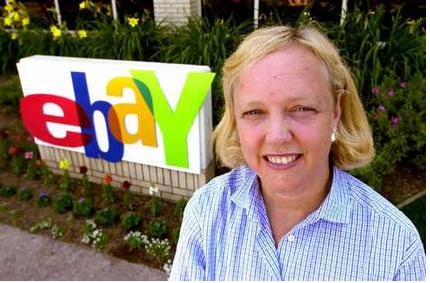
Meg is proud of her success at EBay. I wonder if she’s proud of shoving one of her employees. I know, I know — Meg was a tough-love employer who demanded the best and would tolerate nothing less. She relishes the reputation that, as the NY Times says, she


was known as a demanding leader who did not hesitate to express displeasure with employees who failed to live up to her standards.


Guess that’s what we want up in Sacramento, right? Someone tough enough to take on the special interests.


Except that in this case, she was tough enough, if the Times account is accurate, to bat around someone who worked for her. As some other tough folks have learned in the past, physical abuse of subordinates doesn’t tend to help your reputation.


Calitics asks:


Will she shove the Speaker of the Assembly when she doesn’t get her way? Verbally abuse her Director of Finance when it becomes clear her “fire everybody” strategy only worsens the budget deficit? It certainly does not speak well to Whitman’s judgement or her personality, which appears to be that of a pampered CEO who cannot deal with the rest of society as equals, but instead treats them like indentured servants.


So now we’ve got a GOP senate candidate who makes fun of her opponent’s hair and a GOP guv candidate who knocks around the help. Hell of a ticket.

SFBG Radio: Johnny and Tim on the stink of desperation

3

Today, Johnny and Tim discuss the World Cup, Carly Fiornia, Afghanistan and the stink of desperation. You can listen after the jump.


sfbgradio6/14/2010 by sfbgradio

Leno bill would limit PG&E political spending

5

State Senator Mark Leno is introducing a bill that could stop Pacific Gas and Electric Company from spending ratepayer money on political campaigns.


The bill, which doesn’t yet have a number, would put a serious crimp in the private utility’s ability to launch another effort like Prop. 16 — the $50 million campaign to block public power in California.


The bill wouldn’t stop PG&E from spending money on politics — that might fly in the face of the Supreme Court’s rulings on corporations and campaign finance. It just says that no ratepayer money can be spent — and since PG&E gets the vast majority of its money from ratepayers, the measure would at the very least significantly limit the company’s political efforts.


And since PG&E is a regulated utility, the state of California has every right to control how much money PG&E collects from its customers — and where that money goes.


Not only would the bill ban PG&E from running its own Prop. 16-style statewide campaign, it could block the company from spending tens of millions of dollars to oppose public-power efforts. The bill states that any gas and electric utility with more than three million customers in California (and there’s only one such company)


“shall not spend funds received from ratepayers as authorized revenues on political and public affairs related to state or local governments. For purposes of this section, political and public affairs spending includes any activities involving, directly or indirectly, advocacy of the election or defeat of political candidates and of the adoption or defeat of ballot measures, through the actions of the corporation or through a third party.”


A few years ago, a bill like this would have had little chance in the state Legislature, where PG&E spent lavishly and was relatively popular. But under CEO Peter Darbee, the company has done nothing but piss off legislators. Not one state lawmaker endorsed Prop. 16. It’s safe to say that today, PG&E doesn’t have many friends.


More details to come as I get them.


UPDATE: Here’s Leno’s comment, from a press release I just got:


“PG&E launched a dangerous and misleading political campaign – with ratepayer funds – that had only one goal, to preserve the corporation’s monopoly. The state’s largest electrical and gas company should not be able to use ratepayer-generated profits to write special rules into the state constitution protecting it from competition. This measure ensures that local communities across the state have the ability to launch their own municipal power agencies, which will in turn encourage competition and help keep our rates low.”


UPDATE TWO: I just spoke with Leno, and he noted that the bill has a decent chance, since PG&E at this point “would be hard pressed” to find any friends in Sacramento. “The bill is to protect ratepayers,” Leno said. “It requires the California Public Utilities Commission, when it hears PG&E’s rate cases, to disallow any spending on political campaigns.”


Court hears Weekly’s appeal in Guardian suit

12


The California Court of Appeal heard oral arguments on the Bay Guardian’s lawsuit against SF Weekly and its chain parent June 11, and the discussion focused almost entirely on the Weekly’s assertion that it’s too easy to prove predatory pricing under California’s Unfair Practices Act.


Justices James J. Marchiano, Sandra L. Margulies and Robert L. Dondero peppered the Weekly’s lawyer, Dennis Maio, with questions as he attempted to argue that state law needed to be brought in line with federal standards.


The Unfair Practices Act bars companies from selling products below costs with the aim of harming a competitor. The Guardian sued the Weekly and its parent company, New Times, under that statute, claiming that the chain had deliberately sold ads below cost with the aim of driving a smaller, locally owned competitor out of business.


In March 2008, a San Francisco jury found in favor of the Guardian and awarded more than $6 million in damages. Judge Marla Miller trebled some of the damages, and with attorney’s fees and interest, the judgment is now close to $23 million.


Maio argued that the intent of the law was to protect consumers, and that below-cost sales were often beneficial. “Low prices are good,” he said. “Below-cost prices are even better, because they’re cheaper.” He compared the Village Voice Media chain, which owns the Weekly, to Costco, suggesting that the justices might shop there for better prices.


The thrust of Maio’s claim — and the heart of the Weekly’s appeal — is the argument that the Weekly shouldn’t have been held liable for predatory pricing unless the Guardian could prove that the chain would be able to recoup its losses after its competitor was gone. The federal courts have adopted that approach — and the result has been the effective end of predatory pricing suits in federal court.


But there’s nothing in California law that requires so-called “recoupment” proof, and the justices focused on that in their questions to Maio.


Maio argued that antitrust law was all about protecting consumers, and that the only danger of below-cost sales is if they lead to higher prices later, when a monopoly company has driven away competitors. “Causing a competitor to lose money isn’t a violation,” he said. “The purpose of the statute is to protect the public.”


Under questioning, Milo admitted that there’s no mention of recoupment in the Unfair Practices Act, and no discussion of it in the legislative history.


In a somewhat bizarre diversion, Maio tried to argue that the UPA had anti-semitic roots, because it could have been devised to hurt Jewish-owned chain stores. Then he compared below-cost pricing to pro-bono legal work — although it’s hard to make any rational argument that the SF Weekly owners were attempting to do a charitable act by putting the Guardian out of business.


Ralph Alldredge argued the Guardian’s case. “This is,” he said, “a plain and simple matter of statutory interpretation.


“This is black-letter law,” Alldredge continued. “You can’t take the preamble to a law and use it to add things that aren’t there — especially to add things that are completely inconsistent with the terms of the statute.”


When Dondero asked why there are so few cases under the California Unfair Practices Act, Alldredge explained that until 1987, federal antitrust law took the same approach as the state, so most cases went to federal court. The federal judges added the recoupment standard — “and essentially closed the door to these cases,” Alldredge said.


“And that’s what they’re asking this court to do.”


Alldredge pointed to a number of cases where state antitrust law goes beyond federal law. He also said that the standard or proving below-cost sales and intent to harm a competitor has been tested in other cases, “and the Unfair Practices Act has sailed through all those tests.”


Maio then tried to bring up the issue of whether New Times, now part of Village Voice Media, could be held liable for the actions of the Weekly, but the justices cut him off, saying they’d already read all the relevant briefs and testimony.


A ruling is expected in several weeks.


PS: Andy Van De Voorde, whose coverage of the trial has been nasty, bitter and personal, took a remarkably muted approach to the Appeals Court hearing. The Chron’s Bob Egelko turned in a typically clean, accurate account of the proceedings.


SFBG Radio: Johnny and Tim on American Tories

1

Today, Johnny and Tim talk about why so many of the internet trolls — and conservatives in general — are writing and acting against their own interests. You can listen after the break.

sfbgradio6/11/2010 by sfbgradio

Bread and Circuses: Mexico and the World Cup

0

MEXICO CITY (June 11th) — The Caliente Sports Book down the street is buzzing with betters studying dog and horse races, Major League Baseball, even golf, on the multiple screens. Of particular interest are those channels running wrap-ups of the afternoon match between Mexico and 2006 World Cup champion Italy, from which the national team emerged victorious in a final prelim before this year’s edition of the Copa del Mundo gets underway later this week.


Italy, it may be remembered, won the much-coveted cup four years ago on penalty kicks after France was reduced to playing with ten men on the field when super-star Zenedine Zidane was disqualified for ferociously head-butting a rival who purportedly called his mother and sister “whores.” Beating Italy was a decided plus for Mexico’s downtrodden spirits as the Mundiales approach.


One group of aficionados was not much interested in Mexico’s fortunes in the upcoming fandango in South Africa. Instead, they gathered around a big screen in one corner of the betting parlor cheering on the Los Angeles Lakers in a National Basketball Association Finals match-up with the Boston Celtics. “Forget about football,” sneered “El Guerro” Gonzalez, a regular, “this is where the real money gets made.” Because pro basketball games routinely rack up hundred-point scores, betters have multiple opportunities to wager on winners and losers, over and under point spreads, total points in a quarter, and whether Kobe Bryant will hit the next three-pointer.


But the basketball euphoria will dissipate post haste as the World Cup takes center stage. Although the NBA’s despotic commissioner David Stern promotes his product as the world game, basketball hardly holds a candle to what the U.S. provincially terms “soccer” and the rest of the Planet Earth calls football.


Indeed, the “Copa del Mundo” (“Cup of the World”) will soon sweep every other sporting event from the screens — let alone political scandal, of which there is plenty in this distant neighbor nation, including the upcoming Super Sunday gubernatorial elections July 4th, and even droughts, floods, and other natural disasters. The interminable drug war that has taken 23,000 lives in the past three years will move to the backburner. Ditto an economy that is tailspinning out of control — a million workers lost their jobs in the first three months of this year alone despite President Felipe Calderon’s rosy claims of “recovery.”


Speculation about the disappearance of one of the nation’s most powerful politicians will fade from the primetime news, and the first year anniversary of the incineration of 49 babies in a government-run day care center owned in part by the first lady’s cousin will not even be noticed. The military takeover of the great Cananea copper mine and the dissolution of the miners union, is not news. New revolutions — this is, after all, the hundredth year anniversary of our landmark revolution — could rock the land, but for the next month, Mexico will live and die on what happens to the national team in South Africa.
“In football, we find our revenge against the adversaries of our lives,” philosophizes sociologist Jose Maria Candia in a recent Contralinea magazine interview, “if it goes badly at work, in the economy, politics, the project of the nation, when 11 boys put on the green jersey and do well in an international tournament, we feel vindicated by life.”
With 32 national teams from all five continents in the competition for the World Cup, the fate of the “seleccion” will have palpable impact on domestic tranquility. The political outfall of the Mundiales is unpredictable. Pumped up on toxic nationalism and xenophobia, football is a blood sport in southern climes. Honduras and El Salvador once fought a full-fledged war over soccer.


If the national team wins or acquits itself well, success will strengthen the government in charge no matter how poorly it has served the country. Likewise, a shoddy performance can topple rulers. In Mexico, increasingly unpopular president Felipe Calderon, who won high office in fraud-marred elections three years ago, is banking on the national selection’s triumphs in the opening round to invigorate his deteriorating image. Calderon’s bet is hardly a sure thing.


Mexico, Number 17 on the Federation of World Football Federation’s rankings (now the Coca Cola FIFA rankings), plays host South Africa in the inaugural match of the tournament, and “His Excellency” Felipe Calderon (dixit South African president Jacob Zuma) will be a guest of honor. The “Bafana Bafana” (“Boys Boys”) as the locals are worshipped, have won their last four prelim matches and in the 2009 Confederation Cup took Spain, which some football gurus fix as the best team in the world, into overtime. Their fanatics’ incessantly droning “vuvazelas” or plastic trumpets are said to drive opponents mad.


On the other hand, should Mexico beat sentimental favorite South Africa, it will make Calderon few friends on the African continent — five other African teams are in the draw, with war-torn Cote d’Ivoire the cream of the crop.


Aside from the Bafana Bafana, France and Uruguay are the real class of Mexico’s four-team group — while the French have appeared lackadaisical of late, whipping the South Americans is improbable. Anything less than reaching the quarterfinals will not rehabilitate Calderon’s popularity.


Mexico has a young team that fluctuates between indifference and playing out of control. It is anchored by seven Mexican players from the European and Turkish leagues, and the wily but slow-footed veteran Cuauhtemoc Blanco. Burned repeatedly by the national team’s poor performances in the Mundiales, many fans such as Manuel Garcia, a waiter at the old quarter Mexico City eatery Café La Blanca, consider that only divine intervention can save Mexico — and Calderon — from ignominious elimination.


When and if Mexico wins its matches though, wild celebrations are guaranteed to erupt around the gilded Angel of Independence on the bustling Paseo de Reforma — drunkenness, fisticuffs, and hooliganism are de rigor. Flag-draped caravans of honking cars will jam the boulevards of this conflictive megalopolis. On game days, half the population of Mexico, led by its president, will don green jerseys and play hooky from work and school. Saloons will fill to the brim with fans spilling out into the streets, jostling for a peek at the plasma screens. Masses to insure that God is on Mexico’s side will be pronounced from the altars and saints dressed up in the national colors.


Although football is tantamount to religion in this country where 70% of the population lives in and around the poverty line, only the super rich will have the wherewithal to jet off to Africa. Instead, the underclass will monitor the Mundiales at the “FIFA Fan Fest” on giant screens erected in the great Zocalo plaza from which nearly a hundred hunger-striking members of the Mexican Electricity Workers Union (SME), near death after a month of voluntary starvation, will no doubt be evicted so as not to dampen the fiesta.


Televisa and TV Azteca, Mexico’s two-headed television monopoly, which will transmit the games (the premium package includes 3-D) will have the nation eating out of its hands (and guzzling Corona beer.)  The TV monoliths have leased rights to broadcast the Mundiales from the Swiss-based FIFA, the absolute dictator of the sport for the past 106 years that counts 204 out of 208 football federations worldwide on its roster. FIFA TV revenues are expected to top $167,000,000 for the 2010 World Cup.


This year’s Copa del Mundo is awash with drama. Will the Argentine selection, a perennial favorite, graced by the world’s best player, Leonel “the Flea” Messi, blow up under their sometimes psychotic coach Diego Maradona, himself a Mundiales’ immortal? Will the first round match between England and the U.S. (14th on the FIFA listings with a world-class star, Landon Donovan, to prove it) invoke the star-crossed Yanqui upset of the Brits 60 years ago in 1950 in Brazil, the only time these two teams have ever met in the World Cup?


If the U.S. gets by England, a match between Mexico and its hated gringo rival would up the drama quotient here considerably. A face-off between South Korea and North Korea, both of which are in the draw albeit in separate groups, could lead to nuclear confrontation.


How will tiny, bruised Honduras, which played through a coup d’etat to qualify, fare against the big guns? What kind of karmic reward is in store for France, which slimed its way into the World Cup with mega-star Thierry Henry’s illegal hand-slap goal against the Irish? Will Germany be dispirited by the suicide of its troubled veteran goalie (is this a Wim Wenders’ film)? Will five-time champ Brazil, which is hosting both the 2014 World Cup and the 2016 Olympics, be so overloaded with hubris that the selection will forget to play football?


But unquestionably the drama of dramas is focused on host South Africa, the land of blood and gold, Nelson Mandela, Steve Biko, Joe Slovo, and the last great struggle for liberation from colonialism.


South Africa, an unlikely site for the World Cup, was promised the games by Swiss football impresario Joseph Batter during his 1998 campaign to become the czar of the FIFA. Blatter, who was said to have been backed by Middle East oil money, needed African votes to put him over the top. Although Nigeria and Morocco were also proposed to host the 2010 Cup, South Africa, the continent’s fastest-growing economy, was chosen both as a tribute to African football and to Nelson Mandela. Blatter even flew the frail, aging apostle of African liberation, to London to ballyhoo the designation.
Whether the beloved Mandiba will be well enough to attend the inauguration is the drama within the drama.


In his youth, Nelson Mandela was a keen amateur boxer and enthusiasm for sports has colored his life. Football is indeed the national sport of black South Africans, 75% of the population. During Mandela’s 28 years of imprisonment on Robbin Island for the crime of defying apartheid, his fellow prisoners and comrades in the African National Congress (ANC), played football incessantly, taping up rags into balls, and booting them up and down the narrow prison corridors. But Madiba was held in isolation and could never participate.


Nelson Mandela’s vision for the new South Africa encompassed sports as a path to racial reconciliation. If football was a black sport in South Africa, rugby is an Afrikaner obsession — the Springboks were the maximum icon of the apartheid regime. As president, Mandela brought the 1995 World Rugby Cup to Johannesburg, a story fictionalized in the film “Invictus,” and won the hearts and minds of his former persecutors. Now the World Cup 2010 is slated to project South Africa before the world as a dynamic, multi-racial powerhouse.


The truth is always more diffuse. Jacob Zuma, the country’s very corruptible third president, and his predecessors have sunk between $3.7 and $6 billion USD in infrastructure to burnish their images in a nation where 43% of South Africa’s 45.000.000 peoples live on $2 or less a day. The gleaming $300,000,000 Soccer City Stadium where the July 11th finals will be staged, abuts Soweto, the festering high-crime enclave of 3,000,000 mostly threadbare citizens, 30% of whom suffer from AIDS, according to the World Health Organization. Gangs of orphaned children rule the street.


Similarly, the stadium at Port Elizabeth on Nelson Mandela Bay, which came in at $287,000,000, was built over a slum from which hundreds were evicted. A school complex was demolished to make way for the Neusprot venue (only $140,000,000) — 13 such stadiums have risen from the dust amidst a storm of charges of kickbacks, bribery, and favoritism.
If recent history is any hint, the new stadiums will quickly become certifiable white elephants. Even Beijing’s much-praised “Birds’ Nest” coliseum designed for the 2008 Olympics is reportedly tenantless, and the Greek economy just collapsed in part thanks to  the burden of debt incurred for infrastructure for its Olympic Games. 


With a population scuffling just to feed itself, filling all this dazzling stadia with paying customers is problematic. Even the $18 cheap seats — a week’s wages in the cities and a month’s income in some rural areas — are mostly out of reach in a country where 50% of the work force is out of work. To deflect a grave social crisis in the making, the FIFA is offering 120,000 free admissions, about 2,200 seats for each of the World Cup’s 62 contests. Riots have already occurred at “friendly” preliminary games.


Ever since the bad old days of ancient Rome, bread and circuses have been a powerful formula for social control. In South Africa, as in Mexico, the World Cup is designed to make the discontented forget their discontent. For the next month, the violence, corruption, and class and race hatreds that dominate daily life in Mexico, South Africa, and the rest of what used to be called the third world will disappear beneath the social surface.


Although conflict is my bread and butter, I’m not going to miss the 2010 Mundiales for the world. 


John Ross is at home in the maw of the Monstruo watching the World Cup. You can complain to him at johnross@igc.org


Welcome to Peter Darbee’s world

“The only thing worse than a thug is an ineffective thug,” a source, who has closely tracked Pacific Gas & Electric Co.’s activities for years, told us yesterday. “And that’s what [PG&E CEO] Peter Darbee is revealing himself to be.”

That’s pretty harsh, and isn’t just some hot air blown off by a disgruntled employee or a customer angry about a power shutoff. PG&E’s problem now is that since Darbee set out on the political adventure known as Proposition 16, this kind of characterization isn’t so far off from the sentiments publicly expressed by a number of powerful figures that the company must continue to work with.

California Public Utilities Commission President Michael Peevey wrote in an op-ed in the San Jose Mercury News that, “Pure and simple, Proposition 16 is a clever, brazen, buzzword-driven effort by one company to manipulate the California Constitution to protect its current monopoly.” Peevey isn’t exactly known as a PG&E hater –- green-power advocates have complained to the Guardian in the past that they think he’s too willing to honor the company’s requests. But Prop 16 clearly irked Peevey, who presides over the commission that decides whether PG&E will be allowed to raise rates.

Half a dozen state senators, including Senate pro tem Darrell Steinberg, rebuked PG&E over Prop 16, writing in a formal letter in December that it “calls into question your company’s integrity.”

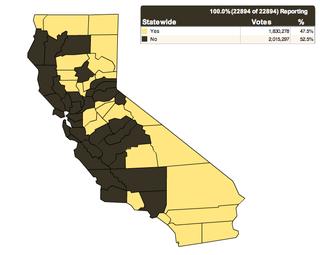
On June 9, the day after voters shot down Prop 16, PG&E shares dropped 2.2 percent — the greatest decline of electricity utilities in the S&P 500 — possibly signaling a fluctuation in shareholder confidence. The Los Angeles Times ran a story pointing out (as the Guardian did) that the majority of counties that voted “no” on Prop 16 overlap with PG&E’s service territory, suggesting that the initiative dubbed by opponents as “PG&E’s power grab” was roundly rejected by its own customers.

Yet amid all the signs that PG&E had gone too far, despite all the indications that the utility had alienated regulators and political allies and royally pissed off its customers to boot, CEO Peter Darbee was patting himself on the back. While others were beginning to see Darbee as an unaccountable power-monger, Darbee evidently regarded himself as a fearless, courageous leader.

In a memo obtained by the Guardian that the CEO sent out to PG&E employees the day after Prop 16 was defeated, Darbee compares PG&E’s $46 million, failed quest to alter the state constitution through Prop 16 to the company’s decision to withdraw from the U.S. Chamber of Commerce. The utility won the respect of environmentalists when it dumped the national business organization last fall, denouncing its do-nothing approach to climate change.

Darbee suggests that PG&E’s willingness to take a stand in both instances is evidence of strong corporate leadership, but it’s an odd comparison to make. As Steinberg and other senators pointed out in their December letter, Prop 16 would’ve served to limit renewable energy development, not facilitate it. “It is unacceptable for a company that is falling behind in meeting state adopted goals for clean energy to impede the efforts of others who would attain those goals through innovative means,” Steinberg wrote.

Without further ado, here’s what Darbee had to say after Prop 16 went down. The essay, which was submitted as an opinion piece to the San Francisco Chronicle, is prefaced with a note to employees.

——————————————————————————————–
From: A Message From Peter Darbee
Sent: Wednesday, June 09, 2010 2:18 PM
To: All PG&E Mail Recipients; All PGE Corp Employees
Subject: After Election Day, A Reflection On Leadership

To All Employees:

As we look forward after the culmination of a hard campaign on Proposition 16, I wanted to share with you a short opinion essay that we submitted today to the San Francisco Chronicle. It addresses head on some of the questions we have all seen about PG&E’s stance on tough issues-from Proposition 16 to climate change, or any number of other examples many of us can no doubt recall. It makes clear that, in each case, our focus is on leadership, even-or maybe especially-when it requires tremendous courage.

I believe passionately that this is one of the aspects of our character that sets PG&E apart from many other companies. That’s been true throughout our history, and it’s even more true today.

As is always the case, the paper may or may not choose to print this piece. We hope they will. It’s an important and timely message for our customers. But it’s just as important and timely for all of us as employees. And, whether it appears in print or not, it’s a message we can all take heart in and carry forward proudly to others.

________________________________

The Price of Leadership

By Peter Darbee, Chairman, CEO and President, PG&E Corporation

Prime Minister Tony Blair said a few years ago, “I do not seek unpopularity as a badge of honour, but sometimes it is the price of leadership. And the cost of conviction.”

I was reminded of that observation this spring, as Pacific Gas and Electric Company came under widespread criticism for its support of Proposition 16, a statewide initiative to give people the right to vote on proposals to create risky new public agencies to provide electric power.

Many of those who criticized our support of Proposition 16 have long applauded our leadership at the state and national level on environmental issues and as a clean-energy provider. At the state level, PG&E helped champion passage of AB32, the Global Warming Solutions Act of 2006.

PG&E also supported California’s aggressive vehicle emissions standards, opposing efforts by a national business organization to overturn them.

At the national level, we were instrumental in forging an historic alliance of major utilities, other large businesses, national environmental groups and labor unions to support comprehensive and effective clean-energy and climate change legislation in Congress. The work of the U.S. Climate Action Partnership, of which PG&E has been a major contributor, is widely credited with inspiring major congressional initiatives on this vital issue.

While PG&E has been frequently honored for its environmental performance and commitment, including Newsweek magazine’s ranking as the country’s greenest utility in 2009, our environmental leadership has aroused controversy as well.

Last year, in a widely discussed move, PG&E withdrew its membership in a national business organization over fundamental differences on the need for climate change legislation. While a number of other major businesses followed our lead, others questioned why we broke ranks to support actions that could increase energy costs. We have explained, without apology, the science behind our stand and our careful choice of policies to utilize market forces to minimize costs.

Some of our longtime supporters, who decried Proposition 16, believe the PG&E they once admired lost its way somewhere along the line. I would tell them that their disagreement with us-which we respect-is the price of our leadership on important issues of the day. By staking out bold positions, we of course invite controversy. But the alternative is to be cowed by fear of criticism into ducking our leadership opportunities and responsibilities. Surely our society needs more leadership, not less.

After a lively debate, the voters have now spoken on Proposition 16 and we respect the outcome. We hope our critics will equally respect our willingness to participate in the system and engage on the important issues of the day. Through mutual engagement and mutual dialog, we can improve our company, our communities and our country.

SEIU wants a hearing on unseemly Ethics ouster

0

A day before Oliver Luby’s last day at the Ethics Commission, his union has called for a hearing into why his boss removed a special condition from the job that allowed him to be bumped and whether it was retaliation for Luby’s history of blowing the whistle on problems within the troubled agency.

“Special conditions are rare, specific to the position not the incumbent, and are put into place to promote the policy goal that specialists who are qualified serve in positions that require specific talents,” Gabrial Haaland of SEIU Local 1021 wrote to members of the Ethics Commission and Board of Supervisors. “Removing a special condition is more unusual than placing one on in the first place.  It is likely that an inexperienced Fines Officer would not be able to accurately interpret the necessary and complicated web of statute, local code, case law and FPPC opinions.”

Ethics Commission Director John St. Croix has refused to comment of the controversy, citing the confidentiality associated with personnel matters, but Haaland requested the Board of Supervisors Budget and Finance Committee hold a hearing on it as part their review of the commission’s budget. And Haaland told the Guardian that his union generally doesn’t like special conditions to be placed on positions, but he’s concerned about St. Croix’s motives in removing it: “It seems like retaliation based on his past actions.”

Meanwhile, Luby’s last day is Friday (6/11) and he will gather with friends and supporters after work at Temple on Polk Street. Luby told us he appreciates SEIU’s efforts and supports the idea of a hearing into what happened, but he said he has accepted his fate: “I’m still a goner.”

Death and (estate) taxes

14

There’s an interesting story in the NY Times about a Texas billionaire whose entire estate will be passed along tax-free, thanks to a rather silly act of Congress. It’s obviously a bit of a scandal that a guy worth $9 billion will pay no estate tax at all, but the really interesting tidbit was deep in the story:


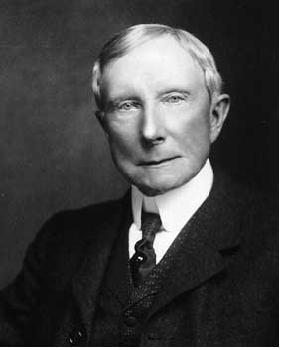
The United States enacted an estate tax in 1916, and when John D. Rockefeller, America’s first billionaire, died in 1937, his estate paid 70 percent. Since then, the rates have fluctuated, but this is the first time the tax has been repealed altogether.


John D. Rockefeller’s estate was taxed at 70 percent.


Of course, since the guy died with a couple of billion to his name, his kids had to make do with a paltry few hundred million — and oh, how it crimped their lifestyles. I grew up about five miles from the Rockefeller estate in Pocantico Hills, New York, and I can tell you: The family owned 7,000 acres of pristine, beautiful land only 30 miles north of New York City. Chauffers drove the brothers, Nelson and David, to their offices every day. Security guards armed with salt guns patrolled the property to keep kids like me out. Nelson managed to get elected governor of New York and became vice-president of the United States (before dying of a heart attack while having sex with his secretary). David was the chairman of Chase Manhattan Bank. The brothers donated an original Chagall window to their tiny church in the nearby town, and bought their wives brand new Rolls Royces every year.


Their kids have managed to survive on the tiny remants of that fortune, too. And their kids’ kids.


The point is, the 70 percent estate tax didn’t wipe out John D. Rockefeller’s wealth or harm his family’s future. There was plenty left. That’s the thing to remember when we talk about taxing the rich: They always wind up with plenty left.

Hyatt workers completing three-day strike

1

By Brittany Baguio
About 400 hotel workers are wrapping up a three-day strike at the Hyatt Regency that began Tuesday morning to protest increasing workloads and efforts to increase their health care costs. This was the fifth strike UNITE-HERE Local 2, a union comprised of hotel workers in San Francisco and San Mateo Counties, has called during nearly a year of negotiations since the last contract expired for 9,000 San Francisco hotel employees.

UNITE-HERE Local 2 initiated the walkout as a way of putting pressure on Hyatt management to offer a fair contract. Although the economy is still lagging, the hospitality industry has remained profitable. Union leaders say that with the cost of living going up, low income wages have made it harder to afford expenses.

The Hyatt Regency released a statement on Tuesday, stating, “Today’s action by Local 2 Leadership is a continuation of the harm they are committing to our associates, the tourism industry, and the city of San Francisco. It has been six months since Local 2 has agreed to return to negotiations. The union should refrain from activities aimed at jeopardizing business in San Francisco during this unprecedented economic downturn and instead expend this energy at the bargaining table, where it belongs.”

Yet union leaders blame management for the continuing labor impasse and they say the Hyatt and other national hotel chains have used the faltering economy as an excuse to justify increasing workloads on hotel employees. According to PKF Hospitality Research, revenue is estimated to grow to 3 percent for the next six months, 12 percent in 2011, and 14 percent in 2012. According to UNITE-HERE financial reports, when the Hyatt became a publicly traded corporation on November 2009, Hyatt owners netted more than $1 billion.

Unite-Here Local 2 representative Riddhi Mehta rejected Hyatt’s claim that the city of San Francisco was hurting in any way. “We’re not launching a boycott of San Francisco, but we’re asking folks to boycott eight specific hotels,” Mehta told the Guardian, “We’ve moved $7 million out of boycotted hotels and the majority of the money has stayed in San Francisco.”
The Grand Hyatt, Westin St. Francis, Palace Hotel, W Hotel, Hilton Union Square, and Hyatt Regency are all on the boycott list. Le Meridien Hotel and Hyatt Fisherman’s Wharf are also on Local 2’s boycott list, but for a different reason. Workers from these two hotels have been fighting for 2 years to obtain the right to choose whether or not to form a union without any intimidation from management.

The SF strike was one of several used as part of UNITE-HERE’s strategy to create a national campaign against Hyatt. Other notable strikes included one that was organized by Local 2 workers from the Grand Hyatt on Union Square and took place the same day Hyatt became a publicly-traded company.

On May 26, 400 hotel workers from the Hyatt Regency in Chicago protested against increasing workloads. Tuesday’s strike occurred a day before Hyatt’s first shareholder meeting in Chicago that was held on Wednesday. The meeting was exclusive to shareholders and banned all media outlets from attending.

Hotel workers and community supporters protested on Wednesday in the cities of San Francisco, Chicago, Vancouver, Honolulu, and Los Angeles. In solidarity, these workers hoped to persuade Hyatt majority owners to consider hospitality working conditions.

Mehta said the union’s experience in dealing with hotel management from 2004 to 2006, after the last contract impasse, has taught workers that they need to keep the pressure on in order to get a fair contract. “We’re happy to go back to the negotiating table but it’s not worth the time when Hyatt is saying that they don’t have the money. If you look at their financial statements, they have $1.3 billion in cash, but they’re spending money renovating hotels and improving their portfolios.” [Editor’s Note: This paragraph was changed from it original version to correct information].
Hyatt Regency workers from the walkout plan to go back to work on Friday.

Carly learns about open mikes

0

Carly Fiorina just learned a key lesson in modern politics: Be sure the mike is off when you’re saying something stupid.

In this case, it’s no big deal — she wonders why Meg Whitman would go on the Hannity show (“he’s not an easy interview”) — as if what GOP candidates want now is someone who will lob softballs. She jokes about her staffers “wolfing down cheesburgers.” And she makes a really silly comment about Barbara Boxer’s hair being “sooo yesterday” — suggesting that fashion ought to be an issue in the race for United States Senate.

No real harm done — except to show that she’s not really ready for prime time.

Goodbye, 49ers — and do we really care?

4

Tony Winnicker, the mayor’s press secretary, was chatting with a group of folks at the Newsom victory party on election night, and Steven T. Jones, the Guardian city editor, asked how the stadium vote was going down in Santa Clara. “Oh, it’s winning, but it’s never going to get built,” Winnicker said. “Cities building stadiums is an economic loser.”


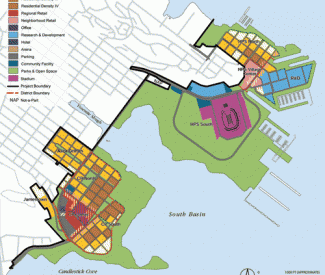
He’s right, of course — although it’s an odd comment coming from a press staffer for a mayor who is still dead set on building a stadium for the 49ers at Candlestick Point. I agree with Randy Shaw: The loss of the 49ers would be a good thing for San Francisco — particularly if the alternative is to pour public money into another expensive boondoggle like Candlestick Park.


Here’s the thing: You can argue that urban baseball stadiums bring economic benefits to the community. You can argue that the (mostly) privately financed Giants stadium has spruced up that neighborhood, spurred the creation of new bars and restaurants, brought in new tax dollars and created jobs. (It also displaced some blue-collar jobs and some poor people, but that’s a different argument.)


In fact, with limited parking and good transit access, the Giants ballpark encourages foot traffic, which encourages people to patronize local businesses before and after the game.


Football stadiums are traditionally very different. Football fans are tailgaters — they drive cars, bring their food and drinks to the parking lot, set up grills and picnic tables, go to the game — and then go right home. Almost nobody who attends a 49ers game at Candlestick stays around in the neighborhood afterward; the people who live nearby get virtually zero economic benefits.


Even as part of a shiny new development package, that won’t change much. The plans for a 49ers stadium in the new redevelopment area include a new roadway and bridge to make it easier to drive in and out, and a parking garage with room for tailgating; the fan base is largely from the Peninsula anyway. And in nearly every city that’s put up public money for a football stadium, the taxpayers have gotten screwed.


I love football, I love the 49ers, but I never go to the games, anyway — way too expensive. The TV feed from Santa Clara will be just fine.


Newsom’s fiscal conservatism undermines his agenda

15

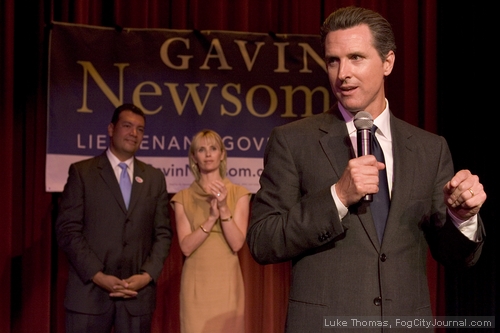
Gavin Newsom’s nomination for lieutenant governor places many San Franciscans in an uncomfortable position, one that was illustrated well by the victory speech that he gave last night just as our story our on his latest budget – in which he proudly rejected taxes in favor of deep spending cuts and future budget deficits — was coming off the presses.

Even though most San Francisco progressives don’t like our fiscally conservative mayor, few of us would rather vote for his Republican challenger, Abel Maldonado, despite the fact that this moderate Latino is actually fairly close to Newsom ideologically. “We don’t want to underestimate the challenge we have. There’s never been a moderate Latino on the statewide ballot,” Newsom pollster Ben Tulchin told me last night.

SF Labor Council President Tim Paulson was at the Newsom event gritting his teeth as he talked about the opportunity progressives now have to work with “a mayor of San Francisco we have issues with,” noting that, “What I find interesting in the easy win for Newsom is how there is going to be a real campaign around this man. It could establish a narrative for what California is about.”

And he’s right, but the danger is if Newsom sticks with his inflexible and longstanding “no new taxes” stance then the narrative could be that neither major political party’s top nominees are willing to tap millionaires, oil companies, and other entities that can afford it in order to fund education, health care, and the development of a green economy, which Newsom said are his top priorities. That and “jobs,” by which he means only private sector jobs, based on his past statements and actions and current failure to support new tax measures.

But Newsom doesn’t seem to see the glaring contradiction in his political philosophy, which he illustrated as he told a story about the potential to achieve strong economic growth while aggressively pursuing solutions to global warming and other environmental challenges, which he and progressives both seem to believe are not just possible, but “the opportunity of a lifetime.”

Newsom noted that the only four wealthy countries that signed the Kyoto Protocols and met their greenhouse gas reduction goals – Sweden, Denmark, United Kingdom, and Germany – have similar economic strategies. “All four of these countries had three things in common vis-a-vis the United States: Lower unemployment, higher growth, and lower income disparities,” he said.

Yet Newsom left out another key commonality that was even more central to their success, and big reason for two of Newsom’s three items: All have far higher tax rates than the U.S. and a more vibrant, respected, and well-funded public sector that was able to guide that economic transformation and ensure a smart, equitable distribution of the country’s wealth – something Newsom has been overtly hostile to as mayor and while campaigning for statewide office.

Nonetheless, he continued, “What’s interesting about these four countries is they dramatically shifted their framework in terms of economic growth and economic development towards a cleaner and greener energy future and they were rewarded with higher growth and lower unemployment. I think that’s suggestive, in the context of this debate.”

So do I, suggestive of the need for Newsom (and Jerry Brown) to finally realize it’s going to take money and a rejuvenated public sector to meet his stated goals for education, health care, and the environment. In San Francisco, his reluctance to challenge the Chamber of Commerce fallacy that taxes kill growth has left a legacy of dangerously diminished social services and increasing budget deficits running indefinitely into the future.

But the four countries that Newsom claims to admire don’t think that way. They don’t boast of cutting social services while proposing even more business tax cuts, and they don’t say things like, “It’ll take an entrepreneurial look at solving problems in this state.” He’s sounds like Meg Whitman and the Republicans.

What we need is the other Gavin Newsom, the one who last night also said, “Now is the time for serious problem solving in California….It is a time for California to fundamentally change.”

But first, Mr. Mayor, you’re going to need to embrace a few fundamental changes of your own.


The Brown/Whitman debates

7

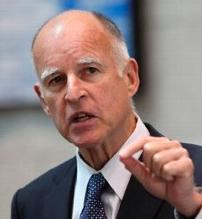
Jerry Brown’s the official frontrunner now, after Meg Whitman endured Steve Poizner’s assault and saw her positives knocked way back. And typically the frontrunner in a campaign tries to avoid direct debates; they can’t help and, with a mistake or two, they can wind up hurting.


But Jerry being Jerry, he’s already challenging Whitman to a series of ten debates, and Whitman is already ducking. That’s because Whitman wants this entire campaign to be about TV ads — the only area in which she has a clear, indisputable advantage.


Brown’s a little unpredictable in debates. He’s smart and can be charming and is certainly experienced — but he can also veer off on tangents and make some remarkable statements, not all of which are good sound bites. Whitman would be carefully, perfectly scripted. But in the end, it would force her to deal directly with journalists and her opponent — and she doesn’t want to do that.


What Whitman plans to do is start right away, tomorrow, airing a blizzard of ads attacking Brown — as too liberal, too flakey, too inconsistent — whatever she can get away with. She’s been knocked down in the polls, and now she wants to knock him down, too.


She can’t get too far with ads promoting herself — California has seen those ads, over and over, and people are getting sick of them. We know her line; she’s gotten about all the positive impressions she’s ever going to get. And she’s not breaking 50 percent in the polling.


The only way she can win is to tarnish Brown — and in the end, he’s going to have to swing back and attack her. It’s going to be a long, ugly summer.


Passionate progressive people prevail

3

At risk of being overly alliterative, this primary election was about the power of progressive principles pushed by passionate people, as several politicos told me last night. That was evident in the success of the progressive slate for the Democratic County Central Committee and in the defeat of Propositions 16 and 17 despite about $70 million in corporate spending.

Money used to define the debates in San Francisco and throughout California, but the dominant narratives are now being written by the coalition of tenants, environmentalists, workers, social justice advocates, and others who backed the Bay Guardian’s slate of DCCC candidates, which took 18 of the 24 seats on a body that makes policy and funding decisions for the local Democratic Party.

“This time, it was the coalition that really made the difference,” DCCC winner Michael Bornstein told me last night. “Frankly, our people worked harder.”

Board of Supervisor President David Chiu agreed, telling me, “For the Central Committee, the message is people power wins.”

Despite the post-election punditry by the Chron’s CW Nevius that “moderates” just didn’t rise up like he had hoped, the most obvious reality is this election demonstrated the power of progressives who embrace San Francisco values – from valuing diversity and the environment to believing in economic justice – and the potential for success when we really stand up for them. One reason why even our would-be exports, Gavin Newsom and Kamala Harris, prevailed last night could be that liberal San Francisco just isn’t widely viewed with the same scorn felt by Nevius and the so-called “moderates,” who want to “take back” the city from progressives.

“In an environment where it was about hundreds of millions of dollars from PG&E and Meg Whitman and Chris Kelly outspending us, we showed that San Francisco is San Francisco and we support San Francisco values,” DCCC chair Aaron Peskin told me last night.

On the statewide level, the bold and expensive deceptions pushed by PG&E and Mercury Insurance were countered only by a handful of super committed activists and a broad cross-section of newspaper editorials, yet because the basically progressive message was so consistent – don’t let powerful corporations fool you into giving up your rights and protections – the Proposition 16 and 17 campaigns turned into epic failures that will feed distrust of corporations.

“California voters proved once again that they can’t be fooled by tens of millions of dollars in deceptive advertising by insurance companies,” Harvey Rosenfield of Consumer Watchdog said today of Prop. 17.

And that failure could feed and empower an ascendant progressive movement. The local Sierra Club’s John Rizzo told me at the DCCC slate party last night that PG&E will be hurt by its overreaching: “The $50 million they spent on this is totally backfiring. Whatever environmental reputation they had has now been totally trashed.”

As it should be. The lesson from last night is that people are starting to get wise to corporate deceptions, and they’re realizing that with hard work and smart coalition-building, the people can still prevail.

SFBG Radio: Johnny and Tim on the election results

1

Today, Johnny and Tim talk about the stunning defeat of Props. 16 and 17, the future of Gavin Newsom and why the governor’s race is Jerry Brown’s to lose. You can listen after the jump.

sfbgradio6/9/2010 by sfbgradio

Sit /lie goes down at the Board of Supervisors

At the June 8 Board of Supervisors meeting, a controversial ordinance that sought to ban sitting or lying down on the sidewalk was voted down 8 to 3, with Sups. Michela Alito-Pier, Sean Elsbernd, and Carmen Chu voting in favor.

Proponents of the law, which was backed by Mayor Gavin Newsom and Police Chief George Gascon, framed it as a measure to promote “civil sidewalks.” Yet opponents believed that the law would be used as a tool against the homeless.

Alioto-Pier said the law was needed to give police a new tool for dealing with people who congregate on the streets and intimidate passersby, saying residents and businesses were bothered by “the presence of dogs or shouting.”

Yet a number of supervisors spoke forcefully against the ordinance, saying it was not an appropriate solution to the problems that Alioto-Pier and other sit/lie backers had raised concerns about.

“I don’t believe that this is the San Francisco way to to approach the challenges that we face,” said District 8 Sup. Bevan Dufty, who goes along with Newsom’s proposals more often than his progressive colleagues and is typically a swing vote on the board. Dufty referenced a former, similar San Francisco law that was ultimately repealed. “That was a law that didn’t want to see gay men congregating at 1 a.m. outside a bar,” he said. He called for a more substantive approach, saying, “We can do better.”

Sup. David Campos also spoke against it. “It doesn’t actually address the issue of civility,” he said. “The case for this legislation simply has not been made.” He noted that day laborers who wait for hours on the sidewalk in hopes of finding work could be targeted when they sit down to take a rest.

Sup. Ross Mirkarimi said he thought greater enforcement of existing laws and community policing would be more effective than the proposed ordinance. Later in the meeting, he proposed a measure to be placed on the November ballot that would require police to adopt a foot beat patrol program and a community policing policy.

The board also voted unanimously in favor of a proposal by Board President David Chiu to create a neighborhood community justice task force “to make recommendations to the Board of Supervisors regarding the creation of restorative and community justice programs.” Chiu pitched the idea as a more meaningful response to hostile behavior on the streets in neighborhoods such as the Haight, where calls for a sit /lie ordinance originated.

“We’re very pleased about what happened today,” said Andy Blue, an activist who organized a citywide campaign opposing sit / lie. But he said it wasn’t over yet, since Newsom has already moved to place the proposal on the ballot. “We know we’re going to face an uphill battle,” he said, “because we’re going to be in a campaign with some very well-funded opponents.” But Blue said he felt confident that once the information got out to San Franciscans, “they’ll vote against it in November.”


Day after 49ers vote, EPA says shipyard dust monitoring OK

1

The day after the 49ers scored “a touchdown with Santa Clara voters“, the U.S. EPA announced it has finalized a report about asbestos dust control issues at the Hunters Point Shipyard.

Maybe the timing is all just a big coincindence. But the U.S. EPA was hopping mad earlier this year when Lennar claimed that “Obama’s EPA” had declared the shipyard dust conditions safe, after viewing a draft copy of the U.S. EPA report.

So, there’s one worldview that says the U.S. EPA delayed release of its final report, so it wouldn’t get mixed up in the city’s hearings on the final EIR for Lennar’s Candlestick/Shipyard development.

Either way, if the 49ers really do leave, that’s more land for Lennar to build houses on.

There’s also the worldview that says the 49ers used the Santa Clara vote to squeeze a better deal out of San Francisco.(And as Lenny Kravitz likes to sing, it ain’t over ’til it’s over.)

But with city officials admitting  that it doesn’t make financial sense to build a new stadium, it’s easy to arrive at the view  that the city used fears that the 49ers would leave to rush approval of the city’s final EIR for the Lennar project, a vast document that could have used more scrutiny and review time.

Anyways, amid  the competing conspiracy theories, it’s worth taking the time to read the report i its entirity. And if you don’t have the time for all that, here is the full text of the cover letter that the US EPA released today:

“Dear Bayview Hunters Point Community and Stakeholders:

EPA has finalized the report entitled, “U.S. EPA’s Final Review of Dust/Naturally Occurring Asbestos Control Measures and Air Monitoring at the Former Hunters Point Naval Shipyard (June 9, 2010).” 

“About the Report:

EPA conducted a technical review of dust mitigation plans and an independent laboratory analyses of data associated with the City and Air District’s efforts to control naturally-occurring asbestos and dust associated with construction activity on Parcel A at the former Hunters Point Naval Shipyard. EPA also evaluated metals and radiation data for both the Parcel A development work and Navy activities on the Shipyard. “

“EPA made independent technical advisory services available to community members to review the data and EPA’s draft report.  EPA held a public meeting for the community to hear comments from the technical expert.  The comments and EPA’s responses are attached to the final report. “

“Naturally-occurring asbestos in dust at construction sites is a widespread concern in California where serpentine soil is common.  EPA’s report finds that best practices for dust monitoring and mitigation are in place at Parcel A and the Hunters Point Shipyard to protect the community by keeping exposures to asbestos, metals and radiation in dust within
acceptable levels.”

This one is for Newsom(e) fans

10

One of the most fun parts about attending District Attorney Kamala Harris’ victory party last night was looking at all the photos on the walls of the Delancey Street Foundation.

And showing cultural blogger Beth Spotwood, one of the funniest writers in town, a photo of our very own Mayor Gavin Newsom with Delancey Street Foundation founder Mimi Silbert, in which the mayor’s name is written as Newsome.

Spotswood, who is a big time fan of Newsom, was delighted by this find. Especially since the photo is displayed close to other photos of the mayor in which his name is correctly spelt (as in the photo of him with Silbert and Tony Blair).

Newsom and Blair aren’t the only luminaries on Silbert’s walls. In fact, the place is a veritable who’s who of the political world, and includes a shot of the late John Kennedy Jr. and his stunningly beautiful wife Carolyn Bessette-Kennedy.

At some point, shortly after Spotswood and I were laughing at the Newsome typo, Silbert showed up in person–and set straight one of the photos, which had somehow gotten cock-eyed on the wall. (I swear we didn’t do it.)

That was around the time I averted my eyes from the wall and turned my attention to the giant TV screen –just as Newsom declared victory in the Lt. Gov’s race. I didn’t hear what he said, but reviewing my pics afterwards, it apparently had something to do with California dreaming.

The NY Times discovers illegal church parking

7

The Bay Citizen-New York Times partnership is already jazzing up the quality of what was a very weak Northern California section in the Times. And now the pair have discovered one of the dirty little secrets of San Francisco Sundays — illegal parking by church-goers who just leave their cars in the middle of the street.


This is one of my favorite crusades, and I’ve been on it for quite a while. The Times/Bay Citizen story tries to sort out what the rules are and why this is allowed to happen. The SF Appeal tried to figure it out, too. But when you talk to the cops on the beat in the Mission, here’s what they’ll tell you: There are no rules. There is no law. The church-goers have no legal right to park in the middle of the damn street. It’s just a tradition that goes back so long that nobody wants to defy it.


And whatever the cops and the MTA say, it’s not a public service for community events. It’s about religious gatherings. If you want to go to a secular gathering — say, a Yoga class — and park in the streets Sunday morning, you get a ticket. In fact, I know somone who tried that; she said a cop on the scene asked where she was going, and she said yoga, and the cop said she couldn’t park there. It’s only “for church services.”


I’m all in favor of closing streets to traffic, but turning them into parking lots — and allowing private institutions to use city property, at no cost, to promote religious events is not only a violation of church and state. It’s wrong.

Everyone hates PG&E

5

Well, maybe not everyone, but the results from last night’s election are fascinating. A $50 million campaign, with the opposition struggling to come up with $100,000 — and PG&E still lost. Calitics has a fun comparison that makes one of the key points: The company lost most heavily in its own service areas. People who have to deal with PG&E — and its high rates, poor service, blackouts, botched smart-meter program and financial greed — voted strongly against allowing the company to further entrench its monopoly power. In essence, PG&E lost at home.


A couple of other interesting factors: The results show, I think, that whatever you say about the decline of newspapers, their endorsements still matter. Every major newspaper in the state opposed Prop. 16, and that clearly had an impact. The No on 16 campaign didn’t have the money for any media buys; the press coverage and strong anti-PG&E endorsements had to carry the message.


TURN, Ross Mirkarmi, Mark Leno, Tom Ammiano and consultant Gail Kaufman deserve credit for raising what little money they could and leveraging it into a stunning statewide victory. Considering that the turnout skewed heavily Republican, the defeat of Prop. 16 will go down as one of the great progressive victories in California history.


The local numbers were astounding: In San Francisco, Prop. 16 went down 2-1, with 67 percent of the voters rejecting PG&E’s ploy. That’s the strongest mandate for public power I’ve ever seen. Same for the rest of the Bay Area: Alameda County, 64 percent No. San Mateo County, 60 percent No. Marin County, 61 percent No. Mayor Gavin Newsom ought to take a look at the map on the Secretary of State’s website; it shows that the voters he needs to get elected lieutenant governor have rejected PG&E and want a public-power option.


The collapse of PG&E’s attempt to buy democracy in California gives San Francisco some breathing room on its community choice aggregation contract, which is excellent news. The supervisors can now take some time to go over the details — and prepare for the next major battle, the marketing campaign to education local residents about the value of community-controlled green energy.


PG&E is clearly on the run — CEO Peter Darbee has driven the company to a point where it has no friends left. Could be a great era for public power efforts.

Prop 16 opponents celebrate

It’s now official: Prop 16 is toast.

With 87 percent of the election results in, Prop 16 was losing, 52.6 percent “no” to 47.4 percent “yes.”

Yes, that’s the measure that the state’s most powerful utility company, Pacific Gas & Electric Co., just sunk a record-breaking $46 million into. 

On election night, victory belonged to a small, brainy group of under-funded green-power activists, filmmakers, bloggers, and attorneys who put their hearts and souls into beating PG&E’s measure. The measure was designed to destroy municipal energy programs that offer an opportunity to depart from PG&E with greener power. Sup. Ross Mirkarimi was a vocal opponent of Prop 16, and the chief supporter of San Francisco’s community choice aggregation program.

Not long after Mirkarimi made an entrance at the Otis Lounge in San Francisco, where opponents of Proposition 16 were glued to computer screens watching election results roll in, the green “Yes” box displayed on the voting results website turned to a “No.”

“We’re winning!” Someone shouted. A cheer arose, and hands shot into the air. Mirkarimi’s face broke into a beaming grin. Public power advocates Eric Brooks, Bruce Wolfe, and Paul Fenn stood nearby, along with Dave Room of the Local Clean Energy Alliance and Ben Zolno, a blogger who created YouTube videos against Prop 16.

Matt Freedman, of The Utility Reform Network (TURN), was perched with a computer on his lap for the duration of the night, and his co-workers, including TURN executive director Mark Toney, clustered around and watched, eyes wide and faces lit up, as things started trending in their favor.

“PG&E has one thing, and one thing only on their side, which is money,” Toney said early in the night, when the numbers were close, but still too early to tell. “The fact that we’re so close is amazing, given that they’ve outspent us 500 to 1.”

State Sen. Mark Leno, an outspoken opponent of Prop 16, made an appearance early in the night, then returned later as things swung in the favor of the opponents.

“I think [Prop 16] represents the epidemic of corporate greed that is so challenging in this country right now, whether it’s banking or the oil industry,” Leno said. “I think a victory tonight would really speak to Calfornia voters rebuking the lies and the deceit” spread by PG&E.

As the results grew stronger in their favor, opponents went into celebration mode. 

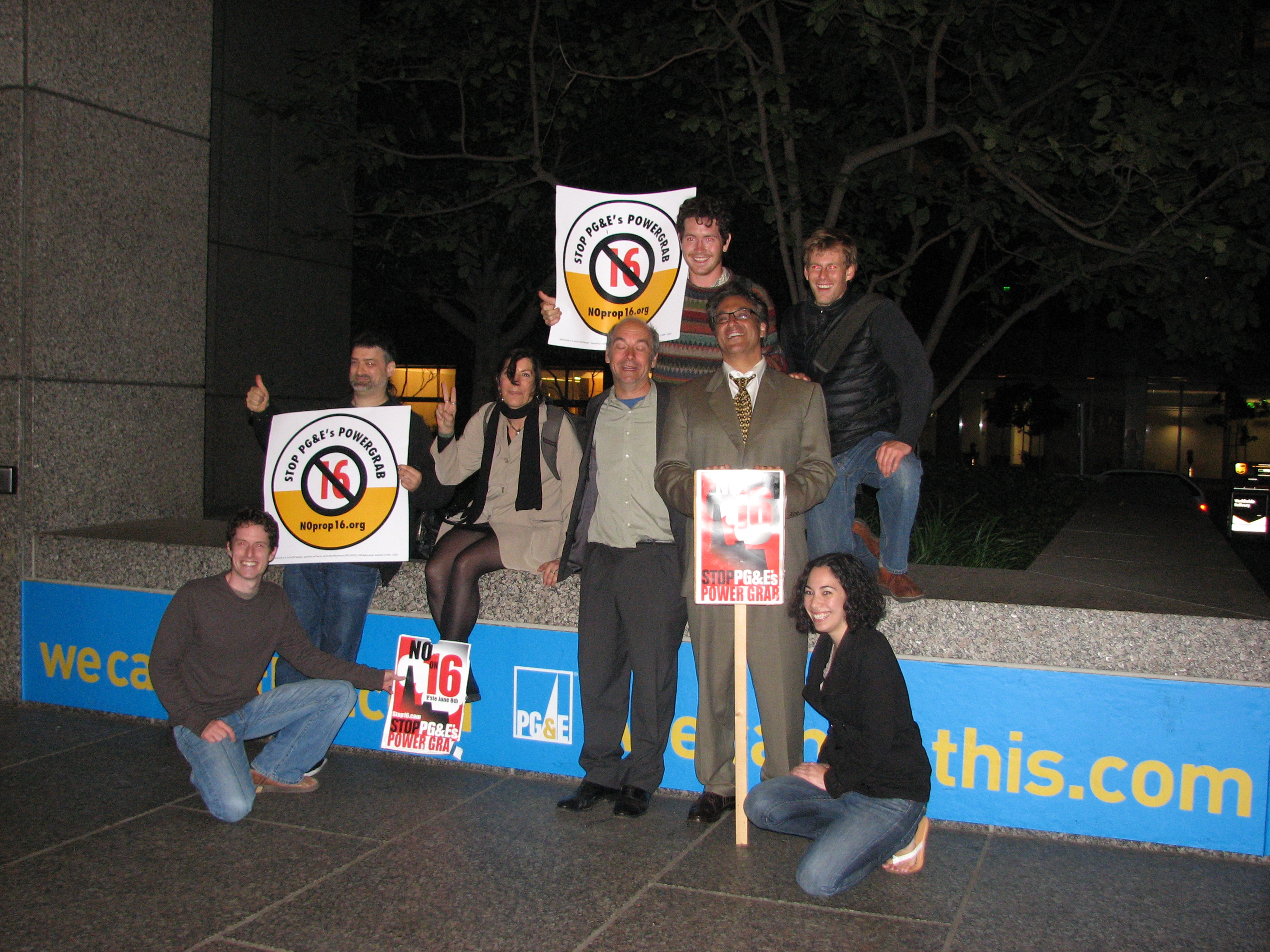
A little after 1 a.m., the exuberant crew took an impromptu stroll to San Francisco’s PG&E headquarters on Beale Street.

Banners adorned PG&E’s fortress-like building. Printed on them was the slogan, “We can do this.”

Note: This post has been updated from an original version.

Harris declares victory in AG Democratic primary

0

San Francisco District Attorney Kamala Harris declared victory in the Attorney General Democratic primary in an energized  speech around 11 p.m. at Mimi Silbert’s Delancey Street Foundation at 600 Embarcadero.

Harris’ speech came soon after the room buzzed with the news that Santa Clara voters had approved a $937 million stadium deal for the 49ers at a site near Great America, and immediately on the heels a rousing introduction by State Sen. Mark Leno.

“With her kind of leadership, we’ll be able to reinvest dollars in the best crime prevention programs,” Leno said.

Harris’s campaign raised $3 million in the Democratic primary, and Leno indicated that supporters would need to “triple or quadruple that in the general election.”

Leno promoted medical parole and praised Harris’ Back on Track program for reducing recidivism rates for young, first time offenders.

“With your help we will elect the first woman to be Attorney General for the state of California,” Leno promised.

 Then Harris took the podium, dazzling in a chic black outfit and pearls.

Acknowledging the work and efforts of her supporters, Harris broke into a big smile.

“I do humbly accept the Democratic nomination for Attorney General of California,” she  said.

She praised good ideas that her fellow Democrats raised during the primary around fighting gang crime, corporate greed and fraud, protecting kids and the environment.

‘It’s been an honor to work with you,” Harris said, promising to call her opponents, “to ask you to help us put those great ideas to work.”

Then she talked about getting “tough and smart on crime” by addressing gang crime, but also focusing on early intervention and truancy.

She talked about cracking down on predatory lenders, supporting health care reform, and protecting California’s environment.

“When the President passed healthcare reform, it was the right thing to do,” Harris said. “People deserve to have medical care when they need it. The Attorney General has got to stand up and support that. It must be the work of the next Attorney General to ensure that the disaster and tragedy that happened in the Gulf of Mexico never happens in California,” she said, warning of attacks on AB 32, which set California’s 2020 greenhouse gas emissions reduction goal into law in 2006. “

And she described her campaign touching down in Modesto, Bakersfield, Oakland and Palo Alto and stretching from “grassroots to net roots,” ,

“We may seemingly be different because of our zip codes, perhaps, but we are all the same in terms of what we want for children.. elders,” Harris said, promising, “to protect poor people, the vulnerable and people who are the targets of bias.”

“We have a lot of work to do before November…but we are clear of purpose, clear of mind,” Harris said. “We believe in hard work, but we also believe that if can be fun work. Let’s celebrate tonight!”

And then she was off the stage, shaking hands with fans .Asked about the possibility of becoming the first female California Attorney General, Harris flashed that dazzling smile.“I’m sure a man could do the job just as well,” she said. “Let’s leave it at that for now.”


“A righteous win.”

1

I just called Sup. Ross Mirkarimi, one of the leaders of the No on 16 campaign. He’s cautious; we’ve both seen PG&E steal elections before. But the numbers are looking good: $50 million later, PG&E is behind and losing ground. “If 16 goes down, this will be such a righteous win,” Mirkarimi said. “We will have defeated their scorched earth greed.”