• No categories

Politics Blog

Solstice fun: Brown and Whitman’s birthday personalities

0

I’m probably going to get into all kinds of trouble for this post, but seeing as today is the summer solstice, and I have hay fever, now (as I wait for the antihistamine to kick in) feels like the perfect moment for fun with politicians’ personalities, beginning with California’s gubernatorial candidates, Jerry Brown and Meg Whitman.

“Many people have long suspected, as astrologers believe, that the day you were born affects your personality,” states the dust jacket of The Secret Language of Birthdays (Penguin, 1994). This weighty 832-page tome claims to be a guide to personality based on “psychology, history, numerology, tarot and astrology.”

So, what light, if any, does this tome shed on Brown and Whitman?

We learn that Brown and the Buddha were both born April 7, a birthday this tome characterizes as The Day of Enthusiastic Belief. (William Wordsworth, Billie Holiday, and Francis Ford Coppola apparently also emerged on this day)

Whitman, who was born August 1, shares a birthday with Yves St. Laurent, Jerry Garcia, Moby Dick author Herman Melville and Claudius 1, (who became Roman emperor after Caligula’s murder), a day the Secret Language of Birthdays characterizes as The Day of Original Style.

“It is not uncommon for April 7 people to reach a point in their lives when they can spiritually progress no further and have to make a very big change,” states the tome, which actually includes Brown in its list of famous April 7 folks. “If April 7 people pass through this crossroads, well, they are capable of even greater success in their life. They may feel less impelled to throw themselves at the world, and instead allow the world to come to them.”

“April 7 people do well in public positions in which they can inspire others to higher achievement through their own example,” the tome concludes. “They should continually work toward being realistic in their view of everyday life, and must not be carried away by illusions. They should also avoid reacting in an angry fashion if their expectations are not met by others.”

As for Whitman and other August 1 people, the tome claims that, “Not content with the knowledge that they are the best in what they do, they must force others to this realization either through the quality of their work or the sheer persuasiveness of their personalities. They may suffer many setbacks, frustrations and disappointments along the way, but rarely give up on their endeavors.”

‘Those born on August are not the easiest people to get along with,” the tome warns. “Since they themselves are the only boss they tolerate, they are generally unsuited for jobs where they must work with superiors…Those born in August 1 are often caught up in the middle of a swirling world of controversy. No matter what they do, they seem to arouse the interest and sometimes antagonism of others.”

Okay, well there you have it with the fun stuff. And now that the antihistamine finally feels like it’s working, I’m ready to enjoy some politically meatier stuff at Politics Verbatim, a website California Watch and the Center for Investigative Reporting just launched “to hold California’s two major gubernatorial candidates accountable in the most straightforward way possible: by collecting and categorizing the promises, proposals, arguments and attacks that they make on the campaign trail.”  (But don’t forget to watch out for the personalities behind the promises: They could just be each campaign’s (not so) secret weapon.)


=

Ammiano wants to clean up crime labs

1

Why could the San Francisco crime lab operate with so many problems for such a long time? One reason: There’s little or no effective state oversight or regulation of local crime labs in California.


That seems like a glaring problem — crime labs can mean the difference between guilt and innocent, the difference between a long prison term and a free life, between an innocent party getting wrongly convicted and a guilty party getting away with murder.


Assemblymember Tom Ammiano told me he’s worried that problems in cities and counties are going to continue unless somebody’s paying attention — so he’s introducing a bill that would create some form of state oversight body to monitor crime labs and make sure they maintain credible standards.


“I think it’s like the BART Police, they aren’t going to reform unless the state tells them they have to,” Ammiano said. He’s going to have legislation drafted shortly.

SFBG Radio: Tim and Johnny on channeling the inner Huey Long

1

Today, Tim and Johnny talk about GOP loonies, Carly and Sarah and the case for our inner Huey Long. You can listen after the jump.

sfbgradio6212010 by bgedit

The insanity of cutting pensions

15


The New York Times has picked up the pension-reform banner, promoting the issue to the lead story on the front page of the June 20th issue.


If, as the Times reports, some of the reformers want to cap pensions – that is, go for the folks at the very top of the pile – it’s worth discussing. But most of the “reform” ideas involve either cutting the take-home pay of existing employees, cutting the take-home pay of pensioners or making sure that future workers don’t get as much of a pension.
The problem with that is simple: We’re in a deep recession. And the last thing we need to do is cut paychecks and encourage people not to spend money.


Let me quote from a brilliant blog post on Calitics.com from the always insightful Robert Cruickshank:


Cutting pensions would be like taking a shotgun, aiming it at our feet, and pulling the trigger. It would cause a cascade of economic problems that would dramatically worsen our economic crisis…


And yet the solution being proposed – slashing benefits – will do absolutely nothing to make state government fiscally solvent. It will mean there’s less money available to spend, meaning less sales tax revenue. Less consumer activity means there’ll be less jobs available, meaning less income tax revenue. With fewer jobs available, and wage stagnation, and now the added financial burden of paying the costs of retired family members that used to be borne by the pensions and other state services that have been cut, younger folks won’t be able to sustain the economy. Retirees and baby boomers will have to sell their homes for the cash, and in a recessionary environment where the young aren’t able to afford the present market value, home values will spiral downward, causing further economic ripple effects as well as reducing property tax revenues.
 
… The notion that ‘everyone needs to give back’ just doesn’t make sense given our economic distress. We’ve already given back too much. We gave back our wages. We gave back our ability to afford health care and housing and transportation. We gave back the robust public sector services that created widespread prosperity in the 1950s and 1960s. We gave back affordable, quality education. And too many of us have given back our future.
No, it’s time for someone else to give back. It’s time for the wealthiest Californians, and the large corporations, to give back. For 30 years now they have benefited from economic policy designed to take money and benefits from the rest of us and give it to those who already have wealth and power.
We are now experiencing the predictable outcome of such policies – the worst recession in 60 years, an intractable downturn. The way out isn’t to worsen the crisis by slashing pensions. The way out is to return to the sensible tax rates of the 1950s and 1960s and make the rich pay.


That’s what I’m talking about.

SFBG Radio: Johnny and Tim on the Whitman clan and class privilege

2

Today, Johnny and Tim talk about the Whitman family — and why the rich are different from you and I. Not to mention some choice GOP oil spill commentary. You can listen after the break.

sfbgradio6182010 by sfbgradio

No traffic lights on Market Street!

3

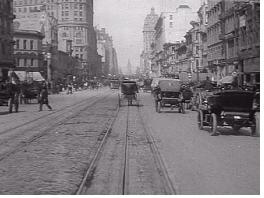
No stop signs, either. Just an amazing collection of horses, cars, trolleys and — yes! — bicycles crowding the city’s main drag, just four days before the 1906 quake. Check out the footage here. 


Bicycles sharing the street with cars (and also horses, and people who just run right out in front of traffic), police foot patrols, multi-modal transportation … good times. It’s great film, and fun to watch.


From the email Larry Fahn, former Sierra Club president sent me:


This film, originally thought to be from 1905 until David Kiehn with the Niles Essanay Silent Film Museum figured out exactly when it was shot. From New York trade papers announcing the film showing to the wet streets from recent heavy rainfall & shadows indicating time of year & actual weather and conditions on historical record, even when the cars were registered (he even knows who owned them and when the plates were issued!).. It was filmed only four days before the quake and shipped by train to NY for processing. Amazing but true!


SF mayoral analysis in the NY Times misses the mark

4

I have praised Bay Citizen’s early work and I think Gerry Shih is a smart young reporter, but I think their analysis of who will be San Francisco’s next mayor – which ran in today’s New York Times – was off the mark and shows they don’t yet have a good grasp of this city’s political dynamics. And a big reason for that is – just like the Examiner and the Chronicle – they relied too much on downtown players who consistently misread those dynamics, at least in recent years.

The one thing it got right was naming Aaron Peskin as one of the frontrunners to succeed Newsom if he is elected lieutenant governor. Peskin is really the only politico in town he has been putting big plays together these days, whether it be keeping Democratic Party leadership in progressive hands or defeating the 555 Washington project. So he might be the only one who can count to six with this current progressive-dominated board.

But nobody really thinks David Chiu is a frontrunner, despite Shih’s claim. Chiu has been a pretty good board president, but remember that he was elected as a compromise candidate (with lots of help from Peskin) after the then-frontrunners, Ross Mirkarimi and Bevan Dufty, couldn’t put the votes together. And since then, he has disappointed his progressive colleagues on several votes, making them unlikely to support him for mayor.

Besides, it will be difficult for any supervisor to get six votes when they can’t vote for themselves, which also makes me scoff at Shih’s contention that John Avalos and David Campos are running for mayor (two supervisors who are close to the Guardian and have never indicated to us that they’re running, even when we’ve asked, although they might each eventually become mayors). Ross Mirkarimi is more likely and wants the job, but would have a tough time getting a board majority to give is to him.

Shih told the Guardian that he’s been getting lots of critical feedback on his article today, and while he said Chiu and Peskin are names that kept coming up in his interviews, Shih admits that the attractive narrative of the protege challenging his mentor perhaps skewed the final analysis: “The relationship between those two guys ended up getting played up in the story.”

The article makes several other mistakes as well (and not just the obvious factual errors, like getting the mayoral election year wrong, as well as the year Feinstein left office, both of which have since been corrected online). It left City Attorney Dennis Herrera’s name out entirely, despite the fact that he’s already declared his intention to run for mayor and could certainly be a compromise candidate. Public Defender Jeff Adachi also wasn’t mentioned, even though he has a better chance than half the people on Shiu’s list, such as Willie Brown or Ed Harrington, who downtown may like but progressives really don’t.

Two strong possibilities for mayor – Mark Leno and Leland Yee – were given only passing mention in the article even though they are far more likely choices than Chiu. Both Leno and Yee have aggressively worked both the centrist and progressive sides of the aisle and are in great positions to run for mayor or be appointed by the board.

The hopes for a Chinese-American mayor that Shih placed with Chiu are probably better placed with Yee, who has worked with Rose Pak and other business interests while also having a history of endorsing progressive candidates, which he’ll be able to call in when he runs (and yes, unlike other candidates on Shih’s list, Yee has actually declared his intention to run).

Similarly, Leno has good relations with progressives on the board, which will be tested a bit this fall as he campaigns for moderate supervisorial candidate Scott Wiener and navigates the wedge issue minefield, but it’s easy to see how with the right outcomes this fall and key deals cut, Leno could emerge as the frontrunner.

The dynamics of this thing are incredibly complicated, but if I was in Shih’s shoes and was asked to name the two frontrunners, I’d probably say Peskin and Leno, with Yee a close third and Herrera as an outside possibility. Or it could be none of them if nobody can count to six and the option of a caretaker mayor who agrees not to run later (such as an Art Agnos) seems like the only way forward.

As politicos Alex Clemens and David Latterman said in their post-election analysis on June 10, this is very complicated and will be the subject of many deals by experienced insiders (of which Chiu really isn’t one just yet). “Everyone is gaming this thing out and trying to figure out what happens,” Clemens said.

But there is one scenario in which I could see Chiu figuring prominently, and that’s in what happens if both Newsom and Kamala Harris win their respective state races. Chiu has expressed a desire to be District Attorney, a chance that he might get if he can help play kingmaker with whoever becomes our next mayor.

So perhaps that qualifies him as a frontrunner of sorts after all.

The Gaza resolution

25

I know that the discussion over the John Avalos/Sophie Maxwell resolution on the Gaza flotilla took a long time, and kept the supervisors and assorted city employees at work until midnight, and Sweet Melissa says that cost the city some money. And she makes the same argument we hear all the time when these things come up:


Run for Congress. Jump onto a plane. Send money to a worthy organization. But don’t pat yourselves on the back for a job well done for getting a resolution passed at the San Francisco Board of Supervisors. No one cares what supervisors in San Francisco think about foreign policy — not other governments, not the U.S. government and especially not those of us who live here.


And while I agree that the Avalos/Maxwell resolution was long, and isn’t going to change anyone’s foreign policy, and a lot of the other supervisors wish the thing had never come up and consider it a terrible time suck, let me gently argue the contrary.


I remember back in 1984, when a group of Berkeley activists put a measure on that city’s ballot calling on the United States to reduce its aid to Israel by the amount that Israel was spending on settlements in the occupied territories. It bitterly divided the Berkeley City Council, stirred up a giant fuss on the city’s left and led to a long, dramatic meeting of the progressive coalition called Berkeley Citizens Action. BCA was at that point the equivalent of a political party that dominated city politics.


There were some BCA members who thought the measure was horrible, anti-semitic and needed to be killed. There were some who argued that the situation in the occupied territories was so bad that Americans needed to take a stand. There were others who said this was none of Berkeley’s business — much as a lot of San Francisco pundits say that the Avalos resolution was none of San Francisco’s business.


But I was there and I watched all of this come down — and in the end, it was a good thing for Berkeley, for progressive politics, and for the way the left in the Bay Area thought about the Middle East.


Lee Halterman, who was an aide to then-Rep Ron Dellums, chaired the BCA meeting where the measure was debated, and he did a fabulous job — everyone got a chance to speak, nobody was cut off, the discussion was remarkably civil and in the end, the group voted not to endorse either side. “This was healthy for BCA,” Halterman told me afterward. “This was a discussion that we needed to have.”


I didn’t know much of anything about the politics of Israel’s settlement policies back then, and I got quite an education. The Arab-American Anti-Discrimination committee folks came down to the Guardian and — calmly, without harsh rhetoric, explained why the continuing settlement construction was creating a serious obstacle to future peace (they were absolutely right). I learned that John B. Oakes, the former editorial page editor of the New York Times, had written a series of columns saying, in essence, that building all the new settlements was going to make a two-state solution almost impossible. Slowly, political observers who fully supported Israel on almost every issue were starting to question the Israeli government’s actions.


We heard the other side, too: Anna Rabkin, the Berkeley city auditor and an icon on the Berkeley left, came in and told us how painful this would be to progressive Jews and how harmful it would be to the progressive agenda. She made a powerful, impassioned argument. 


And all of this came to a head with a ballot campaign that generated both heat and light. We endorsed Measure E (I wrote the endorsement myself); it went down overwhelmingly, but it got a lot of people thinking. I think today it would pass overwhelmingly. And while the usual snipers complained the “Berserkeley” was wasting everyone’s time and money on a foreign policy statement that nobody would pay attention to anyway, I think a lot of us were glad it happened.


And I think that the members of Congress who represented the Bay Area were paying close attention.


So let’s not trash the Avalos/Maxwell resolution so quickly. Sometimes these debates are good; sometimes they help the local voters — who, after all, decide who to elect to Congress, the U.S. Senate and the White House — hear conflicting sides of a complicated story.


The Gaza flotilla wasn’t just about breaking the blockade; it was about getting people in the United States to pay attention to a terrible situation that the daily papers and TV stations typically ignore. I don’t see why it’s so bad for the San Francisco supervisors to help spread that word. 

Following Recology’s $$$ to Environment Commission and DCCC

7

If you’ve been looking for a financial connection between the city’s tentative decision to award the next landfill disposal contract to Recology, which plans to dispose of our trash in Yuba County, then you’ll be interested in this campaign finance item: Because records show that Recology contributed $5,000 last year to SF Forward, a San Francisco Chamber of Commerce political action committee, which also got Money  from Bechtel, Medjool, PG&E, Charles Schwab, and Shorenstein Realty.

Recology Vice President and Group Manager John Legnitto is Chamber’s Chair Elect.

In the last two years, the Chamber contributed $10,000 to Plan C, a political action committee that advocates for more condo conversions and less tenants’ rights.And Plan C gave Commission of the Environment President Matt Tuchow $3,300 for his failed 2010 Democratic CCC bid.

So, while the transactions were legal, with the money laundered twice in between, these dollar connections will probably have folks opposed to the city’s plan to dispose of its waste in Recology’s landfill in Yuba County asking if this explains why Tuchow decided to limit public comment to only one minute when folks wanted to voice concerns at a March 23 hearing at the Environment Commission about an alleged lack of fairness and transparency in the decision to award the contract to Recology.

Especially those folks who drove three hours from Yuba County, which is where Recology proposes to send our trash. And folks who helped negotiate the city’s current trash disposal contract and were shocked that the city would set a one-minute time limit on what they claim is a $1 billion contract, once you factor in the cost of transportation, new trash processing facilities and an as yet unbuilt rail spur that Recology needs inYuba County to transfer trash from the Union Pacific line to its landfill in Wheatland,

Tuchow, who works in the Global Compliance and Ethics Division of McKesson Corporation in San Francisco, had not returned calls as of blog post  time, but if and when he does, I’ll be sure to post an update here.

Meanwhile, it doesn’t look as if Recology’s bucks and/or Mayor Gavin Newsom’s powergrabbing antics, are going to be able to help shoehorn Tuchow onto the DCCC, even in light of Newsom’s newly hatched plan for dominion for the following reasons:

1. Results from the June 8 election show that Tuchow was fourth failed runner up in the DCCC 12th district. (Milton Marks, Sup. Eric Mar, Melanie Nutter, Arlo Smith, Connie O’Connor, Tom A. Hsieh, Jane Morrison, Mary Jung, Sandra Lee Fewer, Michael Bornstein, Sup. John Avalos and Bill Fazio were the top vote getters to win seats, beating out Larry Yee, Jake McGoldrick, Hene Kelly and then Tuchow, in that order.)

2.. It’s not clear if Newsom’s plan for the DCCC is even legal.

3. Even if Newsom’s plan survives a legal challenge, it’s not clear that the law would have the retroactive effect necessary to oust Mar and Avalos.

4. And even if it did, under state law,  DCCC Chair Aaron Peskin would get to appoint folks to fill those vacancies,
“This is about clean money and good government,” Newsom spokesman Tony Winnicker told reporters of Newsom’s DCCC plan.

So, let’s hope the Mayor’s Office applies the same standards when it comes to opening the landfill disposal contract bids this summer and shining light on the money that’s influencing the city’s garbage disposal contract. 

Meanwhile, Peskin, who was reached by cell phone somewhere near Moab, in Utah, where he’s taking his annual camping and hiking trip with his wife, told the Guardian that Newsom “is not thinking very far ahead” with his latest dominion scheme.


The public-employee pension fight

11

Public employees are getting attacked on all fronts, and one of the major issues is pensions. Forum did a show on it this morning, and all the usual suspects were there arguing that the public is outraged, that pensions are out of control, that nobody in the private sector gets these kinds of deals and that high pensions are damaging the very social programs that progressives love. Jeff Adachi, SF’s public defender, is making some of the same arguments in his pension-reform proposal.


Let me add a little perspective.


First of all, the majority of the public-sector workers who get pensions in CA don’t get huge payouts — the average pension, SEIU’s Terry Brennand pointed out on the show, is a little over $2,000 a month. Teachers get a little more, but they don’t get social security; they give up that federal benefit in exchange for pensions that pay maybe $3,000 a month.


There are serious problems with pensions — and most of them involve two categories of workers: Management employees and public safety. Those $100K-plus pensions? Check em out. In San Francisco, anyway, and I’m sure it’s the same in most of the state, the majority of them go to cops, firefighers and people in senior positions who manage to figure out how to bump their pay scales up in their final years.


The bigger cost may be retiree health care — but that’s a bit misleading, too. If we had a single-payer health care system, we wouldn’t need to worry about all these retiree health costs busting state and local budgets. And if retired public employees weren’t getting health care through a pension system, a lot of them would wind up in the public-health system anyway, through Medicare or Medi-Cal; we, the taxpayers, would be covering that cost anyway.


You want to save money on pensions? Quit giving the cops and prison guards everything they want.

Turning Clinton’s words into Brewer and Whitman’s problem

9

“Obama Admin has decided to sue AZ and we had to learn about it through Ecuadorean TV. Outrageous!”
So tweeted accidental Arizona Governor Jan Brewer, after Sec. of State Hillary’s Clinton admitted that the US DOJ has decided to sue Arizona over SB 1070. 
Brewer, who faces a gubernatorial primary August 24,  is betting that  talk about immigration, will help her win the race.
“This is no way to treat the people of Arizona,” Brewer said.

But wasn’t that exactly the point Clinton was making?

And isn’t it about time that the Dems figured out ways to counter the right’s “illegal alien” meme?

Not just in Arizona, but also in California where Republican gubernatorial nominee Meg Whitman recently told reporters in San Francisco that, “We have to prosecute illegal aliens and criminal illegal aliens in all of our cities, in every part of California.”

As far as I’m concerned, (and I’m speaking as an immigrant to North America) the only beings on the planet who can truly be defined as “aliens” are extra terrestrial visitors. The rest of us are humans, thank you very much. And most of us immigrants are economic refugees, not subhumans who somehow deserve to be  treated like shit by a bunch of white folks who turn red in the California and Arizona sun, and whose ancestors came here for similar reasons–and without paperwork–not so very long ago.

Newsom’s plan for DCCC domination

4

Gavin’s not quite ready to take over the world, or even California, but he’s not leaving office without trying to mess up the progressive majority on the Democratic County Central Committee. The plan he hatched June 15: Ban elected city officials from sitting on the DCCC. The idea: Get rid of Supervisors David Campos, David Chiu, John Avalos and Eric Mar. The overall plan: With the progressive supervisors — who have high name recognition and thus get easily elected — gone, the Newsom allies can take back control of the local Democratic Party.


It’s a pretty blatant move — far beyond Aaron Peskin’s so-called coup. And I must say, it’s a bit hypocritical.


See, the DCCC isn’t just made up of 24 elected members. Every San Francisco Democrat who holds state or national office — or who is a candidate for state or national office — is also an automatic member. So Senator Diane Feinstein is a DCCC member; so is House Speaker Nancy Pelosi, Assemblymember Tom Ammiano and Sen. Mark Leno. And guess who gets a seat this fall? Lt. governor candidate Gavin Newsom. People like Feinstein and Pelosi never show up; at best, they send a proxy. They rarely pay much attention to the local party, don’t help out much with party fundraising, don’t even come to the party’s annual dinner (Newsom didn’t show this year, even though he’s the mayor of a Democratic city.)


There have been members of the Board of Supervisors on the DCCC for years. The late Sue Bierman was always a member, and actually cared about and paid attention to the local Democratic Party. Leslie Katz was a member as a supe, and still is. It’s never been that big a deal to anyone — until the progressives starting winning seats. Then suddenly it’s a horrible conflict.


The real conflict has nothing to do with city officials sitting on the committee; it’s the fundraising issue. The city’s campaign finance rules don’t apply to DCCC races, so candidates for DCCC who are also running for supervisor — Scott Wiener, Rafael Mandelman, Debra Walker — can raise unlimited money for their DCCC races and use that additional name recognition for the fall elections. The thing is, I think most of the candidates who benefit from this loophole agree that it needs to be fixed; Mandelman certainly does, and he’s told me that several times. I couldn’t reach Walker or Wiener this morning, but I’d be very surprised if both of them wouldn’t endorse some kind of contribution limits for DCCC races.


I asked Newsom’s press spokesperson, Tony Winnicker, if the mayor would support fundraising limits. Apparently he doesn’t (or at least, he doesn’t want to push the issue):


“For this November’s local ballot, which the Mayor can place an initiative on, we propose eliminating the potential conflict that exists between City officeholders also holding office as elected County Party Committee members.”


How about getting rid of all the elected officials, and creating a real grassroots county committee? No, that won’t fly with Newsom either. Winnicker:


It’s appropriate for state and federal Democratic elected officials from San Francisco to serve on the Democratic County Central Committee.


The city/local offices — Mayor, Board, Treasurer, Assessor, City Atty, Sheriff, District Atty, Public Defender — are nonpartisan offices who have direct oversight over City business. That’s the difference and conflict. This is a local initiative, so our focus and concern is local good government and local conflicts or appearance of conflicts.


From everything I can figure, Newsom doesn’t want campaign-finance reform and doesn’t want to put the party in the hands of local activists; he just wants to get rid of the supervisors who take positions he doesn’t like. That seems like a pretty bad way to make public policy. 


UPDATE: Just talked to Scott Wiener, who told me he agrees that the whole issue of DCCC campaign spending ought to be on the table. And he said he is not at this point prepared to support Newsom’s initiative. “I have concerns with the number of elected officials on the DCCC,” he said, “but there are times when it’s entirely appropriate to have people who have a demonstrated commitment to the DCCC and then get elected supervisor to stay on it.”

SF’s bike project ban is coming to an end

5

Despite high-profile recent improvements to San Francisco’s bicycle network – including a half-dozen new bike lanes since last fall, a green bike lane on Market Street separated from cars, and new on-street bike parking on Valencia and Divisidero streets – the city is still prevented by a court injunction from creating bike lanes that have been sought for a decade. But that could change as early as next week.

On Tuesday, June 22, Superior Court Judge Peter Busch will hear oral arguments and consider whether to end the four-year-old injunction against the city executing any of the projects or policies outlined in its Bicycle Plan, a ban perversely created by the court finding the plan violated the California Environmental Quality Act because it wasn’t subjected to a full-blown environmental impact report, which cost more than a million bucks and took two years.

Despite the fact that EIR was completed and certified last year, the plaintiffs who sued the city over the plan five years ago – anti-bike activist Rob Anderson and his attorney, Mary Miles – sued again, claiming the study was inadequate and decrying how the plan would take space from cars to improve bicycle safety.

In her brief, Miles noted how the EIR finds “89 significant impacts of traffic, transit, and loading but fails to mitigate or offer feasible alternatives to each of these impacts.” Referring to the near universal political support in San Francisco for making improvements to the bike network despite these impacts, Anderson told the Guardian last month,“It’s a leap of faith they’re making here that this will be good for the city.”

But the brief that the city filed in the case argues that leap of faith is a decision for policymakers, whether or not Anderson and Miles agree with it. The city position is that cars have ruled the roads for long enough and now it’s time they shared some space with the fastest growing transportation choice in San Francisco, where the number of regular cyclists has nearly doubled in recent years.

“Petitioners are clearly disappointed that, despite the disproportionate number of drivers over bicyclists, City decisionmakers chose to implement improvements to the bicycle network that may inconvenience some drivers and some transit riders on certain streets at certain times. But the CEQA process does not approve or deny projects; it merely requires that decisions be made with environmental consequences in mind. By improving the City’s bicycle network, the decisionmakers determined that the City would encourage more people to use a bicycle for everyday transportation,” Deputy City Attorney Audrey Williams Pearson wrote in her brief.

With oil continuing to spew into the Gulf of Mexico, the atmosphere becoming steadily more concentrated with planet-threatening fossil fuel emissions, and the politicians in Washington DC offering only hollow rhetoric about our stubborn addiction to oil-powered convenience, San Francisco elected officials from across the ideological spectrum took a small but important step in promoting safer bicycling.

Now, it’s up to Judge Busch (who partially lifted the injunction last fall, allowing the handful of projects I mentioned above) to take the next step, which he will do probably within days (or weeks at the latest) after hearing from both sides June 22 starting at 9:30 a.m. in Superior Court, Department 301, at the corner of Polk and McAllister streets.


P.S. If you want to celebrate the impending end of the bike injunction with thousands of other bicyclists, walkers, dancers, and other non-motorized movers and shakers, show up on car-free Valencia, Harrison, and 24th streets this Sunday from 10 a.m. to 3 p.m. for the latest installment of Sunday Streets.

Muni workers and common sense

7

I’m never the one arguing that city workers should take pay cuts, furloughs, benefit cuts or layoffs when there are ways to bring in new revenue. Remember: Layoffs and furloughs are, by definition, service cuts. And it’s a good thing to have city employees make enough money to live in San Francisco, raise families, send their kids to college etc. Maintaining a middle class in San Francisco through public-sector jobs is a fine use of taxpayer dollars (particularly if those dollars can come from the rich).


But I have to say: The Muni workers union isn’t being very smart. Refusing to accept any concessions at a time when every other union in the city — particularly SEIU Local 1021, whose members typically earn a lot less money than the bus drivers — have stepped up to the plate and accepted painful cut is politically foolish.


And for the Muni union leaders to say that the system’s budget problems aren’t their responsibility sounds terrible. Most other city employee unions show some loyalty to the people they serve, and are interested in making their departments work, and understand that in very bad times, everyone’s got to give a little.


The problem is that Sup. Sean Elsbernd wants to change the way Muni workers are paid, and his ballot measure could lead to significant pay cuts and work-rule changes, things the union really doesn’t want. And every headline about Muni workers refusing concessions gives Elsbernd more signatures, more supporters and more votes. 

Elsbernd blocks state budget resolution

1

The Democratic leadership in the state Assembly has a budget plan that challenges the entire approach Gov. Schwarzenegger is taking on the state budget. It’s not perfect; it relies on borrowing (although it’s borrowing against the revenues from a new oil severance tax). But it will, Speaker John Perez says, save more than 400,000 jobs. And it’s way, way better than what the governor wants to do. “It’s good,” Assembly member Tom Ammiano, who has always been willing to challenge party leadership and take progressive stands. “It’s something we can support.”

Among other things, it would bring San Francisco another $40 million next year as part of a plan to end the raids on city and county treasuries.

So the Dems in the Assembly are trying to get cities, counties and school boards to endorse their plan. Sup. David Chiu did the honors in San Francisco, asking the supes to approve, on consent calendar, a fairly innocuous resolution endorsing the so-called “Jobs Budget.” Nobody objected — except Sup. Sean Elsbernd, who demanded that the measure be sent to committee for further review.

I don’t get that; San Francisco’s support won’t determine the future of this budget, and it’s not a huge deal — but Elsbernd’s a Democrat, he doesn’t like what the governor is doing, and if this could help even a little bit with the forces pushing for an alternative, what’s the big deal?

Well, I talked to Elsbernd about it (one of the things I respect about Elsbernd is that he never ducks questions; unlike some politicians I know, he always returns my calls, always responds, is willing to have an intelligent discussion and doesn’t try to hide). His argument: “I’m not following the details of the state budget yet. I would love to hear a little more about it.” His concern is with the borrowing; “I’m sure,” he said (perhaps a bit sarcastically) “that President Chiu will be able to explain to me why this isn’t just kicking the can down the road.”

He went further: “If the mayor tried to balance the budget by borrowing money with general obligation bonds, you guys would blast him, right?” Well, not necessarily, I told him. Sometimes, governments ought to borrow money, to save and create jobs during an economic downtown. In fact, that’s exactly what President Obama did, borrowing heavily and adding to the already massive federal debt with a stimulus plan that probably prevented the recession from becoming another depression.

I mean, didn’t Sup. Elsbernd support the Obama stimulus package?

“Frankly, Tim,” he said, “I’ve been too busy trying to do my job in San Francisco to be taking a stand on state and federal issues.”

Okay, Sean — it’s a good line. But every elected official in every city in America was paying attention to the Obama economic plans. And SF supervisors have to be paying attention to the state budget. Counties are, in part, the local arms of the state; making sure there’s money to do what the state tells us is part of the job.

SFBG Radio: Tim and Johnny on Obama, Whitman and the hypocrisy of sit-lie

2

Today Tim and Johnny talk about Obama’s energy policy, Whitman’s only hope — and why it’s so silly for the mayor of San Francisco to be pushing a sit-lie law that can only lead to selective enforcement. You can listen after the jump.

sfbgradio6162010 by sfbgradio

San Franciscans decry Newsom’s public health cuts

8

By Alex Emslie

More than 100 concerned citizens, mental health providers, SRO hotel representatives, and clients of San Francisco’s community behavioral health programs spoke to the Board of Supervisors yesterday at a Beilenson hearing, which the state requires of counties that slash public health services, decrying crippling cuts in the mayor’s proposed budget.

Mayor Gavin Newsom proposed cutting the Department of Public Health’s funding by close to $31 million in next year’s budget currently before the Board of Supervisors. The board can choose to add funding back into departments that were cut before approving the final budget by the end of July.

“These are all services that we value,” DPH director Dr. Mitch Katz said following nearly four hours of public testimony. “We have to make difficult choices because of the state of the city’s budget. We recognize that it is never desirable for us to make cuts.”

Sup. John Avalos, who chairs the Budget and Finance Committee, said the city Budget Analyst’s Office was examining cost savings within the police and fire departments to free up money for the DPH. “I, as budget chair, am working with my colleagues to prevent these cuts that you are concerned about. We have to find cost savings in our budget across other departments.”

Avalos added that cutting other departments wouldn’t solve San Francisco’s looming deficit for years to come, and that taxation must be part of San Francisco’s budget solution. “If we don’t find a significant amount of revenue, looking at progressive forms of taxation, we’ll be in the same boat next year, but even worse, because we don’t expect to have the authorization of federal money [that the city received last year] to help us out.”

Mirkarimi to PG&E: We want our $46 million back

Speaking at the June 15 Board of Supervisors meeting, Sup. Ross Mirkarimi introduced a non-binding resolution calling on Pacific Gas & Electric Co. to refund ratepayers for the $46 million it spent on a failed bid to pass Proposition 16, a ballot initiative dubbed the “Taxpayer’s Right to Vote Act” that would have impeded the creation of municipal electricity programs.

While PG&E has publicly stated that its campaign costs were covered by “shareholder funds,” the sole source of income for the parent corporation is money that the utility makes selling electricity, so the $46 million originated in ratepayers’ pockets.

At the meeting, Mirkarimi displayed a map of PG&E’s service territory beside a map of the California counties that rejected Prop 16, highlighting the striking similarity. In San Francisco, Prop 16 was rejected by more than two-thirds of the vote.

Mirkarimi’s resolution included several other improbable requests. He extended an invitation to PG&E CEO Peter Darbee to attend a Board of Supervisors meeting, to “discuss what it really and truly means to peacefully coexist,” he explained. “We look forward to Mr. Darbee coming to meet with us.”

The third aspect of the resolution deals with SFERS, San Francisco’s employment retirement system, which owns 106,348 shares of PG&E common stock valued at $4.38 million on the day the information was accessed. Institutional investors such as CalPERS and SFERS account for more than a 60 percent share of ownership of PG&E, according to the resolution.

Mirkarimi is calling on PG&E to refund SFERS, and “urges CALPERS and SFERS to consider divesting its holdings in PG&E stock” if the company refuses.

The resolution also asks the California Public Utilities Commission to carefully scrutinize PG&E’s requested rate hike.

PG&E didn’t return our requests for comment the last 10 times we called, but we tried again — even though the result is predictable.

And now, the race to replace Kamala Harris

2

David Onek, who has strong political connections and little courtroom experience, sent out a email today announcing that he wants to be San Francisco’s next district attorney:


As many of you know, District Attorney Kamala Harris is very likely to become California’s next Attorney General. DA Harris is a friend and I would never run against her, but her victory in November will open up the office as early as the end of this year. This means the time to get organized is right now.


He adds his name to the list of people, including former chief homicide prosecutor Jim Hammer, who want the job. But it’s going to be an unconventional campaign, to say the least. Because if Harris wins, her successor won’t be chosen by the voters of San Francisco.


There are three relevant scenarios here.


1. Harris loses the AG race. Entirely possible; she’s got a tough campaign ahead of her. Then all of this talk is moot; Onek clearly isn’t going to run against her, although Hammer might.


2. Harris wins the AG race, and Newsom loses his race for lieutenant governor. In that case, Newsom will be mayor of San Francisco when Harris resigns to move up to Sacramento — and under the City Charter, he will appoint someone to serve out the rest of Harris’s term.


3. Harris and Newsom both win — in which case there’s a fascinating legal issue. Do Harris and Newsom leave at the same moment — in which case the Board of Supervisors appoint the next mayor, who appoints the next DA? Or does Newsom try to fill Harris’s job before he resigns himself? In the end, Matt Dorsey, spokesperson for City Attorney Dennis Herrera told me, “that’s a question that will be answered by the attorney general. Theoretically, it could get very complicated.”


Under the state Constitution, the governor, lt. governor and attorney general all take office the same day, the first monday after Jan. 1st, which in this case is Jan. 3. The constitution doesn’t say what time of day that happens. In theory, then, Harris could take the oath of office at 9 am, Newsom could wait until 10 am, and appoint a new DA in between. Then somebody who didn’t get appointed (or, frankly, any angry citizen of San Francisco) could sue — because if Newsom’s term technically starts at 12:01 am Jan. 3d, then at that moment, by city law, the president of the Board of Supervisors instantly becomes mayor, meaning David Chiu should be the one making the DA appointment.


Or Harris and Newsom (and whatever other parties wanted to play ball) could cut a deal. Harris could resign a day early, and Newsom could appoint her replacement with no legal consequences at all. That would look sleazy as hell and be a rotten way for the mayor to start his term as lieutentant governor, but he could do it.


Of course, that will all depend on an interpretation from the attorney general on when the AG and lt. gov. terms actually begin — and the AG at that point will be Jerry Brown, who may have just been elected governor on a ticket with Newsom and Harris.


What a clusterfuck.


At any rate, David Onek now has to build a campaign aimed not really at winning an election, but at convincing either Newsom or Chiu (or, potentially, the next mayor, who would be named by the supervisors) that he ought to be district attorney. Part of that calculation will hinge on whether he can hold onto the job when it comes up for a real election in November.


If it’s a simple deal with Newsom, Onek will be relying on his political allies. He notes:


A broad range of leaders in government, in law enforcement and in the broader criminal justice community have already pledged their support – including former San Francisco City Attorney and Police Commission President Louise Renne, former state Treasurer Phil Angelides, Supervisor Carmen Chu, School Board Commissioner Hydra Mendoza, former Mayor Art Agnos, former Police Chief Heather Fong, Berkeley Law School Dean Christopher Edley, Jr., Police Commission President Joe Marshall and former Chief Probation Officer Jeanne Woodford. 


Although I’m not sure that Newsom cares much these days what Louise Renne, Art Agnos or Phil Angelides think.


So what Onek — and anyone else who wants to be the next DA — needs to do is convince the next mayor that he’s not only going to be a good chief prosecutor (already a hurdle for someone with no background as a prosecutor) but that he has the political ability to convince the actual voters that he’s qualified. Otherwise he’s just another Kim Burton waiting to happen.


I haven’t been able to reach Onek yet to discuss all of this, but the minute he calls me I’ll post an update.

Obama blows his chance to confront oil addiction

1

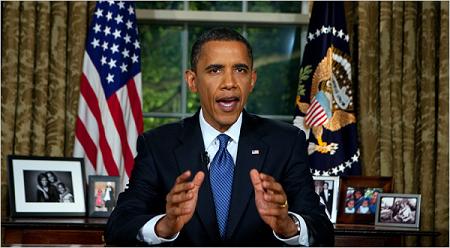
President Obama had the right Oval Office setting, a moment in time of genuine public outrage with the oil industry, and even an eloquent setup, telling Americans “the time to embrace a clean energy future is now” and saying we shouldn’t deterred from bold action by “a lack of political courage and candor.” And then…nothing. Once again, Obama has failed to follow up his rhetorical candor with the courage to do what needs to be done.

As with the health care debate and casino culture on Wall Street, Obama did a good job of diagnosing the problem. In this case, he cited the billions of dollars we send to despots in oil-rich countries, how China is leaving us in the dust in developing clean energy, and the myriad problems created by Americans accounting for 20 percent of world oil consumption, from global warming to the BP spill.

With that kind of setup, he could have just said the magic words — carbon tax – and completely changed the national debate over energy and environmental policy, finally linking the two interconnected realms. He could have called for a steep tax on oil companies and a gasoline tax on consumers, correctly arguing that subsidies on fossil fuels must end now and those who have long benefited from them need to help fund our transition to renewable energy.

Instead, he mentioned a few tepid reforms, and he wouldn’t even pledge his support for any of those ridiculously inadequate half-measures, telling the audience, “The one approach I will not accept is inaction. The one answer I will not settle for is the idea that this challenge is too big and too difficult to meet.”

Pretty words and a fine sentiment, but it means nothing in a political climate in which leaders of both major parties are more concerned with maintaining the flow of political contributions than stopping the flow of oil. Meanwhile, climate scientists say we need to cut our use of fossil fuels in half in the next couple decades to avoid the worst global warming impacts, and all that even the most ambitious legislation in the country would do now is slow the rate of growth over that time.

The only person in this country who could change the political dynamics to really meet this challenge is Obama, and last night, when he had the best chance to do so, he failed.

BP’s stock rises. How about Obama’s?

3

A month ago, when BP ascended to the top of the list of corporate villains, the company’s stock took a thrashing. But now the panic selling seems to have gone into reverse: BP’s stock rose today, even as lawmakers in Washington intensified their criticism, other oil companies claimed they would have done a better at handling the spill, and BP said it was speeding up payment of large commercial losses due to the Gulf of Mexico disaster.

So, is this just a temporary lull in BP’s stock market storm? Or will our addiction to the black stuff keep oil companies afloat, no matter how bad the environmental disaster? And how will Obama’s stock fare?

With the President set to address the American people from the Oval Office tonight, the first time since he was elected and nearly two months after the worst environmental catastrophe in U.S. history, tonight is being framed as a defining moment that could determine Obama’s relevancy.

The “Drill, baby, drill!” crowd would love it if this disaster brought Obama down, and his poll numbers have definitely  taken a beating in recent weeks. My money is on Obama to make a kickass speech tonight—and kick B.P. CEO Tony Hayward’s ass when they meet Wednesday, a day before Hayward testifies before Congress. How it goes after that will depend on the follow through, and that’s where Obama has an opportunity that he better not blow.


Activists angry about BP spill target Arco stations

2

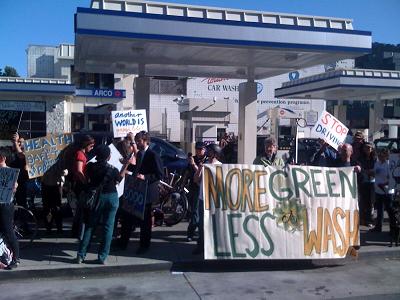
People have felt powerless to counter BP’s devastating and unstoppable oil leak, but Bay Area activists have finally settled on a target for their outrage: BP-owned Arco gas stations, which sell some of the cheapest gas around. On Friday, protesting activists blocked an entrance to the Arco on Fell Street, and tomorrow (6/16), the Sierra Club will hold an 11 a.m. protest outside the Arco at 3400 San Pablo Avenue in Oakland.

“There’s a reason why it’s so cheap, because they skimp on safety,” Josh Hart, one of the main organizers of Friday’s event, told the Guardian. That event targeted an Arco station that had already earned the ire of the bicycling community because motorists there regularly block the bike lane as they wait in line to fill their tanks.

Yet Hart said the protest is about more than just BP, but about Americans’ unquenchable reliance on cheap fossil fuels and an automobile-dependent lifestyle. “It’s not about boycotting BP,” Hart said. “It’s about boycotting oil.”

Tomorrow’s event in Oakland will feature a “mock oil spill” comprised of a black tarp surround by caution tape, a protest designed to send the message, “President Obama move us Beyond Oil.” Meanwhile, at 5 p.m. today, Obama plans to address the country about his adminstration’s so-far-futile efforts to address the spill.

Reading the June election tea leaves

0

Everyone’s reading the tea leaves after the local election. The November supes races will be a huge deal, and it’s really tempting to try to figure out what the DCCC results mean for the fall. Paul Hogarth at BeyondChron takes it on here. Chris Daly (no surprise) disagrees.


Let me see if I can sort some of this out.


Hogarth’s basic argument is that the progressives didn’t really do so well in the election:


“In District 8, moderate Scott Wiener finished 1,400 votes ahead of progressive Rafael Mandelman – as the two face the same electorate in November. The renters’ financial hardship measure, Proposition F, lost badly citywide – and finished far worse in neighborhoods that are usually pro-tenant. Debra Walker fared well in her run for DCCC, but most of her votes were not in District 6 – and results there suggest that another candidate for Supervisor could make such a race highly competitive.”


Hogarth is completely upfront and honest about disclosing that he’s a supporter of one of Walker’s opponents, Jane Kim — a former Green who is now a Democrat (and is very much a progressive), but wasn’t in the DCCC race. Theresa Sparks wasn’t in the DCCC race either. Nor was Jim Meko. There are several strong candidates in that race, and they don’t break down along easy political lines. So looking at how many votes Walker got in D6 seems a little off point; there’s nobody to compare her to.


Back to D8. Hogarth:


“Now we know [the D8 breakdown], and the numbers are even worse for Mandelman. Scott Wiener finished approximately 1,400 votes ahead in District 8 (my vote count shows him at 5,954 to Mandelman’s 4,561.) As a comparison, in December 2002 – the last time District 8 saw a hotly contested race on “moderate v. progressive” lines – Bevan Dufty got 11,000 votes, Eileen Hansen 10,000.”


That would seem to make Wiener the much stronger candidate going into the fall.


But there’s another key factor here: turnout. Low-turnout races are mostly (not always, but mostly) better for the more conservative candidate, and in this case, the turnout was really low. Just 32 percent of the voters went to the polls.


Let’s take a look at the 2002 election, the last time we had an open seat in D 8 with a progressive and a moderate running. In the general election in November, progressive Eileen Hansen came in first, with 9,820 votes to Bevan Dufty’s 8,795. But another progressive, Tom Radulovich was also in the race, and this was before ranked-choice voting. Radulovich got 5,221 votes, the majority of which probably would have gone to Hansen.


Turnout was a little over 50 percent.


In the runoff, in December, turnout dropped to 38.8 percent. Dufty got 11,096 votes, and Hansen 9,995. You could argue that most of the Radulovich votes went to Dufty — possible — but more likely, in the runoff, the more liberal voters who had come out in November to vote for Gray Davis for governor and also voted for Hansen just stayed home in December.


And this fall, Wiener will be more in the position that Hansen was in: There’s a third candidate in the race, Rebecca Prozan, and she’s more likely to take votes from Wiener than from Mandelman. And, of course, there’s RCV this time around — and with two gay men and a lesbian in the race, nobody really knows how the second-choice votes will play out.


Daly plays with the turnout numbers:


For the sake of argument, let’s concede that Mandelman starts out 1000-1400 votes behind Wiener among the 11,000 or so District 8 Democrats who voted for DCCC last week. Given that over 31,000 District 8 residents voted in the 2006 Supervisor race (in a contest that was not the most competitive,) we can assume that at least 20,000 additional people will vote this November. In a 2-person contest, Mandelman would need to win 53.5% of these votes in order to win. Given that less frequent voters trend significantly more progressive, and with the addition of Democratic Party branding and the weight of its mail program, 53.5% is almost assured.


Well, I dunno — in 2002, with a contested governor’s race and a contested D8 race, only 26,600 people voted, but it’s safe to say the numbers will be well above 11,000. And it’s not a two-person contest. But I think it’s also safe to say that those higher-turnout voters are the votes most likely to swing toward Mandelman.  


Jim Stearns, a political consultant with long experience in San Francisco (and no candidate in the D8 race), has another interesting analysis he sent over to me:


“Mandelman’s strategy was to spend his limited resources as part of a team effort to maintain progressive leadership on the DCCC. In so doing, he focused more heavily on slate cards that went district-wide than on mailers in District 8 promoting his own candidacy.


 Wiener, on the other hand, abandoned his fellow moderates and spent his money mostly on his own candidacy. This shortsighted strategic blunder will be extremely costly for Wiener in November.


 The result? Wiener got more votes in District 8, but lost his bid to regain his position as chair of the DCCC. Mandelman got fewer votes, but has significantly increased his chances of winning the Democratic Party endorsement this November. That endorsement is worth far more than the mere 1,000 vote difference between Wiener and Mandelman today.”


None of this means Walker will beat Kim and Sparks in November, or that Mandelman will beat Wiener and Prozan. It just means that I suspect the DCCC results don’t really say much about the relative strengths of any of the candidates when it comes to a focused, district-centered race in a high-turnout fall election.


I emailed Hogarth and ran the turnout argument by him. His response:


I tried to caution in my piece that there’s only so much you can see in the numbers — and that you’re right; voter turnout in November will be a lot higher.  Maybe I should have made this a bigger point.  But progressives are deluding themselves if they think turnout will be as high as it was in November 2008.  And if I were Rafael, I would have reason to worry that Scott did so much better than me in D8.  Also keep in mind that, despite the drop-off of DCCC voters, 48% of people in D8 who participated in this election cast a ballot for Scott Wiener.


Correct — turnout won’t be as high as it was in the presidential race. But it might very well be as high as it was in 2002, when there was a contested race for governor, as there will be this fall. Lots of Democratic candidates — particularly Gavin Newsom and Kamala Harris — will be doing GOTV operations in the city, and while Newsom and Harris won’t be supporting Mandelman, I don’t think either of them will limit their turnout efforts to precincts that run toward Wiener. The more liberal dems who vote in November, the better Harris and Newsom do against Republicans; that’s what they care about.


There’s no question that Scott Wiener will be a formidable contender in November. He’s got money, he’s got Mark Leno, and he’s running in a district that has elected moderate gay men since the return of district elections. But it’s remarkable how well the progressives have done in swing districts of late (see: Eric Mar, John Avalos), and Mandelman will, as Daly says, be the consensus candidate of every progressive group in town. He’ll almost certainly have the Democratic Party — which matters even more when Democrats at the top of the ticket are driving turnout. And he’ll have the same sort of boots on the ground that gave Mar a victory in a very tight race.


At this point, I think Mandelman and Wiener both have a shot at finishing first; it will probably be very close. And Rebecca Prozan runs third.


Oh, and the tenant measure? It lost because there wasn’t an effective campaign behind it. Tenant measures don’t automatically win in tenant-heavy San Francisco; time and again over the years we’ve seen that when there’s a measure that pushes the edge (and face it, I strongly supported Prop. F, but it was pushing the edge) and there’s landlord money against it, you need a full-scale concerted campaign for it. Progressives were paying a lot of attention to the DCCC, and to defeating Props. 16 and 17. Prop. F got lost. I’m not happy about that, but I’m not terribly surprised, either — and I don’t think it means much in the long run.


Chris Daly went a bit too far attacking Hogarth for his connections to Mark Leno, who is a Wiener supporter, and suggesting that the folks at BeyondChron — who are, after all, first and foremost tenant lawyers — are going to be backing Scott Wiener in the fall. I don’t see that happening; I can’t imagine it happening. I just think they read a little too much into the DCCC results.

Why Newsom loves sit-lie

43

To the surprise of exactly nobody, Mayor Gavin Newsom is putting his sit-lie law on the November ballot. And I think he’s thrilled about it.


The last thing the mayor wanted was to have the supervisors approve its own version. He’d much rather have his name on it. This way, he not only gets a wedge issue to attack the progressives in the fall; he gets to run his statewide campaign as someone who’s cracking down on the homeless. It’s tough for a San Francisco politician to win in more conservative parts of the state — but if he can say he stood up to those crazy “ultra-liberals” on the board and is willing to beat up on the poor and homeless, he can shed some of that liberal image.


But it’s not clear that the strategy will work at home. Even David Latterman, a political consultant for Scott Wiener and other downtown-backed candidates, downplayed the role that sit-lie will play in the fall election. “It’s just a wedge issue and it’s not going to change people’s minds on who they support,” Latterman told a crowd that including Chron columnist CW Nevius — who is perhaps the most enthusiastic backer of the measure — during a post-election wrapup at SPUR on June 10.


And among the DCCC candidates in this election, the only one to really champion sit-lie and make it a part of his campaign was David Villa-Lobos, who is also running to replace Chris Daly on the Board of Supervisors, but who finished 26th out of 30 candidates in District 12.


The law also seems a little hinky. It would ban sitting on the sidewalk — or “any object placed on the sidewalk, like a crate or folding chair,” according to the Chron. Everywhere I go in the city these days, people are sitting on folding chairs on the sidewalk — typically eating at a restaurant or cafe that has outdoor seating. I suspect many of those eateries have no specific permits to put chairs on the sidewalk; they just do it, which is fine, and nobody minds.


But technically, I guess, outdoor diners could be cited under the mayor’s law. Or the cops could just ignore them, and decide how and where to enforce the law. Which is never a good thing.


I asked the mayor’s press office for clarification on this point, and I’m still waiting for a response.