• No categories

Politics Blog

Agnos: “I think Gavin’s gonna lose”

11

Former San Francisco Mayor Art Agnos told the Guardian last night that he’d welcome the chance to be appointed a “caretaker mayor” for a year if Mayor Gavin Newsom wins his race for lieutenant governor, but he doesn’t think he’ll get that chance because “I think Gavin’s gonna lose.”

Agnos is one of several names that have been bandied about in the discussions of who the Board of Supervisors might appoint as acting mayor for a year if none of the top candidates running for mayor in 2011 – such as Aaron Peskin, Mark Leno, Leland Yee, or Dennis Herrera – are able to get six votes on the board in January 2010, when Newsom would vacate the Mayor’s Office if he moves on to Sacramento.

“I’m available, but I don’t need it,” Agnos said, noting that he would agree to not run for a full-term in 2011, which would be the main criteria for a caretaker mayor, a concept that would prevent any mayoral candidate from gaining the advantage of incumbency.

But Agnos said that Abel Maldonado, the Republican nominee for lieutenant governor, will be a tough challenge for Newsom, both because he’s a moderate Latino with a compelling personnel story, and because rich Republican gubernatorial nominee Meg Whitman will likely give Maldonado all the money and support he needs so she doesn’t have a Democratic rival as lieutenant governor.

As Agnos told us, “She will give him whatever he need to bury Newsom.”

SUV rampage victim speaks about the night he was hit

A line of television news cameras swiveled toward Rolando Casajeros, known to his friends and coworkers as “Allan,” and followed him as he moved gingerly into the conference room at a downtown San Francisco law office. The press conference was held on June 24 at the office of Choulos, Choulos & Wyle, the law firm tapped to represent him in a civil suit against the driver of the blue Nissan Rogue SUV that rammed into him June 2.

Casajeros was the first of four victims to be intentionally hit by the SUV driver on a rampage, only a few doors down from his home, near the intersection of 24th and Harrison streets in San Francisco’s Mission district. Since surviving the hit-and-run, his life has been turned upside down.

As he took a seat before three microphones, it became obvious that he had sustained very serious injuries. A scar zigzagged across the top of his shaved head, and a second scar crossed vertically down his forehead, marks from intensive surgery he’d endured to alleviate bleeding in his brain. His front teeth were missing and his lips were swollen. While his attorney, Claude Wyle, explained that he had sustained 12 facial fractures, jaw fractures that left him with a wired jaw, and mouth injuries in addition to the complications that necessitated brain surgery, Casajeros kept his eyes closed. “He’s very brave to come here today,” Wyle said gently.

When asked what he remembered from that night, Casajeros opened his eyes and looked up. Speaking in a low tone, he replied that he’d gone out to buy something from Safeway, and had a few grocery items with him as he biked home. The next thing he remembers is blacking out. “Bam, that’s it,” he said. “I just remember I flew in the air. That’s it.” Two nights later, he woke up in the hospital.

Casajeros underwent 19 hours of intensive surgery. He said he “almost fainted” when the doctor conveyed to him the extent of the damage. Since being released from the hospital last week, he’s been staying with the family of his best friend, Ronnie Guinto, who is a care provider by trade. Casajeros, who is originally from the Philippines, is the godfather of Guinto’s children.

The children’s mother, Kellie Arechiga, also spoke at the press conference, saying she wanted to get the word out about this weekend’s fundraiser at the Old Clam House to help cover expenses while he recovers from the traumatic experience. Casajeros has worked as a waiter at the Old Clam House for 12 years. He does not have health insurance, but there is a chance that the city’s Healthy San Francisco program will step in to assist with medical payments. State funds earmarked to aid victims of violent crime may also be available to him, according to his attorney.

Earlier on the day he was struck by the SUV, Casajeros and Guinto had gone out for a long recreational bike ride. “I love bikes,” Casajeros told the reporters. “I love to go biking. I go running. I’m an active person. But after this, I don’t know.” Casajeros cannot imagine why he was targeted, or why the man accused of going on the rampage, 39-year-old David Mark Clark of Albany, would have plowed into him and three others seemingly out of nowhere.

“To all the bike enthusiasts – be careful,” Casajeros said.

Wyle said it sometimes takes an outrageous event to highlight a broader trend of motorists behaving aggressively toward bicyclists in traffic. “There are many, many instances … where motorists are intentionally or recklessly endangering the lives of bicyclists,” said Wyle, who has taken many cases involving bike accidents.

Casajeros — who lives paycheck to paycheck working as a server in San Francisco — is not expected to be able to return to work for at least three months, according to the most optimistic estimate. In the meantime, he is in need of assistance to cover monthly expenses like rent, car payments, and transportation to and from his physical therapy appointments. Information on how to make a donation to a charitable trust fund set up by his attorney can be found here. Meanwhile, his friends and coworkers are still in need of items or services for a raffle at Sunday’s fundraiser at the Old Clam House.

The fundraiser will be held on Sunday, June 27, from 3 p.m. to 10 p.m. at the Old Clam House, 299 Bayshore Blvd, near Oakdale Avenue. $20 gets you a plate of food, one free drink, and two raffle tickets. There will also be live music and a DJ. Anyone wishing to make a donation for the raffle should e-mail Kelliearechiga2000@gmail.com.

Oakland joins the car-free “ciclovia” movement

2

Joining American cities including Portland, San Francisco, and New York in borrowing the temporarily car-free ciclovia concept pioneered in Bogota, Colombia, Oakland officials will clear the automobiles from the heart of the city this Sunday for its first Oaklavia event.

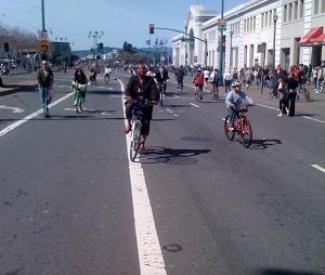
The city’s invitation to “come play in the streets of Oakland” from 10 a.m. to 2 p.m. mirrors SF’s Sunday Streets call that brought thousands of people into the streets of the Mission District last Sunday, an event that will be repeated July 11 before moving to Great Highway Aug. 22 and the Western Addition Sept. 19.

“The heart and soul of a city is its pedestrians spaces,” former Bogota Mayor Enrique Penalosa, who started the trend, told the Guardian during a visit to San Francisco last year, emphasizing the value of borrowing space from cars to to create temporary parks, particularly in resource-strapped cities such as Oakland. “In a poor city, the inequality is felt most during leisure time,” he said. “My main concerns are equity and happiness and the way cities can contribute to those things.”

Kim launches D6 campaign, stressing independence from “machine” politics

45

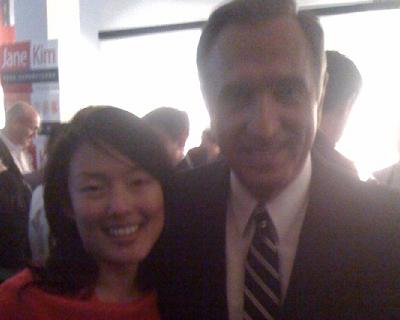
Jane Kim launched her campaign for the District 6 seat on the Board of Supervisors last night during a spirited event at 111 Minna, showcasing some high-profile supporters and giving a speech that began with touting her early work on immigrant rights and homeless issues and ended with the declaration, “I’m not part of anyone’s machine and I’m certainly not a part of anyone’s master plan.”

That emphasis on her independence could be seen as a subtle dig at Debra Walker, another progressive who has been running for the seat for the last two years, who locked down early support from many progressive groups and officials, and whose supporters were unhappy with Kim’s late decision to enter the race, concerned it might split the vote and allow downtown-backed Theresa Sparks — who could be viewed as a “machine” candidate on the other end of the political spectrum — to steal the seat for the moderates.

When I asked what “machine” she meant and whether the comment was a reference to Walker’s supporters, Kim wouldn’t clarify the comment, refusing to criticize the Walker campaign and saying only, “I want to be a part of a new political process.”

And that new process seems to rely heavily on the energy of young people, including many of color, who dominated the crowd last night. Kim also signaled that she will be pushing a fairly bold progressive agenda that includes more city support for schools, Muni, immigrants, and low-income families, and making the streets more vibrant and democratic.

“The mantra of our campaign is to make our neighborhoods complete,” Kim said.

She proposed making substantial pedestian and bicycle improvements on several streets in her district, including 2nd, Folsom, Taylor, and Turk streets, creating more bikes lanes that are separated from car traffic, and turning many of the alleys in her district into more active public spaces. She called for the city to help fund youth programs and a longer school year and to offer more support to small businesses, which she called the city’s most important job generator.

Kim, a civil rights attorney and president of the school board, also emphasized the need to improve the tone of political debate in the city, which she helped accomplish on the school board (whose vice president, Hydra Mendoza, an employee of Mayor Gavin Newsom, was there in support). “People are disillusioned and disappointed with the process and the bickering,” Kim said.

Among Kim’s supporters at the event were Board of Supervisors President David Chiu, former Mayor Art Agnos, filmmaker Kevin Epps, Police Commissioner and immigrant rights activist Angela Chan, transportation activist Dave Synder, and representatives from a wide variety of community groups.

“She has epitomized the progressive values that I think all of San Francisco shares,” Chiu told the crowd, later adding, “She will be a part of the next generation of political leaders of San Francisco.”

“I’m really proud that Jane has put herself out there as a future leader and our supervisor,” said Epps, later adding, “I think Jane really has her ear to the streets.”

Kim pledged to run a clean campaign focused on her issues, and her only supporter to voice overt criticism of Walker was Agnos, who said he was impressed with Kim’s work with him last year in fighting Prop. D, which would have removed mid-Market from the city ban on new billboards, a measure that Walker supported.

“Prop. D for me was a tipping point, and Debra went with the commercial interests,” Agnos told the Guardian.

But Kim, 32, says her reason for running is to help push a progressive vision for the city and bring new blood into the political process.

“I have to tell you, I never wanted to go into politics,” she told the crowd. “But I had the desire to see some real change.”

Why SF cops shouldn’t have tasers

19

So let’s assume, arguendo as the lawyers say, the Johannes Mehserle is telling the truth, that he thought he had drawn his taser instead of his handgun when he shot Oscar Grant in the back. I’m not saying I believe him, but suppose that’s true.


It’s still an excellent argument against giving tasers to the SF cops.


So is this.


I don’t think anyone, even the still-clueless BART police, would argue that Oscar Grant had created a situation that justified the use of lethal force. He was unarmed, not an imminent threat to the life of a cop or a bystander. But a taser is just so convenient; you can zap someone who is just a little unruly. It’s a weapon that’s just too easy to justify.


If Mehserle didn’t have a taser, Grant might still be alive.


And I don’t care how much training you give the cops: As we saw with the BART cop zapping the fare evader, give them a weapon and they’ll use it.

Raise Your Vote

1

Organizing for America , the successor organization to Obama for America, has aunched a new website called Raise Your Vote, which they hope will be the centerpiece of a huge voter registration effort. And more.
“RaiseYourVote.com isn’t just a voter registration site,” OFA stated. “It serves as a powerful clearinghouse for voter information across the country — armed with pretty much everything you need to know to cast your ballot. It even automatically personalizes to the user’s location — so when you visit the site, you’ll see voter information for your state.”
“But the power of a site like this depends on how many voters see it,” OFA concludes.

No kidding. So, stop whining about how Obama hasn’t done enough, and start registering to vote. Because you can bet Alaskan Barbie and the crackpot Tea Partiers will be out in full force this fall.

Was Meg Whitman verbally or physically abusive?

7

Either way, the question spells trouble for the Whitman campaign.

Navy’s destruction of Buck’s Beach begins

0

The Navy has begun its promised destruction of Buck’s Beach, a sandy sheltered beach along the India Basin shoreline that’s technically part of Parcel B of the Hunters Point Shipyard. Navy excavators are currently removing all the sand, which will soon be replaced with rocks. 

Local residents who fought this plan are also upset by the installation of what they believe is an ugly anti-Kayak boom thrust out into the Bay, offshore of the beach. 

D. 10 Supervisor candidate Kristine Enea said she understands the installation is temporary, but wishes the Navy had informed the community of this detail before going ahead and implementing it.

“Apparently, it’s to hold curtains that will stop sediment from going out to the Bay,” Enea told us. “But this is another example of the kind of detail that may not seem important to someone sitting in an office in D.C, but is a big deal to folks who live here.”
 

Did McChrystal speak out to get out?

1

Of all the theories  about why McChrystal let his hair down in front of a reporter no less, the idea that he did it to get the hell out of “Chaos-istan” may be the most credible. On the other hand, McChrystal sounds like the kind of guy who wouldn’t want to see his men (and women) put in harm’s way, if he wasn’t around to support them. But today’s announcement that Petraeus supports a July 2011 withdrawal deadline means any perceived failure will ultimately end up pinned to Petraeus tail.

A tough choice for C.W. Nevius

9

It’s no surprise the C.W. Nevius thinks the city has too many public services and that “some have to go.” Nonprofits that get city funds are an easy target. Some of them aren’t too good at paperwork, and have a hard time providing tangible evidence of results. (If you run a violence-prevention program for kids, and some of them still get in trouble, can you”prove” that the others didn’t because of your help? Of course not.) And there’s no doubt some waste and duplication of services in the system.

Some perspective: When I was on the Board of Trustees of Wesleyan University (as an elected member from the Wesleyan Progressive Alumni Network), I constantly complained about waste in the budget. I wanted to know why we spent so much money on dinners for the trustees (most of whom could well afford their own food and wine) when we were cutting ethnic studies programs and tightening up on financial aid. Colin Campbell, the president, gave me a very good answer:

In any $60 million budget, for any public or nonprofit organization, there’s going to be some waste. It’s unavoidale. And, he said, there are also going to be things that ought to be in the budget but aren’t.

(By my second year on the board, they did cut back on wine at lunch, which may have been due to my complaints but was more likely a result of too many of the older board members getting a little looped and falling asleep during the afternoon meetings.)

So yeah, there are things that could be eliminated in the current nonprofit system. There are also a lot of services that ought to be in the city budget, but aren’t.

C.W.:

There’s just one flaw in our civic personality.

Tough choices.

We’d rather not make them.

That’s correct, and it’s true for everyone in California, probably everyone in the United States. We want good schools, clean streets, nice parks, plenty of cops and firefighters .. and we don’t want to pay for it.

Taxes in this state, and in this country, are the lowest they’ve been in decades. State spending is back to early 1990s levels. State cuts have forced cities to take on more and more burdens.

So the tough choice isn’t whether we can afford to provide public services. It’s whether we have the courage to demand that the people who have seen their tax rates plummet while social problems skyrocket pay their fair share. How about that one, Chuck?

SFBG Radio: Johnny and Tim on Meg, McChrystal and the Messiah

0

 In totday’s installment, Johnny and Tim talk about whether McChrystal is the fall guy for a failed war, Meg’s foolish fight with the nurses — and a very strange Pew poll on the return of Jesus Christ. You can listen after the jump.

sfbgradio6222010 by bgedit

Fundraiser this weekend for cyclist injured in SUV rampage

A fundraiser is planned for this weekend at The Old Clamhouse to help Alan Casajeros, one of four cyclists injured on June 2 when a motorist intentionally plowed into them with a sport utility vehicle.

Casajeros, 39, endured 19 hours of intensive surgery at San Francisco General Hospital after becoming a victim of the six-minute hit-and-run rampage, which occurred in San Francisco’s Mission and Potrero Hill neighborhoods. He was the most critically injured of the four victims. The impact left him with serious head injuries, including bleeding in the brain, damage to his face, and the loss of his front teeth. He was released from the hospital on June 14, according to SFGH spokesperson Rachael Kagan.

Casajeros has worked as a waiter at The Old Clamhouse on Bayshore Boulevard for 12 years, according to coworker Maria Anderson, who said he was “an excellent employee.” Anderson said she received a call from SF General Hospital after the accident occurred. While hospital staffers were unable to get much information to find out who they should notify, he mentioned in his delirium that he had to call in sick at the Clamhouse, Anderson said, so they phoned the restaurant.

“It was horrendous,” Anderson said. “He literally was going from his home to pick up milk.” According to a friend of Casajero’s, Kellie Arechiga, he was biking home when the blue Nissan Rogue SUV struck him.

Arechiga said Casajeros is the best friend of her children’s father, and like a member of the family. She said he loves going for bike rides with the kids, and he often cycles to and from work. Since his release from the hospital, he’s been staying with Arechiga and her family in Redwood City, she said. “He’s just recovering. He knows us, and remembers everything,” she added.

Meanwhile, his friends and coworkers organized the fundraiser to help out with his monthly expenses, and visited him in the hospital. Many cyclists and supporters have come forward to donate money and lend helping hands. “The outpouring of support has been really kind, and really sweet,” Anderson said.

David Mark Clark, 39, is facing trial for the June 2 road rampage, and is being held without bail in the San Francisco County psychiatric lockup. Clark pleaded not guilty to four counts of attempted murder, four counts of assault with a deadly weapon (to wit: a car) and three counts of battery causing serious bodily injury. His next court date is July 27, to set a date for a preliminary hearing.

The fundraiser will be held on Sunday, June 27, from 3 p.m. to 10 p.m. at The Old Clamhouse, 299 Bayshore Blvd, near Oakdale Avenue. $20 gets you a plate of food, one free drink, and two raffle tickets. There will also be live music and a DJ.

***UPDATE: Casajeros’  attorney, Claude Wyle, has set up a special account at Wells Fargo for donations to Alan, whose legal name is Rolando Casajeros. Donations should be made directly to account No. 7734751691, with checks payable to Rolando Casajeros and attorney Claude Wyle.***

**Note: This file has been updated from an original version.

Anti-war groups disappointed with Obama’s speech

3

By Kristen Peters

Bay Area-based anti-war organizations were disappointed that President Barack Obama reaffirmed his support for war in Afghanistan while ousting the commanding general there, saying the doomed and dangerous military intervention is a bigger problem than the generals involved in executing it.

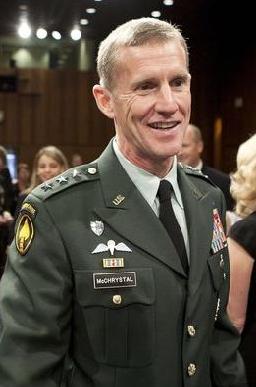
General Stanley McChrystal was today relieved from his post by the president for exhibiting an openly contemptuous view of the Obama administration and other civilian leaders in a recent interview with Rolling Stone magazine, replacing him with General David Petraeus, pending approval from Congress.

“There is a change in personnel, but not a change in policy,” President Obama said during his announcement in the Rose Garden.

That was precisely what the anti-war crowd didn’t want to hear.

“Although there is a personnel change, there is no change in the occupation of Afghanistan,” Nancy Mancias of Code Pink told the Guardian. “The troops are still present. Local groups need to remain focused on bringing our troops home, halt funding and stop the continued occupation overflowing into Pakistan.”

Instead of finding red flags in McChrystal’s insubordinate comments or the RS article’s quotes from disgruntled soldiers and dubious diplomats, Obama simply used the occasion to mix up the staff hierarchy running a war that few think is going well.

“It has proven an incredible waste of resources,” Richard Becker, regional director of the Act Now to Stop War and End Racism (ANSWER) Coalition, told the Guardian. “No one can pretend that anything resembling progress has been made. In fact, it’s just the opposite.”

More deaths have occurred over the last 10 months than have taken place in the last five years of combat. In addition to the staggering number of casualties accompanying the war, it also boasts a hefty price tag. According to organizational leaders, expenditure on the war has just exceeded the $1 trillion mark with no end in sight.

“The war — which will soon enter its tenth year – has meant a complete disaster for the people of our nation, a continuation of disasters for U.S. policy, and has inflicted disaster on the people of Afghanistan,” Becker said.

Environmental groups appeal final EIR on Lennar’s Candlestick/Shipyard plan

0

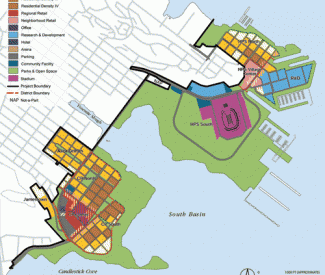
The Sierra Club, the Golden Gate Audubon Society, the California Native Plant Society’ and San Francisco Tomorrow have filed an appeal with the Board of Supervisor’s and the city’s Planning Department over the Planning Commission’s June 3 certification of the city’s controversial final environment report (FEIR) for Lennar’s Candlestick Point/ Hunters Point Shipyard redevelopment project.

The move means that the FEIR, which otherwise would not have come before the Board for review, now heads to the Board for a hearing within 30 days of the group’s June 21 appeal filing. The move also means that the City, which laid out an aggressive schedule for seeking approvals from a myriad of government agencies and departments, cannot seek further approval actions on the project until the Board holds a hearing, which will likely occur on or before July 20.

The San Francisco Bay chapter of the Sierra Club, the Golden Gate Audubon Society, the California Native Plant Society’s Yerba Buena Chapter and San Francisco Tomorrow cited nine major deficiencies in their appeal , but noted that by removing plans to a) build a bridge over Yosemite Slough, b)erect luxury condos on state parkland and b) compromise clean-up efforts at Parcel E2, which is the most polluted land at the shipyard, resolution of many of these disputed issues could be expedited.

“If the Board of Supervisors acts promptly, revisions to the EIR may be made quickly and result in a minimal delay in the progress of the project,” the appeal warns. “Alternately, resolution of many of these disputed issues may be expedited by a decision to remove from the FEIR and Project Plan the provisions for the bridge over the Yosemite Slough, the transfer of land in Candlestick Point State Recreation Area, and compromised clean-up efforts at Parcel E2.”

In their appeal, the four groups noted that they each group and its members represent “a sizeable constituency that has been actively participating in the development of the EIR” for almost a decade and that has conducted or funded studies to inform the Draft EIR and has filed comments to the DEIR and other planning documents.

“Unfortunately, the data, comments and testimony provided by the Appellants and their members have been dismissed or outright ignored by the Planning Department and the developer in this process, resulting in fatal flaws in the FEIR and necessitating this appeal,” the four groups state.

‘Because many portions of the FEIR are inaccurate and incomplete, the Planning Commission erred in adopting several findings and certifying the FEIR,” the appeal concludes. ‘Therefore, we are appealing the FEIR because:
1.    The FEIR failed to adequately analyze an alternate Bus Rapid Transit (BRT) router around Yosemite Slough;
2.    The FEIR failed to adequately assess impacts resulting form the landfill cap on Parcel E2, which is a lower standard for the clean-up than required by San Francisco voters as expressed in Proposition P;
3.    The FEIR inaccurately and incompletely assessed the impacts from transferring approximately 20 acres of public shoreline land in Candlestick Point State Recreation Area to the developer for construction of high-end housing;
4.    The FEIR failed to analyze those elements of the project’s Sustainability Plan that could have significant environmental impacts, including two proposed heating and cooling plants (which appear to be power plants) to serve at least 10,500 units in the Project and a Project-wide recycling collection system;
5.    The FEIR failed to adequately consider impacts to the bird-nesting island component of the Candlestick Point State Recreation Area’s proposed 34-acre Wetland Restoration Project, which is already permitted and planned for construction this year;
6.    The FEIR failed to adequately address impacts to eight MUNI lines, which would significantly increase transit times, increase delays during peak hours, potentially dissuade ridership, and/or require increased service, busses, or drivers;
7.    The FEIR failed to adequately assess impacts resulting from the construction and maintenance of the Project’s underground utility matrix;
8.    The FEIR failed to adequately address the fact that the Project will result in increases in air pollution that will exceed existing air quality standards—indeed even though the FEIR admits exceedences of air quality levels will occur, those statements are underestimates because the FEIR failed to consider that the development in combination with other development plans will result in significant traffic congestion on Highway 101 and Interstate 280 and fore more traffic onto surface streets; and
9.    The FEIR included conclusions based on false, inaccurate and/or biased statements as “evidence,” including (but not limited to) that one cannot have an ‘undisturbed nature experience” in an urban area as a rationale for dismissing impacts that will inevitably result from construction of the bridge over Yosemite Slough and/or the reduction of public land in the Candlestick Point State Recreation Area.

In their appeal, Mike Lynes, Conservation Director Golden Gate Audubon Society, Linda J.Shaffer, Vice President, California Native Plant Society, Yerba Buena Chapter, Jennifer Clary of San Francisco Tomorrow, and Arthur Feinstein, Sierra Club, San Francisco Bay Chapter, promised that each of the abovementioned deficiencies will be further documented by additional submissions to the record prior to a hearing on this appeal by the Board. So, stay tuned.

Lights out? I think not

0

The big bold headline on the front page of the Ex: Lights out for power project. The article actually isn’t that bad, although it’s framed as a setback for public power.


But that spin is completely wrong. A huge victory for public power — the defeat of Prop. 16 — gives the city a little breathing room to get a better contract. That’s all that’s happening.


Sup. Ross Mirkarimi was pushing hard to get the San Francisco Public Utilities Commission to sign at least a tentative deal to get the city’s community choice aggregation program locked in before June 8, just in case Prop. 16 passed. The artificial deadline set by Pacific Gas and Electric Company was, frankly, forcing the city to get the best deal possible in a short time frame. And even an imperfect deal would have been preferable to losing out on CCA altogether.


But now that threat is gone, and the city has a little breathing room to negotiate — and to nobody’s suprise, the SFPUC, with Mirkarimi’s full support, is taking advantage of it. CCA isn’t dead; it’s not “lights out.” It’s not even that far off schedule. If the PUC doesn’t drag its feet, the program can be up and running early next year.


So there’s no cause for alarm or panic. The city will probably get a better deal now, anyway.

Endangered Species Act protection sought for Franklin’s bumble bee

2

I’ve been obsessed with bees in general, and bumble bees in particular for some time now. I’m fascinated by the bumble bee’s thick tundra- adapted pelt that allows it to forage for nectar in way colder temperatures than your average sun-loving Italian honey bee.
And then there’s the bumble bee’s relatively hardcore social structure, in which only the young bumble bee queens over winter, emerging alone in the spring to start colonies afresh.

I’ve even read that the first generation of a bumble bee queen’s colony can be stunted because the young queen had to do everything herself—gathering pollen and nectar, building the nest, tending to her developing brood—unlike the honey bee queen, which forms a permanent colony and has multiple female workers to help raise the young, clean the hive and gather necessary provisions each day.

But above all, I’m fascinated by the fact that something as small as a bumble bee plays such an important role when it comes to pollinating plants. Experts say that native bumble bee pollinators are important to the reproduction of many native flowering plants and food crops. And in Britain and the Netherlands, researchers have actually noticed a decline in the abundance of certain plants where multiple bee species have also declined. Then there’s the fact that for many crops, such as greenhouse tomatoes, blueberries and cranberries, the buzzier bumble bees are better pollinators than honey bees, and some species are produced commercially for their use in pollination.

So, I’ve been troubled by reports that some native bumble bee species are in decline, and that commercially reared bumble bees, reared on the East Coast and then imported to the West to buzz pollinate hothouse tomatoes, could be the cause.

And now the Xerces Society for Invertebrate Conservation and bumble bee scientist Dr. Robbin Thorp have petitioned the U.S. Fish and Wildlife Service requesting Endangered Species Act protection for Franklin’s bumble bee.

”This mostly black bumble bee was readily found throughout its range in southern Oregon and northern California in the early 1990s,” stated the Xerces Society in a press release. “Twelve years of surveys conducted by Dr. Robbin Thorp clearly show that this species has declined steadily.  The decline has been so severe that only a single Franklin’s bumble bee was observed in 2006 and none since.”

“Over the last 12 years I have watched the populations of this bumble bee decline precipitously,” said Thorp, who is Professor Emeritus at UC Davis “My hope is this species can recover before it is too late.”
The Xerces press release notes that the cause of the catastrophic decline of Franklin’s bumble bee is hypothesized to be an escaped exotic disease that may have spread from commercial bumble bee colonies to wild bumble bee populations.

“Research in Dr. Sydney Cameron’s lab at the University of Illinois is underway to test this hypothesis,” the press release notes. “Other threats that may be harming Franklin’s bumble bee populations include habitat loss and degradation, climate change, pesticide use, and invasive plant species.
Recognizing the decline of Franklin’s bumble bee and numerous other North American bumble bees, the Xerces Society, Thorp, Defenders of Wildlife and the Natural Resources Defense Council recently petitioned the USDA’s Animal and Plant Health Inspection Service to protect wild bumble bees from the threat of disease by regulating commercial bumble bees.

Specifically, the petition asked the USDA-APHIS to create rules prohibiting the shipment of commercial bumble bees outside of their native ranges and to regulate the interstate transport of commercial bumble bees within their native ranges by requiring permits that show that bumble bees are certified as disease-free prior to movement.

“It is vital that the U.S. Fish and Wildlife Service Act quickly to protect this bumble bee,” said Sarina Jepsen, Endangered Species program director at Xerces. “We hope that an Endangered Species Act listing will encourage the USDA-APHIS to protect wild bumble bees from future threats posed by nonnative, commercial bumble bees.” 

“The decline in Franklin’s bumble bee should serve as an alarm that we are starting to lose important pollinators,” said Scott Hoffman Black, Executive Director of The Xerces Society.  “We hope that Franklin’s bumble bee will remind us to prevent pollinators across the U.S. from sliding toward extinction.”

Why McChrystal had to go

1

Respect for civilian control over the military chain of command. That’s what Obama talked about in his comments on “accepting the resignation of” (that is, firing) Gen. Stanley McChrystal. And it was the right point to make. The president noted that McChrystal’s conduct “doesn’t meet the standard of a commanding general,” and I think what he was really saying was this:


I may be a Democrat, and I may be (something of) a liberal, and I may never have served in the armed forces, and the military officer corps tends to be overwhelmingly Republican and conservative, but guess what: I’m still the boss. Don’t forget it.


I still think the real issue here isn’t McChrystal — it’s the fact that the war in Afghanistan was and is a mistake, and we can’t possibly win, and the president can shuffle the generals around all he wants, but it won’t change the doomed nature of this pointless mission.


But it seems pretty clear from the tone of Obama’s remarks that he saw a need to remind the military about respect for the commander in chief. And that’s a good thing: When the military starts getting uppity, and the senior officers start acting as if they know more about running things than the elected leaders, you plant the seeds for some very nasty trouble.


And by the way: What a coup for Rolling Stone, for Michael Hastings and for the world of in-depth reporting. It took Hastings more than a month to get this story; without the support of a magazine that could pay for that kind of work, we never would have learned how the military leadership in Afghanistan feels about the president. A reminder that despite the light-speed pace of modern journalism, paying writers to take the time they need to get big stories is still central to democracy. 

Bike Plan hearing yields lots of detail but no decision

2

The fate of San Francisco’s Bicycle Plan and the four-year-old court injunction against implementing its projects remains unclear following a nearly three-hour hearing today that delved deeply into the minutiae of traffic studies, mitigation requirements, and the dictates of the California Environmental Quality Act.

But Superior Court Judge Peter Busch did make a few things clear, most notably that it’s a legitimate decision for city leaders to give more street space to bikes, even if it slows down cars or Muni. “That’s the policy question that’s not for the court to decide,” he said, cutting off plaintiff attorney Mary Miles’ repeated arguments that the city shouldn’t be favoring bicyclists because they are a minority of road users. He later repeated the point: “I don’t get to decide that the Board of Supervisors’ policy is misguided.”

The issue at hand – which was argued to a level of detail that only a lawyer or traffic engineer could really appreciate – was whether policymakers had the benefit of a full analysis of all the various impacts and options before they unanimously decided to certify the four-volume EIR and green light 45 of the 60 near-term bike projects it studied.

“The analysis had to occur before the city approved the project,” Miles, who sued the city along with anti-bike activist Rob Anderson back in 2005, told the court today, charging that “there’s no mitigation or analysis in the EIR” that their suit forced the city to prepare and adopt last year.

Deputy City Attorney Audrey Williams Pearson strongly disagreed, asserting that “one of the great things about this EIR is the breadth of alternatives studied” and noting, “For complicated projects, caselaw is clear that it’s almost impossible to eliminate all impacts.”

And this is certainly a complicated case, as all sides acknowledged. Part of the reason for that was the city’s 2004 decision to mention dozens of specific projects in the plan – a legal strategy some bike activists have criticized – without doing a full EIR, which has proven to be a complicated endeavor that took two years and blazed a new regulatory trail because of all the intersections and factors it needed to study.

“There probably has never been an EIR for a project like this. This is a strange project to prepare an EIR for,” Busch acknowledged, noting the difficulty in deciphering what is then legally required by CEQA. In the end, he gave no indication how he was leaning, asking both sides to submit proposed orders by July 6 and responses to those orders by July 13, meaning that it will likely be at least another month (and up to 90 days) before we have a ruling.

But Busch certainly didn’t seem to buy Miles argument that this was a fatally flawed study that did little to study alternatives or mitigation measures, which she charged was a gross violation of CEQA and abuse of the city’s discretion.

Miles seemed to be throwing out a wide range of accusations hoping that something would stick, belittling every city claim to have diligently looking at alternatives and employing hyperbole and sweeping denunciations with such regularity that Busch finally challenged her on it.

“That’s such an over-argument it leaves me wondering about the rest of your argument,” Busch said after Miles asserted that the voluminous EIR contained no references to any of its underlying studies and source data.

Busch also noted the contradiction between her complaints that the EIR didn’t include all the traffic count data that went into its formulas for determining changes to the level of service at intersections and her complaint that the EIR was too big and unwieldy. “So you’re saying the info should have been added to what you say is already an overlarge EIR?” Busch asked.

Later, he took Miles to task for advocating that the threshold the EIR used for determining whether delays to Muni service rose to the level of a significant impact should have been the subject of separate public hearings, just as she argued that virtually every detail in the plan should have been explicitly laid out in full detail and subject to challenge.

“You’re describing an endless process that would be impossible to comply with,” Busch told Miles.

In fact, Pearson said CEQA specifically says such fine details shouldn’t be in EIRs. For example, while the EIR discusses impacts to the level of service at every intersection affected by the plan – a complicated formula involving 30 different data points, which were in a Transportation Impact Study that the EIR referenced – she said it didn’t need to all be in the EIR. “If this detail was in the EIR, it would turn the four-volume EIR into an eight-volume EIR,” she said.

Miles challenged the city on not going into that same level of detail in justifying why potential mitigation measures for each impact weren’t included in the EIR, something Pearson argued isn’t legally required (although she did trip up in citing a case that did require such analysis, saying that court ruling was wrong and earning a rebuke from Busch, who said it’s not in his power to overrule a higher court’s ruling).

Pearson also noted that for all the complaints about not studying enough alternatives, neither Miles nor Anderson have suggested any. “I think it’s telling that the petitioners haven’t come up with a single alternative that we should have looked at,” Pearson said before acknowledging the point by Miles and Busch that’s not incumbent upon petitioners in cases like this.

But Pearson seemed more persuasive when she noted that in a built out city, there’s only so much the city can do to find creative ways to offset the traffic impacts of giving more space to bikes. “This is not your typical project. We are not working on a blank slate. We are working within the constraints of the city’s existing roadways,” Pearson said.

In the end, Busch asked both sides what the remedies might be if he finds some flaws in the EIR, expressing a desire to wrap this case up without extending the current wide-ranging injunction against all bike projects. But Anderson said the hearing gave him hope that the judge might not let the plan proceed without more work: “It’s taken longer than I thought, which tells me he has some serious concerns.”


What the “Defund ACORN Act” is really about

13

Last September, the US Congress approved the Defund ACORN Act without investigating the charges leveled against ACORN.

Bertha Lewis, ACORN’s CEO, claims that these charges were nothing more than a massive “propaganda campaign” and that ACORN was targeted because it was successful at organizing low-income communities–the very folks that rich corporate interests don’t want to see voting and otherwise standing up for their rights.

Now with a hearing scheduled for June 24, Lewis is asking folks to stand up and fight what she describes as an assault on the Constitution itself.

“Congress’ move, singling out one organization for sanctions without investigation, is called a “bill of attainder” and it is expressly prohibited by the Constitution of the United States,” Lewis stated in a press release issued today.

” If this attack is allowed to stand, then any other organization that displeases those with power in the United States can be similarly attacked and, potentially, destroyed,” Lewis said.

As she notes, ACORN has been investigated by four separate and independent, sources – former Massachusetts Attorney General Scott Harshbarger; the Brooklyn District Attorney’s office; the California Attorney General; and the Government Accountability Office (GAO).

“Each of them has cleared ACORN of any wrongdoing,” Lewis observed. “ Three investigations reviewing the videos used to attack ACORN determined that they were “splice jobs” in which “the truth is on the cutting room floor”. The fourth, from the GAO, concluded that ACORN had not misused any of the Federal funds it had received. In other words, the entire set of attacks was a witch hunt driven using modern propaganda techniques and with millions of dollars in dedicated air time on a “news” channel and talk radio.”

Lewis thinks she knows why these attacks happened.

” We were simply too good at what we did – engaging low- and moderate-income families and families of color in America’s democratic system,” she said. “ If we hadn’t helped 860,000 new voters get on the voter rolls since 2004 (we believe this is the largest non-partisan voter registration effort ever carried out by a single non-profit organization), if we hadn’t helped raise the minimum wage in seven states, if we hadn’t blown the whistle about predatory lending in the sub-prime market back in 1999, and if we hadn’t brought in over $15 billion in direct benefits to America’s low- and moderate-income neighborhoods from 1994 – 2004, then we wouldn’t have been the targets of smears and attacks going back to the 2004 election. Smears that were exposed during the height of the scandal surrounding the firing of US Attorneys like David Iglesias in New Mexico, who refused to trump up phony voter fraud charges against ACORN.”

Lewis comments that if the attacks leveled against ACORN had really been about misusing taxpayer dollars, then defense contractors like Xe (formerly Blackwater), Halliburton, and Kaman Dayron, all of whom have been found guilty of either committing actual crimes or of collectively defrauding the American people of hundreds of millions of dollars, would have been the subject of their own Defund Corporate Criminals Act.

”But, of course, they aren’t,” Lewis concluded.  Because, unlike ACORN’s low- and moderate-income membership, these corporations can buy influence in the highest levels of political power in the United States. So, our lawsuit against the unconstitutional Defund ACORN Act is not about ACORN and its past federal funding. It is about justice for all organizations that fight for the interests of regular folks against the most powerful interests in America.”

The real issue in Afghanistan

0

The Rolling Stone article on Gen. Stanley McChrystal has the blog and pundit world all atwitter, with calls for the general’s resignation, deep sighs of remorse, lofty comments about the sanctity of the commander in chief and the chain of command and lots more. The dude screwed up; you don’t let your aides dis the president like that. But that’s really off the point.


Frankly, if there were a way for the U.S. to be successful in Afghanistan, and McChrystal were the guy to do it, Obama shouldn’t care what the guy says. Whatever; you mean you never griped about your boss? It happens. Calling dinner with a French cabinet minister “fucking gay” is pretty fucking stupid, I admit. Overall, the interviews show astonishly bad judgment. (Oh, and General, sir: Don’t go out drinking and get shitfaced with a reporter if you don’t want to look bad in print.)


But the real point of the Rolling Stone story comes at the very end:


Whatever the nature of the new plan, the delay underscores the fundamental flaws of counterinsurgency. After nine years of war, the Taliban simply remains too strongly entrenched for the U.S. military to openly attack. The very people that COIN seeks to win over – the Afghan people – do not want us there. Our supposed ally, President Karzai, used his influence to delay the offensive, and the massive influx of aid championed by McChrystal is likely only to make things worse. “Throwing money at the problem exacerbates the problem,” says Andrew Wilder, an expert at Tufts University who has studied the effect of aid in southern Afghanistan. “A tsunami of cash fuels corruption, delegitimizes the government and creates an environment where we’re picking winners and losers” – a process that fuels resentment and hostility among the civilian population. So far, counterinsurgency has succeeded only in creating a never-ending demand for the primary product supplied by the military: perpetual war. There is a reason that President Obama studiously avoids using the word “victory” when he talks about Afghanistan. Winning, it would seem, is not really possible. Not even with Stanley McChrystal in charge.


In other words, who cares if the commanding general is a moron with a staff made up of armed frat boys? We can’t win anyway. And we don’t belong there. That’s the only thing that matters.


Hands Across the Sand says “No to offshore drilling, yes to clean energy”

0

I got an email today from Moveon.org advising me, “There’s a huge event happening this weekend at a beach near you.”
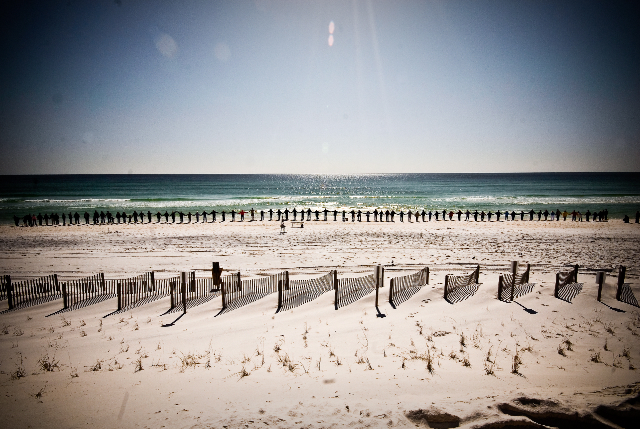
“In the wake of the giant BP oil spill in the Gulf, tens of thousands of people are getting together on beaches around the world for a massive event called “Hands Across The Sand,” the moveon.org folks said.
And so far, I’ve seen press advisories saying a Hands Across the Sand event is happening at Ocean Beach and China Beach In San Francisco, and at Crown Memorial Beach on Alameda Island, with folks gathering around 11 a.m. in preparation for non-violent hand-holding at 12 noon, on Saturday, June 26.
And the really cool and catchy part of this idea is that anyone on any beach anywhere in the world can join in, simply by grabbing the nearest person’s hand.

Dave Rauschkolb, who founded the first Hands Across the Sand event earlier this year, is a surfer and owner of three restaurants on the beach in Seaside, Florida, on the northern Gulf Coast between Pensacola and Panama City.
Rauschkolb spoke to me by phone today, shortly after US District Court Judge Martin Feldman ruled against  Obama’s deepwater drilling moratorium, claiming the Obama Admin “overreached”. and just the tar balls were starting to come up on the beach near Rauschkolb’s restaurants in Florida.

These incoming tar balls are an especially heartbreaking sight for Rauschkolb, given that he helped successfully organize the first Hands Across the Sand event on Feb. 13, 2010, when over 10,000 people joined hands on nearly 100 beaches along the coastline to stop the expansion of offshore oil drilling. But hopefully, terrible sights like this will be the impetus that finally gets U.S. citizens to break their addiction to oil.

“We gathered to stop the expansion of oil drilling in our coastal waters,” Rauschkolb said, referring to how folks protested efforts by the Florida Legislature and the U.S. Congress to lift the ban on offshore oil drilling.

“Now, just a few months later our entire Gulf of Mexico marine environment and
coastal economy is at risk from the very thing we tried to stop: offshore oil drilling off
our coast,” he continued. “The Deepwater Horizon disaster is a wake up call. Even as the Gulf disaster grows, British Petroleum and other oil companies continue to push for new offshore drilling anywhere oil might be found regardless of the risks they pose. The offshore drilling industry is a dirty, dangerous business and no one industry should be able to place entire coastal economies and marine environments at risk. Why is this allowed to happen?”

Rauschkolb said he blames BP to the extent that we should hold them accountable for what happened with the Deepwater Horizon disaster,
“However, I also hold the entire offshore oil industry accountable as well, because any company could have had this happen, “ he told me, pointing to a blow out off the Australian coast that took three months before a relief well could be drilled.

Concerned that the U.S. government and the oil industry will seek to make BP the scapegoat, in an effort to avoid imposing stricter regulations, Rauschkolb said such a response wouldn’t be a good outcome.

“America could be, should be one of the world’s leaders in expanding cleaner energy sources yet, our political process is paralyzed by oil money and influence. It is time for our leaders in all countries to take bold, courageous steps and open the door to clean energy and renewables and finally extend a hand to free our countries from our addiction to oil.”

“This is a critical turning point in finally changing our prehistoric energy policy towards the light of clean energy,” Rauschkolb concludes. “ Let us work together and share our passion and energies to protect our coastal economies, our oceans, our beaches, our waterfowl and our marine life. On behalf of those who have been and continue to be affected by this disaster of epic proportions in our Gulf of Mexico we extend our deepest appreciation to all of you for Joining Hands across America and the world on June 26.”

Rauschkolb invites folks to visit the Hands Across the Sand website and sign up to organize a beach or city.
Sounds like a great way to spend a Saturday. And if you do, you’ll be joining a movement that’s exciting interest around the world. According to Rauschkolb, as of today, 627 events are scheduled to take place on June 26 in 451 U.S. cities, with another 45 events scheduled outside the U.S. in 20 separate countries.

Think Global. Go clean energy.

We tax, they spend

8

There’s nothing terribly new about this data, but it’s still worth a look. Guess who pays most of the taxes in California? The Democratic counties whose legislators don’t mind raising revenue to solve the budget crisis. And guess who gets the greatest share of that tax money? The counties dominated by Republicans, who want to cut services and keep taxes low.


In other words, the tax-and-spend liberals like me are trying to get more money that will go to the folks who elect those assholes that take the “no-new-taxes-ever” pledge.


A little bit of lovely irony for this fine summer day.

Judge orders UC police to hand over journalist’s photographs

Remember when a crowd of angry student protesters surrounded the home of UC Berkeley Chancellor Robert Birgeneau last December, and broke some windows? And then Gov. Arnold Schwarzenegger called them terrorists?

That eventful night touched off a months-long court battle for David Morse, a journalist who was arrested at the chancellor’s residence along with seven protesters but later had his charges dropped entirely. After a June 18 court ruling in his favor, Morse will finally have his photographs from the protest returned to him.

The win signifies a major victory for the First Amendment Project, which represented him pro bono, and strengthens the principle that journalists’ unpublished photographs and information should not be seized by police and used for law-enforcement purposes.

Morse was at the fiery Dec. 11 march not to protest, but to report on it for Indybay, the San Francisco Bay Area Independent Media Center. He wore a press badge, and repeatedly identified himself as a reporter to University of California police officers when they detained him. Nonetheless, campus police seized his camera and arrested him, initially charging him with several felonies. “They said to me, ‘you were taking pictures of us. We want your camera,’” Morse recalled.

As the scene at the chancellor’s residence made headlines the following morning, Morse was sitting in jail in Santa Rita. “My voice as an eyewitness was completely silenced,” he told the Guardian when we interviewed him for an earlier story.

His charges were dropped, and his camera was returned within a few weeks. However, he’s been in court for about six months trying to get his digital photos back. 

State law prohibits the issuance of search warrants for unpublished journalistic materials. The idea behind this is to protect journalists from serving law enforcement’s agenda against their will, which could limit the flow of information by causing sources to clam up. Yet the UC police department obtained a search warrant for Morse’s unpublished photos, which were stored on a memory disc seized along with his camera.

The First Amendment Project stepped in on his behalf. FAP attorney Geoff King said the affidavit that triggered the issuance of the warrant failed to mention that Morse had identified as a journalist. It was a strange omission, King said, since the police report included several references to Morse’s assertion that he was there as a reporter. Since the affidavit didn’t describe Morse as a journalist, the judge had no way of knowing that the warrant was illegal.

On June 18, Morse and FAP claimed victory as an Alameda Superior Court judge quashed the warrant. The court also ordered UCPD to return all of Morse’s photographs, including any copies, and to declare under oath what other agencies had received copies.

While the decision is a major win for press freedom, UC police used the illegally obtained photographs for their own purposes in the interim. Morse’s photos of activists were uploaded onto a “Wanted” website maintained by UCPD, but have since been removed, King said. The university has also indicated that it wanted to use the photos in a series of disciplinary hearings targeting students who engaged in on-campus activism protesting tuition hikes.

In a San Jose Mercury News article, UCPD Capt. Margo Bennett was quoted as saying the department has not considered changing the way it deals with journalists.

Sunday Streets contrasts with SF’s bike injunction

1

A day after bicyclists and pedestrians took over the streets of the Mission for the popular, incident-free Sunday Streets, and a day before the court hearing on whether to end the four-year-old injunction against bike-related projects in San Francisco, Judge Peter Busch today (6/21) issued a noncommital tentative ruling in the case, indicating he needs a hearing on myriad technical details to reach a decision.

Most members of the city’s bicycling community see the injunction as surreal and are simply unable to understand how the California Environmental Quality Act could be used to hinder a transportation option that is clearly a boon for the environment. The answer, say critics, lawyers, and Judge Busch, is that the city should have done an expensive EIR first to probe the finest of details of exactly how more bike lanes would disrupt traffic.

Or as Busch put it in his temporary ruling, he wants to explore questions such as: “1) WHAT OTHER ALTERNATIVES OR MITIGATION MEASURES DOES PLAINTIFF CONTEND RESPONDENT SHOULD HAVE ANALYZED OR CONSIDERED? 2) WAS RESPONDENT REQUIRED TO INCLUDE DATA UNDERLYING TRAFFIC LOS AND, IF SO, DID IT SATISFY THE REQUIREMENT? 3) DID RESPONDENT ABUSE ITS DISCRETION BY USING A SIX-MINUTE THRESHOLD TO ANALYZE TRANSIT IMPACTS?”

It’s a level of detail that only lawyers and traffic engineers can appreciate, and to the casual observer, it’s a level of detail that could maddeningly extend this entirely unreasonable injunction. And Sunday Streets was a great example of why it’s so unreasonable. Here’s an event that disrupted far more cars and buses than the Bike Plan would over a month, and it was done with no EIR and with no major problems.

Why? Because CEQA has an exception for temporary events, which is certainly a good thing. But if CEQA is used to extend this injunction for another month, or a year, then it’s time to revisit this unreasonable law and whether this was ever a reasonable ruling.  Because the harm he’s doing by dragging this case out for a year after the city completed the EIR – to bicyclist safety and to the environment when people are afraid to bike and choose to drive — certainly outweighs any harm this plan will do.