


Today, Johnny and Tim talk about why private power companies don’t want to see more solar and wind generation, and why San Francisco’s public-school admission lottery isn’t really as bad as its critics say.
sfbgradio7/2/2010 by jangel- No categories
Politics Blog
D. 10 candidates DeWitt Lacy, Tony Kelly and progressive planners blast Lennar’s plan
Recently, I spent some time talking with D. 10 candidates DeWitt Lacy and Tony Kelly about Lennar’s redevelopment plan for the shipyard and Candlestick Point. I also attended a Progressive Planners forum that addressed the massive development proposal. Those conversations and the issues they raised seem timely in light of the city’s crazily tight schedule for trying to ram final approvals for the project past government agencies this summer. And in light of three appeals that have been filed against the city’s recently certified final environmental impact report for the plan, raising concerns that the city will get bogged down in expensive and time-consuming litigation if it doesn’t get the plan right, while it still can.
(Lest other D. 10 candidates complain that they weren’t interviewed, too, I’d like to clarify that I’ll be covering the race between now and November, and I look forward to hearing what they all think at the Board’s July 13 meeting to hear appeals of the city’s final environmental impact report (FEIR) for the project. )
Both Lacy and Kelly are critics of Lennar’s plan, but not in a knee-jerk obstructionist way. Instead, they bring considered and informed critiques to the table at a time when the community desperately needs good advice and a workable strategy, if residents are to get needed amendments and concessions, before the developer get the green light, or before the Board puts a moratorium on the project until the city’s FEIR flaws are ironed out.
Lacy is a bright and earnest candidate who learned lessons from the school of life, while growing up in San Jose in a working class family. Lacy says his father worked in an Adidas warehouse until he was injured on the job, and his mother worked as a secretary in Atari’s corporate office, but was laid off after two years.
Lacy recalls how his parents opened their own janitorial business, in the hope of making a better life for their six children. He says that it was while cleaning homes alongside his mother, that he began to recognize the need for working class improvement and growth.
In 1995, Lacy moved to San Francisco, where he has worked in the District Attorney’s office and formed his own law practice—experience that could serve District 10 well, since it’s home to many working-class residents and will be ground zero in the battle for construction-related contracts and environmental and economic justice, if Lennar’s massive redevelopment plan goes ahead,
“I know how to craft legislation for social justice,” Lacy said.
Lacy observes how Michael Cohen, Gavin Newsom’s top economic advisor in the Mayor’s Office of Economic and Workforce Development, has repeatedly told folks that land transferred to Lennar will be subject to a “right of reverter.”
This means the Redevelopment Agency may re-take ownership of the land, if the developer fails to substantially complete the infrastructure in the time frame set forth in the city’s development and disposition agreement (the DDA)
But Lacy observes that this “nuclear option” isn’t likely to happen with so much riding on the Lennar deal, and he stresses that additional controls are needed, if the city is to ensure that the deal remains in the best interest of San Francisco, not just the developer.
Lacy’s probably right about that. (Remember how hard the community had to fight to just get an extra 15 days to read and comment on the project’s six volume draft EIR over the winter holidays?)
And how much political pressure was exerted to ram the city’s EIR for this project across the certification line on June 3, five days before Santa Clara voters decided to support a stadium for the 49ers near Great America.
“What’s needed is an impartial arbiter,” Lacy said. “The city needs regulatory controls and the capacity to fine Lennar if it breaks promises to build affordable housing, create jobs and hire locals. You’re not going to be able to hold their feet to the fire without that.”
“I’m not saying that we should be obstructionists, critics who are trying to prevent stuff for the sake of a political battle,” Lacy added. “But we need new blood. The benefit of my campaign is that I’m not downtown’s candidate. I’m a civil rights attorney, who can help the district by figuring out what battles we need to be fighting and which battles are winnable. And I want to make sure there are jobs and business opportunities for working-class folks in San Francisco. You shouldn’t have to be a doctor or lawyer to afford to live here.”
Lacy believes the Navy should remove the radiologically impacted landfill on the shipyard’s Parcel E2.
“That ground has to be taken out of there,” Lacy said. “I would hope the City Attorney’s Office would get involved and advocate for the people. But leadership is about taking a stance when no one else is.”
With the city suggesting that it can still win back the 49ers, Lacy said that he too, would love it if the 49ers decided to stay.
“But not at the cost of our health and safety,” Lacy said, referring to the city’s repeated claim that it needed to rush certification of the final EIR for Lennar’s project, if there was to be any hope of winning back the team.
“ I don’t think the solution is the rush,” Lacy said. “I say, let’s make sure we clean up the shipyard properly—and bring back the Warriors [a professional basketball team that relocated to San Francisco in 1962, until 1971, when it moved to Oakland].”
I also hung out with D. 10 candidate Tony Kelly, at an event that POWER hosted as part of a Progressive Planners Forum, the day after Lacy and I unsuccessfully tried to access the shipyard, and the same day that POWER was also blocked from the yard.
Kelly has been tracking issues in and around District 10 for years, and, much like Lacy, he’s not afraid to speak his mind on the issues.
For instance, Kelly is incensed by the city’s attempt to ram through approval of the final EIR for Lennar’s development, when the Navy has yet to complete an environmental impact statement related to its proposed clean up activities at the shipyard..
“Is the EIS ever a trailer to the EIR?” Kelly asked. “It’s like planning on Mars.”
Kelly has also expressed concern over the developer’s plan to build two peaker plants in the community.
And he is worried about the consequences of the city’s plan to turn the entire Bayview into a project survey area for Lennar’s Candlestick/Shipyard plan.
“How do you pay for any other improvements in the Bayview, when the shipyard redevelopment plan sucks all the air out of the room?” Kelly said
But Kelly’s biggest concern right now is that once Lennar gets its final approvals this summer, “the developer will never talk directly to the community again.”
At the Progressive Planners Forum that Kelly attended, speakers also voiced measured criticisms of Lennar’s plan.
“The plan has some important elements, especially in the job areas, but I think it adds up to gentrification, which is disruptive to the surrounding community, families and the last bastion of the black community in San Francisco,” said Chester Hartman, who has authored over 18 books on race and urban planning, including the acclaimed City For Sale: The Transformation of San Francisco.
“There is a need for a response in terms of an alternative approach,” Hartman advised.
“It doesn’t have to be a detailed, but it should include a basic philosophy and goals, and retain good parts of the original plan.”
Peter Marcuse, Professor of Urban Planning at Colombia University, said the situation at the shipyard reminded him of the ongoing oil disaster in the Gulf.
“Cap the land sounds like cap the spill,” Marcuse said, noting that in both cases the community is fighting to get folks who dumped toxins to clean them up.
Marcuse criticized the privatization of the planning process, as illustrated by the City’s claim that it has entered into a “public-private” partnership with Lennar, and the community’s experience that the city and the developer keep ignoring or dismissing the public’s feedback and opinions.
“There should have been a range of alternatives open for discussion,” Marcuse said. “Instead, there is a sense, of this mega project’s inevitability. And once the developer has title to the land, the city has to negotiate what should be a public matter.”
Marcuse critiqued the use of tax increment financing, which will use increased taxes on property throughout the Bayview to finance improvements in one relatively small area, the 770 acres of land that, as Marcuse put it, “got sold to Lennar for $1.”
“This is a form of government subsidy,” Marcuse warned.
“There have been some negotiations,” Marcuse continued. He pointed to the community-led Prop. F, which in the spring of 2008 sought to establish 50 percent affordable housing in the development. And the community benefits agreement (CBA) that the San Francisco Labor Council hammered out at in May 2008, in an attempt to nail down benefits for the community in exchange for the Council’s support for the Lennar-financed Prop. G in June 2008.
“But these negotiations with Lennar start on basis that Lennar’s interests have to be protected equally with those of the City and its residents,” Marcuse commented. “It ought to be a public responsibility to show the community what the alternates to Lennar’s vision are.”
Marcuse concluded by suggesting a moratorium on Lennar’s plan to allow for a community-based visioning process, in which residents could express their desire for housing, diversity, open space and protection against environmental hazards
‘The City should then come up with an alternative to Lennar’s plan—and listen to Lennar,” he said. “But this is a public responsibility, rather than a private negotiation with a corporation that has been a beneficiary of a huge subsidy and starts to make a huge profit, the minute its housing units begin to sell.”
Miriam Chion, who works for the Association of Bay Area Governments (ABAG), also expressed concerns with Lennar’s massive plan, which proposes to build thousands of mostly luxury condos at Candlestick Point, with a smaller number on the shipyard.
“We are in the 21st century, how can we continue to use same mechanisms of displacement?” Chion said. “And how can we do that to the African American community, which we have displaced over and over, and which has managed to build a community here, in spite of everything?”
According to Lennar’s plan, 68 percent of its proposed 10,000 units will be built at market rate. Of the remaining 32 percent of units, only 15 percent will be built at truly affordable rates, with an additional 15 percent geared towards the working middle-class income levels, such as those enjoyed by police, fire fighters, nurses and teachers.
But two Bayview residents who attended POWER’s progressive planners’ forum expressed frustration at what they perceived as outsiders trying to tell locals what’s best.
“If you haven’t lived here, you don’t know about the Bayview,” one resident said. “If they are going to do what they are going to do, they should do it all the way, and change things for the better. I’m tired of seeing kids under 12, playing outside at 11 p.m. So, if you are not from here, you can’t come on my ground and pass judgment. If you’d been and lived here, I don’t think you’d see this negatively.”
“$700 million has been spent on cleaning up shipyard, and producing highly technical reports on it,” another local resident said. “Highly intellectual discussions are not helping, we need some action today.”
“No one here is against development,” countered long-term Bayview resident Espanola Jackson, while a Bayview resident named Nyese resurrected longstanding concerns that the developer fatally broke community trust when it failed to control asbestos dust at the site, when it began grading the shipyard’s Parcel A .
“Four years ago, I found out that they were sending home workers at the shipyard, without informing the surrounding community,” Nyese recalled. “My son was having excessive nosebleeds, so it was phenomenally insulting that they didn’t not notify us.”
“Lennar is just a name, a conglomeration of shareholders,” Nyese further noted. “We need development. But we don’t need it on chemically toxic land.”
These competing concerns indicate that all the candidates in the D. 10 race are going to have to be asking critical questions as they track the progress of Lennar, the city and the Navy’s plans this summer. Failure to do so will cost them credibility within the community—and possibly the supervisor’s race this fall, though downtown money will pour in to support whichever candidate is deemed most likely to rubberstamp present and future development and contracting plans. Stay tuned. It’s going to be a (politically) hot July.
Political litmus test for Hunters Point Shipyard access?
Even though the U.S. Navy abandoned the Hunters Point Shipyard in 1974, the military has continued to control access to the shipyard that helped launch the A-Bomb. That’s because the Navy still owns most parcels of land on the shipyard and remains on the hook for cleaning up pollutants on these sites, including a radiologically impacted dump on Parcel E2, which has been deemed to be the dirtiest land on the site.
Currently, the Navy is proposing to cap, not excavate this landfill, despite repeated requests from the local community, and a citywide vote in support of Proposition P in 2000, which urged the Navy to clean up the land to the best extent possible, which would mean excavating the Parcel E2 landfill and replacing it with clean uncontaminated soil. And oddly, the City appears to want government agencies and officials to sign off on its final EIR for Lennar’s massive 770-acre redevelopment plan for the shipyard and Candlestick Point, even though the Navy has not yet completed an environmental impact statement (EIS) related to its proposed shipyard cleanup activities.
Currently, the Navy controls access to the facility beyond a couple of trailers that the city’s Redevelopment Agency has set up just within the yard’s main gate. And to gain access to the shipyard these days, you need to call or visit Redevelopment’s trailer and get a pass. Or, alternatively, if you know any of the artists who continue to rent studios at shipyard, you can call them to try and get the city to give you a pass.
Underlying these limits to accessing the shipyard are some legitimate safety concerns related to equipment and excavations on what is now an active clean up and construction site, along with fears that untoward characters could break into the abandoned buildings or bother the artists who still have studios in operation at the shipyard. But has an additional political litmus test been put in place when it comes to critics of Lennar’s redevelopment plan, who want to access to the yard? If so, does it mirror the tap dancing that the local community has had to undergo to get its voices heard as Lennar pushes to get final approval for its shipyard/ Candlestick Point redevelopment plan.
Those questions resurfaced last week when a private security guard manning the shipyard’s front gate denied access to D. 10 supervisor candidate DeWitt Lacy, who had dropped by hoping to take this reporter around the yard as part of an ongoing conversation about Parcel E2, which Lacy believes needs to be excavated completely, and how best to hold the Navy accountable for cleaning up a mess it created decades ago. The security guard told Lacy that folks who want to visit must get a pass at the Redevelopment Agency trailer.
At the Redevelopment trailer, Micah Fobbs, administrative assistant for W.B. Kennedy and Associates, which has a contract with Redevelopment’s Citizen’s Advisory Committee. told Lacy that without a preauthorized pass, he couldn’t let us onto the site. Fobbs added that he would be happy to take us on a tour himself, but he could not leave the trailer unmanned, since he was the only staff member there at the time. Fair enough. Though the rebuff gave us the feel that the City doesn’t want pesky investigative reporters that have been critical of the development running around the site. “And if they found out I was a civil rights attorney, they probably wouldn’t want me out here, either,” Lacy joked.
But the next day, I encountered what sounded like overt hostility to other critics of Lennar’s plan, when I tried to ride along on what had been billed as a “Toxic Tour of the Navy Shipyard” by POWER (People Organizing to Win Employment Rights). POWER had advertised its tour in an email which said it would involve 23 expert urban planners, who happened to be in the Bay Area for a Progressive Planning Forum. The tour was billed as happening on the morning of June 17, before an afternoon discussion at POWER’s Third Street office in the Bayview, which was to focus “on alternative approaches to the city’s current plan for development at the Shipyard/ Candlestick Point.”
Caught in traffic, I didn’t arrive at the Boys and Girls Club on Kiska Road in Bayview Hunters Point in time to join POWER’s kick-off get together. So, I headed direct to the shipyard, a move that meant I arrived alone and ahead of the school bus that POWER had rented for the occasion. At the gate, I was told by the security guard that I couldn’t get in, that another guard lost his job for letting unauthorized individuals onto the site, that POWER didn’t have a pass and that they’d been warned to watch for POWER “because they want to stop the development.”
“If you are not authorized with badges, you are not let through,” the guard said, giving me the telephone number of the Hunters Point Duty police officer, who in turn said I needed to call the San Francisco Redevelopment Agency, which in turn told me to call the folks at the Redevelopment Agency’s shipyard trailer. And so I called Fobbs again, who confirmed that the Navy still controls all the property, except Parcel A which has already been conveyed to the City which in turn has granted developer Lennar the right to develop thousands of condos on that particular parcel.
“As far as viewing the rest of the property, you have to put in a request, and no photography or videography is allowed,” Fobbs said. This stated ban on photography came as a surprise, given recent photos of the shipyard that ran in a New York Times article about Lennar and the city’s vision for the 770-acre property.
And the sudden difficulties in gaining media access seemed odd, given that Lennar’s PR firm, Sitrick and Company, offered to take the media on a tour on the morning of June 3—the day the Redevelopment and Planning Commissions subsequently approved the final EIR for Lennar’s plan to redevelop the rest of the shipyard, plus Candlestick Point, a FEIR that has now been appealed to the Board, on the grounds that it was rushed for political reasons, leading to fatal flaws in the final document.
“Well, if folks come here through Redevelopment or the Mayor’s Office, then they have been able to take photographs,” Fobbs said. “But we have had people trying to climb fences and get through doors of some of the buildings.” (Fobbs last comment was a reference to a recent climbing of the fence that the Nation of Islam’s Leon Muhammad engaged in, in an effort to determine if air quality monitoring devices near the Nation’s school and Oakdale public housing site were operating. (After Muhammad scaled the fence and reported that he’d found an empty bin where monitoring equipment was supposed to be, a kafuffle ensued, with the US EPA saying Muhammad was looking in the wrong place for the monitors which, it claimed, were in operation.)
Ultimately, Fobbs told me to call Redevelopment’s Audrey Kay if I wanted a tour, and several shipyard artists told me they would be happy to arrange a day pass so I can visit their studios and hear concerns that they will be required to move from a couple of shipyard buildings before replacement studios have been completed–an arrangement that would amount to a breach of promise that Lennar and the city previously made to the shipyard artists.
Shortly after I was turned away for a second time, POWER’s bus arrived at the gate, only to be blocked–a denial of access that meant 23 progressive planners were forced to view the shipyard from various remote viewing spots atop the hills that surround the site.
Together these episodes left me wondering what kind of political litmus test could end up being enforced at the site, if Lennar’s mega project gets the green light this summer, and what will happen if the Board decides to kick the plan back to the drawing board until the Navy completes a environmental impact statement and all of the community’s ongoing environmental and economic justice concerns are addressed.
So stay tuned, and don’t forget to mark July 13 on your calendar when the full Board of Supervisors is tentatively to hear appeals of the project’s final EIR, which the Planning and Redevelopment Commissions rubberstamped June 3. And, as always, it will be revealing to see which candidates in the hotly contested race for D. 10 supervisor, show up and speak truth to power.
Sparks reveals her conservativism in exchange with Walker
During the District 6 supervisorial candidate debate that San Francisco Young Democrats held last week, a two-question exchange between two of the leading candidates – progressive Debra Walker and downtown-backed Theresa Sparks – offered a revealing look at their starkly different worldviews and priorities, which is more important in this race than people’s machine politics conspiracy theories.
During the second portion of the event, candidates were allowed to ask a question of another candidate, and Walker and Sparks focused on one another with pointed questions (this occurred at around the 30-minute mark, although the video doesn’t seem to allow users to forward to that point, forcing you to endure the often insipid commentary).
Walker went first, asking Sparks why, during her more than four-year tenure on the Police Commission – a body in charge of disciplining police officers accused of serious misconduct after citizen complaints are investigated and found valid by the Office of Citizen Complaints, with each case assigned to a particular commissioner – Sparks didn’t hold any hearings or act to punish any officers.
Sparks said the accusation wasn’t true, and that she did hold one hearing during that time, and then said that the Police Commission is prohibited by the city charter from intervening in the internal workings of the Police Department, implying that the body isn’t actually in charge of disciplining officers. Walker said Sparks was wrong and tried to ask a follow-up question and was cut off by moderator Melissa Griffin.
So this week, I called both candidates to try to get to the bottom of the dispute. “She indicated it’s not the commission’s job to focus on these things, and that’s absolutely not the case,” Walker said. “She was incorrect saying it wasn’t the job of commissioners to do this.”
And when I talked to Sparks, she didn’t dispute that fact, but conveyed how complicated the process was when officers are accused of serious misconduct (minor misconduct just goes to the chief), with lawyers seeking stipulated settlements and whatnot, and repeatedly emphasizing “it’s a bad system.” One reason it’s so bad is her own lack of qualifications: “You can’t have people like me, whose only legal background is watching Law and Order, trying to handle these cases.”
Sparks was appointed by Mayor Gavin Newsom, who is backing her supervisorial bid, which is also expected to have strong support from the San Francisco Police Officers Association. She wouldn’t say how many cases she was assigned during her tenure, but OCC records show more than 300 cases assigned to the commission during her tenure and the long backlog left in her wake has been the subject of criticism by everyone from Police Chief George Gascon to new Police Commission Jim Hammer.
Rather than supporting this civilian oversight of problem officers, Sparks wants to turn those duties over to Gascon’s office, telling us, “We need to give this chief more authority to fire officers rather than going through this ridiculous process.”
At the debate, after seeming stung by a question she jokingly called a “softball,” Sparks fired back by asking Walker whether she supported the proposed tax measures now being considered by the Board of Supervisors to help close the city’s large budget deficit, framing the question by saying they would hurt small business.
Walker answered by voicing her support for small business, but noting how essential city services such as public health programs were being deeply cut and that the city needed new revenue to deal with its structural budget deficit, although she said that she had yet to decide which of the tax measures she supported considering none have been approved for the ballot yet.
This week, Moody’s Investor Services lowered the citys’ credit rating precisely because Newsom’s budgets have not addressed that structural budget deficit, and even the Controller’s Office has ordered more than a $100 million placed on reserve because of doubts about the mayor’s revenue assumptions.
So for Sparks to characterize the need for new revenue as an unfair attack on small business indicates a short-sighted, right-wing approach to municipal finances, an approach Walker rejects, telling us, “I think we need to be responsible and do the right thing in dealing with the city’s needs…It’s going to cost us and the people who come after us more and more because of these cuts.”
When I spoke with Sparks, noting the Moody’s report, she seemed to back away from how she was trying the characterize the revenue measures at the debate. “I do think the city needs new revenue, but I don’t think that taxing small business is the way to go,” she said, referring to a proposal by Sup. David Chiu to tax commercial rents, which would be paid by the landlords.
So I asked Sparks whether she supported any of the proposals or if she was advocating any other revenues measures, and she said, “Quite honestly, I need to think about that because I do think we need more revenue.”
Which is pretty much the same answer Walker gave in a far more honest and direct way in that debate, without trying to pander to the fears of small businesspeople. The bottom line is that the downtown corporations who are backing Sparks have done nothing to help the city during this prolonged recession, while demanding even greater police responses to deal with poor people sitting on sidewalks and other perceived problems, and that hypocrisy should be front and center in this election.
The problem with the Students First initiative

I’m not surprised that there’s an initiative in circulation that would set this as city policy:
The proximity of a student’s home to the assigned school should be the highest priority in San Francisco Unified School District’s student assignment system.
Cake throws down to bring solar to Telegraph Hill

The high-water mark in the unsuccessful 2008 campaign to pass Proposition H, the Clean Energy Act – a partial public power measure that Pacific Gas & Electric buried with a deceptive, $10 million propaganda blitz – was arguably when the hit band Cake played a benefit concert for the measure at The Independent.
Tonight (July 1), the ever eco-conscious Cake returns to that venue with a similar mission, this time dubbed Climatepalooza 2010, with the goal of building a solar roof at the Telegraph Hill Community Center, honoring a request by Telegraph Hill political powerhouse and San Francisco Democratic Party chair Aaron Peskin and Prop. H campaign manager Julian Davis, who has a personal relationship with some band members.
“Climatepalooza 2010 promises to be a wonderful event. It give folks a chance to hear some great music and do the right thing for the environment, and it also supports Tel-Hi, a vitally important neighborhood institution,” Peskin said in a statement released by the nonprofit group One Atmosphere, which has also been involved in organizing the event.
That group, which has worked Al Gore, Nancy Pelosi, and other party bigwigs also got a quote from Mayor Gavin Newsom (who opposed Prop. H): “It’s great to see San Francisco putting together events like Climatepalooza. It combines the best of San Francisco – caring for your neighbors, doing something positive for the environment, and having a great time. Everyone needs to help in the fight against global warming. This is a terrific way for people to get involved.”
Apparently Cake and the power of the sun can create unlikely bedfellows.
Weird Uncle Jerry
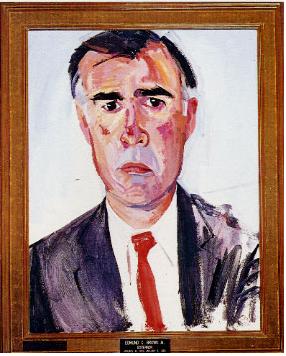
I’m starting to feel as if Jerry Brown is that strange old uncle who comes over for dinner and says things that make you cringe — and you can’t really tell if he’s just a loveable old character, a bright guy with a weird sense of humor, or someone who’s completely losing his marbles.
Check this out: First he makes a very valid, even insightful statement that’s right on target:
“Were I a CEO and someone said, ‘You know what, I’ve never been in this company, I never saw the product and I want to be a boss,’ I’d say, ‘Hey, why don’t you start at the bottom and work your way up,’ ” he said. “That’s the same way with government — you can’t wake up one morning and say, ‘Gee, I’ve got a billion dollars and I want to be governor.’ You got to learn something because those people up in Sacramento are sharks.”
Then he goes completely off the deep end:
Brown discussed his implementation of Prop. 13 despite his earlier opposition to it, as well as support for the 2nd Amendment and same-sex marriage. He said he opposed efforts to legalize marijuana, which will be on the November ballot.
“We got to compete with China, and if everybody’s stoned, how the hell are we going to make it?” he said.
Jerry, pal, I’ve got news for you: The people who are the most successfully competing with China, the brilliant high-tech visionaries you love so much? They’re already stoned. All we can do now is get some tax money out of it.
Besides, China can’t compete with this:
Is there still a political machine in San Francisco?
There’s some interesting discussion going on about Jane Kim, Willie Brown, Gavin Newsom, and political machines here. Check it out if you haven’t read it already.
SFBG Radio: Meg ducks debates, Gav’s oil money and crazy CEO pay

Today, Johnny and Tim talk about why Meg Whitman is ducking debates, why Gavin Newsom has money invested in oil company stocks — and why a corporate CEO can buy an $8 million resort property the same week he lays off 8,000 workers. You can listen after the jump.
sfbgradio6/30/2010 by bgeditAnother reason we love Pete Stark
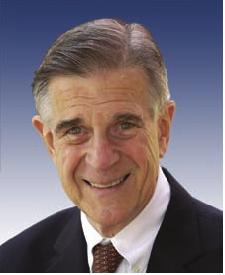
He’s the only openly atheist member of Congress. He refused to apolgize after announcing that he had “no respect for” the commander in chief, George W. Bush or the generals who were sending young people to Iraq “to get their heads blown off for the presidents amusement.” He called one of his colleagues a “whore for the insurance industry.” The mainstream press refers to these statements as “gaffes.” But really, foul-mouthed as he can be, much of what he says is true.
And now he’s finally called out the anti-immigration nuts. They don’t make congressmembers like this any more.
An online defense of print—and a plug for the Public Press’ first print edition
I spent my lunch hour yesterday indulging in what media critics say could soon be a lost experience: reading the first print issue of a newspaper.
As I turned the pages of a pilot print edition of the San Francisco Public Press, which has been in existence online since March 2009, I was surrounded by folks who were tapping out messages on plastic coated cell phones or sitting scrunched at table trying to read stuff on laptops.
And I began to wonder, will there be a print renaissance in my life time as upcoming generations begin to feel the impacts of too much screen and keyboard time? And begin to realize the benefits of having a print presence in this increasingly digital world? Or is print really going to go the way of the dinosaurs?
Maybe it’s because I’m old school, but I actually believe there’s a future for print journalism, though it may be a limited one. To my mind you can’t beat the sensation that comes from leafing through a newspaper, while sipping morning coffee, or the welcome relief of reading the news in hard copy, after staring at computer screens all day. And then there’s the fact that I’m never going to get mugged, or have my car broken into, because someone wants to steal a newspaper–something that can’t be said if you leave your Kindle or Blackberry or fancy laptop around.
Yeah, I never have to worry about sand at the beach, or water in the bath, when I read a print newspaper. And I can rest assured that when I am done with my paper, and leave it in a coffee shop, someone else can read it, or recycle it in their blue bin or reuse it as the proverbial bird cage liner or fish wrap.
Now, what’s especially interesting about the San Francisco Public Press—and distinguishes it from most other print newspapers currently available—is that it’s free of advertisements. Or, as the folks at the Public Press like to say, it’s “ad-free news in the public interest.”
“Why no ads?” the Public Press asks. “As the newspaper advertising market has drained to Internet competitors, we need to search for other sources of income to support quality journalism. Advertising has also warped the content of the newsroom, both explicitly and subtly, encouraging newspapers to shift their coverage to topics of interest to businesses and wealthy readers—the target of ads. Noncommercial news, while often less lucrative, has the luxury of independence.”
The Public Press also devotes some wordage to explaining why they have turned to ink:
“Newspapers help bridge the digital divide,” they state, noting that San Francisco’s 2009 City Survey showed that more than 34 percent of households with income under $50,000 cannot access the Internet at home via personal computers.
“Newspapers serve as communal touchstones,” they continue, observing how isolating digital widgets can be, compared to reading a print newspaper in public.
“We want to pay our hardworking staff for the work they do,” they add, reminding us that folks buy 50 million newspapers everyday in the US, but are still averse to paying for news online.
“People use paper and electronic devices differently,” they conclude. “There are times and places when even the most tech-savvy Bay Area digerati enjoy some screen relief.”
I got my hands on a copy of the San Francisco Public Press’ first print edition, because Lila Lahood, SFPP’s director of operations, and SFPP contributor Christopher D. Cook, who wrote a timely piece about Lennar using federal taxpayer funds to balance its books, stopped by the Guardian with a stack of papers.
And while they were in newspaper delivery mode, Lahood and Cook also shared their thoughts on “Lessons Learned” from their first foray into print.
“We missed our deadline,” Lahood admitted, observing how, in future, the Public Press plans to focus less on breaking news and more on timely features to avoid deadline stress. The plan going forward, Lahood said, is to publish a print edition on a quarterly basis, with the hope of becoming a monthly print publication at some point next year.
“Some of us we stayed up the whole night, filings our full package at 6 in the morning,” Lahood added, tipping her hat to the “strong and committed core” of Public Press workers that made this first print edition possible.
‘Though most of us are journalists, we worked for publications that were already in existence before we arrived,” Lahood continued, acknowledging that the team had much to learn about putting out a print edition from start to finish this first time around.
‘But we showed it could be done,” Cook added. “There is a solid professional publication now in the public sphere, making a dent in the San Francisco community.”
Available in 35 bookstores and newsstands in the Bay Area, the Public Press’ print edition is also available on the street for $2 a pop—an exercise in sales that isn’t as easy as the guys who peddle the Street Sheet (a monthly tabloid written primarily by homeless and formerly homeless people) make it look.
“It’s hard to sell newspapers on the street,” Cook acknowledged. “We knew it was going to be challenging. When you are out there, standing on the corner in the urban crunch, no one has an interest, but the minute you connect to folks, on an individual level, it changes.”
On June 22, the Public Press’s first pilot newspaper hit the streets. At 28 pages long, it includes two sections, three investigative reports, a full-page graphic novel and 50 articles from staff members and a broad spectrum of public media and civic groups, including KALW, KQED, Commonwealth Club, World Affairs Council, California Watch and Consumers Union.
I found the Public Press’ special section on Treasure Island intriguing and informative—the kind of in-depth investigation that’s hard for one journalist to pull off, but is crucial if the city of San Francisco and all its many residents are going to make informed planning and development decisions.
I appreciated the wide-range of articles in the Public Press’ main section, including items on the ongoing battle over the future of the open-air sewage digesters that have been stinking up the Bayview for decades now.
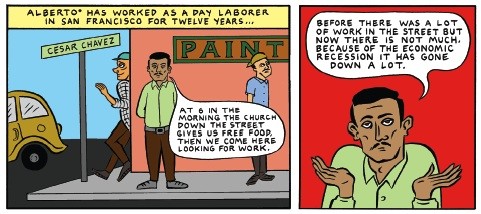
I loved the “Sit, Lie, Get Deported” comic strip that merges photos with hand-drawn illustrations and uses the actual words of politicians, city officials, activists and gadflies to help illustrate its point.
And I’m still trying to finish the crossword. In fact, I plan to read the SFPP’s first printedition from front to back over the July 4 holiday weekend, when I’ll have the time to really absorb and enjoy it.
“Ideally, news will appear in print first, then online, so there’s interest in seeking out the print edition,” Lahood told me, noting that the Public Press’ first edition amounts to about 70,000 words. “So, it a novel, in length,” Lahood laughed. “People are, if not starving, at least very hungry for news analysis and investigative reporting. There are a lot of online sites that aggregate other publications content, and then there’s the corporate model of the Chronicle, but while there is some good reporting in town, there are fewer reporters.”
No kidding. All the more reason for this reporter to write an online defense of print, in the hope that you rush out to secure your copy of the Public Press’s first print edition and evaluate this new model of journalism. I think you’ll be glad you did.
Why can’t Kagan talk?
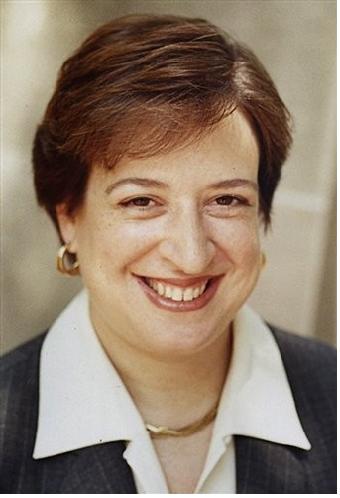
Everyone knows that Elena Kagan’s going to get confirmed by the Democratic majority in the Senate, so it’s too bad that she won’t answer anyone’s questions. I listened to the hearings for a while this morning, and she ducked every single serious issue, hiding behind the notion that she can’t discuss current issues, the court itself, or any issue that might come before the court.
Kagan’s not the only guilty party here; this game’s been going on for years. Remember when Clarence Thomas said he had no opinion on Roe v. Wade?
I’m sure Kagan will be fine on the court — not great, not inspiring, but perfectly adequate in that centrist I’m-really-a-liberal-but-embarassed-to-show-it way. She’s also, clearly, a very intelligent person who has spent years studying and thinking about Constitutional law. It’s crazy that she couldn’t have an honest discussion with the Senate Judiciary Committee. We all could have learned a lot from it.
Stories highlight Newsom’s hypocrisy

A pair of interesting stories in today’s Chronicle paint Mayor Gavin Newsom as a self-serving hypocrite, highlighting how his cuts-only budget proposals ignore the city’s long-term needs and have led Moody’s to lower the city’s credit rating, and how his green rhetoric is belied by his oil industry investments, including in the company responsible for the ongoing oil leak in the Gulf.
The Guardian has long noted how fiscally irresponsible Newsom’s budgets have been, with our latest editorial calling for Newsom to finally offer support for some of the revenue measures now being explored by the Board of Supervisors, which will need strong support from everyone in City Hall to have a chance of winning voter approval.
The Controller’s Office and now Moody’s have confirmed that Newsom’s reckless and gimmicky budget leaves a long-term budget hole even as it does short-term damage to the city’s social safety net and public health programs. But instead of acknowledging that reality, Newsom flak Tony Winnicker is still offering snide, Republican-style put-downs of the supervisors who are actually working hard to improve the city’s fiscal health while Newsom is out running for state office, afraid he will be criticized for supporting the tax revenue this city desperately needs.
As for Newsom’s oil industry investments, well, they speak for themselves. His whole political career, and even the restaurant and bar career before that, was built on a foundation of oil money heaped upon him by the Gettys. And even after he found there was political gold to be mined from green rhetoric, he has continued to financially support and profit from the oil industry.
Many Guardian readers have long said that we should just give up on Newsom, calling him a shameless and self-serving politician of the very worst sort. Maybe they’re right. But if Newsom wants to earn our support in his race for lieutenant governor – whose most important responsibilities are his key votes in deciding whether to support new offshore oil drilling in California and whether to continue pushing myopic cuts-only budgets for the public university systems – then now is the time for him to show some political courage by disinvesting from the oil industry and supporting a responsible city budget that includes new revenue measures for which he should actively campaign this fall.
Kaiser workers seek election between rival unions

Thousands of Kaiser Permanente workers have filed petitions to change unions in what could be the biggest battle yet between Service Employees International Union and its upstart rival National Union of Healthcare Workers. If called by federal regulators, the election would involve more than 45,000 workers, the biggest private sector organization since Ford Motors employees joined United Auto Workers in 1941.
“This is the election everyone has been anticipating for the last year and a half,” NUHW spokesperson Sadie Crabtree told us.
That was when Sal Rosselli and other former leaders of the Oakland-based United Healthcare Workers were ousted by former SEIU President Andy Stern and other leaders of their parent union, SEIU, and formed NUHW. Since then, the two unions have clashed bitterly and regularly, in various workplaces, through the media, in leadership battles, and in a San Francisco court case that ended in April.
“The NUHW petition, if the National Labor Relations Board agrees it was filed appropriately, could force an election between SEIU-UHW and NUHW at Kaiser. Voting for NUHW would risk all the gains SEIU-UHW members made in a hard-fought four-month contract campaign against takeaways by Kaiser,” was how an SEIU-UHW press release cast today’s action.
NUHW opted for a nod to the Fourth of July in its release: “Thousands of Kaiser healthcare workers fired the first shot today in a long-anticipated battle for independence that will determine the future of California’s largest union, SEIU. They filed a petition that will trigger elections for 45,000 SEIU members to choose between the troubled incumbent and the state’s fastest-growing union, the new National Union of Healthcare Workers.”
About 2300 Kaiser workers – representing three of the seven bargaining units – already voted in January to join NUHW, but the petitions now being turned in by the remaining four unions represent the most significant segment of Kaisier workers, including the 44,000-member service, technical, and clerical unit.
Federal law calls for elections when at least 30 percent of a union’s members ask for one, and Crabtree told us, “We have more than we need.” Now, the NLRB must verify the petitions and schedule the election.
Socialists unfriend Matt Gonzalez
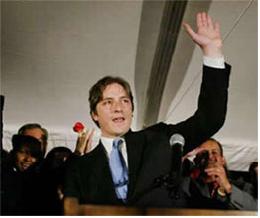
Former Supervisor Matt Gonzalez has joined his old friend Jeff Adachi in supporting a pension-reform measure that has organized labor up in arms. He wants to debate the labor council director, Tim Paulson. He says Adachi’s measure is necessary to protect the city’s fiscal future — but it’s not an approach that the left/progressive wing of the city, where Gonzalez has his political roots, is accepting.
In fact, I learned today that the International Socialist Organization has disinvited Gonzalez from the July 1-4 conference where he was scheduled to speak. Dude, that’s harsh.
From the ISO:
Today the International Socialist Organization, as part of the organizing team of the West Coast Socialism 2010 Conference, decided to rescind our invitation to Matt Gonzalez to speak. After marching with members of Local 2 and other unions at Pride yesterday, ISO members were surprised to learn that he is supporting Jeff Adachi’s pension reform initiative in San Francisco. This was confirmed today by a press release from Matt in the SF Examiner.
The ISO strongly opposes Adachi’s measure and supports the position laid out in the SF Bay Guardian by Larry Bradshaw and Roxanne Sanchez. During these times of severe attacks on workers and union members (and especially public sector unions), we can’t see any progressive basis upon which to support this measure. While organizing this conference, we have done our best to build solidarity between union and non-union workers, students and community members from many different backgrounds. We went so far as to move the conference location from San Francisco to Oakland in order to respect Local 2’s hotel boycott and potential job actions. Under these circumstances, we feel it sends the wrong message to have a prominent supporter of the Adachi initiative speaking at the conference.
We strongly encourage Matt to reconsider his position.
Okay, I imagine Gonzalez will survive this particular insult, and the ISO won’t singlehandedly destroy his political future. (Although Matt was pals with these folks; he and the ISO’s Todd Chretien were sort of buds back in the day.) But it does speak to an important point here:
Progressives who sign on with Adachi are helping drive a wedge between labor and the progressive movement. I’m certainly not one to say that we have to sign on to every misguided thing the SF Labor Council does (the Lennar deal, for example). Labor has in the past been bad on a lot of issues, particularly development issues, and until the past ten years or so was bad on public power. And sometimes, you take a principled stand, and even if your allies hate you and never friend you again on Facebook, you stick to it. I’m sure that’s what Matt thinks he’s doing.
But this thing just stirs up the anti-government, anti-public-employee furor that’s going to become a big problem in the next year or two. And it’s not in any way reflective of the sort of big-picture thinking that the left ought to be involved in.
The D6 progressive primary is defunct

Luke Thomas at Fog City Journal had it first: Sup Chris Daly’s progressive primary for district six didn’t work out. But there will be a District Six Symposium at the same place, at the same time. Daly told me that the primary hadn’t exactly morphed into the symposium: “I’ve been planning to do a symposium anyway, and I scheduled it for that day because, well, I had the day free.”
He had the day free because his call for a primary among the progressive candidates in the district pretty much collapsed when most of them said they weren’t interested. I never quite saw this as working out, but I give Daly credit for trying to do something to prevent the competing progressives from fighting (and wounding) each other and allowing a more moderate candidate to win his seat. In the end, he said, “I’m just one guy, and I didn’t have to power to prevent a train wreck.”
Of course, a primary battle could have had the opposite effect, stirring up competing negative campaigns. And that’s what we simply have to avoid this fall. With ranked-choice voting, Debra Walker, Jane Kim and Jim Meko don’t have to run the kinds of campaigns that would cost the district its progressive representation. But if things get nasty, that could easily happen.
In District Five in 2004, the progressive candidates (and lord, there were a lot of them) pretty much all agreed to keep it positive and civil, and it worked. If the D6 symposium can lead to some discussion of how the candidates can work together, it will be worthwhile.
In the end, I supposed it’s too much to ask people who have decided they really want to be supervisors to think about the progressive movement first, and their own ambitions second. But they could try.
“No new taxes,” but fees and restrictions may apply
The agenda for the June 29 Board of Supervisors meeting reads like the fine print of a credit card statement, with fees piled upon more fees. Mayor Gavin Newsom is proposing a slew of increases to sums that must be forked over for a wide array of city services or permits as a way to bridge a gaping budget gap. With major cuts to critical services in the face of a dramatic revenue shortfall, it’s not surprising that the city is tightening its squeeze to make up for some of the damage.
Some of the proposals make a certain amount of sense. There are higher fees proposed for an underground parking lot at Golden Gate Park, which could potentially help dissuade motorists and promote more environmentally friendly transportation options. There are higher fees for tow truck operators, which most anyone who’s ever involuntarily had their car towed could get behind. And the fee for discharging a cannon may go up from $400 to $636. While we’re pretty sure that last one is more likely to irk people who attend military ceremonies, we nonetheless take delight in imagining a rambunctious crew of pirates spilling into the board chambers to oppose it.
But this roster of Newsom’s new hidden fees begs an important question: Why is a mayor so adamantly against raising taxes bent on vacuuming more money out of the pockets of small business owners with higher fees? After all, many of these proposed increases will squeeze struggling, Mom-and-Pop businesses just a little tighter. City permits for auto wreckers, billiard parlors, junk dealers, and massage establishments may go up significantly. The fee for taking an EMT course may get higher. Permits for selling food on the street, driving a pedicab, dealing in second-hand auto parts, or operating a shooting gallery could also increase. Even the annual permit fee for street artists (several of whom we wrote about in our Streets Issue) is getting more expensive.
The list of fee hikes is on the agenda for Tuesday’s meeting, and was referred to the full board by the Budget & Finance Subcommittee. Supervisors recently proposed a number of new revenue generating measures including a nickel-per-drink tax on alcoholic beverages, an increase to the hotel tax, and a restructuring of the business payroll tax.
“There are no new taxes in this budget,” Newsom declared during a June 1 announcement in which he unveiled his 2010-2011 budget. “I know some folks just prefer tax increases. I don’t.”
But why reject taxes outright and then quietly propose a bunch of fees that will place a higher burden on the individuals they impact?
“No new taxes” may sound like music to the ears of a public awash in financial woes, but Newsom’s hidden fees are not unlike taxes. Under this philosophy, it’s not desirable to ask everyone to pitch in an extra nickel the next time they buy a cocktail, but there’s no problem with asking the bar to fork over hundreds more annually for a health inspection. That doesn’t seem to be as simple as a campaign-ready “no new taxes” slogan, but then again, there’s a reason credit card companies bury their hidden fees in the fine print.
SF Human Services Agency occupied
“Human Services Agency occupied” was one of the premier tweets on the streets of San Francisco this afternoon, as members of Direct Action to Stop the Cuts DASC) occupied 170 Otis Street to pressure the city to find an adequate place to house sixty homeless people displaced by the closure of the night shelter at 150 Otis.
Folks with DASC reportedly say they applaud the fact that this shelter is slated to be converted into permanent housing for homeless veterans in 2012, but condemn that nearly five dozen people are being pushed onto the streets tonight. Stay tuned.
SFBG Radio: Should the Pride Parade boycott California?

Today at SFBG Radio, Johnny argues that all pride celebrations should be cancelled in California until the state recognizes same-sex marraiges. Tim begs to disagree. You can listen after the jump.
sfbgradio6/28/2010 by bgeditBill Clinton suggests Navy blow up BP well
Holy smokes! Clinton wants Navy to bomb B.P.’s well. He’s not talking nuclear. Yet. Guess fireworks won’t be the only thing going off July 4.
Mirkarimi wants state franchise fee change
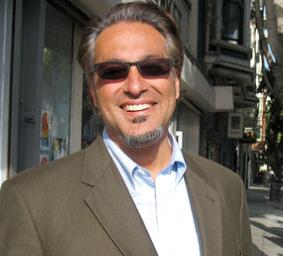
Sup. Ross Mirkarimi has introduced a resolution calling on the state Legislature to reform the law that allows Pacific Gas and Electric Company to pay a miniscule fee, in perpetuity, for the right to run its lines, poles and cables on and below the city streets.
The franchise fee was signed in 1939, and requires PG&E to pay just one half of one percent of its revenue to the city. Berkeley charges ten times that much. But since the deal has no expiration date, the supervisors can’t renegotiate it.
If San Francisco raised its fee to 5 percent for both electricity and gas the city would pick up an extra $50 million a year.
Both state Sen. Mark Leno and Assemblymember Tom Ammiano have told us they’re looking at ways the state Legislature could end perpetual franchise deals.
Supreme Court rejects Healthy SF challenge

The U.S. Supreme Court has decided not to consider a challenge to the Healthy San Francisco program that provides low-cost health coverage to city residents, partially funded by employers who refuse to provide health insurance for their employees, a mandate that prompted a lawsuit from the Golden Gate Restaurant Association.
The decision was a big victory for low-wage workers in the city, as well as California Assembly member Tom Ammiano, who was the driving force behind the program as a member of the Board of Supervisors, taking abuse from the business community for almost a year and holding firm on the need for employers to take responsibility for their employees. Without that mandate, Ammiano successfully argued, businesses that didn’t offer health benefits would enjoy a competitive advantage and their employees’ health care costs would often end up be paid by city taxpayers.
“Today’s Supreme Court decision is an affirmation of San Francisco’s landmark efforts to provide affordable health care to the uninsured. With over 50,000 people receiving health care services and prescription drugs, Healthy San Francisco is a national model for what can be accomplished when the public and private sector work in partnership towards a common goal”, Ammiano said in a prepared statement.
Mayor Gavin Newsom was eventually persuaded to support the mandate and he worked with Ammiano in crafting the final program, which he has since trumpeted as his own while campaigning for governor and then lieutenant governor, for which he won the Democratic nomination.
“The Supreme Court’s rejection of the challenge to Healthy San Francisco is a victory for the 53,000 San Franciscans who have healthcare today through our groundbreaking universal healthcare program. Healthy San Francisco is a model for healthcare reform that works. The High Court’s decision today ensures we can continue providing health care coverage to thousands who would otherwise go without care,” Newsom said in a prepared statement.
Newsom is a former restauranteur and GGRA member, but he did little to dissuade the group from bringing the lawsuit or in urging them to drop it. Many restaurants in San Francisco have taken to adding surcharges on customers’ bills, explicitly citing the increased cost of offering health insurance. But no restaurants that I know of include explicit surcharges for the membership dues they pay to GGRA or the extra contributions some restaurants made to continue pushing this lawsuit after the Ninth Circuit Court of Appeals ruled in the city’s favor.
City Attorney Dennis Herrera, who personally lobbied the Obama Administration to change the federal government stance on whether employer mandates violate federal law, also released a statement thanking the relevant players and singling out businesses that opposed the GGRA lawsuit: “I applaud Assemblymember Tom Ammiano and Mayor Gavin Newsom for their leadership in crafting this policy. We should be very thankful to the Ninth Circuit Court of Appeals, too, whose thorough decision powerfully affirmed our arguments that Healthy San Francisco’s spending provisions were reasonable, fair and legal. I would finally express my gratitude to all those from the business community who voiced their support for this program — especially Zazie and Medjool Restaurants, and Nibbi Construction, which filed amicus briefs on our behalf.”
SFBG Radio: Johnny and Tim on big government v. big business

Today, Johnny and Tim talk about the upcoming Guardian cover story on the changing political narrative in America and ask: Who do the angry voters hate more, big government or big business?
sfbgradio6252010 by bgedit