• No categories

Politics Blog

Newsom’s one bright spot (and even it’s a bit dingy)

8

Covering Mayor Gavin Newsom’s devious exploits for this story last week, watching as the ever-ambitious Newsom sacrificed the city’s fiscal future on the altar of political expediency and his increasingly rigid anti-tax ideology, it seemed as if there was nothing remotely redeeming about this callow, self-serving man. But then he does this, appointing Cheryl Brinkman – a strong and respected advocate for promoting alternatives to the automobile – to the Municipal Transportation Agency Board of Directors.

I’m not saying this one act redeems Newsom, not even close. In fact, some have speculated that he’s trying to coopt a qualified progressive or burnish his green credentials, an echo of the responses to when he appointed San Francisco Bicycle Coalition director Leah Shahum to the MTA board a couple years ago, a tenure Newsom ended prematurely after they clashed over creating more car-free spaces. Or maybe he’s trying to head off support for a ballot measure being considered by the Board of Supervisors to split appointments to the MTA. Who knows with this guy?

Yet it’s also true that being open to democratizing the streets of San Francisco has been a bright spot in Newsom’s otherwise dismal record as mayor. And I think that’s because the cost of admission to this movement is so low. He’s embraced temporary car-free spaces, supported more bicycling, and moved forward other green initiatives – all of which have little to no cost involved and no real political downside. So it’s been easy for Newsom to strike green poses when he chooses, just as it was easy for him to make the supposedly “courageous” decision to legalize same-sex marriage, which involved no heavy lifting and greatly improved Newsom’s political prospects.

But we’re reaching a moment of truth for San Francisco, a point at which the easy answers are evaporating and the bill is coming due – just as Newsom prepares to leave San Francisco for Sacramento. After doubling Muni fares since he became mayor and reaching a level where they really can’t go up anymore without diminishing returns and serious political consequences, Newsom and his appointees have run out of easy options for maintaining Muni in an era of declining state and federal support.

Now, the choices aren’t as easy: charge motorists more for parking, permits, or driving in the most congested times or places; cut Muni service or raise rates more; find ever more ways to nickle-and-dime everyone with various fee increases; or find more general tax revenue, which Newsom has been steadfastly unwilling to do, even though the big banks and financial services companies that caused the Great Recession are exempt from city business taxes.

Brinkman, who tells us that the Mayor’s Office placed no conditions on the appointment, now has a tough job, as do all of this city’s elected and appointed officials. But this is the moment when they must have the courage to make the tough choices about what’s best for San Francisco, choices that Newsom has been unwilling to make.

Hotel Fairness Initiative qualifies for fall ballot

10

By Brittany Baguio

The Department of Elections has announced that the Hotel Fairness Initiative was approved for the November ballot. Labor and community groups last week turned in 10,544 signatures, a little more than the required 7,168 signatures needed to put an initiative on the ballot. The Department of Elections did a sample of 500 signatures to check the validity and reported that 478 of the 500 signatures sampled were valid, resulting in a 95.6 percent accuracy rate.

The Hotel Fairness Initiative would increase revenue by imposing a 2 percent hotel tax on San Francisco hotel rooms temporarily for 4 years, with an average surcharge of $3 per hotel room per night, and close loopholes that let some visitors avoid paying the hotel tax. The hotel tax is currently 14 percent. According to the Controller’s Office, if the Hotel Fairness Initiative passes, it is expected to raise $25 million a year in revenue.

The hotel tax is one of five measures proposed to help close the budget deficit, which we discuss in more detail in this week’s paper. Mayor Gavin Newsom has also placed a measure of the ballot to also close the loopholes that lets airline employees and those who book hotels online avoid paying hotel taxes, as the Hotel Fairness Initiative would also do, but it includes a provision that would invalidate the hotel tax if his measure gets more votes.

Supporters of the Hotel Fairness Initiative claim that online booking companies and airline companies have been using corporate loopholes that have cost the city about $6 million per year. In total, online booking companies have escaped paying $70 million in hotel taxes through its loophole of taking the hotel tax out of a portion of the money the hotel receives, rather than the total amount the customer pays.

For example, Internet booking companies would charge customers $200 for a room and then pay the hotel $170. Internet booking companies argue that the hotel tax comes from a portion of $170, instead of $200. Similarly, airlines have avoided paying hotel taxes by renting blocks of rooms for its flight crews and claiming that airline companies are protected by the Permanent Resident Exclusion law. This law was originally intended to help the homeless and states that individuals who occupy a room for at least 30 days are tax exempted. However, airlines have been taking advantage of this law by moving different flight crews in and out of their hotel rooms rather than an individual person occupying the room for 30 consecutive days that is implied by the law.

Opponents of the Hotel Fairness Initiative, such as the San Francisco Chamber of Commerce and the Hotel Council, contend that the hotel tax would hurt tourism to San Francisco as well as cause job cuts. In a press release, Steve Falk, President & CEO of the San Francisco Chamber of Commerce said, “This misguided effort will discourage travel to San Francisco, hurt our city’s largest industry, and eliminate many of the union jobs the Labor Council seeks to protect. Raising city revenue at the expense of hotels and hospitality workers is not the answer to the city’s fiscal problems.”

A Hotel Council press release states that “the Hotel Fairness Initiative will lead to 7.3 jobs lost for every million dollars in revenue gained.” If this is true, about 182 jobs could be lost as a result of this initiative, offset by the city being able to save many public sector jobs and services with the revenue. The hotel industry already fluctuates in the number of positions available as a result of the market. According to California Labor Market Info’s latest data, the average amount of hotel jobs lost per month in 2009 was 143 jobs.

Although the Hotel Council and the Chamber of Commerce claim that the initiative would eliminate jobs, one of the biggest supporters of the hotel tax is UNITE HERE LOCAL 2, a union of hotel workers. UNITE HERE representative Ian Lewis emphasized that opponents of the issue are conveniently ignoring the lack of fairness in current hotel booking practices. “Hotel workers live in San Francisco,” Lewis told the Guardian, “We’re taxpayers like everyone else. We are in a severe budget crisis and everyone needs to carry their fair share.”

Community groups, retirees, and hospital workers all volunteered their time to collect signatures supporting the Hotel Fairness Initiative. Community groups such as UNITE HERE collected 1700 signatures, Keep the Arboretum Free collected 1000, and a collection of nonprofit groups collected more than 4000. With the efforts of these community groups, the coalition was able to collect an estimated 15,000 signatures.

Family health advocate for the Tenderloin Housing Clinic, Bobbi Lopez, said she found that those who signed the petition saw the hotel tax as a necessary step in closing the budget deficit, “They understood that the necessity of fighting the cuts, particularly the cuts to MUNI, to parks, and to hospitals,” Lopez told us, “I think that they were getting the idea that in desperate budget times, we need a temporary solution and long term solution and that’s exactly what the Hotel Fairness Initiative is.”

Community groups remain optimistic that this grass roots effort will pass. Brenda Barrows, a health care provider at San Francisco General Hospital, told the Guardian, “My hope is that in November it passes and the city’s financial situation gets better so that people who live in the city don’t have to suffer and also people who work for the city don’t have to suffer.”

Lopez told us she thinks that the initiative will pass if there is an ongoing effort on the issue. “We want to remind folks that this is just the beginning and now we have to embark on a long term campaign,” Lopez told us, “so it’s really about sustaining the energy that we had on June 1 when we kicked off and reminding folks that its going to necessitate all the same volunteers to work together and make it reality.”


Board accepts EIR, but vows to amend Candlestick-Shipyard plan

14

Text by Sarah Phelan, images by Luke Thomas


At the end of a ten-hour hearing to appeal the final environmental impact report  for the city and Lennar’s massive Candlestick-Shipyard redevelopment project, the Board voted 8-3 to accept the FEIR, with only Sups. John Avalos, Chris Daly and Eric Mar voting to reverse certification of what they said was a flawed document.


But the vote does not mean the Board has voted to accept the city and the developer’s final redevelopment plan. That plan will come before the Board on July 27, and the supervisors are expected to introduce a slew of amendments, in addition to  five amendments that Board President David Chiu introduced earlier this week.


These amendments are intended to address longstanding concerns about toxins at the shipyard, limited liability on the part of the developer, the questionable need for a bridge over Yosemite Slough, the reality that Bayview residents may be cut out of any upcoming jobs, and the desire to nail down efforts to use public power at the site


“We can’t do the amendments here, we are frozen out, all we can do is an up and down vote on the EIR for now,” Sup. Ross Mirkarimi told the Guardian last night. 
Mirkarimi anticipates that the Board will seek additional mitigations, such as requiring liquidated damages to shore up a community benefits agreement that Labor entered into with Lennar in May 2008.


Mirkarimi said the Board would also seek to increase workforce development benefits.
“Thirty percent of the target workforce population are ex-offenders, so while they might get training, currently they won’t get jobs other than construction,” Mirkarimi observed.


Mirkarimi was proud of the Public Power amendment that Chiu has already lintroduced, pointing to an ordinance that he and then Sup. Gerardo Sandoval introduced and Mayor Gavin Newsom signed into law, in March 2006. This public power ordinance established that “where feasible, the City shall be the electricity provider for new City developments, including military bases and development projects.”


“PG& E was ripped when we pushed that through,” Mirkarimi said.


During yesterday’s marathon hearing, the supervisors grilled city staff on issues that have proved to be key sticking points, as the city seeks to win final project approvals, even though they cannot address these issues with amendments until the July 27 meeting.


The Board questioned the wisdom of moving forward with development on the Shipyard, as the Navy continues to clean up radiological contamination and other toxins at the site, including Parcel E-2, which contains some of the nastiest pollution at the yard.


“Why not just wait until the CERCLA process is completed?” Sup. Campos asked, referring to the fact that the Navy is responsible for shipyard clean up, under CERCLA, which is also known as the Superfund Act.


Campos question came after acclaimed environmental scientist Wilma Subra and national environmental human rights lawyer Monique Harden, challenged the sanity of having the Navy digging out toxins while a developer simultaneously installs infrastructure at the same site.


Subra, who works in Superfund sites throughout the U.S, warned the Board that it’s very common to find contamination at these sites after they have been declared clean.


“So, the number of samples isn’t the magic answer,” Subra said, referring to the city’s constant refrain that the Navy has taken thousands of samples at the site. Subra also warned that it is not uncommon for a contractor to dig into an area that has been capped, thereby potentially exposing workers and the community to contamination and resulting in legal stand-offs, as various parties argue as to who has responsibility to fix the resulting mess.


Harden, who is based in New Orleans but also has an office in D.C., expressed concern over the plan to begin construction on some shipyard parcels, even as the Navy continues to remove radiologically contaminated sewers and other deep infrastructure at the site.
“That’s like a person jumping up and down on a bed that another person is trying to make up,” Harden said


But Michael Cohen, Mayor Gavin Newsom’s chief economic advisor countered that there was no scientific evidence to support Subra or Harden’s concerns.


“It’s a very common situation, especially on brownfields,” Cohen said, (though the Shipyard is a Superfund site that’s been contaminated with radiological waste that was sandblasted off ships returning from a Bikini Atoll atomic testing experiment gone awry.)


“It’s the basis for shipyard artists and the police being on the site for many years,” Cohen continued. “It’s safe based on an extraordinary amount of data.”


But Cohen did agree that language in Chiu’s Parcel E-2 amendment should be changed from “should” to “shall” to indicate that city oversight is a requirement, not a request, when it comes to final decisions over the transfer of this particular parcel.


Mark Ripperda of U.S. EPA assured the Board that his agency is not going to permit transfer of parcels for development until cleanup is completed.
“We are not going to allow any transfer until we are convinced it’s safe,” Ripperda said.


Sup. Eric Mar chastised the EIR for its apparent failure to adequately discuss the impacts of the proposed development on schools in the surrounding area.


“There is less discussion of the impacts on schools than there is of the A-Bomb, which was held at the Shipyard for 1 to 2 days,” Mar said. “The analysis seems very weak.”


And Daly expressed frustration that the Board was being asked to take a decision when it lacked sufficient information about and understanding of the project.


“How do we know it’s safe? ” Daly asked, noting that, “Money talks, bullshit walks.”
(His point resonated as City staff scrambled to find key information within the 7,000 pages of comments and responses in the massive FEIR documents, and Amy Brownell of the city’s Public Health Department rattled off a series of measurements and schedules that few on the Board seemed to understand.)


“The risks are acceptable,” Brownell said. “And the only people allowed on the property [during the development] will be the ones doing the work.”


The Board also challenged the need for a bridge over the environmentally sensitive Yosemite Slough, especially in the wake of the June 2010 election in which Santa Clara voters approved building a new stadium for the 49ers near Great America.


“One reason I’ve been given for [the need for the bridge] is the financial viability of this project,” Campos said.


Cohen replied that if the city does not to build the bridge, “it elevates the financial risk.”


“Parcel C [on the shipyard] has been zoned for green tech, and for major employers, having that direct connectedness to BART and the T-Third is very important.”


Cohen also indicated that, thanks to the project’s huge reliance on tax increment financing, the loss of the bridge would translate into lost property tax revenues.


“Some of the repayment comes from generation of tax increment financing, so the failure to have a bridge here, degrades the potential of property tax revenues, and so you get much less tax increment,” Cohen stated.


The Board also expressed concerned that under the current terms of the deal they are now set to consider July 27, the developer has limited liability—an arrangement that has got supervisors worried that the city, and Bayview residents whose increased property taxes will help pay for the development, could end up on the wrong end of the financial hook.


Campos pointed to the disposition and development agreement (DDA) that the city drew up with Lennar.
“I’m specifically worried about a provision that on the face of it limits the developer’s liability,” Campos said, pointing to language that seems to say that “monetary damages are inappropriate”—conditions that Campos deemed, “Very unusual.


Cohen responded that the deal reflects the reality that, “the Navy, not Lennar is responsible for the cleanup.”
He added that the city retains the legal ability to sue, various remedies and, ultimately, “the right of reverter” (which folks call the “nuclear option” since it involves kicking out the developer, but losing everything in the process.)


“This is an incredibly frontloaded project,  in which we have the ability to terminate the developer at the cost of millions of dollars,” Cohen said.


But while the city and the developer ultimately affirm EIR certification, the decision left the Bayview community deeply divided, with many concerned that the FEIR failed to address their concerns, while others rejoiced, believing that they will benefit from jobs that will be created during the development’s 10-15 year build out and beyond. Only time will tell how it all plays out, but stay tuned as the Board prepares to try and make the plan the best it can in face of all these competing concerns.


Whitman criticized for opposing high-speed rail

10

By Brittany Baguio

Although Republican gubernatorial Meg Whitman claims job creation is one of her top priorities, she recently stated that she opposes the plan to build a high-speed rail system in California – a project that is being eagerly anticipated in San Francisco, its northern terminus.

Whitman says the state does not have enough money to fund the project because of the state’s current budget deficit, but labor, environmental, and other groups say it will be a boon to the state’s economy and environment. Voters approved Proposition 1A in November 2008, supporting the construction of a high-speed rail system with an initial investment of $9.95 billion in bond money.

Proponents say the project will alleviate freeway and airport congestion and provide a green transportation option that has both short- and long-term economic benefits. According to the California High-Speed Authority website, the project would create 160,000 constructed-related jobs as well as 450,000 more jobs by 2035. The construction of the rail system would also improve the movement of people, goods, and services throughout California and ultimately raise more than $1 billion in surplus revenue a year.

“We are eager to thoroughly brief whoever the next governor is on this project and work with him or her to make California’s high-speed rail system a reality,” California High-Speed Rail Authority representative Rachel Wall told the Guardian.

Supporters of the bullet train disagree with Whitman’s analysis and contend that the construction of a bullet train would create revenue and jobs. In a press release, California Labor Federation Executive Secretary-Treasurer Art Pulaski said, “In her glossy TV ads, Whitman says she understands the daily hardships facing our state’s unemployed, but it’s clear that’s just more campaign rhetoric. In opposing high-speed rail, she’s shown her true colors on jobs. It’s shocking that a candidate for Governor could be so detached from the economic hardships facing our state’s families. With one in eight Californians out of work, how can we afford not to invest in the creation of hundreds of thousands of permanent, good new jobs?”

Communications director of the California Labor Federation, Steve Smith, believed that Whitman’s opposition exhibited her political inexperience and uninformed decisions. “She’s out there talking a big game about job creation, but no specifics about how she would create jobs,” Smith told us. “Her proposals would be devastating to California and would lead to higher unemployment in California. She says that California can’t afford the project, but what we can’t afford is not to take advantage of improving our economy and environment.”

Whitman isn’t the only one opposing the project. Bay Area cities of Menlo Park, Palo Alto, Burlingame, Belmont, and Atherton have all voiced concerns about the project and the impact of trains move rapidly through those communities, filing a lawsuit seeking to halt the project.

The bullet train project was awarded $2.25 billion from the American Recovery and Reinvestment Act last January and is currently undergoing supplemental environmental reviews. Construction is scheduled to begin in 2012, with improvements such as rail electrification expected to improve rail service on the San Francisco peninsula even before the high-speed trains start running around 2020.

Assuming the public-private project isn’t derailed politically and can raise the estimated $40 billion total cost, the trains will travel at speeds of up to 220 mph and take passengers from the LA Union Station to San Francisco’s Transbay Terminal in less than 2 hours and 40 minutes.

Board votes on Candlestick-Shipyard project EIR appeal today

3

All images by Luke Thomas

The Chronicle’s suggestion that the city’s massive Candlestick-shipyard project may be facing smoother sailing seems like wishful thinking to those who attended a July 12 noontime rally that was organized by POWER (People Organized to Win Employment Rights) and featured two Louisiana-based advocates who protested the project’s EIR and shared many of the longstanding concerns about project cleanup, infrastructure and financing.

The Chronicle was of course referring to five amendments to the city’s massive redevelopment proposal that Board President David Chiu introduced during yesterday’s July 12 meeting of the Board’s Land Use committee. The Chron interpreted these amendments as a sign that Chiu plans to approve the project’s environmental impact report, which comes before the Board today, after several groups appealed the final EIR that the Planning Commission approved last month.

But while city officials fear the developer will walk, if the Board does not approve the final EIR, some environmental advocates hope a better plan could be reached.

At POWER’s July 12 rally, nationally acclaimed environmental scientist Wilma Subra called on the District Attorney’s environmental justice department to “step up.” Subra claimed that the project’s final EIR “failed to evaluate and assess the cumulative impacts of exposure to children, adults and the environment as a result of exposure to all of the chemicals at the site.”

Monique Harden, co-director and attorney for Advocates for Environmental Health Rights (AEHR) of New Orleans, Louisiana, pointed to “deep flaws in the environmental regulation system,” as a reason why low-income communities of color should be concerned about the proposed plan.
“Why in the middle of an environmental crisis caused by BP in the Gulf am I coming to San Francisco?” Harden asked. “Because San Francisco is providing unequal environmental protection to its residents. As a resident of New Orleans, I’m concerned that San Francisco is careening towards making a decision that can crush the future of Bayview Hunters Point,”

But as local Bayview resident Jose Luis Pavon began talking about seeing gentrification occur in his lifetime within San Francisco, he and others got shouted down by a group of yellow and green-shirted project supporters, who were led by a guy calling himself Bradley Bradley and Alice Griffith public housing resident Stormy Henry.
“This is the devil’s trick in the last hour,” Henry said of the POWER rally.

Henry shared her heartfelt belief that if the Board approves the project’s final EIR, she and other Alice Griffith residents will get desperately needed new housing units. even if it takes some years to build them. Others in her group were unable to answer media questions: they had difficulty speaking in English, but were clutching neatly written statements in support of the project that they later read aloud at the Board’s Land Use Committee hearing.

As these project supporters prepared to move inside to attend the Land Use Committee meeting and lobby supervisors for their suppor, D. 10 candidate Tony Kelly shared his concerns that the Navy has a demonstrated history of finding nasty things at the shipyard years after they say everything’s clean, and that this pattern could jeopardize the plan.

“This happened at Parcel A,” Kelly said, referring to the first and only parcel of land that the Navy transferred to the city for development in 2004. “Since then, Parcel A has gotten smaller and as they found stuff on sites they then renamed as new parcels, like UC-3, which has radiological contamination in a sewer line that goes into the Bayview. So, that means the contamination is now in the Bayview.”

Kelly is concerned that the city is trying push through EIR certification before the Navy completes an environmental impact statement (EIS) related to shipyard cleanup activities. “The EIS is supposed to go before the EIR, as far as I know,” Kelly said

At the Land Use Committee meeting, Sup. Sophie Maxwell, whose district includes Candlestick and the Shipyard,said, the project was about “revitalization and opportunity.”

She noted that the certification of the project’s final EIR has been appealed to full Board’s July 13 meeting. She further noted that she intends to introduce legislation next week to address concerns that Ohlone groups have expressed.

The next two hours were full of testimony from a bevy of city officials, beginning with Michael Cohen, Mayor Gavin Newsom’s top economic advisor in the Office of Workforce and Economic Development.

“Every single element [of this project] has been discussed and debated at countless meetings,” Cohen claimed, as he sought to quell fears that the community had not been properly consulted with over the plan. “As we get closer to a vote, all of a sudden pieces of paper start circulating, criticizing project and suggesting that community involvement just began,” he continued. ” That’s factually untrue.”

He also sought to reassure the supervisors that the Board will have a say-so as to whether the city accepts early transfer of shipyard parcels from the Navy.
“Neither the city nor the developer have any specific authority over the cleanup,” Cohen said, noting that the cleanup is governed by specific rules set out in CERCLA [Comprehensice Environmental Response, Compensation and Liability Act, aka Superfund].

“Regardless of what we do, CERCLA will continue to be the regulatory tool,” Cohen said. ” I urge you not to be confused by CEQA and CERCLA.”

So, how can the city implement Prop. P, which voters overwhelmingly supported in 2000, urging the Navy to clean up the shipyard to highest attainable standards.
“Prior to any transfer, US EPA and DTSR have to concur in writing that the shipyard is safe,” Cohen explained, noting that, thanks to Speaker of the House Nancy Pelosi, the Navy has already spent over $700 million on shipyard cleanup efforts.

“We have 250 artists at the shipyard….but not a shred of scientific evidence to say that the shipyard is not safe,” Cohen claimed. “It’s safe to develop the shipyard in precisely the manner we are proposing.”

When Sup. Eric Mar raised the question of radiological contamination on Parcel UC-3, Cohen downplayed Mar’s concerns.
“The exposure levels are lower than watching TV,” Cohen claimed. “The primary source is very low level radiation from glow-in-the-dark dials.”
Indicating a map that showed a network of old sewers (in blue) and old fuel lines (in red) under the entire development area, Cohen said, “The radiological contamination that has and will be addressed at the shipyard is quite low level. You have radiation, you get nervous. We asked EPA to come out and do a scan to deal with the issue.”

IBI Group’s David Thom, the lead architect and planner for the project said the plan is designed “to connect new development back into the Bayview.”
“And this plan connects the Bayview through to the water.”

Tiffany Bohee, Cohen’s deputy in the Mayor’s Office of Economic and Workforce Development, insisted that project’s proposed bridge is better than Arc Ecology’s proposed alternative route, which would not involve constructing a bridge over an environmentally sensitive slough.
“The non-bridge route increases the number of intersections,” Bohee said, seeking to turn an environmental question (the impact of bridge on wildlife and nature experience) into a public safety issue.”
She claimed the BRT route over bridge was 5-10 minutes faster than Arc’s proposed alternative, “because there are fewer turns, it can go at higher speeds.” But Arc’s studies suggest the BRT route over the bridge is only a minute faster, and would cost over $100 million.

Bohee noted that $50 million from the sale of 23 acres of parkland for condos at the Candlestick Point State Recreation Area (CPSRA) will be “set aside for the state, and won’t be able to be raided by the city,” with $40 million going to improvements, and $10 million to ongoing operation and maintenance costs.

She also cited additional benefits that the project would bring to the community, including thousands of construction job opportunities.

“We are working with City Build to make sure they are for local residents,” Bohee said.“And there is absolutely no displacement for the rebuild,” Bohee continued referring to proposal to place current Alice Griffith public housing iresidents n new units, on a 1-1 basis

Eric Mar said he was impressed by many elements of the plan, but continued to express reservations.
“I’m still concerned that is seems to serve newcomers as proposed to existing residents,” he said. “And I’m still not convinced that the bridge is the best for existing residents.”

Rhonda Simmons, who works in Cohen’s Office of Economic and Workforce Development,  tried to flesh out details of the project’s job creation promises.
“The most immediate workforce is related to the construction site, and as you know, this project goes over a 15-20 year span,” Simmons said, pointing to green tech and retail as job opportunities that will exist once the project is built.

Mar expressed concern that the jobs may not be at the level of D.10 residents
“How is this gonna bring their skill level up?” he asked.
“The idea is that training gives first level entry at a variety of building trades,” Simmons said, pointing to the project’s large solar component.

“What about women?” Sup. Maxwell asked
Simmons pointed to retail opportunities,
“The idea of the training is to give folks job readiness skills, like getting there and showing up on time,” she said

Mar wanted to know who would have oversight of monitoring and compliance.
“In the city we have a tapestry of folks who do contract compliance,” she said. “The oversight will come from a variety of places.”

After Kurt Fuchs of the Controller’s Office listed the estimated economic benefits of the project, Board President David Chiu observed that the city is “at a crossroads.”

“I do not plan to prejudge,” Chiu continued, as he introduced his five amendments to regulate the Parcel E-2 cleanup, the size of a proposed bridge over the Yosemite Slough, expand healthcare access in the Bayview, create a workforce development fund and lay the groundwork for bringing public power to the project.

During public comment, Bayview resident Fred Naranjo pleaded for project support.  

“Please don’t let the train leave the station,” Naranjo said. “If Lennar leaves, the Bayview will never be developed.”

And Tim Paulson, executive director of the San Francisco Labor Council expressed hope that an agreement was getting closer.
“There really is a path to getting this done,” Paulson said. “This really is a model project in many ways for the rest of the United States.”
But D. 10 resident Linda Shaffer with the Yerba Buena chapter of the California Native Plant society indicated the huge pressure exerted on folks to support the project
“I do not want to be classified as an opponent, but we have concerns,” Shaffer said, noting that her group has filed an appeal of the project’s final EIR.

And while the Sierra Club’s Arthur Feinstein thanked Chiu for proposing to reduce the size of the bridge, he pointed out that Chiu’s amendment wasn’t really a compromise.
“That’s because it’s still a bridge,” Feinstein said, as he explained how noisy the area surrounding the slough will become as traffic whizzes by.

Connie Ford of the Labor Council accused some project critics of being “disrespectful.”
Ford took particular issue with claims that the project will gentrify the area
“The neighborhood is changing,” she said. “Since 1990, African American families have been leaving the Bayview in huge numbers. I encourage you to see this project as a good plan.”

Gabe Metcalfe of SPUR expressed his unconditional support for the plan,
“This plan is being asked to fix a huge number of problems,” he said.
Noting that the bridge continues to be a sticking point, Metcalfe said he sees opposition to every transportation project these days.
“We seem to be in a moment when you can’t build anything without it being opposed.”

But other speakers from the Sierra Club reiterated their stance that there are better and viable options to the bridge, noting that it is too costly, and that the surrounding community and wildlife would be better off without it.”

All these competing viewpoints suggest that whatever decision the Board makes today, it will take some time and create plenty of uproar. So, here’s hoping the Board votes in a way that will truly benefit the D. 10 community, not career politicians, city officials and out-of-state developers. It’s about time.

Oakland considers limiting and licensing marijuana growers

7

Updated info below

The medical marijuana community – everyone from small growers to Harborside Health Center, the biggest dispensary in Oakland – are reacting strongly against an ordinance proposed by Oakland City Council members Rebecca Kaplan and Larry Reid to limit and license marijuana cultivation, a proposal that will be heard tonight (7/13) at 6 p.m. by the council’s Public Safety Committee.

They say the measure is an affront to medical marijuana patients and the small growing operations that have been at the forefront of the long struggle to legalize pot for medical uses. While the measure stems from concern about growing weed in residential areas – it would allow only a few large growing operations exclusively in industrial areas – critics characterize it as an attack on patients that violates Prop. 215, the 1996 measure that legalized medical marijuana and explicitly allows patients to grow their own medicine.

“It’s a disturbing turn of events for the usually forward thinking Oakland City Council,” medical marijuana consultant Gaynell Rogers, who works with Harborside, the city’s premier dispensary, wrote in a press release. It went on to quote Harborisde executive director Steve DeAngelo as saying, “This ordinance would deprive hundreds of patient-farmers of their livelihood. It seems a very unfair way to repay them for the years during which they courageously stood up to the federal government, and faithfully supplied patients with the medicine they could not get anywhere else…I’d rather see Harborside’s own opportunity to produce on a centralized efficient-scale basis reduced, than to see the small patient-farmers who are the backbone of this movement driven to extinction.”

Kaplan did not immediately return a Guardian call seeking comment, and neither did Oakland City Attorney John Russo, who is one of the few active law enforcement officers and elected officials to come out in support of Prop. 19, the fall ballot measure that would legalize marijuana for even recreational use by adults.

In addition to regulating growers for the first time, the proposed legislation would also increase the number of licensed dispensaries from four to six. San Francisco, a trailblazer in regulating medical marijuana, currently has more than 22 licensed dispensaries and no licensing program for growers, although Sup. Ross Mirkarimi has said there is a need to better protect growers from prosecution and even to explore having the city grow medical marijuana.

While medical marijuana advocates welcome regulations as a necessary step toward legitimizing the industry, they generally oppose anything limits a patient’s rights to grow their own weed. “We support local regulation but not when it’s at the expense of patients,” Mike Meno, a spokesperson for the DC-based Marijuana Policy Project, told the Guardian.

The hearing will be held in council chambers, with this item last on the agenda for a meeting that begins at 6 p.m.

Update: Kaplan has been in a closed session on Oakland Police Department issues all day, but her staffers just got back to me and clarified that the measure allows small grows of up to 96 square feet or 72 plants (Oakland’s standard for the needs of three patients) to continue unlicensed, although they say the intention is to eventually set standards and a legal framework for all medical marijuana growers.

Policy analyst Ada Chan said Kaplan is concerned about commercial grows in residential areas and its related crime and fire risks and “she feels we need to move it out of residential areas.” She said Harborside and other medical marijuana players were consulted in drafting the legislation, which she said would likely be subject to more staff work before being approved: “This is just the first step.”

But Harborside attorney James Anthony told us that he had not seen language or specifics on the legislation until it was publicly released last week, he’s still concerned that small growing operations will be hurt by the measure because of ambiguity in the legislation, and he fears the council intends to move quickly on an unworkable policy: “This thing is on track to go to the full City Council next week and pass.”

Buyer beware of Candlestick-Shipyard project

0

Board President David Chiu has introduced five amendments to the city’s Candlestick Point-Hunters Point Shipyard redevelopment proposal. All five are a good start, but longtime observers question if they are too little, too late, in the face of intense lobbying by a city and a developer intent on getting project approvals before a new Board and possibly a new mayor occupy City Hall in January 2011.

Chiu’s amendments address key concerns with the city’s proposed redevelopment plan, and they come as the Board prepares for its July 13 hearing into three separate appeals of the project’s final EIR certification, as well as amendments to the Bayview Hunters Point and Shipyard redevelopment plans.

Two of Chiu’s amendments seek to address concerns about the clean-up of radiologically impacted waste at Parcel E-2 on the shipyard, and environmental impacts of a proposed bridge over Yosemite Slough.

Chiu’s other three amendments seek to finance the expansion of the Southeast Health Center, create a workforce development fund and analyze the feasibility of providing public power, including natural gas at the site.

But while all five amendments are welcome, some observers worry they do not fully address concerns about the project’s sustainability, financing and infrastructure.  But before we get to those concerns, let’s review Chiu’s five amendments in greater detail:

1. The Parcel E-2 amendment.
This amendment declares that the Board’s adoption of CEQA findings for the project “shall not in any way imply support of a cap for Parcel E-2.” 

As such, this amendment is a critical step towards insisting that the parcel get completely cleaned up, not just capped, as the Navy is currently proposing. On the other hand, it’s not a watertight demand to excavate and haul away all contamination from this parcel, which is the cleanup alternative that many in the community would prefer..

Instead, Chiu’s Parcel E-2 amendment declares that the U.S. EPA, California EPA and the Navy, “should pursue the highest practicable level of cleanup for Parcel E-2.”
And that the San Francisco Redevelopment Agency “should not accept the property unless and until that cleanup is satisfied.”

It also establishes that the Board shall conduct a hearing regarding final cleanup strategies for Parcel E-2 before a final remedy is selected, urges the U.S. EPA, California EPA and the Navy to participate in such a hearing, and further establishes that the Board shall conduct a separate hearing prior to any transfer of Parcel E-2 to Redevelopment.”

(There was some question as to why the Board was saying “should” in some parts of this amendment, and “shall” in others. The reason I heard was, you can’t force the Navy to do anything, but you can urge them, and you certainly can refuse to accept the property, if it is not cleaned up a city’s requirements.But this needs to be clarified.)

2. The Yosemite Slough Bridge amendment
Chiu notes that the city’s EIR for the project analyzed a non-49ers-stadium alternative that “includes an approximately 41 ft. wide bridge spanning the Yosemite Slough which is limited to bike, pedestrian and transit use.”
“However, in the event the San Francisco 49ers elect to build a new stadium on the shipyard site, the project will include a bridge spanning Yosemite Slough that is wider than 41 ft. across to accommodate game-day traffic,” Chiu’s amendment states.
(So, Chiu’s amendment doesn’t throw the bridge entirely out with the 49ers’ stadium, and that leaves environmental groups uneasy, afraid that the anticipated 25,000 new residents in the proposed development will subsequently push for legislation to allow for a wider, car-accessible bridge.)

3. The Southeast Health Center amendment
Chiu’s Southeast Health Center amendment demands that the developer contribute $250,000 to the Redevelopment Agency for a needs assessment study regarding the need to expand the center and the ongoing health needs of local residents, and, to the extent such expansion is needed, to help pay for predevelopment expenses associated with this expansion.
The capital costs for expanding the center would be funded through a combination of  tax increment dollars, a $2 million Wellness Contribution paid by the developer, and the City’s ability to finance savings that would accrue to the Department of Public Health by moving from leased space into owned space at the expanded center.

4. The Workforce Development Fund amendment
Chiu’s amendment would modify language in the current community benefits agreement to require the developer to contribute $8,925,000 to a workforce development fund to be used for programs “designed to create a gateway to career development, fiirst for residents of District 10 and secondly for “at-risk job applicants.”
(A member of the public suggested that veterans be specified as “at-risk job applicants,” an idea D. 10 Sup. Sophie Maxwell seemed to support during yesterday’s July 12 Land Use Committee hearing, which was where Chiu introduced his five proposed amendments.)

 5. The Public Power amendment 
Chiu’s public power amendment notes that the SFPUC confirmed the feasibility of providing electric service to the shipyard sire, but requires the agency to update this study and include the Candlestick site and include “an analysis of the feasibility of providing natural gas to the project site.”

But will these steps be enough to ensure that the development actually delivers on its promises of thousands of jobs, and hundreds of affordable housing units,? And is a bridge really necessary across Yosemite Slough, if the 49ers go to Santa Clara as planned?

Long-term observers of the project point to the first phase of the project, which began on the shipyard’s Parcel A, as a warning of where things might end up.

“We approved the fast-tracking of Parcel A based on a bevy of assurances and enthusiastic endorsements from the best and brightest this administration has to offer,” said a source who wishes to remain anonymous. “But what has happened since then, and what are we to learn from this experimental test case?”

This source noted that recent maps of the shipyard show that Parcel A, which the Navy conveyed to the city in 2004, has since been carved up into several new pieces.

“How did Parcel A get divided into two areas that don’t even border one another?” my source asked.

The answer appears to be that sections of the shipyard, including Parcel A,  have since been renamed as new and separate parcels, after it was discovered that shipyard sewers on those parcels contained radiologically contaminated material.

One of these sewer lines, as indicated on recent project maps, leads from a site now known as Parcel UC-3, into the Bayview. In other words, it appears to lead off the shipyard site and into the surrounding community. If so, this raises concerns that shipyard contamination is no longer limited to the shipyard in the Bayview, and could be impacting residents and businesses that are not covered by the Navy’s clean-up commitments.

Either way, it seems that the Board could use an update on what happened on Parcel A, since it was conveyed, what’s the deal with UC-3, and other recently renamed parcels, before they consider an early transfer of the rest of the shipyard.

“How can we start Phase 2 of the project, when we haven’t completed Phase 1?” my source asked.

And since the Navy is still tasked with cleaning up the rest of the shipyard parcels, it would be helpful if the Navy updated the Board on what the Navy is proposing in its Records of Decisions for each of these parcels, including UC-3, before the Board votes on Phase 2 of the project.

My source also noted that since the project plans to use 100 percent recycled water at the site, it would be helpful to have an update as to how issues with sewer contamination and groundwater concerns might impact the project’s sustainability plans.

“These issues touch on half of the documents that make up the EIR, but are now obsolete, because of the issue of radioactive contamination on UC-3,” my source claimed.

And then there’s the question of fproject financing and who the developer for the project actually is, these days.

“The city’s exclusive negotiating agreement (ENA) was with Lennar, so who is CP Development and why do we have an ENA with them?” my source asked.”What happened to Lennar? And why would we be obligated to negotiate solely with this CP Development group?”

Now, hopefully the Board has greatly reassuring answers to all these questions, so that the community can rest assured that the supervisors really do understand the ramifications of a project that they are being asked to approve in what appears to be an awful hurry.

Yes, there are plenty of project supporters who keep on urging “no delays.” I understand their concerns. They want jobs, housing, parks and other promised community benefits. And I don’t blame them.

But it’s up to the Board to ensure that it doesn’t get rushed into approving a project that perhaps doesn’t guarantee any or all of these things. So, let’s keep asking questions so the Board of Supervisors doesn’t end up with buyer’s remorse, but instead can truly claim to having secured a deal that really helps all the folks who currently live and work in the city’s southeast sector. Stay tuned.


T


SFBG Radio: Should SF ban pet sales?

4

In today’s episode, Johnny argues that San Francisco should ban all pets in the city. Tim says his dog has a great life. Plus: The latests on the Mehserle verdict. You can listen after the jump.

sfbgradio7/12/2010 by jangel

Tax cuts, unemployment and the deficit

10

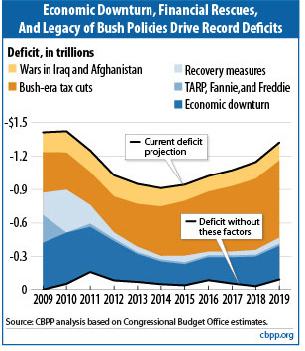
Fifty-five thousand people a day are losing their unemployment insurance because Congress won’t extend benefits. Why? Well, gee, any federal spending will increase the deficit — and like Herbert Hoover, everyone in Washington is talking about cutting deficits.


But check out this handy chart from the Commitee on Budget and Policy Priorities (thanks, Calitics). The overwhelming factors in the current budget deficit are left over from the Bush administration: Two wars, massive tax cuts for the rich, and an economic meltdown. Unemployment insurance barely even counts.


So the obvious solution to the deficit problem is to get the hell out of Iraq and Afghanistan, cut the size of the military and end the tax cuts. Funny: The deficit hawks aren’t talking about any of those things. 


Sunday Streets creates public benefits from private labors

2

By Kristen Peters

San Francisco locals will take to the streets this weekend as main roads in the Mission neighborhood are closed to automobiles for the sixth installment of Sunday Streets. On July 11, a three-mile route from 17th and Valencia to Dolores Park to Potrero Avenue will be car-free from 10 am until 3pm.

Taken from Bogota’s weekly ciclovía, in which nearly 100 miles of city streets are reserved for pedestrians and other recreationalists, Sunday Streets began in San Francisco almost two years ago. Since then, the tradition has made its way to other California cities including Los Angeles and Oakland.

“In San Francisco we have our own unique style,” event coordinator Susan King, who works for the nonprofit group Livable City, said. “We have different routes and we hit different neighborhoods year after year. In each neighborhood, the featured events have their own flair.”

This Sunday, revelers can look forward to performances by Grupo Azteca as well as capoeira and salsa dancing lessons, not to mention the countless restaurants in the area opening their doors early to the public. While the event has some support from the city and its San Francisco Municipal Transportation Agency, mostly in the form of permit fee waivers, it is run by Livable City and funded from corporate donations.

“Our corporate sponsors provide everything from durable goods, in-kind donations and cold, hard cash,” King said.

City officials have even curtailed helping with hanging “no parking” signs, leaving that task to volunteers from the SF Bicycle Coalition. That job was usually designated to the San Francisco Department of Parking and Traffic, but they have now stopped providing that service to an event that Mayor Gavin Newsom trumpets as something he’s bringing to the people. But King still calls Sunday Streets a good example of a public-private partnership.

“Everybody brings something to the table,” King said. “It’s a real cooperative entity with everyone pulling together to produce something really special.”

According to King, the benefits are widespread. Not only is it refreshing for the public to ditch their cars for a few hours, but it also reinvigorates the local economy. “It’s a real boom for the city,” King said. “Lots of people on the street means lots of eating. It’s good for business and good for the community.”

Acting executive director for the SF Bicycle Coalition Renee Rivera said that the Mission in particular has benefited from the crowds at Sunday Streets. “Everyone is enjoying the outdoor activities the event has to offer but, at the same time, are going to get ice cream, stopping for tacos or getting to enjoy all the merchants on 24th and Valencia,” Rivera said.

There are three more Sunday Street events following the Mission neighborhood closure. The Great Highway and areas of Golden Gate Park will be closed on August 22 followed by the Western Addition on September 19. The series will conclude on October 24 with the closure of the Civic Center and Tenderloin areas.

Protests turn to riots in wake of Mehserle verdict (VIDEO)

In the hours following the announcement of that Johannes Mehserle had been found guilty of involuntary manslaughter for fatally shooting Oscar Grant in the back on a BART platform on New Year’s Eve 2009, downtown Oakland became a drama-filled scene that changed minute by minute.

In the early hours, rallies were held, with community leaders speaking out against the killing of Oscar Grant and police brutality in general. At least 1,000 protesters gathered peacefully at the intersection of 14th and Broadway streets to hear a series of speakers venting anger. Representatives from the nonprofit Youth UpRising and other groups tried to discourage violence, but anger and frustration erupted into acts of vandalism once the rally came to a close and the night set in. Around the same time, police strapped on gas masks, readied clubs, and issued a dispersal order.

Around 8:30 bottles started flying among shouts of “fuck the police,” and “no justice, no peace.” A window was smashed at a Foot Locker near 14th and Broadway, and another window came down at the Far East National Bank, across the street. Looting followed, as did graffiti tagging, and trash cans lit ablaze.

By 10 p.m., things descended into further disarray as smaller crowds advanced north on Broadway and Telegraph, with just a few hundred continuing to smash windows at Whole Foods, Sears, Starbucks, and several other locations. The Guardian was on the scene and caught much of the early activity and some of the later rioting on film. The videos are presented below in chronological order. The Guardian left a crowd of less than 50 rioters near Whole Foods at Bay Place and Vernon Street, around 10:30.

http://www.youtube.com/watch?v=O_t8w7-_bVc
Shortly after the verdict was announced, Oscar Grant’s sister-in-law, Yolanda Mesa, tearfully addressed a small crowd outside Oakland City Hall. Video by Wendi Jonassen

http://www.youtube.com/watch?v=V1qclrgIOtE
A rally being held in the middle of the intersection at 14th and Broadway in downtown Oakland dissolved into chaos when police in riot gear approached and announced through a megaphone, “We are here to assist you in your peaceful protest.” Video by Rebecca Bowe

http://www.youtube.com/watch?v=Si0sH_v0oq8
As a marching band played in the background, activists hoisted a sign onto a lamppost over the intersection of 14th and Broadway in downtown Oakland. Video by Rebecca Bowe

http://www.youtube.com/watch?v=Y9S144Tptbg
A protester challenging police in the midst of demonstrations in downtown Oakland was tackled by officers in riot gear. Video by Alex Emslie

http://www.youtube.com/watch?v=V4veyVC204E
Oakland City Council member Rebecca Kaplan gave an interview at the line between demonstrators and police as she linked arms with others at 12th Street and Broadway. Council member Jean Quan stood nearby. Video by Alex Emslie

http://www.youtube.com/watch?v=EiV2-kp5Gc8
Police declared the protest to be an unlawful assembly and issued an order to disperse just before 9 p.m. The police charged, and this reporter got caught in the fray. Video by Alex Emslie

http://www.youtube.com/watch?v=NBwMMiFEe-o
Rioters ignited a trash can and dragged it down 15th Street toward the police line at around 9:30 p.m. Video by Alex Emslie

http://www.youtube.com/watch?v=z2eIW9YTwzQ
The riots took a noticeable turn just before 10 p.m. Even as the crowds diminished, more fires were ignited and store front windows were broken between 15th and 17th streets on Broadway as and rioters began to move further North. Video by Alex Emslie


SFBG Radio: The Mehserle verdict — and beyond

0

Today, Johnny and Tim talk about the Mehserle verdict, the riots, and what comes next. You can listen after the break.

sfbgradio7/9/2010 by jangel

Meg, Jerry and the Latino vote

0

It’s easy for political analysts to talk about “the Latino vote” as if 15 million people in California all shared exactly the same views and cared about exactly the same issues. Which is nuts: Latino voters are a diverse group.


On the other hand, it’s safe to say that over the past 15 years or so, as the California Republican party has become more and more viciously anti-immigrant, Latinos have been rejecting GOP candidates. When Pete Wilson pushed Proposition 187 — which would have prevented undocumented Californians from receiving public health services and would have kicked their kids out of public schools — he wrote off an entire generation of Latino voters.


And Jerry Brown has a strong history of supporting causes that resonate with a lot of Latinos.


So in general, recognizing that not all Latinos remember Brown’s support for Cesar Chavez or cae about the creation of the Agricultural Labor Relations Board, it ought to be a good assumption that Brown will win the Latino vote by a pretty wide margin. The fact that Whitman is narrowing his lead among Latinos is, I think, a sign that Brown is resting too much on history and hasn’t offered much in the way of ideas about jobs, education, or any of the other crucial issues that middle-class voters of all ethnic groups care about.


Still, the Spanish language billboards were really dumb. For a campaign that’s been as disciplined and message driven as the Whitman effort, it’s kind of a surprise. All Meg has done is give Brown a nice weapon, a reason to talk about an area where she’s very weak. And the more he can keep playing on that — the more he can point out how far to the right she and her advisors really are on immigration — the more it hurts her.

Newsom’s ambitions trump local needs

1

I guess that’s nothing new, and I could have written the same headline dozens of times over the past couple of years. But in this case, the Bay Citizen has a nice scoop — Newsom personally scuttled a deal that would have created a $50 million annual stream of affordable housing money because he didn’t want to be on record supporting any new taxes.


The Bay Citizen story, which also ran in the New YorkTimes, doesn’t go quite as far as to say that the tax issue scuttle the whole thing, but I think it’s pretty clear that’s what happened. The deal — a highly unusual agreement between warring parties — involved an increase in the real-estate transfer tax on high-end buildings. The private developers agreed to support it — if the housing advocates would allow some of the money to be used to subsidize the requirement that developers build affordable housing along with market-rate units.


I’m no so into subsidizing private housing developers, but the money would be coming from people who sell high-end properties. At any rate, whether it was a good deal in the end or not, Newsom’s own staff was involved in making it happen — and the mayor only killed it for one reason.


He doesn’t want his Republican opponent this fall to accuse him of raising taxes.


That’s a hell of a way to run a city. 

SF business community just opposes government

21

Mayor Gavin Newsom and his business community allies often accuse progressive members of the Board of Supervisors of being too “ideological” in their proposals, particularly when they involve revenue or regulations. But a looming battle over reforming the city’s business tax – one of three new revenues set for a special Budget & Finance Committee meeting tomorrow (7/9) at 11:30 am – shows that an ideological aversion to taxes of any kind drive Newsom and the business community more than their stated concern for “jobs” and the “economy.”

Board of Supervisors President David Chiu crafted his measure – which creates a progressive structure for the currently flat payroll taxes and uses small commercial rent tax to spread the tax burden among more businesses (only 10 percent of which now pay the payroll tax) — specifically to decrease the business tax burden on small businesses and protect private sector jobs while also bringing in about $35 million more into the city, which will save some city jobs and thus help the local economy.

City Economist Ted Egan and the Office of Economic Analysis confirmed that Chiu’s carefully crafted measure does just that, noting that it was based on recommendations made last month in a report by his office and two private accounting firms that was jointly commissioned by both Chiu and Newsom.

“The proposed legislation modifies the Progressive Payroll option in the Controller’s report, to achieve greater revenue growth while minimizing private sector job growth,” concludes Egan’s analysis. And that’s the idea of this legislation, to save some city jobs and services without hurting the private sector. Egan found this tax reform would on balance have no impact on private sector jobs.

But the Small Business Commission, driven by anti-government zealots in their community, wants even greater concessions and to minimize government revenues, demands that Chiu is now considering giving in to, with sources close to the negotiations saying they will amend the plan to exempt more small businesses and lower the revenue projection to more like $28 million.

“There are members of the small business community that are averse to any taxes,” Regina Dick-Endrizzi, director of the city’s Office of Small Business (which staffs the commission), told us.

She said the commission isn’t opposing or supporting the measure, and while she said the business community isn’t ideologically opposed to government, she did admit that “they are just not sensitive to keeping city workers employed.”

And that’s a terribly selfish and self-defeating attitude that hurts the local economy and the services we all depend on. The problem is the small business community — which is supported by the Bay Guardian and beloved by all as a key job creator — is being used by conservative ideologues and large corporations and lured into joining their anti-government crusade. This has to change, and this legislation is a good opportunity to talk about the real ideological barriers that are hindering common sense solutions to this city’s problems.

Boxer’s better off than Brown

0

I know this is political heresy, but I was encouraged by the results of the Field poll on Boxer and Fiorina. I remember back in 1982, when Milton Marks, then a liberal Republican state senator, challenged incumbent Congressmember Phil Burton — the legendary Democratic leader — with an anti-incumbent message fairly similar to what Fiorina is throwing at Boxer. “The arrogance of power” was the slogan, and while Marks didn’t try to say that Burton was too liberal (this was, after all, a San Francisco seat) the basic push was that an entrenched incumbent had grown stale and was unpopular. And in fact, the early polls showed Burton losing.

But a campaign consultant who was there at the early Burton strategy meetings told me a few years ago what the mood was like when the numbers came in: “We saw that he was down ten points, and we all breathed a sigh of relief. Because we knew we could make that up.”

Some thing when Silicon Valley whiz kid Ed Zschau took on incumbent senator Alan Cranston in 1986. Cranston, the polls showed, had been around too long, was old and boring, an entrenched incumbent … all the same messaging. Zschau was young, exciting, a moderate Republican who everyone thought was a shoo-in to unseat the incumbent. And Cranston ran a great campaign and beat him.

Boxer’s negatives are too high, but she hasn’t really reminded Californians yet of what she’s been doing in Washington and who she really is. And she hasn’t even begun to remind voters that Fiorina is anti-choice — a position that really, really doesn’t play in California.

Jerry Brown also has some good news from the Field poll, but he’s not the campaigner that Boxer is. And he’s got more trouble with younger voters. Frankly, he’s worse off right now than she is. In fact, if I were in Boxer’s camp right now, I’d be heaving a sigh of relief: She can turn this around.


The good news for Jerry Brown

4

The press is all over the latest Field Poll, which shows Jerry Brown and Meg Whitman in a dead heat.  And it’s no surprise that, thanks to a campaign that thus far has been almost entirely negative, voters aren’t particularly thrilled with either candidate.


But I think there’s some good news for Jerry Brown here. Whitman has spent more than $90 million so far, and the voters like her less than they did six months ago. After all that money, some of which has gone for blistering attacks on Brown, Whitman is still not ahead. And it’s hard to see what she can do now to move the needle.


CallBuzz:


Moreover, it looks like the attack ads on Whitman by Brown’s labor allies — including California Working Families 2010 — have had their intended effect: to increase Whitman’s negatives and keep her from pulling away from Brown during the summer, before he can afford to put his own ads on TV.


Meanwhile, Brown’s favorability is only marginally changed from March. It’s 42-40% favorable today, compared to 41-37% favorable before. (Of course, Brown’s favorable was 50-25% back in March of 2009, but that was when he was just the new Attorney General and not a candidate for governor with rivals.)


At some point, Jerry’s got to start seriously campaigning, and he’s got a lot of work to do. He has to define himself to younger voters, who know a lot more about Ebay than about Brown’s tenure as governor, which was generally pretty good. He has to remind Latinos of how awful Whitman is on immigration. He’s got to spend some money.


But at this point, there’s hardly a voter in California (at least, not one with a TV set) who hasn’t seen multiple Whitman ads, defining her as a successful business person and attacking Brown as a failed politician. Those are powerful messages. The ads have been well produced, well targeted and should have been effective. And they haven’t gotten her over the halfway point yet — even against an opponent who is vulnerable to attack and hasn’t campaigned much at all.


Both candidates seem to be holding the party loyalists — the vast majority of the Republicans like Meg, the vast majority of the Democrats like Jerry. And there are more Democrats than Republicans. The independents aren’t breaking Meg’s way, either — she’s only slightly ahead, not enough to make up the difference.


Now if Brown can just get his people to care enough to go to the polls. …

SFBG Radio: The guv’s minimum wage scam

0

In today’s installment, Johnny and Tim talk about the governor’s attempts to cut state employee pay to the federal minimum wage level — and how that will affect the fall election. You can listen after the jump.

sfbgradio 7/7/2010 by jangel

Sorting out the Adachi initiative

37

Lots of press on the Adachi pension-reform measure, a proposal that would amount to cutting the pay of city workers during a recession. It turns out even Gavin Newsom doesn’t like the plan:


The mayor also attacked Adachi’s pension plan, arguing that the public defender never discussed it with the employee unions, city officials or others affected by the measure and that it could have “unintended consequences” for the city.


And while I think it’s a bit of a stretch to say that the Adachi measure “could reshape national politics,” Randy Shaw makes a good point:


Adachi’s measure would join with Sean Elsbernd MUNI charter amendment to create a one-two punch against public employees on San Francisco’s November ballot. The national media will have a field day with the prospect of “liberal” San Francisco, and Nancy Pelosi’s home turf, voting to cut public employee compensation.

While this is not the message Adachi wants to send, it will likely be the one that is heard. It emerges at a time when the entire Republican Party and corporate Democrats are in a full-fledged media campaign to redirect public anger over the fiscal crisis toward excessively compensated public employees, and away from banks, oil companies, hedge fund managers, and an under taxed and poorly regulated private sector.


Shaw also says that the campaign will “bitterly divide progressives,” and I’m not sure it has to turn out that way. There’s always the danger that liberal voters who work in the private sector, and are struggling to keep their jobs and health insurance, will be seduced by the notion that public-sector employees are too well paid already. And the donwtown folks, who will soon be fully on board with the Adachi measure, will seek to divide the nonprofit sector and labor by arguing that nonprofit workers don’t get the same benefits as city employees — and city funding for nonprofits is threatened by the budget deficit. Both those things are true, but it’s also true that there’s a growing movement to challenge that approach. This battle will be a test for the city’s progressive movement, but I think the overwhleming majority of progressive leaders, activists and nonprofits will stick together and oppose Adachi.


The more important political impact will be felt in the tightly contested district-election contests, where city-employee pensions could join the sit-lie measure as wedge issues that the moderates will use against progressives. When Adachi came down to see us, I asked him if he was worried about that; he didn’t really seem to think it was important.


But there’s a reason we talk about a “progressive movement” (and don’t start on the “machine” stuff again, we had that debate over here). We all ought to be concerned about how one campaign affects the larger goal of building a better and more sustainable city. And while I hate to say it, I have to agree with Gavin Newsom: This thing could have “unintended consequences.”


Oakland and SF brace for reaction to Mehserle verdict

8

Oakland and San Francisco police and city officials are nervously awaiting the verdict in the murder trial of Johannes Mehserle, the former BART police officer who shot and killed Oscar Grant on a train platform last year, although the latest word is that verdict won’t come today (July 6), and probably not tomorrow, because of the absences of two jurors.

After demonstrations against Mehserle in Oakland last year turned into destructive riots, officials fear another outbreak of violence, particularly given the racial undertones to the crime, but they are urging calm and saying they will facilitate peaceful demonstrations in reaction to however the Los Angeles jury rules.

“We anticipate that regardless of the verdict reached by the jury, demonstrations will occur in downtown Oakland, and possibly throughout the city. The City of Oakland is committed to facilitating peaceful expression and demonstrations. The City of Oakland is also prepared to deal with the situation if it turns violent. Our goal is to protect public safety and property by minimizing the vandalism and violence,” reads a memo the Mayor’s Office distributed to Oakland city employees.

Of particular concern to Oakland officials is the area around Oakland City Hall, which they want evacuated before the demonstrations begin. As the memo said, “We learned from the January 2009 BART demonstrations that 14th & Broadway and the City Hall Complex are target areas and there is some indication that history may repeat itself. City management is concerned about the safety of our employees and it may be necessary to release some city staff earlier than normal. Similar planning efforts are being considered by the State and Federal buildings as well as private employers in the surrounding area.”

In fact, witnesses say that many Oakland business owners in the area have already started to board up their storefronts in anticipation of civil unrest. Police in both Oakland and San Francisco have been placed on alert and SFPD Officer Samson Chan said all officers, even plainclothed investigators, will be in uniform from now until the verdict.

SFPD Chief George Gascon held a press conference with African-American church leaders this afternoon urging calm and announcing that community centers throughout the city will be opened to give people peaceful opportunities to express their frustrations. “They all urged people to react to the verdict in a peaceful way,” Chan said.

In a public statement accompanying the internal memo, Mayor Ron Dellums expressed sympathy with the frustrations that people may feel if Mehserle is seen as getting a lenient verdict – “We understand that the community is grieving, and we are in this together. We will get through this together.” – but he ended the message by saying, “We are asking for the community to come together, look out for one another, and stay safe. We will not tolerate destruction or violence. We live here, and we love Oakland.”

Local ballot measure campaigns reach the finish line

5

The deadline for submitting enough valid signatures to quality local initiatives for the November ballot is today (July 6) at 5 p.m., which made for a busy holiday weekend for two San Francisco ballot measures that will be close calls: labor’s effort to increase the city’s hotel tax by 2 percent and the pension reform measure pushed by Public Defender Jeff Adachi.

“It’s going to be really close,” Adachi told the Guardian on Friday, referring to a measure to increase how much city employees contribute to their pensions and health care costs, which the labor movement is bitterly opposing.

But labor leaders say they have enough signatures for their Hotel Fairness Initiative after an all-hands-on-deck weekend of gathering and counting signatures, and they plan to hold a rally on the steps of City Hall at 1:45 pm on their way to turn the signatures in to the basement Elections Department. That initiative needed at least 7,168 valid signatures and officials say they turned in about 17,000.

Adachi says he’s also cleared the 44,799 signature threshold for qualifying a charter amendment and plans to turn them in at 4 p.m. He has yet to formally support the hotel tax increase (which could bring in about $30 million per year) or any of the other proposed revenue measures being considered by the Board of Supervisors, which still has a few more weeks to place measures on the ballot.

“It doesn’t deal with the train wreck that we’re in,” Adachi said of the proposed revenue measures, noting that they don’t come close to reaching the $167 million per year that he says his employee benefits reform measure would bring into the city, which labor leaders say will come directly out of the pockets of city employees and hurt the local economy.

But Adachi counters by telling us, “My message is there’s not going to be a city to run in a few years if we don’t do something.”

Meanwhile, Sup. Sean Elsbernd last week turned in about 76,000 signatures to remove Muni workers’ pay guarantees from the city charter, which would appear to easily qualify. The Board of Supervisors is working on a competing ballot measure that would also remove that guarantee, but include a more comprehensive reform that includes governance and oversight changes and new revenue.

COH sends in “hostage negotiators” during budget talks (VIDEO)

Members of the Board of Supervisors, their legislative aides, and other City Hall regulars were all looking a bit sleep-deprived as they darted from office to office at City Hall July 1 after ongoing budget negotiations kept everyone up late the night before. Just as an agreement on the city budget seemed within reach on June 30, Mayor Gavin Newsom and his chief of staff, Steve Kawa, had expressed strong opposition to several initiatives that progressive members of the Board of Supervisors sought to place on the November ballot.

The mayor’s last-minute move was described by some as a quid pro quo that withheld support for an amended budget — which included about $40 million in restorations to community programs that are high priorities for members of the board — unless four different proposals were struck from the ballot. Three were proposed charter amendments dealing with commission appointments that would distribute power more evenly between the board and the mayor, and the fourth was a proposal put forth by Sup. Ross Mirkarimi that would have required the San Francisco Police Department to adopt a community-policing model and engage in neighborhood foot patrols, initially cast as an enlightened alternative to Newsom’s proposed law banning sitting or lying down on the sidewalk. 

“In so many words, he had expressed clear dissent, and that was made relative to our budget proceedings,” Mirkarimi said, noting that the mayor didn’t phrase it in a way that would have run afoul of a law prohibiting that kind of bargaining over legislation. Newsom Press Secretary Tony Winnicker dodged repeated Guardian questions about whether Newsom was demanding conditions unrelated to the budget, coming closest to a direct answer when he said, “Before discussions of vetoing would even come up there would have to be something at the full Board to consider or veto, and there’s not, so NO.”

Technically legal or not, Newsom’s move was enough to prompt members of the Coalition on Homelessness, an advocacy group, to decry it as “a hostage situation.” As if negotiators ping-ponging back and forth across City Hall weren’t jarred enough already, the Coalition on Homelessness and Budget Justice Coalition members opted to underscore their point by blasting heavy metal music outside the mayor’s office windows in order to push the standoff to a close, and release the needed funds to safety.”

“The package of add-backs and cuts would have preserved the essential services San Francisco families rely on to survive the recession,” the Coalition wrote in a press statement that was released as budget negotiations wore on. “In order to leverage political gain on unrelated issues, the Mayor chose to hold hostage the package of restorations to vital senior health services, youth violence prevention programs, mental health treatment and cuts to waste.”

The heavy metal stunt only lasted about two minutes before deputy sherriffs put the kibosh on it, but “hostage negotiators” Patrick Flanagan (shown in the video wearing sunglasses), James Chionsini, Que Newbill, Lorraine Deguzman, Bob Offer-Westort, and Jennifer Friedenbach managed to make their way into the reception area of the mayor’s office. Mike Farrah, director of the Mayor’s Office of Neighborhood Services, was sent out for a bargaining session with the pizza-bearing crew. We caught the whole tense situation on film, and here’s how it went:

The “hostage negotiations” session took place around 4 p.m. Around the same time, various members of the board were going in to meet with the mayor on what several described as “parallel conversations” regarding the charter amendments, and the roster of programs that supervisors wanted to see restored after Newsom proposed slashing them in his June 1 budget proposal.

As the Budget & Finance Committee prepared to meet around 6:30 p.m., the worst fears of the Budget Justice Coalition did not seem to be realized. City Controller Ben Rosenfield arrived to the board chambers with freshly printed copies of an add-back list that included most of the programs that were high priorities for progressive supervisors and community advocates. However, Newsom had not given that list his stamp of approval, so a final budget agreement between both parties remained elusive. Winnicker cast those add-backs as contrary to Newsom’s wishes: “Don’t for a second even try to suggest that it’s improper to raise concerns about the fiscal impact of a new $40 million setaside in the context of a discussion of the budget.”

As for the discussion about the charter amenments, Mirkarimi characterized it as “ongoing.” Avalos called the preliminary amended budget “a work in progress,” but members of the Budget & Finance Committee still voiced a round of thank-yous to one another and all of the community groups who were there to assist with the process.

The Budget & Finance Committee forwarded the budget, including the restoration package, to the full board. Using a variety of sources, supervisors were able to restore $32,941,541 in funding for programs ranging from homeless services, to mental health care programs, to programs that aid and assist impoverished single-room-occupancy hotel residents, and others. An additional $7.4 million meant to cover a variety of youth and senior programs will depend on a supplemental appropriation that won the committee’s preliminary approval. Sup. Sean Elsbernd dissented on both counts, but still made a point of thanking the other committee members for their work.