• No categories

Politics Blog

Register to vote before midnight

1

Did you know that you have until midnight today to register to vote? That you have until next Tuesday (Oct. 26) to request a vote-by-mail ballot?
And that you have until election night, which falls on November 2, Day of the Dead, to actually vote?

If you are not sure if you are eligible to vote, check the rules here. And then download a voter registration form here.

Or pick one up at the Department of Elections, the Department of Motor Vehicles, or at post offices and public libraries throughout San Francisco.

To register to vote, you’ll need a California driver’s license, a California identification number, or the last four digits of your Social Security number.

But what about if you are not sure if you are already registered to vote? Check the city’s online  records here.

Or not sure where your polling station is? Then click here, where you can also find a sample ballot to figure out who and what to vote for.

Either way, vote early, and vote often–and may the best candidates and measures win.

SFBG Radio: a WPA for musicians

5

Today we talk about jobs, the economy — and why Obama should create a WPA for musicians. Listen after the break.

sfbgradio10152010 by endorsements2010

Get angry and make ’em do it!

9

After crashing the country’s economy and turning the world against us, Republicans are clawing their way back into power by stoking voter anger at political and economic systems that are stacked against the common citizen, a tactic that progressives need to adopt if we ever hope to move our agenda forward.

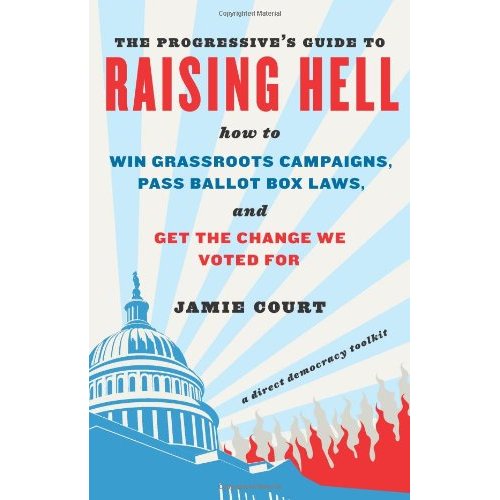
“Anger, not hope, is the fuel of political and economic change,” Jamie Court, head of Consumer Watchdog, writes in his new book, The Progressive’s Guide to Raising Hell: How to win grassroots campaigns, pass ballot box laws, and get the change we voted for (Chelsea Green Publishing, 2010).

Court writes that progressives are rightfully disappointed and disillusioned that after helping to elect President Barack Obama, he and Congressional Democrats turned around and gave Wall Street, the military-industrial complex, and the health insurance companies everything they wanted, with Obama even caving in on requiring all Americans to purchase health insurance, something he opposed as a candidate.


Yet Court said politicians never do the right thing and push progressive political change unless they’re forced to do so. He opened the book with a scene in which President Franklin Delano Roosevelt met with progressive political leaders, listened to their proposals, and then told them, “I agree. I am all for your plan. Now make me do it.”

It’s a concept that the conservative Tea Party movement understands well, and even though they may be crazy and wrongheaded in their utterly unsustainable and destabilizing policy agenda, they have effectively used anger as a political tool, and as a result, the NY Times reports they are poised to wield a disproportionate amount of political power after this election.

It’s the same story on the local level, where the only real anger in this election cycle is coming from those mad at public employee unions and their pension deals, and vagrants who sit uncivilly on sidewalks. These people will keep pushing for what they expect, but many progressives act as if it’s enough to prevent truly heinous Republicans like Meg Whitman from taking power, rather than trying to push Jerry Brown or Board of Supervisors’ progressives from day one to start empowering people over corporations.

“After the vote, power vacuums fill with familiar values, if not faces. Promises give way to fiscal realities, hope succumbs to pragmatism, and ambition concedes to inertia. The old tricks of interest group – confuse, diffuse, scare – prevail over the better angels of American nature,” Court writes, relaying a familiar electoral pattern.

Yet in this election, when the best outcome seems to be simply dodging a bullet, is there any hope for progressive political change? Isn’t the system just too broken? I asked Court these questions when he stopped by the Guardian office for a chat recently, and he retains a belief that with the right kind of tactics and agenda, progressives can still seize the political initiative and power.

http://www.youtube.com/watch?v=J3RD0YObHok

“I wrote it to reengage progressives because they are so despondent,” Court told me. “It’s about how to use anger and focus anger…Politicians don’t answer polite mobs, they only answer angry mobs and the Tea Party is the only angry mob in the room.”

Progressive have understandable doubts about the responsiveness of the current political system, but Court said, “I know if we don’t try to make it work, we’re never going to get there.”

And his book lays out the path to get there, step by step, based on some of the legislative and political successes that Consumer Watchdog and other progressives have had in recent years, such as rejecting the well-funded corporate con jobs in Propositions 16 and 17 earlier this year. Yet it involves an approach based on principle and not parties, and with being relentless in pursuing the kind of world we need.

“If you want to fight corporate power, you have to fight Democrats and Republicans,” Court said.

Specifically, Court is calling for progressives to push a California ballot measure that would establish a public health care option here, the very thing that Obama and the Democrats failed to include in their health reform package, and which will dash any hopes of it working if the people are forced to rely on unregulated insurance company products.

“The biggest thing is mandatory health insurance, which is a ticking time bomb,” Court said, one set to go off in 2014 when that aspect of Obama’s health care reform kicks in.

Corporate and political power working together seem to be a force too strong to overcome, but as Court writes, “Public opinion is the most powerful force in the world. While it can be muted, distracted, and co-opted, it cannot be controlled, except by the public.”

Willie Brown and accusations of machine politics in D6

70

A political mailer promoting progressive supervisorial candidate Jane Kim was funded primarily by former Mayor Willie Brown through a campaign committee that Kim consultant Enrique Pearce helped start and which was located in his office, the latest strange development in a race that is dividing the progressive movement at a crucial moment and prompting a nasty public debate over political “machines.”

It’s illegal for campaigns to coordinate activities with independent expenditure committees such as New Day for SF, which put out the glossy mailer proclaiming “Another renter supports Jane Kim for District 6 Supervisor” and calling her “The people’s candidate.” The most recent campaign finance statements, filed Oct. 4, listed the group’s treasurer as USF student Brent Robinson and the contact number being that of Pearce’s Left Coast Communications, where Robinson worked.

Pearce told the Guardian that he was involved in starting New Day for SF, but that he severed ties with the group and Robinson “about a month ago” when it seemed they might support Kim. “When it started to go down that path, we said that we can’t do that,” Pearce said, adding that he didn’t know why the forms still listed his phone number or why the receptionist in his office took a message for Robinson from the Guardian, although Pearce said they share a receptionist with other organizations. On Oct. 5, a day after the intial filing, the group filed a form to amend Robinson’s phone number.

The campaign finance form shows the group raised $9,200, including $5,000 from Brown on Sept. 30 and $2,500 from Twenty-Two Holdings LLC, which last year applied for a liquor license for the Wunder Brewing Co. Robinson did not return our calls for comment.

The Bay Guardian and other progressive voices used to decry the corrosive influence on San Francisco politics of the Democratic Party political machine established by Brown and former California Senate President (and current state party chair) John Burton. Although that machine is dormant now, the concept of machine politics has been revived in this election cycle by Kim and her allies, adding an ironic note to her support by Brown.

“I’m not a part of anyone’s machine and I’m certainly not a part of anyone’s master plan,” Kim declared during her June 24 campaign kickoff party, where Brown and former Mayor Art Agnos made an appearance. When I highlighted the remark in my coverage of the event, and its inference that Kim’s progressive rival Debra Walker was supported by a budding progressive political machine, it triggered a raging political debate about the concept that continues this day.

The nastiest salvos in that debate have recently been fired at the Bay Guardian and the San Francisco Democratic Party Central Committee – accusing us of being part of a political machine supporting Walker and excluding Kim (who got the Guardian’s #2 endorsement) – by Randy Shaw on his Beyond Chron blog. Shaw is one of two staff writers on the blog, along with Paul Hogarth, a Democratic Party activist and Kim campaign volunteer.

Shaw founded and runs the nonprofit Tenderloin Housing Clinic, which has millions of dollars in city contracts to administer SRO leases through Mayor Gavin Newsom’s Care Not Cash and other programs. He started BeyondChron a few years ago with seed money from Joe O’Donoghue, who was then president of the Residential Builders Association, a developer group that has sometimes clashed with Walker in her capacity as a member of the city’s Building Inspection Commission.

On Oct. 5 and then again on Oct. 12, Shaw wrote and prominently posted long stories promoting Kim’s candidacy and attacking us and the DCCC for not supporting her more strongly. In the first one, “In District 6, Jane Kim takes on the machine,” Shaw defended Burton but shared the Guardian’s criticism of how Brown behaved as mayor.

“Brown’s power was strictly personal, as became clear when his chosen Supervisor candidates were defeated in the 2000 elections,” Shaw wrote, criticizing political machines and writing that the progressive political movement is not “served when those seeking to run for office feel they must choose between ‘playing ball’ with political insiders and giving up their dreams.”

But is it possible that Shaw’s strident campaigning against Walker – indeed, his protege Hogarth planned to challenge Walker before Kim decided to get into the race – was prompted by Walker’s unwillingness to “play ball” with Shaw and his RBA backers? Should we be concerned that it’s actually Shaw who’s trying to build his own little political machine?

I’ve tried to discuss these issues with Shaw and Hogarth, including sending them a detailed list of questions (as has Guardian Executive Editor Tim Redmond), but they’ve been unwilling to respond, just as they were unwilling to contact us before writing two divisive hit pieces that were riddled with inaccuracies that they’ve refused to correct.

I’ve also left messages with Kim and others in her campaign to discuss machine politics and its implications – as well as Sup. Chris Daly, asking about the sometimes close relations that some progressive supervisors have had with Shaw and RBA developers over the years [UPDATE BELOW] – and we’re waiting to hear back.

But Pearce said voters shouldn’t read too much into a relatively small political contribution from Willie Brown, or from the “colorful writing” of Randy Shaw, emphasizing Kim’s independence and saying that was always what she intended to stress when she raised the specter of machine politics tainting the race.

“Randy Shaw is not a part of this campaign, and Willie Brown is certainly not a part of this campaign,” Pearce told us. In fact, Pearce even noted that his office is not a part of the Kim campaign, that they’re merely consultants to it. And he offered his hopes and belief that in 19 days when this campaign is over, progressives would overcome their differences and find a common agenda again. Let’s hope so.

UPDATE: Daly and I just connected and he had an interesting take on all this. He noted that when Brown was mayor, the base that he brought together included the RBA, Rose Pak and the Chinatown power brokers (who also seem to be backing Kim, who used to work as an activist/organizer in that community), and, improbably, both Labor and Downtown.

“But that’s not Gavin’s alignment, his alignment is just downtown. The RBA guys hate Gavin, mostly just because of who is is, a silver spoon guy who never worked a day in his life,” Daly said. So Matt Gonzalez, the board president who ran against Newsom in 2003, formed an alliance with the RBA and O’Donoghue, who already had a long relationship with Shaw, both personal and financial.

Daly also said that he thinks it’s a personality clash more than anything else that is driving Shaw’s opposition to Walker: “He just doesn’t like Debra.” In turn, that sort of personality-based politics — more than any differences in ideology, vision, or qualifications — is souring people in the two political camps on one another as this close election enters the home stretch. But will those resentments linger after this election? Probably, Daly said, although he plans to actively try to mediate the divide once the dust clears on this race.

“Luckily, we have a lot of young people entering the progressive movement,” Daly said. “There’s always a rejuvenation going on and one day the new leaders will be like, ‘Why do that guy and that guy hate each other?’ ‘I don’t know, I think it had something to do with the 2010 election.”

More on the “whore” gaffe

By now, you’ve probably heard about the campaign gaffe in which an unidentified female associate of Jerry Brown (possibly Brown’s wife) called his opponent Meg Whitman a “whore” during a conversation that neither realized was being recorded over voice mail.

The comment was made in reference to Whitman’s offer to cut a deal over the pensions of a police officer’s union in exchange for an endorsement. Soon after the tape went public, Whitman’s campaign seized the opportunity to issue a press release slamming the remark as “an appalling and unforgivable smear,” and a slur. Sparks flew over the comment at Tuesday’s gubernatorial debate.

Yet a number of reactions from feminist organizations and bloggers suggest that despite Whitman’s ire, women haven’t started hating on Brown as a result of the dumb mistake. And in the meantime, the controversy has generated some pretty interesting discussions out there in the blogosphere.

Shortly after the remark went live, Brown secured the endorsement of the California chapter of the National Organization of Women (NOW), which in turn prompted conservative bloggers everywhere to start foaming at the mouth, madly accusing NOW of being partisan and anti-woman.

“We definitely felt that putting the announcement out today was important to refocus on the real issue in the campaign,” such as “what are the two candidates going to do for women and their families,” the chapter’s president, Patty Bellasalma, told the Sacramento Bee. “The use of the word ‘whore’ is offensive,” she added. “There’s no mincing words about that.”

Chloe, a blogger at Feministing.com, had this to say:

“When candidates and their aides use highly gendered derogatory terms to refer to the opponent, and when that opponent responds by appealing to women’s personal-is-political feminism, we are having a national discussion about gender. … But it doesn’t feel like a particularly productive one — it’s more a case of one camp screwing up by revealing underlying sexism and the other capitalizing on that mistake to score a few points. It’s not an honest discussion of structural and cultural sexism in America and how it affects people of all genders. I want to make it clear that I think what Jerry Brown’s aide said was unacceptable, as was Brown’s seemingly tacit endorsement of the word. It’s not acceptable, obviously, to call anyone a whore. But I’m trying hard to remember what Jay Smooth taught us: condemn the action, not the person, or the campaign.”

Hanna Rosin, a blogger writing for Slate.com and the DoubleX factor, had this take on it:

“Now it’s unclear exactly what the aide meant, but it’s perfectly clear he or she did not mean that Whitman was a hussy who had slept with half the legislators west of the Mississippi. Since this was an endorsement call, he or she meant that Whitman was whoring herself for the endorsement. In one way, we could see this as progress, that the word ‘whore’ is so far removed from its original sex-shaming role that it gets thrown around in the context of political power trading.”

But if the phrase weren’t so wrapped up in sexism, would we even find ourselves in the midst of this controversy? Technically, “whore” can be used to refer to a man or a woman, and it can also mean “a venal or unscrupulous person” or some one who is “considered as having compromised principles for personal gain.” But do alternate definitions remove the sting of an offensive word?

A few questions. Should the gender of the person using the word (in this case, a woman) change our analysis of how it was used? When the remark has everything to do with politics and nothing to do with sex, should it be taken as a sign that we’re making progress on gender equality? Or would real progress be when the term “whore” goes the way of an archaic insult you’d find in a Shakespearean play?

There are signs, meanwhile, that the word “whore” isn’t universally regarded as a gendered insult. Just check out the roughly 200 definitions offered on Urban Dictionary. Like this one, posted by some one named Megan:

“Minor annoyance. You’re not really mad at them, but still kinda pissed.
‘Hey, who ate the last doughnut?’
‘I did.’
‘Whore.’”

Talking with Pelosi’s GOP opponent

28

I had a fascinating discussion this morning with John Dennis, the Repubican candidate running against Nancy Pelosi. He’s not going to win, of course, but he’s gotten some national press, including a nice piece by John Nichols, the veteran liberal editor at the Madison-based Capitol Times and a plug from the Huffington Post. Matt Gonzales has endorsed him.

Dennis is a libertarian Republican, but not a nut job or a conspiracy wacko. He’s intelligent, articulate and makes some very good points. He is, for example, totally against the wars in Iraq and Afghanistan, and calls for an immediate pullout of both quagmires. He supports same-sex marriage (it took me a while to get that out of him, but he does), supports Prop. 19, opposes DADT, and wants the feds to stop cracking down on undocumented immigrants in California. He’s against warrantless wiretaps and torture, and wants to repeal the worst parts of the PATRIOT Act. He thinks we should review all of our military bases abroad — just as we have with domestic bases — and close the ones we don’t really need anymore.

In other words, on Iraq, Afghanistan, the Pentagon budget, social issues, the drug war and civil liberties, he’s way out of synch with his party — and a lot better than Pelosi, the good liberal Democrat. And Arthur Bruzzone, my old pal and the former chair of the Republican Party, came down with Dennis and told me that the Guardian really ought to endorse him.

We’ve said some bad things about Pelosi; after all, she privatized the Presidio. She’s been weak on the wars, weak on same-sex marriage, weak on taxes and corporate welfare — and a lot more interested in raising money for Democrats than in representing her district. She won’t even debate Dennis, which is typical of her arrogance.

On the other hand: Dennis has a problem. He’s a member of a party that’s run by barbarians, and if he got elected, and was part of a GOP majority, some very bad people would be in charge. He knows that, and says he wants to change the GOP from within; good luck with that.

And since I spent much of my time these days talking about the gap between the rich and the poor and how utterly unsustainable a nation is when 5,000 families at the top control more wealth than 160 million at the bottom, I have a hard time with libertarians who don’t believe in income taxes.

And that’s Dennis. He told me that he thinks the income tax should be replaced with a consumption tax (that is, a sales tax), which is about the most regressive idea you can imaging. He said he thinks the Bush tax cuts should continue. He thinks government is too big and ought to be dramatically cut back.

I don’t think Pelosi much supports a radical redistribution of wealth in this country, but the Democrats at least are going to let the insane tax cuts for the rich expire. And that’s something.

So I understand Matt Gonzalez, and I had a wonderful talk with Dennis, and I hope you all listen to it (below). And I get the “beyond left and right” thing that the HuffPo talks about. But on the basic economic issues — like wealth redistribution through progressive taxation — the good libertarians and I will never agree. And that’s kind of a deal-breaker.


john dennis by endorsements2010

SFBG Radio: The Whitman-Brown debate

2

Today we look at last night’s debate, at Meg v. Jerry, at Gavin v. Abel, at why such a sorry crew are running for Lt. Gov — and why it’s so hard for independent candidates to run for statewide office. Listen after the jump.

sfbgradio10/13/2010 by endorsements2010

Maxwell disappoints by endorsing Sweet

10

To be honest, I wasn’t surprised that termed-out Sup. Sophie Maxwell endorsed D10 candidate Lynette Sweet yesterday. Just disappointed. And it’s not just because Sweet refused to come into the Guardian this fall for an endorsement interview (a stance that suggests that Sweet would be depressingly inaccessible to reporters that haven’t drunk her Kool-Aid—a stance that, unfortunately, reminds me of Mayor Gavin Newsom’s attitude towards the media).

I’d been hearing rumors that Maxwell was going to endorse Sweet since February, when Sweet, who’d already racked up Mayor Gavin Newsom’s D10 blessing at that point, showed up alongside Maxwell at the city’s kickoff event for Black history month.

Then there was the fact that during an interview in February for the Guardian’s kickoff article about the D10 race, Sweet spouted phrases that sounded eerily similar to Maxwell’s words.
“D10 is a pretty diverse district, but there is only one common thread: the need for economic development,” Sweet told me.

But a few days earlier when I interviewed Maxwell about a third, and ultimately unsuccessful, attempt to recall her , Maxwell talked of common threads:

 “I’m waiting for people to have a better understanding of what this community is, what the common thread running through it is, and how to use rank choice voting,” Maxwell said, by way of explaining why she wasn’t willing to endorse anyone that early in the race.

Now, it’s understandable that Maxwell would be looking for a candidate to carry on her legacy. But it she was looking for a moderate black female candidate  then why not endorse Malia Cohen, who isn’t hampered by all of Sweet’s dirty laundry—and has raised the most money in the race, so far?

Could it be that Cohen wouldn’t be down for the kind of dirty deal making that was par for the course back in the days when Willie Brown was still mayor and Sweet was the swing vote that crowned Lennar as master developer at the shipyard/Candlestick Point?

Rumor has it that Maxwell is upset at all the corporate money that’s flooding into this race in support of Steve Moss—and that she asked the other candidates to hold a press conference in which they decry this practice. Rumor also has it that Sweet signaled her willingness to join Tony Kelly, Dewitt Lacy, Chris Jackson and Eric Smith–to name a few–in making such a statement. But it hasn’t happened, yet. And the corporate money keeps rolling in for Moss.

Meanwhile, with three weeks until the election, D10 forums are beginning to sound like a parody of a “Lost” episode featuring a 22-member cast that all claim to represent the city’s polluted and economically depressed southeast sector:

“One of us is a BART director, one of us worked at City Hall, one of us is a community advocate, one of us is a City College Board member, one of us is a civil rights attorney, one of us is an affordable housing development director, one of us is a bio-diesel advocate, one of us is a public safety advocate, one of us was raised in the Bayview, one of us served on the Navy’s Restoration Advisory Board,” and so on.

I’m not saying this is wrong. Hell, I love all this diversity of choices. but I am concerned that, come election night, the progressive vote will get split into a million pieces, while deep-pocketed conservative forces like the Chamber of Commerce and Golden Gate Restaurant line up behind one candidate in an attempt to crush candidates that would stand up to their powerful influence at City Hall and truly represent the D10 community

Yes, there is ranked choice voting, and it’s unlikely that one candidate will win a majority of the vote in the first round. But it’s critical at this venture that progressives develop a winning strategy. D10 candidate Ed Donaldson told me recently that if a candidate who doesn’t represent the community’s concerns gets elected, then the community would respond just as they did around Maxwell—and organize a recall.

But wouldn’t it be better if the community can come together behind three truly progressive candidates and help them win the November election?

One of the key challenges in this race will be to win votes in Visitacion Valley, as well as in the Bayview and/or Potrero Hill.

In his latest column in the Chron, former mayor and Sweet supporter Willie Brown alluded to the importance of this in a city with ranked-choice voting:”It’s not getting much attention, but someone has finally figured out how to get the Asian vote out,” Brown observed.”You do it by mail. You get ballots and ballot books into every household, then have the whole family sit down together. The kids help with the translation, everyone talks things over and everyone votes.”

Meanwhile, D10 candidate Tony Kelly told me that Marlene Tran, who is tri-lingual (English, Cantonese, Vietnamese) and has a good handle on community issues in Viz Valley, has confirmed that Kelly is her second-ranked choice (presuming that she votes for herself in first place. of course).

Not a bad strategy–and one that other progressives need to consider, given ranked choice voting–and the brutal reality that they are going to be massively outspent in the next three weeks.


Don Perata — lazy, corrupt and armed

0

The East Bay Express, now in independent hands, is endorsing candidates — which is a very good thing in a community where the daily paper is marginal, at best — and the paper’s editors pretty much agreed with us in the Oakland mayor’s race. They endorsed both Rebecca Kaplan and Jean Quan (along with Joe Tuman), and made about the same arguments we did — Kaplan’s a visionary, Quan’s experienced, either would be fine — and Don Perata would be a disaster. In fact, my favorite part was their “anti-endorsement” — 25 reasons not to vote for Perata — which included some stuff I did know (“he’s lazy” and “he’s corrupt”) and some stuff I didn’t:


Perata has purposely fostered the image of a mobster. Friends and foes have called him “The Don,” he conspicuously carried a gun around with him, and he kept a life-size cutout of Tony Soprano in his senate office. He also posted a plaque in his office that read, “The Peratas,” written like the logo from The Sopranos with a handgun in the place of the “r.”


Don Perata, armed. That’s scary.

Downtown massively outspends progressives

17

With only three weeks until the election, downtown interests are massively outspending progressive groups.(Conservative estimates suggest a 5:1 ratio, based on an analysis of campaign finance disclosures at the Ethics Commission.) And these downtown interests have plenty in reserve, as cash is funneled into a bunch of improbably-named political action committees that hope to influence the outcome of district elections and local measures on the fall ballot.

The Alliance for Jobs and Sustainable Growth, which is backed by the Chamber of Commerce, the SF Police Officers Association, and United Health Care Workers, recently got an infusion of cash from the conservative-minded Building Owners and Managers Association and Golden Gate Restaurant Association. And the alliance is already spending gobs of money in support of Theresa Sparks in D6, Scott Wiener in D8 and Steve Moss in D10.

The Coalition for Sensible Government, which recently received a $100,000 injection of cash from the SF Association of Realtors, is spending in support of Sparks in D6, Wiener and Rebecca Prozan in D8, and Lynette Sweet and Moss in D10. The coalition is also spending in support of Proposition G (transit operator wages) and Prop. L (Newsom’s sit-lie legislation)  and in opposition to Prop. M (community policing/ foot patrols) and Prop N (property transfer tax).

And a PAC consisting of the Coalition for Responsible Growth, Plan C, San Franciscans for a Better Muni, SF Forward (sponsored by the SF Chamber of Commerce and SPUR) received $85,000 from the Committee on Jobs, $60,000 from the SF Association of Realtors, and $35,000 from SF Forward.

This PAC, which has already spent $466,000 this year, recently plunked down $1,000 to produce a voter guide for Plan C–a group that focuses on condo conversions and is endorsing Sparks in D6, Wiener in D8, and Sweet (as its first ranked choice) and Moss (as its second ranked choice) in D10.

It isn’t surprising that downtown PACs have deep pockets and almost identical slates. But it is a bit of a shocker that their slates are apparently almost identical to the Small Business Advocates, a group that has somewhat differing values and only a couple hundred members.

Reached by phone, SBA director Scott Hauge said the group has a couple hundred members–and claimed that SBA’s Board supports Sparks in D6, Moss in D10, and supports Measures G, K, L and opposes Measures J, M & N.

Hauge acknowledged that these positions are identical to those of downtown interests.
“We have been working with large companies,” Hauge said, claiming that small and big business’ interests are “the same” in this particular election cycle.

To date, neither the Chamber’s Steve Falk nor UHW’s Leon Chow have replied to the Guardian’s calls about the genesis of their so-called Alliance for Jobs and Sustainable Growth (Chow posted a comment on our politics blog and that is really not the same as a live conversation.)

But Tim Paulson, executive director of the San Francisco Labor Council wasn’t afraid to go on record in opposition to the Alliance and its 2010 slate.

“We’re really disappointed that there are labor organizations that feel they have to team up with Golden Gate Restaurant Association, which is against healthcare, and with CPMC [California Pacific Medical Center], which is working to keep nurses from joining a union,” Paulson said. “This alliance does not reflect what the San Francisco labor movement is about.”

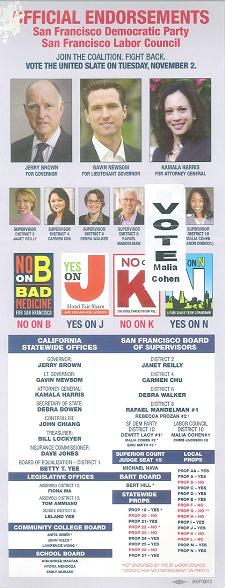
A door hanger that the Labor Council distributed in conjunction with the SF Democratic Party confirms that both organizations support Debra Walker in D6 and Rafael Mandelman in D8. But while the Dem Party supports DeWitt Lacy, Malia Cohen and Eric Smith (in that order) in D10, the Labor Council only supports Cohen and Chris Jackson (in that order) in D10.

But despite their differing D10 candidate slate, both these progressive groups support Measures J, M and N, and oppose Measures B, K and L.

“When we see the Hotel Council stoop to attack Mike Casey, one of the greatest labor leaders in SF history, for fighting hotels who want to take away healthcare and diminish the retirement benefits for workers who make $25K to $30K a year, that’s really disturbing,” Paulson said, referring to a recent op-ed in the SF Examiner that was written by Patricia Breslin, executive director of the Hotel Council.

“And any union that makes an alignment with groups that don’t share the values of the San Francisco Labor Council, that’s really disturbing to me and the Labor Council,” Paulson said.

Noting that downtown is spending buckets of money on the election, Paulson observed that the Labor Council’s values are about “sharing the wealth.”

“So we don’t want Measure B [Jeff Adachi’s pension reform] or K (Newsom’s hotel tax) or L (Newsom’s sit-lie legislation),” Paulson concluded. “And we have three solid weeks to do this.”

DADT ruling gives Obama an opportunity to lead

2

Now that a federal judge has ruled the U.S. military’s “don’t ask don’t tell” policy unconstitutional, President Barack Obama and the Democrats have an opportunity to demonstrate their stated commitment to equal rights for gays and lesbians – and, more generally, their willingness to boldly lead the country. And all they have to do is…nothing.

Actually, if Obama really wants to show some courage on the issue, he would announce that he’s doing nothing – that is, choosing not to appeal the ruling and to simply let it stand – now, before the mid-term elections next month. Sure, that might involve some political risk in conservative districts, but it would also demonstrate to voters on the left that this administration is actually willing to take a stand on an issue that is important to progressives and other believers in social justice.

Part of the problem that Democrats are facing in this election is that the Republican base, all those crazy teabaggers and ill-informed believers that Obama is a dangerous socialist, are fired up, but those in the Democratic Party base – workers, liberals, anti-war activists, and representatives of marginalized communities – don’t have much to cling to these days.

They’ve watched Obama escalate the so-called “war on terror,” do little to challenge Wall Street’s casino capitalism, prop up health insurance companies and call it “reform,” and let conservatives set the agenda while the Democrats dither on issues ranging from raising taxes on the rich to rebuilding the country’s infrastructure and social safety net.

Obama opposes same-sex marriage, and when the Democrat’s made a showy legislative move last month to end DADT, they quickly caved in the face of a Republican filibuster, making the whole gesture seem like a meaningless election year gimmick rather than an honest effort to end a policy that has always been unconstitutional, as this judge has now ruled.

So now, it’s gut check time. Obama needs to show what kind of president he wants to be. Will he do the right thing and finally provide the bold progressive leadership this country needs right now, or will he follow Bill Clinton’s lead and cave in to his conservative critics, maintaining his popularity and winning a second term by triangulating between the left and right, but leaving the country dangerously adrift in treacherous waters.

OFA opens SF office, hosts debate watch party

12


President Obama’s political operation, Organizing For America, is opening its first San Francisco office today (Tues/12), just in time to hold a watch party for this evening’s final California gubernatorial debate between Jerry Brown and Meg Whitman. So stop by 1406 Valencia at 6:30 for the debate, or stop by at 4 pm to watch Obama greet the crowd via video hookup.

Emily Dulcan, OFA’s California communications director, said the office will be focused on get-out-the-vote efforts for the Nov. 2 election, including phone banking and precinct walking for races that include Brown for Governor, U.S. Sen. Barbara Boxer’s reelection effort, Congressional races, and even some local measures.

“A lot of our volunteers hover between local races and the big races,” said Dulcan, who said she was starting to feel good about the chances of Democrats doing well at the polls. “People are really starting to see what’s at stake in this election. We can go back to the failed policies of the Republicans and President George W. Bush, or we can move forward under President Obama.”

While history and many pundits predict the Democrats will lose seats in Congress this fall – mostly because of the stubbornly bad economy and the fact that the party in power usually loses ground in the midterm elections – recent computer modeling by the New York Times showed there’s an almost unprecedented amount of uncertainty in forecasting how this election will really go. And that it could largely depend on which party can get out the vote in a fairly lackluster election season.

I hope Greg Mankiw stops working

6

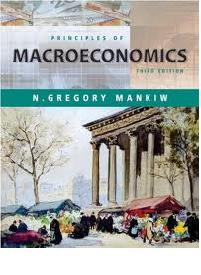
The eminent and distinguished N. Gregory Mankiw, a professor of economics at Harvard and former White House aide (under GW Bush) presented one of the most convoluted and misleading antitax arguments in the history of the dismal science Oct. 10. His New York Times piece argues that the effective tax rate on his marginal income is 90 percent, and because of that, if the Bush tax cuts on the rich expire, he isn’t likely to write any more articles.


That’s yet another wonderful reason to raise his taxes. The less of this crap the world has to deal with the better.


Kevin Drum has a nice takedown in Mojo, but the biggest problem with Mankiw isn’t that he compounds his tax liability over 30 years to make things look worse. It’s that he starts his article with the assumption that he should pay zero taxes — and so should corporations — and there should be no estate tax (which it’s highly unlikely Mankiw will have to pay anyway).


Yes: The difference between paying zero taxes and paying 39.5 percent is significant. The money the profressor would earn 30 years from now on a $1,000 investment if there were no corporate taxes would indeed be higher. But there would also be no streets for him to drive on, no police and fire departments to protect his house, no unemployment benefits to keep the people who aren’t as fortunate as him from breaking down his door to get food for their kids, no social security, no medical care for indigent sick people, no federal funding for the scientific research he and his colleagues do at Harvard … in other words, not much of a country. I don’t think even Mankiw wants to live there.


So what’s the difference in his life if his taxes go up — as proposed — from 35 percent to 39.6 percent? Well, on the $1,000 article, he’d pay an extra $46 in taxes. Big fucking whoop. He probably spends more than that on lunch at the Harvard Club. Even if he invested that $46 for 30 years — AND there were no corporate taxes, AND he got 8 percent a year in the stock market (which remained stable despite the massive social upheaval caused by a society with inadequate tax revenue to provide basic public services), we’re talking $462.88. That’s less than he’d get by putting $4 a year — yes, four dollars a year — into the same account.


In other words, he’d have to be pretty fucking stupid to decide not to write a $1,000 article entirely on the basis of a modest increase in taxes on someone with his level of income.


On the other hand, he clearly is pretty fucking stupid. Or else he’s smart and he’s intentionally skewing the facts to protect his own economic interest. Either way, the world will be a better place if he doesn’t write any more articles.  So let’s raise his taxes.

Janet Reilly wants a centrist mayor. Ick.

8

Janet Reilly’s the overwhelming frontrunner in District 2, and has the support of just about everyone in the Democratic Party establishment, including U.S. Senator Dianne Feinstein and Mayor Gavin Newsom. But she seems to be nervous that someone might suggest she would support a progressive (like, Gasp! Aaron Peskin) for mayor if Newsom leaves the city for Sacramento and the Lt. Guv’s office.


So she sent out an email to her supporters today, announcing that she wouldn’t support any current member of the board — or any former member of the board who has served with any current member of the board. You following? Here’s the message:


I would strongly support a true interim Mayor who pledges not to seek
re-election to a 4-year term. The interim Mayor’s sole ambition should
be to successfully steward the city until the people choose the next
Mayor. I believe this person should be a senior statesperson or a
non-partisan city official with unquestioned expertise and integrity.
There may be others who have never been elected who would be suitable
for the position.

In recent years, I have disagreed with the divisive politics of the
Board. Therefore, if given the chance, I will not cast my vote for
interim Mayor for any currently sitting or former Supervisor who has
served with any member of the current Board. We need a caretaker Mayor
who will guide San Francisco until voters choose long-term leadership in
the November 2011 election. This should be a thoughtful decision.

The next mayoral election will give the city an important opportunity to
chart its future. I think we need to let this debate take place without
any one candidate enjoying the advantage of incumbency.

If I am elected and called upon to vote on this matter, I will vote “no”
on any current member of the Board of Supervisors for interim Mayor, and
I will also vote “no” on any past Supervisor who has served with any
member of the current Board.

I would look for a moderate, custodian Mayor who will govern from the
center for all San Franciscans.


Gawd — governing from the center. What a joke. There is no center in San Francisco politics today, not for the mayor who has to decide whether to raise taxes or cut services, whether to deal with police and fire or stick public health, the schools, human services and rec-park with all the cuts. There are tough decisions coming up, and they’ll require a mayor to take a stand.


And if all Janet Reilly really wants is someone who can duck like a champion, it won’t be in the interest of any San Franciscans.


(I’ve tried to call Reilly for comment on this, but she hasn’t gotten back to me. She’s probably watching the Giants game, which is what I should be doing instead of blogging on this fine Monday afternoon. But I’ve got it on the radio. Go Giants.

Scott Wiener’s TIC letter

15

EDITORS NOTE: Includes corrections, noted at the bottom of the post.


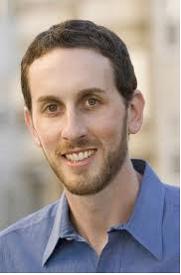
Scott Wiener, candidate for district 8 supervisor, is sending out a letter to people who own tenancy-in-common buildings, telling them he supports the rights of TIC owners to convert their properties to condos and seeking their support.


And he’s very nervous about discussing it.


Wiener’s support for TICs — which amount to a backdoor way to avoid the conversion lottery — is no secret. But raising money by promising to encourage condo conversions defines him pretty clearly as a candidate of the landlords and property owners and against tenant rights.


A bit of background: TICs are a way for several people to buy a multi-unit building, share ownership and each occupy one of the apartments. The strategy allows people who can’t afford single-family houses to become homeowners — and in theory, isn’t all bad (except that every TIC removes a rental housing unit from the city and indirectly drives up rents).


In practice, TICs have become eviction machines.


That because landlords have found that they can make a fortune by evicting all of their tenants under the state Ellis Act and then selling the place as TICs. And if the TIC owners can convert to condos, they can make money, too.


The big losers — and there are thousands of them — are tenants who can’t afford to buy a TIC, so wind up losing their homes to someone a little better off.


But again: It’s no secret where Wiener stands on the issue. What’s odd is that when I first called him about the letter, which I heard rumors about last week, he told me flat out that there was no such thing. “I hear there’s some i.e. [independent expenditure group] doing something like that, but it’s not us,” Wiener said.


A few days later, I got a (low-quality) copy of the letter, which is on Scott Wiener for Supervisor letterhead and signed by Wiener. So I called him again, and asked about it, and he again said his campaign had mailed no such letter. When I pressed, and said I had what looked like a letter from him that started of “Dear TIC owner,” he said that there might be something coming in the future, but he couldn’t talk about it.


Then he called me back half an hour later to tell me that yes, his campaign was indeed sending a letter to TIC owners seeking support.


Wiener’s always been straightforward with me; we don’t always agree on issues, but he always tells me where he is. So this one’s a little baffling — unless, of course, Wiener is hoping that the tenants who live in D8, and there are a lot of them, don’t know what Scott Wiener is saying to landlords and speculators. Maybe he doesn’t want them to think he’s being funded by TIC money.


But in the end, these things always come out anyway.


UPDATE: My original report called this a fundraising letter. But I admit my copy was hard to read, and Wiener just called me to say that the letter isn’t a fundraising letter, it’s only a letter seeking votes, and went out only to D8. He told me the reason he said he had no such letter when I first called is that it wasn’t finalized and hadn’t been sent out (although there was apparently an i.e. letter to TIC owners, which neither of us has seen). He told me he couldn’t discuss the letter until after it was sent out because “no candidate should discuss his future mail strategy with the press.” Fair enough.


Still: I’ve spoken to Wiener many times, and he’s never been this nervous about talking about what he or his campaign is doing. I think the TIC stuff is sensitive in D8.

Lacy’s face disfigured on Dem/Labor doorhanger

31

With only three weeks to go until the election. the dirty campaign tricks get stickier.

Top of the list of dirty tricks this week is the person(s) who pasted “Vote Malia Cohen” stickers atop the image of D10 candidate Dewitt Lacy on door hangers that the SF Democratic Party and the SF Labor Council produced  jointly for the November 2010 election. According to Lacy supporters, the offending stickers cropped up primarily on door hangers distributed on Potrero Hill, where Lacy lives, works and has a strong following.

The door hanger features a photo of Jerry Brown for Governor on one side—and thumbnails of the Dem/Council’s local picks on the other. These local picks include Newsom for Lt. Governor, Kamala Harris for Attorney General, Janet Reilly for D2 Supervisor, Carmen Chu for D4 supervisor, Debra Walker for D6 supervisor, Rafael Mandelman for D8 Supervisor and Dewitt Lacy and Malia Cohen for D10–except you can’t see Lacy’s face on the doorhangers that have been disfigured by Cohen stickers.

Historically, the SF Democratic Party only includes the picture of its top ranked candidate on door hangers, and this fall, the DCCC (the endorsing body of the local Dem Party) endorsed Lacy as its first-ranked candidate, Cohen as its second ranked candidate and Eric Smith as its third ranked candidate.

“But we included both Dewitt and Malia on this door hanger because we are doing it with the Labor Council and we have two different first-ranked candidates,” former Board President and current DCCC chair Aaron Peskin told the Guardian, noting that the Labor Council endorsed Cohen as top-ranked and Chris Jackson as its second-ranked candidate.

Cohen’s campaign manager Megan Hamilton told the Guardian that the Cohen campaign was “aware” of the stickers.
“But we did not put the stickers there,” Hamilton said.

Lacy, who dropped by the Guardian with dozens of defaced door hangers in hand, said a stream of supporters have complained about this latest dirty trick.

‘It’s misleading,” Lacy said. ‘If folks haven’t been paying attention, they won’t understand that I have been endorsed as the Democratic Party’s top choice.”

Lacy said the door hangers were distributed a couple of weeks ago at the DCCC’s election season kick-off event to people who were going to walk precincts.
”Of course, at that time, the door hangers weren’t terribly disfigured by someone sticking a ‘vote for Malia Cohen’ sticker over my smiling face,” Lacy added. “But it shows that these folks are nervous about the inroads my campaign has been making in this race. After each forum we have had folks come up to us and say they are excited by our campaign because they are looking for hope and leadership that really represents them.”

So what does Lacy, the top choice of the Democratic Party, look like when he doesn’t have a sticker over his face?

All smiles, after he completed his interview with the Guardian, which gave him its second-ranked endorsement in the D10 race, with Tony Kelly in top place and Chris Jackson in third.

SFBG Radio: Explaining the state props

0

Today we talk through all the state propositions — the good, the bad and the truly evil. Listen to the conversation, and pick up some advice on how you might want to vote, after the jump.


sfbgradio10/11/2010 by endorsements2010

SFBG Radio: The market’s up, but jobs are down

2

So if the unemployment rate keeps going up, and the recession is in full swing, why is the stock market doing so well — and what does that say about American politics? Check out out after the jump.

sfbgradio1082010 by endorsements2010

Civil Sidewalks, Lewis Lapham, and the struggle for the soul of cities

114

Cities often get vilified as the cauldrons of all that’s wrong in the world – greed, vice, pollution, and all manner of social ills – but they are also the incubators of ideas that are humankind’s last best shot at solving the social and environmental problems that threaten our long-term stability and prosperity. So ruminating on the indispensable role of cities, as Lapham’s Quarterly does with its fall issue, is more than just an academic exercise or interesting read.

“The Census Bureau counts 232,581,397 Americans, 82.6 percent of the population, living in the nation’s cities, but if our moralists and intelligence services are to be believed, they do so at no small risk to the safety of their persons and the security of their souls,” editor Lewis Lapham, who ran the venerable Harper’s Magazine before stepping down to start LQ, writes in the opening essay of an issue entitled simply “The City.”

Lapham goes on to note the contradiction of how rural areas and suburbs get celebrated as somehow housing the more noble values of the common folk, raising the questions, “If the city is the sewer of vice and a slough of despond, why do so many people choose to live there? On what toxic landfill does the city stand as the embodiment of its ennobling cognate, civilization?”

In an interview with the Bay Guardian, Lapham puts the increasingly important role of cities even more succinctly: “The future is urban.” As the population grows and natural resources become more scarce – and as sea levels rise – the population of cities will swell and the imperative of solving our long neglected problems will grow. And where else but the cities will new ideas find their laboratories?

But in San Francisco and other big cities, many still struggle with what it means to be a city, with all the tolerance for messy urban realities that entails. Witness Prop. L on SF’s fall ballot, which actually seeks to outlaw the simple act of sitting on a sidewalk, or as its proponents call it (in an ironic testament to their desire for order above all things), the Civil Sidewalks Law.

Lapham told me this fear of the great unwashed masses (“The rich are afraid of the poor”), an emotion that has fueled the growth of the suburbs and the massive waste of resources that entailed, has hindered the ability and willingness of city leaders to advocate for common values and define the lead role that cities should be playing in this troubled country.

“We don’t have an idea of the city as a great, good place, and we have to start with that,” Lapham told us. “We have to decide what is a city, what work does it do, what is the value, and how do we promote that value.”

This issue of Lapham’s Quarterly is a good place to start that debate. As always, the journal includes the writings of great thinkers throughout time, from Thucydides writing about Athens in 430 BC to Frederick Kaufman writing about New York City in 2008. Celebrated urbanist Jane Jacobs does a great job of capturing the allure of cities – that special something that seems to escape the fearful promoters of Civil Sidewalks – in an essay she wrote about NYC in 1961.

“Reformers have long observed city people loitering on busy corners, hanging around in candy stores and bars and drinking soda pop on stoops, and having passed a judgment, the gist of which is, ‘This is deplorable! If these people had decent homes and a more private or bosky outdoor place, they wouldn’t be on the street!’ This judgment represents a profound misunderstanding of cities. It makes no more sense than to drop in at a testimonial banquet in a hotel and conclude that if these people had wives who could cook, they would give their parties at home,” she writes. “The point of both the testimonial banquet and the social life of city sidewalks is precisely that they are public. They bring people together who do not know each other in an intimate, private social fashion – and in most cases do not care to know each other in that fashion. Nobody can keep an open house in a great city. Nobody wants to. And yet if interesting, useful, and significant contacts among people are confined to acquaintances suitable for private life, the city becomes stultified.”

Indeed, that was the observation that journalist H.L Mencken wrote about many East Coast as he penned an essay in 1920 celebrating San Francisco as “an American city that somehow managed to hold itself above pollution by the national philistinism and craze for standardization, the appalling progress of 100 percent Americanism, the sordid and pathetic dream of unimaginative, timorous, and inferior men.”

Mencken says he can’t quite put a finger on what makes San Francisco so special, touching on our international influences and the fortitude developed by braving fog, steep hills, and messy urban realities, which he says have given us a unique appreciation for life. “The San Franciscans have learned how to bear it. They are stupendously alive while they are in motion, but they knock off betimes. The town is rich in loafing places: restaurants, theaters, parks. No one seems to work very hard. The desperate, consuming industry of the East is quite unknown. One could not imagine a sweatshop in the town. Puffs of Oriental air come with the fog. There is nothing European about the way life is lived; the color is all Asiatic.”

A decidedly different portrait of San Francisco comes in the journal’s only other entry on this city, written in 1849 by Gen. William Tecumseh Sherman, who helped establish an important military base in a city that had only recently changed its name from Yerba Buena and which was about the explode with the discovery of gold in the Sierras.

“All the town lay along Montgomery Street, from Sacramento to Jackson, and about the plaza. Gambling was the chief occupation of the people. While they were waiting for the cessation of the rainy season, and the beginning of spring, all sorts of house were being put up, but of the most flimsy kind, and all were stores, restaurants, or gambling saloons,” wrote the military man, who didn’t much care for the city.

Yet for those who appreciate the role of cities as generators of culture and incubators of ideas, there’s no question that our future is urban, although even Lapham has his doubts that the great solutions will come from the cities, preferring to see the Internet and its virtual communities as usurping from cities the role of intellectual hubs.

“The intellectual engine of the Bay Area is centered in the Silicon Valley world rather than on Montgomery Street in San Francisco,” he told us, noting how little the financial firms that dominate downtown San Francisco or Wall Street in his home city of New York have to do with addressing the real problems the world faces.

He’s right, of course, but that’s also why the struggles for the soul of cities are so important and consequential, and why the the Bay Guardian has spilled so much ink fighting downtown over our 44-year history. Because to give in to the bankers and Civil Sidewalks crowd is to give up on the city.

It’s not a new struggle, as Friedrich Engels wrote about London in 1844: “Everywhere one finds on the one hand the most barbarous indifference and selfish egotism and on the other the most distressing scenes of misery and poverty. Signs of social conflict are to be found everywhere. Everyone turns his house into a fortress to defend himself – under the protection of the law – form the depredations of his neighbors. Class warfare is so open and shameless that is has to be seen to be believed. The observer of such as appalling state of affairs must shudder at the consequences of such feverish activity and can only marvel that so crazy a social and economic structure should survive at all.”

Four years later, Engels wrote “The Communist Manifesto” with Karl Marx, diagnosing the problems of capitalism and laying out solutions that came awfully close to taking root around the world before they were defeated by Western military and economic powers. Yet the problems persist to this day, manifested most visibly in cities around the world.

Lapham does admit that cities will be the laboratories and incubators of the ideas that are developed. Given the political dysfunction on the state and federal levels, he also agrees with the contention of Guardian Executive Editor Tim Redmond that the age of he Nation-State as the preeminent political authority is passing, and that its likely replacement is the City-State.

“To make democracy work, it needs to be relatively small,” Lapham said, agreeing that localism is the model that is being widely discussed as the answer to many of our political, environmental, and economic problems. And that all comes back to the cities, provided we can seize the opportunity to define ourselves, or as Lapham said, “One of the things we’re missing is the idea of a glorious future of some kind.”


Legalization proponents appeal to Reason

0

The Bay Area’s medical marijuana community may be divided over the legalization measure Prop. 19, but Reason’s Brian Doherty has penned an excellent analysis of the current campaign, why it will probably succeed, and how that will likely lead to a nationwide normalization of pot use rather than the federal crackdown and general sky falling that many critics of the measure predict.

City bid to bring vendors into Dolores Parks causes an uproar

12

Officials with the SF Recreation and Parks Department are attempting to quell the mounting frustrations of some Mission District merchants and residents who feel that the city shouldn’t allow private companies to operate in a public park, as the department is seeking to do. Even those who don’t necessarily have a problem with inviting more commerce into Dolores Park say the process should have been more open and transparent.

“I like pushcarts,” said Rachel Herbert, owner of Dolores Park Café. “I think they add flavor to San Francisco.” But Herbert is also allowing opponents of the department’s request for proposals (RFP) to set up shop in her store and gather signatures for a petition to “stop the commercialization of Dolores Park.” Herbert, who lives in the neighborhood, said she is helping the effort because “It’s about the process and Rec and Park not really thinking things through and doing whatever they want.”

Mike McConnell, the man behind the petition, holds a similar viewpoint. “I don’t feel that it was adequate outreach before this.” They’re not alone. McConnell currently has petitions in three stores – including his own store, Fayes Video – each with around 100 signatures, along with 700 online petition signatures.

While the controversy is recent, the RFP for the permits was issued in September last year. The proposal stated: “Before entering into permit agreement for the operation of a pushcart in any neighborhood park, the Department will conduct a community outreach process to determine the appropriateness of such a use in the park.”

It’s unclear how much outreach there was beyond a request for applicants posted in the July 31 issue of the San Francisco Chronicle. However, according to Mission Local, department spokesman Elton Pon sent them an email stating that the department mailed out “an announcement of the opportunity to more than 1,000 potential applicants.”

Regina Dick-Endrizzi, director of the SF Office of Small Business, said much of the demand for the permits has come from small time vendors. “Part of this has been an organic growing up of the vendors themselves,” Dick-Endrizzi said. “The mobile food folks have been coming and working and urging us to open up more space.”

Dick-Endrizzi helped vet the applicants in the panel that included members of department and the Mayor’s Office of Economic Development. “I can attest as being part of the committee that they were very careful in making their decision,” she said.

However one recipient of the permits, Oakland-based Blue Bottle Coffee, has received criticisms that it isn’t local enough – city policies encourage contracting with San Francisco small businesses. Blue Bottle is also backed by venture capital firm Kohlberg Ventures.

Its founder recently issued a public letter explaining his position: “I had assumed that since there were published articles in The Chronicle, the Examiner, and the SF Weekly in November of 2009, and January 2010, that the community around Dolores Park was well informed. So it pained me to hear that many of our (hopefully) future neighbors were upset that more outreach had not been done.”

This isn’t the first time a vendor has been allowed to operate in city parks. Nor are they the first merchant with questionable local status. Last August RPD commission voted 6-1 to replace long-time Stow Lake vendor with an out of state suitor. The Chronicle reported “the corporation, which has owned and operated the 1940s-era boathouse for 67 years, couldn’t compete with New Mexico-based Ortega Family Enterprises, which pledged to complete $233,000 worth of improvements to the well-worn building and buy a brand-new fleet of boats.”

Dolores has become a haven for unlicensed vendors selling items such as beer, hot dogs, ice cream, and even pot-laced brownies and truffles. What will become of them? “You pay thousands and thousands for your trailer and for permits and this guy comes around with his little cart and is selling coffee for 50 cents less, what are you going to do? You’re going to call the fucking cops and say get this scumbag out of here,” said local impresario Chicken John.

Dolores Park has traditionally been regarded with a kind of laissez faire attitude by many San Francisco residents. On a warm day it’s not uncommon to see hundreds of chic to cheap layabouts basking on its hills, beer and bowl in hand, without worry in mind. And many-a-cop has seen them too, but rarely do they intervene – and all was well. Maybe that’s another reason why there has been such uproar over the proposed introduction of pushcarts into the park.

Since the uproar, both Blue Bottle Coffee and the other potential vendor nonprofit Cocina have been put in limbo. La Cocina’s executive director, Caleb Zigas, told Mission Local that “he had expected to roll into the park this week and is disappointed by the delay. In the past four months he’s poured $28,000 in grant money into La Cocina’s food trailer, which is now sitting in storage.”

But how long will the pushcarts (they’re actually trailers powered by generators) gather dust in a garage? “For most types of appeals there is a 15-day window after the permit was issued,” said Cynthia Goldstein, executive director of the SF Board of Appeals. However it isn’t a concrete rule. “On rare instances the board will extend the window when there is evidence that the city did something wrong.” In addition, according to Goldstein, there is usually a 15-20 day window between when an appeal is filled and when it is reviewed by the Board. In short, the dilemma may not be quashed by the meeting this evening that the department is holding on the controversy.

The extension would bode well for any NIMBYs since Cocina’s and Blue Bottle’s permits were granted on April 15, 2010 and Sept 2, 2010, respectively.

RecPark was expecting a 12 percent cut on the pushcart profits and hoped to net around $70,000 annually. The pushcarts are just one of the many revenue generating ideas that are currently floating around. RecPark – under its new department head, Phil Ginsburg, who was previously chief of staff to Mayor Gavin Newsom – recently created a partnerships and revenue generating division with the purpose of capitalizing on many of the cities assets.

At the Jan 21, 2010 Recreation and Parks Commission meeting, pushcarts were discussed as a way to ostensibly keep city employees from getting laid off. Other ideas that were tossed out included hosting a production of Peter Pan, renting out parking places for car shares, and an adopt-a-park program; an adopt-a-gardener program was even suggested. The city was broke and was searching for a way to close huge General Fund deficits.

The idea of pushcarts was discussed again at the Feb 18 meeting. Nick Kinsey from the property division of RecPark, told the commission, “We received 18 responses to the RFP and we actually brought six of them in for interviews. As part of the interviews we met with the respondents, we evaluated their qualifications, evaluated their operation plans – in terms of where they wanted to be in each of the parks, in each of the proposed parks, how that would interact with residents and other park users use of the park space and if there would be any conflict there.”

Kinsey continued, “We’re also accepting application on a rolling basis right now. So if anyone is watching and interested in submitting an application for pushcarts, we are accepting pushcarts. Some of our location are maxed out we wouldn’t accept anyone else. But we have plenty of other park spaces where we think this is an appropriate use.”

The meeting of the issue is today (Thurs/7) at 4 p.m. in City Hall Room 416


A tax break for the billionaire Fisher family

1

The L.A. Times reported Oct. 6 that the Fisher family — the heirs to right-wing power-broker Don Fisher’s GAP fortune — is set to get a $20 million tax break in the new state budget. It’s astonishing, and an example of how the backroom budget process is utterly corrupt.


From what I hear in Sacramento, the proposal came from the Republicans, although so far, nobody outside the small circle of budget dealmakers knows exactly which legislator or lobbyist pushed the issue. And it now appears, I’m told, that the tax break won’t be in the main budget; it will be addressed later in the week, as part of another bill.


But it’s not going to be easy to defeat — there are plenty of Democrats who support the deal, in part because the Fisher family is saving some old-growth redwoods.


But please: This is one of the richest families in America. These folks don’t need a $20 million handout from the state of California. 

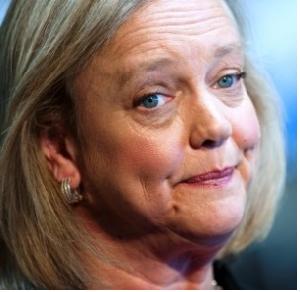
How Team Whitman blew the housekeeper story

5

The folks at Calbuzz are asking the same questions that have been bothering me for a while now: How could Team Whitman, with its legions of high-paid political consultants, have bungled the Nicky Diaz story so badly?


If her campaign team knew about the problem a year ago (and she swears she told her consultants), why didn’t they go public themselves, control the damage and eliminate the story as an October Surprise?


Calbuzz:


According to Political Consulting 101, this is standard operating procedure: control the bad news, put it out yourself, do it early to inoculate against a late hit. It borders on campaign consultant malpractice to have handled it as it was handled.


Of course, campaign consultants can’t be sued for malpractice; there’s no regulatory body, no disciplinary association. But it’s astounding that so many professionals who are earning so much money did such a bad job here.


More important, it borders on criminal arrogance (alas, that’s not a crime) that Whitman didn’t give Diaz some sort of decent severance:


Why not spend $20,000 or so (or more, if need be) to hire her the best immigration attorney she could find to help her see what could be done to stay in the country or ease her return or whatever?


Why not offer her a year’s severance (about $18,000) or help her with re-settlement costs in Mexico? She was, in eMeg’s words, “a member of our extended family” (or as Meg said in one press conference, Freud never sleeping, “an extended member of our family”).


Okay, so Whitman and Harsh had to fire Diaz once they knew she was here illegally, if you buy their story. But they didn’t have to kick her to the curb.


I was pretty sure Whitman was on track to lose even before this happened, but I think the Diaz fiasco has sealed the deal. And it’s not so much the fact that she hired an undocumented worker (LOTS of Californians do that every day) but the fact that she was such an asshole to her employee.


And the $120 million campaign to create a carefully crafted image couldn’t deal with that basic problem.