• No categories

Politics Blog

SF vote-by-mail provides early political snapshot

6

San Francisco’s Department of Elections had received 41,620 vote-by-mail returns so far That’s a fifth of the 210,993 vote-by-mail forms that were requested this year.
And while we don’t know which districts these folks voted in, we do know how they were registered: Over half were Democrats (24,153 votes), a quarter were decline-to-state (10,563 votes), and a fifth were Republican (5,565 votes).

I was surprised to learn that there are more vote-by-mail requests from folks registered with the American Independent Party (573) than with the Green Party, but not surprised to see that 200 folks were registered as Libertarians and 81 as Peace and Freedom Party.

Unfortunately, we can’t compare SF’s vote-by-mail snapshot with the statewide picture.
According to folks at the California Secretary of State’s office, votes won’t be broken down into vote-by-mail categories until after the election is certified…

Oddball billionaire wants to wreck California

6

Okay, this is really scary. An oddball billionaire who used to have homes in New York and Florida but now lives just in hotels — and who has no apparent connection to California — is going to spend $20 million promoting a plan to restructure the state.


And who’s going to be drawing up the blueprints? A bunch of right-wingers from the Reagan and Bush days, a failed way-too-conservative former governor — and Willie Brown.


Calitics has the right line:


The entire progressive movement, which represents at least a third of California, is totally absent from this conversation, whereas the right-wing is there in the form of Condi Rice and Arnold Schwarzenegger.


The problem is, unlike the doomed effort by the Bay Area Council to create a constitutional convention, (the biggest companies in the region couldn’t manage to put together the funding to put it on the ballot) this nightmare has real resouces. I mean, $20 million is enough to run a statewide campaign. And people are so frustrated now that almost any lunacy (spending limits, more tax cuts, eliminating major social programs etc.) could get traction.


Be very afraid.
 

Sfbg Radio: Sex, drugs and rock ‘n’ roll

4

You want to save the American economy? Try legalizing sex, drugs and roc ‘n’ roll. That’s Johnny’s proposal. listen up after the jump.

sfbgradio10272010 by endorsements2010

PayPal tweaked at its own conference for freezing funds

0

WePay, an upstart rival of PayPal, had a little pointed fun with the financial transaction behemoth today outside the Innovate 2010 software developer conference that PayPal hosted at Moscone Center. WePay employees created a large block of ice frozen around cash and the message “PayPal Freezes Your Accounts.”

It was a reference to the PayPal practice of unexpectedly freezing the accounts of grassroots groups with pending nonprofit status, a story that went viral in August after the Bay Guardian wrote about PayPal freezing the funds of the Flux Foundation just as the group was headed to Burning Man to build the Temple of Flux.

In the face of a strong public backlash, PayPal released the Flux Foundation’s funds a day after our story came out. But as we reported, other small groups that don’t have the same community ties and emotional resonance as the temple crew have had a hard time freeing their funds. Some even say they are preparing to sue PayPal, which started as a small Bay Area company but grew into a huge multinational corporation after being purchased in 2002 by eBay, the company where billionaire self-funded gubernatorial candidate Meg Whitman made her fortune.

After their bad experience with PayPal, the Flux Foundation and many other groups have turned to WePay, which focuses on grassroots groups and other small clients. WePay co-founder Rich Aberman told the Guardian that many software developers who use PayPal to fundraise have had similar problems with funds being frozen as the grassroots groups, which is why he pursued this publicity stunt.

“It was just to raise awareness and poke a little fun at them at their own conference,” Aberman told us.

A PayPal representative that we interviewed in August said he couldn’t discuss why the company freezes account or how much notice they give when they do so, citing privacy concerns, but said they were simply anti-fraud measures. Some PayPal critics note that the company makes money off investing those forzen funds and they say it is motivated by greed.

Aberman doesn’t think the PayPal has malicious motives, but he says that it has just gotten too big to effectively serve small clients, focusing instead on merchants and other larger customers that are more sophisticated than small groups.

“Normal people collecting money for normal things is such a small part of their business and PayPal just don’t know how to handle them. They just see these as high-risk accounts based on the anti-fraud systems they’ve created,” Aberman said. Where he does fault PayPal is by presenting itself as a good service for these groups: “They just need to be more forthright about the user they’re trying to serve.”

By contrast, Aberman said WePay was created as a way for individuals and small groups to raise money informally: “Since our customers are different, we handle them differently.”

The politics of the World Series

15

Well, on one level there’s no political significance at all: Two teams made up of high-paid mercenaries who go where the money is and have only fleeting and often temporary connection to their respective cities will play for the national championship. The “World Series,” of course, is not a “world” anything since only two nations have ever been eligible to field teams.


Still: The Giants, a teram from San Francisco with a distictly nontraditional fan base is playing the team that launched the political career of George W. Bush.


Remember: Bush was a failed business owner and failed politician when he put together the group that bought the Texas Rangers in 1989. His initial investment was about $600,000, which he covered in part through a dubious stock sale. After he conviced the good people of Texas to foot most of the bill for a new stadium, the team shot up in value and he cashed out at $15 million.


He also built the contacts and political base that would lead to his election as governor of Texas. Which led to his election as president, two wars and the ecomic meltdown we’re all trying to survive today.


Is that the fault of the players who wear the Rangers uniform? Of course not. And I don’t know how many of the Giants players support same-sex marriage. But if there’s any symolism in pro sports, an underdog SF team taking on Bush’s legacy counts for something.


And does anyone really think Arlington, Texas would have embraced Tim Lincecum?


Go Giants.


Chevron spends big to fool voters

4

Bay Area-based oil giant Chevron is spending millions of dollars to influence this election and protect its financial interests, most notably by being the top contributor to the Prop. 26 campaign, which would make it almost impossible for Californians to impose fees that would help pay for environmental and public health programs.

Chevron, which reported a $5.4 billion record profit in the second quarter of this year, has given $3.75 million to the Yes on 26 campaign, according to campaign spending watchdog Maplight.org, beating the California Chamber of Commerce’s $3.5 million. Other big contributors include the American Beverage Association ($2 million) and Phillip Morris tobacco company ($1.75 million). The Yes on 26 campaign has raised about $16 million compared to the opposition raising less than $5 million from groups representing teachers, environmentalists and social justice advocates.

Prop. 26 would require a two-thirds super majority for the enactment of fees by the California Legislature or by the voters in cities, counties, or special districts, which has proven almost impossible to attain in the face of aggressive corporate-funded opposition campaigns. Such a high electoral bar would cripple the state’s ability to make big polluters and global warmers like Chevron – or the makers on alcohol or tobacco products – pay for their societal impacts.

But that payout isn’t even Chevron’s most audacious move of this election season. As the Bay Citizen reports, Chevron is almost spending $1 million on independent expenditures in support of their favored City Council candidates in Richmond, a city where Chevron has a big polluting oil refinery, in the hopes of buying a more friendly political environment.

Richmond officials have in recent years tried to get Chevron to mitigate its environmental impacts to the cash-strapped city and to pay a bit more in taxes, but Chevron responded with a lawsuit seeking a $26 million rebate on the property taxes that it paid to the city in past years, including 2007, when the company posted record profits of $18.7 billion.

Danny Glover robo-calls for DeWitt Lacy

My office phone rang this afternoon and it was none other than actor Danny Glover — well, a recorded message from him anyway — asking me to support DeWitt Lacy for supervisor in District 10. (The Guardian office is located in the district.)

“I worked in southeast San Francisco before I went into acting,” Glover’s message says. “Lacy has earned my support because he will put people first.”

Lacy’s campaign has drawn some criticism in recent weeks for not being as visible as it could, but with Danny Glover’s message reaching D10 voters, it looks like Lacy is rallying for a strong final push. In any case, the D10 candidate clearly has some friends in high places. You can listen to Lacy’s Guardian endorsement interview here.


Don’t believe everything the government tells you

So this is weird. I was poking around on the National Pipeline Safety Mapping System website today, which is administered by the U.S. Department of Transportation’s Pipeline and Hazardous Materials Administration, looking for information relating to the San Bruno pipeline explosion. When I ran a search for gas pipeline operators in San Francisco, two different names cropped up: The first is a gas technician who works for Pacific Gas & Electric Co., and the second, also listed as a PG&E contact, is local environmental justice advocate Francisco Da Costa. Wait, what?

Da Costa is a well-known figure at city hall who frequently speaks up during public comment at Board of Supervisors meetings. He’s the director of a Bayview organization called Environmental Justice Advocacy, and he blogs about local political issues on his website. When he speaks of PG&E, he tends to use phrases like “diabolical.” Da Costa wears several hats, but PG&E gas pipeline operator certainly isn’t one of them. Not only is he incorrectly identified as such in this federal search engine, complete with his email address and phone number, his name is tagged with the phrase “San Bruno Natural Gas Line” — virtually the only subject a member of the public would be on that website to collect information about.

Da Costa told me this headache started when he submitted an information request under the Freedom of Information Act (FOIA) to the National Transportation Safety Board, the federal agency that is conducting an investigation to determine the cause of the San Bruno gas-pipeline rupture. Somehow, in the course of processing his public-records request, it appears that the government wound up incorrectly listing him as a gas operator with PG&E. He’s notified them of the error, but as of this afternoon, it hadn’t been corrected.

Ironically, Da Costa’s request for information on the San Bruno pipeline prompted other info-seekers to contact him. “Ever since I initiated a FOIA request, fire chiefs have emailed me saying to provide them with the maps of the pipelines and so on and so forth,” he said. “I’ve received about 15 or 20 emails from fire chiefs all over California. I had to tell them, I’m not a gas operator.”

When we phoned the National Pipeline Mapping System to ask how Da Costa wound up being a listed as a PG&E pipeline operator, a spokesperson said she would check into it and call us back.

Rev. Billy exorcises the demon sit-lie measure

17

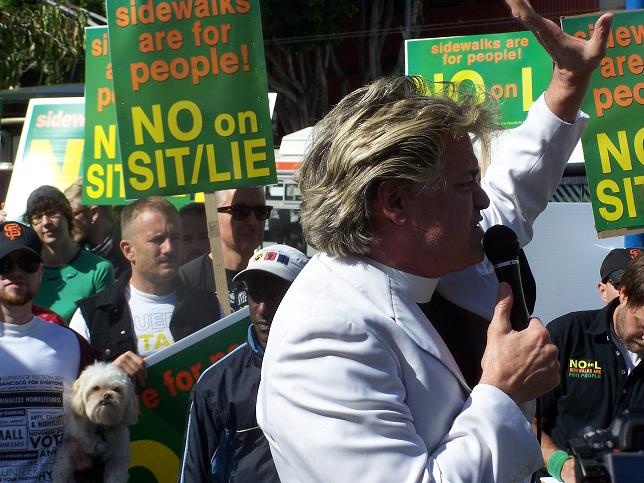
This afternoon in the Mission District, a crowd gathered to bear witness to an exorcism. Reverend Billy had come from New York City to banish the demon from SF. That demon was Prop L, an unholy measure to ban people from communing on San Francisco’s sidewalks.
“The only fundamentalism is the absence of fundamentalism!” bellowed the Rev. Bill, a former San Francisco performance artist turned pastor of NYC’s Church of Life After Shopping (which was in town to perform tonight (Mon/26) at the Victoria Theater for its Earth-a-llujah, Earth-a-llujah Revival Tour).

Rev. Billy cited constitutional dicta on behalf of civil rights: that we are all, even those without addresses, equal. The good reverend followed with a defense of the unadulterated and often unpredictable daily experience out there on the streets of San Francisco, apt to shape a human in good and thoughtful ways, that would find itself stifled if city regulations seep onto our sidewalks.

Rev. Billy’s choir ended his sidewalk sermon with a song that repeated, “Speaking freely sets us free,” and whose chorus built to:
“Standing up in public space…
Breaking in to public space…
Shouting out in public space!”

Sup. John Avalos spoke after Rev. Billy, and no sooner had he taken the mic than he accused Police Chief George Gascon of suffering a demon of his own: “hubris.” Avalos referred disapprovingly to Gascon’s previous attempts to tackle drugs and Critical Mass, the city’s monthly bicyclist phenomenon.

In reference to Prop L, Avalos shared that when he came to San Francisco, he knew “three people, had $1,000 in my pocket,” but would have been sleeping on the street if not for a friend’s couch and kindness. He called San Francisco a “sanctuary city,” where people can “find a pathway in life to something better, like I did.”

Gabriel Haaland, a Haight neighborhood resident and labor leader, took the mic and proclaimed that “I am, we are, you are, the riff raff! Because the rent is too damn high.” He questioned whether some have taken to the streets partially because of San Francisco’s high cost of living.

SF resident Selina Gomez Sutton said of Prop L: “a San Francisco without street performers and musicians? Crazy.”
But Prop L is also about something other than civil rights, street-side music, and “cleaning up” Haight Street. It’s also about tolerance.

Tellingly, just a few feet away from, and entirely throughout, Rev. Billy’s sermon, a man sat nearby barking and shouting gruffly at apparently nothing but for what (he must have thought) were good reasons indeed. I was there the entire time, and can say that not one attendee told him to stop. Perhaps they were simply jaded to such conduct — or perhaps it was because they respected his right to exist.

What if Meg just quit campaigning?

1

The more money Meg Whitman spends, the worse she does in the polls. More than $150 million, and she’s in worse shape than she was six months ago. At least, that’s what the LA times says. And while that’s clearly the most optimistic poll around, the signs aren’t looking good for Whitman.

In fact, the smartest thing she could do now is to quit campaigning. Seriously: The more money she spends, the less people like her. Disappear and hope for low turnout — that’s her only hope.

Calbuzz has an interesting take: Whitman’s initial support of Prop. 23 has really hurt her. I also really, really like the Calbuzz analysis of Meg and “class warfare,” which ought to be required reading for every political reporter in the state.

SFBG Radio: Old ladies love prop 19

2

In today’s episode, Johnny talks about the conservative old ladies at the gym who hate the drug war and love Prop 19. Listen after the jump.

SFBG Radio 10.25.10 by endorsements2010

Wikileaks, military families and the importance of voting rights

5

As Wikileaks’ Iraq war logs continue to reveal the disturbing reality of Bush’s illegal war, and its founder, Julian Assange, continues to be demonized for leaking this information, military families are left wondering if their loved ones were endangered by the actions of rogue military contractors, if Iraqis were tortured by other Iraqis because of the failure of the Bush administration to crack down on this abuse—and whether the same thing is happening in Afghanistan.

Either way, the situation illustrates the importance of voting for ethical leadership, and San Francisco School Board candidate Margaret Brodkin is encouraging all overseas voters and their families, including those in the military, to submit their ballots for the November 2, 2010.

“The Department of Elections has issued 6060 ballots to San Francisco voters overseas,” Brodkin noted in a recent press release. “This population, which includes many military families, has received little to no attention in this election cycle. School Board Candidate Margaret Brodkin cares about families here, and throughout the world. We encourage input from families and parents living and working overseas, and want to know what types of changes you would like to see on the San Francisco Board of Education.”

As Brodkin notes, overseas voters can get more information on their voting rights at the California Secretary of State’s military and overseas voter information website. So, check it out, and use that vote wisely.

sfbg radio: the jobs picture

3

Today Johnny talks to economist Johnny Venom about the jobs picture. Listen after the jump.

sfbgradio10/212010 by endorsements2010

D10 candidate Eric Smith on Local SF

22

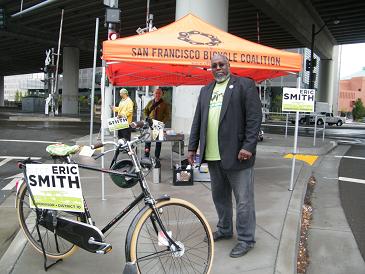
Coming into work this morning, I was greeted by the sight of D10 candidate Eric Smith standing under a San Francisco Bike Coalition tent near the railroad/freeway intersection at 16th and 7th Street in Potrero Hill.

Curious, I stopped by their tent where I was greeted by a hearty handshake from Smith, and plenty of input from the Bike Coalition’s Marc Caswell and League of Conservation Voters president Amandeep Jawa about why they support Smith.

“Eric is about integrity and sustainability,” Jawa said. “In a district like D10 that so desperately needs those things, Eric is the obvious choice.”

“D10 has a lot of really great street projects that are already approved by the MTA,” Caswell added. “So we are looking for strong leadership from Eric on the Board of Supervisors around biking, walking and transportation.”

Smith for his part chatted about Sup. John Avalos’ recently introduced Local SF legislation, which would require contractors to meet local hiring goals that will be phased in over the next few years.

Smith supports Avalos’ legislation—and thinks it needs to go even further.

“A lot of the folks who are clamoring for jobs don’t have the skills,” Smith said, noting that only John O’Connell High School of Technology has vocational training.

“Idle union workers could train folks for prime time, that’s the basic premise of the work that Raquel Pinderhughes did,” Smith said, referring to the efforts of Pinderhughes, an urban studies professor at San Francisco State, to secure truly green-collar local jobs.
“There has to be a mechanism to train folks who need skills, to get them truly trained and ready to take the union tests. That would be a sustainable approach and a huge part of the solution.”

Overcoming a foreclosure, Cohen promises to be a “fierce advocate”

16

D10 candidate Malia Cohen deserves kudos for publicly confronting rumors that she was facing a foreclosure–and for vowing to be a strong advocate, in future.

“I first addressed the rumors publicly a month ago,” said Cohen, who returned to the topic of her foreclosure earlier this week at a San Francisco Housing Coalition candidate night.

You can watch the entire proceedings of the Housing Coalition’s candidate night by clicking on the video clip at the end of this post.

But what Cohen personally told me today not only typifies many of the foreclosure horror stories that have been making national headlines. It also illustrates the abysmal lack of local leadership on this issue–and that’s something that Cohen says she’ll change.

“During the apex of the economic boom, I was the recipient of a predatory loan,” Cohen explained. “I bought a house in the Bayview in 2006 and started the process to modify my home loan. It took one year to get the banks to answer my questions, my paperwork has been lost, and I have a housing counselor I’m working with.”

“Months ago, I got word that my foreclosure has been rescinded and the property is back in my name, so I look forward to being a housing advocate, if elected,” Cohen continued.”Because what the housing crisis has done locally has been to decimate and destabilize our local neighborhoods.”

She notes that 1400 homes have already been lost in the Bayview, and another 1200 are currently teetering on the edge, but so far efforts to reform foreclosure laws have failed in the California legislature.

“Senator Mark Leno proposed SB 1275, which laid out a homeowner’s Bill of Rights, but the bank lobby was too strong,” Cohen said.

‘It’s such a helpless feeling, it’s been a nightmare, “ Cohen continued. “And once again there was no leadership locally to protect our interests, which is another reason why Malia Cohen is in this race. I am going to work hard to advocate on behalf of the community. It’s a crime the amount of money that was transferred out of the Latino and African American community during this crisis. Someone needs to be held accountable.”

Republican who wants to overturn rent control pumps $200,000 into district elections

25

Thomas J, Coates, a big time investor in apartments and mobile homes, has dropped a total of $225,000 into five independent expenditure committees that are trying to push conservative-friendly candidates and measures over the victory line this fall.

Coates, a 56-year-old Republican (he donated $2,000 to George Bush in the 2004 presidential election) and yacht racing enthusiast, was the biggest single spender in the November 2008 election, when he contributed nearly $1 million to Prop. 98, a statewide measure that sought to repeal rent control in California and limit government’s right to seize private property by eminent domain.

And with only 11 days until the election, Coates has given local Republican war chests an enormous last-minute boost: He plunked $100,000 into Common Sense Voters, a committee in support of Mark Farrell in D2. He plunked $10,000 into the Alliance for Jobs and Sustainable Growth’s committee in support of Scott Wiener in D8. He plunked $45,000 into the Alliance’s committee in support of Theresa Sparks in D6. He dropped $45,000 into the Alliance’s committee in support of Steve Moss in D10. And he dropped another $25,000 into San Franciscans for a Better Muni, a committee in support of Measure G, which attempts to reform Muni by focusing on transit operator wages.

As the Guardian previously reported, this Alliance has received thousands from the SF Police Officer’s Association, the Building Operators and Managers Association, the Golden Gate Restaurant Association, and SEIU-United Healthcare Workers, which supports a mega-hospital on Cathedral Hill.

But Coates’ donation raises questions about his choices’ commitment to rent control. As Coates told the Chronicle in an interview in 2008, “There is a reason why 35 of 50 states expressly prohibit rent control by law – and the reason is it doesn’t work.”

Coates, who is a principal in Jackson Square Properties, which specializes in apartments and mobile homes, is also the founding partner of Arroya & Coates, a commercial real estate brokerage and investment firm whose clients include Walgreens, Circuit City, and J.P. Morgan Investment Management. And as campaign disclosures show, he’s dumped a large part of his money into the same conservative alliance that has already collectively spent almost $170,000 on Moss, Sparks and Wiener.

So far, labor has countered the Republican money by spending $70,000 in support of Debra Walker in D6 and $90,000 on Mandelman in D8, and the SF Tenants Union has spent a total of $20,000 on mailers opposing Moss, Sparks and Wiener. But collectively the downtown money, which is also being funnelled into several other independent expenditure committees, continues to massively outweigh the progressive bucks.

Coates’ phone line continues to register a “busy” signal, making it impossible to leave him a message, but I’d be happy to include his comments here, if and when I talk to him.

But Gullicksen said he was disturbed by Coates’ heavy spending on the supervisors’ races.

“Coates is the main funder of Prop. 98, his property is in Southern California, he’s pumping a lot of money into supervisors and he clearly has an agenda that we fear Moss, Sparks and Wiener share, which is to make the existence of rent control an issue the Board will take up, if those supervisors are elected.”

It will be interesting to see if Moss, Sparks and Wiener are prepared to pledge that they have no intention to attack rent control….so, stay tuned.

Meanwhile, labor is organizing a protest outside Coates office at 500 Washington Street at 5 p.m on Tuesday, Oct. 26.

“Be there or be evicted!” labor warned.

 

Creative forces unite against Prop. 23

Proposition 23, bankrolled by out-of-state oil interests, threatens to reverse California’s environmental progress by suspending its landmark climate change legislation,  Assembly Bill 32. Titled the Global Warming Solutions Act, AB32 would place enforceable limits on major polluters and spur the creation of green businesses. But if voters approve Prop. 23, progress on transitioning to clean energy could be stalled for decades. The Guardian published in-depth coverage of Prop. 23 in the Oct. 13 issue.

A broad coalition of big green organizations, green-business associations, and others has formed to oppose Prop. 23 — but some of the most inspiring efforts have emerged from a coalition of environmental-justice advocates who are tapping their own creative genius to get the message out.

Hip hop artists Braelan B and Gammaray of the Los Angeles-based Beatrock Music label spearheaded the creation of a No on Prop 23 song, in collaboration with Otayo Dubb and T-Know (both of CounterParts with Braelan B and Gammaray), and artists Nomi of Power Struggle, Somos One of BRWN BFLO, and Damn Pete of Think Tank. Have a listen:

http://www.youtube.com/watch?v=QCR4QF7w7Aw

Braelan B told the Guardian that the artists were inspired by the efforts of Communities United Against Prop 23 — a coalition of environmental-justice organizations that is highlighting the impact the ballot measure would have on communities of color — as well as a voter-mobilization effort called the Clean Energy Tour, and the California Students Sustainability Coalition (CSSC), which is seeking online pledges for “no” votes against Prop. 23. Also known as Braelan Murray, he also serves as communications director at the Greenlining Institute, which is part of Communities United.

“We’re trying to use music as a catalyst,” he explained. “The youth vote and the of-color vote are really the swing votes.” To launch the music project, he said, “I just sort of got on the phone and said, California’s under attack, and I really want to send a strong message.” The idea caught on, and the YouTube video featuring the song already has more than 1,000 hits.

Meanwhile, Green for All has released a YouTube video about Prop. 23 set to the tune of the Beastie Boys’ “Sabotage,” featuring some rather hilarious oily cowboys smoking cigars and clutching fistfuls of money. Check it out:

http://www.youtube.com/watch?v=lCdTHrtU12Y

SFBG Rado: Fuck the FCC

4

In today’s episode, we ask: What the fuck is up with the FCC — and who really cares these days what language you use on broadcast radio? Check it out after the jump.

sfbgradi10202010 by endorsements2010

Newsom could be headed for victory

11

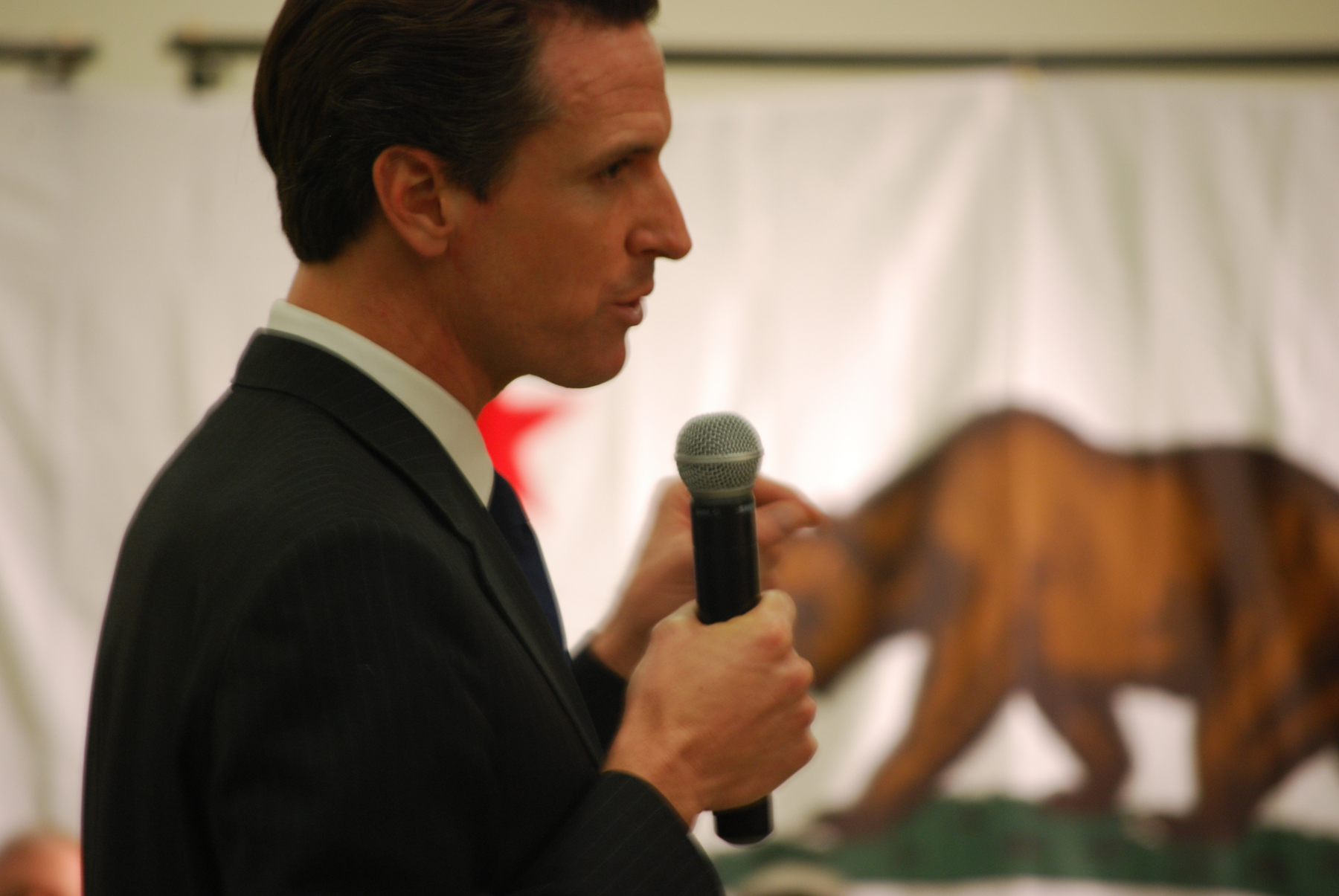
Gavin Newsom seems poised to win his race for lieutenant governor, at least as indicated by his opponent Abel Maldonado’s increasingly desperate campaign tactics and Newsom’s string of newspaper endorsements, including the Spanish language La Opinion, which chose to pass over a moderate Latino that it has endorsed in the past. The only question now is voter turnout, and whether Newsom’s negatives would be enough to drag him down if the Democratic base stays home in this lackluster election.

In its endorsement in Sunday’s paper, La Opinion wrote, “We are deeply disappointed that in this election [Maldonado] has opted for an opportunistic strategy of using images of undocumented criminals to earn political points. This is unacceptable and his charges against Newsom on this issue are inaccurate.” The reference was to Maldonado’s wild charges in an Oct. 15 debate that Newsom created San Francisco’s sanctuary city policies and was responsible for the fatal shootings of Bologna family members, allegedly by an undocumented immigrant who had once been in city custody. The reality was that Newsom inherited the sanctuary city policy and unilaterally weakened it after the Bologna shooting, even refusing to implement legislation approved by the Board of Supervisors (which Newsom vetoed but the board overrode) to require due process before those arrested are turned over to the feds for possible deportation.

While the paper didn’t seem to understand that Newsom has snubbed his nose at San Francisco progressives and petulantly fed a particularly divisive style of politics here, they do rightfully give him credit for running a complicated city, unlike the conservative city of Santa Maria where Maldonado was mayor and always did the bidding of the Chamber of Commerce, something I observed while working at the Santa Maria Times at the time. “The Democratic candidate has implemented solid, progressive management while leading a diverse city during a deep budget crisis. Newsom has proven to be creative, resourceful, and sensitive while forging alliances that improve the quality of life for his city’s residents,” La Opinion wrote. 

Then yesterday, as the Los Angeles Times reports on its blog, when Newsom held a campaign event trumpeting his support by Latino leaders such as Los Angeles Mayor Antonio Villaraigosa and labor leader Dolores Huerta, Maldonado showed up and sat in the back with his advisers during the event. Now that’s just strange.

A California Democratic Party e-mail blast this afternoon used a series of rhetorical questions to describe the campaign’s episodes: “So was Maldonado’s bizarre behavior an egotistical attempt to intimidate other Latinos who came to the event to support Newsom? Does he feel entitled to the appointed position now that he actually has to compete for voters in a real election? Is he desperate for media attention? Or does he just enjoy being a spectator, watching his opponent secure key Latino endorsements while his own campaign falls apart?”

But the real question is whether Democrats can mobilize enough voters to overcome Newsom’s negatives, from his arrogance to his personal foibles. When I did a search for Gavin Newsom’s name on Yahoo, which automatically guesses what you’re asking for based on past queries, the first three that listed were “Gavin Newsom girlfriend,” “Gavin Newsom divorce,” and “Gavin Newsom affair,” an apparent reference to his admitted affair with Ruby Rippey Tourk, who worked for him and was married to his reelection campaign manager.

So, if you support Newsom for this office — or even if you’re just anxious for him to leave San Francisco a year before his mayoral term expires — don’t forget to get out there and vote.

SFBG Radio: No New Deal

5

In today’s episode, we discuss why Abama is not FDR, why he’s refusing to do what has to be done to put Americans to work — and why that’s his real political liability. Listen after the jump.

sfbgradio10/18/2010 by endorsements2010

Beat patrols: A case study

14

If you want a case study that illustrates why San Francisco needs Proposition M, taken a look at Bernal Heights.

In 2008, two people were killed at the Alemany public housing project, topping off a disturbing increase in street crime. Neighborhood activists responded by working successfully with the captain of the Ingleside Station to a beat cop on Cortland Ave. Crime dropped.

But several weeks ago, Captain Louis Cassanego cut that foot patrol, citing the need to reallocate scarce SFPD manpower to more violent areas.

We couldn’t reach Cassanego, but at an Oct. 6th Police Commission meeting, Chief George Gascon said the beat patrol fell victim to budget problems. He explained that a beat cop on Cortland wasn’t needed anymore because the policy “was set there at a time when there was an increase in robberies… in this community that is no longer there today.”

But comminity activists say that’s precisely the point: “When we got the beat cops, crime went down,” Joseph Smooke, executive director of the Bernal Heights Neighborhood Center, told us. In fact, Smooke said, the foot patrol reduced overall crime in the surrounding neighborhoods as well.

And now, with the foot patrols gone, residents fear that crime will rise again.

Supervisor David Campos, a coauthor of Prop M, told us: “It doesn’t make sense: the community wants more policing, not less. They rightly feel that we’re moving backwards, that something they worked very hard for is being taken away.”

Prop M would hamper future foot patrol cuts by requiring the Chief of Police to prescribe a comprehensive “Foot Beat Patrol Program” for all SFPD stations.

Says community organizer Buck Bagot, who volunteers with the Bernal Height Neighborhood Center, “It’s hard not to think [Prop M] makes sense.”

Prop M could also address what Bagot and Smooke agree is the larger problem: community-police synergy. Besides mandating foot patrols, Prop M would require the Police Commission to “adopt a comprehensive written policy on community policing,” including “a plan for… open communication… among [SFPD] personnel and community members,” with a focus on “neighborhood-specific policing priorities and strategies.”

In recent years Bernal Heights community groups have fallen somewhat out of step with local police. Communication with Ingleside Station has at times been strained. The station’s former captain, David Lazar, started a program in August of 2009 that alloowed merchants and residents to call cell phones that beat cops carried on duty. Cassanego ended that program, too.

Cassanego cut the Cortland Ave beat, he compensated by extending two bike patrol beats into that area. Though Bagot is skeptical that this will be effective, losing personal access to the police irks him most. “At least if we could talk with [the cops], we could work with them…. But if they’re not going to patrol there anymore, and we can’t call them on the cell phones, then we’re kind of floating free.”

The myth of the overpaid public employee

31

Lots of press — as there should be  — on the new UC Berkeley study that debunks the myth of the overpaid public employee. The Chron had a decent story this morning, The Bay Citizen, which has been reporting pretty heavily on high wages and pensions in the public sector, acknowledged the study today. It’s a pretty big deal: Since much of the poltics of 2010 seems to be about bashing public employees and complaining about bloated pensions, some hard reality — backed up with a sophisticated regression analysis — was badly needed.

And the study is prettty clear: public employee salaries and pensions are not the cause of California’s (or San Francisco’s) budget problems:

The Great Recession continues to leave a great deal of economic pain and scarring in its wake. But, the
vilification of government workers is sorely misplaced and has left the real culprits of this devastating
downturn off the hook. Compensation received by public sector employees is neither the cause—nor can
it be the solution—to the state’s financial problems. Only an economic recovery can begin to plug the hole
in the state’s budget. Unfortunately, the current budget balancing efforts in California are anti-simulative
and further act to depress demand in an economy already operating way below capacity. Budget cuts have
helped to keep California’s unemployment rate well into the double-digits for over a year and a half—and
there is no end in sight. Thousands of California public employees have lost their jobs and many more
have forgone pay through forced furloughs and their families have experience considerable pain and disruption.
All the workers who have lost their jobs or took cuts in pay or benefits were made to do so not
because of their work performance, or because their services were no longer needed, nor because they were
overpaid. They were simply causalities among a list of millions of hard working innocent victims of a financial
system run amuck. Public sector workers help our communities to thrive and provide services that
make it worthwhile to live in them—it is wrong to blame them for the fallout from the greatest economic
downturn since the Great Depression. 

The study’s out in enough time to make a potential difference in the election — on both the state and the local level, attacks on public employees are driving major campaigns. Meg Whitman is all about tying Jerry Brown to those evil unions, and Prop.B, the measure to cut health care and pensions for city employees, is a wedge issue. A little logic shows that it’s not only misleading but factually wrong to blame the public-sector workers for the recession.

Avalos initiates LOCAL SF

5

Sups. John Avalos, Sophie Maxwell, David Campos and Board President David Chiu, plus community advocates, construction contractors, neighborhood leaders and union members rallied outside City Hall today to announce the launch of LOCAL SF, a campaign for local opportunities and hiring for San Francisco residents. 

And this afternoon, Avalos introduces the first measure of this campaign–legislation mandating local hiring on publicly funded construction projects.

Avalos’ local hiring legislation is a major departure from the city’s current First Source Program. In place for the past decade,First Source only requires contractors on publicly subsidized projects to show “good faith” efforts to meet a local hiring goal of 50 percent. 

By contrast, Avalos’ proposed legislation will require contractors to meet local hiring goals that will be phased in over the next few years.

“My legislation will ensure that San Franciscans have a guaranteed shot to work on the City’s public works projects and that the local dollars invested in public infrastructure be recycled back into San Francisco’s economy and local communities,” Avalos said in a press release,

Avalos’ introduction of this mandated local hiring legislation comes on the heels of a report from the the Mayor’s Office of Economic and Workforce Development that shows only a 20 percent local hire rate in 29 publicly-funded projects, despite the 50 percent local hiring goal and good faith efforts of the city’s First Source program.

Avalos says his local hiring legislation was developed over a series of stakeholders meetings with representatives from city agencies, the Mayor’s Office, labor and building trades, the environmental community, neighborhood advocates, contractors, local hiring advocates and unemployed workers, And he vows to keep this roundtable approach going, as his legislation moves forward.

“Over the next few weeks, I intend to keep a dialogue going with all of these stakeholders to strengthen the legislation as it moves through the legislative process,” Avalos said.
  
His legislation is scheduled to be heard in the Board’s Land Use and EconomicDevelopment Committee in November. And it comes not a moment too soon: with unemployment rates remaining high and major construction projects in the pipeline, it’s critical that city leaders ensure that any related work really benefits the local community.

District 10 endorsement madness

18

Both the Chronicle and Sophie Maxwell have now endorsed Lynette Sweet for supervisor, and I suppose I shouldn’t be surprised. But I am: I know the Chron and Maxwell don’t share my politics, but there are plenty of moderate, centrist candidates in D-10 who don’t have the real problems Lynette Sweet carries with her. The Chron’s a newspaper, sometimes a champion of open government; the folks there don’t care that Sweet seems to ignore the disclosure requirements that come with her current job on the BART Board?  Even when the Chron reported that she never disclosed the $120,000 she was paid by HMS Associates, a lobbying firm that represents many of the most powerful interests in the city? (Oh, and HMS Principal Marcia Smolens is one of Sweet’s top campaign donors.)


You’d think that would matter, particularly when there are alternatives. Apparently not.