

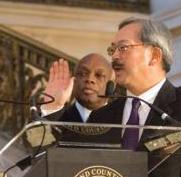
One of the depositions taken in a case involving fraud and corruption in city contracting contains some fascinating detail about how City Hall worked under Mayor Willie Brown — and the role the current mayor, Ed Lee, played in the behind-the-scenes action. The deposition of Deborah Vincent-James, who used to run the city’s technology purchasing agency, was taken by Matt Springman, an attorney with Gonzalez and Leigh. You can read the whole thing here (pdf).It gets pretty interesting around page 49, and the Ed Lee/Willie Brown stuff starts on p. 85.
- No categories
Politics Blog
The confession app: Have you masturbated?
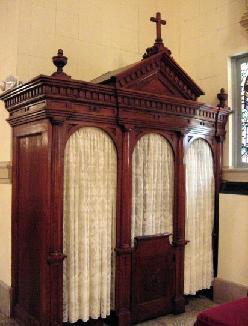
Oh my fucking god (and there’s no other polite way to put it): You can now go to confession on your iPhone. Maureen Dowd at the NYTimes notes that the hot new app
Walks you through the Ten Commandments, your examination of conscience and any “custom sins” you might have, then after confession (purportedly) wipes the slate clean so no one sees your transgressions.
Too bad my old colleague at an East Coast newspaper didn’t have this thing 30 years ago. She always asked me to be the one to interview the 60-something, bald-headed superintendent of schools in a small town we both covered because she couldn’t stop having “impure thoughts” when she saw him, and that meant she’d have to go to confession right after, and she’d miss her deadline.
And the Confession App is pretty special:
For instance, if you sign in as a 15-year-old girl and look under the Sixth Commandment, one of the questions is: “Do I not treat my body or other people’s bodies with purity and respect?” If you sign in as a 33-year-old married man, that commandment offers this query: “Have I been guilty of masturbation?”
Under the Sixth Commandment, men and women are asked: “Have I been guilty of any homosexual activity?” Priests, however, are not. They are asked if they flirt.
Um, I think there are a few sins missing there for the esteemed clergy of the Church of my youth.
Of course, all this does is make the Catholic Church look even dumber and more out-of-touch with the modern (sic) world (if such a thing were possible). Wayne Besen at Truth Wins Out (who does great work, but in this case takes it all a little to seriously) notes:
This is cyber spiritual abuse that promotes backward ideas in a modern package. Gay Catholics don’t need to confess, they need to come out of the closet and challenge anti-gay dogma. The false idea that being gay is something to be ashamed of has destroyed too many lives. This iPhone App is facilitating and furthering the harm.
Besides, electronic confession takes all the fun out of it. I remember the day in eight grade when every boy in my Catholic School class went into the little booth, one right after the other, and told poor Father Mahoney that we had just engaged in improper and sinful sexual behavior in the cloak room. We agreed in advance that each story had to be more detailed than the one before, and our best and most creative sinners got to go last. I think the good Father had plumb run out of Hail Marys by the end of the afternoon.
John Ross memorial Feb. 26
Friends and fans of John Ross, the poet and hellraiser who died in January, will celebrate his life at a memorial service Feb. 26th. It’s at the United Mission Presbyterian Church, 23rd and Capp, from 3-5 p.m., with a reception following at Cafe La Boheme. See you there.
SFBG Radio: Cheetah Chrome’s new book

Today we take another break from hard-core politics while Johnny gets back into his history in hard-core punk and talks with the legendary Cheetah Chrome, who has a new book out. Listen after the jump.
CheetahChrome by endorsements2010San Franciscans show solidarity with Egyptians

“Yesterday we were all Tunisian. Today we are all Egyptian. Tomorrow we will all be Free,” read one sign on at last weekend’s protest in solidarity with the wave of uprisings across the Arab world, an event drew thousands of people into the streets of San Francisco.
The crowd was diverse, from a variety of cultures and age groups. Sabreen Abdelnahmen is an 11-year-old Egyptian American who said she is “very proud there are people of many cultures and many religions fighting for the same thing.”
The events in the Middle East reverberate in San Francisco as well as many major cities, with everyone watching Egypt teeter toward democracy. To understand more about the events in Egypt, we spoke with local activist Yasmeen Daifallah, who helped organize the solidarity events and has connections in Egypt, where she attended Cairo University for six years. She is an activist, a political science doctoral student at UC Berkeley, and a singer in the Arabic music ensemble, ASWAT.
SFBG: Why protest in San Francisco?
YD: Two things were important to us. The first was to express solidarity… when [images of protests here] are transmitted to Tahrir Square [the central square where thousands of Egyptians have been remaining against government orders for two weeks]… it is definitely very uplifting. The second is to spread awareness in San Francisco…and in the U.S, to express a message to the American public and the American government. There should be respect for the people’s rights of self-determination and a cutting back on a strict consideration of self or national interest.
SFBG: Tell us about Tahrir Square, which has been at the heart of the protests, and who is leading the protests.
YD: I am amazed at the intensity of the steadfastness because many protestors are struggling to make a living. They all strike you as struggling to make a living and would not do anything to jeopardize making a living and these same people come out and say ‘we are staying here, we don’t care about bread, we care about dignity, we are not moving from here until [President Mubarak’s] regime falls.’
One of the most interesting things about this protest—there is no particular organization or person or even a group of organizations leading. Actually, the organizations are trying to piggy bag on the people and the momentum that is created by the public. For the leaderless nature that is has, it is remarkably organized.
SFBG: Why did the people rise up? Tell me a little about Egypt under Mubarak.
YD: The economic condition was abysmal and this is because when Mubarak came to power, the country started structural adjustment policies, which gave way to mass privatization. These have particularly intensified in the past 5-10 years. What this has translated into is massive unemployment and having to do several jobs in order to survive. On the day-to-day basis life under Mubarak is a life of economic hardship and social immobility.
When we start talking about the middle class, about politics and the political concerns probably [what is important] are fraudulent elections, rigging elections after people have actually voted but also preventing people from opposition movements from entering the ballot box to begin with. So this a very flagrant political repression. It takes place across the board. The second thing is the repression of the right to freedom of expression, whether in writing and the detention of journalists or in demonstrating. There is a law preventing the right to assemble. Then there is the bureaucracy and inefficiency, which all citizens suffer from on a daily basis. Their energies are exhausted in… getting their daily life going whether on the economic level, the bureaucratic level, or just the transportation level.
SFBG: You were just in Egypt and left 10 days before protests erupted. Do you wish you were there still? How does you feel as an Egyptian at this moment?
YD: Yes, very much so. I wish I were there—we all have a sense that there is something historic happening. We never had this number of people protesting against the regime and putting out demands that are this vocal and this radical. I wish I was more a part of this moment, I am just part of this moment from afar. I feel proud to be an Egyptian, which is a feeling you don’t get often, unfortunately.
On the one hand it feels bad because I wanted to be there to actually be a part of it. On the other hand, I have been convincing myself that there is a role that maybe I was destined to play being out here instead of out there.
SFBG: What do you think about the fears and concerns that democratic elections will lead to the rise of an Islamic government in Egypt?
YD: The question itself is unacceptable in the sense that fear and Islamic government put together should not be an issue. The issue is that people should have the right to determine who they want to govern them and whoever comes out of this is a legitimate leader.
The second thing is, you can easily see…this uprising is not an Islamic uprising—there is no foundation for this concern. The Islamic opposition, which has been among the most powerful if not the most powerful opposition movement will play a role and has to play, rightly, because they have been [part of the opposition]. There is no reason for concern, whether we look at it from the perspective that this is not an Islamic uprising or from the perspective that the nature of the Islamic opposition in Egypt is moderate in the sense that it is not militant and not violent and buys into a lot of democratic rhetoric and human rights rhetoric that is around.
SFBG: The other concerns have been around the lack of stability.
YD: This is not such a bad thing. The state of affairs in this point in time in the region is stability with no justice which in turn is bound to create instability and we have seen the instability of the intifada, we have the instabilities with the war on Gaza. Whatever we think of as stability in the Middle East is a fake and frail notion of stability. One would hope that if a new regime comes in Egypt that is more democratic that it would try to address some of the injustices that have been taking place so far regarding the Middle East peace process, but even this is not a guarantee.
At this point what one should focus on is who are the people at Tahrir, what are they demanding, and how can the international community help them get what they demand because this is not a violent uprising. This is not even an organized uprising. This is not a single actor uprising. It’s a crosscutting uprising and it is legitimate, which calls for respect and support and solidarity and anything less than that is betrayal.
SFBG: Where can people get the best information on what is happening in Egypt?
YD: Al Jazeera-English has been doing a good job at covering the events. It has definitely been the prime source of information to the extent that there is a huge campaign now demanding that Al Jazeera be available through satellite and cable providers in the United States. [For now,] you go online and click on live broadcast.
SFBG: Daifallah incorporates music into her politics through the Arabic musical ensemble ASWAT. Here’s a clip of their performance on Saturday:
http://www.youtube.com/watch?v=6fjZ0XjaJU8&feature=player_embedded
Progressives howl as Kim introduces Twitter tax break

Sup. Jane Kim once again angered her progressive supporters yesterday by introducing legislation to give Twitter a huge corporate tax break, caving in to the company’s extortionary threats to leave the city if politicians don’t bend to its demands. And with Board President David Chiu co-sponsoring a proposal that came out of the mayor’s office, it is all but assured to pass, exacerbating the city’s $380 million budget deficit.
Kim’s predecessor Chris Daly lit up Facebook condemning the move, quipping that Kim thinks progressive means attending three banquets in one night and offering this assessment, “If you truly care about the people in a community, you would invest directly in them – not in some corporate subsidy.”
Last week, before she had made a decision on the Twitter legislation, Kim even echoed the point, telling me, “My general philosophy is I don’t believe in tax breaks or exemptions.” But she acknowledged that it was a difficult decision because “Twitter has made it very clear to me that they will not stay without a payroll tax exemption.”
And now that Twitter was able to make her and other city officials act against their political beliefs and end any illusions that progressives still control the board, the door is wide open for other companies to make similar threats, with San Francisco joining the race to the bottom, competing with other cities for who can give away more public resources to private corporations.
The progressive era at City Hall truly seems to be over.
Come drink and put Lyon Martin over the top

Labor and transgender activist Gabriel Haaland reports that supporters of Lyon Martin Health Services have almost reached their $250,000 to save the clinic. Almost. Come help put them over the top on Wed/9 when I and other “celebrity bartenders” will be pouring stiff ones in a benefit event at the Buck Tavern (aka Daly’s Dive), 1655 Market, starting at 6 pm. Donation of $5-$20 requested. See you there.
SFBG Radio: Why the HuffPo deal sucks

Arianna Huffington just sold the Huffington Post to AOL for $352 million. Johnny and Tim talk about why it’s a bad deal for everyone except Arianna and her investors. Check it out after the jump.
sfbgradio272011 by endorsements2010Richard Johns is closer to developers than preservationists

The controversial mayoral appointment of attorney Richard Johns to historian’s seat on the Historic Preservation Commission is being challenged in court by Gertrude Platt and a group of local preservationists calling itself The Prop. J Committee. They are asking the judge to remove Johns from his post.
“Voters approved Proposition J creating the Historic Preservation Commission for the clear and distinct purpose of protecting San Francisco’s historic resources. To erode the voter-mandated qualifications and expertise on the Commission undermines the will of the voters and the intent of the law,” Platt, a 14-year member of the city’s Landmarks Preservation Advisory Board (which 2008’s Prop. J replaced with the commission), said last week in a prepared statement.
The group’s press release noted that “Johns is a business attorney and husband to Eleanor Johns, former Mayor Willie Brown’s longtime senior staffer and confidante dating back to his tenure as Speaker of the California Assembly. Mr. Johns is not an historian….No testimony or material was presented to the Board of Supervisors to establish otherwise.”
In fact, Johns’ resume and comments to the Guardian two weeks ago (when he dismissed concerns about his connections to Brown as “lame” and “silly”) indicate that his only experience in historic preservation has been working for almost 20 years to preserve the Old Mint, by serving on the San Francisco Museum and Historical Society Board of Directors. But a review of that body doesn’t inspire much confidence that he’ll stand for historic preservation in the face of pressure from developers.
The president of the board is Jim Lazarus, who is the senior vice president for public policy at the San Francisco Chamber of Commerce and a regular advocate for greater development of the city. There are other real estate and corporate representatives on that board as well, most notably Martin Cepkauskas, director of real estate for the Western Properties Division of Hearst Corporation, which is the middle of seeking city permits and approval to redevelop its historically significant Chronicle Building, where the paper has been since 1924, adjacent to Mint Plaza.
So we asked Lazarus, Johns, and Cepkauskas about what would seem to be a conflict of interests between board members who are pushing for development and John’s new role as a guardian of historically significant buildings. After I e-mailed the trio, Lazarus responded to the group “I will respond to this guy,” to which Johns wrote “good” and refused to answer further Guardian inquiries.
In a phone interview, Lazarus said there was no conflict because “nobody has any financial interest in the Mint Project. It’s a pure nonprofit board.” He also made the distinction that “we’re concerned with preserving San Francisco history, not buildings.” But in the name preserving history, the society helped create Mint Plaza, a welcoming plaza across from the Chronicle Building that is ringed by restaurants, retail, and office space.
Lazarus personally bought Cepkauskas onto the society’s board last year because the Hearst project “will have to do community mitigation and I want the Mint to be the beneficiary of that mitigation.” Yet he denies that there is a conflict between the interests of his board and the Hearst project and that of historic preservation and the public interest.
Lazarus also said “I assume Richard would like to stay on our board,” and Lazarus sees no reason why Johns should resign even though the Hearst project is likely to come before the commission later this year.
I solved the state’s budget problem

And you can, too! The Sacramento Bee has a handy tool to evaluate options for closing the budget gap — and unlike some of the other versions of this I’ve seen, it actually offers a wide range of revenue options. I cleared up the $26 billion shortfall without cutting anything at all (except prisons; I checked the box for letting out low-level offenders early. I’d go even further, and repeal three strikes and the death penalty, but those options weren’t on the table at the Bee).
But you can see from this that the state doesn’t have to be broke, failing, in collapse. All we have to do is fix the revenue problem (and yeah, the state does have a revenue problem) and bingo — problem solved. In fact, I managed to get the state a billion-dollar surplus.
Go ahead, check it out.
SFBG Radio: Is the recession over?

Is the recession really ending? The government says so — but what do small businesses need to make that prediction real? Johnny and Tim discuss after the jump.
Black history, local hire, living color
City Hall kicked off its annual Black History month celebrations with a talk by Los Angeles philanthropist and former Xerox Corp. VP Bernard Kinsey about the importance of debunking myths about the absence of blacks in American history. And Mayor Ed Lee, who had just met with five dozen unemployed black construction workers from the Bayview, revealed how, when he was growing up in the projects in Seattle, his neighbors were black, and an African American named Darnell was one of the most loyal patrons of the restaurant that Lee’s father was trying to make succeed.
“And when my dad suddenly died of a heart attack, Darnell was the first person to offer my brother a job at his gas station,” Lee said. “So, this is not just about recognizing African American history, but recognizing what they did for us, and making sure that no there are jobs and we protect the family structure. I know what it is to be helped by the African American culture.”
Lee’s recollections of Darnell came less than an hour after he met with Aboriginal Blackmen United, a group that represents unemployed construction workers in the Bayview, to discuss how its members can get hired at UCSF’s $1.5 billion hospital complex at Mission Bay and other local building sites.
At that meeting, ABU President James Richards thanked Lee for getting UC to clarify the details of its voluntary local hire plan at the Mission Bay hospitals.
But he warned that the fight is just starting. “We’ve got the unions to deal with,” Richards told Lee, referring to the reality that the unions also want their members to get work at the UCSF site.
Lee said he’d do his best to help.
“The African American community in San Francisco has not got its fair share,” he said. “I can’t say that everyone in the room is going to get a job, but I’ll open up doors and do my best.”
And then Lee confirmed that local hire is one of his top five priorities.
“My top priorities are the budget, pension reform, the America’s Cup, finding a good police chief and local hire,” he said. “I said that directly to every union leader yesterday. Some unions will be there, others will resist.”
ABU’s Richards said the need to have a G.E.D. to get into the city’s ob training programs is a barrier to employment for many in the Bayview.
“We have a lot of people, who are not able to get into CityBuild because they don’t take folks anymore who don’t have their G.E.D,” he said.
And he warned that the city’s black community is in crisis.
“I know there is a budget crisis, but this is a life crisis,” Richards said. “Young people are dying and it’s not even newsworthy any more.”
Lee suggested ABU work with the City to avoid the need to hold protests at construction sites in future,
“Let’s plan together, so you don’t have to go to all the sites,” Lee said. “I am for people getting their GED. But if someone has evidence that they are making an attempt to get their GED, we need to reward that with jobs. So that the GED is not a barrier, it’s a hope.”
And then Lee was off to attend his next round of meetings, which included the city’s Black History month event, where speakers noted that during Bernard Kinsey’s career with Xerox, he helped increase the hiring of blacks, Latinos and women,
Kinsey told the audience that he and Shirley Kinsey, his wife of 44 years, share a passion for African-American history and art. And that their world-famous Kinsey Collection, which contains art, books and manuscripts documenting African American triumphs and struggles from 1632 to the present, is currently on display at the National Museum of American History in Washington D.C, and a number of pieces are at the San Francisco African American Historical and Cultural Society. He noted that the posters of African Americans in the Civil War were reproductions of some of the art in those exhibits.
Sup. Malia Cohen noted that about 200,000 African Americans participated in that war. Sup. Ross Mirkarimi, who represents the city’s Western Addition, where redevelopment triggered massive displacement of the black community in the 1960s, noted that eight members of the current Board of Supervisors, who selected Lee as the city’s first Chinese American mayor, are people of color.
“This is true representation,” Mirkarimi said, noting that the fact that the city’s African American population continues to drop (reportedly down from 6 percent to 3.9 percent, according to the 2010 Census) to “is a reminder that even the most forward-thinking cities have a lot of work to do.”
And Kinsey urged African Americans to start describing their ancestors as “enslaved.”
‘It will change how you look at your ancestors,” he said, “You don’t have a clue about what they sacrificed to get you to where you are today. We don’t tell you the ‘ain’t-it-awful’ story about slavery. We tell you the story of how we overcame.”
“You need three things for a successful life,” Kinsey added “Something to do. Someone to love. And something to look forward to.”
Kinsey said he and his wife have espoused two life principles, ‘To whom much is given much is required” and live “A life of no regrets.” And then he told a story about an eagle who was raised by a chicken.
The eagle ended up ashamed of his feathers, because the chickens never told him he was an eagle because they were afraid he’d end up ruling the barnyard.“He even grew up ashamed of his daughters,” Kinsey said.
Eventually, the eagle met another eagle, who told him the truth. “You ain’t no chicken,” the other eagle said.
“And this is the message,” Kinsey said. “Don’t think chicken thoughts, or dream chicken dreams. Think like an eagle.”
He warned the audience to be careful of buying into myths that would have them believe that African Americans played no role in building the U.S.
“There are stories that made America and stories that America made up,” Kinsey said. “And too often, the myth becomes the choice.”
And then he concluded by expounding on “the myth of absence.”
‘”African Americans are not seen, not because of their absence, but because of the presence of a myth that prepares and requires their absence,” Kinsey said. “And the manipulation of the myth changes the color of the past. It’s no accident that the dominate images from the past are white. And many of us have swallowed the pill.”
Why aren’t Brown and Pak registered lobbyists?
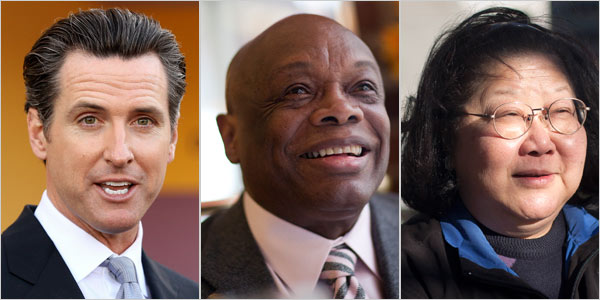
Powerful business interests constantly put pressure on City Hall to do their bidding rather than act in the public interest. Theoretically, they’re supposed to report who they’re lobbying, on whose behalf, and how much they’re being paid, but that doesn’t always happen. Instead, some of this city’s most powerful players operate with little public scrutiny.
Consider former Mayor Willie Brown – a corporate attorney and Chronicle columnist – and his close ally, Chinatown Chamber of Commerce head Rose Pak. Much was made, from the New York Times to local blogs, of how they engineered the selection of Ed Lee as interim mayor. More recently, there were questions about whether they influenced the narrow and controversial appointment of Richard Johns to the Historic Preservation Commission.
But neither Brown nor Pak is on the long list of lobbyists registered with the city. Neither is Rob Black, who lobbies City Hall on behalf of the San Francisco Chamber of Commerce and is a regular fixture at Board of Supervisors meetings. Why? I don’t know because none of the three would return my calls asking that question [see UPDATE below for Black’s comments].
So I asked John St. Croix, who runs the Ethics Commission, the regulatory agency that oversees lobbying and other activities by which wealth influences government. But he didn’t know the answer either. “If someone is paid specifically to lobby government, they should register,” St. Croix told us.
But his underfunded agency is mostly complaint-driven in its enforcement actions, and even though I complained, he didn’t seem inclined to act against these powerful local players. Hell, his agency hasn’t even done anything about the blatantly illegal collusion between a Brown-funded independent expenditure and the campaign of Jane Kim, despite reports in both the Guardian and the Bay Citizen (the local arm of the New York Times) back in October.
And so it goes in this supposedly progressive city.
UPDATE ON 2/4: Black just got back to me after being out sick with the flu. He said the Chamber used to be considered a “registered lobby entity” that was required to report all contacts with public officials and the issue involved. But the Board of Supervisors changed that law last year, requiring lobbyist registration only from individuals who are paid at least $3,000 per quarter for lobbying. And the definition of lobbying doesn’t include attending or speaking at public hearings or writing letters. So while the SF Chamber’s Black, Steve Falk, and Jim Lazarus all lobby city officials, Black said, none of them have exceeded that threshold. “If we hit the monetary threshold, we’ll start filing individually,” he said.
SFBGRadio: Kids, God and lies

A little bit of a break from our usual political ranting: Johnny talks about telling his kids about death and we discuss why it’s so easy to sugarcoat it (and talk about God and an afterlife) but in a secular household, it’s better to tell your kids the truth about everything, from death to sex and drugs. Agree? No? Listen and argue with us after the jump.
sfbgradio222011 by endorsements2010California is an even richer state
Jerry Brown pointed out in his State of the State address that California is a rich state; I’m not sure Jerry saw the latest from Vanity Fair, but I think his estimates of increased personal income might be a bit low. VF loves to dig into the lives (and fortunes) of Hollywood types, and the latest list of the highest-paid people in the film industry is interesting.
James Cameron made $257 million last year. Guess what? He lives in Malibu. That’s Malibu, California. Guess what? If we raised his taxes a little he’d still live in Malibu. In fact, he wouldn’t even notice.
Johnny Depp made $100 million, but he lives in France these days. But Steven Spielberg, who made $80 million without even working, lives in Los Angeles. So does Christopher Nolan $71.5 million) and Leo DeCaprio ($62 million). Kristen Stewart ($28.5 million lives in L.A. too, though I hear she wants to move to Australia; income taxes there are higher than the U.S., though, so she won’t be fleeing the taxman.
Got that? Four people, $477.5 million, last year alone. Yes, my friends, we can afford public education.
Happy Lamb’s Milk Day
According to my trusty old Farmer’s Almanac, the Celts knew Feb. 1 as “Imbolc,” or Lamb’s Milk Day, because it signaled the beginning of the lambing season. And though I didn’t see any lambs today, I did encounter a rambunctious herd of City Grazing’s goats nibbling on mallow plants in the pasture between the SF Bay Railroad and the cement recycling plan. And City Grazing founder David Gavrich and a goat called Petunia were happy to give me a fine impromptu demonstration of how to control weeds in industrial areas in an environmentally friendly way, while some of the rest of the herd got a little, shall we say, frisky. And that’s a sure sign that spring is on the way (even if it felt like it was already summer, two weeks ago), no matter what the Groundhog says tomorrow, Feb. 2, when he is scheduled to pop out of his burrow and, if it’s sunny and he sees his shadow, indicate that we are in for six more weeks of winter.
“Celts also knew Feb. 1 as Brigantia, [who became St. Brigid in Christian traditions] named for their female deity of light and in recognition of their Sun being halfway between the winter solstice and the spring equinox,” my Farmer’s Almanac states. “A sunny day betokened unwelcome snow and frost until Lady Day [March 25]. Clouds portended warmth and rain that would thaw out the fields and have them ready for planting. Our Groundhog Day is a remote survivor of this belief.”
In the Bay Area, Groundhog Day seems even more meaningless than Lamb’s Milk Day, given that our temperatures are positively balmy right now, especially compared to the East Coast, where folks are dealing with freezing rain and facing more snow in the coming weeks. So, perhaps it’s worth focusing on the fact that it’s also a new moon tomorrow (Feb. 2). This means you won’t be able to see the moon for a couple of days. And that the goats won’t have any moonshine to help them in any frisky noctural adventures. But when the moon becomes visible again, it should look like a thin silvery smile at twilight. And, if you’re lucky, you may be able to see the dark portion of the new crescent moon glow, as part of a phenomenon known as earthshine.
“This occurs because 38 percent of the sunlight that strikes Earth bounces back into space; some of this earthlight bathes the lunar surface,” my almanac states. “About 10 percent of that light bounces off the lunar surface (which is not very reflective) to create the visible glow (earthshine) on the Moon’s dark side.”
Either way, Feb. 1 will have daylight for 10 hours and 20 minutes. This means we are midway between the winter solstice, when days were only 9 ½ hours long, and the spring equinox, when the days will last for over 12 hours. If you were a farmer—or a goatherd that would be significant. And the folks at City Grazing told me the only reason there have no baby goats this year is they got the billy goats fixed after last year’s bumper crop of 32 goat kids! But if you’re not into goats or earthshine, Feb. 2- 18 is one of the best sets of fishing days for 2011, again, because the moon will be between new and full. Enjoy.
How to avoid saying dumb shit about Egypt

I came across this guide to avoid saying stupid things about Egypt, while communicating via Facebook with a former reporter whose husband is Egyptian.
My reporter friend told me that her husband’s parents, who live in Cairo, have been able to go out and buy food and visit their relatives, and that while they live in Cairo, they are not in the downtown area, which is where most of the protests have been going on.
My friend also responded to my concerns that this uprising could devolve into another Iran, a country whose revolution I know a bit about since my ex-husband was from Iran, and I visited Teheran in 1977 and 1978, when dissatisfaction with the Shah was growing and young people where optimistic that his removal would bring them greater freedoms, including freedom from America. I know from my experiences in Iran that it’s easy to end up saying stupid stuff about Middle Eastern politics, no matter how well-intentioned you are. In fact, if you are American (or, in my case, British), you are probably best off keeping your mouth shut, unless you live in the region or have family on the ground there, who can help you understand what is really going.
”I just hope that the majority of people in 2011 Egypt will not elect extremists if given the opportunity to improve their own lives,” my friend wrote. “Of course, tea partiers have pretty cushy existences for the most part, and are still attracted to fundamentalism, so… I think it’s impossible to know the future, but change has to happen in Egypt. regardless of all else, Mubarak will die. He’s 83.”
Another friend commented that the worst part of the current debate is how the rhetoric focused on how this might be good or bad for the US.
“Um…how about focusing on how this might be good or bad for Egyptians. And btw, Mubarak kept the peace treaty because as part of the deal, the US gives Egypt billions of dollars and military toys. Good if the U.S. got tough on Mubarak.”
At which point, my reporter friend replied, “Exactly, or as they say in Egypt, BIZOPT. I want our gov’ment to say he should step down, to support the people like they did in Tunisia and wherever else it has suited our interests.”
Meanwhile, the Washington Post reports that some looters included undercover police…. which opens up the usual “agent provocateur” can of worms.
California is a rich state

My favorite part of the State of the State speech (full text here) was a bit of perspective that almost everyone has ignored. It went like this:
We are still a very rich society. In two years alone, Californians will have added more than $100 billion to their personal income. Yet, our State’s credit rating is the lowest of the 50 states, unemployment is higher than the national average and some journalists are calling California a “failed state.”
In two years, Californians will have added more than $100 billion to their personal income. And given that 20 percent of all income eanred in the U.S. goes to the top 1 percent of Americans. $20 billion of that new income will go to the very richest Californians. More than 60 percent of all income earned goes to the richest 20 percent, which would mean $60 billion in income to people who are already richer than four of five Californians.
Brown gets this, clearly. And he’s no fool; I think he can do simple math. Which would lead you to conclude that an increase in the state income tax for the top brackets could bring in a huge chunk of change — without harming the economic recovery. (And don’t give me that trickle down shit; facts are facts, and the top 1 percent of income earners are far less likely to spend their marginal dollar, creating jobs. They sock it away, creating wealth for future generations.)
I know the idea of talking about higher income taxes is political death, but when we talk about frugality and tightening our belts, let’s remember: California is still a very rich state. We can afford things like public education. Even the governor says so.
Why it has to be Green Bay

I mean, not if the 49ers were playing. And I have this ancient loyalty to my old hometown Jets, who won Super Bowl III against Baltimore when I was 11 years old. (I still remember Joe Namath sitting by the pool the day before, sipping a drink and proclaiming that his 21-point underdog team was so certain of victory he could “guarantee it.” And Joe was cool. A jerk, but cool. And Emerson Boozer was a great name for a running back.)
I was a bit of a Steelers fan, too, during the days of Terry Bradshaw and Franco Harris and Mean Joe Green (before the Coca Cola ad, barf).
But in the end, you have to root for the Packers. And not just because Aaron Rodgers went to Cal and got picked 24th (when the Niners could have had him but took Alex Smith instead, look how well that worked out) and had to wait patiently for Brett Favre to move on. I’ve always supported Green Bay because it’s the only publicly owned team in professional sports.
Okay, not exactly publicly owned: The city of Green Bay doesn’t hold the title deed. But it’s pretty close — there are 112,158 shareholders, most of them part of the Green Bay community in one way or another. There’s no majority owner — and it’s a functioning nonprofit. None of the shareholders get dividends; all the money is put back into the team. The Packers can’t leave town and can’t be sold.
The model so freaks out the NFL that the league passed a rule a few years ago barring any more teams from using it; now, there can be no more than 30 shareholders of any team and one must hold 30 percent of more and be the principal owner.
If all the teams were like Green Bay, there’d be no lockout, no Baltimore Colts splitting town in the middle of the night, no Al Davis jacking up Oakland. Go Packers.
Wiener proposes economic study on nightlife
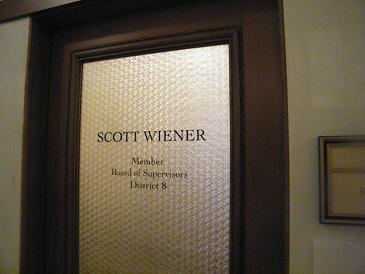
While the basic ideological makeup of the new Board of Supervisors didn’t change much, there are a few notable differences between the newbies and their predecessors. Much has been made of Sup. Jane Kim’s greater willingness than Chris Daly to vote against her progressive colleagues (we have a story in tomorrow’s paper about that), but another significant one is Sup. Scott Wiener’s support for nightlife and concerns about what we’ve called the Death of Fun.
His office has announced that at today’s board meeting, Wiener will call for a study of the economic impacts of entertainment and nightlife in the city. “It’s important that we understand the size and reach of this industry as we consider regulating it,” Wiener in a press release. “Without this information, it’s difficult to make informed decisions and to enact effective policies concerning entertainment and nightlife, which are a key part of San Francisco’s cultural identity. Particularly as we attract more young people to San Francisco, as the biotech and other new economy industries grow here, we need to ensure that we are providing them with entertainment opportunities. Understanding the size and scope of entertainment and nightlife in the City will help us achieve that goal and help us remain a world-class city that attracts people here.”
Contrast that with Wiener’s predecessor, Bevan Dufty, who led the effort to cancel Halloween in the Castro (enforced with hordes of police and water trucks) and presided over the city’s efforts to demonize the nightlife industry, give the cops greater authority to crackdown on clubs, and opposed efforts to create and support street fairs.
Longtime Entertainment Commission member Terrence Alan was an enthusiastic supporter of Wiener’s supervisorial campaign, breaking with many of his progressive allies who were backing Rafael Mandelman. And now, with this study, Wiener seems to be trying to show how valuable this industry really is to San Francisco in the hopes of stopping future crackdowns.
Medi-Cal and cell phones: The ugly truth

There’s a chilling comment from political consultant Dan Schnur in the Los Angeles Times. In a fascinating story by Tony York, Schnur talks about the difference between image and reality in California’s budget wars:
“Cut $1 billion out of Medi-Cal and most voters won’t notice. Take away some cellphones and make legislators sit on a picnic bench, and they pay attention,” he said.
Yep: Jerry Brown is saving the state a few million dollars by cutting cell phones for state workers and replacing a fancy conference table in his office with a cheap one. And that’s gotten a lot of press — as Jerry, the old master, knew that it would. We still live in a state, and a nation, where symbolism matters more than substance.
Republicans still get away with saying that the governor needs to cut state employee pay and benefits — although you could fire (that is, cut all pay and benefits) for every one of the state’s 240,000 employees and you wouldn’t be close to balancing the budget. (What nobody says is that the majority of state spending in California goes for local programs — what legislator wants to call on the governor to cut funding for his or her district? Not even the Republicans do that.) Little cuts like Brown’s mean nothing, and are easily wiped up by the daily, unpredictable ebb and flow of tax receipts.
And yet, Brown has to send a message that he’s being frugal, so he gets rid of his conference table (did he sell it? For how much?) And it works.
And, of course, nobody ever talks about how much the state wastes in corporate tax breaks; it’s much easier to take away some Caltrans worker’s phone.
I wish Brown could really tell the truth in his State of the State speech — that the stuff people get agitated about is chump change, that a huge cut to Medi-Cal means people dying (but not today, and you can’t prove the link, and poor people die all the time and the press never notices), that cuts to education mean more poverty (and crime, and public expense) in the future, that we’ve already cut (or pupt off with gimmicks) about $30 billion in spending, and that the state has a serious revenue problem.
But he knows he can’t do that. People won’t vote for his tax plan unless he looks like he’s somehow punishing state workers and flagellating himself. Good thing the Jesuits trained him.
SFBG Radio: From Cairo to here

In today’s episode, Johnny points out that the protests in Egypt have been driven by young people — and that youth unemployment in the United States is at alarmingly high levels. So why aren’t young people out in the streets here? Check out the discussion after the jump.
sfbgradio1/30/2011 by endorsements2010Free Muni for kids

Sup. David Campos is talking about offering free Muni rides for some of San Francisco’s youth, and he’d like free passes for all school kids next year. That’s a great way for the city to work with SFUSD; the school district spends a huge amount of money on buses. In fact, transportation is the second biggest item in the district’s budget (after salaries). There ought to be a way for kids (above a certain age; maybe fifth grade) who now take SFUSD buses to get on Muni instead.
And let me tell you all a little secret: Most of the middle-school kids who ride Muni never pay anyway. They all pile on the bus after school and some have passes and some don’t and the driver can’t possibly keep up with who’s got what when 50 young people are climbing aboard all at once.
So if we can let them all ride free we can save money for the schools, which can go into the classrooms, and make life easier on the drivers and kids who can avoid the crazy scramble.
And if we can’t do that, or if the city wants some sort of reimbursement, there’s an easy solution: Sell Muni passes in the schools. Not to get too bureaucratic, but SFUSD already keeps track of family income levels (that’s how they do the free lunches) and it wouldn’t be that hard to issue Clipper cards that allow low-income kids to ride free. Kids who can afford it would get a card at the beginning of the year and their parents could put money on it at the Clipper web site (or the kids could do it themselves with a machine in the school office.)
I know it sounds complicated, but it’s way more complicated now; you have to take your kid in person to buy a youth pass and present a birth certificate. Way easier to do it at the schools, where that data is already in the system. A good deal for all: SFUSD agrees to devote one staffer at each middle and high school to the (part-time) job of issuing bus cards, and in exchange SFUSD students get to ride Muni free or cheap — and SFUSD gets to cut its transportation budget.
Why is this not a no-brainer?