• No categories

Politics Blog

SFBG Radio: Right-wing talk runs America

4

Why does a member of Congress from Virginia get away with something as stupid as a bill to put the words “In God We Trust” on every public school? It’s all about right-wing radio. Listen to Johnny expound after the jump. 

sfbgradio3232011 by endorsements2010

US EPA, SF Health Department and Lennar accused of asbestos collusion

0

The  SLAM Coalition of Bayview Hunters Point Community Organizations and the New Orleans-based Advocates for Environmental Human Rights held a press conference outside US EPA Region 9’s San Francisco office today to protest the contents of a string of emails they obtained through a Freedom of Information Act request that they claim “show conspiracy by the US Environmental Protection Agency Region 9 and the San Francisco Health Department officials to cover-up dangers of the Lennar Corp.’s development project at the Hunters Point Shipyard.”

“Since 2006 when heavy grading and excavation began by the Lennar Corporation at the Hunters Point Naval Shipyard, residents of the Bayview Hunters Point Community, a majority African-American, Samoan and Latino low-income community, suffered from health problems including nose bleeds, rashes and headaches that they believed were caused by asbestos and heavy metals being unearthed from these actions,” the SLAM/E.H.R.’s press release states. “However, little did residents know that officials in the Environmental Protection Agency Region 9 and the San Francisco Department of Public Health were conspiring with the Lennar Corporation to conceal the health threats of asbestos laden dust.”

E.H.R’s Wilma Subra said she first saw the emails Thursday March 17.
“As I started to go through them, I could clearly see where EPA and DPH are wrestling with how to downgrade, or make less important, the information on asbestos on Parcel A of the shipyard,” Subra said,

Parcel A is the plot of shipyard land where military housing used to stand before the land was transferred to the city in 2004. Lennar began grading and excavating operations on the site in 2006, which led to health complaints and a $500 million fine by the Bay Area Air Quality Management District  when it turned out that Lennar’s asbestos dust monitors had not been properly functioning and that regular dust mitigation measures had not been enforced.

“So, the community has been asking tough questions, because people have been sick,” Subra continued. “And this clearly shows that the agencies are trying to figure out how to message to the community and downplay the impact, and that Lennar was at the table.”

SLAM member and Bayview Organizing Project Organizer Jaron Browne concurred with Subra’s assessment of the email string.

‘This establishes a consistent pattern of communication right from the beginning,” Browne said. “It shows pressure in the agency to communicate in ways that are less negative.”

“The ones we have included are just examples of many, many more, “ Subra added, noting that the community-based agencies did not receive any attachments in their FOIA request, nor did they get copies of responses from Lennar to US EPA’s emails.

“You see this type of collusion fairly frequently but it’s usually limited to a person or two,” Subra continued. She notes that these emails relate to Parcel A, but two more shipyard parcels are scheduled for early release, and that the city’s Redevelopment Agency and Lennar would then take the parcels over.

“If this is how it’s going to go, but public health is being impacted, then it’s totally unacceptable,” Subra said.

Browne predicts that US EPA will issue a statement standing by its original statements around asbestos exposure at the site. “But we’ve asked a number of agencies and will be ccing our findings to US senators,” Browne said.

The emails obtained through SLAM and E.H.S.’s  email request number in the thousands and can be viewed here, which is also the site where POWER has posted its concerns with the city’s environmental draft environmental impact report for Lennar’s shipyard development –concerns that led POWER to file a suit that will be heard in San Francisco’s Superior Court at 400 McAllister Street at 10 a.m. on Thursday March 24.

“The emails are a separate issue from the lawsuit, but what unites then is that the Bayview community is really organizing,” Browne said. “The EPA recognizes that the Bayview is an environmental justice community, and what cuts across all these issues, whether they are at Parcel A or over the EIR [for Lennar’s massive shipyard-Candlestick development] is that we see the same pattern of behavior in which they dismiss the community’s concerns.”

Browne says POWER’s issue with the EIR was that it did not address toxic contamination at the shipyard.
‘The city says that’s the Navy’s concern, but CEQA [the California Environmental Quality Act] requires you to explain what’s there and, if there’s a negative impact on health, how to address it. But the Navy can’t answer that question yet, and therefore it’s premature to approve the EIR.”

Calls to US EPA were not returned today, but we’ll be sure to post their reply here, so stay tuned…

Tiny city makes $250 mil from public power

10

I wasn’t paying much attention to the move by state Assembly Speaker John Perez to abolish the tiny town of Vernon, California — until I read the column in today’s Sacto Bee by Dan Walters. Walters thinks it’s all about money — Vernon’s got a lot, neighborhoring L.A., which wants to annex Vernon, needs it.


But here’s what’s so interesting:


Tiny Vernon generates a quarter-billion-dollar stream of revenue each year, much of it from city-owned electric, gas and water utilities.


Imagine: A town of 112 residents, with a daytime population of 50,000, gets $250 million a year from public power. And San Francisco, with a federal mandate for public power, doesn’t.


Any on the Budget Committee paying attention?


SFBG Radio: What if we stopped shopping?

83

Today, Johnny offers a fascinating idea. The GOP in Arizona has been forced to back down on some of its worst immigration policies — purely because of the economic impact. What if the 26 million or so American consumers who fall into the general category of the Left (and the anti-war Right) just stopped spending money on anything beyond essentials for one week — a boycott against the wars in Iraq and Afghanistan and in favor of taxes on the rich. Would it make anyone in Washington listen? You, of course, can listen all you want, after the jump.

sfbgradio3212011 by endorsements2010

Is the California GOP done?

16

The folks at CalBuzz — veteran political reporters who know their shit — thing the CAGOP is teetering on the brink of irrelevance:


Like a herd of wooly mammoths at the end of the Pleistocne epoch, the California Republican Party is on the verge of extinction.


It may still recover. The CRP has come back from near death before. And redistricting, alongside the top-two primary system may yet revive it. But judging from the infighting, narrow thinking and rigid ideological positioning on display at the party’s organizing convention last weekend in Sacramento, the signs are not good.


But that assumes that the party wants to recover, wants to be part of governing the state and actually has a plan to do that. Right now, Republicans in Sacramento are standing up and denouncing some of Gov. Brown’s proposed cuts — while refusing to even allow a public vote on extending taxes.


Over at Calitics, David Atkins suggests another perspective:


In reality, the GOP at a national and state level exists to 1) deliver money from the poor and middle class to the rich; and 2) feed enough red meat to their prejudiced and unthinking base to garner just enough votes to continue achieving objective #1. That’s pretty much it.


Right now, the GOP doesn’t actually need to win any of the statewide elections in order to accomplish those goals. Winning them would be helpful, but is ultimately unnecessary. Knowing that the chances of anyone overturning Prop 13 and the 2/3 requirement on revenues are slim to none, all they need is at least 1/3 of the members of just one of the statehouse chambers. To ram through all cuts budgets and destroy faith in government, they need do nothing more.


In fact:


There’s nothing that serves Republican interests at a state and national level more than to see California fiscally collapse. That means shock doctrine, a transfer of wealth from the middle class to the rich, an ability to end all state labor contracts in a way Governor Walker would only dream of, and ultimately the ability to crush the belief of the People in the power of their government to do good on their behalf.


I’m not sure everyone in the GOP thinks this way, but on a macro level, it certainly makes sense. That’s exactly what the Repubicans are doing in Congress — make it impossible for the Obama Administration to succeed, and you’ve done your job. It doesn’t hurt that Obama is allowing that to happen.


Brown continues to say that he doesn’t want to pull any legal chicanery, that he wants Republican support for his plan to but the tax extensions before the voters in June. But if this is the game they’re playing, he may have to reconsider.

If we hadn’t gone to war in Iraq

4

This is nothing new, but at a time when every state and local government is scrambling for spare change, it’s worth thinking about what what we could have done with the Iraq war money. For example:


We could have closed every single state’s FY2012 budget deficit—totaling nearly $112 billion — nearly seven times over. That means no protests in Wisconsin, no mass teacher firings, and no school closures.


And:


 We could have outfitted 31.2 million detached, single-family homes— about 45 percent of the detached, single-family homes in America—with solar paneling.


No more need for nuclear power plants.


Makes you want to cry.

Imagine evacuating New York

2

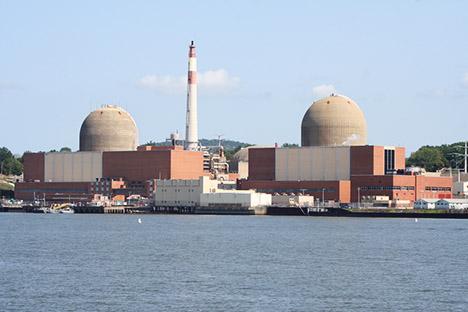
My brother lives a few miles upwind (usually) of the Indian Point nuclear plant on the Hudson River, north of New York City. He called me this morning to ask if we were worried about radiation hitting the West Coast, which all of the government isn’t anything to worry about. Of course, if it were something to worry about, we’d be hearing the same thing anyway.


Truth is, I’m only a little nervous right now. One really cool chart of prevailing winds shows some of a possible plume hitting right smack into the San Francisco area, although by that point it should be sufficiently dispersed that the concentration won’t be high enough to cause any immediate human health impacts. That, of course, assumes that the reactors are brought under control before the plutonium in the core and the spent fuel rods catches fire, explodes or otherwise becomes airborne. Plutonium’s an alpha-emitter with a half life of 24,500 years, and you only need to inhale a tiny speck before it becomes fatally toxic.


Still, let’s not forget: When you release significant amounts of radioactivity into the atmosphere, there are human health consequences — and not just in the immediate area. There’s no doubt in my mind (and in the minds of many experts) that above-ground nuclear testing in the 1950s and 1960s contributed to cancer rates world wide. You can’t prove that any individual got cancer because of exposure to the specific fallout from a specific explosion on a specific date; you can prove that the likelihood of increased cancer risk in large populations increases with almost any measurable increase in background radiation.


That said: My worries are pretty minor compared to the folks in Japan. The head of the company that ran the nukes now admits that the radiation released over the past few days will kill people. And if the situation deteriorates any further, the risk is going to ge beyond a few miles.


The heartbreaker: There’s not a lot anyone can do. You can’t evacuate Tokyo. Where would the people go?


Ralph Nader send out a press release today warning about the problem the United States would face if one of its nuclear plants — say, Indian Point — had a similar accident:


Imagine evacuating the long-troubled Indian Point plants 26 miles north of New York City. Workers in that region have a hard enough time evacuating their places of employment during 5 pm rush hour. That’s one reason Secretary of State Clinton (in her time as Senator of New York) and Governor Andrew Cuomo called for the shutdown of Indian Point.


You can’t evacuate New York. My brother’s on the edge of the official evacuation zone for Indian Point (which is a creaky, leaky old nuke); the roads aren’t wide enough to handle the traffic where he is — and he’s a fair ways upstate from NYC.


The New York Daily News headline talks about the handful or workers still trying (at the risk of their own lives) to get the troubled nukes under control: “The Whole World Is Depending On Them.” And if they somehow prevent disaster, we can all take a deep breath — and start working to shut down the old, past-their-prime, unsafe power plants that are near populated areas.


Oh: that’s almost all of them.

SFBG Radio: Good news from Wisconsin — maybe

0

A judge in Wisconsin has tossed out the governor’s anti-labor law — but does that just mean the Republicans are going to go back and do it again? And what’s going on in Michigan, where the governor wants to get rid of labor contracts by taking control of local government? Check out our discussion after  the jump.


sfbgradio3182011 by endorsements2010

Kids, drinking and smoking

4

I don’t know why this hit me today, but it did. I was at the corner store on Potrero Hill, looking at a sign I see every day and ignore every day, reminding patrons that nobody under 21 can buy alcohol — and nobody under 18 can buy tobacco products.


That’s the law.


First of all, the drinking age is dumb and dangerous. But why can you smoke at 18, if you can’t drink until you’re 21? Frankly, tobacco use in high school (and that’s what we’re talking about) demonstrably leads to a tobacco habit in later life, and that’s far more dangerous to personal and public health than a drinking habit. Alcohol, used in reasonable doses, doesn’t kill people and may even have some health benefits. Tobacco in any dose is deadly.


I’d much rather have my kids drinking in high school than smoking at any age. I’m not for banning cigarettes, but this particular disparity seems to make no sense at all.

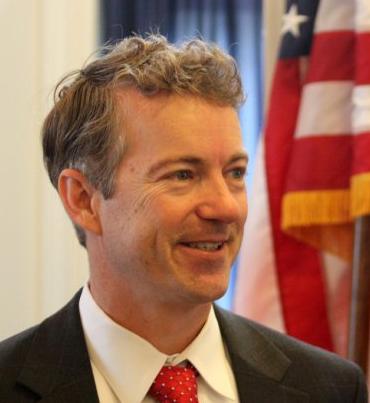
Rand Paul’s baby talk

17

Last week, Rand Paul (R-KY) — man, there’s a double entendre just waiting to happen — went shithouse ballistic (pun intended) over what he sees as one of the most pressing issue in the nation today — low-flush toilets.

At a hearing while grilling a lower level Obama Administration Energy department spokesperson, Paul was in full fury.


“Frankly, the toilets don’t work in my house,” Paul said. “And I blame you, and people like you who want to tell me what I can install in my house, what I can do.”


Be it low flush crappers nouveau, newer and costlier and more energy efficient light bulbs, recycling (the new House leadership got rid of biodegradables in the House caff as a remnant of the despised Pelosi era), the angry and seething Libertarian and his followers are a bizarre variation on the Patrick Henry ethos that could have only sprung from the lunacy of our era–“Give me the liberty to waste the planet’s resources frivolously or give me…well, all of us are draft-dodging chicken-hawks anyway, so death may be extreme, let’s just say we’re gonna whine loudly about it.”

One would think that “conservatism” (Paul claims to be conservative) would include the classical definition, like prudence and caution and recognition that the finite resources of the planet have to be, well, conserved. Instead, he and his ilk rail about “treehuggers” and “environazis” and their mouthpieces mock people accustomed to husbanding their resources as silly.


But this is not conservatism. It is, as any parent whose ever seen a fou- year-old in action, the mindlessly childish defiance of anyone that dares impose anything for one’s own good, even when it makes complete sense to do so–this is not a drug or alcohol law of a prohibitionary stripe, nor a ban on the salacious, nor even an actual imposition–today’s “conservative” gets irate over any restriction, because, how dare you tell me what I can or can’t purchase even if it will make future generations (ie, the “unborn” that they claim to care about so much) miserable.


In other words, baby talk. This is kiddie shit–”I will stand up to those who would see me as a child because I, well, am being childish.” Defiance over not only the trivial, but the desire to make other people miserable by one’s own lack of sense and control. No wonder the American Right uses the expression “nanny state” so much–they are stuck in perpetual infanthood and see even the most modest measures to cut down on resource overuse as a kind of totalitarian, grown-up imposed austerity.


It isn’t a sacrifice to have less water in your john, Rand. It isn’t an imposition to put in them curly lightbulbs or to haul your own bags to the Safeway or to put recyclables in a different colored barrel. It’s called “accepting reality.” Which is probably why Senator Paul wouldn’t recognize it if it bit him on his toupeed ass.


Johnny Angel Wendell is a talk show host in LA at KTLK AM1150 and here on SFBG.com, as well as a musician  and actor

Ethics Commission complacency continues

5

As the Rules Committee considers two diametrically opposed nominees to the Ethics Commission – one a reformer and the other an ally of those who want this political watchdog to be as toothless as possible – Larry Bush with the new CitiReport blog has penned an excellent rundown of the sad recent history of an agency that is ineffective at best and corrupt at worst.

We at the Guardian have reported extensively on the problems with the Ethics Commission, from its coverup of Gavin Newsom’s money-laundering to its failure to regulate Willie Brown’s blatant flouting of city lobbying laws, as well as how the agency has expelled the only public-spirited employees it’s had, such a Oliver Luby and Joe Lynn.

At a time when big corporations and local power brokers are cutting backroom deals to give away millions of dollars in taxpayer revenue, and when even public officials are refusing to answer basic questions about ethics violations and influence peddling, this would seem to be a good time to try to restore faith in the agency that is supposed to be regulating that kind of thing.

Instead, powerful interests seem to be doubling down and going for broke, hoping that the public is too trusting or complacent to do anything about it. Sadly, they may just be right.

Two East Bay rallies for clean energy

As a nuclear emergency continues to unfold in Japan, Bay Area grassroots organizations are trying to drum up support for incorporating clean energy into long-range local planning.

Communities for a Better Environment (CBE), the Asian Pacific Environmental Network, and other grassroots organizations have declared March 17 a “Green Day of Action,” and they’ll mark it with a rally before the City of Richmond’s Planning Commission meeting to call for a meaningful plan for reducing citywide greenhouse gas emissions.

Richmond’s Chevron oil refinery is one of the worst emitters of greenhouse gases statewide. The Richmond Planning Commission will hear public comment on a Draft Environmental Impact Report for the city’s General Plan, which includes a strategy to curb greenhouse gas emissions in coming years. Yet CBE’s Jessica Guadalupe Tovar noted that the city’s plan for a greener future doesn’t account for how it will limit industrial pollution.

According to a graph produced by CBE, industrial sources make up around 88 percent of the total annual greenhouse gas emissions generated in Richmond. The Chevron refinery is responsible for roughly 4.5 million tons of greenhouse gas emissions, out of a citywide total of just under 7 million tons. 

“They can’t ignore the elephant in the room,” Tovar said.

“Richmond is already plagued with preventable illnesses and diseases and residents cannot afford for the General Plan to overlook these serious environmental health hazards,” said Richmond resident Tiana Drisker, a member of CBE.

Meanwhile, on March 18, another rally for clean energy is planned outside Oakland City Hall from 4:30 to 6:30 p.m. Activists from Movement Generation are planning an anti-nuclear rally “to call on PG&E to not extend its nuclear energy production from its Diablo Canyon reactor, and on Oakland to ramp up clean energy alternatives.”

The rally will follow a day-long conference organized by Bay Localize and the Local Clean Energy Alliance to highlight Bay Area clean-energy efforts.

“This nuclear devastation in Japan must never happen in California, or anywhere else,” said Al Weinrub, conference coordinator. “Energy conservation and renewables are the safest forms of energy by far.”

Taxes = prosperity

4

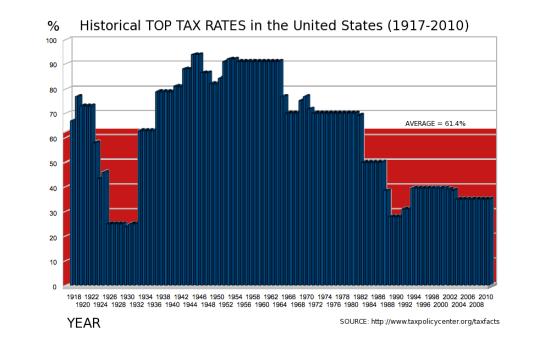
I found this nifty chart on DailyKos, along with an article about the idiot who wants to cut taxes on the rich again. I realize it’s a little hard to read the exact dates, but here’s the overall point:


High taxes on the wealthy, generally speaking, correspond to periods of economic prosperity. Low taxes on the rich, generally speaking, correspond to bad economic periods.


Gee, could there be a connection here?

Simulation of dispersal routes of radioactive pollution cloud

0

The Belgium Institute for Space Aeronomy has posted simulations of the dispersion routes of clouds of radioactive pollution emitted by the explosion in Daiichi Building-3 nuclear power plant in Fukushima in Japan.
“This simulation is one of the first to take into account the leaching by rain as the cloud on the route,” their website notes. “This results in a much faster decrease of the concentration of particulate pollutants. Based on these projections (which extend up to this Saturday), the cloud will disappear before they reach U.S. shores.  This simulation is based on the hypothetical initial cloud between 0 and 1500 m altitude. We tested the sensitivity to this assumption with another simulation where the initial cloud rises up to 3000 m. Thanks to leaching by rainfall, the result is almost the same: the cloud of radioactive pollution disappears over the Pacific Ocean.”

You can watch more cloud dispersal simulations by clicking here. And you can read updates on the nuclear power plants in Japan by checking out the International Atomic Energy Agency’s website.

SFBG Radio: Wavy Gravy on Owsley

2

In a special episode today, Johnny talks to Wavy Gravy, founder of the Hog Farm, patron of Camp Winnarianbow, MC at Woodstock and close friend of Stanley Owsley, the late acid avatar. Hear him talk about Owsely’s home in Australia, the dangers of the platypus, the acid test days, the all-meat diet and much more after the jump.

sfbgradio3/16/2011 by endorsements2010

Ammiano: what about the hospitals?

2

One of the most frightening aspects of an major earthquake in the Bay Area is the potential destruction of some of the big  local hospitals. “If it happened today, we’d have no SF General, no Kaiser,” Assembly Member Tom Ammiano told me. St. Lukes? I wouldn’t bet on it. And considering the conditions in Sendai, that’s not a pleasant prospect.


State law requires all hospitals to undergo seismic upgrades by 2013 — but the deadline keeps getting pushed back. Ammiano said there are more delays pending, more bills in the Legislature that would allow some operators (particularly private hospitals) to miss the deadline without penalty.


Both Stanford and CPMC has tried to claim that they can’t do the work yet because of local obstacles. (Actually, there are no local obstacles to upgrading exisiting CPMC facilities, just to the construction of a new hospital on Cathedral Hill.)


Sme public hospitals say they lack the money. “But in Francisco, we did the right thing. We passed a hospital bond,” Ammiano said. “When my colleagues from other areas say they can’t meet the deadline, I ask them — did you vote for a hospital bond?”


Ammiano plans to introduce legislation to pre-empt any further delays and get this process back on track. “It’s horrifying to see what happened to the hospitals in Japan,” he said. “We need to be prepared in California.”