• No categories

Pixel Vision

The Daily Blurgh: Gay ice cream, straight bears, sun songs

0

Curiosities, quirks, oddites, and items from around the Bay and beyond

The California foothills are alive with “extremely high levels of lead, arsenic and asbestos.”

*****

Russian gajillionaire pledges to financially support rotting historic pile Fort Ross.

*****

“Goooooooooal!” is the word at Civic Center.

*****

“On and on they go. Soon they will sprout beards and their hair will grow down their backs, and their tennis whites will yellow and then rot off their bodies. And still they will stand out there on Court 18, belting aces and listening as the umpire calls the score. Finally, I suppose, one of them will die.”

*****

The gayest ice cream ever?

*****

Shocker: White shoes not such a good idea on a crowded dance floor.

*****

Straight bears: newfound allies or cuddly cockteasers?

*****

The music of the sun out-blasts THX any day.

US takes it! From tears to cheers in Civic Center for World Cup

0

Tension hung over the Civic Center Plaza World Cup watchers this morning like Ocean Beach fog.

The US soccer team faced elimination throughout a nerve-wracking battle with Algeria. Conspiracy theories were abound after the referees called back an early US goal in the first half, echoing a similar controversial call from last Friday’s tie game against Slovenia. Fans went through a wide range of emotions until the final minutes when US star Landon Donovan followed up on a loose ball in front of the Algerian goal. Pandemonium broke out among the few hundred gathered in the plaza as 90 tense minutes were finally absolved. Now, on to round 16!

(h/t The Awl)

Frameline34: Local drama “The Stranger in Us”

0

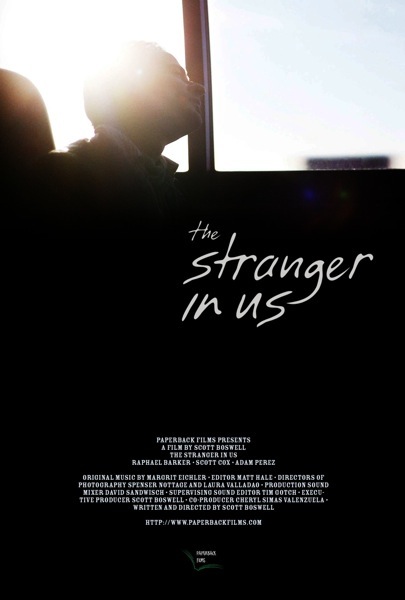
Local filmmaker Scott Boswell may not have set out to make the film he ended up with, but he stands behind the finished product. The Stranger In Us stars ShortbusRaphael Barker as Anthony, a young man who moves from Virginia to San Francisco in order to live with his boyfriend Stephen (Scott Cox). When the relationship turns violent, Anthony finds solace in his friendship with Gavin (Adam Perez), an underage street huster. I spoke to Boswell and Barker about the film’s origins, its unique content, and what this year’s San Francisco International LGBT Film Festival says about the future of queer cinema.

San Francisco Bay Guardian: What was your inspiration for The Stranger In Us? Where did the story come from?

Scott Boswell: Ultimately the story ended up being fairly autobiographical. But it started in a different place. Originally — and Raphael knows this because we talked about it — originally, I had intended to do a much more experimental film, kind of a hybrid documentary-narrative, because of my fascination with the Polk Street, Tenderloin area, which I’ve always had since I moved here in the mid ‘90s. I had considered doing a bit of a portrait of the neighborhood, and kind of infusing actors into it, just shooting a lot of footage and seeing what we came up with. There’s a part of me that wishes I had still done that, but in all honesty, I can say that after Raphael expressed some interest in the project, I suddenly felt like it needed to be more narrative in its scope. He didn’t suggest that. It was just my intuition around the project. So I had been talking to him about doing it for months, without even having a complete script, and continued writing it and auditioning actors. Eventually it became much more traditional in terms of its narrative. It became what it is now.

SFBG: And Raphael, what brought you onto the project?

Raphael Barker: Scott. There wasn’t really a finished script and a lot of it was sort of up in the air, but I was just really comfortable with the process and how it evolved, because it was Scott. He and I just hit it off really well.

SFBG: Did you collaborate at all in terms of creating the character of Anthony or writing the script?

SB: Not so much on the script. I run a screenwriting group, here in the city. It’s a small group and we meet a couple times a month, and they had the most impact on the final script. However, there are quite a few places in the script where it suddenly says, “We’re gonna improv here.” And there are definitely scenes where the actors brought the dialog to the scene. Quite a few, actually, especially between his character and Gavin, the street kid. Largely because they had such wonderful chemistry, and I felt like I could trust them to pull it off.

SFBG: Raphael, can you talk about how the improv process was, as an actor?

RB: Scott would set up the scene and then let us go, and just see what happens. And then would make comments as necessary and readjustments. But I felt very free to just let the scene kind of take over and do its thing. I think Scott and I are just both very instinctual. Like, “That’s not how I planned it, but I kind of like it that way. Let’s play with that.” I think especially when you’re talking about Gavin, there was something almost unwritten about our relationship that was allowed to evolve through improv.

SB: Right, because there’s a piece that’s semi-autobiographical that has a place in history, and then there’s the piece that — I feel like Gavin’s character brings a newness, a sort of unfinished, still to be defined ending. There was something about the energy that really brought novelty to the script.

SFBG: You said originally you wanted to showcase this particular neighborhood in your film, and then it became more of a narrative. But it’s still a very San Francisco film. How did you go about capturing that?

SB: The main thing was choosing that location as his studio that he moves into after leaving Stephen, which actually wasn’t true to my experience. However, the person on which Stephen is most based actually lives there, so I kind of flipped it. And the character on whom Gavin is based actually hung out in the Castro, not the Tenderloin. So I flipped those around, and then because the character is so stuck and lost and wandering, he was able to go out into the street and that became the portrait of the neighborhood right there. We had spent a lot of time trying to work out just how we were going to portray that, and ultimately he’s always in the space. I actually did go out and shoot footage of the neighborhood without Raphael, and none of that is in the film.

SFBG: Anthony moves to San Francisco from Virginia, so he’s experiencing the city from an outsider’s perspective. Why did you decide to write him that way? And Raphael, how did that affect your performance?

SB: I think it’s a very common experience in San Francisco. It seems like the majority of people I meet here have migrated from somewhere else. And I think especially for gay men, when we arrive here, we don’t always quite find what we’re expecting, and especially for queer youth, which is an idea that Gavin embodies. I’m very interested in that sort of push-pull between the desire to be in the city of San Francisco and the challenges that you can face when you arrive. So I was interested in exploring that experience, and I’ve found subsequently that quite a few people — they’re almost always gay men — have come to me and said that they relate to that experience. Different generations of men, and different decades of coming here. It seems to be a continuing phenomenon in a way. In that sense, I think it’s very much a San Francisco story, even though it could probably happen in just about any urban area, especially when someone who doesn’t have experience in an urban environment suddenly arrives and is just thrown into it.

RB: I experienced something very similar coming out here to chase after someone I was pretty in love with, and then being dumped like a week and a half after moving here. And just feeling like I didn’t have that orientation anymore, and everything in the city was associated with this person. I’m sure I’ve one of millions of stories of people — with San Francisco being a kind of pilgrimage, then as soon as we get here we complain about it. But we wouldn’t want to be anywhere else, so there’s kind of that love-hate relationship with it. So I could definitely relate to coming out here to be with someone and having all that kind of expectation and hope, and then me kind of losing that central focus and orientation and realizing, “Now what?” I think that’s a theme that’s not just gay or even queer, but it seems like anyone I talk to who comes from a different place has that similar experience. They knew they needed to be out of wherever they were at, but they weren’t sure what they were exactly coming into.

SFBG: The film also deals with an abusive relationship, which is something we don’t see a lot of in queer cinema. I was wondering why you think that is, and also why you wanted to include it in your movie?

SB: I don’t know why it is, but because it is [not often seen] is one of the main reasons I wanted to include it. Hustlers and street kids appear in a lot of gay cinema  — and just to go down that tangent for a second — which is why I chose to not make that character the protagonist but a supporting role. In terms of same sex domestic violence, it is an issue that permeates probably just about any community, but I have seen and heard very little about it among same sex couples. There are some things, some things written and there’s an organization in San Francisco called Community United Against Violence that works to combat and end violence. So there are resources out there, but I wanted to explore it because it’s an issue that’s personal for me, on several levels. It’s something that I’ve experienced and it’s also something that I just personally have always cared about. I volunteered to do work at battered women’s shelters in the past—this was actually in Madison, Wisconsin, long before I’d ever had any kind of experience with it. What I find really interesting is the degree to which people don’t really understand it. No one thinks they’re going to enter a relationship like that. I certainly didn’t think so. I thought I understood it.

RB: Much less something that’s so countercultural in some sense.

SB: Yes, exactly.

RB: Like, “Oh, if I can requite this kind of relationship, that’s kind of the end game.”

SB: The thing is you don’t necessarily recognize it when you’re there. People always say, many people say and have said about this film, “Why does he stay? Why doesn’t he leave?” It’s interesting that people continue to not understand that issue, because it’s clearly a very common human experience. So I guess in a sense, that question to me opens up a dialog on the issue that I find very important. I’ve been asked that a lot from people, and so far, that’s only come from the very limited number of people who have seen [the film].

SFBG: Well, without sounding like I’m trying to justify the abuse at all, these characters are complex enough that you get a sense of why they’re together. You can see how they got to that point. How did you go about creating that, and making sure they weren’t too clear cut or one-dimensional?

RB: I think to show just how much we loved each other is one way to do it.

SB: Yeah, that was important. I approached this very much as a character piece. I mean, that’s what interests me as a filmmaker and as a writer. In terms of the kind of genres I might be able to work in, I think it’s an area I probably have more of a knack for. But I think it’s true for any genre you’re working in, you have to rewrite. You have to be able to get down the ideas and the scenes on paper, and then take a look at them and be open to feedback. And assessing where it is that they’re black-and-white or flat and one-dimensional, and trying to create scenes that are more organic and layered. So that’s what we did. Once I knew what the story was, it still took me a good nine months to write the thing before we started shooting.

SFBG: One last, much broader question. How have you seen queer cinema change over the years, and what is the direction that you see it taking?

SB: In just the past few days, in the films that I’ve seen at Frameline this year, I’m very excited. I think queer cinema has gotten better and better. I have reaffirmed my understanding of the necessity of LGBT festivals, because it has definitely gone through phases. There was kind of an indie new queer cinema in the early ‘90s, when Gus Van Sant was coming on the scene, and Gregg Arraki and Todd Haynes. Then in the later ‘90s and maybe early 2000s, it kind of evolved into a lighter, more mainstream cinema, which I actually don’t relate to as much. But the best of them are actually quite good. What I’ve seen more recently, and I hope our film falls into that, is really kind of the ability to look more closely at ourselves and tell our own stories without any kind of concern about the broader mainstream appeal. I know that those kinds of films still exist. I think that independent cinema has gotten to a place where it’s not just simply seeing ourselves portrayed on screen anymore, but it has to be good cinema now.

RB: I saw a lot of films at the Frameline festival two or three years ago when the documentary about the making of Shortbus came out, and it just made me realize that the quality — instead of it being a kind of niche genre, I don’t want to say the opposite of what you’re saying, but I almost see Frameline as becoming redundant, because the films are good enough to stand on their own. They don’t have to be a genre film or a niche or a sexuality genre film. We have to keep working and working toward the specific, and then eventually the specific becomes universal. And I think that’s the beauty of the films that are starting to come out. In the Frameline context, it’s going to actually make it almost redundant because they’re just going to be good films, period. That’s what excites me, because everyone’s experience is so unique. And sure, we’re working within paradigms and categories, but I think it’s just getting better.

SB: It’s interesting looking at where these films fit in in terms of festivals and markets and things like that. I guess what I was trying to say is that I feel like Frameline still needs to be around in order for these films to get shown, because they’re not all going to fit into SF International, they’re not all going to fit into all of the big festivals. The sort of bigger queer films coming out may not need Frameline. There have been a quite a few in recent years: Bad Education, Mysterious Skin, Capote. They’re playing at the bigger festivals or getting distribution without festivals. There is sort of a distinction there. But when I see something like I Killed My Mother, which just kind of knocked me on my ass because I thought it was so brilliant, I don’t know where else I would have seen it.

THE STRANGER IN US

Wed/23, 6:45 p.m., Roxie

Fri/25, 11 a.m., Castro

www.frameline.org


The Daily Blurgh: Grifter raccoons, literary subway stations, the Streep!!!

0

Curiosities, quirks, oddites, and items from around the Bay and beyond

Beware of teary raccoon eyes when in Davis.

*****

It’s no battleship Potemkin but the cruiser Varyag, which recently docked in our waters, is no slouch. Neither is its “relaxation cabin.”

*****
Speaking of Russia, a Moscow metro station was recently made-over in honor of Fyodor Dostoevsky and the morbid results sound both hideous and captivating:

“The station, called Dostoyevskaya, is decorated with brooding grey and black mosaics that depict violent scenes from the 19th-century writer’s best-known novels. One mural re-enacts the moment when the main character in Crime and Punishment murders an elderly pawnbroker and her sister with an axe.”

Maybe BART or MUNI could follow suit? They could have so much fun with Hammett, Norris, or Maupin.

*****
“Let’s don’t burlesque this,” to become the new, “don’t get it twisted?”

*****
Ladies and gentleman, unsung gay icon and artist James Bidgood: “I guess people expect me to be lounging around in a silk caftan, face powdered and roughed with twenty yards of orchid chiffon draped around my neck with my bong and a few boys by my pool! Very often guests like yourself think I only work in this slum dwelling, but I live here! There is so little room, I sleep on a twin mattress twice as old as you are, half of which is occupied by a six-foot plaster male store mannequin. I use it to build paper mache forms on and for draping costumes because a regular dressmaker form doesn’t work for the kind of costumes I make, if ya get my meanin’! There’s nowhere else left to put the damn thing, so I got a man in bed with me every night – where he’s of no use at all, like sleepin’ with a cold corpse!”

*****
The end of the rainbow? SF Pride “bans” openly gay DJs due to sponsorship with Clear Channel.

*****
Mid-century architectural madness revealed in Presidio Heights.

*****

Happy birthday, Meryl. May you remain forever young:

Old reliable true confessions — John Waters on secret idols, polar opposites, and role models

0

By Ryan Lattanzio

John Waters. Forefather of filth, pundit of provocation. Not to be mistaken, of course, for 1934 Academy Award recipient John Waters, who kept coming up in my research of the other John Waters.


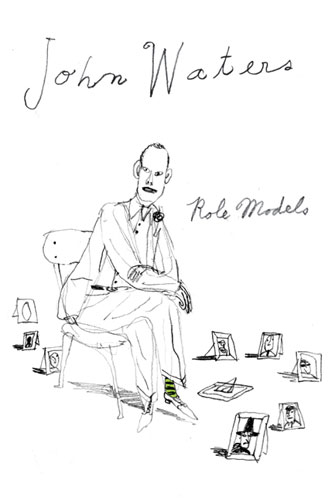
There’s no point in introducing the man, because — well, if you’re reading this, chances are you’re doing so deliberately. No one ever picked up Pink Flamingos by accident and if they did, I’m sorry. His latest book, a collage of candid essays entitled Role Models (Farrar, Straus, and Giroux; 320 pages; $25) is like Hollywood Babylon meets Sodom and Gomorrah. He even tells us, “I know your eyes are not garbage cans, but somehow I feel it is my duty to share with you the depths of depravity some of our long-lost brothers have fallen to.”

Waters is a writer who has seen all tiers of the entertainment industry’s caste system. For him, perversity is pleasure — something to revel in. The titular role models are his own: some are cult figures and pop cultural pariahs, while others are famous figures with whom he’s found inspiration, friendship, and frustration.

There’s little to say on Waters in terms of biography that hasn’t already been said –- the man defines himself. Still, his material is entirely fresh. He remains, and likely always will be, culturally relevant. “I also like Alvin and the Chipmunks better than the Beatles, Jayne Mansfield more than Marilyn Monroe, and, for me, the Three Stooges are way funnier than Charlie Chaplin,” he writes in “The Kindness of Strangers,” an essay on Tennessee Williams.

Waters begins Role Models with a piece on Johnny Mathis, who represents more or less the beginning of what would become his long line of pop cultural idolatry, an ancestry that runs from Rei Kawakubo to NSFW porn auteur Bobby Garcia. “Is it because Johnny Mathis is the polar opposite of me?” he wonders, puzzling over the source of his Mathis fixation. “Do we secretly idolize our imagined opposites, yearning to become the role models for others we know we could never be for ourselves?”

Role Models is eight chapters total, with a few photographs culled from Waters’ grotesque archive. Each chapter is rather long, as he oscillates between discussing the role model in question and discussing himself -– and there’s plenty of the latter. Then again, no one ever looked to John Waters for brevity. In the course of his name-dropping, shit-talking, and first-person autobiographical passages, he places his audience within close emotional proximity. His approach is never didactic. When he comes clean – but when is it ever clean? – it is often shocking and hilarious. No surprise there.

In the flight path of his name-drops, Waters inconspicuously troubles what we know about certain celebrities, and what we’re comfortable knowing. Considering all the people that can be found in his Rolodex, he traffics in some dubious social territory, like his longtime friendship with convicted ex-Charles Manson groupie Leslie Van Houten. His acquaintances also include Little Richard (the progenitor of the pencil-thin moustache!) and pornographer David Hurles, for whom “danger is the turn-on.”

http://www.youtube.com/watch?v=QlJDAPlg8rY

Hurles, for one, films “psychos. Nude ones. Money-hungry drug addicts with big dicks. Rage-filled robbers without rubbers. And of course, convicts — his ultimate Prince Charmings.” In Waters’ terms, what would seem like the material for a Hubert Selby, Jr. tragedy or a J.G. Ballard nightmare is actually treated with levity. He makes these misfits, these role models, entirely human — even if their occupations suggest otherwise. Still, the book is rife with freakiness of all shapes and sizes. Waters even recommends Ivy Compton-Burnett as one of his most influential writers.

Waters’ persona is so founded on equal parts artifice and honesty that in deconstructing himself, even the artifice we know and love can be overwhelming. I don’t want the perfectly preserved Waters I imagine in my head to be ruffled. I certainly don’t want to know that his moustache is sometimes penciled on. At this point Waters is such a god-among-gods that the everyday nature of his autobiographical confessions can be jarring.

“I’m so tired of writing ‘Cult Filmmaker’ on my income tax forms,” Waters declares near the close of Role Models. “If only I could write ‘Cult Leader,’ I’d finally be happy.” Such humanizing, humbling moments like these unravel the Waters we normally know to be tethered to a pedestal in the art world. Though he wears his sexuality like a bejeweled blazer, he still defies or subverts gender norms. He’s the prince of filmmaking.

Role Models certainly isn’t the final word on Waters, nor is it the first. This isn’t Waters For Beginners, nor is it Advanced Waters, and anyone will find both comfort and trouble in this book. As an autobiography, Role Models isn’t thorough. But like the Love Map he describes in “Outsider Porn” – an estimate of one’s sexual trajectory spanning their entire lives – this book is a way to trace the path of the artist and really get to the roots. Or maybe it’s more of a palimpsest, something Waters will return to, erase, revise, and rewrite as he gets older. Thankfully, in his case, getting older doesn’t mean maturing.

Street Threads: Look of the Day

0

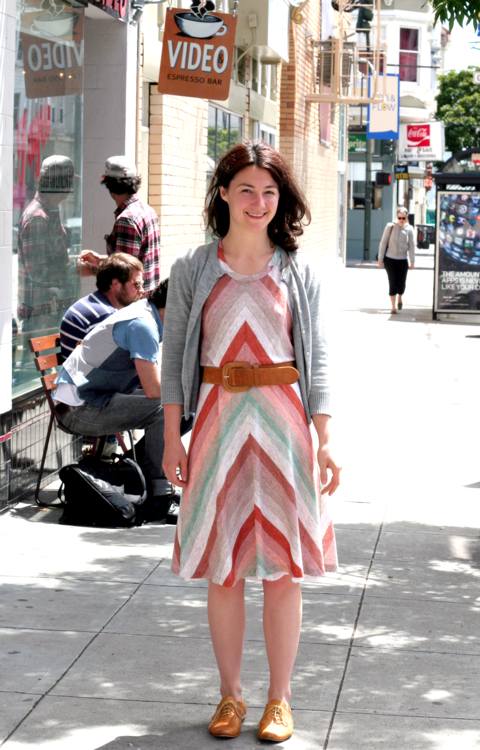
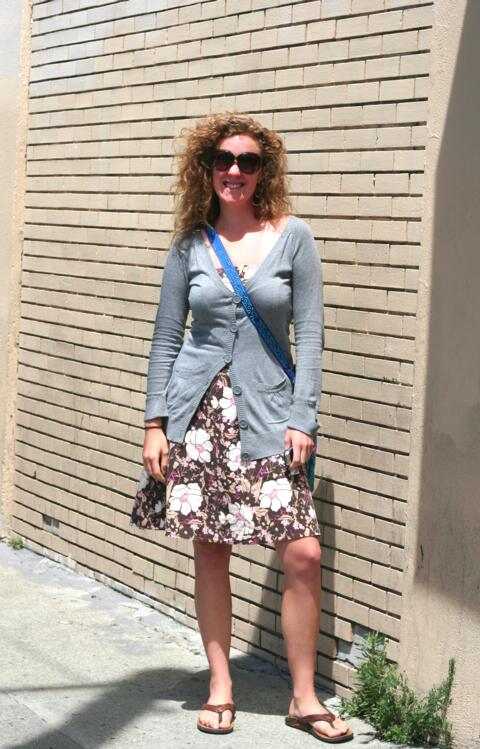
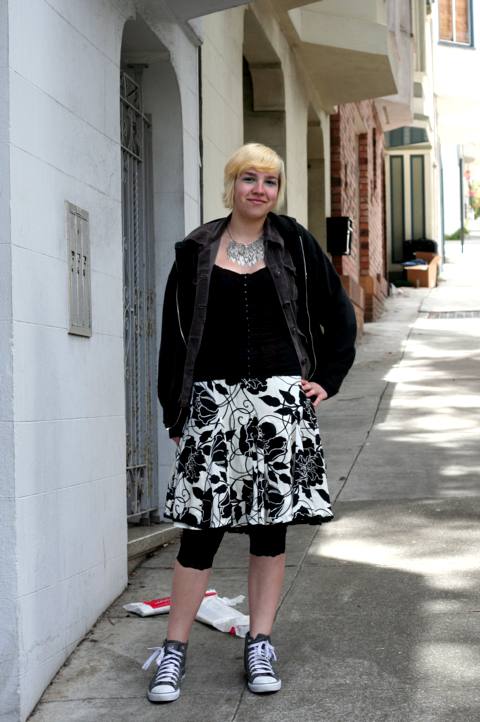
Today’s Look: Katie, 18th Street and Guerrero

Tell us about your look: “I got this dress and belt at a thrift store and the shoes are Campers.”

Native American artists take back culture of their art

0

“Museums are, historically, piles of loots with a roof on them,” says Kim Shuck as she carefully beads a black raven onto the back of a pow-wow vest in the de Young’s Kimball education gallery. I go to touch her intricate stitching, then draw my hand back. Shuck is telling me about her work’s cultural significance, the struggle of the Native American community to coexist with the white art world. Am I really about to manhandle her sacred creation? “I appreciate your impulse to touch, and then not be sure if you can,” she says laughing, as she grants her approval for me to poke and prod the curving lines of tiny beads. Moments like these are what her current project’s about – exposing folks to indigenous art, and teaching them the limits and guidelines to their interaction with it.

Shuck co founded the museum’s Native American Programs Board five years ago to address concerns from the indigenous community that their tribes’ artifacts were being treated disrespectfully by the museum. The board’s efforts have birthed a change in the way the de Young curates its Native American art – a change embodied in Shuck and artist Michael Horses’ living art display, which includes studio space so that visitors can interact with the artists as they continue to create. The work is been shown at the museum through Sun/27 and on Fri/25 they’ll celebrate the space with a closing reception. 

Horse and Shuck’s work, steeped in traditional mediums, is nonetheless an expression of Native Americans in the modern world. Horse is an imposing man who has been an activist since the days of the 1969-’71 Alcatraz occupation, owns Gathering Tribes gallery with his wife, and is a multi generation jewelery maker. He also played Deputy Hawk on TV’s “Twin Peaks.” His contribution to the exhibit, besides his silver kachina doll rings, is ledger art – traditional form paintings that he etches onto documents from the early 21st century days of Native American resettlement. In one farm, cavalry dashes across the canvas blasting horseback native warriors with their muskets. It is painted onto a general store’s ledger from the late 1800s, a clear comment on the presence of commerce in the tribe’s land. The artist periodically invite dancer friends to bless the space, creating kind of a party atmosphere. “We have people stop by here all the time, just to come see us,” says Shuck.

“Being an indigenous person is a constant state of explanation,” says artist Michael Horse of his modern day take on Native American resettlement. Photo by Caitlin Donohue

The basic problem their advisory board was formed to address, as Shuck and Horse expressed to me, is that many of the cultural objects that museums display as static art pieces were never meant to sit under a glass case. Native American art can be very place specific. Some accessories and apparel was painstakingly hand made to be used in special ceremonies, and not viewed by the public at all. To show a piece correctly, one must be aware of its nuances, and respectful of the object’s spirit and purpose. Moreover, the way Western institutions have “gathered” items in the past is a cause of great concern. “I don’t go into some of the cemeteries here and dig up Grandma because I want to see what pearls she wore,” Horse tells me.

But the de Young, to its credit, is one institution that is examining its collection, and seeking ways to collaborate with community members on its presentation and treatment. After the museum fielded a series of complaints from Native American activists on the way their heritage was being displayed, de Young director of public programs Renee Baldocchi contacted Shuck, an artist-professor that was active in SF State’s pioneering Native Studies program, for help. Understandably, Shuck was initially a bit distrustful of the olive branch the museum was extending.

“She wouldn’t even look me in the eye when we shook hands,” Baldocchi tells me. “But something happened, and a relationship was formed.” Shuck was struggling with anger about how her culture’s art had been treated in the past, but saw a benefit in working on change in the future. “Do we release [this art], ignore it, pretend it doesn’t exist? Some people do that, but it’s not my modality,” she tells me. A challenging partnership was born.

When the temporary storage of an important collection of baskets was proposed, museum officials worked with the activists and elders on the advisory board to make sure the vessels were given an appropriate send off. Traditional musicians played, and a microphone was provided so that those from the indigenous community could share their feelings on the baskets’ departure. “This museum is on the right pathway,” Horse tells me. “They’re small steps, but they’re sincere,” Baldocchi says.

On the whole, it reflects the museum’s realization that the way art from different cultures has been handled in the past was no longer good enough. “Instead of looking for that scholar voice, we were looking for people with a connection [to the art],” says Baldocchi, who has arranged similar efforts to the Native American board for other exhibits, such as their recent showing of crafts from Oceania. 

Even the dadas have had their day. For a surrealism show in 2000, the de Young summoned another marginalized SF community to inform them of the arts portent; the city’s dadaists. Like the Native American advisory board, they were locals who could shape their city museum’s look at their culture. The Bay area’s diversity is one more reason why the de Young can provide such diverse art coverage, says Baldocchi. “SF is an amazing resource right in our own backyard.”

June Artist in Residence: Kim Shuck and Michael Horse

through Sun/27, free

Kimball Education Gallery

de Young Museum

50 Hagiwara Tea Garden, SF

(415) 750-3600

www.famsf.org


The Daily Blurgh: Corpse flower is not a ’90s Goth band

1

Curiosities, quirks, oddites, and items from around the Bay and beyond

I would love to hear what Judge Judy would say to the Petaluma mother who, passed out after drinking tequila, let her 2-year-old daughter wander out of her house. Barefoot. Oy.

*****
Where exactly is the Tenderloin?

*****
These are the people in your neighborhood: Mythbusters host Adam Savage has moved to the Mission.

*****
“Porn is like sausage, it tastes better when you don’t see how it’s made.” Thankfully, SFBG alum Josh Rotter went to a local, ahem, sausage factory so you wouldn’t have to.

*****
I hope this sort of thing never happens in San Francisco.

*****
Even if it didn’t have such a fucking cool name, you should still check out the rare Corpse Flower at the UC Botanical Garden. It’s supposed to be in full bloom around July 1st, but will only stay open for a day or two.

SCOBY SCOBY do’s and don’ts: Notes on the Kombucha craze

2

By Katie Gaydos

For me, the words “kombucha on tap” evoke images of endless streams of free-flowing fizzy ambrosia. Unfortunately, while many San Francisco health food markets and juice bars now carry kombucha on tap, kegstands are not an option. Alas, a mere 12 oz. cup of the stuff sets you back anywhere from $3 to $6. Kombucha may be on tap, but as long as it remains on its designer drink pedestal, it’ll cost you. But wait a second, kombucha is virtually cost-free to make. It’s only tea, sugar, water and a SCOBY (Symbiotic Culture/Colony of Bacteria and Yeast). So what’s the deal? How did kombucha become a trend to the degree that people are willing to empty out their wallets?

With health benefits that supposedly include aiding digestion, increasing metabolism, detoxifying the liver, and promoting an overall sense of well-being, it’s no wonder that kombucha has long been considered a valuable elixir. But in the past ten years, ever since G.T. Dave started packaging his Synergy brew in signature bottles, the drink has initiated a consumer craze. More and more health food stores, restaurants, and even liquor stores boast a quickly growing selection.

This is certainly the case in health-conscious, trend-setting San Francisco. In search of all the kombucha this city has to offer, I embarked on an epic hunt and found a wide range of choices (both on tap and bottled) and prices.

Want a fresh ginger elixir? Or perhaps an apple-lemon-ginger kombucha? You got it! Sidewalk Juice (3287 21st St, 415.341,8070) has Lev’s Original Kombucha on tap. The small walk-up bar serves up half-kombucha, half-fresh juice concoctions. Prices range from $4.25 for a 12 oz. serving of coconut kombucha (a.k.a. “The Hangover”) to $7 for a 16 oz. cup of green tea kombucha.

Heading to the Ferry Building? The market Farm Fresh To You (1 Ferry Building #9, 415.834.9981) offers Lev’s original kombucha on tap. For $5 you get a 16 oz. cup with fresh-squeezed apple or orange juice. Farm Fresh also carries 16 oz. bottles of Lev’s (with flavors like mango, fresh mint, and hibiscus) for $4.49. Beware, though: bottled kombucha at Farm Fresh is priced significantly higher than at other SF health food stores — Synergy runs $4.19, and House Kombucha is $5.89 a bottle.

Where can you find the cheapest bottled kombucha? Rainbow Grocery (1745 Folsom, 415.863.0620) offers the widest selection of bottled kombucha at some of the lowest prices I’ve seen: High Country is on sale at $2.59 a bottle; Synergy and Vibranz are $2.99 a bottle; Healing Springs is $3.18 a bottle; Lev’s and Kombucha Botanica are $3.69 a bottle; Rejuvenation Company is $3.79 a bottle; and House Kombucha is $4.69 a bottle.

Where can you find the cheapest kombucha on tap? The Whole Foods Market branches in Potrero Hill and Noe Valley sold Kombucha Botanica at $2.40 for 16 oz., and $3.60 for 24 oz. (Note: Kombucha Botanica on tap is significantly less strong and less carbonated than Lev’s.) But on June 17, the Associated Press reported that Whole Foods temporarily stopped selling kombucha on tap and bottled kombucha for fear that it may contain elevated levels of alcohol.

Will other health food stores follow suit? We’ll have to wait and see. Perhaps the time is right to start brewing your own kombucha — it’s easy to do, and significantly cheaper than store-bought kombucha. You can order a starter kit online for $25 at Bay Area Kombucha Kollective

Live Shots: 54th Annual North Beach Festival, 6/20/10

0

You know it’s summer time in the City when the smell of smoky meat wafts up your nostrils and jazzy tunes wind their way down the streets. As the marathon of fairs and festivals continues, where better to spend this weekend than at the North Beach Festival?

There were some amazing chalk artists scratching masterpieces into the asphalt, sweet tunes sung by the lovely Amanda King, sunbathers in Washington Square Park and lots of local vendors hawking their unique wares. Did I mention that the sun came out to play, too? It was a San Francisco wonder.

Street Threads: Look of the Day

0

Today’s Look: Cortland and Andover

Tell us about your look: “I’m more put together that I usually am because I have an event tonight.”

The Daily Blurgh: Ethnic Frensing, a bear suns in Oakland

0

Fake trend alert! “Ethnic Frensing.” Quick! Get it into circulation before Tyra Banks tries to copyright it.

*****

WTF Headline of the day: “Ghoulish cargo of 60 severed heads found at airport.

*****

Couldn’t the Chronicle‘s editors have worked a “crypt keeper” pun into this profile of UC Santa Cruz’s resident Grateful Dead scholar?

*****

Fantasy casting the inevitable BP oil spill movie. (But no Kevin Costner???).

*****

Welcome Oakland’s newest ursine resident, Pagi.

*****

Is demonstrating part of “The Berkeley Experience?”

*****

Anthony Bourdain on Alice Waters: “I respect her, but … well, that’s comedy gold, let’s put it that way …” Amen.

*****

Mission Street Food to try its hand at “Americanized Oriental Food.” Bring on the free range Egg foo young!

*****

Stay cool this weekend:

Street Threads: Look of the Day

0

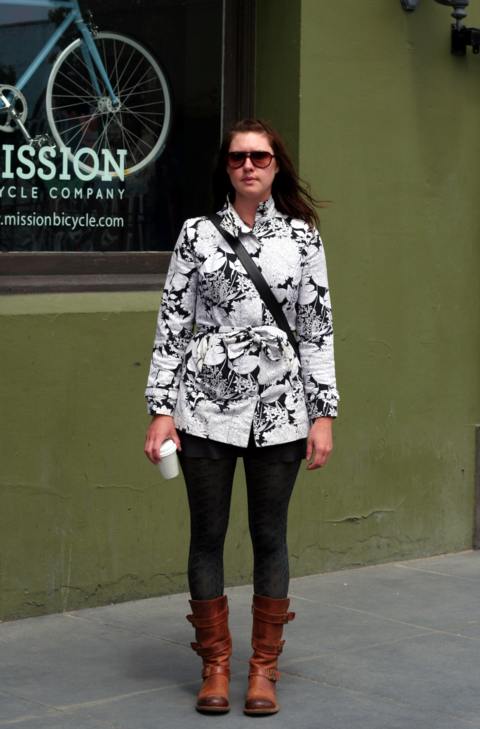
Today’s Look: Corrin, 18th Street and Valencia

Tell us about your look: This is a vintage jacket, and the boots are Doc Martens

Feliz cumple, Tamale lady!

0

Jack Daniels and I were hanging out late last week at the 500 Club when in she came. No one was particularly hungry, but when the Tamale Lady’s there, the Tamale Lady’s there, so we ate. And along with my cheese and rajas ‘male, she passed me a flier. “Virginia, it’s your birthday next week?” It was, and to celebrate, her traditional fiesta/documentary is going down at Zeitgeist Mon/21.

Writing about the Tamale Lady is frustrating, because what angle, exactly, are you going to take? She makes delicious tamales? Well obviously. She is nice to punks, and hooligans? Anyone who has ever taken a bench at Zeitgeist can tell you that. I went ahead and enlisted her documentarian, Cecil B. Feeder, to help make this blog post interesting.

“I love her tamales, I always have.” Great, thanks Cecil. Actually, he did have a theory as to her continued late night allure. “I think she’s human enough to know that it doesn’t matter what people think of you – it’s what you think of yourself.” And if what you think of yourself is drunk and hungry, well than you’ve found your savior in Virginia “Tamale Lady” Ramos.

Feeder will be screening his 2004 film on Virginia’s life, “Our Lady of Tamale,” on the patio wall of the Zeit at Monday festivities – the same place he debuted the movie six years ago, on the night that big wooden “Tamale Lady” plaque was first erected near the front door inside the Zeitgeist bar. Where’d that thing come from, anyway?

According to Ramos, the plaque was made for a SOMarts benefit for a man with cancer many years ago that she catered. After the party, she took it home, but when she showed up for her film debut/birthday party, she found the sign hanging near Zietgeist’s formidable selection of draft beers and famously surly bartenders. “I said ‘who brought my board in here!’ ” Ramos told me. Turns out, her kids had put it up there to honor her. “I’m telling you, I don’t know why they bring it out here!”

She kind of wanted it back. But to be honest, it looked nice up there, and Ramos concluded that the man for whom the original benefit had been thrown (who has since passed away), had engineered its placement in spirit. “I realized he wants to keep it over there, because he wants people to know my name,” she says. A tamale lady’s work, she realized, is never done.

A word about Mr. Feeder’s involvement – after seeing his flick Meter Maid Me Massacre (introduced on his Youtube as “ “The Gone with the Wind” of kung fu zombie movies”), Ramos approached him about making a documentary of her life. What exactly drew Ramos to Feeder’s vision of parking ticket revenge? Has Ramos had issues of her own from past times improperly parking her tamale wagon?

Well, we’re not really sure. “I always thought she was ambitious, you know?” Feeder told me over the phone. “At the time, I had just started making films. I thought about it and I said, ‘you know what Virginia, I don’t think we can make a straight documentary – but we can make a rockumentary!’ ”


And a rockumentary was made.

Our Lady of Tamale is comprised of scenes from the life of Virginia, backed by over 50 songs composed by local musicians especially for the occasion. They debuted it at the Zeit in honor of her 50th birthday party – a tradition that continues on Monday, with another screening of the film, some additional Feeder shorts, and a performance by his band.

Oh, and there will be free booze, according to Feeder. “Speakeasy and Zeitgeist are donating beer, four kegs flowing until they’re gone!” Some of the proceeds from the night (should those kegs be tapped), will go to Feeder’s plane ticket to Bolivia, where he’s in the midst of filming a documentary about an Engineers Without Borders project in progress.

“Hey Honey, It’s My Birthday!”: The Tamale Lady’s 57th Birthday Celebration
Mon/21 6-10 p.m., free
Zeitgeist
199 Valencia, SF
(415) 255-7505
www.cecilbfeeder.com
www.zeitgeistsf.com

A very cinematic Juneteenth: previews from the SF Black Film Festival

0

General Gordon Granger could hardly have known that by signing General Order No. 3 into effect that sunny June 19th, 1865 in Galveston, Texas, he’d be providing an occasion for San Francisco’s young black filmmakers to share their artistic voice. He (most likely) didn’t appreciate that Juneteenth – as the day would come to be called – would mark a time for Bay area African Americans to reflect on the past, present, and future of their community. Probably not. But we get it. So as you munch your popcorn through these previews of the stories screening at this year’s San Francisco Black Film Festival (Thurs/17-Sat/19), take a moment to think on history’s – often unseen – framing of today.

Sounds of Poetry

When I first watched this preview, the young poet’s eloquence struck me. Child actors these days are something else, I thought. But Dawntavia Butler, who plays the lead role of Monique, a girl striving to rise above her mother’s addictions, is only half acting. Filmmaker Henderson Maddox based the script of Sounds of Poetry on Dawntavia and her sisters’ real life experiences at home. In light of the challenges she faced, Bullard’s spoken word performance takes on new meaning.

Flags, Feathers, Lies

The Mardi Gras Indians is a long standing tradition in New Orleans, a group that honors the role Native Americans played in helping slaves escape their bondage. But ask around at the parades these days – nary a party goer knows their name. Filmmaker Pablo Palacios makes the connection between the disappearing Indians with the devastating displacement Katrina left in its wake.


Mountains That Take Wing: Angela Davis & Yuri Kochiyama

Sure, you know about Angela Davis. But what about Yuri Kochiyama, who was interned with her family during World War II, and grew up to join the struggle for Puerto Rican independence, liberation of political prisoners, and nuclear disarmament? What about what those two civil rights leaders would chat about, if they got the chance to hang? Mountains That Take Wing is here for you so that you can find out.


Trapped Haitian Nights

Of course, it’s not all civil rights and social problems. Take this action packed suspense, the last movie shot in Haiti before the disaster. The plot follows Vivica A. Fox investigating the murder of a doctor’s wife, a yellow boa, and rumors of voodoo craziness.

San Francisco Black Film Festival

Thurs/17-Sat/19

various venues and times, SF

(415) 400-4602

www.sfbff.org

Street Threads: Look of the Day

0

Today’s Look: Sara, 30th Street and Mission

Tell us about your look: “Relaxed and sunny”

The Daily Blurgh: Frat douches, crank callers, Marx on soccer

0

Curiosities, quirks, oddites, and items from around the Bay and beyond

Meg Whitman’s son is an asshat (surprised?).

*****

City passes moibile phone radiation law. As if you didn’t already know that your iThing was going to cause ear cancer.

*****

Report finds that UC Berkeley mishandled the police response to student protests in November. This wouldn’t be the first time.

*****

People have too much time on their hands: “Prosecutors say 53-year-old Kurtis Thorsted broadcast more than four dozen hoax distress signals over six months in 2008, costing the Coast Guard more than $102,000 for attempted searches. Thorsted pleaded guilty to broadcasting the “mayday” calls from his Salinas home and telling would-be rescuers he was stranded in an offshore kayak.”

*****

Terry Eagleton on soccer is no where near as fun as Roland Barthes on wrestling.

*****

Speaking of the World Cup, that buzzing sound you keep hearing during matches isn’t an incoming swarm of killer bees. Rather, its your new favorite spelling bee challenge: the vuvuzela.


Quick Lit: June 16-June 22

0

Literary readings, book tours, and talks this week

Voices of James Joyce, Fungi-Inspired Poems, The Queer Art of Failure, well read women, and more.

Wednesday, June 16

“The Voices of James Joyce”
It’s the 9th annual Bloomsday Celebration, an evening of readings of old and new favorites from Joyce’s Ulysses and Dubliners with traditional song and music. Performances by actors Robert Ayres, Bruce Bierman, Renee Gibbons, Oonagh Kavanagh, Laura Sheppard, and Maurice Wren.
7 p.m., $12
Mechanics’ Institute
57 Post, SF
(415) 393-0100
www.milibrary.org

Thursday, June 17

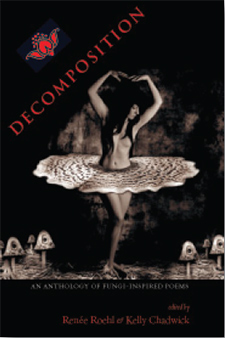
Decomposition

Celebrate mushrooms in poetry at this reading from the new anthology, Decomposition: Fungi-Inspired Poems, a collection of classic and comtemporary mushroom poems.
7 p.m., free
Ecology Center Store
2530 San Pablo, Berk.
(510) 548-3402

InsideStorytime Legends
Enjoy readings from Christina Sunley, author of The Tricking of Freya, Anne Finger, author of Call Me Ahab, Nicholas Nicastro, author of Antigone’s Wake, and others.
6:30 p.m., $3-$5 sliding scale
Café Royale
800 Post, SF
(415) 505-0869
www.insidestorytime.com


Lee Kravitz

The former editor of Parade presents this memoir about his mid-life journey to tie up loose ends titled, Unfinished Business: One Man’s Extraordinary Year of Trying to Do the Right Things.
7:30 p.m., free
Books Inc. Alameda
1344 Park, Alameda
(510) 522-2226

Eric Poole
Poole will read from his new memoir about his childhood in the Midwest in the 1970s, Where’s My Wand.
7:30 p.m., free
Books Inc.
2275 Market, SF
(415) 864-6777

“The Value of Stuff”
Attend this unique conversation with Anne Leonard, author of the book and popular movie The Story of Stuff, and Raj Patel, author of The Value of Nothing.
7 p.m., $10-$20 suggested donation
The David Browner Center
2150 Allston, Berk.
http://earthisland.org/events/stuff

Friday, June 18

The Madonnas of Echo Park
Author Brando Skyhorse gives voice to the Mexican-American community of Echo Park, CA.
7 p.m., free
Books Inc. SF Opera Plaza
601 Van Ness, SF
(415) 776-1111

The Velvet Rage
Popular psychologist and author Alan Downs reads from his ground breaking new book.
7:30 p.m., free
Books Inc. Castro
2275 Market, SF
(415) 864-6777

Saturday, June 19

Backseat Saints
Joshilyn Jackson presents this novel full of sly wit and off-kilter characters.
7 p.m., free
Books Inc. Berkeley
1760 4th St., Berk.
(510) 525-7777


The Daddy Shift

Celebrate Father’s Day early at this discussion and reading with author Jeremy Adam Smith of his new book, The Daddy Shift: How Stay-at-Home Dads, Breadwinning Moms, and Shared Parenting Are Transforming the American Family. Smith with also be joined by authors Jeff Gillenkirk and Mike Adamick.
5 p.m., free
The Green Arcade
1680 Market, SF
(415) 431-6800

Watermark
Meet author Vanitha Sankaran at this reading and signing of her new book about the mute daughter of a papermaker in a small French village in 1320.
2 p.m., free
Borders
200 King, SF
(415) 357-9931

Monday, June 21

Burning Wire
Jeffery Deaver presents his newest Lincoln Rhyme novel, about the brilliant criminologist and his partner.
7:30 p.m., free
Books Inc. Alameda
1344 Park, Alameda
(510) 522-2226

Visit from the Goon Squad
Jennifer Egan brings us a book about time, survival, and the sparks ignited by colliding destinies.
7:30 p.m., free
Books Inc. Marina
2251 Chestnut, SF
(415) 931-3633

Well-Read Lives
Author Barbara Sicherman will read and discuss her new book Well-Read Lives: How books inspired a generation of American Women.
5:30 p.m., free
University Press Books
2430 Bancroft, Berk.
(510) 548-0585

Women, Food, and God
Geneen Roth talks about overeating and the underlying reasons for using food as an emotional buffer.
7:30 p.m., free
Books Inc. Berkeley
1760 4th St., Berk.
(510) 525-7777

Tuesday, June 22

Face to Face: Children of the AIDS crisis in Africa
View a slideshow about the AIDS crisis in Africa with authors Ruthann Richter and Karen Ande. Co-sponsored by the Orphan Support League and in conjunction with a local gallery.
7 p.m., free
Books Inc. Berkeley
1760 4th St., Berk.
(510) 525-7777

“Sizzle!”
Enjoy this month’s enstallment of  Femina Potens’ literary series
“The Queer Art of Failure.” Featuring Jack Halberstam, author of Female Masculinity, providing his unique perspective on Genderqueer life.
8 p.m., $10
Femina Potens Art Gallery
2199 Market, SF
http://feminapotens.org

Before I die, if printing still exists: An interview with Daniel Clowes

0

By Sam Stander

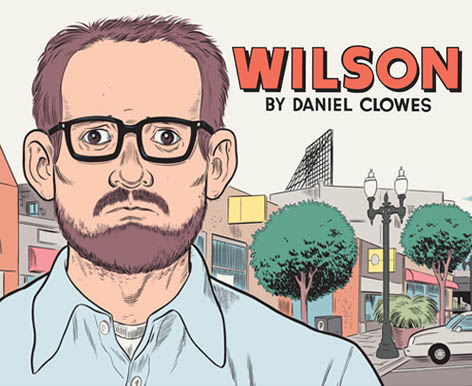
Daniel Clowes has made the leap over the past decade from underground comics hero to a more mainstream identity, with an Oscar nomination for screenwriting, several New Yorker covers, and a comic serialized in the New York Times Magazine under his belt. Despite his raised profile, his newest work, Wilson (Drawn and Quarterly, 80 pages, $15.37), comes closer to home than ever before. The cynical comic strip-based book is largely set in Oakland, of which he is a proud denizen. Clowes recently appeared at Diesel in Oakland, in conversation with McSweeney’s editor Eli Horowitz and the audience. On the setting of the comic, he proclaimed, “I’m pro-Oakland, I’m not sure Wilson is.” He also discussed his forays into film, his debt to Charles M. Schulz and R. Crumb, and the slight controversy over his recent New Yorker cover, among other things.

A lengthy signing followed, where fans presented everything from freshly purchased copies of Wilson to old favorites like David Boring to collector’s items like Lout Rampage for signing. Once the line had dwindled, Clowes sat down for a one-on-one interview.

San Francisco Bay Guardian One of the things I wanted to ask you, if the Oakland observations haven’t been beaten into the ground, was that you also used to live in Berkeley, right? When you were writing Ghost World?
Daniel Clowes Yeah, I was living up by College and Ashby.

SFBG Why are you explicitly writing about Oakland now, and why did you choose to live in Oakland? What do you see as the differences between the different areas?
DC It’s funny, I sort of wound up in Oakland by default. We were living in Berkeley, because my wife was going to Berkeley, and our landlord doubled our rent one month, which I actually didn’t think was legal. And so we said, well, maybe we should try to buy a house. This was years ago. We looked all around Berkeley and it was really expensive, and we found this neighborhood in Oakland that we didn’t even know about, over where we live now, and wound up buying a house there.
You know, I never really thought about Oakland. Even living there for two or three years, I thought, well, we’re near San Francisco and Berkeley. Then I started to walk around and embrace the idea of Oakland. I kind of learned to like Oakland above all its other surrounding cities. I’ve gotten to the point where I almost never go to San Francisco. It’s like, I go to LA more than I go to San Francisco. I just don’t relate to San Francisco at all, and somehow Oakland feels — I grew up in Chicago, and Oakland has this kind of second-tier quality that I find appealing.

SFBG Second-tier?
DC It’s not San Francisco. It’s [its] ugly sister across the Bay, and I prefer that somehow. I was in New York recently, and I was on a block in the Upper East 70s, I think, and I was looking around and I realized every building on the block was a beautiful art deco building built in the ’20s. And I thought, well, Oakland has one building like that. It has the Bellevue-Staten down by Lake Merritt. That’s it. But I’d prefer that, because, to see 20 of them, it has no impact anymore. It’s just, wow, a lot of buildings, and your brain can’t grasp that. But somehow I’m obsessed with this one building in Oakland and I know all about it. I can fixate on that one thing, so I like a city that has one of everything rather than hundreds of the same thing.

SFBG One of the strips in Wilson is him talking about all the bookstores closing down. I was wondering if that was you speaking through him at all, and if so, what bookstore are you saddest to see close down?
DC Well, that was really all about Cody’s. My wife worked at Cody’s, and when I moved here, I sort of agreed to move to Berkeley with my wife because of Cody’s. I thought that [was] something I needed, this world-class bookstore. It was sort of the focal point of my life for many years. I would go there two, three times a week and see what was new, and it just felt like the focus of my world in a way. And when it closed down, it was really hard for me to accept. It was like, you know, you always hear stories of guys who talk about their baseball team leaving town. The guys from Brooklyn are like, “The Dodgers left town in 1958,” or whenever it was. It felt like that to me…Still, when I go to downtown Berkeley and see that empty building, it seems so awful. It seems just like an awful thing that the world couldn’t support that.

SFBG At least it didn’t become a CVS.
DC Exactly.

SFBG [There] was a brief interlude where it was going to be a CVS.
DC Yeah, that’s true. There is that. At least the tomb of Cody’s is still there. And you think, “Well, somebody could just reopen it. Why not? Nobody’s paying rent.”

SFBG Looming over Moe’s.
DC Yeah, I should count my blessings. At least Moe’s is still around, and this place. Better than most cities.

SFBG You were talking about Wilson sort of materializing as a character, [that] you didn’t know who he was at first, but that it was you interacting with him. I was wondering if you’ve ever had experiences with a character who you didn’t have such a productive relationship with, or if you’ve ever had characters who worked against you?
DC Oh, that’s a good question. It’s more that they just run out of — it’s usually a character that I’ve kind of predetermined. Like, I need a character who’s a certain type of person to fit into a story, like, “I need a comic relief character.” Something where you have a role for them, and then they’re never that interesting. I find the best way to do it is to just let the characters come naturally. If they’re forced at all, they tend to [be] artificial. They have to seem like real people. There are characters that I’ve written the hell out of for page after page and they never quite are real people to me. Those are the things that never work, and that I usually have the good sense to throw away before they see print. [Laughs]

SFBG You’ve always had a really strong interest in perversity and human weirdness, and that’s not so central in Wilson. Was that a conscious move away or a permanent move away, or just a change in interests?
DC I think that’s true, you know. I always had a real interest in outsider culture. When I first began doing comics, that kind of thing was so inaccessible. I had a little group of friends who would send me all these weird things. You’d find out about little groups of people who were all linked together by some really odd interest, but they were so segregated. They’d maybe have some little newsletter that they all communicated through, but it felt like the world was filled with these little secret societies. And ever since the Internet has taken hold, it doesn’t feel like that anymore. It feels like the minute anybody hears about any weird little perversion or interest or anything like that, that everybody finds out about it and they know all about it, so it’s sort of lost its interest.
Also, having a child, you sort of reassess what you’re interested in, and you think, would this make me proud for my son to find my collection of books of pictures of freaks, or whatever? You just think, “Ehhh, I’m not sure I want to stand behind that.” Certain [times], you [decide] “I really do think this is cool and I will defend this,” but you weed out a lot of things that were just there because they would get a good reaction out of people.

SFBG Possibly spinning off from that question, but on another angle: You said [during the Q&A] that, specifically, no filmmaker has a strong specific influence on you, but certain films or certain scenes do. Are there any films or scenes you have in mind for Wilson or any of your other works?
DC I feel like Wilson is very non-filmic as far as most of my books go. It’s not about the images at all. A lot of my comics come from ideas that are images, that then turn into stories. Like David Boring and the Velvet Glove thing, and even a little bit of Ghost World. But Wilson was really all about this guy. If it were a movie, it would be more like a Mike Leigh movie or something than a Stanley Kubrick movie. [Laughs]

SFBG And you were saying that to make it into a film would be a strange format for a film.
DC It would be a strange format. I mean, you could certainly rethink it as a story about a guy, and sort of have the same elements, but to replicate the feel of the book would be a very odd thing. That’s the beauty of comics, is you can do all those different styles and they actually resonate off of each other, and even a really amateurish reader, a non-reader of comics, can tell the difference between the styles, whereas in a movie it’d be very hard to do different styles. Only film experts would get that you’re doing, you know, Michael Bay and then Alfred Hitchcock, or whatever.

SFBG Have you seen Natural Born Killers?
DC Yeah, that’s a perfect example.

SFBG Where it’s kind of off-putting at the end of the movie.
DC Right, it’s just a little irritating. Although I think that was the idea, I suppose. I haven’t seen that movie in a long time, I bet it’s really irritating now.

SFBG I’ve never seen all of it, actually. I’ve had friends show me parts.
DC I barely could tolerate it in theaters.

SFBG Woody Harrelson and Juliette Lewis are —
DC Yeah, she’s great. I like him, too.

SFBG In the right role.
DC Yeah, yeah.

SFBG Somebody was asking you about drawing eyes and mouths and conceiving of how people look in each panel, and you were saying that you do [stick-figure] sketches beforehand. How much do you script or plan out or storyboard versus just drawing a comic?
DC It depends on, not even the story, but just on my mood before I start. I usually try to do each story somewhat consistently, but I’m always trying to come up with a new way to do things. Not to be different or to give myself a challenge, but [because] I’m looking for a better way to work. And I always have this carrot dangling in front of me that there’s some other way, that if I could only find that way, it’ll make everything easy. And then it never does, and it always comes out exactly the same, no matter if I script the thing carefully or if I make it up off the top of my head. I could show those comics to a hundred people, and they would have no idea what was the planned-out one and what was the one I just made up. It all turns out the same. And I think that’s true of most artists. You can’t really tell what they’re going through, it’s just their work is always them, you know.

SFBG Do you always get a stack of other people’s works [at signings]?
DC [Holding a thick stack of various printed matter presented by fans] This was a good stack, I’d have to say. Often it’s much more, like, Xeroxed stuff. This actually looks like some pretty decent stuff that people have actually printed up. But yeah, usually you get a big pile of stuff, although not as much anymore, because a lot of people don’t print anything. So now I get business cards, like, “Check out my webcomic.” I have to go type it in at home.

SFBG You have the thing in the little author’s bio in Wilson about [how] you have danielclowes.com reserved.
DC That’s right.

SFBG Do you have any ideas for using that, or anything you want to use it for?
DC Well, my publisher actually said, “Now you have to put something on there, since you said that in the book.” So they just put an ad for Wilson that links right back to their website. I don’t want to get into doing, like, a blog or responding to people, ’cause my life is already so taken up by just responding to e-mails from my friends that I can’t imagine introducing a whole ’nother element of that. But it would be good to make announcements, and just to clarify things. I feel like the average reader doesn’t understand that I used to do a comic called Eightball and the stories were serialized — I figure if there’s some way [to] really concisely explain my career, then I won’t have to explain it to everybody over and over. [Laughs]

SFBG Are the original sequences of Eightball ever going to be made available again, and things that aren’t collected?
DC One of these days we’re going to do the complete Eightball, and do like a hardcover thing, but that’s nine projects down the road or something. But before I die, if printing still exists.

SFBG As far as film projects, is there anything on the horizon or anything you’re excited about working on?
DC With Ghost World, I learned, don’t tell anybody about your film projects until they have a release date. I used to tell people, “Oh, they’re going to make a Ghost World movie,” and then five years later, they finally actually made it. I felt like such a chump. But I wrote a screenplay for this thing that Michel Gondry came up with, this crazy dystopian sci-fi epic. I wrote a script based on his ideas. His son is going to do the drawings for it. I’m not animating it, but I think he wants to do that as his next film, so that should be fun, if that actually happens.

SFBG Have you ever done any animation?
DC I did a video for the Ramones in 1995, and that was it.

SFBG Would you ever do it again?
DC Yeah, I’d like to, I’d like to. I need to sort of come up with an idea that’s only appropriate for animation, and then actually try to get somebody interested in producing it. So there’s lots of hurdles there. [Laughs] But yeah, I’d love to. I feel like I should do that one of these days.


Happy birthday to the Marsh!

0

The Marsh hits the big two-oh this weekend. The one-of-a-kind theater founded by Stephanie Weisman in 1989 has contributed much more than its fair share to performance arts in the Bay Area and beyond. To mark the event, the Marsh is planning a one-of-a-kind celebration this Saturday, June 19: 12 continuous hours of performance, memories, and festive behavior featuring a remarkable assortment of talent under one roof. Seriously, if these were heads of state it’d be like the G20 times two, and the security hassles would suck hard for blocks around. As is, you can just go and watch and talk to these people, who are way cooler anyway.
 
For more of the lowdown on the birthday plans and insider thoughts on the Marsh at 20, I had thought of talking to a dozen or so of the leading lights slated to be there. But not having a lot of energy this morning, I decided instead to just call Mary Samson — currently crafting her own Marsh solo show and one of Saturday’s Marathon MCs — at her daytime desk at the Guardian.

[ringing]

Mary: Hello, this Mary Samson.

Me: Hi Mary, it’s Rob.

Mary: I already had lunch.

Me: No, I wasn’t going to ask about lunch.

Mary: I’ve got dinner plans too, and a reeeally long yoga class on either side of that.

Me: No, Mary, I just wanted to ask about the Marsh.

Mary: Oh, the Marsh! Shoot.

Me: I understand you’ll be MC’ing a portion of this Saturday’s mammoth 20th-anniversary marathon and wondered if … wait a minute. You already had lunch? But it’s only 10:00.

Mary: So call it brunch. What’s your point?

Me: Well, this is a really big deal, isn’t it?

Mary: That’s right, Ron.

Me: Rob.

Mary: The Marsh has been a hotbed of solo performance for two decades. It’s helped launch the careers of some of the best talent to emerge from the Bay Area since Boss Ruef. And about 40 of them will be there between 12 noon and 12 midnight this Saturday — including Marga Gomez, Charlie Varon, Josh Kornbluth, Francesca Fanti, Brian Freeman, Jeff Greenwald, Joan Mankin, Bob Ernst, Dan Hoyle, Merle Kessler, Don Reed, Ann Randolph, Ron Jones AND my personal favorites Liz White Salk and Mark McGoldrick!

The Marsh’s 20th Anniversary and Performance Marathon

Sat/19, noon-midnight, $20-60

Marsh, 1062 Valencia, SF

www.themarsh.org/performance_marathon.html                                                                                                                                                                                               

Street Threads: Look of the Day

0

Today’s Look: Ibolya, Cortland and Coleridge

Tell us about your look: “I’m going to a school graduation.”

Summer in bloom

0

By Sam Stander

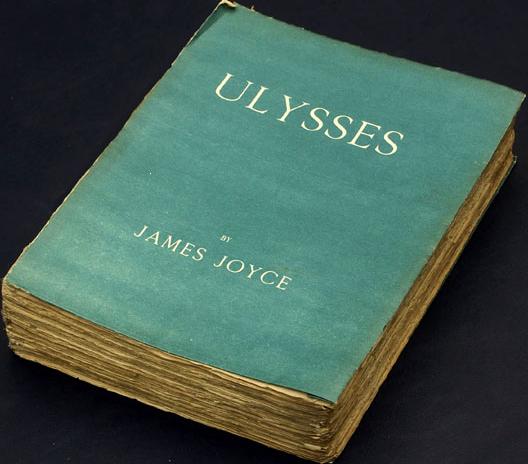
It’s that time of year again! You know, the time when Ulysses happens. That’s right, it’s Bloomsday, the holiday commemorating James Joyce’s epic modernist tome, ranked by the Modern Library as the greatest novel of the 20th century. The novel’s events span a single day — June 16, 1904, the date of Joyce’s first date with his future wife, Nora Barnacle.


Though the epicenter of all things Bloom-related is, for obvious reasons, Dublin, San Francisco hardly skips out on the fun. The Mechanics’ Institute Library is hosting ”The Voices of James Joyce: Readings from Ulysses and Beyond #2,” their ninth annual Bloomsday event. It will feature readings and musical performances, as well as a “special Bloom’s Menu” at the Mechanics’ Saloon.

http://www.youtube.com/watch?v=YbMOhRL6wsA

The Voices of James Joyce: Readings from Ulysses and Beyond #2
7 p.m., $10-$12
Mechanics’ Institute Library
57 Post, SF
(415) 393-0114
www.milibrary.org

Love stories, politics, yodeling, and more: Frameline 34 short takes

2

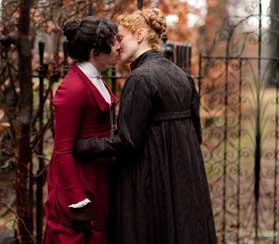
The Secret Diaries of Miss Anne Lister (James Kent, UK, 2010) A BBC production set in the northern English countryside of the early 19th century, James Kent’s The Secret Diaries of Miss Anne Lister depicts the amatory adventures of a gentlewoman landowner (Maxine Peake) in search of a “female companion” with whom to live out her days. The narrative is somewhat breathless, the seductions equally so and yet a bit anemic, and our strong-willed, fearless heroine is admirable without being entirely engaging. Still, besides tapping into the Jane Austen slash fiction demographic, this tale of pre-Victorian bodice ripping and skirt lifting among the female gentry offers the considerable thrill of being adapted from the actual secret diaries of the titular Miss Lister, decoded by a biographer 150 years after her death. A documentary in the festival, Matthew Hill’s The Real Anne Lister, offers a complementary version of her story. Thurs/17, 7 p.m., Castro. (Lynn Rapoport)

I Killed My Mother (Xavier Dolan, Canada, 2009) The title I Killed My Mother suggests a different kind of movie from what it actually is. But that’s OK: though not a crime thriller, the film is still a tightly wound, high stakes drama. Writer-director Xavier Dolan stars as Hubert, the angsty son of the titular mother. When you consider that Dolan’s script is autobiographical — and that he was only 20 when the film was made — his performance becomes all the more impressive. As the mother, Chantale, Anne Dorval is also a force to be reckoned with. Despite its presence as part of a queer film festival, I Killed My Mother is not all that “gay” in the traditional “gay movie” sense. Hubert’s relationship with Antonin (François Arnaud) is secondary — what’s important is how his refusal to share it with his mother affects her. That helps make the movie a refreshing alternative to many more mainstream offerings. Sat/19, 6:45 p.m., Castro. (Louis Peitzman)

The Owls (Cheryl Dunye, USA, 2010) Expectations are high for The Owls: writer-director Cheryl Dunye again collaborates with Guinevere Turner, V.S. Brodie, and other notable queer performers — you can’t not think of classics like Go Fish (1994) and The Watermelon Woman (1996). The Owls isn’t quite at that level, but it’s a fairly thought-provoking piece. Four middle-aged lesbians — played by Dunye, Turner, Brodie, and Lisa Gornick — accidentally kill a younger lesbian and try to cover up the murder. Their ages are central: the fear of getting older is a major thematic concern. So, too, ideas of gender identity, with the introduction of androgynous Skye (Skyler Cooper). But Dunye breaks the fourth wall, staging her film as a pseudo-mockumentary with both the characters and the actors offering commentary. At just over an hour, The Owls can’t sustain all the back-and-forth, and too many intriguing ideas are left unfinished. Fri/18, 7 p.m., Castro. (Peitzman)

The Topp Twins: Untouchable Girls (Leanne Pooley, New Zealand, 2009) It’s hard to name an American equivalent of New Zealand’s Topp Twins — a folk-singing, comedy-slinging, cross-dressing duo who’re the biggest Kiwi stars you’ve never heard of (but may be just as beloved as, say, Peter Jackson in their homeland). Recent inductees in the New Zealand Music Hall of Fame, the fiftysomething Jools and Lynda, both lesbians, sing country-tinged tunes that slide easily from broad and goofy (with an array of costumed personas) to extremely political, sounding off on LGBT and Maori rights, among other topics. Even if you’re not a fan of their musical style, it’s undeniable that their identical voices make for some stirring harmonies, and their optimism, even when a serious illness strikes, is inspiring. This doc — which combines interviews, home movies, and performance footage — will surely earn them scores of new stateside fans. Sun/20, 3:45 p.m., Castro. (Cheryl Eddy)

Out of the Blue (Alain Tasma, France, 2007) Wearily preparing for a dinner party on a day they’ve both forgotten is their anniversary, Marion (Mireille Perrier) suddenly realizes her 22-year-marriage to Paul (Robin Renucci) is dead. Her decision to end it, however, comes as an infuriating surprise to him and a destabilizing one to their teenage daughter Justine (Chloé Coulloud). They all get quite a surprise when Marion’s new friendship with younger, flamenco-dancing female antiques dealer Claude (Rachida Brakni) turns into something more. This latest in a long line of very good French made-for-TV dramas at Frameline typically handles its complex load of familial and sexual issues with grace and intelligence, if with an occasional excess of high dramatics. Sun/20, 9:30 p.m., Roxie. (Dennis Harvey)

The Consul of Sodom (Sigfrid Monleón, Spain, 2009) Late Spanish poet Jaime Gil de Biedma was many things: an intellectual, aesthete, hedonist, bohemian, discotheque owner, Communist sympathizer (though the Party wouldn’t have him), publisher, more-or-less out gay man, and an occasional lover of flamboyant women like Bel (played by pop singer Bimba Bose). Sheltered by wealth and privilege — to the extent possible in Franco’s Spain — he dabbled in ghetto flesh, sometimes on trips abroad for his family’s tobacco family. As portrayed by actor Jordi Mollá and director Sigfrid Monleon, he’s a mixture of arrogance,
compassion, self-destruction, and shark-like perpetual motion. Seldom missing a chance to drop some full-frontal nudity or a kitschy period song (from 1950s to 80s), this biographical drama — which has been decried as overly sensationalized by some Spanish cultural watchdogs, including a few of the subject’s surviving cronies — is a shamelessly flamboyant and entertaining portrait of a life lived large. Sun/20, 9:30 p.m., Castro. (Harvey)

Dzi Croquettes (Tatiana Issa and Raphael Alvarez, Brazil, 2009) Whatever magic fairy dust fuelled the Cockettes’ glitter-covered hippy drag must’ve drifted down south to Brazil to inspire the similarly named Dzi Croquettes. Of course, that’s not the real origin of the equally colorful cabaret troupe, whose fantastic story is told in Raphael Alvarez and Tatiana Issa’s riveting and rollicking documentary. Blending Ziegfeld Follies-style glamour with agitprop, Dzi Croquettes were more polished and more overtly political than their North American sisters; something which frequently landed the group in hot water with José Sarney’s dictatorship. Finding an unlikely and unexpected advocate in Liza Minnelli, Dzi Croquettes fled their homeland in the mid 70s, becoming the unexpected toast of Europe until AIDS began to take its toll. Filled with delightful archival footage and insightful interviews with alumni, Dzi Croquettes is a joyful affirmation of the power of art (and a feathered boa or two) to effect positive change. Mon/21, 11 a.m., Castro. (Matt Sussman)

Brotherhood (Nicolo Donato, Denmark, 2009) It’s hard to feel much sympathy for neo-Nazis. Perhaps that goes without saying, but Danish film Brotherhood asks us to do just that: Lars (Thure Lindhardt) and Jimmy (David Dencik) meet in the service of Hitler’s ideals, then find themselves drawn to each other. As they struggle to come to terms with their attraction, we’re supposed to care. Fat chance. Although Lars initially disproves of the neo-Nazis, he becomes quickly (read: unrealistically) interested in their cause. Soon, he’s writing his own anti-Pakistani propaganda. And Jimmy is devoted to the movement from the get-go, even condemning “faggots” despite his own same-sex attraction. Maybe I’d feel differently if either Lars showed any sign of internal conflict. Neither displays a sense of regret over being a racist, xenophobic, anti-semitic asshole. They’re down with the gay but only in relation to each other. Who gives a crap if these two make it work? Mon/21, 9:30 p.m., Castro. (Peitzman)

Plan B (Marco Berger, Argentina, 2009) It’s the oldest story in the book: boy meets girl, boy loses girl, boy seduces girl’s new boyfriend. OK, maybe not, but the set-up isn’t entirely unheard of either. It’s a credit to Plan B’s sharp aesthetic and strong performances that it still feels fresh. The Argentinean export stars Manuel Vignau as Bruno. When his girlfriend Laura (Mercedes Quinteros) breaks up with him, he decides to get revenge by making his move on Laura’s supposedly bisexual boyfriend Pablo (Lucas Ferraro). If you’ve seen any romantic comedy ever, you know that what begins as a game for Bruno becomes true love. But Plan B doesn’t go the comedy route, and instead offers a compelling, somewhat subtle drama. The love affair is slow but well-paced, so that the inevitable conclusion feels earned and completely satisfying. Mon/21, 9:30 p.m., Elmwood; June 24, 6:30 p.m., Victoria. (Peitzman)

Undertow (Javier Fuentes-León, Peru, 2009) This sexy and delicate drama is a bisexual triangle that continues beyond the grave. In a Peruvian coastal hamlet, fisherman Miguel (Cristian Mercado) loves his pregnant wife and fellow church leader Mariela (Tatiana Astengo). But he’s also having a secret, passionate affair with Santiago (Manolo Cardona), an urbanite who moved there to paint the land- and seascapes, and who chafes at the restrictions Miguel places on their relationship. At a certain point one character dies, and writer-director Javier Fuentes-León seamlessly handles Undertow’s transition to magical realism. The leisurely story doesn’t go where one expects, ending on a perfect grace note of bittersweet acceptance. Tues/22, 7 p.m., Castro. (Harvey)

Children of God (Kareem J. Mortimer, Bahamas, 2009) Likely the first gay-themed film not just shot in but produced by the Bahamas, Kareem J. Mortimer’s first feature is an occasionally heavy-handed but consistently engrossing mix of romance, religion, and homophobia. Johnny (Johnny Ferro) is a withdrawn Nassau art student who’s a target of gay taunts and bashers. A teacher who says his paintings lack emotion gives him keys to her cottage on the “ultimate landscape” of isle Eleuthera, where he promptly meets the aggressively friendly and inquisitive Romeo (Stephen Tyrone Williams). Also headed here is Lena (Margaret Laurena Kemp), righteous wife of pastor Ralph (Ralph Ford), with whom she shares a strong penchant to publicly denounce the moral threat of “the gays.” She has, however, just left her husband after he furiously denied giving her VD — to confess might reveal that he is, in fact, playing around on the downlow. That’s just the starting point for a complicated, perhaps over-ambitious but sometimes powerfully sensual and poignant film that is definitely amongst this year’s Frameline highlights. June 23, 9:30 p.m., Castro. (Harvey)

Spring Fever (Lou Ye, China, 2009) Shot surreptitiously and chock full of gay sex, Chinese director Lou Ye’s latest film isn’t likely to earn him any additional slack from Chinese government censors (his 2006 film, Summer Palace, got him banned from filmmaking for five years after he failed to preview it before it screened at Cannes). Using hand-held cameras, public settings, and natural lighting, Lou follows Wang Ping (Wu Wei), who’s been having a passionate, messy affair with travel agent Jiang Cheng (Qin Hao). Things get more complicated when the snoop Wang’s wife hires to follow her closeted husband winds up pursuing the two men in ways he never imagined. What Spring Fever lacks in continuity and psychological depth, it makes up for with sexual candor and a genuine frisson of risk, given the secretive conditions under which it was made. That thrill doesn’t quite last through the film’s duration, but as a document of defiance Spring Fever is commendable. June 24, 9:30 p.m., Castro. (Sussman)

The String (Medhi Ben Attia, France/Belgium, 2010) The cross-cultural coming out drama is a perennial at LGBT film festivals, but Medhi Ben Attia’s assured debut feature presents a familiar tale in new surroundings with flashes of charm. Handsome architect Malik (Antonin Stahly) returns to his posh, Tunisian homestead from France to lay his father to rest, fully intent on coming out to his overly doting, oblivious mother (former Fellini muse Claudia Cardinale). But when he falls for hunky house-boy Bilal (Salim Kechiouche), he finds that the truth has a way of outing itself. Although Attia unspools his film’s titular metaphor rather quickly (having hid his true feelings for so long, Malik feels continuously “tied-up” by a piece of imaginary string), he deserves credit for his nuanced portrayal of gay life in the Maghreb and his inspired casting of Cardinale, who can’t help but radiate an Auntie Mame-ish joie de vivre even when the script calls for “disappointed” over “daffy.” June 25, 7 p.m., Victoria. (Sussman)

Hideaway (Francois Ozon, France, 2009) The very French insouciance with which Francois Ozon usually treats his characters and narratives sometimes makes a film seem perilously slight — yet more often than not he manages to pull off a surprising climactic resonance. Which is the case with this latest. When they both overdose on heroin, Mousse (Isabelle Carré) wakes up pregnant in the hospital — but her boyfriend doesn’t wake at all. Declining his mother’s offer to pay for an abortion, she retreats to a friend’s empty seaside chateau. There she gets an unexpected visitor in Raul (Louis-Ronan Choisy), her late lover’s surviving sibling. Their prickly interplay (and his affair with a local handyman) sometimes seems to be drifting pleasantly nowhere in particular — yet it does end up somewhere, rather poignantly. June 25, 9:30 p.m., Castro. (Harvey)

From Beginning to End (Aluízio Abranches, Brazil/Argentina/Spain, 2009) Just about the definition of upscale gay male softcore, this “big brother” fantasy has nothing to do with George Orwell. Its protagonists are inseparable Brazilian half-brothers (played as adults by Joao Gabriel Vasconcellos and Rafael Cardoso) whose bond caves in to the physical once parental boundaries are removed by mom’s death. This over-the-top kinship is tested when the younger bro is invited to train as a swimmer in the Olympics … in Russia. Near-plotless and borderline senseless, this shamelessly sexy tale from The Three Marias (2002) director Aluízio Abranches succeeds as a guilty pleasure on the sheer, convincing ardor he and his actors bring to their “taboo” love story. June 26, 6 p.m., Castro. (Harvey)

Howl (Rob Epstein and Jeffrey Friedman, USA, 2010) Beatniks get the Mad Men treatment — with a cast that includes that AMC hit’s Jon Hamm, playing the lawyer who defended the publisher of Allen Ginsberg’s quintessential rebel yell, Lawrence Ferlinghetti, against obscenity charges in San Francisco’s most celebrated trial of the 1950s. It’s fun to see that anally nostalgic aesthetic translated to ramshackle North Beach apartments and sophomoric, filthy-mouthed literary heroes. Not so much fun: the overly literal animation chosen by the directors (famed documentarians Rob Epstein and Jeffrey Friedman). Yes, parts of “Howl,” the poem, are animated — unfortunately in a style that calls to mind bad 1980s French Canadian pseudo-spiritual arthouse schlock. Still, this brief slice of beats is juicy, confined to the trial and the tale of Ginsberg’s poetic and sexual awakening. James Franco is wonderful as the young, self-obsessed, epically needy yet still irresistible crank. It was the first time I found myself wishing to see more of Ginsberg naked. June 27, 7:30 p.m., Castro. (Marke B.)

Frameline34: San Francisco International LGBT Film Festival
June 17-27, most shows $8-15
Castro, 429 Castro, SF; Roxie, 3117 16th St, SF; Victoria, 2961 16th St, SF; Rialto Cinemas Elmwood, 2966 College, Berk
www.frameline.org


The Daily Blurgh: Stakeout on 6th Street, Twilight tribute bands, tipsy artists

0

Curiosities, quirks, oddites, and items from around the Bay

Thomas Kinkade: “painter of light,” shameless boozehound. (Also: Doesn’t the mugshot totally make him look like a champion poker player or a washed up bookie? I always thought he would be more Bob Ross than Hunter S. Thompson).

*****

Ozzy Osbourne has donated his body to science. Will Keith Richards follow suit?

*****

The Bold Italic spends 24 hours on 6th Street.

*****

Drinking game: Do a shot for every one of the local watering holes that made Esquire‘s Best Bars in America list that you’ve been to.

*****

Save the date – The Cullens, the best Twlight tribute band you’ve never heard of, are set to play at the SF Public Library’s Richmond branch this Sunday. Twihardcore for life!

*****

Bigfoot lives, loves old-timey candy bars.