• No categories

Pixel Vision

Veterans of discrimination

0

So you’re a gung-ho Hawaiian high schooler who wants to protect your country back in the early ’40s. You join the ROTC, which leads to a spin through the Territorial Guard. You’re then kicked out of service, because of where your family’s from. In fact, you’re now considered an enemy alien! Fancy. Such was the plight of the protagonists of Junichi Suzuki’s 442: Live With Honor, Die With Dignity (which starts Fri/13 at Viz Cinema), Japanese-Americans who went on to become one of the most decorated squadrons in U.S. military history.

How would you react in a similar situation? In anger, disgust, maybe by sewing a maple leaf on your rucksack and thumbing for passage to points north on passing ocean liners? Oddly, the young men from the film did the opposite. They reinvested in their home, forming a club that reflected the closest thing to service in the military they could still rope down and jumping in flat bed trucks to help their peers still in the armed forces out with construction projects around Honolulu (in Hawaii, it was deemed “not practicable” to export the vast Japanese immigrant to internment camps and instead strict curfew laws and energy blackouts were enacted). The Varsity Victory Volunteers, they called themselves. 

Junichi Suzuki’s 442: Live With Honor, Die With Dignity

Eventually, the army realized the guys weren’t terrorists and put them to work, stationing them on the front lines of WWII’s most dangerous conflicts. They done real good in battles – but paid for it, suffering 93% casulty rates by the military’s conservative counts (9,486 Purple Hearts were awarded and the company started out with only 3,000 soldiers!), all while many of their family members on the mainland were imprisoned in massive U.S. detention centers. 

It’s a compelling story about racism in our country, and I’m glad Suzuki tracked it down. But at its heart, 442 is still a war movie: grainy original footage and those slow zoom-ins on photos that the History Channel so dearly wishes was an appropriate stand-in for action. The most vivid scenes are those of the surviving members of the company that the filmmaker tracked down for an interview. They’re men who move slow, play golf, farm plots of land with their families. Veterans, dig? Doing what they wanted to do all along: be a legitimate, unconditional citizen of our country. 

The film is being shown as part of Viz Cinema’s multi-movie look at the work of Junichi Suzuki, whose been kicking around in director’s chairs forI over 27 years. Previously, the theater showed Suziki’s Toyo’s Camera, which includes footage from a camera that Toyo Miyatake snuck into the internment camp where he was sent during the war. From whence does Suzuki’s motivation spring to make such exhaustively well-researched looks at our country’s past and the history of his people? You can as him yourself — he’ll be at every screening of 442 on Fri/13 and Sat/14 at Viz.


442: Live With Honor, Die With Dignity

opens Fri/13 (through Thurs/19) 2:50, 7 p.m., $10

Viz Cinema

New People

1746 Post, SF

(415) 525-8600

www.newpeopleworld.com


The Performant: A mutable feast — or, theater, buffet-style

0

If the venerable San Francisco Fringe Festival is a full-on Circus Circus-style, all-you-can-eat-buffet, I like to think of its kid cousin the San Francisco Theatre Festival  — which took place Sunday, August 8 — as more of a pu-pu platter. Tasty little morsels of performance presented in manageable, bite-sized chunks designed to whet the appetite for the main courses (the full productions) to come. I don’t know about you, but when I’m confronted with the choice between dainty nibbling, or cleaning each plate as it comes, I tend to adapt the life-is-uncertain principle and gorge myself on all the available goodies in sight.


Gorging comes more easily than restraint at all-day festivals, and it’s hard to determine before you bite whether your picks will be sweet or savory. A delectable treat, first of the day, was an excerpt from a brand new company: The 11th Hour Ensemble. The 11th Hour members’ 20-minute preview of their movement-based, Lewis Carroll-inspired “Alice” was fresh, exciting, hilarious, and completely unexpected. If their full-length production (opening September 8th) is half as charming as their highlights reel, it’ll be a don’t-miss. A quick dash across the park and into the Metreon brought me to Mugwumpin’s excerpt of their current show “This is all I Need” (playing at NOHspace through September 4). Thematically-connected to their last, site-specific “Occurrence” which took place in a semi-residential motel in June, “Need” explores the relationships between ourselves and our possessions. A particularly funny bit involved a convoluted daydream of property ownership and a barricade of berry boxes, but over too soon, it was back outside for a glimpse of No Nude Men (ha! there weren’t any! But there were zombies!). On my way to see San Francisco Recovery Theatre’s modernized take on the Amiri Baraka classic “Dutchman” (opening in October, I believe) I slipped into Ray of Light’s “Jerry Springer, the Opera” (opens September 10). Classically-trained singers reveling in lyrics about adult diaper-play, stripping, and self-abuse? Someone ought to write a show about that.

*******
A one-man smorgasbord of theatrical tropes and truisms, Will Franken played the Clubhouse this past weekend,serving up a bubbling stew of new material mixed in with a few old favorites. As physical as he is cerebral, commedian Franken’s act conforms far less to the traditional stand-up routine but rather to that of the highly-refined, abstracted-reality sketch comedy of Monty Python, The Kids in the Hall, and The Cody Rivers Show. Jim Carrey might be the man with the rubber face, but Franken’s whole persona is as elastic as a rubber band, and in a whirlwind 20-minute set, Franken portrayed a panoply of distinct characters from cross-dressing panhandler to schizophrenic marriage counselor, Al Gore to General Petraeus, an outsourced solar panel salesman in China to a well-meaning yet ultimately self-deluding “condom lady” in Whitechapel circa 1888. No passively-progressive sacred cow ever emerges from Franken’s contrarian logic unscathed—he’s out there gleefully hacking off the hindquarters and serving them up on a slightly tarnished platter before you can say “yoga mat.” But even late on a Friday night with no BYOB, just a taste of Franken’s mad creations left us salivating for more.

Edgar Wright vs. the World

0

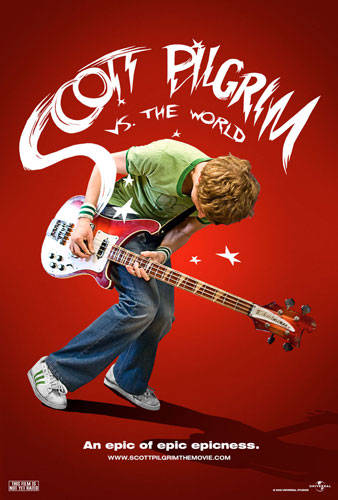
Go here to read Sam Stander’s review of Scott Pilgrim vs. the World in this week’s Guardian. What follows is Stander’s complete interview with director Edgar Wright.

San Francisco Bay Guardian: What is your favorite visual effect or sight gag in all of Scott Pilgrim?

Edgar Wright: Oh my god. There’s so much … I probably have to pick, off the top of my head, I like watching the twins scene because it was only very recently finished, so I’d have to pick that.
 
SFBG: How did you originally get involved in adapting Scott Pilgrim?

EW: I was given the book six years ago, when the first volume came out, by … the producers who had kind of leapt on the rights to it before it was even in bookstores. And I really loved the book, and I thought it would be a really interesting thing to try and adapt. At that point there was only the one book. [We] began a five-year process of working on it as [author Bryan Lee O’Malley] continued to develop the books, so the development of the film and the books kind of went in tandem in places. So it’s kind of been, six years ago I was given the book, and now the final book just was released, and the film is coming out, too.
SFBG: How many books were there when the film was in production? Were there four?

EW: By the time we started filming, there were five and the sixth book had been kind of half-written. But over the course of the production, I’m thinking of various stages where we stalled for time as much as we could, so that we could get as much material as possible. But there was a decision made early on that the two things would have to be different beasts, and Bryan was certainly aware of that, and understood that that would be the case. In a way, I think he actually preferred there being two different versions, that the film could be an alternate-reality version of the comic.
 
SFBG: But you still definitely kept a lot of the details of the comic. I was curious what inspired the choice to visually represent sound effects.

EW: I kind of figured that, you know, it’s a huge part of comics that most people completely jettison, because usually comic book adaptations are striving for reality. I thought, as well, it made sense within Scott Pilgrim that the character would choose to live his life like that, that Scott Pilgrim, as a character who’s grown up on a diet of Saturday morning cartoons and gaming, would actually choose to live his life that way if he could, and have points pop up and sound effects pop out when the doorbell rings. Because the books are funny and imaginative, it was just a way of embracing that kind of imagination within the artwork. It wasn’t a film where we had to strive for absolute realism like The Dark Knight. We had a chance to embrace the bubblegum, pop art nature of the artwork.

SFBG: It reminded me in places of the opening titles to ’60s Batman, which I enjoyed.

EW: Oh, I was always a fan of that show as a kid. I like some of those ’60s comic book adaptations that would embrace the form of the comics a little more. I guess, you know, in the ’80s, with the Tim Burton Batman, comic book movies started to strive for legitimacy, but we didn’t really have to do that with this. It was something where we could actually have fun with the form.
 
SFBG: I was wondering if the characters of Shaun from Shaun of the Dead or Tim from Spaced — how you see them in relation to Scott as a protagonist, or even Ramona?

EW: I think Scott Pilgrim has some things in common with Shaun and Tim Bisley. Tim Bisley and Shaun are both older than Scott Pilgrim, and I think maybe, you know, Tim is in his mid-20s, so he’s a bit more frustrated than Scott Pilgrim is. I think Scott Pilgrim is still in that sort of stage in his life where he’s powered by blind optimism, and I don’t think he’s necessarily a character who’s been worn down by the harsh realities of life yet, and that kind of effects everything he does, in terms of — the way that he pursues Ramona is like the way you pursue a shiny object in a videogame. I don’t think he’s really had his hard knocks yet, and this film is slightly about him getting his karmic comeuppance. I think Shaun is Scott Pilgrim plus about ten years, where he’s kind of settled into a slightly more lazy, depressed state. He’s kind of given up, slightly.
 
SFBG: I was curious, who came first: Gideon or Jason Schwartzman?

EW: Gideon came first. There was a drawing of Gideon back in 2004. I remember when I first read the first book, there was the first book and the script for the second book, but then there were also sketches of all the other exes and their stats that Bryan had drawn. So he’d drawn all of them way back in 2004. But the Gideon sketch back in 2004 looks uncannily like Jason and what he eventually drew for the sixth book.
 
SFBG: In light of having just made a movie entirely referencing videogames, what do you have to say to Roger Ebert’s constant claim that videogames aren’t a form of art?

EW: I think that the film shows both the good and the bad, in a way, in terms of, there’s elements of Scott Pilgrim’s character as maybe a slightly thoughtless person in the way that he powers through life and doesn’t necessarily think about the feelings of the people around him, and even treating them sometimes like bit players on his quest, that that shows maybe a downside to being lost in the world of gaming, and he’s forced to face the consequences later in the film. But then, I think sometimes the criticism about videogames stems from games that are pretty generic, because there is art and brilliant design and amazing ideas at work in gaming and game design, and I think that that would be difficult to deny, in a sense, that there are artists as good as the people working at Pixar working in games today.

But I think that some of the negative articles that are written about games are usually referring to games that are more generic and just concentrate on violence and destruction, that are kind of Xeroxes of films. So I think sometimes there are probably some games that undo the good work done by others, maybe. I’m sure that’s part of it. And then you get videogame adaptations … that are Xeroxes of a Xerox. I can see where that criticism comes from, I don’t necessarily agree with it, because I feel like … on a design level, Nintendo has become sort of the Walt Disney for our era, in a way. I mean, the characters are so identifiable and so beloved. And you get some games that are just works of beauty and interaction, so I can see it go both ways, you know. I would hope Roger Ebert would enjoy this film on the basis that we namechecked Beyond the Valley of the Dolls, so I would hope we could score brownie points even if he didn’t like the videogame stuff in it.
 
SFBG: With the development of the characters, certainly a lot of the comedy of the characters in the comics comes from playing with various stereotypes — of the way people behave in relationships, also jokes about Knives’ Chinese heritage and Wallace being gay, and different characters coming from different contexts like that. I was curious what level of depth do you perceive these characters having, as opposed to being sort of absurd caricatures?

EW: Well, I think a lot of those people came from friends and colleagues of Bryan Lee O’Malley, because Toronto is a very multicultural society, and Bryan himself is half Irish and half Japanese. The two characters you just mentioned, I know Knives and Wallace are based on real people. In the books at least, and certainly in the film, it’s an attempt to show actually a very ethnic community. We tried, in terms of the gay characters in the film to kind of, in hopefully a progressive way, not make a big deal about it. I’m actually quite proud that we have a PG-13 rating when sometimes that has been, you know — depicting homosexual relationships is sometimes frowned upon by the MPAA, or given a more restrictive rating. So it’s actually nice in a studio comedy to have characters who are gay and out, and there’s no stigma about it whatsoever.
 
SFBG: Definitely, in the United States, Shaun of the Dead and Hot Fuzz are really seen as archetypally very English comedies. Were you trying to work as a Canadian comedy director with Scott Pilgrim, or how do you see it relating to that?

EW: I don’t know, I’ve always found that question difficult to answer because I don’t really know how my sense of humor or what I find funny particularly relates to Britain, because I grew up on comedy from all around the world. Obviously, I really like a lot of British comedy, but a lot of my favorite comedy films are American. I wouldn’t like to thing that my sense of humor is completely defined by where I’m from. So I didn’t try and put a Canadian hat on to direct Scott Pilgrim. I tried to just be myself.
 
SFBG: I was curious about the music in the movie. I thought it was really interesting that you got some of the bands that it seemed like Bryan Lee O’Malley was sort of lampooning in the comic to do the actual music, and I was wondering what the process was for picking those bands and getting them involved.

EW: Basically, we had an embarrassment of riches in terms of the people that came on to collaborate. I know that Bryan had drawn Envy Adams based on a live shot of Metric in performance … but I think that most of the bands are a mélange of bands that he played with when he was in a band himself. I think some of the bands in Scott Pilgrim are kind of lampooning his own efforts, and other bands that were doing that circuit at the time. But, you know, in terms of the artists coming on board, everybody was really excited to be a part of it. And I think in the case of the bands, they got to also play a part, they’re sort of almost cast as characters in the film. I mean, Broken Social Scene’s songs in the film don’t sound anything like Broken Social Scene, and Beck was channeling his earlier, fuzzier roots. So I think people had fun playing a part rather than playing themselves. Even the Metric track that’s in the film is them almost doing a pastiche of themselves. In that case, with the track “Black Sheep,” [Metric frontwoman] Emily Haines had said it was a track they left off the last album because they thought it maybe sounded like somebody doing an impression of Metric. And so when I heard that, I said, ‘Well, that’s the song that we want!’”
 
SFBG: You also worked on the screenplay for the upcoming Tintin film, right?
EW: I did. Not for very long, sadly, because I got busy on Scott Pilgrim, but I worked on a couple of drafts, and it was very exciting to work on.
 
SFBG: Was that adaptation-of-a-comic experience similar to Scott Pilgrim or notably different?

EW: Well, different in the sense that [Tintin creator] Hergé is dead, so you don’t get a chance to — in that case, radically different, because you’re only going on his work and his life, rather than actually being able to talk to the creator himself. Unlike with Scott Pilgrim, I couldn’t call Hergé every day, so I could only go on reading those books and trying to recapture how I felt about them when I was eight when I read them.
 
SFBG: All right, anything else you want to say about the film?

EW: Go and see it in theaters.

Scott Pilgrim vs. the World opens Fri/13 in Bay Area theaters.

‘Love Over 60’ adds wisdom to poetic desire

0

   
    It’s fair to say that a lot of Western love poetry is biased towards youth and the male perspective. You could blame the influence of the British Romantics, who for all their unquestionable genius were essentially a bunch of horny twentysomethings who discovered that eloquence could get them laid. You could trace the prejudice back to Renaissance sonneteers, to the Greco-Roman Classics, or even to the general patriarchal bent of our culture. Politics—identity politics included—are pretty inimical to art, and you’d be missing the point if you looked at the whole corpus of poems dealing with sex and desire and saw only a conspiracy to propagate male supremacy and ageism. Still, it doesn’t make you a philistine if you point out that female voices—especially the older ones—are sometimes excluded from this particular canon.
    Last Thursday’s reading at Moe’s books didn’t explicitly acknowledge these realities, but it didn’t exactly have to. The title of the new compilation from which the evening’s content was culled—Love Over 60: An Anthology of Women’s Poems (Mayapple Press, 126 pages, $16.95)—is tough to read as anything but a rebuttal to those who see erotic verse as a young man’s game. The poems themselves dealt with love in a variety of forms—we heard lots about sexual love, sure, but there were also plenty of lines dedicated to its maternal, aesthetic, and metaphysical cousins.
    The first poet who read was Ellery Akers, an occasional writer of fiction and self-described naturalist. Akers presented two pieces, each of which combined a biologist’s fascination with minute organic phenomena with a poet’s worshipful awe of nature. In “The Naturalist in Love,” her eroticism was frank and explicit, though it always arrived filtered through a scrim of natural metaphor. Her overall ethos is pantheistic, drawing no division between her desire for her partner and her all-encompassing love of the natural world. It was vibrant, zesty, smart stuff, but Akers did employ the occasional hackneyed image, especially when she explored the erotic potential—“slide its wet petals apart”– of flowers. 
    Akers was followed by Gail Entrekin, who dished out a rapid series of witty, slice-of-life vignettes. These pieces were charming, funny, and insightful, but they were hampered somewhat by their resolute literalism. There’s nothing that says a poem has to be obscure or packed with dense figurative language, but snappy lines are generally a poor substitute for truly arresting imagery. The exception was her closing poem “Recovery Room,” a shattering but ultimately hopeful portrayal of long-term illness.
    After Entrekin, Kathie Isaac-Luke, a Registered Nurse and the editor of Caesura literary journal, took the mike. Her poems were rife with choice language—the line “I cannot walk her to the stars that guide her” from the parental ode “Blame Aphrodite” really stuck in my head. Furthermore, “Alchemy,” her wistful, joyous paean to classic cinema, seemed the most deeply-felt and potentially the strongest piece read that evening. 
    Following that, things got a little darker.  The final three poets—Rosalie Nelson, Carol Wade Lundberg, and Ellaraine Lockie—expressed degrees of sorrow and anger that hadn’t been present in the preceding poems. This sometimes got a little heavy-handed, particularly in Lockie’s “Translation of a facelift.” She made up for it, though, with her wonderfully ambivalent dialogue “Wings Clipped,” which managed to combine an amusing intergenerational exchange with an overwhelming sense of existential dread. Wade Lundberg’s “Under a Thin Film of Ice” was similarly ambivalent, and ended up being one of the evening’s highlights.
    If the reading—and by extension the collection—had a unifying theme, it was experience. Taken together, the poems implied that a lifetime of love and loss doesn’t make the palate jaded, but instead makes it richer, allowing for an appreciation of subtle hues and undertones. There’ll always be a place in poetry for callow young men, but if Love Over 60 is any indication, perhaps they could benefit from occasionally listening to their elders. 
   

Si se puede, making a difference: El Tecolote turns 40

0

It was with relish that I awaited my interviews with El Tecolote’s managing editor, Roberto Daza, and its founding editor Juan Gonzales on a homey couch in the paper’s modest office on 24th Street. Being a community journalist, it isn’t every day that you are able to check out the digs of another community newspaper – particularly one with as storied a history as the Mission’s bilingual go-to for news on social issues that affect the historically Latino and working class neighborhood. El Tecolote is celebrating forty years of activist journalism this month, kicking off with an opening reception tonight (Wed/11) at the Mission Cultural Center for Latino Arts of an exhibit featuring their extensive photo archives. 

I’m stoked to be there, so I chill and savor the feeling that good work is being done around me. Reporter-advertising manager Francisco Barradas’ computer keys are nearly the only sounds in the office, though passing staff assure me that this is a deadline day in the office. He answers the phone and speaks alternately in Spanish and English, most often a genial mixture of the two. Calendar editor Alfonso Texidor stalks past me multiple times, his distinctive hat and cane combo instantly marking him as one of the driving forces of last week’s popular literary review issue as identified by Eva Martinez, executive director of Accion Latina, the organization which houses Tecolote. 

The office itself reads – as many of the headquarters of these rags will do – like desks and computers framed by a collection of events past. Owls (the newspaper’s namesake) stare at me wide-eyed from the corners. An owl cuckoo clock here, a mascot originally meant to frighten birds away from property perched on a potted tree next to the couch there, a kite on the back wall, the reception desk lined with a cache of ceramic hooters. The walls have a bright collection of silk-screened posters announcing EL Tecolote fundraisers going back through the history of the paper, some which announce that proceeds will also go “for Chile democratico.”  

Later, after it is determined that rush hour traffic and recent hip replacement surgery have held up Daza and Gonzales, respectively, we settle on phone interviews all around. Still sitting on the couch in the office, I ask Gonzalez which stories he is most proud of looking back on the past forty years. His three examples are all moments in which his paper made a difference in the lives of Missionites. In the ’70s, a woman came to them who had recently lost a child. She had gone to SF General Hospital complaining of stomach pains and bleeding, but with no Spanish translators on hand, staff sent her home, told her to lay down. When she returned with her English-speaking son later that day they admitted her, but it was too late: she miscarried soon thereafter.

“We jumped on it,” Gonzales tells me. The newspaper discovered woefully inadequate translator staffing levels at General, and impelled their readers to act. “We mobilized the community,” says Juan. The hospital was forced to sign an agreement with activists from the neighborhood to guarantee translators on duty – the first such accord between a hospital and a community group. El Tecolote pursued similar campaigns with telephone emergency services in the ’80s, and more recently has supported tenants in a fight against Mission Housing Development when they attempted to raise rents in one of their apartment buildings.

“It’s one thing to make people see a newspaper around all the time. It’s another one to speak to the heart of the community,” Gonzales reflects.

From the get, the creation of El Tecolote was meant to give voice to those whom it was elusive. Gonzales started the paper as an off-shoot to his work in SF State’s fledgling Ethnic Studies program, itself born of the Alcatraz occupation and its own student strikes. A recent journalism graduate from the university himself, Gonzales was tapped by the administration to put together a course syllabus that analyzed media coverage of Latinos and taught ways to talk about issues that affected the population. He called it La Raza Journalism, but also craved a place where his students could get on the job experience.

So he held a series of fund-raising events, including an amateur talent show which drummed up the necessary $300 to publish the first El Tecolote on August 24th 1970. And then some. “At that time $50 was enough to publish 500 copies,” Gonzalez muses. His team chose to locate its office in the Mission, in a space donated by non-profit organization Centro Latino on 25th Street and Potrero to avoid reliance on university funding, which they felt could be pulled at any time. Already known to the community from his efforts in covering the area for the SF State paper, Gonzales and his paper were off and running.

“The bottom line is, the paper had to reflect the neighborhood,” he tells me. In those early days, the issues weren’t that much different than now: housing, tensions with the police, immigration, bilingual services and education, schools. They took care to represent all the facts of the controversies. “Don’t be afraid to ask the other side their reaction,” Gonzales says. “They could say things that help the cause.” El Tecolote, running as it does today 90-95% on the efforts of dedicated volunteers, also published pieces on young artists, many of which were at the center of an exciting new push for Latino-centric art forms. “We had to reflect how the cultural movement was really expanding,” its founder tells me. 

Nowadays, the paper experiences its share of the challenges to adapt that are facing most print publications. “We’ve had to make concessions: the quality of the paper we print on, the number of pages,” says Daza, who at a chipper 25 years old comes to the paper as another recent SF State grad. He first entered the Tecolote offices two years ago on a field trip as part of a technical writing class, and tells me the paper’s website upgrade earlier this year was much needed. “The running joke prior to that was that we didn’t want to tell people we even had a website.” 

Which is not to say that they are moving past the paper page. “For us,” Daza says “the print edition represents something completely different. It’s for people that don’t have an iPhone, don’t spend a good percentage of their lives online. That’s the kind of people we want to provide for.” Many community members still use El Tecolote to learn a language – initially, scanning the English articles for new vocabulary words, but more recently, with changes in the neighborhood’s demographics, checking out the Spanish pieces to develop new skills in español.

Daza makes it in after the majority of our interview, in time before his staff meeting to escort me through the paper’s recently organized binders of historic photos (from which we selected this piece’s graphic of Cesar Chavez’s visit to the paper’s office for a press conference on a UFW boycott). We flip to it past shots of a struggle immortalized. Demonstrations in the playgrounds of schools, under murals who this week I will recognize as I fly past them on my bicycle. Fists raised, hands extended, changes wrought – and it’s all there in El Tecolote, typed down in two different languages so that we can remember that this neighborhood has a past (and present, and future) worth remembering. 

“El Tecolote is all about making a difference in the struggle for social change,” says Gonzales, who will reassume the managing editor position when Daza heads across the Bay to pursue a graduate degree at UC Berkeley this fall, tells me. Safe to say the paper has, and will continue to do so, si se puede.


Imagining the Mission: El Tecolote’s 40th anniversary

Wed/11 6:30-9:30 p.m., $5

Mission Cultural Center for Latino Arts

2868 Mission, SF

(415) 643-2785

www.missionculturalcenter.org 


The Photo Issue: Parker Tilghman

0

SFBG Your website is more cunningly organized than a lot of photographer’s or artist’s sites. How does it relate to your photography?
Parker Tilghman I feel like my site isn’t fully representative of what I’m doing now. I’m in this weird exploration phase. I’m enjoying the medium as much as possible while I have access to tools at CCA. My website began as a creative outlet and a place to show my photography. It started with nightlife photography, but I got over it quickly. Once school started I didn’t have time to go out and I stopped working in that way to focus on my studies.

SFBG One of my favorite photos from the “night.” series on your site is of Fauxnique.
PT That was from [her show] Faux Real. It was such a cool number. I took that the last or second to last night [of the run]. I just happened to be in the front of the stage, and I was really excited when I got it. I showed it to Marc [Kate], her husband, and he was all about it. She’s so talented and I’m really thrilled about the success she has been achieving. 

SFBG “night.” also includes a photo of Veronica Klaus.
PT Veronica is probably one of my favorite women in SF. She’s amazing – so sweet and full of life and energy. One photo of her is from a big gay wedding that I shot shortly after Prop 8 passed. The other is of her and Joey Arias. Joey and Veronica were co-hosting Tingel Tangel that month. We did it really quick and dirty in the downstairs basement of The Great American Music Hall. The people behind the event wanted it to be done that night and I said if I was going to do it I wanted to take the time to do it right. I chose a spot and I set up all of my lights, but didn’t realize I was in front of the bathroom – someone took a major shit and it smelled really bad. Joey had to go on in about 15 minutes. I shot a few rolls and prayed for the best. It was classic.

SFBG Some of the bedroom and intimate interior shots from “lover no longer.” remind me a bit of the Boston School – Mark Morrisroe, David Armstrong, Nan Goldin – but they are mixed with outdoor scenes. Can you tell me a bit about that series and its subject?
PT He was this boy I was absolutely in love with. One of the first I felt I was actually in love with. He was living in NY and in graduate school at Columbia getting his MFA. Our time together was intense and very in the moment. He was here this time last year visiting me for a few weeks. The interior shots were taken in my apartment with a Polaroid Spectra. I would shoot without the flash in order to get these blurry, creepy images. I realized after we broke up that I never had a full head-on shot of him. It made sense because he was so far away both literally and emotionally. I was totally heartbroken but I  didn’t want to be a bitchy queen about it. I wanted to honor him in some way.
There are a lot of nude portraits of boys I don’t have on my site because everyone does that now. I have a beautiful collection of images of boys that I’ve encountered throughout my life. The images are a reminder of those relationships, sexual and otherwise.

SFBG You’ve made triptychs, and also series’ of related but varying images. What attracts you to that approach?
PT I’m obsessed with repetition – and how it can express obsession. People are drawn to form connections when they are confronted with multiple images in the same work. I’m interested in forming a communication between the images, whether they have something visually in common or not. In life I tend do the same stupid things over and over again. The repetition is an aesthetic choice, but it also forms a rhythm I become comfortable with and great things happen in that cycle.

SFBG What was it like to photograph Daniel Nicoletta?
PT I love Danny. He is such an idol to me and when I met him I was starstruck in a way. I think about it now and it seems silly because he is such a sweet man. I grew up queer in a small town in South Carolina. He was one of the first gay photographers I learned about through reading about Harvey Milk. He doesn’t have the recognition as a photographer that he deserves outside of SF. I feel that he has that potential now and I am very excited for him.
We spent a wonderful day together at Danny’s house when I photographed him. Danny was a bit of a bossy bottom — he tried to tell me what to do, but soon realized what he was doing and said, “I’m sorry, I’ll stop.” That image was the one moment where he let his guard down. He was fantastic and I still remain in close contact with him.
Recently, I’ve been spending some time with Arthur Tress. I photographed him last week. These photographers are coming into my life and I feel I can learn so much from them. They were there through the AIDS crisis and the Stonewall riots. They paved the way for me to make the work I am doing now.

SFBG “RGB” might be the most striking series on your site, both because of the colors and the sudden bursts of motion.
PT The original installation is on three separate televisions screens turned on their sides.  It’s fully dimensional and takes on aspects of 2-D, 3-D, and 4-D based mediums. They’re animated GIFS. I took the photographs with a stereoscopic lens and compiled the images in Photoshop to make them 3-D.
Stereoscopic imagery has been around since photography’s inception and you can still get these cheap stereoscopic lenses from Japan for about $100. At the time that I was heavily immersed in color theory- and constantly thinking about red, green, and blue. I wanted to play with those ideas on top of underlying notion of digital identity.

SFBG “marshall’s beach.” is different from some of the other series’ on your site in that it isn’t populated. Instead, you photograph detritus. It made me think of a time when I was on a beach with friends in Bolinas, and everyone was shell collecting, and I was most attracted to this bright yellow plastic bottle of Joy dishwashing liquid.
PT That series is more or less a placeholder for my site, although I do find the images to be beautiful. I was out at the beach on my birthday. The best thing I found in the sand that day was a deflated Mylar “Happy Birthday” balloon. I came back three days later and it was still there, so I kept it.
I saw this shirt on the pathway down to the water and thought, “Oh, someone’s cruising.” I walked through the bushes, but they were gone. All that was left were their condoms and lube on the ground. I began noticing that all the trash was in pairs around the area. I don’t think I’m the kind of photographer who just goes out and shoots rolls of film in hopes of finding something. That’s a boring task to me, but I like the idea of queer documentation in whatever form that takes.

SFBG That story makes me think about the waterfront and different photographers who’ve used it either to create gay photography, or documented gay life in that kind of zone. Alvin Baltrop did so in the Piers in New York, and his photos are also now a record of a Manhattan that doesn’t exist anymore. The other night I met an artist, Doug Ischar, who has a book of mid-1980s photos [Marginal Waters] of a sunbathing and cruising space in Chicago that also is no longer around. SF Camerawork had a show devoted to Alan B.Stone, who took pre-Stonewall photos of the Montreal coastline. And here in SF Denny Denfield was doing 3-D physique photography on the beaches.
PT Have you see Arthur Tress’s images from the New York piers in the ’70s? They’re fucking stunning – beautiful and violently sexual. He wouldn’t have sex with his subjects. The way he got off was by photographing these beautiful men in sexy, compromising spaces.
I like work like that because, while I’m a pervy gay boy at heart, I don’t want sex to be the overwhelming projection. I love Mapplethorpe, but more for the technical perfection and beautiful tones achieved in his prints than the blatantly sexual subject matter. I don’t want overwhelming sexuality to be present in my work because some people can’t get past it and it hinders further exploration.
For me, it’s more about having subtle undertones that are a little uncomfortable. You can feel its presence, but aren’t quite sure what is off. I think the magenta in the “Untitled.” color series is a good example of that. It has this underlying tone of strange eroticism that isn’t immediately recognizable.

SFBG There’s a specific alphabet on your main page, and around half of the letters aren’t attached to images yet. What’s to come?
PT I’m going to fill them up eventually. Knowing me, in a year’s time the entire site will be completely different. I like the format – if you get it, you get it. I live in the Tenderloin and within two days I got called a faggot twice walking down the street. I’ve been called a faggot my whole life, but I was in my own fucking neighborhood and I was just wearing boots and flannel! I didn’t even look that gay. I wanted to do something with the word ‘faggot’ and liked the idea of removing it from the alphabet completely. I like making people confused.

SFBG The image in the Guardian’s Photo Issue comes from “untitled (transparencies).” Can you tell me a bit about that series?
PT For this project I spent hours in the darkroom and sometimes forgot to eat or sleep. For me, it always starts as an aesthetic choice. I know a lot of people don’t like that idea, but I need something beautiful to work from as a point of departure. I wanted to play with pure color and investigate it was much as could within the photographic medium. I knew I wanted deep, rich color. I tried a bunch of crazy experiments with my film like pushing and pulling 5 or 6 stops at a time. I began using positive transparency film and printing it on normal color paper in order to produce a negative image. They’re double-exposed and manipulated in-camera. I can’t give away all my secrets.  There were tons of problem solving moments where I thought I would have a nervous breakdown, but it was fun to run with and work through.
The images themselves are horrific if you really look at them. I was reading a lot of Julia Kristeva, especially her writings about abjection and the duality of horror. She really defined what I was doing. I think in terms of queer art and culture she has so much to say, without even realizing it. There are so many connecting channels, even though her writing can be excruciatingly painful to read.
I was excited about making something beautiful and ugly at the same time by mutilating the figures. It’s something I’m proud enough to show, which is a big thing for me.

SFBG Your portraits of women have a mix of directness and depth.
PT Nude female portraiture is something straight male photographers do all the time. Being a gay male, the sexual tension was completely removed, which makes the gaze and the pose of the women very different.
A portrait shoot with me is like a two hour-long conversation. People ask about my camera because it’s big and imposing and it freaks them out sometimes.
I was interested in showcasing these queer women and normalizing them in a way. One person told me it’s like Cathy Opie without everything that makes them who they are. She’s concerned with all the surroundings that make them queer, while I’m interested in them when they are most vulnerable.

SFBG You’ve combined photography with different forms, from installation to bookmaking. What do you like about changing formats?
PT This is going to sound arrogant, but I don’t want to be just a photographer. I’m excited by having the opportunity to change and explore other mediums to achieve what I want. I don’t even really foresee that stopping in the near future. At the same time I’m interested in refining and focusing on what I’m trying to say and getting past making things just because they’re pretty.

SFBG What’s next?
PT I’m still playing with processes and have recently begun shooting directly onto color paper with an 8×10 camera to make paper negatives. I’m creating large wall installations of several small images. The color and detail I have been achieving is simply out of this world.

Street Threads: Look of the Day

0

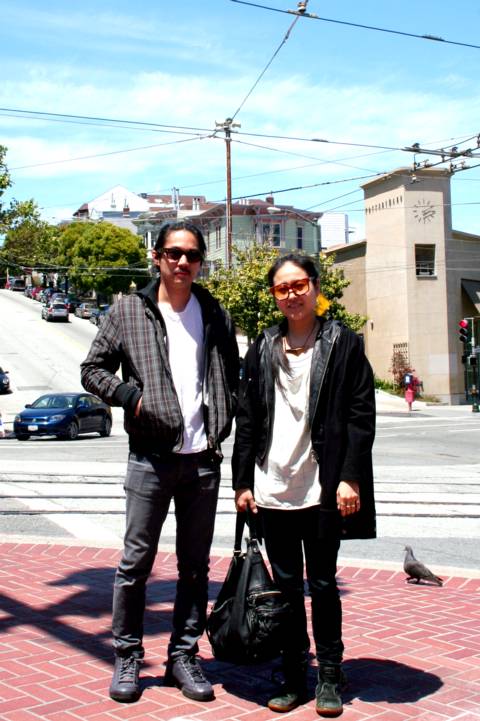
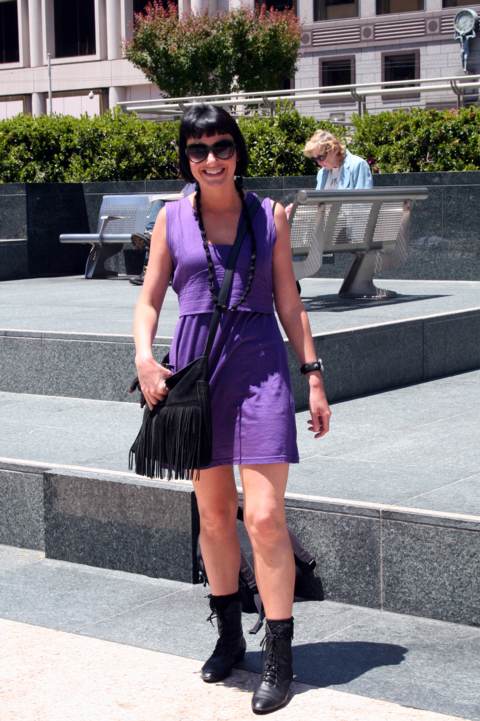
Today’s Look: Mika and Howie, Market and Castro

Tell us about your look: “No comment.”

Street Threads: Look of the Day

0

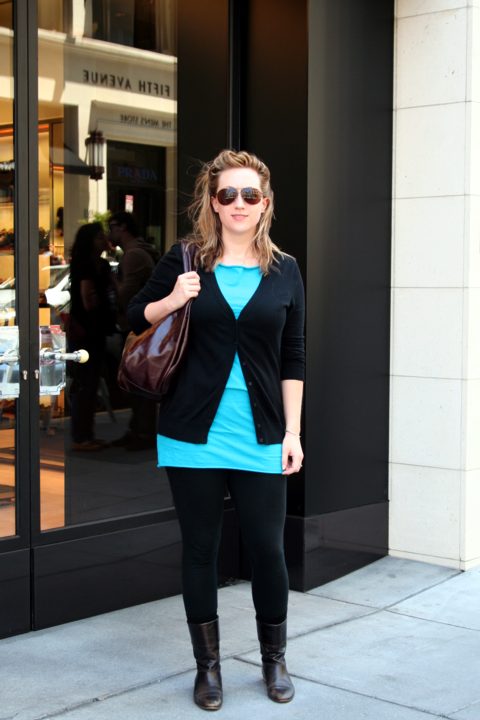
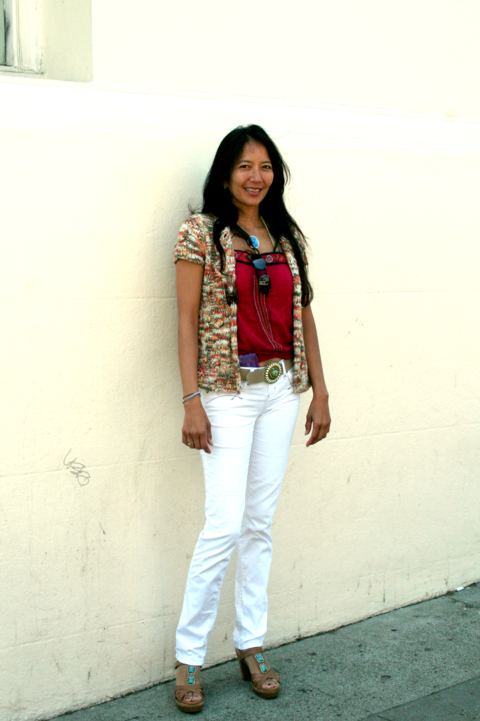
Today’s Look: Kristen, Post and Grant

Tell us about your look: “I just got these boots on Haight Street yesterday.”

Photos from our Best of the Bay party!

0

The fantastic crew at Polite in Public shot many of the adventurous winners and guests at our raucous Best of the Bay party last night. Check ’em out.

The Performant: Adrift on survival riffs and life rafts

2

Recent trends on the arts and culture scene

As long as there has been art, I imagine that the phrase “starving artist” has been in use. I like to imagine prehistoric cave painters stopping halfway through a particularly thrilling rendition of a successful buffalo hunt to halt operations and hold a fundraising party. “Grod, your donation of three chunks of limestone and a sharpened flint chip will help to fund the portraiture of no fewer than five renegade buffalo heading over the edge of the cliff.” But it helps put the sacrifices made in art’s name into perspective when confronted with art created on the very fringes, where “starving” can be more than just a catchphrase but a grim reality.

Friday night at the Redstone building I attended a performance at LaborFest — a month-long celebration of organized labor, worker’s rights, and solidarity. A POOR Magazine project, “Hotel Voices” was written by and about the denizens of SROs — those reviled bastions of affordable housing. Co-directed by Allan Manalo of Bindlestiff Theatre, and Lisa “Tiny” Gray-Garcia of POOR the performance touched on themes such as institutionalization, infestation, violence, racial profiling, death of loved ones, and yes, starving, with a bite of humor provided by the flamboyant “El Bedbug” (Charles Pitts), a charismatic harmonica interlude played by “Nightmare Joey” (Dennis Wilmot), and a suckerpunch of survivalist wisdom from “Supertenant” (Lisa “Tiny” Gray-Garcia).

Told in a series of short vignettes, like scenes of a documentary film about the often unsavory conditions “enjoyed” by the occupants of residential hotel rooms, “Hotel Voices” raised a collective voice against the daily marginalization of its principle characters. More importantly, it underscored the basic tenet of artistic expression that’s so often overlooked — that the need to create isn’t dictated by economics, education, or public demand. On the contrary, it can be an impulse as deeply ingrained as the need for food, shelter, or companionship. In other words, an act of survival.

A very different aspect of survival in the arts occurred to me Sunday night, while watching a shaky staging of “Gillian’s Island” which hadn’t quite found its sea legs. But at least it was at the Garage, a favorite low-key venue where the anything-might-happen vibe pulsates like a club beacon in the SOMA night. Which seems especially important to acknowledge now that three of its neighbors have either shut their doors or announced a pending closure in the last few months: the Climate, Mama Calizo’s Voice Factory (which closed Saturday), and the Off-Market Theatre (scheduled to close January, 2011).

Yes, it’s been a bad year for black boxes, yet the Garage, despite its non-existent booth, minimal grid, and limited seating, remains a competitive player in the performing arts community with a full calendar, focused curation, and an array of artist-in-residency opportunities. And just as “Hotel Voices” helped to remind that the creation of art is an essential aspect of our collective survival, hanging out at The Garage reminds of the importance of maintaining a space for those arts and their creators to survive in.

A good day for germaphobes

0

Good god, y’all! If you parents out there (yeah, I know this is San Francisco, but I’m house-sitting up in Bernal for the week, I know the childrens still exist) have successfully protected your family from the dangers of I dosing, you now have a new challenge on your hands: making sure your loved ones are harboring enough bacteria.

Such is the message of a one Larry Weiss, who has been contracted under the illustrious moniker of “chief technology officer” by a one manufacturer of naturalish hygiene products known in certain circles as Cleanwell, to make you even more aware of the microscopic dangers that lurk in every damp sponge. And the microscopic wonders in every bite of Dannon’s! There’s good bacteria as well, which his product helpfully allows to survive another day in your epidermis and eventually, gut. He’ll be presenting the findings of his doctoral search for the truth today, Thurs/5, at an organic children’s store in the Marina named Sprout. Sounds like it’ll make a bangin’ pre-funk for our Best of the Bay Rock Party tonight.

Some sneak preview tips gleaned from the Cleanwell site:

-Eating yogurt or probiotic products help you to get that belly bacteria back in balance after a round of the antibiotics. Listen up you chronic infection people!

-76% of all liquid soaps include Triclosan, a devil juice that disrupts endochrins and makes teenage girls get their periods disturbingly early. Guess what soap has no Triclosan!

-Viral YouTube videos do not actually cause a single virus, or more than one virus! On a related note, did you know there is some debate as to whether the word ‘virus’ has a correct pluralization?!

Cleanwell appears to have caught wind of the SFBG staff’s penchant for rolling around in pungent “Free” boxes we find on the sidewalk curb, because they generously sent us no less than five spray bottles of their original flavor all-natural hand sanitizer. A question that perhaps Cleanwell can answer: why aren’t we calling the first ingredient on your list “aloe” instead of the slightly more processed sounding “aloe barbadensis?” To me, this suggests you’re not throwing plants in a pot and stirring, which is how we hippie typically prefer our toiletries to be made. One of my counterparts suggested your formal language was due to the fact that Cleanwell ingredients are so natural, one must use their Latin names to describe them. 

Anyways, I got everybody to spritz their hands at the office, thereby putting off yet another pink eye epidemic. Thanks, Cleanwell!


Healthy Hygiene Tips from Dr. Larry Weiss

Thurs/5 6:30 p.m., free

Sprout

1828 Union, SF

(415) 359-9205

www.cleanwelltoday.com

www.sproutsanfrancisco.com


The Photo Issue: Dean Dempsey

0

SFBG What’s it’s like stepping in front of your camera?
Dean Dempsey I don’t have any strong feelings about it, perhaps because I know there is so much post-production involved. I certainly behave as though I am being watched, or surveyed. A bit like what John Berger said, “Women watch themselves being looked at,” and although I’m not a biological woman that rings true for me, and perhaps for many artists who turn the camera onto themselves.There is a spectacle element involved.

SFBG How about the process of being a different person or character or being? What does it feel like — is it experimental, psychological, revelatory, any or all of the above?
DD Sometimes I surprise myself in how unexperimental it feels. I’ve never really been a fan of experiment, perhaps because I feel that it suggests a sort of aimlessness. I do, however, feel it is playful, and there certainly is a revelatory aspect to it. Psychologically, I’m constantly having to imagine the presence of characters that aren’t in fact there — especially for the multiple self-composites. I have to imagine eye-contact, gestures, and conversation. In the process, it doesn’t make any sense. I just look a bit nutty as I pose in various positions to invent relationships with characters who are not immediately present. In this respect, there again is the resurfacing of “phantom.”

SFBG Has it taken you in directions or resulted in visions you didn’t anticipate? I ask this because your series’ seem to inform each other, and in a manner that doesn’t seem predictable, even if the realized images are obviously very carefully composed.

DD The playful,psychological or phantom? Or all three?

SFBG All three. Let’s be expansive, for now.
DD The series “You, Me and the Other” has really informed the bulk of these new series’, “Fragmentations” and “Artifice.” At first I was interested in a more literal interpretation of otherness and spectacle. I wanted, and continue to want, to explore notions of belonging while questioning the ways in which ideas of normality are constructed.
But as I continued with those images, which were about the multiple and theatrical side of my work, I began to explore a little deeper why I was doing them — why I was so invested in the gaze. I’m not at all interested in making “identity art,” but I can’t deny the pivotal ways childhood has informed my practice. So from having a whole lot of myself within a single frame, there has been a complete implosion in “Fragmentations.” That erasure takes place not just to anatomically dismember my characters, but to emphasise what is left over. There is a sort of implosion in “Artifice” as well, as the characters embody something more subhuman and alienated, making it more difficult to encapsulate into specific meanings, in a way.

SFBG What kinds of reactions have you encountered to “Artifice,” and in turn to “Fragmentations”? To me, these series’ manage to be interrelated, though in a surface sense “Artifice” is quite brash and overtly performative and imaginative, while ‘Fragmentations’ is more elliptical.
DD They are very much interrelated. I’ve been working on both series’ at the same time for quite some time now. There are images in each body of work that I haven’t shown anybody because there are other images that have to come first. But yes, on the surface, there is a difference. Conceptually, they are both informed by personal biographical history and each series investigates methods of spectacle and exclusion. Although with a difference in general aesthetic, each series is about the pieces that complete us; the pieces of our body, our process, our gender – pieces of social fabric.

SFBG Biographical history is present in your work in a variety of forms or absences. How has your family responded to your photography, and in what ways might you feel a familial influence in making an image or a series?
DD It’s funny, because the only familial influence with my work is more through a variety of absences — the absence of a father, the absence of a visible Mexican identity, the absence of siblings, and so on. I met my father in 2005, just a few months before I was about to move to San Francisco to attend college. And just two years after that he was hit by a Union Pacific train, losing two limbs. So again, there is a return of absence (this time anatomical) that emerges in my photoworks. He’s been very cooperative in letting me take portraits of him, even at the site of the accident. I even showed him my reenactments of him and he asked, “I don’t remember you taking those of me, when was that?” A lifetime of transiency and drug use hasn’t made him the sharpest of knives, but it certainly has made him an interesting subject.
It was only yesterday I told my mother about it. It took over 3 years for me to process and even begin to find the language to articulate how I felt. It wasn’t so much a secret, I just didn’t know how to say it. The details of his accident continue to reveal themselves in my work, even if they are depersonalized, so I knew it was something I couldn’t avoid much longer. She hasn’t seen him in 20 years. I recorded the conversation, maybe I’ll use it for This American Life. It really is a good story.

SFBG In a different sense, just as there is absence “present” in your photography, there’s also a multiplicity of self. Does that come naturally in relation to your personality? I don’t mean this in an MPD sense, but rather do you feel a creative urge to perform and discover things through performance?
DD It must come naturally because that is in some ways a more difficult part of my process to locate. I have an idea and I know what I need, or don’t need, to materialize it. But as my various bodies of work develop and expand, I’ve become more aware of their shared concept as well as what sets them apart. It is a constant discovery. Performance is fundamental in my work, whether in the act or in the idea behind the image. My content addresses performance in relationship to the constructs of gender and race, and notions of (dis)belonging. Everybody is always performing, even when there isn’t an audience to see it. So in this way, the performer becomes its spectator. By digitally inserting myself multiple times, or even by dismembering the figures I emobody, I’m envisioning a completed project. I’m thinking of how I will see myself, or the people I perform. Not to reference Berger again, but I’m watching myself being looked at.

SFBG What drew you to photography, and what photographic works have had the strongest impact on you in life?
DD I think I was, at first, most allured by the deceptive nature of photography. The medium is often falsely attributed as being very honest and undiscerning, yet a photo (and the photographer) always omits something from the frame. They deem what is worthy enough to be documented, and they choose what is seen. And I won’t begin to mention how Photoshop and image editing software furthers this point.
A good image, or least one I personally find most engaging, is one that suggests a larger narrative but refuses to explain itself. I call them little “cinematic babies,” because these sorts of pictures act as a still, forcing us to image what is happening before and after that with which we can see. What good is a piece of art, or anything, without the implication of its audience? Without outside interest it folds. But these are all my personal opinions, I could care less about constituting what is universally “good,” I’ll leave that to the bigger-headed.
Regarding influences, it’s always a tough question for me. I tend to jump around a lot, but I’ve always enjoyed folks like Carrie Mae Weems, Andreas Gursky, and even sculptural and installation artists like Santiago Serra and Sarah Lucas.

SFBG Ah, and now we segue to the inevitable question — do you have any interest in making films?
DD Yes! It’s funny because I feel sometime these photoworks began as studies for films. Beyond the technical aspect of putting a film or video together, there is still a conceptual formula of sorts that is in the works. But working more with the moving image is definitely in my horizon, I’d say before the end of this year.

A rainbow plays tug of war: East Oakland photo contest winners

0

East Oakland: beautiful, isn’t it? Deep in the Flickrs of its residents, the truth is out. Streets plagued by media images of gang violence and poverty are fodder for shots of kid’s games and preternatural beauty — and artists out there that care enough to capture it. Rene Yung, an artist who is heading the Our Oakland project, took issue with the way the community was being portrayed on TV: all the stories she saw were either crime or “rise above” tales of success. “I think so much of people’s everyday lives deserve to be celebrated.” The website she created for Our Oakland, meant to be a pride pump for this much maligned area of the Bay, sponsored a photography contest to find the photos they knew were out there. They received 22 entries, but this has gotta be due to the vagaries of Internet awareness and less a reflection of the material they sought, cuz they came up with some real pretty pictures. Care for an intro to the civic aesthetes who took the prizes? Wish granted. Check out this week’s SFBG for more stellar shots by Bay shutterbugs.

Oacia Williams has lived in East Oakland off and on since 2002. But she hasn’t seen too many rainbows there — at least skyward. The diversity on her street is part of the reason why she loves where she lives. “All the different colors and nationalities, everyone coming together. It is gorgeous,” Williams told us during the round of phone interviews we conducted with the Our Oakland winners. She took People’s Choice photo “See!! There is a Pot of Gold” (the same shot we picked out as an early favorite in the contest — see, who says community media isn’t influential?) on a day at home playing with her and her boyfriend’s kids. “The kids were tripping off the rainbow – first it was one rainbow and then the double. We were able to see it real well, which I was surprised because it was so dark out,” Williams remembered. Out came her Samsung. “Im always snapping it because you never know what you can do with it or who needs it.” She found out that Our Oakland needed it. Done and done.

“Tug of War” by Pauline Russell-Silva

“It’s just an authentic picture – I didn’t plan it. It’s from the perspective I have as an elementary school teacher, and of the kids in the area where I work,” says Pauline Russell-Silva of her first place shot. Russell Silva, a K-5 teacher at Encompass Elementary, Russell-Silva works with children on their English language development and reading skills. Her dynamic shot was taken on field day at Encompass. “We believe in educating the whole child, developing healthy body, mind and spirit,” she says. The days outside always end in a tug of war match, and the teacher’s Nikon D40 captured the shifting demographics in the East Oakland community. Russell-Silva finds it an apt photo of her neighborhood. “Sometimes there’s conflict and strife, sometimes there’s people working together.” She heard of the contest through the public library adjoining her school.

“Fanea” by Fanea Easterling

“We were so pleased by range of ages of winners in the contest,” Yung says. Taking the organization’s second place prize (and a Ipod shuffle in the bargain) was young person Fanae Clark, a student at the East Oakland Boxing Association who snapped her winning photo when Our Oakland hosted a photography workshop at the athletic center where she spars. In her artist’s statement, she said of her shot. “I also think this image shows hard work, which can get you where you want to be in life.” Yung found her shot appealing for the distinct perspective it offers. “As a young person she was being thoughtful relating to her life.”

Viva La Vanguardia!

0

The folks behind San Francisco’s Cutting Ball Theater have a lot to celebrate after ten years, so they are. The tenth anniversary of the company recently voted Best Theater in SFBG’s Best of the Bay readers poll is being marked by a year’s worth of special programs, all culminating in a season-opening party they’re calling “10-10-10 Tempest!” on October 10. But first, this Sat/7, the theater founded by Rob Melrose and Paige Rogers continues to advance its experimental mission with a rare (and free!) program of staged excerpts from new work by Latino and Latina playwrights called “Vanguardia.”

This is the first time Cutting Ball has featured the work of living Latino playwrights (they promise it won’t be the last either) and the evening will feature some of the country’s most vital voices — meaning both alive and ass-kicking: Kristoffer Diaz (author of Pulitzer-finalist The Elaborate Entrance of Chad Deity), Marisela Treviño Orta, Octavio Solis, Caridad Svich, Enrique Urueta (of the recent Impact Theatre hit Learn to Be Latina), and Karen Zacarías.
Cutting Ball is matching the lineup with top-notch directing and acting talent too. Take, for example, fucking vigwan by Kristoffer Diaz, which will be helmed by Campo Santo cofounder Sean San José. The snarky warning on the company’s website only whets the appetite:

“There are a lot of horrible people in the world. fucking vigwan is a horrible play about some of those horrible people. Warning: play contains sex, drugs, police brutality, horrendously (and stupidly) foul language, necrophilia, neo-colonialism, and some approximation of true love. This play should probably not be seen by anyone.”

Capped by an after-party featuring a DJ and (por supuesto) tequila shots, Vanguardia promises to be a high-spirited celebration all around. You can read more about the lineup and other important details at http://cuttingball.com/10th-anniversary.

Sat/7, 8 p.m. (pre-show soiree at 6 p.m.), free (donations accepted)

Cutting Ball Theater

In residence at the Exit on Taylor, 277 Taylor, SF

http://cuttingball. com

Start your engines for the Chiselers!

0

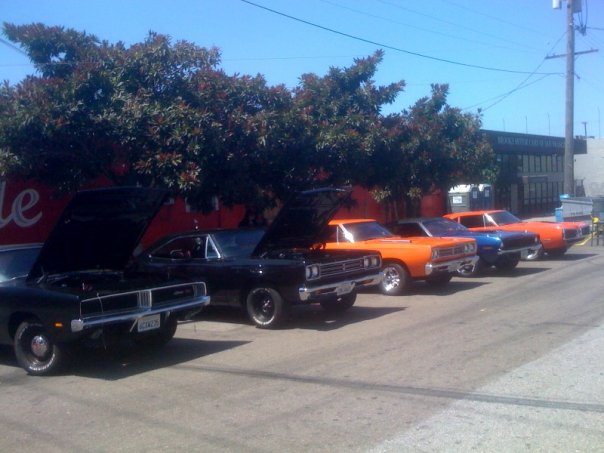
Sure, sure — you love your Prius. Or your fixie-skateboard-rollerblades-scooter-Clipper pass. But there’s something awfully rock n’ roll about a muscle car, especially one that’s been lovingly restored to roarin’-around-town condition.

Sat/7, local auto fanatics Chiselers Car Club host their first annual Chiselers Car Club Blowout — “blowout” in this context referring to a raucous party, of course, not a tire gone haywire. Revelers are encouraged to “bring your pre ’75 pimped-ass ride” (bikes are also welcome); the carless can gawk all they want. Arrive during the daytime hours (starts at 4 p.m., free) to check out the cars, scarf some barbecue, and listen to classic tunes by the Ramshackle Romeos, a two-man group incorporating an array of strange instruments, including the ever-haunting musical saw.

http://www.youtube.com/watch?v=p8bDhRMHrC8&feature=player_embedded

Stick around for the night show (starts at 8 p.m., $10), featuring the pop-punk Clorox Girls (one of those all-dude bands with “Girls” in their name), punk-punk Complaints, and the sassy, garage-y Midnite Snaxxx, whose MySpace “sounds like” is “making out with a burrito.” What’s not to love?

Chiselers Car Show Blowout

Sat/7, 4 p.m., free-$10

Thee Parkside

1600 17th St, SF

www.theeparkside.com

Coilhouse rules

6

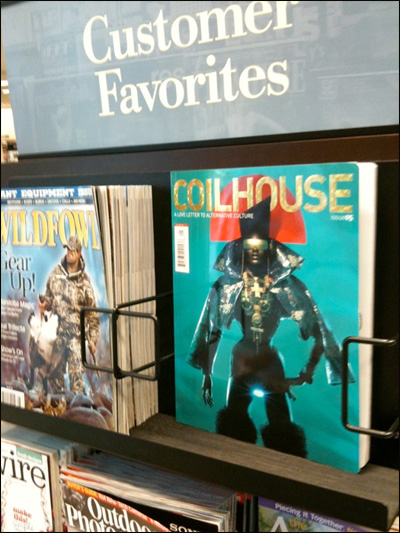
Founded by three brilliant renaissance women with roots in L.A. and the Bay, the alt-everything institution known as Coilhouse exists both as a fantastic groupblog and a quasi-quarterly magazine. According to the mission statement on their website, “Coilhouse is a love letter to alternative culture, written in an era when alternative culture no longer exists.” They cover everything from fashion to visual art to film to comics, with a wealth of youtube clips and beautiful images in all their posts. These ladies — Zoetica Ebb, Meredith Yayanos, and Nadya Lev — and their various collaborators are down with Klaus Nomi and at home with esoteric Russian literature, and more than happy to share with you what made them weird.

The print incarnation of Coilhouse is on its fifth issue, released just under a month ago and already sold out online, but still available at a variety of real-world retailers. Each incarnation of the magazine has brought new experiments in design, ranging from the subtle and inspired (eerie silver foil accents on the cover of Issue 4) to the endearingly goofy (candy-colored section frontispieces in the latest issue). This issue incorporates bonus items — a pull-out poster of Chet Zar art and two trading cards featuring images from the magazine’s Dorian Gray photoshoot. The pages of the issue itself are frantically crowded with original art, photography, and outrageous pull-quotes, but in a way that ultimately suggests raw, genuine enthusiasm.

The content of the magazine is divided between interviews, photo spreads, and primer-style features. Oh, and paper dolls. The new issue features interviews with geek luminaries like horror writer Clive Barker and power-couple Neil Gaiman and Amanda Palmer. Former- Star-Trek -teen-turned-celebrity-blogger Wil Wheaton contributes a non-fiction piece excerpted from his recent book The Happiest Days of Our Lives, and Jess Nevins chronicles the history and highlights of Chinese pulp fiction as a formidable counterpart to the western version. Zoetica Ebb compiles attitudes on “shoe lust,” and Angeliska Polacheck provides a photo-heavy history of the dance part Gadjo Disko

Photography in the issue includes a tribute to the late fashion designer Tiffa Novoa as well as the aforementioned Dorian Gray concept series of photos. The images range from glamorous to grotesque, with an attractive post-goth pall over the whole affair.

Special-interest magazines have taken a huge hit in the past several years, as the Internet has expanded to cater to any and every niche curiosity, so one of the few ways to grab a wide community of readers (for a blog as well as a magazine) is to express a weird, specific aesthetic that crosses subcultural lines. The fact that Coilhouse is essentially a blog that congeals into a magazine a handful of times each year makes it squarely a product of Internet culture. Perhaps that accounts for why it’s so mad and overwhelming, but it also accounts for why it feels so fresh and energetic, and so engaged in the benefits of the magazine as a form of communication distinct from blogging.

Street Threads: Look of the Day

0

Today’s Look: Kathy, Powell and Ellis

Tell us about your look: “I just throw on whatever’s around.”

Labayen Dance/SF revisits Carl Orff’s iconic Carmina Burana

0

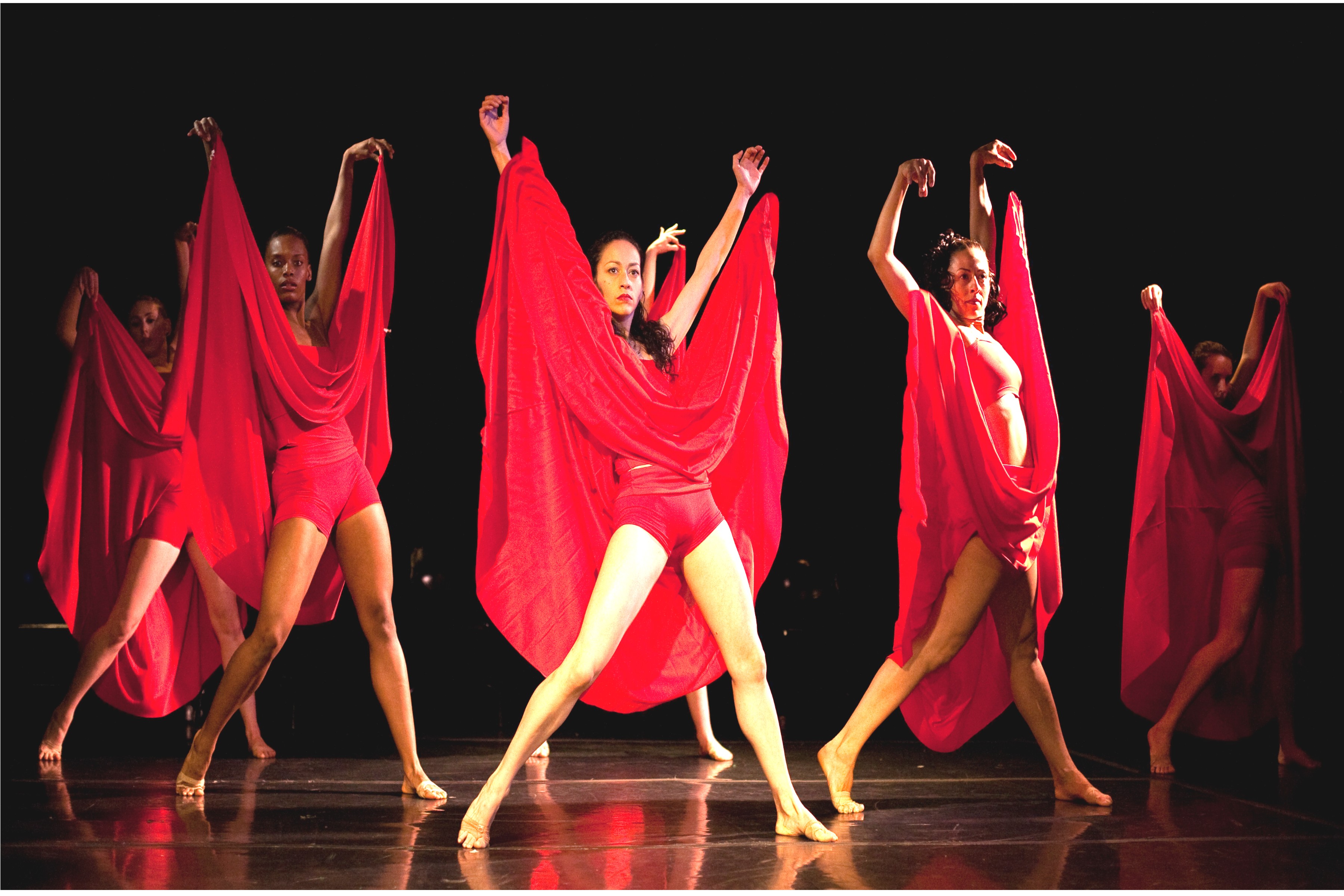
Enrico Labayen’s dance company Labayen Dance/SF took a hiatus from 2004 to 2009 while Labayen was off studying traditional folkloric dances in Southeast Asia. Labayen may have been absent for a few years, but the world premiere of his Carmina Burana, Revisited at Dance Mission Theater (July 23-25) proved that Labayen Dance/SF is back in full force. Inspired by the Philippine matriarchal ritual Tadtarin and set to Carl Orff’s iconic score, Carmina Burana, Revisited was a powerful and passionate celebration of female strength.

From the beginning the women dominated the stage. Dressed in long red skirts and red strapless tops, the dancers (Daiane Lopes, Alyson Abriel, Crystaldawn Bell, Diane Mateo, Leda Pennell, Morgan Eichwald and Lisa Lincoln) emerged into the light, one after another, to stand before the audience like regal warriors ready for battle. As “Ol Fortuna” (perhaps the most well-known and dramatic movement of Orff’s score) began, the well-rehearsed dancers moved perfectly in sync through a series of powerful shoulder shrugs as if tossing off anything that stood in their way. Such dramatic music has the potential to outweigh and undermine (even render silly) any kind of choreographed movement. Yet these women rose to the almost impossible occasion. They didn’t simply own the music, they fed off of its intensity, eating up not only “Ol Fortuna” but every musical movement that followed, hyper-aware of the score’s subtle, and sometimes not so subtle, emotive undertones.

The women also fed off of each others energy. The full-length evening featured various solos, duets, and ensemble dances. While lacking a narrative base, these dances captured a wide range of feminine identities, issues, and emotions, from jealousy and rage to love and triumph. Even in the dances that depicted female rage and cattiness, it was obvious that underneath it all, the dancers were committed to inspiring each other to reach full potential. On Sat/24, after Mateo finished a truly mesmerizing solo to “Omnia Sol Temperat,” she sat down aside Lopes, and I couldn’t help but notice Lopes take Mateo’s hand in her own as if acknowledging the spectacular performance. It’s possible that this gesture took place within character, as part of the performative world the women created. But it just as likely might have been an impulsive moment between the two. Regardless, the act of acknowledgment was an intimate moment that felt characteristic of the powerfully female-centered evening.

The women’s physical stamina was as impressive as their contagious energy. They moved through everything from extremely fast-paced jumps and leaps to slower, more lyrical, classical ballet poses with zest and playful charisma. Nothing seemed too difficult or too grand. Incorporating classical ballet, folkloric dance forms, and more sensual modern movement, Labayen’s elegant and exciting choreography emphasized the women’s versatile strength, but it was the all-female cast of badass dancers that not only brought Carmina Burana to life, but ultimately brought the admiring audience — screaming and stomping — to their feet.

Street Threads: Look of the Day

0

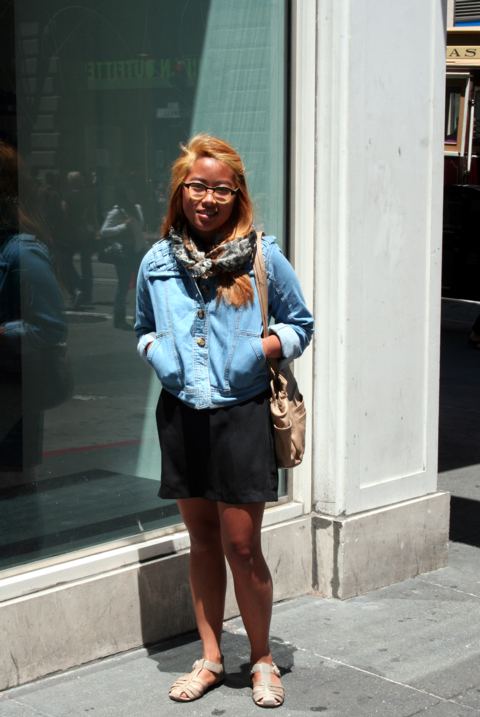
Today’s Look: Julie, Union Square

Tell us about your look: “I wear clothes that go with my skin tone.”

My buddy and meme: Winnebago Man’s unlikely star turn

0

An irascible ex-TV news anchor shoots a promo video for Winnebago in Iowa in the summer of 1988. It’s hot out, the crew isn’t giving him what he needs, and he swears. A lot. Fast forward 20 years, and the video that damn crew complied of his least flattering outtakes has garnered over 20 million hits on YouTube. Filmmaker Ben Steinbauer hired a detective to find out what happened to the star of his favorite viral video, and the ensuing film, Winnebago Man (which starts Fri/30), turns up some surprising conclusions about the notion of, as Steinbauer put it to me in our recent interview at the Mark Hopkins Hotel, “accidental notoriety.” Some people are calling the film an exploitation of the alternately crude and eloquent Jack Rebney, a new media naïf – but my half hour with the pair raised questions in my eyes of who was using who to tell what story.   


San Francisco Bay Guardian: So Jack, tell me about the last time you were in San Francisco. That’s the climax of the film.

Jack Rebney: Well of course, just when we were finishing the movie we had the opportunity to be up in the Haight playing [at the 2008 Found Footage Festival at Red Vic Movie House] and that was the first opportunity for Ben and I to do our dog and pony show. We had just an incredible time.

Ben Steinbauer: You’l l never guess who the pony is.

JR: The people were just, it was electric. It was just quite unusual. I was enormously taken with it. You could feel the vibes between the people and Ben and I. 


SFBG: That’s Haight-Ashbury for you. Ben, I have a question for you. Did your intent and motivation for this film change throughout filming it?

BS: No question. I started out making the movie because I was a big fan of the clip. I got the VHS tape in 2001, my friends and I would all quote it. Cut to four years later when YouTube was popping up and there was this idea of accidental celebrity, or unwanted notoriety. I thought, I wonder how the star of my favorite clip is dealing with this same thing? It just started from there with me as a fan wanting to meet Jack and understand this new technological and cultural phenomenon.


SFBG: Jack, do you remember the original Winnebago shoot?

JR: Like a boil. It was horrible, it was a violent, violent moment in my life. I was used to operating with camera crews, and audio people, and grips, ecetera who were at the highest levels of media. I never had to do a damn thing. All I had to do was babble, do my patented babble. As it was the middle of the summer in Iowa it was 100 degrees or more. The humidity was 98%. There were billions upon billions of flies. There’s a quote that always amuses me, apparently a lot of other people too: God in his infinite wisdom created the fly and they’re all in Iowa. But you have to keep in mind that there was never any of what today we categorize as anger. Its been said I’m the angriest man on earth — that’s actually not true at all. The Winnebago corporation had hired me to do the very best possible marketing film I could do, they percieved that I would be able to do a good film for them. So when it didn’t work right, I swear. Because I think it’s marvelously expressive. If you hit your thumb with a hammer, you don’t say golly wompers.

BS: Jack worked in media at a time when the news was shot on 16mm film. The concept that you could leave the cameras rolling to capture outtakes was foreign, let alone the idea that you could rapidly share video like this and 20 plus years later people in Japan could be laughing – it’s literally science fiction.


SFBG: Jack, did you know the cameras were rolling?

JR: No! Because I would say “cap it!” which in the vernacular means shut it down, stop rolling. 


SFBG: Do you guys think after going through this process that it’s important for people these days to be aware of what’s going on with the Internet?

BS: My interest in this was the realization that we all have digital reputations. That’s a new concept.

JR: Harry Truman made the comment, if you can’t stand the heat, get out of the kitchen. It is for me a total absence of interest. I get a lot of film shot at me, I’ve shot a lot of film at people, stuck a lot of microphones in the face of a lot of people who are actually of some consequence. This was an irrelevancy. But now it’s taken on something else, a life unto itself. 


SFBG: When did you become vested in this film, Jack?

JR: After the first time Ben came up to my little cabin. As is explained in the film, I was on my best behavior, Mary Poppin-esque.

BS: He basically fooled me.

JR: There are two things that are terribly important here. One, this kid knows what he’s doing: he teaches media at the University of Texas. Could this be an adjunct at the beginning of what is possibly his film career? Could this help him? Could this be something? I have people that when I was a youngster make it possible  for me to get positions that normally I could never have attained. On the other hand, for years and years I’ve been a socio-political commentator and I’ve attacked very nearly everything, and I love it because it strikes that the vast majority of people are not thinking, they’re not given anything in media. They’re given milk and honey. Well there’s no more milk and honey! It’s over. It’s time to either fall into a very deep abyss or we’re going to pull ourselves up by our bootstraps and I thought wait a minute, I can enunciate this. I thought well, okay, this kid wants to shoot me? He wants to turn the camera on? I’ll give him something to think about.


SFBG: Are you having a good time traveling together? You’re spending a lot of time together.

BS: Well we just had the best lunch I think I’ve ever eaten –

JR: Years ago when I had the opportunity to come to SF, I would eat lunch or dinner at Scoma’s [random note: this year’s Best of the Bay seafood restaurant!]. It is absolutely nonpareil.

BS: We tried to order that on the menu.

JR: Shut up Ben. In any event, it was absolutely magnificent. San Francisco is a city that has – there is nothing lacking here. There’s an enormous number of absolute nutcases running around, but that what gives it it’s vitality. 


Winnebago Man 

Starts Fri/30 2:25, 4:45, 7:15, and 9:45 p.m.

 With introduction by the Dead Kennedys East Bay Ray and post show Q&A with Jack Rebney and Ben Steinbauer at Fri/30 and Sat/31’s 7:15 and 9:45 shows

Landmark Lumiere Theatre

1572 California, SF

(415) 267-4893

www.landmarktheatres.com


also playing at Shattuck Cinemas (2230 Shattuck, Berk. (510) 464-5980, www.landmarktheatres.com)

Mid season huddle: roller derby’s Bay Bombers talk track

6

Oh Bay Bombers, won’t you stop in your roller derby tracks and tell us how you’ve been? San Francisco’s famed co-ed blocking, pivoting, jamming squadron has been packing ever-increasing crowds into Kezar Pavilion, their historical home this year – and no wonder, they’re killing it on track. To tell us by just how much, we wrangled a phone interview with general manager Jim Fitzpatrick, who we last checked in with shortly before his home opening match with league Lucifer Georgia Hase’s Brooklyn Red Devils.


San Francisco Bay Guardian: Jim you old so-and-so! We hear you’ve been hit with a typhoon of reality TV shows [this year Bombers have been featured on both Jerry Seinfeld’s Marriage Ref and TLC’s Ultimate Cake-Off] What’s up with that? Is derby just the larger than life kind of visuals those shows look for?

Jim Fitzpatrick: We’ve been hit with a lot of great media coverage. We even have the German version of Borat coming to film the tournament next month and there’s another potential project – that’s what’s so bizarre about this. Years ago I skated, I blew out my shoulder, roller derby ended. Then I became a firefighter, got hurt, that ended. My doctor is actually working on a reality show about dealing with people with chronic pain, and I was so successful in that, I’ll be on of the first people they profile on the show.


SFBG: Damn, superstar. So how’s the actual season been going?

JF: It’s been going great. The crowds have dramatically increased. It’s bizarre, but if you look back and trace the history of the sport from the Depression on up, during bad economic times and times of war — it’s one of those things, it’s an outlet for people that they can get their aggressions out and root for somebody that reminds them of themselves. Some of our skaters are kind of small, they wouldn’t be able to compete in traditional sports like football and basketball. But put them on skates and they’re amazing athletes! If you look at the crowd you see anything there from grandmas to little kids.

A man that just screams reality TV: Bombers general manager Jim Fitzpatrick. Photo by Tim Figueras

SFBG: What’s the Bombers’ record right now?

JF: We’ve won all four of our regular season games. 


SFBG: Nice. What’s your secret?

JF: Me. [laughs] It’s one of those things, roller derby has so many diverse people that get into it. Our group is so diverse, but we really get along – it’s the camaraderie. 


SFBG: You have a lot of history with some of the team managers you’ve been going head to head with. Does it change a game for you when you’re competing against someone you’re acquainted with?

JF: I don’t let it get to me. Dave [“Wildman”] Marez was a guy I broke in with, trained with — we both started out with the Bay Bombers, but he left the team and we skated against each other for most of our years in the league. We get together off the track and get along great — but on the track it’s an intense rivalry.

Kezar Stadium cradles those that throw the bows. Photo by Tim Figueras

SFBG: A favorite on track moment from the season so far?

JF: Theres a couple. I have a girl on my team, Lisa Hartmayer, that blows me away. She’s a registered nurse and she was one of the Olympic torch bearers in San Francisco for the Beijing Olympics. She’s taken off this year, scoring a lot of points. Very physical. She’s got an advantage because she’s an ice hockey skater, so she loves the physical. 


SFBG: Prediction for your upcoming tournament?

JF: I’m predicting we’re going to be in the finals against the Red Devils. The last few championship games we’ve ended up facing them. It’s been close, but we’ve beat them both times. They’re one of the best teams out there. 


The Bombers will be one of the top four teams in the league playing in next month’s Calvello Cup (Fri/27-Sat/28). You can also catch recordings of past games on  KFTY TV50 digital 199.  They’ll air Aug 15 and Aug 22, 11 a.m.- 12 p.m. 


The Calvello Cup

Fri/27 and Sat/28 7:30 p.m., $5-20

Kezar Pavilion

755 Stanyan, SF

www.arsdbombers.com


“Growing Up Twisted:” take it … or leave it

2

For every awesome reality show (Real Housewives of New Jersey), there are dozens that feel forced and pointless (keeping it within Bravo, the Housewives network, anyone else seen that Work of Art show? Can you explain the point, or the appeal?) Into the “I’m already famous” sub-genre of reality shows (as opposed to the “I’ll do anything to be famous” sub-genre) tumbles Growing Up Twisted, a new seven-part series that debuted this week on A&E. It’s unclear if we have the success of Gene Simmons Family Jewels (also an A&E production) to thank for this, or if this is some kind of attempt to reclaim the glory that once was MTV’s The Osbournes. If it’s the latter, the world needs to realize that there’s only one Ozzy (and only one Sharon, for that matter), and there will never be another Osbournes.

That said, Dee Snider — fright-wigged leader of Twisted Sister and enemy-for-life of Tipper Gore’s Parents Music Resource Center — was entertaining in the 80s, and appears to have aged with far less slurring side effects than Osbournes-era Ozzy. If there’s no discernable reason we should be watching his brood stomp around their Long Island mansion, at least there are some genuinely funny moments along the way. Filling the Sharon role is Dee’s wife Suzette; they met when she was 15 and he was 21, and have been together ever since (one of the first episodes highlights their 34th anniversary). A busty blonde who considers a skin-tight leopard-print dress to be a “conservative” look, the boisterous Suzette wears the pants in the marriage — I could see her fitting into a Real Housewives scenario, no problem. She’s be the one who gets into fistfights and doesn’t apologize.

Other Sniders include aspiring rocker Jesse (his ability to rock remains unconfirmed as of episode two, for all we see him croon is a sappy ballad to his infant daughter; in addition, he wears his hair in a most unfortunate mohawk, with designs shaved into the sides of his head); stand-up comedian Shane (initially, I thought he was the most normal of the crew, until I realized he was periodically wearing a cape around the house); Cody (described as “a filmmaker,” he’s probably more accurately tagged “a shit-starter); and baby of the family Cheyenne (a Hot Topic-clad young teen who throws a toddler-style tantrum when her beloved trampoline is removed from the family’s backyard).

So, to quickly recap: the kids are named Jesse, Shane, Cody, and Cheyenne. Wild West theme much?

Anyway, A&E aired the first two 30-minute episodes back-to-back on Tues/27; according to A&E’s website, they’ll repeat before the new eps air Tues/3. The first episode, “Baptism By Snider,” follows the frantic efforts of the family to put together a backyard christening for Jesse’s baby (hence, the need to move Cheyenne’s trampoline: “It meeeeeans something to me!” she wails in protest, taking a stand like only a 13-year-old kid who’s been showered with expensive toys all her life can). There’s also a side bit about Jesse’s music career (he’s written a song about how he won’t leave his daughter at home while he goes on tour, like Dee did to him — burn), and a family outing to a comedy club to see Shane perform (do I need to tell you he includes a “We’re Not Gonna Take It” joke?)

Episode two, “Carpet and Drapes,” goes for a slightly raunchier theme; there’s no baby business in this one. Instead, it’s Dee and Suzette’s anniversary. Tender tributes to their love include Suzette’s decision to shave her pubic hair into a heart shape and dye it hot pink (Shane and Cody are either overly offended by this notion, or a little too excited by it; you be the judge). In a scene that’s as close as Growing Up Twisted will ever come to O. Henry, Dee takes Suzette out for a romantic dinner to reveal he’s touched up the fading “Suzette” tattoo on his arm — only to discover that she’s just had her “Dee” tattoo lasered off. This is played for high drama; Dee’s deep Wound of Body Art Betrayal is healed only when Suzette decides she’ll get a big new tattoo where only he can see it (even though she admits that her wardrobe doesn’t leave many places the sun don’t shine).

What’s ahead for this kooky, ooky family? Episode three involves Shane shooting a video for his improv class (and with his brothers, taking revenge on a store clerk who insults his mother’s deliberately cultivated MILF aesthetic); Episode 4 focuses on Suzette’s empty nest syndrome (should they adopt another kid? Especially when Child Protective Services is paying calls regarding other matters?) Hmm. The theme song for Growing Up Twisted insists “Once you get a taste, you’re forever addicted!” Dunno. Perhaps they can loan out that ditty to the Housewives.

Check out the first two episodes of Growing Up Twisted on A&E.com. And, just for fun: Twisted Sister’s video for “I Wanna Rock.” Classic.

Street Threads: Look of the Day

0

Today’s Look: Lauren, Castro and Market

Tell us about your look: “I like color. These shoes are sexy but comfortable.”