So at Public Works this Thursday you can: watch veteran SF DJ Mophono and beat-driven gothsters Water Borders* live, learn about innovative advancements in music-making, peep some short films and new local art, and nibble tasty vegan treats. All in one event, from the safety of your own neighborhood club.
We all know there are overlapping circles between the arts – even the edible arts – and this is the belief that drives Overlap.org, a hyphen organization (music-arts-technology) that also has been hosting parties since 2006. In prep for the next installment of Overlap – which goes down Thursday – I spoke with Ghostly International’s Christopher Willits (Overlap.org’s founder, experimental SF-based musician) about music, food, and fostering local creativity:
SFBG: What will you be doing during the designing process workshop?
Christopher Willits: I’ll be covering a popular music-making and production tool called Ableton Live. I’ll be talking about the basics of this software system and how you can make expressive creative art with this digital tool.
SFBG:What are some other activities that will take place during this installment of Overlap?
CW: We have some great live music and a diverse lineup with Mophono, Water Borders, and Danny Paul Grody. Local films will be shown, we’ll have local vegan food from Freedom Kitchen, food by Rocky’s Fry Bread, and more local vendors announced the day of. We’ll have an info booth for our friends at Mission Creek Festival, and this time we also have very cool art vendors – Dave Marcoullier, The Heated, and more. SFBG: Can you describe the vibe? What has been most surprising about previous Overlaps?
CW: I connected with Public Works after a SF Forage event I performed at, and we found that we shared a common vision of where the Overlap event could go. Our first event with [them] was last October, it proved the concept and set the tone – a relaxed evening of diverse art and some really awesome people hanging out and meeting. It’s cool to see people coming out of their usual scene and connecting with this idea of greater creative community overlapping, a community made from unique but interrelated groups.
SFBG:Why incorporate local food into a music event?
CW: We support the localization of food. Our last events have featured permaculture discussions about decentralizing our food sources. We can do this in SF. Plus we just want people to be comfortable with some delicious clean food and feature these hard-working culinary artists. They are so much a part of the creativity of this city.
SFBG: Do you see any connections in the art of cuisine and the art of music? If so, what?
CW: Absolutely, the process, texture, flavor, color, history. Music, just like food, is woven in the very fabric of our culture. I don’t know of two other things that bring people together better than food and music.
SFBG: What are your personal favorite local places to eat?
CW: I’m really into Gracias Madre right now. Ask for the hot sauce, it’s this paste-like mixure of a couple different chiles. Yum. I think you need to ask for it.
SFBG:Future goals for Overlap.org and Overlap parties?
CW: Our goal is simple – to grow creative community in San Francisco. The rest will fall into place. We want to provide that place and time for people to come together and strengthen new bonds.
I have this feeling that we’re within a new creative wave in SF. We’re living in an amazing place and time, we’re all redefining how art and community interact and grow together. We have so much imagination and creativity. Together we are redesigning how our local communities can connect, come together and ultimately incite creative change.
Overlap With Christopher Willits, Danny Grody, Mophono, Water Borders Thurs/1, 7 p.m., $5-$10 Public Works 161 Eerie, SF (415) 932-0955 www.publicsf.com
*An absolute aside: Water Borders’ Amitai Heller once casually told me he’d want to do a TED talk on the intersection of goth and baseball, and I think about this often, joke or not.
Last week we got to photograph folks from several different corners of the Bay Area nightlife scene for Marke B’s Club Action cover story. Listen to them talk to Guardian art director Mirissa Neff and contributing photographer Matthew Reamer about what they love to do when they’re out and about in the wee hours.
MVP for Noise Pop coverage this year goes to Ryan Prendiville. See below to find out why – Ed. TUESDAY: The Flaming Lips at Bimbo’s
Time, for the Flaming Lips, is important. Because as a band — one that has been through all sorts of well documented shit — the Flaming Lips know the value of time (particularly borrowed) and have made it their work to not just create music but get into the complete manufacture of moments. Which is a tricky business, because moments are bastards.
Take all the pictures you want of the blinding lights, the beautiful costumed kids, the confetti cannons or all the other individual weapons that the Flaming Lips use to wage musical psychedelic war on time, and the moment still might not fit in a shutter, no matter how you slice a second. Full review here.
WEDNESDAY: Grimes, Born Gold, oOoOO, and Yalls at Rickshaw Stop
Cecil Frena described the lineup at Rickshaw Stop last night simply as “weird music.” He should know. Performing with his synth-fueled electronic dance trio, Born Gold (formerly Gobble Gobble,) Frena stood in front of a camera-slash-iPad pulpit, singing and conducting a third of the group’s sound via a motion-captured, clearly homemade, Janet Jackson Rhythm Nation era-esque military jacket. Full review here.
THURSDAY: Surf Club and FIDLAR at Cafe Du Nord, New Diplomat and Big Black Delta at Rickshaw Stop
“This song is called ‘Stoked and Broke,’” the band’s most talkative, spastic member introduced the first song, explaining, “because we’re stoked and broke.” What followed was a frenetic set of punk fueled, stripped down rock. With a rollicking tightness that reminded me of Thee Oh Sees, FIDLAR shot along, keeping the energy up by alternating singers. Full review here.
I left Cafe Du Nord after FIDLAR, hoping to catch at least some of Big Black Delta at the Rickshaw Stop. When I arrived another band was just starting. A local five piece, New Diplomat reminds me of the kind of groups that dominated the alternative rock airwaves in the late ’90s after grunge and pop-punk stopped being exciting. Since it was about the same time period when I stopped listening to the radio, and New Diplomat’s spiky haired singer had that emo/screamo edge that I have a hard time tolerating, it makes sense that the band put me off.
But then when Jonathan Bates, a.k.a. Big Black Delta started to perform, and I felt almost nothing, a more alarming possibility came to mind: maybe I’m burnt out. On record, I’ve liked what I’ve heard of Big Black Delta’s droned, vocally distorted hard electronic tracks. And performance-wise, Bates kept things appropriately dark, moody, and atmospheric, bumping up the sound with two drummers, each banging away on their side of the stage for some heavy hitting percussion. That whole stereo kit thing is usually the easy way to pull me in, but in this case all I could do was recognize it with cheap approval. Between New Diplomat and Big Black Delta the crowd thinned out a bit, and I leave early too, hoping to reset my baseline by the next day.
FRIDAY: Brilliant Colors, Bleached, and Veronica Falls at Rickshaw Stop, Matthew Dear at Public Works
My plan for the night was to see Veronica Falls at Brick and Mortar, and then hopefully run across the street to catch Matthew Dear at Public Works. But when I showed up at Brick and Mortar, the man at the door told me I had the wrong venue, their Noise Pop show was the night before. I apologized and, checking my schedule, saw that I was indeed an idiot. So much for that plan, at least I wore a coat.
The show was underway at Rickshaw. I didn’t know any of the bands opening for Veronica Falls. The androgynous singer onstage had a bowl cut and was wearing a collared button up that was the most over-sized fashion piece since Stop Making Sense. I couldn’t make out the words, but it was a nice voice – a little deep and dreamy – that mixed in with some catchy guitar riffs. The band was playing melodic pop, and having fun by all appearances. I found out later they are SF’s Brilliant Colors.
The next band, Bleached, had a sound that reminded of the Dum Dum Girls with a lo-fi punk edge. Two of the girls are blondes and the other two aren’t even girls. Bleached was more energetic on stage than Brilliant Colors, but I found their songs didn’t really hook me in. (It also didn’t help that there was a camera crew onstage with them.) The group harmonized a lot and decently, but too often spent a lot of time singing vowels (oohs, ahhs, and ohhs), which started to wear on me. They played a Ramones cover. I think it’s “When I Was Young.”
Still, it was good lineup leading into Veronica Falls, a UK band that has a retro pop sound as well. VF’s sound live was as clean and distinctive as it is on record, with nice guitar work over a signature drum sound that has an ever-present jangle that’s accomplished by little more than taping a tambourine to the floor tom. The band’s vocal style has some nice contrast, between Roxanne Clifford’s usual lead with backing from James Hoare and Patrick Doyle, but really I think it’s its structure and a Belle and Sebastian-like sense of lyrical imagery on songs like “Stephen” or “Bad Feeling” that sets the group apart.
So much so that on “Crimson and Clover”-referencing song, “Come on Over” VF can bust out some oohs and ohhs without it seeming like a shortcut. It was a good set, with a lot of new material as well, for the band that canceled its earlier SF debut due to visa issues. If anything, Veronica Falls was overly apologetic, drummer Patrick politely stated before the encore, “I know I keep saying it, and I feel like a bit of a dick saying it, but thanks.”
http://www.youtube.com/watch?v=bE6BFAwzwLU
It was before midnight when Veronica Falls finished, so I hurried to Public Works, where they were still setting the stage. While waiting for Matthew Dear to come on, however, I had the misfortune of standing in front of someone explaining to everyone within earshot how terrible the venue was, how it was a warehouse that they just put equipment in but never fixed up, how if she just got a warehouse for a weekend she could fix it up nicer, how there was a bare two-by-four nailed to the beam above the stage for no apparent reason, how they charged club prices but it was “not really a club.” (Sort of the reason I actually like it, that last part).
When Matthew Dear started performing, with a live band – his second night with the lineup – it all sounded more loud and abrasive than I had expected. I think my attitude, and my tired ears had been switched to bitch mode by the girl behind me. The show was sweaty and chaotic, it being a weekend late night at Noise Pop, but I called it a night while it was still going on.
SATURDAY: Noise Pop Culture Club at Public Works, Built Like Alaska, Hospitality, The Big Sleep, and Archers of Loaf at Great American Music Hall
This would be my last day of Noise Pop, I was convinced. As much as I would’ve liked to, I started the day knowing that I would not make it to Sunday’s Dodos show. Between my day job, covering Noise Pop, and pet-sitting three cats (who operate in a binary of meowing or vomiting) back in the East Bay, I may have taken on too much last week. That said, somehow, Saturday at noon I found myself back at Public Works, for the Noise Pop Culture Club, a six-hour-long block of workshops, screenings, interviews, performances, and something called the Seagate Remix Lounge that I didn’t really understand.
When I got to PW they were screening selections of Petites Planètes, another musical documentary series by the guy behind the Take-Away Shows on YouTube. The videos were cool, but the director, Vincent Moon, wasn’t there for the Q&A. Something about being a “nomad.” Dude bailed. Disappointing. Since I was sitting 20 feet from a bartender with nothing to do, I decided to get a drink, but the shaky feeling in my stomach reminded me that I hadn’t had the right ratio of solid food to alcohol in my diet last week. Some spicy noodles from the food truck outside created a buffer on which I began to add of few layers of bourbon, while watching the restored, color version of Méliès A Trip to the Moon, with soundtrack by AIR.
http://www.youtube.com/watch?v=6Nx8hVGzSO4
The main plan was to see Zigaboo Modeliste of the Meters play the drums. Modeliste was there as part of a Q&A with the makers of Re:Generation Music Project, a documentary-slash-Hyundai promotion in which he appeared. The clips made the recently released film (which apparently no one in the audience had seen) seem interesting, if only for scenes with whipper snapper EDM artists like Skrillex and Pretty Lights attempting to work with established musicians in other genres, awkwardly. At the end Modeliste played the drums for a bit, and the snare was so loud that each time he smacked it everyone in the audience blinked. A walk outside in the sun and a Bloody Mary later, I returned for a how-to session on using Ableton, and realized I am un-Able ton stay awake.
Clearly, when I made it to the Great American Music Hall, I was in bad shape. Nearly asleep on my feet, with quite a bit of time to go, and not thinking clearly, I made a bad strategic move that combines Red Bull and vodka, two things I don’t like anymore together than apart. When the first band, Built Like Alaska went onstage, I was in a fairly vile mood, my head hanging limp over the balcony while I wrote down petty things about the drummer that I didn’t like: his hat (a fedora indoors) his shirt (vintage Mickey Mouse) his facial hair (Tom Selleck meets Mario Brothers). All this, when his consistently irregular drumming was actually my favorite part of the band who I really had no problem with. Clearly, I was hating hard that night.
Until the next band, Hospitality played. I’d never heard Hospitality before – it was the band’s first time playing in San Francisco – but the sound pulled me in almost immediately, led by the charming, identifiable lilt in guitarist and lead singer Amber Papini’s voice. The songs were light and bouncy, and Papini performed with a slight disaffected edge, always looking up and off to something above the crowd, making strange faces and rolling her eyes at no one in particular. When I got home later, I went online almost immediately to listen to its album and find the song “Friends of Friends.”
Likewise, I tried to find music from the final opener, the Big Sleep, but that’s more of a band to see in concert form, as the trio’s main attraction is a Jack White-like guitarist, who has a lively style of playing and a way of alternating his sound between growling and loud to Jesus Christ, where did I put my ear plugs, I can feel my cochlear hair cells dying.
Now I’m not the biggest Archers of Loaf fan – the band’s actually only been on my radar since a number of high profile reissues last year – but other people at the Great American were clearly eager to see the reformed act live. When a few random notes came out of bassist Matt Gentling’s instrument during the band’s set-up a woman above stage in the balcony yelped, jumping to her feet and clapping her hands together excitedly.
Launching into “Harnessed in Slums,” the band played with an easy energy that gave no suggestion of their hiatus or age, and people in the crowd were shouting “I want waste! We want waste!” along with the chorus. Gentling in particular was electric. He leapt around stage and struck every hard rock guitar god stance imaginable but did it with a physicality that actually pulled them off. (Dude is ripped, FYI.)
At one point early on, struggling with some technical issues, Gentling looked at singer-guitarist Eric Bachmann and joked, “It’s just like the old days, everything is breaking.” Not quite getting the kink out of his bass, Gentling asked the crowd if it’d be ok if the band just kept playing through the difficulty, and Archers of Loaf continued on, powering through a long set. The place wasn’t full, but the crowd made up for it, and was still shaking the floorboards fifteen or so songs later when Archers play “Wrong” and shred a version of “Nostalgia”, making an encore completely obvious.
Ten minutes later – when I headed for BART to wait for a train alongside a couple of giggling guys laying on the platform surrounded by what must have been a dozen empty nitrous canisters – I was no longer tired and sent a text that read: “Okay. That was a good show. Worth it.”
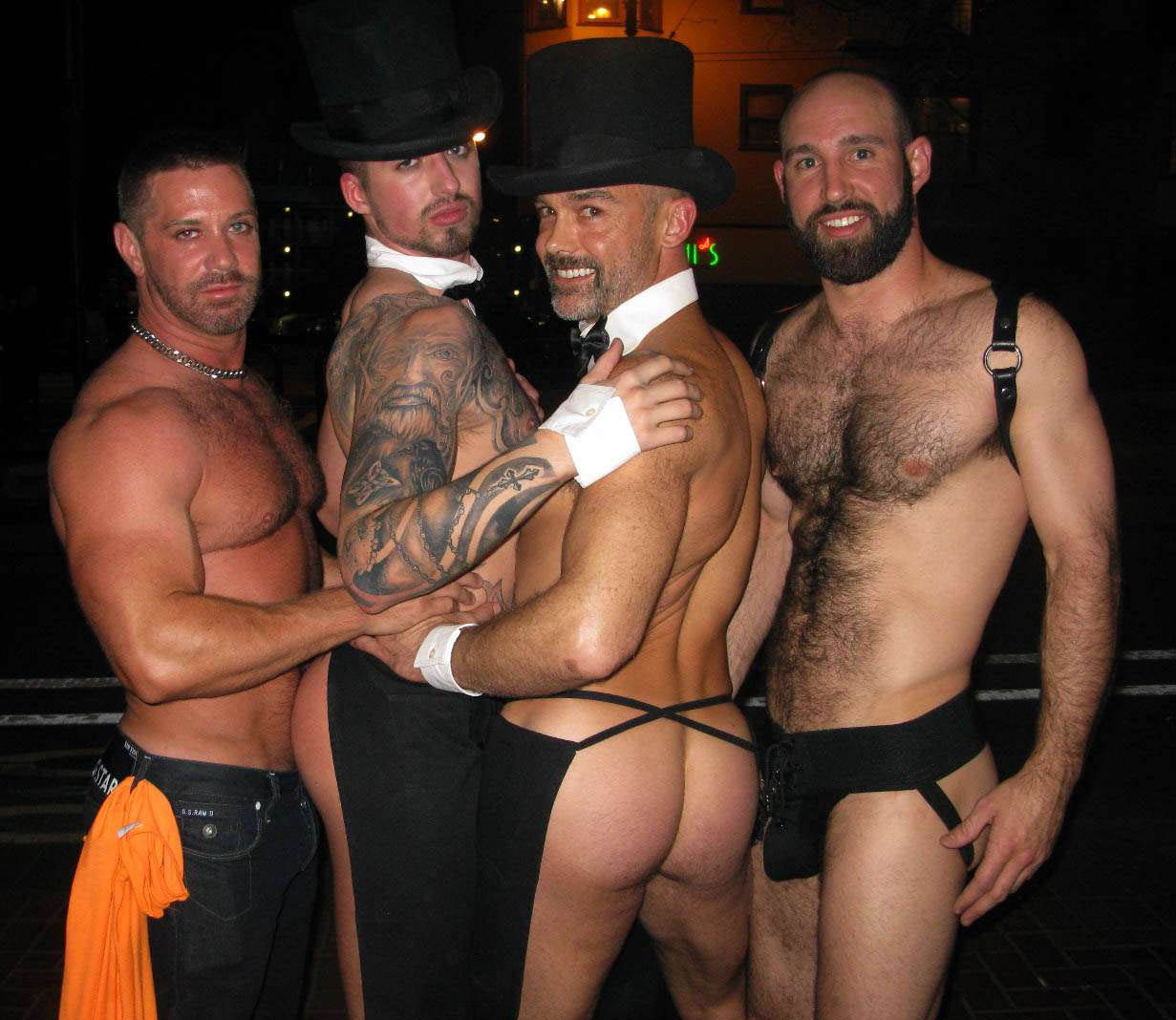
Once upon a time in New York City, on the intersection of Broadway and Bleecker, there used to be a club where the lights never shone. In the cavernous dark, Marc Jacobs’ Black Book of desperate, disposable, beautiful boys could blindly bump into one of club goddess Amanda Lepore’s naked body parts. But when you’re in one of the steamiest, most-crowded gay hotspots in the world with candlelit backrooms, a scandalous vibe, and servers in top hats and backless aprons, such concepts as personal space become fantasy.
This week, gay partygoers in San Francisco will get to experience the iconic Mr. Black nightclub thanks to a likely alliance between Mr. Black founder Luke Nero and SF party promoter Joshua J. Cook. On Thursday, motorcycle-themed club Rebel will host the launch of the monthly Mr. Black SF night with Stanley Frank of Viennetta Discotheque opening up for DJs Aaron & Aaron, Mr. Black’s original, signature DJs. The party will recur the first Thursday of each month.
“I’ve never worked on a party that so effortlessly promoted itself,” said Cook, promoter and creator of Big Top and Stallion Saturdays. “Everyone I’ve told about it wants to be involved.” (Representing the party with stereotypical-looking, half-naked go-go boys on the cover of the advertorial Gloss gay party magazine, however, may belie his statement.)
Not surprisingly. Mr. Black, the NYC version, was the well-kept secret everyone was talking about. A twisted funhouse for eccentric socialites and underground club kids, it was too perfect to last. In 2007, the brick-walled club was forced to shut down after NYPD conducted an undercover, in-drag drug raid and arrested two employees (including Nero) and 15 patrons. The club relocated shortly after to Hell’s Kitchen but failed to recapture much of its relevance. Recently the party started once again, this time in Webster Hall.
“When Stuart Black and I started it in New York there was nothing like it,” said Nero. “It’s as if we had created our own Studio 54.”
Proving that a great ass can take you places, Nero went from the infamously bare-bottomed bartender in New York to creative director of all things Black.
After the raid, Mr. Black, the brand, followed Nero to Hollywood, where he is currently the promoter of the LA version at Bardot. The cross-country relocation has kept the party “fresh” for Nero who enjoys seeing each city’s reinterpretation.
“In L.A. it’s more youthful fashion. It’s where the cool hipster kids go,” he said.
And as for San Francisco’s reinterpretation? Cook expects a crowd of “art people, fashion people, those who want to be seen. The crowd will be the main attraction.”
The promoter has already enlisted a circus of characters to liven-up his version, including Los Angeles-based Andres Rigal, Lenora Claire and William Cullen and from San Francisco, Lady Bear and Miss Terry T. Earlier this month, Rebel held a contest looking for a slew of bare asses to prance around for Mr. Black SF.
With such noted scenester talent, the Mr. Black allure, and Cook’s own connections, the party is sure to be a huge hit, although perhaps for a less cutting-edge gay crowd. The original Mr. Black club had a capacity of 162. For the SF launch, there are already more people RSVPs on Facebook.
The move out of New York, however, has smeared Mr. Black in some edgier eyes. The party once held in an unassuming basement in NoHo is now at a V.I.P. lounge in Hollywood. The party that once took great pride in not having bottle service and hosting the likes of Naomi Campbell, Chloe Sevigny and Boy George without much fuss now has a photo blog, a Facebook page, and hundreds of fans, including every contestant on RuPaul’s Drag Race.
“Those are my greatest memories, says Nero of the original Mr. Black. “Sneaking in all those people into the party and no photographic proof that they were there.”
Now, with the expansion to SF, some bristle at the idea of outside promoters coming into the city when there are already many native parties that appeal to art and fashion crowds, utilizing much of the same local talent.
Ultimately, though, and however fun this iteration may prove to be, Mr. Black itself is not really a brand, but a memory. For even if all the lights are turned off at legal venue Rebel on Thursday night, the camera flashes will probably reveal none of the spontaneous scandal or Marc Jacobs exes the original could brew up. Despite all the name-dropping, no party will ever be Mr. Black at its underground, unpretentious, dirty prime.
Perhaps it is the Internet, that word of mouth now travels faster than the click of a mouse. Perhaps it is the promoters, who realized that there is more money to be made when there’s a line out the door. Perhaps it is the crowd, who wants to not only be seen but also immortalized via a mobile device. Perhaps it is our fault, that we now confuse reality show contestants for true stars.
Perhaps it is fate, that all great underground parties reach their capacity, die, and come back, bigger and sleeker. But not as Black.
Oscar Raymundo is a freelance writer and fabulous book club leader who blacked out plenty of times at the original Mr. Black.
MR. BLACK SF Thu/1 and first Thursdays, 9 p.m.-3 a.m. $5 before 10:30 p.m., $8 after Rebel 1760 Market, SF. Facebook invite
Localized Appreesh is our weekly thank-you column to the musicians that make the Bay. To be considered, contact emilysavage@sfbg.com.
The Shants have done something curiously rare these days: created an authentically Southern and categorically enjoyable stompy blues and folk record in the heart of garage punk and hip-hop obsessed Oakland. That authenticity come from real roots, as these sorts of things often do – the new record, Beautiful was the Night, is said to be a “haunted love letter” to singer Skip Allum’s youth in the South Louisiana delta pines.
The resulting record is a lively mix of Americana, twanged vocals, bluesy riffs, bits of piano and violin, and steel guitar, with guest appearances by the likes of multi-instrumentalist/horn player Ralph Carney, Blue Bone Express, and vocalist Quinn DeVeaux. I think singer Brianna Lea Pruett, who also guests on the record, describes the music best when she says in the short documentary on the making of the album, “Even in the dark parts, there’s a sweet treatment to it.”
With the long-awaited release of its debut full-length record finally here, the quartet will play Cafe Du Nord this Thursday.
You can watch the making of the new album here: http://www.youtube.com/watch?v=WaPdF3T8UZs
Year and location of origin: Oakland, 2009
Band name origin: Its a reference to the Gaelic word, shiant, meaning blessed or charmed… and the Shiant Isles of Scotland. Skip came across it while doing some research on his Scottish family origins, which can be traced to those islands. That’s the short version, anyway.
Band motto: “Is the pedal steel too loud? How ’bout now?”
Description of sound in 10 words or less: A dusty, slow blend of Southern folk, and country blues.
Instrumentation: 1954 Harmony archtop guitar, Emmons double-neck pedal steel guitar, 1970s Peavey bass guitar, drums. May soon have a new fella on many other instruments. Stay tuned!
Most recent release: Beautiful Was The Night, our first full-length! Available now at live shows, our website, iTunes, Bandcamp, Spotify, etc. and all Rasputin Records locations. It was recorded with all analog gear over at the Rec Center (formerly Bakesale Betty’s storage space) and at Tones on Tail Studios in Oakland, with Mr. Eliot Curtis.
Best part about life as a Bay Area band: The diverse musical community is pretty inspiring. We may not sound like a lot of other bands coming out of Oakland and the city… but we are all very DIY-focused & often looking to expand our sound with new textures.
Worst part about life as a Bay Area band: Tolls and parking tickets are a bitch, man. After shelling out this much money, we should get board seats with Caltrans and Alameda County.
First album ever purchased: Skip: Matthew Sweet – Girlfriend Carver: Nirvana – Nevermind Adam: The Police – Synchronicity Sam: Son Volt – Trace
Most recent album purchased/downloaded: Skip: Samantha Crain – You (Understood) Carver: Etta James – Etta James Rocks the House Adam: Keith Jarret – Shostakovich 24 Preludes and Fugues Sam: Calexico – Feast of Wire Favorite local eatery and dish: Skip: Aslam’s Rosoi on Valencia. I love their lamb Madras. Adam: Lo Coco’s on Piedmont Ave in Oakland. Their Maria and Suzanne pizzas so good. Carver: Brown Sugar Cafe in Emeryville. Get the chicken & waffles. Sam: Bakesale Betty’s in Oakland. Fried chicken sandwich, of course.
We made a point to sleep in late on Sunday morning to make sure we made it to church. Services started at 9:30 p.m. that evening, so we had to be sure to get our beauty sleep before putting on our Sunday best. Once ensconsed the holy space, there was singing and readings. We were repeatedly told that yes, we are loved… by Bowie. Public Works was hosting Stardust Sunday, the ecstatic services propagated by the First Church of the Sacred Silversexual, an entity devoted to the worship of all things David Bowie.
But this was no mere night of “Rebel Rebel” and “China Girl,” people. Everyone had their lyric pamphlets in hand, glitter layered on, and were sure to join in the many “wham bam, thank you ma’am!”s proclaimed between each epic musical moment. It was pure, ridiculous fun. Mancub and 8ball of the DJ collective Space Cowboys provided the hymnal Bowie beats, and a fabulous mass was had by all.
Late that night as we walked home, we came upon a golden sign decorating the cold pavement several blocks away from Sunday mass. It served to remind us, just one more time, that Bowie does indeed love us.
For information on the First Church of the Sacred Silversexual’s next services, go here
Last week, Cuban pianist Chucho Valdés demonstrated a shared skill set with San Francisco 49er tight end Vernon Davis. Both are impressively big men whose physical presence belies a breathtaking agility.
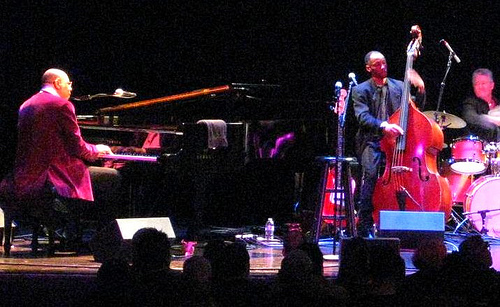
Performing in front of a packed Herbst Theatre last Monday evening, the 70-year-old Valdés spent the majority of the 90-minute concert alternating between Latin and jazz, delegating and allowing his Afro-Cuban Messengers to shine. Many of the tracks were off Valdés’ recent album Chucho’s Steps (Four Quarters Records), with the constant shifts of “Zawinul’s Mambo” and the cool, breezy “New Orleans” serving as highlights. Valdés, resplendent in a violet velvet sportcoat and purple tones, spoke little, allowing a gesture here and a glance there to guide his team.
With time running out, the Cuban superstar took over with a game-winning score. Accompanied by bassist Lázaro Rivero Alarcón and drummer Juan Carlos Rojas Castro, Valdés moseyed into a blues ditty before embarking on a solo run. His fingers leapt into a stunning series of trills, dancing from one side of the piano to the other with an absurd combination of power and grace. Here was a man using all of his beguiling dexterity to build the Herbst crowd into a frenzy, on a blues track no less. After performing the piano equivalent of bulldozing five defenders, Valdés, the good teammate that he is, brought Alarcón and Castro in for the finish. The crowd gave a well-deserved standing ovation.
One of Valdés teammate got a bit enthusiastic with the touchdown celebration. During the deserved encore, bata drummer and vocalist drummer Dreiser Bambolé bounded offstage, somersaulted into the aisle, leapt back onstage and snaked his way around Valdés and the band. A nearby usher, entranced by the enthusiastic percussionist, busted out some salsa moves while waving his hands and imploring the crowd to dance. Few of the crowd obliged; they were still basking in the greatness from the previous performance.
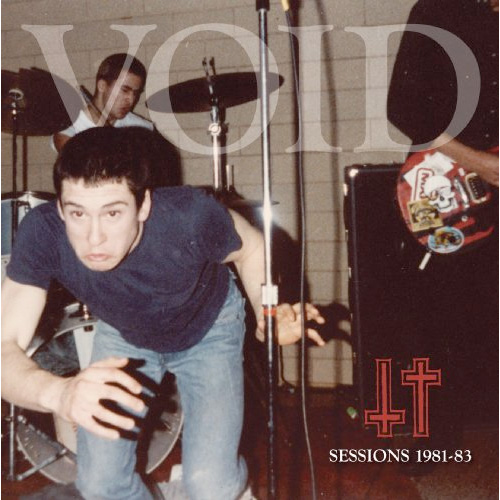
Void was hardcore in a blender. It was loud, frantic, messy, and fast as hell. A brief yet seminal (there’s that word again) punk act, formed in 1979 D.C., Void was known equally for its early mix of hardcore and thrash, as its frenzied live shows, which often turned violent. And for such a memorable act, we future listeners were left with little to actually, well, listen to. It was all buried in seven-inches, splits, and hard-to-find comps.
Nearing the end of 2011, Dischord announced it would release a comprehensive catalogue of the long-gone band’s songs, and it delivered. Sessions 81-83 essentially spans the life of Void in 34 songs, and includes 20 unreleased tracks, live performances, standouts like “Dehumanized,” and thrashy covers (Black Flag’s “Wasted”). Fittingly, the disc ends with a live “My Rules,” recorded in ’83, which simply cuts out, like someone unplugged the amps and walked away.
My personal strategy for Noise Pop 2012 was to pack in as diverse a personal schedule as possible, taking into account old obsessions (Cursive, Bradford Cox) and favored newer acts (Allah-Las, DRMS), national and local bands and musicians, weird and precious live indie music.
I also wanted to spread my time over multiple venues, so this time around I hit up the Independent, Bimbo’s, Great American Music Hall, Swedish American, and Mezzanine. I walked the length of the city, racked up some high bus and cab bills, likely imbibed too frequently and caught some stellar live music. My head, feet, and note-scribbling hand are sore, but it was worth it.
WEDNESDAY: Cursive at Great American Music Hall
It was mid-song (“The Martyr,” 2000’s Domestica), mid-set (Noise Pop), of Cursive’s likely sold-out performance at Great American Music Hall. I opened my eyes, scanned the room, and saw we were all singing along breathlessly. Plaid-shirted forearms thrust towards stage, fringed heads bobbing, and everyone within earshot hollering towards the center. There in the middle stood grizzled singer-guitarist Tim Kasher, leader of the Omaha-bred longtime Saddle Creek Records fixture Cursive, as well as the Good Life. Parsing his words carefully, Kasher spoke for nearly the first time after a quick-fire opening shot of beloved Domestica and Ugly Organ tracks, interspersed with brand newer, understandably less-clapped-for I Am Gemini cuts. “Let’s get candid,” he understated. Full review here.
THURSDAY: Allah-Las and Budos Band at Independent
If you could handpick its most redeeming qualities and inhabitants from any time period in the past half century, Los Angeles could actually be a rather magical place. Pluck the psychedelic guitar strains reverberating through Laurel Canyon, scoop a fistful of bronzed sun-kissed surfers and sparkling waves from the coast, add two shakes of downtown weirdness, and you’d likely come up with something along the lines of Allah-Las, the quartet that opened for Budos Band during the Noise Pop lineup at the Independent Thursday. Full review here.
FRIDAY: Emily Jane White and DRMS at Swedish American Music Hall
The first time I saw dark folk songstress Emily Jane White live was at an ornate church on a hill (RIP EpiscoDisco) so this Noise Pop stop at the Swedish American Music Hall last Friday brought back some particular memories. Memories of an elegant, otherworldly setting and the singer-guitarist who encapsulates the venue’s charms.
With nary a smile, the black cloth-and-lace-swaddled White beautifully finger-picked and sang original tracks off 2009’s Victorian American and 2010’s Ode to Sentience, backed by a seated guitarist, a fellow on bass clarinet, and later, a violinist, who added even more depth to haunting closing song, “Victorian America” – a piece that showcases the bold yet breathy strength of White’s voice. Seated in folding chairs at the Swedish American, surrounded by dark wood trim, the audience clapped politely then grabbed between-act beers from guest bartender John Vanderslice.
Upon my return from Vanderslicing, I saw that DRMS (formerly known as Dreams) had splayed across the relatively small church-like stage, a clump of seven musicians with an interesting mixture of instruments and styles. Behind the retro 1920s blues vocals, the Afro-folk band incorporated more traditional instruments along with melodica, vibraphone, and some sort of bag of shimmering noise, all rainstick-like. Live, the intimate set felt like it could be happening anywhere in the world, a group of friends playing jumbly music with hints at a grab-bag variety of genres and cultures. This could work anywhere, yet still the venue felt the ideal setting.
SATURDAY: Atlas Sound at Bimbo’s
Three of the four acts Saturday night at Bimbo’s were solo dudes on guitar making sounds far beyond the basic limitations of the instrument. These were experiments in experimenting, Carnivores, Frankie Broyles, and of course, the man who likely influenced the others in some form or another, Atlas Sound (aka Bradford Cox, also of Deerhunter).
With a courteous “hello,” Cox picked up one of his magic vintage guitars – one attached to so many pedals and looping mechanisms that one pictures a jumble of chords slithering snake-like up his thigh – and opened up to a captive Bimbo’s crowd with his hypnotic near-soundscapes.
Not knowing quite what to expect live, I was, for whatever reason, somewhat surprised to see only Cox on stage at Bimbo’s (another grand San Francisco venue, for those keeping track of the prettiest music spots to visit) playing music so full it sounded like a full band. Perhaps a ghost band sat behind him, guiding the chord snakes.
Though it’s his solo project, it’s still mystifying to me that he can create such a beautiful noise alone. Cox’s swirling, pulsating loops of guitar and drum sounds picked up speed at times, revving up those in the audience as well, particularly during “Shelia” off 2009’s Logos and more so tracks off most recently released record Parallax: “Te Amo” and “Terra Incognita.”
The front row of the ballroom was packed with youthful obsession (the excited youngsters sat up front on the dancefloor ground from the time the doors opened at 7 p.m. ’till Atlas Sound’s set at 11). Those kids provided fodder for Cox’s eccentric on-stage musings later in the evening, when he brought a boy on stage and said he looked like a younger version of him. I also heard later that young fans swarmed Cox after the set to gush and thank him for saving their lives, with his music.
May I first say thanks to Noise Pop for bringing a sense of urgency to my concert-going behavior. I am nothing if not a festival junkie, and the sheer mass of shows that this particular festival coordinated was awe-inspiring and more than a little anxiety-provoking for those of us who feel the need to go to everything, always. Plus: badges. There is nothing like walking around feeling like you have special access to an entire city, at 24 venues in total from Bimbo’s up in North Beach to the Golden Gate Park-clad California Academy of Science.
Fresh off of a week in New Orleans for Mardi Gras, I couldn’t do it all. But here’s how I tried:
WEDNESDAY: Die Antwoord at Regency Ballroom
This was the show I was most excited about seeing, and the South African hip-hop trio (emcees Ninja and Yolandi Vi$$er, and DJ Hi-Tek) were definitely worth their sold-out hype-age. Even if you can’t get down with their ultra-aggressive lyrics, you can’t quibble with Die Antwoord’s showmanship – even while spinning around like a demented, shaved head-top and bounding across the stage Vi$$er and Ninja managed to hit every lyric like wow. Sadly, the show opened with DJ Hi-Tek’s Mike Tyson-inspired homophobic rantings, and that was tough-impossible to get past. Is Hi-Tek gay? Who cares. Full review here.
THURSDAY: Shannon and the Clams at Cafe Du Nord
One of the greatest things about Noise Pop is that the fest brings new audience to local favorites – and I found, conjures up concert experiences that are a lot different than if you saw your Bay-Bays in the same old venue with the same old crowd as always. Such was Thursday night’s lineup of the Soft Pack, Shannon and the Clams, Fidlar, and Surf Club. (Check Ryan Prendiville’s review of these last two acts here) It was actually my first time catching the Clams, but seeing the group slay it at Du Nord cast them in a different light than if my first time had been moshing in a room-capacity sweaty knot at, say, the Knockout. The Clams came across as a band that is expanding its reach beyond the dark rooms of the Bay Area. After the show lead singer Shannon Shaw told us that the group was in the process of recording its next album, so yay.
FRIDAY: Glass Candy at Mezzanine
I wasn’t wearing neon, but Portland’s Glass Candy still moved my ass out of the upstairs VIP booth we’d somehow scammed and into the throngs for the middle and end of Ida No and Johnny Jewel’s set. The Chromatics are fine, but that group’s live set (which we tasted pre-Candy) was the teensiest bit slow, not compelling enough to leave the cold leather fishbowl that was the booth. Not so No and Jewel, who satisfied all the jumping grindsters with ecstatic chords and No’s prancing.
SATURDAY: Big Queer Dance Party at Public Works
Headliner Big Freedia canceled in a medical emergency, but the crew behind this event decided to keep the ‘big’ and go along with it. Was it a Noise Pop event? Besides Freedia, the schedule, venue, and lineup had remained the same, but staff at the door told me that it was no longer part of the festival, so Noise Pop badge holders had to pay again to enter. Seemed like a boner move, but I was glad to be there once I was inside, if only to check out Double Dutchess’ beautiful boys getting hyped onstage. Their raybeams were reflected in the crowd for the rest of the night – DJ Bus Station John, Stay Gold’s DJ PinkLightning, and DJ Laydown (Hard French crewmember Timothy Strong in his debut on the decks) kept everything really sweaty – which was great because after that much Noise Pop I had some toxins to sweat out.
He asked if there were drink tickets. The bartender nodded, saying that the band could have wine now, and then beers on stage. Neither of those options would work for Stockton’s Surf Club, whose members were all sporting big black X’s — the mark of the underaged — at their Café Du Nord Noise Pop appearance.
When Surf Club played, melancholic Stratocaster led pop, that youthful innocence was obvious in its music. Well, let’s not say innocence, maybe timidity? The lead singer was a big guy with a small voice, like Frank Black (or Kim Deal? someone from the Pixies) in quieter moments.
The softness fit with the lyrics, mostly teen angst songs void of irony with small goals and wants: just to be friends, just to get out of bed. Surf Club seems to be off to a good start, keeping it simple, strumming along to a speedy drum beat. We’ll see what happens when the shyness wears off. The following band, LA’s FIDLAR (which, if you’re keeping score at home was 75% over legal drinking age) had absolutely no issues with confidence. Hell, with a name like Fuck It Dog Life’s A Risk, you know the band’s got to be somewhat carefree, if not downright cocky.
“This song is called ‘Stoked and Broke,’” the band’s most talkative, spastic member introduced the first song, explaining, “because we’re stoked and broke.” What followed was a frenetic set of punk fueled, stripped down rock. With a rollicking tightness that reminded me of Thee Oh Sees, FIDLAR shot along, keeping the energy up by alternating singers.
Simple can be a conscious choice, and for FIDLAR that meant shouting through a song entirely consisting of the words “I drink cheap beer. So what? Fuck You!” with just enough attitude to make it work. Recently signing to Mom+Pop and with a full slate at this year’s SXSW, FIDLAR was definitely one of the better surprises at Noise Pop so far.
If you could handpick its most redeeming qualities and inhabitants from any time period in the past half century, Los Angeles could actually be a rather magical place. Pluck the psychedelic guitar strains reverberating through Laurel Canyon, scoop a fistful of bronzed sun-kissed surfers and sparkling waves from the coast, add two shakes of downtown weirdness, and you’d likely come up with something along the lines of Allah-Las, the quartet that opened for Budos Band during the Noise Pop lineup at the Independent Thursday.
Sporting a bolo tie and an acoustic guitar, lead singer Miles Michaud ran the band through a tight set of exhaustively pleasant, twist-worthy folk-adelia – with the kind of echoing vocals that shoot you back to a simpler time of black-and-white TV rock’n’roll. Perhaps behind those smiling, hair shaking acts of Ed Sullivan yore, a secret hallucinatory tab or barbiturate ran through the blood streams; if you could somehow bring those mysteries pumping through warm veins to the surface, you could get the Allah-Las set. Likewise, it could have replaced Strawberry Alarm Clock in Beyond the Valley of the Dolls, had any of its members been alive at the time.
Maybe most of the 20/30-something, casually hippie crowd was not there for these openers (or the other opening acts), because they seemed mostly stoic – and this sound pleaded for shaking, at least a few hip-swivels. Something.
And from this vintage California boardwalk postcard of a band, we were flown around the world to Ethiopian jazz-via-Staten-Island. The instrumental Budos Band headlined the night and crushed its set – after an abnormally boiling, sticky half-hour wait that left a nearby fan audibly exasperated, and a trail of cool sweat down my back.
The 10-13-piece – counted nine on stage last night – Afro-funk band sauntered out with brassy swagger, clasping large horns (sax, trumpet), traditional vestiges of rock’n’roll (guitar, bass), and plenty of African percussion, amidst a hovering cloud of herbal smoke. Never have I seen such a charismatic baritone saxophonist as Jared Tankel, taking control of the stage with his impressive horn and skill, a maestro of groove, eliciting excitement from the audience by pumping one arm up when freed from the keys.
(The below video was not shot at the Indy, but in Washington a few days earlier) http://www.youtube.com/watch?v=GjPhtjIKjpc
With an instrumental set, the mind naturally wanders, and with this one, it brought me to Bill Murray. Specifically, the downtrodden, graying Murray driving around listening to Ethiopian jazz artist Mulatu Astatke in Broken Flowers. Though I see Budos Band too as perfect driving music, the audience moved far more for during this round, hooting and hollering, shifting and swaying to the consistent beat, laid down by bongos, congas, tambourine, clave, and West African shekere.
The walls were dripping with sweat by the end of it all, and though it was not the transnational journey I’d conjured, the few hour brain-vacation boded well.
Due to health problems, Big Freedia had to cancel her and Rusty Lazer’s Noise Pop gig at Public Works Sat/25. The event been transmutated into a big gay dance party with Double Duchess, DJ Bus Station John, and more. You should still read this interview, though.
With all its technicolor thrift flair, Mardi Gras costumes in state of midway-preparedness, and sleepy passels of breakfast-cooking houseguests, Jay Pennington’s New Orleans clapboard house is pretty hallucinatory on the Saturday afternoon of Carnaval weekend. Staring out the window waiting for the bounce DJ to call me up for our interview, I was to be excused for imagining that the shed in the side lot was producing actual chords while the New Orleans monsoon that raged outside hit it.
When I come across him in his bedroom, Pennington – who is also known as Rusty Lazer, and is the now-famous transgender NOLA bounce artist Big Freedia’s DJ and informal manager – is threading colored paper onto a string. He was going to be Hanuman the monkey god at the Mardi Gras parades on Sunday, his day off from work over Mardi Gras weekend. Around him, the city has ballooned with tourists and locals chucking beads at targets, high-stepping through brass numbers, eating frosted king cake, and peeing in inappropriate places.
I braved the rain that afternoon to talk about bounce music and Mardi Gras with Pennington, so it was kind of a surprise when our conversation swerved into the intricacies of 501(c)3 registration. It shouldn’t have been. He is a lot like New Orleans itself, a town that counts as a centuries-old melting pot, where the frat boys hang at the same bars as the career jazz musicians hang at the same bars as the pretty queer kids who sometimes party at dark gay leather bars (I was privy to this last comingling within six hours of landing in the Big Easy, at Daddy Aki’s Peacock party at the Phoenix Eagle Leather Bar where Pennington and his new managee Nicky Da B spun). [Correction: An earlier version of this article identified Peacock as Jay Pennington’s party. It is actually organized by Daddy Aki. Our bad.]
If you are a NOLA entertainer, Mardi Gras weekend counts among the most hectic of the year. Pennington had evenly informed me that my suggested meet-up time of noon was at least two hours too early considering the aftermath of the night shift on the decks he’d pulled before and that he would surely pull again that evening. But it’s two thirty now and for the moment, he’s able to focus on Hanuman, and attempt to tell me what’s so special about his city.
Hands-on Hanuman: Rusty Lazer in mid-Mardi Gras repose. Guardian photo by Caitlin Donohue
Though the DJ is playing less and less a role in Big Freedia’s career as she blows up and sells out shows around the country, Pennington continues to be a driving force in bounce’s dispersal outside NOLA. He signed his first official managerial contract with Nicky Da B, an adorable local whose track with Diplo hit Soundcloud last week. Bounce is indigenous to New Orleans — like Chicago’s juke and Detroit’s jit — a Caribbean-inflected dance music that is well known for the way its dancers pop their hips at machine gun rates.
Pennington is also is the co-founder along with Delaney Martin of New Orleans Air Lift, an international program he made to support local artists post-Katrina. This loosely-incorporated organization (it’s not 501(c)3 and relies instead on private donations, like the sales of the work of Swoon, one of the few females in the upper echelons of the street art world – her intricate, delicate wheatpastes blanket the fence next to Pennington’s house.) The Airlift Project has sponsored trips by New Orleanian artists to Berlin, even the import of Siberian breakdancer Ivan Stepanov to New Orleans.
This last story illustrates one of Pennington’s biggest turn-ons — fostering the artistic combustion that happens when a bunch of different energies get together. As illustration, he shows me a high fashion video shoot made by Lady Gaga’s stylist Nick Knight featuring the 19-year-old local bounce dancer Quack.
After seeing a video of the improbably Barbie-bodied dancer, Knight contacted Pennington to ask if she’d care to do the same dance wearing Alexander McQueen for a fashion film series. Quack didn’t have a passport, but she went and got one with Pennington. The next day they went to London, found themselves “sitting in a room with nothing but Amazonian models.” Quack danced for eight hours to make the video, which turned out to be a testament to not just the extreme sexuality of bounce music, but also its athleticism, and emotional panacea.
“This is the music that makes people forget that they’re hungry,” Pennington tells me, excitedly clicking through videos of schoolkids bouncing in rec centers, and endless YouTube clips of home bounce practice, done against a wall, ass to the camera. “It’s finally tuned to helping you forget your problems.” He wants to “take a New Orleans plane full of people all over the world,” to teach bounce to the masses. “In case anybody around here has forgotten how to have fun.”
The music lends itself to teaching — singers often give specific commands in songs, a popular request being for everbody to bend over and keep their ass popping. “Bounce is all instructions,” Pennington says.
The ability to move among social groups is one of the reasons why Pennington fell in love with New Orleans.
“Here, you’re part of a community, not just part of a scene,” he reflects. “The difference is that the communities include all the people in your community. I don’t feel that in Portland or Austin.” He says the young arrivals in other artsy, liberal towns “hang out in mirrored social groups. I don’t know if that means anything, but it makes sense to me.” Pennington considers the neighborhood connections he’s made through participating in NOLA’s famous informal second line parades as, if not more, crucial than the ones he’s made with fellow travelers who have alit upon New Orleans as a haven for weirdos and music freaks. “New Orleans black community is nothing if not family-oriented,” he says.
Those mirrored social groups are a concept that should make sense to those beyond DJ Rusty Lazer. Part of what makes gentrification such a bummer is that when young bohos move into low-rent, family-oriented neighborhoods, they don’t form connections with the existing culture, imposing their own wacky adventures on top of the landscape as though they’re the first to really enjoy it.
This missed connection leads newcomers away from frequenting established neighborhood businesses, and doesn’t provide for enough interconnectedness to get any kind of organizing come when rents start to rise and the condos come in. So good for New Orleans, and especially the rapidly changing Bywater neighborhood if they can avoid the typical storyline of minority community attracting broke artists attracting yuppies who can pay first, last, second, and third months’ rent in cash.
Not the town doesn’t have other defense mechanisms. “The heat, the bugs, that lack of industry, the violence — that keeps it from growing out of control,” says Pennington. “It keeps the excessively ambitious away. When this place piles it on, it really piles it on. You can’t just casually live in New Orleans.” Wise words to the San Franciscan exodus that will surely come in the next months after tech boom 2.0.
And for the record, I wasn’t hallucinating the house making music. The Ninth Ward’s musician mad scientist Quintron installed a rain organ into the Music Box, a small village of structures built in Pennington’s sideyard by 70 people to be played like a symphony, complete with Quintron playing conductor and a capacity crowd crammed into bleacher seating and crouching amid the structures themselves. At recent performances during last fall, 750 people showed up to watch the show. There was space for 250 in the sidelot.
Cecil Frena described the lineup at Rickshaw Stop last night simply as “weird music.” He should know. Performing with his synth-fueled electronic dance trio, Born Gold (formerly Gobble Gobble,) Frena stood in front of a camera-slash-iPad pulpit, singing and conducting a third of the group’s sound via a motion-captured, clearly homemade, Janet Jackson Rhythm Nation era-esque military jacket.
Definitely the strangest thing I’d seen all night, until Born Gold started its second song, at which point one of the other members strapped on a pair of stilts and began marching through the audience, playing a custom instrument consisting of a Roland SP-404 affixed to a snow shovel blade. The lighting for the theatrical set was either pitch black or blazing multicolored strobes, including a pair of handhelds that Born Gold used to blind part of the audience after covering them with a black tarp.
In more subdued moments Born Gold did synchronized dances with folding fans or put on helmets and beat each over the head with drum sticks. As much as I noticed the music with all that going on, I’d say Born Gold was a decent fit with the first opener, Yalls. Yalls’s Dan Casey also played largely vocal driven electronic, although typically at a slower tempo and with a quirkier, less sexy lyrical sense. (Did Yalls just say something about living off the pennies in his moustache?) The clipped female R&B samples that made up a sizable portion of one of his beats recalled the time that Ben Gibbard dug up J Dilla’s grave to form the Ghostal Service and cut a chillwave album.
It was clear that most people in the sold out crowd were there to see the very buzzed about Grimes, particularly the wave of hardcore photographers who emerged and cut to the front just before the night’s second to last act, oOoOO (pronounced, by Frena as “Oh, upper case and lower case.”) With a heavy, grim quality that thematically might have fit with Grimes, in terms of the night’s lineup oOoOO was just slotted wrong, as the set was an experiment in how slow one can go. The answer? Really fucking slow. Put a cassette of dirty hip hop — with lots of syncopated hi hats and claps — into a boombox, wait for the batteries to die, record the last ten seconds, loop it, and you’ll get the idea. It’s perfect music to use when training your sloth Barbara to give a lap dance.
Still, it was fairly amazing watching the pros go to great lengths to get the perfect shot of oOoOO’s parka, although the one next to me spent most of the set texting and updating her blog, which was maybe less insulting to the musician than when she was playing Words with Friends while Release to the Sunbird opened for the Flaming Lips the night before. Hopefully as a joke, oOoOO ended his set by throwing the bouquet of flowers from the cover of Power, Lies & Corruption into the audience. Grimes was on after. She performs with the same sort of spread arm, ambidextrous style as the keyboardist from Battles, and met expectations. She had support from Born Gold, as well as a sinister, largely vestigial dancer, whose main move consisted of adjusting her hood. Weird.
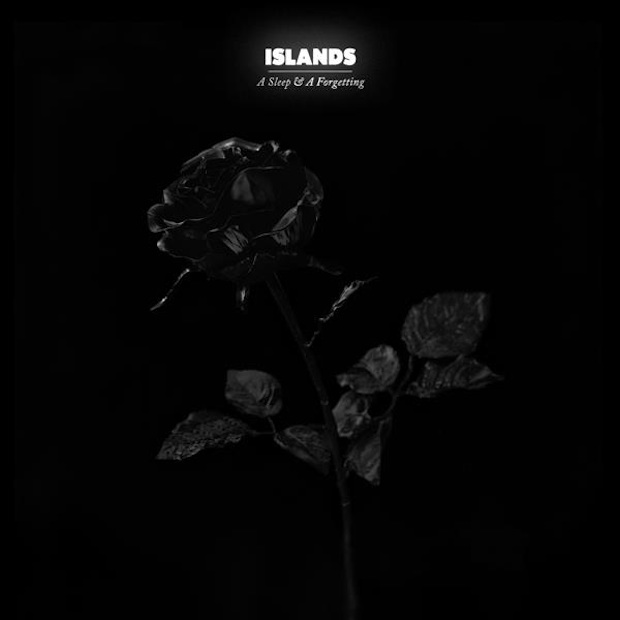
Nick Thorburn started constructing A Sleep & A Forgetting alone, on a piano, while processing a painful breakup. His soul-exposing lyrics carry questions and incredulity. Although there aren’t many uplifting spots in here — literally every song is sad — his voice oscillates between sunny and depressive, heartfelt and sardonic. Quite a conceptual turn from Islands’ last album, Vapours, which featured upbeat, carefree love songs.
In a daring act of honesty Thorburn, who says he’s “always hidden behind devices and humor” in his music, directly places himself in “This is Not a Song” through a third-person reference (“Nick, if you ever learn, it never shows”). The final, and perhaps most impactful, track — “Same Thing” — simulates a hanging sense of hopelessness and craze-inducing monotony via robot-like drum machine. A resigned melancholy permeates this album and leaves you meditating on love’s foreboding nature.
Tears, booze, sex, pain, martyrdom, regret. Against my better judgment, I was singing along with the band. I was singing carefully, with my eyes closed and likely a smile creeping up in the corners of my mouth. I couldn’t help it, it came from within, as much as that particular act generally annoys me in packed settings. The swell of angular guitar and thundering drums pulled back mostly leaving higher octave vocals from a scale that slides to and fro: “Your tears are only alibis/To prove you still feel/You only feel sorry for yourself/Well get on that cross/That’s all you’re good for.”
It was mid-song (“The Martyr,” 2000’s Domestica), mid-set (Noise Pop), of Cursive’s likely sold-out performance at Great American Music Hall. I opened my eyes, scanned the room, and saw we were all singing along breathlessly. Plaid-shirted forearms thrust towards stage, fringed heads bobbing, and everyone within earshot hollering towards the center. There in the middle stood grizzled singer-guitarist Tim Kasher, leader of the Omaha-bred longtime Saddle Creek Records fixture Cursive, as well as the Good Life. Parsing his words carefully, Kasher spoke for nearly the first time after a quick-fire opening shot of beloved Domestica and Ugly Organ tracks, interspersed with brand newer, understandably less-clapped-for I Am Gemini cuts. “Let’s get candid,” he understated.
As with the folly of any continuous lovers, there was ecstasy and there was heartbreak. Dashing Kasher, the classic storyteller, the frog-croaking boozehound, inspires great emotion in his followers, only those who’ve been with him for quite some time – say, more than a decade – may question the direction of sound. Cello out, trumpet in. Perhaps it was projection, but it appeared the crowd and Kasher were mutually orgasmic during early career, well-worn classics, and likewise, faking it to get through the newer ones.
Ending the official set with “Art is Hard” (later explaining he’d be back for an encore, after taking a shot), Kasher reminded us why we were there, because making art is indeed hard and trying, and thrilling and sometimes, routine. “Fall in love to fail – to boost your CD sales.” It’s pulling all those creative types like taffy, up to fame, sideways to monotony, and sometimes, down with it, but if you don’t have a soundtrack to the downward spiral of inventive misery, well, all else is lost too: “You gotta’ sink to swim.”
When South African hip-hop duo Die Antwoord played “Fok Juule Naaiers,” the first single off latest album Ten$ion — the track that opened the group’s Noise Pop gig last night at the Regency Ballroom — for its LA manager, they were told it had some problems. The problem’s name was homophobia, their manager ventured. US audiences, he said, don’t take kindly to the F-word (I wish that were consistently true).
In response, Die Antwoord released this video. It is entitled “F-word,” the version of that term that lacks my lavish commitment to political correctness
Ninja, a.k.a. Watkin Tudor Jones, says the usage is all good because he has good homo friends, and that one of them is Hi-Tek, the group’s DJ, who opened up last night’s show with his charming “Fok Juule Naaiers” verse. Assorted lyrics below:
DJ Hi-Tek will fuck you in the ass, punk ass white boy
Look at you scared/Scared of a real man
Fuck it ’til you love me, [F-word]
So, was this song Hi-Tek’s coming out party? What a bummer party.
Of course, the crowd (sold out to the gills — I had press credentials and still had to beg, borrow, and perform mild thievery to get in) ate it all up. Die Antwood’s stage show is less weird than its videos, because matching them would entail wearing coats made of live rats, which would be hard to get through customs.
Emcee Yolandi Vi$$er without her album cover blood-soaked visage is massively sexy on stage (the whole group looks like they hit the gym hard together). By the end of the show, she had stripped down to running shoes, spandex shorts, and a midriff-bearing pink tee with “zef” printed inside a heart. She always looks like her clothes are about to fall off. Next to Ninja in his orange running shoes and signature Dark Side of the Moon underwear (infamous jiggling penis beneath), they looked like they were hosting a really agressive workout video. Ninja crowdsurfed, constantly. Let no one say that Die Antwoord doesn’t work it out on stage.
Yolandi Vi$$er at the Regency last night.
And, Ninja. Guardian photos by Caitlin Donohue
And it is a good show. Yolandi hype-chirps after Ninja’s every line. She spins around five times and picks up her verse right on cue, and the two reverse roles with Ninja cooing after her lines end. New single “I Think You’re Freaky” was a huge hit, particularly, one imagines, with the guy in a rubber pig mask sweating balls in the front row, a couple in the middle of the crowd wearing the hooded plushie onesies that Die Antwoord rocked — weirdly, always weirdly — in its “Umshini Wam” video. The front lighting blacks out after songs, silhouetting Ninja and Yolandi’s distinctive haircuts. They are unapologetic in their stage presence, crowd love.
Earlier that day, afraid of not getting on the list for the show, I lurked outside Upper Playground’s Fifty24SF gallery, where Ninja had spent the day painting the walls with the black chicken scratches and Evil Boy engorged penis characters that now adorn Die Antwoord merch, stage sets, and his own body. At 4 p.m., there was a line of Die Antwoord fans lined up to greet Yolandi and Ninja. You could cut the line if you bought a $200 Evil Boy latex toy.
Few people did. First-in-liner Stephanie Farrell, who came straight from school for the signing didn’t. But she got what she wanted out of her wait: a really awkward experience with her idols.
“What was your interaction with them like?” I asked her while looking at the Die Antwoord’s signatures, written in her wire-bound, lined notebook.
“They didn’t say anything, it was really awkward. I was like ‘hey,’ and they were like ‘hey.'”
“But are you still a fan?”
“Absolutely. I didn’t expect it to be a normal experience whatsoever.”
In the “[F-word]” video, Ninja says that people from the United States who are upset by the way they use that and other (N-word) offensive bullshit should quit being a little less PC and learn from “your brothers and sisters here in the dark depths of Africa,” where a local saying is translated into “we are one.” He then grabs his Evil Boy dolls, a black one and a white one, and knocks their monster toy dicks together while repeating the “we are one” phrase in a high-pitched voice. “That’s why they say South Africa is a rainbow nation.”
Weird.
Photos of Die Antwoord’s Ninja painting the inside of the Fifty24SF gallery are by John Orvis
I ran into a temporal anomaly while driving. My first warning sign was the police cruiser with one headlight flashing its sirens behind me. Wrong place at the wrong time? Well, I was getting pulled over in Sebastopol on the way to Richmond from SF, but when the cop told me I was doing 78 in a 55, it suggested one thing —speeding.
And speeding isn’t spatial — location is irrelevant — you are precisely where you should be, just too fucking soon. The cop seemed hopeful that he could help me, but as he took my papers and ran back to his car I knew he had abandoned me to the crush of an impending temporal singularity, as time began to move in slow motion.
Slow motion. Some refer to it as time dilation. The sensation that a certain duration lasts longer than it should. The Flaming Lips have a song about it, called, obviously, “Slow Motion.” It goes like this:
Hey, come on over.
You know the day is going slower.
It takes a year, to make a day.
And I’m feeling like a float in the Macy’s Day parade.
Or like a boat, out on the ocean. I’m drifting round in slow motion.
LSD and other narcotics aside, time generally doesn’t work that way. Compared to your life so far, each additional day is a smaller proportion. Time telescopes, you speed up, it goes faster. Slowing down is the opposite, unnatural. Sitting in a car waiting for the cop to come back (Is he going to search me?) or laying on a couch with friends trying not to cry — whenever time slows down — it’s unnerving.
You only know this much about “Slow Motion” — an alternate track from The Soft Bulletin not released in the US — because you saw the Flaming Lips play it once. But which time? Not at that fair in Santa Rosa. That one had a rave after. Not at the Fox Theater. That was the one where you slow danced with your girlfriend (at the time) until the staff asked you to leave. At Sasquatch, there in the Gorge? They did play The Soft Bulletin then, but it was rushed. That guy stood behind you — when Wayne Coyne was recounting Steven Drozd almost losing his hand and Michael Ivins being in a car crash — screaming “Play-a-song!” No, there just hadn’t been time.
And time, for the Flaming Lips, is important. Because as a band — one that has been through all sorts of well documented shit — the Flaming Lips know the value of time (particularly borrowed) and have made it their work to not just create music but get into the complete manufacture of moments. Which is a tricky business, because moments are bastards. Take all the pictures you want of the blinding lights, the beautiful costumed kids, the confetti cannons or all the other individual weapons that the Flaming Lips use to wage musical psychedelic war on time, and the moment still might not fit in a shutter, no matter how you slice a second.
It was at Bimbo’s. Not the time they played Noise Pop a few years back, but more recently. They were playing The Soft Bulletin, and taking their time. Hitting every single track from every single version of the album. Not quite slow motion, but close. When was that?
It was the night after the couch. When you were watching Blade Runner on TV, just the end part. Where the maniac with white hair is running around, trying to knock some sense into the other idiot character, who hardly even realizes he’s alive most of the time. And it starts getting heavy. Meaningless inevitability; the crushing force of time. Fucking tears in the rain. Before you know it, you’re happy it’s basic cable, because sometimes a commercial interruption is all that’s keeping you from crying. It was the night after that. The Lips were going slower for sure, but still way too fast. The moments going by before you’re ready. Before you know it, they are on to other songs, and “Slow Motion” is somewhere in the past, back there with your best friends on the couch, never to return.
The band is getting ready to play something else, Steven readying both miraculous hands on another instrument while Michael stands ready, as ever, on the bass. You want to reach into your bag to take the camera out again, but you resist the urge. It won’t capture the cold press of the air canisters at your back anyway. Or, for that matter, the hookah scented air from the smoke machines. And anyway, if you’re taking pictures during “Feeling Yourself Disintegrate,” you’re probably irretrievably lost.
And suddenly, everything has changed. The cop comes back to the car. Tells me my record is clear, that he just marked 65 on the ticket, because I was didn’t know where I was. He gives me some directions, regarding the roads. I don’t really listen (but do thank him and let him know about his broken headlight.) I drive forward, knowing exactly where I am. I was at a Flaming Lips show, and now I’m driving home.
Hearing a band being described as “tribal electronic” gives me a headache, but Young Magic actually pulls it off on its debut full-length, Melt. This New York-via-Australia trio works irregular drum machine beats, swirling synths, and haunting vocals into dark, psychedelic pop songs. The sluggish, heavily reverbed “Night In The Ocean” is sensual and explosive. With its fluttering synths and repeated “I found love with you” vocals, “Jam Karet” is catchy and almost chant-like. “The Dancer” opens with a few creepy music box notes, and features what sounds like a shrieking tropical bird.
There are a lot of playful juxtapositions of ambient nature sounds and electronic elements on Melt, creating a feeling of these tracks being played on a MPC in some distant, secluded cave. Supposedly, the album was recorded all over the world, in Germany, Iceland, and Australia. These songs sound vaguely exotic and, as the band’s name suggests, snugly rooted in the occult.
The video for “Night in the Ocean” is equally sexy:
Localized Appreesh is our weekly thank-you column to the musicians that make the Bay. To be considered, contact emilysavage@sfbg.com.
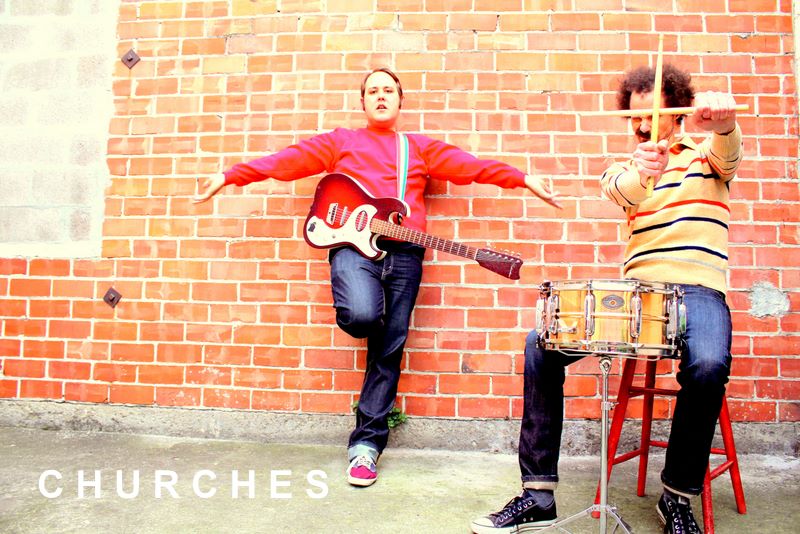
There’s a whole lot of religious imagery going on within new local guitar-and-drums superduo Churches. Most vivid, beyond the obvious, is the guilty, desperate strain in mesmerizing first single, “Save Me,” and its jittery remixes. The track and remixes (available on Bandcamp) are both pleading and sensual, evoking the classic good/evil ecstasy of sacred customs.
Musically, the band – made up of Caleb Nichols (Grand Lake, Port O’Brien) and Pat Spurgeon (Rogue Wave) – arouses memories of ’90s bedroom angst; “Save Me,” recorded at Tiny Telephone, utilizes this vibe and mixes it with distorted pop, repetitive calls, and lightly-employed synth. Second single “Feel Alright,” released today, follows the garage trail deeper, occasionally evoking an early Nirvana-lite.
What better way to showcase an auspicious local act than with a slot during Noise Pop? Churches plays Bottom of the Hill this week with Fresh & Onlys. But first, they gave us the rundown on a new life as Churches.
http://www.youtube.com/watch?v=0AH9XkyhkQE
Year and location of origin: September 2011. San Francisco and Oakland. Tiny Telephone and Harlan Street.
Band name origin: I came up with the name while on tour with WATERS (I was playing bass with them). I remember that Van and Niko and I were talking about what my next music thing should be and we came up with the idea for Churches, which is the English translation of my middle name, Kirke, but plural.
Band motto: Aequalis opus aequalis stipendium.
Description of sound in 10 words or less: Re-experience teen angst through distortion and chorus plus loud drums.
Instrumentation: Guitar, Singing, Drums + (a little) Bass and Moog.
Most recent release: “Feel Alright” – a self-released single, out today, Feb. 21.
Best part about life as a Bay Area band: Lots of great venues, lots of great musicians and studios.
Worst part about life as a Bay Area band: Living here can be expensive. Being a musician can be expensive. Many musicians are poor. So, the math is against some of us.
First album ever purchased: Michael Jackson Dangerous. Most recent album purchased/borrowed from the Web: Cloud Nothings, Attack on Memory. Favorite local eatery and dish: Super Duper on Market and Castro. Best burger in the WORLD.
San Francisco will honor the memory of philanthropist Warren Hellman this weekend with a fittingly free, live bluegrass showcase. The event includes performances by: Poor Man’s Whiskey, John Doe, Kevin Welch, Kieran Kane & Fats Kaplin, Dry Branch Fire Squad, Steve Earle, Buddy Miller, The Wronglers (Hellman’s old band) with Jimmie Dale Gilmore, Gillian Welch, Boz Scaggs, Old Crow Medicine Show, Robert Earl Keen, Emmylou Harris with special guest The Go to Hell Man Clan.
The Warren Hellman Public Celebration takes place Sun/19 from 11 a.m. to 6 p.m. down by Ocean Beach, in the Great Highway (Hwy 1) parking lot between JFK Drive and Lincoln Avenue. The event also will be streaming live at www.strictlybluegrass.com.
As Guardian city editor Steven T. Jones expressed the week following Hellman’s death late last year, “Warren Hellman left a hole in the heart of San Francisco when he died.” As most San Franciscans know by now, Hellman, a venture capitalist, was a music lover at heart – he bankrolled the city’s prized fall festival, Hardly Strictly Bluegrass.
http://www.youtube.com/watch?v=9YDTx_yXfeI
When culture writer Caitlin Donohue visited Hellman in his office two years before his passing she noted, , “I realize that central to [Hellman] is bluegrass music. His corner office is comfortably packed with stacks of banjos and guitars, a signed CD from Emmylou Harris that wishes him a happy birthday, a metal sculpture that wears aviator sunglasses and a white cowboy hat, thank you plaques from the Berkeley music venue Freight and Salvage, where Hellman is a keystone donor and acted as chairman for the club’s fundraising campaign in years past. It’s impossible to avoid the music in the room, indeed the music is the room.”
Warren Hellman Public Celebration Sun/19, 11 a.m.-6 p.m., free Great Highway (Hwy 1) parking lot Between JFK Drive and Lincoln Avenue, SF www.strictlybluegrass.com
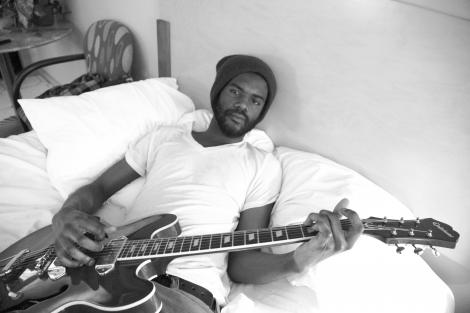
“Well you gonna know my name, by the end of the night,” Gary Clark Jr. sings during his take off Jimmy Reed’s blues classic, “Bright Lights, Big City.” The Animals, Rolling Stones, Clapton, Dylan – many have had their take on it, but Clark flipped the tale of urban intoxication, giving it extra bravado and, with a notable performance at the Crossroads Guitar Festival 2010 and resulting Warner Bros record contract, turned it into an announcement of his own impending stardom (with risks involved).
As Clark Jr. walked out onto the stage of the Great American Music Hall Wednesday night it was clear that “Bright Lights” had been working given that the sold out crowd not only knew who he was, but readily sang him “Happy Birthday.” Of course Clark, turning 28, has had plenty of time to build up a following. At 17, in his home of Austin, TX the mayor was already proclaiming a Gary Clark Jr. Day, on account of his prodigious and heralded guitar skills.
It was those skills that people came out to hear at the Great American, and that’s what they got. There’s a lot of ways someone like Clark could go, but at this point in his career, Clark is still more of an old school, straight ahead blues rockers than successful popular contemporaries like Jack White or the Black Keys’s Dan Auerbach.
Clark opened the night with a couple tracks from his The Bright Lights EP. With “When My Train Pulls In,” he set a simple rule – the length of the songs would be less structured around the verses and would instead go as long as he wanted to solo. That one’s a bit heavier and slow, but he followed it up with “Don’t Owe You A Thang,” a catchy number built from some Bo Diddley-esque guitar playing. Clark would alternately double time or halve the solos, but kept the number well balanced by coming right back in with forceful vocals right before a shift in beat.
As he worked through a set that consisted of some covers and some originals, it was clear that Clark was experimenting with a number of styles, with mixed results. Compared to the confidence on display in “Don’t Owe You A Thang” and “Bright Lights,” the fluttery soul piece, “Things Are Changin’” had a John Meyer quality to it that I found unappealing. Almost reading my mind, Clark finished playing the number and said, “So enough of that sweet soft stuff, we’re about to get crazy up in here.” After a noisy intro that recalled another Austin guitar hero, Eric Johnson, the band started breaking the beat down more, playing “If You Love Me Like You Say,” with a big funky drummer solo, over which Clark pulled out some tricked out technique that sounded more like scratching on vinyl than anything I was expecting.
After a set involving a couple of real stretched out numbers, Clark met expectations with “Bright Lights.” But as he walked off stage it seemed like a number of people either had enough or got what they wanted, not waiting for the encore. People still called for it, though, and the guitarist returned, first without his band, saying “I want some alone time with you guys,” softly playing a couple songs. Anyone who left missed out, as the band came back on stage to closed the night with Curtis Mayfield’s “Move On Up.” It’s a song that’s hard for almost anyone to cover, particularly if they lack a really good horn section. But at Clark Jr.’s hands, it didn’t seem like anything was missing.
1. When My Train Pulls In 2. Don’t Owe You A Thang 3. ? 4. Please Come Home 5. Things Are Changing 6. If You Love Me Like You Say (Albert Collins) 7. 3 O’Clock Blues (Lowell Fulson) 8. ? 9. Bright Lights Encore 10. When The Sun Goes Down 11. Freight Train (Elizabeth Cotten) 12. Move On Up
Openers: Aren’t there a lot of bands right now with White Something as their name? In any case, when the White Buffalo finished its set, someone next to me remarked “Man, I wish there were encores for openers. I could go home right now and been glad I heard that.” For my part I could have stood to hear some more of the first opener, White Dress, particularly the twangy, smoky voice of Arum Rae, who seems to do equally well with or without accompaniment.
Localized Appreesh is our weekly thank-you column to the musicians that make the Bay. To be considered, contact emilysavage@sfbg.com.
Bhi Bhiman manages a joke when he coolly plucks bluesy guitar while singing about kimchi on “Kimchee Line” off his new album Bhiman (“it’s cabbage time”). It’s just not the food you’d expect to hear name-checked in a folky 1920s blues-style standard. (Though on another track, “Ballerina,” he does mention beans.) Despite this wry wink, his songs have an inherent sadness to them, which only makes more intriguing that irreverent style of telling socially conscious stories with lyrics you just wouldn’t quite imagine there in another time period. It’s the contemporary take on the classic style.
He has been referred to as the “Sri Lankan Woody Guthrie,” but that sort of makes me cringe, for a number of reasons. Though it’s true they both sing stories of the downtrodden (check “Guttersnipe” below). But Bhiman is a musician who needn’t be reduced to borderline comparisons based partially on ancestry. He’s got a style his own, and was born in St. Louis. This week, the SF-based musician celebrates the release of Bhiman with a show Sat/18 at Bottom of the Hill.
http://www.youtube.com/watch?v=ALAYYMwQMWQ
Year and location of origin: Born 1982, St. Louis, USA, Earth.
Motto: Badabing Badaboom.
Description of sound in 10 words or less: Socially aware country blues and soul.
Instrumentation: Acoustic guitar, vocals.
Most recent release:BHIMAN (BooCoo) – released Jan. 24, 2012.
Best part about life as a Bay Area musician: Diversity of culture
Worst part about life as a Bay Area musician: Cost of living
First album ever purchased: Michael Jackson’s Dangerous.
Most recent album purchased/borrowed from the Web: Booker T Jones, The Road From Memphis.
Favorite local eatery and dish: There’s a new Korean place called Manna that is really good and reasonably priced (incredibly important). I get the soft tofu soup with pork.
http://www.youtube.com/watch?v=NUxknehMG6E
Bhi Bhiman With Vandella and Misisipi Mike & Cree Rider opening Sat/18, 8:30pm, $12 Bottom of the Hill 1233 17th St., SF www.bottomofthehill.com
When I last caught Parenthetical Girls in SF, singer Zac Pennington closed the show in a memorable way: traipsing around the room with a single drum stick, tapping out the solemn beat of “Stolen Children” on every available pint glass, shattering them and covering the floor in shards.
It made for a good show, but I had to imagine that someone – particularly the person that had to sweep up – was not happy. Pennington took time to tell his side of the story while opening for Los Campesinos! Friday night at the Great American Music Hall. With a typical wry petulance, Pennington said it was a reaction to an engineer who did little more than sit and eat pizza during the sound check for the his band, which hails from Portland, Ore. (a place that, the singer remarked, “has taken the crown for white liberal self-importance in the last few years”).
Whether or not that’s a valid reason for his antics, Parenthetical Girls remains a worthwhile live band largely because of Pennington’s theatrics, which combine Rufus Wainwright’s flair for drama with Mick Jagger’s vamping. Between wandering through the crowd with complete disregard, worming his way across stage face down on his stomach, and deep-throating the microphone, it was a surprise that Pennington found time at all to sing (he’s a multitasker).
Only the band’s drummer made any attempt to compete in terms of physical energy Friday, the other two members consistently played with an aloof cool, particularly keyboardist (and Susan Ann Sulley doppelganger Amber Smith,) who managed to stay blasé even as Pennington suggestively wrapped his mic cord around her pale neck. “Point of fact, the only time we ever get to play nice venues in San Francisco is when we play with Los Campesinos,” Pennington noted. “God bless those guys.*”