News and Politics | San Francisco Bay Guardian

News & Opinion

Editor’s notes

16

tredmond@sfbg.com

It’s nice to see that the days when you could get away with calling protesters commies are back. CNBC says that the Occupy Wall Street activists are “anarchists” who are “aligned with Lenin.” Actually, none of the anarchists I know are remotely Leninist. The communists of old were all for the creation of a powerful state. Lenin read Bakunin in his early years, but later declared that anarchists were “bourgeois revolutionaries.”

But I wouldn’t expect Larry Kudlow, Jim Cramer and Joe Kernan to be up on their radical history. They clearly haven’t spent much time with the people of the Occupy Wall Street movement, either. If they did, they’d realize that — like most of the left-wing movements that have sprung up with young people at the forefront in the United States over the past half century — the essential politics of Occupy Wall Street aren’t derived from Lenin, Marx, Castro, the Sandinistas, or Hugo Chavez. It’s about self-reliance, about community control and free expression, and in its purest form, it’s a rejection of the old role of leaders and authority. It would have driven Lenin mad.

I grew up on that side of politics. In college, the anti-apartheid and antinuclear movements were all about consensus process, all about the rejection of any sort of power relationships. We had no elected presidents or chairpeople. We didn’t vote on anything — voting disempowers the losing side. We took no action until we could reach consensus; everyone had to agree with everything.

What ultimately happened was that the people who could stick around for very long meetings, typically very late at night, where everybody had a lot to say and nobody got to tell anyone to cut it short, made the decisions. I never lasted.

When you’re all at an encampment with nowhere to go, it’s a thrilling exercise in real, direct democracy. When you’re trying to do organizing involving people who have jobs, kids, and lives that can’t fit three-hour (at best) meetings into the schedule, you leave a lot of your potential allies out.

The most interesting thing, though, is that the organizing principle of the protests, by its nature, involves distrusting government. That’s been part of the young left for a long time — and for those of us who believe in a strong public sector, it’s a bit, as they say, challenging.

Breaking free

20

rebeccab@sfbg.com

An ordeal that began with a hiking trip on July 31, 2009 in Northern Iraq came to a close Sept. 21 when Shane Bauer and Josh Fattal were released from Tehran’s Evin Prison. They’d languished in an 8-by-13-foot cell for 781 days while their friends and supporters waged a creative, behind-the-scenes campaign to free them.

Bauer and Fattal were ferried out in a convoy with Swiss and Omani officials and flown to Oman, where news cameras captured their joyful reunion with loved ones. Waiting on the tarmac with their family members was Sarah Shourd, Bauer’s fiancée, who’d been arrested with them and was released last September after spending 410 days in solitary confinement. It was the first time since their arrest that “the hikers” — as the trio came to be labeled in the campaign calling for their release — were together outside prison walls, free at last.

Watching their reunion from Seattle, their friend Shon Meckfessel — who went to Northern Iraq with them but hadn’t felt up to hiking that day — was overjoyed. “It’s like I’ve collapsed from relief,” he told us by phone. “I just feel like I’ve been asphyxiated for the last two years, and suddenly I remember what air smells like.”

In the Bay Area, friends who’d pulled together to work toward their release breathed a huge, collective sigh of relief. “It was just a crazy, amazing adrenaline rush of happiness,” said Jennifer Miller, who befriended Shourd years earlier while doing human rights work focused on violence against women in Juarez.

Bauer and Fattal had stood trial only weeks earlier in an Iranian court, on charges of espionage and illegally crossing an unmarked border between Iraq and Iran. They were found guilty and sentenced to eight years each in prison. Their release coincided with Iranian President Mahmoud Ahmadinejad’s visit to the United States for the United Nations General Assembly conference.

As Bauer, Shourd, and Fattal remained isolated at the mercy of guards they could barely communicate with, their family and supporters kept up a steady drumbeat calling for their release. They recruited actors, intellectuals, and foreign diplomats to urge the Iranian government — which has not had diplomatic ties with the U.S. Since 1979 — to let the Americans go. Once Bauer and Fattal were free and wandering around New York City, they’d morphed into minor celebrities — strangers approached them in the streets to wish them well.

In the end, nobody can say just what persuaded the Iranian government to release Bauer and Fattal. “Sarah was talking with diplomats in all kinds of countries. The thing is, none of us really knows what the calculus was,” said Liam O’Donoghue, a friend who helped out with the campaign.

The campaign was multi-faceted, with friends and family coordinating parallel efforts from various locales. While Bauer and Fattal’s group of friends in the Bay Area are quick to note that their work reflected just one slice of the overall push for the young men’s freedom, the grassroots organizing effort they created clearly had some effect in the end.

“If Shane, Sarah, and Josh were just three random people who didn’t have this group of friends who were so proficient at organizing, I think they would have still been in jail,” O’Donoghue mused.

Shortly after Bauer and Fattal were freed, Iran’s foreign ministry issued a statement acknowledging the involvement of the Sultan of Oman, United Nations Secretary General Ban Ki-Moon, Iraqi President Jalal Talabani, and — more surprisingly, given his adversarial relationship with the U.S. — Venezuelan President Hugo Chavez, who enjoys a close relationship with Ahmadinejad.

Once reports surfaced emphasizing Chavez’s involvement, the news broke that actor Sean Penn had played a role, too — by flying to Venezuela to encourage Chavez to approach Ahmadinejad about the case.

Yet the stage had already been set by friends of the hiking trio, a small crew of passionate social justice activists based in San Francisco and Oakland. They possessed skills as organizers, but this time the goal was more personal — they wanted nothing more than for their friends to be free.


TIME TO ORGANIZE

Based on the 17 alarmed messages on his voicemail, David Martinez knew something terrible had happened involving Bauer and Shourd. An independent filmmaker, Martinez was close to both and had collaborated with Bauer in 2007 to produce a film about Darfur.

Soon after learning that they were being detained in Iran, he found himself swept into a whirlwind, ad-hoc grassroots organizing effort as friends and family of the hikers contacted one another, fired off rapid emails, and organized conference calls to try and determine how to respond.

“We created this working group, this conference group — we wanted everybody’s expertise,” explained attorney Ben Rosenfeld, who has known Shourd for more than a decade and offered free legal representation to Shourd’s mother. “We set out to build a brain trust, essentially, and we did that very, very quickly.”

Shourd and Bauer had been living in Damascus, Syria, at a Palestinian camp when they decided to take a short trip to Iraqi Kurdistan. Shourd was teaching English to Iraqi refugees, and Bauer — a photojournalist — was writing articles about the Middle East. Fattal, an environmental educator, was visiting them. They journeyed along with Meckfessel to Kurdistan, a forested region of Iraq known as a safe destination for U.S. citizens. But once they arrived, Meckfessel felt groggy, so he opted to stay behind while the other three went off in search of a waterfall.

“I was on a bus to meet them and got a call from Shane that they were being arrested by Iranian authorities,” Meckfessel told the Guardian. After notifying their families, he flew to Istanbul to stay with a friend.

Back in the Bay Area, word of the hikers’ plight was starting to make news. “I had producers from morning shows like Good Morning America ringing my doorbell from the beginning,” Rosenfeld said.

Martinez was on a conference call with the core group of organizers when Meckfessel contacted him via Skype from Istanbul — and by that point, the national media was hungry for a statement from the elusive fourth hiker. So the group worked with Meckfessel to craft a statement for the press.

The first challenge they faced was this: Should they emphasize that Bauer, Shourd, and Fattal were humanitarian activists, or should they downplay their political leanings by casting them as adventuresome Americans with a love of the outdoors? Both portrayals were true, but the most important audience, as Rosenfeld pointed out, was ultimately their captors.

Meckfessel said he thought highlighting their politics would help their case. “The first minute after I got the phone call [from Bauer] … I thought that basically our involvement in the region as journalists, as academics, and as educators, and our long public record speaking out for human rights and as critics of US foreign policy in the area … would get them out,” he said.

Meckfessel later created a website, FreeOurFriends.eu, to emphasize the humanitarian and journalistic work that the three were engaged in. In the summer of 2010, he maxed out two credit cards to go on a 30-city European tour to drum up support overseas.

Despite the group’s initial contact with the Committee to Protect Journalists as well as Bauer’s editors at The Nation and Mother Jones, some were opposed to emphasizing the journalism aspect. “Think back to July 2009 in Iran,” Martinez said, referencing the popular uprising known as the Green Revolution that had sent shockwaves through Iran just months earlier. “Our friends were and are journalists involved in social movements and people’s movements. I’m pretty sure if you did a Google search with ‘Iran, July, 2009, activists,’ you’d come up with something like torture, prison. That is why we thought … let’s just say they’re hikers.”

So they came to be known as “the hikers,” and a website was created to go along with the campaign, called Free the Hikers.

“We wanted to make sure we weren’t divulging details about them that they weren’t divulging to their interrogators,” Rosenfeld said. “We wanted to be careful not to piss off the U.S. or the State Department. And, if we seemed too orchestrated, it might feed into Iran’s paranoid theories that they were spies. So we had to try to solve for all of these variables at the same time.”

It began to dawn on them that they were contending not only with the soured relationship between the U.S. and Iran, but an internal power struggle within Iran that had intensified in the wake of mass internal dissent. “The government that grabbed Shane, Josh, and Sarah was at war with its own people,” Martinez reflected. “They were prisoners of the historical moment.”

Nor was the trio the first in their circle of friends to stumble into a horrendous situation overseas. Tristan Anderson, of Berkeley, was attending a nonviolent protest of the Israeli occupation in a Palestinian village at the beginning of 2009 when he was hit by a high-velocity teargas projectile fired by Israeli Defense Forces, and sustained serious brain injuries.

“Tristan’s like a minor celebrity in Iran,” Meckfessel noted. “He’s known not only for initially getting shot … but Tristan’s whole case got a lot of sympathetic media in Iran.” When his three friends were captured, “the first thought I had was, we have proof that we’re all friends with Tristan,” he said.

On Feb. 10, 2010, Anderson’s parents, Nancy and Mike Anderson, sent a letter to Ahmadinejad. “It pains us greatly, on top of the tragedy we have already suffered, to see Tristan’s close friends made to bear the burden of grievances between nations,” they wrote.


GAME OF DIPLOMACY

The idea to approach the Venezuelan government started when Raymor Ryan, an Irish author who lives in Chiapas, phoned Martinez. “He said, ‘The only thing that’s going to really affect them is state power — this is a game of diplomacy,'” Martinez recounted. He suggested Venezuela — a country that is not only on friendly terms with Iran, but has connections with social movements. Martinez liked the idea, but first he ran it by another friend, famed academic Immanuel Wallerstein.

In an email, Wallerstein summarized for the Guardian the advice he gave. “The Iranians are using this as part of their struggles with the United States,” he wrote. “The least likely way to obtain their release is to allow U.S.-Iranian relations to be the issue, or to allow the virtues of the Iranian regime to be the issue. I suggested that they try to work with various left-of-center governments in Latin America, which have friendly relations with Iran, and see if they will intervene with the Iranian government. I did not single out Venezuela. After that, I was out of the picture.”

In October of 2009, Rosenfeld reached out to an attorney he knew through the National Lawyers Guild, Eva Golinger, who’s authored seven books, lives in Caracas, and occasionally serves as an adviser to Chavez. She agreed to help.

Nicolas Maduro, Venezuela’s foreign minister, told her he thought Chavez would be open to helping. “The foreign minister went to Tehran, and they told me they were going to broach the subject,” Golinger said. “When they came back, they told me unfortunately, it wasn’t a topic that was received favorably by the Iranians.”

Rosenfeld and Martinez were crazed, but they had another idea. Perhaps Chavez would be more responsive to appeals from lefty luminaries. Thanks to behind-the-scenes arrangements made by campaign organizers working every connection they could muster, a letter dated Feb. 26, 2010 was sent to Chavez on behalf of Noam Chomsky, Angela Davis, and Harry Belafonte.

“All three of the hikers are dedicated to improving living conditions for poor and oppressed people throughout the world, and to fostering a better understanding among their fellow citizens of the U.S.’s hegemonic role in global politics and economic privation,” they wrote.

Soon after, Golinger had a chance to speak with Chavez directly, when she was invited to join him on a trip to Uruguay to attend the presidential inauguration. “He said, ‘do you think they’re spies?’ I said, look, I don’t think they’re spies. I think they were gringos in the wrong place at the wrong time,” she recounted. “Chavez said, yeah, no problem. I’ll help.”

Soon after, the campaign recruited anti-war activist Cindy Sheehan to write to Chavez, too. But the months rolled by without word of a trial date, let alone a release. Rosenfeld thought up a new way to reach Chavez — by encouraging actor Sean Penn to speak with him.

Penn enjoyed a good relationship with the Venezuelan president and had been regularly traveling to the region to aid in earthquake relief efforts in Haiti, which Venezuela was deeply involved in. Rosenfeld asked Matt Gonzalez, chief attorney of the San Francisco Public Defender’s Office and a friend of Penn’s, to mention it to him.

Within months, Penn discussed the hikers’ case with Chavez, according to Golinger. Then, in September of 2010, Shourd was finally released. Bay Area friends described it as a moment of sheer joy, but also bittersweet, because Bauer and Fattal remained behind bars. Miller invited friends and organizers over to her place in Oakland to join her in the surreal experience of watching their friend deliver a speech on television.

Meckfessel was in Rome as part of his “Free Our Friends” tour through Europe. “I got a text message from somebody that she had been released, and I burst into tears of relief,” he said. “Then, just as I was preparing to do my presentation in Rome, I got a call — and it was Sarah. I just shouted and cried in front of this big group of Romans, and everyone was applauding.”

Upon her return, Shourd wasted no time throwing herself into the campaign. “I just have so much admiration and respect for Sarah,” Miller said. “She went from coming out of prison, and needing time to heal from that, to becoming a full-force, 24/7 international diplomacy worker.”

Shourd, Bauer, and Fattal were unavailable for an interview for this article, but their families emailed a statement. “As Josh and Shane said when they got home, many of their friends put their own lives on hold to fight for their freedom,” they wrote. “We are grateful to the many people who worked in many different ways to help Shane and Josh. Every single effort mattered and made a difference.”


INEXCUSABLE ACTS

When the day of their release finally came, Golinger watched in Caracas as television broadcasts showed Bauer and Fattal bounding down the steps of the plane and leaping into the arms of their loved ones. She sent a text to Maduro, the Venezuelan foreign minister, who was in New York for the UN General Assembly. “I asked … were we involved?” Minutes later, she received a text in response. “He said, fundamentally, yes.” The Iranian foreign minister had told him that the release went through because of Chavez’s request.

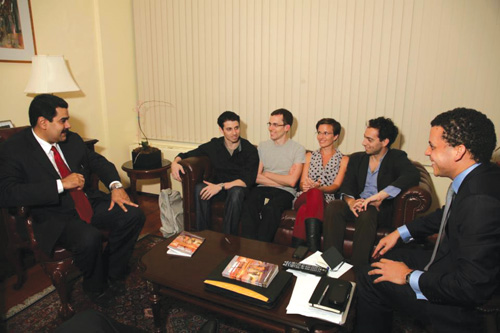
Days later, in New York, the hikers visited the Venezuelan consulate. And on the same trip, their first time back on U.S. soil, Bauer and Fattal held a press conference.

“The only explanation for our prolonged detention is the 32 years of mutual hostility between America and Iran,” Bauer said. “The irony is that Sarah, Josh, and I oppose U.S. policies towards Iran which perpetuate this hostility. We were convicted of espionage because we are American. It is that simple.”

He went on: “In prison, every time we complained about our conditions, the guards would immediately remind us of comparable conditions at Guantanamo Bay. They would remind us of CIA prisons in other parts of the world, and the conditions that Iranians and others experience in prisons in the U.S. We do not believe that such human rights violations on the part of our government justify what has been done to us, not for a moment. However, we do believe that these actions on the part of the U.S provide an excuse for other governments, including the governments of Iran, to act in kind.”

Alerts

0

steve@sfbg.com

WEDNESDAY 5

Occupy San Francisco

Inspired by the activism and events of the Occupy Wall Street movement that began Sept. 17 in New York, protesters with Occupy San Francisco have camped outside the Federal Reserve building in SF for weeks (see our Politics blog for coverage of the movement and its Sept. 29 march through the Financial District). Supporters from labor and other progressive organizations will join the occupiers for another march in support of what protesters call “the 99 percent,” those of us suffering from the greed and corruption of the wealthiest 1 percent, including the financial institutions that got taxpayer bailouts after crashing the economy.

Noon, free

Federal Reserve

101 Market, SF

occupysanfrancisco@gmail.com

occupysf.com


THURSDAY 6

Solidarity action

As the burgeoning Occupy Wall Street movement spreads to Washingon D.C. — for a “Stop the machine! Create a new world!” action that organizers intend to be a month-long occupation of Freedom Plaza — Bay Area activists will be holding a solidarity event at the Federal Building in San Francisco. Speakers include Global Exchange co-founder Kevin Danaher and Michael Eisenscher, national coordinator of US Labor Against the War. After the event, activists interested in planning further actions can join a general assembly nearby in the main library’s Koret Auditorium from 6-7 p.m.

3-6 p.m., free

Federal Building

Mission and Seventh St., SF

october2011.org

sfoctober2011solidarity@gmail.com

650-228-4188


FRIDAY 7

Protest the long war

Mark the 10th anniversary of the U.S. military campaign against Afghanistan — a still-deadly conflict that was escalated by President Barack Obama — by taking part in this rally, die-in, and march starting at the Federal Building. The event was organized by the ANSWER Coalition’s San Francisco chapter — which says “It’s time to connect the crimes of Wall Street to the crimes of the Pentagon” — and is supported by groups ranging from Code Pink to a variety of labor unions to World Can’t Wait. The march will culminate at the Grand Hyatt on Sutter and Stockton to show solidarity with hotel workers from Unite-Here Local 2, which has called for a boycott of the hotel chain.

4:30 p.m., free

Federal Building

Mission and Seventh St., SF

415-821-6545

www.answersf.org

answer@answersf.org

We could ride trains

0

The Muni trains are fun. I rode them for years before I figured that out. 

Muni was always a matter of function, a means of getting around. I was in a rush, a busy person with Places to Be. I was late; the train wasn’t there. When one of those historic clankers from Boston showed up on Church Street, I got even more crabby. The thing goes about four miles an hour; don’t they know we’re on a schedule here?

And then I had a son.

Even before he could talk, Michael loved trains. He’d point at them and start waving his hands up and down and laughing. “Choo-choo” was one of his first words; I think he knew that one even before “dada” and “mama.” And when I finally took him for a ride on the J-Church, around his second birthday, he became the happiest boy on the planet.

For the next year or so, every weekend morning, when he woke me up at the crack of dawn, I’d ask him what he wanted to do that day, and he’d say, with a big smile, “We could ride trains!” And almost every Saturday and Sunday afternoon, that’s what we’d do, from Church Street to Market Street, down Market, maybe along the waterfront to the end of the line at Fisherman’s Wharf. Then we’d get on another train and ride back home.

Sometimes we’d stop for a while at Dolores Park; sometimes we’d have doughnuts and check out the sea lions at the wharf. Sometimes we’d take a walk along the bay and look at boats. But really, as Zen masters and three-year-old boys have always known, the journey was the destination.

It’s different seeing the city through a child’s eyes.

I remember the amazing sense of wonder I had when I first arrived in San Francisco, a 22-year-old out of the New York suburbs and a Connecticut college town who had never been west of Buffalo. Everything seemed so alive, so special and strange and funny. And after a while, like everyone else, I had to pay the rent, and fight with the bank and the phone company, and the IRS found me, and life in the big city became, well, life in the big city.

But when you walk around with a kid, it all starts to come back. The whole urban world is an adventure. That stuff blowing around on the sidewalks isn’t garbage — it’s treasure. The graffiti on the walls isn’t vandalism (or even art) — it’s a clue to some sort of puzzle, maybe a map to where the pirates buried the gold. Even watching the train pull away just before you get to the corner isn’t any reason to be mad — because (as Michael always announces with glee) pretty soon there will be another one!

Just walking out the door is an explosion of scientific marvels. The wind is moving air, which is pretty cool when you think about it. The fog is a cloud on the ground. The rain makes puddles, and puddles lead to big splashes and soaking wet feet, and life doesn’t get much better than that. I suspect that every day in Michael’s life is like the first time I smoked pot and tried to talk about the difference between time and color.

There was a long period (and now it seems like another lifetime) when I could go for weeks without venturing beyond work, the 500 Club, a couple of take-out places, and my apartment. The advantage (and curse) of this city is that you can live quite well in your own neighborhood (particularly when it’s a place like the Mission District or Bernal Heights), so you don’t need to go anywhere else.

Amazing what I was missing.

I’ve lived in or around the Mission for 10 years, and I’d never been to Garfield Pool. You can swim there for three bucks, and it’s never crowded. The locker room feels like something out of a 1940s socialist paradise — everything’s one color, brutally utilitarian, and just a little bit broken. There are free kickboards, basketballs (and a poolside hoop), and sometimes even swim goggles (I guess when people leave them behind they become properly nationalized). The Upper Noe Recreation Center has the same sort of feel: on Saturday mornings, there’s a toddler gym, filled with a huge conglomeration of toys that look and feel like they were never actually new. But they work just fine and are durable as hell, and on rainy days, dozens of children stranded inside get a chance to ride welded tricycles and plastic cars around and crash into each other, with no ill effect. I smile just thinking about it.

The big children’s playground at Golden Gate Park has a long, steep slide made out of concrete that would make a modern-day insurance agent gasp in horror and alarm. Kids who have barely learned to walk somehow manage to climb up about 75 slippery, uneven steps that are almost too much for me, then sit on torn pieces of cardboard and careen down a hard, fast incline and skid to a stop at the bottom. It’s outstanding.

At Crissy Field, there’s a narrow, shallow channel where the water in the newly restored tidal marsh flows in and out of the bay. I don’t think the people who oversaw the ecological restoration of the wetlands area had any idea they were creating a swimming hole for kids, but that’s what happened: on warm days, dozen of children splash in the stream and build elaborate sand castles on the banks. When the tide goes out, a muddy island appears in the middle. Even with the tide coming in, the channel is never more than a few feet deep. It’s mind-boggling: you’re on the edge of the bay, in the shadow of the Golden Gate Bridge, a few yards away from the icy-cold currents and riptides where even seriously athletic adults in wet suits venture only with care — and three-years-olds are romping in the water with their dogs.

There’s a railroad museum at the old Hunters Point shipyard, with vintage steam engines that still work. There’s a model river (full of water and plastic fish) at the Bay Area Discovery Museum in Sausalito. There’s a working beehive in the bug house at the San Francisco Zoo, and the queen bee has a white dot painted on her abdomen. There’s an artificial earthquake that shakes up the Lego houses you can build at the California Academy of Sciences.

There are stores in the Mission that sell parachuting space aliens. If you ask nicely at Mitchell’s Ice Cream, they’ll stick a few green gummy worms in your chocolate-chip cone.

These are all things I didn’t know.

When I was a kid in the suburbs, I couldn’t imagine growing up in a city. I hope my kids see it differently. Because I’m getting to be a kid again right here in San Francisco — and I can’t imagine anyplace better.

Editor’s notes

1

tredmond@sfbg.com

Every mayoral candidate who wants the progressive vote showed up for the Guardian forum Sept. 21. Everyone except Mayor Ed Lee.

Yeah, the mayor’s a busy guy. But state senators and city attorneys and public defenders and city assessors and supervisors are busy, too, and those people managed to get to the LGBT Center, where more than 100 people were packed into the fourth floor room.

Jeff Adachi made a point of talking about “showing up” — and everyone knew exactly what he was saying. Where was Ed?

Well, maybe the mayor isn’t interested in votes from the city’s left, but I kind of doubt he’s written off such a huge sector of the population. In fact, by that standard, he would have written off most of the neighborhoods, and most of the political clubs. Because the mayor isn’t showing up much at all.

There have been more than 50 forums, debates and candidates nights over the course of the election season. Sure, some of them happened before Lee got in the race — but since the day he filed his papers, the other candidates have gone to between 12 and 15 events. Lee has made it to maybe two or three — and when he does show up, he often answers one question then leaves.

I get the strategy: Lee is pretending to be above the political fray. He’s the incumbent in the Rose Garden, refusing to lower himself to the level of all that riffraff out there trying to communicate with the voters. He’s making sure nobody gets to ask him any embarrassing questions; that way he won’t make any mistakes. And his entire reelection will be one big scripted event, paid for with big corporate money and managed from behind the scenes by the same slick operators who brought you Gavin Newsom.

Do we really want four more years of that?

Tony Winnicker, who was Newsom’s press secretary, is now handing the media for Lee. He’s just as hostile and dismissive of legitimate journalistic inquiries as he ever was, just as full of spin and vinegar. He acts as if campaigning — you know, the stuff all the others are doing — is beneath the dignity of His Honor.

Come on, Mr. Mayor. Come out and campaign like everyone else. We’re starting to wonder what you’re trying to hide.

The attack on public finance

0

EDITORIAL The two most important political reforms in modern San Francisco history were the restoration of district elections and the creation of a public-finance system for mayoral and supervisorial elections. Both give candidates who lack big-business support a chance to win elective office. Both give independents a chance to compete against the downtown interests. Both have improved local government considerably in the past decade. And now public financing is directly under attack.

The Board of Supervisors was slated to meet in closed session Sept. 27 to discuss amendments to the public disclosure law — allegedly, according to Supervisors Mark Farrell and Sean Elsbernd, to avoid legal liability. The U.S. Supreme Court struck down in July that an Arizona law giving increased public money to candidates who were being badly outspent by well-financed opponents. One aspect of the city’s law, which allows extra public money for candidates once their opponents break the spending cap, might fall under the high court’s ruling.

But the city’s right in the middle of a heated mayoral election, and all of the candidates entered knowing the current rules — and more important, nobody has come forward to sue, or even threaten to sue, over the city’s law. So there’s no urgent reason to rewrite the ordinance.

The very fact that so many qualified candidates are in the race is an argument for public financing. Many of the current candidates would be unable to raise the vast sums required for a serious campaign without the help of public finance — and that opens up the field to more ideas, more debate, more policy discussions. It also gives the voters more of a choice — which, is, after all, what democracy is about.

Besides, as activist Larry Bush pointed out to us, “you have two choices with money in elections — you can pay up from with public funding or you can pay afterward with sweetheart contracts. And we all know which one is cheaper.”

Mayor Ed Lee, who has refused to take public money (because he doesn’t have to — he’s got plenty of rich and powerful backers) is attacking the campaign law, complaining in a TV ad that his opponents are “using taxpayer money” for “attack ads” — and that’s spurring discussion about whether there ought to be limits on how public money can be used. Any move in that direction would undermine the whole point of the law — if candidates can’t do negative ads (which, like it or not, are part of the modern campaign world) with public funds, they’ll raise outside money instead.

There are plenty of ways to improve the city’s public finance law (increasing disclosure requirements for late money and expanding the restrictions on donation by city contractors would be a good start). But amending the law in the middle of a campaign when there are no existing legal threats is a bad idea, and the supervisors should scrap it.

PS: If Lee wants to be mayor, he needs to start showing up — at debates and forums. That’s part of the job.

Alerts

0

steve@sfbg.com


MONDAY 3

CMAC mayoral forum

San Francisco Police crackdowns on nightclubs and private parties, with the tactic and sometimes overt support by then-Mayor Gavin Newsom, led to the creation of the California Music and Culture Association to advocate for the city’s nightlife (see “The new War on Fun,” 3/23/10). Now, CMAC is hosting a mayoral candidate forum to gauge how the next potential inhabitants of Room 200 feel about issues relevant to party-goers and -throwers. The event will be moderated by Priya David Clemens and will feature remarks by Lyrics Born and Sup. Scott Wiener and musical performances by Bob Mould and Zoe Keating.

6-9 p.m., free

The Fillmore

1805 Geary, SF

rsvp to sfmayoralcandidateforum.eventbrite.com


The state of labor

Wilma Liebman, former chair of the National Labor Relations Board, gives a talk entitled “The Battle for a Fair and Realistic National Labor Policy.” Liebman stepped down as chair last month — after 14 years serving on the board, the third longest serving member in its history — during one of the most turbulent years in the body’s history. The event, sponsored by SF State’s Labor and Employment Studies Program, is the first Gerald McKay Memorial Lecture.

6-8 p.m., free

SF State’s Downtown Campus

885 Market, 5th Floor, SF

817-4300

rsvp to jlogan@sfsu.edu


New Coffee Party

The Coffee Party, a consensus-seeking political group formed in reaction to the reactionary Tea Party, is in transition. The leaders of the former SF Coffee Party Group have now dubbed themselves The Bay Area Circle and they’ll meet to decide on a new name and direction for a group that seeks to bring together people of various views around a common agenda.

6:30-8 p.m., free

Cafe La Boheme

3318 24th St., SF

thebayareacircle@yahoo.com


TUESDAY 4

Organizing in radical times

Authors Amy Sonnie and James Tracy will discuss their new book, Hillbilly Nationalists, Urban Race Rebels and Black Power: Community Organizing in Radical Times (Melville House Publishing, 2011), in conversation with Roxanne Dunbar Ortiz. The books shows how the protest movements of the New Left in the ’60s spawned future organizing efforts that have been challenging right-wing networks over a range of important issues vital to the direction of the country. Afterward the talk, attendees will cross the street to the Buck Tavern for a beer bash benefiting the SF Community Land Trust and Jobs with Justice SF.

7 p.m., free

Green Arcade Books

1680 Market, SF

sonnieandtracybook.com

Standing up for Troy Davis

0

news@sfbg.com

OPINION We were all standing there in different states of hegemony — some of us bought in to the lie of security and police, believing we had done wrong or fucked up and some of us not. It was Wednesday, September 21, the day of the state-sponsored legal lynching of Troy Anthony Davis, and there were easily 210 of us standing in a line snaking out of the building. We were in the Cop Store the Police Bank, the building known simply as the Hall of (In)Justice, 850 Bryant.

In the last six months since budget cuts have sliced deeper wounds in society’s collective flesh, yet more cops roam the streets issuing more tickets. The line for traffic tickets outside room 145 has begun to expand like a python ready to strike, like an unchecked levy after a storm. The people are piling up and the workers to help them diminishing.

I was there standing in that line. I was rocking my hand-made, life-size, “Yo Soy Troy Davis … I am Troy Davis” shirt/body patch. It was 11:00 am and I was tweeting, calling, petition signing, and calling again. My heart had dropped to the bottom, heavy as a boulder crashing through the window of my soul. And then I remembered, I had a voice. Maybe that’s all I had, but I had a voice and I could speak up and then….

“Excuse me, can I get everyone’s attention…..”

I had waited until the halls were clear of police and the only sound you heard was the silent tapping of fingernails on touch screens — and then I did it. I stepped outside of excepted norms of behavior, violated all those unseen, unsaid demands on speech, the rules on when it’s okay to speak up.

“They are about to execute an innocent man in Georgia in less than five hours, and you all can do something about it, right now, from right here…”

I went on to explain a little back ground about the case of brother Troy and fact that seven out of nine witnesses recanted their testimonies and how so many people, including several politricksters in power, have stood up to say this is wrong.

“I have the number on my phone that you all can call. I have the link to the petition that you can sign. Please consider it. We aren’t doing anything else for at least the next hour, right?”

And then it was over. I finished speaking and people looked away. They continued ticking on their meta-keyboards, and looking at their nails, and reading their papers, and looking at their feet. And it was if I have never said anything. Or was it?

My brother in my POOR Magazine family of poverty scholars and reporters told me he did a similar thing on the evening of the S-Comm threat of deportation his family had just had to deal with in Oakland.

“I looked around, it was a crowded BART train and no one was saying anything or doing anything. We were all just standing there. I knew no-one else would say anything so I decided to speak up. I busted out with my poem about the criminalization of immigrants.” He said that when he was finished with the piece, no one said anything — but the air was heavy with his words.

Some organizers and conscious folks talk about moving on — but at POOR Magazine, will not move on. We will continue to speak up in places we are not supposed to about things we are not supposed to mention, and we will make art and cultural work about things and people that never get art made about them and we will work daily to make sure that all silenced, removed, deported, lynched, incarcerated, criminalized, harassed and abused peoples are heard and loved and remembered — and we hope you all do the same. Even when its uncomfortable. 

Tiny, aka Lisa Gray Garcia, is an editor at POOR magazine.

Censorship — or something else?

8

Project Censored highlight stories that didn’t make the national mainstream news media. And in this issue, we’ve got a story that shows something about how news judgments are made in two of San Francisco’s largest newsrooms.

Journalist Peter Byrne (who once worked at SF Weekly and wrote some critical stories about us) shares the tale of what happened to a story that the San Francisco Chronicle assigned him — but never published. The people at the Chron and the Bay Citizen (a nonprofit whose work runs in the New York Times) have different perspectives on what happened in this case — and whether powerful people like Richard Blum influence whether critical stories end up in print. Readers can decide for themselves how to see this situation.

But what was striking to us at the Guardian — and why we chose to print both Byrne’s account and the final story that the Chronicle chose not to print below — was that the suppressed story was actually quite tame and well-balanced after Chronicle writers, editors, and lawyers spent months working on it (Bay Citizen also invested weeks of work and never published anything relating to the story).

It simply raised the issue of whether the University of California should be doing private equity investment deals that are overseen by wealthy, politically connected people like Blum, whose own funds were also involved. It ultimately wasn’t a screaming indictment or accusation of illegal activity, but just a modest peek behind the curtain of an important institution whose focus has strayed from its core mission of serving college students.

We reviewed email exchanges that confirm the basic outline of Byrne’s story, conducted some interviews that guided our editing of this story, and included responses from the Chronicle and Bay Citizen at the end of the story. Ultimately, whether this is a case of censorship or something else, we thought it deserved to find its way into print. (Steven T. Jones)


BlumGate

Why two Bay Area newsrooms dismissed my story about conflicts of interest in UC investment deals


By Peter Byrne

news@sfbg.com

In September 2010, the journalism website Spot.us published my investigative series, “The Investors Club: How University of California Regents Spin Public Money into Private Profit.” It detailed how members of the UC Board of Regent’s investment committee oversaw the investment of nearly $1.5 billion of UC’s money into business deals in which they themselves held significant stakes.

One of the conflicted regents was Richard Blum, the financier husband of U.S. Sen., Dianne Feinstein (D-CA); another was Paul Wachter, a business partner of then-Gov. Arnold Schwarzenegger (who is also a regent).

The story caused a stir, particularly at a time when student groups were protesting draconian cuts and tuition hikes. Several newsweeklies published the series. The Los Angeles Times ran a story about my findings. And the investigation was honored with journalism awards by several local, state, and national organizations. So I was not surprised when Nanette Asimov, the higher education beat reporter for the San Francisco Chronicle, called me last October.

“I know it’s a Herculean task, but is it possible to charbroil your opus down to 800 words?” she asked. The paper offered to pay me $350 for the story.

Intrigued, I squeezed the investigation that Spot.us had paid $7,000 to produce into a few paragraphs. Little did I know that Asimov and I would be expanding and cutting and tweaking this story for the next eight months, as publication was delayed again and again by foot-dragging editors.

But I was patient. Even after Metro Editor Audrey Cooper told me that Blum had “threatened” Chronicle editors if they ran the tale, I waited several more months before going public. It is my belief that journalists must as accountable for what we do not print as for what we do print.

When Elizabeth Lesly Stevens, a staff writer at the Bay Citizen, inquired about the delay in publishing the story, I told her what I knew and gave her dozens of emails between myself and Chronicle staff. Ironically, the Bay Citizen never ran the story about the story.


THE GORY DETAILS

It quickly became obvious that the complex financial story would not easily squeeze into a few paragraphs. But since the Hearst Corporation had cut the Chronicle’s reportorial throat several years ago by laying off its investigative enterprise staff, there appeared to be no one left capable of editing it. Asimov had to constantly badger editors to work on the story.

Shortly before Thanksgiving 2010, Chronicle business reporter Tom Abate got involved. He sent me an outline indicating places where I should insert a “FIRE BREATHING QUOTE” and then a “QUOTE OF OUTRAGE.” The idea of daily news writing, he told me, was “make the readers spit up their coffee.” Okay! I dreamed that the streets of San Francisco would soon flow with rivers of regurgitated java.

By early January 2011, Asimov and I had worked up a coherent version, focusing on Blum and Wachter’s conflicts of interest. On January 31, Assistant City Editor Terry Robertson emailed, “I’m aiming to get it in the paper by the end of the week.” A few days later, he backtracked, “Well, I just found out that the story needs to be lawyered. That throws a bit of a wrench into the works. Sorry.”

By mid-February, Robertson had evidently lost interest. Determined to see it in print, Asimov recruited a veteran Chronicle reporter, John Wildermuth, to edit it. He whipped it into shape at 1,600 words. Now it was time for Asimov to call Blum for comment, since he refuses to talk to me.

According to Asimov, Blum was “spitting nails.” He called the allegations of conflicts of interest made by an array of ethics experts “obscene.” He said, “Nobody has ever told me that we had to ask UC for an OK before we invested in something. I wouldn’t be on the Board of Regents if I have to ask for permission to go to the bathroom.” And I was told he threatened the Chronicle with legal action if the story was published.

In late March, the copy was again sent to Cooper. On April 11, she decided it needed yet more attention from the lawyers.


COOPER GETS MAD

On April 14, the Daily Nexus, which is the student newspaper at UC Santa Barbara, reported on a group of students who had gathered hundreds of signatures on a petition to the state Attorney General asking for an investigation based upon the conflicts of interest identified in the Spot.us investigation. In the article, UC scholar Gray Brechin opined that the Chronicle was failing to print my story due “to the political influence of Blum and Feinstein.”

Shortly after the story was posted online, Cooper called Daily Nexus Editor Elliot Rosenfeld. She complained that Brechin’s comment about the Chronicle was “libelous.” The student editor removed the quote from the newspaper’s website.

When I asked Cooper about this, she emailed, “As for the Nexus, I think it’s a learning experience for them. As I told the paper’s editor and Dr. Brechin, I have never been intimidated into publishing anything—nor to refrain from publishing an article. And it won’t happen in the future, regardless of whether the pressure comes from a scientist, another journalist, or a senator.”

Then Cooper stopped responding to my emails.


THE PLOT THICKENS

On May 6, I received an email from the Bay Citizen’s Stevens. She had been at a dinner party with Brechin. She asked me why the Chronicle story was languishing. She said the Bay Citizen might publish it. I told her I was not ready to go public.

On May 18, I emailed Asimov about the status of the story. She said the lawyer had it.

I called Cooper. She told me, “I would like to get [the story] in for Memorial Day because we need the copy. … I am not responding to emails because I don’t want any of this shit in print. … Dick Blum can go fuck himself! Excuse my language. I don’t know the guy. I am not afraid of him. If he is doing something shady I want to publish that … [but] I am not going to be bullied into not printing it by Dick Blum and I’m not going to be bullied into printing it. … The fact that he’s called the editor and has an attorney in waiting makes us want to do it more. … I absolutely want to run it. I would like to run it next weekend.”

I asked if Blum was threatening the newspaper.

Cooper replied, “Yeah. The only people who know that are me and the executive editor and the managing editor. I don’t think Nanette knows that. So you are now like the fourth person that knows that besides Dick Blum. … People threaten to sue us all the time. But if we are going to mess with, you know, a billionaire, we are going to be a little cautious.”

A few weeks later, on June 2, I asked Asimov if she knew about Blum’s threat. She replied, “Of course, I knew. Heck, Blum told me as well. The presence of Blum’s lawyers won’t influence whether we run the piece, however. But this is getting increasingly ridiculous, and I’ve asked someone to find out the status for us.”

On June 27, Asimov told me that the “final version” of the story would “run over the weekend” and that it had been cut to 1,200 words. It did not run.

On July 6, I asked Asimov what was going on. She replied, “What happened is that the lawyer looked at it, and made some tweaks. Most were minor, but a small number of them struck me as simply wrong—like he didn’t understand the point. So I told Audrey, and its been the big chill ever since. So I don’t currently know what’s happening.”

That same day, July 6, the Chronicle ran a profile of Feinstein praising her as “the most effective politician in California.” Her well-documented conflicts of interest with her husband’s various businesses were not mentioned.

A week later, July 12, the Chronicle printed an op-ed by Blum in which he said online education is the future. He did not mention that Blum Capital has a multi-billion-dollar stake in two of the nation’s largest for-profit education corporations, each with a growing online component. Nor did the oped note that UC had invested $53 million in these companies after Blum joined the investment committee in 2004.

On July 19, Asimov told me, “The story was re-sent to the attorneys last night with the latest edits.” She said that nothing was likely to happened for at least two weeks since people were going on vacation. She said she would “leave [Cooper] a note saying that if the lawyer approves it, you must approve the final version.” And that was the last time I heard from anyone at the Hearst Corporation.

A few days later, Stevens contacted me again. She wanted to write about my story for the Bay Citizen’s section in The Sunday New York Times. Not being gifted with second sight, I did not know if the Chronicle would ever run the story, but they damn sure had let it get rigor mortis. So, I gave Stevens the email trail. I warned her that she might run into a similar problem at the Bay Citizen, which was founded by Wall Street financier Warren Hellman. It turns out that Hellman sits on the Board of Directors of the Berkeley Endowment Management Company, which controls half a billion dollars in UC Berkeley Foundation investments. Public records show that Hellman’s investment bank is partnered with the same two private equity funds that count both UC and Blum Capital as limited partners. And one of the Founding Patrons of Bay Citizen is the Blum Family Foundation. And one of the board members of the nonprofit Bay Citizen is Jeffery Ubben, a former managing partner of Blum Capital. But I digress.

[Editor’s Note: The Bay Citizen’s newsroom is run independently of its board members, and journalists there say none of the funders have influenced the selection or editing of news stories.]

A week later, Stevens informed me that the story was being pushed to the following week. And then she went on a month-long vacation and the story died. Go figure.

But Stevens did alert the Chronicle staff to my complaints, and the fact that I had provided her with emails and documentation to back up my claim that the Chronicle had bowed to Blum’s threat.

On August 8, Asimov emailed a UC instructor, Kathryn Klar, who had inquired about the status of my story. Asimov recounted, “I worked for nearly a year to get Peter Byrne’s—frankly awful—story in good enough shape to run in the Chronicle. It was poorly written and confusing. He will tell you how hard I worked to get that thing ready for publication. … By the end of July, the story was in great shape and the lawyers were taking a final look.

“And then Peter did the unthinkable. He forwarded a year’s worth of my private correspondence to another journalistic organization—not a newspaper—who then contacted me and others at the paper threatening to write a story about how the Chronicle had suppressed Peter’s story. … They behaved like blackmailers. Of course they had no story to write, and they didn’t. Needless to say, Peter’s story will not run in the Chronicle now. But it was his actions, not ours, that led to its death. We, my editors included, liked the story and were pleased that it was finally in great shape. Even the lawyers agreed.

“Its such a shame.”

Editors note: We asked Chronicle Managing Editor Steve Proctor for his response. He told us:

“The decision not to publish the story was made by the paper’s two top editors, me and Ward Bushee. After reviewing Mr. Byrne’s previously published articles and his interactions with the Chronicle, we decided that we were not comfortable publishing his work.

“The story was brought to the Chronicle after having been previously published on a journalism web site. The editors here who worked with Mr. Byrne decided that his reporting would need to be double-checked if the piece were to appear in some form in the Chronicle. This was done intermittently, over a period of time, as there was no urgency to publish given that a version of the story had already appeared.

“We want to be clear on one point. The Chronicle is never intimidated by threats made prior to the publication of a newspaper story — and they are hardly infrequent. We make all of our decisions about publishing stories based on the high standards for journalism that we seek to uphold in the newspaper every day.” Bay Citizen reporter Elizabeth Lesly Stevens told us: “After much reporting we ultimately decided that Peter’s story was a lot less interesting than he thought it was, and wouldn’t make for a very worthwhile column in the NY Times.”

Editors note: This is the final version of the story that was supposed to run in the Chron:

By Peter Byrne

news@sfbg.com

The University of California has invested hundreds of millions of dollars in business deals in which two regents who have helped oversee UC’s investment portfolio also had financial interests, records show.

Since 2003, UC has invested in five private equity deals in which Regent Richard Blum also had investment interests, according to federal, state and university documents. Regent Paul Wachter had a substantial financial interest in one of those deals.

In such cases, Blum and Wachter were in a position to benefit — or lose — from university investments they oversaw. Blum served on the investment committee from 2004 to February 2010. Wachter joined in 2004 and is its current chairman.

Both regents deny any wrongdoing. The university’s chief attorney has examined the investment overlap and concluded they were likely coincidental.

Yet some ethics experts say the overlapping investments create an appearance of conflicted interests. Critics say the deals may violate state and UC ethics guidelines.

Blum, an investment banker and financier who was appointed to the regents in 2002 by then-Gov. Gray Davis, is the husband of Sen. Dianne Feinstein. Wachter is CEO of Main Street Advisors,?a financial management company. He was named to the board by Gov. Arnold Schwarzenegger in 2004.

The regents’ 10-member investment committee sets policy for and oversees the management of UC’s $70.8 billion as of March 2011 portfolio of investments, which includes the retirement, endowment and campus foundation funds. UC’s chief investment officer, Marie Berggren, regularly reports to the committee, explaining where the money is being invested and how well the investments are doing.

The investment committee’s conflict-of-interest policy prohibits committee members from telling the investment officer what specific funds to invest in. But they can, and do, direct her to invest greater or lesser amounts in certain categories of funds.

Committee members must also adhere to conflict-of-interest guidelines established by the state and UC, both of which prohibit officials from influencing or voting on matters in which there is even an appearance of a personal conflict of interest. In particular, UC’s policy says a conflict exists “if it is reasonably foreseeable that the decision will have a material financial effect on one or more of your economic interests.” A material interest is defined as being worth more than $2,000.

DEALS EXAMINED

Blum had investments of more than $1 million in a number of the business partnerships that UC put money into, while Wachter had up to $1 million invested in one of the deals.

UC’s general counsel, Charles Robinson, examined these investments in 2010. Robinson concluded that the investment overlap was probably coincidental, and that neither Blum nor Wachter improperly steered public funds.

“Any overlap is substantially more likely to be the result of independent decisions by like-minded investors than the result of coordination,” Robinson reported.

Blum called the idea that he would coordinate investments and profit from UC’s financial dealings “ridiculous” and even “obscene.”

“Nobody has ever told me that we had to ask the UC for an OK before we invested in something,” Blum told The Chronicle. “I wouldn’t be on the Board of Regents if I have to ask for permission to go to the bathroom.”

Wachter also dismissed the idea that the overlapping investments represent a conflict. “It just doesn’t make sense at all,” Wachter said, adding that he’s surprised that he and Blum had so few overlapping investments over the years, given the extent of their holdings. “The key thing is that you’re not telling each other what to do.”

But ethics experts say conflict of interest laws and regulations do not allow for such overlaps. “The regents’ overlapping investments pose clear conflicts of interest,” said Kirk Hanson, executive director of the Markkula Center for Applied Ethics at Santa Clara University. “It is really striking that members of the investment committee stood to gain so significantly from co-investing with UC.”

Robert Weissman, president of the government watchdog group Public Citizen, was more direct: “A third-grader can see that what the regents on the investment committee were doing is unethical.”

FINANCIAL DETAILS

Minutes from committee meetings show Blum and Wachter consistently voted to instruct the investment officer to increase the amount of money invested in private equity funds, a sector in which the two regents have substantial financial interests.

More importantly, some of those investments were tied to private equity deals in which Blum and Wachter held financial stakes.

In one example, Blum, Wachter, and UC all invested in private equity funds that partnered to buy the Las Vegas casino corporation Harrah’s Entertainment in 2008.

It worked this way: The regents’ investment committee oversaw an investment of $199 million in four private equity funds that helped finance the $30 billion Harrah’s deal, according to documents filed with the U.S. Securities and Exchange Commission and UC financial records.

Blum held “more than $1 million” in one these funds, called TPG Capital V, according to Feinstein’s economic disclosure statement. Wachter owned “up to $1 million” in two of the funds that financed the Harrah’s buyout, according to his financial disclosure statements.

Blum denied any conflict. He said the money resulted from a 2006 merger between Blum’s Newbridge Capital and TPG Capital. Newbridge became TPG Asia, with Blum as its co-chairman.

As a result of the merger, “I wound up having some extremely minor — less than 1 percent — interest in some of (TPG Capital’s) funds,” Blum said, referring to his $1 million-plus asset.

Blum said he did not engineer the arrangement, and is never consulted on matters concerning TPG Capital, which did the deal with Harrah’s.

“You couldn’t pay me to invest in a casino,” he said. Wachter agreed that the Harrah’s case presents no conflict. “With investors, there will always be overlap. The point is, if one of the regents told the UC to invest in a particular fund, manager or company, that would be a different conversation. But that’s what our policy prohibits.”

OTHER DEALS

During his six years on the investment committee, Blum had a financial interest in four other deals in which UC was involved, according to SEC filings and UC records.

They involved Univision and Freescale Semiconductor in 2007, Sungard Data Systems in 2005, and Kinetic Concepts in 2004.

Blum said he had no control over any of the deals involving TPG Capital, but said his firm, Blum Capital Investments, was very involved with Kinetic Concepts.

He scoffed at the idea that he engineered any UC investment to enrich himself. “This is how ridiculous it is,” Blum said. “So someone’s going to whine because of $1 million? And somehow I’m taking advantage of the UC? I probably give away a bigger percentage of my net worth” than many people.

Private equity, in any case, has not been a cash cow for the university. In February, investment officer Berggren reported that the 10-year rate of return on the private equity portion of the UC retirement fund was averaging less than 1 percent annually, far less than the 6.5 percent return of UC’s fixed-income portfolio during the same period. Nanette Asimov contributed to this report.

On Guard!

1

news@sfbg.com


CENTRAL SUBTERFUGE

While supporters of the controversial Central Subway project — from Mayor Ed Lee and his allies in Chinatown to almost the entire Board of Supervisors — dismiss the growing chorus of critics as everything from ill-informed to racist, they refuse to address the biggest concerns about the project.

In a nutshell, the main concerns center on serious design flaws (such as the lack of direct connections to either Muni or BART), the city’s responsibility for any cost overruns on this complex $1.6 billion project, its estimated $15.2 million increase to Muni’s already strained annual operating budget (a figure used by the Federal Transportation Administration, well over the local estimate of $1.7 million), and the city’s unwillingness to implement its own plans for improving north-south transit service on congested Stockton Street rather than relying solely on such an expensive option for serving Chinatown that doesn’t start until 2019.

Judge Quentin Kopp, a longtime former legislator, called this summer’s grand jury report, “Central Subway: Too Much Money for Too Little Benefit,” the best he’s ever read and one that should be heeded. He recently wrote a letter to top state officials urging them to reconsider the $488 million in state funding pledged to the project. As we reported last week, mayoral candidate Dennis Herrera is also challenging a project that he supported before its most recent cost overruns and design changes.

But supporters of the project pushed back hard on Sept. 14, using taunts and emotional rhetoric that avoided addressing the core criticisms. “Beneath the unfounded criticism about costs is actually a disagreement over values. The grand jury report relied upon by critics makes a only brief and superficial criticism about costs,” Norman Fong and Mike Casey wrote in an op-ed in last week’s Guardian.

Actually, the 56-page grand jury report goes into great detail about why it believes cost overruns are likely, citing the myriad risks from tunneling and SFMTA’s administrative shortcomings and history of mismanagement, including on this project’s less-complicated first phase, the T-Third line, which was 22 percent over budget and a year and half late in completion. Even with the contingencies built into the Central Subway budget, the report notes that a similar overrun would increase the local share of this project from $124 million to more than $150 million.

Mayor Lee purportedly addressed criticism of the project during the Question Time session in the Sept. 14 Board of Supervisors meeting, prompted by a loaded question from Sup. Sean Elsbernd offering Lee the “opportunity to move beyond the clichés and one-liners of political campaigns.”

But Lee’s answer was classically political, touting the estimated 30,000 jobs it would create, praising those who have pushed this project since the 1980s, offering optimistic ridership estimates (that exceed current FTA figures by about 9,000 daily riders), and ignoring concerns about whether the city can cover the ever-increasing capital and operating costs.

“Now is the time to support the Central Subway,” Lee said, flashing his trademark mustachioed grin.

We called the normally responsive Elsbernd, who prides himself on his fiscal responsibility, twice, to ask about financial concerns surrounding the project and he didn’t call back. During their mayoral endorsement interviews with the Guardian last week, we also asked Sups. John Avalos and David Chiu to address how they think the city will be able to afford this project, and neither had good answers about the most substantive issues (listen for yourself to the audio recordings on our Politics blog).

Once Congress gives final approval to $966 million in federal funding for this project sometime in the next couple months, the city will be formally committed to the Central Subway and all its costs. It’s too bad that, even during election season, all its supporters have to offer to address valid concerns are “clichés and one-liners.”(Steven T. Jones)


BLACK AGENDA

Mayoral candidates faced tougher questions than usual at a Sept. 15 forum hosted by the Harvey Matthews Bayview Hunters Point Democratic Club. Whereas debates hosted in the Castro and Mission Bay, for instance, featured questions on how candidates planned to clean up city streets, what they thought about AT&T’s plan to place utility boxes on city sidewalks, or how they’d promote a more business-friendly environment, residents brought a thornier set of concerns to the Bayview Opera House.

One question pointed to an alarming statistic based on U.S. Census data and cited by racial justice advocates, showing that residents of the predominantly African American Bayview Hunters Point have a life expectancy that’s 14 years lower, on average, than that of residents of the more well-to-do Russian Hill.

Someone else asked about improving mental health services for lower-income community members struggling with post-traumatic stress syndrome (PTSD). High unemployment figured in as a key concern. And one member of the audience wanted to know how candidates planned to “improve the behavior of the police,” alluding to the mid-July officer-involved shooting that left 19-year-old Seattle resident Kenneth Harding dead, triggering community outrage.

Mayor Ed Lee attended the beginning of the forum but left early to attend an anniversary celebration for the Bayview Hunters Point Foundation; other participants included Terry Joan Baum, Jeff Adachi, Bevan Dufty, Dennis Herrera, David Chiu, Michela Alioto-Pier, and Joanna Rees.

Answers to Bayview residents’ sweeping concerns varied, yet many acknowledged that the southeastern neighborhood had been neglected and ill-served by city government for years.

“There is no economic justice here in Bayview Hunters Point,” Adachi said. “There never has been. That’s the reality.” He pointed to his record in the Pubic Defender’s Office on aggressively targeting police misconduct, and played up his pension reform measure, Prop. D, as a vehicle for freeing up public resources for critical services.

Dufty, who has repeatedly challenged mayoral contenders to incorporate a “black agenda” into their platforms, spoke of his vision for a mayor’s office with greater African American representation, and emphasized his commitment to improving contracting opportunities for minority-owned businesses.

Herrera, meanwhile, was singled out and asked to explain his support for gang injunctions, an issue that has drawn the ire of civil liberties groups. “I only support gang injunctions as a last resort,” he responded. “We shouldn’t have to use them. But … people should be able to walk around without being caught in a web of gang violence. I put additional restrictions on myself to go above and beyond what the law requires, to make sure that I am balancing safe streets with protecting civil liberties.”

Herrera asserted that gang violence had been reduced by 60 percent in areas where he’d imposed the controversial bans on contact between targeted individuals, and noted that the majority of those he’d sought injunctions against in Oakdale weren’t San Francisco residents.

Baum brought questions about a lack of services back to the overarching issue of the widening income and wealth gaps. “Right now, the money is being sucked upward as we speak,” she said. “We have to bring that money back down.”

She closed with her signature phrase: “Tax the rich. Duuuuh.” (Rebecca Bowe)


DUFTY REMEMBERS

The selection of Ed Lee as interim (or not-so-interim) mayor of San Francisco was one of those moments that left just about everyone dazed — how did a guy who wasn’t even in town, who had shown no interest in the job, who had never held elective office, suddenly wind up in Room 200?

Well, former Sup. Bevan Dufty, who was going to nominate Sheriff Mike Hennessey and switched to providing the crucial sixth vote for Lee at the last minute, told us the story during his mayoral endorsement interview last week.

Remember: Lee, as recently as a few days earlier, had told people he didn’t want to be mayor. “An hour before the meeting, Gavin (Newsom) called Michela (Alioto-Pier) and me into his office and said Ed Lee had changed his mind,” Dufty told us. He walked out of the Mayor’s Office uncommitted, he said, and even Newsom wasn’t sure where Dufty would go.

After two rounds of voting, with Dufty abstaining, there were five votes for Lee. So Dufty asked for a recess and went back to talk to Newsom — where he was told that the mayor thought the reason the progressives were supporting Hennessey was that the sheriff had agreed to get rid of about 20 mayoral staffers — including Chief of Staff Steve Kawa, “who had engineered Ed Lee running.”

So Kawa, with Newsom’s help, preserved his job and power base. “It’s all turnabout,” Dufty said. “I figure Mike Hennessey’s had a couple of beers and a couple of good times thinking about my vote. But that’s politics.” (Tim Redmond)


ALMOST FREE?

Friends and supporters of Shane Bauer and Josh Fattal were kept in a state of agonizing suspense over whether the two men, both 29, would be released from the Iranian prison where they’ve been held for more than two years following an ill-fated hiking trip in Iraqi Kurdistan.

On Sept. 13, Iranian President Mahmoud Ahmadinejad stated publicly that Bauer and Fattal could be freed “in a couple of days.” The announcement brought hope for family and friends who, just weeks earlier, had absorbed the news that the men were sentenced to eight years in prison after an Iranian court found them guilty of committing espionage, a charge that the hikers, the United States government, religious leaders, and human rights advocates have characterized as completely baseless.

Reports followed that the Iranian judiciary would commute the hikers’ sentences and release them in exchange for bail payments totaling $1 million. But by Sept. 16, when supporters gathered in San Francisco in hopes that of an imminent announcement, they were instead greeted with new delays.

The constantly shifting accounts hinted at internal strife within the Iranian government, and contributed to the sense that Bauer and Fattal were trapped as pawns in a power struggle. By Sept. 19, their Iranian lawyer remained in limbo, awaiting the signature of a judge who was scheduled to return from vacation Sept. 20.

“Shane and Josh’s freedom means more to us than anything and it’s a huge relief to read that they are going to be released,” the hikers’ families said in a statement Sept. 13. “We’re grateful to everyone who has supported us and looking forward to our reunion with Shane and Josh. We hope to say more when they are finally back in our arms.” (Rebecca Bowe)

Hiding the condoms

3

news@sfbg.com

“All Condoms primary location at Customer Service” reads a small sign surrounded by empty shelves that once held condoms, pregnancy tests, and other important sexual health products at the Safeway on Potrero Avenue.

Because of concerns about theft, the condoms now sit among the Nicorette and razors in a row of glass cases near Customer Service, amid the chaos of hurried shoppers headed to and fro. Although Safeway’s recent condom lock-up may have reduced theft, it has also reduced accessibility, and may have deterred customers from buying a product crucial for the prevention of pregnancy and STD’s.

The increased security measures are not contained to the Potrero store, or even San Francisco’s Safeways. “There are a number of products (Oil of Olay for example) that we’ve had to secure under lock and key because of theft,” Susan M. Houghton, Safeway’s Northern California spokesperson tells the Guardian. “It varies by store and city, but yes, condoms were recently added — due to theft.”

Houghton would not go into any further detail about when or why the condoms were locked, but the move has raised concerns by public health advocates.

“We fully understand the position that Safeway is in, but we really would advocate for people having pregnancy tests, condoms — anything that really helps people manage their lives better — to be much more accessible,” Adrienne Verrilli, a spokesperson for Planned Parenthood in San Francisco tells the Guardian. “Accessibility is often key, especially for young people.”

Kyriell Noon, executive director of San Francisco’s STOP AIDS project, says he believes locked cases could deter people from buying condoms, “especially for young people who are shy or could be embarrassed about asking for help…Condoms should be as easy for people to access as any other item available for purchase on the market. When there are barriers between people and condoms, I think many people will shrug and give up. But if they’re easy to access there’s no excuse to not use them.”

STOP AIDS knows the importance of condoms in the prevention of HIV, and distributes free condoms to 90 locations throughout San Francisco.

Safeway representatives and staff members refused to say which Safeways have moved condoms behind glass, but a visit to four San Francisco Safeways found condoms locked in cases at each of them, some even locked behind the Customer Service counter.

At the Safeway at Church and Market streets, we found that there is often a line at Customer Service, which customers must now wait in to purchase condoms. The process of acquiring condoms requires requesting the case be unlocked, making a selection under the watchful eye of an employee, and having the employee remove it from the case and walk it back to Customer Service where it can be purchased. Ten minutes had passed before I was leaving with my $8.99 12-pack of Trojan ENZ.

This challenge could affect teenagers more than adults due to embarrassment, hassle, or the now public process of choosing and purchasing condoms at Safeway. “It puts young people in a very awkward situation,” says Leah LaCroix, president of the San Francisco Youth Commission. LaCroix says she does not believe condoms should be locked up, even if it means a company loses profits.

“I think public safety is more important than that,” she tells the Guardian. LaCroix and the rest of the Youth Commission are currently urging the San Francisco Unified School District, “to reevaluate and come up with a new curriculum for health education,” she said. “I’m sure safe sex will be a component of their new curriculum.”

A 2009 Center for Disease Control survey found that 43.5 percent of high school students did not use a condom during sex, and 85.6 percent did not use birth control pills the last time they had sex, making sex education and birth control availability increasingly vital.

“I’m not sure you can criticize Safeway for protecting their merchandise,” says Beth Brown, manager of San Francisco’s New Generation Health Center. “I think there’s a larger issue of a lack of resources and lack of resourcefulness.”

Brown says she believes the Department of Public Health is responsible for providing these resources. One resource that is available is a service called Family PACT, which provides reproductive health services to low-income residents.

“The state of California pays for young people who need confidential services…and you can get all the birth control you want,” she tells the Guardian. The New Generation Health Center enrolls teenagers and young adults in the service, and gives away free condoms to non-enrolled teenagers as well.

“The state of California is actually a very good place to be if you’re young and sexually active,” says Brown, “because they will pay for it.”

“What’s interesting about that,” Verrilli said of Safeway’s condom lockup, “is that it’s kind of going backwards to where we used to be as opposed to moving forward to where we are.”

Today, with condoms available to purchase for any age, public health clinics in most cities, and sexual education available on the Internet, making birth control readily and publicly accessible seems to be the next logical step. Besides preventing pregnancy, condoms are crucial in preventing the spread of HIV, the virus that causes AIDS.

“I think we should all be in the practice of increasing access to condoms rather than decreasing it,” Noon said. “I don’t know that Safeway’s decision alone would make a huge contribution to the spread of HIV, but they could be setting a precedent that other stores that sell condoms might follow. If it were the case that Walgreen’s and Rite-aid, etcetera, also began to follow this practice, I think we would have a problem.”

SFBG’S CONDOM BUYER’S GUIDE FOR THE YOUNG AND SHY

A wide variety of unlocked condoms are sold at:

Planned Parenthood — 1650 Valencia St. off Mission

Price: 30 cents each, come individually and in strips of 8 or 10.

Plus: offers STD testing and other health services

Walgreens — 200 West Portal at 15th

Price: 12 count $14 and up

Walgreens — 3201 Divisadero at Lombard

Price: 12 count $8.99 and up

Plus: open 24 hours a day

Walgreens — 3400 Cesar Chavez at Mission

Price: 12 count $13.99 and up

Walgreens — 1496 Market at Van Ness

Price: 12 count $15.99 and up

CVS/Pharmacy — 731 Market at 3rd

Price: 12 count $12.99 and up

CVS/Pharmacy — 2025 Van Ness at Jackson

Price: 12 count $12.99 and up

Plus: open until midnight every day

Free condoms are available at:

New Generation Health Center — 625 Potrero at 18th

Plus: offers bags of 20 at a time

STOP AIDS — 2128 15th at Market

Plus: also distributes free condoms to restaurants and stores in the city including:

Marlena’s — 488 Hayes at Octavia

SOMA Health Center — 551 Minna at 6th

Crossroads — 1519 Haight at Ashbury

LBGT Center — 1800 Market at Octavia

Books Inc. — 2275 Market at Noe

(Oona Robertson)

Consequences of inaction

8

news@sfbg.com

The San Francisco Sunshine Ordinance, although it sounds bright and cheery, remains shrouded in a cloud of inaction. Meant to increase transparency in city government, it hasn’t emerged from the bureaucratic fog since its establishment in 1994. Cases wait years to be heard and even blatant violations go unpunished, due to infighting and power disputes between the commissions that are supposed to enforce government compliance.

The Sunshine Ordinance outlines citizen’s rights to request document and information. Citizens can take their complaints about request denials to the Sunshine Ordinance Task Force, an 11-member committee appointed by the Board of Supervisors to ensure government compliance. If the task force decides a violation has occurred the case is handed over to the Ethics Commission, a five-member appointed board that will supposedly enforce the rulings with fines or ordering documents to be made public.

George Wooding, reporter for the Westside Observer and president of the West of Twin Peaks Central Council, is the complainant in one of the task force’s most recent cases. This spring Wooding requested emails from the Recreation and Park Department multiple times but was told the documents did not exist. What RPD didn’t know was that Wooding had the emails all along.

The task force unanimously found RPD guilty of withholding emails. This is the third major sunshine violation by RPD in three years. Even more surprising, not one RPD employee has been fined, suspended, or faced any kind of punishment or corrective action.

The episode is a case study in the total eclipse of sunshine enforcement in the city, and how one embattled department — the RPD, which has come under heavy scrutiny for efforts to monetize park resources (see “Parks Inc.”, July 12) — used that dysfunction to stifle dissent.


DILUTING DISSENT

George Wooding v. RPD began when Wooding was asked to be a panelist at a Commonwealth Club event on May 11. The event, titled “Golden Gate Park Under Siege,” was to be a discussion about possible development projects in the park. Other panelists were representatives of environmental and anti-development groups who claimed they were not given time to voice their concerns in Board of Supervisors meetings, and wanted a forum to do so.

Wooding says that the Commonwealth Club was bombarded with phone calls and emails weeks before the discussion.

“They were saying our panel was one-sided, which is really unusual, and the Commonwealth Club told us they were getting a lot of heat for such a little panel discussion,” Wooding said. “It was not going to be a big deal, in all honesty.”

The emails that Wooding had and the department denied include correspondence from Sarah Ballard, RPD’s director of policy and public affairs, to Kerry Curtis, co-chair of the Commonwealth Club Environment & Natural Resources Forum, indicating she had phoned the club as well and asked that the discussion be canceled due to its “deeply biased panel that has no interest in discussing facts.”

There are also emails between Susan Hirsch, director of the City Fields Foundation, a private group that has been installing artificial turf in public parks, from her business email address to the panel moderator Jim Chappell’s private email, urging him to reconsider the event.

“You and I discussed this project years ago; the private sector is contributing far more than $20 million to provide safe, accessibly, and yes, environmentally sound fields for kids all across San Francisco to use. We have a unique private/public partnership with Rec and Park; it’s too bad the focus is on something negative, rather than the positive impact,” Hirsch wrote.

Mark Buell, president of the Recreation and Park Commission, also emailed Greg Dalton, Commonwealth Club’s COO, from his private email address: “I find the title inflammatory, the participants biased, and the fact that no one from the Rec and Park Department invited hard to understand. As president of the Commission I would like to urge the club to both alter the title of the event to ‘issues facing the park’ and have the club ask a representative of the department to be on the panel.”

Shortly thereafter, Buell was added to the panel and the event was renamed “Golden Gate Park Under Siege?”

Buell says the situation has been blown out of proportion. “I got on the panel because I’ve been active with the Commonwealth Club for years and all of a sudden I read a very slanted title about something tantamount to the ruination of Golden Gate Park, and a panel of people who are all critics,” Buell told us.

Wooding says the panel went smoothly, but he was unsettled by the last minute changes. He asked around for any information about what happened and got the emails through a knowledgeable source close to the RPD.

“[RPD] has pissed off a lot of people because they came in with a hammer when they didn’t need a sledge hammer. One of the people they pissed off was really upset and ended up giving me the correspondence,” Wooding told us.

As a journalist, Wooding said, “I was thinking, ‘this is a great story but wait, I can’t use any of this information,’ so I thought about how I could get the information legitimately?”

Wooding immediately emailed Olivia Gong, a RPD secretary, making clear that he was requesting the emails in accordance with the Sunshine Ordinance. Gong replied that the department did not have any documents matching the request.

“Imagine how amazed I was when they claimed they didn’t exist,” Wooding said.

After a second request turned up nothing, Wooding knew they were hiding the emails. He then asked Gong how she had determined the emails did not exist. Gong forwarded emails she had sent to department members who replied they did not have responsive documents.

Wooding then filed a complaint with the task force, which voted unanimously that RPD was in the wrong. Not only did it claim the emails did not exist, but when it became clear that they did, the department said that members deleted the emails because some were sent on private accounts and did not directly pertain to RPD affairs.

“I just delete everything,” Buell says. “It’s not that I did anything, it’s just that I didn’t know the rules that you’re supposed to keep everything.”

Task Force Chair Hope Johnson says she was shocked by this argument. The California Public Records Act, which is more lenient than the Sunshine Ordinance, clearly lists emails as a form of government document that must be handed over on request. The Sunshine Ordinance covers emails as well, and all officials who serve on city boards were required to undergo sunshine training last year, outlining what public documents are and noting that it’s illegal under state law to destroy them.

“Just switching over to another email address lends itself to the idea that this is something they knew was underhanded and would not be received positively by the public,” Johnson said.

She says this is becoming a problem throughout city government.

“There’s not a lot of specificity about keeping emails. They need a retention policy,” Johnson says. “Obviously I think that they prefer it to be as vague as possible.”


POSSIBLE PUNISHMENT?

Although the task force found RDP in violation, punishment is up to the Ethics Commission, a separate entity at City Hall.

Enter bureaucratic gloom and doom.

Since 1993 the task force has given the Ethics Commission 19 sunshine violation cases. Only one has even been heard. The other 18 were dismissed or are still “pending investigation.” Government officials are therefore under no serious threat if they disobey the law.

Richard Knee, former chair of the task force, says there is obvious animosity between the task force and commission staff. Rather than enforcing punishment, the Ethic Commission staff claim that cases can be dismissed on the grounds of insufficient evidence, or require additional investigation, which stalls the process indefinitely.

“I don’t think there’s any confusion, I think it’s merely resistance,” Knee said. “We are not asking the Ethics Commission to re-adjudicate something we have already adjudicated. When we refer a matter to the Ethics Commission we are asking them to tack some kind of enforcement action on a violation we have already found exists.”

In the one case Ethics did hear, it turned the punishment decision over to the mayor as the “appointing officer,” who did nothing. It has, therefore, never enforced a penalty on any government official that the task force found guilty.

A report released in August by the Civil Grand Jury, entitled “San Francisco’s Ethics Commission: The Sleeping Watchdog,” criticizes the body’s record of inaction on both sunshine and campaign finance complaints.

“Because of the Ethics Commission’s lack of enforcement, no city employee has been disciplined for failing to adhere to the Sunshine Ordinance. The Commission has allowed some city officials to ignore the rulings of the Sunshine Ordinance Task Force,” the report says.

Johnson says that since the report came out, her correspondence with the Ethics Commission has shifted slightly.

“They used to send us letters back saying they dismissed it, but recently we’ve sent over two cases and they agreed that there had been a violation,” Johnson said. “But they said they wouldn’t be able to do enforcements of any kind.”

She says that the Sunshine Ordinance won’t be taken seriously until the very people it is meant to monitor begin to enforce its stipulations.

“It’s difficult with the Ethics Commission because they keep all of their investigations secret,” Johnson says. “There is no external oversight, it is all the politicians, all of the people who appointed them, they are the only people who monitor what they’re doing.”

In response to the report, Johnson hopes the Ethics Commission will be urged to actually hear sunshine cases, and Wooding’s could be one of the first.

“The George Wooding case is a good example of how the Sunshine Ordinance can reveal oppression of a group of people who wanted to come together and have a constructive analysis,” Johnson said. “That should be something that’s allowed, and here’s the very entity that they want to have an analysis and discussion about shutting them down. And here are some documents that prove it.”

Wooding’s case will be heard once more by the task force on Sept. 27. It will almost certainly be sent to the Ethics Commission, but Wooding may be waiting awhile for any resolution.

“It’s probably going to take forever,” Wooding says. “Either I’ll just end up being another file in a cabinet somewhere, or this may even become an example, if it moves through, of how things should be done. There might be a lot more life in this than anyone ever imagined.”

A case for Avalos, Yee and Dufty

121

OPINION Like all of us, SEIU 1021 can take three dates to the prom when it comes to voting for mayor, but narrowing it down in a field of so many candidates was still challenging. After a month-long process, we arrived at a dual endorsement of Supervisor John Avalos and State Senator Leland Yee for first and second choice, and Supervisor Bevan Dufty for our third choice.

It’s a diverse slate, and the choices are representative of the constituencies, perspectives and priorities in our membership.

Yee’s record on labor issues in Sacramento has been impeccable, and he has long been a staunch supporter of our union, so endorsing him was a no-brainer. The Guardian asked me personally, as I am also a transgender activist, how I could support Leland after his vote against transgender health benefits. Frankly, I was disappointed in how my response was framed.

Leland approached transgender activists a number of years ago and apologized for his vote. Instead of denying or rationalizing like other politicians might do, he had the courage to come to a community meeting of transgender activists, stand in front of us, admit he was wrong, and apologize. For people to continue to attack an individual for having a true change of heart is very discouraging. We would never make any advancement of our rights if we continued to shun those who have come to understand and support the transgender fight for equality. In fact, Yee’s support was critical to the collective effort to save Lyon-Martin, a clinic that is a key service provider for trans folks, after it almost closed earlier this year.

That’s why so many in the transgender community now support Yee so strongly and why he has become an even closer, tested ally through this experience.

SEIU 1021 has always had a very close relationship with John Avalos. Avalos has been a steadfast supporter of crucial social and health- care services, and has been a leader in creating needed progressive revenue measures. But most importantly, John understands how essential jobs are for lifting people out of poverty and stimulating the local economy for everyone in San Francisco.

Last year, he introduced a Local Hire ordinance that is becoming a real jobs generator in our city and a national model. Like many of our members when they first started working for the city, workers hired under the Local Hire ordinance may for the first time have a living-wage job with benefits.

And while some in labor have been critical of this legislation — in fact, it cost him the endorsement of the San Francisco Labor Council — that’s a short-sighted criticism.

As more people are employed in San Francisco with living wage jobs, they spend money in San Francisco, boosting tax revenues and in turn creating more jobs across the city. Moreover, this visionary legislation has other benefits — workers coming from low-income communities bring a new found pride in and community spirit to what could be otherwise economically depressed areas. That’s why SEIU 1021 supports Avalos, and why I am proud to endorse him as well.

Rounding out SEIU’s endorsements in this campaign is former Supervisor Bevan Dufty. Dufty has a history of supporting preserving city services. Some have argued that Dufty can’t handle downtown pressure, and yet, Dufty has consistently supported public power, took a stance against Sit-Lie despite intense pressure, and several years ago, at a critical juncture for Tom Ammiano’s signature health care legislation, Healthy San Francisco, he didn’t blink when we called on him to be our 8th vote. In fact, he committed to the bill, unequivocally, and called on other supervisors, like Fiona Ma, to say it was time. She immediately co-sponsored and eventually it was a unanimous 11-0 vote.

For labor and progressives, Ammiano’s Healthy San Francisco legislation was the single most important piece of legislation of the last decade. And while history has been rewritten, and Lt. Gov. Gavin Newsom now takes credit for the legislation, then-Mayor Newsom did not come on board until after Dufty declared his support, and as the 8th supporter, created a veto-proof majority.

Each of these candidates have shown their capacity to grow and transform as leaders making them the best choices for progressive labor, and we believe for the San Francisco. Whatever you do, you have three votes, make them count. 

Gabriel Haaland is a transgender labor activist and the SEIU 1021 San Francisco political coordinator.


Editor’s notes

0

tredmond@sfbg.com

So the people who advise President Obama have finally figured out that he was on the road to becoming a one-term president — and the United States was on the road to ruin under President Perry. Whatever combination of self-preservation and fear was at work, it worked, at least for the moment.

Obama is now on record as refusing to accept any cuts in entitlements for poor people unless the rich people give a little, too. It’s a pretty good political statement — in every single major poll taken in the past year, an overwhelming majority of Americans agreed that higher taxes on the wealthy should be part of any deficit-reduction package. And it’s a no-brainer economic statement — the fundamental problem with the U.S. economy is a lack of consumer demand, which is tied directly to the fact that all of the wealth over the past 20 years has gone to the top and the middle class doesn’t have enough money to spend.

But what’s it’s really done is kicked the proverbial tax can — and thus, unfortunately, economic recovery — down the proverbial road another 13 months. Because the Republicans won’t accept higher taxes, and if Obama keeps his newfound spine, he won’t accept any cuts in Medicare and Medicaid, and nobody is talking about cutting the military, so nothing is going to happen.

Instead, this is the launch of Campaign 2012. Obama’s got a tough sell — the number on issue for most voters is jobs, and while I personally believe that the first stimulus plan kept the recession from getting worse, that’s not enough. Things are supposed to get better, and when they don’t, the guy at the top gets the blame.

So Obama has a problem: It’s all his fault, but he can’t do anything about it, and that’s what the Republicans are counting on. His only choice is to come roaring out like Harry Truman, and blame the “do-nothing” Republican Congress for blocking economic growth (and, if he has any sense, will say that the GOP is holding a jobs program hostage to protect the interests of the millionaires), and the Democrats will try to use that message to take back the House — and if it works, we might just possibly get things back on track in 2013. If it doesn’t, it’s going to be a very ugly decade.

SF’s foreclosure crisis

2

EDITORIAL Here’s a great issue for the San Francisco mayor’s race: The big banks that the city uses to hold nearly half a billion in cash deposits are part of a group of financial institutions that are costing the taxpayers $115 million.

That’s the amount the city will wind up paying to cover the lost property taxes and other costs associated with home foreclosures, according to a new report. And the authors of the report, the Community Reinvestment Coalition and the Alliance of Californians for Community Empowerment, estimate that San Francisco homeowners are going to lose a total of $6.9 billion in value because of the foreclosure crisis.

Most of the discussion around foreclosures has focused on the national picture — but there’s plenty the city can do.

The numbers are alarming: 16,355 San Francisco homeowners are underwater on their mortgages, meaning they owe more than the house is currently worth. By 2012, the report estimates, 12,410 local homes will be in foreclosure.

That means 12,400 families facing displacement — which adds to the homeless crisis, puts more pressure on the rental housing market and most likely will force many people who work in the city to find housing a long commute away.

Foreclosures also drive down the value of neighboring property — which means the city collects less property tax. The cost of sending deputy sheriffs out to evict families, of patrolling and monitoring vacant houses, dealing with increased crime in the area — all of that adds up. According to the report, every foreclosure costs the city $19,229. Add up the loss of property taxes and the direct costs to taxpayers and the bill exceeds $115 million.

Two of the top four banks involved in foreclosures in California are Wells Fargo and Bank of America. Those just happen to be two of the three banks that have to contract to handle the city’s cash accounts — which contain $406 million, according to an Aug. 16, 2011 report by Budget Analyst Harvey Rose. So the city is giving its money to banks that are costing the city money.

The banks aren’t paupers, either — and have accepted huge amounts of federal tax money. B of A and Wells together received $270 billion in bailout money — and both are now making nice profits (enough that the CEO of Wells, John Stumpf, earned $17 million last year). They can afford to write down the underwater mortgages and arrange for foreclosure relief for people behind on the bills.

The report suggests that the banks be charged a fee — between $10,000 and $20,000 — for each foreclosure. That would offset the costs and provide a disincentive for throwing families out on the street. The candidates for mayor ought to be pushing that — but the city can do more.

The supervisors ought to call a hearing on the crisis and demand that the B of A and Wells executives come down and explain why they’re moving so slowly on write-downs and relief. And they should be told, in very clear terms, that the city will no longer put a penny of its money in banks that are damaging, instead of investing in, San Francisco.

Alerts

0

alert@sfbg.com

WEDNESDAY 21


Guardian Mayoral Forum

This Guardian-sponsored mayoral forum caps a series of five events this summer in which community members, policy experts, and progressive groups have created an agenda that serves all San Franciscans (see “A new progressive agenda, 9/13/11). All the major mayoral candidates have been asked to review that agenda and they’ll publicly weigh in with where they stand on the issues and solutions it addresses.

6 p.m., free

LGBT Center

1800 Market, SF

www.sfbg.com


Medicaid matters

Join the Independent Living Resource Center of San Francisco and other groups representing seniors, the disabled, and social justice advocates in a demonstration against the deep cuts to Medicaid that are now being discussed by Congress and the White House. Attendees will be asked to write their names and stories on a blank strip of paper that will be linked together in a long chain.

Noon, free

Civic Center Plaza

Polk and Grove, SF

www.ilrcsf.org/Rally/rally.htm


Rev. Billy at Revolution Books

Writers and performance artists Savitri D and Bill Talen will discuss their new book, The Reverend Billy Project: From Rehearsal Hall to Super Mall with the Church of Life After Shopping, which chronicles their creation of an effective and inspiring anti-consumerist group in New York City. Talen assumes his evangelical alter ego of Reverend Billy to preach against the evils of everything from corporate-controlled sweatshops and chain stores to mountain-top removal coal mining, delivering heavy message with a fun and engaging flair, backed by a large choir.

7 p.m., free

Revolution Books

2425 Channing, Berk.

www.revolutionbooks.org


FRIDAY 23

The ARTery Project

The San Francisco Arts Commission and various City Hall officials have been trying to enliven the Central Market area with series of arts initiatives they’ve dubbed the ARTery Project, ranging from the Art in Storefronts effort to the recent placement of artist Karen Cusolito’s Dandelion sculpture (originally created for Burning Man) in United Nations Plaza. The commission’s 2011 photography interns will display their work on the project during this reception.

5-7 p.m. Free

Sup. Jane Kim’s office

City Hall

1 Dr. Carlton B. Goodlett, SF

www.sfartscommission.org/artery


Mail items for Alerts to the Guardian Building, 135 Mississippi St., SF, CA 94107; fax to (415) 437-3658; or e-mail alert@sfbg.com. Please include a contact telephone number. Items must be received at least one week prior to the publication date.

Central Subway: justice and jobs

0

OPINION The Central Subway is a result of years of grassroots environmental transit justice organizing that San Francisco should be proud of. But in recent weeks, politicos and the media have stirred up a string of unfounded criticisms of the Central Subway — an essential project that will upgrade transit for the long term, create thousands of jobs in the midst of a recession, and expand opportunity for tens of thousands of San Franciscans who need to get to work everyday. Politicians who supported the project for years are now reversing themselves and calling it a “subway to nowhere” and a “boondoggle.” And short staffed newspapers find it easy paint a cartoon picture of City Hall and Chinatown “powerbrokers” who conspired to sell the city on an expensive project it doesn’t need.

But San Franciscans should ignore the overheated rhetoric of the moment and see the future value and need for this critical project — particularly when the Republicans in Congress are attacking us from the right. We need to unite as one city and not squander what might be the last opportunity to access federal funding to make the economic center of the city more transit accessible for all San Franciscans. In this limited space, we offer some of the facts about the project that seem to be missing in the present reporting.

The number of recent critics and media attention about the subway makes it appear that the subway’s costs and design were new news. Planning for the project began more than 20 years ago, and the essential alignment and projected costs have been agreed to and consistent since 2008. There is no new news.

The claims about skyrocketing costs are misleading, comparing different project proposals. The Civil Grand Jury and others fail to do an apples-to-apples comparison. The project costs have increased primarily because, in response to public feedback, the final project is a different project. It has a new alignment, new stations, and more contingency funds built in. The core costs for the project have not changed since 2008, when it was approved with broad support, including some of its present critics.

The critics who claim that not building the project will save future Muni operating costs fail to address the costs of doing nothing. The environmental impact report showed that the no-project option would cost even more. The absence of a subway would require Muni to run and maintain more buses on streets that will be more crowded and more gridlocked. (Ten years from now, if the critics succeed in killing the project, when you are stuck in traffic and late for work you will know who to blame).

Beneath the unfounded criticism about costs is actually a disagreement over values. The grand jury report relied upon by critics makes a only brief and superficial criticism about costs. The report actually devotes more attention and criticism to the location of the Chinatown station. The grand jury prefers a subway that runs closer to the financial district. For critics, the present project is a “subway to nowhere.” But for the Asian, black, and working class neighborhoods that will be connected via the subway and the T-line, this is a subway to jobs and economic opportunity.

Finally, we need to be clear that this is probably the last chance in many of our lifetimes for San Francisco to grow its transit system. While critics talk about alternate uses for the $940 million dollars of federal funding, the reality is we cannot redirect those dollars. The funding process for the subway is nearing the finish line after an arduous ten-year competitive federal application process. Given the federal budget, re-starting that application process may not merely mean a multi-year delay, it will likely mean there will be no funding to apply for and the loss of 30,000 jobs over the life of the project.

We urge all the mayoral candidates and our media pundits to tone down the rhetoric around the subway. We should not let short-term thinking and the heat of political passion of this campaign season kill a project that has had broad support for 20 years and will provide new transit that we desperately need for our city’s future.

Ultimately the subway is an issue about justice and access to jobs. Justice for some of the most densely populated neighborhoods in San Francisco, where 80% of the residents don’t own cars and rely entirely on public transportation. And we’re talking about the potential loss of thousands of construction jobs and access to jobs for those who need the transit to their workplaces.

Stand firm, San Francisco, for jobs and justice.

Rev. Norman Fong is the incoming director of the Chinatown Community Development Center. Mike Casey is the head of UNITE HERE Local 2.


On Guard!

0

news@sfbg.com

BART’S CRACKDOWN

For weeks now, protesters have descended on Bay Area Rapid Transit (BART) stations to denounce the fatal July 3 shooting of homeless passenger Charles Hill by a BART Police officer, and to call for the agency’s long-controversial police force to be disbanded. Commuters have had to contend with service disruptions and delays, and costs to the transit agency have exceeded $300,000. Yet it isn’t just bullhorn-wielding protesters who’ve been thrust into the spotlight — BART’s police force is also facing scrutiny for its conduct under pressure.

BART drew the ire of numerous media outlets after a Sept. 8 protest when transit cops detained members of the press along with protesters on suspected violation of California Penal Code Section 369i, which prohibits interfering with the operations of a railroad. Most journalists were eventually released, but the protest resulted in 24 arrests.

Although BART police later contended that they issued dispersal orders prior to closing in, many who were encircled and detained (including me) insisted they’d heard no such announcement. BART police also instructed San Francisco Police Department (SFPD) officers who were on hand to assist to seize reporters’ SFPD-issued press passes — a move that SFPD spokesperson Troy Dangerfield later told the Guardian was an error that went against normal SFPD protocol.

In a Sept. 10 editorial, the San Francisco Chronicle blasted BART police for placing Chronicle reporter Vivian Ho in handcuffs despite being informed that she was there as a journalist. Ho’s experience was mild compared with that of Indybay reporter David Morse (aka Dave Id), who told the Guardian he was singled out for arrest by BART Deputy Police Chief Daniel Hartwig and isolated from the scene — even though Hartwig is familiar with Morse and knows he’s been covering protests and BART board meetings for the free online publication. Asked why Morse was arrested when other journalists detained for the same violation were released, BART spokesperson Jim Allison told us, “The courts will answer that, won’t they?”

No Justice, No BART — a group that was instrumental in organizing the Sept. 8 protest — telegraphed to media and police at the outset that they intended to test BART’s assertions that people’s constitutionally guaranteed rights to free speech would be upheld as long as they remained outside the paid areas of the station, in what was dubbed a “free speech zone.” (Rebecca Bowe)


CHRON VS. WIENER(S)

Scott Wiener tried to do something eminently reasonable, and ask the naked guys in the Castro to put down a towel before they sit on public benches. Although the Department of Public Health hasn’t made any statements about the issue (and people put their naked butts on public toilet seats without creating major social problems), it’s pretty much an ick factor thing — and using a towel is an unwritten (sometimes written) rule at almost every nudist resort in the country.

The whole thing is a bit ironic, since it’s already illegal for fully clothed poor people to sit on the street — but so far, it’s not illegal for naked people to sit on benches. So far.

Wiener’s move set off an anti-nudity campaign at the San Francisco Chronicle, starting with columnist C.W. Nevius suggesting that the nudies are all perverts: “If these guys were opening a trench coat and exposing themselves to bystanders in a supermarket parking lot we’d call them creeps.” A Chron editorial called for a new law banning nudity in the city (an excellent use of time for a police department that already says it can’t afford community policing). The national (right-wing) press is having a field day. The commenters on sfbg.com are arguing about whether the pantsless men are shedding scrotal hair, or whether they’re mostly shaved. For the record, we haven’t checked.

And for the record, in a couple of months it’s going to get way too cold and rainy for this sort of thing anyway. (Tim Redmond)


HERRERA’S SMACKDOWNS

City Attorney Dennis Herrera has always been limited by his office’s neutral role in criticizing city policies and officials. But as a mayoral candidate, he seems to have really discovered his political voice, offering more full-throated criticisms of Mayor Ed Lee and his policies than any of the other top-tier candidates.

“I think it’s kind of liberating for him that he can talk policy instead of just about legal issues,” Herrera’s longtime spokesperson Matt Dorsey, who recently took a leave from his city job to work on the campaign full-time, told the Guardian.

Perhaps not surprisingly, Herrera’s shift began a little more than a month ago when Lee bowed to pressure from Willie Brown, Rose Pak, and other top power brokers to get into mayor’s race, prompting Herrera’s biting analysis that, “Ed Lee’s biggest problem isn’t that he’s a dishonest man — it’s that he’s not his own man. The fact is, if Ed Lee is elected mayor, powerful people will continue to insist on things. And I don’t think San Franciscans can be blamed for having serious doubts about whether Ed Lee would have the courage to say no.”

Herrera followed up last week by providing an example of something Lee and most other mayoral candidates don’t have the courage to say no to: the Central Subway project, with its runaway price tag and growing number of critics that say it’s a wasteful and inefficient boondoggle that will worsen Muni’s operating budget deficit.

“Fiascos aren’t born that way. They typically grow from the seeds of worthy idea, and their laudable promise is betrayed in subtle increments over time,” was how Herrera began a paper he released Sept. 8 called “It’s time to rethink the Central Subway,” in which he calls for a reevaluation of a project that he and the entire Board of Supervisors once supported.

He notes that the project’s costs have tripled and its design flaws have been criticized by the Civil Grand Jury and numerous transit experts. “Let’s look at this thing and see if it still makes sense,” Herrera told us, a stand that was greeted as blasphemy from the project’s supporters in Chinatown, who called at least two press conferences to decry that they called a “cheap political stunt.”

While the stand does indeed help distinguish Herrera from a crowded mayoral field, he insists that it was the grand jury report and other critiques that prompted him to raise the issue. “Good policy is good politics, so let’s have a debate on it and let the validity of the project stand or fall on its merits,” he said.

Herrera and fellow candidate John Avalos were also the ones who called out Lee on Sept. 2 for praising Pacific Gas & Electric Co. as “a great company that get it” for contributing $250,000 to a literacy program, despite PG&E’s deadly negligence in the San Bruno pipeline explosion and its spending of tens of millions of dollars to sabotage public power efforts and otherwise corrupt the political process.

“It shows insensitivity to victims’ families, and poor judgment for allowing his office to be used as a corporate PR tool. No less troubling, it ignores the serious work my office and others have done to protect San Franciscans from PG&E’s negligence,” Herrera said in a prepared statement.

Now, his rhetoric isn’t quite up to that of Green Party mayoral candidate Terry Baum, who last week called for PG&E executives to be jailed for their negligence, but it’s not bad for a lawyerly type. Herrera insists that he’s always wielded a big stick, expressed through filing public interest lawsuits rather than campaign missives, “but the motivation in how I do either is not really different.” (Steven T. Jones)


JACK IS BACK

The mayor’s race just got a new player, someone who is guaranteed to liven things up. His name is Jack Davis — and he’s already gone on the attack.

Davis, the infamous bad boy of political consulting who is so feared that Gavin Newsom paid him handsomely just to stay out of the 2003 mayor’s race, has been keeping a low profile of late. But he’s come out of semi-retirement to work for Jeff Adachi, the public defender who is both running for mayor and promoting Prop. D, his pension-reform plan.

Davis and Adachi first bonded when Adachi ran against appointed incumbent Kim Burton in 2002. Now, Davis has begun firing away at Mayor Ed Lee, with a new mailer that calls the competing Lee pension plan a “backroom deal.” The piece features a shadowy figure (who looks nothing like Ed Lee) slipping through a closing door, a fancy ashtray full of cigars and an allegation that Lee gave the cops a sweet pension deal in exchange for the police union endorsement.

Trust us, that’s just the start. (tr)


PENSION PALS

Meanwhile, Adachi sent Lee a letter on Sept. 8 challenging him to debate the merits of their rival pension measures — Lee spearheaded the creation of Prop. C, with input from labor unions and other stakeholders — sometime in the next month.

“I believe there is a vital need — if not an obligation — for us to ensure that the voters of San Francisco understand both the severity of our pension crisis as well as the significant differences between our two proposals,” Adachi wrote, later adding, “As the two principals behind the competing ballot measures, I hope that we can work together to increase awareness of this important issue and work toward a better future for our city.”

Lee’s campaign didn’t respond directly to Adachi, but Lee’s ever-caustic campaign spokesperson Tony Winnicker told the Guardian that the request was “the oldest political trick in book” and one they were rejecting, going on to say, “Voters deserve to hear from all the candidates on pension reform, not just two of them.”

Perhaps, but given the mind-numbing minutiae that differentiates the two measures, some kind of public airing of their differences might be good for all of us. Or I suppose we can just trust all those dueling mailers headed our way, right? (stj)

For more, visit our Politics blog at www.sfbg.com.

Editor’s notes

0

tredmond@sfbg.com

If you want to put more money in the pockets of working people, cutting the federal payroll tax — which, for many, is a larger tax burden than the income tax — makes perfect sense.

If you want to create jobs, cutting the payroll tax for businesses is a risky proposition.

Most new jobs in the United States are created by small businesses — and the payroll tax, while significant, isn’t a dramatic hindrance to job growth.

I work for a small business, and I ran the numbers with our controller, and if the Obama stimulus bill passes, the Bay Guardian will probably have enough extra money to hire one part-time employee — as long as we don’t pay that person much more than the city’s minimum wage. That’s something, I suppose. But even multiplied by the millions of small businesses in the country, there’s no guarantee it will lead to millions of jobs — particularly since so many small businesses in this country are deeply in debt, scraping for profits and likely to use the extra money for something other than hiring.

And a lot of big businesses already have the cash on hand to hire new workers, but they aren’t doing it.

That’s because businesses don’t make hiring decisions based just on taxes and cash — they hire people when they need workers to fill demand for their products and services. And the fundamental problem with the American economy today is that the very rich, who don’t spend most of their money, keep getting more of it, and the middle class doesn’t have enough to stimulate demand.

Here’s what makes me crazy: The government knows how to create jobs. If that’s what Obama wants to do, why not just .. do it?

Let’s say you want to create a million new jobs that pay a living wage (say, $50,000). If, instead of hoping that the private sector will be the middleman, Obama directed federal, state, and local governments to hire people to rebuild the nation’s infrastructure, teach in public schools etc, that would cost …. oh, about $500 billion.

So for $447 billion, you might only get 800,000 jobs. But that increased economic activity, and the demand it would create, would almost certainly lead to more jobs, probably at least another 400,000 jobs. That’s more than a million; the unemployment rate just dropped a full percentage point, and the recovery is well under way.

Why is nobody even talking about this?

Cops go after the press

1

EDITORIAL The BART Board and the new general manager, Grace Crunican, have become so clueless it’s almost mind-boggling. For weeks, demonstrators have been taking to the BART stations to complain about a policy that never should have been in place (the shutoff of cell phone service during an earlier demonstration). The response of the BART Police (and, unfortunately, the San Francisco Police Department) has been so heavy handed and out of scale that it’s just making the situation worse.

For starters, BART could have easily avoided most of the trouble if the agency had simply apologized for cutting off phone service and instituted a policy to ensure that it would never happen again. And the new civilian police auditor can go a long way to establishing public credibility by expediting review of the shooting of Charles Hill and releasing a report quickly.

But BART is doing nothing but further agitating the protesters — and the events of Sept. 8 were a case in point.

The BART Police, with the help of the SFPD, began arresting people who were doing nothing but protesting in an area that BART had previously said would be open for demonstrations. The activists were peaceful — loud at times, but peaceful. And the police had nothing to charge them with except an old state statute that bars interference with the operation of a railroad.

The arrests came without warning — as Rebecca Bowe reported on sfbg.com, the police never declared an unlawful assembly, never warned protesters that they would be arrested if they didn’t leave and never followed normal, proper, legal procedures.

Then the cops went after the press. Reporters who were wearing passes issued by the SFPD were told to line up and present their credentials — at which point the San Francisco cops confiscated the press passes. That left reporters in a bind — if they stayed around to continue to cover the events, they would be subject to arrest. If they left, they’d miss the story — which may have been exactly what BART had in mind.

The episode is just the latest evidence that the BART police lack the training and experience to handle difficult situations. Crunican needs to get a handle on this immediately — and the BART Board, which has been far too hands-off when it comes to police abuse, needs to demand tighter procedures and more direct and effective discipline for the subway system cops.

The SFPD brass knows better than this — and while some officers privately say that detaining the press was a mistake, Chief Greg Suhr has been silent on the issue. He needs to speak out, now — apologize to the reporters and announce a policy change that strictly limits the ability of officers to arrest or detail credentialed journalists (and that bars the confiscation of press passes in all but the most unusual circumstances).

Meanwhile, the incident raises again a question the Society of Professional Journalists, and San Francisco officials, ought to be taking up: Why are the cops the ones who issue credentials for reporters?