Bay Guardian Archives

On the Rise: Meklit Hadero

0

How to describe a Meklit Hadero performance? Warm, bluesy upright bass; bright trumpet and saxophone. Elements of classic ’60s folk by way of acoustic guitar, a lean toward R&B and soul, lyrics that blend personal and political, the intimate and the universal. The unmistakable influence of the music of Ethiopia — the singer’s country of birth — shapes her music as it darts between genres. But what sucks you in, what keeps your eyes and ears locked on Meklit, what makes an unselfconscious Damn start to grow at the back of your mouth is her voice: Lilting, sensuous, capable of the leap from staccato jazz-cat to honeyed songbird, she conveys both fragility and great strength in a single line.

Meklit, who often goes by her first name, grew up in Washington DC, Iowa, Brooklyn, and Florida after her family moved to the US when she was just shy of two years old. Throughout the moves, she was always singing. “As a kid I saw two paths…[one] that led to a kind of cult of fame, which wasn’t really my thing. The second path was a more academic approach to music, which I also didn’t like,” she says. “I was interested in music that engaged with the world around it, and artists who were cultural voices that mattered.”

She didn’t begin making music professionally until moving to San Francisco, however, post-Yale, at age 24. Here, she found an artists’ community that was “still reeling from the first dot-com bust,” with “artists picking up the slack and making noise with all sorts of street-level organizing.” The Red Poppy Art House and the Mission Arts and Performance Project both served as launching pads for her live performances, which led to recording. Ten years later, she’s been a TED Global Fellow, served as an artist-in-residence at NYU, and completed musical commissions for the San Francisco Foundation and the Brava Theatre.

Meklit’s second full-length album, We Are Alive, has her backed by Darren Johnston on trumpet, Lorca Hart on drums, and Sam Bevan on bass. The record is currently garnering critical praise from NPR, USA Today, and other national media hot-shots, and the year is shaping up to be a busy one — in addition to touring North America and traveling to Rio for a TED conference, Meklit will be working on an arts installation with YBCA called “Home (Away From) Home” with Ethiopian and Eritrean artists based in the Bay Area. We in the Bay Area also get her record release show, at Great American Music Hall on April 2.

Influences: Caetano Veloso taught me that you could write a song about anything, Aster Aweke taught me that the human voice can express absolutely any emotion if you lead it the right way. Michael Jackson taught me that you can create an entire dance style all on your own. Nina Simone taught me that the raw moments are what stay with people once the song is done. Miles Davis taught me to never sit still and sit on a sound that is bring you success. Keep moving! John Coltrane taught me that you can hear when sound comes from intense inner searching. David Byrne taught me that a little humor and absurdity goes along way.

The first album I ever loved was Michael Jackson’s Thriller. I remember being four years old and dancing to it in the living room of our tiny Iowa apartment. I really wore the entire record out. I even wrote a fan letter to MJ when I was five. It took more than a year but his fan club wrote back.

Weirdest/coolest thing that’s happened at a show? In 2011, I went on a tour of Ethiopia with my band. We were performing at the foot of the ancient castles in Gondar, with electricity borrowed from the local Red Cross. It had been storming all day long and the power in the whole city suddenly went down. Folks started driving their cars with the headlights on to light the stage. The sense of possibility was palpable. My cousin, emcee Gabriel Teodros, climbed on top of another car and begin rapping to the crowd from there. Suddenly, the electricity was back, the crowd went wild, and the band continued to play. That was pretty epic.

www.meklitmusic.com

On the Rise

1

>> MEKLIT HADERO
>> CATHEDRALS
>> USELESS EATERS
>> ANNIE GIRL & THE FLIGHT
>> TONY MOLINA
>> NU DEKADES
>> ASTRONAUTS, ETC.
>> FRICTION QUARTET
>> MAJOR POWERS & THE LO-FI SYMPHONY
>> AVALON EMERSON
>> ROCKY RIVERA

Have you heard the news? Bohemia is dying. All the musicians are leaving San Francisco. Our favorite venues and dingy little clubs are all closing up shop, and being replaced by artisan cocktail bars filled with Google Glasses and reclaimed wood toilet seats.

OK, so some of that is true. The music scene is changing, to be sure; how could it not, with the influx of wealth over the past few years? Yes, we’re sad about Cafe du Nord. Yes, we’re worried about the Elbo Room.

What’s also true: We still have one of the richest musical histories anywhere in the world, and artists aren’t going to stop flocking here anytime soon. One glance at our listings section will tell you there’s live music to be found every single night of the week, and San Francisco’s small size relative to its population — a major factor in the current wave of gentrification and the state of the real estate market — also means that the vast array of genres here, and the communities that exist around different music scenes, all hum along pretty much on top of each other.

In one night, you could take in a jazz jam session in the Haight, a hardcore band in the outer Mission, an Irish folk quartet in North Beach, a synthwave producer in SoMa, a hip-hop show in the Western Addition, and, um, Macaulay Culkin’s pizza-themed Velvet Underground tribute band in the Richmond. (I’ve done all of these recently, and I only regret that last one.) That’s not even touching on the East Bay, which — despite being pronounced almost like an epithet in the city lately, as in “Everyone’s having to move to the East Bay” — is arguably fostering some of the most interesting, nascent micro-scenes in music right now.

With that in mind, we at the Guardian set out to pick 10 artists that we thought deserved our attention in the coming year. We couldn’t narrow it past 11. (Click that first photo up there for a slideshow.) This year’s On the Rise acts come from so many different worlds, have been inspired by so many different artists — Freddie Mercury, MC Lyte, and the 19th century composer Hector Berlioz all make appearances, to give you a taste — and, unsurprisingly, they all make incredibly different kinds of music. Some of these artists are Bay Area natives; some were born on other continents. What they have in common (aside from talent) is a love of this place, its people, its weirdness, and yes, its challenges.

We love them back. And we don’t plan on letting them go anywhere else anytime soon.

Smotherly love

0

FILM

Lots of big-budget English-language movies are made in Romania now, because it has good production facilities, flexibly “period” locations, and most importantly because it’s probably still a lot cheaper to shoot there than wherever your story is actually set (whether 17th-century France or even contemporary suburban America). But that trend started nearly a quarter century ago, when producers of low-rent horror movies (notably Full Moon, with its Subspecies and Puppetmaster series) realized they could film whole movies right where Dracula came from, for less than their LA catering budget.

That sort of thing continues today, and there’s even a Full Moon Festival that is the country’s only annual horror/sci-fi showcase. Yet in terms of actual Romanian movies, made by and (at least theoretically) for Romanians, horror has never gotten much of a foothold. The Romanian New Wave that began making waves internationally about a decade ago is as far from guilty pleasure genre terrain as possible, being heavy on the very long takes, cryptic narratives, and bleak realism of a particular, stratifying form of high art cinema. You could make a case for some being psychological horror stories, like Cristian Mungiu’s 2007 4 Months, 3 Weeks and 2 Days, the cheerful tale of two young women trying to get one illegal abortion amid the pro-life climate of the Ceausescu dictatorship.

At last, however, Romania has come up with its very own, original, terrifying monster movie. Yes, it is only psychological “horror,” replete with more long takes, cryptic narrative aspects, and bleak realism. But nothing has been quite as skin-crawling a filmic experience in a while as watching Luminita Gheorghiu as a Bucharest grande dame practicing her particular form of Machiavellian maternal concern in Child’s Pose. It’s a good thing Mother’s Day is still some weeks away, because here is a movie you will need to shake off before regarding your own “I carried you for nine months” claim-staker with anything but fear and loathing.

Cornelia Keneres (Gheorghiu) is introduced kvetching by phone to a friend about her son’s girlfriend — one who, being insufficiently Brahmin-born (among other things), she does not approve of. But you sense right away she wouldn’t approve of anyone who complicated her successful apron-string strangulation of said only child. She plumbs (and plies with unwanted secondhand-clothing gifts) their discomfited, shared housekeeper for every possible detail about what Barbu (Bogdan Dumitrache) has said and done of late. She clucks over the affairs of other people’s children with similarly well upholstered, upper-class Bucharest matrons you just know steered their families’ good fortunes with iron-butterfly will through the awkward transition from corrupt old Communist regime to brave new capitalist world. One such pal is a none-too-retired veteran opera diva who, while coaching two young singers in front of a small audience, can’t resist butting in on the junior soprano’s part repeatedly.

Cornelia is appreciating this spectacle — selfish, war-painted gorgons must stick together — when she gets an emergency call with some bad news. Her thirtysomething “boy,” driving recklessly on a country road, has hit and killed an actual boy. Swooping down like a mother hawk, she immediately sets about intimidating the local police and trying to revise the statement Barbu has already given them.

This might be a heartrending tale of sacrifice and love under tragic circumstances, if it weren’t for the fact that Cornelia is palpably a horrible, horrible person, and her son — who shows no signs of being much better — hates her guts. The child he killed is an inconvenient abstract for her, and one suspects what Barbu feels is less guilt than an all-consuming self-pity that this should happen to him. Jobless, hapless, and pampered, he’s the kind of terminal manboy who will never be able to make decisions of his own, or stop resenting his parents for making them on his behalf. (Actually dad, played by Florin Zamfirescu, has clearly long since given up on both of them in disgust.) He whines, he chafes in his mother’s presence. But notably, he doesn’t tell her to stop meddling, because he’s too weak to either save his own ass or accept the criminal punishment that would befall most people in his position. The line between love and control may blur between them, but it’s not about to be severed.

This Golden Bear winner by Calin Peter Netzer, who co-wrote it with Razvan Radulescu, is a bit over infatuated with handheld jerky-cam at first, a distracting aesthetic choice that does not heighten the immediacy of its mostly cold, conversational scenes. But Netzer (whose prior features, 2003’s Maria and 2009’s Medal of Honor, were well-received if little seen beyond the festival circuit) settles down after a while, his film’s impact gathering as the camera grows more and more still. There are chillingly well-realized tête-à-têtes between Cornelia and her Barbu’s well-intentioned, overmatched girlfriend (Ilinca Goia); Cornelia and a reptilian accident witness (Vlad Ivanov) she hopes to bribe into changing his testimony; then a blood-freezing standoff between Cornelia and Barbu himself.

Finally, she meets with the parents of the dead child, two “very simple people” whose desire for justice she tries every trick in the book to manipulate. It’s a bravura performance of grief, empathy, and desperation, such that Cornelia might even believe it herself. Like her bleached hair, the emotions she expresses have been inauthentic for so long she can no longer tell the difference. Recalling the mother monster in the Alien movies, she just does what she has to in order to protect offspring who probably won’t even be grateful. And like that ghoul, she has umpteen ways to eviscerate anyone who gets in the way. *


CHILD’S POSE opens Fri/21 in Bay Area theaters.

Hot dog

0

marke@sfbg.com

SUPER EGO The daytime drinking season has kicked off in full force — it’s also kicked off my face, judging from this hangover. (El Rio patio, I’m blurrily looking at you.) Kidding, I haven’t had a hangover since 1976, and that was a love hangover. Also shitty coke.

Especially hot right now that we’re apparently skipping spring and going straight into summer: cramming like a desperate half-naked penguin community on the grassy strip of land left while they’re rejiggering Dolores Park. The fruit shelf overfloweth with closer encounters. Seriously, it looks like a refugee camp for huddled hipster masses up there. Hang on to your dreams, beautiful people! And also, where’d you get that cute tank top?


GO GOLD

Nice one: a high-energy electro benefit for childhood cancer research, with a huge lineup that features two classic Bay Area DJs, Denise and Forest Green, going back to back. Wear gold!

Thu/20, 8pm-3am, $15–$20, 18+. DNA Lounge, 375 11th St, SF. www.dnalounge.com


MARCO CAROLA

The Neapolitan titan of techno still reps a tasty, stripped-down underground Ibiza sound — which is a great way to slide into sunny times.

Thu/20, 9pm-3am, $15 advance, $20. Public Works, 161 Erie, SF. www.publicsf.com


MK

One of my favorite DJs and remixers ever, with a sound so buoyant, with a touch of the surreal, that he’ll make you dance to anything — including Lana del Ray.

Thu/20, 9pm, $10. Mezzanine, 444 Jessie, SF. www.mezzaninesf.com


SOUL CLAP

Love this classic Boston duo, which was essential in bringing slow ‘n sexy (not to mention a flood of ’90s R&B memories) back to dance floors in the late-2000s.

Thu/20, 9:30pm, $15. Monarch, 101 Sixth St, SF. www.monarchsf.com


TENSNAKE

The German recombinant house wiz is back, now in a poppier mode with the big-label release of his Glow album. He’ll still take you to strangely nostalgic places that never really existed.

Fri/21, 9pm-late, $22. Mezzanine, 444 Jessie, SF. www.mezzaninesf.com


NIGHTMARES ON WAX

George Evelyn has swung from classic UK techno innovator to funky chill out cool cat in the 25 years he’s been making records. It’s all perfect for dancing.

Sat/22, 9pm-late, $15 advance. Mighty, 119 Utah, SF. www.mighty119.com


SHONKY

This Parisian house purist hits the sweet spot — you can tell he just loves the sounds that make a record jump on the floor. He’s opening for energetic Spanish newcomer Uner.

Fri/21, 10pm, $10–$20. Audio, 316 11th St, SF. www.audiosf.com


DANCE MANIA

The Honey Soundsystem and Icee Hot crews team up to showcase this seminal Chicago down-and-dirty house label, with Paul Johnson, Jammin’ Gerald, and Parris Mitchell showing us how it’s done.

Sat/22, 9pm-4am, $15 advance, $20. Public Works, 161 Erie, SF. www.publicsf.com


Uber adjusts insurance policy in wake of fatal collision

0

Transportation Network Companies, more commonly known as “rideshares,” have operated in legal limbo regarding their insurance since their creation. This came to a head on New Year’s Eve with the death of six-year-old Sofia Liu, who was killed in a collision with an Uber car driven by a man named Syed Muzzafar. Uber claimed in a blog post that because Muzzafar was not ferrying a passenger at the time, and only using the app to search for fares, that he was not officially covered by their insurance.

That insurance gap left Muzzafar on the hook for the little girl’s death and the injuries of her family, the subject of a lawsuit that could end up seeking some $20 million in damages.

So far, Uber has not provided any compensation to Liu’s family. But it has revised its insurance policy, suggesting future collisions may be covered.

In a blog post, Uber announced that “in order to fully address any ambiguity or uncertainty around insurance coverage for ridesharing services,” it would expand drivers’ insurance “to cover any potential ‘insurance gap’ for accidents that occur while drivers are not providing transportation service for hire but are logged onto the Uber network and available to accept a ride.”

Uber’s new policy will cover up to $100,000 per incident for bodily injuries and $25,000 per incident for property damage. But the blog specifies that the money will not kick in if a driver’s personal insurance covers a collision, as appears to be the case with the New Year’s Eve incident.

In an interview with the San Francisco Chronicle, Uber CEO and co-founder Travis Kalanick said that the Syed Muzzafar’s personal insurance policy had offered to pay the claim, but had not yet followed through.

Uber’s spokesperson Andrew Noyes declined to comment when we asked him about this.

Notably, a coalition of rideshares including Lyft and Sidecar and a handful of insurance companies banded together to develop new insurance policies. The group’s work is ongoing, though the intent looks positive — new insurance policies specific to Transportation Network Companies developed by a coalition of industries would be a great step for driver, passenger and pedestrians alike.

But for now, commercial and personal insurance policies rarely, if ever, cover TNC drivers. And Uber’s new insurance? It’s great, as long as Uber follows through. (Joe Fitzgerald Rodriguez)

Indecisive Democrats let real-estate developers win

By a slim margin, the governing body of the San Francisco Democratic Party voted Wed/12 to oppose a controversial June ballot measure, Proposition B, concerning waterfront height limits.

The initiative would require city officials to get voter approval before approving new building projects that are taller than what’s legally sanctioned under a comprehensive waterfront land-use plan. Prop. B stems from an effort last November, authored by the same proponents, to reverse approval for a luxury waterfront development project called 8 Washington, which exceeded building height limits. In the run-up to that election, the DCCC sided against the 8 Washington developers, and aligned itself with those seeking to strike down the 8 Washington height-limit increase in order to kill the project.

But this time, under the leadership of chair Mary Jung — who is employed as a lobbyist for the San Francisco Association of Realtors — the DCCC came down on the side of powerful real-estate developers.

The vote was surprising to some longtime political observers, given that until recently the DCCC was known as a progressive stronghold in San Francisco politics. Its slate cards are distributed to Democrats throughout San Francisco, and Democrats make up the vast majority of city voters.

In a politically significant outcome, the DCCC’s opposition to Prop. B was decided by a slim 13 to 12 vote. The threshold for it to pass or fail was much lower than usual, because so many DCCC members simply refused to take a stand.

San Francisco Board of Supervisors President David Chiu — who not only opposed 8 Washington but helped gather signatures for the referendum to challenge it — was among those who abstained. Chiu’s decision to abstain sets him apart from Campos, his opponent in the upcoming Assembly race, who voted to endorse Prop. B. Had Chiu voted, Prop. B’s opponents would not have had the votes to get the upper hand.

When reached for comment, Chiu told the Bay Guardian he still hasn’t formed an opinion on the measure, and that he’s waiting on a pending city analysis and the outcome of a lawsuit challenging it.

“There’s been very little analysis and I could take money away from affordable housing and cost the city money fighting a lawsuit,” he said, citing the money that developers would be spending on political campaigns as the potential source of affordable housing money.

“I am open to supporting the measure, as someone who passionate about waterfront development,” he added, citing the lead role he took in opposing the 8 Washington project. (Rebecca Bowe)


Local support for national LGBT housing rights

At the Tue/11 Board of Supervisors meeting, Sup. David Campos introduced legislation to encourage large-scale developers to protect the housing rights of the LGBT community.

Same-sex couples nationwide are more likely to experience discrimination in their search for senior housing, a study by the Washington, D.C. based Equal Rights Center found.

To investigate, testers posed as gay or straight couples with otherwise nearly identical credentials, then submitted inquiries on senior housing in 10 different states. They discovered that in 96 out of 200 tests, those posing as lesbian, gay or bisexual residents experienced at least one type of adverse, differential treatment.

Meanwhile, according to the National Center for Transgender Equality, one in five transgender U.S. residents has been refused a home or apartment, and more than one in ten has been evicted, because of their gender identity.

Federal law does not expressly prohibit discrimination based on sexual orientation or gender identity. California law does, as do laws in 19 other states. Given these gaps in legal protection, real-estate providers can adopt their own policies to prohibit LGBT discrimination.

Campos’ proposal would require large-scale developers who wish to build in San Francisco to prove their commitment to equal housing opportunities.

“We want to know whether a developer hoping to build in San Francisco is protecting LGBT housing rights when they own or manage housing in states where legal protections don’t exist,” Campos explained. “By collecting this information, we can highlight best practices and urge those who do not have these policies to do the right thing.”

Cops on campus

0

Historic new protections are now in place for children facing police action in the San Francisco Unified School District.

Reforms include having a parent present when police question a child, tracking police presence in schools, and using a more lenient approach than simply dragging kids off to the police station or juvenile hall. All of these may be strengthened by a new memorandum of understanding (MOU) between the SFUSD and SFPD.

The MOU, passed by the Board of Education at its Feb. 25 meeting, places new restraints on police officers when they come into schools, with specific outlines for when schools should call police, board President Sandra Lee Fewer told the Guardian.

“It’s about changing student behavior, versus punishment,” she said. The agreement dovetails with the district’s new restorative practices initiative aimed to decrease reliance on suspensions to correct behavioral problems (see “Suspending judgment,” 12/3/13).

All sides say the MOU is strong, but one section was weakened shortly before it was voted on. In the final hour before the MOU was brought before the Board of Education, the police revised the language of the agreement.

One important word was changed in a section describing how police are to respond to student crime on school grounds: a “shall” became a “should.” Critics say that change transforms the contract from a legally binding agreement signed in goodwill to a mere suggestion of cooperation from the police.

“To a civilian, those are everyday words. To a police officer, they’re the difference between always and never,” Police Chief Greg Suhr told the Guardian.

At a Jan. 14 Board of Education meeting, members of Coleman Advocates for Children and Youth told the board that this contract was no mere suggestion: It is vital to the safety of children.

Kevine Boggess of Coleman Advocates worked on the agreement for over two years, explaining to the board why “shall” was so important: “We feel like this is something that’s necessary for this document to really stand true, to make sure students are treated with respect and not introduced to the criminal justice system.”

Boggess said cops need stringent rules. But to see why those rules are necessary, we need to revisit a dark day in San Francisco history, when police discretion turned a school brawl into a riot.


MELEE PROMPTS REFORMS

To those who remember, that day in 2002 is known as 10/11. Board of Education member Kim-Shree Maufus remembers that day well.

Maufus was sitting at work when her friend, a teacher, emailed her alarming news: Maufus’ daughter was in danger. She was a sophomore at Thurgood Marshall High School, and the entire school was under attack.

Barriers blockaded the streets around Thurgood Marshall and helicopters swarmed the skies. At least 100 armored officers stormed the school, weapons at the ready.

“They were beating them. When my daughter got on the phone, I couldn’t understand her. It wasn’t English. Later, I understood it was a nervous breakdown,” Maufus told the Guardian.

The book Lockdown High recounted the incident in which Maufus’ daughter and dozens of other students, as well as teacher Anthony Peebles, were batoned by police and injured.

The San Francisco Bay View’s article on the incident quoted a student who saw the violence escalate: “‘We were coming out of the office as the fight was going on, and an officer took his gun out at one of the students and told him, ‘Don’t make me use this,’ said Ely Guolio, a student. ‘I was shocked.'”

The police allege they responded to a riot, and although four students and a teacher were arrested, all charges were later dropped, according to a San Francisco Chronicle report from 2003.

In the incident’s wake, Coleman Advocates and other groups called for change. Proposition H was passed by San Francisco voters in 2003, reforming the Police Commission to provide better civilian oversight of the SFPD.

But negotiations around an MOU between the police and the school district stalled for years. The tensions between the two bodies were high.

“Police would come to schools and arrest students, saying the students were re-igniting incidents from Thurgood Marshall,” Maufus told us. “The Thurgood Marshall melee was absolutely the catalyst to get the conversation started on how to structure police on school property.”

In 2005, an MOU was crafted, but many viewed it as ineffectual. Although this new agreement between the SFPD and SFUSD has many strong new rules, one rule was weakened that pertains to the violence of 10/11.

The section in question reads: “Subject to the exception described below, when SFPD officers make a school based arrest they should (emphasis ours) use the graduated response system outlined below.”

The graduated response system sets rules for police officers when they enter a school to make arrests for low-level offenses. It’s a “three strikes” rule: the first offense warrants admonishment or counseling, the second offense asks for the same or a diversionary program, and the third recommends a juvenile be placed in probation or a community counseling program.

“It’s definitely less binding,” Fewer told the Guardian. “But the police chief would not sign it with more binding language.”

Suhr said he doesn’t want his officers restricted in an emergency. “You can’t take all discretion away from a police officer, and expect that officer to assume liability (for the situation),” Suhr said.

Some said the SFPD of today is easier on students than 12 years ago. Juvenile arrests are down, with just over 600 felony juvenile arrests in 2012 compared to 1,100 in 2003, according to SFUSD data.


COOPERATIVE APPROACH

Implementing a restorative justice model and new standards for police in the schools isn’t just a matter for the SFPD, but for individual school administrators as well, with Fewer noting that the SFUSD sometimes calls the police for routine disciplinary matters.

The Guardian profiled one such student in “Suspending Judgment,” telling the story of a school official who called on the police to discipline a kindergartner throwing a tantrum. Suhr agreed, “You can’t have police officers enforcing school discipline.”

The MOU now seeks to address that problem in a section directing school administrators to only call the police for public safety concerns and crimes. And though the MOU is not as ironclad as advocates may have wished, there are still many wins for reformers.

One of the authors of the agreement, Public Counsel’s Statewide Education Rights Director Laura Faer, said the new mandate for data collection is one of the key sections of this MOU. Now, the SFPD will report how many times officers have entered school grounds to arrest students.

“There will be a regular dialogue with the community about arrests,” she said. “It’s extraordinary.”

The agreement also has mandates for training with the SFPD on school policies. And, as Fewer reminded the Guardian, this is a living document. All parties now have new promises to live up to.

“This is the beginning,” Faer said, “this is not the end.”

Alerts: March 19 – 25, 2014

0

WEDNESDAY 19

Get educated with affordable housing experts St. Philip’s Church, 725 Diamond, SF. 7pm, free. Hosted by the Noe Valley Democratic Club, this public forum on (the lack of) affordable housing in the Bay Area will bring together a host of experts coming to the table from a variety of perspectives. Panelists will include Doug Shoemaker of Mercy Housing, Teresa Yanga of the San Francisco Mayor’s Office of Housing, Tim Colen of the San Francisco Housing Action Committee, Fernando Marti of the Council on Community Housing Organizations and Sara Shortt of the Housing Rights Committee of San Francisco. It’s a tight squeeze out there, but knowledge is power — and this is an opportunity to get educated, ask questions and join forces with longtime community members who are searching for answers. For more info, contact molly@ffrsf.com.


Meeting on the future of the Tenderloin Tenderloin Police Station, 301 Eddy, SF. 11am-noon, free. San Francisco’s Tenderloin neighborhood has been at the center of many community dialogues recently as rising rents have placed tremendous pressure on nonprofits and arts organizations in the surrounding area. Neighborhood residents, social service providers, arts groups, and local businesses may wish to attend this meeting, which will include presentations on the arts center at 950 Market Street, current projects associated with the Civic Center Community Benefit District, and other updates. For more information, call (415) 820-1412.


THURSDAY 20

How to deal with your debt once and for all The Green Arcade, 1680 Market, SF. www.thegreenarcade.com. 7-9pm, free. George Caffentzis — a contributor the newly released The Debt Resisters’ Operations Manual, and author of In Letters of Blood and Fire: Work, Machines, and the Crisis of Capitalism — will speak at the Green Arcade on providing tools for debtors everywhere who want to understand how the system really works. In the past 30 years, wages have stagnated nationwide and average household debt has more than doubled. This new book offers detailed strategies, resources, and insider tips for dealing with some of the most common kinds of debt, including credit card debt, medical debt, student debt, and housing debt.


SATURDAY 22

Bay Area Anarchist Book Fair The Crucible, 1260 7th Street, Oakl. 10am-6pm, free. www.bayareaanarchistbookfair.net. Now hosted in new East Bay digs, the 19th annual Bay Area Anarchist Book Fair is free and open to the public. It’s a gathering for folks who are interested and engaged in radical movements and organizing around social and economic justice. The book fair provides a space to connect, learn and discuss, through book and information tables, workshops, panel discussions, skill-shares, films, and more.

MONDAY 24

East Bay forum on raising the minimum wage Ed Roberts Campus, 3075 Adeline St. Berk. www.tonythurmond.com/march_24. 6-8pm, free. Join District 15 Assembly Candidate Tony Thurmond for an open panel on raising the minimum wage. With the state minimum wage to reach $10 in early 2016, this discussion will take into account that, as big of step that may be, it still won’t amount to a living wage for many Bay Area residents. Join in to have your say, share a personal story, and connect with community members who are pushing for higher wages across the board.

Last chance for Marcus Books, part of SF’s black history

36

OPINION

It’s taken decades, but the Mahattanization of San Francisco is nearly complete: The immigrants, artists, and natives who built the City and gave it its unique flavor can no longer afford to live here.

With San Francisco’s African American population largely banished to across the bay, along with the working and artists classes, the freethinking lifestyle that attracted so many people to the Bay Area in the first place has largely been and gone.

“What is crucial, is whether or not the country, the people of the country, the citizenry, is able to recognize that there is no moral distance between the facts of life in San Francisco, and the facts of life in Birmingham,” James Baldwin said on a fact-finding trip to San Francisco in 1963, at the height of the Civil Rights Movement, a time at which he would have also visited Marcus Books.

If buildings could talk, the Marcus Books property on Fillmore Street, the onetime “Harlem of the West,” would tell a tale of two cities for over 50 years. Once the jazz club Bop City (where John Coltrane, Charles Mingus, and Billie Holiday performed), the purple Victorian is central to a neighborhood that survived the internment and return of its Japanese American residents, a botched “redevelopment” project that resulted in the permanent displacement of African Americans, and a blueprint for a “Jazz District” that failed to launch.

Now the neighborhood faces a final act as the oldest seller of books “by and about black people” attempts to uphold a part of the history and culture it had a hand in creating, while the City looks away and toward tech as its future.

Every black writer and intellectual in the US knows the store; celebrities, activists, athletes, and literary giants — including Malcolm X, Rosa Parks, Muhammad Ali, Walter Mosely, Alice Walker, Oprah Winfrey, and Toni Morrison — have all passed through the doors of the San Francisco or Oakland stores.

Founded by Julian and Raye Richardson in 1960, their store served as a sanctuary for thinkers, authors, and community members during watershed moments, from the Voting Rights Act through the Black Power Movement and historic SFSU student strike in 1968 (resulting in the establishment of multicultural study programs which flourish at universities today).

Many of San Francisco’s African American faith, civic, arts, and culture leaders were educated through the program at State, either by the Richardsons or the books they stocked at Marcus. The Richardson family continues that tradition today at the bookstore, engaging visitors in discussions on the journey from Jim Crow to the first black president .

Yet for the past year, Marcus Books has struggled to survive. Community activists, elected supervisors, and appointed commissioners helped attain landmark status for the historic building, while attorneys brokered a buyback after the property was sold at auction and a fundraising effort was launched in December (see “Marcus Books can stay if it can raise $1 million,” SFBG Politics blog, Dec. 5). To contribute, visit www.gofundme.com/6bvqlk.

Marcus is not the only community-serving bookseller forced into crowdfunding and community organizing, diverted from its core mission to enlighten and educate. If a city’s bookstores are any indication of its cultural diversity and intellectual health, San Francisco is on the critical list.

The City’s last gay bookstore, A Different Light, was laid to rest three years ago; while our most progressive political book outlet in the Mission District, Modern Times, is on the brink (see “A Modern tragedy,” Jan. 7). A similar fate for Marcus Books would mean the end to a longstanding black-owned business in the Fillmore.

It seems “The City That Knows How” has forgotten where it came from. Baldwin’s 1963 quote may’ve been specifically about racist ways and laws, but a blow to Marcus Books could mean his message remains the same: San Francisco’s reputation as a kindly city of love, tolerance, and diversity will be forever tarnished; in fact, it may have been false advertising all along.

Denise Sullivan is the author of Keep on Pushing: Black Power Music From Blues to Hip Hop.

Feinstein, Pelosi, and NSA/CIA spying

1

EDITORIAL

Two of the most powerful members of Congress — Sen. Dianne Feinstein and Rep. Nancy Pelosi — are from San Francisco. They’ve each spent much of their long tenures in Congress serving on the Intelligence Committees in their respective houses, overseeing the increasingly overreaching surveillance state. And they’re now in positions to do something significant to rein in the National Security Agency and Central Intelligence Agency, if they can move from statements of outrage to actions of courage.

Feinstein is at the center of the latest national security controversy, criticizing the CIA for spying on her Senate Intelligence Committee staffers as they researched legislation to expose and rein in the CIA’s interrogation and torture policies. Apparently, Feinstein doesn’t like being subjected to the same kind of blanket NSA surveillance that she’s been defending, so perhaps this is a welcome lesson for her.

Pelosi was also in a key oversight position when this illegal wiretapping by the federal government began under then-President George W. Bush, something we and others called her out for at the time (see “Pelosi knew about warrantless spying,” 1/25/06).

Pelosi’s defense then was “I objected in writing” when she was briefed on the federal government’s overreaching surveillance operation, something that falls far short of what we would expect from someone who regularly get vilified by conservatives as epitomizing San Francisco’s liberal values.

Now is the time for San Francisco’s most powerful congressional representatives to represent our values, and those of the rest of civilized world that has condemned US surveillance programs that violate international law and cultivate backdoors and other weaknesses in this country’s critical cybersecurity infrastructure.

Feinstein should introduce bipartisan legislation, possibly co-sponsored with Sen. Rand Paul, a libertarian Republican who also has expressed concerns about the security state, to repeal the USA Patriot Act, the post-9/11 bill that gave vague license to many of the current excesses.

Pelosi and Feinstein should also pressure President Barack Obama to accept all or most of the 46 important reforms recommended by his commission on government surveillance, even if starts a fight that costs party unity in the short term.

“In our view, the current storage by the government of bulk metadata creates potential risks to public trust, personal privacy, and civil liberty,” the commission wrote in its report to Obama, which was released in mid-December.

Obama has already expressed concerns about the Democratic Party losing ground in this year’s mid-term election because of apathy among Democratic voters, but a bold break from the imperial presidency of the Bush era could be exactly what the party needs to fire up the base.

Yet more important than such political considerations, it’s simply the right thing to do, and something that Feinstein, Pelosi, and the Bay Area’s other congressional representatives should be vigorously pushing.

Democracy for none

0

Democracy is dead at City College of San Francisco. At least, that’s what student protesters allege.

At a rally on March 13, over 200 student and faculty protesters marched at City College’s main campus to call for the resignation of state-appointed Special Trustee Robert Agrella. When City College was told it would soon close, the city-elected Board of Trustees was removed from power, and the state gave Agrella the power to make decisions unilaterally.

Agrella is not beholden to board rules, and now makes policy decisions behind closed doors: No public meetings are held and no public comments are solicited.

His decisions have proved controversial. Students are concerned that fast-tracked decision-making and new billing policies will create new barriers for students with few other educational options. But with no public forum to express their outrage, students took to the pavement.

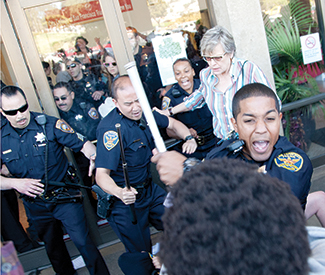
The protesting students were met by police aggression, and in the aftermath of the clash two students were arrested — one was pepper sprayed, and the other suffered a concussion, allegedly at the hands of a San Francisco Police Department officer.

Both SFPD and CCSF police were on hand for the protest.

Controversy is now swirling around Agrella, school administrators, and the students involved. But lost among questions about police violence are larger policy concerns. When will democracy, that critical right to have a say in significant decision-making on campus, return to City College?

Critics say City College is compromising its core mission in its fight to remain open and accredited, slashing access for students and curtailing democracy in the name of reform.

“To be excluded and ignored and disenfranchised is simply unacceptable,” said faculty union president Alisa Messer.

bgad

BEFORE YOU READ ON: Check out our beta multimedia version of this story.

(Or you can read the plain text version below)

PEPPER SPRAYED AND INJURED

The protest began as students marched across City College’s main campus in an open space designated by college officials as a “free speech zone.” They headed toward an administrative office building, Conlan Hall, where students freely conduct business every day. However, the administration locked the doors on the protesters.

In response, the students inside unlocked them. When the protesters tried to enter this public building, they were met with resistance from campus police and the SFPD.

Otto Pippenger, 20, who was at the front of the protest, was dragged to the ground by multiple officers and allegedly punched in the head by an SFPD officer, an incident caught on video and recalled in eyewitness accounts.

His mother, Heidi Alletzhauser, told the Bay Guardian that Pippenger had since received medical attention. She said he’d suffered a concussion, contusions from where his head hit the concrete, injuries to both wrists, and broken blood vessels in his right eye.

Dimitrios Philliou, 21, was tackled to the ground and pepper sprayed in the face. In a video interview shortly after the incident, he recalled what happened.

“I asked [officers] what law I broke and neither could give me an explanation. They proceeded to tackle me to the ground,” he said.

In the end, Philliou was charged with misdemeanor “returning to school,” described as trespassing by the Sheriff’s Department. Pippenger was charged with two misdemeanors: resisting arrest and battery on emergency personnel.

The students were released the following morning (March 14), before sunrise. Philliou was issued a citation and released, and Pippenger made bail and was released, according to the San Francisco Sheriff’s Department.

The City College faculty union raised over $1,000 towards Pippenger’s $23,000 bail. He will face arraignment March 19, two days after the Bay Guardian goes to press.

In an emailed statement, City College Chancellor Arthur Q. Tyler described the clash between protesters and police as the fault of the protesters who tried to enter the building.

“I am saddened to see students engaging in violent outbursts,” he wrote.

City College spokesperson Peter Anning said the school regretted the actions of the most violent officers. “There was one police officer with the SFPD, not [City College Police], whose behavior was more forceful than need be,” he said.

Philliou said he just wanted to be heard.

“We just want to have a conversation with Bob Agrella,” he said in a video interview with the college’s newspaper, The Guardsman. “It’d be nice if he would talk to us, like a real human.”

But so far, the students have been met with silence.


DEMOCRACY NOW

Agrella does not hold public meetings or take public comment on his decisions, but he posts public agendas in accordance with the California Brown Act. In the past, he’s called these posted agendas “meetings,” and dubbed email feedback as “public comment.”

Messer was critical of the practice. “Apparently these meetings are happening in the special trustee’s head,” she said, “and an email counts as public comment. No one agrees that [email] comment is public.”

In the past, public comment has meant speaking aloud at a meeting in a room where not only could everyone hear you, but every word was broadcast on television and on the web.

City College Board of Trustee public meetings used to be archived online for the world to see. Now only Agrella’s eyes see the concerns of the college community.

Pressed on whether these agendas and emails could count as public meetings, City College spokesperson Larry Kamer said, “I can’t answer that question because you’re getting into matters of legal interpretation. I’m not a lawyer.”

The Board of Trustee’s meetings were not always the most shining examples of democracy, he said.

“When Dr. Agrella was appointed as special trustee with extraordinary powers, it was precisely for the purpose of expediting decision making,” Kamer said. “The idea of expedited decision making and board meetings that go until one or two in the morning are usually incompatible.”

But City College Trustee Rafael Mandelman said some of the tension around the changes at City College could be diffused by letting the public vent, well, in public.

“I’d much rather have people jumping up and down in public comment than having an assault at Conlan Hall,” he said.

At a City Hall hearing held by Sup. David Campos the day after the protest, many students decried a loss of democracy at the school. Campos will soon introduce a resolution to the Board of Supervisors calling for the reinstatement of the City College Board of Trustees.

Students’ concerns about the college, voiced at rallies instead of public forums, have proven as diverse as the students themselves.


THE COLLEGE TRANSFORMS

The same day protesters clashed with police at the main campus, Chinese Progressive Association lead activist Emily Ja Ming Lee led a student protest at the college’s Chinatown Campus.

The population there is traditionally older, with fewer English speakers than the general student body.

“We’re worried about the impact on the immigrant communities, the free English as Second Language classes, and vocational training,” Lee told the Guardian. “We partner with City College to run a hospitality training program so immigrant workers can get good jobs. We’re concerned about how City College will serve its immigrant workers.”

That concern has been intensified by a new restrictive billing policy that’s impacting lower income students.

The school has started to require up-front payment for classes, rather than billing students later. The change may shore up the college’s bank account in the short term, but many financially strapped students dropped their classes due to an inability to pay.

Itzel Calvo, a student who is an undocumented citizen, said at the City Hall hearing, “I was not able to enroll in classes this semester unless I paid thousands of dollars in tuition up front, even before the classes started. I can’t afford that.”

The Chinese Progressive Association has also raised concerns about changes to the college’s educational plan.

Over the course of four months, City College will formulate an educational plan to determine which classes deserve funding, and which don’t. This process usually takes a year. But with the accelerated process and lack of outreach, Lee’s worried that English language learners and vocational students will be sidelined.

“Our students don’t fit into a traditional model of what community colleges look like,” she said. “They’re not looking to transfer to a four-year university, necessarily.”

Focusing on transfer students moving from community colleges to four-year universities is part of a state policy known as the Student Success Initiative. In a lawsuit against the Accrediting Commission for Community and Junior Colleges, City Attorney Dennis Herrera alleges that the ACCJC’s agenda of pushing this initiative was the driving force behind trying to close City College.

The college’s students rallied against those changes for years. Yet Agrella is enforcing the Student Success Initiative. “My job is to play within the rules and regulations of the ACCJC,” he told the Guardian in an interview a few months back.

On campus, concern is growing that changes made to appease the ACCJC may disenfranchise City College students in greater numbers. But worst of all, without public meetings or public comment, the college’s students may not get a chance to advocate against those changes before it’s too late.


How To Dress Well laughs his way into the sad songs at The Independent

0

By Ryland Walker Knight

Last night at The Independent, How To Dress Well kicked off a short tour (10 shows in this second half of March) with Forest Swords, playing new songs from a forthcoming album. On the heels of the release of “Words I Don’t Remember,” a new single, HTDW has assembled a more or less “real” band for these dates, with Tom Krell expanding his live act from a duet with Aaron Read (electronics, violin, guitar, bass) to quartet with Destroyer’s Larissa Loyva (keys/synths, backing vocals) and Broken Social Scene’s Justin Peroff (drums, laptop).

Krell’s previous visit was a spot supporting Sky Ferreira at the Rickshaw Stop, but he had no trouble selling out The Independent, its floor clogged with iPhone-ready and booze-addled fans eager to bathe Krell in coos, assuaging his anxieties about playing so many new songs. Throughout the night, Krell would banter about how this was the first time people were hearing these new tunes (eight of the 14 songs), but each was greeted with bumping, grinding adoration.

htdw

HTDW has always trafficked in “sad rave” vibes, but Krell made a point to joke that “I only write emo songs now” after introducing a new song called “What You Wanted” as “being really shitty about your desires, and incredibly basic; like being a teenager about your desires and always wanting something more and new.” It’s a fun song, actually, hitting that sweet spot of enough bounce to lift the moping and wailing Krell has become known for. He sings in a high falsetto not unlike everybody in R&B’s idol, Prince, but his music is more indebted to 1990s groups like Dru Hill, and everybody’s fallen star, Aaliyah. Or, that’s the vibe on the pop-ier songs, like the new jam “Very Best Friend.” But there remains a strain of unabashed sadness, too: Krell reminded the crowd that his first visit to San Francisco in 2010 was planned, under “less than ideal circumstances,” in order to record a song called “Suicide Dream 1” that he wrote to mourn a close friend. Nevertheless, he says it’s still his favorite song to sing.

Among the other new songs was one Krell described as “a sort of reggae, emo, early Animal Collective song,” drawing on pop-punk and Rich Homie Quan. Another was inspired by the idea that if you’ll do something once, you’ll probably do it twice (which may not necessarily be a good thing), that Krell hopes becomes a radio single after “Words” has its run. Details on the record are mum, however, as the first thing Krell told the crowd was: “I just got a text message from my manager and he’s like, whatever you do on stage, don’t say the name of your album or the release date of it.” He laughed his way into a terrifically sad opening number, but not before promising to have fun soon.

htdw

The night started with the likely final show of locals EN, the duo of multi-instrumentalists James Devane and Maxwell August Croy, who layered koto and other sine waves, all the sounds (pedaled or pure) processed by Devane over syncopated electronics for a beautiful 20-minute welcome, accented by visuals from another local, the visual artist Paul Clipson. I was told Krell has invited similar experimental audio-visual artists to open each show on each stop of this tour, one imagines to lend necessary contrast against the sad pop he sings and the dub-like moods Forest Swords conjur from a similar duet of live bass and an assortment of electronics. Forest Swords’ newest work was released by Tri Angle Records, but their songs have more traditional rhythms than many of that label’s “witch” music. In fact, I joked with my friend that the Forest Swords set sounded like the saddest sex you’ve ever had, while EN and Clipson made me wish I could walk around inside those tones with my own 16mm eyes ready to chop up the light of the world.

On the other hand, even without Krell’s formerly standard encore cover of “I Wish” by R. Kelly, which he says he can’t sing anymore out of political correctness (divorce the song from the man! keep the song the song!), How To Dress Well’s set made me happy he’s at the forefront of this new genre of white guys making R&B music — at least in part because he just seems so jazzed to play his songs, to be present in his life as an artist on a stage.

Setlist and other notes
“The Power”
“What You Wanted” — being really shitty about your desires, and incredibly basic, and being a teenager about your desires and always wanting something more and new
“Cold Nights” — as a ‘metal’ song, still not very metal
“Very Best Friend” — dancey, sisqo-y, love song
“No More Death” — ‘not fun, lets make it super dark for this one please’
“Facing Up” — i don’t know what’s best for me
“Suicide Dream 1” — first visited SF in 2010, recorded song with orchestra, to commemorate a friend who had just died — his favorite song to sing
“Chop and pick’m up” — reggae emo animal collective song
“” — Radio single — If you’ll do something once, you’ll probably do it twice
“Words I Don’t Remember”
“Set It Right”

@ryknight

The unanswered question: How do we bridge SF’s affordable housing gap?

186

Nobody has a good answer to San Francisco’s most basic housing problem: How do we build the housing that existing city residents need? It was a question the Guardian has been posing for many years, and one that I again asked a panel of journalists and housing advocates on Friday, again getting no good answers.

The question is an important one given Mayor Ed Lee’s so-called “affordability agenda” and pledge to build 30,000 new housing units, a third of them somehow affordable, by 2020. And it’s a question that led to the founding 30 years ago of Bridge Housing, the builder of affordable and supportive housing that assembled Friday’s media roundtable.

“There really isn’t one thing, there needs to be a lot of changes in a lot of areas to make it happen,” was the closest that Bridge CEO Cynthia Parker came to answering the question.

One of those things is a general obligation bond measure this fall to fund affordable housing and transportation projects around the Bay Area, which Bridge and a large coalition of other partners are pushing. That would help channel some of the booming Bay Area’s wealth into its severely underfunded affordable housing and transit needs.

When I brought up other ideas from last week’s Guardian editorial for capturing more of the city’s wealth — such as new taxes on tech companies, a congestion pricing charge, and downtown transit assessment districts — Parker replied, “We’d be in favor of a lot of that.”

Yet it’s going to take far more proactive, aggressive, and creative actions to really bridge the gap between the San Francisco Housing Element’s analysis that 60 percent of new housing should be below-market-rate and affordable to those earning 120 percent or less of the area median income, and the less than 20 percent that San Francisco is actually building and promoting through its policies.

Stated another way, about 80 percent of housing we’re building is for a small minority of city residents, or the wealthy people that these developers hope to attract to the city. And we’re not building housing for the vast majority of city residents. That is a recipe for gentrification, displacement, and destruction of San Francisco as a progressive-minded city.

Parker parroted Lee and other pro-development boosters, including SPUR, in arguing that city needs to make it easier and faster for developers to build new housing of all types. “In San Francisco, we do need to expedite the [housing] entitlement process,” Parker said.

But when asked whether meeting or exceeded Lee’s housing production goals would ever bring the price of market-rate housing down to the level where someone more 120 percent of AMI — which HUD recently set at $81,550 for single San Franciscans, or $116,500 for a family of four — Parker conceded that it wouldn’t.

The bottom line for San Francisco and its overheated real estate market is we can never built our way to affordability. The only way to build housing that most people can afford is with public subsidies, and San Francisco just isn’t asking enough from its wealthy individuals, corporations, and developers to create an Affordable Housign Trust Fund that is anywhere near big enough to meet the real demand.

That kind of assertion seems radical by the standards of today’s skewed political (and online) discourse. But when I raised it to a panel that included Bridge Housing officials, members of SPUR and HOPE SF, and a panel of journalists from such pro-development outlets as San Francisco Business Times, San Francisco Magazine, SocketSite, The Registry SF, KQED, and TechCrunch (as well as the more Guardian-aligned Mother Jones), nobody had any good answers or remedies to that basic question that we’ve raised again and again.

Instead, some of the business journalists offered a more sober assessment of what’s to come than most of this city’s pro-development boosters, noting a few signs of irrational exhuberance in the local economy.

The Registry’s Vladimir Bosanac said he’s observed a recent trend of developers buying up unentitled land, indicating more optimism in the sustainability of this development boom than market conditions might warrant. Adam Koval of SocketSite, an early predicter of the last dom-com crash, also voiced sketicism in the pervasive “this time is different” faith in the tech sector, noting how realms such as gaming and online coupons are losing steam and predicting that commercial rents are plateauing.

“I think there are some real gut checks coming up,” Koval said of the tech sector and the sustainability of its growth and valuations.

Perhaps it’s also time for a gut check by Mayor Lee and others who argue that we can build our way to housing affordability without any major new efforts to capture more of the wealth now being generated in San Francisco, wealth that might not be here later if we continue avoiding the question of how to provide the housing that San Francisco needs. 

Sexual assault survivors seek reform at the University of California

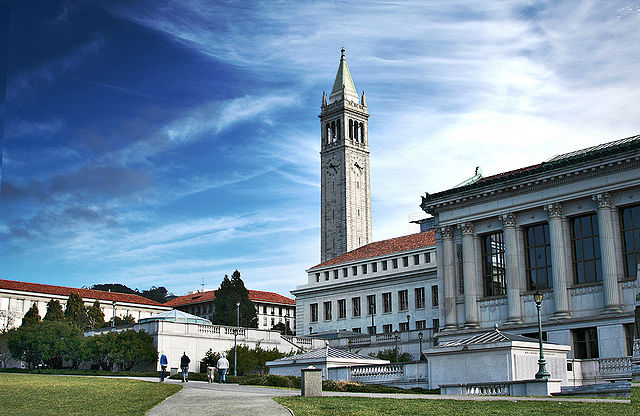
University of California Berkeley graduate Nicoletta Commins was 20 when she was sexually assaulted, in early 2012. She’d been taking a Taekwondo class, and said her teammate assaulted her when they were in her apartment.

He was “just an acquaintance,” she said in a phone interview. “We were sort of flirty, but not close friends.”

Following the incident, she had a pervasive sense of fear. “He was on campus for a month or a little more, after this happened. I was really depressed. They let me take a reduced workload, but it was hard to keep up with school,” she said. “I took windy ways to school to avoid him. I saw him on campus and it was a terrifying experience. There was one time I saw him walking by, and I hid behind a car.”

Adding to that stress was the difficulty Commins says she encountered after formally reporting the assault and awaiting a response from campus officials.

Late last month, 31 women who currently or formerly attended UC Berkeley filed formal complaints with the federal Department of Education, alleging that the university had mishandled sexual assault investigations through repeated failure to adequately address reports of these incidents.

Universities are bound to comply with Title IX, a federal civil rights law that requires postsecondary institutions to take measures to protect sexual assault victims. They must also adhere to the Clery Act, which requires reporting of crime statistics and for security policies to be in accordance with federal guidelines.

In their complaint, sexual assault survivors charged that UC Berkeley had violated their rights under Title IX and the Clery Act by failing to meet the complaints with adequate investigation and response. This was the second formal complaint to be lodged along these lines: Last May, nine women who had attended UC Berkeley came forward with an Office of Civil Rights complaint charging the same. This most recent filing was an updated complaint with accounts from more survivors.

After the sexual violence she experienced, Commons said she immediately sought medical care and reported what had happened. Initially, campus staff was responsive, she said. She met with a representative from the Office of Student Conduct, followed by a meeting with a campus coordinator tasked with Title IX compliance.

“People reached out to me. People told me their burden of evidence is lower at the school than the court,” she recounted. “They said people will see disciplinary action in the school that they won’t see from law enforcement.”

But time went on, and she heard nothing. “No one would tell me anything or respond to emails. All of a sudden everyone left me in the dark. They told me there’d be a hearing to participate in. Then nothing. For months.”

Getting nowhere through campus channels, she decided to go to the police, prompting the Alameda County District Attorney to become involved in her case.

After a year and a half had gone by, a settlement was finally reached. “Part of it included him not coming back to school for a few years before I left the campus,” she explained. “He had to get counseling. He was excluded from school functions, and [was barred] from contacting me.”

But she believes UC’s hand was forced by her decision to involve law enforcement. “If I had not reported to the police and the DA had not come to agreement with the lawyers, [the settlement] would not have happened,” she said. “It was an agreement between the DA’s office and the school.”

Following the initial OCR complaint last May, the California Legislature ordered the State Auditor to conduct an audit of UC Berkeley and three other universities, to assess outcomes of sexual violence complaints on a broad scale and to investigate whether the universities’ policies are in compliance with federal guidelines.

“Sexual violence is the elephant in the room that nobody wants to talk about, particularly in an educational environment,” Assemblymember Anthony Rendon wrote in a letter calling for the audit.

“I am particularly concerned with the recent allegations made by the nine women from UC Berkeley stating that their cases were simply not taken seriously by campus officials and not reported properly. Campus officials discouraged them from reporting their cases to police and did not provide these victims with adequate support services … These women are broken down physically and emotionally. The lack of support they received from the officials on campus is attributable to this.”

Margarita Fernández, spokesperson for the State Auditor, said the audit was a work in progress and that findings could be released in June.

“The U.S. Department of Education’s Office of Civil Rights received a complaint that alleges discrimination on the basis of sex, sexual violence, race and disability at the University of California-Berkeley,” a spokesperson from that agency wrote in a statement to the Bay Guardian. “The Department is evaluating the complaint allegations to determine whether they are appropriate for a civil rights investigation.”

In the interim, the UC system has taken some steps in the wake of the federal complaints. According to a March 7 announcement, the school released a new policy against sexual violence and harassment that provides for expanded training and education, increased reporting requirements, and broader protections for victims, according to a recent announcement from the office of UC President Janet Napolitano.

UC Berkeley has also issued a formal response, with Chancellor Nicholas Dirks issuing a Feb. 25 letter to announce efforts to streamline campus policies around responding to sexual violence.

Addressing the sexual assault victims who came forward, Dirks said, “I have been deeply moved by your courage and conviction, and offer my full support for your efforts.”   

We sought to contact representatives from the campus’ Gender Equity Resource center, which provides assistance to sexual assault victims, but received a statement from campus spokesperson Janet Gilmore instead.

“We are committed to taking a close look at what we can do to better serve students and incorporate their concerns as we seek to address these issues,” Gilmore wrote. “That process remains underway.”

AirBNB apartment advertised for “XXX Freakfest” orgy

8

A Manhattan comedian put his apartment up for rent on SF-based AirBNB, only later to find his renter advertising out his apartment for an orgy, Gawker reported Friday. While hilarious, the incident highlights key points in the New York attorney general’s litigation againts AirBNB. And the San Francisco City Attorney may soon look into them as well.

The problem? Cities have no data on how AirBNB rentals are being used. Usually the concern is over landlords renting through AirBNB at the expense of evicted long-term tenants. In this case, the tenant asked comedian Ari Teman if it was alright to have family over for a wedding. It turns out he meant to use the apartment for much wilder aims.  

Teman walked through the lobby of his building, just before leaving for a trip, only to overhear his new tenant say “they’re shutting us down,” according to Gawker. Suspicious, Teman Googled his tenant’s phone number and found a Tweet advertising a “BBW panty raid” party. 

For the unitiated, BBW stands for Big Beautiful Women. Talk about the wrong time to leave. One wonders if Teman was just bummed he missed out on all the fun. He needn’t have worried, as the next advertisement listed was for a “XXX Freak Fest” — in Teman’s own apartment.

The damage to his apartment may also have gotten him miffed. His furniture was damaged and overturned, and bags of condoms and loads of liquor were strewn about his apartment. 

The tenant, who Gawker identified as “David,” said an agreement between he and Teman specified he could have up to 50 guests, which Teman denies. 

To its credit, AirBNB put up Teman in a hotel while his apartment is cleaned, changed his locks, and ponied up $23,817, all within 24 hours, Gawker reported.

The best part? Afterwards, the now infamous company Taiwanese Animators already has a 3D animated cartoon up about the incident. Though we will say, the video is a bit problematic by primarily featuring black actors in the overweight roles. What’s with that!?

But really, this is another example of the troubles around lax regulation of AirBNB which hopefully will be ironed out soon. The NYPD cleared the apartment, which costs New York City a chunk of change. That’s money that isn’t paid for by AirBNB, because hosts have so far skirted paying hotel taxes. The same is true in San Francisco. 

As we’ve reported previously, New York Attorney General Eric Schneiderman issued a subpoena to Airbnb last October, demanding information on New York City’s 15,000 hosts and 25,000 listings.

So far, San Francisco hasn’t pursued AirBNB with the same zeal. Maybe all we need to do is throw a few AirBNB hosted sex parties. 

Dispatches from SXSW: Day 3 — Lessons, brisket, and fool’s gold

2

The most important thing I learned from being at SXSW is that I should not under any circumstances make any decisions to move to Austin based on my experience at SXSW. Yes, the city is amazing, hip, and fun for 10 days out of the year, but what about the other 355? I’m willing to bet at least 60 percent of attendees thought to themselves “You know what, I could totally see myself living here.” For San Franciscans and New Yorkers, that number is probably 80 percent. Not to mention, summertime in Austin is a devil’s combo of Arizona heat and Deep South humidity. In addition there’s only one light rail line in this huge sprawl of a city; Austin’s population is a little larger than San Francisco’s but has more than five times the square mileage. I feel this is necessary to point out because I have a feeling there are a dozen or so people every year who did this and after a couple months of living here they panic and are like “Oh god! Why did I sign that one-year lease!”

On to day three (Friday).

Part of the reason I was so excited to visit Austin was for the barbeque, specifically brisket. My original plan was to visit the famous Franklin’s BBQ, a place that usually has a three-hour wait. But when I saw that people were camping out in line, I said scratch that. The first two days were brisket free for me, therefore my third day had to be brisket day. I went to some place called Noah’s and had a brisket plate and a brisket sandwich to go. The plate was good at first and then became mediocre half-way through. When I had the sandwich later on in the day, it was dried out and there virtually useless, I still ate it anyway. My determination to find a decent a brisket joint was still undeterred. I found a food truck area and convinced myself to order a $10 brisket sandwich. It too was mediocre. My friend had a brisket from another food stand, I had a bite of it and it didn’t do anything to impress. Here’s another lesson for you, food at big events sucks, it’s the more expensive and mass-produced version of itself; Outside Lands is very guilty of this.

Anyway, back to the music.

migos
Migos

Day three was also my sleep-in and rest day. Walking 14 miles a day with sun in your eyes and loud noise in your ears and staying out to 2 or 3am can really wreck you. At around 4pm, I’m fully recharged and I make my way to the Fader Fort for one last hurrah. Unfortunately, this time around even the badge-people are having a hard time getting. I’m stuck in line for 80 minutes, while my friends are enjoying the hedonism of the Fader Fort. I finally get in, I catch the last three songs of Young Thug’s raucous set. I find my friends and we decide to bounce, I bid adieu to the Fader Fort.

For our last night in Austin, my friends and I decide that we’re going to stick to one showcase and spend the entire night. We finally decided on the Fool’s Gold showcase hosted by A-Trak and Nick Catchdubs. On the bill was A-Trak, Migos, Travis Scott, Black Atlas, Treasure Fingers, Berkeley rapper 100s, and about 234 other rappers and DJs. We get in line two hours before doors open at 8 and of course there are already 30 people in front of us. We pass the time by playing games, eating dinner, and making new friends with our line buddies. Then 8pm rolls around,  the moment we’ve been waiting for. Nothing happens besides someone telling us to form a strict single-file line. Then at 8:40, we make our way in knowing our patience will be greatly rewarded.

The waiting, however, is not over. The first hour and a half of acts are by and large forgettable. They’re all rappers whose gimmicks, fist-pumping, and attempts to “turn up” were doing little to affect the crowd.

Four hours after we got in line, the real fun kicks in when Treasure Fingers hops on the ones and twos. He spins a bombastic set of fast-paced galloping electro and bass-drenched hip hop, a near perfect threading of the border between hip-hop and electronic music. Fool’s Gold co-head Nick Catchdubs takes over the DJ baton after Treasure Fingers and switches to a more hip-hop centric set that’s just as  exciting. Sweet vindication for all that time waiting is settling in, my version of the marshmallow experiment.

100s
100s

However, I was not prepared for the next two and a half hours. I had never experienced such a colossal amount of hip-hop bravado, swagger, and stage presence packed into such a small space (the venue was a car repair garage.) 100s led off this hip-hop marathon with his silky perm and synth-hop beats. When they say SXSW is a platform for artists to take off, they’re talking about artists like 100s.

A-Trak takes the stage after 100s and starts turntabling for a bit and then out of a nowhere Danny Brown pops out as the “surprise” guest of evening. The crowd goes wild even though despite this being one of the least surprising guests SXSW. Danny Brown throws down a rambunctious set mostly because the crowd is so hyped to see him. He yells “Where’s the molly at?!” of course, then does one more song and bows out to Migos.

As soon as they grab the mic, it’s apparent that Migos are natural performers. Not too many acts can have an iron-fisted control over a mob of drunk and high hip-hop fans. During “Versace” and “Hannah Montana,” the energy in the air is so palpable I think the entire place was going to collapse. Then Young Thug bursts out of nowhere, causing an earthquake registering a 7.2 on the richter scale. Tsunami warnings are issued all along the Texas and Gulf coasts.

young thug and migos
Young Thug and Migos

It’s one of the most “Can’t stop, won’t stop” moments I’ve ever witnessed in hip-hop. More and more guests like A$AP Ferg, Travis Scott, and YG. Each guest somehow finding a way to turn up the crowd more. Every time I feel like we’ve reach peak turn-up, the next track manages to turn up even more.

At the end of this hip-hop extravaganza, I am left nearly catatonic and speechless. I literally OD on hip-hop, and plan to go cold turkey for the rest of the month. When I regain consciousness, a pain and numbness takes over my legs, leaving me with the daunting task of walking two miles home.

Ana Tijoux on motherhood, Breaking Bad, and un-learning colonialist history

0

By Rebecca Huval

If you’re tired of mainstream Latin hip-hop — which, right now, is disproportionately made up of reggaeton beats, male MCs, and bitter lyrics — then Ana Tijoux is the lady rapper for you.

The French-Chilean artist upends the genre. Instead of bragging about her millions, she advocates for cultural pride. Instead of barking at her enemies, she weaves a soothing spool of words that remixes the Spanish language into silk. She has evolved from using samples to working with a live band in a textured, colorful sound all its own, incorporating brass, jazz inflections, and a smorgasbord of South American instruments such as Andean charangos and pan-flutes.

You might have heard Tijoux’s origin-story track, “1977,” on Breaking Bad, as Jesse and Mike make deliveries through a desolate Southwestern landscape. The song describes the year she was born in France to parents who were exiled during the military dictatorship in Chile. Her alternating flow and staccato make the mind-numbing road trip seem badass. Following that sophomore record, La Bala, Tijoux is releasing a mature album with lush orchestration March 18: Vengo. The following evening, Wed/19, she’ll hit The Independent.

Calling to mind Erykah Badu, Tijoux is a poet with a low, creamy voice and a call for algre rebelde, or joyful rebellion. Her lyrics will make you feel like the top of your head was taken off, to paraphrase Emily Dickinson. “I come as a child who sought entrance to his/ home, the entrance to his origin, the return to/ his crusade, I come seeking silenced history/ the history of a land pillaged/ I come with the world and I come with the birds,” Tijoux raps in the title track of Vengo. In the shadow of Pinochet’s Chile, Tijoux is rebuilding dignity in her heritage with thoughtful, joyous rap.

Ahead of her show Wednesday night, we caught up with her by phone to talk about why it’s better to protest with beauty, how it felt to move from France to Chile as a teenager, and what it was like to dance with a man in an octopus suit in a music video.

San Francisco Bay Guardian How did you start rapping, and what female rappers influenced you?

Ana Tijoux I think I began when I was 20, very naturally, out of necessity because I needed to communicate. The woman who inspired me first was Bahamadia. And then I began to rhyme and write, and then I began to learn about more female MCs: MC Lyte, and when I was younger, Queen Latifah.

SFBG I’ve read that you consider yourself to be shy. How do you find the strength to perform in front of so many audiences?

AT Because I’m an amazing actress. [Laughs] On stage, I’m singing, I’m communicating, so I forget about the audience. It’s energy, and you begin a dialogue with people. That’s one of the moments when I feel free. It doesn’t matter what happens, I just do it.

SFBG Why did you move to Chile in 1993?

AT Because my parents were exiled in France, and I’m from there, and when refugees could come back I came with my parents. It was hard, very hard. I was a teenager and you’re in the construction of a personality. You’re fighting between a child and an adult in one personality, and then to change continents was hard. It was also one of the most amazing moments in my life. And it was a moment of a lot of lessons, but I understood about them more later, not immediately. I understood about friends, and about how the North robs so many things from the South. It was a political education.

SFBG Your 2007 video for “Eres Para Mi” with Julieta Venegas is goofy and delightful. It looks like you had a lot of fun making it. What was it like dancing with a man in an octopus suit and a nun?

AT The most hilarious moment in my life. When she made the video she didn’t tell me an octopus would be there, so it was a surprise. And I’m shy, like I told you, so I tried to act the best that I could. I didn’t know I would have an octopus near to me.

SFBG How did you write an album with your young children around?

AT It was an amazing moment, but very hard with time. I learned so much, like trying to be a mother with the [artistic] creation and no sleeping. At the same time, it was amazing. I learned time is a precious treasure and so valuable. I can’t lose time anymore in stupidity. The time I have is for creation or friends and family. It was hard to be honest, but really amazing.

SFBG Why did you decide to work with a live band instead of using samples?

AT I work with the best musicians I could have imagined. The songs have different vision with drums because it can be longer, or if the bassist has a solo, each instrument sings and gives a different color. It feels so organic and every instrument can give one texture to a song, and different movement and weather in the songs.

SFBG In “Vengo,” you say “Without fear you and I decolonize/what we were taught.” How have you unlearned what you were taught about Chile’s history?

AT I feel like everything I learned in school was with a colonized vision. You become interested in your roots, you understand that how you learned history is so different than what happened. In Chile, we live in a country with people with brown and black hair, and in publicity they have women with blond hair. All this publicity is about who we should be, and I’m saying we should be proud of who we are as a society and a community.

In America, they say it’s been 500 years since they discovered the continent. They didn’t discover it, people were here before the colonizers arrived. We’re changing the vision and vocabulary.

SFBG I loved Somos Sur, and I think your lyric “alegre rebeldía” captures the spirit of your music. In your calls for social justice, I sense more beauty than anger. What inspires you to call for equality with your gorgeous lyrics instead of just shouting at a protest?

AT Protests in general are protests for life. When you see fights around the world, it’s a fight for life. To have a fair life, it’s about dignity. We’re so used to protests with anger. We want a better future for us our kids and community. So that’s what I’m saying, it’s a fight for happiness.

SFBG How did it feel to hear “1977” on Breaking Bad?

AT Funny. I’m glad. It’s an amazing series, and I’m glad that there is a mainstream series that’s taking a risk. It’s a good series with amazing characters.

SFBG In “1977,” you say “Caminas en crucijadas/ Cada cual es su morada” (“You walk in crossroads/ each one is your home”). Where do you consider your home now?

AT Chile, totally Chile. It’s where my family is, my parents, my kids, my garden, and my refugees.

SFBG What advice would you give to young female rappers out there?

AT Do not listen to advice at all. Everybody wants to give advice about how to make stuff. Don’t listen to advice. Try to make music and be free.

@rhuval

Dispatches from SXSW: Day 2 – Fader Fort, Future Islands, and Waiting in Lines

0

I’m pretty sure the Fader Fort is where I want to spend the rest of my youth and possibly my life. This makeshift village is probably as close to cool heaven as it gets. It’s got free music, free drinks, and people-watching galore. Did I mention it’s also got charging stations, free ice cream, and a first aid tent? You really could spend the rest of your youth and/or life here.

The Fader Fort is that illustrious castle on the hill of peak hipness. You can absorb the coolness into your skin via osmosis. For entrance into this Hearst Castle for the Snapchat crowd, you must either know somebody who knows somebody, have a pass (like I do), or get in line at the ungodly hour of no later than 12:30pm. Seriously, if you don’t get in line by at 1pm, you’re doomed to a fate of sunburns and sobriety. So get in line early, your brand depends on it.

As much I want to conduct an anthropological study on the impossibly hip 20-somethings lounging and fluttering all over the Fort, I have to force myself over to music stage.

fader fort

The first act is British crooner Sam Smith. He’s most known for his feature on Disclosure’s “Latch.” Without the Disclosure brothers at his side, Mr. Smith and his rad pompadour unleash an acoustic rendition of the dance hit, which the crowd and I found equally pleasing. As per SXSW custom, Smith busts out 20 minutes of work, packed up, and bounces to his next gig.

I go re-up on free pineapple juice and rum.

When I get back, Theophilus London is about to come on. I’ve been listening to this guy for a while and I still don’t get his deal. I feel like he’s been stuck on the come up for a while, which contradicts the very idea of being on the come up. He presents his mix of electro funk, pop, and hip-hop, all while wearing torn yellow pants, a yellow tank top, jean jacket, and that Pharrell/Arby’s hat. Towards the end of his set, he brings onstage a woman from the crowd and they do some sort of seductive dance that’s kind of novel and cool, but immediately takes a turn for the worse when London creepily starts grope-dancing with her. He almost sucks all the cool from the air, leaving everyone baffled and awkward. She goes back to the crowd and we all breathe a sigh of relief.

theo

Theophilus London
Pineapple juice and rum time.

Collaborators Shlomo and Jeremih are up next. Shlomo warms up the crowd with a DJ set of percolating electro rhythms. I begin to worry Jeremih might not show up, but he does. The two are collaborating for an upcoming album, but their performance makes me think they should establish this as a permanent arrangement. Jeremih’s suave and soothing nu-R’nB vocals hypnotizes the crowd into a state of mindfulness. But Jeremih knows what the crowd wants to hear, they want to hear “Birthday Sex,” and you do not deny what the good people at Fader Fort want. Jeremih plays “Birthday Sex” and the audience reacts in a way that it makes seem it like they enjoy “Birthday Sex” more than actual birthday sex.

Headlining the Fader Fort is electro-funk impresarios Chromeo, aka the self-proclaimed “most successful Jewish-Muslim collaboration ever.” Even though everyone in the concert tent is shoulder to shoulder and butt to butt, we all erupt in cathartic dance when Chromeo belt out “Night by Night.” There aren’t too many acts worthy of being a headliner at the Fader Fort, but Chromeo rises to the challenge and then some. They decimate the audience with 30 straight minutes of the old hits and some new tracks from their upcoming LP, White Women. Then the clock strikes midnight on the Fort and now we all have to face the daunting reality of not being in the Fort. But wait, Chromeo comes back for an encore! Encore finishes. OK, now the Fader Fort is done.

I grab a quick dinner and speed-walk over to Congress Ave, where the entire Heart Break Kids gang are playing, but unfortunately when I get there, there’s a 100-foot line, and from what I can tell, the entire club is packed to brim. Even badge people like myself aren’t being allowed in. I give up on HBK and speed-walk across town again to the Mad Decent Garage shows. Half an hour  later I arrive, and there’s a short but extremely slow-moving line. I give up and go meet up with friends at some rave tent with no line.

Turns out, there’s a real good reason there was no line. I’m subjected to blaring and soul-killing dubstep. The filthy and warbled bass jackhammers my very-being. Time to get out of there.

I wander around this part of town looking for my next show, while also being in awe of the massive herd of drunk revelers tripping flyers and empty drink cups.

I then happen upon Cheer Up Charlie’s to catch the end of indie-rockers Merchandise and then indie-poppers Future Islands. I didn’t catch enough of Merchandise to formulate an impression. At this point I’m just happy to be away from the dubstep. Future Islands come on and are the saviors I’ve been waiting for in this post-Fader Fort landscape.

future islands
Future Islands

Future Islands’ frontman Samuel T. Herring immediately grabs the crowd with a loud growl, jabbing dance moves, and pointed stares. Every band should have a Samuel T. Herring. His chaotic energy is more infectious than a breakout of pink-eye. He sneers, jumps up and down, and makes disfigured looks on his face for the entire set, and it makes for a surprisingly good complement to Future Islands’ bouncy and sunny pop. I honestly have never seen someone as turned up as this guy. I couldn’t think of a better way to end the day.

‘Budapest,’ ‘Mars,’ and more: CAAMFest + new movies!

1

Last night heralded the opening of the Center for Asian American Media’s CAAMFest; it runs through March 23 at the Castro Theatre, 429 Castro, SF; Great Star Theater, 636 Jackson, SF; New Parkway Theater, 474 24th St, Oakl; New People Cinema, 1746 Post, SF; Pacific Film Archive, 2575 Bancroft, Berk; and Sundance Kabuki Cinemas, 1881 Post, SF. For tickets (most shows $12) and complete schedule, visit www.caamedia.org. For commentary, see “The Art of Martial Arts,” “Telling Tales, ” and “Women With Movie Cameras.”

New movies after the jump.

Better Living Through Chemistry Sam Rockwell, Olivia Wilde, and Michelle Monaghan star in this dark comedy about a mild-mannered pharmacist whose life is upended when he meets a pill-addicted trophy wife. (1:31) 

Elaine Stritch: Shoot Me See “Shooting Straight.” (1:21)

The Face of Love Five years after her husband, Garrett (Ed Harris), drowns while on vacation for their 30th anniversary, Nikki (Annette Bening) chances upon his exact double, Tom (Harris again). She pretends to be a divorcée and hides all photographic evidence that would out her reason for pursing Tom, an easygoing art professor and painter who actually is divorced (he’s buddies with his ex, a low-key Amy Brennemen). To her delight, he reciprocates her interest — but as their relationship grows, it becomes harder to conceal the, uh, doppelgänger situation from Nikki’s adult daughter (Jess Weixler) and neighbor (Robin Williams), a widower who’s jealous of Nikki’s new love. Harris and especially Bening are great — and they’re great together — but The Face of Love, from director and co-writer Arie Posin (2005’s The Chumscrubber), is the romantic melodrama equivalent of a one-joke comedy (with at least one Vertigo-inspired scene, and a drippy score that underlines every emotional story beat). The end to Nikki’s agonizing charade, and the end of the movie, can’t come soon enough. (1:32) (Cheryl Eddy)

Generation War German import Generation War was originally called Our Mothers, Our Fathers, to underline the relevancy of the discussion it’s presumably trying to stir at home — even if for many viewers the war generation would have been their grandparents’. Directed by Philipp Kadelbach and written by Stefan Kolditz, it starts out in dismayingly hackneyed fashion as we’re introduced to our youthful protagonists. Celebrating a birthday in 1941 near the war’s start, when Axis victory seems assured, they pose for a photo you know damn well is going to be the heart-tugging emblem of innocence horribly lost for the next 270 minutes. Fast-paced yet never achieving the psychological depth of similarly scaled historical epics, Generation War grows most interesting in its late going, when for all practical purposes the Allies have already won the war, but Germany continues to self-destruct. Imminent peace provides no relief for protagonists who’ve survived only to find themselves fucked no matter what side they stay on, or surrender to. That moral and situational complexity is too often missing in a narrative that aims for sympathy via simplicity. The underrated recent film version of The Book Thief (2013) was criticized for soft-pedaling the era, but it was about (and from the viewpoint of) somewhat sheltered Aryan children living in a civilian wartime. Generation War’s characters are of exactly the age to be fully indoctrinated young zealots, yet none of them seems touched by National Socialist dogma. Of course such naiveté is designed to maximize their later disillusionment. But War doesn’t even try to approach the serious analysis of national character in something like Ursula Hegi’s great novel Stones from the River, in which we come to understand how time, propaganda, and preyed-upon weaknesses can turn a town of perfectly nice Germans into fascists capable of turning a blind eye toward the Final Solution. Note: longer review here(4:30) (Dennis Harvey)

The Grand Budapest Hotel Is this the first Wes Anderson movie to feature a shootout? It’s definitely the first Anderson flick to include a severed head. That’s not to say The Grand Budapest Hotel, “inspired by” the works of Austrian novelist Stefan Zweig, represents too much of a shift for the director — his intricate approach to art direction is still very much in place, as are the deadpan line deliveries and a cast stuffed with Anderson regulars. But there’s a slightly more serious vibe here, a welcome change from 2012’s tooth-achingly twee Moonrise Kingdom. Thank Ralph Fiennes’ performance as liberally perfumed concierge extraordinare M. Gustave, which mixes a shot of melancholy into the whimsy, and newcomer Tony Revolori as Zero, his loyal lobby boy, who provides gravitas despite only being a teenager. (Being played by F. Murray Abraham as an older adult probably helps in that department.) Hotel‘s early 20th century Europe setting proves an ideal canvas for Anderson’s love of detail — the titular creation rivals Stanley Kubrick’s rendering of the Overlook Hotel — and his supporting cast, as always, looks to be enjoying the hell out of being a part of Anderson’s universe, with Willem Dafoe, Jeff Goldblum, and Adrien Brody having particularly oversized fun. Is this the best Wes Anderson movie since 2001’s The Royal Tenenbaums? Yes. (1:40) (Cheryl Eddy)

Love and Demons A man (Chris Pfleuger) in the midst of a midlife crisis, a woman (Lucia Frangione) starting to realize she’s completely dissatisfied with her life — does this relationship have a chance? Enter each partner’s personal demon, eager to have a hand in shaping events in what turns into a not-so-friendly competition. At first, the intervention seems helpful; the male demon encourages the man, a wannabe screenwriter, to get a better job, clean up the apartment, and blurt out feel-good-isms like “I want to build something together.” But what’s this about murder? Meanwhile, the female demon (Arnica Skulstad Brown) appears to be the ultimate gal pal, stroking the woman’s ego by telling her she could do so much better, going on shopping sprees with her, and sharing her stay-skinny coke stash. Temptations ahoy! Written, directed by, and costarring local filmmaker JP Allen (as the male demon, he’s the cast’s cigarette-smoking, smirking high point) this intriguing look at modern love earns bonus points for its excellent use of SF locations — and creative editing that helps break up the film’s many voice-overs and fourth-wall-breaking moments. (1:24) (Cheryl Eddy)

Need for Speed Breaking Bad‘s Aaron Paul stars in this tale of a breakneck cross-country car race, an adaptation of the popular video game. (2:10)

Particle Fever “We are hearing nature talk to us,” a physicist remarks in awe near the end of Particle Fever, Mark Levinson’s intriguing doc about the 2012 discovery of the Higgs boson particle. Earlier, another scientist says, “I’ve never heard of a moment like this in [science] history, where an entire field is hinging on a single event.” The event, of course, is the launch of the Large Hardon Collider, the enormous machine that enabled the discovery. Though some interest in physics is probably necessary to enjoy Particle Fever, extensive knowledge of quarks and such is not, since the film uses elegant animation to refresh the basics for anyone whose eyes glazed over during high-school science. But though he offers plenty of context, Levinson wisely focuses his film on a handful of genial eggheads who are involved in the project, either hands-on at the European Organization for Nuclear Research (CERN), or watching from afar as the mighty LHC comes to life. Their excitement brings a welcome warmth to the proceedings — and their “fever” becomes contagious. (1:39) (Cheryl Eddy)

Veronica Mars Since the cult fave TV show Veronica Mars went off the air in 2007, fans of the series, about a smart, cynical teenager who solves mysteries and battles her high school’s one percenters — a sort of adolescent noir minus the ex nihilo patois of Rian Johnson’s 2005 Brick — have had their hopes raised and dashed several times regarding the possibility of a big-screen coda. While that sort of scenario usually involves a few of the five stages of grief, this one has a twist happy ending: a full-length film, directed by show creator Rob Thomas and cowritten by Thomas and show producer-writer Diane Ruggiero (with a budget aided by a crowdfunding campaign), that doesn’t suck. It’s been a decade since graduation, and Veronica Mars (Kristen Bell) has put a continent between herself and her creepy, class war–torn hometown of Neptune, Calif. — leaving behind her P.I. vocation and a track record of exposing lies, corruption, and the dark side of the human soul in favor of a Columbia law degree and a career of covering up same. But when Logan Echolls (Jason Dohring), her brooding, troubled ex, gets charged with the murder of his pop star girlfriend and asks Veronica for help, she can’t resist the pull of what she admits is a pathological impulse. Plus, it’s her 10-year reunion. And indeed, pretty much anyone who had a character arc during the show’s three seasons makes an appearance — plus (naturally) James Franco, Dax Shepard (Bell’s husband), and (oddly) Ira Glass. It could have been a cameo fusillade, but the writing here is as smart, tight, funny, and involving as it was on the TV series, and Thomas and Ruggiero for the most part manage to thread everyone in, taking pressure off a murder mystery that falls a little flat, updating the story to reflect current states of web surveillance and pop cultural mayhem, and keeping the focus on the joy of seeing Veronica back where she belongs. (1:43) (Lynn Rapoport)

Dispatches from SXSW: Painted Palms

0

After a long day of waiting in line in the sun, catching various 15-minute sets, and just being downright baffled by the enormity and complexity of SXSW (this is my first time), I lumbered my way to Maggie Mae to catch San Francisco’s psych band du jour, Painted Palms, at the Forcefield PR showcase (disclosure: I interned for Forcefield one summer a long time ago). The venue itself looked like Bottom of the Hill’s cousin but without the absurdly short ceilings and claustrophobia.

San Francisco power-punk act Tony Molina fronted by (you guessed it) Tony Molina packed a raucous and chaotic set into 20 minutes, which of course was too short, but then this is SXSW.

tony molina
Tony Molina

This was Painted Palms’ second show so far at SXSW. They are touring on debut LP Forever, which came out last January on Polyvinyl Records. The band is comprised of two cousins, Chris Prudhomme (vocals, guitar, hails from Bernal Heights), and Reese Donahue (electronics, hails from Western Addition).

Despite some minor technical difficulties, the psych-pop duo jammed out a sunny set full of spirited electronic sounds, a great soundtrack to lounge on for day-long retreat at Alamo Square or Dolores Park. Just minutes after the show, the  cousins joined me for a quick Q&A, where we discussed the origin of the name Painted Palms, whether or not they would ever cover The Talking Heads, and everyone’s favorite topic of conversation: the cost of living in San Francisco.

San Francisco Bay Guardian: Why are you called Painted Palms?
Prudhomme: I don’t know, people guess, and I think the best guess that someone has had so far is that William Randolph Hearst had a mansion and at the end of his life, he didn’t want to see death on his property. So whenever the palm trees died, he would have people paint the bark of the palms to keep it looking like they were still alive.

SFBG: This is your second show at your first-ever SXSW, how’s it going so far?
Prudhomme: We had some technical difficulties, but I think it’s something that with a full band is recoverable.
Donahue: I think [the show] was sketchy in the beginning…but it’s fine.

SFBG: So music journalists like myself often describe bands in a wrong manner. Tell me how do you describe yourselves?
Prudhomme: It’s psychedelic pop music.
Donahue: I think it focuses on pop structure, the structure of ’60s pop music. We have a fascination with ’90s electronic psychedelic stuff.

painted palms
Painted Palms

SFBG: Your influences?
Donahue: I’d say The Zombies, they’re just the coolest motherfuckers.
Prudhomme: Some of our influences also don’t have anything to do with the way our music sounds, a lot of it is just music personalities. I really like David Bowie a lot, but I don’t think our music sounds anything like David Bowie.

Donahue: My favorite band of all time is The Talking Heads, and I think the drummer was at our showcase earlier.

SFBG: The city is extremely expensive right now, which is especially tough on creative types such as musicians like yourselves. Has this impacted you? Is this a big worry for you?
Prudhomme: It hasn’t really impacted us that much because we’ve been doing the same kind of recording process for a really long time. We have a really cheap, raggeddy practice space in the Tenderloin.
Donahue: But we have to share it with five other bands to make the rent. I tried to move out and get my own place at one point but it didn’t work out. If I ever decide to leave San Francisco and live somewhere else, I don’t think I could come back. I do have rent control so it’s not something I’m worried about.
Prudhomme: I worry about it. I live in a big house with lots of tenants, which is the only way I can afford to live in SF. So whenever I have master tenants who are about to move out, I worry about my rent being jacked up.

SFBG: Is the East Bay an option?
Donahue: Oakland is fucking awesome…but I don’t know.

SFBG: Ever thought about covering a Talking Heads song?
Donahue: No, we’d never do that. I don’t think we could make those songs better.