Bay Guardian Archives

After Oscar, after Trayvon…

49

rebecca@sfbg.com

Even before Cephus “Uncle Bobby” Johnson picked up the phone on Feb. 27, 2012, he wasn’t having an easy day. His nephew, Oscar Grant, would have celebrated his 26th birthday on that date if he had not been killed by a gunshot wound on Jan. 1, 2009.

Grant was shot by BART police officer Johannes Mehserle while lying face down on a train platform, an incident that was caught on film, prompted riots in Oakland, drew international scrutiny, and became the subject of the award-winning film Fruitvale Station by Oakland filmmaker Ryan Coogler.

In the years since Grant’s death, Johnson and his wife, Beatrice X, founded the Oscar Grant Foundation to develop a support network for families who’ve lost loved ones due to police violence. It was his involvement in this work that led Johnson to be contacted that day, and informed that a 17-year-old boy named Trayvon Martin had been gunned down in Florida one day earlier.

It wasn’t a police shooting but nevertheless, “We knew at this point that we had to go to Florida,” Johnson recalled. “What we’ve decided is that whenever a family experienced that, we would definitely try and get to them.”

Fast forward to July 13, almost exactly three years after violent protests erupted in Oakland following the news that Mehserle, who was charged with second degree murder, had been convicted of involuntary manslaughter instead. A new wave of demonstrations flared up as word spread that George Zimmerman, the neighborhood watch volunteer who killed Martin, had been acquitted.

“We weren’t surprised,” Johnson, who returned to Florida last month to observe the jury selection process for Zimmerman’s trial, told the Guardian. “But it was still painful.”

The verdict in this high-profile case has brought discussions about racial profiling and unequal treatment in the criminal justice system to the forefront. Even President Barack Obama touched on the theme in comments to White House reporters on July 19, saying, “Trayvon Martin could have been me 35 years ago.”

At the national level, new findings on “implicit bias” — unconscious prejudices that research in psychology has shown can persist in individuals (including poorly trained police officers), even if they consciously reject racial stereotypes — has started to inform policy debates around racial profiling.

“Policy needs to recognize that implicit bias exists,” Maya Wiley, founder and president of the New York City-based Center for Social Inclusion, told us. “Rep. John Conyers introduced a bill last year to prohibit racial profiling in law enforcement. That bill, if made law, would collect data on stops by race, as well as provide resources for training. That is a step in the right direction.”

But things get complicated, Wiley says, because “research shows that people of color, women, the elderly, may all experience discrimination as a result of implicit bias. There is no remedy in the law for this. … I think what is important now is to fight Stand Your Ground Laws which empower people to act on their implicit biases.”

At a July 16 rally held on the steps of San Francisco City Hall, Rev. Malcolm Byrd, pastor of San Francisco’s First A.M.E. Zion Church, illustrated his point about racial profiling by donning a hoodie and sneakers at the rally.

“I wanted to come looking suspicious,” he explained. “I wanted to give you an image that America has of young black men. I look suspicious. This is my country. I love my country. Yet, I look suspicious.”

Last year, Mayor Ed Lee’s proposal to introduce a stop-and-frisk policy, which would have allowed police officers to randomly stop individuals who appeared to be suspicious in an effort to get weapons off the streets, was abandoned in the face of widespread community concern.

Officers who undergo training at the San Francisco Police Department Academy must complete 52 hours of “cultural diversity” training, according to SFPD spokesperson Sgt. Dennis Toomer, which includes a mandatory four-hour intensive geared toward preventing racial profiling. State law mandates just 16 hours for such training for law enforcement agencies, Toomer told us.

But despite supplemental police training and the efforts of grassroots organizations that carefully monitor police activity, the Bay Area has witnessed a number of fatal shootings at the hands of police since Grant’s death, and many draw a link between these cases and the broader issue of racial profiling.

When asked about the outreach efforts of the Oscar Grant Foundation, Johnson began to rattle off a long list of names — mostly young black men, from places ranging from Oakland to Vallejo to Stockton to San Leandro — who were killed by police, and whose families his organization has reached out to.

They have also been in touch with several families in New York City who lost loved ones in similar situations, Johnson said. In many cases, the individuals were killed despite being unarmed, and officers later explained their actions by saying they’d mistakenly believed the shooting victims had firearms.

After several years of taking an up-close look at the investigative and legal proceedings that unfold in the aftermath of officer-involved shootings, Johnson has reached the conclusion that from case to case, “The playbook is pretty much the same. The officer first alleges he felt threatened — it’s all about the thought process of the officer. It’s always found to be justifiable because the officer feared for his life.”

One long-term goal of the Oscar Grant Foundation is to build up a coalition that can mount a meaningful challenge to the California Peace Officers Bill of Rights, a law enacted some 30 years ago that affords special protections for law enforcement officers facing misconduct charges. Johnson and others are critical of provisions such as officers’ rights to keep confidential information out of their personnel files, which can prevent significant information from being disclosed during a criminal trial. Meanwhile, others throughout the Bay Area seem primed to push for change in the wake of the Zimmerman verdict. “On Sunday, every black church in the nation was talking about what? Trayvon Martin, and what we need to do,” Andrea Shorter, a member of the San Francisco Commission on the Status of Women, said during the July 16 rally. “Two weeks ago, and we were all standing here as San Franciscans to rejoice … because we knew that LGBT people could be treated as first class citizens. The job is not done.” San Francisco NAACP President Rev. Amos Brown, who organized the rally, vowed that his organization “will push for a civil suit to bring this Zimmerman gentlemen to justice.” The national NAACP is petitioning U.S. Attorney General Eric Holder to open a civil rights case against Zimmerman. Sups. London Breed, Malia Cohen, Jane Kim, and David Campos also delivered speeches at the rally. “For the first time in my life, after growing up and going to funeral after funeral after funeral after funeral, of all boys and black men throughout my life, I see people in this audience who are not African American, who are just as hurt as I am, who are just as sick of this as I am,” Breed said. “And we are all in this together. We have got to work together if we want to change it.”

Privatizing the Botanical Gardens

48

news@sfbg.com

The Board of Supervisors last week voted to continue the collection of “non-resident fees” at the Botanical Gardens in Golden Gate Park for a minimum 10-year period. Then it approved a companion measure to allow construction of a new, privately run nursery that will be the home of corporate parties and members-only activities, giving a private group unusual control over a public space.

The proposed plan will replace the existing nursery with a new Center For Sustainable Growth, funded as a “gift-in place” from the San Francisco Botanical Garden Society, a nonprofit that has supported the gardens since 1955, when it was known as Strybing Arboretum.

“This vote means we are basically privatizing 55 acres of Golden Gate Park and handing it over to a nonprofit with no public accountability,” Harry Pariser, a longtime resident of the Inner Sunset, activist, and author told the Bay Guardian. “Essentially we’re allowing the government to make us show an ID to come onto public land. It’s also going to be a space where there’s going to be a lot more commercial activity. I think inevitably there is going to be fees for everyone.”

The new agreement consists of demolishing an existing 4,600 square foot greenhouse, which will be replaced by a new 9,800 square foot nursery. A real estate evaluation report on the nursery project performed by Clifford Advisory, a limited liability corporation, compares the project to allegedly positive public-private development efforts such as the Hunter’s Point Shipyard project.

The lease agreement between the Botanical Garden Society and the City of San Francisco allows the society to use the premises for “special events,” designate members-only hours for the facility, and waive the non-resident fee for those events. According to the lease, the city shall avoid interfering with the Society’s “quiet use and enjoyment of the premises,” namely by allowing them to throw private parties.

“The Botanical Gardens is an incredible asset to the city, it’s a great place for families and kids, and now they’re no longer treating it as a public asset,” Sup. John Avalos, who recently voted against the non-resident fees and the lease agreement, told the Guardian. “They’re making it more exclusive.”


LAND GRAB

The SFBGS has a history of campaigning for private exclusivity on public land as well as generating new revenue sources. In 2010, Avalos pushed a plan to replace the revenue brought in by non-resident fees with $250,000 pulled from the city’s real estate transfer tax.

SFBGS, backed by London Breed before she was elected the supervisor of District 5, which includes the Botanical Gardens, opposed Avalos’ effort and helped shoot down the proposed plans, continuing the fee collections.

A large part of the board’s approval is derived from the lobbying efforts of Sam Lauter, a lobbyist hired by SFBGS who has continually pushed for permanent fees and the new conservatory. Lauter also helped support and fund Breed’s supervisorial campaign last year.

While the lease and management agreement purports that the SFBGS’s management shall be subject to the city’s definition of the gardens as a public space, it offers an exception in cases of SFBGS-sponsored special events, circumventing its status as a public space. The lease also allows the Society to use other buildings on the premises, such as the County Fair Building, for special events, free of charge.

Although the SFBGS is essentially taking over operation of the gardens, the city will continue to pay for utilities and offer a “rent credit” that requires the Society to pay just $100 in rent annually. Additionally, SFBGS will be reimbursed for non-resident fee collection expenses.

“We understand the logic of providing benefits for people who donate to the facility,” Breed legislative aide Conor Johnston told us. “It’s very important to remember all San Francisco residents have free access and [organized groups of] youth from outside the city have free access. This structure allows the arboretum to stay open.”

While San Francisco residents still have free access, the agreements with the SFBGS strongly limit this access by instituting members-only hours, forcing residents to show identification at security gates, and renting out buildings for exclusive corporate parties.

Another part of the Botanical Garden’s master plan consists of providing food services in a new visitors center. Consequently, the “public” gardens will enforce a rule barring visitors from bringing in outside food. The plan also details the SFBGS’s plan to bring in new revenue streams through corporate events.

“This is about weeding people out, controlling people and deciding who has access to this place,” said Pariser. “They put up a wall that must cost thousands of dollars and they destroyed this meadow that even London Breed was appalled by. They control this place like it’s a domain and you’re not allowed to say anything.”


QUIET TRANSFER

The lack of public outreach and input on the SFBGS’s buyout has left residents like Pariser feeling robbed of public land that their taxes pay to support. Nancy McNally, founder of the San Francisco AIDS Grove, voiced similar concerns regarding the misplaced priorities of both SFBGS and the Recreation and Parks Department, which in recent years has been under growing criticism for monetizing public spaces (see “Parks Inc.,” 7/12/11).

“For me, I can’t even be in the same room as Recreation and Park Director Phil Ginsburg. I think he has done so much harm to the parks,” McNally told us. “He’s created a ton of positions in the marketing and PR department. What do they need four people for to run public marketing for a public space?”

Frederick Law Olmsted, the co-designer of Central Park, is said to have influenced the style of Golden Gate Park. Olmsted’s theory was to bring wilderness into the city. For McNally, this non-manicured, rustic aspect of Golden Gate Park is what makes it so appealing.

“They’re taking away the basic foundation of the park, which is wildness,” said McNally. “The new building is so big, obtrusive, and unnecessary. It’s only about income for the Botanical Society’s select group.”

McNally views the RPD and SFBGS as predatory entities who target residents attempting to use the land by charging egregious fees for weddings, memorials, and other events.

McNally recalled a friend who wanted to have a memorial for another gardening enthusiast in the Arboretum. For 10 people, the RPD wanted $1,000 and to hire a security guard for a group of elderly gardening enthusiasts.

SFRPD did not return the Guardian’s phone calls regarding the management under the SFBGS, which also did not return our call.

Jane Glasby, an ex-librarian for the SFBGS, whose job was terminated in 2010 due to widespread cuts to the garden’s education program, expressed her inside views on the changing tides of park’s atmosphere in a letter written to “friends and garden lovers” as her tenure came to an end.

“Over the last few years, the library budget has been slashed, the children’s program cut back, and the adult education program all but eliminated,” Glasby wrote at the time. ‘With money available to pay a firm to lobby for an entrance fee $10,000 every month for at least the last seven months, it looks very odd to close the library [that was at the Arboretum] with the excuse of saving just $10,000 a year. Charging admissions would put the garden in danger of becoming an exclusive but shallow and flashy entertainment (I am thinking of the Tea Garden and the Academy [of Science]), rather than the living museum that we all love and respect.”

While Glasby’s comments refer to cutbacks dating back to 2010, her experience denotes what is seemingly becoming the protocol of SFBGS. Three years later, the Society has succeeded in charging non-residents indefinitely and turning what was once a public place of solitude for residents and non-residents alike into an increasingly privatized hub for members willing to pay extra for exclusivity of an allegedly public space.

McNally, who is now retired, has taken it upon herself to document the decreasing local attendance of the arboretum, which was once a frequent lunch spot for residents and nearby UCSF students. “On a sunny day at noon it used to be to be carpeted with people having lunch. It’s not anymore,” said McNally. “I have four years of documentation of that empty lawn at high noon, showing it completely empty, with just geese shitting everywhere.”


Corrections: The permit fee for the gardening club was corrected. We also added the parenthetical to Johnston’s quote to clarify visitor fees.


Why democracy matters

21

EDITORIAL There’s a troubling anti-democratic trend taking place in this country, one that’s been recently reflected everywhere from the US Supreme Court’s decision to strike down key provisions of the landmark Voting Rights Act to City College of San Francisco losing its accreditation and being placed under state control.

Maybe you’ve only been passively following the City College story, either because it doesn’t seem to directly affect you or simply because of mid-summer distractions, but here’s why you should care: power has been unilaterally stripped from the Board of Trustees, the people we elect to carry out our will, spend our money (including the parcel tax for CCSF that local voters overwhelmingly approved just last year), and strike the right balance between training students for jobs and universities and offering more community-based programming.

That can be a difficult balance to strike in San Francisco, with its multitude of interests and needs, and we can legitimately criticize how decisions are made or not made by this often dysfunctional board (as we’ve repeatedly done in these pages over the years). Democracy isn’t always the cleanest or most effective way to govern, but we as a country long ago decided that it’s an important experiment worth trying, and that it beats more autocratic alternatives.

But Mayor Ed Lee has been all too eager to give up on that experiment when it comes to City College, as he’s made clear in repeated public statements since the decision. Asked about the issue during the July 9 Board of Supervisors meeting, including the loss of local control over vital public assets and meeting halls, Lee once again praised the move “to save City College through a state intervention.”

Maybe that’s not a surprising position coming from a career bureaucrat who was appointed mayor with the support of powerful economic interests, but it should trouble those of us who haven’t yet given up on democracy, which is the stuff that happens between elections even more than casting ballots every couple years.

It’s about process and protests, coalitions and consensus-building, trial and error. As strange as it may seem to some, the Egyptian military’s recent removal of President Mohamed Morsi, whose unilateral dismantling of democratic mechanisms prompted widespread protests, was essentially a democratic act (albeit an imperfect choice between untenable options). That’s because that unilateral action was driven by popular will and accompanied by strong assurances to rapidly restore democratic institutions and leadership — something that has not yet happened in relation to City College.

Detroit has long been one of the most troubled big cities in the US, thanks to this country’s evaporating industrial sector and other factors. But when Michigan Gov. Rick Snyder implemented a state takeover of the city in March, fully half of the state’s African-American population was denied democratic representation. And since then, Snyder and other Republican leaders have magically found the funds that could and should have been offered in the first place to bail this city out. Instead, they’ve begun packaging up Detroit for the capitalist speculators.

If we aren’t vigilant, financially troubled California cities such as Vallejo and Stockton could be next on the urban auction block, and that list could grow from there given the ability of coordinated capitalists to withdraw investments and cripple any jurisdiction that opposes their interests (as writer Naomi Klein compellingly showed in her 2007 book The Shock Doctrine: The Rise of Disaster Capitalism).

Are we being a little alarmist about the state takeover of one, small democratic institution? Maybe, but there is good reason to draw bright, clear lines in defense of our experiment in democracy. The conservative-dominated US Supreme Court has already signaled its willingness to grease this slippery slope, led by Chief Justice John Roberts, who clearly is playing the long game and will likely be quarterbacking this effort for decades to come.

As the New York Times and other legal analysts noted after the court’s latest session ended, Roberts has been carefully laying the groundwork for an undermining of democracy, even when issuing rulings that ostensibly side with the liberals, as he did in helping strike down Prop. 8.

While we in San Francisco cheered the resulting legalization of same-sex marriage, what the ruling actually did was limit the power of the people to defend decisions made through the initiative process. And earlier that week, Roberts also wrote the ruling that the racial discrimination guarded against in the Voting Rights Act no longer existed, despite aggressive current efforts by Republicans to disenfranchise African American, Hispanic, and poor voters through disingenuous voter fraud laws, scrubbing voter rolls, and other mechanisms.

It was Thomas Jefferson, the greatest advocate for democracy among our founding fathers, who said, “The price of liberty is eternal vigilance.” In other words, we lose our liberty a chunk at a time if we don’t resist those who would trade democracy for efficiency (or in the parlance of Mayor Lee, “getting things done.”).

So the loss of local control over City College is something that should not stand, and we should all put be putting pressure on Lee and other locally elected representatives to demand a clear plan for when and how this important institution will be returned to local democratic control. If the Egyptian military can do it, clearly state education officials can as well.

Due Process for All ordinance may offer better protection for domestic violence victims

In San Francisco Sup. John Avalos’ District 11, half of all residents were born outside the U.S. In Sup. Jane Kim’s District 6, more than a third of residents are foreign-born, and almost half speak a language other than English.

Given the sizable immigrant population in San Francisco, it may not come as a surprise that Secure Communities (S-Comm), a federal immigration program administered by the U.S. Immigration and Customs Enforcement (ICE), is highly unpopular. What might not be so obvious is how dramatically S-Comm can impact the lives of foreign-born women who are survivors of domestic violence.

The reason for this is simple. “If you are a victim or a survivor of domestic violence and you call the police, you do not want to end up deported,” Beverly Upton of the San Francisco Domestic Violence Consortium explained at a rally this afternoon, where advocates from organizations such as Mujeres Unidas Activas, Causa Justa, the Filipino Community Center and others stood and held banners demonstrating opposition to S-Comm. “We want it to be safer to call the police, not less safe.”

A member of Mujeres Unidas y Activas who introduced herself as Lourdes and spoke through a translator delivered a personal account of feeling fearful of police as well as an abusive partner. “Many times, abusers tell us not to call the police, because the police will not believe us. They say the police will probably deport us.”

The domestic violence and immigrant community advocates were there to champion Avalos’ Due Process for All Ordinance, which is being introduced at today’s Board meeting and is co-sponsored by seven other supervisors, essentially guaranteeing its passage. Avalos himself didn’t speak, and Sups. David Campos and Board President David Chiu, who were co-sponsors of the legislation, sent female staff members to make statements on their behalf as part of the all-female roster of speakers.

The legislation prohibits law enforcement officials from detaining individuals solely in response to immigration detainer requests issued by immigration authorities under S-Comm. As things stand, “the request has been honored in many cases,” Avalos explained in comments to the Guardian, even though California Attorney General Kamala Harris has affirmed that local law enforcement agencies are not obligated to comply with ICE detainers because they are mere “requests” and not legally binding. Since 2010, according to data provided be Avalos’ office, 784 San Franciscans have been deported after being turned over to federal authorities due to ICE detainers.

Sup. Jane Kim called S-Comm “a giant step backward when it comes to equality and fairness,” and added that S-Comm “makes our neighborhoods less safe.” 

Legal Counsel Freya Horne read a statement on behalf of San Francisco Sheriff Ross Mirkarimi, stating that the sheriff has reduced the number of ICE detainers leading to deportations, and was supportive of Avalos’ legislation. She added that Mirkarimi had made it a policy to honor immigration detainer requests only in cases of criminal convictions of serious or violent felonies.

Avalos said he was compelled to move the legislation forward because “I’ve talked to so many people whose families have been separated, and have been devastated,” due to deportations under S-Comm. “We want to make sure we’re maintaining a level of due process,” he added, since the detainer requests are routinely issued without warrants or a requirement to show probable cause.

Alerts: July 24 – 31

0

WEDNESDAY 24

Milk Club Dinner & Gayla Roccapulco Supper Club, 3140 Mission, SF. http://milkdinner2013.eventbrite.com. 7-10pm, $40 and up. Join the Harvey Milk LGBT Democratic Club in celebrating 37 years of queer progressive leadership. Featuring U.S. Army Lieutenant Dan Choi, staunch advocate for the successful repeal of the U.S. military’s “Don’t Ask, Don’t Tell” policy affecting LGBT service members, as keynote speaker. Milk Club honorees include whistleblower Bradley Manning, queer activist group ACT UP, the San Francisco Gay Men’s Chorus and others.

THURSDAY 25

Forum: The worst international trade deal you’ve never heard of First Unitarian Universalist Society of San Francisco, 1187 Franklin, SF. 7-9pm, free. You may or may not have heard of the Trans-Pacific Partnership, a multinational “free-trade” agreement that’s being hashed out largely behind closed doors. Why should you are? Here’s a hint: It’s being orchestrated by the likes of Chevron, Halliburton, Walmart, and major financial firms among others. Join experts in globalization and learn about international resistance to this shady trade deal.

SATURDAY 27

Party with Meiklejohn Civil Liberties Institute 1715 Francisco St., Berk. (510) 848-0599. 1:30-4pm, donation requested. This benefit gathering for a unique think tank on human rights will include a special treat: Oakland attorney Walter Riley will deliver a talk on “getting the Oakland Police Department to obey the law.” And just in case you require more discussion on our eroding civil liberties to make your hair stand up, there will also be discussion about how drones violate the California Constitution.

TUESDAY 30

Teach-in: immigration and labor ILWU Local 34 union hall, 801 2nd St., SF. (415) 362-8852, http://www.lclaa.org. 7-9pm, free. Join the International Longshore and Workers Union for this Laborfest event, offering a concise history of labor and immigration in California. The history of the Bracero Program is key to understanding the current Congressional debate about immigration reform. Featuring members of the Association of Braceros of Northern California. Al Rojas, a labor organizer and with Labor Council For Latin America Advancement, LCLAA, of Sacramento, will discuss the continuing struggle of California Braceros for justice and the connection of the struggle for immigrant rights.


Chiu becomes City Hall’s go-to guy for solving tough problems

60

At the start of this year, when I wrote a Guardian cover story profile of Sup. Scott Wiener (which SF Weekly and San Francisco Magazine followed shortly thereafter with their own long Wiener profiles), he seemed like the one to watch on the Board of Supervisors, even though I noted at the time that Board President David Chiu was actually the more prolific legislator.

Now, it’s starting to seem like maybe we all focused on the wrong guy, because it is Chiu and his bustling office of top aides that have done most of the heavy legislative lifting this year, finding compromise solutions to some of the most vexing issues facing the city (ironically, even cleaning up some of Wiener’s messes).

The latest example is Wiener’s CEQA reform legislation, which the board is poised to unanimously approve at today’s meeting, a kumbaya moment that belies the opposition and acrimony that accompanied its introduction. Rather than a battle between developers and the coalition of progressives, environmentalists, neighborhood activists, and historic preservationists, Chiu and board aide Judson True transformed the legislation into something that benefited both sides.

[UPDATE: For reactions to this post and another perspective on Chiu, read this.]

That effort comes on the heels of Chiu’s office solving another big, ugly, seemingly intractable fight: the condominium lottery bypass legislation sponsored by Wiener and Sup. Mark Farrell. To solve that one in the face of real estate industry intransigence, Chiu showed a willingness to play hardball and practice a bit of gamesmanship, winning over swing vote Sup. Norman Yee to get six votes using some hostile amendments to the legislation.

In the end, Chiu won enough support to override a possible veto by the waffling Mayor Ed Lee, who has always echoed Chiu’s rhetoric on seeking compromise and consensus and “getting things done,” but who lacks the political skills and willingness to really engage with all sides. For example, it was Chiu — along with Sups. Farrell and David Campos — who spent months forging a true compromise on the hospital projects proposed by California Pacific Medical Center, replacing the truly awful CPMC proposal that Lee readily accepted.

“It’s been a very long year,” Chiu told the Guardian. “It’s been important for me to not just to seek common ground, but legislative solutions that reflect our shared San Francisco values.”

Next, Chiu will wade into another thorny legislative thicket by introducing legislation that will regulate the operations of Airbnb, the online shared housing share corporation whose basic business model often violates local landlord-tenant laws, zoning codes, and lease conditions, in addition to openly defying rulings that it should be paying the city’s transient occupancy tax.      

“This challenge has been particularly difficult,” Chiu told us, referring the many hard-to-solve issues raised by companies such as Airbnb, who Chiu and board aide Amy Chan have been working with for several months. In fact, after originally predicting the legislation would be introduced before the board takes its August recess, Chiu now tells us it may need a bit more time to hammer out the details.

We’ll be watching to see how he sorts through the many tough issues raised by Airbnb’s approach, here and in other big cities with complicated landlord-tenant relations, which I will be exploring in-depth in an upcoming Guardian cover story. But if there’s anyone at City Hall capable of solving this one, it’s probably Chiu.

Video Q&A: Tyler Bryant and the Shakedown

1

Tyler Bryant and the Shakedown are tearing up the stage, and people are taking notice. The Nashville-based country and blues-rock group released its well-crafted, guitar-heavy, debut album Wild Child in January of this year, and just wrapped a lengthy tour through the States, which included a stop in San Francisco.

Following its gritty performance at Brick and Mortar Music Hall late last month, the group talked about how it arrived at its raw, high-energy performances, first loves, and non-musical hobbies.

The Performant: Roll Out the Barrel

2

At Nerd Nite, beer + nerds = fun

One of beer’s most intriguing qualities is that it’s an incredibly easy elixir to get nerdy about. In fact, it’s almost like a double gateway — attracting regular folk to the wide wonderful world of microbiology and science-minded folk to the bar scene. What’s more, beer as a social catalyst has been bringing people together for possibly over 10,000 years and is the third most popular beverage in the world after water and tea, providing plenty of opportunity for historical insight and cultural exchange.  All of which made hosting a beer-tasting event at San Francisco’s 38th edition of Nerd Nite kind of a no-brainer … except with brains.

Nerd Nite San Francisco has been running strong at the Rickshaw Stop since its local inception in 2010 (Nerd Nite as a phenomenon having been founded in Boston in 2003 by Chris Balakrishnan), regularly packing the place to the literal rafters with fans who flock to witness talks on such phenomena as “The World’s Weirdest Fungus,” the science behind circus sideshow acts, the inevitability of the zombie apocalypse, and the intricacies of video game design. But this month, beer. Ok, and video game design. But mostly beer.

After an informative lecture on the history of beer delivered by Jim Withee of GigaYeast (a company producing and packaging a variety of beer yeast strains for professional and home-brewers) came the beer-tasting portion of the evening. An ingrained beer-brewing rivalry between the Bay Area Science Festival and the Philadelphia Science Festival led to three experimental batches being brewed by local craft brewer (and scientist), Bryan Hermannsson of Pacific Brewing Laboratory, the winner voted on by the crowd to become the beer entered into the official 2013 competition. So not just tasting for the sake of tasting, but a group experiment to determine the beer with the best flavor and presentation. Yay for science!

What made the experiment even more intriguing from a beer science standpoint was the fact that all three batches were brewed with the same base recipe of two-row malt and simcoe hops, and under the same temperature conditions, what made the flavor of each different was strictly the yeast strain used in each (courtesy of GigaYeast, natch).  The first was a pale ale, so reminiscent of the Bay Area they even called it the “Norcal”. This one was my personal favorite, the way it embodied both the beer style and the region that brews some of the best of that style in the country, possibly the world. People were less enthusiastic about the Kölsch-style beer, which one member of the oddience likened to “cat pee” and one of the panel judges, Ken Wever, to “Band-Aids”. I just found the flavor and body flat, uninteresting. But the third brew, a Belgian-style with pear, was definitely more inspired. The nose was the best — fruity, rich, and herbal — plus a creamy mouthfeel and a lingering note of bramble and spice. It was a little sweeter than I usually like, but the crowd response to it was generally positive.

The taster cups were generous and the crowd response to free boozing was as enthusiastic as you might expect. But calling the winner was less easy, although the Bay Area Science Festival’s Kishore Hari attempted to do just that (in favor of the Belgian-style) amid loud protesting coming from the back of the room where votes were still rolling in. So clearly some bugs still remain in the scientific process of vote tallying, but you’ll be glad to know that as far as the science of beer-brewing goes, things appear to be better than ever.

Before Outside Lands: the Easy Leaves prep for summer fests, hope to catch Willie Nelson

0

Kevin Carducci and Sage Fifield of the Easy Leaves really are pretty easy-going. But take away their opportunity to do what they love and you might have a problem. Luckily, they’re currently living their dream. And lucky for us, it makes for some well-crafted, enjoyably smooth folk tunes.

The Sonoma County duo recently played at the Independent with Langhorne Slim and the Law and will be playing the Petaluma Music Festival, and Outside Lands next month (Aug. 9-11 in Golden Gate Park).

I talked to the Easy Leaves about the power of folk, musical inspirations, and their love of performing:

SF Bay Guardian How does it feel to be playing with Langhorne Slim at the Independent?

Kevin Carducci Really excited about it. I actually know Langhorne from way back West. I saw him when I went out West. When I moved out here, it was one of the first shows I went to. One of the problems of being in music is we never get to go to shows because we’re always playing them. But I’ve been a really big fan of his for a long time. It feels like a full circle thing to play with him. One of those cool moments, feels like a little milestone.

Sage Fifield I love that stuff; it’s super exciting. Every person you get to play with always feels like an honor. To be on the same bill with him it’s genuinely exciting, like in a big way. I’ve actually listen to one of his early albums a lot of times, one of the albums Kevin introduced me to.  

SFBG What’s the best show you’ve ever been to?

SF I’m just going to reach to something relatively recent within the last few years. I went to an Avett Brothes show in South Carolina, it was not too many years after Kevin and I started playing. We got tickets and went to it. It was one of those shows where you’re transfixed by the performance itself, just the energy of it. The energy was just hot the whole night, I just literally stood almost in one spot the entire show. I think they’re great.

KC I think I maybe have seen them more than any other band. I think I’ve seen the Avett Brothers 12 or more times, they’re a huge inspiration for me. Back when they were just touring up and down the East Coast, the energy they brought every time. Me and my friends would drive hundreds of miles just to see them perform. They would just transform crowds. The energy would be so powerful, a big sweaty dance party. Certain fans would just stop and stare and be sucked into it. They’re such engaging performers. They were working their asses off, you could see it in the lines in their faces – that hardworking attitude that really resonated.

SFBG What drew you to making folk music?

SF To really give an honest answer, for me it’s become the culmination of everything that I’ve wanted to do with my time here. It’s sort of like on a bigger level, to be able to perform things that you’ve created, it’s just really amazing. And so I just think it’s like a lifestyle thing, I love performing, it’s fun. When the energy’s right, it can be the best thing – very enjoyable.

KC Collaborative energy with crowd, that’s a defining factor that goes back to roots about what the music’s all about. Country music and folk music is just about passing on stories and connecting with folks, sitting around and playing songs. We started this band just sitting around the fire sharing songs with each other and eventually it became something.

Ideally we’d have a crowd of folks who sing along. That’s the thing that just makes the shows that much more exciting for us, when we’re playing to have folks on board and something they can connect with. We feel lucky people feel that way about our music.  

SFBG Favorite song to perform live, cover or otherwise?

SF Right now I’ve really been enjoy playing some of our more traditional country-type tunes like one that jumps to mind is called “Since You Gone,” it’s not on any albums. It’s a really straightforward country song. We almost always play it. When you play a song that much it almost becomes more than muscle memory, almost like the song plays itself. When that happen you can really relax into it in a way. For me “Get Down” got to that point. Of course, after saying this I’ll probably totally blow off the bridge.

KC I agree with what Sage said. Constantly changing tunes like “Get Down”. Another one is “Purgatory,” which I like because I get to sing lead. We’ve been playing it for so long; it’s become a fan favorite. And “Get Down,” we’ve gotten really tight on it. You have room, you get to play around and take chanced you wouldn’t take on a new song.

SFBG Any groups you’re for sure not going to miss at Outside Lands?

KC We’re so bummed we can’t go on Saturday because we have a wedding that whole day. At the top of the list for Sunday is Hall and Oats and Willie Nelson.

SF Same here, Willie Nelson. I’ve never seen [him]. I’m always excited to see someone for the first time because you’re on the same bill.

http://www.youtube.com/watch?v=4la8cvsUZD0

Street Fight: Plan Bay Area falls short of a worthy goal

20

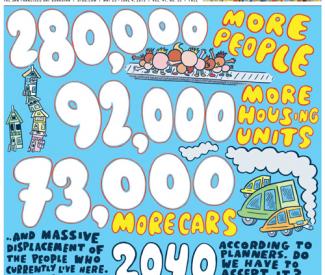
Last week’s adoption of Plan Bay Area by the Metropolitan Transportation Commission was a watershed moment in regional planning. The plan links regional planning to state policies mandating reductions in greenhouse gas emissions, and aims to limit future sprawl by accommodating 2.1 million people, 1 million jobs, and 660,000 housing units largely within the existing built-up areas of the nine-county region.

Newly designated priority development areas (PDAs) will enable modest-density, walkable development in city and suburb alike, while preserving both existing single-family neighborhoods and open space. In a time of urgent need to address global warming, the Bay Area has once again proved a leader by enabling compact housing around transit, and its supporting studies expect the per capita greenhouse gas emissions from driving to decline by 15 percent in 2040.

This will not save the world and it’s not without some challenging byproducts — such as preventing displacement of low-income residents from San Francisco and other urban centers — but it is a start. And in a nation hell-bent on denying the urgency of global warming, it is refreshing and inspiring that someone, somewhere, is trying to do something.   

Yet the transportation component – the lynchpin and impetus of Plan Bay Area, according to many local leaders –is mediocre, uninspiring, and inadequate.  Despite land use policies enabling compact development, 80 percent of all travel in the Bay Area will still be in cars in 2040, not much different from today, and far short of the real change that is needed in this time of urgency. With 2 million more people, this is a recipe for gridlock, inequity, and ecological disaster – not sound public policy. 

 It should be no surprise that a big part of the problem is funding. The MTC, charged with assessing future regional transit potential, identifies just $289 billion between now and 2040 for roads, bridges, and transit — far short of what’s needed.  At $10.3 billion a year that may seem like a lot, but upwards of 87 percent of this is already committed to maintenance of existing roads and transit– not transit capacity expansion.  New homes and jobs might be focused around BART and Caltrain stations, but because there’s no real capacity expansion, the current iteration of Plan Bay Area can’t even reach its own modest goal of 74 percent of trips by car in 2040. 

With 2 million more people, cumulative emissions from driving will actually increase by 18 percent because so few new residents will be able to squeeze onto our already crowded transit systems.  Today BART is breaking ridership records but it is crowded. Extensions to far flung suburbs might be worthwhile but they don’t expand capacity in the system’s core. What we need is a second BART line and/or Amtrak service between San Francisco and Oakland, but this is absent from the plan. Meanwhile, most mainline Muni buses and railcars are currently jam-packed, yet San Francisco is somehow expected to absorb 92,000 housing units in Plan Bay Area.

Supervisors David Campos and Scott Weiner, representing San Francisco in the Plan Bay Area process, are to be commended for drawing attention to the transit problem and for asking MTC staff to show how to meet future funding gaps. By broaching the subject, they show that San Francisco might be poised to lead on this critical issue. But Campos and Weiner, working within the “fiscally constrained envelope” as framed by MTC planners, were only seeking to cover deficits for existing service – not visionary expanded service.  In the end, there was no real vision for adequate transit capacity expansion.

This foretells a troubling transit future – and one that will likely be more and more private. While many San Franciscans decry the proliferation of Google buses and other private corporate shuttles hogging Muni stops, these buses do lay bare the transit conundrum in the Bay Area. Without well-funded, visionary capacity expansion of public transit, those with the means (and high wage jobs) will shift to private buses while everyone else is left to duke it out on crowded highways, buses, and trains.

This conundrum demands that progressives in the Bay Area ramp up their transit politics to lead locally and nationally. The debate about transit finance needs to be redirected – away from regressive local sales tax measures (which often include more roads) back towards more progressive measures, such as transit assessment districts – which could require developers who profit from Plan Bay Area’s growth incentives to adequately finance transit expansion.

The debate needs to move away from demonizing public transit employees to a discussion of the role and responsibility of corporate health care, banks, and the real estate industry in causing economic instability (which has harmed public transit finance more in the last decade than a bus driver expecting a living wage and healthcare). The debate needs to move away from creating new roadway capacity, such as exclusive toll lanes, and focus on how to convert existing highway lanes into transit-only lanes with fast, frequent, reliable regional bus service open to all.

Plan Bay Area is a living document, a work in progress. Within the next four-five years it will need to be revised and can be improved.  The current version of the plan, weak on transit funding, has been dominated by a loud, irrational mob of Tea Party cranks bent on sabotaging anything that hints of progressive ideas. They were successful in diluting Plan Bay Area. While a smattering of progressive transit activists showed up and attempted to shape the plan, next time the plan needs a broader progressive movement — including housing, social justice, and environmental activists — to demand a truly visionary transportation plan.


Jason Henderson is a geography professor at San Francisco State University and the author of Street Fight: The Politics of Mobility in San Francisco. We’ll be sharing his perspective regularly in the Bay Guardian.

Heads Up: 6 must-see concerts this week

1

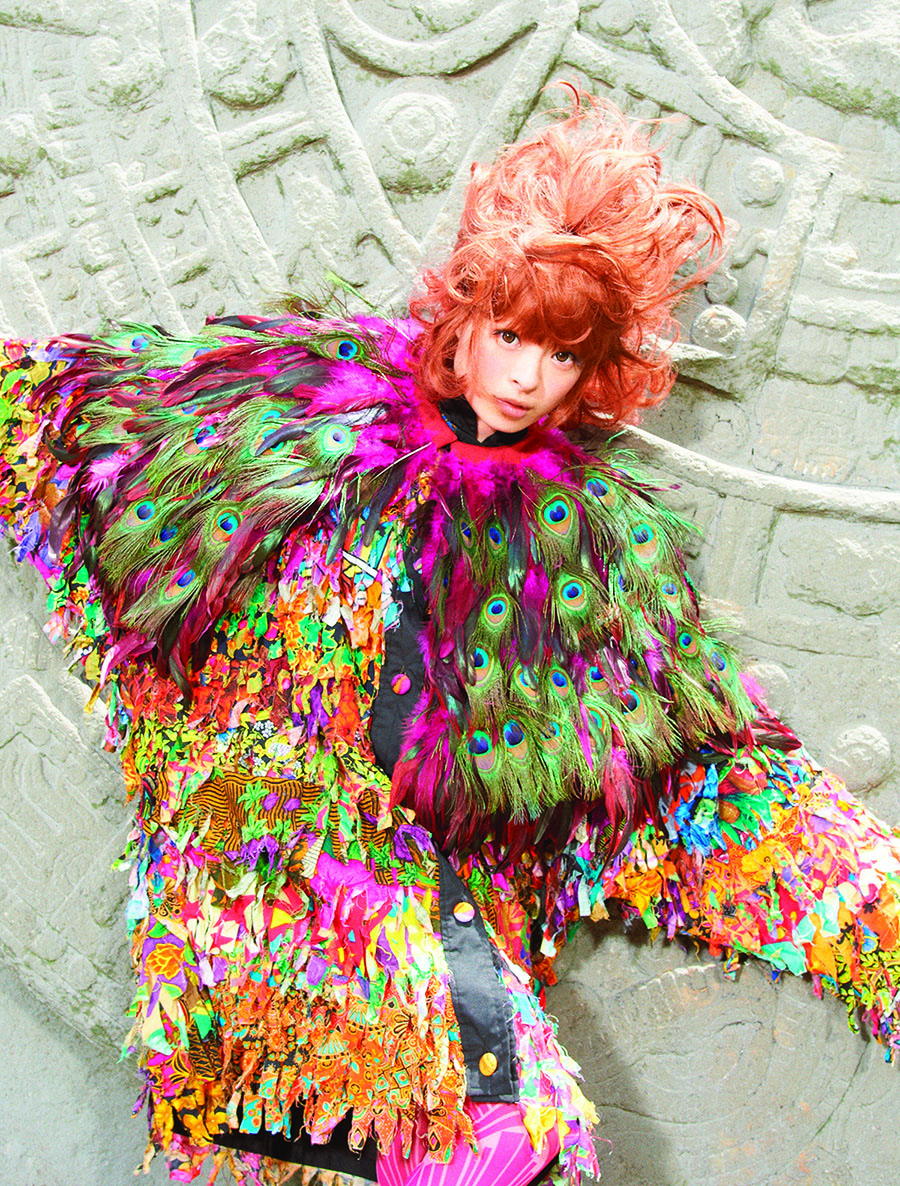
Hiatus Kaiyote, Yassou Benedict, Elvis Christ with Pookie and the Poodlez, Jello Biafra and the Guantanamo School of Medicine — this week’s must-sees are a mouthful. A salty, appetizing taste of old school punk, the young and shoegazy, Australian future soul-makers, and more. There’s also locals Wild Moth, and the reliably bubbly J-POP Summit, which includes a performance by Kyary Pamyu Pamyu.

Not listed below, but there’s also a mid-‘90s nostalgia wave hitting our shores this week, with Courtney Love’s sold-out Independent show and Weezer at the America’s Cup Pavilion (both Thu/25) — tickets to the latter are $47.50.

Here are your must-see Bay Area concerts this week/end:

Wild Moth
“To understand SF’s Wild Moth, it’s much easier to describe what it’s not. The band’s fuzzy, electric guitar styling is wild, but not sloppy. Wild Moth’s EP Mourning Glow isn’t long, it’s also not lacking in kick. Distorted guitar and rough vocals have never been so appealing. The group’s big bang is its general lackluster attitude juxtaposed with its tight percussion and surged guitar licks. It’s all about the raw emotional energy that often accompanies its tunes. Wild Moth very much leaves it up to the listener — are you there to hear about the black void of blind compliance, or to feel it?” — Hillary Smith
With Speedy Ortiz
Thu/25, 9pm, $10
Bottom of the Hill
1233 17th St., SF
www.bottomofthehill.com
http://www.youtube.com/watch?v=egkSza2EXeM

Jello Biafra and the Guantanamo School of Medicine
Jello Biafra could be your theatrical political science professor. The still-charismatic frontperson has long spewed knowledge deep from the underbelly of political theater, from his influential early 1980s Bay Area punk band Dead Kennedys, and projects like the band Lard, through his nine dense spoken word albums, and up to his newest musical endeavor, louder than ever in his 50s, Jello Biafra and the Guantanamo School of Medicine. That band, which also includes Victims Family guitarist Ralph Spight, plays the Uptown this weekend with D.I., the Divvys, and Gir-illa Biscuits — an excellent local Gorilla Biscuits tribute act.
Fri/26, 9pm, $15
Uptown
1928 Telegraph, Oakl.
www.uptownnightclub.com
http://www.youtube.com/watch?v=6f66EqCyPOE

Yassou Benedict

The shoegazing dreampop group of 20-somethings Yassou Benedict recently released its debut EP, In Fits in Dreams, a moody, complex, emotionally fraught record that leaves the listener itching for a full-length, and touches on themes of “anxiety, and wanting to be weightless, the desire to run through wide open spaces.” The album release party was actually a few weeks back, but you can catch the band this week at Milk Bar.
With Beautiful Machines, Hotel Eden, NVO
Fri/26, 8:30pm, $10
Milk Bar
1840 Haight, SF
www.milksf.com
http://www.youtube.com/watch?v=MrEejzbeYbI

J-POP Summit Festival
“The theme of the fifth annual J-POP Summit Festival is “Making Kawaii Universal” — which seems a certainty. What warm-blooded, sweet-tooth-having human could resist this two-day explosion of film, art, fashion, pop culture, and pop stars, chiefly feather-bedecked glamour girl Kyary Pamyu Pamyu, “Japan’s Official Ambassador of Kawaii”? (For those not in the know, “Kawaii” = “cute,” and its influence goes way beyond whatever Gwen Stefani co-opted and repackaged for the American masses a few years back.) She’ll be performing live (along with other acts, including a human beat box); other J-POP attractions include a film festival (with a hefty anime component), a Harajuku fashion show, live art events, sake tasting, a dance contest, and a whole lot more.” — Cheryl Eddy
Sat/27-Sun/28, 11am-6pm, prices vary
Japantown (near Geary and Webster), SF
www.j-pop.com
http://www.youtube.com/watch?v=yzC4hFK5P3g

Elvis Christ, Pookie and the Poodlez
“Looking at the bands’ names on this lineup is enough to make your head spin. From quirky to downright dumb, it won’t matter much because the performance will prove they all take playing live seriously. Elvis Christ may sound familiar if not for his new cassette on Burger Records, then for recording troves of trash rockers including Nobunny and Pookie and the Poodlez (also on the bill). Be sure to catch Yogurt Brain, an earnest act with a solid songwriter (though he does have an affinity for covering Springsteen and Gram Parsons songs). Expect some country-punk style shredding (fingerpicks and all) on guitar and if you’re lucky he may even do the kick splits on stage!” — Andre Torrez
With Yogurt Brain
Sat/27, 8pm, $5
Eli’s Mile High Club
3629 Martin Luther King Jr., Oakl.
(510) 350-7818.
www.elismilehigh.com
http://www.youtube.com/watch?v=6SdZUC5QaPI

Hiatus Kaiyote

“Hiatus Kaiyote might identify as a “future soul” ensemble, and Nai Palm’s impassioned, show-stopping vocals surely establish a strong R&B foundation, but in the end, Tawk Tomahawk sounds less like a soul LP than an unfiltered rush of creative energy, heaping countless ideas and influences into an ecstatic vision of musical possibility.” — Taylor Kaplan
With the Seshen, Bells Atlas
Sun/28, 9pm, $22
Independent
628 Divisadero, SF
(415) 771-1421
www.theindependentsf.com
http://www.youtube.com/watch?v=ghw26g3h6L0

Run, Chewie, run: Star Wars fashions fly at ‘Run the Course’

0

Many people say that the Star Wars movies are phenomenal, and I’m sure that if I’d seen any of them, I’d agree. Although I don’t know much about the series, there is one thing I do know – the fashion of Star Wars fans is vastly underrated.

A couple Wednesdays ago, die-hard fans ran in Course the Force, an Olympic-style torch relay benefitting the Make-A-Wish Foundation. They started at Pier 50, and ran across the Golden Gate Bridge, and then joined “Conival” at Justin Herman Plaza for games, food, expo booths, and live music.

Thirteen year-old Morgan McCarthy sported an outfit resembling Barriss Offee. “Barriss was a background character in the movies, but became a major player in the cartoon,” McCarthy said. McCarthy may have worn a new costume, but her sister, ten year-old Isabel, proved that hipsters come in all shapes and sizes as she wore a thrifted costume, handed down by her older sister.

One of the most talked about costumes of the event came from Traci Degerman, who dresses as a Jedi knight of the old republic. Not only did Degerman put in more elbow grease in dressing up by doing her own engravements on her outfit, but she still looked fierce and ready to kick ass even after participating in the Course the Force Relay. “Well, it was only half a mile,” Degerman said modestly of her triumph. “I’m just excited to see the video of us running.” I guess you can’t look fine and run gracefully.

I wish we could focus only on the cute children and over achievers, but with the bad always tags along with the good. “In all fairness, I’m dressed as myself,” Leif Bryor said. Bryor was technically dressed as a Jedi, as his robe had an official emblem on it. He described his attire choice as “Just a way to find granny,” as he handed over a business card and walked away. Bryor didn’t put any effort into his look but, Sith happens.

Solomon: The portrait of a leaker as a young man

7


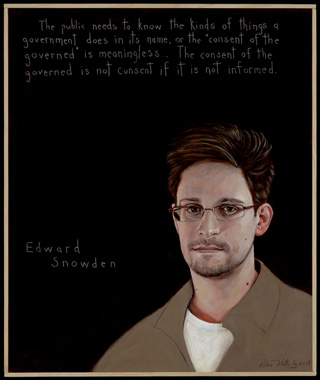
Painted by Robert Shetterly for his Americans Who Tell The Truth Project.


A Portrait of the Leaker as a Young Man

By Norman Solomon 

Norman Solomon is co-founder of RootsAction.org and founding director of the Institute for Public Accuracy. His books include “War Made Easy: How Presidents and Pundits Keep Spinning Us to Death” and “Made Love, Got War: Close Encounters With America’s Warfare State.”

Why have Edward Snowden’s actions resonated so powerfully for so many people?

The huge political impacts of the leaked NSA documents account for just part of the explanation. Snowden’s choice was ultimately personal. He decided to take big risks on behalf of big truths; he showed how easy and hazardous such a step can be. He blew the whistle not only on the NSA’s Big Brother surveillance but also on the fear, constantly in our midst, that routinely induces conformity.

Like Bradley Manning and other whistleblowers before him, Snowden has massively undermined the standard rationales for obedience to illegitimate authority. Few of us may be in a position to have such enormous impacts by opting for courage over fear and truth over secrecy—but we know that we could be doing more, taking more risks for good reasons—if only we were willing, if only fear of reprisals and other consequences didn’t clear the way for the bandwagon of the military-industrial-surveillance state.

Near the end of Franz Kafka’s The Trial, the man in a parable spends many years sitting outside an open door till, near death, after becoming too weak to possibly enter, he’s told by the doorkeeper: “Nobody else could have got in this way, as this entrance was meant only for you. Now I’ll go and close it.”

That’s what Martin Luther King Jr. was driving at when he said, in his first high-risk speech denouncing the Vietnam War: “In this unfolding conundrum of life and history, there is such a thing as being too late. Procrastination is still the thief of time. Life often leaves us standing bare, naked, and dejected with a lost opportunity.”

Edward Snowden was not too late. He refused to allow opportunity to be lost. He walked through the entrance meant only for him.

When people say “I am Bradley Manning,” or “I am Edward Snowden,” it can be more than an expression of solidarity. It can also be a statement of aspiration—to take ideals for democracy more seriously and to act on them with more courage.

The artist Robert Shetterly has combined his compelling new portrait of Edward Snowden with words from Snowden that are at the heart of what’s at stake: “The public needs to know the kinds of things a government does in its name, or the ‘consent of the governed’ is meaningless. . . The consent of the governed is not consent if it is not informed.” Like the painting of Snowden, the quote conveys a deep mix of idealism, vulnerability and determination.

Edward Snowden has taken idealism seriously enough to risk the rest of his life, a choice that is to his eternal credit and to the world’s vast benefit. His decision to resist any and all cynicism is gripping and unsettling. It tells us, personally and politically, to raise our standards, lift our eyes and go higher into our better possibilities.

Norman Solomon is co-founder of RootsAction.org and founding director of the Institute for Public Accuracy. His books include “War Made Easy: How Presidents and Pundits Keep Spinning Us to Death” and “Made Love, Got War: Close Encounters With America’s Warfare State.”
[This work is licensed under a Creative Commons Attribution-Share Alike 3.0 License.]

(Bruce B. Brugmann, who signs his emails and blogs B3, writes and edits the bruce blog on the Bay Guardian website at sfbg.com He is the editor at large and was editor and co-founder and co-publisher of the Bay Guardian, 1966-2012),  He can be reached at bruce@sfbg.com  b3

Silent films, racing snails, haunted houses, and more in weekend movies!

2

Those long, well-dressed lines wrapping around the Castro Theatre signal the advent of the annual San Francisco Silent Film Festival, now in its 18th year and popular as ever. Though the fest opened last night, programming continues through the weekend; check out my take on some of the films (including one of tonight’s selections, 1928 rom-com The Patsy) here.

Elsewhere, in first-run and rep theaters, it’s a robust week for openings. There’s something for nearly every age and appetite (plus a few recommendations on what to avoid) in the short reviews below.

Big Star: Nothing Can Hurt Me The ultimate pop-rock cult band’s history is chronicled in Drew DeNicola and Olivia Mori’s documentary. Alex Chilton sold four million copies of 1967 Box Tops single “The Letter,” recorded when he was 15 years old. After years of relentless touring, he quit that unit and returned home just as fellow Memphis native and teenage musical prodigy Chris Bell was looking to accentuate his own as-yet-unnamed band. Big Star’s 1973 debut LP #1 Record, like subsequent years’ follow-ups Radio City and Third/Sister Lovers, got great reviews — but won no commercial success whatsoever, in part due to distribution woes, record-company politics, and so forth. The troubled Bell struggled to get a toehold on a solo career, while barely-more-together Chilton changed his style drastically once invigorated by the punk invasion. At the least the latter lived long enough to see Big Star get salvaged by an ever-growing worshipful cult that includes many musicians heard from here, including Robyn Hitchcock, Matthew Sweet, and Tav Falco, plus members of the Posies, Flaming Lips, Teenage Fanclub, Yo La Tengo, R.E.M., Mitch Easter, the dB’s, and Meat Puppets. Unfortunately the spoken input from Chilton and Bell is mostly limited to audio (didn’t anyone actually film interviews back then?) Still, this semi-tragic story of musical brilliance, commercial failure, and belated “legendary” beknighting is compelling — not to mention a must for anyone interested in the annals of power pop. Now, would somebody please make documentaries about Emitt Rhodes, Game Theory, and SF’s own Oranger? (1:53) Roxie. (Dennis Harvey)

http://www.youtube.com/watch?v=Vjk2So3KvSQ

The Conjuring Irony can be so overrated. Paying tribute to those dead-serious ‘70s-era accounts of demonic possession — like 1973’s The Exorcist, which seemed all the scarier because it were based on supposedly real-life events — the sober Conjuring runs the risk of coming off as just more Catholic propaganda, as so many exorcism-is-the-cure creepers can be. But from the sound of the long-coming development of this project — producer Tony DeRosa-Grund had apparently been wanting to make the movie for more than a dozen years — 2004’s Saw and 2010’s Insidious director James Wan was merely applying the same careful dedication to this story’s unfolding as those that came before him, down to setting it in those groovy VW van-borne ‘70s that saw more families torn apart by politics and cultural change than those ever-symbolic demonic forces. This time, the narrative framework is built around the paranormal investigators, clairvoyant Lorraine Warren (Vera Farmiga) and demonologist Ed Warren (Patrick Wilson), rather than the victims: the sprawling Perron family, which includes five daughters all ripe for possession or haunting, it seems. The tale of two families opens with the Warrens hard at work on looking into creepy dolls and violent possessions, as Carolyn (Lili Taylor) and Roger Perron (Ron Livingston) move into a freezing old Victorian farmhouse. A very eerie basement is revealed, and hide-and-seek games become increasingly creepy, as Carolyn finds unexplained bruises on her body, one girl is tugged by the foot in the night, and another takes on a new invisible pal. The slow, scary build is the achievement here, with Wan admirably handling the flow of the scares, which go from no-budg effects and implied presences that rely on the viewer’s imagination, to turns of the screws that will have audiences jumping in their seats. Even better are the performances by The Conjuring’s dueling mothers, in the trenches of a genre that so often flirts with misogyny: each battling the specter of maternal filicide, Farmiga and Taylor infuse their parts with an empathetic warmth and wrenching intensity, turning this bewitched horror throwback into a kind of women’s story. (1:52) (Chun)

http://www.youtube.com/watch?v=expPMt-TX_k

Crystal Fairy Mysteriously given a tepid reception at Sundance this year, Chilean writer-director Sebastián Silva’s new film is — like his 2009 breakout The Maid — a wickedly funny portrait of repellent behavior that turns unexpectedly transcendent and emotionally generous in its last laps. Michael Cera plays a Yank youth living in Santiago for unspecified reasons, tolerated by flatmate Champa (José Miguel Silva) and his brothers even less explicably — as he’s selfish, neurotic, judgmental, hyper, hyper-annoying, and borderline-desperately in endless pursuit of mind-altering substances. At a party he meets a spacey New Age chick who calls herself Crystal Fairy (Gaby Hoffman). The next morning he’s horrified to discover he’d invited her on a road trip whose goal is to do drugs at an isolated ocean beach, but despite their own discomfort, Champa and company insist he honor his obligation. What ensues is near-plotless, yet always lively and eventually rather wonderful. If you have an allergy to Cera, beware — he plays a shallow (if possibly redeemable) American brat all too well here. But it would be a shame to miss a movie as spontaneous and surprising as this primarily English-language one, which underlines Silva’s stature as a talent likely well worth following for the long haul. (1:40) (Dennis Harvey)

http://www.youtube.com/watch?v=NqNgrsxcwiY

Girl Most Likely Even an above-average cast (Kristen Wiig, Annette Bening, Matt Dillon) can’t elevate this indie entry from Shari Springer Bergman and Robert Pulcini (2003’s American Splendor) above so many life-crisis comedies that have come before. Blame the script by Michelle Morgan (who also cameos), which never veers from the familiar, except when it dips into cliché. After she’s dumped by her suit-wearing boyfriend, failed playwright Imogene (Wiig) realizes her life is superficial and meaningless. Oopsies! A faux suicide attempt forces her to leave the cold sparkle of NYC for the neon glimmer of the Jersey shore, where her batty mother (Bening, in “tacky broad” mode) lives with her says-he’s-a-CIA-agent boyfriend (Dillon) and Imogene’s older brother (Christopher Fitzgerald), an Asperger’s-y sort obsessed with hermit crabs. Also in the mix — because in a movie like this, the adorably depressed lead can only heal with the help of a new romance — is Glee‘s Darren Criss; by the time you realize his character is a Backstreet Boys impersonator who also happens to be a fluent-in-French Yale grad with the patience and kindness to help a bitchy stranger work through her personal drama, you’re either gonna be OK with Girl Most Likely‘s embrace of the contrived, or you’ll have given up on it already. The takeaway is a fervent hope that the talented Wiig will write more of her own scripts in the future. (1:43) (Cheryl Eddy)

http://www.youtube.com/watch?v=JtdYdT17Vuk

The Look of Love Though his name means little in the US, in the UK Paul Raymond was as famous as Hugh Hefner. Realizing early on that sex does indeed sell, he (played by Steve Coogan) began sticking half-naked girls in 1950s club revues, then once the Sexual Revolution arrived, helped pull down a prudish country’s censorship barriers with a variety of cheesy, nudie stage comedies, “members-only” clubs, and girly mags. En route he abandoned a first wife (Anna Friel) for a bombshell actress-model (Tamsin Egerton), all the while continuing to play the field mightily. Nothing — lawsuits, police raids, public denunciations of his smutmongering — seemed to give him pause, save the eventually tragic flailing about of a daughter (Imogen Poots) who was perhaps the only person he ever loved in more than a physical sense. This fourth collaboration between director Michael Winterbottom and actor Coogan is one of those biopics about a driven cipher; if we never quite learn what made Raymond tick, that may be because he was simply an unreflective man satisfied with a rich (he was for a time Britain’s wealthiest citizen), shallow, hedonistic life. But all that surface excess is very entertainingly brought to life in a movie that’s largely an ode to the tackiest decor, fashions, and music of a heady three-decade period. (1:41) Smith Rafael. (Dennis Harvey)

Only God Forgives Julian (Ryan Gosling) and Billy (Tom Burke) are American brothers who run a Bangkok boxing club as a front for their real business of drug dealing. When the latter kills a young prostitute for kicks, then is killed himself, this instigates a chain reaction bloodbath of retribution slayings. Their primary orchestrators: police chief Chang (Vithaya Pansingarm), who always has a samurai-type sword beneath his shirt, pressed against his spine, and incongruously sings the most saccharine songs to his cop subordinates at karaoke; and Crystal (Kristin Scott Thomas, doing a sort of Kabuki Cruella de Vil), who flies in to avenge her son’s death. (When told he’d raped and slaughtered a 16-year-old girl, she shrugs “I’m sure he had his reasons.”) Notoriously loathed at Cannes, this second collaboration between director-scenarist Nicolas Winding Refn and star-producer Gosling certainly isn’t for those who found their 2011 Drive insufferably pretentious and mannered. But that movie was downright gritty realism compared to this insanely stylized action abstraction, which blares its influences from Walter Hill and Michael Mann to Suzuki and Argento. The last-named particularly resonates in Suspira-level useage of garishly extreme lighting effects, much crazy wallpaper, and a great score by Cliff Martinez that duly references Goblin (among others). The performances push iconic-toughguy (and toughmutha) minimalism toward a breaking point; the ultraviolence renders a term like “gratuitous” superfluous. But there’s a macabre wit to all this shameless cineaste self-indulgence, and even haters won’t be able to deny that virtually every shot is knockout gorgeous. Haters gonna hate in the short term, but God is guaranteed a future of fervent cult adoration. (1:30) (Dennis Harvey)

http://www.youtube.com/watch?v=COpJwAeuWHo

An Oversimplification of Her Beauty Terence Nance’s original, imaginative feature is a freeform cinematic essay slash unrequited-love letter. He and Namik Minter play fictionalized versions of themselves — two young, African American aspiring filmmakers in Manhattan, their relationship hovering uneasily between “just friends” and something more. To woo her toward the latter, he makes an hour-long film called How Would You Feel?, and the movie incorporates that as well as following what happens after he’s shown it to Minter. En route, there’s a great deal of animation (in many different styles), endless ruminative narration, and … not much plot. The ephemeral structure and general naval-gazing can get tiresome, but Beauty‘s risk-taking plusses outweigh its uneven qualities. (1:24) Roxie. (Dennis Harvey)

Red 2 Sequel to the 2010 action hit starring Bruce Willis about a squad of “retired, extremely dangerous” secret agents. (1:56)

http://www.youtube.com/watch?v=X07xNrVd7DU

R.I.P.D. Expect to see many reviews of R.I.P.D. calling the film “D.O.A.” — with good reason. This flatly unfunny buddy-cop movie hijacks elements from Ghost (1990), Ghostbusters (1984), and the Men in Black series, but even 2012’s lackluster third entry in the MIB franchise had more zest and originality than this sad piece of work. Ryan Reynolds plays Boston police officer Nick, recruited into the afterlife’s “Rest In Peace Department” after he’s gunned down by his crooked partner (Kevin Bacon). His new partner is Wild West casualty Roy, embodied by a scenery-chomping Jeff Bridges in an apparent parody of both his own turn in 2010’s True Grit and Sam Elliott’s in 1998’s The Big Lebowski. Tasked with preventing ghosts who appear to be human (known as “deados”) from assembling an ancient artifact that’ll empower a deado takeover, Nick and Roy zoom around town cloaked by new physical identities that only living humans can see. In a joke that gets old fast, Roy’s earthly form resembles a Victoria’s Secret supermodel, while Nick is stuck with “Chinese grandpa.” That the latter’s avatar is portrayed by James Hong — deliciously villainous as Lo Pan in 1986’s Big Trouble in Little China, a vastly superior supernatural action comedy — is one bright spot in what’s otherwise the cinematic equivalent of a shoulder shrug. (1:36) (Cheryl Eddy)

http://www.youtube.com/watch?v=Mv_Rl0CBPNs

Still Mine Canadian production Still Mine is based on the true story of Craig Morrison (James Cromwell), an elderly man whose decision to build a new house on his own land — using materials he’d harvested himself, and techniques taught to him by his shipwright father — doesn’t go over well with local bureaucrats, who point out he’s violating nearly every building code on the books. But Craig has a higher purpose than just challenging the system; he’s crafting the home for the comfort of his physically and mentally ailing wife of 61 years (Geneviève Bujold). It’s pretty clear from the opening courtroom scene how Still Mine will end; though it’s well-crafted — and boasts moving turns by Cromwell and Bujold — it ultimately can’t overcome its sentimental, TV-movie vibe. A heartfelt tale, nonetheless. (1:43) (Cheryl Eddy)

http://www.youtube.com/watch?v=ADuKkRTiCfI

Turbo It’s unclear whether the irony of coupling racing — long the purview of white southern NASCAR lovers — with an animated leap into “urban” South Central LA is lost on the makers of Turbo, but even if it is, they’re probably too busy dreaming of getting caught in the drift of Fast and Furious box office success to care much. After all, director David Soren, who came up with the original idea, digs into the main challenge — how does one make a snail’s life, before and after a certain magical makeover, at all visually compelling? — with a gusto that presumes that he’s fully aware of the delicious conundrums he’s set up for himself. Here, Theo (voiced by Ryan Reynolds) is your ordinary garden snail with big, big dreams — he wants to be a race car driver like ace Guy Gagne (Bill Hader). Those reveries threaten to distract him dangerously from his work at the plant, otherwise known as the tomato plant, in the garden where he and brother Chet (Paul Giamatti) live and toil. One day, however, Theo makes his way out of the garden and falls into the guts of a souped-up vehicle in the midst of a street race, gobbles a dose of nitrous oxide, and becomes a miraculous mini version of a high-powered race car. It takes a meeting with another dreamer, taco truck driver Tito (Michael Pena), for Theo, a.k.a. Turbo, to meet up with a crew of streetwise racing snails who overcome their physical limitations to get where they want to go (Samuel L. Jackson, Snoop Dogg, Maya Rudolph, Michael Bell). One viral video, several Snoop tracks, and one “Eye of the Tiger” remix later, the Indianapolis 500 is, amazingly, in Turbo’s headlights — though will Chet ever overcome his doubts and fears to get behind his bro? The hip-hop soundtrack, scrappy strip-mall setting, and voice cast go a long way to revving up and selling this Cinderella tall/small tale about the bottommost feeder in the food chain who dared to go big, and fast; chances are Turbo will cross over in more ways than one. (1:36) (Kimberly Chun)

http://www.youtube.com/watch?v=o2i6gJjzX2Y

V/H/S/2 This surprisingly terrific sequel to last year’s just-OK indie horror omnibus rachets up the tension and energy in each of its four segments, again connected by a thread involving creepy “home videos” found in a seemingly abandoned house. Adam Wingard and Simon Barrett’s Phase 1 Clinical Trials is a straightforwardly scary tale in which the former stars as a wealthy slacker who finds himself victim to predatory ghosts after surgery changes his physiological makeup. Reunited Blair Witch Project (1999) alumni Eduardo Sanchez and Gregg Hale’s A Ride in the Park reinvigorates zombie clichés with gleefully funny bad taste. The most ambitious narrative, Timo Tjahjanto and Gareth Huw’s Safe Haven, wades into a Jonestown type cult and takes it a few steps beyond mere mass suicide. Finally, Hobo With a Shotgun (2011) auteur Jason Eisener’s Slumber Party Alien Abduction delivers on that title and then some, as hearty-partying teens and their spying little brothers face something a whole lot more malevolent than each others’ payback pranks. The found-footage conceit never gets old in this diverse and imaginative feature. Plus, kudos to any horror sequel that actually improves upon the original. V/H/S/3? Bring it on. (1:36) Clay. (Dennis Harvey)

Call to action issued at San Francisco vigil for Trayvon Martin

A group of African American community leaders gathered outside San Francisco City Hall July 16 for a rally and candlelight vigil in memory of Trayvon Martin, the 17-year-old black youth who was gunned down in Sanford, Florida by George Zimmerman. Protests have flared up throughout the nation since Zimmerman was acquitted on a second-degree murder charge this past weekend, spurring renewed dialogue about race.

Rev. Amos Brown, president of the San Francisco NAACP, introduced a host of speakers including pastors from black churches, the San Francisco Interfaith Council, members of the Bayview Hunters Point Community, and others. While speakers touched on a variety of topics including San Francisco’s dwindling black population and the economic pressures facing those unable to find work in an increasingly unaffordable city, much of the discussion revolved around a need to mount a significant challenge against racial profiling and to seek a different outcome in Zimmerman’s case.

The NAACP “will use all of our legal and moral resources at the national level, and will push for a civil suit to bring this Zimmerman gentlemen to justice,” said Brown. The national NAACP has created a petition urging U.S. Attorney General Eric Holder to open a civil rights case against Zimmerman.

Sups. London Breed, Malia Cohen, Jane Kim, and David Campos also delivered speeches at the rally.

“The injustice in Florida is a threat to all of us,” Breed said. “The injustice in Florida is a threat to African American boys. The fact that we have to look our children in the eye and explain why somebody can kill a kid and get away with it and not be charged and walk out of the courtroom a free man, how do you explain that?”

Rev. Malcolm Byrd, pastor of First A.M.E. Zion Church in San Francisco, illustrated his point about racial profiling by wearing a hoodie, jeans, and sneakers to the rally. He opened with comments referencing how Martin was deemed “suspicious” due to his appearance. His comments also alluded to the idea that Zimmerman was allowed to walk free in Florida, the same state where a woman was sentenced to three years in prison for shooting and killing a pit bull.

Despite the very real sense of outrage that many people expressed, some spoke about using the Zimmerman verdict as an opportunity to push for broader social change.

“In San Francisco, we know how to lead the way,” said LGBT activist Andrea Shorter. “On Sunday, every black church in this nation was talking about what? Trayvon Martin.” Shorter added that community members had succeeded in halting a proposal to introduce a stop-and-frisk policing policy that had the potential to increase racial profiling, and that there was momentum in place for a national effort to “dismantle racist profiling policies” and repeal stand-your-ground laws.

“For the first time in my life, after growing up and going to funeral after funeral after funeral after funeral, of all boys and black men throughout my life, I see people in this audience who are not African American, who are just as hurt as I am, who are just as sick of this as I am,” Breed noted. “And we are all in this together. We have got to work together if we want to change it.”

Cohen sounded a similar note. “I think one of the things that have transpired now that the verdict has come out is that there has been a serious call to action,” she said.

“Being black in America is to be the beneficiary of great inheritance,” said Obai Rambo of the San Francisco Black Young Democrats. “History will mark this day as one of the greatest opportunities for building equality and justice.”

Photographs by Justin Benttinen. Audio slideshow by Rebecca Bowe.

New generation of Guardian leadership seeks community partnership

52

San Francisco Print Media Company has named Marke Bieschke as publisher and Steven T. Jones as editor of the San Francisco Bay Guardian, elevating two longtime Guardianistas into the top spots, guaranteeing them editorial autonomy, and letting them work with the community to chart its future.

As a first step in that process, the Guardian will hold a public forum on July 31 from 6-8pm in the LGBT Center, 1800 Market Street, to solicit input and discuss the Guardian’s unique role in the Bay Area’s political and journalistic landscape. Helping to coordinate the forum is Guardian writer Rebecca Bowe, who has accepted the position of news editor. The forum and subsequent discussions will form the basis for a strategic plan that will help guide the Guardian into a new era.

The newspaper’s future was uncertain a month ago following the abrupt departure of longtime Guardian Editor-Publisher Tim Redmond in a dispute with the owners over layoffs and the Guardian’s autonomy. The company’s Vice President of Editorial Operations Stephen Buel, who is also editor of the San Francisco Examiner, was named interim Guardian publisher and Bieschke its interim editor.

Heeding concerns in the community about whether the Guardian would remain an independent, progressive voice in San Francisco, Bieschke and Jones negotiated terms with SF Print Media Company CEO Todd Vogt that guarantee them full editorial control, the addition of three new advertising sales positions and another staff writer, and guaranteed minimum staffing levels during a rebuilding period.

Bieschke and Jones, who are in their early 40s and have been with the Guardian for around 10 years each, say they are excited for the opportunity to work collaboratively with Guardian staff and its community to rejuvenate the paper, attract new readers, and achieve economic sustainability.

“Losing Tim’s leadership was hard on all of us at the Guardian, and we struggled with what to do next. But ultimately, the Guardian plays such an important role in San Francisco — particularly now, at a pivotal moment for this gentrifying city and its progressive movement — that we wanted to find a way to keep that voice alive, maintain our credibility, and reach out to a new generation of Bay Area residents,” Jones said.

The San Francisco Bay Guardian was founded in 1966 by Jean Dibble and Bruce B. Brugmann, who continues to blog and serve as editor-at-large for the Guardian. The couple retired from regular duties when the financially troubled paper was sold to Canadian investors headed by Vogt in the spring of 2012, a deal engineered by Redmond, who is always welcome in the pages of the Guardian as he pursues a new media venture.

“I’m stoked to bring a different energy and openness to innovation to the Guardian, while respecting our legacy and strengthening our bonds with the progressive, alternative community,” Bieschke said. “Obviously, Steve Jones and I stand on the shoulders of giants, and we’re so grateful to our Guardian family, past and present, for blazing a trail for world class progressive journalism, arts and culture coverage, and community-building in the Bay Area. In that spirit, I’m eager to reconnect with our readers and partner with them to amplify the Guardian voice and continue to change the Bay Area for the better.”

Vogt said he’s excited by the prospects of new generation of Guardian leadership: “I’m happy about this. I think it’s appropriate that two recognized leaders in the progressive community are in charge of the Guardian and I look forward to seeing what they do with it.”

Bieschke joined the Bay Guardian in 2005 as culture editor, coming on staff after covering nightlife in his Super Ego column, and he was made managing editor in 2010. His background includes online editorial and management level positions at Citysearch and PlanetOut Partners, as well as managing a bookstore in the Inner Richmond.

“I’m also excited to help diversify San Francisco’s media environment by bringing two decades of queer Arab-American activist experience to the role,” Bieschke said.

Jones is a Northern California native who was hired as the Guardian’s city editor in 2003, coming from Sacramento News & Review, where he served as news editor. Before that, he was a full-time staff writer for two other alternative newsweeklies, two daily newspapers, and one community weekly, all in California, since graduating from Cal Poly-SLO with a journalism degree in 1991.

Years of cutbacks have distilled the Guardian newsroom down to just a few excellent journalists: senior editor Cheryl Eddy, who has shaped the paper’s film and arts coverage since 1999; Bowe, an award-winning investigative reporter who returned to the Guardian in January from a one-year stint with the Electronic Frontier Foundation; and Music Editor Emily Savage, who knows the beats of this city better than anyone; with Art Director Brooke Robertson leading the Guardian’s creative presentation.

“We all hope you’ll help us to guard San Francisco’s values, appreciating all of its best cultural, artistic, and culinary offerings in the process,” Jones said. “We love the San Francisco Bay Area, in all its messy urban glory, and we think it’s worth fighting for.”

Music Listings: July 17-23, 2013

0

WEDNESDAY 17

ROCK

Bottom of the Hill: 1233 17th St., San Francisco. Joyce Manor, Merry Christmas, Tony Molina, 9 p.m., $10-$12.

DNA Lounge: 375 11th St., San Francisco. Six Feet Under, Decrepit Birth, Dealey Plaza, Cannabis Corpse, Saint Vernon, 7:30 p.m., $15-$20.

El Rio: 3158 Mission, San Francisco. Will Crum, Husband, Impuritan, 8 p.m., $5.

Elbo Room: 647 Valencia, San Francisco. Owl Paws, Cold Eskimo, Dogcatcher, The Crux, 9 p.m., $8.

Hemlock Tavern: 1131 Polk, San Francisco. Kirby Krackle, H2Awesome!, DJ Real, 8:30 p.m., $8.

The Knockout: 3223 Mission, San Francisco. Kids in Heat, The Dead Shakes, The Pentagraham Crackers, DJ Ryan Smith, 9:30 p.m., $6.

Milk Bar: 1840 Haight, San Francisco. Down Dirty Shake, Buffalo Tooth, Grill Cloth, The Spiral Electric, DJ Dahmer, 8 p.m., $2.

Monarch: 101 6th St., San Francisco. Strawberry Girls, These Colors, Oranges, Tommy Boys, 8 p.m.

DANCE

The Cafe: 2369 Market, San Francisco. “Sticky Wednesdays,” w/ DJ Mark Andrus, 8 p.m., free.

Cat Club: 1190 Folsom, San Francisco. “Bondage A Go Go,” w/ DJs Damon, Tomas Diablo, & guests, 9:30 p.m., $5-$10.

The Cellar: 685 Sutter, San Francisco. “Eye Candy Wednesdays,” 9 p.m., free.

Club X: 715 Harrison, San Francisco. “Electro Pop Rocks,” 18+ dance party with Mightyfools, more, 9 p.m., $10-$20.

DNA Lounge: 375 11th St., San Francisco. Die Sektor, Frontal Boundary, Techniker Sektion, DJs Decay & Unit 77, 8 p.m., $8-$12.

F8: 1192 Folsom St., San Francisco. “Housepitality,” w/ Terry Mullan, Ben Vallery, Buckner, Derek Opperman, 9 p.m., $5-$10.

Harlot: 46 Minna, San Francisco. “Qoöl,” 5 p.m.

Infusion Lounge: 124 Ellis, San Francisco. “Indulgence,” 10 p.m.

Lookout: 3600 16th St., San Francisco. “What?,” 7 p.m.

MatrixFillmore: 3138 Fillmore, San Francisco. “Innov8,” 8 p.m.

Q Bar: 456 Castro, San Francisco. “Booty Call,” w/ Juanita More, Joshua J, guests, 9 p.m., $3.

Showdown: 10 Sixth St., San Francisco. “Nokturnal,” w/ DJs Coyle & Gonya, Third Wednesday of every month, 9 p.m., free.

HIP-HOP

Double Dutch: 3192 16th St., San Francisco. “Cash IV Gold,” w/ DJs Kool Karlo, Roost Uno, and Sean G, 10 p.m., free.

Skylark Bar: 3089 16th St., San Francisco. “Mixtape Wednesday,” w/ resident DJs Strategy, Junot, Herb Digs, & guests, 9 p.m., $5.

ACOUSTIC

Cafe Divine: 1600 Stockton, San Francisco. Craig Ventresco & Meredith Axelrod, 7 p.m., free.

Fiddler’s Green: 1333 Columbus, San Francisco. Terry Savastano, Every other Wednesday, 9:30 p.m., free/donation.

JAZZ

Amnesia: 853 Valencia, San Francisco. Gaucho, Eric Garland’s Jazz Session, The Amnesiacs, 7 p.m., free.

Burritt Room: 417 Stockton St., San Francisco. Terry Disley’s Rocking Jazz Trio, 6 p.m., free.

Club Deluxe: 1511 Haight, San Francisco. The Techtonics, Every other Wednesday, 8:30 p.m., free.

Jazz Bistro At Les Joulins: 44 Ellis, San Francisco. Charles Unger Experience, 7:30 p.m., free.

Le Colonial: 20 Cosmo, San Francisco. The Cosmo Alleycats featuring Ms. Emily Wade Adams, 7 p.m., free.

Oz Lounge: 260 Kearny, San Francisco. Hard Bop Collective, 6 p.m., free.

Rasselas Ethiopian Cuisine & Jazz Club: 1534 Fillmore, San Francisco. M.B. Hanif & The Sound Voyagers, 8 p.m.

Revolution Cafe: 3248 22nd St., San Francisco. Michael Parsons Trio, Every other Wednesday, 8:30 p.m., free/donation.

Savanna Jazz Club: 2937 Mission, San Francisco. “Cat’s Corner,” 9 p.m., $10.

Top of the Mark: One Nob Hill, 999 California, San Francisco. Ricardo Scales, Wednesdays, 6:30-11:30 p.m., $5.

Zingari: 501 Post, San Francisco. Brenda Reed, 7:30 p.m., free.

INTERNATIONAL

Bissap Baobab: 3372 19th St., San Francisco. Timba Dance Party, w/ DJ WaltDigz, 10 p.m., $5.

Cafe Cocomo: 650 Indiana, San Francisco. “Bachatalicious,” w/ DJs Good Sho & Rodney, 7 p.m., $5-$10.

Cigar Bar & Grill: 850 Montgomery, San Francisco. Brazilian Night, 8 p.m.

Pachamama Restaurant: 1630 Powell, San Francisco. “Cafe LatinoAmericano,” 8 p.m., $5.

Union Square Park: 333 Post, San Francisco. Ilan Bar-Lavi, 12:30 p.m., free.

Yoshi’s San Francisco: 1330 Fillmore, San Francisco. Debo Band, Young Ethio Jazz Band, 8 p.m., $17-$22.

BLUES

Biscuits and Blues: 401 Mason, San Francisco. MoFo Party Band, 8 & 10 p.m., $15.

The Royal Cuckoo: 3202 Mission, San Francisco. Big Bones & Chris Siebert, 7:30 p.m., free.

The Saloon: 1232 Grant, San Francisco. Leah Tysse, 9:30 p.m.

SOUL

Boom Boom Room: 1601 Fillmore, San Francisco. “Soul Train Revival,” w/ “Ziek” McCarter, Third Wednesday of every month, 9:30 p.m., $5.

The Cellar: 685 Sutter, San Francisco. “Color Me Badd,” w/ DJ Matt Haze, Wednesdays, 5-9 p.m.

THURSDAY 18

ROCK

Bottom of the Hill: 1233 17th St., San Francisco. Apogee Sound Club, Death Cheetah, Sex Snobs, 9 p.m., $9.

Brick & Mortar Music Hall: 1710 Mission, San Francisco. Cool Ghouls, Wyatt Blair, Meat Market, Corners, Froth, DJ Al Lover, 9 p.m., $8.

S.F. Eagle: 398 12th St., San Francisco. Thursday Nite Live: Hollow Mirrors, Winter Teeth, Illusion of Self, 9 p.m., $7.

The Independent: 628 Divisadero, San Francisco. Futurebirds, Diarrhea Planet, The Ecstatics, 8 p.m., $12-$14.

Light Rail Studios: 672 Toland, San Francisco. Hungry Skinny, Andre Thierry & Zydeco Magic, The Surgeon Generals, The Campbell Apartment, 8 p.m., $5.

Monarch: 101 6th St., San Francisco. Tall Fires, Tall Sheep, Cash for Gold, Coo Coo Birds, 8 p.m., $8.

DANCE

Abbey Tavern: 4100 Geary, San Francisco. DJ Schrobi-Girl, 10 p.m., free.

Aunt Charlie’s Lounge: 133 Turk, San Francisco. “Tubesteak Connection,” w/ DJ Bus Station John, 9 p.m., $5-$7.

The Cafe: 2369 Market, San Francisco. “¡Pan Dulce!,” 9 p.m., $5.

Cat Club: 1190 Folsom, San Francisco. “All ‘80s Thursdays,” w/ DJs Damon, Steve Washington, Dangerous Dan, and guests, 9 p.m., $6 (free before 9:30 p.m.).

The Cellar: 685 Sutter, San Francisco. “XO,” w/ DJs Astro & Rose, 10 p.m., $5.

Club X: 715 Harrison, San Francisco. “The Crib,” 9:30 p.m., $10, 18+.

Elbo Room: 647 Valencia, San Francisco. “Afrolicious,” w/ DJs Pleasuremaker, Señor Oz, and live guests, 9:30 p.m., $5-$7.

The EndUp: 401 Sixth St., San Francisco. EDMSF Thursdays, 10 p.m., $10 (free before midnight).

F8: 1192 Folsom St., San Francisco. “Beat Church,” w/ resident DJs Neptune & Kitty-D, Third Thursday of every month, 10 p.m., $10.

Harlot: 46 Minna, San Francisco. 2000 and One, Pedro Arbulu, MFYRS, 9 p.m., free with RSVP.

Infusion Lounge: 124 Ellis, San Francisco. “I Love Thursdays,” 10 p.m., $10.

Laszlo: 2532 Mission, San Francisco. “Werk It,” w/ DJ Kool Karlo, Third Thursday of every month, 9 p.m., free.

Madrone Art Bar: 500 Divisadero, San Francisco. “Night Fever,” 9 p.m., $5 after $10 p.m.

MatrixFillmore: 3138 Fillmore, San Francisco. “Fusion,” w/ DJ Big Bad Bruce, 9 p.m., $5.

Mighty: 119 Utah, San Francisco. “Ritual,” w/ Irie Cartel & guests, 10 p.m., $5-$10.

Q Bar: 456 Castro, San Francisco. “Throwback Thursday,” w/ DJ Jay-R, 9 p.m., free.

Raven: 1151 Folsom St., San Francisco. “1999,” w/ VJ Mark Andrus, 8 p.m., free.

Rickshaw Stop: 155 Fell, San Francisco. “Popscene,” w/ Le Youth, Touch Sensitive, DJs Aaron & Omar, 9:30 p.m., $12-$15.

Ruby Skye: 420 Mason, San Francisco. “Awakening,” w/ DJ Bl3nd, 9 p.m., $15-$20 advance.

The Tunnel Top: 601 Bush, San Francisco. “Tunneltop,” DJs Avalon and Derek ease you into the weekend with a cool and relaxed selection of tunes spun on vinyl, 10 p.m., free.

Underground SF: 424 Haight, San Francisco. “Bubble,” 10 p.m., free.

Vessel: 85 Campton, San Francisco. “Base,” w/ Navid Izadi, 10 p.m., $5-$10.

HIP-HOP

Eastside West: 3154 Fillmore, San Francisco. “Throwback Thursdays,” w/ DJ Madison, 9 p.m., free.

Park 77 Sports Bar: 77 Cambon, San Francisco. “Slap N Tite,” w/ resident Cali King Crab DJs Sabotage Beats & Jason Awesome, free.

The Parlor: 2801 Leavenworth, San Francisco. “Locals Night Out,” w/ DJ Illy D, 9 p.m., free.

Project One: 251 Rhode Island, San Francisco. Paint the Night: Action Jackson, Young Audiences of Northern California fundraiser featuring free paints and brushes to help you unleash your inner Jackson Pollock, plus music by DJs Mr. E, Max Kane, The Whooligan, and Ry Toast., 6-10 p.m., $25.

Showdown: 10 Sixth St., San Francisco. “Tougher Than Ice,” w/ DJs Vin Sol, Ruby Red I, and Jeremy Castillo, Third Thursday of every month, 10 p.m.

Skylark Bar: 3089 16th St., San Francisco. “Peaches,” w/lady DJs DeeAndroid, Lady Fingaz, That Girl, Umami, Inkfat, and Andre, 10 p.m., free.

ACOUSTIC

Amnesia: 853 Valencia, San Francisco. Zoe Muth & The Lost High Rollers, Miwa Gemini, Margaret Glasby, 9 p.m., $10.

Atlas Cafe: 3049 20th St., San Francisco. Pat Campbell & His Buds, 8 p.m., free.

Plough & Stars: 116 Clement, San Francisco. Tipsy House, Third Thursday of every month, 9 p.m., free.

JAZZ

Blush! Wine Bar: 476 Castro, San Francisco. Doug Martin’s Avatar Ensemble, 7:30 p.m., free.

Bottle Cap: 1707 Powell, San Francisco. The North Beach Sound with Ned Boynton, Jordan Samuels, and Tom Vickers, 7 p.m., free.

Cafe Claude: 7 Claude, San Francisco. Shelley MacKay, 7:30 p.m., free.

Cafe Du Nord: 2170 Market, San Francisco. MegaFlame Big Band & Cabaret, The John Brothers Piano Company, Miss Kay & Eva D’Luscious, 8:30 p.m., $12-$15.

Cafe Royale: 800 Post, San Francisco. West Side Jazz Club, 9 p.m.

Club Deluxe: 1511 Haight, San Francisco. Michael Parsons, 8:30 p.m., free.

The Emerald Tablet: 80 Fresno St., San Francisco. Mark Levine & The Latin Tinge, 7:30 p.m., $10.

Le Colonial: 20 Cosmo, San Francisco. Steve Lucky & The Rhumba Bums, 7:30 p.m.

The Royal Cuckoo: 3202 Mission, San Francisco. Chris Siebert, 7:30 p.m., free.

Savanna Jazz Club: 2937 Mission, San Francisco. Savanna Jazz Jam with Eddy Ramirez, 7:30 p.m., $5.

Top of the Mark: One Nob Hill, 999 California, San Francisco. Stompy Jones, 7:30 p.m., $10.

Yoshi’s San Francisco: 1330 Fillmore, San Francisco. NaJe, in Yoshi’s lounge, Third Thursday of every month, 6:30 p.m., free.

Zingari: 501 Post, San Francisco. Barbara Ochoa, 7:30 p.m., free.

INTERNATIONAL

Bissap Baobab: 3372 19th St., San Francisco. “Pa’Lante!,” w/ Juan G, El Kool Kyle, Mr. Lucky, 10 p.m., $5.

Pachamama Restaurant: 1630 Powell, San Francisco. “Jueves Flamencos,” 8 p.m., free.

Rasselas Ethiopian Cuisine & Jazz Club: 1534 Fillmore, San Francisco. Latin Breeze, 8 p.m.

Verdi Club: 2424 Mariposa, San Francisco. The Verdi Club Milonga, w/ Christy Coté, DJ Emilio Flores, guests, 9 p.m., $10-$15.

Yerba Buena Gardens: Fourth St. & Mission, San Francisco. Ilan Bar-Lavi, 12:30 p.m., free.

Yoshi’s San Francisco: 1330 Fillmore, San Francisco. The Raghu Dixit Project, 8 p.m., $25-$35.

REGGAE

Pissed Off Pete’s: 4528 Mission St., San Francisco. Reggae Thursdays, w/ resident DJ Jah Yzer, 9 p.m., free.

BLUES

Biscuits and Blues: 401 Mason, San Francisco. Alvon Johnson, 8 & 10 p.m., $15.

Jazz Bistro At Les Joulins: 44 Ellis, San Francisco. Bohemian Knuckleboogie, 7:30 p.m., free.

The Saloon: 1232 Grant, San Francisco. Chris Ford, 4 p.m.; Wendy DeWitt, 9:30 p.m.

EXPERIMENTAL

Hemlock Tavern: 1131 Polk, San Francisco. Grex, Alto!, Efft, Street Priest, 8:30 p.m., $7.

The Luggage Store: 1007 Market, San Francisco. Heroic Trio, Dunkelpeck, 8 p.m., $6-$10.

FRIDAY 19

ROCK

Bottom of the Hill: 1233 17th St., San Francisco. Mister Loveless, Transfer, Dante Elephante, 9:30 p.m., $10.

Cafe Du Nord: 2170 Market, San Francisco. Bonnie & The Bang Bang, French Cassettes, Down & Outlaws, 9:30 p.m., $10-$12.

Neck of the Woods: 406 Clement St., San Francisco. California Wives, My Gold Mask, on the upstairs stage, 9 p.m., $10; Unruly Things, Fast Piece of Furniture, Spider Garage, on the downstairs stage, 9 p.m., $5-$7.

Slim’s: 333 11th St., San Francisco. Orchid, The Saint James Society, Hell Fire, 9 p.m., $15.

Sub-Mission Art Space (Balazo 18 Gallery): 2183 Mission, San Francisco. Them Creatures, Lucabrazzi, The Yes Go’s, Andrea & The Bad Sugar Daddies, 8 p.m.

Thee Parkside: 1600 17th St., San Francisco. Captured! By Robots, Elephant Rifle, Pins of Light, 9 p.m., $10.

DANCE

Cafe Flore: 2298 Market, San Francisco. “Kinky Beats,” w/ DJ Sergio, 10 p.m., free.

The Cafe: 2369 Market, San Francisco. “Boy Bar,” w/ DJ Matt Consola, 9 p.m., $5.

Cat Club: 1190 Folsom, San Francisco. “The Witching Hour vs. Strangelove,” w/ DJ Sage, Daniel Skellington, Joe Radio, and Tomas Diablo, 9:30 p.m., $7 ($3 before 10 p.m.).

The Cellar: 685 Sutter, San Francisco. “F.T.S.: For the Story,” 10 p.m.

The EndUp: 401 Sixth St., San Francisco. “Fever,” 10 p.m., free before midnight.

F8: 1192 Folsom St., San Francisco. “Vintage,” w/ DJ Toph One & guests, 5 p.m., free; “Freeform vs. Dubalicious,” w/ resident DJs Floorcraft, Jonboy, and guests, Third Friday of every month, 9 p.m., $5 (free before 10 p.m.).

The Grand Nightclub: 520 4th St., San Francisco. “We Rock Fridays,” 9:30 p.m.

The Independent: 628 Divisadero, San Francisco. Big Black Delta, Breakdown Valentine, 9 p.m., $12.

Infusion Lounge: 124 Ellis, San Francisco. “Escape Fridays,” 10 p.m., $20.

The Lab: 2948 16th St., San Francisco. “Goth Prom,” Decades magazine issue #2 release party with Some Ember, Galaxy Radio DJs Smac & Holly B, readings, art, food, more, 9 p.m., $5-$8.

Lookout: 3600 16th St., San Francisco. “HYSL,” 9 p.m., $3.

Madrone Art Bar: 500 Divisadero, San Francisco. “That ‘80s Show,” w/ DJs Dave Paul & Jeff Harris, Third Friday of every month, 9 p.m., $5.

MatrixFillmore: 3138 Fillmore, San Francisco. “F-Style Fridays,” w/ DJ Jared-F, 9 p.m.

Mighty: 119 Utah, San Francisco. “Lights Down Low,” w/ Cajmere, Harvard Bass, Matrixxman, 9 p.m., $15-$20.

Monarch: 101 6th St., San Francisco. Safety Scissors, Kit n’ C.L.A.W.S., Jason Kendig, 10 p.m., $10 advance.

Q Bar: 456 Castro, San Francisco. “Pump: Worq It Out Fridays,” w/ resident DJ Christopher B, 9 p.m., $3.

Ruby Skye: 420 Mason, San Francisco. Torro Torro, 9 p.m., $20 advance.

Slate Bar: 2925 16th St., San Francisco. “Darling Nikki,” w/ resident DJs Dr. Sleep, Justin Credible, and Durt, Third Friday of every month, 8 p.m., $5.

Temple: 540 Howard, San Francisco. “Trap City: 1-Year Anniversary,” w/ heRobust, UltraViolet, Napsty, WolfBitch, Thizz Markie, Lé Swndle, Teleport, Smasheltooth, Nebakaneza, Johnny5, Mr. Kitt, more, 10 p.m., $20.

Wish: 1539 Folsom, San Francisco. “Bridge the Gap,” w/ resident DJ Don Kainoa, Fridays, 6-10 p.m., free; “Depth,” w/ resident DJs Sharon Buck & Greg Yuen, Third Friday of every month, 10 p.m., free.

HIP-HOP

Elbo Room: 647 Valencia, San Francisco. “The Social,” w/ Mars Today, Sayknowledge, Cait La Dee, Ryan Nicole, Do D.A.T., Dynamic, The Whooligan, Mikos Da Gawd, 10 p.m.

EZ5: 682 Commercial, San Francisco. “Decompression,” Fridays, 5-9 p.m.

John Colins: 138 Minna, San Francisco. “Juicy,” w/ DJ Ry Toast, Third Friday of every month, 10 p.m., $5 (free before 11 p.m.).

Showdown: 10 Sixth St., San Francisco. “Fresh to Def Fridays: A Tribute to Yo! MTV Raps,” w/ resident DJs Boom Bostic, Inkfat, and Hay Hay, Third Friday of every month, 10 p.m.

Yoshi’s San Francisco: 1330 Fillmore, San Francisco. “Yoshi’s First Annual White & Pink Affair,” w/ DJs Mind Motion & D-Sharp (in Yoshi’s lounge), 10:30 p.m., $15-$25.

ACOUSTIC

Amnesia: 853 Valencia, San Francisco. Indianna Hale, Small Souls, 7 p.m., $5-$7.

Bazaar Cafe: 5927 California, San Francisco. Sweet Hayah, Jean Marc, Tommy P, 7 p.m.

Brick & Mortar Music Hall: 1710 Mission, San Francisco. Kelly McFarling, Cave Clove, Laura Benitez & The Heartache, DJs Mish Mosh & KillyKill, 9 p.m., $9-$12.

The Chapel: 777 Valencia St., San Francisco. Jolie Holland, Mark Olson, 9 p.m., $20.

Mercury Cafe: 201 Octavia, San Francisco. Toshio Hirano, Third Friday of every month, 7:30 p.m., free, all ages.

The Sports Basement: 610 Old Mason, San Francisco. “Breakfast with Enzo,” w/ Enzo Garcia, 10 a.m., $5.

JAZZ

Beach Chalet Brewery & Restaurant: 1000 Great Highway, San Francisco. Johnny Smith, 8 p.m., free.

Bird & Beckett: 653 Chenery, San Francisco. The Third Quartet, Third Friday of every month, 5:30 p.m., free.

Biscuits and Blues: 401 Mason, San Francisco. Lavay Smith & Her Red Hot Skillet Lickers, 8 & 10 p.m., $20.

Cafe Claude: 7 Claude, San Francisco. Steve Lucky & The Rhumba Bums, 7:30 p.m., free.

Cafe Royale: 800 Post, San Francisco. Cyril Guiraud Trio, 9 p.m.

Jazz Bistro At Les Joulins: 44 Ellis, San Francisco. Charles Unger Experience, 7:30 p.m., free.

Revolution Cafe: 3248 22nd St., San Francisco. Emily Anne’s Delights, Third Friday of every month, 8:45 p.m., free/donation.

Savanna Jazz Club: 2937 Mission, San Francisco. Ann Marie Santos, $10.

Top of the Mark: One Nob Hill, 999 California, San Francisco. Black Market Jazz Orchestra, 9 p.m., $10.

Zingari: 501 Post, San Francisco. Joyce Grant, 8 p.m., free.

INTERNATIONAL

1015 Folsom: 1015 Folsom St., San Francisco. “A Celebration of Fela Kuti,” w/ Tony Allen, Najite & Olokun Prophecy, Lagos Roots, Afrolicious, Rich Medina, Damon Bell, King Most, DJ Leydis, Izzy*Wise, 9 p.m., $15-$20.

Bissap Baobab: 3372 19th St., San Francisco. Qumbia Qrew, Third Friday of every month, 8 p.m.

Cafe Cocomo: 650 Indiana, San Francisco. Taste Fridays, featuring local cuisine tastings, salsa bands, dance lessons, and more, 7:30 p.m., $15 (free entry to patio).

Cigar Bar & Grill: 850 Montgomery, San Francisco. Montuno Swing, 8 p.m.

Little Baobab: 3388 19th St., San Francisco. “Paris-Dakar African Mix Coupe Decale,” 10 p.m.

Pachamama Restaurant: 1630 Powell, San Francisco. Cuban Night with Fito Reinoso, 7:30 & 9:15 p.m., $15-$18.

Verdi Club: 2424 Mariposa, San Francisco. “Café Flamenco,” w/ Yaelisa & Caminos Flamencos, Third Friday of every month, 8 & 9:30 p.m., $18-$22 ($10 for kids under 12).

Yerba Buena Gardens: Fourth St. & Mission, San Francisco. Crosspulse Percussion Ensemble, 11 a.m. & 12:15 p.m., free.

REGGAE

Gestalt Haus: 3159 16th St., San Francisco. “Music Like Dirt,” 7:30 p.m., free.

BLUES

Boom Boom Room: 1601 Fillmore, San Francisco. Bill Phillippe, 6 p.m., free.

The Saloon: 1232 Grant, San Francisco. Highwater Blues, 4 p.m.; Steve Freund, 9:30 p.m.

FUNK

Amnesia: 853 Valencia, San Francisco. “Hella Tight,” w/ resident DJs Vinnie Esparza, Jonny Deeper, & Asti Spumanti, Third Friday of every month, 10 p.m., $5.

Boom Boom Room: 1601 Fillmore, San Francisco. Turkuaz, July 19-20, 9:30 p.m., $15 advance.

Make-Out Room: 3225 22nd St., San Francisco. “Loose Joints,” w/ DJs Centipede, Damon Bell, & Tom Thump, 10 p.m., $5.

SOUL

Edinburgh Castle: 950 Geary, San Francisco. “Soul Crush,” w/ DJ Serious Leisure, 10 p.m., free.

The Knockout: 3223 Mission, San Francisco. “Oldies Night,” W/ DJs Primo, Daniel, Lost Cat, and friends, Third Friday of every month, 10 p.m., $5.

Milk Bar: 1840 Haight, San Francisco. The Peach Kings, The St. Valentinez, Baby & The Luvies, 9 p.m., $10.

Public Works: 161 Erie, San Francisco. M.O.M. DJs Gordo Cabeza, Timoteo Gigante, and Malachi, in the OddJob loft, 10 p.m., $5.

Yoshi’s San Francisco: 1330 Fillmore, San Francisco. The Stylistics, July 19-20, 8 & 10 p.m., $35-$42.

SATURDAY 20

ROCK

Bender’s: 806 S. Van Ness, San Francisco. The Butlers, 10 p.m., $5.

Bottom of the Hill: 1233 17th St., San Francisco. Papa, Wardell, Luke Sweeney & Wet Dreams Dry Magic, 9:30 p.m., $12.

Cafe Du Nord: 2170 Market, San Francisco. SMiLE! Progressive Rock Festival, w/ Dominique Leone, Matti Bye & This Forgotten Land, Corima, Once & Future Band, Inner Ear Brigade, DJ Neil Martinson, 8 p.m., $10-$12.

El Rio: 3158 Mission, San Francisco. The Meat Sluts, Bad Cop/Bad Cop, Jabber, 10 p.m., $7.

Hemlock Tavern: 1131 Polk, San Francisco. Wild Hunt, Ionophore, Ephemeros, Thoabath, 9:30 p.m., $7.

The Independent: 628 Divisadero, San Francisco. The BoDeans, The Luke Mulholland Band, 9 p.m., $25.

The Knockout: 3223 Mission, San Francisco. Qui, Feral Ohms, Pigs, 5 p.m., $7.

Neck of the Woods: 406 Clement St., San Francisco. Water District, The Insufferables, 9 p.m., $8-$10.

Thee Parkside: 1600 17th St., San Francisco. Luicidal, Oppressed Logic, Nihilist Cunt, 9 p.m., $10.

DANCE

Amnesia: 853 Valencia, San Francisco. “O.K. Hole,” w/ Painted Caves, Little Debbie, Inhalt, C.L.A.W.S., Tom Sellect, Keith Slogan, 9 p.m., $5.

Brick & Mortar Music Hall: 1710 Mission, San Francisco. Conte, Seatraffic, 9 p.m., $10-$13.

Cafe Flore: 2298 Market, San Francisco. “Bistrotheque,” w/ DJ Ken Vulsion, 8 p.m., free.

Cat Club: 1190 Folsom, San Francisco. “New Wave City: Soundtrack Night,” w/ DJs Skip, Shindog, Low-Life, and Prince Charming, 9 p.m., $7-$12.

DNA Lounge: 375 11th St., San Francisco. “Bootie S.F.,” w/ Meikee Magnetic, Mixtress ShiZaam, WolfBitch, Speakerbomb, Reyka, Tommy Arcade, DJ Tripp, David X, Purple Crush, more, 9 p.m., $10-$15.

The EndUp: 401 Sixth St., San Francisco. “The Show,” w/ The Junkies, Ben Seagren, Dean Samaras, Alessandro, Marija Dunn, 10 p.m., $10-$20 (free before 11 p.m.).

Infusion Lounge: 124 Ellis, San Francisco. “Social Addiction,” Third Saturday of every month, 10 p.m., $20.

The Lab: 2948 16th St., San Francisco. “R U That Some Body?,” w/ MicahTron, Sevrinn, Jocquese Whitfield, DJs Jaqi Sparrow & Essex, 9 p.m., $7.

Lookout: 3600 16th St., San Francisco. “Bounce!,” 9 p.m., $3.

Madrone Art Bar: 500 Divisadero, San Francisco. “Fringe: 4-Year Anniversary Bash,” w/ DJs Blondie K & subOctave, 9 p.m., $5 (free before 10 p.m.).

Mighty: 119 Utah, San Francisco. The Twelves, Wool, Nolan Gray, 9 p.m., $18 advance.

Milk Bar: 1840 Haight, San Francisco. “The Queen Is Dead: A Tribute to the Music of Morrissey and the Smiths,” w/ DJ Mario Muse & guests, Third Saturday of every month, 9 p.m.

Powerhouse: 1347 Folsom, San Francisco. “Beatpig,” Third Saturday of every month, 9 p.m.

Public Works: 161 Erie, San Francisco. 2 Live Crews, Benefit for Project HOPE Art and Peter Hudson featuring DJs from Brass Tax and Space Cowboys., 9 p.m., $10-$20 sliding scale.

Rickshaw Stop: 155 Fell, San Francisco. “Gameboi S.F.,” w/ VJ LaRock, 9:30 p.m., $12-$15.

Ruby Skye: 420 Mason, San Francisco. “World Town,” w/ Cold Blank, Tyler Sherritt, Trevor Simpson, 9 p.m., $20 advance.

Slate Bar: 2925 16th St., San Francisco. “Smiths Night S.F.: Madonna vs. Blondie,” w/ The Certain People Crew, 10 p.m., $5.

The Stud: 399 Ninth St., San Francisco. “Squrrrl: Underrr the Sea,” w/ DJs Papa Tony, Trevor Sigler, and Joe Pickett, 9 p.m., $5.

Sub-Mission Art Space (Balazo 18 Gallery): 2183 Mission, San Francisco. “Batcave S.F.,” w/ The Tunnel, New Happiness, plus DJs Agitator, Burning Skies, Lori Lust, and Decoffinated, 9:30 p.m., $6.

Underground SF: 424 Haight, San Francisco. “Deep Crates,” w/ DJ Jenö, Bones, Matt Holland, JD, 9 p.m., $5 (free before 10 p.m.).

Vessel: 85 Campton, San Francisco. Tall Sasha, Jason Kwan, Ks Thant, 10 p.m., $10-$30.

HIP-HOP

111 Minna Gallery: 111 Minna St., San Francisco. “Shine,” Third Saturday of every month, 10 p.m.

John Colins: 138 Minna, San Francisco. “The Bump,” w/ The Whooligan, Third Saturday of every month, 10 p.m., free.

The Knockout: 3223 Mission, San Francisco. “The Booty Bassment,” w/ DJs Dimitri Dickinson & Ryan Poulsen, Third Saturday of every month, 10 p.m., $5.

Showdown: 10 Sixth St., San Francisco. “Purple,” w/ resident DJs ChaunceyCC & Party Pablo, Third Saturday of every month, 10 p.m.

ACOUSTIC

Amnesia: 853 Valencia, San Francisco. Eric Friedmann & The Lucky Rubes, Porkchop Express, 7 p.m.

Atlas Cafe: 3049 20th St., San Francisco. Craig Ventresco & Meredith Axelrod, Saturdays, 4-6 p.m., free.

The Chapel: 777 Valencia St., San Francisco. Lia Rose, We Became Owls, Annie & The Beekeepers, 9 p.m., $12-$15.

The Lucky Horseshoe: 453 Cortland, San Francisco. Slow Motion Cowboys, 9 p.m.

Plough & Stars: 116 Clement, San Francisco. The Shelby Foot Three, 9 p.m.

JAZZ

Cafe Claude: 7 Claude, San Francisco. Vijay Anderson Quartet, 7:30 p.m., free.

Club Deluxe: 1511 Haight, San Francisco. Saturday Afternoon Jazz, w/ Danny Brown, Danny Grewen, Eugene Warren, & Beth Goodfellow, 4:30 p.m., free.

Jane Warner Plaza: Market, San Francisco. Kitten on the Keys, 3 p.m., free.

Jazz Bistro At Les Joulins: 44 Ellis, San Francisco. Bill “Doc” Webster & Jazz Nostalgia, 7:30 p.m., free.

Rasselas Ethiopian Cuisine & Jazz Club: 1534 Fillmore, San Francisco. The Robert Stewart Experience, 9 p.m., $7.

The Rite Spot Cafe: 2099 Folsom, San Francisco. Project: Pimento, 9 p.m., free.

The Royal Cuckoo: 3202 Mission, San Francisco. Jules Broussard, Danny Armstrong, and Chris Siebert, 7:30 p.m., free.

Savanna Jazz Club: 2937 Mission, San Francisco. Jazz Combustion Uprising, 7:30 p.m., $10.

Zingari: 501 Post, San Francisco. Lisa Lindsley, 8 p.m., free.

INTERNATIONAL

1015 Folsom: 1015 Folsom St., San Francisco. “Pura,” 9 p.m., $20.

Artists’ Television Access: 992 Valencia, San Francisco. An Evening with Sublime Frequencies and Filmmaker Hisham Mayet, Seattle record label Sublime Frequencies presents two documentaries about North African music and culture: Palace of the Winds and Folk Music of the Sahara: Among the Tuareg of Libya., 8 p.m., $9.

Cigar Bar & Grill: 850 Montgomery, San Francisco. Orquesta Borinquen, 8 p.m.

Little Baobab: 3388 19th St., San Francisco. “Paris-Dakar African Mix Coupe Decale,” 10 p.m.

Make-Out Room: 3225 22nd St., San Francisco. “El SuperRitmo,” Latin dance party with DJs Roger Mas & El Kool Kyle, 10 p.m., $5.

OMG: 43 6th St., San Francisco. “Bollywood Blast,” Third Saturday of every month, 9 p.m., $5 (free before 10:30 p.m.).

Pachamama Restaurant: 1630 Powell, San Francisco. Peña Eddy Navia & Pachamama Band, 8 p.m., free.

Revolution Cafe: 3248 22nd St., San Francisco. Go Van Gogh, Third Saturday of every month, 9 p.m., free/donation.

REGGAE

Slim’s: 333 11th St., San Francisco. Radical Something, The Holdup, 8 p.m., $15.

BLUES

Biscuits and Blues: 401 Mason, San Francisco. Andy T & Nick Nixon Band, 7:30 & 10 p.m., $20.

The Saloon: 1232 Grant, San Francisco. Tony Perez & Second Hand Smoke, Third Saturday of every month, 4 p.m.; Ron Thompson, 9:30 p.m.

EXPERIMENTAL

Center for New Music: 55 Taylor St., San Francisco. 11th Annual Festival of Contemporary Music, 7:30 p.m., $10-$20.

FUNK

Boom Boom Room: 1601 Fillmore, San Francisco. Turkuaz, July 19-20, 9:30 p.m., $15 advance.

SOUL

Elbo Room: 647 Valencia, San Francisco. “Saturday Night Soul Party,” w/ DJs Lucky, Phengren Oswald, and Paul Paul, Third Saturday of every month, 10 p.m., $10 ($5 in formal attire).

Mezzanine: 444 Jessie, San Francisco. “Soul Slam S.F. VIII: Prince & Michael Jackson,” w/ DJs Spinna, Proof, Hakobo, and King Most, 9 p.m., $20-$25.

Yoshi’s San Francisco: 1330 Fillmore, San Francisco. The Stylistics, July 19-20, 8 & 10 p.m., $35-$42. “The R&B House Party,” w/ Carl Thomas, plus DJs Pos Red, Supreme, and C.J. Flash (in Yoshi’s lounge), 10:30 p.m., $25.

SUNDAY 21

ROCK

Cafe Du Nord: 2170 Market, San Francisco. Tijuana Panthers, GRMLN, The She’s, 9 p.m., $10.

El Rio: 3158 Mission, San Francisco. Turkey Swamp, Fresh Juice Party, Brentando, 8 p.m., $5.

Make-Out Room: 3225 22nd St., San Francisco. Scraper, 7:30 p.m., $8.

DANCE

The Cellar: 685 Sutter, San Francisco. “Replay Sundays,” 9 p.m., free.

The Edge: 4149 18th St., San Francisco. “’80s at 8,” w/ DJ MC2, 8 p.m.

Elbo Room: 647 Valencia, San Francisco. “Dub Mission,” w/ DJ Sep & Vinnie Esparza, 9 p.m., $6 (free before 9:30 p.m.).

The EndUp: 401 Sixth St., San Francisco. “T.Dance,” 6 a.m.-6 p.m.; “Soul Affair,” w/ Atnarko, Cuervo, Mario Dubbz, Roger Moorehouse, 8 p.m.

F8: 1192 Folsom St., San Francisco. “Stamina Sundays: 2-Year Anniversary,” w/ Gridlok, Lukeino, Jamal, 10 p.m., free.

Holy Cow: 1535 Folsom, San Francisco. “Honey Sundays,” w/ Honey Soundsystem & guests, 9 p.m., $5.

The Knockout: 3223 Mission, San Francisco. “Sweater Funk,” 10 p.m., free.

Lookout: 3600 16th St., San Francisco. “Jock,” Sundays, 3-8 p.m., $2.

Otis: 25 Maiden, San Francisco. “What’s the Werd?,” w/ resident DJs Nick Williams, Kevin Knapp, Maxwell Dub, and guests, 9 p.m., $5 (free before 11 p.m.).

The Parlor: 2801 Leavenworth, San Francisco. DJ Marc deVasconcelos, 10 p.m., free.

Q Bar: 456 Castro, San Francisco. “Gigante,” 8 p.m., free.

Showdown: 10 Sixth St., San Francisco. “The Dark Wave Rises,” w/ DJ Xtine Noir & DJ From Full House, Third Sunday of every month, 10 p.m.

Slate Bar: 2925 16th St., San Francisco. “She Said…: A Queer Affair,” Third Sunday of every month, 4 p.m., $3-$5.

Temple: 540 Howard, San Francisco. “Sunset Arcade,” 18+ dance party with bar games and video arcade, 7 p.m., $5.

HIP-HOP

Yoshi’s San Francisco: 1330 Fillmore, San Francisco. The Coup, 8 p.m., $22-$26.

ACOUSTIC

Bottom of the Hill: 1233 17th St., San Francisco. Roadkill Ghost Choir, Shady Maples, Anju’s Pale Blue Eyes, 9 p.m., $10.

Club Deluxe: 1511 Haight, San Francisco. Musical Mayhem with the Dimestore Dandy, 5:30 p.m., free.

The Lucky Horseshoe: 453 Cortland, San Francisco. Sunday Bluegrass Jam, 4 p.m., free.

Milk Bar: 1840 Haight, San Francisco. The Kentucky Twisters, The Righteous Uprights, 4 p.m., free.

Neck of the Woods: 406 Clement St., San Francisco. “iPlay,” open mic with featured weekly artists, 6:30 p.m., free.

Plough & Stars: 116 Clement, San Francisco. Seisiún with Darcy Noonan, Richard Mandel, and Jack Gilder, 9 p.m.

St. Luke’s Episcopal Church: 1755 Clay, San Francisco. “Sunday Night Mic,” w/ Roem Baur, 5 p.m., free.

JAZZ

Club Deluxe: 1511 Haight, San Francisco. Jay Johnson, 9 p.m., free.

Jazz Bistro At Les Joulins: 44 Ellis, San Francisco. Bill “Doc” Webster & Jazz Nostalgia, 7:30 p.m., free.

Madrone Art Bar: 500 Divisadero, San Francisco. “Sunday Sessions,” 10 p.m., free.

Revolution Cafe: 3248 22nd St., San Francisco. Jazz Revolution, 4 p.m., free/donation.

The Riptide: 3639 Taraval, San Francisco. The Cottontails, Third Sunday of every month, 7 p.m., free.

The Royal Cuckoo: 3202 Mission, San Francisco. Lavay Smith & Chris Siebert, 7:30 p.m., free.

Savanna Jazz Club: 2937 Mission, San Francisco. Vocal Jam with Kelly Park, 7 p.m., $5.

SFJAZZ Center: 205 Franklin St., San Francisco. Laurie Antonioli & The American Dreams Band: The Music of Joni Mitchell, 7:30 & 9 p.m., $20.

Zingari: 501 Post, San Francisco. Kitt Weagant, 7:30 p.m., free.

INTERNATIONAL

Atmosphere: 447 Broadway, San Francisco. “Hot Bachata Nights,” w/ DJ El Guapo, 5:30 p.m., $10 ($15-$20 with dance lessons).

Bissap Baobab: 3372 19th St., San Francisco. “Brazil & Beyond,” 6:30 p.m., free.

Oasis Bar & Grill: 401 California Ave., San Francisco. “El Vacilón,” 4 p.m., $10.

Thirsty Bear Brewing Company: 661 Howard, San Francisco. “The Flamenco Room,” 7:15 & 8:30 p.m.

BLUES

Biscuits and Blues: 401 Mason, San Francisco. Jules Leyhe, 7 & 9 p.m., $15.

Lou’s Fish Shack: 300 Jefferson St., San Francisco. A.C. Myles, 4 p.m.

Revolution Cafe: 3248 22nd St., San Francisco. HowellDevine, 8:30 p.m., free/donation.

The Saloon: 1232 Grant, San Francisco. Blues Power, 4 p.m.; Silvia C, 9:30 p.m.

Sheba Piano Lounge: 1419 Fillmore, San Francisco. Bohemian Knuckleboogie, 9 p.m., free.

EXPERIMENTAL

Center for New Music: 55 Taylor St., San Francisco. Crissy Broadcast: Participatory Site-Specific Music Making, Panel discussion and event preview moderated by KDFC’s Jeffrey Freymann-Weyr., 5 p.m., free.

The Lab: 2948 16th St., San Francisco. MSHR, Rubber O Cement, Waxy Tomb, 8 p.m., $8.

San Francisco Community Music Center: 544 Capp, San Francisco. 12th Annual Outsound New Music Summit: Communications Workshop for Independent Musicians, 3-5 p.m., free; 12th Annual Outsound New Music Summit: Touch the Gear Expo, 7-10 p.m., free.

FUNK

Pier 23 Cafe: Pier 23, San Francisco. Hot Pocket, Third Sunday of every month, 4 p.m., $5.

SOUL

Boom Boom Room: 1601 Fillmore, San Francisco. “Deep Fried Soul,” w/ DJs Boombostic & Soul Sauce, 9:30 p.m., $5.

Delirium Cocktails: 3139 16th St., San Francisco. “Heart & Soul,” w/ DJ Lovely Lesage, 10 p.m., free.

MONDAY 22

ROCK

Amoeba Music: 1855 Haight, San Francisco. Bastille, 5 p.m., free.

Cafe Du Nord: 2170 Market, San Francisco. Colleen Green, Sisu, Burnt Palms, 8 p.m., $9-$12.

El Rio: 3158 Mission, San Francisco. Au Dunes, Rustangs, Sandy’s, 7 p.m., $5.

The Knockout: 3223 Mission, San Francisco. Vampire Circus, Das Fluff, Facts on File, The Tempers, DJ Neil Martinson, 9 p.m., $8.

DANCE

DNA Lounge: 375 11th St., San Francisco. “Death Guild,” 18+ dance party with DJs Decay, Joe Radio, Melting Girl, & guests, 9:30 p.m., $3-$5.

Q Bar: 456 Castro, San Francisco. “Wanted,” w/ DJs Key&Kite and Richie Panic, 9 p.m., free.

Underground SF: 424 Haight, San Francisco. “Vienetta Discotheque,” w/ DJs Stanley Frank and Robert Jeffrey, 10 p.m., free.

ACOUSTIC

Amnesia: 853 Valencia, San Francisco. The Pick Bluegrass Jam, Fourth Monday of every month, 6 p.m., free; The Earl Brothers, Fourth Monday of every month, 9 p.m., free.

The Chieftain: 198 Fifth St., San Francisco. The Wrenboys, 7 p.m., free.

Fiddler’s Green: 1333 Columbus, San Francisco. Terry Savastano, 9:30 p.m., free/donation.

Hotel Utah: 500 Fourth St., San Francisco. Open mic with Brendan Getzell, 8 p.m., free.

The Independent: 628 Divisadero, San Francisco. Shooter Jennings, Scott H. Biram, Shovelman, 8 p.m., $22-$25.

Osteria: 3277 Sacramento, San Francisco. “Acoustic Bistro,” w/ Jason Berk, Michael Shoup, Josh Hoke, Katie Garibaldi, 7 p.m., free.

JAZZ

Le Colonial: 20 Cosmo, San Francisco. Le Jazz Hot, 7 p.m., free.

Rasselas Ethiopian Cuisine & Jazz Club: 1534 Fillmore, San Francisco. Open Mic Jazz Jam with Tod Dickow, 8 p.m.

The Union Room at Biscuits and Blues: 401 Mason, San Francisco. “The Session: A Monday Night Jazz Series,” pro jazz jam with Mike Olmos, 7:30 p.m., $12.

Zingari: 501 Post, San Francisco. Nora Maki, 7:30 p.m., free.

INTERNATIONAL

Elbo Room: 647 Valencia, San Francisco. Bachaco, DJ El Kool Kyle, 9 p.m., $5.

REGGAE

Skylark Bar: 3089 16th St., San Francisco. “Skylarking,” w/ I&I Vibration, 10 p.m., free.

BLUES

Jazz Bistro At Les Joulins: 44 Ellis, San Francisco. Bohemian Knuckleboogie, 7:30 p.m., free.

The Saloon: 1232 Grant, San Francisco. The Bachelors, 9:30 p.m.

EXPERIMENTAL

San Francisco Community Music Center: 544 Capp, San Francisco. 12th Annual Outsound New Music Summit Composers Symposium: Compositional Trace Medium & Traditional Strata, 7-9 p.m., free.

SOUL

Madrone Art Bar: 500 Divisadero, San Francisco. “M.O.M. (Motown on Mondays),” w/ DJ Gordo Cabeza & Timoteo Gigante, 8 p.m., free.

TUESDAY 23

ROCK

Bottom of the Hill: 1233 17th St., San Francisco. Sweetwater Black, Lee Gallagher & The Hallelujah, Slow Season, 9 p.m., $8.

Brick & Mortar Music Hall: 1710 Mission, San Francisco. Hydrophonic, Soule Faction, Overland, 9 p.m., $5-$8.

Cafe Du Nord: 2170 Market, San Francisco. Midnight Cinema, Sentinel, 8 p.m., $10-$12.

El Rio: 3158 Mission, San Francisco. Mortar & Pestle, The Tempers, Diesel Dudes, 8 p.m., $6.

DANCE

Aunt Charlie’s Lounge: 133 Turk, San Francisco. “High Fantasy,” w/ DJ Viv, Myles Cooper, & guests, 10 p.m., $2.

MatrixFillmore: 3138 Fillmore, San Francisco. “TRL,” w/ DJ Big Bad Bruce, 10 p.m.

Monarch: 101 6th St., San Francisco. “Soundpieces,” 10 p.m., free-$10.

Q Bar: 456 Castro, San Francisco. “Switch,” w/ DJs Jenna Riot & Andre, 9 p.m., $3.

Underground SF: 424 Haight, San Francisco. “Shelter,” 10 p.m., free.

Wish: 1539 Folsom, San Francisco. “Tight,” w/ resident DJs Michael May & Lito, 8 p.m., free.

HIP-HOP

Double Dutch: 3192 16th St., San Francisco. “Takin’ It Back Tuesdays,” w/ DJs Mr. Murdock and Roman Nunez, Fourth Tuesday of every month, 10 p.m., free.

Elbo Room: 647 Valencia, San Francisco. The Life and Times Tour, w/ Self Jupiter, Spank Pops, L*Roneous, Dregs One, AgentStrike9, DJ Pause, host Michael Marshall, 9 p.m., $10.

Skylark Bar: 3089 16th St., San Francisco. “True Skool Tuesdays,” w/ DJ Ren the Vinyl Archaeologist, 10 p.m., free.

ACOUSTIC

Bazaar Cafe: 5927 California, San Francisco. Songwriter-in-Residence: Alan Monasch, 7 p.m. continues through July 30.

Cafe Royale: 800 Post, San Francisco. Toshio Hirano, 9 p.m.

Plough & Stars: 116 Clement, San Francisco. Sean O’Donnell & John Caulfield, 9 p.m.

JAZZ

Beach Chalet Brewery & Restaurant: 1000 Great Highway, San Francisco. Gerry Grosz Jazz Jam, 7 p.m.

Burritt Room: 417 Stockton St., San Francisco. Terry Disley’s Rocking Jazz Trio, 6 p.m., free.

Cafe Divine: 1600 Stockton, San Francisco. Chris Amberger, 7 p.m.

Club Deluxe: 1511 Haight, San Francisco. Eugene Warren Trio, 8:30 p.m., free.

Jazz Bistro At Les Joulins: 44 Ellis, San Francisco. M.B. Hanif & The Sound Voyagers, 7:30 p.m., free.

Oz Lounge: 260 Kearny, San Francisco. Emily Hayes & Mark Holzinger, 6 p.m., free.

Revolution Cafe: 3248 22nd St., San Francisco. West Side Jazz Club, 5 p.m., free.

Verdi Club: 2424 Mariposa, San Francisco. “Tuesday Night Jump,” w/ Stompy Jones, 9 p.m., $10-$12.

Yoshi’s San Francisco: 1330 Fillmore, San Francisco. Cherry Poppin’ Daddies, 8 p.m., $22.

Zingari: 501 Post, San Francisco. Amanda King, 7:30 p.m., free.

INTERNATIONAL

Bissap Baobab: 3372 19th St., San Francisco. “Underground Nomads,” w/ rotating resident DJs Cheb i Sabbah, Amar, Sep, and Dulce Vita, 10 p.m., $5.

The Cosmo Bar & Lounge: 440 Broadway, San Francisco. “Conga Tuesdays,” 8 p.m., $7-$10.

El Rio: 3158 Mission, San Francisco. “Balkan Brass & Eastern Grüve,” w/ DJ Baron Von East-Infection, Fourth Tuesday of every month, 9 p.m., free.

REGGAE

Milk Bar: 1840 Haight, San Francisco. “Bless Up,” w/ Jah Warrior Shelter Hi-Fi, 10 p.m.

BLUES

Biscuits and Blues: 401 Mason, San Francisco. Rich DelGrosso, 8 & 10 p.m., $15.

Rasselas Ethiopian Cuisine & Jazz Club: 1534 Fillmore, San Francisco. Bohemian Knuckleboogie, 8 p.m., free.

The Saloon: 1232 Grant, San Francisco. Powell Street Blues Band, 9:30 p.m.

EXPERIMENTAL

Center for New Music: 55 Taylor St., San Francisco. sfSoundSalonSeries, w/ Boris Baltschun & Serge Baghdassarians, sfSoundGroup, 7:49 p.m., $7-$10.

Hemlock Tavern: 1131 Polk, San Francisco. NegativWobblyLand, Mitchell Brown, Ecstatic Music Band, 8:30 p.m., $7.

FUNK

Madrone Art Bar: 500 Divisadero, San Francisco. “Boogaloo Tuesday,” w/ Oscar Myers & Steppin’, 9:30 p.m., $2.

SOUL

Make-Out Room: 3225 22nd St., San Francisco. “Lost & Found,” w/ DJs Primo, Lucky, and guests, 9:30 p.m., free. 2


Change in leadership at DPH triggers brain (and heart) drain

26

The San Francisco Department of Public Health has seen an exodus of top officials over the 18 months since Barbara Garcia took the reins from longtime chief Mitch Katz, the most recent being Environmental Health Director Dr. Rajiv Bhatia, who was placed on administrative leave last month pending an investigation into unspecified concerns.

Bhatia has been a hero to many progressive San Franciscans and public health professionals for his innovative work supporting expanded worker protections, regulation of cannabis dispensaries and restaurants, environmental justice initiatives, and other work that has landed him in the pages of the Guardian many, many times.

“The poorest Americans are about two times as likely to die. People in low-wage jobs have less access to health care … food, shelter, clothing, and transit,” Bhatia testified during the 2002 Board of Supervisors hearing that led to the creation of a city minimum wage.

Neither Bhatia nor the department would comment on his leave, although sources tell us that he has not been informed of the charges against him (which an item in the Chronicle last month suggested was a possible conflict of interest issue relating to his regulation of restaurants) and that Garcia has clashed with many of top officials in the department since taking over.

Among those who have left the department, said one knowledgeable source, are Dr. Susan Fernyak, Director of Communicable Disease Prevention and Control; Dr. Masae Kawamura, Director of TB Control; Dr. Grant Colfax, Director of HIV Prevention; Elizabeth Jacobi, Director of Human Resources; Tangerine Brigham, Director of Healthy San Francisco; Mark Trotz, Director of Housing and Urban Health; and Dr. Erica Pan, Director of Emergency Preparedness.

“SFDPH has a national and worldwide reputation for innovative solutions to traditional public health problems. As a citizen of this city, I’m concerned that the current leadership is fostering an environment that is driving out and stifling that innovation to the detriment of all of us. A number of staff people have told me they have been instructed not to stretch themselves to innovate, to do only what their job description says and no more,” said the source, who works for nonprofit that deals with the department.

Asked to comment on the exodus and her role in it, Garcia issued the following statement in response to questions from the Guardian: “Three staff that reported to me directly were recruited and provided promotions in the Los Angeles Department of Health Services.   I’m very proud of these staff  who are now involved with Health Care Reform efforts for the Los Angeles area.  Several other staff that reported to our Public Health Division left for positions that were closer to home and the majority of these departures were promotions. All staff left  in good standing with the San Francisco Department of Public Health.”

Meanwhile, 93 “members of the public health, social and environmental justice, foundation and education communities” wrote a signed letter to Mayor Ed Lee on July 10 on behalf of Dr. Bhatia, highlighting his work and appealing for a just resolution to the situation.

“Many across the nation have been grappling with how to improve the social and environmental conditions that are the cause of poor health and health inequities. Under Dr. Bhatia’s leadership, the San Francisco Department of Public Health Environmental Health Section has found practical ways — using research, policy, regulation, and cross-sector collaboration — to produce measurable improvements to environmental and social conditions throughout San Francisco’s diverse communities,” they wrote.

While writing that they “have no knowledge or commentary on the details of the leave or investigations, they went on to note the initiative that Bhatia has shown in going beyond his prescribed duties to work with various San Francisco constituencies to support equitable solutions to this city’s problems: “He takes his responsibilities as a public servant seriously, working well beyond required hours, and he is committed to improving the life-chances of socially, economically, and politically marginalized communities.”

Brutal murder, wrenching trial: HBO’s must-see doc “The Cheshire Murders”

10

It was, people said, Connecticut’s version of the In Cold Blood murders. In July 2007, Jennifer Hawke-Petit and her two daughters, 11-year-old Michaela and 17-year-old Hayley, were murdered by a pair of strangers — Steven Hayes and Joshua Komisarjevsky, who’d picked the family at random — while patriarch William Petit lay bound and beaten in the basement of their suburban home. He survived; the women perished either at the hands of their attackers or in the fire the men set to cover their tracks.

Clearly, the bare facts of the case — which took place in Cheshire, Conn., a bedroom community near New York City — are horrific enough, without considering any of its other elements. But The Cheshire Murders, created for HBO’s Summer Documentary Series by married filmmaking team Kate Davis and David Heilbroner (2010’s Stonewall Uprising), reveals that the deaths may have been preventable if only police had intervened; a frantic bank teller dialed 911 after observing a frightened Jennifer Petit withdrawing a large sum of money for the waiting Hayes. Or, perhaps the family would have been spared if Komisarjevsky and Hayes, men with long rap sheets, had been more closely monitored by their parole officers and drug counselors — or had received better mental-health care during their respective troubled childhoods.

But all the “what if” scenarios in the world can’t restore three lives — or fill the void felt by those they left behind. Using revealing interviews that explore the many facets of the case, deft editing, and a sensitive yet questioning tone, The Cheshire Murders is a both thought-provoking and disturbing viewing experience. I spoke with Davis and Heilbroner ahead of the film’s Mon/22 HBO debut.

SF Bay Guardian A story like The Cheshire Murders, with its many lurid details, could come across as exploitation, but your film manages to avoid that.

David Heilbroner It would have been very easy to go down the “murder-tainment” path. Obviously, we didn’t go there.

SFBG The earliest interviews in the film seem to occur right after the crimes. How did you first hear about the murders, and how did you go about getting access to your subjects?

DH We heard about the murders, I think, like everybody else — in the papers the next day. We’ve been working with Sheila Nevins, who is the President of HBO Documentary Films, for over a decade, and she called us up. I used to be a prosecutor and I’ve written true crime, and she said, “You guys should go to Cheshire and take a look at what’s going on. There might be a movie — I don’t know, but go look.”

So Kate and I went, and what really got us hooked was that nothing about this case screwed together all that logically right from the beginning. It just was a mystery. It didn’t make sense. It was the wrong town: Cheshire, this stuff just doesn’t happen there. It was the wrong family: usually when you have a crime like this, it turns out one of them was dealing drugs after all. Like Breaking Bad or something, the guy’s actually cooking meth in the basement. But everyone in this family was wonderful. They were all just good, upright citizens. The didn’t bring this upon themselves at all.

And the perpetrators weren’t lifelong arsonists, or sexual predators, or people with vicious assaults in their records. They were petty burglars. And then, Mrs. Petit turns out to have been at the bank and alerted the police in a timely fashion, when the perpetrators were separated and the family was still alive. And yet, 35 minutes later, everybody’s dead.

So, it just was full of weird mysteries that got us immediately hooked on what happened, and why.

SFBG It seemed like you had pretty generous access to everyone (except the police, who refused to comment at all). Several family members on both sides give very open interviews. How forthcoming were they really, and how did you get access to them?

KD It was not easy. The town had virtually shut its doors because it was inundated by a tidal wave of media trucks and reporters. It’s a place where people like to keep to themselves, and privacy is considered a really important commodity. So they were shell-shocked and didn’t want to talk, by and large.

But we stuck around, because we had the latitude to do that with HBO’s support. And beyond that, it really took months for people to understand that this would be a story that really would take place over time, and that we would allow people to speak for themselves, and we weren’t trying to squeeze them into our version of the story. We also assured the people in the film that us filming them, before the trial particularly, wouldn’t affect the trial, because nobody would see the material until after both trials were done. But did it take a long time? Yes.

DH It took months. People were shell-shocked by the horror of the crime, and wary of being taken advantage of. They didn’t want their sound bites taken out of context, and they wanted to trust us. So we spent a long time talking to people about what exactly we were trying to do. They’re hard questions to answer when you’d love someone to open up and be part of your film, but you have to earn their trust.

Now that the film is done, we were able to show it to a few of the central characters in the film — I was actually shaking, I was so nervous showing it to them, because I really wanted them to like it and think we hadn’t abused their kindness — and I’m delighted to say that they all really liked the film, and really believe in it. That’s more gratifying than I can say.

SFBG Did you try to interview either of the killers?

DH We did try. Steven Hayes, shortly after his trial, fell apart mentally. He started writing crazy letters to these sort of death row groupies who are out there, and his letters were intercepted. He’d started taking credit for 17 rape-murder-abductions, none of which were true. He was just losing it, and saying all this crazy stuff, and his lawyer said, “You know, I just can’t have you interview him in this state. He’s a mess.” He was falling apart anyway; he was depressed, he was on meds during the trial, he was deeply suicidal.

As for Joshua Komisarjevsky, the prison authorities have not been kind to any reporting. They literally wouldn’t allow us to film any exteriors of the prison in which he was incarcerated, unless we were off the perimeter of the property. Eventually we hit a brick wall with them. And even if Steven had said yes, we probably wouldn’t have gotten in, ultimately. Not unlike what happened with the Cheshire police, we offered any number of compromises and suggestions, and the prison authorities flatly rebuffed all filming requests.

As for the Cheshire police, if you’ve seen the film, you know there is a terrible scandal about the way they treated the family [of Jennifer Hawke-Petit]. I went and had two meetings with the Chief of Police in Cheshire, and I said, “Our film’s going to come out, and it’s going to say X, Y, and Z, and it’s not very flattering to you. I bet you have good answers to this. Please be in our film. We will honor what you have to say and let you give your point of view, and rebut these allegations if you want to.” And they said no. They didn’t want to say anything.

I’m sorry to say, both the Cheshire police and the correctional authorities have lot of unanswered questions. [After his arrest,] Steven Hayes was able to squirrel away days and days of medication, even though he was on suicide watch, so how did that happen? So many mysteries in this case. It just kept getting weirder as the trial wore on.

SFBG The film’s revelation about the timeline of the crime — that the police could have, maybe, intervened while Jennifer Hawke-Petit was at the bank — was something that the mainstream media hadn’t really covered.

DH What was also missed was that they came up with a cover story. Right after the crime, both the state and the local police had this story about how, the minute they arrived at the crime scene, the house was already on fire and the perpetrators were running out of the building. And that was directly contradicted by their own records. It shows that they had a full complement of officers, about 16 of them, surrounding the house for about half an hour.

That was really troubling — this is a crime that took place in small-town America, with a local police force that everyone knows, and you’d think if anyone was going to stand up for me, and protect me, and tell me the truth about what happened, it would be those guys.

SFBG I appreciated how you included the Hartford Courant reporter in the film. It seemed like he encountered some of the same frustrations that you guys did.

DH Yeah. Colin Poitras. He was a model reporter, I thought, because he was very cool-headed, extremely dogged, just wanted the facts. He had to bring a lawsuit to even pry loose heavily redacted [case] documents. He was very gracious to let us into this real-time process of reporting on an ongoing event.

SFBG The film ends up making a pretty strong statement against the death penalty, although for reasons not normally mentioned in death-penalty debates: it was known from the beginning that the trial would be long and costly, and would make the crime’s most traumatic details public knowledge. Plus, the men were willing to plead guilty in exchange for life sentences, but emotions were so high that the quest for death sentences kind of took over. Did you start out making The Cheshire Murders with that theme in mind, or did it emerge while you were filming?

KD David, you have a legal background, so you may have been aware of the two-part stage of death penalty trials. But it was new to me. I went into the film really being quite open-minded. I was historically anti-death penalty, but with this case, I thought — particularly as a filmmaker — that I would learn more, and make a better film, and think more deeply about things if I could set aside my political beliefs and just watch the story unfold.

So if anything, I went into this thinking that this might steer me toward understanding why somebody would want the death penalty, and that I might end up more pro-death penalty than I was. But in watching the re-victimization of the family members on both sides, and what they had to go through — with these protracted displays of the worst evidence you can imagine — even the jurors suffered from PTSD and many of them had to undergo therapy after the trial.

This was all avoidable, had these guys been locked up for life. In the end, in the end, that’s what will happen, because the chances of them actually being put to death is slim to none.

DH There are any number of documentaries that have looked at the death penalty, and I’ve seen a lot of them. Most of them are about cases where guilt is ultimately in question. Maybe they didn’t do it, this was a miscarriage of justice and god forbid we execute somebody who didn’t do it. That’s the worst indictment of the death penalty.

This is the first case that’s the poster child for the death penalty, if you’re going to have a death penalty. These guys definitely did it. They admitted they did it. And what they did is just awful. There’s no conceivable good spin you can put on tying girls to their beds, dousing them with gasoline, and setting them on fire. It’s as bad as it gets.

Then, since guilt isn’t the question, and since the horribleness of the crime isn’t the question, it becomes, “What is the death penalty going to achieve, emotionally, in terms of society, in terms of finances?” It was a chance to document that and it had never been done before. I think it gives you a chance to really look the death penalty squarely in the eye and decide whether you believe in it, not when someone’s innocent, but when someone’s guilty.

KD And guilty of, arguably, one of the worst domestic crimes in US history.

SFBG Somebody in the movie mentions that it’s like a modern-day In Cold Blood.

DH It’s a comparison that gets made often, and with good reason. There’s an uncanny similarity between the crimes. A family of four in a nice rural home. Two perpetrators who barely know each other break in, in the hopes of stealing money, and by morning nearly everybody’s dead. And they’re eventually sentenced to death. The similarities were resonant in my mind as we were making the film.

SFBG Did you try to get a more formal interview with William Petit, or is what’s in the movie all he was willing to share one-on-one?

DH That was what he was willing to share, and that was more than he was willing to share with anybody but Oprah. He did do one sit-down interview with Oprah, although he refused to discuss the crime. To this day, he refuses to discuss the crime publicly. He doesn’t do interviews. We were close with his family and he agreed to talk with us on camera on a couple of occasions, and he was inundated with requests. I think he spent as much time fending off the media as he did being at the trial. He couldn’t walk down the street without this school of fish of cameras and mics following him, just hoping he might say something.

So to get the few intimate moments we got with him — it was hard to find him when he wasn’t surrounded. We were grateful. And I think it gives you a glimpse into his loneliness and his struggle with pain, anger, and frustration, which is completely understandable, given that he is a man who literally lost everything in his life overnight.

SFBG What are the advantages of working with a company like HBO, and making a film for cable rather than theatrical release?

KD First of all, it really reaches millions of people. The audience is built-in. And for such a national story, I think it was important for us to know that it would be seen if we were going to invest that kind of time. Theatrical documentaries are a wonderful way to see films, but the numbers of people who see them are much smaller.

Also, HBO is one of the few places in the world that has the appetite and the financial backing to support long-term stories like this. The fact that the film went on for years, and the trial took a long time, didn’t stop them from wanting to continue to make the film.

DH Having a place like HBO, which will give you a national audience and potentially an international platform, is really amazing. If your goal as a filmmaker is to get your take on a subject into the public zeitgeist, it’s a great way to go. And they’re wonderful to work with, I have to say. At least with Kate and me, they do not have a heavy editorial hand; they’re just helpful and I have always been really grateful to work with them.

THE CHESHIRE MURDERS airs Mon/22 on HBO.

Trayvon Martin: Guns escalate conflicts

86

OPINION The tragedy of Trayvon Martin’s death is not merely the loss an innocent young boy’s life, nor the criminal justice system’s failure to provide justice, though those are wounds we struggle to bear. The tragedy is that these wounds are not unique. We have felt this pain before. Trayvon is but one of thousands of young African American men who have lost their lives to gun violence. And George Zimmerman’s acquittal represents the dismissive attitude our country seems to have about those lives.

People from all walks of life are angry about Trayvon’s death and George Zimmerman’s acquittal. Our anger in the face of such tragedy is understandable. I share it. But I also believe that even in our darkest hours, there is hope. There is something to be learned here.

Let this be the start of a greater debate on gun laws, racism, and our national climate of fear for our own personal safety and the safety of our children.

We have to do something about the prevalence of guns in our society. If not for the introduction of a gun into the situation, Mr. Zimmerman likely would have been beaten up—something he probably deserved—and that would have been the end of it. His firearm needlessly escalated the situation far beyond where it needed to go.

This case is a very real example of a nation that puts someone’s right to carry a handgun over someone’s right to not be pointlessly murdered. Let me add my voice to the multitudes calling for greater firearm accountability.

And why did the situation that night begin in the first place? “Neighborhood Watch” means “watch” and “report suspicious activity,” not “chase” or “pursue.” What is so suspicious about walking, wearing a hoodie, and talking on a cell phone? Nothing. Unless you are black.

Although the African American community is, sadly, used to being profiled, used to grieving the loss of our young boys and men to gun violence, Trayvon’s case has opened the eyes of others who are finally as outraged as we are. For the first time, I feel that something has changed. The outpouring of support from non-African Americans for Trayvon Martin and his family has given me hope that our cries for boys and men in our community are finally being heard.

Anger is a great motivator. And progress is often borne from tragedy. I hope for the African American community and for our country that this tragedy is more than just a passing media spectacle. I hope it’s the beginning of something meaningful, a reevaluation of gun laws, of the violence young black men face every day, and of the way we empower our communities.

London Breed represents the Western Addition and the Haight on the Board of Supervisors


Trayvon Martin: Can it happen here?

25

OPINION Like many others I have been captivated by the proceedings in the Trayvon Martin case. Personally, and as a member of the Board of Supervisors, it has inspired disappointment, outrage, frustration, and more questions about our criminal justice system than I have answers. But more than anything else this case prompts me to ask: Can this happen here?

However you feel about this particular case, we all like to think that in San Francisco we are more advanced than the rest of the country, and in most ways we are. From our Sanctuary City to our community policing strategies, we have always been conscious about race in our criminal justice system and City policies.

The neighborhoods I represent have 33 percent of the City’s African American population, more than any other area of our City, and we also have the highest concentration of young people, nearly 23 percent. More than half of the individuals who are incarcerated in San Francisco are African American and last year District 10 had the City’s highest number of youth on probation.

Regardless of their ethnicity, residents of areas that experience public safety challenges have a heightened sense of awareness or tension about what goes on in their neighborhoods. Unfortunately, sometimes seeing a young African American man is a trigger. It is a trigger to walk faster, be more alert, notify neighbors, or even call the police to report suspicious behavior.

This is the exact tension that a year ago led Mayor Lee to discuss implementing a version of New York City’s controversial Stop and Frisk Policy. Under this policy, each year police officers stop hundreds of law abiding citizens, the vast majority of which are African American, Latino, and young men on the suspicion that they may be engaging in illegal behavior. I was proud to join with many residents, faith leaders, and even our Police Chief in outlining more productive ways that we can interrupt violent behavior without instituting a policy based on racial profiling.

Thankfully, Stop and Frisk was never implemented in San Francisco, but the debate we had about it demonstrated that we still struggle with the role race plays in our criminal justice system and crime in our neighborhoods.

This verdict serves as a call to action for all of us that if we don’t want a similar tragedy to occur here, we must continue to do what San Francisco has always done best — lead the way. I will continue to push our City to have open dialogues about race in all of our public safety policies. I have spent the last year and will continue to do everything possible to strengthen our City’s regulations on gun control and work collaboratively with all of our communities to develop real solutions to violence that are rooted in protecting and supporting our neighborhoods instead of racial profiling.

Malia Cohen represents southeast San Francisco on the Board of Supervisors.