Arts & Culture

Arts & Culture

Spread ’em

0

The city has its fair share of microclimates, microbreweries, microlocal eateries, and even microtrannies. Also: micronightlife. The wobbly stilettos of North Beach on Fridays, the indie electro tang of Mondays in the Castro (served especially kinky at DJ Richie Panic and Key&Kite’s packed “nutter-butter” Wanted weekly — Mondays, 9 pm, free, QBar, 456 Castro, www.sfwanted.com), the late night surf-rock bar crawls out near Ocean Beach … It’s easy to stereotype some of our heirloom hotspots — or get locked into them — but, um, you’re the one who brings the party, so spread it around a tad.

Here are some off-the-blackout-path watering holes I’ve recently had the pleasure of stumbling out of, none too pricey: The Republic (3213 Scott, SF. www.republicsf.com) in the Marina is, yes, a fancy sports bar, but it’s a chill place to meet friends and mingle with a shockingly snob-free and diverse crowd. Glittery lodge Swank (488 Presidio, SF. 415-346-7431) in Laurel Heights didn’t destroy my credit rating, and its cozy fireplace is perfect for the rainy nights ahead. Cole Valley’s EOS (901 Cole, SF. www.eossf.com) is perf for sipping a spot of primo vino and N Judah people-watching. Bloom’s Saloon (1318 18th St., SF. 415- 552-6707) in Potrero Hill still has the best beer-guzzling view of the city, even if it recently had to rope off the patio due to complaints, boo. And tony new SoMa resto Heaven’s Dog (1148 Mission, SF., www.heavensdog.com) has a gangbusters bar, with nom-nom pre-Prohibition concoctions like the gingered Monk Buck and kicky Daisy de Santiago, surely some Chilean child’s drag handle.

If you missed the bonkers opening weeks of the civic-minded Public Works (161 Erie, SF. www.publicsf.com), you’ll soon be hooked by the late-night club and gallery’s crazy-canny programming, like the one-off return of gloriously debaucherous shindig Fag Fridays (Fri/15, 9 p.m.-4 a.m., $10), with DJs David Harness, Rolo, and Juanita More and the future dub power of Surefire Sound (Sat/16, 9 p.m.-4 a.m., $15), with Bristol steppers Pinch and Gemmy. Public Works was launched by a who’s who of local nightlife talent, including longtime invisible hand of the SF club scene Pete Glikshtern, who’s also behind the neato new Jones (620 Jones, SF. www.620-jones.com), which rightly focuses on its enormous outdoor terrace and downtown-glamour feel.

One of the zazzliest transformations on the scene, however, has to be that of 11th Street Corridor mainstay Holy Cow (1535 Folsom, SF. www.theholycow.com) which just got a knockout steampunky makeover by artist Dara Young. Fear not, “woo!” girls and bro-bros, your chartered party limos will still drop you off to top-40 bliss Thursday through Saturday. But owner Bill Herrmann is expanding the Cow’s party palate, by giving the homo-futurist Honey Soundsystem’s weekly Honey Sundays (Sundays, 9 p.m., $3) a new home, now that Paradise Lounge has bit the dust. (Holy Cow was the original site of the Stud in the 1960s, so edgy queer nightlife comes full circle.) And there are more pleasant shocks on the way. Herrmann’s a guy I can’t help but adore — a slick Burner with a head-turning look, he genuinely enjoys hosting parties, whether the clientele is gelled-up meatmarketeers or post-techno fairies. Expanding definitions!


MERCURY SOUL

Techno meets classical when composer Mason Bates and conductor Benjamin Schwartz thread live orchestral performances through thumping DJ sets at this roving party (www.mercurysoul.org). It’ll give you auditory shivers on the dance floor.

Thu/14, 9 p.m., $8–$10. The New Parrish, 579 18th St., Oakl. www.thenewparrish.com and Fri/15, 5 p.m.–9 p.m., $5, 111 Minna, SF. www.111minnagallery.com


ELECTRIC WIRE HUSTLE

Electronic soul outfit from New Zealand that manages the neat trick of combining D’Angelo steaminess, Avalanches effects, and DJ Shadow atmospherics. With smoothie singer Jesse Boykins III.

Fri/15, 10 p.m., $10. SOM, 2925 16th St., SF. www.som-bar.com


GASLAMP KILLER

L.A. future bass slammer always gets heads banging with his special brand of experimental fuzz. I’m living for the stoner cosmic-laptop kids this year. With Daedelus, 12th Planet, and Teebs.

Fri/15, 10 p.m.–4 a.m., $15. 103 Harriet, SF. www.1015.com 


Treasure Island Music Fest preview, take one

0

Cords. Pedals. Buttons. Plugs and pieces. What is electronic music but a soundtrack of electricity flowing from one plastic part to another; a collection of volts humming and vibrating in an ironically harmonious fashion that somehow manages to tantalize our organic bones and flesh? Treasure Island’s Saturday lineup is dedicated to the electronic elements of today’s sound waves, but the event’s artist grouping distorts the genre’s seemingly obvious definition to one that is tattered with new sound bytes and unlikely additions.

Out goes the assumption that “electronic music” equals tranquilized club kids, and in come the offshoots of chill wave, electro-pop, electro-rock, folktronica, dance rock, and all kinds of made-up names. From the dance-party infiltrators, LCD Soundsystem, to the “next level shit” of Die Antwoord, each of the 13 acts playing Saturday’s Island stage hold unique qualities. DeadMau5 and Kruder and Dorfmeister remain strictly digital; Little Dragon and Holy Fuck incorporate traditional instruments; French duo Jamaica bans synth completely, while Miike Snow and Wallpaper might consider their vintage plug-in pianos family members. When it comes to defining today’s electronic scene, DJs and professional remixers definitely count, but the full set of rules is still TBD.

Music is what frees us from our overloaded lives, cutting through our webbed-out existence with sounds that take us “away from it all,” yet electronic music seems to work as both an escape and a reminder. Aren’t we tired of hearing our computers bleep? How about those ridiculously catchy videogame noises and horrid ringtones that rot the brain? Electronically-inclined musicians are adding such sounds to their repertoire, disguising them with mustaches and wigs, tangling them with bass and dreamy melodies then handing them back in a totally rad new package.

It’s a streamlined recycling process, melting, molding, and converting junk sounds into something that injects new movement into our robot routines. No, not everything has been thought of before — here is one area where fresh sounds are being discovered.

In fact, things are so new and up in the air that some bands included in the electronic half of this weekend don’t even consider themselves part of the genre. Sarah Barthel, half of the newest blog sensation Phantogram, is one example, though she and bandmate Josh Carter use a fair amount of outlet-powered instruments like samplers, synths, beat machines, and loop machines. “Sound has so many options today. It’s mind boggling and amazing,” she says while riding in a tour van to Atlanta.

Phantogram’s mysterious electro-rock doesn’t necessarily call out “brand new” when it spins, mostly due to its throwbacks to ’90s trip-hop. But similar to a fair portion of Saturday’s bill, the duo is living somewhere off the classic genre map.

“People will ask, ‘Where’s your drummer? Why don’t you have one?” and I just tell them, ‘We don’t want one,'” Barthel says with a laugh, remembering that just moments prior she had expressed her excitement over Phantogram’s newest addition to the tour family— a real drummer to replace their box with buttons. “In general, we’re just trying to go for a different aesthetic. And typically, more traditional elements like a live drummer wouldn’t fit that. But right now, it’s totally working.”

Electronic music today is full of contradictions — as many loopholes as loops. Anything goes and nothing fits quite right, which is why Antoine Hilarie of Jamaica doesn’t even know how to answer the question, What is electronic music?

“I don’t have the slightest idea, to be honest,” he says, before taking it a philosophical step farther and questioning the point of my question altogether. “Genre-defining is a bit obsolete in my opinion. These days I only listen to bands I like, whether they’re rap, electronic music, rock, or folk.”

It’s a genre that can incorporate all genres, meaning it’s own definition is completely lost for words. But none of the bands on Saturday will be playing unplugged. And if the power does disconnect any of our electric artists, we’ll have a very quiet island. 

TREASURE ISLAND MUSIC FESTIVAL

Sat/16, noon–11 p.m.; Sun/17, noon–10:30 p.m.;

$67.50–$475

Treasure Island, SF

www.treasureislandfestival.com


Treasure Island Music Fest preview, take two

0

Don’t make Gollum come over here. Is 2010 the year that Treasure Island’s indie rock programming skews “precious, precious,” playing to our staider, more subdued selves, in search of sure things and still uncertain that we’ve recovered from that doozy of a Great Recession hangover?

How else would Ms. Indieface Snap-Judgement — always a tough critic — size up a day crowned by the excellent, seldom-seen, but never-too-outta-hand Belle and Sebastian? A day studded with such dutiful students of well-behaved melodicism as She and Him (whose “Home,” off Volume 2 [Merge], is either ironic or one of the most overly-sugared numbers this year) and the National, deep-throating dryly and eloquently about masculine banalities via Matt Berninger’s well-used baritone?

Down, girl — no blubbering, land-lubber. Listen to the still-raging, feisty Superchunk, navigating its own frothing white-water distortion. Behold a different breed of rock-out madness in the crowd-control maestros of Monotonix and the passionate school-band kids of Ra Ra Riot. You know there’s no way to dismiss Treasure Island’s rock seafarers as simply too-cute weak geeks and stubborn post-punk freaks.

Nay, matey, if anything unites the washed and unwashed swept ashore Sunday at Treasure Island fest, it’s the conceit that indie is completely fractured in 2010: a broken social scene, for sure, encapsulated by no one sound. This year’s rock labels skew toward the other coast — more Matador/4AD and Merge than Sub Pop — and the bands trend older rather than younger, tending toward the proven rather than the unknown. A few common themes thread through disparate bands’ songs in ways that might amuse followers of the collective unconscious — whether it’s the ghosts that float through Belle and Sebastian and the National’s latest discs, or the way Superchunk hollers, “I stopped swimming/ Learned to surf” on, of course, “Learned to Surf,” while Surfer Blood, natch, warbles, “If you move out west, you better learn how to surf” in “Floating Vibe.”

Catholic tastes, classical gases come out to play, although nothing is ever clear-cut. In fact, Belle and Sebastian appear to be making moves toward Saturday’s electronics with Write About Love (Matador), as subtle synthesizers shimmer along the surfaces of “I Didn’t See It Coming,” and guest vocalist Norah Jones slathers buttery soul over the mannered Dusty-goes-to-Memphis-Sunday-service of “Little Lou, Ugly Jack, Prophet John.” Picture B&S dragging itself — via Northern soul and brassy, oh-so-forward grooves — into, gulp, the 1970s and even ’80s. Not that Stuart Murdoch is going easily into middle age: tracks such as “Calculating Bimbo” hinge on barbed jabs. Are B&S feeling sinister and bitter to be woken from a twee dream, one that the Pains of Being Pure at Heart and the Crystal Stilts seemed to be taking for their own last year?

There’s no need to retreat to precious twee when bands like the National are brooding so prettily and anthemically. On High Violet (4AD), the blandly, grandiosely monikered combo sounds like ‘burb-bound Ian Curtises wandering betwixt the sadlands of Bruce Springsteen and the cushy enclaves of Coldplay. Ms. Snap wonders how the group can reproduce the recording’s plush, simultaneously warm and coolly detached production in concert. It’s as much a character as any of the dour, pathetic, and somewhat mean-spirited men populating High Violet.

Better still are groups like Broken Social Scene, which keep you guessing while lobbing one wobbly, janky curveball after another on Forgiveness Rock Record (Arts and Crafts), dipping toes into puddles of foghorn-like electronics (“World Sick”), toying with dynamic highs and lows while embracing the rock-out (“Meet Me in the Basement”) and the close-up (“Sentimental X’s”). You forgot that indie rock could still do it, but songs like “Forced to Love” and “Sweetest Kill” jolt you out of cozy complacency.

TREASURE ISLAND MUSIC FESTIVAL

Sat/16, noon–11 p.m.; Sun/17, noon–10:30 p.m.;

$67.50–$475

Treasure Island, SF

www.treasureislandfestival.com


Nan on Jean

0

arts@sfbg.com

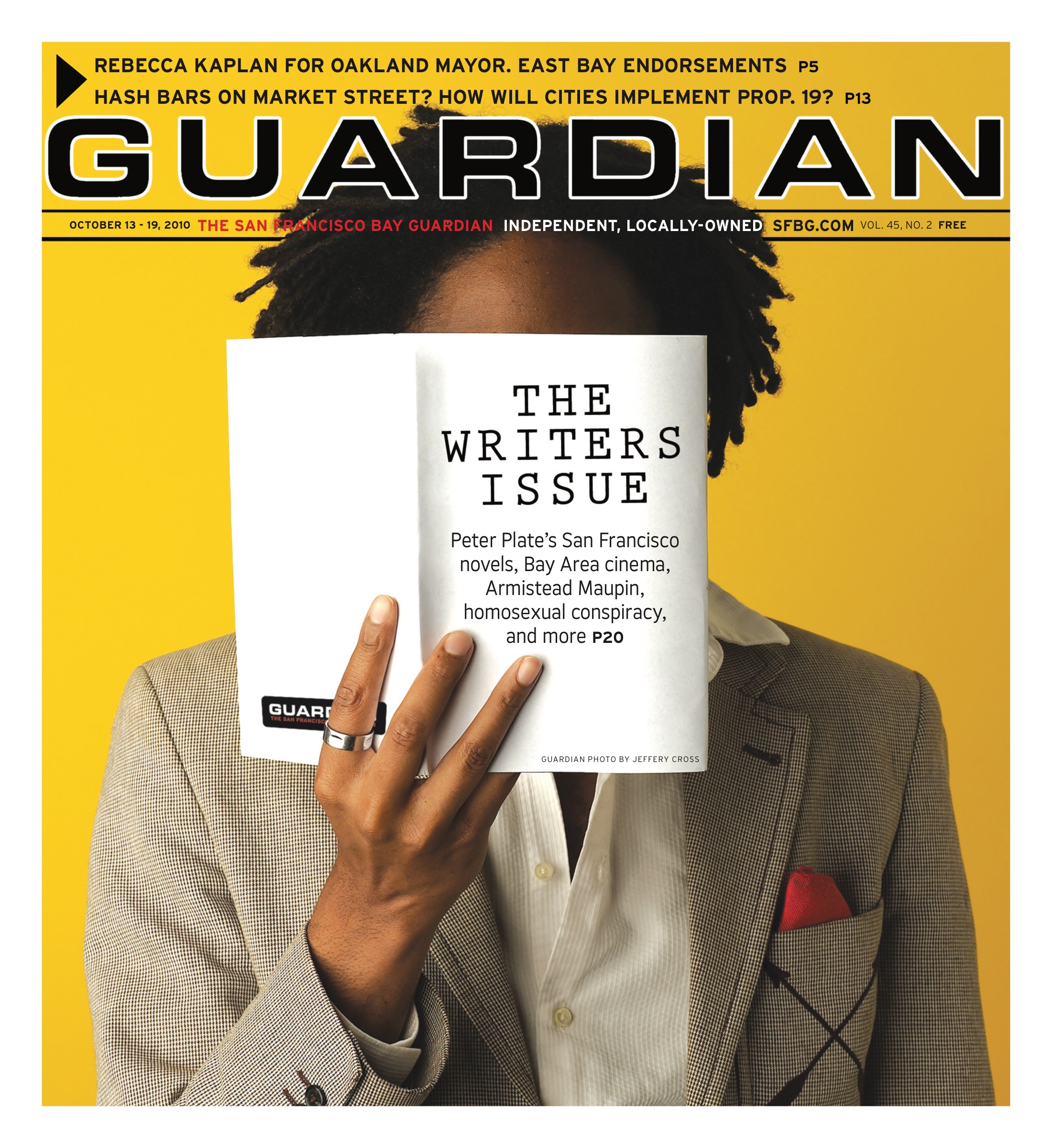
WRITERS ISSUE So this is my very first book review ever (!) unless you count the book review I had to do in school on The Yearling, so bear with me because I’m a beginner. But anyway the title of the book is A Book of Jean’s Own (St. Martin’s Griffin, 288 pages, $14.99) and the author is Jean Teasdale who lives in an apartment somewhere with her husband Rick and her two cats, one was named Garfield which I’m guessing she took from the comic strip and I forget the name of her other cat. You’ll find out if you read her book!

Now I liked this book very much and someone told me it was supposed to be “satiric” but to me it just felt like meeting an old friend and sharing a little “wit and wisdom.” I must say I got quite a few chuckles from Jean’s stories and now that I’m writing this I remember from The Yearling that the hard part of writing a book review is that you’re not allowed to say exactly what’s in the book because that would spoil it for everyone else so I can’t actually tell you the stories here. Sorry!

I have to tell you one thing because I just can’t resist and it’s that Jean shaved off all her hair one day by accident even “down there” and I had to laugh out loud when I read that. Can you imagine?

Now I don’t know about the guys, but I suspect a lot of the gals that read this book might have a few pieces of advice for Jean.

For one thing, Jean has Type 2 diabetes and still eats rich chocolate desserts and I looked that up on the Internet and found out that it’s a very serious disease and that people who have that should not be eating sweets at all (which is what I thought before I even checked). For heaven’s sake Jean put a few recipes in her book and the “Oooey gooey choco-cocoa-mocha cupcakes with raspberry filling and coconut-cream-cheese-cola frosting” has tons of sugar! Jean even insists that you make the frosting with real cola instead of diet even though I think Coke Zero tastes just as good as Coke and I even like it better than Diet Coke and either one would be a fine substitute although I think Diet Pepsi has a nasty aftertaste and I wouldn’t use that.

And I also thought that Jean could be bit more strict with Rick because he seems to get drunk and stay out after work quite a bit and I gather from Jean that he’s not exactly the romantic type, but girls! You know we’ve got to work on our husbands now and then to get them to “shape up” and I know when Doug seems distracted I have a few tricks up my sleeve like a certain pout that isn’t obvious and it’s kind of hard to do but after 28 years I’ve “got it down” as the kids say and it works!

Anyway Jean’s a doll and I’m planning on reading her book all over again from Page One because sometimes I don’t “get” everything there is to “get” in a book the first time around and it’s helpful to read it twice. And there was one part where Jean was wondering if writing the book was worth it and if she really had anything important to say and my heart went out to her and I wanted to scream through the book into her ear and tell her that she was doing a great job and that you don’t have to have something “important” to say in order for it to be well worth saying! 

It’s not easy being an arrogant know-it-all

0

arts@sfbg.com

WRITERS ISSUE Having to constantly suffer the company of the ignorant, it’s difficult to suppress my condescension. After all, I know about obscure music and books that few others know of and this makes me superior.

For that matter, I must also tolerate the naive with regard to politics and current events. It is a constant struggle to maintain a civil façade, to avoid an outburst. After all, the polite response to the uninformed is not to point out their glaring faults but to gently correct their errors in a subtle, guiding way. Maintaining patience is not easy.

I was talking the other day to an acquaintance (it’s hard for people to actually be friends with one as superior as me) and I was shocked to find he’d never heard of Sainkho Namtchylak. Come on, what rock do you have to be living under to not know of the Tuvan throat-singing virtuoso — a singer who makes Diamanda Galas sound like Whitney Houston — who collaborates with free-jazzers like saxophonist Evan Parker? I tried not to be too disdainful as I informed him of her numerous releases on the British record label, Leo. It’s just so difficult not to get sarcastic when faced with that sort of colossal ignorance and cultural complacency.

Do these people just take whatever is offered them on MTV, instead of digging deeper? I have to laugh at the people who think they’re hip just because they listen to something they consider obscure, like Borbetomagus. Come on, they’ve been around forever. Even some grunge-listening moron who hasn’t picked up a magazine since Forced Exposure turned into a mail-order company knows that.

How did I become as I am: namely, one of the most hip people on the planet, endowed with a broad cultural knowledge? Obscurantists are made, not born. To tell the wounding truth, my strength came from weakness. In high school, I was a geek, woefully ignorant of popular culture and rock music in particular. My reading was predominantly in the genre of science fiction. I listened to the folk and classical music my parents preferred and, for exoticism’s sake, enjoyed the synthesizer stylings of Wendy Carlos and Tomita. Children have no taste. We’re shaped (or should I say twisted?) by our environment.

Once I discovered punk rock, I shot up like a late bloomer whose delayed pubescence doesn’t preclude his growth to a height greater than six feet. I devoured the Trouser Press Record Guide, listened to lots of music from the collections of friends. I started reading obscure magazines that reviewed music none of my friends listened to and I was an early adopter of the Internet: I had email in college in 1984 and my Usenet newsgroup posts archived on Google Groups date back that far, before the 1987 Great Renaming, which reorganized online discussion forums. I was an invited member of a secret e-mail music list called “Music-flamers” in 1986.

Let’s face it, it’s too easy to put someone down for being a fan of Korn or Britney Spears (what’s the difference, really?). I prefer to insult people for being so obvious as to be fans of virtually mainstream 1970s British psyche-folk group Caravan instead of Everyone Involved or fill-in-the-blank with your favorite ultra-obscure, private pressing, un-reissued psyche-folk LP of the early ’70s.

Why should music be something that we have in common, something that might bring us together, when it can be a soapbox to stand on to put us above other people? Why settle for the pleasure of turning on someone to good music when you can use it to put them down? If you can tell me, I’ll let you listen to my copy of Jim French and Galas’ If Looks Could Kill or Orchid Spangiafora’s Flee Past’s Ape Elf

Excerpted from The International Homosexual Conspiracy (Manic D Press, 224 pages, $14.95).


Moving portraits

0

cheryl@sfbg.com

WRITERS ISSUE The Metreon is handy if you require 10 different Inception showtimes. But watching a movie there is not same as seeing one — even the same one — at a circa-1922 palace like the Castro Theatre, a space lovingly dedicated to the specific pleasure of Going To The Movies. Edited by Julie Lindow (a former Castro employee), the brand-new Left in the Dark: Portraits of San Francisco Movie Theatres (Charta Art Books, $39.95) compiles essays from Bay Area film advocates, paying homage to San Francisco’s dwindling population of theaters. The book is illustrated by photographer R.A. McBride’s colorful, often haunting images of spaces robust (the Roxie) and ravaged (the New Mission).

Cinephiles will recognize most of the contributors, including San Francisco International Asian American Film Festival director Chi-hui Yang (topic: Chinatown cinemas); Landmark Theatre cofounder and current Balboa Theatre proprietor Gary Meyer (a personal timeline of his life as an exhibitor); and Guardian writer D. Scot Miller (a look at theaters in the onetime “Harlem of the West,” the Fillmore), among others. There’s also an interview with author Rebecca Solnit, who points out that the shared-experience aspect of movie-going is lost in a multiplex environment. Buying a ticket in a theater inside a mall, she writes, “you don’t have that funny sudden spiritual bond that this person next to you in line, who looks so different, also wants to see cowboys.”

Even before they met, Lindow and McBride had a mutual interest in local theaters. “I had been thinking about doing a book to help the movie theaters. At a party that Melinda Stone [another of Left in the Dark‘s essayists] had, I met Rebecca [McBride] and she had started her series of [theater] photographs. So we thought, that might make a great book if we combine these two things together. And then she handled the photos, and I handled the text.” The collaborative spirit continued to the selection of contributors. Lindow says making a connection with one author would lead to her to another; she describes the writing process as a true community effort.

By contrast, McBride found that accessing every venue she wanted to document wasn’t easy (she was flatly denied access to Cow Hollow’s Metro shortly before it closed). She also made some surprising discoveries (a toilet in the projection booth at the Clay, for example).

“There were over 100 theaters at one point in the San Francisco Bay Area — and I’ve only photographed 19 of them,” McBride says, with a certain amount of wistfulness. “One my favorites was the Coronet, which is now gone.”

LEFT IN THE DARK: PORTRAITS OF SAN FRANCISCO MOVIE THEATRES

Wed/13, 5:30 p.m. reception;

7 p.m., slideshow with R.A. McBride

SF Camerawork

657 Mission, second floor, SF

www.sfcamerawork.org

More events at www.leftinthedark.info


Tick tock

0

arts@sfbg.com

HAIRY EYEBALL In a characteristically poetic passage within 1980’s Camera Lucida, Roland Barthes describes early cameras, given their cabinet-like appearance and precise mechanical innards, as “clocks for seeing.” I couldn’t shake the phrase while taking in Will Rogan’s “Stay Home,” an ambiguous smile of a solo show composed of photographs and three-dimensional photographic collages at Altman Siegel.

Taking the measure of time is very much on Rogan’s mind, as it was on Barthes’ some 40 years ago. A photograph is but an imperfect means of forestalling time’s onward march: it offers the present a momentary record of an instant long gone. So too has photography, at least in the nondigital form that Barthes was writing about, become an index of a past medium, and in our current age of Photoshop, an object for nostalgic longing (see the Hipstamatic iPhone app).

Rogan skirts this sand trap even though his practice deliberately engages with 1970s printed matter and evokes a range of photographers from that decade and later, most notably Lee Friedlander and Daido Moriyama’s social landscapes, and to a lesser extent, Sherrie Levine’s appropriations. The three small sculptural collages of cropped images affixed to painted wood pieces with beeswax even look as if they are from another time. Indeed, it’s easy to get distracted by Rogan’s mode of address (“hey guys, here are some cool books I found at a yard sale, and look what I came upon while walking to the corner store”), by his work’s muted cleverness and calculated arrangement of happenstance, that it can be easy to overlook the substance of what he’s saying.

Viewing the Past As it Happens takes its title from a passage in a picture book on astronomy that is itself the subject of the photograph. The book lies open; a picture of a galaxy on the right page. A description on the adjacent page details that what we are looking at, that what astronomers gaze at through their telescopes night after night, is in fact millions of years old. Of course, this also functions as a gloss (as does the photograph’s title) on the act of taking a picture: in that moment when we look into the viewfinder, our fingers poised to capture what we see before us, we are in a sense seeing what will become the past.

Two other photographs of educational books, The Elusive Nature of Time and Man Versus Clock: The Unequal Struggle, drive the point home that the photographer’s relationship to time is a Sisyphean one, even as the lifted bathos of their titles sends up the self-seriousness inherent to such postulating. Rogan seems to say, “Don’t freak out, too much,” while simultaneously holding up evidence to the contrary. The detritus that catches Rogan’s eye in other pictures — reflective glass shards, a gutter-lodged beer can, a taped-together window, an abandoned sneaker — are corollaries to the amazing sign on the paper shredding business captured in Shredder that reads, “DOCUMENT DESTRUCTION — While You Watch,” in light of which “document” starts to read more as a verb than a noun.

With Busts, a series of six magazine pages (covers perhaps?) that have been altered so that only the ghostly white silhouettes of unknown seated subjects remain, Rogan moves from documenting destruction to participating in it. It’s hard to tell whether or not the outlines are formed from erasing a prior image or painting over unrelated text, some of which is visible underneath the white. Regardless, the message is still clear: time is on no one’s side.


THAT JOKE ISN’T FUNNY ANYMORE

Time will certainly not be on the side of Hugh Brown, who demonstrates in his solo show “Allegedly” at Robert Koch that no amount of skilled workmanship or flawless execution can make up for a paucity of ideas. Indeed, he has but one, and truly, it is more a gimmick than a concept: to remake iconic works of art in his own image.

And how does the artist picture himself? As a chainsaw-wielding bad boy, cutting through the canon and art world pretensions with the power phallus of choice for exploitation filmmakers and ice sculptors. Brown’s smash and grab tour through art history includes Diane Arbus (here, the child clenched in rage holds a toy saw instead of a grenade), John Baldessari, Henri Matisse, Barbara Kruger (“I saw therefore I am”), and Roy Lichtenstein, among many others.

Granted, Brown’s art is well made and it exhibits a careful attention to the material details of the work it parodies. A “Bruce Nauman” is actually done in neon (surprise, it’s a chainsaw). Each work is also credited to the original artist, a parenthetical “allegedly” following their name, as if the dubiousness of what we we’re looking at weren’t apparent already.

Appropriation is by no means a new game, and many of the artists hijacked by Brown made poaching and quotation central to their own practices. But the art in “Allegedly” lacks any real critical force. It says nothing about the works being pillaged and everything about Brown’s estimation of himself. The show is apiece with those postcards that put sunglasses on the Mona Lisa or banana hammocks on Michelangelo’s David.

How Brown has managed to convince gallerists otherwise is a mystery that “Allegedly” leaves unsolved. *

WILL ROGAN: STAY HOME

Through No. 6

Altman Siegel Gallery S/F

49 Geary, Fourth floor, SF

(415) 576-9300

www.altmansiegel.com

HUGH BROWN: ALLEGEDLY

Through Oct. 30

Robert Koch Gallery

49 Geary, SF

(415) 421-0122

www.kochgallery.com


To tell the truth

0

cheryl@sfbg.com

FILM Have you heard the one about the hook-handed killer who stalks little kids deep in the woods? Filmmakers Barbara Brancaccio and Joshua Zeman met as adults, but they both grew up on Staten Island, hearing stories of a local boogeyman nicknamed Cropsey — campfire tales that took on more sinister shades when a girl with Down syndrome went missing in 1987. Turns out a lot of children vanished from Staten Island over the years. Was the urban legend real?

Brancaccio and Zeman’s fascinating documentary, Cropsey, is obsessed with answering this question. The film follows the recent trial of transient Andre Rand — convicted of that 1987 kidnapping and suspected by a fearful community of more terrible crimes. Was bringing Rand up on new charges the result of a witch hunt, or was justice finally being served? Cropsey, which considers layers of details (from circumstantial evidence to wild rumors), encourages the viewer to form his or her own opinion on the case. Along the way, there are visits to abandoned mental hospitals, discussions of Satanism, and glimpses of hidden histories stashed all over Staten Island.

As Brancaccio and Zeman worked on Cropsey, they became so involved with the material that they weren’t sure what to believe themselves. “We each had a viewpoint about whether [Rand] was guilty or innocent, and it switched during the middle of the filming,” Zeman recalls. “At times we didn’t know what to think. I think that’s something we wanted to convey to the audience. There was definitely enough doubt to go around.”

Unsurprisingly, given its subject matter, Cropsey is genuinely scary. (It’s attracted horror fans for that reason, including director Peter Jackson, who recently requested a copy.) “At times it’s part crime thriller, at times it plays like a narrative horror film,” Zeman says. “That was not an easy task — we really had to play with the tone [while editing] and figure out what kind of movie we wanted to make. Also, how do you make a documentary seem literally scary? Thing is, filming the movie, we were scared all the time. We weren’t creating an emotion that wasn’t there — we would come home from shooting and have nightmares.”

Rand, who communicated with the filmmakers from prison via a series of incoherent letters, hasn’t seen Cropsey — yet. In the meantime, fans of the doc can be assured the legend will live on: “We’re trying to work on a narrative remake of Cropsey,” Zeman says. “There was so much we couldn’t put in the doc, so rather than make Cropsey 2: Electric Boogaloo, we’re going to try and tell some other parts of the story in a narrative version.”


PARTY AT GROUND ZERO

Cropsey made its local debut at the 2009 San Francisco Documentary Film Festival; this year’s DocFest kicks off with Everyday Sunshine: The Story of Fishbone, codirected by San Franciscan Chris Metzler (2004’s Plagues and Pleasures on the Salton Sea). Sunshine, which Metzler made with Lev Anderson (Salton Sea co-helmer Jeff Springer served as Sunshine‘s cinematographer and editor), is a lively, revealing look at cult SoCal ska-punk rockers Fishbone.

Its formation — circa 1979, in a San Fernando Valley junior high newly filled with bussed-in South Central kids — is explored via animation, which is used periodically throughout the film. The film’s quirkier stylistic choices offer evidence that Sunshine was made by two guys who don’t like traditional music docs. It’s a label they resist because it could potentially limit the film’s audience.

“I find music documentaries kind of boring and formulaic,” admits Anderson, who worked on Taggart Siegel’s 2005 doc The Real Dirt on Farmer John. A lifelong music fan, his father took him to a Fishbone concert when he was 10 years old. “But I figured if you could make a music documentary that would be interesting, have good characters, have a good story, and be able to reflect on some larger cultural issues — I thought that would be the Fishbone story.”

Anderson, who met Metzler at a Salton Sea-era film festival party and pitched him the Fishbone idea on the spot, was confident the band would be an ideal subject. “I knew that we could interview just about anybody in popular music, from Ice-T to Mike Watt, Flea to George Clinton — I knew that those were all people who were aware of Fishbone in one way or another. The musical legacy they have is inspiring. If you’re going to do one music documentary, that’s the one, because you can talk to everybody.”

In addition to chatting with famous faces (and getting longtime Fishbone fan Laurence Fishburne to narrate), the filmmakers spent months on the road with the band, capturing the infectious energy of its live shows in addition to behind-the-scenes tension. Past members chime in, but the main protagonists are bassist-vocalist Norwood Fisher and lead vocalist-saxophone player Angelo Moore. Their intertwining stories offer a poignant portrait of creative soulmates who’ve weathered many storms (personality conflicts, legal and money troubles, an industry that didn’t know how to categorize them) without once giving up on their music.

Metzler sees Sunshine‘s appeal as extending beyond Fishbone fans, or even music fans. “We’re hoping that the people who come to see the film are the same sort of people who were attracted to the Salton Sea film,” he says. “People who want to watch an engaging, offbeat story about these eccentric personalities and their perseverance to do things their own way. The Fishbone story is an outsider tale about these guys who fit in everywhere — yet didn’t fit in anywhere, all at the same time.”

CROPSEY

Fri/15–Tues/19, $6–$10

Red Vic

1727 Haight, SF

www.redvicmoviehouse.com

SF DOCFEST

Oct. 15–28, $11

Roxie

3117 16th St., SF

www.sfindie.com


Hula heartbeat

0

arts@sfbg.com

DANCE Quite a few hula companies populate the Bay Area, but none is led by a kumu hula (teacher) quite as charismatic as Patrick Makuakane. Watch him warm up an audience, and you’d think he could charm cash out of a bunch of IRS agents. Then he steps on stage, grabs a drum, and starts to chant, and you know that this is an old soul, somehow still in touch with hula’s roots as a spiritual practice. “We love that duality about him,” explains Makani da Silva Santos, one of his longtime dancers.

Makuakane’s choreography for his Na Lei Hulu I Ka Wekiu company, which celebrates its 25th anniversary this year, reflects his complex personality. He is as much at ease creating hulas based on pop songs as he is at excavating meaning out of ancient chants or creating politically searing dance dramas.

Hula, like many other dance forms—Indian, Balinese, West African—was born in rituals that both strengthened a group’s identity and attempted to get in touch with the Divine. In Hawaii, that meant paying tribute to natural forces, particularly the goddess Pele. But missionaries who colonized Hawaii in the 19th century and tried to force Christianity on its people prohibited hula. They considered all Hawaiian culture crude and lascivious. They almost succeeded when King David Kalakaua restored hula and other native customs, saying famously: “Hula is the language of the heart and therefore the heartbeat of the Hawaiian people.” Even so, long after the king’s death, hula had to be practiced in secret. Makuakane’s stark 1999 The Natives are Restless unsparingly looks at that sorry part of Hawaiian history. In one haunting passage, a “priest” tattoos a cross onto bare-chested women.

You can’t miss hula’s deep connection to the earth. Often the dancers wear garlands, head-dresses, and anklets made from flowers and plants. Watching the dancers sway, step, and turn in unison, bent knees opening and closing, feet firmly planted on the ground, you can sense that they are engaged in something that goes beyond simple entertainment, even when dressed in modern garb.

That doesn’t mean hula isn’t also great fun to do and to watch — Don Ho was not all that wrong. Makuakane once told an interviewer that he wanted two things for his dancers: to have fun and to develop a sense of community. Watching her mother in Makuakane’s classes at the age of eight, da Silva Santos first experienced that sense of belonging, When Makuakane asked her whether she wanted to dance, it made her feel special to be invited into this group of grownups. (There were no children’s classes at the time). Twenty-five years later, she is still at it and hopes that one day her daughter “will also dance hula because it’s a link to my Hawaiian culture.”

In addition to dancing with the company for many years, da Silva Santos has undergone the Uniki process, an extensive formal training in Olapa (master dancer) and Ho’opa’a (master chanter) which, as she explains, demands a “disciplined frame of mind” to study the “deeper meanings of the ancient chants and practices”. Does she speak Hawaiian? “I am learning,” the Vallejo resident says. Even after all these years she — in the company of other dancers — still makes her own leis. They no longer have to fashion the skirts themselves. “Fortunately, we now have seamstresses,” she laughs. “Though I do sometimes miss those long nights working together.”

Along with works from the repertoire, Na Lei Hulu will premiere Ke Kumulipo, based on the epic Hawaiian chant of creation. If past celebrations are any indication, you can expect to see many of the students who take hula classes every week for the sheer fun of it — as well as the more than 40 professional dancers.

25 YEARS OF HULA: A SPECIAL ANNIVERSARY PERFORMANCE

Sat/16 through Oct. 24

Palace of Fine Arts Theatre

3301 Lyon, SF

(415) 392-4400

www.CityBoxOffice.com


All tied up

0

Dear Andrea:

I’m from the Netherlands and stumbled on a Guardian column yours in which you say: “I don’t believe you can get ‘addicted’ to silk scarves and stilettos.” This struck me because I have an experience that might prove the opposite. I’ve been married many years. We have integrated my love for silk scarves in our sex life and everything was OK until I met this other beautiful woman. I fell hopelessly in love with her and we ended up in bed. No scarves around. I just couldn’t perform, It happened twice. The strange thing is that a vanilla fuck at home never was/is a problem….

Could I be addicted to silk scarves? And if so, do you think I should restrain myself from me fetish altogether?

Love,

Little Dutch Boy

Dear Boy:

Some of your confusion comes from my use of and your lack of idiom. If I did say “You can’t get addicted to silk scarves and stilettos,” I would have been using the S-words as shorthand for kinky, fetishy sex in general. I believe that one can get habituated to thrills and chills and — especially — to extreme sensation, after which the sweet and the subtle may come to seem not merely different but, unfairly, inferior. This can happen. I’d hate to think that anyone contemplating a walk on the wild side would shy away for fear of habituation, but it’s certainly something to keep an eye on. But I don’t think such habituation can accurately be classified as an addiction.

But that’s not what has happened to you. Your scarves, whatever it is you do with them, are something of an end in themselves. You, sir, are a scarf-fancier.

Which is fine. I would say, though, that you may not be quite as dedicated a scarf fancier as you would have me believe. I mean, sure, there were no scarves on hand when you had your fling. And while that could have been the reason for your lack of performance, it probably wasn’t.

You do say, after all, that scarf-free “vanilla” sex with your wife is no problem. So what, besides the scarf, was missing? Could it have been your wife, or at least your wife’s consent, and perhaps your self-respect?

I suggest that you felt crappy about stepping out. I don’t believe for a second that you were or are “haunted” by scarves (“wooooo-oo-oo”) or the lack of same. You are haunted by your own behavior.

Clearly you feel conflicted about the scarf thing, so by all means try to proceed without them while you get your equilibrium back. You can get back to them later. I also can tell you that if you want to keep your wife, you need to get back with her. I am quite sure she has noted your absence and, by this point, she is either peeved, aggrieved, or both. Likely, she blames herself (she has gotten too old, she has gained weight, she is no longer exciting …). You’d better let her know that’s not at all what is going on with you.

I suggest cunnilingus.

Love,

Andrea

andrea@mail.altsexcolumn.com


Lost city

2

arts@sfbg.com

WRITERS ISSUE With its vast divide between the rich and poor, its lusty appetite for sex, and its backroom real estate deals, it would seem that even the boutique and completely gentrified San Francisco of today offers to writers of crime fiction a rich vein of noir opportunity. Yet the lone novelist today determinedly probing the dark side of San Francisco’s endless battle to clean up the streets is Peter Plate. His latest novel, Elegy Written on a Crowded Street (Seven Stories Press, 176 pages, $13.95), is Plate’s ninth in a hardboiled writing career that spans the era of out of control gentrification in San Francisco. With little fanfare or support, against the real life backdrop of police sweeps of the homeless and the start of the dot com boom, Plate has produced a shelf of books that represent a lonely, yet noble and deeply radical literary effort to write noir crime fiction in which not the cops but the criminals are the protagonists.

Plate’s novels are full of delicious hooks. They reliably begin with some of the best premises in noir fiction today. Fogtown (Seven Stories Press, 2004) opens as a crowd of Market Street homeless and down and outers witness the crash of an armored Brinks truck at dawn that temporarily fills the desolate street with crisp, new hundred dollar bills. In Police and Thieves (Seven Stories Press, 1999), Doojie, a small-time Capp Street weed dealer, accidently witnesses the murder of a homeless man by a police officer and spends the rest of the book on the run from the murderous cop who seeks to silence him.

Like Doojie, Plate’s characters are always in the wrong place at the wrong time, unwilling spectators as the city changes around them. The free money in Fogtown offers the Market Street dwellers a tantalizing glimpse of the kind of new carefree life being lived all around them by the rich who have newly arrived to the city. Yet, like the upscale new eateries and clubs popping up everywhere, the money is off limits to them, and those who take the money instantly become, like Doojie, hunted by police. Plate’s strength is in conveying the hopelessness and despair of lone characters pitted in Doestoyevskian battle with societal forces far greater than they are. As they are slowly ground down by this struggle, we feel their terror, incomprehension and paranoia. As the drug dealer and SRO hotel manager, Jeeter, says in Fogtown, “Rights? You don’t have any rights. You have choices. That’s all you have. And you made the wrong one.”

In this context, noir fiction for Plate is protest fiction. A longtime street activist, Plate writes with the gut instincts of a protester, taking his novels right to the barricades where different visions of San Francisco violently clash. One Foot Off The Gutter (Incommunicado, 1995), is a mordant postcard from a Mission District just about to enter its gentrification era in which a homeless cop, a Latino gang member, and a yuppie doctor all covet the same Victorian houses at 21st Street and Folsom. Soon The Rest Will Fall (Seven Stories, 2006) is set in the Trinity Plaza Apartments on Market Street at the height of housing activists’ struggle to save the low income housing from demolition. Plate has so reliably found the pulse of change in the city that at times his work has blurred tragically with reality. Police and Thieves ends with a fire at the Crown Hotel on Valencia Street. Just months after the book’s publication, the real life Crown Hotel burned to the ground.

Since Plate finished his Mission Quartet at the close of the dot-com era, he has turned his attention to San Francisco’s Main Street, Market Street. Recently, in its inaugural issue, the incipient local newspaper San Francisco Public Press reported that one lone real estate speculator owns 62% of the vacant real estate between 5th and 6th on Market Street and that he is willfully leaving those properties vacant until he can make the money he thinks he deserves off of the property. Those uselessly abandoned and boarded up buildings at the very heart of the city are the recurring backdrop for much of Elegy Written On a Crowded Street, perhaps Plate’s darkest and most emotional work to date.

Elegy is not so much a traditional crime fiction thriller, but a lyrical roman noir in which police and thieves battle not each other but the stifling conditions of the city. Plate’s latest evokes Don Carpenter’s 1966 classic Hard Rain Falling (reissued this year by New York Review of Books), an unrelenting work that also took place largely on Market Street. Carpenter’s novel brings to life the old dive 24-hour pool halls and dirty hotel rooms of a 1950s San Francisco where the promise of the Gold Rush American West has faded. The novels’ restless young pool hustlers and small time thieves can only shuttle aimlessly back and forth in the new remote control city, like the 8 Ball, waiting to fall. Elegy’s characters are their descendents, still on Market Street and still waiting.

Down this mean street walks May Jones a tough, hard-drinking bail bondswoman, who is nearing forty with no prospects. Like everyone around her, Jones dreams of escape from the city. Even Jones’ clients are leaving for Portland. “It’s got trees. Good people. Cheap housing,” an erstwhile, young crusty-punk bank robber earnestly tells Jones as she prepares to skip bail. But Jones is condemned to remain, while all around her are the undead ghosts of those already disappeared and the soon to be departed. The cleaned up San Francisco is haunted. The living are exhausted. Jones says to herself, “I have pipelines to the lands of the dead.’

Jones echoes the food stamp caseworker, Charlene Hassler from Plate’s welfare reform novel, Snitch Factory (Incommunicado, 1996). Like Hassler, Jones is being worn down between the insatiable needs of her clients and the treacherous intrigues that surround her job. Jones’ client is Mary Anderson, a pregnant twenty-year-old African-American who has killed her boyfriend, the SFPD’s star snitch on Fillmore Street. By keeping her client out of jail, Jones finds herself on the cops’ shitlist and in fear for her life. As in other Plate novels, a police hunt for Jones ensues. As in other recent Plate novels, after the initial hook, the plot soon becomes murky and this hunt becomes elliptical and hard to follow, perhaps even a bit ridiculous. A plot sideline in which Jones has a brief fling with a dyke she meets at the End Up goes nowhere. The ghosts of Lenin and punk rock legend, Will Shatter make surprise cameos that stretch the reader’s credulity. Yet, Plate’s spot on descriptions of Market Street today and the universe of dread his characters inhabit there remains compelling throughout and one never doubts that the unraveling narrative is what life feels like for his characters. Plate writes with a tightly wound urgency throughout and Elegy makes a persuasive case that what is happening at 5th and Market today is happening to the city as a whole.

Fantastical plot aside, it is the weight of the dead that is the true subject of Elegy. The book opens with a dreamy scene, shrouded in fog, in which Jones watches the dead body of one of her former clients as it bobs up and down in the surf, unable to either reach the shore or go under for good. Some policemen have waded into the water to grapple with the dead man and bring him in, but the body proves too difficult to apprehend and the cops are pulled down with the it into the crashing waves. Throughout Elegy, Plate’s characters similarly bob along, paralyzed and unable to take decisive action, only pulling each other down, and as the novel ends, May Jones is more or less back where she started. Sadly, like many of Plate’s recent books, the novel fails to fully satisfy because there is no resolution to the plot. Plate’s characters do not seem changed by their ordeal; they only become more numb. Yet perhaps that is the point. Plate seems to be saying that as long as the city fails to grapple with its own dead, nothing can change, and the city is condemned to go around and around in a sort-of netherworld, reliving its past traumas in new conflicts. “It’s a moment in hell that should be taking place beneath the ground,” Plate writes of a brutal police assault on a drunken derelict in Elegy, and it sums up the whole book. The dead won’t stay buried.

While an elegy is a funeral song, a lamentation for the dead, it also suggests a last word. With Elegy has Plate said all he has to say about San Francisco? One hopes not. Perhaps no writer working today has left such a record of what it feels like to live in the American city in the era of gentrification. Yet, in life as in Plate’s fiction, knowing the truth can take its toll, as Doojie finds out when he is hunted by the police for the truth he alone knows. By the end of Elegy, May Jones has spent so much time wallowing in the murky depths where her clients dwell, that her identification with them is complete and her fate has become inseparable from theirs.

The exhausted tone of Elegy suggests that like Jones, Plate, the lifelong activist and engaged writer, has perhaps stared into the abyss too long. Nonetheless, his nine novels are a significant achievement, the life’s work of a doggedly engaged writer. In each book, I have found scenes that remain unforgettable in my own mind and that have permanently altered my own perceptions of San Francisco and its streets. While Plate’s novels are each flawed in their own way, I love them with the Algren-like compassion he clearly has for his memorable characters, like the homeless cop who lives in his squad car in Gutter, and the ex-con who robs a pot club while dressed like Santa Claus in Soon the Rest Will Fall. Taken as a whole, Plate’s novels offer a compelling and defiant portrait of the psychic toll the disappearance of loved people, places, and opportunity from the city has taken on those left behind.


Rep clock

0

Schedules are for Wed/13–Tues/19 except where noted. Director and year are given when available. Double and triple features are marked with a •. All times are p.m. unless otherwise specified.

ARTISTS’ TELEVISION ACCESS 992 Valencia, SF; www.atasite.org. $6-15. “Pow! Pow! Pow! Art Festival 2010,” live performance, video installations, and more, Thurs, 8. “Immigrant Film Festival,” Fri, 7 and Sat-Sun, 3. “Other Cinema:” Space, Land and Time: Underground Adventures with Ant Farm (Federici and Harrison, 2010), Sat, 8:30. “Next! And Attention Deficit Gift: A 99 Hooker Screening,” Sun, 8. “Electroacoustic audio-visual improvisations” with Bill Hsu, Gino Robair, and John Shiurba, Tues, 8.

CASTRO 429 Castro, SF; (415) 621-6120, www.castrotheatre.com. $7.50-10. Where the Boys Are (Levin, 1961), Wed, 2:30, 4:45, 7, 9:15. Connie Francis in person to introduce 7pm show. “14th Annual Arab Film Festival:” Masquerades (Salem, 2008), Thurs, 7:30. This event, $20; for more info, visit www.arabfilmfestival.org. “Midnites for Maniacs: Don’t Get Bit … By Big Mouths:” •Fright Night (Holland, 1985), Fri, 7:15; An American Werewolf in London (Landis, 1981), Fri, 9:30; and The Evil Dead (Raimi, 1981), Fri, 11:45. “Connie Francis: The Legend Continues,” live concert with full orchestra, Sat, 8. Presented by the Rrazz Room; visit www.cityboxoffice.com for tickets ($49-99). “Montgomery Clift Double Feature:” •From Here to Eternity (Zinnemann, 1953), Sat, 2:30, 7, and Wild River (Kazan, 1960), Sat, 4:50, 9:15.

CERRITO 10070 San Pablo, El Cerrito; www.rialtocinemas.com. $7. “Cerrito Classics:” Rosemary’s Baby (Polanski, 1968), Thurs, 7:45.

CHRISTOPHER B. SMITH RAFAEL FILM CENTER 1118 Fourth St, San Rafael; (415) 454-1222, www.cafilm.org. $6.50-10.25. “Mill Valley Film Festival,” Wed-Sun. Program information at www.mvff.com. 36 (Marchal, 2005), Oct 18-21, 6:30, 9.

DELANCEY STREET SCREENING ROOM 600 Embarcadero, SF; www.modjeskawomantriumphantmovie.com. Free ($5-10 suggested donation). Modjeska: A Woman Triumphant (Myszynski), Sun, 3.

FORBIDDEN ISLAND TIKI LOUNGE 1304 Lincoln, Alameda; www.forbiddenislandalameda.com. Free. “Forbidden Thrills: Half N’ Half Halloween Horrors:” •Werewolf in a Girl’s Dormitory (Heusch, 1961), and The Manster (Breakston and Crane, 1959), Mon, 7:30.

GRAND LAKE 3200 Grand, Oakl; (510) 452-3556. $10. Enemies of the People (Lemkin and Sambath, 2009), Wed, 4:30, 7:15, 9:30.

HUMANIST HALL 390 27th St, Oakl; www.humanisthall.org. $5. Sharkwater: The Truth Will Surface (Stewart, 2006), Wed, 7:30.

LUMIERE 1572 California, SF; www.landmarkafterdark.com. Free. “Monthly Anime:” “Sengoku Basara,” Thurs, 7.

MECHANICS’ INSTITUTE 57 Post, SF; (415) 393-0100 (reservations required). $10. “CinemaLit: Apocalypse Noir:” Matinee (Dante, 1993), Fri, 6.

PACIFIC FILM ARCHIVE 2575 Bancroft, Berk; (510) 642-5249, www.bampfa.berkeley.edu. $5.50-9.50. “Radical Light: Alternative Film and Video in the San Francisco Bay Area:” “1961-71,” Wed, 7:30; “Stories Untold,” Sat, 6; “The Exotic Erotic,” Sat, 8:30; “Procession of the Image Processors,” Sun, 6:30. “Shakespeare on Screen:” Chimes at Midnight (Welles, 1966), Thurs, 7; Romeo + Juliet (Luhrmann, 1996), Sun, 4. “Days of Glory: Revisiting Italian Neorealism:” Bellissima (Visconti, 1953), Fri, 7; Miracle in Milan (De Sica, 1951), Fri, 9:10. “Home Movie Day:” “Film Check-In,” Sat, 11am; “Home Movie Day Screening,” Sat, 1. Metropolis (Lang, 1926), Tues, 7.

PIEDMONT 4186 Piedmont, Oakl; www.landmarktheatres.coom. $8. The Room (Wiseau, 2003), Sat, midnight.

RED VIC 1727 Haight, SF; (415) 668-3994. $6-10. Dr. Strangelove (Kubrick, 1964), Wed-Thurs, 7:15, 9:15 (also Wed, 2). Cropsey (Zeman and Brancaccio, 2009), Fri-Tues, 7:15, 9:15 (also Sat-Sun, 2, 4).  

ROXIE 3117 and 3125 16th St, SF; (415) 863-1087, www.roxie.com. $5-9.75. Exit Through the Gift Shop (Banksy, 2010), Wed-Thurs, 9:15. Grant Morrison: Talking With Gods (Meaney, 2010), Wed, 9:30 and Thurs, 7. Who Is Harry Nilsson (And Why Is Everybody Talkin’ About Him?) (Scheinfeld, 2010), Wed, 7, call for times. “SF DocFest,” Oct 14-28. Program information at www.sfindie.com.

SAN FRANCISCO MUSEUM OF MODERN ART 151 Third St, SF; www.sfmoma.org. $5. “Jordan Belson: Films Sacred and Profane,” Thurs, 7.

SAN FRANCISCO PUBLIC LIBRARY Koret Auditorium, 100 Larkin, SF; www.sfpl.org. Free. “Beyond Manny and Marcos: A Showcase of Far-Out Filipino American Films and Theater,” Sat, 3-5:30.

VIZ CINEMA New People, 1746 Post, SF; www.vizcinema.com. $10. “Ozu and His Muse: Setsuko Hara,” Early Summer (1954), Fri, 4:30 and Sat, 3:15; Late Autumn (1960), Sat, 12:15, Sun, 6, and Mon, 4:30; Late Spring (1949), Sun, 12:15 and Tues, 715; Tokyo Twilight (1947), Sun, 2:30 and Mon, 7:15.

YERBA BUENA CENTER FOR THE ARTS 701 Mission, SF; (415) 978-2787, www.ybca.org. $6-8. “Jim Henson and Friends: Inside the Sesame Street Vault,” Thurs, 7:30 and Sat, 2. “San Francisco Jewish Film Festival Presents: Tough Guys: Images of Jewish Gangsters in Film:” Little Caesar (LeRoy, 1931), Sun, 2.

On the cheap listings

0

On the Cheap listings are compiled by Paula Connelly. Submit items for the listings at listings@sfbg.com.

WEDNESDAY 13

“How to Cook Like a Scientist” Bazaar Café, 5927 California, SF; (415) 831-5620. 7pm, free. Meet Jeff Potter, author of Cooking for Geeks, who combines cooking with Mythbusters to create a food-as-science, cooking experience for those who like to know how things work.

THURSDAY 14

Sparring with Beatnik Ghosts Beat Museum, 540 Broadway, SF; (415) 399-9626. 7pm, free. This ongoing multimedia poetry series returns to the Beat Museum with host Daniel Yaryan and featuring readings by David Meltzer, San Francisco Poet & Beat Icon, Ellyn Maybe & Her Band, Steve Arntson, Jerry Ferraz, Martin Hickle, Richard Loranger, Whitman McGowan, Ginger Murray, Julie Rogers, Margery Snyder, and Chris Vannoy.

FRIDAY 15

Mark I. Chester Benefit Mark I. Chester Studio, 1229 Folsom, SF; (415) 621-6294. 7pm; free, donations encouraged. Celebrate Mark I. Chester’s 60th birthday while helping to raise funds for a new book. View Chester’s current exhibit, “Doing Time on Folsom St: a 30 year retrospective of fine art gay radical sex photography” and enjoy readings and performances by Carol Queen, Tom Orr, Seth Eisen and Jesse Hewitt and more. Sponsored by the Center for Sex and Culture.

“Writing Our Word, Speaking Our Minds, Telling Out Stories” San Francisco Main Library, Latino/Hispanic Community Meeting Room, 100 Larkin, SF; (415) 557-4400. 6pm, free. Featuring readings by and about lesbians with disabilities with Elana Dykewomon, Barbara Ruth, Teya Schaffer, Dominika Bednarska, and the Mothertongue Feminist Theater Collective.

SATURDAY 16

“The Classics” 1:AM Gallery, 1000 Howard, SF; (415) 861-5089. 5:30pm, free. Attend the closing reception for this exhibit, curated by Nate1, that brings together original vintage work from the artists that put San Francisco on the graffiti map and defined Bay Area graffiti style. Guest speaker Spie will give an informative tour of the exhibit on Bay Area graffiti.

Halloween Bazaar Modern Eden Gallery, 403 Francisco, SF; (415) 420-2898. 7pm, free. End your day of touring open studios in North Beach, as part of SF Open Studios’ weekend two, at this spooky-themed trunk show featuring wares by local artists JuJu by Sarah, Marya Zoya Taxidermy Courture, Blackbird Bazaar, Squid Rose designs, and more plus pumpkin carving and painting, music, drinks, and treats. Costumes encouraged.

Potrero Hill Festival 20th street between Missouri and Wisconsin, SF; www.potrerofestival.com. 11am-4pm, free. Soak up the best of Potrero Hill at this street fair with a view featuring local merchants and residents selling their wares, arts, and crafts, two stages with live music, food from Potrero Hill restaurateurs, information booths, and kids activities including a bouncy house, petting zoo, pony rides, and performances.

Taste of Fillmore Fillmore between Post and Jackson, SF; www.tasteoffillmore.com. 1pm-6pm; free admission, $20 for wrist band. Buy a wrist band and enjoy food and wine tastings at boutiques and restaurants, or just walk around and check out some live jazz, walk through home décor scenes installed on the sidewalks, watch cooking demonstrations, fashion shows, and more.

Trolley Dances Meet at the Harvey Milk Center for Recreational Arts at Duboce Park, Scott at Duboce, SF; www.epiphanydance.org. 11am-2:45pm, tours leave every 45 min.; free with MUNI fare. Get out of the theater and into the streets with traveling performances by Epiphany Productions SDT, Joe Goode Performance Group, Sara Shelton Mann, and more as they take you from Duboce Park to the SF Botanical Garden in Golden Gate Park for several unique performance locations.

“The Wild Kitchen” Omnivore Books on Food, 3885a Cesar Chavez, SF; (415) 282-4712. 3pm, free. Hear authors Connie Green and Sara P. Scott discuss their book, The Wild Kitchen: Seasonal Foraged Foods and Recipes, and the increasing popularity of wild delicacies. Green sells her gathered goods across the country to Napa Valley’s finest chefs, so before you buy that expensive meal, consider the free buffet that is California.

Writers with Drinks Make Out Room, 3225 22nd St., SF; (415) 647-2888. 7:30pm, $5-$10 sliding scale. This installment of the monthly spoken word variety show features Marcia Clark, Ken Scholes, Jamie Freveletti, Stephen O’Connor, Kirya Traber and Daniel Allen Cox. Proceeds to benefit the Center for Sex and Culture.

Yerba Buena Fair Yerba Buena Gardens, Mission between 3rd and 4th St., SF; (415) 644-0728. 11am-3pm, free. Celebrate the Yerba Buena neighborhood at the fair featuring live music, dancing, acrobats, neighborhood food vendors, street food vendors, art and history walks, prizes and giveaways, kids activities, and more.

SUNDAY 17

Capsule Hayes Valley Park, Octavia at Hayes, SF; www.capsulesf.com. 11am-6pm, free. Enjoy this fashion design open air market and community party where you can browse locally made clothing, upcycled jewelry and accessories, steampunk-inspired wear, graphic tees, kids clothes, and designer housewares while listening to live music by members of the Jazz Mafia, Brent Bishop and the Part Poopers, and more.

Fiesta on the Hill Cortland between Bocana and Folsom, SF; (415) 206-2140. 10am-6pm, free. Join your friends and neighbors for the 22nd annual Fiesta to benefit the Bernal Heights Neighborhood center, an organization that works to maintain the ethnic, cultural, and economic diversity of Bernal Heights. This alcohol free family event to feature a petting zoo, pony rides, a pumpkin patch, non-profit booths, live music, food vendors and more.


Stage listings

0

Stage listings are compiled by Guardian staff. Performance times may change; call venues to confirm. Reviewers are Robert Avila, Rita Felciano, and Nicole Gluckstern. Submit items for the listings at listings@sfbg.com. 

THEATER

OPENING

Habibi Intersection for the Arts, 446 Valencia; 626-2787, www.theintersection.org. $15-25. Previews Thurs/14-Sun/17, 8pm. Opens Mon/18, 8pm. Runs Thurs-Sun, 8pm. Through Nov 7. Intersection for the Arts and Campo Santo present the world premiere of a play by Sharif Abu-Hamdeh.

Nina and the Monsters Shotwell Studios, 3252A 19th; 509-8656, 509-8656. $10-15. Opens Fri/15, 8pm. Runs Fri-Sat, 8pm (also Sun/17 and Oct 24, 2pm). Ninjaz of Drama with Footloose present a modern-day fairy tale.

Proof Exit Stage Left Theatre, 156 Eddy; www.belljartheatre.com. $20. Opens Fri/15, 8pm. Runs Fri-Sat, 8pm. Through Oct 30. Bell Jar Theatre presents David Auburn’s award-winning play.

Susie Butler Sings the Sarah Vaughan Songbook Exit Theater Cafe, 156 Eddy; (510) 860-0997, www.brownpapertickets.com. $15-20. Opens Sat/16, 8:30pm. Runs Sat, 8:30pm. Through Nov 20. Local actress and singer Susie Butler takes on the Sassy songbook.


ONGOING

Absolutely San Francisco Phoenix Theatre, Stage 2, 414 Mason; 433-1235, www.absolutelysanfrancisco.com. $20-25. Fri-Sat, 8pm. Through Oct 23. A one-woman musical starring Karen Hirst, with book and music by Anne Doherty.

Anita Bryant Died For Your Sins New Conservatory Theatre Center, 25 Van Ness; 861-8972, www.nctcsf.org. $24-40. Wed-Sat, 8pm; Sun, 2pm. Through Oct 24. New Conservatory Theatre Center presents a show by Brian Christopher Williams.

*The Brothers Size Magic Theatre, Bldg D, Fort Mason Center; 441-8822, www.magictheatre.org. $20-60. Dates and times vary. Through Sun/17. Magic Theatre presents the West Coast premiere of Tarell Alvin McCraney’s play, directed by Octavio Solis.

Cat on a Hot Tin Roof Actors Theatre, 855 Bush; 345-1287, www.actorstheatresf.org. $26-38. Wed-Sat, 8pm. Through Oct 22. Actors Theatre presents Tennessee Williams’ sultry, sweltering tale of a Mississippi family, directed by Keith Phillips.

Christian Cagigal’s Obscura: A Magic Show EXIT Cafe, 156 Eddy; (800) 838-3006, www.brownpapertickets.com. $15-25. Thurs-Sat, 8pm. Through Dec 18. Magician Christian Cagigal presents a mix of magic, fairy tales, and dark fables.

Disoriented Off-Market Theater, 960 Mission; (800) 838-3006, www.brownpapertickets.com. $20. Sun, 7pm. Through Oct 17. A trio of solo performances by Asian-American women.

A Funny Thing Happened on the Way to the Forum Eureka Theatre, 215 Jackson; 255-8207, www.42ndstmoon.org. Wed, 7pm; Thurs-Fri, 8pm; Sat, 6pm; Sun, 3pm (also Sat/16, 1pm). Through Oct 24. 42nd Street Moon presents the Sondheim musical farce, starring Megan Cavanagh.

Futurestyle ’79 Off-Market Theater, Studio 250, 965 Mission; (800) 838-3006, www.brownpapertickets.com. $15-20. Wed, 8pm. Through Oct 27. A fully improvised episodic comedy played against the backdrop of SF in 1979.

Hamlet Alcatraz Island; 547-0189, www.weplayers.org. By donation. Sat-Sun, times vary. Through Nov 21. Outside of an actual castle, it would hard to say what could serve as a more appropriate stand-in for Kronborg castle of Helsingør—also known as Elsinore—than the isolated fortress of Alcatraz Island, where WE Players are presenting Hamlet in all its tragic majesty. As audience members tramp along stony paths and through prison corridors from one scene to the next, the brooding tension the site alone creates is palpable, and the very walls impart a sense of character, as opposed to window-dressing. Deftly leaping around rubble and rock, a hardy troupe of thespians and musicians execute the three-hour production with neat precision, guiding the audience to parts of the island and prison edifice that aren’t usually part of the standard Alcatraz tour package. Incorporating movement, mime, live music, and carefully-engineered use of space, the Players turn Alcatraz into Denmark, as their physical bodies meld into Alcatraz. Casting actress Andrus Nichols as the discontent prince of Denmark is an incongruity that works, her passions’ sharp as her swordplay, the close-knit family unit of Laertes, Ophelia, and Polonius are emphatically human (Benjamin Stowe, Misti Boettiger, Jack Halton), and Scott D. Phillips plays the appropriately militaristic and ego-driven Claudius with a cold steel edge. (Gluckstern)

IPH… Brava Theater, 2781 24th St, 647-2822, www.brava.org. $15-35. Thurs-Sat, 8pm. Through Sat/16. Brava Theatre and African-American Shakespeare Company present the US premiere of an adaptation of Iphigenia at Aulis.

*Jerry Springer the Opera Victoria Theatre, 2961 16th; www.jerrysf.com. $20-36. Wed-Sat, 8pm. Through Sat/16. Highbrow meets low in one big, boisterous mono-brow middle as one of the baser of daytime talk-show hosts meets his audience and maker—or anyway Jesus and Satan—in a TV show purgatory that really is purgatory. The form is operatic, the subject matter the stuff of soap, and the resulting tawdry spectacle all but irresistible in Ray of Light Theatre’s production of the 2003 British musical by Richard Thomas (music, book and lyrics) and Stewart Lee (book and lyrics). If the conceit feels a bit one-note, it’s a note taken very cleverly and ably for all its worth. A smart, smarmy and dyspeptic Patrick Michael Dukeman excels in the title role, as the chorus, meanwhile, comprised of Jerry’s rabid studio audience, puts the unbridled hooligan glee in glee club, lending Wagnerian weight to such key phrases as “step-dad” or “chick with a dick.” The grand and just slightly sleazy Victoria Theatre makes the perfect venue for this fine irreverence, filling it charmingly with rafter-shaking vulgarity and mayhem.

Kiss of Blood Hypnodrome Theatre, 575 10th; (800) 838-3006, www.brownpapertickets.com. $25-35. Thurs-Fri, 8pm. Through Nov 19. Thrillpeddlers’ seasonal slice of eyeball is comprised of three playlets variously splattered with platelets, all directed by Russell Blackwood and bridged by a rousing burst of bawdy song from the full cast. Rob Keefe’s Lips of the Damned (after La Veuve by Eugene Heros and Leon Abric) takes place in a rat-infested museum of atrocities just before the fumigating starts, as an adulterous couple—comprised of a kinky married lady (a vivacious Kara Emry) and a naïve hunk from the loading dock (Daniel Bakken)—get their kicks around the guillotine display, and their comeuppance from the jilted proprietor (Flynn DeMarco). Keefe’s delightfully off-the-wall if also somewhat off-kilter Empress of Colma posits three druggy queens in grandma’s basement, where they practice and primp for their chance at drag greatness, and where newly crowned Crystal (a gloriously beaming Blackwood) lords it over resentful and suspicious first-runner-up Patty Himst (Eric Tyson Wertz) and obliviously cheerful, non-sequiturial Sunny (Birdie-Bob Watt). When fag hag Marcie (Emry) arrives with a little sodium pentothal snatched from dental school, the truth will out every tiny closeted secret, and at least one big hairy one. Kiss of Blood, the 1929 Grand Guignol classic, wraps things up with botched brain surgery and a nicely mysterious tale of a haunted and agonized man (Wertz) desperate to have Paris’s preeminent surgeon (DeMarco) cut off the seemingly normal finger driving him into paroxysms of pain and panic. Well-acted in the preposterously melodramatic style of the gory genre, the play (among one or two other things) comes off in a most satisfying fashion. (Avila)

Last Days of Judas Iscariot Gough Street Playhouse, 1620 Gough; (510) 207-5774, www.CustomMade.org. $10-30. Thurs-Sat, 8pm; Sun, 7pm. Through Oct 30. Custom Made Theatre Company presents the 2005 play by New York’s Stephen Adly Guirgis (Our Lady of 121st Street, Jesus Hopped the A Train), which places purgatorial Judas (Kristoffer Alberto Barrera) on trial to determine his deserved fate for dropping a dime on Jesus and all that jazz. Flamboyant, sycophantic and horny prosecutor El-Fayoumy (Ben Ortega) and defense attorney Loretta (Amelia Avila) call between them a series of brow-raising witnesses—including Mother Teresa (Brandy Leggett), Sigmund Freud (Catz Forsman), and Satan (Richard Wenzel)—as Judas (seated on the upper tier of Sarah Phykitt’s suitably imposing split-level set) stares stoically in relative silence or appears in a series of childhood flashbacks. Characteristically funny and streetwise, as well as versed in the Catholic rigmarole as filtered through a NYC-boroughs sensibility, Guirgis’s play is also unusually tedious in its jokey, poky unfolding since—offering not much more than a cipher in the largely mute Iscariot—the proceedings lack a strong sense of dramatic stakes. It feels more like a revue than a play, or like an unnecessarily long-winded excuse for the final, well-turned concluding monologue by a heretofore marginal character (a speech delivered with admirable understatement by director Brian Katz). (Avila)

Love Song Exit Theatre, 156 Eddy; (800) 838-3006, www.brownpapertickets.com. $20. Thurs-Fri, 8pm; Sat, 3 and 8pm. Through Oct 23. An offbeat comedy by John Kolvenbach, directed by Loretta Janca.

Mary Stuart The Ashby Stage, 1901 Ashby, Berk; (510) 841-6500, www.shotgunplayers.org. $15-30. Thurs-Sat, 8pm; Sun, 5pm. (also Oct 20, Oct 27, Nov 3; 7pm). Through Nov 7. Shotgun Players presents Friedrich Schiller’s historical drama, directed by Mark Jackson.

*The Real Americans The Marsh MainStage, 1062 Valencia; (800) 838-3006; www.themarsh.org. $20-50. Wed-Fri, 8pm; Sun, 5pm. Through Nov 6. The fifth extension of Dan Hoyle’s acclaimed show, directed by Charlie Varon.

*Scapin American Conservatory Theatre, 415 Geary; 749-2228, www.act-sf.org. $10-90. Tues-Sun, times vary. Through Oct 23. Bill Irwin, the innovative former Pickle Family clown and neo-vaudevillian turned Broadway star, makes a San Francisco return at the helm—and in the title role—of American Conservatory Theater’s production of Moliere’s classic farce. It’s an excuse for some arch meta-theatrical high jinx as well as expert clowning, a love fest really, with many fine moments amid a general font of fun whose heady purity seems like it should fall under some FDA regulation or other—clearly, somebody has paid someone to look the other way, and for once the corruption is unreservedly welcome. Joining the fun is Irwin’s old comrade-in-arms and, here, sacks, Geoff Hoyle, as miserly and dyspeptic daddy Geronte. Other ACT regulars and veterans flesh out a winning cast, among them the ever versatile and inimitable Gregory Wallace as Octave, a flouncing Steven Anthony Jones as put-out patriarch Argante, René Augesen as boisterously unlikely “virgin” Zerbinette, and a wonderfully adept and scene-stealing Judd Williford in the role of Scapin sidekick Sylvestre. As for Irwin, his comedic sensibility shows itself scrupulously apt and timeless at once, and his sure, lithesome performance intoxicating and age-defying. As a director, moreover, he gives as generously to each of his fellow performers as he does to his adoring, lovingly tousled audience. (Avila)

The Shining: Live The Dark Room, 2263 Mission; 401-77891, www.darkroomsf.com. $7-10. Fri-Sat, 8pm. Through Oct 23. The Dark Room becomes the Overlook Hotel in this stage production of the horror classic.

Sunset Limited SF Playhouse, 533 Sutter; 677-9596, www.sfplayhouse.org. $40-50. Tues-Wed, 7pm; Thurs-Fri, 8pm; Sat, 3 and 8pm. Through Nov 6. This 2006 play by Cormac McCarthy exhibits some of the best and worst of the celebrated author, but significantly more of the latter. It sets an aging white academic and failed suicide (Charles Dean) in a room with his rescuer and would-be savior, a poor black social worker (Carl Lumbly), who has just snatched him from a railway platform ahead of a tête-à-tête with a train called the Sunset Limited. Both characters remain nameless, emphasizing the abstract pseudo-Socratic dimensions attendant on the dialogue-driven realism here (staged with a knowing wink in director Bill English’s scenic design, a partially walled wood-framed shack with see-through slits between the thin horizontal planking). The black man is a born-again Christian and ex-con convinced Jesus has just given him a major assignment. His dogmatic certainty is matched by the white man’s nihilism and despair. “I believe in the primacy of the intellect,” the miserable prof tells his host, who’s locked the door on his self-destructive guest in an effort to buy time to change his mind. Leaving aside the historically clichéd, problematic and baggage-heavy dynamic of a poor black American devoted to the welfare of a rich white one, neither man moves from his respective position one inch (at least until perhaps and partially at the very end), which constrains the dramatic development. Moreover, both sides argue feebly, mainly by gainsaying whatever it is the other one says, making this not a great intellectual debate either. SF Playhouse’s production sets two fine actors at this heavy-handed twofer, but little can be done to redeem so static and arid an exercise. (Avila)

Superior Donuts TheatreWorks at the Mountain View Center for the Performing Arts, 500 Castro; (650) 463-1960, www.theatreworks.org. $19-67. Tues-Wed, 7:30pm; Thurs-Fri, 8pm; Sat, 2 and 8pm; Sun, 2 and 7pm. Through Oct 31. TheatreWorks presents Tracy Letts’ tale of friendship and redemption in a Chicago donut dispensary.

Zombie Town Stage Werx Theatre, 533 Sutter; www.stagewerx.org. (800) 838-3006, www.brownpapertickets.com. $24. Thurs-Sat, 8pm (also Oct 31, 5pm). Through Oct 31. Catharsis Theatre Collective presents a documentary play about zombie attacks in Texas.


BAY AREA

Angels in America, Part One Pear Avenue Theatre, 1220 Pear, Mtn View; (650) 254-1148, www.thepear.org. $15-30. Thurs-Fri, 8pm; Sat, 2 and 8pm; Sun, 2pm. Through Sat/16. Pear Avenue Theatre kicks off its fall “Americana” program with the Tony Kushner play.

*Compulsion Berkeley Repertory Theatre, Thrust Stage, 2025 Addison; (510) 647-2949, www.berkeleyrep.org. $29-85. Dates and times vary. Through Oct 31. Director Oscar Eustis of New York’s Public Theater marks a Bay Area return with an imaginatively layered staging of Rinne Groff’s stimulating new play. Compulsion locates the momentous yet dauntingly complex cultural-political outcomes of the Holocaust in the career of a provocative Jewish American character, Sid Silver, driven by real horror, sometimes-specious paranoia, and unbounded ego in his battle for control over the staging of Anne Frank’s Diary. A commandingly intense and fascinatingly nuanced Mandy Patinkin plays the brash, litigious Silver, based on real-life writer Meyer Levin, a best-selling author who obsessively pursued rights to stage his own version of Anne Frank’s story. The forces competing for ownership of, and identification with, Anne Frank and her hugely influential diary extend far beyond her father Otto, Silver, or the diary’s publishers at Doubleday (represented here by a smooth Matte Osian in a variety of parts; and a vital Hannah Cabell, who doubles as Silver’s increasingly alarmed and alienated French wife). But the power of Groff’s play lies in grounding the deeply convoluted and compromised history of that text and, by extension, the memory and meanings of the Holocaust itself, in a small set of forceful characters—augmented by astute use of marionettes (designed by Matt Acheson) and the words of Anne Frank herself (partially projected in Jeff Sugg’s impressive video design). The productive dramatic tension doesn’t let up, even after the seeming grace of the last-line, which relieves Silver of worldly burdens but leaves us brooding on their shifting meanings and ends. (Avila)

*East 14th: True Tales of a Reluctant Player Marsh Berkeley, 2120 Allston, Berk; www.themarsh.org. $20-50. Dates and times vary. Through Nov 21. Don Reed’s solo play, making its Oakland debut after an acclaimed New York run, is truly a welcome homecoming twice over. (Avila)

*Loveland The Marsh Berkeley, 2120 Allston Way; (800) 838-3006, www.brownpapertickets.com. $20-50. Fri, 7pm; Sat, 5pm. Through Nov 13. Ann Randolph’s acclaimed one-woman comic show about grief returns for its sixth sold-out extension.

Music listings

0

Music listings are compiled by Paula Connelly and Cheryl Eddy. Since club life is unpredictable, it’s a good idea to call ahead to confirm bookings and hours. Prices are listed when provided to us. Submit items for the listings at listings@sfbg.com.

WEDNESDAY 13

ROCK/BLUES/HIP-HOP

*Dead Sea, Grayceon, DJ Crackwhore Elbo Room. 9pm, $7.

Femka Project, Sleeping Desires Knockout. 9:30pm, $6. With DJs Omar, Josh, and Justin.

Floater, Trophy Fire, Apopka Darkroom Bottom of the Hill. 9pm, $10.

Macy Gray Bimbo’s 365 Club. 8pm, $25.

*Immolation, Vader, Abigail Williams, Lecherous Nocturne, Pathology DNA Lounge. 6:30pm, $22.

Jason King Band Biscuits and Blues. 8 and 10pm, $15.

Jolly Good Fellows, Astral Force, Zej El Rio. 8pm, $5.

K-OS, Shad, Astronautilus Slim’s. 9pm, $16.

Jane Lui, Goh Nakamura, Melissa Polinar Café Du Nord. 9:30pm, $10.

Script Fillmore. 8pm, $25.

Shadow Shadow Shade, AM Magic, Upstairs Downstairs Red Devil Lounge. 8pm, $8.

Shuteye Union, Carcrashlander, Silian Rail Rickshaw Stop. 8pm, $10.

Skarhead, Alcatraz, Dro City Holocaust, Plead the Fifth, Adlib and Panic Thee Parkside. 8pm, $13-15.

Th Mrcy Hot Springs, Pure Country Gold, Mystery Lights Hemlock Tavern. 9pm, $6.

Hawksley Workman, Sallie Ford and the Sound Outside, Paul M. Davis Hotel Utah. 8pm, $10.

DANCE CLUBS

Booty Call Q-Bar, 456 Castro, SF; www.bootycallwednesdays.com. 9pm. Juanita Moore hosts this dance party, featuring DJ Robot Hustle.

Hands Down! Bar on Church. 9pm, free. With DJs Claksaarb, Mykill, and guests spinning indie, electro, house, and bangers.

Jam Fresh Wednesdays Vessel, 85 Campton, SF; (415) 433-8585. 9:30pm, free. With DJs Slick D, Chris Clouse, Rich Era, Don Lynch, and more spinning top40, mashups, hip hop, and remixes.

Mary-Go-Round Lookout, 3600 16th St, SF; (415) 431-0306. 10pm, $5. A weekly drag show with hosts Cookie Dough, Pollo Del Mar, and Suppositori Spelling.

Open Mic Night 330 Ritch. 9pm, $7.

RedWine Social Dalva. 9pm-2am, free. DJ TophOne and guests spin outernational funk and get drunk.

Respect Wednesdays End Up. 10pm, $5. Rotating DJs Daddy Rolo, Young Fyah, Irie Dole, I-Vier, Sake One, Serg, and more spinning reggae, dancehall, roots, lovers rock, and mash ups.

Switch Triple Crown. 9pm, free. With DJ Cheb i Sabbah.

Synchronize Il Pirata, 2007 16th St, SF; (415) 626-2626. 10pm, free. Psychedelic dance music with DJs Helios, Gatto Matto, Psy Lotus, Intergalactoid, and guests.

THURSDAY 14

ROCK/BLUES/HIP-HOP

Acorn, Leif Vollebekk, Angel Island Café Du Nord. 9pm, $12.

Atomic Love Bombs, Blisses B, Stove, Friends of the River Hotel Utah. 8pm, $8.

Dan Black, Butterfly Bones, DJ Morale Independent. 9pm, $15.

Chikita Violenta, Leopold and His Fiction, Echo Twin Bottom of the Hill. 9pm, $12.

Crayon Fields, Magic Bullets, Mystery Claws Rickshaw Stop. 8pm, $12.

*Fishbone, Everything Must Go, Loyd Family Players DNA Lounge. 8pm, $14. SF DocFest opening night party.

Larry Garner Biscuits and Blues. 8 and 10pm, $15.

Hoodoo Gurus, Wrong Words Great American Music Hall. 8pm, $26.

Jail Weddings, Lotus Moons, We Are Country Mice Hemlock Tavern. 9pm, $7.

Erica Sunshine Lee, Camaron Ochs, Kelly McFarling Slim’s. 8pm, $13.

Mental 99 El Rio. 7pm, free.

*Silver Griffin, Manzanita, Orchestra of Antlers Red Devil Lounge. 8pm, $6.

JAZZ/NEW MUSIC

Brian Andres and the Afro-Cuban Jazz Cartel Coda. 8:30pm, $10.

Kasey Knudsen, Liza Mezzacappa, Permanent Wave Ensamble Amnesia. 9pm, $5. Part of SFJazz Hotplate Series.

Manhattan Transfer Herbst Theatre, 401 Van Ness, SF; www.sfjazz.org. 7:30pm, $30-75.

FOLK/WORLD/COUNTRY

Savannah Blue Atlas Café. 8pm, free.

“Songwriters Unplugged Showcase III” Yoshi’s San Francisco. 8pm, $14. With Bonnie Hayes, Heather Combs, Anita Lofton, Valerie Orth, and Ziva.

Tu Gusto Musical Coda. 8:30pm, $10. With Brian Andres and the Afro-Cuban Jazz Cartel, Avotcja and Modupue, Alejandro Chavez and Friends, Patricio Angulo and the Sonado Project, and more.

DANCE CLUBS

Afrolicious Elbo Room. 9:30pm, $10. DJs Pleasuremaker and Señor Oz spin Afrobeat, tropicália, electro, samba, and funk.

CakeMIX SF Wish, 1539 Folsom, SF; www.wishsf.com. 10pm, free. DJ Carey Kopp spinning funk, soul, and hip hop.

Caribbean Connection Little Baobab, 3388 19th St, SF; (415) 643-3558. 10pm, $3. DJ Stevie B and guests spin reggae, soca, zouk, reggaetón, and more.

Drop the Pressure Underground SF. 6-10pm, free. Electro, house, and datafunk highlight this weekly happy hour.

Good Foot Som., 2925 16th St, SF; (415) 558-8521. 10pm, free. With DJs spinning R&B, Hip hop, classics, and soul.

Jivin’ Dirty Disco Butter, 354 11th St., SF; (415) 863-5964. 8pm, free. With DJs spinning disco, funk, and classics.

Kissing Booth Make-Out Room. 9pm, free. DJs Jory, Commodore 69, and more spinning indie dance, disco, 80’s, and electro.

Koko Puffs Koko Cocktails, 1060 Geary, SF; (415) 885-4788. 10pm, free. Dubby roots reggae and Jamaican funk from rotating DJs.

Libra Dance Party Deco Lounge, 510 Larkin, SF; (415) 346-2025. 8:30pm, free. With DJs L’Elephant, Tres Lingerie, Steve Fabus, Sergio, Ken Vulsion, André Lucero, and more spinning dance, housem funk, jazz, boogie, and more.

Mestiza Bollywood Café, 3376 19th St, SF; (415) 970-0362. 10pm, free. Showcasing progressive Latin and global beats with DJ Juan Data.

Motion Sickness Vertigo, 1160 Polk, SF; (415) 674-1278. 10pm, free. Genre-bending dance party with DJs Sneaky P, Public Frenemy, and D_Ro Cyclist.

Paul Oakenfold, Chuckie, Kenneth Thomas Fillmore. 8pm, $35. Spinning electronic.

Peaches Skylark, 10pm, free. With an all female DJ line up featuring Deeandroid, Lady Fingaz, That Girl, and Umami spinning hip hop.

Popscene 330 Rich. 10pm, $10. Rotating DJs spinning indie, Britpop, electro, new wave, and post-punk.

Queer Porn TV El Rio. 8pm, $5. A super sexy variety show with Venus in Furs, DJs PRDCT, and Primo, Boylesque by James Darling, a kinky kissing booth, a porno-preview peepshow, and more.

FRIDAY 15

ROCK/BLUES/HIP-HOP

Birds and Batteries, Geographer, Holy Rolling Empire Bottom of the Hill. 10pm, $12.

Blood Red Shoes, Sky Larkin, My First Earthquake Rickshaw Stop. 8:30pm, $12.

Matt Costa, Threes and Nines Slim’s. 9pm, $16.

“Delta Wire’s 40th Year Celebration” Biscuits and Blues. 8 and 10pm, $20.

Jason Derulo, Auburn Regency Ballroom. 8pm, $28.

*Die Antwoord Ameoba, 1855 Haight, SF; www.amoeba.com. 6pm, free.

Girls, Holy Shit, She’s Fillmore. 9pm, $22.50.

Hollyhocks, Billy and Dolly Make-Out Room. 7:30pm, $7.

Indian Jewelry, Clipd Beaks, Late Young Hemlock Tavern. 9:30pm, $10.

Rubblebucket, Kiss and Tell Boom Boom Room. 9:30pm, $10.

Scream, Dusted Angel, Dead Meat Thee Parkside. 9pm, $10-12.

7 Orange ABC, King Baldwin, Maiden Lane, Ladies on a Train Hotel Utah. 8:30pm, $8.

*Kelley Stoltz, Fresh and Onlys, Carletta Sue Kay Café Du Nord. 9:30pm, $12.

Soundearth, Bpos, Agentstriknine, Mantis One El Rio. 9pm, $10.

Tainted Love Bimbo’s 365 Club. 9pm, $23.

JAZZ/NEW MUSIC

Garaj Mahal Swedish American Hall (upstairs from Café Du Nord). 8pm, $35.

FOLK/WORLD/COUNTRY

Meredith Axelrod and Craig Ventresco Amnesia. 7pm, free.

Gaelic Storm Great American Music Hall. 9pm, $20.

Latin Kings All-Stars Yoshi’s San Francisco. 8 and 10pm, $25.

Native Elements Coda. 10pm, $10.

DANCE CLUBS

Club Dragon Club Eight, 1151 Folsom, SF; www.eightsf.com. 9pm, $8. A gay Asian paradise. Featuring two dance floors playing dance and hip hop, smoking patio, and 2 for 1 drinks before 10pm.

Dirty Rotten Dance Party Madrone Art Bar. 9pm, $5. With DJs Morale, Kap10 Harris, and Shane King spinning electro, bootybass, crunk, swampy breaks, hyphy, rap, and party classics.

Exhale, Fridays Project One Gallery, 251 Rhode Island, SF; (415) 465-2129. 5pm, $5. Happy hour with art, fine food, and music with Vin Sol, King Most, DJ Centipede, and Shane King.

Fat Stack Fridays Koko Cocktails, 1060 Geary, SF; (415) 885-4788. 10pm, free. With rotating DJs B-Cause, Vinnie Esparza, Mr. Robinson, Toph One, and Slopoke.

Fubar Fridays Butter, 354 11th St., SF; (415) 863-5964. 6pm, $5. With DJs spinning retro mashup remixes.

Good Life Fridays Apartment 24, 440 Broadway, SF; (415) 989-3434. 10pm, $10. With DJ Brian spinning hip hop, mashups, and top 40.

Hella Tight Amnesia. 10pm, $3.

Hot Chocolate Milk. 9pm, $5. With DJs Big Fat Frog, Chardmo, DuseRock, and more spinning old and new school funk.

Hubba Hubba Revue: Mad Science DNA Lounge. 9pm, $10-15. Burlesque gone mad with the Fuxedos.

Jah Yzer’s Nickel Bag of Funk Birthday Celebration Elbo Room. 10pm, $5. Hip-hop and reggae with DJs Ant-One, Sean G, and Jah Yzer.

Mercury Soul 111 Minna Gallery. 5pm, free. A happy hour filled with DJ sets and string quartets.

Oldies Night Knockout. 9pm, $2-4. Doo-wop and one-hit wonders with DJs Primo, Daniel, and Lost Cat.

Radioactivity 222 Hyde, SF; (415) 440-0222. 6pm. Synth sounds of the cold war era.

Rockabilly Fridays Jay N Bee Club, 2736 20th St, SF; (415) 824-4190. 9pm, free. With DJs Rockin’ Raul, Oakie Oran, Sergio Iglesias, and Tanoa “Samoa Boy” spinning 50s and 60s Doo Wop, Rockabilly, Bop, Jive, and more.

Some Thing The Stud. 10pm, $7. VivvyAnne Forevermore, Glamamore, and DJ Down-E give you fierce drag shows and afterhours dancing.

*Z-Trip Mighty. 9pm, $25.

SATURDAY 16

ROCK/BLUES/HIP-HOP

Big Lion, Mental 99, Clair, True Margrit, Battlin’ Bluebirds Bottom of the Hill. 9:30pm, $10.

Burmese, Kowloon Walled City, Nero Order Hemlock Tavern. 9:30pm, $7.

Meklit Hadero Swedish American Hall (upstairs from Café Du Nord). 8pm, $25.

Jackie Payne Band Biscuits and Blues. 8 and 10pm, $20.

McTuff Coda. 10pm, $10.

Morning Benders, Twin Sister, Cults Fillmore. 9pm, $20.

No Alternative, Everything Must Go, Hightower El Rio. 10pm, $7.

Rogue Wave, Mumlers Independent. 9pm, $15.

Rubblebucket, Katdelic Boom Boom Room. 9:30pm, $10.

Sic Alps, Howlin Rain, Wooden Shjips, Greg Ashley, Assemble Head in Sunburst Sound Thee Parkside. 1:30pm, $15. With Carlton Melton, White Manna, Young Prisms, and more.

Scott Alan Simmons, JJ Schultz Band, Glittersnatch Hotel Utah. 9pm, $10.

Street Dogs, Devil’s Brigade, Flatfoot 56, Continental Slim’s. 8pm, $16.

Tainted Love Bimbo’s 365 Club. 9pm, $23.

Wiz Khalifa, Yelawolf 8pm, $22.50.

JAZZ/NEW MUSIC

“Ladies of Jazz” Noe Valley Ministry, 1021 Sanchez, SF; www.noevalleymusicseries.com. 8:15pm, $25. With Cathi Walkup, Jennifer Lee, Leanne Weatherly, and Melissa Dinwiddie.

Stella Royale Café Royale, 800 Post, SF; (415) 641-6033. 8pm, free.

FOLK/WORLD/COUNTRY

Robert Gastalum, Esben and the Witch Amnesia. 7pm, free.

Craig Ventresco and Meredith Axelrod Atlas Café. 4pm, free.

DANCE CLUBS

Bar on Church 9pm. Rotating DJs Foxxee, Joseph Lee, Zhaldee, Mark Andrus, and Nuxx.

Bootie: Hubba Hubba Revue Pirate Show DNA Lounge. 9pm, $6-12. Mash-ups, burlesque, and more.

Booty Bassment Knockout. 10pm, $5. Hip-hop with DJs Ryan Poulsen and Dimitri Dickenson.

Cock Fight Underground SF. 9pm, $7. Gay locker room antics galore with electro-spinning DJ Earworm, MyKill, and Dcnstrct.

Fire Corner Koko Cocktails, 1060 Geary, SF; (415) 885-4788. 9:30pm, free. Rare and outrageous ska, rocksteady, and reggae vinyl with Revival Sound System and guests.

Fringe Madrone Art Bar. 9pm, $5. With DJs Blondie K and subOctave spinning indie music videos.

Full House Gravity, 3505 Scott, SF; (415) 776-1928. 9pm, $10. With DJs Roost Uno and Pony P spinning dirty hip hop.

HYP Club Eight, 1151 Folsom, SF; www.eightsf.com. 10pm, free. Gay and lesbian hip hop party, featuring DJs spinning the newest in the top 40s hip hop and hyphy.

Ok Hole Amnesia. 9pm, $5. With DJs Nay Nay, Muscledrum, and C.L.A.W.S. spinning dance music.

Prince vs. Michael Madrone Art Bar. 8pm, $5. With DJs Dave Paul and Jeff Harris battling it out on the turntables with album cuts, remixes, rare tracks, and classics.

Rock City Butter, 354 11th St., SF; (415) 863-5964. 6pm, $5 after 10pm. With DJs spinning party rock.

Saturday Night Soul Party Elbo Room. 10pm-2am, $10. DJs Lucky, Paul Paul, and Phengren Oswald spin butt-shakin’ ’60s soul on 45.

Spirit Fingers Sessions 330 Ritch. 9pm, free. With DJ Morse Code and live guest performances.

SUNDAY 17

ROCK/BLUES/HIP-HOP

Arrington De Dionysos Malaikat dan Singa, Edmund Welles, Lickets Hotel Utah. 9pm, $7.

*Batusis, Re-Volts Thee Parkside. 8pm, $12-15.

Craig Chaquico Yoshi’s San Francisco. 7 and 9pm, $25.

Lloyd Gregory Biscuits and Blues. 8 and 10pm, $15.

Hot Chip, Sleigh Bells Warfield. 9pm, $38.

Johnny Hi-Fi, Lion Riding Horses, Festizio Café Du Nord. 8pm, $10.

Living Colour, Against the Girl Independent. 8pm, $25.

Amy Obenski Rock-It Room. 7pm, free.

Say Anything, Motion City Soundtrack, Saves the Day, Valencia Regency Ballroom. 8pm, $27.

Toys That Kill, Fleshies, Rank/Xerox Hemlock Tavern. 8pm, $7.

JAZZ/NEW MUSIC

Laurie Antonioli, Matt Clar, and John Shifflett Bliss Bar, 4026 24th St, SF; (415) 826-6200. 4:30pm, $10.

Clarinet Thing Koret Auditorium, de Young Museum, Golden Gate Park, 50 Hagiwara Tea Garden Dr, SF; www.theintersection.org. 2pm, free.

FOLK/WORLD/COUNTRY

Candela El Rio. 4pm, $8.

Gayle Lynn and Her Hired Hands Thee Parkside. 4pm, free.

DANCE CLUBS

Call In Sick Skylark. 9pm, free. DJs Animal and I Will spin danceable hip-hop.

DiscoFunk Mashups Cat Club. 10pm, free. House and 70’s music.

Dub Mission Elbo Room. 9pm, $6. Dub, dubstep, roots, and dancehall with Vinnie Esparza and J Boogie.

Gloss Sundays Trigger, 2344 Market, SF; (415) 551-CLUB. 7pm. With DJ Hawthorne spinning house, funk, soul, retro, and disco.

Honey Soundsystem Paradise Lounge. 8pm-2am. “Dance floor for dancers – sound system for lovers.” Got that?

Jock! Lookout, 3600 16th St, SF; (415) 431-0306. 3pm, $2. This high-energy party raises money for LGBT sports teams.

Kick It Bar on Church. 9pm. Hip-hop with DJ Zax.

Lowbrow Sunday Delirium. 1pm, free. DJ Roost Uno and guests spinning club hip hop, indie, and top 40s.

Pachanga Coda. 7pm, $10. Salsa dance party with DJs Fab Fred and DJ Antonio, with Louie Romero y Mazacote.

Religion Bar on Church. 3pm. With DJ Nikita.

Stag AsiaSF. 6pm, $5. Gay bachelor parties are the target demo of this weekly erotic tea dance.

Swing Out Sundays Rock-It Room. 7pm, free (dance lessons $15). DJ BeBop Burnie spins 20s through 50s swing, jive, and more.

MONDAY 18

ROCK/BLUES/HIP-HOP

David Bazan, Wye Oak Independent. 8pm, $15.

Califone, Greg Ashley Bottom of the Hill. 9pm, $12.

Tia Carroll Biscuits and Blues. 8 and 10pm, $15.

Envy, La Dispute, Touche Amore, And So I Watch You From Afar Café Du Nord. 8pm, $14.

Flyleaf, Story of the Year Regency Ballroom. 7:30pm, $25.

Jugtown Pirates, Rob and Cindy, Chris Jeffries and the Plastic Fantastic Lovestains Elbo Room. 9pm, $5.

*Lydia and the Projects, Dina Maccabee Band, Matthew Edwards and the Unfortunates Knockout. 9pm, $7.

Elissa P., Dot Punto, Moonlight Orchestra El Rio. 7pm, $5.

DANCE CLUBS

Black Gold Koko Cocktails, 1060 Geary, SF; (415) 885-4788. 10pm-2am, free. Senator Soul spins Detroit soul, Motown, New Orleans R&B, and more — all on 45!

Death Guild DNA Lounge. 9:30pm, $3-5. Gothic, industrial, and synthpop with DJs Decay, Joe Radio, and Melting Girl.

Household Triple Crown. 9pm, free. With DJs Mr. White, Kimmy Le Funk, Gabriel Testadorra, and Daren Grant spinning house, disco, techno, hip hop, funk, and soul.

Krazy Mondays Beauty Bar. 10pm, free. With DJs Ant-1, $ir-Tipp, Ruby Red I, Lo, and Gelo spinning hip hop.

M.O.M. Madrone Art Bar. 6pm, free. With DJ Gordo Cabeza and guests playing all Motown every Monday.

Manic Mondays Bar on Church. 9pm. Drink 80-cent cosmos with Djs Mark Andrus and Dangerous Dan.

Musik for Your Teeth Revolution Café, 3248 22nd St., SF; (415) 642-0474. 5pm, free. Soul cookin’ happy hour tunes with DJ Antonino Musco.

Network Mondays Azul Lounge, One Tillman Pl, SF; www.inhousetalent.com. 9pm, $5. Hip-hop, R&B, and spoken word open mic, plus featured performers.

Punk Rock Sideshow Hemlock Tavern. 10pm, free. With DJ Tragic and Duchess of Hazard.

Skylarking Skylark. 10pm, free. With resident DJs I & I Vibration, Beatnok, and Mr. Lucky and weekly guest DJs.

TUESDAY 19

ROCK/BLUES/HIP-HOP

Cory Chisel, Sahara Smith Café Du Nord. 8pm, $12.

Dahga Bloom, Moccreto, Superstitions Five Points Arthouse, 72 Tehama, SF; www.fivepointsarthouse.com. 9pm.

Electric Shepherd, Outlets, Swaybone Bottom of the Hill. 9pm, $8.

Film School, LoveLikeFire, Fake Your Own Death Independent. 8pm, $15.

Half Handed Cloud, Roar, Carol Cleveland Sings Hemlock Tavern. 9pm, $6.

Minus the Bear, Tim Kasher, AM Regency Ballroom. 7:30pm, $24.

Nick Moss and the Flip Tops Biscuits and Blues. 8 and 10pm, $20.

Ash Reiter, Petracovich, Jamie Drake, Carly Escoto Hotel Utah. 9pm, $6.

Sentinel Beast, Hatchet, Vindicator, Possessor Thee Parkside. 8pm, $8.

Villagers, Dave Smallen, Attachments, Yourstru.ly Rickshaw Stop. 8pm, $12.

DANCE CLUBS

Alcoholocaust Presents Argus Lounge. 9pm, free. With DJ What’s His Fuck.

Brazilian Wax Elbo Room. 9pm, $7. With Forro Brazuca and DJs Carioca and P-Shot.

Eclectic Company Skylark, 9pm, free. DJs Tones and Jaybee spin old school hip hop, bass, dub, glitch, and electro.

Rock Out Karaoke! Amnesia. 7:30pm. With Glenny Kravitz.

Share the Love Trigger, 2344 Market, SF; (415) 551-CLUB. 5pm, free. With DJ Pam Hubbuck spinning house.

Womanizer Bar on Church. 9pm. With DJ Nuxx.

 

Psychic Dream Astrology

0

October 13-19

ARIES

March 21-April 19

It’s important that you tolerate your sadness enough to learn what it’s trying to teach you, Aries. Start executing changes, but first make sure they’re improvements. Know what’s wrong so you can make it right.

TAURUS

April 20-May 20

Instead of focusing on what isn’t stellar, take stock of what is. Don’t ignore or repress your troubles — but don’t overinflate them and block out the good, either. Be balanced in how you approach the work in front of you.

GEMINI

May 21-June 21

Don’t be cocky. You are human and subject to the highs and lows that befall us all. Don’t let your inner twins get schizophrenic. Stay humble through the good times and patient through the rough ones.

CANCER

June 22-July 22

Stop trying to control the people and things you love. It time to practice the old wisdom: If you love something, set it free; if it comes back to you, it’s yours; and if it doesn’t, it never was. Let go and see what sticks.

LEO

July 23-Aug. 22

Make a list of every good thing you’ve got going for you, Leo. This is the time to count your blessings not lament your losses. Resignation leads to hesitation, which leads to bad times. Think positive.

VIRGO

Aug. 23-Sept. 22

Pour energy into your emotional life, Virgo. Your instincts are on fire and if you practice noticing them instead of analyzing them, you’ll get exactly where you need to be — and on your own terms.

LIBRA

Sept. 23-Oct. 22

If you push your agenda hard, you’ll end up pushing others away instead of getting what you want. Fear and fervor can make your ego go rogue on you if you’re not careful. Channel your energy mindfully.

SCORPIO

Oct. 23-Nov. 21

Work hard to create the kind of love and joy you want for yourself this week. Internal impulses for good and evil are duking it out, and it ain’t pretty. Create foundations for a happy future, even if it means more work today.

SAGITTARIUS

Nov. 22-Dec. 21

Look for a learning opportunity in everything you do, even the crappiest stuff, Sag. The Universe wants you to be introspective, reflective, and make something new and wonderful from what you learn.

CAPRICORN

Dec. 22-Jan. 19

Strength and confidence are trying to emerge from deep in your gut. Make sure your ambition is not just to be excellent, but to feel excellent. You are being challenged to grow emotionally, so make it a priority, pal.

AQUARIUS

Jan. 20-Feb. 18

This is a terrible week to sit home and wait for your life to happen. Put yourself out there, start something new, and take some risks. Act like your love for life is bigger than your fear of it. Fake it till ya make it.

PISCES

Feb. 19-March 20

It’s a delicate balance between tending to the needs of your environment and pursuing what’s right for you. Love yourself enough to put yourself first without alienating others as you do. Direct communication is the key.

Jessica Lanyadoo has been a Psychic Dreamer for 16 years. Check out her website at www.lovelanyadoo.com or contact her for an astrology or intuitive reading at (415) 336-8354 or dreamyastrology@gmail.com.

On the way

0

ODC Founder and Artistic Director Brenda Way put it best when, toasting the crowd at the end of the premiere of her Architecture of Light, she said: “If you don’t leave a footprint, you will be forgotten. If you tread lightly, you’ll fly away. So here’s to you who hit the ground running.”

It was indeed a gala — festive, fancy, and fun — as ODC opened its new 36,000-square-foot facility. Elaine Buckholtz’s masterful lighting transformed the exterior into a glistening jewel without obliterating the solidity of architect Mark Cavagnero’s X-beam trusses that so solidly anchor the building on the ground.

But the real action happened inside, as small groups of audience members — high heels clacking — traipsed through the three-story structure for a series of installation performances. From my group’s perspective, Architecture built a beautifully logical trajectory. Others might have experienced the sequences differently. It started with Corey Brady’s index finger gently tracing on a studio floor and ended with him at the center of a huge gathering of professional and audience member dancers in which he partnered the mother of Bay Area dance, Anna Halprin.

In his intimate solo, the bare-chested Brady, an impressively nuanced and athletically nimble dancer, explored his sense of self as he became familiar with the terrain around him. Tracing geometric patterns or slithering through them, he happened upon unexpected frozen moments of frozen balance. Several times Brady appeared to sniff the air around him. At the next location, Vanessa Thiessen — strong, fast, and assertive — put a tie on Brady. A gift? A challenge? Initially the two engaged each other in what looked like a private sign language, then they began to connect more directly. At times they circled and engaged like boxers, though without the violence, finishing with only their fingertips gently touching.

In an adjacent area that could only partially be seen, a quintet — three dancers and two others who reshaped the space around them by means of white strings — looked at perspective, both the one in front of us and in a “parallel universe.” I am not sure that this concept worked. Architecture also somewhat clumsily tried to include “ordinary folks” by having some streak through at the end of episodes. The effect was akin to a joke that missed its punch line.

A ground floor episode made good use of the area’s physical space. Dancers poured in from the street, alternately melting into what probably is a closet or slinking out of sight down a hallway. The dancing had an ambling, relaxed quality about it, with the performers responding to the music’s tick-tock beat with shakes of heads, hands, and shoulders. At one point they even engaged in a stick-out-your-tongue competition.

An audience-involvement section divided dancers and visitors into two groups. Led by the dancers, we learned simple five phrase patterns that then were juxtaposed with each other. Often these exercises can look forced and awkward. This one worked because the moves were simple, the “teachers” good humored, and the audience willing to participate.

The grand finale in the theater proper — a space with the same footprint but twice the height — brought everyone together. Twenty-five dancers each partnered a lay performer while the rest of us watched. Either these unison duets had been rehearsed ahead of time or this city abounds in some very good recreational dancers. At the end of the smartly-timed, one-hour gala, there were chocolates, toasts, and champagne. The festivities continue this month with “JumpstART” on Oct. 16, a free, daylong celebration of dance, theater, and music curated by local artists including Joe Goode and Mark Jackson.

JUMPSTART

Oct. 16, noon–11 p.m.

ODC Theater

351 Shotwell, SF

(415) 863-9834

www.odcdance.org


No brains required

0

Dead Rising 2

Blue Castle (Capcom)

Xbox 360/PS3/PC

GAMER If Dead Rising was a videogame homage to Dawn of the Dead (1978), then Dead Rising 2 has taken a big leap forward in the George Romero zombie timeline, landing somewhere near the patchy neighborhood of 2005’s Land of the Dead.

Set a few years after the events of the original, the sequel depicts a society well past the shock and dismay of the zombie outbreak: it’s begun to make money off it. At the game’s outset, motocross driver Chuck Greene is a contestant on a competition TV show called Terror is Reality, where the goal is to slice up zombies on a motorcycle outfitted with chainsaws. This is not a game that takes itself terribly seriously. The original Dead Rising had plenty of goofy material, from Mega Man costumes to psychopathic clowns, but it was also grounded so strongly in its homage to the Romero film that the goofiness felt like icing on a cake. Here, goofiness takes center stage. This isn’t quite a criticism, mind you, and the silly fun you have in Dead Rising 2 beats the pants off watching 2007’s Diary of the Dead any day.

After his appearance on Terror is Reality, and an apparent terrorist attack that caused zombies to break into the show’s studios, Chuck finds himself quarantined on a patch of the Vegas strip with three days to solve mysteries and make sure that his daughter receives her daily shot that prevents her from turning into a member of the undead. As in the original, you’re largely free to go where you like for the three days, but dilly-dallying comes at the expense of saving other survivors. That clock is always ticking down, and it quickly becomes clear that it’s impossible to do everything the game offers in the time given, forcing you to make choices about whom to save and which mysteries to investigate.

This isn’t some complex moral exercise: the real reason to play Dead Rising 2 is to kill lots of zombies. We’re talking thousands upon thousands, filling every screen. Luckily, Las Vegas is packed with the tools of zombie disposal, from lawnmowers to novelty foam fingers, and the game introduces a new system of combining items to make them doubly efficient and doubly hilarious. Grab that rake and attach a car battery and you have an electric rake — perfect for zapping zombies at a safe distance.

Other than the new location and the combo items, developer Capcom didn’t mess much with the formula; in fact, a number of the game’s sections are indistinguishable from the first title. The option to play cooperatively with a friend is welcome, but the multiplayer portion is more afterthought than anything. It’s not reinventing the wheel, but there aren’t a lot of games in the “zombie sandbox” genre and the overwhelming wealth of stuff to do in Dead Rising 2 suggests you’ll be slicing up zombies and making yourself laugh for a long time to come.

Now is the time

0

arts@sfbg.com

STAGE The recent appointment of L. Peter Callender as artistic director of the African-American Shakespeare Company is exciting news, and not only for the San Francisco–based operation founded in 1994 by Sherri Young. With the Lorraine Hansberry Theatre recently rocked (though thankfully not tumbled) by the untimely deaths this year of its founding directors, Stanley E. Williams and Quentin Easter, the revitalization of a serious theater devoted to “coloring the classics” comes as especially welcome and timely. Moreover, the arrival of Callender — who, as a preeminent Bay Area actor for two decades, brings excellent experience and connections — promises a broadening of AASC’s programming as much as an overall increase in proficiency.

Case in point is AASC’s first outing under Callender’s leadership, IPH …, Irish playwright Colin Teevan’s 1999 adaptation of Euripides’ Iphigenia in Aulis. The U.S. premiere, directed by Dylan Russell, proves an uneven production, but it offers energy, invention, and, not least, Callender himself in a central role. Indeed, whatever its limitations, IPH … has no trouble expanding to fit the cavernous Brava Theater (coproducer for this season opener), which says something about the heft of the company now and going forward.

Callender plays King Agamemnon, leader of the Greek forces assembled at Aulis, en route to make war on Troy, whose Prince Paris has made off with Greek beauty Helen, wife of Agamemnon’s brother and Sparta’s king, Menelaus (Dorian Lockett). It’s a family affair, in other words, to which whole nations of people are unfortunately tied. But before the slaughter commences on the battlefield, Agamemnon must sacrifice one of his very own: beloved daughter Iphigenia (a warm and spirited Traci Tolmaire). A soothsayer has told him it is the condition under which the goddess Artemis will release his ships, now stranded in a dead calm.

In Russell’s expansive staging — which includes effective use of Matt McAdon’s gracefully sloping three-level set and Wesley Cabral’s large video backdrop — Callender’s Agamemnon stirs in nightmares at center stage, haunted and agitated like a giant unused to helplessness. Confronted by the bullying of his humiliated brother and facing the wrath of his proud, outraged, and grief-stricken wife, Queen Clytemnestra (an elegant and imposing C. Kelly Wright), Agamemnon musters all his regal strength. Only before his adorable and adoring daughter does he seem barely up to the task at hand. Callender excels as a leader of men brought to the very brink of emotional collapse by this cruel test of allegiance, responsibility, and resolve. (At times, however, disparities in acting ability can make it seem as if the actors onstage are in separate productions, as when Callender and Lockett’s kingly brothers square off.)

Of course, leaders of state rarely sacrifice their own in waging war — very much to the contrary. All too easy to have other, far less powerful people sacrifice theirs, hence the importance of ideas of “sacrifice” on behalf of a “nation,” whatever that is. (Interestingly, Jon Tracy’s In the Wound, currently making its premiere in a production by the Shotgun Players, is an adaptation of the same Greek myth that takes heated exception to this notion of national sacrifice). The drama as adapted by Teevan emphasizes familial conflict and presents us with the ultimately willing figure of Iphigenia, accepting her own death out of paternal love and a sense of civic obligation and a greater destiny. But the play’s very title suggests an underlying ambivalence, and Teevan frames the story from the world- and war-weary perspective of an old servant (Peter Kybart), who gives us the tale as a flashback, seen from the other side of 10 years of bloody and pointless conflict.

The playwright also balances all with a strain of mischievous humor, centered in a chorus of four catty, flirty women (Natalia Duong, Lisa Tarrer Lacy, Marilet Martinez, Sarita Ocon) who sing their narration to familiar melodies from the “classics” of American pop music — for instance, discoursing ravenously on the manly attributes of Achilles (Luke Taylor) to the tune of Peggy Lee’s “Fever.” The gambit has a generally crowd-pleasing effect, though as presented here it goes on a bit long, diluting the central emotional content of the play.

IPH …

Through Oct. 16; $15–$35

Brava Theater Center

2781 York, SF

(415) 647-2822

www.brava.org

Scroll of sound

0

arts@sfbg.com

MUSIC One of the singular ironies among the speedy online dissemination of sounds has to be the rediscovery of so many 1960s- and ’70s-era women singer-songwriters who came, sang, and seemingly disappeared in the wake of Joni, Judy, and Joan. Singular among Judee Sill, Vashti Bunyan, Karen Dalton, and those other ladies of the canyon is Linda Perhacs, the maker of Parallelograms, an achingly beautiful ode to nature and an all-too-brief testament to one young woman’s life, first released on Kapp in 1970 and most recently re-released in 2008 by Sunbeam.

From the start, psychedelic and folk-rock aficionados have been swept away by Parallelograms‘ opener "Chimacum Rain," as Perhacs’ overdubbed harmonies pour down like a sweet shower in the Olympic Peninsula while she tenderly pieces out, "I’m spacing out, I’m seeing/ Silences between leaves." But the title track is the heart of the album. A child of both Joni Mitchell and Free Design, with its jazzy washes of atonal color, circling Celtic guitar figure, and exploratory electronic effects, "Parallelograms" is a genuinely haunting masterpiece of experimental psychedelia — a future-folk madrigal that has inspired artists as disparate as Daft Punk (which used her "If You Were My Man" demo in 2007’s Electroma) and Devendra Banhart (who sang with Perhacs on "Freely," from 2007’s Smokey Rolls Down Thunder Canyon).

It’s a recording informed by the natural world of Perhacs, born Linda Jean Arnold in Southern California, raised among the the redwoods of Mill Valley, and relocated once more to Topanga Canyon as a young dental hygienist. By day, she’d work on the teeth of the famous and talented in Beverly Hills, and on the weekend, she and her husband, artist Les Perhacs, would venture into the "very raw wilderness" of Big Sur, Mendocino, and Alaska, she tells me today from LA, where she continues to apply her healing powers to celebrated smiles. "I’d walk the beaches in Baja, California, or the Sea of Cortez, Canada or the Pacific Northwest. I’d spend a lot of time alone walking — that’s when I started to write songs. It just seemed to come naturally in the middle of such beauty. I was just describing what I was seeing."

That vision — and its sonic incarnation — was recognized by Oscar-winning film composer Leonard Rosenman, a patient who had studied with Arnold Schoenberg and befriended Perhacs. Once he heard her rough demo and saw her "scroll" — her sketchlike notation for the song "Parallelograms," which she saw as a "moving sound sound-sculpture" — Rosenman decided he had to record her. "He said, ‘I could live a lifetime and only come up with two ideas this good,’" recalls Perhacs. The composer gave Universal Records a demo of two of her more conventional songs, secured funding, and assembled such ace players as guitarist Steve Cohn and percussionists Shelley Mann and Milt Holland to play on the LP, telling Perhacs, "If you see the executives from Universal walking in with suits, switch to another song because they’ll never understand this piece." In Perhacs’ words, "He supported me, but let the creativity of a young person come through."

Perhacs’ rare vision continues to shine through, though she never tried to replicate Parallelograms‘ many-layered vocals and effects live until recently. In fact, her forthcoming San Francisco Art Institute concert of new material — and a few songs from the 1970 classic, she promises — is only her third public performance. Rather, after making her powerful, influential sole disc, life — and spirit — called Perhacs, who passionately holds forth on theosophist Annie Besant’s thought forms (which find a place in Perhacs’ SFIAF concert), Paramahansa Yogananda, and Sister Josefa Mendez’s unabridged The Way of Divine Love.

"I’m a trained nurse," explains the songwriter, who remembers making music at age 5. "I know this stuff isn’t good for people. I know I lost a bunch of close friends in the ’70s. "Paper Mountain Man" — we lost him at 33. He was being a space pilot with his mind, and we lost him. I knew the dangers, and I knew from working on entertainment personalities in Beverly Hills. I didn’t want that world. I knew it would have an effect on an unformed personality. My sense of caution told me, ‘Do not go on the road and try to live that kind of life.’ My sense of inner balance told me, ‘Keep your balance.’"

The lack of label promotion and the first pressing of Parallelograms, badly remixed for AM radio, discouraged Perhacs from pursuing music further, until a 2003 visit by Wild Places’ Michael Piper, who first reissued the album on CD using the original LP. Shortly before his visit, Perhacs had almost died of pneumonia, but she soon discovered that her album had found a second life, too: "I was really weak when this guy got a hold of me and said, ‘The Internet has sent the album all over the world. I just felt guilty that you didn’t know what was going on.’" Perhacs had hung on to her own masters as well as demos she made after Parallelograms, and with Piper’s help, the original mix and never-before-heard songs like "If You Were My Man" were finally released. A vinyl version of Parallelograms as it was meant to be heard is due soon on Mexican Summer.

And Perhacs is making new music, inspired and supported by such friends and fans as We Are the World’s Aaron Robinson and Robbie Williamson, and Julia Holter, who performed with her not long ago at Red Cat in LA — a new community akin to her long-ago Topanga Canyon creative milieu. "When we had a budget it went really quickly and was very organized," she says sweetly today. "We all have straight gigs, as you call them, so it’s hard to get us all together to rehearse or record." Nevertheless, she adds, "I felt very comfortable with what I stayed with, which was spiritual pursuit. Going on the road did not feel right to me, but at this stage of my life, I don’t feel vulnerable — you could put me in the middle of a million people and I would feel solid with the choices I made."

LINDA PERHACS
With Julia Holter and CLoudS
Sat/9, 7 p.m., $17
San Francisco Art Institute Lecture Hall
800 Chestnut, SF
www.human-ear.
org

Noe thanks

0

arts@sfbg.com

FILM Gaspar Noé wants to share. Yet after three features, it’s still unclear whether what he’s got on his mind is worth sharing, let alone anywhere near as urgent as his need to share it.

I Stand Alone (1998) skyrocketed him to the new Cinema of Misanthropy’s forefront by making us run the A-to-B emotional gamut of a belligerent butcher (Philippe Nahon) who hates everybody but his daughter. He loves her a little too much in the “shocking” finale. Naturally, this horrified a lot of people who expected something provocative but not that nasty. Nonetheless, it was also a movie whose conspicuous straining to frighten the horses could be experienced as pat, pretentious, overgrown adolescent nihilism.

Getting yea further up in yer face, Irreversible (2002) followed a Parisian couple (Vincent Cassel, Monica Bellucci) over the course of one long day that eventually steps off a cliff and leaves them both splattered to pulp beneath. Its reverse chronology stratagem meant the infamous violent episodes — one prolonged murder, one really prolonged rape-beating — came fairly early, leaving us stunned and vulnerable for scenes of ordinary, pre-catastrophe life more resonant than they would have been otherwise. Noé’s characters have no depth (or only as much as actors can themselves provide), but here the structure actually seemed to encourage our caring about people.

It took him seven more years to drop Enter the Void, a “psychedelic melodrama” that has polarized responses (hypnotized vs. narcotized) since it premiered in preliminary form at Cannes last year. This was Noé’s dream project all along, his big meditation on Life, Sex, and Death.

Oscar (first-time actor Nathaniel Brown) is a young American living in Tokyo with kid sister Linda (Paz de la Huerta), dealing (and doing) drugs while she dances at a strip club. Caught delivering goods to a friend (whose mother he’s sleeping with), Oscar is killed by cops. The film’s remaining two hours — set up by blunt nods to The Tibetan Book of the Dead, which our hero was reading — follow Oscar’s spirit as it floats through past, present, and future, eventually “escaping the circle” of this life’s consciousness via reincarnation.

Noé has fingered Kenneth Anger, 2001: A Space Odyssey (1968), and classic 1947 noir Lady in the Lake‘s entirely subjective camera as influences. But you could label rave lighting and black-light posters as equally important. Much of Enter the Void would be absolutely great to go-go dance in front of. (Plus then you’d face away from all the irksome strobing bits.) Like the computerized luminescent jellyfish frequently undulating in Oscar’s visions, it’s a colorful, gelatinous mess some will find trippy, others stuporous. The FX work and stealth editing seldom detectible in Irreversible‘s seemingly unbroken shots are more obvious (not to mention endless) here. Repeated sequences stubbornly refuse to grow more meaningful.

As for the oversharing/underlying psychology … oy. Oscar is a blank we could care less about filling in, while women are objects of mammary desire both lactate and lust-based. Noé doesn’t refrain from such Freudosaurus antiques as the “I saw mommy and daddy fucking!” flashback, or the mawkish cliché of orphans vowing never to be separated, though what the Dickens, they are anyway. This being Noé, sibling proximity naturally equals incestuous longing. What if it didn’t? That would be shocking.

Enter the Void does tamp down the prior films’ racist and homophobic invective, which discomfited mostly because it felt like the filmmaker’s personal ranting. (Purportedly he edited himself as a masturbating spectator into Irreversible‘s nightmarish gay sex club — the Rectum! — lest he be taken for a homophobe. It says a lot that this was his idea of a conciliatory gesture.) Still, as attempted transcendence of mortal coil, Void ultimately sits and spins on Noé’s terminal literal-mindedness, no matter how many Day-Glo CGI vapors emit from vaginas.

Noé says his next project will be a love story. Very explicit of course: “We have been watching movies for almost a century {note: it’s been well over a century) and not one movie has gotten close to how love is in real life. I know what my sexual life is made of, and I want to see similar things on screen.”

Oh, great.

ENTER THE VOID opens Fri/8 in Bay Area theaters.