Tim Redmond

Some reality about the jobs report

6

The Obama Administration is thrilled with the new employment figures, and it’s clear the president will use this as a key part of his campaign (as long as the recovery keeps going and doesn’t sputter again). The Republicans, of course, are complaining that it’s not enough, that “we could do better,” but that sounds awfully hollow and fits into the narrative that the GOP doesn’t want anything to improve this year because the entire goal of the party is to defeat Obama in the fall.

But really, while it’s encouraging, the new unemployment figures are still bogged down by two things: The labor force is growing faster than the nation is creating jobs — and layoffs in the public sector are still a drag on the recovery.

There’s a pretty good analysis on DailyKos, talking about the labor force issue. But there’s more: Among people without a college education, the jobs picture is still really bleak. Same for people who have been unemployed for a while now and for youth. I could go on and on about the failure of trickle-down spending, but the reality is that the economy is still far too top heavy to all for a real recovery. Income inequality isn’t just a political and moral issue; it’s an economic downer. The U.S. economy depends overwhelmingly on consumer spending, and since all of the new new wealth of the past 20 years has gone to the very rich, most consumers don’t have enough money to spend enough to keep the economy buzzing. And a few new IPOs that make a few more people rich isn’t going to solve the problem.

Note that the one sector of the economy that is still losing jobs is government. That’s a result of low taxes that can’t fund public services (and can’t provide the generally decent unionized jobs, including jobs for people without college degrees, that exist in the public sector).

I was intrigued by the Congressional Budget Office report comparing federal and private-sector workers, which the Republicans (and, I’m sure, some of my beloved trolls on this blog) will use as evidence that government is bloated and public-sector workers are overpaid. But that’s not exactly what the report says:

CBO found that those without a college degree fared better as federal employees, since their pay was 36% higher than that of private-sector employees–particularly when it came to benefits. Those with advanced degrees such as doctorates, however, were generally better off in private industry, strictly from a monetary viewpoint–government pay was 18% lower than that of comparable individuals in the private sector.

In other words, federal pay is a lot more like the private sector used to be, back before the United States became one of the most socially stratifed societies in the developed world. The folks at the bottom do better, and the folks at the top don’t get as rich, and the gap between the highest paid and the lowest paid is a lot smaller.

Which is one reason that Republicans hate public-sector unions and government employment — it’s better for the 99 percent.

A new district elections map

6

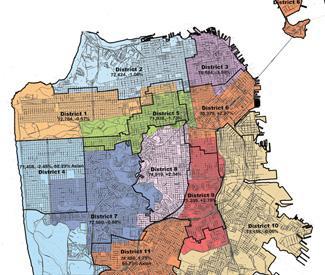
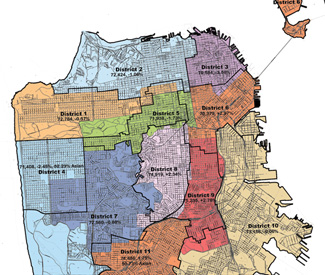
There’s only about a month left before the Redistricting Task Force starts to finalize a new map for supervisorial districts in San Francisco. You can look at the draft map the task force is working on here. The Guardian held a forum on the topic Jan 26 and that’s lead to an alternative community map, which is here. The group that worked on the draft community map is continuing to meet, and I’d love to hear more feedback on it. You can email comments to map@sfbg.com or just post them as comments here.

Presidio Trust gets sued — for good reason

14

The Sierra Club and the Presidio Historical Association have filed suit in federal court charging that the Presidio Trust violated environmental laws when it approved a new luxury hotel for the Main Post area.

The suit reflects the essential problem of the semi-private trust: When you force a national park to make enough money to pay its own way, and you stock the governing board with people who think like real-estate developers, then you create the near inevitability of serious problems.

The complaint, filed by lawyers at the Stanford Environmental Law clinic, argues that the construction of a 95,000-square-foot hotel, consisting of 14 buildings, “will degrade the historic, cultural, and aesthetic values and character of the main post, in direct violation of the duty imposed on the Trust by the National Historic Preservation Act.”

The suit also challenges the adequacy of the environmental impact statement the Trust prepared on the proposal.

The whole idea of a luxury hotel in an urban national park is a bit odd — but then, so is the idea of an 850,000-square-foot commercial office building owned by George Lucas’s outfit and built with a $60 million tax break.

That’s what privatization inspires. That’s why the entire foundation of the Presidio Trust and the law that created it are so fundamentally flawed.

In the meantime, we have this fancy hotel, which ought to go the way of the Fisher museum. It’s so clearly inappropriate for the site (which, by the way, is one of the most important historic sites on the west coast) that it’s hard to imagine how it got this far. (No it’s not — the Presidio Trust is a real-estate development outfit, not a national parks outfit. I keep forgetting.)

So now maybe this lawsuit will stop it in its tracks. Maybe at some point Congress will realize that national parks aren’t supposed to pay for themselves (shall we sell naming rights to the Grand Canyon to Disney?) and repeal the Presidio Trust Act. In the meantime, thanks to the folks who are trying to keep the damage under control.

Santorum lives for donuts and venison

0

I love Bad Lip Reading. And the Rick Santorum ad is the best one ever.

We are all homosexuals.

The big fat chick stunk … like beef.

I hold it like it’s a fancy fist for joy.

I had some porn, and I swore, and some weird witch gagged me.

I’m living for donuts and venison.

The first time I drank I had my shoes under my arm.

Diarrhea is OK.

Check it out.


Gavin Newsom (suddenly) cares about economic justice

37

I was eating my (late) breakfast as I was listening to Gavin Newsom on KQED’s Forum this morning, and at first it was just the usual lofty rhetoric about education … and then Michael Krasny asked the lieutenant governor about the Occupy movement, and I almost threw up my whole wheat bagel and peanut butter.

Cuz Gav — the mayor who would never even consider asking the city’s wealthiest to pay more taxes, who ran for governor and then lite gov on a platform that he’d balanced the city budget without raising taxes, the guy who was a great friend of the city’s 1 percent, had the nerve to sing the praises of Occupy and complain about economic injustice.

Seriously: Gav ranted on for about five minutes about how low the taxes are on rich people. He announced that his company just set up a new winery and hired a bunch of people — and taxes were never an issue. He acted like someone who reads my shit.

One of the messages of Occupy — and one of the reasons that the movement exists not just in Washington and Manhattan but in cities all over the country — is that economic injustice needs to be addressed everywhere. It’s not just about the Bush tax cuts or even Jerry Brown’s tax-hike initiative; it’s also about local government trying to address the wealth and income gap and the impacts of 1 percent domination — at home.

Gavin had seven years to do that. He didn’t even try. Worse, when the progressives on the board tried, he’d veto anything that remotely smacked of a tax hike on the rich or a way to force the 1 percent to share the wealth with the 99 percent. (Does anyone think he would have allowed Occupy to stay at Justin Herman Plaza as long as Ed Lee did? Not a chance.) Now he wants to take advantage of the popularity of the movement for his own advancement.

Fucking sick.

America’s cup: What does Larry get?

8

The development agreement for the America’s Cup comes out next week, although the project is already under way. But there’s some concern that the number of visitors (and thus the revenue to the city) might not be as high as projected.

The project EIR is more conservative about the possible number of visitors than city officials had been at first, and now the Bay Citizen reports that “doubts are growing about the number of spectators who will actually come to the city this year and next.” Apparently the prelims in San Diego have been a bit of a bust — and there aren’t as many teams signing up for the challenge.

So here’s the question: If the city winds up taking in less money than expected, does Larry Ellison take a bath, too?

Of course, it’s not that simple: Ellison’s getting a lot from the city, but it’s not based on any revenue the city will get from the cup; it’s based on the investment he’s putting into the port. He’s getting a sweet deal from San Francisco — way too sweet in my mind. The guy’s the sixth-richest person in the world; he doesn’t need all the goodies the city’s handing over, and I’m not sure I want the arrogant, aggressive CEO of Oracle determining the future of a large part of the San Francisco waterfront. But in theory, since he’s renovating property that’s falling apart, he gets something in return.

And, as Jane Sullivan, the spokesperson for the America’s Cup project at City Hall, points out, the fewer the visitors, the lower the city’s costs.

She also told me that “we don’t think the number of competitors will affect the number of visitors,” which is probably true — people will come for the spectacle, and Oracle will hype it beyond imagination, and nobody knows who any of these other teams are anyway. (The one team that might have gotten some press, aside from Oracle, wasn’t allowed to put in an application.)

But here’s the thing: This entire project, and the motivation to give Larry Ellison a bunch of really valuable city property, was the economic impact the cup is supposed to have on the city. The Mayor’s Office has been throwing around numbers like $1.4 billion in economic impact — that’s new jobs, full hotel rooms, packed restaurants, spillover employment benefits — and, of course, more tax revenue to the city coffers.

What it we give away the store to the Oracle pirates and we wind up getting a lot less money than we were hoping for? Nothing against the Cup; I love boats, and I love a big party (although I try to make sure that when the party’s over, I’m not completely broke). But it seems to me that the city’s the only one taking the risk on the downside. Larry gets everything he wants no matter how this all turns out.

We won’t know all the details until we see the agreement, but am I the only one worried about this?


But doubts are growing about the number of spectators who will actually come to the city this year and next to watch the races of experimental catamarans. Preliminary races held on 45-foot vessels in San Diego and elsewhere are failing to attract expected crowds or sponsors.

Source: The Bay Citizen (http://s.tt/15upW)

District lines: a community alternative

7

Early in April, a nine-member task force most San Franciscans have never heard of will draw lines that could change local politics for a decade. The Redistricting Task Force is using the 2010 U.S. Census data to adjust supervisorsial districts to reflect changes in the city’s population. Some shifts are dramatic — the area now covered by District 6 has some 25,000 new residents, and will have to shrink. Others will have to grow. And the way the new boundaries are set could affect the representation of ethnic groups, the political leanings of the board members, and the ability of progressives to pass legislation.

The task force has held a series of hearings on individual district lines. The S.F. Board of Realtors and other downtown groups are drawing their own maps. But almost nobody on the left has been looking at the city as a whole and how the different district lines can impact our ability to get six votes.

As campaign consultant David Looman puts it, “what downtown wants is clear — they want to quarantine all the progressives in districts five, six and nine, so they can control the rest.” What do the rest of us want?

The Guardian held a forum on the topic Jan 26, and about 70 people from across the wide rainbow that is the city’s progressive moment attended. The goal: To create a community alternative to what downtown, the Mayor’s Office, and possibly a majority of the task force members is suggesting.

>>VIEW THE MAP HERE

The map above represents a first draft. Fernando Marti, a community architect and housing activist, did the heavy lifting, looking for ways to keep ethnic communities, neighborhoods, and other so-called communities of interest together, while still avoiding the downtown quarantine.

It’s not an easy task, and there was a lot of discussion around some of the lines. Many of the people in the room were unhappy with the border between District 8 and District 6; in the next draft, that will probably be moved back from Valencia to Guerrero.

There was discussion about whether Japantown should be in District 1 or District 5, whether Portola should be in District 9 or split up, how the District 6 lines should be drawn, and much more.

It’s a work in progress — but we’re publishing it to get some feedback, to let people know that the process is going on, and to let progressive and independent neighborhood activists know that the task force decision, which can’t be appealed or overturned, is critical to the city’s future.

Editor’s notes

13

tredmond@sfbg.com

I used to go to Grateful Dead shows at the Oakland Auditorium, which is now called the Kaiser Convention Center. One night I saw Bill Graham, the late concert promoter, ride a zip line from up near the ceiling to the stage in a giant paper mache joint called the “S.S. Columbian,” which looked like it was going to fall apart at any minute as he swung back and forth 50 feet over the crowd, trying to smile and wave in a bizarre promotional stunt that confused even the deadheads. I bet he shit his pants.

The place was a pretty good venue for a big concert, but it never worked out as a convention center, and the city shut it down in 2005. It needs seismic work and about $5 million in maintenance. It sits near Lake Merritt, on the edge of downtown Oakland, a giant empty building just waiting for something to happen to it.

It’s a perfect spot for an Occupy Oakland headquarters. I’m surprised it took the Occupy folks this long to figure it out.

Look: Oakland’s a working-class city, and it’s having severe financial problems, and sending hundreds of cops to arrest Occupy protesters is sucking up money that’s desperately needed for other things. Mayor Jean Quan complains that police were unable to respond to emergency calls in other parts of the city because they were all downtown dealing with the demonstration.

Understood — and it’s clear that the Oakland Police, whether the Occupy folks like it or not, are going to arrive in mass numbers to make sure that there’s no damage to local businesses or City Hall (where, oddly, there were no arrests, because the cops were elsewhere).

But the empty Kaiser Center, which isn’t even in the downtown center? Why bother?

Seriously: Why not just give it to Occupy Oakland? Tell the group that the city will strictly enforce fire and health codes, that the Occupy people will have to clean the place up and keep it clean, that they can’t damage the place … and hand over the keys?

It’s public property. Nobody using it now. Occupy might actually bring some excitement to the scene. If it became a center for political meetings and organizing, for education and performances, it could be a be a very positive thing.

Declare at truce in the Occupy wars. Let the cops go after murderers; give Occupy the vacant convention center. Nothing else is working. It’s worth a try.

The college tuition problem

18

President Obama wants to solve the horrible problem of college tuition costs and student loans by offering tax breaks and telling schools to keep their costs down. Memo to the prez: Holding the line on tuition increases won’t do it. Tuition is already way to high. Student loan requirements are already way too crippling.


It would be nice if governments would just raise the tax money necessary to subsidize costs at public universities again. But until that happens, there’s another interesting idea I heard on KPFA the other day: Why not do a federal bailout for students?


The Federal Reserve bought up trillions in toxic bank debt. Why not use the same principle to buy up the debt of a generation of college students, reduce the payments to an affordable level and do what other countries do, which is to waive all payments until the students get a job? What a great investment in the future — and what a great way to stimulate the economy. Put money in the pockets of young college graduates and guess what? They’ll spend it. Trust me on this.


I wonder if anyone in Washington is even thinking about this. If so, it’s awfully quiet.

Can SF follow Berkeley in dumping the big banks?

15

The City of Berkeley is considering dropping its contract with Wells Fargo and moving the city’s money to a credit union or a smaller community bank. That makes perfect sense — the Move Your Money Project has been urging individuals to do that, and there’s no reason why cities (which are huge customers of banking services) can’t do the same.


In fact, San Francisco ought to be next on the list.


This city puts all of its short-term money in Bank of America. It’s a lot of cash — if the city spends more than $6 billion a year, much of that at some point goes into a city account and most of the checks the city issues are paid on that account. We’re talking a plum deal for a big bank — particularly since the city’s checks aren’t going to bounce and the money comes in steadily.


Why B of A? Because the contract is put out to bid, and B of A was able to offer the best deal. But the bidding process didn’t consider the issues that Occupy has brought up — nor did it consider the number of local jobs that could be generated if the city put its money in a local bank that actually makes local loans to small businesses and homeowners instead of foreclosing on people and shipping the profits back to North Carolina every night.


I don’t know if there’s a local credit union or community bank big enough to handle the business of a client the size of San Francisco — but there’s no reason the entire contract has to go to one bank.


Besides, we could always create our own.

Why the public thinks government is fat

10

Polls from the PPIC are typically pretty accurate, so I have no reason to doubt the results of a recent one showing that a majority of Californnians still think government can be cut substantially without a reduction in services. It’s hard to fathom; as Brian at Calitics notes,


Cuts to government expenditures mean direct cuts to services. There is simply no way to provide the same level of services for an ever decreasing amount of money. Go take a look at your local government offices and then compare it to the offices of your local bank corporate office.  There are no fancy waterfalls and lavish breakrooms offering wide selections of Odwalla and Rice Krispies, there are just a dwindling level of state employees working ever harder to keep up.  


So, while most voters strongly support raising taxes on the rich, 59 percent also think that government can easily be cut just by eliminating waste. Even Arnold Schwarzenegger, who took office pledging the same thing, left saying there wasn’t much waste left to cut. And while I fully believe that any organization that spends $80 billion a year is going to have some things in the budget that don’t belong — it’s simply humanly impossible to run anything, public or private, that big without some employee sleeping in the supply room or somebody sneaking cookies on the company dime — it’s also the case that what’s missing in the California budget is more important than what’s being mis-spent.


Why don’t people get this? Part of the reason is a 30-year concerted campaign by the right wing to convince people that the public sector is a waste of money. But part of the reason is also that the news media, by its very nature, is much more likely to report on waste in government than similar (or worse) waste in the private sector.


For one thing, it’s easy: Government records are public. Figuring out how Enron, which kept its records private, stole $40 billion from the state of California is really, really hard. There’s also the (correct) notion that the government is spending OUR money, so we ought to watch where it goes.


And of course, corrupt politicians like Willie Brown give everyone in government a bad name, and there are plenty of them.


But remember: The government typically spends a lot of our money on private contracts with companies that don’t make their records public. How many employees of the contractors building the Central Subway are sleeping on the job, double-billing, charging fancy lunches and wasting the public’s dollars? That takes a lot more digging — weeks of investigative reporting — and it’s not the sort of stuff that can just pop up in a Matier and Ross column, the way a city worker who pulls in a lot of overtime can (and does).


I think there’s also a general lack of interest in exposing corporate wrongdoing. PG&E’s records are public, and all the money the company spends is OUR money (we’re ratepayers, and we have no choice). But how much do you see about overpaid PG&E executives compared to how much you see about (far less) overpaid city employees? PG&E has hundreds of executives making far more than the most bloated City Hall salaries, and they all have nice pensions — but you never hear about PG&E needing pension reform, or how the utility needs to tighten its belt to keep rates low in a recession.


When you’re bombarded day after day with stories about a deputy sheriff or a nurse who works a huge amount of overtime and takes home $150,000 a year, you can’t help but think that the public sector’s wasting your money. But the private sector does a lot worse.


And sure, under capitalism, a wasteful private company should pay the price in the marketplace — but we all know that a lot of the big private companies don’t really compete much (see: the financial sector), and when it comes to regulated utilities like PG&E, they don’t compete at all. You think ATM fees and checking account fees and all the other shit that banks hit us with isn’t in part a result of waste, fraud and bloated payrolls? Isn’t that my money, too?


Milk Plaza vote raises public-space issues

1

The supervisors will vote Jan. 31 on new rules for the use of Harvey Milk Plaza and Jane Warner Plaza, rules that could have an impact on the future use of small public parklets. Sup. Scott Wiener introduced the legislation, which has stirred up a lot of opposition — and in the end, the decision will probably come down to how Sup. David Chiu decides to vote. Activists involved in the battle say it’s likely the progressives will oppose the measure, and the supervisors who typically side with the more conservative bloc will support it, and Chiu (and maybe Sup. Malia Cohen) will be the swing votes.


There’s an online petition against the measure; you can sign it here.

Redistricting: A Guardian Forum

13

The new supervisorial districts could change the makeup of the board and have a lasting impact on local politics. There’s been a lot of discussion about individual districts — but not so much talk about how the new map will affect progressive politics citywide. We’re holding a Guardian forum Jan. 26 to look at that issue, discuss different scenarios and come up with some alternatives. Panelists include Calvin Welch (who helped draw the first district elections lines in 1976), Quintin Mecke (who was on the redistricting panel 10 years ago when the current lines were drawn), Norman Fong (who runs the Chinatown Community Development Center and Fernando Marti (a community architect and housing activist who has some proposals for new lines).


If you’re interested and want to join the discussion, the event starts at 6 p.m. at the Mission Campus of City College, 1125 Valencia. We’ll be done by 8 p.m., I promise.

Occupy and the State of the Union

2

Have all of the Occupy actions made any difference? Gee — I wonder.


I wonder if a president who acted a year ago as if economic justice wasn’t even an issue in this country would have devoted a substantial part of his State of the Union speech to fairness in tax policy. I wonder if he would have said this:


Right now, we’re poised to spend nearly $1 trillion more on what was supposed to be a temporary tax break for the wealthiest 2 percent of Americans. Right now, because of loopholes and shelters in the tax code, a quarter of all millionaires pay lower tax rates than millions of middle-class households. Right now, Warren Buffett pays a lower tax rate than his secretary.


Do we want to keep these tax cuts for the wealthiest Americans? Or do we want to keep our investments in everything else –- like education and medical research; a strong military and care for our veterans?


Or this:


Tax reform should follow the Buffett Rule. If you make more than $1 million a year, you should not pay less than 30 percent in taxes. And my Republican friend Tom Coburn is right: Washington should stop subsidizing millionaires. In fact, if you’re earning a million dollars a year, you shouldn’t get special tax subsidies or deductions. On the other hand, if you make under $250,000 a year, like 98 percent of American families, your taxes shouldn’t go up. You’re the ones struggling with rising costs and stagnant wages. You’re the ones who need relief.


Now, you can call this class warfare all you want. But asking a billionaire to pay at least as much as his secretary in taxes? Most Americans would call that common sense.


or this:


No American company should be able to avoid paying its fair share of taxes by moving jobs and profits overseas. From now on, every multinational company should have to pay a basic minimum tax.


Now: Not saying any of that is going to happen right away, or even that Obama will put tax reform at the top of the agenda. And changing the tax code to charge people like Mitt Romney 30 percent is nowhere near enough; in the 1960s, those people paid 80 percent of their marginal dollars in federal taxes. The Repubs in Congress won’t let any of this happen anyway.


But all of the major newspapers (which a year ago didn’t even know how to spell economic injustice) made his pitch for greater fairness in the economy the lead of their reports and all of the headlines talked about it. And when pollster Stan Greenberg tracked the responses of Democrats, Republicans and independents to the speech, the vast majority were pleased by and agreed with the commments that I cited above. That’s not just 80 percent of the Dems but 70 percent of the GOP voters.


The other thing Obama said — in indirectly — is that government is important. Beyond the flag-waving salute to the troops and the talk about the Navy Seals (Yay! We killed a guy! No arrest, no trial, just summary execution!), Obama was setting the tone for a debate over the role of the public sector in America. He talked about building the Hoover Dam, the Golden Gate Bridge and the interstate highway system. He talked about the importance of public support for research. That’s a direct contradiction to what the Republicans are saying about making government much smaller and less significant in people’s lives. I wonder what happens if the Republican candidate and Obama get out of the platitudes are actually have that discussion this fall.


Of course, he also said the solution to most business problems was tax cuts and incentives, which is not only GOP dogma but silly, since tax cuts for business almost never have the intendent effect. Tax penalties won’t keep companies from moving offshore (although I still support the idea), and tax cuts won’t bring them back.


It’s notable that Obama didn’t mention corporate personhood, which is going to be a huge part of the Occupy agenda this year. And that’s something that could actually change business behavior. Corporate charters are granted by the government — and with a few changes in law, could be revoked by the government, too. Screw your workers, cheat on taxes and move jobs to low-wage non-union areas where children work 14 hours a day making your products? Guess we’ll have to revoke your corporate charter. No more protection for personal liability for the owners and shareholders. Too bad.


And while his populist stuff struck a chord, the energy and environmental policy suggestions were just horrible. Yeah, I’m for ending tax breaks for oil companies — but opening up 75 percent of the potential offshore areas to drilling? Encouraging more natural gas drilling? Not much in the way of serious talk about investing a fraction of that money in renewables?


Oh, and I love this: Obama’s going to force natural gas drillers to “disclose the chemicals they use.” That’s going to keep us safe, yesiree. Thank you, mister driller, for telling me how your poisoning my water. Not that I can do anything about it, of course; you can keep right on going. But now, thanks to our bold president, I know about it.


Occupy the natural gas wells. I’m ready to go.


Mirkarimi’s not going anywhere

107

Sheriff Ross Mirkarimi may be guilty of domestic violence, and if he is — as I’ve said repeatedly — it’s a serious crime and he should be held accountable. It will be very hard for him to remain in office with a DV conviction, even if it’s just a misdemeanor.


But right now, the charges are just that — charges. In the eyes of the law, he’s innocent until proven guilty. So I don’t see how Mayor Ed Lee can suspend him.


Lee’s under a lot of pressure, and under the City Charter, he has the sole authority to suspend an office holder for “official misconduct,” which is defined as “wrongful behavior by a public officer in relation to the duties of his or her office.” If there’s a suspension, the Ethics Commission and the Board of Supervisors would both have to vote to remove Mirkarimi permanently.


But here’s the thing: Lee has no evidence of official misconduct — not unless the district attorney decides to turn over to the mayor all of the files in the criminal case, at which point Ethics and the supes would be holding mini trials of their own on evidence that hasn’t been adjudicated in court (and a court may rule some of it inadmissable).


That doesn’t seem likely (and it would be very odd for the D.A. to join the mayor in what would amount to a second prosecution).


And all of this would be going on at a time when the actual criminal trial is only four weeks away.


The courts have interpreted “official misconduct” fairly narrowly. If Mirkarimi is convicted, then the city attorney can get into the argument over whether domestic violence has any “relation to the duties” of the Sheriff’s Office, and since he’s a law-enforcement officer, that might not be too hard to argue. Certainly the charge of influencing a witness would be subject to that interpretation. So after a conviction, Lee would be in a position to think seriously about suspension — if Mirkarmi didn’t step down on his own.


But right now, there’s no conviction. In terms of the court system (that would have to get involved) Mirkarimi isn’t guilty of anything yet.


Mirkarimi could decide to take a leave of absence, although he doesn’t seem inclined to do that. But whatever the merits of the case, and whatever the political arguments about whether the sheriff can do his job in the middle of this media circus, I — admittedly as a nonlawyer — can’t see how Lee could possibly invoke the suspension provisions of the Charter.


Maybe I’m missing something. 

Big changes to the DCCC?

14

Half the city probably doesn’t realize there is such a thing as the Democratic County Central Committee, and most of the other half doesn’t realize how powerful it is. The daily papers never cover the DCCC meetings and rarely write about the elections that choose the members of an organization that runs the local Democratic Party — and controls local party endorsements. But it’s a serious factor in local politics — the party slate in a Democratic town is one of the most influential endorsements around. And a lot of the city’s current elected leaders started off as members of the DCCC.


For the past few years, progressives have held a majority on the DCCC, but it’s always up in the air, particularly since every elected state and federal Democrat who lives in SF is automatically an ex-officio voting member. So Senator Dianne Feinstein, Rep. Nancy Pelosi both get to vote (actually, the never show up; they send proxies). Gavin Newsom had a vote until he moved to Marin. You get the picture.


And now, with reapportionment, the part has to change its rules. Under the current system, 12 members are elected from each of the city’s two Assembly districts — but under the new lines, Tom Ammiano’s Assembly district will expand beyond the eastern side of town and he’ll now represent 61 percent of the Democratic voters in the city. Fiona Ma’s district moves south into San Mateo, and she’ll only represent 39 percent of the Democrats.


So now the state has to reapportion the DCCC. Three LGBT members describe the process in a B.A.R. piece here. It seems to me that the easiest thing to do is to add five more members on the east side of town. Good for getting more San Franciscans involved in local politics. Good for the diversity of the DCCC. And good because the more directly elected members you have, the less the ex officios influence the committee.


Seems like a fair easy fix. 

Strong opposition to Wiener plaza plan

17

More than 20 prominent LGBT activists, including eight former presidents of the Harvey Milk Club, have signed a letter opposing legislation by Sup. Scott Wiener that would put some restrictions on the use of the two plazas near Castro and Market.

Harvey Milk Plaza and Jane Warner Plaza are both in an odd legal situation — they aren’t city parks, and they aren’t city streets or sidewalks, so they don’t fit under any existing codes. The park code, for example, bars camping; the sit-lie law applies to sidewalks, but not to these plazas.

So Wiener is seeking some clarity — but his proposal has drawn the ire of the Coalition on Homelessness and the ACLU — and now a group of people who trace their political roots back to Milk, and who say that restricting the use of a plaza with his name is a terrible idea: Here’s their letter:

We, the undersigned members of the Harvey Milk Club, write in opposition to the proposed new regulations for Harvey Milk and Jane Warner Plazas.

We are writing because Harvey Milk’s name is attached to one of the two plazas for which this legislation was written and is a historic space that for decades has been a site of free speech. In the 1970s, Harvey Milk fought against that era’s sit/lie law—a law that had been written to target the hippies of the Haight-Ashbury, but was, in Milk’s day, used as an excuse to attempt to drive gay men out of the Castro. Those of us who have been around long enough, or who are at all in touch with our community’s history, are familiar with the image of Harvey Milk and his megaphone at the plaza which was eventually given his name. To propose to prohibit sitting in that very plaza is not just ironic, it disrespects our community’s legacy.

The interests of the LGBT community have always been united with the interests of public space. As a community that is forced—far too often and for far too long—to spend much of our collective lives “in the closet,” the ability to be free in public spaces has been tremendously liberating. Harvey Milk knew that liberation was only possible if we escaped the shadows of anonymity and invisibility. When we restrict these spaces—even when those restrictions are meant, initially, to be applied to another group of people—we damage ourselves.

We must also recognize that this law does not apply, in any very meaningful way, to another group of people: It applies to us. A great many—perhaps the majority—of homeless people who spend time in the Castro are LGBT San Franciscans, who came from somewhere else, but who came here seeking community and safety. This is most especially notable for the youth of LYRIC. Cuts to the City budget have reduced LYRIC’s drop-in hours to only a few every week. During the other hours, homeless LGBT youth are faced with the choice of either heading to drop-in services in the Mission or Tenderloin—services that are already so overburdened that they must turn clients away, and which likely feel to most youth to be outside of their own communities—or using open spaces in the Castro. With Collingwood Park fenced in, Harvey Milk and Jane Warner Plazas are the last open community spaces in the neighborhood. They are the last places in our community where our community’s most marginalized youth can be.

We have read and share the grave concerns expressed by the ACLU.  Much of the law infringes on important constitutional freedoms, and as they noted, cannot be cured.  We respectfully ask the Board of Supervisors to vote no.

Sincerely,

Tom Ammiano, Assembly member
Harry Britt, Co-Founder, Harvey Milk Club,  Former Supervisor who replaced Harvey Milk on the Board of Supervisors
Cleve Jones, Co-Founder, Harvey Milk Club, Human Rights and AIDS activist, Co-founder of SF AIDS Foundation and AIDS Memorial Quilt
The Harvey Milk LGBT Democratic Club
Stephany Joy Ashley, President, Harvey Milk Club
Gabriel Haaland, Former President, Harvey Milk Club, Former Commissioner
Laura Thomas, Harvey Milk Club member, AIDS activist
Anna Glendon Conda Hyde, Harvey Milk Club member, Commissioner
Esperanza Macias, Former Vice-President, Harvey Milk Club
Eileen Hansen, Harvey Milk Club member, Former Commissioner
Rafael Mandelman, Former President, Harvey Milk Club, Former Commissioner
Gwenn Craig, Former President, Harvey Milk Club, Former Commissioner
David Waggoner, Former President, Harvey Milk Club
Nate Albee, Former President, Harvey Milk Club
Tamara Ching, Harvey Milk Club member
Lisa Feldstein, Harvey Milk Club member, Former Commissioner
Suzanne Rueker, Harvey Milk Club officer
Carol Stuart, Vice-President, Harvey Milk Club
Kim-Shree Maufus, Vice President, Harvey Milk Club, Commissioner
Matt Dorsey, Harvey Milk Club member, SFDCCC
Brian Bassinger, Former President, Harvey Milk Club
Debra Walker, Former President, Harvey Milk Club, Former Commissioner

Boxer, Feinstein both supported SOPA/PIPA

18

The grassroots and corporate tech rebellion against two Internet censorship bills was, by all accounts, a stunning success and a demonstration of the clout of online politics and web organizing — and the emergence of Big Tech as a potential counterbalance to Big Entertainment. But it’s worth noting as the dust settles that two of the biggest supporters of SOPA and PIPA were the senators from California, Barbara Boxer and Diane Feinstein.


Raw Story points out that Boxer was a major recipeint of Hollywood money:


Far and away, the top beneficiary in the Senate from interest groups that support PIPA is Sen. Barbara Boxer (D-CA), who’s taken in just short of a million dollars from those groups, according to data from OpenSecrets.org. She’s also the most recent Senator to co-sponsor PIPA, adding her name to the list on Dec. 12.


Most of the Bay Area delegation opposed the bill. S.F.’s Nancy Pelosi was against it early on, as was Barbara Lee of Oakland. Jackie Speier of San Mateo and the South Bay’s Pete Stark were also both opposed. If Lynn Woolsey, the retiring rep. from Marin, has taken a position, it’s not clear what it is; she’s listed by most of the anti-censorship groups as undecided.


But for the two senators, both from Northern California, the SoCal position carried the day.

More on the Mirkarimi case

172

I wrote up the Jan. 19 hearing on the domestic violence charges against Sheriff Ross Mirkarimi, but a few more points are worth thinking about as the embattled sheriff prepares for another court hearing Jan. 23.


For one, the stay-away order that Judge Susan Breall issued doesn’t allow Mirkarimi to have any contact with his two-year-old son for the next 45 days. That seems not only harsh but bad for the kid, who doesn’t understand why he can’t see his daddy and is, not surpisingly, confused and upset. There are no winners in this case (except the folks who would just as soon see Mirkarimi gone and replaced with a more traditional law-enforcement sheriff), but the biggest loser, the one I feel worst about, is the kid. If the judge was really worried about Mirkarimi being a danger to his son (which, frankly, seems like a huge stretch), then she could have authorized supervised visitation. That’s not at all unusual in these kinds of cases, and would at least give the child a chance to have contact and a relationship with his father during the period when all of this is being sorted out in adult court.


There’s not a lot of talk about the inherent conflicts of interest in this case, issues that come about from a sheriff who was once an investigator in the District Attorney’s Office facing criminal charges filed by that same office, which is now run by a former police chief who the sheriff clashed with repeatedly when he was a supervisor. I don’t know the law on this or how it could possibly play out, but there’s an interesting article about it all here.


It’s odd that the conflict piece ran in a publication that makes its living bashing local progressives, but everything about the media in this case is odd (except that fact that it’s become an international zoo). The one writer who has talked seriously about Mirkarimi’s right to be treated as innocent until proven guilty — and the only major voice in the media urging him not to step down — is the Chron’s conservative columnist Debra Saunders


Another interesting media tidbit: I don’t know Mirkarimi will enough to have any insight into his behavior in romantic relationships, but one person who really does — his longtime former girlfriend, journalist Evelyn Nieves — has been quoted only once in the bottom of a New York Times/Bay Citizen story, to wit:


“I was shocked when I read about it,” Evelyn Nieves, a journalist and a past partner of Mr. Mirkarimi’s, said in an e-mail. “Ross and I were together for the better part of a decade — eight years or so — and never once did he even come close to being physical during an argument.”


“It’s just not his way,” Ms. Nieves added. “He was way more prone to proposing that disagreements be talked out. He could talk and talk.”


Again: Doesn’t mean he’s not guilty. Doesn’t mean he hasn’t changed. Just interesting that only one publication has even tried to contact and get a quote from Nieves.


I’m not a lawyer, of course, but it seems to me that the defining moment in this case will not be the trial but the pre-trial hearing in which Mirkarimi’s lawyer tries to get a judge to rule that the videotape of Eliana Lopez talking about her injury and her fear of her husband can’t be used in court. Bob Egelko has an excellent piece here; he points out that if the video isn’t admissible as evidence, the case will collapse. If a judge rules (and the legal arguments seem to support it) that the prosecution can’t introduce the video or show it to the jury, then I suspect the district attorney will have to drop the charges; if Lopez refuses to testify against her husband, there’s nothing else to go on.


But this is a domestic violence case, and judges (no surprise) are political, and how many members of the local bench really want to be the one who ended such a high-profile case (and in effect, let the suspect walk) on what the media will call “a technicality?”


The GOP primary: Enjoy the show

6

The 49ers game isn’t until Sunday, but in the meantime, I hope everyone’s enjoying the spectacle that is the Republican primary in South Carolina. First off, we have John King asking His Newtness about allegations that he wanted an “open marriage” and setting off a classic Newtron bomb. Then we have all the discussion on CNN about Mitt Romney’s (allegedly) huge penis. And of course, the SuperPac ads accusing Romney of being a serial killer (“Mitt the Ripper.”) Oh, and by the way: Did anybody actually win the Iowa Caucuses? Does anybody actually care?


Party on, Repubs. You’re doing better every day.

Plenty of drama at the Mirkarimi hearing

69

I’m glad I got to the courtroom early; by the time Judge Susan Breall called the case of People v. Ross Mirkarimi, there wasn’t a single seat available, and Her Honor wasn’t allowing standing room.

What followed was a quick “not guilty” plea to three misdemeanor charges – and then a session that lasted more than two hours, with a long interruption, as the prosecution and defense argued over whether Mirkarimi was such a threat to his wife and two-year-old son that he should be forced to stay away from them and avoid any form of contact until after what is expected to be an early March trial.

In the process, Mirkarimi’s wife, Eliana Lopez, made a passionate plea against the restraining order and Deputy District Attorney Elizabeth Aguilar-Tarchi introduced new evidence to support her claims that the newly elected Sheriff is not only guilty of domestic violence but too dangerous to allow into his own home.

In the end, Breall – who once worked as a prosecutor in domestic violence cases – issued the order forbidding the sheriff from any contact with his wife and child, and told Mirkarimi and his attorney, Robert Waggener, to return to court Jan. 23 to set a trial date.

Breall angered Lopez – and some courtroom observers – by saying she was concerned that the 36-year-old Venezuelan soap opera star was new to the country and lacked fluency in English and a family support system. Waggener noted that the length of time Lopez had lived in the United States and her language skills weren’t part of the evidence in the case and had nothing to do with the need for a protective order. He later told me that it was unusual for a judge to mention or consider that sort of information in a restraining order.

In fact, Breall noted that she had learned about Lopez’ background from reading the newspapers, leading Waggener to insist that the judge stick to the facts before her and not rely on news accounts that the attorney said were inaccurate.

At times, the proceedings turned bizarre: After Lopez had been identified by her full name and discussed at some length, her attorney noted that the last name and address of a domestic violence victim should not be in the public record. Breall agreed, and from then on referred to her only as “Eliana L.”

A little late for that, of course: The local news media have put her picture and full name on the front pages and the airwaves repeatedly in the past week.

Early in the proceedings, Breall asked if Lopez had seen a victim advocate in the District Attorney’s Office, noting that such a visit was part of standard procedure in these kinds of cases. Shortly afterward, Lopez left the courtroom; we later learned she had walked down the hall to the D.A.’s Office and met with the advocate.

Waggener asked repeatedly during the afternoon that statements from Lopez be taken in a closed courtroom, citing her privacy rights. Breall declined, and refused to put any documents under court seal.

After delaying the case for roughly an hour while Lopez had her meeting and Waggener read over the documents that had already been published in local newspapers but had only that day been provided to him, the judge came back and heard arguments on the stay-away order – and we learned more about the evidence that the D.A. will be presenting in the case.

Waggener noted that after reading the documents he had received, he saw nothing that would justify barring Mirkarimi from seeing his family. Aguilar-Tarchi started to discuss what the now-famous videotape that neighbor Ivory Madison made of Lopez showing a bruise and discussing a confrontation with her husband, but Lopez’s lawyer interrupted with an interesting new claim: She said that when Lopez had met with Madison, who is a lawyer, she believed that everything she said would be protected by attorney-client privilege and thus shouldn’t be admitted as evidence.

That will no doubt come up later – but for now, Breall wasn’t interested.

Then Lopez took the stand.

Speaking in English – relatively fluent English – she first chided the judge for the comments about her language skills and her residency in the U.S. “This idea that I’m a poor little immigrant is insulting,” she said. “It’s a little racist.”

She said that, rather than being adrift without a support system, she was someone who had been living on her own for 16 years, had her own career and her own apartment in Venezuela (one larger and nicer than her home in San Francisco). She said she’s spent time in Los Angeles and New York and had traveled in Mexico, London, Tibet, Europe and all over Latin America.

“I don’t need the support of my (extended) family,” she said. “I support my family.”

She also said that the press coverage, while unfair, was nothing she couldn’t handle: “I’ve been working in TV for 15 years,” she noted. “Check out the press in Venezuela. This is nothing.”

Then she got into her point: She saw no need for a protective order, didn’t fear her husband and found the whole idea abhorrent. “The violence against me is that I don’t have my family together,” she said. “This country is trying to pull my family apart, and that is the real violence.”

Aguilar-Tarchi wasn’t done, though. After Lopez finished, she repeated some of the allegations in the video, but then described text messages that Lopez had allegedly sent to Madison. “She told a neighbor that she was afraid,” the prosecutor said. “She asked if she could change the locks on the door. She asked if she would have to go to the police or if the police would come to her.”
The text messages also stated, Aguilar-Tarchi said, that Mirkarimi was scared and didn’t want the story to come out and that he had taken Lopez and their son, Theo, on a vacation to Monterey in an effort to prove that everything was fine. “My little Theo is so confused,” one of the messages allegedly said.

Waggener argued that the case wasn’t yet on trial and that much of the evidence was hearsay. And, he said, “in terms of what this court sees all the time, broken bones etc., this is on the low end.” He explained that the couple had been together from the day of the incident – New Year’s Eve – until the day the original protective order was issued, “with no complaints or evidence of violence.” He called the description of the videotape (which hasn’t been shown in court) “highly distorted.”

Breall said some nice (if somewhat condescending) things about Lopez, who she called “charming,” but wasn’t swayed. “I am going to treat this case like any other case,” she said, issuing the order that would keep Mirkarimi away from his wife and child until the end of the trial. Waggener later said he would come back to Breall to seek a modification in that order next week. Breall said the trial would start no later than March 5.

(In an interesting side note, the prosecution demanded that Mirkarimi give up the three guns in his possession. I never knew he kept guns in his house. At any rate, they’ve already been turned over to the authorities.)

I walked out thinking: This is just awful. There’s really nothing positive you can say about it.

I’ve known Ross Mirkarimi for years; I’ve never seen any hint of violence in his behavior. Of course, I’m not that close to him, and I don’t know anything about his marriage. Still, somebody who has been part of the progressive community for a long time has been accused of something really terrible, and it has a lot of us shaking our heads and, frankly, wondering what to think. You want to stand by a friend who’s in trouble (and lord knows, I have plenty of friends who’ve been arrested and charged with all manner of crimes, and some of them were guilty as sin, and they’re still my friends).

But I’ve also helped a close friend through episodes of domestic violence, and I can tell you it isn’t a minor deal, or a private family affair (as Mirkarimi foolishly and inappropriately stated). It’s a serious crime, and for many years, the cops and the courts didn’t treat it that way. And because it used to be really hard for women to get stay-away orders (and in some areas, it still is), women have been badly hurt and sometimes killed.

It’s only because progressive political leaders (the same progressives my blog trolls love trash at the slightest provocation) demanded changes in the law that the rules now allow for prosecution even if the alleged victim doesn’t cooperate. It’s only because of progressive reforms that a case like this is even in court.

And I agree with those reforms. As I’ve said before, there’s no excuse for intentionally injuring anyone – and there’s less than no excuse for injuring your spouse. If that’s what Mirkarimi did, he should be held accountable. It doesn’t matter what side of the political divide he’s on. If he’s guilty of domestic violence, I’m not going to make excuses for him.

More than a misdemeanor charge is on the line. All Mirkarimi has done professionally is progressive politics and law-enforcement, and by most accounts, neither one has much room for someone who has a DV rap. (Although I have to say – there are an awful lot of cops who have DV allegations against them and are still on duty.)

If Mirkarimi weren’t the elected sheriff, this case might well have been handled a lot differently. He could have accepted a misdemeanor plea, taken DV courses, gone into therapy, tried to put his marriage back together. That’s pretty standard in first-offense cases. But to do that would be to admit something he can’t easily admit to and remain in office.

So Mirkarimi knows his only real chance is to win a “not guilty” verdict and then try to rebuild his reputation. Given the stakes, I can’t imagine that he would so much as raise his voice half an octave against Lopez over the next few weeks; one more allegation it would be the end of everything. But Breall must be worried (as any modern judge would be in any prominent DV case) that if she refused to issue the restraining order and something bad did happen, her ass would be very much on the line. So she did the obvious thing.

And the media circus continues.

The only possible bright side (and I always look for a bright side) is that a lot of people who weren’t talking about domestic violence are now discussing it, on the front pages. They’re talking about how a lot of women are trapped by batterers, how they’re afraid to testify and can’t (or don’t want to) leave, how all of us, particularly the police and the courts, are responsible for protecting victims who can’t find a way to escape. And that’s a whole lot of women.

All of that said, we have to remember that Mirkarimi is still innocent until proven guilty. The mayor has no business removing him from office at this point; he hasn’t been convicted of anything. It’s only a few weeks until his trial (Mirkarimi has made it clear he wants this over as quickly as possible, so by law he has to face a jury within 45 days). After that, if he’s guilty, the mayor and the supervisors can worry about whether to vacate the Sheriff’s Office – unless Mirkarimi makes that decision himself.


Supervisors make the Chamber of Commerce happy

7

You want a sense of what’s happened to politics at City Hall? Here you go: the San Francisco Chamber of Commerce is thrilled.


The Chamber just released its 2011 voting scorecard on the Board of Supervisors (which it calls the “Paychecks and Pink Slips Scorecard,” as if most of the stuff the Chamber supports had anything to do with actual job creation), and guess what? The board is more pro-downtown than it has been in a while:


The 2011 year-end scorecard reveals marked improvement in city’s efforts to create jobs and grow the economy. Overall, the Board of Supervisors received a score of 82 percent (equivalent to a B – grade), up from 60 percent (or a D – grade) in 2010. Individual rankings also improved, with five supervisors increasing their scores by at least 15 percent since last year. In 2011, a solid majority of supervisors voted in favor of jobs, the economy and government efficiency more than 75 percent of the time.


The top performer: Sup. Scott Wiener, who voted with the Chamber 88 percent of the time. Second best: Supervisor David Chiu (82%). The worst (or best, depending how you see downtown’s agenda of low taxes, reduced public services and minimual regulations) was Sup. John Avalos, who scored 56%.


The reality is that some of the Chamber’s key votes were relatively noncontroversial things that everone on the board supported — for example, a law sponsored by Sups. Ross Mirkarimi, Eric Mar, David Campos and Wiener making it easier for small cafes and restaurants to host live music and a measure restricting restaurant waste, both of which passed unanimously. There were some votes where nearly everyone opposed the Chamber — the cell phone disclosure requirements and the ban on yellow pages. And on a couple of them, even Chamber darlings Sean Elsbernd and Mark Farrell were on the wrong side — they voted against a tax exclusion for stock options because they wanted even greater tax reductions.


But on the key votes, you can see where the majority of the board lies: Six, sometimes seven votes with downtown, five, sometimes four with the rest of us. Not exactly a progressive majority. 

Firing bad teachers

8

Diane Ravich, who used to be on the wrong side of school reform but has pretty much come around, was on Forum Jan. 18 talking about education policy. For the most part, she was right on target, explaining that too much of a focus on testing (as a measure of school and teacher accomplishment, not as a diagnostic tool) and too narrow an emphasis on math and reading has damaged public schools.


Neither she nor host Michael Krasny spent much time talking about the bigger problem — money — or the fact that other nations that are eclipsing the United State in education actually tax people and spend that money on schools. California has already cut the number of classroom days, and may cut as much as a week out of the school year. That’s a huge deal, one that’s directly related to the intransigence of a few state legislators who can hold the entire budget hostage — and to the unwillingness of California residents to amend Prop. 13 and allow reasonable property taxes.


But one of the things that struck me was a caller who complained that tenure was making it impossible to fire bad teachers.


Tenure, Ravich noted, is badly misunderstood. At the college level, it’s essentially a lifetime commitment; a college professor gets tenure and he or she understands that, for the most part, it means a career at an institution — with minimal job requirements. Tenured professors teach a few classes, but are free to spend a lot of time on academic research (without any set requirement for success or publication.)


For K-12 teachers, tenure is just a word meaning that they get due process in employment. It’s basically the same as the civil-service rules that San Francisco city employees have — the right to a hearing on discipline and freedom for arbitrary actions on the part of management.


You think it’s hard to fire a teacher? Try firing a cop. The police, who have nothing called “tenure,” have more and broader rights than any other public-sector employees, including the right to have all disciplinary matters kept completely secret. And police officers are armed and given the ability to arrest and even shoot people.


So yeah, let’s blame the inability to fire teachers. That’ll fix the problems.