Willie Brown

Editor’s notes

5

tredmond@sfbg.com

I’m not going to tell Ed Lee he can’t run for mayor. I know he promised he wasn’t going to. I know that if he hadn’t made that promise, he wouldn’t have had the six votes to win the office. I think Lee believed at the time that he didn’t want to run in November, and he may believe it now.

But this is still a democracy, and if Lee thinks the situation has changed and he’s the only person who can properly lead the city over the next four years, he ought to put his name forward.

Right now, though, he’s allowing the “draft Ed Lee” movement to get out of control.

Chinatown powerbroker Rose Pak and political consultant Enrique Pierce (who runs the clearly misnamed Left Coast Campaigns and loves to tout his progressive credentials) have set up an office, are raising money, and have hatched this plan to get Lee to agree to put his name on the ballot and not actively campaign.

The operation — which, let’s remember, carries Ed Lee’s name on it — has already run afoul of the law. The Ethics Commission — hardly an aggressive political watchdog — says the campaign had improperly filed as a political action committee. That’s not Lee’s fault — he has nothing to do with this. But it already taints his reputation.

Lee, by all accounts, has done a far better job with the budget than his immediate predecessor. He’s actually been talking to people. He listens; he accepts logic; he tries to make thing work. I admit, the bar is pretty low — Gavin Newsom was a complete asshole. Still: Lee’s a decent guy.

But he has some heavy political baggage — and most of it has to do with his connections to sleazy operators like Pak and Willie Brown. As long as he’s linked to people who treat campaign finance laws, lobbying rules, and political ethics with disdain bordering on hostility, he’s going to have trouble keeping the public trust.

And right now, those same people are raising money — money that is already being spent on a political campaign — and the noncandidate is letting it happen.

Run if you want, Ed. But if you’re going to keep your promise, then it’s time to call Pak, Pierce and company and tell them to quit.

Ethics chief says “Run, Ed, Run” must register honestly

24

As the pseudo-campaign to convince Mayor Ed Lee to change his mind and run for mayor prepares to open a campaign office tomorrow morning – an event with all the trappings of a real campaign but without the candidate or the regulatory controls – the Ethics Commission is asking it to re-register in a less deceptive way.

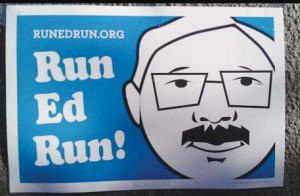
As the Examiner reported this morning, Progress for All, the group behind the Run, Ed, Run campaign – which has set up a website, bought advertising, and printed and circulated campaign materials around the sole purpose of promoting a mayoral campaign – registered as a political action committee (one not subject to campaign contribution limits or other controls) even though Ethics Director John St. Croix said it is clearly formed around a primary purpose.

Today, St. Croix tells the Guardian that he has asked Progress for All to re-register as a committee formed around the specific purpose of promoting Lee for mayor, but that “I don’t know that they responded completely in the affirmative.” Guardian calls to the group’s main contract Gordon Chin, who also runs the Chinatown Community Development Center, were not returned.

Despite statements to the Examiner by Progress for All campaign consultant Enrique Pearce that this campaign isn’t unprecedented (he cited the 1999 mayoral write-in campaign of Tom Ammiano, who was a willing participant in the effort and formed a campaign committee), St. Croix said it is unprecedented and his office is figuring out how to regulate it.

“There aren’t regulations specifically designed for a scenario like his,” he told us. “They can’t operate in the absence of regulations.”

Right now, while Progress for All lists five co-chairs of the committee, the public has no way of knowing who’s funding the group, how much individual donors have given, or how much is being spent to make the campaign appear to have popular support. That will become more clear at the end of July when the semi-annual campaign finance reports are due, and St. Croix said his office plans to “carefully examine” those filings in order to decide how to proceed.

The group’s current filings list its purpose as “general civic education and public affairs,” but St. Croix said the public has a right to know that it has actually formed around a single candidate. While the courts have struck down fundraising limits for committees like this, the group’s website seems to limit contributions to the maximum individual contribution of $500, apparently acknowledging that there are potential legal problems with its current approach.

Lee has repeatedly said that he doesn’t want to run for mayor and has not encouraged this effort, but he has done little to discourage the efforts by a group led by his closest political allies, so he could be sullied by group’s tactics if he eventually decides to run. St. Croix says that if Lee runs and his campaign has any overlap with the current efforts, it will raised troubling issues of whether there has been any collusion between the two campaigns, which is illegal.

Despite the concerns expressed by Ethics, the agency doesn’t have a great track record of being tough with powerful campaign finance violators, as a Grand Jury report released this week argues. For example, although the Guardian and Bay Citizen each reported back in October about an independent expenditure (partially funded by Willie Brown) on behalf of Jane Kim’s supervisorial campaign that was done through Pearce’s Left Coast Communications, which was Kim’s campaign consultant, that apparently illegal action was never followed up by the Ethics Commission. St. Croix has said he can’t comment on that incident, and he responded to the grand jury report by noting that its recommendations were mild even though “the report itself uses some fighting words,” and he said he was preparing a formal response.

Although some activists have argued that those expressing concerns about this stealth campaign are somehow being undemocratic, the reality is that Progress for All is the only mayoral campaign not playing by the rules. And there are rules that govern elections, rules set up precisely so the public knows who’s really behind the campaign propaganda.

Will partisan agendas shape the redrawing of political lines? — UPDATED

14

UPDATED BELOW In the midst of a political realignment at City Hall that is still shaking out, the Board of Supervisors Rules Committee is today (Thurs/23) considering appointments to the Redistricting Task Force, the body that will redraw supervisorial districts using the latest census data. And its choices will say a great deal about the role of integrity and impartiality in the new “politics of civility.”

This commission will arguably have more influence on the city’s political dynamics over the next decade than any other, so overtly partisan appointees should be viewed with great suspicion. Larry Bush at CitiReport did a nice rundown of the applicants and their backgrounds, but the Rules Committee will be where the real action is.

President David Chiu stacked the committee with a conservative majority (Sups. Mark Farrell and Sean Elsbernd) and named a chair (Sup. Jane Kim) whose political loyalties are tough to peg right now. Will she seek an appointee who doesn’t have a political agenda, or will she seek to reward a partisan ally like applicant Paul Hogarth, who worked on her campaign and writes for BeyondChron.org, a propaganda outlet for Kim-backers Randy Shaw and the Willie Brown/Rose Pak/David Ho cabal that elevated Ed Lee into Room 200 and is desperately trying to keep him there.

There are other problematic applicants as well, including Potrero View Publisher Steven Moss, who ran for supervisor in D10 last year and has shown a penchant for seeking payback against his perceived enemies (including the Guardian, which ran articles questioning his residency status). Applicant Ron Dudum has also shown a vindictive streak – following up his failed D2 supervisorial campaigns with an unsuccessful lawsuit challenging the ranked-choice voting system – that would make him a worrisome figure to have on this task force.

So far, three people have been named to the body by the Elections Commission: gadfly/policy wonk David Pilpel, Google attorney Melissa Tidwell, and Mark Schreiber, the managing general partner of Cooper White & Cooper. So already, this is tilting toward a business community bias that will probably get worse once Mayor Ed Lee makes his three appointments to the nine-member commission.

Given how the Rules Committee is stacked, its three recommendations are likely to raise questions that the full board will need to put to rest when it takes the matter up on Tuesday. Voters need to have faith that partisan agendas aren’t shaping the city’s most important political lines, and now is the moment to ensure they have that confidence.

UPDATE: The committee voted unanimously to recommend Eric McDonnell, the chief operating officer of United Way of the Bay Area; Jenny Lam, director of community initiatives for Chinese for Affirmative Action and a board member of Chinatown Community Children’s Center; and Mike Alonso, a “security professional” with Corporate Security Services who got his law degree from New College in 2007 but never worked as a lawyer.

The mayoral poll: No surprises

18

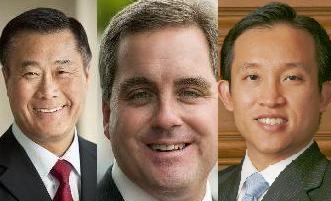
The David Chiu campaign has released a poll that isn’t really all that surprising. It shows that the two candidates who have run citywide races — State Sen. Leland Yee and City Attorney Dennis Herrera — are a little tiny bit ahead, and Chiu is a little tiny bit behind, but all of them are well within the margin of error of a poll sample of only 500 people. Yee is out in front at 17 percent (I’m actually surprised he’s not further ahead at this point, since so much of this is name recognition and he’s been elected so many times, to so many jobs, over so many years that he has by far the best name rec in the race). Chiu and Herrera are tied at 13 and 12 percent (but with a plus-or-minus five percent MOE, all three are statistically in a dead heat).


I would have thought John Avalos would be closer to the top at this point, since he’s doing a good job consolidating the left, but he’s never run citywide, and the campaigns have barely started. Again: It’s name recognition right now.


The bottom line: There is no front runner (with the possible exception of Yee). There may never be a front-runner among the three men bunched in the center of the pack. It’s all going to come down to who gets the second- and third-place votes — which is why ranked-choice voting is so valuable in a race like this. In a traditional race, two candidates who combined might have 35 percent of the vote would be in a runoff, and a candidate who missed the cut by half a percentage point would be out of the running.


One thing we do know: This poll is going to drive Rose Pak and Willie Brown nuts, and increase dramatically the pressure on Ed Lee to run. the more powerful Yee appears, the more likely it is that the center of power in the Asian community will shift away from Pak’s Chinatown operations. Yee’s base is west side, not Chinatown; always has been. Pak despises him (and the feeling is no doubt at least somewhat mutual).


The other fact that weighs in Yee’s favor: He’s doing a better job than anyone of expanding his base. He’s racking up leftside endorsements (unions, the Sierra Club) and aiming hard at the Avalos Number Twos.


As for the questions about what people want in a mayor? Again, these are poll-tested platitudes that we hear every year, and we’re going to hear more of them. “Together.” “Shared values.” “Making the city work.” If it weren’t such a beautiful day, I’d want to puke out my window.

Daly: SFBG profiled the wrong guy

88

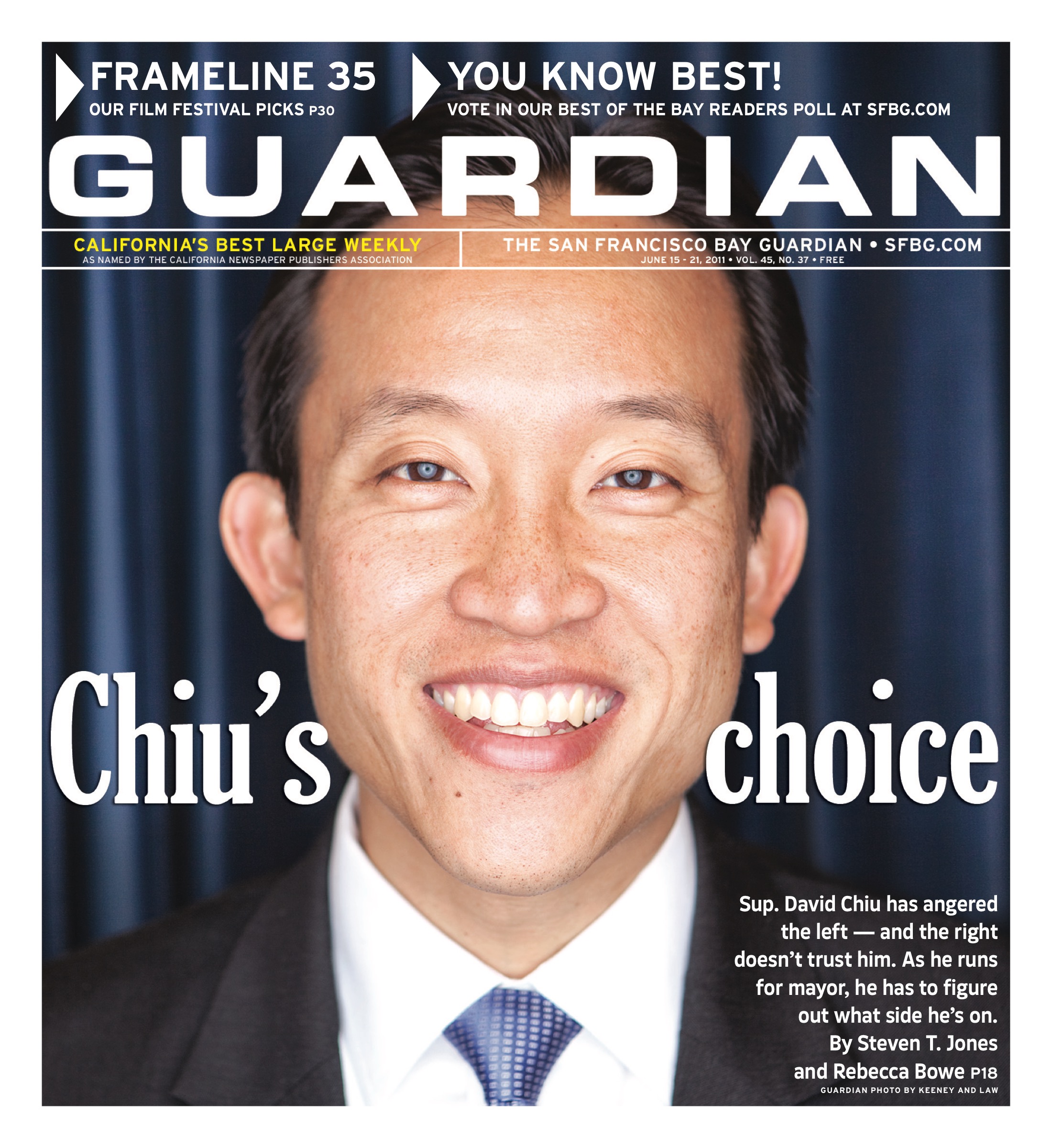
When I interviewed Chris Daly for this week’s cover story on David Chiu and the political realignment at City Hall, Daly said we were putting the wrong guy on the cover.

“If the story is about political realignment, it’s about David Ho,” Daly told me of the political consultant who once worked on his and other progressive campaigns, but who helped engineer a split in the progressive movement with the help of consultant Enrique Pearce and District 3 Sup. Jane Kim, whose campaign they worked on together last year, beating early progressive favorite Debra Walker.

Daly said the political realignment that has taken place at City Hall has more to do with Kim and Ho – in collusion with former Mayor Willie Brown, Chinatown Chamber head Rose Pak, and Tenderloin power broker Randy Shaw – than it does with Chiu, who Daly considers simply a pawn in someone else’s game. Ho is seeking to be Pak’s successor as Chinatown political boss, and he and Pearce have been out there doing the ground work Pak’s effort to convince Lee to remain mayor.

“Any realignment that exists is about David Ho and I think it has more to do with the District 6 race than the District 3 race,” Daly said. “As far as David Chiu and realignment, they are separate things.”

While Ho and Pearce have traditionally worked on progressive campaigns – particularly in high-profile contests like this year’s mayor’s race, where John Avalos is the clear progressive favorite – they are now some of the strongest behind-the-scenes backers of the campaign to convince Ed Lee to run. Neither Ho nor Pearce returned our calls for comment.

“That’s the whole realignment,” Daly said, explaining that it was the peeling of entities like Chinatown Community Development Corporation and the Tenderloin Housing Clinic away from the progressive coalition of the last decade that has cast progressive supervisors into the wilderness and empowered Chiu and Kim, who in turn brought Lee to power.

“It’s not a seismic realignment, it’s a minor realignment, it just happens to be who’s in power,” Daly said. “It was a minor political shift that caused a big change at City Hall.”

Power has now consolidated around Mayor Lee, as well as those who convinced Chiu to put him there, including the powerful players who helped elect Kim. “These people, as far I can tell, have disowned Chiu,” Daly said. “He did what they wanted but he failed the loyalty test in the process.”

Chiu has so quickly fallen from favor that even Planning Commission President Christina Olague, who spoke at Chiu’s campaign launch event on the steps of City Hall just two months ago, is now one of the co-chairs of a committee pushing Lee to run, along with others connected to CCDC and the Pak/Brown power center.

Kim has also notably withheld her mayoral endorsement. She tells us that she’s waiting until after budget season, but the real reason is likely to wait and see whether Lee gets into the race. Daly said this new political power center has been playing the long game, starting with supporting Chiu back in 2008.

“Peskin kind of brought him up, and then I – tactically or a strategic blunder – I made the mistake of not bringing someone up,” Daly said, insisting that he’s always questioned Chiu’s political loyalties. “I had doubts from the beginning. Ultimately, it was Jane Kim and David Ho who tag teamed me and got me on board.”

Daly said Chui’s last-minute move to cross his progressive colleagues and back Lee for mayor “irreparably harmed him with progressives,” while doing little to win over a new political base. “He miscalculated the damage it would do to him,” Daly said.

Chiu’s dependability was also called into question when he was openly considering a deal with Gavin Newsom to be named district attorney, which would have allowed Newsom to appoint his replacement in D3, a move that he didn’t check with Pak.

“He gave control of his political base to someone else,” Avalos told us, offering that if Chiu was going to be so narrowly ambitious then he should have taken Newsom’s offer to become district attorney.

Even those around Chiu have emphasized his independence from Pak, who has desperately been looking for someone she could count on to back and prevent Leland Yee from winning the mayor’s office. And if Lee doesn’t run, sources say she’s likely to back another political veteran such as Dennis Herrera or Michela Alioto-Pier.

But given how deftly Ho and his allies have grabbed power at City Hall, I’d say they have a pretty good chance of convincing Lee to run, despite the mayor’s resistance. And if Lee runs, Daly, USF Professor Corey Cook, and others we interviewed say he would probably win.

Sneaky campaign to draft Lee sullies political environment

92

At a time when City Hall is taking on several important issues – from the budget and pension reform to massive projects such CPMC’s mega hospital and housing project and the redevelopment of Parkmerced and Treasure Island – an ambitious cabal of political operators bent of convincing Mayor Ed Lee to break his word and run for office is poisoning the environment under the dome.

A series of unfolding events over the last week makes it clear that Sup. Jane Kim’s campaign team – political consultants Enrique Pearce and David Ho, Tenderloin shot-caller Randy Shaw, and their political benefactors Willie Brown and Rose Pak – are orchestrating another campaign to convince Lee to run for office, apparently abandoning the mayoral campaign of Board President David Chiu.

The Bay Citizen reported that Pearce was pursuing creation of a mayoral campaign that Lee could simply step into, while blogger Michael Petrelis caught Pearce creating fake signs of a grassroots groundswell for Lee over the weekend. That effort joins another one by the Chronicle and a couple of downtown politicos to create the appearance of popular demand for Lee to run despite a large field of well-qualified mayoral candidates representing a wide variety of constituencies.

And then today, Shaw joined the effort with a post in his Beyond Chron blog that posed as political analysis, praising the John Avalos campaign – an obvious effort to ingratiate himself to the progressive movement that Shaw alienated by aggressively pushing the Twitter tax break deal and Kim’s candidacy – while trying to torpedo the other mayoral campaigns, calling for Lee to run, and offering a logic-tortured take on why the public wouldn’t care if Lee breaks his word.

Pearce and Ho – who sources say have been aggressively trying to drum up support for Lee in private meetings around town over the last couple weeks – didn’t return our calls. Kim, who is close to both Chiu and Avalos, told us she is withholding her mayoral endorsement until after the budget season – which, probably not coincidentally, is when Lee would get into the race if he runs.

Fog City Journal owner Luke Thomas, who Petrelis caught taking photos for Pearce over the weekend – told us Pearce’s Left Coast Communications, “hired me in my capacity as a professional photographer to take photographs of people holding ‘Run Ed Run!’ signs and should not be construed as an endorsement of the effort to draft Ed Lee into the mayor’s race.”

In an interview with the Guardian last week, Lee reiterated his pledge not to run for mayor – which was the basis for his appointment as a caretaker mayor to finish the last year of Gavin Newsom’s term – but acknowledged that Pak and others have been actively trying to convince him to run. Pak has an open disdain for candidate Leland Yee and fears his ascension to Room 200 would end the strong influence that Pak and Brown have over the Mayor’s Office and various department heads.

“I am not running. I’ve told people that. Obviously, there is a group of good friends and people who would be happy for me to make a different decision, so they’re going to use their time trying to persuade me. I’ve told them I’m not interested and I have my personal reasons for doing that but they’re not convinced that someone who has held this office for five months and not fallen into a deep abyss would not want to be in this office and run for mayor. I’ve been honest with people that I’m not a politician. I’ve never really run for office nor have I ever indicated to people that I’d like to run for mayor of San Francisco. That’s just not in my nature so it’s been a discussion that is very foreign to me that has been very distracting for me in many ways because I set myself a pretty aggressive piece of work that this office has to get to. The way I do it is very intensely. I do meet a lot of people and seek their input before I made a decision,” Lee told us.

Even Sup. Sean Elsbernd, who nominated Lee for mayor, told the Chronicle that he doesn’t support the effort to pressure Lee into running and he feels like it could hurt sensitive efforts to craft compromises on the budget and pension reform. When asked by the Guardian whether he would categorically rule out a run for mayor, Lee told us he would.

“I’ve been very adamant about that yet my friends will still come up to me and they’ll spend half their time talking to me about it. And I say thank you, I’m glad you’re not calling me a bum and trying to kick me out,” Lee told us, noting that Pak – a longtime ally who helped engineer the deal to get Lee into office, for which Chiu was the swing vote, parting from his five one-time progressive supervisorial allies in the process – has been one of the more vociferous advocates on him running.

Asked whether there are any conditions under which he might change his mind, Lee told us, “If every one of the current supervisors in office asked me to run and those supervisors who are running voluntarily dropped out.” But Avalos says he’s committed to remain in the race, and his campaign has been endorsed by three other progressive supervisors.

A rather odd endorsement

94

I got a press release today from the Dennis Herrera for Mayor campaign proudly announcing the endorsement of … Frank Jordan.


Jordan was mayor of San Francisco once. Back in the 1990s. His term ran from 1992 to 1996, and was, to be polite, mediocre. Nice guy; awful mayor. He was one of the more conservative mayors in memory, left office pretty unpopular, and a lot of people don’t even remember him. Those who do, particularly progressives, don’t remember him fondly at all.


Ah, but Herrera does.


“I’m deeply honored by Mayor Jordan’s praise for my leadership, and grateful for his endorsement for my mayoral candidacy,” said Herrera.  “Few can claim to have done as much to serve our City with such integrity, skill and courage as Frank Jordan.”


While Leland Yee is out trying to get support on the left, which might actually help him win, Herrera seems to be moving, if anything, to the right (which is what Jordan’s endorsement represents). Very odd. Very odd indeed.


I couldn’t reach Herrera today to ask him about it, but I’m sure he’ll call me and I’ll update this post. Meanwhile: WTF?  


UPDATE: I heard from Herrera late in the day. He told me that “there are only six people alive who have ever held the office of mayor of San Francisco and know what it’s really like to manage this city, and I would be proud to have the endorsement of any of them.” I asked: Including Willie Brown? Herrera: “He’s a columnist now so he doesn’t do endorsements.”


Herrera also pointed out, correctly, that he has the endorsement of Mike Hennessey, the progressive sheriff. And he’ll wind up with some more leftish endorsements, too. Still: Frank Jordan?

A different Mayor’s Office

10

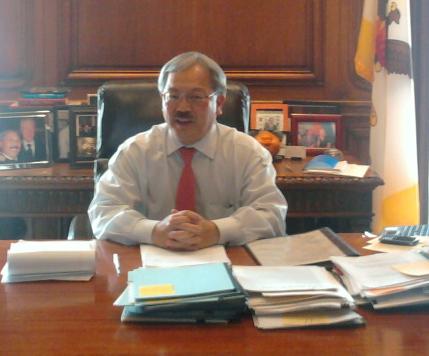
A group of Guardian reporters and editors met with Mayor Ed Lee June 2, and while the mayor and I don’t agree on everything, I have to say: It was refreshing.


Refreshing because the mayor has a sense of humor and doesn’t act like an infallible monarch. Refreshing because his office looks like, well, a working office. Refreshing because he smiled, was polite and never said “I dispute the premise of your question.”


What a difference.


Under Willie Brown, the mayor’s office was an imperial sanctum. If His Royal Williness deigned to favor one of his servants or subjects with the boon of a royal visit, you were expected to crawl on your hands and knees and kiss the floor. 


When Gavin Newsom was the occupant, the place was a cross between a museum and an Architectural Digest showplace — not a scrap of paper on the desk, every hair perfectly in place, the Robert Kennedy pictures and books lined up perfectly for the visitor to admire.


Both mayors treated the press with hostility. Both expected to be treated as potentates. The mayor was better than you and I — and you needed to understand that right away, or risk disdain and dimissal.


Ed Lee isn’t doing what I want with the budget. He’s not talking about raising taxes on the rich. He’s probably going to go along with ParkMerced and maybe even Treasure Island. He signed the Twitter tax break. I worry (a lot) about his ties to past corrupt regimes.


But he’s happy to have reporters in his office. He’s got stacks of reports on his desk and a notepad that suggests he’s actually reading them. He showed us his private “man cave” in the back, and offered us walnuts. He’s not always right on policy, and I don’t think he should run in the fall … but he’s not a jerk. And given the recent history of San Francisco mayors, that’s pretty radical.


Don’t undo ballot measures

0

EDITORIAL The California initiative process is broken. The state’s too big, and it costs too much to gather signatures and mount a media campaign for or against a ballot measure.

But in San Francisco, the initiative process has traditionally been, and for the most part continues to be, a check on corrupt or ineffective political leaders and a chance for progressive reforms that can’t make it through City Hall. That’s why Sup. Scott Wiener’s proposal to allow the supervisors to amend (or, in theory, abolish) laws passed by the voters is a bad idea.

Since 1968, the San Francisco voters have approved 96 ordinances; that’s an average of about two a year. Obviously the pace has picked up since the 1970s. In 2008, there were eight measures approved; in 2010 there were four. The length and complexity of the ballot makes it appear that the supervisors aren’t doing their work, Wiener says. He notes that when he was campaigning, one of the most common complaints was that the voters were being asked to decide too many things that should have been handled at City Hall.

Some of that is the result of an unwieldy City Charter. Benefits for police and firefighters, for example, are specified in the charter, and any change needs voter approval. Wiener’s measure, aimed only at initiatives and not charter amendments, wouldn’t change that situation.

But some of it relates to the political alignments in San Francisco. For much of the past decade, the supervisors and the mayor were at odds over major issues. The mayor couldn’t get his (bad) proposals, like a ban on sitting on the sidewalks, through the board, and the progressives couldn’t get their proposals past a mayoral veto. So both sides went directly to the voters.

That’s a lot better than the paralysis we’re seeing in Sacramento. At least the issues are getting decided.

And over the years, some of the most important legislation in San Francisco — growth controls, tenant protections, protections for children’s programs, the city’s landmark open-government law — has come through ballot initiatives. The only way public power advocates have been able to get the issue on the agenda has been through ballot initiatives.

Those were issues that generations of supervisors and mayors wouldn’t take on — the developers and landlords and secrecy lobbyists and Pacific Gas and Electric Co. had too much power at City Hall. And those protections for the public, the environment, and the most vulnerable residents only survive today because they’re set in law and can’t easily be changed.

If Wiener’s measure has been in effect a decade ago, for example, Proposition M — the 1986 law that set neighborhood planning priorities and limits on office development, would have been summarily scrapped by Mayor Willie Brown and a pro-developer board. Key rent-control laws would have been repealed or amended to death. The ban on buildings that cast shadows on parks would be gone. Killing the Sunshine Ordinance would have been Brown’s first act.

Today’s district-elected board is far more accountable to the voters — but there’s hardly a reliable progressive majority. And the point of ballot initiatives is that you can’t predict who will control City Hall next year, or in 10 years.

We don’t think the initiative process in San Francisco is out of control. Sure, big money wins the day too often — but on balance, it’s a check that the Board of Supervisors should leave alone.

Editorial: Don’t undo ballot measures

3


The California initiative process is broken. The state’s too big, and it costs too much to gather signatures and mount a media campaign for or against a ballot measure.

But in San Francisco, the initiative process has traditionally been, and for the most part continues to be, a check on corrupt or ineffective political leaders and a chance for progressive reforms that can’t make it through City Hall. That’s why Sup. Scott Wiener’s proposal to allow the supervisors to amend (or, in theory, abolish) laws passed by the voters is a bad idea.

Since 1968, the San Francisco voters have approved 96 ordinances; that’s an average of about two a year. Obviously the pace has picked up since the 1970s. In 2008, there were eight measures approved; in 2010 there were four. The length and complexity of the ballot makes it appear that the supervisors aren’t doing their work, Wiener says. He notes that when he was campaigning, one of the most common complaints was that the voters were being asked to decide too many things that should have been handled at City Hall.

Some of that is the result of an unwieldy City Charter. Benefits for police and firefighters, for example, are specified in the charter, and any change needs voter approval. Wiener’s measure, aimed only at initiatives and not charter amendments, wouldn’t change that situation.

But some of it relates to the political alignments in San Francisco. For much of the past decade, the supervisors and the mayor were at odds over major issues. The mayor couldn’t get his (bad) proposals, like a ban on sitting on the sidewalks, through the board, and the progressives couldn’t get their proposals past a mayoral veto. So both sides went directly to the voters.

That’s a lot better than the paralysis we’re seeing in Sacramento. At least the issues are getting decided.

And over the years, some of the most important legislation in San Francisco — growth controls, tenant protections, protections for children’s programs, the city’s landmark open-government law — has come through ballot initiatives. The only way public power advocates have been able to get the issue on the agenda has been through ballot initiatives.

Those were issues that generations of supervisors and mayors wouldn’t take on — the developers and landlords and secrecy lobbyists and Pacific Gas and Electric Co. had too much power at City Hall. And those protections for the public, the environment, and the most vulnerable residents only survive today because they’re set in law and can’t easily be changed.

If Wiener’s measure has been in effect a decade ago, for example, Proposition M — the 1986 law that set neighborhood planning priorities and limits on office development, would have been summarily scrapped by Mayor Willie Brown and a pro-developer board. Key rent-control laws would have been repealed or amended to death. The ban on buildings that cast shadows on parks would be gone. Killing the Sunshine Ordinance would have been Brown’s first act.

Today’s district-elected board is far more accountable to the voters — but there’s hardly a reliable progressive majority. And the point of ballot initiatives is that you can’t predict who will control City Hall next year, or in 10 years.

We don’t think the initiative process in San Francisco is out of control. Sure, big money wins the day too often — but on balance, it’s a check that the Board of Supervisors should leave alone.


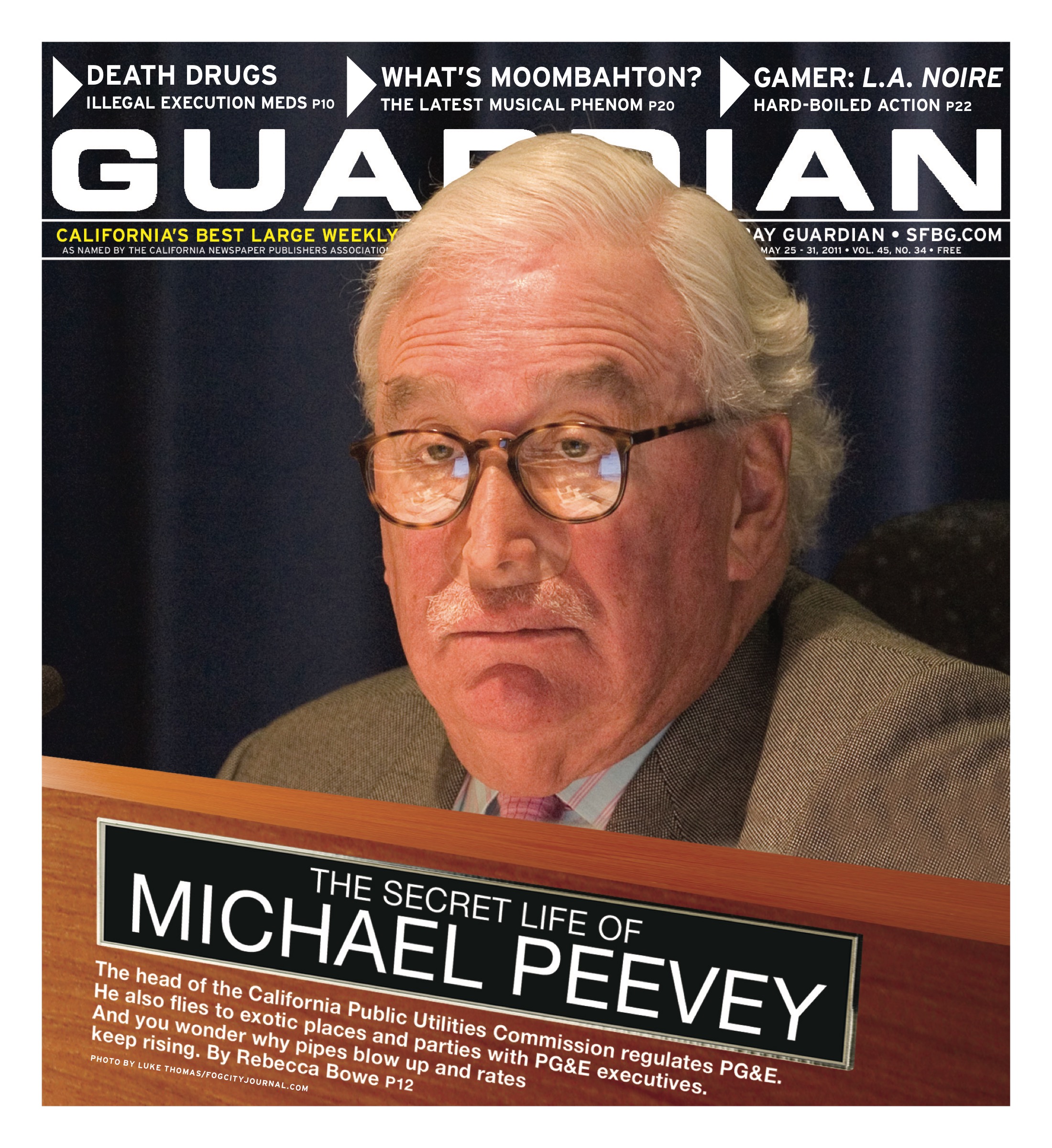
The secret life of Michael Peevey

11

rebeccab@sfbg.com

Inside a legislative hearing room at the state capitol, things were beginning to get uncomfortable. Roughly five weeks had passed since a Pacific Gas & Electric Co. pipeline explosion killed eight and leveled an entire San Bruno neighborhood, and this California Senate committee hearing was an early attempt to get answers.

San Bruno residents who lost loved ones in the deadly explosion huddled in the front row, their eyes fixed on company representatives and agency bureaucrats as they spoke. At the back of the room, a band of immaculately dressed PG&E executives and utility lawyers sat clustered together.

Richard Clark, director of the consumer protection and safety division of the California Public Utilities Commission (CPUC), fielded questions from visibly frustrated state legislators. Sen. Dean Florez (D-Shafter) wanted know why the CPUC hadn’t done anything when PG&E ignored an impaired section of the ruptured pipeline even after it was granted $5 million to fix it.

“Did the PUC do any accounting when you gave them $5 million?” Florez demanded. “Do we just give them money and cross our fingers and hope they fix it? Is that what we do? Until some terrible tragedy occurs?”

Sen. Mark Leno (D-San Francisco) said the CPUC needed to step it up and start practicing serious hands-on oversight. He recalled a tragedy that occurred in 2008 when a gas leak in Rancho Cordova triggered a pipeline explosion, killing one person and injuring several others. Although an investigation determined that PG&E was at fault, the CPUC hadn’t yet gotten around to fining the company.

“We’ve got a pattern here,” Leno said. “And we’re not doing anything differently.”

Less than three weeks after CPUC staff members were grilled in Sacramento, Michael Peevey — president of the CPUC and the top energy official in the state — boarded an airplane for Madrid. He was embarking on a 12-day travel-study excursion, with stops in Sevilla and Barcelona, sponsored by the California Foundation on the Environment and the Economy (CFEE).

Peevey’s wife, California Sen. Carol Liu (D-Glendale), was along for the trip. So were two other state senators, several members of the state Assembly, CPUC commissioner Nancy Ryan, and a host of representatives from the energy industry. The group included executives from Chevron, Mirant (now GenOn, the owner of the Potrero power plant), Covanta Energy Corporation, Shell Energy North America, and engineering giant AECOM. High-ranking executives of the state’s investor-owned utilities also participated, including Fong Wan, the senior vice president of energy procurement for PG&E.

Although strict rules normally govern commissioners’ interactions with parties that have a financial stake in the outcomes of commission rulings, there wasn’t anything especially unusual about Peevey traveling internationally with a group that included representatives from the same companies his regulatory commission oversees. CFEE trips happen every year. The nonprofit has footed the bill to fly groups of regulators, legislators, and utility executives to prime vacation destinations like Italy, Brazil, and South Africa in recent years, excursions organizers say are critical for educating top-level stakeholders about worldwide best practices for sustainable systems. However, groups such as The Utility Reform Network (TURN) have decried CFEE trips as “lobbying junkets.”

As PG&E and the CPUC both work to win back the public’s confidence after their latest deadly failure, it’s worth analyzing whether their relationship — shaped by vacations together at exotic locales — has grown too cozy.


THE BUDDY SYSTEM

CFEE isn’t the only nonprofit that regularly flies Peevey overseas for green travel tours with high-ranking utility executives, and the 12 days he spent in Spain wasn’t the only time he spent away from official duties and in the company of the corporations his commission regulates.

These controversial getaways are just a small part of Peevey’s involvement with private-sector interests. He also chairs the board of a nonprofit investment fund created as part of a $30 million settlement agreement with PG&E. Called the California Clean Energy Fund, it funnels money into private venture-capital funds that invest in green start-ups, plus a few companies in the fossil-fuel sector.

While legislators have voiced frustration that lax CPUC oversight of PG&E on pipeline-safety issues opened the door to disaster in San Bruno, inside observers are critical of the outright favors Peevey has granted utilities, such as guaranteeing an unprecedented, higher-than-ever profit margin for PG&E as part of the company’s 2004 bankruptcy settlement.

The CPUC is set up to perform as a watchdog agency, yet social and professional ties running deep within California’s insular energy community mean regulators sometimes run in the same circles as the executives who answer to them, making for cozier relationships than the general public might anticipate. It’s an old-fashioned insider game that one longtime observer wryly characterizes as “the buddy system.” But the buddy system can bring consequences.

As the public face of the CPUC, Peevey repeatedly has been thrust into the spotlight. He has absorbed advocates’ concerns about pipeline safety, rising electricity rates, SmartMeters, missed targets for energy efficiency, and municipalities’ David-vs.-Goliath battles with PG&E to implement community choice aggregation (CCA), to name a few. He’s a magnet for public scrutiny while occupying the center seat at commission meetings, but Peevey’s behind-the-scenes engagements with private-sector organizations bent on shaping statewide energy policy demonstrate how power is wielded in California’s energy world, a system in which regulators seem to be partnering with utilities rather than policing them.

Based at Pier 35 in San Francisco, CFEE’s board of directors is composed of a small group of officers, plus a long list of members who hail from some of the most prominent businesses nationwide. Shell, Chevron, J.P. Morgan, Goldman Sachs, AT&T, and PG&E all hold positions on CFEE’s membership board, and each entity chips in to fund the foundation’s activities and travel excursions.

The group also includes representatives from labor organizations like the International Brotherhood of Electrical Workers and mainstream environmental groups such as the Natural Resources Defense Council. Among the emeritus members of CFEE’s governing board are some high-ranking figures, such as CIA director-turned-Pentagon boss Leon Panetta. CFEE received $45,000 in donations from PG&E in 2009 (the most recent year available) and was granted similar amounts in prior years.

CFEE spokesperson P.J. Johnston, the son of former state senator and CFEE officer Patrick Johnston and the press secretary under former Mayor Willie Brown, described the trips as valuable opportunities for top-level stakeholders to gain insight on best practices and engage in noncombative dialogue on key issues.

“The idea for us was that it made sense to have someplace where it was nonconfrontational to engage in policy, work-type discussions,” Johnston explained. He added that the trips are “all about policy, on the 30,000-foot level,” and emphasized that discussions aren’t about specific decisions pending before the CPUC.

Loretta Lynch, a former president of the CPUC who brought a reformist spirit to the agency and was never shy about rebuking utilities, is skeptical of CFEE’s stated program goals. When she was first appointed to the commission, Lynch said, CFEE contacted her to ask where she wanted to travel. If the trips are arranged to fly regulators to destinations they’ve been itching to visit, she reasoned, must-see green innovations probably aren’t dictating the itineraries. “To me,” Lynch said, “they don’t have anything to study in mind.”


“PARTYING WITH THE JUDGE”

The CFEE trip to Spain included a briefing on developing wind energy from AES, a company working on wind and solar development in California that also operates polluting, gas-fired power plants in Huntington Beach, Long Beach, and Redondo Beach. There was a round table on solar energy featuring a presentation from the Independent Energy Producers Association, a trade group that regularly files petitions and comments on CPUC proceedings. The trip included a tour of a desalination plant, a talk from the president of the Madrid Chamber of Commerce, and discussions about California’s energy market. Scheduled activities ended by midafternoon on some days, and the itinerary left a Friday afternoon, Saturday, and Sunday in Sevilla wide open.

Asked to comment on concerns about inappropriate lobbying, Johnston said: “We’re not guarding against anyone’s potential behavior any more than we would be on the streets of Sacramento. We’re not setting ourselves up as the guardians. We’re not facilitating that, per se, either.” He added, “I realize there are critics of any kind of travel and any kind of commingling. But it is wise for us not to close our eyes to the rest of the world, and there’s not a great appetite for spending taxpayer money on these trips.”

Yet Lynch countered that there is an important distinction between the roles of Sacramento legislators and that of utility commissioners. “Regulators are not legislators,” Lynch said. “They’re more like judges. Their decisions have the power of a judge’s decision.” By inviting commissioners along on these lavish getaways, she said, “it’s as if you’re partying with the judge.”

Mindy Spatt, a spokesperson for TURN, echoed Lynch’s concerns. “These ostensibly educational trips are essentially lobbying junkets, where utilities … wine and dine legislators,” Spatt said. TURN raised the issue several years ago, she said, when Peevey joined a CFEE trip attended by a representative of Southern California Edison “just coincidentally at the exact same time that he was penning an alternate decision in Edison’s rate case.” She added: “In TURN’s perspective, the commissioners need to be more in touch with what actual utility customers are experiencing, rather than in touch with the top restaurants in Brazil.”

While Peevey is only one of a host of officials who attend CFEE trips, he has more than just a casual tie to the nonprofit. From 1973 to 1983, he served as president of the California Coalition for Environment and Economic Balance (CCEEB), an organization CFEE grew out of and whose membership shares some overlap with CFEE.

Based in San Francisco, CCEEB was founded by Edmund G. “Pat” Brown (Gov. Jerry Brown’s father) in 1973. CCEEB backed a late-1970s proposal to construct a series of nuclear power plants along the California coastline. More recently, the group honored BP with a 2009 award for environmental education — shortly before the company and lax federal regulators were responsible for the worst oil spill in U.S. history.


A YEAR IN THE LIFE

Spain wasn’t the only country Peevey jetted off to with complimentary airfare in 2010. According to a Form 700 filing with the Fair Political Practices Commission, he also traveled to Germany from Aug. 1–5 for a sustainable energy study tour organized by the Energy Coalition. Joining that trip were representatives from investor-owned utilities PG&E, Southern California Edison, and Sempra, plus various city officials and energy experts from the Swedish Energy Agency.

The group stayed at the Radisson Blu Berlin Hotel, which is famous for its AquaDom. “Standing at 25 meters high, it is the world’s largest cylindrical aquarium containing 1 million liters of saltwater,” according to the hotel website. All Radisson Blu Berlin guests have free access to “the hotel’s well-being area,” called Splash, which features a pool, sauna, steam bath, and fitness room.

Based in Irvine, the Energy Coalition’s Board of Directors is chaired by Warren Mitchell, a retired chair of the Southern California Gas Co. and San Diego Gas & Electric Co.. Another director is a utility lawyer who also sits on the board of directors of the Northeast Gas Association, a consortium of natural gas companies in the northeastern U.S.

Founded in the late 1970s by John Phillips to get large businesses to reduce energy consumption in partnership with utilities, the Energy Coalition has arranged excursions for years to bring energy regulators, city officials, and utility executives to Sweden (where Phillips’ wife was born) to exchange ideas on energy issues. The nonprofit organizes an annual summit called the Aspen Accord, “an energy policy forum where cities, utilities, regulators, and end-users collaborate to identify problems and propose solutions to our most pressing energy issues,” according to a 2009 tax filing. While it used to be held in Aspen, Colo., the most recent Aspen Accord was held at San Francisco’s Westin St. Francis. Peevey gave introductory remarks, and the conference featured talks from PG&E, among others.

Craig Perkins, executive director, told the Guardian that the Aspen Accord and study trips are designed to create a venue for major stakeholders to arrive at outside-the-box solutions. “What we try to do is get everybody out of their comfort zone, if you will — that’s the best way to support more creative thinking,” he said. Official regulatory proceedings are “so rigidly legalistic and bureaucratic that it almost prevents any creative thought from happening,” he added. “We’re not in San Francisco, we’re not in Sacramento, we’re not in corporate offices — let’s just talk about these really big issues, and really big challenges.”

The Germany tour included meetings with the Berlin Energy Agency, talks about climate policy, and a tour of an eco-community in Freiburg. Perkins said utility companies must to pay their own way on the trips, but costs are covered for governmental officials.

An Energy Coalition tax filing reveals that board members receive a monthly retainer of $1,000, quarterly meeting fees of $1,000, plus $500 for each board committee meeting. Teleconferences also result in $500 meeting fees.

Several years ago, the Energy Coalition partnered with PG&E to create the Business Energy Coalition, which paid businesses including Bank of America and the Westin St. Francis $50 per KW of energy savings for banding together to reduce energy during peak load hours. According to a tax filing, total annual Energy Coalition revenue dropped from $10.7 million in 2008 to $3.75 million in 2009 “due to large revenue receipts for participant incentives” for the Business Energy Coalition program, as “revenues were used for direct pass-through payments to program participants and contractors.” In 2006, according to a CPUC filing, PG&E paid the Energy Coalition $227,373 for unspecified consulting services.

In addition to the $8,880 trip to Spain (comped), and the $6,583 trip to Germany last year (comped), Peevey’s 2010 disclosure form shows that he also went to Australia May 14-19 to participate in a conference hosted by the Sydney-based Total Environment Center called “Smart Metering to Empower the Smart Grid” ($12,577, comped). And while it doesn’t show up on his FPPC filing, an agenda for CFEE’s Energy Roundtable Summit from Dec. 9-10 at the Carneros Inn in Napa lists Peevey as a participant. A glance through past filings suggests that 2010 was no anomaly; it’s a typical year in the life of a jet-setting utilities regulator.


GREEN CAPITALISM

Peevey once served as president of the Southern California Edison, an investor-owned utility, and was president of NewEnergy, Inc., an electricity company that later was sold to Williams Energy. Yet his professional image is that of a forward-thinker on climate change. According to a bio on the CPUC website, he’s received awards for achievements on green and sustainable energy from various organizations throughout California.

In 2005, speaking in Berkeley at an annual conference for the California Climate Action Registry, Peevey touted a list of his accomplishments on sustainable energy. My final example of PUC actions on climate change is related to PG&Es bankruptcy, he said. When they emerged from bankruptcy last year, one of many conditions of our support for their reorganization plan was that they create a $30 million Clean Energy Fund, devoted to investing in California businesses developing and producing clean technologies.

What Peevey didnt mention is that he chairs the board of directors of that fund. As a nonprofit venture capital fund, the obscure, San Francisco-based CalCEF sounds like an oxymoron. Based on the terms of the PG&E bankruptcy settlement, its governed by a nine-member board consisting of three CPUC appointees, three PG&E appointees, and the rest selected jointly by the CPUC and PG&E appointees. Other board members include past PG&E executives, a former member of the California Energy Commission, and a former chair of the board of governors of the California Independent System Operator (Cal-ISO), the body that ensures statewide grid reliability and blocked the closure of the Mirant Potrero Power Plant for years.

The nonprofit’s stated mission is to catalyze clean energy investment to aid in the state’s transition away from fossil fuels. CalCEF president Dan Adler described it as a sort of seasoned guide for fledgling green companies that might otherwise fail to navigate the murky, complicated clean-energy sector. CalCEF is in a position to usher start-ups toward success with a combination of funding, networking, and insider wisdom on state energy policy.

Among the challenges that the clean-energy sector faces, Adler said, are the utilities themselves. “They are effectively monopoly, or oligopoly, controllers of the energy industry,” he said. “And they don’t like outside innovation coming and disrupting their work process or their relationship with their customers.”

CalCEF aims to guide the finance community “to be partners with what public policy is doing around clean tech and clean energy,” Adler went on. “There’s a tremendous amount of money to be made, but there’s also a lot of opportunity for money to be wasted. If you don’t have a private-sector investment community that understands these rules and can put their money alongside these rules in a collaborative framework, we’re very unlikely to achieve the really aggressive energy targets that California has set.”

Yet as one skeptical energy insider noted, “there are 15 to 20 other funds, with 10 times as much money, an hour south in the same field,” referring to the burgeoning clean-tech hub in Silicon Valley. It’s questionable whether the CPUC is actually fulfilling some dire need with CalCEF, this person said.

Lynch, not surprisingly, takes a dim view of CalCEF. The former CPUC president questions what business the CPUC has creating a private foundation to guide venture capital investment. “It is a fundamental distortion of the PUC’s authority,” she charged, “all in service of Peevey’s ambitions.”

Peevey’s economic disclosure showed that he holds more than $1 million in a private family trust, without disclosing whether private investments contributed to that fund.

Adler stressed that there is arms-length relationship between CalCEF board members and the companies that benefit from the fund’s investments. “Because we are a nonprofit, and because we have on our board members of the regulatory community, we recognized quickly that we can’t be making direct investments into companies,” said Adler, a former CPUC staff member who was highly regarded even by the critics of CalCEF. “So … we’ve picked the venture-capital funds that we wanted to partner with.”

CalCEF funnels its capital into three different for-profit investment firms, which in turn select the companies that will be included in CalCEF’s investment portfolio. Several directors of the partnering investment firms also sit on the boards of directors of the companies they invest in. The startups run the gamut, from carbon-offset outfits, to energy-efficient lighting manufacturers to solar and wind companies, to biofuels startups to various kinds of technology firms related to the smart grid.

But CalCEF has also poured money into companies that bolster the fossil-fuel industry. One of its first investments was CoalTek, a company developing technology for so-called “clean coal.” Asked to explain why, Adler told the Guardian, “We don’t have veto power on every deal that goes down.”

Adler said he personally believes that “there’s no such thing as clean coal,” but tempered this by adding, “there are some very smart people in our community who will tell you that there’s no future … without coal.”

Another CalCEF investment, DynaPump, is developing technology to make it more energy efficient to pump oil and gas. Asked about this decision, Adler responded: “I will say that when we were approached with this investment by the venture partner that ultimately undertook it, we had our misgivings. If you can save energy in the production of oil and gas, then you’re definitely making a contribution to overall energy efficiency.”


TAX-EXEMPT TESLA

There appear to be some closer-than-arms-length links between CalCEF board members and the investment fund’s beneficiaries. A bio for CalCEF director Nancy Pfund, for example, notes that in her capacity as manager of an outside investment fund, she had “worked closely” with Tesla Motors, a CalCEF investment. Tesla provided CalCEF’s first investment return earlier this year after Tesla went public. A principal of one of the investment firms that works with CalCEF, Stephen Jurvetson of Draper Fisher Jurvetson, holds Tesla shares in a personal trust, according to a filing with the U.S. Securities and Exchange Commission.

Tesla manufactures sleek, electric, zero-emission sports cars with prices in the six-figures, and it’s gearing up to roll out a model that will cost somewhere closer to $50,000. The company’s success was helped by a sales-and-use-tax exclusion granted by the state of California last year. Peevey had a hand in that, too. Few Californians may have heard of the California Alternative Energy and Advanced Transportation Financing Authority (CAEATFA), a state body within the Office of the Treasurer, which has the power to authorize sales-tax exclusions for companies that are developing alternative energy technologies. Peevey has a seat on it.

In October 2009, according to a CAEATFA document, Tesla was granted a sales tax exclusion from that financing authority. The sports car manufacturer had received a tax break of $3.3 million as of December 2010, and stands to gain a tax break as large as $29.1 million, depending on its property purchases. As a CAEATFA member, Peevey approved the deal by proxy.

A central question is whether the CalCEF dollars that benefited Tesla and other CalCEF portfolio investments were originally derived from PG&E shareholder profits or ratepayer funds. Adler was careful to note that the initial $30 million came from company shareholders, not PG&E customers. But Lynch pointed out that every dime in PG&E coffers originates with the millions of customers who pay utility bills.

Lynch noted another provision of the bankruptcy settlement agreement, which guarantees PG&E a minimum annual profit of 11.2 percent, catapulting it forever into a higher rate of return than the 8 percent to 11 percent profit traditionally granted by the CPUC in prior decades. “They’re manipulating how big this bucket is to siphon off funds into programs like CalCEF,” Lynch said. “It’s all to give Peevey and his friends access — and to greenwash what was a very stinky deal for the ratepayer.”


ELUSIVE CLEAN ENERGY FUTURE

In California, a national leader in addressing climate change, the stakes are high in the energy sector. The CPUC is tasked not only with shoring up transmission-pipeline safety to prevent another San Bruno disaster, but helping to chart a course away from reliance on fossil fuel-powered energy sources.

CFEE, the Energy Coalition, and CalCEF share a common thread — their missions relate to advancing the cause of a clean energy future in California. And while utility funding and partnership is evident in all three operations, the overarching goal is understood to be green.

But as Adler observed, the utilities themselves present one of the greatest obstacles to progress on a clean-energy transition. While California has increased renewable energy sources, it’s done a poor job at supplanting fossil fuel generation with green alternatives, in part because the CPUC has allowed for increasing fossil fuel power generation even as renewable energy expands. According to a listing on the California Energy Commission website, nine natural gas power plants have won approval statewide and are moving toward construction, while six new ones are under review.

The CalCEF approach to addressing climate change, rather than aggressively targeting polluting industries, is to encourage the fledgling green industry in hopes of facilitating success in partnership with the financial sector. In many cases, the backers of the clean-tech companies are the same players behind the big energy giants.

Environmental advocates are critical. “If anyone thinks the CPUC is set up to serve public interests, forget that,” says Al Weinrub, executive director of the Local Clean Energy Alliance, a group that organized against PG&E’s ill-fated Proposition 16 last year. “They never have and they never will.”

Weinrub said he viewed proponents of green energy as falling into two camps: Moneyed interests motivated by a growing new market sector, and activists motivated by environmental and social justice causes. Major green investment firms “want to de-carbonize capitalism,” he observed. “But everything else stays the same.”

Peevey is considered a major driver behind the state’s climate change legislation, and he’s highly regarded for his dedication to green energy. Yet as long as the interlocking dynamic between energy regulators and California’s largest utilities goes unchallenged, change will only come in a way that’s as comfortable, profitable, and manageable for the state’s top polluters as they wish. And in a state with an aging energy infrastructure that’s vulnerable to the impacts of climate change, that pace isn’t nearly quick enough. 


Lee needs to make a decision

2

news@sfbg.com

The moment Ed Lee accepted the job as interim mayor — with the strong support of former Mayor Willie Brown and Chinatown powerbroker Rose Pak — we knew that the word “interim” would soon be in play.

Lee promised he wouldn’t run in November, and for some supervisors (particularly Sean Elsbernd, who nominated Lee) that was a deal breaker: Elsbernd told us he wouldn’t vote for anyone who wanted to seek a full term. But immediately some of Lee’s supporters began pushing him — quietly and not-so-quietly — to go back on his word and announce his candidacy.

Last week, a fake “draft Ed Lee” campaign emerged and got front-page treatment in the San Francisco Chronicle, despite the fact that it was orchestrated entirely by two political consultants. And word around City Hall is that Lee faces immense pressure to get in the race — and hasn’t entirely ruled it out.

That’s a problem. Lee is heading into a crucial budget season and will be negotiating with, and making deals with, a wide range of constituency groups. Everyone in town needs to know, now, what sort of mayor is running the show — a caretaker trying to get San Francisco through a rough time until a duly elected replacement can take office, or an ambitious politician looking at how to leverage this appointment into a four-year gig.

Lee has every right to run for mayor, and the filing deadline isn’t until August. By law, and political tradition, he can wait until the last minute to tell the city how he plans to spend the fall. And the fact that he promised not to run shouldn’t be an absolute bar: we never endorsed the idea of a caretaker mayor in the first place. What if Lee does a great job? What if the voters overwhelmingly want him to stick around? Why should that be off the table?

Still, this waiting game and this ongoing round of rumors and back-room discussions isn’t good for the city. If Lee wants to run, he needs to announce it now. If he’s not going to run, he needs to tell everyone — starting with Brown, Pak, and his other top backers — that he’s simply not going to do it, that he’s not changing his mind, and that they have to stop pushing him and making noise about it.

There are other candidates in the race, some directly involved in making city policy. When Sup. David Chiu talks about his budget priorities, we know exactly whom we’re dealing with — a board president who wants to be mayor. When City Attorney Dennis Herrera takes on the tricky job of running for mayor while serving as an impartial city legal officer, we know what the conflicts are. It’s not fair to them, or to anyone else, to be dealing with a mayor who may have secretly promised his supporters (who are also players and lobbyists at City Hall) that he’s getting into the race.

Lee may be personally undecided — but he can’t manage the city this way. He has to give San Franciscans a straight, and final, answer: is he running or not? Otherwise all these behind-the-scenes whispers, involving some very shady political operators, will fatally undermine his credibility. 


Editorial: Lee needs to make a decision

8


 The moment Ed Lee accepted the job as interim mayor — with the strong support of former Mayor Willie Brown and Chinatown powerbroker Rose Pak — we knew that the word “interim” would soon be in play.

Lee promised he wouldn’t run in November, and for some supervisors (particularly Sean Elsbernd, who nominated Lee) that was a deal breaker: Elsbernd told us he wouldn’t vote for anyone who wanted to seek a full term. But immediately some of Lee’s supporters began pushing him — quietly and not-so-quietly — to go back on his word and announce his candidacy.

Last week, a fake “draft Ed Lee” campaign emerged and got front-page treatment in the San Francisco Chronicle, despite the fact that it was orchestrated entirely by two political consultants. And word around City Hall is that Lee faces immense pressure to get in the race — and hasn’t entirely ruled it out.

That’s a problem. Lee is heading into a crucial budget season and will be negotiating with, and making deals with, a wide range of constituency groups. Everyone in town needs to know, now, what sort of mayor is running the show — a caretaker trying to get San Francisco through a rough time until a duly elected replacement can take office, or an ambitious politician looking at how to leverage this appointment into a four-year gig.

Lee has every right to run for mayor, and the filing deadline isn’t until August. By law, and political tradition, he can wait until the last minute to tell the city how he plans to spend the fall. And the fact that he promised not to run shouldn’t be an absolute bar: we never endorsed the idea of a caretaker mayor in the first place. What if Lee does a great job? What if the voters overwhelmingly want him to stick around? Why should that be off the table?

Still, this waiting game and this ongoing round of rumors and back-room discussions isn’t good for the city. If Lee wants to run, he needs to announce it now. If he’s not going to run, he needs to tell everyone — starting with Brown, Pak, and his other top backers — that he’s simply not going to do it, that he’s not changing his mind, and that they have to stop pushing him and making noise about it.

There are other candidates in the race, some directly involved in making city policy. When Sup. David Chiu talks about his budget priorities, we know exactly whom we’re dealing with — a board president who wants to be mayor. When City Attorney Dennis Herrera takes on the tricky job of running for mayor while serving as an impartial city legal officer, we know what the conflicts are. It’s not fair to them, or to anyone else, to be dealing with a mayor who may have secretly promised his supporters (who are also players and lobbyists at City Hall) that he’s getting into the race.

Lee may be personally undecided — but he can’t manage the city this way. He has to give San Franciscans a straight, and final, answer: is he running or not? Otherwise all these behind-the-scenes whispers, involving some very shady political operators, will fatally undermine his credibility.


Chronicle pushes fake campaign to “draft” Ed Lee

83

Downtown is clearly nervous about not having a reliable horse in the mayor’s race, so much so that a few power brokers are using the Chronicle to drum up a fake “campaign” to convince Mayor Ed Lee to break his word and run to keep the job. And the fact that these liars – those who just six months ago earnestly argued we need a caretaker mayor who won’t run for the office – are pushing this with a front-page, above-the-fold “news” story shows just how shameless they are.

Say what you will about this year’s field of mayoral candidates, but they do represent a broad range of constituencies and they include several seasoned politicians who are well-qualified to be mayor. Sen. Leland Yee has served in a variety of public offices for decades, Sup. John Avalos is a reliable progressive intimately familiar with the workings of City Hall, Dennis Herrera and Phil Ting each hold citywide offices to which the Mayor’s Office is the logical next step, Michela Alioto-Pier is a consistent supporter of ruling class interests, and David Chiu has proven his political skills by engineering his reelection as board president and installing Lee as mayor.

So why exactly do people want to convince Lee to go back on his word, as well as giving up the city administrator position that the board just cleared the way for him to return to with an ethics exemption? Well, the Chronicle article doesn’t really make that clear, all it makes clear is that’s what Willie Brown and Rose Pak – as well as their errand boys, former Sup. Michael Yaki and downtown consultant Jim Ross – want.

And why do they want Lee to remain in the Mayor’s Office? Because they’re the ones who put him there and he has done nothing to challenge the corrupt status quo at City Hall, where corporate desires trump people’s needs every time. Chief-of-staff Steve Kawa is still calling the shots, Brown’s clients and developer buddies are still getting what they want, and Pak still gets to be the de facto leader of Chinese-American interests in City Hall.

They desperately fear that Yee will win the mayor’s race and clean house, kicking out Kawa and all of the Brown and Pak cronies, greatly reducing their power in San Francisco. And the rest of the candidates are too independent and broad-based to guarantee the continued power of Brown and Pak and the downtown interests they represent. Their only hope is that they can cut some kind of deal with Chiu to maintain their influence in the next administration by applying pressure through this article and the others likely to follow in this fake draft-Lee campaign.

To his credit, Sup. Sean Elsbernd isn’t taking part in this shameless charade, instead sticking by the statements he made when he nominated Lee to be mayor, telling the Chronicle that in a year with tough political decisions on the budget, pension reform, and other pressing issues, “this city desperately needed someone who wasn’t going to play election-year politics,” and that, “if he files papers to run for mayor, all that goes away.”

That’s true, along with any illusions that Lee and those who back him have any integrity.

Civil Grand Jury report rips Parkmerced plan

One week before the massive Parkmerced redevelopment project is slated to go before the Board of Supervisors for a second shot at approval, the San Francisco Civil Grand Jury has issued a scathing critique of the plan in a report titled “The Parkmerced Vision: Government-by-Developer.” The assessment charges that the project’s development agreement fails to guarantee adequate rent-control protections for current tenants whose homes will be razed and replaced with new units as part of the ambitious, 20-to-30 year overhaul.

The Civil Grand Jury report charges that the development agreement “is fundamentally unable to deliver such assurances because of overarching state laws that are changeable and subject to court interpretation. Through its call for demolition of existing units, the agreement eliminates existing statutory rights of tenants, replaces them with a contractual agreement from the owner/developer, and bypasses due process in the face of eviction.”

The report appears to reject the claim that the tenant protections are “ironclad,” an assurance that was repeated often in public hearings by representatives of the developer and the city’s Office of Economic and Workforce Development. “As it is stated, the agreement claims it can cause newly constructed units to be protected under the same rent stabilization ordinance previously applied to the demolished dwellings,” the report notes. “In reality, current laws appear to contravene this claim.”

When a discussion about Parkmerced was continued several weeks ago at a Board of Supervisors meeting, several members of the board voiced concerns that they did not have enough clarity on the question of whether renter protections could be guaranteed for tenants who reside in the complex’s 3,221 rent-controlled units, some of whom have lived there for decades.

“Never before has a redevelopment project of this size and length been undertaken in San Francisco in an existing community where more than 9,000 people live,” the report notes. It acknowledges the enormous tax revenues that the city stands to gain from the development, but cautions that “this windfall, no matter how promising, should not come at the expense of citizens’ legal rights.”

To remedy the flawed agreement, the Civil Grand Jury recommends that the city “enact legislation prior to signing the Development Agreement that adequately assures the statutory rights of existing tenants to remain at Parkmerced and enjoy undisturbed continued tenancy,” and goes onto suggest language providing that “If a landlord demolishes residential property currently protected under the City’s Rent Stabilization and Arbitration Ordinance, and builds new residential rental units on the same property within five (5) years, the newly constructed units are subject to the San Francisco Rent Stabilization Ordinance.”

Meanwhile, Parkmerced spokesperson P.J. Johnston has already issued a response the hot-off-the-presses report, sending out a press release calling it “flawed,” and charging that the Civil Grand Jury is “calling for a solution to a problem San Francisco has already solved.”

Johnston contends that San Francisco already has a provision in the local municipal code that would do exactly what the Civil Grand Jury is asking city government to enact as a remedy for the shortcomings of the development agreement. Is Johnston’s interpretation of the local ordinance an accurate assessment? Not being lawyers ourselves, the Guardian phoned the office of the City Attorney to find out. We’ll post a response as soon as we receive one.

Johnston criticized the Civil Grand Jury report as “a highly political stink bomb,” saying, “I believe we’ve been able to address those concerns over the past several weeks, and I hope our leaders are able to see past this kind of last-minute distraction.” Johnston, who previously served as former Mayor Willie Brown’s press secretary, added, “This reeks of the nasty side of San Francisco politics.”

**UPDATE** The Guardian just received a call from an official from the City Attorney’s office, who said they did not want to be quoted because Parkmerced is a highly politicized issue. This person confirmed that the existing code Johnston pointed to does in fact do just what the Civil Grand Jury was asking for, and added that the local law had been referenced in a Parkmerced board file from last week. Seems the Civil Grand Jury didn’t have that information when it issued the report.

And the next chief is…yes, Suhr!

3

Mayor Ed Lee appointed a deeply emotional Captain Greg Suhr as Chief of the San Francisco Police Department during a swearing-in ceremony where the majority of folks were either elected officials, running for election, running each other’s electoral campaigns—or wearing SFPD uniforms.

And in the end it seemed that the choice may have been influenced by pressure from the powerful San Francisco Police Officers Association, judging from the comment Lee jokingly directed at SFPOA leader Gary Delagnes, saying, “Gary, it’s time to get quiet and go to work.”

Lee told a standing-room only crowd that when he returned from Hong Kong to San Francisco four months ago finding a new police chief was his top priority. And that initially it was suggested (Lee did not say by whom) that he leave the SFPD situation alone and allow an elected mayor to appoint the next Chief.

‘While I am an interim mayor, this is not an interim decision,” Lee told the crowd, signaling that while he may be out of office in January, Suhr may be here to stay as the city’s top cop.

“Today, I’ve chosen the best candidate,” Lee continued, thanking Acting Chief Jeff Godown for his work leading the SFPD since former Mayor Gavin Newsom made the shocking decision to appoint former Chief George Gascón as District Attorney.

But while Newsom’s move may have upset the apple cart in the D.A.’s race, it sure seems to be working out well for Suhr.

Describing Suhr as “a police and people’s Chief: and “a reformer from the inside out,” Lee ran through a long list of the new Chief’s contributions to the SFPD. These included Suhr’s 30 years of service, his climb through the ranks to become Captain of the Mission station, his gig as Captain of the San Francisco Public Utilities Commission in a Homeland Security capacity, and, since 2009, as Captain of the Bayview station.

Suhr began by saying he was “speechless.” Donning glasses to read a speech that he had prepared the night before, Suhr choked up when he talked of being “fourth-generation, born and raised in San Francisco.” Recovering his composure, Suhr smoothly changed gears, as he joked how his appointment therefore makes him “a local hire,”—an insider reference to Sup. John Avalos’ recently approved local hire legislation that Mayor Lee is helping enact citywide.

Suhr recalled how he started out as a rookie on the midnight shift in the Tenderloin in 1981. He thanked his family, his friends and his girlfriend Wendy. And then he asked for a moment of silence “ to honor the memory of all the brave officers who have given their lives in the line of duty.”

Lee reclaimed the podium long enough to jokingly ask Suhr  “to investigate the whereabouts of my birth certificate” as his first assignment as the new chief.

Then it was Board President David Chiu’s turn. Chiu described Suhr as someone, ”who knows our streets, walked the walk, and knows the beats, someone who we all feel confident will be able to bring the SFPD the reform that former Chief Godown, Chief Gascón and Chief Heather Fong initiated. “

San Francisco Superior Court Judge Katherine Feinstein, who is the daughter of Sen. Dianne Feinstein and the presiding judge of the Superior Court, recalled how she has known Suhr since the mid 1980s. “I have watched him as each of our careers have moved forward,” Feinstein said, noting how there were some “steps forward and some steps backward” and how, “there were those who thought this day would never come.” (Feinstein’s words were the only reference to some of the less sunny moments in Suhr’s long and distinguished career. These included his 2003 indictment as part of Fajitagate, an incident that involved off-duty officers, a bag of take-out food, a beer bottle and injuries sustained by two local residents. Suhr was cleared of wrongdoing the next year, but was reassigned by then Chief Heather Fong to the PUC position after an incident in 2005, in which a police officer was seriously injured at an anarchist protest, and videographer Josh Wolf was held in federal prison for 226 days after he refused to release unedited footage of the protest.)

Next up was D.A Gascón and his rooster-like shock of silver hair. Gascón noted that when he first came to San Francisco, in the summer of 2009, he had no allegiances to, and no prior knowledge of, people inside the SFPD.

“I looked at Greg Suhr and one of the things that impressed me is how he worked with and related to people,” Gascón said, explaining why he appointed Suhr as Bayview Captain “Not only has he exceeded all expectations he did an incredible job,” he said.

 Police Commission President Thomas Mazzucco said that in the 100 days since the Commission announced it was looking for a new chief, it became clear that Suhr has the support of SFPD’s rank-and-file.

Mazzuco noted that he met Suhr in high school. “I knew he could hold a ball,” Mazzuco added, noting that he subsequently became Suhr’s football coach, even though he is younger than Suhr. “What the Police Commission has brought to us is not only a native son but also a cop’s cop. It’s an honor to have him as his chief.”

And after the swearing-in, the sentiment among officers in blue appeared to be strongly in Suhr’s favor. Lt. Ken Lee of Central Station recalled how he and Suhr went through the police academy together about 30 years ago.

“We went to different assignments but we’ve maintained a friendship,” Lee said. “The moment I met him I liked him. He was a very stand-up person, and as a native San Franciscan like myself, you could tell he had strong ties to the city. He’s a hard worker, he’s very dedicated to what he does.”

Lt. Mario Delgadillo, also of Central Station, said Suhr hasn’t lost his connection to the street. “That also means a lot, when you have a boss who’s walking with you,” Delgadillo said.

Suhr takes over the SFPD as it’s grappling with the fallout from a recent spate of scandals, including videos that Public Defender Jeff Adachi released that appear to show police misconduct at residential hotels and that forced DA Gascón to hand over his investigation of this alleged police misconduct to the FBI. Asked during a media roundtable what his appointment means for Acting Chief Godown, Suhr said Godown has returned to being Assistant Chief of Operations, which was the post he held before Gascón, who recruited Godown from LAPD, was appointed DA.

In response to a question about his top priorities as police chief, Suhr noted, “When I sit down with the mayor this afternoon, the mayor’s going to tell me what his priorities are. My first priority will be blocking the door open on the 5th floor so that if you wanna come see me you can, like it used to be. Then I have to meet with the command staff and captains and get their take on where they think we are, where they think we’re moving forward best, and match that up against how I’ve seen from a position of Bayview, how that matches up. And then see if I can’t meet with different community groups, the different police employee groups and the command staff.”

He didn’t mince words when it came to indicating that SFPD officers are going to be asked to give back during upcoming budget negotiations
“I’m sure that there’s going to have to be adjustments and I look forward to working with a collaborative effort with the mayor and the board and the unions and the rank and file,” Suhr said. “When the economy’s been good we’ve benefited by it, and now that the economy has … gone the other way, to some extent I think that the officers are willing to give back to do whatever needs to be done to keep the city safe.”

So, how does Suhr think he differs from former Chief Gascón? 

”He has a gorgeous head of hair,” Suhr joked. “To put it in a sports analogy, he’s a quarterback shortstop guy, and I’m more of a catcher, lineman, linebacker kind of guy. But I admire him, I think he moved a lot of issues forward for the police department, and I look forward to continuing those initiatives and giving a few of them a shot in the arm that I think were beginning to wane a bit.”

Suhr also talked about how he has always wanted to become a police officer (a comment that suggests he’s not planning to use the Chief’s post as a stepping stone to the District Attorney’s Office).

”When I went into the police department. on Silver Avenue which is now Willie Brown Academy — that was the police academy back in 1991 when I came in — man, we looked at just the regular uniformed police officers with just stars in our eyes, because they were just the sharpest, classiest folks that we were aspiring to be,” Suhr said.

And he indicated that as Chief, he won’t tolerate dishonesty in the face of ongoing investigations into alleged police misconduct. ”The character of a police officer must be above reproach,” Suhr said. “And I think that the investigation will show what it ends up showing, but I don’t think that there’s a police officer in San Francisco that would want to have a dishonest cop and I’d be at the top of that list. So I want all my officers to be of character that is above reproach.

Asked if he welcome clarification around the duties of SFPD officers assigned to the FBI’s Joint Terrorism Taskforce, Suhr said he believed an examination of the wording of the FBI’s most recent memorandum of understanding (MOU) with the department was already under way.

“I believe that the MOU is being revisited,” Suhr said. “I have not been a part of that, but again I think we have a real good policy with regard to our intelligence gathering and that does supercede any ask of any other agency. The officers are bound by policies and procedures. And that policy was well thought out with tremendous community and group input years and years ago, from situations that have not since repeated themselves. I think a lot of people back then couldn’t believe they happened in the first place, but I think measures were well thought out and put in place to make sure we don’t have a problem again.”

And at the end of the day, Suhr expressed the hope that his tenure as Chief would endure long after the interim mayor is replaced by an elected mayor.

”I’m a native San Franciscan, and this is a dream come true,” he said. “It’s my first day. However this story ends, with a little bit of luck (raps on the wood tabletop) it’s not going to end today.”

Earth Day in City Hall … on Wells Fargo’s dime

Who was lucky enough to get treated to Mayor Ed Lee’s Earth Day Breakfast in City Hall, with the city’s top politicos and a smattering of high-profile San Franciscans? After noticing that the Board of Supervisors had approved a grant of $12,000 from Wells Fargo a few weeks ago to sponsor the event, the Guardian contacted the Mayor’s Office to ask for the guest list. The response came from the city’s Department of the Environment, which accepted the donation and organized the affair.

The 472-person invite list (we don’t know how many actually attended) included prominent figures such as Sens. Barbara Boxer and Dianne Feinstein, Rep. Nancy Pelosi, billionaire investor Warren Hellman, and former San Francisco Mayor Willie Brown. All 11 members of the Board of Supervisors were invited, too, as were mayoral hopefuls City Attorney Dennis Herrera, Assessor-Recorder Phil Ting, and state Sen. Leland Yee.
 
Invitations were extended to some truly green organizations, too, such as Green for All, Save the Bay, Rainforest Action Network, the Ella Baker Center for Human Rights, the Sierra Club, the Apollo Alliance, Greenaction, and others.

And many seats were reserved for the corporate sector. A total of nine representatives of Pacific Gas & Electric Co. were on the list. There were seven from Cisco, several from consulting and design firm CH2MHill, and a couple representatives from Skidmore, Owings & Merrill — the firm that’s doing the Parkmerced overhaul and which was tapped to envision waterfront venues for the America’s Cup. 

Seven representatives — including the CEO — were invited from Recology, which is in the midst of a debate over its high-stakes, $275 million no-bid garbage contract with the city.

According to Mark Westlund of the Department of the Environment, only half of the Wells Fargo grant went toward the mayor’s Earth Day Breakfast, “the remainder to a series of community events held in the Department’s EcoCenter lobby.” The other sponsors included Blue Shield of California ($2,000); CH2MHill; Skidmore, Owings & Merrill; United Airlines; Environmental Science Associates ($4,000); Levi Strauss & Co.; Cisco ($6,000) and Starbucks — which provided BPA-free travel mugs (double green points!).

It’s nice that San Francisco taxpayers didn’t have to shell out the $18,000 for all these people to celebrate Earth Day together. But at an event such as this, with so many millions of dollars in city contracts and major development projects flying around (not to mention the half a dozen or so people in need of campaign contributions), you can bet they weren’t all talking to one another about saving the planet.

Editor’s notes

6

tredmond@sfbg.com

The candidates for mayor of San Francisco are already lining up endorsements — the Sierra Club held its interviews April 23, which seems awfully early to me, since some of the most interesting contenders in this town (Tom Ammiano, Matt Gonzalez) have a tendency to jump in at the last minute. And the filing deadline isn’t until August.

But the sooner the big names and organizations are lined up and the money is locked in, the harder it will be for anyone to pull off an August surprise. So unless the redistricting commission seriously messes with Mark Leno’s state Senate seat or Ed Lee bows to the pressure from Willie Brown, Rose Pak, and their allies and decides to go back on his promise and seek a full term, we’re probably looking at a rough approximation of what the voters will face in November.

With John Avalos in the race, the ballot’s become a lot more attractive to progressives. It’s not as if the other major candidates don’t have a lot to offer, and in some cases, they have a lot to offer to the left. There are smart, experienced, qualified people running.

But let’s be honest here: David Chiu, Dennis Herrera, Phil Ting, Leland Yee, and Bevan Dufty all operate somewhere in the squishy political center, a place where tax breaks for corporations are okay, where “homeownership opportunities” tend to trump the needs of tenants, where deals with big private developers are sculpted around the edges but never rejected outright, and where cuts in services are a larger part of the budget solution than taxes on the rich.

Michela Alioto-Pier is off on the far right of the San Francisco political world, and if she looks at all credible and gets any significant traction (and that’s a big if) she’ll be downtown’s favorite candidate. But until now, there was nobody holding the solid progressive banner.

I don’t think that means Avalos’ appeal is limited to the left; he’s in a swing district, and he’s very popular there, and he can talk about small business and community development and open, honest government. He doesn’t sound like a crazy radical; he’s polite and respectful and listens to people.

But I’m glad we have a candidate who won’t try to argue that 25 percent affordable housing at Treasure Island is something to be proud of, or that the Twitter tax break will create jobs, or that social inequality can’t be addressed through local policy. I’m glad there’s someone who can push the discussion and debate out of the middle, can force some of the others who want progressive support to take strong stands, and can liven things up a bit. Because without him, all of the candidates were sounding a lot alike — and I really don’t want to be bored this fall.

Reject the Treasure Island plan

18

EDITORIAL After a long, long hearing April 21, as the San Francisco Planning Commission prepared to vote on an ambitious development plan for Treasure Island, Commissioner Gwyneth Borden acknowledged that the plan wasn’t perfect. But, she said, on balance it ought to be approved: “Twenty five percent affordable housing is better than zero percent.”

That’s not necessarily true.

Treasure Island is an usual piece of real estate, 403 acres of artificial land created in 1937 by dumping sand and dirt on a shallow part of the bay. It’s less than two miles from downtown San Francisco — but there’s no rail service, no BART station. The only way off the island is by boat — or by driving onto a Bay Bridge that’s already jammed way beyond capacity every morning and afternoon.

The soil is unstable, prone to liquefying in an earthquake — and if sea levels rise as high as some predictions suggest, the whole place could be underwater in a few decades.

A strange hybrid agency called the Treasure Island Development Authority, created by former Mayor Willie Brown, cut a deal with Lennar Urban (the same outfit that has the redevelopment deal for Bayview Hunters Point) and several partners to construct a neighborhood of some 19,000 people on the island. Among the features: a 450-foot condominium tower and 6,000 units of high-end housing. The developers brag that a fleet of new ferries will offer a 13-minute ride to the city and that some streets will be designed for pedestrians and bicycles.

But the fact remains that the developers want to add 19,000 new residents — almost all of whom will work off the island somewhere — to a place that has no credible transportation system. City studies show that even with an extensive (and costly) ferry service, at least half the new residents would drive cars to work (and, presumably, to shop, and go to movies, and eat and drink), joining the mob of vehicles heading east or west on the bridge. That’s almost 10,000 new cars each day trying to jam onto a roadway that can’t handle the existing traffic. The backups would stretch well onto San Francisco surface streets and as far back as Berkeley.

A rail line on the Bay Bridge would solve part of the problem. So would bike lanes. Neither option is even remotely possible in the foreseeable future. Free, or heavily subsidized ferries could, indeed, be a positive alternative — but who is going to pay for that service? Nonsubsidized ferries would be far more expensive than current Muni or BART service, a particular burden on the residents of the below-market housing.) And does anybody really think there’s going to be enough ferry capacity to carry 10,000 people a day to downtown SF, the East Bay, and the Peninsula?

The bottom line: this isn’t a good deal for San Francisco. The affordable housing level is too low. The transportation problems are nightmarish. The last thing Treasure Island needs is a 450-foot tower.

There’s no rush to approve this — and no immediate downside to waiting for a better deal. The supervisors should tell Lennar to come back with a project that has fewer residents, better transit options, and more affordable housing. Because zero is looking a lot better than what’s on the table.

PS: The 4-3 Planning Commission vote demonstrated exactly why it’s important to have key commission appointments split between the mayor and the Board of Supervisors. The mayoral appointees all rolled over — but at least the board-appointed members made strong points, forced real debate, and gave the supervisors plenty of ammunition to demand a better deal.

Spies in blue

19

sarah@sfbg.com

San Francisco cops assigned to the FBI’s terrorism task force can ignore local police orders and California privacy laws to spy on people without any evidence of a crime.

That’s what a recently released memo appears to say — and it has sent shockwaves through the civil liberties community.

It also has members of the S.F. Police Commission asking why a carefully crafted set of rules on intelligence gathering, approved in the wake of police spy scandals in the 1990s, were bypassed without the knowledge or consent of the commission.

“It’s a bombshell,” said John Crew, a long-time police practices expert with the American Civil Liberties Union of Northern California.

The ACLU obtained the document April 4 under the California Public Records Act after a long battle. It’s a 2007 memorandum of understanding outlining the terms of an agreement between the city and the FBI for San Francisco’s participation in the Joint Terrorism Task Force.

And, according to Crew, it effectively puts local officers under the control of the FBI. “That means Police Commission policies do not apply,” Crew said. “It allows San Francisco police to circumvent local intelligence-gathering policies and follow more permissive federal rules.”

Veena Dubal, a staff attorney at the Asian Law Caucus, agreed: “This MOU confirms our worst fears,” she said.

Dubal noted that in the waning months of the Bush administration, the FBI changed its policies to allow federal authorities to collect intelligence on a person even if the subject is not suspected of a crime. The FBI is now allowed to spy on Americans who have done nothing wrong — and who may be engaged in activities protected by the First Amendment.

FBI activity under this new “assessment” category has since come under fire, and a recent report in The New York Times showed that the FBI has conducted thousands of assessments each month, and that these guidelines continue under Obama.

And if the feds do control San Francisco police policy, then the San Francisco cops could be spying on innocent people — a dramatic change from longstanding city policy. “The MOU is disturbing,” Police Commission member Petra DeJesus told the Guardian. “The department is assuring us that local policies are not being violated — but it looks as if it’s subject to interpretation.”

It’s the latest sign of a dangerous trend: San Francisco cops are working closely with the feds, often in ways that run counter to city policy.

And it raises a far-reaching question: With a district attorney who used to be police chief, a civilian commission that isn’t getting a straight story from the cops, and a climate of secrecy over San Francisco’s intimate relations with outside agencies, who is watching the cops?


SPIES LIKE US

San Francisco has a long — and ugly — history of police surveillance on political groups. SFPD officers spied on law-abiding organizations during the 1984 Democratic National Convention; kept files in the 1980s on 100 Bay Area civil, labor, and special interest groups; and carried out undercover surveillance of political groups focused on El Salvador and Central America.

Those abuses led the Police Commission to develop a departmental general order in 1990 known as DGO 8.10. The local intelligence guidelines require “articulable and reasonable suspicion” before SFPD officers are allowed to collect information on anyone.

Even those rules weren’t enough to halt the spies in blue. In 1993, police inspector Tom Gerard was caught spying on political groups — particularly Arab American and anti-apartheid organizations and groups Gerard described as “pinko” — and selling that information to agents for the Anti-Defamation League.

As the ACLU and Asian Law Caucus noted in a December 2010 letter to Cdr. Daniel Mahoney: “That scandal was not just about the fact that peaceful organizations and individuals were being unlawfully spied upon and their private information sold to foreign governments, but that the guidelines adopted in 1990 had never been fully implemented by SFPD. No officers had been trained on the new guidelines and no meaningful audit had ever been implemented.”

Over the years, the commission has tried to keep tabs on police intelligence and prevent more spy scandals. The general order mandates that local police officials have to request general authority from a commanding officer and the chief to investigate any activity that comes under First Amendment protections — and must specify in the request what the facts are that give rise to this suspicion of criminal activity. The order also states that the chief can’t approve any request that doesn’t include evidence of possible criminal activity.

Those requests are reviewed monthly by the Police Commission and there are annual audits of the SFPD files to monitor compliance — so the notion that the local cops are joining the FBI spy squad without commission oversight is more than a little disturbing.

Officials with the FBI and SFPD are doing their best to reassure the local community that there’s nothing to worry about. But so far their replies seem to duck questions about whether FBI guidelines trump local policies. For example, the MOU states that “when there is a conflict, [task force members] are held to the standard that provides the greatest organizational benefit.”

We asked Mahoney to clarify: does that mean the local cops could be held to the FBI’s standards?

“The San Francisco Police Officer(s) who are assigned to the Joint Terrorism Task Force always have and continue to be required to follow all SFPD’s policies and procedures,” Mahoney replied in a statement.

That’s confusing; do they follow SFPD policies, or obey the MOU?

We asked FBI special agent-in-charge Stephanie Douglas whether SFPD officers are involved in surveillance and “assessments” (that FBI code word for creating spy files on individuals and groups) and whether they are identifying as SFPD or FBI officers.

“The FBI only initiates investigations on allegations of criminal wrongdoing or threats to our national security,” Douglas replied April 21. “Our investigations are conducted in compliance with the Constitution, the laws of the United States, the Attorney General Guidelines, the Domestic Investigation and Operations Guide, and all other FBI policies.”

Okay, that’s typical FBI-speak. Here’s more: “The JTTF is a task force comprised of FBI special agents, agents from other federal agencies, and local police officers who have been officially deputized as federal task force officers (TFOs) who have the power and authority of a federal agent. Because all JTTF TFOs are actually de facto federal agents, they are required to operate under federal laws and policies when involved in a JTTF case.”

So the cops are actually feds. But wait: “Our standard JTTF MOU recognizes, however, that the JTTF TFOs do wear two hats, as it were, and directs JTTF TFOs to follow his or her own agency’s policy when it is stricter than the FBI policy under certain circumstances,” Douglas concluded.

Again: not exactly clear, and not exactly reassuring.

“At some point they need to say whether SFPD officers are engaged in assessments,” Crew said.

These questions have spurred the Police Commission and Human Rights Commission to schedule a joint hearing in May to discuss what the document means, why SFPD never alerted the civilian oversight authorities, and whether a clarifying addendum can be tacked onto the agreement.


SPY FOR US OR LEAVE

The concerns are likely to be intensified by recent developments in Portland, Ore.

Portland dropped out of the Joint Terrorism Task Force in 2005 over concerns that local cops would be violating privacy laws. But in November 2010, the FBI thwarted a bomb plot allegedly linked to terrorists, and city officials came under pressure to rejoin the JTTF.

But Mayor Sam Adams has insisted on language that would bar local cops from doing surveillance and assessments, which, apparently, won’t fly with the feds.

On April 20, Willamette Week, the Portland alternative paper, wrote that Adams “effectively scuttled” Portland’s reentry into its local JTTF because of his anti-spying language.

In an April 19 letter to Adams, U.S. Attorney for Oregon Dwight Holton stated that Adams’ proposal of only allowing officers with the Portland Police Bureau to be involved in investigations and not in FBI assessments was a deal-breaker.

“Unfortunately, as currently drafted, the proposed resolution does not provide a way in which the PPB can rejoin the team,” Holton wrote. “There is a single provision that stands as a roadblock to participation — specifically the provision that seeks to have the City Council delineate only certain investigative steps a task force officer can take part in. Specifically, the resolution seeks to dictate for the JTTF which stages of an investigation task force officers from the [Portland police] can work on.”

“Investigation and prevention of complex crimes and terrorism are typically fluid and fast-moving,” he added. “It makes no sense to ask [Portland police] officers to be in for one part of a conversation, but out for another part of the same conversation as investigators discuss findings from assessments, investigations, etc. in evaluating and addressing terrorist threats in Portland and beyond.”

The message isn’t lost on San Francisco civil liberties activists. If you don’t let your cops join the spy squad, they can’t be a part of the task force.

“It was one thing to join the JTTF 10 years ago when they were operating under guidelines that, while not to the ALCU’s taste, were at least tied to some level of suspicion,” Adams said. “But they have taken their procedures and guidelines and moved them to the far right. It’s one thing to say that it’s necessary for the FBI to do that, and quite another to say that local agencies have to forfeit their own policies — and with no public debate or decision-making.”


ASK THE FEDS FIRST

Further complicating the question of police oversight is the fact that George Gascón, who was police chief when civil liberties groups started asking for a copy of the MOU last fall, refused to turn over the document without asking the feds first.

In a Jan. 4 letter to the ACLU and ALC, Gascón and Mahoney stated that the SFPD could not speak to information about the duties, functions, and numbers of officers assigned to the Joint Terrorism Task Force “without conferring with our partners in the Federal Bureau of Investigation.”

“I am sure you can appreciate the delicate balance we hold in crafting policy that not only supports our mission in the ultimate protection of life, but also in advancing democratic values through collaboration with the communities we serve,” Gascón and Mahoney wrote.

And Gascón is now district attorney.

“It raises the question of accountability,” said Public Defender Jeff Adachi “We want to make sure that police officers working in the city, regardless of whether it be for the feds or the SFPD, are complying with general orders and policies established by the department. But when officers go on an assignment with the feds, we don’t know if they are operating under parameters set by local law.”

Unearthing the FBI’s hitherto clandestine MOU with the SFPD appears to be yet another sign that local police are increasingly being subjected to federal policies not in keeping with local procedures.

As the Guardian previously reported, the 2008 decimation of San Francisco’s sanctuary city legislation and the 2010 activation of the federal government’s controversial Secure Communities program, which both happened during former Mayor Gavin Newsom’s tenure, means that the city of St. Francis now ranks among the top 38 counties nationwide that are deporting “noncriminal aliens.”

Dubal also noted that the FBI came to the SFPD in 1996 asking for help with the task force, but also sought a waiver from the Police Commission so officers could participate without having to follow local rules. “And within two weeks, then Mayor Willie Brown said, not in our town,” Dubal said. “So in 1997, the SFPD said we are not going to join unless we can follow our own rules. And in 2001, when the SFPD joined, it was under an MOU that required them to comply with SFPD rules and was signed in 2002 by then-SFPD Chief [Earl] Saunders.”

Dubal said that after local law enforcement agencies sign an MOU with the FBI, they designate and assign officers to work from FBI headquarters. “In the past, two SFPD officers, paid with San Francisco tax dollars, physically worked in the FBI’s office in a secure room where you can only go if you have security clearance. But they still can’t spy without reasonable suspicion, and they also need audits.”

Crew and Dubal said that in a recent meeting, SFPD officials assured them that local police were following General Order 8.10, but that they are open to creating an MOU addendum to clarify this.

Crew and Dubal remain unsure if the FBI would be agreeable to signing off on that. They note that the FBI has previously stated that its JTTF has sensitive investigations going on so it can’t give the public all the information. “Fine, but the issue is, Are these investigations based on suspicion, or are they based on religious background, associations, ethnicity, and travel patterns?” Dubal said.

They also doubt that the MOU would even have surfaced if not for comments that then SFPD Chief Gascón made, first in October 2009, then in March 2010, that triggered an uproar in the local Muslim, Arab, and Pakistani and Afghani communities.

At the time, Gascón, who has a law degree and graduated from the FBI Academy, had just landed in San Francisco fresh from a stint as police chief for Meza, Ariz., where he drew praise for speaking out against Maricopa County Sheriff Joe Arpaio’s inhumane treatment of undocumented immigrants Given this seemingly progressive stance, Gascón shocked civil libertarians in San Francisco when he said he wanted to unearth SFPD’s intelligence unit, which was disbanded amid scandal in the early 1990s.

“We have to realize that in the post-9/11 world, San Francisco is an iconic city, like New York, Washington. and Los Angeles,” Gascón said. “If somebody wanted to make a big statement about something they disliked about America, doing it here would definitely get attention. We need to know what is going on under the surface of the city.”

But Gascón did not say how a revived police spy unit, which had been shut down in large part due to Crew’s work, would operate. And six months later, he upset Bay Area Muslims during a March 2010 breakfast by reportedly saying that the Hall of Justice building was not just susceptible to earthquakes, but also to an attack by members of the city’s Middle Eastern community who could park a van in front of it and blow it up.

Gascón subsequently claimed that he “never referred to Middle Easterners or Arab Americans,” but that he had instead singled out the Afghanistan and Yemen communities because they pose “potential terrorism risks”

“In light of Gascón’s comments and his desire to resurrect the intelligence unit, people were asking, ‘Is it possible that the SFPD is also doing the same thing?'” Dubal asked, noting that she started getting complaints in 2009 and throughout 2010 about the FBI.

“Folks were saying that the FBI was asking about their religious identity, their family situation, and their political activities,” she recalled. “I certainly saw an upswing in innocent people being contacted. People were saying, ‘What the hell? — the FBI knocked on my door at 5 a.m.'”


COMMUNITIES UNDER SIEGE

A 2011 Human Rights Commission report documents frequent complaints from Arab, Muslim, and South Asian communities facing racial and religious profiling while traveling and unwaraanted interrogation, surveillance, and infiltration by local and federal law enforcement personnel at their homes, places of worship, and workplaces.

The report recommended asking the supervisors and the Police Commission to “ensure that all SFPD officers, including those deputized to the Joint Terrorism Task Force, follow and comply with local and state privacy laws, including DGO 8.10.”

On April 5, the Board of Supervisors voted 10-0 to approve a resolution, sponsored by Sup. Ross Mirkarimi and cosponsored by Sups David Chiu, Eric Mar, David Campos, and John Avalos, to endorse the HRC report.

All this is happening against the backdrop of FBI guidelines that have been loosened twice since September 2011, first by U.S. Attorney General John Ashcroft in the wake of the 9/11 terrorist attacks, then by Attorney General Michael Mukasey in the dying days of the Bush administration, and now by the Obama administration.

And as The New York Times reported in March, records obtained through a Freedom of Information Act request show that between Dec. 2008 and March 2009, the FBI began 11,667 assessments of people and groups for criminal/terror links, completed 8,605 assessments, and launched more than 400 intensive investigations based on the assessments. The FBI also told the Times that agents continue to open assessments at about the same pace

Crew noted that Mukasey’s guidelines marked the first time since 1976 that the FBI has been allowed to do assessments and collect files without a suspicion that a crime has occurred.

Dubal observed that the most relevant documents to emerge from a recent FOIA request to determine if the FBI has engaged in disturbing intelligence gathering activities are those related to “geomapping.”

“The materials are not particular to Northern California, but they show how FBI maps communities based in ethnic concentrations,” Dubal said.

Dubal also pointed to the case of Yasir Afifi, an Egyptian American student from Santa Clara, who found an FBI tracking device on his car when he took it in for an oil change. In March 2011, CAIR filed suit in Washington, D.C., alleging that the FBI violated Afifi’s First, Fourth, and Fifth Amendment rights by failing to obtain a warrant.

DeJesus recently told the Guardian that the Police Commission was never made aware of the MOU’s existence. “The chief should have checked in with the commission president, at the very least,” she said. “The idea that they were not reporting this to anyone is disconcerting.”

“The SFPD does not have the authority to enter into a secret agreement with the FBI whereby some of its officers are allowed to conduct intelligence operations in violation of the Police Commission’s General Order 8.10,” Crew added.

In a Jan. 25 letter to Mahoney, representatives from the ACLU and the ALC noted that “in the past, the SFPD had not previously deferred to the FBI on whether or how to openly address how San Francisco police officers will be supervised and held to well-established and painstakingly and collaboratively crafted San Francisco general orders.”

“These are low-level investigations that require no criminal predicate, meaning that when initiating an assessment, FBI agents can conduct intrusive forms of investigation without any criminal suspicion,” Dubal said. “These include interviewing innocent Americans, infiltrating organizations, using open source data to spy and surveil, going into religious centers such as mosques to spy and surveil, and recruiting and using informants.”


Editorial: Reject the Treasure Island plan

1

After a long, long hearing April 21, as the San Francisco Planning Commission prepared to vote on an ambitious development plan for Treasure Island, Commissioner Gwyneth Borden acknowledged that the plan wasn’t perfect. But, she said, on balance it ought to be approved: “Twenty five percent affordable housing is better than zero percent.”

That’s not necessarily true.

Treasure Island is an usual piece of real estate, 403 acres of artificial land created in 1937 by dumping sand and dirt on a shallow part of the bay. It’s less than two miles from downtown San Francisco — but there’s no rail service, no BART station. The only way off the island is by boat — or by driving onto a Bay Bridge that’s already jammed way beyond capacity every morning and afternoon.

The soil is unstable, prone to liquefying in an earthquake — and if sea levels rise as high as some predictions suggest, the whole place could be underwater in a few decades.

A strange hybrid agency called the Treasure Island Development Authority, created by former Mayor Willie Brown, cut a deal with Lennar Urban (the same outfit that has the redevelopment deal for Bayview Hunters Point) and several partners to construct a neighborhood of some 19,000 people on the island. Among the features: a 450-foot condominium tower and 6,000 units of high-end housing. The developers brag that a fleet of new ferries will offer a 13-minute ride to the city and that some streets will be designed for pedestrians and bicycles.

But the fact remains that the developers want to add 19,000 new residents — almost all of whom will work off the island somewhere — to a place that has no credible transportation system. City studies show that even with an extensive (and costly) ferry service, at least half the new residents would drive cars to work (and, presumably, to shop, and go to movies, and eat and drink), joining the mob of vehicles heading east or west on the bridge. That’s almost 10,000 new cars each day trying to jam onto a roadway that can’t handle the existing traffic. The backups would stretch well onto San Francisco surface streets and as far back as Berkeley.

A rail line on the Bay Bridge would solve part of the problem. So would bike lanes. Neither option is even remotely possible in the foreseeable future. Free, or heavily subsidized ferries could, indeed, be a positive alternative — but who is going to pay for that service? Nonsubsidized ferries would be far more expensive than current Muni or BART service, a particular burden on the residents of the below-market housing.) And does anybody really think there’s going to be enough ferry capacity to carry 10,000 people a day to downtown SF, the East Bay, and the Peninsula?

The bottom line: this isn’t a good deal for San Francisco. The affordable housing level is too low. The transportation problems are nightmarish. The last thing Treasure Island needs is a 450-foot tower.

There’s no rush to approve this — and no immediate downside to waiting for a better deal. The supervisors should tell Lennar to come back with a project that has fewer residents, better transit options, and more affordable housing. Because zero is looking a lot better than what’s on the table.

PS: The 4-3 Planning Commission vote demonstrated exactly why it’s important to have key commission appointments split between the mayor and the Board of Supervisors. The mayoral appointees all rolled over — but at least the board-appointed members made strong points, forced real debate, and gave the supervisors plenty of ammunition to demand a better deal. *