Willie Brown

Editor’s notes

2

tredmond@sfbg.com

You lose a lot on the left. We all get used to it; we’re fighting against a rich, entrenched power structure and the rules of the game are rigged against us. For people in the labor movement, it’s been a particularly bad year; all over the country, politicians are looking for ways to undermine collective bargaining rights.

So it’s nice to win one every now and then — and it’s nice to be able to say that labor, progressive labor, just won a major victory in San Francisco. But it’s no surprise that the San Francisco Chronicle got the story wrong.

For several years now, the owners of the Fairmont Hotel have wanted to tear down a tower built in the 1960s, eliminate 226 hotel rooms, and build about 160 luxury condos instead. The hotel workers union, not surprisingly, worried about a loss of jobs; condo owners don’t use housekeeping. But it’s a larger issue than that: people who buy hotel condos don’t live there much. Most of the rooms that have been converted nationwide become pieds à terre for very wealthy people. They spend a few nights a year in their units; the rest of the time, the places are empty. Nobody there to shop, eat, or get entertained in SF; nobody spending money here.

So it’s a nice little bit of class warfare: The city loses hotel and restaurant jobs — and part of the city’s tourist infrastructure — so that the owners (including a Saudi prince and Oakland A’s owner Lou Wolff) can make a fast windfall profit. (Think $1 million to $2 million each for 160 condos and you get the picture.)

The owners hired Willie Brown to make their case at City hall; Mayor Ed Lee quickly introduced legislation that would allow the conversion. The Chron picked up the ownership line: only condos can save the Fairmont. “The business has migrated downhill to new hotels near the Moscone Convention Center south of Market,” the paper lamented in an April 17 editorial. Done deal, right?

Well, no. Local 2, the hotel workers union, did an amazing job of organizing, working with Nob Hill neighbors and, by the way, pointing out the facts — the Fairmont has outperformed the SoMa hotels during 10 of the past 11 years, has enviable occupancy rates and stands to reap the benefits of the America’s Cup. Facing a possible strike and a battle royal at City Hall, the Fairmont blinked. The condo plan is dead. Good work, my friends. 


Gascon’s futility

0

news@sfbg.com

If the April 12, 2011 breakfast meet-and-greet featuring appointed District Attorney George Gascón at a West Portal Avenue eatery constitutes a barometer of the campaign for that important public office, San Franciscans are in for a tepid exercise in municipal futility.

Sponsored by a prolific campaign contributor and restaurant owner, a Board of Permit Appeals appointee of former Mayor Gavin Newsom, and the owner of a new public relations/lobbying firm just awarded the $100,000 dollar public relations contract for Muni, the event attracted some 20 people, including Gascón’s campaign manager and fundraiser, and consisted of a stereotypical candidate presentation and a meager number of audience questions.

Revealing he’s “intrigued” by a chief of police becoming the District Attorney, Gascón described a Saturday afternoon meeting in early January with Newsom supposedly about the transition in local law enforcement arising from relinquishment of the DA’s office by the prior officeholder. According to Gascón, he was “really surprised” when Newsom declared he wanted to appoint him to the office — but Gascón had to accept the offer by 5 p.m. (Not a word did he provide his breakfast audience about Willie Brown-Rose Pak’s participation in promulgating the Newsom offer).

After claiming he “got some very good results” in his first year as police chief, Gascón recited the need for “separation” between his role as former chief and execution of prosecutorial duties. But he failed to specify, even by example, cases in which he has or will recuse himself from prosecuting in favor of the state’s attorney general — at added taxpayer cost, to be sure! (The Attorney General’s Office institutionally lacks trained criminal trial lawyers; the office responsibility pertains to defending the people in appeals from criminal trial court convictions.)

Asserting that the D.A.’s office is “understaffed and underfunded,” the political appointee then tried to describe the three sections of responsibility within the office, concentrating on so-called community courts for “low-level offenses” and “diversion courts.”

He referred to a section for “justice integrity” without defining its nature or scope. He proclaimed as novelty ” a pre-preliminary hearing” proceeding to resolve charges by “offers” for defendants pleading no contest or guilty to lesser crimes, an existing standard practice in Superior Court.

Audience questions involved the mentally ill, capital offenses, the Mental Health Court, domestic violence, and prosecution problems caused by a flawed drug laboratory, search and seizure police errors, and the like. Gascón conveyed his personal “misgivings about the death penalty,” asserted that 60 percent of Death Row prisoners are “minorities,” reminded listeners the death penalty is California law and must be followed and concluded: “I can’t say categorically I’d never seek the death penalty.” (There are currently seven cases in the District Attorney’s Office that qualify for capital punishment.)

Gascón finally stated he “is not a fan of” so-called consent searches and that he has established a 24-hour search warrant office capability for police — and he spoke of an unexplained relationship with Public Defender Jeff Adachi, who has criticized several warrantless Police Department searches.

Strikingly absent from the Gascón dissertation was any reference to attacking public corruption of the genre disclosed by the Guardian and many other sources. One also wonders whether punishment represents an object of this prosecutor’s office or whether social outcomes represent the dominant goal.

Never mentioned was the Special Prosecution Unit of the office (which once handled corruption cases), whether it still exists or, if so, what its current mission is. Never mentioned was the method of selecting judges for his proposed Community Courts.

And, as John Shanley, one-time spokesman for ex-District Attorney Terence Hallinan and a former deputy city attorney observes: “Anybody who thinks public corruption ended in San Francisco with the disgraced Ed Jew needs to reduce their dosage of medicinal marijuana.”

Lacking any questions or information on the candidate’s trial experience, prosecutorial successes, or experience as a lawyer, we still don’t know much about political appointee D.A. Gascón after one West Portal meet and greet.

Retired Superior Court Judge Quentin Kopp — a former San Francisco supervisor and state senator — has been engaged as a special correspondent for the Guardian covering selected political events and issues.


Guardian named California’s best weekly newspaper

1

The California Newspaper Publishers Association gave the Guardian its coveted General Excellence Award April 16, in effect naming the Guardian the best large weekly newspaper in the state.

The blue-ribbon panel of judges considered entries from across the state, from alternative weeklies, community weeklies, and weeklies published by big daily outfits.

The contest required entrants to submit three consecutive issues from March 2010. In awarding first-place to the Guardian, the judges noted: “The San Francisco Guardian knows itself, knows what it does and does it very well. In-depth reporting, with an attitude yet fully fair, is a real contribution to a democratic society. The FOI awards are a shining diamond in the rough. The arts and culture coverage sparkles in words and design. The listings are endless.”

In his remarks accepting the award at the CNPA convention in Los Angeles, Bruce Brugmann, editor and publisher, noted that the award was timely because “it helps us celebrate 45 years of printing the news and raising hell by an independent, family-owned paper in San Francisco.” He added that the Guardian had an advantage because of the unending scandals in San Francisco: “We have Willie Brown, we have Gavin Newsom, and we have PG&E.”


Seeking a watchdog’s watchdog

1

rebeccab@sfbg.com

When cash pumps through the guts of city politics, the Ethics Commission is charged with keeping track of it all to help members of the public follow the money. But what happens when the public loses faith in the ethics of the Ethics Commission?

In the run-up to a hotly contested mayoral race, in a city marked by rough-and-tumble politics influenced by moneyed power brokers, the function of this local-government watchdog agency is especially critical — and to hear some critics tell it, the Ethics Commission needs reform if it is to perform as an effective safeguard against corruption.

So it was hardly surprising that an April 5 discussion at the San Francisco Board of Supervisors meeting about whom to appoint to the Ethics Commission featured a low-level tug-of-war with some potentially high-level implications.

Sup. Eric Mar proposed that the board consider Allen Grossman for the seat. An octogenarian government watchdog unaffiliated with any political party, Grossman has gone so far as to file a successful lawsuit against the Ethics Commission for not following its own public-disclosure rules. As a potential appointee, he was widely viewed as reform-minded, following in the footsteps of others who have been purged from the body in recent years.

“Open government and good government work together, hand in hand,” Grossman told members of the board’s Rules Committee several weeks prior, interlacing his fingers for emphasis.

Grossman won the backing of Sups. John Avalos and Ross Mirkarimi. But Board President David Chiu spoke against the idea, throwing his support instead behind Dorothy Liu, an attorney and professional colleague of his through the Asian American Bar Association. The Rules Committee, chaired by Sup. Jane Kim and filled out by Sups. Sean Elsbernd and Mark Farrell, also turned down Grossman in favor of Liu.

“She’s extremely hard-working and does her homework,” Chiu later told the Guardian. He also saw it as a plus that Liu was not a political insider: “I think we need an individual on the Ethics Commission who will be impartial,” he said, adding that he’d prefer “someone who has not been involved in the rough-and-tumble of San Francisco politics.” Sup. Carmen Chu echoed Chiu’s comments during the meeting, saying she thought Liu would be an ideal candidate because she did not seem to have an agenda.

Mirkarimi and Avalos, on the other hand, said they were looking for a candidate who did possess a vision for strengthening the role of the agency as a watchdog. “I think our Ethics Commission and the department, as it stands, needs all the help it can get,” Mirkarimi said during the meeting. “I think having people who are well-seasoned with an understanding in the law of ethics and sunshine is something we should be looking for. Mr. Grossman has exhibited that well over the years in trying to do everything he possibly can to advance the cause in a nonpartisan way of making sure that we have a very strong Ethics Commission.”

Mar’s motion to consider Grossman was shot down on an 8-3 vote with Mirkarimi, Mar, and Avalos dissenting; Liu then won the commission appointment on a 10-1 vote, with Avalos dissenting.

Until recently, the Board of Supervisors seat on the Ethics Commission was held by Eileen Hansen, a progressive who had called for political reform under Mayor Willie Brown’s administration prior to being named to the post. When she was being considered for the commission, Hansen recalled, then-Sup. Michela Alioto-Pier raised an objection. “[She] thought the perfect person would be somebody who … would come essentially as a clean slate,” Hansen remembered. “Because I had been involved in organizing campaigns and had run for office, that was deemed too political.”

Yet Hansen viewed her familiarity with the system as an asset that helped her serve as an effective watchdog against corruption. During her six-year tenure, Hansen often cast lone dissenting votes against decisions she believed were weakening ethical standards. She told the Guardian she’d tried floating remedies for situations she viewed as inappropriate, only to have them summarily ignored, a role similar to that of former Ethics Commission member and staffer Joe Lynn.

In one case, Hansen recalled, she became concerned about a planning commissioner who also directed a nonprofit. To raise money, her organization held fundraisers that were ostensibly attended and funded by the very same developers and lobbyists who appeared before her at the Planning Commission. Yet Hansen said she was unable to persuade the other commissioners or staff to call for an investigation.

A more recent Ethics Commission vote underscores the same tension. On March 14, the commission voted unanimously to waive a pair of ethics regulations to allow a mayoral staff member to become executive director of the America’s Cup Organizing Committee (ACOC). Composed of highly influential business figures including at least two billionaire investors, ACOC is tasked with securing corporate donations for the America’s Cup to offset city costs of hosting the race.

Kyri McClellan, project manager with the Mayor’s Office of Economic and Workforce Development, helped craft a memorandum of understanding with ACOC regarding its fundraising obligations to the city. In her new job, without skipping a beat, she’ll interface with the city on behalf of ACOC. The rules that were waived for her benefit are meant to prevent city officials from holding undue influence over their former coworkers after leaving public service, and to prevent city staffers from accepting money from city contractors right after departing from city employment.

“If I had been there, there would have been at least one vote against that waiver,” said Hansen, whose term on the commission ended before this vote. “We have this law in place for a reason. By continuing to provide waivers … we create a situation where the public will not trust the Ethics Commission as a watchdog.”

Hansen said she was scouting for a new commissioner who would carry on with her work. “I was looking for and trying to recruit a visionary — someone who could really be a reformer,” she said. “We’re almost in a position now where we need a watchdog over the watchdog.” She said she saw Grossman as the right fit.

Other observers, such as CitiReport blogger Larry Bush — an investigative reporter who called for the creation of the Ethics Commission in San Francisco in the early 1990s — questioned whether Liu was the best choice after hearing her statements at the March 17 Rules Committee hearing. Liu did not come out strongly in favor of televising Ethics Commission meetings, which has long been a sticking point for open-government advocates.

“I absolutely support televising the Ethics Commission, I think it’s really important,” Kim noted when we asked her about this. She added that she would have supported Oliver Luby — a former Ethics Commission staff member and whistleblower who was ultimately ousted from the job — if he’d applied.

Kim noted that an initial concern she’d had in seeking an ethics commissioner was whether the person would vote to allow Mayor Lee to resume his job as city administrator after serving out his term as interim mayor, a key decision that the commission was scheduled to consider April 11.

Once she was advised that it would be inappropriate to ask which way they would vote when conducting candidate interviews, Kim said she withheld her question — and still didn’t know Liu’s or Grossman’s position at the time she spoke with the Guardian. “I think it’s very appropriate for him to get his job back,” Kim noted. “That vote is very important to me.”

That vote drew closer scrutiny, however, after Ethics Commission staff recommended that the exemption that would be built into the law for Lee’s benefit should be expanded to include appointed members of the Board of Supervisors. “This new proposal would convert a targeted, narrow exemption to deal with a special case into the ‘Politician Job Protection Act’ and could open the door to all kinds of unintended consequences,” charged Jon Golinger of San Franciscans for Clean Government.

Meanwhile, Luby seemed disheartened by the board’s selection of Liu for the Ethics Commission. He was looking to Grossman to fill Hansen’s shoes as the commission’s reformer — a role previously held by Lynn, Luby’s good friend and mentor who died last year.

He lamented, “This will mark the first time in over 10 years to have an Ethics Commission without someone who has past experience advocating for good government.” 


Jane Kim’s credibility problem

96

(UPDATED AND CLARIFIED ON 4/7 BELOW) Two weeks ago, when Sup. Jane Kim voted to move the Twitter/mid-Market/Tenderloin tax exclusion zone forward before Twitter had agreed to a community benefits agreement (CBA), over the objections of Sup. Ross Mirkarimi and other opponents of the legislation who wanted a chance to review the CBA, she announced at the Budget & Finance Subcommittee meeting that she would delay the vote if the CBA wasn’t approved by the day before the hearing.

Today, the full board is scheduled to consider approving the legislation and Twitter has not yet agreed to a CBA, which is the only thing the city gets in return for giving the company a $57 million tax break. So, during a rally this morning at City Hall against the CPMC project, I asked Kim whether she would keep her word and delay the legislation.

No, she said, they will be voting today to approve it and then they’ll approve the CBA later as trailing legislation. When I pointed out that she was going back on her word and reminded her of the comments she made publicly two weeks ago, she said, “Well, the community understands and wants us to move this forward.”

What community, I asked, noting that much of the community opposes the legislation. She said, “SOMCAN is OK with this,” referring to the South of Market Community Action Network, whose members were perhaps the most vociferous opponents of the legislation at that March 23 committee hearing, their members uniformly asking that the legislation be delayed until after a CBA is approved by Twitter and subjected to community input.

After that conversation, a SOMCAN member who overheard the exchange confirmed that the organization continues to oppose the legislation, although City Hall sources tell us that Kim’s office has assured the group that it will get money out of the final CBA. It is illegal for supervisors to direct funding to specific groups in such agreements, which are negotiated by the Office of Economic and Workforce Development, as Deputy City Attorney Cheryl Adams testified at the March 23 hearing.

UPDATE AND CLARIFICATION: Kim legisiative aide Matias Mormino and SOMCAN organizational director Angelica Cabande strongly deny the organization was promised financial compensation from the Twitter CBA, saying the only assurance the organization was given was Kim’s pledge to create legislation designed to prevent the displacement that SOMCAN fears this legislation will create. Cabande also told us, ” The CBA will keep the corporation accountable to our neighborhood and residents’ concerns by specifically defining how Twitter’s presence will benefit the surrounding low-income communities.” 

Kim has made several statements about this legislation that weren’t true or were contradicted by the testimony of City Economist Ted Egan, as we’ve reported. Previously, she has also lied to others about statements I’ve made in conversations with her and about whether she’s ever met privately with Willie Brown, who supported her supervisorial campaign with an independent expenditure mailer that was illegally created in her campaign manager’s office.

Kim’s sponsorship of this tax break legislation comes despite the fact that she’s said she generally opposes such supply-side economic schemes. In his economic analysis of the legislation, Egan recommended doing a parcel tax on vacant commercial property as a better way to address vacant storefronts in mid-Market, the problem that Kim and others have claimed that this legislation is about.

I asked her about that recommendation during the March 16 committee hearing and she said that she strongly supports the proposal and that she has directed her staff to work on it. Is she going to keep her word and follow through on that pledge? I’ll believe it when I see it.

Progressive pension reform

5

EDITORIAL It’s entirely possible that San Francisco voters will see three different pension proposals on the November ballot. Public Defender Jeff Adachi, who failed to pass a harsh pension-reform plan last year, is determined to try again. A working group headed by investment banker Warren Hellman is working on a plan, and Sup. Sean Elsbernd expects some version of that to move forward. And organized labor may do its own initiative.

But before any of those efforts are finalized, it’s worth understanding where this so-called crisis originated — and how to fashion a progressive approach to the issue.

The idea behind San Francisco’s fixed-benefit system is simple. Every year, the city and it’s employees contribute to a pension fund, which is invested under strict rules, and when an employee retires, he or she gets paid a predetermined amount out of that fund. Until the financial system imploded and the stock market crashed in 2008, San Francisco’s pension fund was solid. The reserves more than covered expected payouts. In fact, the fund was so healthy, and growing so fast, that some years the city didn’t have to contribute anything at all.

Under Mayors Willie Brown and Gavin Newsom, the city used its flush pension fund as a way to avoid tough decisions on employee pay. Instead of giving raises, for example, the city offered to pick up the contributions some workers were making to the fund (which would cost the city nothing as long as the stock market kept booming).

Now things aren’t so rosy, and the city’s having to put hundreds of millions a year into the fund to keep it solvent. For the record, that’s not the fault of the city employees who negotiated their contracts in good faith — and who weren’t players in the Wall Street greed and corruption that wrecked the economy. In fact, if the city had continued paying into the fund in good times, the costs would be far lower now.

The various pension proposals look at a wide range of approaches, but in essence, both Adachi and Hellman’s group are going to ask city employees to put more of their paychecks into the pension fund. That’s the equivalent of a pay cut — they’ll be taking home less money for the same benefits they currently receive.

It’s true that city employees now get better pensions than most private-sector workers (a result in part of the fact that corporate American, aided by Congress, shifted most retirement plans to the 401(k) model, which puts all the risk on the employees and leaves employers largely off the hook). And there’s some horrendous abuse, particularly by senior police and fire staffers (former Police Chief Heather Fong is getting $229,000 a year for life, which is ridiculous).

It’s also true that the average midlevel city worker gets a pension between $20,000 and $24,000 a year.

Labor has already given back some $500 million in concessions over the past four years (and most of that money has come from lower and midlevel workers) City programs and services have been cut, by most estimates, by close to $1 billion.

The city has raised only $90 million in new taxes.

The bottom line is that over the past four years, the rich and big corporations, which are radically undertaxed in our society, have given back almost nothing to the city, have felt almost no pain. Unless pension reform takes that into account, it won’t be fair or acceptable.

The first element of any new pension plan should be progressive in scale: capping pensions at, say, $100,000 (or lower); eliminating pension spiking; and requiring high-paid employees to contribute a higher percentage to the fund than low-paid workers would make sense. Policy makers should treat this as what it is, a pay cut — and any cuts should fall disproportionately on those who are more able to afford it. Requiring the city to put its share into the fund every year, even if the market is booming, would help ease the pain in bad years.

But there should be no pension reform without tax reform. If San Francisco is going to ask its employees to do more to balance the local budget — and that probably has to happen — then city officials should be willing to ask the richest residents and businesses to share the pain too.

Editorial: Toward progressive pension reform

11

It’s entirely possible that San Francisco voters will see three different pension proposals on the November ballot. Public Defender Jeff Adachi, who failed to pass a harsh pension-reform plan last year, is determined to try again. A working group headed by investment banker Warren Hellman is working on a plan, and Sup. Sean Elsbernd expects some version of that to move forward. And organized labor may do its own initiative.

But before any of those efforts are finalized, it’s worth understanding where this so-called crisis originated — and how to fashion a progressive approach to the issue.

The idea behind San Francisco’s fixed-benefit system is simple. Every year, the city and it’s employees contribute to a pension fund, which is invested under strict rules, and when an employee retires, he or she gets paid a predetermined amount out of that fund. Until the financial system imploded and the stock market crashed in 2008, San Francisco’s pension fund was solid. The reserves more than covered expected payouts. In fact, the fund was so healthy, and growing so fast, that some years the city didn’t have to contribute anything at all.

Under Mayors Willie Brown and Gavin Newsom, the city used its flush pension fund as a way to avoid tough decisions on employee pay. Instead of giving raises, for example, the city offered to pick up the contributions some workers were making to the fund (which would cost the city nothing as long as the stock market kept booming).

Now things aren’t so rosy, and the city’s having to put hundreds of millions a year into the fund to keep it solvent. For the record, that’s not the fault of the city employees who negotiated their contracts in good faith — and who weren’t players in the Wall Street greed and corruption that wrecked the economy. In fact, if the city had continued paying into the fund in good times, the costs would be far lower now.

The various pension proposals look at a wide range of approaches, but in essence, both Adachi and Hellman’s group are going to ask city employees to put more of their paychecks into the pension fund. That’s the equivalent of a pay cut — they’ll be taking home less money for the same benefits they currently receive.

It’s true that city employees now get better pensions than most private-sector workers (a result in part of the fact that corporate American, aided by Congress, shifted most retirement plans to the 401(k) model, which puts all the risk on the employees and leaves employers largely off the hook). And there’s some horrendous abuse, particularly by senior police and fire staffers (former Police Chief Heather Fong is getting $229,000 a year for life, which is ridiculous).

It’s also true that the average midlevel city worker gets a pension between $20,000 and $24,000 a year.

Labor has already given back some $500 million in concessions over the past four years (and most of that money has come from lower and midlevel workers) City programs and services have been cut, by most estimates, by close to $1 billion.

The city has raised only $90 million in new taxes.

The bottom line is that over the past four years, the rich and big corporations, which are radically undertaxed in our society, have given back almost nothing to the city, have felt almost no pain. Unless pension reform takes that into account, it won’t be fair or acceptable.

The first element of any new pension plan should be progressive in scale: capping pensions at, say, $100,000 (or lower); eliminating pension spiking; and requiring high-paid employees to contribute a higher percentage to the fund than low-paid workers would make sense. Policy makers should treat this as what it is, a pay cut — and any cuts should fall disproportionately on those who are more able to afford it. Requiring the city to put its share into the fund every year, even if the market is booming, would help ease the pain in bad years.

But there should be no pension reform without tax reform. If San Francisco is going to ask its employees to do more to balance the local budget — and that probably has to happen — then city officials should be willing to ask the richest residents and businesses to share the pain too.


Ethics Commission complacency continues

5

As the Rules Committee considers two diametrically opposed nominees to the Ethics Commission – one a reformer and the other an ally of those who want this political watchdog to be as toothless as possible – Larry Bush with the new CitiReport blog has penned an excellent rundown of the sad recent history of an agency that is ineffective at best and corrupt at worst.

We at the Guardian have reported extensively on the problems with the Ethics Commission, from its coverup of Gavin Newsom’s money-laundering to its failure to regulate Willie Brown’s blatant flouting of city lobbying laws, as well as how the agency has expelled the only public-spirited employees it’s had, such a Oliver Luby and Joe Lynn.

At a time when big corporations and local power brokers are cutting backroom deals to give away millions of dollars in taxpayer revenue, and when even public officials are refusing to answer basic questions about ethics violations and influence peddling, this would seem to be a good time to try to restore faith in the agency that is supposed to be regulating that kind of thing.

Instead, powerful interests seem to be doubling down and going for broke, hoping that the public is too trusting or complacent to do anything about it. Sadly, they may just be right.

Unregistered lobbyist

0

tredmond@sfbg.com

In 2007 and 2008, Pacific Gas and Electric Co. paid former Mayor Willie Brown a total of $480,000 for consulting work. Since Brown has never been utility lawyer, it’s almost certain that money has bought political advice and access.

Brown is also working for the owners of the Fairmont Hotel, which wants to tear down one of its towers and build as many as 180 luxury condos.

His public affairs institute shares office space with one of the most powerful lobbying firms in town. He meets with or talks regularly with the mayor and members of the Board of Supervisors.

Yet unlike dozens of others who seek to influence public policy for hire, Brown is not registered as a lobbyist at City Hall.

On the surface, it’s a fairly modest issue — all Brown would have to do to comply with the letter and spirit of the city’s law is to fill out a form, list his clients, and reveal which officials he’s been talking to. It would take him 10 minutes.

But the fact that someone who is widely acknowledged to be among the most influential power brokers in San Francisco refuses to disclose whom he’s working for leaves city officials and the public in the dark — and raises a long list of questions about the effectiveness of the city’s ethics laws.

There’s a reason city law requires people who seek to influence city officials for money to disclose what they’re up to. When elected officials, commissioners, or department heads meet with advocates, they need to know who’s paying the bills. If, for example, Sup. Jane Kim has breakfast with Brown (which Brown himself reported on in a recent column in the San Francisco Chronicle), she needs to know: Does he have a client with an agenda? If he asks her to meet with someone, is he just looking out for the interests of the city — or is he pushing a paid special interest?

When Brown has dinner with Mayor Ed Lee (as he did several weeks ago) the voters need to know: Is this dinner companion pushing the mayor to make policy decisions that might help a private interest?


THE RULES

The definition of “lobbyist” in city law is designed to avoid putting special requirements on advocates who push issues on their own or for purely political reasons. A neighborhood activist pushing for a stop sign or better police patrols doesn’t have to register. Neither does a restaurant owner looking for a permit to put tables on the street. The only people who have to register are those who represent a client who pays them more than $3,000 in any given three-month period.

Lawyers are exempt if they’re contacting city officials purely about specific pending litigation or claims. Labor leaders are exempt if they’re talking about wages or benefits for their union members.

The requirements aren’t onerous. Lobbyists simply disclose their clients, the issues they’re working on, the city officials they have contacted, and any campaign contributions they’ve made.

There’s no doubt Brown meets the financial threshold in at least one instance. Documents on file with the state Public Utilities Commission show that PG&E paid him $280,000 in 2007 and almost $200,000 in 2008. And although Brown is a lawyer, there’s no indication that he is representing PG&E in any litigation against the city.

On the other hand, PG&E is fighting hard to derail the city’s community choice aggregation program. Is Brown part of that effort? There’s no way to know.

It’s clear he talks to local officials regularly. Most members of the Board of Supervisors we contacted said they had talked to Brown at some point in the past year. “He called me to ask how he could help with the local hire legislation,” Sup. John Avalos told us. “I told him he could call (then-Sup.) Bevan Dufty. He said he would, but I don’t know if it ever happened.” Sup. Sean Elsbernd told us he speaks to Brown about “the state of local political dynamics,” but said he can’t remember being lobbied on any particular issue.

Insiders say that’s typical — Brown rarely lets anyone know exactly what his interests are. “The talent of Willie is his ability to create plausible deniability,” one city official, who asked not to be named, told us.

But when Brown is involved, things have a funny way of happening. Take the Fairmont Hotel.


FRONT OF THE LINE

The Fairmont’s owners, who include the Saudi royal family and a group of American investors, want to tear down one of the hotel’s towers, eliminate several hundred hotel rooms, and replace them with high-end condominiums. That requires a city permit — legislation by former Sup. Aaron Peskin limits the number of hotel rooms that can be converted to condos and requires applicants to submit to a lottery for the right to convert.

The Fairmont applied for a permit in 2009, and won tentative approval. But in October 2010, the Planning Commission refused to certify the project’s environmental impact report. With no valid EIR, the permits expired, meaning the hotel would have to go back and reenter the lottery, with no guarantee of success.

So the Fairmont owners are seeking special legislation that would allow them to submit a new EIR without going to the back of the line — in essence, an exemption from the lottery. So far there’s no champion on the Board of Supervisors, and the hotel workers union has been dubious about the project, fearing it will cost union jobs in the long run.

But early in March, Mayor Lee quietly submitted his own legislation to the board, offering the Fairmont everything the owners want.

Who’s working for the owners? Willie Brown.

Bill Oberndorf, part of the local ownership group, told us Brown was an “advisor” to the project. “Nobody in the city has more knowledge about how to get things done than Mayor Brown,” he said.

So did Brown talk to Lee before the mayor introduced his Fairmont bill? And isn’t that a valid question? At press time, Lee’s office hadn’t responded to my questions. But if Brown was a registered lobbyist, he’d have to report that information.

Who else are Brown’s clients? Since he doesn’t register, there’s no list. But there are some clues.

For example, the headquarters of the Willie Brown Institute is situated at One Market Plaza, Suite 2250. That’s the same address as Platinum Advisors, the high-powered lobbying firm founded by Darius Anderson. Among the firm’s clients: AECOM, the engineering and construction giant, which has a $147 million contract on the Chinatown subway project; PG&E; and Sutter Health, which wants to build a $1 billion hospital on Van Ness Avenue.

Others who lobby regularly at City Hall don’t always register. Rob Black, who works for the Chamber of Commerce, is a constant presence.

Black told us the chamber used to be considered a “registered lobby entity” that was required to report all contacts with public officials and the issue involved. But the Board of Supervisors changed that law last year, requiring lobbyist registration only from individuals who are paid at least $3,000 per quarter for lobbying. Furthermore, the definition of lobbying doesn’t include attending or speaking at public hearings or writing letters. So while the SF Chamber’s Black, Steve Falk, and Jim Lazarus all lobby city officials, Black said, none have exceeded that threshold. “If we hit the monetary threshold, we’ll start filing individually,” he said.

The fact that Brown is a lawyer doesn’t excuse him from registering, said Ethics Commission director John St. Croix “If someone is paid specifically to lobby government, they should register,” St. Croix said.

Sup. Ross Mirkarimi told us that the city needs to take a look at the lobbyist registration law to make sure that everyone who has private interests is properly registered.

Elsbernd said that others — particularly labor leaders and union staffers — also regularly lobby but don’t register. And while the law may allow them to skate underneath (like Black), there’s a huge difference between, say, Labor Council Executive Director Tim Paulson appearing at City Hall and Brown meeting with city officials.

When Paulson appears, there’s no doubt in anyone’s mind whom he represents. The same could be said of Black. Although the chamber has many members, it’s clear that he’s pushing the interests of the big-business community.

On the other hand, Ken Cleaveland, public affairs director of the Building Owners and Managers Association, is duly registered with the Ethics Commission.

Brown — as is his typical practice — didn’t return my calls seeking comment. But by flouting the rules, he’s able to operate completely behind the scenes, influencing policy decisions in secrecy, with no accountability whatsoever. That’s a violation of the exact reason the lobbyist registration laws exist.

The lobbyist loophole

1

EDITORIAL As the stories in this issue show, open government laws are critical to democracy. Without the city’s sunshine law, we wouldn’t know how the proposal to give Twitter a tax break ballooned into a major giveaway. Without the sunshine laws, Tim Crews, the embattled publisher of the Sacramento Valley Mirror, wouldn’t have been able to use his small paper to hold public officials accountable.

That’s why the laws on the books need to be enforced — and sometimes strengthened. One example in San Francisco is the lobbyist registration requirement.

Here’s the problem: Former Mayor Willie Brown, who now works for at least two major outfits with business before City Hall. As Tim Redmond reports on page 10, Pacific Gas and Electric Co. paid Brown some $480,000 in 2007 and 2008. And although Brown is a lawyer, nobody can honestly believe that was for legal work. He was clearly paid to give the embattled utility political advice and to pull political strings. And PG&E has major interests at City Hall — San Francisco is trying to set up a community choice aggregation system that PG&E opposes, and (of course) the utility has spent almost 90 years trying to block public power in this town. There are dozens of other city issues, from facility safety to the franchise fee, that affect PG&E’s bottom line.

Has Brown tried to influence city officials on behalf of the utility? The public has no way to know. By law, any individual who lobbies for a private client (and earns more than $3,000 a quarter doing so) has to register with the Ethics Commission, reveal his or her clients, and report on all contacts with city officials. Brown has never done that.

Brown also works for the owners of the Fairmont Hotel, who want the right to convert hotel rooms to condos. Mayor Ed Lee just submitted legislation giving the hoteliers what they want, and Brown is Lee’s political mentor. Connection?

The public has a right to know who’s trying to do what deals behind closed doors; that’s why the city has a lobbyist registration law. The voters have a right to know whether lobbyists are giving money to elected officials; that’s why the law requires registered lobbyists to itemize those contributions. But it’s not always honored — and as Brown shows, it can be openly defied. And nothing happens.

Part of the problem is that the Ethics Commission has been far too lax in pursuing enforcement of the laws. The agency lacks the resources to do serious investigations. As a result, its director John St. Croix told us, all the staff can do is respond to complaints. But even with the limited money it has, the commission can do a lot more. Public hearings on the failures of lobbyist registration and campaign contribution reporting would be a good first step. And how hard would it be to cross-check campaign filings with lobbyist filings to see which lobbyists don’t properly report their contributions? A simple computer program could do that in a few minutes.

The commission also needs to do a better job making its funding case to the supervisors. The utter lack of serious enforcement of laws involving powerful interests doesn’t instill confidence in the agency.

But the law is also vague in parts, and the supervisors need to fix it. A clearer definition of “lobbyist” is a clear mandate. And enforcement needs to be increased. Willful violation of the state’s Political Reform Act is a misdemeanor crime. Violating the city’s lobbyist law should be too.

Editorial: The Willie Brown loophole

0

As the stories in this issue show, open government laws are critical to democracy. Without the city’s sunshine law, we wouldn’t know how the proposal to give Twitter a tax break ballooned into a major giveaway. Without the sunshine laws, Tim Crews, the embattled publisher of the Sacramento Valley Mirror, wouldn’t have been able to use his small paper to hold public officials accountable.

That’s why the laws on the books need to be enforced — and sometimes strengthened. One example in San Francisco is the lobbyist registration requirement.

Here’s the problem: Former Mayor Willie Brown, who now works for at least two major outfits with business before City Hall. As Tim Redmond reports on page 10, Pacific Gas and Electric Co. paid Brown some $480,000 in 2007 and 2008. And although Brown is a lawyer, nobody can honestly believe that was for legal work. He was clearly paid to give the embattled utility political advice and to pull political strings. And PG&E has major interests at City Hall — San Francisco is trying to set up a community choice aggregation system that PG&E opposes, and (of course) the utility has spent almost 90 years trying to block public power in this town. There are dozens of other city issues, from facility safety to the franchise fee, that affect PG&E’s bottom line.

Has Brown tried to influence city officials on behalf of the utility? The public has no way to know. By law, any individual who lobbies for a private client (and earns more than $3,000 a quarter doing so) has to register with the Ethics Commission, reveal his or her clients, and report on all contacts with city officials. Brown has never done that.

Brown also works for the owners of the Fairmont Hotel, who want the right to convert hotel rooms to condos. Mayor Ed Lee just submitted legislation giving the hoteliers what they want, and Brown is Lee’s political mentor. Connection?

The public has a right to know who’s trying to do what deals behind closed doors; that’s why the city has a lobbyist registration law. The voters have a right to know whether lobbyists are giving money to elected officials; that’s why the law requires registered lobbyists to itemize those contributions. But it’s not always honored — and as Brown shows, it can be openly defied. And nothing happens.

Part of the problem is that the Ethics Commission has been far too lax in pursuing enforcement of the laws. The agency lacks the resources to do serious investigations. As a result, its director John St. Croix told us, all the staff can do is respond to complaints. But even with the limited money it has, the commission can do a lot more. Public hearings on the failures of lobbyist registration and campaign contribution reporting would be a good first step. And how hard would it be to cross-check campaign filings with lobbyist filings to see which lobbyists don’t properly report their contributions? A simple computer program could do that in a few minutes.

The commission also needs to do a better job making its funding case to the supervisors. The utter lack of serious enforcement of laws involving powerful interests doesn’t instill confidence in the agency.

But the law is also vague in parts, and the supervisors need to fix it. A clearer definition of “lobbyist” is a clear mandate. And enforcement needs to be increased. Willful violation of the state’s Political Reform Act is a misdemeanor crime. Violating the city’s lobbyist law should be too.


Newsom’s fancy gift, trip to China

The Chronicle’s got a story today about how Lt. Gov. Gavin Newsom’s personal investments and earnings, documented in an economic disclosure form released by the Fair Political Practices Commission (FPPC), make him a lot richer than his boss, Gov. Jerry Brown.

The form also discloses travel payments and gifts Newsom received in 2010, which makes for some interesting reading. For one, San Francisco’s former mayor evidently received a very expensive pen (made by Louis Vuitton and valued at $398) last year from this guy.

The most significant item in the travel and gifts category, of course, was Newsom’s trip to Shanghai last June, valued at $9,082 and paid for by the San Francisco-Shanghai Sister City Committee. He traveled there with former Mayor Willie Brown and some others for San Francisco week at Expo 2010 Shanghai China.

Evidently, it was a week filled with dancing, singing, and celebration. (And dressing to impress. Check out the creamy, eco-friendly suit Brown wore at this “dazzling” event.)

http://www.youtube.com/watch?v=NZ8rKho15dw

Since becoming lieutenant governor of California, Newsom has continued his efforts to improve business relations between China and San Francisco. Just have a look at his recent article in China Brief, a magazine published by the American Chamber of Commerce in the People’s Republic of China (AmCham-China).

In the article, penned in late January of 2011, Newsom wrote:

“China’s central government stresses the importance of developing their innovation industry sectors–including clean-tech, biotech and information technology (IT)—and is projected to commit over $600 million of government funds to support this development. This overlaps with San Francisco’s core industry sectors. With over 500 tech and new media companies (including leaders such as Salesforce.com, Zynga and Twitter), more than 225 clean-tech companies and a worldclass biotech hub (anchored by the University of California San Francisco), San Francisco brings together internationally-recognized leadership in each of these sectors.”

Meanwhile, a few items on that economic disclosure form suggest that what’s good for business in China is also good for Newsom. His wife’s investment portfolio, the Jennifer Siebel Newsom Trust, includes stocks ranging from $10,001 to $100,000 each in China Valves Technology, a for-profit, “e-learning services provider” called  Chinacast, and a Chinese motor manufacturer called Harbin Electric.

The mayor’s race: beyond compromise

0

EDITORIAL The race for mayor is now fully underway, with eight candidates declared — and at least four are fighting for the progressive vote. It’s a remarkably open field — and the fact that there’s no clear frontrunner, no candidate whose money is dominating the election, no Willie Brown or Gavin Newsom, is the result of two critical progressive reforms: public financing and ranked-choice voting.

In fact, those two measures — promoted by the progressive, district-elected supervisors — have transformed the electoral process in San Francisco and undermined, if only somewhat, downtown’s control.

As Steven T. Jones points out in this week’s issue, the leading candidates are all sounding similar, vague themes. They all say the city can work better when we all work together. That’s a nice platitude, but it reminds us too much of President Obama’s promise to seek bipartisan consensus, and it’s likely to lead to the same result.

On the big issues, the Republicans don’t want to work with the president, and big downtown businesses, developers, and landlords don’t want to work with the progressives. In the end, on some key issues, there’s going to be a battle, and candidates for mayor need to let us know, soon, which side they’re going to be on.

Sup. David Chiu, who entered the race Feb. 28, may have the hardest job: he actually has to help balance the city budget. As board president, he’ll be involved in the negotiations with the Mayor’s Office and the final product will almost certainly carry his imprimatur. It’s unlikely the progressives on the board will agree with the mayor on cuts; it’s much more likely that some will seek revenue enhancements as an alternative. Whatever Chiu does, he’ll be on the record with a visible statement of his budget priorities.

We’d like to hear those priorities now, instead of waiting until June. But either way, the remaining candidates, particularly those who want progressive and neighborhood support, need to start taking positions, now. What in the city budget should be cut? What new revenue should be part of the solution? What, specifically, do you support in terms of pension reform? How would you, as mayor, deal with the budget crisis?

Every major candidate in the race has enough familiarity with city finance to answer those questions. None should be allowed to duck or resort to empty rhetoric about everyone working together.

The same goes for community choice aggregation and public power. There is no consensus here, and will never be. Either you’re for public power and against Pacific Gas and Electric Co., or you’re opposed, weak, or ducking — all of which put you in PG&E’s camp.

There are many more issues (condo conversions, tax breaks for big corporations, housing development, help for small business, etc.) on which there has never been, and likely never will be, agreement. The people who make money building new condos will never accept a law mandating that 50 percent of all new housing be affordable (although the city’s own Master Plan sets that as a goal). The landlords will never accept more limits on evictions and condo conversions.

We’re all for working together and seeking shared solutions, but the next mayor needs to be able to go beyond that. When the powerful interests refuse to bend, are you ready to fight them?

The American dream, for sale

14

news@sfbg.com

For Mao Huajun and Wen Lin, a trip to San Francisco is a chance to stock up on American retail. With at least five bags in each arm, the couple from China is all smiles. Through an interpreter, they point to the tags on their new clothes and cologne and explain: "Made in China."

Consumer products devised here and made there are too expensive or not available for Chinese shoppers, so Mao and Wen, who come from Wenzhou, where Mao made a fortune in wood products and real estate, are taking full advantage of their trip.

But don’t confuse them with typical tourists. The two are on a boutique pre-immigration tour of the Bay Area, tailored for rich people who want to move to this country — without the typical problem of getting documents.

An anti-immigration wave is sweeping across the country. The Obama administration has overseen the deportation of a record 390,000 people in the past year. College kids who came here as young children are finding they can’t stay and work. The much-anticipated DREAM Act, which would allow college graduates a chance at citizenship, is in a Republican-induced limbo. Poor and working-class immigrants are getting kicked out of the country every day.

But private companies are going overseas and recruiting investors with the promise of a little-known federal program: For half a million bucks, you can get yourself a green card.

If you’ve got the cash, the promoters say it’s easy. Invest that sum with a broker who’s doing some sort of development in a low-income area and you’re guaranteed the right to move to the United States, immediately, with your entire family. You can live anywhere you want (not just in the area where you invested). And you’re on track to become a U.S. citizen.

But the program, known by its federal moniker of EB-5, is riddled with loopholes and lack of oversight. It has a history of creating few or no jobs, and the projects it funds can harm low-income communities. The immigrant investors aren’t safe, either. They put their fate in the hands of brokers and immigration officials, and if everything doesn’t go according to plan (and sometimes they have no control over that plan), they lose their money and face deportation — sometimes years after settling into their new lives.

In truth, the real winners in this program are the private brokers who profit by connecting immigrant investors with projects that desperately need funding.

San Francisco has been late to enter the EB-5 game — but now long-time political figures, including former Redevelopment Commissioner Benny Yee, are getting in on the action. Oakland has several EB-5 centers looking for money.

THE RICH ARE DIFFERENT


The federal government has long offered employment-based visas that allow people with exceptional skills or who are otherwise valuable to the American economy to immigrate to the U.S. But EB-5, created in 1990, is different: it places value on immigrants based on their wallets, not on their brains.

When Congress debated the creation of EB-5, politicians and members of the public saw it as a bona fide way to create citizenship opportunities. The rationale: people who create jobs with their money deserve to live here.

Federal officials and EB-5 experts told us how it works, at least in theory. To gain initial residence visas for themselves and their families, would-be immigrants have to invest $1 million in a new business or an existing and struggling one. If the business is in a Targeted Employment Area — defined by law as "a rural area or an area that has experienced high unemployment of at least 150 percent of the national average" — the investment requirement drops to $500,000.

The EB-5 applicants can invest on their own or they through a broker, known as a regional center. Regional centers make the process easier for investors; they also pool investment to generate the capital necessary for big projects.

Each investor must create or preserve at least 10 full-time sustainable jobs within two years to stay in the country permanently.

Exact numbers aren’t available, but government data shows that the vast majority of investors opt for the $500,000 plan — and few invest on their own. Luz Irazabal, spokesperson for United States Citizenship and Immigration Services, the agency overseeing EB-5, estimates that 80 percent to 90 percent of visas are granted through the regional centers.

So in practice, the program allows private, unregulated brokers to take the money of wealthy people and invest it in projects that are supposed to create jobs in low-income areas. It’s not necessarily a bad idea, and there’s nothing wrong with opening the most possible paths to legal residency.

But it doesn’t always work out — for the immigrants or the community.

WIN-WIN-WIN-WIN?


The EB-5 program is booming. Only 11 regional centers existed in 2007. Today 133 businesses are designated as regional centers allowed to offer EB-5 visas to foreigners in exchange for their cash and 180 applications for the status are pending.

And while EB-5 started out slowly (only a few hundred green cards were issued in the first few years) and still isn’t a huge factor in immigration (1,886 permits were issued last year), most observers agree it’s on the rise.

"As domestic money has gotten tighter, project developers have discovered the EB-5 program as a possible way to obtain foreign capital," said Stephen Yale-Loehr, a professor at Cornell University Law School, veteran immigration lawyer, and self-described "guru" of EB-5."

Some are dubious. Henry Liebman, the Seattle-based CEO of one of the oldest and most successful regional centers, told us that "most of these [new] regional centers aren’t going to raise a nickel." He added that EB-5 is "not going to be the panacea that’s going to lift us out of the great depression."

And it’s something of a Wild West. The federal agency that runs the program doesn’t regulate the regional centers once they’re approved for business. And even though the centers make loans and invest money, the Securities and Exchange Commission doesn’t monitor them. Indeed, there’s no real regulation at all.

Yale-Loehr says the program helps everyone. "Project developers can win because they can get access to capital for their projects. U.S. workers win because the EB-5 money will create jobs. U.S. taxpayers win because EB-5 money stimulates the economy and creates jobs at no expense to taxpayers. And foreign investors win because they get a green card through their investments."

Not exactly. A Dec. 22, 2010 Reuters news service report notes that "thousands of immigrants have been burned by misrepresentations that EB-5 promoters make about the program, inside and outside the United States. Many have lost not only their money, but their chance at winning U.S. citizenship."

In fact, the news service found that in 2009 "four Koreans who invested in a South Dakota dairy farm through EB-5 lost their entire investment when the price of milk collapsed and the operators of the farm stopped paying the mortgage. When the four, who had invested a total of $2 million in the dairy, tried to step in and save the venture, they discovered their partner had left their names off the title. When they tried to sue in state court, the case went nowhere."

If a project falls apart and no jobs are created, the immigrants face deportation.

And there’s little guarantee that the projects these investors fund actually create any jobs for the communities where they’re located.

Regional centers have plenty of ways to win. According to center executives, they typically charge the investors a fee for facilitating the program they charge their clients. In some cases, the immigrant investors become part owners of a business enterprise; the investors and the regional center gets paid when the business turns a profit. But it’s far more common for the regional center to lend the money for projects and collect the interest. Usually immigrant investors get paid only around 1 percent in interest and the regional center picks up the rest.

It’s certainly worked for Liebman. He owns and runs 10 regional centers with offices throughout the United States and one in Tokyo. All his investments have gone into commercial real estate. "You don’t get to be Bill Gates through EB-5, but it certainly raises your game," he said.

Yale-Leohr did say the program must be "done correctly" and that it’s no piece of cake. "It is hard to set up a project that meets all immigration and securities-related requirements."

JOBS? WHERE?


Everyone agrees that the program exists primary because it’s supposed to create jobs. "There is a lot of scrutiny of job creation because that is the foundation of the program," Irazabal said.

But that scrutiny is actually limited.

It shouldn’t be hard to determine if an investment is creating jobs in the community; either there are people working in a local business or not. But EB-5 experts told us that most of the EB-5 investment doesn’t create direct jobs. Sharon Rummery, also a spokesperson for the Citizenship and Immigration Service, said she suspects most of the jobs are indirect. But after checking with agency staff, she told us there’s no data.

The difference is critical. Say, for example, some investors build an electric car factory in a neighborhood with high unemployment. They hire 10 people to build cars, and create 10 direct jobs.

But when the workers go out to lunch and the deli counter down the street hires more help, that’s indirect job-creation — and how one specific investment creates other jobs is essentially guesswork.

Of course, the electric car factory has to buy materials and parts — say, computer chips — that might be made halfway across the country (and possibly in an area that doesn’t have high unemployment). Those jobs count, too. According Irazabal, USCIS has "no requirement for the [indirect] jobs to be in the geographic area" that is struggling economically.

The geographic flexibility USCIS allows is interesting considering that, according USCIS rules, regional centers must have "plans to focus on a geographical region within the United States and must explain how the regional center will achieve economic growth within this regional area."

The most interesting question is whether any of the indirect jobs are ever really created. And the bottom line is, USCIS never checks.

Here’s the process, according to USCIS officials. Regional centers create business plans. Then they hire consulting firms to evaluate how many indirect jobs will be created if the business plan all goes as projected. USCIS signs off on the report and the E-5 visas are approved.

The government never does its own studies or reports, never tracks actual indirect job creation, and rarely questions what the private consultants say.

Economist Peter Donahue, who runs PBI Associates in San Francisco, told us the job creation promises under EB-5 amount to a "parable." Models used to track indirect jobs "give the appearance of the science but its probably someone’s best guess," he said. "I’m not persuaded this stuff adds up."

Assumptions inherent in the models are not commonly verified, he added, and often fail to calculate the net effect of an investment, like when a new firm crowds out existing firms.

Tom Henderson, who’s setting up an EB-5 center in Oakland, told us the indirect jobs model "is all smoke and mirrors — it’s bullshit" (see sidebar).

Still, Irazabal says, "numbers don’t lie." USCIS checks that business plan and the job creation strategy is "viable, can be reproduced, and is practical. We have people whose area of specialty is looking at this."

To make things more complicated, most EB-5 money isn’t going into creating goods or services. It’s going into real estate development. And unlike a factory, a new building by itself creates barely any direct jobs.

It may have the opposite effect. High-end office development often displaces existing businesses, particularly industrial ones. And those lost jobs aren’t taken into account.

THE AMERICAN DREAM


Mao said his No. 1 reason for seeking residency in the United States is the prospect of better education for his two sons, 5 and 17.

It’s ironic. Mao’s American Dream for his children is no different from the dreams of immigrants like Shing Ma "Steve" Li, a 20-year-old nursing student in San Francisco.

Li has lived in San Francisco since he was 12. speaks Cantonese, English, French and Spanish. He was arrested Sept. 15, 2010 by ICE agents, held in a detention center for two months, and threatened with deportation because his parents lacked the proper documentation.

Li, like tens of thousands of others, has talent and education and a lot to offer the United States. But he doesn’t have $500,000.

Immigration activists like Ali Noorani, executive director of the National Immigration Forum, aren’t against EB-5 just because its immigrants are privileged. "We don’t believe there are good immigrants or bad immigrants when it comes to folks who contribute to this nation," he said.

But, he added, "We are looking for equity in our immigration system."

Immigrant-rights activists properly support almost any program that helps open the doors, particularly at a time when the right-wing is exploiting anti-immigrant sentiment. But it seems unfair that one class of immigrants, the ones with large sums of extra money to invest, are getting recruited to come to the U.S. while a much larger group — including people who have lived here for years, worked hard, built businesses and contributed to the nation — is being shown the exit door.

Francisco Ugarte, an attorney with the San Francisco Immigrant Legal and Education Network, made the point: "We disagree with legal standards that make it easier for rich people to immigrate than poor people.

"Our legal system is designed to protect the rich and powerful," he added. "People who are coming out of necessity have a much harder time immigrating than wealthy people looking to move."

"It is," he added, indicative of a broken immigration system." *


EB-5 COMES TO SAN FRANCISCO

Tom Henderson’s clients call San Francisco jiou jin shan, meaning "old gold mountain" in Mandarin and referring to the Gold Rush era impression that San Francisco must be awash in opportunity.

His soon-to-be-unveiled San Francisco Regional center is still waiting on final government approval, but Henderson has already been lining up investors to participate in the program.

He spends a third of his year in China and has done business there for decades. Armed with an international network of business relationships and a quirky charisma, Henderson has won over people like Mao Huajun, low profile but extremely wealthy potential investors with sights on America.

Although more than 20 regional centers are certified to do work in Southern California, only a handful are operating in the Bay Area — although applications for more regional centers are in the pipeline.

Featured prominently on the website of the Synergy Regional Center are two prominent local figures: former Mayor Willie Brown and former Redevelopment Commission member Benny Yee.

The website has pictures of the Synergy management "meeting former San Francisco Mayor Willie Brown, to discuss about how EB-5 investment can stimulate the local economy."

Yee is listed as one of six principals at the firm. He didn’t return our phone calls seeking comment. Neither did Brown (who, to be fair, may have simply been part of a photo op since it appears the picture was taken at a fund-raising event for his institute).

According to Synergy CEO Simon Jung, Yee joined after initially "giving [Jung] advice on how to do business. He can help us bring deals in San Francisco we don’t have access to otherwise."

James Falaschi heads the Bay Area Regional Center in Oakland. His website that features three potential projects — all real estate developments in downtown and east Oakland.

Sunfield Development is the company building at the Fox Uptown and at Seminary and Ninth streets, two of the projects the Bay Area Regional center is working on. Sunfield CEO Sid Afshar said EB-5 is "a very good idea because it is a win-win for everyone."

The new player on the scene is Henderson, and he is unveiling an EB-5 vision with a lot of promise.

Mao was bombarded with options when he first heard of EB-5. As a savvy businessman, he was wary of jumping into something sketchy. Through an interpreter, he told us he went with Henderson because he "can see the way Tom is doing this business is transparent, so [he] know[s] the step by step."

Henderson has yet to reveal what his projects will be, but he says they are all businesses, not real estate projects. He said all the companies he is setting up will inhabit industries the city has identified as central to Oakland’s economic growth.
"I was born in Oakland. I work in Oakland. I live in Oakland," he said. "I won’t do projects that don’t create direct jobs."


Editorial: The mayor’s race: beyond compromise

0


The litmus test issue: Either you’re for public power and against Pacific Gas and Electric Co., or you’re opposed, weak, or ducking — all of which put you in PG&E’s camp.

The race for mayor is now fully underway, with eight candidates declared — and at least four are fighting for the progressive vote. It’s a remarkably open field — and the fact that there’s no clear frontrunner, no candidate whose money is dominating the election, no Willie Brown or Gavin Newsom, is the result of two critical progressive reforms: public financing and ranked-choice voting.

In fact, those two measures — promoted by the progressive, district-elected supervisors — have transformed the electoral process in San Francisco and undermined, if only somewhat, downtown’s control.

As Steven T. Jones points out on page 11, the leading candidates are all sounding similar, vague themes. They all say the city can work better when we all work together. That’s a nice platitude, but it reminds us too much of President Obama’s promise to seek bipartisan consensus, and it’s likely to lead to the same result.

On the big issues, the Republicans don’t want to work with the president, and big downtown businesses, developers, and landlords don’t want to work with the progressives. In the end, on some key issues, there’s going to be a battle, and candidates for mayor need to let us know, soon, which side they’re going to be on.

Sup. David Chiu, who entered the race Feb. 28, may have the hardest job: he actually has to help balance the city budget. As board president, he’ll be involved in the negotiations with the Mayor’s Office and the final product will almost certainly carry his imprimatur. It’s unlikely the progressives on the board will agree with the mayor on cuts; it’s much more likely that some will seek revenue enhancements as an alternative. Whatever Chiu does, he’ll be on the record with a visible statement of his budget priorities.

We’d like to hear those priorities now, instead of waiting until June. But either way, the remaining candidates, particularly those who want progressive and neighborhood support, need to start taking positions, now. What in the city budget should be cut? What new revenue should be part of the solution? What, specifically, do you support in terms of pension reform? How would you, as mayor, deal with the budget crisis?

Every major candidate in the race has enough familiarity with city finance to answer those questions. None should be allowed to duck or resort to empty rhetoric about everyone working together.

The same goes for community choice aggregation and public power. There is no consensus here, and will never be. Either you’re for public power and against Pacific Gas and Electric Co., or you’re opposed, weak, or ducking — all of which put you in PG&E’s camp.

There are many more issues (condo conversions, tax breaks for big corporations, housing development, help for small business, etc.) on which there has never been, and likely never will be, agreement. The people who make money building new condos will never accept a law mandating that 50 percent of all new housing be affordable (although the city’s own Master Plan sets that as a goal). The landlords will never accept more limits on evictions and condo conversions.

We’re all for working together and seeking shared solutions, but the next mayor needs to be able to go beyond that. When the powerful interests refuse to bend, are you ready to fight them?


Chiu announces run for mayor

64

Board of Supervisors President David Chiu announced his candidacy for mayor today, becoming the eighth major candidate in a field that will likely continue shaking out in the coming months.

Chiu has been considering the move since at least the start of this year, when he played kingmaker as the swing vote to name Ed Lee as interim mayor, parting from his progressive colleagues to do so. With no strong progressive candidate yet in the mayor’s race, the question now is whether Chiu will try to win over the left and if he can be successful in doing so after making several more moderate moves in recent years.

Chiu’s initial political base will be allies of Chinatown Chamber of Commerce boss Rose Pak, who has pledged to block Sen. Leland Yee from becoming mayor, is close to Chiu, and has been courting someone to run. There have even been widespread rumors recently that Pak and ally Willie Brown have been trying to convince Lee to run, a possibility that those in Chiu’s camp dismiss.

Chiu will made his announcement at 11 am on the steps of City Hall. Sources say Chiu has spent weeks lining up support for his run, so it could be telling to see who shares the stage with Chiu beyond Sup. Jane Kim and others from his immediate political circle. Chiu and Kim are sponsoring the mid-Market tax break that the Mayor’s Office crafted to keep Twitter from leaving town, the most controversial legislation of the year, a proposal that has drawn opposition from many progressives. Some other mayoral campaigns have privately started to grumble about the deal, so it could become a mayoral campaign issue, particularly if the Office of Economic Analysis concludes it will be a drain on city coffers when that report is issued by week’s end.

For more on the implications of Chiu’s leap into the race, read this week’s Guardian.

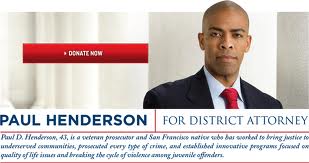
Paul Henderson denies D.A. deal with Willie Brown

6

Paul Henderson doesn’t mince words when it comes to debunking the notion that Willie Brown helped him get his new job as Mayor Ed Lee’s public policy czar. Or that his decision to drop out of the D.A.’s race was in exchange for his new job.

“There was no deal with Willie Brown. I called and said, so do I get a check in the mail, a basket of fruit?” Henderson said, recalling his furious reaction to Brown’s claim, made in the Chronicle in January, that Brown and then mayor Gavin Newsom conspired to make sure Henderson was “taken care of,” in the wake of Newsom’s shocking announcement that he had appointed San Francisco Police Chief George Gascón as D.A.

“If there was a set up for me somewhere, I still have not got it. I didn’t get shit,” Henderson, who joined the D.A.’s office in 1995 and was said to be former D.A. Kamala Harris’ preferred pick to fill the D.A. post, after she won the state Attorney General’s race, last fall.

Instead, Henderson, who filed papers to run in the D.A.’s race in November, saw his plans blown out of the water when Newsom, in his last act as mayor, appointed Gascón as Henderson’s new boss. And when Gascón filed papers in the D.A.’s race the very next day, Henderson found himself in the unenviable situation of holding an at-will position in the D.A.’s office, while running against his boss in the 2011 D.A. election.

“ If there was any deal, it was for me not to lose my job,” Henderson added.  “And it’s the best decision for me. I really do care about public service.”

During his 16 years in the D.A.’s office, Henderson established juvenile drug and community justice courts, set up domestic violence and hate crime programs, and focused on rehabilitative, reformative, treatment-oriented alternatives to imprisonment.

He said his decision to join the Mayor’s Office is based on a long relationship with Lee. “I want to have a voice in the criminal justice system, and I’ve known Ed Lee independent of all this political business,” Henderson said, recalling that he worked with Lee to develop language programs in the D.A.’s office, so employees could take lessons and better interact with community members, victims and witnesses in court.

“I’m a third generation San Francisco resident, and the first generation not to grow up in the projects, though we lived opposite them,” Henderson continued, recalling how his mother is a Public Defender, his grandmother was a community advocate, and he went to preschool in Sunnydale. Those experiences gave him a strong sense of being connected to and serving his community from an early age, Henderson said.

And he soon found himself holding the highest position, as a gay and black, in the D.A.’s office in the 1990s.‘I was the first African American the D.A.’s office had hired in five years,” Henderson said, recalling how the department looked in 1995. “And look at it now,” he added, noting that since he took over hiring at the D.A.’s office, more gays, lesbians, Asians, Latinos and other minorities have been employed.

“I’m very aware of who I am and what I represent in this office,” Henderson said. “For me, it’s about creating an open door and having a voice at the table. Ed Lee has asked if I would be the liaison between national, state and local agencies collectively in his office. And this expands my voice and creates opportunities for all in San Francisco in ways that are exciting to me.”

Henderson said his new post will have a very different focus from the role former US Attorney Kevin Ryan played, during his brief tenure in the Mayor’s Office, under Gavin Newsom.“This will be about policy development, advice and implementation, and it will be more reflective of marginalized communities,” Henderson said. “So, I don’t want these communities being misled into thinking, ‘oh, he got a hand out.’ This was not a hook-up. I earned my place here.”

“The truth is that you have access to me because I am in this position,” Henderson continued. “And I hope it’s transformative for the city and the community. Because I did not get shit. There is no Paul Henderson pay-off. I’d be happy to tell you if I’d sold out. But no. I knew Ed independently. He knows my heart, trusts my judgment and reputation. This has nothing to do with Willie, Gavin and Kamala. Unless it did, and they are all tricking me. In which case, they should at least tell me, so I can credit them. But the truth is, I’ve worked so hard, and if I’ve become ‘the Man,’ then I’m at the table for the community. I’m not the person who took a pay out, got a hook up, a cushy deal, so I will go away, to silence my voice.”

Henderson notes that he has not given up his political aspirations, despite all that went down recently. “If it’s not my time right now, I still have political credibility and a profile in the city that isn’t going away “ he said, noting that he raised $65,000 in 28 days, just before Christmas, with no staff, immediately after a statewide election. “That speaks to how much support I have. Obviously I was disappointed that I wasn’t appointed D.A. But I’m not dead, and I’m trying to move in a direction that expands my voice.”

Henderson says his new role won’t change him and he’ll remain accessible to gay, black, Chinese, Samoan, immigrant, low-income, Latino and other marginalized communities.“I have a lens that most city leaders don’t have,” he said, noting that he was homeless and slept in his car when he was going to law school. “Ad now I can affect policy. Many folks feel the criminal justice system happens to you, and over 80 percent of victims are people of color and poor people. But who speaks for and represents them?”

Henderson drops out of D.A’s office and race, SFPD Chief turned D.A. Gascón appoints DeBerry as new chief of staff

4

I wondered what Willie Brown was talking about when he wrote that making sure that D.A. office insider Paul Henderson was “taken care of” was one of only two details to be worked out, following former Mayor Gavin Newsom’s shocking last-minute appointment of former police chief George Gascón as the next District Attorney  And now I think I found out: Henderson, who was former D.A. Kamala Harris’ chief of administration and her preferred pick, announced yesterday that he is dropping out of the D.A.’s race and will serve as Lee’s public safety czar.

Henderson starts his new job March 8, meaning 15 months has passed since former U.S. Attorney Kevin Ryan resigned from the Mayor’s Office of criminal justice—leaving everyone unsure what Henderson’s new post entails, and whether it comes with a staff and/or a budget.

Henderson says his new job includes involvement in the Taser debate, the next police chief selection, and assessing how budget cuts impact public safety. And he certainly didn’t publicly let on that he was anything but delighted about this latest twist in the ever evolving race to be the next elected district attorney.

“I’m excited about helping our Mayor shape this new position and about what we can accomplish under his leadership to enhance public safety in the City,” Henderson, who is  reportedly backing Gascón in the D.A.’s race, told the Guardian.

But Henderson’s move brings us back to the other detail Brown referred to in January, namely, “assessing the odds of Gascón winning the D.A.’s race in November.”

Currently, David Onek, a senior fellow at the UC Berkeley Center for Criminal Justice and served in the Mayor’s Office of Criminal Justice under Newsom and Alameda County Deputy District Attorney Sharmin Bock, are the only remaining contenders. And while little has been heard from Bock since she filed in January, Onek has been doing all he can to stay relevant, including holding house parties, raising money, calling for transparency in the D.A.’s Office around officer-involved shootings, and interviewing criminal justice experts as part of his Criminal Justice conversations podcast project in Berkeley.

Onek’s latest interview is with Michael Romano, co-founder of the Stanford Three Strikes Project, which represents folks serving life sentences under the Three Strikes law for minor, non-violent offenses – such as stealing a pair of socks. “Addressing the flaws in the Three Strikes law will protect Californians while also having a positive impact on our state budget.” Onek observed in a campaign email. “According to the California state auditor, non-violent third strikers will cost our state at least $4.8 billion over the next 25 years – almost $200 million per year.”
 
Onek also noted that the next few months are crucial for his D.A. campaign, “to build strong partnerships between law enforcement and the community.”
And the challenge for anyone who is not part of the Brown- Newsom machine to remain viable in the D.A.’s race were illustrated afresh yesterday when Gascón convened a 30-minute press conference at the Hall of Justice to announce he is reorganizing his staff to focus on cutting the backlog of homicides and other felony cases–and was replacing Henderson with Cristine DeBerry, who was deputy chief of staff under Mayor Gavin Newsom and Mayor Ed Lee.

Gascón said the reshuffle was a product of six weeks talking to prosecutors, court officials, defense lawyers and others in the criminal justice system. And so far it has led to David Pfeiffer being named as heads of special operations, Sharon Woo as head of operations, Eugene Clendinen as chief of administration, Braden Woods as chief of the criminal division, Lenore Anderson as chief of collaborative courts, Maria Bee as chief of victim services, June Cravett as head of the white collar division, Jim Crisolo as chief of investigations and Jerry Coleman as chief of the Brady, appellate and training division.

Gascón said he doesn’t foresee immediate layoffs in the department, which has a $39 million annual budget. But he warned that if he is required to cut his budget by 10 percent, as Mayor Lee has requested of all departments, he’ll have to lay off the equivalent of 18 prosecutors.
“Hopefully, we’ll be spared that,” he said. “As it is, we have so much unattended business.”

Gascón blamed the crushing deficit in the D.A.’s Office on budget constrictions over many years, as he used a Power Point slide show to illustrate how the department had less funding in 2008 than in 1986 (if numbers are adjusted for inflation).
“It’s why we had problems in the past and why we are doing this reorganization,” he said, claiming that a significant lack of training in the department has caused “a poor performance in court,” and that there is only one paralegal for every 9 attorneys, on average.

Gascón said it took 3-4 months to process most felony cases, and up to 3 1/2 years to bring a murder case to trial, under the office’s previous configuration.  “By that time, memories have faded, and people are not showing up,” he said.
(D.A. press spokesperson Seth Steward clarified today that Gascón’s claim that “only one out of every 26 misdemeanor cases” was in fact a misstatement, and that the D.A. is working to provide a more accurate analysis.)

Gascón also announced that he is rolling out a makeshift community court system in the next few months, in which alleged perpetrators, victims and three mediating members of the public would work to find a solution, which could be community service.
‘So you can roll the dice and be prosecuted or go to the community court,” he said. “We believe we can take 20 percent of our work load, which is about 1,000 cases, and run it through this system.”

He also claimed that instead of spending $1,200 to $1,300 in the court system, these cases would only cost $300, and that the Tenderloin Community Justice Center will stay in place, under the reshuffle.
 “My goal as Chief was the make San Francisco the safest and largest city in the United States, and that continues to be the goal,” Gascón concluded.


Behind the Twitter tax break deal

36

There’s much political intrigue and anticipation swirling around the Central Market Payroll Tax Exclusion, aka the Twitter Tax Break, which the Board of Supervisors will consider next month. This has all the elements of a great story: backroom deals between political and corporate power brokers, the strange argument that Republican-style tax cuts will cure Mid-Market blight, the fact that Twitter executives have uttered nary a tweet about shaking down SF taxpayers, and the role that a pair of supposedly progressive supervisors have played in brokering the deal.

Following up on my Feb. 10 post about how the deal would help Twitter meet the high asking price of politically connected landlord Alvin Dworman for a new mid-Market headquarters, the Bay Citizen yesterday had a great story showing how Dworman gave then-Mayor Gavin Newsom discounted office space for his lieutenant governor bid just as Newsom proposed the tax break that would benefit Dworman and Twitter. The story also includes a nice tick-tock about how this unseemly deal unfolded.

We at the Guardian are currently awaiting a big package of documents from City Hall that we requested on the deal, and sources tell us they’re likely to include some interesting insights and tidbits. For example, are Twitter and Dworman the main beneficiaries of this legislation or are there other corporations (and the politicians they support) who were pushing this plan? Everyone is also waiting to see how the city’s Office of Economic Analysis rates the proposal, and Economic Ted Egan tells us that report should be out by the end of next week or beginning of the following week.

At this point, we have more questions than answers, but that should start changing by next week. Maybe we’ll gain a better understanding of why Sup. Jane Kim is pushing this deal (much to the consternation of some of her former top supporters) or why Randy Shaw, the taxpayer-subsidized blogger and Tenderloin don, strongly backed Kim’s candidacy and attacked her critics with such perplexing ferocity. Will Willie Brown’s name continue popping up? Perhaps we’ll be able to determine whether the Newsom-Dworman pact actually broke campaign finance laws. And we’ll certainly gain some insights into how the Mayor’s Office of Economic and Workforce Development trades away taxpayer money to successful corporations that wield whines and threats of relocation.

If nothing else, we’ll get a peek into modern crony capitalism, San Francisco-style, dressed up in the guise of “saving” the Tenderloin. So, from a strictly journalistic perspective, this should be fun.

Meet the new boss

3

news@sfbg.com

The Guardian hasn’t been invited into City Hall’s Room 200 for a long time. Former Mayor Gavin Newsom, who frequently criticized this newspaper in his public statements, had a tendency to freeze out his critics, adopting a supercilious and vinegary attitude toward any members of the press who questioned his policy decisions. So it was almost surreal when a smiling Mayor Ed Lee cordially welcomed two Guardian reporters into his stately office Feb. 15.

Lee says he plans to open his office to a broader cross-section of the community, a move he described as a way of including those who previously felt left out. Other changes have come, too. He’s replaced Newsom’s press secretary, Tony Winnicker, with Christine Falvey, former communications director at the Department of Public Works (DPW). He’s filled the Mayor’s Office with greenery, including giant tropical plants that exude a calming green aura, in stark contrast to Newsom — whose own Room 200 was sterile and self-aggrandizing, including a portrait of Robert Kennedy, in whose footsteps Newsom repeatedly claimed to walk.

When it comes to policy issues, however, some expect to see little more than business-as-usual in the Mayor’s Office. Democratic Party chair Aaron Peskin, a progressive stalwart, said he sees no substantive changes between the new mayor and his predecessor. “It seems to me that the new administration is carrying forward the policies of the former administration,” Peskin said. “I see no demonstrable change. And that makes sense. Lee was Willie Brown and former Mayor Gavin Newsom’s handpicked successor. So he’s dancing with the guys that brought him in.”

Sup. David Campos, viewed as part of the city’s progressive camp along with Peskin, took a more diplomatic tack. “So far I’ve been very pleased with what I’ve seen,” Campos noted. “I really appreciate that he’s reached out to the community-based organizations and come out to my district and done merchant walks. I think we have to wait to see what he does on specific policy issues.”

But while Lee has already garnered a reputation for being stylistically worlds apart from Newsom, he still hews close to his predecessor’s policies in some key areas. In our interview, Lee expressed an unwillingness to consider tax-revenue measures for now, but said he was willing to take condo conversions into consideration as a way to bring in cash. He was unenthusiastic about community choice aggregation and dismissive of replacing Pacific Gas & Electric Co. with a public-power system. He hasn’t committed to overturning the pending eviction of the Haight Ashbury Neighborhood Council’s recycling center, and he continued to argue for expanding Recology’s monopoly on the city’s $206 million annual trash stream, despite a recent Budget and Legislative Analyst’ report that recommended putting the issue to the voters.

Public Defender Jeff Adachi, who met Lee in 1980 through the Asian Law Caucus, said Lee would be facing steep challenges. “It’s a fascinating political karmic outcome that he is now our appointed mayor. He didn’t seek it out, as he says, but the opportunity he has now is to focus his efforts on fixing some of the problems that have gone unaddressed for decades, pension reform being one of them. I think he realizes he has a limited time to achieve things of value. The question I and others have is, can he do it?”


THE RELUCTANT MAYOR

Lee identified as a non-politician, patently rejecting the notion that he would enter the race for mayor. In meetings with members of the Board of Supervisors at the end of 2010, he said he didn’t want the job.

Yet while vacationing in Hong Kong, Lee became the subject of a full-court press. “When the lobbying and phone calls started … clearly they meant a lot to me,” Lee told us, adding that the choice “was very heavy on my mind.” He finally relented, accepting the city’s top post.

Although rumors had been circulating that Lee might seek a full term, he told the Guardian he’s serious about serving as a caretaker mayor. “If I’m going to thrust all my energy into this, I don’t need to have to deal with … a campaign to run for mayor.”

Adachi offered an interesting take on Lee as caretaker: “Somewhere along the way, [Lee] became known as the go-to guy in government who could take care of problems,” Adachi said, “like the Wolf in Pulp Fiction.”

Sounding rather unlike Harvey Keitel’s tough-talking character, Lee noted, “One of my goals is to rebuild the trust between the Mayor’s Office and the Board of Supervisors. I think I can do that by being consistent with the promises I make.”

Lee’s vows to keep his promises, mend rifts with the board, and stay focused on the job could be interpreted as statements intended to set him apart from Newsom, who was frequently criticized for being disengaged during his runs for higher office, provoking skirmishes with the board, and going back on his word.

The new mayor also said he’d be willing to share his working calendar with the public, something Newsom resisted for years. Kimo Crossman, a sunshine advocate who was part of a group that began submitting requests for Newsom’s calendar in 2006, greeted this news with a wait-and-see attitude. “I’ve already put in a request,” Crossman said. “Politicians are always in support of sunshine — until they have to comply with it.”


THE ELEPHANT IN THE ROOM

Pointing to the tropical elephant-ear plants adorning his office, Lee noted that elephants are considered lucky in Chinese culture. With the monstrous issues of pension reform and a gaping budget deficit hitting his mayoral term like twin tornadoes, it might not hurt to have some extra luck.

Pension reform is emerging as the issue du jour in City Hall. A round of talks on how to turn the tide on rising pension costs has brought labor representatives, Sup. Sean Elsbernd, billionaire Warren Hellman, City Attorney Dennis Herrera, labor leaders, and others to the table as part of a working group.

Gabriel Haaland, who works for SEIU Local 1021, sounded a positive note on Lee. “He’s an extraordinarily knowledgeable guy about government. He seems to have a very collaborative working style and approach to problem-solving, and he is respectful of differing opinions,” Haaland said. “Where is it going to take us? I don’t know yet.”

Lee emphasized his desire to bring many stakeholders together to facilitate agreement. “We’re talking about everything from limiting pensionable salaries, to fixing loopholes, to dealing with what kinds of plans we can afford in the health care arena,” he noted. Lee said the group had hashed out 15 proposals so far, which will be vetted by the Controller’s Office.

A central focus, Lee said, has been “whether we’ve come to a time to recognize that we have to cap pensions.” That could mean capping a pension itself, he said, or limiting how much of an employee’s salary can be counted toward his or her pension.

Since Lee plans to resume his post as city administrator once his mayoral term has ended, he added a personal note: “I want to go back to my old job, do that for five years, and have a pension that is respectable,” he said. “At the same time, I feel others who’ve worked with me deserve a pension. I don’t want it threatened by the instability we’re headed toward and the insolvency we’re headed toward.”


BRACING FOR THE BUDGET

If pension reform is shaping up to be the No. 1 challenge of Lee’s administration, tackling the city budget is a close second. When Newsom left office, he passed Lee a budget memo containing instructions for a 2.5 percent reduction in most city departments, part of an overarching plan to shave 10 percent from all departments plus another 10 percent in contingency cuts, making for a bruising 20 percent.

Lee said his budget strategy is to try to avert what Sup. David Chiu once characterized as “the typical Kabuki-style budget process” that has pitted progressives against the mayor in years past. That means sitting down with stakeholders early.

“I have opened the door of this office to a number of community groups that had expressed a lot of historical frustration in not being able to express to the mayor what they feel the priorities of their communities are,” Lee said. “I’ve done that in conjunction with members of the Board of Supervisors, who also felt that they weren’t involved from the beginning.”

Affordable-housing advocate Calvin Welch said Lee’s style is a dramatic change. “I think he’s probably equaled the total number of people he’s met in six weeks with the number that Newsom met in his seven years as mayor,” Welch said.

Sup. Carmen Chu, recently installed as chair of the Budget & Finance Committee, predicted that the budget will still be hard to balance. “We are still grappling with a $380 million deficit,” Chu told us, noting that there are some positive economic signs ahead, but no reason to expect a dramatic improvement. “We’re been told that there is $14 million in better news. But we still have the state budget to contend with, and who knows what that will look like.”

Sup. John Avalos, the former chair of the Board’s powerful Budget Committee, said he thinks the rubber hasn’t hit the road yet on painful budget decisions that seem inevitable this year — and the outcome, he said, could spell a crashing halt to Ed Lee’s current honeymoon as mayor.

“We are facing incredible challenges,” Avalos said, noting that he heard that labor does not intend to open up its contracts, which were approved in 2010 for a two-year period. And federal stimulus money has run out.


DID SOMEONE SAY “CONDO CONVERSIONS”?

Asked whether he supported new revenue measures as a way to fill the budget gap, Lee initially gave an answer that seemed to echo Newsom’s inflexible no-new-taxes stance. “I’m not ready to look at taxes yet,” he said.

He also invoked an idea that Newsom proposed during the last budget cycle, which progressives bitterly opposed. In a conversation with community-based organizations about “unpopular revenue-generating ideas,” Lee cautioned attendees that “within the category of unpopular revenue-generating ideas are also some that would be very unpopular to you as well.”

Asked to explain, Lee answered: “Could be condo conversion. Could be taxes. I’m not isolating any one of them, but they are in the category of very unpopular revenue-generating ideas, and they have to be carefully thought out before we determine that they would be that seriously weighed.”

Ted Gullicksen, who runs the San Francisco Tenants Union, said tenant advocates have scheduled a meeting with Lee to talk about condo conversions. Thanks to Prop. 26’s passage in November 2010, he said, any such proposal would have to be approved by two-thirds of the board or the voters. “It’s pretty clear that any such measure would not move forward without support from all sides,” Gullicksen said. “If anyone opposes it, it’s going to go nowhere.”

Gullicksen said he’d heard that Lee is willing to look at the possibility of significant concessions to renter groups in an effort to broker a condo conversion deal, such as a moratorium on future condo conversions. “If, for example, 1,000 TICs [tenants-in-common] became condos under the proposal, then we’d need a moratorium for five years to minimize and mitigate the damages,” Gullicksen explained.

More important, some structural reform of TIC conversions may be on the table, Gullicksen said. “And that would be more important than keeping existing TICs from becoming condos.”

Gullicksen acknowledged that Lee has the decency to talk to all the stakeholders. “Newsom never attempted to talk to tenants advocates,” he said.


GREEN, WITHIN LIMITS

Lee’s two children are in their early 20s, and the mayor said he takes seriously the goal of being proactive on environmental issues in order to leave them with a more sustainable San Francisco. He trumpeted the city’s green achievements, saying, “We’re now on the cutting edge of environmental goals for the city.”

Leading bicycle activist Leah Shahum of the San Francisco Bicycle Coalition had praise for Lee on bike issues. “I’m really encouraged by his very public support of the new green separate bikeways on Market Street and his interest and commitment to creating more,” she said. “I believe Mayor Lee sees the value of connecting the city with cross town bicycle lanes, which serve a wide range of folks, including business people and families.”

Yet some proponents of green causes are feeling uncertain about whether their projects will advance under Lee’s watch.

On the issue of community choice aggregation (CCA), the ambitious green-energy program that would transfer Pacific Gas & Electric Co. customers to a city-run program with a cleaner energy mix, Lee — who helped determine rates as city administrator — seemed lukewarm. “I know Mr. [Ed] Harrington and his staff just want to make sure it’s done right,” he said, referring to the general manager of the city’s Public Utilities Commission, whose tepid attitude toward the program has frequently driven him to lock horns with the city’s chief CCA proponent, Sup. Ross Mirkarimi.

Lee noted that CCA program goals were recently scaled back. He also said pretty directly that he opposes public power: “We’re not in any day getting rid of PG&E at all. I don’t think that is the right approach.”

The controversial issue of the Haight Ashbury Neighborhood Council Recycling Center’s pending eviction from Golden Gate Park still hangs in the balance. The Recreation and Park Commission, at Newsom’s behest, approved the eviction despite overwhelming community opposition.

Lee said he hadn’t looked at the issue closely. “I do know that there’s a lot of strong debate around the viability, what that operation attracts and doesn’t attract,” he said. “I had the owner of HANC here along with a good friend, Calvin Welch, who made a plea that I think about it a bit. I agreed that I would sit down and talk with what I believe to be the two experts involved in that decision: Melanie Nutter at the Department of the Environment and then Phil Ginsburg at the Rec and Park.” Nutter and Ginsburg supported HANC’s eviction.

Welch, who is on the board of HANC, noted that Lee could be swayed by his staff. “The bunch around Newsom had old and bad habits, and old and bad policies. In dealing with mayors over the years, I know how dependent they are on their staff. They’re in a bubble, and the only way out is through a good staff. Otherwise, Lee will come to the same conclusions as Newsom.”

HANC’s Jim Rhoads told the Guardian he isn’t feeling reassured. “He said he would keep asking people about it. Unfortunately, if he asked his own staff, it would be a problem because they’re leftovers from Newsom.”

Speaking of leftovers, Lee also weighed in on the debate about the city’s waste-management contract — and threw his support behind the existing private garbage monopoly. Campos is challenging a perpetual waste-hauling contract that Recology has had with the city since 1932, calling instead for a competitive-bidding process. When the Department of the Environment recommended awarding the city’s landfill disposal contract to Recology last year, it effectively endorsed a monopoly for the company over managing the city’s entire waste stream, at an estimated value of $206 million per year.

The final decision to award the contract was delayed for two months at a February Budget & Finance Committee hearing. Campos is contemplating putting the issue to the voters this fall, provided he can find six votes on the Board.

“I know that Sup. Campos had given his policy argument for why he wants that revisited,” Lee said. “I have let him know that the Recology company in its various forms has been our very dependable garbage-hauling company for many, many decades. … I feel that the company has justified its privilege to be the permit holder in San Francisco because of the things that it has been willing to do with us. Whether or not we want to use our time today to revisit the 1932 ordinance, for me that wouldn’t be a high priority.”


UNFINISHED BUSINESS

In the last week of 2010, Avalos pushed through groundbreaking local-hire legislation, without the support of then Mayor Gavin Newsom or his chief of staff, Steve Kawa, who wanted Avalos to back off and let Newsom takeover the task.

With Lee now in Room 200, things appear to be moving forward on local hire, in face of misleading attacks from Assemblymember Jerry Hill (D-San Mateo), who wants to make sure no state money is used on local-hire projects, presumably because the building trades are upset by it. And Kawa, whom Lee has retained as chief of staff, doesn’t really support the legislation. Indeed, Kawa’s presence in the Mayor’s Office has his detractors believing that the new boss in Room 200 is really the same as the old boss.

“I feel like things are moving forward in the right direction around local hire, though a little more quietly than I’d like,” Avalos told the Guardian. Avalos noted that he is going to hold a hearing in March on implementing the legislation that should kick in March 25.

Welch said he believes that if Lee starts replacing staff wholesale, it could indicate two things: he’s a savvy guy who understands the difficulties of relying on Newsom’s chief of staff Steve Kawa for a budget, and he’s not ruling out a run for mayor.

“If I was in his position, the first thing out of my mouth would be, ‘I’m not running.’ I think he’s very focused in the budget. And it’s going to make or break him. But if he starts overriding Kawa and picks staff who represent him … well, then I’d revisit the question of whether he’s contemplating a run for mayor, say, around June.”

Onek to SFPD Chief turned D.A. Gascon: release records of officers cleared in shootings

3

Calitics has a revealing letter from David Onek, a senior fellow at the Berkeley Center for Criminal Justice, a former member of the San Francisco Police Commission and a candidate in the 2011 District Attorney’s race, demanding greater transparency from the D.A.’s office when it comes to explaining why officers have been cleared in officer-related shootings.

“After spending my career working to identify and implement the most effective public safety strategies, I have seen one constant – the community is safest when the police and prosecutors earn and keep the public’s trust,” Onek writes in a letter that is guaranteed to turn up the ante in an already intriguing race. “That’s why I read with real concern that the San Francisco District Attorney’s office would not produce reports related to officer-involved shootings pursuant to a recent public records request from NPR-affiliate KALW.”

(The KALW report shows that the person in the D.A.’s office who penned the letter denying its request for records was Paul Henderson, D.A. Kamala Harris’ chief of staff and her preferred pick as replacement D.A. before Gavin Newsom appointed former SFPD Chief George Gascón as his last act as mayor, shocking just about everyone except Willie Brown, especially when it came out that Gascón used to be a Republican and is not philosophically opposed to the death penalty. And while Gascón, who was registered in recent years as decline-to-state, promptly turned around and registered as a Democrat, he also filed papers in the D.A.’s race that cite the phone number of notorious campaign attorney Jim Sutton.)

In his post on Calitics, Onek notes that as a former Police Commissioner, he was briefed in closed session on the details of officer-involved shootings, and he often heard complaints from community members about how little public information was released about officer-involved shootings.
“This lack of transparency breeds distrust,” Onek observes.

Onek acknowledges that in all officer-involved shootings, the DA’s office conducts an independent review to determine if there is criminal liability, and that if such liability is found, the DA presses charges, which are public. “But when the DA determines that there is no liability, it is equally important that the DA publicly explain the reasons for its decision,” Onek states.

In short, he believes the D.A.’ office should issue a very detailed report on every officer-involved shooting in which it does not file charges and should make the report publicly available on its website. “The report should detail the facts, the law and the reasons for the decision not to file charges,” Onek says, arguing that complete transparency would make the job of police and prosecutors much easier by building trust between law enforcement and the community, making it more likely that community members will work in partnership with police and prosecutors, and that victims and witnesses will come forward to testify.

“Publishing detailed reports that clear officers when they acted within the law can dispel public misconceptions about what actually happened,” Onek concludes. “Of course, officers’ privacy rights need to be respected and investigations cannot be compromised. But once an investigation is complete, and an officer has been cleared, it is imperative that the District Attorney’s office share its findings with the public. “

And as Onek points out, this standard is already in place in communities in California. “The District Attorney’s office in San Diego, hardly a bastion of liberalism, actually lists these cases on its website,” Onek states. “Many other counties – including Los Angeles, Orange and Fresno – also make them matters of public record and available on request. Building trust with the community is the key to enhancing public safety. Let’s not violate that trust by refusing to release documents that the public has the right to see.”

I’ve got a call into D.A. Gascón’s office to learn more about the rationale for denying KALW’s request, and I’ll be sure to post his reply here, so stay tuned.

Mayor Ed Lee willing to disclose work calendar

1

Among the many issues that rankled progressives under Mayor Gavin Newsom’s administration was Newsom’s unwillingness to turn over his work calendar to members of the public who formally requested it. Beginning in 2006, a group of sunshine activists routinely submitted public-information requests for the mayor’s daily schedule in hopes of finding out who Newsom was meeting with, what events he attended, and just how he spent his time on the job as mayor of San Francisco. After years of battle, Newsom finally agreed to release a watered-down calendar containing very little information.

On this matter, it does not seem as if Interim Mayor Ed Lee will follow in the footsteps of his predecessor.

In an interview with Guardian reporters today, Mayor Lee indicated that he would be willing to make his calendar available to the public. “Sure,” he said when we asked him about it. “I have no problem with that.”

Lee noted that he has complied with similar requests in the past. “I’ve had those already reviewed as the City Administrator, so I’m used to it,” Lee said.

He added that while he was willing to share his work-related calendar, “I may not want to share where I privately go every night.”

That’s OK. Thanks to former Mayor Willie Brown, we already know Lee went out to dinner in North Beach the other night with Brown, Rose Pak, and several others.