War

Rep Clock

0

Schedules are for Wed/6–Tues/12 except where noted. Director and year are given when available. Double and triple features are marked with a •. All times are p.m. unless otherwise specified.

BALBOA 3620 Balboa, SF; www.balboamovies.com. $20. “Opera, Ballet, and Shakespeare in Cinema:” Love’s Labours Lost, performed at the Globe Theater, Sat-Sun, 10am.

CASTRO 429 Castro, SF; (415) 621-6120, www.castrotheatre.com. $7.50-13. •Out of the Past (Tourneur, 1947), Wed, 3:15, 7, and The Night of the Hunter (Laughton, 1955), Wed, 5, 8:55. Cave of Forgotten Dreams (Herzog, 2010), Thurs, 3, 5, 7, 9. “Watching Big Brother: A Tribute to the Summer of 1984: Day One” •The Last Starfighter (Castle, 1984), Fri, 7:30; Gremlins (Columbus, 1984), Fri, 9:45; and The Adventures of Buckaroo Banzai Across the 8th Dimension (Richter, 1984), Fri, 11:59; “Day Two:” •Cloak and Dagger (Franklin, 1984), Sat, 2:30; The Karate Kid (Avildsen, 1984), Sat, 4:45; Red Dawn (Milius, 1984), Sat, 7:15; The Pope of Greenwich Village (Rosenberg, 1984), Sat, 9:45; and Streets of Fire (Hill, 1984), Sat, 11:59. “Marc Huestis Presents: I Dream of Barbara Eden:” 7 Faces of Dr. Lao (Pal, 1964), Sun, noon; Gala Event with on-stage interview, performances, and more, Sun, 8. Tickets for the Gala Event, $25-45 at (415) 863-0611 or www.ticketfly.com.

CHRISTOPHER B. SMITH RAFAEL FILM CENTER 1118 Fourth St, San Rafael; (415) 454-1222, www.cafilm.org. $10.25. Buck (Meehl, 2011), call for dates and times. Page One (Rossi, 2011), call for dates and times. The Tree of Life (Malick, 2011), call for dates and times. The Trip (Winterbottom, 2010), call for dates and times. Mann vs. Ford (Chermayeff, 2011), Wed, 7. With director Maro Chermayeff and producer James Redford in person. Swan Lake, performed by the Bolshoi Ballet, Thurs, 7; Sun, 1. The Big Uneasy (Shearer, 2011), Mon, 7:15. With director Harry Shearer in person; this event, $15.

“FILM NIGHT IN THE PARK” This week: Creek Park, 451 Sir Francis Drake, San Anselmo; (415) 272-2756, www.filmnight.org. Donations accepted. ) Beatles movie TBA, Fri, 8.

FOUR STAR 2200 Clement, SF; www.lntsf.com. $10. “Asian Movie Madness” •Torrid Wave (Lin, 1982), and Sex and Zen III (Min, 1998), Thurs, call for times.

MECHANICS’ INSTITUTE 57 Post, SF; (415) 393-0100, rsvp@milibrary.org. $10. “CinemaLit Film Series: Music and Nostalgia:” Oh! What a Lovely War (Attenborough, 1969), Fri, 6.

PACIFIC FILM ARCHIVE 2575 Bancroft, Berk; (510) 642-5249, www.bampfa.berkeley.edu. $5.50-9.50. “Japanese Divas:” Twenty-Four Eyes (Kinoshita, 1954), Wed, 7; Carmen Comes Home (Kinoshita, 1951), Thurs, 7 and Sat, 6:30: When a Woman Ascends the Stairs (Naruse, 1960), Sat, 8:20; •Woman of Tokyo (Ozu, 1933) and A Hen in the Wind (Ozu, 1948), Sun, 5. “Bernardo Bertolucci: In Search of Mystery:” Before the Revolution (1964), Fri, 7; The Grim Reaper (1962), Fri, 9:10; The Spider’s Stratagem (1970), Sun, 7:45.

PARAMOUNT 2025 Broadway, Oakl; 1-800-745-3000, www.ticketmaster.com. $5. National Velvet (Brown, 1944), Fri, 8.

RED VIC 1727 Haight, SF; (415) 668-3994; www.redvicmoviehouse.com. $6-10. Vertigo (Hitchcock, 1958), Wed, 2, 7, 9:25. Circo (Schock, 2010), Thurs-Fri, 7:15, 9:15. Poster sale, noon-6pm. “An Evening with Jonathan Richman:” Vengo (Gatliff, 2000), Sat, 8. Babe (Noonan, 1995), Sun-Mon, 7:15, 9:15 (also Sun, 2, 4). What’s Up Doc? (Bogdanovich, 1972), July 12-13, 7:15, 9:20 (also July 13, 2).

RIALTO CINEMAS ELMWOOD 2966 College, Berk; (510) 433-9730, www.rialtocinemas.com. $5-10. The Big Uneasy (Shearer, 2011), July 8-14, call for times.

ROXIE 3117 and 3125 16th St, SF; (415) 863-1087, www.roxie.com. $5-9.75. Happy (Belic, 2011), Wed-Thurs, 7, 8:30. Viva Riva! (Munga, 2010), Wed, 7, 9. “San Francisco School of Digital Filmmaking Graduating Class ’11 Presents: Love the Shorts,” Thurs, 7, 9. “San Francisco Frozen Film Festival,” Thurs-Sat. Visit www.frozenfilmfestival.com for tickets and info. The Big Uneasy (Shearer, 2011), Sun-Mon, 7, 9 (also Sun, 3, 5). “Where Did That Come From?,” illustrated lecture with Bill Nichols, 7. For tickets ($20), visit www.sffs.org.

“TEMESCAL STREET CINEMA 2011” 49th St at Telegraph, Oakl; www.temescalstreetcinema.com. Free. D-Tour (Granato, 2009), Thurs, 8:45. With music by Pancho San at 8pm.

VIZ CINEMA New People, 1746 Post, SF; www.vizcinema.com. $15. Das Boot (Petersen, 1981), Thurs, 6. Restored and remastered director’s cut version of the film in honor of its 30th anniversary, with producer Ortwin Freyermuth in person. VORTEX ROOM 1082 Howard, SF; www.myspace.com/thevortexroom. $5 donation. “The United States of Vortex:” •Wild in the Streets (Shear, 1968), Thurs, 9, and The Werewolf of Washington (Ginsberg, 1973), Thurs, 11.

Here’s tax reform, Jerry

14

Everyone knows I’m a fan of taxing the rich and that I think most of the economic problems in our country have their roots in the growing inequality of the past few decades, so it should come as no surprise that I enjoyed the Cruickshank piece on Calitics. He’s got exactly the right idea: Tax reform that benefits the wealthy (or, in fact, tax reform that doesn’t force the wealthy to pay more) isn’t tax reform at all.


I was on a houseboat at Lake Shasta over the 4th of July, arguing with some very smart people about why the economy is so fucked up (yeah, for relaxation I go someplace beautiful — then sit around and talk about economic policy), and we covered a lot of ground. My friend the investment banker and corporate executive said that out-of-control CEO pay — and bonus payments for failure, and lack of corporate accountability — were a bit part of the problem. “If corporations succeed, then everyone — all the people who work there, at every level — ought to benefit,” he pointed out. True: In the early post-War era, labor union clout in major industries (automotive, for example) forced corporations to pay a decent middle-class wage — that is, to share the fruits of success with the workers. That’s all gone now. “Corporations don’t pay enough taxes,” my friend the corporate salesman said — and he’s right, too.


And all of us agreed that higher taxes won’t drive corporations out of the country or out of states or even out of cities; the actual numbers of businesses that pick and and move because of taxes (as opposed to labor-force issues, rents, land availablity, access to transportation etc.) is so minor it’s not even worth talking about.


But those are just pieces of the puzzle. Here’s what I always come back to: Over the past couple of decades, the size of the U.S. economy has doubled — and real wages have been essentially flat. All that new money has gone to the very, very top. Robert Reich explain this brilliantly in exactly two minutes — and I don’t care how busy you are, you have two minutes to watch this video.


That, really, is the root of everything, the reason we’re still in a recession, that people are losing their homes, that government debt is soaring … it’s all because this country, as a matter of public policy, has allowed the very, very rich to take almost all of our wealth. We have become a banana republic, a corporate kleptocracy, a place so badly managed that it we weren’t the United States, the news media would be reporting on our utter lack of economic democracy. And they’d be saying that the system is so unsustainable that one way or the other, it’s going to collapse.


Jerry Brown must know this. He’s not going to run for another term. There’s no excuse at all for not at least proposing a modest tax increase on the highest earners and the most profitable big businesses. Come on, guv: What are you waiting for?


The Fourth of July in Rock Rapids, Iowa, 1940-53

5

(Note: In July of l972, when the Guardian was short a Fourth of July story, I sat down and cranked out this one for the front page on my trusty Royal Typewriter. I now reprint it each year on the Bruce blog (by popular demand, of course), with some San Francisco updates and postscripts. My update for  this year’s Fourth  is the story on  today’s Chronicle front page that reports sadly, “Leaner budgets douse fireworks shows.” But, if you read to the end of this piece, I will point you to a little known spot in town where the amateurs and semi-pros  and parents with children will go to fire off their cherry bombs and Roman candles.

Back where I come from, a small town beneath a tall standpipe in northwestern Iowa, the Fourth of July was the best day of a long, hot summer.

The Fourth came after YMCA camp and Scout camp and church camp, but before the older boys had to worry about getting into shape for football. It was welcome relief from the scalding, 100-degree heat in a town without a swimming pool and whose swimming holes at Scout Island were usually dried up by early July. But best of all, it had the kind of excitement that began building weeks in advance.
The calm of the summer dawn and the cooing of the mourning doves on the telephone wires would be broken early on July Fourth: The Creglow boys would be up by 7 a.m. and out on the lawn shooting off their arsenal of firecrackers. They were older and had somehow sent their agents by car across the state line and into South Dakota where, not far above the highway curves of Larchwood, you could legally buy fireworks at roadside stands.

Ted Fisch, Jim Ramsey, Wiener Winters, the Cook boys, Hermie Casjens, Jerry Prahl, and the rest of the neighborhood would race out of their houses to catch the action. Some of them had cajoled firecrackers from their parents or bartered from the older boys in the neighborhood: some torpedoes (the kind you smashed against the sidewalk); lots of 2 and 3-inchers, occasionally the granddaddy of them all, the cherry bomb (the really explosive firecracker, stubby, cherry red, with a wick sticking up menacingly from its middle; the kind of firecracker you’d gladly trade away your best set of Submariner comics for).

Ah, the cherry bomb. It was a microcosm of excitement and mischief and good fun. Bob Creglow, the most resourceful of the Creglow boys who lived next door,  would take a cherry bomb, set it beneath a tin can on a porch, light the fuse, then head for the lilac bushes behind the barn.

“The trick,” he would say, imparting wisdom of the highest order, “is to place the can on a wood porch with a wood roof. Then it will hit the top of the porch, bang, then the bottom of the porch, bang. That’s how you get the biggest clatter.”

So I trudged off to the Linkenheil house, the nearest front porch suitable for cherry bombing, to try my hand at small-town demolition. Bang went the firecracker. Bang went the can on the roof. Bang went the can on the floor. Bang went the screen door as Karl Linkenheil roared out in a sweat, and I lit out for the lilacs behind the barn with my dog, Oscar.

It was glorious stuff – not to be outdone for years, I found out later, until the Halloween eve in high school when Dave Dietz, Ted Fisch, Ken Roach, Bob Babl, and rest of the Hermie Casjens gang and I made the big time and twice pushed a boxcar loaded with lumber across Main Street and blocked it for hours. But that’s another story in my annual  Halloween blog.

Shooting off fireworks was, of course, illegal in Rock Rapids, but Chief of Police Del Woodburn and later Elmer “Shinny” Sheneberger used to lay low on the Fourth. I don’t recall ever seeing them about in our neighborhood and I don’t think they ever arrested anybody, although each year the Rock Rapids Reporter would carry vague warnings about everybody cooperating to have “a safe and sane Fourth of July.” My father, a bit of a law and order sort, would take Jimmy DeYoung and me  five miles north of town and across the state line to Minnesota where it was legal to shoot off fireworks. 

Perhaps it was just too dangerous for them to start making firecracker arrests on the Fourth – on the same principle, I guess, that it was dangerous to do too much about the swashbuckling on Halloween or start running down dogs without leashes (Mayor Earl Fisher used to run on the platform that, as long as he was in office, no dog in town would have to be leashed. The neighborhood consensus was that Fisher’s dog, a big, boisterous boxer, was one of the few that ought to be leashed).

We handled the cherry bombs and other fireworks in our possession with extreme care and cultivation; I can’t remember a single mishap. Yet, even then, the handwriting was on the wall. There was talk of cutting off the fireworks supply in South Dakota because it was dangerous for young boys. Pretty soon, they did cut off the cherry bomb traffic and about all that was left, when I came back from college and the Roger boys had replaced the Creglow boys next door, was little stuff appropriately called ladyfingers.

Fireworks are dangerous, our parents would say, and each year they would dust off the old chestnut about the drugstore in Spencer that had a big stock of fireworks and they caught fire one night and much of the downtown went up in a spectacular shower of roman candles and sparkling fountains.

The story was hard to pin down, and seemed to get more gruesome every year – but, we were told, this was why Iowa banned fireworks years before, why they were so dangerous and why little boys shouldn’t be setting them off. The story, of course, never made quite the intended impression; we just wished we’d been on the scene.
My grandfather was the town druggist (Brugmann’s Drugstore, “where drugs and gold are fairly sold,” since 1902) and he said he knew the Spencer druggist personally. Fireworks put him out of business and into the poorhouse, he’d say, and walk away shaking his head.

In any event, firecrackers weren’t much of an issue past noon – the Fourth celebration at the fairgrounds was getting underway and there was too much else to do. Appropriately, the celebration was sponsored by the Rex Strait post of the American Legion (Strait, so the story went, was the first boy from Rock Rapids to die on foreign soil during World War I); the legionnaires were a bunch of good guys from the cleaners and the feed store and the bank who sponsored the American Legion baseball team each summer.

There was always a big carnival, with a ferris wheel somewhere in the center for the kids, a bingo stand for the elders, a booth where the ladies from the Methodist Church sold homemade baked goods, sometimes a hootchy dancer or two, and a couple of dank watering holes beneath the grandstand where the VFW and the Legion sold Grainbelt and Hamms beer  at 30¢ a bottle to anybody who looked of age.

Later on, when the farmboys came in from George and Alvord, there was lots of pushing and shoving, and a fist fight or two.

In front of the grandstand, out in the dust and the sun, would come a succession of shows that made the summer rounds of the little towns. One year it would be Joey Chitwood and his daredevil drivers. (The announcer always fascinated me: “Here he comes, folks, rounding the far turn…he is doing a great job out there tonight…let’s give him a big, big hand as he pulls up in front on the grandstand…”)

Another year it would be harness racing and Mr. Hardy, our local horse trainer from nearby  Doon, would be in his moment of glory. Another year it was tag team wrestling and a couple of barrel-chested goons from Omaha, playing the mean heavies and rabbit-punching their opponents from the back, would provoke roars of disgust from the grandstand. ( The biggest barrel-chest would lean back on the ropes, looking menacingly at the crowd and yell, “ Aw, you dumb farmers. What the hell do you know anyway?” And the grandstand would roar back in glee.)

One year, Cedric Adams, the Herb Caen of Minneapolis and the Star-Tribune, would tour the provinces as the emcee of a variety show. “It’s great to be in Rock Rapids,” he would say expansively, “because it’s always been known as the ‘Gateway to Magnolia.” (Magnolia, he didn’t need to say, was a little town just over the state line in Minnesota which was known throughout the territory for its liquor-by-the-drink roadhouses. It was also Cedric Adams’ hometown: his “Sackamenna.”) Adams kissed each girl (soundly) who came on the platform to perform and, at the end, hushed the crowd for his radio broadcast to the big city “direct from the stage of the Lyon County Fairgrounds in Rock Rapids, Iowa.”

For a couple of years, when Rock Rapids had a “town team,” and a couple of imported left-handed pitchers named Peewee Wenger and Karl Kletschke, we would have some rousing baseball games with the best semi-pro team around, Larchwood and its gang of Snyder brothers: Barney the eldest at shortstop, Jimmy the youngest at third base, John in center field, Paul in left field, another Snyder behind the plate and a couple on the bench. They were as tough as they came in Iowa baseball.

I can remember it as if it were yesterday at Candlestick, the 1948 game with the Snyders of Larchwood. Peewee Wenger, a gawky, 17-year-old kid right off a high school team, was pitching for Rock Rapids and holding down the Snyder artillery in splendid fashion. Inning after inning he went on, nursing a small lead, mastering one tough Larchwood batter after another, with a blistering fastball and a curve that sliced wickedly into the bat handles of the right-handed Larchwood line-up.

Then the cagey Barney Snyder laid a slow bunt down the third base line. Wenger stumbled, lurched, almost fell getting to the ball, then toppled off balance again, stood helplessly holding the ball. He couldn’t make the throw to first. Barney was safe, cocky and firing insults like machine gun bullets at Peewee from first base.

Peewee, visibly shaken, went back to the mound. He pitched, the next Larchwood batter bunted, this time down the first base line. Peewee lurched for the ball, but couldn’t come up with it. A couple more bunts, a shot through the pitcher’s mound, more bunts and Peewee was out. He could pitch, but, alas, he was too clumsy to field. In came Bill Jammer, now in his late 30’s, but in his day the man who beat the University of Iowa while pitching at a small college called Simpson.

Now he was pitching on guts and beer, a combination good enough for many teams and on good days even to take on the Snyders. Jammer did well for a couple of innings, then he let two men on base, then came a close call at the plate. Jammer got mad. Both teams were off the bench and onto the field and, as Fred Roach wrote in the Rock Rapids Reporter, “fisticuffs erupted at home plate.” When the dust cleared, Jammer has a broken jaw, and for the next two weeks had to drink his soup through a straw at the Joy Lunch. John Snyder, it was said later, came all the way in from center field to throw the punch, but nobody knew for sure and he stayed in the game. I can’t remember the score or who won the game, but I remember it as the best Fourth ever.

At dusk, the people moved out on their porches or put up folding chairs on the lawn. Those who didn’t have a good view drove out to the New Addition or parked out near Mark Curtis’ place or along the river roads that snaked out to the five-mile bridge and Virgil Hasche’s place.

A hush came over the town. Fireflies started flickering in the river bottom and, along about 8:30, the first puff of smoke rose above the fairgrounds and an aerial bomb whistled into the heavens. BOOM! And the town shook as if hit by a clap of thunder.

Then the three-tiered sky bombs – pink, yellow, white, puff, puff, puff. The Niagara Falls and a gush of white sparks.

Then, in sudden fury, a dazzling display of sizzling comets and aerial bombs and star clusters that arched high, hung for a full breath and descended in a cascade of sparks that floated harmlessly over the meadows and cornfields. At the end, the flag – red, white and blue – would burst forth on the ground as the All-American finale in the darkest of the dark summer nights. On cue, the cheers rolled out from the grandstand and the cars honked from the high ground and the people trundled up their lawn chairs and everybody headed for home.

Well, I live in San Francisco now, and I drive to Daly City with my son, Danny, to buy some anemic stuff in gaudy yellow and blue wrapping and I try unsuccessfully each year to get through the fog or the traffic to see the fireworks at Candlestick. But I feel better knowing that, back where I come from, everybody in town will be on their porches and on the backroads on the evening of the Fourth to watch the fireworks and that, somewhere in town, a little boy will put a big firecracker under a tin can on a wood porch, then light out for the lilacs behind the barn.

P.S. Our family moved in l965 from Daly City to a house in the West Portal area of San Francisco. There are, I assure you, few visible fireworks in that neighborhood. However, down where we work at the Guardian building at the bottom of Potrero Hill, the professional and amateur action is spectacular.

From the roof of the Guardian building at 135 Mississippi, and from any Potrero Hill height, you can see the fireworks in several directions: the waterfront fireworks in the city, fireworks on the Marin side of the Golden Gate bridge, fireworks at several points in the East Bay, fireworks along the Peninsula coast line.

And for the amateur action, parents with kids, kids of all ages, spectators in cars and on foot, congregate after dusk along Terry Francois Boulevard in San Francisco along the shoreline between the Giants ballpark and Kellys Mission Rock restaurant.

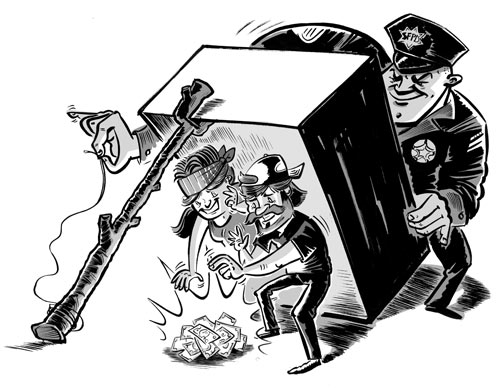
The action is informal but fiery and furious: cherry bombs, clusters, spinning wheels, high flying arcs, whizzers of all shapes and sizes. The cops are quite civilized and patrol the perimeter but don’t bother anybody. I go every year. I think it’s the best show in town. B3.

The Village Voice, Ashton Kutcher and prostitution ads

13

There’s some fascinating back and forth in media circles about the Village Voice, its chain (which includes SF Weekly), Ashton Kutcher, Demi Moore, prostitution, and layoffs and budget cuts as the nation’s oldest alternative weekly.

It’s all so juicy I don’t know where to begin. Perhaps with the SF Weekly’s cover story this week, which also ran in the Voice and most of the chain’s other papers.

The story takes Kutcher and Moore to task for launching a campaign against child prostitution using bogus numbers.
For the record: I have no reason to doubt the Voice’s conclusions here. I have no problem with adult ads (which the Guardian also takes). And frankly, I have no problem with prostitution, which, like gambling and drugs, ought to be legalized, regulated and taxed.

And the Voice was scrupulous about disclosing that it has a financial interest in this issue. How much of an interest? Well, a lot. In fact, according to the New York Observer, the prostitution ads could well be floating the financially troubled chain:

Backpage, which is a fraction of the size of Craigslist, is the only popular classifieds site left willing to host the paid escort and body-rub ads that are often thinly veiled fronts for prostitution. In the month after Craigslist closed its erotic services sections under pressure from Congress and state attorneys general, Backpage enjoyed a half-million-visitor bump in traffic, according to Quantcast, and became the No. 1 publisher of escort ads on the Internet. The Aim Group, a media consulting firm, estimated that in January, Backpage brought in $2.1 million in revenue from erotic services ads alone.

That would be about $24 million a year — and the Observer notes that VVM desperately needed the cash:

For more than two decades, Village Voice Media executive editor Mike Lacey employed a simple, often devastatingly successful strategy for gaining control of the country’s alternative weekly business: acquire the local paper, cut editorial costs (lay off critics, reporters and, reportedly, entire fact-checking departments), pump the paper full of nationally syndicated content and splash an occasional local investigative piece on the cover. It was working like a charm until 2004, when the San Francisco Bay-Guardian sued VVM’s SF Weekly for manipulating ad prices in an attempt to drive the rival paper out of business. According to court transcripts, Mr. Lacey told the staff on his first day as owner of SF Weekly that this was precisely his intention.

Despite facing legendary antitrust lawyers in a state notorious for its aversion to monopolistic practices, Mr. Lacey spent years appealing the court’s award of $16 million, which grew to $21 million with interest, until the California Supreme Court threw out VVM’s petition. During the proceedings, the company revealed that it owed creditors $80 million and claimed it could not afford to pay the award. Lawyers for the Bay-Guardian threatened to force bankruptcy.

In January 2011, VVM and SF Weekly settled the issue privately. Though the terms of the agreement were not disclosed, between the settlement and what one attorney familiar with the case said were legal fees of at least $5 million to fight the case, VVM was likely left with an eight-figure hole burned in its pocket.

Since last spring, the company’s efforts to patch that hole up have included the unthinkable (laying off legendary Village Voice investigative reporter Wayne Barrett in January); the surprising (selling off Kansas City Pitch to Tennessee publisher South Comm, Inc., in mid-March); and the long overdue: shutting down an experiment with a pair of sex blogs that were never publicly launched despite being published for nearly a year.

(For the record: The Guardian and VVM have agreed not to discuss the terms of the settlement.)

Mike Lacey, the executive editor of Village Voice Media, shot back with a letter to the Observer featuring his typical wild-ass metaphors and flowery prose:

In fact, in just the past few months Backpage.com has spent millions of dollars policing content to attempt, for example, to keep underage kids out of adult listings. Despite Trench’s professed lack of knowledge, which we do not doubt for a second, anyone looking at Backpage will notice the absence of nudity-merely one of thousands of changes over the past year.

Damn — no more nudity on Backpage. Then Lacey goes on to describe what he found at the Voice when he took it over:

We found a Voice “library” where an individual sat with scissors and clipped out articles from other publications for filing. The age of the Internet stopped at the library’s doors. Town cars arrived to ferry one late working chap to Westchester County. While we kept critics at Cannes, Toronto, and Sundance, we equivocated on sending them to Rotterdam. The Voice was the only alternative newspaper in the country that thought its reporters needed to have their facts checked in addition to being edited, copyedited, and proofread. I disagreed. (Though I do not wish to presume that the Observer might not benefit from such staffing.)

Actually, it was a little more than that. There were a number of longtime Voice staffers — mostly with politically left views — who earned, by alternative press standards, fairly high salaries. They’ve been shoved out the door. Nat Hentoff, James Ridgeway, Wayne Barrett … all gone. They were, in some ways, the soul of the old Voice — scrappy, unafraid to be progressives (and to care about political causes) and interested in social change. That didn’t fit with Lacey’s world view.

But it gets better: The Voice and Kutcher are now in a tweet war — and all of this is going to bring more attention to Backpage and the sex ads — which, again, don’t bother me, but do bother a lot of stuck-up law-enforcement types, who will now have even more reason to go after VVM. At the Observer notes:

As Backpage grows in popularity, more news stories have emerged suggesting that the kinds of abuses that led lawmakers to demand Craigslist shutter its erotic-services section are increasingly occurring on the site. In September a former child prostitute sued VVM for knowingly publishing advertisements of her, and later that month 21 attorneys general called on the company to follow Craigslist’s lead and ban escort ads. VVM declined, but offered to continue cooperating with law enforcement officials on cases originating on the site.

I’m not sure all this publicity is exactly what Lacey had in mind.


Hunger strike highlights horrible prison conditions

14

In a state that’s still floundering for ways to comply with court orders to drastically reduce the number of inmates in a prison system that has long been severely overcrowded, people in prison face unconstitutionally inhumane and degrading treatment on a daily basis. And now a group of inmates is highlighting the problem with a hunger strike that begins this Friday, July 1.

Lawyers for and supporters of the group of inmates from the Secure Housing Unit at the notorious Pelican Bay prison will hold a press conference tomorrow (Thu/30) at 11 am outside the state building at 1515 Clay Street in Oakland to announce the hunger strike to back up a list of demands they have submitted to the warden and Gov. Jerry Brown. Their demands include an end to long-term solitary confinement, collective punishment, and forced interrogation on gang affiliation, and they say they will continue their hunger strike until their demands are met.

“The prisoners inside the SHU at Pelican Bay know the risk that they are taking going on hunger strike,” Manuel LaFontaine of All of Us or None said in a prepared statement. “The CDCR must recognize that the SHU produces conditions of grave violence, such that people lose their lives in there all the time.”

The anti-war group World Can’t Wait is also supporting the hunger strike and calling for a supportive demonstration on Friday at 11 am outside the state building in San Francisco at Van Ness and McAllister streets. California officials have for years defied judges’ orders to reduce the prison population, which is at 180 percent of capacity, and the Supreme Court this year upheld the order and is requiring the state to reduce the prison population to 109,000 inmates, of 137.5 percent of the levels the prisons were designed to house.
The Brown Administration is seeking an extension of the deadline as it wrestles with political gridlock and a budget debacle that has stymied the governor’s efforts to transfer more prison inmates to county jails. But that plan avoids the reality that the U.S. has by far the highest incarceration rate in the world, a situation that is both inhumane and fiscally unsustainable.

He’s back!

9

steve@sfbg.com

It’s been more than a year since relations between San Francisco’s nightlife community and the San Francisco Police Department bottomed-out following a nasty crackdown and pattern of harassment led by plain-clothes Officer Larry Bertrand and Michelle Ott, an agent with the California Department of Alcoholic Beverage Control.

The pair’s antics included repeatedly shutting down clubs, aggressively raiding private parties, seizing laptop computers and other property, making arrests for minor infractions, roughing up and threatening those who objected to the harsh treatment, dumping out dozens of bottles of alcohol, and, according to one lawsuit, retaliating against those who filed complaints.

There were at least four lawsuits against the city related to the crusade, including one that the city is in the process of settling for $50,000 (involving promoter Arash Ghanadan, who had repeated run-ins with Bertrand) and another federal lawsuit alleging that Bertrand’s harassment of legal businesses amounted to a criminal racketeering enterprise. The federal case is headed for trial later this year.

After cover stories in the Guardian (see “The new War on Fun,” 3/23/10) and SF Weekly exposed the abuses, and the nightlife community formed the California Music and Culture Association to counter the assault, Bertrand and Ott were pulled off the nightlife beat and things slowly got better.

So when Bertrand appeared back on the beat on a recent Friday night, June 17 — targeting two of the same clubs he allegedly harassed before, Mist and Sloan, and shutting Sloan down for the night on a technical violation — many in the nightlife community freaked out, fearing that their improved relationship with SFPD was over and the bad old days were back.

“My phone was blowing up with texts and photos of his raid on Sloan nightclub. People are livid,” attorney Mark Rennie, who works with clubs on permitting and compliance issues, wrote to a group of nightlife advocates in an e-mail titled “Officer Larry Bertrand back on the Streets last night and up to his old tricks.”

Complaints were made to new Police Chief Greg Suhr and others in the command staff. The SFPD initially refused a Guardian request for comment on whether Bertrand would remain back on the beat, citing the ongoing lawsuits. But police spokesperson Sgt. Mike Andraychak eventually admitted it was a mistake to have Bertrand busting clubs and said he won’t be back on that beat anytime soon.

Andraychak said the new commander of Southern Station, Capt. Charlie Orkes, assigned Bertrand to police the clubs for the night and “he wasn’t aware of the history of lawsuits, and so that’s why Officer Bertrand was out there that night doing permit inspections … He won’t have Officer Bertrand in that role again, in the interests of good community relations.”

Those relations have become much better and more cooperative in the last year, according to Suhr, Rennie, and Entertainment Commission Executive Director Jocelyn Kane. “We’re happy with our relationship with the Police Department right now,” Kane told us. “That’s why [the reappearance of Bertrand] was of concern to people.”

During an interview with the Guardian on the morning of June 17, Suhr said he was supportive of nightlife. “I’m pro entertainment and I want the clubs to succeed. It think it draws people to the city and allows us to do a lot of things,” Suhr said, emphasizing the importance of clear communications and good relations between clubs and the SFPD. “If we’re being fair, consistent, and objective in how we treat situations, the clubs will know how it works.”

To many in the nightlife community, Bertrand represents the antithesis of that approach. Mist owner Mike Quan, a plaintiff in the ongoing federal lawsuit alleging Bertrand repeatedly harassed him and his customers, said he was shocked to hear Bertrand showed up at his club and was abrasive with his employees again. “My attorney sent [SFPD] a letter the next day saying this is not acceptable,” Quan told us. “Hopefully they got the message.”

Mayoral candidate Bevan Dufty, who is close to the nightlife community, helped reach out to Suhr after the incident and said he believes it was an aberration. “This is something that is a concern and the leadership needs to be sure that we’re not falling back,” Dufty told us.

Appeals also went out to the City Attorney’s Office, headed by another mayoral candidate, Dennis Herrera, who said he was happy to hear this was an isolated incident. But he said it illustrates something he’s been saying in meetings with clubs and cops — that SFPD’s nightlife enforcement policies need to be clear and consistent.

“We need to get it above the ad hoc way we’ve done it, so that it’s above the captain level and coming from the command staff,” Herrera told us.

Suhr, who has better relations with the nightlife community than any of his recent predecessors, also emphasized the need to lay out clear expectations. But he stopped short of saying there wouldn’t be anymore undercover raids of clubs and parties, telling us, “I think it’s important that people think that’s a possibility.”

Down Mexico way

0

arts@sfbg.com

FILM Traditional noir cinema is like a whirlpool (and there is, in fact, a 1949 noir titled Whirlpool): its protagonists are haplessly sucked into a vortex of escalating, devouring peril against which their struggles are likely to be futile. Violence, deceit, perversity, love gone wrong, vengeance, and insanity envelop the good and the weak, the haunted and proud alike.The familiar noir setting is that of the bustling city turned malevolent and strange, suddenly underpopulated streets fraught with danger in an unending night of guns, dames, and double crosses. But the open road is equally a noir landscape, exchanging the maze of urban entrapment for flights that seek rescue from dire straits but instead only dig deeper into trouble with each incriminating mile. Loss of control and comfort is the noir hero’s inevitable slippery slope; he (or the occasional she) is increasingly at the mercy of cruel fate, unrelenting pursuit, bad judgment, and/or unforgiving alien surroundings.

The Pacific Film Archive July series “Going South: American Noir in Mexico” explores one such manifestation of the traveler becoming “lost” in ways no AAA map can help. The eight vintage black and white features in curator Steve Seid’s program trace Yank protagonists’ odysseys southward, often on the lam or otherwise under duress. Some never actually make it to Mexico, or just to those border towns fabled for lawlessness and licentiousness (if largely because northern money, cultural ignorance, and thrill-seeking encouraged criminal predation).

Those who do make it find no comfort in a strange land: the stark desert, tourist traps, and insinuating locals with their maddening foreign tongue (the titular villain from 1953’s The Hitch-Hiker keeps expressing exasperation that Mexicans insist on speaking “Mexican”) provide no hiding place from their demons.

No less than three features star the inimitable sloe-eyed Robert Mitchum, a man who always seemed like he’d have a few Tijuana stories unfit for family consumption. Two by Mia’s dad John Farrow (1950’s Where Danger Lives and the next year’s His Kind of Woman), as well as Jacques Tourneur’s 1947 noir classic Out of the Past, find his variably innocent heroes drawn like flies into ornate sticky webs with an alluring brunette at their center. If Danger and Past prove her deadlier than the male, Woman‘s lighter tone allows a tropical resort near Santa Rosalita to parody den-of-thieves exoticism. In it, Jane Russell gets to be one dame who’s hard-boiled on the outside but soft on the in, as opposed to vice versa.

Mexico is likewise just the end point of thorny chases — after stolen loot or lying tail, respectively — in Phil Karlson’s excellent 1952 Kansas City Confidential and Anthony Mann’s cheesy Blue Angel (1930) update The Great Flamarion (1945) (with Erich von Stroheim as a grandiose vaudeville sharpshooter). But it’s central to the series’ three most potent entries, which also notably offer more complex takes on the relationship between our perennially poorer neighbor and imposing Gringolandia.

If you haven’t seen Orson Welles’ 1958 Touch of Evil — either in its original studio cut or drastically different 1998 Walter Murch reconstruction of the director’s original intent — you need to, because it’s a masterpiece of noir, exploitation, irony, and stylistic delirium. When Charlton Heston’s unlikely spray-tanned Mexican narcotics agent marries very blonde, “pure” (and racist) gringa Janet Leigh, their honeymoon becomes a grotesque nightmare of border-straddling sleaze, though the Spanish-speaking miscreants are just pawns in the hands of Yankee pros — especially Welles’ own Jabba the Hutt-like police captain.

Much lesser-known are two other films by actors behind the camera. Ida Lupino’s The Hitch-Hiker finds two average American Joes on a Baja fishing trip kidnapped by a serial-murdering psycho who forces them deep into desolate foreign terrain. It’s the keen eye of locals rather than our desperate heroes’ resourcefulness that might ultimately save them from the maniac’s itchy trigger finger. Spare, tense and realistic, it’s contrasted by Robert Montgomery’s 1947 Ride the Pink Horse, a sort of noir-fever-dream spin on Under the Volcano (1984) in which the director stars as a war-veteran tough guy unraveling from sleep deprivation and general dislocation on a revenge mission in a fictitious border town. Full of phony ethnic exoticism and stereotypes, it nonetheless offers hope of salvation solely from kindly Spanish-speaking locals, notably a teenage girl (pigtailed Wanda Hendrix) who can see his imminent death in our gruff hero’s eyes.

“Go on, beat it. Scrambo!” he barks at her — a good line to be sure, though none can beat Out of the Past‘s (false, it turns out) koan “A dame with a rod is like a guy with a knitting needle.”

GOING SOUTH: AMERICAN NOIR IN MEXICO

July 1–29, $5.50–$9.50

Pacific Film Archive

2575 Bancroft, Berk.

(510) 642-5249

www.bampfa.berkeley.edu

The way forward

0

sarah@sfbg.com

Two days before President Obama announced his plan to begin withdrawing 33,000 troops from Afghanistan over the next 15 months, Peace Action West’s political director Rebecca Griffin delivered a box containing thousands of toy soldiers to Sen. Dianne Feinstein’s office in downtown San Francisco.

Tied to each soldier were handwritten messages that gave reasons for demanding a large and swift withdrawal. Many of the petitions came from folks whose loved ones are in the military or are veterans of Afghanistan and Iraq.

Unlike most Democratic Party leaders, Feinstein has not demanded a significant draw-down of combat troops, despite polls showing that Americans increasingly support leaving Afghanistan, particularly after the killing of Osama bin Laden. There’s good reason for the public’s growing restlessness. This 10-year war has already surpassed Vietnam as the longest conflict in U.S. history.

According to the online database icasualities.org, 1,637 U.S. soldiers have died in Afghanistan and 4,463 soldiers have died in Iraq. Another 11,722 service members have been wounded in Afghanistan, and 32,100 in Iraq, primarily by improvised explosive devices. And that’s not counting the thousands who are suffering from depression, posttraumatic stress disorder, and other ailments.

Griffin said her goal was to draw attention to the political organizing in support of ending the war. But even as she made her delivery, Feinstein was on MSNBC maintaining that draw-down decisions should be left to the military generals.

In the wake of President Obama’s June 22 announcement, which went way farther than the generals wanted, many of Feinstein’s colleagues such as Sen. Barbara Boxer and Rep. Nancy Pelosi, the house minority leader, expressed disappointment that the pace of withdrawal isn’t quicker.

“I am glad this war is ending, but it’s ending at far too slow a pace,” Boxer said.

“We will continue to press for a better outcome,” Pelosi stated.

Rep. John Garamendi (D-Concord), who visited the troops over Memorial Day weekend, told us that a different strategy is needed. “Our troops are incredible, dedicated, and skilled. But every minute of every day, they are in a very dangerous situation, and many of them are dying. There is no recognition that we are caught in the middle of a five-way civil war.”

And Rep. Barbara Lee (D-Oakland) vowed to offer defense appropriations amendments to cut all funding for combat operations. “History shows there is no military solution in Afghanistan,” she said. “We’ve got to engage with the Taliban and engage with those in the region to find some stability.”

But where does Obama’s plan leave the peace movement as the election nears?

Griffin said activists should take credit for getting Obama to withdraw 33,000 troops rather than the smaller number his generals wanted. She sees his plan as a sign that activists need to keep pushing for more, including a concrete timeline for when he will bring all the troops home.

Under Obama’s plan, 68,000 troops will still be on the ground in September 2012, and 2014 is identified as the deadline for completing the transition to Afghan control and ending the U.S.’s combat mission.

“This means there’ll be a significant military presence in Afghanistan for at least another three-and-a-half years,” Griffin said. “By the end of Obama’s first term, the war will be 11 years old and there will be nearly double the American troops on the ground as there were when [George W.] Bush left office.”

Progressive activist and author Norman Solomon, who is running in the 2012 race to replace Rep. Lynn Woolsey (D-Marin County), noted that a recent New York Times’ headline read “Obama Opts for Faster Afghan Pullout.”

“But faster than what?” Solomon said, noting that “10,000 troops are only 10 percent of our force. This is a pattern we saw in Iraq, where the withdrawal was too slow and the numbers remaining doubled when you factored in all the private contractors.”

Solomon said that when Nixon pulled 500,000 troops from Vietnam in the late 1960s, the conflict actually increased in terms of the tonnage of weaponry used. “And the U.S. is now engaged in wars in Libya, Yemen, and a Pakistan air war.”

But longtime antiwar activist and former Democratic state legislator Tom Hayden saw a number of clues in Obama’s speech for how to push for a faster, bigger, more significant draw-down.

“Obama said 33,000 troops will be withdrawn by next summer, followed by a steady pace of withdrawal. So that gets you to 50,000 troops by the election, and all combat troops out by 2014,” Hayden told us. “If he could be pushed by the peace movement, that would break the back of the warmongers’ planning.”

In his speech, Obama noted that the U.S. will host a summit with our NATO allies and partners to shape the next phase of this transition next May in Chicago, where Obama’s former chief of staff is mayor.

“Get ready, Rahm Emanuel, for big demonstrations,” warned Hayden, who was a member of the Chicago Seven group tried for inciting riots during the 1968 Democratic National Convention. “But do you imagine Obama would do that if he were going to escalate the war? No — he’s wrapping a ribbon of unity to transfer control to Afghanistan on a timetable.”

He also noted that Obama’s allies aren’t exactly pushing him to stay. “They may not have an exit strategy, but they are heading for the exits,” Hayden said. “So if you organize demonstrations with international support, that gives you an organizational opportunity in multiple governments to press Obama to leave.”

Hayden predicts that Obama is moving toward a diplomatic settlement, led by Secretary of State Hillary Clinton, that is pro withdrawal and pro women.

“But Obama’s got a genuine problem of his own making. He escalated the damn war,” Hayden said. “He doesn’t want the military to be attacking his plan. But if he wants to be in the center, he’s going to offend the generals.

Hayden noted that in his speech Obama said, “America, it is time to focus on nation building here at home.” It was a statement that sounded in line with a recent U.S. Conference of Mayors resolution calling on Congress “to bring these war dollars home to meet vital human needs, promote job creation, rebuild our infrastructure, aid municipal and state governments.”

But Richard Becker, western regional coordinator of the antiwar ANSWER Coalition, described Obama’s draw-down as “a minimal pledge.”

“Given the growing discontent with the war, it’s hard to see how you can claim that this is a step forward,” he told us.

Becker said it has been difficult to mobilize the antiwar movement under a Democratic administration. He also stressed the importance of people coming out in San Francisco for a “protest, march, and die-in” on Oct. 7, the 10th anniversary of the war, and for a major action in Washington. D.C., on Oct. 6. “What’s going to get the U.S. out is a combination of what’s going on in Afghanistan — and what kind of antiwar movement we have here.”

Our Weekly Picks: June 29-July 5, 2011

0

WEDNESDAY 29

FILM

Green  

Swedish-French filmmaker Patrick Rouxel’s Green documents the life and death of a female orangutan in a rainforest of Indonesia. The 48-minute film won the Natural History Museum Environment Award in Great Britain for its narration-free depiction of a habitat ravaged by loggers, forest fires, and dwindling biodiversity. Head to the San Francisco Main Library to see a free screening of Green; afterward, there will be an opportunity to speak with members of the Rainforest Action Network Forest Team and ask questions of activists from the Bay Area working in the field. If you can’t make it, Green streams for free at greenplanetfilms.org. (David Getman)

6 p.m., free

Koret Auditorium

San Francisco Main Library

100 Larkin, SF

(415) 557-4277

www.sfpl.org


MUSIC

Tera Melos

There are many bands formerly treasured for innovation and aggression that — as the members got older and actually learned how to play their instruments — suddenly got boring, like a crappy caterpillar emerging from a brilliant cocoon. Although it has undergone a dramatic sonic change, Tera Melos is, happily, not one of these bands. Since gaining a vocalist and switching around members, Tera Melos has blossomed into a jaw-droppingly technically adept (it always was) pop band that draws from the best of its math rock past to craft songs that are as catchy as they are challenging. Add to this an impressive stage presence, bolstered by the joy of watching everyone in the band shred on his respective ax of choice with mind-blowing ability, and a rare but winning combination is born. (Cooper Berkmoyer)

With Les Butcherettes and Adebisi Shank

8 p.m., $14

Great American Music Hall

859 O’Farrell, SF

(415) 885-0750

www.gamh.com


FRIDAY 1

MUSIC

Death Grips at Low End Theory SF

For almost any other hip-hop group out there, the sound of Sacramento’s Death Grips would be too much. It’s loud, it’s abrasive, and it’s rough around the edges. Even a relatively relaxed song on the debut album Ex-Military features a distorted power-chord sampled from Link Wray’s “Rumble.” But the lyrical ferociousness displayed by MC Ride, Mexican Girl, Info Warrior, and Flatlander manages to match the beat. With nonstop drummer Zach Hill of Hella performing live with this latest rap-rock hybrid, the show should be punk enough to make you forget about earlier, lesser experiments in the genre (i.e., Limp Bizkit). (Ryan Prendiville)

With TOKiMONSTA, Free the Robots, Bangers, Nobody, D-Styles, and Nocando

10 p.m., $15

103 Harriet, SF

(415) 431-1200

www.1015.com


PERFORMANCE

Circus Bella

As if all the hallmarks of the circus weren’t entertaining enough, Circus Bella sets performers to a live quartet playing New Orleans jazz, French waltz, klezmer, and other music from around the globe — along with plain old American circus marches. Circus Bella features nine artists who showcase the usual clowning along with trapeze, ropewalking, juggling, and contortion in open-air venues. The circus has been touring since 2008 and arrives for a brief stay of nine free performances in assorted Bay Area parks. After today’s show, there’s also the chance to meet the artists-musicians, including America’s Got Talent veterans Zoë Klein and Dave Paris, also known as Paradizo Dance. (Getman)

Fri/1–Sat/2, noon

Also Sat/2, 2:15 p.m., free

Yerba Buena Gardens

760 Howard, SF

(415) 543-1718

www.ybgf.org


MUSIC

Group Doueh

Bamaar Salmou (the Doueh of Group Doueh) is a guitarist like you’ve never heard before. Many have tried to incorporate African music into a rock rubric. Yet while a few succeed somewhat (notably Sun City Girls), most fail outright. Salmou’s strength is that the music seems to have emerged organically. Group Doueh is based in the Western Sahara where Salmou has been playing guitar for almost 30 years, drawing on the regional stylings of Saharan music as well as Western music that would filter into the area on cassette. The end result is something as heavy and raw as Jimi Hendrix (apparently of favorite of Salmou’s) and as vibrant as the western edge of North Africa, a tapestry of sound that no amount of orientalist posturing will ever be able to successfully imitate. (Berkmoyer)

With Nick Waterhouse and the Tarots, Mark Gergis DJ set

9 p.m., $14

Rickshaw Stop

155 Fell, SF

(415) 861-2011

www.rickshawstop.com


VISUAL ART

ColorFest

As the city gets buried under its pale gray seasonal shroud of fog, the Exploratorium is rebelling, giving a giant middle finger to the weather encroaching on its dome with its summer-long celebration of color. For two months, the hands-on museum is delving into the visible spectrum with ColorFest, featuring more 30 color-related exhibits, a six-part Chromatic Cinema series, and weekly demos on the science behind rainbow-riffic things like kaleidoscopes, prisms, and dye-making. Or sip cocktails, dance, and listen to live music during the adults-only “After Dark” events on the first Thursday of each month: July’s theme is red and August’s is blue. Wayward San Francisco spirits, this just might be the cure for the summertime blues. (Kat Renz)

Through Sept. 5

Tues.–Sun., 10 a.m.–5 p.m., $10–$15

Exploratorium

3601 Lyon, SF

(415) 561-0363

www.exploratorium.edu


SATURDAY 2

THEATER

2012: The Musical!

Okay, it’s officially summer: the San Francisco Mime Troupe, now in its 52nd season of confusing noobs who’re expecting actual mimes onstage, is opening its annual park-hopping musical production. At first glance, one might worry that 2012: The Musical! might be some kind of disaster-movie parody. Fear not — SFMT is smarter and way more hilarious than that. 2012 refers to the show-within-the-show being mounted by Theater BAM!, a fictional political theater company whose creative integrity is jeopardized when its members have to choose between selling out (and staying afloat) or staying staunchly idealistic (and going under). Written by Michael Gene Sullivan with Ellen Callas, with music by Bruce Barthol with Pat Moran, 2012 kicks off at Dolores Park and romps up and down California (Ukiah to Hollywood) throughout the summer. (Cheryl Eddy)

Various venues through Sept. 25

Sat/2–Mon/4, 2 p.m., free

Dolores Park

19th St. at Dolores, SF

www.sfmt.org


MUSIC

DJ MartyParty

Half of PANTyRAiD with Glitch Mob’s Ooah, DJ MartyParty is picking up where Prince left off: seemingly obsessed with purple. Not only is Purple the title of his new album, it’s also his genre, the aesthetic of his website, and presumably the shade of his mood ring 24/7. For those of you without a color-coded record collection, his “Twisted Summer Mixtape” online is a bit more descriptive: a promising soundtrack for warm nights. Eclectic vocal samples (Adele, Eleanor Rigby, Khia’s crack) and layered melodies combine with a measured amount of vibrato bass and soul-clappin’ hi-hats, ensuring that the mood stays hot (purple is the most sensual color) without overheating. (Prendiville)

With Bogl, Manitous, Shawna, Mozaic, Dax, and Napsty

10 p.m., $10–$12

Public Works

161 Erie, SF

(415) 932-0955

www.publicsf.com


MUSIC

Melodians

Chances are, you’ve probably heard the Melodians without even knowing it. The Kingston, Jamaica, trio’s biggest hit, “Rivers of Babylon,” is omnipresent as far as roots reggae goes, and as an early addition to the Trojan Records roster, it helped pioneer a musical genre that would become a movement. The Melodians’ catalog is widely covered by all manner of upstroke-friendly musicians, and although dwarfed in size by those of similar artists such as Desmond Dekker and Lee Perry, the early material is just as consistently great as any other late-1960s Kingston reggae music (does anyone else always read “reggae music” in a Jamaican accent?) Two of three original members remain, and although well into their 60s, they show no signs of letting up, having toured consistently since 2007 with the Yellow Wall Dub Squad. (Berkmoyer)

9 p.m., $20

Brick and Mortar Music Hall

1710 Mission, SF

(415) 800-8782

www.brickandmortarmusic.com


EVENT

Breastfest Beer Festival

The 11th annual Breastfest Beer Festival gives San Franciscans the chance to get tipsy and taste-test knowing that all those beers aren’t just supporting a habit, but also a good cause. The festival expands this year to include the unlimited sampling of drinks from 60 breweries, four cider companies, and three wineries. In addition, Breastfest features fresh food and live music from1980s cover band Metal Shop. So far, the festival has brought in more than $225,000 to the Charlotte Maxwell Complementary Clinic (CMCC), an innovative public health center that gives women in dire financial straits and others fighting cancer alternative medical and social services, free. (Getman)

5 p.m., $45

Fort Mason Center

Marina at Laguna, SF

(415) 461-4677

www.thebreastfest.org


MONDAY 4

EVENT

U.S.S. Hornet Fourth of July Family Party

The aircraft carrier U.S.S. Hornet was a major factor in World War II’s Pacific theatre — its 20,000-plus tons were instrumental in the Doolittle Raid, the Battle of Midway, and Guadalcanal, among others. The decorated ship was also on hand in 1969 to scoop up Neil Armstrong and company after Apollo 11 splashed down post-moon walk. Alas, the Hornet can’t talk (though its alleged ghost sightings might suggest otherwise), but it survived its many adventures to become part of a museum that also hosts occasional parties, including today’s suitably patriotic July 4 bash. Tour the carrier’s multiple decks, check out the Apollo Moon Mission exhibit, play carnival games, and boogie to live music (Celtic, retro, and classic rock). Guests are encouraged to stick around for a front-row view of the traditional fireworks over the bay. (Eddy)

1–9 p.m., $10–$25

707 W. Hornet

Pier 3, Alameda

(510) 521-8448, ext. 282

www.hornetevents.com 


The Guardian listings deadline is two weeks prior to our Wednesday publication date. To submit an item for consideration, please include the title of the event, a brief description of the event, date and time, venue name, street address (listing cross streets only isn’t sufficient), city, telephone number readers can call for more information, telephone number for media, and admission costs. Send information to Listings, the Guardian Building, 135 Mississippi St., SF, CA 94107; fax to (415) 487-2506; or e-mail (paste press release into e-mail body — no text attachments, please) to listings@sfbg.com. Digital photos may be submitted in jpeg format; the image must be at least 240 dpi and four inches by six inches in size. We regret we cannot accept listings over the phone.

Stage Listings

0

Stage listings are compiled by Guardian staff. Performance times may change; call venues to confirm. Reviewers are Robert Avila, Rita Felciano, and Nicole Gluckstern. Submit items for the listings at listings@sfbg.com. For further information on how to submit items for the listings, see Picks. 

THEATER

OPENING

2012: The Musical! Dolores Park, 19th St at Dolores, SF; www.sfmt.org. Free. Sat/2-Mon/4, 2pm. Continues through Sept. 25 at various Bay Area venues. San Francisco Mime Troupe mounts their annual summer musical; this year’s show is about a political theater company torn between selling out and staying true to its anti-corporate roots.

BAY AREA

All My Children Cabaret at Marsh Berkeley, 2120 Allston, Berk; www.themarsh.org. $20-50. Previews Fri/1, 8pm. Opens Sat/2, 8:30pm. Runs Fri, 8pm; Sat, 8:30pm. Through July 23. Not the soap opera — it’s Seattle Improv co-founder Matt Smith in his comedy about a middle-aged man with boundary issues.

ONGOING

All Atheists Are Muslim Stage Werx, 533 Sutter, SF; www.brownpapertickets.com. $20. Runs Sun, 7pm. Through July 10. Zahra Noorbakhsh returns with her timely comedy.

Assisted Living: The Musical Imperial Palace, 818 Washington, SF; 1-888-88-LAUGH, www.assistedlivingthemusical.com. $79.59-99.50 (includes dim sum). Sat-Sun, noon (also Sun, 5pm). Through July 31. Rick Compton and Betsy Bennett’s comedy takes on “the pleasures and perils of later life.”

The Book of Liz Custom Made Theatre, 1620 Gough, SF; www.custommade.org. $10-29. Thurs-Sat, 8pm; Sun, 7pm. Through July 31. Custom Made Theatre performs David and Amy Sedaris’ comedy about an unconventional nun.

*Fighting Mac! Thick House Theatre, 1695 18th St, SF; 1-800-838-3006, www.therhino.org. $15-30. Wed/29-Sat/2, 8pm; Sun/3, 3pm. Theatre Rhinoceros artistic director John Fisher’s new play is (characteristically for the author of Combat! and Special Forces, among others) too subtly intelligent and far-reaching to fit comfortably under the didactic subject heading “gays in the military.” Nevertheless, that is the terrain it scouts, with neat skill and satisfyingly messy results. It’s the story of a young West Point–bound gay Berkeley student (an able, likeable Joshua Lomeli) with a fixation on the historical figure of Hector “Fighting Mac” Macdonald (a strong William J. Brown III), a self-made Victorian-era British Major-General who committed suicide after being accused of homosexuality. Mac shares the stage as alter-ego or mentor to the young man, counseling him to let go of his faith in feelings for a hard-headed calculation of advantage in a world where both love and war are often no more than means to social ends. In the paralleling of stories Fisher draws out with humor, knowing winks, and an underlying emotional unease the implications of certain colonized key words, like loyalty, honor, and love — and finds them too often a long way from home. Not for the first time, director Fisher also gets fine, open, and shrewd performances from a cast that includes several Berkeley students. (Avila)

“Fury Factory 2011” Various venues and prices; www.brownpapertickets.com. Through July 12. Over 30 Bay Area and national companies participate in this bi-annual theater festival.

Indulgences in the Louisville Harem Phoenix Theatre, 414 Mason, SF; 1-800-838-3006, www.offbroadwaywest.org. $20-40. Thurs-Sat, 8pm. Through July 30. Two spinster sisters find unlikely beaux in Off Broadway West Theatre’s production of John Orlock’s play.

The Pride New Conservatory Theatre Center, 25 Van Ness, SF; (415) 861-8972, www.nctcsf.org. $24-40. Wed-Sat, 8pm; Sun, 2pm. Through July 10. New Conservatory Theatre Center performs the West Coast premiere of Alexi Kaye Campbell’s love-triangle time warp drama.

*Vice Palace: The Last Cockettes Musical Thrillpeddlers’ Hypnodrome, 575 10th St; (800) 838-3006, www.brownpapertickets.com. $30-35. Fri-Sat, 8pm; Sun, 7pm. Through July 31. Hot on the high heels of a 22-month run of Pearls Over Shanghai, the Thrillpeddlers are continuing their Theatre of the Ridiculous revival with a tits-up, balls-out production of the Cockettes’ last musical, Vice Palace. Loosely based on the terrifyingly grim “Masque of the Red Death” by Edgar Allan Poe, part of the thrill of Palace is the way that it weds the campy drag-glamour of Pearls Over Shanghai with the Thrillpeddlers’ signature Grand Guignol aesthetic. From an opening number set on a plague-stricken street (“There’s Blood on Your Face”) to a charming little cabaret about Caligula, staged with live assassinations, an undercurrent of darkness runs like blood beneath the shameless slapstick of the thinly-plotted revue. As plague-obsessed hostess Divina (Leigh Crow) and her right-hand “gal” Bella (Eric Tyson Wertz) try to distract a group of stir-crazy socialites from the dangers outside the villa walls, the entertainments range from silly to salacious: a suggestively-sung song about camel’s humps, the wistful ballad “Just a Lonely Little Turd,” a truly unexpected Rite of Spring-style dance number entitled “Flesh Ballet.” Sumptuously costumed by Kara Emry, cleverly lit by Nicholas Torre, accompanied by songwriter/lyricist (and original Cockette) Scrumbly Koldewyn, and anchored by a core of Thrillpeddler regulars, Palace is one nice vice. (Gluckstern)

What Mamma Said About Down There SF Downtown Comedy Theater, 287 Ellis, SF; www.sfdowntowncomedytheater.com. $15. Thurs-Sat, 8pm. Through August 20. Sia Amma returns with her solo comedy.

BAY AREA

Down a Little Dirt Road Berkeley City Club, 2315 Durant, Berk; www.justtheater.org. $15-30. Thurs/30-Sat/2, 8pm; Sun/3, 5pm. A naturalistic family portrait twists itself into a supernatural love knot in Erin Marie Bregman’s first full-length play Down a Little Dirt Road, directed by Molly Aaronson-Gelb. Dad (Anthony Nemirovsky), an earthquake researcher, has moved his family to Parkfield, Calif. for work, but Mom (Lisa Morse) is not with them. Did she die in a plane crash on September 11? Did she vanish into another dimension? Daughter Alice (Alona Bach) has plenty of theories to share, each more earnestly improbable than the last. She is also plagued with recurring nightmares, an unsettling trait she shares with her father. Together they dream of wandering, lost, in a shadow realm, gradually revealed to hold the shade of the missing mother, trying desperately to get back to her daughter while a menacing authority figure (Ryan Tasker) tries to literally pry her memories away. Alona Bach delivers a guileless, pitch-perfect performance as Alice, and her relationship with her stage parents is comfortable and genuine. Berman is clearly playing with the convention of the family-oriented horror story, much like the referenced Roald Dahl classic The Witches, but the ghostly elements prove somewhat problematic in terms of staging and clarity, and while there are a few moments with some serious spine-tingling potential, the overall effect is somewhat flat. (Gluckstern)

East 14th: True Tales of a Reluctant Player Marsh Berkeley, 2120 Allston, Berk; www.themarsh.org. $20-50. Sat, 8:30pm; Sun, 7pm. Through Aug. 7. Don Reed’s hit solo comedy receives one last extension before Reed debuts his new show (a sequel to East 14th) in the fall.

Metamorphosis Aurora Theatre, 2081 Addison, Berk; (510) 843-4822, www.auroratheatre.org. $10-55. Tues, 7pm; Wed-Sat, 8pm; Sun, 2 and 7pm. Through July 17. Aurora Theatre Company performs a terrifying yet comic adaptation of Kafka’s classic by David Farr and Gísli Örn Gardarsson.

A Raisin in the Sun Pear Avenue Theatre, 1220 Pear, Mtn. View; (650) 254-1148, www.thepear.org. $15-30. Thurs-Sat, 8pm; Sun, 2pm. Through July 10. Lorraine Hansberry’s classic play comes to life on the Pear Avenue Theatre stage.

*Working for the Mouse La Val’s Subterranean, 1834 Euclid, Berk; www.impacttheatre.com. $10-20. Thurs-Sun, 8pm. Through July 8. It might not come as a surprise to hear that even “the happiest place on earth” has a dark side, but hearing Trevor Allen describe it during this long overdue reprise of 2002’s Working for the Mouse, will put a smile on your face as big as Mickey’s. With a burst of youthful energy, Allen bounds onto the tiny stage of Impact Theatre to confess his one-time aspiration to never grow up — a desire which made auditioning for the role of Peter Pan at Disneyland a sensible career move. But in order to break into the big time of “charactering,” one must pay some heavy, plush-covered dues. As Allen creeps up the costumed hierarchy one iconic cartoon figure at a time, he finds himself unwittingly enmeshed in a world full of backroom politics, union-busting, drug addled surfer dudes with peaches-and-cream complexions, sexual tension, showboating, job suspension, Make-A-Wish Foundation heartbreak, hash brownies, rabbit vomit, and accidental decapitation. Smoothly paced and astutely crafted, Working for the Mouse will either shatter your blissful ignorance or confirm your worst suspicions about the corporate Disney machine, but either way, it will probably make you treat any “Casual Seasonal Pageant Helpers” you see running around in their sweaty character suits with a whole lot more empathy. (Gluckstern)

PERFORMANCE/DANCE

“The Betrothed” Cowell Theater, Fort Mason Center, Marina at Laguna, SF; (415) 788-7142, ext. 18. Thurs, 7pm. Free (RSVP required due to limited space). The Italian Cultural Institute and the Museo Italo Americano present this theatrical performance based on Alessandro Manzoni’s novel of the same name.

“The Book” SOMArts Cultural Center, 934 Brannan, SF; www.somarts.org. Fri/1 and July 29, 6pm. Free. Also July 7, 14, and 21, 8pm. $12. In conjunction with a new dance-based exhibition by Avy K Productions, SOMArts presents a series of new work featuring Bay Area artists Carol Swann, Ken Ueno, Matt Ingalls, Jesse Hewit, and more.

“Queer Rebels of the Harlem Renaissance” African American Art and Culture Complex, 762 Fulton, SF; www.queerrebels.com. Fri-Sat, 7:30pm. $15-25. The National Queer Arts Festival presents this show of new work by 16 LGBT African American artists.

“The Romane Event Comedy Show” Make-Out Room, 3225 22nd St, SF; www.pacoromane.com. Wed, 7:30pm. $7. Comedian Paco Romane hosts this showcase of up-and-coming stand-up talent.

San Francisco Ethnic Dance Festival Yerba Buena Center for the Arts, Novellus Theater, 700 Howard, SF; www.sfethnicdancefestival.org. Fri-Sat, 8pm (also Sat, 3pm); Sun, 3pm. $18-58. The annual festival wraps up in a final weekend of dance from Haiti, Spain, China, Hawaii, and global points beyond.

“This Twisted Tale” Dance Mission Theater, 3316 24th St, SF; www.brownpapertickets.com. Fri-Sat, 8pm. $20. Paper Doll Militia performs their latest aerial theater production.

“Will Franken’s Beautiful Birthday Bash: .38 Special” Purple Onion, 140 Columbus, SF; (415) 956-1653. 8pm, $20. Comedian Will Franken performs a new show of vignettes in honor of his 38th birthday. 


Film Listings

0

Film listings are edited by Cheryl Eddy. Reviewers are Kimberly Chun, Michelle Devereaux, Peter Galvin, Max Goldberg, Dennis Harvey, Johnny Ray Huston, Louis Peitzman, Lynn Rapoport, Ben Richardson, and Matt Sussman. For rep house showtimes, see Rep Clock. For first-run showtimes, see Movie Guide.

OPENING

Happy Happy, a documentary by Roko Belic (1999’s Genghis Blues), traces the contented lifestyles of men and women around the globe. Manoj Singh is a Kolkata rickshaw driver sustained by his son’s smile. Anne Bechsgaard’s life is enriched by her co-housing community in Denmark. These soothingly sentimental profiles are intercut with commentary from leading neuroscientists and psychologists. They provide a cursory guide to the rare balancing act that is happiness in the 21st century. A brisk 75 minutes, the film is saturated with thought-provoking tidbits (the Bhutan government aims for gross national happiness instead of GDP) and an ambient backing track that’s heavy on the chimes. However, sometimes there’s the sense that these mechanics of happiness aren’t cinematically compelling enough, and that rifling through a couple Wikipedia pages might offer just as much insight. At its best, Happy sparks a reflection on how many of the unofficial criteria for joy one has fulfilled, and suggests ideas for simple happiness boosters. (1:15) Roxie. (David Getman)

Larry Crowne A recently unemployed man (Tom Hanks, who also co-wrote and directs the film) starts attending college, where he promptly becomes hot for teacher (Julia Roberts). (1:39) Four Star, Piedmont, Presidio, Shattuck.

Monte Carlo Selena Gomez, Leighton Meester, and Katie Cassidy play friends who fake their way to an awesome European vacation. (1:48)

Mr. Nice By the second hour of Mr. Nice, star Rhys Ifans and company have exhausted every possible pot smoking flourish. There’s the seductive French inhale by the pool, the suggestive mouth to mouth, the euphoric dragon release in the deserts of Pakistan: all rendered in extreme close-up with improbably thick plumes of white smoke. Mr. Nice is mostly sexy drug use tutorial, though it’s also part biography of real-life drug smuggler Howard Marks. His claim to fame — at least according to the movie’s tagline — is the sheer number of aliases, phone lines, and children he had (43, 89, and 4, respectively). Unexpectedly, it’s the period costuming, cinematography, and the enchanting listlessness of Chloe Sevigny that redeem the film. Mr. Nice is captivatingly interlaced with vintage news and scenery clips from the period and it’s shot in a way that is both hyper-stylized and erratic. Those twists and turns of Marks’s life turn out to be not nearly as suspenseful onscreen as they should be, making the movie less of a traditional drug thriller and more of a mildly interesting reflection on the culture of the period. (2:01) Lumiere, Shattuck. (Getman)

*Page One: Inside the New York Times When Andrew Rossi’s documentary premiered at Sundance this January, word of mouth on it was respectable but qualified, with nearly everyone opining that it was good … just not what they’d been led to expect. What they expected was (in line with the original subtitle A Year Inside the New York Times) a top-to-bottom overview of how the nation’s most respected — and in some circles resented — arbiter of news, “style,” and culture is created on a day-to-day as well as longer term basis. That’s something that would doubtless fascinate anyone still interested in print media, or even that realm of web media not catering to the ADD nation. But that big picture and the wealth of minute cogs within isn’t Page One‘s subject. Instead, Rossi focuses on the Gray Lady’s wrestling with admittedly fast-changing times in which newspapers and any other information source on paper seem to constitute an endangered species. This particular Times, however, is such a special case that that crisis might better have been explored by training a camera on a less fabled publication, perhaps one of the many that have succumbed to a once unthinkable, market-shrunk mortality in recent years. The film finds its colorful protagonist in David Carr, an ex-crack addict turned media columnist who retains his cranky, nonconformist edge even as he defends the Times itself from the same out-with-the-old cheerleaders who 15 years ago were inflating the dot-com boom till it burst. Facing one particularly smug champion of the blogosphere at a forum, Carr notes that without a few remaining outlets — like the Times — doing the hard work of serious research and reportage, the web would have nothing to purloin or offer but its own unending trivia and gossip. Page One does what it does entertainingly well, but if you’re looking for insight toward this not-dead-yet U.S. institution as a whole, you’d be better off simply picking up this week’s Sunday edition and reading every last word. (1:28) Bridge, Shattuck, Smith Rafael. (Harvey)

Transformers: Dark of the Moon Just wondering how Michael Bay could possibly improve on the previous film’s robot balls. (2:34) Presidio.


ONGOING

The Art of Getting By The Art of Getting By is all about those confusing, mixed-up and apparently sexually frustrating months before high school graduation. George (Freddie Highmore) is a trench coat-wearing misanthrope — an old soul, as they say — whose parents and teachers are always trying to put him inside a box and tell him how to think. He finds a kindred sprit in Sally (Emma Roberts) who smokes and watches Louis Malle films. Hot. Heavily scored by the now-ancient songs of early ’00s blog bands, it may all sound like indie bullshit but this one has charm and wit despite its post-trend package. Like a sad little crayon, Highmore is a competent Michael Cera surrogate du jour. Writer-director Gavin Wiesen embraces hell of clichés, but he suitably sums up a generational angst along the way. The film may not always feel real, but it does have real feeling. Look out for great performances from Blair Underwood and Alicia Silverstone. (1:24) Sundance Kabuki. (Ryan Lattanzio)

Bad Teacher Jake Kasdan, the once-talented director of a few Freaks and Geeks episodes and 2002’s underrated Orange County, seems hell-bent on humiliating everyone in the cast of Bad Teacher. Cameron Diaz is Elizabeth, the title’s criminally bad pedagogue who prefers the Jack Daniels method to the Socratic. Her impetus for pounding Harper Lee into her middle school students’ bug-eyed little heads is to cash in on a bonus check to fund her breast-y ambitions and woo Justin Timberlake and his baby voice. The only likable onscreen presence is Jason Segal as a sad sack gym teacher in love with Elizabeth. But he could do so much better. There’s no shortage of racist jokes and potty humor in this R-rated comedy pandering to those 17 and below. When asked if she wants to go out with her coworkers, Elizabeth ripostes, “I’d rather get shot in the face!” That scenario is likely a better alternative than suffering this steaming pile of cash cow carcass. (1:29) Marina, 1000 Van Ness, Shattuck, SF Center. (Lattanzio)

*Beginners There is nothing conventional about Beginners, a film that starts off with the funeral arrangements for one of its central characters. That man is Hal (Christopher Plummer), who came out to his son Oliver (Ewan McGregor) at the ripe age of 75. Through flashbacks, we see the relationship play out — Oliver’s inability to commit tempered by his father’s tremendous late-stage passion for life. Hal himself is a rare character: an elderly gay man, secure in his sexuality and, by his own admission, horny. He even has a much younger boyfriend, played by the handsome Goran Visnjic. While the father-son bond is the heart of Beginners, we also see the charming development of a relationship between Oliver and French actor Anna (Mélanie Laurent). It all comes together beautifully in a film that is bittersweet but ultimately satisfying. Beginners deserves praise not only for telling a story too often left untold, but for doing so with grace and a refreshing sense of whimsy. (1:44) Embarcadero, Piedmont, Sundance Kabuki. (Peitzman)

*Bill Cunningham New York To say that Bill Cunningham, the 82-year old New York Times photographer, has made documenting how New Yorkers dress his life’s work would be an understatement. To be sure, Cunningham’s two decades-old Sunday Times columns — “On the Street,” which tracks street-fashion, and “Evening Hours,” which covers the charity gala circuit — are about the clothes. And, my, what clothes they are. But Cunningham is a sartorial anthropologist, and his pictures always tell the bigger story behind the changing hemlines, which socialite wore what designer, or the latest trend in footwear. Whether tracking the near-infinite variations of a particular hue, a sudden bumper-crop of cropped blazers, or the fanciful leaps of well-heeled pedestrians dodging February slush puddles, Cunningham’s talent lies in his ability to recognize fleeting moments of beauty, creativity, humor, and joy. That last quality courses through Bill Cunningham New York, Richard Press’ captivating and moving portrait of a man whose reticence and personal asceticism are proportional to his total devotion to documenting what Harold Koda, chief curator at the Costume Institute at the Metropolitan Museum of Art, describes in the film as “ordinary people going about their lives, dressed in fascinating ways.” (1:24) Opera Plaza. (Sussman)

Bride Flight Who doesn’t love a sweeping Dutch period piece? Ben Sombogaart’s Bride Flight is pure melodrama soup, enough to give even the most devout arthouse-goer the bloats. Emigrating from post-World War II Holland to New Zealand with two gal pals, the sweetly staid Ada (Karina Smulders) falls for smarm-ball Frank (Waldemar Torenstra, the Dutchman’s James Franco) and kind of joins the mile high club to the behest of her conscience. The women arrive with emotional baggage and carry-ons of the uterine kind. As the harem adjusts to the country mores of the Highlands, Frank tries a poke at all of them in a series of sex scenes more moldy than smoldery. This Flight, set to a plodding score and stuffy mise-en-scene, never quite leaves the runway. Not to mention the whole picture, pale as a corpse, resembles one of those old-timey photographs of your great grandma’s wedding. These kinds of pastoral romances ought to be put out to, well, pasture. (2:10) Opera Plaza. (Lattanzio)

*Bridesmaids For anyone burned out on bad romantic comedies, Bridesmaids can teach you how to love again. This film is an answer to those who have lamented the lack of strong female roles in comedy, of good vehicles for Saturday Night Live cast members, of an appropriate showcase for Melissa McCarthy. The hilarious but grounded Kristen Wiig stars as Annie, whose best friend Lillian (Maya Rudolph) is getting hitched. Financially and romantically unstable, Annie tries to throw herself into her maid of honor duties — all while competing with the far more refined Helen (Rose Byrne). Bridesmaids is one of the best comedies in recent memory, treating its relatable female characters with sympathy. It’s also damn funny from start to finish, which is more than can be said for most of the comedies Hollywood continues to churn out. Here’s your choice: let Bridesmaids work its charm on you, or never allow yourself to complain about an Adam Sandler flick again. (2:04) Marina, 1000 Van Ness, Shattuck, Sundance Kabuki. (Peitzman)

Buck This documentary paints a portrait of horse trainer Buck Brannaman as a sort of modern-day sage, a sentimental cowboy who helps “horses with people problems.” Brannaman has transcended a background of hardship and abuse to become a happy family man who makes a difference for horses and their owners all over the country with his unconventional, humane colt-starting clinics. Though he doesn’t actually whisper to horses, he served as an advisor and inspiration for Robert Redford’s The Horse Whisperer (1998). Director Cindy Meehl focuses generously on her saintly subject’s bits of wisdom in and out of a horse-training setting — e.g. “Everything you do with a horse is a dance” — as well as heartfelt commentary from friends and colleagues. In the harrowing final act of the film, Brannaman deals with a particularly unruly horse and his troubled owner, highlighting the dire and disturbing consequences of improper horse rearing. (1:28) Embarcadero, Shattuck, Smith Rafael, Sundance Kabuki. (Sam Stander)

Cars 2 You pretty much can’t say a bad thing about a Pixar film. Cars 2 is by no means Ratatouille (2007) or Wall-E (2008), but the sequel to the 2006 hit Cars offers plenty of sleek visuals and one-note gags under its hollow hood. If nothing else, Pixar seems to have overcome the dingy, dark glaze that plagues 3-D films. Directors John Lasseter and Joe Ranft return to beloved autos Lightning McQueen (Owen Wilson) and the “extremely American” Mater (Larry the Cable Guy). This time around, secret agents Finn McMissile (Michael Caine) and Holley Shiftwell (Emily Mortimer) come along for the ride while working to expose sabotage in the alternative fuel industry. Compelling chase sequences, explosions and more than a few jabs at cultural stereotypes follow suit. This is the lightest, silliest Pixar film to date, but you probably don’t have any business seeing it unless you’ve got a kid in tow. (1:52) Balboa, Empire, 1000 Van Ness, Presidio, SF Center, Shattuck, Sundance Kabuki. (Lattanzio)

*Cave of Forgotten Dreams The latest documentary from Werner Herzog once again goes where no filmmaker — or many human beings, for that matter — has gone before: the Chauvet-Pont-d’Arc Cave, a heavily-guarded cavern in Southern France containing the oldest prehistoric artwork on record. Access is highly restricted, but Herzog’s 3D study is surely the next best thing to an in-person visit. The eerie beauty of the works leads to a typically Herzog-ian quest to learn more about the primitive culture that produced the paintings; as usual, Herzog’s experts have their own quirks (like a circus performer-turned-scientist), and the director’s own wry narration is peppered with random pop culture references and existential ponderings. It’s all interwoven with footage of crude yet beautiful renderings of horses and rhinos, calcified cave-bear skulls, and other time-capsule peeks at life tens of thousands of years ago. The end result is awe-inspiring. (1:35) SF Center, Shattuck. (Eddy)

Conan O’Brien Can’t Stop Conan O’Brien Can’t Stop seems less of a movie title and more like a hushed comment shared between one of the many hangers-on during the filming of the “Legally Prohibited From Being Funny On Television Tour.” Throughout 23 cities’ worth of footage, O’Brien seethes, paces, sweats, yells and beats dead jokes so hard that they spring back to life, as he is wont to do. At this point, the Leno/Coco drama is a bit stale — at least in internet time — but the documentary is a fascinating comedian character study nonetheless. It may be hard to sympathize with a man nursing a bruised ego as he cashes a $45 million dollar check, but it’s easy to see that he’s one of the best late night hosts (temporarily off) the air. Split primarily between clips of O’Brien performing songs on stage with a myriad of celebrity guests and bemoaning how exhausted and frustrated he is, Can’t Stop derives most of its hilarity from the off-the-cuff comments that pepper Conan’s everyday conversations. (1:29) Lumiere, Shattuck. (Getman)

*The Double Hour Slovenian hotel maid Sonia (Ksenia Rappoport) and security guard Guido (Filippo Timi) are two lonely people in the Italian city of Turin. They find one another (via a speed-dating service) and things are seriously looking up for the fledgling couple when calamity strikes. This first feature by music video director Giuseppe Capotondi takes a spare, somber approach to a screenplay (by Alessandro Fabbri, Ludovica Rampoldi, and Stefano Sardo) that strikingly keeps raising, then resisting genre categorization. Suffice it to say their story goes from lonely-hearts romance to violent thriller, ghost story, criminal intrigue, and yet more. It doesn’t all work seamlessly, but such narrative unpredictability is so rare at the movies these days that The Double Hour is worth seeing simply for the satisfying feeling of never being sure where it’s headed. (1:35) Opera Plaza. (Harvey)

Empire of Silver Love, not money, is at the core of Empire of Silver — that’s the M.O. of a Shanxi banking family’s libertine third son, or “Third Master” (Aaron Kwok) in this epic tug-of-war between Confucian duty and free will. The Third Master pines for his true love, his stepmother (Hao Lei), yet change is going off all around the star-crossed couple in China at the end of the 19th century and the start of the 20th, and the youthful scion ends up pouring his passion into the family business, attempting to tread his own path, apart from his Machiavellian father (Tielin Zhang). Much like her protagonist, however, director (and Stanford alum) Christina Yao seems more besotted with romance than finance, bathing those scenes with the love light and sensual hues reminiscent of Zhang Yimou’s early movies. Though Yao handles the widescreen crowd scenes with aplomb, her chosen focus on money, rather than honey, leaches the action of its emotional charge. It doesn’t help that, on the heels of the Great Recession, it’s unlikely that anyone buys the idea of a financial industry with ironclad integrity — or gives a flying yuan about the lives of bankers. (1:52) Four Star. (Chun)

Green Lantern This latest DC Comics-to-film adaptation fails to recognize the line between awesome fantasy-action and cheeseball absurdity, often resembling the worst excesses of the Christopher Reeve Superman movies. A surprisingly palatable Ryan Reynolds stars as Hal Jordan, the cocky test pilot who is chosen to wield a power ring as a member of an intergalactic police force called the Green Lantern Corps. He must face down Parallax, an alien embodiment of fear, who appears here as a chuckle-inducing floating head surrounded by tentacles. Peter Sarsgaard is effectively nauseating as Hector Hammond, who becomes Parallax’s crony after he is transformed by a transfusion of fear energy. The acting is all over the map, with Blake Lively’s blank-faced love interest caricature as the weakest link, and the effects are hit-or-miss, but scenes featuring alien Green Lanterns should please fans, and you could probably do worse if you’re looking for an entertaining popcorn flick. (1:45) 1000 Van Ness, Sundance Kabuki. (Stander)

The Hangover Part II What do you do with a problematic mess like Hangover Part II? I was a fan of The Hangover (2009), as well as director-cowriter Todd Phillips’ 1994 GG Allin doc, Hated, so I was rooting for II, this time set in the East’s Sin City of Bangkok, while simultaneously dreading the inevitable Asian/”ching-chang-chong” jokes. Would this would-be hit sequel be funnier if they packed in more of those? Doubtful. The problem is that most of II‘s so-called humor, Asian or no, falls completely flat — and any gross-out yuks regarding wicked, wicked Bangkok are fairly old hat at this point, long after Shocking Asia (1976) and innumerable episodes of No Reservations and other extreme travel offerings. This Hangover around, mild-ish dentist Stu (Ed Helms) is heading to the altar with Lauren (The Real World: San Diego‘s Jamie Chung), with buds Phil (Bradley Cooper) and Doug (Justin Bartha) in tow. Alan (Zach Galifianakis) has completely broken with reality — he’s the pity invite who somehow ropes in the gangster wild-card Mr. Chow (Ken Jeong). Blackouts, natch, and not-very-funny high jinks ensue, with Jeong, surprisingly, pulling small sections of II out of the crapper. Phillips obviously specializes in men-behaving-badly, but II‘s most recent character tweaks, turning Phil into an arrogant, delusional creep and Alan into an arrogant, delusional kook, seem beside the point. Because almost none of the jokes work, and that includes the tired jabs at tranny strippers because we all know how supposedly straight white guys get hella grossed out by brown chicks with dicks. Lame. (1:42) 1000 Van Ness, SF Center. (Chun)

Kung Fu Panda 2 The affable affirmations of 2008’s Kung Fu Panda take a back seat to relentlessly elaborate, gag-filled action sequences in this DreamWorks Animation sequel, which ought to satisfy kids but not entertain their parents as much as its predecessor. Po (voiced by Jack Black), the overeating panda and ordained Dragon Warrior of the title, joins forces with a cavalcade of other sparring wildlife to battle Lord Shen (Gary Oldman), a petulant peacock whose arsenal of cannons threatens to overwhelm kung fu. But Shen is also part of Po’s hazy past, so the panda’s quest to save China is also a quest for self-fulfillment and “inner peace.” There’s less character development in this installment, though the growing friendship between Po and the “hardcore” Tigress (Angelina Jolie) is occasionally touching. The 3-D visuals are rarely more than a gimmick, save for a series of eye-catching flashbacks in the style of cel-shaded animation. (1:30) 1000 Van Ness, SF Center. (Stander)

*Making the Boys In 1968 The Boys in the Band revolutionized Broadway and opened a lot of minds by being a hit play (and film) about NYC homosexuals. Yet on the cusp of “Gay Liberation” and for many years thereafter, much of the actual gay community hugely objected to author Mart Crowley’s fictive portrait of its ‘mos as insular, shallow, classist, bitchy, and guilt-ridden. It was (as interviewee Edward Albee notes here) a picture ideally suited to straight Broadway audiences who lined up to see queers rendered pitiful if still identifiably human. Crayton Robey’s absorbing documentary chronicles the bumpy road of Boys and its creators — Crowley never had another hit, floundering until he moved into TV series scripting. The cast of the 1970 movie version, directed by William Friedkin (one year before The French Connection, followed by The Exorcist), saw their big break turn into a virtual industry blacklisting. Exceptions were unimpeachably heterosexual thespians Laurence Luckinbill and Cliff Gorman, who only “played” gay. This engrossing document recalls a work that trailblazed, was rejected as politically correct, then re embraced as an important touchstone in gay visibility and self-empowerment. (1:33) Roxie. (Harvey)

Midnight in Paris Owen Wilson plays Gil, a self-confessed “Hollywood hack” visiting the City of Light with his conservative future in-laws and crassly materialistic fiancée Inez (Rachel McAdams). A romantic obviously at odds with their selfish pragmatism (somehow he hasn’t realized that yet), he’s in love with Paris and particularly its fabled artistic past. Walking back to his hotel alone one night, he’s beckoned into an antique vehicle and finds himself transported to the 1920s, at every turn meeting the Fitzgeralds, Gertrude Stein (Kathy Bates), Dali (Adrien Brody), etc. He also meets Adriana (Marion Cotillard), a woman alluring enough to be fought over by Hemingway (Corey Stoll) and Picasso (Marcial di Fonzo Bo) — though she fancies aspiring literary novelist Gil. Woody Allen’s latest is a pleasant trifle, no more, no less. Its toying with a form of magical escapism from the dreary present recalls The Purple Rose of Cairo (1985), albeit without that film’s greater structural ingeniousness and considerable heart. None of the actors are at their best, though Cotillard is indeed beguiling and Wilson dithers charmingly as usual. Still — it’s pleasant. (1:34) Albany, Balboa, Embarcadero, 1000 Van Ness, Piedmont, Sundance Kabuki. (Harvey)

Mr. Popper’s Penguins (1:35) 1000 Van Ness.

*My Perestroika Robin Hessman’s very engaging documentary takes one very relatable look at how changes since glasnost have affected some average Russians. The subjects here are five thirtysomethings who, growing up in Moscow in the 70s and 80s, were the last generation to experience full-on Communist Party indoctrination. But just as they reached adulthood, the whole system dissolved, confusing long-held beliefs and variably impacting their futures. Andrei has ridden the capitalist choo-choo to considerable enrichment as the proprietor of luxury Western menswear shops. But single mother Olga, unlucky in love, just scrapes by, while married schoolteachers Lyuba and Boris are lucky to have inherited an apartment (cramped as it is) they could otherwise ill afford. Meanwhile Ruslan, once member of a famous punk band (which he abandoned on principal because it was getting “too commercial”), both disdains and resents the new order just as he did the old one. Home movies and old footage of pageantry celebrating Soviet socialist glory make a whole ‘nother era come to life in this intimate, unexpectedly charming portrait of its long-term aftermath. (1:27) Balboa. (Harvey)

Submarine (1:37) Opera Plaza.

*Super 8 The latest from J.J. Abrams is very conspicuously produced by Steven Spielberg; it evokes 1982’s E.T.: The Extra-Terrestrial as well as 1985’s The Goonies and 1982’s Poltergeist (so Spielbergian in nature you’d be forgiven for assuming he directed, rather than simply produced, the pair). But having Grandpa Stevie blessing your flick is surely a good thing, especially when you’re already as capable as Abrams. Super 8 is set in 1979, high time for its titular medium, used by a group of horror movie-loving kids to film their backyard zombie epic; later in the film, old-school celluloid reveals the mystery behind exactly what escaped following a spectacular train wreck on the edge of their small Ohio town. The PG-13 Super 8 aims to frighten, albeit gently; there’s a lot of nostalgia afoot, and things do veer into sappiness at the end (that, plus the band of kids at its center, evoke the trademarks of another Grandpa Stevie: Stephen King). But the kid actors (especially the much-vaunted Elle Fanning) are great, and there’s palpable imagination and atmosphere afoot, rare qualities in blockbusters today. Super 8 tries, and mostly succeeds, in progressing the fears and themes addressed by E.T. (divorce, loneliness, growing up) into century 21, making the unknowns darker and the consequences more dire. (1:52) California, Empire, 1000 Van Ness, Presidio. (Eddy)

*13 Assassins 13 Assassins is clearly destined to be prolific director Takashi Miike’s greatest success outside Japan yet. It’s another departure for the multi-genre-conquering Miike, doubtless one of the most conventional movies he’s made in theme and execution. That’s key to its appeal — rigorously traditional, taking its sweet time getting to samurai action that is pointedly not heightened by wire work or CGI, it arrives at the kind of slam-dunk prolonged battle climax that only a measured buildup can let you properly appreciate. In the 1840s, samurai are in decline but feudalism is still hale. It’s a time of peace, though not for the unfortunates who live under regional tyrant Lord Naritsugu (Goro Inagaki), a li’l Nippon Caligula who taxes and oppresses his people to the point of starvation. Alas, the current Shogun is his sibling, and plans to make little bro his chief adviser — so a concerned Shogun official secretly hires veteran samurai Shinzaemon (Koji Yakusho) to assassinate the Lord. Fully an hour is spent on our hero doing “assembling the team” stuff, recruiting other unemployed, retired, or wannabe samurai. When the protagonists finally commence their mission, their target is already aware he’s being pursued, and he’s surrounded by some 200 soldiers by the time Miike arrives at the film’s sustained, spectacular climax: a small village which Shinzaemon and co. have turned into a giant boobytrap so that 13 men can divide and destroy an ogre-guarding army. A major reason why mainstream Hollywood fantasy and straight action movies have gotten so depressingly interchangeable is that digital FX and stunt work can (and does) visualize any stupid idea — heroes who get thrown 200 feet into walls by monsters then getting up to fight some more, etc. 13 Assassins is thrilling because its action, while sporting against-the-odds ingeniousness and sheer luck by our heroes as in any trad genre film, is still vividly, bloodily, credibly physical. (2:06) Four Star, Opera Plaza, Shattuck. (Harvey)

The Tree of Life Mainstream American films are so rarely adventuresome that overreactive gratitude frequently greets those rare, self-conscious, usually Oscar-baiting stabs at profundity. Terrence Malick has made those gestures so sparingly over four decades that his scarcity is widely taken for genius. Now there’s The Tree of Life, at once astonishingly ambitious — insofar as general addressing the origin/meaning of life goes — and a small domestic narrative artificially inflated to a maximally pretentious pressure-point. The thesis here is a conflict between “nature” (the way of striving, dissatisfied, angry humanity) and “grace” (the way of love, femininity, and God). After a while Tree settles into a fairly conventional narrative groove, dissecting — albeit in meandering fashion — the travails of a middle-class Texas household whose patriarch (a solid Brad Pitt) is sternly demanding of his three young sons. As a modern-day survivor of that household, Malick’s career-reviving ally Sean Penn has little to do but look angst-ridden while wandering about various alien landscapes. Set in Waco but also shot in Rome, at Versailles, and in Saturn’s orbit (trust me), The Tree of Life is so astonishingly self-important while so undernourished on some basic levels that it would be easy to dismiss as lofty bullshit. Its Cannes premiere audience booed and cheered — both factions right, to an extent. (2:18) California, Embarcadero, Empire, Smith Rafael, Sundance Kabuki. (Harvey)

*The Trip Eclectic British director Michael Winterbottom rebounds from sexually humiliating Jessica Alba in last year’s flop The Killer Inside Me to humiliating Steve Coogan in all number of ways (this time to positive effect) in this largely improvised comic romp through England’s Lake District. Well, romp might be the wrong descriptive — dubbed a “foodie Sideways” but more plaintive and less formulaic than that sun-dappled California affair, this TV-to-film adaptation displays a characteristic English glumness to surprisingly keen emotional effect. Playing himself, Coogan displays all the carefree joie de vivre of a colonoscopy patient with hemorrhoids as he sloshes through the gray northern landscape trying to get cell reception when not dining on haute cuisine or being wracked with self-doubt over his stalled movie career and love life. Throw in a happily married, happy-go-lucky frenemy (comic actor Rob Brydon) and Coogan (TV’s I’m Alan Partridge), can’t help but seem like a pathetic middle-aged prick in a puffy coat. Somehow, though, his confused narcissism is a perverse panacea. Come for the dueling Michael Caine impressions and snot martinis, stay for the scallops and Brydon’s “small man in a box” routine. (1:52) Albany, Clay, Smith Rafael. (Devereaux)

*Trollhunter Yes, The Troll Hunter riffs off The Blair Witch Project (1999) with both whimsy and, um, rabidity. Yes, you may gawk at its humongoid, anatomically correct, three-headed trolls, never to be mistaken for grotesquely cute rubber dolls, Orcs, or garden gnomes again. Yes, you may not believe, but you will find this lampoon of reality TV-style journalism, and an affectionate jab at Norway’s favorite mythical creature, very entertaining. Told that a series of strange attacks could be chalked up to marauding bears, three college students (Glenn Erland Tosterud, Tomas Alf Larsen, and Johanna Morck) strap on their gumshoes and choose instead to pursue a mysterious poacher Hans (Otto Jespersen) who repeatedly rebuffs their interview attempts. Little did the young folk realize that their late-night excursions following the hunter into the woods would lead at least one of them to rue his or her christening day. Ornamenting his yarn with beauty shots of majestic mountains, fjords, and waterfalls, Norwegian director-writer André Ovredal takes the viewer beyond horror-fantasy — handheld camera at the ready — and into a semi-goofy wilderness of dark comedy, populated by rock-eating, fart-blowing trolls and overshadowed by a Scandinavian government cover-up sorta-worthy of The Girl with the Dragon Tattoo (2009). (1:30) Lumiere. (Chun)

*X-Men: First Class Cynics might see this prequel as pandering to a more tweeny demographic, and certainly there are so many ways it could have gone terribly wrong, in an infantile, way-too-cute X-Babies kinda way. But despite some overly choppy edits that shortchange brief moments of narrative clarity, X-Men: First Class gets high marks for its fairly first-class, compelling acting — specifically from Michael Fassbender as the enraged, angst-ridden Magneto and James McAvoy as the idealistic, humanist Charles Xavier. Of course, the celebrated X-Men tale itself plays a major part: the origin story of Magneto, a.k.a. Erik Lehnsherr, a Holocaust survivor, is given added heft with a few tweaks: here, in an echo of Fassbender’s turn in Inglourious Basterds (2009), his master of metal draws on his bottomless rage to ruthlessly destroy the Nazis who used him as a lab rat in experiments to build a master race. The last on his list is the energy-wrangling Sebastian Shaw (Kevin Bacon), who’s set up a sweet Bond-like scenario, protected by super-serious bikini-vixen Emma Frost (January Jones). The complications are that Erik doesn’t ultimately differ from his Frankensteins — he pushes mutant power to the detriment of those puny, bigoted humans — and his unexpected collaborator and friend is Xavier, the privileged, highly psychic scion who hopes to broker an understanding between mutants and human and use mutant talent to peaceful ends. Together, they can move mountains—or at least satellite dishes and submarines. Jennifer Lawrence as Raven/Mystique and Nicholas Hoult as Hank McCoy/Beast fill out the cast, voicing those eternal X-Men dualities — preserving difference vs. conformity, intoxicating power vs. reasoned discipline. All core superhero concerns, as well as teen identity issues — given a fresh charge. (2:20) 1000 Van Ness, Sundance Kabuki. (Chun)


Alerts

0

WEDNESDAY 29

Moon Tides and the women of Jeju Island

Photographer Brenda Paik Sunoo presents her book Moon Tides, an homage to the female divers of Jeju-do between the ages of 39 and 93. Through photographs and interviews, the author presents the lives of these remarkable South Korean women who dive for seaweed and shellfish with little more than a knife and no breathing apparatus. This practice is common throughout coastal Korea and Japan, usually leaving the men to stay at home and care for the family. The film focuses on the older generations who still do it. The evening includes a wine reception; tickets can be purchased online.

5:30–7:30 p.m., $10

Russ Building

235 Montgomery, 12th Floor, SF

(415) 543-4669

www.imow.org


SATURDAY 2

Immigration history and Angel Island

Like a Left Coast Ellis Island, Angel Island was an immigration station for newly arrived immigrants and war prisoners. It was also the location of the 1939 trial to deport Australian-born International Longshore and Warehouse Union (ILWU) President Harry Bridges for allegedly being a member of the Communist Party. ILWU historian Harvey Schwartz and ironworker Mike Daly discusses the island’s history — from the trial of Harry Bridges to the Pearl River Delta Taishan people of China, who were largely responsible for building the early infrastructure of California. Check the website for ferry and shuttle information.

11 a.m., free

Angel Island Immigration Post

Mess Hall

Northeast side of the island

www.laborfest.net


SUNDAY 3

Labor attacks in California

The McCarthy-era “witch hunts” in California that targeted trade union members and their right to make a living also helped shape the future of the labor movement. The backlash included a large protest and sit-in at the House Un-American Activities Committee (HUAC) hearings in San Francisco, which resulted in ending the HUAC hearings and their attack on the labor movement. Hear about that tumultuous time from those who were involved, including Phil Mezey (the San Francisco State University professor who was fired for not signing a loyalty oath), labor historians, and a handful of retired workers and protestors.

2 p.m., free

ILWU Local 34

801 Second St., SF

www.laborfest.net 


Mail items for Alerts to the Guardian Building, 135 Mississippi St., SF, CA 94107; fax to (415) 437-3658; or e-mail alert@sfbg.com. Please include a contact telephone number. Items must be received at least one week prior to the publication date.

On the hook

4

rebeccab@sfbg.com

Unique Roberts squared back her shoulders and recalled what it was like when she first moved to San Francisco from East Oakland more than a decade ago. A tall, 33-year-old African American transgender woman with piercing eyes and a charming smile despite gaps of missing teeth, Roberts said she performed as a showgirl at clubs like Harvey’s and the Pendulum in the Castro. In those exciting days, “I fell in love with this boy, and he was an addict,” she explained. “I thought that if I did it, it would keep our relationship together.”

She recalled how awful her boyfriend felt when he found out she was using, telling her, “You don’t know what you’re doing to yourself.” He departed for Texas several years later, but addiction stuck with her as a way of life.

She says she’s tried to kick the habit, but it’s wrapped up in a battle against depression stemming from the loss of loved ones. Roberts was wearing one of the bright orange sweatshirts issued to inmates at San Francisco County Jail. She landed there after being arrested in April for allegedly selling a tiny rock of crack, weighing just 9/100s of a gram, to an undercover narcotics officer. According to the police report, the cop offered her $20 for it — but based on National Drug Intelligence Center street-value estimates, that amount is only worth about $2.50.

Roberts may go by the first name Unique, but her lawyer Tal Klement, who works for the San Francisco Public Defender’s Office, is fond of saying her case is hardly unique at all. She was one of several people arrested in the Tenderloin that day after interacting with the same plainclothes officer.

It was part of a coordinated sweep known as a buy-bust, a common practice under which an officer may pose as a homeless person, a clueless outsider, or a dope-sick fiend to lure people into selling crack, pills, meth, heroin, or marijuana. Once a transaction is made, a team of officers awaiting the signal immediately closes in and arrests the seller.

As of June 20, there were at least 109 open buy-bust cases in San Francisco. Based on defendants’ rap sheets, 92 percent had prior drug-use histories, according to a tally conducted by the Public Defender’s Office.

The officers posing as buyers — who often earn overtime — use street lingo, know which drugs can be obtained at which intersections, and sometimes offer higher prices than the accepted street value. Attorney Anne Irwin, also a public defender, is critical of the practice, saying it’s an expensive tactic that’s makes for easy arrests — because the money is irresistible to addicts who think they’re getting an opportunity to convert a personal stash into more drugs.

In a lean budget year, “they’re cutting social services left and right, and these are the very services that could help the addicts get off the street,” Irwin noted. She’s skeptical that the strategy stems the flow of substantial quantities of drugs.

Police Chief Greg Suhr, who said he participated in buy-busts for years as a narcotics officer, credits the tactic for helping to eradicate a rampant open-air drug market on Third Street in the Bayview, and says it can help prevent drug-related violence.

Klement, however, condemns it as a “war on crumbs,” saying it ensnares far more addicts than serious dealers and often ends up unnecessarily pinning felony convictions onto low-level offenders.


NUMBERS GAME

Buy-busts usually involve around eight officers, according to an average calculated by the Public Defender’s Office based on open cases, but have involved as many as 14 and as few as three. There’s the decoy buyer, who sometimes dresses in grimy sweatpants, goes without shaving, or dirties his face to look like a street addict in desperate need of a fix. There’s a “close cover” officer who follows the decoy, plus an arrest team that is also sometimes in plainclothes. Beforehand, officers will photocopy cash — usually $20 bills — to document the serial numbers so that the same marked city funds can be used as evidence once recovered from arrestees. Busts can happen within minutes of one another, and a single shift may net five or six arrests.

Irwin says the people snared aren’t typical drug dealers — certainly not big-time players. But they’re charged as dealers — and in many cases wind up branded as felons, with severe legal penalties such as multiyear prison sentences.

While the police department is able to show on paper that it’s brought hundreds of drug dealers into custody — and the district attorney can point to a boost in the conviction rate thanks to the program’s efficiency — Irwin says the amounts being peddled are tiny.

“In traditional narcotics operations, they cultivated snitches, used surveillance, and obtained search warrants” to go after major dealers, Irwin said. With buy-busts, “It’s like shooting fish in a barrel. Everyone agrees that we need cops on the streets to help keep us safe … But do we want to be paying hundreds of thousands of dollars for this?”

Sharon Woo, chief assistant of operations for the San Francisco District Attorney, told the Guardian that “we charge based on the conduct of the individual.” Woo went on to say that the DA tried to “exercise appropriate discretion” on a case-by-case basis when individuals are selling to support an addiction or due to being in dire financial straits.

Sometimes individuals are ushered into alternative programs such as drug court or a Back on Track program for first-time offenders, Woo said. And while the DA typically includes charges that make defendants ineligible for probation under state law if they have prior convictions for selling crack-cocaine — a discretionary practice that has drawn criticism from public defenders — Woo observed that “it doesn’t mean that’s how cases resolve.”

Police forces in nearly every major metropolitan area practice buy-busts, said Frank Zimring, a law professor at UC Berkeley’s Boalt Hall School of Law specializing in criminal justice issues. Yet he described the practice as costly and noted that paying overtime for it “makes what would ordinarily be a very expensive operation into a more expensive operation.”

Cost estimates for the entire program are tough to pin down. It costs $130 per day to house each prisoner in the county jail, amounting to more than $14,000 per day if all of the defendants with pending cases are in custody. If an average of eight officers per bust were paid $60 an hour each to spend six hours conducting a buy-bust, the current caseload represents more than $300,000 in officer pay — a conservative estimate — and that’s before lawyers in the offices of the public defender and district attorney are paid to prosecute and defend the suspects in court.

But no matter how you add it up, it’s a lot of money.

Suhr told the Guardian that apprehending street-level offenders occasionally leads officers to bigger fish. “Sometimes you get a low-level person, or a buyer if you will … if that same person would say, ‘But I know this guy and he has guns and he’s a big dealer and whatever.’ That is a good way to get to those bigger people.”

“We’ve never seen that happen in practice,” Klement countered.

One of Irwin’s clients, a homeless man, was charged with selling narcotics after he scraped out the contents of his pipe to sell 1/1,000th of a gram of crack to an undercover officer for $20. In a rare twist, the case was ultimately settled on a misdemeanor possession of narcotics.

Inspector Robert Doss, who served as the decoy in that case, has earned substantial amounts of overtime while going undercover to buy drugs, according to a court transcript. In 2009 Doss earned $35,488 in combined overtime and “other pay,” which includes time spent testifying in court, according to a San Francisco Chronicle database of municipal salaries.


ON THE STREET, OFF THE STREET

The Tenderloin is frequently targeted for buy-busts, with 65 percent of open cases as of June 13 having taken place in that neighborhood. The Haight ranked second, with nearly 12 percent of cases, and the Mission followed with 10 percent. Shortly after District Attorney George Gascón was sworn into his prior post as police chief in 2009, he announced a concerted effort to clean up the Tenderloin, and Klement maintains he’s seen a surge in cases stemming from buy-busts there ever since.

Drug dealing in the Tenderloin often makes the news as a source of frustration to merchants and residents. “You try and explain to the people of San Francisco that it’s okay for people to have open-air drug markets right in front of their stores,” Suhr said.

Yet Klement maintains that what is essentially a quality-of-life crime should not be treated as a felony. “There’s a lot of pressure from people who are invested in businesses [in the Tenderloin] who would love to see that neighborhood become the next Hayes Valley,” he said. “But what they don’t realize is that people are paying with prison for that agenda.”

Once someone has been labeled a drug dealer in the eyes of the law, he said, it becomes more difficult for them to access drug treatment — not to mention get a job, qualify for a student loan, or find housing.

Roberts’ case nearly went to trial. If convicted, she could have been sent to prison for a minimum of three and a maximum of 17 years due to extra penalties from prior convictions. On the eve of the trial, however, the case was settled on a possession charge for a year in jail, a rare outcome. Klement was hoping to have her placed in a treatment program.

Asked if she knew of others swept up in undercover operations, Roberts gave a wry chuckle and gestured to the jail corridor behind her, indicating that nearly everyone there had been taken down in similar fashion. Klement noted that the targets of the buy-busts are almost exclusively people of color, saying, “You walk into the holding cell and you think you’re in Alabama or Mississippi, not San Francisco.”

In an editorial on the subject that he wrote a couple years ago, Klement noted that by contrast, predominantly white middle class people with a fondness for illegal drugs are rarely targeted because they aren’t the ones selling drugs on the street. “The hard truth is that the police ignore most of the middle class drug use and dealing occurring out of private homes in every neighborhood or other public venues in the city — bars, nightclubs, concert halls. More drugs are being transported to Burning Man as we speak than will probably be seized during Gascón’s entire crackdown.”

For Klement, it’s just another symptom of a broken system. “A lot of these people are repeat players because we don’t have the right interventions at the right time,” he said. “We don’t understand addiction.”


Yearbook of heartbreak and outrage

0

news@sfbg.com

The giant commemorative AIDS ribbon that was up on Twin Peaks during the first half of June has been taken down, but the 30th anniversary of the epidemic, and how it changed San Francisco, is still reverberating throughout the city.

“It was like paradise,” Mark Ottman said as he guided me through the high-ceiling lobby, quiet as a library, of Union Bank on 400 California St. “For a few years. Then things got really scary.”

Ottman, the vice president of personal trust and estate services at the bank, recalled arriving in the city in 1981 as a 22-year-old Montana transplant. That year, the gay newspaper the Bay Area Reporter published the word AIDS for the very first time.

Although the paper has been at the forefront of reporting gay news for its 40 years — from White Night Riots of the 1970s through the Lavender Sweep of the 1990s, the Bowers vs. Hardwick decision through the “don’t ask, don’t tell” repeal — the way it straightforwardly handled the heartbreak of AIDS and the outrage that followed has become its lasting legacy.

“This was not stuff that was shown on the nightly news,” Ottman continued. “The B.A.R. was three or four months ahead in covering AIDS. In that sense, it was really the leader.”

This month, those with a thirst for history will need to look no further than newsprint. Union Bank’s LGBT Alliance has commissioned a retrospective exhibit highlighting the Bay Area Reporter’s coverage of the gay and lesbian community.

When the B.A.R. started in 1971, founders and friends Paul Bentley and Bob Ross had the intention of making it more than just a gossipy guide to bars and bathhouses. The newspaper focused on serious local news — even recruiting Harvey Milk as a political columnist.

“The founders weren’t journalists,” said Rick Gerharter, the longtime freelance photographer who curated the photo- and front page-filled exhibit at Union Bank. “But as the paper grew, it certainly became more professional.”

In 1981, when AIDS first appeared, the B.A.R. had no choice but to undergo a journalistic coming of age as it struggled to be first and be fair covering the mysterious disease that had begun to mow down gay men.


UNEASY EARLY AIDS COVERAGE

Yet the newspaper was not immune to the confusion and uneasiness that enveloped the community during the early days of the “gay cancer.”

“Me and my boyfriend both laughed — it must be another Anita Bryant plot against homosexuals,” said Robert Julian, recalling his first response to talk of the “gay-related immunodeficiency” or GRID.

“Gay people are united by sexual orientation, not genetics,” said Julian. Initially, the former B.A.R. entertainment editor and author of But the Show Went On: San Francisco 1987-1988 had his suspicions, thinking that a “physical ailment confined solely to gay people was a practical impossibility.”

It didn’t take long before the B.A.R. began reporting on the latest research, medical resources, and information about financial services available to the hundreds of gay men in San Francisco who had contracted the HIV virus.

Once researchers discovered that AIDS was being transmitted sexually, public opinion divided. Then-Mayor Diane Feinstein and Director of Public Health Mervyn Silverman wanted to close the bathhouses, but some members of the gay community considered this a violation of personal rights.

“There was this repression around gay people and sex, this hysteria around bathhouses,” said Gerharter. And the B.A.R. was hesitant to feed into that frenzy at first. “When it was clear what was really happening, how this thing was being spread around, then it clicked — and the paper really jumped to the forefront of covering what had tuned into an epidemic.”


STEAMY BATHHOUSE DEBATE

The paper not only began to cover the AIDS crisis extensively, but did it with an editorial slant that fostered debate in the community. Paul Lorch, then-managing editor, became a prominent voice arguing to keep the bathhouses open. Bathhouses don’t give you AIDS; unprotected sex gives you AIDS, Lorch expressed in strongly-penned editorials. Sometimes he even answered back to Letters to the Editor.

“Lorch and the publishers didn’t believe closing the bathhouses would solve it,” said Wayne Friday, who took over the paper’s political column after Harvey Milk was assassinated and continued it for 27 years. “But no one had an alternative. Diane [Feinstein] would call me at 5 a.m. asking me what we should do about this thing.”

The community was split. Some, including Friday, believed that the bathhouses were a public health hazard while others accused Feinstein of scapegoating. “Those people were being selfish and foolish,” Friday said. “Closing the bathhouses saved lives.”

In 1984 the San Francisco Health Department asked for a court order forbidding renting out private rooms in bathhouses. Without the luxury of privacy, most closed within months. “San Francisco became a blueprint of how to handle AIDS on the city level for the rest of the country,” Friday said.


OBITUARIES KEPT SAD TALLY

During this time, the B.A.R. was also keeping a more morbid type of tally: the obituaries. Each week the paper published two pages — 30 to 50 obituaries — until 1998.

“When you picked it up, it was the first thing you turned to,” Gerharter said. “It was just a name and a face. Maybe you recognized the person. Maybe someone you tricked with.”

In 1989, art director Richard Burt became so overwhelmed by the number of obituaries that had been turned in to the B.A.R. within the first 10 months that he wanted to convey the sinking feeling in the pages of the paper. The Nov. 16 issue included a four-page collage of everyone who had passed away due to AIDS that year. Just a name and a face.

“It was heartbreaking,” Julian said, “to see my friends and lovers pictured there.”

Through the efforts of Tom Burtch and the San Francisco GLBT Historical Society, a massive searchable online database of B.A.R. obituaries since 1979 was launched in 2009 (www.leifkerdesigns.com/olo/index.jsp).

During his tenure at the paper, Julian chose not to cover AIDS, feeling that the point of entertainment news was to distract away “from the soul-crushing presence of the grim reaper stalking our neighborhoods.”

Though AIDS was a heavily political newsbeat, Friday removed himself from covering it for different reasons. “I knew every elected official. I sat in on all the City Hall meetings about the bathhouses,” Friday said. “But I just couldn’t do it every week. It was too damned personal.”

“Thinking about turning the page to those obituaries even now is making me shiver,” Ottman said. “It’s like a high school reunion, except you don’t know which half made it.”


COVERING THE RISE OF ACTIVISM

The B.A.R. was also instrumental in covering the various political and protest actions that accompanied the disease, including the bloody police sweep of ACT-UP protesters the Castro and the Stop AIDS Now or Else blockade of the Golden Gate Bridge, both in 1989.

Gerharter remembers the blockade. “They arranged it for the morning commute. And thank God it was foggy or else the surveillance cameras would have stopped us.”

Gerharter would often be trusted with information about an upcoming demonstration and be the only photographer allowed to tag along. “You can document history better when you become a part of it. You get closer to the people — they’re not posing,” he said. “It was our job to be advocates and watchdogs.”

After consistently seeing the tragedy of AIDS on the front page for almost a decade, the B.A.R. became more active itself, inciting its readers to action. “We’d read the B.A.R. to find out about the rallies were happening so we could skip work and take a road trip to Sacramento,” Ottman said. “The Chronicle would never cover that.”

When the fight against AIDS became a war, the B.A.R.’s writers often felt like they had become war correspondents, complete with all the outsize personality conflict and drama of the classic stereotype.

“[Bob] Ross was a nightmare boss, a pain in the ass, and complete rageaholic,” Julian said of B.A.R.’s often conservative cofounder, who died in 2003. “But he was committed to keeping the paper and us running.”

THE BAY AREA REPORTER 40TH ANNIVERSARY EXHIBIT

Through June 30, 9 a.m.–5 p.m.

Union Bank Main Branch

400 California, SF


Film Listings

0

Film listings are edited by Cheryl Eddy. Reviewers are Kimberly Chun, Michelle Devereaux, Peter Galvin, Max Goldberg, Dennis Harvey, Johnny Ray Huston, Louis Peitzman, Lynn Rapoport, Ben Richardson, and Matt Sussman. For rep house showtimes, see Rep Clock. For first-run showtimes, see Movie Guide.

FRAMELINE

The 35th San Francisco International LGBT Film Festival runs through Sun/26 at the Castro, 429 Castro, SF; Rialto Cinemas Elmwood, 2966 College, Berk; Roxie, 3117 16th St., SF; and Victoria, 2961 16th St., SF. For tickets (most films $9-$15) and complete schedule, visit www.frameline.org.

OPENING

Bad Teacher Cameron Diaz don’t need no education. (1:29) Shattuck.

Buck This documentary paints a portrait of horse trainer Buck Brannaman as a sort of modern-day sage, a sentimental cowboy who helps “horses with people problems.” Brannaman has transcended a background of hardship and abuse to become a happy family man who makes a difference for horses and their owners all over the country with his unconventional, humane colt-starting clinics. Though he doesn’t actually whisper to horses, he served as an advisor and inspiration for Robert Redford’s The Horse Whisperer (1998). Director Cindy Meehl focuses generously on her saintly subject’s bits of wisdom in and out of a horse-training setting — e.g. “Everything you do with a horse is a dance” — as well as heartfelt commentary from friends and colleagues. In the harrowing final act of the film, Brannaman deals with a particularly unruly horse and his troubled owner, highlighting the dire and disturbing consequences of improper horse rearing. (1:28) Embarcadero, Shattuck, Smith Rafael. (Sam Stander)

Cars 2 Owen Wilson, Larry the Cable Guy, Michael Caine, and others give voice to the autos in this spy-themed Pixar sequel. (1:52) Balboa, Shattuck.

Conan O’Brien Can’t Stop Conan O’Brien Can’t Stop seems less of a movie title and more like a hushed comment shared between one of the many hangers-on during the filming of the “Legally Prohibited From Being Funny On Television Tour.” Throughout 23 cities’ worth of footage, O’Brien seethes, paces, sweats, yells and beats dead jokes so hard that they spring back to life, as he is wont to do.

At this point, the Leno/Coco drama is a bit stale — at least in internet time — but the documentary is a fascinating comedian character study nonetheless. It may be hard to sympathize with a man nursing a bruised ego as he cashes a $45 million dollar check, but it’s easy to see that he’s one of the best late night hosts (temporarily off) the air. Split primarily between clips of O’Brien performing songs on stage with a myriad of celebrity guests and bemoaning how exhausted and frustrated he is, Can’t Stop derives most of its hilarity from the off-the-cuff comments that pepper Conan’s everyday conversations. (1:29) Lumiere, Shattuck. (David Getman)

Oki’s Movie See review at www.sfbg.com. (1:20) Yerba Buena Center for the Arts.

*Viva Riva! Gritty, riveting, and even heartbreaking, Viva Riva!, the first Congolese feature film to get distribution in the states, is much like its small-time crook of an anti-hero, Riva (Patsha Bay Mukuna) — in love with life and prepared to laugh in the face of death when it comes knocking. Director Djo Tunda Wa Munga’s African Movie Academy Award winner tumbles with the grimy details of its Kinshasa, Congo, backdrop, and rarely stumbles. A mere foot soldier in a sprawling crime world, Riva has seized his chance at breaking into the big time, with a score of stolen gasoline, and has returned home. His eyes are on an unlikely prize, Nora (Marie Malone), the well-guarded moll of a Kinshasa gangster. As Riva stalks his lithe prey, he’s tailed by the ruthless Angolan crime boss he’s crossed (Hoji Fortuna) and a local military commander under the thug’s thumb (Marlene Longage). As sexy and violent as a contemporary noir, and as familiar as a folk tale unraveled round a campfire, Viva Riva! holds your attention with all the bruised bravado of its Stagger Lee-like protagonist, catching you in with the way the gorgeous Nora undulates at an outdoor gathering at one moment, then squats in the dirt to take a piss at the next. (1:36) Lumiere, Shattuck. (Chun)

ONGOING

*L’Amour Fou Pierre Thoretton’s documentary L’amour fou opens with two clips of men bidding farewell. The first, from 2002, is of the French-Algerian couturier Yves Saint Laurent announcing his retirement in a moving and emotional speech worthy of his favorite writer Marcel Proust. The second is of Pierre Bergé, Saint Laurent’s longtime business partner and former lover, eulogizing his departed friend at the designer’s memorial service six years later. Thoretton’s film is suffused with goodbyes, many tender and candid, some portentous and rehearsed. To be sure, L’amour fou is a touching portrait of the powerful and tempestuous bond between Saint Laurent and Bergé, a bond that lasted close to five decades and resulted in one of the great empires of 20th century fashion. But it is also, alongside David Teboud’s two 2002 YSL documentaries, another entry in the hagiography of Saint Laurent, one cannily steered by Bergé as much as by Thoretton. Well-spoken and charming, Bergé still comes off as the punchy entrepreneurial foil to Saint Laurent’s dazzling but fragile genius. He can be both hyperbolic (praising Saint Laurent’s gifts) but also forthcoming (discussing the designer’s demons). Former muses Loulou de la Falaise and Betty Catroux are also interviewed, but this is clearly Bergé’s show. (1:43) Opera Plaza. (Sussman)

The Art of Getting By The Art of Getting By is all about those confusing, mixed-up and apparently sexually frustrating months before high school graduation. George (Freddie Highmore) is a trench coat-wearing misanthrope — an old soul, as they say — whose parents and teachers are always trying to put him inside a box and tell him how to think. He finds a kindred sprit in Sally (Emma Roberts) who smokes and watches Louis Malle films. Hot. Heavily scored by the now-ancient songs of early ’00s blog bands, it may all sound like indie bullshit but this one has charm and wit despite its post-trend package. Like a sad little crayon, Highmore is a competent Michael Cera surrogate du jour. Writer-director Gavin Wiesen embraces hell of clichés, but he suitably sums up a generational angst along the way. The film may not always feel real, but it does have real feeling. Look out for great performances from Blair Underwood and Alicia Silverstone. (1:24) 1000 Van Ness, Sundance Kabuki. (Ryan Lattanzio)

*Beautiful Boy Save the children, but pity the parents. Director-cowriter Shawn Ku’s Beautiful Boy is one of two recent films concerning parents of kids who go on school killing sprees, and it’ll get potentially shortchanged due to the forthcoming We Need to Talk About Kevin‘s head-turning cast and its Hitchcockian literary source material. Still, Beautiful Boy shines in its own humble way, by dint of its quiet sense of integrity and refusal to pander. The bone-deep unhappiness suffusing the family concerned was present long before 18-year-old college student Sammy (Kyle Gallner) picked up a gun, killed more than a dozen people, then took his own life. Surviving parents Kate (Maria Bello) and Bill (Michael Sheen) already kept separate bedrooms under the same roof and led separate lives, with Bill pasting an unsettling grin on for work and Maria relentlessly pushing to make everything all right, neither noticing the barely perceptible warning signs that their only son was succumbing to despair. Belying its title, Beautiful Boy is less focused on the desperate youngster than on the adults attempting to cope with the horror he’s wrought — not necessarily cleaning up after him or picking up the pieces, but somehow finding their way through their own explosive responses. Bolstered by fine performances by Bello and Sheen, it’s yet another installment in the post-9/11 cinema of trauma — this time, attempting to imagine the unimaginable and to comprehend a kind of healing. (1:40) SF Center. (Chun)

*Beginners There is nothing conventional about Beginners, a film that starts off with the funeral arrangements for one of its central characters. That man is Hal (Christopher Plummer), who came out to his son Oliver (Ewan McGregor) at the ripe age of 75. Through flashbacks, we see the relationship play out — Oliver’s inability to commit tempered by his father’s tremendous late-stage passion for life. Hal himself is a rare character: an elderly gay man, secure in his sexuality and, by his own admission, horny. He even has a much younger boyfriend, played by the handsome Goran Visnjic. While the father-son bond is the heart of Beginners, we also see the charming development of a relationship between Oliver and French actor Anna (Mélanie Laurent). It all comes together beautifully in a film that is bittersweet but ultimately satisfying. Beginners deserves praise not only for telling a story too often left untold, but for doing so with grace and a refreshing sense of whimsy. (1:44) Embarcadero, Piedmont, Sundance Kabuki. (Peitzman)

*Bill Cunningham New York To say that Bill Cunningham, the 82-year old New York Times photographer, has made documenting how New Yorkers dress his life’s work would be an understatement. To be sure, Cunningham’s two decades-old Sunday Times columns — “On the Street,” which tracks street-fashion, and “Evening Hours,” which covers the charity gala circuit — are about the clothes. And, my, what clothes they are. But Cunningham is a sartorial anthropologist, and his pictures always tell the bigger story behind the changing hemlines, which socialite wore what designer, or the latest trend in footwear. Whether tracking the near-infinite variations of a particular hue, a sudden bumper-crop of cropped blazers, or the fanciful leaps of well-heeled pedestrians dodging February slush puddles, Cunningham’s talent lies in his ability to recognize fleeting moments of beauty, creativity, humor, and joy. That last quality courses through Bill Cunningham New York, Richard Press’ captivating and moving portrait of a man whose reticence and personal asceticism are proportional to his total devotion to documenting what Harold Koda, chief curator at the Costume Institute at the Metropolitan Museum of Art, describes in the film as “ordinary people going about their lives, dressed in fascinating ways.” (1:24) Opera Plaza. (Sussman)

Bride Flight Who doesn’t love a sweeping Dutch period piece? Ben Sombogaart’s Bride Flight is pure melodrama soup, enough to give even the most devout arthouse-goer the bloats. Emigrating from post-World War II Holland to New Zealand with two gal pals, the sweetly staid Ada (Karina Smulders) falls for smarm-ball Frank (Waldemar Torenstra, the Dutchman’s James Franco) and kind of joins the mile high club to the behest of her conscience. The women arrive with emotional baggage and carry-ons of the uterine kind. As the harem adjusts to the country mores of the Highlands, Frank tries a poke at all of them in a series of sex scenes more moldy than smoldery. This Flight, set to a plodding score and stuffy mise-en-scene, never quite leaves the runway. Not to mention the whole picture, pale as a corpse, resembles one of those old-timey photographs of your great grandma’s wedding. These kinds of pastoral romances ought to be put out to, well, pasture. (2:10) Opera Plaza. (Lattanzio)

*Bridesmaids For anyone burned out on bad romantic comedies, Bridesmaids can teach you how to love again. This film is an answer to those who have lamented the lack of strong female roles in comedy, of good vehicles for Saturday Night Live cast members, of an appropriate showcase for Melissa McCarthy. The hilarious but grounded Kristen Wiig stars as Annie, whose best friend Lillian (Maya Rudolph) is getting hitched. Financially and romantically unstable, Annie tries to throw herself into her maid of honor duties — all while competing with the far more refined Helen (Rose Byrne). Bridesmaids is one of the best comedies in recent memory, treating its relatable female characters with sympathy. It’s also damn funny from start to finish, which is more than can be said for most of the comedies Hollywood continues to churn out. Here’s your choice: let Bridesmaids work its charm on you, or never allow yourself to complain about an Adam Sandler flick again. (2:04) Empire, 1000 Van Ness, Shattuck, Sundance Kabuki. (Peitzman)

*Cave of Forgotten Dreams The latest documentary from Werner Herzog once again goes where no filmmaker — or many human beings, for that matter — has gone before: the Chauvet-Pont-d’Arc Cave, a heavily-guarded cavern in Southern France containing the oldest prehistoric artwork on record. Access is highly restricted, but Herzog’s 3D study is surely the next best thing to an in-person visit. The eerie beauty of the works leads to a typically Herzog-ian quest to learn more about the primitive culture that produced the paintings; as usual, Herzog’s experts have their own quirks (like a circus performer-turned-scientist), and the director’s own wry narration is peppered with random pop culture references and existential ponderings. It’s all interwoven with footage of crude yet beautiful renderings of horses and rhinos, calcified cave-bear skulls, and other time-capsule peeks at life tens of thousands of years ago. The end result is awe-inspiring. (1:35) SF Center, Shattuck. (Eddy)

*The Double Hour Slovenian hotel maid Sonia (Ksenia Rappoport) and security guard Guido (Filippo Timi) are two lonely people in the Italian city of Turin. They find one another (via a speed-dating service) and things are seriously looking up for the fledgling couple when calamity strikes. This first feature by music video director Giuseppe Capotondi takes a spare, somber approach to a screenplay (by Alessandro Fabbri, Ludovica Rampoldi, and Stefano Sardo) that strikingly keeps raising, then resisting genre categorization. Suffice it to say their story goes from lonely-hearts romance to violent thriller, ghost story, criminal intrigue, and yet more. It doesn’t all work seamlessly, but such narrative unpredictability is so rare at the movies these days that The Double Hour is worth seeing simply for the satisfying feeling of never being sure where it’s headed. (1:35) Opera Plaza. (Harvey)

Green Lantern This latest DC Comics-to-film adaptation fails to recognize the line between awesome fantasy-action and cheeseball absurdity, often resembling the worst excesses of the Christopher Reeve Superman movies. A surprisingly palatable Ryan Reynolds stars as Hal Jordan, the cocky test pilot who is chosen to wield a power ring as a member of an intergalactic police force called the Green Lantern Corps. He must face down Parallax, an alien embodiment of fear, who appears here as a chuckle-inducing floating head surrounded by tentacles. Peter Sarsgaard is effectively nauseating as Hector Hammond, who becomes Parallax’s crony after he is transformed by a transfusion of fear energy. The acting is all over the map, with Blake Lively’s blank-faced love interest caricature as the weakest link, and the effects are hit-or-miss, but scenes featuring alien Green Lanterns should please fans, and you could probably do worse if you’re looking for an entertaining popcorn flick. (1:45) 1000 Van Ness, Sundance Kabuki. (Stander)

The Hangover Part II What do you do with a problematic mess like Hangover Part II? I was a fan of The Hangover (2009), as well as director-cowriter Todd Phillips’ 1994 GG Allin doc, Hated, so I was rooting for II, this time set in the East’s Sin City of Bangkok, while simultaneously dreading the inevitable Asian/”ching-chang-chong” jokes. Would this would-be hit sequel be funnier if they packed in more of those? Doubtful. The problem is that most of II‘s so-called humor, Asian or no, falls completely flat — and any gross-out yuks regarding wicked, wicked Bangkok are fairly old hat at this point, long after Shocking Asia (1976) and innumerable episodes of No Reservations and other extreme travel offerings. This Hangover around, mild-ish dentist Stu (Ed Helms) is heading to the altar with Lauren (The Real World: San Diego‘s Jamie Chung), with buds Phil (Bradley Cooper) and Doug (Justin Bartha) in tow. Alan (Zach Galifianakis) has completely broken with reality — he’s the pity invite who somehow ropes in the gangster wild-card Mr. Chow (Ken Jeong). Blackouts, natch, and not-very-funny high jinks ensue, with Jeong, surprisingly, pulling small sections of II out of the crapper. Phillips obviously specializes in men-behaving-badly, but II‘s most recent character tweaks, turning Phil into an arrogant, delusional creep and Alan into an arrogant, delusional kook, seem beside the point. Because almost none of the jokes work, and that includes the tired jabs at tranny strippers because we all know how supposedly straight white guys get hella grossed out by brown chicks with dicks. Lame. (1:42) 1000 Van Ness, SF Center, Shattuck, Sundance Kabuki. (Chun)

Judy Moody and the Not Bummer Summer Try not trying so hard, Judy Moody. The tween paperback fave gets an OTT makeover for the cineplex, as director John Schultz and company throw as many bells, whistles, silly new slang, kooky gruesome colors, CGI twinkles, sing-along subtitles, and zany hijinks into the mix as possible, in vain hope of keeping kiddie eyeballs from drifting. Bright-eyed redhead Judy Moody (Jordana Beatty) — think Pippi Longstocking, only way more annoying — is stuck at home for the season, sans most of her pals and parentals, scuttling her plans for a Not Bummer Summer filled with weirdly competitive thrill points (her very own invention) and pointless faux adventures (ditto). Her cute, arty, wack-eee Aunt Opal (Heather Graham) offers some diverting solace, but the summer seems to find its groove only after Judy slimily co-opts younger bro Stink’s (Parris Mosteller) obsession with Bigfoot. Lovers of visceral kid stuff will appreciate Judy and mob’s affection for pee and puke references — too bad the entire enterprise just reeks of very bummer desperation. (1:31) 1000 Van Ness. (Chun)

Kung Fu Panda 2 The affable affirmations of 2008’s Kung Fu Panda take a back seat to relentlessly elaborate, gag-filled action sequences in this DreamWorks Animation sequel, which ought to satisfy kids but not entertain their parents as much as its predecessor. Po (voiced by Jack Black), the overeating panda and ordained Dragon Warrior of the title, joins forces with a cavalcade of other sparring wildlife to battle Lord Shen (Gary Oldman), a petulant peacock whose arsenal of cannons threatens to overwhelm kung fu. But Shen is also part of Po’s hazy past, so the panda’s quest to save China is also a quest for self-fulfillment and “inner peace.” There’s less character development in this installment, though the growing friendship between Po and the “hardcore” Tigress (Angelina Jolie) is occasionally touching. The 3-D visuals are rarely more than a gimmick, save for a series of eye-catching flashbacks in the style of cel-shaded animation. (1:30) 1000 Van Ness, SF Center. (Stander)

*Making the Boys In 1968 The Boys in the Band revolutionized Broadway and opened a lot of minds by being a hit play (and film) about NYC homosexuals. Yet on the cusp of “Gay Liberation” and for many years thereafter, much of the actual gay community hugely objected to author Mart Crowley’s fictive portrait of its ‘mos as insular, shallow, classist, bitchy, and guilt-ridden. It was (as interviewee Edward Albee notes here) a picture ideally suited to straight Broadway audiences who lined up to see queers rendered pitiful if still identifiably human. Crayton Robey’s absorbing documentary chronicles the bumpy road of Boys and its creators — Crowley never had another hit, floundering until he moved into TV series scripting. The cast of the 1970 movie version, directed by William Friedkin (one year before The French Connection, followed by The Exorcist), saw their big break turn into a virtual industry blacklisting. Exceptions were unimpeachably heterosexual thespians Laurence Luckinbill and Cliff Gorman, who only “played” gay. This engrossing document recalls a work that trailblazed, was rejected as politically correct, then re embraced as an important touchstone in gay visibility and self-empowerment. (1:33) Roxie. (Harvey)

Midnight in Paris Owen Wilson plays Gil, a self-confessed “Hollywood hack” visiting the City of Light with his conservative future in-laws and crassly materialistic fiancée Inez (Rachel McAdams). A romantic obviously at odds with their selfish pragmatism (somehow he hasn’t realized that yet), he’s in love with Paris and particularly its fabled artistic past. Walking back to his hotel alone one night, he’s beckoned into an antique vehicle and finds himself transported to the 1920s, at every turn meeting the Fitzgeralds, Gertrude Stein (Kathy Bates), Dali (Adrien Brody), etc. He also meets Adriana (Marion Cotillard), a woman alluring enough to be fought over by Hemingway (Corey Stoll) and Picasso (Marcial di Fonzo Bo) — though she fancies aspiring literary novelist Gil. Woody Allen’s latest is a pleasant trifle, no more, no less. Its toying with a form of magical escapism from the dreary present recalls The Purple Rose of Cairo (1985), albeit without that film’s greater structural ingeniousness and considerable heart. None of the actors are at their best, though Cotillard is indeed beguiling and Wilson dithers charmingly as usual. Still — it’s pleasant. (1:34) Albany, Balboa, Embarcadero, 1000 Van Ness, Piedmont, Sundance Kabuki. (Harvey)

Mr. Popper’s Penguins (1:35) 1000 Van Ness.

*My Perestroika Robin Hessman’s very engaging documentary takes one very relatable look at how changes since glasnost have affected some average Russians. The subjects here are five thirtysomethings who, growing up in Moscow in the 70s and 80s, were the last generation to experience full-on Communist Party indoctrination. But just as they reached adulthood, the whole system dissolved, confusing long-held beliefs and variably impacting their futures. Andrei has ridden the capitalist choo-choo to considerable enrichment as the proprietor of luxury Western menswear shops. But single mother Olga, unlucky in love, just scrapes by, while married schoolteachers Lyuba and Boris are lucky to have inherited an apartment (cramped as it is) they could otherwise ill afford. Meanwhile Ruslan, once member of a famous punk band (which he abandoned on principal because it was getting “too commercial”), both disdains and resents the new order just as he did the old one. Home movies and old footage of pageantry celebrating Soviet socialist glory make a whole ‘nother era come to life in this intimate, unexpectedly charming portrait of its long-term aftermath. (1:27) Balboa. (Harvey)

Submarine (1:37) Opera Plaza, SF Center.

*Super 8 The latest from J.J. Abrams is very conspicuously produced by Steven Spielberg; it evokes 1982’s E.T.: The Extra-Terrestrial as well as 1985’s The Goonies and 1982’s Poltergeist (so Spielbergian in nature you’d be forgiven for assuming he directed, rather than simply produced, the pair). But having Grandpa Stevie blessing your flick is surely a good thing, especially when you’re already as capable as Abrams. Super 8 is set in 1979, high time for its titular medium, used by a group of horror movie-loving kids to film their backyard zombie epic; later in the film, old-school celluloid reveals the mystery behind exactly what escaped following a spectacular train wreck on the edge of their small Ohio town. The PG-13 Super 8 aims to frighten, albeit gently; there’s a lot of nostalgia afoot, and things do veer into sappiness at the end (that, plus the band of kids at its center, evoke the trademarks of another Grandpa Stevie: Stephen King). But the kid actors (especially the much-vaunted Elle Fanning) are great, and there’s palpable imagination and atmosphere afoot, rare qualities in blockbusters today. Super 8 tries, and mostly succeeds, in progressing the fears and themes addressed by E.T. (divorce, loneliness, growing up) into century 21, making the unknowns darker and the consequences more dire. (1:52) California, Empire, 1000 Van Ness. (Eddy)

*13 Assassins 13 Assassins is clearly destined to be prolific director Takashi Miike’s greatest success outside Japan yet. It’s another departure for the multi-genre-conquering Miike, doubtless one of the most conventional movies he’s made in theme and execution. That’s key to its appeal — rigorously traditional, taking its sweet time getting to samurai action that is pointedly not heightened by wire work or CGI, it arrives at the kind of slam-dunk prolonged battle climax that only a measured buildup can let you properly appreciate. In the 1840s, samurai are in decline but feudalism is still hale. It’s a time of peace, though not for the unfortunates who live under regional tyrant Lord Naritsugu (Goro Inagaki), a li’l Nippon Caligula who taxes and oppresses his people to the point of starvation. Alas, the current Shogun is his sibling, and plans to make little bro his chief adviser — so a concerned Shogun official secretly hires veteran samurai Shinzaemon (Koji Yakusho) to assassinate the Lord. Fully an hour is spent on our hero doing “assembling the team” stuff, recruiting other unemployed, retired, or wannabe samurai. When the protagonists finally commence their mission, their target is already aware he’s being pursued, and he’s surrounded by some 200 soldiers by the time Miike arrives at the film’s sustained, spectacular climax: a small village which Shinzaemon and co. have turned into a giant boobytrap so that 13 men can divide and destroy an ogre-guarding army. A major reason why mainstream Hollywood fantasy and straight action movies have gotten so depressingly interchangeable is that digital FX and stunt work can (and does) visualize any stupid idea — heroes who get thrown 200 feet into walls by monsters then getting up to fight some more, etc. 13 Assassins is thrilling because its action, while sporting against-the-odds ingeniousness and sheer luck by our heroes as in any trad genre film, is still vividly, bloodily, credibly physical. (2:06) Bridge, Shattuck. (Harvey)

The Tree of Life Mainstream American films are so rarely adventuresome that overreactive gratitude frequently greets those rare, self-conscious, usually Oscar-baiting stabs at profundity. Terrence Malick has made those gestures so sparingly over four decades that his scarcity is widely taken for genius. Now there’s The Tree of Life, at once astonishingly ambitious — insofar as general addressing the origin/meaning of life goes — and a small domestic narrative artificially inflated to a maximally pretentious pressure-point. The thesis here is a conflict between “nature” (the way of striving, dissatisfied, angry humanity) and “grace” (the way of love, femininity, and God). After a while Tree settles into a fairly conventional narrative groove, dissecting — albeit in meandering fashion — the travails of a middle-class Texas household whose patriarch (a solid Brad Pitt) is sternly demanding of his three young sons. As a modern-day survivor of that household, Malick’s career-reviving ally Sean Penn has little to do but look angst-ridden while wandering about various alien landscapes. Set in Waco but also shot in Rome, at Versailles, and in Saturn’s orbit (trust me), The Tree of Life is so astonishingly self-important while so undernourished on some basic levels that it would be easy to dismiss as lofty bullshit. Its Cannes premiere audience booed and cheered — both factions right, to an extent. (2:18) California, Embarcadero, Smith Rafael, Sundance Kabuki. (Harvey)

*The Trip Eclectic British director Michael Winterbottom rebounds from sexually humiliating Jessica Alba in last year’s flop The Killer Inside Me to humiliating Steve Coogan in all number of ways (this time to positive effect) in this largely improvised comic romp through England’s Lake District. Well, romp might be the wrong descriptive — dubbed a “foodie Sideways” but more plaintive and less formulaic than that sun-dappled California affair, this TV-to-film adaptation displays a characteristic English glumness to surprisingly keen emotional effect. Playing himself, Coogan displays all the carefree joie de vivre of a colonoscopy patient with hemorrhoids as he sloshes through the gray northern landscape trying to get cell reception when not dining on haute cuisine or being wracked with self-doubt over his stalled movie career and love life. Throw in a happily married, happy-go-lucky frenemy (comic actor Rob Brydon) and Coogan (TV’s I’m Alan Partridge), can’t help but seem like a pathetic middle-aged prick in a puffy coat. Somehow, though, his confused narcissism is a perverse panacea. Come for the dueling Michael Caine impressions and snot martinis, stay for the scallops and Brydon’s “small man in a box” routine. (1:52) Albany, Clay, Smith Rafael. (Devereaux)

*Trollhunter Yes, The Troll Hunter riffs off The Blair Witch Project (1999) with both whimsy and, um, rabidity. Yes, you may gawk at its humongoid, anatomically correct, three-headed trolls, never to be mistaken for grotesquely cute rubber dolls, Orcs, or garden gnomes again. Yes, you may not believe, but you will find this lampoon of reality TV-style journalism, and an affectionate jab at Norway’s favorite mythical creature, very entertaining. Told that a series of strange attacks could be chalked up to marauding bears, three college students (Glenn Erland Tosterud, Tomas Alf Larsen, and Johanna Morck) strap on their gumshoes and choose instead to pursue a mysterious poacher Hans (Otto Jespersen) who repeatedly rebuffs their interview attempts. Little did the young folk realize that their late-night excursions following the hunter into the woods would lead at least one of them to rue his or her christening day. Ornamenting his yarn with beauty shots of majestic mountains, fjords, and waterfalls, Norwegian director-writer André Ovredal takes the viewer beyond horror-fantasy — handheld camera at the ready — and into a semi-goofy wilderness of dark comedy, populated by rock-eating, fart-blowing trolls and overshadowed by a Scandinavian government cover-up sorta-worthy of The Girl with the Dragon Tattoo (2009). (1:30) Lumiere. (Chun)

*X-Men: First Class Cynics might see this prequel as pandering to a more tweeny demographic, and certainly there are so many ways it could have gone terribly wrong, in an infantile, way-too-cute X-Babies kinda way. But despite some overly choppy edits that shortchange brief moments of narrative clarity, X-Men: First Class gets high marks for its fairly first-class, compelling acting — specifically from Michael Fassbender as the enraged, angst-ridden Magneto and James McAvoy as the idealistic, humanist Charles Xavier. Of course, the celebrated X-Men tale itself plays a major part: the origin story of Magneto, a.k.a. Erik Lehnsherr, a Holocaust survivor, is given added heft with a few tweaks: here, in an echo of Fassbender’s turn in Inglourious Basterds (2009), his master of metal draws on his bottomless rage to ruthlessly destroy the Nazis who used him as a lab rat in experiments to build a master race. The last on his list is the energy-wrangling Sebastian Shaw (Kevin Bacon), who’s set up a sweet Bond-like scenario, protected by super-serious bikini-vixen Emma Frost (January Jones). The complications are that Erik doesn’t ultimately differ from his Frankensteins — he pushes mutant power to the detriment of those puny, bigoted humans — and his unexpected collaborator and friend is Xavier, the privileged, highly psychic scion who hopes to broker an understanding between mutants and human and use mutant talent to peaceful ends. Together, they can move mountains—or at least satellite dishes and submarines. Jennifer Lawrence as Raven/Mystique and Nicholas Hoult as Hank McCoy/Beast fill out the cast, voicing those eternal X-Men dualities — preserving difference vs. conformity, intoxicating power vs. reasoned discipline. All core superhero concerns, as well as teen identity issues — given a fresh charge. (2:20) Empire, 1000 Van Ness, Sundance Kabuki. (Chun)


Feinstein gets box of toy soldiers, as Obama prepares to announce troop draw down

1

As Obama prepares to announce a troop drawdown this week, Peace Action West’s political director Rebecca Griffin delivered a box of thousands of toy soldiers, each attached to a petition for a swift withdrawal of U.S troops from Afghanistan, to Sen. Dianne Feinstein’s San Francisco office on Monday afternoon. Unlike many Democratic senators, Feinstein has not publicly demanded a rapid drawdown.

Griffin said the goal of collecting the messages, attaching them to toy soldiers and delivering them to Feinstein was to draw attention to the organizing that is happening to end the war, which reportedly is costing $2 billion a week. Many of the messages attached to the soldiers came from folks with family in the military.

A representative from Feinstein’s office accepted the delivery in the foyer of the Post Street building where Feinstein’s office is located. But Feinstein continues to support deferring draw down timetables to Gen. David Petraeus, based on comments she made on MSNBC that her press secretary Tom Mentzer referred the Guardian to on Monday, when we asked if Feinstein supports a rapid withdrawal from Afghanistan.

Asked by MSNBC’s Andrea Mitchell, what Obama should do, perhaps this week, when he makes a decision as to how quickly to draw down, Feinstein said Monday that she had had a brief discussion with Petraeus. [Obama nominated Petraeus last June to succeed General Stanley McChrystal, after McChrystal was fired for comments he made to Rolling Stone magazine, which included dismissing the counter terrorism strategy that Vice President Joe Biden was advocating as “shortsighted,” saying it would lead to a state of “Chaos-istan” and showing a lack of respect for civilian leadership. Petraeus intends to retire in September, and Obama plans to nominate him as the next CIA director.]

“What General Petraeus said is, ‘Look, I will give him several options. I may make a recommendation. And then the President will decide,’” Feinstein told MSNBC. “My own view is that this right now is a primarily—should be a military decision.”

Feinstein noted that she is bothered by Afghan President Hamid Karzai’s reaction. [Presumably, Feinstein was referring to comments Karzai made on the weekend, when he stated that the Nato-led coalition forces are “here for their own purposes, for their own goals, and they’re using our soil for that.” Last month, Karzai threatened to denounce the coalition as occupiers if they did not stop attacks on Afghan homes, after an airstrike killed civilians, many of them children.]

“I’m really very bothered by President Karzai’s reaction to it,” Feinstein told MSNBC. “That is negative to our troops over there. You know, our people have died essentially so that his country might be secure. I think this is a real problem: to have a President of a country that you are trying to help to stabilize, to get rid of al Qaeda, to see the Taliban doesn’t take over the country, and to receive a comment like that from the President of the country. But I think the President will make a decision—we can all guess, but none of us really know—to begin removing the troops. How big, I can’t say.”

Feinstein’s comments came shortly after Obama’s Sec of Defense Robert Gates acknowledged that the U.S is negotiating with the Taliban—an acknowledgement that only came after President Karzai publicly said that the US is in talks with the Taliban.

Asked if she’d like to see a more rapid withdrawal than the 5,000 troops originally suggested, and if she thought with Osama bin Laden’s recent death, and with al Qaeda diminished in Afghanistan, there’s a justification to begin drawing down more rapidly, Feinstein said, “There is a justification,” but she left viewers with a question.

“I don’t want to see what has been a turnaround, in the words of Petraeus, ‘still fragile’ destroyed,” Feinstein said. “I think there have been major inroads made in Afghanistan. Particularly in the south and now the plan is to go east. So that to me is the crux of the decision. How do you begin a significant rollback of troops without destroying the forward momentum that has been made by the surge?”

It’s been 18 months since Obama first ordered a surge of 30,000 troops into Afghanistan. And even if he withdraws the surge, there would still be about 70,000 American troops on the ground. And according to the Department of Defense’s website, there are currently 1.425 million active service members in the U.S. military.

Those statistics brings us back to Peace Action West’s Rebecca Grifffin, who noted during Monday’s action that because there is no draft, there is more of a disconnect from and less of an outcry about the wars in Afghanistan and Iraq, then there was about Vietnam. “Because there is no longer a draft, the public is not as touched, as they were by Vietnam,” she said.

As of Dec. 2010, there were 103,700 coalition soldiers in Afghanistan, according to DoD numbers. This means Obama has sent an additional 72,300 soldiers to Afghanistan since Dec. 2008, when Bush left office. Obama has significantly reduced troop levels in Iraq—drawing down their numbers from 178,300 in Dec. 2008 to 85,600 in Dec. 2010—but though there is a large military presence still in place, folks are fretting about the safety of those remaining troops as they try to pack up and leave Iraq in the coming years.

So far, there have been 4,408 military deaths in Operation Iraqi Freedom, which began March 19, 2003, 36 military deaths in Iraq’s Operation New Dawn, which began Sept. 1, 2010, and 1,590 deaths in Afghanistan’s Operation Enduring Freedom, which began Oct. 7, 2001.

That’s 6.034 deaths in total–a huge loss in terms of the families and communities that have been impacted by these soldiers’ deaths.

And then there are the 11,722 soldiers who were wounded in Afghanistan, the 31, 928, wounded in Operation Iraqi Freedom and the 172 wounded in Iraq’s Operation New Dawn, And that’s not factoring in the impact and cost of dealing—and not dealing–with post-traumatic stress disorder. According to the Department of Veterans Affairs, 50,000 veterans of the Iraq and Afghanistan wars received a new PTSD diagnosis between 2002 and 2008, but fewer than 10-30 percent, particularly under 25-year-old males, completed a course of treatment sessions.

So, members of Congress are increasingly hearing from their constituents about the impacts of soldiers who were killed, maimed and/or are suffering from PTSD, especially as the recession threatens to translates into cuts to benefits and programs for veterans. And following the May 1 U.S. raid that led to Osama bin Laden being killed in Pakistan, there has been a big uptick in congressional support for a withdrawal, according to Griffin who spends a fair amount of time in Washington, D.C.

“A lot of people are using the raid as their starting point,’ Griffin said, pointing to the House of Representatives May 26 vote, where a measure which would have required Obama to develop an exit strategy for the war in Afghanistan with a clear end date and report back to Congress, only narrowly failed, winning 42 more votes than a similar amendment last year, and with a score of Republicans siding with the Democrats.

And in mid- June 16, a bipartisan group of senators wrote Obama, urging him to use his self-imposed July troop draw down deadline as an opportunity to begin a “sizable and sustained” draw down of troops that puts the U.S. on a path toward removing all regular combat troops from the country. But while a third of the Senate spoke out in that letter, and its signatories included Dem leaders Chuck Schumer, Dick Durbin, and Barbara Boxer, and a host of moderate Democrats and Republicans, it did not include Feinstein.

U.S. military officials have voiced concern that a rapid withdrawal of troops could undercut gains in southern Afghanistan, a traditional Taliban stronghold. And Feinstein certainly seems to share those worries. “It took 10 years and for the first time we now have a turnaround,” Feinstein, who is the Chair of the Senate’s Intelligence Committee, told reporters earlier this month. “I would like to not telescope what we are going to do; wait and see a little bit more about what happens. I think it’s important candidly to keep all our options open.”

In face of comments like this, Griffin and Peace Action West’s field organizers have spent the last two months collecting toy soldiers and messages to attach to them, with the help of an online outreach effort that they launched in May.“Part of it is to create a physical reminder of the public’s opposition to war. People talk about wanting their family members to come home, Griffin said, pointing to the handwritten messages that are attached to each toy soldiers. “Some politicians are saying, ‘Give them a little more time.’ But the casualties are going up each month, and last month was the deadliest for Afghan civilians on record. So, while Defense Secretary Gates, who is very invested in his counter insurgent strategy, is doing his farewell tour, the troops are asking, do we get to come home sooner because Osama bin Laden is dead?”

Griffin observed that DoD statistics show that double and triple amputations due to IEDs (improvised explosive devices) have increased, and that PTSD levels continue to rise as veterans return, yet it’s not clear that at-risk veterans are getting the help they need.

“There’s been a perception shift about Afghanistan,” Griffin continued, noting that it’s been going on for almost a decade, and that pressure from the public and Congress will make it more difficult for Obama to not follow suit.

But while Griffin is clearly against the war in Afghanistan, she believes there are alternative ways for the U.S. to be productively engaged. These include playing a role in regional diplomacy with Iran, Russia and Iraq, helping facilitate political negotiations with Afghan, and partnering with the Afghan people on development projects that help.

“But that does not include giving money to the military to build stuff because then it becomes a Taliban target,” Griffin explained.

Noting that Sen. Boxer has suggested drawing down the troops by 30,000 and Congressmember Barbara Lee has advocated reducing the troops by 50,000, Griffin believes that Obama’s July decision is very important in terms of setting the debate about when we are going to get out of Afghanistan entirely.

‘Will it be 2014, or much longer?” Griffin asked.

She believes the coming election season will help tip the balance, especially since recent polls show the American public supports a troop withdrawal, especially in the wake of the Osama raid. “But if there aren’t strong actions, it will fester and will risk getting bogged down,” she said, warning folks that they also focus on making sure that reduced military budgets don’t translate into cuts to veterans benefits and pay. “

A lot of people who are uncomfortable with what’s going on, don’t know what to do,” Griffin said, explaining that she is looking for people who want to end the war, and is urging them to visit Peace Action West’s website to learn about things that they can do,that they feel comfortable with. “We want people to know that even though it might seem hopeless, there’s a lot they can do.”

And with that Griffin shared with me a list of some of the reasons Californians gave when asked why they want to end the war:

“My nephew wants to come home.”

“I want my friend to be able to raise his son.”

“My ex-boyfriend never came back alive from Iraq. He was even against the war. And America is generally unhappy (to be mild) about our ‘fight’ still going on.”

“I want my legs back.”

“I have a good friend who is just back from Afghanistan and is suffering from PTSD. He is 22 years old. Stop doing this to young people.”

“If we can’t afford Medicare, then we can’t afford bombs.”

“Because my brother has been deployed several times and he has a family at home.”

“Stop because my son is in there for six years.”

“My brother has been to Iraq three times. The first time he was in the army for six months. We train football players longer than that.”

“My 21-year-old grandson was just sent with his army unit to the front lines in Afghanistan. Every day we wonder if he will come home alive and uninjured. And for what? Why does the U.S. have to police the entire world?”

All good questions and reasons as Obama prepares to tell the nation how many soldiers he plans to withdraw in July–and when the rest of them and their families can expect to see them come home….

Ford says goodbye at Golden Wheel Awards

2

Just hours after being asked to leave the San Francisco Municipal Transportation Agency, director Nat Ford was at the San Francisco Bicycle Coalition’s annual Golden Wheels Awards accepting an award for the MTA’s Livable Streets Team. But that potentially awkward moment was eased by the universal political support for making the streets of San Francisco safer and more inviting for pedestrians and bicyclists.

Coming from car-centric Atlanta in 2006, Ford admitted he was an unlikely champion of turning San Francisco into one of the country’s best cities for biking. But he said the SFBC was “very persistent and worked with us.” While the bike injunction hurt progress, Ford said the support of SFBC and city officials allowed the agency to beef up the program from just a couple of staffers to “a dozen of the best bike planning and engineering folks in this country.”

“It was great working with all of you to get the MTA where it is today in terms of biking,” Ford told the capacity crowd in the War Memorial Building’s second floor event space, where the balcony overlooked City Hall and a sea of hundreds of bikes parked on the sidewalk out front.

Mayor Ed Lee spoke next, pledging to continue the progress and telling the crowd, “I want to give my very special thanks to Nat Ford for his five years of very dedicated service.”

Both Ford and MTA members told the Guardian that the split was a “mutual decision.” Ford told us, “Now’s a good time to go,” and that he’s still figuring out his next move. MTA board chair Tom Nolan told us, “It’s something we arrived at together. It’s good for his family and him.”

Indeed, it seems very good for Ford. The board approved a $385,000 severance package to go with its request that he resign before his contract expires, a payout that is drawing some criticism. “I am deeply disappointed that MTA would approve a nearly $400,000 golden parachute for an outgoing city executive. At a time when our budget is cutting critical social services for our kids and the most vulnerable in our city, we can ill-afford to be paying excessive payouts to administrators who are no longer working for the public. I have fought these exorbitant sweetheart deals at UC and CSU, and as mayor I will reform these practices,” Sen. Leland Yee, a candidate for mayor, said in a prepared statement.

Nolan says it’s time to restore the agency. “I’ve talked about wanting to restart what we do,” he told us. While Ford’s reported job hunting was one reason for the split, Nolan also alluded to mismanagement of the agency and the mistrust of its administration by Transport Workers Union Local 250A and other employees.

“We clearly have a problem when the drivers turn down a contract two-to-one,” Nolan said of the union’s rejection of its latest contract, which has since been approved by an outside arbitrator. “We can do a lot better.”

But the Ford saga was just a sideshow during an evening devoted to celebrating the improvements to the city’s bicycle network and selling the SFBC’s vision of what’s next, which it calls “Connecting the City.” The plan calls for three, green, separated bikeways (like those now on a stretch of Market Street) bisecting the city by 2015 (with the first Bay To Beach route done by next year) and a fully connected network of 100 miles of bikeways by 2020.

“Safe, comfortable, crosstown bikeways for everyone,” was how MTA Commissioner Cheryl Brinkman put it in slick video that the SFBC premiered at the event to promote the plan.

SFBC Director Leah Shahum told the crowd the idea is to connect and promote the city’s various neighborhoods and encourage “regular San Franciscans” to take more frequent trips by bike. “Seven in 10 of us, that’s how many people are already riding a bike,” she said, citing a survey of how many city residents own or have access to bikes. “We’re developing a vision where people are connected by safe, family-friendly bikeways.”

Shahum praised how engaged Mayor Lee has been with the plan and the need to improve the city’s cycling infrastructure. “Let me tell you how impressed I am with the level of involvement from Room 200,” she said.

Lee pledged to make cycling safer on dangerous sections of Oak and Fell streets that connect the Panhandle with the Lower Haight – sections Shahum took Lee on during Bike to Work Day this year – and to complete a new green bike lane on JFK Drive this year.

“We can get a lot of the goals of the Bicycle Coalition done together. We need your help in November,” Lee told the crowd, calling for them to support a street improvement bond measure on the fall ballot. He said the bicycling community has made the streets more fun and inviting, telling the crowd that at this weekend’s Conference of Mayors, he is “going to brag about our bike lanes and our way of living.”

The Performant: The fast and the furious

1

FURY Factory turns four

Summertime is festival time in the city, and the streets will stay lively from now to Halloween, barring acts of god/s or unforeseen War on Fun skirmishes. But considering the typical bluster of an average summer day in San Francisco, it’s a relief that a few of our festivals can be enjoyed indoors. 

One example: FURY Factory, a three-week celebration of ensemble theatre hosted by San Francisco’s own foolsFURY Theater that provides the perfect excuse to avoid the elements, located in the comparable warmth of Project Artaud’s four theatre spaces. An eclectic lineup of 31 ensemble companies from around the country, FURY Factory includes talkbacks, workshops, and a forum for discussing excellence in theatre. 

But for most oddiences, the play’s the thing, and there is indeed a plethora of performances to choose from, some of which are even being streamed live on “New Play TV.”

On Saturday afternoon a cluster of kids and young-at-hearts gathered in The Jewish Theatre to watch a light-hearted collaborative effort between two San Francisco-based ensembles — Sweet Can Productions and Coventry and Kaluza – called “Chef Mulchini’s Kitchen”. A buoyant public service announcement regarding the four “R’s” (reduce, reuse, recycle, and rot) as presented by a quartet of capable clowns, “Kitchen” is a visually appealing romp which includes an appearance by a rapping green trash bin, puppet produce, and acrobatics. 

A nerd (Ross Travis, who also plays a brash pentathlete), a robot (Natasha Kaluza), a flirtatious neighbor (Kerri Kresinski), and that mustachioed punster, Chef Mulchini himself (Jamie Coventry), approach the topic of waste reduction with the wide-eyed earnestness of a Sesame Street sketch. You’re more likely to catch the next Mulchini performance at a public grade school than in a private theatre, but the performers themselves can be found in grown-up shows throughout the year, and are well worth watching on any stage.

One of the most buzzed-about events in the festival by far has been the West Coast premiere of Pig Iron’s Obie-winning “Chekov Lizardbrain,” which played for a single sold-out weekend at Z Space. An uncomfortably wry prologue narrated by an ostensibly imaginary occupant of protagonist Dmitri’s mind (both played by James Sugg) opens the show. 

The narrator “Chekov Lizardbrain” wears an ostentatious top hat and tailcoat, but his reptilian gestures and labored mumble undermine the graciousness such attire is meant to convey. His host body, Dmitri, is not much better off. An Aspergian botanist, he is socially awkward to the point of painful, and his interactions with three brothers whose house he is buying take a surreal turn as he recasts their conversations in the context of a Chekovian melodrama. 

The brothers, played by Dito van Reigersberg, Geoff Sobelle, and Quinn Bauriedel, first appear onstage in formal top hats, suit vests, and turn-of-the-century long underwear, underscoring their fantasy-based roles. Peeks behind the stylish red curtain provide glimpses of the murky swamp of Dmitri’s brain, where an initially light-hearted game of “lost and alone” leaves him stranded, inside and out. Though the “rules” of Chekov presented earlier in the show specify that tragedy should happen “offstage,” the melancholy finale in which Dmitri succumbs entirely to his “lizard brain” is not a particularly uplifting one. But the neocortex can sense the humanity in it.


FURY Factory 2011

Through June 26

Project Artuad

499 Alabama, SF

(415) 685-3665

www.foolsfury.org


Crying in public

0

arts@sfbg.com

HAIRY EYEBALL Weaving my way through the groups of slower moving shoppers and tourists ambling out of the Powell Street BART Station, I realized I was already too late.

I had wanted to be present for the June 11 noon kickoff of Market Day — the large-scale public art event tied to Allison Smith’s current Southern Exposure exhibit “The Cries of San Francisco” — but when I reached Mint Plaza and had been handed a schedule I saw that my timing had been off by an hour.

Oh well. The point of Market Day wasn’t to necessarily be at a certain place at a certain hour to see a certain something. The “something” was supposedly happening all around me. The nearly 70 Bay Area artists, performers, and craftspeople Smith had gathered for this ambitious public art project had dispersed throughout Mint Plaza, and up and down Market Street between Fifth and Third streets, to peddle their wares (many homemade), offer more ineffable “services” (such as owning the expletive of your choice or telling you a story), or to simply “perform” in “character.”

The criers were to be like tiny pebbles subtly altering the fast-moving watercourse of weekend foot traffic. Granted, participation is hard to measure for something like “The Cries of San Francisco,” but wherever I turned, people seemed engaged even if the number of folks documenting a given artist seemed to greatly outnumber the members of the public they were interacting with.

I decided I needed a little more intimacy if I was to get my feet wet. I started back toward Market and ran into a woman dressed in steampunk-ish attire. Her name was Jamie Venci, a.k.a. the Questing Choreographer (each participating artist conveniently had a large nametag). She offered me an informative pamphlet about one of three historic buildings in the vicinity that had survived the 1906 earthquake if I promised to carry out the site-specific choreography contained within.

I agreed, and for convenience’s sake, I went with the Mint Building. Not five minutes later, I was on the steps of “the Granite Lady” attempting to convey the shape of its crenellated outline with my arms — per a step in Venci’s cutely drawn instructions — in what must have looked like a particularly inept approximation of tai chi.

Conceptual art requires a suspension of disbelief on the part of its audience. I was not merely being ridiculous in public, but was publicly enacting a new relationship to a space I had not really considered too closely before. I, as much as Venci, was the Questing Choreographer, and together we had collaborated on a piece.

The satisfaction I took in my demonstration of good faith was fleeting, as questions took over. What had passersby thought about what I was doing? And how could they really have anything to think about without some context for my undertaking? If a person dresses up in a colorful manner in San Francisco and carries on in public does anyone raise an eyebrow, let alone pause to consider the host of artistic and economic concerns that “The Cries of San Francisco” aimed to bring to the streets?

Materials for the event cited Mohamed Bouazizi, the Tunisian street vendor who set himself on fire to protest police harassment, as well as Carol Reed’s 1968 film version of the musical Oliver! as representational precedents. But despite the presence of Art for a Democratic Society’s Class War Store cart full o’ Marxism, the tenor of many of the criers was more playful than revolutionary. Whimsy was the order of the day.

Ha Ha La (Nathaniel Parsons) pushed around an “amusement park,” a steep ladder that participants would gingerly climb up and down while Parsons bellowed a New Age-y chant affirming their bravery and blessedness through a conch shell. After I took my turn on the rickety structure, I chose a souvenir badge that read, “You don’t have to behave you just gotta be brave.”

Also hard to miss was Maria de los Angeles Burr, who, as the Unsellable, had transformed herself into a walking pile of paper bags. “I have become burdened by too many possessions,” she muttered to me, as confused shoppers exiting from the Westfield Centre stopped to take pictures or gawked while hurrying on their way.

I wondered if they got the visual pun, or would simply move on and tune out the other criers much in the same way many of us avoid other solicitors like petitioners or canvassers.

I also wondered what the Market Street regulars — the men who sell cheap earrings, bootleg Giants merchandise, and faux-cashmere scarves from tables or the young hip-hop dancers who busk near the Powell Street cable car turnaround — thought about the criers. Did they view them as competition? As a friendly change-of-scene? Or did they see them at all?

By 4:30 p.m., all the criers had reconvened at Mint Plaza. They seemed tired from their day of art-making and being “on.” Continuing at a full clip, however, were tweens Colin Cooper and Cole Simon, by far the loudest and youngest hawkers, who had set up shop as the Masters of Disguise (one of their parents informed me that their after-school art teacher, a California College of the Arts student, had encouraged them to get involved with the project).

I walked away from our genial encounter $1 poorer but with a pair of plastic pink sunglasses and an orange mustache to my name. I felt braver with them on.

The carnival continues: the gallery installation component of “The Cries of San Francisco” is up until early next month and will host a series of performance events. Future Saturday marketplaces are scheduled for two Saturdays, June 18 and July 2 (noon to 6 p.m.). And on Wednesday, June 15 at 7 p.m., various criers will present a showcase of musical storytelling, speeches, and other forms of public address.

THE CRIES OF SAN FRANCISCO

Through July 2

Southern Exposure

3030 20th St., SF

(415) 893-1841

www.soex.org


Heroes and hoedowns

0

arts@sfbg.com

FRAMELINE This year’s Bay Area-centric Frameline features run a thematic and identification gamut appropriate to the festival’s ever-inclusive programming. Several are celebrations of local LGBT heroines and heroines, some recently deceased and some still-with-us.

Scott Gracheff’s With You commemorates the life and legacy of late local resident Mark Bingham, who famously died on United Airlines Flight 93 and is strongly suspected of being among the passengers who stormed the cockpit and prevented that hijacked Newark-to-SFO flight from reaching its presumed governmental target in Washington, D.C., on 9/11.

As his activist mother Alice Hoagland and everyone else here says, it’s the sort of thing he would do — Bingham was, among other things, an avid rugby player, metalhead, daredevil, UC Berkeley frat president, world-class partier, several-time arrestee (for reckless hijinks rather than criminal menace), bear chaser, global traveler, dot-com-wave surfer, and “human labrador retriever” (as a long-term boyfriend calls him). He lived a very full life and doubtlessly would have continued living it to the limit if this encounter with terrorism hadn’t cut his time short at 31.

A life that remained eventful for nearly three times that length was that of Del Martin, who along with surviving partner Phyllis Lyon founded SF’s Daughters of Bilitis — the nation’s first lesbian political and social organization — in the highly conservative climate of 1955. They remained highly active in feminist, gay, senior, and other progressive causes over the decades. Martin’s death in 2008 at age 87 occasioned a tribute in the City Hall rotunda that is captured by veteran local filmmaker Debra Chasnoff’s Celebrating the Life of Del Martin. This hour-long document demonstrates the breadth of Martin’s influence as prominent politicians, musicians, authors, progressive and religious leaders, et al. pay homage.

How exactly to honor our dead is the question at the heart of Andy Abrahams Wilson’s very polished The Grove, which charts the creation of the National AIDS Memorial Grove — an idea brought to fruition by the surviving partner of local landscape gardener Stephen Marcus — as well as some struggles over its visibility (even most visitors to Golden Gate Park don’t seem to know it’s there) and purpose.

When a recent contest was held for an installation to be added to the site, two women designers won with a striking sculptural concept intended to make a potent statement à la D.C.’s Vietnam Veterans Memorial about the disease’s devastation. But the grove’s current board shot it down, preferring to maintain the space’s leafy, meditative feel — even if that might also maintain its relative public invisibility. Should the memorial comfort those who directly suffered loss, or metaphorically convey that loss in vivid terms for future generations?

Very much living with HIV — emphasis on the living part — is the subject of Dain Percifield’s Running in Heels: The Glendon “Anna Conda” Hyde Story. Glendon Hyde a.k.a. Anna Conda fled a horrific Bible Belt background to become one of SF’s premier drag personalities, running the Cinch’s popular Friday night Charlie Horse revue for five years until a new condo’s complaining tenants shut that down. Enraged by the city’s “war on fun,” hostility toward the homeless, and other issues to boot, he joined 13 other candidates running for District 6 (Tenderloin) supervisor last year. He didn’t win, but this doc will make you hope he tries again.

Last but far from least is this year’s sole Bay Area narrative feature, shot largely in Fruitvale even if it is set in Texas. A big leap from writer director David Lewis’ prior features, Longhorns is a delightful romantic comedy about several 1982 Lone Star state frat boys dealing with sexual impulses and related emotions that might — oh lawd no — mean they’s quar, not just “messing around.” With some soundtracked songs by H.P. Mendoza (2006’s Colma: The Musical), this total charmer is (as one character puts it) “hotter’n a billy goat in a pepper patch.”

FRAMELINE 35: SAN FRANCISCO INTERNATIONAL LGBT FILM FESTIVAL

June 16–26, most films $9–$15

Various venues

www.frameline.org