

Here’s an exclusive new video from Ramon and Jessica, a local San Francisco duo that hopscotches folk, pop, and freaky experimental. The single, “Snow Day” was released today, the album, Fly South, comes out in early 2012.
Video
British pop star V V Brown returns, brings candy and politics
While her earlier image and sound were more pointed toward the retro, with new album Lollipops and Politics, V V Brown is hopping towards the future. No longer sporting the vintage pin-up bang roll, she seems comfortable in herself, rocking a more laid-back look in the video for “Children” (released last week) off the new record, which comes out February 2012.
The song has a nursery rhyme hook (“Do Your Ears Hang Low?”), layered with Brown’s deep pop vocals and Chiddy Bang’s flow. “It was very DIY,” she says of the video, which includes, amongst other images, an ice cream truck matching the tune, Brown petting cute pups and riding her bicycle through the sunny streets of LA, and a variety of people showing off their tattoos, dancing, or mugging for the camera. “We wanted to get in contact with real people, [we] literally stopped people in the street.” There also are mirrors interlaced through the scenes, which signified outer contemplation. Brown explains, “we wanted to touch on the idea of reflection about what’s going on in the world – children, hope, the economy.”
When I speak to her on the day of the video’s release, she already sounds exhausted. In a car on the way to her first gig of the tour in New York, she’s sleepy and says she is in fact getting a cold, something I saw mentioned earlier in the day on her Twitter. I feel bad forcing her to answer questions in such a state, but it’s the only time we have to chat. She’s embarking on a world tour that stops in San Francisco on Tuesday, Nov. 8 (tonight) at the Rickshaw Stop. Her last tour to San Francisco had her opening for Little Dragon, but don’t assume that means she sounds like the popular Swedish electro act, this Brit’s own music varies greatly, including elements of R&B, pop, rock, hip-hop, and soul, which makes sense – she grew up listening to “the Clash, Whitney Houston, Toni Braxton, De La Soul, Blur, Ella Fitzgerald, and Smashing Pumpkins.”
She perks up when we get to the new album. It’s a departure from 2009’s Travelling Like the Light, which was the product of a doomed relationship. Lollipops and Politics, like “Children,” lyrically goes outside of Brown’s own inner struggle, to look at the rest of humanity: “the whole album is centered around this idea of questioning what’s going in the world.” Beginning with the slow pinging beat of high drum machine, on “Famous” she sings “everybody’s locked on the TV screens/they keep watching and watching and watching” later, voice almost cracking with the question, “Smash the bubble down/what’s it all about?” In “Climbing High” her voice deepens a bit, the beat turns more to traditional hop-hop, the chorus seems a call to arms. “We’re screaming loud from the top of our lungs and we’re getting louder.”
When it’s time to hang up, I ask one last question just because she seems in the mood for honesty. “What question do you most hate from interviewers?” Her answer surprises me (I figured it’d be something about how hard it is to make it as a solo female artist, or about her modeling/acting career) — “what’s your favorite color?” she laughs in a prim British accent, “It’s kind of irrelevant.”
V V Brown
With Cambo & the Life
Tues/8, 7 p.m., $15
Rickshaw Stop
155 Fell, SF
(415) 861-2011
www.rickshawstop.com
“Children”
http://www.youtube.com/watch?v=9dFnIHA35x0
Amanda Palmer and Neil Gaiman get intimate at the Palace of Fine Arts
There’s no real way of knowing how much crossover there was between the fans of Dresden Dolls singer/solo artist Amanda Palmer and fiction writer/poet Neil Gaiman before the two married last year. Now though? Well, it would have been amazingly helpful if the seating arrangement at the Palace of Fine Arts Friday night had been his and hers – to properly delineate whose fans wear more Victorian-styled coats, Sherlock Holmes hats, video game references, tucked in long-sleeves t-shirts with jeans, and early ’90s Jean-Claude Van Damme haircuts – but since that didn’t happen, it was up to the audience to stake their own claims. “We’ve been Amanda fans for quite a while,” one man told the people sitting in front of him, arm draped over his companion. “We’ve been with her longer than he has.”
“With” can be a mundane part of sentence, or it can have near biblical meaning, and “An Evening With Neil Gaiman & Amanda Palmer” was strangely intimate. The show, one of a number of West Coast engagements funded using Kickstarter ($133,000+ over a goal of $20,000), had a certain voyeuristic quality to it, as if the audience came not just to hear songs and poems, but check out the bride (or groom.) Which, both Palmer and Gaiman seemed to expect and welcome. His poems were at times candidly about her: “She fucks like wildcats in thunderstorms.” Her songs, even when pulled from the back catalog, seemed to address the new relationship: for instance, “Ampersand” a song about not wanting to be just half of something, found a illustrative example in the billing of the show.
At times it was a separate show, his reading, her concert (each great, as you would expect,) but they also embraced their new coupled identity. Most of the time this involved Gaiman taking part in musical numbers. His flat, politely English voice never straying too far from poetic recitation, was best when contrasted with her powerful bombast. Sometimes it was adorably understated: the two opened the night with a duet of “Makin’ Whoopee,” which cleverly referenced Gaiman’s apparent slight nervousness and the tribulations of a married couple. “I Google You,” an internet torch song sung by Gaiman with Palmer on the piano, was the most thematically representative of the night, touching on the tribulations of love and romance in the modern world.
Occasionally Gaiman seemed somewhat out of his element. When Palmer sang “I’m Waiting for the Man” to her husband as part of an ongoing birthday present of Lou Reed/Velvet Underground covers, he was seated in stage center for the duration, with little more to do than try to look comfortable. And whether because it was rushed or for other reasons, the penultimate number of the night, “Whole Wide World,” was fairly lifeless despite backup singers. (Palmer would close the show on a higher note with her just released “Ukelele Anthem,” which she described as “a great all purpose song – I sang it last night to a bunch of neuroscientists and today to people at Occupy Oakland.’)
Ultimately, the audience was loving, and seemed to appreciate the whole novelty of the night. Less of a night for making new fans, it was for the ones that already had an outstanding relationship – that read all their books, bought all their albums, and follows them on Twitter (but read the blogs way before that.) It was more of a chance to catch up. And where the show appeared unrehearsed, it also seemed genuine, which isn’t really a quality I associate with celebrity marriages.
An extremely long set list:
Opener from Australia, The Jane Austen Argument is suitably theatrical. One of its songs, an extended double entendre, “Holes,” has lyrics by Gaiman.
Palmer (on ukelele): “Makin’ Whoopee” (w/ Gaiman)
“Dear Old House That I Grew Up In”
“Gaga. Palmer. Madonna: A Polemic”
Gaiman (poems): “The Rhyme Maidens”
“Making a Chair”
“I Will Write in Words of Fire”
“The Day the Saucers Came”
Palmer (on piano): “Ampersand”
“Missed Me”
“Half Jack”(request)
Gaiman: “The Man Who Forgot Ray Bradbury” (short story)
“I Google You” (w/ Palmer on Piano)
Palmer (on piano): “Judy Blume”
“Runs in the Family”
Palmer & The Jane Austen Argument: “The Flowers” by Regina Spektor
Palmer (on piano): “I’m Waiting for the Man” by The Velvet Underground
Gaiman (short story): “Other People”
Gaiman w/ Palmer on piano: “The Problem with Saints”
Gaiman (poem): “For Amanda, An Appreciation After Christopher Fry, Sort Of’’
Gaiman w/ Palmer on piano: “Jump” by Derek and Clive
Gaiman w/ Palmer on ukelele and backup vocals from The Jane Austen Argument:
“Whole Wide World” by Wreckless Eric
Palmer (on ukelele): “Ukelele Anthem”
The Hangover: Nov. 3-5
Jounce with us, if you will, through the Guardian staff’s frenzied weekend. Here’s our live reviews, hot raging, random sightings.
**I’m a firm believer in the idea that whenever Atlanta’s Mastodon comes to town, you must go. The last three times I saw the band, however, resulted in nearly identical experiences (with setlists culled largely from 2009 release Crack the Skye; the tour had a special visual component in the form of a trippy video synced to each song). Granted, Mastodon is one of the best live acts today, or in any era, I dare say — no fucking around, no stage banter, just solid rocking from opening notes to “Thank you, good night!” — but the same show three times did get a little tiresome. (That’s what you get for being obsessed.) Fortunately, the band’s set Thurs/3 at the Warfield was an outstanding mix of new songs (from brand-new disc The Hunter, an album stuffed with meaty rockers well-suited for live performance), plus songs from, yes, Skye, but also Remission, Blood Mountain, and personal favorite Leviathan (“Blood and Thunder” was the encore). Portland, Ore. openers Red Fang have their own cult following, very well-deserved. Come back soon and headline, Red Fang! (Cheryl Eddy)
**It’s not every day that you recieve a commendation from the State Senate for hosting a happy hour, but then you don’t work for an alt weekly that’s turning 45 years old all that often either. The Guardian’s 45th anniversary happy hour went off at the Buck Tavern last Thursday, to the tune of $1 Bud Lights (blame Executive Editor Tim Redmond’s atrocious taste in beverages), copious political cameos (including aforementioned appearance by State Senator Mark Leno and a big plaque), and tons of giveaway vibrators courtesy of Good Vibes. The end of the night was a little fuzzy, but I do recall a lot of female Baby Boomers stoked on their new sex toys and some delinquent reporters smoking weed in the beaded curtain room towards the back. Uncalled for. (Caitlin Donohue)
**I had to be pretty stoked on Das Racist to brave the armpit of San Francisco known as Ruby Skye – where the drinks are as overpriced as the staff is hostile – on Friday night. Despite the poor choice of venue, I had a pretty awesome time. In his signature skinny jeans, opener Danny Brown made groupies swoon with some debaucherous selections from his mixtape XXX. Das Racist’s set featured a ridiculous number of cameos, the best of which was a swagger-drenched re-work of Dr. Dre’s “Xplosive” by Boots Riley of The Coup. A close second was scraggly-haired newcomer Lakutis, who dropped his absurdly catchy track, “Lakutis In The Haus,” and re-appeared for a verse on “Rapping 2 U.” Das Racist’s Himanshu Suri (a.k.a. Heems) strutted the stage playing air guitar and flashing rock star devil horns at the crowd. Though he did a stage dive early on, Victor Vazquez (a.k.a. Kool AD) seemed a little too relaxed. He messed with his phone and remained seated for the majority of the set. I don’t really blame him, though, as the sound issues at Ruby Skye were unrelenting. The sub-par sound accommodations didn’t stop fans from going bonkers over favorites like “Power” and “Michael Jackson.” Check out a full review with photos in Noise Blog later this week. (Frances Capell)
**We all know the story: Some dude records an album in a basement, garners considerable Internet attention, tries to perform live, and totally blows it. Fortunately for the audience at the Rickshaw Stop on Thursday night, Unknown Mortal Orchestra is a bold exception to this emerging parable in modern music. The hazy, cracked psych-pop tunes dreamed up by Unknown Mortal Orchestra’s progenitor Ruban Nielson blossomed and came to life with help from bandmates Jacob Portrait and Julien Ehrlich. See full review here. (Frances Capell)
**There’s no real way of knowing how much crossover there was between the fans of Dresden Dolls singer-solo artist Amanda Palmer and fiction writer-poet Neil Gaiman before the two married last year. Now though? Well, it would have been amazingly helpful if the seating arrangement at the Palace of Fine Arts Friday night had been his and hers to properly delineate whose fans wear more Victorian-styled coats, Sherlock Holmes hats, video game references, tucked in long-sleeves t-shirts with jeans, early ’90s Jean-Claude Van Damme haircuts, and black. But since that didn’t happen, it was up to the audience to stake their own claims. “We’ve been Amanda fans for quite a while,” one man told the people sitting in front of him, arm draped over his companion. “We’ve been with her longer than he has.” (Ryan Prendiville)
**Despite the awesome spectacle (high kicks, guitar humping) and the resumes (Sleater-Kinney, Helium, the Minders) Wild Flag‘s music stands on its own. The indie rock foursome (don’t call it a supergroup) from Portland, Oreg. and Washington D.C. ripped the Great American Music Hall to shreds on Saturday night, likely Friday night too but I wasn’t there. Jumping on stage without a word and whipping through the first three songs of the set (all off the self-titled debut), the band set the bar high early; the energy between vocalist-guitarist Mary Timony and vocalist-guitarist Carrie Brownstein was instantly electric. The two snaked around one another, in classic sex-soaked rock god movements. Janet Weiss’ complex drumming remained a blissful flurry of pummeling hits. Organist Rebecca Cole added cool retro garage charm. This is a pack of insanely talented musicians, and the crowd fed off their every lick. It was a packed, attentive, ecstatic house. See the full review here.
**J-pop and the Ramones; a combination you might not hear anywhere else besides a Shonen Knife show. On Friday night, the Osaka-bred trio of pop punk rockers received audience cheers as we collectively spotted them through the window behind the stage at Bottom of the Hill, making their way down the stairs outside and into the venue. The band played crowd favorites off 2010’s Free Time, including first track “Perfect Freedom” and “Rock Society” off 2006’s Genki Shock. They covered “Redd Kross,” which is Yamano’s favorite band (not the Ramones?). They also highly recommended the burgers at Bottom of the Hill (which: really?) though Shannon Shaw, during the Shannon and the Clams set did mention that on their joint seven-day tour, she’d learned that Shonen Knife “really likes burgers, especially from Wendy’s.” (Emily Savage)
**The skies opened up just like the forecast said on Saturday, just in time to soak 2011’s last few hours of Hard French at El Rio. The good news: no one was electrocuted (way to weather-protect your 45s, DJs Carnita and Brown Amy) and the party kept going straight on into Sly and the Family Stone’s 1968 hit “Everyday People”. And like, c’mon, as if anyone ever exited the dancefloor of the two-year-old queer soul party dry? (Caitlin Donohue)
We love the sound: Wild Flag will play the Great American Music Hall
Back in 2010, when the members of Wild Flag initially started playing music with one another, whether a band would be forged or not wasn’t altogether clear. Carrie Brownstein, Rebecca Cole, and Janet Weiss (all from Portland, Ore.) had been writing the score for art documentary !Women Art Revolution when they tapped Mary Timony, who lived in Washington D.C., to record vocals. One project naturally led to the other.
Given the bands they had played in before, you would think there’d be no question as to whether or not they’d make a good group: Brownstein and Weiss had Sleater-Kinney until it disbanded in the 2006, Timony led Helium in the 90s, while Cole had backed the Minders. However, the four weren’t certain. In theory, sure, but: “Everyone knows, whether, you’re a fan or a musician, that theories do not make good music,” Carrie Brownstein said in a phone interview on Thursday. Wild Flag is now north in San Francisco for a two-night stint at the Great American Music Hall starting Friday, Nov. 4. “We spent a lot of time working to figure out if the band was necessary.”
Necessary — it’s something Brownstein stresses about the band. And it seems that it not only determined the fate of Wild Flag, but also determines her involvement in just about any project, which likely explains the reason why everything she does, she does extremely well — she needs it, and it undoubtedly needs her. Her co-created IFC sketch comedy with Fred Armisen, Portlandia (whose second season begins in January), is spot on and hilarious. Her blog at NPR Music, Monitor Mix, was intelligent and delightful. And Sleater-Kinney was one of the most talented feminist-punk bands of the late 90s and early 2000s.
Now, Brownstein and the others have found Wild Flag necessary — the songs were telling them so. “The songs felt like they were being played by a band,” Brownstein explained, “not individual people with separate ideas that weren’t congealing into something interesting.”
After they announced that Wild Flag was official late last year, the band set out on tour, without an album or recorded songs, to play fairly small clubs (including Bottom of the Hill) and to give fans a pure, unadulterated listen to the band. Over the course of that tour, the band earned a reputation for its passionate live performances. Then, in April of this year, Wild Flag went into Sacramento’s the Hangar studio to record its self-titled debut, releasing it five months later on Merge.
The record is tough but catchy, original but accessible, and recalls just about every sub-genre between post-hardcore and classic hard rock. It also speaks to just how important music is to Wild Flag. “We love the sound, the sound is what found us/Sound is the blood between me and you,” they harmonize on the dynamic single, “Romance.” Most of the music besides the vocals on the album was recorded live as well, making it a raw and undisguised release.
“For our first album, we wanted an unadorned, mirror document of who we were — our capabilities, our presence, and our sound,” Brownstein said. “It was exciting to have a blank slate; to not be comparing or measuring ourselves to any previous body of work.”
Although the four musicians have been playing in bands for decades and they feel familiar, Wild Flag is itself still a very new project. Even for someone like Brownstein, who is in familiar territory. “I feel like this band is very recent and still in its infancy,” she says, “there are still a lot of places to go with it, and there are a lot of things I still don’t know about it.”
Clearly, this is just the beginning for Wild Flag. The members are anxious to move on from this point and explore the band and it’s ultimate potential. “We’re trying to just be present in the band and be in the middle of it. But at the same time, we’re impatient. I really want to have new songs, those are what I love playing live.”
“But,” she adds, “that’s not going to happen between now and San Francisco.”
Wild Flag
With Drew Grow & the Pastors Wives
Fri/4 and Sat/5, 9 p.m., $19
Great American Music Hall
859 O’Farrell, SF
www.gamh.com
The awesome video for “Romance”
http://www.youtube.com/watch?v=8J8n9R8rnB8&ob=av2e
Miyamoto and jail abuse
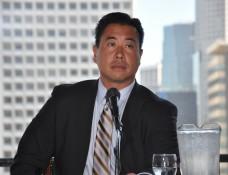
A new video produced by lawyer Ben Rosefeld includes disturbing footage of deputy sheriffs under the supervision of Paul Miyamoto using excessive force on peaceful protesters. It reflects charges in a 2007 lawsuit against the city — and evidence collected in that case shows that Miyamoto, now a captain in the department and a candidate for sheriff, was an active participant in the alleged misconduct.
The lawsuit is a result of a protest that took place in June, 2004, when activists were demonstrating against a biotech conference in the city. Protesters dressed as mutant animals marched through the streets, and 17 were arrested and taken to the county jail.
The protesters declined to give their names — and at some point, sheriff’s deputies were directed to remove them from a holding cell.
As the video — taken by the Sheriff’s Department and released as part of the lawsuit — shows, the deputies used physical force to pull the protesters out of the cell. The protesters were holding on to each other — and in some cases, the level of force used certainly appears excessive.
Remember: These were nonviolent activists who never threatened the deputies or gave any sign that they were dangerous.
Miyamoto, then a sergeant, both supervised and participated in the removal. In a legal document responding to questions from Rosenfeld, who represented the protesters, Miyamoto said that he, along with another sergeant, had developed the extraction plan and “became physically involved in the cell extractions on more than one occasion.”
I called Miyamoto and sent him a copy of the video. He told me that he was, indeed, involved and said the video was “a fair representation” of what happened.
“I stand by out decision that night,” he told me, saying he didn’t see anything in the video that bothered him or that was inappropriate.
“Our job was to get them out individually, and we took great pains not to harm anybody,” he said.
The lawsuit charged that some of the protesters were seriously injured during the extraction. It was settled when the city agreed to pay $25,000.
Sup. Ross Mirkarimi, who is running for sheriff, told me that the video was, indeed, disturbing. “I think it speaks for itself,” he said, adding that he didn’t think the tactics were appropriate.
“This is why we need an independent sheriff who isn’t connected to the Deputy Sheriff’s Association,” he said.
On crowd size during the Occupy Oakland General Strike
Having spent all day in Oakland Wedesday for the General Strike launched by Occupy Oakland, I knew something was wrong when I read reports like this one, which appeared in the San Jose Mercury News:
“Quan said she was happy the crowd — which police estimate hit 7,000 people at one point — protested all day with only a small amount of destruction and violence.” (Emphasis mine.)
I’m terrible at estimating crowd sizes. Estimates of as low as 5,000 had made their way onto Twitter by mid-afternoon, but when I randomly asked people how large they thought the crowd was hours later, they guessed 20,000 or 30,000. None of us had an aerial view of the scene, of course, but the streets of downtown Oakland were clearly packed full.
Later on, the idea that the protests had drawn only 7,000 people seemed laughable. After following the 5 p.m. march from 14th and Broadway to the port, I spent more than an hour milling about in the crowd assembled there, where people were standing on top of trucks and holding dance parties in the streets. Upon heading out, I was amazed to see that people were still pouring in — a cluster was just making its way across the overpass.
(By the way, if you ever happen to be in West Oakland and start getting a craving for fried oysters or fish and chips, check out Jk’s Brickhouse, a bar nearby the port where longshoremen apparently like to hang out.)
Chronicle Columnist Zennie Abraham has published the highest crowd estimate I’ve seen yet. He wrote: “Oakland’s Interim Police Chief Howard Jordan (a capable and politically smart leader in a tough position) got the Occupy Oakland General Strike crowd count massively wrong: it’s not 7,000, but 100,000.”
This seems reasonable. Check out this video of people marching to the port, which goes on for four and a half minutes.
http://www.youtube.com/watch?feature=player_embedded&v=r4jYdCaHrjQ#
As Abraham points out, a crowd of this magnitude counts as historic.
Powerful, mostly peaceful Oakland action ends badly
After a long day of mostly peaceful demonstrations by thousands of protesters who joined OccupyOakland’s General Strike and Day of Action yesterday, it’s still unclear why the Oakland Police – which had stood down the entire day, leaving the movement to self-police – massed in riot gear around midnight and used tear gas and other projectiles to clear the streets and make a reported 80 arrests.
Spokespersons for the Oakland Police Department and Mayor Jean Quan haven’t returned Guardian phone calls, and reports in the Oakland Tribune and other media outlets don’t indicate exactly what prompted police to change tactics and aggressively confront the demonstration. Protesters had taken over a vacant building and erected barricades in the streets shortly before riot police showed up, and it appears from a Tribune video that a dumpster was set on fire after the police showed up.
Before the standoff between city officials and demonstrators in Oakland again took a violent turn, the day was notable for its lack of police presence around the occupied Oscar Grant Plaza and nearby 14th and Broadway epicenter. And despite a small number of masked agitators who broke bank windows and sprayed graffiti – much to the chagrin of most protesters who actively opposed such tactics – the movement was remarkably nonviolent and self-policing, particularly given a crowd of what seemed to be around 10,000 people at its peak. Protesters even handled traffic control, using a megaphone to help motorists through intersections congested with passing demonstrators.
“This is an extraordinarily peaceful collection of diverse people,” Sen. Loni Hancock (D-Oakland) told the Guardian just after 5 pm as a massive march left the encampment to shut down the Port of Oakland. “I feel like they’re doing what no elected person can do: they’re putting economic equity issues in front of the American people.”
“This is beautiful and powerful. This I love,” agreed Oakland City Council member Libby Schaaf, beaming as the peaceful march took off, although she told us that she was disappointed to see Oakland businesses vandalized, including her beloved Noah’s Bagels. “Fight greed, not bagels.”
Most of the crowd condemned the violence, and many openly worried that it would undercut the positive demonstration of people power and the airing of frustration with economic injustices in the country. But even Hancock said a few bad apples shouldn’t spoil people’s understanding of what an important day it was.
“I’m very grateful to them for calling attention to economic inequality. It is in the interests of cities that this issue take center stage,” Hancock told us. “There are so many things that have been talked about that are now on the stage and it’s a very important conversation to have.”
But many in the movement were disappointed nonetheless, despite the myriad successes in shutting down business nonviolently. Around 3 pm, a crowd of thousands marched past a Chase Bank at 20th and Berkeley streets where the front window had been shattered, as was the case with at least six other businesses. Taped to the windows were signs reading “We are better than this” and “This is not the 99%. Sorry, the 99%”.
As the huge crowd repeatedly chanted “peaceful protest,” Ryan, a 31-year-old Oakland resident, expressed his frustration over vandalism he blamed on out-of-town instigators. “People from Oakland would not damage their city like that,” he told me. “Last week was beautiful, we were dancing and singing in the streets,” he said, referring to the largely nonviolent response to police violence, “but this is bullshit.”
Large protests almost always have members who want to escalate the conflict and who see breaking windows as a legitimate tactic, and yesterday there were sometimes tense conflicts between protesters who disagreed on the issue. Another complex issue is how to now view Oakland Mayor Jean Quan, whose support for last week’s violent police crackdown prompted calls for her recall or resignation, although her subsequent apology, the re-encampment of Frank Ogawa Plaza, and yesterday’s police stand down caused some to rethink whether to actively oppose her.
“My goal for today is to spur the international movement forward and to show what we’re capable of,” said 23-year-old Iris Brilliant, who got more actively involved in OccupyOakland after the crackdown and said she was happy to see the police kept at bay. “It’s important to push this forward.”
But Tania Kappner, a 41-year-old teacher from Oakland, still hadn’t forgiven Quan or the police for the violent excesses in last week’s raid. She was camped out in Oscar Grant Plaza in a tent with the sign “Mayor Quan Must Go!”
“It’s good she’s not sending them in on us today, but she never should have done it in the first place,” Kappner told us. “We’re calling for her to go and the police who did it to be jailed.”
With the decision to again unleash the riot police and tear gas and arrest big numbers of people – which was the very thing that prompted such huge numbers of people to turn out yesterday, giving OccupyOakland the numbers and power to easily shut down the port and dozens of businesses – Oakland and the larger Occupy movement might again find itself back at square one.
The National Lawyer’s Guild, which had observers on hand to witness the late-night police crackdown, issued a statement today condemning the city’s actions and saying they violate a crowd control police the NLG helped the city write to settle lawsuits stemming from the OPD’s use of rubber bullets to clear anti-war protesters from the Port of Oakland back in 2003.
“Like we saw last Tuesday, the OPD actions in the late night hours violated numerous provisions of the Crowd Control Policy and the Constitutional rights of activists,” explained NLG’s San Francisco Bay Area chapter president Michael Flynn. “Our legal observers did not disobey any police orders and neither did many of the other arrestees.”
“The Crowd Control Policy clearly prohibits shooting munitions into a crowd,” added NLG attorney Rachel Lederman. “While the police are allowed to use tear gas, they are supposed to use a minimum amount and only where other crowd control tactics have failed. It is not at all clear that less violent and less provocative measures would not have sufficed to achieve any legitimate law enforcement objectives last night.”
Meanwhile, in San Francisco, Mayor Ed Lee has reportedly assured OccupySF that he won’t follow through on threats to raid the camp if tents aren’t removed, at least not anytime soon (many observers speculate that he’ll at least wait until after next week’s mayoral election). But Lee has been unwilling to make a clear public statement that raids are now off the table.
When we sought to clarify Lee’s position and get his reaction to a Board of Supervisors resolution calling for the city to allow a 24/7 encampment, his Press Secretary Christine Falvey wrote: “The mayor has not focused on the resolution, but has been focusing on meeting with clergy, labor, occupysf demonstrators and his department heads to make sure that the site is kept clean, safe and accessible for everyone. He remains concerned about overnight camping and the public health and safety issues that brings. That said, he has seen some good progress over the last few days because of his open communication with the group. DPW cleaned up the site over the weekend and the demonstrators helped facilitate the cleanup. Tents were moved off the Bocce Ball Court as well. The group is working with Fire and Public Health officials to make some improvements. The dialogue is ongoing.”
Photos by Steven T. Jones
Live Shots: Anamanaguchi at Slim’s
The self-proclaimed “nerds” behind me in the will-call line at Slim’s Sunday night were lamenting the theft of their culture. “I hate it when hipsters try to act like us,” one said, with threatening hostility. “Because you’re not one of us, you don’t know what it’s like, and it’s not fucking cool.” Oh crap, I thought, looking straight ahead. Are they talking about me? Do they think I’m a poser, coming to this show because it’s hip? That I wear chunky orthopedics and thick rimmed glasses for the purpose of ironic style? I got my ticket and went inside as fast as I could, away from the geek toughs.
Luckily the show itself wasn’t as militantly nerdcore as the line. Anamanaguchi borrows the speed and intensity of punk rock, but also has other notable influences. The band that’s known for making songs inspired by 8bit video game soundtracks, started out with “Space Wax America,” a new song that not only nods to Weezer’s “Surf Wax America” but has a bouncy background beat that could fit in with happy Euro techno. (Or maybe that certain rave quality was just the armfuls of glowsticks the band threw out to the audience. Or the visuals: colorful anime references including dogs, cats, and a never quite resolving cthuhlu Pokemon.) It’s like Anamanaguchi takes all the fun parts from genres and ditches the rest. And the band looks to be having a blast, particularly guitarist/member-who-handles-most-mic-breaks, Peter Berkman, who performed in a clearly homemade and adorable Adventure Time costume.
The band created the soundtrack to the video game version of the Scott Pilgrim Versus The World graphic novels, so combined with Halloween eve, I wasn’t surprised to see some evil ex-boyfriends amongst the crowd. I was, however, caught off guard by what appeared to be a combination of Ramona Flowers and the The Dark Knight’s Joker, giant red lips and short green hair with long tufts hanging down in front of each ear. Afterward, I asked her if I was identifying it right and she said, “Well, Ramona Flowers is my everyday look, and I wanted to be the Joker, so I guess you could say yes.” I checked my wallet and looked around for the guys from the line. If they still had it in for me, I could always give the girl a twenty to tell them “He’s with me.”
Opener: During a song about Jesus and fucking asses up like a car crash, opener Knife City took a brief swig of his beer and proceeded to spit it over the crowd in the front. The reaction from the rest of the crowd, looks of disgust and puzzlement, quickly revealed who was punk or not.
Atari Teenage Riot releases second “Black Flags” edit with footage from Boots Riley and Steve Aoki
Notorious German electro-hardcore group Atari Teenage Riot teamed up with Anonymous to release this second video edit for its song, “Black Flags” late last month, with footage culled from Boots Riley, Steve Aoki, and other Occupy Wall Street supporters. It’s an ongoing video project; submit your statement here.
When Occupy Oakland shut down the port (VIDEO)
The grand finale of a day of rallies and marches scheduled for Oakland’s Nov. 2 General Strike was a shutdown of the Port of Oakland, in which hordes of protesters accessed the property from different entry points, standing atop train cars and trucks while whooping and chanting. Clusters of groups blocking each gate of the sprawling property featured something different: Brass bands, small assemblies using the “human mic” style of communicating as a crowd, dance parties, and impromptu reunions.
Hours later, things had taken a far more serious turn, as police were amassed near 14th and Broadway and dispersing teargas and reportedly firing rubber bullets in yet another nighttime clash in the streets.
But in the hour or so just before sunset, the march was happily advancing toward the protesters’ intended target, causing delays to the 7 p.m. longshoremen shift. Here’s a video of scenes from the port shut down, including an interview with a truck driver, Andres, who had several people standing atop his truck and flying signs while we interviewed him.
Video by Rebecca Bowe
Occupy Oakland: On to the Port
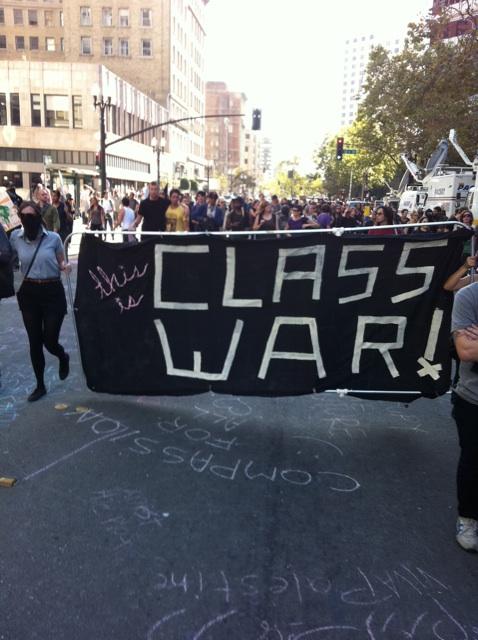
From Steven T. Jones on the streets of Oakland:
The large crowd has been chanting “peaceful protest” as it moves back to the Plaza. That’s in response to a small group that’s been breaking windows at BofA, Wells Fargo and Chase. There’s also been vandalism at Clorox and Whole Foods. The Chron reports that the vandals are mostly wearing masks.
But for the most part, it’s peaceful and most of the activists are trying to avoid (and discourage) the behavior of a few.
You can follow all the action at our twitter feed here .
If you’re on facebook, there’s a short video on Steve’s page here.
Occupational hazards
HAIRY EYEBALL Weds/2 marks the first citywide general strike in our country since 1946. Spearheaded by Occupy Oakland in the wake of the Oakland Police’s grossly excessive use of force against protestors last week, the strike is further proof that the only definitive thing one can say about the Occupy movement is that it is growing at a remarkable pace.
Whether this growth will result in greater political traction, rather than merely prompt further sympathy or ridicule from politicians and the media alike, remains to be seen. Then again, one metric of political traction for the Occupy movement is simply endurance, measured by present bodies. As Lili Loofbourow recently wrote in an on-the-ground report on Occupy Oakland for website The Awl, “technology tilts the political machine so that only that which is public matters.” And despite the Occupy movement’s necessary imperfections, there is no more direct and immediate way of being public than showing up and speaking out.
What gets broadcast and what gets heard beyond the encampments is another matter. Even with the tools of social media at the Occupiers’ disposal, can the movement’s horizontal, leaderless structure effectively amplifying the voices of “the 99%” without resulting in an echo chamber? And if that is what’s being perceived, both on the ground and in the national conversation, is that necessarily a sign of the movement’s failure or merely a testament to its vibrancy?
A variation on these questions of mediums and messages is at the heart of Geof Oppenheimer’s intellectually bracing and formally daring show at Ratio 3, Inside Us All There Is A Part That Would Like to Burn Down Our Own House, which although not explicitly about current events, uncannily resonates with them. The work in Inside Us formally traces the fluctuating state of the body politic by zeroing in on moments of stress in which civic faith breaks down or flares up, whether due to admissions of failure on the part if its appointed leaders or from internal combustion.
The latter isn’t just a figure of speech. The ballistic-grade Plexiglass cubes on plinths that snake down the center of Ratio 3’s main room, collectively titled Modern Ensembles, each contain the multicolored residue of an explosion set off within. Oppenheimer worked with a pyro-technician (a former employee of the Disney Corporation, no less) to create custom-made charges of various explosive chemicals that were then detonated inside the cubes, resulting in gorgeous, nebula-like washes of color that completely cover each cube’s interior face.
That the beauty of the Modern Ensembles comes from such violent origins is less interesting to me (that’s an old story in Art History, particularly in regards to action painting, a tradition which these sculptures extend as much as they do classic Minimalism’ proverbial cube), than how they embody a tension between explosive force and containment. The Oakland occupiers also hit a wall — a phalanx of police armed with riot gear and tear gas. It’s hard not to think of that moment, that so many experienced remotely via Facebook posts and Flickr feeds, when viewing these chemically colored cubes that, although transparent, you can’t actually see through.
Communication breakdown is also taken up in Social Failure and Black Signs, a suite of five pigment prints that surround the enigmatic vitrines like a gaggle of lost protestors. Each black and white image consists of a similarly-positioned arm holding aloft a sign printed with phrases concerning governance or economics but clearly removed, media res, from their original context. “Tolerated, as unfortunate excess,” reads one. Another states, “everything, but it is not enough.”
These stranded phrases are, in fact, excerpts from interviews with political figures such as Margaret Thatcher, Ronald Reagan, Fidel Castro and Robert McNamara, in which they discuss moments when their ideologies resulted in policy failure, something which Oppenheimer’s photographs formally restage by transforming these confessional moments into incomplete sound bytes.
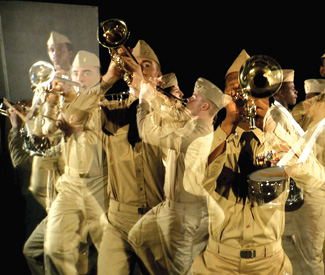
The opposite tack is used to achieve similarly disorienting results in Anthems, a four minute high definition video, which superimposes footage of a military marching band playing four different national anthems while in formation. The resulting wall of sound renders the pieces indistinguishable from each other, while, visually, the rapidly overlaid footage scrambles the patterned order of military spectacle.
Politically, a lot can happen when polyphony gives way to cacophony (or in the case of Social Failure and Black Signs when signal becomes noise). But the result can also just be chaos. As an ongoing experiment in the messy business of building a participatory democracy with its share of successful and failed words and deeds, the Occupy movement is a living, ever-expanding testament to this. And despite being presented under a title full of Freudian dramatics, so are the pieces in Inside Us.
GEOF OPPENHEIMER: INSIDE US ALL THERE IS A PART THAT WOULD LIKE TO BURN DOWN OUR OWN HOUSE
Through December 10
Ratio 3
1447 Stevenson, SF.
(415) 821-3371
Remember, remember the 5th of November

steve@sfbg.com
Guy Fawkes’ masks — popularized by the film and graphic novel V for Vendetta — have been the most common face of American resistance to empire, used by the hacktivists of Anonymous and by the Occupy Wall Street protesters in cities across the country. Bay Area costume stores report the masks getting snapped up as soon as they hit the shelves.
Guy Fawkes Day on Nov. 5 — commemorating the day in 1605 when Fawkes was caught with a cache of explosives under the House of Lords — is also the deadline set for a pair of unrelated actions directed at powerful corporations: national banks and Facebook.
Bank Transfer Day calls for people to transfer their money from the huge banking institutions that helped crash the economy and into local credit unions or locally owned banks. It was created as a Facebook event by Central Coast resident Kristen Christian and it went viral, with almost 67,000 people pledging the take part.
“Together we can ensure that these banking institutions will ALWAYS remember the 5th of November!! If the 99% removes our funds from the major banking institutions to nonprofit credit unions on or by this date, we will send a clear message to the 1% that conscious consumers won’t support companies with unethical business practices,” reads the invite.
Meanwhile, Facebook is the target of threats by a splinter group from Anonymous, the leaderless online collective whose hackers have crashed corporate websites in defense of Wikileaks, confronted the Church of Scientology, and organized protesters against BART over police reform and the agency’s decision to cut cell phone service to scuttle a protest, with many wearing the Fawkes mask.
Videos in several languages have proliferated on You Tube, featuring a speaker in a Guy Fawkes mask and electronic voice accusing Facebook of giving corporations and government agencies access to people’s personal information (Facebook did not respond to a request for comment). The videos urge people to close their Facebook accounts by Nov. 5 or risk having the hackers expose their information, urging allies to help “Kill Facebook, for the sake of your own privacy.”
GO DOWN IN HISTORY
“Prepare for a day that will go down in history, Nov. 5, 2011. We are Anonymous. We are legion. We do not forgive. We do not forget. Expect us,” the video closes, using the standard Anonymous tagline.
While many supporters of Anonymous have criticized the Facebook campaign and cast doubts on its chances of success, the system administrator for the AnonyOps.com website told us it is the nature of this movement that small groups can start campaigns of their choosing.
“One thing I do want to state about Anonymous is the fact that it is not a group. As stated above; it is an idea, an idea in which anyone can sail under freely. Think of it as a banner, a banner anyone can use to spread awareness of an issue or topic,” the administrator said.
As for Bank Transfer Day — which has significant support in both the Anonymous and Occupy communities, although it doesn’t identify with either — the AnonyOps administrator wrote, “I can’t speak for Anonymous as a whole about the expected response from banks, but I personally believe that this movement is mostly to send a message. A message that says, ‘We’re fed up of your lies, and we don’t trust you anymore.'”
He also wrote, “November 5th was chosen because it is a rather big day for Anonymous. A lot of Anonymous’ ideas are based around the ideology of Guy Fawkes, and the movie “V for Vendetta”. November 5th marks the day that Guy Fawkes failed to assassinate King James I of England, and this is also the same day in which the people stand up to their Government in the movie, so it marks a special day.”
WHO WAS THIS GUY?
So how exactly did Guy Fawkes Day — with its sing-song mantra learned by British schoolchildren: “Remember, remember, the fifth of November, the gunpowder treason and plot/ I know of no reason why the gunpowder treason should ever be forgot” — come to play such an iconic role in the current political moment?
Much of it was the power and timing of the 2005 movie, a dystopian tale of fascism taking root in England, with the state using fear and aggressive police tactics to quiet dissent and control the population. While the film’s hero, V, adopts the Fawkes mask and story, it is his ideology that probably resonates with the modern movement than the historical Fawkes, a Catholic partisan who targeting a Protestant king.
In particular, when V speaks to the people through a television broadcast, his issues and critique on power resonate with young people raised in the post-9/11 world who then watch the financial collapse and saw how crony capitalism protects the powerful at the expense of the powerless.
“The truth is that there is something terribly wrong with this country, isn’t there? If you look about, you witness cruelty, injustice and despotism. But what do you do about it? What can you do? You are but a single individual. How can you possible make any difference? Individuals have no power in this modern world. That is what you’ve been taught because that is what they need you to believe. But it is not true,” V says.
Indeed, the young people of Occupy, Anonymous, and various other nascent political movements are feeling empowered by their successes and the support they’re receiving. In his speech, V calls for everyone to show up in Guy Fawkes masks on Nov. 5 to watch him blow up the House of Lords.
“I have come to offer you a deal,” V says. “If you accept, I will give you a different world. A world without curfews, without soldiers and surveillance systems. A world that is not run by other men but that is run by you. I am offering you a second chance.”
The notion that an idea can ripple through the populace with little organizational support seems to be borne out by Bank Transfer Day, which was announced shortly after Bank of America said it would charge monthly fees on debit cards. Since then, credit unions report a steady uptick in business.
Robin McKenzie from the nonprofit Redwood Credit Union in San Francisco said more than 500 people have opened accounts with the community institution since the announcement, specifically by customers who reported being unhappy with the fees, ethics, and government bailouts of the big banks.
Carol Highton of Patelco Credit Union told us she’s seen a 65 percent increase in checking, 80 percent increase in credit cards, and 33 percent increase in membership since Bank Transfer Day was announced.
“Our stance on it is: why wait? If they’re interested in moving their money they should do it now,” McKenzie said. “We’ve been seeing a lot of demand from people for honesty and trust, and a lot on the local level…We’re not looking to profit from them, we’re looking to serve them.”
Adachi video attacks public financing
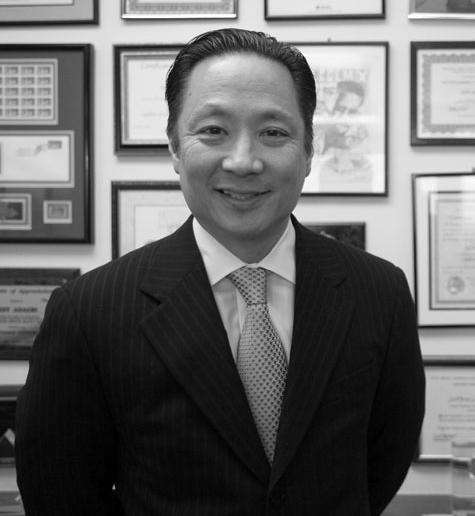
This is odd: An eight-minute video narrated by Matt Gonzalez in support of Jeff Adachi devotes a considerable amount of time to attacking public campaign financing — something Gonzalez always supported as a supervisor.
The video claims that the $4 million that “politicians” are taking to pay for their mayoral campaigns could have helped the city avoid cancelling summer school and cutting school bus routes.
Actually, the city doesn’t pay for summer school or for school buses; the school district does. But I suppose the city could have scrapped public financing and given the money to SFUSD. Unlikely, but possible. (The city actually does share some money with SFUDS, under a measure that Gonzalez opposed.)
The thing about public financing, of course, is that it allows candidates like John Avalos, who won’t get big business support, to run a competitive campaign. If it prevents special interests from buying elections, it saves the city far more than it costs. Public financing has always been a central part of the progressive agenda, nationally and locally.
The rest of the message is about what you’d expect — pension reform, Recology’s franchise fee, giveaways to the police and fire unions. All stuff that Adachi has made part of his campaign. It’s nicely (if inexpensively) produced, and, as always, Gonzalez is a great presenter.
But what’s up with the attack on public finance?
(UPDATE: Gonzalez emailed me to say that Adachi doesn’t oppose public financing but thinks this is a bad year to accept it. He also said when he chaired the Budget Commitee the city sent a lot of money to the schools. But he did oppose the measure that guarantees some city funding to SFUSD.)
Beautiful pop

emilysavage@sfbg.com
MUSIC I half-expect Jhameel to be sporting face paint whiskers swiped across his cheeks as I walk up to meet him at Cafe Strada near the UC Berkeley campus. Lyrically, he’s inspired by Ben Gibbard, musically by Sufjan Stevens, but aesthetically, it’s early Bowie.
After listening to Jhameel’s latest full-length — The Human Condition, which came out in early 2011 — on repeat, I’ve grown accustomed to seeing his face painted with black streaks like on the cover, or in rainbow stripes like in the frenetic video for the poppy “How Many Lovers.” The rational side of my brain, however, assures me he’ll show up in street clothes.
It’s not like the multi-instrumentalist singer-songwriter wears face paint in real life, or even in all of his output. In reality, his style is gradually morphing. It’s fluid, like the danceable baroque-pop music itself, which Jhameel (his legal name, meaning “beautiful”) composes and creates almost entirely solo. He played every instrument on the album: guitar, piano, bass, drums, violin, cello, trumpet, keyboard. While it’s not his biggest strength (that would be violin), he says he’s most in line with the cello. “I relate to its personality,” he explains, fresh-faced when we spot each other at the cafe wearing similar black pea coats, “It’s got a strong foundation. It’s rooted in the ground. I get a good vibe out it.”
The son of a master violinist (who appeared in the original Fame) Jhameel spent his childhood surrounded by instruments. “I’ve been writing [music] since before I can remember, it’s been like a language for me.” It can be included in the long list of languages he knows, including Spanish, bits of Korean and Chinese, Latin, some Russian, and near fluency in Arabic.
He majored in Arabic at Berkeley and graduated in two years, paying for schooling through ROTC (Reserve Officers’ Training Corps). But something happened during that time, a “cliché self-identity crises” — a seismic shift of values, mentality. He won’t shed too much light on the life change, but he says he had to let go of ROTC. He joined a co-op; the contrasts enlivened his lyrics. “I only have one life to do this. I’d like to have a positive effect on the world.”
In a stroke of DIY music-maker ingenuity, Jhameel this week announced that beginning Nov. 8, he’ll release a new song every week for the next five weeks in a series called Waves. Each song will be accompanied by individual photography, and will be totally free to download. He calls the upcoming series more primal and animalistic then the highly poetic The Human Condition, which is an analysis of emotion.
He does have some experience mining pop culture. Early in this musical journey he covered T-Pain’s “Buy You a Drink” — on violin — and posted it to Youtube. It’s the perfect slice of modern music. Go watch it now. He’s not wearing any fancy face paint, but he’s got style.
(Note: this article has been changed from its original print version to reflect Jhameel’s decision after press time to change the nature of his next release.)
JHAMEEL
With Company of Thieves, and Motopony
Nov. 14, 9:30 p.m., $12
Cafe Du Nord
2170 Market, SF
(415) 861-5016
Combat fatigue
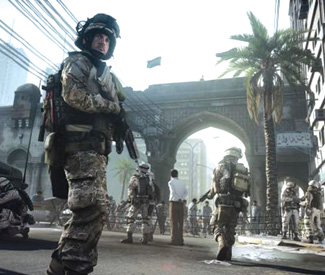
Battlefield 3
(DICE, Electronic Arts)
Xbox 360, PS3, PC
GAMER It’s disappointing that a Battlefield 3 review has to begin with a discussion of Call of Duty, but we can’t ignore the elephant in the room. For months, the Battlefield team has been shooting barbs at Call of Duty, warning the makers of the best-selling video game in the world that they intended to steal the Brown-War-Shooter crown. The previous Battlefield release was a multiplayer surprise success, performing just below Call of Duty for the better part of a year, and Swedish developer DICE intended to go all the way this time.
Well, the time has come to evaluate the threat. And while the multiplayer delivers on the promise, the rest of the package makes those earlier boasts seem a little premature.
A significant number of Battlefield fans never touch the single-player campaign, bypassing it to dive right into the online experience, and this time they aren’t missing much. In search of authenticity, the campaign takes a deliberate approach to combat, but it feels old hat. Most action takes place in corridors — not Battlefield‘s strong suit — where soldiers pour into an area and you have to clear them out. Yawn. You start thinking, maybe Call of Duty was right to juice up their ostentatious campaigns in the name of fun.
In the campaign’s second half, DICE comes around on Call of Duty‘s strengths as well, feebly aping that series’ better bits: a nuclear threat, car chases and shootouts in the streets of Paris and the NY subway. It’s not just disappointing that the levels are unmemorable and derivative, it’s a shame there’s no real exploration of the team-based combat that makes the series unique.
And yet: it’s revealing that for the reviewed Xbox version, Battlefield 3’s campaign comes on the second of two discs; the campaign itself is negligible. Battlefield‘s roots are multiplayer, where their Conquest and Rush modes prove that war is not just about killing, it is about cooperation. Whether you’re driving friends around in a jet, helicopter, or tank, fixing vehicles or attacking capture points, Battlefield is more than a shooter, it’s a full war experience. Undeniably, having 64 combatants on the field in multiplayer makes PC the go-to version if you can afford the rig.
Despite how much went wrong with the story missions, if you approach Battlefield 3 with the right expectations, it comes out largely unscathed. DICE’s multiplayer offers up massive vistas and the opportunity to feel like an essential cog in the war machine. Will it take this year’s Brown-War-Shooter crown? The online community will suss that out for themselves, but until DICE can deliver a complete package, I suspect Battlefield will have to learn to share.
Stage Listings
Stage listings are compiled by Guardian staff. Performance times may change; call venues to confirm. Reviewers are Robert Avila, Rita Felciano, and Nicole Gluckstern. Submit items for the listings at listings@sfbg.com. For further information on how to submit items for the listings, see Picks.
THEATER
OPENING
Annapurna Magic Theatre, Bldg D, Fort Mason Center, Marina at Laguna, SF; (415) 441-8822, www.magictheatre.org. $20-60. Previews Wed/2-Sat/5, 8pm; Sun/6, 2:30pm; Tues/8, 7pm. Opens Nov 9, 8pm. Through Dec 4, showtimes vary. Magic Theatre performs Sharr White’s world premiere drama about love’s longevity.
More Human Than Human Dark Room Theater, 2263 Mission, SF; (415) 401-7987, www.brownpapertickets.com. $25. Opens Fri/4, 8pm. Runs Thurs-Sat, 8pm. Through Nov 19. B. Duke’s dystopian drama is inspired by Philip K. Dick.
Oh, Kay! Eureka Theatre, 215 Jackson, SF; (415) 255-8207, www.42ndstmoon.org. $20-50. Previews Wed/2, 7pm; Thurs/3-Fri/4, 8pm. Opens Sat/5, 6pm. Runs Wed, 7pm; Thurs-Fri, 8pm; Sat, 6pm; Sun, 3pm. Through Nov 20. 42nd Street Moon performs George and Ira Gershwin’s Prohibition-set comedy.
The Temperamentals New Conservatory Theatre Center, 25 Van Ness, SF; (415) 861-8972, www.nctcsf.org. $25-45. Previews Fri/4-Sat/5 and Nov 9-11, 8pm; Sun/6, 2pm. Opens Nov 12, 8pm. Runs Wed-Sat, 8pm; Sun, 2pm. Through Dec 18. New Conservatory Theatre Center performs Jon Marans’ drama about gay rights during the McCarthy era.
Two Dead Clowns Box Car Theatre Studios, 125A Hyde, SF; www.brownpapertickets.com. $20. Previews Thurs/3, 8pm (free preview). Opens Fri/4, 7pm. Runs Fri-Sat, 7pm. Through Nov 26. Ronnie Larsen’s new play explores the lives of Divine and John Wayne Gacy.
The Waiting Period MainStage, Marsh San Francisco, 1062 Valencia, SF; (415) 282-3055, www.themarsh.org. $15-35. Opens Fri/4, 8pm. Runs Fri, 8pm; Sat, 5pm. Through Nov 26. Brian Copeland (Not a Genuine Black Man) presents a workshop production of his new solo show.
*Working for the Mouse Exit Theatre, 156 Eddy, SF; www.brownpapertickets.com. $22. Opens Thurs/3, 8pm. Runs Thurs-Sat, 8pm (no performances Nov 24-26). Through Dec 17. It might not come as a surprise to hear that even “the happiest place on earth” has a dark side, but hearing Trevor Allen describe it during this reprise of 2002’s Working for the Mouse will put a smile on your face as big as Mickey’s. With a burst of youthful energy, Allen bounds onto the tiny stage of Impact Theatre to confess his one-time aspiration to never grow up — a desire which made auditioning for the role of Peter Pan at Disneyland a sensible career move. But in order to break into the big time of “charactering,” one must pay some heavy, plush-covered dues. As Allen creeps up the costumed hierarchy one iconic cartoon figure at a time, he finds himself unwittingly enmeshed in a world full of backroom politics, union-busting, drug addled surfer dudes with peaches-and-cream complexions, sexual tension, showboating, job suspension, Make-A-Wish Foundation heartbreak, hash brownies, rabbit vomit, and accidental decapitation. Smoothly paced and astutely crafted, Mouse will either shatter your blissful ignorance or confirm your worst suspicions about the corporate Disney machine, but either way, it will probably make you treat any “Casual Seasonal Pageant Helpers” you see running around in their sweaty character suits with a whole lot more empathy. (Note: review from the show’s recent run at La Val’s Subterranean in Berkeley.) (Gluckstern)
ONGOING
Almost Nothing, Day of Absence Lorraine Hansberry Theatre, 450 Post, SF; (415) 474-8800, www.lhtsf.org. $43-53. Wed-Sat, 8pm (also Sat, 2pm); Sun, 2pm. Through Nov 20. The Lorraine Hansberry Theatre christens its grand new home near Union Square with two well-acted one-act plays under sharp direction by artistic director Steven Anthony Jones. Almost Nothing by Brazilian playwright Marcos Barbosa marks the North American premiere of an intriguing and shrewdly crafted Pinteresque drama, wherein a middle-class couple (Rhonnie Washington and Kathryn Tkel) returns home from an unexpected encounter at a stop light that leaves them jittery and distracted. As an eerie wind blows outside (in David Molina’s atmospheric sound design), their conversation circles around the event as if fearing to name it outright. When a poor woman (Wilma Bonet) arrives claiming to have seen everything, the couple abandons rationalization for a practical emergency and a moral morass dictated by poverty and class advantage — negotiated on their behalf by a black market professional (Rudy Guerrero). Next comes a spirited revival of Douglas Turner Ward’s Civil Rights–era Day of Absence (1965), a broad satire of Southern race relations that posits a day when all the “Neegras” mysteriously disappear, leaving white society helpless and desperate. The cast (in white face) excel at the high-energy comedy, and in staging the text director Jones makes a convincing parallel with today’s anti-immigrant laws and rhetoric. But if the play remains topical in one way, its too-blunt agitprop mode makes the message plain immediately and interest accordingly pales rapidly. (Avila)
Desdemona: A Play About a Handkerchief Boxcar Theatre Playhouse, 505 Natoma, SF; www.boxcartheatre.org. $15-35. Wed/2-Sat/5, 8pm. Written in 1979 by a 28-year-old Paula Vogel, Desdemona retells a familiar Shakespearean tragedy, Othello, through the eyes of its more marginalized characters, much as Tom Stoppard’s Rosencrantz and Guildenstern are Dead did with Hamlet in 1966. In Vogel’s play, it is the women of Othello — Desdemona the wife, Emilia her attendant (demoted down to washer-woman in Vogel’s piece), and Bianca, Cassio’s lover, and the bawdy town pump — who are the focus, and are the play’s only onstage characters. Whiling away an endless afternoon cooped up in the back room of the governor’s mansion, the flighty, spoiled, and frankly promiscuous Desdemona (Karina Wolfe) frets over the loss of her “crappy little snot-rag,” while her subservient, pious, but quietly calculating washer-woman Emilia (Adrienne Krug) scrubs the sheets and mends the gubernatorial underpants with an attitude perfectly balanced between aggrieved, disapproving, and cautiously optimistic. Though the relationship between the two women often veers into uncomfortable condescension from both sides, their repartee generally feels natural and uncontrived. Less successfully portrayed is Theresa Miller’s Bianca, whose Cockney accent is wont to slip, and whose character’s boisterous nature feels all too frequently subdued. Jenn Scheller’s billowing, laundry-line set softens the harsh edges of the stage, just as Emilia’s final act of service for her doomed mistress softens, though not mitigates, her unwitting role in their mutual downfall. (Gluckstern)
Honey Brown Eyes SF Playhouse, 533 Sutter, SF; (415) 677-9596, www.sfplayhouse.org. $20-50. Wed/2-Thurs/3, 7pm; Fri/4-Sat/5, 8pm (also Sat/5, 3pm). Bosnia in 1992 is divided in a horrifying civil war, some characteristics of which play out in parallel circumstances for two members of a single rock band in SF Playhouse’s west coast premiere of Stefanie Zadravec’s new play. In the first act, set in Visegrad, a young Bosnian Muslim woman (Jennifer Stuckert) is held at gunpoint in her kitchen by a jumpy soldier (Nic Grelli) engaged in a mission of murder and dispossession known as ethnic cleansing. The second act moves to Sarajevo and the apartment of an elderly woman (Wanda McCaddon) who gives shelter and a rare meal to an army fugitive (Chad Deverman). He in turn keeps the bereaved if indomitable woman company. Director Susi Damilano and cast are clearly committed to Zadravec’s ambitious if hobbled play, but the action can be too contrived and unrealistic (especially in act one) to be credible while the tone — zigzagging between the horror of atrocity and the offbeat gestures of romantic comedy — comes over as confused indecision rather than a deliberate concoction. (Avila)
How to Love Garage, 975 Howard, SF; www.pustheatre.com. $15. Fri-Sat, 8pm; Sun, 2pm. Through Nov 20. Performers Under Stress Theatre presents Megan Cohen’s Plato-inspired world premiere.
*The Kipling Hotel: True Misadventures of the Electric Pink ’80s Marsh San Francisco, 1062 Valencia, SF; (415) 282-3055, www.themarsh.org. $15-50. Sat, 8:30pm; Sun, 7pm. Through Nov 13. This new autobiographical solo show by Don Reed, writer-performer of the fine and long-running East 14th, is another slice of the artist’s journey from 1970s Oakland ghetto to comedy-circuit respectability — here via a partial debate-scholarship to UCLA. The titular Los Angeles residency hotel was where Reed lived and worked for a time in the 1980s while attending university. It’s also a rich mine of memory and material for this physically protean and charismatic comic actor, who sails through two acts of often hilarious, sometimes touching vignettes loosely structured around his time on the hotel’s young wait staff, which catered to the needs of elderly patrons who might need conversation as much as breakfast. On opening night, the episodic narrative seemed to pass through several endings before settling on one whose tidy moral was delivered with too heavy a hand, but if the piece runs a little long, it’s only the last 20 minutes that noticeably meanders. And even with some awkward bumps along the way, it’s never a dull thing watching Reed work. (Avila)
Making Porn Box Car Theatre Studios, 125A Hyde, SF; www.brownpapertickets.com. $25-50. Thurs, 8pm; Thurs, 8pm; Fri-Sat, 9pm; Sun, 7pm. Extended through Nov 27. Ronnie Larsen brings back his crowd-pleasing comedy about the gay porn industry.
*”Master Harold” … and the Boys Phoenix Theater, 414 Mason, Ste 601, SF; 1-800-838-3006, www.offbroadwaywest.org. $18-40. Thurs-Sat, 8pm. Through Nov 19. Based loosely on personal history, Athol Fugard’s drama explores institutionalized racism in South Africa’s apartheid era ensconced in the seemingly innocuous world of a Port Elizabeth tea room. The play opens during a rainy afternoon with no customers, leaving the Black African help, Willie (Anthony Rollins-Mullens) and Sam (LaMont Ridgell), with little to do but rehearse ballroom dance steps for a big competition coming up in a couple of weeks. When Hally (Adam Simpson), the owner’s son, arrives from school, the atmosphere remains convivial at first then increasingly strained, as events happening outside the tea room conspire to tear apart their fragile camaraderie. The greatest burdens of the play are carried by Sam, who fills a range of roles for the increasingly pessimistic and emotionally-stunted Hally — teacher, student, surrogate father, confidante, and servant — all the while completely aware that their mutual love is almost certainly doomed to not survive past Hally’s adolescence, and possibly not past the afternoon. Ridgell rises greatly to the challenges of his character, ably flanked by Rollins-Mullens, and Simpson; he embodies the depth of Sam’s humanity, from his wisdom of experience, to his admiration for beauty, to his capacity to bear and finally to forgive Hally’s need to lash out at him. It is a moving and memorable rendering. (Gluckstern)
Not Getting Any Younger Marsh San Francisco, Studio Theater, 1062 Valencia, SF; (415) 826-5750, www.themarsh.org. $15-50. Thurs-Fri, 8pm; Sat, 8:30pm; Sun, 3pm. Extended through Dec 17. Marga Gomez is back at the Marsh, a couple of too-brief decades after inaugurating the theater’s new stage with her first solo show — an apt setting, in other words, for the writer-performer’s latest monologue, a reflection on the inevitable process of aging for a Latina lesbian comedian and artist who still hangs at Starbucks and can’t be trusted with the details of her own Wikipedia entry. If the thought of someone as perennially irreverent, insouciant, and appealingly immature as Gomez makes you depressed, the show is, strangely enough, the best antidote. (Avila)
*The Odyssey Aboard Alma, Hyde Street Pier, San Francisco Maritime National Historic Park, SF; www.weplayers.org. $160. Fri/4-Sun/6, Nov 11-12, and 18, 12:30pm. Heralding their hugely ambitious Spring 2012 production of The Odyssey, which will take place all over Angel Island, the WE Players are tackling the work on a slightly smaller scale by staging it on the historic scow schooner Alma, which is part of the Maritime National Historical Park fleet docked at the end of Hyde Street Pier. Using both boat and Bay as setting, the essential chapters of the ten-year voyage — encounters with the Cyclops, Circe, the Underworld, the Sirens, Aeolus, the Laestrygonians, and Calypso — are enacted through an intriguing mash-up of narration, choreography, sea chanteys, salty dog stories (like shaggy dog stories, but more water-logged), breathtaking views, and a few death-defying stunts the likes of which you won’t see on many conventional stages. High points include the casual swapping of roles (every actor gets to play Odysseus, however briefly), Ross Travis’ masked and flatulent Prometheus and sure-footed Hermes, Ava Roy’s hot pants-clad Circe, Charlie Gurke’s steady musical direction and multi-instrumental abilities, and the sail itself, an experiential bonus. Landlubbers beware, so much time facing the back of the boat where much of the action takes place can result in mild quease, even on a calm day. Take advantage of the downtime between scenes to walk around and face forward now and again. You’ll want to anyway. (Gluckstern)
*On the Air Pier 29 on the Embarcadero (at Battery), SF; (415) 438-2668, love.zinzanni.org. $117 and up (includes dinner). Wed-Sat, 6pm; Sun, 5pm. Through Dec 31. Teatro ZinZanni’s final production at its longtime nest on Pier 29 is a nostalgia-infused banquet of bits structured around an old-time radio variety show, featuring headliners Geoff Hoyle (Geezer) and blues singer Duffy Bishop. If you haven’t seen juggling on the radio, for instance, it’s pretty awesome, especially with a performer like Bernard Hazens, whose footing atop a precarious tower of tubes and cubes is already cringingly extraordinary. But all the performers are dependably first-rate, including Andrea Conway’s comic chandelier lunacy, aerialist and enchanting space alien Elena Gatilova’s gorgeous “circeaux” act, graceful hand-balancer Christopher Phi, class-act tapper Wayne Doba, and radio MC Mat Plendl’s raucously tweeny hula-hooping. Add some sultry blues numbers by raunchy belter Bishop, Hoyle’s masterful characterizations (including some wonderful shtick-within-a-shtick as one-liner maestro “Red Bottoms”), a few classic commercials, and a healthy dose of audience participation and you start to feel nicely satiated and ready for a good cigar. Smoothly helmed by ZinZanni creative director Norm Langill, On the Air signals off-the-air for the popular dinner circus — until it can secure a new patch of local real estate for its antique spiegeltent — so tune in while you may. (Avila)
*Pellas and Melisande Cutting Ball Theater, Exit on Taylor, 277 Taylor, SF; 1-800-838-3006, www.cuttingball.com. $10-50. Thurs, 7:30; Fri-Sat, 8pm (also Sat, 2pm); Sun, 5pm. Through Nov 27. The Frog Prince, Rapunzel, the Swan Maiden: shimmering strands of each timeless tale twist through the melancholy tapestry of the Maurice Maeterlinck play Pelleas and Melisande, which opens Cutting Ball Theater’s 12th season. Receiving a lushly atmospheric treatment by director and translator Rob Melrose, this ill-fated Symbolist drama stars Joshua Schell and Caitlyn Louchard as the doomed lovers. Trapped in the claustrophobic environs of an isolated castle at the edge of a forbidding forest and equally trapped in an inadvertent love triangle with the hale and hearty elder prince Golaud (Derek Fischer), Pelleas’ brother and Melisande’s husband, the desperate, unconsummated passion that builds between the two youngsters rivals that of Romeo and Juliet’s, and leads to an ending even more tragic — lacking the bittersweet reconciliation of rival families that subverts the pure melodrama of the Shakespearean classic. Presented on a spare, wooden traverse stage (designed by Michael Locher), and accompanied by a smoothly-flowing score by Cliff Caruthers, the action is enhanced by Laura Arrington’s haunting choreography, a silent contortionism which grips each character as they try desperately to convey the conflicting emotions which grip them without benefit of dialogue. Though described by Melrose as a “fairy tale world for adults,” the dreamy gauze of Pelleas and Melisande peels away quickly enough to reveal a flinty and unsentimental heart. (Gluckstern)
Race American Conservatory Theater, 415 Geary, SF; (415) 749-2228, www.act-sf.org. $10-85. Opens Wed/26, 8pm. Tues-Sat, 8pm (also Wed and Sat, 2pm); Sun, 2pm (also Sun/6, 7pm). Through Nov 13. ACT performs David Mamet’s wicked courtroom comedy.
The Rover, or the Banish’d Cavaliers, The American Clock Hastings Studio Theater, 77 Geary, SF; (415) 749-2228, www.act-sf.org. $10 ($15 for both productions). Through Sat/5, performance times vary. American Conservatory Theater’s Masters of Fine Arts program presents plays in repertory by Aphra Behn and Arthur Miller.
Savage in Limbo Actors Theatre of San Francisco, 855 Bush, SF; (415) 345-1287, www.actorstheatresf.org. $26-38. Wed-Sat, 8pm. Through Dec 3. Actors Theatre of San Francisco performs John Patrick Shanley’s edgy comedy.
“Shocktoberfest 12: Fear Over Frisco” Hypnodrome Theatre, 575 10th St, SF; (415) 377-4202, www.thrillpeddlers.com. $25-35. Thurs-Sat, 8pm. Through Nov 19. In its annual season-scented horror bid, Thrillpeddlers joins forces with SF’s Czar of Noir, writer-director Eddie Muller, for a sharply penned triplet of plays that resurrect lurid San Francisco lore as flesh-and-blood action. In the slightly sluggish but intriguing Grand Inquisitor, a solitary young woman modeling herself on Louise Brooks in Lulu (an alluringly Lulu-like Bonni Suval) believes she has located the Zodiac killer’s widow (a sweet but cagey Mary Gibboney) — a scenario that just can’t end well for somebody, yet manages to defy expectations. An Obvious Explanation turns on an amnesiac (Daniel Bakken) whose brother (Flynn de Marco) explains the female corpse in the rollaway (Zelda Koznofski) before asking bro where he hid a certain pile of money. Enter a brash doctor (Suval) with a new drug and ambitions of her own vis-à-vis the hapless head case. Russell Blackwood directs The Drug, which adapts a Grand Guignol classic to the hoity-toity milieu of the Van Nesses and seedy Chinatown opium dens, where a rough-playing attorney (an ever persuasive Eric Tyson Wertz) determines to turn a gruesome case involving the duplicitous Mrs. Van Ness (an equally sure, sultry Kära Emry) to his own advantage. The evening also offers a blackout spook show and some smoothly atmospheric musical numbers, including Muller’s rousing “Fear Over Frisco” (music composed by Scrumbly Koldewyn; accompaniment by Steve Bolinger and Birdie-Bob Watt) and an aptly low-down Irving Berlin number — both winningly performed by the entire company. (Avila)
Sticky Time Brava Theater, 2781 24th St, SF; www.vanguardianproductions.com. $15-40. Wed-Sat and Nov 14, 8pm. Through Nov 18. Crowded Fire and Vanguardian Productions present playwright-director Marilee Talkington’s multimedia science fiction about a woman running out of time in the worst way. The prolix and histrionic story is the real sticking point, however, in this otherwise imaginatively staged piece, which places its audience on swivel chairs in the center of Brava’s upstairs studio theater, transformed by designer Andrew Lu’s raised stage and white video screens running the length of the walls into an enveloping aural (moody minimalistic score by Chao-Jan Chang) and visual landscape. Thea (Rami Margron) heads a three-person crew of celestial plumbers managing a sea of time “threads,” an undulating web of crisscrossing lines (in the impressive video animation by Rebecca Longworth). The structure is plagued by a mysterious wave of “time quakes” that Tim (Lawrence Radecker) thinks he may have figured out. Coworker Emit (Michele Leavy), meanwhile, goofing around like a hyperactive child, spots some sort of beast at work in the ether. When Thea gets stuck by a loose thread, she becomes something of a time junky, desperate to relive the color-suffused world of love and family lost somewhere in space-time as reality starts to unravel (with a dramatic assist from cinematographer Lloyd Vance) and the crew seeks help from a wise figure in a tattered gown (Mollena Williams). A little like a frenetic, stagy version of Andrey Tarkovsky’s Solaris (1972), the story gets credit for dramatizing some confounding facts about time and space at the particle level but might have benefited from less dialogue and more mystery —just as the audio-visual experience works best when the house lights are low. (Avila)
Totem Grand Chapiteau, AT&T Park, Parking Lot A, 74 Mission Rock, SF; cirquedusoleil.com/totem. $58-248.50. Tues-Sun, schedule varies. Extended through Dec 18. Cirque Du Soleil returns with its latest big-top production.
BAY AREA
Annie Berkeley Playhouse, Julia Morgan Center for the Arts, 2640 College, Berk; (510) 845-8542, www.berkeleyplayhouse.org. $17-35. Thurs-Sat, 7pm; Sun, noon and 5pm. Through Dec 4. Berkeley Playhouse performs the classic musical.
Doubt: A Parable Live Oak Theatre, 1301 Shattuck, Berk; www.aeofberkeley.org. $12-15. Fri-Sat, 8pm; Nov 13, 2pm. Through Nov 19. Actors Ensemble of Berkeley performs John Patrick Shanley’s Pulitzer-winning drama.
How to Write a New Book for the Bible Thrust Stage, 2025 Addison, Berk; (510) 647-2949, www.berkeleyrep.org. $14.50-73. Tues, Thurs-Sat, 8pm (also Sat, 2pm; no show Nov 18); Wed and Sun, 7pm (also Sun, 7pm). Through Nov 20. An aspiring writer who later becomes a priest, Bill (Tyler Pierce) is the caregiver for his aging mother (Linda Gehringer) during her long bout with cancer. His father (Leo Marks), though already dead, still inhabits his mother’s flickering concept of reality, made all the more dreamlike by her necessary dependence on pain medication. His brother (Aaron Blakely), meanwhile, has returned from Vietnam with survivor guilt but lands a meaningful career as a schoolteacher in the South. The latest from playwright Bill Cain (Equivocation, 9 Circles) is a humor-filled but sentimental and long-winded autobiographical reflection on family from the vantage of his mother’s long illness. It gets a strong production from Berkeley Rep, with a slick cast under agile direction by Kent Nicholson, but it plays as if narrator Bill mistakenly believes he’s stepped out of an Arthur Miller play, when in fact there’s little here of dramatic interest and far too much jerking of tears. (Avila)
Rambo: The Missing Years Cabaret at Marsh Berkeley, 2120 Allston, Berk; (415) 282-3055, www.themarsh.org. $15-50. Thurs-Fri, 7pm; Sat, 8:30pm. Through Dec 10. Howard “Hanoi Howie” Petrick presents his solo show about being an anti-war demonstrator — while also serving in the Army.
*Rita Moreno: Life Without Makeup Berkeley Repertory Theatre, Roda Theatre, 2015 Addison, Berk; (510) 647-2949, www.berkeleyrep.org. $14.50-73. Wed-Sun, showtimes vary. Extended through Nov 12. The life of stage and screen legend Rita Moreno is a subject that has no trouble filling two swift and varied acts, especially as related in anecdote, song, comedy, and dance by the serene multiple–award-winning performer and Berkeley resident herself. Indeed, that so much material gets covered so succinctly but rarely abruptly is a real achievement of this attractively adorned autobiographical solo show crafted with playwright and Berkeley Rep artistic director Tony Taccone. (Avila)
Sam’s Enchanted Evening TheaterStage at Marsh Berkeley, 2120 Allston, Berk; (415) 282-3055, www.themarsh.org. $15-50. Thurs-Fri, 8pm; Sat, 8:30pm. Through Nov 26. The Residents wrote the script and did the musical arrangements for this musical, featuring singer Randy Rose and pianist Joshua Raoul Brody.
The World’s Funniest Bubble Show Marsh Berkeley, TheaterStage, 2120 Allston, Berk; (415) 826-5750, www.themarsh.org. $8-50. Sun, 11am. Through Nov 20. Louis “The Amazing Bubble Man” Pearl returns with this kid-friendly, bubble-tastic comedy.
Music Listings
Music listings are compiled by Emily Savage. Since club life is unpredictable, it’s a good idea to call ahead or check the venue’s website to confirm bookings and hours. Prices are listed when provided to us. Submit items for the listings at listings@sfbg.com. For further information on how to submit items for the listings, see Picks.
WEDNESDAY 2
ROCK/BLUES/HIP-HOP
Bell X1, Favourite Sons Rickshaw Stop. 8pm, $15.
Gaelic Storm Great American Music Hall. 8pm, $17-$20.
Girl in a Coma Amoeba Music. 6pm, free.
Magic Christian, Bitter Honeys, Tomorrow Men , DJ Neil Martinson Elbo Room. 9pm, $8.
Mayday Parade, We Are The In Crowd, You Me at Six, There For Tomorrow, Make Regency Ballroom. 6:30pm, $20.
Method Man, Curren$y, Big KRIT, Smoke DZA, Pricks, Corner Boy P, Paypa Warfield. 8pm, $32.
Yael Naim, David Donatien Bimbo’s. 8pm, $28.
Priory, Vir, Matinees Bottom of the Hill. 9pm, $8.
Rabbles 50 Mason Social House, SF; www.50masonsocialhouse.com. 10pm.
Terry Savastano Johnny Foley’s, 243 O’Farrell, SF; www.johnnyfoleys.com. 9pm, free.
Sirhan Sirhan, Hazzard’s Cure, Prizehog Hemlock Tavern. 9pm, $8.
Uh Huh Her, Jarrod Gorbel Slim’s. 8pm, $21.
JAZZ/NEW MUSIC
Chester Thompson Quartet Yoshi’s. 8pm, $18.
Chris Amberger Trio Yoshi’s Lounge. 6pm.
Cosmo AlleyCats Le Colonial, 20 Cosmo Place, SF; www.lecolonialsf.com; 7-10pm.
Dink Dink Dink, Gaucho, Michael Abraham Amnesia. 7pm, free.
Jazz organ party Royal Cuckoo, 3202 Mission, SF; www.royalcuckoo.com. 7:30pm, free.
Ricardo Scales Top of the Mark, 999 California, SF; www.topofthemark.com. 6:30pm, $5.
DANCE CLUBS
Booty Call Q-Bar, 456 Castro, SF; www.bootycallwednesdays.com. 9pm. Juanita Moore hosts this dance party, featuring DJ Robot Hustle.
Mary Go Round Lookout, 3600 16th St, SF; www.lookoutsf.com. 10pm, $5. Drag with Suppositori Spelling, Mercedez Munro, and Ginger Snap.
Megatallica Fiddler’s Green, 1333 Columbus, SF; www.megatallica.com. 7pm, free. Heavy metal hangout.
No Room For Squares Som., 2925 16th St, SF; (415) 558-8521. 6-10pm, free. DJ Afrodite Shake spins jazz for happy hour.
Vespa Beat Bliss Bar, 4026 24th St., SF; www.blissbarsf.com. 9pm, free. MSK.fm spins raregrooves, electroswing, and boogie.
THURSDAY 3
ROCK/BLUES/HIP-HOP
Architecture in Helsinki, DOM, Sandwitches Fillmore.8pm, $20.
Complications, RxNightly Thee Parkside. 9pm, $5.
Cut Loose Band Johnny Foley’s, 243 O’Farrell, SF; www.johnnyfoleys.com. 9pm, free.
Fishtank Ensemble, Kelly McFarling Brava Theater, 2781 24th St, SF; www.brava.org. 8pm, $20.
Fruit Bats, Parson Red Heads Great American Music Hall. 8pm, $15.
In Defense, Migraine, Love Below, Vulvalard Sub-Mission. 8:30pm, $8.
Mastodon, Dillinger Escape Plan, Red Fang Warfield. 8pm, $30.
Naked Fiction, Jordan Baron 50 Mason Social House, SF; www.50masonsocialhouse.com. 7pm.
Northern Key, Ash Reiter Brick and Mortar Music Hall. 9pm, $5-$8.
Sharon Robinson, Conspiracy of Beards Cafe Du Nord. 8pm, $15.
Street Pyramids, Yeah Great Fine, We Arsons Hemlock Tavern. 9pm, $7.
Typhoon, Wild Ones, Youth Bottom of the Hill. 9pm, $12.
Unknown Mortal Orchestra, Gauntlet Hair Rickshaw Stop. 9pm, $12-$14.
Kate Voegele, Parachute, Kevin Hammond Slim’s. 8pm, $16.
Zeds Dead, Big Chocolate, DJ AUDIO1 Regency Ballroom. 8pm, $22.
JAZZ/NEW MUSIC
Blues Organ Party Royal Cuckoo, 3202 Mission, SF; www.royalcuckoo.com. 7:30pm, free.
Rachelle Ferrell Rrazz Room, 222 Mason, SF; www.therrazzroom.com. 8pm, $49.50.
Jazz Mafia Presents: Emporer Norton Suite Yoshi’s. 8 and 10pm, $22.
Naje Yoshi’s Lounge. 6-11pm.
Stompy Jones Top of the Mark, 999 California, SF; www.topofthemark.com. 7:30pm, $10.
FOLK/WORLD/COUNTRY
Creole Choir of Cuba Herbst Theatre, 401 Van Ness, SF; www.sfwmpac.org. 8pm, $25-$65.
Twang! Honky Tonk Fiddler’s Green, 1330 Columbus, SF; www.twanghonkytonk.com. 5pm. Live country music, dancing, and giveaways.
DANCE CLUBS
Afrolicious Elbo Room. 9:30pm, $5. With Pleasuremaker and Senor Oz spin Afrobeat, Tropicália, electro, samba, and funk.
Guilty Pleasures Gestalt, 3159 16th St, SF; (415) 560-0137. 9:30pm, free. DJ TophZilla, Rob Metal, DJ Stef, and Disco-D spin punk, metal, electro-funk, and 80s.
Thursday Special Tralala Revolution Café, 3248 22nd St, SF; (415) 642-0474. 5pm, free. Downtempo, hip-hop, and freestyle beats by Dr. Musco and Unbroken Circle MCs.
Thursdays at the Cat Club Cat Club. 9pm, $6 (free before 9:30pm). Two dance floors bumpin’ with the best of 80s mainstream and underground with Dangerous Dan, Low Life, and guests.
Tropicana Madrone Art Bar. 9pm, free. Salsa, cumbia, reggaeton, and more with DJs Don Bustamante, Apocolypto, Sr. Saen, Santero, and Mr. E.
FRIDAY 4
ROCK/BLUES/HIP-HOP
Acacia, Tell River, Clay Hawkins Plough and the Stars, 116 Clement, SF. www.theploughandstars.com. 9pm, $5-$10.
Body and Soul Johnny Foley’s, 243 O’Farrell, SF; www.johnnyfoleys.com. 9pm, free.
Collie Buddz Fillmore. 9pm, $25.
Deertick, Guards, Kamp Camille Independent. 9pm, $15.
Four Year Strong, Gallows, Title Fight, Swellers, Sharks Regency Ballroom. 6:30pm, $18.
Gavilan, Cloaking Device, Blame Brainwash Cafe, 1122 Folsom, SF; www.brainwash.com. 8pm, free.
Knights of the New Crusade, Hondettes, Ogres, Khans Hemlock Tavern. 9pm, $7.
Lydia Loveless Hotel Utah. 9pm, $8.
Matthew Edwards and the Unfortunates, Paul Griffiths Amnesia. 7pm, $5.
Minus the Bear, Velvet Teen Slim’s. 9pm, $25.
Troy Neihardt, Greg Zema, Jason Marion Johnny Foley’s, 243 O’Farrell, SF; www.duelingpianosatfoleys.com. 9pm.
Peter Wolf Crier, Birds & Batteries, Curious Mystery Cafe Du Nord. 9:30pm, $10.
Shonen Knife, Shannon & the Clams, Pleasure Kills Bottom of the Hill. 9:30pm, $14.
Sore Thumbs, Re-Volts, Street Justice, Paper Bags Thee Parkside. 9pm, $5.
Still Corners, Silver Swans, Ganglians Rickshaw Stop. 8pm, $10-$12.
Super Diamond, Petty Theft Bimbo’s. 9pm, $22.
Wild Flag, Drew Grow & the Pastors’ Wives Great American Music Hall. 9pm, $17-$19.
JAZZ/NEW MUSIC
Black Market Jazz Orchestra Top of the Mark, 999 California, SF; www.topofthemark.com. 9pm, $10.
Rachelle Ferrell Rrazz Room, 222 Mason, SF; www.therrazzroom.com. 7 and 9:30pm, $49.50.
Jazz Mafia Presents: Emporer Norton Suite Yoshi’s. 8 and 10pm, $22-$25.
Anita Lofton, Sean Hughes 50 Mason Social House, SF; www.50masonsocialhouse.com. 7pm.
Tyrese Yoshi’s Lounge. 10:30pm, $25.
Ways & Means Committee Yoshi’s. 6-11pm.
FOLK/WORLD/COUNTRY
Jessica Fichot Red Poppy Art House. 8pm, $12-$15.
DANCE CLUBS
Afro Bao Little Baobab, 3388 19th St, SF; (415) 643-3558. 10pm, $5. Afro and world music with rotating DJs including Stepwise, Steve, Claude, Santero, and Elembe.
Old School Dance Party El Rio. 9pm. DJs spinning freestyle, new wave, hip-hop, and old school jams.
120 Minutes Elbo Room. 10pm, $12. Witch house with performance by Creep and Sleazemore, and resident DJs Whitch and GuMMyBeaR.
Strangelove: Dia de los Muertos Cat Club. 9:30pm, $3-$7. Goth and industrial with DJs Tomas Diablo, Joe Radio, Fact50, and Prince Charming.
Vintage Orson, 508 Fourth St, SF; (415) 777-1508. 5:30-11pm, free. DJ TophOne and guest spin jazzy beats for cocktalians.
SATURDAY 5
ROCK/BLUES/HIP-HOP
Amber Asylum, Velnias, Fell Voices, Ash Border, Lycus Elbo Room. 4-9pm, $8.
Back Pages Johnny Foley’s, 243 O’Farrell, SF; www.johnnyfoleys.com. 9pm, free.
Belligerator, Catacomb Creeps, Asada Messiah, Over the Falls Thee Parkside. 9pm, $7.
Bray Rockit Room, 406 Clement, SF; www.rock-it-room.com. 8pm, $15.
City and Colour, Hacienda Fillmore. 9pm, $27.50
Cormorant, La Fin du Monde, Hell Ship El Rio. 9pm, $5.
Dos Gringos Chicanos Thee Parkside. 3pm, free.
Hot Rod Circuit, No Motiv, I The Mighty Bottom of the Hill. 9pm, $18.
Icarus Line, Zodiac Death Valley, Tambo Rays Cafe Du Nord. 9:30pm, $12-$15.
Little Red, OONA, Bleeding Knees Club Rickshaw Stop. 9pm, $10-$12.
Liquorball, Carlton Melton, Harderships Hemlock Tavern. 9:30pm, $8.
Jason Marion, Troy Neihardt, Greg Zema, Johnny Foley’s, 243 O’Farrell, SF; www.duelingpianosatfoleys.com. 9pm.
Mike Doughty and His Band Fantastic, Moon Hooch Independent. 9pm, $22.
Minus the Bear, Lonely Forrest Slim’s. 9pm, $25.
Petrojvic Blasting Company Amnesia. 9pm, $7.
Rayband Brick and Mortar Music Hall. 10:30pm, $7-$10.
Rockabilly with the Roundups, Bay Area Swing All-Stars 50 Mason Social House, SF; www.50masonsocialhouse.com. 7pm.
Thrice, La Dispute, Moving Mountains, O’Brother Regency Ballroom. 7:30pm, $23.
Wild Flag, Drew Grow & the Pastors’ Wives Great American Music Hall. 9pm, $17-$19.
JAZZ/NEW MUSIC
Rachelle Ferrell Rrazz Room, 222 Mason, SF; www.therrazzroom.com. 7 and 9:30pm, $49.50.
Jazz Mafia Presents: Emporer Norton Suite Yoshi’s. 8 and 10pm, $25.
FOLK/WORLD/COUNTRY
Latif Bolat St. Cyprian’s Episcopal Church, 2097 Turk, SF; www.liveatcyprians.blogspot.com. 8pm, $16-$20.
Max Lax and the Nearly Beloved Riptide, 3639 Taraval, SF; www.riptidesf.com. 10 and 11:15pm, free.
Saturday Night Salsa Ramp, 855 Francois, SF; www.facebook.com/therampsf. 5:30pm, $10.
Skillet Licorice Cafe International, 508 Haight, SF; www.cafeinternational.us . 4-7pm, free.
DANCE CLUBS
Afro Bao Little Baobab, 3388 19th St, SF; (415) 643-3558. 10pm, $5. Afro and world music with rotating DJs including Stepwise, Steve, Claude, Santero, and Elembe.
Cockfight Underground SF, 424 Haight, SF; (415) 864-7386. 9pm, $7. Rowdy dance night for gay boys .
Haceteria Deco Lounge, 510 Larkin, SF; www.decosf.com. 9pm, free-$3. Live set by C.L.A.W.S. And resident DJs Tristes Tropiques, Jason P, Smac.
Sanafrica Bollyhood Café. 9pm, $7-10. West African and Latin fusion party with Jose Luis, DJ Nado, and DJ Mignane.
Saturday Night Soul Party Elbo Room. 10pm, $5-$10. DJs Lucky, Paul Paul, and Phengren Oswald spinning ’60s soul 45s.
SUNDAY 6
ROCK/BLUES/HIP-HOP
City and Colour, Hacienda Fillmore. 8pm, $27.50
Dean’s List, OnCue Brick and Mortar Music Hall. 9pm, $12-$16.
Indian Elbo Room. 4-8pm.
Kiwi Time, In One Wind, Reggie Gin Kimo’s. 10pm, $6.
Mike Doughty and His Band Fantastic, Moon Hooch Independent. 8pm, $22.
Eliza Rickman Amnesia. 7pm.
Rock the Bottom, Vanish Breed, War Child, Poor Sons Knockout. 5:30pm, free. Video premiere for two skate videos.
Said the Whale, We Are The City Hemlock Tavern. 9pm, $7.
Terry Savanstano Johnny Foley’s, 243 O’Farrell, SF; www.johnnyfoleys.com. 9pm, free.
Zodiac Death Valley, Icarus Line, Tambo Rays Cafe Du Nord. 8:30pm, $12-$15.
JAZZ/NEW MUSIC
Jazz Organ Party with Lavay Smith and Chris Siebert Royal Cuckoo, 3202 Mission, SF; www.royalcuckoo.com. 7:30pm, free.
Rachelle Ferrell Rrazz Room, 222 Mason, SF; www.therrazzroom.com. 7pm, $49.50.
Kally Price Old Blues and Jazz Band, Emperor Norton’s Jazz Band Amnesia. 9pm, $5.
Suzanna Smith, John R. Burr, Brandon Essex Bliss Bar, 4026 24th St, SF; www.blissbar.com. 4:30-7:30pm, $10.
Faith Wintrhop Rrazz Room, 222 Mason, SF; www.therrazzroom.com. 4pm, $27.50.
FOLK/WORLD/COUNTRY
Monika Jalili Yoshi’s. 7pm, $35.
Sunday Night Salsa Ramp, 855 Francois, SF; www.facebook.com/therampsf. 5:30pm, $10.
Twang Sundays Thee Parkside. 4pm, free. With Real Sippin’ Whiskeys, Bottom Dwellers.4pm, free.
DANCE CLUBS
Batcave Club 93, 93 9th St, SF 10pm, $5. Death rock, goth, and post-punk with Steeplerot, XChrisT, Necromos and c_death.
Dub Mission Elbo Room. 9pm, $6. Dub, roots, and classic dancehall with DJ Sep, J. Boogie, and guest DJ Theory.
Jock Lookout, 3600 16th St, SF; www.lookoutsf.com. 3pm, $2. Raise money for LGBT sports teams while enjoying DJs and drink specials.
La Pachanga Blue Macaw, 2565 Mission, SF; www.thebluemacawsf.com. 6pm, $10. Salsa dance party with live Afro-Cuban salsa bands.
MONDAY 7
ROCK/BLUES/HIP-HOP
Aziatix Slim’s. 8pm, $15.
Bible Thumper Hemlock Tavern. 6pm, $5.
Big Tree, Lawlands, City Tribe Rickshaw Stop. 8pm, $10.
Damir Johnny Foley’s, 243 O’Farrell, SF; www.johnnyfoleys.com. 9pm, free.
Illmaculate with G Force and DJ Fatboy Elbo Room. 9pm, $7. Also with Fortilive, Saurus, Goldini Bagwell, and Mikey Vegaz.
Jack’s Mannequin, Scars on 45, Lady Danville Regency Ballroom. 7pm, $30.
Tony Lucca Red Devil Lounge. 8pm, $12.
Warbringer, Lazarus A.D., Landmine Marathon, Diamond Plate, Necrosin Thee Parkside. 8pm, $14.
JAZZ/NEW MUSIC
Bossa Nova Tunnel Top, 601 Bush, SF; (415) 722-6620. 8-11:30pm, free. Live acoustic Bossa Nova.
Hot 8 Brass Band Yoshi’s. 8pm, $18.
FOLK/WORLD/COUNTRY
Belle Monroe and Her Brewglass Boys Amnesia. 9pm.
DANCE CLUBS
Death Guild DNA Lounge. 9:30pm, $3-5. Gothic, industrial, and synthpop with Joe Radio, Decay, and Melting Girl.
M.O.M. Madrone Art Bar. 6pm, free. DJs Timoteo Gigante, Gordo Cabeza, and Chris Phlek playing all Motown every Monday.
Sausage Party Rosamunde Sausage Grill, 2832 Mission, SF; (415) 970-9015. 6:30-9:30pm, free. DJ Dandy Dixon spins vintage rock, R&B, global beats, funk, and disco at this happy hour sausage-shack gig.
TUESDAY 8
ROCK/BLUES/HIP-HOP
Bangles Fillmore. 8pm, $27.50.
Jefferson Bergey 50 Mason Social House, SF; www.50masonsocialhouse.com. 7pm.
Boots Electric, Light FM, Baron Von Luxxury Bottom of the Hill. 9pm, $14.
Marc Cohn Yoshi’s. 8pm, $35.
Hull, Dimesland Hemlock Tavern. 9pm, $7.
Lights, Rubik Great American Music Hall. 8pm, $15-$17.
Megan Keely, Goodnight Texas, Lia Rose Amnesia. 9:30pm, $8.
North Sky Cello Ensemble Brick and Mortar Music Hall. 8pm, free.
Pierce the Veil, Miss May I, Woe is Me, Letlive, Amity Affliction Regency Ballroom. 6:30pm, $18.
Matthew Stewart, Mental 99, Quartet Rouge Cafe Du Nord. 9:30pm, $12.
Stan Erhart Band Johnny Foley’s, 243 O’Farrell, SF; www.johnnyfoleys.com. 9pm, free.
VV Brown, Cambo & the Life Rickshaw Stop. 7pm, $15.
FOLK/WORLD/COUNTRY
Buster Blue, Drop Apollo Boom Boom Room, 1601 Fillmore, SF. www.boomboomblues.com. 9:30pm, free.
DANCE CLUBS
Bombshell Betty & Her Burlesqueteers Elbo Room. 9pm, $10. Live music from Fromagique.
Eclectic Company Skylark, 9pm, free. DJs Tones and Jaybee spin old school hip hop, bass, dub, glitch, and electro.
Flattened fences and strengthened bridges
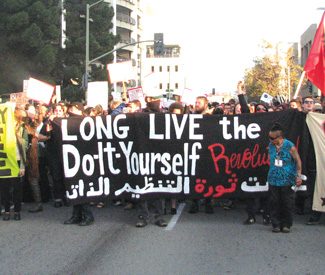
With high-profile standoffs between protesters and police last week, Occupy Oakland and OccupySF have attracted international attention and support, helping to galvanize the six-week-old Occupy Wall Street movement.
At press time, Occupy Oakland organizers working in league with local unions were gearing up for a citywide general strike intended to shut down the Port of Oakland and encourage work stoppages and school walkouts on Nov. 2. The occupation at Frank Ogawa Plaza, which had been dismantled by police only days earlier, had begun to reseed, with some 40 tents and a kitchen and first aid area reassembling. Planning meetings for the general strike were being held daily. Nearly 2,000 Occupy Oakland participants voted at an Oct. 26 general assembly to call for the shutdown, following an Oct. 25 clash with law enforcement that left Iraq war veteran Scott Olsen with brain injuries after his skull was fractured by a projectile fired from a line of riot police.
Olsen, 24, who completed two tours of duty before becoming a member of Iraq Veterans Against the War, had progressed beyond critical condition and was expected to eventually recover, yet he continued to have difficulty speaking. At a flagpole near 14th and Broadway, near where Olsen was struck, a shrine was created with his visage illuminated with candlelight and surrounded by flowers and notes wishing his speedy recovery.
Video of an injured Olsen being carried by fellow activists through what looked and sounded like a war zone went viral, putting pressure of Oakland Mayor Jean Quan to retreat from her stance against the encampment. But in San Francisco, Mayor Ed Lee stuck to his position that the OccupySF encampment must come down, threatening another police raid if necessary.
“Any official who would send in the riot police to deal with this camp does not deserve to be mayor of San Francisco,” said Brad Newsham, one of a stream of activists sounding off at an Oct. 31 hearing of the Board of Supervisors’ City Operations and Neighborhood Services Committee convened by Sup. John Avalos to consider a resolution the mayoral candidate had created allowing OccupySF to keep its infrastructure in place.
OccupySF was jolted to a new level of activity Oct. 26 when supporters flooded into the camp in anticipation of a pending police raid. As hundreds practiced forming human blockades to defend the space and news of police whereabouts traveled like wildfire along social network sites, five members of the Board of Supervisors and Sen. Leland Yee appeared in the plaza and voiced their support for the Occupy movement.
“We should allow OccupySF to do what they’re doing,” Sup. David Campos, who was among those to turn out at the plaza and address protesters around 2 a.m., said at the Oct. 31 hearing. “It’s good for San Francisco.”
Campos singled out Lee and Quan for the violent raids, disputing the idea that “somehow it’s okay for us to spend the limited resources we have on these kinds of police actions…I hope we don’t have Mayors Quan and Lee wasting resources that could be better spent elsewhere.”
Amid the ranks of Bay Area occupiers, it was clear that a week marked by fierce government resistance to their organizing had only strengthened their resolve and ignited greater passion for advancing the Bay Area’s role in a nationwide movement that, on the cusp of its seventh week, continued gaining momentum.
Chinatown residents rallying with the Chinese Progressive Association gathered in Portsmouth Square Oct. 30 and marched to the OccupySF encampment in solidarity with the “We are the 99 Percent” movement. On Oct. 29, some 1,000 activists gathered at Ocean Beach to spell out “Tax the 1%” in a human formation.
“For every one of us you repress, 50 join the movement,” said camper Steven Boffo, according to an Occupy Oakland press statement. “Oppressive attacks like the exorbitantly expensive one last night give social movements their wings.”
POLICE BRUTALITY Olsen was not the only protester to be injured by the Oakland Police Department (OPD) and other regional law enforcement agencies recruited for backup on Oct. 25. The conflict began with a 4:30 a.m. police raid of the Occupy Oakland encampment, and ended with a street conflict akin to a war zone just outside the plaza, in which toxic teargas clouded the streets and thunderous booms from flash grenades sent protesters fleeing.
The National Lawyers Guild San Francisco Bay Area Chapter (NLGSF) condemned police actions as excessive and unjustified.
“The police violated just about every provision of their own crowd control policy last night,” said Bobbie Stein, a NLGSF attorney. “Tear gas canisters and flash bang grenades were thrown directly at protesters. … Demonstrators were shot with rubber bullets and shot-filled ‘bean bags.’ All of this is prohibited under the policy that we helped write and under which all OPD officers and commanders are required to be trained.”
There were reports of hand injuries, welts and bruises that appeared to be from rubber bullets, and a head injury stemming from the encampment raid in which officers made 115 arrests, according to a briefing delivered by NLGSF when protesters reconvened in the aftermath.
When the raid occurred, activists erected barricades using wooden pallets, Dumpsters, and an old couch, yet the occupation was crushed in a show of force carried out by hundreds of officers. “The first thing they did was teargas,” explained a protester who gave her name as Maria Jackson. “The teargas created a blackout zone.”
Injuries resulting from the early morning raid paled in comparison with wounds inflicted that night, when Occupy Oakland activists sought to return en masse to Frank Ogawa Plaza, which they had dubbed Oscar Grant Plaza in memory of a 22-year-old police shooting victim.
More than 1,000 marched from the Oakland Public Library around 5 p.m. and continued progressing through the streets for hours, though several standoffs with police sent protesters scattering in mayhem before they reconvened to head back to the plaza, chanting forcefully.
Harun Arsalai, a 29-year-old Muslim organizer originally from Afghanistan, told the Guardian he was taken to the hospital after losing consciousness when several police officers pummeled him on the pavement during a heated standoff at the intersection of Eighth and Washington streets, not long after the march began. A YouTube video shot from a window above the scene shows several officers piling on top of him.
After being released from Highland Hospital to Santa Rita Jail several hours later, Arsalai said several officers stationed inside the jail brought him into an empty cell where they beat him, forced his hand into a toilet, and restrained his neck so that he could not turn to see their faces.
Arsalai — a student, bartender, social worker and organizer who was at Occupy Oakland nearly every day since the encampment started — said he has no way of knowing whether he was specifically targeted. Yet his visibility was high during the march because he was in the front line, helping to carry a banner with writing in English and Arabic. He partially covered his face with a bandana inscribed with an Arabic prayer.
When we was initially arrested, Arsalai said he tried to make police aware that he was having difficulty breathing, but then everything went white. “I didn’t realize teargas was going off right behind me, because I was passed out, unconscious,” he said later.
Upon arriving to jail, Arsalai said he was first placed in a holding cell for a short time which was doused in urine and lacked a toilet. He complained, saying he wanted to speak to a lawyer, but then he said he was taken to a different cell, put in a pain compliance hold, and beaten by several officers. Arsalai weighs about 130 pounds.
“They were standing on my face and telling me not to dare move to look at them before they closed the door and locked it,” he said. “I’m still basically in shock. I’m banged up everywhere. It made me feel less than human.” Sgt. J.D. Nelson, a spokesperson for the Alameda County Sheriff Department, told us: “His allegations are false…We have surveillance areas of all the areas of the jail. We’ve been reviewing all those tapes.” He added, “We’re looking into it, but it’s not an internal investigation at this point. Nobody seemed to remember this guy, so it’s odd.”
THREAT OF A RAID
Across the bay, meanwhile, protesters at the OccupySF encampment continued to live on the psychological edge, not knowing when the hammer would come down.
Avalos’ resolution to allow OccupySF infrastructure to remain in place — which was co-sponsored by Sups. Eric Mar, Campos, and Jane Kim — was approved by the committee and sent to the full board for consideration on Nov. 1, after Guardian press time.
“It is something I am wholeheartedly supporting because it is an expression of great frustration and concern about the economic system,” Avalos said. “We need to speak with a greater voice about changing our economic system so it works for the many and not just the few.”
But Avalos noted his frustration that Lee and the police had raided the camp twice and were threatening to do so again, something the mayoral candidate has sought to mediate since Oct. 5. The city should learn from Oakland that using police force to stop the movement only makes it stronger, Avalos said.
“If we were to try to stop it from happening, it would just encourage more people to take part in it,” he said, noting that more midnight raids are dangerous for both police and protesters. “We have to figure out as a city how we’re going to facilitate, encourage, and accommodate this movement.”
With a second police raid fresh in memory and the threat of a third looming, protester Philip Oje, 26, said the numbers in the camp had swelled. “It’s a microcosm of society and we have to work through all kinds of issues, which we’ve been doing as a group,” he said.
Oje spoke with the Guardian on Oct. 25, hours after the raid on Occupy Oakland. The SFPD had just circulated memos warning OccupySF inhabitants: “You are subject to arrest.” But rather than backing down, OccupySF rented four porta-potties — what many called “occu-potties” — that arrived that afternoon.
“Last night, because of what was happening in Oakland, I thought it would happen here as well,” Oje said. “Personally, I feel like police action is imminent.”
Oje said his personal strategy was to place his body between police and the medical tent to try to salvage that critical resource. “It’s about peace and nonviolence and it’s hard when we have people of lots of different backgrounds,” he said. “So we have to practice rational responses. We need to know what to do when the tear gas comes and the rubber bullets start flying.”
As the evening of Oct. 26 wore on, however, the camp experienced no teargas, projectiles, or physical force — only an outpouring of support from local labor leaders, activists, and elected officials.
By 4:30 am, some 500 were still gathered when OccupySF organizer Ryan Andreola announced, “We just got a report from an official police statement that the raid has been called off because there were not enough police for the number of people here.” The crowd erupted in applause.
The following day, a different story emerged from City Hall. Mayor Lee and Police Chief Greg Suhr offered shifting explanations for the massing of SFPD troops in riot gear, which protesters tracked by sending motorists to keep tabs on them and by communicating via Twitter.
“There were that many police amassed last Wednesday, there will be that many police amassed next Wednesday,” Suhr said. “Wednesday is a standard training day for the Police Department.”
But when reporters expressed skepticism — many were aware of last-minute changes in police staffing schedules and notices issued to neighboring businesses warning of police activity — Suhr said police were preparing to either assist in Oakland, where occupiers had planned to reconverge at the plaza for a general assembly, or deal with trouble from OccupySF.
Lee also raised the concern that violent agitators might come to San Francisco. “They had to get ready for what they saw in downtown Oakland. They had to get ready for hundreds of people coming to San Francisco, either walking over the bridge or coming through the BART system. So they were trying to get ready for that particular activity because we didn’t know what was going to happen.”
BART stations nearby the Oakland and San Francisco encampments were shuttered for some time that evening, presumably to prevent Oakland supporters from joining the ranks of the OccupySF protesters facing a possible police raid. BART did not respond to inquiries as to who made the decision to close those stations or why.
“I’ve always asked the chief to be ready [to enter the camp],” Lee said at the Oct. 27 press conference. “I’ve been insistent that we have to be ready to enforce our laws so he’s been under that instruction for quite some time. But the tactical decisions are the chief’s responsibilities.”
Yet later in the press conference, after Lee had left the room, Suhr made it clear that the final decision lies with the mayor. “Make no mistake about it, Mayor Lee is in charge of this situation,” Suhr said.
After a series of vague responses to reporters’ questions, Lee stood by his earlier statements that protesters would not be allowed to camp.
“There’s a fine line between occupying public space within your First Amendment rights and sleeping overnight and causing health conditions that we’ve been very concerned about,” Lee said. Asked whether tents would still be allowed if the camp was clean and otherwise compliant, he said, “We’re still saying no tents.”
WORLD WATCHES, AND RESPONDS The Oakland crackdown stirred an international response. Talk show host Keith Olbermann condemned the excessive show of police force in a special broadcast and called for Mayor Quan to either resign or fire Police Chief Howard Jordan, whose interim term began just weeks ago following the departure of Chief Anthony Batts.
Quan, for her part, was thrust into the center of a public relations nightmare upon her return from a trip to Washington, D.C., where she was when the raid was occurring.
“I am deeply saddened about the outcome on Tuesday,” she wrote in a statement released Oct. 27. “It was not what anyone hoped for, ultimately it was my responsibility, and I apologize for what happened. Today I visited Scott Olsen and his parents because I was concerned about his recovery,” she wrote.
Quan added that she had called for an investigation into police use of force, and stated, “I will continue to order a minimal police presence.” But Quan noted in her message that camping was still prohibited overnight, a fundamental conflict that seemed to be leading the city back to square one with regards to the occupiers.
Occupy Wall Street (OWS), the encampment based in Manhattan’s Zucotti Park, voted to send $20,000 to Occupy Oakland in the wake of the police crackdown. Between 500 and 1,000 people also marched through the streets of New York City Oct. 26 in a show of solidarity with the Oakland occupiers. “That was a really big march, especially considering how quickly it came together,” said Joseph Carter, a member of IVAW based in New York. “There was a good sized veterans’ contingent. There’s a lot of outrage and a lot of sadness here in New York related to what happened to Scott.” Donations to IVAW for Olsen’s medical and legal needs were pouring in, Carter added. “We’ve had about 700 donations, and they’re coming from across the country,” he said. “Clearly this has touched a nerve here in America.” In Cairo on Oct. 28, thousands rallying against Egypt’s interim military government marched from Tahrir Square to the U.S. Embassy in a show of support for Occupy Oakland. “We’re following everything minute to minute,” said Gan Golan, an OWS activist. “This entire movement is interconnected through the use of social networking technology.”
BEFORE THE STRIKE
At an Oct. 31 press conference at Telegraph and Broadway streets, an intersection which held historic significance in the 1946 Oakland general strike, Occupy Oakland organizers shared their plans for their Nov. 2 day of action, which they officially titled, ‘Liberate Oakland, Shut Down the One Percent.’ The strike was being called to demonstrate solidarity with the global Occupy movement, to call for an end to police attacks, to defend Oakland schools and libraries, and to resist an economic system that promotes inequality and environmental destruction, activists said.
The idea of holding a general strike had won support from the Oakland Education Association (also known as the Oakland teachers’ union), the International Longshore and Warehouse Union (ILWU), and Oakland’s largest union, Service Employees International Union (SEIU) Local 1021.
“The Oakland General Strike will demonstrate the wide reaching implications of the Occupy Wall Street movement,” according to a statement on the Occupy Oakland website. “The entire world is fed up with the huge disparity of wealth caused by the present system. Now is the time that the people are doing something about it. The Oakland General Strike is a warning shot to the one percent — their wealth only exists because the 99 percent creates it for them.” *
Yael Chanoff contributed to this report.
“Total Decay” your Halloween holiday, the Soft Moon way
In anticipation of local haunted popsters The Soft Moon‘s Halloween concert at the Independent, here’s the static-drenched new video for track “Total Decay.” (And get into the band’s fresh and freaky mix for Fact Magazine here.)
The raid that never came to OccupySF (VIDEO)
Protesters at the OccupySF encampment remained on edge for hours early on Oct. 27 as reports of a pending police raid put the crowd of perhaps 1,000 on alert. Between the collective fear of risking serious injury or arrest, the anxiety of losing camp, and the sleep deprivation, the police department’s unwillingness to make its intentions clear to people gathered in Justin Herman Plaza seemed akin to psychological warfare waged against the occupiers.
The OccupySF campers practiced forming human blockades, wrote legal phone numbers on their arms in case of arrest, and rallied together in efforts to defend their ground in the public park. To keep their energy up, they sang, chanted, circled around the square as a band played, and shared food.
They received unlikely support from five members of the San Francisco Board of Supervisors, who spoke to the crowd around 2 a.m.
Read a detailed account of the night’s events here.
Here’s a video of what the scene was like in Justin Herman Plaza last night.
Video by Rebecca Bowe
In the clip, Shaw San Liu of the Chinese Progressive Association communicates with the crowd on the megaphone, saying if the police came they would defend camp. Sup. David Campos tells the crowd that the plaza is safer than many other places in the city, and that Mayor Ed Lee ought to see what was happening for himself before ordering a police raid of the camp.
While many occupiers seemed pleased by the support from local elected officials, some — like activist Andy Blue — also took the politicians to task for supporting the one percent by approving legislation such as the Twitter tax break.