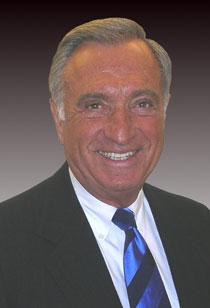
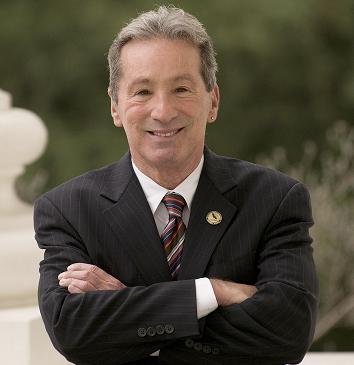
Tom Ammiano

GOP is wrong: Most Californians want taxes

50

The Public Policy Institute of California generally has some of the most reliable polls in the state. It’s not a partisan group or part of anyone’s campaign, and the questions tend to be framed in a fair manner. So I take the results of the PPIC polls as a decent indicator of where the state is going.


And where it’s going right now could not be more clear: A vast majority of Californians in the latest PPIC poll want to see a June ballot measure to address the state budget, and they support higher taxes, particularly to save education. And 60 percent think the state should raise taxes on corporations.


It’s going to be tricky: Gov. Brown will need two Republicans in each house to go along if he wants to get a tax measure on the ballot. And the GOP is holding out for changes in the state pension system, which is a complex issue and will be hard to nail down in the short time that remains before the Legislature would have to vote on a June ballot measure. But Brown has the support of the public — even the support of most Republican voters — so it’s possible.


“I’m crossing my fingers,” Assembly member Tom Ammiano told me. “But I think we can get there.”

What if everybody ran for mayor?

66

I mean, not everybody. I’m not running. Tom Ammiano isn’t running. Mark Leno isn’t running. Ed Lee isn’t running, unless he is.


But as the progressives think about the 2011 mayor’s race, there’s a strategy that’s been floating around, mostly in bars, that’s crazy and I’m not even sure I’m serious about it myself, but it might actually make sense.


See, right now there’s no one progressive candidate that everyone can get behind. And there’s no single progressive candidate who has the resources and the citywide base to win a contest where millions of dollars will be spent, not only by the candidates but by indepenent expenditure groups.


So suppose a whole bunch of people ran? Suppose the field included Aaron Peskin, Chris Daly, David Campos, John Avalos, Ross Mirkarimi (although he might want to run for Sheriff), Eric Mar … a half dozen decent candidates get in the race, each of them bringing along constituencies who might not otherwise vote. And in the end, it all comes down to ranked-choice voting, and as we know from the Oakland mayor’s race and D10, anything can happen.


Aaron Peskin gets 15 percent of the vote, comes in first, gets enough second-place votes and suddenly — he’s mayor! Take that, Arthur Evans!


Seriously, the point isn’t to elect Peskin or any other individual. It’s too see if a concerted progressive campaign, involving candidates who work together, the way Jean Quan and Rebecca Kaplan did in Oakland, could get enough voters excited and involved to put one of the candidates over the top.


Again: I’m not even sure this is a good idea. But it’s worth thinking about.

SF’s new political era

31

news@sfbg.com

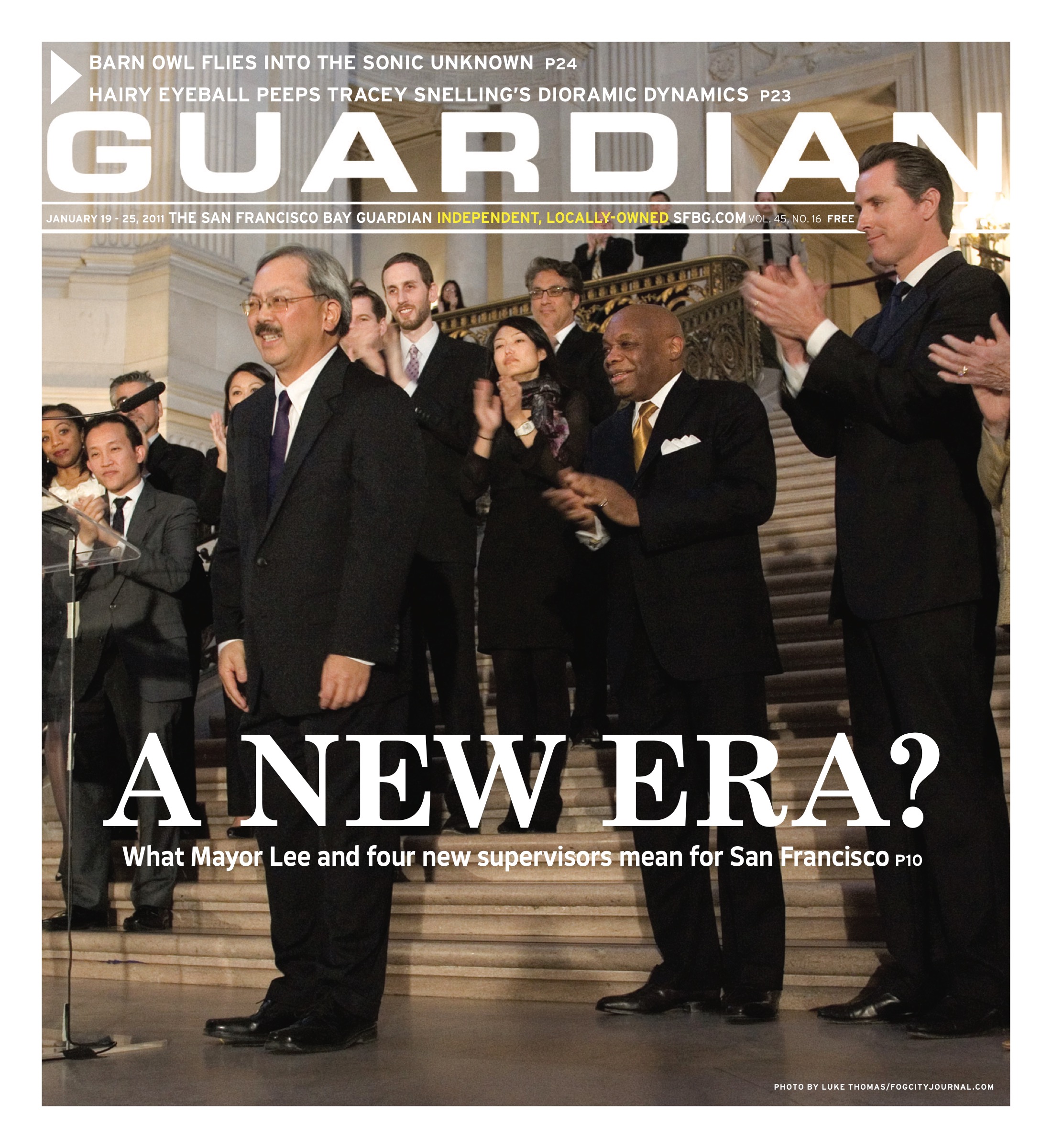
You can argue about what the word “progressive” means, and you can argue about the process and the politics that put Ed Lee in the Mayor’s Office. And you can talk forever about which group or faction has how much of a majority on the San Francisco Board of Supervisors, but you have to admit: this city has just undergone a significant political realignment.

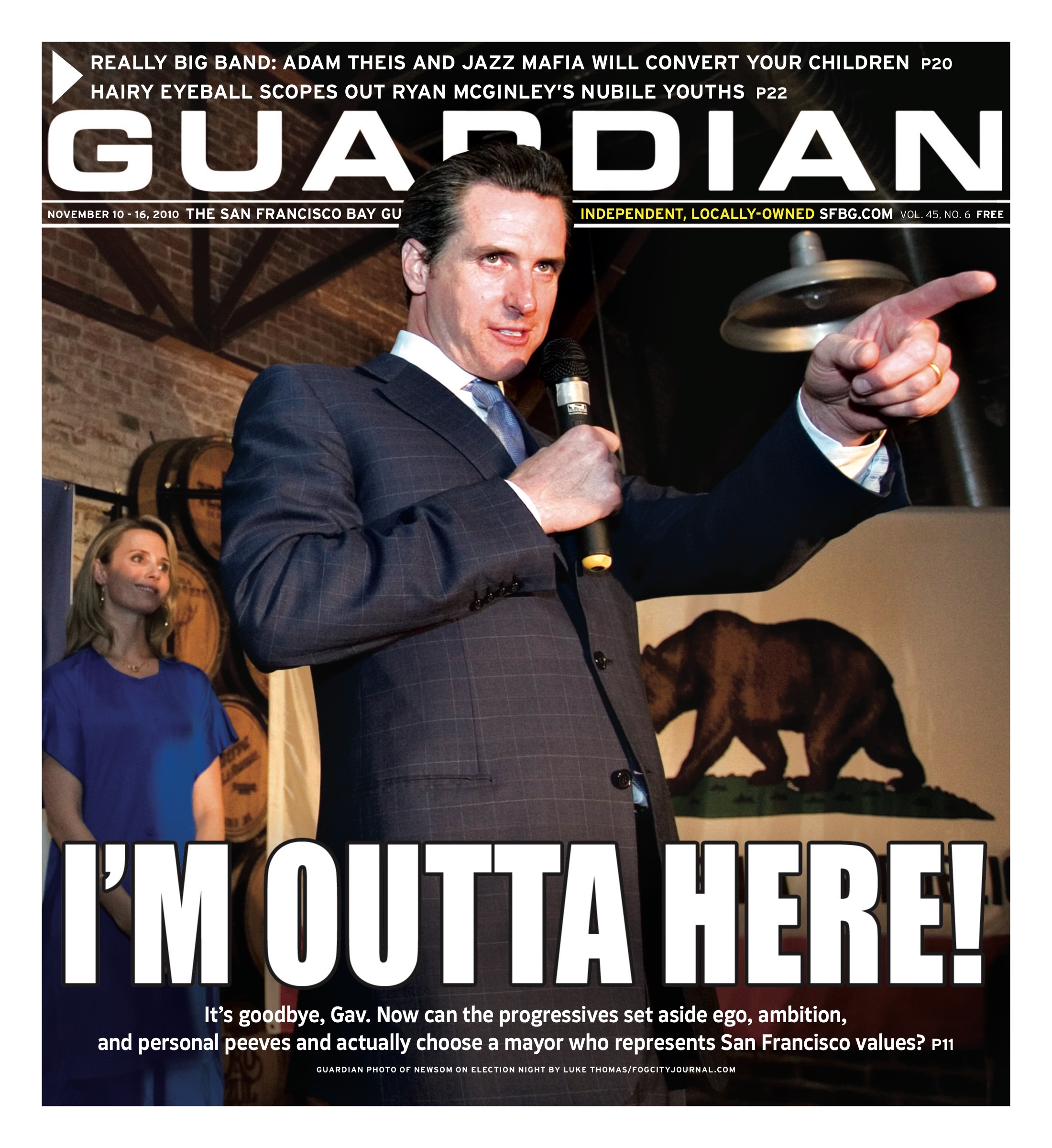
Some of that was inevitable. The last members of the class of 2000, the supervisors who were elected in a rebellion against the sleaze, corruption, and runaway development policies of the Willie Brown administration, have left office. Gavin Newsom, the mayor who was often at war with the board and who encouraged a spirit of rancor and partisanship, is finally off to Sacramento. For the first time since 1978, the supervisors will be working with a mayor they chose themselves.

For much of the past 15 years, progressive politics was as much about stopping bad things — preventing Brown and then Newsom from wrecking the city — as it was about promoting good things. But the “politics of anti,” as San Francisco State political scientist Rich DeLeon describes is, wasn’t a central theme in the November elections, and this generation of supervisors comes into office with a different agenda.

Besides, one of the clear divisions on the board the past seven years was the Newsom allies against the progressives — something that dissipated instantly when Lee took over.

But the realignment goes deeper.

Until recently, the progressives on the board had a working majority — a caucus, so to speak — and they tended to vote together much of the time. The lines on the board were drawn almost entirely by what Newsom disparagingly calls ideology but could more accurately be described as a shared set of political values, a shared urban agenda.

There are still six supervisors who call themselves progressives, but the idea that they’ll stick together was shattered in the battle over a new mayor — and the notion that there’s anything like a progressive caucus died with Board President David Chiu’s election (his majority came in part from the conservative side, with three progressives opposing him) and with Chiu’s new committee assignments, which for the first time in a decade put control of key assignments in the hands of the fiscal conservatives.


A PROGRESSIVE MAJORITY?

The progressive bloc on the board was never monolithic. There were always disagreements and fractures. And, thanks to the Brown Act, the progressives don’t actually meet outside of the formal board sessions. But it was fair and accurate to say that, most of the time, the six members of the board majority functioned almost as a political party, working together on issues and counting on each other for key votes. There was, for example, a dispute two years ago over the board presidency — but in the end, Chiu was elected with exactly six votes, all from the progressive majority that came together in the end.

That all started to fall apart the minute the board was faced with the prospect of choosing a new mayor. For one thing, the progressives couldn’t agree on a strategy — should they look for someone who would seek reelection in November, or try to find an acceptable interim mayor? The rules that barred supervisors from voting for themselves made it more tricky; six votes were not enough to elect any of the existing members. And, not surprisingly, some of the progressives had mayoral ambitions themselves.

When state Assemblymember Tom Ammiano — who would have had six votes easily — took himself out of the running, there was no other obvious progressive candidate. And with no other obvious candidate, and little opportunity for open discussion, the progressives couldn’t come to an agreement.

But by the Jan. 4 board meeting, five of the six had coalesced around Sheriff Mike Hennessey. Chiu, however, was supporting Ed Lee, someone he had known and worked with in the Asian community and whom he considered a progressive candidate. And once it became clear that Lee was headed toward victory, Sup. Eric Mar announced that he, too, would be in Lee’s camp.

A few days later, when the new board convened to choose a president, the progressive solidarity was gone. Sups. David Campos, John Avalos, and Ross Mirkarimi, now the solid left wing of the board, voted for Avalos. Chiu won with the support of Mar, Sup. Jane Kim, and the moderate-to-conservative flank.

Now the Budget Committee — long controlled by a progressive chair and a progressive majority — will be led by Carmen Chu, who is among the most fiscally conservative board members. The Land Use and Development Committee will be chaired by Mar, but two of the three members are from the moderate side. Same goes for Rules, where Sup. Sean Elsbernd, for years the most conservative board member, will work with ideological ally Sup. Mark Farrell on confirming mayoral appointments, redrawing supervisorial districts, and promoting or blocking charter amendments as Kim, the chair, does her best to contain the damage.

You can argue that having independent-minded supervisors who don’t vote as a caucus is a good thing. You can also argue that a fractured left will never win against a united downtown. And both arguments have merit.

But you can’t argue any more that the board has the same sort of progressive majority it’s had for the past 10 years. That’s over. It’s a new — and different — political era.

What happens now? Will the progressives hold enough votes to have an influence on the city budget (and ensure that the deficit solutions include new revenue and not just cuts)? What legislative priorities will the supervisors be pushing in the next year? How will the votes shake out on difficult new proposals (and ongoing issues like community choice aggregation)?

Mayor Lee has pledged to work with the board and will show up for monthly questions. How will he respond to the sorts of progressive legislation — like tenant protections, transit-first policies, immigrant rights measures, and stronger affordable housing standards — that Newsom routinely vetoed?

How will this all play out in a year when the city will also be electing a new mayor?


IDENTITY POLITICS?

When Sups. Chiu, Mar, and Kim broke with their three progressive colleagues to support Chiu for board president — just as Chiu and Mar helped clear the path for Ed Lee to become mayor days earlier — it seemed to many political observers that identity had trumped ideology on the board. There’s some truth to that observation, but it’s too simple an explanation. There’s also the fact that Chiu strongly supported Kim, who is a personal friend and former roommate, in her election, so it’s no surprise she went with him for board president.

And the phrase itself is so laden with baggage and problems that it’s hard to talk about. It has come to signify a wide range of political activity and theorizing founded in the shared experiences of injustice of members of certain social groups. “Rather than organizing solely around belief systems, programmatic manifestoes, or party affiliation, identity political formations typically aim to secure the political freedom of a specific constituency marginalized within its larger context,” says the Stanford Encyclopedia of Philosophy, an ongoing research project by the students and faculty at Stanford University.

Although the notion of identity politics took hold during the social movements of the 1960s and ’70s — when liberation and organizing movements among women and various ethic and other identity groups fed a larger liberal democratic surge that targeted war, economic inequity, social injustice, and other issues — it’s also a political approach that has divided the populace.

“One of the central charges against identity politics by liberals, among others, has been its alleged reliance on notions of sameness to justify political mobilization,” says the Stanford Encyclopedia. “Looking for people who are like you rather than who share your political values as allies runs the risk of sidelining critical political analysis of complex social locations and ghettoizing members of social groups as the only persons capable of making or understanding claims to justice.”

Mar explains that the reality of identity politics and whether it’s a factor in the current politics at City Hall is far more complex.

“With me, David Chiu, and Jane Kim as a block of three progressive Asians — and I still define David Chiu as a progressive though I think some are questioning that — we all come out of what I would call a pro-housing justice, transit-first, and environmental sustainability [mindset],” Mar told us. “But I think because of our ethnic background and experiences, we may have different perspectives at times than other progressives.”

For example, Mar said, many working class families of color need to drive a car so they’ll differ from progressives who want to limit parking spaces to discourage driving. He also has reservations about the proposed congestion pricing fee and how it might affect low-income drivers.\

“I think often when progressive people of color come into office — Jane Kim might be one of the best examples — that sometimes there’s an assumption that her issues are going to be the same as a white progressive or a Latino progressive,” he said. “But I think kind of the different identities that we all have mean that we’re more complex.”

Campos, a Latino immigrant who is openly gay, noted that “as a progressive person of color, I have at times felt that the progressive movement didn’t recognize the importance of identity politics and what it means for me to have another person of color in power.”

But, he added, “I don’t think identity politics alone should guide what happens. A progressive agenda isn’t just about race but class, sexual orientation, and other things. It’s not enough to say that identity politics justifies everything.”

University of San Francisco political science professor Corey Cook told the Guardian that identity has always been a strong factor in San Francisco politics, even if it was overshadowed by the political realignment around progressive ideology that occurred in 2000, mostly as a reaction to an economic agenda based on rapid development and political cronyism.

“I’m not sure that identity wasn’t relevant, but it was swamped by ideology,” Cook told the Guardian. Now, he said, another political realignment seems to be occurring, one that downplays ideology compared to the position it has held for the last 10 years. “I’m not sure that ideology is dead. But the dynamics have definitely changed.”

Cook sees what may be a more important change reflected in Chiu’s decision to put the political moderates in control of key board committees. But he said that shift was probably inevitable given the difficulties of unifying the diverse progressive constituencies.

“It’s hard to hold a progressive coalition together, and it’s amazing that it has lasted this long,” he said.

There’s another kind of identity politics at play as well — that of native San Franciscans, who often express resentment at progressive newcomers talking about what kind of city this is, versus those who see San Francisco as a city of immigrants and ideas, a place being shaped by a wider constituency than the old-timers like to acknowledge.

“I’m honored to join Sups. Elsbernd and Cohen in representing the neighborhoods they grew up in,” Sup. Mark Farrell said during his opening remarks after being sworn in Jan. 8., sobbing when he thanked his parents for their support.

As he continued, he fed the criticism of the notion of ideology-based politics that has been a popular trope with Gavin Newsom and other fiscal conservatives in recent years, telling the crowd he wanted “to turn City Hall into a place based on issues and ideas, not ideology.”

Cohen also placed more importance on her birthright than on her political philosophy, telling stories about entering board chambers through the back door at age 16 when she was part of a youth program created by then-Mayor Frank Jordan, and with former Mayor Dianne Feinstein coming to speak at Cohen’s third-grade class. “I am a San Francisco native, and that is a responsibility I take seriously,” said Cohen, who graduated from the Emerge Program, which grooms women for political office,

“We will have another woman as president of the Board of Supervisors, and we will have a woman as mayor of San Francisco,” she added. And as the sole African American on the board, she also pledged, “I will be working to add more members of the African American community to the elected family of San Francisco.”

But what issues she plans to focus on and what values she’ll represent were unclear in her comments — as they were throughout her campaign, despite the efforts of journalists and activists to discern her political philosophy. In her public comments, her only stated goal was to build bridges between the community and City Hall and let decisions be guided by the people “not political ideologies.”

Oftentimes in recent San Francisco history, identity and ideology have worked in concert, as they did with former Sup. Harvey Milk, who broke barriers as the first openly gay elected official, but who also championed a broad progressive agenda that included tenants rights, protecting civil liberties, and creating more parks and public spaces.

Sup. Scott Wiener, shortly after being sworn into office, acknowledged the legacy of his district, which was once represented by Milk and fellow gay progressive leader Harry Britt, telling the crowd: “I’m keenly aware of the leadership that has come through this district and I have huge shoes to fill.”

Yet Wiener, a moderate, comes from a different ideological camp than Milk and Britt and he echoed the board’s new mantra of collaboration and compromise. “I will always try to find common ground. There is always common ground,” he said.


GETTING THINGS DONE?

Chiu is making a clear effort to break with the past, and has been critical of some progressive leaders. “I think it’s important that we do not have a small group of progressive leaders who are dictating to the rest of the progressive community what is progressive,” he said.

While he didn’t single out former Sup. Chris Daly by name, he does seem to be trying to repudiate Daly’s leadership style. “I think that while the progressive left and the progressive community leaders have had very significant accomplishments over the past 10 years, I do think that there are many times when our oppositional tactics have set us back.”

When Chiu was reelected board president, he told the crowd that “none of us were voted into office to take positions. We were voted into office to get things done.”

Some progressives were not at all happy with that comment. “I thought that was a terrible thing to say,” Avalos told the Guardian, arguing the positions that elected officials take shape the legislation that follows. As an example, he cited the positions that progressive members of Congress took in favor of the public option during the health care reform debate.

Talking about getting things done is “a sanctimonious talking point that fits well with what the Chronicle and big papers want to hear,” Avalos said. He said the Chronicle and other downtown interests are more interested in preserving the status quo and blocking progressive reforms. “It’s what they want to see not get done.”

Campos even challenged the comment publicly during the Jan. 11 board meeting when he said, “It’s important to get things done, but I don’t think getting things done is enough. We have to ask ourselves: what is it that we’re getting done? How is it that we’re getting things done? And for whom is it that we’re doing what we’re doing? Is it for the people, or the downtown corporate interests? I hope it’s not getting things done behind closed doors.”

Chiu said that, for him, getting things done is about expanding the progressive movement and consolidating its recent gains. “I think we all share a political goal. As progressives, we all share a political goal of getting things done and growing mainstream support for our shared progressive principles so that they really become the values of our entire city.”

To do that, he said, progressives are going to need to be more conciliatory and cooperative than they’ve been in the past. “I think it’s easy to slip into a more oppositional way of discussing progressive values, but I’m really pushing to move beyond that.”

The biggest single issue this spring will be the budget — and it’s hard to know exactly where the board president will draw his lines. “I have spoken to Mayor Lee about the need for open, transparent, and community-based budget processes and he’s open to that,” Chiu told us — and that alone would be a huge change. But the key progressive priority for the spring will be finding ways to avoid brutal budget cuts — and that means looking for new revenue.

When asked whether new general revenue will be a part of the budget solution, instead of Newsom’s Republican-style cuts-only approaches, Chiu was cautious. “I am open to considering revenues as part of the overall set of solutions to close the budget deficit,” he said. “I am willing to be one elected here that will try to make that argument.” But with his political clout and connections right now, he can do a lot more than be one person making an argument.

Chiu has always been open to new revenue solutions and even led the way in challenging the cuts-only approach to both the city budget and MTA budget two years in a row, only to back down in the end and cut a deal with Newsom. When asked whether things will be better this year given his closer relationship to Lee, Chiu replied, “I think things are going to be different in the coming months.”

During the board’s Jan. 7 deliberation on Lee, Sup. Eric Mar also said that based on his communications with Lee, Mar believed that the Mayor’s Office is open to supporting new revenue measures. He echoed the point later to us.

In addition to supporting the open, inclusive budget process, Mar called for “a humane budget that protects the safety net and services to the most vulnerable people in San Francisco is kind of the critical, top priority.

“I think it’s going to be difficult working with the different forces in the budget process,” he added. “That’s why I wish it could have been a progressive who was chairing the budget process.”

Mar said progressive activism on the budget process is needed now more than ever. “The Budget Justice Coalition from last year I think has to be reenergized so that so many groups are not competing for their own piece of the pie, but that it’s more of a for-all, share-the-pain budget with as many people communicating from outside as possible, putting the pressure on the mayor and the board to make sure that the critical safety net’s protected.”


CUTS WILL BE CENTER STAGE

But major cuts — and the issue of city employees pay and benefits — will also be center stage.

At the board’s Jan. 11 meeting, before the supervisors voted unanimously to nominate Lee as interim mayor, Sup. Elsbernd signaled that city workers’ retirement and health benefits will once again be at the center of the fight to balance the budget.

Elsbernd noted that in past years he was accused of exaggerating the negative impacts that city employees’ benefits have on the city’s budget. “But rather than being inflated, they were deflated,” Elsbernd said, noting that benefits will soon consume 18.14 percent of payroll and will account for 26 percent in three years.

“Does the budget deficit include this amount?” he asked.

And at the after-party that followed Lee’s swearing-in, Public Defender Jeff Adachi, who caused a furor last fall when he launched the ill-considered Measure B, which sought to reform workers’ benefits packages, told us he is not one to give up lightly.

“We learned a lot from that,” Adachi said. “This is still the huge elephant in City Hall. The city’s pension liability just went up another 1 percent, which is another $30 million”

Chu agreed that worker benefits would be a central part of the budget-balancing debate. “Any conversation about the long-term future of San Francisco’s budget has to look at the reality of where the bulk of our spending is,” she said.

Avalos noted that he plans to talk to labor and community based organizations about ways to increase city revenue. “I’m going to work behind the scene on the budget to make sure the communities are well-spoken for,” Avalos said, later adding, “But it’s hard, given that we need a two-thirds majority to pass stuff on the ballot.”

Last year, Avalos helped put two measures on the ballot to increase revenue: Prop. J, which sought to close loopholes in the city’s current hotel tax and asked visitors to pay a slightly higher hotel tax (about $3 a night) for three years, and Prop. N, the real property transfer tax that slightly increased the tax charged by the city on the sale of property worth more than $5 million.

Prop. N should raise $45 million, Avalos said. “I’ve always had my sights set on raising revenue, but making cuts is inevitable.”


THE IDEOLOGY ARGUMENT

Newsom and his allies loved to use “ideology” as a term of disparagement, a way to paint progressives as crazies driven by some sort of Commie-plot secret agenda. But there’s nothing wrong with ideology; Newsom’s fiscal conservative stance and his vow not to raise taxes were ideologies, too. The moderate positions some of the more centrist board members take stem from a basic ideology. Wiener, for example, told us that he thinks that in tough economic times, local government should do less but do it better. That’s a clear, consistent ideology.

For much of the past decade, the defining characteristic of the progressives on the board has been a loosely shared urban ideology supported by tenants, immigrant-rights groups, queer and labor activists, environmentalists, preservationists, supporters of public power and sunshine and foes of big corporate consolidation and economic power. Diversity and inclusiveness was part of that ideology, but it went beyond any one political interest or identity group.

It was often about fighting — against corruption and big-business hegemony and for economic and social equality. The progressive agenda started from the position that city government under Brown and Newsom had been going in the wrong direction and that substantive change was necessary. And sometimes, up against powerful mayors and their well-heeled backers, being polite and accommodating and seeking common ground didn’t work.

As outgoing Sup. Daly put it at his final meeting: “I’ve seen go-along to get along. If you want to do more than that, if you think there’s a fundamental problem with the way things are in this world, then go-along to get along doesn’t do it.” When Chiu announced that the new progressive politics is one of pragmatism, he was making a break from that ideology. He was signaling a different kind of politics. He has urged us to be optimistic about the new year — but we still don’t know what the new agenda will look like, how it will be defined, or at what point Chiu and his allies will say they’ve compromised and reached out enough and are ready to take a strong, even oppositional, stand. We do know the outcome will affect the lives of a lot of San Franciscans. And when the budget decisions start rolling down the pike, the political lines will be drawn fairly clearly. Because reaching across the aisle and working together sounds great in theory — but in practice, there is nothing even resembling a consensus on the board about how the city’s most serious problems should be resolved. And there are some ugly battles ahead.


Let’s get budget priorities straight

0

OPINION Who will pay for California’s budget woes? For the last three years, Californians have put up with cuts to programs that are critical to our state’s future and our social safety net. Public education, HIV and AIDS programs, state universities, and CalWORKs have all come under the knife. The elephant in the room, as state and federal governments try to balance budgets on the backs of the working and middle class, is the billions of dollars we are wasting on a misguided war in Afghanistan.

Fresh evidence that the war in Afghanistan is failing rolls in on a daily basis. While the administration justifies the cost in lives and dollars as necessary to fight Al Qaeda, it also acknowledges that there are only 50 to 100 Al Qaeda fighters in Afghanistan. Every soldier in Afghanistan costs U.S. taxpayers $1 million per year. With 100,000 soldiers on the ground, that means we’re spending as much as $2 billion a year on each Al Qaeda fighter.

Would we dream of spending $2 billion on every needy child in California? Or even $1 million? As U.S. and Afghan casualties rise along with the dollar amounts, with little success to show for it, we need to get our priorities in check.

At Governor-elect Jerry Brown’s budget forum this week, we were staring down a $28.1 billion budget deficit over the next 18 months. Compare that to the $46.4 billion Californians have already spent on the war in Afghanistan — $1.2 billion of that right out of San Franciscans’ pockets.

The Obama administration is conducting a strategy review this month that is expected to rubber stamp an approach that keeps soldiers in harm’s way — when doing so is not likely to make Americans or Afghans safer. At the same time, the president’s deficit commission chairs are also passing down recommendations to save money by cutting benefits for our most vulnerable citizens.

I would like to tell the taxpayers in my district who are shelling out these dollars that there’s a light at the end of the tunnel, but the president is now proposing ending the “combat mission” in 2014, which could mean there will be tens of thousands of troops on the ground even after four more years have passed.

I will continue to fight for our real needs in Sacramento. But it’s time for our representatives in Washington to put an end to this disastrous war and bring our troops home as quickly and responsibly as possible. Our tax dollars should be making life in California sustainable and safe for all. We can’t afford any other way.

Assemblymember Tom Ammiano represents the 13th District.

Ammiano wants to change bike laws

29

Assemblymember Tom Ammiano wants to change the way bicycles and cars are treated under state traffic laws.


He’s responding in part to the furor over the bike crackdowns in Berkeley, but it’s nothing new for Ammiano — he also tried to get bicycle traffic legislation through last year. This time, though, he told me, “I think we’re going to be able to pass something.” And incoming Gov. Jerry Brown ought to be willing to sign it.


Matt Bunch, an Ammiano staffer, told me that the bill isn’t final, but will certainly address the penalty for cars hitting bicycles. “A lot of these are preventable, but they’re treated as accidents,” he said. “They aren’t punished adequately.”


The measure could also address the wide disparity in traffic fines that bicyclists face in different cities and take on the Berkelely problem. “The fine you get depends on what they charge you with, and it’s all over the map,” Bunch said.


Bunch also suggested that Ammiano might be looking at the way some police officers in some jurisdictions charge bicyclists with vehicle-code violations that were written to apply to cars. “The vehicle code isn’t specific to bikes,” he said. “There’s a clear deficiency in law, and we’re going to look at it.”


One of the things they ought to be checking out: Why is it okay to make a biker get a point on his or her drivers license when he or she isn’t driving a motor vehicle?


Go, Tom. I’ll keep you posted when the bill is introduced.


The mayoral roulette

23

At the San Francisco Tomorrow holiday party Dec. 8th, David Chiu, Dennis Herrera, John Rizzo, Jake McGoldrick and a host of others who I’ve seen at these events for at least the past few years were doing their usual schmoozing — when Ross Mirkarimi, a former SFT board member, showed up with …. Art Agnos. I haven’t seen the former mayor at an SFT event since … I don’t know. Since a long long time ago.


Agnos made a short speech and talked about all of the rising stars in the San Francisco progressive movement — Mirkarimi, Chiu, Rizzo, David Campos, Eric Mar, John Avalos … and it was all very nice and low key. But there was a message in his appearance, in his connection with Mirkarimi, and even in the overall tone of his remarks, which amounts to this:


If the supervisors have trouble finding a progressive who can get six votes — and if they want an old hand, someone who has been through a brutal recession as mayor of San Francisco and dealt with awful budgets and nasty politics, someone who will serve for a year and then walk away — Agnos is open to being asked.


Well, maybe a little more than open to being asked. I wouldn’t say he’s actively, publicly campaiging for the job, but he has met with most of the supervisors, and dropped them all a 13-page memo listing all of his accomplishments, and his supporters (maybe his emissaries) are making the rounds and making the case for Agnos. Which amounts to this:


None of the progressives now more-or-less openly in the mix (Campos, Chiu, Mirkarimi, even Aaron Peskin) can realistically take on all the sacred cows (esp. police and fire), make a bunch of other cuts, and push for all sorts of revenue increases — and at the same time try to run for re-election in November (when the tax hikes would be on the ballot). The only way to do “what needs to be done” is to put in a progressive caretaker who can then take the political heat for the tough decisions — and help set up a campaign for another progressive in November.


I’m not sure I entirely agree — the right person, with the right leadership and agenda, could set up a five-year plan for fiscal stability, launch year one immediately and tell the public that he/she needs a full term to finish the job. But it’s true that it will be tough — and it’s also true that none of the obvious alternatives have ever run citywide.


If Tom Ammiano were interested, we wouldn’t be having this discussion. Tom has run citywide numerous times (for School Board, pre-district elections supervisor and mayor), has been elected by half the city (to the Assembly), and has the credibility to deal with the budget crisis and still win in November. But he’s not, and we have to respect that.


Right now, the progressives can’t seem to unite on a candidate. None of the current board members has six votes today. And Campos, Chiu, Mirkarimi and everyone else in the game knows full well how hard it will be to win in November, particularly against State Sen. Leland Yee, who will be a formidable candidate, and possibly City Attorney Dennis Herrera (who has won citywide), State Sen. Mark Leno (who is popular all over town) and others.


So if a couple rounds pass and there’s no winner, the “progressive caretaker” concept will be in play. It’s possible Mirkarimi would give up his seat two years early and take that job; it’s likely Peskin would agree to serve one year and then step down. But it’s also possible that neither scenario works out — at which point Sheriff Mike Hennessey and Agnos will be in play.


(I hear through the grapevine that Willie Brown is nosing around, too — and let’s remember that he became Assembly speaker by cutting a deal with the Republicans.)


Hennessey’s got a strong progressive record, but has never had to deal with anything remotely as awful as what the next mayor will face. So Agnos backers will make the case that their guy has the experience and gravitas to pull it off.


Given all of that, let me say a couple of things about Agnos, since I was around and watching City Hall when he was mayor (and some of the people who will be voting on this weren’t.)


Art’s a mixture. He was a great progressive member of the state Assembly. When he ran for mayor, we backed him strongly; he seemed to be the great progressive hope. Then his long list of wonderful promises ran into the buzz saw of a deep recession — and made things much worse with his arrogant, imperious style. His first major act in office was to sign a set of contracts that gave away the store to PG&E. He never lifted a finger for public power. And it quickly became clear that he wasn’t a fan of open government or public process. We were all supposed to “Trust in Art” and shut up if we didn’t like it.


That’s why — despite what was at the time and is in retrospect a pretty darn progressive record, a lot of solid accomplishments and absolutly no hint of corruption or scandal — the progressives just weren’t all that excited about his re-election. So he lost to Frank Jordan, who was way worse.


The thing is, Agnos these days is a lot more mellow. He’s 72, knows he’s not going anywhere else in politics, and has essentially admitted to me that he made a lot of mistakes, and his arrogance and closed-door attitude were top on the list. A reformed Agnos — willing to serve with a degree of humility and an acceptance that progressive politics in this town demands inclusiveness, and that even though he’s a former mayor, he’s not by definition the most important person in any room he walks into — would present an interesting option.


Of course, we still don’t know exactly where he would be on the issues, since, like Chiu, he hasn’t even publicly called himself a candidate for the job. I still think anyone who is a serious contender ought to be willing to appear before the supervisors and answer questions.


We all know where to start: What’s your plan for raising a quarter billion dollars in new revenue in 2011?    

Class of 2010: Jane Kim

7

steve@sfbg.com

Despite fears that a candidate backed by downtown could replace firebrand progressive leader Sup. Chris Daly in District 6, in the end it was the two progressive candidates — Jane Kim and Debra Walker — who finished far in front of the large pack of candidates, with Kim winning the race. And she thinks that says something about how the progressive movement has matured.

“To have the two leading candidates be progressives says a lot about the progressive political community,” Kim said. “The race was really between Debra and me in end.”

Kim, a 33-year-old attorney and the outgoing president of the San Francisco Board of Education, has been active in progressive politics in San Francisco for many years, from doing community organizing with the Chinatown Community Development Center to running the short-lived San Francisco People’s Organization, which Daly helped create.

Yet part of her campaign strategy, and the message that she’s sending in the wake of an election that divided the progressive community, focuses on issues and themes that are more common to political moderates: job creation, clean streets, public safety, and neighborhood services.

“I think it’s important for progressives to cross over, and I don’t think it should be viewed as selling out,” Kim told us. “Progressives need to do a good job at maintaining voters’ faith in the progressives’ ability to lead.”

In addition to courting progressive groups and voters, Kim’s campaign aggressively targeted residents of the residential condo towers in Rincon Hill and Eastern SoMa, voters who are generally more affluent and newer to San Francisco than the typical progressive constituencies.

“It’s a lot of new residents who don’t feel like they’re a part of any political faction and they’re really open,” Kim said. “People just want to see that things are better. They want the streets to be clean and safe.”

With a new mayor and new blood on the Board of Supervisors, Kim said this is an important political moment for San Francisco, “a huge opportunity” to redefine San Francisco politics in the wake of Mayor Gavin Newsom and progressive supervisors such as Aaron Peskin, Matt Gonzalez, Tom Ammiano, and Daly.

“The Class of 2000 was able to show how progressive we can be with policy. They really pushed the envelope,” Kim said, citing new worker and tenant protections and programs such as Healthy San Francisco. Now, she said, the challenge for progressives in the Classes of 2010 and 2008 is to show that they can provide effective leadership in realms like public safety and economic development. “If we’re able to lead on those two issues, it would really firm up our leadership of the city,” Kim said, noting that it would also affect the dynamics of next year’s mayor’s race.

While Kim didn’t go into detail about how she intends to deal with what she says is the biggest challenge facing the new board — a budget deficit of $700 million over two years, coming at a time when all the easy cuts have already been made in recent years — she said the city needs to be aggressive in boosting the local economy and ensuring San Franciscans get most city contracts.

“We need to figure out how we can partner with small business to create a diversity of jobs in San Francisco,” she said, noting that the average San Franciscan has more faith in the moderates’ ability to create jobs, something that progressives need to address. But how can she help break the grip that the conservative San Francisco Chamber of Commerce has on small businesses?

“Part of the problem is that small businesses aren’t organized,” Kim said, noting how that hurt Sup. David Chiu’s ability to win support this year for his business tax reform measure that would have helped most small businesses and made some large corporations pay more taxes. “They’re busy running their businesses and they don’t have the time to look at the details, so they just read the briefing of the Chamber of Commerce.”

Kim said she respects the leadership role Daly has played in progressive politics and that she’d “like to be part of the moral compass of the Board of Supervisors.” But she also said that Daly’s sometimes abrasive style unnecessarily hardened the opposition of moderates to important progressive issues.

“He made it harder to talk about affordable housing,” Kim said, noting that the city’s dearth of affordable housing should be an issue that’s important to middle class voters, noting that it includes housing for people who earn up to 120 percent of the median income for the region. But after Daly hammered on the issue, “It was like a bad word coming out, and people would turn off to the issue.”

But she thinks it’s a fixable problem if she and her allies do the hard work, an ability they demonstrated this year by defeating Walker, who had been running for the seat for years and lining up all the key endorsements. “Voters do respond to campaigns that work really hard, and that bodes well for progressives,” Kim said, noting that she intends to reach out to Walker’s supporters. “I don’t think I can be successful as a supervisor if I don’t work with all the camps in the progressive community.”

Supervisors punt mayoral decision back a week

11

The San Francisco Board of Supervisors today voted to delay until Dec. 14 the process of choosing a mayor to succeed departing Mayor Gavin Newsom after taking about 40 minutes worth of public testimony, most of it calling on supervisors to act quickly to choose a public-spirited mayor to deal with a variety of neglected issues.
After Assembly member Tom Ammiano announced earlier today that he would not accept the board’s nomination to become mayor, it seemed unlikely that anyone could get the required six votes. But Sup. Chris Daly, who led the campaign to recruite Ammiano, argued for beginning the process today as agendized.
“While the Board of Supervisors is not prepared today to appoint someone as successor mayor of San Francisco, we shouldn’t truncate the conversation,” Daly argued, reiterating his call last week for a mayor who is experienced, compassionate, and willing to work cooperatively with the board.
But Sup. Sophie Maxwell didn’t want to have that conversation, making the motion to continue the item for one week, a motion seconded by Sup. Bevan Dufty. Neither offered reasons or arguments for the action.
Yet Daly noted that the board has an approved process for selecting a new mayor and “it might be a good idea to try it out and see how it works,” even if six votes aren’t there yet to approve a nominee. “I’m prepared to make a nomination.”
He addressed calls for delaying the mayoral succession decision by noting that Oakland Mayor-elect Jean Quan and Governor-elect Jerry Brown have both put together transition teams to prepare for taking power at the same time that Newsom will resign as mayor to become lieutenant governor.
“Typically, a mayor would have had about a month to put together a transition team,” Daly said, also noting, “We are now borrowing time against the next administration of San Francisco.”
Sups. David Campos and Eric Mar also spoke in support of this board making the mayoral succession decision “sooner rather than later,” as Campos put it. “We do have a very tough budget year we will be facing and many challenges in front of us,” he said. Campos said he was open to the delay, but he said “it would be a mistake” not to begin dealing with the decision in earnest next week.
Mar said he was open to the delay because he was interested to read the “Values-based Platform for the next Mayor” that a coalition of labor and progressive groups called San Francisco for All distributed at the meeting. The four-page document called for a mayor to value accessibility, consensus-building, making appointments who are accountable to the community, more equitable budget priorities, and transparency.
The motion to delay was approved on a 9-2 vote, with Daly in Sup. John Avalos in dissent.

Mayor? Ammiano says no thanks

4

Assemblymember Tom Ammiano made it official today, Dec. 7th — despite the efforts of Sup. Chris Daly and others to get him to serve as the city’s interim mayor, he’s declining. I just got the official statement:


I sincerely appreciate and understand the recent public efforts asking that I seek the nomination for interim mayor when Mayor Newsom steps down in January to become Lt. Governor but I must respectfully decline any nomination from the Board of Supervisors.


I was sworn in yesterday for my second term in the California State Assembly and I believe that the same strong progressive values that have inspired my twenty years as an elected official are needed now more than ever in the State Capitol.  One of the weaknesses of our current state government is a lack of true investment in the various elected offices due to the revolving door syndrome caused by term limits but I am committed to finishing the work that I have begun in Sacramento, including reforming our antiquated marijuana laws, closing the corporate loopholes in Proposition 13, ensuring adequate funding for the on-going battle against AIDS and continuing the struggle for equal rights for our LGBT community.


Since the board meets this afternoon to start the process of choosing a new mayor, Ammiano clearly wants to be sure that his name isn’t placed into nomination — a move that would force his many allies and supporters on the board either to vote against him (a potential show of disrespect for a man who many see as the father of the modern progressive movement in San Francisco) for vote for him (and push him toward a job he doesn’t want).


I don’t know if Daly will still nominate Ammiano; he was quoted today in the Bay Citizen saying that Ammiano “knows the gravity of the situation … I think if he has to opportunity to let that sink in a bit he might change his mind.” But I do know that Ammiano isn’t happy about being pushed by Daly, and would like to get his name out of the mix and move on.


So with all due respect to the many folks I know who want to encourage Tom (and I personally think he’d be a great mayor), he’s made his decision, and we have to respect that.

Emergency forum Tues. / 30 on HANC recycling center eviction

8

An emergency community forum will be held tonight, Nov. 30, about the Recreation and Parks Department’s plan to evict the Haight Ashbury Neighborhood Council (HANC) Recycling Center from a parking lot in Golden Gate Park. If Mayor Gavin Newsom and his former chief of staff, Rec & Park General Manager Phil Ginsburg, succeed in their plan to evict the 36-year old recycling center, they’ll kill 10 green jobs, eliminate a rare source of income for poor people, and put an end to a community resource that costs San Francisco taxpayers nothing.

HANC believes the recycling center is being targeted by Newsom’s administration as a form of political payback, since the progressive organization opposed Proposition L, the sit / lie ordinance, which Newsom supported.

Ginsburg wants to evict the recycling center, which pays rent to the city, and replace it with a community gardening center that would cost $250,000. The shaded lot doesn’t seem like an ideal site for growing produce.

A memo issued Nov. 29 from Ginsburg to Rec & Park Commissioners notes that it is legal for the department to move forward with the eviction without commission approval. Apparently, Newsom’s administration intends to send 10 people to the unemployment line and kick a 36-year-old green resource to the curb without any public input, despite receiving 400 postcards from San Francisco residents opposing the eviction. The Rec & Park Commission will take up the issue of the new community garden center at its Thurs., Dec. 2 meeting.

Tonight’s emergency forum, organized by Keep Arboretum Free, is an attempt to open up a space for public dialogue.

A stakeholder meeting took place this afternoon with Ginsburg, District 5 Sup. Ross Mirkarimi, Department of the Environment Director Melanie Nutter, representatives from the San Francisco Police Department, represenatives from the offices of Assembly Member Tom Ammiano and City Attorney Dennis Herrera, HANC, and area residents.

Jim Rhoads of the HANC Recycling Center told the Guardian just after the meeting, “They’re going to evict us by the end of December. That’s their goal. The mayor has it in for us and he wants to get us out before he leaves.”

The recycling center, located at Frederick and Arguello streets, operates a buyback program for recyclable materials as well as a San Francisco native plant nursery. Residents from the Inner Sunset Park Neighbors have voiced complaints about “quality-of-life issues” that they link with some of the center’s patrons. During buyback hours, held from 10 a.m. to 3 p.m., people arrive with shopping carts filled of cans and bottles to exchange for small amounts of cash. Some of them are homeless.

Representatives from HANC, Rec & Park, and the Inner Sunset Park Neighbors have been invited to speak at tonight’s forum. “There are strongly felt opinions on both sides,” a flier for the event notes. “In the interest of a broad discussion, a number of long time local residents organized this forum for a full public airing of the issues prior to the Dec. 2 Commission meeting.”

The forum will be held tonight, Tuesday, Nov. 30, from 7 to 9 p.m. at St. John of God, 5th Avenue at Irving St.

To voice your opinion about Rec & Park’s plan to evict HANC, call Phil Ginsburg at 415-831-2701 or email him at Philip.Ginsburg@sfgov.org.

Editor’s Notes

0

tredmond@sfbg.com

Imagine if the next mayor of San Francisco was chosen in public. I don’t mean the supervisors voting in public — they’ll have to do that at some point anyway. I mean the various possible candidates going through a process that allows the public to see who’s on the short list — and where those candidates are on the issues.

Sup. John Avalos, with the backing of his colleagues Chris Daly and David Campos, have started the process by suggesting that the board nominate candidates, soon. The idea, Avalos says, is to get a new mayor chosen early so that person can start on the transition process and get up to speed on leading the city.

But there are further steps here. When the supervisors nominate candidates for less significant offices, the Rules Committee holds a hearing and discusses the nominees. What if the supervisors, meeting as a Committee of the Whole, nominated, say, a half-dozen people for the job of interim mayor — then asked each candidate to appear before the group and answer questions?

The voters just overwhelmingly approved a charter amendment that will require the next mayor to appear at a board meeting once a month. There’s no reason the candidates shouldn’t do the same.

The supervisors have every right to ask someone who wants to be mayor what his or her position is on a long list of policy issues. And the pubic has every right to hear the responses.

I know, I know — the candidates would hate it. Standing in front of 11 people, from Chris Daly to Sean Elsbernd, and submitting to the mother of all job interviews would be unpleasant, perhaps unsettling. Some of the top contenders might bow out at the prospect.

But let’s be serious: In a normal campaign, the voters get to see candidates for mayor speak, take stands on issues, and engage in debates. I can’t see the supervisors choosing a new mayor on good faith alone (well, I’d take Tom Ammiano on good faith, but he doesn’t want the job). And if there aren’t any public discussions or interviews, then the only screening process is going to happen privately, with individual board members contacting individual candidates and (most likely) cutting deals.

I think it’s perfectly fair to say to the potential candidates: You want to be mayor of San Francisco? Spend an hour making the case for yourself and fielding questions from the people who are about to hire you. And let the rest of us watch.

Prison for killer cop

0

rebeccab@sfbg.com

On Nov. 5, former BART Police officer Johannes Mehserle was sentenced to two years in state prison for fatally shooting Oscar Grant, a 22-year-old African American rider, on the Fruitvale train platform on New Year’s Day 2009.

Mehserle, who is white, was convicted of involuntary manslaughter in July in an incident that has become charged with racial undertones. He received credit for 292 days served in jail so far, which will considerably reduce his time in prison. It was the lightest prison sentence he could have received for the crime.

Grant supporters gathered in Frank Ogawa Plaza in downtown Oakland to express anger and sorrow upon hearing news of the sentence. “I’m not shocked,” said Cat Brooks, who helped organize an afternoon rally for the Coalition for Justice for Oscar Grant. “But I’m disgusted and distraught. It seems like the justice system didn’t work.”

After the rally came to a close and night fell, protesters spilled into the streets and marched toward the Fruitvale BART Station, the scene of the crime. But after a dozen car windows were smashed along the way, police officers in riot gear corralled the group into a residential neighborhood. Police then placed 152 protesters under mass arrest, mostly on charges of unlawful assembly. Roughly two-thirds of those arrested were Oakland residents, according to the Oakland Police Department, while others were from Berkeley, San Francisco, Hayward, and other local cities.


COMMUNITY RESPONDS

A stage outside Oakland City Hall was transformed into a venue for personal expression in the wake of the sentencing. Community members lined up to air their frustrations and resolve to keep fighting. They piled flowers onto a shrine that had been created with a picture of Grant’s face. Some painted pictures, while others gave spoken word or hip-hop performances. Several told stories of loved ones who’d died in police shootings.

Cephus Johnson, Grant’s uncle, was at the Los Angeles courtroom where Mehserle was sentenced, but shared some thoughts with the Guardian beforehand. Asked what he’d thought when the verdict had been announced, Johnson said, “My first thought was that we’re witnessing the criminal justice system failing to work as it should have worked.” If the sentence fell short of the 14-year maximum, he said, “it will be another slap in the face, signifying that black and brown men are worthless.”

East Bay labor organizer Charles Dubois was among those attending the Nov. 5 rally. “Every black parent, every brown parent, lives with this nightmare of their children being killed by some cops because they thought they had a gun,” Dubois said in an interview with the Guardian. “It’s been happening since I was a kid. It’s been happening then and it’s happening now, and it’s going to keep happening until we do something.”

California Assemblymember Tom Ammiano (D-SF) also weighed in during a phone call with the Guardian. “This verdict is outrageous,” he said. “It’s Dan White all over again.”


JUDGE DROPS GUN ENHANCEMENT

Judge Robert Perry sided with arguments presented by Mehserle’s defense attorney, Michael Rains, when he levied a reduced punishment. Mehserle could have served up to 14 years prison for involuntary manslaughter committed while wielding a gun, but Perry tossed out the firearm enhancement.

“No reasonable trier of fact could have concluded that Mehserle intentionally fired his gun,” the judge was quoted in media reports as saying. But that appears to be what the jury found, as the prosecution argued in a presentencing memorandum.

“The evidence was presented regarding the use of the gun, and in discussing the use of the gun in the jury room, somehow or another the jury decided he had used the gun illegally,” criminal defense attorney and National Lawyers Guild observer Walter Riley told the Guardian. “One has to believe the jury expected him to have exposure to a greater amount of jail time because of that.”

Perry said he believed Mehserle suffered a “muscle memory accident” that led him to draw and fire his service weapon instead of his Taser, a cornerstone of the defense’s case.

Rains wrote to the court prior to sentencing that jurors should never have been allowed to apply the firearm enhancement to an involuntary manslaughter conviction “because in this case, there is no logical way to square a verdict of involuntary manslaughter and a finding that Mehserle intended to use his gun.”

Prosecutor David Stein of the Alameda County District Attorney’s Office countered that the jury’s conviction showed they believed Mehserle intended to shoot, but not to kill, Grant. Yet Perry agreed with the defense, conceding he had mistakenly permitted the jury to enhance Mehserle’s sentence.

Riley said he sympathized with frustrations over the gun enhancement getting dismissed. “The use of guns is too prevalent in circumstances where law enforcement comes in contact with young black people,” he said. “Our society — our civil society, our judicial authority, and our communities — have to hold government and law enforcement officers to a higher level of accountability in their interactions with citizens. When people with guns shoot an inordinate number of people of one group, it’s worth tremendous scrutiny.”


ANOTHER NIGHT IN JAIL

Twice before, activists took to the streets in furious protest over this case. In January 2009, things escalated to the point where cars were set ablaze. In July 2010, a street rally gave way to rioting and looting. So on Nov. 5, many downtown Oakland storeowners boarded up and closed business early in anticipation of a third wave of vandalism.

Yet the turnout was smaller than the previous events. And while there were reports of smashed car windshields and other instances of vandalism along the circuitous path of the march, there was far less property destruction.

The community affair outside Oakland City Hall ended around 6 p.m., when the permit expired. Soon after, activists spilled into the intersection of 14th and Broadway streets, then began advancing down 14th Street chanting “No Justice! No Peace!” and “The whole system is guilty!” The march turned right onto Madison Street, then left onto 10th Street.

A police helicopter with a spotlight kept pace overhead while it progressed, and when protesters reached Laney College, police officers in riot gear blocked them in. So protesters cut through a park and wandered in a pack until they reached the intersection of East 18th Street and Sixth Avenue in a residential neighborhood. Once again, police surrounded the protesters. This time, the crowd was trapped.

Rachel Jackson, an activist who was barricaded in, began sounding off. “We were going to Fruitvale,” she explained. “We wanted to go to the scene of the crime. All night the police have been trying to suppress our free speech.” When a nearby TV news reporter asked her about windows that had been busted along the march, she was incensed. “We will not equate glass with Oscar Grant’s life!” she responded. “If we have to come out ourselves and board up windows, we’ll do that. But what we are concerned with right now is murder.”

Reporters were allowed to exit the confined area, but if anyone else had been inclined to leave peacefully, they were unable to. Police issued a call on a megaphone telling activists, “You are all under arrest. Do not resist arrest.” By the time the mass arrest was underway, public information officer Jeff Thomason told a group of reporters that there were more police officers on the scene than protesters.

“When the rocks were being thrown, it was declared an unlawful assembly,” Thomason explained. He said a dispersal order had been issued simultaneously. Yet it would have been impossible for the trapped crowd to comply with such an order.

Meanwhile, a resident of the Oakland neighborhood who had come outside when the commotion began told the Guardian that she sympathized with the protesters. “The only thing I don’t condone is the vandalism,” said Dyshia Harvey, who surveyed the scene from behind a fence with her six-year-old son.

Harvey had been anticipating word of Mehserle’s sentencing. “I was upset. I was frustrated, angry, and hurt” by the outcome, she said. But she wasn’t surprised. “I already knew we weren’t going to get no justice,” she said. “For taking a life, 14 years isn’t enough. It makes you feel like there’s no justice in the justice system.”


NOT OVER YET

Alameda County District Attorney Nancy O’Malley has not stated whether her office will appeal Perry’s ruling. Rains told reporters in L.A. that he would appeal Mehserle’s involuntary manslaughter conviction.

Meanwhile, the Civil Rights Division of the U.S. Department of Justice released a statement indicating that a federal investigation is in the works. “The Justice Department and the U.S. Attorney’s Office for the Northern District of California have been closely monitoring the local prosecution of this case,” a USDOJ prepared statement notes. “Now that the state prosecution has concluded and consistent with department policy, we will thoroughly review the prosecution and its underlying investigation to determine whether further action is appropriate.”

BART settled a civil lawsuit filed on behalf of Grant’s daughter in January that is likely to total $5.1 million, according to civil rights attorney John Burris’ website. Two other lawsuits, one on behalf of Grant’s mother and one on behalf of five other men on the Fruitvale station platform that night, have been consolidated into a single trial that will begin in May 2011, Burris told the Guardian.

Meanwhile, Grant’s death marked just one of three police shootings that occurred Jan. 1, 2009 — the other two cases also sparked allegations of civil-rights violations, since both victims were African American men. Adolph Grimes, 22, was fatally shot 14 times, including 12 times in the back, by a group of New Orleans police officers, who erroneously believed he was a suspect who’d fled the scene of a shooting.

The same night, Robert Tolan, 23 — the son of a Major League Baseball player — was shot and seriously injured outside his home in an upscale Houston suburb by a police officer who mistakenly believed Tolan had stolen the vehicle he was driving. Sgt. Jeffrey Cotton, the white officer who shot him, was ultimately acquitted.


CREATIVE OUTLET

Not everyone in Oakland reacted to Mehserle’s sentence by charging through the streets. The Oscar Grant Foundation, which facilitated live art performances at Frank Ogawa Plaza Nov. 5, is calling for youth groups, Bay Area schools, and adults to participate in an art and poetry showcase inspired by Grant. Information can be found online at IamOscarGrant.org. The foundation is advertising a $1,000 grand prize. Three artists from the Trust Your Struggle Collective didn’t wait to join a contest, however, and spent the afternoon of Nov. 5 adorning plywood covering the Youth Radio building windows at 17th Street and Telegraph Avenue, a few blocks from Frank Ogawa Plaza.

The mural displayed a prominent image of Grant holding his daughter, Tatiana, who was four years old when Grant was killed. The pair are flanked by the names and figures of more than 20 people killed by police.

“We asked the youth inside what they wanted to see,” Miguel Perez, an artist with the Trust Your Struggle Collective, told the Guardian as he looked over the mural. “They said they wanted to see the names of people killed by police nationwide, not just in the Bay Area. The list is so huge, it’s hard to pick out specific names.”

Perez said Trust Your Struggle is a group of artists and educators with social-justice backgrounds who create art as activism. “Being a person of color, I’ve had racist stuff said to me by the police,” Perez said. “It seems like it’s slowly been changing for the past hundreds of years, but it’s still not enough — enough being fairness.” *

The next mayor

108

tredmond@sfbg.com

By the time a beaming Mayor Gavin Newsom took the stage at Tres Agaves, the chic SoMa restaurant, on election night, enough results were in to leave no doubt: the top two places on the California ballot would go to the Democrats. Jerry Brown would defeat Meg Whitman in the most expensive gubernatorial race in American history — and Newsom, who once challenged Brown in the primary and dismissed the office of lieutenant governor, would be Brown’s No. 2.

It might not be a powerful job, but Newsom wasn’t taking it lightly anymore. “We can’t afford to continue to play in the margins,” he proclaimed proudly, advancing a vague but ambitious agenda. “There is absolutely nothing wrong with California that can’t be fixed with what’s right with California.”

But around the city, as results trickled in for the local races, the talk wasn’t about Newsom’s role in the Brown administration, or the change the Democrats might bring to Sacramento. It was about the profound change that could take place in his hometown as he vacates the office of mayor a year early — and opens the door for the progressives who control the Board of Supervisors to appoint a chief executive who agrees with, and is willing to work with, the majority of the district-elected board.

At a time when the Republican takeover of Congress threatens to create gridlock in Washington, there’s a real chance that San Francisco’s government — often paralyzed by friction between Newsom and the board — could take on an entirely new direction. It’s possible that the progressives, long denied the top spot at City Hall, could put a mayor in office who shares their agenda.

This could be a turning point in San Francisco, a chance to put the interests of the neighborhoods, the working class, small businesses, the environmental movement, and economic justice ahead of the demands of downtown and the rich. All the pieces are in place — except one.

To make a progressive vision happen, the fractious (and in some cases, overly ambitious) elected leaders of the progressive movement will have to recognize, just for a little while, that it’s not about any individual. It’s not about David Chiu, or Ross Mirkarimi, or Chris Daly, or John Avalos, or Eric Mar, or David Campos, or Jane Kim, or Aaron Peskin. It’s not about any one person’s career or personal power.

It’s about a progressive movement and the issues and causes that movement represents. And if the folks with the egos and personal gripes and career designs can’t set them aside and do what’s best for the movement as a whole, then the opportunity of a generation will be wasted.

Folks: this is a hard thing for politicians to recognize. But right now it’s not about you. It’s about all of us.

It’s an odd time in San Francisco, fraught with political hazards. And it’s so confusing that no one — not the elected officials, not the pundits, not the lobbyists, not the insiders — has any clear idea who will occupy Room 200 in January.

Here’s the basic scenario, as described by past opinions of the city attorney’s office:

Under the state Constitution, Newsom will take office as lieutenant governor Jan. 3, 2011. The City Charter provides that a vacancy in the Mayor’s Office is filled by the president of the Board of Supervisors until the board can choose someone to fill the job until the end of the term — in this case, for 11 more months.

So if all goes according to the rules (and Newsom doesn’t try to play some legal game and delay his swearing-in), David Chiu will become acting mayor on Jan.3. He’ll also retain his job as board president.

On Jan. 4, the current members of the Board of Supervisors will hold a regularly scheduled Tuesday meeting — and the election of a new mayor will be on the agenda. If six of the current supervisors can agree on a name (and sitting supervisors can’t vote for themselves) then that person will immediately take office and finish Newsom’s term.

If nobody gets six votes — that is, if the board is gridlocked — Chiu remains in both offices until the next regular meeting of the board — a week later, when the newly elected supervisors are sworn in.

The new board will then elect a board president — who will also instantly become acting mayor — and then go about trying to find someone who can get six votes to take the top job. If that doesn’t work — that is, if the new board is also gridlocked — then the new board president remains acting mayor until January 2012.

There are at least three basic approaches being bandied about. Some people, including Newsom and some of the more conservative members of the board, want to see a “caretaker” mayor, someone with no personal ambition for the job, fill out Newsom’s term, allowing the voters to choose the next mayor in November, 2011. That has problems. As Campos told us, “The city has serious budget and policy issues and it’s unlikely a caretaker could handle them effectively.” In other words, a short-termer will have no real power and will just punt hard decisions for another year.

Then there’s the concept of putting in a sacrificial progressive — someone who will push through the tax increases and service cuts necessary to close a $400 million budget gap, approve a series of bills that stalled under Newsom, take the hits from the San Francisco Chronicle, and step out of the way to let someone else run in November.

The downside of that approach? It’s almost impossible for a true progressive to raise the money needed to beat a downtown candidate in a citywide mayor’s race. And it seems foolish to give up the opportunity to someone in the mayor’s office who can run for reelection as an incumbent.

Which is, of course, the third — and most intriguing — scenario.

The press, the pundits, and the mayor have for the past few months been pushing former Sup. Peskin as the foil, trying to spin the situation to suggest that the current chair of the local Democratic Party is angling for a job he wouldn’t win in a normal election. But right now, Peskin is no more a front-runner than anyone else. And although he’s made no secret in the past of wanting the job, he’s been talking of late more about the need for a progressive than about his own ambitions.

“If the board chose [state Assemblymember] Tom Ammiano, I would be thrilled to play a role, however small, in that administration,” Peskin told us.

In fact, Peskin said, the supervisors need to stop thinking about personalities and start looking at the larger picture. “If we as a movement can’t pull this off, then shame on us.”

Or as Sup. Campos put it: “We have to come together here and do what’s right for the progressive movement.”

Two years ago, the San Francisco left was — to the extent that it’s possible — a united electoral movement. In June, an undisputed left slate won a majority on the Democratic County Central Committee. In November 2008, Districts 1, 3, 5, and 11 saw consensus left candidates running against downtown-backed opponents — and won. In D9, three progressives ran a remarkably civil campaign with little or no intramural attacks.

The results were impressive. As labor activist Gabriel Haaland put it, “we ran the table.”

But that unity fell apart quickly, as a faction led by Daly sought to ensure that Sup. Ross Mirkarimi couldn’t get elected board president. Instead that job went to Chiu — the least experienced of the supervisors elected in that class, and a politician who is, by his own account, the most centrist member of the liberal majority.

This fall, the campaign to replace Daly in D6 turned nasty as both Debra Walker and Jane Kim openly attacked each other. Walker sent out anti-Kim mailers, and Kim’s supporters charged that Walker was part of a political machine — a damaging (if silly) allegation that created a completely unnecessary rift on the left.

And let’s face it: those fights were all about personality and ego, not issues or progressive strategy. Mirkarimi and Daly have never had any substantive policy disagreements, and neither did Walker and Kim.

In the wake of that, progressives need to come together if they want to take advantage of the opportunity to change the direction of the city. It’s not going to be easy.

“We’re good at losing,” Daly said. “I’m afraid we’re doing everything we can to blow it.”

The cold political calculus is that none of the current board members can count on six votes, and neither can Peskin or any of the other commonly mentioned candidates. The only person who would almost certainly get six votes today is Ammiano — and so far, he’s not interested.

“I know you never say never in politics, but I’m happy here in Sacramento. Eighty-six percent of the voters sent me back for another term, and I think that says something,” he told us.

It’s hardly surprising that someone like Ammiano, who has a secure job he likes and soaring approval ratings, would demur on taking on what by any account will be a short-term nightmare. The city is still effectively broke, and next year’s budget shortfall is projected at roughly $400 million. There’s no easy way to raise revenue, and after four years of brutal cuts, there’s not much left to pare. The next mayor will be delivering bad news to the voters, making unpleasant and unpopular decisions, infuriating powerful interest groups of one sort or another — and then, should he or she want the job any longer, asking for a vote of confidence in November.

Yet he power of incumbency in San Francisco is significant. The past two mayors, Newsom and Willie Brown, were reelected easily, despite some serious problems. And an incumbent has the ability to raise money that most progressives won’t have on their own.

Chiu thus far is being cautious. He told us his main concern right now is ensuring that the process for choosing the next mayor is open, honest, and legally sound. He won’t even say if he’s officially interested in the job (although board observers say he’s already making the rounds and counting potential votes).

And no matter what happens, he will be acting mayor for at least a day, which gives him an advantage over anyone else in the contest.

But some of the board progressives are unhappy about how Chiu negotiated the last two budget deals with Newsom and don’t see him as a strong leader on the left.

Ross Mirkarimi is the longest-serving progressive (other than Daly, who isn’t remotely a candidate), and he’s made no secret of his political ambitions. Then there’s Campos, an effective and even-tempered supervisor who has friendly relationships with the board’s left flank and with centrists like Bevan Dufty. But even if Dufty (who I suspect would love to be part of electing the first openly gay mayor of San Francisco) does support Campos, he’d still need every other progressive supervisor. Campos also would need Chiu’s vote to go over the top. Which means Chiu — who needs progressive support for whatever his political future holds — would have to set aside his own designs on the job to put a progressive in office.

In other words, some people who want to be mayor are going to have to give that up and support the strongest progressive. “If there’s someone other than me who can get six votes, then I’m going to support that person,” Campos noted.

Then there are the outsiders. City Attorney Dennis Herrera has already announced he plans to run in the fall. If the board’s looking for a respected candidate who can appeal to moderates as well as progressives, his name will come up. So will state Sen. Mark Leno, who has the political gravitas and experience and would be formidable in a re-election campaign in November. Leno doesn’t always side with the left on local races; he supported Supervisor-elect Scott Wiener, and losing D6 candidate Theresa Sparks. But he has always sought to remain on good terms with progressives.

All that assumes that the current board will make the choice — and even that is a matter of strategic and political dispute. If the lame duck supervisors choose a mayor — particularly a strong progressive — you can count on the San Francisco Chronicle, Newsom, and the downtown establishment to call it a “power grab” and cast doubt on the legitimacy of the winner.

“But choosing a mayor is the legal responsibility of this board and they ought to do their jobs,” Peskin said.

The exact makeup of the next board was still unclear at press time. Jane Kim is the likely winner in D6 and has always been a progressive on the School Board. She’s also close to Chiu, who strongly supported her. If Malia Cohen or Lynette Sweet wins D10, it’s unlikely either of them will vote for a progressive mayor.

Newsom also might try to screw things up with a last-minute power play. He could, for example, simply refuse to take the oath of office as lieutenant governor until after the new board is seated.

Chiu’s allies say it makes sense for the progressives to choose a mayor who’s not identified so closely with the left wing of the board, who can appeal to the more moderate voters. That’s a powerful argument, and Herrera and Leno can also make the case. The progressive agenda — and the city — would be far better off with a more moderate mayor who is willing to work with the board than it has been with the arrogant, recalcitrant, and distant Newsom. And if the progressives got 75 percent of what they wanted from the mayor (as opposed to about 10 percent under Newsom), that would be cause to celebrate.

But to accept that as a political approach requires a gigantic assumption. It requires San Franciscans to give up on the idea that this is still, at heart, a progressive city, that the majority of the people who live here still believe in economic and social justice. It means giving up the dream that San Francisco can be a very different place, a city that’s not afraid to defy national trends and conventional wisdom, a place where socioeconomic diversity is a primary goal and the residents are more important than the big companies that try to make money off them. It means accepting that even here, in San Francisco, politics have to be driven by an ever-more conservative “center.”

It may be that a progressive can’t line up six votes, that a more moderate candidate winds up in the Mayor’s Office. But a lot of us aren’t ready yet to give up hope.

Additional reporting by Noah Arroyo.

Editor’s Notes

0

tredmond@sfbg.com

Way back in 1986, Tom Hsieh Sr., an architect and one of the most conservative members of the Board of Supervisors, called his colleague Harry Britt — by all accounts the most liberal supervisor — and asked for a meeting. The way both men described it to me at the time, Britt was a little mystified; why would someone who was on the opposite end of the political spectrum want to be pals?

Well, it turned out that Hsieh had a message for his colleague. "Someday," Hsieh told Britt, "the gays and the Asians will be running this town, and we might as well get along."

It’s taken a while, but Hsieh (whose son is a moderate-to-conservative political consultant and activist) was prophetic. One of the little-noticed facts about this supervisorial election is that the majority of the members of the next Board of Supervisors will be either Asian or gay. And the odds are pretty good that the person in the Mayor’s Office in 2012 will be Asian (David Chiu, Leland Yee, Phil Ting) or gay (Tom Ammiano, David Campos, Mark Leno).

I mention that bit of interesting history as a sort of a prelude to the fascinating historic challenge facing progressives in San Francisco today. At a time when the rest of the country seems to be drifting (at least for the moment) to the right, San Francisco has a chance to go to the left. There hasn’t been a mayor the progressives supported in this town in at least 20 years (and that’s if you count Art Agnos, which is a bit of a stretch). With Gavin Newsom (will he be San Francisco’s last straight white mayor?) leaving early in his term, the supervisors could profoundly change the direction of the city.

And they could also duck, punt, or make a terrible mistake.

If the board wants to appoint someone who’s going to promote a progressive agenda, that person not only needs to be able to get six votes in January, but hold on to the seat until November — when the competition will be intense. And any progressive mayor will be vilified by the local daily papers, mocked by the national media, and held to an almost impossible standard by his or her constituents.

You wonder why anyone would want the job.

But taking on that insane challenge is also about history, and about proving that this city is (still) different. And the person in the job is going to need a whole lot of help and support. I have to believe that we’re up to it.

Calls for justice

0

rebeccab@sfbg.com

Since the fatal shooting of Oscar Grant III on New Year’s Day in 2009, a photograph of the 22-year-old African American man from Hayward has become iconic. The picture shows Grant’s smiling face, and the black ski cap and a hooded sweatshirt he was wearing the day it was taken.

It has been copied onto posters and displayed like wallpaper in downtown Oakland cafes and along city blocks, manipulated with different hues and accents to produce scores of flyers, banners, hip-hop album jackets, T-shirts, and even masks. An expansive mural in Oakland displays Grant’s image on a larger-than-life scale, framed with roses.

The ubiquitous pictures of Grant, the victim of a shooting by police, are a constant reminder that his life was taken suddenly when BART cop Johannes Mehserle shot him in the back on the Fruitvale train platform. At the time, Grant was unarmed and physically restrained, having been arrested following reports of a fight.

Cell phone camera footage of the shooting went viral, and the case drew national attention. The defense argued that it was all a tragic accident, saying Mehserle had mistakenly drawn his firearm when he meant to draw his Taser.

Mehserle was convicted of involuntary manslaughter and his sentencing is expected Nov. 5. With all the attention surrounding the case, this final determination has taken on the proportions of a moment of truth.

Mehserle could be sent to prison for as long as 14 years, or merely be placed on probation. For many Grant supporters, it’s a question of whether the justice system will incarcerate a police officer for killing a young person of color, after so many other youths have been slain in police shootings that never went to trial. For Mehserle’s supporters, the outcome will signify something else entirely.


RIVAL NARRATIVES

Mehserle, a white Napa native in his late 20s who resigned from BART after the shooting, was tried on a murder charge. But a jury in Los Angeles (where the trial was moved because of the publicity here) found him guilty of involuntary manslaughter on July 8. Protesters, decrying the verdict as too lenient, converged in downtown Oakland for a street rally directly afterward that later gave way to bursts of rioting and looting.

The grassroots community leaders who urged supporters into the streets aren’t the only people now mobilizing around the sentencing. In the months following the verdict, the law enforcement community rallied in support of Mehserle, whose conviction for on-duty police conduct stood out as a rarity.

The former cop’s supporters have set up websites, hosted vigils, and arranged media interviews for Mehserle and his allies. A website called Justice4Johannes.com decries his conviction, denouncing the justice system as biased against police. “Do not let our officers fall victim to a spineless system,” the website urges, “who would rather protect criminals than protect our law enforcement officers who daily put their lives on the line for you!”

As the date of the sentencing approaches, each side has demonstrated that they are as active as ever. When the Giants played in AT&T Park in October, Mehserle’s father, Todd, made an appearance in McCovey Cove on a stately sailboat with “Free Johannes Mehserle” banners ruffling on its tall masts. But a smaller wooden ketch with activist Jared Aldrich at the helm, hoisted banners that read “Justice for Oscar Grant” and, on another occasion, “Jail Killer Cops.”

On Oct. 23, the International Longshore and Warehouse Union (ILWU) Local 10 shut down Bay Area ports, using a stop-work day to hold a rally at the Port of Oakland calling for the maximum sentence for Mehserle.

“The litany of police killings of innocent young black and Latino men has evoked a public outcry in California,” Jack Heyman, a co-organizer of the rally, wrote in an article in CounterPunch. “Yet when it comes to killer cops, especially around election time, with both the Democratic and Republican parties espousing law and order, the mainstream media either expunges or whitewashes the issue.”

Heyman told the Guardian that he had visited Oakland high school classes to speak about the issue and found that in some classes, every single student raised a hand when asked if they knew the name Oscar Grant. “They happen to be sensitive to the issue of police brutality,” he noted. “A number of them had had problems with police.”


PRISON OR PROBATION?

On Oct. 26, opposing briefs on the sentencing were filed in Los Angeles County Superior Court. Defense Attorney Michael Rains submitted a 126-page memo urging the judge to drop the gun-enhancement charge and place Mehserle on probation, which would keep him out of prison. Meanwhile, prosecutors with the Alameda County District Attorney filed a 20-page memo indicating that Mehserle should be sent to prison, but stopped short of advocating for the maximum sentence.

Rains’ motion goes into great detail, quoting from letters sent to the court in Mehserle’s defense, in which the former transit officer is said to be “a gentle giant.” It even goes so far as to suggest that Mehserle’s infant son (born New Year’s Day, 2009) could suffer psychological difficulties later in life if he is separated from his father.

Grant, too, was a father — his daughter, Tatiana, is six — but the prosecution’s motion doesn’t mention how she may be psychologically affected later in life by her loss. Grant supporters sent some 2,000 letters to the judge, according to a posting on civil rights attorney John Burris’ website, but none were referenced in the briefing.

The DA argues that Mehserle intentionally shot Grant, implying that the Taser argument was a fabrication. In the moments following the shooting, the document notes, Mehserle told his fellow officer that he thought Grant was going for a gun. “If the sentence in this case is to serve any purpose whatsoever,” it notes, “it must serve as punishment.”


INSIDE THE POLICE LOBBY

The Peace Officers Research Association of California (PORAC) covered the cost of Mehserle’s defense. The 85,000-member, politically powerful police organization maintains a legal defense fund for officers facing legal troubles.

Technically, Mehserle wasn’t entitled to the financial assistance. According to PORAC’s website, an officer who voluntarily resigns may be ineligible for benefits, and Mehserle quit shortly after the shooting. Still, PORAC stepped up and put itself on the hook for millions in legal fees to ensure he had the best possible defense. PORAC was a driver behind the Peace Officers’ Bill of Rights, which established a unique set of protections for law enforcement officers under investigation for misconduct.

PORAC president Ron Cottingham acknowledged that its decision to fund Mehserle’s defense was discretionary, but declined to say more. It’s possible that PORAC was interested in preventing Mehserle’s trial from setting a precedent for other cases involving officers who use deadly force against unarmed suspects.

PORAC also played a role in the BART civilian oversight structure that was ultimately approved by the California Legislature. The transit agency’s lack of civilian oversight became a flashpoint in the wake of the shooting, prompting Assemblymember Tom Ammiano to draft legislation that would have created an Office of Citizen Complaints (OCC) for BART patterned after the system in place in San Francisco. PORAC fought it and the effort was stymied.

“PORAC … will actively oppose your bill as it is written,” Jesse Sekhon, president of the BART Police Officers’ Association, wrote in a letter to Ammiano’s office. “They also said that they will have every law enforcement agency in the state oppose the bill.” Ammiano’s bill would have prevented police officers from serving in oversight roles and would have granted more power to the OCC.

The bill that went forward instead, Assembly Bill 1586, was crafted by BART, supported by PORAC, and introduced by Assemblymember Sandre Swanson (D-Oakland). Under this system, the oversight process begins with a police auditor selected by the BART Board of Directors, and a citizen board — which may include police officers.

According to Lynette Sweet, a member of the BART Board who spoke about the bill during a community meeting in Oakland in August 2009, PORAC opposed Ammiano’s bill because it would have allowed the state to direct municipalities throughout California to create civilian-oversight offices. “PORAC doesn’t want to see that happen. So we’ve now become the lesser of two evils for them,” she said.

On Oct. 29, BART held a dedication ceremony for the new police auditor office and honored Swanson for bringing the legislation forward. The transit agency has initiated a search to fill the civilian-oversight positions. But the rifts in the community over this shooting are far from healed.

On one side, a politically powerful and financially robust police lobby is actively influencing civilian-oversight legislation and spending top dollar trying to keep Mehserle out of prison. On the other, a grassroots community movement furious about police brutality against black and Latino youth is gaining momentum.

Only Judge Robert Perry knows what his own personal interpretation of justice is, and he alone will determine if or for how long Mehserle will spend time behind bars. If he is spared from prison, the community will be outraged. If he is incarcerated, Mehserle supporters will be outraged. But regardless of the decision, Mehserle’s life will go on.

Flash: I won’t be throwing out the first pitch today to open the World Series

0

Amazing.  Peter Hartlaub nominated me Tuesday (Oct. 26) in his Chronicle pop culture column to throw out the first pitch to open the World Series game in San Francisco. 

In the spirit of  “getting the rest of the country into the swing of things” in San Francisco,  he also nominated actor Sean Penn, Rep. Barbara Lee, and Assemblyman Tom Ammiano. And he suggested Lawrence Ferlinghetti read the national anthem, that Tony Hall sing the national anthem,  that the Sisters of Perpetual Indulgence become the new ball dudes, and that a slow-moving  flotilla of Critical Mass kayaks make the other boats late for the game in McCovey Cove.  

Hartlaub had the right approach. “There are definitely advantages to having the rest of the country develop the false impression that your region is filled with nothing but crackpots,” he wrote. “It seems to motivate the team. And in a roundabout way the weird looks from the rest of the country help preserve our culture.” 

Well,  I’m available and I’m happy to report that I’m actually qualified to toss out the first pitch and get the ball to homeplate.

I was a left-handed pitcher back in my playing days in summer playground and the Junior Legion baseball  in my hometown of  Rock Rapids, Iowa. I had a blazing fastball and a wicked curve and a drop ball that I couldn’t control. Nobody ever hit a homerun off of me. 

Alas, I’m sad to report, PG&E opposes my appearance. It’s getting late. And I suspect I won’t get an invitation. 

I guess I’ll soon be off to Blooms or the Connecticut Yankee bars to watch the game and drink Potrero Hill martinis. b3

On the margins

3

Sarah@sfbg.com

Franklin is a 20-something computer programmer who shares an apartment with 10 other people around his age, an arrangement that helps him and his housemates come up with $3,500 each month for rent in the Mission, a rapidly gentrifying part of town.

“Everyone is pretty much working, but they are in and out at different times so the house isn’t ever really empty. But there’s usually only three or four of us at a time, ” Franklin told the Guardian, speaking on his cell phone as he rode his bike to work.

But how does an apartment that officially has only one bedroom sleep 10 people? Franklin said there are other rooms in the house — including a dining room and a double parlor that splits into two with sliding doors — and that each of these spaces has a couple sleeping in it. “And there is one person sleeping in a closet and another sleeping in a space atop the bathroom.”

While overcrowding has been a problem in immigrant communities in San Francisco, it’s reaching a new area: young people who have for generations flocked to the city to escape uncomfortable home lives, find a supportive community, and make a new start in life.

Ted Gullicksen, director of the San Francisco Tenants Union, said at least 1,250 housing units annually were lost to condominium and tenancy-in-common conversions in the dot.com and housing bubble years, a loss rate that has slowed only slightly since then.

“Right now, it’s about 1,000 units a year,” he said.

It’s become more common for young people to struggle to pay rent in a town where well-paying jobs are scarce and educational programs have been cut — a triple whammy that means youth with additional challenges are at risk of becoming homeless and getting trapped in vicious cycle of abuse and incarceration.

COMPOUNDING THE PROBLEM

Sherilyn Adams, executive director of Larkin Street Youth Services, which provides housing, medical, social, and educational services to at-risk homeless and runaway youth, says all young people in San Francisco face the same basic challenges.

“And if, in addition, these youth are part of a group like LGBTQ youth, or are youth of color, or immigrant youth, documented or not, then the circumstances and barriers are much more exacerbated,” she said.

Adams said San Francisco has done a lot to add resources for transitional age youth, a group that traditionally has been defined as ages 12 to 24. “But there is still a significant gap in resources, especially for the more disenfranchised groups, because the longer you’ve been on the street, the more complex your issues in terms of substance abuse and mental health.”

Civic leaders, including California Assembly member Tom Ammiano, recently held a rally and candlelight march to raise awareness of the tragic rise in homelessness and suicides among LGBTQ youth. Shortly after, Adams told us, “Youth who came here escaping homophobia in their family or city then face the harsh reality of San Francisco.”

Adams understands that some people see Proposition L, legislation on the November ballot to criminalize sitting or lying on city sidewalks, as a way to address disruptive and aggressive behavior on the streets. “But it becomes part of the larger divide, because youth who come here and are on the street are mostly there because they have no other place. So penalizing them in the absence of services, housing, and education is ineffective at best and really harmful at worst,” Adams said.

Many young people on the brink of homelessness are “somewhat invisible,” and therefore at high risk, she said. “Youth will double, triple up. They will couch surf as a way to be off the streets. And we hear the stories where youth are faced with a Sophie’s choice: Do you sleep on the street, or do you barter with what you have available so as to get shelter? And LGBTQ youth are at particular risk because the more disenfranchised and disconnected you are, the more you have to make impossible choices to survive.”

Jodi Schwartz, executive director at Lyric, an SF nonprofit that focuses on building community and inspiring change in LGBTQ youth, said the group serves 500 youth and reaches out to 800 to 1,000 more each year. “We go into classrooms and talk about hate speech, putting it in the context of racism and other forms of oppression,” she said.

“There’s a misconception that because we live in San Francisco and have a lot more dialogue and interaction with the LGBTQ community, that young people’s experience here is so much better. It may be different, but I wouldn’t say it’s better,” Schwartz said, noting that harassment levels, especially for transgendered youth in local schools, are very high.

HELPING THOSE IN NEED

Young women are another at-risk group, especially if they are pregnant, have kids, or are in the foster or juvenile justice system.

As executive director of the Center for Young Women’s Development in San Francisco’s gritty SoMa district, Marlene Sanchez tries to stabilize at-risk young women, then engage them in policy work so they can advocate for other young people they know.

“We work with young women who are involved in the underground street economies, doing prostitution, drug sales, and selling stolen goods like clothes,” Sanchez said. “We try to reach them on the streets and inside Juvenile Hall, so we take an inside-outside approach.”

Leajay Harper, who coordinates CYWD’s Young Mothers United program, works with young pregnant women inside Juvenile Hall.

“We have all experienced poverty, parents on drugs, and having to take care of younger siblings,” Harper said. “When young moms get incarcerated, they are at risk of having their children taken away at much higher rates. So we started parenting classes that are age and culturally relevant.”

City records show that while only about 12 percent of Juvenile Hall detainees are female, they are twice as likely as their male counterparts to land back in custody for probation violations.

“There are lots of young women with felonies struggling to pay their bills and feed their kids who look out the window and see they can sell drugs. And that often seems like the only option,” Sanchez explained.

City statistics also show that of the overwhelmingly male population at Juvenile Hall, almost half is African American, and that many are inside for what appear to be gang-related offenses.

Easop Winston, a 35-year-old local musician, church pastor, and member of the Visitacion Valley Peacekeepers, regularly visits young men inside Juvenile Hall, where gangs are a topic of discussion every week.

“The same guys that they have been fighting with, they are now incarcerated with,” Winston observed. “So one of the approaches I try to take is rehabilitating how they think about their neighbor. You are killing/fighting with someone who lives one block over. It’s plain genocide”

He credits the juvenile justice system for doing its best, but worries that it fails to rehabilitate youthful offenders with jobs skills, education, and counseling before sending them back into society.

He blames the churches for not doing a better job of making youth feel welcome. “Churches are part of the fabric of our community,” he said. “They need to do more outreach and not have so many rules. They need to accept youth as they are, with their tattoos, piercings, and styles of clothing.”

Winston believes politicians need to do a better job of making sure community-based organizations deliver on their promises to help working class communities of color. At the same time, as he acknowledges, “We can’t cure the world in one day.”

“Over the last five to 10 years, the African American population in SF has shrunk,” he observed. “Everybody is moving to Antioch and Fairfield because people can’t afford to live here. People are losing their jobs. And San Francisco has almost become impossible to live in unless you have a college degree. A lot of what I hear from youth is about economics. They want jobs. They want to be trained.”

PUSHING THEM OUT

Political disputes over the city’s sanctuary city policies on undocumented immigrants — which have left in limbo the question of whether arrested immigrants will get their days in court before being turned over to the federal government for possible deportation — have also been a source of instability for immigrant teens, many of whom are homeless and/or LGBTQ.

Police Commissioner Angela Chan, a staff attorney with the Asian Law Caucus, decried Mayor Gavin Newsom for refusing to implement Sup. David Campos’ due process legislation, which the board approved in November 2009.

“It’s been a little bit upsetting for the many groups that took the democratic process seriously. But these groups are still very committed to these kids,” Chan said. “We are hoping to work with the new U.S. Attorney Melinda Haag to clarify this issue and explain that the top priority of the Obama administration is not to deport undocumented youth.”

Other so-called tough-on-crime initiatives also threaten local at-risk young people. In September, City Attorney Dennis Herrera secured an injunction against 41 alleged gang members in Visitacion Valley, a strategy that progressives fear will accelerate the ongoing displacement of the African American community.

Court documents show that 66 percent of the men named in the injunction are 18 to 25 years old and that many have children in public housing, where lease holders are predominantly women of color.

San Francisco City College Trustee Chris Jackson, 27, is running for the District 10 seat on the Board of Supervisors. Noting that the southeast SF district has some of the highest numbers of poor people and children citywide, Jackson said that youth issues are similar to challenges that other voters face.

“But the context is different,” said Jackson, who previously served on the San Francisco Youth Commission. “Young people care about safe streets because it’s us or our friends who are on them. We care about schools because we are in them and want to go to college. And we are concerned about the future of employment because how do you tell folks to go to school if there are no jobs?”

Jackson notes that in the Bayview-Hunters Point, home to the city’s largest remaining African American community, kids don’t come back if they leave for college. “We see a brain drain. It’s really difficult to retain young people, so it’s important to first make sure that youth’s housing needs are met. And they also need access to careers so that when they graduate, they know there is a job in the city. But right now, youth can’t even find a summer job because of the recession.”

He called for city policies that are based on the needs of current city residents rather than developers’ profits or the desires of well-off outsiders to move here.

“San Francisco is more of an opportunity for Silicon Valley residents than for youth who were born and raised here. And part of the problem is city policies, ineffective programs, and a failure to provide job opportunities for youth,” he said. “Everything for youth has been gutted.”

And those evaporating opportunities are compounded by punitive policies like Prop. L, Jackson said, further alienating young people. “It comes down to how much money you have,” Jackson observes. “If you are rich, you can enjoy the parks, the clubs, the transit. But if you are low-income, especially low-income youth of color, it’s very hard to take advantage of everything the city has to offer.”

Noting that both City College and the San Francisco Unified School District canceled their summer school program, Jackson said, “it doesn’t look like youth are prioritized.”

Jackson was recently at Double Rock (a.k.a. the Alice Griffith Public Housing Project) and he saw four kids under 10 who were at home while their parents were at work. “Why aren’t they in school or in child care? And don’t give me the line that these are hard to serve communities. We have to serve them.”

N’tanya Lee, executive director of Coleman Advocates, agrees that while all young people are struggling in the city, African American children and youth are having one of the worst times.

“We don’t need 5,000 different strategies and initiatives when 90 percent of these kids live in extreme poverty, mostly concentrated in public housing, and you could fit the city’s entire black high school student population into one auditorium,” Lee said.

She wants the city to create a database of these youth and develop specific strategies to help this population before it’s too late.

“No one in city government feels accountable for the outcomes for black children and youth,” she said. “Instead you have one group who are about young people and another who are about economic development — and they have nothing to do with each other. Meanwhile, we’ve lost half of all black families with children in this city in the past 20 years.”

Our 44th Anniversary Issue also includes stories by Rebecca Bowe on ageing out of the foster care system, Caitlin Donohue’s account of the Haight street kids, and Tim Redmond’s editorial on the issues facing our rising generation

Waiting to inhale

0

news@sfbg.com

Much of the controversy around Proposition 19, which would legalize marijuana in California for even nonmedical uses, involves speculation about what comes next. Hash bars on Market Street? Packs of joints next to the cigarettes in Mission District bodegas? Bags of green buds available with the bongs for sale on Haight Street? They are questions that have yet to get serious consideration in the city where the medical marijuana movement was launched.

The measure would give local governments almost complete control over how to regulate recreational-use cannabis sales in much the same way that cities set their own standards for medical marijuana dispensaries, a realm in which San Francisco has shown real leadership and created a well-functioning, successful, and legitimate industry (see “Marijuana goes mainstream,” Jan. 27).

But San Franciscans have been slow to prepare for the post-Prop. 19 world, with some other Bay Area cities leaving it in the dust on these issues. Oakland City Council Member Rebecca Kaplan, who is now running for mayor, not only spearheaded that city’s ballot measures on taxing recreational pot sales and permitting large scale growing operations, she’s actively talking using the Amsterdam model to revitalize the city’s downtown business district.

“[Hash bars] absolutely potentially would be part of the mix,” Kaplan told us when we asked about the issue during her mayoral endorsement interview, seeing it as part of a multipronged economic development strategy.

When asked if Oakland should have places where people could go to blaze legally, something Oakland doesn’t allow in its medical marijuana dispensaries, Kaplan said, “Yes. Oh yeah, we’re definitely gonna have those. The only question is gonna be whether the consumption facilities are separate from [those for] sales,” or if they’re under the same roof.

Kaplan thinks this will be part of the winning strategy that takes cannabis use off street corners while acknowledging its appeal to visitors and “synergy with the restaurants. When I talk about wanting to replicate the Amsterdam model in Oakland … it doesn’t just mean that you have … a regulated cannabis facility. You also have restaurants, shops, pedestrian safety, nice lighting, patio dining, musicians, artists.”

She points out that although an Oakland-regulated cannabis industry may use current alcohol regulation as a template, the two substances would not be sold alongside each other. “Frankly, ABC [California Department of Alcoholic Beverage Control) will freak out.” That means, at least in Oakland, you won’t be able to purchase cannabis at bars, liquor, or grocery stores.

On this side of the bay, Sup. Ross Mirkarimi — who wrote the regulations on the city’s medical marijuana facilities — says it is “extremely premature” to contemplate Amsterdam-esque hash bars. “That would have to occur within a strong regulatory framework,” he said, one the Board of Supervisors has yet to envision. San Francisco attorney David Owen, who has helped advise some medical marijuana purveyors, said some dispensaries currently allow on-site medication, and San Francisco might legislate to extend the practice to bars.

Meanwhile other California cities such as Berkeley and Oakland are anticipating Prop. 19’s passage much more proactively. Berkeley’s Measure S would tax cannabis businesses, applying different rates to for profit med-use cannabis businesses, nonprofit med-use businesses, and rec-use businesses (which won’t exist unless Prop 19 passes). The measure would secure medical-use cannabis for low-income patients and tighten regulations on Berkeley’s current med-use dispensaries and cultivators regardless of how Prop. 19 fares. There’s also a Measure T on the ballot that would establish a new committee that, in the event that Prop. 19 passes, would advise city officials on how to implement it.

Berkeley City Council Member Kriss Worthington said planning for the post-Prop. 19 world is smart to “synchronize a forward movement on the state and local level” and to “hit the ground running,” a sentiment that Kaplan also voiced for Oakland and one shared by other cities.

Stockton’s Measure I would tax rec-use cannabis businesses at a higher rate than med-use businesses. Sacramento’s Measure C is similar, containing a provision for a rec-use tax range if Prop. 19 passes. Richmond’s Measure V would tax 5 percent of gross sales of cannabis, and could apply to rec-use businesses too. Oakland’s Measure V would add a 5 percent tax to other taxes already on med-use cannabis, and put a 10 percent sales tax on rec-use cannabis. Measure H, on Rancho Cordova’s ballot, would tax personal cultivation at a higher tax on any square footage beyond the 25 square feet that Prop 19 specifies. Long Beach’s Measure B would establish a business license tax on the city’s potential recreational cannabis businesses. Even Albany, which has no dispensaries, would tax for-profit and nonprofit dispensaries differently through its Measure Q.

But Mirkarimi said he would like to tax marijuana cultivation, and has even voiced support for med-use cannabis dispensaries working directly with SF General Hospital to provide to patients, “thereby segregating a special use” and keeping cannabis prices low or nonexistent based on patient needs.

So if Prop. 19 passes, where will San Franciscans be able to purchase rec-use cannabis? Current med-use dispensaries may be a logical choice. “We already have the infrastructure,” said SF dispensary Medithrive co-owner Daniel Bornstein.

Whereas alcohol purveyors are accustomed to providing one barrier to purchase (when they card the buyer), dispensaries such as Medithrive offer many. “We already card and only accept patronage from those with a valid doctor recommendation. We also require he/she become a member of the dispensary and limit to one visit per day.”

When he contemplates whether Medithrive might provide rec-use cannabis in the future, Bornstein says “If [the city adopts] a responsible statute that’s fair, we would welcome the opportunity to offer a broadened service to more people.”

That avenue troubles Mirkarimi. “I don’t know how that works,” he said. Rec-use cannabis purchase would require no doctor’s notes and could occur within a for-profit business model. How would dispensaries legally reconcile making money under their nonprofit status? “I don’t want to put that burden on them,” Mirkarimi said.

Prop. 19 offers other potential implementation conundrums. For example, the measure will only give local governments the option to legalize the limited cultivation/sale of cannabis. Legalization won’t be compulsory. Therefore, it is likely that a post-Prop. 19-approved California will become a patchwork of alternating “dry” and “wet” municipalities.

So let’s say you’re on a road trip and you pass through many cities that all treat cannabis differently. Bornstein and his Medithrive partner Misha Breyburg worry about such a “patchwork of legal complexity.” But Prop. 19 provides for the legal transport of cannabis through cities that prohibit its sale, and California Assemblymember Tom Ammiano has already proposed legislation to smooth out the rough spots in Prop. 19 and answer open questions.

So for now, everyone is just waiting to see what state voters do.


Endorsements 2010: San Francisco ballot measures

26

PROP. AA

VEHICLE REGISTRATION FEE

YES

Proposition AA would add $10 to the existing annual fee for vehicles registered in San Francisco, which would bring in about $5 million a year in desperately needed funds for public transit and other environmentally friendly modes of transportation. Proceeds would help to fund new bike infrastructure, pedestrian crosswalks, and transit reliability projects. Some would also be spent on street repairs — with top priority given to streets with bikeways and public transit routes. Unless Muni and bike infrastructure improves, it’s hard to persuade drivers to leave their cars at home and choose greener ways of getting around. Prop. AA is in line with the city’s transit-first goals, and it will be a step toward reducing traffic congestion and helping public transit. Vote yes.


PROP. A

EARTHQUAKE RETROFIT BOND

YES

This $46.15 million general obligation bond to support seismic upgrades for wood-framed buildings is an important means of protecting San Franciscans in an earthquake and preserving affordable housing. A 2009 report by the Department of Building Inspection found that 151 buildings that received government affordable housing support — 8,247 units in all — could be destroyed in the next big earthquake.

Unfortunately, most of these buildings are break-even ventures for their owners, who have no incentive to put the money into needed seismic upgrades. This measure would fund those improvements with grants and deferred loans, which would accrue interest but would only need to be paid back if the owner makes a profit or tries to convert the building to another use, providing further guarantees that the housing will remain affordable even after an owner’s obligation to the state or federal governments ends. Vote yes on Prop. A.


PROP. B

CITY RETIREMENT AND HEALTH PLANS

NO, NO, NO

Back when the great national health care reform debate was raging, the Guardian advocated for a single-payer system, which would have cut out health insurance companies altogether. What we got instead was a bill that requires everyone to buy health insurance. Now endlessly rising health insurance costs pose a problem for the city — in years of financial stress, it must make ever-larger payments to cover public employees’ health benefits. The blame for this dysfunctional system should be pinned on health insurance companies, not public employees. After all, the industry spent millions lobbying federal lawmakers to preserve a system in which they are solidly guaranteed to make millions off the backs of taxpayers.

But Prop. B, introduced by Public Defender Jeff Adachi, asks public employees to bear the brunt of these ballooning costs. It would also require them to contribute up to 10 percent of their pay to fund retirement benefits. One of the most compelling arguments against Prop. B was articulated by Assemblymember Tom Ammiano in a recent Guardian editorial: “A single mother will be forced to pay up to $5,600 per year for her child’s health care — in addition to the $8,154 she already pays.” That cost would be the same whether the employee earns $40,000 or $100,000 annually — and that’s just unfair. Prop. B would deal the greatest blow to the people who have the least. But there’s a broader consequence, too — take this kind of money out of the pockets of working people and you’ve done just the opposite of stimulating the economy.

Adachi wrote and circulated his measure without negotiating with city employee unions or seeking a solution that would be less harsh and regressive. We’re all for reviewing the city’s pension and health care costs. But making the lowest-paid city workers take the same hit as the overpaid managers is no answer. Vote no on B.


PROP. C

MAYOR APPEARANCES AT BOARD

YES

If you feel like you’ve seen this measure before, that’s because you have — an advisory measure asking the mayor to show up once a month and answer questions at the Board of Supervisors passed overwhelmingly in 2006. But Mayor Gavin Newsom ignored it, and a tougher measure failed the next year after Newsom raised $250,000 to defeat it.

Now the problem is worse than ever. In a year in which back room negotiations and underhanded political tactics marred the city budget approval process and other legislative initiatives, progressive supervisors are again trying to get Newsom and future mayors to engage in a political dialogue, in public, to determine what’s best for the city. This is precisely how the people’s business should be done, in an open and transparent way that respects the role that these two branches of government are supposed to play in running the city. Besides, won’t it be fun to watch? Vote yes.


PROP. D

NONCITIZEN VOTING IN SCHOOL BOARD ELECTIONS

YES

Sponsored by Board President David Chiu and Sups. David Campos, Eric Mar, John Avalos, Ross Mirkarimi, Sophie Maxwell, Chris Daly, and Bevan Dufty, this charter amendment would extend the right to vote in local school board elections to San Francisco residents who are parents, guardians, and caregivers of children who attend school in San Francisco, regardless of whether these residents are U.S. citizens.

One-third of San Francisco residents are foreign-born. Parental involvement has been determined as a critical factor in children’s education — and this measure only applies to elections for the Board of Education. Vote yes.


PROP. E

ELECTION DAY VOTER REGISTRATION

YES

In an era of growing political apathy and cynicism, anything that draws more people into the electoral process is a good thing. So this common sense measure by Sup. Ross Mirkarimi to remove one more barrier to participation in elections is a positive step.

Current state law requires eligible voters to register at least 15 days before an election. Prop. E would allow any city resident to simply show up at a polling place on Election Day, register to vote, and participate in a municipal election. Eight other states currently offer same-day voter registration. Vote yes.


PROP. F

HEALTH SERVICE BOARD ELECTIONS

NO

Sup. Sean Elsbernd, who sponsored this measure, says it will save the city money be consolidating elections for the board that oversees the city employee health care fund. But it won’t save much — $30,000 a year, at most — and the unions that represent the people who are served by this board say risks turning board elections into more expensive and complex political contests. Vote no.


PROP. G

TRANSIT OPERATOR WAGES

NO

We understand the motivations behind this measure — Muni drivers are the only city employees who don’t have to engage in collective bargaining for wages and work rules. Instead, the City Charter guarantees them the second-highest salary level of all comparable transit systems in the nation. Although that’s not an unreasonable salary level given that Muni is perhaps the country’s most challenging transit system and San Francisco has one of the highest cost of living price tags in the country, no city workers should have their salaries set this way.

We also agree that many of Muni’s work rules need to be changed and that removal of the salary guarantees would give the city more leverage to make those changes. We even agree that Transport Workers Union Local 250 hasn’t done itself any favors and should have been a better partner in this year’s difficult city budget process.

But we oppose Prop. G, which inappropriately seeks to blame Muni’s problems on its drivers and would set a new standard for collective bargaining that could hurt workers and perhaps make Muni more dangerous to pedestrians and others.

Like all city employees, Muni drivers are banned from going on strike. In exchange, the city agrees to binding arbitration if contract talks reach an impasse. But this measure adds a factor that exists in no other city union contract: the arbitrator would have to consider whether a proposed contract could negatively affect service.

While that might seem benign or even appropriate, the reality is that everything from driver rest breaks to assisting those with disabilities to the expectations of how fast drivers can complete a route all potentially affect service, forcing the arbitrator into positions of agreeing with city officials who have been choosing the politically expedient path of trying to squeeze more out of Muni without trying to give it the resources it needs to operate safely, efficiently, and reliably.

Earlier this year, progressive supervisors tried to craft an omnibus Muni reform measure that removed driver pay guarantees from the charter while also trying to get it more money and make critical changes in how the system is governed, an effort the TWU supported but that the supervisors ultimately abandoned. That’s the kind of balanced approach the system needs and it ought to be revived. In the meantime, vote no on G.


PROP. H

LOCAL ELECTED OFFICIALS ON POLITICAL PARTY COMMITTEES

NO

This one’s a pure political vengeance act by Mayor Newsom, who is unhappy that the local Democratic Party is controlled by progressives who oppose his initiatives. The measure would bar elected officials in San Francisco from serving on the Democratic or Republican County Central Committee. It’s almost certainly unconstitutional — the parties get to decide their own membership rules — and has no rationale at all except the mayor’s personal sour grapes. Vote no.


PROP. I

SATURDAY VOTING

YES

Okay, we’re suspicious of Prop I. The sponsor is Alex Tourke, a political consultant whose client list isn’t exactly a roster of progressive San Francisco. And it’s a little funky — it calls for an experiment in opening the polls the Saturday before the next mayoral election, with the costs covered by private donations. And the idea of private interests paying for an election strikes us as bad policy.

But at its base, the idea is sound. Tuesday voting is a very old idea that makes no sense in the modern age. We’d much rather see Election Day held at a time when most people aren’t working. In fact, we’d rather see the polls open for a week, not just one day. And this is a one-time test to see if weekend voting might increase turnout. Vote yes.

PROP. J

HOTEL TAX CLARIFICATION AND TEMPORARY INCREASE

YES

There are two competing hotel taxes on the November ballot: Prop. J and Prop K. Prop. K contains a poison pill: if both measures pass, whichever gets the most votes take effect. Both J and K try to address legal insufficiencies in San Francisco’s existing hotel tax, but Prop. J also asks visitors to pay a slightly higher tax — about $3 a night (the cost of a latte) — for the next three years.

Currently the way hotel taxes are assessed allows some online customers to avoid part of the tax. When a customer books a hotel room through an online booking service like Expedia or Orbitz, the hotel tax is only assessed on the amount that a hotel receives, not the amount that the website charges the customer. In other words, if a website sells a room to an online customer for $150 a night, but only $120 of that goes to the hotel, the customer is charged hotel tax on the lower amount. If Prop. J passes, the customer will have to pay a hotel tax on the full amount paid to the online booking service. The measure would also eliminate a loophole that allows airlines to book rooms for flight crews without paying any tax. Those changes are expected to generate at least $12 million a year. The $3 increase in the hotel tax will generate another $26 million.

The Chamber of Commerce and Convention and Visitors Bureau say the measure could hurt tourism — but it’s hard to imagine how somebody will decide not to visit San Francisco because of a $3 a night fee. Vote yes.


PROP. K

HOTEL TAX CLARIFICATION

NO

Put on the ballot by Mayor Newson at the behest of large hotel corporations, Prop. K also seeks to close loopholes in the hotel tax. But Prop. K doesn’t include a tax increase, meaning that it will contribute millions less to the city’s General Fund at a time when San Francisco is having trouble balancing its budget, leading to ongoing cuts in city staff and services.

Prop. K’s a direct attempt to undermine Prop. J. Vote no.


PROP. L

SITTING OR LYING ON SIDEWALKS

NO, NO, NO

What kind of a city is San Francisco? If proponents of Prop. L, the Civil Sidewalks Ordinance, were to be believed, it’s a city where nothing is done when uncivil people harass pedestrians, drink on the sidewalk, or pee in public. Even though Prop. L purports to address this kind of behavior, all it really does is outlaw sitting or lying on public sidewalks.

We think San Francisco is the kind of city that is smart enough to reject this dumb idea. The Prop. L proponents like to say it’s about public safety, but there is nothing inherently unsafe about sitting or lying down on the sidewalk. Street poets sit at their typewriters to sell sonnets to tourists. The tamale lady sometimes sits while selling her tasty Mexican treats. Day laborers sit when they get tired of standing around waiting for work. Many people who live on the streets lie down to sleep beside their shopping carts. If Prop. L passes, there is nothing to guarantee that buskers, day laborers, homeless people, partygoers, people with bad knees, or anyone else would not be harassed by police for the simple act of sitting.

But even if there are people squatting on the sidewalk harassing passersby, how is this law going to change that? All they have to do is stand up — which would still be legal. If they persist, and the police arrest them, the city will be on the hook for millions of dollars in costs for prosecution, defense, and incarceration.

The notion that the ordinance would only be used against troublemakers is problematic too, since a law that is selectively enforced could open the door to legal headaches. Prop. L is misguided, draconian, unnecessary, and the wrong direction for San Francisco. Vote no.


PROP. M

COMMUNITY POLICING AND FOOT PATROLS

YES

Prop. M offers an enlightened alternative to Prop. L. Introduced by Sup. Ross Mirkarimi, it would require the chief of police to establish a comprehensive beat patrol program, with cops on the beat, to deal with the safety and civility issues Prop. L seeks to address. It would also direct the Police Commission to adopt a written community policing policy, involving police interactions with the community, focusing police resources on high crime areas, and encouraging citizen involvement in combating crime. Prop. M also has a poison pill: if the voters adopt both M and L and M gets more votes, then the law against sitting or lying down on the sidewalk would not take effect. So a yes vote for Prop. M is kind of like another no vote against Prop. L. Vote yes.


PROP. N

REAL PROPERTY TRANSFER TAX

YES

With the city facing a massive structural budget deficit, it’s hard to argue against a measure that would bring in an average of $36 million without hurting anyone except the buyers and sellers of very high-end property — that is, big corporations and exceptionally wealthy individuals. Prop. N would slightly increase the tax charged by the city on the sale of property worth more than $5 million. Vote yes.


>>BACK TO ENDORSEMENTS 2010

Endorsements 2010: State ballot measures

25

PROP. 19

LEGALIZE MARIJUANA

YES, YES, YES

The most surprising thing about Prop. 19 is how it has divided those who say they support the legalization of marijuana. Critics within the cannabis community say decriminalization should occur at the federal level or with uniform statewide standards rather that letting cities and counties set their own regulations, as the measure does. Sure, fully legalizing marijuana on a large scale and regulating its use like tobacco and alcohol would be better — but that’s just not going to happen anytime soon. As we learned with the legalization of marijuana for medical uses through Prop. 215 in 1996, there are still regional differences in the acceptance of marijuana, so cities and counties should be allowed to treat its use differently based on local values. Maybe San Francisco wants full-blown Amsterdam-style hash bars while Fresno would prefer far more limited distribution options — and that’s fine.

Other opponents from within marijuana movement are simply worried about losing market share or triggering federal scrutiny of a system that seems to be working well for many. But those are selfish reasons to oppose the long-overdue next step in legalizing adult use of cannabis, a step we need to take even if there is some uncertainty about what comes next. By continuing with prohibition Californians and their demand for pot are empowering the Mexican drug cartels and their violence and political corruption; perpetuating a drug war mentality that is ruining lives, wasting resources, and corrupting police agencies that share in the take from drug-related property seizures; and depriving state and local governments of tax revenue from the California’s number one cash crop.

Bottom line: if there are small problems with this measure, they can be corrected with state legislation that Assemblymember Tom Ammiano has already pledged to carry and that Prop. 19 explicitly allows. But this is the moment and the measure we need to seize to continue making progress in our approach to marijuana in California. Vote yes on Prop. 19.


PROP. 20

CONGRESSIONAL DISTRICT REAPPORTIONMENT

NO

Prop. 20 seeks to transfer the power to draw congressional districts from elected officials to the 14-member California Citizens Redistricting Commission, the state agency created in 2008 to draw boundary lines for California state legislative districts and Board of Equalization districts.

Supporters argue that Prop. 20, (which is backed by Charles Munger Jr., the heir to an investment fortune) would create more competitive elections and holds politicians accountable. And indeed, there’s been some funky gerrymandering going on the the state for decades.

But the commission is hardly a fair body — it has the same number of Republicans as Democrats in a state where there are far more Democrats than Republicans. And most states still draw lines the old-fashioned way, so Prop. 20 could give the GOP an advantage in a Democratic state. States like Texas and Florida, notorious for pro-Republican gerrymandering, aren’t planning to change how they do their districts.

That’s why former state Assemblymember John Laird (D-Santa Cruz), who lost his recent bid for the State Senate thanks to gerrymandering and an August special election, calls Prop. 20 “the unilateral disarmament of California.”

It could also create a political mess in San Francisco, Laird said. “An independent commission could end up dividing the city north/south, not east/west. Or it could throw Sen. Mark Leno and Leland Yee into the same district.” Vote no.


PROP. 21

VEHICLE LICENSE FEE FOR PARKS

YES

Part of the reason California is in the fiscal crisis it is now facing — underfunding schools, slashing services, and considering selling off state parks — is because Gov. Arnold Schwarzenegger ran for office on a pandering pledge to deeply cut the vehicle license fee, costing the state tens of billions of dollars since then. It was the opposite of what this state should have been doing if it was serious about addressing global warming and other environmental imperatives, not to mention encouraging car drivers to come closer to paying for their full societal impacts, which study after study shows they don’t now do. This measure doesn’t fully correct that mistake, but it’s a start.

Prop. 21 would charge an $18 annual fee on vehicle license registrations and reserve at least half of the $500 million it would generate for state park maintenance and wildlife conservation programs. As an added incentive, the measure would also give cars free entrance to the state parks, a $50 million perk. Of the remaining $450 million, $200 million could be used to back-fill state general fund revenue now going to these functions, which means most of this money would go to parks and wildlife.

We’d rather see funds derived from private car use go to mass transit and other alternatives to the automobile, but we’re not going to quibble with the details on this one. California desperately needs the money, and it’s time for drivers to start giving back some of the money they shouldn’t have been given in the first place.


PROP. 22

LOCAL REDEVELOPMENT FUNDS

NO

This one sounds good, on the surface: Prop. 22 would prevent the state from taking money from city redevelopment agencies to balance the budget in Sacramento. But it’s not so simple: Sometimes it actually makes sense to use redevelopment money to fund, say, education — and only the state can do that. Besides, this particular bill only protects cities, not counties — so San Francisco will take even more of a hit in tough times. Vote no.


PROP. 23

SUSPENDING AIR POLLUTION CONTROL LAWS

NO, NO, NO

Think of Prop. 23 as a band of right-wing extremists orchestrating a sneak attack on the one hope this country has for removing its head from the tarball-sticky sand and actually doing something, for real this time, about global warming. Assembly Bill 32, California’s Global Warming Solutions Act, imposes enforceable limits on greenhouse gas emissions by 2012 — and now, Big Oil is drilling deep into its pockets in an effort to blow up those limits.

Funded by Texas oil companies Tesoro Corporation and Valero Energy Corporation in conjunction with the Koch brothers, billionaires who have been called the financial backbone of the Tea Party, Prop. 23 would reverse a hard-fought victory by suspending AB32 until unemployment drops to 5.5 percent for four consecutive quarters — not likely to happen anytime soon. In truly sleazy fashion, proponents have dubbed Prop. 23 the “California jobs initiative.”

The environmental arguments for rejecting Prop. 23 are obvious, but this time there’s a twist — even the business community doesn’t like it. Take it from Rob Black of the San Francisco Chamber of Commerce, which is actively opposing Prop. 23. “There is a fear that clean energy policy is a communist plot,” Black explained. “We actually think it’s a good capitalist strategy.” To most business leaders, AB32 is like the goose that laid the golden egg — it encourages investment in green technology, which is probably California’s best future economic hope. Vote no on 23.


PROP. 24

BUSINESS TAXES

YES

Prop. 24 repeals some special-interest tax breaks that the Legislature had to accept as part of the latest budget deal. In essence, it restores about $1.7 billion worth of taxes on corporations, particularly larger ones that hide income among various affiliates. Vote yes.


PROP. 25

SIMPLE MAJORITY BUDGET PASSAGE

YES, YES, YES

Prop. 25 would be a step toward ending the budget madness that defines California politics every year. It would allow the state Legislature to pass a budget and budget-related legislation can be passed with a simple majority vote.

It’s not a full solution — a two-thirds vote would still be required to pass taxes. But at least it would allow the majority party to approve a blueprint for state spending and help end the gridlock caused by a small number of Republicans. Vote yes.


PROP. 26

TWO-THIRDS VOTE FOR FEES

NO, NO, NO.

Prop. 26 would require a two-thirds supermajority vote in the Legislature and at the ballot box in local communities to pass fees, levies, charges and tax revenue allocations that under existing rules can be enacted by a simple majority vote

It’s supported by the Chamber of Commerce, Chevron, Occidental Petroleum, the Wine Institute, and Aera Energy.

Opponents argue that Prop. 26 should be called the “Polluter Protection Act” because it would make it harder to impose fees on corporations that cause environmental or public health problems. For example, it would be harder to impose so-called “pollution fees” on corporations that discharge toxics into the air or water. It would also make it nearly impossible for San Francisco to impose revenue measures like the Alcohol Fee sponsored by Sup. John Avalos. It’s another in a long line of attempts at the state level to block local government from raising money. Vote no.


PROP. 27

ELIMINATING REDISTRICTING COMMISSION

YES

We opposed the 2008 ballot measure creating the redistricting commission, arguing that, while allowing the state Legislature to draw its own seats is a problem, the solution would make things worse. The panel isn’t at all representative of the state (it has an equal number of Republicans and Democrats) and could be insensitive to the political demographics of California cities (it makes sense, for example, to have Senate and Assembly lines in San Francisco divide the city into east and west sides because that’s how the politics of the city tend to break).

This measure abolishes that panel and would allow the Legislature to draw new lines for both state and federal offices after the 2010 census. We don’t love having the Legislature handle that task — but we like the existing, unaccountable, unrepresentative agency even less. Vote yes.


>>BACK TO ENDORSEMENTS 2010

Endorsements 2010: State races

24

GOVERNOR

EDMUND G. BROWN

We have issues with Jerry Brown. The one-time environmental leader who left an admirable progressive legacy his first time in the governor’s office (including the Agricultural Labor Relations Board, the California Conservation Corps, and the liberal Rose Bird Supreme Court) and who is willing to stand up and oppose the Diablo Canyon nuclear power plant has become a centrist, tough-on-crime, no-new-taxes candidate. And his only solution to the state budget problems is to bring all the players together early and start talking.

But at least since he’s started to debate Republican Meg Whitman face to face, he’s showing some signs of life — and flashes of the old Jerry. He’s strongly denouncing Whitman’s proposal to wipe out capital gains taxes, reminding voters of the huge hole that would blow in the state budget — and the $5 billion windfall it would give to the rich. He’s talking about suing Wall Street financial firms that cheated Californians. He’s promoting green jobs and standing firm in support of the state’s greenhouse-gas emissions limits.

For all his drawbacks (his insistence, for example, that the Legislature shouldn’t raise any taxes without a statewide vote of the people), Brown is at least part of the reality-based community. He understands that further tax cuts for the rich won’t solve California’s problems. He knows that climate change is real. He’s not great on immigration issues, but at least he’s cognizant that 2 million undocumented immigrants live in California — and the state can’t just arrest and deport them all.

Whitman is more than a conservative Republican. She’s scary. The centerpiece of her economic platform calls for laying off 40,000 state employees — thereby greatly increasing the state’s unemployment rate. Her tax plan would increase the state’s deficit by another $5 billion just so that a tiny number of the richest taxpayers (including her) can keep more of their money. She’s part of the nativist movement that wants to close the borders.

She’s also one of the growing number of candidates who think personal wealth and private-sector business success translate to an ability to run a complex state government. That’s a dangerous trend — Whitman has no political experience or background (until recently she didn’t even vote) and will be overcome by the lobbyists in Sacramento.

This is a critically important election for California. Vote for Jerry Brown.


LIEUTENANT GOVERNOR


GAVIN NEWSOM

Why is the mayor of San Francisco running for a job he once dismissed as worthless? Simple: he couldn’t get elected governor, and he wants a place to perch for a while until he figures out what higher office he can seek. It’s almost embarrassing in its cold political calculus, but that’s something we’ve come to expect from Newsom.

We endorsed Newsom’s opponent, Janice Hahn, in the Democratic primary. It was hard to make a case for advancing the political career of someone who has taken what amounts to a Republican approach to running the city’s finances — he’s addressed every budget problem entirely with cuts, pushed a “no-new-taxes” line, and given the wealthy everything they wanted. His immigration policies have broken up families and promoted deporting kids. He’s done Pacific Gas and Electric Co. a nice favor by doing nothing to help the community choice aggregation program move forward.

Nevertheless, we’re endorsing Newsom over his Republican opponent, Abel Maldonado, because there really isn’t any choice. Maldonado is a big supporter of the death penalty (which Newsom opposes). He’s pledged never to raise taxes (and Newsom is at least open to discussion on the issue). He used budget blackmail to force the awful open-primaries law onto the ballot. He’s a supporter of big water projects like the peripheral canal. In the Legislature, he earned a 100 percent rating from the California Chamber of Commerce.

Newsom’s a supporter of more funding for higher education (and the lieutenant governor sits on the University of California Board of Regents). He’d be at least a moderate environmentalist on the state Lands Commission. And he, like Brown, is devoting a lot of attention to improving the state’s economy with green jobs.

We could do much worse than Newsom in the lieutenant governor’s office. We could have Maldonado. Vote for Newsom.


SECRETARY OF STATE


DEBRA BOWEN

California has had some problems with the office that runs elections and keeps corporate filings. Kevin Shelley had to resign from the job in 2005 in the face of allegations that a state grant of $125,000 was illegally diverted into his campaign account. But Bowen, by all accounts, has run a clean office. Her Republican opponent, Damon Dunn, a former professional football player and real estate agent, doesn’t even have much support within his own party and is calling for mandatory ID checks at the ballot. This one’s easy; vote for Bowen.


CONTROLLER


JOHN CHIANG

Chiang’s been a perfectly decent controller, and at times has shown some political courage: When Gov. Arnold Schwarzenegger tried to cut the pay of state employees to minimum-wage level, Chiang refused to go along — and forced the governor to back down. His opponent, state Sen. Tony Strickland (R-Los Angeles), wants to use to office to promote cuts in government spending. Vote for Chiang.


TREASURER


BILL LOCKYER

Lockyer’s almost certain to win reelection as treasurer against a weak Republican, Mimi Walters. He’s done an adequate job and pushed a few progressive things like using state bonds to promote alternative energy. Mostly, though, he seems to be waiting for his chance to run for governor — and if Jerry Brown loses, or wins and decides not to seek a second term, look for Lockyer to step up.


ATTORNEY GENERAL


KAMALA HARRIS

This is going to be close, and it’s another clear choice. We’ve had our differences with Harris — she’s trying too hard to be a tough-on-crime type, pushing some really dumb bills in Sacramento (like a measure that would bar sex offenders from ever using social networking sites on the Internet). And while she shouldn’t take all the blame for the problems in the San Francisco crime lab, she should have known about the situation earlier and made more of a fuss. She’s also been slow to respond to serious problem of prosecutors and the cops hiding information about police misconduct from defense lawyers that could be relevant to a case.

But her opponent, Los Angeles D.A. Steve Cooley, is bad news. He’s a big proponent of the death penalty, and the ACLU last year described L.A. as the leading “killer county in the country.” Cooley has proudly sent 50 people to death row since he became district attorney in 2001, and he vows to make it easier and more efficient for the state to kill people.

He’s also a friend of big business who has vowed, even as attorney general, to make the state more friendly to employers — presumably by slowing prosecutions of corporate wrongdoing.

Harris, to her credit, has refused to seek the death penalty in San Francisco, and would bring the perspective of a woman of color to the AG’s office. For all her flaws, she would be far better in the AG’s office than Cooley. Vote for Harris.


INSURANCE COMMISSIONER


DAVE JONES

Jones, currently a state Assemblymember from Sacramento, won a contested primary against his Los Angeles colleague Hector de la Torre and is now fighting Republican Mike Villines of Fresno, also a member of the Assembly. Jones is widely known as a consumer advocate and was a foe of Prop. 17, the insurance industry scam on the June ballot. A former Legal Aid lawyer, he has extensive experience in health-care reform, supports single-payer health coverage, and would make an excellent insurance commissioner.

Villines pretty much follows right-wing orthodoxy down the line. He wants to replace employer-based insurance with health savings accounts. He argues that the solution to the cost of health insurance is to limit malpractice lawsuits. He wants to limit workers compensation claims. And he supports “alternatives to litigation,” which means eliminating the rights of consumers to sue insurance companies.

Not much question here. Vote for Jones.


BOARD OF EQUALIZATION, DISTRICT 1


BETTY YEE

The Board of Equalization isn’t well known, but it plays a sizable role in setting and enforcing California tax policy. Yee’s a strong progressive who has done well in the office, supporting progressive financial measures. She’s spoken out — as a top tax official — in favor of legalizing and taxing marijuana. We’re happy to endorse her for another term.


SUPERINTENDENT OF PUBLIC INSTRUCTION


TOM TORLAKSON

We fully expected a November runoff between Torlakson and state Sen. Gloria Romero. Both Democrats had strong fundraising and political bases — and very different philosophies. Romero’s a big charter school and privatization fan; Torlakson has the support of the teachers unions. But to the surprise of nearly everyone, a wild-card candidate, retired Los Angeles educator Larry Aceves, came in first, with Torlakson second and Romero third. Now Aceves and Torlakson are in the runoff for this nonpartisan post.

Aceves is an interesting candidate, a former principal and school superintendent who has the endorsement of the San Francisco Chronicle and the San Francisco Green Party. But he’s too quick to take the easy line that the teachers’ unions are the biggest problem in public education, and he wants the unilateral right to suspend labor contracts.

Torlakson wants more charter-school accountability and more funding for primary education. He’s the far better candidate.


STATE SENATE


DISTRICT 8

Leland Yee

Yee’s got no opposition to speak of, and will easily be re-elected. So why is he spending money on a series of slick television ads that have been airing all over San Francisco, talking about education and sending people to his website? It’s pretty obvious: The Yee for state Senate campaign is the opening act of the Yee for San Francisco mayor campaign, which should kick into high gear sometime next spring. In other words, if Yee has his way, he’ll serve only a year of his next four-year term.

Yee infuriates his colleagues at times, particularly when he refuses to vote for a budget that nobody likes but everyone knows is necessary to keep the state afloat. He’s done some ridiculous things, like pushing to sell the Cow Palace as surplus state property and turn the land over to private real estate developers. But he’s always good on open-government issues, is pushing for greater accountability for companies that take tax breaks and then send jobs out of state, has pushed for accountability at the University of California, and made great progress in opening the records at semiprivate university foundations when he busted Stanislaus State University for its secret speaking-fees deal with Sarah Palin.

With a few strong reservations, we’ll endorse Yee for another term.


STATE ASSEMBLY, DISTRICT 12


FIONA MA

A clear hold-your-nose endorsement. Ma has done some truly bad things in Sacramento, like pushing a bill that would force the San Francisco Unified School District to allow military recruiters in the high schools and fronting for landlords on a bill to limit rent control in trailer parks. But she’s good on public power and highly critical of PG&E, and she has no opposition to speak of.


STATE ASSEMBLY, DISTRICT 13


TOM AMMIANO

Ammiano’s a part of San Francisco history, and without his leadership as a supervisor, we might not have a progressive majority on the Board of Supervisors. Ammiano was one of the architects of the return to district elections, and his 1999 mayoral campaign (against Willie Brown) marked a turning point in the organization, sophistication, and ultimate success of the city’s left. He was the author of the rainy day fund (which has kept the public schools from massive layoffs over the past couple of years) and the Healthy San Francisco plan.

In Sacramento, he’s been a leader in the effort to legalize (and tax) marijuana and to demand accountability for the BART Police. He’s taken on the unpleasant but critical task of chairing the Public Safety Committee and killing the worst of the right-wing crime bills before they get to the floor. He has four more years in Sacramento, and we expect to see a lot more solid progressive legislation coming out of his office. We enthusiastically endorse him for reelection.


STATE ASSEMBLY, DISTRICT 14


NANCY SKINNER

Skinner’s a good progressive, a good ally for Ammiano on the Public Safety Committee, and a friend of small business and fair taxation. Her efforts to make out-of-state companies that sell products in California pay state sales tax would not only bring millions into the state coffers but protect local merchants from the likes of Amazon. We don’t get why she’s joined with Berkeley Mayor Tom Bates to try to get rid of Kriss Worthington, the most progressive member of the Berkeley City Council, but we’ll endorse her for re-election.


STATE ASSEMBLY, DISTRICT 16


SANDRE SWANSON

Swanson’s a good vote most of the time in Sacramento, but he’s not yet the leader he could be — particularly on police accountability. The BART Police murdered Oscar Grant in Swanson’s district, yet it fell to a San Franciscan, Tom Ammiano, to introduce strong state legislation to force BART to have civilian oversight of the transit cops. Still, he’s done some positive things (like protecting state workers who blow the whistle on fraud) and deserves another term.


>>BACK TO ENDORSEMENTS 2010

It’s raining yuks

0

caitlin@sfbg.com

STAGE Ho there! You with the sad-face! Check out these whoop-whooping upcoming comedy events and turn that ;( onto a 🙂 right quick.


THE ENDGAMES

It’s no laughing matter. Twelve San Francisco improv teams will enter Kitchen Stadium — sorry, the Ninth Street Independent Film Center — but only one will rise to the top like clownin’ Mario Batalis. Not only does the winner score the honor of beating less funny peers in front of a crowd (and G-list celebrity judges — the author of this article included), but he or she also gets a four-week run at the venue. We hear the art of improv involves never saying “no” — how you gonna turn down the cutthroat crazy of The Endgames?

Thursdays through Nov. 11, 9 p.m., $10

Ninth Street Independent Film Center

145 Ninth St., SF

www.endgamesimprov.blogspot.com


KUNG PAO KOSHER PRESENTS: FUNNY GIRLZ

It ain’t easy being a woman in the stand-up biz. But you’ll never know it watching the four women who will be onstage for this long-running (11 years!) annual lineup from Kung Pao Kosher Comedy. Kung Pao began as a haven for Jews on Christmas and has expanded into a year-round lineup of multicultural, multi-hilarious events. This year’s Funny Girlz include Pakistani native Brit Shazia Mirza (“at least, that’s what it says on my pilot’s license,” she quips); San Franciscan Clara Clayy; Dhaya Lakshminarayanan, one of India’s rare female comedians; and Kung Pao founder Lisa Geduldig. Breaking boundaries, busting glass ceilings? Try being an intelligent, funny female stand-up. Unfortunately, that can be radical enough at times.

Weds/29, 8 p.m., $25

Brava Theater

2781 27th St., SF

(415) 522-3737

www.koshercomedy.com


WILL FRANKEN

So your stash ran out, or you’re detoxing, or you’re done with the hallucinogenics, or whatever. Page back through your neatly stacked Guardian Best of the Bay issues and there it is: “Best Alternative to Psychedelic Drugs”: comedian Will Franken. Shall we listen in on one of his absurdist rants? “Every 60 seconds in America, 60 seconds go by. For every one minute, there are 59 others just waiting to form an hour. By the time this sentence is over, I will have finished saying it.” Franken is one of SF’s glorious bizarros, spackling his acts with TV commercials that fold into dual-voiced skits that segue to celebrations of diversity … for profit! Just don’t freak when does his Antichrist voice.

Fri/1 and Sat/2 8 p.m., $20

The Purple Onion

140 Columbus, SF

(415) 956-1653

www.caffeemacaroni.com


IMPROVISED SHAKESPEARE

Improv is a strange beast. Improv comedians find more thrill from throwing body and soul into the dark abyss of audience suggestion and happenstance genius than they do from conventional stand-up’s hours in front of the mirror perfecting that ever-so-crucial eyebrow raise or purposefully awkward arm movement. But from the abyss, great rewards they reap. No company in San Francisco has learned this lesson more effectively than BATS Improv, which has been entertaining Bay Area audiences since 1986. This week’s offering? “Warp Speed” is an all-improvised take on Star Trek – no Kirk, no Spock but a flurry of new characters made up on the spot, as well as, we’re sure, some seriously kooky props and alien situations.

Fri/1 8 p.m., $17–$20

BATS Improv

B350 Fort Mason Center, SF

(415) 474-6776

www.improv.org


KRISTEN SCHAAL

It’s a tricky line, but one Kristen Schaal walks well: that fissure between cute and psycho. She’s gone and perfected the odd balance on TV’s “Flight of the Conchords” as Mel, the persistent stalker of the eponymous New Zealand folk-humor duo. But standup comedy is where she got her start and laid the groundwork for her nerdy suave. Her sets vary between dark and light — she wants to tell you about her dream! Her sex dream. Featuring Winston Churchill. (The sex wasn’t great.)

Thurs/7–Sun/10 8 p.m., $17.50–$20.50

Cobb’s Comedy Club

915 Columbus, SF

(415) 928-4320

www.cobbscomedyclub.com


OUT LOUD COMEDY & ARTS FESTIVAL

It may not be the first comedy mélange devoted to our hilarious homos — Assemblymember Tom Ammiano’s Valencia Rose Cabaret flounced off with that title in the 1980s — but the four-day Out Loud fest may be the brightest and most focused yet. Shall we lead with the high-wattage names? Castro Theatre will be packed for “An Evening with Sandra Bernhard,” whose Nancy Bartlett on Roseanne was the first recurring lesbian character on American TV. Film snark Frank Decaro from The Daily Show will also be out and about, sassing up a corner of The Lookout interviewing his fellow festivators and performing with a swath of TV feys at the Swedish-American Music Hall for an evening called “Rooftops and Bottoms.” But you don’t gotta be on TV to kick it. Local drag cutup Sasha Soprano has rousted six of the finest becoiffed and becoming spotlight stars for Saturday’s “The Drag Queens of Comedy” at the Castro Theater. How exactly will their shtick be different from the rest of the shows on our fall highlights list? We asked one of the night’s main acts, Miss Coco Peru, a classy redhead who has kept New York City audiences enthralled since the early 1990s with monologues that switch between the weighty and the witty. “Well, it takes us all a lot longer to get ready,” she said. Oh, and you don’t heckle a drag queen — unless you think a stiletto to the sacrum will straighten out your kinks down there.

Oct. 7–10

See website for times, locations, and prices

www.outloudcomedy.com