Technology

Metal Mania: Just keep Walken

0

› duncan@sfbg.com

How would you feel? Your band has been together since 1999, struggling through lineup changes, two US tours, hundreds of shows, an album and two EPs, without so much as a write-up in the local weekly. Finally, after dropping your most recent CD last year — an untitled, self-released disc of skull-crushing riffs — you get a review in the bible of modern metal, Metal Maniacs, and the photo that runs with it is of another band.

In the case of the San Francisco four-piece Walken, it was a photo of a three-piece party-rock outfit from Sioux City, Iowa, whose MySpace "sounds like" reads: "Rush meets Metallica meets Blink 182 meets Nickelback meets Matchbox 20 meets Live meets Red Hot Chili Peppers." With all due respect to Neil Peart and pre-Load era Metallica — seriously?

"They’re total dicks," Shane Bergman, 25, vocalist and bassist for the Original Walken — otherwise known as Vintage Walken or Walken Classic — says during an interview at the Western Addition Victorian he shares with roommate and guitar player Sean Kohler, 27. It’s the crack of noon and the guys are posted up on the couch, drinking coffee, and eating toast and jam in their finest sweatpants. "I’d written the guy a long time ago," he continues. "’Hey, this isn’t cool. We’ve had this name for seven or eight years. We’ve actually put out stuff and toured the US. It’s not cool.’ And they were like, ‘Oh, it doesn’t really matter — we’re in different states.’ I just let it slide. And then I pick up that" — he points to the magazine — "and I’m, like, ‘Well, now it’s gone too far.’ You look through and see a picture of those tools … "

There have been more Walkens, including a band from Melbourne that played weddings and broke up in 2004. The reason for the popularity, most likely, is Christopher Walken’s 2000 "more cowbell" skit on Saturday Night Live. While this settles the name game with pretenders enamored with the sketch, it raises the question: if not for "more cowbell," then why "Walken"?

Like the actor, dancer, and celebrity beer-can-chicken chef, Walken is hard to pin down. When walking in on Walken’s live set and hearing the crushing, dual-guitar assault "Bitch Wizard," from their untitled, self-released 2007 EP, all pummeling drums and clean backing vocals contrasting with deathly, oven-throat howls, it’s difficult to characterize the group — which includes guitarist Max Doyle, 26, and drummer Zack Farwell, 29 — as anything but metal. Perhaps "fuckin’ metal" might be more apt. But it hasn’t always been so clear-cut. "Our Unstoppable record, it was just a weird record," Kohler says of the self-released 2004 full-length. "We thought we were being all revolutionary having these funny rock songs, with funk songs and blues songs … "

"And math rock," Bergman interjects. Unstoppable was Walken’s version, to steal a phrase from Lou Reed, of ‘growing up in public.’"

"Most people sit in their garage when they’re coming up with their sound, but we were actually out there playing it, trying to figure it out in front of people," Bergman says. The band’s music has coalesced into a pointed metal attack. It couldn’t have happened at a more opportune time. While the bottom has fallen out of the housing market, and spending $3 trillion bucks on blowing up Iraqis has wreaked havoc on the economy, stock in metal is clearly on the rise.

"That’s one thing that’s changed about metal," Kohler says. "All of the sudden it’s getting cool again. You can be big and be in a metal band, with Mastodon and High on Fire and bands like that." I’m sworn to (semi-)secrecy, but there’s something on the horizon for Walken, something that Kohler demanded I euphemistically term a "great opportunity," which will put the days of touring cross-country with Hightower on their own dime, playing a couple dozen shows, and coming home dog-dick broke, behind them.

But are the vanguard of 21st-century metal warriors and their burgeoning audience really anything new? While it’s no doubt refreshing to see metal — true metal, not the Hollywood hair-farmer crap that lined record company coffers in a pre-Nirvana world — crawl out from the underground, it seems that it’s still largely aimed at the dudes in black hoodies. Which leads us to simultaneously discuss two major concerns about the future of heavy music: is anything really new, truly revolutionary, or is it all just a remix of old ideas? And just what will it take to woo a crop of hot new metal women away from the evils of floppy-haired emo boys in so-called chick pants?

Thankfully, Kohler’s got some insight: "Everything that’s new is just a reinvention of something else. The only way that I really believe that there can be a new beginning is after most of the human population is annihilated. And then it starts over, just as creative expression is part of life. It slowly becomes a community thing. It starts organically, that’s the point."

"So basically, you blow up the world, and more chicks will come to metal shows," Bergman quips.

Walken is already well into writing a new full-length, but I’ve got to advise them: scrap those songs and work on the concept album. Imagine this: the year is the year is 3052. Global warming and perpetual war have taken their toll. The ice caps have melted and a tribe of mutant metal warrior women of Amazonian stature have arisen from the rubble, repurposing military technology found in underground bunkers into hybrid instrument-weapons, with which they can both rock out and kill you. They rock you to death. Everything metal is new again.

WALKEN

With Hightower, Three Weeks Clean, and Soulbroker

May 1, 9 p.m., $8

Cafe Du Nord

2170 Market, SF

(415) 861-5016

www.cafedunord.com

Resistance is futile — or is it?

0

It was a time without precedent in American history. The commander-in-chief voiced his intention to take the country to war — a voluntary, preemptive war with no clear catalyst, no faraway invasion or Pearl Harbor or sinking of the Maine and millions of people shouted their opposition. With plenty of time to avert war, the protesters warned the invasion would be a costly disaster.

They were right. And it didn’t matter.

The war in Iraq was a test of our democratic ideals. It was a test that this country failed, a failure that has been felt by the people of the United States, Iraq, and elsewhere for the last five years. For many, the refusal of the US government to heed the demands of its citizens left them disillusioned and disempowered.

But others say it sparked a political change that woke up an apathetic citizenry, pulled the Democratic Party back to the left, and may have averted war with Iran.

It’s certainly arguable that the presidential campaign of Barack Obama owes its energy and success in part to the antiwar movement — and if Obama wins, he will be the first president in a long time who took office thanks to the support of a strong grassroots progressive movement.

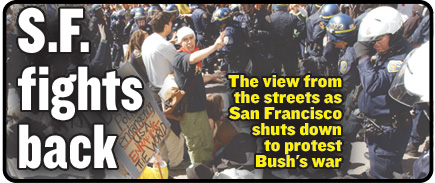
Nowhere was the clash of people power and government will more acute than on the streets of San Francisco, where a series of massive marches, some drawing nearly 100,000 people, filled the streets prior to the invasion of Iraq on March 19, 2003. The onset of war led protesters to effectively shut down the city, resulting in about 2,300 arrests and millions of dollars in costs to the city.

President George W. Bush dismissed the protests, of course, but he wasn’t the only one. Political leaders such as Rep. Nancy Pelosi, then-Mayor Willie Brown and soon-to-be Mayor Gavin Newsom (who didn’t attend any of the marches, unlike progressives on the Board of Supervisors) condemned the peace movement for hurting an innocent city. But with the “battle for San Francisco” making international news, the protesters were more concerned with the global audience.

A month earlier, on the weekend of Feb. 15 and 16, there were coordinated protests against the impending war in about 800 cities around the world, drawing around 10 million people. The peace march in Rome included about 3 million people, earning a listing in the Guinness Book of World Records as the largest anti-war rally in history. People have never made such a loud and clear statement against an incipient war.

Beyond the numbers, the antiwar movement was also right. On every major issue and prediction, the messages from the street proved correct while those from the White House were wrong. The US wasn’t welcomed as liberators. There were no weapons of mass destruction. Iraq after the invasion isn’t a stable democracy or shining beacon to anyone but the new generation of jihadis Bush created.

We can blame a hard-headed president, ineffectual opposition party, failure of the national media, or the national climate of fear following Sept. 11. But rather than refighting that lost battle, now is the time to gain perspective on the events of five years ago and determine what it means for democracy and the post-Bush national agenda.


TO THE STREETS

There were two main umbrella groups organizing protests before the war: Direct Action to Stop the War (DASW) and International ANSWER (Act Now to Stop War and End Racism). ANSWER has remained active and DASW has recently been reconstituted for the fifth anniversary of the war, using direct action in San Francisco as well as other urban centers and outposts like Chevron’s refinery in Richmond, which has reportedly been processing Iraqi oil.

“With the fifth anniversary coming up, we’re going back to direct action on the streets,” said Henry Norr of DASW. “But I don’t have any illusions that it’s going to be like it was five years ago.”

The maddening march to an ill-advised war created a political dynamic in which a broad cross-section of Americans was willing to hit the streets.

“We had a wonderfully diverse group of people, from soccer moms to anarchists,” said Mary Bull, who cofounded DASW, a collective of various affinity groups and concerned individuals formed in October of 2002 as Bush started beating the drums of war.

It was a group fiercely determined to prevent the war — and really believed that was possible. In fact, Bull recalls how she and other members of the group burst out crying at one meeting when a key activist said the war was going to happen.

Richard Becker, who cofounded ANSWER and serves as its West Coast coordinator, said that in the summer of 2002, “we came to the conclusion that [the war] was going to happen.” The group called its first big protest for Sept. 15, 2002, and another one two weeks later. But the movement really exploded on Oct. 26 when almost 100,000 people took to Market Street, much of it a spontaneous popular uprising.

“We were overwhelmed,” Becker said. “We were in a perpetual state of mobilization to keep up with what was going on. But then it didn’t stop the war.”

Did he think they could?

“I think a lot of people thought maybe it was possible to stop it. And we thought maybe it was possible to stop it,” Becker said.

The high point, according to Becker and Norr, was Feb. 17, 2003, when the New York Times ran a front page analysis piece entitled “A new power in the streets” that claimed “the huge anti-war demonstrations around the world this weekend are reminders that there may still be two superpowers on the planet: the United States and world public opinion.” But then Colin Powell went to the United Nations to argue for the invasion, and the Democrats in Congress did nothing, and it became clear war was coming.

Norr stayed out there protesting, being arrested several times and even shot in the leg by Oakland police with a rubber bullet during a protest at the Oakland docks. And he thinks some good came from the experience.

“The lesson for people is the political and economic elites are committed to preserving and extending empire. And they basically say as much in their own writing,” Norr said. “Wars are not anomalies.”

Despite being a frustrating and depressing exercise, most saw benefits to the failed movement. “People got an incredible education about how the system really worked,” Becker said. “Building a movement is mostly about a series of setbacks.”

Medea Benjamin, cofounder of both Global Exchange and CodePink and fixture of the anti-establishment peace movement for years, was upbeat about the protests. “We did our job as citizens. We did what we were supposed to do: organize, get people to take action, get people onto the streets,” she said. “We did everything we could think of.

“What you take from it is we don’t have a very well-developed democracy because the people spoke and the government didn’t listen.”

25war2_Lars1.jpg The ever-evolving “Democracy Wall” on Valencia Street, March 2003, helped stir up debate (Photo by Lars Howlett)


FACING ARREST

The collective action of five years ago starts with a series of personal stories — tens of thousands of them — so let me briefly begin with mine.

My arrival in San Francisco was closely tied to the march to war. I was living in Sacramento and working as the news editor of the Sacramento News & Review when Bush began his saber rattling against Saddam Hussein, but by the end of 2002 I had a falling out with my boss and found myself jobless.

Like most Northern Californians who opposed the war, I came to San Francisco on Jan. 18 to make my voice heard and experienced a bit of serendipity on my way to Justin Herman Plaza: while reading the Guardian on Muni, I saw their advertisement for a city editor, a job that was ideal for me at a paper I’ve always loved. Needless to say, it was a great day, empowering and full of possibilities.

Less than two months later I was on the job, and on the second week of that job I was back on the turbulent streets of San Francisco, part of a Guardian team covering the eruption of this city on the first full day of war. When I stepped off the cable car just after 7 a.m., people were streaming up Market Street and I joined them.

When a large group stopped at the intersection of Market and Beale, I stopped too, taking notes and bearing witness to this historic, exciting event. I had a press pass issued by the California Highway Patrol that allowed me to cross police lines, so when police in riot gear surrounded us and threatened arrest, I held my ground with 100 or so protesters.

After interviewing about a dozen people about why they were there and that they hoped to accomplish (see “On the bus: Journalists, lawyers, four-year-olds — the cops were ready to bust anyone Thursday morning“), I was arrested with the others and taken to a makeshift jail and processing center at Pier 27 (no charges were filed in my case, and charges against all of the 2,300 people arrested here in those first few days of the war were later dropped).

I recently tracked down a few of the people who appeared in my article, including Daphne and Ross Miller, who were at the center of the most interesting drama to play out during our standoff with the police. She’s a family practice physician, he’s an architect, and they live in Diamond Heights with their two children, Emet, who is almost 9, and Arlen, 12, who was away on vacation when the war began.

“We were genuinely shocked that the war started,” Ross told me. “We were at some of the earlier protests and really thought there was no way [Bush] could do it.”

They woke up March 20, 2003, to news that the war had begun and immediately walked to the BART station with Emet and rode to the Embarcadero station, not really planning for the day ahead but just knowing that they had to make themselves heard.

“We were pissed as hell. I don’t think I’ve ever been so angry in my life,” Daphne said.

They quickly came up with a plan. “We basically decided that if anyone was going to be arrested, it was going to be Ross and I’d stay with Emet. But it didn’t end up that way and I ended up in the arrest circle.”

Daphne had their house keys and threw them over the police line to Ross at one point. A photographer in the circle had gotten shots of a man named Roman Fliegel being roughed up by police as they pulled him off his bicycle, which was towing a trailer with a sound system, and decided to throw his backpack with camera gear out as well. When Ross — who had four-year-old Emet on his shoulders — caught it and refused police orders to give it to them, police grabbed Emet and roughly arrested Ross, leaving a gash on his forehead.

“Rage surged through the crowd, and it seemed as if things might get ugly, but the police kept a tight lid on the situation, using their clubs to shove back protesters who had moved forward,” I wrote at the time.

Emet was delivered into the circle with Daphne as the arrests continued, many quite rough. “At that point, as a mom, I had to exercise the most restraint ever,” said Daphne, who was angry about the situation but fearful about what she was exposing her son to. “Please, don’t let any violence happen here,” she pleaded with the crowd. Eventually, commanders on the scene let the mother and child go.

“The officer who let me go said that if he saw me again out there, he would call Child Protective Services on me,” Daphne said. But two days later, still brimming with outrage at her country’s actions, she ditched a downtown medical conference to rejoin the street protests, this time solo.

The couple say they’ve lost friendships over the war and have become more engaged with politics, coming to believe that Bush and the neocons are malevolent figures who knew how badly the war would go and did it anyway to establish a large, permanent military base in Iraq.

“Since that day, we’ve been far more active,” Ross said. “We realized you can’t just trust the system. You have to push.”

But that determination was mixed with feelings of disempowerment and depression. They attended some of the protests that following year, but the couple — like most people — just stopped going at some point because they seemed so futile.

“There was a horrible sense of resignation and a genuine depression that followed,” Ross told me.

The nadir was when Bush was reelected and they considered leaving the country. But then, Ross said, “we decided we’re not just going to run away and we’re not going to accept this.” Looking back, even with the scare over Emet, they express no regrets.

“It was the right thing to do because it was the wrong war to have. I’d do it again and again and again if I had to,” Ross said

They’re guardedly hopeful that Barack Obama could begin to turn things around if he’s elected. “I think the right president can at least start to dismantle this,” Daphne said. “I think thousands of people marching in the streets is something he would listen to.”

25war3_Charles1.jpg A die-in on the streets of San Francisco in March 2007 marked the fourth anniversary of the invasion (Photo by Charles Russo)


WITNESS TO HISTORY

Covering the peace movement in those early days was a heady experience, like reporting on a revolutionary uprising or working in a foreign country where the people are organized and active enough to be able to shut down society and brave enough to risk bodily injury for their beliefs.

I was at the founding meeting of CodePink — which became the most effective group at personally confronting the warmongers and keeping the war in the public eye — one evening at Muddy Waters in the Mission District shortly after the war started.

Looking back, Benjamin rattled off a long list of the alliances the group built — with labor, churches, businesses, and a wide array of social movements — and creative actions intended to build and demonstrate popular support for ending the war.

“We’ve done so many things and what did we get? We got a surge,” she said. “It shows the crisis in our democracy, the crisis of the two-party system, the crisis of a dysfunctional opposition party.”

Yet she said the peace movement has been remarkably successful in convincing the public that the war was a mistake and that it’s time for the troops to come home, even if the Democrats have been slow to respond to that shift.

“The progress we’ve made is turning around public opinion and that’s going to play a big role in the upcoming elections,” she said. For Norr, the role of the news media is a particular sore spot. He was a technology reporter for the San Francisco Chronicle who called in sick on the first full day of war and was arrested on Market Street with his wife and daughter, resulting in suspension by editor Phil Bronstein for his actions.

I wrote several stories on the issue, which culminated in Norr being fired and Bronstein unilaterally banning Chron employees from peace protests. I even borrowed CodePink’s guerilla tactics when Bronstein repeatedly refused to return my calls or address why he had singled out antiwar protesters for uniquely punitive treatment. I confronted him during a speech he gave at the Commonwealth Club (see “Lies and half-truths,” 5/7/03). That was the tenor of the times: we were all tired of being lied to and we decided to push back.

Norr was particularly frustrated with his own paper’s reporting of the war and started sending articles by the foreign press to his paper’s news desk, trying to wake his colleagues up to the pro-war propaganda being passed off as journalism in this country.

He was also disappointed with the country and with the Chronicle — both the management and his fellow reporters, who did little to support him — but the experience caused him to return to his roots as a progressive activist.

“The war and losing the job and everything brought an abrupt end to my consumerist phase and dumped me back into the world of being an activist,” said Norr, who serves on the KPFA 94.1 FM local station board and has made three recent trips to the Palestinian territories while working with the International Solidarity Movement.

Benjamin said Americans shouldn’t expect the next president to end the war — not without lots of pressure from a renewed and vocal peace movement. “This is the time to set the stage for the post-Bush agenda,” Benjamin said. “Don’t put your hopes in Barack Obama in getting us out of Iraq. Put your hopes in the people.”

25war4_Lane1.jpg A rally and nonviolent direct action at the Richmond refinery targeted Chevron on March 15 (Photo by Lane Hartwell)


THE AFTERMATH

The San Francisco Police Department, which spent more than $2 million on overtime costs responding to peace protests between March 15 and April 16, 2003, generally behaved with restraint and professionalism, but there were several exceptions.

The most costly and disturbing incident came when Officer Anthony Nelson began aggressively swinging his long riot baton at protesters, badly shattering the arm of peaceful protester Linda K. Vaccarezza, who suffered a permanent disability in her career as a court reporter.

Nelson’s incident report falsely stated that Vaccarezza had threatened him with a sign attached to a solid pole, but video of the incident later clearly showed there was no pole and that she was retreating when he teed off on her (see “The home front,” 05/19/04).

Vaccarezza received an $835,000 settlement from the city in November of 2004. On Oct. 5, 2005, two and a half years after the incident, SFPD fired Nelson for lying about what happened that day, and the City Attorney’s Office has been successfully fighting Nelson’s appeals in court ever since, putting in more than $100,000 in attorney time and costs into the Nelson and Vaccarezza cases.

The other significant ongoing litigation from the antiwar protests involved Mary Bull, who was arrested during an early protest for pouring fake blood in front of the entrance to Chevron’s San Francisco office before being allegedly strip searched and left naked in her San Francisco Jail cell for 36 hours.

Ironically, Bull was among those who brought a successful class action lawsuit against Sacramento County after she and others protesting a logging plan were strip searched, setting a precedent and led most counties to reform their strip-search policies. She used her share of the $15 million judgment to buy an organic permaculture farm in Sebastopol.

Her San Francisco case, in which Bull won a multimillion-dollar judgment, is still under appeal and now in mediation. Bull said the protests five years ago did make a difference, something she tells those who fret about its apparent failure. “I tell them to look at what issues the candidates are talking about now and I thank them for protesting then.”

“Even though we had millions throughout the world, we were sort of blocked, but now we’re regaining that momentum,” Melodie Barclay, a massage therapist who was also arrested with me on the first day of the war, told me recently. “We can’t judge it by the fact that we didn’t get the momentum we wanted.”

Norr started his antiwar activism working with Students for a Democratic Society in Boston, protesting the Vietnam War, which he said shares many similarities with the current situation, for good or for ill. He said that people tend to forget that while the protests then were huge and helped end the war, the movement did wane after Nixon ended the draft and substituted massive aerial bombardment for boots on the ground.

“The protests dropped off considerably,” he said. “A lot of the things that drove people to take risks in the late ’60s had faded by the early ’70s.”

He thinks the current administration learned a lesson from those days: it’s easier to maintain a war effort if the average citizen isn’t affected.

But there are other factors as well keeping a lid on the antiwar outrage.

“The culture has changed too. Young people are oversaddled with debt. People in schools seem to be docile. The culture as a whole seems to be more individualist and consumerist,” Norr said.

Yet some young people have woken up and many of them are funneling their energies into a peace group that was formed in the summer of 2005: World Can’t Wait, as in: the world can’t wait for the end of Bush’s second term before we change our direction and leadership.

“We don’t just want them gone, we need to repudiate their program,” said Giovanni Jackson, a 26-year-old WCW student organizer. “If we’re going to change anything, we need the youth.”

Jackson was at WCW’s founding convention in New York City, which came just as New Orleans was being flooded and then essentially abandoned by the federal government.

“When [Kerry] lost, people felt demoralized and World Can’t Wait kind of stepped into that situation,” Jackson said. “There was a lot of demoralization in the antiwar movement at that time.”

The group organized protests and student walkouts on Nov. 2, 2005.

“Everyone has their moments of doubt,” he said, “but I’m motivated by the crimes we see everyday.”


THE LESSONS

One of the biggest barriers to galvanizing people and turning the fifth anniversary of the war into something that might make a difference is the presidential election, which is diverting the energy of many potential protesters — and at the same time, offering some hope that a new president may lead to peace.

After all, every single one of the Democratic presidential candidates has promised to withdraw troops from Iraq, with varying timelines and numbers of US personnel left behind. And with enough encouragement, they might be willing to help change the status quo.

Many of the activists who volunteered their time and money to help move the Obama campaign into its front-runner position came out of the antiwar movement, and Obama’s strong stand against the war has been a key factor in his popularity.

Becker and some other activists don’t have much faith that a change in presidents will change the course in Iraq, although he agrees that much of the energy now surrounding Barack Obama derives directly from the antiwar movement.

“There’s been a huge upsurge of hope for Obama and that he might bring about the kind of change we need,” Bull said, adding that she doesn’t share that hope, believing the only path to peace is to pressure Obama and other leaders to commit to more progressive positions.

Norr said, “On one level, people have illusions about the power of peaceful protests. People believe in democracy, as well they should. We feel like the rulers should be paying attention to public opinion.

“It’s a remarkable story how broadly and quickly the American people have turned against the war. Public opinion was certainly ahead of the Democrats.”

And people will only grow more disenchanted with Iraq and its multitude of costs. “The people here are paying for this war, and everyday we have new stories about health clinics being shut down,” Becker said.

Becker was amazed last March as massive demonstrations for immigrant rights seemed to explode out of nowhere. “We think there will be more things like that,” he said.

Because after five years of organizing communities to resist the military-industrial complex’s plans, Becker thinks there’s been some visible progress.

“There isn’t a town or hamlet in the US that doesn’t have activism going on, but you wouldn’t know it from the corporate media,” Becker said. “It’s a mistake for people to feel discouraged.”


SXSW Interactive: Pirate vs. Consumer

0

By Paula Connelly

Panel titled: How Piracy will save the music industry

Jason Schwartz, founder of a digital music label called Robber Baron Music, and Randy Saaf, the founding CEO of an internet piracy prevention technology company called MediaDefender, Inc, discussed the conflicting viewpoints of the record labels and millions of music consumers. Schwartz’ music label acts as an internet marketing outlet that offers free music downloads in conjunction with artist donation options. This is beneficial to the artist because it gets people listening to an artists’ music while cataloging the downloader’s demographics for tour negotiation leverage. This is the future of the music industry. The labels are cut out. They know it. They’re angry.

Desperately seeking cinema

0

> a&eletters@sfbg.com

Jennifer Reeves’s movies are personal wishing wells, each a repository of dreams and worries. As we see ourselves reflected in the water’s surface after tossing in a coin, so too is Reeves’s presence apparent in the handmade, fussed-over quality of her moving pictures. I use that broad designation pointedly, as her films are as varied in material and form as they are prosaic in mood and temperament. Over 15 years of independent filmmaking, the New York–based artist has created hand-painted films in the style of her mentor Stan Brakhage, freewheeling shorts, fiction fantasias, 16mm double-projections, feature narratives, and experiments in high definition. San Francisco Cinematheque hosts the formally restless filmmaker for a three-program tour.

Reeves’s early shorts channel riot-grrrl spark with scratched-up film stock. Elations in Negative (1990) is a good sample of the celluloid-mad sexual politics of these 16mm beaters, though Taste It Nine Times (1992), with its vivid pickle-biting innuendos, will be missed from the Cinematheque run. In painted films like The Girl’s Nervy (1995) and Fear of Blushing (2001), Reeves’s appropriation of Brakhage’s technique conveys playful femininity in color, pattern, and music.

Though Reeves toyed with narrative early on, most notably in 1996’s psychodrama Chronic, 2004’s The Time We Killed represented a kind of breakthrough. An unhurried 94 minutes passes through the dark mirror of an agoraphobic poet keeping to her New York apartment during the buildup to the Iraq War. "Terrorism brought me out of the house, but the war on terror drove me back in," Robyn (Lisa Jarnot) says in her peripatetic voice-over, adding later, "I’m afraid of catching the amnesia of the American people." Reeves’s magnetically immersive filmmaking is such that the political situation neatly folds into an extended experiment in subjectivity — besides being an unstinting portrait of madness (it’s everywhere in this film: in a record’s spin and neighbors’ voices echoing through the walls, in dogs’ faces, bathwater, and masturbation), The Time We Killed also serves as an understated chronicle of the collateral psychic and moral damage of our country’s manufactured warmongering.

The Time We Killed is heavier than Reeves’s other work, though it’s not without humor; she finds the ridiculous, unwieldy side of depression in Robyn’s litany of death fantasies and a painfully misguided interaction with a curious neighbor. Robyn’s locked in, but Reeves is formally unfettered, mixing conventional 16mm footage with lyrical, associative streams of inner life shot in high-contrast black-and-white. The filmmaker raids her home-movie archive for the film, in addition to using her own apartment and acting as Jarnot’s body double during the extended shooting. This air of transference makes The Time We Killed weirdly transparent, so we feel as intimately connected to Reeves’s isolated work in the editing room as we do to Robyn’s experience in the apartment.

Since The Time We Killed, Reeves has returned to more typically experimental filmmaking. Her 2006–07 Light Work variations strike an ideal balance of abstract and representational visions, in the process cataloging the changing textures of cinema. In the affecting He Walked Away (2007), Reeves dissects, refracts, and abstracts footage from her older movies to create a tri-tipped memorial piece in which the intrinsically elegiac nature of cinema is connected to the dissolution of film technology, which is then tied to the disappearing loves and friendships that shadow personal lives.

As with Guy Maddin — another filmmaker who favors overheated evocations — one has the sense that Reeves could make a hundred interesting movies from the same scraps of footage. "I want to counter the turncoats who say film’s dead," Reeves announces on her excellent new blog. "Try telling a painter that she can only use digital paint on a Mac for the rest of her life. She’d be pissed." But if she were Jennifer Reeves, she certainly wouldn’t slow down.

IMMERSIVE CINEMA: JENNIFER REEVES

Artists’ Television Access, Sat/15, 8:30 p.m.

Yerba Buena Center for the Arts, Sun/16, 7:30 p.m.;
Tues/18, 7:30 p.m.; $6–$8

See Rep Clock for venue information

Big book, tiny topic

0

› johnny@sfbg.com

REVIEW This week, I’m reviewing a book about toothpicks, a book about citrus, and a book about pigeons. When I first mentioned this plan to a fellow editor, she said it prompted visions of a surrealist game of Clue: the orange stabbed the pigeon in the study with a toothpick.

In truth, my motivation is pragmatic. I want to draw attention to the publishing industry’s love of big books devoted to tiny topics. It seems that one surefire way of selling a nonfiction tome is by focusing on a very specific subject. For evidence, one need only look at recent efforts such as Pierre Laszlo’s Citrus: A History (University of Chicago Press, 252 pages, $25), Henry Petroski’s The Toothpick: Technology and Culture (Knopf, 443 pages, $27.95), and Andrew D. Blechman’s Pigeons: The Fascinating Saga of the World’s Most Revered and Reviled Bird (Grove Press, 239 pages, $24).

Without snappy cover art and a colon followed by a subtitle, these books would be ready for inclusion in the next edition of Russell Ash and Brian Lake’s Bizarre Books: A Compendium of Classic Oddities (Harper Perennial, 224 pages, $14.95), a collection devoted to ridiculous and arcane tomes. Today, the colon (note that Ash and Lake’s book also sports one) is a way for author and publisher to assert an awareness of the potential absurdity that might arise from inscribing a world history on the head of a pin — or the tip of a toothpick.

Which brings us to The Toothpick. It’s the latest endeavor by a writer who specializes in large books on tiny topics. Petroski’s previous lengthy portrait in words was devoted to the toothpick’s cousin of sorts, the pencil. He brings an ease born from familiarity to his latest project. He also brings an anti-Wikipedia agenda, beginning his toothpick odyssey with a collection of false "stuff rustled up from the wild, wild Web." In the United States, the toothpick does have ties to Charles Forster — as claimed by answers.com and other Web sites — but Forster did not "invent" it, as one online source of misinformation states. If you read The Toothpick, you’ll learn about Forster and about Benjamin Sturtevant, a contemporary who has been erased from the toothpick’s United States–origin myth. Neither Forster nor Sturtevant are the most fascinating men ever to have probed their gums.

The point of Petroski’s toothpick testament is sharpest when he uses his small subject to touch upon ideas from different eras and cultures. Thus, before Forster and his Charles Foster Kane–like name (though not, alas, story) take over, The Toothpick cites a long passage from James Joyce’s 1916 A Portrait of the Artist as a Young Man that cries out for a toothpick, provides illustrations of Chinese toothpicks that look like chandeliers, and notes that the Renaissance was "the golden age of toothpicks." Perhaps literally — there are golden toothpicks, as well as ones made from walrus whiskers.

As its title might suggest, Laszlo’s Citrus: A History presents a fruit-centric — though by no means fruitopian — history of the world. Via the erudite Laszlo, the travels of an orange can blossom into a discussion of religious persecution. Laszlo is a retired professor of chemistry, and his prose presents a mix of stuffiness and frolic, whether imagining a correspondence with the first person ever to write a book about citrus (an 11th-century Chinese governor named Han Yen-Chih), randomly leaping from a descriptive passage into a recipe, or redundantly telling the reader that he is about to tell a story. Ultimately, Citrus does have the passion — if not always the juice — of a labor of love, even when its author favors the kind of obvious symbolism found in this sentence.

In comparison, Pigeons author Blechman is a storyteller who has a way with a hilarious turn of phrase. He writes of "backyard geneticists" who create birds "more akin to a Dresden figurine than a child of nature," notes that the pigeon "has been prized as a source of companionship (and protein)," and confesses his fondness for the Frillback, a breed with feathers that look like they "were dipped in Jheri Curl." Over the course of one winter, he meets as many breeds of pigeon obsessives as he does pigeons. The wildest marriage might be between Parlor Rollers and their owners. Parlor Rollers somersault backward up to 600 feet in a single effort, a display that Blechman deems "the avian equivalent of obsessive-compulsive disorder." When Blechman asks one owner why the birds do what they do, the man replies, "Because they’re retarded, that’s why."

Actually, Pigeons makes a strong case for recognizing and respecting the oft-abused pigeon, a case drawn from no less a source than Charles Darwin’s 1859 On the Origin of Species. Blechman’s book contains some disturbing passages (especially a foray into a Pennsylvania town that made bird slaughter into an annual holiday replete with teen boys delivering body slams) and no shortage of funny adventures. By the end, it transformed the way I view pigeons. Though I’m a vampire for blood oranges and I abuse toothpicks like an addict smokes cigarettes, I’m afraid the other two books didn’t have quite the same impact.

Freedom of Information: Virtual meeting

0

› news@sfbg.com

Forget smoke-filled rooms and paper shredders — today’s government officials can elude public scrutiny from the comfort of their own e-mail accounts, conducting virtual meetings to do the public’s business.

To curb such activity, provisions in both the Brown Act (the state law governing open meetings) and the San Francisco Sunshine Ordinance have been interpreted as prohibiting the use of electronic communication between members of policy bodies. But not everyone has been heeding the rules, particularly in this hyperconnected age.

The TechConnect Task Force, a now disbanded advisory body charged by Mayor Gavin Newsom with creating a plan to bridge the city’s digital divide with free wireless Internet service, frequently used an e-mail listserv to conduct its business.

"Since these things were publicly posted right away, I should think there would be a transparency that advocates would like," said Emy Tseng, a member of the task force. "It was useful in the way e-mails and listservs are useful to anyone."

However, many contend the task force was engaging in activities prohibited under the city’s Sunshine Ordinance, even if the intent was to provide greater public access to the group’s work. Tseng, who claims to have never been informed by the City Attorney’s Office that the group might have been in violation of Sunshine laws, expressed the frustrations of many throughout the city who must comply with open-meeting policies.

"If you don’t use e-mail in this day and age, what can you do?" she asked. The answer, according to state and local laws, is to conduct public business in a public meeting, with the agenda posted in advance and where anyone can attend.

State and city public-disclosure laws apply to all "policy bodies," which can include nearly every government-sanctioned board, commission, or task force. Some members of these bodies have been suspected of vioutf8g open-meeting and public-disclosure laws through the use of online communication.

Seriatim meetings are presumably the most common illegal activity occurring under both open-information laws, although they are the hardest to detect. A seriatim meeting occurs when one member of a policy body privately contacts another, who then contacts another, in a chain of communication that eventually constitutes a quorum of the group.

An e-mail that is forwarded along to enough individuals, or a round of mass e-mails, would constitute a seriatim meeting, according to attorneys who spoke with the Guardian. While e-mail forwarding is a common practice for any office worker, some are just an unassuming click away from breaking the law.

"I would absolutely make it clear that anybody subject to the Brown Act or Sunshine [should] not communicate through e-mail," said Thomas Burke, a San Francisco-based attorney who specializes in media and Internet law and has represented the Guardian. "This could go on for years because people are not in the loop."

The Brown Act, passed in 1953 by the California Legislature, expressly bans a legislative body from using "technological devices" in order to communicate about topics relevant to the work of that body.

"The Brown Act itself forbids the majority of ‘technological devices’ — which is essentially anything you could imagine," said Terry Francke, director of Californians Aware, who also drafted amendments to the act in the early ’90s. Under the Brown Act, a committee member can be slapped with a misdemeanor for the intent to withhold information from the public or conduct prohibited meetings.

Many of the same issues are also addressed in the San Francisco Sunshine Ordinance, filling in more restrictions and open information requirements. Ironically, the TechConnect Task Force was charged with creating universal access to online discussions like theirs, although few legal experts think even that would nullify the requirement for open, public meetings in a physical – rather than virtual – setting.

According to a report released by the San Francisco TechConnect Task Force, 32 percent of Americans do not have access to the Internet. In San Francisco, certain populations are even worse off compared to national averages — for instance, women and the elderly.

"You have to consider if people are going to have equal access to meetings," Burke told the Guardian. "There is still a digital divide. As a public entity they have to be sensitive to this."

Recently, members of the city’s Peak Oil Task Force inquired with the City Attorney’s office about using Yahoo! Groups or a blog to increase efficiency on the all volunteer committee. Attorneys advised the group to stay away from Internet communication, as it can easily lead to prohibited seriatim meetings. Jeanne Rosenmeier, who is the chairperson of the task force, now spends more committee time trying to determine alternative ways to engage the public.

"It is certainly something that should be rewritten, to deal with modern technology so it corresponds with today’s reality," Rosenmeier told the Guardian. "If we have a public e-mail listserv that anyone can sign on to, that seems transparent; or if we have a blog, that’s pretty transparent."

In other cities that do not have sunshine ordinances, teleconferencing may be used legally under the Brown Act to conduct meetings. In Los Angeles, for instance, some boards and commissions teleconference when members would need to drive a few hours just to meet. There is some speculation that the language of the Brown Act could be augmented under this provision to allow for online communication, but there are no major groups pursuing the amendment.

In 2001, former California Attorney General Bill Lockyer wrote an opinion declaring the use of e-mail between policy-body members as an infraction of the Brown Act, even if the e-mails were made publicly available. "Members of the public who do not have Internet access would be unable to monitor the deliberations as they occur," the opinion states. "All debate concerning an agenda item could well be over before members of the public could [participate]."

According to the Sunshine Ordinance Task Force, there have been no complaints filed concerning prohibited online meetings, however there have been public information disclosures of private e-mail messages over the years. Recently, a group of deputy city attorneys were required to turn over an e-mail correspondence when a member of the public filed a complaint.

While Peter Scheer, director of the California First Amendment Coalition, understands the frustration of government officials who must abide by the cumbersome laws, he thinks the tradeoff is well worth it.

"The whole rest of society uses the power of e-mail and the only business that can’t use it is government, because they’re subject to the Brown Act," Scheer told the Guardian. "But we made the tradeoff already in efficiency versus accountability, to force all meetings and information to be open to the press and public."

>

Freedom of Information: Sunshine in the digital age

0

Public records used to be dusty old documents, stuck in dog-eared files or bound in aging folders. They were held in back rooms or the basements of city halls, available during government hours — and often, only by written request.

These days, a lot of that information is stored on hard drives and servers. That can make it harder to access and easier to hide — or it can give the public vast new access. That’s what this year’s Freedom of Information issue — our 22nd — is all about.

On one front, the advocates of secrecy are pushing hard to keep electronic data under strict controls. The state Legislature is considering a bill that would prohibit the release of electronic data embedded in a public record. The county of Santa Clara tried to set a $100,000 price on access to a public database.

But on the other hand, sunshine advocates are pushing for ways to use the same technology to make government more open. We’ve been in the forefront of sunshine battles for more than two decades; this is just the next step. (Tim Redmond)

>>2007 James Madison Award winners
Society of Professional Journalists Northern California announces First Amendment award winners

>>A citizen’s guide to fighting secret government
Local and national organizations that offer a wide range of resources for journalists, citizen activists, and hell-raisers

>>More sunshine — easily and at no cost
Technology can allow the city to take a huge step forward in public access — right now
By Kimo Crossman

>>Battleship metadata
Legislation on mapping software would create an expensive new category of public records
By Sarah Phelan

>>Virtual meeting
Open government laws prohibit online official discussions, but they’ve happened anyway
By Bryan Cohen

>>The leaks go on
A federal court judge says prior Wikileaks ruling was unconstitutional
By Megan Ma

>>Sunshine experiment in Palo Alto
Posting e-mails from council members on the city’s Web site
By Emma Lierley

Freedom of Information: More sunshine — easily and at no cost

0

› news@sfbg.com

Imagine sitting at home — or in your office, or in your favorite café — and listening in on what are now secret, backroom policy discussions and decisions in the San Francisco mayor’s office. Imagine having access to an immediate transcript of the talks. Imagine being able to read internal e-mail discussions among city staffers about issues that affect you — without ever filing a public records request. In fact, imagine never having to file another written request for public documents; imagine just going to a city Web site, entering a search term, and finding all of the records yourself.

Imagine filing a complaint with a city agency and tracking the issue, minute by minute, as it works its way through the system.

Imagine listening on your cell phone to any policy body as it meets in city hall.

All of this is possible, today. Much of it is not only consistent with but actually required by local law. And it won’t cost the city more than a modest amount of money.

Transparency is a common buzzword during this presidential campaign; the Barack Obama campaign has even issued a white paper describing policy and technological ways to embrace it. He’s talking about live Internet feeds of meetings about significant issues involving executive branch appointees as well as for those of regulatory departments (a program that would go far beyond what you see on C-SPAN).

So there’s no reason San Francisco can’t take the lead in using technology — generally simple, off the shelf, existing technology — to dramatically increase sunshine at City Hall and public participation in local government.

Proposition G, the city’s 1999 sunshine law, mandates that San Francisco use "all technological and economical means to ensure efficient, convenient and low cost access to public information on the Internet." Here are five easy ways to do that:

1. Fully adopt the voyeur concept for city meetings. This is the idea that the public should be able to observe and engage in government decision making — all government decision making.

All policy meetings in City Hall should at the very least be broadcast as audio on the Web and available via phone teleconference. In other words, the meetings should be streamed online, and that stream should be accessible by calling a free conference line. This is already standard practice in the business world and is working well for many investors in public companies that disclose financial information in compliance with Securities and Exchange Commission rules. It can be done for little or no cost with services like blogtalkradio.com, skype.com, freeconferencecalls.com, and webex.com.

Today only a limited number of public meetings are broadcast, mostly because the only outlet is SFG-TV and resources are limited. But audio streaming is a no-brainer — there’s no need for a staffer to control cameras, the microphones are already set up, and these days just about every room has a speakerphone.

Currently, the SFG-TV video coverage isn’t posted on the city’s Web site, sfgov.org, until two or three days after a meeting. That’s too long; the audio should be made immediately available online. And the Internet URL and dial-in options should be listed on the meeting agenda so that news media and citizen bloggers can instantly refer back to the URL with timecodes to point out specifics, and include them in their stories and blog postings.

With streaming, you can follow along in real time when you are stuck at home taking care of a sick relative, or at the office listening with headphones, or you are disabled and can’t cross town to attend in person.

The city already has a great contract for real time captioning — the text you see at the bottom of the screen for video. It’s not 100 percent accurate, but it’s pretty decent. That could be expanded to cover streaming audio, and the text could be computer translated (or translated by bilingual typists) into other common languages. The advantage of media integrated with RTC is that specialized search engines like blikx.com and everyzing.com can be used to find relevant phrases and begin playback directly at that spot. And transcriptions can be posted online in real time (somewhat like live blogging!) so that if you are late for a meeting you can quickly scan what has already transpired, and by the end of the meeting you will effectively have a draft of minutes. That saves a lot of staff time and provides an immeasurably more useful historic record.

Today, video recordings of city meetings can’t be downloaded — the only way to review it or post a clip to YouTube is to order a $10 DVD, which arrives a week after you send a check (and no, they don’t take PayPal). And while many other city meetings make audio recordings, you have to pay $1 for an audio tape and pick it up during business hours or pay more for postage. They all should be available as free podcasts.

The SFG-TV video shows more than just the speakers and officials; there are other angles, and they ought to be available too. It’s important to know who attended the meeting but never said anything, who greeted whom, and even who ignored whom.

2. Let the public do the broadcasting. All City Hall meeting rooms should provide wi-fi (and electrical outlets), and the system ought to have enough speed to allow bloggers or activists to upload high-quality video broadcasts of meetings that SFG-TV can’t afford to cover. It can be done using existing services like Justin.tv, Upstream.tv, and live.yahoo.com. This would also allow live blogging — and let people preparing to testify on an issue have access to the Web to do research on the spot. If the room had a projector and a screen, people who were unable to attend the meeting could still comment, either through video or just by posting text messages that the decision makers could read.

The audio broadcasting of meetings should be expanded to include all meetings between the mayor (or supervisors) and city staff. The law already requires public access to so-called passive meetings — those between the mayor or department heads and outside parties that influence city policy.

3. Make public most city emails and other documents as soon as they are produced.

San Francisco city employees produce thousands of records a day — e-mails, memos, reports, etc. — and the vast majority of them are and should be public record. But many are deleted and others never see the light of day. When a member of the public asks for all the records on a topic, just finding those documents can be a sizable task.

But it’s technologically simply to solve that problem: every time a city employee produces a document, the computer system should automatically send a back-up copy to a public web server. That way nothing would get lost or erased, and anyone looking for public information could simply go to that site and search for it him or herself.

For e-mails sent by city staff, one way might be to CC (carbon copy) an online message board (for example Google or Yahoo groups, which would be available at no cost to the city). Other approaches for instant messages, text messages and voicemails could be adopted as well. The Palo Alto City Council is already doing something like this for a narrow collection of e-mails (although not in real time).

We all know there are some city communications that must remain private or be redacted — for example Attorney Client discussions or human-resource conversations regarding personnel. But there are simply ways to make sure those stay confidential: one approach might simply have the user tick a flag or answer a Yes/No Possible Redaction popup when the message is sent. Certain employees — like the people who handle sensitive employee health records and certain litigators in the city attorney’s office — could have software that defaults to a confidential server.

The added advantage, of course, is that the computers could also make a record of the title and date of every confidential document — and that information could be made public. If a dispute arose over whether the city was improperly withholding records, the public would at least know that certain documents existed.

All city files could be stored on network drives (not on local drives) with one location for default public files that would not allow overwriting or deletions and would be mirrored to a Web server and another drive for the few that may require redaction first.

4. Save all the old records. After a very embarrassing lawsuit that is threatening the Missouri governor’s job, that state in January adopted an email retention system that preserves all email for at least seven years (based on federal requirements for financial records). And e-mail/instant message/text/fax retention systems are standard practice now in the financial industry (Morgan Stanley lost a $1.45 billion judgment because the company failed to preserve e-mail).

In fact, we all know storage continues to get cheaper and smaller — so San Francisco should abolish any retention timeframes for electronic records and keep them all into the foreseeable future. The world-famous Internet Archive is right here in the Presidio: I suspect that group would love to archive all the city information, and keep it online, free and forever.

When paper documents are part of the public record, they should be scanned and converted to text and posted within two days. This would include discussions between staff and individual members of policy bodies and the creation of the draft agenda and supporting materials as they are obtained.

All these methods would significantly reduce the number of public records requests to the city staff and thus save the city money.

5. Make calendars public — and keep communications public. Mayor Gavin Newsom won’t provide detailed daily calendars — even after the fact, when there is no possible security reason for keeping his workday itinerary secret. All top officials should post their calendars on the web so the public can track what they are doing.

The city needs to adopt a global policy that city business should be performed on city devices (computers, email accounts, phones) whenever possible — and when city employees or officials use their own computers or hand-held communications tools, those should be forwarded immediately to the city system and made public.

San Francisco has one of the best local Sunshine laws in the country — and at a time when activists at every level are looking for ways to use technology to expand public access, the city should be in the forefront. All it takes is some political will.

———————————————————-

Here are some more ways that the city could use technology to improve public access:

1. Use a program like govtrack.us to follow legislative changes.

2. Explore ways to bring nonprofits that perform traditional government services under sunshine laws.

3. Significantly improve the city’s Crimestats system (more real-time allow alerts for crimes near you) – google mashup et al. See http://chicago.everyblock.com/crime/

4. Embrace e-rulemaking technology – similar to federal rulemaking use technology to get ideas online and generate more participation for those who can’t show up in a meeting.

5. Require the Police Department to issue press credentials to bloggers.

6. Fund a few open-government lawsuits to expand the boundaries on access to public records (the law provides for attorney’s fees if the suit is successful).

7. Require city agencies to post the method for obtaining public records online. Require posting of all negative determinations on home pages.

8. At budget time, mandate that each agency provide statistics as determined by SOTF on sunshine responsiveness.

9. Require an assessment of sunshine compliance as a mandatory item for all Financial/Management audits.

10. Televise SOTF and Ethics Commission formal hearings.

11. Require active Ethics investigative files to be open.

12. Embrace fully the much-improved but incomplete example of posting online all interactions as part of large contract negotiations – as was partially done with TechConnect.

13. Host accounts payable/receivables online with the scanned images of invoices paid.

———————————————————

>

Freedom of Information: Battleship metadata

0

› sarah@sfbg.com

On Valentine’s Day, Assemblymember Jose Solorio (D-Santa Ana) introduced Assembly Bill 1978, legislation that seeks to define computer mapping systems and make them available to commercial interests at a fee — a one-two punch that freedom of information advocates fear constitutes a serious blow to the California Public Records Act.

Noting that computer mapping systems, computer programs, and computer graphic systems do not constitute public records under current law, Solorio’s bill seeks to amend the CPRA to define computer mapping systems to include "assembled model data, metadata, and listings of metadata, regardless of medium, and tools by which computer mapping systems are created, stored, and retrieved."

AB 1978 would also allow "commercial interests, who are most benefited by these systems, to obtain the portion of these systems developed by a public agency, at a fee designed to offset the agency’s cost of maintenance for the computer mapping systems."

But Oakland-based Bruce Joffe, who works as a geographic information consultant to cities, counties, and state agencies in California, warns that AB 1978 would allow public agencies to charge the public more for this data than the cost of duplication.

"It would severely weaken the CPRA and reduce the public’s access to government records," said Joffe, noting that as the law currently stands, CPRA requires state and local agencies to make their records available and, upon request, to provide copies on payment of any applicable fee.

Solorio aide Hazel Miranda told the Guardian that the intent of the bill is to protect software, not to restrict access to information.

"Our intent is to protect the software, not to restrict the information that is given out on it," Miranda said, noting that the bill’s sponsor is the government of Orange County. "The concern was that a lot of corporations were taking this information — and when the information is given out, you have to give out the software, too — and using it to their own benefit."

Joffe, who was the California First Amendment Coalition’s technical advisor when CFAC successfully sued Santa Clara County over access to the county’s tax maps, disagrees.

"When you give information out, you are not giving out software, you are giving out data in export format," said Joffe, who believes Solorio wants to change the law so that AB 1978’s sponsor, Orange County, which has sold its tax maps for $400,000 in the past, can continue to sell its data.

Holly Fraumeni, the AB 1978 lobbyist with the well-connected firm Putf8um Advisors, deferred questions to Bruce Matthias of Orange County’s legislative affairs, who told us, "The County of Orange has never disagreed on sharing public data. We are not trying to hide data down here. If you want it on a disk, we charge 25 cents. All we are doing is updating language in the bill. Our exclusive intent is to protect the software we’ve developed." Records show Orange County paid Putf8um Advisors $60,000 between October 1 and December 31, 2007.

CFAC executive director Peter Scheer believes AB 1978 is an attempt to take the information that CFAC has tried to make freely available and put it back under lock and key, so that it is proprietary information that can be sold.

Recalling how, years ago, the only way you could see a county’s tax maps was as an engineer’s rendering on paper, Scheer observed that when this data is computerized and made publicly available, "individuals and businesses can create all kinds of valuable tools or simply post the raw data on the Internet."

Blair Adams, chief consulting officer at San Francisco’s Department of Technology and Information Services, says the city’s GIS data has been publicly available for five years.

"We have no intent to change that," Adams said. "Our motto is ‘Go have it, and help us make it better.’<0x2009>"

But while San Francisco treats this data as a public record and copies it for the price of a blank DVD, Santa Clara and Orange counties have treated it as a revenue generator.

"They charge an arm and a leg, and another arm and leg, and whatever other appendages they can think of," said Scheer, noting that Santa Clara County charges $100,000 for a full base map of its real estate parcels — data that can be used to determine whether properties are assessed correctly, and whether pothole repairs are carried out equitably.

"Likely clients willing to purchase this data would be utilities, phone companies, and developers, who can’t do without it," Scheer said. "But public health and safety departments need access to it, too."

Joffe agrees, and it’s something he has plenty of experience with. He helps cities and counties create geographic information systems that allow ambulances to take the most efficient routes, the Department of Public Works to carry out better capital improvements, and the police to conduct better crime analysis.

"Every department uses it, and because it’s in the government system, therefore it is a public record, and the public has the right to access those records at no more cost than it takes to duplicate them," Joffe said. He added, "If AB 1978 passes, we’ll lose considerable access."

>

Sunshine in the digital age

0

EDITORIAL The California Public Records Act needs an update. So does the state’s Brown Act, which mandates open meetings of government bodies, and the San Francisco Sunshine Ordinance. These are the landmark laws that keep government from operating in secret — but all were written long before the explosion of information technology profoundly changed the way city, state, and local agencies compile, sort, process, present, and preserve information.

And now, with agencies at every level trying to use information technology to hide data from the public and courts struggling with laws that didn’t anticipate the modern era, open-government advocates need to be working on every level to protect and expand access.

As we point out in this issue, technology can be used to spy, to hide, and to obfuscate — but it can also be used to make the operations and processes of the public sector far more open and accessible. Properly used, today’s information technology can vastly improve the way governments work — and it’s neither difficult nor expensive to make that happen.

The state Legislature, the San Francisco Board of Supervisors, and the Sunshine Task Force should be looking at ways to make sure that computers don’t increase secrecy — and to take advantage of the opportunities modern technology offers.

The Brown Act, passed in 1954, forbids public agencies from meeting in secret, except in very limited circumstances. The San Francisco Sunshine Ordinance goes further. The laws have been interpreted to mean that the members of a board or commission can’t use e-mail to discuss pending business; that would amount to a closed-door meeting. That same interpretation ought to apply to members participating in discussions on, say, a Yahoo! news group. Deliberations on a policy matter would be taking place outside of public view.

But what if the public was invited? What if a virtual discussion took place before or between traditional meetings — and any member of the public could log in from anywhere (work, home, the public library, terminals in City Hall) and watch? What if people — who are now allowed only a minute or two to comment in public meetings — were able to post longer, more detailed comments that policymakers would see during online discussions? What if the entire record of that meeting were instantly available on the Web, in a searchable form?

Would that be an increase in public access? What about the large number of people who still don’t have computers or Web access — would they be left out?

That’s just one of the questions sunshine advocates are talking about. Legislators need to be addressing the issues, too.

As Kimo Crossman reports on page 14, increasing public access doesn’t have to be difficult or expensive — in fact, there are ways to save the city money. One obvious idea: almost every document that’s produced by a city employee, including e-mail, is already considered a public record. Why not simply program the computers to make an instant copy of everything and post it to a public Web site? That way someone looking for memos from, say, the Public Utilities Commission addressing solar energy could simply search that site with those key words and come up with all of the records quickly.

That would save time for journalists and citizen watchdogs who now have to request those records from the agency — and it would save money for the city. If the documents were all searchable for anyone, there would be no need to spend time and money responding to public-records requests.

It wouldn’t be hard at all to add a "possibly confidential" key to records, preventing documents that really should remain secret from going into the public file. And the computers could automatically generate a list of the documents being withheld, so the public could find out what records are remaining out of view.

Over time, old paper records could be scanned and put on the site, too. And with electronic storage so cheap these days, there’s no reason why all public records can’t be preserved in an accessible form and location.

The County of Santa Clara a few years back began putting together a valuable data trove that included all of the county’s real estate and property ownership records. That allowed for the creation of a geographic information system that could be used to track property sales, taxes, crime rates, building permit applications, and much more. A wonderful public service — except that the county didn’t offer it to the public. The data was for sale, for more than $100,000 a license.

It took a lawsuit by the California First Amendment Coalition to force the county to back off and make the data public. But that’s just an example of a trend that’s cropping up all over the country: governments are developing ways to make more use of information — and then are trying to copyright it, sell it, and make money.

The problem with that, as attorney Rachel Matteo-Boehm, who handled the CFAC case, points out, is that it segregates access to information by wealth. The rich get the tools of technology to understand and use public data; the poor don’t.

It’s a dangerous trend and the Legislature should address it right away. Information created by public agencies using public data should be public — no excuses, no exceptions. And if the software that makes it easy to process that information is created by the public sector (or under contract to the public sector) the public needs free access to it.

The Legislature also needs to shoot down a series of attempts by the secrecy lobbyists to cut off access to new types of data. A bill now before the Assembly, AB 1978 by Assemblymember Jose Solorio (D-Anaheim), would exempt certain types of information from the Public Records Act. The bill appears to be aimed at overturning the Santa Clara decision but could also address an issue that has come up in San Francisco: that of so-called metadata in public documents.

Metadata is embedded information that may be in a file that doesn’t appear when the file is printed out. The City Attorney’s Office has been arguing that metadata isn’t public. That’s nonsense — it’s part of a public document, created at public expense by public employees. The Legislature needs to reject this bill — and instead pass a law that would specifically require agencies to release any internal data that’s created as part of a public record.

The San Francisco Sunshine Task Force is in the process of updating and improving the city’s landmark law, and it should seek to incorporate some of the suggestions above.

The Task Force also needs to be sure that the amendments to the law give that oversight body the teeth it needs to enforce public-access requirements. Far too often, city officials simply ignore task force findings, and, as Sarah Phelan reports on page 17, the Ethics Commission and the district attorney rarely follow up with sanctions.

For starters, the task force should have the right to subpoena documents and witnesses (without first asking the supervisors for approval — a cumbersome process). The panel should have its own full-time legal counsel. It should also have increased enforcement power: while giving the task force the right to levy fines and sanctions is politically tricky, a provision that allows the task force to order the release of documents — backed up with the full support of the City Attorney’s Office — ought to be part of the final package.

Noise Pop: Little twin stars

0

› kimberly@sfbg.com

So are they or aren’t they? A pop twosome that make lovely music together in more ways than one is the irresistible scenario embedded in more rock, soul, and country partnerships than one can count — who doesn’t fall for the notion of torturously entangled C&W soulmates that extends far beyond Walk the Line turf and into the year in and year out of George Jones and Tammy Wynette, Dolly Parton and Porter Wagoner, Loretta Lynn and Conway Twitty, Emmylou Harris and Gram Parsons territory? Nancy Sinatra and Lee Hazelwood’s affections remained unrequited up to the latter’s 2007 death, as did the palpable chemistry between Marvin Gaye and Tammi Terrell.

Well, gawkers remain out of luck here, says Matt Ward, a.k.a. M. Ward, the manly half of indie rock’s latest sweetheart duo, She and Him. He and actress-singer-songwriter Zooey Deschanel are just friends, friend. "People are always going to think whatever they’re going to want to think, no matter what they read in interviews or what the facts are," the extremely soft-spoken Ward says from Omaha, Neb., where he’s currently mixing his next LP, with Bright Eyes’ Mike Logan. "I think music is a lightning rod for people’s imaginations — and I don’t think that’s a bad thing."

He can hardly expect a listener to stop dreaming while listening to the Deschanel originals. With Ward’s production and arranging input, the tunes take on the luscious feel of gimlet-eyed ’60s-style girl-group protorock ("I Was Made for You"), pedal-steel-sugared, chiming country ("Change Is Hard"), and subtly colored girl-singer pop ("I Thought I Saw Your Face Today"). Leslie Gore, Darlene Love, Julie London, Ronnie Spector, and all of those other dulcet voices of teen agony, ecstasy, and crash-and-burn romantic disaster, move over: Deschanel is the next worthy addition to those ranks — a doll-like upstart cross between Sinatra and Carole King — thanks to She and Him’s maiden outing, Volume One (Merge).

Director Martin Hynes brought Deschanel and Ward together to cover a Richard and Linda Thompson tune for his as-yet-unreleased film The Go-Getter. Deschanel and Ward discovered they were "mutually fans of each other’s work," the latter says. One song led to another and, he adds, "eventually Zooey mentioned she had some demo songs that she had under her hat. I had no idea she was a songwriter — let alone a really incredible songwriter and vocalist. They had really beautiful chord progressions, and as a producer, it makes things easy when you have great songs and amazing vocals." He decided to play Phil Spector to her King.

"We started with a pile of songs that I had written," Deschanel e-mails from her current movie, "and had found their life up to that point completely in the safety of my bedroom. It was amazing to see what such a creative individual as Matt could bring to those songs. He brought a tremendous amount of life to them without killing their original essence. His instincts are dead on."

Deschanel wasn’t above making the bizarre instrumental contribution: the mysterious bazookalike sound on "This Is Not a Test," for instance, "is actually me playing mouth trumpet," she writes. "I said, ‘This song needs a trumpet,’ and then I said, ‘You know, like this’ and I did that bit. Matt liked it. We didn’t have the budget for horns so I just did it."

They took each song as its own "island," as Deschanel puts it. "The compositions tell you where they want to go," adds Ward, who strived for a warm analog production. "We tried keeping it away from computers and digital technology as much as we could. I think that’s the main reason the record sounds good — that and the songs are good."

The approach perfectly jibed with Deschanel’s aesthetic. "I have always been attracted to old music. I have always been a fan but I continue to discover ‘new’ old music," writes the vocalist, who says she started writing at age eight, was in bands in high school, and later had a cabaret act called the Pretty Babies. Elf (2003) gave her a chance to sing on film, but otherwise she had limited her music primarily to demos: "Demoing became sort of a hobby that I found relaxing."

She isn’t concerned with trying to please hipsters or cool kids who might view her as a movie-star dilettante simply passing through the trenches of indie pop. "I hope each person responds to [Volume One] naturally without any agenda of mine seeping into the matter," she offers. "Ideally audience and artist should be uncorrupted by each other."

Not a surprise from a singer in love with the passion and craft of country music. "I think," Deschanel opines, "sincerity is hugely underrated."

SHE AND HIM

With Whispertown2000, Adam Stephens, and Emily Jane White

March 2, 8 p.m., sold out

Great American Music Hall

859 O’Farrell, SF

(415) 885-0750

www.gamh.com

>>Back to Noise Pop page

Text-messaging the apocalypse

0

HORROR FILM Jacob Gentry, one of the three codirectors of The Signal, assures me he’s "fully prepared for the zombie apocalypse." His cohorts, David Bruckner and Dan Bush, agree that they love zombie movies. But they would also like to make it clear that The Signal — which supposes that "a rift in the electromagnetic sector" has infected cell phones, televisions, and other devices, inspiring all who experience it to inflict terrible violence — is not a zombie movie.

"If you took all 360 channels of your satellite TV and spat them out in one single signal and turned the volume up, would you become a little bit more frantic?" Bruckner asks. "If it pushed one person to the point of pushing another person, could it start a giant chain reaction of violence across the country?"

Bush adds, "I look around me and I see a lot of pissed-off people that are really close to some sort of violence as it is. In our movie the people are conscious, they’re rational, they’re aware of their decisions — they’re not bloodsucking morons."

Yep, they’re rational — and that’s what makes them so spooky. The Signal unfolds in three chapters, each helmed by a different director. Every segment is told from the point of view of a different character: cheatin’ wife Mya (Anessa Ramsey), her lover Ben (Justin Welborn), and her jealous husband, Lewis (A.J. Bowen).

"The first section is visceral and straightforward," Bruckner explains. "Then we get into the second section and we get inside the head of someone who’s very, very signalized. From his perspective it takes on a black-comedy tone. Then we get to the third section and we focus on the hero and his journey."

Cinematic gore and chaos are always enjoyable, and The Signal, which taps into the totally legitimate notion that humans are slaves to their technology, conveys an overall feeling of psychic dread. But the film’s middle section, in which a weapons-wielding Lewis home-invades a failed New Year’s Eve party, is the film’s strongest. Perhaps it’s because humor is the most comfortable way to digest the film’s suggestion that anarchy is just one fucked-up frequency away.

THE SIGNAL

Opens Fri/22 in Bay Area theaters

Sharing the Panopticon

0

› gwschulz@sfbg.com

When two airline workers were robbed at 14th and Mission streets last August, the victims called 911 and described their attackers to the dispatcher as a pair of African American males.

At the time, several groups of people stood two blocks away at the always manic intersection of 16th and Mission streets, a high-crime area where the city installed four public surveillance cameras as part of an ongoing pilot project that began in 2005.

Police nabbed two suspects there whom they believed fit the description, and the victims later identified the duo as their attackers. Case closed. Except for one problem: the suspects claimed they were standing at 16th and Mission streets the whole time and never ventured two blocks away, to where the robbery occurred.

So a deputy public defender, Eric Quandt, tried to obtain footage from the city’s controversial public safety cameras to confirm their story. He was denied access to it by the San Francisco Department of Emergency Management because, according to the city’s Administrative Code, only police officers with a written request can review the recordings.

Other government agencies must get a court order, and since the recordings are held by the city for no more than seven days, by the time defense attorneys realize crucial evidence might exist, it’s likely to be long gone.

Mayor Gavin Newsom’s expansion of public surveillance cameras across the city has been the subject of regular criticism from privacy advocates who say no substantial evidence exists that they reduce crime or provide valuable evidence to prosecutors. But few imagined Big Brother could serve as an alibi proving someone’s whereabouts when police placed the wrong suspect at the scene of a crime.

Quandt managed to get the footage in time after appealing to a police inspector, and 23-year-old Neil Butler and 21-year-old Robert Dillon, who had served 70 days in jail, were freed. However, the city’s elected public defender, Jeff Adachi, said there have been almost a dozen or so other instances when his office believed surveillance footage from the cameras could refute a prosecutor’s claims, but city officials have barred PDs from accessing it.

"These two men would have faced decades in prison," Adachi told the Guardian, "so I find it shocking that law enforcement would object to the defense obtaining these tapes. It has to be a two-way street."

"[City officials] act as if they have a proprietary right over the footage," added Rebecca Young, the managing attorney for Adachi’s felony unit. "We are officers of the court. We should not have to deal with bureaucratic red tape to access and review the footage."

Few cities in the United States have rules in place reguutf8g the use of surveillance footage to begin with, so determining procedures for how defense attorneys might use the cameras to free innocent people once again puts San Francisco on the cutting edge of public policy.

After learning about the robbery case last August, Sup. Gerardo Sandoval decided defense lawyers need access to the recordings if they could be used as evidence to free people wrongfully charged with crimes.

Sandoval’s legislation would require the city to preserve the footage for 30 days instead of seven, giving defendants more time to access the footage. Their lawyers would only need to submit a written request to the Department of Emergency Management, which controls the tapes.

But Newsom’s newly appointed top criminal-justice aide, Kevin Ryan, and the mayor’s chief of staff, Phil Ginsburg, want to kill the legislation, claiming it would cost the city too much money and could potentially compromise ongoing criminal investigations by exposing witnesses or confidential informants who appear in the footage.

"It’s safe to say that they tried to derail the legislation," Sandoval told the Guardian.

Ryan, you may recall, is the former US attorney for the Northern District of California who attempted to define his law enforcement career by prosecuting the steroids scandal in major-legal baseball and later the stock options backdating imbroglio that consumed Silicon Valley.

His last major imprint on the public, however, came when the White House ousted him from the Justice Department along with seven other chief federal prosecutors. While his colleagues were said to be let go because they weren’t fully cooperative with the GOP’s political agenda, it was reported that Ryan was asked to resign because of mounting criticism that he’d poorly managed his office and alienated staffers, despite being an eager loyalist of President George W. Bush.

After that, Ryan worked briefly in the private sector before Newsom surprised the city at the beginning of the year by making him director of the Mayor’s Office of Criminal Justice. While a prominent San Francisco Democrat making a Republican devotee his top aide on issues related to crime raised eyebrows, Ryan’s inaugural act in that capacity epitomizes the outlook of a conservative law enforcement official.

Sandoval has attached to his ordinance a string of amendments to satisfy law enforcement, such as instituting punishments for defense lawyers who publicly disclose videos and allowing the district attorney and the Police Department 180 days to review footage and block its release if it’s deemed too sensitive for any reason.

However, the supervisor says he’s still not sure that Newsom, through his new conservative crime-fighting proxy, will accept making a traditional tool of law enforcement the new weapon of public defenders who serve indigent criminal suspects.

"I got the impression from Ryan that he outright opposed it," Adachi said. "But I’m not sure where the mayor stands on it."

Ryan and mayoral chief of staff Ginsburg did not return calls for this story, nor did the mayor’s press spokesperson, Nathan Ballard, respond to a detailed e-mail.

But Ryan has already shown a willingness to flout Newsom’s caution on the cameras. After the Feb. 6 Police Commission meeting, Ryan told the San Francisco Chronicle that police should be permitted to monitor the city’s surveillance cameras in real time to identify crimes about to occur or already in progress.

When the safety cameras were first launched, however, Newsom made a major concession to privacy advocates, the American Civil Liberties Union of Northern California most notable among them, by prohibiting law enforcement officials from watching the cameras live, in part to protect against potential voyeurism or racial profiling.

Ryan’s desire to expand the camera program is "all the more reason to make sure there’s a process in place," Adachi said, for defense lawyers to obtain the footage.

The Police Commission, meanwhile, has made it clear that the footage should not be widely available as public records and the cameras ought to be shut off during political demonstrations to protect First Amendment rights and keep federal agents from using them to target undocumented immigrants.

"If the public defender or a defense lawyer needs it, to me that’s an appropriate use of the information," police commissioner David Campos told the Guardian. "The concern should be: is there any way to keep the feds from getting this footage? We don’t have a way of doing that right now."

San Francisco launched its surveillance program in mid-2005 with two cameras outside public housing tracts in the Western Addition. Two and a half years later, 74 cameras are spread across the city in 25 locations, even though city officials were still calling this a pilot project as recently as this month.

The city was supposed to provide the Board of Supervisors and the Police Commission with a report by last year that evaluated how well the cameras were performing, but city administrator Ed Lee has missed several deadlines, and now it’s not due until March.

Jennifer King, a research analyst for the University of California at Berkeley’s Samuelson Law, Technology and Public Policy Clinic, is leading the study and says it’s one of only two that she’s aware of taking place in the US at this time.

A preliminary report done by the Berkeley team will only include an analysis of crime statistics, but a second study will involve comparing camera locations with control sites that are the same size and have similar demographics and crime profiles, because "there could have been changes in the background crime rate citywide that had nothing to do with the cameras," King told the Guardian.

In the meantime, Police Chief Heather Fong told the commission Feb. 6 that inspectors had requested footage nearly 80 times but in only two instances was it "useful in a prosecution."

At another public meeting last year, an official acknowledged that of the 178 cameras controlled by the federally subsidized San Francisco Housing Authority, none has ever led to an arrest in a homicide case, despite the fact that a large percentage of the city’s violent crime occurs in public housing developments.

Even Sandoval’s not convinced of the cameras’ efficacy: "We have to do everything we can to make sure everyone has fair access to the cameras…. But I’m fairly certain that the cameras really are just an intrusion into our privacy and the risk greatly outweighs any benefit."

The return of the return of the DJ

0

Born from the ashes of New York hip-hop DJ supergroup the X-ecutioners and from a frustration with the current state of turntablism, Ill Insanity are on a mission to return the art of the DJ to its former glory.

Composed of ex-X-ecutioners Rob Swift and Total Eclipse along with younger inductee DJ Precision, the turntable trio have just released their progressive scratch music debut, Ground Xero, on Fat Beats, which includes among its turntable guests fellow former X man Roc Raida, plus Excess and DJ Q-Bert.

Ill Insanity’s ongoing national tour, which stops in San Francisco on Feb. 21 for a performance and a workshop at Guitar Center and a party-rocking throw-down at Levende Lounge, seems less like a jaunt and more like a crusade to its three impassioned turntable ambassadors.

"This is the beginning of us taking the art form back," Rob Swift said, sounding something like one of the Marvel Comics heroes from which his original group, the X-Men, took their name. "And I feel that we are putting it on our shoulders to show people that this is real creative music. And we are educating people about this art form because it seems to me like no one else is really doing it right now."

Speaking a few weeks ago at Swift’s Queens, NY, apartment, which also serves as the group’s recording studio and rehearsal space, the trio had gathered to mourn what they see as a creative lull in the art of turntablism and to prepare for its pending renaissance.

"Basically we were all bored with music, and that’s what brought us together," Total Eclipse said. All three agreed that for several years now DJ battles, traditionally the barometers gauging the advancement of the turntable art form, have been in a decline. "There has been a really poor attendance at DJ battles for the past five years, especially here in the US," said Precision, the 2007 USA DMC Finals DJ battle champion. "And it’s because the art form has slipped so much."

Part of this artistic stagnation, they believe, is because DJs of recent years have been satisfied with merely imitating instead of trying to innovate. "The younger DJs are too caught up with looking up to what came before, so they stop practicing when they master that trick that QBert or whoever has already done years ago," Swift said, "and consequently now everyone is sounding the same."

Precision jumped in: "And a lot of them don’t even know the complete history of the DJ, like that Steve Dee created beat juggling."

In performance Ill Insanity’s setup includes five turntables, three mixers, and computers to operate the Serato program. "What we are trying to do is to use the new technology without dumbing down the art," Swift insisted. "We have much respect for what came before us, still applying the skills of Grandmaster Flash, party-rocking, and so on…. But we’re saying, ‘Let’s do a 2008 version of what’s already been done in the past.’<0x2009>"

And as for the future of turntablism? Swift is optimistic: "There could be a kind of DJ revolution again. I predict that in a couple of years things will go back to the way they were." (Billy Jam)

ILL INSANITY

Feb. 21, 6 p.m. performance and workshop, free

Guitar Center

1645 Van Ness, SF

(415) 409-0350

www.guitarcenter.com

Running on empty

0

› news@sfbg.com

The fourth floor of San Francisco’s City Hall feels remote. Dimly lit and strangely quiet, it conveys a sense of isolation from the powerful people who do their work in the lower levels of the building.

Here, in an unremarkable conference room, is where the San Francisco Peak Oil Preparedness Task Force is conducting its second meeting. Two of its officers are absent, and only one member of the public has turned up to participate. It is an atmosphere that belies the issue’s cataclysmic potential.

The day’s breaking news headlines of oil reaching $100 per barrel for the first time in history is perhaps a harbinger of things to come. One year earlier the price was $58 per barrel. This dramatic increase in such a short span would devastate economies around the world if it continued at anywhere close to that rate.

Chairperson Jeanne Rosenmeier, an articulate, contemplative woman, reiterates the task force’s purpose: "Our charge is to examine how the city is going to handle rising oil prices and possible shortages. That is what we have been asked to do."

The assessment seems like an understatement, perhaps suggesting that the group is merely looking for solutions to how the average citizen could function better without an automobile. Yet in a society built on oil, the consequences of such an energy crisis are likely to be far more sweeping and problematic than merely high gas prices.

While considering models for the study the task force will prepare, Rosenmeier points to Portland, Ore.’s recently completed peak oil report and talks about limiting San Francisco’s effort to outlining the range of scenarios, from small impacts to large. She’s reluctant to acknowledge the extralarge scenario — massive worldwide social unrest and full-scale anarchy in the streets of San Francisco — which she argues would be harmful to the group’s focus.

Jan Lundberg, the task force member in charge of "societal functioning," politely disagrees. Insightful and exuding a sort of deeply ingrained experience, Lundberg has a goatee and a big mane of blond hair that make him look like a Berkeley-ish version of billionaire Virgin CEO Richard Branson. The resemblance is strangely apt when you consider that Lundberg has defected from more lucrative ventures. His family’s business, the Lundberg Survey, has been one of the premier oil industry research authorities in the world for the past few decades, but today Lundberg is volunteering his time to the task force.

"You have to look honestly at what we are up against," Lundberg tells the Guardian. "Only then can you come up with intelligent responses to what is occurring. If it is a tsunami coming, then you take action for a tsunami."

It might come as news to most San Franciscans that a team of seven relatively unknown, politically appointed volunteers is hashing out the hard realities and dire implications of a potentially massive energy crisis. When the Board of Supervisors unanimously passed a resolution (with Sup. Michela Alioto-Pier absent) in April 2006 to acknowledge the looming phenomenon of the global oil supply being exceeded by demand, San Francisco was the first city in the country to do so. It was a precedent that received little attention from the media, perhaps shrugged off as just another wacky resolution steeped in San Francisco values.

For the next 10 months the task force will be preparing a study of mitigation measures to be considered by the city government for implementation into law. Much like the phenomenon of peak oil, their work will also be best assessed in hindsight. For now, some will see them as a team of Chicken Littles sketching a contingency plan for when the sky falls.

Yet if the scientific insights that compelled the Board of Supervisors to form the group prove prescient, then the report that the task force is producing may well be crucial to San Francisco’s very survival.

SLIPPERY SLOPE


Oil has acquired a bad reputation in recent years, as if the resource were not a fossil fuel found in the earth’s crust but a corrupt corporate tycoon spurring international conflicts and gleefully dismantling the ozone layer. Like addicts who blame the substance rather than the habit, we have come to forget that oil is one of the best resources the planet has offered.

"Oil is amazing stuff. The 20th century was basically founded on the wonders of petroleum," explains Richard Heinberg, a professor at New College of Santa Rosa and author of several books, including The Party’s Over: Oil, War and the Fate of Industrial Societies (New Society Publishers, 2003). "Oil is very energy dense and can be made into an amazing range of chemicals and products. Our entire way of life is soaked in petroleum," he says.

This point tends to get lost in the shuffle. It is often forgotten that more than just powering our cars, petroleum is deeply woven into the fabric of our daily lives. Adding up to a global consumption rate of about 86 million barrels per day, oil plays a starring role in agriculture, industry, infrastructure, and transportation. It heats our homes, paves our roads, and grows our food.

So what happens when the global demand for oil begins to outpace the supply? That’s the peak oil question.

"Peak oil is not theoretical. Everyone knows that oil is a nonrenewable resource," Heinberg explains, "so at some point our ability to continue increasing the supply will cease. Everyone knows that it will happen. It is just a matter of when."

Peak oil is inherently a geological concept, formulated by renowned geophysicist Marion King Hubbert. In 1956, as a researcher for Shell Oil, Hubbert presented his theory to the American Petroleum Institute, claiming that the oil output in the mainland United States would peak in the late 1960s or early ’70s. Though dismissed by his colleagues at the time, Hubbert was vindicated when US oil production peaked in 1970 and the nation became forever dependent on foreign sources of petroleum to meet its energy needs.

Hubbert had explained that the production of any petroleum reserve — a single oil well, a particular country, or even the entire planet — follows a similar bell-shaped curve (now referred to as the Hubbert curve). The logic is that as the supply is first tapped, there is a steady increase of oil output that ascends to a peak (or plateau), which represents the maximum amount of oil that will ever be produced from the designated source. As production descends the other side of the curve, the supply is not exhausted, but future yields will always be lower and more expensive to obtain.

For the past 10 years — as the price of crude oil has gone from $12 to $100 per barrel on the world market — scientists, geologists, petroleum experts, and concerned citizens have increasingly pondered the point at which the global oil supply will not only begin to wane but fail to keep up with surging demand.

Proponents of preparing for the impending peak in worldwide petroleum output often cite the steady decline of major oil field discoveries since the 1960s and the alarming number of oil-producing countries that have already hit their peaks. Considering the widespread role petroleum plays in the general day-to-day functioning of our society, an impending decline in overall global production is — to put it mildly — severely worrying.

"People assume that the other side of the peak will be an orderly transition," Lundberg tells us, "but we have no other experience to compare it to."

In 2005 the United States Department of Energy completed a study it had commissioned on the topic of worldwide petroleum depletion titled Peaking of World Oil Production: Impacts, Mitigation, and Risk Management. Popularly known as the Hirsch Report (for principal author Robert Hirsch), the study consulted a wide range of scientific and oil industry experts.

It painted a startling portrait: "The peaking of world oil production presents the U.S. and the world with an unprecedented risk management problem. As peaking is approached, liquid fuel prices and price volatility will increase dramatically, and, without timely mitigation, the economic, social, and political costs will be unprecedented. Viable mitigation options exist on both the supply and demand sides, but to have substantial impact, they must be initiated more than a decade in advance of peaking."

"It is one of the most important government reports of the last half century," Heinberg explains, "because it clearly indicates that this global event of peak oil is going to change everything."

Unfortunately, the Hirsch Report has been mostly ignored by Congress, the George W. Bush administration, and the DOE itself (which did not even publish the study for more than a year after its completion). However, the most troublesome aspect of the report is the fact that a sizable selection of the scientists and activists concerned with the topic believe that we’ve already hit the peak. They believe peak oil is happening right now.

PITCHING THE PEAK


"Most people in this country are energy illiterate," David Fridley says. "We can’t substitute millions of years of fossil fuels with something that we can manufacture in a factory, like biofuels. So most people don’t get this sense of anxiety about the situation we’re in."

Fridley knows a fair amount about energy. Currently a staff scientist leading the China Energy Group of the Lawrence Berkeley National Laboratory, he has spent a large portion of his career working in the Asian oil industry. His deep concern over the implications of peak oil incited him to play a key role in the formation of San Francisco’s task force.

"Having spent a year just thinking about this on my own," Fridley tells us, "and everyone around me telling me I was nuts, I decided to join a local group where I could at least meet up with others and see if we might educate people rather than just talking amongst ourselves."

In 2005, Fridley met Dennis Brumm — a veteran San Francisco activist with an address book containing an A-list of the city’s prime political players — who was looking to raise the city’s awareness of the issue.

Together with local activists Jennifer Bresee and Allyse Heartwell, they set their sights on bringing the issue of peak oil before the Board of Supervisors.

"Tommi Avicolli Mecca of the Housing Rights Committee is a friend of mine," Brumm explains, "so I invited him over to my house one night and had him discuss with us the personalities and quirks of the supervisors and their aides."

Having charted the terrain, Brumm’s small group soon began spending its Thursdays and Fridays for the next six months lobbying the supervisors at City Hall. When technical questions were asked, the group referred to Fridley’s decades-long experience in the industry for expert scientific analysis.

In April 2006, with backing from District 5 Sup. Ross Mirkarimi and District 1 Sup. Jake McGoldrick, the board passed Resolution Number 224, recognizing "the challenge of Peak Oil and the need for San Francisco to prepare a plan of response and preparation."

For Fridley, the resolution and the formation of the task force were matters of appropriate preparation. "We have two oil tankers come under the Golden Gate every day to fill up the local refinery tanks to produce the fuels that keep the Bay Area running," he says. "What would happen if those tankers don’t come in? Or they don’t come for a week? The city has no plan for that, but we have the ability to be better prepared."

HALF EMPTY OR HALF FULL?


When discussing the phenomenon of peak oil, Lundberg prefers to use the term petro collapse. It is a turn of phrase that quickly provides insight into his considerable sense of alarm for the days ahead.

"It is going to be a globally historic event," Lundberg says. "Imagine a nationwide version of [Hurricane] Katrina."

Although ominous in its predictions, Lundberg’s perspective is based on a long road of experience. While he ran the Lundberg Survey with his father in the 1970s, their widely read insider journal for the oil industry predicted the second great oil shock of the decade (in 1979). In the mid-1980s he moved on from the family business to form the Sustainable Energy Institute nonprofit in Washington DC, a move USA Today marked with the headline "Lundberg Goes Green."

As suggested by the title of the online magazine he currently edits — Culture Change — Lundberg has come to view the peak oil phenomenon as being primarily an issue of the American consumer lifestyle.

"We have this crazy way of life based on limited resources that are clearly becoming constrained," he says, "and we’re holding on to yesterday’s affluence without realizing that we have already walked off the cliff."

Chairperson Rosenmeier, one of Lundberg’s colleagues on the task force, is wary that such an explicitly bleak viewpoint may scare public attention away from the matter.

"You have to be careful with peak oil that you don’t immediately leap to ‘We’re all doomed and our economy is doomed,’<0x2009>" she says. "I think there is an intermediate phase, which is what we are being asked to address: the transition from business as usual."

An accountant by trade and a longtime Green Party activist, Rosenmeier ran for state treasurer in 2002, garnering about 350,000 votes. Setting an ambitious pace for her contribution to the report, she recently met with the Mayor’s Office of Economic and Workforce Development to request an analysis of how oil prices are related to the orientation of San Francisco’s economy. For this reason, she appears less concerned with predictions than with producing a heavily researched and well-structured report.

"I have a very strong vision of what I want the report to look like," Rosenmeier says. "I want us to have a uniformity and a more quantitative approach. I do not want to address the disintegration of our society."

The disparity between the views of Lundberg and Rosenmeier reflects the vast spectrum of opinions on how peak oil will manifest, although the extremes go well beyond them: some call peak oil a liberal hoax, while others have converted all of their assets to gold and prepared well-stocked and well-armed bunkers where they can ride out the social and economic storm.

The Web site LifeAfterTheOilCrash.net is now getting as many as 23,000 hits per day. Creator Matt Savinar, a graduate of the University of California Hastings College of the Law, abandoned his law career as a futile concern when compared to the implications of peak oil.

"It is pretty simple," Savinar tells us. "What do you think is going to happen when the oil-exporting countries like Russia, Venezuela, and Iran say, ‘We cannot export any more because we need to keep it for our own people’? The US will react by starting a war."

Although Savinar gravitates toward the most drastic of peak oil’s potential implications, his concerns are shared by some high-profile figures. Rep. Roscoe Bartlett (R-Md.), who has started the small but significant Peak Oil Caucus in Congress, has quoted Savinar’s work in congressional session, while billionaire Richard Rainwater told Fortune magazine he regularly reads Savinar’s site.

Pessimistic about the prospect of mitigating the effects of peak oil, Savinar characterizes the efforts of the San Francisco Peak Oil Preparedness Task Force as "throwing a wet rag at a forest fire." In swinging to the opposite end of the spectrum, the vast chasm between opinions on the matter manifests more clearly. Peter Jackson, the senior director of oil industry activity for the Cambridge Energy Research Associates, recently published the results of an in-depth analysis of more than 800 oil fields worldwide, concluding that the declining output rate of established fields is about half as low as originally expected.

"I think the danger of a peak [in global oil production] in the short term is minimal," Jackson tells the Guardian. "I think there are plenty of new developments on the books of oil companies, and the prospects for growth are good."

While Jackson acknowledges that at some point in the future it will be difficult to increase production, his optimistic viewpoint of the current situation helps to flesh out the dynamics of the overall discussion. As Heinberg explains it, "The debate really is between the near-peak and the far-peak viewpoints."

Yet even as Jackson attracts the ire of near-peak proponents such as Heinberg, he still acknowledges the need for swift preparation efforts. "There is still time to think about these issues and plan for the future," Jackson says. "But the sooner we do that the better."

EATING OIL, GROWING FUEL


Toward the end of the task force’s most recent meeting, the group discusses the city’s potential options for producing its own food supply. As Lundberg points out some of the particulars for pulling up pavement to plant crops, the exchange seems like an excerpt from Ernest Callenbach’s novel Ecotopia (Bantam, 1990).

"Streets cannot be pulled up as easily as driveways or parking lots," Lundberg explains. "There is soil immediately below a concrete driveway, whereas the earth beneath a street is much farther down."

This talk of tearing up asphalt to transform the city’s urban landscape into a viable agricultural venture may seem strange, until one considers how overreliant modern agribusiness has become on cheap fossil fuels.

"About one-fifth of all the petroleum we use goes into some part of our agriculture system," explains Jason Mark, the task force member focusing on the city’s food supply. "Whether that is through transportation and shipping, tractors and farm machinery, or the making of synthetic fertilizers and pesticides — it all demands oil."

Mark notes that the average American meal travels an estimated 1,500 miles from the farm to the dinner table, a startling figure that can be partly attributed to federal policies like the North American Free Trade Agreement that have encouraged export crops rather than diversified farming for local consumption.

"There is no way that San Francisco is going to feed itself in the short term," Rosenmeier says. "Food is going to be a gigantic issue."

In a larger sense, it already is. This past December the Food and Agricultural Organization of the United Nations urged governments to take immediate steps to mitigate "dramatic food price increases" worldwide. Meanwhile, a recent cover story in the New York Times ("A New, Global Quandry: Costly Fuel Means Costly Calories," 1/19/08) cited "food riots" in more than half a dozen countries and asserted, "Soaring fuel prices have altered the equation for growing food and transporting it around the world."

In the US, the Department of Labor’s Consumer Price Index cited a 5.6 percent increase of national grocery store prices in 2007, echoing sizable domestic price spikes in milk, corn, and wheat supplies.

"In a situation where you have sharp increases in the price of fossil fuels, you are going to see spikes in the costs and perhaps even the availability of food," explains Jason Mark, a former employee of Global Exchange and a graduate of the University of California at Santa Cruz’s renowned ecological horticulture program.

Mark now splits his time between editing the environmental quarterly Earth Island Journal and comanaging Alemany Farms. In his task force research, Mark plans to focus on two key challenges: increasing food production within San Francisco and improving both production in and distribution from the farms in the Bay Area.

"The city is pretty lucky because we are surrounded by all of this incredibly productive agricultural land," Mark explains. "If you were to draw a 100-mile radius around Potrero Hill, you could still have a pretty amazing diet."

Of course, the situation is far from simplistic. Climate change has proven to be a wild card in the equation, periodically negating dependable food supplies. Most recently, the entire Australian wheat crop collapsed due to a massive drought, affecting food imports around the world.

Less noticeable, though equally problematic, is the strain that biofuels are putting on food supplies. As increases in oil prices are stimuutf8g demands for alternatives, governments must decide whether crops should be used as food or fuel.

"Increasing our production of ethanol or biodiesel means direct competition with the food supply," Heinberg says. "In other words, we may see millions of people around the world going hungry so that a small percentage of the population can continue to drive their cars."

While such factors translate into a predicament as delicate as it is complex, Mark manages to elude pessimism. "I’m not one of these apocalyptic fetishists inciting for some sort of Mad Max scenario," he explains. "[The task force] is going to come out with a document that, although cautionary in scope, will be really optimistic about how SF can exist as an oil-free city."

GLOBAL WARNING


Amid a vast disparity of opinions from scientists and industry experts expounding both sides of the debate, the San Francisco Peak Oil Preparedness Task Force plans to release its final report in October.

As with the issue of climate change almost two decades ago, the task force members face a long climb toward making an impression on an American population that has shown considerable reluctance to alter its lifestyles.

And while the deliberation over the onset of peak oil is likely to see little decline among skyrocketing energy costs and increasing geopolitical hostilities, the underlying truth may already be far less complicated.

"The era of cheap oil is over," Lundberg says. "Period." *

The next meeting of the San Francisco Peak Oil Preparedness Task Force will be on Feb. 5 at 3 p.m. in room 421 of City Hall, 1 Dr. Carlton B. Goodlett Place, SF. Members of the public are strongly encouraged to attend.

————————————————————–

OIL ALTERNATIVES

In the event of sudden petroleum shortages, how do the alternatives stack up?

Ethanol: The Republican choice for weaning the nation off oil is a lucrative venture for red state constituents in the Midwest. However, the drawbacks are numerous. Corn ethanol requires almost as much oil energy to produce as it is meant to replace. Furthermore, it will require 4.8 billion — yes, billion — acres of corn to match the world’s current rate of annual oil consumption.

Hydrogen fuel cells: Touted by conservatives as some kind of miracle fuel because its tailpipe by-product is simply water vapor, hydrogen is a long way from being a viable fuel for cars, if that’s even possible. It takes even more energy to produce than ethanol and can explode in collisions.

Nuclear: Expensive and unpopular, nuclear power faces numerous logistical hurdles (particularly safety and long-term waste storage) that make it infeasible in the short and middle terms.

Natural gas: A major source of current United States energy consumption (25 percent nationally), natural gas is extremely difficult to ship, making importation from far-off sources impractical. Its supplies are running low in the US, and this nonrenewable fossil fuel is likely to parallel oil in its decline.

Wind: This clean power source is being quickly developed around the world as a major generator of electricity. Currently in the US, it accounts for about 1 percent of domestic electricity production, so offsetting the loss of fossil fuel plants would require a massive commitment. Downsides include the danger to migrating birds and the fact that sometimes the wind doesn’t blow.

Solar: This is Marion King Hubbert’s choice for replacing fossil fuels. It is a renewable generator of electricity, yet the shortcomings so far have been with finding more efficient and less toxic battery technology to store it. But improving research and strong consumer demand for solar panels point to a promising future.

Video Mutants: Prince of theme parkness

0

>>Click here to view some Damon Packard vids

› cheryl@sfbg.com

Try explaining a Damon Packard film to someone who hasn’t seen one and you will fail. The best you can achieve is a description: "It’s a sequel to Logan’s Run, kind of, but with a lot of 1984, clips from Dateline NBC’s To Catch a Predator, and roller skaters jamming to ‘Never Knew Love like This Before.’<0x2009>"

Seriously, can you even imagine what that’s like? Step inside 2007’s SpaceDisco One and enter the world of a filmmaker who makes movies unlike anything you’ve seen before — except for the parts you have seen before. Every time he uses nonoriginal footage, it’s worth paying extraclose attention; though Packard would rather use only his own material, his choices of appropriated footage are never random. Why else would he include a clip of Dirk Benedict (Starbuck on the original Battlestar Galactica) padding dejectedly around the British Celebrity Big Brother house in a film that pays homage to — and mourns the lost aesthetic of — 1970s sci-fi movies?

"I’m not really into mashup-type stuff," the Los Angeles–based Packard explained to me. It was New Year’s Eve eve, and we were sitting in the basement at Artists’ Television Access — a dark, chilly space crammed with TV monitors and other electronic odds and ends. "In SpaceDisco, I didn’t plan on using any [nonoriginal] footage. It’s just a case of not having the money. It takes money to go out and shoot original footage. You need actors, props, costumes, and locations. That’s the short answer to it. [The nonoriginal footage] was just replacing things that I needed — I needed some shots of spaceships and things like that. For the most part the film is all original."

SpaceDisco One, in which Hollywood’s Universal City Walk stands in for the Ministry of Truth during the film’s 1984-inspired scenes, works real news footage into its narrative. At one point, a giant screen beaming the face of radio host Alex Jones attracts the attention of SpaceDisco‘s Winston Smith character — himself a result of Packard’s interest in recontextualizing familiar or favorite characters.

"I love the idea of taking characters from other films and utilizing them in some way — taking Arthur Frayn from Zardoz [and using him in] SpaceDisco," he said. In keeping with SpaceDisco‘s positioning as a Logan’s Run sequel, several of Packard’s leads are written as the daughters of characters from that film. "And of course Smith and O’Brien from 1984 — all sort of meeting up in the same universe. I like that idea, taking characters and settings from other films and coming up with a new adventure."

Anticipating my next question, he added, "I don’t know how that will ever translate into something in the [mainstream film] world professionally, because of copyright issues."

So far Packard hasn’t run into any cinema-related problems with the law, aside from being booted from a theme park while grabbing shots for 2002’s Reflections of Evil, an epically surreal study of LA paranoia. "[My films have all been] independent films made for no money and no distribution, or very minor distribution," he said. "Once it gets to a point where I have a budget and there’s real distribution, [using copyrighted material] would be a whole different situation."

He’s also never heard a peep from his celebrity targets, specifically Steven Spielberg (his childhood idol, who might frown on Reflections‘ depiction of Schindler’s List: The Ride) or George Lucas, who’s showered with ire in 2003’s The Untitled Star Wars Mockumentary. That film manipulates DVD featurettes from the newer Star Wars films, with wraparound footage (reaction shots, responses to conversations, the occasional porn snippet) adding a whole new level to the average Jedi’s beef with Lucas. It’s payback for Greedo shooting first and Jar Jar Binks, but to Packard, Lucas’s addiction to technology is symptomatic of a bigger issue — how Hollywood films have changed dramatically in the past 30 years.

"I don’t dislike Lucas," Packard noted, though a viewing of the hilarious Mockumentary might suggest otherwise. ("Angry black people became a strong inspiration for George," a faux Industrial Light and Magic animator notes while working on the schematics for a character described as Mace Windu’s streetwise brother, pointedly referencing the observation that some of Lucas’s Phantom Menace creatures seem ever so slightly racist.) "I would actually hope that he would have a good laugh at it if he ever saw it. [With Mockumentary] I was just expressing my disappointment in the new generation of Star Wars films and how Lucas has become part of that whole system of becoming obsessed with CGI and digital effects."

But Lucas is hardly alone, according to Packard. "It seems like all of the film industry is operating in this vacuum where they aren’t aware of what they’re doing. They’re out of touch with what audiences are interested in seeing — [although] maybe it’s just the reality that I’m experiencing. I don’t understand how most [mainstream] films get green-lighted; it’s just more of the same thing over and over, just variations on playing-it-safe themes, following the same formulas. Like Transformers. It was a film that I just — why? I was baffled by that film. It was kind of entertaining — I saw it in IMAX — but who would think that was a great idea? There’s nothing new or special about doing a Transformers movie."

That’s not to say Packard hates every new movie; you may have noticed he submitted a top 10 list to the Guardian‘s 2007 year in film issue, with favorites like No Country for Old Men and Paris, Je T’Aime. One of his friends in LA gave him a hard time for not including Sidney Lumet’s Before the Devil Knows You’re Dead.

"He was really upset," Packard said of the Dead fan. "He thinks it’s Sidney Lumet’s best film. I disagreed. I thought it was OK, but it doesn’t compare to his early works at all. It would have been much better if it was made in the 1970s with a sleazier cast, sleazier characters, and not [set in] a modern strip mall. The characters didn’t feel credible — they just weren’t very interesting. Things aren’t that interesting these days."

Watch a Packard film — and if you haven’t, you must; Other Cinema is working on a release of SpaceDisco One for later in 2008, and at least one version of Reflections of Evil is available at Amazon.com — and it’s clear he’s inspired by the 1970s and more than a little nostalgic for them. At 40, he’s too young to have been part of what he views as Hollywood’s last golden age.

"The late ’70s and early ’80s were the beginning of the downfall of cinema — the beginning of the blockbuster film and special effects. Suddenly the quality levels, the character-driven films, were diminishing [in favor of] special-effects extravaganzas," he said. "If I went back in time, it would probably be even more difficult to get into the film business [than it is now]. Still, I think it was a better time in a lot of ways. My films are always making a statement about the way things have changed for the worse."

Though he’s a YouTube user and sees the finer points of shooting on video (though he prefers film), Packard’s view of his future as a filmmaker is surprisingly old-school. Specifically, he would like to make more narratives. His dream projects are an "analog fantasy film without the overuse of CGI" and a longer version of SpaceDisco One, which now clocks in at less than an hour.

"I’ve always wanted to make big films, not small independent art movies. But my creative sensibilities seem to be so off the wavelength of the average person. The way people react to my films — they can’t understand them. They need to have something palatable," he said. He blames Hollywood — at one time a creative haven where up-and-coming directors like Robert Altman could make offbeat films like 3 Women — for creating the apathetic-audience monster. "I don’t know if there’s any hope [for the future of movies]. That should be a theme of [your] article: is there any hope? God only knows." Insert your own A New Hope wraparound — the exploding Death Star, perhaps? — here.

www.myspace.com/choogo

Delete key

0

› sarah@sfbg.com

San Francisco’s recent move to a new, privatized electronic campaign finance database will make it more difficult to track amendments to reports on political spending, a change that has caused a conflict between top-level staffers at the Ethics Commission.

In a Jan. 10 memo sent to all of the appointed members of the Ethics Commission, fines collection officer Oliver Luby wrote, "The transition to a NetFile-created database will result in large amounts of deletion of campaign data from the Commission’s database, both in the future and retroactively.

"This data deletion will destroy the ability of the Commission and the public to systematically perform computerized reviews of finance changes made via amendment," Luby wrote, adding, "Coincidentally, the biggest beneficiary of this lack of disclosure will be the clients of NetFile."

Many large campaigns use NetFile to electronically file their finance statements, and last year the Ethics Commission decided to have the company take over the city database, which officials with the Department of Technology and Information Services say is failing.

To illustrate his concerns, Luby sent a report to commissioners and staff Jan. 2 identifying more than $2 million in transactions that political committees, including the 2003 campaigns Gavin Newsom for Mayor and Kamala Harris for District Attorney, reported between 1997 and 2007 by using post-filing-deadline amendments, sometimes in violation of the law.

"If there is any way for the Commission to convince NetFile to provide a database and filing system that will not delete data, I recommend pursuing it," Luby concluded. "Otherwise, this problem is an indicator that the cost savings obtained by using NetFile, instead of SF DTIS, were inflated."

But Ethics executive director John St. Croix didn’t appreciate Luby’s input and defended the choice of NetFile.

"DTIS determined that it would be very expensive and unrealistic for them to create a new system since they didn’t have the man power or the time. And to buy it elsewhere, like from the city of Los Angeles, would have been expensive, so we looked at the private vendors," he told the Guardian.

St. Croix signed a three-year, $90,000 per year contract with NetFile on Oct. 31, 2007, and told us, "If we don’t go with NetFile, we won’t have anything,"

David Tristan, deputy director of Los Angeles’ Ethics Commission confirmed that his city’s in-house system, which costs $30,000 per year, is not a turnkey operation: "It was built as a filing, audit, enforcement, and compliance tool, and it’s a good system, but we encourage that you have a systems person."

St. Croix claimed Ethics auditors are not losing any tracking capability. "The way the old system works, a global assessment is no longer available," St. Croix told the Guardian.

Acknowledging that his staff will have to take more steps to do a comprehensive "global search," St. Croix said Luby "is negating the fact that we will be able to display lobbyist reports, statements of economic interests, and all our scanned filings."

If a modification to the NetFile contract is required, St. Croix said, "We’ll try to get the city to pay for it." But, he claimed, "there is no basis for the idea that there is a sinister relationship between the filers and NetFile."

NetFile founder David Montgomery confirmed that NetFile, which accounts for 50 percent of the state’s electronic filings, provides services to filers, such as political committees supporting candidates and measures, and governmental agencies.

"But the data filed belongs to NetFile’s customers. We’re just providing a management service," Montgomery told the Guardian, dismissing conflict-of-interest concerns. "That’s like saying that because Joe Smith cheated on his income tax, we need to sue TurboTax."

Noting that amendment-tracking capabilities are on NetFile’s long-term wish list, Montgomery said, "We want to make sure everyone is happy with the transition, but some people don’t like change."

Joe Lynn, who was campaign finance project for the Ethics Commission when San Francisco went online, believes NetFile represents a degradation of Ethics audit capacity. "The biggest fine issued by the SF Ethics Commission, and the biggest in California, involved this principle, the auditing of an amendment," he said, referring to the $100,000 fine that a Pacific Gas and Electric Co.–funded committee incurred from the city (plus $140,000 from the state) when its amended filings showed it failed to disclose $800,000 in last-minute donations from the utility to help defeat a 2002 public power measure. Ethics auditors caught one of PG&E’s violations, while the media, using Ethics’ amendment review tools, caught the other.

"But thanks to the way NetFile’s system is set up, it doesn’t have the capacity to display amendments the way we do," Lynn said. "This demonstrates the dangers of privatization."

Lynn said NetFile’s less sophisticated ability to track amendments stems from the fact that it was set up in 1998 to help committees fill out campaign finance reports, "and not from what makes sense for public disclosure.

"It’s unfortunate, but not necessarily negligent, that this fell through the cracks," added Lynn, who suggests the Ethics Commission should work to resuscitate its amendment-tracking ability by requiring that committees filing amendments fill out a form stating just how filings have been amended.

"We need to have ordinance," Lynn said. He doesn’t buy the argument that NetFile’s system is adequate just because it’s used by San Jose, Santa Clara, and San Bernardino.

"San Francisco should have a first-class system," Lynn said. "This is another mechanism by which a committee can skirt the law."

Robert Stern at the LA Center for Governmental Studies worries that by signing on with NetFile, San Francisco will lose "the ability to find electronically information on what was changed and to see whether voters had this amended information before an election and what they were learning through amendments afterwards."

Luby also worries that because Ethics’ old database won’t have technical support, it could irreparably break down in the future and that even if it remains functional, "auditors will have to look in two places to see every local contribution Chevron made."

Luby e-mailed his concerns to management Dec. 7, 2007, then provided them with his detailed analysis Jan. 2 — submissions that raised St. Croix’s ire.

"I cannot attest to the accuracy of the information in this report," St. Croix wrote in a Jan. 11 memo to the commission. "I believe that many of its conclusions are inaccurate and many are spurious. Further, the information appears to be based on false assumptions and the language implies dishonest motives that are quite simply non-existent."

But St. Croix’s reply earned a swift rebuke from Luby’s union, Service Employees International Union Local 1021. "We believe the report was written in accord with Mr. Luby’s previously recognized duties," SEIU work-site organizer Cristal Java wrote Jan. 15.

Claiming St. Croix implied that Luby’s report was a "misuse of City resources," Java added, "While Mr. Luby’s act of forwarding his report may not satisfy the technical requirements of filing a complaint, we believe that Mr. Luby’s bringing of a report about work-related problems to your attention was whistleblowing."

Luby said St. Croix "is attempting to discredit his amendment review report because its results reflect that Ethics staff dropped the ball when the new database’s minimum system requirements were provided to NetFile. Mr. St. Croix doesn’t want to own up to the mistake."

Dark Chocolate 1.0

0

NEWS What does technology taste like? According to TCHO, the answer is chocolate. This brand-new San Francisco company, founded by Wired magazine cofounder Louis Rossetto, is serious about good, dark chocolate — and using tried-and-true Silicon Valley techniques to guarantee quality and customer satisfaction.

For example: TCHO’s beta test for a new flavor at the Electronic Frontier Foundation’s 17th anniversary party at 111 Minna last week. TCHO representatives invited participants — many who came straight from Macworld — to taste small morsels of two flavors of chocolate and then vote for their favorite. The winner, to be announced in the EFF’s next newsletter, will determine the direction TCHO will take when it releases nationally later this year — a process not dissimilar to the way tech companies test, refine, and market their new software. (In case you’re curious, Option A was a warm, consistent, slightly bitter dark that just begged to be complemented with orange slices. Option B was sweeter but with a complex, strongly bitter aftertaste. I voted for A.)

All of this would be just an interesting gimmick if the chocolate weren’t good — which it truly is. So I expect the employee-owned fair trade company, which currently only sells its products at its Fisherman’s Wharf factory and online, will find itself quite a cult following. It’s no MacBook Air, but TCHO’s 0.16-inch innovation is much more cost-effective — and I promise it tastes better.

TCHO Mon.–Fri., 4–7 p.m. Pier 17, SF. (415) 981-0189, tcho.com

Geek lust

0

Technology turns me on. Which is not to say I’m a gadget geek – far from it. In fact, the most advanced piece of equipment I own is a first generation miniPod my ex-boyfriend gave me. But I do think there’s something inherently sexy about Technology with a capital T – all those big, pulsing brains working and sweating late into the night, over and over, to create objects that are not only useful, but also beautiful. And the objects themselves – sleek, smooth, and often warm and humming. What’s not to like?

djheatherb.jpg
Dude. DJ Heather B. sure has a nice set of, uh, turn tables. From Merkley’s111 Nude Ladies on Sofas at 111 Minna during the EFF anniversary celebration.

This is a truth that just exists for me, the way I know wearing striped socks always makes me smile and seeing horror movies always gives me nightmares. And usually, the technology itself is enough – no extra accessories (lingerie, dinner and a movie, a naked person holding the technology) are necessary to make laptops and iPod-compatible speaker systems seem hot.

But sometimes the planets align in such a way that my tech-fetish gets kicked up a notch or twelve, and Tuesday’s anniversary party for the Electronic Frontier Foundation was just such a night.

The factors?

The great escape

0

› gwschulz@sfbg.com

There are some dark clouds hovering over City College of San Francisco. The District Attorney’s Office is investigating political corruption allegations, a long-awaited audit of half a billion dollars in bond spending is just months from completion, and several infrastructure projects are running tens of millions of dollars over budget.

But Chancellor Phil Day won’t be around to clean up those messes. He’s leaving City College for a new job on the East Coast at the National Association of Student Financial Aid Administrators as early as March 1.

Day’s announcement came just weeks before the school’s Board of Trustees Jan. 10 unveiling of the results of an internal investigation into who knew what about City College money from taxpayers being diverted to an election campaign committee that should have operated entirely independently of the school.

The investigation concludes that there was no evidence that contractors made donations to a campaign committee formed by the school’s leadership in exchange for favorable business arrangements.

But the report does confirm that two lower-level bureaucrats, Stephen Herman and James Blomquist, instructed business tenants who used school facilities — the coffer vendor Bean Scene and Bay Area Motorcycle Training — to sign rent checks over to the committee instead of to the school. Neither tenant appeared to have any intention of contributing to the committee.

The timing of the checks is also questionable. The school returned the Bean Scene’s $20,000 rent check shortly after recognizing a potential violation of the state’s Education Code, which prohibits using school funds for electioneering purposes. But officials then violated the same provision when a $10,000 rent check from the motorcycle-training outfit wasn’t returned to public coffers until a year and a half later, when the San Francisco Chronicle‘s Lance Williams began snooping around.

"The fact that an apparent misuse of public funds could be discovered, corrected, and then occur again after such a short period reveals a glaring lack of oversight of the College’s involvement in fundraising from College contractors, literally from start to finish during the campaign," the report states.

City College’s trustees and school administrators created the Committee to Support Our City College in 2005 as a campaign vehicle for convincing voters to authorize $246 million in bond projects, the third such bond election for City College in a decade.

The report’s executive summary in part downplays the significance of the Chron stories from last April that inspired the probe in the first place. Rather, it implies that the fund diversions had more to do with a poor accounting system and an 11th-hour decision to rush the bond election to voters with minimum preparation.

It’s not clear how the report will impact a DA’s investigation of the campaign committee related to the same allegations. The Guardian revealed last summer (see "Day’s Dilemma," 8/8/07) that just days before the November 2005 election, Kamala Harris’s office also requested documents stemming from the college’s $8.7 million purchase of land in Chinatown that the county determined was worth only $1.7 million for tax purposes.

We also reported that City College’s half a billion dollars in infrastructure improvements are running approximately $225 million over budget and as a result, the school has gutted projects promised to voters and reallocated about $130 million in order to sustain others (see "The City College Shell Game," 7/4/07). An expansive management audit of the school’s bond spending is due in June.

In a prepared statement, Day insists the fund diversions were an accident, and he complains that if the San Francisco Ethics Commission had notified it of the mistake sooner, the school would have corrected it. The Guardian reported that the Ethics Commission had known the Bay Area Motorcycle Training check was illegally used by the committee but waited for more than a year to notify the state’s Fair Political Practices Commission of a possible elections law violation (see "At the Crossroads," 7/18/07).

"As the chancellor and CEO of this college, I take responsibility for these mistakes," Day’s statement reads. "However, it is important to understand that these mistakes occurred innocently and inadvertently, and as soon as we learned of them, we took immediate action to rectify them."

An exasperated Day, who became City College’s chancellor in 1998, said in a phone interview that he didn’t believe the school’s troubles would make it difficult for his successor to return to the ballot and get voters to approve bond projects they’ve already partially paid for, including a stem-cell technology training center.

"I don’t feel like I’m leaving someone with disarray," Day told us. "It’s the people in the institution that sometimes make mistakes, not the institution itself."

Day’s departure also comes as a building inspector hired by the school in 2003 alleges in a federal lawsuit that he was wrongfully terminated last summer for blowing the whistle on illegal building code violations and for making safety complaints during facility renovations. The suit was filed Dec. 24, 2007.

Plaintiff Lawrence Lauser contends that he’d repeatedly informed his bosses at City College that building codes were being violated during construction work, but there was no willingness to fix them.

Instead of being outright fired, Lauser alleges, he was told the work had run out. "That was a complete sham," his attorney, Frank Sarro, said. "There wasn’t a lack of work at all." Lauser is also suing his union, the United Brotherhood of Carpenters and Joiners Local 22, for refusing to request arbitration with the school on his behalf.

"He just had a strong feeling that things should be done by the book," Sarro said of Lauser. "And his bosses didn’t want to hear it."

Careers & Ed: Paid by Pandora

0

› culture@sfbg.com

Before Tim Westergren founded the Music Genome Project and Pandora, an online radio station–music recommendation site that’s developed a cultlike following, he had no idea what he was going to do for a living. After all, how do you prepare for a job that doesn’t exist yet?

He wasn’t like the scores of people who go through school with specific goals in mind — for instance, major in computer science or business administration, get an entry-level position, start climbing the corporate ladder to become an engineer or manager, and acquire a 401(k).

No, for the venture capitalist, for the entrepreneur, life is more abstract. Westergren’s career path was blazed on a hunch and an intense passion for music, which he’d loved ever since learning to play piano in the suburbs of Paris as a child.

"It’s more, kind of, personal instinct," Westergren said when asked how he found his niche. "Looking around thinking, ‘OK, the problem that I have and that all my friends and everyone I know has is that they love music but they have a hard time finding new stuff.’ That’s the problem that just about every single adult faces. I also knew, as a musician, that there was an awful lot of really great music around that nobody was hearing because it was all buried. And so I figured, ‘Gosh, there’s got to be an opportunity in there of connecting those two.’<0x2009>"

WHAT’S IN THE BOX?


If you don’t happen to be one of the many people who have already pledged their allegiance to Pandora’s wide selection of music and uncanny ability to predict what other artists you might like, let me explain.

At its simplest, Pandora is Internet radio with a brain. Signing up is free and surprisingly quick. Then you choose an artist or song as your "station," and music begins to play. Each successive song is chosen by Pandora, creating a customized streaming playlist based on the attributes of the songs you’ve chosen (and on whether or not you like the songs the site chooses for you). If you like Manu Chao, Pandora might play Los Cafres next. If you start a station around Weezer, Pandora might recommend a song by Jimmy Eat World. If you like Prince, you’ll probably soon be jamming to the Time. And if your Nine Inch Nails station is playing too much hard, dark Marilyn Manson, you can give feedback that’ll lead the station toward a more melodic NIN relative, like Tool.

It’s this system — the combination of radio station and the Music Genome Project, which offers carefully crafted music recommendations based on your tastes — that sets Pandora’s suggestions apart from those of other music sites.

"We’ve created a taxonomy of musical attributes that kind of collectively describe a song," Westergren said, sitting in the main room of Pandora’s headquarters, which looks like a computer lab crossed with a record store thanks to rows of computer stations backdropped by stacks of CDs. He showed me an example, clicking on a tune by Chet Baker at one of the stations. A form popped up on the flat screen, filled with about 40 drop-down menu fields rating musical characteristics. One, for example, says "Fixed to Improvised" and lets the user rate a song from 1 to 10 on that scale. A graphic at the bottom of the screen shows that this is the first of seven pages.

"An analyst goes through and scores each one of these, one by one," Westergren said. Around him the stations were speckled with sleepy-eyed musicians clutching Monday-morning coffee cups, while downtown Oakland glistened through large windows. "So in the end, they have a collection of about 400 individual pieces of musical information about the song. Everything about melody and harmony, rhythm and instrumentation, etc. And it’s this sort of musical DNA that connects songs on Pandora. So when you type a song in, it’s using this information to create playlists."

The criteria for these selections, much like Westergren’s qualifications for steering this funky music boat across the World Wide Web, have been gathered from scratch.

MUSIC BUSINESS


Born in Minneapolis, Westergren moved to France with his family when he was six years old. He went to high school in England, where he sang in a choir and learned a smattering of instruments: clarinet, bassoon, drums, and the recorder. But school in Europe was too tracked for his tastes, and by age 16 he knew he wanted to return to the United States. In college he majored in political science but kept finding himself drawn further into music.

"I tried a bunch of things out. The last couple of years, though, I really got deep into music and recording technology," Westergren said. With his tousled hair and green sweater, the 41-year-old has the clean-cut but cool appearance you’d expect of an Internet executive. "I went to Stanford as an undergrad, and there’s a place there called the Center for Computer Research in Music and Acoustics. It’s a place where science and music come together. There’s a lot of study of sound and sound creation and sound recording, and I [practically] lived there my senior year."

After graduating in ’88 and working as a nanny for several years, he began practicing piano eight hours a day, studying with jazz pianist Mark Levine in Berkeley, and performing at the Palo Alto Holiday Inn. But he always played in rock bands, which he says aren’t that different from start-up companies, and moved to San Francisco to be closer to the nightlife. He began writing jingles for radio ads; it was a short step from there to composing soundtracks for student films.

"The idea for the Music Genome Project, the whole sort of foundation for Pandora, actually was really hatched when I was a film composer. Because when you’re a film composer your job is to figure out someone else’s taste. So you’ll sit down with a film director with a stack of CDs and play stuff for them and try and learn what they like about music," Westergren said. "Then, as a composer, you’ve got to go back to your recording studio and write a piece of music they’ll like. So what you’re doing is, you’re transutf8g that feedback into musicological information."

But this was all just pointing in the right direction. There was still no road map, no clear way of making a musical-taste machine profitable. About this time, Westergren read an article about Aimee Mann, the singer-songwriter you may remember for sacrificing her toe in The Big Lebowski or for covering Harry Nilsson’s "One" for Magnolia. Mann had a decent fan base from her success with the band ‘Til Tuesday, but her record company had shelved her because it didn’t think she could sell enough records.

"It was really that article that prompted me to think, ‘Wow, if there was a way to let people who like her kind of music know that she had a new album coming out, then maybe she’d release her albums, because you could find the fan base.’ That was the original idea: to help connect artists with their audience," Westergren said.

In 1999 he started developing that idea. He sought the business advice of Jon Kraft, a friend from college. Kraft tapped Will Glaser for his computer expertise, and the trio began moving forward with the Music Genome Project, forming Savage Beast Technologies, the name still emblazoned on Pandora’s software today.

"We weren’t originally a radio station. In the beginning we were actually a recommendation tool," Westergren said. "You know how Amazon has ‘If you buy this book, you should also read these books?’ We thought we were going to be that kind of a recommendation tool used on other sites to help people find stuff."

The company got its first push in January 2000, when a few angel investors, or wealthy individuals, loaned it enough money to start developing software. It was on its way, but there was still no clear moneymaking mechanism, and for years the company ran on faith and credit cards. After a while cofounders Glaser and Kraft decided they had to move on. Westergren stuck with the project and kept looking for investors.

"I had been pitching venture funds for a couple of years. I had pitched over 300 times to different venture firms. I didn’t get a yes until 2004," Westergren said.

That was when Pandora.com was created, the Music Genome Project was plugged into personalized radio stations, ad space started selling, and revenue began to flow. It’s also when Westergren’s idea was paired with the shift the Internet has taken toward interactive marketing. Today Pandora has offices in Oakland, Los Angeles, Chicago, and New York and sells ads connected to sounds that consumers like — and therefore products to consumers. The field of interactive marketing is booming, and Westergren says anyone looking to break into Internet radio should first look into a background in advertising.

Then again, you could just follow his example: use your instincts and see what develops.

Tim Westergren is traveling the country promoting Pandora with town hall meetings. See blog.pandora.com/pandora for information.

Great Scott!

0

› a&eletters@sfbg.com

Though orchestra leader and electronics pioneer Raymond Scott may not exactly have been a household name, his sonic inventiveness succeeded in seeping across the larger social synapse of America’s television generation. Credited with founding 20th-century music’s dubiously named exotica genre — a kind of pop counterpart to art brut that included everything from Claude Debussy’s Javanese tribalism to Clara Rockmore’s theremin, Arthur Lyman’s vibes and chimes to electronic voice phenomena séances — Scott created a corpus that was as unique as it was bizarre.

In fact, Scott’s variety of assorted musical approaches was extraordinary: he composed everything from syncopated so-called cartoon jazz to proto-synthesizer radio jingles to ambient albums for toddlers. "The concept of electronic music for babies in the early 1960s usually strikes folks as either extremely clever and useful or totally insane," says Jeff Winner, aficionado, RaymondScott.com archivist, and coproducer of many Scott reissues. And truly, Scott’s role as a radiophonic designer and a thoroughly American surrealist in the autodidactic tradition of Joseph Cornell or Stan Brakhage is unparalleled in the almanac of recorded music.

It’s appropriate, then, that this new year marks the centennial anniversary of the birth of a man in whose absence the ether of the 20th century may have sounded radically different — or, at the very least, would have had fewer blurbs, blips, and zoinks. In celebration, the Raymond Scott Archive and Basta Records — the geniuses behind the comprehensive Manhattan Research Inc. (2000) and the 1997 reissue of Scott’s Soothing Sounds for Baby, Volumes 1–3 (Epic, 1963) — are planning a yearlong audio bacchanal that will revisit every major era in the composer’s 50-year career. According to Winner, this will include the release of a documentary by Scott’s only son, Stan Warnow; a series of electronic and jazz rarities recordings; and live tribute concerts on the East and West Coasts.

Born Harry Warnow in 1908 to a Jewish Russian immigrant family in New York City, Scott pursued his early passion for science and music by attending a local Brooklyn technical school before entering the Institute of Musical Art (later the Juilliard School) in the late 1920s. He began his professional career as an in-house musician at CBS, where he worked in varying capacities for the television and radio network — as a session man, orchestra conductor, and creative director — for decades.

In the interim, the always resourceful musician recruited five compeers and formed the Raymond Scott Quintette — so called because, according to Scott, using the correct "<0x2009>‘sextet’ might get your mind off music." Under Scott’s direction, the Quintette produced a striking oeuvre that blended the compositional and stylistic aesthetic of big band jazz, the amorphous motifs of soundtrack and sound effects records, and the playful narratives of Gilbert and Sullivan operettas. The song titles alone are surrealism in miniature — "New Year’s Eve in a Haunted House," "Dinner Music for a Pack of Hungry Cannibals," "In an Eighteenth Century Drawing Room," and Scott’s most celebrated and oft-repeated piece, "Powerhouse." So successful were these instrumentals that within months of their debut the Quintette were contracted with 20th Century Fox to score major motion pictures. These songs would also become the adolescent soundtrack of Saturday morning after Warner Bros. secured the rights to the Quintette’s catalog in 1943 and Warner musical director Carl Stalling inserted huge swathes of Scott’s work into the immensely popular Looney Tunes.

Using the generous salary from his work at CBS, Scott bankrolled his own electronics studio — a sort of junior BBC Radiophonic Workshop — which he christened Manhattan Research in 1946. Though its initial function was to produce radio ads and jingles, the Long Island, NY, laboratory’s true purpose was to develop unheard and unimagined forms of electromechanical and synthesized tones. Predating the widespread use of integrated circuits and analog synthesis, the photocell tone generators and polyphonic sequencers constructed at Manhattan Research were completely unprecedented in sound technology.

"Given the amazing, tiny, and cheap technology that’s everywhere today, it’s a real challenge for us moderns to appreciate how difficult and s-l-o-w the process was," Winner explains. "It was always laborious, tedious, and extremely time-consuming. Designing, theorizing, soldering, then testing…. Wiring, rewiring, and testing again and again…. Hour after hour, year after year — literally — decade after decade."

The records spawned from these contraptions — the Clavivox, the Electronium, and the Circle Machine — often consisted of limpid pools of sustained sound multitracked with sharp sine wave helices and processed glitches. The almost childlike primitivism and free-form tonality that template Scott’s work bely its enchanting subtlety, prefiguring the kraut rock pastoralism of Brian Eno and the lush microtones of contemporary digital artists Christian Fennesz and Nobukazu Takemura. In fact, Winner recalls that when a colleague introduced Eno to Scott’s music years ago, Eno "was indeed impressed. He agreed that some of Scott’s electronic music is similar to some of his own."

Though his success as a producer and inventor was subordinated to his very popular role as an orchestra conductor and jazzman — creating a kind of night-and-day personality that alternated between the smiling TV bandleader and the dial-twisting mad scientist — Scott continued his nocturnal research unabated. Along the way, the once-gregarious musician became more obsessive and secretive regarding his unwieldy instruments, some of which extended wall to wall with their untranslatable, blinking consoles.

The fruits of his labor only became clear later, as the impact of Scott’s brilliance was measured in the younger technologists and musicians who joined his mission in the ’50s and ’60s. Budding musical technician Robert Moog began working with Scott long before he invented the first modular synthesizer that bears his name. Motown impresario Berry Gordy was so impressed with Scott’s mysterious Electronium that he recruited the inventor to the label’s expanding R&D department and bankrolled Manhattan Research’s 1971 move to California, where Scott would spend his final professional years toiling unapologetically on the apparatus.

"During [those years,] among the very few who were thinking about electroinstruments, no one foresaw a consumer market for hardware," Winner explains of Scott’s lifelong work. "Almost no one wanted those kinds of sounds yet." With this centennial celebration — and a bevy of new studio discoveries — Scott’s work may finally be recognized for its uncompromising beauty and understood as the revolving soundtrack for a century of technology and dreams, human and machine.

Technology in wartime

0

› annalee@techsploitation.com

TECHSPLOITATION War changes everything, including technology. We are roughly six years into what the George W. Bush administration calls the war on terror and what hundreds of thousands of soldiers know as the occupation of Iraq. Gizmos that a decade ago would have been viewed entirely as communications tools and toys are now potential surveillance and killing machines.

Don’t believe me? Consider how much the Web has changed. Referred to naively 10 years ago by Bill Clinton and Co. as the friendly, welcoming "information superhighway," the Web is now the National Security Agency’s surveillance playground. Last year a whistle-blower at AT&T revealed that every bit of Internet traffic routed by AT&T was also being routed through an NSA surveillance system. Millions of innocent people’s private Internet information, including online purchases and e-mail, was being watched without warrants.

Cuddly consumer robots epitomized by Sony’s Aibo robot dog have changed too. The company that makes adorable Roomba vacuum robots, iRobot, just announced a huge deal with the United States military to make reconnaissance and killing robots called PackBots for use in combat zones. Already, 50 PackBots have been deployed in Iraq and Afghanistan. These are the ground versions of crewless aerial vehicles, remote-controlled spy planes that can also shoot weapons.

Tech security expert Bruce Schneier describes technology as having "dual uses": one for peacetime and one for war. The Wii video game console, for example, is great for transutf8g physical movements into movements onscreen. That makes the Wii great for party games in which you swing your arms to move dancing penguins on the screen. It also makes a great interface for remote-controlled guns in a combat robot. Just move your arm to aim.

In a time of war you can’t enjoy a party game without thinking about your game console being used to kill people. I realize that sounds melodramatic, but looked at pragmatically it’s quite simply true.

Once you realize that every form of technology has a dual use, it becomes much easier to argue for ways of limiting the uses that aren’t ethical or legal. Consider that a roboticized antiaircraft cannon (similar to the PackBot) turned on its operators during a field exercise in South Africa in October 2007, killing nine people before it ran out of ammo. The software error that led this robot to slaughter friendly soldiers is no different from errors that make your Roomba crash. What do we draw from this analogy? Perhaps robots that are perfectly legal as vacuums should be illegal on the battlefield. Perhaps no weapon should ever be completely autonomous like the Roomba.

Questions like these led me and my colleagues at Computer Professionals for Social Responsibility to put together a conference at Stanford University on the topic of technology in wartime, focusing especially on ethics and the law. Coming up on Jan. 26, the conference will be a day packed with talks and panels about everything from dual-use technology (Schneier will be a keynote speaker) to what happens when robots commit war crimes. We’ll also hear from people who are appropriating military technologies for human rights causes — the very technologies that let military spies hide online also help human rights workers and dissidents shield themselves while still getting out their subversive messages.

We’ll also have a panel on so-called cyberterrorism, or destructive hacks aimed at taking down a nation’s tech infrastructure. But should fears of cyberterror lead to total government surveillance of the Internet? Cindy Cohn, the Electronic Frontier Foundation’s legal director, will talk about how the NSA used AT&T to spy on US citizens and the suit the EFF has brought against AT&T for vioutf8g its customers’ privacy rights.

If you want to find out how to change the way militaries are appropriating consumer tech or just want to learn more about how war is changing the way we use technology, come to Stanford on Jan. 26 for the conference. It’s open to the public, and you can register at www.technologyinwartime.org. The cost of admission gets a you free lunch and a T-shirt, as well as a chance to talk to some of the smartest people in the field. See you there!

Annalee Newitz is a surly media nerd who wants smart defense to replace buggy offense.