taxes

Teabaggers: Angry, ignorant, and proud of it

16

As the teabaggers hit the streets again on April 15 to shout their denunciations of taxes and government, a new poll in the New York Times confirms what most of us knew: these people are angrier, more conservative, and less informed than the average American – a deadly combination.

The Grey Lady didn’t say it that way exactly, but that’s what the results show. They overwhelmingly hate Obama and think that he’s been pushing policies that disproportionately help the poor and African-Americans and that he has already increased taxes on most Americans, none of which is true, as untrue as the supposed “government takeover” of the health care system that ushered in the Tea Party in the first place.

The teabaggers are older and wealthier than most Americans, and they also describe themselves as far more angry than the average American or even most Republicans. And considering their affections for guns and Revolutionary War metaphors, that’s kinda scary.

Frankly, I was hoping that these people would eventually realize that Obama was as far from being a socialist and I am from being, well, a teabagger. But this strange circle jerk of proud ignorance seems to have some staying power. In San Francisco, there are not one but two Tax Day Tea Parties: an event from 4-7 pm at Union Square and another from 1-4 pm at Civic Center with the telling title, “Tell Pelosi to Shove It!”

Editorial: No free ride for developers

0

Under Newsom’s approach, the current residents and businesses of San Francisco will have to put up millions of dollars to cover the costs created by market-rate housing developers

The dumbest plan the Newsom administration has cooked up in a long time continues to make its way through City Hall. The mayor wants to defer fees for housing developers as a way to “stimulate” the economy — despite the fact that the city’s own economist concluded the plan would lead to the creation of a relatively tiny number of jobs and perhaps 40 or 50 new market-rate condos over the next two years.

And the cost would be staggering. Over the next 15 to 20 years, depending on how much the housing market picks up, $43 million worth of fees developers typically pay before they break ground could be deferred, an analysis by Fernando Marti, a member of the Eastern Neighborhoods Citizens Advisory Committee, shows. The city would get the money eventually — but buildings would go up before the cash to provide water and sewer service, public transportation, schools, parks, and other amenities is in the city’s accounts.

At the same time, information released by the city last week shows that the gap between the cost of the infrastructure needed for the Eastern Neighborhoods plan and the fees developers will pay is at least $100 million, and perhaps as much as $234 million.

The message is clear. Under Newsom’s approach, the current residents and businesses of San Francisco will have to put up millions of dollars to cover the costs created by market-rate housing developers. In fact, Newsom’s administration is already suggesting special levies on property in the impacted areas to make up the difference.

In underserved areas like the Eastern Neighborhoods, where transit and open space are already inadequate to meet current needs, the situation is particularly harsh. “They want to have the Eastern Neighborhoods pay higher taxes than anyone else to mitigate the impacts of new stuff that was supposed to pay for itself,” planning activist Tony Kelly, who is running for District 10 supervisor, told us. “This is a non-starter.”

The problem is nothing new — although a lot of pro-development activists have been denying it for years: new high-end housing development doesn’t pay its own way. If more than 40,000 new residents are going to live in the southeast part of town, San Francisco will have to build schools, police stations, firehouses, bus and rail lines, parks, and in some cases new roads. Then the city will have to hire (and train) cops, bus drivers, firefighters, gardeners, and teachers. None of that is cheap — in fact, the Eastern Neighborhoods Infrastructure Finance Working Group estimates that the actual cost of providing basic infrastructure would be about $22 for every square foot of new development.

The developers howl at that sort of number and insist they can’t afford it, so the city is prepared to charge closer to $10 a square foot. To make up the difference in the Eastern Neighborhoods, the working group suggested some form of tax-increment financing — that is, the city would borrow against the expected new property tax revenues from the new development and use that to build infrastructure. The mayor took that off the table, wanting any new revenue to go right to the General Fund.

And, of course, under the mayor’s current plan, the modest fees developers actually have to pay will be deferred for several years, making the problem even worse. So the only way to pay for the costs of new housing development is some sort of special property-tax district in the affected neighborhoods.

Add to this the fact that the mayor’s proposal would mean the immediate loss of at least 400 affordable housing units, and the whole thing becomes untenable.

The supervisors have amended the fee-deferral plan to make it a bit less awful, but the whole approach is still completely backward. City fees aren’t holding up housing construction; the weak market and tight credit are to blame for that. And when those conditions change, developers will be poised — as always — to make a vast amount of money selling overpriced condos for millionaires in San Francisco. And if they can’t pay their own way, the city shouldn’t allow them to break ground.


No free ride for developers

2

EDITORIAL The dumbest plan the Newsom administration has cooked up in a long time continues to make its way through City Hall. The mayor wants to defer fees for housing developers as a way to "stimulate" the economy — despite the fact that the city’s own economist concluded the plan would lead to the creation of a relatively tiny number of jobs and perhaps 40 or 50 new market-rate condos over the next two years.

And the cost would be staggering. Over the next 15 to 20 years, depending on how much the housing market picks up, $43 million worth of fees developers typically pay before they break ground could be deferred, an analysis by Fernando Marti, a member of the Eastern Neighborhoods Citizens Advisory Committee, shows. The city would get the money eventually — but buildings would go up before the cash to provide water and sewer service, public transportation, schools, parks, and other amenities is in the city’s accounts.

At the same time, information released by the city last week shows that the gap between the cost of the infrastructure needed for the Eastern Neighborhoods plan and the fees developers will pay is at least $100 million, and perhaps as much as $234 million.

The message is clear. Under Newsom’s approach, the current residents and businesses of San Francisco will have to put up millions of dollars to cover the costs created by market-rate housing developers. In fact, Newsom’s administration is already suggesting special levies on property in the impacted areas to make up the difference.

In underserved areas like the Eastern Neighborhoods, where transit and open space are already inadequate to meet current needs, the situation is particularly harsh. "They want to have the Eastern Neighborhoods pay higher taxes than anyone else to mitigate the impacts of new stuff that was supposed to pay for itself," planning activist Tony Kelly, who is running for District 10 supervisor, told us. "This is a non-starter."

The problem is nothing new — although a lot of pro-development activists have been denying it for years: new high-end housing development doesn’t pay its own way. If more than 40,000 new residents are going to live in the southeast part of town, San Francisco will have to build schools, police stations, firehouses, bus and rail lines, parks, and in some cases new roads. Then the city will have to hire (and train) cops, bus drivers, firefighters, gardeners, and teachers. None of that is cheap — in fact, the Eastern Neighborhoods Infrastructure Finance Working Group estimates that the actual cost of providing basic infrastructure would be about $22 for every square foot of new development.

The developers howl at that sort of number and insist they can’t afford it, so the city is prepared to charge closer to $10 a square foot. To make up the difference in the Eastern Neighborhoods, the working group suggested some form of tax-increment financing — that is, the city would borrow against the expected new property tax revenues from the new development and use that to build infrastructure. The mayor took that off the table, wanting any new revenue to go right to the General Fund.

And, of course, under the mayor’s current plan, the modest fees developers actually have to pay will be deferred for several years, making the problem even worse. So the only way to pay for the costs of new housing development is some sort of special property-tax district in the affected neighborhoods.

Add to this the fact that the mayor’s proposal would mean the immediate loss of at least 400 affordable housing units, and the whole thing becomes untenable.

The supervisors have amended the fee-deferral plan to make it a bit less awful, but the whole approach is still completely backward. City fees aren’t holding up housing construction; the weak market and tight credit are to blame for that. And when those conditions change, developers will be poised — as always — to make a vast amount of money selling overpriced condos for millionaires in San Francisco. And if they can’t pay their own way, the city shouldn’t allow them to break ground.

SF smokers kicked to curb, by the cars

9

By Adam Lesser

San Francisco smokers will be hit with the latest in a long lines of restrictions starting April 25, when they’ll be kicked to the curb, out by the cars whose tailpipes are at least as dangerous as secondhand smoke.

But drivers haven’t been as easy to demonize as smokers. Light up within 15 feet of a building entrance and you’ll be breaking the law. Other spots where smokers will be barred include outdoor areas at cafes and restaurants, farmer’s markets, and charity bingo games (grandma can take her wheelchair to the curb if she needs a puff).

But pot smokers need not fear. The new law maintains a provision allowing you to light up in licensed dispensaries. Smoking patios at bars are still okay, though smokers probably shouldn’t get too comfortable.

            The San Francisco Department of Public Health frames the smoking debate in terms of the impacts of secondhand smoke. And there’s some good data there. People tend to think lungs and cancer when they think smoking, but the real problem with second hand smoke is heart attacks.  A 2005 estimate from the California EPA put the number of heart attack deaths from second hand smoke at 3,600 annually. Second hand smoke contains a host of toxins from benzene to arsenic.

But it’s hard to know the incremental benefits of moving smokers to the curb. Almost all of the positive data on public health improvements from smoking bans has come from measures the city has already taken. But Mele Lau-Smith of DPH gave me a preview of the potential next battleground: third hand smoke.

“The new science that’s coming out on third hand smoke is interesting. Third hand smoke is everything that clings to furniture and hair and takes longer to dissipate. They’re smaller particles that get deeper into the lungs,” she says. The term was coined last year in the journal Pediatrics and a 2010 paper showed that nicotine reacts with nitrous acid to form carcinogenic molecules that hang around long after a smoker has left the room.

            So the news gets worse for smokers, and the anti-smoking crusade to completely eliminate smoking gains an inch. The smoking prevalence rate in California is among the lowest in the country at 14.3 percent. Most states are in the 18-20 percent range.

            And while it’s all well and good, one wonders if there are other problems in the air besides second hand smoke. Choosing to live in an urban area like San Francisco lowers one’s life expectancy by two years, and one of the major reasons for that is auto exhaust and illnesses related to poorer air quality.

            Mark Jacobson, Professor of Civil and Environmental Engineering at Stanford University, believes the government should keep regulating until smoking is eliminated. But when comparing deaths from automobile emissions versus second hand smoke, he added, “If you look at the mass of the automobile exhaust, then you’re looking at a much bigger figure than second hand smoke. Vehicle exhaust is still way under regulated for addressing health concerns.” Over 2 million people die globally from air pollution each year. About 500,000 die from second hand smoke.

            In the end, Jacobson says it comes down to combustion. When you start burning, you release toxins that eventually hurt or kill people. It doesn’t matter if it’s diesel fuel, gasoline, or tobacco. Combustible products harm public health, and in the case of oil, the environment.

Smokers have proven ideal targets for taxes. San Francisco smokers pay $2.08 in taxes on every pack of cigarettes. When you’re in the minority and the government needs cash, it’s a political no brainer. A 20 cent cigarette tax was tacked on by the Board of Supervisors last October, done under the argument that the money was needed to clean up cigarette butts. Recent proposals to add a local 10 cent tax on gasoline in order to help various cash strapped public transit agencies haven’t found much traction.

So smokers, enjoy the summer. It’ll be the last summer you can light up after an outdoor sunset meal. The smoking ban at restaurants won’t be implemented for another six months.

But come November you’ll be enjoying that smoke out by the curb, where you’ll also be treated to some car exhaust. But, hey, at this point you’re probably all in anyways.

No time for a trade war

1

By Joseph E. Stiglitz

Here is our monthly installment of Joseph E. Stiglitz’s Unconventional Economic Wisdom column from the Project Syndicate news series. Stiglitz is University Professor at Columbia University, the winner of the 2001 Nobel Prize in economics and has a recently published book, Freefall .

NEW YORK – The battle with the United States over China’s exchange rate continues. When the Great Recession began, many worried that protectionism would rear its ugly head. True, G-20 leaders promised that they had learned the lessons of the Great Depression. But 17 of the G-20’s members introduced protectionist measures just months after the first summit in November 2008. The “Buy America” provision in the United States’ stimulus bill got the most attention. Still, protectionism was contained, partly due to the World Trade Organization.

Continuing economic weakness in the advanced economies risks a new round of protectionism. In America, for example, more than one in six workers who would like a full-time job can’t find one.

These were among the risks associated with America’s insufficient stimulus, which was designed to placate members of Congress as much as it was to revive the economy. With soaring deficits, a second stimulus appears unlikely, and, with monetary policy at its limits and inflation hawks being barely kept at bay, there is little hope of help from that department, either. So protectionism is taking pride of place.

The US Treasury has been charged by Congress to assess whether China is a “currency manipulator.” Although President Obama has now delayed for some months when Treasury Secretary Timothy Geithner must issue his report, the very concept of “currency manipulation” itself is flawed: all governments take actions that directly or indirectly affect the exchange rate. Reckless budget deficits can lead to a weak currency; so can low interest rates. Until the recent crisis in Greece, the US benefited from a weak dollar/euro exchange rate. Should Europeans have accused the US of “manipulating” the exchange rate to expand exports at its expense?

Although US politicians focus on the bilateral trade deficit with China – which is persistently large – what matters is the multilateral balance. When demands for China to adjust its exchange rate began during George W. Bush’s administration, its multilateral trade surplus was small. More recently, however, China has been running a large multilateral surplus as well.

Saudi Arabia also has a bilateral and multilateral surplus: Americans want its oil, and Saudis want fewer US products. Even in absolute value, Saudi Arabia’s multilateral merchandise surplus of $212 billion in 2008 dwarfs China’s $175 billion surplus; as a percentage of GDP, Saudi Arabia’s current-account surplus, at 11.5% of GDP, is more than twice that of China. Saudi Arabia’s surplus would be far higher were it not for US armaments exports.

In a global economy with deficient aggregate demand, current-account surpluses are a problem. But China’s current-account surplus is actually less than the combined figure for Japan and Germany; as a percentage of GDP, it is 5%, compared to Germany’s 5.2%.

Many factors other than exchange rates affect a country’s trade balance.  A key determinant is national savings. America’s multilateral trade deficit will not be significantly narrowed until America saves significantly more; while the Great Recession induced higher household savings (which were near zero), this has been more than offset by the increased government deficits.

Adjustment in the exchange rate is likely simply to shift to where America buys its textiles and apparel – from Bangladesh or Sri Lanka, rather than China. Meanwhile, an increase in the exchange rate is likely to contribute to inequality in China, as its poor farmers face increasing competition from America’s highly subsidized farms. This is the real trade distortion in the global economy – one in which millions of poor people in developing countries are hurt as America helps some of the world’s richest farmers.

During the 1997-1998 Asian financial crisis, the renminbi’s stability played an important role in stabilizing the region. So, too, the renminbi’s stability has helped the region maintain strong growth, from which the world as a whole benefits.

Some argue that China needs to adjust its exchange rate to prevent inflation or bubbles. Inflation remains contained, but, more to the point, China’s government has an arsenal of other weapons (from taxes on capital inflows and capital-gains taxes to a variety of monetary instruments) at its disposal.

But exchange rates do affect the pattern of growth, and it is in China’s own interest to restructure and move away from high dependence on export-led growth. China recognizes that its currency needs to appreciate over the long run, and politicizing the speed at which it does so has been counterproductive. (Since it began revaluing its exchange rate in July 2005, the adjustment has been half or more of what most experts think is required.) Moreover, starting a bilateral confrontation is unwise.

Since China’s multilateral surplus is the economic issue and many countries are concerned about it, the US should seek a multilateral, rules-based solution. Imposing unilateral duties after unilaterally labeling China a “currency manipulator” would undermine the multilateral system, with little payoff. China might respond by imposing duties on those American products effectively directly or indirectly subsidized by America’s massive bailouts of its banks and car companies.

No one wins from a trade war. So America should be wary of igniting one in the midst of an uncertain global recovery – as popular as it might be with politicians whose constituents are justly concerned about high unemployment, and as easy as it is to look for blame elsewhere. Unfortunately, this global crisis was made in America, and America must look inward, not only to revive its economy, but also to prevent a recurrence.

Joseph E. Stiglitz is a professor of economics at Columbia University and winner of the 2001 Nobel Memorial Prize in Economics. His most recent book, Freefall: Free Markets and the Sinking of the World Economy, is now available in French, German, and Japanese, and will be shortly available in Spanish, Italian, and Chinese.

Copyright: Project Syndicate, 2010.
www.project-syndicate.org

Where’s teacher?

4

By Brady Welch

news@sfbg.com

Horace Mann Middle School principal Mark Sanchez sounded exhausted when we reached him on March 26. It wasn’t because Horace Mann is such a tough school, although the Mission District campus does have a disproportionate number of at-risk students. And it wasn’t because it was the Friday before spring break, although that might have had something to do with it.

All week Sanchez had been reeling from news that a whopping 10 out of his 20 full-time teachers had been issued pink slips by the San Francisco Unified School District. Including counselors, a vice principal, and other staff, the budget cuts essentially lopped off 24.6 percent of the school’s workforce, an unprecedented blow that speaks volumes about the state of California public education.

“A lot of the kids were wondering if the school was getting shut down,” Sanchez said. And although Horace Mann isn’t closing, with so many axed teachers, it might seem like a new school to many students come August. “If a significant number [of teachers] are moved, we don’t know what we’re in for.”

There is a legend that you will meet the person who will seal your fate long before the final event happens. And in an interesting turn of events, it was Sanchez who, as president of the Board of Education in 2007, hired current SFUSD Superintendent Carlos Garcia. Attempting to close a staggering $113 million budget gap over the next two years, it fell to Garcia on Feb. 23 to send out 645 layoff notices across the district in a list that included 163 administrators, 239 elementary school teachers, 124 high school teachers, and 104 middles school positions. Horace Mann was hit particularly hard because so many of its staff lacked seniority. Final decisions on layoffs will be made next month by the school board.

The first indications of this massive fiscal blood-letting came Jan. 20, when Garcia sent a letter to the entire district on learning of Gov. Arnold Schwarzenegger’s budget. The document was a glaring reminder of how bad things had gotten in Sacramento, and the superintendent wrote candidly of what he saw and what it meant for the district. “These numbers are large, and they will be devastating.”

Aside from the extraordinary blow to personnel, the proposed SFUSD budget will increase class sizes, freeze salaries, cancel summer school except for those who need credits to graduate, and reduce the number of days of classroom instruction to 175 annually, putting the district in conflict with a state law mandating at least 180 days. Given its deep cuts, Sacramento probably won’t enforce the statute.

“The state itself is in such a budget crisis,” Sanchez told us. “And [it’s] refusing to raise taxes. The fix has to be at the state level.”

But that’s been difficult since the passage of Proposition 13, the 1978 measure that limits property tax increases and gives control of whatever revenue is generated directly to the state. Because all state budgets must pass the Legislature with a two-thirds super-majority vote, a disciplined minority of virulently antitax Republicans block budgets that adequately fund education nearly every time.

Yet now, the bill for that political stalemate is coming due at schools like Horace Mann.

Beyond the numbers and politics, the Guardian wanted to get a closer look at how this regular cycle of cuts and layoffs is affecting teachers and students, so we spoke to a couple of eighth grade English teachers at Horace Mann who described it as dismal.

“I try to put it at the back of my mind, to be honest,” said Matt Borowsk, one of the 10 teachers at Horace Mann who received a pink slip. Borowsk reiterated a common sentiment that all teachers — potentially laid off or not — just want to do their jobs and focus on their classes. “I want to be able to stay and do my work and make improvements. And I want to do what I can for the school community and work with students,” he said. “I’m still in it, and I’m in it for the long run, despite what issues the district has about keeping their teachers.”

Gail Eigl, a teacher at Horace Mann for eight years who is tenured and therefore not at risk of a layoff, concurred. “No one I know who got a pink slip has changed their attitude. People are trying to stay focused on the present and teach.”

It’s an admirable response, and one Eigl understands well. She was laid off after her first year there in 2001. “Six of us got pink slips,” she recalled. “It was terrible.” She went looking for a job in South San Francisco, but in a strange turn of events, SFUSD called and offered her a job at Argonne Elementary in the Richmond District. A year later, she was back where she started at Horace Mann, and until now, she hadn’t really looked back.

“It’s like the school keeps having problems,” she said, an opinion that also hints at SFUSD’s skewed notion of teaching as a stable career path.

Borowski offers a similar story. This year’s pink slip is his second. Last year he received one after teaching only a year in Burlingame, which is how he ended up in San Francisco. Such rampant doling out of pink slips has nothing to do with Borowski’s performance. Rather, it has everything to do with seniority. And because the state is in such a crunch, it’s hard to stay in any school long enough before the budget’s grim reaper comes to collect.

“People who are able to stick through the first five years, they genuinely want to be a good teacher, make seniority, and not have to worry about it,” he said. And “because Horace Mann is a school where new teachers go, because it’s a tough school, then they’re the most vulnerable to layoffs. Which starts this vicious cycle.”

It’s classic Catch-22. Facing such a budget shortfall, how does SFUSD keep teachers who have little or no seniority teaching in the very schools whose litany of needs put those teachers there in the first place? In many ways, these are the most committed and passionate teachers the district has, and they represent for their classes a level of discipline and stability absent in many of their students’ home lives.

Many of Eigl’s students are low-income, speak English as a second language, or both. Some of their parents are deceased, others are undocumented immigrants, and a few are in jail.

“I honor tenure,” she told us. “I know there’s a reason for it. But right now, it doesn’t seem to be working for us.” Eigl brings up the case of a new parent liaison the school received this year, a critically important position that takes time building solid relationships with students’ families. “She got a pink slip too,” Eigl told us, the exasperation evident in her voice.

“I think people are really defeated inside. It’s so frustrating,” she continued. When asked what she meant by that, Eigl became heated. “It’s California! We’re supposed to be the richest economy. We should have money for schools. Why are other states doing so much more? We’re at the bottom. Where’s the money?” She suggested that Horace Mann should be granted special status because of its high-needs student body.

“It’s almost predictable that students who have a lot of unpredictability in their lives will suffer for this,” Sanchez told us. “It will be destabilizing for them. Teachers will get disrupted as well. A lot of what you do in schools has so much to do with outside the classroom, and it takes a lot of time to get acclimated.” At a tough school like Horace Mann, he says, “there’s been a lot of professional development and new programs.”

Borowski stresses the sentiment forcefully. “It’ll be devastating if the pink slips go through. It’ll be a huge mess.”

Both teachers participated in the massive statewide protests against the cuts on March 4. But other than letting Sacramento know how public educators feel, nothing concrete has come out of it. Sanchez suggested that it might be possible to sue the state for violating its statute on the minimum number of school days. Even SFUSD, at the last Board of Education meeting on March 23, didn’t rule out the possibility of suing the state for lack of adequate funding.

Negotiations are ongoing between the district and the United Educators of San Francisco teachers union about final layoffs. Those will be finalized May 15. Meanwhile, teachers at Horace Mann and across the district will continue to do their jobs despite how grim the outlook may be. As Eigl puts it, “It’s like out of a book from a bad future.”


Access denied

3

rebeccab@sfbg.com

If tuition goes up to $40 per course unit at the community college where Dielly Diaz is working toward her associate of arts degree, she’s not sure she’ll be able to afford it. But Diaz isn’t just worried about her own shot at an education. She also wonders what’s in store for her 19-year-old daughter, a student at Laney Community College in Oakland. For parents scrambling in the face of the economic downturn even as their kids prepare for the future, she said, “it’s like we’re getting hit both ways.”

Diaz, who is 39 and originally from Venezuela, says she decided to enter Berkeley City College’s adult education program to earn her degree because the recession threw her into a precarious position, shaking the stability of her job as a mortgage loan officer. When she started just a year ago, tuition was $20 per course unit. It has since gone up to $26, and now the California Legislative Analyst’s Office is recommending ratcheting it up to $40.

Even as students are being asked to shell out more, California’s community colleges are reeling from the impacts of budget cuts: faculty layoffs, swelling class sizes, fewer available courses, and reductions in student services. For students hoping to transfer to other public institutions in the California State University (CSU) or University of California (UC) systems — or even for those seeking to develop a skill set that can garner a living wage — maneuvering the shredded educational framework can be frustrating. This past year, roughly 250,000 students statewide were denied access to community colleges due to a lack of course availability, according to education advocacy group Against Cuts.

“When you see all that, it’s like OK, I feel like I really need to do something,” Diaz said. “It’s not like we can just sit and wait, letting the cuts happen. I think we can really get organized.”

Between school, work, and being a mom, Diaz started pitching in on community outreach for Against Cuts, a grassroots effort that took shape last fall in the wake of devastating education cutbacks. It was one of hundreds of organizations that collectively launched mass demonstrations decrying funding slashes to education on March 4. The newly energized education movement plans to propel another mass rally to descend on Sacramento in the fall, Diaz noted, in the meantime focusing on awareness-raising efforts like an April 17 teach-in at Berkeley City College.

California’s community colleges are unique among the state’s higher education institutions in that they represent a gateway for nontraditional students to get a foothold for career advancement or a fresh start for people trying to improve their lives. They also offer an affordable option to complete lower-division coursework before transferring, a path that’s starting to become a bottleneck since courses needed to meet transfer requirements have been affected by cuts.

Yet even as fees climb and class sizes balloon, more people are opting to go the community college route, and demand for enrollment is only expected to increase. Some are college-age students whose families have been priced out of other institutions.

“We’re having this flood of people from the CSUs and UCs now trying to do their freshmen and sophomore year with us and then transfer,” notes Berkeley City College faculty member Joan Berezin. Others are individuals who can’t find work in an economic climate marked by 12.5 percent unemployment. “When we get hog-tied and cut and restricted, we close off possibilities to everyone,” Berezin says. “People who’ve just lost their jobs, people whose parents have lost their jobs, they’re all coming to us.”

Of the nearly 3 million students attending community college statewide, women and people of color are in the majority, and 80 percent work while attending school. It’s still a relative bargain for education, but fees are keeping pace with the rising costs of housing, transportation, childcare, and food.

“I have students who are homeless, who are living in their cars,” Berezin notes. “So we can say, oh, $40 a unit, that’s not a big deal. But if you’re taking 12 units and you have no income — and you don’t qualify for financial aid ’cause you don’t have an address … that’s a huge amount of money.”

Financial aid is available, but with narrow eligibility requirements — and even some of that funding may be headed for sacrifice on the budgetary chopping block. Gov. Arnold Schwarzenegger’s budget for the 2010-11 fiscal year proposes suspending new awards for the Competitive Cal Grant Program, for a savings of $45.5 million. About 70 percent of Cal Grant award recipients attend community colleges.

“This award is dispersed according to income and GPA,” explained Theresa Tena, director of fiscal policy at the Community College League of California. “Many of our students have a high GPA and a low income.” Some 22,500 students receiving this financial help would be affected by the proposal — and Tena says more than 150,000 eligible students already compete for the award packages.

Research increasingly shows that students from working-class families are being priced out of college — even community college — and that it’s harder to pay their own way without taking on serious amounts of debt. A California Postsecondary Education Commission (CPEC) report found that in 1975, a community college student would have earned well over the amount needed for a year of school, including housing and other expenses, by working a summer job in retail. Today that same student would only be able to scrape together about two-thirds of the needed amount — and that’s assuming every single penny was saved.

“In the old days, going to community college was a break-even proposition,” notes Adrian Griffin, assistant director of research and policy development for the CPEC. “With stagnating wages at the low end of the job market, it doesn’t work this way anymore.”

The blow to community colleges caused by a loss in state revenue and consequential budget cuts mirrors the damage done to the entire public education system. While the recession has triggered especially hard times, this low point follows a long-term trend of diminishing state funding for education. In 1965, the state general fund provided $15 for every $1 paid in fees by UC or CSU students, according to the CPEC. By 2009–10, that state contribution had declined to $1.40 for every dollar paid in fees. “We’ve gone from a taxpayer-supported system to a semi-privatized system,” Griffin observed.

This point hasn’t been lost on the education advocates at Against Cuts, who are pushing for reform in tax policy as a solution for restoring public education in California. An information packet created by the group highlights a nearly 50 percent decline in the share of corporate income paid in taxes since 1981, even as corporate profits have shot up.

“There is no reason for education to be cut in California, the world’s eighth-largest economy,” Diaz said. “We can’t just continue to accept and accept and accept. Having a population that does not have access to education is dangerous.”

Revenue for all

2

OPINION Cut, cut, cut, cut, cut: this is the sound of your government — parks, schools, playgrounds, hospitals, clinics, public transportation, programs for youth and seniors, arts, social services, the whole fabric that makes San Francisco what it is — fading away as state and local politicians refuse to raise revenue to revitalize our economy.

Mayor Gavin Newsom and big business groups have promoted a defeatist politics of low expectations, cutting spending, laying off city workers by the thousands, and offering tax breaks to businesses and developers rather than tapping San Francisco’s deep pockets of wealth to generate economic opportunities citywide.

It’s time for a new path: a fiscal politics of optimism, opportunity, and addition rather than subtraction. It’s time for an unapologetic progressive taxation movement for this November’s ballot and beyond, to make the city’s great wealth — individual and corporate, often badly undertaxed — work for all San Franciscans.

As California crumbles, local revenue movements could fuel a statewide campaign of towns, cities, and counties to overturn Proposition 13. San Francisco can take the lead with progressive taxation to create jobs, promote small neighborhood businesses, expand affordable housing and public transit, save public health, and more.

A citywide campaign for progressive taxes is building, including leaders from community-based nonprofits, grassroots organizing and neighborhood groups, labor unions, and some corners of City Hall. There are many promising ideas; with the right political will and organizing, the city could, for instance, tax large-scale real estate and levy profits from large firms. Progressive taxes could, at minimum, bring in close to $100 million and help save critical city services.

To win this campaign, a strong coalition must educate and mobilize the public about the vital importance — and citywide benefit — of raising revenue through targeted taxes on large firms and wealthy individuals. The city’s political leaders will need prodding, pressure, and support to get this done.

Progressive taxation will benefit all of San Francisco, not just some — working-class people of color and immigrants who endure the cuts’ harshest effects, everyone from youths to seniors, and vitally needed city employees like social workers, nurses, librarians, park workers, and firefighters.

The politics of austerity poses false choices between public safety and public health — as if health isn’t a safety issue. San Franciscans of all stripes must reject the pitting of services and "constituencies" against each other, reject the wedge politics that pit labor against nonprofits (both of which work to uplift working-class and poor residents), and unify around progressive revenue.

Nobody likes taxes, least of all the middle class, working class, and poor (the vast majority of us) who shoulder the bulk of the burden. But wealthy individuals and corporations can and must pay their fair share. According to a 2007 World Wealth Report produced by Merrill Lynch, 123,621 households in the Bay Area — many of them in San Francisco — "had $1 million or more in financial assets in 2007, up 10.8 percent from the year before," the San Francisco Chronicle reported.

At a Feb. 14, 2007 Town Hall on Poverty in Bayview-Hunters Point, Newsom asserted, "we haven’t addressed the wealth divide; we haven’t addressed the health divide; we haven’t addressed the economic divide … why in a city like San Francisco has income inequality grown like it has?"

Yet Newsom and others continue to avoid progressive taxation — despite polls suggesting such measures can win. Tell Mayor Newsom, and your district supervisor, to make San Francisco’s wealth work for everyone. Now. *

Christopher Cook, an award-winning journalist and former Bay Guardian city editor, is communications director for the Revenue for All campaign of Budget Justice, a coalition of members from dozens of community organizations, labor unions and their allies working to raise revenue and protect the most vulnerable San Franciscans from budget cuts.

Levada takes on the Times

7

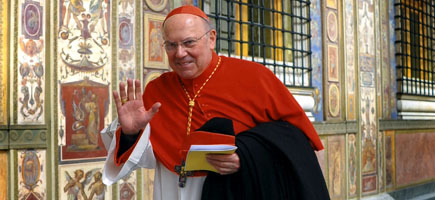
Cardinal William Levada, former archbishop of San Francisco Catholic Archdiocese of San Francisco, has penned a caustic response to recent New York Times articles and editorials that were critical of how the church and Pope Benedict XVI have handled sexual abuse cases involving priests over the years, calling the coverage “deficient by any reasonable standards of fairness that Americans have every right and expectation to find in their major media reporting.”

This bold, Spiro Agnew-like counterattack on the press during a time of mounting evidence of a covered-up pedophilia epidemic in the church is all the more notable given that Levada is the Prefect of the Congregation for the Doctrine of the Faith, an office then-Cardinal Ratzinger held before becoming Pope Benedict XVI, helping to place that office in charge of all reports of pedophiliac priests, a move that critics have charged was made to shield the church from criticism.

“I ask the Times to reconsider its attack mode about Pope Benedict XVI and give the world a more balanced view of a leader it can and should count on,” Levada writes, giving a far more charitable view of the current pope than the general public is feeling right now.

Rather than these defensive counterattacks on the Times’ solid journalism and analysis, Levada should realize that this tactic is precisely the attitude that has people concerned about the church, which has yet to fully atone for its many sins, including those committed by the Pope.

Back home in San Francisco, the church continues to stiff the city for millions of dollars in real estate transfer taxes involving the deed transfers of hundreds of properties under Levada’s leadership, a strange move that many critics have speculated was done to shield church assets from the claims of sexual abuse victims.

To me, this seems deficient by any reasonable standards of morality and openness that Americans have every right and expectation to find in their major religious institutions, particularly one that aspires to leadership that we can and should count on.

The state budget isn’t growing

11

I heard a great show on NPR the other day about the new rules on compensation for executives whose banks got federal bailout money. The feds have cracked down (a bit), and some of those massive salaries have been cut and top bankers are now accepting much less pay, and stock that can’t be sold for three years.


And guess what: More than 80 percent of these people are still hard at work at their desks, including almost all of the most senior folks. Very few have left. It puts the lie to this notion that extreme salaries are needed to attract and retail the top talent; even after those salaries have been cut by more than half, the “talent” doesn’t flee.


There’s a new study by the California Budget Project (PDF) that says makes the same kinds of points. Jean Ross, the director of the nonprofit, nonpartisan group, says that urban legends die hard, so she’s chosen the top ten myths about the state budget and demonstrated how utterly inaccurate they are.


For example, the anti-tax folks love to crow about the massive growth in state spending and how the budget is “out of control.” Truth:


Current year spending is $16.9 billion below 2007-2008 levels and proposed 2010-2011 spending is $20.1 billion below  2007-2008 levels.


2009-2010 spending is $21.5 billion below the baseline levels projected by the Legislative Analysts Office in 2004.


As a share of the state’s economy, state spending is at its lowest levels since the early 1970s.


And it’s not just the recession:


State spending as a share of personal income has declined significantly in recent years.


And guess what: taxes aren’t driving businesses out of the state — or hampering personal wealth creation.


The number of millionaire taxpayers has increased more rapidly than the number of taxpayers as a whole since the passage of Prop. 63, which imposed an additional tax on high-income individuals.


And guess what, you bureaucracy bashers:


California ranks 41s [among the 50 states] with respect to the number of state and local government employees per 10,000 population.


So no, California doesn’t have a spending problem. The state has a revenue problem.

Study: Cuts to health programs a bad plan for state economy

It doesn’t take a Ph.D. to understand that people who earn less shell out a greater percentage of their income from month to month than those occupying more elite ranks. Anyone fortunate enough to be holding down even a low-paying gig in a state where unemployment stands at 12.5 percent knows that basic living expenses can quickly consume a paycheck in San Francisco.

A study released by the Center for Labor and Research Education at the University of California at Berkeley has found that cutting relatively low-paying jobs in the state’s health and human services sector would deal a harsher blow to California’s financial health than alternative budget-balancing measures, like raising taxes on the wealthiest residents. Gov. Arnold Schwarzenegger has proposed cutting $6.4 billion from California’s health and human services budget, part of his solution for closing a roughly $20 billion budget gap.

“The budget proposals that the governor is making would … significantly worsen the economic crisis in the state, rather than pull us out,” said Ken Jacobs, chair of the Labor Center at UC Berkeley.

The report highlights “multiplier” effects of hypothetical cuts to statewide health and human services programs. The study examined the impacts of cutting $1 billion each from Medi-Cal, Healthy Families, and CalWORKS – state programs that assist low-income families – and found that the resulting losses would total 98,600 jobs for all three combined. The worst impacts from cuts to those programs would come from indirect consequences, according to Jacobs. Since those programs are funded in part from federal dollars, a loss in federal funding matched for every dollar the state invests also takes a toll.

A $1 billion cut to state funding for In-Home Supportive Services (IHSS), which aids disabled and elderly people who want to remain in their homes, would result in a statewide loss of 215,900 jobs, the report found.

Meanwhile, generating that same $1 billion through taxes from households in the highest income bracket in California would result in a comparatively lower job loss of 6,400, the research group estimated.

Health Access, a nonprofit consumer advocacy group, used the study’s findings in its own report to predict ramifications of the actual proposals in Schwarzenegger’s budget. According to Health Access, a minimum of 42,384 jobs would be lost as a result of proposed health cuts to Healthy Families and Medi-Cal, with more than $2.7 billion lost in business activity. It predicted 370,000 jobs would be wiped out if IHSS were eliminated altogether.

In a tumultuous economic downturn like the one facing California right now, “the best stimulus is funds in the pockets of low-income families,” according to Jacobs. Cutting these health and human service programs, which employ low-income workers and serve residents living near the poverty line, would do just the opposite.

Speaking of multipliers, Jacobs noted that corporate tax cuts produce the absolute worst bang for the buck out of any other schemes to fix the economy.

Poll: 73 percent in favor of simple majority vote for budget legislation

By Nima Maghame

A new poll by David Binder of DB-Research, conducted on behalf of Californians For Democracy, shows that 73 percent of California voters support a simple majority vote for revenue and budget legislation. Voters were asked to weigh this proposal: “All legislation on revenue and budget must be determined by a majority vote. Would you vote for it?” In response, 73 percent said yes, and 22 percent said no.

The findings are being hailed as a ringing endorsement for the California Democracy Act, a November 2010 ballot initiative authored by UC Berkeley Professor George Lakoff that would change the California Constitution from requiring a two-thirds vote of the Legislature to approve budget and tax proposals to a simple majority rule. Californians for Democracy is in the process of gathering signatures for the initiative.

800 respondents were questioned for the poll. When respondents were asked, “In a democracy, a majority of legislators should be able to pass everyday legislation,” 71 percent said yes, they agreed. When asked, “In a democracy, a minority of legislators should be able to block everyday legislation,” 68 percent said no, they disagreed. Tax worries were addressed as well – 62 percent of respondents agreed they would support a proposal “solving the budget crisis by closing tax loopholes on corporations and charging oil companies an extraction fee without raising taxes on the lower and middle income Californians.”

Since a large amount of state legislation is required to be part of the budget, the initiative could have a far-reaching impact. Californians For Democracy has stated that a 37 percent minority blocks a 63 percent majority on everyday legislation.

“We made sure to ask the right-wing questions and our questions,” Lakoff told the Guardian, noting that most polls only present one side. “Republican questions get Republican answers,” he said. “We finally asked the question on both sides, and the answer is clear.”

Jerry Brown’s inner populist emerges

3

In the 1990s, when Jerry Brown ran for president against Bill Clinton, his whole persona had a populist streak. He crashed with supporters instead of staying in fancy hotels; he raised money with an 800 number (the precursor to netroots fundraising); he railed against big-money interests. He even once put the future president of the United States on hold while he took another phone call. (Clinton gave up after waiting about ten minutes and disconnected.) 


But then he became mayor of Oakland and turned into a friend of developers, a tough-on-crime hardass and a promoter of military school. And he ran for attorney general as that Jerry Brown, not the old one.


So I’m glad to see some of his populism starting to re-emerge, not that I really think it’s going to stick (he’s still against raising taxes on the rich), but because it’s the only way he’s going to beat Meg Whitman.


Meg’s got a problem — the incumbent Republican is now rated as the worst governor ever, with the lowest popularity ratings in history. So Brown’s going to be running against the party that, by almost all accounts, wrecked California — and Whitman will have to run like hell away from the titular head of her own party in this state.


Brown also has the advantage, if he wants to take it, of being able to rail against the very types of financial institutions that Whitman and her anti-regulation platform represents. If he can make this about Wall Street, he wins, going away.


In the wake of March 4, education battles continue

Two weeks after protests against cuts to education filled Bay Area streets (and one freeway) on March 4, employees in the public-education sector are still engaged in a fight against budgetary rollbacks. But it’s an uphill battle, as was made clear at a briefing organized by United Educators of San Francisco at City College of San Francisco March 18.

At El Dorado Elementary School in the Bayview, 11 of 15 teachers were issued pink slips, according to elementary school teacher Megan Caluza (featured in the video above). While this doesn’t mean all 11 teachers are on their way out the door, it does mean that none of them knows for sure whether there’s a guaranteed job in the school district in the coming year. Since the budget cuts hit, Caluza says she’s been spending just as much time “fighting to teach” as she has in the actual classroom.

Elementary schools aren’t the only places being hit hard. Statewide, more than 23,000 layoff notices were sent to K-12 teachers recently, with no one knowing for sure which recipients will stay or face job losses.

“What is more important to you, corporate tax loopholes, or teachers in your daughter’s classroom?” asked Dennis Kelly, president of United Educators of San Francisco. “A college education for your son to get ahead, or tax breaks for the wealthiest Californians?”

Meanwhile, community colleges throughout the state face fee hikes even as classes are being cancelled, summer programs are being scaled back or eliminated altogether, and staff faces layoffs and furloughs. According to AgainstCuts.org, a group that was instrumental in organizing March 4 activities, the student population at California community colleges is comprised of more than 50 percent women and people of color, with around 80 percent of students working while taking classes. Blows to this educational system impedes opportunities for career advancement for the nearly 3 million community college students, which is bad news not just for students with lifelong dreams and high hopes, but California’s economy as a whole.

On Monday, March 22, more than 3,000 students, faculty members and others from City College of San Francisco plan to hold a march and rally in Sacramento to highlight the impact of cuts to community colleges. Around 62 buses will be leaving SF early in the morning to arrive in Sacramento for a 10 a.m. rally on the steps of the State Capitol Building.

Joining students and teachers at CCSF yesterday was a representative from Californians for Democracy, an organization that is pushing a November ballot initiative, authored by University of California Berkeley Professor George Lakoff, that would change the two-thirds majority vote requirement for the state Legislature to pass a budget or raise taxes to a simple majority vote. While the initiative is still circulating petitions to gather signatures, it seems to have found allies in the growing movement against cuts to education.  

March 4 represented “the first time we’ve ever done an all-education action,” Joan Berezin, a faculty member at Berkeley City College for 20 years, told the Guardian. “We’re trying to build the broadest coalition possible.”

Steve Poizner is scary!

10

I knew that Republicans have gotten pretty loony these days, but gubernatorial hopeful Steve Poizner was downright scary in his debate with Meg Whitman yesterday, threatening to create racial unrest and bankrupt the state in the name of being more conservative-than-thou.

He wants to deny all public services to undocumented immigrants and chided Whitman for not currently supporting Prop. 187, the 1994 measure that was struck down by the courts as unconstitutional. And after correctly saying California was “on the brink of economic collapse,” he went on promote that collapse by calling for a 10 percent reduction in sales, corporate, and income taxes, which really would bankrupt a state government that is already wrestling with a multi-billion-dollar budget deficit.

Now, I know that he’s pandering to the right-wing lunatic fringe of California, where Republicans are less than a third of voters and shrinking, and they’re all riled up these days from drinking too much Fox-brewed tea. But damn, this guy has really lost his mind.

Editor’s Notes

0

Tredmond@sfbg.com

The crowd protesting at San Francisco’s Civic Center March 4 had a different demographic than we’re used to. There were families, moms and dads with their kids. A lot of the people there don’t demonstrate and protest on a regular basis; they have jobs and families and can barely keep up with their day-to-day responsibilities. I know the drill.

But they were out in the streets because they’re furious at what’s happening to public education in California — and they should be. It’s criminal. The state is headed for the very bottom, and at this rate we’ll soon have the worst-funded public schools in America. And a gem of a state higher education system is on its way to becoming a set of overpriced, second-rate institutions.

And now everyone who stood up to be counted last week needs to take the next step and support the only solution that will actually work. It’s called raising taxes.

California’s more than $20 billion in the hole. There’s money going to waste, plenty of it. We could release every prisoner doing time on drug charges and save a few billion. But even that wouldn’t be enough to save the education system.

We all knew, or should have known, back in 1978, when Proposition 13 passed, that this day was coming. When you cut off the main source of revenue for schools — local property taxes — and rely on state funding, and the state Legislature can’t raise new revenue without a two-thirds vote, which means a handful of troglodyte Republicans can prevent it, this kind of crisis is inevitable.

So some intense, ongoing political action has to come out of the exciting and wonderful Day of Action. And if it’s going to make a difference, the action has to take place on three fronts.

1. We’ve got to get rid of the two-thirds majority requirement. There’s a ballot initiative circulating now that would do that.

2. We’ve got to amend Prop. 13. Assembly Member Tom Ammiano is pushing for a split-roll, to tax commercial property at a higher rate. That’s an excellent start.

3. We’ve got to push local government to raise taxes — right here at home — to help fund schools and public services. That means pushing Mayor Gavin Newsom, who loves to crow about education, to work with the supervisors on some major new revenue measures.

Either that or we let the politicians point fingers and blame each other. And the schools fall apart.

Oil company profits vs. education

4

I like Darrell Steinberg’s idea: The people protesting cuts in education should sign on to the oil-severance tax bill, and then force the Republicans to decide whether they want to protect the oil companies or fund public education.


Not that the crazy no-new-taxes folks will come around and do the right thing, but the issue will be pretty clear; it’s not, as Gloria Romero argues, a Sophie’s Choice:


We don’t want to cut education. The thing you have to ask is, are you willing to yank the dentures out of the mouths of the elderly? Am I willing to take away that wheelchair?”


It’s oil company profits against the future of the state. Let’s let Meg Whitman run for governor on that platform.


Newsom’s Orwellian doublespeak on city layoffs

1

One of the things that irritates people most about Mayor Gavin Newsom is his Orwellian doublespeak, in which he makes claims that conflict with his actions, and that was on vivid display with his recent decision to lay off 15,000 city workers and then hire most of them back for shorter workweeks.

These are frontline workers (managers, cops, and firefighters were excluded) who will either be fired or take a 6.25 percent pay cut – while the public will see a rollback in the hours devoted to providing city services – but Newsom’s press release claims that he’s actually helping both the workers and the public.

“Mayor Newsom used his YouTube update this week to discuss the City’s budget and his plan to save thousands of city jobs and services by offering 37.5 hour part time positions to most city employees. This proposal will allow the City to maintain services for residents, while saving the City an estimated $50 million. San Francisco faces a projected $522 million budget deficit for the 2010-11 fiscal year.” the press release, which was sent out on Saturday (presumably so the media ignores it), begins.

As the Chronicle reported that day, none of the affected employees are happy about this “offer” they can’t refuse, and their unions are even talking about suing the city. As for this plan to “maintain services,” that’s based simply on Newsom’s demand that city employees – who, because of the layoffs in previous years, are often already doing several people’s jobs – do 40 hours of work in 37.5 hours.

Now, this reduced workweek plan might not be so terrible if Newsom had worked on it with the unions, made deeper cuts to senior management and his taxpayer-paid political team in recent years, coupled it with a push to try to increase local taxes, and been honest about its impact to city services and the local economy.

Instead, we hear that we must burn the village in order to save it, which was dubbed the “enlightened approach” in the press release (which failed to mention that Newsom plans to not rehire an unspecified number of the employees he’s firing). “The point is to keep people employed and to keep their benefits,” Big Brother Newsom said in the press release.

Later in the release, Newsom goes on to laud Thursday’s Day of Action events, in which speaker after speaker called for increased taxes on wealthy corporations and individuals in order to prevent continued cuts to the public education system – despite the fact that Newsom has been the single biggest obstacle in San Francisco to such tax increases. “They’re shutting down opportunities. Its [sic] impacted faculty, its [sic] impacted morale, and it’s going to devastate the economy of the state unless we wake up and say enough’s enough,” Newsom said, sounding like the sympathetic populist instead the mayor who has proudly touted the fact that his budgets haven’t raised taxes, relying entirely on cuts.

Big Brother couldn’t have said it better himself.

Making the protests count

37

It was wonderful to see so many people all over the state taking to the streets to protest cuts in education and public services. The rally at San Francisco’s Civic Center wasn’t just young radical agitators, either — most of the people there were parents with kids, families, people who are just fed up with the threats to the future of this state and don’t want to take it any more.


And now that the press and public and maybe even the elected officials are focused on the issue, it’s time to move to the next step. Politicians can talk all they want about “standing with the families” and supporting education, but in the end, there’s only one way to adequately fund K-12 and higher education in California. And that’s to raise taxes.


You can talk about waste all you want, and there’s certainly waste at the University of California. But we’re looking at a need that runs into the billions, multiple billions, tens of billions — and eliminating a few million bucks of waste here and there isn’t going to solve the problem.


You’re not going to solve it by reallocating the state’s budget money, either, since there’s no single large pot of cash that can be taken and given to the schools without devastating another necessary public service. The only real possibility is the prison system, a financial sink hole if ever there were one — but again: You can’t just cut prison spending by eliminating services to prisoners. They get so little as it is — and the federal courts won’t allow any reductions in health care and the state’s already under court order to reduce overcrowding.


You could probably solve half of the schools’ fiscal problems by releasing from prison every single inmate serving time for a drug offense; that’s the kind of dramatic steps we’re talking about. And if anyone wants to launch a political campaign to let 30,000 prisoners free tomorrow, I’m with you.


But it’s not going to happen, not in this climate. So the only real option is to get more revenue. That means raising taxes at the state level, repealing Prop. 13 to allow local property tax hikes, or raising taxes at the city level.


And here’s who the protesters need to be targeting:


1. The governor. Arnold Schwarzenegger not only refuses to allow new taxes as part of the budget, he vetoed Sen. Mark Leno’s bill that would have allowed local government to raise its own car taxes. He’s at (916)-445-2841.


2. The Republican leadership of the state Legislature. These folks go into the budget talks with the power of a minority that can block the two-thirds vote required for tax hikes, and they’ve both signed “no new taxes” pledges. These two people are among the single largest reason that the California school are facing such huge cuts. Assemblymember Martin Garrick,  916-319-2074. Senator Dennis Hollingsworth, (916) 651-4036.


3. Attorney General Jerry Brown. He’s running for governor as the Democratic candidate, and he has already announced that he won’t raise taxes and that Prop. 13 is untouchable. He won’t even support Assemblymember Tom Ammiano’s bill to legalize and tax marijuana. He needs to hear from his constituents that those positions won’t fly. (916) 322-3360


4. The mayor of San Francisco. Gavin Newsom is happy to announce that he supports education funding, but he’s never come forward with a single significant new tax increase for the city. Local taxes could be split between the general fund and the schools, and the progressives on the Board of Supervisors are looking for revenue options. Call the mayor and tell him: If Sacramento won’t raise taxes to educate our kids, we’d like to do it at home, in San Francisco. 415-554-6141.


5. Any state or local official who claims to support the schools but won’t publicly endorse and work for higher taxes. Folks, there’s no other way out of this.


And at the next rally, let’s chant: Repeal Prop. 13, Now! Tax the rich in San Francisco — Now!

Stiglitz: The Dangers of Deficit Reduction

0

By Joseph E. Stiglitz

Here is our monthly installment of Joseph E. Stiglitz’s Unconventional Economic Wisdom column from the Project Syndicate news series. Stiglitz is University Professor at Columbia University and the winner of the 2001 Nobel Prize in economics. His forthcoming book Freefall will be published this winter.

NEW YORK – A wave of fiscal austerity is rushing over Europe and America. The magnitude of budget deficits – like the magnitude of the downturn – has taken many by surprise. But despite protests by the yesterday’s proponents of deregulation, who would like the government to remain passive, most economists believe that government spending has made a difference, helping to avert another Great Depression.

Most economists also agree that it is a mistake to look at only one side of a balance sheet (whether for the public or private sector). One has to look not only at what a country or firm owes, but also at its assets. This should help answer those financial sector hawks who are raising alarms about government spending. After all, even deficit hawks acknowledge that we should be focusing not on today’s deficit, but on the long-term national debt. Spending, especially on investments in education, technology, and infrastructure, can actually lead to lower long-term deficits. Banks’ short-sightedness helped create the crisis; we cannot let government short-sightedness – prodded by the financial sector – prolong it.

Faster growth and returns on public investment yield higher tax revenues, and a 5 to 6% return is more than enough to offset temporary increases in the national debt. A social cost-benefit analysis (taking into account impacts other than on the budget) makes such expenditures, even when debt-financed, even more attractive.

Finally, most economists agree that, apart from these considerations, the appropriate size of a deficit depends in part on the state of the economy. A weaker economy calls for a larger deficit, and the appropriate size of the deficit in the face of a recession depends on the precise circumstances.

It is here that economists disagree. Forecasting is always difficult, but especially so in troubled times. What has happened is (fortunately) not an everyday occurrence; it would be foolish to look at past recoveries to predict this one.

In America, for instance, bad debt and foreclosures are at levels not seen for three-quarters of a century; the decline in credit in 2009 was the largest since 1942. Comparisons to the Great Depression are also deceptive, because the economy today is so different in so many ways. And nearly all so-called experts have proven highly fallible – witness the United States Federal Reserve’s dismal forecasting record before the crisis.

Yet, even with large deficits, economic growth in the US and Europe is anemic, and forecasts of private-sector growth suggest that in the absence of continued government support, there is risk of continued stagnation – of growth too weak to return unemployment to normal levels anytime soon.

The risks are asymmetric: if these forecasts are wrong, and there is a more robust recovery, then, of course, expenditures can be cut back and/or taxes increased. But if these forecasts are right, then a premature “exit” from deficit spending risks pushing the economy back into recession. This is one of the lessons we should have learned from America’s experience in the Great Depression; it is also one of the lessons to emerge from Japan’s experience in the late 1990’s.

These points are particularly germane for the hardest-hit economies. The United Kingdom, for example, has had a harder time than other countries for an obvious reason: it had a real-estate bubble (though of less consequence than in Spain), and finance, which was at the epicenter of the crisis, played a more important role in its economy than it does in other countries.

The UK’s weaker performance is not the result of worse policies; indeed, compared to the US, its bank bailouts and labor-market policies were, in many ways, far better. It avoided the massive waste of human resources associated with high unemployment in America, where almost one out of five people who would like a full-time job cannot find one.

As the global economy returns to growth, governments should, of course, have plans on the drawing board to raise taxes and cut expenditures. The right balance will inevitably be a subject of dispute. Principles like “it is better to tax bad things than good things” might suggest imposing environmental taxes.

The financial sector has imposed huge externalities on the rest of society. America’s financial industry polluted the world with toxic mortgages, and, in line with the well established “polluter pays” principle, taxes should be imposed on it. Besides, well-designed taxes on the financial sector might help alleviate problems caused by excessive leverage and banks that are too big to fail. Taxes on speculative activity might encourage banks to focus greater attention on performing their key societal role of providing credit.

Over the longer term, most economists agree that governments, especially in advanced industrial countries with aging populations, should be concerned about the sustainability of their policies. But we must be wary of deficit fetishism. Deficits to finance wars or give-aways to the financial sector (as happened on a massive scale in the US) lead to liabilities without corresponding assets, imposing a burden on future generations. But high-return public investments that more than pay for themselves can actually improve the well-being of future generations, and it would be doubly foolish to burden them with debts from unproductive spending and then cut back on productive investments.

These are questions for a later day – at least in many countries, prospects of a robust recovery are, at best, a year or two away. For now, the economics is clear: reducing government spending is a risk not worth taking. 

Joseph E. Stiglitz is University Professor at Columbia University and recipient of the 2001 Nobel Prize in Economics. His most recent book Freefall: Free Markets and the Sinking of the Global Economy is available in French (Le Triomphe De La Cupidité, Liens Qui Liberent) and will be available shortly in Japanese, Spanish, German, and Italian.

Copyright: Project Syndicate, 2010.
www.project-syndicate.org

Homeowners for Prop. 13 reform

32

The Chron’s headline says “most want cuts, not taxes, to fix state budget.” The story cites a new Field poll, and the Chron’s not the only paper to spin it that way. The Sacramento Bee also claims that the poll shows widespread support for cuts instead of taxes.


But the folks at Calitics drew a different, more encouraging conclusion:


The responses, of statewide registered voters:
Cuts only: 31%
Mostly cuts: 19%
Equal mix of cuts and taxes: 29%
Mostly taxes: 9%
Taxes only: 4%
No opinion: 8%
So the way this is being reported in the media strikes me as being pretty flawed. The way I read this says 61% of voters want taxes to be some element of the solution to the budget mess, and only 31% want cuts-only.


And as people take to the streets March 4th to protest cuts to education and public services, I think that message will get reinforced. I certainly hope so — and I hope when protesters are interviewed, they don’t make the mistake of saying that “there’s plenty of waste in the budget” or that resources need to be better deployed.


The truth is that we need to raise taxes, particularly on the wealthy, to close this budget gap without destroying the state. I’m a homeowner who wants higher property taxes and better schools; anyone want to join me in Homeowners For Prop. 13 Reform?

Editor’s Notes

0

Tredmond@sfbg.com

Hundreds of parents packed the Marina Middle School auditorium last week to talk about cuts to public education — and Assembly Member Tom Ammiano, who spoke about reforming Proposition 13, said he thought the response to his suggestions was overwhelmingly positive. That’s not surprising — public school parents in San Francisco are not really the demographic you worry about when you talk about raising taxes to pay for education.

And until fairly recently, I thought it was impossible to do anything worthwhile about tax policy on a statewide level. I figured the state Legislature, with its obstinate Republicans, could never launch a tax reform movement, and that passing a ballot measure to alter Prop. 13 was a long shot at the very best. I was the one telling local officials that we had to look to our own resources, right here in San Francisco.

But when I see hundreds of parents organizing around school cuts, and hundreds of Muni riders organizing around transit cuts, and tens of thousands of students organizing around cuts to higher education, I start to think: maybe there’s hope.

Maybe the state has gotten so bad, the red ink so awful, that Californians will finally realize that they can’t have good public services for free. And maybe they’ll realize that Prop. 13 does a lot more for big commercial property owners than for homeowners, and that a split-roll measure like the one Ammiano is proposing could raise the kind of money we need for decent schools and public services.

I have to hope so.

Expanding movement

1

rebeccab@sfbg.com

When University of California Berkeley students staged building occupations last fall, their furious, brazen response to startling tuition hikes and staff cutbacks captured the attention of the world, recalling the radical actions of earlier generations.

Yet the thrust behind the March 4 Strike and Day of Action, a mass mobilization for public education and services that is reaching into all corners of the state and spreading nationwide, appears to stem from widespread agitation that extends well beyond the flare-ups on college campuses.

"What’s historic about this is that pre-K through PhD has never walked together," said Lillian Taiz, president of the California Faculty Association, which represents faculty in the California State University system. "We have often been pitted against one another, and I think everyone feels finally, in the end, there is no difference in importance between pre-K and PhD. We need it all."

The historic new alliance faces an uphill climb in an environment characterized by a devastating budget crisis at the state level. California — the world’s eighth-largest economy — hovers around 47th in the nation in terms of per-pupil spending, and the most recent wave of budget rollbacks has cut to the bone.

Students and teachers across the Bay Area argue that with dramatic slashes in funding, the educational system is failing youth. Class sizes are ballooning to claustrophobic levels, students are unable to take their desired courses, fees are going up, bathrooms are getting cleaned less frequently, and staffers are getting stressed by overwhelming workloads. "Classes are jam-packed," Taiz says. "You have kids sitting on the floor. You have students just begging to be allowed in a class."

As University of California students decry a 32 percent hike in fees, the California State University system is suffering from damage inflicted by 2,000 faculty layoffs over the past year. The San Francisco Unified School District, meanwhile, is staring down an estimated $113 million budget deficit over the next two years, and 900 layoff notices recently were issued to teachers, librarians, secretaries, and other school employees to warn them that their jobs could be slashed by the end of the school year.

When San Francisco’s school district faced a gaping budget shortfall during the last budget cycle, it was propped up by a combination of Rainy Day Fund reserve dollars and stimulus funding from the American Recovery and Reinvestment Act. With no such safety nets in place this time around, anxiety levels are higher and the outlook is uncertain.

March 4 is shaping up to be more than an opportunity to vent frustrations to elected leaders. Instead, organizers describe it as a rallying point for a movement to defend public education that has caught on like wildfire, uniting people from different worlds. Pickets and rallies will be staged throughout the region. Thousands are expected to swarm Civic Center Plaza in San Francisco. Students from a handful of East Bay campuses are organizing marches to Frank Ogawa Plaza in downtown Oakland. Students and faculty from Berkeley will be boarding buses to take the message to Sacramento. The Oakland Unified School district will host a districtwide mock "disaster drill" to call attention to the disastrous budget. Even public transit activists opposed to the latest round of Muni service cuts and fare hikes are joining the protests, hoping to expand the discussion to support vital public services (for details on these and other events, see "Alerts" opposite this page).

"We’ve never gotten this level of activism over anything in SF since I’ve been here," says Matthew Hardy, communications director for United Educators of San Francisco. "There’s a growing movement for progressive taxation and budget reform instead of draconian cuts."

Taiz, who teaches history at Cal State Los Angeles, described March 4 as an opportunity to fill a void in leadership. "Historically, in these moments where ordinary people step up to the plate, you end up leading the leaders," she said. "We are kind of shocked, but in truth, we do know what has to be done." Quality education isn’t just important for young people, but for society as a whole, she argued. "I am a baby boomer, and if the folks coming up behind me don’t have really, really good jobs, I’m going to be eating dog food. Because those are the people who pay Social Security and pay the taxes."

In the week preceding March 4, teachers and students throughout the Bay Area were in a frenzy of preparation.

Carlos Baron, a theater professor at SF State, was wondering whether the grand procession of papier-mâché puppets his theater students will unveil on the March 4 Day of Action should take a V-shape or some other form. "The main puppet is the Draculator," explained Baron, a Chilean who directed plays in the Salvador Allende era before he began teaching at SF State in 1978. "It’s a cross between the Terminator-Governor and Dracula. But also it doubles as a banker and a general."

When asked how funding cutbacks affect students, Baron didn’t hesitate. "It impedes the creation of a positive vision for themselves and this society," he said. It stunts "the development of the imagination," he added. "We are trained as individuals to accept our failure and our smallness because we’re familiar with it. They don’t want an educated population, a sensitive population, a dreaming population. Would we select Schwarzenegger?"

Nicole Abreu Shepard, a first-grade teacher at Buena Vista Elementary in San Francisco’s Mission District, was collecting permission slips from parents to take her students to a rally and march down 24th Street. "The entire school is walking out," Abreu Shepherd said. Buena Vista’s art program exists solely because parents volunteer their time, she explained. More than half the students qualify for free or reduced lunch, and many incoming kindergarteners or preschoolers are new to the English language. Now there are proposals on the table to increase kindergarten class sizes to 25 or possibly even 30 students. "It’s sort of tying their hands behind their back and asking them to teach on one foot," she noted, and worried about the eventual result. "It’s going to be harder and harder to keep parents who could afford private school in a public school system."

Meanwhile, at the UC Berkeley campus, Krystof Cantor was sitting behind a table heaped with piles of radical literature bearing titles such as "After the Fall: Communiques from an Occupied California." Cantor, who earned his PhD in vision science in 2005, was joining student organizers in making one last push to drum up student interest in March 4 events at a multi-faceted event called "Rolling University." Late on the evening of Feb. 26, a dance party on the Berkeley campus morphed into a street riot — replete with ignited Dumpsters — in downtown Berkeley. The incident attracted media attention and drew public criticism from administrative officials.

The radicalized student movement that has erupted on the UC Berkeley campus is "very much about seizing power," Cantor told the Guardian several days before. "It’s been disruptive, it’s been militant, and it’s been creative. That’s very scary," to the administrators the movement is targeting, he added.

That focused pressure on UC administrators sets these students apart from the coalition of UC Berkeley faculty members and student government members and allies who are coordinating bus trips to protest in Sacramento March 4, he explained. "Sacramento’s not innocent, but it’s not like the administrators are just doing what they have to do," he charged, pointing to new construction projects on campus even as workers are hit with layoffs and furloughs, plus an increasing trend of privatizing on-campus jobs and services. "You can save the public sector by pouring money into it. But it won’t work if the people in charge … want to privatize everything."

Jasper Bernes, a graduate student in English who was seated next to Cantor, noted that the occupation tactic is catching on at other campuses. "I have no doubt that March 4 will greet us with news of many occupations," he said.

Baron, the Chilean theater professor, noted that some SF State students had occupied a business school building in protest of budget cuts. "They were pissed," he said. "They wanted to do something radical. They really inconvenienced a lot of people — but they took chances nonetheless. I went there, and I locked arms with them for awhile." At the same time, he wondered about how effective it was, he said.

And for all the months of preparation and visioning, Baron said he also wonders what will ultimately be borne out of the marches, rallies, pickets, and procession of lovingly crafted street puppets he helped breathe life into. For all the hard work and planning, he says, "My problem is not so much March 4. It’s March 5."