taxes

Class of 2010: Mark Farrell

0

steve@sfbg.com

Mark Farrell is a 36-year-old venture capitalist and political newcomer who will represent the wealthy neighborhoods of District 2 (Pacific Heights, Sea Cliff, and the Marina) after narrowly beating Janet Reilly, whose extensive political endorsements ranged from the Guardian and local Democratic Party Chair Aaron Peskin to U.S. Sen. Dianne Feinsein and Mayor Gavin Newsom.

Challenging the city’s political power structure is why Farrell said he ran for office, playing up his outsider status and investment banking experience. He told visitors to his campaign website, “I am running for the Board of Supervisors to bring common sense back to City Hall” and railed against “career politicians who run for office again and again.”

In an interview with the Guardian, Farrell said he was motivated to make his first foray into politics by the dysfunction he has heard about at City Hall. “I’ve been frustrated with City Hall over the last few years, from the personal antics to the policies that have come out,” Farrell told us. “I humbly believe I have something different to bring to the table.”

Farrell calls himself a fiscal conservative who believes “our city government has gotten too large and we need to look at that,” a task he thinks he’s well-suited for given his background in finance. Yet when asked what government functions he would eliminate or cut deeply to help close a projected $700 million budget deficit over the next two years, Farrell said he can’t offer any specifics yet, saying only, “We need to make tough decisions.”

Would Farrell be open to new taxes or other revenue-side budget solutions? He told us that he won’t completely reject the idea of new taxes, but that he generally opposes them. “I don’t believe in raising taxes. We can’t raise enough revenue to get out of this problem,” Farrell said. “We need to learn to live within our means.”

Although he opposed Prop. B in this election, Farrell said public employee pension reform needs to be a part of the city’s budget solution, as well as scaling back how much the city gives to nonprofit groups, which provide many of the social services the city supports.

Farrell was born and raised in San Francisco — except for his college years, he’s spent his whole life in D2, where his parents still live — and has been friends with Sup. Sean Elsbernd since high school. Politically, Farrell also identifies with Elsbernd and fellow fiscally conservative Sups. Carmen Chu and Michela Alioto-Pier (who endorsed Farrell to replace her in D2), but he says that he doesn’t want to be politically pigeon-holed.

“I’m very much my own person and I look forward to working with everyone,” Farrell said. Indeed, part of Farrell’s frustration with City Hall politics has been the divisive relationship between the progressives and moderates, which he sees as a hindrance to finding “common sense solutions.”

“The progressive and moderate labels have been relatively destructive to San Francisco,” Farrell said. “We need to get beyond that to focus on issues.”

Yet people’s political values and worldview determine what issues they care about and the solutions they favor. For example, progressives decry the dearth of affordable being built for San Franciscans and cite city studies showing that deficit will get worse as developers build ever-more market rate housing (see “Dollars or sense?” Sept. 28), particularly in a city that is two-thirds renters.

Farrell said he supports rent control (saying he was unfairly attacked during the campaign as anti renter) and sees the dwindling rental stock and lack of new affordable units being constructed as problems, but he doesn’t have a solution to those problems. In fact, Farrell supports allowing more condo conversions, which would make the problem worse, telling us, “I believe home ownership is something we should promote.”

He was also vague about how he will approach land use issues and how tough he’ll be with developers in having them meet city design guidelines and provide affordable housing and other community benefits, saying only, “We need to have sustainable development in the city.”

Yet the issues that do animate Farrell are those typically focused on by conservative D2 voters. Farrell lists his top priorities as seeing to his district’s needs, promoting private sector job creation (“I think a lot of lip service has been paid to it, but not a lot of action by City Hall,” he said), public safety, and quality-of-life issues (he supported Prop. L, the sit-lie ordinance, calling it “very reasonable”). Generally Farrell sees San Francisco as a city in he midst of a serious fiscal crisis, “and I want to create a San Francisco that is secure for the future over the long haul.”

The end of Obama’s presidency?

6

The tax-cut deal with the Republicans is almost unfathomable. It’s the most dramatic sign of President Obama’s failure as a leader, his refusal to stand up for the platform he ran on — and it could mark the end of his presidency. I mean, he’ll still be in office for two more years — but now that he’s rolled over and given the Republicans everything they want, he has no moral or political authority left, no national constituency to back him up and he might as well be a lame duck. He’s certainly finished as far as most of the progressive movement is concerned. Kos:


This shouldn’t be worrisome to the White House because these people won’t vote for him in 2012. They probably will. But will they give money and knock on doors and make phone calls and drag their social circle to the polls? Nope. They didn’t in 2010. And at this rate, they sure as hell won’t in 2012.


Already, some Obama supporters are starting to ask whether we all should have backed Hillary Clinton.


So far, Nancy Pelosi is standing up to the “compromise,” which essentially gives the Republicans everything they want. And the House can still call the GOP bluff: Refuse to reauthorize tax cuts for the rich — and force the Republicans to vote to raise taxes on the middle class and deny unemployment benefits to a few million Americans. That’s the only way to salvage the situation.


The Dec. 7 press conference was terribly disappointing. Obama said, in effect, that he — the president of the United States — is powerless against a Republican minority in the Senate. “I have been unable to budge them,” he announced. He’s decided to negotiate with terrorists, to let a few right-wingers hold him and the millions of unemployed Americans hostage. The polls are on his side, the public sentiment is on his side — and he’s acting as if he’s being forced to negotiate from weakness.


The real-time Washington Post poll shows that 66 percent think Obama made a bad deal. 


The big problem here is that Obama looks shaken, doesn’t look tough, is on the defensive. A very sad moment.  


Can the U.S. be great again?

13

I know I’m getting a little obsessed with the NY Times and it’s sometimes amazing, sometimes utterly clueless analysis of what’s happening with tax policy and the American economy. But I had to comment on Matt Bai’s piece in the Sunday Times about the debt-reduction commission, also known as the cat-food commission. Bai’s thesis is that American’s don’t want to hear that they are going to have to sacrifice something because it runs against our national grain, our desire to be ever bigger and stronger and number one in the world:

What makes this case for sacrifice so much harder to embrace, perhaps, is that it goes to our national psyche, threatening our self-image as a land with limitless potential. While past generations have readily sacrificed for national greatness, debt reduction — at least in the gloomy way its advocates argue for it — feels like a call to sacrifice in the name of our national decline.

And, of course, like every writer who takes on this topic, he harkens back to the Good Old Days when America seemed to be on top of the world:

For much of the Industrial Age, and especially between World War II and the oil crises of the 1970s, this was, in fact, reality. Wages and profits rose, the social safety net and the nation’s military reach both expanded, and government lived largely within its means. College education, suburban lawns, good pensions and blissful security all became part of the pact with the middle class, as much a part of the constellation of entitlements as Medicare and Medicaid.

He says, of course, in the end, that by tighening its fiscal belt, America can pave the way for more greatness:

In fact, policy experts argue that steps along the lines of the commission’s recommendations could actually modernize outdated systems — making the country more competitive as a result — without profoundly affecting the American experience. A simpler, updated tax code for businesses might help spur entrepreneurship, while a hard line on inefficient spending (farm subsidies come to mind) might free up government to invest more in new technologies and infrastructure. A streamlined military of the kind championed by Robert Gates, the defense secretary, would probably be better prepared for the challenges ahead than a military burdened by the costs of obsolete weapons systems and bases left over from the cold war.

But he totally misses a key point: Between World War II and the 1970s (actually, until the election of Ronald Reagan in 1980) the American economy was driven in part by a stable middle class, created in part by trade unions but also — to a great degree — by a tax system built on socioeconomic equality. Rich people paid taxes in the good old days — in fact, the highest income earners paid around 60 percent or more of their income in taxes. and that money allowed the nation to build highways and watger systems and offer public education to all and to create the entitlements that kept old people out of dire poverty.

And because the public sector — the government — was largely able to live within its means, and offered quality public services, people were willing to pay taxes and not blame public employees for everything and demand that Santa Claus bring them goodies for free.

Yes, this country can be great again. It’s richer than ever. But as long as that wealth is so tightly controlled by such a small elite, we’re going to continue to slide down until we become another banana republic. There’s really no way around it.


Amazing data: How taxes used to be

3

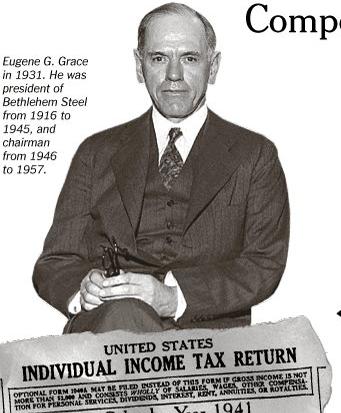
The New York Times has a truly amazing graphic presentation of how the rich used to pay taxes. Check out the image here. The data comes from old IRS filings, made public through the National Archives. They show, for example, that in 1941 — PRIOR to the WWII tax hikes — Eugene Grace, the president of Betehem Steel and one of the highest paid Americans, earned $522,637 (the equivalent of about $7.5 million today), had an adjusted gross income of $336,953 — and paid 66 percent of it, or $114,902, in federal income taxes. Thomas Watson, the president of IBM, paid 69 percent of his AGI in taxes.


Back then, the top marginal tax rate was 81 percent.


And guess what? Those folks were still very rich, still worked hard, still built big companies and created the most poweful economy in the world.


In fact, I could argue that it was precisely BECAUSE OF those high marginal rates that America grew so prosperous in what are now seen as the good old days.

Tax breaks we can’t afford

18

The big front-page headline on today’s Examiner: “Workers we can’t afford.” It’s a classic story of the Ex genre, a look at how much labor costs are increasing and eating a hole in the city budget. But what gets me is thal it’s not just the Ex; the Chron takes this line, too, and so do news outlets all over the state (and all over the country). The problem is always labor.


You never see a big headline telling the other side of the story: “Tax breaks we can’t afford.”


The thing is, tax cuts and tax breaks are expenses, just like labor costs. The impact the budget in the same way. And at least city workers DO something; a lot of the tax cuts don’t.


I was watching the City Channel last night (yes, Mr. Mayor, I was one of the “ten people” you joked about who were actually watching) and Newsom was giving a speech out at Mission Bay, welcoming a new biotech outfit to the city. And he went on and on about how his administration has attracted all these companies by giving them tax breaks.


He said that, unlike South San Francisco, this city “taxes jobs.” (That’s just silly; we have a payroll tax because you have to have some form of business tax, and the state won’t let us tax corporate income, and a gross receipts tax also has problems, and a payroll tax is at least an approximation of the size of a company. If we taxed gross receipts instead he’d complain that we were “taxing success.”)


And then when he was done with his prattle, the guy from UC who sets up the Mission Bay incubator space for biotech businesses spoke, and talked about all the reasons busineses want to move into the area, mainly the direct connection with UC researchers and experts in business development and the quality of the workforce. He didn’t say a word about taxes.


Because taxes, particularly the very modest payroll tax the city charges, are such a minor factor in business location decisions that tax breaks like Newsom’s don’t do much good in attracting employers. But they do cost the city money.


And those are expenses — yes, expenses — that we can’t afford.


Editor’s notes

2

Tredmond@sfbg.com

The New York Times, the old established voice of the liberal media elite, ran a piece on Sunday looking for answers to the nation’s persistent economic crisis. Reporter David Segal interviewed prominent economists on the left and right — the likes of John H. Cochrane at the University of Chicago, James K. Galbraith at the University of Texas, even Gar Alperowitz at the University of Maryland, who’s kind of (God help us) a socialist.

The right-wingers talked about the need to cut government, the left-wingers talked about community co-ops and green technology, and all sides agreed that the situation was dire and would probably get worse. But nobody even mentioned wealth inequality.

It’s kind of mind-boggling. It’s as if the entire subject is off the table, taboo, something that doesn’t get discussed in the company of polite economists. And that’s just crazy.

Look: the 400 richest Americans today have combined assets of about $1.5 trillion. Raise that number to 5,000 and you can about double the total wealth. This is a very rich country; our prospects aren’t bleak at all. With a bit of enlightened public policy, we could profoundly improve the economic situation in just a few months.

I have no PhD. I barely escaped Wesleyan University with an economics degree in 1980, squeaking out a D in my last class by promising the (very conservative) professor that if he failed me, I’d be back next year. But it doesn’t take econometric wizardry to add up the figures. They go like this: A one-time 20 percent wealth tax on the 5,000 richest Americans — including many people who have pledged to give away half their wealth anyway — would generate about $600 billion. Nobody would miss any meals; no families would lose their homes, or even their second or third homes, or their personal jets. Expand the pool a little and you could easily reach $1 trillion.

With that money, you could immediately create 7 million jobs (at an average of $50,000 a year) and fund them for three years. That would cut the unemployment rate in half. What would those people do? Plenty. They could rebuild the country’s roads and highways and bridges, and build high-speed rail systems, and work in health care clinics, and teach art and music and writing, and clean up environmental messes … there’s loads of work in this country. And even with a modest estimate of the economic multiplier, those 7 million public sector jobs would create another 3 million private sector jobs, and all of a sudden, the country’s booming again. And a lot of those people who were hired by the government could now transition to private business. (And those very rich people would do well in the boom, as they always do, and might even make most of their money back.)

Raise taxes on the top 5 percent of the nation’s wage earners and corporations and you would generate enough money to keep the program going until the private economy could pick up the slack. Then eliminate the Social Security tax on the first $25,000 of income and expand it to cover all income up to $250,000 and suddenly — a huge incentive for small businesses to hire new workers and a stable retirement system for the next two generations.

It’s not that hard. It’s not a socialist revolution. Nobody really gets hurt, and a lot of people benefit. I mean, it seems to me that it ought to be part of the discussion. Maybe that’s why I was such a lousy economics student.


DREAM on

2

sarah@sfbg.com

Spurred by congressional Democratic leaders’ promises to hold a vote on the DREAM (Development, Relief, and Education for Alien Minors) Act before the end of Congress’ lame-duck session this month, immigrant and civil rights advocates are pushing for the passage of bipartisan legislation that would give undocumented youth a shot at citizenship if they go to college or serve in the military for two years.

On Nov. 29 in San Francisco, several undocumented young people joined members of the Bay Area Coalition for Immigration Reform outside Mission High School — where as much as 20 percent of the student population may be undocumented, according to principal Eric Guthertz — to explain why it makes sense to give youth who grew up in the United States a shot at legal status.

“We are not asking you to give us a green card,” Anna, a student from Guatemala, said at the event. “All we want is a chance to succeed and give back to this country. We live here, we pay taxes, we’re smart, we go to college, but afterward we can’t work and give back.”

Mario, a 22-year-old gay student who was born in Peru to a Chinese father and Peruvian mother, graduated from UC Berkeley with a civil engineering degree. He explained that because of his lack of documentation, he can’t get a job to pay his bills or save up to pursue a master’s degree, and fears being deported to a homophobic country.

“It would be a waste of talent because I’ve learned California-specific engineering rules and the U.S. building code,” Mario said. “Sometimes I wake up from a nightmare about being detained. I came out here, but in Peru, I’d probably be back in the closet.

Joining Anna and Mario was Shing Ma “Steve” Li, a nursing student at City College, who was released Nov. 19 after two months in federal detention, shortly before he was to be deported to Peru. San Francisco Democrat Sen. Dianne Feinstein introduced legislation to halt his removal, saying it would be “unjust” to deport Li before a DREAM Act vote takes place.

Li, who speaks Cantonese, English, French, and Spanish, grew up reciting the Pledge of Allegiance and dreams of opening a clinic to serve low-income San Franciscans. But recently, federal immigration authorities flew him 800 miles to a jail in Arizona, all because his parents brought him here when he was 12 and he lacks documentation.

“We were handcuffed and shackled to our seats, and I wondered what would happen if the plane went down,” Li recalled.

Li believes the main barriers to the legislation’s passage is lack of accurate information. “People need to know the facts, see the people, and hear their stories,” Li said. “Then they’ll know it is a human rights issue.”

Guthertz said that as principal of Mission High, every year he sees undocumented youth who have great grades and lots of advanced placement classes “hit the wall” of their status. “Over and over, I’ve seen the heartbreaking effect of their situation,” Guthertz said. “The DREAM Act is yet another avenue to help these students.”

Eric Quezada, executive director of Dolores Street Community Services, noted that congressional leaders did not agree to the DREAM Act vote “out of the goodness of their heart — it’s because of the hard work of immigrant advocates.”

Quezada said the push to force a DREAM Act vote in Congress this year began when undocumented youth staged a sit-in in Sen. John McCain’s (R-Ariz.) office in May. “And the vote of Latinos saved the Senate from a Republican takeover on Nov. 2,” he said.

“But we understand this window is closing,” Quezada added, referring to the reality that Republicans will take control of the House in January. “So we’re not taking one vote for granted. And this is the first step. If we are able to pass the DREAM Act, it will be a downpayment for comprehensive immigration reform.”

Sup. John Avalos says the DREAM Act recognizes the contribution immigrants make to the community, and to the creation of economic opportunities for everybody. “Immigrants here support themselves and their families across the water, so it makes sense that we make proper investments and support,” Avalos said. “Education is one way to make the world a more stable place.”

Sup. David Campos, who came to the U.S. from Guatemala as an undocumented teenager, sees the DREAM Act as a piece of commonsense legislation.

“It’s so modest,” Campos said. “Even those who are against comprehensive immigration reform should be for something that recognizes that young people, who came here not by choice but because of their parents’ issues, should be given a chance to give back.”

Campos said his father was able to gain legal status for his whole family because of his employment, but that many undocumented youth aren’t so lucky.

“We open the doors to our public schools, we invest in their education, and then, when they are ready to give back to us, we say, ‘No, we don’t want you here,'” Campos said. “The best and brightest, the risk-takers, come here. As a country, we cannot go forward unless we realize that this influx of creativity and entrepreneurship made this country what it is.”

Editor’s notes

0

Tredmond@sfbg.com

The pollsters like to call it the Santa Claus effect, and we’ve seen it over and over in surveys of California voters in the past few months. I think of it more as some sort of deep political pathology, a schizophrenia combined with delusions that underlies the state’s inability to get anything done.

Here’s what the data shows:

California voters don’t want cuts to higher education; in fact, they want to see more money spent on the University of California system, the California State University system, and local community colleges. They don’t want cuts to K-12 education either. Nor do they want to shut down state parks, release prisoners early, close public hospitals, stop building high-speed rail, reduce state support of local government … or do anything else that would save a significant amount of money.

And they don’t want tax increases.

If you ask people how they think the state should balance the budget, they talk about cutting waste — even though the current Republican governor admits there’s not that much waste left to cut.

I could spend hours talking about how we got here, how decades of corruption and bad governmental priorities soured people so much on the public sector that they don’t believe the state can be trusted to spend their money properly. But part of the issue is that the news media (which love to find a little waste here and there to trumpet) are very bad at presenting the choices.

Nobody in Sacramento’s going to do anything serious about the budget until Jerry Brown takes office; that’s just how it is. So this psycho-financial nightmare is going to fall in his lap — and I wonder sometimes if he ought to force us all to make the choices we want to avoid.

Maybe Brown ought to call a special election in February or March and put two — and exactly two — measures before the voters. Both would balance the state budget. One would do it almost entirely with cuts, and those cuts would be clearly defined: public schools would shut down all over the state. Class size would rise to 40 or more kids. UC would close half its campuses and admit half the number of qualified students it does today. At least 100,000 prisoners would be released as several prison are mothballed. The entire state park system would be shuttered. And that’s just the start. Consumer protection agencies would be abolished, public health devastated — there wouldn’t be a single thing that Californians take for granted that would survive.

Because that’s what a cuts-only, no borrowing budget would look like.

The other proposition would save those services by closing tax loopholes that benefit big business and raising income taxes on the wealthiest people in the state. Brown would have to travel up and down the state and make it clear: these are the choices we face. You can’t solve a $20 billion budget crisis without either tearing the state apart or raising taxes.

No more ducking. No more pretending. No more looking around for Santa Claus. Make the choice, folks: accept new taxes on a small percentage of the population, or give up on the state.

It’s a scary thought, but it may have to come to that.


Why selling state buildings is so dumb

18

To stem the massive hemorrhaging in the budget, the state of California has authorized the sale of 24 state-owned office buildings across the state to private investors. The state would then rent back the office space.


It’s a classic case of short-term thinking: In the end, the state will end up paying more money in rent than it will gain from the sales. The nonpartisan Legislative Analyst’s Office reported in April that over the next 30 years, the lease payments will likely cost $5  billion more than if the property had stayed in the state’s possession.


But it would provide an immediate injection of $1.2 billion into the state’s general fund.


But there’s an interesting twist that hasn’t been reported on: The state buildings are currently exempt from local property taxes. Once they’re in private hands, county assessors can put them on the tax rolls.


And the way the deal is structured, the state — that is, the taxpayers — will be subsidizing the private owners to cover the local property tax bills. In effect, the deal means that the state will be shifting more money from its general fund to local government — a good thing for counties, but not a terribly good deal for Sacramento.


According to Eric Lamoureux, spokesperson for the Department of General Services, if the local cities decide to tax the new owners, the rent state agencies pay would increase to make up the difference. The private owners would pay nothing.
“The [cost of the tax] is built into lease terms. Ultimately, the state would be paying that.” Lamoureux said.


And while San Francisco City Attorney’s office is still unsure of the exact terms of the sale-lease back agreement, they plan on looking out for the city’s best interests.


 “The city attorney is going to be extremely diligent with the recorder-assessor to collect all the taxes that are owed,” Matt Dorsey, press spokesperson for City Attorney Dennis Herrera, told us. And by collecting property tax, the local city governments would get a nice boost in revenue.


The sale to California First LLC, a partnership between Hines Interests and Antarctica Capital, has already been met with opposition including a lawsuit and an injunction trying to prevent the deal.

The screwy rules for mayoral succession

0

EDITORIAL The clerk of the Board of Supervisors, at the request of Board President David Chiu, has released a proposal for the selection process for a new mayor, and it’s about as complicated and confusing as everyone expected. That’s in part the result of the vagueness of the City Charter, which simply specifies that a vacancy in the office of mayor shall be filled by a San Francisco registered voter chosen by a majority of the supervisors but offers no procedural clues on how to get there. And the Political Reform Act sets very strict limits on conflicts of interest for elected officials in California; a supervisor, for example, can’t vote for himself or herself or do anything to promote his or her candidacy for an office that comes with a pay raise.

In the end, the proposal leaves limited room for public input — and makes it very difficult for any sitting supervisor, particularly one of the progressives, to wind up winning the job.

The way the rules are laid out, the board would accept nominations — but any sitting supervisor who accepted the nomination would have to leave the room at once, cease all communication with his or her colleagues, and play no role in further deliberations or voting. Since it’s entirely possible that several supervisors — and possibly several progressives — could be nominated, the process would cripple the final outcome since the only ones allowed to vote would be the remaining board members whose names aren’t in the mix.

That skews the outcome heavily toward one of two options: the supervisors appoint someone who isn’t on the board — or Chiu winds up as both acting mayor and board president because nobody else can muster six votes. The only other option: The progressives all stick together, line up in advance behind a candidate who’s currently on the board, and find one more vote for that person.

The whole thing is so screwy that the supervisors ought to make some changes before they adopt it and try, to the extent that it’s legal, to inject some sanity into the process.

For example: Instead of opening the nominations, collecting a long list of names, sending all of the sitting supervisors on that list out of the room and then voting, the board could take the names one at a time. A supervisor gets nominated, leaves the room, and the votes are tallied; if he or she has fewer than six, the process starts again. (The problem: who goes first — because the first person eliminated can’t be nominated again. To be fair, there would have to be some sort of random drawing of which supervisor could make the first nomination — which alone might add too much random chance to the outcome.)

Then there’s the question of when this all takes place. If the process starts now and an interim mayor is chosen, the board will have to reconfirm that person Jan. 4 when Gavin Newsom actually resigns to take over as lieutenant governor. There’s a chance something could go wrong in the meantime and the board would have to change its vote, and there’s a chance that state law would prevent a supervisor who won from acting in any way to influence the final vote. But those are better risks than the option of leaving everything to the last day. And if the board decides that it can’t or shouldn’t act until Jan. 4, special meetings ought to be calendared for Jan. 5, 6, and 7 to give the current board more than one day to make the final decision.

And before anything happens, the board needs to schedule at lest one open hearing to get input from the public on the qualifications for the next mayor and on potential candidates.

The bottom line: any candidate who wants to get progressive support needs to be willing to do more than sign legislation and manage the city. He or she needs to be willing to use political capital and the mayor’s bully pulpit to make the case for progressive change — on taxes, services, the budget, and an overall civic vision. And the six board members on the left need to stick together, or that won’t happen.

Editorial: The screwy process for selecting a mayor

19

The clerk of the Board of Supervisors, at the request of Board President David Chiu, has released a proposal for the selection process for a new mayor, and it’s about as complicated and confusing as everyone expected. That’s in part the result of the vagueness of the City Charter, which simply specifies that a vacancy in the office of mayor shall be filled by a San Francisco registered voter chosen by a majority of the supervisors but offers no procedural clues on how to get there. And the Political Reform Act sets very strict limits on conflicts of interest for elected officials in California; a supervisor, for example, can’t vote for himself or herself or do anything to promote his or her candidacy for an office that comes with a pay raise.


In the end, the proposal leaves limited room for public input — and makes it very difficult for any sitting supervisor, particularly one of the progressives, to wind up winning the job.


The way the rules are laid out, the board would accept nominations — but any sitting supervisor who accepted the nomination would have to leave the room at once, cease all communication with his or her colleagues, and play no role in further deliberations or voting. Since it’s entirely possible that several supervisors — and possibly several progressives — could be nominated, the process would cripple the final outcome since the only ones allowed to vote would be the remaining board members whose names aren’t in the mix.


That skews the outcome heavily toward one of two options: the supervisors appoint someone who isn’t on the board — or Chiu winds up as both acting mayor and board president because nobody else can muster six votes. The only other option: The progressives all stick together, line up in advance behind a candidate who’s currently on the board, and find one more vote for that person.


The whole thing is so screwy that the supervisors ought to make some changes before they adopt it and try, to the extent that it’s legal, to inject some sanity into the process.


For example: Instead of opening the nominations, collecting a long list of names, sending all of the sitting supervisors on that list out of the room and then voting, the board could take the names one at a time. A supervisor gets nominated, leaves the room, and the votes are tallied; if he or she has fewer than six, the process starts again. (The problem: who goes first — because the first person eliminated can’t be nominated again. To be fair, there would have to be some sort of random drawing of which supervisor could make the first nomination — which alone might add too much random chance to the outcome.)


Then there’s the question of when this all takes place. If the process starts now and an interim mayor is chosen, the board will have to reconfirm that person Jan. 4 when Gavin Newsom actually resigns to take over as lieutenant governor. There’s a chance something could go wrong in the meantime and the board would have to change its vote, and there’s a chance that state law would prevent a supervisor who won from acting in any way to influence the final vote. But those are better risks than the option of leaving everything to the last day. And if the board decides that it can’t or shouldn’t act until Jan. 4, special meetings ought to be calendared for Jan. 5, 6, and 7 to give the current board more than one day to make the final decision.


And before anything happens, the board needs to schedule at lest one open hearing to get input from the public on the qualifications for the next mayor and on potential candidates.


The bottom line: any candidate who wants to get progressive support needs to be willing to do more than sign legislation and manage the city. He or she needs to be willing to use political capital and the mayor’s bully pulpit to make the case for progressive change — on taxes, services, the budget, and an overall civic vision. And the six board members on the left need to stick together, or that won’t happen.

Memo to Jerry: Yes, you can raise taxes

6

The students and professors at UC have come up with all sorts of creative ways to avoid or minimize tuition hikes, but there’s an option that the Regents (and so far, the new governor) haven’t put on the table: An income tax surchage on the irch and big corporations to pay for public education. Guees what? A majority of Californians are in favor of that approach. In fact, according to the Public Policy Institute, which generally produces some of the most accurate polls in the state, Californians are far more willing to see their own taxes go up than to see student fees raised.


And PPIC didn’t ask the direct question that I would have asked — would you favor a small tax increase for the wealthiest Californians to pay for reduced tuition at California’s public universities? — but based on the poll results in general, I think the response would be a resounding yes.


So there you go, Jerry — a chance to immediate take a stab at the budget crisis in a way that would be popular almost across the board.  

War on drugs rages on

0

By Pamela A. MacLean

news@sfbg.com

The two Norton brothers thought someone was breaking into their Oakland apartment to kill them one pre-dawn day in October 2007. Instead, a couple dozen well-armed and screaming federal drug agents stormed the place, rousted the pair, and dragged them around the apartment before arresting them.

Winslow and Abraham Norton operated one of the most successful medical marijuana dispensaries in the Bay Area, the Compassionate Patients’ Cooperative of California, in Hayward. In just the first six months of 2007, the operation grossed $26 million.

But if they thought facing a federal indictment on charges of conspiracy to possess and distribute more than 1,000 kilos of marijuana and money laundering was their worst nightmare, the Norton brothers just weren’t dreaming big enough.

The pair — with all-American good looks, close-cropped beards, and infectious smiles — finish each other’s sentences when they describe their run-in with the federal justice system.

“We were 11 and 14 when medical marijuana was legalized, and we grew up in Berkeley,” Abraham said “It may be naïve, but we didn’t understand the legality. Now we know federal law a lot better.”

Abraham, 26, and Winslow, 29, played by the rules in California’s fledgling medical marijuana law. In 2005 they got an Alameda County permit to operate from the former Sheriff Charles Plummer, a seller’s permit from the state, paid taxes, and had random inspections by local police.

They even hired security guards to patrol the place to make sure patients felt safe. After abandoning a couple of security companies as “no good,” they hired a tough bunch that had former Navy SEALS, Marines, and cops in their ranks, SEAL-Mar Security. They rotated a crew of 44 different guards who patrolled outside and carried Glocks, Smith & Wessons, Sig Sauers, and Rugers to make sure no one caused trouble.

“We are very proud we were squeaky clean and examined under a microscope,” Winslow said. “We never did a deal out the back door,” Abraham insisted. They sold so much marijuana to legitimate patients “it never made sense and it would have hurt the company” to do any illegal side deals, Winslow said.

But selling marijuana is still a federal crime, and in negotiations the prosecutor insisted the brothers accept five-year minimum prison terms. They refused, offering to plead guilty to conspiracy and let U.S. District Judge D. Lowell Jensen set the sentence. Assistant U.S. Attorney Steve Corrigan balked. Then, according to the Nortons and their lawyers, Corrigan upped the ante, threatening to indict their mother, who helped out in the co-op by opening up for the early shift.

“We had to tell her over a Thanksgiving,” Winslow said. “It was pretty miserable. We didn’t know what to do.”

Then, in February 2009, the government indicted their father instead, along with a coworker, and added a far more serious charge: aiding in the carrying of a firearm to further a drug crime. That charge alone carries up to life in prison, but no less than five years.

The Nortons had no guns. It was the gun-toting security team that was “aiding” in a drug conspiracy.

“It is plain and simple coercion, nothing less than that,” said Harold Rosenthal, Abraham’s attorney.

“When we heard the charge, we said ‘you must be kidding,'” says Doron Weinberg, the high-profile defense lawyer who defended record producer Phil Spector in his 2007 murder trial. “I have never before heard of a person charged with violation of a gun law because they hired a security guard.”

Although there is a new U.S. attorney, Melinda Haag, she isn’t talking. “It is an ongoing case so we have no comment,” said her spokesman Jack Gillund.

Sheriff Plummer, who retired in 2007 after 50 years in law enforcement, said of the weapons charges: “It’s bullshit.”

“While I don’t favor their type of business, it was legal. I wanted to make damn sure they were protected, people were protected, and the building was protected. I told them to hire a security crew,” he said.

Abraham says Plummer assured them during a county Board of Supervisors meeting that if they did everything he required, the feds would leave them alone. “I could have said that,” Plummer said when asked about that assurance.

Although the new charge is “aiding” use of weapons, the security crew was not charged with a crime. It had no effect on the guards or the company, according to Tom Turner, one of SEAL-Mar’s owners.

The indictment of their father, Michael, was no accident. Michael is a patient of the dispensary, but the brothers and his lawyer, Bill Osterhoudt, say Michael had no ownership interest in the co-op.

What Michael Norton does have is a criminal record. In the 1980s, he went to prison for two years in what was known as the Kona coffee caper. He bought low-cost Guatemalan coffee beans and sold them as pricey Hawaiian Kona coffee.

Piled on to the Norton brothers’ legal problems is a tax bill that went unpaid when the federal agents raided their apartment and the business. When the federal agents swept in three years ago, they seized the brothers’ two cars, a house they just bought, more than 300 pounds of marijuana, and an electronic deposit of nearly $340,000 in sales tax sent to the state Board of Equalization, according to Winslow.

“We thought the wire transfer cleared. We had confirmation, but the government still seized it,” Abraham said. “They stole the money,” Winslow said. That debt, with penalties and interest, is now close to $1 million, according to Abraham.

“The feds snatched the sales tax money and left the Nortons liable for it, and now they have liens against them for the money,” Rosenthal said.

The irony for the brothers is that they believe they were the first dispensary to voluntarily pay sales taxes. “We collected them for six months and took a check for $1 million to the BOE,” Abraham said. “They didn’t want to take money from medical marijuana sales and told us to call it something else,” Winslow said. “We refused. They wanted us to lie and say the bags cost $300 and the contents were free. But that would have screwed up our accounting.”

After accepting the initial payment, within a week the board issued letters to all the dispensaries in the state asking for sales tax, according to the brothers.

Judge Jensen rejected defense efforts to get the gun charges thrown out in September. But Jensen, a Republican former prosecutor, signaled he is not happy and ordered both sides to sit down Dec. 9 for formal talks before a magistrate to see if they can resolve the case.

“It’s not enough to say we want the case dropped,” Abraham said. “Our credit is destroyed. We can’t work.”

“Three years later we are still fighting it,” Winslow said. “We’ve been fighting this almost as long as the dispensary existed.”

As for the brothers’ chances to negotiate a resolution with the feds, Rosenthal said, “I’m somehow hoping the clouds are going to part and sanity is going to set in.”

Questions for the next mayor

4

EDITORIAL The progressives on the Board of Supervisors are a long way from united on a possible mayoral candidate, and if they can’t come together, the person who finishes Gavin Newsom’s term will be a compromise candidate, either a short-term caretaker (not the greatest option) or someone who’s more in the moderate camp but a candidate the left can work with — for 2011 and possibly four years after that.

We’re glad to see the proposal by Sup. John Avalos to begin the mayoral selection process early. Picking a mayor in a mad scramble on the day Newsom steps down is a recipe for chaos — and potentially a bad outcome. And as the process begins, the last thing the city needs is a mayor chosen through a backroom deal.

But it’s entirely appropriate for progressive board members to set some standards and to ask the people who are angling for the job to make clear exactly what their positions would be on key policy issues.

In other words, anyone who wants to be the interim mayor — and possibly mayor for the next five years or longer — should have to answer, directly and without hedging, question like these:

How much new revenue does San Francisco need to solve its budget problems, and where, specifically, should it come from? This is the central issue facing the city, now and for the indefinite future. San Francisco’s budget has a structural deficit of at least $250 million, and it simply can’t be closed by cuts alone. What taxes will you pledge to support — and put political capital and fundraising clout behind when they go on the ballot?

What specific programs ought to be cut? Everyone likes to talk about the city living within its means, but that ends up leading to a series of death-by-1,000-cuts decisions that year after year devastate services to the poor. Don’t tell us you need to look at budget figures and work it out later; the big-ticket items are no secret. What’s on the chopping block — and what isn’t?

Will you work to promote public power? How will you expedite community choice aggregation, and will you support a ballot measure to replace Pacific Gas and Electric Co. with a full-scale municipal electric utility?

What are your law enforcement priorities? If money’s tight, should the San Francisco police be hassling nightclubs, or should more resources go into the homicide division? How important are foot patrols, and which neighborhoods should get them? Will the SFPD and juvenile authorities continue to turn young people over to federal immigration authorities?

Who should pay to fix Muni? Should the burden of paying for the transit system fall primarily on the riders (through fare increases and reduced services) or should big downtown businesses and retailers (the major beneficiaries of the system) pay more? Should car owners pay higher fees (including parking fees and congestion management fees) to subsidize transit? Which specific fees would you be willing to push for?

Who should the city build housing for? Right now, much of the new housing stock is aimed at the very rich — and San Francisco is turning into a bedroom community for Silicon Valley. Would you set housing policy to conform with the city’s General Plan assertion that more than half of all new housing should be below market rate? How would you make that balance happen? Should the city spend a significant amount of money for affordable housing, and who should pay for it?

Do you agree that public sector jobs are as important as private sector jobs in San Francisco? Would you support the tax plan proposed by Sup. David Chiu?

Do you support giving the supervisors appointments to all major commissions?

Do you think the city should be doing more to stop TICs and condo conversions and to preserve existing rental housing?

That’s just the beginning of a long list of questions — but the progressives on the board should make sure they have answers before agreeing to support anyone, as a caretaker or interim mayor.

Gavin Newsom, Republican

1

I mean, isn’t this exactly what the Republicans have been saying in Sacramento, paralyzing the state by refusing to accept any new taxes? Is that the attitude Newsom wants to bring to his new job? What’s he going to do when Jerry Brown announces a package of tax hikes for the June ballot and wants his loyal Lt. to go around the state and campaign for them? Or is there a different standard for the state budget?


I don’t get it, Gav. 

Will reapportionment change California?

21

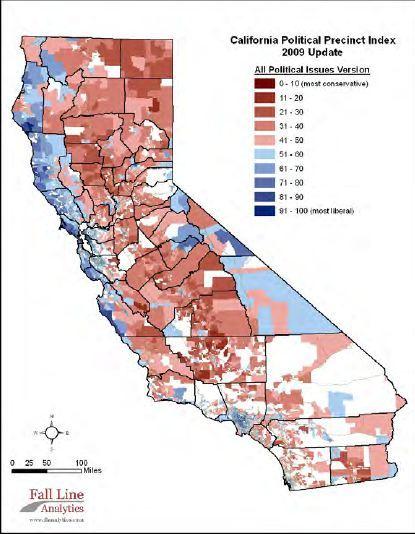
Probably not. The voters confirmed that the job of drawing new district lines next spring will be done by an independent (and unaccountable) commission whose makeup will not reflect California’s. (Five Republicans and five Democrats in a state where Democrats far outnumber Republicans?) But Brian at Calitics makes the case that it won’t matter much — and he’s hit on a really important point about California politics.


The voters have already gerrymandered themselves, in a sense. The liberals tend to live with liberals, the conservatives with conservatives. And any reasonably compact, fair district lines will reflect that.


In fact, the Fall Line Analytics map that Calitics cites makes an excellent case for splitting California into two or three states — one along the coast from Sonoma to Los Angeles, one in the Central Valley (including San Diego) and perhaps a third including the far-northern counties, which have wanted to secede for a while anyway. Then the coastal residents could have a progressive state with taxes on the wealthy to fund services, and the conservatives can try to survive in a low-tax heaven of their own. (And if you really think wealthy people will leave San Francisco and Silicon Valley and L.A. to move to Fresno for lower taxes, you’re as crazy as some of our blog trolls.)


The interesting twist on this all, though, is that there’s pretty good evidence that the population in California has shifted somewhat away from the coasts in the last decade and moved somewhat inland. Which means that Los Angeles and the Bay Area may wind up losing Congressional and state Legislative seats to the traditionally more conservative areas.


The data also suggests, though, that a lot of the new residents of the inland areas are Latino — and the way that Latino vote breaks may play a far more significant role than the redistricting commission.


Questions for the next mayor

19

 The progressives on the Board of Supervisors are a long way from united on a possible mayoral candidate, and if they can’t come together, the person who finishes Gavin Newsom’s term will be a compromise candidate, either a short-term caretaker (not the greatest option) or someone who’s more in the moderate camp but a candidate the left can work with for 2011 and possibly four years after that.

We’re glad to see the proposal by Sup. John Avalos to begin the mayoral selection process early. Picking a mayor in a mad scramble on the day Newsom steps down is a recipe for chaos and potentially a bad outcome. And as the process begins, the last thing the city needs is a mayor chosen through a backroom deal.

But it’s entirely appropriate for progressive board members to set some standards and to ask the people who are angling for the job to make clear exactly what their positions would be on key policy issues.

In other words, anyone who wants to be the interim mayor and possibly mayor for the next five years or longer should have to answer, directly and without hedging, question like these:

How much new revenue does San Francisco need to solve its budget problems, and where, specifically, should it come from? This is the central issue facing the city, now and for the indefinite future. San Francisco’s budget has a structural deficit of at least $250 million, and it simply can’t be closed by cuts alone. What taxes will you pledge to support and put political capital and fundraising clout behind when they go on the ballot?

What specific programs ought to be cut? Everyone likes to talk about the city living within its means, but that ends up leading to a series of death-by-1,000-cuts decisions that year after year devastate services to the poor. Don’t tell us you need to look at budget figures and work it out later; the big-ticket items are no secret. What’s on the chopping block and what isn’t?

Will you work to promote public power? How will you expedite community choice aggregation, and will you support a ballot measure to replace Pacific Gas and Electric Co. with a full-scale municipal electric utility?

What are your law enforcement priorities? If money’s tight, should the San Francisco police be hassling nightclubs, or should more resources go into the homicide division? How important are foot patrols, and which neighborhoods should get them? Will the SFPD and juvenile authorities continue to turn young people over to federal immigration authorities?

Who should pay to fix Muni? Should the burden of paying for the transit system fall primarily on the riders (through fare increases and reduced services) or should big downtown businesses and retailers (the major beneficiaries of the system) pay more? Should car owners pay higher fees (including parking fees and congestion management fees) to subsidize transit? Which specific fees would you be willing to push for?

Who should the city build housing for? Right now, much of the new housing stock is aimed at the very rich and San Francisco is turning into a bedroom community for Silicon Valley. Would you set housing policy to conform with the city’s General Plan assertion that more than half of all new housing should be below market rate? How would you make that balance happen? Should the city spend a significant amount of money for affordable housing, and who should pay for it?

Do you agree that public sector jobs are as important as private sector jobs in San Francisco? Would you support the tax plan proposed by Sup. David Chiu?

Do you support giving the supervisors appointments to all major commissions?

Do you think the city should be doing more to stop TICs and condo conversions and to preserve existing rental housing?

That’s just the beginning of a long list of questions but the progressives and other supervisors  on the board should make sure they have answers before agreeing to support anyone, as a caretaker or interim mayor.


SFBG Radio: The great political disconnect

4

In today’s episode, we ask: If the polls show that some 75 percent of the American people think Congress ought to raise taxes on the rich and cut defense spending, why doesn’t either party talk about it seriously? Listen after the jump.

sfbgradio11/1/2010 by endorsements2010

Music Listings

0

Music listings are compiled by Cheryl Eddy. Since club life is unpredictable, it’s a good idea to call ahead to confirm bookings and hours. Prices are listed when provided to us. Submit items for the listings at listings@sfbg.com. For further information on how to submit items for the listings, see Weekly Picks.

WEDNESDAY 10

ROCK/BLUES/HIP-HOP

Bobs Café Du Nord. 8pm, $24.

Chicago Afrobeat Band Boom Boom Room. 9:45pm, $8.

Delorean, Lemonade, Butterfly Bones Great American Music Hall. 8pm, $16.

Grinn and Barrett, Coyotes, Red Light Circuit El Rio. 8pm, $5.

Have Special Power, Poison Control Center, Guitar vs. Gravity Elbo Room. 9pm, $7.

Derick Hughes Biscuits and Blues. 8pm, $16.

Gregg Laswell, Harper Blynn Independent. 8pm, $15.

Mae, Terrible Things, Windsor Drive Bottom of the Hill. 8pm, $14.

Terry Malts, Devon Williams, Lilac Hemlock Tavern. 9pm, $6.

Personal and the Pizzas, Natural Child, Wrong Words Rickshaw Stop. 8pm, $10.

Slick Rick Yoshi’s San Francisco. 8pm, $25.

Stars, Delays Fillmore. 8pm, $27.50.

DANCE CLUBS

Booty Call Qbar, 456 Castro, SF; www.bootycallwednesdays.com. 9pm, $3. Jualina More!, Joshua J, and guests spin booming, booty-shaking beats.

Fixup 222 Hyde; www.fixupsf.com. 9:30pm, $5. Bass music monthly with special guest Submerse.

Hands Down! Bar on Church. 9pm, free. With DJs Claksaarb, Mykill, and guests spinning indie, electro, house, and bangers.

Jam Fresh Wednesdays Vessel, 85 Campton, SF; (415) 433-8585. 9:30pm, free. With DJs Slick D, Chris Clouse, Rich Era, Don Lynch, and more spinning top40, mashups, hip hop, and remixes.

Mary-Go-Round Lookout, 3600 16th St, SF; (415) 431-0306. 10pm, $5. A weekly drag show with hosts Cookie Dough, Pollo Del Mar, and Suppositori Spelling.

Mods vs. Rockers Make-Out Room. 9pm. With Nectarine Pie and mod, garage, punk, and new wave DJs.

RedWine Social Dalva. 9pm-2am, free. DJ TophOne and guests spin outernational funk and get drunk.

Respect Wednesdays End Up. 10pm, $5. Rotating DJs Daddy Rolo, Young Fyah, Irie Dole, I-Vier, Sake One, Serg, and more spinning reggae, dancehall, roots, lovers rock, and mash ups.

Synchronize Il Pirata, 2007 16th St, SF; (415) 626-2626. 10pm, free. Psychedelic dance music with DJs Helios, Gatto Matto, Psy Lotus, Intergalactoid, and guests.

THURSDAY 11

ROCK/BLUES/HIP-HOP

Leila Broussard, Bess Rogers, Allison Weiss Hotel Utah. 8pm, $10.

Marc Broussard Yoshi’s San Francisco. 8pm, $30.

Collie Buddz and New Kingston, Los Rakas Independent. 9pm, $30.

Candy Claws, Chain Gang of 1974, Blackbird Blackbird Rickshaw Stop. 8pm, $12.

Ghostface Killah, Sheek Louch, Music by Frank Dukes Slim’s. 9pm, $22.

Jack Grisham and the West Coast Dudes, Stagger and Fall Thee Parkside. 9pm, $10-12.

Mayer Hawthorne and the County, Gordon Voidwell Bimbo’s 365 Club. 8pm, $16.

Mental 99 El Rio. 7pm, free.

RJ Mischo Biscuits and Blues. 8pm, $16.

Nitzer Ebb, //Tense//, Soft Metals, Terminal Twilight Mezzanine. 8:30pm, $20.

Taxes, Fake Your Own Death, Kill Moi, DJ Ted Bagel Radio Bottom of the Hill. 9pm, $10.

Tyrone Wells, Andrew Belle, Crown Point Café Du Nord. 8pm, $18.

Yo Mama’s Big Fat Booty Band Boom Boom Room. 9:30pm, $8.

Zoobombs, Uzi Rash, Cruddy Hemlock Tavern. 9pm, $6.

DANCE CLUBS

Afrolicious Elbo Room. 9:30pm, $10. DJs Pleasuremaker and Señor Oz with special guest Black Pearl 504 spin Afrobeat, tropicália, electro, samba, and funk.

CakeMIX SF Wish, 1539 Folsom, SF; www.wishsf.com. 10pm, free. DJ Carey Kopp spinning funk, soul, and hip hop.

Caribbean Connection Little Baobab, 3388 19th St, SF; (415) 643-3558. 10pm, $3. DJ Stevie B and guests spin reggae, soca, zouk, reggaetón, and more.

Drop the Pressure Underground SF. 6-10pm, free. Electro, house, and datafunk highlight this weekly happy hour.

Good Foot Som., 2925 16th St, SF; (415) 558-8521. 10pm, free. With DJs spinning R&B, Hip hop, classics, and soul.

Jivin’ Dirty Disco Butter, 354 11th St., SF; (415) 863-5964. 8pm, free. With DJs spinning disco, funk, and classics.

Kissing Booth Make-Out Room. 9pm, free. DJs Jory, Commodore 69, and more spinning indie dance, disco, 80’s, and electro.

Koko Puffs Koko Cocktails, 1060 Geary, SF; (415) 885-4788. 10pm, free. Dubby roots reggae and Jamaican funk from rotating DJs.

Mestiza Bollywood Café, 3376 19th St, SF; (415) 970-0362. 10pm, free. Showcasing progressive Latin and global beats with DJ Juan Data.

Motion Sickness Vertigo, 1160 Polk, SF; (415) 674-1278. 10pm, free. Genre-bending dance party with DJs Sneaky P, Public Frenemy, and D_Ro Cyclist.

Peaches Skylark, 10pm, free. With an all female DJ line up featuring Deeandroid, Lady Fingaz, That Girl, and Umami spinning hip hop.

Roger Sanchez Vessel. 9:30pm, $10-20. “The Return of House Tour” with Sidney Samson.

Wax Candy Ambassador, 673 Geary, SF; www.ambassador415.com. 9pm, free. Disco-licious party jams with Andre Lucero, Worker, Travis Dalton, and Sergio.

FRIDAY 12

ROCK/BLUES/HIP-HOP

“Bohemian Carnival” DNA Lounge. 9pm, $20. With Vau de Vire Society, Gooferman, Bambi Killers, and DJ Smoove.

Doomtree, POS, Dessa, Sims, Cecil Otter, Mike Mictlan, Lazerbeak, Paper Tiger, Rec-League Slim’s. 9pm, $15.

Emmitt-Nershi Band, Hot Buttered Rum Special String Band Independent. 9pm, $25.

Holy Shit, Bitter Honeys Knockout. 9pm, $7.

Talib Kweli Yoshi’s San Francisco. 8 and 10pm, $26.

Mayday Parade, Breathe Carolina, Every Avenue, Artist vs. Poet, Go Radio Regency Ballroom. 6pm, $20.

Narrows, Skinwalker, New Trust Bottom of the Hill. 10pm, $12.

Charles Neville, Youssoupha Sidibe and the Mystic Rhythms Coda. 9pm, $17.

Nosaj Thing, Toro Y Moi, Jogger Rickshaw Stop. 9pm, $18.

Number Prophets, Pebble Theory, Heart Touch Hotel Utah. 9pm, $8.

Rod Piazza and Mighty Flyers Biscuits and Blues. 8pm, $22.

Rocket Summer: Bruce Avary, his instruments and your voices, He Is We, Travis Hayes and An-Nhein Le Thee Parkside. 9pm, $15.

Le Serpent Rouge, Mardi Love and Zoe Jakes, Brass Menazeri Great American Music Hall. 9pm, $21.

Sista Sekunden, Roller, Lecherous Gaze, Fast Asleep Submission, 2183 Mission, SF; www.sf-submission.com. 9pm, $8.

This Charming Band, For The Masses Café Du Nord. 9:30pm, $12.

Young Offenders, Northern Towns, Sydney Ducks Hemlock Tavern. 9:30pm, $7.

JAZZ/NEW MUSIC

Paul Dresher Ensemble ODC Theater, 3153 17th St, SF; www.odctheater.org. 8pm, $18.

SF Jazz High School All-Stars Concert Jewish Community Center, 3200 California, SF; www.sfjazz.org. 8pm, $5-15.

3 Leg Torso Red Poppy Art House. 8pm, $15.

FOLK/WORLD/COUNTRY

Hobbyhorse Red Vic, 1665 Haight, SF; www.myspace.com/redvicsessions. 7:45pm, $2.

Marco Periera and Brasil Guitar Duo Herbst Theatre, 401 Van Ness, SF; www.omniconcerts.com. 8pm, $24-38.

DANCE CLUBS

Exhale, Fridays Project One Gallery, 251 Rhode Island, SF; (415) 465-2129. 5pm, $5. Happy hour with art, fine food, and music with Vin Sol, King Most, DJ Centipede, and Shane King.

Fat Stack Fridays Koko Cocktails, 1060 Geary, SF; (415) 885-4788. 10pm, free. With rotating DJs B-Cause, Vinnie Esparza, Mr. Robinson, Toph One, and Slopoke.

Fo’ Sho! Fridays Madrone Art Bar. 10pm, $5. DJs Kung Fu Chris and Makossa spin rare grooves, soul, funk, and hip-hop classics.

Fubar Fridays Butter, 354 11th St., SF; (415) 863-5964. 6pm, $5. With DJs spinning retro mashup remixes.

Good Life Fridays Apartment 24, 440 Broadway, SF; (415) 989-3434. 10pm, $10. With DJ Brian spinning hip hop, mashups, and top 40.

Heartical Roots Bollywood Café. 9pm, $5. Recession-friendly reggae.

Hot Chocolate Milk. 9pm, $5. With DJs Big Fat Frog, Chardmo, DuseRock, and more spinning old and new school funk.

Rockabilly Fridays Jay N Bee Club, 2736 20th St, SF; (415) 824-4190. 9pm, free. With DJs Rockin’ Raul, Oakie Oran, Sergio Iglesias, and Tanoa “Samoa Boy” spinning 50s and 60s Doo Wop, Rockabilly, Bop, Jive, and more.

Some Thing The Stud. 10pm, $7. VivvyAnne Forevermore, Glamamore, and DJ Down-E give you fierce drag shows and afterhours dancing.

Strictly Video 111 Minna. 9pm, $10. With VDJs Shortkut, Swift Rock, GoldenChyld, and Satva spinning rap, 80s, R&B, and Dancehall.

Treat Em Right Elbo Room. 10pm, $5. Hip-hop, funk, and more with DJs Vinnie Esparza and B. Cause, plus guest Primo.

SATURDAY 13

ROCK/BLUES/HIP-HOP

Blisses B, Tyler Matthew Smith, Vandella Café Du Nord. 9:30pm, $10.

Cat Party, Pins of Light Bender’s, 800 S. Van Ness, SF; www.bendersbar.com. 10pm, $5.

Dead to Me, Cobra Skulls, Thousand Watt Stare, Invalids Thee Parkside. 9pm, $10.

Full On Flyhead, Stomacher, Swoon, Nosebleed Academy Slim’s. 9pm, $14.

Hank IV, Carlton Melton, Circle Pit, Outlaw Bottom of the Hill. 9pm, $10.

Hot Lunch, Spider Fever, Harderships El Rio. 9pm, $7.

Junip, Sharon Van Etten Independent. 9pm, $20.

Talib Kweli Yoshi’s San Francisco. 8 and 10pm, $26.

Charles Neville, Youssoupha Sidibe and the Mystic Rhythms Coda. 10pm, $17.

Over the Rhine, Lucy Wainwright Roche Great American Music Hall. 9pm, $25.

Sista Monica Biscuits and Blues. 8pm, $22.

Trophy Fire, Ash Reiter, Foolproof Four Hemlock Tavern. 9:30pm, $7.

Two Headed Spy, Deeper, Thumper, Cold Steel Renegade Hotel Utah. 9pm, $8.

Dean Wareham Fillmore. 9pm, $25.

JAZZ/NEW MUSIC

Jazz Mafia, Realistic Orchestra, Latryx Mezzanine. 9pm, $20.

Jazz Sawyer 3rio Coda. 7-9pm, $5.

Paul Dresher Ensemble ODC Theater, 3153 17th St, SF; www.odctheater.org. 8pm, $18.

3 Leg Torso San Francisco Museum of Modern Art, 151 Third St, SF; www.ticketweb.com. 10am, $5-18.

FOLK/WORLD/COUNTRY

Banda de Turistas, Pacha Massive Elbo Room. 4pm, $5.

Broceliande Seventh Avenue Performances, 1329 Seventh Ave, SF; www.sevenperforms.org. 7:30pm, $15-20.

Go Van Gogh Café International, 508 Haight, SF; www.cafeinternational.com. 7pm.

Slavic Soul Party! Swedish American Hall (above Café Du Nord). 8pm, $30.

DANCE CLUBS

Bar on Church 9pm. Rotating DJs Foxxee, Joseph Lee, Zhaldee, Mark Andrus, and Nuxx.

Bootie DNA Lounge. 9pm, $6-12. Mash-ups with guest DJ Axel.

Frolic Stud. 9pm, $3-7. DJs Dragn’Fly, NeonBunny, and Ikkuma spin at this celebration of anthropomorphic costume and dance. Animal outfits encouraged.

Prom Milk. 9pm, $8. Wave not Wave DJs Jacob Fury and Mario Muse spin rock ‘n’ roll at this prom-themed dance party.

Rock City Butter, 354 11th St., SF; (415) 863-5964. 6pm, $5 after 10pm. With DJs spinning party rock.

Same Sex Salsa and Swing Magnet, 4122 18th St, SF; (415) 305-8242. 7pm, free.

Spirit Fingers Sessions 330 Ritch. 9pm, free. With DJ Morse Code and live guest performances.

Spotlight Siberia, 314 11th St, SF; (415) 552-2100. 10pm. With DJs Slowpoke, Double Impact, and Moe1.

Tormenta Tropical Elbo Room. 10pm. Electro cumbia with DJs Spoke Mathambo and Mshini Wam, Zuzuka Poderosa, Disco Shawn and Oro 11, and Panamami.

SUNDAY 14

ROCK/BLUES/HIP-HOP

Macy Blackman and the Mighty Fines Biscuits and Blues. 8pm, $15.

Cornershop, Tyde, Mar Carroll Independent. 8pm, $25.

High Places, Soft Circle, Sun Bottom of the Hill. 9pm, $10.

Erin Mckeown Café Du Nord. 8pm, $15.

Nile, Ex Deo, Psycroptic, Keep of Kalessin Slim’s. 7:30pm, $30.

Tennis, Eulogies Hotel Utah. 9pm, $8.

Thralls, Reverse Dotty, Spiro Agnew Hemlock Tavern. 9pm, $6.

JAZZ/NEW MUSIC

Sepia Yoshi’s San Francisco. 8pm, $22.

Vijay Iyer Trio Yerba Buena Center for the Arts, 701 Mission, SF; www.sfjazz.org. 7pm, $30-50.

FOLK/WORLD/COUNTRY

Rosanne Cash Palace of Fine Arts Theatre, 3301 Lyon, SF; www.sfjazz.org. 7pm, $25-65.

Hammerlock, K-9 Thee Parkside. 4pm, free.

DANCE CLUBS

DiscoFunk Mashups Cat Club. 10pm, free. House and 70’s music.

Dub Mission Elbo Room. 9pm, $6. Dub, dubstep, roots, and dancehall with DJ Sep, J Boogie, and guest Spliff Skankin’.

Gloss Sundays Trigger, 2344 Market, SF; (415) 551-CLUB. 7pm. With DJ Hawthorne spinning house, funk, soul, retro, and disco.

Hacienda Deco Lounge, 510 Larkin, SF; www.decosf.com. 10pm, $3. Classic electronic tracks with DJs Inquilab, Robots in Heat, Tristes Tropiques, and guest Chris Orr.

Honey Soundsystem Paradise Lounge. 8pm-2am. “Dance floor for dancers – sound system for lovers.” Got that?

Pachanga Coda. 5pm, $10. Salsa with DJs Fab Fred and Antonio, plus Orquesta La Moderna Tradición.

Play T-Dance DNA Lounge. 5pm-midnight, $25. House with DJ Rich Russ and DJ John LePage.

Swing Out Sundays Rock-It Room. 7pm, free (dance lessons $15). DJ BeBop Burnie spins 20s through 50s swing, jive, and more.

Tensnake Public Works, 161 Erie, SF; www.publicsf.com. 9pm, $10. Cosmic disco.

MONDAY 15

ROCK/BLUES/HIP-HOP

Alejandro Chavez, Korelenko, Upwords Movement El Rio. 7pm, $7.

Pomegranates, Oh No Oh My, Big Tree Rickshaw Stop. 8pm, $10.

Rattlesnakes, Silent Comedy, Scrote with Stripminers, Pink Snowflakes Elbo Room. 9pm, $7.

Someone Still Loves You Boris Yeltsin, Lonely Forest, Alright Bottom of the Hill. 9pm, $10.

Thermals, Night Marchers, White Fang Independent. 8pm, $16.

Nico Vega, Imagine Dragons, Saint Motel Café Du Nord. 8pm, $10.

DANCE CLUBS

Black Gold Koko Cocktails, 1060 Geary, SF; (415) 885-4788. 10pm-2am, free. Senator Soul spins Detroit soul, Motown, New Orleans R&B, and more — all on 45!

Krazy Mondays Beauty Bar. 10pm, free. With DJs Ant-1, $ir-Tipp, Ruby Red I, Lo, and Gelo spinning hip hop.

M.O.M. Madrone Art Bar. 6pm, free. With DJ Gordo Cabeza and guests playing all Motown every Monday.

Death Guild DNA Lounge. 9:30pm, $3-5. Gothic, industrial, and synthpop with Decay, Joe Radio, and Melting Girl.

Manic Mondays Bar on Church. 9pm. Drink 80-cent cosmos with Djs Mark Andrus and Dangerous Dan.

Musik for Your Teeth Revolution Café, 3248 22nd St., SF; (415) 642-0474. 5pm, free. Soul cookin’ happy hour tunes with DJ Antonino Musco.

Network Mondays Azul Lounge, One Tillman Pl, SF; www.inhousetalent.com. 9pm, $5. Hip-hop, R&B, and spoken word open mic, plus featured performers.

Skylarking Skylark. 10pm, free. With resident DJs I & I Vibration, Beatnok, and Mr. Lucky and weekly guest DJs.

TUESDAY 16

ROCK/BLUES/HIP-HOP

Bright Blues, Drums and Color, Moonshine and the Drugs Hemlock Tavern. 9pm, $6.

Cermak, Califia El Rio. 7pm, free.

Curse of Panties, Red Light Mind, Stowaways Hotel Utah. 9pm, $6.

Fat Tuesday Band Biscuits and Blues. 8pm, $15.

Generalissimo, Pegataur, Nero Order Café Du Nord. 8:30pm, $10.

Margot and the Nuclear So and Sos, Jookabox, Burnt Ones Great American Music Hall. 8pm, $16.

Bruno Mars, Donnis Slim’s. 8pm, $19.

Perfect Circle Fillmore. 8pm, $40.

Sole and the Skyrider Band, Egadz and Edison, Epcot, DJ Bomarr Bottom of the Hill. 9pm, $10.

Twiztid, Blade, Mclordz and Sauce Funky, Kung Fu Vampire Regency Ballroom. 7:30pm, $23.

Vaccuum, Unlearn, Kruel, Neo Cons Knockout. 9:30pm, $5.

DANCE CLUBS

Alcoholocaust Presents Argus Lounge. 9pm, free. With DJ Ken Prank and DJ Grenadine.

Brazilian Wax Elbo Room. 9pm, $7. With Samba de Raiz featuring Jorge Alabe, plus DJs Carioca and P-Shot.

Eclectic Company Skylark, 9pm, free. DJs Tones and Jaybee spin old school hip hop, bass, dub, glitch, and electro.

Share the Love Trigger, 2344 Market, SF; (415) 551-CLUB. 5pm, free. With DJ Pam Hubbuck spinning house.

Womanizer Bar on Church. 9pm. With DJ Nuxx.

Dodging bullets

14

steve@sfbg.com

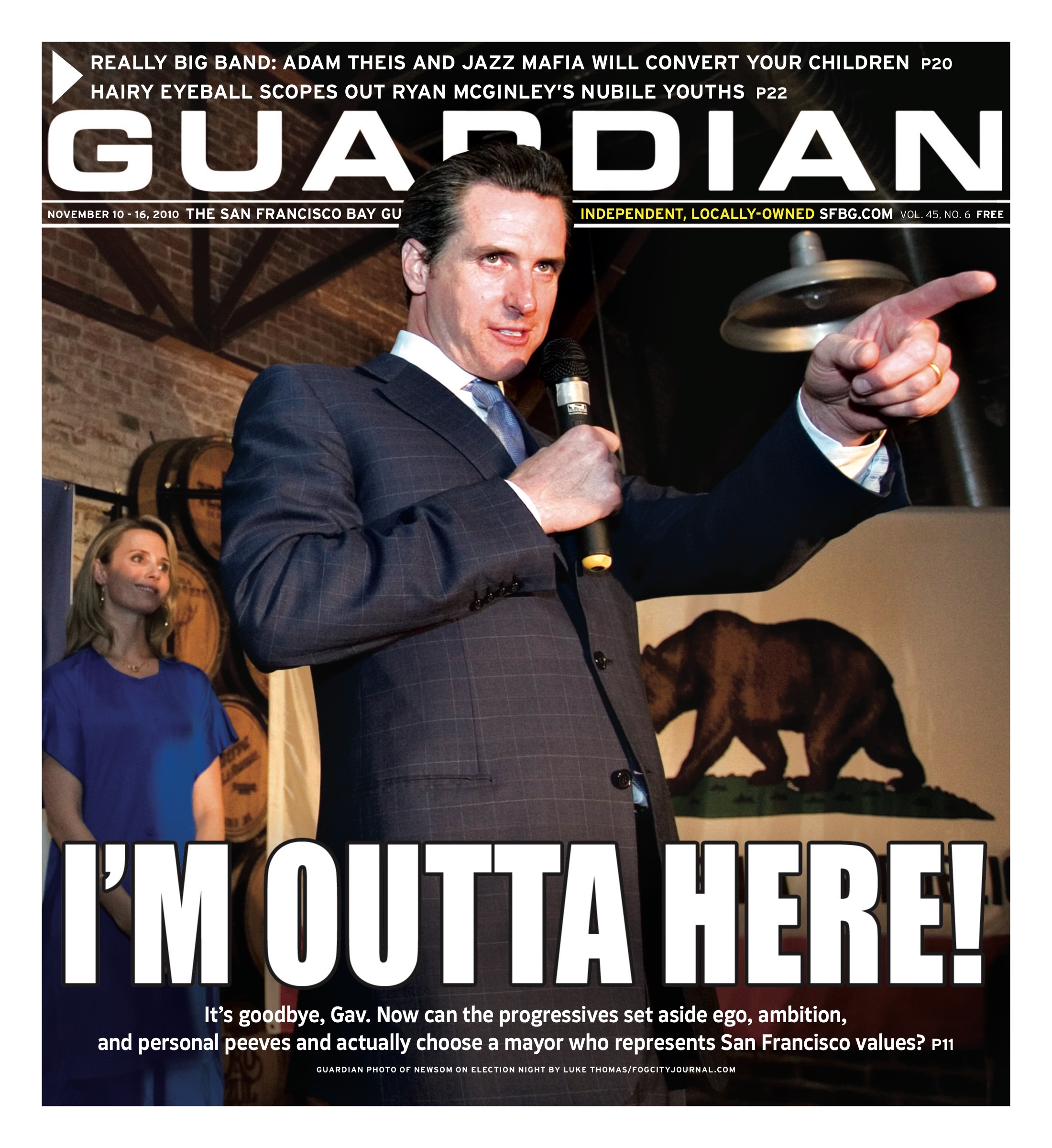
Progressives in San Francisco dodged a few bullets on election night, which was the highest hope that many held in a campaign season dominated by conservative money and messaging. The Board of Supervisors retained a progressive majority, Prop B’s attack on public employees went down, the wealthy will pay more property transfer taxes, and — perhaps the best news of all — Gavin Newsom is leaving for Sacramento a year before his mayoral term ends.

But economically conservative and downtown-backed campaigns and candidates scored the most election-night victories in San Francisco, killing a temporary hotel tax hike pushed hard by labor and several progressive-sponsored ballot measures, and winning approval for the divisive sit-lie ordinance and Prop. G, removing Muni driver pay guarantees, which had the widest margin of the night: 65-35 percent.

“Ultimately, downtown did well,” progressive political consultant Jim Stearns told us on election night, noting how aggressive spending by downtown business and real estate interests ended a string of progressive victories in the last several election cycles. He cited the likely election of Scott Wiener in District 8 and the strong challenge in District 2 by Mark Farrell to perceived frontrunner Janet Reilly, who had progressive and mainstream endorsements.

A preliminary Guardian analysis of reported spending by independent expenditure committees shows that groups affiliated with downtown or supporting more conservative candidates spent about $922,435, the biggest contributions coming from conservative businessman Thomas Coates and the San Francisco Board of Realtors, compared to $635,203 by more progressive organizations, mostly the San Francisco Democratic Party and San Francisco Labor Council.

That spending piggy-backed on national campaigns that were also skewed heavily to conservative and corporate-funded groups and messaging that demonized government and public employee unions, playing on people’s economic insecurities during a stubborn recession and jobless recovery.

Stearns said voters are having a hard time in this economy “and they don’t like to see the government spending.” He said national polls consistently show that people are more scared of “big government” than they are “big corporations,” even if San Francisco progressives tend to hold the opposite view.

And even that narrow defeat came after an almost unprecedented opposition campaign that included every elected official in San Francisco except the measure’s sponsor, Public Defender Jeff Adachi, and both the labor movement and many moderate groups.

“The campaign on this was extraordinary and caught fire at the end,” Alex Clemens, founder of Barbary Coast Consulting, said at SPUR’s Nov. 4 election wrap-up event. In particular, the message about how much Prop B would increase the health care costs on median-income city employees seemed to resonate with voters.

“We are really happy that Prop. B is going down because it was such a misguided measure. It was not well thought through,” Labor Council President Tim Paulson told the Guardian at the election night party labor threw with the San Francisco Democratic Party at Great American Music Hall. “San Francisco voters are the smartest in America.”

Paulson was also happy to see those voters approve taxing the transfer of properties worth more than $5 million, “because San Franciscans know that everyone has to pay their fair share.”

In the Board of Supervisors races, it was basically a status quo election that shouldn’t alter the body’s current politics dynamics much. Sup. Bevan Dufty will be replaced with fellow moderate Scott Wiener in D8 and Sup. Chris Daly by progressive Jane Kim in D6. The outcome of races to replace ideological wobbler Sup. Sophie Maxwell in D10 and conservative Michela Alioto-Pier in D2 may not be conclusively known for at least a few more days (maybe longer if the close races devolve into lawsuits), but neither is a seat that would diminish the board’s progressive majority.

Progressives could have made a gain if Rafael Mandelman had won in D8, but he was seven points behind Wiener on election night and even more after the initial ranked choice tally was run on Nov. 5. And in D6, fears that downtown-backed candidate Theresa Sparks might sneak past dueling progressive candidates Jane Kim and Debra Walker never materialized as Sparks finished far behind the lefty pair.

Consultant David Latterman, who worked for Sparks, told us on election night that he was surprised to see that Kim was the choice of 32 percent of early absentee voters “because we targeted those voters.” By comparison, Walker was at 20 percent and Sparks was at 21 percent in the initial returns, which tend to be more conservative. By the end of the night, Kim had 31.3 percent, Walker 27.7 percent, and Sparks just 16.5 percent.

“If she did that well with absentees, it seems like it was Jane’s race to win. If they choose Jane, they wanted Jane. It’s just that simple,” Latterman told us on election night.

At her election night party, Kim credited her apparent victory to a strong campaign that she said fielded 400 volunteers on Election Day, most wearing the bright red T-shirts that read “See Jane Run” on the back. “I feel good,” Kim told the Guardian. “What I’m really happy about is we ran a really good campaign.”

In the end, Kim’s campaign was put over the top by the second-place votes of Sparks’ supporters, with 769 votes going to Kim and 572 to Walker in the first preliminary run of ranked-choice voter tabulations. But despite the bad blood that developed between progressives in the Kim and Walker campaigns, Board President David Chiu, an early Kim supporter, sounded a conciliatory note, telling the Guardian on election night, “Given where Debra and Jane are, I’m glad that we’re going to keep this a progressive seat.”

Election over, what next?

0

Dick Meister is a San Francisco-based columnist who has covered political and labor issues for a half-century as a reporter, editor , author and commentator. Visit him at his website, www.dickmeister.com.

OK, the election is over and labor, Democrats and the other good guys came up a bit short. But what now? What next for the good guys?

 Well, for starters, organized labor and its Democratic Party allies must be ready to block Republican plans to try to enact legislation that would cut taxes for the very wealthy, slash Medicare funding, and possibly even privatize Social Security. I know that may sound alarmist and far-fetched. But that’s what Republican leaders are actually talking about.

After all, the GOP’s anti-labor corporate allies spent nearly a billion dollars on the election and they damn well want their money’s worth.  Larry Cohen, president of the communications workers union, thinks it’s getting like the way elections were 100 years ago when the big trusts and robber barons made sure their voices were the only ones heard during election campaigns.

Not yet, Larry. Not quite. Unions were able to make a lot of highly effective noise that helped elect some important pro-labor Democrats and defeat several Tea Party candidates and other anti-labor wackos who argued, as the AFL-CIO’s Mike Hall notes, “that government should do nothing to improve the economy or protect working families during the worst economic crisis since the Great Depression.”

Let’s me take a little closer look at how the election went for organized labor and its political friends in two of the country’s most important states politically, numbers one and two in population, California and Texas.

In California, as the AFL-CIO says, unions were a key factor propelling notably pro-labor Democrat Jerry Brown to the governorship and pro-labor Democrat Barbara Boxer to a third term in the Senate. Those victories were especially sweet, since the opponents of Governor-elect Brown and Senator Boxer were former business executives with tons of money, including their own, to spend on their campaigns.

Former eBay CEO Meg Whitman spent more than $141 million of her own money on her losing campaign against Jerry Brown for governor. And though Carly Fiorina, former Hewlett-Packard CEO, spent several million of her own money on her campaign, the total was nowhere near the obscene amount that Whitman pulled from her own pocket for her campaign.

Anyway, Meg Whitman lost, and good for Californians for making that happen.  Labor couldn’t imagine a worse anti-labor governor than Meg Whitman, or more labor-friendly governor than Jerry Brown, a worse anti-labor senator than Carly Fiorini, or more labor-friendly senator than Barbara Boxer.

It was a bit different in most other states. As Executive Director Rose Ann DeMoro of the California Nurses Association notes, the election of Democratic, pro-labor candidates in California “provided a national alternative to the conservative, corporate-oriented economic program that won so many other races nationwide.”

DeMoro praised California’s voters “for seeing through the fool’s gold promises that the path to economic recovery and job creation is through corporate tax breaks and shifting more wealth and resources to those who need it the least.”

The news isn’t so good out of Texas, where, as Jim Lane of the People’s World  says, “the second largest delegation to the U.S. House of  Representatives, already heavily leaning to the right, tilted drastically further on November 2 – plus, many of the most popular Texas Democratic leaders were defeated.

The re-election of Gov. Rick Perry was more bad news for labor and its allies, given what the People’s World’s Lane notes as Perry’s “far-right, anti-worker vision.” Reporter Lane says “progressive Texans are not looking forward to extending the years of being shamed about their home state, as we have been since GW Bush took the national stage.”

But at least the Texas labor movement was able to run what Lane calls “a strong and largely independent political campaign.”  Unions even dared to run “one of their own,” former national AFL-CIO official Linda Chavez-Thompson, for lieutenant governor. But, as Lane notes, “Like all other statewide Democratic candidates, Chavez-Thompson’s campaign was buried by big money.”

So, what next for Texas, California – the whole country?

What’s next should be in large part to carry out what AFL-CIO and Democratic Party leaders have been advocating for many years – rebuilding of our long crumbling infrastructure

 President Obama has a plan that calls for rebuilding 150,000 miles of roads, laying and maintaining 4,000 miles of railway tracks, restoring 150 miles of airport runways and , in doing so, providing badly needed jobs for many of the country’s millions of unemployed workers.
 
That’s how labor and political leaders can – and must – begin to deliver on their election campaign promises to, above all, do what it takes to create “jobs, jobs, jobs.”

Dick Meister is a San Francisco-based columnist who has covered political and labor issues for a half-century as a reporter, editor , author and commentator. Visit him at his website, www.dickmeister.com.

Editor’s notes

0

Tredmond@sfbg.com

At a certain point, you have to stop trying to project what’s going to happen and just wait for the election results. Because what matters now isn’t the $140 million Meg Whitman has spent or Carly Fiorina’s record at Hewlett-Packard or which aide to Jerry Brown called Whitman a whore. It’s who shows up to vote.

If I were Meg Whitman’s campaign manager, I’d stop spending money. Go into hiding. Pretend there’s nothing going on here, no big deal next Tuesday morning — and then pray for rain. Because the way Whitman wins — possibly the only way she wins — is if huge numbers of Californians don’t bother to vote.

If the turnout is reasonable — that is, if enough Democrats realize the danger posed by of the GOP candidate and go to the polls — then Jerry Brown is in. And if that happens, chances are good that the rest of the Democratic ticket — including Gavin Newsom and Kamala Harris — squeaks in, too. And then we can all start to have fun figuring out the future of San Francisco politics.

That, of course, depends on the same factor: Who’s going to show up to vote? Will all the tenants in District 8 — many of them unexcited about Jerry Brown — take the time to vote for Rafael Mandelman for supervisor? Will the progressive voters who have lived in District 6 for a while get to the polls in greater numbers than the conservative newcomers in the pricey condos? Will the next Board of Supervisors — which could be choosing the next mayor — be as progressive as the current board (which also might wind up choosing the next mayor?)

And who’s even on the mayoral short list?

At the Haight Ashbury Neighborhood Council forum Oct. 14, former Supervisor (and potential mayoral contender) Aaron Peskin noted that the person in Room 200 year “is going to have to take out the garbage.” The city’s going to face another awful budget deficit and a progressive interim mayor will have to make a lot of enemies. Who wants to face the voters in November 2011 after making more cuts and raising taxes?

Well, somebody needs to — because the “caretaker” mayor some people are pushing for won’t have the clout to make tough decisions. And frankly, a progressive with the power of incumbency might actually be able to win a full term, even up against a huge downtown war chest.

Fun stuff. Go out and vote.


Chevron spends big to fool voters

4

Bay Area-based oil giant Chevron is spending millions of dollars to influence this election and protect its financial interests, most notably by being the top contributor to the Prop. 26 campaign, which would make it almost impossible for Californians to impose fees that would help pay for environmental and public health programs.

Chevron, which reported a $5.4 billion record profit in the second quarter of this year, has given $3.75 million to the Yes on 26 campaign, according to campaign spending watchdog Maplight.org, beating the California Chamber of Commerce’s $3.5 million. Other big contributors include the American Beverage Association ($2 million) and Phillip Morris tobacco company ($1.75 million). The Yes on 26 campaign has raised about $16 million compared to the opposition raising less than $5 million from groups representing teachers, environmentalists and social justice advocates.

Prop. 26 would require a two-thirds super majority for the enactment of fees by the California Legislature or by the voters in cities, counties, or special districts, which has proven almost impossible to attain in the face of aggressive corporate-funded opposition campaigns. Such a high electoral bar would cripple the state’s ability to make big polluters and global warmers like Chevron – or the makers on alcohol or tobacco products – pay for their societal impacts.

But that payout isn’t even Chevron’s most audacious move of this election season. As the Bay Citizen reports, Chevron is almost spending $1 million on independent expenditures in support of their favored City Council candidates in Richmond, a city where Chevron has a big polluting oil refinery, in the hopes of buying a more friendly political environment.

Richmond officials have in recent years tried to get Chevron to mitigate its environmental impacts to the cash-strapped city and to pay a bit more in taxes, but Chevron responded with a lawsuit seeking a $26 million rebate on the property taxes that it paid to the city in past years, including 2007, when the company posted record profits of $18.7 billion.

The soul of the city

23

tredmond@sfbg.com

44th ANNIVERSARY SPECIAL We all arrived in San Francisco broke: Paulo and me in the ’73 Capri, crawling over Donner Pass with a blown valve and three cylinders firing; Tracy and Craig in the back of a VW van, behind in the payments and on the run from the repo men; Tom and Sharon hitching across the Southwest after Tom, who could bullshit with the best, talked himself out a jail cell in New Orleans. Moak showed up in a rusty Datsun with the wheels falling off. Jane and Danny came on the old hippie bus, the Green Tortoise, $69 across the country.

But we all had a friend who knew a friend where you could crash for a little while. And in the early 1980s you got food stamps the first day and it only took a couple of weeks to get a job waiting tables or canvassing or selling trinkets on the Wharf. And once you’d scraped together a couple hundred dollars — maybe two weeks’ work — you could get a place to live. My first room in a flat in the Western Addition was $120 a month.

We did art and politics and writing and music. After a while, some of us went to law school, some of us became journalists, some of us went into government and education. A few of us fled, and Paulo died in the plague (dammit). But in the end, a lot of us were — and are — San Franciscans, part of a city that welcomed us and gave us a chance.

It was a very different time to be young in San Francisco.

I’m not here to get all nostalgic, really I’m not. There were serious problems in 1982 — raging gentrification was creating clashes in the Mission and the Haight and south of Market that were more violent than anything going on today. And frankly, broke as we were, most of my friends were from middle class homes and were college educated and had a leg up. We weren’t going to starve; we didn’t have to make really ugly choices to eat.

Most of the stories in this special anniversary issue are about marginalized youth — young people trying to survive and make their way against all odds in an increasingly hostile city and a bitter, harsh economy.

But there’s an important difference about San Francisco today, something earlier generations of immigrants didn’t face. The cost of housing, always high, has so outstripped the entry-level and nonprofit wage scale that it’s almost impossible for young people to survive in this town — much less have the time to add to its artistic and creative culture.

I met the 21-year-old daughter of a college friend the other day. She’s as idealistic as we all were. She wants to move to San Francisco for the same reasons we did and you did — except maybe she won’t. Because she felt as if she had to come visit first, to use her dad’s network, see if she could line up a job and figure out if her likely earnings would cover the cost of living. When I mentioned that I’d just up and left the East Coast and headed west, planning to figure it out when I got here, she gave me a look that was part amazement and part sadness. You just can’t do that anymore.

The odds are pretty good that San Francisco won’t get her — her talent and energy will go somewhere else, somewhere that’s not so harsh on young people. I wondered, as I do every once in a while when I’m feeling halfway between an angry political writer and an old curmudgeon: would I come to San Francisco today?

Would Harvey Milk? Would Jello Biafra? Would Dave Eggers? Would you?

If you were born here, would you stay?

Are we squandering this city’s greatest resource — its ability to attract and retain creative people?

The two people who started the Bay Guardian 44 years ago were young arrivals from the Midwest. Bruce Brugmann looked around the city room at the Milwaukee Journal, where he worked as a reporter, and realized there wasn’t any job he wanted there in 10 years. With two young kids and a dream of starting a weekly newspaper in one of the world’s most exciting cities, Bruce and his wife, Jean Dibble, settled in a $130-a-month flat. The Guardian’s first office was a desk in the printers shop. When they paper could finally afford its own space, Bruce and Jean moved the staff into a $60-a-month four-room place on Ninth and Bryant streets.

From the start, the paper was a “preservationist” publication — both in terms of environmental issues like saving the bay and in the larger political sense. The San Francisco Bay Guardian was out to save San Francisco.

The city was under assault — by the developers who were making fast money tossing high-rises into downtown; the speculators making fast money flipping property, ducking taxes, and driving up rents; the unscrupulous landlords who were letting their buildings fall apart while they charged ever higher rent. For the Guardian, fighting this urbicide meant protecting San Francisco values, preserving the best of the city from what Bruce liked to call “the radicals at the Chamber of Commerce.”

For the Guardian, progress wasn’t measured in the number of new buildings constructed, but in the ability of the city to remain a place where artists and writers and community organizers and hell-raisers — and the young people who were always bringing new life to the city — could survive. We supported rent control, and growth limits, and affordable housing policies, and limits on condo conversions, and minimum-wage and sanctuary city laws — and a long list of other things that together amounted to a progressive agenda.

And in 2010, the assault on the young, the poor, the nonconformists, the immigrants, is still on, at full force. The mayor and his allies are pushing a ballot measure that would make it illegal just to sit on the sidewalk. He’s also turning the local juvenile authorities into immigration cops, breaking up families in the process. He’s cut funding for youth services, and wants to make it easier for speculators to evict tenants, take affordable rental housing (especially the flats that young people share to save money) off the market, and create high-priced condos. Virtually all of the new housing he’s pushing is for rich people. He’s shutting down parties and arresting DJs and, in effect, declaring a War on Fun.

What he’s doing — and what the downtown forces want — is the transformation of San Francisco from a welcoming city where the weird is the normal, where the young and the crazy and the brilliant and the broke can be part of (or even drivers of) the culture, to one where profit and property values are all that matter. And that’s a recipe for urban doom.

Richard Florida’s 2004 bestseller The Rise of the Creative Class shook up political thinking by pointing out that cities thrive with iconoclasts, not organization people. Everyone likes to talk about that now, even Mayor Gavin Newsom. But the missing piece, from a policy perspective, is that the creative class — particularly the young people who are going to be the next generation of the creative class — needs space to grow. And that means the most important thing a creative city can do is nurture the very people Newsom and his allies want to drive away.

If Prop. L, the “sit-lie” law, passes, if the rental flats in the Mission that have been home to several generations of young artists, writers, musicians and future civic leaders vanish in the name of condo conversions, if 85 percent of all the new housing in San Francisco is affordable only to millionaires, if the money that helps foster kids and runaways and at-risk youth dries up because this rich city won’t raise taxes, if nightlife becomes an annoyance to be stifled…then we’re in danger of losing San Francisco.

Our 44th Anniversary Issue also includes stories by Sarah Phelan on SF’s disadvantaged youth, Caitlin Donohue’s account of the Haight street kids, and Rebecca Bowe’s look at ageing out of the foster care system