Stage

Sprinting toward Babylon

0

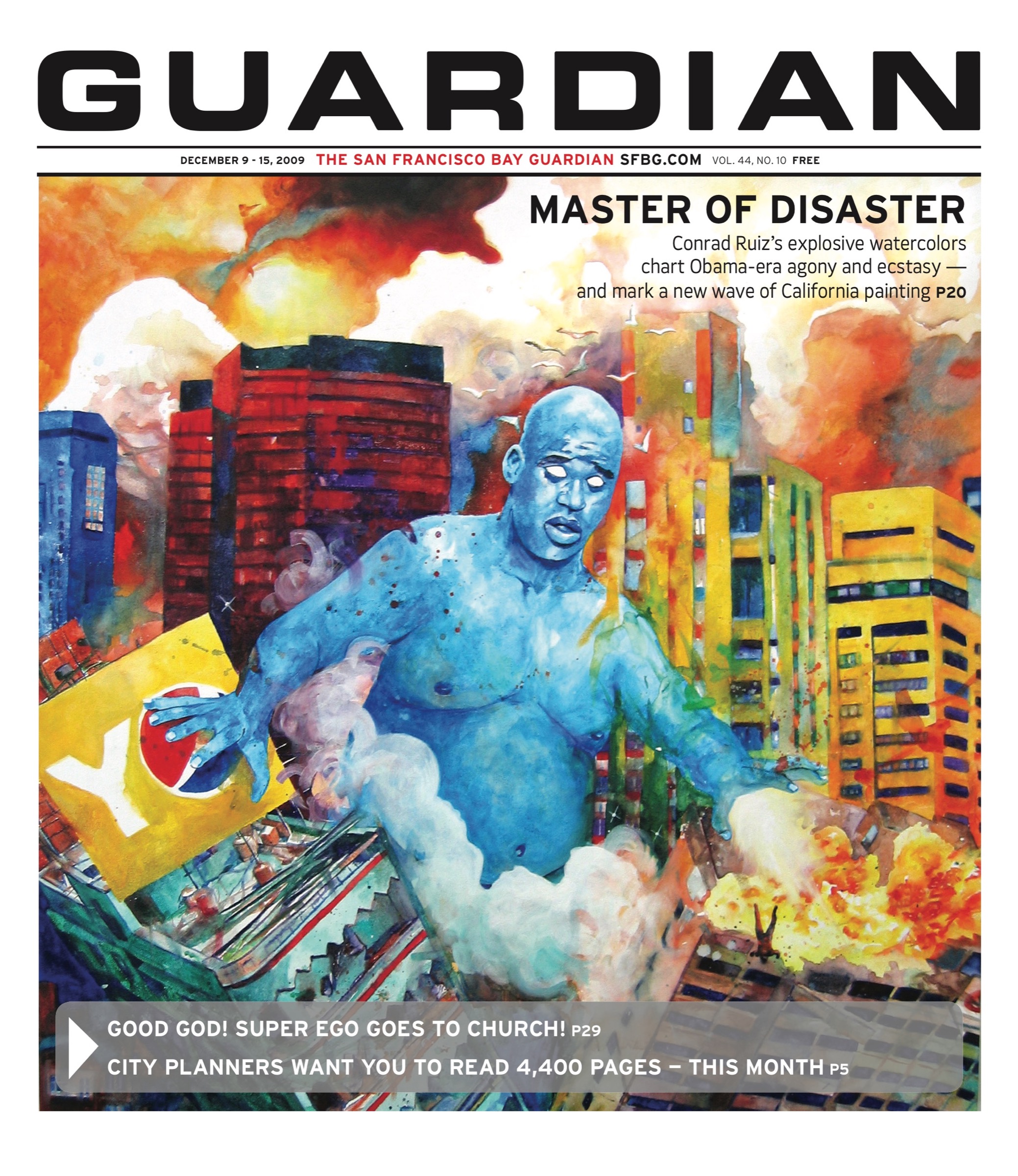
VISUAL ART I remember the first time I heard about Conrad Ruiz. I was standing by the fire on the patio of the Eagle, a spot that for me is a site of great tidings. A pair of talented San Francisco artists told me with enthusiasm about this young painter whose large-scale works depicted things like a man riding the nose of a killer whale as it burst forth from a pool, or a coach getting a golden shower of Gatorade from his triumphant team. According to their accounts, Ruiz magnified and entwined the absurdity and ecstasy of his subject matter. I had some cathartic laughs just imagining his paintings.

109-cover2.jpg
Detail from Overload. Challenger explosion not pictured.

When I first “saw” Ruiz’s art, online, it exceeded my expectations. In particular, I was blown away by Overload [2009], which among other things deserves consideration as the best piece of “Barack Obama art” to date. Panoramic and vibrant even when shrunk 25 times in size, Ruiz’s watercolor works on paper and canvas once again incited a convulsive reaction. I laughed my ass off upon seeing works such as New Fall Lineup [2009] for the first time. But the longer I looked, the more caught up in wonder I became about their myriad tiny details and teeming — at times disturbing subtextual currents.

What goes on in Ruiz’s imagination? On the eve of his first solo show, at San Francisco’s Silverman Gallery, I caught up with him as he navigated the social conflagration of Art Basel Miami, the megafair where at least one magazine tipped him as the leader of a “new generation of art stars.” Whatever one makes of that claim, Ruiz — who is also plotting some collective artistic efforts with friends — is the splashiest crest of an exciting new wave of young California painters.

SFBG How are you doing?
Conrad Ruiz I’m alright. I’m just sitting on South Beach. I wanted to find a place to gather my thoughts, and I’m watching this guy tan himself. I can’t believe he’s doing that. He’s got these great stomach muscles. [Curator and Berkeley Art Museum director] Larry Rinder and I were talking about doing sit-ups before we came here, but we both just got busy — we never did it.

Miami’s fun. I kind of wish I could take my shirt off everywhere, but I feel a little bit squishy.

SFBG It seems like your art would look good in Miami.
CR The colors are finding a home here. There are a lot of bright red and yellow bikinis around. This couple nearby are either arguing or also tanning themselves. They just sit and look at the sun, kinda like lizards.

SFBG What do you think of the Tiger Woods news frenzy right now? I wondered about your take on him. In a way, I thought he might not fit along with some of the athletic figures you depict, because golf isn’t so much about dynamism.
CR But you always hear comedians say, “Just leave it to a black American to dominate another sport.” Chris Rock essentially says, “Wait till we get on ice skates, man, we’re going to take over hockey.”

Tiger Woods has been developed into this brand, aligned with Nike. It’s a very intelligent campaign. It’s not Obama, but he’s been this person who can do no wrong. That’s the personality that has developed through whoever is handling his marketing. It’s more than his being an excellent golfer, he’s also been displayed as this great human. We don’t know that much about him, and then something like [the car accident and ensuing scandal] happens. It’s all we get, and it’s kind of sketchy, and it happened to fall on this awesome Thanksgiving weekend. I thought, “All must be right in the world if the only thing we have to talk about is Tiger Woods getting hit with a golf club by his wife.” If that’s what actually happened.

SFBG People are already Photoshopping and digitally animating visions of that.
CR That’s my job — to look up all that stuff.

109-cover1.jpg

SFBG Does 1970s cinema have any place in your mind’s eye? The Jaws [1975] shark in your painting Rough Riders [2008] and the disaster film or Towering Inferno-like [1974] quality of works like New Fall Lineup made me wonder. I could see that I might be wrong about the latter, since a flaming, exploding skyscraper has other obvious connotations.
CR My work really started with that time period and in painting advertising from that era. The colors were a lot more primary. When I was painting those advertisements, the work was more sarcastic. That beginning body of work was about developing this snarky character that evolved into what I’m making now.

It is about going back and catching some of the ridiculousness of what was so popular at one time. When you watch a disaster film now, you know the history of those celebrities. It’s hard for me to relate to that period of time, but it’s easy for me to relate to early 1990s movies like the Naked Gun franchise — O.J. Simpson was in those — and the Terminator flicks. Those are ridiculous and fun. I like them, and of course [lowers voice], that’s my Governor.

Everyone says “I hate that guy,” but even though I think [Schwarzenegger]’s doing a terrible job, I don’t want my politicians to be these people I don’t know — I’d rather have them be these celebrities I hate. If I’m going to hate who’s in office, I’d rather have it be Sylvester Stallone or somebody.

SFBG When you make work that has a contemporary element, there’s always a danger of it becoming instantly dated. But I think some of your work is both timely and ahead of its time. Overload, for example, just becomes more and more evocative.

The NASA element of the piece, with the Challenger exploding, is taking on new facets as Obama is increasingly identified with the military and space program. I saw a show at Altman Siegel Gallery by Matt Keegan earlier this year that utilized a New York Times front page photo of Obama boarding Air Force One for the first time. That’s a more direct example of what I’m talking about. Six months ago, that image had a different connotation.
CR I was really hoping Obama would get elected, because I started Overload before the election.

SFBG I have to ask about the Challenger’s presence in Overload. I was talking with the artist Colter Jacobsen recently about the fact that I’d like to put together a show of Challenger-related art. Within the art world, there are at least a dozen or so people who have incorporated the Challenger one way or another into work. That’s not even counting how it has manifested as band and album names and jokes in popular culture.
CR For me, it would be great to ask the artist about the original idea behind making a Challenger painting. Everyone has a different a point of view about what’s going on. I always feel like I’m casting with my paintings. There are these scenarios that have never happened, and since I get to decide what’s happening, I also decide who is the star —whether it’s someone from a B movie, an unsung celebrity, a friend who I’m giving a big break, or someone from a blockbuster, like Eddie Murphy and David Alan Grier.

109-cover3.jpg

Overload is a blockbuster sort of painting. I cast that [Challenger] explosion because I thought it was a very unique, amazing explosion. Once I began painting it, people began talking about its relevance, because it says something different when Obama is flying towards it, possibly causing it or stopping it.

To be very honest, I didn’t initially know it was the Challenger exploding. My Mom told me. She’s a teacher, so to her it was a terrible thing, and she asked me to really consider what I was doing. I told her, “That’s perfect.” Because to me the painting is about Obama coming to the rescue and shitting these energy projections — either he’s going to stop the war, or he causing some trouble of his own.

A few paintings later [in New Fall Lineup] I painted the Twin Towers exploding for a similar reason. I was casting this unique explosion and trying to create a different scenario with it.

SFBG I don’t often self-identify in generational terms, but when I was talking about the Challenger explosion with Colter [Jacobsen], he was saying that he had referred to it while teaching a class, and that it wasn’t even a memory for many students. Whereas for he and I, there was the teacher element, and also the fact that everyone was watching the Challenger at school that day. So as a disastrous event, it was similar to 9/11 in that the day just stopped.
CR The Challenger explosion has a lot to do with failed promise, doesn’t it? There was tremendous hope about what was about to happen, and it all fell apart in one second.

There’s an element of comedy that I’ve kind of borrowed from Richard Pryor. As I watch his stuff, it’s more like performance art. What he talked about wasn’t funny at all, it was actually horrible. He was an interesting character in that he talked about things that were definitely not right, but did so in a way that everyone would be laughing. Comedy is a way of passing serious information without being worried about the consequences. That makes it kind of a new territory. Dave Chappelle was able to say some unique and terrible things in this fun format.

SFBG It’s interesting that you bring up Chappelle, because after he hit his sort of Challenger moment on the pop culture stage and went away, Block Party [a.k.a. Dave Chappelle’s Block Party, 2006] came out.
CR That’s a beautiful movie.

SFBG It was released during the final stretch of all the jockeying for Academy Awards in Hollywood. All these talking heads were going on about which movies were important, and I remember thinking that Block Party was more important or vital and connected to the world than any of them.
CR/strong> His stuff is always about pointing out differences, and bringing together ideas of social class hierarchy. In a roundabout way, that’s what he did [in em>Block Party]. He brought together a lot of high-end artists and gave a free show. It was about giving to the people or the neighborhood. The idea of a barbecue, a barbecue block party, also has an ethnic connotation to it.

SFBG There is a lot of athletic imagery in your art, and I don’t want to reduce it to masculinity or sexuality, but I do want to ask about being drawn to those kinds of visuals, or wanting to render them.

Veronica De Jesus does some sports-oriented work that’s quite different from yours, but also has a terrific sense of humor. Sports are quite iconic — moments like an Olympic runner tumbling or Zidane’s headbutt become part of the collective consciousness. But beyond that, there’s an ecstatic, colorful, lively quality to your sports imagery.
CR Sports have always been a part of my life. My mom and dad were very athletic at one time, and they encouraged my brother and me to take part in sports. The alternative was for us to be on our own, and they knew we had a lot of Latino friends, so of course I was just going to get into trouble. So I was enrolled in soccer and taekwando. I was a sprinter in high school, and I was on the football team.

[The paintings] are a culmination of all the things you’re talking about. The outfits these athletes wear are designed to be eye-catching, with these primary colors. The Denver Broncos have that awesome dark blue with orange …

SFBG I love that combo. I just put together a sports cinema program with a film curator at Yerba Buena Center for the Arts, and when I’d introduce a movie from the 1970s, I’d always mention the athletic fashions.
CR Everything is designed to be the most freaking amazing thing possible, because these people are performing acts that no one else can do — they’re leaping through the air catching a ball thrown from very far away while wearing purple and yellow. The performance and exertion is incredible, and at the same time, what can make it even greater is being in a stadium where everyone is screaming their lungs out at the same time. Whether it’s an epic win or colossal failure, it’s still that climax. The climax doesn’t mean that it’s good — it’s a peak of performance.

When I’d meet with advisors at CCA [California College of the Arts], we’d really break it down, and they could easily talk me out of making my work. When you get down to it, what I’m doing is a little ineffective, and what would be more effective, to really get my idea across, would be to just play soccer with a group. I’d be performing, I’d be creating these intimate male relationships. I could actually be slapping some guy’s butt instead of painting around it. Joining a soccer team would be more efficient.

SFBG Maybe you and Luke [Butler, a fellow Silverman Gallery artist whose work engages with masculinity] should join a soccer team.
CR [Laughs] Yeah.

SFBG There is some commonality between your work, and also some major differences.
CR I think it’s because I’m the boy and Luke is the dashing man. I’m looking to be a man and trying to figure out what a man is, while Luke is a dashing man looking sideways.

CONRAD RUIZ: COLD, HARD AND WET
Fri/11 through Jan. 30, 2010
Silverman Gallery
804 Sutter, SF
(415) 255-9508
www.silverman-gallery.com

Monster mash note

0

a&eletters@sfbg.com

SONIC REDUCER "I’m from the underground. And I’m making pop music and I’m not a bit ashamed about it."

So sayeth Lady Gaga on the cellie last year on the way to a radio show at a Raging Waters in San Demos where she was dying to get wet. Alas, she forgot her Jellies at home and didn’t want to get her towering D Square pumps splashed ("I’ll find a private part of the park and just go in my birthday suit"). Yet I’m sure Christian Siriano could relate to this pop fashionista dilemma — regardless of whether he’d sniff at her taste-defying getups or not. After all Lady Gaga is the pantless, prep-school-bred amalgam of Carole King and Madonna reimagined as a hot tranny mess, a Gossip Girl turned Fame Monster.

OK, Gaga is no tranny, strictly speaking, though at the time she told me she was thrilled about appearing at SF’s Pride Fest ("I grew up in the dance and theater community — I’ve been surrounded by gay men and women and transgendered my whole life!"). Still, this bio queen’s obviously snatched more than a scrap of inspiration from clubland’s OTT drama kids, and she’s rough enough around the edges to make any sex bomb efforts an exercise in wise-ass deconstruction. From the gag of her "Radio Ga Ga" handle to her go-there way with the attraction-repulsion factor, Gaga is enough of a fabulous freak to embrace a gag-able frisson — I’ll be looking for that vomiting video vixen on the megascreen at her upcoming show at the newly reopened Bill Graham Dec. 14.

There’s more than a smudge of Her Dancefloor Madge-sty in the diva’s diamond-hard pop persona, wardrobe switch-ups, and workaholic drive. Lady Gaga impressed me at the time with a disarming sincerity and brusque sweetness: she was eager to be understood by serious music fans who might dismiss her as a throwaway popster. "The level of commitment and dedication it takes to put on a perfect pop show is very difficult," she exclaimed. "And I think some of the underground snobbery is fear and not understanding that discipline.

"Listen, I come from a party background and I used to party like crazy! That was a lot of my source of creativity," she continued. "But my life has changed a lot now, and I can’t do that shit. I got to go to bed, and I gotta wake up, I gotta work out, I gotta go to rehearsal. I got to pound, pound, pound, work, work, work hard so that every time I hit the stage it’s flawless. And if it isn’t flawless, I gotta work myself up to where it is — otherwise I’m just another pop chick with blonde hair."

But unlike Madonna, Gaga, like King, initially came from the flip side of the pop factory: as a songwriter, ghosting, she said, for Britney Spears and Pussycat Dolls. "I started to write pop songs mostly because I’m a classically trained pianist," she explained. "Beethoven and Bach and the structure of those classical pieces are really just rudimentary pop chord progressions. So it was something I understood." A vocal coach pointed out to her how easy it was to play a Mariah Carey tune by ear — "’It’s because you’ve been playing Bach inventions since you’ve been four, and it’s the same kind of idea’<0x2009>" — and she says, "That’s how I found out I had a knack for it, and I’ve been writing, writing, writing, since I was 13 years old."

Those skills came in handy when she started playing piano to beats in her undies at clubs in New York City’s Lower East Side, and had to come back to, for instance, a heckler who yelled, "Why don’t you play something serious?" Her response should be familiar to fans of "Beautiful, Dirty Rich"’s and "Poker Face"’s provocation: "I put my leg up onto the piano with my crotch pretty wide open to the audience, and then I did a very old school George Gershwin ragtime improv on the piano — pretty complicated. The whole idea was ‘Fuck you, I’m going to be sexy, sing about sex in my underwear, and then I’m going to do this really, really difficult piano virtuoso moment and show you it really doesn’t matter.’ People associate glamour and being female and being nude and being provocative with stupidity — there’s a great deal of intelligence and conceptualizing behind my work."

LADY GAGA

Sun/13–Mon/14, 7:30 p.m., $48

Bill Graham Civic Auditorium

99 Grove, SF

www.apeconcerts.com

Coda

0

paulr@sfbg.com

Coda is just the sort of stylish urban vault where you’d expect to find votive candles flickering on every table, but you don’t. It’s the visual equivalent of a promising dish that’s lacking a final dash of some seasoning. The space has the look of a sound stage — exposed-brick walls, concrete floors, a large dining area uncluttered by pillars — and while there is something exciting about the vastness, vast spaces also fill up easily with darkness. And while darkness can be exciting and even beautiful, it’s more beautiful when punctuated and shaped by light.

The Coda space was home most recently to Levende Lounge — which looked pretty much the same — and before that, Butterfly, whose layout was different and whose tables were each finished with a candle, so that, on entering, you gazed upon a flickering sea of candlelight. Candlelight is wonderfully softening, like a dab of foamed milk atop a demitasse of strong, dark espresso. Shafts of red halogen light, such as shine on one of Coda’s brick walls, are arresting but don’t cast the same limbic spell.

Onward. The space is comfortable enough without candles. The tables, in particular, are nicely spaced, with plenty of breathing room between them. This gives an appealing sense of insulation from other tables and the conversations going on at them (nota bene, eavesdroppers). The overall noise level is also surprisingly moderate, at least when live music isn’t being played. But Coda, in addition to being a good restaurant, is also a live-music venue, with performances every night of the week, beginning at 9 p.m. weekday evenings, 10 p.m. Saturdays, and 8 p.m. Sundays. If it’s just food you seek, plan accordingly.

Simple seekers after food won’t be disappointed. Coda’s menu has been put together by Chris Pastena, who is one of the local masters of Cal-Ital cooking and had a hand in the revival of Bruno’s a few years back. Pastena’s Coda menu divides its offerings according to their nature rather than along the formal lines of a dinner service, so instead of first, main, and side courses, you have soups and salads, starches and grains, vegetables, and flesh. This sort of arrangement is conducive to nibbling; it also helps gently remind us that we should mind our starch intake.

Having said that, I must say that one of the best items on the menu, pastena in brodo ($6.25), smuggles starch to the table under cover of soup. Pastena, in addition to being the chef’s surname, is a small, star-shaped pasta, and it is usually spelled "pastina" — but that would wreck the joke. The pasta is a bit player, anyway, since the real star is the golden brodo, chicken broth stoutly fortified with truffle oil and grated parmesan cheese. The broth could have stood alone, like a brilliant (or consummate) consommé.

As a loather of brussels sprouts in childhood, I am perhaps perversely drawn to them now. They are a real test of vegetable cookery: can the bitterness be drawn away and the texture softened without losing the essential character of the vegetable? Coda’s kitchen makes a lovely salad out of the little cabbages; they are coarsely shredded, dressed with a vinaigrette of sherry and toasted garlic, tossed with bacon and goat cheese, and topped with a poached egg. I didn’t like the egg, which introduced a gooiness I found unsettling, but the rest was fabulous. You could easily re-spin these flavors into a fine pizza.

Another potentially difficult member of the cruciferous family, cavolo nero, or black kale ($4) is simply braised here (in what? we couldn’t tell, but maybe just olive oil) to a tender crispness that reminded me of the flash-fried arugula leaves I had years ago at Abiquiu near Union Square. The bane of kale cookery is toughness, so if your kale turns out tender — as here — you have succeeded.The lone small dish we found underpowered was a bowl of Israeli couscous ($4.25) tossed with what appeared to be mainly a dice of carrots and zucchini. It lacked a unifying flavor or theme and would probably work best as a side dish — to one of the formidable plates of flesh, say.

Among the most interesting of these was the coffee-crusted pork loin ($16): four slices of medium-rare meat bathing in a shallow pool of (Jameson) whiskey-cream sauce. The coffee rub and cream sauce combined to produce a latte effect — beguiling in its own right and also a welcome change from the usual cliched accompaniments of apples, cherries, and so forth. Less impressive, though still quite good, was a grilled ribeye steak ($24.50), nestled on a mat of watercress. The meat had a good smoky flavor and was nicely rare, but it was a little fattier than ideal.

Of an ideal fattiness was the honey-lavender panna cotta, like a tasty, creamy cloud that had been captured in a martini glass. At $5.50, it has to be the best buy on the dessert menu. And a deal is always music to some ears.

CODA

Dinner: Tues.–Sun., 5:30–-10 p.m.

1710 Mission, SF

(415) 551-CODA (2632)

www.codalive.com

Full bar

AE/MC/V

Loud

Wheelchair accessible

Film listings

0

Film listings are edited by Cheryl Eddy. Reviewers are Kimberly Chun, Michelle Devereaux, Max Goldberg, Dennis Harvey, Johnny Ray Huston, Louis Peitzman, Lynn Rapoport, Ben Richardson, Matt Sussman, and Laura Swanbeck. The film intern is Fernando F. Croce. For rep house showtimes, see Rep Clock. For first-run showtimes, see Movie Guide.

OPENING

Invictus Elected President of South Africa in 1995 — just five years after his release from nearly three decades’ imprisonment — Nelson Mandela (Morgan Freeman) perceives a chance to forward his message of reconciliation and forgiveness by throwing support behind the low-ranked national rugby team. Trouble is, the Springboks are currently low-ranked, with the World Cup a very faint hope just one year away. Not to mention the fact that despite having one black member, they represent the all-too-recent Apartheid past for the country’s non-white majority. Based on John Carlin’s nonfiction tome, this latest Oscar bait by the indefatigable Clint Eastwood sports his usual plusses and minuses: An impressive scale, solid performances (Matt Damon co-stars as the team’s Afrikaaner captain), deft handling of subplots, and solid craftsmanship on the one hand. A certain dull literal-minded earnestness, lack of style and excitement on the other. Anthony Peckham’s screenplay hits the requisite inspirational notes (sometimes pretty bluntly), but even in the attenuated finals match, Eastwood’s direction is steady as she goes — no peaks, no valleys, no faults but not much inspiration, either. It doesn’t help that Kyle Eastwood and Michael Stevens contribute a score that’s as rousing as a warm milk bath. This is an entertaining history lesson, but it should have been an exhilarating one. (2:14) Sundance Kabuki. (Harvey)

Me and Orson Welles See “Citizen Welles.” (1:54)

*The Princess and the Frog Expectations run high for The Princess and the Frog: it’s the first Disney film to feature an African American princess, the first 2D Disney cartoon since the regrettable Home on the Range (2004), and the latest entry from the writing-directing team responsible for The Little Mermaid (1989) and Aladdin (1992). Here’s the real surprise — The Princess and the Frog not only meets those expectations, it exceeds them. After years of disappointment, many of us have given up hope on another classic entry into the Disney 2D animation canon. And yet, The Princess and the Frog is up there with the greats, full of catchy songs, gorgeous animation, and memorable characters. Set in New Orleans, the story is a take off on the Frog Prince fairy tale. Here, the voodoo-cursed Prince Naveen kisses waitress Tiana instead — transferring his froggy plight to her as well. A fun twist, and a positive message: wishing is great, but it takes hard work to make your dreams come true. For those of us raised on classic Disney, The Princess and the Frog is almost too good to believe. (1:37) Shattuck. (Peitzman)

*The Private Lives of Pippa Lee See “Life Out of Balance.” (1:40) Albany, Bridge, Smith Rafael.

A Single Man Tom Ford directs Colin Firth and Julianne Moore in this 1960s-set tale of a man mourning the death of his longtime partner. (1:39) Sundance Kabuki.

Uncertainty A knocked-up girl (Lynn Collins) and a guy with a coin in his pocket (Joseph Gordon-Levitt) stand on the Brooklyn Bridge, circle the issue, flip the coin, then bolt in opposite directions. The coin was clearly purchased in some dusty, mysterious Chinatown magic shop from a loopy-seeming octogenarian codger, because at each end of the bridge, the pair reunite for two 24-hour bouts of the title’s psychological state that unspool side by side in time but diverge in mood and pace and genre: on the Brooklyn side, we get a slow-paced family drama; in Manhattan, a pulse-raising action-thriller. In other words, a monument, a monumental decision, and a premise spun out of such pure and visible artifice that it seems unlikely to translate into absorbing filmmaking. It does, though, somehow, in the hands of writer-directors Scott McGehee and David Siegel (2005’s Bee Season, 2001’s The Deep End), who adroitly move Uncertainty’s central characters through familial scenes weighted down by quiet grief, strife, love, and worry and through the more heightened anxiety of chase and gunplay and ceaseless surveillance. While the framework remains a distracting fact, something constructed while we watched and then imposed on us, the film, heavily improvised, is carefully edited to guide us without tripping between the two threads of story. And in each — in what is becoming a pleasurable habit — we watch Gordon-Levitt bring texture and depth to the smallest moments in a conversation or scene. (1:45) Roxie. (Rapoport)

ONGOING

Armored (1:28) 1000 Van Ness, Shattuck.

*Bad Lieutenant: Port of Call New Orleans Consider that ridiculous title. Though its poster and imdb entry eliminate the initial article, it appears onscreen as The Bad Lieutenant: Port of Call New Orleans. That’s the bad lieutenant, not to be confused with Abel Ferrara’s 1992 Bad Lieutenant. The bad lieutenant has a name: Terence McDonagh, and he’s a police officer of similarly wobbly moral fiber. McDonagh’s tale — inspired by Ferrara and scripted by William Finkelstein, but perhaps more important, filmed by Werner Herzog and interpreted by Nicolas Cage — opens with a snake slithering through a post-Hurricane Katrina flood. A prisoner has been forgotten in a basement jail. McDonagh and fellow cop Stevie Pruit (Val Kilmer) taunt the man, taking bets on how long it’ll take him to drown in the rising waters. An act of cruelty seems all but certain until McDonagh, who’s quickly been established as a righteous asshole, suddenly dives in for the rescue. Unpredictability, and quite a bit of instability, reigns thereafter. Every scene holds the possibility of careening to heights both campy and terrifying, and Cage proves an inspired casting choice. At this point in his career, he has nothing to lose, and his take on Lt. McDonagh is as haywire as it gets. McDonagh snorts coke before reporting to a crime scene; he threatens the elderly; he hauls his star teenage witness along when he confronts a john who’s mistreated his prostitute girlfriend (Eva Mendes); he cackles like a maniac; he lurches around like a hunchback on crack. Not knowing what McDonagh will do next is as entertaining as knowing it’ll likely be completely insane. (2:01) Shattuck, Smith Rafael. (Eddy)

The Blind Side When the New York Times Magazine published Michael Lewis’ article “The Ballad of Big Mike” — which he expanded into the 2006 book The Blind Side: Evolution of a Game —nobody could have predicated the cultural windfall it would spawn. Lewis told the incredible story of Michael Oher — a 6’4, 350-pound 16-year-old, who grew up functionally parentless, splitting time between friends’ couches and the streets of one of Memphis’ poorest neighborhoods. As a sophomore with a 0.4 GPA, Oher serendipitously hitched a ride with a friend’s father to a ritzy private school across town and embarked on an unbelievable journey that led him into a upper-class, white family; the Dean’s List at Ole Miss; and, finally, the NFL. The film itself effectively focuses on Oher’s indomitable spirit and big heart, and the fearless devotion of Leigh Anne Tuohy, the matriarch of the family who adopted him (masterfully played by Sandra Bullock). While the movie will delight and touch moviegoers, its greatest success is that it will likely spur its viewers on to read Lewis’ brilliant book. (2:06) 1000 Van Ness, Sundance Kabuki. (Daniel Alvarez)

Brothers There’s nothing particularly original about Brothers — first, because it’s based on a Danish film of the same name, and second, because sibling rivalry is one of the oldest stories in the book. The story is fairly straightforward: good brother (Tobey Maguire) goes AWOL in Afghanistan, bad brother (Jake Gyllenhaal) comforts his sister-in law (Natalie Portman), attraction develops, but then — and here’s where things get awkward — good brother comes home. Throughout much of Brothers, the script is surprisingly restrained, holding the film back from Movie of the Week territory. Those moments of subtlety are the movie’s strongest, but by the end they’ve given way to giant, maudlin explosions of angst, which aren’t nearly as impressive. Still, the acting is consistently strong. Maguire is especially good as Captain Sam Cahill in a performance that runs the gamut from doting father to terrifyingly unbalanced. It’s unfortunate that the quiet scenes, in which all the actors excel, are overshadowed by the big, plate-smashing ones. (1:50) 1000 Van Ness, Shattuck, Sundance Kabuki. (Peitzman)

*Capitalism: A Love Story Gun control. The Bush administration. Healthcare. Over the past decade, Michael Moore has tackled some of the most contentious issues with his trademark blend of humor and liberal rage. In Capitalism: A Love Story, he sets his sights on an even grander subject. Where to begin when you’re talking about an economic system that has defined this nation? Predictably, Moore’s focus is on all those times capitalism has failed. By this point, his tactics are familiar, but he still has a few tricks up his sleeve. As with Sicko (2007), Moore proves he can restrain himself — he gets plenty of screen time, but he spends more time than ever behind the camera. This isn’t about Moore; it’s about the United States. When he steps out of the limelight, he’s ultimately more effective, crafting a film that’s bipartisan in nature, not just in name. No, he’s not likely to please all, but for every Glenn Beck, there’s a sane moderate wondering where all the money has gone. (2:07) Roxie. (Peitzman)

Christmas with Walt Disney Specially made for the Presidio’s recently opened Walt Disney Family Museum, this nearly hour-long compilation of vintage Yuletide-themed moments from throughout the studio’s history (up to Walt’s 1966 death) is more interesting than you might expect. The engine is eldest daughter Diane Disney Miller’s narrating reminiscences, often accompanied by excerpts from an apparently voluminous library of high-quality home movies. Otherwise, the clips are drawn from a mix of short and full-length animations, live-action features (like 1960’s Swiss Family Robinson), TV shows Wonderful World of Disney and Mickey Mouse Club, plus public events like Disneyland’s annual Christmas Parade and Disney’s orchestration of the 1960 Winter Olympics’ pageantry. If anything, this documentary is a little too rushed –- it certainly could have idled a little longer with some of the less familiar cartoon material. But especially for those who who grew up with Disney product only in its post-founder era, it will be striking to realize what a large figure Walt himself once cut in American culture, not just as a brand but as an on-screen personality. The film screens Nov 27-Jan 2; for additional information, visit http://disney.go.com/disneyatoz/familymuseum/index.html. (:59) Walt Disney Family Museum. (Harvey)

*Collapse Michael Ruppert is a onetime LAPD narcotics detective and Republican whose radicalization started with the discovery (and exposure) of CIA drug trafficking operations in the late 70s. More recently he’s been known as an author agitator focusing on political coverups of many types, his ideas getting him branded as a factually unreliable conspiracy theorist by some (including some left voices like Norman Solomon) and a prophet by others (particularly himself). This documentary by Chris Smith (American Movie) gives him 82 minutes to weave together various concepts — about peak oil, bailouts, the stock market, archaic governmental systems, the end of local food-production sustainability, et al. — toward a frightening vision of near-future apocalypse. It’s “the greatest preventable holocaust in the history of planet Earth, our own suicide,” as tapped-out resources and fragile national infrastructures trigger a collapse in global industrialized civilization. This will force “the greatest age in human evolution that’s ever taken place,” necessitating entirely new (or perhaps very old, pre-industrial) community models for our species’ survival. Ruppert is passionate, earnest and rather brilliant. He also comes off at times as sad, angry, and eccentric, bridling whenever Smith raises questions about his methodologies. Essentially a lecture with some clever illustrative materials inserted (notably vintage educational cartoons), Collapse is, as alarmist screeds go, pretty dang alarming. It’s certainly food for thought, and would make a great viewing addendum to concurrent post-apocalyptic fiction The Road. (1:22) Shattuck. (Harvey)

La Danse: The Paris Opera Ballet (2:38) Smith Rafael.

Disney’s A Christmas Carol (1:36) 1000 Van Ness.

*An Education The pursuit of knowledge — both carnal and cultural — are at the tender core of this end-of-innocence valentine by Danish filmmaker Lone Scherfig (who first made her well-tempered voice heard with her 2000 Dogme entry, Italian for Beginners), based on journalist Lynn Barber’s memoir. Screenwriter Nick Hornby breaks further with his Peter Pan protagonists with this adaptation: no man-boy mopers or misfits here. Rather, 16-year-old schoolgirl Jenny (Carey Mulligan) is a good girl and ace student. It’s 1961, and England is only starting to stir from its somber, all-too-sober post-war slumber. The carefully cloistered Jenny is on track for Oxford, though swinging London and its high-style freedoms beckon just around the corner. Ushering in those freedoms — a new, more class-free world disorder — is the charming David (Peter Sarsgaard), stopping to give Jenny and her cello a ride in the rain and soon proffering concerts and late-night suppers in the city. He’s a sweet-faced, feline outsider: cultured, Jewish, and given to playing fast and loose in the margins of society. David can see Jenny for the gem she is and appreciate her innocence with the knowing pleasure of a decadent playing all the angles. The stakes are believably high, thanks to An Education’s careful attention to time and place and its gently glamored performances. Scherfig revels in the smart, easy-on-eye curb appeal of David and his friends while giving a nod to the college-educated empowerment Jenny risks by skipping class to jet to Paris. And Mulligan lends it all credence by letting all those seduced, abandoned, conflicted, rebellious feelings flicker unbridled across her face. (1:35) Albany, Piedmont. (Chun)

The End of Poverty? (1:46) Four Star.

Everybody’s Fine Robert De Niro works somewhere between serious De Niro and funny De Niro in this portrait of a family in muffled crisis, a remake of the 1991 Italian film Stanno Tutti Bene. The American version tracks the comings and goings of Frank (De Niro), a recently widowed retiree who fills his solitary hours working in the garden and talking to strangers about his children, who’ve flung themselves across the country in pursuit of various dreams and now send home overpolished reports of their achievements. Disappointed by his offspring’s collective failure to show up for a family get-together, he embarks on a cross-country odyssey to connect with each in turn. Writer-director Kirk Jones (1998’s Waking Ned Devine) effectively underscores Frank’s loneliness with shots of him steering his cart through empty grocery stores, interacting only with the occasional stock clerk, and De Niro projects a sense of drifting disconnection with poignant restraint. But Jones also litters the film with a string of uninspired, autopilot comic moments, and manifold shots of telephone wires as Frank’s children (Kate Beckinsale, Drew Barrymore, and Sam Rockwell) whisper across the miles behind their father’s back — his former vocation, manufacturing the telephone wires’ plastic coating, funded his kids’ more-ambitious aims — feel like glancing blows to the head. A vaguely miraculous third-act exposition of everything they’ve been withholding to protect both him and themselves is handled with equal subtlety and the help of gratingly precocious child actors. (1:35) 1000 Van Ness. (Rapoport)

*Everything Strange and New In Frazer Bradshaw’s Everything Strange and New, Wayne (Jerry McDaniel), wears overalls too large and a look of pained, dazed acquiescence. It’s as if not just his clothes but his life were given to the wrong person — and there’s a no-exchange policy. He loves wife Reneé (the writer Beth Lisick) and their kids. But those two unplanned pregnancies mean she’s got to stay home; daycare would cost more than she’d earn. So every day Wayne returns from his dead-end construction job to the home whose mortgage holds them hostage; and every time Reneé can be heard screaming at their not-yet-school-age boys, at the end of her tether. Sometimes he silently just turns around to commiserate over beer with buddies likewise married with children, but doing no better. Wayne’s voiceover narration endlessly ponders how things got this way — more or less as they should be, yet subtly wrong. He might be willing (or at least able) to let go of the idea of happiness. But Reneé’s inarticulate fury at her stifling domestication keeps striking at any nearby punching bag, himself (especially) included. Something’s got to change. But can it? Veteran local experimentalist and cinematographer Bradshaw’s first feature, which he also wrote, never stoops to narrative cliché. Or to stylistic ones, either — there’s a spectral poetry to the way he photographs the Oakland flats. (1:24) Roxie. (Harvey)

*Fantastic Mr. Fox A lot of people have been busting filmmaker Wes Anderson’s proverbial chops lately, lambasting him for recent cinematic self-indulgences hewing dangerously close to self-parody (and in the case of 2007’s Darjeeling Limited, I’m one of them). Maybe he’s been listening. Either way, his new animated film, Fantastic Mr. Fox, should keep the naysayer wolves at bay for a while — it’s nothing short of a rollicking, deadpan-hilarious case study in artistic renewal. A kind of man-imal inversion of Anderson’s other heist movie, his debut feature Bottle Rocket (1996), his latest revels in ramshackle spontaneity and childlike charm without sacrificing his adult preoccupations. Based on Roald Dahl’s beloved 1970 book, Mr. Fox captures the essence of the source material but is still full of Anderson trademarks: meticulously staged mise en scène, bisected dollhouse-like sets, eccentric dysfunctional families coming to grips with their talent and success (or lack thereof).(1:27) Empire, 1000 Van Ness, SF Center, Sundance Kabuki. (Devereaux)

The Maid In an upper-middle class subdivision of Santiago, 40-year-old maid Raquel (Catalina Saavedra), perpetually stony and indignant, operates a rigorous dawn-to-dusk routine for the Valdez family. Although Raquel rarely behaves as an intimate of her longtime hosts, she remains convinced that love, not labor, bonds them. (Whether the family shares Raquel’s feelings of devotion is highly dubious.) When a rotating cast of interlopers is hired to assist her, she stoops to machinations most vile to scare them away — until the arrival of Lucy (Mariana Loyola), whose unpredictable influence over Raquel sets the narrative of The Maid on a very different psychological trajectory, from moody chamber piece to eccentric slice-of-life. If writer-director Sebastián Silva’s film taunts the viewer with the possibility of a horrific climax, either as a result of its titular counterpart — Jean Genet’s 1946 stage drama The Maids, about two servants’ homicidal revenge — or from the unnerving “mugshot” of Saavedra on the movie poster, it is neither self-destructive nor Grand Guignol. Rather, it it is much more prosaic in execution. Sergio Armstrong’s fidgety hand-held camera captures Raquel’s claustrophobic routine as it accentuates her Sisyphean conundrum: although she completely rules the inner workings of the house, she remains forever a guest. But her character’s motivations often evoke as much confusion as wonder. In the absence of some much needed exposition, The Maid’s heavy-handed silences, plaintive gazes, and inexplicable eruptions of laughter feel oddly sterile, and a contrived preciousness begins to creep over the film like an effluvial whitewash. Its abundance makes you aware there is a shabbiness hiding beneath the dramatic facade — the various stains and holes of an unrealized third act. (1:35) Shattuck. (Erik Morse)

The Men Who Stare at Goats No! The Men Who Stare at Goats was such an awesome book (by British journalist Jon Ronson) and the movie boasts such a terrific cast (George Clooney, Kevin Spacey, Jeff Bridges, Ewan McGregor). How in the hell did it turn out to be such a lame, unfunny movie? Clooney gives it his all as Lyn Cassady, a retired “supersolider” who peers through his third eye and realizes the naïve reporter (McGregor) he meets in Kuwait is destined to accompany him on a cross-Iraq journey of self-discovery; said journey is filled with flashbacks to the reporter’s failed marriage (irrelevant) and Cassady’s training with a hippie military leader (Bridges) hellbent on integrating New Age thinking into combat situations. Had I the psychic powers of a supersoldier, I’d use some kind of mind-control technique to convince everyone within my brain-wave radius to skip this movie at all costs. Since I’m merely human, I’ll just say this: seriously, read the book instead. (1:28) Shattuck. (Eddy)

*The Messenger Ben Foster cut his teeth playing unhinged villains in Alpha Dog (2006) and 3:10 to Yuma (2007), but he cements his reputation as a promising young actor with a moving, sympathetic performance in director Oren Moverman’s The Messenger. Moverman (who also co-authored the script) is a four-year veteran of the Israeli army, and he draws on his military experience to create an intermittently harrowing portrayal of two soldiers assigned to the U.S. Army’s Casualty Notification Service. Will Montgomery (Foster) is still recovering from the physical and psychological trauma of combat when he is paired with Tony Stone (Woody Harrelson), a by-the-book Captain whose gruff demeanor and good-old-boy gallows humor belie the complicated soul inside. Gut-wrenching encounters with the families of dead soldiers combine with stark, honest scenes that capture two men trying to come to grips with the mundane horrors of their world, and Samantha Morton completes a trio of fine acting turns as a serene Army widow. (1:45) Shattuck, Smith Rafael. (Richardson)

Ninja Assassin Let’s face it: it’d be nigh impossible to live up to a title as awesome as Ninja Assassin –- and this second flick from V for Vendetta (2005) director James McTeigue doesn’t quite do it. Anyone who’s seen a martial arts movie will find the tale of hero Raizo overly familiar: a student (played by the single-named Rain) breaks violently with his teacher; revenge on both sides ensues. That the art form in question is contemporary ninja-ing adds a certain amount of interest, though after a killer ninja vs. yakuza opening scene (by far the film’s best), and a flashback or two of ninja vs. political targets, the rest of the flick is concerned mostly with either ninja vs. ninja or ninja vs. military guys. (As ninjas come “from the shadows,” most of these battles are presented in action-masking darkness.) There’s also an American forensic researcher (Noemie Harris) who starts poking around the ninja underground, a subplot that further saps the fun out of a movie that already takes itself way too seriously. (1:33) 1000 Van Ness, Shattuck. (Eddy)

Old Dogs John Travolta and Robin Williams play lifelong friends, business partners, and happily child-free bachelors whose lives change when the latter is forced to care for the 7-year-old twins (Conner Rayburn, Ella Bleu Travolta) he didn’t know he’d sired. You know what this will be like going in, and that’s what you get: a predictable mix of the broadly comedic and maudlin, with a screenplay that feels half-baked by committee, and direction (by Walt Becker, who’s also responsible for 2007’s Wild Hogs) that tries to compensate via frantic over-editing of setpieces that end before they’ve gotten started. The coasting stars seem to be enjoying themselves, but the momentary cheering effect made by each subsidiary familiar face –- including Seth Green, Bernie Mac, Matt Dillon, Ann-Margret, Amy Sedaris, Dax Shepard, Justin Long, and Luis Guzman, some in unbilled cameos –- sours as you realize almost none of them will get anything worthwhile to do. (1:28) 1000 Van Ness. (Harvey)

Pirate Radio I wanted to like Pirate Radio, a.k.a., The Boat That Rocked –- really, I did. The raging, stormy sounds of the British Invasion –- sex, drugs, rock ‘n’ roll, and all that rot. Pirate radio outlaw sexiness, writ large, influential, and mind-blowingly popular. This shaggy-dog of a comedy about the boat-bound, rollicking Radio Rock is based loosely on the history of Radio Caroline, which blasted transgressive rock ‘n’ roll (back when it was still subversive) and got around stuffy BBC dominance by broadcasting from a ship off British waters. Alas, despite the music and the attempts by filmmaker Richard Curtis to inject life, laughs, and girls into the mix (by way of increasingly absurd scenes of imagined listeners creaming themselves over Radio Rock’s programming), Pirate Radio will be a major disappointment for smart music fans in search of period accuracy (are we in the mid- or late ’60s or early or mid-’70s –- tough to tell judging from the time-traveling getups on the DJs, played by Philip Seymour Hoffman and Rhys Darby, among others?) and lame writing that fails to rise above the paint-by-the-numbers narrative buttressing, irksome literalness (yes, a betrayal by a lass named Marianne is followed by “So Long, Marianne”), and easy sexist jabs at all those slutty birds. Still, there’s a reason why so many artists –- from Leonard Cohen to the Stones –- have lent their songs to this shaky project, and though it never quite gets its sea legs, Pirate Radio has its heart in the right place –- it just lost its brains somewhere along the way down to its crotch. (2:00) Oaks, Piedmont, 1000 Van Ness. (Chun)

Planet 51 (1:31) Oaks, 1000 Van Ness.

*Precious: Based on the Novel Push By Sapphire This gut-wrenching, little-engine-that-could of a film shows the struggles of Precious, an overweight, illiterate 16-year-old girl from Harlem. Newcomer Gabourey Sidibe is so believably vigilant (she was only 15 at the time of filming) that her performance alone could bring together the art-house viewers as well as take the Oscars by storm. But people need to actually go and experience this film. While Precious did win Sundance’s Grand Jury and Audience Award awards this year, there is a sad possibility that filmgoers will follow the current trend of “discussing” films that they’ve actually never seen. The daring casting choices of comedian Mo’Nique (as Precious’ all-too-realistically abusive mother) and Mariah Carey (brilliantly understated as an undaunted and dedicated social counselor) are attempts to attract a wider audience, but cynics can hurdle just about anything these days. What’s most significant about this Dancer in the Dark-esque chronicle is how Damien Paul’s screenplay and director Lee Daniels have taken their time to confront the most difficult moments in Precious’ story –- and if that sounds heavy-handed, so be it. Stop blahging for a moment and let this movie move you. (1:49) SF Center, Shattuck, Sundance Kabuki. (Jesse Hawthorne Ficks)

Red Cliff All Chinese directors must try their hands at a historical epic of the swords and (arrow) shafts variety, and who can blame them: the spectacle, the combat, the sheer scale of carnage. With Red Cliff, John Woo appears to top the more operatic Chen Kaige and a more camp Zhang Yimou in the especially latter department. The body count in this lavishly CGI-appointed (by the Bay Area’s Orphanage), good-looking war film is on the high end of the Commando/Rambo scale. The endless, intricately choreographed battle scenes are the primary allure of this slash-’em-up, whittled-down version of the Chinese blockbuster, which was released in Asia as a four-hour two-parter. Yet despite some notably handsome cinematography that rivals that of the Lord of the Rings trilogy in its painterliness, seething performances by players like Tony Leung and Fengyi Zhang, and recognizable Woo leitmotifs (a male bonding-attraction that’s particularly pronounced during Leung and Takeshi Kaneshiro’s zither shred-fests, fluttering doves, a climactic Mexican standoff, the added jeopardy of a baby amid the battle), the labyrinthian complexity of the story and its multitude of characters threaten to lose the Western viewer –- or anyone less than familiar with Chinese history –- before strenuous pleasures of Woo’s action machine kick in. The completely OTT finale will either have you rolling your eyes its absurdity or laughing aloud at its contrived showmanship. Despite Woo’s lip service to the virtues of peace and harmony, is there really any other way, apart from the warrior’s, in his world? (2:28) Shattuck. (Chun)

The Road After an apocalypse of unspecified origin, the U.S. –- and presumably the world –- is depleted of wildlife and agriculture. Social structures have collapsed. All that’s left is a grim survivalism in which father (Viggo Mortensen) and son (whimpery Kodi Smit-McPhee) try to find food sources and avoid fellow humans, since most of the latter are now cannibals. Flashbacks reveal their past with the wife and mother (Charlize Theron) who couldn’t bear soldiering on in this ruined future. Scenarist Joe Penhall (a playwright) and director John Hillcoat (2005’s The Proposition) have adapted Cormac McCarthy’s novel with painstaking fidelity. Their Road is slow, bleak, grungy and occasionally brutal. All qualities in synch with the source material –- but something is lacking. One can appreciate Hillcoat and company’s efforts without feeling the deep empathy, let alone terror, that should charge this story of extreme faith and sacrifice. The film just sits there –- chastening yet flat, impact unamplified by familiar faces (Robert Duvall, Guy Pearce, Molly Parker) road-grimed past recognition. (1:53) California, Piedmont. (Harvey)

*A Serious Man You don’t have to be Jewish to like A Serious Man — or to identify with beleaguered physics professor Larry Gopnik (the grandly aggrieved Michael Stuhlbarg), the well-meaning nebbishly center unable to hold onto a world quickly falling apart and looking for spiritual answers. It’s a coming of age for father and son, spurred by the small loss of a radio and a 20-dollar bill. Larry’s about-to-be-bar-mitzvahed son is listening to Jefferson Airplane instead of his Hebrew school teachers and beginning to chafe against authority. His daughter has commandeered the family bathroom for epic hair-washing sessions. His wife is leaving him for a silkily presumptuous family friend and has exiled Larry to the Jolly Roger Motel. His failure-to-launch brother is a closeted mathematical genius and has set up housekeeping on his couch. Larry’s chances of tenure could be spoiled by either an anonymous poison-pen writer or a disgruntled student intent on bribing him into a passing grade. One gun-toting neighbor vaguely menaces the borders of his property; the other sultry nude sunbather tempts with “new freedoms” and high times. What’s a mild-mannered prof to do, except envy Schrodinger’s Cat and approach three rungs of rabbis in his quest for answers to life’s most befuddling proofs? Reaching for a heightened, touched-by-advertising style that recalls Mad Men in look and Barton Fink (1991) in narrative — and stooping for the subtle jokes as well as the ones branded “wide load” — the Coen Brothers seem to be turning over, examining, and flirting with personally meaningful, serious narrative, though their Looney Tunes sense of humor can’t help but throw a surrealistic wrench into the works. (1:45) California, Piedmont. (Chun)

2012 I don’t need to give you reasons to see this movie. You don’t care about the clumsy, hastily dished-out pseudo scientific hoo-ha that explains this whole mess. You don’t care about John Cusack or Woody Harrelson or whoever else signed on for this embarrassing notch in their IMDB entry. You don’t care about Mayan mysteries, how hard it is for single dads, and that Danny Glover and Chiwetel Ejiofor jointly stand in for Obama (always so on the zeitgeist, that Roland Emmerich). You already know what you’re in store for: the most jaw-dropping depictions of humankind’s near-complete destruction that director Emmerich –- who has a flair for such things –- has ever come up with. All the time, creative energy, and money James Cameron has spent perfecting the CGI pores of his characters in Avatar is so much hokum compared to what Emmerich and his Spartan army of computer animators dish out: the U.S.S. John F. Kennedy emerging through a cloud of toxic dust like some Mary Celeste of the military-industrial complex, born aloft on a massive tidal wave that pulverizes the White House; the dome of St. Paul’s flattening the opium-doped masses like a steamroller; Hawaii returned to its original volcanic state; and oodles more scenes in which we are allowed to register terror, but not horror, at the gorgeous destruction that is unfurled before us as the world ends (again) but no one really dies. Get this man a bigger budget. (2:40) Empire, California, 1000 Van Ness. (Sussman)

The Twilight Saga: New Moon Oh my God, you guys, it’s that time of the year: another Twilight chapter hits theaters. New Moon reunites useless cipher Bella (Kristen Steward) and Edward (Robert Pattinson), everyone’s favorite sparkly creature of darkness. Because this is a teen wangstfest, the course of true love is kind of bumpy. This time around, there’s a heavy Romeo and Juliet subplot and some interference from perpetually shirtless werewolf Jacob (Taylor Lautner). Chances are you know this already, as you’ve either devoured Stephenie Meyer’s book series or you were one of the record-breaking numbers in attendance for the film’s opening weekend. And for those non-Twilight fanatics — is there any reason to see New Moon? Yes and no. Like the 2008’s Twilight, New Moon is reasonably entertaining, with plenty of underage sexual tension, supernatural slugfests, and laughable line readings. But there’s something off this time around: New Moon is fun but flat. For diehard fans, it’s another excuse to shriek at the screen. For anyone else, it’s a soulless diversion. (2:10) Empire, 1000 Van Ness, SF Center, Sundance Kabuki. (Peitzman)

Up in the Air After all the soldiers’ stories and the cannibalism canards of late, Up in the Air’s focus on a corporate ax-man — an everyday everyman sniper in full-throttle downsizing mode — is more than timely; it’s downright eerie. But George Clooney does his best to inject likeable, if not quite soulful, humanity into Ryan Bingham, an all-pro mileage collector who prides himself in laying off employees en masse with as few tears, tantrums, and murder-suicide rages as possible. This terminator’s smooth ride from airport terminal to terminal is interrupted not only by a possible soul mate, fellow smoothie and corporate traveler Alex (Vera Farmiga), but a young tech-savvy upstart, Natalie (Anna Kendrick), who threatens to take the process to new reductionist lows (layoff via Web cam) and downsize Ryan along the way. With Up in the Air, director Jason Reitman, who oversaw Thank You for Smoking (2005) as well as Juno (2007), is threatening to become the bard of office parks, Casual Fridays, khaki-clad happy hours, and fly-over zones. But Up in the Air is no Death of a Salesman, and despite some memorable moments that capture the pain of downsizing and the flatness of real life, instances of snappily screwball dialogue, and some more than solid performances by all (and in particular, Kendrick), he never manages to quite sell us on the existence of Ryan’s soul. (1:49) SF Center. (Chun)

*William Kunstler: Disturbing the Universe A middle-class suburban lawyer radicalized by the Civil Rights era, Kunstler became a hero of the left for his fiery defenses of the draft-card-burning Catonsville Nine, the Black Panthers, the Chicago Twelve, and the Attica prisoners rioting for improved conditions, and Native American protestors at Wounded Knee in 1973. But after these “glory days,” Kunstler’s judgment seemed to cloud while his thirst for “judicial theatre” and the media spotlight. Later clients included terrorists, organized-crime figures, a cop-killing drug dealer, and a suspect in the notorious Central Park “wilding” gang rape of a female jogger –- unpopular causes, to say the least. “Dad’s clients gave us nightmares. He told us that everyone deserves a lawyer, but sometimes we didn’t understand why that lawyer had to be our father” says Emily Kunstler, who along with sister Sarah directed this engrossing documentary about their late father. Growing up under the shadow of this larger-than-life “self-hating Jew” and “hypocrite” –- as he was called by those frequently picketing their house –- wasn’t easy. Confronting this sometimes bewildering behemoth in the family, Disturbing the Universe considers his legacy to be a brave crusader’s one overall –- even if the superhero in question occasionally made all Gotham City and beyond cringe at his latest antics. (1:30) Roxie. (Harvey)

Stage listings

0

Stage listings are compiled by Molly Freedenberg. Performance times may change; call venues to confirm. Reviewers are Robert Avila, Rita Felciano, and Nicole Gluckstern. Submit items for the listings at listings@sfbg.com.

THEATER

OPENING

The 39 Steps Curran Theater, 1192 Market; 551-2020, www.shnsf.com. $35-$80. Previews Wed/9. Runs Tues, 8pm; Wed, 2 and 8pm; Thurs, 8pm; Fri, -Sat, 2 and 8pm; Sun, 2pm. Through Jan 3. The SHN Best of Broadway series kicks off with Alfred Hitchcock’s Tony Award-winning whodunit comedy.

Cinderella African American Art and Culture Complex, 762 Fulton; (800) 8383-3006, www.african-americanshakes.org. $20-$30. Previews Thurs/10. Opens Fri/11. Runs Sat/13, 3 and 8pm; Sun, 3pm; Dec 19, 8pm. Through Dec 27. The African-American Shakespeare Company presents an enchanting production of the classic fairytale, re-set on the bayous of Louisiana.

Dames at Sea New Conservatory Theatre Center, 25 Van Ness; 861-8972, www.nctcsf.org. $22-$40. Previews Wed/8-Fri/11. Opens Sat/12. Runs Wed-Sat, 8pm; Sun, 2pm. Through Jan 17. NCTC presents the Off-Broadway musical hit.

Fun-derful Holidaze The Marsh, 1062 Valencia; (800) 838-3006, www.themarsh.org. $7-$12. Opens Sat/12-Sun/13. Runs Sat-Sun, 2pm. Through Jan 3. The Marsh presents Unique Derique in a fun-filled feast of frivolity for all ages.

Katya’s Holiday Spectacular New Conservatory Theatre Center, 25 Van Ness; 861-8972, www.nctcsf.org. $22-$32. Previews Wed/9-Thurs/10. Opens Fri/11. Runs various days, 8pm, through Jan 2. NCTC presents a special winter cabaret starring Katya Smirnoff-Skyy.

BAY AREA

Aurelia’s Oratorio Berkeley Repertory Theatre, Roda Theatre, 2015 Addison, Berk; (510) 647-2949, berkeleyrep.org. $33-$71. Opens Wed/9. Runs Tues, Thurs, Fri, and Sat, 8pm; Wed, 7pm; Sun, 2 and 7pm. Through Jan 24. Berkeley Rep presents Victoria Thierree Chaplin’s dazzling display of stage illusion.

The Coverlettes Cover Christmas Aurora Theatre, 2081 Addison, Berk; (510) 843-4822, auroratheatre.org. $25-$28. Opens Tues/15. Runs Mon-Sat, 8pm; Sun, 7pm. Through Dec 27. Aurora Theatre Company rocks the holiday season in the style of 1960’s girl groups.

The Stone Wife Berkeley City Club, 2315 Durant, Berk; 730-2901. $15-$20. Opens Fri/11. Runs Fri-Sat, 8pm; Sun, 6pm. Through Dec 20. The Berkeley City Club presents this award-winning play written and directed by Helen Pau.

ONGOING

Beautiful Thing New Conservatory Theatre Center, 25 Van Ness; 861-8972. $22-40. Wed-Sat, 8pm; Sun, 2pm. Through Jan 3. New Conservatory Theatre Center performs Jonathan Harvey’s story of romance between two London teens.

Better Homes and Ammo (a post apocalyptic suburban tale) EXIT Stage Left, 156 Eddy; www.brownpapertickets.com/event/86070. $15-$19. Thurs-Sat, 8pm. Through Dec 19. No Nude Men Productions presents the end-of-the-world premiere of sketchy comedy veteran Wylie Herman’s first full length play.

The Bright River Climate Theater, 285 9th St; (800) 838-3006, thebrightriver.com. $15-$25. Runs Thurs-Sat, 8pm; Sun, 7pm. Through Dec 27. Climate presents this mesmerizing hip-hop retelling of Dante’s Inferno by Tim Brarsky.

A Christmas Carol American Conservatory Theater, 415 Geary; 749-2228, www.act-sf.org. $14-$102. Days and times vary. Through Dec 27. A.C.T. presents the sparkling, music-infused celebration of goodwill by Charles Dickens.

Cotton Patch Gospel Next Stage, 1620 Gough; (800) 838-3006, www.custommade.org. $10-$28. Thurs-Sat, 8pm; Sun, 7pm. Through Dec 19. Custom Made presents Harry Chapin’s progressive and musically joyous look at the Jesus story through a modern lens.

*East 14th Marsh, 1062 Valencia; 1-800-838-3006, www.themarsh.org. $20-35. Fri, 9pm; Sat, 8:30pm. Through Dec 19. Don Reed’s solo play, making its local premiere at the Marsh after an acclaimed New York run, is truly a welcome homecoming twice over. It returns the Bay Area native to the place of his vibrant, physically dynamic, consistently hilarious coming-of-age story, set in 1970s Oakland between two poles of East 14th Street’s African American neighborhood: one defined by his mother’s strict ass-whooping home, dominated by his uptight Jehovah’s Witness stepfather; the other by his biological father’s madcap but utterly non-judgmental party house. The latter—shared by two stepbrothers, one a player and the other flamboyantly gay, under a pimped-out, bighearted patriarch whose only rule is “be yourself”—becomes the teenage Reed’s refuge from a boyhood bereft of Christmas and filled with weekend door-to-door proselytizing. Still, much about the facts of life in the ghetto initially eludes the hormonal and naïve young Reed, including his own flamboyant, ever-flush father’s occupation: “I just thought he was really into hats.” But dad—along with each of the characters Reed deftly incarnates in this very engaging, loving but never hokey tribute—has something to teach the talented kid whose excellence in speech and writing at school marked him out, correctly, as a future “somebody.” (Avila)

Eccentrics of San Francisco’s Barbary Coast: A Magical Escapade San Francisco Magic Parlor, Chancellor Hotel Union Square, 433 Powell; 1-800-838-3006. $30. Fri-Sat, 8pm. Ongoing. This show celebrates real-life characters from San Francisco’s colorful and notorious past.

I Heart Hamas: And Other Things I’m Afraid to Tell You Off Market Theaters, 965 Mission; www.ihearthamas.com. $20. Thurs/10 and Sat/12, 8pm. An American woman of Palestinian descent, San Francisco actor Jennifer Jajeh grew up with a kind of double consciousness familiar to many minorities. But hers—conflated and charged with the history and politics of the Middle East—arguably carried a particular burden. Addressing her largely non–Middle Eastern audience in a good-natured tone of knowing tolerance, the first half of her autobiographical comedy-drama, set in the U.S., evokes an American teen badgered by unwelcome difference but canny about coping with it. The second, set in her ancestral home of Ramallah, is a journey of self-discovery and a political awakening at once. The fairly familiar dramatic arc comes peppered with some unexpected asides—and director W. Kamau Bell nicely exploits the show’s potential for enlightening irreverence (one of the cleverer conceits involves a “telepathic Q&A” with the audience, premised on the predictable questions lobbed at anyone identifying with “the other”). The play is decidedly not a history lesson on the colonial project known as “the Israeli-Palestinian conflict” or, for that matter, Hamas. But as the laudably mischievous title suggests, Jajeh is out to upset some staid opinions, stereotypes and confusions that carry increasingly significant moral and political consequences for us all. (Avila)

I SF South of Market home stage, 505 Natoma; (800) 838-3006, www.boxcartheatre.org. Thurs-Sat, 8pm. Through Dec 19. Boxcar Theatre presents an improvised unabashed stage poem to all things San Francisco.

Jubilee Eureka Theatre, 215 Jackson; 255-8207, www.42ndstmoon.org. $34-$44. Wed/9, 7pm; Thurs/10-Fri/11, 8pm; Sat/12, 6pm; Sun/13, 3pm. 42nd Street Moon presents this tune-filled 1935 musical spoof of royalty, revolution, and ribald rivalries.

Let It Snow! SF Playhouse Stage 2, 533 Sutter; 677-9596, www.sfplayhouse.org. $8-$20. Thurs-Fri, 8pm; Sat, 3 and 8pm. Through Dec 19. The Un-scripted Theater Company lovingly presents an entirely new musical every night based on audience participation.

The Life of Brian Dark Room Theater, 2263 Mission; 401-7987, darkroomsf.com. $20. Fri-Sat, 8pm. Through Dec 19. The Dark Room Theater presents a movie parody turned into a theatrical parody.

*Loveland The Marsh, 1074 Valencia; 826-5750, www.themarsh.org. $15-$50. Thurs/10, 8pm; Sat/12, 5pm. Los Angeles–based writer-performer Ann Randolph returns to the Marsh with a new solo play partly developed during last year’s Marsh run of her memorable Squeeze Box. Randolph plays loner Frannie Potts, a rambunctious, cranky and libidinous individual of decidedly odd mien, who is flying back home to Ohio after the death of her beloved mother. The flight is occasion for Frannie’s own flights of memory, exotic behavior in the aisle, and unabashed advances toward the flight deck brought on by the seductively confident strains of the captain’s commentary. The singular personality and mother-daughter relationship that unfurls along the way is riotously demented and brilliantly humane. Not to be missed, Randolph is a rare caliber of solo performer whose gifts are brought generously front and center under Matt Roth’s reliable direction, while her writing is also something special—fully capable of combining the twisted and macabre, the hilariously absurd, and the genuinely heartbreaking in the exact same moment. Frannie Potts’s hysteria at 30,000 feet, as intimate as a middle seat in coach (and with all the interpersonal terror that implies), is a first-class ride. (Avila)

Ovo Grand Chapiteau, AT&T Park; (800) 450-1480, www.cirquedusoleil.com. $45.50-$135. Tues-Thurs, 8pm; Fri-Sat, 4 and 8pm; Sun, 1 and 5pm. Through Jan 24. The U.S. premiere of Cirque du Soleil’s latest extravaganza, written and directed by Deborah Colker, dependably sports several fine acts enmeshed in a visually buzzing insect theme. Highlights include a delighting set of juggling ants, twirling huge wedges of kiwi with their synchronized tootsies, very adorable and almost unbelievably deft; a mesmerizing and freely romantic airborne “Spanish Web” duet; and a spider traversing a “slackwire” web with jaw-dropping strength, balance and agility. The whisper-thin plot, thin even by Cirque standards, is nearly summed up in the title (Portuguese for “egg”). A very large “ovo” takes up most of the stage as the audience enters the tent. This is miraculously replaced in a flash by a smaller, though still ample one lugged around by one of three clowns (by the standards of past years, not a very inspired or absorbing bunch these three), and then snatched away amid a throng of insect types. An endoplasmic reticulum, or something, hovers a floor or two high toward the back of the stage, where the live band churns the familiar trans-inducing Euro-beats. The baseline entertainment value is solid, though the usual high jinx and overall charm are at somewhat lower ebb compared with recent years. (Avila)

Pearls Over Shanghai Hypnodrome, 575 Tenth St.; 1-800-838-3006, www.thrillpeddlers.com. $30-69. Sat, 8pm; Sun, 7pm. Through Jan 23. Thrillpeddlers presents this revival of the legendary Cockettes’ 1970 musical extravaganza.

Pulp Scripture Off Market Theater, 965 Mission; www.pulpscripture.com. $20. Sat/12, 10:30pm; Sun/13, 4pm. Original Sin Productions and PianoFight bring the bad side of the Good Book back to live in William Bivins’ comedy.

Rabbi Sam The Marsh, 1062 Valencia; (800) 838-3006, www.themarsh.org. $25-$50. Sat/12, 8pm. Charlie Varons’ runaway hit show returns to the Marsh.

“ReOrient 2009” Thick House, 1695 18th St; 626-4061, www.goldenthread.org. $12-$25. Thurs/10-Sat/12, 8pm; Sun/13, 5pm. Golden Thread Productions celebrates the tenth anniversary of its festival of short plays exploring the Middle East.

Santaland Diaries Off Market Theater, 965 Mission; (800) 838-3006, www.brownpapertickets.com/event/89315. $25. Mon-Sun, 8 and 10pm. Through Dec 30. Combined Artform and Beck-n-Call present the annual production of David Sedaris’ story, starring John Michael Beck and David Sinaiko.

Shanghai San Francisco One Telegraph Hill; 1-877-384-7843, www.shanghaisanfrancisco.com. $40. Sat, 1pm. Ongoing. To be Shanghaied: “to be kidnapped for compulsory service aboard a ship&ldots;to be induced or compelled to do something, especially by fraud or force”. Once the scene of many an “involuntary” job interview, San Francisco’s Barbary Coast is now the staging ground for Shanghai San Francisco, a performance piece slash improv slash scavenger hunt through the still-beating hearts of North Beach and Chinatown, to the edge of the Tendernob. Beginning at the base of Coit Tower, participants meet the first of several characters who set up the action and dispense clues, before sending the audience off on a self-paced jaunt through the aforementioned neighborhoods, induced and compelled (though not by force) to search for a kidnapped member of the revived San Francisco Committee of Vigilance. It’s a fine notion and a fun stroll on a sunny afternoon, but ultimately succeeds far better as a walking tour than as theatre. Because the actors are spread rather thinly on the ground, they’re unable to take better advantage of their superior vantage by stalking groups a little more closely, staging distractions along the way, and generally engaging the audience as such a little more frequently. But since Shanghai San Francisco is a constantly evolving project, maybe next time they’ll do just that. (Gluckstern)

She Stoops to Comedy SF Playhouse, 533 Sutter; 677-9596, www.sfplayhouse.org. $30-$40. Tues, 7pm; Wed-Fri, 8pm; Sat, 3 and 8pm. Through Jan 9. SF Playhouse continues their seventh season with the Bay Area premiere of David Greenspan’s gender-bending romp.

Under the Gypsy Moon Teatro ZinZanni, Pier 29; 438-2668, www.zinzanni.org. $117-$145. Wed-Sat, 6pm; Sun, 5pm. Through Jan 1. Teatro ZinZanni presents a bewitching evening of European cabaret, cirque, theatrical spectacle, and original live music, blended with a five-course gourmet dinner.

Who’s Afraid of Virginia Woolf? Actors Theatre of SF, 855 Bush; 345-1287, www.actorstheatresf.org. $26-$40. Thurs-Sat, 8pm; Sun, 2pm. Through Dec 19. Before throwing around terms like “dysfunctional, bi-polar, codependent,” to describe the human condition became fodder for every talk show host and reality TV star, people with problems were expected to keep them tight to the chest, like war medals, to be brought out in the privacy of the homestead for the occasional airing. For George and Martha, the sort of middle-aged, academically-entrenched couple you might see on any small University campus, personal trauma is much more than a memory—it’s a lifestyle, and their commitment to receiving and inflicting said trauma is unparalleled. The claws-out audacity of mercurial Martha (Rachel Klyce) is superbly balanced by a calmly furious George (Christian Phillips), and their almost vaudevillian energy easily bowls over boy genius Biologist, Nick (Alessandro Garcia) and his gormless, “slim-hipped” wife Honey (Jessica Coghill), who at times exhibit such preternatural stillness they seem very much like the toys their game-playing hosts are using them as to wage their private war of attrition; their nervous reactions, though well-timed, coming off as mechanical in comparison to the practiced ease with which Klyce and Phillips relentlessly tear down the walls of illusion. But thanks to George and Martha’s menacing intensity, and self-immoutf8g love, this Virginia Woolf does not fail to hold the attentions of its audience captive, despite being a grueling (though never tedious) three-and-a-half hours long. (Gluckstern)

Wicked Orpheum Theatre, 1182 Market; 512-7770, www.shnsf.com. $30-$99. Tues, 8pm; Wed, 2pm; Thurs-Fri, 8pm; Sat, 2 and 8pm; Sun, 2pm. Ongoing. Assuming you don’t mind the music, which is too TV-theme–sounding in general for me, or the rather gaudy décor, spectacle rules the stage as ever, supported by sharp performances from a winning cast. (Avila)

BAY AREA

*FAT PIG Aurora Theatre, 2081 Addison, Berk; (510) 843-4822, auroratheatre.org. $15-$55. Wed/9-Sat/12, 8pm; Sun/13, 2 and 7pm. Playwright Neil LaBute has a reputation for cruelty—or rather the unflinching study thereof—but as much as everyday sociopathy is central to Fat Pig, this fine, deceptively straightforward play’s real subject is human frailty: the terrible difficulty of being good when it means going decidedly against the values and opinions of your peers. Aurora Theatre’s current production makes the point with satirical flair and insight, animated by a faultless ensemble directed with snap and fire by Barbara Damashek. A conventionally handsome businessman named Tom (a brilliantly canny, vulnerable and sympathetic Jud Williford) falls for a bright, beautiful woman of more than average size named Helen (Liliane Klein, radiantly reprising the role after a production for Boston’s Speakeasy Stage). It’s the most important relationship either has had. Alone together they’re very happy. At work, however, Tom contends with relentless pressure from his coworkers, Carter (a penetrating Peter Ruocco, savoring the sadism of the locker room) and onetime dating partner Jeannie (Alexandra Creighton, devastatingly sharp at being semi-hinged). As ambivalent as Tom is about both, he feebly attempts to hide his new love from them. The separation of public and private selves leads to conflict, and the plot will turn on how Tom resolves it. Needless to say, the title’s inherent viciousness points not at Helen—by far the most advanced personality on stage—but at those who would intone the phrase as well as those, like Tom, who tacitly let it work its dark magic. (Avila)

*Large Animal Games La Val’s Subterranean, 1834 Euclid, Berk; www.impacttheatre.com. $10-20. Thurs/10-Sat/12, 8pm. Impact Theatre co-presents (with Atlanta’s Dad’s Garage) the world premiere of a new play by Atlanta-based Steve Yockey. The 75-minute comedy mingles three separate subplots among a group of friends, all refracted through a mysterious lingerie shop run by an affable, somewhat impish tailor (Jai Sahai) offering new skins for exploring inner selves. There’s the spoiled rich-girl (Marissa Keltie) horrified to discover her perfect fiancé’s (Timothy Redmond) secret penchant for donning feminine undergarments; a pair of best friends (Cindy Im and Elissa Dunn) who fall out over the sexy no-English matador-type (Roy Landaverde) one brings home from a Spanish holiday; and there’s an African American woman (Leontyne Mbele-Mbong) who goes on an African safari as the logical extension of her obsession with guns. Briskly but shrewdly directed by Melissa Hillman, the agreeable cast knows what to do with Yockey’s well-honed, true-to-life repartee. The play has a touch of the magical dimension familiar to audiences who saw Skin or Octopus (both produced by Encore Theatre) but it operates here in a less self-conscious, more lighthearted way, while still nicely augmenting the subtly related themes of animal-lust, competition, self-image and possession cleverly at work under the frilly, scanty surface. (Avila)

“Shakes ‘Super’ Intensive + Bronte Series” Berkeley Unitarian Fellowship, 1924 Cedar, Berk; (510) 275-3871. $8. Mon/14, 7:30pm. Subterranean Shakespeare presents weekly staged readings of classic Shakespeare plays, followed by a staged reading of Jon O’Keefe’s complete play about the Bronte sisters.

*The Threepenny Opera Ashby Stage, 1901 Ashby, Berk; www.shotgunplayers.org. $18-$30. Thurs-Sat, 8pm; Sun, 5pm. Through Jan 17. Wednesday performances begin Jan 6. Shotgun Players present Bertolt Brecht’s beggar’s opera.

DANCE

“Dance Along Nutcracker” Yerba Buena Center for the Arts Forum, 701 Mission; 978-2787, www.dancealongnutcracker.org. Sat, 2:30 and 7pm; Sun, 11am and 3pm. $16-$50. The San Francisco Lesbian/Gay Freedom Band plays at this family-friendly holiday show, featuring performances interspersed with audience dancing.

“Double Dance Bill” ODC Dance Commons, 351 Shotwell; www.odctheater.org. Sat-Sun, 8pm. $15-$18. ODC Theater presents world and local premieres by Kate Weare Company and project agora.

“Fiesta Flamenca” Baobab Village, 3372 19th St; 970-0362, www.latania-flamenco.com. Sun, 7:30pm. $15. Bollyhood Café presents this monthly evening with La Tania and Cuadro Aljibe, Roberto Zamora, and Roberto Aguilar.

Funsch Dance Experience Legion of Honor, 34th Ave and Clement; 902-5371, www.funschdance.org. Sun, 4pm. The nine dancers of Christy Funsch’s company present Funsch Solos Volume II: Water Solos, performances that take place outside around the water fountain.

“Lightning Never Strikes the Same Place Twice” SOMArts Cultural Center, 934 Brannan; www.sffs.org. Sat-Sun, 8pm. $15-$18. San Francisco Film Society presents the KinoTek program Catherine Galasso, a multimedia dance, theater, and projected video performance.

Lily Cai Dance Company Cowell Theater, Fort Mason Center; 345-7575, www.fortmason.org. Thurs, 8pm. $28-$35. The dance company and Melody of China present an evening of contemporary dance and music.

“A Queer 20th Anniversary” Locations vary. www.circozero.org. Various days and times, Dec. 9 – Jan. 31. Zero Performance presents a retrospective of two seminal pieces performed by Keith Hennessy and company, including a restaging of Saliva at the original site under a freeway South of Market.

Mark Foehringer Dance Project/SF Zeum Theater, 221 Fourth St; 433-1235, www.tixbayarea.org. Dec 12, 13, 19, and 20, 11am and 2pm. $25. The dance project presents a unique rendition of The Nutcracker at Zeum, featuring the Magik*Magik Orchestra performing live.

Presidio Dance Theatre Junior Company Palace of Fine Arts Theatre, 3301 Lyon; www.presidiodance.org. Sun, 3pm. $35-$100. Sherene Melania presents the company’s annual benefit holiday show.

“The Revolutionary Nutcracker Sweetie” Brava Theater, 2781 24th St; 273-4633, www.dancemission.com. Sat, 2 and 7pm; Sun, 2 and 6pm. Dance Brigade’s Dance Mission Theater’s Youth Program takes Clara on a magical journey with the Freedom Fighting Nutcracker.

“The Velveteen Rabbit” Novellus Theater, Yerba Buena Center for the Arts, 700 Howard; 978-2787, www.ybca.org. Through Sun. $10-$45. This year’s installment of a favorite Bay Area holiday tradition features dancing by ODC/Dance, recorded narration by Geoff Hoyle, design by Brian Wildsmith, and a musical score by Benjamin Britten.

BAY AREA

“The Hard Nut” Zellerbach Hall, UC Berkeley, Berk; cpinfo.berkeley.edu. Days and times vary, Dec 11-20. $36-$62. Mark Morris Dance Group and Berkeley Symphony Orchestra present this retelling of The Nutcracker.

PERFORMANCE

“All of Me” Marines Memorial Theatre, 609 Sutter; 771-6900, www.marinesmemorialtheatre.com. Fri-Sat, 8pm. $47.50-$77.50. Linda Eder kicks off the Rrazz Concert Series with an evening of signature songs and holiday favorites.

“Amahl and the Night Visitors” Community Music Center, 544 Capp; 826-8670. Sun, 11:30am. Free. The Ina Chalis Opera Ensemble presents this one-hour family-friendly Christmas opera by Gian-Carlo Menotti.

“Bijou” Martuni’s, Four Valencia; 241-0205, www.dragatmartunis.com. Sun, 7pm. $5. An eclectic weekly cabaret.

On Broadway Dinner Theater 435 Broadway; 291-0333, www.broadwaystudios.com. Thurs-Sat, 7pm. Ongoing. SF’s most talented singers, artists, and performers combine interactive shows with dining and dessert.

“A Cathedral Christmas” Grace Cathedral, 1100 California; 392-4400, www.cityboxoffice.com. Sat-Sun, 3pm; Dec 21, 7pm. Through Dec 21. $15-$50. Celebrate the season with the Choir of Men and boys with orchestra, featuring their signature performances of favorite carols, along with sacred masterpieces and yuletide classics.

“A Chanticleer Christmas” St. Ignatius Church, 650 Parker; 392-4400, www.chanticleer.org. Sun, 8pm. Check Web for ticket prices. Also performances Sat in Oakland, Tues in Petaluma, Wed in Berkeley, and Dec 19 in San Francisco. The internationally renowned 12-man a cappella singing ensemble returns home with its critically acclaimed holiday concert.

“A Christmas Memory” Theatre Artaud, 450 Florida; 552-4100, www.therhino.org. Mon, 7pm. Check Web for price. Theatre Rhinoceros in collaboration with Word-for-Word presents Truman Capote’s humorous and heart-breaking tale.

“Cora’s Holiday Hotpad” EXIT Theatre, 156 Eddy; 673-3847, www.theexit.org. Thurs-Sat, 8pm. $15-$20. EXIT Theatre’s writer/performer-in-residence Sean Owens returns as Cora Values.

“An Evening with Lucie Arnaz” Rrazz Room, Hotel Nikko, 222 Mason; (866) 468-3399, www.therrazzroom.com. Wed-Sun, 7pm. $45-$50. The daughter of Lucille Ball and Desi Arnaz brings her new show to SF.

Full Spectrum Improvisation The Marsh, 1062 Valencia; 564-4115, www.themarsh.org. Tues, 7:30pm. $10-$15. Lucky Dog Theatre performs in its ongoing series of spontaneous theatre shows.

“Ghosts Walks” Yerba Buena Center for the Arts Forum, 701 Mission; www.ybca.org. Thurs, 7:30pm. Free. As part of the San Francisco Mime Troupe 50th Anniversary Exhibition Birthday Bash, the mime troupe will revive Ghosts, seen only once at the December 1981 opening of the Moscone Center.

“The Greatest Bubble Show on Earth” The Marsh, 1062 Valencia; (800) 838-3006, www.themarsh.org. $7-$10. Dec 13, 20, and 27, 11am. The Marsh Presents Louis Pearl, the Amazing Bubble Man, in this fun show suitable for all ages.

“Mission Dolores Basilica Choir’s 18th Candlelight Christmas Concert” Mission Dolores Basilica, 3321 16th St; 621-8203, www.missiondolores.org. Sun, 5pm. $15-$25. The choir will perform a stirring and inspiring experience that promises to be the perfect way to usher in the season.

“Monday Night ForePlays” Studio250, Off-Market, 965 Mission; www.pianofight.com. Mon, 8pm. Through Dec 21. $20. PinaoFight’s female-driven variety show extends into December with new sketches, dance numbers, and musical performances.

New Zealand Choir and Orchestra St. Mary’s Cathedral, 1111 Gough; 567-2020 ext 213, www.cathedral.org.nz. Tues, 7:30pm. 50 members of the Choir and Orchestra of the Cathedral of the Blessed Sacrament, Christchurch, New Zealand, will present Part One of Handel’s Messiah.

“Nocturnal Butterflies” Z Space at Theater Artaud, 450 Florida; (434) 535-2896, www.avykproductions.com. Thurs-Sat, 8pm. Check Web for price. Erika Tsimbrovsky/Avy K Productions presents this multimedia dance performance dedicated to Vaslav Nijinsky.

“The Whirling Dervishes” Palace of Fine Arts Theatre, 3301 Lyon; 563-6504, www.palaceoffinearts.org. Fri, 8pm. $25-$45. California Institute of Integral Studies presents these master musicians from Turkey led by Jelaleddin Loras.

“Tony and Tina’s Wedding” Hornblowre Cruises. 788-8866, www.hornblower.com. $25-$129. Fri, 7:30pm. Hornblower hosts the popular Italian-wedding themed dinner theater show.

BAY AREA

Cantare Con Vivo Merritt College Student Lounge, 12500 Campus Drive, Oakl; www.cantareconvivo.org. Sat, 5 and 7:30pm. $50. The 23-voice Cantare Chamber Ensemble will present an array of Christmas art songs, soothing lullabies, and festive carols while listeners enjoy a catered dinner by candlelight.

“The Christmas Revels” Scottis Rite Theater, 1547 Lakeside, Oakl; (510) 452-8800, www.calrevels.org. Fri, 7:30pm; Sat-Sun, 1 and 5pm. Through Dec 20. $12-$50. Experience the music, dance, and folklore of 19th century Bavaria with this beloved Bay Area holiday tradition.

“Clerestory: Cancion de Navidad” St. Mark’s Episcopal Church, 2300 Bancroft, Berk; clerestory.org. Sat, 8pm. (Also Sun in SF). $10-$17. The Bay Area’s acclaimed male vocal ensemble performs festive Christmas songs and familiar carols from Spain and the Americas.

“Hubba Hubba Revue” Uptown, 1928 Telegraph, Oakl; www.hubbahubbarevue.com. Mon, 10pm. Ongoing. $5. Scantily clad ladies shake their stuff at this weekly burlesque showcase.

“Let Us Break Bread Together” Paramount Theatre, 2025 Broadway, Oakl; (510) 836-1981, www.oebs.org. Sun, 4pm. $10-$40. Oakland East Bay Symphony presents its annual holiday concert.

“Old Chestnuts, New Fire!” St. Paul’s Episcopal Church, 114 Montecito, Oakl; 979-5779, www.stpaulsoakland.org. Sun, 4pm. $19-$30. San Francisco Choral Artists present a tantalizing alternative to traditional December choral concerts.

“Special Centennial Christmas Concert” First Church of Christ, Scientist, 2619 Dwight, Berk; www.1stchurchberkeley.org. Sun, 2:30pm. Free. Organist William Ludtke, three soloists, the chamber choir, and hand bell quartet will celebrate Bernard Maybeck’s masterpiece church building with a full scale Christmas concert.

“Traditional Marimba” La Pena Cultural Center, 3105 Shattuck, Berk; (510) 849-2568, www.anaitmar.com. Sat, 7:30pm. $12-$15. Singer Ana Nitmar and Guatemalan Folkoric Dance Groups perform traditional marimba music at this event also featuring a nativity scene exhibit and holiday drinks.

COMEDY

Annie’s Social Club 917 Folsom, SF; www.sfstandup.com. Tues, 6:30pm, ongoing. Free. Comedy Speakeasy is a weekly stand-up comedy show with Jeff Cleary and Chad Lehrman.

“Big City Improv” Shelton Theater, 533 Sutter; (510) 595-5597, www.bigcityimprov.com. Fri, 10pm, ongoing. $15-$20. Big City Improv performs comedy in the style of “Whose Line Is It Anyway?”

Brainwash 1122 Folsom; 861-3663. Thurs, 7pm, ongoing. Free. Tony Sparks hosts San Francisco’s longest running comedy open mike.

Club Deluxe 1511 Haight; 552-6949, www.clubdeluxesf.com. Mon, 9pm, ongoing. Free. Various local favorites perform at this weekly show.

Clubhouse 414 Mason; www.clubhousecomedy.com. Prices vary. Scantily Clad Comedy Fri, 9pm. Stand-up Project’s Pro Workout Sat, 7pm. Naked Comedy Sat, 9pm. Frisco Improv Show and Jam Sun, 7pm. Ongoing.

Cobbs 915 Columbus; 928-4320. Fri-Sat, 8 and 10:15pm. $22.50. Featuring Greg Giraldo from “Friday Night Stand-Up” and “Root of All Evil.”

“Comedy Master Series” Blue Macaw, 2565 Mission; www.comedymasterseries.com. Mon, 6pm. Ongoing. $20. The new improv comedy workshop includes training by Debi Durst, Michael Bossier, and John Elk.

“Comedy on the Square” SF Playhouse, 533 Sutter; 646-0776, www.comedyonthesquare.com. Sun, 8:30pm, through Dec. Tony Sparks and Frisco Fred host this weekly stand-up comedy showcase.

“Comedy Returns” El Rio, 3158 Mission; www.koshercomedy.com. Mon, 8pm. $7-$20. Comedian/comedy producer Lisa Geduldig presents this weekly multicultural, multi-everything comedy show.

Danny Dechi & Friends Rockit Room, 406 Clement; 387-6343. Tues, 8pm. Ongoing. Free.

“Improv Society” Shelton Theater, 533 Sutter; www.improvsociety.com. Sat, 10pm, ongoing, $15. Improv Society presents comic and musical theater.

Punch Line San Francisco 444 Battery; www.punchlinecomedyclub.com. Check Website for times and prices.

Purple Onion 140 Columbus; 1-800-838-3006, www.purpleonionlive.com. Call for days and times.

Rrazz Room Hotel Nikko, 222 Mason; (866) 468-3399, www.therrazzroom.com."

“Raw Stand-up Project” SFCC, 414 Mason, Fifth Flr; www.sfcomedycollege.com. Sat, 7pm, ongoing. “Scott Capurro” SF Playhouse, 533 Sutter; 677-9596, www.sfplayhouse.org. Sun, 7:30pm. $20. The stand up comic and star of She Stoops to Comedy presents this one-night-only event.

BAY AREA “Bill Santiago’s The Immaculate Big Bang” La Pena Cultural Center, 3105 Shattuck, Berk; www.billsantiago.com. Fri, 8pm. $10-$12. Comedian Bill Santiago goes in search of God. “Comedy Off Broadway Oakland” Washington Inn, 495 10th St, Oakl; (510) 452-1776, www.comedyoffbroadwayoakland.com. Fri, 9pm. Ongoing. $8-$10. Comedians featured on Comedy Central, HBO, BET, and more perform every week. SPOKEN WORD Anselm Berrigan with Norma Cole City Lights Bookstore, 261 Columbus; 362-1901, www.citylights.com. Thurs, 7pm. The poet will read from Free Cell. “Does the Secret Mind Whisper” Koret Auditorium, 100 Larkin. Sun, 1pm. Free. Justin Desmangles hosts a celebration of the life, mission, and legacy of poet Bob Kaufman. Writers with Drinks Make-Out Room, 3225 22nd St; www.writerswithdrinks.com. Sat, 7:30pm. $3-$5. Charlie Jane Anders hosts this monthly event, this time featuring Dan Fante, Joshua Mohr, Mark Coggins, Mollena Williams, and Seanan McGuire.


Big bang

0

THEATER “Stop the world, I want to get off” — a hoary phrase of pop weltschmerz that only now strikes me as a choice bit of narcissistic prurience, thanks to Peter Sinn Nachtrieb. The phrase doesn’t actually figure in his latest work, a date-play apocalypse called boom, but when you see the play you too will encounter unexpected resonances between world-shaking existential dread and the most banal of Craigslist innuendo.
The personals posting that actually gets the ball rolling promises something more like “sex to change the course of the world.” Finally, some truth in self-advertising. For as it happens, the man who placed the ad, Jules (a delightfully earnest Nicholas Pelczar), is a young marine biologist who through diligent study of the nervous diurnal habits of tropical reef fish has deduced the end of the world by comet — in what, by the opening of the action, is about a few minutes time. Accordingly, he has lured an eager and feisty young journalism student named Jo (a terrific, wound-up and wounding Blythe Foster) to his creepily well-stocked underground lab-lair to, little does she realize, repopulate the soon-to-be-barren earth. Never mind that Jules is a big gay virgin, or that Jo turns out to detest the very thought of babies: this is the End of the World, people.
But of course rare is the hookup that matches what it promises, fate of humanity notwithstanding. Given our would-be Adam and his don’t-even-think-about-it Eve, things look increasingly dire for a race suddenly dependent on two maladapted virgins whose strange backgrounds — he, the sole survivor of a cursedly accident-prone family; she, hard-wired to faint at the first sign of danger — may or may not bode well from an evolutionary point of view. On this Darwinian date with destiny, Jules and Jo rank as colder fish than their tropical roommates, staring back at them from the aquarium center stage.
Such contrasts between the mundane and the profound make for good comedy, especially in the very sharp production at Marin Theatre Company helmed by Ryan Rilette, but they also spark insight in a work that, for all its winning humor, ponders without pretension serious themes none too arbitrary here at what does kind of look like the end of the line for life as we know it.
boom is never heavy about it, but it thoughtfully celebrates the ambiguous nature of things, or indeed the ambiguity in Nature itself. It’s a bracing tonic — whether in comedy or tragedy, you can always make my entendre a double. Nachtrieb and MTC serve up a stiff one, spiked with an even headier irony: the story we are watching of a heavily freighted blind date gone horribly wrong is itself actually a museum exhibit from the far future side of our impending doom, operated by a slowly unraveling docent (played with Chaplin-esque aplomb by an irresistible Joan Mankin) during what turns out to be her last day on the job, after many creatively frustrated work-years under heartless management.
But Nachtrieb, the San Francisco–based playwright responsible for some of the more successful and smart comedies of recent years (Hunter Gatherers; T.I.C. Trenchcoat in Common), has never shied from the deeper social implications of his effortlessly hilarious send-ups of familiar human foibles — probably because his characters are always so lovingly rooted in their particular time and place, they just rise up naturally from his stories. boom, which is reportedly the most-popularly produced new play in the country this year, is no exception. Its human touch makes its posthuman dimensions somehow strangely reassuring. It’s as if, in almost diffident fashion, the play succeeds where the dogged journalism student in Jo would: in wringing a modest moral (and a final A) from the blackest hole of tragedy and the detritus of cliché — you know, “in some small, stupid way that’s sort of uplifting.”

BOOM
Through Dec. 6
Wed, 7:30 p.m.; Thurs–Sat, 8 p.m.; Sun, 7 p.m., $31–$51
Marin Theatre Company
397 Miller, Mill Valley
(415) 388-5208
www.marintheatre.org

They were expendable

0

“Camera movement” doesn’t even begin to describe the orchestral coordination of tracks, pans, tilts, zooms, and compositional dimensionality comprising Miklós Jancsó’s boldly vertiginous 10-minute takes. The Pacific Film Archive screens a quartet of the Hungarian director’s influential but rarely shown films from the late 1960s and early ’70s, each a kinesthetic rumination on the awful coordinates of martial law — and perhaps the closest cinema has ever come to the epic poetry of The Iliad.
Raymond Durgnat’s account of Jancsó’s “calligraphic” camerawork helps distinguish the director’s style from formalist theorizations of the long take. From Touch of Evil (1958) to Children of Men (2006), thrilling tracking shots have come to stand as the summit of cinema’s realist plenitude. With Janscó, like Stanley Kubrick, omniscience itself is held in doubt. In The Round-Up (1966), a distressing parable of interrogation set during an 1848 campaign against insurgent outlaws, Jancsó’s free-floating camera paradoxically registers the blinkered confusion of imprisonment. The volatility of view calls attention to the partiality of witnessing. Simultaneously, the repetitive movements of degradation and violence signal a repertoire of human evil surpassing any single individual, nation, or war.
In Jancsó’s dialectical form, a Marxist apprehension of the enduring structures of power jostles against the individual’s frightened namelessness. As with Jean Renoir, the long take is not at odds with montage’s multiplication of meaning. Take the first scene after the opening titles of The Red and the White (1967). The camera glides after two Bolsheviks in flight from the counterrevolutionaries — slowly, as if in foreknowledge of the coming reversal. As they wade into a narrow river (the geography of the scene bears curious resemblance to one in 2007’s No Country for Old Men), the composition opens up terrain where another band of cavalrymen are mounting a charge. The two men beat a retreat, and now the recessing camera leads them on. One man hides behind a tree, becoming a surrogate for our own position; the other is not so lucky. An ushanka-clad counterrevolutionary soldier bullies the Bolshevik into the shallow water. The shot cues the man’s final movement: like a felled tree he topples into the drink, the first of many searing images worthy of Goya’s The Disasters of War.
Unlike most combat films, time does not bend to the casualties of war in this scene. The shot proceeds after the man is shot, the seconds flowing over crime and banality alike. You can watch one of these films a dozen times having only seen it once.
Jancsó’s durational use of Cinemascope means that actors cover a lot of physical ground in his shots. The cracked Martian expanse of the Hungarian steppe is their mortal stage, a no-place that pictorially undoes the idea of historical setting. Jancsó’s early films are often linked to the crushed Hungarian Revolution of 1956, but in truth they offer no such comfort of specificity. To the contrary, the films demonstrate how state-sanctioned violence vanquishes particularization, making them more relevant to our Guantanamo-Abu Ghraib era than anything coming to a theater near you.
It was only while watching Red Psalm (1972) that I realized the utopic possibilities of Jancsó’s reanimation of historical space. The film, composed of 28 shots in Van Gogh color, stages a late 19th century confrontation between peasant socialists and nationalist conservatives as a series of concentric rings in which the Marxist call for an alternative course of history is richly imagined, if still damned. Twelve-minute takes notwithstanding, any talk of “real time” in such film is preposterous. Serge Bozon’s 2007 film La France broached a similarly musical vision of armed struggle, but Jancsó’s swirling analysis of fate, theatre, ritual, song, idealism, God, grain, and horror is something uniquely sublime.

FOUR BY HUNGARIAN MASTER MIKLÓS JANCSÓ
Dec. 5–18, $5.50–$9.50
Pacific Film Archive
2757 Bancroft, Berk.
(510) 642-5249
www.bampfa.berkeley.edu

Stage Listings

0

Stage listings are compiled by Molly Freedenberg. Performance times may change; call venues to confirm. Reviewers are Robert Avila, Rita Felciano, and Nicole Gluckstern. Submit items for the listings at listings@sfbg.com. For further information on how to submit items for the listings, see Picks. For the complete listings, go to www.sfbg.com.
THEATER

OPENING

Better Homes and Ammo (a post apocalyptic suburban tale) EXIT Stage Left, 156 Eddy; www.brownpapertickets.com/event/86070. $15-$19. Opens Thurs/3. Runs Thurs-Sat, 8pm. Through Dec 19. No Nude Men Productions presents the end-of-the-world premiere of sketchy comedy veteran Wylie Herman’s first full length play.
A Christmas Carol American Conservatory Theater, 415 Geary; 749-2228, www.act-sf.org. $14-$102. Previews Thurs/3-Sun/6. Opens Tues/8. Days and times vary. Through Dec 27. A.C.T. presents the sparkling, music-infused celebration of goodwill by Charles Dickens.
Dames at Sea New Conservatory Theatre Center, 25 Van Ness; 861-8972, www.nctcsf.org. $22-$40. Previews Fri/4-Dec 11. Opens Dec 12. Runs Wed-Sat, 8pm; Sun, 2pm. Through Jan 17. NCTC presents the Off-Broadway musical hit.
I <Heart> SF South of Market home stage, 505 Natoma; (800) 838-3006, www.boxcartheatre.org. Opens Thurs/3. Runs Thurs-Sat, 8pm. Through Dec 19. Boxcar Theatre presents an improvised unabashed stage poem to all things San Francisco.
Santaland Diaries Off Market Theater, 965 Mission; (800) 838-3006, www.brownpapertickets.com/event/89315. $25. Opens Wed/2. Runs Mon-Sun, 8 and 10pm. Through Dec 30. Combined Artform and Beck-n-Call present the annual production of David Sedaris’ story, starring John Michael Beck and David Sinaiko.

Bay Area
Aurelia’s Oratorio Berkeley Repertory Theatre, Roda Theatre, 2015 Addison, Berk; (510) 647-2949, berkeleyrep.org. $33-$71. Previews Fri/4, Sat/5, Sun/6, and Tues/8. Opens Dec 9. Runs Tues, Thurs, Fri, and Sat, 8pm; Wed, 7pm; Sun, 2 and 7pm. Through Jan 24. Berkeley Rep presents Victoria Thierree Chaplin’s dazzling display of stage illusion.
The Threepenny Opera Ashby Stage, 1901 Ashby, Berk; www.shotgunplayers.org. $18-$30. Previews Thurs/3-Fri/4. Opens Sat/5. Runs Thurs-Sat, 8pm; Sun, 5pm. Through Jan 17. Wednesday performances begin Jan 6. Shotgun Players present Bertolt Brecht’s beggar’s opera.


ONGOING

Bare Nuckle Brava Theater, 2781 24th St; 647-2822, www.brava.org. $15. Thurs/3, 8pm. Brava Theater presents a solo theater performance written and performed by Anthem Salgado and directed by Evren Odcikin.
Beautiful Thing New Conservatory Theatre Center, 25 Van Ness; 861-8972. $22-40. Wed-Sat, 8pm; Sun, 2pm. Through Jan 3. New Conservatory Theatre Center performs Jonathan Harvey’s story of romance between two London teens.
Cotton Patch Gospel Next Stage, 1620 Gough; (800) 838-3006, www.custommade.org. $10-$28. Thurs-Sat, 8pm; Sun, 7pm. Through Dec 19. Custom Made presents Harry Chapin’s progressive and musically joyous look at the Jesus story through a modern lens.
*East 14th Marsh, 1062 Valencia; 1-800-838-3006, www.themarsh.org. $20-35. Fri, 9pm; Sat, 8:30pm. Through Dec 19. Don Reed’s solo play returns the Bay Area native to the place of his vibrant, physically dynamic, consistently hilarious coming-of-age story, set in 1970s Oakland. (Avila)
I Heart Hamas: And Other Things I’m Afraid to Tell You Off Market Theaters, 965 Mission; www.ihearthamas.com. $20. Thurs and Sat, 8pm. Through Dec 12. Jennifer Jajeh’s play is decidedly not a history lesson on the colonial project known as “the Israeli-Palestinian conflict” or, for that matter, Hamas. But as the laudably mischievous title suggests, Jajeh is out to upset some staid opinions, stereotypes and confusions that carry increasingly significant moral and political consequences for us all. (Avila)
Jubilee Eureka Theatre, 215 Jackson; 255-8207, www.42ndstmoon.org. $34-$44. Wed, 7pm; Thurs-Fri, 8pm; Sat, 6pm; Sun, 3pm. Through Dec 13. 42nd Street Moon presents this tune-filled 1935 musical spoof of royalty, revolution, and ribald rivalries.
Let It Snow! SF Playhouse Stage 2, 533 Sutter; 677-9596, www.sfplayhouse.org. $8-$20. Thurs-Fri, 8pm; Sat, 3 and 8pm. Through Dec 19. The Un-scripted Theater Company lovingly presents an entirely new musical every night based on audience participation.
The Life of Brian Dark Room Theater, 2263 Mission; 401-7987, darkroomsf.com. $20. Fri-Sat, 8pm. Through Dec 19. The Dark Room Theater presents a movie parody turned into a theatrical parody.
*Loveland The Marsh, 1074 Valencia; 826-5750, www.themarsh.org. $15-$50. Thurs, 8pm; Sat, 5pm. Through Dec 12. Los Angeles–based writer-performer Ann Randolph returns to the Marsh with a new solo play partly developed during last year’s Marsh run of her memorable Squeeze Box. (Avila)
“The Me, Myself and I Series” Brava Theater, 2781 24th St; 647-2822, www.brava.org. Days, times, and ticket prices vary. Runs through Thurs/3. Four different tales from theatre/performance artists like D’Lo, Jeanne Haynes, Rachel Parker, and Anthem Salgado will surprise and awaken your imagination.
Ovo Grand Chapiteau, AT&T Park; (800) 450-1480, www.cirquedusoleil.com. $45.50-$135. Tues-Thurs, 8pm; Fri-Sat, 4 and 8pm; Sun, 1 and 5pm. Through Jan 24. Cirque du Soleil presents its latest big top touring production.
Pearls Over Shanghai Hypnodrome, 575 Tenth St.; 1-800-838-3006, www.thrillpeddlers.com. $30-69. Sat, 8pm; Sun, 7pm. Through Jan 23. Thrillpeddlers presents this revival of the legendary Cockettes’ 1970 musical extravaganza.
Pulp Scripture Off Market Theater, 965 Mission; www.pulpscripture.com. $20. Sat, 10:30pm; Sun, 4pm. Through Dec 13. Original Sin Productions and PianoFight bring the bad side of the Good Book back to live in William Bivins’ comedy.
“ReOrient 2009” Thick House, 1695 18th St; 626-4061, www.goldenthread.org. $12-$25. Thurs-Sat, 8pm; Sun, 5pm. Through Dec 13. Golden Thread Productions celebrates the tenth anniversary of its festival of short plays exploring the Middle East.
She Stoops to Comedy SF Playhouse, 533 Sutter; 677-9596, www.sfplayhouse.org. $30-$40. Tues, 7pm; Wed-Fri, 8pm; Sat, 3 and 8pm. Through Jan 9. SF Playhouse continues their seventh season with the Bay Area premiere of David Greenspan’s gender-bending romp.
“Stateless” Jewish Theatre, 470 Florida; 292-1233, www.tjt-sf.org. $15-$18. Thurs/3-Sat/5, 8pm; Sun/6, 7pm. Zeek presents poetry, hosted by Dan Wolf and Joanna Steinhardt.
Who’s Afraid of Virginia Woolf? Actors Theatre of SF, 855 Bush; 345-1287, www.actorstheatresf.org. $26-$40. Thurs-Sat, 8pm; Sun, 2pm. Through Dec 19. Before throwing around terms like “dysfunctional, bi-polar, codependent,” to describe the human condition became fodder for every talk show host and reality TV star, people with problems were expected to keep them tight to the chest, like war medals, to be brought out in the privacy of the homestead for the occasional airing. For George and Martha, the sort of middle-aged, academically-entrenched couple you might see on any small University campus, personal trauma is much more than a memory—it’s a lifestyle, and their commitment to receiving and inflicting said trauma is unparalleled. The claws-out audacity of mercurial Martha (Rachel Klyce) is superbly balanced by a calmly furious George (Christian Phillips), and their almost vaudevillian energy easily bowls over boy genius Biologist, Nick (Alessandro Garcia) and his gormless, “slim-hipped” wife Honey (Jessica Coghill), who at times exhibit such preternatural stillness they seem very much like the toys their game-playing hosts are using them as to wage their private war of attrition; their nervous reactions, though well-timed, coming off as mechanical in comparison to the practiced ease with which Klyce and Phillips relentlessly tear down the walls of illusion. But thanks to George and Martha’s menacing intensity, and self-immoutf8g love, this Virginia Woolf does not fail to hold the attentions of its audience captive, despite being a grueling (though never tedious) three-and-a-half hours long. (Gluckstern)
Bay Area
*Boom Marin Theatre Company, 397 Miller Ave, Mill Valley; 388-5208, www.marinthetre.org. $31-$51. Thurs/3-Sat/5, 8pm; Wed/2, 7:30pm; Sun/6, 7pm. Marin Theatre Company presents the Bay Area premiere of Peter Sinn Nachtrieb’s explosive comedy about the end of the world.
*FAT PIG Aurora Theatre, 2081 Addison, Berk; (510) 843-4822, auroratheatre.org. $15-$55. Tues, 7pm; Wed-Sat, 8pm; Sun, 2 and 7pm. Through Dec 13. Playwright Neil LaBute has a reputation for cruelty—or rather the unflinching study thereof—but as much as everyday sociopathy is central to Fat Pig, this fine, deceptively straightforward play’s real subject is human frailty. (Avila)
*Large Animal Games La Val’s Subterranean, 1834 Euclid, Berk; www.impacttheatre.com. $10-20. Thurs-Sat, 8pm. Through Dec 12. Impact Theatre co-presents (with Atlanta’s Dad’s Garage) the world premiere of a new play by Atlanta-based Steve Yockey. (Avila)

PERFORMANCE

“An Old Fashioned Christmas” Old First Church, 1751 Sacramento; 474-1608, www.oldfirstchurch.org. Sat, 4pm. $12-$15. The internationally acclaimed Ragazzi Boys Chorus performs haunting and mysterious classics alongside sing-along carols.
Anonymous 4 Herbst Theatre, 401 Van Ness; 398-6449, www.performances.org. Thurs, 8pm. $32-$42. The a cappella group performs medieval English carols and American Christmas songs.
“Body Music Festival” Various SF and East Bay venues. www.crosspulse.com. Through Sun, various times and prices. Keith Terry and Crosspulse present the second annual six-day global event featuring concerts, workshops, teacher trainings, and open mics.
“A Brass and Organ Christmas” Grace Cathedral, 1100 California; 749-6364, gracecathedral.org. Mon, 7pm. $15-$50. The best of Bay Area brass brings down the house in this annual holiday fest.
Golden Gate Boys Choir and Bellringers Cristo Rey Monastery, 721 Parker; www.ggbc.org. Sun, 2pm.  Free. The Golden Gate Boys Choir and Bellringers perform a special Christmas concert.
“KML’s Holidays with Class” Intersection for the Arts, 446 Valencia; killingmylobster.com. Fri-Sun, 8pm. $15. Killing My Lobster presents a staged reading of holiday-themed comedic sketches written by alums of KML’s writing classes.
“Joy to the World!” MCC, 150 Eureka; www.brownpapertickets.com/event/85853. Fri, 8pm. $20. Gay Asian Pacific Alliance presents GAPA Men’s Chorus in a global, multilingual holiday concert featuring Likha Pilipino Folk Ensemble and the Likha Rondalla string ensemble.
“Left Coast Leaning Festival” Yerba Buena Center for the Arts Forum, 701 Mission; 978-2787, www.ybca.org. Thurs-Sat, 8pm. $10-$35. Youth Speaks’ Living Word Project and YBCA present a three-day festival celebrating West Coast dance, theater, and music.
Magnificat St. Mark’s Lutheran Church, 1111 O’Farrell; www.magnificatbaroque.com. Sun, 4pm. $12-$35. Magnificat invites you to explore the new music of the Early Baroque.
“Return of the Sun” San Francisco Jewish Community Center, 3200 California; 292-1233, www.jccsf.org. Sat, 11 and 2pm. $15-$22. Brenda Wong Aoki, Mark Izu, and World Arts West present a masterful blend of dynamic storytelling, music, and dance.
“Rockin’ the Gay 50s” Victoria Theatre, 2961 16th St; www.gracelandgirls.com. Sat, 8pm. Sun, 2pm. $8-$20. The Graceland Girls present this funny satire on gay adolescence in the 50s, the way many wish it had been.

Film Listings

0

Film listings are edited by Cheryl Eddy. Reviewers are Kimberly Chun, Michelle Devereaux, Max Goldberg, Dennis Harvey, Johnny Ray Huston, Louis Peitzman, Lynn Rapoport, Ben Richardson, Matt Sussman, and Laura Swanbeck. The film intern is Fernando F. Croce. For rep house showtimes, see Rep Clock. For first-run showtimes, see Movie Guide at www.sfbg.com. For complete film listings, see www.sfbg.com.

OPENING

Armored Matt Dillon, Laurence Fishburne, and Jean Reno star in this action flick about a group of armored-truck workers who plot to steal $42 million. (1:28) Shattuck.
Brothers One’s a decorated Marine (Tobey Maguire) and one’s a fuckup (Jake Gyllenhaal) in this remake of a 2004 Danish film. (1:50) Embarcadero, Presidio, Shattuck, Sundance Kabuki.
*Collapse Michael Ruppert is a onetime LAPD narcotics detective and Republican whose radicalization started with the discovery (and exposure) of CIA drug trafficking operations in the late 70s. More recently he’s been known as an author agitator focusing on political cover-ups of many types, his ideas getting him branded as a factually unreliable conspiracy theorist by some (including some left voices like Norman Solomon) and a prophet by others (particularly himself). This documentary by Chris Smith (American Movie) gives him 82 minutes to weave together various concepts — about peak oil, bailouts, the stock market, archaic governmental systems, the end of local food-production sustainability, et al. — toward a frightening vision of near-future apocalypse. It’s “the greatest preventable holocaust in the history of planet Earth, our own suicide,” as tapped-out resources and fragile national infrastructures trigger a collapse in global industrialized civilization. This will force “the greatest age in human evolution that’s ever taken place,” necessitating entirely new (or perhaps very old, pre-industrial) community models for our species’ survival. Ruppert is passionate, earnest and rather brilliant. He also comes off at times as sad, angry, and eccentric, bridling whenever Smith raises questions about his methodologies. Essentially a lecture with some clever illustrative materials inserted (notably vintage educational cartoons), Collapse is, as alarmist screeds go, pretty dang alarming. It’s certainly food for thought, and would make a great viewing addendum to concurrent post-apocalyptic fiction The Road. (1:22) Lumiere, Shattuck. (Harvey)
La Danse: The Paris Opera Ballet Famed documentarian Frederick Wiseman turns his camera on the storied ballet company. (2:38) Elmwood, Smith Rafael.
The End of Poverty? Martin Sheen narrates this doc about the root causes of poverty. (1:46) Four Star.
Everybody’s Fine Robert De Niro works somewhere between serious De Niro and funny De Niro in this portrait of a family in muffled crisis, a remake of the 1991 Italian film Stanno Tutti Bene. The American version tracks the comings and goings of Frank (De Niro), a recently widowed retiree who fills his solitary hours working in the garden and talking to strangers about his children, who’ve flung themselves across the country in pursuit of various dreams and now send home overpolished reports of their achievements. Disappointed by his offspring’s collective failure to show up for a family get-together, he embarks on a cross-country odyssey to connect with each in turn. Writer-director Kirk Jones (1998’s Waking Ned Devine) effectively underscores Frank’s loneliness with shots of him steering his cart through empty grocery stores, interacting only with the occasional stock clerk, and De Niro projects a sense of drifting disconnection with poignant restraint. But Jones also litters the film with a string of uninspired, autopilot comic moments, and manifold shots of telephone wires as Frank’s children (Kate Beckinsale, Drew Barrymore, and Sam Rockwell) whisper across the miles behind their father’s back — his former vocation, manufacturing the telephone wires’ plastic coating, funded his kids’ more-ambitious aims — feel like glancing blows to the head. A vaguely miraculous third-act exposition of everything they’ve been withholding to protect both him and themselves is handled with equal subtlety and the help of gratingly precocious child actors. (1:35) Presidio. (Rapoport)
*Everything Strange and New See “Triumph of the Underdog.” (1:24) Roxie.
Serious Moonlight From a screenplay by the late actor, writer, and director Adrienne Shelly, Curb Your Enthusiasm’s Cheryl Hines constructs a few scenes from a marriage in various kinds of jeopardy. The caddish-seeming Ian (Timothy Hutton) is on the verge of leaving his powerhouse-lawyer wife of 13 years, Louise (Meg Ryan), for a considerably younger and somewhat dimmer woman (Kristen Bell) when Louise throws a wrench in his plans with the help of a well-aimed flower pot and a roll of duct tape (are there any household problems this miracle material can’t solve?) What follows, with the unpredictable assistance of a gardener (Justin Long) who wanders onto the scene, is a sort of marathon couple’s-counseling session under duress that largely takes place within the confines of their bathroom — a roomy space, but rather smaller than your average therapist’s office. It’s not always easy to be in such close quarters with the pair as they rehash their relationship — a lot of decibels bounce off the walls as Ian yells and Louise endeavors to force him to recall, and feel, what he once felt. And while the circumstances, and the camera, give Ryan and Hutton the opportunity to leisurely express their characters’ conversational and interrelational habits, the larger issues are too much to work through all at once. The faint overlying tone of darker comedy and a scattering of physical gags restrain us from much emotional involvement, the backstory of the marriage gets pieced together in large, unlikely sections, and the film feels like an exercise or a sketch, rather than a deeply considered undertaking. (1:35) Opera Plaza. (Rapoport)
Transylmania Holy Vlad, another vampire movie? At least this one’s a spoof. (1:32).
Up in the Air After all the soldiers’ stories and the cannibalism canards of late, Up in the Air’s focus on a corporate ax-man — an everyday everyman sniper in full-throttle downsizing mode — is more than timely; it’s downright eerie. But George Clooney does his best to inject likeable, if not quite soulful, humanity into Ryan Bingham, an all-pro mileage collector who prides himself in laying off employees en masse with as few tears, tantrums, and murder-suicide rages as possible. This terminator’s smooth ride from airport terminal to terminal is interrupted not only by a possible soul mate, fellow smoothie and corporate traveler Alex (Vera Farmiga), but a young tech-savvy upstart, Natalie (Anna Kendrick), who threatens to take the process to new reductionist lows (layoff via Web cam) and downsize Ryan along the way. With Up in the Air, director Jason Reitman, who oversaw Thank You for Smoking (2005) as well as Juno (2007), is threatening to become the bard of office parks, Casual Fridays, khaki-clad happy hours, and fly-over zones. But Up in the Air is no Death of a Salesman, and despite some memorable moments that capture the pain of downsizing and the flatness of real life, instances of snappily screwball dialogue, and some more than solid performances by all (and in particular, Kendrick), he never manages to quite sell us on the existence of Ryan’s soul. (1:49) (Chun)

ONGOING

Art and Copy (1:30) Roxie.
*Bad Lieutenant: Port of Call New Orleans (2:01) Lumiere, Shattuck, Smith Rafael, Sundance Kabuki.
The Blind Side When the New York Times Magazine published Michael Lewis’ article “The Ballad of Big Mike” — which he expanded into the 2006 book The Blind Side: Evolution of a Game —nobody could have predicated the cultural windfall it would spawn. Lewis told the incredible story of Michael Oher — a 6’4, 350-pound 16-year-old, who grew up functionally parentless, splitting time between friends’ couches and the streets of one of Memphis’ poorest neighborhoods. As a Sophomore with a 0.4 GPA, Oher serendipitously hitched a ride with a friend’s father to a ritzy private school across town and embarked on an unbelievable journey that led him into a upper-class, white family; the Dean’s List at Ole Miss; and, finally, the NFL. The film itself effectively focuses on Oher’s indomitable spirit and big heart, and the fearless devotion of Leigh Anne Tuohy, the matriarch of the family who adopted him (masterfully played by Sandra Bullock). While the movie will delight and touch moviegoers, its greatest success is that it will likely spur its viewers on to read Lewis’ brilliant book. (2:06) Cerrito, 1000 Van Ness, Presidio, Sundance Kabuki. (Daniel Alvarez)
*Capitalism: A Love Story (2:07) Red Vic, Roxie.
Christmas with Walt Disney (:59) Walt Disney Family Museum.
Coco Before Chanel (1:50) Opera Plaza, Shattuck.
Defamation (1:33) Roxie.
Disney’s A Christmas Carol (1:36) 1000 Van Ness.
*An Education (1:35) Albany, Embarcadero, Piedmont.
*Fantastic Mr. Fox A lot of people have been busting filmmaker Wes Anderson’s proverbial chops lately, lambasting him for recent cinematic self-indulgences hewing dangerously close to self-parody (and in the case of 2007’s Darjeeling Limited, I’m one of them). Maybe he’s been listening. Either way, his new animated film, Fantastic Mr. Fox, should keep the naysayer wolves at bay for a while — it’s nothing short of a rollicking, deadpan-hilarious case study in artistic renewal. A kind of man-imal inversion of Anderson’s other heist movie, his debut feature Bottle Rocket(1996), his latest revels in ramshackle spontaneity and childlike charm without sacrificing his adult preoccupations. Based on Roald Dahl’s beloved 1970 book, Mr. Foxcaptures the essence of the source material but is still full of Anderson trademarks: meticulously staged mise en scène, bisected dollhouse-like sets, eccentric dysfunctional families coming to grips with their talent and success (or lack thereof).(1:27) Elmwood, Empire, Four Star, Marina, 1000 Van Ness, SF Center, Sundance Kabuki. (Devereaux)
*Good Hair (1:35) Opera Plaza.
The Maid (1:35) Clay, Shattuck.
The Men Who Stare at Goats (1:28) 1000 Van Ness, Roxie, Shattuck.
*The Messenger (1:45) Albany, Opera Plaza, Smith Rafael.
*Michael Jackson’s This Is It (1:52) 1000 Van Ness, SF Center.
New York, I Love You (1:43) Lumiere.
Ninja Assassin (1:33) 1000 Van Ness, Shattuck.
Old Dogs (1:28) Elmwood, Oaks, 1000 Van Ness.
Pirate Radio (2:00) Elmwood, 1000 Van Ness, Piedmont, Presidio, Sundance Kabuki.
Planet 51 (1:31) Oaks, 1000 Van Ness.
*Precious: Based on the Novel Push By Sapphire (1:49) SF Center, Shattuck, Sundance Kabuki.
Red Cliff (2:28) Embarcadero, Shattuck, Smith Rafael.
The Road (1:53) Embarcadero, California, Piedmont.
*A Serious Man (1:45) California, Embarcadero, Piedmont.
2012 (2:40) California, Empire, 1000 Van Ness.
The Twilight Saga: New Moon (2:10) Cerrito, Empire, 1000 Van Ness, Presidio, SF Center, Sundance Kabuki.
(Untitled) (1:30) Bridge, Shattuck.
*William Kunstler: Disturbing the Universe (1:30) Shattuck.

REP PICKS

The Cardinal In 1963 Otto Preminger was an old-guard titan of prestige Hollywood projects as yet unaware he’d just passed his peak. That this three-hour epic of priestly life got six Oscar nominations –- winning none, including what was only Preminger’s second go at Best Director –- testifies more to its scale and expense than to any great enthusiasm from press or public. Soon the famously tyrannical director would be considered by many a dinosaur in need of extinction so that new, less lumbering species could invigorate the medium. He did go away, too, or at least became irrelevant, via a painful late-career stretch of movies. Still, as a next-to-last effort (preceding 1965 John Wayne war spectacular In Harm’s Way) from his “superproduction” period, the seldom-revived Cardinal is not without interest. Based on a 1950 novel by Henry Morton Robinson, it charts the steady rise of idealistic but occasionally self-doubting Boston priest Stephen Fermoyle (Tom Tryon). Taking him from humble beginnings to Vatican insiderdom, the episodic narrative features Carol Lynley as a sister who becomes (for forbidden love of a Jew) a fallen woman; John Huston, Burgess Meredith, Raf Vallone, and Josef Meinrad as mentoring fellow men of the cloth; Ossie Davis as a black Georgia priest whose agitation against racism attracts KKK violence; and Romy Schneider as the Viennese girl who nearly lures Stephen from his vocation, then encounters him years later as a married woman threatened by the Gestapo. There’s also a completely unnecessary musical sequence with “Bobby (Morse) and His Adora-Belles,” a Passion of the Christ-like whipping scene, and other sporadic incongruities. For the most part, however, The Cardinal is all too steady of pulse, its 175 minutes consistently interesting yet without cumulative power. That’s long been blamed on Tryon, a tall, handsome, placid actor who fails to communicate a difficult role’s inner turmoil. But it’s also the producer-director’s fault. He hews to the cinematic era’s disinterest in real period atmosphere, renders gritty episodes corny, and demonstrates no stage-management flair for big setpieces like a late Nazi riot. Nonetheless, the film’s seriousness about church politics –- especially conflicting personal ethics and institutional necessity –- remains potent. This Film on Film Foundation screening features a very rare surviving 35mm widescreen Technicolor print, and is shown as a sidebar to but not an official part of the PFA’s current Preminger retrospective. (2:55) Pacific Film Archive. (Harvey)

*“Four by Hungarian Master Miklós Janksó” See “They Were Expendable.”

Squeeze box plus Sparkly boobs: the Accordion Babes equal the truth

0

Text and photos by Caitlin Donohue

accordian burlesque 1 1209.JPG
Reneé de la Prade rocks an accordion version of ‘I Wanna Be Sedated.’ In a corset. Get it, girl.

“She is the truth.” Last night I turned to see my boyfriend struck starry eyed over a girl with pink hair, a matching corset, and a punk rock way with a squeeze box. We were at the Hubba Hubba Revue/Accordion Babe calendar release party at the Uptown Night Club (928 Telegraph, Oakland), and I had to agree.

There is something about accordion that goes smashingly with burlesque. The two art forms are unapologetically vintage with rather cumbersome apparatuses (stiletto heels, fluffy boas, weighty bellows) and would almost be entertaining enough to look at standing still. But dance burlesque dancers do, and rock accordionists will. Last night’s program went something like this: funny guys, badass accordion song, lady gets naked, monkey clears stage, funny guys, repeat.

accordion burlesque 2 1109.JPG
Emcees and monkey men break up the broads at the Hubba Hubba/Accordion Babes bash

Live Shots: Hip-Hop DanceFest, Palace of Fine Arts, 11/22/09

0

Text and photos by Ariel Soto

hiphopfest1_1109.jpg

hiphopfest2_1109.jpg

hiphopfest3_1109.jpg

For the 11th Annual Hip Hop DanceFest, 11 dance troupes graced the stage for Sunday afternoon at the Palace of Fine Arts. The dance companies hailed from California, South Korea, Norway, Canada, London and New York, showcasing a diverse definition of what hip-hop dance means today. There was some tap dancing, classical music, and Michael Jackson tributes. The ages of the dancers ranged from very young kids to seasoned adults, but their skill and proficiency was perfectly cohesive and steeped full of energy. There was also a spectacular trio, the ILL-Abilities Crew, made up of three dancers with various disabilities who danced with such passion and talent that it brought the whole crowd to a standing ovation. It was obvious after seeing these dance companies perform that hip hop is a dance of all nations, where everyone speaks the universal language for throwing down.

hiphopfest4_1109.jpg

hiphopfest5_1109.jpg

hiphopfest6_1109.jpg

Things We Like

0
Yoshi’s Fillmore

The Fillmore district was an epicenter of the golden age of West Coast jazz, and this huge, luxurious, recent addition to the area is reviving the spirit of that bygone era for thousands of delighted musicophiles and newbies. Dine on delicious sushi, grab a couple of cool cocktails, and sink into the tuneful, improvisatory vibes with live shows nightly. Don’t be surprised if you find yourself taking in performances by (or sitting next to) some of the Bay’s jazz greats. 1330 Fillmore. (415) 655-5600, www.yoshis.com
Neighborhood: Fillmore. Muni: 22 Fillmore, 38 Geary

Glen Canyon Park

A stunning shot of Northern California nature lies smack-dab in the middle of the city. This huge preserve in the Glen Park neighborhood offers outdoor activities, unusual wildlife, sports utilities, and the opportunity to get away from it all without the car-rental fees. Pack a couple of buttery chocolate croissants from nearby Destination Baking Company in the Glen Park Village shopping area and commune with nature (and gooey pastry) for an afternoon.
Bosworth and Elk
Neighborhood: Glen Park. Muni: 44 O’Shaughnessy. BART: Glen Park

Ton Kiang

Chinatown gets all the press when it comes to Chinese cuisine in this town — deservedly so — but locals also flock to this Outer Richmond neighborhood fave from 10:30 a.m. to 9 p.m. daily to dive into some of the city’s best dim sum. That means the large two-story dining room gets a little packed and noisy, but who cares when you’re gorging on delectable hai kim (shrimp-stuffed crab claws) and siu lung bao (Shanghai meat dumplings)?
5821 Geary. (415) 752-4440, www.tonkiang.net
Neighborhood: Outer Richmond. Muni: 38 Geary

Temple

If you’re into giant, after-hours nightlife experiences with a spiritual edge, this recently opened megaclub will grab you body and soul (without completely draining your wallet). Techno, tribal, electronica, hip-hop – even guided meditation and peace conferences – all find a home in the bangin’ multiple rooms of this green-certified palace. Check the basement “catacombs” for the latest sounds, grab a bite at attached Thai restaurant Prana, and don’t forget your latest dancing shoes.
540 Howard. www.templesf.com www.templesf.com
Neighborhood: SoMa. Muni: 27 Bryant

Zante Pizza and Indian Cuisine

It’s one thing to claim to invent a curious dish like “Indian pizza” – but quite another to have it turn out quite so amazingly. Zante in the Outer Mission has been serving this unique, crispy-crusted delicacy for years; it’s a San Francisco classic. Choose your toppings from an expansive, unusual list that includes spinach, tandoori chicken, cauliflower, eggplant, and more. The restaurant also features savory traditional Indian foods (the veggie samosas will knock your socks off). If you can’t make it in, Zante delivers to most of the city seven days a week.
3489 Mission. (415) 821-3949, www.zantespizza.com
Neighborhood: Outer Mission. Muni: 14 Mission

Fiona’s Sweet Shoppe

Ah yes, the famous Union Square, where the tumult of international commercialism, in the form of a gazillion department stores and tourist traps, can certainly overwhelm. When you’ve had enough browsing, or just need a sweet refresher, head a few blocks northeast to this incredibly cute, tiny candy store on Sutter Street. Scrumptious old school confections like English toffee and Dutch licorice abound, each piece individually wrapped and displayed in adorable jars.
214 Sutter. (415) 399-9992, www.fionassweetshoppe.com
Neighborhood: Downtown. Muni: 30 Stockton, 45 Union

Harry Denton’s Starlight Room

An oldie but still very-goodie. This dazzling bar and nightclub on the 21st floor of the Sir Francis Drake Hotel has an atmosphere that occasionally rises into glitzy high camp, but with 360-degree views of the glimmering city at night through floor-to-ceiling plate glass windows – well, all aboard the disco-go-round! Among all the polished Art Nouveau decor, the 1930s-style ladies room is a definite must-see. Sundays play host to the raucous “Sunday’s a Drag” brunch and gender-illusionist showcase – a stunning buffet if ever there was one.
450 Powell. (415) 395-8595, www.harrydenton.com
Neighborhood: Downtown. Muni: 38 Geary, 30 Stockton

Upper Playground

An art gallery, a fashion label, a men’s and women’s boutique – Upper Playground, whose various outlets take up approximately an entire block of Fillmore Street in Lower Haight, is the streetwise hipster’s one-stop dream. Local graffiti artists line up to design for Upper Playground’s numerous lines of T-shirts, hats, jackets, and accessories (including cheeky dildos and shot glasses), or to display their latest graphic works. When you’re done fingering monogrammed fleece in downtown’s tourist traps, this is the place to collect real SF souvenirs.
220 Fillmore. (415) 861-1960, www.upperplayground.com
Neighborhood: Lower Haight. Muni: 30

The Buena Vista

Whether or not the talented gents of the Buena Vista bar and cafe brought the everdreamy Irish coffee to America (as has been claimed), this well-appointed bar is well worth visiting for its cozy, old-timey atmosphere in the heart of North Beach – and for that lovely, steaming concoction of Irish whisky and specially prepared cream. Fog? What fog? You’ll slice right through it with a couple of warm ones in your belly.
2765 Hyde. (415) 474-5044. www.thebuenavista.com
Neighborhood: North Beach. Cable Car: Powell and Hyde

Ritual Coffee Roasters

With its anti-establishment logo, interesting art, tattooed baristas devoted to coffee culture, and scenester customers devoted to their laptops, Ritual embodies several generations of quintessential San Franciscan culture – from the summer of love to the dot com boom (2.0) – with a decidedly funky Mission District flair. This is where to plug in, foam up, and get connected, whether you’re new in town or ready to launch that quirky startup.
1026 Valencia, SF. (415) 641-1024, www.ritualroasters.com
Neighborhood: Mission. Muni: 14 Mission, 26 Valencia. BART: 24th Street

Zeitgeist

Rain or shine, this world-famous dive always seems packed with hipsters, hippies, bikers, anarchists, burners, European exchange students, and anyone else willing to brave notoriously surly service from punk-rock bartenders. The payoff? A chance to sip stellar Bloody Marys or draught imports on a beer garden-style bench in the expansive backyard. Sunday afternoons are especially raucous, and feature a shamelessly carnivorous barbeque.
199 Valencia, SF. (415) 255-7505, myspace.com/zeitgeistsf
Neighborhood: SoMa. Muni: 22 Fillmore, 26 Valencia

AsiaSF

Sleek, upscale, stylish – and fabulously gender-bending. Chichi drinks and high-end food are part of the deal, but AsiaSF’s real draw is its spectacular, theatrical, during-dinner shows featuring gorgeous, jaw-dropping gender illusionists – high-kicking, hair-flipping, and lip-synching with flair atop the long, thin bar. A restaurant and club perfect for celebrations, special occasions, and other-side-of-the-mirror titillation.
201 Ninth St., SF. (415) 255-2742, www.asiasf.com
Neighborhood: SoMa. Muni: F Line, 14 Mission, 19 Polk. BART: Civic Center Station

Bottom of the Hill

Situated deep in the deceptively charming industrial district of Potrero Hill, this live music venue, bar, and restaurant is known to music fans worldwide as one of the best places in San Francisco to see live bands. With a roster of performers that reads like Pitchfork’s Who’s Who of Indie Rock (and local acts soon to be included), an intimate stage, cheap cover, and a comfortable smoking patio, it’s a good bet seven days a week.
1233 17th St., SF. (415) 621-4455, www.bottomofthehill.com
Neighborhood: Potrero Hill. Muni: 19 Polk, 22 Fillmore

TransportedSF

San Francisco’s take on the tour bus, this biodiesel-fueled, decked-out VW is one part party, one part educational tool (by day, as Das Frachtgut), and all parts experience. Hop aboard for a movie-, DJ-, or dinner-themed trip with other strangers in the know, or rent it out for your own private fete. Either way, you’ll see several San Francisco landmarks, from peeks at Ocean Beach to a great view of your purple-haired fellow rider.
Pick up at Shine (call for schedule), 1337 Mission, SF. (415) 424-1058, www.transportedsf.com
Neighborhood: SoMa and all over. Muni: F Line, 14 Mission, 26 Valencia

Japantown

Japanese immigrants flocked to the area in Western Addition between Van Ness Avenue and Fillmore 100 years ago, and Japanophiles have been following their lead ever since. You can’t miss Japan Center, a three-block mall featuring shops that sell rare Japanese products, a multiplex theater, and a memorial designed by a world-renowned architect. Highlights include noodles at Suzu Ya, the baths and spa at Kabuki Springs, and oodles of anime figurines and samurai swords.
Between Geary, Polk, Laguna, and Fillmore, SF. www.sfjapantown.org
Neighborhood: Fillmore. Muni: 38 Geary

Beat Museum

If there’s one thing North Beach is known for more than its Italian roots, it’s for being the adopted home of the Beat Generation. This shop and museum is dedicated to all things Kerouac-and-friends, from documentaries upstairs to Beat bobbleheads (downstairs). An interesting education for curious on-the-roaders and a treasure trove for serious, finger-snapping fanatics looking to get groovy.
540 Broadway, SF. (800) 537-6822, www.thebeatmuseum.org
Neighborhood: North Beach. Muni: 20 Columbus, 41 Union, 45 Union/Stockton

Casanova Lounge

Hip, crowded, and unapologetically ironic (read: velvet nudes on the walls), Casanova, a full-service dive bar, is a Mission flagship. Crimson lighting and comfortable couches give it a slight boudoir/opium den feel, while lots of standing room and loud DJ music keep a casual vibe. And yes, it’s a meat market, but also a great place to meet well-versed, impeccably accessorized locals.
527 Valencia, SF. (415) 863-9328, www.casanovasf.com
Neighborhood: Mission. Muni: 22 Fillmore, 26 Valencia, BART: 16th Street

Our weekly picks

0

WEDNESDAY 25th

MUSIC

Sex Worker


In the current folds of neo-psychedelia, kids don’t require drugs to lose their shit. They need only close their eyes and wait for the neon to swirl, the monologues to multiply. Sex Worker, the solo effort of Daniel Martin-McCormick of Mi Ami, is one such manifestation of this hide-and-seek schizo entanglement, where fits of stretched, ethereal sound get densely layered with Martin-McCormick’s fractured vocal tantrums. Actually, I have no idea what I’m talking about. I’m basing this on two MySpace songs. The truth is, you’re still in town. And you didn’t go home to Utah (or some other whoopee cushion state) because you thought staying in SF during the holiday would be more entertaining than having that same conversation with that same uncle over the same plate of Jell-O and mashed potatoes. And you’re right. This is guaranteed to be more exciting. (Spencer Young)

With Psychic Reality, Jealousy

9:30 p.m., $6

Hemlock Tavern

1131 Polk, SF

www.hemlocktavern.com

VISUAL ART

Ara Peterson: "Turn Into Stone"


Not every artist who has representation has it from a gallery that’s a near-ideal showcase for her or his work. But such is the case for Ara Peterson, whose large-scale experiments with form and color are given the right amount of white space by Ratio 3. "Turn Into Stone" is composed of two bodies of work. The first is a series of backgammon tables designed and created by Peterson and his father, Jack. In terms of influence, these pieces extend patrilineal influence yet further, drawing from the youngest Peterson’s memories of his great-grandfather’s ceramic paintings. The 21-century Albers extended lines of color — or, to use the artist’s phrase "long impervious vibes" — in the other body of work make for a good wood-and-acrylic-paint contrast with Marcus Linnebrink’s current epoxy resin and pigment pieces at Patricia Sweetow Gallery. And that’s not even getting into the show’s giant intestinal orange tubes. (Johnny Ray Huston)

11 a.m.-6 p.m. (continues through Dec. 19), free

Ratio 3

1447 Stevenson, SF

(415) 821-3371

www.ratio3.org

EVENT

San Francisco Gourmet Chocolate Tour


If you’re in the mood for a culinary adventure, you’ll likely love-love-lovey Gourmet Walks’ three-hour tour devoted to treats by local artisan chocolatiers. You might be looking for petit fours of bitter chocolate rust. Or perhaps you’re the type to appreciate crepe de chine encrusted with whole goji berries from your local farmers market, or you’re one of the growing number of dog owners looking for some white chocolate-covered canine biscuits. Maybe you just like chocolate. If any of the above apply, you’ll a chance to encounter a newsstand with 200-plus candy bars and a Swiss place beloved by the mighty Oprah on this jaunt. Oh, and you’ll definitely get a free cup of piping hot cocoa. (Jana Hsu)

10:30 a.m. (also Fri., 10:30 a.m.; Sat., 2 p.m.), $49

Union Square to waterfront, SF

(800) 838-3006

www.brownpapertickets.com

www.gourmetwalks.com

MUSIC

Del Tha Funkee Homosapien


Who is the cousin of Cube, the secret Native Tongue, the psychedelic seer, the time-traveler who had been to 3030 and back before he even met Gorillaz? Dude, it’s Del tha Funkee Homosapien. In addition to a footwear project with Osiris Shoes, Del’s been putting out recordings at a furious pace of late: the latest — after this year’s self-released Funkman and Automatic Statik — might be Parallel Uni-verses (Gold Dust) a collabo with Tame One of Artifacts. The man who prices his music in response to the economy brings his stimulus package to the stage tonight. (Huston)

With Bukue One, Serendipity Project, Hopie Spitshard

9 p.m., $19–$22

Great American Music Hall

859 O’Farrell, SF

(888) 233-0449

www.gamh.com

FRIDAY 27th

DANCE

The Velveteen Rabbit


In a time when babies are practically born with electronic hamsters to pet and Transformers to hug, one wonders whether there still is place in a child’s life for a velveteen rabbit that loses its whiskers and a practically tail-less toy horse. The success of ODC/Dance’s now 23-year-old The Velveteen Rabbit proves that there are plenty of kids, parents, and grandparents who see the fun and heartache in this lovely story about love, loss, and growing up. Of course, it helps that ODC went for quality when they first scratched the money together for a production of this evergreen: KT Nelson for choreography, Benjamin Britten for music, Brian Wildsmith for costumes and sets, and our own Geoff Hoyle for narration. Margery Williams’ story may be a classic, but so is ODC’s translation to the stage. (Rita Felciano)

2 p.m.(through Dec. 13), $10–$45

Novellus Theater

Yerba Buena Center for the Arts

701 Mission, SF

(415) 978-2787

www.ybca.org

MUSIC

Peaches


The first time I saw Peaches was by accident. She somehow snuck herself onto a tour with …And You Will Know Us by the Trail of Dead, a solid yet serious emo rock band. Peaches, too, was solid — or ripe, rather — but only semiserious, and she was neither emo nor rock (despite the suggestion of her most successful song to date, "Fuck the Pain Away"). She was more electroshock than electroclash, dancing provocatively to simple but catchy prerecorded tracks and flaunting giant rubber dildos while Germanic pubic hair spilled out her kid-sized leotard. Since then I’ve learned that it’s imperative to abandon your dull, serious self at a Peaches show. Otherwise she’ll find you in the crowd and call you out by slapping your face with God knows what. (Young)

With Amanda Blank, Wallpaper

9 p.m., $25

Regency Ballroom

1290 Sutter, SF

www.theregencyballroom.com

EVENT

The Great Dickens Christmas Fair


The Great Dickens Christmas Fair aims to take attendees back to the era of the author’s novels, not to mention the holiday season of one of his more popular tales. But it also is a Bay Area tradition that carries its own history, dating back to 1970. The fair has more than its fair share of devoted attendees — among them Father Christmas, Ebeneezer Scrooge, the Cratchit Family (including Tiny Tim), Oliver Twist, Mr. Pickwick, and perhaps even Charles Dickens. They know the truth: nothing’s better for the body than a hot toddy. (Hsu)

11 a.m.–7 p.m. (through Dec. 20)

$10–$22 ($25–$55 for season passes)

Cow Palace Exhibition Halls

2600 Geneva, SF

(800) 510-1558

www.dickensfair.com

FILM

"Otto Preminger: Anatomy of a Movie"


He came from Vienna, and he conquered Hollywood. Well, it took a hot minute — occasional thespian Otto Preminger was also cast as a Nazi in multiple films. But directing was his true talent, and he proved a master in multiple genres: 1944 noir Laura; 1947 Joan Crawford melodrama Daisy Kenyon; 1959 courtroom drama Anatomy of a Murder; 1962 political thriller Advise and Consent; 1957 historical biopic Saint Joan, starring a then-unknown Jean Seberg (who later played the enfant terrible in 1958’s Bonjour Tristesse); 1955 Frank Sinatra junkie drama The Man with the Golden Arm; and 1955’s Carmen Jones, with Dorothy Dandridge leading an all-African American cast. This Pacific Film Archive series, loaded with restored and rare prints of all of the above and more, also tosses in a couple of unclassifiable gems: 1965’s Bunny Lake is Missing (whodunnit?) and 1968’s Skidoo (LSD dunnit!) (Cheryl Eddy)

7 p.m. (Laura) and 8:50 p.m. (Fallen Angel), continues through Dec. 20; $5.50–$9.50

Pacific Film Archive

2575 Bancroft, Berk.

(510) 642-5249

www.bampfa.berkeley.edu

SATURDAY 28th
FILM

Secrets of the Shadow World


Season’s greetings from George Kuchar! San Francisco’s busy underground laureate is featured in a recent documentary portrait, an upcoming SF Cinematheque program of vintage 8mm restorations, and Yerba Buena’s "Tropical Vultures" exhibit. Visit Yerba Buena this Saturday and your gallery admission is good for a special screening of Secrets of the Shadow World (1989-1999). A prime slab of the Kucharesque, this Rockefeller Foundation-funded (!) paranormal video dive incorporates reconnaissance with John Keel, the recently deceased author of 1975’s Mothman Prophecies, along with essayistic inquiries into the ontology of digital imagery and Sasquatch droppings. (Max Goldberg)

2 p.m., Free with Gallery Admission

Yerba Buena Center for the Arts

701 Mission, SF

415-978-2787

www.ybca.org

LIT/MUSIC/VISUAL ART

"You Are Her: Riot Grrrl and Underground Female Zines of the 1990s"


Matt Wobensmith’s zine shop Goteblüd was the toast of the town at this October’s New York Art Book Fair, with Holland Cotter of The New York Times singling it out in a report on the event. Wobensmith has already shared a lion’s-size library of queer zines with curious local paper tigers via Goteblüd’s first local show — now, it’s the paper tigresses’ turn for a treat, thanks to "You Are Her," a pretty much astonishingly expansive — though not if you know Wobensmith’s dedication to the cause — collection of riot grrrl and other female-centric 1990s zines available for viewing and reading. Behold copies of Bikini Kill, Double Bill, Girl Germs, Hey Soundguy (by Corin Tucker), I Heart Amy Carter and Jigsaw (by Donna Dresch), my first love Teenage Gang Debs, and Way Down Low. Behold Sassy in its glossy glory. Be glad you live in SF, where you can see this stuff for real — for realz. (Huston)

Noon–5 p.m. (show continues through Jan. 2010), free

Goteblüd

766 Valencia, SF

www.goteblud.livejournal.com

MONDAY 30th

VISUAL ART


"What About Me?!: New Faces in Contemporary Self Portraiture"


First off, kudos to the Peanut Gallery for its name. Second, the young space’s latest show has a strong sense of variety. At a glance, what I really like are the vast differences between Dean Dempsey’s colorful backlit image of himself times five post-racketball in a locker room; Richard Bluecloud Cataneda’s black-and-white vision of himself times nine in street, ceremonial, and clown guises; and Susan Wu’s 10 card-size drawings that render her face, disembodied, as masks of a sort. These contrasts demonstrate the breadth and potential of contemporary self-portraiture rather than its narcissistic pitfalls. (Huston)

Noon–6 p.m., free

The Peanut Gallery

855 Folsom, #108, SF

(415) 341-0074

www.thepeanutgallerysf.blogspot.com

TUESDAY 1st

MUSIC

Conspiracy of Beards


Few beards exist in the 30-man a capella choir Conspiracy of Beards. This is not surprising, considering they sing the songs of Leonard Cohen, who seems to prefer the scrape of a razor to any soft cushion. If you were rich (or desperate) enough to pay the $90 ticket fee to see Mr. Cohen back in April at the Paramount in Oakland, then you know it was for the words. A poet dressed in a musician’s clothing, Cohen is most potent when his lyrics do all the songs’ work, which they usually do. The a capella setup of Conspiracy of Beards proves to be genius when you hear 30 men singing "Giving me head on the unmade bed." Cohen’s signature synthpop sound is delivered courtesy of the bass vocals on songs like "First We Take Manhattan" and "Tower of Song." And "Famous Blue Raincoat" is more ominous than sad. Don’t be surprised if the Cafe Du Nord suddenly becomes a cathedral. (Lorian Long)

With StitchCraft, King City

8:30 p.m., $10

Cafe Du Nord

2170 Market, SF

(415) 861-5016

www.cafedunord.com
The Guardian listings deadline is two weeks prior to our Wednesday publication date. To submit an item for consideration, please include the title of the event, a brief description of the event, date and time, venue name, street address (listing cross streets only isn’t sufficient), city, telephone number readers can call for more information, telephone number for media, and admission costs. Send information to Listings, the Guardian Building, 135 Mississippi St., SF, CA 94107; fax to (415) 487-2506; or e-mail (paste press release into e-mail body — no text attachments, please) to listings@sfbg.com. We cannot guarantee the return of photos, but enclosing an SASE helps. Digital photos may be submitted in jpeg format; the image must be at least 240 dpi and four inches by six inches in size. We regret we cannot accept listings over the phone.

The 448’s war

0

news@sfbg.com

The Green Room of the San Francisco Veterans Building has been taken over for the night by the Sisters of Perpetual Indulgence, a charity organization that mashes Catholic imagery and drag, perhaps San Francisco’s most iconic gay group. But among the drag queens and leather daddies are military veterans in garrison caps and vests decorated with medals.

This is the Sister’s bingo night, an event to raise money for the various nonprofit organizations the order supports. Above the stage hangs the banner of the Sisters’ partner in the event: American Legion Post 448, also known as the Alexander Hamilton post.

It may seem like a strange partnership — drag nuns joining forces with the American Legion, the country’s largest veterans’ organization with 14,000 posts worldwide. The goals of the Legion are traditionally conservative: uphold the constitution, make national security the top priority, demand loyalty to the union, and "foster and perpetuate a 100 percent Americanism," according to its preamble. It even maintains a pseudo-military rank structure among its members.

But the partnership isn’t so strange. The 448 is the only Legion post in the nation for gays and lesbians who once served in the military. Its relationship with the Sisters is a "good partnership," as Assistant Sergeant-at-Arms Morningstar Vancil puts it, and a "win-win situation." The post runs the outside bar since city bingo rules don’t allow liquor during the game and the Sisters get the room at the vets’ reduced rental rate.

The bingo proceeds go to the Sisters’ charities while the proceeds from the bar go to Post’s causes, particularly its ongoing push to repeal the military’s long-standing ban preventing homosexuals from serving openly. Today, that cause seems more hopeful than ever considering that the current presidential administration has promised to bring the ban to an end.

"We should not be punishing patriotic Americans who have stepped forward to serve this country. We should be celebrating their willingness to show such courage and selflessness on behalf of their fellow citizens, especially when we’re fighting two wars," President Barack Obama said in his speech to the San Francisco Human Rights Commission on Oct. 10.

However, some of the post members are only cautiously optimistic about Obama’s promise after the long, tough climb just to establish a gay post in San Francisco.

EARLY DAYS


Noted gay rights activist and veteran Dr. Paul D. Hardman formed the post in 1984, naming it after Alexander Hamilton, who wrote affectionate letters to Continental Army Capt. John Laurens. A quote from one letter appears on the post’s Web site: "I wish, my dear Laurens, that it might be in my power, by action, rather than words, to convince you that I love you." Hardman and some historians have speculated on a homosexual relationship between the two.

Hardman needed at least 15 gay veterans to form the post and he got 18, including the late Marcus Hernandez, former leather columnist for the LGBT newspaper Bay Area Reporter. But acceptance was hard to get in the early days.

According to Arch Wilson, World War II vet and the oldest living founding member at 85, the post had a difficult time getting approved. During the approval process, the Legion stalled, losing applications and paperwork, which Wilson attributes to old-guard homophobia.

"They absolutely had no tolerance for homosexuals in their midst," Wilson said

At first, the 448 wasn’t even allowed in the Veterans Building. But they had a powerful weapon: the city’s nondiscrimination ordinances. Since the building was city property, the American Legion had to abide by the ordinances. The threat of a lawsuit was leverage enough to allow the Alexander Hamilton Post an office and its charter, but not a seat on the War Memorial Commission that ran the building. The 448 got a seat on the commission after taking the Legion to court in 1987.

According to Commander John Forrett, one of his predecessors had once been asked at a national Legion convention, "Oh, you’re from San Francisco. You’ve got that queer post, don’t cha?" And when a gay slur was uttered at a delegate meeting, the post again took the Legion to court. "Following that they haven’t dared mouth off any kind of venom about queers," Wilson said.

And while acceptance is more readily found today, there is still some resentment. "It shows through sometimes," Wilson said. "If you were a black man, you’d know when you were getting a subtle brush-off by a white who didn’t like you and wouldn’t dare say so."

Forrett agrees. "The clash still exists but it’s the old guard — the older veterans as well as older active duty members."

When called for comment, the national American Legion office said it didn’t even know a gay post existed. However, the American Legion’s Department of California — the state headquarters, which is located in San Francisco — told us that the 448’s sexual orientation just isn’t even an issue nowadays.

DON’T ASK, DON’T TELL


When Congress approved 10 United States Code, Section 654, commonly known as "Don’t Ask, Don’t Tell" (DADT) — the Alexander Hamilton Post had a new fight. Signed in 1993 by President Bill Clinton, DADT is the policy that allows homosexuals to serve as long as they stay in the closet. Since its inception, the 448 has fought aggressively to get it overturned.

The history of DADT is "kind of the history of the post," according to Forrett, who was a reserve Army officer living in the closet during the first Gulf War. Fortunately, his sexuality never came into question, but he eventually resigned his commission because of the unfortunate changes he saw in the military as a result of DADT.

"DADT, with the best of intentions, didn’t go far enough to protect and left a huge window of opportunity for predators and harassers," Forrett said.

Forrett has met two of the most prominent casualties of DADT: Lt. Dan Choi, who has since become a post member, and former sailor Joseph Rocha, who wrote an Oct. 11 Washington Post op-ed piece outlining the brutal harassment he received because of his sexuality. He wrote that his chief forced him to simulate oral sex with another sailor, and was once tied up in a dog kennel.

Since the mid-1990s, the 448 has sought to build support for repealing DADT. Hardman and others testified in Congress in 1996 on the damaging impact of the policy. He also pushed for the belated release of what he called the "long-suppressed" 1993 Rand Corporation study on gays in the military. The study’s conclusion was that sexual orientation wasn’t germane when deciding who can and cannot effectively serve in the military

The report spearheaded the post’s partnership with the Servicemembers Legal Defense Network (SLDN), a nonprofit organization helping those harassed under DADT. "The Alexander Hamilton Legion has been a longtime committed partner," Aubrey Sarvis, SLDN Executive Director wrote in an e-mail to the Guardian.

Post members attend SLDN’s Lobby Day, where supporters gather on Capitol Hill asking politicians to take action. And they continue to work with SLDN on getting the Military Readiness Enhancement Act — a bill that would repeal DADT — pushed through Congress.

But other post members are getting impatient. "Get on with it," Service Officer Robert C. Potter told us. "As my mother would say, ‘Either shit or get off the pot.’"

"Before Obama gets out of office, I want this changed," Sergeant-at-Arms Jimmy McConnell said. "And it’s not just for me. I want it for every person who feels that they are gay, bi, transgender, whatever."

However, Forrett is confident the president will make good on his promise. He feels that the president is going about it the right way by waiting for the next Congress. "Come on, man, 2010 isn’t that far," he said. "We’ve been suffering this long."

A NEW MISSION


When DADT is repealed, the post will work toward building a LGBT veterans’ memorial honoring those brave gay soldiers who gave their lives protecting their country. "For those who were before us, for those who are with us, and those who will come," Forrett said. "That’s kind of the concept. We want it to be an ongoing tribute."

In the meantime, the post continues to fight for veterans’ rights as well as LGBT rights, even bringing care packages to the wounded soldiers at the Fort Miley V.A. Hospital. "When we go to the V.A. hospital we don’t focus on LGBT, we focus on veterans," Forrett said.

And they’ll continue working with the Sisters of Perpetual Indulgence and marching in the Pride Parade because Forrett believes that everything the post does comes back to DADT. "It keeps us out in front of everybody and that’s what’s important."

Film listings

0

Film listings are edited by Cheryl Eddy. Reviewers are Kimberly Chun, Michelle Devereaux, Max Goldberg, Dennis Harvey, Johnny Ray Huston, Louis Peitzman, Lynn Rapoport, Ben Richardson, Matt Sussman, and Laura Swanbeck. The film intern is Fernando F. Croce. For rep house showtimes, see Rep Clock. For first-run showtimes, see Movie Guide.

OPENING

Christmas with Walt Disney Specially made for the Presidio’s recently opened Walt Disney Family Museum, this nearly hour-long compilation of vintage Yuletide-themed moments from throughout the studio’s history (up to Walt’s 1966 death) is more interesting than you might expect. The engine is eldest daughter Diane Disney Miller’s narrating reminiscences, often accompanied by excerpts from an apparently voluminous library of high-quality home movies. Otherwise, the clips are drawn from a mix of short and full-length animations, live-action features (like 1960’s Swiss Family Robinson), TV shows Wonderful World of Disney and Mickey Mouse Club, plus public events like Disneyland’s annual Christmas Parade and Disney’s orchestration of the 1960 Winter Olympics’ pageantry. If anything, this documentary is a little too rushed –- it certainly could have idled a little longer with some of the less familiar cartoon material. But especially for those who who grew up with Disney product only in its post-founder era, it will be striking to realize what a large figure Walt himself once cut in American culture, not just as a brand but as an on-screen personality. The film screens Nov 27-Jan 2; for additional information, visit http://disney.go.com/disneyatoz/familymuseum/index.html. (:59) Walt Disney Family Museum. (Harvey)

*Fantastic Mr. Fox "See 21st Century Fox." (1:27) Four Star, Marina.

Ninja Assassin Let’s face it: it’d be nigh impossible to live up to a title as awesome as Ninja Assassin –- and this second flick from V for Vendetta (2005) director James McTeigue doesn’t quite do it. Anyone who’s seen a martial arts movie will find the tale of hero Raizo overly familiar: a student (played by the single-named Rain) breaks violently with his teacher; revenge on both sides ensues. That the art form in question is contemporary ninja-ing adds a certain amount of interest, though after a killer ninja vs. yakuza opening scene (by far the film’s best), and a flashback or two of ninja vs. political targets, the rest of the flick is concerned mostly with either ninja vs. ninja or ninja vs. military guys. (As ninjas come "from the shadows," most of these battles are presented in action-masking darkness.) There’s also an American forensic researcher (Noemie Harris) who starts poking around the ninja underground, a subplot that further saps the fun out of a movie that already takes itself way too seriously. (1:33) (Eddy)

Oh My God? See "Pray Tell." (1:38) Lumiere.

Old Dogs John Travolta and Robin Williams play lifelong friends, business partners, and happily child-free bachelors whose lives change when the latter is forced to care for the 7-year-old twins (Conner Rayburn, Ella Bleu Travolta) he didn’t know he’d sired. You know what this will be like going in, and that’s what you get: a predictable mix of the broadly comedic and maudlin, with a screenplay that feels half-baked by committee, and direction (by Walt Becker, who’s also responsible for 2007’s Wild Hogs) that tries to compensate via frantic over-editing of setpieces that end before they’ve gotten started. The coasting stars seem to be enjoying themselves, but the momentary cheering effect made by each subsidiary familiar face –- including Seth Green, Bernie Mac, Matt Dillon, Ann-Margret, Amy Sedaris, Dax Shepard, Justin Long, and Luis Guzman, some in unbilled cameos –- sours as you realize almost none of them will get anything worthwhile to do. (1:28) Oaks. (Harvey)

Red Cliff All Chinese directors must try their hands at a historical epic of the swords and (arrow) shafts variety, and who can blame them: the spectacle, the combat, the sheer scale of carnage. With Red Cliff, John Woo appears to top the more operatic Chen Kaige and a more camp Zhang Yimou in the especially latter department. The body count in this lavishly CGI-appointed (by the Bay Area’s Orphanage), good-looking war film is on the high end of the Commando/Rambo scale. The endless, intricately choreographed battle scenes are the primary allure of this slash-’em-up, whittled-down version of the Chinese blockbuster, which was released in Asia as a four-hour two-parter. Yet despite some notably handsome cinematography that rivals that of the Lord of the Rings trilogy in its painterliness, seething performances by players like Tony Leung and Fengyi Zhang, and recognizable Woo leitmotifs (a male bonding-attraction that’s particularly pronounced during Leung and Takeshi Kaneshiro’s zither shred-fests, fluttering doves, a climactic Mexican standoff, the added jeopardy of a baby amid the battle), the labyrinthian complexity of the story and its multitude of characters threaten to lose the Western viewer –- or anyone less than familiar with Chinese history –- before strenuous pleasures of Woo’s action machine kick in. The completely OTT finale will either have you rolling your eyes its absurdity or laughing aloud at its contrived showmanship. Despite Woo’s lip service to the virtues of peace and harmony, is there really any other way, apart from the warrior’s, in his world? (2:28) Embarcadero, Smith Rafael. (Chun)

The Road After an apocalypse of unspecified origin, the U.S. –- and presumably the world –- is depleted of wildlife and agriculture. Social structures have collapsed. All that’s left is a grim survivalism in which father (Viggo Mortensen) and son (whimpery Kodi Smit-McPhee) try to find food sources and avoid fellow humans, since most of the latter are now cannibals. Flashbacks reveal their past with the wife and mother (Charlize Theron) who couldn’t bear soldiering on in this ruined future. Scenarist Joe Penhall (a playwright) and director John Hillcoat (2005’s The Proposition) have adapted Cormac McCarthy’s novel with painstaking fidelity. Their Road is slow, bleak, grungy and occasionally brutal. All qualities in synch with the source material –- but something is lacking. One can appreciate Hillcoat and company’s efforts without feeling the deep empathy, let alone terror, that should charge this story of extreme faith and sacrifice. The film just sits there –- chastening yet flat, impact unamplified by familiar faces (Robert Duvall, Guy Pearce, Molly Parker) road-grimed past recognition. (1:53) Embarcadero, California, Piedmont. (Harvey)

Sophie’s Revenge Zhang Ziyi stars as the titular woman who seeks you-know-what after her boyfriend dumps her. (1:47) Four Star.

ONGOING

Art and Copy Doc maker Doug Pray (1996’s Hype!, 2001’s Scratch, 2007’s Surfwise) uses the mid-twentieth century’s revolution in advertising to background an absorbing portrait of the industry’s leading edge, with historical commentary, philosophical observations, and pop-psych self-scrutiny by some of the rebel forces and their descendants (including locals Jeff Goodby and Rich Silverstein). We see the ads that made a permanent dent in our consciousness over the past five decades. We hear conference-room tales of famous campaigns, like "Got Milk?" and "I Want My MTV." And during quieter interludes, stats on advertising’s global cultural presence drift on-screen to astonish and unnerve. Lofty self-comparisons to cave painters and midwives may raise eyebrows, but Pray has gathered some of the industry’s brighter, more engaging lights, and his subjects discuss their métier thoughtfully, wittily, and quite earnestly. There are elisions in the moral line some of them draw in the process, and it would have been interesting to hear, amid the exalted talk of advertising that rises to the level of art, some philosophizing on where all this packaging and selling gets us, in a branding-congested age when it’s hard to deny that breakneck consumption is having a deleterious effect on the planet. Instead the film occasionally veers in the direction of becoming an advertisement for advertising. Still, Art and Copy complicates our impressions of a vilified profession, and what it reveals about these creatives’ perceptions of their vocation (one asserts that "you can manufacture any feeling that you want to manufacture") makes it worth watching, even if you usually fast-forward through the ads. (1:30) Roxie. (Rapoport)

*Bad Lieutenant: Port of Call New Orleans Consider that ridiculous title. Though its poster and imdb entry eliminate the initial article, it appears onscreen as The Bad Lieutenant: Port of Call New Orleans. That’s the bad lieutenant, not to be confused with Abel Ferrara’s 1992 Bad Lieutenant. The bad lieutenant has a name: Terence McDonagh, and he’s a police officer of similarly wobbly moral fiber. McDonagh’s tale — inspired by Ferrara and scripted by William Finkelstein, but perhaps more important, filmed by Werner Herzog and interpreted by Nicolas Cage — opens with a snake slithering through a post-Hurricane Katrina flood. A prisoner has been forgotten in a basement jail. McDonagh and fellow cop Stevie Pruit (Val Kilmer) taunt the man, taking bets on how long it’ll take him to drown in the rising waters. An act of cruelty seems all but certain until McDonagh, who’s quickly been established as a righteous asshole, suddenly dives in for the rescue. Unpredictability, and quite a bit of instability, reigns thereafter. Every scene holds the possibility of careening to heights both campy and terrifying, and Cage proves an inspired casting choice. At this point in his career, he has nothing to lose, and his take on Lt. McDonagh is as haywire as it gets. McDonagh snorts coke before reporting to a crime scene; he threatens the elderly; he hauls his star teenage witness along when he confronts a john who’s mistreated his prostitute girlfriend (Eva Mendes); he cackles like a maniac; he lurches around like a hunchback on crack. Not knowing what McDonagh will do next is as entertaining as knowing it’ll likely be completely insane. (2:01) Embarcadero, Shattuck, Smith Rafael, Sundance Kabuki. (Eddy)

The Blind Side When the New York Times Magazine published Michael Lewis’ article "The Ballad of Big Mike" — which he expanded into the 2006 book The Blind Side: Evolution of a Game —nobody could have predicated the cultural windfall it would spawn. Lewis told the incredible story of Michael Oher — a 6’4, 350-pound 16-year-old, who grew up functionally parentless, splitting time between friends’ couches and the streets of one of Memphis’ poorest neighborhoods. As a Sophomore with a 0.4 GPA, Oher serendipitously hitched a ride with a friend’s father to a ritzy private school across town and embarked on an unbelievable journey that led him into a upper-class, white family; the Dean’s List at Ole Miss; and, finally, the NFL. The film itself effectively focuses on Oher’s indomitable spirit and big heart, and the fearless devotion of Leigh Anne Tuohy, the matriarch of the family who adopted him (masterfully played by Sandra Bullock). While the movie will delight and touch moviegoers, its greatest success is that it will likely spur its viewers on to read Lewis’ brilliant book. (2:06) Cerrito, 1000 Van Ness, Presidio, Sundance Kabuki. (Daniel Alvarez)

*Capitalism: A Love Story Gun control. The Bush administration. Healthcare. Over the past decade, Michael Moore has tackled some of the most contentious issues with his trademark blend of humor and liberal rage. In Capitalism: A Love Story, he sets his sights on an even grander subject. Where to begin when you’re talking about an economic system that has defined this nation? Predictably, Moore’s focus is on all those times capitalism has failed. By this point, his tactics are familiar, but he still has a few tricks up his sleeve. As with Sicko (2007), Moore proves he can restrain himself — he gets plenty of screen time, but he spends more time than ever behind the camera. This isn’t about Moore; it’s about the United States. When he steps out of the limelight, he’s ultimately more effective, crafting a film that’s bipartisan in nature, not just in name. No, he’s not likely to please all, but for every Glenn Beck, there’s a sane moderate wondering where all the money has gone. (2:07) Red Vic, Roxie. (Peitzman)

Coco Before Chanel Like her designs, Gabrielle "Coco" Chanel was elegant, très chic, and utterly original. Director Anne Fontaine’s French biopic traces Coco (Audrey Tautou) from her childhood as a struggling orphan to one of the most influential designers of the 20th century. You’ll be disappointed if you expect a fashionista’s up close and personal look at the House of Chanel, as Fontaine keeps her story firmly rooted in Coco’s past, including her destructive relationship with French playboy Etienne Balsar (Benoît Poelvoorde) and her ill-fated love affair with dashing Englishman Arthur "Boy" Capel (Alessandro Nivola). The film functions best in scenes that display Coco’s imagination and aesthetic magnetism, like when she dances with Capel in her now famous "little black dress" amidst a sea of stiff, white meringues. Tautou imparts a quiet courage and quick wit as the trailblazing designer, and Nivola is unmistakably charming and compassionate as Boy. Nevertheless, Fontaine rushes the ending and never truly seizes the opportunity to explore how Coco’s personal life seeped into her timeless designs that were, in the end, an extension of herself. (1:50) Opera Plaza, Shattuck. (Swanbeck)

Defamation When you begin to perceive all criticism as persecutorial, you might forget it’s possible to be wrong. That’s the worry driving Yoav Shamir’s Defamation, opening theatrically following a stormy reception at July’s San Francisco Jewish Film Festival. The documentarian (2003’s Checkpoint) says that as an Israeli Jew he’s never actually experienced anti-Semitism. So he sets out to explore that prejudice’s status quo — or so he claims, somewhat disingenuously. Because Defamation‘s real agenda is positing anti-Semitism as a distorted, exploited, propagandic bludgeon used to taint any critique of Israeli government policies or the foreign lobbies supporting them. This is a theory bound to inflame angry emotions, not least the "self-hating Jew" accusation. It must be said that Shamir lays himself at risk — à la Michael Moore — of selectively gathering only evidence that supports his agenda. Anti-Semitism certainly does exist today, in many different forms, around the world. And if Defamation‘s deliberate omissions and occasional snarky tone hamper its case, Shamir nonetheless makes legitimately troubling points. His most controversial interviewee is Norman Finklestein, whose book The Holocaust Industry got him pilloried as a Holocaust denier (untrue) and quite likely cost him his teaching position. The son of Shoah survivors, he thinks "the Nazi Holocaust is now the main ideological weapon for launching wars of aggression" and that "pathological narcissism" desensitizes many American Jews to other people’s sufferings. The author can be persuasively reasonable. To Defamation‘s credit, however, it doesn’t yell "Cut!" when Finklestein whips himself into a crank-case frenzy that masochistically self-destructs his credibility. Absolute righteousness ain’t pretty, anywhere on the political spectrum. (1:33) Roxie. (Harvey)

Disney’s A Christmas Carol (1:36) 1000 Van Ness.

*An Education The pursuit of knowledge — both carnal and cultural — are at the tender core of this end-of-innocence valentine by Danish filmmaker Lone Scherfig (who first made her well-tempered voice heard with her 2000 Dogme entry, Italian for Beginners), based on journalist Lynn Barber’s memoir. Screenwriter Nick Hornby breaks further with his Peter Pan protagonists with this adaptation: no man-boy mopers or misfits here. Rather, 16-year-old schoolgirl Jenny (Carey Mulligan) is a good girl and ace student. It’s 1961, and England is only starting to stir from its somber, all-too-sober post-war slumber. The carefully cloistered Jenny is on track for Oxford, though swinging London and its high-style freedoms beckon just around the corner. Ushering in those freedoms — a new, more class-free world disorder — is the charming David (Peter Sarsgaard), stopping to give Jenny and her cello a ride in the rain and soon proffering concerts and late-night suppers in the city. He’s a sweet-faced, feline outsider: cultured, Jewish, and given to playing fast and loose in the margins of society. David can see Jenny for the gem she is and appreciate her innocence with the knowing pleasure of a decadent playing all the angles. The stakes are believably high, thanks to An Education‘s careful attention to time and place and its gently glamored performances. Scherfig revels in the smart, easy-on-eye curb appeal of David and his friends while giving a nod to the college-educated empowerment Jenny risks by skipping class to jet to Paris. And Mulligan lends it all credence by letting all those seduced, abandoned, conflicted, rebellious feelings flicker unbridled across her face. (1:35) Albany, Embarcadero, Piedmont. (Chun)

*Good Hair Spurred by his little daughter’s plaintive query ("Daddy, how come I don’t have good hair?"), Chris Rock gets his Michael Moore freak on and sets out to uncover the racial and cultural implications of African-American hairstyling. Visiting beauty salons, talking to specialists, and interviewing celebrities ranging from Maya Angelou to Ice-T, the comic wisecracks his way into some pretty trenchant insights about how black women’s coiffures can often reflect Caucasian-set definitions of beauty. (Leave it to Rev. Al Sharpton to voice it ingeniously: "You comb your oppression every morning!") Rock makes an affable guide in Jeff Stilson’s breezy documentary, which posits the hair industry as a global affair where relaxers work as "nap-antidotes" and locks sacrificially shorn in India end up as pricey weaves in Beverly Hills. Maybe startled by his more disquieting discoveries, Rock shifts the focus to flamboyant, crowd-pleasing shenanigans at the Bronner Bros. International Hair Show. Despite such softball detours, it’s a genial and revealing tour. (1:35) Opera Plaza. (Croce)

*The House of the Devil Ti West’s The House of the Devil is a retro thrillfest quite happy to sacrifice the babysitter to the Dark Lord. "Based on true unexplained events" (uh-huh), the buzzed-about indie horror has fanboy casting both old school (Dee Wallace, Mary Woronov, Tom Noonan — all performing seriously rather than campily) and new (AJ Bowen of 2007’s The Signal and mumblecore regular Greta Gerwig). Its heroine (Jocelin Donahue), a 1980 East Coast collegiate sophomore desperate for rent cash so she can escape her dorm roomie’s loud nightly promiscuity, signs on for a baby- (actually, grandma-) sitting gig advertised on telephone poles. For tonight. During a lunar eclipse. Bad move. Devil takes its time, springing nothing lethal until nearly halfway through. Its period setting allows for ultratight jeans, feathered hair, rotary dialing, a synth-New Wavey score, and other potentially campy elements the film manages to render respectfully appreciative rather than silly. Ultimately, it isn’t significantly better than various fine indie horrors of recent vintage and various nationality that went direct to DVD. (Quality, let alone originality, aren’t necessarily a commercial pluses in this genre.) But it is dang good, and that cuts it above most current theatrical horror releases. (1:33) Lumiere. (Harvey)

The Maid In an upper-middle class subdivision of Santiago, 40-year-old maid Raquel (Catalina Saavedra), perpetually stony and indignant, operates a rigorous dawn-to-dusk routine for the Valdez family. Although Raquel rarely behaves as an intimate of her longtime hosts, she remains convinced that love, not labor, bonds them. (Whether the family shares Raquel’s feelings of devotion is highly dubious.) When a rotating cast of interlopers is hired to assist her, she stoops to machinations most vile to scare them away — until the arrival of Lucy (Mariana Loyola), whose unpredictable influence over Raquel sets the narrative of The Maid on a very different psychological trajectory, from moody chamber piece to eccentric slice-of-life. If writer-director Sebastián Silva’s film taunts the viewer with the possibility of a horrific climax, either as a result of its titular counterpart — Jean Genet’s 1946 stage drama The Maids, about two servants’ homicidal revenge — or from the unnerving "mugshot" of Saavedra on the movie poster, it is neither self-destructive nor Grand Guignol. Rather, it it is much more prosaic in execution. Sergio Armstrong’s fidgety hand-held camera captures Raquel’s claustrophobic routine as it accentuates her Sisyphean conundrum: although she completely rules the inner workings of the house, she remains forever a guest. But her character’s motivations often evoke as much confusion as wonder. In the absence of some much needed exposition, The Maid’s heavy-handed silences, plaintive gazes, and inexplicable eruptions of laughter feel oddly sterile, and a contrived preciousness begins to creep over the film like an effluvial whitewash. Its abundance makes you aware there is a shabbiness hiding beneath the dramatic facade — the various stains and holes of an unrealized third act. (1:35) Clay, Shattuck. (Erik Morse)

The Men Who Stare at Goats No! The Men Who Stare at Goats was such an awesome book (by British journalist Jon Ronson) and the movie boasts such a terrific cast (George Clooney, Kevin Spacey, Jeff Bridges, Ewan McGregor). How in the hell did it turn out to be such a lame, unfunny movie? Clooney gives it his all as Lyn Cassady, a retired "supersolider" who peers through his third eye and realizes the naïve reporter (McGregor) he meets in Kuwait is destined to accompany him on a cross-Iraq journey of self-discovery; said journey is filled with flashbacks to the reporter’s failed marriage (irrelevant) and Cassady’s training with a hippie military leader (Bridges) hellbent on integrating New Age thinking into combat situations. Had I the psychic powers of a supersoldier, I’d use some kind of mind-control technique to convince everyone within my brain-wave radius to skip this movie at all costs. Since I’m merely human, I’ll just say this: seriously, read the book instead. (1:28) 1000 Van Ness, Presidio, Shattuck, Sundance Kabuki. (Eddy)

*The Messenger Ben Foster cut his teeth playing unhinged villains in Alpha Dog (2006) and 3:10 to Yuma (2007), but he cements his reputation as a promising young actor with a moving, sympathetic performance in director Oren Moverman’s The Messenger. Moverman (who also co-authored the script) is a four-year veteran of the Israeli army, and he draws on his military experience to create an intermittently harrowing portrayal of two soldiers assigned to the U.S. Army’s Casualty Notification Service. Will Montgomery (Foster) is still recovering from the physical and psychological trauma of combat when he is paired with Tony Stone (Woody Harrelson), a by-the-book Captain whose gruff demeanor and good-old-boy gallows humor belie the complicated soul inside. Gut-wrenching encounters with the families of dead soldiers combine with stark, honest scenes that capture two men trying to come to grips with the mundane horrors of their world, and Samantha Morton completes a trio of fine acting turns as a serene Army widow. (1:45) Albany, Smith Rafael. (Richardson)

*Michael Jackson’s This Is It Time –- and a tragic early death –- has a way of coloring perception, so little surprise that these thought pops into one’s head throughout This Is It: when did Michael Jackson transform himself into such an elegant, haute-pop sylph? Such a pixie-nosed, lacy-haired petit four of music-making delicacy? And where can I get his to-die-for, pointy-shouldered, rhinestone-lapeled Alexander McQueen-ish jacket? Something a bit bewitching this way comes as Michael Jackson –- now that he’s gone, seemingly less freakish than an outright phenomenon –- gracefully flits across the screen in this final (really?) document of his last hurrah, the rehearsals for his sold-out shows at O2 Arena in London. This Is It is far from perfect: this grainy video scratchpad of a film obviously wasn’t designed by the perfectionist MJ to be his final testament to pop. Director Kenny Ortega does his best to cobble together what looks like several rehearsal performances with teary testimonials from dancers (instilled with the intriguing idea that they are extensions of the surgery-friendly Jackson’s body onstage), interviews with musicians, minimal archival footage, and glimpses of Jacko protesting about being encouraged to "sing through" certain songs when he’s trying to preserve his voice, urging the band to play it "like the record," and still moving, dancing, and gesticuutf8g with such grace that you’re left with more than a tinge of regret that "This Is It," the tour, never came to pass. It’s a pure, albeit adulterated, pleasure to watch the man do the do, even with the gaps in the flow, even with the footage filtered by a family intent on propping up the franchise. Amid the artistry and kitsch, critics, pop academics, and superfans will find plenty to chew over –- from Jackson’s curiously timed physical complaints as the Jackson 5 segment kicks in, to the surreally CGI-ed, golden-age-of-Hollywood mash-up sequence. (1:52) 1000 Van Ness, Presidio, SF Center, Shattuck. (Chun)

New York, I Love You A dreamy mash note to the city that never sleeps, New York, I Love You is the latest installment in a series of omnibus odes to world metropolises and the denizens that live and love within the city limits. Less successful than the Paris, je t’aime (2006) anthology — which roped in such disparate international directors as Gus Van Sant and Wes Craven, Alfonso Cuaron and Olivier Assayas — New York welcomes a more minor-key host of directors to the project with enjoyable if light-weight results. Surely any bite of the Big Apple would be considerably sexier. Bradley Cooper and Drea de Matteo tease out a one-night stand with legs, and Ethan Hawke and Maggie Q generate a wee bit of verbal fire over street-side cigs, yet there’s surprisingly little heat in this take on a few of the 8 million stories in the archetypal naked city. Most memorable are the strangest couplings, such as that of Natalie Portman, a Hasidic bride who flirtatiously haggles with Irrfan Khan, a Jain diamond merchant, in a tale directed by Mira Nair. Despite the pleasure of witnessing Julie Christie, Eli Wallach, and Cloris Leachman in action, many of these pieces — written by the late Anthony Minghella, Israel Horovitz, and Portman, among others — feel a mite too slight to nail down the attention of all but the most desperate romantics. (1:43) Lumiere, Shattuck. (Chun)

*Paranormal Activity In this ostensible found-footage exercise, Katie (Katie Featherson) and Micah (Micah Sloat) are a young San Diego couple whose first home together has a problem: someone, or something, is making things go bump in the night. In fact, Katie has sporadically suffered these disturbances since childhood, when an amorphous, not-at-reassuring entity would appear at the foot of her bed. Skeptical technophile Micah’s solution is to record everything on his primo new video camera, including a setup to shoot their bedroom while they sleep — surveillance footage sequences that grow steadily more terrifying as incidents grow more and more invasive. Like 1999’s The Blair Witch Project, Oren Peli’s no-budget first feature may underwhelm mainstream genre fans who only like their horror slick and slasher-gory. But everybody else should appreciate how convincingly the film’s very ordinary, at times annoying protagonists (you’ll eventually want to throttle Micah, whose efforts are clearly making things worse) fall prey to a hostile presence that manifests itself in increments no less alarming for being (at first) very small. When this hits DVD, you’ll get to see the original, more low-key ending (the film has also been tightened up since its festival debut two years ago). But don’t wait — Paranormal‘s subtler effects will be lost on the small screen. Not to mention that it’s a great collective screaming-audience experience. (1:39) Metreon, 1000 Van Ness. (Harvey)

*Paris Cédric Klapisch’s latest offers a series of interconnected stories with Paris as the backdrop, designed — if you’ll pardon the cliché — as a love letter to the city. On the surface, the plot of Paris sounds an awful lot like Paris, je t’aime (2006). But while the latter was composed entirely of vignettes, Paris has an actual, overarching plot. Perhaps that’s why it’s so much more effective. Juliette Binoche stars as Élise, whose brother Pierre (Romain Duris) is in dire need of a heart transplant. A dancer by trade, Pierre is also a world-class people watcher, and it’s his fascination with those around him that serves as Paris‘ wraparound device. He sees snippets of these people’s lives, but we get the full picture — or at least, something close to it. The strength of Paris is in the depth of its characters: every one we meet is more complex than you’d guess at first glance. The more they play off one another, the more we understand. Of course, the siblings remain at the film’s heart: sympathetic but not pitiable, moving but not maudlin. Both Binoche and Duris turn in strong performances, aided by a supporting cast of French actors who impress in even the smallest of roles. (2:04) Opera Plaza. (Peitzman)

Pirate Radio I wanted to like Pirate Radio, a.k.a., The Boat That Rocked –- really, I did. The raging, stormy sounds of the British Invasion –- sex, drugs, rock ‘n’ roll, and all that rot. Pirate radio outlaw sexiness, writ large, influential, and mind-blowingly popular. This shaggy-dog of a comedy about the boat-bound, rollicking Radio Rock is based loosely on the history of Radio Caroline, which blasted transgressive rock ‘n’ roll (back when it was still subversive) and got around stuffy BBC dominance by broadcasting from a ship off British waters. Alas, despite the music and the attempts by filmmaker Richard Curtis to inject life, laughs, and girls into the mix (by way of increasingly absurd scenes of imagined listeners creaming themselves over Radio Rock’s programming), Pirate Radio will be a major disappointment for smart music fans in search of period accuracy (are we in the mid- or late ’60s or early or mid-’70s –- tough to tell judging from the time-traveling getups on the DJs, played by Philip Seymour Hoffman and Rhys Darby, among others?) and lame writing that fails to rise above the paint-by-the-numbers narrative buttressing, irksome literalness (yes, a betrayal by a lass named Marianne is followed by "So Long, Marianne"), and easy sexist jabs at all those slutty birds. Still, there’s a reason why so many artists –- from Leonard Cohen to the Stones –- have lent their songs to this shaky project, and though it never quite gets its sea legs, Pirate Radio has its heart in the right place –- it just lost its brains somewhere along the way down to its crotch. (2:00) 1000 Van Ness, Piedmont, Sundance Kabuki. (Chun)

Planet 51 (1:31) Oaks, 1000 Van Ness.

*Precious: Based on the Novel Push By Sapphire This gut-wrenching, little-engine-that-could of a film shows the struggles of Precious, an overweight, illiterate 16-year-old girl from Harlem. Newcomer Gabourey Sidibe is so believably vigilant (she was only 15 at the time of filming) that her performance alone could bring together the art-house viewers as well as take the Oscars by storm. But people need to actually go and experience this film. While Precious did win Sundance’s Grand Jury and Audience Award awards this year, there is a sad possibility that filmgoers will follow the current trend of "discussing" films that they’ve actually never seen. The daring casting choices of comedian Mo’Nique (as Precious’ all-too-realistically abusive mother) and Mariah Carey (brilliantly understated as an undaunted and dedicated social counselor) are attempts to attract a wider audience, but cynics can hurdle just about anything these days. What’s most significant about this Dancer in the Dark-esque chronicle is how Damien Paul’s screenplay and director Lee Daniels have taken their time to confront the most difficult moments in Precious’ story –- and if that sounds heavy-handed, so be it. Stop blahging for a moment and let this movie move you. (1:49) SF Center, Shattuck, Sundance Kabuki. (Jesse Hawthorne Ficks)

*The September Issue The Lioness D’Wintour, the Devil Who Wears Prada, or the High Priestess of Condé Nasty — it doesn’t matter what you choose to call Vogue editor-in-chief Anna Wintour. If you’re in the fashion industry, you will call her — or at least be amused by the power she wields as the overseer of style’s luxury bible, then 700-plus pages strong for its legendary September fall fashion issue back in the heady days of ’07, pre-Great Recession. But you don’t have to be a publishing insider to be fascinated by director R.J. Cutler’s frisky, sharp-eyed look at the making of fashion’s fave editorial doorstop. Wintour’s laser-gazed facade is humanized, as Cutler opens with footage of a sparkling-eyed editor breaking down fashion’s fluffy reputation. He then follows her as she assumes the warrior pose in, say, the studio of Yves St. Laurent, where she has designer Stefano Pilati fluttering over his morose color choices, and in the offices of the magazine, where she slices, dices, and kills photo shoots like a sartorial samurai. Many of the other characters at Vogue (like OTT columnist André Leon Talley) are given mere cameos, but Wintour finds a worthy adversary-compatriot in creative director Grace Coddington, another Englishwoman and ex-model — the red-tressed, pale-as-a-wraith Pre-Raphaelite dreamer to Wintour’s well-armored knight. The two keep each other honest and craftily ingenious, and both the magazine and this doc benefit. (1:28) Presidio. (Chun)

*A Serious Man You don’t have to be Jewish to like A Serious Man — or to identify with beleaguered physics professor Larry Gopnik (the grandly aggrieved Michael Stuhlbarg), the well-meaning nebbishly center unable to hold onto a world quickly falling apart and looking for spiritual answers. It’s a coming of age for father and son, spurred by the small loss of a radio and a 20-dollar bill. Larry’s about-to-be-bar-mitzvahed son is listening to Jefferson Airplane instead of his Hebrew school teachers and beginning to chafe against authority. His daughter has commandeered the family bathroom for epic hair-washing sessions. His wife is leaving him for a silkily presumptuous family friend and has exiled Larry to the Jolly Roger Motel. His failure-to-launch brother is a closeted mathematical genius and has set up housekeeping on his couch. Larry’s chances of tenure could be spoiled by either an anonymous poison-pen writer or a disgruntled student intent on bribing him into a passing grade. One gun-toting neighbor vaguely menaces the borders of his property; the other sultry nude sunbather tempts with "new freedoms" and high times. What’s a mild-mannered prof to do, except envy Schrodinger’s Cat and approach three rungs of rabbis in his quest for answers to life’s most befuddling proofs? Reaching for a heightened, touched-by-advertising style that recalls Mad Men in look and Barton Fink (1991) in narrative — and stooping for the subtle jokes as well as the ones branded "wide load" — the Coen Brothers seem to be turning over, examining, and flirting with personally meaningful, serious narrative, though their Looney Tunes sense of humor can’t help but throw a surrealistic wrench into the works. (1:45) California, Embarcadero, Empire, Piedmont. (Chun)

2012 I don’t need to give you reasons to see this movie. You don’t care about the clumsy, hastily dished-out pseudo scientific hoo-ha that explains this whole mess. You don’t care about John Cusack or Woody Harrelson or whoever else signed on for this embarrassing notch in their IMDB entry. You don’t care about Mayan mysteries, how hard it is for single dads, and that Danny Glover and Chiwetel Ejiofor jointly stand in for Obama (always so on the zeitgeist, that Roland Emmerich). You already know what you’re in store for: the most jaw-dropping depictions of humankind’s near-complete destruction that director Emmerich –- who has a flair for such things –- has ever come up with. All the time, creative energy, and money James Cameron has spent perfecting the CGI pores of his characters in Avatar is so much hokum compared to what Emmerich and his Spartan army of computer animators dish out: the U.S.S. John F. Kennedy emerging through a cloud of toxic dust like some Mary Celeste of the military-industrial complex, born aloft on a massive tidal wave that pulverizes the White House; the dome of St. Paul’s flattening the opium-doped masses like a steamroller; Hawaii returned to its original volcanic state; and oodles more scenes in which we are allowed to register terror, but not horror, at the gorgeous destruction that is unfurled before us as the world ends (again) but no one really dies. Get this man a bigger budget. (2:40) California, Empire, Marina, 1000 Van Ness. (Sussman)

The Twilight Saga: New Moon Oh my God, you guys, it’s that time of the year: another Twilight chapter hits theaters. New Moon reunites useless cipher Bella (Kristen Steward) and Edward (Robert Pattinson), everyone’s favorite sparkly creature of darkness. Because this is a teen wangstfest, the course of true love is kind of bumpy. This time around, there’s a heavy Romeo and Juliet subplot and some interference from perpetually shirtless werewolf Jacob (Taylor Lautner). Chances are you know this already, as you’ve either devoured Stephenie Meyer’s book series or you were one of the record-breaking numbers in attendance for the film’s opening weekend. And for those non-Twilight fanatics — is there any reason to see New Moon? Yes and no. Like the 2008’s Twilight, New Moon is reasonably entertaining, with plenty of underage sexual tension, supernatural slugfests, and laughable line readings. But there’s something off this time around: New Moon is fun but flat. For diehard fans, it’s another excuse to shriek at the screen. For anyone else, it’s a soulless diversion. (2:10) Cerrito, Empire, 1000 Van Ness, Presidio, SF Center. (Peitzman)

(Untitled) The sometimes absurd pretensions of the modern art world have –- for many decades –- been so easily, condescendingly ridiculed that its intelligently knowing satire is hard to come by. (How much harder still would it be for a fictive film to convey the genius of, say Anselm Kiefer? Even Ed Harris’ 2000 Pollock less vividly captured the art or its creation –- better done by Francis Ford Coppola and Nick Nolte in their 1989 New York Stories segment –- than the usual tortured-artist histrionics.) Bay Arean Jonathan Parker attempts to correct that with this perhaps overly low-key witticism. Erstwhile Hebrew Hammer Adam Goldberg plays a composer of painfully retro, plink-plunk 1950s avant-gardism. (His favorite instrument is the tin bucket.) His lack of success is inevitable yet chafes nonetheless, because he’s a) humorlessly self-important, and b) sibling to a painter (Eion Bailey) whose pleasant, unchallenging abstracts are hot properties amongst corporate-art buyers. But not hot enough for his gorgeous agent (Marley Shelton), who puts off showing him at her Chelsea gallery in favor of cartoonishly "edgy" artists –- like soccer hooligan Vinnie Jones as a proponent of lurid taxidermy sculpture –- and takes a contrary (if unlikely) fancy to Goldberg. (How could her educated like not know his music is even less cutting-edge than the brother’s canvases?) (Untitled) holds interest, but it’s at once too glib and modest –- exaggerative sans panache. This is equivalently if differently problematic from Parker’s 2005 Henry James-goes-Marin County The Californians. It can’t compare to his 2001 feature debut, the excellent Crispin Glover-starring translation of Melville’s Bartleby to Rhinoceros-like modern office culture. (1:30) Bridge, Shattuck. (Harvey)

Where the Wild Things Are From the richly delineated illustrations and sparse text of Maurice Sendak’s 1963 children’s book, director Spike Jonze and cowriter (with Jones) Dave Eggers have constructed a full-length film about the passions, travails, and interior/exterior wanderings of Sendak’s energetic young antihero, Max. Equally prone to feats of world-building and fits of overpowering, destructive rage, Max (Max Records) stampedes off into the night during one of the latter and journeys to the island where the Wild Things (voiced by James Gandolfini, Catherine O’Hara, Forest Whitaker, Chris Cooper, Lauren Ambrose, Paul Dano, and Michael Berry Jr.) live — and bicker and tantrum and give in to existential despair and no longer all sleep together in a big pile. The place has possibilities, though, and Max, once crowned king, tries his best to realize them. What its inhabitants need, however, is not so much a visionary king as a good family therapist — these are some gripey, defensive, passive-aggressive Wild Things, and Max, aged somewhere around 10, can’t fix their interpersonal problems. Jonze and Eggers do well at depicting Max’s temporary kingdom, its forests and deserts, its creatures and their half-finished creations from a past golden era, as well as subtly reminding us now and again that all of this — the island, the arguments, the sadness — is streaming from the mind of a fierce, wildly imaginative young child with familial troubles of his own, equally beyond his power to resolve. They’ve also invested the film with a slow, grim depressive mood that can make for unsettling viewing, particularly when pondering the Maxes in the audience, digesting an oft-disheartening tale about family conflict and relationship repair. (1:48) 1000 Van Ness, Sundance Kabuki. (Rapoport)

*William Kunstler: Disturbing the Universe A middle-class suburban lawyer radicalized by the Civil Rights era, Kunstler became a hero of the left for his fiery defenses of the draft-card-burning Catonsville Nine, the Black Panthers, the Chicago Twelve, and the Attica prisoners rioting for improved conditions, and Native American protestors at Wounded Knee in 1973. But after these "glory days," Kunstler’s judgment seemed to cloud while his thirst for "judicial theatre" and the media spotlight. Later clients included terrorists, organized-crime figures, a cop-killing drug dealer, and a suspect in the notorious Central Park "wilding" gang rape of a female jogger –- unpopular causes, to say the least. "Dad’s clients gave us nightmares. He told us that everyone deserves a lawyer, but sometimes we didn’t understand why that lawyer had to be our father" says Emily Kunstler, who along with sister Sarah directed this engrossing documentary about their late father. Growing up under the shadow of this larger-than-life "self-hating Jew" and "hypocrite" –- as he was called by those frequently picketing their house –- wasn’t easy. Confronting this sometimes bewildering behemoth in the family, Disturbing the Universe considers his legacy to be a brave crusader’s one overall –- even if the superhero in question occasionally made all Gotham City and beyond cringe at his latest antics. (1:30) Opera Plaza, Shattuck. (Harvey)

Stage listings

0

Stage listings are compiled by Molly Freedenberg. Performance times may change; call venues to confirm. Reviewers are Robert Avila, Rita Felciano, and Nicole Gluckstern. Submit items for the listings at listings@sfbg.com.

THEATER

OPENING

Jubilee Eureka Theatre, 215 Jackson; 255-8207, www.42ndstmoon.org. $34-$44. Opens Wed/25, 7pm. Runs Wed, 7pm; Thurs-Fri, 8pm; Sat, 6pm; Sun, 3pm. 42nd Street Moon presents this tune-filled 1935 musical spoof of royalty, revolution, and ribald rivalries.

The Life of Brian Dark Room Theater, 2263 Mission; 401-7987, darkroomsf.com. $20. Opens Fri/27, 8pm. Runs Fri-Sat, 8pm. Through Dec 19. The Dark Room Theater presents a movie parody turned into a theatrical parody.

Ovo Grand Chapiteau, AT&T Park; (800) 450-1480, www.cirquedusoleil.com. $45.50-$135. Opens Fri/27, 4 and 8pm. Runs Tues-Thurs, 8pm; Fri-Sat, 4 and 8pm; Sun, 1 and 5pm. Through Jan 24. Cirque du Soleil presents its latest big top touring production.


ONGOING

Bare Nuckle Brava Theater, 2781 24th St; 647-2822, www.brava.org. $15. Nov 29, 3pm; Dec 1, 7pm; and Dec 3, 8pm. Brava Theater presents a solo theater performance written and performed by Anthem Salgado and directed by Evren Odcikin.

Beautiful Thing New Conservatory Theatre Center, 25 Van Ness; 861-8972. $22-40. Wed-Sat, 8pm; Sun, 2pm. Through Jan 3. New Conservatory Theatre Center performs Jonathan Harvey’s story of romance between two London teens.

Cotton Patch Gospel Next Stage, 1620 Gough; (800) 838-3006, www.custommade.org. $10-$28. Thurs-Sat, 8pm; Sun, 7pm. Through Dec 19. Custom Made presents Harry Chapin’s progressive and musically joyous look at the Jesus story through a modern lens.

*East 14th Marsh, 1062 Valencia; 1-800-838-3006, www.themarsh.org. $20-35. Fri, 9pm; Sat, 8:30pm. Through Dec 19. Don Reed’s solo play, making its local premiere at the Marsh after an acclaimed New York run, is truly a welcome homecoming twice over. It returns the Bay Area native to the place of his vibrant, physically dynamic, consistently hilarious coming-of-age story, set in 1970s Oakland between two poles of East 14th Street’s African American neighborhood: one defined by his mother’s strict ass-whooping home, dominated by his uptight Jehovah’s Witness stepfather; the other by his biological father’s madcap but utterly non-judgmental party house. The latter—shared by two stepbrothers, one a player and the other flamboyantly gay, under a pimped-out, bighearted patriarch whose only rule is "be yourself"—becomes the teenage Reed’s refuge from a boyhood bereft of Christmas and filled with weekend door-to-door proselytizing. Still, much about the facts of life in the ghetto initially eludes the hormonal and naïve young Reed, including his own flamboyant, ever-flush father’s occupation: "I just thought he was really into hats." But dad—along with each of the characters Reed deftly incarnates in this very engaging, loving but never hokey tribute—has something to teach the talented kid whose excellence in speech and writing at school marked him out, correctly, as a future "somebody." (Avila)

Eccentrics of San Francisco’s Barbary Coast: A Magical Escapade San Francisco Magic Parlor, Chancellor Hotel Union Square, 433 Powell; 1-800-838-3006. $30. Fri-Sat, 8pm. Ongoing. This show celebrates real-life characters from San Francisco’s colorful and notorious past.

*First Day of School SF Playhouse, 533 Sutter; sfplayhouse.org. Check Website for dates and prices. Through November. Good sex comedy should surprise you with how long it can keep its premise up and satisfying. By that measure, Billy Aronson’s new farce, First Day of School, is a humdinger. But it gets A’s in other departments too, like playing well with others, and having something interesting to say when the panting stops. SF Playhouse’s world premiere packs a very solid, comically lithesome bunch of actors on its intimate middle-class, middle age, middle school sofa, where unexpectedly open-minded married couple Susan (Zehra Berkman) and David (Bill English) have forthrightly invited some fellow parents home for some "other people" action on the first day of school—the only calendar day not completely scheduled, managed, harried and over-determined in anyone’s modern suburban calendar. Susan has asked Peter (Jackson Davis), instantly reducing him to a quivering bowl of horny and guilt-laden jello, while good-natured hubby David has coaxed an equally neurotic lawyer-mom, Alice (Stacy Ross), over to his son’s room down the hall. David is temporarily flummoxed, however, by the social challenge of having his first choice, the vivaciously self-righteous Kim (Marcia Pizzo), change her mind and show up after all. Parents today&ldots; It’s all winningly helmed by Chris Smith, whose last effort with SF Playhouse, Abraham Lincoln’s Big Gay Dance Party, was another world premiere with inspiration extending well beyond the title. (Avila)

I Heart Hamas: And Other Things I’m Afraid to Tell You Off Market Theaters, 965 Mission; www.ihearthamas.com. $20. Thurs and Sat, 8pm. Through Dec 12. An American woman of Palestinian descent, San Francisco actor Jennifer Jajeh grew up with a kind of double consciousness familiar to many minorities. But hers—conflated and charged with the history and politics of the Middle East—arguably carried a particular burden. Addressing her largely non–Middle Eastern audience in a good-natured tone of knowing tolerance, the first half of her autobiographical comedy-drama, set in the U.S., evokes an American teen badgered by unwelcome difference but canny about coping with it. The second, set in her ancestral home of Ramallah, is a journey of self-discovery and a political awakening at once. The fairly familiar dramatic arc comes peppered with some unexpected asides—and director W. Kamau Bell nicely exploits the show’s potential for enlightening irreverence (one of the cleverer conceits involves a "telepathic Q&A" with the audience, premised on the predictable questions lobbed at anyone identifying with "the other"). The play is decidedly not a history lesson on the colonial project known as "the Israeli-Palestinian conflict" or, for that matter, Hamas. But as the laudably mischievous title suggests, Jajeh is out to upset some staid opinions, stereotypes and confusions that carry increasingly significant moral and political consequences for us all. (Avila)

Let It Snow! SF Playhouse Stage 2, 533 Sutter; 677-9596, www.sfplayhouse.org. $8-$20. Thurs-Fri, 8pm; Sat, 3 and 8pm. Through Dec 19. The Un-scripted Theater Company lovingly presents an entirely new musical every night based on audience participation.

*Loveland The Marsh, 1074 Valencia; 826-5750, www.themarsh.org. $15-$50. Thurs, 8pm; Sat, 5pm. Through Dec 12. Los Angeles–based writer-performer Ann Randolph returns to the Marsh with a new solo play partly developed during last year’s Marsh run of her memorable Squeeze Box. Randolph plays loner Frannie Potts, a rambunctious, cranky and libidinous individual of decidedly odd mien, who is flying back home to Ohio after the death of her beloved mother. The flight is occasion for Frannie’s own flights of memory, exotic behavior in the aisle, and unabashed advances toward the flight deck brought on by the seductively confident strains of the captain’s commentary. The singular personality and mother-daughter relationship that unfurls along the way is riotously demented and brilliantly humane. Not to be missed, Randolph is a rare caliber of solo performer whose gifts are brought generously front and center under Matt Roth’s reliable direction, while her writing is also something special—fully capable of combining the twisted and macabre, the hilariously absurd, and the genuinely heartbreaking in the exact same moment. Frannie Potts’s hysteria at 30,000 feet, as intimate as a middle seat in coach (and with all the interpersonal terror that implies), is a first-class ride. (Avila)

"The Me, Myself and I Series" Brava Theater, 2781 24th St; 647-2822, www.brava.org. Days, times, and ticket prices vary. Runs through Dec. 3. Four different tales from theatre/performance artists like D’Lo, Jeanne Haynes, Rachel Parker, and Anthem Salgado will surprise and awaken your imagination.

Pearls Over Shanghai Hypnodrome, 575 Tenth St.; 1-800-838-3006, www.thrillpeddlers.com. $30-69. Sat, 8pm; Sun, 7pm. Through Jan. 23. Thrillpeddlers presents this revival of the legendary Cockettes’ 1970 musical extravaganza.

Pulp Scripture Off Market Theater, 965 Mission; www.pulpscripture.com. $20. Sat, 10:30pm; Sun, 4pm. Through Dec 13. Original Sin Productions and PianoFight bring the bad side of the Good Book back to live in William Bivins’ comedy.

Rabbi Sam The Marsh, 1062 Valencia; (800) 838-3006, www.themarsh.org. $25-$50. Sat, 8pm; Sun, 7pm. Through Dec 12. Charlie Varons’ runaway hit show returns to the Marsh.

"ReOrient 2009" Thick House, 1695 18th St; 626-4061, www.goldenthread.org. $12-$25. Thurs-Sat, 8pm; Sun, 5pm. Through Dec 13. Golden Thread Productions celebrates the tenth anniversary of its festival of short plays exploring the Middle East.

Shanghai San Francisco One Telegraph Hill; 1-877-384-7843, www.shanghaisanfrancisco.com. $40. Sat, 1pm. Ongoing. To be Shanghaied: "to be kidnapped for compulsory service aboard a ship&ldots;to be induced or compelled to do something, especially by fraud or force". Once the scene of many an "involuntary" job interview, San Francisco’s Barbary Coast is now the staging ground for Shanghai San Francisco, a performance piece slash improv slash scavenger hunt through the still-beating hearts of North Beach and Chinatown, to the edge of the Tendernob. Beginning at the base of Coit Tower, participants meet the first of several characters who set up the action and dispense clues, before sending the audience off on a self-paced jaunt through the aforementioned neighborhoods, induced and compelled (though not by force) to search for a kidnapped member of the revived San Francisco Committee of Vigilance. It’s a fine notion and a fun stroll on a sunny afternoon, but ultimately succeeds far better as a walking tour than as theatre. Because the actors are spread rather thinly on the ground, they’re unable to take better advantage of their superior vantage by stalking groups a little more closely, staging distractions along the way, and generally engaging the audience as such a little more frequently. But since Shanghai San Francisco is a constantly evolving project, maybe next time they’ll do just that. (Gluckstern)

She Stoops to Comedy SF Playhouse, 533 Sutter; 677-9596, www.sfplayhouse.org. $30-$40. Tues, 7pm; Wed-Fri, 8pm; Sat, 3 and 8pm. Through Jan 9. SF Playhouse continues their seventh season with the Bay Area premiere of David Greenspan’s gender-bending romp.

Tings Dey Happen Marines Memorial Theater, 609 Sutter; 771-6900, www.marinesmemorialtheatre.com. $35-45. Check website for schedule. Through Sun/29. Dan Hoyle’s solo show about his year studying the West African oil frontier returns for a limited run.

Under the Gypsy Moon Teatro ZinZanni, Pier 29; 438-2668, www.zinzanni.org. $117-$145. Wed-Sat, 6pm; Sun, 5pm. Through Jan 1. Teatro ZinZanni presents a bewitching evening of European cabaret, cirque, theatrical spectacle, and original live music, blended with a five-course gourmet dinner.

Who’s Afraid of Virginia Woolf? Actors Theatre of SF, 855 Bush; 345-1287, www.actorstheatresf.org. $26-$40. Thurs-Sat, 8pm; Dec 6, 2pm. Through Dec 19. Actors Theatre of SF presents Edward Albee’s classic.

Wicked Orpheum Theatre, 1182 Market; 512-7770, www.shnsf.com. $30-$99. Tues, 8pm; Wed, 2pm; Thurs-Fri, 8pm; Sat, 2 and 8pm; Sun, 2pm. Ongoing. Assuming you don’t mind the music, which is too TV-theme–sounding in general for me, or the rather gaudy décor, spectacle rules the stage as ever, supported by sharp performances from a winning cast. (Avila)


BAY AREA

*Boom Marin Theatre Company, 397 Miller Ave, Mill Valley; 388-5208, www.marinthetre.org. $31-$51. Tues, Thurs-Sat, 8pm; Wed, 7:30pm; Sun, 7pm. Through Dec 6. Marin Theatre Company presents the Bay Area premiere of Peter Sinn Nachtrieb’s explosive comedy about the end of the world.

*FAT PIG Aurora Theatre, 2081 Addison, Berk; (510) 843-4822, auroratheatre.org. $15-$55. Tues, 7pm; Wed-Sat, 8pm; Sun, 2 and 7pm. Through Dec 13. Playwright Neil LaBute has a reputation for cruelty—or rather the unflinching study thereof—but as much as everyday sociopathy is central to Fat Pig, this fine, deceptively straightforward play’s real subject is human frailty: the terrible difficulty of being good when it means going decidedly against the values and opinions of your peers. Aurora Theatre’s current production makes the point with satirical flair and insight, animated by a faultless ensemble directed with snap and fire by Barbara Damashek. A conventionally handsome businessman named Tom (a brilliantly canny, vulnerable and sympathetic Jud Williford) falls for a bright, beautiful woman of more than average size named Helen (Liliane Klein, radiantly reprising the role after a production for Boston’s Speakeasy Stage). It’s the most important relationship either has had. Alone together they’re very happy. At work, however, Tom contends with relentless pressure from his coworkers, Carter (a penetrating Peter Ruocco, savoring the sadism of the locker room) and onetime dating partner Jeannie (Alexandra Creighton, devastatingly sharp at being semi-hinged). As ambivalent as Tom is about both, he feebly attempts to hide his new love from them. The separation of public and private selves leads to conflict, and the plot will turn on how Tom resolves it. Needless to say, the title’s inherent viciousness points not at Helen—by far the most advanced personality on stage—but at those who would intone the phrase as well as those, like Tom, who tacitly let it work its dark magic. (Avila)

*Large Animal Games La Val’s Subterranean, 1834 Euclid, Berk; www.impacttheatre.com. $10-20. Thurs-Sat, 8pm (no show Nov 26). Through Dec 12. Impact Theatre co-presents (with Atlanta’s Dad’s Garage) the world premiere of a new play by Atlanta-based Steve Yockey. The 75-minute comedy mingles three separate subplots among a group of friends, all refracted through a mysterious lingerie shop run by an affable, somewhat impish tailor (Jai Sahai) offering new skins for exploring inner selves. There’s the spoiled rich-girl (Marissa Keltie) horrified to discover her perfect fiancé’s (Timothy Redmond) secret penchant for donning feminine undergarments; a pair of best friends (Cindy Im and Elissa Dunn) who fall out over the sexy no-English matador-type (Roy Landaverde) one brings home from a Spanish holiday; and there’s an African American woman (Leontyne Mbele-Mbong) who goes on an African safari as the logical extension of her obsession with guns. Briskly but shrewdly directed by Melissa Hillman, the agreeable cast knows what to do with Yockey’s well-honed, true-to-life repartee. The play has a touch of the magical dimension familiar to audiences who saw Skin or Octopus (both produced by Encore Theatre) but it operates here in a less self-conscious, more lighthearted way, while still nicely augmenting the subtly related themes of animal-lust, competition, self-image and possession cleverly at work under the frilly, scanty surface. (Avila)

"Shakes ‘Super’ Intensive + Bronte Series" Berkeley Unitarian Fellowship, 1924 Cedar, Berk; (510) 275-3871. $8. Mon, 7:30pm, through Dec. 14. Subterranean Shakespeare presents weekly staged readings of classic Shakespeare plays, followed by a staged reading of Jon O’Keefe’s complete play about the Bronte sisters.

Tiny Kushner Berkeley Repertory Theatre, Thrust Stage, 2025 Addison, Berk; (510) 647-2949, berkeleyrep.org. $27-$71. Fri/27, 8pm; Wed/25, 7pm; Thurs/26 and Sat/28, 2 and 8pm; Sun/29, 2 and 7pm. Berkeley Rep presents the West Coast premiere of Tony Kushner’s series of short scripts.

The Wizard of Oz Julia Morgan Center for the Arts, 2640 College Ave, Berk; (510) 845-8542, www.berkeleyplayhouse.org. $19-$28. Berkeley Playhouse presents this adaptation of the classic musical theater piece.


DANCE

"Heart of the Mission Dance" Abada Capoeira Center, 3221 22nd St; www.missiondance.net. Sun, 9:30am. Ongoing. $13. Join a new 5-rhythm ecstatic dance company for a revitalizing world-music-inspired Sunday morning dance journey every week.

"The Velveteen Rabbit" Novellus Theater, Yerba Buena Center for the Arts, 700 Howard; 978-2787, www.ybca.org. Through Dec 13. $10-$45. This year’s installment of a favorite Bay Area holiday tradition features dancing by ODC/Dance, recorded narration by Geoff Hoyle, design by Brian Wildsmith, and a musical score by Benjamin Britten.


PERFORMANCE

BATS Improv Theatre Bayfront Theater, Fort Mason Center; 474-6776, www.improv.org. Fri-Sat, 8pm. $17-$28. This three-round improv competition pits two teams squaring off each night and performing improvised games, songs, or scenes.

"Bijou" Martuni’s, Four Valencia; 241-0205, www.dragatmartunis.com. Sun, 7pm. $5. An eclectic weekly cabaret.

"Body Music Festival" Various SF and East Bay venues. www.crosspulse.com. Dec 1-6, various times and prices. Keith Terry and Crosspulse present the second annual six-day global event featuring concerts, workshops, teacher trainings, and open mics.

On Broadway Dinner Theater 435 Broadway; 291-0333, www.broadwaystudios.com. Thurs-Sat, 7pm. Ongoing. SF’s most talented singers, artists, and performers combine interactive shows with dining and dessert.

"Concerto Italiano" Herbst Theater, 401 Van Ness; 864-3330, www.sfopera.com. Sat, 7pm. $30-$55. The San Francisco Opera Orchestra will perform a concert in honor of the 30th anniversary of Museo ItaloAmericano.

Full Spectrum Improvisation The Marsh, 1062 Valencia; 564-4115, www.themarsh.org. Tues, 7:30pm. $10-$15. Lucky Dog Theatre performs in its ongoing series of spontaneous theatre shows.

Golden Gate Boys Choir and Bellringers Aurora Theatre, 2081 Addison, Berk; (510) 843-4822, auroratheatre.org. Mon, 7:30pm, free. Aurora Theatre Company presents the second meeting of the season with a reading of Tennesse Williams’ Cat on a Hot Tin Roof and a discussion of Neil LaBute’s Fat Pig.

"The Greatest Bubble Show on Earth" The Marsh, 1062 Valencia; (800) 838-3006, www.themarsh.org. $7-$10. Nov 27-29 and Dec 6, 1pm. The Marsh Presents Louis Pearl, the Amazing Bubble Man, in this fun show suitable for all ages.

"Kickin’ Off the Holidays Dance Party" Zeum, 221 Fourth St; www.zeum.org. Sun, 1 and 3pm, $18. Candy and the Sweet Tooths celebrate their CD release with two concerts of their popular repertoire plus two new holiday songs.

"Otello" San Francisco Opera War Memorial House, 301 Van Ness; 864-3330, sfopera.com. Wed, 7:30pm; Sun, 2pm. Through Dec 2. SF Opera presents Giuseppe Verdi’s classic, directed by Nicola Luisotti.


BAY AREA

"Aurora Script Club" Aurora Theatre, 2081 Addison, Berk; (510) 843-4822, auroratheatre.org. Mon, 7:30pm, free. Aurora Theatre Company presents the second meeting of the season with a reading of Tennesse Williams’ Cat on a Hot Tin Roof and a discussion of Neil LaBute’s Fat Pig.

"Hubba Hubba Revue" Uptown, 1928 Telegraph, Oakl; www.hubbahubbarevue.com. Mon, 10pm. Ongoing. $5. Scantily clad ladies shake their stuff at this weekly burlesque showcase.


COMEDY

Annie’s Social Club 917 Folsom, SF; www.sfstandup.com. Tues, 6:30pm, ongoing. Free. Comedy Speakeasy is a weekly stand-up comedy show with Jeff Cleary and Chad Lehrman.

"Big City Improv" Shelton Theater, 533 Sutter; (510) 595-5597, www.bigcityimprov.com. Fri, 10pm, ongoing. $15-$20. Big City Improv performs comedy in the style of "Whose Line Is It Anyway?"

Brainwash 1122 Folsom; 861-3663. Thurs, 7pm, ongoing. Free. Tony Sparks hosts San Francisco’s longest running comedy open mike.

Club Deluxe 1511 Haight; 552-6949, www.clubdeluxesf.com. Mon, 9pm, ongoing. Free. Various local favorites perform at this weekly show.

Clubhouse 414 Mason; www.clubhousecomedy.com. Prices vary. Scantily Clad Comedy Fri, 9pm. Stand-up Project’s Pro Workout Sat, 7pm. Naked Comedy Sat, 9pm. Frisco Improv Show and Jam Sun, 7pm. Ongoing. Note: Clubhouse will host no classes or shows Nov. 24-26.

Cobbs 915 Columbus; 928-4320. Featuring Henry Cho Fri-Sat, 8pm and 10:15pm.

"Comedy Master Series" Blue Macaw, 2565 Mission; www.comedymasterseries.com. Mon, 6pm. Ongoing. $20. The new improv comedy workshop includes training by Debi Durst, Michael Bossier, and John Elk.

"Comedy on the Square" SF Playhouse, 533 Sutter; 646-0776, www.comedyonthesquare.com. Sun, 8:30pm, through Dec. Tony Sparks and Frisco Fred host this weekly stand-up comedy showcase.

Danny Dechi & Friends Rockit Room, 406 Clement; 387-6343. Tues, 8pm. Ongoing. Free.

"Improv Society" Shelton Theater, 533 Sutter; www.improvsociety.com. Sat, 10pm, ongoing, $15. Improv Society presents comic and musical theater.

"The Howard Stone Comedy Variety Talk Show" SF Playhouse, 533 Sutter; 646-0776, www.comedyonthesquare.com. Sun, 8:30pm. $10. Comedy on the Square presents this twisted talk show featuring Kurt Weitzmann and unique one-man band the Danny Dechi Orchestra.

Punch Line San Francisco 444 Battery; www.punchlinecomedyclub.com. Check Website for times and prices. Featuring W. Kamau Bell Fri-Sat.

Purple Onion 140 Columbus; 1-800-838-3006, www.purpleonionlive.com. Call for days and times.

"Raw Stand-up Project" SFCC, 414 Mason, Fifth Flr; www.sfcomedycollege.com. Sat, 7pm, ongoing. $12-15. SFCC presents its premier stand-up comedy troupe in a series of weekly showcases.


BAY AREA
"Comedy Off Broadway Oakland" Washington Inn, 495 10th St, Oakl; (510) 452-1776, www.comedyoffbroadwayoakland.com. Fri, 9pm. Ongoing. $8-$10. Comedians featured on Comedy Central, HBO, BET, and more perform every week.
"Heretic’s Potentially Offensive Comedy" Live Oak Theatre, 1301 Shattuck, Berk; www.hereticnow.com. Sat, 8pm. $15. The work of Benjamin Garcia, Erin Phillips, and Clay Rosenthal is featured in this night of bizarre and hilarious comedy.

SPOKEN WORD
"Japanese Fairy Tales: Powerful Unattainable Women" Hillside Club, 2286 Cedar Street, Berk; (510) 644-2967, www.hillsideclub.org/blog. Mon, 7:30pm. $5. Marie Mutsuki Mockett presents her new novel Picking Bones From Ash, inspired by a Japanese fairy tale.

Photo Essay: Comedy at Cobb’s

1

Photos and text by Ariel Soto

1vilanch4_1109.jpg
Bruce Vilanch, famous for writing for awards show and for quotes like, “What makes me laugh? Richard Nixon always made me laugh.”

Bruce Vilanch is a hip and connected man. He hangs with Cher, writes for Miss Universe, and knows volumes full of ridiculous and hilarious stories about everyone in Hollywood. Vilanch, perhaps best known for his time on Hollywood Squares with Whoopi Goldberg, also writes for the Academy Awards and spent most of his set on November 19 at Cobb’s Comedy Club dishing on untold stories behind the epic Hollywood awards event. There was the time Bart, the bear, took a crap on stage while Dolly Parton was playing a guitar solo; or, the time Vilanch had to battle it out with Steve Martin to get him to say a cock joke on live television. Vilanch seemed to truly relish in sharing all his stories with a San Francisco crowd, a city he said he always loves to come back to.

1karel2_1109.jpg
Charles Karel Bouley, who performs as just “Karel,” is best known for being fired from KGO radio for controversial on-air statements about people like Ronald Reagan and Joe the Plumber.

His set was preceded by Karel, who covered everything from politics to his recent airplane ride, ending with an epic song about his thrill in obtaining a pot card. But I’d like to give it up for Nico Santos. Santos, a homegrown San Franciscan, is hilarious. From the gay Asian jokes to the fat jokes, Santos was perfectly inappropriate and in my opinion, really stole the show.

1nicosantos2_1109.jpg
Nico Santos recently starred in a run of “Fags and Hags” at the Punchline.

Photo Essay: Snoop Dogg at the Warfield

0

Photo and text by Ariel Soto

snoopdogg1_1109.jpg

Snoop Dogg, why you gotta be such a tease-izzle? You tempted us all night on November 21, as we waited and waited for you to come on stage, the early morning hours coming nearer and nearer. Finally you made it, slipping your way through the thick cloud of ganja goodness to tickle our ears with your naughty lyrics and seductive dance moves. We loved that you sang us all the classics and can’t wait for your new album, Malice in Wonderland, to debut in December. Snoop, you are our hip hop hero … for shizzl.

Drunk on holiday spirit

0

>culture@sfbg.com


I have to admit it. I love Christmas. I don’t mean the day, or even the presents, though those both have their charm. But I love the whole damn holiday season and everything that comes with it. Little white lights wrapped around trees downtown, fake icicles dangling from apartment windows, plastic nativity scenes in storefronts and Muzak versions of "The Little Drummer Boy" playing in elevators. I like spray snow and real snow and cheap batting that’s meant to look like snow. Ribbons and dangling ornaments, train sets and Santa scenes, really sappy Christmas movies featuring washed-up TV stars. This time of year, I even like the mall.


I’m not sure who to blame this obsession on: My Jewish dad, who considered Christmas a national holiday and therefore only celebrated the season (not the reason)? My Christian agnostic mom, who could never find the right denomination but always found the best Christmas Eve candlelight service, complete with bell choir and carols? Or perhaps it’s something innate in me that made me love the cold weather and warm drinks, the dark nights and bright lights, finding it all comforting and safe and magical. There’s certainly an element of fantasy that’s consistently charmed me: as a kid, my favorite game of Pretend was called Tinsel Fairies – one whose garland outfits and Christmas Tree scenery rendered it purely seasonal. And now, my favorite game of Pretend is called Boyfriend at Christmas – a whimsical daydream that involves mistletoe, a fireplace, and that elusive creature: a man who likes this crap as much as I do.


Whatever the reason, while most people are gearing up for their "Christmas decorations in November?!?" complaints, I’m getting out my calendar to schedule two months of awesome. In fact, I attempted to make a spreadsheet of every holiday fair, festival, and destination I wanted to hit this year, but it turns out there are too many to fit into one calendar year. (Seriously, planners, what’s up with Dec. 5? Does everything have to happen the first weekend of the month?) Instead, I’ve compiled a list of those places, shows, and events that I simply cannot miss.


Marlena’s

Best known as a drag bar, I’ve had my eye on this Hayes Valley watering hole for years, thanks to its Christmas tradition of drowning the place in Santa figurines (more than 800 of them) and twinkling lights. Add an enclosed smoking area, pool table, and amazing jukebox and it’s the perfect stop for a bit of holiday cheer any day of the week.

488 Hayes, SF. (415) 864-6672, www.marlenasbarsf.com


Union Square Ice Rink

Sure, there’s an outdoor ice skating rink at the Embarcadero too, but I prefer this one, situated beneath the giant tree amidst the glittering lights of San Francisco’s downtown. Despite the often annoying music, it’s one of the most beautiful spots to celebrate the holidays in the city. Now if only my pretend boyfriend would come with me and hold my hand&ldots;

Nov. 11-Jan. 18. Sun.-Thurs., 10 a.m.-10 p.m.; Fri.-Sat., 10 a.m.-11:30 p.m. $4.50-$9.50 for 90 minute sessions. ($4-$5 for skate rentals.) 555 Pine, SF. (415) 781-2688, www.unionsquareicerink.com


Let it Snow!

As much as I love this season, even I get sick of the predictable storylines of the Christmas Carol/Nutcracker/Miracle on 34th Street trinity (and their endless adaptations). This year, I’m looking forward to watching the Un-Scripted Theater Company weave an entirely unique story, based on audience participation, and present it in spontaneous Broadway song-and-dance fashion.

Nov. 19-Dec. 19, except Nov. 21 and 26. 8 p.m., $8-$20. Thurs.-Fri., 8 p.m.; Sat., 3 and 8 p.m. SF Playhouse, Stage 2, 533 Sutter, SF. (415) 869-5384, www.un-scripted.com


Black Rock Artumnal Gathering

Considering that Christmas Camp was one of the first theme camps at Burning Man, it seems only fitting to ring in the season with a playa-related event. This gorgeous gala benefiting the Black Rock Arts Foundation – an organization that supports Burning Man-style art outside of Burning Man — features performances by Fou Fou HA! and Lucent Dossier, beats by Freq Nasty, and visuals by Shrine and Andrew Jones.

Nov. 20, dinner at 6 p.m., late entry at 9 p.m. $35-$200. Bently Reserve, 400 Sansome, SF. (415) 626-1248, blackrockarts.org


Dickens Fair

The endless iterations of Dickens’ Christmas tale might get stale (OK, fine. I’ll never tire of Bill Murray in Scrooged), but the festivity of the story’s setting never will. I can’t wait to don my Victorian finest (acquired from La Rosa on Haight Street) and get my Christmas geek on with dance parties, Christmas shops, holiday food and drinks, and hundreds of costumed players roaming winding lanes.

Nov. 27 and Sat.-Sun. through Dec. 20. 11 a.m.-7 p.m. $10-$22. Cow Palace Exhibition Halls, 2600 Geneva Ave, SF. (800) 510-1558, www.dickensfair.com


San Francisco Motorized Cable Car Holiday Lights Tour

So maybe we don’t have horse drawn carriages, but we do have those charming cable cars. Why not channel a West Coast version of Christmas in Central Park by grabbing a blanket and some roasted chestnuts and boarding festively-decorated public transportation for a tour of the city’s lights, including Fisherman’s Wharf, Polk Street Shops, the tree and menorah at Union Square, and stops to appreciate the Golden Gate Bridge?

Nov. 27-Dec. 15, Wed.-Sun., 5 and 7 p.m. Dec. 16-Jan. 3, 5 and 7 p.m. daily. $14-$24. Departs from either Fisherman’s Wharf or Union Square, www.buysanfranciscotours.com/tours/holiday_lights_tour_ccc.html


Women’s Building Celebration of Craftswomen

Who doesn’t love a good holiday crafts fair? Especially one that supports such a good cause. This four-day event features unique hand-made crafts and art pieces by more than 200 female American artists, all supplemented with live music, gourmet food, and a benefit silent auction.

Nov. 28-29, Dec. 5-6, 10 a.m.-5 p.m., $6.50-$12. Herbst Pavilion, Fort Mason Center, SF. (650) 615-6838, www.celebrationsofcraftwomen.org


Vandals Christmas Formal

The punk rock veterans host this year’s version of their legendary holiday show, where they’ll play nearly their entire Oi! To the World album, including (if we’re lucky) that heart-warming family classic "Christmas Time for My Penis." Now the only question is where to get a studded corsage.

Dec. 5, 8 p.m. $16 G.A.; $40.95 with dinner. Slim’s, 333 11th St., SF. www.slims-sf.com


Cantare Con Vivo Choral Concert

My mom has a Master’s in music, so it’s probably no surprise that I can’t make it through a holiday season without seeking out some classic carols. This year, I’ll forego Handel’s Messiah for this stunning 100-voice ensemble, accompanied by brass and organ.

Dec. 6, 3 – 5 p.m. $10-$40. First Presbyterian Church, 27th and Broadway, Oakl. (510) 836-0789, www.cantareconvivo.org


The Making of Mister Magoo’s Christmas Carol

Author Darrell Van Citters discusses his book about the first-ever animated Christmas special, a ’60s classic that’s all but forgotten to new generations.
Dec. 8, 7:30 p.m.-9:00 p.m., free. Cartoon Art Museum, 655 Mission, SF. (415) CAR-TOON, www.cartoonart.org

Santacon
The only thing more delightful than the sight of hundreds of Santas drinking, dancing, and causing a rukus in public is being one of those Santas. Perhaps the best known and loved creation of the Cacophony Society, this annual bar crawl/flash mob/guerilla art piece has become one of my favorite holiday traditions (at least, the parts I can remember). Plus, as a walking and transportation tour led by volunteers, it’s a fantastic way to see parts of the city I’d rarely visit otherwise.
Dec. 12, times and locations TBA. www.santarchy.com

Dance-Along Nutcracker
This year sees Tchaikovsky’s characters translated through a Western lens with "Blazing Nutcrackers," a Wild West-themed participatory dance event with accompaniment by the San Francisco Lesbian/Gay Freedom Band. My plan? To channel Clara, by way of Mae West.
Dec. 12, 2:30 p.m. and 7:00 p.m. gala, Dec. 13, 11 a.m. and 3 p.m. $16-$50. Yerba Buena Center for the Arts Forum, 701 Mission, SF. (415) 978-2787, www.dancealongnutcracker.org

MOCHA Makers’ Studio: Adult Art Night
Call it a throwback to my days doing Sunday School crafts (at any one of several churches), but there’s something appealing about learning to make paper – and then make holiday cards or 3-D shapes and sculptures – while enjoying beer, wine, and each other at this kids’ night for grown-ups.
Dec. 17, 7:30 p.m.-10:30 p.m., $5. Museum of Children’s Art, 538 Ninth St., Oakl. (510) 465-8770, www.mocha.org

Carols in the Caves
For more than 20 years, David Auerbach – better known as The Improvisator – has been sharing the solstice spirit by playing his impressive bevy of instruments in natural caverns and wine cellars. Wondrous, reverent, and – especially during the audience participation part – fun, this is the event I’m perhaps looking forward to most. (But don’t tell the Vandals.)
Weekends Dec.19-Jan. 10. $40-$65. Various wineries. (707) 224-4222, www.carolsinthecaves.com

Have different taste than I do? (Apparently, that’s possible.) Check out our events, music, and stage listings throughout the holiday season. For information on tree lightings at places like city hall, check out www.sanfrancisco.com. And if you’re a fan of Christmas Tree Lanes, visit www.lightsofthevalley.com, a not-for-profit Website compiling information on more than 460 decorated homes in 105 cities, to be updated the day after Thanksgiving.

Something absurd you may have heard

0

arts@sfbg.com

THEATER The Bald Soprano and A Body of Water, two very different plays, share a strange symmetry. Both feature a married couple with no recollection whatsoever of their longstanding daily relationship who gingerly grope toward mutual recognition.

Cutting Ball Theater’s slick production of Eugene Ionesco’s The Bald Soprano clocks in at a breezy and laugh-filled 70 minutes. Artistic director Rob Melrose’s staging is exactingly precise yet nimble enough to seem almost carefree. That dovetails nicely with Ionesco’s text — offered here in Melrose’s own fresh and astute translation — whose surreal linguistic contortions famously grew from the playwright’s attempt to learn English from the usual textbooks and their usual absurdities: "You are my husband, Mr. Smith. I am your wife, Mrs. Smith. We live in London. We had braised beef shanks for dinner. I wear my hat outside but not inside." Things like that. I don’t know about you, but people who talk this tediously are something of a perverse turn on. And so it was for Ionesco, onetime ESL hopeful, whom it’s all too easy to imagine gleefully holed up in language lab, under a sweaty pair of bulky headphones, tittering shamelessly to himself and getting a big idea.

The idea starts with a Mr. and Mrs. Smith of London (David Sinaiko and Paige Rogers). They get a visit from the Martins (Caitlyn Louchard and Donell Hill), who upon being left alone together become blank slates to one another and must painstakingly reacquaint themselves. An upstart maid (Anjali Vashi) and a boyishly enthusiastic fire captain (Derek Fischer) also make memorable contribution to the mix. The plot is about as complex and meaningful as one you might find on Sesame Street, but it’s just this lack of semantic sense that makes the play enduringly provoking and anxiously funny.

Cast and director ground the play’s giddy, unhinged quality in bright, highly articulate, physically taut comedic performances, set on designer Michael Locher’s swank orange-toned living room as if collapsed onto the glossy page of a magazine. Culminating in deftly choreographed mayhem, as all spout non sequiturs and literally bounce off the walls, Cutting Ball’s smart showmanship finds just the right visual and gestural corollaries to Ionesco’s wonderful linguistic somersaults.

A Body of Water is a 2005 work by American playwright Lee Blessing, presented by Spare Stage. A man named Moss (James Allen Brewer) and a woman named Avis (Holly Silk) confront each other cordially in bathrobes one morning in a remote lakeside house, and proceed to puzzle out who each one is and the exact nature of their relationship. Before long, a young woman named Wren (Halsey Varady) arrives. They suspect she may be their daughter, but who knows? Moss and Avis are wary of appearing completely clueless, and thus resist asking obvious questions. Soon, though, Wren takes dramatic charge of the situation, leveling a series of competing "back stories" at the couple with something between sorrowful exasperation and sadistic delight.

Funny at moments but generally darker and more sinister in tone, A Body of Water — decently but somewhat haltingly acted under direction of Stephen Drewes — starts out a little like Ionesco and quickly veers toward Harold Pinter. Indeed, Blessing’s fraught exploration of memory, of our discrete and linked identities, and of attendant power plays in close quarters are probably too reminiscent of Pinter, since they never really do him justice. Midway through, the play’s drama strains under its own premise and an increasingly tedious set of reversals, and begins to founder.

But Spare Stage’s venturing into Blessing’s Body of Water reveals starkly what makes the humor in Soprano so unnerving and successful: language is the ground beneath our sense of identity. Ionesco’s big idea was to make everyday language nonsensical enough to become transparent in both its function and its inadequacy. In both plays, with differing degrees of success, a crisis in the ability to name, and therefore recognize ourselves, points to a miraculous and precarious fact: as persons we may talk the talk, but we walk on water.

THE BALD SOPRANO

Through Dec. 12

Thurs.–Sat., 8 p.m.; Sun, 5 p.m., $15–$30

Exit on Tayor, 277 Taylor, SF

1-800-838-3006

www.cuttingball.com

A BODY OF WATER

Fri/20-Sat/21, 8 p.m.; Sun/22, 7 p.m., $18-24

Exit Theatre, 156 Eddy, SF

1-800-838-3006

Film listings

0

Film listings are edited by Cheryl Eddy. Reviewers are Kimberly Chun, Michelle Devereaux, Max Goldberg, Dennis Harvey, Johnny Ray Huston, Louis Peitzman, Lynn Rapoport, Ben Richardson, Matt Sussman, and Laura Swanbeck. The film intern is Fernando F. Croce. For rep house showtimes, see Rep Clock. For first-run showtimes, see Movie Guide.

OPENING

*Bad Lieutenant: Port of Call New Orleans See "Call of the Weird." (2:01) Embarcadero, Shattuck, Smith Rafael.

*Black Dynamite A lot of movies have spoofed in passing the cliches and excesses of 70s blaxploitation movies. But this collaboration between director Scott Sanders and coscenarist-star Michael Jai White makes you realize they only scratched the surface. It takes real love to meticulously reproduce not just the obvious retro pimp-wear, but every cheesy 70s graphic, wah-wah soundtrack riff, arbitrary plot development, and horrendous interior decoration tip the genre once offered up with a straight face. The brawny White plays our titular hero, a one-man ghetto militia out to avenge the inevitable death of the inevitable kid brother, in the process naturally exposing The Man’s latest heinous plot to keep the Black Man down. Between dealings with the CIA, the mob, pushers, narcs, and righteous soul sisters, B.D. of course finds plenty of time to satisfy a rainbow coalition of topless foxes. (There are also sidekicks like Arsenio Hall as Tasty Freeze and comedian Tommy Davison as Cream Corn.) Every ludicrous yet deadpan detail here is perfect, such that you could take any few seconds here and pass them off as snipped from a real grindhouse relic circa 1975. It’s in the bigger picture that Black Dynamite eventually flags a bit — when the movie ought to be getting its second wind, instead it begins to run out of steam, with a White House finale that’s just too silly. Nonetheless, this is easily one of the year’s best comedies. After inexplicably bombing in limited theatrical release elsewhere last month, it’s finally reaching the Bay Area in midnight-only showings, and is not to be missed. (1:28) Castro, Grand Lake. (Harvey)

The Blind Side When the New York Times Magazine published Michael Lewis’ article "The Ballad of Big Mike" — which he expanded into the 2006 book The Blind Side: Evolution of a Game —nobody could have predicated the cultural windfall it would spawn. Lewis told the incredible story of Michael Oher — a 6’4, 350-pound 16-year-old, who grew up functionally parentless, splitting time between friends’ couches and the streets of one of Memphis’ poorest neighborhoods. As a Sophomore with a 0.4 GPA, Oher serendipitously hitched a ride with a friend’s father to a ritzy private school across town and embarked on an unbelievable journey that led him into a upper-class, white family; the Dean’s List at Ole Miss; and, finally, the NFL. The film itself effectively focuses on Oher’s indomitable spirit and big heart, and the fearless devotion of Leigh Anne Tuohy, the matriarch of the family who adopted him (masterfully played by Sandra Bullock). While the movie will delight and touch moviegoers, its greatest success is that it will likely spur its viewers on to read Lewis’ brilliant book. (2:06) Cerrito, Grand Lake, Presidio. (Daniel Alvarez)

Defamation See "What’s Hate Got to Do With It?" (1:33) Roxie.

*The House of the Devil Ti West’s The House of the Devil is a retro thrillfest quite happy to sacrifice the babysitter to the Dark Lord. "Based on true unexplained events" (uh-huh), the buzzed-about indie horror has fanboy casting both old school (Dee Wallace, Mary Woronov, Tom Noonan — all performing seriously rather than campily) and new (AJ Bowen of 2007’s The Signal and mumblecore regular Greta Gerwig). Its heroine (Jocelin Donahue), a 1980 East Coast collegiate sophomore desperate for rent cash so she can escape her dorm roomie’s loud nightly promiscuity, signs on for a baby- (actually, grandma-) sitting gig advertised on telephone poles. For tonight. During a lunar eclipse. Bad move. Devil takes its time, springing nothing lethal until nearly halfway through. Its period setting allows for ultratight jeans, feathered hair, rotary dialing, a synth-New Wavey score, and other potentially campy elements the film manages to render respectfully appreciative rather than silly. Ultimately, it isn’t significantly better than various fine indie horrors of recent vintage and various nationality that went direct to DVD. (Quality, let alone originality, aren’t necessarily a commercial pluses in this genre.) But it is dang good, and that cuts it above most current theatrical horror releases. (1:33) Lumiere. (Harvey)

*The Messenger Ben Foster cut his teeth playing unhinged villains in Alpha Dog (2006) and 3:10 to Yuma (2007), but he cements his reputation as a promising young actor with a moving, sympathetic performance in director Oren Moverman’s The Messenger. Moverman (who also co-authored the script) is a four-year veteran of the Israeli army, and he draws on his military experience to create an intermittently harrowing portrayal of two soldiers assigned to the U.S. Army’s Casualty Notification Service. Will Montgomery (Foster) is still recovering from the physical and psychological trauma of combat when he is paired with Tony Stone (Woody Harrelson), a by-the-book Captain whose gruff demeanor and good-old-boy gallows humor belie the complicated soul inside. Gut-wrenching encounters with the families of dead soldiers combine with stark, honest scenes that capture two men trying to come to grips with the mundane horrors of their world, and Samantha Morton completes a trio of fine acting turns as a serene Army widow. (1:45) Albany, Smith Rafael. (Richardson)

Planet 51 In this animated adventure, Earth astronauts realize they’re the aliens when they visit a populated planet elsewhere in the galaxy. (1:31) Oaks.

The Twilight Saga: New Moon The one with the werewolf. (2:10) Cerrito, Grand Lake, Presidio.

*William Kunstler: Disturbing the Universe A middle-class suburban lawyer radicalized by the Civil Rights era, Kunstler became a hero of the left for his fiery defenses of the draft-card-burning Catonsville Nine, the Black Panthers, the Chicago Twelve, and the Attica prisoners rioting for improved conditions, and Native American protestors at Wounded Knee in 1973. But after these "glory days," Kunstler’s judgment seemed to cloud while his thirst for "judicial theatre" and the media spotlight. Later clients included terrorists, organized-crime figures, a cop-killing drug dealer, and a suspect in the notorious Central Park "wilding" gang rape of a female jogger –- unpopular causes, to say the least. "Dad’s clients gave us nightmares. He told us that everyone deserves a lawyer, but sometimes we didn’t understand why that lawyer had to be our father" says Emily Kunstler, who along with sister Sarah directed this engrossing documentary about their late father. Growing up under the shadow of this larger-than-life "self-hating Jew" and "hypocrite" –- as he was called by those frequently picketing their house –- wasn’t easy. Confronting this sometimes bewildering behemoth in the family, Disturbing the Universe considers his legacy to be a brave crusader’s one overall –- even if the superhero in question occasionally made all Gotham City and beyond cringe at his latest antics. (1:30) Opera Plaza, Shattuck. (Harvey)

ONGOING

Amelia Unending speculation surrounds the fate of aviator Amelia Earhart, who, with navigator Fred Noonan, disappeared in 1937 over the Pacific while attempting to circumnavigate the globe. However, Mira Nair’s biopic Amelia clarifies at least one fact: that Earhart (played by Hilary Swank) was a free-spirited freedom-loving lover of being free. We learn this through passages of her writing intoned in voice-over; during scenes with publisher and eventual husband George Putnam (Richard Gere); and via wildlife observations as she flies her Lockheed Electra over some 22,000 miles of the world. Not much could diminish the glory of Earhart’s achievements in aviation, particularly in helping open the field to other female pilots. And Swank creates the impression of a charming, intelligent, self-possessed woman who manages to sidestep many of fame’s pitfalls while remaining resolute in her lofty aims. She’s also slightly unknowable in her cheery, near-seamless virtue, and the film’s adoring depiction, with its broad, heavy strokes, at times inspires a different sort of restlessness than the kind that compels Earhart to take flight. Amelia is structured as a series of flashbacks in which the aviator, while circling the earth, retraces her life –- or rather, the highlights of her career in flying, her marriage to Putnam, and her affair with Gene Vidal (Ewan McGregor), another champion of aviation (and the father of author Gore). And this, too, begins to feel lazily repetitive, as we return and return again to that cockpit to stare at a doomed woman as she stares emotively into the wild blue yonder. (1:51) Elmwood. (Rapoport)

Art and Copy Doc maker Doug Pray (1996’s Hype!, 2001’s Scratch, 2007’s Surfwise) uses the mid-twentieth century’s revolution in advertising to background an absorbing portrait of the industry’s leading edge, with historical commentary, philosophical observations, and pop-psych self-scrutiny by some of the rebel forces and their descendants (including locals Jeff Goodby and Rich Silverstein). We see the ads that made a permanent dent in our consciousness over the past five decades. We hear conference-room tales of famous campaigns, like "Got Milk?" and "I Want My MTV." And during quieter interludes, stats on advertising’s global cultural presence drift on-screen to astonish and unnerve. Lofty self-comparisons to cave painters and midwives may raise eyebrows, but Pray has gathered some of the industry’s brighter, more engaging lights, and his subjects discuss their métier thoughtfully, wittily, and quite earnestly. There are elisions in the moral line some of them draw in the process, and it would have been interesting to hear, amid the exalted talk of advertising that rises to the level of art, some philosophizing on where all this packaging and selling gets us, in a branding-congested age when it’s hard to deny that breakneck consumption is having a deleterious effect on the planet. Instead the film occasionally veers in the direction of becoming an advertisement for advertising. Still, Art and Copy complicates our impressions of a vilified profession, and what it reveals about these creatives’ perceptions of their vocation (one asserts that "you can manufacture any feeling that you want to manufacture") makes it worth watching, even if you usually fast-forward through the ads. (1:30) Roxie. (Rapoport)

*The Box In recent interviews, Donnie Darko (2001) director Richard Kelly has sounded like he’s outright begging to go Hollywood with The Box. But try as he might (and the horribly cheesy trailer does try to puff up this dread-imbued, downbeat thriller into the stuff of big-box blockbuster numbers), Kelly can’t stop himself from making a movie that rises above its intentions — and its trashy entertainment value. Norma (Cameron Diaz) and Arthur (James Marsden) seem like a perfect, beautiful couple, until the cracks begin to quickly appear in their sporty, well-groomed facade: the victim of a girlhood accident, Norma has a startling masochistic streak, while NASA engineer and would-be astronaut Arthur is eager to channel his interest in exploring outer space toward mysteries closer to home: a box that suddenly appears, courtesy of the maimed, besuited Arlington Stewart (Frank Langella). Press the button and someone will die — but the couple will receive one million dollars. Pointing to the existential parable of No Exit like a pretentious, AP-course-loaded high-schooler, The Box also touches on such memorable genre-busters as Kiss Me Deadly (1955) with its Pandora’s box conceit, but more obviously it’s boxed in and stuck in the ’70s, fascinated by the fear, loathing, and paranoia generated by conspiracy-obsessed flicks like The Parallax View (1974) and Three Days of the Condor (1975). Those films reveled in a romantic fatalism and radiating all-encompassing negativity that had its roots in the conformity-fearing Invasion of the Body Snatchers (1956) and found its amplified, arguable apotheosis in the body horror of David Cronenberg. The analog synth score by Arcade Fire’s Win Butler and Regine Chassagne and Final Fantasy’s Owen Pallett also cues memories of Cronenberg, while the soft-focus shots of Cameron Diaz with Charlie’s Angels hair and well-chosen songs like "Bell Bottom Blues" conjure a mood that overcomes narrative potholes as big as the Scanners-like gap in Arlington Stewart’s face. (1:56) 1000 Van Ness, SF Center. (Chun)

*Capitalism: A Love Story Gun control. The Bush administration. Healthcare. Over the past decade, Michael Moore has tackled some of the most contentious issues with his trademark blend of humor and liberal rage. In Capitalism: A Love Story, he sets his sights on an even grander subject. Where to begin when you’re talking about an economic system that has defined this nation? Predictably, Moore’s focus is on all those times capitalism has failed. By this point, his tactics are familiar, but he still has a few tricks up his sleeve. As with Sicko (2007), Moore proves he can restrain himself — he gets plenty of screen time, but he spends more time than ever behind the camera. This isn’t about Moore; it’s about the United States. When he steps out of the limelight, he’s ultimately more effective, crafting a film that’s bipartisan in nature, not just in name. No, he’s not likely to please all, but for every Glenn Beck, there’s a sane moderate wondering where all the money has gone. (2:07) California. (Peitzman)

Coco Before Chanel Like her designs, Gabrielle "Coco" Chanel was elegant, très chic, and utterly original. Director Anne Fontaine’s French biopic traces Coco (Audrey Tautou) from her childhood as a struggling orphan to one of the most influential designers of the 20th century. You’ll be disappointed if you expect a fashionista’s up close and personal look at the House of Chanel, as Fontaine keeps her story firmly rooted in Coco’s past, including her destructive relationship with French playboy Etienne Balsar (Benoît Poelvoorde) and her ill-fated love affair with dashing Englishman Arthur "Boy" Capel (Alessandro Nivola). The film functions best in scenes that display Coco’s imagination and aesthetic magnetism, like when she dances with Capel in her now famous "little black dress" amidst a sea of stiff, white meringues. Tautou imparts a quiet courage and quick wit as the trailblazing designer, and Nivola is unmistakably charming and compassionate as Boy. Nevertheless, Fontaine rushes the ending and never truly seizes the opportunity to explore how Coco’s personal life seeped into her timeless designs that were, in the end, an extension of herself. (1:50) Lumiere, Shattuck, Sundance Kabuki. (Swanbeck)

*The Damned United Like last year’s Frost/Nixon, The Damned United features a lush 70’s backdrop, a screenplay by Peter Morgan, and a commanding performance by Michael Sheen as an ambitious egotist. A promising young actor, Sheen puts on the sharp tongue and charismatic monomania of real-life British soccer coach Brian Clough like a familiar garment, blustering his way through a fictionalized account of Clough’s unsuccessful 44-day stint as manager of Leeds United. Though the details of high-stakes professional "football" will likely be lost on American viewers, the tale of a talented, flawed sports hero spiraling deeper into obsession needs no trans-Atlantic translation, and the film is an engrossing portrait of a captivating, quotable character. (1:38) Opera Plaza. (Richardson)

Disney’s A Christmas Carol (1:36) 1000 Van Ness, Sundance Kabuki.

*An Education The pursuit of knowledge — both carnal and cultural — are at the tender core of this end-of-innocence valentine by Danish filmmaker Lone Scherfig (who first made her well-tempered voice heard with her 2000 Dogme entry, Italian for Beginners), based on journalist Lynn Barber’s memoir. Screenwriter Nick Hornby breaks further with his Peter Pan protagonists with this adaptation: no man-boy mopers or misfits here. Rather, 16-year-old schoolgirl Jenny (Carey Mulligan) is a good girl and ace student. It’s 1961, and England is only starting to stir from its somber, all-too-sober post-war slumber. The carefully cloistered Jenny is on track for Oxford, though swinging London and its high-style freedoms beckon just around the corner. Ushering in those freedoms — a new, more class-free world disorder — is the charming David (Peter Sarsgaard), stopping to give Jenny and her cello a ride in the rain and soon proffering concerts and late-night suppers in the city. He’s a sweet-faced, feline outsider: cultured, Jewish, and given to playing fast and loose in the margins of society. David can see Jenny for the gem she is and appreciate her innocence with the knowing pleasure of a decadent playing all the angles. The stakes are believably high, thanks to An Education‘s careful attention to time and place and its gently glamored performances. Scherfig revels in the smart, easy-on-eye curb appeal of David and his friends while giving a nod to the college-educated empowerment Jenny risks by skipping class to jet to Paris. And Mulligan lends it all credence by letting all those seduced, abandoned, conflicted, rebellious feelings flicker unbridled across her face. (1:35) Albany, Embarcadero, Piedmont. (Chun)

For the Love of Movies: The Story of American Film Criticism Informative, nostalgic, and incredibly depressing, Gerald Peary’s For the Love of Movies traces film criticism from ye olden days (Vachel Lindsay’s appreciation of Mary Pickford) to today (Harry Knowles drooling over Michael Bay). Peary, himself a film critic, captures big-name writers working (or recently out-of-work) today, with Roger Ebert, A.O. Scott, J. Hoberman, Jonathan Rosenbaum, and multiple others explaining why they chose to make a career out of their love for movies, and how the gig has changed over the years. Peary clearly believes the heyday of film criticism is over, having hit peak in the 60s and 70s, when new releases by filmmakers like Scorsese and Altman were argued-about in print and on talk shows by longtime rivals Andrew Sarris (who weighs in here) and the late Pauline Kael. Of course, these days, anyone with a blog can call him or herself a film critic, and while For the Love of Movies acknowledges the importance of the internet, it also points out that when "everyone’s a critic," quality control suffers. Welcome to the future. (1:21) Roxie. (Eddy)

The Fourth Kind (1:38) 1000 Van Ness.

*Good Hair Spurred by his little daughter’s plaintive query ("Daddy, how come I don’t have good hair?"), Chris Rock gets his Michael Moore freak on and sets out to uncover the racial and cultural implications of African-American hairstyling. Visiting beauty salons, talking to specialists, and interviewing celebrities ranging from Maya Angelou to Ice-T, the comic wisecracks his way into some pretty trenchant insights about how black women’s coiffures can often reflect Caucasian-set definitions of beauty. (Leave it to Rev. Al Sharpton to voice it ingeniously: "You comb your oppression every morning!") Rock makes an affable guide in Jeff Stilson’s breezy documentary, which posits the hair industry as a global affair where relaxers work as "nap-antidotes" and locks sacrificially shorn in India end up as pricey weaves in Beverly Hills. Maybe startled by his more disquieting discoveries, Rock shifts the focus to flamboyant, crowd-pleasing shenanigans at the Bronner Bros. International Hair Show. Despite such softball detours, it’s a genial and revealing tour. (1:35) Opera Plaza. (Croce)

Law Abiding Citizen "Spike Lee’s Inside Man (2006) as re-imagined by the Saw franchise folks" apparently sounded like a sweet pitch to someone, because here we are, stuck with Jamie Foxx and Gerard Butler playing bloody and increasingly ludicrous cat-and-mouse games. Foxx stars as a slick Philadelphia prosecutor whose deal-cutting careerist ways go easy on the scummy criminals responsible for murdering the wife and daughter of a local inventor (Butler). Cut to a decade later, and the doleful widower has become a vengeful mastermind with a yen for Hannibal Lecter-like skills, gruesome contraptions, and lines like "Lessons not learned in blood are soon forgotten." Butler metes out punishment to his family’s killers as well as to the bureocratic minions who let them off the hook. But the talk of moral consequences is less a critique of a faulty judicial system than mere white noise, vainly used by director F. Gary Gray and writer Kurt Wimmer in hopes of classing up a grinding exploitation drama. (1:48) 1000 Van Ness. (Croce)

The Maid In an upper-middle class subdivision of Santiago, 40-year-old maid Raquel (Catalina Saavedra), perpetually stony and indignant, operates a rigorous dawn-to-dusk routine for the Valdez family. Although Raquel rarely behaves as an intimate of her longtime hosts, she remains convinced that love, not labor, bonds them. (Whether the family shares Raquel’s feelings of devotion is highly dubious.) When a rotating cast of interlopers is hired to assist her, she stoops to machinations most vile to scare them away — until the arrival of Lucy (Mariana Loyola), whose unpredictable influence over Raquel sets the narrative of The Maid on a very different psychological trajectory, from moody chamber piece to eccentric slice-of-life. If writer-director Sebastián Silva’s film taunts the viewer with the possibility of a horrific climax, either as a result of its titular counterpart — Jean Genet’s 1946 stage drama The Maids, about two servants’ homicidal revenge — or from the unnerving "mugshot" of Saavedra on the movie poster, it is neither self-destructive nor Grand Guignol. Rather, it it is much more prosaic in execution. Sergio Armstrong’s fidgety hand-held camera captures Raquel’s claustrophobic routine as it accentuates her Sisyphean conundrum: although she completely rules the inner workings of the house, she remains forever a guest. But her character’s motivations often evoke as much confusion as wonder. In the absence of some much needed exposition, The Maid’s heavy-handed silences, plaintive gazes, and inexplicable eruptions of laughter feel oddly sterile, and a contrived preciousness begins to creep over the film like an effluvial whitewash. Its abundance makes you aware there is a shabbiness hiding beneath the dramatic facade — the various stains and holes of an unrealized third act. (1:35) Clay, Shattuck, Smith Rafael. (Erik Morse)

The Men Who Stare at Goats No! The Men Who Stare at Goats was such an awesome book (by British journalist Jon Ronson) and the movie boasts such a terrific cast (George Clooney, Kevin Spacey, Jeff Bridges, Ewan McGregor). How in the hell did it turn out to be such a lame, unfunny movie? Clooney gives it his all as Lyn Cassady, a retired "supersolider" who peers through his third eye and realizes the naïve reporter (McGregor) he meets in Kuwait is destined to accompany him on a cross-Iraq journey of self-discovery; said journey is filled with flashbacks to the reporter’s failed marriage (irrelevant) and Cassady’s training with a hippie military leader (Bridges) hellbent on integrating New Age thinking into combat situations. Had I the psychic powers of a supersoldier, I’d use some kind of mind-control technique to convince everyone within my brain-wave radius to skip this movie at all costs. Since I’m merely human, I’ll just say this: seriously, read the book instead. (1:28) Empire, Grand Lake, 1000 Van Ness, Presidio, Shattuck, Sundance Kabuki. (Eddy)

*Michael Jackson’s This Is It Time –- and a tragic early death –- has a way of coloring perception, so little surprise that these thought pops into one’s head throughout This Is It: when did Michael Jackson transform himself into such an elegant, haute-pop sylph? Such a pixie-nosed, lacy-haired petit four of music-making delicacy? And where can I get his to-die-for, pointy-shouldered, rhinestone-lapeled Alexander McQueen-ish jacket? Something a bit bewitching this way comes as Michael Jackson –- now that he’s gone, seemingly less freakish than an outright phenomenon –- gracefully flits across the screen in this final (really?) document of his last hurrah, the rehearsals for his sold-out shows at O2 Arena in London. This Is It is far from perfect: this grainy video scratchpad of a film obviously wasn’t designed by the perfectionist MJ to be his final testament to pop. Director Kenny Ortega does his best to cobble together what looks like several rehearsal performances with teary testimonials from dancers (instilled with the intriguing idea that they are extensions of the surgery-friendly Jackson’s body onstage), interviews with musicians, minimal archival footage, and glimpses of Jacko protesting about being encouraged to "sing through" certain songs when he’s trying to preserve his voice, urging the band to play it "like the record," and still moving, dancing, and gesticuutf8g with such grace that you’re left with more than a tinge of regret that "This Is It," the tour, never came to pass. It’s a pure, albeit adulterated, pleasure to watch the man do the do, even with the gaps in the flow, even with the footage filtered by a family intent on propping up the franchise. Amid the artistry and kitsch, critics, pop academics, and superfans will find plenty to chew over –- from Jackson’s curiously timed physical complaints as the Jackson 5 segment kicks in, to the surreally CGI-ed, golden-age-of-Hollywood mash-up sequence. (1:52) Marina, 1000 Van Ness, SF Center, Shattuck, Sundance Kabuki. (Chun)

New York, I Love You A dreamy mash note to the city that never sleeps, New York, I Love You is the latest installment in a series of omnibus odes to world metropolises and the denizens that live and love within the city limits. Less successful than the Paris, je t’aime (2006) anthology — which roped in such disparate international directors as Gus Van Sant and Wes Craven, Alfonso Cuaron and Olivier Assayas — New York welcomes a more minor-key host of directors to the project with enjoyable if light-weight results. Surely any bite of the Big Apple would be considerably sexier. Bradley Cooper and Drea de Matteo tease out a one-night stand with legs, and Ethan Hawke and Maggie Q generate a wee bit of verbal fire over street-side cigs, yet there’s surprisingly little heat in this take on a few of the 8 million stories in the archetypal naked city. Most memorable are the strangest couplings, such as that of Natalie Portman, a Hasidic bride who flirtatiously haggles with Irrfan Khan, a Jain diamond merchant, in a tale directed by Mira Nair. Despite the pleasure of witnessing Julie Christie, Eli Wallach, and Cloris Leachman in action, many of these pieces — written by the late Anthony Minghella, Israel Horovitz, and Portman, among others — feel a mite too slight to nail down the attention of all but the most desperate romantics. (1:43) Bridge, Shattuck. (Chun)

*Paranormal Activity In this ostensible found-footage exercise, Katie (Katie Featherson) and Micah (Micah Sloat) are a young San Diego couple whose first home together has a problem: someone, or something, is making things go bump in the night. In fact, Katie has sporadically suffered these disturbances since childhood, when an amorphous, not-at-reassuring entity would appear at the foot of her bed. Skeptical technophile Micah’s solution is to record everything on his primo new video camera, including a setup to shoot their bedroom while they sleep — surveillance footage sequences that grow steadily more terrifying as incidents grow more and more invasive. Like 1999’s The Blair Witch Project, Oren Peli’s no-budget first feature may underwhelm mainstream genre fans who only like their horror slick and slasher-gory. But everybody else should appreciate how convincingly the film’s very ordinary, at times annoying protagonists (you’ll eventually want to throttle Micah, whose efforts are clearly making things worse) fall prey to a hostile presence that manifests itself in increments no less alarming for being (at first) very small. When this hits DVD, you’ll get to see the original, more low-key ending (the film has also been tightened up since its festival debut two years ago). But don’t wait — Paranormal‘s subtler effects will be lost on the small screen. Not to mention that it’s a great collective screaming-audience experience. (1:39) Metreon, 1000 Van Ness. (Harvey)

*Paris Cédric Klapisch’s latest offers a series of interconnected stories with Paris as the backdrop, designed — if you’ll pardon the cliché — as a love letter to the city. On the surface, the plot of Paris sounds an awful lot like Paris, je t’aime (2006). But while the latter was composed entirely of vignettes, Paris has an actual, overarching plot. Perhaps that’s why it’s so much more effective. Juliette Binoche stars as Élise, whose brother Pierre (Romain Duris) is in dire need of a heart transplant. A dancer by trade, Pierre is also a world-class people watcher, and it’s his fascination with those around him that serves as Paris‘ wraparound device. He sees snippets of these people’s lives, but we get the full picture — or at least, something close to it. The strength of Paris is in the depth of its characters: every one we meet is more complex than you’d guess at first glance. The more they play off one another, the more we understand. Of course, the siblings remain at the film’s heart: sympathetic but not pitiable, moving but not maudlin. Both Binoche and Duris turn in strong performances, aided by a supporting cast of French actors who impress in even the smallest of roles. (2:04) Opera Plaza. (Peitzman)

Pirate Radio I wanted to like Pirate Radio, a.k.a., The Boat That Rocked –- really, I did. The raging, stormy sounds of the British Invasion –- sex, drugs, rock ‘n’ roll, and all that rot. Pirate radio outlaw sexiness, writ large, influential, and mind-blowingly popular. This shaggy-dog of a comedy about the boat-bound, rollicking Radio Rock is based loosely on the history of Radio Caroline, which blasted transgressive rock ‘n’ roll (back when it was still subversive) and got around stuffy BBC dominance by broadcasting from a ship off British waters. Alas, despite the music and the attempts by filmmaker Richard Curtis to inject life, laughs, and girls into the mix (by way of increasingly absurd scenes of imagined listeners creaming themselves over Radio Rock’s programming), Pirate Radio will be a major disappointment for smart music fans in search of period accuracy (are we in the mid- or late ’60s or early or mid-’70s –- tough to tell judging from the time-traveling getups on the DJs, played by Philip Seymour Hoffman and Rhys Darby, among others?) and lame writing that fails to rise above the paint-by-the-numbers narrative buttressing, irksome literalness (yes, a betrayal by a lass named Marianne is followed by "So Long, Marianne"), and easy sexist jabs at all those slutty birds. Still, there’s a reason why so many artists –- from Leonard Cohen to the Stones –- have lent their songs to this shaky project, and though it never quite gets its sea legs, Pirate Radio has its heart in the right place –- it just lost its brains somewhere along the way down to its crotch. (2:00) Elmwood, Oaks, 1000 Van Ness, Piedmont, Sundance Kabuki. (Chun)

*Precious: Based on the Novel Push By Sapphire This gut-wrenching, little-engine-that-could of a film shows the struggles of Precious, an overweight, illiterate 16-year-old girl from Harlem. Newcomer Gabourey Sidibe is so believably vigilant (she was only 15 at the time of filming) that her performance alone could bring together the art-house viewers as well as take the Oscars by storm. But people need to actually go and experience this film. While Precious did win Sundance’s Grand Jury and Audience Award awards this year, there is a sad possibility that filmgoers will follow the current trend of "discussing" films that they’ve actually never seen. The daring casting choices of comedian Mo’Nique (as Precious’ all-too-realistically abusive mother) and Mariah Carey (brilliantly understated as an undaunted and dedicated social counselor) are attempts to attract a wider audience, but cynics can hurdle just about anything these days. What’s most significant about this Dancer in the Dark-esque chronicle is how Damien Paul’s screenplay and director Lee Daniels have taken their time to confront the most difficult moments in Precious’ story –- and if that sounds heavy-handed, so be it. Stop blahging for a moment and let this movie move you. (1:49) SF Center, Shattuck, Sundance Kabuki. (Jesse Hawthorne Ficks)

*The September Issue The Lioness D’Wintour, the Devil Who Wears Prada, or the High Priestess of Condé Nasty — it doesn’t matter what you choose to call Vogue editor-in-chief Anna Wintour. If you’re in the fashion industry, you will call her — or at least be amused by the power she wields as the overseer of style’s luxury bible, then 700-plus pages strong for its legendary September fall fashion issue back in the heady days of ’07, pre-Great Recession. But you don’t have to be a publishing insider to be fascinated by director R.J. Cutler’s frisky, sharp-eyed look at the making of fashion’s fave editorial doorstop. Wintour’s laser-gazed facade is humanized, as Cutler opens with footage of a sparkling-eyed editor breaking down fashion’s fluffy reputation. He then follows her as she assumes the warrior pose in, say, the studio of Yves St. Laurent, where she has designer Stefano Pilati fluttering over his morose color choices, and in the offices of the magazine, where she slices, dices, and kills photo shoots like a sartorial samurai. Many of the other characters at Vogue (like OTT columnist André Leon Talley) are given mere cameos, but Wintour finds a worthy adversary-compatriot in creative director Grace Coddington, another Englishwoman and ex-model — the red-tressed, pale-as-a-wraith Pre-Raphaelite dreamer to Wintour’s well-armored knight. The two keep each other honest and craftily ingenious, and both the magazine and this doc benefit. (1:28) Presidio. (Chun)

*A Serious Man You don’t have to be Jewish to like A Serious Man — or to identify with beleaguered physics professor Larry Gopnik (the grandly aggrieved Michael Stuhlbarg), the well-meaning nebbishly center unable to hold onto a world quickly falling apart and looking for spiritual answers. It’s a coming of age for father and son, spurred by the small loss of a radio and a 20-dollar bill. Larry’s about-to-be-bar-mitzvahed son is listening to Jefferson Airplane instead of his Hebrew school teachers and beginning to chafe against authority. His daughter has commandeered the family bathroom for epic hair-washing sessions. His wife is leaving him for a silkily presumptuous family friend and has exiled Larry to the Jolly Roger Motel. His failure-to-launch brother is a closeted mathematical genius and has set up housekeeping on his couch. Larry’s chances of tenure could be spoiled by either an anonymous poison-pen writer or a disgruntled student intent on bribing him into a passing grade. One gun-toting neighbor vaguely menaces the borders of his property; the other sultry nude sunbather tempts with "new freedoms" and high times. What’s a mild-mannered prof to do, except envy Schrodinger’s Cat and approach three rungs of rabbis in his quest for answers to life’s most befuddling proofs? Reaching for a heightened, touched-by-advertising style that recalls Mad Men in look and Barton Fink (1991) in narrative — and stooping for the subtle jokes as well as the ones branded "wide load" — the Coen Brothers seem to be turning over, examining, and flirting with personally meaningful, serious narrative, though their Looney Tunes sense of humor can’t help but throw a surrealistic wrench into the works. (1:45) California, Embarcadero, Empire, Piedmont, Sundance Kabuki. (Chun)

*Skin This is one of those movies that works in large part because you know it’s a true story –- its truth is almost too strange to be credible as fiction. In 1955 the Laings, a white Afrikaner couple (played by the blond and blue-eyed likes of Sam Neill and Alice Krige) gave birth to a second child quite unlike their first, or themselves. Indeed, Sandra (Ella Ramangwane) was, by all appearances, black. Mrs. Laing insisted she hadn’t been unfaithful –- further, the couple were firm believers in the apartheid system –- and it was eventually determined Sandra’s looks were the result of a rare but not-unheard-of flashback to some "colored" genes no doubt well-buried far in their colonialist ancestry. Living in rural isolation, the well-intentioned Laings were able to keep Sandra oblivious to her being at all "different." But when time came to send her off to boarding school, she got a rude awakening in matters of race and class, resulting in court battles and myriad humiliations. Sophie Okonedo (2004’s Hotel Rwanda) plays the rebellious adult Sandra, who must reject her upbringing to find an identity she can live with –- as opposed to the wishful-thinking one her parents insist upon. Based on the real protagonist’s memoir, Anthony Fabian’s first feature observes the institutional cruelty and eventual fall of apartheid from the uniquely vivid perspective of someone yanked from privilege to prejudice. It’s a sprawling, involving story that affords excellent opportunities for its very good lead actors (also including Tony Kgoroge as Sandra’s abusive eventual husband). (1:47) Opera Plaza, Smith Rafael. (Harvey)

2012 I don’t need to give you reasons to see this movie. You don’t care about the clumsy, hastily dished-out pseudo scientific hoo-ha that explains this whole mess. You don’t care about John Cusack or Woody Harrelson or whoever else signed on for this embarrassing notch in their IMDB entry. You don’t care about Mayan mysteries, how hard it is for single dads, and that Danny Glover and Chiwetel Ejiofor jointly stand in for Obama (always so on the zeitgeist, that Roland Emmerich). You already know what you’re in store for: the most jaw-dropping depictions of humankind’s near-complete destruction that director Emmerich –- who has a flair for such things –- has ever come up with. All the time, creative energy, and money James Cameron has spent perfecting the CGI pores of his characters in Avatar is so much hokum compared to what Emmerich and his Spartan army of computer animators dish out: the U.S.S. John F. Kennedy emerging through a cloud of toxic dust like some Mary Celeste of the military-industrial complex, born aloft on a massive tidal wave that pulverizes the White House; the dome of St. Paul’s flattening the opium-doped masses like a steamroller; Hawaii returned to its original volcanic state; and oodles more scenes in which we are allowed to register terror, but not horror, at the gorgeous destruction that is unfurled before us as the world ends (again) but no one really dies. Get this man a bigger budget. (2:40) California, Empire, Grand Lake, Marina, 1000 Van Ness. (Sussman)

(Untitled) The sometimes absurd pretensions of the modern art world have –- for many decades –- been so easily, condescendingly ridiculed that its intelligently knowing satire is hard to come by. (How much harder still would it be for a fictive film to convey the genius of, say Anselm Kiefer? Even Ed Harris’ 2000 Pollock less vividly captured the art or its creation –- better done by Francis Ford Coppola and Nick Nolte in their 1989 New York Stories segment –- than the usual tortured-artist histrionics.) Bay Arean Jonathan Parker attempts to correct that with this perhaps overly low-key witticism. Erstwhile Hebrew Hammer Adam Goldberg plays a composer of painfully retro, plink-plunk 1950s avant-gardism. (His favorite instrument is the tin bucket.) His lack of success is inevitable yet chafes nonetheless, because he’s a) humorlessly self-important, and b) sibling to a painter (Eion Bailey) whose pleasant, unchallenging abstracts are hot properties amongst corporate-art buyers. But not hot enough for his gorgeous agent (Marley Shelton), who puts off showing him at her Chelsea gallery in favor of cartoonishly "edgy" artists –- like soccer hooligan Vinnie Jones as a proponent of lurid taxidermy sculpture –- and takes a contrary (if unlikely) fancy to Goldberg. (How could her educated like not know his music is even less cutting-edge than the brother’s canvases?) (Untitled) holds interest, but it’s at once too glib and modest –- exaggerative sans panache. This is equivalently if differently problematic from Parker’s 2005 Henry James-goes-Marin County The Californians. It can’t compare to his 2001 feature debut, the excellent Crispin Glover-starring translation of Melville’s Bartleby to Rhinoceros-like modern office culture. (1:30) Embarcadero, Shattuck. (Harvey)

Where the Wild Things Are From the richly delineated illustrations and sparse text of Maurice Sendak’s 1963 children’s book, director Spike Jonze and cowriter (with Jones) Dave Eggers have constructed a full-length film about the passions, travails, and interior/exterior wanderings of Sendak’s energetic young antihero, Max. Equally prone to feats of world-building and fits of overpowering, destructive rage, Max (Max Records) stampedes off into the night during one of the latter and journeys to the island where the Wild Things (voiced by James Gandolfini, Catherine O’Hara, Forest Whitaker, Chris Cooper, Lauren Ambrose, Paul Dano, and Michael Berry Jr.) live — and bicker and tantrum and give in to existential despair and no longer all sleep together in a big pile. The place has possibilities, though, and Max, once crowned king, tries his best to realize them. What its inhabitants need, however, is not so much a visionary king as a good family therapist — these are some gripey, defensive, passive-aggressive Wild Things, and Max, aged somewhere around 10, can’t fix their interpersonal problems. Jonze and Eggers do well at depicting Max’s temporary kingdom, its forests and deserts, its creatures and their half-finished creations from a past golden era, as well as subtly reminding us now and again that all of this — the island, the arguments, the sadness — is streaming from the mind of a fierce, wildly imaginative young child with familial troubles of his own, equally beyond his power to resolve. They’ve also invested the film with a slow, grim depressive mood that can make for unsettling viewing, particularly when pondering the Maxes in the audience, digesting an oft-disheartening tale about family conflict and relationship repair. (1:48) 1000 Van Ness, Sundance Kabuki. (Rapoport)

*The Yes Men Fix the World Can you prank shame, if not sense, into the Powers That Be? Andy Bichlbaum and Mike Bonnano, the jesters-activists who punked right-wing big-business in the documentary The Yes Men (2003), continue to play Groucho Marx to capitalism’s mortified Margaret Dumont in this gleeful sequel. Decked in sharp suits and packing fake websites and catchphrases, the duo bluffs its way into conferences and proceeds to give corporate giants the Borat treatment. The stunts are often inspired and, in their visions of fantasy justice, poignant: Bichlbaum and Bonnano pose as Dow envoys and announce the company’s plans to send billions to treat victims of the 1984 Bhopal chemical disaster, and later appear as HUD representatives offering a corrective to the shameful neglect of New Orleans in the wake of Hurricane Katrina. The Yes Men may not fix the world, but their ruses once more prove the awareness-raising potential of comedy. (1:30) Smith Rafael. (Croce)

x plus x equals xx

0

x one: 2009 is 1989 all over again. Exhibit 89: The xx intro themselves near Fascination Street, somewhere across the city from the fine times and vanishing points where Memory Tapes currently resides. Truth be told, that year is just one of many pre-millennial ones this sneaky group taps into and renovates. Their minor key, lowercase late night musings shine darkly like Young Marble Giants circa-1979. Their slowly uncoiling guitar lines accompany a less chaste version of the gorgeous languor on Unrest’s 1992 imperial f.f.r.r. (Teen Beat), an album whose male-female vocal duality was an outgrowth of the shoegaze craze of — wait for it — 1989. When they cast their eyes at infinity, the brooding atmosphere and cavernous reverb sound a bit like the wicked games and twin peaks of 1989, as well. The canny use of space and silence, masculine and feminine on The xx (Young Turks) might reach maximum seduction and propulsion on “Islands,” where the low-end throbs like Tricky breaking free from the Wild Bunch and the angular guitar melodies flutter with excitement as Oliver Sims’ sexy cig-rasp snakes in and out of Romy Madley Croft’s soft, lazy lead vocal. Too many British female vocalists go so wan they lose all sense of lust. But not her — not here. (Johnny Ray Huston)

x two: “Basic space, open air … don’t look away when there’s nothing there.” On the intimate Independent stage, what will the emotionally prickly xx share? The quartet’s just lost keyboardist Baria Qureshi due to exhaustion and their much-hyped live show at CMJ this year was called “warmed-over Tracey Thorn” by a cheeky New York Times critic. That would seem paradoxical (no one associates physical exhaustion with Everything But the Girl appearances) if paradox wasn’t the xx’s creative engine, the push-pull of sexual relationships churning lyrically within an obsessively polished, passive-aggressively spare musical backdrop. The xx‘s “Basic Space” might be the best encapsulation of this Ziploc-ed bleeding heart aesthetic. From its inverted horror-movie metaphors — co-singer Oliver Sims climbs into a pool of boiling wax, which provides him with a “shine,” a “second skin,” while Romy Madley Croft states, “I’ll take you in pieces” — to its plucky Smiths-pinching final phrases and tin-Casio organ chords, the track is at the razor’s edge of current indie pop sensibilities. What’s uniquely its own, though, besides the way the tune’s steel-blue flicker runs up your discs, and what the xx brings to the world of rock, is a voluble taciturnity — yearning for personal space while lamenting its necessity, holding yourself together by breaking into pieces, creating a killer dance tune just one whiff away from silence. Sustaining that attitude live will be a neat trick. (Marke B.)

THE XX

With Friendly Fires, Holly Miranda

Nov 23, 9 p.m., sold out

The Independent

628 Divisadero, SF

(415) 771-1421

What’s hate got to do with it?

0

arts@sfbg.com

FILM Like so many recent it’s-true-if-we-say-so slogans, "A Republican is a Democrat who’s been mugged" is smugly, fundamentally misguided on more levels than can be addressed here, suggesting that only conservatives have the horse sense to grasp that it’s a big, scary world out there. Interpreted another way, however, this catchphrase contains a grain of truth: the sense of victimization can be blindsiding. When you begin to perceive all criticism as persecutorial, you might forget it’s possible to be wrong.

That’s the worry driving Yoav Shamir’s Defamation, which opens Friday following a stormy reception at July’s San Francisco Jewish Film Festival. The documentarian (2003’s Checkpoint) says that as an Israeli Jew he’s never actually experienced anti-Semitism. So he sets out to explore that prejudice’s status quo — or so he claims, somewhat disingenuously. Because Defamation‘s real agenda is positing anti-Semitism as a distorted, exploited, propagandic bludgeon used to taint any critique of Israeli government policies or the foreign lobbies supporting them.

This is a theory bound to inflame angry emotions, not least the "self-hating Jew" accusation. It must be said that Shamir lays himself at risk — à la Michael Moore — of selectively gathering only evidence that supports his agenda. Anti-Semitism certainly does exist today, in many different forms, around the world. But the only folks Shamir finds to spout negative stereotypes are some African American Crown Heights youths — whose complaints about their insular neighbors seem reasonable enough until they cite Nazi best seller The Protocols of the Elders of Zion as an important ethnic expose — and his own granny. (Bizarrely, she opines that Jews are indeed money-hoarding shirkers of "real" work — albeit only foreign Jews, not industrious Israelis like herself.)

Yet if Defamation‘s deliberate omissions and occasional snarky tone hamper its case, Shamir nonetheless makes legitimately troubling points. He views Israeli media as obsessing over any incidents of global anti-Semitism (and ignoring decreases) much as the U.S. media endlessly dwells on certain lurid crime stories — because their public loves to feel indignant.

More than 30,000 Israeli high schoolers now go on field trips each year to European Holocaust sites. But their experience is heavily stage-managed, with Secret Service guards ensuring they have no contact with locals — in Poland a group is kept sequestered in their hotel because (they’re told) this "relatively hostile country" is rife with neo-Nazis.

No wonder when two girls briefly try to bridge the language barrier with some old men in a park, they instantly assume they’re being insulted. (They are not, as the exchange’s subtitled translation reveals.) This thrilling experience of actual, or at least assumed, anti-Semitism reinforces what one student calls "what makes us special: that no one can stand us, but that we are proud of it."

"Everyone knows the Jews are hated. We are raised that way," another proclaims.

Getting ample cooperation (now regretted) from its Manhattan H.Q.’s staff, Shamir suggests the Anti-Defamation League also inflates anti-Semitism’s modern-day realities to exert political muscle, and to dismiss any criticism of Israel as simple Jew-hating "in disguise." When a British academic at an ADL conference rather mildly asserts anti-Semitism and anti-Zionism can indeed be separated — is it racist to think the West Bank settlements and occupation of Palestinian lands unjust? — he’s denounced as an outrageous provocateur.

The most controversial interviewee is Norman Finklestein, whose book The Holocaust Industry got him pilloried as a Holocaust denier (untrue) and quite likely cost him his teaching position. The son of Shoah survivors, he thinks "the Nazi Holocaust is now the main ideological weapon for launching wars of aggression" and that "pathological narcissism" desensitizes many American Jews to other people’s sufferings. (One U.S. rabbi here theorizes that the sense of ongoing historical persecution has replaced religious observance as many Jews’ primarily source of ethnic-cultural identification.)

Finklestein can be persuasively reasonable. To Defamation‘s credit, however, it doesn’t yell "Cut!" when he whips himself into a crank-case frenzy that masochistically self-destructs his credibility. Absolute righteousness ain’t pretty, anywhere on the political spectrum.

DEFAMATION opens Fri/20 at the Roxie.

Dutch trick

0

superego@sfbg.com

SUPER EGO Say what you will about trance: it happened.

In fact, it happened two ways. The first, in all its flaming-poi-twirling, shaman-transcendentalist, goa-gamma-psy-matrix glory, is rooted in underground dance movements of the 1980s, and still provides a few subversive, head-pounding kicks. For a local taste, check out the Tantra tribe’s omnipresent DJ Liam Shy (www.liamshy.com), Skills DJ crew honcho Dyloot (www.myspace.com/dyloot), and the new Club S weekly, benefiting SF Food Bank (Thursdays, 9:30 p.m., $3/$1 with nonperishable food item. Paradise Lounge, 1501 Folsom, www.paradisesf.com). This strain of trance gets props both for its hyperactive dedication to melting far-flung cultural influences into its obliterating 155 b.p.m. bam-bam-bam and its surge of female power behind the decks. Holy neon dreads of Gaia, it even has its own store on Haight Street! (Ceiba, 1364 Haight, SF, www.ceibarec.com).

Then there’s the other kind. "Popular trance" ditches the wonky metaphysics and morphs the progressive Euro-house template of build-breakdown-build into a numbing, arena-filling formula that somehow took over the 2000s and gifted us with visions of Ed Hardy dudes spazzing out in Glo-Stick necklaces. Queasy. No one is more representative of this slicked-up genre than Tiësto, the 40-year-old Dutch DJ and producer who started as an underground gabber and rose with laser-like ambition to claim the title of "World’s Biggest DJ." Tiësto’s my favorite "supastar" punching bag — the Reebok shoe, the knighthood by Queen Beatrix, the video-game ubiquity, the sigh-raising "Adagio for Strings" redo, the agro cloud of spiky-haired, wraparound Gucci wannabes. It’s a tad much.

But beating this particular bugbear’s too easy. As his ruthless marketing onslaught suggests, the guy is really on top of his game. Worse, he’s actually quite charming — infectiously enthusiastic about his scene and quick to praise up-and-comers. Although avowedly apolitical, he’s used his clout to raise funds for HIV/AIDS awareness through the Dance4Life project. And with his new album Kaleidoscope (Ultra), Tiësto shows he’s suitably self-aware to know when enough’s enough.

"My brand of trance has evolved," he told me over the phone from Winnipeg, Manitoba, where he was preparing to slay a stadium of Canadian fanatics. ("Canada is 10 years ahead of the U.S. — I don’t have to scale down my tour here," he said.) "It’s kind of freaked me out. It’s not about the drugs or the old communal feeling so much, it’s about this big urge to party. My shows are like rock concerts now — crowd surfing, moshing, singing along. I realized I couldn’t do the same thing I used to, just these long trance sets. It was time for something different."

Kaleidoscope shows a definitive turning away from extended jams. Loaded with guest collaborators and indie darlings like Calvin Harris and Bloc Party’s Kele Okereke, most of the songs are less than five minutes long and stick to a classic pop template. None of it’s particularly mind-blowing — Tegan and Sara number "Feel It in my Bones" is the definite standout — but there’s a refreshing sense of risk and a few nice hooks.

"I’ve been listening to a lot more indie and rock lately, so this transition is a personal one, too," Tiësto said. "I don’t consider myself underground. I’m a pop artist now. I’m even writing songs on the road that could be called Tiësto R&B," he added with a laugh. "But it’s just the way the music is going, toward more pop structure. You can see that with David Guetta’s chart success this year. Everyone’s becoming more song-oriented. I’m a producer more than a DJ. That’s why I don’t call myself DJ Tiësto anymore. Just Tiësto."

But he still tours as a DJ, one famous for delivering nine-hour sets to crowds of 100,000. So how does he fit short pop blasts into the revolving-stage and firework-erupting Tiësto spectacle? "I have this trick where I split the show in two parts, the pop-rock and singing in the beginning and then the classic longer stuff later on. It really works out."

As for his fans’ reaction to the changes? "Look," he said, "I see stuff on the Internet. Some people hate it. Some new people love it. It’s always been the same about me anyway. Love or hate. But like I said — even with trance, you can’t do that same thing forever."

TIËSTO

Sat/21, 8 p.m., $60

Cow Palace

2600 Geneva, Daly City

www.ticketmaster.com

www.tiesto.com