Stage

Ain’t no iguana

0

cheryl@sfbg.com

“David Lynch presents a Werner Herzog film” — there’s a phrase guaranteed to titillate a certain percentage of the filmgoing public. Anyone still reeling from last year’s The Bad Lieutenant: Port of Call New Orleans may not be ready for My Son, My Son, What Have Ye Done, a less accessible tale imprinted with trademark quirks from both its producer and director.

Loosely based on a true case of matricide in San Diego, My Son begins as Brad McCullum (Michael Shannon of 2008’s Revolutionary Road) has just used a sword to slay his mother (Grace Zabriskie). As police, led by Detective Hank Havenhurt (Willem Dafoe), gather ’round Mark’s pink, flamingo-festooned home — where he’s barricaded himself, apparently with hostages — the tale of a son’s bizarre downfall is pieced together via flashbacks courtesy of his fiancée, Ingrid (Chloë Sevigny), and ascot-wearing theater director Lee (Udo Kier).

Lee had recently cast aspiring actor Brad in a Greek tragedy as noted mother-killer Orestes — a role that inspired him to borrow the eventual murder weapon from his Uncle Ted (Brad Dourif). But Brad proved too wacko for the stage, interrupting rehearsals to reflect on his glory days as a high school basketball star, and to make pronouncements about the state of the universe. As Ingrid primly explains, Brad hasn’t been the same since he returned from a trip to Peru, the only survivor of a rafting trip that apparently visited the setting of Herzog’s Aguirre, the Wrath of God (1972). (Peru is only glimpsed in a few scenes, but the locations are indeed authentic.) But Ingrid’s description of life at Casa McCullum suggests that all hasn’t been well for some time; Mrs. McCullum puts the smother in mother, and Brad’s been seeing God in his oatmeal since childhood.

The whole thing, as Brad might say, is a “cosmic melodrama” imbued with just enough surreal and off-putting stylistic choices to alienate general audiences. Ernst Reijseger’s score is haunting, often to the point of distraction. A tuxedo-wearing little person appears, maybe as a shout-out to Lynch fans who’re hanging on hope that 2006’s Inland Empire won’t be his last theatrical film. A dinner scene involving Jell-O is capped by a frozen tableau, actors motionless even as the dessert jiggles. Ostriches, only slightly more integrated into the plot than Bad Lieutenant‘s iguanas, stalk across the screen. Herzog, ever the outsider auteur, may win no new fans with My Son. One senses he’s just fine with that.

MY SON, MY SON, WHAT HAVE YE DONE opens Fri/19 at the Castro.

Reality bites

0

arts@sfbg.com

THEATER Feb. 5 saw a varied but collectively incensed body of American conservatives unfurl itself all red-white-and-blue in Nashville’s Gaylord Opryland Hotel for the first Tea Party Nation convention. The delegates, dubbed “teabaggers” by media wags and hailing from all parts of the land, responded enthusiastically to a keynote speech bewailing the “Islamification” of a nation overrun by foreigners and subverted from within by the Obama administration, the green movement, and the “cult of multiculturalism.”

Many in the Bay Area might look upon such a grouping, and the groundswell it purports to represent, with a vaguely uneasy sense of amusement, not to say superiority. But the name itself begs the question: are these people really patriots, or just pudheads? Maybe the only thing to do is gas up and head out for some reconnaissance. After all, there’s a legitimate wave of anger across the downsized middle of this otherwise clinically obese country, and it behooves us smug coastal dwellers to know something about it.

Or better idea: let Dan Hoyle go and report back from the stage. Like many a 20-something seeker before him, the restlessly peripatetic San Francisco–based writer-performer set out last year in a custom van to, as he put it in one of his dispatches to the San Francisco Chronicle, “find out what makes America’s heartland tick.” What he discovered during the three-month, 27-state odyssey may not be all that surprising in the end — indeed, the liberal biases Hoyle looks to complicate come back more or less intact — but it makes for a deft, sharply funny, and entirely engaging night of theater.

In the episodes brought to theatrical life here — astutely and meticulously shaped in collaboration with director Charlie Varon (Rabbi Sam) and reminiscent of the humanist satire of Garry Trudeau — Hoyle heads out from his charmingly incongruous but insular circle of friends (and their “liberal bubble”) straight to Texas, where he joins hands in mealtime prayer with a born-again Vietnam vet and his family, including a grandson about to ship off to Iraq with the Marines.

The dinner conversation is largely devoted to a defense of creationist history: “Now,” his kindly host asks with rhetorical relish, “How did Noah fit all those dinosaurs in the ark?” Afterward, Hoyle deflects a postprandial pass from the man’s son, who’s clearly surprised a guy from San Francisco could ever be so straight. Retreating to his van, Dan is not above doing some praying of his own, including hoping for the safety of the young soldier about to do “what I could never do” in Iraq.

Then it’s off to Alabama, Hoyle toggling expertly between, on the one hand, the casual racism of a moonshine-sipping paraplegic ex-trucker and his apologetic wife, and, on the other, an African American casino worker and ex-con (“livin’ the mutherfuckin’ American dream”) who expounds with gritty eloquence upon the impact of Obama on white and black minds.

Reagan Democrats, gun-show vendors, and aging Midwestern hippies-turned-reactionaries, among others, all lie on the road ahead. Hoyle finds much to sympathize with and honor along the way — an all-American cross-cultural encounter related by Ramón, a Dominican from New York whom Hoyle meets in Michigan, is particularly supple and hopeful — but the going is rough. Frequently Hoyle gives vent to his frustration in song, picking up the guitar and letting go a melodic tirade of inspired lyricism. “Americans” is pervaded with a sense of the playwright’s own loneliness, a frustrated desire for connection in the face of a reactionary populism that will not meet an earnest liberal halfway.

Maybe there is no halfway? Or maybe a halfway line requires more rigorous interrogation of the play’s own political assumptions. That might have cast the ideological landscape in a somewhat different light. After all, the widespread conviction that Obama is a “Moozlum” is one thing; a more general distrust of the state and big business as dangerously encroaching powers is another.

THE REAL AMERICANS

Through April 18

Thurs.–Fri., 8 p.m.; Sat., 5 p.m.

Sun/21, Feb 28, and all Sundays starting March 14, 3 p.m.

Marsh

1062 Valencia, SF

(415) 826-5750

www.themarsh.org


Live Shots: Best Coast and Vivian Girls, Bottom of the Hill, 02/09/2010

0

The vintage starburst lights were tinted red and Bottom of the Hill was packed with hipsters toting hand-me-down apparel: ratty old sweaters, torn hats and grandma’s old prescription glasses. Best Coast’s Bethany Cosentino let out the first words to “When I’m With You,” and the crowd anxiously listened to each note echo through the mic, paired with her slow, distorted guitar strums.

I couldn’t help but wonder if anyone else in the room felt like we had just stepped into a time machine and shot straight back to a 1960’s dive bar on the beach. A little bit Beach Boys and part Ronnettes, the antique sounds were innocent and as gold as Cosentino’s sandy locks.
The L.A. duo was so calm, Cosentino strumming and singing with her pink lips parted as wide as a Charlie Brown caroler. “Love, of Love” she cried in perfect harmony, closing her eyes and showing her light brown eye shadow. Guitarist Bobby Bruno was a true shoegazer, his long black hair hanging over his strings and glowing with shades of pink from the stage lights above.

Playing through their EP Something in the Way (RCRD LBL), they made each song float over the crowd in waves, heads and bodies bobbing up and down like buoys in a tide. This show was Best Coast’s first in San Francisco and Cosentino said she was a little worried that people wouldn’t show up until after 10, thereby missing a part of their set.

“Did anybody watch Lost?,” she asked the crowd. “We were joking that people wouldn’t come in until after the show, but you guys are troopers — here, right at the beginning.”

Ali Koehler of Vivian Girls (who had earlier shared their iPod playlists with me) stepped in as the drummer for Best Coast’s set and the trio played two new songs, both of which were more upbeat, with lots of cymbal action and heavy bass drum solos. Cosentino promised we would find them on the new album soon.  At the end of the set, Bruno threw on a black sweatshirt, complete with cat ears affixed to the hood.

Vivian Girls took over at 10:45, hitting it hard and urging the crowd for a little more action. “You guys should dance more,” bassist Kickball Katy said with a grin, the same of which stayed glued to her face throughout the entirety of their show. The crowd happily responded with a small, male mosh pit in front of the stage.

Cassie Romone’s lips were bright red to match her red blouse, skirt and the carpet on the stage. Mid-show Koehler approached the mic and pointed out her and Romone’s nearly identical ruffly, red shirts. Apparently this happens a lot.

Costentino joined the trio of Brooklyn ladies for a song, creating a stage billowing with womanpower. Totally normal girls rockin’ hard, Vivian Girls put out some stellar garage songs for the packed house, but my absolute favorite was their A cappella rendition of “He’s Gone”, which they dedicated to the opening band, “The bananas.” Their voices quietly squeaked and peaked, totally exposed in a not-so-perfect harmony but all together delivered an incredible gem that only live shows like that can offer.

Newsom’s gonna run? That’s what we’re hearing

2

Gavin Newsom’s going to announce his campaign for Lt. Governor in a few days.

That’s what inside sources are telling us, anyway. (And the rumor’s been circulating for a bit.) The mayor has been making a lot of phone calls in the past few days, checking in with supporters and lining up allies. And he’s ready to make the leap.

(Other sources say just the opposite, but such is San Francisco politics.)

The move makes a lot of sense from Newsom’s point of view; he’ll be termed out of office in two years, with nothing much to do on the horizion. And for a politician with heavy ambitions, that’s a bad place to be.

In the Lite Gov’s spot, he can keep a high profile, push education issues (the Lt. Gv. is a member of the UC Regents), make a bunch of speeches — and have no responsibility at all for actual follow through, which was never his strong suit.

And he’ll be positioned to run for an office like U.S. Senate should Dianne Feinstein decide to retire.

The issue has always been the local impact: If Newsom wins — and he would enter the race as the odds-on favorite — then he’d have to resign his job as mayor with a year left, and the supervisors would pick an new mayor, who could then run for re-election as an incumbent. Newsom’s money guys have never been happy with the prospect of leaving the city in the hands of a mayor appointed by a progressive majority on a district-elected board, but Newsom’s over that, our sources say. He’s thinking of his own future, and it looks like Sacramento.

So no confirmation, this is still at the rumor stage, but I’m betting he goes for it.

Live Shots: St. Vincent, Great American Music Hall, 02/08/10

0

It was a cold and rainy Monday night, but that didn’t keep the fans away. St. Vincent, aka Annie Clark, was performing at the Great American Music Hall in support of her latest album, Actor (4AD) and the sold-out event was packed with smitten groupies.

Wearing a tiny black dress, her curly crown of hair bouncing to every beat, St. Vincent entranced her audience with her sweet voice and unusual lyrics. She played along with the help of a band that included flutes, violins, clarinets and drums. But when she took the stage solo, aided only by her electric guitar, these were the moments when the whole room seemed to glitter.  The opening band, Wildbirds and Peacedrums from Sweden, were also wonderful, pounding out drum-driven beats that actually gave me goosebumps. The husband-and-wife duo use only voice and a variety of percussive instruments — a musical concoction that made me think of Björk at a powwow. What a perfect night to warm up under a blanket of fiery musical talent.

Live Shots: VV Brown and Ebony Bones, Popscene, 02/04/10

0

Outside, the night was horrid and pouring sheet after sheet of chilled rain. Inside, Popscene at 330 Ritch’s stage was blazing with bold UK women and their undeniable vocal prowess. The evening started with Brit babe VV Brown, a young singer/songwriter — on tour to promote her recent Travelling Like the Light (Universal, 2009) — who qualifies as the indie version of the Adele and Duffy types.

The set started shy, with VV Brown (born Vanessa Brown) hiding behind a glamorous Mardi Gras mask of shimmering silver, adorned with a fan of black feathers and peacock accents. Song one, “Game Over,” was spent with her vocals streaming into a small megaphone pointed towards the mic. The sound quality was a displaced and muddled, similar to an old record player. Her tiny frame was decorated in a shiny gold swimsuit top and red-plaid tapered pants, cinched tight at the waist.

When the mask came off, Brown’s face was painted with a red blindfold, her trademark bouffant standing tall and proud. She was full of energy, hopping around stage, singing with full facial expressions, banging on the drums and pounding the bongos.

Brown happily announced that the show was her first gig in San Francisco and only her 2nd show in the U.S. “And I wrote this song while sitting on the toilet,” she said as a preface to “Back in Time.” “It’s about Einstein, love, and betrayal.” Hitting the gong with four solid swings, her voice chimed in with an eerie echo and not three seconds later, cut short when her mic cord fell onto the floor.

“Isn’t that what we all love about live music? We just keep going,” she smiled with a confident grin. She played through a majority of the songs on her freshman album, “Traveling Like the Light”, including her most recognizable tracks, “Crying Blood” and “Shark in the Water.”

Brown’s cover of  “The Best I Ever Had” by Drake was quite impressive — the girl can rap! Totally sexy and 100 percent more badass than one would assume, Brown sang the lyrics “You’re the fuckin’ best” with her fist pumping and voice creamy smooth.

Afro-punk-electro-pop songstress Ebony Bones didn’t hit the stage until midnight, but took it over by storm with a full band decked out in color, makeup, wigs and beads. I managed to drool over the awesomeness of the first song and snap a few photos, but I regretfully had to pull myself away in order to catch my train. There’s no way it wasn’t amazing.

The heart of art

0

arts@sfbg.com

DANCE In 1960, San Francisco City Hall’s glorious staircase became infamous when police turned fire hoses on protesters at a hearing of the House Un-American Activities Committee. Fifty years later, these same stairs will become the stage for a very different event: Erika Chong Shuch Performance Project’s Love Everywhere, a celebration of love and marriage equality.

Chong Shuch had never heard of the protest incident when Dancers’ Group commissioned her as part of its ONSITE initiative — free performances in public spaces that offer artists the opportunity to create something otherwise not possible (Joanna Haigood, Patrick Makuakane, and Anna Halprin are previous participants; Benjamin Levy is next). When Chong Shuch received the grant, she was asked to consider the Civic Center area as a possible site.

She first looked at the San Francisco Public Library, but upon walking into City Hall she was struck “by the beauty of the architecture of this public space that belongs to everybody living here.” She knew she wanted to make a work about “love and joy and the big things in my life as opposed to the difficulties.” Deciding on a Valentine’s Day piece, she was reminded that Feb. 12 is the sixth anniversary of when the city started issuing marriage licenses to same-sex couples. That sealed the deal.

“I remembered how incredibly joyous it was to be in that City Hall space at the time, and I was inspired to try to generate that kind of joy,” she recalls.

You certainly couldn’t miss the love and joy in the couple dances, spiraling chains, and whirling circles practiced at a recent rehearsal in the Margaret Jenkins Performance Lab. Fifty or so performers (“At this point, I am not sure myself of how many,” she says) answered Chong Shuch’s call for volunteers to join her octet of professional dancers. These folks — primarily young, but with a gray head or two — were having the time of their lives.

Two also had a surprise awaiting them. In addition to calling for volunteers, Chong Shuch sent out a request for marriage vows that people had written for each other. She received around 30, ranging from “African ceremonial” to “quirky and artsy” and “formal, God-ly.” These vows form the texts for Love. One became the basis for a call-and-response: “I promise to pay close attention; I promise to listen.” But one couple recognized lyrics from a Daveen DiGiacomo song composed for the piece — because they had selected them for their wedding. “It’s a lovely way for this couple to have their own vows reflected back to them,” Chong Shuch says.

Using amateur performers — “I don’t like to call them that, I prefer to simply call them people” Chong Shuch says — seems to be something of a trend among Bay Area choreographers. Joe Goode, Janice Garrett and Charles Moulton, and Chong Shuch in her 2008 After All have done it successfully. It’s a way to fill large spaces where the added numbers often serve as choruses, but it’s also a sign of what might be called an attempt to “democratize” dance.

For Chong Shuch, this means thinking differently about her own role as choreographer. Just as she increasingly seeks her professional dancers’ input, she also thinks that “regardless of their training or lack thereof, individual expressions are still of value and of worth” — and, therefore, have a place on stage.

LOVE EVERYWHERE

Fri/12, noon–1 p.m., free

San Francisco City Hall Rotunda

One Dr. Carlton B. Goodlett Place, SF

Sat/13, performances TBA (check Web site for updates)

Sun/14, 9 a.m. and 11 a.m., free

Glide Memorial Church

330 Ellis, SF

www.dancersgroup.com, www.erikachongshuch.org

Tragically hip

0

arts@sfbg.com

THEATER The Oedipus of Sophocles gets transposed to the California prison system and East L.A. in Luis Alfaro’s lively Oedipus el Rey, playing at the Magic Theatre in a world premiere slickly staged by artistic director Loretta Greco. Neither the classic nor contemporary terrain is new turf for Alfaro, whose Electricidad similarly reset the Electra myth. But San Francisco is another story, this being the acclaimed L.A.-based Latino playwright’s first professional Bay Area production.

Slipping into Alfaro’s lyrical mix of the sacred and vernacular, his intuitive sense of comic timing, and his larger dramatic purposes proves relatively easy. Despite many appeals to artistic license — including a sometimes cumbersome substitution of a Christian universe for fate-bound Greek pantheism and the more intriguing revisioning of Oedipus as a barrio gangster on the make — the story remains familiar in outline, not least the beloved plot points “kills father, marries mother.” And decades into the work of playwrights like Luis Valdez, José Rivera, and Octavio Solis, there’s something already familiar as well about the setting’s wry, poetical, classically bound barrio.

But Alfaro is a knowing and competent progenitor of the style. The use of a four-cholo chorus, or Coro, is particularly deft, with the actors in orange prison smocks occupying the extreme corners of a mystically bare stage and calling on us to consider “this man” — played with a jagged, bounding innocence by Joshua Torrez — in a tough, sardonic but elegant litany that pounds open the themes of the play from the outset like a piñata idol.

But the less abstract scenes are among the most effective, especially the riveting relationship between Oedipus and his lover and unrecognized mother Jocasta (a winningly strong yet vulnerable Romi Dias), which unfolds as an incestuous but tender and strangely compelling meeting of damaged souls. If the play doesn’t cohere with quite the authority or intensity it aims for, what remains is a set of images and moments that set the prophetic and profane in vital relation to one another.


KEEPING IT REAL, OR PRÊT-À-PORTER

Drag performance artist and dancer Monique Jenkinson, a.k.a. Fauxnique, recently saw the weekend run of her new solo show Luxury Items at ODC Theater sell out in the bat of an eyelash. (See SFBG photographer Ariel Soto’s shots of that perfomance here.) So the current remounting at CounterPULSE comes highly anticipated. It doesn’t disappoint, and given the charisma and talent of its writer-choreographer-performer, not to mention the love lavished on her by adoring audiences, it’s hard to imagine how an intimate evening like this could. And considering its general execution and not least its ambition and scope — at once surprising and altogether apt — it’s well worth seeing at any stage in its ongoing development. At the same time, in the uneven arc of its dramatic line and somewhat choppy melding of themes, it remains a work-in-progress.

But what a work! Beginning in glorious repose across a deluxe chaise longue, Luxury Items revels in haute couture fantasy. But it soon acknowledges essential truths about our obsession with opulence in general and haute couture in particular. One: it’s built around an ersatz encounter with luxury that comes courtesy of media and advertising (“obsession,” in other words, is first of all a perfume ad). And two: it’s tacitly premised on a political economy whose principal characteristic is the ruthless class-based exploitation of laboring bodies.

If this makes drag sound like a drag, all the more reason to laud what Jenkinson is crafting here. It retains all requisite insouciance and wit even while deconstructing, in compellingly personal and historical terms, the “real” material bargain being made in every rarified, Chanel-clouded embrace of precious materialism.

OEDIPUS EL REY

Through Feb. 28

Wed.–Sat., 8 p.m. (also Sat., 2:30 p.m.);

Sun., 2:30 p.m.; Tues., 7 p.m., $20-$55

Magic Theatre

Bldg B, Fort Mason Center, SF

(415) 441-8822

www.magictheatre.org

LUXURY ITEMS

Through Feb. 21

Thurs.–Sat., 8 p.m. (except Feb. 20, 10 p.m.), $20

CounterPULSE

1310 Mission, SF

(415) 626-2060

www.counterpulse.org

<3 <3 <3

0

superego@sfbg.com

SUPER EGO Love — can’t we just stick it in a blender with some vodka and call it a nightlife? This year Presidents Day, Valentine’s Day, and the International Bear Rendezvous all collide in a ginormous party-party mush. Which makes sense, since two bears back-to-back make an upside-down heart or Richard Nixon’s face. For large, hairy, gay events hit the IBR site (www.bosf.org/bearrendezvous). Below are more hearty affairs to flirt with.

1964

“He hit me (and it felt like a kiss)”? A special hand-holding, goin’ down to Love Town edition of the classic girl-group and Motown pop joint with DJs Sergio Iglesias and Matt Bonar.

Wed/10, 10 p.m., free. Edinburgh Castle, 950 Geary, SF. www.castlenews.com

ARABS GONE WILD

“We think nothing says ‘I love you’ more than watching a group of Arab American comedians be funny,” says joker Maysoon Zayid. She’ll be joined by Dean Obeidallah and Aron Kader for some heartfelt halal hilarity.

Thu/11, 8 p.m., $20 (Also Fri/12, 8 p.m. and 10:15 p.m.). Cobb’s, 915 Columbus, SF. www.cobbscomedyclub.com

NIGHTLIFE: ROMANCE AND REPRODUCTION

The diversity of life gets an amorous showcase at the Cal Academy’s wildly popular club night, while the diversity of sound comes courtesy of DJ Jeff Stallings’ Balearic, Bedouin, African and Latin beats.

Thu/11, 6 p.m.- 10 p.m., $10–$12. California Academy of Sciences, 55 Music Concourse Dr., SF. www.calacademy.org/nightlife

LUCHA VAVOOM

Burlesque-wrestlemania to tear your heart out! Take it to the mat with Hector Garza, Chocolate Caliente, El Bombero, Lucy Fur, Lil Cholo, hula-hooper extraordinaire Karis, and also some chickens, apparently, as they ring the bell of amour.

Fri/12, 8 p.m.-11 p.m., $32.50. Fillmore, 1805 Geary, SF. www.livenation.com

1994

World’s tallest DJ Stretch Armstrong has enough party-electro love to reach out from the late 2ks and embrace the fresh-faced crowds at this super-fashionable retro-fest. Will he drop some rave bombs? With Jeffrey Paradise and Richie Panic.

Sat/13, 9 p.m., $10 advance. 111 Minna, SF. www.111minnagallery.com

BLACK VALENTINE MASQUERADE

You go, ghoul (ugh). Goth it up in style with demonic Aussie heart-breakbeats from DJ Nick Thayer and a blippy dub blitz from Flying Skulls. Dress like hot, masked death.

Sat/12, 10 p.m.-4 a.m., $10. Mighty, 119 Utah, SF. www.mighty119.com

BLOWOFF

It may not be the most romantically named party for V-Day, but if you’re looking for furry snugglebunnies, in the form of large gay men, then this gathering is one of your best bets. DJs Bob Mould and Richard Morel bring the alt-rock dance remixes.

Sat/13, 10 p.m., $15. Slim’s 333 11th St., SF. www.blowoff.us

BOOTIE VALENTINES PARTY

“We’re going to scare our audience big-time with our most fucked up Valentines midnite mashup show ever,” DJ D of the still-going-strong bootleg club tells me. Get ready! Cousin Winderlette performs and A+D and Freddy King of Pants get wicked on the decks.

Sat/13, 9 p.m., $12. DNA Lounge, 375 11th St., SF. www.bootiesf.com

CLUB NEON UNDERWEAR PARTY

It’s the sixth anniversary of this pants on the ground must, with nubile flesh amply and cheekily displayed to indie-rock and hip-hop tunes from Jamie Jams, Emdee, Lil’ Melanie, and Aidan. Flash that bulging polka-dotted Ginch Gonch, brother.

Sat/13, 9 p.m., $10. The Knockout, 3223 Mission, SF. www.theknockoutsf.com

COCKBLOCK: THE LOVE PARTY

Who doesn’t want to feel the love of dozens of punkish young lezzies and bois with amazing hair, raising their cans to the heavy dance tunes of DJ Nuxx and Kidd Sysko

Sat/13, 10 p.m., $7. Rickshaw Stop, 155 Fell, SF. www.cockblocksf.com

LE PERLE DEGLI SQUALLOR

Who needs love when you can have delicious anonymous queer encounters, which are also a form of love? A trickin’ chicken, tonsil-ticklin’, fanny-fondlin’, disco rareties free-for-all, tenderly sprayed down from DJ Bus Station John.

Sat/13, 10 p.m., $5. Hot Spot, 1414 Market, SF.

MY BLOODY VALENTINE BINGO

Oh, those Sisters of Perpetual Indulgence — always getting pancake on my pants. It’ll be a “zombie of a good time” when our patron saints preside over a horrifically lovely zombie-themed installment of their charitable bingo bonanza. Even the undead need love.

Sat/13, 4 p.m.–7 p.m., donations encouraged. Veteran’s War Memorial, second floor, 401 Van Ness, SF. www.thesisters.org

PARADISE LOVERS DISCO

Singles going steady on the dance floor, please, for this retro-disco and lovebug-boogie extravaganza. DJs from Gemini Disco, Beat Electric, Donuts, Honey Soundsystem, and Sweaterfunk get all underground and passionate. Cheap, too.

Sat/13, 9 p.m.–3 a.m., $5. Mezzanine, 444 Jessie, SF. www.mezzaninesf.com

“A LOVELYFUCKING SUNDAY”

Why all the bitterness, when weekly bassbin funk-rap blowout Lowbrow has DJs Roost Uno, Smashy Trashy, Pony P, and Pozibelle on tap (and $2 brews). Plus, “photos by many drunk girls and most likely members of Ron Jeremy Fan Club.” I have no idea, but I like it.

Sun/14, 9 p.m., free. Delirium, 3139 16th St., SF. www.lowsf.com

HONEY AND THE HEARTBREAKERS

A Honey Sunday “leather discotheque Valentine’s” from Honey Soundsystem that will whip your lonely ticker into a frenzy — probably a tipsy frenzy, if you take advantage of the $8 beer bust until 11 p.m., DJ Ken Vulsion, Pee Play, and Derek Bobus make it work.

Sun/14, 9 p.m., $3. Paradise Lounge, 1501 Folsom, SF. www.honeysoundsystem.com

HUGS ‘N HEARTS

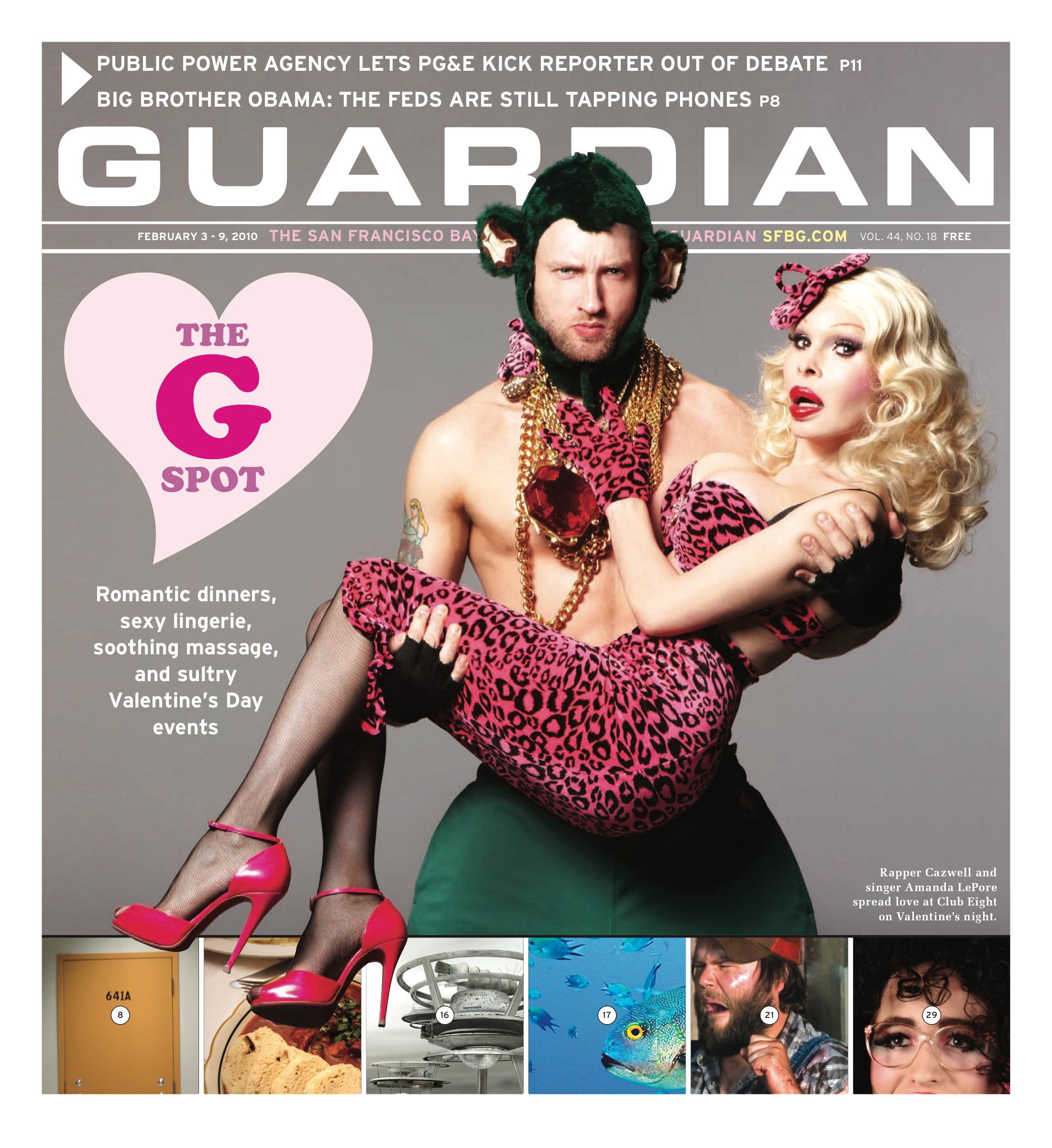
Monthly three-ring kiki-athon Big Top is a circus, and its special V-Day party will be a zoo, with NYC homo-rapper Cazwell and club legend Amanda LePore (she sings!) in town to stir things up. Heklina hostesses.

Sun/14, 9 p.m., $10–$25. Club Eight, 1151 Folsom, SF. www.eightsf.com

JUSTIN BOND: CLOSE TO YOU

The fantastical creature who jumped from local club kid talent to legend of New York stage (Tony nom, anyone?) is back with a freakin’ 10-piece orchestra to sing his favorite Carpenters’ songs. Mellow gold, child. 

Sun/14, 8:15, $25-$75. Castro Theatre, 419 Castro, SF. www.ticketweb.com

LOVESICK III

Geez, will anybody ever love you if you look like heck warmed over? Of course they will, Adam Lambert. But why not hit up this huge, buzzy lingerie fashion fiesta, dance floor prance, and trunk show party to polish your lacy underthings resume.

Sun/14, 7 p.m.-1 a.m., $15/$20. Mighty, 119 Utah, SF. www.mighty119.com

MOODYMANN

No one wants to date moody, but everyone shall dance to Moodymann, the second generation Detroit techno whiz and father of the current red-hot soul re-edits trend (although his Black Power message is getting a bit lost in the fray.) With Sunset and Stompy party DJs.

Sun/14, 3 p.m.-2 a.m., $15/$20. Café Cocomo, 650 Indiana, SF. www.stompy.com

SIXXTEEN

Rock out with your aorta out — it’s cuddle-with-a-chainsaw time as the legendary rock club returns, leopard Spandex and all. Kiss tribute band Heroes takes stage, while DJs Omar, Jenny, China G., Howie Pyro and more give you a whole lotta love. Panama!

Sun/14, 10 p.m.-3 a.m., $10. Cat Club, 1190 Folsom, SF. www.sfcatclub.com

Stage Listings

0

Stage listings are compiled by Molly Freedenberg. Performance times may change; call venues to confirm. Reviewers are Robert Avila, Rita Felciano, and Nicole Gluckstern. Submit items for the listings at listings@sfbg.com.

THEATER

OPENING

The Greatest Bubble Show on Earth Marsh, 1062 Valencia. (800) 838-3006, www.themarsh.org. $7-$50. Opens Sun/14. Runs Sun, 11am. Through April 3. The Amazing Bubble Man returns with his extraordinary family-friendly show.

Ramona Quimby Zeum: San Francisco Children’s Museum, 221 Fourth St; (510) 296-4433, aciveartstheatre.org. $14-$18. Opens Sat/13. Runs Sat-Sun, 2 and 4:30pm. Through Feb 21. Active Arts Theatre for Young Audiences presents a theatrical production based on the novels of Beverly Cleary.

Tick, Tick&ldots;Boom! Eureka Theatre, 215 Jackson. (800) 838-3006, www.therhino.org. $15-$30. Previews Wed/10-Fri/1Opens Wed/10. Runs Wed-Sat, 8pm; Sun, 3pm. Through Feb 28.Theatre Rhinoceros presents Jonathan Larson’s rock musical.


ONGOING

Animals Out of Paper SF Playhouse, 533 Sutter; 677-9596, www.sfplayhouse.org. $30-$40. Tues, 7pm; Wed-Fri, 8pm; Sat, 3 and 8pm. Through Feb 27. SF Playhouse presents Rajiv Joseph’s quirky comedy.

Beauty of the Father Phoenix Theatre, 414 Mason; (800) 838-3006, www.offbroadwaywest.org. $30. Thurs-Sat, 8pm. Through March 13. Off Broadway West Theatre Company presents Nilo Cruz’s Pulitzer Prize-winner.

Bright River Brava Theater Center, 2781 24th St; (800) 838-3006, thebrightriver.com. Thurs-Sat, 8pm; Sun, 7pm. Through Feb 20. From the imagination of Tim Barsky comes a journey through a dystopian uderworld.

Eat, Pray, Laugh! Off-Market Theaters, 965 Mission; www.brownpapertickets.com. $20. Wed, 8pm. Through Feb 24. Off-Market Theaters presents stand up comic and solo artist Alicia Dattner in her award-winning solo show.

Eccentrics of San Francisco’s Barbary Coast: A Magical Escapade San Francisco Magic Parlor, Chancellor Hotel Union Square, 433 Powell; 1-800-838-3006. $30. Fri-Sat, 8pm. Ongoing. This show celebrates real-life characters from San Francisco’s colorful and notorious past.

Fabrik: The Legend of M. Rabinowitz Jewish Theatre, 470 Florida; 292-1233, www.tjt-sf.org. $20-$45. Thurs-Sat, 8pm; Sun, 2 and 7pm. Through Feb 28. The Jewish Theatre San Francisco presents a Wakka Wakka Productions presentation of this story of a Polish Jew who immigrated to Norway, told with hand-and-rod puppets, masks, and original music.

Fiddler on the Roof Golden Gate Theatre, 1 Taylor; 512-7770, www.shnsf.com. $30-$99. Tues-Sat, 8pm; Wed, Sat, and Sun, 2pm. Through Feb 21. Harvey Fierstein, who played Tevye in the recent critically acclaimed Broadway production, reprises the role as part of the Best of Broadway series.

Fiorello! Eureka Theatre, 215 Jackson; 392-4400, www.cityboxoffice.com. $10-$30. Sat-Sun, 2pm. Through Feb 20. The San Francisco Arts Education Project celebrates the ninth year of its musical theater company with three weekend performances of Broadway’s Pulitzer Prize winning play.

Frankie and Johnny in the Clair de Lune Royce Gallery, 2901 Mariposa; (866) 811-4111, www.frankieandjohnnysf.com. $28. Thurs/11-Sat/13, 8pm. Royce Gallery presents Terrence McNally’s award-winning play.

Hearts on Fire Teatro ZinZanni, Pier 29; 438-2668, www.zinzanni.org. $117-$145. Wed-Sat, 6pm; Sun, 5pm. Through May 16. Teatro ZinZanni celebrates its 10th anniversary with this special presentation featuring Thelma Houston, El Vez, and Christine Deaver.

Oedipus el Rey Magic Theatre, Building D, Fort Mason Center; 441-8822, www.magictheatre.org. $20-$55. Days and times vary. Through Feb 28. Luis Alfaro transforms Sophocles’ ancient tale into an electrifying myth, directed by Loretta Greco.

Pearls Over Shanghai Hypnodrome, 575 Tenth St.; 1-800-838-3006, www.thrillpeddlers.com. $30-69. Sat, 8pm; Sun, 7pm. Through April 24. Thrillpeddlers presents this revival of the legendary Cockettes’ 1970 musical extravaganza.

The Real Americans The Marsh, 1062 Valencia; 826-5750, www.themarsh.org. $15-$50. Thurs-Fri, 8pm; Sat, 5pm. Through March 6. The Marsh presents the world premiere of Dan Hoyle’s new solo show.

Red Light Winter Next Stage, 1620 Gough; (800) 838-3006, custommade.org. $18-$28. Thurs-Sat, 8pm. Through Feb 20. There’s a moment in the second act of Red Light Winter that eerily recalls the plotline of Fugard’s Coming Home, currently playing the Berkeley Rep, but unlike Fugard, playwright Adam Rapp can’t help but to ratchet up the despair without tempering it with a shred of hope, and the resultant script comes off more like misery porn than an authentic exploration of the human spirit. You can’t fault the fearless cast of Custom Made Theatre’s production of it for the script’s overall flaws though; they inhabit their characters wholly, firing off volleys of "dude-speak" "nerd-speak" and "unrequited love-lament" without a hitch, imbuing each scene with subtle quirk and nervous tension. Steve Budd, as Davis, channels the restless energies of a hedonistic jackass (whose brash exterior sadly does not hide a heart of gold), and the neurotic, OCD sorrows of the hopelessly heartbroken Matt are brought to acutely uncomfortable life by Daveed Diggs. But it is the shape-shifting, name-changing, unreliable Christina (powerfully rendered by Britanny K. McGregor) who remains the play’s greatest enigma and bears the brunt of Rapp’s punishing pen, like the weary subject of a Tom Waits ballad, minus the comfort of a redemptive moment, or even just a bottle of whiskey. (Gluckstern)

Rent Southside Theatre, Fort Mason Center; www.jericaproductions.com. $25-$35. Fri, 8pm; Sat-Sun, 2 and 8pm. Through Feb 21. The Royal Underground presents A Jerica Productions Company rendition of Jonathan Larson’s Tony Award and Pulitzer Prize-winning rock opera.

*The Wave The Marsh, 1062 Valencia; 826-5750, www.themarsh.org. $7-$50. Sat/13-Sun/14, 2pm. The Marsh Youth Theater’s teen troupe propels a wholly worthwhile, surprisingly sophisticated world premiere musical, directed with loving attention by Cliff Mayotte, and written by Marsh stage veteran Ron Jones ("Say Ray"), after his own infamous experience as a young history teacher at Palo Alto’s Cubberley High School in 1967. In a year marked by the Summer of Love, an annihilating war in Vietnam, and a Civil Rights Movement that saw, among much else, Cubberley’s first "integrated" student body, Jones (played by Mark Kenward) crafted a lesson plan on the Holocaust that called for the creation of his own authoritarian movement, dubbed the Third Wave. Students—and teacher—soon found their susceptibility to a sense of belonging and the acquisition of power altogether intoxicating, enough to forgo some basic human decencies, and the experiment went infamously out of control, ending Jones’s career as a history teacher where it began. But the lesson—that fascism is a modern social danger present to all and not confined to some aberrant past—has never subsided. Indeed, the real wave proved to be the story’s powerful resonance worldwide for over four decades—inspiring multilingual treatments in articles, literature, teleplays, and films, including a 2008 German drama and a forthcoming English-language doc. There’s palpable heart and a knowing freshness to the staging of this adept musical, however, which features a rewarding score (from David Denny, Kathy Peck and MYT creative director Emily Klion, under the sharp direction of Frederick Harris), bright choreography (by Patricia Lam), and memorably spirited performances by a diverse, versatile cast. It won’t be surprising to see a version of "The Wave" reach Broadway in the near future, but it’s real power lies in the kind of community project beautifully realized right here at the Marsh. (Avila)

What Mama Said About ‘Down There Our Little Theater, 287 Ellis; 820-3250, www.theatrebayarea.org. $15-$25. Thurs-Sun, 8pm. Through July 30. Writer/performer/activist Sia Amma presents this largely political, a bit clinical, inherently sexual, and utterly unforgettable performance piece.

Wicked Orpheum Theatre, 1182 Market; 512-7770, www.shnsf.com. $30-$99. Tues, 8pm; Wed, 2pm; Thurs-Fri, 8pm; Sat, 2 and 8pm; Sun, 2pm. Ongoing. Assuming you don’t mind the music, which is too TV-theme–sounding in general for me, or the rather gaudy décor, spectacle rules the stage as ever, supported by sharp performances from a winning cast. (Avila)


BAY AREA

Antigone Live Oak Theatre, 1301 Shattuck, Berk; (510) 649-5999, www.aeofberkeley.org. $12-$15. Fri-Sat, 8pm. Through Feb 20. Actors Ensemble of Berkeley presents Jean Anouilh’s adaptation of the ancient Greek tragedy.

Coming Home Thrust Stage, Berkeley Repertory Theatre, 2025 Addison; (510) 647-2917, www.berkeleyrep.org. Tues, 8pm; Wed, 7pm; Thurs-Sat, 8pm; Sun, 2 and 7pm. Through Feb 28. $33-$71. The rags to riches fantasy of the small town girl who hits the big time after abandoning her hometown for the brighter lights of a big city is one of the most well-worn yet perennially beloved plotlines. Less popular are the tales of the girls who return to their hometowns years later still in rags, their big city dreams crumbled and spent. Such a tale is Athol Fugard’s Coming Home, a cautious sequel to Valley Song, which follows Veronica Jonkers (a versatile Roslyn Ruff) to her childhood home in the Karoo, her own small child in tow and little else. The tragedy of her ignominious return is further compounded by her secret knowledge that she is HIV-positive, and her young son’s future therefore precarious. The slow-moving yet tenacious script stretches over a period of four years, following both the progression of Veronica’s dread decline in health, and the flowering intellectual development of her son, Mannetjie (played by Kohle T. Bolton and Jaden Malik Wiggins), who keeps his "big words" in his deceased Oupa’s pumpkin seed tin. Almost superfluous appearances by the ghost of Oupa (Lou Ferguson) are made enjoyable by Ferguson’s quiet mastery of the role, and Thomas Silcott parlays great empathy and range in his performance as Veronica’s irrepressible childhood companion and circumstantial caretaker Alfred Witbooi. (Gluckstern)

The First Grade Aurora Theatre, 2081 Addison, Berk; (510) 843-4822, auroratheatre.org. $15-$55. Tues, 7pm; Wed-Sat, 8pm; Sun, 2 and 7pm. Through Feb 28. Aurora Theatre Company presents the world premiere of Joel Drake Johnson’s new play.

Rosencrantz and Guildenstern Are Dead Marion E. Green Black Box Theatre, 531 19th St, Oakl; www.theatrefirst.com. $10-$30. Thurs/11-Sat/13, 7:30pm; Sun/14, 2pm. Tom Stoppard’s sensational first play will probably never have the impact it had in 1966—partly because it proved so influential—but TheatreFIRST’s generally sturdy production wades in enthusiastically and the results remain ultimately, if more quietly, contagious. In a cheeky, knowing meld of Beckett and Shakespeare, Stoppard crafts a heady as well as deeply silly existential comedy, told from the perspective of two hapless minor characters in Hamlet—the somewhat interchangeable and finally expendable Rosencrantz (Kalli Jonsson) and Guildenstern (Michael Storm)—whose sealed fate is signaled by a changeless sky (manifest in Rick Ortenblad’s scenic design), coins that only come up heads, and their inexplicable inability to leave the stage. Nevertheless, our bemused protagonists—preoccupied with nameless anxiety, word games, and endless summarizing—are the last ones to figure it all out. Leave it to a roving thespian (the excellent Andrew Hurteau) and his amusing caravan of out-of-work players, strutting and fretting along, to gradually drop some knowledge on our heroes. If the first act runs slow and rough, Mary Cavanaugh’s firm direction, graceful choreography, and shrewd use of live and recorded music contribute to a general warming by acts two and three. Meanwhile, the play’s bandying of philosophical ideas and fertile metaphors ensures the monkey business does not escape some poignancy by the end. (Avila)

DANCE

"The Butterfly Lovers" Palace of Fine Arts Theatre; 392-4400, www.cityboxoffice.com. Tues-Wed, 7:30pm. $35-$70. Chinus Cultural Productions and China Arts and Entertainment Group present the U.S. premiere of China’s Romeo and Juliet, performed by the Beijing

"It Never Gets Old" The Garage, 975 Howard; (510) 684-4294, dancetheatershannon.org. Fri-Sun, 8pm. $15-$20. Dance/Theater Shannon presents an evening length performance exploring how different relationships provide context to intentions of touch.

"Love Everywhere" Various locations; www.dancersgroup.org. Fri, 12pm; Sun, 9 and 11am. Erika Chong Shuch Performance Project presents this new, large-scale work as part of Dancers’ Group’s ONSITE series.


BAY AREA

"Ecstatic Dance" Sweets Historic Ballroom, 1933 Broadway, Oakl; 505-1112, info.ecstaticdance@gmail.com. Sun, 9:30am; Wed, 7pm. Ongoing. Move however you feel inspired with this freeform journey of movement.


PERFORMANCE

"All Star Magic & More" SF Playhouse, Stage 2, 533 Sutter; 646-0776, www.comedyonthesquare.com. Sun, 7pm. Ongoing. Magician RJ Owens hosts the longest running magic show in San Francisco.

30th Anniversary Celebration of New Works African American Art and Culture complex, 762 Fulton; 292-1850, www.culturalodyssey.org/tickets. Thurs-Sat, 8pm; Sun, 3pm. Through March 14. $20. In celebration of Black History Month and National Women’s Month, Cultural Odyssey presents a festival featuring The Love Project, The Breach, and Dancing with the Clown of Love.

"Assuming the Ecosexual Position" The Lab, 2948 16th St. 864-8855, www.thelab.org. Sat, 8pm. $7-$10 Acclaimed performance artist and sex educator Annie Sprinkle and her partner Elizabeth Stephens explore, generate, and celebrate love through art during this special event that includes an erotic cake contest. Bring your own!

BATS Improv Theatre Bayfront Theater, Fort Mason Center, B350 Fort Mason; 474-6776, www.improv.org. Fri-Sat, 8pm. $17-$20. The Theatresports show format treats audiences to an entertaining and engaging night of theater and comedy presented as a competition.

Bijou Martuni’s, 4 Valencia; 241-0205, www.dragatmartunis.com. Sun, 7pm. $5. The eclectic live cabaret showcase features a night of love songs in honor of Valentine’s Day.

"Bee’s Knees" Bollyhood Café, 3372 19th St. Thurs, 7pm. $3. This night of poetry, storytelling, and music celebrates performers who are post-democratic, humanist, sensual, and dedicated artists in the tradition of Walt Whitman.

"Best Feeding" EXIT Theatre, 156 Eddy; 673-3847, StageWerx Theatre, 533 Sutter. www.brownpapertickets.com. Fri, 8pm. $15. W. Kamau Bell presents this comedy written and performed by Martha Rynberg.

"Cora’s Recipe for Love" EXIT Theatre, 156 Eddy; 673-3847, www.theexit.org. Fri-Sat, 8pm, through Feb 20. $15-$25. Sean Owens’ wacky alter ego returns to address love and longing through the eyes of Gas and Gulp regulars.

"Emergency Cabaret Relief: Haiti" Community Music Center, 544 Capp. Sfcmc.org. Mon, 7pm. $15-$20. Accidentally Double Booked Presents Jessica Coker, Soila Hughes, and Leanne Borghesi in a benefit for Partners in Health.

"How We First Met" Herbst Theatre, 401 Van Ness; 392-4400, www.howwefirstmet.com. Sat-Sun, 8pm. $25-$40. Real audience stories are spun into a comedy masterpiece in this one-of-a-kind show, now in its 10th year.

"I Heart Hamas: And Other Things I’m Afraid to Tell You" Off Market Theaters, 965 Mission; www.ihearthamas.com. Thurs-Sat, 8pm. $20. An American woman of Palestinian descent, San Francisco actor Jennifer Jajeh grew up with a kind of double consciousness familiar to many minorities. But hers—conflated and charged with the history and politics of the Middle East—arguably carried a particular burden. Addressing her largely non–Middle Eastern audience in a good-natured tone of knowing tolerance, the first half of her autobiographical comedy-drama, set in the U.S., evokes an American teen badgered by unwelcome difference but canny about coping with it. The second, set in her ancestral home of Ramallah, is a journey of self-discovery and a political awakening at once. The fairly familiar dramatic arc comes peppered with some unexpected asides—and director W. Kamau Bell nicely exploits the show’s potential for enlightening irreverence (one of the cleverer conceits involves a "telepathic Q&A" with the audience, premised on the predictable questions lobbed at anyone identifying with "the other"). The play is decidedly not a history lesson on the colonial project known as "the Israeli-Palestinian conflict" or, for that matter, Hamas. But as the laudably mischievous title suggests, Jajeh is out to upset some staid opinions, stereotypes and confusions that carry increasingly significant moral and political consequences for us all. (Avila)

"Justin Bond: Close to You" Castro Theatre, 429 Castro; 863-0611, www.thecastrotheatre.com. Sun, 8:15pm. $35-75. Accompanied by a lush 10-piece orchestra, the Tony nominee recreates sweet sounds from your favorite Carpenters hits. The evening also features the Thrillpeddlers as special guests.

"The Lieutenant Governor from the State of Confusion" Rrazz Room, Hotel Nikko, 222 Mason; 781-0306, www.therrazzroom.com. Mon, 8pm. Through Feb 22. $25. Will Durst is back with his quiver chock full of fresh topical barbs.

"Life Unfolding" NOHspace, 2840 Mariposa; www.brownpapertickets.com/event/95864. Fri-Sat, 8pm. $20-$100. This benefit performance for the Tamalpa Institute features the works of Dohee Lee, G Hoffman Soto, Iu-Hui Chua, and special guest artists.

"Love Bites: All That Jazz" Women’s Building, 3543 18th St; womensbuilding.org. Fri-Sat, 8pm. Through Sat. $15-$30. The Lesbian/Gay Chorus of San Francisco presents its seventh annual Anti-Valentine’s Day cabaret and musical extravaganza.

"Marga’s Laugh Party" Café Du Nord, 2170 Market; 861-5016, www.cafedunord.com. Wed, 8pm. $10. DJ Chelsea Starr spins and host Marga Gomez presents some of the hottest acts in comedy.

"MediaARTS 2010: Algo-rhythms of heart/break/beats" Ninth Street Independent Film Center, 145 Ninth St; www.mediaarts2010.com. Fri, 7pm. $10-$20. Ninth Street Independent Film Center presents an exhibition of the intersection of emerging technology, performance, and the moving image attempting to compute what it means to love and lose.

"Mortified: Doomed Valentine’s Show" Make-Out Room, 3225 22nd St.; www.makeoutroom.com. Thurs-Fri, 8pm. $12-$15. Share the pain, awkwardness, and bad poetry associated with love as performers read from their teen angst artifacts.

"On the Periphery of Love: A Solo Performance Festival with Valentine’s Day Implications" StageWerx Theatre, 533 Sutter. www.stagewerx.com. Fri-Sat, 8pm; Sun, 7pm, $15-$30. StageWerx presents five new visions of romance, featuring work by Martha Rynberg, Thao P. Nguyen, Zahra Noorbaksh, Bruce Pachtman, and Paolo Sambrano.

PianoFight Studio 250 at Off-Market, 965 Mission; www.painofight.com. Mon, 8pm. Through March 29. $20. The female-driven variety show Monday Night ForePlays returns with brand new sketches, dance numbers, and musical performances.

"Salute to the World Soccer Cup" Cocomo Café Club, 650 Indiana. 334-0106, www.friendsofbrazil.org. Sat, 9pm. $30. The Bay Area Brazilian Club cast their mystic and joyous spell for the 43rd Carnaval Ball.

"Strange Love" Actors Theatre, 855 Bush; 345-1287, www.natashamuse.com. Sun, 6:30pm. $10. The Valentine’s Day edition of "A Funny Night for Comedy" features Will Franken, Wegent and Page, and host Natasha Muse.

"Things We Made" Off-Market Theater, 965 Mission; www.thingswemade.com. Sat, 10:30pm. Ongoing. $20. The longest-running alternative comedy show premieres an all-new weekly show in its new home.

"Wegent and Page Draw the Line" The Dark Room, 2263 Mission; 401-7987, www.darkroomsf.com. Fri-Sat, 8pm, $10. Sammy Wegent and Allison Page present new comedic material about breaking up, breaking down, and breaking barriers.

Gas and Gulp regulars.


BAY AREA

Upright Citizens Brigade Pan Theater, 2135 Broadway, Oakl; www.pantheater.com. Fri, 8 and 9:10pm. Ongoing. $14-$18. Upright Citizens Brigade Touring Co. brings the NYC funny to Oakland with this improve comedy show with guest performing troupes.

"The Vagina Monologues" La Pena Cultural Center, 3105 Shattuck Ave, Berk; (510) 849-2568, www.lapena.org. Thurs, 8pm. Also Sun at The Warehouse. V-Day East Bay presents a two-night benefit reading of Eve Enselr’s award-winning play.

"Whipped" La Pena Cultural Center, 3105 Shattuck Ave, Berk; (510) 849-2568, www.lapena.org. Fri. $8-$12. Mango w/ Chile presents true life stories of love through music, spoken word, theater, dance, burlesque, drag, and video.


COMEDY

Annie’s Social Club 917 Folsom, SF; www.sfstandup.com. Tues, 6:30pm, ongoing. Free. Comedy Speakeasy is a weekly stand-up comedy show with Jeff Cleary and Chad Lehrman.

"All Star Comedy and More with Tony Sparks" SF Playhouse, 533 Sutter; 646-0776, www.comedyonthesquare.com. Sun, 8:30pm. Ongoing. SF’s favorite comedy host brings a showcase of the Bay’s best stand-up comedy and variety.

"Big City Improv" Shelton Theater, 533 Sutter; (510) 595-5597, www.bigcityimprov.com. Fri, 10pm, ongoing. $15-$20. Big City Improv performs comedy in the style of "Whose Line Is It Anyway?"

Brainwash 1122 Folsom; 861-3663. Thurs, 7pm, ongoing. Free. Tony Sparks hosts San Francisco’s longest running comedy open mike.

Club Deluxe 1511 Haight; 552-6949, www.clubdeluxesf.com. Mon, 9pm, ongoing. Free. Various local favorites perform at this weekly show.

Clubhouse 414 Mason; www.clubhousecomedy.com. Prices vary. Scantily Clad Comedy Fri, 9pm. Stand-up Project’s Pro Workout Sat, 7pm. Naked Comedy Sat, 9pm. Frisco Improv Show and Jam Sun, 7pm. Ongoing. Valentine’s Day special features Reggie Steele and JJ Johnson.

Cobbs 915 Columbus; 928-4320. Thurs, 8pm; Fri, 8 and 10:15pm. $20. Featuring "Arabs Gone Wild," including Dean Obeidallah, Aron Kader, and Maysoon Zayid. Also Robert Schimmel with Mark Pitta on Sat and Sun.

"Comedy Master Series" Blue Macaw, 2565 Mission; www.comedymasterseries.com. Mon, 6pm. Ongoing. $20. The new improv comedy workshop includes training by Debi Durst, Michael Bossier, and John Elk.

"Danny Dechi and Friends" Rockit Room, 406 Clement; 387-6343. Tues, 8pm. Free. Danny Dechi hosts this weekly comedy showcase through October.

"Frisco Fred’s Comedy Hour" Chancellor Hotel in the Luques Restaurant, 433 Powell; 646-0776, www.comedyonthesquare.com. Sat, 7 and 8:30pm. Through March 27. $25. Frisco Fred presents this fun-filled hour of comedy, magic, crazy stunts and special guests.

"Improv Society" Shelton Theater, 533 Sutter; www.improvsociety.com. Sat, 10pm, ongoing, $15. Improv Society presents comic and musical theater.

"Legwork!" Mama Calizo’s Voice Factory, 1519 Mission; www.brownpapertickets.com/event/96616. Fri, 8pm. New comedic work from Beth Lisick and Tara Jepsen, Kirk Read, and Erin Markey.

Punch Line San Francisco 444 Battery; www.punchlinecomedyclub.com. Featuring Grant Lyon on Wed and Dana Gould Fri-Sat.

Purple Onion 140 Columbus; (800) 838-3006, www.purpleonionlive.com.

Rrazz Room Hotel Nikko, 222 Mason; 781-0306, www.therrazzroom.com.

"Raw Stand-up Project SFCC, 414 Mason, Fifth Flr; www.sfcomedycollege.com. Sat, 7pm, ongoing. $12-15. SFCC presents its premier stand-up comedy troupe in a series of weekly showcases.

BAY AREA

"Comedy Off Broadway Oakland" Ms. Pearl’s Jam House, 1 Broadway, Oakl; (510) 452-1776, www.comedyoffbroadwayoakland.com. Thurs-Fri, 9pm. Ongoing. $8-$10. Comedians featured on Comedy Central, HBO, BET, and more perform every week.

"Identity Crisis Tour" Oracle Arena, 7000 Coliseum Way, Oakl; (510) 569-2121, www.coliseum.com. Sun, 5pm. $45.50. Celebrate Valentine’s Day with Jeff Dunham.

SPOKEN WORD
"Grateful Tuesday" Ireland’s 32, 3920 Geary; 386-6173, www.myspace.com/thegrasshoppersongs. Tues, 8pm. Ongoing. Grasshopper hosts this weekly open mic featuring folk, world, and country music.
"Literary Death Match" Elbo Room, 647 Valencia. Fri, 6:30pm. $5-$10. A lineup of all-star judges pit writers against each other.
"Writers with Drinks" Make-Oput Room, 3225 22nd St; www.writerswithdrinks.com. Sat, 7:30pm. $5-$10. Charlie Jane Anders hosts this spoken word variety show, this time featuring Vikram Chandra, Cherie Priest, James Rollins, Andrew Porter, and Derek Powazek.


Film Listings

0

Film listings are edited by Cheryl Eddy. Reviewers are Kimberly Chun, Michelle Devereaux, Max Goldberg, Dennis Harvey, Johnny Ray Huston, Erik Morse, Louis Peitzman, Lynn Rapoport, Ben Richardson, and Matt Sussman. The film intern is Peter Galvin. For rep house showtimes, see Rep Clock. For first-run showtimes, see Movie Guide.

SF INDIEFEST

The 12th San Francisco Independent Film Festival runs through Feb. 18 at the Roxie, 3117 16th St, SF. For tickets (most shows $11), visit www.sfindie.com. All times pm.

WED/10

City Island 7:15. Oh My God! It’s Harrod Blank! 7:15. Limbo Lounge 9:30. "Games of Telephone" (shorts program) 9:30.

THURS/11

Blood of Rebirth 7:15. West of Pluto 7:15. My Movie Girl 9:30. "None of the Above" (shorts program) 9:30.

FRI/12

Double Take 7:15. High on Hope 7:15. Down Terrace 9:30. Last Son 9:30.

SAT/13

"Access Denied" (shorts program) 2:45. Last Son 2:45. No One Knows About Persian Cats 5. René 5. Harmony and Me 7:15. Zooey and Adam 7:15. Easier With Practice 9:30. Godspeed 9:30.

SUN/14

Art of the Steal 2:45. Double Take 2:45. "An Animated World" (shorts program) 5. TBA 5. Corner Store 7:15. TBA 7:15. At the Foot of a Tree 9:30. TBA 9:30.

MON/15

"An Animated World" (shorts program) 7:15. Easier with Practice 7:15. "Access Denied" (shorts program) 9:30. High on Hope 9:30.

TUES/16

René 7:15. TBA 7:15. Zooey and Adam 9:30. Corner Store 9:30.

OPENING

Percy Jackson and the Olympians: The Lightning Thief Chris Columbus directs this adaptation of the popular children’s fantasy novel. (1:59) Elmwood.

*Saint John of Las Vegas See "Even Steven." (1:25) Embarcadero, California.

*Terribly Happy The Coen Brothers’ Blood Simple (1984) is the obvious corollary for this coolly humorous Danish import, though director/co-writer Henrik Ruben Genz’s firmly dampened-down thriller of sorts is also touched by David Lynch’s parochial surrealism and Aki Kaurismäki’s backwater puckishness. Happy isn’t quite the word for handsome, seemingly upstanding cop Jakob (Robert Hansen), reassigned from the big city of Copenhagen to a tiny village in South Jutland. There he slowly learns that the insular and self-sufficient locals are accustomed to fixing problems on their own and that cows, trucks, and other troubles have a way of conveniently disappearing into the bog. When buxom blonde Ingerlise (Lene Maria Christensen) whispers to him that her husband Jørgen (Kim Bodnia) beats her, Jakob begins to find his moral ground slipping away from him — while his own dark secrets turn out to be not so secret after all. More of a winkingly paranoid, black-hearted comedy about the quicksand nature of provincial community and small-town complicity than a genuine murder mystery, Terribly Happy wears its inspirations on its sleeve, but that doesn’t stop this attractively-shot production from amusing from start to finish, never tarrying too long to make a point that it gets mired in the bog that swallows all else. (1:42) Lumiere, Shattuck. (Chun)

Valentine’s Day Romantic comedy or horror flick? (1:57) Cerrito, Shattuck, Sundance Kabuki.

The Wolfman Benicio Del Toro stars as the hairy antihero. (2:05) Sundance Kabuki.

ONGOING

Avatar James Cameron’s Avatar takes place on planet Pandora, where human capitalists are prospecting for precious unobtainium, hampered only by the toxic atmosphere and a profusion of unfriendly wildlife, including the Na’vi, a nine-foot tall race of poorly disguised cliches. When Jake Sully (Sam Worthington), a paraplegic ex-marine, arrives on the planet, he is recruited into the "Avatar" program, which enables him to cybernetically link with a part-human, part-Na’vi body and go traipsing through Pandora’s psychedelic underbrush. Initially designed for botanical research, these avatars become the only means of diplomatic contact with the bright-blue natives, who live smack on top of all the bling. The special effects are revolutionary, but the story that ensues blends hollow "noble savage" dreck with events borrowed from Dances With Wolves (1990) and FernGully: The Last Rainforest (1992). When Sully falls in love with a Na’vi princess and undergoes a spirit journey so he can be inducted into the tribe and fight the evil miners, all I could think of was Kevin Bacon getting his belly sliced in The Air Up There (1994). (2:42) 1000 Van Ness, Sundance Kabuki. (Richardson)

The Blind Side When the New York Times Magazine published Michael Lewis’ article "The Ballad of Big Mike" — which he expanded into the 2006 book The Blind Side: Evolution of a Game —nobody could have predicated the cultural windfall it would spawn. Lewis told the incredible story of Michael Oher — a 6’4, 350-pound 16-year-old, who grew up functionally parentless, splitting time between friends’ couches and the streets of one of Memphis’ poorest neighborhoods. As a sophomore with a 0.4 GPA, Oher serendipitously hitched a ride with a friend’s father to a ritzy private school across town and embarked on an unbelievable journey that led him into a upper-class, white family; the Dean’s List at Ole Miss; and, finally, the NFL. The film itself effectively focuses on Oher’s indomitable spirit and big heart, and the fearless devotion of Leigh Anne Tuohy, the matriarch of the family who adopted him (masterfully played by Sandra Bullock). While the movie will delight and touch moviegoers, its greatest success is that it will likely spur its viewers on to read Lewis’ brilliant book. (2:06) Elmwood, Oaks. (Daniel Alvarez)

The Book of Eli The Book of Eli isn’t likely to win many prizes, but it could eventually be up for a lifetime achievement award in the "most sentimental movie to ever feature multiple decapitations by machete" category. Denzel Washington plays the titular hero, displaying scant charisma as a post-apocalyptic drifter with a beatific personality and talent for dismemberment. Eli squares off against an evil but urbane kleptocrat named Carnegie (Gary Oldman phoning in a familiar "loathsome reptile" performance). Convinced that possession of Eli’s book will place humanity’s few survivors in his thrall, Carnegie will do anything to get it, even pimping out the daughter (Mila Kunis, utterly unconvincing) of his blind girlfriend (Jennifer Beals, who should stick to playing people who can see). The two slumming lead actors chase each other down the highway, pausing for some spiritual hogwash and an exchange of gunfire before limping towards an execrable twist ending. At least there’s a Tom Waits cameo. (1:58) 1000 Van Ness. (Richardson)

Broken Embraces Pedro Almodóvar has always dabbled in the Hitchcockian tropes of uxoricide, betrayal, and double-identity, but with Broken Embraces he has attained a polyglot, if slightly mimicking, fluency with the language of Hollywood noir. A story within a story and a movie within a movie, Embraces begins in the present day with middle-aged Catalan Harry Caine (Lluís Homar), a blind screenwriter who takes time between his successful writing career to seduce and bed young women sympathetic to his disability. "Everything’s already happened to me," he explains to his manager, Judit (Blanca Portillo). "All that’s left is to enjoy life." But this life of empty pleasures is brought to a sudden halt when local business magnate Ernesto Martel (José Luis Gómez) has died; soon after, Ernesto Jr. (Rubén Ochandiano), who has renamed himself Ray X, visits Caine with an unusual request. The action retreats 14 years when Caine was a young (and visually abled) director named Mateo Blanco; he encounters a breathtaking femme fatale, Lena (Penelope Cruz) — an actress-turned-prostitute named Severine, turned secretary-turned-trophy wife of Ernesto Martel — when she appears to audition for his latest movie. If all of the narrative intricacies and multiplicitous identities in Broken Embraces appear a bit intimidating at first glance, it is because this is the cinema of Almodóvar taken to a kind of generic extreme. As with all of the director’s post-’00 films, which are often referred to as Almodóvar’s "mature" pictures, there is a microscopic attention to narrative development combined with a frenzied sub-plotting of nearly soap-operatic proportions. But, in Embraces, formalism attains such prominence that one might speculate the director is simply going through the motions. The effect is a purposely loquacious and overly-dramatized performance that pleasures itself as much by setting up the plot as unraveling it. (2:08) Clay, Smith Rafael. (Morse)

Crazy Heart "Oh, I love Jeff Bridges!" is the usual response when his name comes up every few years for Best Actor consideration, usually via some underdog movie no one saw, and the realization occurs that he’s never won an Oscar. The oversight is painful because it could be argued that no leading American actor has been more versatile, consistently good, and true to that elusive concept "artistic integrity" than Bridges over the last 40 years. It’s rumored Crazy Heart was slotted for cable or DVD premiere, then thrust into late-year theater release in hopes of attracting Best Actor momentum within a crowded field. Lucky for us, this performance shouldn’t be overlooked. Bridges plays "Bad" Blake, a veteran country star reduced to playing bars with local pickup bands. His slide from grace hasn’t been helped by lingering tastes for smoke and drink, let alone five defunct marriages. He meets Jean (Maggie Gyllenhaal), freelance journalist, fan, and single mother. They spark; though burnt by prior relationships, she’s reluctant to take seriously a famous drunk twice her age. Can Bad handle even this much responsibility? Meanwhile, he gets his "comeback" break in the semi-humiliating form of opening for Tommy Sweet (Colin Farrell) — a contemporary country superstar who was once Bad’s backup boy. Tommy offers a belated shot at commercial redemption; Jean offers redemption of the strictly personal kind. There’s nothing too surprising about the ways in which Crazy Heart both follows and finesses formula. You’ve seen this preordained road from wreckage to redemption before. But actor turned first-time director Scott Cooper’s screenplay honors the flies in the windshield inherited from Thomas Cobb’s novel — as does Bridges, needless to say. (1:51) California, Embarcadero, Empire, 1000 Van Ness, Piedmont, Sundance Kabuki. (Harvey)

Creation Critically drubbed in its high-profile slot as the 2009 Toronto International Film Festival’s opening-night film, this handsome costume drama isn’t all that bad — but neither is it very good. Offscreen married couple Paul Bettany and Jennifer Connelly play Mr. and Mrs. Darwin in the mid-1850s, just as he’s about to incite a still-active public firestorm with The Origin of the Species. Charles is hardly in any shape to face such controversy, as the death of favorite daughter Annie (Martha West) has had a grave impact on both his psychological and physical health. That event has only strengthened wife Emma’s Christian faith, while destroying his own. Also arguing against the evolutionary tract’s publication is their close friend Reverend Innes (Jeremy Northam); contrarily urging Darwin to go ahead and "kill God" are fellow scientitific enthusiasts played by Toby Jones and Benedict Cumberbatch. Director Jon Amiel lends considerable visual panache, but Creation ultimately misses the rare chance to meaningfully scrutinize rationalism vs. religious belief perhaps the industrial era’s most importantly divisive issue — in favor of conventional dramatic dwelling on grief over a child’s loss. The appealing Bettany is somewhat straitjacketed by a character that verges on being a sickly bore, while Connolly is, as usual, a humorless one. (1:58) Opera Plaza. (Harvey)

Dear John As long as you know what you’re getting yourself into, Dear John is a solid effort. Not extraordinary by any means, it’s your standard Nicholas Sparks book-turned-film: boy meets girl — drama, angst, and untimely death ensue. Here, Channing Tatum stars at the titular John, a soldier on leave who falls in love with the seemingly perfect Savannah (Amanda Seyfried). Both actors are likable enough that their romance is charming, if not always believable. And Dear John‘s plot turns, while not quite surprising, are at least dynamic enough to keep the audience engaged. But at the end of the day, this is still a Nicholas Sparks movie — even with the accomplished Lasse Hallström taking over directorial responsibilities. There are still plenty of eye-roll moments and, more often than not, Dear John employs the most predictable tearjerking techniques. By the time you realize why the film is set in 2001, it’s September 11. Sad? Surely. Cheap? You betcha. (1:48) 1000 Van Ness, Shattuck, Sundance Kabuki. (Peitzman)

District 13: Ultimatum Often cited by the uninformed as a wellspring of all that is artsy and pretentious about film, France is also home to some quality action movies. District 13: Ultimatum is the second in a series of breezy, adrenalized crime capers about a Parisian housing project and the politicians that secretly crave its destruction, and it succeeds as a satisfying reprise of the original’s inventive stunt-work and good-natured self-mockery. Cyril Raffaeli (a sort of Frenchified Bruce Willis) returns as Captain Damien Tomasso, a principled super-cop whose friendship with hunky petty criminal Leito (David Belle) carries over from the first film. Belle is widely acknowledged as the inventor of parkour, the French martial art of death-defying urban gymnastics, and an avalanche of clever fight choreography ensues as the pair karate kick their way toward the bottom of the conspiracy and a showdown with the forces of evil: an American conglomerate called "Harriburton." (1:41) Lumiere. (Richardson)

Edge of Darkness (1:57) Empire, 1000 Van Ness, SF Center.

*An Education The pursuit of knowledge — both carnal and cultural — are at the tender core of this end-of-innocence valentine by Danish filmmaker Lone Scherfig (who first made her well-tempered voice heard with her 2000 Dogme entry, Italian for Beginners), based on journalist Lynn Barber’s memoir. Screenwriter Nick Hornby breaks further with his Peter Pan protagonists with this adaptation: no man-boy mopers or misfits here. Rather, 16-year-old schoolgirl Jenny (Carey Mulligan) is a good girl and ace student. It’s 1961, and England is only starting to stir from its somber, all-too-sober post-war slumber. The carefully cloistered Jenny is on track for Oxford, though swinging London and its high-style freedoms beckon just around the corner. Ushering in those freedoms — a new, more class-free world disorder — is the charming David (Peter Sarsgaard), stopping to give Jenny and her cello a ride in the rain and soon proffering concerts and late-night suppers in the city. He’s a sweet-faced, feline outsider: cultured, Jewish, and given to playing fast and loose in the margins of society. David can see Jenny for the gem she is and appreciate her innocence with the knowing pleasure of a decadent playing all the angles. The stakes are believably high, thanks to An Education‘s careful attention to time and place and its gently glamored performances. Scherfig revels in the smart, easy-on-eye curb appeal of David and his friends while giving a nod to the college-educated empowerment Jenny risks by skipping class to jet to Paris. And Mulligan lends it all credence by letting all those seduced, abandoned, conflicted, rebellious feelings flicker unbridled across her face. (1:35) Bridge, Shattuck, Smith Rafael. (Chun)

*Fantastic Mr. Fox A lot of people have been busting filmmaker Wes Anderson’s proverbial chops lately, lambasting him for recent cinematic self-indulgences hewing dangerously close to self-parody (and in the case of 2007’s Darjeeling Limited, I’m one of them). Maybe he’s been listening. Either way, his new animated film, Fantastic Mr. Fox, should keep the naysayer wolves at bay for a while — it’s nothing short of a rollicking, deadpan-hilarious case study in artistic renewal. A kind of man-imal inversion of Anderson’s other heist movie, his debut feature Bottle Rocket (1996), his latest revels in ramshackle spontaneity and childlike charm without sacrificing his adult preoccupations. Based on Roald Dahl’s beloved 1970 book, Mr. Fox captures the essence of the source material but is still full of Anderson trademarks: meticulously staged mise en scène, bisected dollhouse-like sets, eccentric dysfunctional families coming to grips with their talent and success (or lack thereof).(1:27) Elmwood, SF Center. (Devereaux)

*Fish Tank There’s been a string of movies lately pondering what Britney once called the not-a-girl, not-yet-a-woman syndrome, including 2009’s An Education and Precious: Based on the Novel Push By Sapphire. Enter Fish Tank, the gritty new drama from British filmmaker Andrea Arnold. Her films (including 2006’s Red Road) are heartbreaking, but in an unforced way that never feels manipulative; her characters, often portrayed by nonactors, feel completely organic. Fish Tank‘s 15-year-old heroine, Mia (played by first-time actor Katie Jarvis), lives with her party-gal single mom and tweenage sister in a public-housing high-rise; all three enjoy drinking, swearing, and shouting. But Mia has a secret passion: hip-hop dancing, which she practices with track-suited determination. When mom’s foxy new boyfriend, Connor (Michael Fassbender, from 2008’s Hunger) encourages her talent, it’s initially unclear what Connor’s intentions are. Is he trying to be a cool father figure, or something far more inappropriate? Without giving away too much, it’s hard to fear too much for a girl who headbutts a teenage rival within the film’s first few minutes — though it soon becomes apparent Mia’s hard façade masks a vulnerable core. Her desire to make human connections causes her to drop her guard when she needs it the most. In a movie about coming of age, a young girl’s bumpy emotional journey is expected turf. But Fish Tank earns its poignant moments honestly — most coming courtesy of Jarvis, who has soulfullness to spare. Whether she’s acting out in tough-girl mode or revealing a glimpse of her fragile inner life, Arnold’s camera relays it all, with unglossy matter-of-factness. (2:02) Lumiere, Smith Rafael. (Eddy)

44 Inch Chest You couldn’t ask for a much better cast than the one 44 Inch Chest offers. The film’s a veritable who’s who of veteran British actors: Tom Wilkinson, Ray Winstone, John Hurt, Ian McShane. The story’s a bit less exceptional, though kudos to director Malcolm Venville and co-writers Louis Mellis and David Scinto for subverting expectations. While the movie’s poster suggests a gritty crime thriller, 44 Inch Chest is actually a somewhat subtle character drama. Winstone stars as Colin, a man devastated after his wife Liz (Joanna Whalley) leaves him for a younger man. His mobster friends encourage him to kidnap her new squeeze, nicknamed Loverboy (Melvil Poupaud), as revenge. But don’t expect any Tarantino-esque torture scenes: 44 Inch Chest spends most of its time revealing what’s going on in Colin’s head while he struggles to make sense of his friends’ conflicting philosophies. Hurt’s Old Man Peanut is the obvious standout, but McShane should also be commended for playing a character who is suave and confident, despite being a gay man named Meredith. (1:34) Lumiere. (Peitzman)

From Paris with Love Every so often, I walk out of a film feeling like I’ve been repeatedly buffeted by blows to the face. Transformers 2: Revenge of the Fallen (2009) had this effect, and it is now joined by From Paris With Love, a movie so aggressively stupid that the mistaken assumption that it was adapted from a video game could be construed as an insult to video games. John Travolta shows up chrome-domed as Charlie Wax, a loose-cannon CIA operative with a lot of transparently screenwritten machismo and an endless appetite for violence. He is joined by Jonathan Rhys Meyers, sporting a risible American accent, and the two embark on a frantic journey across the French capital that is almost as racist as it is misogynistic. I could fill an entire issue of this newspaper eviscerating this movie —suffice to say, don’t see it. (1:35) 1000 Van Ness. (Richardson)

The Hurt Locker When the leader of a close-knit U.S. Army Explosive Ordnance Disposal squad is killed in action, his subordinates have barely recovered from the shock when they’re introduced to his replacement. In contrast to his predecessor, Sgt. James (Jeremy Renner) is no standard-procedure-following team player, but a cocky adrenaline junkie who puts himself and others at risk making gonzo gut-instinct decisions in the face of live bombs and insurgent gunfire. This is particularly galling to next-in-command Sanborn (Anthony Mackie). An apolitical war-in-Iraq movie that’s won considerable praise for accuracy so far from vets (scenarist Mark Boal was "embedded" with an EOD unit there for several 2004 weeks), Kathryn Bigelow’s film is arguably you-are-there purist to a fault. While we eventually get to know in the principals, The Hurt Locker is so dominated by its seven lengthy squad-mission setpieces that there’s almost no time or attention left for building character development or a narrative arc. The result is often viscerally intense, yet less impactful than it would have been if we were more emotionally invested. Assured as her technique remains, don’t expect familiar stylistic dazzle from action cult figure Bigelow (1987’s Near Dark, 1989’s Blue Steel, 1991’s Point Break) — this vidcam-era war movie very much hews to the favored current genre approach of pseudo-documentary grainy handheld shaky-cam imagery. (2:11) Opera Plaza, Shattuck.. (Harvey)

*The Imaginarium of Doctor Parnassus From the title to the plot to the execution, The Imaginarium of Doctor Parnassus is the kind of movie you’re told not to see sober. This is a film in which Tom Waits plays the Devil, in which characters’ faces change repeatedly, in which Austin Powers‘ Verne Troyer makes his triumphant big-screen return. The story is your basic battle between good and evil, with Doctor Parnassus (Christopher Plummer) struggling to save souls from Mr. Nick (Waits) in order to protect his daughter Valentina (Lily Cole). Meanwhile, Valentina is wooed by the mysterious Tony, played by Heath Ledger in his final film role — along with Johnny Depp, Jude Law, and Colin Farrell. There are plenty of big important themes to be analyzed here, but it’s honestly more fun to simply get lost in Doctor Parnassus’ Imaginarium. Director and co-writer Terry Gilliam has created a world and a mythology that probably takes more than one viewing to fully comprehend. Might as well let yourself get distracted by all the shiny colors instead. (2:02) Shattuck, Sundance Kabuki. (Peitzman)

Invictus Elected President of South Africa in 1995 — just five years after his release from nearly three decades’ imprisonment — Nelson Mandela (Morgan Freeman) perceives a chance to forward his message of reconciliation and forgiveness by throwing support behind the low-ranked national rugby team. Trouble is, the Springboks are currently low-ranked, with the World Cup a very faint hope just one year away. Not to mention the fact that despite having one black member, they represent the all-too-recent Apartheid past for the country’s non-white majority. Based on John Carlin’s nonfiction tome, this latest Oscar bait by the indefatigable Clint Eastwood sports his usual plusses and minuses: An impressive scale, solid performances (Matt Damon co-stars as the team’s Afrikaaner captain), deft handling of subplots, and solid craftsmanship on the one hand. A certain dull literal-minded earnestness, lack of style and excitement on the other. Anthony Peckham’s screenplay hits the requisite inspirational notes (sometimes pretty bluntly), but even in the attenuated finals match, Eastwood’s direction is steady as she goes — no peaks, no valleys, no faults but not much inspiration, either. It doesn’t help that Kyle Eastwood and Michael Stevens contribute a score that’s as rousing as a warm milk bath. This is an entertaining history lesson, but it should have been an exhilarating one. (2:14) Oaks, SF Center. (Harvey)

It’s Complicated Allow me to spoil one line in It’s Complicated, because I believe it sums up — better than I ever could — everything right and wrong with this movie: "I prefer a lot of semen." Bet you never thought you’d hear Meryl Streep say that. The thrill of movies like It’s Complicated (see also: Nancy Meyer’s 2003 senior romance Something’s Gotta Give) is in seeing actors of a certain age get down and dirty. There is something fascinating (and for audiences of that same age, encouraging) about watching Alec Baldwin inadvertently flash a webcam or Streep and Steve Martin making croissants while stoned. Once the novelty wears off, however, It’s Complicated is a fairly run-of-the-mill romcom. Sure, the story’s a bit more unusual: 10 years after their divorce, Jane (Streep) and Jake (Baldwin) begin having an affair. But the execution is full of the same clichés you’ve come to expect from the genre, including plenty of slapstick, miscommunication, and raunchy humor. It’s delightful to see such talented actors in a film together. Less delightful when they’re shotgunning weed and saying "oh em gee." (2:00) Empire, Sundance Kabuki. (Peitzman)

*The Last Station Most of the buzz around The Last Station has focused on Helen Mirren, who takes the lead as the Countess Sofya, wife of Leo Tolstoy (Christopher Plummer). Mirren is indeed impressive — when is she not? — but there’s more to the film than Sofya’s Oscar-worthy outbursts. The Last Station follows Valentin Bulgakov (James McAvoy), hired as Tolstoy’s personal secretary at the end of the writer’s life. Valentin struggles to reconcile his faith in the anarchist Christian Tolstoyan movement with his sympathy for Sofya and his budding feelings for fellow Tolstoyan Masha (Kerry Condon). For the first hour, The Last Station is charming and very funny. Once Tolstoy and Sofya’s relationship reaches its most volatile, however, the tone shifts toward the serious — a trend that continues as Tolstoy falls ill. After all the lighthearted levity, it’s a bit jarring, but the solid script and accomplished cast pull The Last Station together. Paul Giamatti is especially good as Vladimir Chertkov, who battles against Sofya for control of Tolstoy’s will. You’ll never feel guiltier for putting off War and Peace. (1:52) Albany, Embarcadero. (Peitzman)

Legion (1:40) 1000 Van Ness.

The Lovely Bones There comes a point when the boy with every toy should have some taken away, in order to improve focusing skills. Ergo, it seemed like a good idea when Peter Jackson became attached to The Lovely Bones. A (relatively) "small" story mixing real-world emotions with the otherworldly à la 1994’s Heavenly Creatures? Perfect. His taste for the grotesque would surely toughen up the hugely popular novel’s more gelatinous aspects. But no: these Bones heighten every mush-headed weakness in the book, sprinkling CGI sugar on top. Alice Sebold’s tale of a 1970s suburban teenager murdered by a neighbor is one of those occasional books that becomes a sensation by wrapping real-world horror (i.e. the brutal, unsolved loss of a child) in the warm gingerbread odor of spiritual comfort food. Susie Salmon (Saoirse Ronan of 2007’s Atonement) narrates from a soft-focus wish-fulfillment afterlife in which she can watch (and occasionally be seen by) those left behind. Bones is sentimentally exploitative in an ingenious way: it uses the protagonist’s violent victimization to stir a vague New Age narcissism in the reader. Susie is, yes, an "ordinary" girl, but she (and we) are of course so loved and special that all heavenly rules must be suspended just for her. Ultimately, divine justice is wrought upon her killer (Stanley Tucci, whose appropriately creepy scenes are the film’s best) — but why didn’t it intervene in time to save his prior victims? Guess they weren’t special enough. This is specious material — powerful in outline, woozy in specifics — that needed a grounding touch. But Jackson directs as if his inspirations were the worst of coproducer Steven Spielberg (i.e., those mawkish last reels) and Baz Luhrmann (in empty kitsch pictorialism). Seriously, after a while I was surprised no unicorns jumped o’er rainbows. (2:15) 1000 Van Ness. (Harvey)

Me and Orson Welles It’s 1937, and New York City, like the rest of the nation, presumably remains in the grip of the Great Depression. That trifling historical detail, however, is upstaged in Richard Linklater’s Me and Orson Welles (adapted from the novel by Robert Kaplow) by the doings at the newly founded Mercury Theatre. There, in the equally tight grip of actor, director, and company cofounder Orson Welles — who makes more pointed use of the historical present, of Italian fascism — a groundbreaking production of Shakespeare’s Julius Caesar hovers on the brink of premiere and possible disaster. Luckily for swaggering young aspirant Richard (High School Musical series star Zac Efron), Welles (Christian McKay), already infamously tyrannical at 22, is not a man to shrink from firing an actor a week before opening night and replacing him with a 17-year-old kid from New Jersey. Finding himself working in perilous proximity to the master, his unharnessed ego, and his winsome, dishearteningly pragmatic assistant, Sonja (Claire Danes), our callow hero is destined, predictably, to be handed some valuable life experience. McKay makes a credible, enjoyable Welles, presented as the kind of engaging sociopath who handles people like props and hails ambulances like taxicabs. Efron projects a shallow interior life, an instinct for survival, and the charm of someone who has had charming lines written for him. Still, he and Welles and the rest are all in service to the play, and so is the film, which offers an absorbing account of the company’s final days of rehearsal. (1:54) Opera Plaza. (Rapoport)

Nine Though it has a terrific concept — translating Fellini’s 1963 autobiographical fantasia 8 1/2 into musical terms — this Broadway entity owed its success to celebrity, not artistry. The 1982 edition starred Raul Julia and a host of stage-famed glamazons; the 2003 revival featured Antonio Banderas and ditto. Why did Rob Marshall choose it to follow up his celebrated-if-overrated film of 2002’s Chicago (overlooking his underwhelming 2005 Memoirs of a Geisha)? Perhaps because it provided even greater opportunity for lingerie-clad post-Fosse gyrations, starry casting, and production numbers framed as mind’s-eye fantasies just like his Chicago. (Today’s audiences purportedly don’t like characters simply bursting
into song — though doesn’t the High School Musical series disprove that?) Daniel Day-Lewis plays Guido, an internationally famed, scandalous Italian film director who in 1965 is commencing production on his latest fantastical epic. But with crew and financiers breathing down his neck, he’s creatively blocked — haunted by prior successes, recent flops, and a gallery of past and present muses. They include Marion Cotillard (long-suffering wife), Penélope Cruz (mercurial mistress), Nicole Kidman (his usual star), Judi Dench (costume designer-mother figure), Sophia Loren (his actual mamma), Fergie (his first putana), and Kate Hudson (a Vogue reporter). All can sing, pretty much, though Nine‘s trouble has always been Maury
Weston’s generic songs. This is splashy entertainment, intelligently conceived (not least by Michael Tolkin and the late Anthony Minghella’s screenplay, which heightens the structural complexity of Arthur Kopit’s original book) and staged. But despite taking place almost entirely in its protagonist’s head, psychological depth is strictly two-dimensional. One longs for the suggestive intellectual nuance Marcello Mastroianni originally brought to Fellini’s non-singing Guido — something Nine doesn’t permit the estimable Day-Lewis. (2:00) Opera Plaza. (Harvey)

*Precious: Based on the Novel Push By Sapphire This gut-wrenching, little-engine-that-could of a film shows the struggles of Precious, an overweight, illiterate 16-year-old girl from Harlem. Newcomer Gabourey Sidibe is so believably vigilant that her performance alone could bring together the art-house viewers as well as take the Oscars by storm. But people need to actually go and experience this film. While Precious did win Sundance’s Grand Jury and Audience Award awards this year, there is a sad possibility that filmgoers will follow the current trend of "discussing" films that they’ve actually never seen. The daring casting choices of comedian Mo’Nique (as Precious’ all-too-realistically abusive mother) and Mariah Carey (brilliantly understated as an undaunted and dedicated social counselor) are attempts to attract a wider audience, but cynics can hurdle just about anything these days. What’s most significant about this Dancer in the Dark-esque chronicle is how Damien Paul’s screenplay and director Lee Daniels have taken their time to confront the most difficult moments in Precious’ story –- and if that sounds heavy-handed, so be it. Stop blahging for a moment and let this movie move you. (1:49) Cerrito, Shattuck. (Jesse Hawthorne Ficks)

*A Serious Man You don’t have to be Jewish to like A Serious Man — or to identify with beleaguered physics professor Larry Gopnik (the grandly aggrieved Michael Stuhlbarg), the well-meaning nebbishly center unable to hold onto a world quickly falling apart and looking for spiritual answers. It’s a coming of age for father and son, spurred by the small loss of a radio and a 20-dollar bill. Larry’s about-to-be-bar-mitzvahed son is listening to Jefferson Airplane instead of his Hebrew school teachers and beginning to chafe against authority. His daughter has commandeered the family bathroom for epic hair-washing sessions. His wife is leaving him for a silkily presumptuous family friend and has exiled Larry to the Jolly Roger Motel. His failure-to-launch brother is a closeted mathematical genius and has set up housekeeping on his couch. Larry’s chances of tenure could be spoiled by either an anonymous poison-pen writer or a disgruntled student intent on bribing him into a passing grade. One gun-toting neighbor vaguely menaces the borders of his property; the other sultry nude sunbather tempts with "new freedoms" and high times. What’s a mild-mannered prof to do, except envy Schrodinger’s Cat and approach three rungs of rabbis in his quest for answers to life’s most befuddling proofs? Reaching for a heightened, touched-by-advertising style that recalls Mad Men in look and Barton Fink (1991) in narrative — and stooping for the subtle jokes as well as the ones branded "wide load" — the Coen Brothers seem to be turning over, examining, and flirting with personally meaningful, serious narrative, though their Looney Tunes sense of humor can’t help but throw a surrealistic wrench into the works. (1:45) Oaks, Opera Plaza. (Chun)

*Sherlock Holmes There is some perfunctory ass-kicking in director Guy Ritchie’s big-ticket adaptation of the venerable franchise, but old-school Holmes fans will be pleased to learn that the fisticuffs soon give way to a more traditional detective adventure. For all his foibles, Ritchie is well-versed in the art of free-wheeling, entertaining, London-based crime capers. And though Sir Arthur Conan Doyle’s legendary characters have been freshened up for a contemporary audience, the film has a comfortingly traditional feel to it. The director is lucky to have an actor as talented as Robert Downey Jr. in the title role, and the pair make good use of the American’s talents to create a Holmes resplendent in diffident, pipe-smoking, idiosyncratic glory. Though the film takes liberal creative license with the literary character’s offhand reference to martial prowess, it’s all very English, very Victorian (flying bowler hats, walking sticks, and bare-knuckle boxing), and more or less grounded in the century or so of lore that has sprung up around the world’s greatest detective. Jude Law’s John Watson is a more charismatic character this time around, defying the franchise’s tradition, and the byzantine dynamics of the pair’s close friendship are perfectly calibrated. The script, by Michael Robert Johnson, Anthony Peckham, and Simon Kinberg, suffers a little by borrowing from other Victorian crime fictions better left untouched, but they get the title character’s inimitable "science of deduction" down pat, and the plot is rife with twists, turns, and inscrutable skullduggery. (2:20) 1000 Van Ness, SF Center, Shattuck. (Richardson)

A Single Man In this adaptation of Christopher Isherwood’s 1964 novel, Colin Firth plays George, a middle-aged gay expat Brit and college professor in 1962 Los Angeles. Months after the accidental death of Jim (Matthew Goode), his lover for 16 years, George still feels worse than bereft; simply waking each morning is agony. So on this particular day he has decided to end it all, first going through a series of meticulous preparations and discreet leave-takings that include teaching one last class and having supper with the onetime paramour (Julianne Moore) turned best friend who’s still stuck on him. The main problem with fashion designer turned film director Tom Ford’s first feature is that he directs it like a fashion designer, fussing over surface style and irrelevant detail in a story whose tight focus on one hard, real-world thing–grief–cries for simplicity. Not pretentious overpackaging, which encompasses the way his camera slavers over the excessively pretty likes of Nicholas Hoult as a student and Jon Kortajarena as a hustler, as if they were models selling product rather than characters, or even actors. (In fact Kortajarena is a male supermodel; the shocker is that Hoult is not, though Hugh Grant’s erstwhile About a Boy co-star is so preening here you’d never guess.) Eventually Ford stops showing off so much, and A Single Man is effective to the precise degree it lets good work by Goode, Moore and especially the reliably excellent Firth unfold without too much of his terribly artistic interference. (1:39) Embarcadero, 1000 Van Ness, Piedmont, Shattuck. (Harvey)

Up in the Air After all the soldiers’ stories and the cannibalism canards of late, Up in the Air‘s focus on a corporate ax-man — an everyday everyman sniper in full-throttle downsizing mode — is more than timely; it’s downright eerie. But George Clooney does his best to inject likeable, if not quite soulful, humanity into Ryan Bingham, an all-pro mileage collector who prides himself in laying off employees en masse with as few tears, tantrums, and murder-suicide rages as possible. This terminator’s smooth ride from airport terminal to terminal is interrupted not only by a possible soul mate, fellow smoothie and corporate traveler Alex (Vera Farmiga), but a young tech-savvy upstart, Natalie (Anna Kendrick), who threatens to take the process to new reductionist lows (layoff via Web cam) and downsize Ryan along the way. With Up in the Air, director Jason Reitman, who oversaw Thank You for Smoking (2005) as well as Juno (2007), is threatening to become the bard of office parks, Casual Fridays, khaki-clad happy hours, and fly-over zones. But Up in the Air is no Death of a Salesman, and despite some memorable moments that capture the pain of downsizing and the flatness of real life, instances of snappily screwball dialogue, and some more than solid performances by all (and in particular, Kendrick), he never manages to quite sell us on the existence of Ryan’s soul. (1:49) California, Cerrito, 1000 Van Ness, Piedmont, SF Center, Sundance Kabuki. (Chun)

When in Rome From the esteemed director of Ghost Rider (2007) and Daredevil (2003) comes a romantic comedy about a New York workaholic (Kristen Bell) who drunkenly takes magic coins from a fountain of love while on a trip to Rome. She soon finds herself pursued by a gaggle of goons keen on winning her affection, incited by the ancient Roman magic. With a supporting cast that includes Danny DeVito, Will Arnett, and That Guy From Napoleon Dynamite, there’s way too much going on for anyone to get a decent amount of screen time to strut their stuff. The budding relationship between Bell and charming sports reporter Nick (Josh Duhamel) is largely predictable fluff but pleasant enough for those of you who like that sort of thing. However, if you’re looking for a romantic pre-Valentine’s Day date movie, be warned that When in Rome is generally more interested in slapstick than sweetness. (1:31) 1000 Van Ness. (Galvin)

*The White Ribbon In Michael Haneke’s The White Ribbon, his first German-language film in ten years, violence descends on a small northern German village mired in an atmosphere of feudalism and protestant repression. When, over the course of a year, a spate of unaccountable tragedies strikes almost every prominent figure as well as a powerless family of tenant farmers, the village becomes a crucible for aspersion and unease. Meanwhile, a gang of preternaturally calm village children, led by the eerily intense daughter of the authoritarian pastor, keep appearing coincidentally near the sites of the mysterious crimes, lending this Teutonic morality play an unsettling Children of the Corn undertone. Only the schoolteacher, perhaps by virtue of his outsider status, seems capable of discerning the truth, but his low rank on the social pecking order prevent his suspicions from being made public. A protracted examination on the nature of evil — and the troubling moral absolutism from which it stems. (2:24) Albany, Embarcadero. (Nicole Gluckstern)

The Young Victoria Those who envision the Victorian Age as one of restraint and repression will likely be surprised by The Young Victoria, which places a vibrant Emily Blunt in the title role. Her Queen Victoria is headstrong and romantic — driven not only by her desire to stand tall against the men who would control her, but also by her love for the dashing Prince Albert (Rupert Friend). To be honest, the story itself is nothing spectacular, even for those who have imagined a different portrait of the queen. But The Young Victoria is still a spectacle to behold: the opulent palaces, the stunning gowns, and the flawless Blunt going regal. Her performance is rich and nuanced — and her chemistry with Prince Albert makes the film. No, it doesn’t leave quite the impression that 1998’s Elizabeth did, but it’s a memorable costume drama and romance, worthy of at least a moderate reign in theaters. (1:40) Oaks. (Peitzman)

Youth in Revolt At first glance, Youth in Revolt‘s tragically misunderstood teenage protagonist Nick Twisp is typical of actor Michael Cera’s repertoire of lovesick, dryly funny, impossibly sensitive and meek characters, although his particularly miserable family life does ratchet up the pathos. The Sinatra-worshipping Nick spends his time being shuttled between his bitter, oversexed divorced parents (Jean Smart and Steve Buscemi), who generally view him as an afterthought. When Nick meets Sheeni Saunders (newcomer Portia Doubleday), a Francophile femme fatale in training, she instructs him to "be bad." Desperately in lust, he readily complies, developing a malevolent, supremely confident alter ego, François Dillinger. With his bad teenage moustache, crisp white yachting ensemble, and slow-burn swagger, François conjures notions of a pubescent Patricia Highsmith villain crossed with a dose of James Spader circa Pretty in Pink. While the film itself is tonally wobbly (whimsical Juno-esque animated sequences don’t really mesh with a guy surreptitiously drugging his girlfriend), Cera’s startlingly self-assured, deadpan-funny performance saves it from devolving into smarmy camp. In an added bonus, his split-personality character plays like an ironic commentary on Cera’s career so far — imagine Arrested Development‘s George-Michael Bluth setting fire to a large swath of downtown Berkeley instead of the family banana stand. (1:30) 1000 Van Ness. (Devereaux)

REP PICKS

Josee, The Tiger and The Fish A breakout hit in Japan, Isshin Inudou’s 2003 indie romance begins as a typically mannered Japanese melodrama, but proceeds to flirt with something deeper beneath the surface. Tsuneo is an average Osakan college student, chasing girls and working part-time at a mahjong parlor, until he stumbles upon Josee, a young girl with cerebral palsy. As Tsuneo begins to spend more time with Josee, it becomes unclear whether he is falling in love with her or merely cultivating another conquest. While toeing the line between giddy romance and darker drama can cause certain emotional scenes to ring false, it also delivers moments of brilliance that elevate an otherwise muddled storyline. Less affecting and exhaustive than Korea’s Oasis (2002), also a cerebral palsy love story, Josee feels comparatively slight. Though he often suggests a deeper meaning, Inudou never outright makes a statement. Whether such open-endedness is enough for you will be a matter of personal taste. (1:56) Viz Cinema. (Galvin)

Hot sex events this week: Feb 3-9

0

Compiled by Molly Freedenberg

sexevents020310.jpg

Remember late Juliet Anderson, the adult film star and producer known for starting her career at age 39 and appearing in more than 70 films during the “golden age of porn” this Saturday.

————-

>> Hubba Hubba Revue stage-play
It’s so meta! Hubba Hubba presents a scripted play about staging a burlesque show, starring Wiggy Darlington, Sid Scenic, Bunny Pistol, McPuzo & Trotsky, Pin Key Lee, Miss Information, Zip the What-Is-It, and Kingfish and Eddie.

Thurs/4, 7pm
$15.50
Cobbs Comedy Club
915 Columbus, SF
www. hubbahubbarevue.com

————-

>> Juliet Anderson Memorial Gathering for Friends and Fans
Celebrate the late sex goddess known as Aunt Peg, who entered the adult industry during its Golden Age. The event will feature a clipshow with images of Anderson and a chance to bring written memories about her.

Thurs/4, 7pm
Free
Center for Sex and Culture
1519 Mission, SF
www.sexandculture.org

————-

XXX-rated bondage dinner
Every first Friday, supperclub hosts this nicely naughty party with Stormy Leather and sexploration with Monika.

Fri/5, 7pm
$65
Supperclub
657 Harrison, SF
(415) 348-0900
www.supperclub.com

————-

>> Red Hots Burlesque

Dottie Lux’s seductive, spicy, absurd, and amusing weekly burlesque show features Alotta Boutte, Isis Starr, Nikki Sparx, Dottie Lux, La Rena Rose, and Lindsey B. Jones.

Fri/5, 7:30pm
$5-$10
El Rio
3158 Mission, SF
www.redhotsburlesque.com

————-

>> Pre-Code Follies
Film curator Paul Etcheverry presents hidden film clips Includeing Zazu Pitts, Betty Boop shorts, and Busby Berkeley, while burlesque star Kitten on the Keys plays naughty tunes from the ’20s and ’30s.

Fri/4, 8:30pm
$10-$12
Niles Essanay Silent Film Museum
37417 Niles Boulevard, Fremont

————-

>> Nasty
Attend this filthy fun-raiser for the AIDS Emergency Fund, featuring a battle for the nasty girl between Cooper the Trick and Cooper the Boyfriend in a real, raw wrestling match.

Fri/5, 10pm
$5
Powerhouse
1347 Folsom, SF
(415) 552-8689
www.powerhouse-sf.com

————-

>> First Friday Follies
Celebrate two years of this monthly burlesque show with emcee Maragaret France, Vera DeVille, Cupcake, Little Eyeful, the Bombshells, and more.

Fri/4, 9:30pm
Free
Stork Club
2330 Telegraph, Oakl
www.myspace.com/firstfridayfollies

————-

>> Pussy Boxes
Join this special artmaking workshop with jeweler and assemblage artist Ruby Pearl, who’s known for her pussy boxes and altered Barbies.

Sat/6, 12-4pm
$25-$50
Center for Sex and Culture
1519 Mission, SF
www.sexandculture.org

————-

>> Burlesque n’ Brass
The Hot Pink Feathers perform at this monthly musical event.

Sat/6, 8:30pm
$10
Café Van Kleef
1621 Telegraph, Oakl
blueboneexpress.com

————-

>> ”Pin me up, Pin me Down” artist discussion panel
Femina Potens kicks off a month devoted to the art of the pin-up with an opening reception featuring a special burlesque performance by FellaFem and Debauchery.


Sat/6, 6pm
Free
Femina Potens
2199 Market, SF
www.feminapotens.org

————-

>> Kentucky Fried Woman Show: Rock of Love
Hear the best of rock and roll and see the best of Bay Area brulesque, Includeing Dottie Lux, Rusty Hips, Kitty von Quim, and Delicio del Toro.

Sat/6, 8:30pm
$10
Velvet
3411 MacArthur Blvd, Oakl

————-

>> Ask our Doc: The G-Spot
Fact or fiction? Find out with Doctor Carol Queen, PhD, who confirms the existence of the special spot and tells you how to find and enjoy it.


Sun/7, 6pm
Free
Good Vibrations Berkeley
2504 San Pablo Ave, Berk
(510) 841-0171
events.goodvibes.com

————-

>> ”How to Paint a Pin-Up”
Learn a bit of art from an artist’s perspective in this workshop with Nancy Peach.

Sun/7, 2-5pm
$20
Femina Potens
2199 Market, SF
www.feminapotens.org

————-

>> Uptown Hubba Hubba
Kiss Me Kate, Eva Valentine, Monifa, Pin Key Lee, and Vivi Ennui star in this week’s installment of Hubba’s Oakland show.


Mon/8, 10:15pm
$5
Uptown
1928 Telegraph, Oakl
www.hubbahubbarevue.com

————-

>> Intro to Lap Dancing with Slinky Productions
Learn the art of sensual teasing and erotic fun without gettingg out of your chair. This women-only workshop with Catherine Rose will give you the skills you need to start your own slinky dance.

Mon/8, 8pm
$25-$30
Good Vibrations Berkeley
2504 San Pablo Ave, Berk
www. goodvibes.com

————-

>> Intro to Red Tantra
Bast, director of Dakini Temple, will get you started in this introductory, non-explicit workshop on the artful, conscious practice of red tantra.
Tues/9, 8-10pm
$45-$50
Good Vibrations Polk
1620 Polk, SF
www. goodvibes.com

————-


Film Listings

0

Film listings are edited by Cheryl Eddy. Reviewers are Kimberly Chun, Michelle Devereaux, Max Goldberg, Dennis Harvey, Johnny Ray Huston, Erik Morse, Louis Peitzman, Lynn Rapoport, Ben Richardson, and Matt Sussman. The film intern is Peter Galvin. For rep house showtimes, see Rep Clock. For first-run showtimes, see Movie Guide.

SF INDIEFEST

The 12th San Francisco Independent Film Festival runs Feb. 4-18 at the Roxie, 3117 16th St, SF. For tickets (most shows $11), visit www.sfindie.com. For commentary, see “Hollywouldn’t” and “Double Vision.” All times pm.

THURS/4

Wah Do Dem 7:15, 9:30.

FRI/5

Limbo Lounge 7:15. Less Adolescent 7:15. Rosencrantz and Guildenstern Are Undead 9:30. Beyond the Pole 9:30.

SAT/6

“Games of Telephone” (shorts program) 2:45. Less Adolescent 2:45. West of Pluto 5. “The End is Not the End” (shorts program) 5. City Island 7:15. A + D 7:15. My Movie Girl 9:30. Lilli and Secure Space 9:30.

SUN/7

“Life NorCal-Style” (shorts program) 2:45. Beyond the Pole 2:45. “None of the Above” (shorts program) 5. Bonecrusher 5. Oh My God! It’s Harrod Blank! 7:15. “You’re Not the Only, Lonely” (shorts program) 7:15. The Blood of Rebirth 9:30. Point Traverse 9:30.

MON/8

“You’re Not the Only, Lonely” (shorts program) 7:15. Bonecrusher 7:15. Point Traverse 9:30. “Life NorCal-Style” (shorts program) 9:30.

TUES/9

Rosencrantz and Guildenstern Are Undead 7:15. Lilli and Secure Space 7:15. A + D 9:30. “The End is Not the End” (shorts program) 9:30.

OPENING

Dear John As long as you know what you’re getting yourself into, Dear John is a solid effort. Not extraordinary by any means, it’s your standard Nicholas Sparks book-turned-film: boy meets girl — drama, angst, and untimely death ensue. Here, Channing Tatum stars at the titular John, a soldier on leave who falls in love with the seemingly perfect Savannah (Amanda Seyfried). Both actors are likable enough that their romance is charming, if not always believable. And Dear John‘s plot turns, while not quite surprising, are at least dynamic enough to keep the audience engaged. But at the end of the day, this is still a Nicholas Sparks movie — even with the accomplished Lasse Hallström taking over directorial responsibilities. There are still plenty of eye-roll moments and, more often than not, Dear John employs the most predictable tearjerking techniques. By the time you realize why the film is set in 2001, it’s September 11. Sad? Surely. Cheap? You betcha. (1:48) Presidio, Shattuck. (Peitzman)

District 13: Ultimatum The sequel to 2004’s French action hit District 13 promises even more insane fights and high-flying stunts. (1:41) Lumiere, Shattuck.

44 Inch Chest You couldn’t ask for a much better cast than the one 44 Inch Chest offers. The film’s a veritable who’s who of veteran British actors: Tom Wilkinson, Ray Winstone, John Hurt, Ian McShane. The story’s a bit less exceptional, though kudos to director Malcolm Venville and co-writers Louis Mellis and David Scinto for subverting expectations. While the movie’s poster suggests a gritty crime thriller, 44 Inch Chest is actually a somewhat subtle character drama. Winstone stars as Colin, a man devastated after his wife Liz (Joanna Whalley) leaves him for a younger man. His mobster friends encourage him to kidnap her new squeeze, nicknamed Loverboy (Melvil Poupaud), as revenge. But don’t expect any Tarantino-esque torture scenes: 44 Inch Chest spends most of its time revealing what’s going on in Colin’s head while he struggles to make sense of his friends’ conflicting philosophies. Hurt’s Old Man Peanut is the obvious standout, but McShane should also be commended for playing a character who is suave and confident, despite being a gay man named Meredith. (1:34) Lumiere, Shattuck. (Peitzman)

From Paris with Love John Travolta and Jonathan Rhys-Meyers star as secret agents in this Luc Besson-produced thriller. (1:35)

*The Last Station Most of the buzz around The Last Station has focused on Helen Mirren, who takes the lead as the Countess Sofya, wife of Leo Tolstoy (Christopher Plummer). Mirren is indeed impressive — when is she not? — but there’s more to the film than Sofya’s Oscar-worthy outbursts. The Last Station follows Valentin Bulgakov (James McAvoy), hired as Tolstoy’s personal secretary at the end of the writer’s life. Valentin struggles to reconcile his faith in the anarchist Christian Tolstoyan movement with his sympathy for Sofya and his budding feelings for fellow Tolstoyan Masha (Kerry Condon). For the first hour, The Last Station is charming and very funny. Once Tolstoy and Sofya’s relationship reaches its most volatile, however, the tone shifts toward the serious — a trend that continues as Tolstoy falls ill. After all the lighthearted levity, it’s a bit jarring, but the solid script and accomplished cast pull The Last Station together. Paul Giamatti is especially good as Vladimir Chertkov, who battles against Sofya for control of Tolstoy’s will. You’ll never feel guiltier for putting off War and Peace. (1:52) Albany, Embarcadero. (Peitzman)

ONGOING

Avatar James Cameron’s Avatar takes place on planet Pandora, where human capitalists are prospecting for precious unobtainium, hampered only by the toxic atmosphere and a profusion of unfriendly wildlife, including the Na’vi, a nine-foot tall race of poorly disguised cliches. When Jake Sully (Sam Worthington), a paraplegic ex-marine, arrives on the planet, he is recruited into the “Avatar” program, which enables him to cybernetically link with a part-human, part-Na’vi body and go traipsing through Pandora’s psychedelic underbrush. Initially designed for botanical research, these avatars become the only means of diplomatic contact with the bright-blue natives, who live smack on top of all the bling. The special effects are revolutionary, but the story that ensues blends hollow “noble savage” dreck with events borrowed from Dances With Wolves (1990) and FernGully: The Last Rainforest (1992). When Sully falls in love with a Na’vi princess and undergoes a spirit journey so he can be inducted into the tribe and fight the evil miners, all I could think of was Kevin Bacon getting his belly sliced in The Air Up There (1994). (2:42) 1000 Van Ness, Sundance Kabuki. (Richardson)

The Blind Side When the New York Times Magazine published Michael Lewis’ article “The Ballad of Big Mike” — which he expanded into the 2006 book The Blind Side: Evolution of a Game —nobody could have predicated the cultural windfall it would spawn. Lewis told the incredible story of Michael Oher — a 6’4, 350-pound 16-year-old, who grew up functionally parentless, splitting time between friends’ couches and the streets of one of Memphis’ poorest neighborhoods. As a sophomore with a 0.4 GPA, Oher serendipitously hitched a ride with a friend’s father to a ritzy private school across town and embarked on an unbelievable journey that led him into a upper-class, white family; the Dean’s List at Ole Miss; and, finally, the NFL. The film itself effectively focuses on Oher’s indomitable spirit and big heart, and the fearless devotion of Leigh Anne Tuohy, the matriarch of the family who adopted him (masterfully played by Sandra Bullock). While the movie will delight and touch moviegoers, its greatest success is that it will likely spur its viewers on to read Lewis’ brilliant book. (2:06) Four Star, Marina, Oaks. (Daniel Alvarez)

The Book of Eli The Book of Eli isn’t likely to win many prizes, but it could eventually be up for a lifetime achievement award in the “most sentimental movie to ever feature multiple decapitations by machete” category. Denzel Washington plays the titular hero, displaying scant charisma as a post-apocalyptic drifter with a beatific personality and talent for dismemberment. Eli squares off against an evil but urbane kleptocrat named Carnegie (Gary Oldman phoning in a familiar “loathsome reptile” performance). Convinced that possession of Eli’s book will place humanity’s few survivors in his thrall, Carnegie will do anything to get it, even pimping out the daughter (Mila Kunis, utterly unconvincing) of his blind girlfriend (Jennifer Beals, who should stick to playing people who can see). The two slumming lead actors chase each other down the highway, pausing for some spiritual hogwash and an exchange of gunfire before limping towards an execrable twist ending. At least there’s a Tom Waits cameo. (1:58) Empire, 1000 Van Ness, Sundance Kabuki. (Richardson)

Broken Embraces Pedro Almodóvar has always dabbled in the Hitchcockian tropes of uxoricide, betrayal, and double-identity, but with Broken Embraces he has attained a polyglot, if slightly mimicking, fluency with the language of Hollywood noir. A story within a story and a movie within a movie, Embraces begins in the present day with middle-aged Catalan Harry Caine (Lluís Homar), a blind screenwriter who takes time between his successful writing career to seduce and bed young women sympathetic to his disability. “Everything’s already happened to me,” he explains to his manager, Judit (Blanca Portillo). “All that’s left is to enjoy life.” But this life of empty pleasures is brought to a sudden halt when local business magnate Ernesto Martel (José Luis Gómez) has died; soon after, Ernesto Jr. (Rubén Ochandiano), who has renamed himself Ray X, visits Caine with an unusual request. The action retreats 14 years when Caine was a young (and visually abled) director named Mateo Blanco; he encounters a breathtaking femme fatale, Lena (Penelope Cruz) — an actress-turned-prostitute named Severine, turned secretary-turned-trophy wife of Ernesto Martel — when she appears to audition for his latest movie. If all of the narrative intricacies and multiplicitous identities in Broken Embraces appear a bit intimidating at first glance, it is because this is the cinema of Almodóvar taken to a kind of generic extreme. As with all of the director’s post-’00 films, which are often referred to as Almodóvar’s “mature” pictures, there is a microscopic attention to narrative development combined with a frenzied sub-plotting of nearly soap-operatic proportions. But, in Embraces, formalism attains such prominence that one might speculate the director is simply going through the motions. The effect is a purposely loquacious and overly-dramatized performance that pleasures itself as much by setting up the plot as unraveling it. (2:08) Clay, Shattuck, Smith Rafael. (Morse)

Crazy Heart “Oh, I love Jeff Bridges!” is the usual response when his name comes up every few years for Best Actor consideration, usually via some underdog movie no one saw, and the realization occurs that he’s never won an Oscar. The oversight is painful because it could be argued that no leading American actor has been more versatile, consistently good, and true to that elusive concept “artistic integrity” than Bridges over the last 40 years. It’s rumored Crazy Heart was slotted for cable or DVD premiere, then thrust into late-year theater release in hopes of attracting Best Actor momentum within a crowded field. Lucky for us, this performance shouldn’t be overlooked. Bridges plays “Bad” Blake, a veteran country star reduced to playing bars with local pickup bands. His slide from grace hasn’t been helped by lingering tastes for smoke and drink, let alone five defunct marriages. He meets Jean (Maggie Gyllenhaal), freelance journalist, fan, and single mother. They spark; though burnt by prior relationships, she’s reluctant to take seriously a famous drunk twice her age. Can Bad handle even this much responsibility? Meanwhile, he gets his “comeback” break in the semi-humiliating form of opening for Tommy Sweet (Colin Farrell) — a contemporary country superstar who was once Bad’s backup boy. Tommy offers a belated shot at commercial redemption; Jean offers redemption of the strictly personal kind. There’s nothing too surprising about the ways in which Crazy Heart both follows and finesses formula. You’ve seen this preordained road from wreckage to redemption before. But actor turned first-time director Scott Cooper’s screenplay honors the flies in the windshield inherited from Thomas Cobb’s novel — as does Bridges, needless to say. (1:51) California, Embarcadero, Piedmont, Sundance Kabuki. (Harvey)

Creation Critically drubbed in its high-profile slot as the 2009 Toronto International Film Festival’s opening-night film, this handsome costume drama isn’t all that bad — but neither is it very good. Offscreen married couple Paul Bettany and Jennifer Connelly play Mr. and Mrs. Darwin in the mid-1850s, just as he’s about to incite a still-active public firestorm with The Origin of the Species. Charles is hardly in any shape to face such controversy, as the death of favorite daughter Annie (Martha West) has had a grave impact on both his psychological and physical health. That event has only strengthened wife Emma’s Christian faith, while destroying his own. Also arguing against the evolutionary tract’s publication is their close friend Reverend Innes (Jeremy Northam); contrarily urging Darwin to go ahead and “kill God” are fellow scientitific enthusiasts played by Toby Jones and Benedict Cumberbatch. Director Jon Amiel lends considerable visual panache, but Creation ultimately misses the rare chance to meaningfully scrutinize rationalism vs. religious belief perhaps the industrial era’s most importantly divisive issue — in favor of conventional dramatic dwelling on grief over a child’s loss. The appealing Bettany is somewhat straitjacketed by a character that verges on being a sickly bore, while Connolly is, as usual, a humorless one. (1:58) Embarcadero, Shattuck. (Harvey)

Edge of Darkness (1:57) California, Empire, Marina, 1000 Van Ness, SF Center.

*An Education The pursuit of knowledge — both carnal and cultural — are at the tender core of this end-of-innocence valentine by Danish filmmaker Lone Scherfig (who first made her well-tempered voice heard with her 2000 Dogme entry, Italian for Beginners), based on journalist Lynn Barber’s memoir. Screenwriter Nick Hornby breaks further with his Peter Pan protagonists with this adaptation: no man-boy mopers or misfits here. Rather, 16-year-old schoolgirl Jenny (Carey Mulligan) is a good girl and ace student. It’s 1961, and England is only starting to stir from its somber, all-too-sober post-war slumber. The carefully cloistered Jenny is on track for Oxford, though swinging London and its high-style freedoms beckon just around the corner. Ushering in those freedoms — a new, more class-free world disorder — is the charming David (Peter Sarsgaard), stopping to give Jenny and her cello a ride in the rain and soon proffering concerts and late-night suppers in the city. He’s a sweet-faced, feline outsider: cultured, Jewish, and given to playing fast and loose in the margins of society. David can see Jenny for the gem she is and appreciate her innocence with the knowing pleasure of a decadent playing all the angles. The stakes are believably high, thanks to An Education‘s careful attention to time and place and its gently glamored performances. Scherfig revels in the smart, easy-on-eye curb appeal of David and his friends while giving a nod to the college-educated empowerment Jenny risks by skipping class to jet to Paris. And Mulligan lends it all credence by letting all those seduced, abandoned, conflicted, rebellious feelings flicker unbridled across her face. (1:35) Bridge, Shattuck, Smith Rafael. (Chun)

Extraordinary Measures It’s probably to early to name the worst movie of 2010, but Extraordinary Measures is surely the first serious contender. This would-be inspirational semi-true story focuses on John Crowley (a puffy Brendan Fraser), who employs Dr. Robert Stonehill (Harrison Ford) to find a cure for his ailing children. The script is flat from start to finish, reducing this potentially powerful tearjerker to Lifetime Movie of the Week. The acting is just as misguided, which given the talent of the performers likely speaks to Tom Vaughan’s directorial choices. While Fraser blubbers endlessly, Ford spends the entire film yelling. The only difference between Extraordinary Measures and Ford’s other missteps is that here he’s shouting on behalf of someone else’s kids. It’s hard to say how this film got made: it doesn’t even look all that appealing on paper. There may have been potential at some point, but the finished product is downright unendurable — even with its heart in the right place. (1:52) 1000 Van Ness, SF Center. (Peitzman)

*Fantastic Mr. Fox A lot of people have been busting filmmaker Wes Anderson’s proverbial chops lately, lambasting him for recent cinematic self-indulgences hewing dangerously close to self-parody (and in the case of 2007’s Darjeeling Limited, I’m one of them). Maybe he’s been listening. Either way, his new animated film, Fantastic Mr. Fox, should keep the naysayer wolves at bay for a while — it’s nothing short of a rollicking, deadpan-hilarious case study in artistic renewal. A kind of man-imal inversion of Anderson’s other heist movie, his debut feature Bottle Rocket (1996), his latest revels in ramshackle spontaneity and childlike charm without sacrificing his adult preoccupations. Based on Roald Dahl’s beloved 1970 book, Mr. Fox captures the essence of the source material but is still full of Anderson trademarks: meticulously staged mise en scène, bisected dollhouse-like sets, eccentric dysfunctional families coming to grips with their talent and success (or lack thereof).(1:27) SF Center. (Devereaux)

*Fish Tank There’s been a string of movies lately pondering what Britney once called the not-a-girl, not-yet-a-woman syndrome, including 2009’s An Education and Precious: Based on the Novel Push By Sapphire. Enter Fish Tank, the gritty new drama from British filmmaker Andrea Arnold. Her films (including 2006’s Red Road) are heartbreaking, but in an unforced way that never feels manipulative; her characters, often portrayed by nonactors, feel completely organic. Fish Tank‘s 15-year-old heroine, Mia (played by first-time actor Katie Jarvis), lives with her party-gal single mom and tweenage sister in a public-housing high-rise; all three enjoy drinking, swearing, and shouting. But Mia has a secret passion: hip-hop dancing, which she practices with track-suited determination. When mom’s foxy new boyfriend, Connor (Michael Fassbender, from 2008’s Hunger) encourages her talent, it’s initially unclear what Connor’s intentions are. Is he trying to be a cool father figure, or something far more inappropriate? Without giving away too much, it’s hard to fear too much for a girl who headbutts a teenage rival within the film’s first few minutes — though it soon becomes apparent Mia’s hard façade masks a vulnerable core. Her desire to make human connections causes her to drop her guard when she needs it the most. In a movie about coming of age, a young girl’s bumpy emotional journey is expected turf. But Fish Tank earns its poignant moments honestly — most coming courtesy of Jarvis, who has soulfullness to spare. Whether she’s acting out in tough-girl mode or revealing a glimpse of her fragile inner life, Arnold’s camera relays it all, with unglossy matter-of-factness. (2:02) Lumiere, Shattuck, Smith Rafael. (Eddy)

The Hurt Locker When the leader of a close-knit U.S. Army Explosive Ordnance Disposal squad is killed in action, his subordinates have barely recovered from the shock when they’re introduced to his replacement. In contrast to his predecessor, Sgt. James (Jeremy Renner) is no standard-procedure-following team player, but a cocky adrenaline junkie who puts himself and others at risk making gonzo gut-instinct decisions in the face of live bombs and insurgent gunfire. This is particularly galling to next-in-command Sanborn (Anthony Mackie). An apolitical war-in-Iraq movie that’s won considerable praise for accuracy so far from vets (scenarist Mark Boal was “embedded” with an EOD unit there for several 2004 weeks), Kathryn Bigelow’s film is arguably you-are-there purist to a fault. While we eventually get to know in the principals, The Hurt Locker is so dominated by its seven lengthy squad-mission setpieces that there’s almost no time or attention left for building character development or a narrative arc. The result is often viscerally intense, yet less impactful than it would have been if we were more emotionally invested. Assured as her technique remains, don’t expect familiar stylistic dazzle from action cult figure Bigelow (1987’s Near Dark, 1989’s Blue Steel, 1991’s Point Break) — this vidcam-era war movie very much hews to the favored current genre approach of pseudo-documentary grainy handheld shaky-cam imagery. (2:11) Shattuck.. (Harvey)

*The Imaginarium of Doctor Parnassus From the title to the plot to the execution, The Imaginarium of Doctor Parnassus is the kind of movie you’re told not to see sober. This is a film in which Tom Waits plays the Devil, in which characters’ faces change repeatedly, in which Austin Powers‘ Verne Troyer makes his triumphant big-screen return. The story is your basic battle between good and evil, with Doctor Parnassus (Christopher Plummer) struggling to save souls from Mr. Nick (Waits) in order to protect his daughter Valentina (Lily Cole). Meanwhile, Valentina is wooed by the mysterious Tony, played by Heath Ledger in his final film role — along with Johnny Depp, Jude Law, and Colin Farrell. There are plenty of big important themes to be analyzed here, but it’s honestly more fun to simply get lost in Doctor Parnassus’ Imaginarium. Director and co-writer Terry Gilliam has created a world and a mythology that probably takes more than one viewing to fully comprehend. Might as well let yourself get distracted by all the shiny colors instead. (2:02) Shattuck, Sundance Kabuki. (Peitzman)

Inglourious Basterds With Inglourious Basterds Quentin Tarantino pulls off something that seemed not only impossible, but undesirable, and surely unnecessary: making yet another of his in-jokey movies about other movies, albeit one that also happens to be kinda about the Holocaust — or at least Jews getting their own back on the Nazis during World War II — and (the kicker) is not inherently repulsive. As Rube Goldbergian achievements go, this is up there. Nonetheless, Basterds is more fun, with less guilt, than it has any right to be. The “basterds” are Tennessee moonshiner Pvt. Brad Pitt’s unit of Jewish soldiers committed to infuriating Der Fuhrer by literally scalping all the uniformed Nazis they can bag. Meanwhile a survivor (Mélanie Laurent) of one of insidious SS “Jew Hunter” Christoph Waltz’s raids, now passing as racially “pure” and operating a Paris cinema (imagine the cineaste name-dropping possibilities!) finds her venue hosting a Third Reich hoedown that provides an opportunity to nuke Hitler, Himmler, Goebbels, and Goering in one swoop. Tactically, Tarantino’s movies have always been about the ventriloquizing of that yadadada-yadadada whose self-consciousness is bearable because the cleverness is actual; brief eruptions of lasciviously enjoyed violence aside, Basterds too almost entirely consists of lengthy dialogues or near-monologues in which characters pitch and receive tasty palaver amid lethal danger. Still, even if he’s practically writing theatre now, Tarantino does understand the language of cinema. There isn’t a pin-sharp edit, actor’s raised eyebrow, artful design excess, or musical incongruity here that isn’t just the business. (2:30) Oaks. (Harvey)

Invictus Elected President of South Africa in 1995 — just five years after his release from nearly three decades’ imprisonment — Nelson Mandela (Morgan Freeman) perceives a chance to forward his message of reconciliation and forgiveness by throwing support behind the low-ranked national rugby team. Trouble is, the Springboks are currently low-ranked, with the World Cup a very faint hope just one year away. Not to mention the fact that despite having one black member, they represent the all-too-recent Apartheid past for the country’s non-white majority. Based on John Carlin’s nonfiction tome, this latest Oscar bait by the indefatigable Clint Eastwood sports his usual plusses and minuses: An impressive scale, solid performances (Matt Damon co-stars as the team’s Afrikaaner captain), deft handling of subplots, and solid craftsmanship on the one hand. A certain dull literal-minded earnestness, lack of style and excitement on the other. Anthony Peckham’s screenplay hits the requisite inspirational notes (sometimes pretty bluntly), but even in the attenuated finals match, Eastwood’s direction is steady as she goes — no peaks, no valleys, no faults but not much inspiration, either. It doesn’t help that Kyle Eastwood and Michael Stevens contribute a score that’s as rousing as a warm milk bath. This is an entertaining history lesson, but it should have been an exhilarating one. (2:14) Oaks, SF Center. (Harvey)

It’s Complicated Allow me to spoil one line in It’s Complicated, because I believe it sums up — better than I ever could — everything right and wrong with this movie: “I prefer a lot of semen.” Bet you never thought you’d hear Meryl Streep say that. The thrill of movies like It’s Complicated (see also: Nancy Meyer’s 2003 senior romance Something’s Gotta Give) is in seeing actors of a certain age get down and dirty. There is something fascinating (and for audiences of that same age, encouraging) about watching Alec Baldwin inadvertently flash a webcam or Streep and Steve Martin making croissants while stoned. Once the novelty wears off, however, It’s Complicated is a fairly run-of-the-mill romcom. Sure, the story’s a bit more unusual: 10 years after their divorce, Jane (Streep) and Jake (Baldwin) begin having an affair. But the execution is full of the same clichés you’ve come to expect from the genre, including plenty of slapstick, miscommunication, and raunchy humor. It’s delightful to see such talented actors in a film together. Less delightful when they’re shotgunning weed and saying “oh em gee.” (2:00) Castro, Empire, Four Star, Presidio, Sundance Kabuki. (Peitzman)

Legion (1:40) 1000 Van Ness.

The Lovely Bones There comes a point when the boy with every toy should have some taken away, in order to improve focusing skills. Ergo, it seemed like a good idea when Peter Jackson became attached to The Lovely Bones. A (relatively) “small” story mixing real-world emotions with the otherworldly à la 1994’s Heavenly Creatures? Perfect. His taste for the grotesque would surely toughen up the hugely popular novel’s more gelatinous aspects. But no: these Bones heighten every mush-headed weakness in the book, sprinkling CGI sugar on top. Alice Sebold’s tale of a 1970s suburban teenager murdered by a neighbor is one of those occasional books that becomes a sensation by wrapping real-world horror (i.e. the brutal, unsolved loss of a child) in the warm gingerbread odor of spiritual comfort food. Susie Salmon (Saoirse Ronan of 2007’s Atonement) narrates from a soft-focus wish-fulfillment afterlife in which she can watch (and occasionally be seen by) those left behind. Bones is sentimentally exploitative in an ingenious way: it uses the protagonist’s violent victimization to stir a vague New Age narcissism in the reader. Susie is, yes, an “ordinary” girl, but she (and we) are of course so loved and special that all heavenly rules must be suspended just for her. Ultimately, divine justice is wrought upon her killer (Stanley Tucci, whose appropriately creepy scenes are the film’s best) — but why didn’t it intervene in time to save his prior victims? Guess they weren’t special enough. This is specious material — powerful in outline, woozy in specifics — that needed a grounding touch. But Jackson directs as if his inspirations were the worst of coproducer Steven Spielberg (i.e., those mawkish last reels) and Baz Luhrmann (in empty kitsch pictorialism). Seriously, after a while I was surprised no unicorns jumped o’er rainbows. (2:15) 1000 Van Ness, Sundance Kabuki. (Harvey)

Misconceptions This indie comedy starts out shrilly, relying overmuch on easy stereotyping of both born-agains and guppies. Small-town Georgia evangelicals Miranda (A.J. Cook) and Parker (David Sutcliffe) maintain a facade of nuclear-family-values perfection. But she’s desperate for a child and he seems strangely evasive of the act which usually leads to one. She experiences an epiphany watching a TV program in which Boston gay couple Terry (Orlando Jones) and Sandy (David Moscow) express their own so-far-frustrated desire to raise a child. She abruptly decides it’s God’s will for her to play surrogate to the sperm-donating duo, even though their status as “godless atheistic Sodomites” would seem to contract her beliefs in a pretty big way. Annoyingly broad at first, the film’s decent performances, good heart, and a few effective plot developments eventually make a pleasing impression. (1:35) Roxie. (Harvey)

Nine Though it has a terrific concept — translating Fellini’s 1963 autobiographical fantasia 8 1/2 into musical terms — this Broadway entity owed its success to celebrity, not artistry. The 1982 edition starred Raul Julia and a host of stage-famed glamazons; the 2003 revival featured Antonio Banderas and ditto. Why did Rob Marshall choose it to follow up his celebrated-if-overrated film of 2002’s Chicago (overlooking his underwhelming 2005 Memoirs of a Geisha)? Perhaps because it provided even greater opportunity for lingerie-clad post-Fosse gyrations, starry casting, and production numbers framed as mind’s-eye fantasies just like his Chicago. (Today’s audiences purportedly don’t like characters simply bursting

into song — though doesn’t the High School Musical series disprove that?) Daniel Day-Lewis plays Guido, an internationally famed, scandalous Italian film director who in 1965 is commencing production on his latest fantastical epic. But with crew and financiers breathing down his neck, he’s creatively blocked — haunted by prior successes, recent flops, and a gallery of past and present muses. They include Marion Cotillard (long-suffering wife), Penélope Cruz (mercurial mistress), Nicole Kidman (his usual star), Judi Dench (costume designer-mother figure), Sophia Loren (his actual mamma), Fergie (his first putana), and Kate Hudson (a Vogue reporter). All can sing, pretty much, though Nine‘s trouble has always been Maury

Weston’s generic songs. This is splashy entertainment, intelligently conceived (not least by Michael Tolkin and the late Anthony Minghella’s screenplay, which heightens the structural complexity of Arthur Kopit’s original book) and staged. But despite taking place almost entirely in its protagonist’s head, psychological depth is strictly two-dimensional. One longs for the suggestive intellectual nuance Marcello Mastroianni originally brought to Fellini’s non-singing Guido — something Nine doesn’t permit the estimable Day-Lewis. (2:00) Oaks. (Harvey)

*Precious: Based on the Novel Push By Sapphire This gut-wrenching, little-engine-that-could of a film shows the struggles of Precious, an overweight, illiterate 16-year-old girl from Harlem. Newcomer Gabourey Sidibe is so believably vigilant that her performance alone could bring together the art-house viewers as well as take the Oscars by storm. But people need to actually go and experience this film. While Precious did win Sundance’s Grand Jury and Audience Award awards this year, there is a sad possibility that filmgoers will follow the current trend of “discussing” films that they’ve actually never seen. The daring casting choices of comedian Mo’Nique (as Precious’ all-too-realistically abusive mother) and Mariah Carey (brilliantly understated as an undaunted and dedicated social counselor) are attempts to attract a wider audience, but cynics can hurdle just about anything these days. What’s most significant about this Dancer in the Dark-esque chronicle is how Damien Paul’s screenplay and director Lee Daniels have taken their time to confront the most difficult moments in Precious’ story –- and if that sounds heavy-handed, so be it. Stop blahging for a moment and let this movie move you. (1:49) Four Star, Shattuck. (Jesse Hawthorne Ficks)

*Sherlock Holmes There is some perfunctory ass-kicking in director Guy Ritchie’s big-ticket adaptation of the venerable franchise, but old-school Holmes fans will be pleased to learn that the fisticuffs soon give way to a more traditional detective adventure. For all his foibles, Ritchie is well-versed in the art of free-wheeling, entertaining, London-based crime capers. And though Sir Arthur Conan Doyle’s legendary characters have been freshened up for a contemporary audience, the film has a comfortingly traditional feel to it. The director is lucky to have an actor as talented as Robert Downey Jr. in the title role, and the pair make good use of the American’s talents to create a Holmes resplendent in diffident, pipe-smoking, idiosyncratic glory. Though the film takes liberal creative license with the literary character’s offhand reference to martial prowess, it’s all very English, very Victorian (flying bowler hats, walking sticks, and bare-knuckle boxing), and more or less grounded in the century or so of lore that has sprung up around the world’s greatest detective. Jude Law’s John Watson is a more charismatic character this time around, defying the franchise’s tradition, and the byzantine dynamics of the pair’s close friendship are perfectly calibrated. The script, by Michael Robert Johnson, Anthony Peckham, and Simon Kinberg, suffers a little by borrowing from other Victorian crime fictions better left untouched, but they get the title character’s inimitable “science of deduction” down pat, and the plot is rife with twists, turns, and inscrutable skullduggery. (2:20) 1000 Van Ness, SF Center, Shattuck, Sundance Kabuki. (Richardson)

A Single Man In this adaptation of Christopher Isherwood’s 1964 novel, Colin Firth plays George, a middle-aged gay expat Brit and college professor in 1962 Los Angeles. Months after the accidental death of Jim (Matthew Goode), his lover for 16 years, George still feels worse than bereft; simply waking each morning is agony. So on this particular day he has decided to end it all, first going through a series of meticulous preparations and discreet leave-takings that include teaching one last class and having supper with the onetime paramour (Julianne Moore) turned best friend who’s still stuck on him. The main problem with fashion designer turned film director Tom Ford’s first feature is that he directs it like a fashion designer, fussing over surface style and irrelevant detail in a story whose tight focus on one hard, real-world thing–grief–cries for simplicity. Not pretentious overpackaging, which encompasses the way his camera slavers over the excessively pretty likes of Nicholas Hoult as a student and Jon Kortajarena as a hustler, as if they were models selling product rather than characters, or even actors. (In fact Kortajarena is a male supermodel; the shocker is that Hoult is not, though Hugh Grant’s erstwhile About a Boy co-star is so preening here you’d never guess.) Eventually Ford stops showing off so much, and A Single Man is effective to the precise degree it lets good work by Goode, Moore and especially the reliably excellent Firth unfold without too much of his terribly artistic interference. (1:39) Embarcadero, 1000 Van Ness, Piedmont, Presidio, Shattuck. (Harvey)

The Spy Next Door (1:32) 1000 Van Ness.

Tooth Fairy (1:41) 1000 Van Ness, SF Center.

*Trimpin: The Sound of Invention The titular German-raised composer/inventor, who goes by just his last name, is a Seattle-based innovator whose mixings of avant-garde art and hands-on technology re-awaken a sense of the marvelous in both pricey concert and family museum-goers. He emigrated because he “couldn’t believe what high junk you had here.” Since then (1979) he’s made rusty old machine parts and other detritus into original instruments and spectacular sculptural installations (which also play music in a combination of digital/acoustic design). The through-line to Peter Esmonde’s documentary is Trimpin’s collaboration with the Kronos Quartet on a multimedia performance that stretches even those veteran avant-gardists’ ability to roll with idiosyncratic minds. Like the treasured Rivers and Tides (2001) about equally unclassifiable artist Andy Goldsworthy, this lovely documentary manages to capture the intoxicating excitement and originality of an artist whose work by any rights should/could be best appreciated live. (1:19) Smith Rafael. (Harvey)

*A Town Called Panic A Town Called Panic is that rare movie for everybody — or at least those old enough to read subtitles and not too wrong-headedly “grown-up” to snub a cartoon. It’s a feature expansion of a Belgian “puppetoon” series originating in a film-school project in 1991; a decade later, fellow graduates Stéphane Aubier and Vincent Patar decided to turn it into a series of five-minute shorts that wound up on TV networks worldwide. The titular town is an idyllic patch of cartoon countryside whose primary stop-motion residents are a couple of households on adjacent hills. On one abides tantrum-prone Farmer Stephen, his wife Jeanine, and their livestock. The other houses our real protagonists, Cheval (a.k.a. Horse), Indian, and Cowboy. All look like the kinds of not-so-high-action figures kids possessed in the first half of the 20th century, before TV commercials made the toy market explode. Of course they’re animate, albeit in the most endearingly klutzy fashion imaginable — though A Town Called Panic the movie is, like 1999’s South Park: Bigger, Longer and Uncut, a significant visual upgrade from the broadcast version that nonetheless retains the air of cheerful crudity on which the concept’s charm largely rests. (1:15) Smith Rafael. (Harvey)

Up in the Air After all the soldiers’ stories and the cannibalism canards of late, Up in the Air‘s focus on a corporate ax-man — an everyday everyman sniper in full-throttle downsizing mode — is more than timely; it’s downright eerie. But George Clooney does his best to inject likeable, if not quite soulful, humanity into Ryan Bingham, an all-pro mileage collector who prides himself in laying off employees en masse with as few tears, tantrums, and murder-suicide rages as possible. This terminator’s smooth ride from airport terminal to terminal is interrupted not only by a possible soul mate, fellow smoothie and corporate traveler Alex (Vera Farmiga), but a young tech-savvy upstart, Natalie (Anna Kendrick), who threatens to take the process to new reductionist lows (layoff via Web cam) and downsize Ryan along the way. With Up in the Air, director Jason Reitman, who oversaw Thank You for Smoking (2005) as well as Juno (2007), is threatening to become the bard of office parks, Casual Fridays, khaki-clad happy hours, and fly-over zones. But Up in the Air is no Death of a Salesman, and despite some memorable moments that capture the pain of downsizing and the flatness of real life, instances of snappily screwball dialogue, and some more than solid performances by all (and in particular, Kendrick), he never manages to quite sell us on the existence of Ryan’s soul. (1:49) California, Four Star, 1000 Van Ness, Piedmont, Presidio, SF Center, Sundance Kabuki. (Chun)

Watercolors Picked-on, arty gayboy Danny (Tye Olson), who comes complete with fag-hag friend, finds his domestic horizons suddenly changed when mom’s AA-met new boyfriend introduces her own teen son. Rebellious, broody Carter (Kyle Clare) proves willing to indulge Danny’s ill-hidden desires to a surprising degree, but not be his friend at school, as he’s a champion swimmer already at odds with his homophobic teammates. The sensitive lad’s formative crush on dreamboat jock is pretty hoary gay-cinema stuff, and writer-director David Oliveras’ feature recycles all the expected clichés without any originality, irony, or lightness of touch. Despite Greg Louganis and Karen Black in support roles, plus a few unintentional laughs, Watercolors is too ponderous even to be so-bad-it’s-good. (1:54) Roxie. (Harvey)

When in Rome From the esteemed director of Ghost Rider (2007) and Daredevil (2003) comes a romantic comedy about a New York workaholic (Kristen Bell) who drunkenly takes magic coins from a fountain of love while on a trip to Rome. She soon finds herself pursued by a gaggle of goons keen on winning her affection, incited by the ancient Roman magic. With a supporting cast that includes Danny DeVito, Will Arnett, and That Guy From Napoleon Dynamite, there’s way too much going on for anyone to get a decent amount of screen time to strut their stuff. The budding relationship between Bell and charming sports reporter Nick (Josh Duhamel) is largely predictable fluff but pleasant enough for those of you who like that sort of thing. However, if you’re looking for a romantic pre-Valentine’s Day date movie, be warned that When in Rome is generally more interested in slapstick than sweetness. (1:31) 1000 Van Ness, Shattuck. (Galvin)

*The White Ribbon In Michael Haneke’s The White Ribbon, his first German-language film in ten years, violence descends on a small northern German village mired in an atmosphere of feudalism and protestant repression. When, over the course of a year, a spate of unaccountable tragedies strikes almost every prominent figure as well as a powerless family of tenant farmers, the village becomes a crucible for aspersion and unease. Meanwhile, a gang of preternaturally calm village children, led by the eerily intense daughter of the authoritarian pastor, keep appearing coincidentally near the sites of the mysterious crimes, lending this Teutonic morality play an unsettling Children of the Corn undertone. Only the schoolteacher, perhaps by virtue of his outsider status, seems capable of discerning the truth, but his low rank on the social pecking order prevent his suspicions from being made public. A protracted examination on the nature of evil — and the troubling moral absolutism from which it stems. (2:24) Albany, Embarcadero. (Nicole Gluckstern)

The Young Victoria Those who envision the Victorian Age as one of restraint and repression will likely be surprised by The Young Victoria, which places a vibrant Emily Blunt in the title role. Her Queen Victoria is headstrong and romantic — driven not only by her desire to stand tall against the men who would control her, but also by her love for the dashing Prince Albert (Rupert Friend). To be honest, the story itself is nothing spectacular, even for those who have imagined a different portrait of the queen. But The Young Victoria is still a spectacle to behold: the opulent palaces, the stunning gowns, and the flawless Blunt going regal. Her performance is rich and nuanced — and her chemistry with Prince Albert makes the film. No, it doesn’t leave quite the impression that 1998’s Elizabeth did, but it’s a memorable costume drama and romance, worthy of at least a moderate reign in theaters. (1:40) Shattuck. (Peitzman)

Youth in Revolt At first glance, Youth in Revolt‘s tragically misunderstood teenage protagonist Nick Twisp is typical of actor Michael Cera’s repertoire of lovesick, dryly funny, impossibly sensitive and meek characters, although his particularly miserable family life does ratchet up the pathos. The Sinatra-worshipping Nick spends his time being shuttled between his bitter, oversexed divorced parents (Jean Smart and Steve Buscemi), who generally view him as an afterthought. When Nick meets Sheeni Saunders (newcomer Portia Doubleday), a Francophile femme fatale in training, she instructs him to “be bad.” Desperately in lust, he readily complies, developing a malevolent, supremely confident alter ego, François Dillinger. With his bad teenage moustache, crisp white yachting ensemble, and slow-burn swagger, François conjures notions of a pubescent Patricia Highsmith villain crossed with a dose of James Spader circa Pretty in Pink. While the film itself is tonally wobbly (whimsical Juno-esque animated sequences don’t really mesh with a guy surreptitiously drugging his girlfriend), Cera’s startlingly self-assured, deadpan-funny performance saves it from devolving into smarmy camp. In an added bonus, his split-personality character plays like an ironic commentary on Cera’s career so far — imagine Arrested Development‘s George-Michael Bluth setting fire to a large swath of downtown Berkeley instead of the family banana stand. (1:30) 1000 Van Ness, SF Center. (Devereaux)

Stage

0

Stage listings are compiled by Molly Freedenberg. Performance times may change; call venues to confirm. Reviewers are Robert Avila, Rita Felciano, and Nicole Gluckstern. Submit items for the listings at listings@sfbg.com.

THEATER

OPENING

Beauty of the Father Phoenix Theatre, 414 Mason; (800) 838-3006, www.offbroadwaywest.org. $30. Opens Fri/5. Runs Thurs-Sat, 8pm. Through March 13. Off Broadway West Theatre Company presents Nilo Cruz’s Pulitzer Prize-winner.

Fabrik: The Legend of M. Rabinowitz Jewish Theatre, 470 Florida; 292-1233, www.tjt-sf.org. $20-$45. Previews Thurs/4-Sat/6. Opens Sun/7. Runs Thurs-Sat, 8pm; Sun, 2 and 7pm. Through Feb 28. The Jewish Theatre San Francisco presents a Wakka Wakka Productions presentation of this story of a Polish Jew who immigrated to Norway, told with hand-and-rod puppets, masks, and original music.

Fiorello! Eureka Theatre, 215 Jackson; 392-4400, www.cityboxoffice.com. $10-$30. Opens Fri/5. Runs Fri/5-Sat/6, 7:30pm, Sat-Sun, 2pm. Through Feb 20. The San Francisco Arts Education Project celebrates the ninth year of its musical theater company with three weekend performances of Broadway’s Pulitzer Prize winning play.

Hearts on Fire Teatro ZinZanni, Pier 29; 438-2668, www.zinzanni.org. $117-$145. Opens Thurs/4. Runs Wed-Sat, 6pm; Sun, 5pm. Through May 16. Teatro ZinZanni celebrates its 10th anniversary with this special presentation featuring Thelma Houston, El Vez, and Christine Deaver.

Oedipus el Rey Magic Theatre, Building D, Fort Mason Center; 441-8822, www.magictheatre.org. $20-$55. Opens Thurs/4. Days and times vary. Through Feb 28. Luis Alfaro transforms Sophocles’ ancient tale into an electrifying myth, directed by Loretta Greco.

ONGOING

Akin EXIT Theatre, 156 Eddy; 673-3847, www.theexit.org. $15-$25. Thurs/4-Sat/6, 8pm. The realization that no-one who shares the family bloodline could be exactly classified as mentally stable, becomes more apparent with each explosive accusation and murderous intention, and the definition of love as crisis carries the show to its abrupt, presumed fatal conclusion. (Gluckstern)

Animals Out of Paper SF Playhouse, 533 Sutter; 677-9596, www.sfplayhouse.org. $30-$40. Tues, 7pm; Wed-Fri, 8pm; Sat, 3 and 8pm. Through Feb 27. SF Playhouse presents Rajiv Joseph’s quirky comedy.

Bright River Brava Theater Center, 2781 24th St; (800) 838-3006, thebrightriver.com. Thurs-Sat, 8pm; Sun, 7pm. Through Feb 20. From the imagination of Tim Barsky comes a journey through a dystopian uderworld.

Eat, Pray, Laugh! Off-Market Theaters, 965 Mission; www.brownpapertickets.com. $20. Wed, 8pm. Through Feb 24. Off-Market Theaters presents stand up comic and solo artist Alicia Dattner in her award-winning solo show.

Fiddler on the Roof Golden Gate Theatre, 1 Taylor; 512-7770, www.shnsf.com. $30-$99. Tues-Sat, 8pm; Wed, Sat, and Sun, 2pm. Through Feb 21. Harvey Fierstein, who played Tevye in the recent critically acclaimed Broadway production, reprises the role as part of the Best of Broadway series.

Frankie and Johnny in the Clair de Lune Royce Gallery, 2901 Mariposa; (866) 811-4111, www.frankieandjohnnysf.com. $28. Thurs-Sat, 8pm. Through Feb 13. Royce Gallery presents Terrence McNally’s award-winning play.

The Real Americans The Marsh, 1062 Valencia; 826-5750, www.themarsh.org. $15-$50. Thurs-Fri, 8pm; Sat, 5pm. Through March 6. The Marsh presents the world premiere of Dan Hoyle’s new solo show.

Red Light Winter Next Stage, 1620 Gough; (800) 838-3006, custommade.org. $18-$28. Thurs-Sat, 8pm. Through Feb 20. Custom Made presents the Bay Area premiere of Adam Rapp’s Obie award-winning and Pulitzer nominated play.

Rent Southside Theatre, Fort Mason Center; www.jericaproductions.com. $25-$35. Fri, 8pm; Sat-Sun, 2 and 8pm. Through Feb 21. The Royal Underground presents A Jerica Productions Company rendition of Jonathan Larson’s Tony Award and Pulitzer Prize-winning rock opera.

A Round-Heeled Woman Z Space, Theater Artaud, 450 Florida; (800) 8383-3006, www.zspace.org. $20-$50. Wed/3, 7pm; Thurs/4-Sat/6, 8pm; Sun/7, 5pm. Cagney & Lacey alumni Stephen Macht and Sharon Glass reunite as lovers in a new play by Jane Prowse.

The Wave The Marsh, 1062 Valencia; 826-5750, www.themarsh.org. $7-$50. Fri-Sat, 8pm; Sun, 2pm, through Sun/7. Also Feb 13-14, 2pm. The Marsh presents its Teen Troupe in the world premiere of this musical by Ron Jones.

What Mama Said About ‘Down There Our Little Theater, 287 Ellis; 820-3250, www.theatrebayarea.org. $15-$25. Thurs-Sun, 8pm. Through July 30. Writer/performer/activist Sia Amma presents this largely political, a bit clinical, inherently sexual, and utterly unforgettable performance piece.

BAY AREA

Antigone Live Oak Theatre, 1301 Shattuck, Berk; (510) 649-5999, www.aeofberkeley.org. $12-$15. Fri-Sat, 8pm. Through Feb 20. Actors Ensemble of Berkeley presents Jean Anouilh’s adaptation of the ancient Greek tragedy.

Coming Home Thrust Stage, Berkeley Repertory Theatre, 2025 Addison; (510) 647-2917, www.berkeleyrep.org. Tues, 8pm; Wed, 7pm; Thurs-Sat, 8pm; Sun, 2 and 7pm. Through Feb 28. $33-$71. This cautious sequel to Valley Song follows Veronica Jonkers (a versatile Roslyn Ruff) to her childhood home in the Karoo. (Gluckstern)

*East 14th Marsh Berkeley, 2120 Allison, Berk; (800) 838-3006, www.themarsh.org. $20-$50. Fri/12, 9pm; Sat/13, 8pm. Don Reed’s solo play returns the Bay Area native to the place of his vibrant, physically dynamic, consistently hilarious coming-of-age story. (Avila)

The First Grade Aurora Theatre, 2081 Addison, Berk; (510) 843-4822, auroratheatre.org. $15-$55. Tues, 7pm; Wed-Sat, 8pm; Sun, 2 and 7pm. Through Feb 28. Aurora Theatre Company presents the world premiere of Joel Drake Johnson’s new play.

Phèdre American Conservatory Theatre, 415 Geary, SF. 749-2228, www.act-sf.org. $10-$82. Wed/3, 2 and 8pm; Thurs/4-Fri/5, 8pm; Sat/6, 2 and 8pm; Sun/7, 2pm. You’d be forgiven for forgetting that the story of Phèdre is a steamy tale of sexual intrigue, betrayal, and unspeakable desires, at ACT’s tepid production of it. True, a classical tragedy merits being given the classical treatment, and who better to render it than a cast of Shakespearean actors imported from Stratford(Ontario)? But when “classical” is interpreted as merely bloodless, it makes one long for the rougher beasts of post-modernism. Even worse, not content to fully invest in classicism, by staging the play in ancient Greece, director Carey Perloff tries to create a sense of timelessness through design, but only succeeds in distraction. Among the puzzling design elements include period costumes from the 17’th century, a set of futuristic industrial pillars fashioned out of what appear to be vacuum cleaner hoses, and stage direction heavy on grand entrances and hurried exits out through the audience. These confusing elements combined with stiff-limbed monologues, imbalanced delivery (Tom McCamus as Theseus easily out-elocutes the rest of the cast to no good effect), and a complete lack of sexual chemistry between any of the principles, make this a Phèdre best left to its own tragic consequences. (Nicole Gluckstern) Ramona Quimby Julia Morgan Center for the Arts, 2640 College Ave, Berk; (510) 296-4433, activeartstheatre.org. $14-$18. Sat/6-Sun/7, 2pm. Active Arts Theatre for Young Audiences presents a theatrical production based on the novels of Beverly Cleary.

Rosencrantz and Guildenstern Are Dead Marion E. Green Black Box Theatre, 531 19th St, Oakl; www.theatrefirst.com. $10-$30. Thurs-Sat, 7:30pm; Sun, 2pm. Through Feb 14. Tom Stoppard’s sensational first play will probably never have the impact it had in 1966—partly because it proved so influential—but TheatreFIRST’s generally sturdy production wades in enthusiastically and the results remain ultimately, if more quietly, contagious. In a cheeky, knowing meld of Beckett and Shakespeare, Stoppard crafts a heady as well as deeply silly existential comedy, told from the perspective of two hapless minor characters in Hamlet—the somewhat interchangeable and finally expendable Rosencrantz (Kalli Jonsson) and Guildenstern (Michael Storm)—whose sealed fate is signaled by a changeless sky (manifest in Rick Ortenblad’s scenic design), coins that only come up heads, and their inexplicable inability to leave the stage. Nevertheless, our bemused protagonists—preoccupied with nameless anxiety, word games, and endless summarizing—are the last ones to figure it all out. Leave it to a roving thespian (the excellent Andrew Hurteau) and his amusing caravan of out-of-work players, strutting and fretting along, to gradually drop some knowledge on our heroes. If the first act runs slow and rough, Mary Cavanaugh’s firm direction, graceful choreography, and shrewd use of live and recorded music contribute to a general warming by acts two and three. Meanwhile, the play’s bandying of philosophical ideas and fertile metaphors ensures the monkey business does not escape some poignancy by the end. (Avila)

Science slips into something more comfortable: the Exploratorium’s “Sexplorations”

0

Spring is in the air. Sure, it’s coupled by a lingering chill, but the past few days have brought a cameo by our fair weather (ha!) friend the sun, flowers are popping up and open toed shoe spottings have been increasing in intensity on our city sidewalks. It’s a time of rebirth, renewal… and no small amount of, shall we say, “fecundity” in the world around us.

Such fertility sets the stage nicely for this month’s Exploratorium After Hours night dedicated to the science of hanky panky. If you haven’t yet checked out the kid-friendly science museum’s adult-friendly monthly event, just know that it features all the regular museum exhibits, a cash bar, music, expert lecturers and free parking. February’s theme is “Sexplorations” and it promises a vaguely titillating evening- particularly if you’re into watching insects bang or modern science’s latest findings on your nasty bits.

exploratorium 1 0210.jpg
“Baby you so fine I wanna stick on you like recombinant DNA.” Science pick-up lines, ya dig? Photo by Amy Snyder, copyright Exploratorium

And what has science dug up on our down under since 10th grade health class? “Sexplorations” will feature a discussion of just these revelations by sly fox science writer Mary Roach, whose latest tome “Bonk,” is a rundown of understandings and misunderstandings of our privates and their functions, a follow up to her previous treatises on cadavers and what specialists have discovered about the afterlife.

What else? A “condom couture” fashion show, sea urchin fertilization, a talk on the sex lives of kitty cats, bull testicle dissection, live sperm and two movies entitled “Love Life of the Octopus” (1965) and “Sexual Encounters of the Floral Kind” (1983). Ready to get frisky, scientifically speaking?


After Hours: “Sexplorations”
Thur/4 6-10 p.m., $15
The Exploratorium
3601 Lyon, SF
(415) 561-0363
www.exploratorium.edu

“Waiting for Guffman” forever!

0

By Louis Peitzman

In honor of SF Sketchfest’s Jan. 31 screening of Waiting for Guffman (1996) with star Fred Willard in person, I tried to interview the entire cast of the film. I failed. I did, however, speak to four cast members — two of Corky’s actors and two Blaine councilpeople — who reflected fondly on their experience and humored my fanboy questions. Where are these characters now? And, of course, is Broadway finally ready for Red, White and Blaine?

Fred Willard (Ron Albertson, travel agent)

On getting involved with director Christopher Guest: “I was in Spinal Tap. I’d worked with Michael McKean and Harry Shearer before, and I knew Rob Reiner. I was doing a show called Fernwood 2 Night at the same time he was doing All in the Family. We would pass in the halls and say hello, how are you. I would say mostly it was because of Harry Shearer, who’s a fairly good friend and who I’ve worked with. So I got in Spinal Tap, and then I was in a movie that Eugene Levy wrote and directed in Toronto called Sodbusters, which is kind of a spoof of Shane. Then next I knew, I got to know Christopher Guest.”

On the improv process: “[Guest] calls you and discusses your character and kind of aims you in the right direction. But there’s nothing, no lines written down. So he films a lot and then cuts out what he doesn’t need, and puts in what moves the plot forward, as he puts it. Which always kind of frustrates me, because some of the funniest stuff that not only I do but that a lot of people do, doesn’t really move the plot forward, but it’s just stuff I’d enjoy seeing. But he likes his movies about 85, 86 minutes. And that way, I think, a lot of people I find tell me they watch them over and over, which you can’t do with a two-and-a-half hour movie.”

On creating Ron: “First, [Guest] kind of gave me everything. He said I was a high school athlete. It was his idea, the penis reduction joke. In fact, he wanted to have a scene where I was running, you know an old film clip of me running the hurdles, and each hurdle being knocked over. That never was filmed or put in the movie, which I’m kind of glad about. He pretty much told me that Catherine [O’Hara] and I were like the Lunt and Fontanne of this little town, that we’d been in every production and when we had to audition, it was just kind of a technicality. We considered ourselves the pros of all the amateurs. I can say we’re about the most annoying couple I’ve seen in film.”

On the Chinese restaurant scene: “[Guest] just said, all right, what we’re going to do is, you’re going to take Eugene Levy and his wife out, because this is their first show and you’re going to try to make them more comfortable, because they’re the newcomers. So my key there is, in making them more comfortable, we would make them as uncomfortable as possible. And I didn’t know that Catherine was going to be drinking and get kind of tipsy during this scene, which added a whole nother dimension. And Eugene is a perfect victim. … [Guest] said the Chinese restaurant scene, we’ll probably film for two hours and then cut it down. And my first thought is, ‘Oh my God, what am I going to think of to say for two hours?’ But the night we did it, it was filmed late at night. We’d finished another scene. We got to the restaurant and we started filming, and went on and on. And finally, he said, cut, that’s it. And I said, ‘Wait a minute, Chris. There’s more! We can still do more!’”

On what Corky sees in the talentless Ron and Sheila: “I would think what Corky sees is a kind of commitment that we have. We probably show up on time, we probably bring baked goods to the cast. We probably have a lot of input and show off a lot of interest. I was going to say we’re probably very good with our lines in the script, but we probably aren’t actually. We probably make up for it by discussing points in the script and pointing out how we could improve our parts.”

On whether or not Ron and Sheila have a happy marriage: “Oh, no. [laughs] You could see that there’s just so much tension, with Sheila’s drinking and Ron kind of domineering her.”

On where Ron and Sheila are now: “If they stayed in Hollywood, they’d probably be running a little acting studio out in North Hollywood where they teach acting, and spend most of the class discussing their near-Broadway adventures, and how they were probably just as glad they never went to Broadway because it would be like prostituting their talents.”

On whether or not Broadway is ready for Red, White and Blaine: “I think it might be wonderful, yes. We were doing some promotion for Chris’s last movie, For Your Consideration, and someone asked, ‘I hear rumors that they want to do Waiting for Guffman on Broadway.’ And Chris was kind of swatting away the idea. He’s not too enthralled with that. And I yelled over to him, ‘Chris, does this mean we’re going to Broadway?’”

On a possible sequel: “I wrote an idea for a Waiting for Guffman, part two, and got it to [Guest]. And he discussed it with me, and said, ‘Well, I have several other ideas.’ That was before we did the next movie. I thought that was going to be the only one, and I said, ‘Chris, come on, this is my opportunity. Let’s do another one.’”

Catherine O’Hara (Sheila Albertson, travel agent)

On getting involved with Christopher Guest: “I worked with [Guest] — it was for HBO years ago, with Fred Willard and him. And we had a great time together. And I hoped to work with him again, and then I got a call about Waiting for Guffman.”

On the improv process: “It’s thrilling and exhilarating and scary. Really scary on the first couple of days, especially the first day, when you first open your mouth. Because there’s no rehearsal and you know, you open your mouth on camera, with the camera rolling, and you hope to God that you made a good choice. You’re locked in from that point on.”

On the outlines: “[Christopher Guest and Eugene Levy’s] outlines are inspiring, because they’re filled with funny ideas about these people. Everything that’s on the page is very well chosen. I think Waiting for Guffman was just a few pages — they’ve gotten longer. Because in Guffman, we all kind of traveled around as a group, so it would say, ‘They have rehearsal.’ Whereas the other stories, we sort of split up into different couples and different groups, so there were more pages.”

On creating Sheila: “They gave us the idea that Ron and Sheila ran a travel agency but had never been anywhere. So right there, you start thinking, ‘Why would I have never been anywhere when I have a travel agency?’ And you can make whatever choices you want, and there’s no discussion. You don’t have to run anything by Chris. You just come out with it on camera, and he can use it or not. But it’s so freeing that way, because everyone’s imaginations can be limited by directors or writers when it’s fully scripted. … You are totally free to create your own world and present their ideas with whatever voice you choose. And you just start rolling.”

On Sheila’s talent, or the lack thereof: “I would like to claim that I show the least talent. I think the others were probably thinking ahead to their careers outside of this movie. [laughs] But I showed no potential in Sheila’s performance.”

On playing a bad actor-singer: “Oh, it’s fun. It’s fun to try to ride the fine line of bad acting and not be too bad. You just want to be sincerely bad. But the best is — I mean, the saddest of the best in life, is when people kid themselves. And we’re all doing it every day, I’m sure. But you know, when someone sincerely believes that they have a right to be performing or doing whatever they’re doing in life and they don’t have talent or what it takes to pull it off. But they love it, and you can’t take that away from them. They love it and they get so much out of it and they believe they’re born to do it. And God bless them.”

On whether or not Ron and Sheila have a happy marriage: “What did Fred say? [laughs] I don’t think they have a healthy marriage. I think their marriage might last, just because, who else is going to be with them? [laughs] I think it’s a sad, codependent kind of relationship. They’re so deeply into their own whatever the hell they’ve got going on, I’m not sure they’d have the wherewithal or nerve or whatever, to leave each other.”

On the Chinese restaurant scene: “I loved that we had that [Chinese restaurant] scene. … I think I maybe did run that by him right before we did that. I asked him if I could be drunk and he said yeah. It was great because, you know, there’s a lot of stuff that Sheila’s burying deep down, in my mind anyway. And some of that got to come out because she was not editing herself and not aware of being on camera.”

On where Ron and Sheila are now: “They probably are together, but then she’d still be drinking if they are. No, maybe she’s gone sober. Sober and he found a true love for her, taking care of her through her rehab. And there are a lot of people in this city and every city who are acting in maybe not big famous ways, but they’re acting and they’ve got their groups of friends who they work with, and I’m sure Ron and Sheila could survive. And Ron, he’s got such nerve, he’d get them in the door.”

On whether or not Broadway is ready for Red, White and Blaine: “Oh, sad. Sad to say. Well, you know, I’ve seen some sad stuff on Broadway. Maybe. Let’s be honest.”

Michael Hitchcock (Steve Stark, councilperson)

On getting involved with Christopher Guest: “I’m a member of the Groundlings theater in Los Angeles, which is a comedy/improv troupe. And one night I was doing an all-improv show over there, and I found out afterwards that [Christopher Guest] had been in the audience. And I was glad I didn’t know ahead of time, because I would have been really nervous. I found out he wanted to interview me regarding Waiting for Guffman. He doesn’t really do auditions, per se — he interviews people he’s interested in. He kind of scours various improv theaters and comedy places.”

On the improv process: “Chris’s movies are so different from anything else that you’d ever imagine, because it’s such a creative experience, I think, for everyone involved. You just don’t get that in a scripted thing, and there’s obviously nothing wrong with scripted material—there’s writers who are usually very good at what they do and have written great things. But on something like this, you get to create your character.”

On creating Steve Stark: “We sat down, for my part, I was a councilman and we talked a little bit about it ahead of time. And he asked me, ‘What do you want to do?’ And I said, ‘Well, I would like to be someone who really wanted to be in the show but didn’t make it. And I’m kind of secretly in love with you.’ And he said, ‘All right, let’s try that.’ I chose for myself the occupation of being a pharmacist, because growing up, I had a job in a pharmacy, so I knew a lot about that. I knew about the pharmacy life. In improv, you obviously want to have specific information, so I could draw on life experience for that.”

On what makes Christopher Guest movies unique: “You never rehearse. So there’s never like a trial run of improv information. The first time anyone talks is when the cameras roll, which I really, really like. I think a lot of people don’t do it that way. Chris is one of the few people who actually do it like that and I love it. You can’t really plan ahead. You have no idea what the next person is going to say. It just makes it so invigorating. Certainly scary but invigorating at the same time. The weird thing about watching any Christopher Guest movie if you’re in it, is thinking, ‘I don’t even remember saying that.’ It’s so weird to look at them and go, ‘Oh my gosh, I really said that?’ You kind of forget, because you obviously film it more than one time.”

On where Steve is now: “In one of the reshoots, Corky and Steve Stark end up together in New York. And that was filmed and not used. So I’ve always thought, well, maybe he did. But in my own mind, I think poor Steve is probably at the pharmacy, hoping against hope that Corky moves back to town.”

On the gay subtext: “I think in that kind of a situation, the small town kind of situation, he was married and had a wife and kids. He probably didn’t even know himself exactly what was happening.”

On the Christopher Guest family: “It’s truly like a family reunion getting together. And Chris, to his credit, in subsequent films you usually get paired up with somebody new, so there’s a new chemistry and a new kind of playing around, which I just love. And plus, what’s great, he usually hires the same crew, too, so the people behind the scenes are familiar faces, which makes a huge difference when you’re flying by the seat of your pants in an improv situation.”

On whether or not Broadway is ready for Red, White and Blaine: “I think if a chandelier fell down. If you could get a chandelier to fly down, then yes, certainly. I think Broadway would certainly be ready for Red, White and Blaine. Some of the other Broadway shows, you kind of wonder how they got up there. If you actually look at Red, White and Blaine, it’s pretty well produced. So that’s what I really liked about Chris’s approach. It’s not like people are stumbling over their lines or falling over each other. Corky was a taskmaster: those people knew their lines and knew their dances and the scenery came in at the right time. In real life, that scenery could never have fit on the stage. So I thought, good for Corky. He had it figured out.”

Deborah Theaker (Gwen Fabin-Blunt, councilperson)

On getting involved with Christopher Guest: “I had met Catherine and Eugene and all of the SCTV people at the Second City, because they’d been there over the years. I was the lead actress on a series that Eugene Levy created for George Lucas called Maniac Mansion … That was my first big job, and then, I performed out here—there was a Second City in Los Angeles back in 1990, and Chris Guest just coincidentally happened to come to one of the shows we did. And he left me a note. There was no real audition. There was never any audition. I think he just called the people he liked.”

On the improv process: “What Chris has created is a two-sided thing, because you never feel the same about a script. You rarely get a script that passes your desk or that you see that you go, ‘Oh my God, this is fantastic.’ Improvising your own material and creating your own character ruins you for the real world. It’s just so inventive and so much more fun to do a movie that way that any scripted material pales in comparison. It’s almost like he’s ruined us for real movies.”

On creating Gwen: “In the outline, I was a city councilwoman — pretty much all we knew. I decided from watching dailies with them, I better come up with something more, because it could be very easy to get cut. I decided to make myself the last surviving descendent of Blaine Fabin, so that was me. But when we were meeting, talking about the character, he said, ‘I see you as the sort of woman who wears open-toed sandals with pantyhose,’ and I went, ‘Oh, I got ya.’ I used my friend’s name — her last name was Blunt — because we could pick our own character names. And I know that Mike Hitchcock, Steve Stark, also used his friend’s name.”

On holding her own against the wackier characters: “I think you only manage to be funny in that situation if you don’t try to be, if you just kind of go so deep or invest so much in your own viewpoint or whatever viewpoint your character has. I’ve never gotten a laugh if I’ve tried to be funny, ever. I don’t know why that is, but it is, so I always find — and to me, the things that are the best material are weird nuances of people’s behavior or their strange idiosyncrasies.”

On the comedic contributions of hair and makeup: “Look at Catherine with her ‘Texas claw,’ what they called the ‘Texas claw,’ where her bangs are so high, because women in Texas would wear their hair that way. To me, that was hilarious. And then there was the inspired bit that our makeup artist Kate Shorter put in of all the performers having those red dots by their eyes when they do the stage show. That just cracked me up.”

On the reality TV connection: “It’s just about — I hate to say it — the audacity of hope, that they all think they could be Broadway stars. It’s the same kind of misguidedness that you see on American Idol with the contestants who are as flat as pancakes and couldn’t carry a tune in a bucket, but they’re just so convinced that this is their big moment. There’s something borderline tragic but borderline sweet about how hopeful everybody is about having a show business career without having any talent. Now you see, it’s been backed up by all these years of reality television. You see all these competitors who are so earnest and so sincere in their desire to do whatever they cannot possibly do because they just don’t have a shred of talent.”

On how difficult Gwen’s life really is as a Fabin: “I think it’s her delusional creation of a dynasty. In that little place, she’s a big fish in a little pond only by reminding everyone that she’s a Fabin. People don’t honestly care or remember, but to her, that’s all she’s got to go on, so she’s going to milk it for every ounce that she can.”

On where Gwen is now: “I think that she would now be the mayor and she’d be a despot. I think that she’d have been all sweet and congenial all the way through. And then finally, once she got a little bit of power, she’d go completely power-hungry, because she’s a Fabin after all.”

On whether or not Broadway is ready for Red, White and Blaine: “There were rumors that at some point they were trying to make this into a musical. … If they did do it as a musical, it would have to be done with a sense of irony, and I don’t know if they could pull that off. The film was presented as verite, as a documentary. The musical in and of itself wouldn’t work as a musical without the framework of the documentary, so I don’t know. Hard to say.”

SF Sketchfest presents Waiting for Guffman with Fred Willard in person


Sun/31, 2 p.m., $15
Christopher B. Smith Rafael Film Center
1118 Fourth St, San Rafael
www.sfsketchfest.org


Mockumentary, true love

0

QUOTABLE CULT CLASSIC I think Libby Mae said it best: Corky St. Clair has a vision. Or at least, Christopher Guest does — and since he cowrote, directed, and starred as Corky in Waiting for Guffman (1997), I’d say it’s fair to make the connection.

That vision (Guest’s, not Corky’s) became a cult classic, and it’s screening Jan. 31 as part of SF Sketchfest. Star Fred Willard will be on hand to relate his experience filming the mockumentary masterpiece. But because I don’t get to go on stage and talk about my relationship with Waiting for Guffman, I’m taking this opportunity to write it all out. You’re welcome.

Guffman wasn’t Guest’s first mockumentary — that would be Rob Reiner’s classic This Is Spinal Tap (1984), which costar Guest also cowrote. But it did usher in a new era for the genre, as well as an increased appreciation for improvisation. (Let’s not forget that most of Guffman is ad-libbed by its actors.) Guest has released more mockumentaries with many of the same cast members: Best in Show (2000) and the underrated A Mighty Wind (2003), plus the Hollywood satire For Your Consideration (2006). But Guffman has always been my favorite.

Maybe it’s the theater lover in me. I can’t think of a movie that better captures the passion (and yes, sometimes absurdity) of amateur productions. Corky and his actors are so damn committed to Red, White and Blaine — the play within the film — that you can almost overlook its flaws. I wouldn’t really want to watch Ron and Sheila ham it up for two hours, but look how much fun they’re having!

There’s also a charming simplicity to Guffman that doesn’t appear in Guest’s other mockumentaries. It’s not about rock stars or famous folk musicians. It doesn’t have canine costars. But like other quality documentaries — mock or otherwise — Guffman makes the mundane compelling. I care about Corky, no matter how hilariously misguided his dream may be. (“Stool Boom”? Really?)

“There’s a good reason some talent remains undiscovered,” the tagline notes. I suppose that’s true. Still, I’ve always been grateful that Red, White and Blaine gave these oddballs a chance to shine. No — spoiler alert — the long-awaited Guffman never shows, but that doesn’t mean our beloved characters won’t achieve fame eventually. As Corky puts it, “It’s like in a Hitchcock movie, where they tie you up in a rubber bag and throw you in the trunk of a car. You find people.” Well said.

“SF SKETCHFEST: AN AFTERNOON WITH FRED WILLARD AND WAITING FOR GUFFMAN”

Sun/31, 2 p.m., $15

Christopher B. Smith Rafael Film Center

1118 Fourth St,, San Rafael

(415) 454-1222

www.cafilm.org

Queer and present

0

DANCE In the middle of Keith Hennessy’s “A Queer 20th Anniversary” performances — which end this weekend with the Bay Area premiere of his 2008 Crotch (all the Joseph Beuys references in the world cannot heal the pain, confusion, regret, cruelty, betrayal, or trauma …) — the reprise of his two-part How to Die (2006) nearly filled Dance Mission Theatre. At the end of the evening, he asked for donations to help him defray a looming $5,000 deficit. Just about everyone gave.

Perhaps Hennessy didn’t mind begging. Stepping out of a persona and addressing the audience directly, after all, is part of his artistic make-up. Still, I winced. After two decades of investigating theater as a locus for truth-seeking, of innovating formal structures, of honing performance skills and creating work that is serious and thought-provoking, an artist deserves better.

Although Hennessy has a sizable, loyal audience, primarily in the queer community, his theatrically pungent work rattles everyone’s cage; injustice, poverty, violence, and hypocrisy set him off. Broadway it ain’t. Compelling — and sometimes uncomfortable — dance theater it is. You don’t have to agree with Hennessy’s perspective on sex’s redemptive power to appreciate the richness of his references, the skill with which he translates ideas to the stage, and the force of his commitment to what he does.

Hennessy is a stripper, not because he often performs in the nude, but because he tears off the blinders that protect him and us from what we don’t want to see. The question, of course, is what remains. Vulnerability for sure. But perhaps Hennessy is also a romantic, hoping to find something pure underneath all the garbage we accumulate.

In Homeless USA, part one of How to Die, he makes us look at the homeless in front of our noses. In part two, American Tweaker, he conjures up the drug-addled sexual abandon of the early 1980s. Even on second viewing, neither work was easy to watch. There is something of the fleshy rawness of a Francis Bacon canvas about them. But Hennessy also pushes theatrical verisimilitude to the point of absurdity, which allows an audience to step back from the emotional onslaught.

Homeless USA was derived from research on homeless men — many of them veterans — who commit suicide by being decapitated by passing trains. Hennessy started out gently, with Jules Beckman as a pugnacious sidekick, but turned up the heat by “masturbating” on the train tracks, and stumbling over the list of reasons to commit suicide. While “drowning” himself in a bucket, he became his own lighting designer. Attached to a string threaded through his nose, he recalled a delicate Petrouchka. In these scenes, Hennessy’s intensity — he often approaches a kind of religious fervor in his performances — was riveting.

At the core of the manic American Tweaker, a train-wreck evocation of a sex-obsessed disco and bathhouse scene, was a prolonged, extremely violent (though simulated) scene of anal intercourse. It ended with Hennessy whimpering on the floor. Addressing the audience, he confessed that at this point “I usually don’t know what to say.” Neither did I. The final healing ritual had Hennessy hanging upside down, Seth Eisen as an apparition from A Thousand and One Nights, and Beckman’s wondrous music. Rituals necessitate a community of believers. I wish I could have been one of them.

In Crotch, Hennessy draws props from his performance theory studies and (as the piece’s full title suggests) the work of the late German artist and philosopher Joseph Beuys. Among the most clearly referential are a tub of lard and a piece of felt: Beuys claimed after his Luftwaffe plane crashed on the Crimean Front in 1944, Tatar tribes people saved his life by wrapping him in lard and felt. The way Hennessy uses the lard is simultaneously freaky and profound.

CROTCH (ALL THE JOSEPH BEUYS REFERENCES IN THE WORLD CANNOT HEAL THE PAIN, CONFUSION, REGRET, CRUELTY, BETRAYAL, OR TRAUMA …)

Fri/29–Sun/31, 8 p.m., $15–$25

Dance Mission Theatre

3316 24th St, SF

www.brownpapertickets.com/event/82278

Joel from MST3K talks ‘bots and breakups

0

mst 3k 1 0110.jpg
Swoon- so dreamy! Gypsy, Crow, Joel, and Tom Servo from “MST 3K”

Here’s the scene. You’re watching a B movie, or a C movie, a D movie- do the grades go lower? At any rate, it’s in grainy glory on your television. A werewolf is stalking a yokel through the misty woods, or a catastrophic fire is testing the limits of the staff of a hospital, or atomic fallout is causing mysterious happenings on a deserted island. Along the bottom of the screen, there is a row of silhouettes- a janitor stuck in space and his robot companions, one fashioned from a gumball machine and the other from gold, with a beak. They’re all riffing along like there’s no tomorrow, injecting sass into some of the greatest movie failures of the modern age. This is truly, a wonderful premise. This is “Mystery Science Theater 3000.” The show was one of cable TV’s biggest cult hits in the ‘90s, spawning websites and online fan forums back in the days when those things were still the domain of the technologically savvy with time on their hands. Joel Hodgson created the show, built the robots, starred and wrote scripts- for the first hundred episodes. Then he left the show entirely. “MST3K” continued on without him, but for many die hard fans, the success of the Hodgson shows could never be duplicated.

Lucky for us, he’s back. Hodgson has assembled the original cast of the show for a live production called “Cinematic Titanic,” which will provide the same bad old movies and razor sharp verbal barbs on stage. Thanks to the SF Sketchfest, it’s coming to the Castro next week as the comedy festival’s closing night strong finish. Don’t worry, you’ve still got ample time to get up your homemade space jumpsuit or robot ‘fit. We had the chance to breathlessly moon over Hodgson the other day and he was just dreamy.

San Francisco Bay Guardian: I’ve gotta tell you, I’m a huge fan of the show. We watched it all the time when I was little.,/em>
Joel Hodgson: Oh great! And it didn’t screw you up or anything?

SFBG: Nope. Me and my dad had a whole tradition; we’d pick up a pizza and watch the show together.
JH: Oh, that’s really great. We meet a lot of people like you on the road, a lot people that started watching the show back then.

SFBG: How long have you been doing the “Cinematic Titanic” shows?
JH: Oh man. I just knocked something over. Okay. Two years. We did our first show two years ago at Industrial Light and Magic in San Francisco at the Lucas Films complex.

SFBG: You left “Mystery Science Theater 3000” after 100 shows. I read somewhere that it was because you were tired of performing in front of the camera.
JH: That’s what I said. But it was a bit of a dodge. I was fighting with my partner [producer Jim Mallon]. That’s why I quit. I lied to everyone, basically.

SFBG: Well then it must have been really sad to leave the show.
JH: I really regret leaving the show. But I did it in the hopes that it would live on. The nature of [my troubles with Mallon] was the kind of thing that would wreck the show. Surprisingly it worked out. Mike [Nelson, Hodgson’s replacement on the show] got in there and did a great job.

SFBG: How long will you be doing the “Cinematic Titanic” shows?
JH: I love “Cinematic Titanic.” It’s a really great job to write riffs. Its one of those things, I love it. But I have to go get in the right frame of mind to do it. I have to go exercise first. For four hours a day, I write. It’s really great fun.


“Cinematic Titanic” takes on another gem of the silver screen

SFBG: Do the robots make it to the live shows?
JH: No it’s the actors themselves, Trace Beaulieu and Kevin Murphy and everyone.

SFBG: How’s that? You were used to performing with puppets before.
JH: It’s actually much better. We all met doing stand up. [Since we’re performing in person] we can be ourselves, which is kind of useful. Its fun.

SFBG: But don’t you miss Tom Servo and Gypsy and the rest of the gang?
JH: That’s a good question. But the thing is, they’re the embodiment of Trace and Josh. It’s like… what’s it called… god, I just have no idea what this thing is called.

SFBG: What are you talking about? I want to help you figure it out.
JH: You know, like in the Wizard of Oz… where there’s the dream version and then the real life manifestation of somebody… what is that called? I don’t know.

SFBG: You got me. Are you stoked to come back to San Fran then? The city it all started in.
JH: We’re super excited. It’s a great city to perform live in. It’s been a year since we’ve performed here. The Castro’s a great theater, too.

SFBG: You folks will be riffing on “Danger on Tiki Island,” a thriller about an atomic bomb test that causes strange happenings on an isolated island. Sounds great.
JH: “Danger on Tiki Island” has the worst monster in movie history. Who ever made him must have been really rushed. He looks the Michelin Man after he’s been in a fiery car crash. So yeah, that’ll be fun.

Cinematic Titanic: “Danger on Tiki Island”
Tuesday, February 2, 7 p.m., $25
Castro Theater
429 Castro, SF
(866) 468-3399
www.sfsketchfest.com
www.thecastrotheater.com

Hard Times Handbook

0

It’s tough out there. The recession is supposed to be over, although you’d never know it to walk the streets of San Francisco. But we’re here to help; our Hard Times Handbook offers tips on bargains, deals, and discounts to make those fewer dollars go further.

———-

Broke doesn’t mean bored

Eight great ways to have fun in San Francisco for $5 or less

By Johnny Funcheap

Living on a tight budget and still trying to have fun in San Francisco is a near impossible task. This is an expensive city, thanks to the reality that everyone wants to live in the tiny 49-square-mile cultural oasis — driving up rents and the cost of just about everything else.

Despite its reputation, the city is actually getting slightly more affordable, if ever so relatively. (In 2008 San Francisco actually fell in the rankings of most expensive cities in the U.S. from fourth to fifth.)

Leading the charge toward making the city a more affordable place to have fun are numerous businesses, government-run sites, and co-ops that are trying to survive in the recession themselves — and using big discounts and fun free events to try to lure you in.

Here’s a list of my favorite deals and freebies I’ve found so far for 2010.

CAFÉ ROYALE

Waving the flag high for nightlife in the Trendynob with its curved couches and velvet curtains is the cozy beer and wine bar Café Royale. This late-night venue (it’s open until 2 a.m. Fridays and Saturdays) stages more than 20 nights of free events each month, an eclectic mix of live entertainment that includes jazz bands, Beatles karaoke, book readings, slam poetry, stand-up comedy, and even the odd accordion night. You can dine on small plates and noshables until the wee hours, and wash them down with a robust selection of wines by the glass and creatively yummy Soju cocktails like the Pom Pom and Creamsicle. And for billiards fans, Café Royale has one of the few three-quarter size tournament tables in San Francisco at just 75 cents a game.

800 Post at Leavenworth. 415-441-4099. www.caferoyale-sf.com

COUNTERPULSE

More an arts and culture community hub than just a performance space, CounterPULSE serves as a home and venue for a diverse mix of local artists, dancers, and playwrights to practice and showcase their latest works. A majority of the events at this nonprofit theater (plays, dance performances, as well as classes and workshops) are free. For more elaborate productions that require tickets, CounterPULSE has a wonderful “no one turned away for lack of funds” policy. You can also get in free by donating a few hours of your time to the volunteer usher program.

1310 Mission at Ninth St., 415-626-2060. www.counterpulse.org

$5 MOVIE NIGHT

Saving money on going out to the movies used to mean you had to blag your way to a cheap ticket using a long-expired student ID or arrive by lunchtime to save a few bucks on a matinee ticket. The historic Roxie Theater has done away with all of those shenanigans, at least on Monday nights, with cheaper-than-matinee prices ($5) to all films (except for the odd film festival or special screening when regular ticket prices still apply). This stalwart of the Mission District, which recently celebrated its 100th birthday, is an independent art-house theater that shows limited-run art, music, foreign, and documentary films on two small screens.

Roxie Theater, 3117 16th St., 415-431-3611. www.roxie.com

BART DISCOUNTS AND FREE RIDES

You didn’t think BART — notoriously expensive for commuters — could be the source of cheap events, did you? Well, mybart.org, run by the transit system, lists a calendar of free events that take place close to BART stations. The site also gives you access to an constantly updated bevy of special discounts like two-for-one theater tickets, museum discounts, and heavily-discounted tickets to Warriors and Cal basketball games. For those of you who only respond to free, mybart.org also puts together ticket contests with different prizes each week, like the chance to win one of five preloaded $50 BART tickets.

www.mybart.org

PIER CRABBING

Hell with Fisherman’s Wharf and its giant crab sign. Forget the pricey crab dinners at local restaurants. You can learn how to be your own crusty crab-fisher, right in the shadow of the Golden Gate Bridge. The National Park Service staffers at the historic Fort Port (built in the 1850s) give free pier-crabbing demonstrations every Saturday morning from March to October. After the class, they’ll even loan you crabbing equipment so you can put your newly-learned skills to the test. Space is limited and advanced reservations are required.

Fort Point, Marine Drive, Saturdays, 10 a.m.–noon, March–Oct. (415) 556-1693 www.nps.gov/fopo

THE HISTORY OF BAY AREA ROCK ‘N’ ROLL

Feeling nostalgic? You can get a taste for the era when the Bay Area and the psychedelic music scene were the center of the rock ‘n’ roll universe at the Museum of Performance and Design’s free history exhibit “Something’s Happenin’ Here: Bay Area Rock ‘n’ Roll 1963-73.” On display at this one-of-a-kind exhibit are the full-size original painting that made in onto the Grateful Dead’s “Anthem in the Sun” album cover, costume pieces worn by stars like Janis Joplin and Sly Stone, and original posters from the Fillmore and the Avalon Ballroom, along with a collection of previously unseen rock photos. Visitors can also listen to rare audioclips and watch vintage film footage they probably never knew existed. Exhibit runs through Aug. 28. It’s free, but the museum suggests a $5 donation.

Museum of Performance and Design, Veterans Building, 401 Van Ness, Fourth Floor. Wed.–Sat., noon–5 p.m. www.mpdsf.org

AMERICAN BOOKBINDERS MUSEUM

If you’re really looking for a blast from the past, check out the free exhibit at this little-known museum. Bookbinding is the art of physically assembling and sewing the pages and spine of a book by hand — a skill that was made essentially obsolete (at least, for the purpose of mass-production) with the dawning of the Industrial Revolution. But the nonprofit American Bookbinders Museum, part of a working bookbindery that still practices this art, documents the history of how books used to be put together with exhibits celebrating the skilled artisans who bound books, samples of vintage papers, and a maze of large and terrifying-looking 19th- and early 20th-century binding and cutting machines (many of which could cut off all your fingers in one go if you stood too close).

1962 Harrison at 16th St., Saturdays, noon–4 p.m. and by appointment, (415) 710-9369. www.bookbindersmuseum.com

SAN FRANCISCO BICYCLE COALITION

Unless you want to walk, there’s really no cheaper way to get around town than on a bicycle. And for the tens of thousands of San Franciscans who use bikes as their main mode of transportation, the Bike Coalition is a co-op knight in shining armor. The advocacy group, whose members successfully fought more than 200 miles of bike lanes in the city as well as bike access on Muni and BART, also puts on and sponsors a handful of events each month such as free urban cycling workshops to help you navigate the city streets safely, themed guided bike rides, and many other bike-friendly events. Membership starts at $35 per year, but many of their events are free for nonmembers or for a $5 donation.

www.sfbike.org

D-STRUCTURE

Owned by former pro skater and X-Games judge Azikiwee Anderson, D-Structure in the Lower Haight blurs the line between retail store, art gallery and performance space in a big way. Every month, this self-described “lifestyle clothing brand culture store” lets local artists take over the space and use the entire store as their canvas. For launch parties, which take place several times each month, the merchandise displays of urban hoodies and t-shirts and hip beanies are pushed to the walls to make room for DJs and events that range from art openings with live painting to indie rock shows, hip hop album release parties and film screenings. And did we mention the open bar? During its nighttime events, most of which are free and open to the public, D-Structure has been known to bring in a truck load of beer; that’s what happened on New Year’s Eve.

520 Haight, 415-252-8601, Mon.–Sat., noon–8 p.m.; Sundays, noon–6 p.m. www.d-structuresf.com

Johnny Funcheap runs FunCheapSF.com, a free SF-based service that uncovers and shares a hand-picked recommendation list of more than 50 cheap, fun, unique Bay Area events each week.

———-

Drink early and often

Five great happy hours that offer bargain booze — and amazing food deals

By Virginia Miller

BAR CRUDO’S HAPPY HOUR

About the best crudo (and some of the best seafood) anywhere, Bar Crudo’s new digs on Divisadero Street provide ample room for you and your friends. You want to go at happy hour; there’s free food and you can also get sweet deal on what is arguably one of the best seafood chowders around. A creamy bowl rich with fish, mussels, shrimp, squid, potatoes, and applewood-smoked bacon goes for $5 (normally $14). Oysters from British Columbia, Prince Edward Island, and Washington are normally $2.50 each, but only $1 during happy hour. Beer and wine specials rotate, $5 for wine or $3 for beer — and we’re not talking PBR. Bar Crudo is known for a broad selection of Belgian and artisan beers, not to mention some beautiful wines.

Mon.–Thurs., 5–6:30 p.m. 655 Divisadero.415-409-0679. www.barcrudo.com

SEAFOOD HAPPY HOUR AT SWELL

For happy hour with a touch of class — and an affordable price — you can’t beat Swell, a delightful, under-the-radar crudo/seafood restaurant. The post-work crowd gets $1 oysters — and not just any oysters, but our own local Point Reyes’ bivalves. There’s ceviche with kampachi and butterfish or mackerel bruschetta with garlic-ginger oil ($8 each). For imbibing, sip $6 Bellinis and Kir Royals or $6 glasses of chardonnay, syrah, or rosé.

Mon.–Thurs., 5–7 p.m. 603 Bush. 415-956-0396. www.swellsf.com

AVENUE LOUNGE’S FREE BRATS ON SUNDAYS

I’ll give you three words: bacon bloody marys. That alone makes it worthwhile trekking to Outer Sunset’s Avenue Lounge on a Sunday. But it gets better: buy any of the $3 well drinks or draft beers ($5 to upgrade to Belvedere or Hennessy in your cocktail) and they’ll throw in free brats and chips. Yes, you heard right: dogs, beer, and football on the flatscreens for $3. At that price, you could settle in all day.

Sundays, 10a.m.–2 a.m.. 1334 Noriega. 415-731-3757

NAMU’S FREE-FOOD MONDAYS

Monday night is free food night at Namu, the Richmond District’s gem of an Asian fusion restaurant that combines Korean and Japanese cooking techniques with Cali-fresh cuisine. With an order of sake, beer, or glass of wine, you can nibble on what Namu is dubbing “drinking food”: bite-size tapas, skewers, and spreads with Asian flair. If you can’t stay out late on a Monday night, there’s a weekday happy hour from 5-7 p.m.

Mondays, 9:30–10:30pm. 439 Balboa. 415-386-8332.www.namusf.com

DOSA ON FILLMORE’S SOUTH INDIAN HAPPY HOUR

This Pac Heights wing of Dosa has the feel of a chic London Indian restaurant, with striking chandeliers and gorgeous Indian-influenced cocktails. The happy hour rocks with a rotating selection of beer (like India’s Kingfisher), wine (maybe a Dona Paula Argentinean malbec) and, yes, those cocktails (how about “Mood Indigo,” i.e., Buffalo Trace bourbon, jackfruit marmalade, Angostura bitters, and a splash of sparkling wine) for a mere $5 each. For the same price, there’s a range of South Indian snacks like cochin calamari sautéed in coconut milk and served with a julienned salad, or a mung sprout salad with fresh lentils, tomatoes, ginger, cucumber, grated coconut, chile, and mustard-seed oil.

Mon.–Thurs., 5:30–7 p.m. 1700 Fillmore. 415-441-3672. www.dosasf.com.

Virginia Miller writes about food for sfbg.com and offers advice for great meals at theperfectspotsf.com

————

Drinks on the cheap

By Caitlin Donohue

“No nation is drunken where wine is cheap, and none sober where the dearness of wine substitutes ardent spirits as the common beverage.” So said our illustrious forefather and part-time debaucher, Thomas Jefferson, on the importance of happy hour. We are proud of the brave bar-owning San Franciscan souls who have held true to his vision of a nation built on cheap booze and high spirits. Here assembled are their numbers, true patriots that they are.

BAR ON CHURCH

Some days you want to get drunk and throw peanut shells on the floor. This is a practice aided and abetted by the B.O.C., which serves up 50 cent PBR’s (that elixir from the heavens for the broke-as-hell contingent) and free peanuts from 4-8 p.m. on Saturdays. Sit down, throw one back and get nutty with it.

198 Church, SF. (415) 355-9211. www.thebarsf.com

TSUNAMI SUSHI

With more than 100 sake bottles on the menu, Tsunami is usually off-limits to those with holes in their pockets. Not so during happy Hour (Mon.-Fri. 5-8 p.m., Sat. 6-9 p.m.) when all bottles and selected maki rolls are half off. Try the Sho Chiku Bai nigori sake, a sweet, creamy, unfiltered 720 ml that’ll only run you $16 — ureshii yo!

Mon.–Fri. 5–8 p.m., Sat. 6–9 p.m. 301B King, SF. (415) 284-0111. www.dajanigroup.net

EL RIO

Ah, Mondays at El Rio. If shuffleboard and easy access to cheap burritos isn’t enough to pull you Outer Mission-ward, than peep their very special Monday happy hour: $1 Pabsts, $2 wells all the live-long day. Get you in with that and then tell us you can’t hang with the hipster hangouts.

3158 Mission, SF. (415) 282-3352. www.elriosf.com

KYOTO SUSHI

Japanese businessmen have a reputation for sealing big deals utterly, blackout snookered. Something about how you can only really know a man when he’s being slapped by the waitress for being fresh or passed out drooling on your suit jacket. At any rate, sushi restaurants like to get you drunk. Check out Kyoto, where the anytime special of draft Sapporos for 99 cents will compel you to raise one to the salaryman.

1233 Van Ness, SF.(415) 351-1234. www.kyotosushi-sf.com

BRAIN WASH LAUNDROMAT

Now here’s a multitask for you: get drunk, listen to good music, and wash your clothes. Only one spot in the city where that’s a go — and to celebrate the lineup of fresh tunes and clean threads, Brain Wash Laundromat is offering $1 Pabst during happy hour and $3 wine glasses all the time. Drop by for its acoustic open mic nights Tuesdays at 7 p.m.

1122 Folsom, SF. (415) 861-3363. www.brainwash.com

BEAN BAG CAFE

Not only does this sunny, warm café serve the most bangingest breakfast burrito and plethora of bean blends in the city, the folks there have a soft spot for the low-income set. Bean Bag proves it with $1.75 Stella Artois and 21st Amendment beers on tap; just the ticket for easing your way through that mid-afternoon caffeine-booze transition. Just don’t spill on the laptop and you’re golden, you pillar of the community, you.

Bean Bag Café. 601 Divisadero, SF. (415) 563-3634 *

————

How to fight foreclosure

By Caitlin Donohue

You’ve finally found your dream home, an apartment so well-loved even you can afford it. You settled in, cleaned the carpet, set the mouse traps … and then the eviction notice arrives: your landlord’s been foreclosed on. And the bank that owns the place now wants you out.

It’s happening a lot in this city, where tenants get caught in the financial meltdown through no fault of their own. But don’t panic: in most San Francisco buildings, foreclosure isn’t a legal grounds for eviction. But you’ll have to stand up for your rights.

Here’s what the San Francisco Tenants Union advises:

If you sense your landlord’s at the brink of foreclosure, watch for telltale signs: realtors checking out the property or repairs that go unresolved. Keep in mind that lack of money is no defense for maintaining property, so call the Department of Building Inspections at 415-558-6200 for help with holding property-owners to their repair responsibilities.

Once the eviction notice due to foreclosure arrives, find out if you are covered by rent control. If you aren’t (if your rental was built after 1979 then you definitely aren’t) the bank has the power to evict you within 90 days. If you do have rent control, you have eviction protection. This means the bank can’t evict you or raise your rent.

Unfortunately, the bank might not know that if it’s based outside the city or state. Ignore the letters to vacate and contact the bank of its property agent directly to let them know you have protection. Then file a wrongful eviction petition with the SF Rent Board, which also handles cases from Oakland, Berkeley and West Palo Alto (forms available at the office at 25 Van Ness, SF or online at www.sfgov.org/rentboard).

Rent control or no, landlords can only collect rent on foreclosed properties until the deed of trust has gone to the bank. Determine who has control of your property to avoid paying rent twice. This information is available at the City Assessor’s Office at 415-554-7915. Send letters to the bank and to your landlord saying you have the money but don’t know who to pay. Until you can determine who has control, don’t pay rent.

For more resources, check out SF Tenants’ Union Web site at www.sftu.org.

———–

Avoid check-cashing fees

By Caitlin Donohue

ATM charges, big old monthly fees, frustrating commercials — oh Lord, save us from these banks! But you can’t live without ’em either — the average unbanked American spends 5 percent of his or her income at the check-casher. In San Francisco, we drop a total of $40 million a year accessing our own money — not to mention how much goes toward money order fees.

Enter the Bank of San Francisco, the mayor’s brainchild that allows city residents to open a checking or savings account for $5 a month or less. The bank is open to those without Social Security numbers as well as residents who have a poor record with accounts in the past. Go to www.bankonsf.org for more information on the program, or keep an eye peeled for one of the 140 participating city banks that have a “Bank on SF” sign in their window. There’s no reason to pay check-cashing fees any more.

————

Food so cheap, it’s free

Let’s level here: how broke are you? Two-for-one beers and discounted oysters are all well and good for the casually unmonied, but there are times when one needs a real deal on nutrition — like, food that really is free. If we’ve got your number, here’s the Web site for you: www.freeprintshop.org, whose printable calendar lists 20 organizations that dish up meals open to all comers, including Food Not Bombs’ vegetarian dinners, which are served four times a week in U.N. Plaza. Free Print Shop gets the posthumous thumbs-up from Abraham Maslow: the up-to-date info on shelters, mental health, and neighborhood resources in the city has the bottom tier of your hierarchy of needs covered. Except for maybe the sex part; that might be another Web site. (Caitlin Donohue)

————-

Inner peace, by donation

It is said that whenever Buddha would speak to an audience that had not yet recognized him as their spiritual teacher, he would first expound on the concept of dana, or giving. If the listeners were unable to grasp this basic principle, he knew they weren’t ready for the Four Noble Truths.

Would that all yoga studios were this enlightened. I mean, $20 for 90 minutes of inner peace?

We are lucky that with a little bit of looking one can find financially accessible ayurveda even here, in the city of yoga-yuppies. Case in point: Yoga to the People, whose beautiful new Mission District studio (and fixture Berkeley location) offers three classes a day by donation, some of them by candlelight and all of them dana approved. And they’re not the only ones. Here’s a list of places that will relieve that tension you’ve been holding, including the strain in your wallet. (Caitlin Donohue)

YOGA TO THE PEOPLE

Class schedule online, donations

2673 16th St., SF

64 Shattuck, Berkeley

www.yogatothepeople.com

GREY AREA FOUNDATION FOR THE ARTS

Mondays, 6-7:30 p.m., donations

55 Taylor, SF

www.gaffta.org

SPORTS BASEMENT

Sundays, 1-2:30 p.m., free

1590 Bryant, SF

(415) 575-3000

LAUGHING LOTUS

Mon.-Fri. 2:30–3:45 p.m., donations

3261 16th St., SF

(415) 335-1600

www.laughinglotus.com

SATORI YOGA STUDIO

Mondays, 4:15– 5:15 p.m., free

40 First St., SF

(415) 618-0418

www.satoriyogastudio.com

PURUSHA YOGA

Saturdays, 11 a.m., free

Main entrance of Botanical Gardens

Golden Gate Park

Ninth Ave. and Lincoln Way, SF

(415) 694-8412

www.purushayoga.org

————

Learning to love the rec centers

With free gyms, darkrooms, and play areas, city rec centers may be the athlete (or artist’s) answer to the bum economy

By Molly Freedenberg

I’ve always though of recreation centers as places where kids took cheap summer camp classes or attended awkward junior high school dances. But these city-funded centers are actually some of the coolest, most affordable, and least appreciated resources any community has to offer — and especially so in San Francisco.

From weight rooms and basketball courts to dance studios, dog parks, and performance-ready auditoriums, SF’s neighborhood centers offer a variety of resources for budget-conscious adults as well as their kids. Use of most facilities is free (or, on rare occasions, costs a nominal fee) and classes and workshops are priced low with a sliding scale and scholarship option.

Why does the city allocate $34.5 million in general fund support to maintain these centers every year? According to Elton Pon, spokesperson for the Recreation and Park Department (which also oversees public spaces like Golden Gate Park and Coit Tower), “they keep the city sane.”

We’ve outlined the resources at some of our favorite centers, but check parks.sfgov.org for a full list, sfreconline.org for programs, or call (415) 831-5520 for information on renting rec center buildings.

CHINESE RECREATION CENTER

This Nob Hill neighborhood center caters primarily to youth in Chinatown, which is most apparent weekdays after 3 p.m. when its gym areas fill up with teenage boys. But everyone can enjoy volleyball, basketball, and even dance in its indoor gym, outdoor hoops, and mini weight room. The secret to getting some grown-up time? Visit early on weekdays or after 7 p.m.

1199 Mason. (415) 292-2017

EUREKA VALLEY REC CENTER

Well-maintained and recently renovated, this Castro District facility is a favorite for its resources and fantastic location (there’s a grocery store right next door, not to mention the full Castro shopping corridor a block away). Parents love that the indoor and outdoor play areas are especially good for toddlers. Dog-owners love the enclosed dog run. Sporty adults appreciate that the basketball court is regularly relacquered, while event planners focus on the auditorium with raised stage and 70-seat capacity. Special bonuses? An LGBT Teen Center and an especially girl-friendly gym scene.

100 Collingwood. (415) 831-6810

HARVEY MILK ARTS CENTER

Geared more toward artists than athletes, this recently reopened center in Duboce Park is a dream-come-true for creative-leaning folks on a budget. With dark room, dance studio, costume room, meeting spaces, and variety of other opportunities, HMAC is a fantastic and affordable alternative to adult education courses, expensive dance studios, and booked-up theater spaces.

50 Scott. (415) 554-9523

MISSION REC CENTER

This hidden gem, often overlooked by athletes headed to Mission Cliffs, offers everything your K-12 schools did — without the homework or early call-time. Mission Rec provides a weight area, ping pong tables, squash courts, a dance studio (complete with floor-to-ceiling mirrors and enclosed storage space), basketball court, outdoor playground area, and a full auditorium with stage and curtains (and food prep area).

2450 Harrison. (415) 695-5014

POTRERO HILL REC CENTER

Most people notice the baseball fields first — a full-block expanse of green, grassy oasis in the center of what’s still mostly an industrial area. But this city property also offers a well-maintained indoor basketball court, recently revamped playground, decent tennis courts (though lights rarely work), and a dog-friendly area that notoriously extends to the rest of the park when games aren’t in session. Not feeling sporty? Check out the infamous mural of O.J. Simpson (who apparently used to frequent the park as a kid) or the fantastic view of the city and the bridge from the south/southeast end of the park.

801 Arkansas. (415) 695-5009

RICHMOND REC CENTER

Catering primarily to the very young and the very old, people in the middle can certainly appreciate this classic neighborhood meeting spot. Play badminton, volleyball, or take advantage of the dance studio (where many city dance programs are held). Or just people-watch: weekdays are great for spying toddlers in the big indoor play area or quieter play-and-craft spot; weekends are when older Asian ping pong masters take over.

251 18th Ave. (415) 666-7020

UPPER NOE REC CENTER

Newish, bright, and clean, this well-loved and well-funded facility also is one of the few with its own Web site (hosted by friends of the Noe Valley Recreation Center). The bright, shiny spot offers indoor and outdoor basketball courts, a playground, baseball field, tennis court, dog park, and (according to parents-in-the-know), an inordinately nice sandbox. Indeed, this spot is known for being especially good for babies and toddlers. Another bonus? A multipurpose room that can be rented for small events features an A/V system, stage area with upgraded theater curtains, and a large movie screen with a projector.

30th Sreet, west of Church. (415) 695-5011. www.noevalleyreccenter.com

Jay Reatard, 1980-2010

0

MUSIC “It rocks, dude. Start to finish. Top to bottom.” This was my brother’s earnest recommendation of Blood Visions (In the Red), Jay Reatard’s incendiary 2006 solo debut and the record that, in the year or so following its release, startled me and many others into awareness of this Memphis punk auteur’s mesmerizing fury. Only a few years later, he has passed on, and no matter how many people he offended, slagged off, or punched out, it’s such a damn shame that he’s gone.

People admired many different things about Reatard (real name: Jimmy Lee Lindsey), even those turned off by his surly stage persona: his work ethic, how seriously he took every single show he played, and his intense commitment to craft, unusual at a time when tossed-off, blown-out punk became in vogue.

Visions‘ feverish litany rapidly unfolded into several subsequent solo releases — enough singles to fill two full-length compilations as well as a second LP, last year’s Watch Me Fall (Matador). Reatard released music faster than most of us scummy fanatics could acquire it. But as many songs as he cranked out, you never felt like he was cheating you out of a buck: this was a guy who clearly went to shows, nerded out over records, and knew bullshit when he saw it.

Knowing how lame a half-assed show could be, Reatard whipped his backing band into a tight unit, playing sets at twice the already speedy tempo at which they were laid to tape. Knowing full well the collector’s thrill of the hunt, he released a series of six increasingly limited-edition singles that, of course, punk vinyl fiends ate up with gusto. He knew how fun it was to both play and consume music, and kept doing it and doing it and doing it better than anyone else to the end.

I had the privilege of seeing Jay play on four occasions. As a performer, he had an almost comic intensity, which occasionally manifested itself in bizarre, unforgettable flame-outs. At one SF show last year, he angrily flung an audience member from the stage after the person attempted to break his treasured Flying V. Flipping the bird, he called it quits, encore be damned.

Other more highly publicized punches and feuds transpired, but these shenanigans weren’t what the guy, or his volatility, was all about. The man’s vigor and intensity, as rooted in anger as it seemed to be, has had an unexpected result: an undying vitality, born out of restlessness and an apparent love for the act of creation. Somehow his death doesn’t cast a purely macabre shadow over his work, pained and death-obsessed as it often was. Grim as it could be, his music always seemed more about living, accepting one’s flaws and making something great out of them, an ecstatic release of extraordinary pain.

Lately Reatard’s music had taken a turn toward the Kiwi sounds of the ’80s, enrolling in the Flying Nun school of pop with acoustic guitar in tow. Last year’s Watch Me Fall wasn’t quite as immediate or highly rated as the hard-ripping Visions, but featured some of his most inventive, infectious tunes yet. It’s heartbreaking going back to hear the beginning of this phase in his work with what might be his finest record, “I Know a Place” “Don’t Let Him Come Back” (Goner, 2007), the flip a Go-Betweens cover, the first single where his acoustic guitar and voice rang out with a tenderness we never knew he had in him. The dude shredded, start to finish. Top to bottom.

tlhIngan maH!

0

EVENT Encompassing an entire universe of exotic worlds, cutting-edge technology, and larger-than-life characters, the realm of Star Trek has inspired fans and captivated their imaginations since the first episode of the original television series was broadcast back in 1966.

Created by Gene Roddenberry, who wove many of the pressing social issues of the 1960s into the fabric of the Star Trek ethos, the franchise has continued to live on through several spin-off television series, feature films, books, video games, and more.

San Francisco — which also happens to be home to the fictional headquarters of “Starfleet Command” — will be filled with sci fi fans this weekend for an official Star Trek convention featuring luminaries from the series such as the legendary William Shatner, the newly knighted Sir Patrick Stewart, and several other notable actors.

Two fan favorites who will be in attendance on Saturday are J.G. Hertzler and Robert O’Reilly, best known in the Star Trek pantheon for their roles as the Klingons Martok and Gowron. Both will be making a rare appearance in full costume and makeup, and will be doing some light-hearted improv in character, including what they call “Kling Bling” — a bit of Klingon hip-hop.

Hertzler, who spent several years at American Conservatory Theater in San Francisco before beginning his television career, enjoys stepping back into the character, which not only allows him to entertain fans but to interject political and social commentary into the proceedings.

“The thing about being a Klingon is that it allows you to rant. It’s on the edge of acceptable human behavior, but it’s all acceptable if you’re a Klingon,” Hertzler laughs.

The fervor with which fans embrace Star Trek is admired by O’Reilly, who also notes that many Trekkers have gone on to make valuable scientific contributions to society after being inspired by the series.

“People really feel deeply about Star Trek. If you see who the fans are, they’re scientists, astronomers — they’re very bright people,” O’Reilly says. “I’ve talked to astronauts who have said, ‘I wanted to be an astronaut because I watched Star Trek and I wanted to get up there.'”

Both actors, who have also done a great deal of work on the stage during their careers, are proud and appreciative of the connections they and others in the series have made with fans over the years, which they say can transcend differences even in culture or location.

“It’s truly amazing, I correspond with fans who live everywhere,” Hertzler says. “Because of Star Trek, I have friends all over the world.”

OFFICIAL STAR TREK CONVENTION 2010

Sat/23, 11 a.m.–9:45 p.m.;

Sun/24, 11 a.m.–6 p.m.; $20–$65

Westin St. Francis

335 Powell, SF

(818) 409-0960

www.creationent.com

Clouds and mirrors

1

Carl Fisher turned a mosquito-plagued, malarial sandbar into Miami Beach, “The Sun and Fun Capital of The World,” in less than a decade — dredging up sea bottom to build the island paradise, an all-American Las Vegas-by-the- Sea, where Frank Sinatra and Jackie Gleason partied and Richard Nixon received two Republican nominations for president. Art Deco hotels lined the beach, bold as Cadillacs, defiant in the path of hurricanes, their confident Modern lines projecting postwar American power. Morris Lapidus, the architect of the Fontainebleau Hotel, understood that the skin-deep city Fisher conjured out of neon and sunshine was a stage for the leisure fantasies of the ruling class. When his iconic Collins Avenue hotel opened in 1954, Lapidus said he wanted to design a place “where when (people) walk in, they do feel ‘This is what I’ve dreamed of, this is what we saw in the movies.'”

For many years in Miami, that movie was Scarface, as Colombian drug lords shot it out in mall parking lots. A shiny new downtown skyline of banks and condos emerged during a recession economy from the laundered proceeds of drug smuggling. Today the cocaine cowboys have all died, or done their time and moved on. Their descendents are selling art.

Art Basel came to Miami Beach in 2002, and the rise of Miami as an international art world capital neatly coincided with the glory days of the housing bubble. According to Peter Zalewski of Condovulture.com, around 23,000 new condo units were built in and around downtown Miami during the Art Basel era — twice the amount built in the 40 previous years. The success of the international art exhibition has inspired a fever dream among city leaders, in which Miami’s skyline and neighborhoods are radically transformed by art world-related real estate development.

Cesar Pelli’s $461 million, 570,000-square-foot Carnival Center for the Performing Arts opened in 2006 in a moribund section of downtown known for its proximity to the faded 1970s-era mall, the Omni. That same year, the Miami Art Museum (MAM) hired as its new director Terence Riley, the former curator for architecture and design at the New York Museum of Modern Art. Heralded in his new city as “the Robert Moses of the new Miami millennium,” Riley initiated the development of Museum Park. This 29-acre complex would be home to new buildings for the Miami Art Museum and the Miami Museum of Science and Planetarium. It was to be built on the site of Miami’s last public waterfront park, Bicentennial Park, long a sort-of autonomous zone for Miami’s homeless residents. While the new MAM is not scheduled for completion until 2013, by 2007, a 50-floor, 200-unit luxury condo development, 10 Museum Park, had already been finished across the street.

Art Basel Miami Beach brings an estimated 40,000 people to Miami each year to look at art, party, and more important, look at celebrities as they look at art and party. The art fair, once dubbed “the planet’s highest concentration of wealth and talent,” generates an estimated $500 million in art sales each year. Yet while Miami leaders seek to present to the world Basel’s image of wealth and glamour, the iconic image of South Florida today has abruptly become the newly built and entirely empty condo development. Zalewski estimates that 40% of the condo units built since 2003 remain unsold. Florida’s foreclosure rate is the second-highest in the nation, and for the first time since World War II, people are leaving Florida faster than they are arriving. Just months before this year’s Art Basel Miami Beach, a New York Times cover story told of the lone occupant in a towering Broward County condo that had gone entirely into foreclosure. As the fair approached, I wondered: can art really save a city like Miami? Or is its reliance on art world money part of the city’s collapse?

ATLANTIS CITY

At this year’s Art Basel, the glitz was, of course, played down, what with the global economic collapse and Art Basel’s main corporate sponsor, top Swiss bank UBS, now the subject of an FBI probe on charges of helping billionaire clients evade taxes. In the weeks before the opening of the fair, it was announced that the legendary UBS free caviar tent would not be open this year. One could not help but notice that the ice sculptures on the beach itself, hallmarks of the recent boom, were gone, already as fabled as the lost city of Atlantis.

Still, the epic “Arts and Power” issue of Miami magazine hit the stands on time, luxurious full-color spreads on oversize glossy pages. Press from all over the world wrote a month’s worth of previews leading up to the event, and on the day of the VIP vernissage, TV news reporters from all continents were there to dutifully record the arrivals of billionaires, celebrities, and fashion models at the Miami Beach Convention Center. As Art Basel Miami Beach 2009 opened, the floor of the convention center was eerily quiet, with hardly a sound except a hushed, determined whisper a bit like paper money being rubbed together. It seemed to me like everyone was doing her or his part, as if the whole art fair was a sort of performance art piece demonstrating the vigor of the free market in dark times.

This murmur ceased completely, and the air filled with the muted clicking of camera shutters, as Sylvester Stallone passed me on the convention floor. Stallone, too, was stoic, his expression hidden by dark sunglasses at mid-day. He stopped next to me and began to talk to TV news cameras about his own paintings on display, presented by the gallery Gmurzynska. Close-up and in person, clumps of the actor’s face, now just inches from mine, seemed to lay inert and dead like the unfortunate globs of oil paint he had arranged on his own canvasses. Pieces of puffy cheek hung limp and jowly under taut eyebrow skin, Botox and facelifts fighting age for control. For a paparazzi flashbulb moment, I thought I saw in Rambo’s sagging face a metaphor for the doomed efforts to prop up a whole failing way of life.

The Miami Beach Convention Center’s 500,000 square feet had been blocked out into booths and concourses that comprised a pseudo-city of art. As a city, it most resembled some parts of the new Manhattan — crowded yet curiously hollowed out and lifeless, under relentless surveillance, full of nostalgia for its former, more vital self. Groundbreaking art that once had the power to shock, move, or startle — Rauschenberg’s collages, Richard Prince’s Marlboro men, Barbara Krueger’s text block barrages — were presented here as high-priced real estate. In the city of art, time stood still; Matisse, de Kooning, and Duchamp had all retired to the same street. A sailor portrayed in a 2009 life-size portrait by David Hockney seemed to gaze wistfully across the hall toward a 1981 silk-screened print of a dollar sign by Andy Warhol. The life-size portraits by Kehinde Wiley felt just like the city in summer, how the radio of every passing car seems to be blasting the same song. A print of a photo of Warhol and Basquiat together in SoHo stood catty-corner to a 1985 Warhol paining of the text, “Someone Wants To Buy Your Apartment Building.”

I wondered if this city of art offered clues as to the kind of city that developers imagined Miami might become.

ART MAUL

Across Biscayne Bay, away from Miami Beach in the city of Miami, the fever dream of art was turning a down-and-out neighborhood in the poorest city in America into an outdoor art mall. Fifteen satellite art fairs and 60 galleries staged simultaneous exhibitions in Miami during the week of Art Basel Miami Beach. Virtually all this art was crammed into about 80 square blocks north of downtown Miami, bisected by North Miami Avenue. The area included Miami’s African American ghetto, Overtown, the warehouse district of the low rent Puerto Rican neighborhood, Wynwood, and the resurgent Miami Design District up to its shifting borders with Little Haiti.

Walking up North Miami Avenue and Northwest Second Avenue the night before the exhibitions began, I could see the usually moribund main drags transforming before my eyes. Warehouses vacant the other 50 weeks of the year were hastily being turned into galleries or party spaces. Solely for Art Basel week, the Lower East Side hipster bar Max Fish had built an exact replica of its Ludlow Street digs in an Overtown storefront. In Wynwood, the paint still appeared wet on a fresh layer of murals and graffiti running up and down the streets.

The modern-day Carl Fisher most perhaps most responsible for dredging this new art world Miami up from the bottom of the sea is Craig Robins. “I transformed the image of my city from Scarface into Art Deco,” is how Robins put it when I talked to him in the Design District offices of his development firm, Dacra. Widely considered to be the person who brought Art Basel to Miami Beach, Robins is, at a youthful 46, the man who perhaps more than anyone embodies the values and tastes of a new Miami where art and real estate have become as inseparable as fun and sun. Robins takes art seriously — he is a major collector of artists like John Baldessari, Elizabeth Peyton, Rirkrit Tiravanija, and Richard Tuttle — and he made his name and fortune by restoring the derelict Art Deco motels on his native Miami Beach during the early 1990s into the international high-end tourist destination now known as South Beach. Today Robins is one of the principal owners of the warehouses in the Miami Design District and Wynwood.

With his casual dress, shaved head, and stylish Euro glasses, Robins could easily fit in as one of the German tourists who flock to the discos on the South Beach that he developed. His offices offer a rotating display of the works of art in his collection. Around the time of Art Basel, his staff had installed many works by the SoCal conceptual artist John Baldessari, in honor of Baldessari’s upcoming career retrospective at the Tate Gallery in London. Robins was friendly and projected a relaxed cool; when I’d met him on the convention center floor and asked for an interview, he gave me an affectionate shoulder squeeze and said, “Call my assistant and we’ll hang, OK?” A few days later, he grinned somewhat impishly when I sat down said, “I notice you sat in the Martin Bas chair,” as if it was a Rorschach test. Honestly, it was the only piece of furniture in the design collector’s office that looked dependably functional.

Not surprisingly, Robins was adept at explaining the art theory behind his development projects, and the ways Dacra is bringing art, design, and real estate together “to make Miami a brand name.” He said he learned from the successful preservation of historic buildings in his South Beach projects that consumers were starting to reject the cookie-cutter commodities of the mall and “starting to value unique experiences” made from “a combination of permanent and temporary things.” On the streets of the Design District and Wynwood, Robins sought to bring together restaurants, fashion showrooms, and high-end retail stores, surrounded by parties, international art shows, and public art. “This gives a richness to the experience of Miami,” Robins said. “That is the content that Miami is evolving toward right now.” I thought of Lapidus, the Godfather of Art Deco, and his quote about the Fontainebleau: In Wynwood, Robins wanted to turn not just a hotel lobby but an entire neighborhood into a place where visitors feel they have entered a movie.

Robins grew more excited as he discussed his vision. “With my work at Dacra, I build communities,” he told me. “When we brought Art Basel here, Miami immediately became recognized as a world-class city.”

Others are skeptical. “Miami will always be an attractive place for people to visit in December, but you can’t graft culture onto a city,” says Alan Farago of the widely read blog Eye On Miami. “It’s a mistaken belief that art can be a totem or a symbol of a great city without there being any substance. Miami will continue to be a pretender because there is no investment in local culture beyond building massive edifices like the Performing Arts Center.”

Indeed, the center — now renamed the Adrienne Arsht Performing Arts Center, in honor of a wealthy benefactor — has become perhaps another in a long line of tragicomic failed improvements for the area. Bunker-like, it has been likened by some architecture critics to an upside-down Jacuzzi. Though 20 years in the making and long heralded by boosters as a building that would instantly make Miami a “world-class city,” the center has operated at a deficit and suffered from poor attendance since its opening. The future of Museum Park suddenly turned cloudy a month before the opening of this year’s Art Basel, when Miami Art Museum director Terrence Riley unexpectedly resigned days after unveiling the architects Herzog and de Meuron’s final model for the new buildings. Riley sited a desire to return to private practice as an architect, but online speculation had it that he already knew cash-strapped Miami would ultimately be unable to raise the money to build the museum.

Farago wonders what would change if the city did have the money. “In Miami on one hand, we have public school teachers using their own salaries to buy art supplies for their students,” he says. “Then we have these one-off art events and a performing arts center that brings us road shows of Rent, Annie, and 101 Dalmatians.”

When I asked Robins what lasting benefits Art Basel provided to the community, he cited a roster of new restaurants opened by star chefs and fashion showrooms. “It encourages people to come down here year-round,” he said. It was clear that Robins was discussing amenities designed for tourists, or for a speculative community of future residents who might be enticed to come to Miami.

I suggested that there were actually two different communities in Wynwood with potentially opposing interests. I told Robins I’d attended a community meeting held by the activist groups Power University and the Miami Workers Center. There, Wynwood residents discussed how their rents had doubled, how the city continued to neglect the facilities at Roberto Clemente Park, and how the increased presence of police escorting the art patrons to the new galleries had made them feel like they didn’t belong in their own neighborhood.

Robins, who had been very loose and calm during the first 45 minutes of our talk, became visibly upset. He launched into a sustained rant. “Well, look, active communities are a good thing,” he said, shaking his head. “But just because a community is active doesn’t mean it is rational. You go and sit in these meetings and half the people are nuts. Half are just there because they are miserable people and they have some soapbox to go and rant about all these things that they think they have some entitlement to attack government about when they never do anything themselves for anyone. I find that 20 percent of these people are totally irrational, mean-spirited people who would never agree with anyone about anything good.”

“What kind of people do you mean?” I asked.

“People who feel disenfranchised! They’re very angry. They have psychological problems and they want a forum to vent. I’m not implying we should stifle democracy — I’m a big believer in it! I’m saying these people should not be taken seriously by enlightened people!”

Robins rose to look at a clock on his desk. Not surprisingly, our time was up. I politely excused myself to the restroom. When I returned it was like no tantrum had ever happened. Robins’ impish grin even returned as I asked him to pose for a photo in front of one of his Baldessari prints. I had him stand in front of Cigar Smoke to Match Clouds That are Different (By Sight/ First Version), a 1972-3 triptych of photos. As the artist looks into a mirror at clouds over his shoulder in the sky, he blows out a mouthful of twisting cigar smoke, trying to match their elusive shape in the air.

GIMME DANGER

Out on the streets of Wynwood, it was still mostly quiet, expectant, but the scene at David Lynch’s art opening gave one a sense of what the coming weekend would be like. Lynch was presenting photos from a book of staged stills he is releasing with a CD of music by Danger Mouse. Hundreds of hipsters, mostly locals, guzzled free booze and gawked when new Miami resident Iggy Pop showed up, shirtless as usual, in a Miami Vice-style blue blazer. As I watched the Godfather of Punk pose for pictures with his arm around Danger Mouse, I thought of the city of art, the Jackson Pollacks and Donald Judds together at last, on the convention center floor. I had the eerie feeling that the Internet had come to life.

I left the opening and walked at random through the streets of Wynwood at 2:00 a.m. While looking at murals and thinking about the changes Art Basel had wrought, I unexpectedly came upon a small street party of people I knew. The side street intersection was lit up like a stage with an enormous floodlight. Street artist SWOON stood high on a scissor lift, painting a mural on a warehouse wall, while below a couple of kids dressed like old tramps wrestled with a big, brown stuffed bear.

The bear split open, and thousands of tiny white particles of stuffing poured out into a warm Miami breeze, swirling high into the air and reflecting the glow from the floodlight. I ran to join the kids, who were now playing and laughing in the sudden snowstorm. A guy I recognized from Brooklyn rode by on a tall bike. Bay Area artist Monica Canilao went careening by on a scooter with no helmet. A cop drove by and smiled and waved. Guys from Overtown with cornrows and gold teeth were laying out a spread of huge chicken legs on a flaming grill. Some punk kids from Brooklyn sat on the curb, drinking beer. A girl in the group laid her head on a boy’s shoulder as they all watched SWOON work.

For a second, I flashed back to the Stallone scene earlier in the day, back on the convention floor. Here, in this intersection, I had found something living and breathing. This could be the real city of art. But I also knew the SWOON mural was commissioned by Jeffrey Deitch. I stood and watched the painting and the dancing and laughing and eating in the fake December snowstorm and contemplated what the city would be like if we all had the free time, resources, and permission to take to the streets and transform the city any way we pleased. Was this a window to a different world where anything might be possible?

Or was it just art?

The second half of this essay will run in the Jan. 27 Guardian. *