SoMa

The hawk and the rat: Hugh Leeman’s artistic ‘social experiments’

0

The artist talks about his upcoming exhibit, depictions of the homeless, and art-related capitalism
 
If you’ve walked through the Tenderloin, along Market Street, or around SoMa, there’s a good chance you’ve seen Hugh Leeman’s art. (He’ll be showing new work Thu/4 at SOMArts Gallery as part of the “Dial Collect” show.) Leeman is best known for his drawings of the distinct and arresting faces of Sixth and Market’s homeless, which he used to wheatpaste onto billboards and buildings. His iconic work has been characterized as “street art,” but Leeman views his homeless art project through a more enterprising lens.

The power latent in billboards and marketing campaigns – both to make a statement and to expose vulnerabilities held by the viewer – inspired Leeman to plaster his friends’ faces around town. (Leeman met most of the homeless men he’s depicted by engaging in street-side conversation, usually with the help of a trusty pack of Camel cigarettes.) He aimed to get as many eyes on his work as possible by giving away free posters of his drawings and by allowing people to download posters off his website for free. He also screen printed his drawings onto t-shirts and gave them away to men and women on the street to sell for a 100% profit.


“All along, my thought was, ‘I’m not making street art – I’m making advertisements,'” Leeman says. “It was a social experiment into whether we could use the idea behind selling a product, but do it for the betterment of society as opposed to just for the betterment of a corporation. The high aspiration was that you could connect disparate demographics this way.”

Leeman will be exhibiting a piece as part of Dial Collect – a group show comprised of large-scale interactive installations – at SOMArts Thursday, April 4 through Friday, April 26. Leeman’s exhibit will explore disparate demographics – a concept he has explored during his wheatpasting past – social vulnerability, paranoia, and relationships. Leeman’s best friend Blue, who plays harmonica on the street for cash and lives in an alley near Sixth and Mission, and Leeman’s father, an attorney, will be participating in the interactive exhibit.

Blue and his wife Sam inspired Leeman’s mural concept, which will function as the backdrop of his piece. “Over the past several years, Blue’s been telling me stories about this hawk who lives in the alley,” Leeman says. “The hawk’s been swooping down and eating rats and pigeons out of the alley, and the way Blue always tells the story is like: ‘You know, man, I was just fixing my gear shift then BOOM – the fucking hawk ate a goddamn rat!’”

Leeman’s mural depicts a stern hawk with outstretched talons reaching out to snatch up an anxiety-ridden rat to prey upon. He used white paint to depict the hawk and the rat and painted them against a black background. The hawk represents formality and our society’s flawed concept of strength, whereas the rat represents those who “just put their sail up and go wherever the wind takes them.” Leeman sees himself as both the hawk and the rat at times and considers his father and Blue – two men with whom he has an extremely special yet complex relationship – to represent aspects of the hawk and the rat respectively.

“My father has a more structured, formal process within his being than I have ever had or been capable of. And I think the opposite of him is someone like Blue, who has always ran with the wind. I find myself somewhere in between,” Leeman says.

Leeman’s reflection on his existence as an artist in a capitalistic economy – something he’s been thinking about a lot recently – also ties in with his exhibit. The hawk in him wants to market himself, maintain a style, and gain notoriety, wealth, and fame through his work. As an artist, developing a style – and exposing it, often relentlessly – can be key to success, and Leeman says he’s felt pressure to conform. But his more rat-like sensibilities tell him to be free-spirited in his process; to make whatever he feels like making whenever he feels like making it, regardless of what other people want or expect.

“It all started to become more sport for me than art,” he explains, with regard to becoming established in his homeless, philanthropic art realm. “And the sport was all speaking in quantifiers: ‘what gallery do you show at? Who do you show with? How often are you showing? How much do your pieces sell for?’ But this has nothing to do with the beauty of taking off your fucking clothes and dancing” – one of Leeman’s many metaphors for art and the creative process.

Recently, Leeman has been creating free-form paintings of sea life and skulls and depictions of angelic women via blowtorch and cement. When asked what he’ll do next and where his art is going, Leeman shrugs. “I’m just going to do whatever I feel. I can’t really say what I’ll do in the future. If there is one certainty, it’s that there is no destination. Life is just a constant transition and journey through the gray.”

Dial Collect
Opening reception Thurs/4, 6pm, free
Show runs through April 26
SOMArts
934 Brannan, SF
(415) 863-1414
www.somarts.org

Tech Bubble 2.0

58

OPINION We all remember the first dot-com bubble, right? Web technology start-ups flocked to San Francisco in the late 1990s. Thousands of would-be entrepreneurs and techies filled up the city. Gentrification of Central City neighborhoods accelerated sharply. Apartment rents jumped, followed by the condo boom. Demand for commercial office space, especially South of Market, quickly grew red-hot. Rents zoomed, and office developers rushed dozens of proposed new projects forward.

The leaders of Mayor Willie Brown’s gutless Planning Department rubber-stamped all they could, and decried the annual limit imposed on their approvals by the 1986 community-activist-sponsored Proposition M ballot measure.

The activists and the mayor put two competing measures on the November 2000 ballot in response. Both lost, but the progressive slate for the Board of Supervisors swept that election, defeating most of the mayor’s candidates.

And then Tech Bubble 1.0 popped. The peak year was 2000. The big dot-com bust, 9/11, and finally the Great Recession all followed.

The city’s office market crashed. Some new office buildings were foreclosed by their lenders. Many approved office developments went unbuilt. Overall office market vacancies approached 20 percent by 2010.

Ah, but here we go again — Tech Bubble 2.0! A new wave of recent technology industry start-ups — like Twitter and Yelp — are joining the growing survivors of Bubble Number 1 — like Salesforce. And San Francisco has become a premiere national media venue for the tech industry.

Thousands of would-be entrepreneurs and techies are again filling up the city. Apartment rents are going through the roof. Gentrification of Central City neighborhoods is accelerating even faster. Demand for commercial office space, still in SoMa, is red-hot again.

But by 2011 so much vacant space was on the market, and so many approved buildings were waiting for anchor tenants to start construction, that there has been room for them all so far. Several new buildings got underway. Mayor Ed Lee strategically took advantage of this market boom to target economic expansion to the Central Market District, the last disinvested zone of San Francisco’s Downtown.

Even today though, city office vacancies still exceed 5 percent. And according to the most recent Planning Department report, more than a dozen already-approved new buildings, totaling more than 4.5 million square feet, are waiting to start construction in the Transbay Transit District, South of Market, and Mission Bay. Another 5 million feet of office space is proposed for more than a dozen more pipeline projects for those areas. Plus another 2.5 million feet is planned for projects on Port property — including the San Francisco Giant’s huge project — that are not even on the Planning Department’s list yet!

How does this total of 12 million square feet of pending new San Francisco office buildings compare to historic demand? Going back to 1986, the amount of new office space actually built — true long-term market demand through the boom/bust business cycles — averages out to about only 750,000 square feet a year. The city’s old-school corporate headquarters dramatically downsized or even moved out of San Francisco — like Chevron and Bank of America — and that’s still ongoing. The new tech industry is mostly replacing them. So these 30+ identifiable current projects would provide a 16-year supply of office space at historic rates.

But even in the face of this evident market glut of future office buildings, the usual civic development hypsters are once again muttering about gutting Proposition M, and radically upzoning Soma for even greater office expansion. Is that who City Hall will listen to this time too?

Bubble? What Bubble? [Pop!]

John Elberling is executive director of the Tenants and Owners Development Corporation.

“It just gets different”: Ali Liebegott on her third book ‘Cha-Ching!’

1

When you’ve spent long, smelly months in a bus traveling the world sharing words with pockets of alternative community, the issue of place takes the fore. As she releases her third book Cha-Ching!, and as her decades-old Sister Spit collective embarks upon yet another tour of spoken word, queer revelry, and cramped living conditions, author Ali Liebegott is getting academic about it.

“I’m kind of obsessed with how artists can live,” she tells me in a SoMa coffeehouse. She had texted me for clarification the night before on whether it was okay to look “scummy” at our interview, but she looks pretty neat in her white tee, motorcycle helmet sitting next to her on a bench. “And how queer people can live. I always think, where would I live if I couldn’t live in San Francisco or New York?”

Liebegott teaches Sarah Schulman’s Gentrification of the Mind — a book that looks at how economic displacement changes our brain’s wiring — in her fiction class at Mills College. And in Cha-Ching!, the economy is an ever-present force, guiding protagonist Theo into shitty apartments in both NY and SF neighborhoods where there are few out gay people. (Not to mention a ludicrously depressing janitor job at a junk mail factory.) The book is Liebegott’s third after The Beautifully Worthless and The IHOP Papers

When I ask whether they’re getting easier to write as time goes on she just laughs. “If I had been a plumber, I’d be able to fix things in my sleep. It doesn’t get easier, it just gets different.”

Liebegott reads from Cha-Ching! at City Lights in October

In an ever-more-caffeinated manner, she and I discuss how those higher rents are coinciding with an era in which publishing houses are more hesitant about what they throw their weight behind. “[Queer literature] is the first to go,” Liebegott says. “All the queer books at Barnes and Noble are behind a potted plant, there’s like four of them, and one of those is Best Lesbian Erotica 1994.”

So it’s good that, as poor queers and creatives and poor creatives and queers get kicked out of their urban homes and prime shelf space, Sister Spit is on the rise. Once restricted to queer female writers, the tour now includes a variety of genders, and different kinds of artists.  

Liebegott’s book is one of the first to come out on the imprint that the group’s founder Michelle Tea was able to start through City Lights Books in the fall of 2012 — The Beautifully Worthless was also released through the imprint, as well as the amazing Sister Spit anthology from earlier this year. Tea’s fantastical young adult novel Mermaid in Chelsea Creek, set to drop this summer, is delicious. The collective’s gig at the main library on Sun/31 is in advance of yet another of its fabled tours. This time the path lies up and down the coasts, up to Canada, and into the Mid-West. 

>>LISTEN TO CITY LIGHTS BOOKS’ RECENT PODCAST INTERVIEW WITH ALI LIEBEGOTT 

Along the way, the Sister Spit artists will meet audience members in places where there is no queer community, places where people fundraised to get them there. 

“I don’t want to say we’re a beacon of hope, but it is nice to give people this connection that they might not have,” Liebegott says. 

And that connection, more and more, may not be associated with any specific urban area. San Francisco, for example, would be beyond Liebegott’s reach as a home if it weren’t for her and her girlfriend’s rent control. “I kind of feel like we’re headed towards hell,” Liebegott muses, taking in our swank, caffeinated surroundings. “I feel like we’re already there.”

Regardless, art. Cha-Ching! deals in gambling addiction, drug addiction, poverty, ennui, animal abuse, powerlessness — but nonetheless, can be laugh out loud funny even, especially, when characters hit their low points.

She’s already planning her next book, about a war vet obsessed with feeding ducks. “I feel like I’m so mired in depressing things!” Liebegott says. “My threshold for that is much higher than most people.”

Cha-Ching!‘s ending, though, leaves room to hope that queers can triumph over today’s adversities. Or does it? At any rate, you have ample chances to buy the book at this week’s readings (Liebegott is one of the featured artists at the Sister Spit reading on Sun/31 as well.)

In other news, Liebegott’s big into Sizzler. She told me to write that.

Ali Liebegott’s Cha-Ching! release party

Wed/27, 7pm, free

City Lights Bookstore

261 Columbus, SF

www.citylights.com


Sister Spit tour kick-off reading

Sun/31, 2-5pm, free

San Francisco Main Library

100 Larkin, SF

www.sfpl.org

Spring’s best fairs and festivals

0

caitlin@sfbg.com

Corn Dog Day (March 23, free entry with RSVP. SoMa StrEat Food Park, SF) Observe this very important holiday with savory dogs from SoMa’s superb outdoor food truck court and catch the game while you’re at it — the first weekend of March Madness will be showing on several screens around this gourmand parking lot. Sponsored by that online encyclopedia of awesome, FunCheapSF. sf.funcheap.com/corn-dog-day-funcheap

International Chocolate Salon (March 24, $25-30. Fort Mason, SF) With over 40 purveyors of dark, milk, white, bitter, etc., you will most likely be a mess of sugar high halfway through your tour of this expo’s floor. Take a break to inhale artisan perfume in the connected fragrance salon, or check out an expert talk by food critics and chocolatiers. www.sfchocolatesalon.com

Whiskies of the World (April 6, $120. Hornblower Yacht, Pier 3, SF) Thank goodness for the world’s heaviest buffet (steak and potatoes like whoa) at this world-class whiskey expo. You’ll need that tummy padding to tackle the hundreds of rare and delicious scotches, bourbons, etc. This year it’s on a boat, so you can blame your swerve on faulty sea legs. www.whiskiesoftheworld.com

DogFest (April 13, free. Duboce Park, SF) McKinley Elementary scored big when it thought up this daylong parkside dog-a-thon fundraiser for its kiddos. Daniel Handler, author of the Lemony Snicket series, hosts contests for the pup with the best tail, trick, bark, lookalike, and other superlatives. Bouncy castle and other activities to boot! www.mckinleyschool.org/dogfest

Northern California Cherry Blossom Festival (April 13-14, 20-21) Check out Japantown’s premier celebration of neighborhood culture. You can watch this year’s Cherry Blossom Queen crowned on April 13 and on April 21, the fest’s grand parade. Drop by the Sanrio kid’s corner with your little guy for sand painting and kawaii games. www.sfcherryblossom.org

Earth Day (April 20, free. Civic Center Plaza, SF) A “trashion” show by Truckee High School students, a sustainable cooking showcase, and mass yoga classes will be highlights of this year’s city celebrations for Mother Earth’s big day. www.earthdaysf.org

Maker Faire (May 18-19, early bird prices: $25 one-day, $45 weekend pass. San Mateo Event Center) DIY heads of all stripes will swoon for this mega-collection of self-made projects. Last year featured weird food, wacky wiring art, sports mania, and more. www.makerfaire.com

Bay to Breakers (May 19, race registration $58. See website for route) You need to mark this costumed wackadoo of a footrace on your calendar for one of two reasons: to prep your liver for definitely not drinking on the parade route or so you can set up cyclone fencing to prevent errant streams of urine from over-hydrated toga partiers and people in gold bodypaint. www.baytobreakers.com

North Beach Festival (June 15-16, free. North Beach neighborhood, SF) Tell us that all the neighborhood street fairs are essentially the same amalgamation of elephant ears, “quirky” accessory vendors, and pleasant live music. Untrue — North Beach’s massive edition of the tradition includes a church dispensing blessings for animals, so bring your bush python through! www.sresproductions.com


Should bars be open until 4 am?

44

State Sen. Mark Leno is introducing a bill that would allow (not require, allow) cities to designate areas where bars could stay open and serve alcohol until 4 am. It’s not going to lead to a rampage of all-night drinking — the bill calls for a three-stage approval system that would allow public input at every step. But it might allow a handful of clubs in the city to stay open later — something that works just fine in a lot of other places, including most of New York State.

I grew up in a small town north of New York City (it was called North Tarrytown then, Sleepy Hollow now) and all the bars were open until 4. No big deal; even the hard-core people usually left well before that.

Then I went to college in Middletown, Connecticut, where people think it’s still 18th Century Puritan New England and all bars have to close at 1 am. At about 12:30, everyone would hear last call, chug as much as they could, and spill out onto the streets, and the cops never had an easy time of it.

That’s why, when Seattle considered this, the police department was all in favor.

But already, there’s opposition, some of it from people who just think everyone should drink less — and some of it from Bruce Lee Livingston at Alcohol Justice, whoi usually spends his time trying to tax drinks to pay for the costs of treating alcohol problems.

I didn’t get why Livingston was fighting this, so I called him up — and after we talked about whether the later hours at a small number of clubs in a few parts of the city will lead to more drinking and more problems (he thinks so, citing this; I disagree), he started talking about how dense San Francisco has become and how late-night clubs could harm residents who live near them. “San Francisco is becoming a daytime city,” he said. Sunday Streets, hiking, healthy lifestyles … all of those things conflict for Livingston with the notion of late-night drinking. Between 2 am and 4 am, he said, people “are trying to get some rest.”

Which is an argument against having active nightlife in an area where there are also residences, a major battle for years in San Francisco. But I have to say: The clubs in Soma moved into that area long before there was much of any residential use, and the condos came later — and I’m sorry, but when you move into a place next to a nightclub, you can’t expect silence at night.

I think with all of the tech workers who work unusual and long hours, this is becoming MORE of a late-night town. I hope so. We’ll see.


Our Weekly Picks: March 13-19, 2013

0

WEDNESDAY 13

VOWS

The legend of San Francisco band VOWS includes heartbreak, cross-country travel, and a little gambling in Reno. All that occurred nearly six years and a couple of albums ago. Since then, it has more finely tuned its breed of psych-pop comprised of punchy guitar riffs, seamless transitions between raspy yelps and bright three-part harmonies, and depth couched in catchy lyrics that all fits perfectly into a distinctly West Coast tradition. In the midst of recording its third album, VOWS comes to Rickshaw Stop to show it all off. (Laura Kerry)

With Standard Poodle, the Goldenhearts

8pm, $10

Rickshaw Stop

155 Fell, SF

(415) 861-2011

www.rickshawstop.com


“Hooch, Harlots, and History: Vice in San Francisco”

Those who’ve moved to San Francisco from other regions (admit it, most of you) are often endlessly curious about the city’s seedier past: the sailors, roadhouses, moonshine-makers, and generalized underground happenings that helped shape our weird little city by the bay. At this Flipside (an offshoot of the the San Francisco Museum and Historical Society) event inside the historic Old Mint building — a docent tour of which is worth the ticket price, alone — there will be historical presentations by Duggan McDonnell, Stuart “Broke-Ass” Schuffman, Woody LaBounty, and Laureano Faedi, along with live music and rare archival footage of old SF. Plus, there’ll be eats on hand for purchase, and entry includes one complimentary boozy beverage. Bring on the vices. (Emily Savage)

6:30-9:30pm, $5–$10

Old Mint

88 Fifth St., SF

flipsidesfvice.eventbrite.com


THURSDAY 14

“Ask A Scientist Pi Day Puzzle Party”

What is it about this particular entity? Throughout the ages, people have composed odes for its elegance, books about its ubiquity, and formulas to try to grasp its ineffability. We’re talking about Pi, of course, and Thursday’s the day to celebrate it (3.14). And whether or not you have memorized three or three-hundred digits (or zero) of the mathematical constant, Ask A Scientist has the perfect pi-worship for you. Come to SoMa StrEat Food Park, grab some nourishment, and settle down alone or with a team to get your blood pumping with a rowdy puzzle competition. You probably won’t pin down the mystery of that wonderfully irrational number, but you just might earn a bit of glory. (Kerry)

7pm, free

SoMa StreEat Food Park

428 11th St., SF

www.askascientistsf.com


Odesza

Somewhere between SF and the Mojave desert, between midnight and three in the morning, it started to get to me. Not the physical tiredness, but the boredom that comes with staring down a couple of yellow lines perpetually receding into the darkness. I needed stimulation, and found it in Summer’s Gone, a free LP from Pacific North West electronic duo Odesza. Headphones were one thing, but hearing it in the car gave new dimension to the production: swelling bass lines emerged and pulled back, light strings and chimes moved about the interior, and the melodic, frequently chopped vocals seemed like passengers along for the ride. (Ryan Prendiville)

With Emancipator, Little People

9pm, $20

Mezzanine

444 Jessie, SF

(415) 625-8880

www.mezzaninesf.com


FRIDAY 15

“Labayen Dance 18th Anniversary Season”

In a couple of years Labayen Dance/SF will celebrate its 20th anniversary. That would be a remarkable achievement for any company, particularly a smallish one working in a town where new companies pop up like crocuses. Enrico Labayen was an excellent dancer and now creates intimate work but also tackles big ambitious pieces around often-painful issues — imprisonment, environmental disasters. child abuse, violence against women. He has choreographed to original music but also well-known scores like Carmina Burana. In this concert he’ll present the American premiere of his Rite of Spring, first shown in his native Philippines. He clearly attracts very fine dancers rarely seen anywhere else. Labayen’s own pieces will be joined by works from his own dancers. (Rita Felciano)

Also Sat/16, 8pm; Sun/17, 7:30pm, $20

Dance Mission Theater

3316 24th St. S.F.

(415) 826-4441

brownpapertickets.com/event/319623


The Chop Tops

Santa Cruz rockers the Chop Tops have been tearing up stages for nearly two decades now, taking traditional rockabilly and chucking out the owner’s manual, boosting the power, streamlining the chassis, and hot rodding it into something that’s all their own. Perennial favorites at the Viva Las Vegas festival, the trio has toured across the country and performed as far away as Australia — but local fans can check out the action tonight at “Handsome Hawk Valentine’s Rock N’ Rumble,” where Sinner, Shelby and Brett are guaranteed to blow the roof off the joint with their always incendiary set of what they call “revved-up rockabilly.” (Sean McCourt)

With Slim Jenkins, Tony T. and the Pendletons, the Bastard Makers

8:30pm, $16

Slim’s

333 11th St., SF

(415) 255-0333

www.slimspresents.com


A Wilhelm Scream

A Wilhelm Scream, named for the stock scream sound byte used in slasher films and classic horror movies, originally formed under the name Smackin’ Isaiah in New Bedford, Mass. The band emerged in a deluge of likeminded acts (Hot Water Music, Propaghandi) formed in the glorious heyday of oldschool emo, post-hardcore, and serious young adult angst — otherwise known as the mid-’90s. Through its decades of inventive melodic hardcore, name changes, shifting lineups, and five studio albums, A Wilhelm Scream never managed to attain that “big break.” Its lack of mainstream success, however, is irrelevant when compared to its incredible stamina and quietly influential presence in the punk scene. (Haley Zaremba)

With Heartsounds, Stickup Kid, I Don’t Wanna Hear It

9pm, $10

Thee Parkside

1600 17th St, SF

(415) 252-1330

www.theeparkside.com


Michael Mayer

“No hesitation, no obligation. Let’s just have a good time,” WhoMadeWho’s Jeppe Kjellberg intones on Michael Mayer’s “Good Times.” The lyrics could be creepy and pushy, but the immaculate underlying beat is strictly 4/4, familiar and reliable as a friend. An all-too-occasional producer in his own right, Mayer is a trusted name as co-owner of Germany’s Kompakt, one of the most dependable labels in the world. At one of techno’s hubs, Mayer should have a lot to pull from for his set, but make sure to arrive in time for the chill house live vocal duo Benoit and Sergio, to be assured an extra good time. (Prendiville)

9pm, $16.50

Mezzanine

444 Jessie, SF

(415) 625-8880

www.mezzaninesf.com


SATURDAY 16

“Lucidity: Fariba Bogzaran, A Retrospective” In our dreams we fly, we have intimate moments, and we travel. In our dreams we also sometimes see ourselves dreaming. Fariba Bogzaran, Ph.D. has studied lucid dreams for decades. And if that wasn’t cool enough, she has also created corresponding artwork for about the same amount of time. In Meridian Gallery’s three-story retrospective of the artist’s work, Bogzaran’s surrealist paintings will shed some light on the consciousness-expanding possibilities of dreams. Everyone dreams but no one can adequately express the images once they wake. Bogzaran presents an intriguing way to do so. (Kerry)

Through April 30

6pm, free

Meridian Gallery

535 Powell, SF

(415)398-7229

www.meridiangallery.org


MONDAY 18

“Math Films Mathathon”

Mathematicians in films are usually portrayed as wack jobs (Russell Crowe in 2001’s A Beautiful Mind; that dude in 1998’s Pi), though you could make a case for the “hunky-yet-emotionally-damaged” blackboard bandit in Good Will Hunting (1997). Bay Area filmmaker George Csicsery’s “Math Films Mathathon” docs sidestep the clichés, thankfully. Tonight brings the local premiere of Taking the Long View: The Life of Shiing-Shen Chern, about the co-founder of Berkeley’s Mathematical Sciences Research Institute, as well as Julia Robinson and Hilbert’s Tenth Problem, notable not just for its famous equation but also for focusing on a female numbers whiz. March 20’s docs spotlight both the legendary (N is a Number: A Portrait of Paul Erdos) and the up-and-coming (Hard Problems: The Road to the World’s Toughest Math Contest). (Cheryl Eddy)

Also March 20

Roxie Theater

3117 16th St., SF

www.roxie.com


The Black Lips

Cole Alexander and Jared Swilley have been making deliciously dirty, cacophonous garage rock together since they were teenagers in Atlanta. In high school, their onstage antics and outlandish humor had already earned them a reputation extreme enough to get them expelled in the anti-outcast hysteria that swept the nation after the Columbine High School massacre. This abrupt turn led them to create the group that would become the Black Lips, one of the industry’s most respected, feared, and least predictable rock bands. Vomit, urine, nudity, etc. were more or less standard in the band’s early, awe-inspiring performances. Though they’ve mellowed a bit over the years, they still provide one of the most frenetic, energetic, and thoroughly worthwhile performances out there. (Zaremba)

With Night Beats

8pm, $16

Great American Music Hall

859 O’Farrell, SF

(415) 885-0750

www.slimspresents.com


Sound Tracks: Music Without Borders

After several years as the Guardian’s art director, Mirissa Neff (already a popular DJ in her spare time) left in 2012 to pursue other avenues for her talents — including co-hosting Sound Tracks: Music Without Borders, a PBS show focusing on world music. Tonight, the latest episode premieres, featuring performances by Youssou N’dour, Wynton Marsalis, Icelandic popsters Of Monsters and Men, and Scottish musician Julie Fowlis — whose crooning on the Brave soundtrack just might have helped the 2012 Pixar hit win an Oscar for Best Animated Film. (Eddy)

10pm, KQED

pbs.com/soundtracks


The Guardian listings deadline is two weeks prior to our Wednesday publication date. To submit an item for consideration, please include the title of the event, a brief description of the event, date and time, venue name, street address (listing cross streets only isn’t sufficient), city, telephone number readers can call for more information, telephone number for media, and admission costs. Send information to Listings, the Guardian, 225 Bush, 17th Flr., SF, CA 94105; or e-mail (paste press release into e-mail body — no attachments, please) to listings@sfbg.com. Digital photos may be submitted in jpeg format; the image must be at least 240 dpi and four inches by six inches in size. We regret we cannot accept listings over the phone.

On the Cheap Listings

0

On the Cheap listings by Caitlin Donohue. Submit items for the listings at listings@sfbg.com. For further information on how to submit items for the listings, see Picks.

WEDNESDAY 13

Beats for Lunch Monarch 101 Sixth St., SF. www.sunsetpromotions.com. Noon-2pm, free. It has to be the best party deal in town. Not only do you get in free with pre-registration for this lunchtime disco, but upon entering Monarch’s dark haven from the harsh noon sun, attendees receive their very own organic brown bag lunch. How you’ll eat it neatly while dancing to co-founder of global fusion group Delhi to Dublin, Boogiemeister and DJ Matt Haze is your own challenge to deal with.

Crossroads Irish American Festival reading California Historical Society, 678 Mission, SF. www.irishamericancrossroads.org. 6pm, free. Readings of little-known Irish immigrant writers who lived in San Francisco are interspersed with live harp music at an event perfect for adding cultural learning to your St. Patty’s season.

THURSDAY 14

A Simple Revolution book launch Modern Times Bookstore, 2919 24th St., SF. www.mtbs.com. 6:30pm, free. Judy Grahn celebrates the release of her memoir and raps today about her life as a lesbian in the Bay Area during the 1960s and ’70s.

“Hooch, Harlots, and History: Vice in San Francisco” Old Mint, 88 Fifth St., SF. www.sfhistory.org. 6:30-9:30pm, $10. Rapscallions Broke Ass Stuart, historian Woody LaBounty, and more spin tales of vintage shenanigans, while audience members sip classic cocktails and 21st Amendment Brewery beer.

Ask a Scientist’s Pi Day puzzle party SoMa StrEat Food Park, 428 11th St., SF. www.askascientistsf.com. 7pm, free entry, food purchase suggested. A math and logic puzzle contest in which solo and team competitors (up to six on a side) are invited to bust out the pencils, erasers, and pocket protectors.

FRIDAY 15

“Shifted Perception” Fouladi Projects, 1803 Market, SF. www.fouladiprojects.com. Through May 11. Opening reception: 6-8pm, free. Will painter Marcus Payzant’s work inspire a level-jump in your gray matter? Payzant’s into animist beliefs, instilling deep meaning in relics from the natural world.

“The Art of Dr. Seuss” Dennis Rae Fine Art, 781 Beach, SF. www.dennisraefineart.com. Through March 31. Opening reception: 5-8pm, free. Curator Bill Dreyer will be on hand to introduce the Bay Area to this touring exhibition of the beloved children’s author and illustrator’s hat collection, which are displayed alongside the works of art they inspired.

SATURDAY 16

“Cloth, Clouds, and Survival: Weavers’ Tales from East Timor” de Young Museum, 50 Hagiwara Tea Garden Drive, SF. www.famsf.org. 10am, $10. Cultural anthropologist Jill Forshee presents on her 12 years collecting oral histories from the textile workers who live in one of the world’s poorest countries.

Commonplace Birthday weekend Castle in the Air, 1805 Fourth St., Berk. www.castleintheair.biz. In celebration of Karima Cammel’s picture book Commonplace Birthday, an installation in the author’s Commonplace Mouse children’s series, Castle in the Air studio and art supply shop is hosting a weekend of raising support for Oakland Children’s Hospital. Drop-in crafting sessions for all ages will give visitors the chance to make decorations for sick kids’ birthdays,

St. Patrick’s Day parade and festival Parade starts at Market and Second St., SF. 11:30am, free; festival at Civic Center Plaza, SF. 10am-5pm, free. www.saintpatricksdaysf.com. High step your way downtown today for the biggest leprechaun of all: St. Patty’s Day celebrations. This week’s theme is “Celebrating the Celtic Woman” — SF Fire Department chief Joanna Hayes-White presides over the processional, and will hopefully keep the pub louts in line.

Brain Health Expo Samuel Merritt University Health Education Center, 400 Hawthorne, Oakl. www.samuelmerritt.edu. 10am-3pm, free. Care for your cranium with this day-long event, where you can dig on stress management pointers, ways to prevent hurting that noggin, and tricks for beefing up your memory.

G.I. Joe cosplay at the Cartoon Art Museum Cartoon Art Museum, 655 Mission, SF. www.cartoonart.org. 1-5pm, $7. In celebration of the new G.I. Joe: Retaliation movie, local cosplay group Cobra 1st Legion is taking over the Cartoon Art Museum, providing soldier models for live drawing sessions, and presiding over beaucoup giveaways of comic nerd manna.

“Tarot: Art of Fortune” Modern Eden Gallery, 403 Francisco, SF. www.moderneden.com. Through April 9. Opening reception: 6-10pm, free. Immerse yourself in woo this weekend at this group exhibition curated by local art website Warholian’s founder, Michael Cuffe. The creative works comprise an alternative look at the all-knowing tarot deck.

TUESDAY 19

“Feast of Words: A Literary Potluck” SOMArts Cultural Center, 934 Brannan, SF. www.somarts.org. 7-9pm, $5 with a potluck dish, $10-12 without. Every third Thursday, gourmands and writers congregate at this sit-down reading and eating event. Maggie Weber-Striplin of Pachamama provides the culinary centerpiece at this edition, with a plate inspired by the name of Quiet Lightning, the local reading series that delivers quick bolts of author greatness.

“Colors of Sao Paolo” Glama-rama Salon, 304 Valencia, SF. www.glamarama.com. The Mission salon bedecks its walls with Seren Moran’s vivid color block paintings of sights she took in teaching English in Indaiauba, Brazil.


Supervisors approve Western SoMa Plan, rejecting expanded office development

145

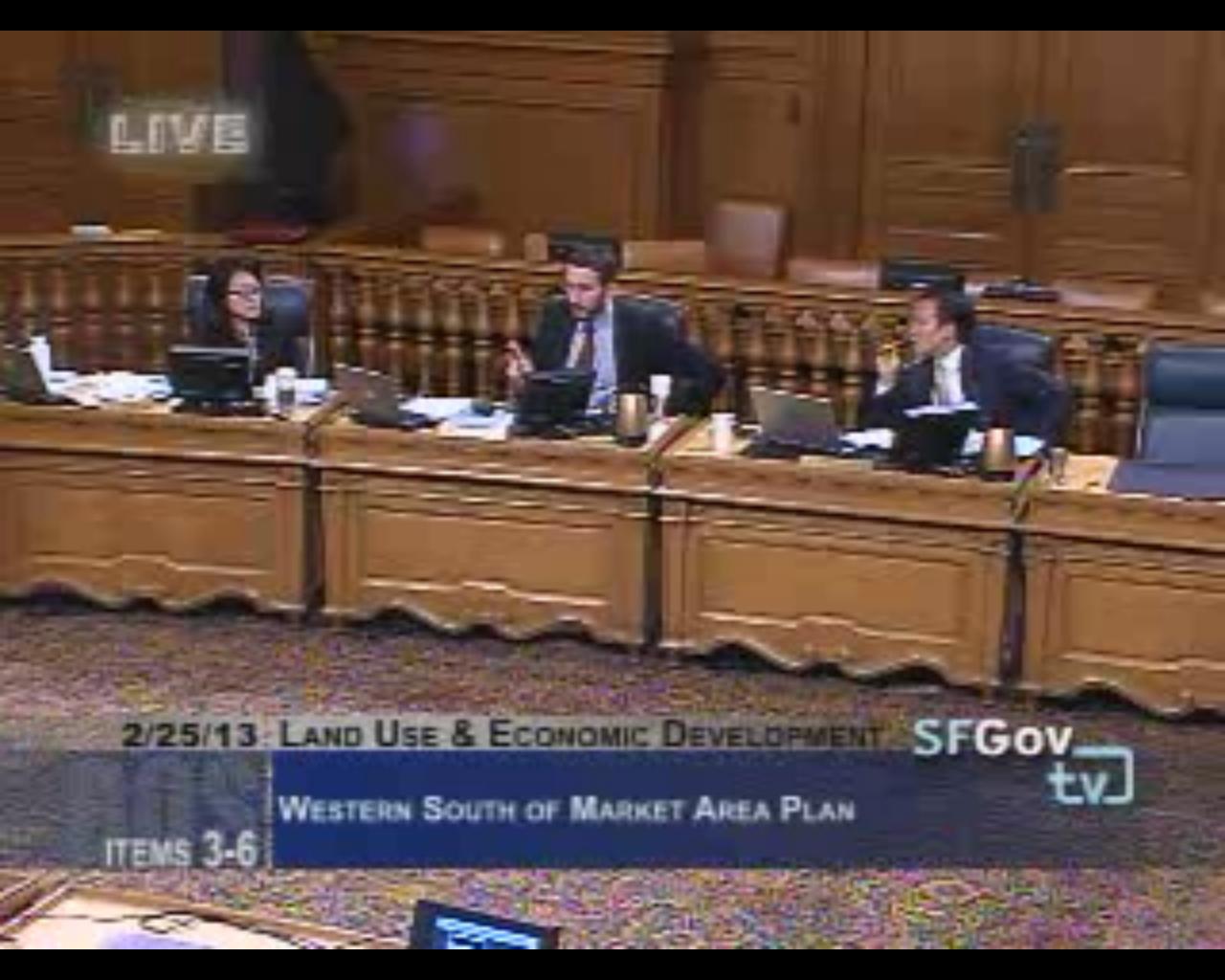
The Board of Supervisors today approved the Western South of Market Community Plan, the first step to ending a development moratorium that has been in place since the citizen-based planning process that developed the plan began in 2005, but not before some supervisors made a last-ditch effort to allow more office development and nightlife.

“I have real concerns over the plan,” Sup. Scott Wiener said as the plan came before the full board for the first time, continuing an effort to modify the plan that he began a few weeks ago when it was before the Land Use and Economic Development Committee.

While some of Wiener’s colleagues echoed his concerns and those raised by the business and entertainment communities, most decided to defer to the area’s Sup. Jane Kim and the Western SoMa Task Force that developed the plan. It was approved on a 10-1 vote, with Wiener in dissent. It will guide development and set land use rules for the Western SoMa area after being approved on second reading by the board next week.

Wiener led the critique of the plan’s restrictions on office development in most of the plan area, particularly around the transit hub of 4th and King streets, concerns that were echoed by Sups. London Breed and Malia Cohen, likely indicating that the business community has been lobbying supervisors on the issue.

But Kim said she is concerned about the area’s artists, nonprofits, and light industrial businesses – dubbed Production Distribution and Repair (PDR) in the city planning code – being squeezed out if the area is opened up to more office development.

“Office space is hot right now and it’s pushing out PDR uses,” Kim said. “Zoning is an importance tool, otherwise everything will turn into offices in South of Market.”

Wiener, Breed, and other supervisors also sounded their support for the entertainment community that has lobbied for changes in the plan, winning greater protections for nightlife at earlier hearings – including a ban on residential development on the raucous 300 block of 11th Street and persuading owners of “the purple building” to switch from residential to office – pushing for removal of more of the plan’s restrictions on attaining limited live music permits.

“I also have some real concerns with how the plan treats nightlife and entertainment,” Wiener said, while Breed said, “As a big supporter of the arts, I’m concerned there are limited live performances in the plan.”

Kim noted that the plan tried to strike a balance in the conflict between nightlife and housing, and she said that expanding the ability business in areas zoned Regional Commercial District (RCD) shouldn’t be done in just in a part of town where there conflicts have often been difficult to resolve.

“If you’re going to permit it in the RCD areas, it should be citywide rather than just in Western SoMa,” Kim said, noting that she’s open to futher discussions after the plan is approved.

Sup. David Campos and other supervisors urged their colleagues not to tinker with the compromises and hard-won balance in the plan. “I’m not 100 percent happy with every aspect of the plan, but I do think some deference should be given to the district supervisor,” Campos said.

Wiener agreed that deference to the desires of district supervisors is an important consideration, “but there are times when this board does not vote the same as their supervisors,” citing as an example the board’s approval of the controversial 8 Washington luxury condo project over the objections of Board President David Chiu.

Afterward, Terrence Alan of the California Music and Culture Association, which had lobbied for expanded protections of nightlife, told us, “Entertainment as a whole fared well.” But he said that they would continue pushing for greater citywide nightlife protections, including supporting Wiener’s proposal to expand the limited live music permits to include DJs.

SF approaches 1 million residents

167

So the Association of Bay Area Governments, which plays an outsized role in local planning by making all sorts of projections, based on whatever economists and demographers use to make projections, that are supposed to guide how cities in the region make land-use decisions, says San Francisco should be prepared to see its population grow to 964,000 people by 2035.If you figure that’s only an estimate, and probably off by at least five percent, we could be talking about a million people in this city just 20 years down the road.

Now: Some of those people will be coming here for jobs that are being created. Many will be coming here as immigrants from other countries. Many more will be coming because, well, California is growing, and, as the official motto of the old Redevelopment Agency put it, “Omnes Volunt Habitare in Urbe San Francisco.” Everybody wants to live in the city of San Francisco.

ABAG says we’re going to need to build homes and create jobs for all of those people, and the Chron talks about the new private-sector development that’s going on, and the zoning plans the city has adopted to increase density, particularly on the Eastern and Southeastern side of town. (Yes, it’s crazy, but John Rahaim, the planning director, freely admits that 80 percent of all new development is going into 20 percent of the city.)

Before we decide that this is our fate and our future, though, it’s worth considering a few points.

1. San Francisco is already one of the densest urban areas in the US. Last time I check the data, this city was number three on the list, behind Manhattan and Union City, New Jersey. Clearly, urban areas are going to have to get more dense as population increases in this state; the only other option is suburban sprawl, which works for nobody. But I wonder: Should San Francisco take this much more density when Berkeley (for example) doesn’t want it and won’t take it? Should it all go on the East Side when the more suburban-style areas on the West Side don’t want it?

Is there a way to do density that looks more like North Beach — one of the densest neighborhoods in town, and a really great place to live, work, and visit — and less like the highrise forests of Soma, which are unappealing at ground level, discourage neighborhood interaction, and are lacking in human scale?

I don’t want to live in Manhattan. I don’t want Soma to turn into Manhattan. Downtown is bad enough.

2. Nowhere in the Chron article, or in the comments attributed to Rahaim, is there any mention of affordable housing. That’s crazy. The urban planning train wreck that we’re heading for is all about the balance between jobs and the cost of housing. The vast majority of the jobs in San Francisco today do not pay enough to cover the cost of renting or buying a market-rate home. That’s not going to change radically; tourism and government are, and will be, the city’s major industries, even as tech, which pays better, increases.
If the housing that gets built is not in synch with the needs of the workforce, then the workers will be forced to live futher and further away, which leads to exactly the kind of sprawl and transportation problems that this “infill” and increased density is supposed to prevent.In other words: Affordable housing for the workforce prevents sprawl. Market-rate housing for people who live here and commute to work on the Peninsula is not environmentally sound.

3. Density — both in housing and in commercial development — has huge impacts on existing populations, particularly low-income communities. That’s not part of the planning discussion at all, and it really ought to be the starting point.

I know my trolls — I know you well — and I know you’re all going to say that growth and change is inevitable. Sure. But I think of a city first and foremost as a community, as a place where a diverse group of people live. Protecting that is just as important as giving developers and businesses a chance to make money.

Oh, and Rahaim’s comment —  “This (growth) is going to happen whether we plan for it or not” — is wrong. If we don’t build office space and room for new jobs, if we don’t build housing, the growth isn’t going to happen. San Francisco gets to decide what happens on land in San Francisco. Not saying we want to stop (all) growth, but Rahaim is a planner, and he should know: Growth happens when you encourage it and allow it. Growth doesn’t happen in places where you don’t allow it.

There is no growth in Bolinas, because the people who live there don’t want it. There’s less growth in Berkeley, because the people who live there want less. Again: Not the model I want to use. I don’t want to live in Bolinas any more than I want to live in Manhattan. But San Francisco does control our own fate, and we should never forget that.


Trip history

0

SUPER EGO As Maria von Trapp sang at the climax of The Sound of Music, “Whenever the goddess closes a rave cave, somewhere she reopens a gay leather biker bar.”

That sad closure is upon us, as the wonderful 222 Hyde (www.222hyde.com), the city’s thumping bass-ment in the Tenderloin, wings into history. Owner EO emailed me a couple Saturdays ago to tell me he was closing the precious, risk-taking little venue due to pressure from the ABC state liquor board over a license technicality and uncertainty about cooperation from the 222 building’s new owners. In short: sucks.

But EO’s off to pursue his musical destiny — he killed it playing live at Robotspeak at Saturday’s Lower Haight Art Walk — as one half of upcoming analogue electronic duos Moniker (with Kenneth Scott) and Polk and Hyde (with Jonah Sharp). And you can say farewell to the lovely space, rumbly Turbo Sound system, twinkly LED dance floor ceiling, and gorgeous staff this week: a special guest superstar (cough DJ Fark Marina cough) is supposed to drop by Thu/7, the As You Like It crew brings in Dutch techno wiz San Proper on Fri/8 (9pm-2am, $20) and 222 hosts a huge closing blowout on Sat/9 (10pm-late) full of surprise guests, gushing tears, and yummy pizza. The space itself has an amazing history — as the “Three Deuces” from the 1940s-’60s, it played hst to jazz greats and wild gals. Whatever it becomes now, 222 will live 444 ever in our raving hearts.

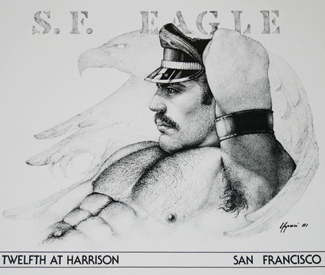
Throwing open its gay SoMa leather biker bar sash, however, is legendary rock ‘n roll watering hole SF Eagle (www.sf-eagle.com), reopened after a final passing grade on inspections last weekend, just in time for a Sunday beer bust of epic proportions — and 45-minute-wait lines — celebrating the victory of our new Mr. SF Leather, Andy Cross. (The true crown, I heard, went to anyone who made it through the four-hour Mr. SF Leather competition.)

I latched on my Nasty Pig kneepads and checked out the space (and the returned staff!) on Saturday night, and happily found myself there all Sunday as well. New owners Alex and Mike, inheriting the gutted space once slated for a pizza restaurant, have really opened it up by exposing the vaulted ceiling of the interior, pushing the main bar against the wall, and removing the trees from the patio (sad face). Everything is painted semi-gloss black — it looks like a beerhall designed by Anselm Kiefer. Although the mirrored bar is a wee bit ultralounge and there is as of yet no crusty, comfy decor, that good ol’ Eagle spirit is alive and well-drink drunk.

The beer bust was roiling delightfully with grateful scruffs and old school fetishists. Indie kids will rejoice at the return of Thursday Night Live on Thu/7 (8pm, $7, www.tinyurl.com/thursnightlive) with bands Beard Summit, the Galloping Sea, and Reliic, hosted by the Eagle’s ace music programmer Doug Hilsinger. (The space’s new layout is perfect for live music, and more regular parties will pop up soon, I’m sure). The Eagle reopened on the final weekend of fabulously festive Hayes drag dive Marlena’s, set to become another concept bar eesh, and the tail end of Soma’s fetish-friendly Kok Bar, also closing very soon. It’s a bittersweet trade-off for sure. Meet me at the Eagle’s patio trough and we’ll commiserate.


STACEY HOTWAXX HALE

I am freaking the funk out that Detroit’s own Godmother of House is going to vibe up the Housepitality weekly’s dancefloor — along with Chicago legends Gene Hunt and CJ Larsen? Try to pry me away!

Wed/6, 9pm, $5 before 11 p.m., $10 after. F8, 1192 Folsom, SF. www.housepitalitysf.com


DJ PIERRE

Following the Godmother of House comes the Godfather of Acid, one of the ones who started it all, Chicago Afro-Acid pioneer Pierre, whose sets are blissful rollercoasters to another, darker side.

Fri/8, 8pm-3am, $15. 1192 Folsom, SF. djpierre.eventbrite.com


DELHI 2 DUBLIN

Kick off your weeklong St. Patty’s Day binge the bhangra way, as great monthly Non Stop Bhangra brings in this beloved five-piece live band, a true multiculti mashup that meshes the Celtic with the Indian. Somehow, it works splendidly.

Sat/9, 9pm, $15. Public Works, 161 Erie, SF. www.publicsf.com


PARIS IS BURNING

“Shoot and arrow and it goes real high, well good for you.” SF’s Mistress of the Gay Night Peaches Christ and formidable NYC queen Patrice Royale host a screening of the all-the-rage-again 1990 doc and a vogue ball to die for. It’ll be an ex-travaganza.

Sat/9, 8pm, $22. Castro Theatre, 429 Castro, SF. www.peacheschrist.com


Big waterfront projects prompt study of new transportation ideas

18

The massive development projects being proposed along San Francisco’s central waterfront – from the proposed Warriors Arena at Pier 30 through the Giants’ housing/retail project at Pier 48 down to Forest City’s sprawling proposal around Pier 70 – will create huge challenges for the city’s already overtaxed transportation system.

Nobody is more aware of that issue than Warriors President Rick Welts as he seeks approval to build a 17,500-seat arena with just a smattering of parking spaces. “We’re investing a billion dollars in this property, and if people aren’t comfortable getting to it and leaving it, we have a problem,” Welts told a gathering of the California Music and Culture Association on Tuesday night, responding to a local resident who raised the concern. “We have to get that right, it’s at the top of our list.”

With Muni and BART already at capacity during peak hours, and thousands of new housing units being built in the coming years both along the waterfront and from nearby SoMa down through the Eastern Neighborhoods Plan area, city transportation planners are trying to get ahead of potential problems created by the development boom.

“We’re now taking a step back and looking at the long-term needs from the Exploratorium down to Pier 70,” says San Francisco Municipal Transportation Agency planner Peter Albert, who is leading a comprehensive waterfront transportation study that will inform the environmental studies done for each of these projects. “What we get is an environmental review that is much smarter because we have all this advanced planning….EIRs are important, but they aren’t really planning.”

Albert is looking at everything from working with various transportation agencies to beef up bus, train, and ferry services to the area; using these projects to complete the ambitious but underfunded and long-stalled Blue-Greenway bicycle path along the waterfront; accelerating capital projects that are already in the SFMTA’s queue; and exploring a dozen or so new ideas.

“What’s also coming out of this are new ideas we’re coming up with, things we weren’t even thinking of that may make sense,” Albert told us, noting that he’ll be doing his first presentation of some of these ideas to the SFMTA Board of Directors on March 5.

They include extending new streetcar service along the Embarcadero to the Caltrain station at 4th and King or possibly all the way out to the Anchor Steam Brewing-anchored project at Pier 48 (which would probably involve construction of new streetcar turn-arounds); better integrating the Central Subway project into Mission Bay and the Embarcadero with new bus and rail connections around 20th and 3rd streets; and expansion of the Embarcadero BART station to increase its peak capacity.

Welts said BART will be an important connector to the new Warriors Arena, noting that the walking distance from Pier 30 to the Embarcadero station is actually about the same distance as the Coliseum BART station is from the entrance to the Warriors’ current arena. He said that he’s excited about Albert’s work and wants to cooperate with helping the city meet its transportation needs: “We have a lot of process to go through and we’re embracing that process.”

Funding the needed improvements will be a challenge, particularly because new development projects generally don’t pay for their full impacts to the transportation system, as SFMTA head Ed Reiskin and Sup. Scott Wiener have told the Guardian. On Monday, Wiener amended the Western SoMa Community Plan to increase how much developers would pay in transportation impact fees.

Albert said funding for the needed improvements to the area’s transportation system would come from a combination of mitigation fees from the developers, reprioritizing the SFMTA’s existing capital budget, and securing state and federal transportation grants by developing impactful projects that are shovel-ready, thanks to this advanced planning effort.

These three waterfront development projects alone could have huge impacts. The Warriors Arena would host more than 200 concerts and sporting events per year, drawing anywhere from a few thousand to more than 17,500 people. The Giants’ Pier 48 proposal involves 27 acres of new development, including retail, office, Anchor Brewing, and about 1,500 homes. And Forest City’s proposal for Pier 70 involves about 1,000 homes, 2.2 million square feet of office space, and 275,000 square feet of retail and light manufacturing.

Addressing the waterfront’s transportation challenges, Board of Supervisors President David Chiu told the Guardian, “It is possibly the most difficult and important question surrounding the Warriors project, and I’ve encouraged all parties to make sure they get it right.”

Gentrification’s simple math

66

Chuck Nevius is big into gentrification these days. He thinks it’s a dandy thing and “no longer a dirty word,” says the even longtime residents of the Mission love it, and has a nice photo of a person walking in Dogpatch, where two really cool dive bars just shut down — thanks to the gentrication that’s such a great thing.

Nevius quotes Randy Shaw, who has a bizarre statement:

In the ’70s and ’80s there was massive displacement of residents in the Haight, Noe Valley and the Castro,” says Randy Shaw, executive director of the Tenderloin Housing Clinic. “But now you are seeing a massive influx of upper-income people into previously unoccupied areas.”

What? “Previously unoccupied?” Like the Mission and Soma and Dogpatch? Unoccupied by the wealthy, maybe, but there are people living in almost every square inch of San Francisco, and in some parts of town, they are low-income people, and richer people force them out. That’s happening on the same scale today that it did in the 1980s, except worse: In the 80s, if you werer priced out of the Haight or Noe Valley or the Castro you could move to the Western Addition or the Mission or Soma. Now prices are so high everywhere in town that your only move is out of San Francisco altogether.

And while ol’ Chuck does admit there are downsides, he seems to think that somehow you can move wealthier people and more upscale establishments into existing lower-income areas without anything bad happening, as long as you respect “the delicate balancing act.”

But it isn’t a balancing act at all — it’s a zero-sum game. There’s finite space in this city, and when when something or someone comes in, something or someone has to leave. (Yes, you could build a lot more housing, but nobody’s building housing for working-class people.) But you can’t build more storefronts on Valencia or Mission; force out the existing community serving businesses and they have noplace else to go.

San Francisco has failed spectacularly at the fundamental challenge facing a city under this kind of pressure. First, before you allow more development, more upscaling, more of what C.W. Nevius loves, you have to protect existing vulnerable populations. That’s not a balancing act; that’s a mandate. If you don’t do it, you lose the character of the city and San Francisco becomes another sterile, corporate community.

Jesus. Why is this so hard to understand? I’ve lived through it several times, these booms that people like Mayor Lee and Nevius always celebrate, and every time, the pattern has been the same, the city has been damaged, and community institutions have been lost. I’m not one of those preservationists opposed to all change, but again: First protect existing vulnerable populations.


Western SoMa Plan changed to lessen development impacts to nightlife and Muni

14

The Western SoMa Community Plan had its first hearing before the Board of Supervisors Land Use and Economic Development Committee today, with dozens of speakers praising the eight-year citizen-based planning effort that developed it but with much of the testimony criticizing the plan’s emphasis on facilitating housing development to the exclusion of other goals.

As we’ve reported, the nightlife community has in recent months been pushing for changes to the plan that would better protect nightclubs from complaints and pressure from nearby residents, particularly along 11th Street. Area Sup. Jane Kim has supported that effort and those concerns were echoed by Sup. Scott Wiener, the committee chair and a strong nightlife advocate.

“I have had significant concerns about this plan…and I’m hoping we can address them over the course of this hearing,” Wiener said.

Wiener also opened another front of attack on the plan by noting that it doesn’t adequately pay for the impact that thousands of new housing units would have on Muni and other aspects of the transportation system. In particular, he criticized a policy in the plan that would let 13 large properties get increased density in exchange for higher affordable housing fees that would be offset by lower transit and other impact fees paid to the city.

“What are we doing to make sure our transportation system keeps pace?” Wiener asked of Planning Department staff, later asking again, “Where would we get the money to improve transit for these increased residents?” Wiener didn’t get back any answers that seemed to satisfy him, so he asked for a more detailed report when the plan returns next week for a second hearing. That concern was echoed by the third committee member, Board President David Chiu, who said, “Building housing without money for transit will lead to long-term problems.”

The concern seemed to revive a losing fight that Wiener led in December over expanding who pays the city’s Transit Impact Development Fee, which pitted transportation advocates against affordable housing activists. Fernando Marti of the Council of Community Housing Organizing rued the revival of that conflict. “We’ve been here before, pitting [transportation against affordable housing needs] as if it were a zero sum game,” Marti told the committee, noting the importance of policies to balance out market rate housing and calling it a “plan for stability in a neighborhood facing large-scale gentrification.”

Marti’s COCHO colleague Peter Cohen, who was closely involved with the plan’s creation, also urged the committee not to tweak the housing policies or the revenues it creates for affordable housing. “This is a major upzoning,” Cohen said. “In 20 years, perhaps all the market rate stock [of housing in the plan area] will be gentrified.”

But the issue raised most often during more than two hours of public testimony involved nightlife and the need to strike a better balance between housing development and entertainment, much of the input stirred up by the California Music and Culture Association, a industry-backed trade group that formed largely in response to crackdowns on clubs in SoMa.

“It’s often said San Francisco can plan more for fun, and this is a great opportunity to do that,” said Guy Carson, a CMAC founder who owns Cafe du Nord. Longtime nightlife advocate Terrence Alan took part in the Western SoMa Task Force for four years before resigning in frustration, and he told the committee, “We are bringing up issues we felt marginalized in bringing up earlier.”

But several people involved with the task force, as well as speakers representing development interests, urged supervisors to pass the place without significant modifications. “There are dozens or hundreds of compromises in this plan,” Cohen said, urging supervisors not to upset that careful balance.

Task Force Chair Jim Meko – whose leadership was widely praised in the testimony – detailed the extensive outreach and detailed work that went into the plan, and offered a simple plea to the committee: “Please pass this plan so we can get on with our lives.”

The committee unanimously voted to support the change made to the plan by the Planning Commission to ban new residential development on the raucous 300-block of 11th Street, but to reverse the commission’s decision to grandfather in one final 24-home residential project on that block, in the so-called “purple building” at 340 11th Street. A number of other small changes to the plan were also unanimously approved.

But Kim objected to Wiener’s motion to eliminate the plan provision that would reduce the transit and open space fees and raise the affordable housing fees that developers of those 13 large parcels would pay. “I don’t think it’s good policy to reduce transit impact fees when we’re increasing population,” Wiener said.

“This has gone through an extensive community process,” Kim countered, adding that, “I hate that we’re always having this discussion about transit versus affordable housing.”

But Chiu sided with Wiener and the amendment was approved on a 2-1 vote with Kim in dissent. Yet Chiu held open the possibility of changing his mind next week when the plan returns to committee for a final vote – the delay prompted by the other revisions in the plan – when Planning staff will provide more information on the fee structure and its impacts.

If the committee gives final approval to the plan next Monday, it could be before the full board for approval the next day.

Staff of shut-down Mission dispensary opens SoMa’s newest cannabis club

1

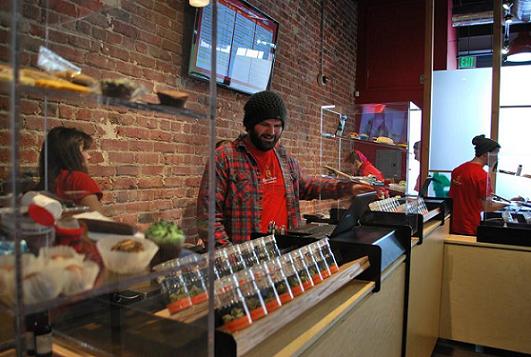
Today was the grand opening for a new dispensary just steps from the front door of Mezzanine and right down the block from a rapidly-changing Sixth Street. Long-time medical marijuana patients may recognize some familiar faces — Bloom Room employs many of the staff and management from Medithrive, the Mission Street dispensary was was forced to close “for the children” back in November of 2011.

“I was the manager of a store, and then I was the manager of a delivery service,” Bloom Room manager Stephen Rechit tells me, sitting in the dispensary vaporizing lounge area. When federal government agencies informed the cannabis club that it was too close to Marshall Elementary School, Medithrive switched to a $50-minimum, delivery-only service that owners continue to operate. 

The Bloom Room’s open for business, with space for on-site vaporizing steps from the cash register

Did Rechit — who says he became Medithrive’s first employee as a new University of San Francisco graduate — consider a career change in the face of unyielding federal agents? Not for a second. 

“I know this is definitely what I want to do,” he reflects. “I just really — I don’t want to get cheesy, but I believe in the plant.”

>>THROUGH MARCH 1, NEW BLOOM ROOM PATIENTS GET A SAMPLER OF THREE MARIJUANA STRAINS WITH ANY PURCHASE OF $50

Bloom Room’s downtown design, with its exposed brick walls and translucent glass marijuana leaf panels reappropriated from the defunct Medithrive storefront, may be the perfect fit for a Sixth Street neighborhood that’s on a definite upward economic swing. Rechit points out the window to the corporate offices of Burning Man, perched atop a skyscraper alongside the rest of the Mid-Market buildings that tech tenants are filling up. Burning Man’s been an earlier contributor to Bloom Room’s “Community Corner,” a space for neighborhood fliers, business cards. 

Bloom Room plans to stock six to 10 strains each of indicas and sativa, and sells blackberry chocolate bars from Kiva, Auntie Dolores caramel corn, and oen of Rechit’s favorites, TerpX concentrates. 

Sticky: TerpX concentrate

“TerpX is like the Girl Scout Cookies of last year,” Rechit comments, unrolling a piece of waxed paper so I can check out the golden goo. 

As we chatted, Tenderloin resident Jim Murray (who, happily, bore a striking resemblance to Bill Murray in The Life Aquatic in his navy beanie) pulled up in the narrow, tall table to inquire about the availability of the clould of OG Kush pumping into the vaporizer bag between Rechit and I. 

I’d seen Murray complaining about the quality of Bloom Room bud he’d picked up previously, and now he was interested in the “toast,” the spent flower already used in the vaporizer that was sitting on a piece of paper in the ashtray. 

“The reason why I’m sensitive to this is because I am a senior living on a VA pension,” he informed me. “What compassionate care programs do you have here?” he asked Rechit. 

FYI, Rechit says the dispensary gives away free product to patient on holidays and keeps prices low in general. Back when Medithrive’s doors were open at its Mission Street location it made monthly donations to the school around the corner that was eventually used as the excuse by the federal government to shut it down. Let’s hope Bloom Room has more luck in its new SoMa spot. 

Bloom Room, 471 Jessie, SF. (415) 543-7666, www.bloomroomsf.com

Supervisors consider Western SoMa Plan, lots of new condos, and “the purple building”

129

The fate of the “purple building” – which has become caught up in the clash between nightlife and residential interests on the clubgoer-saturated 300-block of 11th Street – remains undecided as the Western SoMa Community Plan heads into its first hearing before the Board of Supervisors Land Use and Economic Development Committee on Monday.

As we reported in this week’s paper, a unique citizen-based task force has spent the last eight years developing the plan, which will allow thousands of units of new housing – most of it along Folsom Street – to move forward once the plan gets final approval from the board. But the California Music & Culture Association and other nightlife advocates successfully amended the plan to ban new housing on that 11th Street block as the Planning Commission approved it in December.

Yet the commission also decided to grandfather in a 24-home project at 340 11th Street, the so-called purple building, which nightlife advocates say would put those new residents on a collision course with Slim’s, DNA Lounge, and other big nightclubs on that busy block. As we went to press, both sides and District 6 Sup. Jane Kim were all hopeful that a compromise was imminent, likely involving switching from residential to office.

But with just days to go before that hearing, building owner Tony Lo still hasn’t decided whether to make the change or fight it out in front of the supervisors. His architect John Goldman – whose residential design for the site was placed on hold by the city since shortly after he submitted it in 2005 – had hoped to hear by now but he’s still waiting for Lo to make the call.

“Based on my analysis, it looks feasible to change to offices if you want to do it, and I mean feasible financially and architecturally and planning-wise,” Goldman today told the Guardian, referring to what he told Lo.

Meanwhile, Western SoMa Task Force Chair Jim Meko – who has not been supportive of tweaking the plan after all the work he oversaw – yesterday sent out an email blast to stakeholders and supporters urging them to attend Monday’s hearing and show support for the plan.

“You don’t often get a chance to participate in making decisions about your own neighborhood from start to finish. Some special interest groups are expected to come out of the woodwork to take pot shots at the Plan so the hundreds of participants in this process need to make their voices heard. Your testimony at the hearing next week will make all the difference,” Meko wrote.

The hearing starts at 10am in board chambers in City Hall. This item might have been heard later in the day considering the agenda opens with a continuation of the controversial condo lottery bypass legislation, on which Board President David Chiu and others have been trying to forge a compromise between tenant advocates and homeowner groups. But committee Chair Scott Wiener just told us that item “will be continued. No compromise yet.”

Clubs vs. condos

30

steve@sfbg.com

The Western South of Market area is ground zero for the city’s War on Fun, a place where nightlife often comes into conflict with residential expectations, particularly on the raucous 300 block of 11th Street and, to a lesser degree, Folsom Street’s old “miracle mile” of predominantly gay bars.

As the city’s Planning Department and its development community looks to accommodate another 4,000 homes for 10,000 new residents on less than 300 acres of Western SoMa — most of it along Folsom Street between 7th and 13th streets — that potential for conflict could grow in the coming years as funky old buildings give way to shiny new stacks of expensive condos.

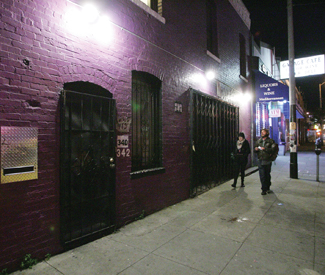
And efforts to sort it out may hinge on the future of a 105-year old purple building.

After nearly eight years of work by a unique citizen-led task force, the Western SoMa Community Plan is now before the Board of Supervisors, with the Land Use Committee set to hold its first hearing on Feb. 25. Despite dozens of task force meetings seeking to strike the right balance between residential and entertainment interests, the plan is still being tweaked.

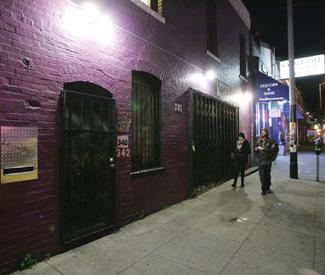
When the Planning Commission approved the plan and some related projects on Dec. 6, it followed King Solomon’s approach of cutting the 11th Street baby in half. The commission heeded the recent recommendation of the nightlife community and District 6 Sup. Jane Kim to modify the plan to prohibit new residential development on the 11th Street block where tipsy visitors to Slim’s, DNA Lounge, and other big clubs clog the sidewalks every weekend. But it also voted to grandfather in a 24-unit residential project at 340 11th Street, which everyone now involved in closed-door negotiations simply calls “the purple building,” a two-story masonry structure built in 1907 that is awaiting demolition.

The building houses light industrial businesses and is the former home of Universal Electric, whose owner, Tony Lo, wants to develop the property. Along with architect John Goldman, Lo submitted a residential project application in 2005, only to have it placed on hold pending adoption of the Western SoMa Community Plan.

“It was well along when the Planning Department put the project on hold,” Goldman told us.

City officials and even many of the nightlife advocates say they sympathize with the long wait that Lo and Goldman have endured, even if many oppose housing on the site and have been urging Lo to find another use for the site, such as an office building.

“They would have no idea what they’re getting into until that first Saturday night,” nightlife advocate Terrance Alan said of the would-be residents of the building, envisioning a young couple who had only visited during daytime hours trying push a baby stroller past the throngs of club-goers. Alan took part in recent meetings Kim facilitated with Lo and Goldman, and Alan told us, “There was, for the first time, a very frank discussion about the problems that owners would experience and the pressure they would put on clubs in the area.”

For example, just one neighbor of Slim’s — a popular live music venue on the block owned by singer Boz Scaggs — has waged a relentless campaign that has forced temporary shutdowns and cost the club more than $750,000 in mediation costs, Alan said, despite the club’s sound buffering and general compliance with local codes.

Alan said that it’s simply unthinkable to add more than two dozen new homeowners to that busy block in a condominium building that only allows access on 11th Street. Alan is hopeful for a negotiated compromise with Lo, something that Kim told us she also thinks is likely.

“I’m hoping we can come to a consensus of the property owners and business owners on 11th street, including the purple building,” Kim said, echoing Alan’s point that, “Just one resident can really shut down a business and hurt its financing.”

Goldman said he understands the concern and “my client is considering alternatives to housing.” While he was a little frustrated that it wasn’t until November that they first heard about a proposal to ban residential projects on the block, “We’ve definitely heard the concerns of the nightlife entertainment folks…No decision has been made yet, but it’s the goal of my client to decide fairly soon.”

A ban on housing is just one of the changes that Alan and other members of the California Music And Culture Association (CMAC) are pushing the supervisors to make to the plan, provisions he was unable to get into the plan as a member of the Western SoMa Task Force for four years before resigning in frustration.

“The task force was made up of people primarily interested in residential development,” Alan told us. “The plan is pretty much about protecting residential.”

That perspective irritates task force chair Jim Meko, who said he held about 60 meetings on entertainment and nightlife issues and bent over backward to accommodate that community. “Overall, the Western SoMa Plan is very friendly to the entertainment industry,” Meko said, noting that the plan grandfathers in all existing nightclubs, even after a building is demolished, and requires new residential construction to buffer against street noise. “They’re never satisfied.”

But Meko does concede that accommodating existing residents and new residential development was central to the task force’s work, as it was charged with doing by the Planning Department. “The most important thing was to do no harm to anyone,” Meko said was the guiding philosophy behind the task force’s approach. “We’re the real test case for a mixed use community in the city.”

While Folsom Street has more bars that 11th street, and those bars will be protected under the plan, Meko said the idea was to keep them limited in scale and prevent the proliferation of large clubs that operate into the wee hours.

“Folsom Street is where the residential growth will go,” Meko said. “That’s the area where we want to add the most residential growth and it seems dumb to add more nightclubs there.”

But he also doesn’t think it makes economic sense for many clubs to open there anyway. With allowable height limits in that corridor being increased from 50 feet now up to 65 feet, and with the plan’s approval allowing development projects to move forward, many of what he called the “old junky buildings” where clubs could find cheap rent will likely be demolished.

“With the height increases, those buildings are going to be history in five years,” Meko said.

Kim said she is supportive of both nightlife and the plan’s facilitation of residential development.

“It’s transit-first and a good place to be able to handle the density that’s close to downtown,” Kim said, noting that she’s supportive of even the massive residential project proposed for 801 Brannan Street, mostly because it includes units with up to two and three bedrooms and an elegant design by architect David Baker.

That project would have 432 housing units with a total of 606 bedrooms, 22,124 square feet of retail, and a 422-car parking garage on a site of just over four acres. In many ways, it is typical of the housing density that will begin to crowd into Western SoMa.

Meko was critical of how the entertainment community was able to make changes to the plan after all the hard work of the task force, and he told us, “It was a choice Jane Kim had to make, and she will have to answer to her constituents in the future.”

But Kim said the change on 11th Street made sense and that it’s important to strike a balance. “Entertainment is clearly an important part of Western SoMa and 11th Street is unique in showcasing that community,” Kim said.

Alan and Glendon Hyde — an LGBT activist who, like Meko, ran against Kim for D6 supervisor two years ago — are also pushing for other changes in the rules governing nightlife in SoMa, including who can get the limited live music permits that the city issues and extending the 10pm curfew in those permits.

“I think small businesses throughout the district should be able to use the limited live music permits, and they’re available only on Folsom Street under the plan,” Hyde told us, noting that otherwise he thinks nightlife fares well until the plan, particularly after Kim’s intervention on 11th Street.

Kim said that she in reluctant to start tweaking too many provisions of the plan, which she characterized as a separate discussion that doesn’t have to happen now: “I’m open to further discussions after we get the plan passed.”

The Western SoMa Plan was broken off from the larger Eastern Neighborhoods Plan by then-Sup. Chris Daly in 2005 to let a citizen-based effort tackle this area’s unique challenges, and Kim said the plan is a testament to the diligent efforts of Meko and a diverse set of members.

“I think it was a really good process with lots of stakeholders involved,” Kim said. “I like the balance. I’m happy.”