SFPD

Community policing in the Haight

3

By Tim Redmond

There’s lots of commentary on my latest post on the proposed sit-lie law. In one of his numerous comments, Arthur Evans argues that

We, the residents, also believe that a sit-lie law would help make things uncomfortable for the thugs.

It’s always tricky to say that “we, the residents” of the Haight, or any other neighborhood, are in unanimous agreement about anything. In fact, the Haight Ashbury Neighborhood Council recently adopted a statement on policing in the neighborhood that doesn’t call for a sit-lie law at all. Here’s the relevant part:

HAIGHT STREET

What happens on Haight Street rarely stays on Haight Street, and oftentimes doesn’t even start on Haight Street.

The need is for constant, predictable, visible and persistent patrols on Haight Street, Page Street and Waller Street from Stanyan to Baker. Additionally, the Panhandle must be viewed as an integral part of the policing of Haight Street as the two are linked by both residents and visitors. Foot patrols should be maximized on Haight Street while regular bicycle patrols should be the primary means used in the Panhandle. Regular car patrols can be used to supplement foot patrols for Page and Waller streets.

Care should be taken by the SFPD to pay particular attention to the area around Park Station itself, especially the area around the intersection of Haight and Stanyan, as it is a heavily used pedestrian, transit and automobile corridor with major retailers – McDonald’s, Amoeba and the proposed Whole Foods – joining the Alvord Lake, Children Playground, and Golden Gate Park pedestrian entrance creating a complex mix of tourist, visitor, shopper and resident users. Community attempts to smooth out these complex interactions through more police presence and various traffic calming proposals should be supported by Park Station.

The entire statement is after the jump. HANC will be holding a community meeting on the issue Feb. 11.\\

Sitting boundaries

0

Aggressive lobbying efforts by the San Francisco Police Department and some of its allies who are pushing a proposed sit/lie ordinance have irked some current and former members of the Board of Supervisors.

The legislation was privately created by new Police Chief George Gascón and then played up in the mainstream media. It would make it illegal to sit or lie down on public sidewalks. Supporters say it would make it easier for cops to target people who harass neighborhood residents.

But in other cities where similar laws have been passed, protests have erupted from homeless-advocacy organizations and civil liberties groups, which say criminalizing this behavior unfairly (and unconstitutionally) targets homeless people who have nowhere else to go.

In Portland, Ore., a similar law was enacted then overturned by the courts. In Los Angeles, an ordinance against sleeping on the sidewalk was challenged by the American Civil Liberties Union, resulting in the 9th Circuit Court of Appeals ruling in 2006 that unless adequate shelter is available for homeless people in L.A., arresting them for sleeping on the sidewalk amounted to cruel and unusual punishment.

But an e-mail action alert included in SFPD Central Station Capt. Anna Brown’s monthly community newsletter encouraged people to contact the mayor and the Board of Supervisors to support the creation of a sit/lie ordinance. “Naturally, there is resistance from the left-leaning Board of Supervisors who feel this is an attack on the homeless population,” it noted.

That unusually overt political plea caught the eye of Aaron Peskin, former president of the Board of Supervisors and current chair of the San Francisco Democratic Party, who called it “funky.” Peskin told us he’d never seen an advocacy pitch like this go out in a captain’s newsletter before, and he questioned whether this was an appropriate use of city resources.

But the City Attorney’s Office says this doesn’t fall under city laws banning electioneering by city employees, who are barred from using government resources to endorse a candidate or ballot initiative, or from doing any campaign-related work on city property.

Yet this kind of pitch “is not considered political activity,” Jack Song, a spokesperson for City Attorney Dennis Herrera, told the Guardian.

But Sup. David Campos, a former police commissioner, frowned upon it nonetheless. “Something like this is not really helpful to the Board of Supervisors and the Police Department working together,” Campos said.

Sup. Ross Mirkarimi took a similar view. At a recent Board of Supervisors meeting, he requested a hearing about the ordinance because he said the media-driven public debate had occurred without formal discussion. Anti-loitering and public nuisance laws are already on the books, Mirkarimi pointed out.

“What makes those laws inadequate?” he asked. “How would the proposed law augment what is already in effect?”

The alert wasn’t actually written by Capt. Brown, who included it in her newsletter. It was drafted by the Community Leadership Alliance, an organization headed by David Villa-Lobos, a longtime resident of the Tenderloin and a candidate for the District 6 Supervisor seat.

Since Gascón floated the idea of creating a sit/lie ordinance, CLA has kicked into high gear to mobilize support, most recently issuing its action alert e-mail to 8,000 recipients. Police captains were included in the e-mail blast, Villa-Lobos told us, but each captain decides independently what to include in his or her newsletter.

People sitting and lying on sidewalks is “a really, really big problem, especially in the crime-ridden areas,” Villa-Lobos said. “God bless the homeless, but it’s a big problem there too.” Several years ago, his organization tried to mount a campaign for a sit/lie ordinance, but it didn’t go anywhere. “People came out and said we were trying to violate civil rights,” he said.

The Community Leadership Alliance is active in the Tenderloin, SoMa, and the mid-Market Street area, and the group occasionally holds monthly meetings at the Infusion Lounge, an upscale nightclub owned by Scott Caroen, the chair of the organization.

Gascón worked with deputy city attorneys to draft the ordinance and all district police stations have submitted to their commanders a list of areas that they feel could benefit from the law, according to a Tenderloin district newsletter. Mirkarimi told the Guardian that some supervisors were kept in the dark for weeks about the fact that an ordinance had been drafted. “This wasn’t collaborative at all,” Mirkarimi told us. “We never received it until we demanded to see it.”

The Haight-Ashbury, where residents and visitors have been complaining about harassment from wayward traveling youth, has been ground zero for discussion about a sit/lie ordinance. A small group of irate residents there and the Park Station Capt. Teresa Barrett have rallied in support of the law, saying it would give police a new tool to target these disruptive street kids.

But it’s clear that the ordinance’s supporters want to see it applied broadly and to be used to roust the homeless in neighborhoods throughout the city.

“CLA feels that our sidewalks should be enjoyable and a place of social gathering, and that the ordinance could go a long way in helping our neighborhoods feel safer,” reads the Community Leadership Alliance alert that was included in the police captain’s newsletter. “It may also reduce the overall homeless population in San Francisco by discouraging people from coming to the city to beg for money.”

SF Critical Mass under review

1

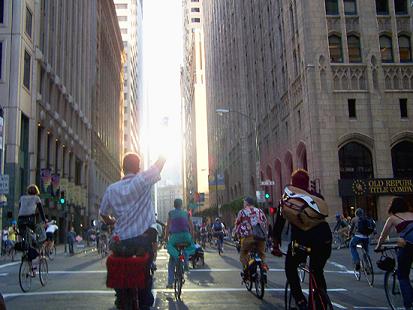
San Francisco Police Chief George Gascón said Friday that he has ordered a review of policies related to Critical Mass, offering veiled threats of an impending crackdown to the unpermitted monthly mass bike ride. As SFPD learned from a 1997 crackdown, that won’t work, and will more likely make the event even more popular and provocative.

But if he’s serious about improving police procedures surrounding Critical Mass, that would be a welcome change. Ever since the March 2007 ride, in which the local media fed hysteria over the ride after an altercation between a driver and cyclist, there’s been a big but confused and confusing police presence on the rides, the result of wanting to “do something” but having no discernible policy or strategy for what to do.

Meanwhile, within the community of longtime Critical Mass riders, there was already a discussion brewing about how to self-regulate and prevent conflicts with drivers. Some of that discussion has been occurring on a new website devoted to the event, and much of it centers on communicating to riders that the event is about celebrating bikes, not purposely pissing off drivers.

There are no official leaders, procedures, or route to the 18-year-old event, making overt negotiations and policies difficult. But if Gascón is serious about the value he said he places on community outreach, there have got to be ways to lower police costs, lessen community conflicts, and preserve what thousands of San Franciscans still see as an important San Francisco tradition.

The problem with Tasers

0

The BART police officer who pulled a weapon and killed Oscar Grant on Jan. 2, 2009 claims he didn’t intend to use lethal force. Lawyers for Johannes Mehserle say their client meant to pull a Taser gun to subdue Grant and grabbed his service pistol by mistake.

That, of course, is a debatable proposition, and a jury in Mehserle’s homicide case will have to sort it out. But it shows the danger of a new San Francisco Police Department report suggesting that Tasers might have saved the lives of some of the eight people shot and killed by San Francisco cops between 2005 and 2009.

The report, written by Assistant Chief Morris Tabak, focuses on 15 incidents in which local officers shot at suspects. Seven of those shootings led to nonfatal injuries, but eight ended with the suspect dead. Some of the shootings were, at best, dubious. In 2005, for example, two officers shot and killed a mentally disturbed man, Asa Sullivan, who was unarmed and hiding in an attic (see “Why is Asa Sullivan dead?” 6/21/06). If the police had a viable less-lethal alternative, the report states, the outcome might have been different. The death of Idriss Stelley at the hands of the SFPD isn’t mentioned in the report, since that happened in 2001,. But Stelley was also mentally ill, and some critics say he should never have been shot .

It’s no secret that Chief George Gascón supports arming the police with Tasers, which use high-voltage electrical current to disrupt a person’s nervous system and render him or her temporarily unable to move. Tasers aren’t exactly nonlethal; by some accounts, 250 people have been killed by Taser shots. They can be particularly hazardous to people with heart conditions.

And they also can be badly abused by police officers who see them as a tool to subdue unruly suspects who otherwise would not be subject to the use of lethal force. Nobody argues, for example, that Oscar Grant (who was lying on the ground, unarmed) was enough of a threat that the use of lethal force was an appropriate police response. The BART officers on the scene, however, apparently thought that using a Taser was fine.

If that’s how the SFPD is going to see the use of Tasers, then the city’s better off without them.

We agree: if the officers who shot Asa Sullivan had used a Taser instead, the young man might still be alive today. (Assuming he wasn’t one of those whose medical condition would render a Taser attack fatal). And it’s always better to subdue a suspect without the use of lethal force. And Tabak is right — if the local cops had (and used) an alternative to their firearms in some of the fatal shootings, live might have been saved.

And if that’s how Tasers are used — and that’s the only way they’re used — there’s a case for adding them to the city’s arsenal.

But when the Police Commission reviews the Tabak report and discusses a policy change that could allow the SFPD to carry Tasers, it should start and end with one rule: a Taser should be treated like any lethal weapon, and used only when deadly force would be authorized.

The danger of less-lethal weapons is not just the fact that they can be fatal to some people, or that they can be mistaken for a firearm. If the cops think they can use the devices any time they want a shortcut to other forms of physical restraint, then Tasers become a liability that can lead to tragic consequences.

Editorial: Just say no on tasers

0


A taser should be treated like any other lethal weapon only when deadly force would be authorized

The BART police officer who pulled a weapon and killed Oscar Grant on Jan. 2, 2009 claims he didn’t intend to use lethal force. Lawyers for Johannes Mehserle say their client meant to pull a Taser gun to subdue Grant and grabbed his service pistol by mistake.

That, of course, is a debatable proposition, and a jury in Mehserle’s homicide case will have to sort it out. But it shows the danger of a new San Francisco Police Department report suggesting that Tasers might have saved the lives of some of the eight people shot and killed by San Francisco cops between 2005 and 2009.
The report, written by Assistant Chief Morris Tabak, focuses on 15 incidents in which local officers shot at suspects. Seven of those shootings led to nonfatal injuries, but eight ended with the suspect dead. Some of the shootings were, at best, dubious.

In 2005, for example, two officers shot and killed a mentally disturbed man, Asa Sullivan, who was unarmed and hiding in an attic (see “Why is Asa Sullivan dead?” 6/21/06). If the police had a viable less-lethal alternative, the report states, the outcome might have been different. The death of Idriss Stelley at the hands of the SFPD isn’t mentioned in the report, since that happened in 2001,. But Stelley was also mentally ill, and some critics say he should never have been shot .

It’s no secret that Chief George Gascón supports arming the police with Tasers, which use high-voltage electrical current to disrupt a person’s nervous system and render him or her temporarily unable to move. Tasers aren’t exactly nonlethal; by some accounts, 250 people have been killed by Taser shots. They can be particularly hazardous to people with heart conditions.
And they also can be badly abused by police officers who see them as a tool to subdue unruly suspects who otherwise would not be subject to the use of lethal force. Nobody argues, for example, that Oscar Grant (who was lying on the ground, unarmed) was enough of a threat that the use of lethal force was an appropriate police response.

The BART officers on the scene, however, apparently thought that using a Taser was fine.
If that’s how the SFPD is going to see the use of Tasers, then the city’s better off without them.
We agree: if the officers who shot Asa Sullivan had used a Taser instead, the young man might still be alive today. (Assuming he wasn’t one of those whose medical condition would render a Taser attack fatal). And it’s always better to subdue a suspect without the use of lethal force. And Tabak is right — if the local cops had (and used) an alternative to their firearms in some of the fatal shootings, live might have been saved.
And if that’s how Tasers are used — and that’s the only way they’re used — there’s a case for adding them to the city’s arsenal.
But when the Police Commission reviews the Tabak report and discusses a policy change that could allow the SFPD to carry Tasers, it should start and end with one rule: a Taser should be treated like any lethal weapon, and used only when deadly force would be authorized.

The danger of less-lethal weapons is not just the fact that they can be fatal to some people, or that they can be mistaken for a firearm. If the cops think they can use the devices any time they want a shortcut to other forms of physical restraint, then Tasers become a liability that can lead to tragic consequences.<0x00A0>2

Mirkarimi’s mandatory foot patrols ballot measure

0

Text by Sarah Phelan

Mirkarimi.jpg

Sup. Ross Mirkarimi, along with Sups. Eric Mar, David Chiu, John Avalos and David Campos, submitted a ballot initiative today that asks voters to require the San Francisco Police Department to implement community-based foot/ beat and MUNI patrols.

The legislation would require the Captain of each district police station, in consultation with neighbors, merchants and community stakeholders, to establish and assign officers to foot/beat patrols within their station’s
jurisdiction.

The measure would also require station commanders to coordinate with adjacent stations for the efficient policing of distressed MUNI lines.

“Foot/beat patrols work very well in deterring crime and building trust with the community – it’s proven throughout the United States,” Mirkarimi said in a press release. “Walking or bicycling police beats or riding Muni should not be a luxury for the one of the best funded per capita police departments in the nation.”

The measure, Mirkarimi said, would provide substantial discretion to the SFPD command staff and the City’s district stations to define and modify beats in response to crime statistics, community input and evolving realities on the street.

Mirkarimi also submittied a hearing request on the implementation of an “Anti-Sit/Lie” law.

“There has been a great deal of misinformation on how this law works – completely absent from the public
discussion is both the District Attorney and City Attorney to substantiate any of the presumed effects,” Mirkarimi stated. “There are questions that remain unanswered as to why current anti-loitering and
nuisance laws aren’t being enforced.”

Police chief: SFPD dignitary security costs were a mystery even to him

2

By Rebecca Bowe

San Francisco Police Chief George Gascon offered an explanation yesterday for why it took so long for the San Francisco Police Department to provide any figures whatsoever on how much it spends on security detail for elected officials: Apparently, no one really had any idea what the costs actually were.

“Quite frankly, when I first came here I asked multiple times, how much are we spending in dignitary protection? And I could not get the answer within my department,” Gascon told the Board of Supervisors yesterday.

Sup. Ross Mirkarimi first began asking for this information back in July. “When we got the first cut of information approximately two weeks ago, I looked at it and I said, this information does not seem right,” Gascon recounted. “Go back and work on this.”

When his staff finally produced a figure of around $2 million for all dignitary security costs for the budget year ending in June 2009, Gascon says he immediately shared that figure with the media and members of the Board. This past weekend, the San Francisco Chronicle ran a front-page story about the cost, which includes protection for the mayor, politicians visiting from outside San Francisco, and others.

“I don’t believe it is copasetic to allow a black ops budget to exist” within the SFPD, Sup. Ross Mirkarimi said at yesterday’s Board meeting, during a discussion about legislation he introduced to require elected officials to reimburse the city for the cost of bodyguards on the SFPD payroll when they’re out on the campaign trail.

Guarded secrets

5

By Rebecca Bowe

mystery box.jpg
How much did the mayor’s security detail cost when he campaigned outside SF? SFPD isn’t telling.

When San Francisco Police Department Assistant Chief Jim Lynch spoke before the Rules Committee this morning, he mentioned that the Police Chief George Gascon was unable to attend because he was at the swearing-in ceremony of Los Angeles’ new police chief.

“Out of curiousity,” Sup. Michela Alioto-Pier asked Lynch, “How many officers went to L.A. with Chief Gascon?” She was referring to his security detail for an event that was clearly unrelated to San Francisco city business.

Lynch replied that he could not say. When pressed whether security had in fact been provided for him by SFPD, he gave the same response. Sorry. Can’t tell you.

It’s the same response that Sup. Ross Mirkarimi received for months when he tried in vain to get the dollar amount for Mayor Gavin Newsom’s security detail for campaign-related events outside city and state borders. According to the SFPD, divulging that information could compromise security tactics.

The discussion at this morning’s Rules Committee focused on legislation authored by Mirkarimi, co-sponsored by Sups. John Avalos, David Campos, and Chris Daly, which would require elected officials to reimburse the city for the cost of “dignitary security” (think bodyguards) when that protection is provided on the campaign trail outside San Francisco.

“It’s not about one elected official,” Mirkarimi noted, while acknowledging that Newsom’s frequent travel had sparked interest in the issue. “It’s about reviewing standard operating procedure,” he said, and creating a system for cost recovery when taxpayer dollars are used to send SFPD forces off to campaign-related events. With the General Fund already in rough shape, Mirkarimi added, “fiscal vigilance is demanded.”

SF cops shouldn’t seize DJs’ laptops

7

By Steven T. Jones
laptopdj.jpg
Going into another weekend, I find myself thinking about our story on San Francisco Police officers seizing DJs’ laptops as they raid house parties. The SF Weekly got on the story about the same time we did, but their music columnist got it into the paper a week before us. We furthered her reporting by naming the main cop culprit and showing the Chief’s Office knows about it, but it’s frustrating that the policy isn’t being addressed more directly, given the level of concern. Our story is getting a few comments and I’d love to hear others weigh in here on a tactic that seems punitive and perhaps unconstitutional.

That’s what I called it when SFPD spokesperson Lyn Tomioka wrote an e-mail to me defending the practice (I was the editor for our story, which was written by freelancer Joshua Emerson Smith). She wrote: “Our primary focus is always public safety. In the past we have seen over crowed [sic] events that the Fire Department would not have been able to rescue all of the people, in the event a fire broke out. Under age drinking is another concern and the serious issues that have been associated with that. There are other public safety issues that concern us.”

To which I responded: “I understand your concerns about fire and underaged drinking, but I’m still not clear what those things have to do with laptop computers or how their seizure proves anything. Playing music is not a crime, nor is having it on your computer. Frankly, the policy seems punitive and perhaps unconstitutional. We hope the SFPD will review this tactic, allow the public to weigh in on it, and consider modifying or rescinding it.”

What do you think?

Police seize DJs’ laptops

0

news@sfbg.com

San Francisco Police Department officers have added a controversial tactic to their aggressive raids on house parties (see "Fun under siege," 4/22/09): they’re seizing laptop computers from DJs at the events.

While SFPD officials deny the laptop seizures is a new policy, they admit it has been condoned by Police Chief George Gascón, who took over in August and last month told the Guardian‘s editorial board he wants to make the SFPD more transparent and accountable to the public (see "New coach, new approach," 10/14/09).

"The police chief is aware that officers are being proactive in gathering evidence," Sgt. Lyn Tomioka told the Guardian when asked about a string of laptop seizures by undercover cops over the last 10 months, most of them in cases in which the DJs weren’t even charged with a crime.

Many of the raids have occurred in SoMa, and were spearheaded by undercover officers who penetrated the parties and were followed by uniformed officers. San Francisco Entertainment Commission member Terrance Alan called the crackdown a "disappointing and dangerous trend."

Tomioka said it’s a judgment call for officers to seize laptops as evidence of an illegal party, but Alan said the tactic is a punitive measure that proves nothing: "Taking laptops [is] not necessary to prove the underlying crime, and in many cases damages people’s ability to earn a living."

One of the most recent raids happened on Halloween. It was about 2:30 a.m. and music was pumping out of a warehouse party on Sixth Street. The people throwing the party had hired a doorman, and attendee Eric Dunn was standing in line waiting to get in.

"We were right at the front of the line," Dunn told the Guardian, when, he said, two plainclothes officers drove up on the sidewalk, jumped out of an unmarked car, and rushed up to the doorman. "[The officers] pretty much started demanding entry right away. The doorman was really polite. He basically told them that you have to know somebody to get into the party."

Dunn said the officers waited until an exiting guest opened the door from the inside and then made their move. "One guy barged in, and the other guy followed. They never asked permission or received permission to enter the building," Dunn said.

Inside, the two undercover officers immediately shut down the event. Justin Miller, a DJ at the event, said she remembers it very clearly. "The cops at that point were telling everybody to leave the party, telling me to turn the music off. I turned the music off. Everyone was quietly leaving."

But Miller said it didn’t stop there. One of the undercover officers approached her and asked if she had a laptop. She said she did. "I was a little confused at this point because I didn’t know what my laptop had to do with anything. I was playing CDs." She said she pulled her computer out from underneath a table and unzipped it from a case. The officer then "grabbed it from me."

The undercover police officer — later identified by witnesses and the evidence receipt as Larry Bertrand — instructed Miller to follow him down to the street to get a property receipt for her laptop.

At this point there were uniformed officers on the scene as well. Miller started to cry. "I begged him. I said, ‘This is my livelihood. You’re talking my laptop. This is my livelihood. I hope you realize that.’ He said, ‘This is how you’re going to learn then, I guess.’"

Miller said Bertrand (who did not return Guardian calls for comment) then told her he was "going to take it upon himself to shut down every illegal party in San Francisco."

She said he then opened the trunk of his car, revealing several other laptops. A person at the party pointed out that one of the laptops belonged to a friend of his, and asked if he could get the property receipt for the laptop. Miller said Bertrand turned to the inquiring person and said, "You will never see this laptop again."

She continued: "He then looked at me and said, ‘I’m going to make sure your paperwork gets so tied up that maybe you won’t see this laptop until December, January, February, who knows when.’ I felt so violated."

Miller has been working as a DJ in the Bay Area, under the name DJ Justincredible, for more than 10 years. She says she’s never had any of her equipment confiscated by the police before. But at that party, three DJs had their laptops confiscated, even though none were charged with a crime.

Shortly after the Halloween incident, Miller and the two other DJs who were at the party contacted the Electronic Frontier Foundation, a nonprofit advocacy group specializing in technology and privacy issues. Jennifer Granick, a civil liberties lawyer with EFF, said most people haven’t heard about this because few of these DJs, if any, ever get convicted of a crime.

"DJs and the police department know that sound equipment and laptops are being unlawfully seized. But the public and the courts haven’t heard much about it because every time a DJ asks for a hearing, the cops just give them their property back rather than show up and defend the practice in open court before a judge," she said.

Sean Evans has been working as a DJ in San Francisco, under the name DJ 7, for more than 10 years. He said that over the summer he had his laptop seized by police during an after-hours party in SoMa. He was given no property receipt, and his case was dismissed. But it took him three months to get his computer back.

"To lose our sole means of income, it’s a huge setback. It puts us out of work. In this recession, we’re struggling, and we need our laptops to get by," he said. Evans grew up in the Bay Area and he said has never had anything like this happen to him before.

Granick argued it is illegal for police to seize property without issuing citations or arrests. She also said there are serious privacy issues at stake. "If we were to find out that the police were doing something else with the laptops, like searching through them or copying the data, we would definitely go to court," she said.

SFPD Sgt. Wilfred Williams said he could not say what was currently being done with the laptops. In general, he said, private events that emit "extraordinary amounts of sound" need permits. And if they don’t have the proper permits, he said, property can be seized as evidence, "be it the speakers, be it the laptops, be it a mixer."

Both Tomioka and Williams say the seizures aren’t a new policy. "If you look back in time, laptops haven’t been used for music," Williams said. "There used to be old types of equipment that was taken in the past. But now laptops are being used. So yes, today, laptops [are] being seized."

Entertainment advocates have called on Mayor Gavin Newsom and Gascón to come forward with an explicit policy concerning these raids and seizures. The Mayor’s Office did not respond to Guardian inquiries. Critics of the policy say it’s having a chilling effect on nightlife in San Francisco.

Police and prosecutor payback?

0

news@sfbg.com

When officers of the San Francisco Police Department’s Gang Task Force put prominent private investigator Steve Vender in handcuffs the evening of Nov. 19, it marked the crescendo of a years-old rivalry between Vender and the authorities.

But Vender’s indictment for trying to dissuade attempted murder victim Ladarius Greer from coming to court has raised the hackles of some in San Francisco’s community of defense attorneys, including Eric Safire, a frequent employer of Vender who came close to being indicted for witness intimidation himself, and Stuart Hanlon, a prominent local attorney who is representing Safire.

They and others believe Vender’s prosecution is meant to intimidate defense lawyers. Hanlon called the case against Vender "a political move," and said he doesn’t think it’s a coincidence that District Attorney Kamala Harris, who’s running for state attorney general, got an endorsement from new SFPD Chief George Gascón the day after the Nov. 17 indictment.

"You don’t sell lawyers and investigators to get political support," Hanlon told the Guardian. "I have a lot of respect for Kamala Harris … but I don’t support what she’s doing here."

SFPD spokesperson Lyn Tomioka told us there is "absolutely no truth" to the suggestion that Gascón’s endorsement had to do with the Vender case, calling the chief and prosecutor "partners in crime fighting." DA spokesperson Brian Buckelew called the allegation a "false and malicious insinuation" meant to distract from Vender’s transgression: telling Greer in a voicemail that there was a warrant issued for him in Solano County and that it was a good time to visit the "Fresno Riviera."

Vender didn’t tell Greer that he would be arrested if he came to court; nor did he tell him not to testify against Phil Pitney, the man accused of shooting Greer in the head in the Western Addition in April, according to a transcript of the voicemail. But he did seem to insinuate that the case would crumble if Greer didn’t show.

"The last day they have to bring Pitney to trial is Oct. 13," Vender said. "They can dismiss and refile again, and start the whole process all over. But they can only do that one time."

Greer skipped the trial, but Pitney, represented by Safire, still got convicted for attempted murder and other charges and faces a lengthy prison term. Then, on Nov. 10, DA gang unit chief Wade Chow began presenting evidence of Vender’s alleged witness tampering to a grand jury, which indicted him a week later.

Vender declined to comment publicly, but both Hanlon and Safire say he didn’t do anything wrong. Hanlon said Vender was just being friendly to a key witness, like any investigator. "It was banter …," he said. "These kids have no place to go. They don’t leave."

But it might’ve been Vender’s and Safire’s history of zealous criminal defense that precipitated the indictment. Vender’s sparring with SFPD dates back to 2006, when reputed Oakdale Mobster Daniel Dennard walked away from a murder prosecution after the star witness was killed. Vender told SF Weekly that the authorities, lacking evidence, "talked shit, talked shit, talked, and in the end they couldn’t prove anything."

Then there was Jaime Gutierrez, acquitted of murder in back-to-back 2008 trials on self-defense grounds after allegedly blowing away Abraham Guerra, a man Vender discovered was a police informant. Recently prosecutors had to dismiss an attempted murder case against another man, Steven Campbell, in part because Vender dug up dirt on the victim and his girlfriend, a key witness.

Cops also question Safire’s tactics and his close relationships with the reputed Western Addition gang-bangers he sometimes represents. (When police arrested rapper Ronnie "Ron Ruger" Louvier shortly after the 2008 murder of Marquise Washington, for which Louvier was recently convicted, they found him wiping down his tricked-out car with a "Safire for Judge" T-shirt).

More recently, Safire orchestrated the theatrical courtroom appearance of seven men wearing gold grills on their teeth who were meant to resemble his client, murder defendant Charles "Cheese" Heard. When a key witness was asked to identify Heard, all the men stood up, ostensibly to test the witness’s memory, throwing the courtroom into disorder.

Vender, who posted a $75,000 bail the night of his arrest, was arraigned Nov. 23 and will return to court Dec. 7. Hanlon said he thinks Vender will be acquitted: "This is gonna go to trial, I’m sure of that."

Bloody shoeprints and stab wounds suggest de la Plaza murdered

5

Text by Sarah Phelan

hugues12acd.jpg
A newly released forensic report suggests that Hugues de la Plaza (pictured above) was murdered in San Francisco two years ago.

Francois de la Plaza, the father of deceased French-American citizen Hugues de la Plaza, sent me a copy of a report today that forensic pathologist Michael Ferenc prepared for SFPD Deputy Chief David Shinn, concluding that Hugues’s death was a homicide, as his family and the French authorities have long claimed.

“In my opinion, the death of Mr. Hugues de la Plaza is a homicide,” Ferenc writes in his report, which was prepared nine months ago, (and not in Feb. 2008, as the Guardian initially claimed, thanks to a typo on the report itself). Curiously, the SFPD has never publicized Ferenc’s findings, even though it has divulged preliminary findings from an as yet unpublished LAPD report, which allegedly supports the SF Medical Examiner’s finding that the cause of death was “undeterminable.”

Ferenc notes that SFPD Inspector Casillas gave him, “an excellent overview of the case” when he met with him and his colleagues,” earlier this year.

” It was very thorough and detailed,” Ferenc writes.

In his report, he summarizes several key points that support his murder conclusion, (based on his review of the SFPD’s crime scene photos, video and autopsy report.), before inferring, Sherlock Holmes-style, the following sequence of events:

“Mr. De La Plaza returned home from nightclubbing around 0200 hours and entered his residence,” Ferenc states. “There he ate some food and apparently made phone calls and utilized his computer (approximately during the next half hour based upon Inspector Casillas’s investigation). For some reason(s) he exited his apartment ( or at least stepped outside to answered his door). Either upon exiting or at his subsequent return, an assailant(s), who was(were) most likely positioned on the lower landing of the stair case, stabbed Mr. De La Plaza while he was on the lower steps. The victim retreated inside the apartment and the assailant(s) probably did not follow inside. The victim went to the kitchen and returned to the front room bleeding profusely all the time. He soon collapsed from hemorrhagic shock in the front room where he was found.”

To support his conclusions, Ferenc highlights the following key points:

Gavin’s long honeymoon is way over

2

Gavin Newsom’s long, long political honeymoon is crashing — and his recent secret escape to Hawaii hasn’t helped him a bit. Even the Chron is now getting a little snippy with the mayor, who showed up back at work today but wouldn’t talk to the press.

Heather Knight goes so far as to bring up the issue Sup. Ross Mirkarimi has been pushing for months:

Ballard wouldn’t say whether the SFPD’s mayoral security detail accompanied the Newsoms to Hawaii. The cost of guarding the mayor and his family has been a dispute at City Hall recently because the mayor’s office and police department won’t say how much taxpayer money is used on it.

But we’ve got to say, if the choice is going to gubernatorial fundraisers or lounging on the beach in Hawaii, we bet his security staff was pleased with the latter.

Think about that sort of press: The public gets the image of the mayor ducking comment, ducking his responsibilities, ducking the whole damn city — while his bodyguards lounge on the beach on the taxpayer dime.

It probably didn’t go down that way, but still: Lookin’ bad, Gav.

The cops are killing SF’s public parties

1

Story and photos by Steven T. Jones

cops.jpg
Cops immediately shut down the street party outside the Ferry Building…

While there are some good things about the engaged style of new Police Chief George Gascon, it’s been a major disappointment to watch the SFPD take a zero tolerance approach to public partying in recent weeks, making San Francisco less hospitable to the fun, free, grassroots events that make this such a great city.

On Halloween night, the cops shut down the Take Back Halloween Flashdance party before organizer Amandeep Jawa even turned on his stereo (luckily, that resourceful crew stealthily relocated to Pier 7 and threw a great dance party that didn’t hurt or offend anyone).

deep.jpg
…so Deep secretly moved it to nearby Pier 7.

The next day, the Brass Tax Halloween Renegade dance party – the highlight of Halloween for many lovers of the beat — got shut down by the cops in each of three remote spots, for no good reason.

btax.jpg
The victimless criminals of Brass Tax covered a lot of ground yesterday.

Editor’s Notes

0

Tredmond@sfbg.com

The new police chief, who started out with a lot of promise, has been sending some very bad signals the past week.

Chief George Gascón told us earlier this month that he was sympathetic to the efforts of Sup. David Campos to protect immigrant kids from deportation. He also said he agreed that the cops and probation officers shouldn’t be deciding when to call in the federal immigration authorities. Yet now that the mayor said he will defy the Campos legislation (see page 11), Gascón told the San Francisco Chronicle he’s siding with Newsom. That’s a pretty cosmic wimp-out — and it only took a few days.

Then there’s the shake-up of top staff — which looks to me like a total cave-in to the Police Officers Association. The POA types (who have been associated with a lot of bad stuff over the years) got tough-guy cop Greg Corrales assigned back as captain of Mission Station (where he got in trouble during the Fajitagate scandal, but ultimately faced no discipline. They got Greg Suhr, who had been demoted on a pretty bogus technicality, a new career shot as captain of the Bayview station.

Paul Chignell, one of the rare almost-liberals in the department who was doing a good job at Taraval Station, has been exiled to the night shift. Al Casciato, who supported community policing, has been bounced out as captain of Northern Station in the Western Addition. "This completely belies Gascón’s promises about community policing," Sup. Ross Mirkarimi told me. "These unannounced and unplanned rotations (of district captains) undermine the whole community-policing idea."

And perhaps most alarming, the chief wants to bring back the old SFPD intelligence unit — once again turning local cops into spies.

The intelligence squad was a nightmare. Back in the early 1990s, an intel cop was spying on Arab American and Palestinian groups and passing along the data to the private Anti-Defamation League of B’nai B’rith. Cops were spying on peace activists and protesters. They even had a file on me. When all that started to come out, the city properly shut the spy shop down.

Now Gascón wants to bring it back, citing fears about terrorism. As if there aren’t enough government agencies spying on people already. And SFPD has enough trouble solving murders and keeping its own house in order — opening a spy agency is a really, really bad idea.

Gascón is also refusing to tell Mirkarimi and the other supervisors how much taxpayer money gets spent sending officers around with the mayor as he campaigns up and down the state. I could argue that the Newsom for Governor campaign ought to reimburse the city for those expenses — but Gascón won’t even produce a gross figure. His claim: Telling the taxpayers how much the mayor’s security detail costs threaten Newsom’s security.

I don’t buy it. We’re not asking for protection plans, schedules, deployments, or anything else — just a bottom-line cash number. SFPD doesn’t need spies or a black budget. If Gascón thinks that style is going to work here, he’s going to run into trouble, quick.

Mystery of the missing de la Plaza coroner’s report

0

Text by Sarah Phelan

hugues11acb.jpg
Rumors mount that a third review of Hugues de la Plaza’s death exists, this time concluding it was a homicide. If true, these rumors also means his killer could still be walking the streets of San Francisco, knife at hand.

By most accounts, there exists a third but as yet undisclosed coroner’s report on the 2007 stabbing death of Hugues de la Plaza, a San Francisco resident with French and American dual nationality. Only this report allegedly concludes that de La Plaza’s death was a homicide, a finding that puts this review on the same page as a report that the French authorities released last year, and at odds with the findings of the San Francisco Medical Examiner’s Office, which classified it as “undetermined” cause.

According to de la Plaza’s ex-girlfriend Melissa Nix, the SFPD and Medical Examiner Venus Azar, are sitting on this third review which was carried out, over 18 months ago, in Feb. 2008 by Marin County Medical Examiner Dr. Michael Ferenc (who used to work with the SF Medical Examiner’s office) at the request of SFPD Deputy Chief of Investigations David Shinn (who is headed to SFO thanks to SFPD Chief George Gascon’s command staff shuffle).

Nix claims Ferenc completed his report pro bono in March 2008, gave it to both Shinn and Azar, then made repeated calls to Azar, but allegedly never heard back.

And the Chronicle cites Bill Fazio, the attorney for Hugues’ parents, saying that Ferenc’s report concludes that de la Plaza’s death was a murder.

But Fazio told us today that he has not seen the report, but simply heard about it from Ferenc, a few weeks ago.

“I need to get a copy,” said Fazio, adding that he hopes to have a three-way video conference between Azar, the French authorities and Ferenc, in the near future, third review in hand.

“Ferenc concludes without doubt that this was a homicide and doesn’t understand how anyone could think otherwise,” Fazio asserted.

While on the phone, Fazio pointed out that while the SFPD made a big deal of the fact that de la Plaza never called 911, as they sought to explain the SF Medical Examiner’s “undetermined cause of death” ruling, they did not make an equally big deal of the fact that de la Plaza was bleeding profusely and had a collapsed left lung, thanks to his knife wounds,.

But these two factors would have made it difficult for de la Plaza to breathe and speak, let alone call 911, before his death, Fazio said.

Noting that SFPD was also never able to explain why there was no knife in the apartment, if de la Plaza stabbed himself, then locked himself into his apartment to die, as was suggested, Fazio said, “I don’t understand why they don’t treat it as a homicide.”

Sup. Ross Mirkarimi also believes the Ferenc report exists and he wants to see it released as soon as possible.

“There are a number of independent testimonies that speak to its existence,” Mirkarimi said. “What’s unconscionable is if SFPD has been sitting on it all this time and not disclosing its existence. I think it’s stunning how these events have unfolded and been treated since day one. I am now wondering if there is an effort to cover up the dysfunctionality of how this case was treated.”

“As I have tried to stay on top of all the violent crimes in my district, this one never added up,” Mirkarimi continued. “It needs to be dealt with in an honest and professional way.”

Mirkarimi also noted that the unresolved status of the de la Plaza death speaks to a larger worry: the role of unresolved homicides in the SFPD.

To date, no one at SFPD has given up the alleged Ferenc report, or made its contents public. But the SFPD released preliminary findings from a report by the LAPD—carried out at the request of newly sworn-in SFPD chief and former LAPD member George Gascón– earlier this year, at which time SFPD claimed the LAPD report was leaning towards calling it a suicide.

But as Fazio notes, the LAPD report itself has not been made available nor has LAPD commented on it.

And as Fazio observes, at the very least, the release of the Ferenc report would constitute a tiebreaker, in a world where the French say that de la Plaza was murdered, the SFPD can’t say, and LAPD calls it a suicide.

And it would also offer de la Plaza’s family, who don’t believe he killed himself, some long-sought solace. Assuming the Ferenc report exists. On the other hand, if it exists and its findings prove true, then this means that Hugues de la Plaza’s killer may still be on the loose. Stay tuned.

Conspiracy to get deported

2

By Tim Redmond

1021exam.jpg

I was arrested once for “Conspiracy to Loiter.”

Think about that, for a second. Try to figure out what that exact crime entails. Then consider that it took place in the Federal Building in San Francisco, and under federal law, conspiracy to commit a misdemeanor can be charged as a felony. So my crime, as it were, could have landed me in a federal pen, serving five years hard time.

I was actually just a reporter, wearing an press pass issued by the SFPD, covering a demonstration that involved some activists chaining themselves to the front door of the Federal Building. Most of the reporters were outside, trying to do interviews as the cops blocked off access to the protesters. So I walked around to the side door, walked into the (public) building and started doing interviews as the chain gang was broken up and taken into custody.

An infuriated member of the Federal Protective Service pointed to me and told his assistant to “arrest that man.” When the younger cop asked what the charge would be, the red-faced officer blurted out “uh, conspiracy to loiter.”

So that’s what went down on the paperwork, and as a suspected felon, I was chained to a radiator in the FPS office while they figured out what to do with me next. It took an hour or two for some U.S. attorney to get involved and realize that there was no such crime as conspiracy to loiter, and if there was I hadn’t committed it, and eventually I was unchained and released. I still had to get a lawyer to get the charge formally dismissed.

All these years later, it’s just a funny story — but if I had been a young person with brown skin who had arrived in the United States with his parents at age two and never attained proper legal status, I could have been deported, to a country I’d never known where I had no ties or connections and might not even speak the language.

That’s one of the problems with deporting people just on the basis of an arrest — sometimes people get arrested by mistake. Sometimes they turn out to be not guilty.

That’s why the Examiner’s front page headline — “Commit a crime, stay in The City” — is so crazy. You don’t have to commit a crime to get arrested. Any young man with black or brown skin in this country knows that.

There’s a reason why people have the right to a preliminary hearing and a trial before they have to pay for a crime. Maybe they didn’t do it.

All that David Campos’ legislation does is move the time when you refer someone for potential deportation (which, frankly, is worse punishment than most of the sentences most people will get for the crimes in question) from the arrest period to the conviction period.

It’s pretty simple, really. And I remain convinced that the only reason Mayor Newsom opposes it is that he’s running for governor and doesn’t want to look soft on crime.

New coach, new approach

0

news@sfbg.com

The chief was running late. As a group of Guardian reporters filed into his modest, comfortable conference room on the fifth floor of the Hall of Justice, an aide told us that Police Chief George Gascón was still meeting with Mayor Gavin Newsom at City Hall, and that we’d all have to cool our heels for a while.

While we were waiting, Michelangelo Apodaca, a public affairs officer in the chief’s office (he called himself an “image strategist”) stressed the recent sea change at SFPD, labeling it “new coach, new approach.” (It appears, however, that the mayor is still pushing his so-called “quality of life” agenda. “I just came from a meeting where I got beat up for not doing enough about public drinking and public disorder,” the chief belatedly told us.)

But once we got into the interview, Gascón was friendly, candid, thoughtful, and accommodating, and spent nearly an hour discussing his philosophy of law enforcement, his vision for San Francisco, and his positions on some tricky and divisive problems.

We left with the impression that the new chief, although hardly in agreement with us on a number of issues, is far more open than his predecessor, willing to shake things up in the moribund department — and sometimes, interested in discussion and compromise on progressive concerns.

“My philosophy of policing is very heavy in community involvement, very transparent,” Gascón told us.

Gascón said he’s moving quickly on implementing many of the items that he’s promised, such as creating a COMPSTAT (computerized crime and staffing statistics) system that will be accessible to the public. He plans to launch it Oct. 21.

And beyond the technology, he seems interested in shifting the top-down structure of the department. “I said that we would reorganize the department in certain levels and do certain levels of decentralization to increase resources at the neighborhood level so that we actually have people within the police department who have greater ownership of neighborhood issues,” he said. “And we’re going to do that in November. I stated that we would have community police advisory boards at each of the stations, and those basically will be neighborhood-level people, anywhere from 10 to 20, for each station. We’ll work with our local captains on neighborhood-related issues.”

He said that improving how the department does community policing will have a two-fold impact. “One is, the cops get to understand better what the community really wants. The other is that the community gets to understand better what the resources really are.

“Everybody wants a foot-beat cop,” he continued. “Everybody wants a fixed-post cop. Everybody wants a cop in every bus. If we had 10,000 people, then perhaps we could fulfill all those wishes. The reality is that we don’t.”


EXPENSIVE CRACKDOWN

But the most tangible impact of Gascón’s tenure so far has been his crackdowns on drug-related activity in the Tenderloin, where more than 300 people at a time have been swept up in sting operations, and on marijuana-growing operations in the Sunset District, where 36 locations were raided (four of which Gascón said were discovered to be “legitimate” medical marijuana growers who had their crops returned by police).

The arrest surge generated a lot of positive press — but also is costing the city a bundle. Sheriff Michael Hennessey, who runs the county jail, told us that he had to reopen several jail housing units that had been slated to close to meet his budget for the current fiscal year. He said the average daily jail population in July was 1,861, but that it has risen to 2,146 in September, a 285 inmate increase.

If it stays at this level, Hennessey estimates that he’ll need up to $3.5 million in additional annual funding to house the larger population, as he indicated in a letter that he wrote to the Board of Supervisors last month, letting them know that he will probably need a supplemental budget appropriate this year.

When we asked Gascón whether affected city agencies — including the Sheriff’s Department, District Attorney’s Office, and Public Defender’s Office — should increase their budgets to deal with the SFPD’s new approach, he said they should.

There’s a touch of the corporate manager about Gascón. When we challenged him to defend the efficacy of the crackdowns, Gascón pulled out a pen and paper and started drawing a Venn diagram, with its three overlapping circles. He explained that many criminal justice studies have shown that about 10 percent of criminal suspects commit about 55 percent of the crime, that 10 percent of crime victims are the targets of about 40 percent of crimes, and that crime is often concentrated in certain geographic areas.

By concentrating on the overlap of these realms, Gascón said police can have a major impact on crime in the city. Although Gascón admits that “police can never arrest themselves out of social problem,” he also said “there are people who do need to be arrested … Most of the arrests are for serious felonies.”

It’s a potentially tricky approach — in essence, Gascón is saying that when you mix some people and some places (in this case, mostly people of color and mostly poor neighborhoods) you create crime zones. The difference between that and racial profiling is, potentially, a matter of degree.

But Gascón defended the surge in arrests over the last two months as targeting those who need to be arrested and, just as important, sending a message to the greater Bay Area that San Francisco is no longer a place where open-air drug dealing, fencing stolen goods, and other visible crimes will be tolerated.

“We need to adjust the DNA of the region,” he said.

And while Gascón said the arrest surge might not be sustained indefinitely, he also frankly said that the city will probably need to spend more money on criminal justice going forward. In other realms of the recent crackdown, such as the police sweeps of Dolores Park and other parks ticketing those drinking alcohol, Gascón said that was more of a balancing act that will involve ongoing community input and weighing concerns on both sides of the issue.

It was when we pushed for the SFPD to ease up busting people in the parks who were drinking but not causing other problems that Gascón told us that the mayor had a different opinion and had been chiding his new chief to be tougher on public drinking.

In light of several recent shootings by SFPD officers of mentally ill suspects, we asked Gascón whether he’s satisfied with how the department and its personnel handle such cases. He didn’t exactly admit any problems (saying only that “there’s always room for improvement”) but said he was concerned enough to create a task force to investigate the issue last month, headed by Deputy Chief Morris Tabak.

When we asked if we can see the report on the 90-day review, Gascón didn’t hesitate in answering yes, “the report will be public.”


FIRE TEN COPS?

If Gascón follows through with his promises, internal discipline — one of the worst problems facing the department — could get a dramatic overhaul. The new chief wants to clear up a serious backlog of discipline cases, possibly by reducing the penalties — but claims to be willing to take a much tougher stand on the serious problem cases.

In fact, Gascón said he wants the authority to fire cops — that power now rests entirely with the Police Commission — and said there are eight to 10 police officers on the San Francisco force who should be fired, now, for their past record of bad behavior. That would be a radical change — in the past 20 years, fewer than five officers have ever been fired for misconduct, despite the fact that the city has paid out millions in legal settlements in police-abuse cases.

Gascón also discussed controversial legislation by Sup. David Campos that would require due process before undocumented immigrant youths arrested by the SFPD are turned over to federal immigration authorities, an amendment to the sanctuary city policy that was weakened by Newsom.

Just days after arrived in town, Gascón had made comments to the San Francisco Chronicle supporting Newsom’s position and saying that under Campos’ legislation, “drug or even violent offenders could be released by judges on reduced charges in lieu of reporting them for possible deportation.”

But in the interview with us, while not backing away from his previous statement, Gascón seemed to take a more nuanced position that pointed toward the possibility of compromise. He reminded us that he’d spent time in Mesa, Ariz., tangling with a county sheriff, Joe Arpaio, who has gone far beyond any reasonable standard in trying to arrest and deport undocumented residents. He also told us that he doesn’t think the cops, by themselves, should decide who gets turned over the feds for deportation.

That alone is a significant step — and suggests that Gascón could turn out to be one of Newsom’s best hires.

————-

GASCON ON IMMIGRATION

SFBG Are you still concerned about waiting for the courts to determine a suspect’s guilt before turning him over to the feds? Gascón Yes, it’s very much a concern. And by the way, I fully understand the concerns Sup. David Campos brings to the table.

I have the benefit of being on the other side also, where you have police agencies aggressively engaged in immigration enforcement, where people that frankly were not engaged in any criminal activity other than being here without authority — which sometimes, by the way, is not criminal. In fact, depending on whose numbers you listen to, anywhere from 30 to 50 percent of people who are here without authority in this country have not committed a criminal violation; they have committed an administrative violation.

And people get deported. I have seen very young people, people that basically came to this country when they were three, four years old, they are actually staying clean, they are going to school, and they get stopped for a traffic violation at age 17 or 18, and now all of a sudden they are getting deported to a country where they really have no roots at all. I have seen that, and I’m very sensitive to that.

On the other hand, I think it’s important also to recognize that in any group, whether you were here legally or not legally, whether you were born here or not, whether you are green, red, or brown, there are people that for a variety of reasons aren’t willing to live by the social norms we all need to live by to be able to have a peaceful environment.

I think that allowing the process to go all the way to the point where a judge decides whether to allow this to continue … is probably too far down the food chain for my comfort level. On the other hand, I would not want to have police officers on the streets stopping people and trying to assess whether they are here legally or not.

So I think we need to find somewhere down the middle, that if person is arrested, there is a non-law enforcement review. And quite frankly, probably the best person would be the D.A. They determine whether they have a prosecutable case or not. If it’s prosecutable case and a predictable offense that requires reporting, then that would be a good time where a flag could go up.

SFBG But that’s not the process right now.  Gascón No, the process now is triggered by the Probation Department, which is a law enforcement entity. So I think we have a process where law enforcement is making a decision and Sup. Campos is looking at a process of adjudication.

SFBG It sounds as if you agree substantially with Sup. David Campos. Is there room for compromise? 

Gascón I’m hoping there is room for compromise, that is something we’re trying to work with.

Sarah Phelan and Rebecca Bowe contributed to this report.

LAPD says de la Plaza stabbing may be suicide

1

Text by Sarah Phelan

hugues11ac.jpg
If de la Plaza really killed himself, how come no one can find the weapon?

I’m still waiting for a copy of this latest report and a call back from SFPD, but the Chronicle is reporting that the LAPD’s review of the 2007 stabbing death of Hugues de la Plaza is leaning towards ruling the case a suicide.

And that’s a verdict that has made de la Plaza’s ex-girlfriend, Melissa Nix, extremely angry.

“It’s very disappointing,” an emotional Nix told me today. ‘It’s a cynical decision that’s meant to silenced critics. How can they explain that a man kills himself when there is no weapon? They should be ashamed of themselves.”

Nix went onto slam the SFPD’s new chief George Gascón .
“This shows that Gascón is not necessarily in favor of cfhange, but of politics as usual,” Nix said. “I think San Francisco should be outraged. And scared. San Francisco can’t be the kind of city where you murder someone and get away with it.”

After a March press conference in which the de la Plaza family announced that French investigators had ruled the stabbing a homicide, and a report from the Office of Citizen Complaints that found that de la Plaza was a low SFPD priority, the SFPD agreed to review the case. And when Gascón took over as SFPD Chief this summer, he called investigators in the LAPD, where he used to work, and asked them to take another look at the case.

But according to the Chronicle, Dr. Venus Azar, the SFPD Medical Examiner in charge of the case, intends to stick by her original finding, namely that the cause of de la Plaza’s death is “undetermined.”

Either way, this case is doubtless going to get people wondering just how many deaths that the SFPD has ruled as suicides or undetermined were actually homicides. And how many murderers wander our streets unchecked.

Running with the night

0

FILM NOIR FEST The Columbia trademark: a literal goddess swathed in virginal white robes, she serenely holds aloft a torch à la the Statue of Liberty. What say we gussy her up in black satin and replace that blazing torch with a hot little .45? It seems apropos, considering the Roxie Theater is hosting a "Best of Columbia Noir" retrospective. But does the program manage to eclipse all that angelic light? Yes and no. While there is plenty of nefarious activity on display, a weirdly frequent moralizing often fails to capture the noir spirit.

Take Knock on Any Door (1949). A social justice–courtroom drama steeped in moral outrage, it has the gall to cast Humphrey Bogart not as rogue private dick but as upstanding defense attorney. As directed by Nicholas Ray, Door is a prestige picture flirting with humanity’s underbelly, eventually offering a mea culpa to wash itself clean.

Even "B" movie bona fides like The Whistler (1944) can’t help suffer a little moral affront. Its titular character operates in Rod Serling mode: part superego, part harbinger of doom. Robert Rossen’s Johnny O’Clock (1947) offers all the traditional noir elements, but dang if its criminal antihero (Dick Powell) doesn’t get redeemed by true love. When the SF-set The Lineup (1958) focuses on a pair of drug henchmen, it’s a fascinating character study; when it follows forthright SFPD detectives, it’s Dragnet.

Speaking of lineups, there’s a curious dearth of femmes fatales in this one. Even Sam Fuller, the king of exploitation with a social conscience, fails to deliver one in his otherwise crackerjack Crimson Kimono (1959), a gritty exploration of race relations in midcentury Los Angeles. Anita Ekberg camps it up in the uproarious, Freudian cheesecake-fest Screaming Mimi (1958), but her femme fatale status is seriously undermined by a lack of personal responsibility — she’s like a buxom Barbara Stanwyck with a frontal lobotomy.

Thank the dark lord for the grotesquely atmospheric and oddball Soul of a Monster (1944). It won’t be giving much away to reveal that the movie takes the femme fatale concept to its logical end. Never mind the film’s coda about faith and redemption, the sight of the devil marching resolutely through dark streets, downing power lines in her wake, obliterates all that corn. We can finally chalk one up for the bad girls.

THE BEST OF COLUMBIA NOIR

Sept. 17–30, $5–$9.75

Roxie Theater, 3117 16th St., SF

(415) 863-1087, www.roxie.com

Mayor’s Office releases memo, two weeks later

0

Text and photos by Sarah Phelan

Gavin.jpg
How can someone this pretty play so dirty?

Two weeks have passed since Mayor Gavin Newsom told me in person that he had every right to waive the attorney-client privilege in giving a confidential memo to the Chronicle.

And today—two weeks and many requests later– the Mayor’s Office finally sent a copy of this memo, which outlines llegal issues in connection with Sup. David Campos’ proposed legislation to extend due process to undocumented youth.
Campos15%.jpg
Sup. David Campos at the Aug.18 rally in support of his legislation. That same day, Newsom, whose office sits directly above the rally, leaked the memo to the Chronicle. Two days later, Newsom claimed he waived attorney-client privilege, but he kept the rest of the media waiting two weeks before sharing the memo with anyone else.

I guess someone in the Mayor’s Office finally got the other memo from the City Attorney’s Office–the one in which the City Attorney explains how the attorney client privilege cannot be reasserted once it’s been waived.

“You cannot un-ring the bell” is how it was explained to me two weeks ago. And no one in the City Attorney’s Office has told me anything different since.

But in the last two weeks, it has became painfully clear that Mayor Gavin Newsom and members of his staff feel entitled to play favorites in their treatment of the media. That’s unjust and totally sucks, and here’s why:

Up until this moment, the only people who have seen the memo have been the Mayor, members of the Board of Supervisors—and reporters at the Chronicle.

As a result, the only interpretation of what this memo says has been the Chronicle’s. And their interpretation was an extremely negative assessment that included damning quotes from Newsom and seemed to amount to sending a free road map of how to sue San Francisco to any anti-immigrant rightwing nuts who have it in for our city and its progressive policies.

Newsom and the Chronicle are entitled to their opinions. But what Newsom is not entitled to do, once he claims he has waivered the attorney-client privilege, is make sure that no other media outlet has the opportunity to read the memo and then report on what it does and doesn’t say.

But now that I have the memo in hand, I can really see just how dirty Newsom is playing around immigration reform.

As Angela Chan, staff attorney for the Asian Law Caucus, puts it, “The gist of the City Attorney’s memo is that the City could get sued more by anti-immigrant groups. It doesn’t say the City would lose. San Francisco is at the forefront of the civil and human rights movement, which is why it rightly takes on these kinds of issues.”

And as Chan further points out, the City Attorney’s memo does not point out the legal risks that the City is taking by allowing undocumented youth to be deported without due process.

Maybe that’s because the City Attorney’s office, understandably, has little or no experience of immigration law.

But those concerns have been outlined in a 20-page brief by the Asian Law Caucus and four other civil rights’ groups that have tons of experience dealing with these issues.

Sadly, the Chronicle has only dedicated one sentence to what this civil rights brief says, even though it outlines legal issues that are just as important to the City’s fiscal and legal well being.

Reached by phone, Sup. David Campos told me today that the Aug. 18 memo about his legislation identifies the challenges that the City could face under federal law.

“But those are challenges that apply to the whole concept of sanctuary, period,” Campos said. “There’s nothing new here.”

“If anything,” Campos added, “my legislation is arguably more legally defensible, because it’s predicated on state law and its unique treatment of juveniles. So, I don’t think that the way the Chronicle characterizes [the Campos proposal] is accurate. They are making it sound like my legislation makes the sanctuary ordinance politically less defensible.”

As Campos notes, his proposal doesn’t protect undocumented youth , if the court decide to charge them as adults.
“If a youth is charged of something so heinous that court decides to charge them as an adult, then they will be reported to ICE right away,” Campos said. “We decided to have a very modest and conservative approach to address a lot of the public safety concerns that law enforcement would have.”

Campos is also bummed that the Chronicle has never bothered to point out that a lot of legal memos are written, particularly when the city is doing something new and edgy.

As for why Newsom’s decided to release the memo about Campos’ proposal, Campos opined “People are terrified of this issue, and I can see why. I get a lot of hate mail, and this is not a way to promote your political career.”

One last point for now: when I asked SFPD Chief Goerge Gascón’s press officer Sgt. Lyn Tomioka to verify quotes he reportedly made in the Chronicle’s Aug. 19 article, expressing concern that under the Campos legislation, “drug or even violent offenders could be released by judges on reduced charges in lieu of reporting them for possible deportation,” Sgt. Tomoika replied that she has “suggested and Chief Gascón has agreed to read the entire Supervisor Campos legislation, and then give a statement.”

I don’t know about you, but my reaction in reading this reply was to think that it was unfair of Newsom to ask the Chief to comment on a memo about a piece of legislation that Gascón had not yet read.

Gavin&Gascon15.jpg
Newsom and Gascón during the Chief’s Aug. 21 swearing-in ceremony.

Officials report on Tenderloin narcotics operation

5

Text and photos by Sarah Phelan

Gascon10.jpg
SFPD Police Chief George Gascón reports on the results of a Tenderloin-based undercover drug operation.

On the way to today’s press conference at the Tenderloin Police Station, I bumped into the usual cast of characters—the guy in the wheelchair who flirts with everyone, the guy on the cell phone negotiating a payment plan for his debts, the woman talking in tongues as she crossed against the traffic at Eddy Street.

But absent from the melee was anyone selling drugs.

Maybe that was because of what the San Francisco Police Department is describing as an “intensive and ongoing narcotics enforcement operation in the Tenderloin district.”

This buy-bust operation, which began Aug.13, led to 302 arrests, officials said at today’s conference, which was attended by SFPD Chief George Gascón, District Attorney Kamala Harris, U.S. Attorney Joe Russoniello and F.B.I. Supervisory Special Agent Bryan Smith.

mugshot10.jpg
Mugshots of some of those arrested were on display at the Tenderloin Police Station.

Rhetoric and reform at SFPD

0

EDITORIAL We’re glad to see San Francisco’s new police chief, George Gascon, is talking about reform. He’s talking about opening up the mediaphobic culture at the SFPD, bringing in new blood at the management level, shifting schedules so more experienced cops are available at night (when most crime takes place). He wants to focus the discipline process on the most serious departmental offenders — the handful of officers who are responsible for the majority of the misconduct problems.

Those are, generally, good signs. If he’s serious about changing the moribund, sometimes corrupt, and generally toxic climate in the department, though, he’ll need more than promises. Over the next few months, he needs to take action on a few key fronts.

Send a clear message about discipline. The weakest link in San Francisco’s civilian oversight system has traditionally been the police chief. The Office of Citizen Complaints has its problems, and some valid cases get dismissed, but overall, the agency investigates and recommends disciplinary action in most of the serious abuse cases. But the former chief, Heather Fong, repeatedly declined to impose credible discipline, either dismissing or ignoring the OCC’s findings. One single officer, Jesse Serna, has so far cost the city $580,000 in legal settlements stemming from improper conduct — but he’s still on the force.

Yes, the OCC has a huge backlog, and some of the cases the agency presents may be weak. Gascon has proposed dismissing about 75 cases now before the Police Commission — mostly, he says, minor offenses like failing to file a proper police report. But the cases that have gone before the commission typically aren’t minor — offenses that could result in as much as a 10-day suspension are resolved by the chief. The commission gets cases that are more serious — or that the chief refuses to act on.

Before Gascon starts talking amnesty and clearing minor cases, he needs to demonstrate that he’s going to take a hard line on the serious cases. He claims that "a very small group" in the department has a history that’s "irredeemable." Once he’s helped the commission fire those officers — and sent a clear message that abuse won’t be tolerated — he’ll have the credibility to talk about dismissing less-serious cases.

Don’t be afraid of the POA. There are some good, honest, experienced, qualified officers in the management and command ranks — but there are also people who hold powerful positions because of their union and political connections. And frankly, the Police Officers Association has been a major obstacle to reform. The POA doesn’t run the department, shouldn’t get to chose managers, and needs to be informed by the chief that the needs of the current (sometimes abusive) union leadership are not going to drive department policy.

Take a public stand against secrecy. Under Chief Fong, the San Francisco Police Department seemed terrified of sunshine. The media relations department acted as if releasing any information to the media was a terrifying prospect. Officers and detectives were told to avoid talking to reporters. And the cops — who, for reasons we still don’t understand, have the authority to unilaterally decide who qualifies for a police press pass — use the most narrow interpretation and keep bloggers, small publications, and nontraditional media out of the information loop.

Gascon has done the right thing by bringing in outside help and vowing to expand his definition of news media. But given the stifling climate of secrecy in the department, he needs to do more. Directing his staff to cooperate with the press (through a public general order) would be a big step. Announcing that all police reports (unless they involve a confidential source or situation) will be posted on the Web would go even further.

Chief Gascon has the chance to completely turn around a dysfunctional department. But small steps aren’t going to do it.

A reform agenda for SF’s new police chief

0


Before Chief Gascon starts talking amnesty and clearing minor cases, he needs to demonstrate that he’s going to take a hard line on the serious misconduct cases

EDITORIAL We’re glad to see San Francisco’s new police chief, George Gascon, is talking about reform. He’s talking about opening up the mediaphobic culture at the SFPD, bringing in new blood at the management level, shifting schedules so more experienced cops are available at night (when most crime takes place). He wants to focus the discipline process on the most serious departmental offenders – the handful of officers who are responsible for the majority of the misconduct problems.

Those are, generally, good signs. If he’s serious about changing the moribund, sometimes corrupt, and generally toxic climate in the department, though, he’ll need more than promises. Over the next few months, he needs to take action on a few key fronts.