SF

Events Listings

0

Events listings are compiled by Paula Connelly. Submit items for the listings at listings@sfbg.com. For further information on how to submit items for the listings, see Weekly Picks.

WEDNESDAY 18

"Ancient Book of Hip" Space Gallery, 1141 Polk, SF; (415) 377-3325. 7pm, $10 includes book. A release party for D.W. Lichtenberg’s new book of poetry, a case study about girls, sex, cigarettes, thick-framed glasses, and everything that is the world of hip.

Dining by Design Galleria at the San Francisco Design Center, 101 Henry Adams, SF; (415) 597-4650. 6pm, $100. View three-dimensional dining installations and meet the designers at this preview party to Thursday night’s fine dining gala featuring cocktails, wine, and hors d’oeuvres from the city’s top restaurants.

"Meet the Future" California Academy of Sciences, 55 Music Concourse, Golden Gate Park, SF; (415) 379-8000. 7pm, $15. Attend this Scientific American roundtable debate with people working on world-changing ideas to address pressing issues, such as global health, robotics and artificial intelligence, energy, and environment. Moderated by Scientific American magazine editor Michael Moyer.

Mole to Die For Mission Cultural Center for Latino Arts, 2868 Mission, SF; (415) 643-2775. 7pm, $7. Attend this mole tasting and contest where chef’s judge the mole of professional cooks and the people judge homemade moles of from the community. Cash prizes for all winners. Mole for everyone.

THURSDAY 19

Denialism Commonwealth Club, 2nd floor, 595 Market, SF; (415) 597-6705. 5:30pm, $15. Hear staff writer for the New Yorker Michael Specter talk about his new book Denialism, about how irrational thinking hinders scientific progress, harms the planet, and threatens our lives.

InsideStorytime Iran Café Royale, 800 Post, SF; (415) 505-0869. 6:30pm, $3-10 sliding scale. Hear readings from Iranian-American authors Shahrnush Parsipur, Anita Amirrezvani, Mahbod Seraji, Persis Karim, and others with MC Dorinda Vassigh.

Open Source Embroidery Museum of Craft and Folk Art, 51 Yerba Buena, SF; (415) 227-4888. 7pm, free. Michele Pred discusses her mobile phone interactive art piece. Pred’s piece is a part of the Open Source Embroidery exhibition, which presents artworks that use embroidery and code as a tool for participatory production and distribution.

Isabella Rossellini Herbst Theater, 401 Van Ness, SF; (415) 392-4400. 8pm, $20-25. See the legendary actress, model, and director Isabella Rossellini in conversation with Roy Eisenhardt featuring film clips and a reading from her recent book, Green Porno.

SlideSlam Gallery 291, 5th floor, 291 Geary, SF; (415) 291-9001. 7pm, free. Attend this monthly event that provides aspiring and professional photographers the chance present their work to Fotovision members, a professional from a photo agency, and the general public.

BAY AREA

Sustainability Summit and Green Gathering David Brower Center, 2150 Allston Way, Berk; www.ecologycenter.org. 4pm, $35. Start your evening by attending the Sustainability Summit, a series of brief presentations on a range of Berkeley-centric sustainability projects, followed by the Green Gathering dinner and mingling, featuring keynote speaker Robert Reich.

FRIDAY 20

Art in Storefronts Triple Base, 3041 24th St., SF; www.sfartscommission.org/storefronts . 7pm, free. Attend the opening reception for the Mission District addition to the Art in Storefronts program, where local artists create original installations in vacant storefronts throughout the city. Mission installations will appear along 24th St. between Mission and Potrero.

Bead and Design Show Hotel Whitcomb, 1231 Market, SF; (530) 274-1123. Fri. Noon-8pm, Sat. 10am-6pm, Sun. 10am-5pm; $10 for all three days. Join artists, artisans, and merchants who specialize in handmade beads, ethnographic art, artisan supplies, and more at this design show featuring over 40 workshops where you can make your own jewelry.

MESS Oddball Film and Video, 275 Capp, SF; (415) 558-8117 to RSVP. 8:30pm, $10. As a part of the Media Ecology Soul Salon (MESS), where modern thinkers address the metaphysics of their callings and the nitty-gritty of their crafts, Gerry Fialka interviews writer, teacher, and performer Erik Davis.

Up from Underground D-Structure, 520 Haight, SF; (415) 252-8601. 8pm, $5 suggested donation. Attend this fundraiser to support Roots and Branches, a youth-led community-building collective in Oakland featuring performances by Baybe Champ, Bumpitythump, DJ Basta, and more.

SATURDAY 21

5 Treasures The Family, 545 Powell, SF; (415) 565-0545 x16. 6pm cocktail party, 7pm event; $125 cocktail party, $30 event. Celebrate the innovation of five San Franciscans who have contributed to the fields of printing, bookbinding, book design, creative writing, and publishing at this event . Honorees are Bob Aufuldish, Eleanore Edwards Ramsey, Brenda Hillman, Mary Risala Laird, and Dave Eggers.

SF Bike Expo Cow Palace, 2600 Geneva, SF; www.sfbikeexpo.com. 10am, $10. Calling all bike lovers, check out this all-things-bike expo featuring a bike style fashion show, indoor cross race, dirt jump competition, BMX stunt show, swap, and more.

THREAD Festival Pavilion, Fort Mason, SF; threadshow.com. Sat.-Sun. 11am-6pm, $10. Get some holiday shopping done early at this indie fashion, art, and music event featuring cocktails, a clothing swap, clothing donations, eco designers, and more.

TUESDAY 24

Le Chill du Nord Café du Nord, 2174 Market, SF; (415) 861-5016. 7pm, $15. Hang out in the historic Victorian venue at this fundraiser for SF WAR, RAINN, and Free the Slaves featuring downtempo live music performances, art, and fashion.

Granted

0

le.chicken.farmer@gmail.com

CHEAP EATS Some things in life just smell way better than they taste, Kentucky Fried Chicken being an obvious example. There are two kids named Boink and Popeye the Sailor Baby who will one day wonder why their nanny used to take them to Jackson Park all the time. Alameda has a lot of nice playgrounds featuring state-of-the-art sliding boards and other nice touches, such as other children. What Jackson Park has, besides abandoned shopping carts, riff-raff, and a bus stop, is Kentucky Fried Chicken.

I’ve never been inside, but I’m glad it’s there. And the kids … well, even without all the bright-colored plastic, they find plenty to do. They scrape the bark off of piss-soaked trees with little sticks and look for unusual bugs — while their grownup stands nearby, nose to the Colonel, and dreams.

If there’s one thing I will take from my two years as a nanny — besides neck and shoulder issues, some permanent hearing loss, and an addiction to migraine medicines, I mean — well, wisdomwise, I have learned a lot. But the one lesson that really stands out is this: that, though you show a kid a waterfall, wildlife, redwood trees, and sunset, they will be infinitely more fascinated by leaf blowers.

Mind you, this is not to even mention their fascination of fascinations: the garbage truck. You can take my word for it, because nannies know more kids than most parents do. It’s as true as math: the sweeter the adorable little angel, the more obsessed with garbage trucks they will be. And no amount of exposure to Yosemite will help.

Who knows? Maybe it’s innately wise to take natural wonders for granted. When you are one yourself.

Of course, the reverse is also true: some things in life taste way better than they smell. (Fish sauce. I rest my case.)

The point I want to make about bacon fries is that they smell way better than they taste, and they taste (are you ready for this?) … absolutely insanely wonderfully delicious. Go figure! Who would have guessed that french fries, already one of the best things in life, could be improved on by the best thing in life? And here’s where I wish I had actually invented my dream punctuation, the sarcastic mark, instead of just talking about it for 25 years.

Of course … bacon fries!!!

Where to get them is Broken Record, the great bar with the even greater backroom kitchen, way out in the Excelsior District. I’m pretty sure that people have been telling me about Broken Record for a long time. "Broken Record," they said. "Broken Record … Broken Record … Broken Record," they said and said and said. If only I could think of a way to describe what this sounded like.

Nor am I proud to admit that I didn’t listen. Then: the bar, or the restaurant part of the bar changed hands, or chefs, word was, and alas I had missed the boat. The assumption being that the new people would ruin a good thing, and I, being more than a believer — being an all-out act of entropy, found this reasonable to assume.

But change is change. A good thing can go bad, or vice versa, or a good thing can change into an entirely different good thing. Hold on a second, my estrogen patch is coming loose. Or — I was saying — you can just leave the judgment out of it and say that things change.

All I know is I was playing late-night soccer one night out at Crocker, and afterward some folks were getting a beer, and invited me along, and I said no thank you and they said, "bacon fries."

And just like that a new favorite restaurant was born. All I want to do now is play late-night soccer at Crocker. And I haven’t even tried their burgers yet! Supposedly they trim off all the beef fat and grind it themselves, replacing the beef fat with bacon fat.

Why would anyone ever eat a burger anywhere else, not to mention fries? I can think of reasons. Well, geography, for one. But why would anyone live anywhere but here?

I comfort myself with thoughts of sausages. And the knowledge that technically, I did invent the sarcastic mark. I know exactly what it looks like, and have drawn it many times on cocktail napkins, as well as regular napkins.

Broken Record

Mon.–Sat., 6 p.m.–11 p.m.;

Sun., 6 p.m.–10 p.m.

1166 Geneva, SF

(415) 424-6743

Full bar

Cash only

L.E. Leone’s new book is Big Bend (Sparkle Street Books), a collection of short fiction.

Dutch trick

0

superego@sfbg.com

SUPER EGO Say what you will about trance: it happened.

In fact, it happened two ways. The first, in all its flaming-poi-twirling, shaman-transcendentalist, goa-gamma-psy-matrix glory, is rooted in underground dance movements of the 1980s, and still provides a few subversive, head-pounding kicks. For a local taste, check out the Tantra tribe’s omnipresent DJ Liam Shy (www.liamshy.com), Skills DJ crew honcho Dyloot (www.myspace.com/dyloot), and the new Club S weekly, benefiting SF Food Bank (Thursdays, 9:30 p.m., $3/$1 with nonperishable food item. Paradise Lounge, 1501 Folsom, www.paradisesf.com). This strain of trance gets props both for its hyperactive dedication to melting far-flung cultural influences into its obliterating 155 b.p.m. bam-bam-bam and its surge of female power behind the decks. Holy neon dreads of Gaia, it even has its own store on Haight Street! (Ceiba, 1364 Haight, SF, www.ceibarec.com).

Then there’s the other kind. "Popular trance" ditches the wonky metaphysics and morphs the progressive Euro-house template of build-breakdown-build into a numbing, arena-filling formula that somehow took over the 2000s and gifted us with visions of Ed Hardy dudes spazzing out in Glo-Stick necklaces. Queasy. No one is more representative of this slicked-up genre than Tiësto, the 40-year-old Dutch DJ and producer who started as an underground gabber and rose with laser-like ambition to claim the title of "World’s Biggest DJ." Tiësto’s my favorite "supastar" punching bag — the Reebok shoe, the knighthood by Queen Beatrix, the video-game ubiquity, the sigh-raising "Adagio for Strings" redo, the agro cloud of spiky-haired, wraparound Gucci wannabes. It’s a tad much.

But beating this particular bugbear’s too easy. As his ruthless marketing onslaught suggests, the guy is really on top of his game. Worse, he’s actually quite charming — infectiously enthusiastic about his scene and quick to praise up-and-comers. Although avowedly apolitical, he’s used his clout to raise funds for HIV/AIDS awareness through the Dance4Life project. And with his new album Kaleidoscope (Ultra), Tiësto shows he’s suitably self-aware to know when enough’s enough.

"My brand of trance has evolved," he told me over the phone from Winnipeg, Manitoba, where he was preparing to slay a stadium of Canadian fanatics. ("Canada is 10 years ahead of the U.S. — I don’t have to scale down my tour here," he said.) "It’s kind of freaked me out. It’s not about the drugs or the old communal feeling so much, it’s about this big urge to party. My shows are like rock concerts now — crowd surfing, moshing, singing along. I realized I couldn’t do the same thing I used to, just these long trance sets. It was time for something different."

Kaleidoscope shows a definitive turning away from extended jams. Loaded with guest collaborators and indie darlings like Calvin Harris and Bloc Party’s Kele Okereke, most of the songs are less than five minutes long and stick to a classic pop template. None of it’s particularly mind-blowing — Tegan and Sara number "Feel It in my Bones" is the definite standout — but there’s a refreshing sense of risk and a few nice hooks.

"I’ve been listening to a lot more indie and rock lately, so this transition is a personal one, too," Tiësto said. "I don’t consider myself underground. I’m a pop artist now. I’m even writing songs on the road that could be called Tiësto R&B," he added with a laugh. "But it’s just the way the music is going, toward more pop structure. You can see that with David Guetta’s chart success this year. Everyone’s becoming more song-oriented. I’m a producer more than a DJ. That’s why I don’t call myself DJ Tiësto anymore. Just Tiësto."

But he still tours as a DJ, one famous for delivering nine-hour sets to crowds of 100,000. So how does he fit short pop blasts into the revolving-stage and firework-erupting Tiësto spectacle? "I have this trick where I split the show in two parts, the pop-rock and singing in the beginning and then the classic longer stuff later on. It really works out."

As for his fans’ reaction to the changes? "Look," he said, "I see stuff on the Internet. Some people hate it. Some new people love it. It’s always been the same about me anyway. Love or hate. But like I said — even with trance, you can’t do that same thing forever."

TIËSTO

Sat/21, 8 p.m., $60

Cow Palace

2600 Geneva, Daly City

www.ticketmaster.com

www.tiesto.com

Seizing space

0

steve@sfbg.com; molly@sfbg.com

San Francisco’s streets and public spaces are undergoing a drastic transformation — and it’s happening subtly, often below the radar of traditional planning processes. Much of it was triggered by the renegade actions of a few outlaw urbanists, designers, and artists.

But increasingly, their tactics and spirit are being adopted inside City Hall, and the result is starting to look like a real urban design revolution — one that harks back to a movement that was interrupted back in the 1970s.

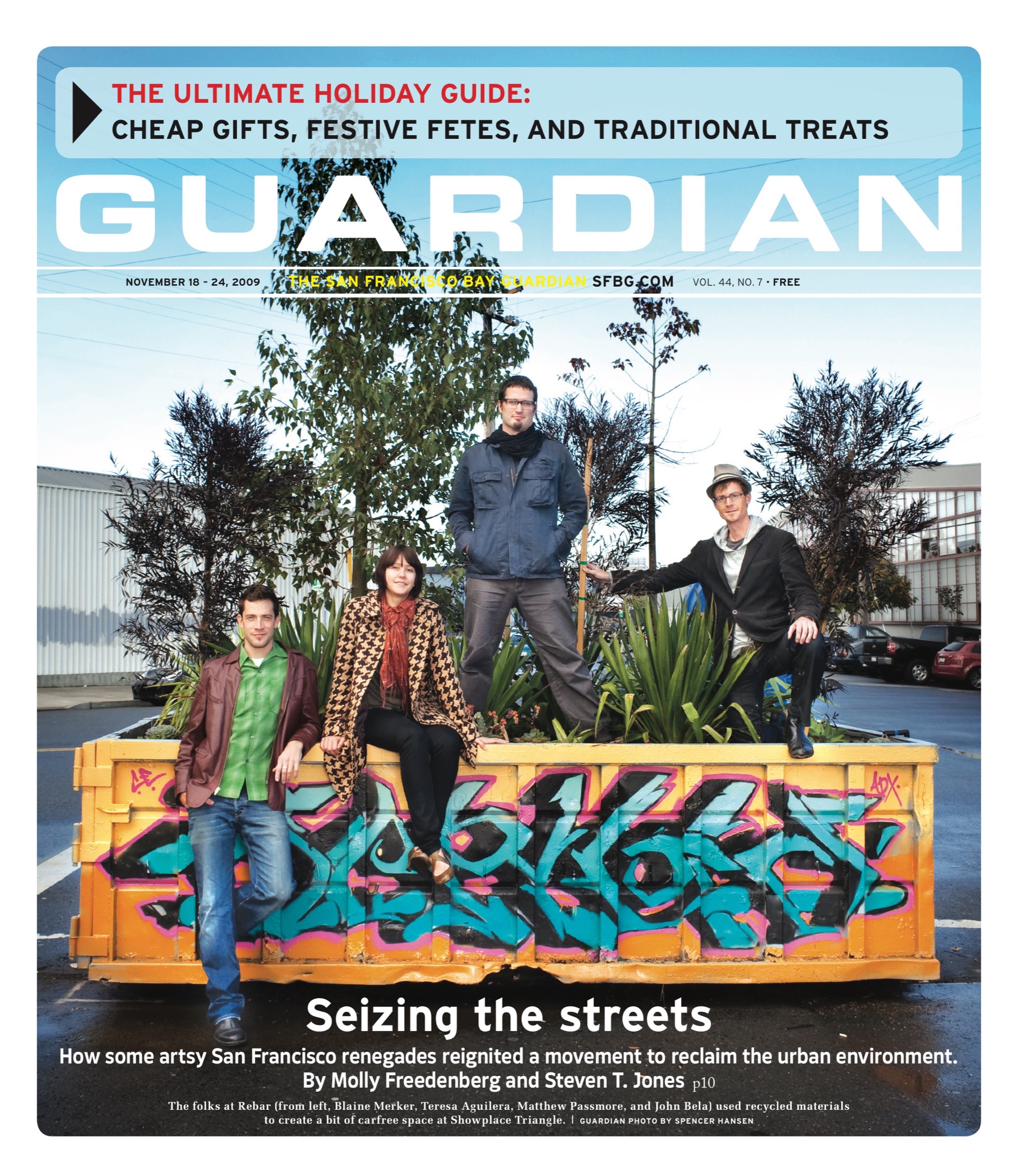
One of the earliest signs of the new approach emerged in 2005 on the first Park(ing) Day, the brainchild of the hip, young founders of the urban design group Rebar. The idea was simple: turn selected street parking spots around San Francisco into little one-day parks. Just plug some coins in the meter to rent the space, then set up chairs or lay down some sod, and kick it.

It was a simple yet powerful statement about how San Franciscans choose to use public space — and the folks at Rebar expected to get in trouble.

“When we did the first Park(ing) Day in 2005, JB [a.k.a. John Bela] and I were just prepared to be arrested and hauled into court,” Rebar’s Matthew Passmore told us at a recent interview in the group’s new Mission District warehouse space. “But nothing like that happened.”

Instead, City Hall called. 079_realcover.jpg Rebar’s Blaine Merker, Teresa Aguilera, Matthew Passmore, and John Bela at their carfreee space at Showplace Triangle

“We got a call from the director of city greening, who said this is great, I want to meet with you guys and talk about how the city can support this kind of activity,” Passmore said. “Much to our surprise, the city was totally responsive as opposed to shutting us down and imprisoning us.”

Bela said the group discovered that Mayor Gavin Newsom’s administration was looking for just the sort of innovative, cool, environmental ideas that were Rebar’s focus. And that connection merged with other people’s efforts — like sidewalk-to-garden conversions being pioneered by Jane Martin, the urban gardening and bicycling movements, and the unique public art that was making its way back from Burning Man. That created a catalyst for a wide array of city initiatives, from the Sunday Streets road closures to temporary art installations that began popping up around the city to the Pavement to Parks program that creates short-term parks in underutilized roadways.

“It was a single interaction five years ago, and now we have things like Sunday Streets,” Bela told us on Sept. 18’s Park(ing) Day, in which various individuals and groups took over more than 50 parking spots around town. “It’s about reclaiming the streets for people.”

Park(ing) Day itself blew up, becoming a worldwide phenomenon that is now in 151 cities on six continents, and one that the Mayor’s Office is planning to turn into a more permanent plan, with the regular conversion of some parking spots on commercial corridors into outdoor seating areas.

“You had a few guys and a girl who had an idea and now it’s an international event,” Mike Farrah, a longtime Newsom lieutenant who now heads the Office of Neighborhood Services and has been the main contact in City Hall for Rebar and similar groups, told the Guardian.

Locally, the success of events like Park(ing) Day have changed San Francisco’s approach to urban spaces, particularly on land left dormant by the economic downturn. Rebar, the permaculture collective Upcycle, and former MyFarm manager Chris Burley plan to turn the old Hayes Valley freeway property near Octavia, between Oak and Fell streets, into a massive community garden and gathering space. Plans are being hatched for temporary uses on Rincon Hill properties approved for residential towers. “Green pod” seating areas are sprouting along Market Street and there are plans to extend the Sunday Streets road closures next year. And, perhaps most amazingly, most projects are being accomplished with very little funding.

How has San Francisco suddenly shifted into high gear when it comes to creating innovative new public spaces? The key is their common denominator: they’re all temporary. As such, they don’t require detailed studies, cumbersome approval processes, or the extensive outreach and input that can dampen the creative spark.

But San Francisco is starting to prove that dozens of short-term fixes can add up to a true transformation of the urban environment and the citizenry’s sense of possibility.


EVOLUTION OF THE PRANK

Rebar began as a group of friends and artists who came together to enter a design contest in 2004. Passmore was a practicing lawyer and Bela was a landscape architecture student at UC Berkeley. They chose the name Rebar for future collaborations, the first of which was Park(ing) Day.

Passmore, who had a background in conceptual art before going to law school, discovered a legal loophole that might allow for anything from a burlesque performance to a temporary swimming pool to be installed in metered parking spaces. Bela recruited Blaine Merker, a fellow landscape architecture student with whom he’d won a design competition, to join the effort.

Park(ing) Day was a hit, getting great press and igniting people’s imaginations. “We realized after we did it, like, oh, people are really getting this,” Merker said. And Rebar was off. In the following years they added a fourth principal, graphic designer Teresa Aguilera, and took on a number of acclaimed projects: planting the Victory Garden in Civic Center Plaza, building the Panhandle Bandshell from old car hoods and other recycled parts, creating COMMONspace events (from “Counterveillance” to the “Nappening”) in privately-owned public spaces, and designing the Bushwaffle (commissioned for the Experimenta-Design biennale in Amsterdam) to help soften paved urban spaces and create a sense of play.

Through it all, the group maintained its prankster spirit. When they were invited to present the Bandshell project at the prestigious Venice Biennale festival, Rebar members showed up costumed as Italian table-tennis players (a joke that mostly baffled other attendees, they said).

They told us every project needed to have a “quotient of ridiculum.” Or as Bela put it, “That’s how we know project has evolved to the right point — when we’re on the floor laughing.”

As Rebar found success, it was still mostly a side project for members who had other full-time jobs. “We were all playing hooky all the time,” said Merker, who, like Bela, joined a landscape architecture firm after he finished school. “It just got worse and worse.”

So now, they’re trying to turn their passion into a profession, recently moving into a cool warehouse office and workspace in the Mission. “We’re shifting our practice a little to have the same sort of spirit but trying to figure out how we can make that an occupation,” Merker said.

It’s also about moving from those short-lived installations to something a little more lasting, even while working within the realm of temporary projects. As Aguilera said, “A lot of the projects we started with were creating moments to maybe think about. But we’re shifting into more permanent ways to interact with the city.”

They may not be sure where they’re headed as an organization, but they have a clear conception of their canvas, as well as the traditions they draw from (including movements like the Situationists and artists such as Gordon Matta-Clark, who worked in urban niche spaces) and the fact that they are part of an emerging international movement to reclaim and redesign urban spaces.

“We’re not the originators of any of this stuff,” Bela said. “It’s like emerging phenomena happening in cities all over the world. We just happened to have plugged into it early on and we continue to push it.”


EXPANDING THE POSSIBLE

Rebar is strongly pushing a reclamation of spaces that have been rather thoughtlessly ceded to the automobile over the last few decades. “Street right-of-way is 25 percent of the city’s land area. A quarter of the city is streets,” Bela said. “And those streets were designed at the time when we wanted to privilege the automobile.

“So basically, there’s all this underutilized roadway,” he continued. “It’s asphalt and it’s pavement, and the city wants to reclaim some of those spaces for people. That’s a thread we’ve been exploring in our work for a long time, and now it’s elevated up to a citywide planning objective.”

The short-term nature of the projects comes in part from political necessity: temporary projects are usually exempt from costly, time-consuming environmental impact reports. Demonstration projects also don’t need the extensive public input that permanent changes do in San Francisco. But there’s more to the philosophy.

“It stands on this proposition that temporary or interim use does actually improve the character of the city,” Passmore said. “People used to think that if something is temporary or ephemeral, what good is it? It’s just here today, gone tomorrow. But I think now people are realizing that the city can be improved like this.”

And it goes even deeper than that. When people see parking spaces turned into parks, vacant lots blossoming with art and conversation nooks, or old freeway ramps turned into community gardens, their sense of what’s possible in San Francisco expands.

“What we’re remodeling is people’s mental hardware. It’s like stretching. You have to bend something a little more than it wants to go, and the next time you do that, it’s that much easier,” Merker said.

“There’s also a psychological aspect to that. When people see a crack in the Matrix open up, if you will, it can open up a whole lot more than just that one moment,” he said.

For those who have been working on urbanism issues in San Francisco for a long time, like Livable City director Tom Radulovich, this new energy and the tactic of conditioning people with temporary projects is a welcome development. “There is a huge resistance to change in San Francisco, no matter what the change is, and a lot of that stems from fear,” Radulovich said. But with temporary projects, he said, “you can establish what success looks like from the outset.”


BUILDING ALLIANCES

The Rebar folks have been fairly savvy in their approach, making key friends inside City Hall, people who have helped them bridge the gap between their idealism and what’s possible in San Francisco.

“We are a process-driven city, and temporary allows you to create change without fear,” Farrah told us. He said the partnership between the Mayor’s Office and community groups that want to do cool, temporary public art really began in the summer of 2005 with the Temple at Hayes Green by longtime Burning Man temple builder, David Best.

Farrah had connections to the Burning Man community, so he facilitated the placement of the temple along Octavia Boulevard, then one of the city’s newest and least developed public spaces. Next came the placement of another Burning Man sculpture, Flock by Michael Christian, in Civic Center Plaza that fall. Both projects got funding and support from the Black Rock Arts Foundation, a public art outgrowth of Burning Man.

“I saw, after some of the temporary art and special events, how it’s changed people’s ideas about what’s possible,” Farrah said. “There has been a change in the way people view the streets.”

That got Farrah thinking about what else could be done, so he approached BRAF’s then-director Leslie Pritchett and Rebar’s Bela, telling them, “I need you to look at San Francisco like a canvas. Tell me the things you want to do, and I’ll tell you if it’s possible or not. And that’s led to a lot of cool stuff.”

Livable city advocates like Radulovich — progressives who are generally not allied with Newsom and who have battled with him on issues from limiting parking to the Healthy Saturdays effort to create more carfree space in Golden Gate Park — give the Mayor’s Office credit for its greening initiatives.

He credits Greening Director Astrid Haryati and DPW chief Ed Reiskin with facilitating this return to urbanism. “He’s really responsive and he gets it,” Radulovich said of Reiskin. “This is really where a lot of energy is going in the mayor’s office. It seems to have captured their imaginations.”

Another catalyst was last year’s visit by New York City transportation commissioner and public space visionary Janette Sadik-Khan, who met with Reiskin and Newsom on a trip sponsored by Livable City and the San Francisco Bicycle Coalition. Radulovich said her message, which SF has embraced, is that, “There are low-cost, reversible ways you can reclaim urban space in the near term.”

The Mayor’s Office, SFBC, and Livable City partnered last year to create Sunday Streets, which involved closing streets to cars for part of the day. The events have proven hugely successful after overcoming initial opposition from merchants who now embrace it.

Then there’s the Pavement to Parks program — which involves converting streets into temporary parks for weeks or months at a time — that grew directly from the Sadik-Khan visit. Andres Power, who directs the program for the Planning Department, told us the visit was a catalyst for Pavement to Parks: “She came to the city a year ago and inspired my director, Ed Reiskin.”

“We’re rethinking what the streets are and what they can be,” Power said. “It’s rewarding to see this stuff happen and to be at the forefront of a national effort to imagine what our streets could be.”


DE-PAVE THE CONCRETE

Pavement to Parks launched last year, a multiagency effort with virtually no budget, but the mandate to use existing materials the city has on hand to turn underutilized streets into active parks. “It looks at areas where we can reclaim space that’s been given over to cars over the decades,” Power told the Guardian.

At the first site, where 17th Street meets Market and Castro, the city and volunteer groups used planters and chairs to convert a one-block stretch of street that was little-used by cars because of the Muni line at the site.

“We bent over backward to make the space look temporary,” Power said, noting the concern over community backlash that never really materialized, leading to two time extensions for the project. “But we’re now ready to revamp that whole space.”

Another Pavement to Parks site at Guerrero and San Jose streets was created by Jane Martin, whom Newsom appointed to the city’s Commission on the Environment in part because of the innovative work she has done in creating and facilitating sidewalk gardens since 2003.

As a professional architect, Martin was used to dealing with city permits. But her experience in obtaining a “minor sidewalk encroachment permit” to convert part of the wide sidewalk near a building she owned on Shotwell Street into a garden convinced her there was room for improvement.

“At that point, I was really jazzed with the result and response [to her garden] and I wanted to make it so we could see more of it,” she said. So she started a nonprofit group called PlantSF, which stands for Permeable Lands As Neighborhood Treasure. Martin worked with city agencies to create a simpler and cheaper process for citizens to obtain permits and help ripping up sidewalks and planting gardens.

“We want to de-pave as much excess concrete as possible and do it to maximize the capture of rainwater,” she said.

Martin said the models she’s creating allow people to do the projects themselves or in small groups, encouraging the city’s DIY tradition and empowering people to make their neighborhoods more livable. More than 500 people have responded, creating gardens on former sidewalks around the city.

“We’ll get farther faster with that model,” she said. “It’s really about engaging people in their neighborhoods and helping them personalize public spaces.”

San Francisco has always been a process-driven city. “We in San Francisco tend to plan and design things to death, so as a result, everything takes a very long time,” Power said.

But with temporary projects under Pavement to Parks, the city can finally be more nimble and flexible. Three projects have been completed so far, and the goal is to have up to a dozen done by summer.

“We’re working feverishly to get the rest of the projects going,” Power said.

One of those projects involves an impending announcement of what Power called “flexible use of the parking lane” in commercial corridors like Columbus Avenue in North Beach. “We’re taking Park(ing) Day to the next level.”

The idea is to place platforms over one or two parking spots for restaurants to use as curbside seating, miniparks, or bicycle parking. “The Mayor’s Office will be announcing in the next few weeks a list of locations,” Power said. “There have been locations that have come to us asking for this.”

“The idea is to do a few of these as a pilot to determine what works and what doesn’t. The goal is to use their trial implementation to develop a permanent process,” Power said. “We want to think of our street space as more than a place for cars to drive through or park.”

Rebar was responsible for the last of the completed Pavement to Parks projects. Known as Showplace Triangle, it’s located at the corner of 16th and Eighth streets in the Showplace Square neighborhood near Potrero Hill. For Rebar, it was like coming full circle.

“We started doing this stuff about five years ago, finding these niches and loopholes and exploring interim use as a strategy for activating urban space,” Bela said. “And to our surprise, what we perceived as a tactical action is now being embodied by strategic players like the Planning Department.”


REUSE, RECYCLE, REINVENT

The Rebar crew was like kids in a candy store picking through the DPW yard.

“These projects are all built with material the city owns already, so we had the opportunity to go down to the DPW yard and inventory all of these materials they had, and figure out ways to configure them to make a successful street plaza,” Bela said.

So they turned old ceramic sewer pipes into tall street barriers topped by planter boxes, and built lower gardens bordered by old granite curbs.

“We are trying to be as creative as possible with the use of materials the city already has on hand,” Power said. In addition to the DPW yard that Rebar tapped for Showplace Triangle, Power said the Public Utilities Commission, Port of SF, and the Recreation and Parks Department all have yards around the city that are filled with materials.

“They each have stockpiles of unused stuff that has accumulated over the years,” he said.

For her Pavement to Parks project on Guerrero, Martin used fallen trees that originally had been planted in Golden Gate Park — pines, cypress, eucalyptus — but were headed for the mulcher. Not only were they great for creating a sense of place, they offered a nod to the city’s natural history.

But perhaps the coolest material that had been sitting around for decades was the massive black granite blocks that Rebar incorporated into Showplace Triangle. “One of the most interesting materials that we used in Showplace Triangle was the big granite blocks from Market Street that were taken off because merchants didn’t like people encamping there. They were too successful as spaces, so they got torn out,” Merker said.

Bela said they couldn’t believe their eyes: “We saw these stacks of five-by-five by one-foot deep black granite. Just extraordinary. If we were to do a public project today, we could never afford that stuff. There’s no way. But the taxpayers bought that stuff back in the ’70s and now it’s just sitting there in the DPW yard. It’s a crime that it’s not being used, so it was great to get it back out on the street.”

Radulovich said the return of the black granite boxes to the streets represents the city coming full circle. He remembers talking to DPW manager Mohammad Nuru as he was removing the last of them from Market Street in the 1970s, citing concerns about people loitering on them.

“To see them put up again in JB’s project was symbolic of where the city went and where it’s coming back from,” Radulovich said. “It’s almost like the livability revolution got interrupted and we lost two decades and now it’s picking up again.”

Back in the 1970s, Radulovich said the city was actively creating new public spaces such as Duboce Triangle. It was also creating seating along Market Street and generally valuing the creation of gathering places. But in the antitax era that followed, public sector maintenance of the spaces lagged and they were discovered by the ever-growing ranks of the homeless that were turned loose from institutions.

“The fear factor took over,” Radulovich said. “We did a lot to destroy public spaces in the ’80s and ’90s.”

But by creating temporary public spaces, people are starting to realize what’s been lost and to value it again. “These baby steps are helping us relearn what makes a good public space,” Radulovich said.

For much of the younger generation, building public squares is a new thing. As Aguilera noted, “We don’t have a lot of public plazas anymore or places for people to gather. When Obama was elected, where did everyone go in the city? Into the streets. So we’re trying to give that back to the city.”


CARS TO GARDENS

Perhaps the most high-profile laboratory for these ideas is the Hayes Valley Farm, a temporary project planned for the 2.5 acres of freeway left behind after the Loma Prieta earthquake. The publicly-owned land between Oak and Fell streets is slated for housing projects that have been stalled by the slow economy.

“The site’s been vacant for 10 years. They came up with a beautiful master plan. And the moment they’re ready to move on the master plan, there’s an economic collapse, so nothing is happening,” Bela said.

In the meantime, the Mayor’s Office and Hayes Valley Neighborhood Association pushed for temporary use of the neglected site. They approached the urban farming collectives MyFarm and Upcycle. Later, Rebar was brought in to design and coordinate the project.

Now the group known as the Hayes Valley Farm Team has an ambitious plan for the area: part urban garden, part social gathering spot, and part educational space. There will be an orchard of fruit trees, a portable greenhouse, demonstrations on urban farming, and a regular farmers market.

“The different topography of ramps allows for different growing conditions. These ramps are prime exposure to the south,” Merker said. “They create these areas that can produce some really great growing conditions, so it’s kind of funny that this freeway is responsible for that. The ramps actually create different microclimates.”

Most remarkably, the whole project is temporary, designed to be moved in three years. “We’re interested in developing infrastructure and tools and machinery and implements that are sort of coded for the scale of the city: a lot of pedal-powered things, a lot of mobile infrastructure, and smaller things that are designed to be useful in a plot that is only 2.5 acres,” Bela said. “Then when we need to move on, we’ll be able to do that. It’s about being strategic with some of the investments so we can take some of the tools we develop here and move it to the next vacant lot down the street.”

The project has lofty goals, ranging from creating a social plaza in Hayes Valley to educating the public about productive landscaping. “We’re getting away from ideas of turning parks into food production — it can be both,” said David Cody of Upcycle. “We want to just crack the awareness that cities can be multi-use and agriculture doesn’t mean farm.”

This is perhaps the most ambitious temporary project the Mayor’s Office has taken on. “Rebar pushed the envelope on what is possible. I told them it would be a tough one,” Farrah said of the project. But he loves the concept: “You can argue that putting gardens in temporary spaces changes attitudes.”

Symbolically, this land seems the perfect place for such an experiment. “This really is a special spot. If you look at a map of the city, Hayes Valley is in the very center, and this is right in the heart of Hayes Valley,” Aguilera said. “And right now, in the heart of a neighborhood in the heart of the city, there’s this vacant, fallow reminder of what used to be there. We’re looking to turn it into a new beating heart that brings together lots of different parts of the community.”


ACTIVATING DORMANT SPACES

Activating dormant spaces in the city isn’t easy, particularly for properties with pending projects. In Hayes Valley, for example, the Rebar crew was required to develop a detailed takedown plan.

“A lot of development is hesitant to get involved with these interim uses because at the end, they’re worried that it’s going to be framed as the evil, money-hungry developer coming in to kick out artists or farmers,” Passmore said. “But the reality is, they are very generously opening up their space is the first place.”

With last year’s crash of the rental estate and credit markets, development in San Francisco stalled, leaving potentially productive land all over the city. “As the city has gone through an economic downturn, like now, the city has a lot of vacant lots with developer entitlements on them, but nothing is being built right now. Those are spaces the public has an interest in,” Merker said, citing Rincon Hill as a key example.

Michael Yarne, who facilitates development projects for the Mayor’s Office of Economic Development, has been working on how developers might be encouraged to adopt temporary uses of their vacant lots.

“How can we credit them to do a greening project on a vacant lot?” Yarne asks, a problem that is exacerbated by the complication that neither the developers nor local government have money to fund the interim improvements.

He looked at the possibility of using developer impact fees on short-term projects, but there are legal problems with that approach. The courts have placed strict limits on how impact fees are charged and used, requiring detailed studies proving that the fees offset a project’s real cost and damage.

“But there is other value we can give as a city without spending a dollar — and that is certainty,” said Yarne, a former developer. He said developers value certainty more than anything else.

Right now, developers have to return to the Planning Commission every year or so to renew project entitlements, something that costs time and money and potentially places the project at risk. But he said the city might be able to enter into developer agreements with a project proponent, waiving the renewal requirement for a certain number of years in exchange for facilitating short-term projects.

“Everyone wins. We get a short-term use, and the developer gets certainty that they won’t lose their rights,” Yarne said, noting that he’s now developing a pilot project on Rincon Hill. “If that works, that could be a template we could use over and over.”

Radulovich is happy to see the new energy Rebar and other groups are infusing into a quest to remake city streets and lots, and with the use of temporary projects to expand the realm of the possible in people’s minds: “Let’s get people reimagining what the streets could be.”

www.rebargroup.org

Shock and style roll out at the SF Bike Expo

0

By Caitlin Donohue

I make it a point to spend quality time with my bike- you know, the daily commute/traffic battles, satisfying slogs up to Alamo Square Park, maybe an ill-advised wobble back from happy hour every now and then. But no matter how much qt they get with their parents, kids still need social time with their peer group.

sf bike expo 1109.jpg
Andrew Taylor, host of the SF BIke Expo’s dirt jump competition, gets high on the prettest darn bike I’ve ever seen

So because I love her, I’m making a play date for my bike with the San Francisco Bike Expo. The day-long event will be jam packed with kids that ride their bikes even more than I do- there’s a BMX stunt competition and a mountain bike dirt jump contest that seeks to replicate the pants-wetting good times of Evil Knievel’s Cow Palace appearance nearly 40 years ago. Plus, there will be a track stand show down, which is awesome if you’ve never seen a guy on a fixed gear stop for a traffic light (possible).

Appetite: Dog drinks, cheesy prom spirit, pine nut tarts, and more

0

Every week, Virginia Miller of personalized itinerary service and monthly food, drink, and travel newsletter, www.theperfectspotsf.com, shares foodie news, events, and deals. View the last installment here.

appheavdog1109.jpg
Come drink up at Heaven’s Dog

Heaven’s Dog $5 drinks during November
There’s only a couple weeks left to sip Heaven’s Dog’s cocktails for a mere $5. Any regular knows this is a steal for artisan, high-quality cocktails from a revolving list of specials… it could be Satan’s Whiskers (a gin, sweet and dry vermouth, orange concoction) or a Tiger’s Milk No. II (Spanish brandy, rum, sugar, cream, and nutmeg). By the way, it’s still worth coming at full price.
Through Dec. 1, 4:30-6:30pm, Mon-Fri
1160 Mission, SF
415-863-6008

www.heavensdog.com

appstg1109a.jpg
A view from St. George’s

11/21 – St. George Spirits Holiday Open House “A Winter Wonderland” – prom wear recommended!
Pull out your crazy, cheesy prom wear for a holiday open house at our beloved local distillery, St. George. If you’ve ever been to a St. George party, you know they’re a crazy bunch who rock out with attitude, music and world class spirits… all in a former naval air station hangar. With live music by John Clarke and Farewell Typewriter, take in distillation demos, photo booth, cocktail sipping and food from many of La Cocina‘s best (like Estrellitas Snacks, Botanas Felicitas, Kika’s Treats, Neo Cocoa), as well as El Huarache Loco, Pacific Fine Foods, Gelateria Naia and Recchiuti Confections. St. George does one better with a Cali Party Bus, transporting people for free from West Oakland Bart station 12:30-5pm (to and from the distillery every half hour), with stops at the Alameda Ferry Terminal around 1:30 and 4:05pm.
1-6pm
$40 advance/$50 at door
2601 Monarch, Alameda
510-864-0635

www.stgeorgespirits.com

appaxelrod1109a.jpg
A course from Chef Axelrod

11/22 – Navarro Winery Harvest Dinner
California Table Sunday Supper throws a Sunday Supper Series from Chefs Liz Bills and Melissa Axelrod (who’s dinners I wrote about in an August The Perfect Spot issue), this time teaming with Sarah Bennett of Anderson Valley’s Navarro winery. Celebrating the end of harvest season with five to six Navarro wines (including some new releases) and a five-course meal from Bills and Axelrod. Yes, it’s a ‘pop-up dinner’, warm, communal and unique, like a friend’s dinner party but held in a Mexican cantina down a charming FiDi alley. The menu includes risotto cooked in a parmesan broth with Bellwether Farms Crescenza & wild mushrooms, slow-roasted leg of Sonoma lamb rubbed with lavender and honey, and a pine nut tart with baked apple ice cream.
11/22, 5pm, $85 (all inclusive)
Mercedes Hair of the Dog Cantina, 653 Commercial, SF
http://californiatable.net/events/index.html
http://www.brownpapertickets.com/event/88196

Street Threads: Look of the Day

0

SFBG photog Ariel Soto scoops SF street fashion. See the previous Look of the Day here.

Today’s Look: Megan, Stockton and Green

Megan1109.jpg

Tell us about your look: “It’s all Louis Vuitton and I’m loving leggings right now!”

Dick Meister: The man who didn’t die

0


Joe Hill told his IWW comrades just before he stepped in front of the firing squad, “Don’t waste any time in mourning. Organize.”

By Dick Meister

(Dick Meister, former labor editor of the SF Chronicle and KQED-TV Newsroom, has covered labor, politics and other matters for a half century.)

It’s Nov. 19, 1915, in a courtyard of the Utah State Penitentiary in Salt Lake City. Five riflemen take careful aim at a condemned organizer for the Industrial Workers of the World, Joe Hill, who stands before them straight and stiff and proud.

“Fire!” he shouts defiantly.

The firing squad didn’t miss. But Joe Hill, as the folk ballad says, “ain’t never died.” He lives on as one of the most enduring and influential of American symbols.

Venue Guide

0

AMNESIA


853 Valencia

(415) 970-0012

ASIASF


201 Ninth St

(415) 255-2742

ATLAS CAFE


3049 20th St

(415) 648-1047

BAOBAB


3388 19th St

(415) 643-3558

BAZAAR CAFÉ


5927 California

(415) 831-5620

BEAUTY BAR


2299 Mission

(415) 285-0323

BIMBO’S
365 CLUB


1025 Columbus

(415) 474-0365

BISCUITS
AND BLUES


401 Mason

(415) 292-2583

BOHEMIA LOUNGE


1624 California

(415) 474-6968

BOOM BOOM ROOM


1601 Fillmore

(415) 673-8000

BOTTOM
OF THE HILL


1233 17th St

(415) 621-4455

BROADWAY
STUDIOS


435 Broadway

(415) 291-0333

BRUNO’S


2389 Mission

(415) 643-5200

BUBBLE LOUNGE


714 Montgomery

(415) 434-4204

BUTTER


354 11th St

(415) 863-5964

CAFÉ CLAUDE


7 Claude

(415) 392-3515

CAFE COCOMO


650 Indiana

(415) 824-6910

CAFE DU NORD


2170 Market

(415) 861-5016

CAFE INTERNATIONAL


508 Haight

(415) 665-9915

CASANOVA LOUNGE


527 Valencia

(415) 863-9328

CAT CLUB


1190 Folsom

(415) 431-3332

CITY NIGHTS


715 Harrison

(415) 546-7938

CLUB CALIENTE


298 11th St

(415) 255-2232

CLUB DELUXE


1509 Haight

(415) 552-6949

CLUB NV


525 Howard

(415) 339-8686

CLUB SIX


60 Sixth St

(415) 863-1221

CONNECTICUT
YANKEE


100 Connecticut

(415) 552-4440

CRASH


34 Mason

1-877-342-7274

DALVA


3121 16th St

(415) 252-7740

DANNY COYLE’S


668 Haight

(415) 431-4724

DELIRIUM


3139 16th St

(415) 552-5525

DNA LOUNGE


375 11th St

(415) 626-1409

DOLCE


440 Broadway

(415) 989-3434

DOLORES PARK CAFE


501 Dolores

(414) 621-2936

DOUBLE DUTCH


3192 16th St

(415) 503-1670

DUPLEX


1525 Mission

(415) 355-1525

EDINBURGH CASTLE PUB


950 Geary

(415) 885-4074

EIGHT


1151 Folsom

(415) 431-1151

ELBO ROOM


647 Valencia

(415) 552-7788.

ELEMENT LOUNGE


1028 Geary

(415) 571-1362

ELIXIR


3200 16th St

(415) 552-1633

ENDUP


401 Sixth St

(415) 357-0827

FILLMORE


1805 Geary

(415) 346-6000

540 CLUB


540 Clement

(415) 752-7276

FLUID ULTRA LOUNGE


662 Mission

(415) 615-6888

FUSE


493 Broadway

(415) 788-2706

GLAS KAT


520 Fourth St

(415) 495-6626

GRAND


1300 Van Ness

(415) 673-5716

GRANT AND GREEN


1371 Grant

(415) 693-9565

GREAT AMERICAN MUSIC HALL


859 O’Farrell

(415) 885-0750

HARRY DENTON’S STARLIGHT ROOM


Sir Francis Drake Hotel

450 Powell

(415) 395-8595

HEMLOCK TAVERN


1131 Polk

(415) 923-0923

HIFI


2125 Lombard

(415) 345-TONE

HOMESTEAD


2301 Folsom

(415) 282-4663

HOTEL UTAH SALOON


500 Fourth St

(415) 546-6300

HOUSE OF SHIELDS


39 New Montgomery

(415) 495-5436

ICON ULTRA LOUNGE


1192 Folsom

(415) 626-4800

INDEPENDENT


628 Divisadero

(415) 771-1421

IRELAND’S 32


3920 Geary

(415) 386-6173

JACK’S CLUB


2545 24th St

(415) 641-5371

JAZZ AT PEARL’S


256 Columbus

(415) 291-8255

JELLY’S


295 Terry Francois

(415) 495-3099

JOHNNY FOLEY’S


243 O’Farrell

(415) 954-0777

KATE O’BRIENS


579 Howard

(415) 882-7240

KELLY’S MISSION ROCK


817 Terry Francois

(415) 626-5355

KNOCKOUT


3223 Mission

(415) 550-6994

LASZLO


2534 Mission

(415) 401-0810

LEVENDE LOUNGE


1710 Mission

(415) 864-5585

LEXINGTON CLUB


3464 19th St

(415) 863-2052

LI PO LOUNGE


916 Grant

(415) 982-0072

LOFT 11


316 11th St

(415) 701-8111

LOU’S PIER 47


300 Jefferson

(415) 771-5687

LUCID BAR


580 Sutter

(415) 398-0195

MAD DOG IN THE FOG


530 Haight

(415) 626-7279

MADRONE LOUNGE


500 Divisadero

(415) 241-0202

MAKE-OUT ROOM


3225 22nd St

(415) 647-2888

METRONOME DANCE CENTER


1830 17th St

(415) 252-9000

MEZZANINE


444 Jessie

(415) 625-8880

MIGHTY


119 Utah

(415) 626-7001

MILK


1840 Haight

(415) 387-6455

MOJITO


1337 Grant

(415) 398-1120

MOOSE’S


1652 Stockton

(415) 989-7800

NICKIE’S


466 Haight

(415) 255-0300

OLD FIRST CHURCH


1751 Sacramento

(415) 474-1608

111 MINNA GALLERY


111 Minna

(415) 974-1719

PARK


747 Third St

(415) 974-1925

PARKSIDE


1600 17th St

(415) 252-1330

PIER 23


Pier 23

(415) 362-5125

PINK


2925 16th St

(415) 431-8889

PLOUGH AND STARS


116 Clement

(415) 751-1122

PLUSH ROOM


York Hotel

940 Sutter

(415) 885-2800

PUBLIC


1489 Folsom

(415) 552-3065


RAMP


855 China Basin

(415) 621-2378

RASSELAS JAZZ


1534 Fillmore

(415) 346-8696

RED DEVIL LOUNGE


1695 Polk

(415) 921-1695

RED POPPY ART HOUSE


2698 Folsom

(415) 826-2402

REDWOOD ROOM


Clift Hotel

495 Geary

(415) 775-4700

RETOX LOUNGE


628 20th St

(415) 626-7386

RICKSHAW STOP


155 Fell

(415) 861-2011

EL RIO


3158 Mission

(415) 282-3325

RIPTIDE BAR


3639 Taraval

(415) 240-8360

RITE SPOT


2099 Folsom

(415) 552-6066

ROCCAPULCO
SUPPER CLUB


3140 Mission

(415) 648-6611

NECK OF THE WOODS


406 Clement

(415) 387-6343

ROYALE


1326 Grant

(415) 433-4247

RUBY SKYE


420 Mason

(415) 693-0777

SAVANNA JAZZ


2937 Mission

(415) 285-3369

SHINE DANCE LOUNGE


1337 Mission

(415) 421-1916

SKYLARK


3089 16th St

(415) 621-9294

SLIDE


430 Mason

(415) 421-1916

SLIM’S


333 11th St

(415) 255-0333

SOLUNA CAFE AND LOUNGE


272 McAllister

(415) 621-2200

SPACE 550


550 Barneveld

(415) 550-8286

STUD


399 Ninth St

(415) 252-7883

SUEDE


383 Bay

(415) 399-9555

SUGAR LOUNGE


377 Hayes

(415) 255-7144

SUITE ONE8ONE


181 Eddy

(415) 345-9900

SUPPERCLUB


657 Harrison

(415) 348-0900

1015 FOLSOM


1015 Folsom

(415) 431-1200

330 RITCH


330 Ritch

(415) 541-9574

TOP OF THE MARK


Mark Hopkins Intercontinental Hotel

1 Nob Hill

(415) 616-6916

TRANSFER


198 Church

(415) 861-7499

TUNNEL TOP


601 Bush

(415) 986-8900

26 MIX


3024 Mission

(415) 826-7378

222 CLUB


222 Hyde

(415) 864-2288

UNDERGROUND SF


424 Haight

(415) 864-7386

VELVET LOUNGE


443 Broadway

(415) 788-0228

VODA


56 Belden

(415) 677-9242

WARFIELD


982 Market

(415) 775-7722

WISH


1539 Folsom

(415) 431-1661

BAY AREA

ALBATROSS PUB


1822 San Pablo, Berk

(510) 843-2473

ANNA’S JAZZ ISLAND


2120 Allston Way, Berk

(510) 841-JAZZ

ASHKENAZ


1317 San Pablo, Berk

(510) 525-5054

BECKETT’S


2271 Shattuck, Berk

(510) 647-1790

BLAKES


2367 Telegraph, Berk

(510) 848-0886

CAFE VAN KLEEF


1621 Telegraph, Oakl

(510) 763-7711

DOWNTOWN


2102 Shattuck, Berk

(510) 649-3810

FOURTH STREET TAVERN


711 Fourth St, San Rafael

(415) 454-4044

FREIGHT AND SALVAGE COFFEE HOUSE


1111 Addison, Berk

(510) 548-1761

JAZZSCHOOL


2087 Addison, Berk

(510) 845-5373

JUPITER


2181 Shattuck, Berk

(510) THE-ROCK

KINGMAN’S LUCKY LOUNGE


3332 Grand, Oakl

(510) 465-KING

MAMA BUZZ CAFE


2318 Telegraph, Oakl

(510) 465-4073

19 BROADWAY


19 Broadway, Fairfax

(415) 459-1091

924 GILMAN STREET PROJECT


924 Gilman, Berk

(510) 525-9926

NOMAD CAFÉ


6500 Shattuck, Oakl

(510) 595-5344.

PARAMOUNT THEATRE


2025 Broadway, Oakl

(510) 465-6400

RUBY ROOM


132 14th St, Oakl

(510) 444-7224

SHATTUCK DOWN LOW


2284 Shattuck, Berk

(510) 548-1159

STARRY PLOUGH


3101 Shattuck, Berk

(510) 841-2082

STORK CLUB


2330 Telegraph, Oakl

(510) 444-6174

SWEETWATER


153 Throckmorton, Mill Valley

(415) 388-2820

TIME OUT BAR AND PATIO


1822 Grant, Concord

(925) 798-1811

21 GRAND


416 25th St, Oakl

(510) 444-7263

UPTOWN


1928 Telegraph, Oakl

(510) 451-8100

WHITE HORSE


6551 Telegraph, Oakl

(510) 652-3820

YOSHI’S


510 Embarcadero West

Jack London Square, Oakl

(510) 238-9200

Dive In: A case of the Mondays

0

Bar reviewer Kristen Haney seeks to separate hipster wannabes from real-life dives in this weekly column. Check out her last installment here.

diveinpops_1109.jpg

Mondays, frequently described as manic or met with a response of expletives, are seldom associated with happy thoughts of relaxation and general joviality. But it doesn’t have to be like that. A number of bars are doing their best to help you banish that beginning of the week gloom and give Mondays a better name. These are the best dives to grab a drink at the start of your week, when that first workday has you already asking, “is it Friday yet?”

The Saloon

This bar is older than dirt and looks the part. It may smell like piss, but no one will notice you reek of hangover from your previous weekend of debauchery, and neither will you after a few of their stiff drinks. If you can bear to part with your dear old friend Abe, hand over $5 on Mondays to drink away your blues to the sound of the blues and jazz band that plays.

1232 Grant, SF.
(415) 989-7666

Pop’s Bar

Let the bright neon glow of the sign outside transfix your eyeballs as your feet carry you into Pop’s for free Monday-night bacon. No, really. After bringing home the bacon, you can enjoy some real fried pork fat for free. You can even take your new bacon friend over to the graffiti covered photo booth and ham it up for a few snapshots. Just make sure to avoid the judgmental looks of the other patrons, who’d rather discuss sustainability and Bukowski poems with their pork pals.

2800 24th St, SF
(415) 401-7677

Sonic Reducer Overage: Grant Hart, ‘In C,’ Flobots, Talk Normal, and more

0

By Kimberly Chun

I recommend taking some cult-cha with your cold cereal — it’ll make the pre-Thanksgiving/Black Friday mania go down easier. More fun stuff than we could fit into print.

Ty Segall and Culture Kids
The raging Goldie ‘09 winner lets it fly with the buskable, combustible Bay Area noise makers. With the Baths. Sat/14, 9 p.m., $7. Amnesia, 853 Valencia, SF. (415) 970-0012.

Turks
The Oakland combo likes its tempos convulsive and screams pitched a few notches above the deep, dark pit of post-punk hell. With Rats Eyes and La Guardia. Sat/14, 9:30 p.m., $6. Hemlock Tavern, 1131 Polk, SF. (415) 923-0923.

Street Threads: Look of the Day

0

SFBG photog Ariel Soto scoops SF street fashion. See the previous Look of the Day here.

Today’s Look: Maris and Trip the dog, Washington Square Park

MarisandTrip1109.jpg

Tell us about your look: “I just moved here and I’m living out of my car right now. This was the outfit I found in my car this morning.”

Meet the mothers, Mister Mayor

1

Text and video by Sarah Phelan


Abigail Trillin reads a letter from an immigrant mother who wants to meet Newsom in person and hear him explain why he supports a policy that has led to her son being needlessly placed in a federal detention facility in Oregon

As the father of a newborn, Mayor Gavin Newsom is doubtless having sleepless nights and tiring days, as he learns to change diapers, burp and even bathe his young daughter, in between his duties as San Francisco’s CEO.

Presumably, he’s already gained the fiercely protective perspective of a parent–a point of view that could help him realize why it would be humane to meet with the parents of immigrant teens who have been whisked out of the city and away to federal detention facilities in other states, thanks to a policy that Newsom ordered last year.

One such mother wrote a letter requesting a meeting with the mayor to discuss why her son is sitting in a federal detention facility in Oregon, even though the SF District Attorney has dismissed all the charges in his case.

Abigail Trillin, staff attorney with Legal Services for Children, read that letter aloud at City Hall this week, shortly after the Board voted to override Newsom’s veto of amendments to the sanctuary policy (and you can listen to it, by clicking on the video above.)

The Board’s amendments seek to ensure that teens who haven’t done anything wrong aren’t turned over to the feds for possible deportation. The amendments would therefore also ensure that families aren’t needlessly put through hell, just because someone accuses their kids of doing something they never did.

But Newsom has said- indirectly through his spokespeople–that he plans to ignore the Board’s amendments, claiming that his hands are tied by federal law.

The Board believes otherwise and currently a nasty legal battle seems eminent.

In the meantime, families of immigrant children in San Francisco are left worrying if their kid is going to be the next child to be referred to the feds and disappeared to a detention facility in Oregon or Miami or Indiana or wherever for deportation to a country they never knew for a crime they never did.

So if Newsom, as a mayor and a parent, believes in his policy, then surely he is willing to defend and explain it to those directly impacted by his decisions.

Because this isn’t a game, or another piece of political theater. It’s a case of immigrant parents desperately fighting to protect their kids from needless harm, which could include death at the border or being recruited into a gang.

Now, folks tell me stuff like, well, these parents should make sure their kids don’t get into trouble in the first place.
But the truth is that some of these kids didn’t get into trouble in the first place. Or not into trouble that was so serious that it warranted being referred to the feds. And that’s why their mothers have a problem with Newsom’s current policy and want him to amend it, as he has been directed, or at the very least explain it, as mayor of San Francisco, to them in person.

f

Bloody shoeprints and stab wounds suggest de la Plaza murdered

5

Text by Sarah Phelan

hugues12acd.jpg
A newly released forensic report suggests that Hugues de la Plaza (pictured above) was murdered in San Francisco two years ago.

Francois de la Plaza, the father of deceased French-American citizen Hugues de la Plaza, sent me a copy of a report today that forensic pathologist Michael Ferenc prepared for SFPD Deputy Chief David Shinn, concluding that Hugues’s death was a homicide, as his family and the French authorities have long claimed.

“In my opinion, the death of Mr. Hugues de la Plaza is a homicide,” Ferenc writes in his report, which was prepared nine months ago, (and not in Feb. 2008, as the Guardian initially claimed, thanks to a typo on the report itself). Curiously, the SFPD has never publicized Ferenc’s findings, even though it has divulged preliminary findings from an as yet unpublished LAPD report, which allegedly supports the SF Medical Examiner’s finding that the cause of death was “undeterminable.”

Ferenc notes that SFPD Inspector Casillas gave him, “an excellent overview of the case” when he met with him and his colleagues,” earlier this year.

” It was very thorough and detailed,” Ferenc writes.

In his report, he summarizes several key points that support his murder conclusion, (based on his review of the SFPD’s crime scene photos, video and autopsy report.), before inferring, Sherlock Holmes-style, the following sequence of events:

“Mr. De La Plaza returned home from nightclubbing around 0200 hours and entered his residence,” Ferenc states. “There he ate some food and apparently made phone calls and utilized his computer (approximately during the next half hour based upon Inspector Casillas’s investigation). For some reason(s) he exited his apartment ( or at least stepped outside to answered his door). Either upon exiting or at his subsequent return, an assailant(s), who was(were) most likely positioned on the lower landing of the stair case, stabbed Mr. De La Plaza while he was on the lower steps. The victim retreated inside the apartment and the assailant(s) probably did not follow inside. The victim went to the kitchen and returned to the front room bleeding profusely all the time. He soon collapsed from hemorrhagic shock in the front room where he was found.”

To support his conclusions, Ferenc highlights the following key points:

Street Threads: Look of the Day

0

SFBG photog Ariel Soto scoops SF street fashion. See the previous Look of the Day here.

Today’s Look: Linda, Union and Stockton

Linda1109.jpg

Tell us about your look: “My belt and boots go together.”

Street Threads: Look of the Day

0

SFBG photog Ariel Soto scoops SF street fashion. See the previous Look of the Day here.

Today’s Look: Joel, Powell and Ellis

Joel1009.jpg

Tell us about your look: “I’m going to work. This outfit is very laid back cuz of the weather today.”

Komeback Kink

0

arts@sfbg.com

MUSIC MLK’s and Bobby Kennedy’s assassinations, shaken confidence in Vietnam after a bloody and vengeful Tet Offensive, Haight-Ashbury’s rapid dissolving into a breeding ground for lost and burned-out hippies pathetically clinging to the idyllic notion of a "Summer of Love," and a free Charles Manson settling in Laurel Canyon to plot the perverse and gruesome murders his "family" would soon commit. Yes, 1968 was the year the darkness had arrived. Certainly flower power had gone wrong, wilting its way toward a strong sense of paranoia that not only seeped its way into society’s psyche and politics, but into popular music as well.

Stripped in tone and oftentimes more raw-sounding than the overly-produced psychedelia that dominated the previous two years, the Kinks’ masterfully produced November 1968 classic The Kinks are the Village Green Preservation Society is a prime example of Ray Davies’ maturing writing skill. It especially shines as an artist’s profound expression of his own insecurities. Village Green is loaded with accounts of Davies’ vain obsessions and his fears. It’s a document of the human condition — in particular, people’s longings to leave a lasting legacy and be remembered.

Thematically, Davies works himself into a frenzy, unable to live for the moment, facing the pressures of fading British tradition (on the title track) and changes in technology ("Last of the Steam-Powered Trains"), both of which symbolize a changing of the guard and uncertainty about how the album’s protagonist fits into the world. Don’t underestimate Davies’ fears of growing old. The bitterness on "Do You Remember Walter?" is almost too much to bear. It fits well, though, making Village Green a cohesive unit. Here he criticizes an old friend who he assumes has grown old, boring, and out of shape. But his disdain stems from Ray’s fear of being Walter (i.e., washed up), and is connected to the fact that Walter has moved on in life and perhaps wouldn’t even recognize or remember his dear old friend.

With its simple and bucolic flair, "Sitting by the Riverside" seems familiar enough. The ditty should be relaxing, with its nice, easy-going melody, but Ray even corrupts something seemingly innocent with a manic "la-da-da" that chimes in on occasion before bursting to a near crescendo during the song’s outro, sounding like a bad drug experience.

Listening to Village Green‘s "All of My Friends Were There," I’ve always imagined it playing at someone’s birthday party, with — of course — all their friends present. But it seems to be more of a performance with all eyes on Davies, because he’s built it in his head to be the biggest day in his life. Once again we see his sick longing to feel love, attention, and validation, this time through the power of numbers. Unfortunately, his gathering backfires to disastrous results. It’s just as well. Somehow I have a feeling that no matter how many people were present, he still feels alone and empty.

Two Village Green songs, "Picture Book" and the album-closing "People Take Pictures of Each Other," focus on how photographs are supposed to fill some sort of void, making us seem more important than we really are — as if a photograph is necessary to validate our feelings of love for one another and emotions from our past. Davies argues that we take pictures of one another to prove our existence. At the same time, he’s caught up in paranoid visions of what his own photograph will look like when he’s an old man: "Picture yourself, when you’re getting old." Finally a bit of optimism peeks through, but in an unsure way, when he sings, "People often change, but memories of people can remain." That is to say, I can remember you however I choose.

RAY DAVIES

Thurs/12, 8 p.m., $40–$57

The Warfield

982 Market, SF

www.ticketmaster.com

Hello, cello

0

molly@sfbg.com

There is something hauntingly beautiful — if not downright sexy — about the cello: a musician straddling the feminine curves of a human-sized instrument, bow sliding slowly and elegantly over the trembling strings, fingers plucking and vibrating in alternately gentle and assertive motions, and tones emitting from the smooth wood that range everywhere from soft whispers to deep moans.

It’s no wonder the cello has been compared to both the human voice and, in the many portraits of women’s backs painted to look like string instruments, the human body.

So perhaps it should also be no wonder that lately, particularly in the Bay Area, the cello has gained new popularity — one outside of the traditional concert hall. Cellists like Zoe Keating, formerly of Rasputina, and Sam Bass, of Loop!Station and Les Claypool, are gaining the kind of recognition formerly reserved for indie rockers. Cello Madness Congress, the monthly improv jam hosted by Joey Chang a.k.a. Cello Joe, regularly draws a crowd of musicians and enthusiasts alike. Cello Bazaar, a monthly cello concert held at Café Bazaar in the Richmond District, has become so popular it might have to expand. And Rushad Eggleston’s punk band Tornado Rider has rock ‘n’roll lovers moshing to cello music at venues like Red Devil Lounge. Not only does cello music seem to be a trend, as Cello Bazaar founder Hannah Addario-Berry says, "it’s a total scene."

Perhaps one reason for the increased visibility of cello in the Bay Area is due to recent developments in classical music. As symphonies get less funding and young musicians become more adventurous, classical musicians are finding new ways to play and new venues to play in. The most visible of these is Classical Revolution, which has taken instruments like violin, piano, and, yes, cello, out of the stuffy concert hall and into Revolution Cafe and SoCha Café for casual weekly concerts.

These gatherings are particularly advantageous for cellists. In an orchestra setting, cello tends to play a supportive roll. But there is a fabulous repertoire of music meant to be played by several cellos together, thanks mostly to the cello’s remarkable range. In a non-symphony setting, the cello can more easily take center stage.

Plus, cellists seem to like to socialize and harmonize together. Perhaps because of their role in larger symphonies, cellists tend not to be particularly competitive (unlike violinists, for example, who often compete for solos). Some musicians say people drawn to cello are naturally more easy-going than those drawn to other instruments. Others say that there is more a group of cellos can do together sonically than, say, a group of flutes. "Brass sections are incredibly social too," says Addario-Berry. "But of the string family, I’ve found cellists to be the ones who most want to hang out together."

But perhaps the largest reason for the cello’s new visibility and popularity is its versatility. The artist most famous for exploring the possibilities for cello is Yo-Yo Ma, but these days all kinds of artists are finding ways to use cello in other in the music of various cultures, in rock, and in electronic music. Indeed, it was the infinite possibilities for layering different cello sounds over each other and over the human voice that inspired the cycle of songs that composer/singer Amy X Neuburg began writing for the three-piece Cello Chixtet in 2005 — the same qualities that make Loop!Station’s sound so rich and varied, even though they’re only two people (and only one instrument).

One of the most exciting new developments, though, is not just using the cello with rock but to rock. According to Eggleston, who straps on his sticker-covered cello and plays it like an electric guitar, the progression is a natural one. With a cello you can play power chords with one finger instead of two, he says. There’s infinite sustain because there’s a bow. You don’t need a wah-wah pedal because you can get different harmonics from one string. Because there are no frets, you can bend notes various ways and get subtle details you can’t get from a guitar. Plus you have the option of sliding and jumping around on the frets. "It’s kind of like a vicious harmonica/slide guitar/ metal guitar/wild cat," he says.

But whatever direction cellists are taking, the Bay Area music community seems supportive. "So many people are intimidated by the concert hall protocol … not knowing when to clap and not to cough," says Addario-Berry. "The idea of taking cello music to people in a comfortable environment is really important."

Or as Eggleston puts it, "Yay! Cello power!"

UPCOMING CELLO EVENTS

CELLO BAZAAR

Tues/17, 7 p.m.

Bazaar Café

5927 California, SF

(415) 831-5620

www.bazaarcafe.com

JOEY CHANG AND THE SHOW

Nov. 18, 7:30 p.m.; $5

Blue Macaw

2565 Mission, SF

(415) 920-0577

thebluemacawsf.com

TORNADO RIDER

Nov. 20, 9 p.m.; $10

The Uptown

1928 Telegraph, Oakl.

www.uptownnightclub.com

CELLO MADNESS CONGRESS

Nov. 25, 8 p.m.; free

Blue Macaw

2565 Mission, SF

(415) 920-0577

thebluemacawsf.com

Button pushers

0

arts@sfbg.com

SONIC REDUCER Bend an ear toward Fuck Buttons’ ecstatic second album, Tarot Sport (ATP), and you’re only a card flip away from shuffling the Rider-Waite deck of the mind and coming up with visual corollaries for the tracks. Frenetic opener "Surf Solar" obviously boogie-boards to the freedom-first of the major arcana’s card zero, the Fool, whereas "Rough Steez" burrows into the deep ‘n’ dirty low end of the Tower card, and "The Lisbon Maru" cozies down amid warmly glimmering Doppler synths, akin to the Sun image. The glorious polyrhythmic cluster-fuck of "Phantom Limb" sparkles hard, reading just like the Star, while finale "Flight of the Feathered Serpent" breaks into a mind-expanding, all-encompassing loop, à la the closing picture of the major arcana: a baton-twirling cosmic cheerleader dancing within a circle of completion, or the World. Bring it on.

The tarot of sport — see the Vangelis shout-out of "Olympians" — or the sport of tarot did inform the album, says Fuck Buttons’ Benjamin John Power, by phone from D.C. "We’re both kind of interested in the mystical world in some way," he confesses, referring to bandmate Andrew Hung. But perhaps I’m reading too hard between the cards. Power and Hung didn’t quite rifle through the deck and riff off those airy swords, energetic wands, emotional cups, and earthy pentacles. Rather, they were both intrigued by the idea of formalized competition between psychics, which Hung had been reading about. "I mean, first and foremost, the words themselves were quite resonant for us," Hung says. "They struck a chord — and it’s quite a funny concept."

Battling psychics might conjure thoughts of Criss Angel mind-freaking the ladies of the Psychic Friends Network in Paranormal Activity‘s haunted townhouse, crystals and dowsing rods in fists. But the notion also plugs into Fuck Buttons’ music-making process — as well as the image of Hung and Power hunched diligently over their gadgets, pedals, and toy instruments at their packed, steamy Independent show last year. The hardcore-schooled Power is more serious. Hung, who has an electronic music background, is more puckish and playful. ("We’re based in a car right now," he jokes when asked where the two 27-year-olds live. Ask him what a Fuck Button is, and he quips, "I guess you’re talking to one.")

The Bristol, England, natives started playing together in 2004. "When we converged at the same point, that’s when things started to get quite loud," says Hung. Fuck Buttons’ writing process hinges on a similar sense of give-and-take. "We’ve always written songs the same way," explains Power. "We’ll get together in a room and it’s quite important that we don’t have any ideas brought in, that we approach it like a blank canvas. We’re both messing around with sound together — it’s been very free in that sense."

The beat-driven, less aggro sound of Tarot Sport, informed by the more ambitious musicians once confined to the New Age aisle, was the direct result of the twosome’s new equipment acquisitions — various analog synths, pedals, and "bips and bobs," as Power puts it — since their debut, Street Horrrsing (ATP, 2008). "The sounds are quite a lot richer on this record because we had a lot more stuff to play with," notes Power. "One particular thing that did happen was we got rid of our laptop. When a lot of people see a laptop onstage, they assume you’re a laptop band and just playing things off your laptop, which isn’t the case at all."

That’s where the psychic ability comes in very handy, though Fuck Buttons don’t cop to those powers — or even a good grasp of the Vulcan mind meld. "We’re definitely working on that one," Power deadpans. "We haven’t quite perfected it yet, but it’s something we’ve been trying to do, yeah." *

FUCK BUTTONS

With Growing and Chen Santa Maria

Fri/13, 10 p.m., $10

Bottom of the Hill

1233 17th St., SF

www.bottomofthehill.com

————

LOVER!


Onetime Jay Reatard bandmate Rich Crook turns up the twang with the No Dreams Please EP (Big Legal Mess). With the Splinters and Bass Drum of Death. Fri/13, 9:30 p.m., $7. Hemlock Tavern, 1131 Polk, SF. www.hemlocktavern.com

BURAKA SOM SISTEMA


Way disorderly in the new world and shit-hot to boot — that’s the Lisbon, Portugal, hybridized electro-kuduro party machine. Sun/14, 9 p.m., $16–$18. Mezzanine, 444 Jessie, SF. www.mezzaninesf.com

THE BLACK HEART PROCESSION AND BELLINI


Dusky SoCal fantasies meet Italian-American brutarian post-punk. Sun/15, 8 p.m., $15. Independent, 628 Divisadero, S.F. www.theindependentsf.com

Information

0

superego@sfbg.com

SUPER EGO Apparently there’s some sort of "recession" happening, which explains all the cat-hair wigs, duct-taped platforms, sideways boob-jobs, and flask-filled socks on the dance floor. And yet, peculiarly, new SF clubs continue to open at the rate of one a week. Among the recent delectations: SOM (2925 16th St., SF. www.som-bar.com), club impresario Peter Glickstern’s Brazilian-tinged redo of the Liquid-Pink space in the Mission; Siberia (314 11th St., SF.), an intriguing if somewhat directionless ramp-up of the old Fat City, and a relaunch of the cozy 222 Hyde (222 Hyde, SF. www.222hydesf.com), which is starting to attract some mighty piquant talent. Are there enough crisp bucks to fold and tuck into these newbies’ spangled thongs? Don’t sneeze at my wig!

DEVOTION

Good ol’ seamless sets of throwdown soulful house became a rarity in this fractional decade, and the rest seems to have done a world of good. That full-throated sound of yore is back on the rise, and former Bay Area fave DJ Ruben Mancias is bringing his joyful party back once more, hands up.

Thurs/12, 9:30 p.m., $10. Harlot, 46 Minna, SF. www.harlotsf.com

BEATS IN SPACE

I practically grew up on Beats in Space radio (www.beatsinspace.net), DJ and DFA member Tim Sweeney’s tastily eclectic show on New York’s WNYU. From Carl Craig to Faze Action, Diplo to Shit Robot, BIS’s guestlist has been a crystalline signal through the Web static. Now the 10-year-old show’s on the move, kicking off a monthly here with DJ Brennan Green and Sweeney himself.

Fri/13, 9 p.m., $5. Triple Crown, 1760 Market, SF. www.triplecrownsf.com

CLAUDE VONSTROKE

Mr. Dirty Bird Records should be credited with injecting a sense of humor into minimal techno and producing a signature Bay Area sound. Although he sticks with his usual tricks on his new album, Bird Brain — guttural grunts, jungle calls, tympani rolls, locker room jokes, and ornithological obsession — he’s still hitting a dance floor sweet spot and occasionally breaking through into beauty.

Fri/13, 10 p.m., $10 advance. Mezzanine, 444 Jessie, SF. www.mezzaninesf.com

THE FUTURE 003

Yes, future bass is still happening, and starting to enter its baroque phase. (Luckily, wacky maestro headliner Daedelus was baroque to begin with). The first two gut-rumbling installments of this party focused on more aggressive, dubstep-related variations of the future sound. This one looks a tad jazzier, with electro-boogie aficionado James Pants and progressive warper Free the Robots looking ahead.

Fri/13, 9 p.m., $12 advance. 103 Harriet, SF. www.1015.com

MERCURY LOUNGE

It’s all about Mason Bates, the local composer whose attempts to fuse classical orchestration with laptop electronics are never less than wowza. His Mercury Soul project is mixing up a fizzy Friday happy hour, interspersing live classical performances with house, trip-hop, and jazzy downtempo loveliness.

Fri/13, 5 p.m.-9 p.m., free. 111 Minna, SF. www.111minnagallery.com

BIG IDEA NIGHT

Another lollapalooza of art and nightlife who’s-who at Yerba Buena, this time taking on "The State of the Queer Nation." Yes, that’s far too much to swallow in one tipsy evening, but performances by HOTTUB, Tim Miller, Diamond Daggers, DJ Black, and more will certainly whet your appetite for funky homo-intellectualization.

Sat/14, 9 p.m., free. Yerba Buena Center for the Arts, 701 Mission, SF. www.ybca.org

L-VIS 1990 AND BOK BOK

L-vis 1990’s videos, directed by James Connolly, are little slices of postmodern genius, positing a Soul II Soul meets Jane Fonda Workout era that never existed but kind of should have. His UK Funky sound, however, is definitely of the now, mixing tribal house beats with champagne-rave breakdowns. With fellow funker Bok Bok, he’ll bring the bangin’ Night Slugs party from the UK.

Sat/14, 10 p.m., $10. Elbo Room, 647 Valencia, SF. www.elbo.com

MALL MADNESS

I once jokingly lamented that among all the ’90s grunge revival in the clubs, there wasn’t a complimentary boy-band tribute night. STFU, Marke B.! Here it is in all its glory, a galleria-drag bonanza with a healthy and shockingly unironic dose of Tiffany, Stacey Q., and uncloseted Backstreet Boys. Accessories by Claire’s, Glamour Shots provided.

Sat/14, 10 p.m., $5. UndergroundSF, 424 Haight, SF. *

This is it

0

arts@sfbg.com

VISUAL ART In its opening week, the posthumous Michael Jackson film This Is It topped the international box office. It’s a testament to the enduring ardor of his fans. But one day in the not-so-distant future, the film will likely be core material in a media studies program. Perhaps even a Michael Jackson studies program.

In 2005, Candice Breitz, a Berlin-based, South African-born artist whose works of photography and video installation address the psychosocial power of pop, created King (A Portrait of Michael Jackson). Breitz’s multimedia project efficiently makes the case that the musician and his fans are engaged in a deeply complicated relationship, one with an infectious soundtrack. King is direct — 16 Jackson fans, videotaped singing and dancing to the entire Thriller album, are presented together in the gallery on plasma screens. The result is a dynamic image of the entertainer in which he never appears.

The similarly structured 2006 work Working Class Hero (A Portrait of John Lennon) is one of two celebrity-appropriating Breitz works currently on view at SFMOMA. Like a good pop song, it seduces with a hook and takes a complicated foothold in your consciousness. The second piece, 2005’s Mother, isolates scenery-chewing performances by six major Hollywood actresses: Faye Dunaway, Diane Keaton, Shirley MacLaine, Julia Roberts, Susan Sarandon, and Meryl Streep.

"I’m turned on by the potential for the work of art to articulate complex ideas and simultaneously engage a broader audience which might not be as invested in the discourse of contemporary art," the highly articulate Breitz explains in a recent conversation. She offers what she terms "the South Park model," suggesting the subversive cartoon is something you can simply be entertained by or write a PhD dissertation on.

Breitz’s projects frequently manage to have it both ways. The Lennon piece beckons with the sound of familiar songs. But encountering 25 video monitors, each one slightly enlarging a passionate fan, is involvingly witty — and frightening, due to the intensity of the performances. These are people who clearly take the music to heart and have made it their own. Being able to look at them so closely in a gallery is an uncomfortably intimate experience — an effect perhaps achieved by the fact that each participant is recorded alone.

"I’m interested in the ping pong, that they’re there both as individuals who have their own subtle or radically different ways of interpreting their challenge, but also as members of what Benedict Anderson refers to as an ‘imagined community,’" Breitz says. "They don’t know each other, but by virtue of their shared interests they belong to an abstract community." This explanation concisely identifies a key component of the media-dependent condition of modern life.

The scenarios in Breitz’s works have been complicated by the popularity of American Idol and YouTube. Breitz views them with characteristic criticality. "In as much as I am flirting with those formats, there are certain elements of those programs I don’t care to embrace," she admits. "One is the way in which participants are humiliated and stripped of dignity."

The Breitz exhibition recalls Phil Collins’ crowd-pleasing 2005 dünya dinlemiyor, a chapter of his Smiths karaoke video project that SFMOMA presented in 2006. Collins’ piece also accesses powerful pop bonds, allowing one to see young Turkish fans deliver versions of Morrissey’s lyrics in flawless English. Coincidentally enough, Collins made a project (2005’s the return of the rea / gercegin geri donusu) about people who felt damaged and exploited by their participation in British reality TV shows. While one might imagine a rivalry between the artists, Breitz acknowledges an appreciation and dialogue.

"Who did it first?" she asks. "I find it fascinating when different people do something similar at the same time. I find it affirming — there’s a relevance [when] other people are thinking about the same things."

Mutual thoughts seem to have been entertained by the screenwriters of Kramer vs. Kramer (1979) and Mommie Dearest (1981), which are among the vintage film sources for Breitz’s Mother. The piece essentially constructs new meanings from elements such as Faye Dunaway’s over-the-top performance as Joan Crawford and Shirley MacLaine’s fictitious Debbie Reynolds portrayal in Postcards from the Edge (1990). In the process, it spotlights the ways in which we embrace and consume maternal archetypes.

"There’s a tug of war for meaning going on, and at the end of the rope there are all of those existing meanings and identifications and desires already invested in that material," Breitz says. "And then there’s me — I’m doing my best to bring a new translation or angle."

She manages the feat, not least because her perspectives on her material and equipment are so spot-on. "I think of those plasma displays as vitrines," she says of the screens in her works. "They’re like glass boxes in the natural history sense. Almost immediately, what you put into them is something of the past — they’re less objects of our present than documents that refer back to something which was." Like the first time we heard that favorite Michael Jackson song.

ON VIEW: CANDICE BREITZ

Through Dec. 20., $9–$15 (free for kids and on first Tues.; half-price Thurs. evenings)

San Francisco Museum of Modern Art

151 Third St., SF

(415) 357-4000

www.sfmoma.org

Encapsuutf8g pulses

0

I happened upon the opening of "Our Best Machines are Made of Sunshine," a sound installation by Jacqueline Gordon at Queen’s Nails Projects that has inspired noisy throngs both inside and outside the gallery’s small walls. The work relays miked sound from the sidewalk and street outside QNP, ricocheting it through the gallery’s innards via four white constructions of paneled vinyl and protruding, point-less (but sharp with meaning) pyramids. The result is a lot of fun; outsiders can create sound from outside the gallery’s walls, while those inside are subject to an echo of cacophony. Inspired by anechoic chambers, John Cage, Brutalist architecture, the limitations of technology, utopia and dystopia, and, of course, sunshine, "Our Best Machines" is simultaneously intimidating and intimate, especially when visited alone. I recently sat down with QNP director Julio Cesar Morales and Gordon on the gallery’s comfy floor cushions to get a sense of why this is, and what’s so special about sunshine.

SFBG How did you arrive at the gap and tension between nature and machines?

Jacqueline Gordon I’m interested in the history of technology and how we create — or not necessarily how we create, but why we create — and the kind of tools that we create for ourselves. In particular, the tools and the ideas and machines created in pursuit of utopia, and how that approach can actually be a confining thing. So it’s that push-pull between the search for an escape and then the confinement of that search. To me, this search is a universally human, psychological phenomenon.

SFBG Why or how does this search become confining?

JG It could become limiting because maybe you’re only focused on one thing, and you kind of get stuck.

I started knitting when I was really depressed, which I think a lot of people do (laughs). And I was noticing that I couldn’t not knit for eight hours a day. I got really into it. But then I started noticing that I wasn’t progressing; I was just continuing on and I wasn’t necessarily improving on certain aspects of my life. Instead, I was just totally obsessed with knitting.

SFBG It just became really repetitive.

JG Yeah, it was really soothing and comforting, but just total escape.

SFBG Would you say that "Our Best Machines are Made of Sunshine" is an attempt to elucidate or expose the push of technology and its tools toward a utopia, or an attempt to break out and disrupt that occurrence?

JG I’m investigating that occurrence by asking "What is that?" or "Why do we do these things, and how do we see them related to our lives?"

SFBG I’ve noticed that some of your earlier work, such as "Black Matters," takes its design direction from the natural world. And the title for this work obviously privileges sunshine (the natural) over the man-made (machine). How does this inform its form?

JG All the designs came from the natural environment. These patterns [the cone or stud-looking shapes that house the speakers] came from a building on the corner of Market and 11th streets. The vinyl pieces come from log cabin quilting patterns. It’s very simple. All of it is from the world. I like to think of it as actually coming from reality.

SFBG So, architecturally speaking, you’re interested in being "site-specific." What else?

JG In terms of architecture, in terms of inspiration, I was looking at a lot of Brutalist architecture.

SFBG How come?

JG I think that in a way it demonstrates a striving for progression. Brutalist architecture was a kind of symbol for, or the epitome of, progress. Yet the buildings are so derelict; they’re not good to live in. But they are these emblems of power and structure — they symbolize utopia.

SFBG Why did you choose to house the speakers in the Brutalist forms as opposed to the quilted patterns? Could it have been the other way around?

JG I wanted the sound to come out of something hard. I also wanted it to be a little, I don’t know if "scary" is the word, but a little intimidating.

When I first started working with sound I got the idea that I wanted to make an anechoic chamber. I had read about John Cage’s theory of the anechoic chamber and I eventually got to experience an installation of one in New Jersey. The walls’ insides were patterned, and wedges come out in different directions.

SFBG Aside from the obvious "white cube" connection, why else did you choose white?

JG I’m interested in the manipulation of the senses and perception. I wanted to do something that was all white, but it’s also a way of creating sensory deprivation. (Spencer Young)

OUR BEST MACHINES ARE MADE OF SUNSHINE

Through Nov. 20,

(music performance with Wobbly, Nate Boyce and Greg Zifcak, Thurs/12, 8 p.m.)

Queen’s Nails Project

3191 Mission, SF

(415) 314-6785

www.queensnailsprojects.com

Listen to the community

0

news@sfbg.com

The HIV/AIDS support community celebrated when President Barack Obama recently lifted the 22-year long U.S. travel ban against people infected with HIV. But officials say the federal government is still deaf to local needs and not making the best use of scarce resources.

The U.S. Conference on AIDS, held Oct. 29-31 at the Hilton San Francisco Hotel, attracted more than 3,000 AIDS treatment and prevention professionals and emphasized the unmet needs of the most at-risk communities.

"By extending the Ryan White Care Program and by lifting the ban, Obama has made a lot of people very happy," said Ravinia Hayes-Cozier, director of government relations and public policy for the National Minority AIDS Council, which sponsored the conference. "But we have to continue to do things differently here, to do things better, and to let the rest of the country know about the epidemic that is in all of our communities."

According to the Centers for Disease Control and Prevention (CDC), more than 56,000 Americans become infected with HIV each year — one every nine-and-a-half minutes — and more than 1 million people living with HIV in the U.S.

Despite these figures, community workers said little movement has been seen on the domestic side in the last eight years and that federal funding often fails to fund the full range of services people need.

"The CDC wants to see deliverable results in the fight against AIDS, which is understandable," said Alfred Forbes, a holistic consultant who led a workshop at the conference on how support and quality of life services have been neglected. "But I believe it has come to the point where we have missed our missions. A lot of organizations are more in touch with the federal funding in their pockets than their own communities."

While Obama’s 2010 budget request includes an estimated $25.8 billion for HIV/AIDS activities, only 4 percent of that is allocated toward domestic HIV prevention, thanks to the emphasis on more traditional care services.

"In the early days of epidemic, most of the work was done by the community, and we would try everything," said Karl Knapper, a program manager at the SF-based nonprofit Shanti. "But while it’s easy to look at results for providing care for people with HIV and AIDS, preventing it is very hard to prove — it’s like trying to prove a negative."

An organization that understands this problem well is the San Francisco AIDS Foundation, an agency that offers one of the oldest syringe exchange services in the country, a program banned from receiving federal funds.

"There is proof this program is saving lives. Before these services were available, 16 to 19 percent of new HIV-infections were caused by sharing syringes. But now in San Francisco, less than 1 percent of new infections are caused this way," said interim vice president of programs and services Keith Hocking.

Of the 28,114 cumulative AIDS cases in San Francisco at the end of 2008, 94 percent were male, 4 percent were female, and 1 percent were transgender persons. Seventy percent of male AIDS cases were among men who have sex with men.

Yet when a San Francisco group working to prevent HIV transmission among all gay and bisexual men created what it thought was a powerful publicity campaign five years ago, it got vilified in Congress and lost its federal funding. "We produced materials that we thought were appropriate for our constituents, and it was a disaster," said Kyriell Noon, executive director of the STOP AIDS Project. "They called it pornography and indecent. But to be perfectly honest, community norms when talking about sex are different in gay and bisexual communities.

"We have to meet the community if we are going to have any effect on the epidemic," Noon continued. "But there is a real disconnect between what we know is effective and what the government wants to fund."

The federally funded Ryan White Program, which covers underinsured individuals living with HIV/AIDS, got $2.3 billion this fiscal year, a $54 million increase over last year. While the CDC has increased funds for HIV prevention by the same amount, many community-based organizations must rely on the San Francisco Department of Public Health to fund less traditional services.

In July of this year, SFDPH allocated $11.5 million for HIV prevention, with $5 million coming from city and state funds. Dr. Grant Colfax, director of HIV Prevention and Research at SFPDH, said community partnership is crucial when tackling the disease.

"We work closely with the community planning council and base our priorities on what communities want and need," he said. "But I really do think it’s progressive to be able to hold ourselves accountable for the preventive methods we use. We do have to show it works."

"There are lots of different opportunities for funding, but we can’t afford to fund everyone," said CDC spokesperson Nikki Kay. "Community-based organizations must apply competitively."

Crossing the line

0

sarah@sfbg.com

Estella (a fake name she used to protect her identity) is a single mother of five who came to the United States from Latin America when her oldest daughter was a baby, hoping for a better future for her family.

But thanks to a shift in San Francisco’s sanctuary policy that Mayor Gavin Newsom ordered last year, Estella’s daughter — we’ll call her Maria, now 15 — was seized by federal immigration authorities this fall, ripped from her family and community, and shipped to a detention center in Miami.

Her crime: she got in a fight with her younger, U.S.-born sister.

The experience shattered Estella’s dreams and terrified her family, whom immigration experts describe as "mixed status" because Estella also has U.S.-born children.

It also convinced Estella to speak out publicly to try to convince Newsom that legislation that ensures due process for kids like her daughter is the right thing to do.

Last month, a veto-proof majority of the Board of Supervisors voted to support amendments to Newsom’s current policy in an effort to make sure juveniles get their day in court before being hastily and needlessly referred to federal immigration authorities.

But the next day, Newsom vetoed the legislation introduced by Sup. David Campos, claiming it violates federal law. And now Newsom is refusing to debate the issue with Campos or meet with the community whose kids are at risk of being deported because someone in local law enforcement suspects them of being here without paperwork and accuses them of committing a serious crime.

Under Newsom’s policy, which he ordered without public review in June 2008, city officials are required to refer juveniles whom they suspect of being undocumented felons to U.S. Immigration and Customs Enforcement (ICE) when they book them at Juvenile Hall.

Last month Newsom defended his policy, saying that the city’s sanctuary ordinance, as originally conceived and adopted, was designed to protect law-abiding city residents.

"It was never meant to serve as a shield for people accused of committing serious crimes in our city," Newsom wrote in his veto letter.

His comments followed close on the heels of a San Francisco Chronicle editorial claiming the majority of these juveniles detained are subsequently found guilty of serious crimes.

But this is not true: the Juvenile Probation Department’s 2008 statistics show that 68 percent of the young people arrested in San Francisco that year were found to be innocent.

And as Estella’s story shows, under Newsom’s policy juveniles who have not committed serious crimes are at risk of being reported and detained for possible deportation.

This means a teenager — a 15-year-old girl in this case — could get dropped off in a country she last saw when she was a baby, with no family to meet and take care of her. These kids are at risk of being preyed upon by criminal gangs or "coyotes," often-unscrupulous human traffickers known to abuse and abandon young people during the perilous border crossing.

Most kids in Maria’s situation would want to return to their U.S. home — to their parents, families, friends — the only community they know. But since the federal government has made border crossings increasingly perilous, getting back to the U.S. often requires several thousand dollars in smuggler fees — leaving teens open to harsh exploitation.

In other words, deportation — in Maria’s case, for the crime of a fight with her sister — could be a sentence to years of forced labor, life in a violent gang … or death.

BAD DAY AT SCHOOL


It’s not clear how Maria got into the altercation at school with her sister; fights between siblings and friends in high school are hardly a rare or even terribly remarkable experience. But in this case, Estella told us, a school official reported her daughters’ fight to a social worker, who brought a police officer to Estella’s house for questioning.

As a result, Estella’s daughter was taken to Juvenile Hall. A year ago, she would have had access to a lawyer, who would have helped sort things out. If the fight had been serious or violent, she might have been placed on supervised probation.

But thanks to Newsom’s new policy, probation officers referred her to ICE and its agents swooped in, seized her, and shipped her to Miami.

Ultimately, a juvenile judge in San Francisco recommended Estella’s daughter be put on probation — but by that time, Maria was already in Florida, in a detention center run by a private company under contract to the Department of Health and Human Services’ Office of Refugee Resettlement (ORR).

Detainees have no right to a public defender or free legal services. It’s often hard for their families to find out exactly where they are, so detainees wait in detention for immigration officials to decide what to do next.

Maria was fortunate that ORR recommended temporary reunification. Immigrant advocates say that Estella’s daughter is now back in the Bay Area with her family, but is still under deportation proceedings.

They note that one way parents can get their kids back from ICE is by giving up information — including the names, fingerprints, and addresses of other family members — to federal immigration authorities. But parents are not always willing to do that, especially if it could lead to other family members, including children, being deported.

As of press time, a super-majority on the Board of Supervisors is planning to override Newsom’s veto of Campos’ legislation at its Nov. 10 meeting. But the mayor has said he intends to ignore the Campos legislation — a posture that is not only legally questionable, but leaves immigrant parents facing the ongoing nightmare that their teens could get deported to a country they never knew for a crime they didn’t commit.

Immigrant advocates cite the case of a 14-year-old boy who is under ICE removal proceedings after he brought a BB-gun to school, and a Mexican youth who was deported, even though the District Attorney’s Office dismissed the robbery charges against him.

Patti Lee, managing attorney for the San Francisco Public Defender’s Office Juvenile Unit, described how the feds recently snatched a kid outside juvenile court, even though the District Attorney’s Office had dismissed his case.

"The kid was coming into court with his mother and the ICE agent had a photo of him, and grabbed him outside the building," Lee said. "His mom was hysterical and it was traumatic for our staff."

These are not isolated cases. ICE spokesperson Virginia Kice told us that 150 juveniles from San Francisco have been referred to ICE, and 114 have been taken into federal custody and transferred to detention facilities since Newsom ordered his policy change in 2008.

Immigration advocates say some of the kids have been sent to Yolo County, while others have been shipped to Oregon, Washington, Indiana, and Florida, making visits from family members, who may themselves be undocumented, extremely difficult.

Eric Quezada, an immigrant advocate and the executive director of Dolores Street Community Services, told us that while kids may try crossing the border to rejoin their families and friends, "lacking the serious dollars to come back, many are deported into extreme poverty or to be part of a gang."

Lee notes that federal immigration authorities have a duty to reunite children with their families. "But if the family is undocumented, its members are afraid to step forward, afraid to step into the Youth Guidance Center," Lee said. "So there are some children sent back to their alleged country of origin, without a family and resources. Because we can’t track them, that may be a death sentence."

DEATH MARCH


As a volunteer with No Mas Muertes (No More Deaths), a humanitarian camp in Arizona, SF Pride member Molly Goldberg has seen firsthand what being deported and trying to cross the border means to immigrants in terms of loss of dignity and life.

Arizona has been an immigrant rights testing ground for years. Shortly after its creation as an agency, the Department of Homeland Security provided millions of dollars to build a wall blocking the easiest terrain, forcing border crossers into the most rugged and dangerous areas, Goldberg said.

"They are bottle-necking it so folks cross in the most difficult, deadly area," she said.

Since the wall went up, the numbers crossing have gone down — but numbers dying have gone up. Goldberg said 184 people have died so far this year. But the numbers of dead could be much higher. "Because of the vultures and other scavengers, bodies are gone pretty quickly," she said.

This year, Service Employee International Union Local 1021 organizer Robert Haaland accompanied Goldberg to the border. Haaland says what he saw convinced him of the need for Campos’ amendment.

"I kept thinking about the Campos legislation in terms of seeing the impact of people crossing the border after being deported," Haaland said. He described a makeshift memorial to a 14-year-old El Salvadoran girl named Josseline whom smugglers left behind after she got sick from eating a bad can of tuna, according to her younger brother. He managed to cross the border, but Josseline died after wandering alone and without water in the border’s dry and inhospitable no man’s land for a week.

Others get left behind and die because they are wearing the wrong shoes and end up with badly blistered feet or are too weak to continue the grueling trek. Haaland recalled seeing water bottles that volunteers had left on the coyote trails but had subsequently been slashed, presumably by nativist vigilantes.

"The Border Patrol is using the desert as a weapon and harassing people who go to the border to give humanitarian aid," Haaland said.

That’s where some of the kids Newsom has sent for deportation will wind up.

WHERE ARE THEY NOW?


Although Newsom has made it clear he intends to keep referring kids to ICE, their whereabouts and fate under his policy remains somewhat of a mystery.

Kenneth Wolfe, a spokesperson for ORR, which is responsible for detained juveniles deemed "unaccompanied" (a category they could be placed in if they refuse to divulge the whereabouts of undocumented family members in the U.S.) said he can’t divulge their precise whereabouts because of juvenile confidentiality rules.

Wolfe told the Guardian that kids could be placed in juvenile halls or shelter-like facilities run by private contractors, depending on their crimes. He said ORR is required to report to Congress annually about the program, but the report for FY 2008-09 won’t be available for a few months.

In the meantime, Wolfe e-mailed the Guardian a copy of ORR’s 2007-08 report, which includes a map featuring colored circles to represent the numbers of apprehended kids based on Department of Homeland Security referrals.

The map shows that in 2007-08, less than 100 juveniles were apprehended in Los Angeles, New York, Philadelphia, and Washington; 100-250 were apprehended in San Diego; 1,000-1,600 in Phoenix; and 1,600-2,600 at the U.S.-Mexico border.

Presumably, next year’s map will include a colored circle around San Francisco, representing an apprehension rate similar to San Diego. But it probably won’t reveal which facilities these kids were sent to or whether they were ultimately deported, even though these kids were apprehended on the basis of referrals made by local city officials.

Nor will it show what the local community knows full well: that many deported kids cross back over the border to rejoin their families. Only now, because they have been deported, they are forced to go underground and are at risk if being recruited by gangs.

The federal government’s Unaccompanied Alien Children (UAC) program was transferred from ORR to the Department of Homeland Security in 2003. "The program is designed to provide for the care and placement of unaccompanied alien minors apprehended in the U.S. by Homeland Security agents, border patrol officers, or other law enforcement agencies and are taken into care pending resolution of their claims for relief under U.S. immigration law or released to adult family members or responsible adult guardians," reads the U.S. Catalog of Federal Domestic Assistance. "Resolution of their claims may result in release, granting of an immigration status (such as special immigrant juvenile or asylum), voluntary departure, or removal."

According to a 2008 ORR report, "a great number of UAC have been subjected to severe trauma, including sexual abuse and sexual assault in their home countries or on their journey to the U.S.: gang violence, domestic violence, traumatic loss of a parent, and physical abuse and neglect. In addition, UAC experience the increased probability of ongoing trauma as a result of their uncertain legal status and return to difficult life circumstances."

The report also notes that "UAC have indicated that, among other reasons, they leave their home countries for the U.S. to rejoin family, escape abusive family relationships in their home country, or find work to support their families in their home country."

ORR has approximately 7,200 UAC a year in its facilities, which are operated by organizations such as the U.S. Catholic Conference of Bishops and Lutheran Immigration and Refugee Services. There are more than 41 ORR-funded care provider facilities in 10 different states.

Last year’s ORR report noted that average length of stay in federal detention facilities is 55 days before children are released to family members and other sponsors, move into the adult system, or are returned to their home countries.

"As these programs increase and ICE increasingly places people in them, there’s a financial incentive to keep detaining people." Francisco Ugarte, an immigration lawyer with San Francisco Immigrant Legal and Education Network, told us.

But Abigail Trillin, staff attorney for Legal Services for Children, says ORR is doing a better job of handling juveniles than ICE did. "ORR has the right and obligation to try and place these kids in the least restrictive option," Trillin said. "But being reunified with your family does not in any way change the fact that you are under federal removal proceedings. So you still have a very significant risk of being deported alone to your country of origin."

Having a documented parent helps a juvenile make the case for staying in the U.S. permanently, as does having grounds for asylum. Having siblings who are U.S. citizens or having been here since you were a small child does not significantly help someone’s case.

But ending up in lockup can makes things worse. "If a child is in an ORR secure detention facility, they are less likely to fight their deportation case — a fight that could take up to two years — than if they were reunified with their family," Trillin said. "We have not yet seen a juvenile move from a secure facility to a foster home, but we have in the case of kids who are in ORR shelters for more than three months and have a legal case for staying."

Still, she said it’s possible a child could be flown to an airport in their country of origin without much subsequent support in most Latin American countries. "If they are Mexican, they are flown to the airport in Tijuana, and if there are no relatives, they are turned over to a child welfare agency in Mexico," Trillin said. "I don’t believe that level of cooperation exists elsewhere, though there might be some temporary shelters for them to wait in while their relatives are coming."

All countries of origin will have some involvement, Trillin noted, to the extent that they are contacted because all these kids need travel documentation. But that support is minimal. As she said, "Our country feels that it’s done its duty once the consulates are contacted."

LETTER OF THE LAW


In his Oct. 28 veto letter, Newsom claimed that the supervisors had changed the sanctuary ordinance by "restricting the ability of local law enforcement officers to report juveniles who are in custody after being booked for the alleged commission of a felony and are suspected of vioutf8g the civil provisions of our sanctuary ordinance."

But in a Nov. 2 response to Newsom’s veto, Campos countered that his amendment won’t shield anyone guilty of such crimes and he invited Newsom to publicly debate the issue. "The board and the people of San Francisco deserve to understand more fully why you intend to ignore this policy and the time-honored democratic processes followed in enacting it," Campos wrote. "At stake is the protection of innocent immigrant children that have been unjustly separated from their families."

He also accused Newsom of spreading misinformation about what federal law requires. "City officials have no affirmative legal duty under federal law to expend limited local resources and funding on immigration enforcement," Campos wrote, citing a July 1, 2008 public memo from the City Attorney’s Office and legal experts from Yale Law School, Stanford Law School, and UC Davis Law School who "have all agreed that there is no federal duty to inquire or report."

Noting that the City Attorney’s Office has made it clear that his proposed amendment is "a legally tenable measure," Campos concluded that "the point at which a referral of a minor is made to ICE is ultimately not a legal decision but a policy decision.

"Our criminal justice system rests on the principle that everyone is innocent until proven guilty; that is why providing youth an opportunity to contest a charge in court is a matter of basic due process," Campos continued. "The current policy is creating a climate of fear in immigrant communities, which means that immigrants who have been victims or witnesses to crimes are afraid to come forward."

The City Attorney’s Office has declined to comment on whether the mayor has the authority to ignore properly approved legislation. "We are not going to comment on legislation that’s still in the legislative process," City Attorney spokesperson Matt Dorsey told us.

But Campos believes the mayor lacks any such authority. "Can the mayor ignore legislation because he believes it’s illegal? Does he have the authority to have the final say? I don’t think so," said Campos, who is an attorney.

Trillin sees Newsom’s refusal to debate the issue with Campos as further confirmation that the Mayor’s Office doesn’t have a substantive argument that its sanctuary policy is a good one. "They can’t defend their position. They can’t win on substance," said Trillin, whose organization frequently provides legal guidance and support for immigrant youth.

She noted that the controversy that prompted Newsom’s policy change started with family reunification efforts. City officials were trying to reunite undocumented teenagers who were caught selling crack in downtown San Francisco with their families in Honduras when ICE officials intercepted them at George Bush Intercontinental/Houston Airport in December 2007 and May 2008.

These interceptions led U.S. Attorney Joe Russoniello, who opposed San Francisco’s sanctuary ordinance when it was introduced in the 1980s, to claim that flying youth back to their families without first referring them to ICE was tantamount to harboring criminals.

After the apprehended city officials claimed they were acting in accordance with San Francisco’s sanctuary ordinance, Russoniello convened a federal grand jury to investigate the city’s juvenile probation department. That investigation still hangs over JPD, even as Sen. Barbara Boxer mulls recommending candidates to replace Russoniello.

Meanwhile, right-wing activists have been blaming the city’s sanctuary policy for the tragic 2008 shootings of three members of the Bologna family, after they discovered that 23-year-old Edwin Ramos, the alleged killer and an MS-13 gang member, was apprehended by San Francisco’s juvenile justice system as a teen, but was never referred to the feds.

Facing this firestorm, Newsom caved to public pressure and followed the advice of Kevin Ryan, his Republican criminal justice director and the only prosecutor fired for cause during the 2006 U.S. attorneys firing scandal, by ordering that the city treat juvenile immigrants as adults, referring them to ICE at the moment of arrest on felony charges.

CHILDREN ON ICE


The same day supervisors approved Campos’ amendment, outgoing LAPD Chief William Bratton urged his department to keep its focus on fighting crime, not illegal immigration, plunging headfirst into the controversy over the federal 287(g) program.

Created in 1996 and expanded in the wake of 9/11 purportedly to counter terrorism and violent crime, the 287(g) program allows the federal government to enter into agreements giving local police the authority to enforce federal immigration laws. This has led many immigrants to mistrust and refuse to cooperate with local cops.

"My officers can’t prevent or solve crimes if victims or witnesses are unwilling to talk to us because of the fear of being deported," Bratton wrote in a Los Angeles Times opinion piece.

"I think what Chief Bratton is saying is different from what we are hearing in San Francisco" Campos said. "Mayor Gavin Newsom seems to be implying that San Francisco’s juvenile probation officers have no choice. But really, there is no law requiring them to refer kids to ICE. So it seems that what the mayor is doing is creating a de facto 287(g) program that gives local officers the power of federal agents."

That’s why Campos said it’s important for Newsom to participate in a public discussion of his intentions. "We need to ask the mayor if what he is saying is that JPD is an arm of ICE. If that’s the case, we need to know."

President Obama promised during the campaign that immigration reform would be part of his legislative agenda, but the White House hasn’t acted much on the issue. Yet immigration attorney Francisco Ugarte is hopeful that the tide is turning locally, as witnessed by the outpouring of support for Campos’ legislation. "Thirty-three percent of San Francisco residents are foreign-born," Ugarte observed. "That’s a really high number, a significant part of the constituency."

Russoniello told the Guardian that immigrants are not entitled to the same level of due process as citizens, implying that the U.S. has a two-tier criminal justice system. "There are citizens, and then there are people," Russoniello said.

Ugarte finds such arguments laughable. "The federal government has to make the argument that the Fourth Amendment does not apply to undocumenteds," Ugarte said. "These are hare-brained ideas that stem from hate and fear. The wonderful part of our country is that we have respect in the laws for all."

Ugarte believes that blaming the tragic Bologna murders on the city’s immigrant youth policy is like arguing that putting people on parole leads to crime. "Yes, there are going to be bad apples," Ugarte said. "But that doesn’t mean we can solve our problems by sending people to another country. L.A. thought it could get rid of gangs by deporting people to El Salvador. But guess what? They only grew the problem."

Patti Lee of the Public Defender’s Office doesn’t believe that the sanctuary policy will change unless the Board exerts financial pressure on Juvenile Probation. "I do not believe the policy will change because JPD is under orders from the mayor," Lee explained. "But JPD is supposed to comply with the legislation. So the Board of Supervisors, through its Public Safety Committee, could question JPD’s chief about his current process and why he isn’t complying with it. The board does have control over JPD’s budget, so it can put the squeeze on them."

"When police arrest and detain an undocumented child and bring them into detention charged with a felony, the minute they come in front gate, JPD has been directed to contact ICE," Lee said. "So we are not even aware until a day or two later, when we receive a police report or when we get a house list the next day, if someone is ICEed or not."

If the kids are unaccompanied and there are no family members in town, they typically go to juvenile lock-up for 30 days and then are released to ICE and get deported," Lee said.

"They are being ICEed even if they are adjudicated," Lee added, noting how her department got one youth’s charges reduced to misdemeanors but JPD reported the youth to ICE anyway, based on the current policy that any undocumented person booked on a felony should be reported at the moment of booking. "So they were ICEed without due process," Lee said. "And these are children."