sex

Film Listings

0

SAN FRANCISCO JEWISH FILM FESTIVAL

The 31st San Francisco Jewish Film Festival runs July 21-Aug 8 at the Castro, 429 Castro, SF; Christopher B. Smith Rafael Film Center, 1119 Fourth St., San Rafael; Jewish Community Center of San Francisco, 3200 California, SF; Oshman Jewish Community Center, 3921 Fabian Way, Palo Alto; and Roda Theatre at Berkeley Rep, 2025 Addison, Berk. For tickets (most shows $12) and a full schedule, visit www.sfjff.org.

OPENING

Captain America: The First Avenger Chris Evans trades in his Human Torch togs to play the patriotic Marvel superhero. (2:09) Marina, Shattuck.

*Enforcing the Silence With a taut running time of 59 minutes, Tony Nguyen’s debut doc delves into the mysterious 1981 murder of Lam Duong, a Vietnamese journalist and social activist who lived and worked in the Tenderloin. He’d come to Oberlin, Ohio in the early 1970s as part of a high school exchange program, and ended up staying for college and beyond as war raged in his homeland. Though the program Duong founded after moving to San Francisco, the Vietnamese Youth Development Center, was an asset to the community (providing a place for kids to hang out after school, assisting non-English speakers with complicated social-services forms, etc.), his political views made him a polarizing figure, and may have cost him his life. Was being seen as pro-communist (and speaking out about it, per his first amendment rights) the motive for Duong’s murder? What about the other Vietnamese American journalists also killed in the early 80s? The crimes remain unsolved, but as Nguyen’s film finds through interviews with investigators and people who knew Duong during his short life, the controversy lingers. Enforcing the Silence has its local debut Thurs/21 at 7 p.m., the 30th anniversary of Duong’s murder; half of the proceeds (tickets $5-25) will go to the VYDC. (:59) Roxie. (Eddy)

Friends With Benefits Mila Kunis and Justin Timberlake star in an apparent remake of the Natalie Portman-Ashton Kutcher rom-com No Strings Attached. (1:44) Four Star, Presidio.

Life, Above All It’s tough enough to simply grow up, let alone care for a parent with AIDS and deal with the suspicions and fears of the no-nothing adults all around you. Rising above easy preaching and hand-wringing didacticism, Life, Above All takes as its blueprint the 2004 best-seller by Allan Stratton, Chandra’s Secrets, and makes compelling work of the story of 12-year-old Chandra (Khomotso Manyaka) and her unfortunate family, unable to get effective help amid the thicket of ignorance regarding AIDS in Africa. After her newborn sister dies, Chandra finds her loyalty torn between her bright-eyed best friend Esther (Keaobaka Makanyane), who’s rumored to hooking among the truck drivers in their dusty, sun-scorched rural South African hometown, and her mother (Lerato Mvelase), who listens far too closely to her bourgie friend Mrs. Tafa (an OTT Harriet Manamela), for her own good. Cape Town native director Oliver Schmitz sticks close to the action playing across his actors’ faces, and he’s rewarded, particularly by the graceful Manyaka, in this life-affirmer about little girls forced to shoulder heart-breaking responsibility far too soon. (1:46) Embarcadero. (Chun)

*Rapt Colder than cool — and pokerfaced in its perusal of all the angles — this hostage thriller takes as its starting point the real-life 1978 kidnapping of Belgian aristo Baron Edouard-Jean Empain. Slick industrialist Stanislas Graff (Yvan Attal) is smoothly going through the motions of life — preparing for a sojourn to China alongside heads of state, swinging through his gambling den, indulging in an afternoon tryst with a mistress, then heading home to make fatherly noises for the family. Graff’s seamless, impressively precise kidnapping effectively cock-blocks the routine. Fifty million euros is the ransom, and the kidnappers quickly, brutally demonstrate that they mean bidness. Filmmaker Lucas Belvaux tests the tension at home, in the boardroom, among law enforcement, while the ugly details of Graff’s day-to-day life are laid bare by the French tabloids, much like dismembered body parts — and giving off a whiff of the hypocrisies surrounding ex-IMF chief Dominique Strauss-Kahn. More often behind the camera than before it, Attal offers what might be his best performance as the entitled scion reduced to a cowering bag of bones and scar tissue. He’s well-matched by Anne Consigny as his shell-shocked spouse and Alex Descas as his lawyer, as Belvaux efficiently delivers his core query with almost zero melodrama: who’s the more brutal player in this high-stakes game — the so-called terrorists or the cutthroat captains of industry? (2:05) Lumiere, Shattuck. (Chun)

*Road to Nowhere See “To Hellman and Back.” (2:02) Roxie, Smith Rafael.

ONGOING

Bad Teacher Jake Kasdan, the once-talented director of a few Freaks and Geeks episodes and 2002’s underrated Orange County, seems hell-bent on humiliating everyone in the cast of Bad Teacher. Cameron Diaz is Elizabeth, the title’s criminally bad pedagogue who prefers the Jack Daniels method to the Socratic. Her impetus for pounding Harper Lee into her middle school students’ bug-eyed little heads is to cash in on a bonus check to fund her breast-y ambitions and woo Justin Timberlake and his baby voice. The only likable onscreen presence is Jason Segal as a sad sack gym teacher in love with Elizabeth. But he could do so much better. There’s no shortage of racist jokes and potty humor in this R-rated comedy pandering to those 17 and below. When asked if she wants to go out with her coworkers, Elizabeth ripostes, “I’d rather get shot in the face!” That scenario is likely a better alternative than suffering this steaming pile of cash cow carcass. (1:29) SF Center, Shattuck. (Lattanzio)

Beats, Rhymes & Life Actor Michael Rapaport probably didn’t set out to make a hip-hop Metallica: Some Kind of Monster (2004), but that’s pretty much where his portrait of A Tribe Called Quest ends up. The first half of Beats, Rhymes & Life: The Travels of A Tribe Called Quest is predictably worshipful, slathering on low angles and slow motion to cover mediocre live shows. More effectively, Rapaport traces the Queens group’s brief incubation period and subsequent breakthroughs in what would later be called alternative or, more obnoxiously, conscious hip-hop. A slew of notable followers and contemporaries toast Tribe’s first three albums, but by the time Rapaport catches up to the group’s 2008 reunion even their longtime friends De La Soul are wishing they’d call the whole thing off. The documentary slides into the Monster zone of hurt feelings and passive aggressive behavior in accounting for the group’s split after their inappropriately named 1998 album, The Love Movement. Phife Dawg and Q-Tip are the warring egos, though perennially slighted Phife is really no match for the imperially cool Tip. DJ Ali Shaheed Muhammad is the Kirk Hammett of the outfit, looking on helplessly as the two bigger personalities make a mess of things. There’s still novelty in a story about aging in hip-hop, but Rapaport’s portrait is utterly conventional. He also doesn’t pursue more interesting questions of race and politics that naturally follow the band’s crossover appeal. (1:38) Shattuck, Sundance Kabuki. (Goldberg)

*Beginners There is nothing conventional about Beginners, a film that starts off with the funeral arrangements for one of its central characters. That man is Hal (Christopher Plummer), who came out to his son Oliver (Ewan McGregor) at the ripe age of 75. Through flashbacks, we see the relationship play out — Oliver’s inability to commit tempered by his father’s tremendous late-stage passion for life. Hal himself is a rare character: an elderly gay man, secure in his sexuality and, by his own admission, horny. He even has a much younger boyfriend, played by the handsome Goran Visnjic. While the father-son bond is the heart of Beginners, we also see the charming development of a relationship between Oliver and French actor Anna (Mélanie Laurent). It all comes together beautifully in a film that is bittersweet but ultimately satisfying. Beginners deserves praise not only for telling a story too often left untold, but for doing so with grace and a refreshing sense of whimsy. (1:44) Embarcadero, Piedmont. (Peitzman)

A Better Life (1:38) Opera Plaza, Shattuck.

*Bill Cunningham New York To say that Bill Cunningham, the 82-year old New York Times photographer, has made documenting how New Yorkers dress his life’s work would be an understatement. To be sure, Cunningham’s two decades-old Sunday Times columns — “On the Street,” which tracks street-fashion, and “Evening Hours,” which covers the charity gala circuit — are about the clothes. And, my, what clothes they are. But Cunningham is a sartorial anthropologist, and his pictures always tell the bigger story behind the changing hemlines, which socialite wore what designer, or the latest trend in footwear. Whether tracking the near-infinite variations of a particular hue, a sudden bumper-crop of cropped blazers, or the fanciful leaps of well-heeled pedestrians dodging February slush puddles, Cunningham’s talent lies in his ability to recognize fleeting moments of beauty, creativity, humor, and joy. That last quality courses through Bill Cunningham New York, Richard Press’ captivating and moving portrait of a man whose reticence and personal asceticism are proportional to his total devotion to documenting what Harold Koda, chief curator at the Costume Institute at the Metropolitan Museum of Art, describes in the film as “ordinary people going about their lives, dressed in fascinating ways.” (1:24) Opera Plaza. (Sussman)

Bride Flight Who doesn’t love a sweeping Dutch period piece? Ben Sombogaart’s Bride Flight is pure melodrama soup, enough to give even the most devout arthouse-goer the bloats. Emigrating from post-World War II Holland to New Zealand with two gal pals, the sweetly staid Ada (Karina Smulders) falls for smarm-ball Frank (Waldemar Torenstra, the Dutchman’s James Franco) and kind of joins the mile high club to the behest of her conscience. The women arrive with emotional baggage and carry-ons of the uterine kind. As the harem adjusts to the country mores of the Highlands, Frank tries a poke at all of them in a series of sex scenes more moldy than smoldery. This Flight, set to a plodding score and stuffy mise-en-scene, never quite leaves the runway. Not to mention the whole picture, pale as a corpse, resembles one of those old-timey photographs of your great grandma’s wedding. These kinds of pastoral romances ought to be put out to, well, pasture. (2:10) Opera Plaza. (Lattanzio)

*Bridesmaids For anyone burned out on bad romantic comedies, Bridesmaids can teach you how to love again. This film is an answer to those who have lamented the lack of strong female roles in comedy, of good vehicles for Saturday Night Live cast members, of an appropriate showcase for Melissa McCarthy. The hilarious but grounded Kristen Wiig stars as Annie, whose best friend Lillian (Maya Rudolph) is getting hitched. Financially and romantically unstable, Annie tries to throw herself into her maid of honor duties — all while competing with the far more refined Helen (Rose Byrne). Bridesmaids is one of the best comedies in recent memory, treating its relatable female characters with sympathy. It’s also damn funny from start to finish, which is more than can be said for most of the comedies Hollywood continues to churn out. Here’s your choice: let Bridesmaids work its charm on you, or never allow yourself to complain about an Adam Sandler flick again. (2:04) 1000 Van Ness, Presidio, Shattuck, Sundance Kabuki. (Peitzman)

Buck This documentary paints a portrait of horse trainer Buck Brannaman as a sort of modern-day sage, a sentimental cowboy who helps “horses with people problems.” Brannaman has transcended a background of hardship and abuse to become a happy family man who makes a difference for horses and their owners all over the country with his unconventional, humane colt-starting clinics. Though he doesn’t actually whisper to horses, he served as an advisor and inspiration for Robert Redford’s The Horse Whisperer (1998). Director Cindy Meehl focuses generously on her saintly subject’s bits of wisdom in and out of a horse-training setting — e.g. “Everything you do with a horse is a dance” — as well as heartfelt commentary from friends and colleagues. In the harrowing final act of the film, Brannaman deals with a particularly unruly horse and his troubled owner, highlighting the dire and disturbing consequences of improper horse rearing. (1:28) Lumiere, Shattuck, Smith Rafael. (Sam Stander)

Cars 2 You pretty much can’t say a bad thing about a Pixar film. Cars 2 is by no means Ratatouille (2007) or Wall-E (2008), but the sequel to the 2006 hit Cars offers plenty of sleek visuals and one-note gags under its hollow hood. If nothing else, Pixar seems to have overcome the dingy, dark glaze that plagues 3-D films. Directors John Lasseter and Joe Ranft return to beloved autos Lightning McQueen (Owen Wilson) and the “extremely American” Mater (Larry the Cable Guy). This time around, secret agents Finn McMissile (Michael Caine) and Holley Shiftwell (Emily Mortimer) come along for the ride while working to expose sabotage in the alternative fuel industry. Compelling chase sequences, explosions and more than a few jabs at cultural stereotypes follow suit. This is the lightest, silliest Pixar film to date, but you probably don’t have any business seeing it unless you’ve got a kid in tow. (1:52) 1000 Van Ness, SF Center, Shattuck. (Lattanzio)

*Cave of Forgotten Dreams The latest documentary from Werner Herzog once again goes where no filmmaker — or many human beings, for that matter — has gone before: the Chauvet-Pont-d’Arc Cave, a heavily-guarded cavern in Southern France containing the oldest prehistoric artwork on record. Access is highly restricted, but Herzog’s 3D study is surely the next best thing to an in-person visit. The eerie beauty of the works leads to a typically Herzog-ian quest to learn more about the primitive culture that produced the paintings; as usual, Herzog’s experts have their own quirks (like a circus performer-turned-scientist), and the director’s own wry narration is peppered with random pop culture references and existential ponderings. It’s all interwoven with footage of crude yet beautiful renderings of horses and rhinos, calcified cave-bear skulls, and other time-capsule peeks at life tens of thousands of years ago. The end result is awe-inspiring. (1:35) SF Center, Shattuck. (Eddy)

Empire of Silver Love, not money, is at the core of Empire of Silver — that’s the M.O. of a Shanxi banking family’s libertine third son, or “Third Master” (Aaron Kwok) in this epic tug-of-war between Confucian duty and free will. The Third Master pines for his true love, his stepmother (Hao Lei), yet change is going off all around the star-crossed couple in China at the end of the 19th century and the start of the 20th, and the youthful scion ends up pouring his passion into the family business, attempting to tread his own path, apart from his Machiavellian father (Tielin Zhang). Much like her protagonist, however, director (and Stanford alum) Christina Yao seems more besotted with romance than finance, bathing those scenes with the love light and sensual hues reminiscent of Zhang Yimou’s early movies. Though Yao handles the widescreen crowd scenes with aplomb, her chosen focus on money, rather than honey, leaches the action of its emotional charge. It doesn’t help that, on the heels of the Great Recession, it’s unlikely that anyone buys the idea of a financial industry with ironclad integrity — or gives a flying yuan about the lives of bankers. (1:52) Four Star. (Chun)

The Hangover Part II What do you do with a problematic mess like Hangover Part II? I was a fan of The Hangover (2009), as well as director-cowriter Todd Phillips’ 1994 GG Allin doc, Hated, so I was rooting for II, this time set in the East’s Sin City of Bangkok, while simultaneously dreading the inevitable Asian/”ching-chang-chong” jokes. Would this would-be hit sequel be funnier if they packed in more of those? Doubtful. The problem is that most of II‘s so-called humor, Asian or no, falls completely flat — and any gross-out yuks regarding wicked, wicked Bangkok are fairly old hat at this point, long after Shocking Asia (1976) and innumerable episodes of No Reservations and other extreme travel offerings. This Hangover around, mild-ish dentist Stu (Ed Helms) is heading to the altar with Lauren (The Real World: San Diego‘s Jamie Chung), with buds Phil (Bradley Cooper) and Doug (Justin Bartha) in tow. Alan (Zach Galifianakis) has completely broken with reality — he’s the pity invite who somehow ropes in the gangster wild-card Mr. Chow (Ken Jeong). Blackouts, natch, and not-very-funny high jinks ensue, with Jeong, surprisingly, pulling small sections of II out of the crapper. Phillips obviously specializes in men-behaving-badly, but II‘s most recent character tweaks, turning Phil into an arrogant, delusional creep and Alan into an arrogant, delusional kook, seem beside the point. Because almost none of the jokes work, and that includes the tired jabs at tranny strippers because we all know how supposedly straight white guys get hella grossed out by brown chicks with dicks. Lame. (1:42) SF Center. (Chun)

*Harry Potter and the Deathly Hallows Part 2 Chances are you aren’t going to jump into the Harry Potter series with Harry Potter and the Deathly Hallows Part 2. So while the movie is probably the best Harry Potter film yet, it’s more a fitting conclusion than a standalone film. For fans of the books, there are no real surprises — this is a close adaptation. And for those Harry Potter movie fans who haven’t read the books, shame on you, and kudos if you managed to not get spoiled. It’s hard for me to offer a serious critical analysis of Part 2, because it represents the end of a long and very emotional journey. (Everyone in that audience was crying. Everyone.) I will say that, as was the case in the book, there are a few overdone, schmaltzy moments that aren’t really necessary. But in the context of the series, they’re forgivable — this may not be the great cinematic event of our generation, but Harry Potter as a whole is sure to be one of our most enduring cultural icons. (2:10) Empire, 1000 Van Ness, Presidio, Sundance Kabuki. (Peitzman)

Horrible Bosses Lead by a clearly talented ensemble of comic actors, Horrible Bosses is yet another example of a big-budget summer comedy with a promising conceit (see Bad Teacher) that fails to deliver anything but crude alms to the lowest common denominator. Seth Gordon directs Jason Bateman, Jason Sudeikis, and Charlie Day as three pals fed up with their evil employers (Kevin Spacey, Colin Farrell and Jennifer Aniston, respectively) so they hatch a plan to have them killed. Because the answer to their problem obviously lies in a dive bar in the “bad part of town,” Jamie Foxx plays Motherfucker Jones, their murder consultant and the film’s most likable character-stereotype. In the tradition of The Hangover (2009) and its ilk of beer-guzzling, frat-boy cousins, Horrible Bosses is a disastrous pile-up of idiocy that’s more vapid than vulgar despite a few amusing performances. See it for no other reason than Michael Bluth and Charlie Kelly on coke. (1:33) Four Star, Marina, 1000 Van Ness, Sundance Kabuki. (Lattanzio)

Larry Crowne While Transformers: Dark of the Moon may be getting all the attention for being the most terrible summer movie, I’d like to propose Larry Crowne as the bigger offender. No, it doesn’t have the abrasive effects of a Michael Bay blockbuster, but it’s surely just as incompetent. And coming from an actor as talented as Tom Hanks — who co-wrote, directed, produced, and stars in the film —Larry Crowne is insulting. The plot, insofar as there is one, centers around the titular Larry (Hanks), a man who goes to community college, joins a scooter gang led by Wilmer Valderrama, and ends up falling for his cranky, alcoholic teacher Mercedes (Julia Roberts). The scenes are thrown together hapharzadly, with no real sense of character development or continuity. Larry Crowne doesn’t even feel like a romantic comedy until a drunk Mercedes begins kissing and dry humping her student. But hey, who can resist a shot of Larry’s middle-aged bottom as he tries to wriggle into jeans that are just too small? (1:39) Presidio, SF Center. (Peitzman)

Midnight in Paris Owen Wilson plays Gil, a self-confessed “Hollywood hack” visiting the City of Light with his conservative future in-laws and crassly materialistic fiancée Inez (Rachel McAdams). A romantic obviously at odds with their selfish pragmatism (somehow he hasn’t realized that yet), he’s in love with Paris and particularly its fabled artistic past. Walking back to his hotel alone one night, he’s beckoned into an antique vehicle and finds himself transported to the 1920s, at every turn meeting the Fitzgeralds, Gertrude Stein (Kathy Bates), Dali (Adrien Brody), etc. He also meets Adriana (Marion Cotillard), a woman alluring enough to be fought over by Hemingway (Corey Stoll) and Picasso (Marcial di Fonzo Bo) — though she fancies aspiring literary novelist Gil. Woody Allen’s latest is a pleasant trifle, no more, no less. Its toying with a form of magical escapism from the dreary present recalls The Purple Rose of Cairo (1985), albeit without that film’s greater structural ingeniousness and considerable heart. None of the actors are at their best, though Cotillard is indeed beguiling and Wilson dithers charmingly as usual. Still — it’s pleasant. (1:34) Albany, Embarcadero, 1000 Van Ness, Piedmont, Sundance Kabuki. (Harvey)

*Page One: Inside the New York Times When Andrew Rossi’s documentary premiered at Sundance this January, word of mouth on it was respectable but qualified, with nearly everyone opining that it was good … just not what they’d been led to expect. What they expected was (in line with the original subtitle A Year Inside the New York Times) a top-to-bottom overview of how the nation’s most respected — and in some circles resented — arbiter of news, “style,” and culture is created on a day-to-day as well as longer term basis. That’s something that would doubtless fascinate anyone still interested in print media, or even that realm of web media not catering to the ADD nation. But that big picture and the wealth of minute cogs within isn’t Page One‘s subject. Instead, Rossi focuses on the Gray Lady’s wrestling with admittedly fast-changing times in which newspapers and any other information source on paper seem to constitute an endangered species. This particular Times, however, is such a special case that that crisis might better have been explored by training a camera on a less fabled publication, perhaps one of the many that have succumbed to a once unthinkable, market-shrunk mortality in recent years. The film finds its colorful protagonist in David Carr, an ex-crack addict turned media columnist who retains his cranky, nonconformist edge even as he defends the Times itself from the same out-with-the-old cheerleaders who 15 years ago were inflating the dot-com boom till it burst. Facing one particularly smug champion of the blogosphere at a forum, Carr notes that without a few remaining outlets — like the Times — doing the hard work of serious research and reportage, the web would have nothing to purloin or offer but its own unending trivia and gossip. Page One does what it does entertainingly well, but if you’re looking for insight toward this not-dead-yet U.S. institution as a whole, you’d be better off simply picking up this week’s Sunday edition and reading every last word. (1:28) Lumiere, Smith Rafael. (Harvey)

Pirates of the Caribbean: On Stranger Tides The last time we saw rascally Captain Jack Sparrow (Johnny Depp), he was fighting his most formidable enemy yet: the potentially franchise-ending Pirates of the Caribbean: At World’s End (2007). The first Pirates movie (2003) was a surprise critical success, earning Depp his first-ever Oscar nomination; subsequent entries, though no less moneymaking, suffered from a detectable case of sequel-itis. Overseeing this reboot of sorts is director Rob Marshall (2002’s Chicago), who keeps the World’s End notion of sending Jack to find the Fountain of Youth, but adds in a raft of new faces, including Deadwood‘s Ian McShane (as Blackbeard) and lady pirate Penélope Cruz. The story is predictably over-the-top, with the expected supernatural elements mingling with sparring both sword-driven and verbal — as well as an underlying theme about faith that’s nowhere near as fun as the film’s lesser motifs (revenge, for one). It’s basically a big swirl of silly swashbuckling, nothing more or less. And speaking of Depp, the fact that the oft-ridiculous Sparrow is still an amusing character can only be chalked up to the actor’s own brand of untouchable cool. If it was anyone else, Sparrow’d be in Austin Powers territory by now. (2:05) SF Center. (Eddy)

*Project Nim This is the story of an individual plucked from their native culture even before birth, separated from parents shortly after, handed over to a chaotic if loving urban foster family, yanked from them to a lavish, isolated country estate, then shipped off to a medical experimentation lab, “rescued” only to be placed in prison like solitary confinement, and … well, things finally get a little better, but isn’t this enough abuse for several lifetimes? Before you call Child Services or the ACLU, be informed that this is not the saga of a human being, but one Nim Chimpsky, a chimpanzee born in U.S. captivity, then set on a highly unusual life course as the subject of a study in animal language acquisition by Columbia University linguist Herbert S. Terrace. Nim did indeed prove remarkably adept at learning sign language to communicate with his teachers/minders — even if Terrace finally belittled that as no more than imitation performed to beg food and other favor. Nim was a prodigy, and for a while a media sensation. He was also a temperamental, physically powerful wild beast who could (and sometimes did) cause considerable harm to those around him. Regardless, both his adaptation to human habitats and animal instincts should have been deal with a great deal more care and consistency — there was no overall plan for his well-being beyond serving (or being abandoned by) whoever his keepers were at any given moment. This latest documentary by James Marsh (2008’s Man on Wire, 1999’s Wisconsin Death Trip) is an involving story whose latter-day interviewees — tumbling rather easily into hero and villain categories, with Prof. Terrance not in the first camp — annotate an enormous amount of archival footage shot throughout Nim’s life. (1:33) SF Center. (Harvey)

*Snow Flower and the Secret Fan Working with Lisa See’s novel, director Wayne Wang returns to the crowd-pleasing territory of his wildly popular Joy Luck Club (1993) — fortunately it’s also material that feels intensely personal, even transposed in 21st century China (one of those modern Chinese women, Rupert Murdoch’s wife Wendi bought the rights to the book and provides a financial boost here). Modern-day Nina (Bingbing Li) is about to leave her native Shanghai for NYC and certain success in the banking world when she learns that her best friend, her laotong or sworn sister, Sophia (Gianna Jun), is in a coma. She must piece together the mystery of her friend’s life since they last parted, studying the book written about her 19th century forbearer Snow Flower (also Jun) and her own laotong Lily (Li). An uncredited turn by Hugh Jackman as a caddish boyfriend is beside the point here; Wang’s take on the bond of friendship that ties two women together, beyond the pain of foot-binding, marriage, class, and adversity is tremulously sentimental, in way that will have many would-be Joy Luck Club-ers happily identifying with these sisters from other mothers — and leave everyone else sobbing in the darkness. (1:40) Albany, Piedmont, SF Center, Sundance Kabuki. (Chun)

*Super 8 The latest from J.J. Abrams is very conspicuously produced by Steven Spielberg; it evokes 1982’s E.T.: The Extra-Terrestrial as well as 1985’s The Goonies and 1982’s Poltergeist (so Spielbergian in nature you’d be forgiven for assuming he directed, rather than simply produced, the pair). But having Grandpa Stevie blessing your flick is surely a good thing, especially when you’re already as capable as Abrams. Super 8 is set in 1979, high time for its titular medium, used by a group of horror movie-loving kids to film their backyard zombie epic; later in the film, old-school celluloid reveals the mystery behind exactly what escaped following a spectacular train wreck on the edge of their small Ohio town. The PG-13 Super 8 aims to frighten, albeit gently; there’s a lot of nostalgia afoot, and things do veer into sappiness at the end (that, plus the band of kids at its center, evoke the trademarks of another Grandpa Stevie: Stephen King). But the kid actors (especially the much-vaunted Elle Fanning) are great, and there’s palpable imagination and atmosphere afoot, rare qualities in blockbusters today. Super 8 tries, and mostly succeeds, in progressing the fears and themes addressed by E.T. (divorce, loneliness, growing up) into century 21, making the unknowns darker and the consequences more dire. (1:52) Empire, 1000 Van Ness, Shattuck. (Eddy)

*Tabloid Taking a break from loftier subjects, Errol Morris’ latest documentary simply finds a whopper of a story and lets the principal participant tell her side of it — one we gradually realize may be very far from the real truth. In 1978 former Miss Wyoming Joyce McKinney flew to England, where the Mormon boy she’d grown infatuated with had been posted for missionary work by his church. What ensued became a U.K. tabloid sensation, as the glamorous, not at all publicity-shy Yankee attracted accusations of kidnapping, imprisonment, attempted rape and more. Her victim of love, one Kirk Anderson, is not heard from here — presumably he’s been trying to live down an embarrassing life chapter ever since. But we do hear from others who shed considerable light on the now middle-aged McKinney’s continued protestations that it was all just one big misunderstanding. Most importantly, we hear from the lady herself — and she is colorful, unflappable, unapologetic, and quite possibly stone-cold nuts. (1:28) California, Embarcadero. (Harvey)

*Terri What happens when the camera stops on the quiet, shy and heavy 15-year-old in the corner of the classroom? Terri might be his story — if he cut class regularly to avoid being teased about his man-breasts, wore PJs to school, and befriended an affable, straight-talking Shrek of a teacher. Painfully awkward Terri (Jacob Wysocki) is ignored or mocked by most, left to feed the mice he catches in traps to passing raptors, care for his ailing uncle, and avoid the school bullies as best he can. But assistant principal Mr. Fitzgerald (John C. Reilly), who has a habit of nurturing the school’s misfits, recognizes Terri’s tender heart and takes him under his wing. It’s catching, apparently, as Terri first befriends the hair-pulling Chad (Bridger Zadina) and then Heather, the girl who allows herself be fingered in home ec (Olivia Crocicchia). What transpires among these school outcasts, shaped by director-writer Azazel Jacobs, subtly subverts your conventional teen identity story arc —Terri isn’t the only one here that’s good-hearted. (1:45) Bridge, California. (Chun)

*13 Assassins 13 Assassins is clearly destined to be prolific director Takashi Miike’s greatest success outside Japan yet. It’s another departure for the multi-genre-conquering Miike, doubtless one of the most conventional movies he’s made in theme and execution. That’s key to its appeal — rigorously traditional, taking its sweet time getting to samurai action that is pointedly not heightened by wire work or CGI, it arrives at the kind of slam-dunk prolonged battle climax that only a measured buildup can let you properly appreciate. In the 1840s, samurai are in decline but feudalism is still hale. It’s a time of peace, though not for the unfortunates who live under regional tyrant Lord Naritsugu (Goro Inagaki), a li’l Nippon Caligula who taxes and oppresses his people to the point of starvation. Alas, the current Shogun is his sibling, and plans to make little bro his chief adviser — so a concerned Shogun official secretly hires veteran samurai Shinzaemon (Koji Yakusho) to assassinate the Lord. Fully an hour is spent on our hero doing “assembling the team” stuff, recruiting other unemployed, retired, or wannabe samurai. When the protagonists finally commence their mission, their target is already aware he’s being pursued, and he’s surrounded by some 200 soldiers by the time Miike arrives at the film’s sustained, spectacular climax: a small village which Shinzaemon and co. have turned into a giant boobytrap so that 13 men can divide and destroy an ogre-guarding army. A major reason why mainstream Hollywood fantasy and straight action movies have gotten so depressingly interchangeable is that digital FX and stunt work can (and does) visualize any stupid idea — heroes who get thrown 200 feet into walls by monsters then getting up to fight some more, etc. 13 Assassins is thrilling because its action, while sporting against-the-odds ingeniousness and sheer luck by our heroes as in any trad genre film, is still vividly, bloodily, credibly physical. (2:06) Four Star, Opera Plaza. (Harvey)

Transformers: Dark of the Moon I’ll never understand the wisdom behind epic-length children’s movies. What child — or adult, for that matter — wants to sit through 154 minutes of assaultive popcorn entertainment? It’s an especially confounding decision for this third installment in the Transformers franchise because there’s a fantastic 90-minute movie in there, undone at every turn by some of the worst jokes, most pointless characters, and most hateful cultural politics you’re likely to see this summer. But when I say a fantastic movie, I mean a fantastic movie. It took two very expensive earlier attempts before director Michael Bay figured out that big things require a big canvas. Every shot of Dark of the Moon‘s predecessors seemed designed to hide their effects by crowding the screen. Finally we get the full view — the scale is now rightly calibrated to operatic and ridiculous. The marquee set pieces are inspired and terrifying, eliciting a sense of vertigo that’s earned for once, not imposed by the editing. The human hijinks are less consistent but ingratiatingly batshit, and without resorting to preening self-awareness and elaborately contrived mea culpas. But unfortunately Bay is too unapologetic even to walk back the ethnic buffoonery that not only upsets hippies like me but also seems defiantly disharmonious with the movie he’s trying to make. Bay is like that guy at the party who thinks amping up the racism will prove he’s not a racist. It’s that kind of garbage (plus, I guess, some universal primal hatred of Shia LaBeouf that I don’t really get) that makes people dismiss these movies wholesale. This time it’s just not deserved. I wouldn’t want to meet the asshole who made this thing, but credit where credit is due. It’s a visual marvel with perfectly integrated, utterly tactile, brilliantly choreographed CG robotics — a point that’ll no doubt be conceded in passing as if it’s not the very reason the movie exists. As if it’s not a feat of mastery to make a megaton changeling truck look graceful. (2:34) 1000 Van Ness, Sundance Kabuki. (Jason Shamai)

The Tree of Life Mainstream American films are so rarely adventuresome that overreactive gratitude frequently greets those rare, self-conscious, usually Oscar-baiting stabs at profundity. Terrence Malick has made those gestures so sparingly over four decades that his scarcity is widely taken for genius. Now there’s The Tree of Life, at once astonishingly ambitious — insofar as general addressing the origin/meaning of life goes — and a small domestic narrative artificially inflated to a maximally pretentious pressure-point. The thesis here is a conflict between “nature” (the way of striving, dissatisfied, angry humanity) and “grace” (the way of love, femininity, and God). After a while Tree settles into a fairly conventional narrative groove, dissecting — albeit in meandering fashion — the travails of a middle-class Texas household whose patriarch (a solid Brad Pitt) is sternly demanding of his three young sons. As a modern-day survivor of that household, Malick’s career-reviving ally Sean Penn has little to do but look angst-ridden while wandering about various alien landscapes. Set in Waco but also shot in Rome, at Versailles, and in Saturn’s orbit (trust me), The Tree of Life is so astonishingly self-important while so undernourished on some basic levels that it would be easy to dismiss as lofty bullshit. Its Cannes premiere audience booed and cheered — both factions right, to an extent. (2:18) California, Embarcadero, Empire, Smith Rafael, Sundance Kabuki. (Harvey)

*The Trip Eclectic British director Michael Winterbottom rebounds from sexually humiliating Jessica Alba in last year’s flop The Killer Inside Me to humiliating Steve Coogan in all number of ways (this time to positive effect) in this largely improvised comic romp through England’s Lake District. Well, romp might be the wrong descriptive — dubbed a “foodie Sideways” but more plaintive and less formulaic than that sun-dappled California affair, this TV-to-film adaptation displays a characteristic English glumness to surprisingly keen emotional effect. Playing himself, Coogan displays all the carefree joie de vivre of a colonoscopy patient with hemorrhoids as he sloshes through the gray northern landscape trying to get cell reception when not dining on haute cuisine or being wracked with self-doubt over his stalled movie career and love life. Throw in a happily married, happy-go-lucky frenemy (comic actor Rob Brydon) and Coogan (TV’s I’m Alan Partridge), can’t help but seem like a pathetic middle-aged prick in a puffy coat. Somehow, though, his confused narcissism is a perverse panacea. Come for the dueling Michael Caine impressions and snot martinis, stay for the scallops and Brydon’s “small man in a box” routine. (1:52) Clay, Shattuck, Smith Rafael. (Devereaux)

Winnie the Pooh (1:09) 1000 Van Ness, Presidio.

Zookeeper (1:42) 1000 Van Ness.


Film listings are edited by Cheryl Eddy. Reviewers are Kimberly Chun, Michelle Devereaux, Peter Galvin, Max Goldberg, Dennis Harvey, Johnny Ray Huston, Louis Peitzman, Lynn Rapoport, Ben Richardson, and Matt Sussman. For rep house showtimes, see Rep Clock.
To Hellman and back

0

arts@sfbg.com

FILM “Legendary” is a term often applied to artists distinguished by either ubiquity or scarcity. Monte Hellman definitely falls in the second camp — nearly 80, he’s just made his first feature in 22 years, causing a flurry of interest in the sparse 10 he made during the prior three decades he was, relatively speaking, active — movies hardly anyone saw when they came out since none were more than a blip on the commercial radar.

That of course aided his reputation as a fascinating oddball working — when allowed — on the B-movie margins of mainstream entertainment, yet never quite at home there. Presumably this status, and the small number of projects he’s realized (let alone had a satisfying amount of control over), has been a cause of some frustration. Yet the laconic distance from emotional display or anything else that might pander to the audience’s easier responses — even in genres as typically uncomplicated as the western or horror movie — suggests a filmmaker who might well enjoy being perceived as the rugged, tether-resistant outsider. Lord knows it’s impossible to imagine him directing something brash, accessible, and popular.

Not that his interview quotes have ever revealed a willfully elusive nature. Hellman appears at the Roxie Friday, July 22 (and at the Smith Rafael Saturday, July 23) when his new Road to Nowhere opens, so you can gauge for yourself just how the man does or doesn’t feed the enigma his films have built around him.

After that night, the Roxie plays Road on double bills with the four movies that most shaped his cult following, offered in a mini-retrospective called “Monte Hellman: Maximum Minimalism.” They’re all road flicks in one way or another — the typical Hellman film, if there be such, is a one-way trip of some urgency but no certain destination save oblivion. Its protagonists’ circumstances may be desperate, but they themselves ruffle an outwardly sardonic, existential cool as they ride into the incinerating sunset.

Hellman got into the business via Roger Corman, Hollywood’s all-time greatest nose for cheap young talent from Francis Ford Coppola, Peter Bogdanovich, and Martin Scorsese to James Cameron. His first directorial job was 1959’s The Beast From the Haunted Cave, about a giant spider — a movie notable for being better than it needed to be, since it didn’t need to be any good at all, though no indicator of a distinctive sensibility. Nor were two 1964 action movies shot back-to-back in the Philippines, Flight to Fury and Back Door to Hell, though they commenced his brief but key collaboration with Jack Nicholson (who wrote the first as well as acting in both).

The next year they did another two-for-one deal for Corman, Nicholson now producing as well. Ride in the Whirlwind and The Shooting were low-budget westerns shot in Utah, intended for the bottom half of drive-in and grindhouse double bills. As Hellman later said, the expectation that they’d fly so far below radar was freeing: “Any thoughts about doing something different were for our own satisfaction. We never thought that anybody would notice.”

Evidently Corman and/or distributors noticed, because these two idiosyncratically spare Old West odysseys into ever more desolate (and deadly) terrain wound up being sparsely released around the globe as a seeming afterthought over the next many years, then falling into public domain limbo. (You can still find cheap dupes on fly-by-night labels in $1 bins.) The Nicholson-penned Whirlwind has him, a young Harry Dean Stanton, and Rupert Crosse (1969’s The Reivers) as itinerant cowhands mistaken for killer bandits, chased into the desert by vigilantes who’ll shoot first and hear claims of innocence later.

In The Shooting, Nicholson doesn’t appear until midpoint, joining Millie Perkins as a second black-hatted angel of death hiring two cowboys (Warren Oates, Will Hutchins) to lead them on a trek whose slowly revealed actual intent turns the guides into captives. That film, written by Carole Eastman (who later cemented Nicholson’s post-Easy Rider stardom with 1970’s Five Easy Pieces), not only introduced Hellman to his acting muse Oates but attracted enough stealth attention as a strikingly stark genre statement that it was shown out of competition at Cannes.

His mythos already growing in inverse proportion to his films’ popular exposure, Hellman found himself one of the more experienced directors to benefit from the major studios’ early 1970s panic — the old system having largely collapsed, and no clear roadmap to the future in place, they greenlit anything that seemed like it would appeal to the fickle new “youth” audience. Two-Lane Blacktop (1971) was one of many fascinating commercial flops that resulted, a cross-country race with a stubbornly detached, becalmed pulse, Oates wryly chewing scenery that included rock stars James Taylor and Dennis Wilson (as “The Driver” and “The Mechanic” respectively). The two had never acted before, and never would again — indeed you could say Taylor never has, since Hellman’s cryptic communication on set left Sweet Baby James stiff as a board. This effect winds up seeming part and parcel of the film’s droll in-joke tenor; it’s an action movie about extreme acceleration, yet one that absolutely will not get agitated.

There was even less hope of commercial benefit from Cockfighter, a 1974 adaptation of a Charles Willeford pulp with Oates — one actor who never needed being told what to do in the claustrophobic Hellman universe — perfect as the mute loner drifting through an unlovely small-town America of sleazy small-time operators, wayward wimmen, and bloody gambling “sport.” It’s the last film in the Roxie’s mini-retro, alongside the Corman westerns and Blacktop.

Hellman’s subsequent career has largely been off the map — as a director and editor for hire, often fixing problems (like directors who die mid-production) without screen credit. Among films with his name on them, 1978’s China 9, Liberty 37 was an Italian-produced, internationally-cast western that’s okay but uncharacteristically driven by sex and sentiment. (Oates’ rancher says “There ain’t no soft-hearted gunfighters,” but that’s exactly what impossibly handsome Fabio Testi plays.) Direct-to-video killer Santa Claus sequel Silent Night, Deadly Night III: Better Watch Out! (1989) shoehorns just enough eccentricity into the slasher formula to be bearable for Hellman completists.

But the prior year’s Iguana is something else: Shakespeare’s Tempest (with a little Robinson Crusoe) in reverse, a willfully misanthropic castaway adventure in which the facially deformed Oberlus (Twin Peaks‘ Everett McGill) avenges himself on lifelong tormentors by escaping his 19th-century whaling ship and ruthlessly ruling his own “kingdom” of enslaved castaways on an uncharted isle. Its Canary Islands shoot apparently an off-screen form of torment, Iguana was (natch) barely released and remains undervalued, but it’s as uncompromising, bitterly humorous and assured as anything Hellman’s done.

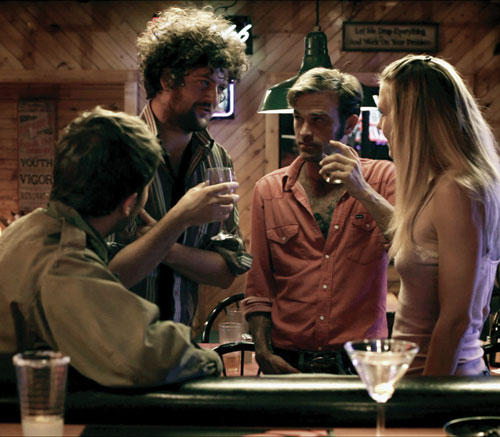
Whether Road to Nowhere qualifies as summary statement or aberration has already divided viewers since its Venice premiere last fall. Written by Iguana‘s Steven Gaydos, it’s a hall of mirrors in which a hotshot filmmaker (Tygh Runyan) making a movie about a woman’s apparent real-life murder casts an alluring non-actress (Shannyn Sossamon) whom an insurance investigator (Waylon Payne) and reporter (Dominique Swain) come to suspect might be playing herself — having faked her own death and adopted a new identity.

The mix of noir, reality-illusion puzzle, industry in-jokes, film history name-dropping (as well as archival clips), uneven performances, sometimes stilted dialogue, brief startling violence, and handsome compositions (shot without permits on a hand-held digital camera) can be taken as two hours of delicious gamesmanship or exasperating self-indulgence. But no one can argue that by now Hellman hasn’t earned his right to be difficult.

MONTE HELLMAN: ROAD TO NOWHERE AND REPERTORY

July 22–28, $5–$10.25

Roxie

3117 16th St., SF

www.roxie.com

Christopher B. Smith Rafael Film Center

1118 Fourth St., San Rafael

www.cafilm.org

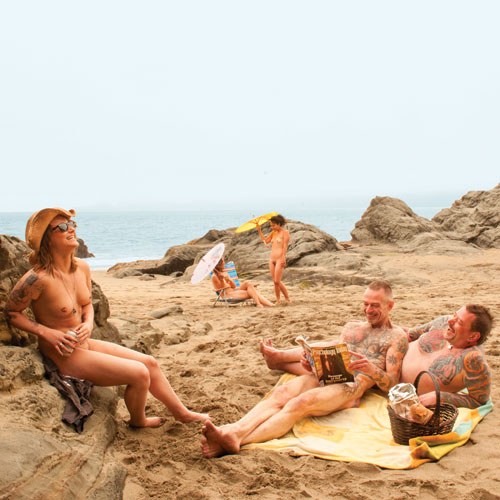
Nude Beaches Guide 2011

18

garhan@aol.com

A few snippets from the year in nude beaches: TV installer Paul Jung enjoyed playing nude volleyball on the north end of Baker Beach. Stinson Beach local and attorney-teacher Fred Jaggi preferred to be naked while tossing a Frisbee on Red Rock Beach in the North Bay. And when he wasn’t busy representing an area that stretches from Tomales south to Muir Beach and as far east as Novato, Marin County Supervisor Steve Kinsey could sometimes be found without a stitch of clothing at a beach in Point Reyes National Seashore.

They’ll be able to continue enjoying their favorite clothing-optional spots. Unfortunately, that’s not the case for all Californians.


BUDGET CUTS TO NAKED SPACE

As you may have heard, our state government plans to close 70 state parks and beaches, including at least three places in Northern California that have traditionally attracted naturists: Montara’s Gray Whale Cove State Beach in San Mateo County, Garrapata State Park near Carmel, and Zmudowski State Beach in northern Monterey County. All three sites have seen declines in nude use recently.

But there’s good news too: After a July 8 meeting of the California State Park & Recreation Commission, Allen Baylis, a board member of the Naturist Action Committee, was hopeful that the state will soon officially designate some beaches as clothing-optional — and said that progress is being made behind the scenes. “We’re going to get there sooner or later,” he predicted. Plus, we’ve learned that none of the spots slated for closure will be fully shuttered before July 2012.

Roy Stearns, deputy director of communications of the California State Parks, says that until then “there may be service reductions and closures on non-peak days, such as Monday through Thursday,” but nothing firm has been decided yet.

“And how do you really close a beach?” asks a state official who wants to remain anonymous. “It’s never been done before in California, so it’s new territory to us. Sure, we can close the bathrooms and the doors, turn off the electricity, and stop the garbage pickup, but you probably can’t keep people out.”

To prevent them from being broken or vandalized, authorities may even decide to keep some gates open at closed beaches.


MARIN TIDINGS

Thankfully, Kinsey won’t have to worry about those concerns in Marin County, although he has had his hands full trying to broker an agreement between homeowners and nudists at Muir Beach in 2009 and 2010. In the end, county officials ordered a sign to be erected on the sand, warning visitors not to engage in lewd behavior and encouraging them to report violations to law enforcers.

“My favorite ongoing spot for going au natural is Limantour Beach, in the dunes heading toward Drakes Estero,” Kinsey says. In fact, while others were mowing their lawns or having barbecues with their families, Kinsey spent part of his Fourth of July weekend sunbathing in the nude area of Limantour.

Limantour isn’t the only clothing-optional place in Marin where Kinsey likes to relax. He was at Bass Lake, also in the Point Reyes National Seashore last year. “And I make it a point to check Red Rock once a year to make sure things are steady and stable,” Kinsey says.


THE NEW BEACH ON THE BLOCK

Even while some nude beaches face closure, we’re proud to add North Garberville Nude Beach in Humboldt County to our online guide this year.

Its discovery comes as a surprise to us, even though it has been known to locals for years. If there’s one thing we’ve learned about covering — and uncovering — nude beaches over the years, it’s to expect the unexpected.

For instance, at North Garberville some visitors even camp naked. “I’ve done it, but so have others,” says reader Dave.


NAKED ON THE MOUNTAINTOP

In January, the leader of the Tahoe Area Naturists, North Swanson, used snowshoes to walk down a flurry-covered hill and go nude with some friends at Secret Harbor Creek Beach, just south of Incline Village, in North Lake Tahoe. “If it’s above 40 degrees and there’s no wind, it’s okay,” says Swanson, who went back several more times that month.

A few times, bears have wandered onto nude beaches at Tahoe during broad daylight, though nobody’s been injured, and the bears have left quickly every time. Once, a federal park ranger on a trail near Marin County’s Bass Lake let a group of nudists pass without incident while he was busy writing a citation to a man (clothed) for not having his dog on a leash.

About the ratings: We give an A to spots that are large or well-established and where the crowd is mostly nude, B to places where fewer than half the visitors are nude, C to small or emerging nude areas, and D to areas we suggest you avoid.

Please send brainstorms, your new beach finds, trip reports, and improved directions (especially road milepost numbers), along with your phone number to garhan@aol.com or Gary Hanauer, c/o San Francisco Bay Guardian, 135 Mississippi St., San Francisco CA 94107


SAN FRANCISCO

NORTH BAKER BEACH

RATING: A

From the first day of summer, when several hundred people appeared — by the estimate of regular visitor Paul Jung — to the warm spells that followed, visitors have been swarming onto San Francisco’s North Baker Beach this year. And when it’s been hot, 60 percent to 80 percent of those people showing up on the shoreline have been nude. The only bummer: a mini-war has erupted between beach regulars and a few gawkers with cameras or binoculars who occasionally hang out in the rocks above the site. “Most of the regulars carry small mirrors to shine at them,” explains Jung, who keeps one in his beach bag. “Some people are even starting to shine laser pointers at them, with great success. Sometimes, five of us will aim up at one guy. So far, it’s been pretty effective in getting them to back off.”

Directions: Take the 29 Sunset or go north on 25th Avenue to Lincoln Boulevard. Turn right and take the second left onto Bowley Street. Follow Bowley to Gibson Road, turn right, and follow Gibson to the east parking lot. At the beach, head right to the nude area, which starts at the brown and yellow “Hazardous surf, undertow, swim at your own risk” sign. Some motorcycles in the lot have been vandalized, possibly by car owners angered by bikers parking in car spaces; to avoid trouble, motorcyclists should park in the motorcycle area near the cyclone fence.


LAND’S END BEACH

RATING: A

What ends at Land’s End? Quite possibly your tan lines. Shorts, bikini tops, and even a few work clothes seem to disappear during weekday lunch breaks on warm summer days at this fun cove, which attracts a few skinny-dippers among a mostly swimsuit-wearing crowd. The site features a mix of sand and rocks, plus some of the Bay Area’s best views. The beach is a quarter-mile long, with some nice sunbathing nooks. Bring a windbreaker in case the weather changes or check out the mini-windbreaks that visitors there have made with rocks and put together one of your own.

Directions: Follow Geary Boulevard to the end, then park in the dirt lot up the road from the Cliff House. Take the trail at the far end of the lot. About 100 yards (past a bench and some trash cans) the path narrows and bends, then rises and falls, eventually becoming the width of a road. Don’t take the road to the right, which leads to a golf course. Just past another bench, as the trail turns right, go left toward a group of dead trees where you will see a stairway and a “Dogs must be leashed” sign. Descend and head left to another stairway, which leads to a 100-foot walk to the cove. Or instead, take the service road below the El Camino del Mar parking lot for a quarter-mile until you reach a bench, then follow the trail there. It’s eroded in a few places. At the end, you’ll have to scramble over some rocks. Turn left (west) and walk until you find a good place to put down your towel.


GOLDEN GATE BRIDGE BEACH

RATING: A

Golden Gate Bridge Beach’s rocky shoreline features incredible views of the world-famous bridge, along with water that can be great for wading. “In low tide,” one woman says, “you can sometimes go 150 feet.” But if you want to be alone, don’t even think about visiting this site, where hundreds of gay men — along with some women and straight visitors — pack three side-by-side coves on the hottest days. No wonder it’s also known as Nasty Boy Beach!

Directions: From the toll booth area of Highway 101/1, take Lincoln Boulevard west about a half mile to Langdon Court. Turn right (west) on Langdon and look for space in the parking lots, across Lincoln from Fort Winfield Scott. Park and then take the beach trail, starting just west of the end of Langdon, down its more than 200 steps to Golden Gate Bridge Beach, also known as Marshall’s Beach. Despite recent improvements, the trail to the beach can still be slippery, especially in the winter and spring.


FORT FUNSTON BEACH

RATING: C

Even though Fort Funston has gone to the dogs — who appear here with their human entourages by the hundreds — a few naturists sneak in from time to time. But don’t even think about going naked here on weekends. Even on weekdays, be sure to use discretion before disrobing. Suit up quickly if you see rangers or families in the area. Authorities usually only issue several citations a year at Fort Funston, south of Ocean Beach, so if you don’t make a fuss and remain in the dunes, you may not be busted. If anyone complains, put on your beach gear right away. Two more fun activities at Fort Fun: watching the passing parade of people and their dogs, and watching the hanggliders that take off from the cliffs.

Directions: From San Francisco, go west to Ocean Beach, then south on the Great Highway. After Sloat Boulevard, the road heads uphill. From there, curve right onto Skyline Boulevard, go past one stoplight, and look for signs for Funston on the right. Turn into the public lot and find a space near the west side. At the southwest end, take the sandy steps to the beach, turn right, and walk to the dunes. Find a spot as far as possible from the parking lot. Don’t go nude here on the weekends. And if you dislike dogs, try another beach.


CONTRA COSTA COUNTY

LAS TRAMPAS REGIONAL WILDERNESS

RATING: C

Are you ready to moon the moon? Imagine walking nude on parkland in the East Bay Hills, with the trail silhouetted by a full moon and small herds of horses coming up to greet you: it’s a scene that makes you feel like you’re on Avatar‘s fictional planet Pandora, mingling with another species.

“It’s absolutely surreal,” says Jurek Zarzycki of Fremont. “The horses come within inches of you, so close you can feel their breath. It’s like being on a moonscape with aliens. You may be a little afraid at first, but the horses are very friendly.”

As part of a partnership between the Sequoians nudist park and the San Jose-based Bay Area Naturists, Hikers leave the Sequoians’ property fully clothed at dusk and walk through meadows and up hills until the moon rises, before heading back down the slopes completely nude, with their clothes folded neatly into their backpacks. Some people walk partially nude, especially near the top of the main ridge used by the hikers where, says Zarzycki, “there can be very cold winds.” San Leandro resident Dave Smith, who leads the naked treks, adds that “the coastal air just starts pouring over the hilltop. And the wind begins howling.” Once on the peak, almost everyone dons a windbreaker.

Zarzycki suggests hikers bring good hiking shoes, a flashlight — though most of the time, the moon provides plenty of light — and bug spray. And don’t forget baby carrots to give to the horses. “It’s truly wonderful,” says Smith. “We’re usually the only ones on the path.”

Zarzycki agrees. “It’s one of the best experiences I’ve ever had. I pitched my tent right there at the Sequoians and then slept under the sky.”

After the walk, most hikers shower at the Sequoians, then take a dip in the pool or hot tub.

Directions: Contact the Sequoians (www.sequoians.com) or the Bay Area Naturists (www.bayareanaturists.org) for details on how to join a walk. Meet at the Sequoians park. To get there, take Highway 580 east to the Crow Canyon Road exit. Or follow 580 west to the first Castro Valley off-ramp. Take Crow Canyon Road toward San Ramon three-quarters of a mile to Cull Canyon Road. Then follow Cull Canyon about 6.5 miles to the end of the paved road. Take the dirt road on the right until the Y in the road and keep left. Shortly after, you’ll see the Sequoians sign. Proceed for another three-quarters mile to the Sequoians front gate.


SAN MATEO COUNTY

DEVIL’S SLIDE, MONTARA

RATING: A

Though it’s one of 70 beaches and parks being closed by the state to save money, Gray Whale Cove is set to remain available for use through at least July 2012. (But days and hours may be reduced according to Roy Stearns, deputy director of communications of the California State Parks.) Today only a few visitors go nude: naturist numbers are down sharply form the several hundred that came during Devil Slide’s heyday as a privately operated nude beach. The nudists that do come tend to hang out on the pretty northern end of the shoreline. “It’s a good place to recharge from work,” says Ron, a regular visitor who enjoys swimming there, even though signs warn of dangerous surf. Dogs are prohibited.

Directions: Driving from San Francisco, take Highway 1 south through Pacifica. Three miles south of the Denny’s restaurant in Linda Mar, turn left (inland or east) on an unmarked road, which takes you to the beach’s parking lot and to a 146-step staircase that leads to the sand. Coming from the south on Highway 1, look for a road on the right (east), 1.2 miles north of the Chart House restaurant in Montara.


SAN GREGORIO NUDE BEACH, SAN GREGORIO

RATING: A

Now in its 45th year of operation, San Gregorio continues its reign as the USA’s longest continually used nude beach. The beach, adjacent to the no-nudity-allowed San Gregorio State Beach, usually attracts a large gay crowd, along with some nude and suited straight couples, singles, and families. First-timers should be wary of the driftwood structures on the sandy slope leading down to the beach, which are used by some visitors as “sex condos.” (If you see one with a t-shirt on a pole, it means it’s occupied.) However, fans of the beach savor San Gregorio’s stunning scenery. It has “awesome natural beauty,” says regular visitor Bob Wood. Attractions at this 120-acre site include two miles of great sand and intriguing tide pools to explore, as well as a lagoon and lava tube.

Directions: From San Francisco, drive south on Highway 1 past Half Moon Bay. Between mileposts 18 and 19, look on the right side of the road for telephone call box number SM 001 0195 at the Stage Road intersection. From there, continue 1.1 miles to the entrance, ABOUT 0.1 MILES from Junction 84. Turn into a gravel driveway, passing through an iron gate with 19429 on the gatepost. Drive past a grassy field to the parking lot, where you’ll be asked to pay an entrance fee. Take the long path from the lot to the sand; everything north of the trail’s end is clothing-optional (families and swimsuit-using visitors tend to stay on the south end of the beach). The beach is also accessible from the San Gregorio State Beach parking area to the south; from there, hike about a half mile north. Take the dirt road past the big white gate with the toll road sign to the parking lot.


SANTA CRUZ COUNTY

BONNY DOON NUDE BEACH, BONNY DOON

RATING: A

At Bonny Doon, “free bathers” head for the northernmost of two coves, where Santa Cruz County’s best-looking nude beach usually has a friendly, social crowd. In recent years, its delightful scenery and peaceful vibes have attracted more women and couples than most clothing-optional sites. However, the Doon’s reputation has been tarnished recently by reports of increased visits by law enforcers and comments left on message boards by men and women alike about some men on the sand making unwanted advances. Jill from Santa Cruz visited the beach in March and wrote that, even after she and her boyfriend left, “one of the men actually got up and followed us.” But after a June visit, Elizabeth from San Jose said, “I gave them the get-away-from-me look and things were cool after that.”

Directions: Go south on Highway 1 to the Bonny Doon parking lot at milepost 27.6 on the west side of the road, about 11 miles north of Santa Cruz. From Santa Cruz, head north on Highway 1 until you see Bonny Doon Road, which veers sharply to the right just south of Davenport. The beach is right off the intersection. Park in the paved lot to the west of Highway 1; don’t park on Bonny Doon Road or the shoulder of Highway 1. If the lot is full, drive north on Highway 1, park at the next beach lot and walk back to the first lot. To get to the beach, climb the berm next to the railroad tracks adjacent to the Bonny Doon lot, cross the tracks, descend, and take the trail to the sand. Walk north past most of the beach to the cove on the north end.


2222, SANTA CRUZ

RATING: A

Named for the house number across the street, America’s smallest nude beach could probably fit in your yard. And that’s what makes it a magical place. You won’t find crowds at this pocket size cove, which takes scrambling to reach and isn’t recommended for children or anyone who isn’t a good hiker. However, those who are agile enough to make it down a steep cliff and over some concrete blocks on the way down will probably be rewarded with an oasis of calm and a good spot to catch some sunrays. Even though there’s a walking path just above it, the beach can’t be seen from above. College students like to hang out here and, if they’re lucky, get a glimpse of a local juggler who can sometimes be seen practicing his routines on the sand.

Directions: The beach is a few blocks west of Natural Bridges State Beach and about 2.5 miles north of the Santa Cruz Boardwalk. From either north or south of Santa Cruz, take Highway 1 to Swift Street. Drive for 0.8 miles to the ocean, then turn right on West Cliff Drive. The beach is five blocks away. Past Auburn Avenue, look for 2222 West Cliff on the inland side of the street. Park in the nine-car lot next to the cliff. If it’s full, continue straight and park along Chico Avenue. Use care in following the path on the side of the beach closest to downtown Santa Cruz and the municipal wharf.


PRIVATES BEACH, SANTA CRUZ

RATING: A

Surf and turf conditions at Privates are excellent once again. The beach — 4524 Opal Cliff Drive, north of the Capitola Pier — is nearly always pristine. “Privates is one of my favorite beaches,” says Brittney Barrios, manager of the nearby Freeline Design Surfboards shop. “It’s always very peaceful.” Nudists, surfers, and families all mingle on the sand. “Everyone gets along,” adds Barrios. “And it’s never crowded.” Barrios, who likes to lay out in the sun at Privates, says many of the local naturists share a favorite pastime: “They like to play paddle ball.”

Directions: Some visitors walk north from Capitola Pier in low tide (not a good idea since at least four people have needed to be rescued). Others reach it in low tide via the stairs at the end of 41st Avenue, which lead to a surf spot called the Hook at the south end of a rocky shore known as Pleasure Point. Surfers can paddle on their boards for the short stretch between Privates and Capitola or the Hook. But most visitors buy a key to the beach gate for $100 a year at Freeline (821 41st Ave., Santa Cruz (831) 476-2950), 1.5 blocks west of the beach. Others go with someone with a key or wait outside the gate until a person with a key goes in, provided a security guard is not present (they often are). “Most people will gladly hold the gate open for someone behind them whose hands are full,” says Bay Area Naturists leader Rich Pasco. The nude area starts to the left of the bottom of the stairs.


MARIN COUNTY

MUIR NUDE BEACH

RATING: A

Happier times have returned to the clothing-optional portion of Muir Beach, long cherished by nudists and known to locals as Little Beach. “Dogs without leashes have replaced people without swimsuits as the top beach concern of the season,” says Steve Kinsey, the member of the Marin County Board of Supervisors who found himself smack dab in the middle of the brouhaha between some homeowners and nudists over use of the sand in the last few years. After several community meetings, it was decided that, while naked use of the incredibly beautiful cove would not be ended, a warning sign stressing “respect” for everyone and listing a phone number for complaints would be installed by the county. Unlike many other nude beaches, Muir doesn’t have a challenging beach path, with eroded steps or poison oak — and the swimming here can be good. To reach it, walk along the water to the north end of the public beach and follow the others you will see crossing over a line of rocks there.

Directions: From San Francisco, take Highway 1 north to Muir Beach to milepost 5.7. Turn left on Pacific Way and park in the Muir lot (to avoid tickets, don’t park on Pacific). Or, park on the long street off Highway 1 across from Pacific and about 100 yards north. From the Muir lot, follow a path and boardwalk to the sand. Then walk north to a pile of rocks between the cliffs and the sea. You’ll need good hiking or walking shoes to cross. In very low tide, try to cross closer to the water. The nude area starts north of it.


RED ROCK BEACH, STINSON BEACH

RATING: A

With what’s thought to be the friendliest Bay Area nude beach crowd, Marin’s Red Rock Beach plays host to Ultimate Frisbee games that last up to three hours. Nudists are also trying their luck at double disc court, for which players toss two Frisbees at once (“We throw them really hard and fast,” says Fred Jaggi, the attorney-teacher from Stinson Beach), and Befuddle, which, Jaggi explains, means that “you throw the first one soft and the second disc hard.” Naked Scrabble has replaced nude hearts as the most popular game played by sunbathers. Tips: the lower part of the trail sometimes is slippery, so wear good shoes on the path instead of flip-flops. For more sitting space, visit when the tide is low (check tide tables before visiting) and bring a folding beach chair. If possible, arrive early in the day, before crowds, or come on a Monday.

Directions: Go north on Highway 1 from Mill Valley, following the signs to Stinson Beach. At the long line of mailboxes next to the Muir Beach cutoff point, start checking your odometer. Look for a dirt lot full of cars to the left (west) of the highway 5.6 miles north of Muir and a smaller one on east side of the road. The lots are at milepost 11.3, one mile south of Stinson Beach. Limited parking is also available 150 yards to the south on the west side of Highway 1. Or from Mill Valley, take the West Marin/Bolinas Stage toward Stinson Beach and Bolinas. Get off at the intersection of Panoramic Highway and Highway 1. Then walk south 0.6 mile to the Red Rock lots. Follow the long, steep path to the beach that starts near the Dumpster next to the main parking lot.


BASS LAKE, BOLINAS

RATING: A

“It really was nice in May,” says Dave Smith of San Leandro regarding his visit to beautiful Bass Lake, deep in the Point Reyes National Seashore. The lake lies off a path that, if you continue past the lake turnoff, will eventually take you to a waterfall. “The trail was a little overgrown — but I had fun swimming nude in the lake.” Bass, though, doesn’t attract as many nudists as it did 10 years ago. “When I first went, everybody was nude,” says Smith, who usually leads a group of Bay Area Naturists once a year for picnicking and swimming outings at Bass — which, by the way, doesn’t have any bass fish. Pat, a recent visitor, says, “Most people are cool if you take off your clothes, but some are kind of freaked out.” Suggestions: bring an air mattress, water shoes, and a thick towel or tarp for sitting on the matted, sometimes prickly meadow near the water. For even more fun, try the lake’s rope swing.

Directions: From Stinson Beach, go north on Highway 1. Just north of Bolinas Lagoon, turn left on the often-unmarked exit to Bolinas. Follow the road as it curves along the lagoon and eventually ends at Olema-Bolinas Road. Continue along Olema-Bolinas Road to the stop sign at Mesa Road. Turn right on Mesa and drive four miles until it becomes a dirt road and ends at a parking lot. On hot days the lot fills quickly. A sign at the trailhead next to the lot will guide you down scenic Palomarin Trail to the lake. For directions to Alamere Falls, 1.5 miles past Bass Lake, please see “Elsewhere In Marin” in our online listings.


RCA BEACH, BOLINAS

RATING: A

Inspiring. Romantic. Isolated. Rugged. However you describe RCA Beach, a Point Reyes National Seashore property near Bolinas, you’ll probably say you like it. “It hasn’t changed much in 20 years,” says regular visitor Michael Velkoff. But it can be a bit breezy at the cove, which requires a moderately long walk to reach. The good news is that there are lots of nooks that are sheltered from the wind. And there’s so much driftwood on the sand that many people build windbreaks or even whole forts. Though seldom deserted, RCA is never crowded and averages five to 20 people per day. “It’s a quiet place,” says Velkoff. “Whenever I’ve been there, everyone’s been nude.”

Directions: From Stinson Beach, take Highway 1 (Shoreline Highway) north toward Calle Del Mar for4.5 miles. Turn left onto Olema Bolinas Road and follow it 1.8 miles to Mesa Road in Bolinas. Turn right and stay on Mesa until you see cars parked past some old transmission towers. Park and walk a quarter mile to the end of the pavement. Go left through the gap in the fence. The trail leads to a gravel road. Follow it until you see a path on your right, leading through a gate. Take it along the cliff top until it veers down to the beach. Or continue along Mesa until you come to a grove of eucalyptus trees. Enter through the gate here, then hike a half mile through a cow pasture on a path that will also bring you through thick brush. The second route is slippery and eroding, but less steep. “It’s shorter, but toward the end there’s a rope for you to hold onto going down the cliff,” says Velkoff.


LIMANTOUR BEACH, OLEMA

RATING: B

On warm days in the summer, arrive by 10:30 a.m. or the parking lot of this Olema-area clothing-optional beach may be full. More parking is located a half mile away. Even with several hundred visitors on a hot weekend day, Limantour is so large that it usually looks deserted. Recently named one of the USA’s top 10 national park beaches in the west by Sunset Magazine, you may just want to wear one thing: a pair of binoculars for watching birds, whales, and seals. Leashed dogs are okay, but only on the south half of the beach. Nudity is allowed away from main public areas like the parking lot or a picnic area, as long as nobody complains. A regular visitor says he walks several minutes from the lot before going nude. “The closest person is usually 100 to 150 yards away,” he says. Also popular for disrobing are the sand dunes on the north end.

Directions: Follow Highway 101 north to the Sir Francis Drake Boulevard exit, then follow Sir Francis through San Anselmo and Lagunitas to Olema. At the intersection with Highway 1, turn right onto 1. Just north of Olema, go left on Bear Valley Road. A mile after the turnoff for the Bear Valley Visitor Center, turn left (at the Limantour Beach sign) on Limantour Road and follow it 11 miles to the parking lot at the end. Walk north a half mile until you see some dunes about 50 yards east of the shore. Nudists usually prefer the valleys between the dunes for sunbathing, which may be nearly devoid of, or dotted with, users depending on the day.


GET NAKED: UPCOMING NUDIST EVENTS

BODYFEST

A five day long, clothing-optional summer camp at a retreat in the Santa Cruz Hills

July 20–26, www.photonaturals.com


SEQUOIANS NUDIST PARK

The family friendly Castro Valley park is holding a naked luau on July 30, an outdoor movie on the lawn Aug. 6, and a day of Jamaican food and reggae music Aug. 20.

www.sequoians.com


FULL MOON HIKE

For fun that’s not in the sun, join this group nude hike in the East Bay Hills.

Next hike Sept. 9. Leaves from the Sequoians, Castro Valley. www.sequoians.com


BONNY DOON BEACH CLEANUP

Want to help the environment and work on your tan at the same time? Drop by this nude beach to give back to nature, in your natural state.

Sept. 17. Bonny Doon Beach, Santa Cruz. www.bayareanaturists.org


NUDE BEACH PARTY DAY

Clothes-free races, nude fashion show, track and field events, naked sand sculpting, and body painting — and prizes up to $500 for winners.

Oct. 8, 11 a.m.–4 p.m., free. North Baker Beach, SF. www.photonaturals.com 


Trash (summer) lit: Shut Your Eyes Tight

0

Shut Your Eyes Tight
By John Verdon
Crown, 509 pp, $24


Ever since Thomas Harris created Hannibal Lecter and James Patterson devised the twisted psychokillers who populate the Alex Cross novels, there’s been something of a drive in thriller lit to top even the worst, most grusome stuff imaginable. It’s the Pulp Fiction Syndrome in trash lit — and although Shut Your Eyes Tight is hardly the worst of the recent offerings, I was only about a third of the way through the book when I took out my notepad and wrote:


“This is some sick fucking shit.”


Yep: Ritual machete decapitations (including the bride at a society wedding). Headless body in a rich man’s freezer (below a hundred chickens and some broccoli). Doll equivalent of a horse’s head in a bed. Sexual sadists taking advantage of kids at a reform school for juvie sex offenders.


Oh, and our hero gets a roofie in his drink and gets blackmailed by a fake art patron with no real vowels in his name over (possible) unconsious underage sex. And the Sicilian mob is involved. And an obscure-Elizabethan-literary-reference murderer who cites the works of  Thomas (why should this not surpise me) Kyd.


Naturally, Dave Gurney, the reluctant former homicide detective caught in the middle of all of this, is having tortured relationship problems. It’s sort of a bloody Green Acres: His wife wants to live a nice peaceful life in the country, and he can’t stop himself from getting dragged into dangerous and horrifying crime investigations. In fact, for all the gore, the scenes with the wife are some of the most painful stuff in the book.


In this case, Gurney is called to help solve the wedding-day homicide, which the husband (a truly weird psychiatrist) wants to blame on the household help, in this case a young man who — according to the police — might have been having an affair with the late lamented, or might have been mad at her husband, or might just be a crazed killer who conveniently split town and can’t be found. But the facts don’t quite add up — and Gurney has to piss off not only all of the direct players but a crew of state cops who have bungled the preliminary investigation.


He follows the threads through a bizarre world of crooks, fashion models, child molesters, billionaires, and assorted upstate New York characters until he runs into the grisly world he retired to avoid. You can imagine how his wife feels.


Somehow, it all works as a perfectly adequate (if a bit too lenghty) beach book for the lovers of batshit psychos and the cops who chase them. It’s on my recommended list.

Short takes on the 2011 San Francisco Jewish Film Festival

0

Eichmann’s End: Love, Betrayal, Death (Raymond Lay, Germany/Israel, 2010) Many documentaries rely heavily on historical reenactments to flesh out real-life events not caught on camera. Sometimes this effect can be corny, but in Eichmann’s End, the powerful reenactments make the film. Interviews with actual eyewitnesses guide the acted-out tale of Nazi Adolph Eichmann’s post-World War II life; despite his grim contributions to the Holocaust, he managed to escape to Buenos Aires, eventually settling down to a normal-seeming life with his wife and sons. Though he lived under an assumed name, his true identity was known by many, including a Dutch journalist who conducted a series of interviews with Eichmann in the late 1950s.

Transcripts from these chats are performed nearly verbatim, tellingly revealing Eichmann’s lack of guilt, remorse, or any feelings whatsoever (except regret that he wasn’t able to exterminate all the Jews before the war ended). When by chance his teenage son became smitten with the pretty daughter of a Jewish Nazi hunter who’d survived a concentration camp in the 1930s, events were set in motion that lead to his dramatic capture and highly public trial in Israel. (For what happened next, see The Hangman, below). Eichmann’s End occasionally betrays its made-for-TV roots (as with its intrusive, unnecessarily “tense” score), but it’s chilling nonetheless. Mon/25, 5 p.m., Castro; Mon/1, 4:25 p.m., Roda; Aug. 7, 2:10 p.m., Oshman. (Cheryl Eddy)

The Hangman (Netalie Braun, Israel, 2010) Sephardic Jew Shalom Nagar would already be a pretty compelling subject for a short documentary — for starters, he’s a ritual butcher by trade — but the film’s title reveals his most prominent contribution to history: he was the jailer turned executioner of Adolph Eichmann. Though he calls the man evil (and, chuckling, recalls that the captured Nazi literally thought his shit didn’t stink) he admits he “grew attached” after six months of close contact; his task was not so much preventing Eichmann’s escape, but preventing his death before his trial, to the point of taste-testing all his food to make sure it wasn’t poisoned. When lots were drawn and a hesitant Nagar was selected to “press the button,” the experience affected him so deeply that he became devoutly religious. The rest of his life story, including a stint working at a jail in Hebron after the Six-Day War (where he advocated for prisoners’ rights), is no less remarkable, and reveals a remarkable man who views his fellow humans without any shred of prejudice. July 31, 4:45 p.m., JCCSF; Aug. 2, 4:40 p.m., Roda; Aug. 6, 4:30 p.m., Oshman. (Eddy)

In Heaven Underground: The Weissensee Jewish Cemetery (Britta Wauer, Germany, 2011) In Heaven Underground charts the history of the Weissensee Jewish Cemetery in Berlin, the second-largest Jewish cemetery in Europe, and an important piece of Jewish-German culture that somehow managed to escape desecration at the hands of the Nazis. Surprisingly perhaps, In Heaven Underground is a joyous film, showcasing Weissensee not as a place of death, but as a site for the enduring vibrancy of life. From the Pobbig-Shulz family who live on its premises to the goshawk enthusiasts who conduct research in its lush deciduous environs, Jews and gentiles alike reveal Weissensee cemetery’s resilient personality and its contributions to the people of Berlin both in the past and present. As Harry Kindermann, who worked there as a teenager, notes: “Jewish children could laugh in 1942. But only in the cemetery, because nobody there forbade it.” Sun/24, Castro, 11 a.m.; Aug. 6, 4:40 p.m., Roda. (Cooper Berkmoyer)

Polish Bar (Ben Berkowitz, U.S., 2010) The “good Jewish boy:” does he really exist? In Polish Bar, director-writer Ben Berkowitz tells the story of Rueben (Vincent Piazza) as he grapples with his roots and does whatever it takes to realize his dream of DJ stardom. Although employed by his uncle Sol (Judd Hirsch), Reuben moonlights at a strip club, honing his turntable skills and scoring cash on the side with more illicit trade. Along with stripper Ebony (Golden Brooks) and bouncer Tommy (James Badge Dale), he walks a razor’s edge between his aspirations and utter obliteration. Piazza does a great job of toeing the line; Reuben never comes off as malicious, just lost and caught in a vicious game. As Reuben sinks ever deeper into a sordid world of drugs and sex (and a weird plot tangent or two) he is forced to confront his tenuous relationship with his Jewish upbringing and face the repercussions of his actions. Sat/23, 9:15 p.m., Castro; July 30, 9:30 p.m., Roda; Aug. 2, 8:45 p.m., Oshman; Aug. 6, 8:55 p.m., Rafael. (Berkmoyer)

Skate of Mind (Karin Kainer, Israel, 2010) Ostensibly a documentary about skateboarding in Tel Aviv, Skate of Mind is more poignantly a story of youth in Israel. Mohammed Kahil (a.k.a. Juice) is an Arab-Israeli teenager with an unquenchable thirst for skating, dashing his father’s hopes that Mohammed help out with the family grocery store. Ever the rebellious son, he leaves home to move in with his Jewish girlfriend, Alina Fine. Although there are plenty of opportunities for Mohammed to showcase his considerable talent and talk endlessly about skateboarding, his relationship with Alina is the most intriguing part of Skate of Mind. Both their fathers disapprove, and having to get by on their own wears on their youthful, bordering-on-naïve love. In the end, despair and hope meet side by side as two young Israelis are forced to confront reality and look to the future. July 31, 8:50 p.m., JCCSF; Aug. 4, 2:30 p.m., Roda. (Berkmoyer)

San Francisco Jewish Film Festival
July 21-Aug 8, most shows $12
Castro Theater
429 Castro, SF
Christopher B. Smith Rafael Film Center
1119 Fourth St., San Rafael
Jewish Community Center of San Francisco
3200 California, SF
Oshman Jewish Community Center
3921 Fabian Way, Palo Alto
Roda Theatre at Berkeley Rep
2025 Addison, Berk.
(415) 621-0523
www.sfjff.org

Opening up the [SSEX BBOX]

0

What turns you on? Why do you use a condom? How do you define your gender? From Spain to Germany, Brazil and the US, the documentary series [SSEX BBOX] poses honest questions about sex and sexuality and asks for blunt, no-fuss answers in return. The culmination of these stories is a refreshing challenge to the pre-disposed definitions around sexuality. [SSEX BBOX]’s short videos and new magazine are tearing open binary-ridden boxes and letting real life spill out.

[SSEX BBOX] began as a social justice film project two years ago to create awareness and accessibility around sexuality issues worldwide. The project’s odd spelling is a play on the four cities being explored: San Francisco, Sao Paulo, Barcelona and Berlin, which were primarily chosen due to the locations of project leaders, but also for their unique cultural perspectives. Brazilian director Priscilla Bertucci says exposing the differences between the sex-positive cities is one of her favorite aspects of the project, noting the challenge of sexism present in Latin counties and the inherent gendering in the Latin languages, in which every noun is assigned to be either male or female. Bertucci loves that [SSEX BBOX] will facilitate discussions between these countries and hopes the information trade will help make positive changes in all cities.

 ssexbbox5


A gem from the must-see-twice [SSEX BBOX] photo collection

Film crews in all locations have been interviewing everyone from sex educators, kinks and queers, to anyone interested in sharing their opinions on topics like relationships, sexual orientation, anal, sex work, and polyamory. The mission of the project is to explore sex without shame, fear, or hesitation. A voice in one video asks, “What would a sexually healthy society look like? Are you sexually satisfied?” San Franciscans may raise their hands and cheer but it’s easy to forget that these questions may not fare so well outside of our sex-friendly Bay; all the more reason we should be asking. 

ssexbbox1

[SSEX BBOX] is still in the filming stages, but a preliminary collection of videos are already on their site as a precursor to what will become a full-on 15-episode series beginning in January 2012. In the mean time, the project has decided put out a series of pocket-sized zines, the first of which is themed, “Genderly Phrased” and is meant to explore the vast world of gender definitions beyond the all-too standard masculine and feminine.

ssexbbox_mag


The freshly published [SSEX BBOX] magazine

“Maybe you exude androgyny, or pull from seahorse energy, or a series of colors,” says Bertucci, explaining that gender is meant to be subjective and personal.

It’s a steamy read (if you can tear yourself away from the stunning cover) with lots more bonus visuals and personal essays from people around the world confidently exploring outside the lines. Another issue is expected to print in October and it’s not too late to submit your own story, or your mother’s. 


[SSEX BBOX] [CRUSH] ZINE-RELEASE PARTY

Thurs/14, 8 p.m., $7

El Rio

3158 Mission, SF

www.elriosf.com


Michael Irvin and gay professional athletes

3

I must admit, I wouldn’t have expected it out of a Dallas Cowboys player, but let’s have a hand for Michael Irvin, who has announced (in Out Magazine, with a shirtless cover) his full support for marriage equality:


“I don’t see how any African-American, with any inkling of history, can say that you don’t have the right to live your life how you want to live your life,” he said, according to the magazine. “No one should be telling you who you should love, no one should be telling you who you should be spending the rest of your life with. When we start talking about equality, and everybody being treated equally, I don’t want to know an African-American who will say everybody doesn’t deserve equality.”


Irvin says that he believes this work matters more than his football career and would embrace any athlete who chose to come out. He thinks the team that won three Super Bowls could have integrated an openly gay teammate as well as any team. “We had a bunch of different characters on that team,” Irvin said. “Deoin [Sanders] and Emmitt [Smith]. I believe that team would have handled it well.”


It’s only a matter of time, I hope not too much time, before a professional male athlete from one of the four major sports comes out — and think what that will do for the “It Gets Better” campaign. I’ve spent some time speculating on which sport it will be; baseball’s the obvious choice, in part because of its history of breaking barriers but also because there’s, well, a lot more tolerance in general in baseball, certainly in San Francisco.


Not hockey — I mean, things are better now (and Candians have embraced same-sex marriage) but I went to hockey camp in Canada as a kid, and it was by far the most homophobic group of jocks I’ve ever met.


Basketball? Maybe. But honestly, I’m thinking the NFL. We know there are plenty of gay NFL players, and Irvin has already opened the door a little tiny crack … I don’t know. I can see it.

our Weekly Picks, July 13-19, 2011

0

THURSDAY 14

EVENT

Fire Monks: Zen Mind Meets Wildfire at the Gates of Tassajara

Here’s your spiritual riddle of the week, young grasshopper. Say you’re a Buddhist monk. Two thousand fires are sprinting across California’s tinderous golden landscape. The wind shifts. One blaze streams down a single unpaved road, the sole portal to your monastery. The conundrum expressed best by the Clash alights in your ever-mindful mind: should I stay or should I go now? In June 2008, five monks chose to stay when the Big Sur fires threatened Tassajara, the country’s oldest Zen monastery. Author Colleen Morton Busch shares their story in her new book Fire Monks: Zen Mind Meets Wildfire at the Gates of Tassajara. Hear her read selections, plus stories from the monks and wild land firefighters, on how they successfully fought the fire with the fire within. (Kat Renz)

7:30 p.m., free

San Francisco Zen Center

300 Page, SF

(415) 863-3136

www.sfzc.org


EVENT

“Cabaret Bastille”

LitQuake revives the ghosts of Left Bank bohemia for its cabaret and fundraiser Cabaret Bastille. Everyone’s favorite modernists will be in the house — Anais Nin, F. Scott Fitzgerald, James Joyce, Djuna Barnes, Henry Miller, H.D. and of course, the salon dom herself Gertrude Stein — as local writers impersonate these legends and read selections from their work. Other merriments include songs by accordion-accompanied chanteuse Gabrielle Ekedal, a make-your-own-Matisse station, exquisite corpses, and much genius-inducing imbibing. (Matt Sussman)

8 p.m.–midnight, $15

Cellspace

2050 Bryant, SF

www.brownpapertickets.com


EVENT

“Crimes Against Horticulture: When Bad Taste Meets Power Tools”

I earn most of my money on my knees, initiating a rampage of genocidal proportions upon the natural world. I pull weeds and I love the killing, though not without remorse, for who am I to judge? (As a nonbreeder, I’m biologically nil compared to the reproductive success of an invasive plant.) I wonder if funny-man gardener Billy Goodnick would diagnose this murderous spree a “crime against” or a “crime in the name of” horticulture? An award-winning landscape architect and host of the Santa Barbara television show Garden Wise Guys, Goodnick brings his humor-infused message of sustainability to horticultural criminals, crazies (any “compulsive rakers” out there?), and petal perfectionists alike. (Renz)

7 p.m., $15

Conservatory of Flowers

100 John F. Kennedy, Golden Gate Park, SF

(415) 831-2090

www.conservatoryofflowers.org


COMEDY

Jay Pharoah

Even though comedian Jay Pharoah is only 23, he is already a seasoned veteran of the stand-up circuit, hitting stages since his early teens and honing his hilarious impersonation skills. Eddie Murphy, Will Smith, and President Obama are among his stable of dead-on, side splitting impressions, some of which, along with his many other comedic talents, have been featured on national television since he joined the cast of Saturday Night Live last year. Pharoah’s star is only certain to rise with more national exposure, so do yourself a favor and catch him this weekend in the cozy confines of Cobb’s before it’s too late. (Sean McCourt)

Thurs/14–Sun/17, 8 p.m.

Also Fri/15–Sat/16, 10:15 p.m., $18.50–$20.50

Cobb’s Comedy Club

915 Columbus, SF

(415) 928-4320

www.cobbscomedy.com


FRIDAY 15

PERFORMANCE

Persepolis, Texas

Sometimes it takes a Texas-reared second-generation Iranian American cisgendered female in drag to point out what should be obvious: “That this huge stage presenteth nought but shows” (to quote an old Englishman who never set a pointy shoe in Texas). Is self-presentation of any kind just a drag act by another name? Isn’t the real question whose terms apply in the fashioning of one’s persona? Whose hijab is it anyway? San Francisco–based performance artist Maryam Farnaz Rostami explores the tenuous line between identity, persona, eroticism, and exoticism in her first evening-length solo show, embodying a handful of characters — including Rostami’s celebrated drag persona Mona G. Hawd — in movement, music, and an unexpected narrative encompassing contemporary Iran, Iranian Texas, and queer San Francisco. (Robert Avila)

Fri/15–Sun/17, 8 p.m., $20

CounterPULSE

1310 Mission, SF

1-800-838-3006

www.counterpulse.org


FILM

Skatetown, U.S.A.

Billed as “The Rock and Roller Disco Movie of the Year!” — the people behind Roller Boogie (which came out the same year) must have taken great offense — 1979 crapsterpiece Skatetown, U.S.A. has been very hard to find for years. What a cast: top-billed rodent Scott Baio, a slutted-up Marcia Brady (a.k.a. Maureen McCormick, who claimed she became a coke addict on this shoot), and 1979 Playboy Playmate-turned-1980-murder-victim Dorothy Stratten, to name just a few. Plus tons of actual roller-disco troupes — you can tell they thought this was their ticket to Broadway — and two genuinely talented dancers showcased as good and bad guy. The very Warriors-style villain is Patrick Swayze, making his film debut (his belt-whip skate solo smokes). With its mix of stupid skit comedy and stupider ensemble dramatics, Skatetown, U.S.A. is a fungal time capsule that played less-than-fresh even at its moment of birth. Yet it’s kind of great anyway. This one-night only revival features free tube socks, presumably not-free beer, and a post-screening roller disco party at Cellspace. (Dennis Harvey)

7 and 9 p.m., $15 (includes roller disco)

Roxie Theater

3117 16th St., SF

(415) 431-3611

www.roxie.com


PERFORMANCE

Hello, My Name is Joe

Bringing a global perspective to the push and pull of power structures, Meridian Dance presents 8213 Physical Dance Theater’s world premiere Hello, My Name is Joe, a site-specific work inspired by the concurrent visual art exhibition “In Extremis: Prints Monumental, Intimate.” Based in Taipei, Taiwan, under the direction of Chuo-Tai Sun with collaborator Casey Avaunt (a Maine native), 8213 Physical Dance Theater reveals the ways humans emotionally and physically battle controls. Launching from the old children’s song “Hello, My Name is Joe,” in which the protagonist is asked by his boss to push, pull, and turn buttons, the work challenges the performers to negotiate their freedom within the walls of the Meridian Gallery. (Julie Potter)

Fri/15–Sat/16, 7:30 p.m., $10–$20

Meridian Gallery

535 Powell, SF

(415) 398-7229

www.meridiangallery.org


SATURDAY 16


FILM

When Harry Met Sally

They’ve brought salsa and swing dancing, a circus festival, and classical music to Union Square. Now the Jewels in the Square Performance Series reopens age-old debates about the nature of friendships and sex, the rebound girlfriend, and orgasmic deli dishes. The latest event on the outdoor-entertainment calendar (in partnership with Film Night in the Park and the San Francisco Jewish Film Festival) is a screening of 1989 classic rom-com When Harry Met Sally. Prime your funny bone for the upcoming 2011 SFJFF (opening night is July 21) with the ultimate “Can a straight man and a straight woman ever be just friends?” flick, starring Meg “On the Side” Ryan and Billy “Made a Woman Meow” Crystal. Bring a friend, significant other, or both. (David Getman)

8 p.m., free

Union Square

Geary at Powell, SF

www.sfjff.org


MUSIC

Black Dynamic Sound Orchestra

“Blaxsploitation” cinema is as much prized for its music as for its leather-wearing, Afro-having, ass-kicking heroes and the vengeance that they wreak. What would Shaft (1971) be without its theme song? How could justice be adequately dispensed, or love properly made, without exceptionally funky grooves? It was with questions such as these in mind that the producers of Black Dynamite (2009) must have chosen Adrian Younge to score their filmic love song to black belts and pointy collars. Younge, who also edited Black Dynamite, created a perfect backdrop to a ridiculous movie, and wrote some great songs doing it. With Younge at the helm, Black Dynamite Sound Orchestra takes his vision on the road, performing selections from the Black Dynamite original soundtrack as well as unreleased tracks from a forthcoming album. (Cooper Berkmoyer)

With Lord Loves a Working Man and the Struts

10 p.m., $12

Bottom of the Hill

1233 17th St., SF

(415) 621-4455

www.bottomofthehill.com


EVENT

Phono Del Sol Music and Food Festival

Music festivals can totally suck. They cost an Xbox 360, take half a week of your life (that’s never coming back) to see four bands that were in town at small venues the month before, make you realize Kanye is better on YouTube, force you to fend off that bro who won’t stop asking for drugs, and camp in a in a parking lot next to Porta-Potties. It’s a little much. Thankfully the folks at the Bay Bridged blog and Tiny Telephone have you covered with this darling, commitment-free fest that combines two SF passions: music and food. They’ll bring musicians including Aesop Rock, Mirah, and Appetite, and you bring your appetite (plus cash for Off the Grid’s food trucks.) (Ryan Prendiville)

Noon-7 p.m., free

Potrero Del Sol Park

25th St. at San Bruno, SF

www.thebaybridged.com


SUNDAY 17


VISUAL ART/EVENT

“Google Family Day”

In its “Doodle 4 Google: What I’d Like To Do Someday … ” exhibit (through July 19), the San Francisco Museum of Modern Art linked up with Google to showcase the works of 40 student artists. The works (selected from more than 100,000 submissions) were inspired by a prompt for kids to envision what they would like to do in the future — and channel that energy into redesigning a logo for the website’s continually changing home page. The moon-themed winner (which earned its seven-year-old creator, South San Francisco’s Matteo Lopez, $15,000 in college money plus a technology grant for his school) hit Google in May. The 39 other contestants have the pretty nifty consolation prize of having had their artwork hung in a museum before they’ve even hit 18. Today’s “Google Family Day” event offers free entry for families with kids under 12, with special hands-on activities, performances, and more aimed at young artists. (Getman)

11 a.m.–4 p.m., free for families with children under 12

San Francisco Museum of Modern Art

151 Third St., SF

(415) 357-4000

www.sfmoma.org


TUESDAY 19


MUSIC

Parenthetical Girls

Pop music. To some these two words together bring to fore images of cloying sweetness, a toothy smile in high gloss shrink-wrap bearing down on contented mall shoppers. Parenthetical Girls is here to remind us that pop still has cards up its sleeve, if not revel in the antagonism. The willfully obscure recording project (usually) from the Pacific Northwest warps complex operatic composition à la Sparks and Eno, adds a dash of Morrissey’s infamous ego, and ends up with songs that are almost caustically intellectual. Experimental it is, but not so much that the essential framework is smothered. Instead, Parenthetical Girls emerges as something uncanny; it draws you in with familiar pop music tropes but leaves you pleasantly unsettled. (Berkmoyer)

With Extra Life and Sam Mickens

9 p.m., $7

Hemlock Tavern

1131 Polk, SF

(415) 923-0923

www.hemlocktavern.com 


The Guardian listings deadline is two weeks prior to our Wednesday publication date. To submit an item for consideration, please include the title of the event, a brief description of the event, date and time, venue name, street address (listing cross streets only isn’t sufficient), city, telephone number readers can call for more information, telephone number for media, and admission costs. Send information to Listings, the Guardian Building, 135 Mississippi St., SF, CA 94107; fax to (415) 487-2506; or e-mail (paste press release into e-mail body — no text attachments, please) to listings@sfbg.com. Digital photos may be submitted in jpeg format; the image must be at least 240 dpi and four inches by six inches in size. We regret we cannot accept listings over the phone.

Hot reels

0

culture@sfbg.com

LUST FOR LIFE In 1969, San Francisco became the first American city to legalize screening hardcore pornography. In honor of director Michael Stabile’s documentary-in-progress Smut Capital of America, which chronicles the 1969 event and SF’s ensuing pivotal role in the adult film industry during the early 1970s, Yerba Buena Center for the Arts is sponsoring a festival from July 14-Aug. 24 that will screen Stabile’s project and seven vintage porn films.

The festival kicks off with an evening featuring Smut Capital, a post-screening Q&A, rare vintage porn clips, and a discussion between Stabile and YBCA film and video curator Joel Shepard on SF sex culture in the 1960s and ’70s. After seeing the 16 minute-excerpt of the film, I ‘m already intrigued, entertained, and offended.

Smut Capital does more than give a blow-by-blow (sorry for the pun) porn history. It is also one of the few existing histories of sex work and queerness in the 1970s Tenderloin district. There is some pretty transphobic and sexist language in the footage (said by interviewees, not the filmmaker), and its treatment of street sex work and survival sex feels weirdly lighthearted. But because documenting the Tenderloin’s importance to queer and sex cultures is rare, I’m glad this film is in the works. I’m interested to see what other footage Stabile has for us down the road.

YBCA is also screening good old-fashioned smut — a passel of 1960s and ’70s blue shorts and full-lengths are on the schedule. And for another take on the era, a perspective piece from right in the thick of things, look to director Alex De Renzy’s Pornography in Denmark (1969), a controversial (at the time — but then, what wasn’t?) documentary he made during the first Danish adult trade expo to shoot its load after the country rescinded many of its anti-sex laws. De Renzy went on to direct such gems as 1989’s Bring on the Virgins and 1997’s Trashy Ass Deliquents, so you can probably guess where he stands on matters of sexual freedom.

Pornography in Denmark is far more interesting as a historical document than as a documentary or a porn film. As far as docs go, it’s slow; as far as porn goes, well, there’s nudity and sex, but they’re not very arousing. The film is a bit dry and long-winded, with the narrator earnestly explaining the history of porn in Denmark, right down to reciting the national average of production costs.

The interviews with sex industry workers are interesting, though, and some of the dialogue is priceless. I was having giggle fits over lines like “Probably not many men carry a vibrator in their attaché case”; “A tourist’s raincoat has deep pockets”; and “Making a pornographic film can raise a sharp appetite!”

All in all, these events are definitely worth checking out. I’ll be at “Smut Capital” — see you there?

SMUT CAPITAL OF AMERICA: SAN FRANCISCO’S SEX FILM REVOLUTION

Smut Capital , Thurs/14, 7:30 p.m., $6–$8

Pornography in Denmark , July 21, 7:30 p.m., $6–$8

Yerba Buena Center for the Arts

701 Mission, SF

www.ybca.org


Editor’s notes

16

tredmond@sfbg.com

I’m not prone to agreeing with right-wing nuts from Riverside County, but there’s a county supervisor down there named Jeff Stone who has a dandy idea. He wants to secede.

According to the Los Angeles Times, Stone is proposing that 13 counties in the southland and inland empire split off and become their own state, which would be called South California. We’re talking everything south of Madera, with the coastal counties (and Los Angeles) left behind. A real conservative haven of low taxes and limited regulation.

And I say: Go for it, pal. I’m completely with you.

Imagine what would happen if Supervisor Stone got his way. There would be no more budget paralysis in the California Legislature. Democrats would control two-thirds of both houses and could pass a budget that included higher taxes on the rich and big corporations. Candidates for governor wouldn’t have to worry about getting votes from the conservative parts of the state, so they could talk more honestly about the major issues. Same-sex marriage would pass the first week. Pot would be legal. The death penalty would be gone in a year or two.

It might take a while longer to amend Prop. 13, but with the ability to raise revenue instead of just cutting, California could begin to fund the schools adequately, rebuild the state university system, and move forward with projects like high-speed rail.

And let’s remember: those counties that want to leave? They elect representatives who won’t vote for taxes — but they are the biggest beneficiaries of state revenues. The northern and coastal counties, the more liberal ones, pay more in taxes than we get in services. Our taxpayers are subsidizing their tax haters.

So go on — leave. We’ll keep our money here.

Now, just to our south and east would be a train wreck of a state with few public services — but South California would still be part of America, so people could move north without worrying about immigration papers. I’d propose that we set up a state fund to resettle refugees from Republicanland.

And maybe, after a while, the people who have to live with crappy schools and crumbling roads will look across the border and say, Why do they have it so good? And maybe they’ll start to think differently about the role of government.

OneTaste opens orgasm pop-up shop

4

Yes, you read that correctly. And no, they’re not providing customers with afternoon delights. OneTaste‘s “orgasm store” has academic goals: instructing the masses on how to please a woman based on Slow Sexa book by OneTaste’s founder Nicole Daedone. It’s kind of like that ancient proverb: Give a man (or woman) a fish and he eats for a day. Teach ’em to fish and she’ll cum again, and again, and again. 

The heart of Daedone’s goal is simple: spreading the should-be obvious notion that every woman deserves super-amazing orgasms. Unfortunately a lot of ladies and their partners don’t know how to make this happen. Daedone’s attentive approach is simple: combat ADD, settle the mind, and get all parties focused on the task at hand so the explosive ending happens organically. 

If you have yet to read Daedone’s book or if you’ve poured thousands into an orgasmic meditation retreat with her OneTaste empire, the pop-up shop is a great, free alternative. The former Loehmann’s on the corner of Sutter and Kearny will be home to the Orgasm shop for one month and besides glorifying the book, the space invites everyone inside for a daily to-do list of interactive options. 

orgasmis3

From the “Orgasm Genius Bar” to the opportunity to record a 30 second confession about what your vagina wants in the “Desire Booth,” this shop insists you contemplate your sexual fulfillment and then chat about it. Even the walls beg for input. Covered in the scribble-in-the-blank statement “Orgasm Is …,” from ceiling to floor, guests can chalk-in their personalized definition.

orgasmis2

The space also offers yoga classes, lunch hour discussions, happy hours and workshops like “Orgasm Is…Not Just for Younguns! Tips and Tools for Savvy Seniors” and “Behind the Scenes of the 15 minute Orgasm: A Meet Up for 4-Hour Body Fans.” Of course Daedone also pops into the store once a day for the promotional stuff, like readings and book signings, offering a motivational glimpse into her Turned-On Woman movement, probably similar to her TED talk.

orgasmis

Even if you have your “regular sex” climax on lock, walking into an orgasm pop-up on your lunch hour could be inspiration for some after-work activities and it makes for a great Four Square check-in. Plus, free TCHO chocolate.


Project “Orgasm Is…,” 

June 22- July 18

Open daily 11 a.m. to 7 p.m (until 9 p.m. on Wednesdays and Thursdays)

211 Sutter, SF

www.onetaste.us

Hot sexy events: July 6-12

0

Good news this week’s gang: Femina Potens has found a new brick and mortar gallery! The sex-positive, high-art fetish org will be moving out to Cesar Chavez between Mission and Valencia, high times for those of us in favor of artsy bondage nights and feminist porn-o-rama. We’ll keep you posted as this story progresses… now onto the sex events!


Feelmore510 erotic film night

Didja catch our recent profile of Oakland’s dopest new sex toy store? Certainly worth a trip to downtown Oak-town, so why not make it tonight for owner Nena Joiner’s screening of blue films. Tonight’s theme is vintage – maybe it’ll get you all stoked for next week’s YBCA retro porn festival?

Weds/13 7:30-9 p.m., free

Feelmore510 

1703 Telegraph, SF

(510) 891-0199

www.feelmore510.com


Pink 

Oh man, you’re all dressed up in your marabou finery, you’re at Mission Control, there’s a sexy cat or Dorothy or mermaid sitting across the room giving you the come-hither gaze – and you freeze. Don’t worry, times like these just call for a workshop. You can get that before you hit this week’s Pink play party at the regular pre-party class, which this time around features Martha Baczynski teaching you the fine art of the swinger come-on. Just remember, you gotta bring a “responsible partner” to Pink.

Pre-workshop 9-10:15 p.m.

Play party 10 p.m.-3 a.m., $30 for both, members only

Mission Control 

www.missioncontrolsf.org


Screwup

Guess what trannies, genderqueers, and the like: you now have your very own coffee meet-and-greet! Hie thee hence to Wicked Grounds, where you will find not only a gender-nuetral bathroom, but a roomful of fun, interesting, sexy folks who defy the gender binary that persists in asking: coffee or tea? at SF’s S-M cafe extraordinaire. 

Sat/9 7-9 p.m., free

Wicked Grounds 

289 Eighth St., SF

(415) 503-0405

www.wickedgrounds.com


11th Annual South Bay Kink Ride

Board your choppers and bring your appetite – this South Bay tradition takes you to that most suburban of restaurants, to a small park for singetail slingin’, and then out through the Santa Cruz Mountains – and lunch, of course. Perfect for those who enjoy the feel of fresh air whipping by their sexy loins. And whips, of course. 

Sun/10 9 a.m. breakfast, 10:30 ride, free except for cost of food

Marie Callender’s

18500 Sutter, Morgan Hill

www.soj.org/calendar


Naked Girls Eating

The gang — Lady Monster, Carol Queen, Cherry Galette, Ophelia Coeur de Noir, and Isis Starr from Naked Girls Reading is back — and they’ve brought snacks. This month, the rude nudes will be orating from tales of delectable food porn — and all the while you can feast on their bodacious bods and treats from SF’s own BDSM coffeeshop, Wicked Grounds. Delicious!

Sun/10 8-10 p.m., $15-20

Center for Sex and Culture

1349 Mission, SF

(415) 552-7399

www.sexandculture.org


“Fabulous Fellatio: The Art of Oral Sex” and “Petting the Kitty: Cunnilingus and Female Massage”

Megan Andelloux‘s gotta have a great mouth. The sexpert is teaching not one, but two nights that’ll teach all comers the art of going downtown on their Charlie Brown (and Lucy). Hetero couples: going to one and not the other? Not fun at all, make it a two-fer and everyone goes home happy! 

Fellatio: Mon/11 6:30-8:30 p.m., $20-25

Petting: Tues/12 6:30-8:30 p.m., $20-25

Good Vibrations

1620 Polk, SF

(415) 345-0500

www.goodvibes.com 


(Summer) Trash Lit: Adrenaline

0

Adrenaline, by Jeff Abbott


Grand Central Publishing, 400 pages, $24.99


There’s a CIA agent who has a wife who also works for the CIA, and she’s seven months preggers with their kid, and life in the London Station is just dandy. Already a very bad sign: CIA agents with spouses and kids are prime fodder for thriller writers. It never works out. James Bond figured that out early, and since then, everyone else in the genre has fallen in love at his or her peril.


So naturally the wife gets kidnapped (or maybe she’s really a double agent) and the London CIA Station is blown up by a bomb that she might have planted (or maybe she didn’t) and our hero, agent Sam Capra, gets the full-on spook interrogation treatment, including all manner of fine drugs and devices, to see if he’s a traitor, too.


Of course, he’s entirely clueless. But by the time the manages to (maybe) convince CIA management that he doesn’t know where (or who) his wife is, he realizes it’s been nine months and the baby must have been born. So he sets off to find the kid, and the wife along the way, and the guy who either snatched her or hired her.


It’s a fun ride. Capra has to pretend he’s a smuggler who’s ready to steal counterfeit goods from Chinese gangs and reuse their trucks to get some nasty stuff into Great Britain. Much discussion of the modern underworld:


The postmodern criminal networks come together for a particular function — smuggling in ethnic laborers, muling heorin hidden inside televisions from China that were diverted first to ports in Pakistan, or setting up a train bombing to short-sell a transportation stock price. The cells are small and nimble, and they snap together and break into new shapes, like a child’s plane of tank or wall made from little plastic blocks. … When you cannot break a wall, you can shatter a single brick. I just needed to find the right brick.


In the weak tradition of this year’s top thrillers, there’s absolutely no sex. But Adrenaline does offer more than the usual amount of shooting, beating, and assorted personal violence:


[I] Found two Glock 9 mms, spare clips, silencers.


“What else do you need?”


“I have to fight a large number of people,” I said. “They will be heavily armed and I’ll be alone. So I guess I have to kill them all.”


You get the picture.


In the end, nothing is as it appears, the whole situation is a masterfully tangled mess that works its way through a string of bars in Europe and winds up with an ending that makes it very clear this is just the start of a Capra series. Don’t get too drunk when you read it or you’l lose track; the twists and turns require a little more concentration than the typical beach novel. But that’s not a bad thing, and this one goes on my summer list.


Fetish and armor

1

culture@sfbg.com

LUST FOR LIFE The year I was 16, I wore nothing but thrift shop vintage lingerie. As outerwear. I’d layer two slips or two half-slips on top of each other so they wouldn’t be quite as see-through and clomp around in impossibly high heels. I bought my actual underwear from the Victoria’s Secret at the mall when they had their blowout sales. There and at places like Forever 21 — flashy, clubby, and cheap.

I tell you these details because it’s important, naming the places I picked up armor and fetish. Because it felt like armor and it felt like fetish — in all senses of the word. Sexual but mythic and protective in proportion, too. That lacy magenta push-up demi-bra, the one that was just a little too tight, the one that was always uncomfortable. But I’d wear it anyway because I understood the importance of armor. Of having something that would protect me if bad shit went down.

The refrain from my mother — and from the more prudish crowd at my school, the tough homophobic boys in my neighborhood, the cat-calling older men at the Mission BART Station who didn’t realize how young I was — was that if you wear clothes like that, you are asking for it. You’re putting yourself in danger.

But didn’t any of them realize that this was my way of staying out of danger? I felt so much more powerful in those impossible heels, tits pushed up and out, cleavage for days, fishnets encasing my thighs, tight leather boots hugging my calves. I felt so much more powerful and able to fight if any shit went down.

I get that kids are sexualized young in this culture, especially girls. That’s creepy, and I’m not saying it’s okay. When Abercrombie & Fitch sold thongs to preteens, it disgusted me. Toddler beauty pageants scare the hell out of me.

But whenever people get moralistic and concerned about teenage girls’ slutty outfits, about how sexual teens are these days — I cringe. Because I was that girl who got into screaming fights with her mother about fishnets and cleavage and dresses that were too tight. And I want us to actually talk to that girl without screaming at her. To see how she feels about what she’s wearing. To see if she’s doing it solely to impress people, or if she’s doing it to go along with the crowd, but she really hates it. Or if she’s doing it because it’s a way to claim power in a world that hates sexuality and hates femininity.

I was a queer chubby girl wearing sexy clothes trying to learn how to love herself in a viciously fatphobic, sexist, homophobic world. Honestly? Cobbling together a wardrobe of vintage lingerie was one of the ways I coped. I spent a lot of time figuring out what clothes worked for my body. Like most fat people, I had to figure it out on my own.

There is no cultural road map for being fat and sexual. We’re taught that the two are at odds with each other. I have lost count of how many times I have heard people say — in person, on the Internet, in print media — that fat people should not go out in clothes that are tight or revealing or provocative. That the very sight of our flesh — and in particular, the sight of our sexual bodies — is cause for disgust, even for violence. I wonder sometimes if people would have reacted as strongly to my outfits as a teenager if I’d been a size 2 or 4 instead of a size 12 or 14. How much of it was fear of young people being sexual? How much of it was fear of fat people being sexual?

I was speaking at a reproductive justice conference a while back, on a panel called something vague and cutting-edge like “The Politics of Sexuality.” I was supposed to be talking about my work in the porn industry as a fat queer woman — what I like and don’t like about doing porn. But the panel moderator opened the session by referring to Andrea Dworkin and Catherine McKinnon (who are famously anti-porn) as “sex-radical feminists.” My eyes about bugged outta my head.

It all went downhill from there. Women in the audience started disclosing their rape fantasies during the Q&A: “Why do we like this? Are we fucked up?” It was like group therapy and second-wave feminist sex guilt were getting together to have a really terrible party. By the end of it, I was bowled over and exhausted.

And then a pretty young fat girl — white, maybe 19 or 20, kinda punky, with wire-rimmed glasses and fine blonde hair with an orange streak — walked up to me as I gathered my things. She had tears in her eyes.

“I’ve …” She had to gulp, she was that choked up. “I’ve never… Gina, you’re the first fat person I’ve ever heard talk about being comfortable with your body and comfortable with sex. I really want to be there, and I’m not yet. What do I do?”

I was floored. I almost started crying too. I hugged her. I told her she was beautiful. I scribbled down some websites and some book titles. And then I hugged her — again — and told her she was beautiful — again. I felt like I could not say that enough times.

I wish I’d had time to tell her my story — how wearing clothes as armor and fetish helped and healed, and got me to where I am now. If that girl wants to wear nothing but vintage lingerie for a year? For the rest of her life? More power to her. 

Gina de Vries is a San Francisco-based writer, sex worker, activist, and writing instructor. Hear all about her at www.ginadevries.com. Hot for Lust for Life? It’s our new sex column, stay tuned.

Film Listings

0

Film listings are edited by Cheryl Eddy. Reviewers are Kimberly Chun, Michelle Devereaux, Peter Galvin, Max Goldberg, Dennis Harvey, Johnny Ray Huston, Louis Peitzman, Lynn Rapoport, Ben Richardson, and Matt Sussman. For rep house showtimes, see Rep Clock. For first-run showtimes, see Movie Guide. Due to the Fourth of July holiday, theater information was incomplete at presstime.
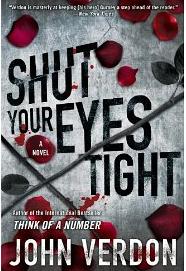
OPENING

A Better Life Demian Bichir (Weeds) stars in this drama about an immigrant family struggling to realize the American dream. (1:38)

Horrible Bosses Jason Bateman and Jennifer Aniston star in this workplace comedy. (1:33)

How to Live Forever After his mother died, documentarian Mark S. Wexler began to seriously contemplate aging and, inevitably, his own death. A certain amount of baby boomer naval-gazing is the inevitable result, but Wexler is curious enough to expand his quest into realms beyond his own graying hair and expanding midsection. The film’s (mostly) tongue-in-cheek title comes into play as he visits scientists, inventors, new age types, cryonics-facility workers, and doctors with various anti-aging philosophies and agendas. But probably the most compelling long-life widsom comes from the elderly folks he visits for practical advice. While the Guinness record-holding 114-year-olds aren’t much for coherent communication, quite a few of the 80-, 90- and 100-somethings Wexler talks to suggest that simply being a spitfire is a key to longevity. Highlights include the late fitness guru Jack LaLanne, enviably energetic in his mid-90s; a 104-year-old Brit who’s a smoker, drinker, and aspiring marathoner; and an 80-year-old tap dancer who decides to compete in a beauty pageant for senior citizens. “I’m older than he is,” she giggles of her boyfriend. “But he can drive at night!” (1:34) (Eddy)

Vincent Wants to Sea An anorexic, an obsessive-compulsive, and someone with Tourette syndrome go on a roadtrip: it’s not the setup to a bad joke, it’s the gist of Vincent Wants to Sea, a mostly fun, sometimes touching, but often improbable film. When Vincent’s mother dies, his father (Heino Ferch) decides it’s time for Vincent (Florian David Fitz — who also wrote the screenplay) to once and for all eradicate his tics and spasms and sequesters him at a summer camp-esque institution in the German countryside. The subsequent escape and journey to the Italian coast (where Vincent hopes to scatter his mother’s ashes) with two fellow patients, the anorexic Marie (Karoline Herfuth) and the Bach-loving compulsive Alex (Johannes Allmayer), is rife with self-discovery and uplifting music, so much so that it sometimes resembles a Levi’s ad more than a feature film. There’s real heart and humor beneath the cheese, but there’s a lot of cheese. (1:36) (Cooper Berkmoyer)

Zookeeper Kevin James graduates from policing mall rats to hanging with talking zoo animals. (1:42)

ONGOING

The Art of Getting By The Art of Getting By is all about those confusing, mixed-up and apparently sexually frustrating months before high school graduation. George (Freddie Highmore) is a trench coat-wearing misanthrope — an old soul, as they say — whose parents and teachers are always trying to put him inside a box and tell him how to think. He finds a kindred sprit in Sally (Emma Roberts) who smokes and watches Louis Malle films. Hot. Heavily scored by the now-ancient songs of early ’00s blog bands, it may all sound like indie bullshit but this one has charm and wit despite its post-trend package. Like a sad little crayon, Highmore is a competent Michael Cera surrogate du jour. Writer-director Gavin Wiesen embraces hell of clichés, but he suitably sums up a generational angst along the way. The film may not always feel real, but it does have real feeling. Look out for great performances from Blair Underwood and Alicia Silverstone. (1:24) (Ryan Lattanzio)

Bad Teacher Jake Kasdan, the once-talented director of a few Freaks and Geeks episodes and 2002’s underrated Orange County, seems hell-bent on humiliating everyone in the cast of Bad Teacher. Cameron Diaz is Elizabeth, the title’s criminally bad pedagogue who prefers the Jack Daniels method to the Socratic. Her impetus for pounding Harper Lee into her middle school students’ bug-eyed little heads is to cash in on a bonus check to fund her breast-y ambitions and woo Justin Timberlake and his baby voice. The only likable onscreen presence is Jason Segal as a sad sack gym teacher in love with Elizabeth. But he could do so much better. There’s no shortage of racist jokes and potty humor in this R-rated comedy pandering to those 17 and below. When asked if she wants to go out with her coworkers, Elizabeth ripostes, “I’d rather get shot in the face!” That scenario is likely a better alternative than suffering this steaming pile of cash cow carcass. (1:29) (Lattanzio)

*Beginners There is nothing conventional about Beginners, a film that starts off with the funeral arrangements for one of its central characters. That man is Hal (Christopher Plummer), who came out to his son Oliver (Ewan McGregor) at the ripe age of 75. Through flashbacks, we see the relationship play out — Oliver’s inability to commit tempered by his father’s tremendous late-stage passion for life. Hal himself is a rare character: an elderly gay man, secure in his sexuality and, by his own admission, horny. He even has a much younger boyfriend, played by the handsome Goran Visnjic. While the father-son bond is the heart of Beginners, we also see the charming development of a relationship between Oliver and French actor Anna (Mélanie Laurent). It all comes together beautifully in a film that is bittersweet but ultimately satisfying. Beginners deserves praise not only for telling a story too often left untold, but for doing so with grace and a refreshing sense of whimsy. (1:44) (Peitzman)

*Bill Cunningham New York To say that Bill Cunningham, the 82-year old New York Times photographer, has made documenting how New Yorkers dress his life’s work would be an understatement. To be sure, Cunningham’s two decades-old Sunday Times columns — “On the Street,” which tracks street-fashion, and “Evening Hours,” which covers the charity gala circuit — are about the clothes. And, my, what clothes they are. But Cunningham is a sartorial anthropologist, and his pictures always tell the bigger story behind the changing hemlines, which socialite wore what designer, or the latest trend in footwear. Whether tracking the near-infinite variations of a particular hue, a sudden bumper-crop of cropped blazers, or the fanciful leaps of well-heeled pedestrians dodging February slush puddles, Cunningham’s talent lies in his ability to recognize fleeting moments of beauty, creativity, humor, and joy. That last quality courses through Bill Cunningham New York, Richard Press’ captivating and moving portrait of a man whose reticence and personal asceticism are proportional to his total devotion to documenting what Harold Koda, chief curator at the Costume Institute at the Metropolitan Museum of Art, describes in the film as “ordinary people going about their lives, dressed in fascinating ways.” (1:24) (Sussman)

Bride Flight Who doesn’t love a sweeping Dutch period piece? Ben Sombogaart’s Bride Flight is pure melodrama soup, enough to give even the most devout arthouse-goer the bloats. Emigrating from post-World War II Holland to New Zealand with two gal pals, the sweetly staid Ada (Karina Smulders) falls for smarm-ball Frank (Waldemar Torenstra, the Dutchman’s James Franco) and kind of joins the mile high club to the behest of her conscience. The women arrive with emotional baggage and carry-ons of the uterine kind. As the harem adjusts to the country mores of the Highlands, Frank tries a poke at all of them in a series of sex scenes more moldy than smoldery. This Flight, set to a plodding score and stuffy mise-en-scene, never quite leaves the runway. Not to mention the whole picture, pale as a corpse, resembles one of those old-timey photographs of your great grandma’s wedding. These kinds of pastoral romances ought to be put out to, well, pasture. (2:10) (Lattanzio)

*Bridesmaids For anyone burned out on bad romantic comedies, Bridesmaids can teach you how to love again. This film is an answer to those who have lamented the lack of strong female roles in comedy, of good vehicles for Saturday Night Live cast members, of an appropriate showcase for Melissa McCarthy. The hilarious but grounded Kristen Wiig stars as Annie, whose best friend Lillian (Maya Rudolph) is getting hitched. Financially and romantically unstable, Annie tries to throw herself into her maid of honor duties — all while competing with the far more refined Helen (Rose Byrne). Bridesmaids is one of the best comedies in recent memory, treating its relatable female characters with sympathy. It’s also damn funny from start to finish, which is more than can be said for most of the comedies Hollywood continues to churn out. Here’s your choice: let Bridesmaids work its charm on you, or never allow yourself to complain about an Adam Sandler flick again. (2:04) (Peitzman)

Buck This documentary paints a portrait of horse trainer Buck Brannaman as a sort of modern-day sage, a sentimental cowboy who helps “horses with people problems.” Brannaman has transcended a background of hardship and abuse to become a happy family man who makes a difference for horses and their owners all over the country with his unconventional, humane colt-starting clinics. Though he doesn’t actually whisper to horses, he served as an advisor and inspiration for Robert Redford’s The Horse Whisperer (1998). Director Cindy Meehl focuses generously on her saintly subject’s bits of wisdom in and out of a horse-training setting — e.g. “Everything you do with a horse is a dance” — as well as heartfelt commentary from friends and colleagues. In the harrowing final act of the film, Brannaman deals with a particularly unruly horse and his troubled owner, highlighting the dire and disturbing consequences of improper horse rearing. (1:28) Smith Rafael. (Sam Stander)

Cars 2 You pretty much can’t say a bad thing about a Pixar film. Cars 2 is by no means Ratatouille (2007) or Wall-E (2008), but the sequel to the 2006 hit Cars offers plenty of sleek visuals and one-note gags under its hollow hood. If nothing else, Pixar seems to have overcome the dingy, dark glaze that plagues 3-D films. Directors John Lasseter and Joe Ranft return to beloved autos Lightning McQueen (Owen Wilson) and the “extremely American” Mater (Larry the Cable Guy). This time around, secret agents Finn McMissile (Michael Caine) and Holley Shiftwell (Emily Mortimer) come along for the ride while working to expose sabotage in the alternative fuel industry. Compelling chase sequences, explosions and more than a few jabs at cultural stereotypes follow suit. This is the lightest, silliest Pixar film to date, but you probably don’t have any business seeing it unless you’ve got a kid in tow. (1:52) Balboa. (Lattanzio)

*Cave of Forgotten Dreams The latest documentary from Werner Herzog once again goes where no filmmaker — or many human beings, for that matter — has gone before: the Chauvet-Pont-d’Arc Cave, a heavily-guarded cavern in Southern France containing the oldest prehistoric artwork on record. Access is highly restricted, but Herzog’s 3D study is surely the next best thing to an in-person visit. The eerie beauty of the works leads to a typically Herzog-ian quest to learn more about the primitive culture that produced the paintings; as usual, Herzog’s experts have their own quirks (like a circus performer-turned-scientist), and the director’s own wry narration is peppered with random pop culture references and existential ponderings. It’s all interwoven with footage of crude yet beautiful renderings of horses and rhinos, calcified cave-bear skulls, and other time-capsule peeks at life tens of thousands of years ago. The end result is awe-inspiring. (1:35) (Eddy)

Conan O’Brien Can’t Stop Conan O’Brien Can’t Stop seems less of a movie title and more like a hushed comment shared between one of the many hangers-on during the filming of the “Legally Prohibited From Being Funny On Television Tour.” Throughout 23 cities’ worth of footage, O’Brien seethes, paces, sweats, yells and beats dead jokes so hard that they spring back to life, as he is wont to do. At this point, the Leno/Coco drama is a bit stale — at least in internet time — but the documentary is a fascinating comedian character study nonetheless. It may be hard to sympathize with a man nursing a bruised ego as he cashes a $45 million dollar check, but it’s easy to see that he’s one of the best late night hosts (temporarily off) the air. Split primarily between clips of O’Brien performing songs on stage with a myriad of celebrity guests and bemoaning how exhausted and frustrated he is, Can’t Stop derives most of its hilarity from the off-the-cuff comments that pepper Conan’s everyday conversations. (1:29) (David Getman)

*The Double Hour Slovenian hotel maid Sonia (Ksenia Rappoport) and security guard Guido (Filippo Timi) are two lonely people in the Italian city of Turin. They find one another (via a speed-dating service) and things are seriously looking up for the fledgling couple when calamity strikes. This first feature by music video director Giuseppe Capotondi takes a spare, somber approach to a screenplay (by Alessandro Fabbri, Ludovica Rampoldi, and Stefano Sardo) that strikingly keeps raising, then resisting genre categorization. Suffice it to say their story goes from lonely-hearts romance to violent thriller, ghost story, criminal intrigue, and yet more. It doesn’t all work seamlessly, but such narrative unpredictability is so rare at the movies these days that The Double Hour is worth seeing simply for the satisfying feeling of never being sure where it’s headed. (1:35) (Harvey)

Empire of Silver Love, not money, is at the core of Empire of Silver — that’s the M.O. of a Shanxi banking family’s libertine third son, or “Third Master” (Aaron Kwok) in this epic tug-of-war between Confucian duty and free will. The Third Master pines for his true love, his stepmother (Hao Lei), yet change is going off all around the star-crossed couple in China at the end of the 19th century and the start of the 20th, and the youthful scion ends up pouring his passion into the family business, attempting to tread his own path, apart from his Machiavellian father (Tielin Zhang). Much like her protagonist, however, director (and Stanford alum) Christina Yao seems more besotted with romance than finance, bathing those scenes with the love light and sensual hues reminiscent of Zhang Yimou’s early movies. Though Yao handles the widescreen crowd scenes with aplomb, her chosen focus on money, rather than honey, leaches the action of its emotional charge. It doesn’t help that, on the heels of the Great Recession, it’s unlikely that anyone buys the idea of a financial industry with ironclad integrity — or gives a flying yuan about the lives of bankers. (1:52) (Chun)

Green Lantern This latest DC Comics-to-film adaptation fails to recognize the line between awesome fantasy-action and cheeseball absurdity, often resembling the worst excesses of the Christopher Reeve Superman movies. A surprisingly palatable Ryan Reynolds stars as Hal Jordan, the cocky test pilot who is chosen to wield a power ring as a member of an intergalactic police force called the Green Lantern Corps. He must face down Parallax, an alien embodiment of fear, who appears here as a chuckle-inducing floating head surrounded by tentacles. Peter Sarsgaard is effectively nauseating as Hector Hammond, who becomes Parallax’s crony after he is transformed by a transfusion of fear energy. The acting is all over the map, with Blake Lively’s blank-faced love interest caricature as the weakest link, and the effects are hit-or-miss, but scenes featuring alien Green Lanterns should please fans, and you could probably do worse if you’re looking for an entertaining popcorn flick. (1:45) (Stander)

The Hangover Part II What do you do with a problematic mess like Hangover Part II? I was a fan of The Hangover (2009), as well as director-cowriter Todd Phillips’ 1994 GG Allin doc, Hated, so I was rooting for II, this time set in the East’s Sin City of Bangkok, while simultaneously dreading the inevitable Asian/”ching-chang-chong” jokes. Would this would-be hit sequel be funnier if they packed in more of those? Doubtful. The problem is that most of II‘s so-called humor, Asian or no, falls completely flat — and any gross-out yuks regarding wicked, wicked Bangkok are fairly old hat at this point, long after Shocking Asia (1976) and innumerable episodes of No Reservations and other extreme travel offerings. This Hangover around, mild-ish dentist Stu (Ed Helms) is heading to the altar with Lauren (The Real World: San Diego‘s Jamie Chung), with buds Phil (Bradley Cooper) and Doug (Justin Bartha) in tow. Alan (Zach Galifianakis) has completely broken with reality — he’s the pity invite who somehow ropes in the gangster wild-card Mr. Chow (Ken Jeong). Blackouts, natch, and not-very-funny high jinks ensue, with Jeong, surprisingly, pulling small sections of II out of the crapper. Phillips obviously specializes in men-behaving-badly, but II‘s most recent character tweaks, turning Phil into an arrogant, delusional creep and Alan into an arrogant, delusional kook, seem beside the point. Because almost none of the jokes work, and that includes the tired jabs at tranny strippers because we all know how supposedly straight white guys get hella grossed out by brown chicks with dicks. Lame. (1:42) (Chun)

Happy Happy, a documentary by Roko Belic (1999’s Genghis Blues), traces the contented lifestyles of men and women around the globe. Manoj Singh is a Kolkata rickshaw driver sustained by his son’s smile. Anne Bechsgaard’s life is enriched by her co-housing community in Denmark. These soothingly sentimental profiles are intercut with commentary from leading neuroscientists and psychologists. They provide a cursory guide to the rare balancing act that is happiness in the 21st century. A brisk 75 minutes, the film is saturated with thought-provoking tidbits (the Bhutan government aims for gross national happiness instead of GDP) and an ambient backing track that’s heavy on the chimes. However, sometimes there’s the sense that these mechanics of happiness aren’t cinematically compelling enough, and that rifling through a couple Wikipedia pages might offer just as much insight. At its best, Happy sparks a reflection on how many of the unofficial criteria for joy one has fulfilled, and suggests ideas for simple happiness boosters. (1:15) Roxie. (Getman)

Kung Fu Panda 2 The affable affirmations of 2008’s Kung Fu Panda take a back seat to relentlessly elaborate, gag-filled action sequences in this DreamWorks Animation sequel, which ought to satisfy kids but not entertain their parents as much as its predecessor. Po (voiced by Jack Black), the overeating panda and ordained Dragon Warrior of the title, joins forces with a cavalcade of other sparring wildlife to battle Lord Shen (Gary Oldman), a petulant peacock whose arsenal of cannons threatens to overwhelm kung fu. But Shen is also part of Po’s hazy past, so the panda’s quest to save China is also a quest for self-fulfillment and “inner peace.” There’s less character development in this installment, though the growing friendship between Po and the “hardcore” Tigress (Angelina Jolie) is occasionally touching. The 3-D visuals are rarely more than a gimmick, save for a series of eye-catching flashbacks in the style of cel-shaded animation. (1:30) (Stander)

Larry Crowne While Transformers: Dark of the Moon may be getting all the attention for being the most terrible summer movie, I’d like to propose Larry Crowne as the bigger offender. No, it doesn’t have the abrasive effects of a Michael Bay blockbuster, but it’s surely just as incompetent. And coming from an actor as talented as Tom Hanks — who co-wrote, directed, produced, and stars in the film —Larry Crowne is insulting. The plot, insofar as there is one, centers around the titular Larry (Hanks), a man who goes to community college, joins a scooter gang led by Wilmer Valderrama, and ends up falling for his cranky, alcoholic teacher Mercedes (Julia Roberts). The scenes are thrown together hapharzadly, with no real sense of character development or continuity. Larry Crowne doesn’t even feel like a romantic comedy until a drunk Mercedes begins kissing and dry humping her student. But hey, who can resist a shot of Larry’s middle-aged bottom as he tries to wriggle into jeans that are just too small? (1:39) (Peitzman)

Midnight in Paris Owen Wilson plays Gil, a self-confessed “Hollywood hack” visiting the City of Light with his conservative future in-laws and crassly materialistic fiancée Inez (Rachel McAdams). A romantic obviously at odds with their selfish pragmatism (somehow he hasn’t realized that yet), he’s in love with Paris and particularly its fabled artistic past. Walking back to his hotel alone one night, he’s beckoned into an antique vehicle and finds himself transported to the 1920s, at every turn meeting the Fitzgeralds, Gertrude Stein (Kathy Bates), Dali (Adrien Brody), etc. He also meets Adriana (Marion Cotillard), a woman alluring enough to be fought over by Hemingway (Corey Stoll) and Picasso (Marcial di Fonzo Bo) — though she fancies aspiring literary novelist Gil. Woody Allen’s latest is a pleasant trifle, no more, no less. Its toying with a form of magical escapism from the dreary present recalls The Purple Rose of Cairo (1985), albeit without that film’s greater structural ingeniousness and considerable heart. None of the actors are at their best, though Cotillard is indeed beguiling and Wilson dithers charmingly as usual. Still — it’s pleasant. (1:34) Balboa. (Harvey)

Monte Carlo (1:48)

Mr. Nice By the second hour of Mr. Nice, star Rhys Ifans and company have exhausted every possible pot smoking flourish. There’s the seductive French inhale by the pool, the suggestive mouth to mouth, the euphoric dragon release in the deserts of Pakistan: all rendered in extreme close-up with improbably thick plumes of white smoke. Mr. Nice is mostly sexy drug use tutorial, though it’s also part biography of real-life drug smuggler Howard Marks. His claim to fame — at least according to the movie’s tagline — is the sheer number of aliases, phone lines, and children he had (43, 89, and 4, respectively). Unexpectedly, it’s the period costuming, cinematography, and the enchanting listlessness of Chloe Sevigny that redeem the film. Mr. Nice is captivatingly interlaced with vintage news and scenery clips from the period and it’s shot in a way that is both hyper-stylized and erratic. Those twists and turns of Marks’s life turn out to be not nearly as suspenseful onscreen as they should be, making the movie less of a traditional drug thriller and more of a mildly interesting reflection on the culture of the period. (2:01) (Getman)

Mr. Popper’s Penguins (1:35)

*My Perestroika Robin Hessman’s very engaging documentary takes one very relatable look at how changes since glasnost have affected some average Russians. The subjects here are five thirtysomethings who, growing up in Moscow in the 70s and 80s, were the last generation to experience full-on Communist Party indoctrination. But just as they reached adulthood, the whole system dissolved, confusing long-held beliefs and variably impacting their futures. Andrei has ridden the capitalist choo-choo to considerable enrichment as the proprietor of luxury Western menswear shops. But single mother Olga, unlucky in love, just scrapes by, while married schoolteachers Lyuba and Boris are lucky to have inherited an apartment (cramped as it is) they could otherwise ill afford. Meanwhile Ruslan, once member of a famous punk band (which he abandoned on principal because it was getting “too commercial”), both disdains and resents the new order just as he did the old one. Home movies and old footage of pageantry celebrating Soviet socialist glory make a whole ‘nother era come to life in this intimate, unexpectedly charming portrait of its long-term aftermath. (1:27) Balboa. (Harvey)

*Page One: Inside the New York Times When Andrew Rossi’s documentary premiered at Sundance this January, word of mouth on it was respectable but qualified, with nearly everyone opining that it was good … just not what they’d been led to expect. What they expected was (in line with the original subtitle A Year Inside the New York Times) a top-to-bottom overview of how the nation’s most respected — and in some circles resented — arbiter of news, “style,” and culture is created on a day-to-day as well as longer term basis. That’s something that would doubtless fascinate anyone still interested in print media, or even that realm of web media not catering to the ADD nation. But that big picture and the wealth of minute cogs within isn’t Page One‘s subject. Instead, Rossi focuses on the Gray Lady’s wrestling with admittedly fast-changing times in which newspapers and any other information source on paper seem to constitute an endangered species. This particular Times, however, is such a special case that that crisis might better have been explored by training a camera on a less fabled publication, perhaps one of the many that have succumbed to a once unthinkable, market-shrunk mortality in recent years. The film finds its colorful protagonist in David Carr, an ex-crack addict turned media columnist who retains his cranky, nonconformist edge even as he defends the Times itself from the same out-with-the-old cheerleaders who 15 years ago were inflating the dot-com boom till it burst. Facing one particularly smug champion of the blogosphere at a forum, Carr notes that without a few remaining outlets — like the Times — doing the hard work of serious research and reportage, the web would have nothing to purloin or offer but its own unending trivia and gossip. Page One does what it does entertainingly well, but if you’re looking for insight toward this not-dead-yet U.S. institution as a whole, you’d be better off simply picking up this week’s Sunday edition and reading every last word. (1:28) Smith Rafael. (Harvey)

*Super 8 The latest from J.J. Abrams is very conspicuously produced by Steven Spielberg; it evokes 1982’s E.T.: The Extra-Terrestrial as well as 1985’s The Goonies and 1982’s Poltergeist (so Spielbergian in nature you’d be forgiven for assuming he directed, rather than simply produced, the pair). But having Grandpa Stevie blessing your flick is surely a good thing, especially when you’re already as capable as Abrams. Super 8 is set in 1979, high time for its titular medium, used by a group of horror movie-loving kids to film their backyard zombie epic; later in the film, old-school celluloid reveals the mystery behind exactly what escaped following a spectacular train wreck on the edge of their small Ohio town. The PG-13 Super 8 aims to frighten, albeit gently; there’s a lot of nostalgia afoot, and things do veer into sappiness at the end (that, plus the band of kids at its center, evoke the trademarks of another Grandpa Stevie: Stephen King). But the kid actors (especially the much-vaunted Elle Fanning) are great, and there’s palpable imagination and atmosphere afoot, rare qualities in blockbusters today. Super 8 tries, and mostly succeeds, in progressing the fears and themes addressed by E.T. (divorce, loneliness, growing up) into century 21, making the unknowns darker and the consequences more dire. (1:52) (Eddy)

*13 Assassins 13 Assassins is clearly destined to be prolific director Takashi Miike’s greatest success outside Japan yet. It’s another departure for the multi-genre-conquering Miike, doubtless one of the most conventional movies he’s made in theme and execution. That’s key to its appeal — rigorously traditional, taking its sweet time getting to samurai action that is pointedly not heightened by wire work or CGI, it arrives at the kind of slam-dunk prolonged battle climax that only a measured buildup can let you properly appreciate. In the 1840s, samurai are in decline but feudalism is still hale. It’s a time of peace, though not for the unfortunates who live under regional tyrant Lord Naritsugu (Goro Inagaki), a li’l Nippon Caligula who taxes and oppresses his people to the point of starvation. Alas, the current Shogun is his sibling, and plans to make little bro his chief adviser — so a concerned Shogun official secretly hires veteran samurai Shinzaemon (Koji Yakusho) to assassinate the Lord. Fully an hour is spent on our hero doing “assembling the team” stuff, recruiting other unemployed, retired, or wannabe samurai. When the protagonists finally commence their mission, their target is already aware he’s being pursued, and he’s surrounded by some 200 soldiers by the time Miike arrives at the film’s sustained, spectacular climax: a small village which Shinzaemon and co. have turned into a giant boobytrap so that 13 men can divide and destroy an ogre-guarding army. A major reason why mainstream Hollywood fantasy and straight action movies have gotten so depressingly interchangeable is that digital FX and stunt work can (and does) visualize any stupid idea — heroes who get thrown 200 feet into walls by monsters then getting up to fight some more, etc. 13 Assassins is thrilling because its action, while sporting against-the-odds ingeniousness and sheer luck by our heroes as in any trad genre film, is still vividly, bloodily, credibly physical. (2:06) (Harvey)

Transformers: Dark of the Moon I’ll never understand the wisdom behind epic-length children’s movies. What child — or adult, for that matter — wants to sit through 154 minutes of assaultive popcorn entertainment? It’s an especially confounding decision for this third installment in the Transformers franchise because there’s a fantastic 90-minute movie in there, undone at every turn by some of the worst jokes, most pointless characters, and most hateful cultural politics you’re likely to see this summer. But when I say a fantastic movie, I mean a fantastic movie. It took two very expensive earlier attempts before director Michael Bay figured out that big things require a big canvas. Every shot of Dark of the Moon‘s predecessors seemed designed to hide their effects by crowding the screen. Finally we get the full view — the scale is now rightly calibrated to operatic and ridiculous. The marquee set pieces are inspired and terrifying, eliciting a sense of vertigo that’s earned for once, not imposed by the editing. The human hijinks are less consistent but ingratiatingly batshit, and without resorting to preening self-awareness and elaborately contrived mea culpas. But unfortunately Bay is too unapologetic even to walk back the ethnic buffoonery that not only upsets hippies like me but also seems defiantly disharmonious with the movie he’s trying to make. Bay is like that guy at the party who thinks amping up the racism will prove he’s not a racist. It’s that kind of garbage (plus, I guess, some universal primal hatred of Shia LaBeouf that I don’t really get) that makes people dismiss these movies wholesale. This time it’s just not deserved. I wouldn’t want to meet the asshole who made this thing, but credit where credit is due. It’s a visual marvel with perfectly integrated, utterly tactile, brilliantly choreographed CG robotics — a point that’ll no doubt be conceded in passing as if it’s not the very reason the movie exists. As if it’s not a feat of mastery to make a megaton changeling truck look graceful. (2:34) (Jason Shamai)

The Tree of Life Mainstream American films are so rarely adventuresome that overreactive gratitude frequently greets those rare, self-conscious, usually Oscar-baiting stabs at profundity. Terrence Malick has made those gestures so sparingly over four decades that his scarcity is widely taken for genius. Now there’s The Tree of Life, at once astonishingly ambitious — insofar as general addressing the origin/meaning of life goes — and a small domestic narrative artificially inflated to a maximally pretentious pressure-point. The thesis here is a conflict between “nature” (the way of striving, dissatisfied, angry humanity) and “grace” (the way of love, femininity, and God). After a while Tree settles into a fairly conventional narrative groove, dissecting — albeit in meandering fashion — the travails of a middle-class Texas household whose patriarch (a solid Brad Pitt) is sternly demanding of his three young sons. As a modern-day survivor of that household, Malick’s career-reviving ally Sean Penn has little to do but look angst-ridden while wandering about various alien landscapes. Set in Waco but also shot in Rome, at Versailles, and in Saturn’s orbit (trust me), The Tree of Life is so astonishingly self-important while so undernourished on some basic levels that it would be easy to dismiss as lofty bullshit. Its Cannes premiere audience booed and cheered — both factions right, to an extent. (2:18) (Harvey)

*The Trip Eclectic British director Michael Winterbottom rebounds from sexually humiliating Jessica Alba in last year’s flop The Killer Inside Me to humiliating Steve Coogan in all number of ways (this time to positive effect) in this largely improvised comic romp through England’s Lake District. Well, romp might be the wrong descriptive — dubbed a “foodie Sideways” but more plaintive and less formulaic than that sun-dappled California affair, this TV-to-film adaptation displays a characteristic English glumness to surprisingly keen emotional effect. Playing himself, Coogan displays all the carefree joie de vivre of a colonoscopy patient with hemorrhoids as he sloshes through the gray northern landscape trying to get cell reception when not dining on haute cuisine or being wracked with self-doubt over his stalled movie career and love life. Throw in a happily married, happy-go-lucky frenemy (comic actor Rob Brydon) and Coogan (TV’s I’m Alan Partridge), can’t help but seem like a pathetic middle-aged prick in a puffy coat. Somehow, though, his confused narcissism is a perverse panacea. Come for the dueling Michael Caine impressions and snot martinis, stay for the scallops and Brydon’s “small man in a box” routine. (1:52) Smith Rafael. (Devereaux)

*Trollhunter Yes, The Troll Hunter riffs off The Blair Witch Project (1999) with both whimsy and, um, rabidity. Yes, you may gawk at its humongoid, anatomically correct, three-headed trolls, never to be mistaken for grotesquely cute rubber dolls, Orcs, or garden gnomes again. Yes, you may not believe, but you will find this lampoon of reality TV-style journalism, and an affectionate jab at Norway’s favorite mythical creature, very entertaining. Told that a series of strange attacks could be chalked up to marauding bears, three college students (Glenn Erland Tosterud, Tomas Alf Larsen, and Johanna Morck) strap on their gumshoes and choose instead to pursue a mysterious poacher Hans (Otto Jespersen) who repeatedly rebuffs their interview attempts. Little did the young folk realize that their late-night excursions following the hunter into the woods would lead at least one of them to rue his or her christening day. Ornamenting his yarn with beauty shots of majestic mountains, fjords, and waterfalls, Norwegian director-writer André Ovredal takes the viewer beyond horror-fantasy — handheld camera at the ready — and into a semi-goofy wilderness of dark comedy, populated by rock-eating, fart-blowing trolls and overshadowed by a Scandinavian government cover-up sorta-worthy of The Girl with the Dragon Tattoo (2009). (1:30) (Chun)

*X-Men: First Class Cynics might see this prequel as pandering to a more tweeny demographic, and certainly there are so many ways it could have gone terribly wrong, in an infantile, way-too-cute X-Babies kinda way. But despite some overly choppy edits that shortchange brief moments of narrative clarity, X-Men: First Class gets high marks for its fairly first-class, compelling acting — specifically from Michael Fassbender as the enraged, angst-ridden Magneto and James McAvoy as the idealistic, humanist Charles Xavier. Of course, the celebrated X-Men tale itself plays a major part: the origin story of Magneto, a.k.a. Erik Lehnsherr, a Holocaust survivor, is given added heft with a few tweaks: here, in an echo of Fassbender’s turn in Inglourious Basterds (2009), his master of metal draws on his bottomless rage to ruthlessly destroy the Nazis who used him as a lab rat in experiments to build a master race. The last on his list is the energy-wrangling Sebastian Shaw (Kevin Bacon), who’s set up a sweet Bond-like scenario, protected by super-serious bikini-vixen Emma Frost (January Jones). The complications are that Erik doesn’t ultimately differ from his Frankensteins — he pushes mutant power to the detriment of those puny, bigoted humans — and his unexpected collaborator and friend is Xavier, the privileged, highly psychic scion who hopes to broker an understanding between mutants and human and use mutant talent to peaceful ends. Together, they can move mountains—or at least satellite dishes and submarines. Jennifer Lawrence as Raven/Mystique and Nicholas Hoult as Hank McCoy/Beast fill out the cast, voicing those eternal X-Men dualities — preserving difference vs. conformity, intoxicating power vs. reasoned discipline. All core superhero concerns, as well as teen identity issues — given a fresh charge. (2:20) (Chun)

Rep Clock

0

Schedules are for Wed/6–Tues/12 except where noted. Director and year are given when available. Double and triple features are marked with a •. All times are p.m. unless otherwise specified.

BALBOA 3620 Balboa, SF; www.balboamovies.com. $20. “Opera, Ballet, and Shakespeare in Cinema:” Love’s Labours Lost, performed at the Globe Theater, Sat-Sun, 10am.

CASTRO 429 Castro, SF; (415) 621-6120, www.castrotheatre.com. $7.50-13. •Out of the Past (Tourneur, 1947), Wed, 3:15, 7, and The Night of the Hunter (Laughton, 1955), Wed, 5, 8:55. Cave of Forgotten Dreams (Herzog, 2010), Thurs, 3, 5, 7, 9. “Watching Big Brother: A Tribute to the Summer of 1984: Day One” •The Last Starfighter (Castle, 1984), Fri, 7:30; Gremlins (Columbus, 1984), Fri, 9:45; and The Adventures of Buckaroo Banzai Across the 8th Dimension (Richter, 1984), Fri, 11:59; “Day Two:” •Cloak and Dagger (Franklin, 1984), Sat, 2:30; The Karate Kid (Avildsen, 1984), Sat, 4:45; Red Dawn (Milius, 1984), Sat, 7:15; The Pope of Greenwich Village (Rosenberg, 1984), Sat, 9:45; and Streets of Fire (Hill, 1984), Sat, 11:59. “Marc Huestis Presents: I Dream of Barbara Eden:” 7 Faces of Dr. Lao (Pal, 1964), Sun, noon; Gala Event with on-stage interview, performances, and more, Sun, 8. Tickets for the Gala Event, $25-45 at (415) 863-0611 or www.ticketfly.com.

CHRISTOPHER B. SMITH RAFAEL FILM CENTER 1118 Fourth St, San Rafael; (415) 454-1222, www.cafilm.org. $10.25. Buck (Meehl, 2011), call for dates and times. Page One (Rossi, 2011), call for dates and times. The Tree of Life (Malick, 2011), call for dates and times. The Trip (Winterbottom, 2010), call for dates and times. Mann vs. Ford (Chermayeff, 2011), Wed, 7. With director Maro Chermayeff and producer James Redford in person. Swan Lake, performed by the Bolshoi Ballet, Thurs, 7; Sun, 1. The Big Uneasy (Shearer, 2011), Mon, 7:15. With director Harry Shearer in person; this event, $15.

“FILM NIGHT IN THE PARK” This week: Creek Park, 451 Sir Francis Drake, San Anselmo; (415) 272-2756, www.filmnight.org. Donations accepted. ) Beatles movie TBA, Fri, 8.

FOUR STAR 2200 Clement, SF; www.lntsf.com. $10. “Asian Movie Madness” •Torrid Wave (Lin, 1982), and Sex and Zen III (Min, 1998), Thurs, call for times.

MECHANICS’ INSTITUTE 57 Post, SF; (415) 393-0100, rsvp@milibrary.org. $10. “CinemaLit Film Series: Music and Nostalgia:” Oh! What a Lovely War (Attenborough, 1969), Fri, 6.

PACIFIC FILM ARCHIVE 2575 Bancroft, Berk; (510) 642-5249, www.bampfa.berkeley.edu. $5.50-9.50. “Japanese Divas:” Twenty-Four Eyes (Kinoshita, 1954), Wed, 7; Carmen Comes Home (Kinoshita, 1951), Thurs, 7 and Sat, 6:30: When a Woman Ascends the Stairs (Naruse, 1960), Sat, 8:20; •Woman of Tokyo (Ozu, 1933) and A Hen in the Wind (Ozu, 1948), Sun, 5. “Bernardo Bertolucci: In Search of Mystery:” Before the Revolution (1964), Fri, 7; The Grim Reaper (1962), Fri, 9:10; The Spider’s Stratagem (1970), Sun, 7:45.

PARAMOUNT 2025 Broadway, Oakl; 1-800-745-3000, www.ticketmaster.com. $5. National Velvet (Brown, 1944), Fri, 8.

RED VIC 1727 Haight, SF; (415) 668-3994; www.redvicmoviehouse.com. $6-10. Vertigo (Hitchcock, 1958), Wed, 2, 7, 9:25. Circo (Schock, 2010), Thurs-Fri, 7:15, 9:15. Poster sale, noon-6pm. “An Evening with Jonathan Richman:” Vengo (Gatliff, 2000), Sat, 8. Babe (Noonan, 1995), Sun-Mon, 7:15, 9:15 (also Sun, 2, 4). What’s Up Doc? (Bogdanovich, 1972), July 12-13, 7:15, 9:20 (also July 13, 2).

RIALTO CINEMAS ELMWOOD 2966 College, Berk; (510) 433-9730, www.rialtocinemas.com. $5-10. The Big Uneasy (Shearer, 2011), July 8-14, call for times.

ROXIE 3117 and 3125 16th St, SF; (415) 863-1087, www.roxie.com. $5-9.75. Happy (Belic, 2011), Wed-Thurs, 7, 8:30. Viva Riva! (Munga, 2010), Wed, 7, 9. “San Francisco School of Digital Filmmaking Graduating Class ’11 Presents: Love the Shorts,” Thurs, 7, 9. “San Francisco Frozen Film Festival,” Thurs-Sat. Visit www.frozenfilmfestival.com for tickets and info. The Big Uneasy (Shearer, 2011), Sun-Mon, 7, 9 (also Sun, 3, 5). “Where Did That Come From?,” illustrated lecture with Bill Nichols, 7. For tickets ($20), visit www.sffs.org.

“TEMESCAL STREET CINEMA 2011” 49th St at Telegraph, Oakl; www.temescalstreetcinema.com. Free. D-Tour (Granato, 2009), Thurs, 8:45. With music by Pancho San at 8pm.

VIZ CINEMA New People, 1746 Post, SF; www.vizcinema.com. $15. Das Boot (Petersen, 1981), Thurs, 6. Restored and remastered director’s cut version of the film in honor of its 30th anniversary, with producer Ortwin Freyermuth in person. VORTEX ROOM 1082 Howard, SF; www.myspace.com/thevortexroom. $5 donation. “The United States of Vortex:” •Wild in the Streets (Shear, 1968), Thurs, 9, and The Werewolf of Washington (Ginsberg, 1973), Thurs, 11.

(Summer!) Trash Lit: The Profession

0

By Steven Pressfield. Crown, 320 pages, $25


Wow, they still drink Rolling Rock in 2032. And they still use military laptops and handhelds and complain about bad TV reception. The web doesn’t seem to have advanced much, and people still rely on the Al Jazeera video feed to see what’s going on in the Middle East.


There’s a lot that’s jarring in The Profession, a military thriller set in the Middle East 20 years in the future. For one thing, the future looks a lot like today, except that there’s been a dirty bomb attack on Long Beach and the Chinese are starting to cash in their U.S. debt, putting the world economy into turmoil. (It takes China 20 years to figure that out? Damn.)
So it’s pretty bad sci-fi. But it’s not a bad adaptation of the Heart of Darkness/Apaocalypse Now myth of the powerful general who goes rogue with his loyal troops and tries to take over part of the world.


In this case, it’s the Middle East, where (again, bad sci-fi) they’ve just found some more really rich oil fields. And much of the military work of the major nations is done by mercenaries.


One of them is General James Salter, who got cashiered out of the Marine Corps for defying the president’s orders, but who has a MacArthur-like following in both the military and the civilian worlds. He’s a private soldier now, and he’s got this plan to take control of much of the world’s oil, and then return in triumph to Washington, where he can become president (oh, and marry the widow of the prez who cashiered him, who is also involved in this plot.


Our hero, Gilbert Gentilhomme (and what kind of name is that for an action hero?) is one of Salter’s best friends and loyalists, one of the few who can get close to the great man. And he knows he can’t let the general get away with his plan.


Lots of desert battles. Random brutality. International intrigue, of sorts. A bleak and dusty vision of the future — but one where there’s no climate change or peak oil. No sex (and how come none of this summer’s thrillers have any sex?). But not bad for a quick beach read.
 

The Village Voice, Ashton Kutcher and prostitution ads

13

There’s some fascinating back and forth in media circles about the Village Voice, its chain (which includes SF Weekly), Ashton Kutcher, Demi Moore, prostitution, and layoffs and budget cuts as the nation’s oldest alternative weekly.

It’s all so juicy I don’t know where to begin. Perhaps with the SF Weekly’s cover story this week, which also ran in the Voice and most of the chain’s other papers.

The story takes Kutcher and Moore to task for launching a campaign against child prostitution using bogus numbers.
For the record: I have no reason to doubt the Voice’s conclusions here. I have no problem with adult ads (which the Guardian also takes). And frankly, I have no problem with prostitution, which, like gambling and drugs, ought to be legalized, regulated and taxed.

And the Voice was scrupulous about disclosing that it has a financial interest in this issue. How much of an interest? Well, a lot. In fact, according to the New York Observer, the prostitution ads could well be floating the financially troubled chain:

Backpage, which is a fraction of the size of Craigslist, is the only popular classifieds site left willing to host the paid escort and body-rub ads that are often thinly veiled fronts for prostitution. In the month after Craigslist closed its erotic services sections under pressure from Congress and state attorneys general, Backpage enjoyed a half-million-visitor bump in traffic, according to Quantcast, and became the No. 1 publisher of escort ads on the Internet. The Aim Group, a media consulting firm, estimated that in January, Backpage brought in $2.1 million in revenue from erotic services ads alone.

That would be about $24 million a year — and the Observer notes that VVM desperately needed the cash:

For more than two decades, Village Voice Media executive editor Mike Lacey employed a simple, often devastatingly successful strategy for gaining control of the country’s alternative weekly business: acquire the local paper, cut editorial costs (lay off critics, reporters and, reportedly, entire fact-checking departments), pump the paper full of nationally syndicated content and splash an occasional local investigative piece on the cover. It was working like a charm until 2004, when the San Francisco Bay-Guardian sued VVM’s SF Weekly for manipulating ad prices in an attempt to drive the rival paper out of business. According to court transcripts, Mr. Lacey told the staff on his first day as owner of SF Weekly that this was precisely his intention.

Despite facing legendary antitrust lawyers in a state notorious for its aversion to monopolistic practices, Mr. Lacey spent years appealing the court’s award of $16 million, which grew to $21 million with interest, until the California Supreme Court threw out VVM’s petition. During the proceedings, the company revealed that it owed creditors $80 million and claimed it could not afford to pay the award. Lawyers for the Bay-Guardian threatened to force bankruptcy.

In January 2011, VVM and SF Weekly settled the issue privately. Though the terms of the agreement were not disclosed, between the settlement and what one attorney familiar with the case said were legal fees of at least $5 million to fight the case, VVM was likely left with an eight-figure hole burned in its pocket.

Since last spring, the company’s efforts to patch that hole up have included the unthinkable (laying off legendary Village Voice investigative reporter Wayne Barrett in January); the surprising (selling off Kansas City Pitch to Tennessee publisher South Comm, Inc., in mid-March); and the long overdue: shutting down an experiment with a pair of sex blogs that were never publicly launched despite being published for nearly a year.

(For the record: The Guardian and VVM have agreed not to discuss the terms of the settlement.)

Mike Lacey, the executive editor of Village Voice Media, shot back with a letter to the Observer featuring his typical wild-ass metaphors and flowery prose:

In fact, in just the past few months Backpage.com has spent millions of dollars policing content to attempt, for example, to keep underage kids out of adult listings. Despite Trench’s professed lack of knowledge, which we do not doubt for a second, anyone looking at Backpage will notice the absence of nudity-merely one of thousands of changes over the past year.

Damn — no more nudity on Backpage. Then Lacey goes on to describe what he found at the Voice when he took it over:

We found a Voice “library” where an individual sat with scissors and clipped out articles from other publications for filing. The age of the Internet stopped at the library’s doors. Town cars arrived to ferry one late working chap to Westchester County. While we kept critics at Cannes, Toronto, and Sundance, we equivocated on sending them to Rotterdam. The Voice was the only alternative newspaper in the country that thought its reporters needed to have their facts checked in addition to being edited, copyedited, and proofread. I disagreed. (Though I do not wish to presume that the Observer might not benefit from such staffing.)

Actually, it was a little more than that. There were a number of longtime Voice staffers — mostly with politically left views — who earned, by alternative press standards, fairly high salaries. They’ve been shoved out the door. Nat Hentoff, James Ridgeway, Wayne Barrett … all gone. They were, in some ways, the soul of the old Voice — scrappy, unafraid to be progressives (and to care about political causes) and interested in social change. That didn’t fit with Lacey’s world view.

But it gets better: The Voice and Kutcher are now in a tweet war — and all of this is going to bring more attention to Backpage and the sex ads — which, again, don’t bother me, but do bother a lot of stuck-up law-enforcement types, who will now have even more reason to go after VVM. At the Observer notes:

As Backpage grows in popularity, more news stories have emerged suggesting that the kinds of abuses that led lawmakers to demand Craigslist shutter its erotic-services section are increasingly occurring on the site. In September a former child prostitute sued VVM for knowingly publishing advertisements of her, and later that month 21 attorneys general called on the company to follow Craigslist’s lead and ban escort ads. VVM declined, but offered to continue cooperating with law enforcement officials on cases originating on the site.

I’m not sure all this publicity is exactly what Lacey had in mind.


Noodle gnar: We got your SF air guitar championship photos right here

0

Attention, pre-adults: there is a place for you, a place where a laissez faire attitude and zero musical talent will not only get you by, but get you laid. Ladies and gentleman, welcome to San Francisco, the American hotbed of would-be air guitar heroes.

No, champions. No, gods. In fact, such is the level of air guitar talent in the Bay Area that the organizers of the U.S. Air Guitar Championships decided to hold not one, but two regional competitions last weekend at the Independent.

Authentic nerds (minus the “ironically cool” schtick) took the opportunity to trade their tighty-whities for more creative duds and rise to the heavens.They came, they shredded — they melted the ears off a boozed-up crowd that heartily welcomed beer, candy, rubber animals, and body parts thrown at their heads, not to mention catapaulting, oversized bodies. What would a rock show be without stage diving? 

On night one (Fri/24), the “master of airimonies” was Bjorn Turoque, the dark horse 2003 winner of the World Air Guitar Championships in Finland (a victory documented in the film Air Guitar Nation). Judges were Hot Lixx Hulihan — two time SF winner and one time national winner — as well as Onion A.V. Club’s Mark Hawthorne and some other dude that everyone hated. In true rock and roll spirit, the crowd expressed their disgust for any unfair scoring by hurling random objects at the judges.

On night two (Sat/25), Hot Lixx mastered the airimonies, while judge Turoque was joined by nemesis and legend C Diddy (co-star in the aforementioned documentary, first ever U.S. champion, and a world champion himself) and Dr. Frank of Mr. T Experience, who is also the author of King Dork. The crowd showed much more love and respect for this bunch and kept their fist-pumping hands to themselves.

Participants on each night’s lineup battled imaginary axes in two rounds: air noodling to a minute-long song of one’s own choosing, and a surprise song from the judges. The judges scored the performances on a scale from four to six, looking for technical skill, stage presence, and something called “airiness” — the unexplainable something that “you’ll know when you see.” In the end, the winners with the highest combined score on each night — Shred Nugent and seasoned champ Cold Steel Renegade — represented San Francisco in Chicago’s national throwdown. 

The winner from night one, Shred Nugent (a.k.a. Airy and the Hendersons, get it?), shows excitement for his high score. All photos by Jackie Andrews

Cold Steel Renegade, now a two-time SF champ, emerged victorious on the following night to join Nugent in Chicago

While more performance art than concert, the night involved all of the elements of a good rock show: a rowdy crowd, lights, fog, and energetic “musicians.”  Along with rock ‘n’ roll comes baggage — sex, drugs, booze, hurling television sets out windows, trashing hotel rooms. And while none of the contestants got super creative, a few did pulled out some of those stops.

Toward the end of his performance, this contestant pulled tall boys out of his pockets and sprayed onlookers with the froth. His score was dinged for playing something other than air guitar. 

Creepy fake cocaine moment No. 1: Singar the Goat Demon and his “groupie” snort lines of the faux blow and then prance around the bag in a strange pagan-like ritual. 

Creepy fake cocaine moment No. 2: The Six String General snorted lines of the spurious nose-candy off this young ladies bum before whacking her from behind. 

An otherwise unmemorable performance became noteworthy with a freakishly high jump into the crowd to a perfectly timed confetti explosion. 

Opting for Marilyn Manson shock, posing pretty for the camera. 

And so it was — the San Francisco leg of the U.S. Air Guitar Championships came and went, blowing minds and leaving a huge mess. We hear that our SF contenders did well in Chicago, but unfortunately neither are going to Finland for the World Air Guitar Championships. Next year!

Feelmore510 is bringing sexy back to Oakland

0

The Bay’s east side can seem a little prudish, especially when compared to its slutty sister city. Until February, Oakland’s only retail resources for sex were a couple of trashy adult “superstores.” Those places can be fun and functional, but it’s safe to bet the cashier probably isn’t too concerned about answering a list of questions and making you feel comfortable with your purchase. Nenna Joiner, the owner of Oakland’s new sex-positive shop, Feelmore510, is quite the opposite and simply can’t wait to start friendly conversations about sex with everyone in her community.

Joiner, a sex educator and adult film director, has been dreaming about opening an Oakland shop for years, but her ideas go far beyond retail. From terminology to etiquette, Joiner says her community needs to start at the beginning, birds and bees style. “I love talking to people. People teach me new things everyday. I’m open and not judgmental. I’ll talk about anything,” she says after ushering a couple ladies out the door who had spent their lunch break browsing. 

From basic questions to the personal, Joiner is educating from the inside out. “A guy came by the other day asking if it was gay for him to want to play with his girlfriend’s butt,” she says. “San Francisco takes its sexual openness for granted — the community there is so exposed, probably overexposed,” she laughs, a playful swipe at the close-knit kink communities and accessible sex-positive resources she loves.

Joiner says Oakland residents may attend erotic events like Folsom or shop for dildos west of the bridge, but when they return home, the conversation goes flaccid. She puts partial blame on years of serious bedroom talk: preventative health and safe sex practices have been a priority due to the high number of HIV cases in the area. No one is contesting the importance of these topics, but in terms of fast, slutty fun they can be total Debbie Downers. Joiner wants to put the spunk back into conversations about sexuality. 

Before the shop opened, the surrounding neighborhood seemed nervous about the addition of a sex shop on the block, but Joiner has been extra careful to make sure people understand that her intentions are purely rooted in the revitalization of Oakland. She keeps up on local politics, attends city meetings, directs tourists to other neighborhood businesses, and even watches high school band concerts. She waves at people from across the street and welcomes anyone inside to chat and enjoy the space. Joiner feels supported by the city around her, which she thinks is happy to recognize her role as a successful business owner. She regularly gets friendly calls from the Alameda Small Business Association, casual check-ins to make sure she’s doing well.

“They know I’m a young woman of color, working my ass off. Maybe they don’t watch porn or have interest in the products I sell, but they support me because they know how hard I’m working.”

Nestled between downtown office buildings on Telegraph Avenue, Feelmore510 lures in its share of curious customers during the day with a modest store front that looks more art gallery than porn hub. Inside the store, Joiner loves to play her late grandmother’s vinyl collection, including Sinatra and Perry Como, which perfectly compliment the space’s glowing chandeliers and velvet curtains. The shop stays open until midnight, way past the bedtime of most of her neighbors’, but with the Fox Theater nearby and a collection of bars and clubs in walking distance, Joiner likes providing the night owls some after-party options.

“I stay open late because I want to help more people have great sex.” Getting people off the streets and under the sheets with body-safe, pleasurable accessories– now that’s community activism!


Feelmore510

1703 Telegraph Avenue, Oakland

(510) 891-0199

www.Feelmore510.com


The Chron is clueless

8

The ol’ Chron commissioned its former reader representative, Dick Rogers, to do a piece on the Jose Antonio Vargas story, and he concludes that Vargas was a liar whose failure to turn himself in to immigration authorities (and thus accept deportation to a country he hardly knew) undermined his journalistic work. Rogers quotes editor Ward Bushee:


“While he deserves sympathy for his efforts to become a citizen, Vargas’ lack of forthrightness in some of his reporting cannot be defended,” Bushee said. “He practiced a pattern of deception that was not only dishonest, but disrespectful of his readers and fellow journalists at The Chronicle.”


Pardon me while I puke.


I’ve already written about Vargas and about former Chron editor Phil Bronstein’s (far more nuanced) handwringing over the situation. But the conclusions the Chron reached in the Rogers article are just bizarre and reflect a creaky, ancient attitude towards journalism that makes no sense in the modern world.


I called Rogers, who is a nice guy with a long history in journalism, and we had a long talk about the situation. I asked him what the young man should have done when he found out at 16 that his parents had sent him to the Unites States illegally. Rogers, to his credit, said he didn’t know, that it was a tricky moral and legal dilmemma. “But that’s not what I was asked to write about,” he said.


The issue for him: Vargas lied when he filled out his employment application and failed to disclose to his editors that he was in the country illegally. That damaged the Chronicle. “You can’t put yourself above your newspaper,” he told me.
Okay, once again: What should Vagas have done? What should a person who is forced by stupid and inconsistent federal laws to lie about his immigration status do if he wants to be a journalist? Well, Rogers said, that’s the dilemma: “I don’t think he should have been working in mainstream journalism.”


Of course, he’s have to lie to get a job as a lawyer, or doctor, or CPA. And all of those professions also have ethical codes that discourage lying. So perhaps he should have been a bricklayer.


To be fair, Rogers doesn’t go that far — he suggested that there were other types of journalism Vargas could have done. He could, for example, have worked for the Bay Guardian. (I wish.) After we talked for a while, Rogers said that if Vargas was going to work for the Chron, he should have recused himself from any stories involving immigration.


But let’s be real here: The Chron allowed a reporter who took money from a nativist group to keep writing about immigration. Bushee, who is so outraged about Vargas, has no problem allowing an (illegally) unregistered lobbyist who gets paid to advocate for wealthy interests in the city to write a political column without ever disclosing his clients or conflicts. (Rogers told me that was a legitimate point. “Conflicts are conflicts,” he said.)


And at the same time, the Chron fired a reporter who participated in an antiwar march and wouldn’t let a lesbian reporter cover same-sex marriage.


It’s inconsistent to the point of being silly.


Look: All of us have conflicts. As the great Larry Bensky once told me, “People who have no conflicts have no interests.” Can a person who drives a car write about transportation policy? Can a person who smokes pot write about medical marijuana (or should she tell her editor, sorry boss — I’m illegally ingesting a controlled substance at night, better fire me or report me to the cops because I can’t cover this story)? Can a person with children write about whether San Francisco is a good city to raise children? Can a person with kids in the public schools write about the school board? Can a divorced person cover a wedding? Can a person who had an affair write about a politician who’s caught fooling around? Can a person who drinks beer write about the city’s alcohol tax?


I mean, let’s not be ridiculous here.


Let me tell a perhaps hypothetical story. Suppose that, when I was working for a (socially conservative) daily newspaper in a (socially conservative) New England city in the mid-1970s, I had a colleague who was gay. And suppose she decided — correctly — that her career would be damaged (at that time, at that institution) if she was out of the closet. (For all I know, she was a criminal, too — I’m not sure when this particular state repealed its sodomy laws.) So suppose she lied — to her boss, to her coworkers, to everyone around. Did that mean she was a bad reporter? Not at all. My hypothethical friend did what she thought she had to do, at a time when the professional and political world she lived in was unwilling to accept who she was. (In fact, there were no laws back then about firing people because of their sexual orientation.) She hated it, we all hated it, and we worked to change things. But I’m not going to condemn her — or call into question the credibility of her work — because of it.


(By the way: I lied, too. I told my boss at this particular institution that I didn’t smoke marijuana. It was a job requirement. I wanted the job. I was a lawbreaker, and I still covered the cops. In fact, I wrote about pot busts. Thank god they didn’t test my pee.)


Let’s face it: Everyone at the Chron, and at every daily newspaper, has personal issues that prevents him or her from being completely objective. Jose Antonia Vargas was no different. The fact that the United States government forced him to lie is no grounds for saying he couldn’t be, and isn’t, a good, honest reporter.
 

The Performant: Trans-cendental Meditations

0

The Tranimals come out at Nightlife

The time is probably coming when humans will be able to adapt animalian traits, ala “Transmetropolitan,” either as a weekend whim or on a permanent basis. The whole notion is too tempting to remain a fiction forever. Imagine possessing the smooth, insulating skin of a dolphin, the soaring wings of a peregrine falcon, the keen night vision of a bobcat. The desire for such transmogrification is as ancient as recorded history: from Centaurs to Satyrs, Mermaids to Manticores, Mami Wata to the Minotaur, there’s hardly a mythology around without some reference to human-animal hybrids, whether monsters or gods. Years from now, the very notion of “transitioning” might well have to be expanded to include folks shifting between all kinds of bodies and capabilities. Until then, we’ll have to make do with costumery, flaunting temporary feathers and furs like so much wishful thinking.
 
You probably won’t find a denser concentration of fantasy animal drag outside a furry convention than at a “Tranimal” contest — particularly one hosted in the California Academy of Sciences, where accurately portraying animal characteristics is serious business.

At last week’s Pride-themed NightLife (and adult-themed, cocktail-hour weekly event that draws a huge crowd with ever-changing themes), an eager crowd eschewed the planetarium and rain forest sphere to gather in the glass-walled piazza for a mini-Trannyshack show followed by the surprisingly competitive Tranimal contest. “We were afraid no one was going to want to compete,” pageant organizer Heklina marveled as close to 40 contestants jumped on and off the makeshift stage for their 15 seconds of fame. Each costume more elaborate and exotic than the last, all manner of fauna was well-represented. A mysterious, stiletto-heeled figure in a spotted jaguar mask named Latrina (“Oh, how punk,” remarked Heklina); a flame-haired, fur-armed creature of the night called Envy; a surprise appearance from touring circuit star, Scotty the Blue Bunny (“We should just hand you the grand prize now and get it over with”). For the most part though, more faithfully-rendered animals swept the awards: a shy, lighted jellyfish, a spunky, slithery reptile “the Sex Raptor,” and the delicately-finned, giant-toothed “Lady Angler Fish”.

“That’s every gay man’s nightmare of a vagina,” joked Heklina about the lady’s enormous jaws ringed with gigantic, dagger-like teeth that obscured her entire abdomen. Some of the best costumes didn’t even compete. My personal faves, husbands Roger and Joel, looked ready for action as intrepid naturalists covered in giant insects and normal-sized birds, nets at the ready.
 
Down in the aquarium, costuming was scarce, but thanks to the pulsing sounds provided by Honey Soundsystem, and the disco-worthy
lights illuminating the fishtanks, a purely psychedelic experience was still available. Drawn especially to the languid varieties of jellyfish, “ballerinas of the sea,” I found the Soundsystem soundtrack extremely well-suited to the mysterious perambulations of the colorfully-illuminated Medusozoa. In general, all the fish seemed appreciative of the shindig, even Claude, the albino alligator was moved to leap off his usual perch and splash around his swamp domain. True, he might have just been trying to get away, but the possibility that he might have been fantasizing about donning a more human skin in order to join the party was an irresistible notion.

Hot sexy events June 29-July 5

0

Love the mommy bloggers. Such a feel good moment when a harried parent gets to sit down and share (even electronically, even through a screen) just what they’ve been feeling about their day with the kids. Y’know, how to talk to a youngster about adoption, wise words from grandma, the best new G-spot stimulator.

Oh yes, there’s a new kind of mommy in town. Or at least, pervy parents are finally getting their due. Dirty mommies now have their very own local blog, and meet-up.

To compliment personal online screeds that are already being penned by Shar Rednour of How Good Sex Made Me a Great Mom, of the example above, and sex toy shop mommies Moms In Babeland, Madison Young organized Sexy Mamas Social Club (she’s also held workshops on motherhood and sexuality at Good Vibes, and ate breast milk icecream as performance art this year). It’s open to moms in the sex trade, moms who have sex on screen, moms in alternative sexuality communities, and moms who support all of the above. The group meets for brunch at one in the afternoon on Fridays, which is another reason to like it. 


Sex With Emily livecast

Today, Emily Morse told me all about the new semen cookbook (there’s something weird in the air about cooking with cum). She’s got this squeaky little voice, she’s broadcasts outta San Francisco, she has very little qualms about talking about her decidedly heterosexual, but fairly entertaining love life. And she’s there for you everyday so that you can snicker through the afternoon, especially when your boss asks you what you’re listening to and you say “making Jello shots with male ejaculate.” Now I wish that would happen. 

Monday-Friday 1-2 p.m.

www.sexwithemily.com


Go-Go Studs night

There’s nothing worse than being in the middle of a good grind and looking up to see the scantily clad go-gos with looks of boredom on their Adonis-like faces. Well hell, how hard do you have to work it to get a rise out of them? KOK feels your pain, so they’ve assembled a line-up of faces so fresh they’ve had no time to weary of your (adorable) flailing. Sexxy.

Fri/1 11:30 p.m.-1 a.m., $2 after 11 p.m.

KOK Bar

1225 Folsom, SF

www.kokbarsf.com


Sexy Mama’s Social Club

Because sexy thangs shouldn’t be barred from having kids – or from continuing to be hella sexy. New mamí Madison Young has apparently organized a get-together for mommas from the sex industry. Be you a sex worker, a sex writer, polyamorous, an adult film actress, or just supportive, roll through this brunch (the group’s third) to be part of a new old girl’s club. 

Fri/11-4 p.m.

Email Madison Young at feminapotens@gmail.com for details

www.feminapotens.org 


Nasty

In addition to hosting a frequently-updated site of HIV/AIDS research news, Project Inform throws a good party. We think – Powerhouse‘s Nasty will now go to benefit the HIV/AIDS advocacy organization, which is promising for many reasons. The party’s raised over $30,000 for the AIDS Emergency Fund in the past, and it’s kind of your dirty, dirty duty to make sure that it gets off (ha) on the right food with Project Inform. All for charity! 

Fri/1 10 p.m.-1 a.m., $5

Powerhouse 

1347 Folsom, SF

www.projectinform.org


Pyro Passion with Stefanos and Chey

Why wait til the Fourth for the fireworks? Rumor has it this power couple of SF BDSM learned their fireplay skills in a sub-zero Minnesota dungeon – that’s one way to figure out how to be sensual with flame, but getting taught by the experts, with super hot models, in one of the city’s best-known dungeons – you’ve upped them on comfort factor, at least. Learn skills in tools, safety, and the psychology of properly lighting your lover aflame.

Thurs/30 8-10 p.m., $20

SF Citadel

1277 Mission, SF

(415) 626-2746

www.sfcitadel.org 


Girls just want to have fun

9

culture@sfbg.com

SEX It was their first official slumber party and a late-night run to the grocery store for pink hair dye was in order. Decked out in a combination of pink, pajamas, and leather, the San Francisco girls of Leather shrieked and giggled as they wandered the aisles searching for anything rosy-colored. The girls could easily have been mistaken for a freshman herd of coeds soaked in Malibu and cheap vodka, but as the group’s president, Leland, remembers, they were “just high on girls.”

Until they discovered the store’s collection of pink and white unicorns — on sale.

“We all oohed and ahhed and ended up purchasing six of them, surprising the other girls by returning to the party with an entire unicorn herd,” Leland says. From sleeping bags and hair braiding to dirty storytelling and play piercing, the night teetered between innocent and naughty, sweet and sexy. “So many unicorns, so many needles, and so much blood!” she said.

The SF girls of Leather (the girls prefer a lowercase “g” and uppercase “L” out of respect for the traditions of the leather community) are giddy and flirty: the epitome of seventh-grade girliness, complete with kinky sleepovers, hearts, and cuteness. As this year-old group sees it, maturity is overrated when it comes to BDSM — and a hint of silliness in a dark dungeon can only heighten the sex appeal. Who else is going to giggle or blush after a spank?

The group’s approach to leather is hardly in line with the masculine traditions that have come to be associated with the history of the kink community. But in the year since the girls formed their group, they’ve been working to secure their place in the continuum of leather lovers. And judging from the group’s growing membership — and accolades from the leather community at large — SFgoL is providing a much-needed refuge for marginalized fans of lighthearted play, splashing accents of pink across the traditional wash of black.


GIRL GOALS

Historically, a girl in the leather community has been defined as the female-identified version of a boy — a submissive expected to service a dominant individual in various kinds of BDSM play. But in SFgoL parlance, girl means something way more fun. Top, bottom, submissive, dominant, giver, receiver, experienced, or curious: all roles are welcome in the group, as long as you “girl” identify.

Which means what, exactly?

“Leather doesn’t have to be serious,” says Leland, who is of the mind that people of all ages, bodies, and sexual preferences can find bliss by tapping into their own personalized “girl-space.”

“You’re a leathergirl if you feel like it,” says SFgoL Vice President Kate McKinley. Even boys and bois are allowed in the group — as long as they have a “girl heart.” Coincidentally, McKinley wears one of these around her neck — a silver heart necklace.

“I play girly and therefore this group is where I belong,” she says.

An important tenet of the leather life, service (traditionally, the practice of obediently pleasing a dominant character) is still an integral part of the girl group’s goals — but its definition of the term goes beyond tending to masters and daddies.

In the year since the group’s inception, SFgoL has volunteered at multiple fundraisers and organized charity drives for nonprofits benefiting women in the leather community and beyond. Members are free to service individuals but are required to serve the community by means of philanthropy: grown-up Girl Scouts earning merit badges for kink.

Their efforts haven’t gone unnoticed — the San Francisco Bay Area Leather Alliance recognized SFgoL as its best new organization of 2010. “Contributing to the community makes it easier for us to enjoy what we’re doing,” says SFgoL member Anita, who asked that we not use her last name for professional reasons.

Anita moved to San Francisco from Norway on a work visa, but soon found herself lusting for a close encounter with leather. She discovered some BDSM groups for women interested in playing with women, but because she identified as straight when she arrived in the city, the SFgoL’s more inclusive membership requirements felt like a better fit.

She was also attracted to the group because it didn’t require members be in a dominant-submissive relationship. She was free to play with whomever, whenever, and however she pleased. “I’m a girl and I was interested in exploring the leather community in a group where I could just be myself and share my feelings,” she says.

Last month the SFgoL celebrated its one-year anniversary with 18 full members and more than 100 girls on its Listserv. The numbers are a strong indicator of its success, especially since the current version of the SFgoL isn’t the city’s first attempt at a girly collective. In 2004, a leathergirl group was formed, but failed to secure footing in the established leather community. The second time around seems to be the shiny charm — or maybe these girls are just extra-charming?

“We do have a smokin’ hot group of girls,” giggles Leland, looking around the table and raising her eyebrows at Anita and McKinley.

It’s lunch hour on a Tuesday and the three girls flirt like crazy, constantly laughing and finishing each other’s sentences between small bites of spicy Thai food. The three are a prime example of the group’s demeanor and exactly why Leland has enforced a “no cruising” rule during official meetings.

“The meetings are meant to be safe space and for taking care of business. But yes, we can play outside the meetings,” she says, batting her lashes as the other girls smirk, hiding a thousand secrets anyone with a pulse would die to hear.


RESIZING THE LEATHER FIT

Since its inception, the leather community has been predominately male. Icons like Marlon Brando, and the work of Tom of Finland and the Satyrs Motorcycle Club, defined modern masculinity in the 1950s, igniting a kinky obsession in the gay community. A badass jacket, muir cap, and related wardrobe of black hide became a symbol of sexual power and masculine independence, eradicating the stereotype that all gay men were effeminate.

Leather rules and traditions grew from military protocol and were diligently enforced by masters and their slaves, daddies and their boys. Women were intrigued, but struggled to find a place among the men; many leather bars turned away women at the door.

Over time, elements of BDSM became associated with leather and the community began to flex. During the ’80s, leatherwomen competitions popped up, and in the ’90s, groups like San Francisco’s Outcasts — now the Exiles —provided the community with strong female-identified role models. In 2006, the Exiles helped open Betty Paige’s Secret, which in subsquent years of the festival became Venus’ Playground. It was the first leatherwomen play space at the Folsom Street Fair.

It’s been six years since the Venus milestone, yet during this April’s International Ms. Leather competition in San Francisco, it was apparent that questions about the role of women in the leather community remain.

In a moment of call and response, “Where are the leatherwomen?” was shouted into the microphone. The answer was loud and proud: “Here we are! We’re here!” followed by a rumble of audience applause. Women may be standing their ground with paddles in hand, but the exchange was telling of their struggle for continued acknowledgment.

Deborah Isadorah, a veteran of kink and current leather momma, has been entranced by the leather community for more than 40 years, and is proud to have watched the roles of women expand. But in Isadorah’s eyes, the progression has been slow going.

“We live in a patriarchal society and that reflects on every part of our society, including leather,” she says, sipping a latte in Oakland and soaking in the spring sun.

“The men outnumber us physically in this community, [but that] doesn’t mean women’s voices are missing,” she continues. Isadorah is pleased with the progress of her generation of leatherwomen and is happy to sit back and nurture the younger crop. “I think we’ve done our job: to educate women about their bodies and the opportunities they have to explore sexuality beyond what society thinks is appropriate.”

Today, nearly half the current directors of the Leather Alliance, the community’s well-respected governing board, are female.

“We’re sitting at the table now,” says Daddy Vick Germany, a female-bodied leather daddy who has been a part of the Bay Area’s leather community for more than 15 years and serves as a director for the Alliance. Overall, Daddy Vick is content with the community’s moves toward inclusivity. “The men are leaving more space for us,” she says.

But traces of segregation can still be found. “Sometimes men just don’t see you — you’re not even in their line of vision,” she says, referring to a recent experience at the Up Your Alley street fair where a man blindly butted in front of her while she stood in a concession line. She recognizes that these incidents can be subconscious, but any female who roams the SoMa leather fairs is bound to encounter this feeling of invisibility. It makes her “mad as hell.”

Elected SF Dyke Daddy in 2002, Vick made substantial efforts to bridge gaps between the sexes. She’s currently running for SF Leather Daddy, a traditional competition built on fundraising for the AIDS crisis. In 2009 a transman won the competition, but if she wins, Daddy Vick would be the first female-bodied daddy to hold the title. Her candidacy alone is sure to shake things up with leathermen who believe in upholding traditional roles — but her motives are pure.

“I’m not doing this to make a statement as a female daddy. I’m running because I think I’m a good daddy for the community,” she says, meaning she cares about being a supportive, reliable father figure for those around her. The “working title” would help her foster change more effectively than her individual efforts.

Besides Folsom’s Venus’ Playground, there are no official social spaces intended for leatherwomen. This makes sharing communal bars and events incredibly important. Change is a slow process, but Daddy Vick says ample motivation is brewing in all corners, and — paired with the diffusion of kink — the space for growth can only flourish. Leather is opening into an umbrella term with the capacity to encompass multiple elements of fetish, and to further accept people of all genders, bodies, and preferences in any role.

In this respect, Daddy Vick thinks the SFgoL could play an important role. “It just takes people like Leland, coming in with a different energy. People who stand up in the crowd, see a need, and start organizing.”


FOLLOW THE PINK BRICK ROAD

While leatherwomen made slow but steady strides in the past decade, those straddling the space between butch and femme — the girl space — began breaking ground for themselves, too. In 2003 an international Leather Girl Network was born, led by the Bay Area’s Cheryl D. The group intended to mirror the already well-established leather boy community. Girls everywhere were giddy with possibilities.

“I had always identified with the title of ‘girl.’ I was a girl who liked to serve the community, but I was also a switch,” says Mistress Pilar, a longtime leather veteran and member of the original, and now revived, SF girls of Leather. Being a switch — someone who doesn’t commit to top or bottom exclusively — meant her definition of girl didn’t fit with that of the Leather Girl Network, which stated: girl equals submission. She wasn’t alone in her dilemma.

In 2004, San Francisco girls decided to put together their own troop, headed by girl Lori, the 2003 San Francisco Leather Dyke girl (a contest that no longer exists), and girl Hayden, the 2004 title-holder. They intentionally left the definition of girl open to allow for individual interpretation. The leather community shuddered at the loose restraints, confused by the men, boys, and transpeople that joined the girl ranks.

“People in the leather community were not comfortable with this idea at the time. No one even liked talking about it,” says Pilar, referring to the notion that a girl didn’t need to be a biological woman to be in their group. “The attitude that people should ‘get off the fence’ really hurt.”

The initial group grew to about 30 members and its short three years as a successful alliance was packed with fundraising, volunteer work, and super-girly fun. But eventually the negative attitudes, biased expectations, and confusion over the definition of “girls” wore down on moral.

“People would walk up to me and demand, ‘girl, clean my boots’ and I would say, ‘I don’t serve you, I serve the community,'” Pilar says shaking her head.

Even Daddy Vick remembers how the group of strong, independent individuals struggled to prove themselves to the wider leather community. The girls, she says, “took a lot of flak” for contesting tradition. “There was still a belief in place that girls and boys couldn’t be leaders. Some thought girls and boys should be seen and not heard.”

The girls managed to have good times regardless, but Pilar says by early 2007 the group was down to five members who reluctantly agreed the end had come. It wasn’t until the 2010 International Ms. Leather competition — when Pilar decided to donate the leftover SF girls memorabilia and a curious Leland started asking questions — that SFgoL sparked back into life, with a little PR and a lot of ambition.

“Leland is a wonderful leader. She creates a really positive image of a girl,” says Pilar, nostalgically looking over an old stack of meeting notes, scribbled calendars, and photos from the original group. The dissolution of her crew hit hard, and it’s bittersweet for Pilar to hear about the new group’s instant success. But more than anything, she’s proud. “I feel like a proud mom. Those are my girls.”

Coincidentally, just as the girls sprung out of the woodwork and formed an official group, the San Francisco boys of Leather, a longstanding and once very active organization, hung up their chaps and caps due to a decline in membership. The boys generously donated all their remaining funds to the girls.

Steve Gaynes, the 1994 SF Leather Daddy and Alliance director representing the 15 Association, a longstanding sexual fraternity for men interested in BDSM, has been a leatherman since 1978 and has watched all kinds of groups come and go. He says the ebb and flow is just a reflection of the community’s current needs.

“The energy ran of out the boys and ran into the girls. If there’s no driving force behind a group, it will die,” he says, noting the community’s excitement for the new girl group. “They’re enthusiastic, inclusive, and have clear ideas for their future. And they’re doing [it all] with a lot of respect for tradition.”

And the SFgoL’s continued dedication to volunteer work and partnerships with other groups have shown the community at large that it values the path paved by the forefathers — and foremothers — of leather.

Paying tribute to old protocol is simple. Isadorah boils it down to three simple rules: integrity, honesty, and service to the community. Judged by this metric, she says, anyone who thinks the SFgoL is out of line is just being stubborn. “Whenever something happens in the community that brings change, there will always be someone who is offended,” Gaynes says. “You won’t know you’ve created change until you’ve offended those people. Change is good and should be embraced.”


LOOKING OUT FOR THE GIRLS

Leland and McKinley agree that there seems to be a buzz of excitement surrounding the SfgoL lately. The group’s logo is everywhere, and partnerships are being fostered across the community. Leland has even been asked to serve as a director for the SF Leather Alliance.

But her primary concern is making sure the SFgoL remains a safe, welcoming landing pad for girls who are new to the leather community. And these days, the media is providing all sorts of inspiration for curiosity. Rihanna’s song “S&M” speaks directly to sexual play, but even a quick Google search for “girls in leather” retrieves images of celebrities in fetish gear, from Lindsay Lohan and Miley Cyrus in leather leggings to Emma Watson in a full latex suit with collar. In general, our society is opening up to alternative sex and women want in on the action.

But girls who jump in with little research and few friends may not leave with the most positive experiences. The inherent power dynamic associated with BDSM relationships and play can blur the lines between consent and abuse, and Leland says it’s important for newbies to have mentors within reach. “Sometimes the person you’re playing with may not have your best intentions at heart,” she says. “But as an alliance of girls, we can look out for each other.”