Scene

Funny face, fecal face

0

arts@sfbg.com

FALL ARTS/HAIRY EYEBALL “New Work: R. H. Quaytman” It’s appropriate that the paintings commissioned by SFMOMA for R.H. Quaytman’s first West Coast showing were conceived in response to the museum’s own photography holdings as well as the work of SF Renaissance poet Jack Spicer. I’m curious to see what sort of conversation Quaytman’s precise, labor-intensive, and site-specific silk-screens (in “seven interrelated sizes based on the golden ratio”) stage with Spicer’s salty and spicy verse. Oct. 22-Jan. 16, 2011; San Francisco Museum of Modern Art, www.sfmoma.org.

“Masami Teraoka: The Inversion of the Sacred” Masami Teraoka built his reputation in the 1980s and ’90s on his apocalyptic ukiyo-e-style paintings, which juxtaposed topical content (AIDS, the globalization of fast food) against their faithful reproduction of an older, “traditional” aesthetic. In recent years he’s turned to Renaissance altar painting as the medium of choice to express his disgust over a whole host of new evils. His latest gilded blasphemy — a triptych that reenvisions the Last Supper as a Papal stag party in hell — encompass the ever-mounting sex abuse scandals linked to the Catholic Church and the gulf oil spill. Oct. 2-Nov.13; Catharine Clark Gallery, cclarkgallery.com.

“Tammy Rae Carland: Funny Face, I Love You” For her second solo show at Silverman Gallery, Mr. Lady Records cofounder and visual artist Tammy Rae Carland presents a suite of new work inspired by female comedians. Carland’s photographs of empty stand-up stages give off a slightly forlorn vibe, to be sure, but her anywhere clubs are also sites of possibility to laugh off gender difference as well as to laugh at it. You’ll leave in stitches. Sept. 10-Oct. 23, 2010; Silverman Gallery, www.silverman-gallery.com.

“10 Years of Fecal Face, An Anniversary Show” A decade in Internet years is a long-ass time, so three cheers to founder John Trippe and his army of global correspondents for sticking to their guns these past 10 years and creating an invaluable resource and platform for Bay Area artists and visual art fans. Tripp has pulled together a who’s who of site and Fecal Face Dot Gallery alum — David Choe, Matt Furie, and Jeremy Fish, to name a few — for this epic retrospective. Support the scene that supports you. Sept. 10-Oct. 9, 2010; Luggage Store Gallery, www.luggagestoregallery.org.

“HARVEST: what have you gathered?” Just in time for the lead-up to Thanksgiving, the North of Market/Tenderloin Community Benefit District Gallery lays out quite a spread. “Harvest” asked a diverse group of TL-based artists, “What have you gathered?” Their responses should make for an interesting snapshot of the lives that comprise a neighborhood in flux. Sept. 1–Nov. 30; 134 A Golden Gate, www.nom-tlcbd.org.

“Reclaimed: Paintings From the Collection of Jacques Goudstikker” Fact: the Nazis did many shitty things, such as taking other people’s (wealthy Jews, in particular) cultural property as their own. Such was the fate of the collection of prominent Dutch art dealer Jacques Goudstikker, who had amassed a sizable number of Northern Renaissance rarities. After much effort conservators finally repieced together the collection in 2006, and now SF gets a peek at Goudstikker’s greatest hits. And what hits they are: for starters, Hendrick Avercamp’s Winter Landscape with Iceskaters (1608) could give Breughel’s peasantry a run for their money. Oct. 29-March 11, 2011; Contemporary Jewish Museum, www.thecjm.org.

“Chris Duncan: Eye Against I” Though it takes its title from a seminal album by Washington, D.C., hardcore-legends Bad Brains, “Eye Against I” can also refer to the mind/body split one undergoes when staring down one of Chris Duncan’s refracted whirlpools of color. Fry art by way of Saul Bass is one way to think about Duncan’s carefully hued spirals of isosceles triangles, but some of the guest artists scheduled for a series of accompanying live events might provide some other ways to re-see the work. Sept. 11- Oct. 16, 2010; Baer Ridgway Exhibitions, www.baerridgway.com.

“One Night Stand: A Mills MFA Group Show” Art doesn’t come much cheaper than this. The bright-eyed and bushy-tailed talents in the 2011 Mills MFA class are selling their work for under $50 a pop. Buy now or cry later after they’ve won a SECA award and made the cover of Juxtapoz. Oct. 8, 6-9 p.m.; Branch Gallery, www.branchgallery.com.

“Cliff Hengst and Wayne Smith: New Work” Both Hengst and Smith have been longtime fixtures on the SF art scene, but their work — different as it is in tone and medium — is always refreshing. Here’s hoping Hengst unveils work in line with the small gems in his last showing at 2nd Floor Projects: news photo-sourced images of demonstrations in which everything but the protestors’ signs have been blackened out. Sept. 10-Oct. 29; Gallery 16, www.gallery16.com.

“Suggestions of Life Being Lived” This exciting group show curated by Danny Orendorff and Adriane Skye Roberts promises to live up to the dare laid down by Bikini Kill many moons ago to be “worse than queer.” Bypassing the usual identity politics-centered narratives and concerns that have defined much LGBT art practice, “Suggestions” seeks out new territory for queerness, whether it be in Kirstyn Russell’s photos of gay bars past, Jeannie Simm’s intimate study of an Indonesian maid training agency, or Chris Vargas and Greg Youman’s humorous “real life” Web sitcom Falling in Love With Chris and Greg. Sept. 9-Oct. 23; SF Camerawork, www.sfcamerawork.org.


OUT OF TOWN

Not all fall hits are in the city. Borrow some wheels and head to points north and south to check out these promising shows:

“THE GOLDEN DECADE: PHOTOGRAPHY AT THE CALIFORNIA SCHOOL OF FINE ARTS, 1945-55”

Before SF Art Institute was SF Art Institute, it was known as the California School of Fine Arts and had one of the finest photography programs in post-World War II America. Set up by Ansel Adams, the program counted such celebrated photographers as Dorothea Lange, Homer Page, and Imogen Cunningham among its illustrious faculty. Smith Anderson North in San Anselmo collects an unprecedented showing of photographers who came out of the program at the height of its fame. Sept. 14-Oct. 15; Smith Anderson North, www.smithandersonnorth.com.

“2010 01SJ BIENNIAL”

You may know the way to San Jose, but San Jose knows the way to the future. The 01SJ Biennial has grown into one of the Bay Area’s premier art events, bringing together visual artists, architects, computer programmers, and a whole host of other creative doers and thinkers and unleashing their creations and collaborations across the city, this year, with the prompt to “Build Your Own World.” Sept. 16-19; www.01sj.org.

Stage listings

0

Stage listings are compiled by Guardian staff. Performance times may change; call venues to confirm. Reviewers are Robert Avila, Rita Felciano, and Nicole Gluckstern. Submit items for the listings at listings@sfbg.com.

THEATER

OPENING

How Lucky Can You Get? New Conservatory Theatre Center, 25 Van Ness; 861-8972, www.nctcsf.org. $20-28. Previews Thurs/26, 8pm. Opens Fri/27, 8pm. Runs Thurs-Sat, 8pm. Through Sept 11. Darlene Popovic sings Kander and Ebb under the direction of F. Allen Sawyer.

Oscar Wilde’s The Picture of Dorian Gray Eureka Theatre, 215 Howard; 552-4100, www.TheRhino.org. $10-25. Previews Thurs/26-Sat/28, 8pm; Sun/29, 3pm. Opens Sept 1, 8pm. Runs Wed-Sat, 8pm (also Sept 5, Sept 12, and Sept 19, 3pm). Through Sept 19. John Fisher adapts the Oscar Wilde novel for the stage and directs the production.

BAY AREA

Into the Woods 142 Throckmorton Theatre, 142 Throckmorton, Mill Valley; 383-9600, www.142throckmortontheatre.org. $14-30. Opens Fri/27, 7:30pm. Runs Fri-Sat, 7:30pm, Sun, 2pm. Through Sept. 4. Marin Youth Performers present James Lapine’s and Stephen Sondheim’s fractured fairy tale.

The Light in the Piazza TheatreWorks at the Mountain View Center for the Performing Arts, 500 Castro, Mtn View; (650) 463-1960, www.theatreworks.org. $19-67. Previews Wed/25-Fri/27, 8pm. Opens Sat/28, 8pm. Runs Tues-Wed, 7:30pm, Thurs-Fri, 8pm; Sat, 2 and 8pm; Sun, 2 and 7pm. Through Sept 19. TheatreWorks presents Craig Lucas’s tale of love under the Tuscan sun.

MilkMilkLemonade La Val’s Subterranean, 1834 Euclid, Berk; www.impacttheatre.com. $10-20. Previews Thurs/26-Fri/27, 8pm. Opens Sat/28, 8pm. Runs Thurs-Sat, 8pm. Through Oct 2. Impact Theatre presents Joshua Conkel’s off off Broadway about a lonely gay man trapped in a chicken farm.


ONGOING

Abigail: The Salem Witch Trials Temple SF, 540 Howard; www.templesf.com. $10. Fri/ 26, 9pm. Buzz Productions, with Skycastle Music and Lunar Eclipse Records, presents an original rock opera based on the Salem witch trials.

Don’t Ask New Conservatory Theatre Center, 25 Van Ness; 861-8972; www.nctcsf.org. $24-36. Wed-Sat, 8pm; Sun, 2pm. Through Sept 19. New Conservatory Theatre Center presents the West Coast premiere of Bill Quigley’s play about the affair between a Private and his superior.

The Glass Menagerie Boxcar Playhouse, 505 Natoma; 776-1747, www.boxcartheatre.org. $15-25. Fri/27 (also Sept. 2 and Sept. 3), 8pm. Through Sept 3. The third production in Boxcar Theatre’s trio of Tennessee Williams plays in repertory is the biggest disappointment, not only because director Jessica Holt’s production comes bloated distractingly by "shadow" versions of the principals and other random characters, but because it’s the play that otherwise feels most apt and urgent. The "social background of the play," as narrator Tom (a generally credible Brian Trybom) describes it, is a landscape characterized by depression at home and revolution abroad, as pent-up American energies shuffle along through hangdog subsistence, shallow hedonism and occasional "labor unrest." This is the social projection of Tom’s private quandary, but that’s just how this partly autobiographical play speaks so eloquently and subtly to larger themes. When the unhelpful, enervating pantomiming and other stage business dies down a bit, you can see the principal roles—rounded out by Hannah Knapp as Tom’s too fragile sister, Laura, and Suzan A. Kendall as his indomitable mother, Amanda—breath more genuinely and the play actually take shape on the stage. The arrival of the Gentleman Caller (played with winning solidity by Boxcar’s Nick A. Olivero) marks the best part of the evening, even if the gentleman arrives too late to fully redeem the proceeding hour’s misconceived shenanigans. (Avila)

Gilligan’s Island: Live on Stage! The Garage, 975 Howard; (800) 838-3006, www.brownpapertickets.com. $15-20. Sun/29, 8pm. Moore Theatre and SAFEhouse for the Performing Arts brings the TV show to the stage, lovey.

Party of 2 Shelton Theater, 533 Sutter; (800) 838-3006, www.partyof2themusical.com. $25-29. Sun, 3pm. Through Sept 12. A new show written by Morris Bobrow.

Peter Pan Threesixty Theater, Ferry Park (on Embarcadero across from the Ferry Bldg); www.peterpantheshow.com. $30-125. Tues and Thurs, 7pm; Fri-Sat, 7:30pm (also Sat, 2pm); Wed, 2pm; Sun, 1 and 5pm. Through Sept 5. JM Barrie’s tale is performed in a specially-built 360-degree CGI theater.

*Posibilidad, or Death of the Worker Dolores Park and other sites; 285-1717, www.sfmt.org. Free. Sat-Sun, 2pm; also Sept 6, 2pm; Sept 17, 8pm. Through Sept 17. It may have been just a coincidence, but it certainly seems auspicious that the San Francisco Mime Troupe, itself collectively run since the 1970’s, would preview their latest show Posibilidad on the United Nations International Day of Cooperatives. The show, which centers around the struggles of the last remaining workers in a hemp clothing factory ("Peaceweavers"), hones in on the ideological divide between business conducted as usual, and the impulse to create a different system. Taking a clip from the Ari Lewis/Naomi Klein documentary The Take, half of the play is set in Argentina, where textile-worker Sophia (Lisa Hori-Garcia) becomes involved in a factory takeover for the first time. Her past experiences help inform her new co-workers’ sitdown strike and takeover of their own factory after they are told it will close by their impossibly fey, new age boss Ernesto (Rotimi Agbabiaka). You don’t need professional co-op experience to find humor in the nascent collective’s endless rounds of meetings, wince at their struggles against capitalistic indoctrination, or cheer the rousing message of "Esta es Nuestra Lucha" passionately sung by Velina Brown, though in another welcome coincidence, the run of Posibilidad also coincides with the National Worker Cooperative conference being held in August, so if you get extra inspired, you can always try to join forces there. (Gluckstern)

Skin Tight CounterPULSE, 1310 Mission; www.counterpulse.org. $20 ($35 for gala opening). Thurs-Sat, 8pm. Through August 28. Rapid Descent Physical Performance Company takes its debut bow with Gary Henderson’s oblique portrait of a lifelong love affair, directed and choreographed by Megan Finlay. The couple, the vivacious Elizabeth (Beth Deitchman) and her gentle but quick-witted childhood sweetheart (and later war veteran) Tom (Nathaniel Justiniano) tumble, wrestle and entwine in playful lovemaking and painful heartache across a stage largely bare but for a bathtub set prominently upstage and center, and a white-clad trumpet player (composer-performer Aaron William Priskorn) who observes and accompanies them at close quarters throughout as an invisible muse or piece of mobile furniture. The acting is strong and committed—Deitchman’s sharp and vibrant Elizabeth balances well with the brawny Justiniano’s slyly self-effacing Tom, and both are lithesome in the physically demanding staging—but the dramatic content is thin and hampered by a sentimental storyline that feels precious rather than genuinely romantic or truthful. Moreover, the movement, central to the piece, remains fitfully effective and repetitious. But there’s a promising intelligence at work throughout the production that makes Rapid Descent a welcome arrival. (Avila)

*Streetcar Named Desire Boxcar Playhouse, 505 Natoma; 776-1747, www.boxcartheatre.org. $15-25. Wed-Sat, 8pm. Through Sept 4. It’s no small feat, creating a sultry southern summer circa 1940’s smack-dab in the middle of a typically frosty San Francisco summer circa right here right now, but Boxcar Theatre rises admirably to the challenge. Rebecca Longworth’s creative staging of Tennessee Williams’ "A Streetcar Named Desire" includes musical interludes, ghostly apparitions, and the clattering of a cleverly impersonated streetcar that shakes the walls of Matt McAdon’s simply-detailed tenement flat and the spirits of one Blanche DuBois (Juliet Tanner), while the deliberately-muted lighting (Stephanie Buchner) and period-appropriate sound (Ted Crimy), add the appropriate layers of southern discomfort to the unfolding action. Especially captivating to watch are the performances of supporting characters Stella (Casi Maggio) and Mitch (Brian Jansen), who seem to almost helplessly orbit the hot flame of Stanley Kowalski’s sun (Nick A. Olivero) and the grimly flickering satellite of Blanche’s waning moon. As he does in "Cat on a Hot Tin Roof," Seth Thygesen stands in for one dearly-departed, in this case Blanche’s old beau, Allan Gray, whose abrupt suicide de-magnetized her moral compass. And in addition to a saucy turn as next-door neighbor Eunice, Linnea George tracks the fractured emotions of the main characters on her mournful violin. (Nicole Gluckstern)

*This Is All I Need NOHspace, 2840 Mariposa; www.mugwumpin.org. Thurs-Sun, 8pm. Through Sept 4. $15-20. In our obsession with possessions, just who possesses who? Mugwumpin’s inventive, hilarious and repeatedly surprising new work—captivated and captivating—reminds us that a possession isn’t just a thing but also a (colonized) state of being. But there’s no manifesto here, so much as a multifaceted, deftly staged exploration of a theme so central to this bare and incredibly cluttered existence that we hardly even notice it. The four person ensemble (Madeline H.D. Brown, Joe Estlack, Erin Mei-Ling Stuart, and Christopher W. White), sharply co-directed by Liz Lisle and Jonathan Spector, brings various states of being and relation to life with aplomb—amid swift transformations of time and place, provocative contrasts and parallels, dexterous vocalizations, and supple and satisfyingly offbeat choreography. I’m purposely leaving out the details of the vignettes and the sometimes-startling mise en scène because it’s better that way. All you really need now is the price of a ticket. (Avila)

This World Is Good Phoenix Theater, 414 Mason; 913-7272, www.sleepwalkerstheatre.com. Thurs-Sat, 8pm. Through Sat/28. $18-24. The 1990s are giving way to a millennial moment of anti-climax known as Y2K, but the anxiety and dread are real, and the bloodiest century in human history looks poised to be outdone by the doom-drones of the next. Making at least academic sense of all that angst is Ally (Dina Percia), a brilliant young Latina writing her doctoral dissertation on Grunge and its landscape of youth alienation. Her best friend and occasional lover is a smitten young English prof (Damian Lanahan-Kalish), a dork with a degree and the pet name Scrotum Face. But as she delves into the world of ideas, Ally loses track of her family: single mother Emmy (Tessa Koning-Martinez) and, more tragically, talented but emotionally tortured younger brother Sam (Shoresh Alaudini), whose battered mind and compassionate heart craft a graphic story around a new "super hero" with no costume, no parallel identity, and indeed no special powers. When her family collapses, Ally reassembles the pieces from a new vantage, outside the ivory tower, where she makes art from a sort of crystalline "ordinariness" that complements her brother’s all-too-ordinary super hero. This World Is Good is the opening gambit in a new trilogy by local playwright J.C. Lee called This World and After, all being presented by Sleepwalkers Theatre this season. Artistic director Tore Ingersoll-Thorp helms a competently acted production, which helps lend Lee’s ambitious scope its tangible human proportions, though in truth the characters do not always feel fully drawn. There’s a fine monologue from Sam, both chilling and exhilarating, but also a proclivity throughout for awkwardly poetical speeches over dialogue. Still, there’s subtlety and real humor in the best parts, and enough here to want to see more. (Avila)

What Mama Said About Down There Our Little Theater, 287 Ellis; 820-3250, www.theatrebayarea.org. $15-25. Thurs-Sun, 8pm. Through August 28. Writer-performer-activist Sia Amma presents this largely political, a bit clinical, inherently sexual, and utterly unforgettable performance piece.

BAY AREA

Antony & Cleopatra Forest Meadows Ampitheatre, 1475 Grand, San Rafael; 499-4488, www.marinshakespeare.org. $20-35. Fri-Sat, 8pm; Sun, 4pm. Through Sept 25. Marin Shakespeare Company’s summer season continues with the tale of the Egyptian queen.

*East 14th: True Tales of a Reluctant Player Marsh Berkeley, 2120 Allston, Berk; www.themarsh.org. $20-50. Dates and times vary. Through Sept 12. Don Reed’s solo play, making its Oakland debut after an acclaimed New York run, is truly a welcome homecoming twice over. (Avila)

In the Wound John Hinkel Park, Berk; (510) 841-6500, www.shotgunplayers.org. $10 (no one turned away). Sat-Sun, 3pm (also Sept 5, 3pm). Through Oct 3. Shotgun Players present a unique take on the Iliad, written and directed by Ian Tracy.

Macbeth Bruns Ampitheater, 100 California Shakespeare Way, Orinda; (510) 548-9666, www.calshakes.org. $34-70. Fri-Sat, 8pm; Sun, 4pm (also Sept 11, 2pm). Through Sept 12. Minneapolis’s Joel Sass returns to Cal Shakes to direct Macbeth with a pared down cast of 12, lead by Jud Williford in the title role of the prophesy-driven regicidal social climber and Stacy Ross as his ambitious and then guilt-crazed Lady M. The towering, two-tiered set (by Daniel Ostling) is a suitably eerie, decrepit-looking place, a "murky hell" with a sort of Old World clinical sleaze about it. The three witches come gowned (by costumer Christal Weatherly) in dingy white nurses habits and sickly green surgical gloves with black voids where their faces should be (their spectral speech projected over the audio system). But Cal Shakes’s production doesn’t really measure up to the atmospheric mise-en-scene, being more dutiful than heat-generating. A wily cut-and-paste job with one of the more famous lines doesn’t quite come off either, since it jars by its initial absence and then rings a bit self-consciously when it does surface as a downbeat coda. (Avila)

The Norman Conquests The Ashby Stage, 901 Ashby, Berk; (510) 841-6500, www.shotgunplayers.com. $20-25. Dates and times vary. Through Sept 5. Shotgun Players presents Alan Ayckbourn’s comic trilogy.

The Taming of the Shrew Forest Meadows Amphitheatre, 1475 Grand, San Rafael; (415) 499-4488, www.marinshakespeare.org. $20-25. Fri-Sun, 8pm; also Sun, 4pm and 5pm. Through Sept 26. Marin Theatre Company presents a swashbuckling version of the classic.

Trouble in Mind Aurora Theatre, 2081 Addison, Berk; (510) 843-4822, www.auroratheatre.org. $10-55. Wed-Sat, 8pm; Sun, 2 and 7pm; Tues, 7pm. Through Sept 26. Aurora Theatre presents Alice Childress’ look at racism through the lens of theater.

PERFORMANCE/DANCE

"Buddy Club Children’s Shows" Botanical Garden, 9th Ave and Lincoln; (510) 236-7649, www.TheBuddyClub.com. Sun/29, 11am-noon, $5-10. Robert Strong performs magic.

"New Choreography" The Garage, 975 Howard; 518-1517, www.975howard.com Fri/27-Sat/28, 8pm. SPF5 presents two nights of dance.

Penny Dreadful Project Studio Theatre, Creative Arts Bldg, San Francisco State University, 1600 Holloway; 338-2467, www.creativearts.sfsu.edu. Wed/25-Sat/28, 8:30pm; free. A dark tale about an unnamed woman and three versions of her son, directed and co-written (with Alex peri) by Mario El Caponi Mendoza.

"San Francisco Circus Center Showcase" San Francisco Circus Center, 755 Frederick; www.brownpapertickets.com. Fri/27, 7pm; Sat/28 2 and 7pm; Sun/29, 2pm; $10-20. The Circus Center presents its annual showcase.

Sci-Fi Burlesque DNA Lounge, 375 11th; www.superhappyfuntimeburlesque.com. Thurs/26, 9pm; $10-15. Six-person Michigan burlesque group puts on a show.

BAY AREA

On the Cheap listings

0

On the Cheap listings are compiled by Paula Connelly. Submit items for the listings at listings@sfbg.com.

THURSDAY 26

The Bearded Gentleman Books Inc., 2275 Market, SF; (415) 864-6777. 7:30pm, free. Men have been growing and styling their facial hair for centuries. Hear facial hair expert Nick Burns read from his authoritative, detailed guide, The Bearded Gentleman: The Style Guide to Shaving Face, on 50 specific facial hair styles and how to grow and maintain them.

“On Artists and Institutions” Yerba Buena Center for the Arts, 701 Mission, SF; (415) 978-2787. 6pm, free. Curators Stuart Horodner and Betti-Sue Hertz and artist Sergio de la Torre discuss the relationship between local artists and their city’s arts institutions, and the meaning of “local” in an increasingly globalized art world. RSVP required, email tlam@ybca.org.

“Seedy Side of SF” Bender’s Bar and Grill, 806 South Van Ness, SF; (415) 824-1800. 8pm, free. Check out six short silent films from Grumblefish Films that depict the darker sides of San Francisco, with slapstick humor revolving around heavy drug use, hard boozing, jerk landlords, and more from the underbelly we all know and love.

BAY AREA

007 Jack London Square, 2 Webster, Oakl.; www.jacklondonsquare.com. 7:30pm, free. Practice your double agent skills at this free showing of the newest James Bond movie, Quantum of Solace, coupled with some James Bond trivia and DVD prizes. Prepare for the night by getting a martini, shaken of course, beforehand at one of the many surrounding bars.

FRIDAY 27

BAY AREA

Eat Real Festival Jack London Square, 2 Webster, Oakl.; www.eatrealfest.com. Fri. 2pm-9pm, Sat. 10:30am-9pm, Sun. 10:30am-5pm; free. Celebrate tasty, fresh, handmade food, with a focus on food craft, street food, artisan beers, and local wines at this three day food and culture festival, where no food item will be priced over $5. There will also be DIY lifestyle demonstrations, tons of live music, films, a lit fest, a Porchlight Storytelling performance on Sunday, and more.

SATURDAY 28

Climate Change, Adaptation, and the Gowen Cypress Meet in the Presidio at the parking area at the intersection of Pacific and Walnut, SF; www.wildequity.org. 10am, free. Join Brent Plater of the Wild Equity Institute and Dr. Daniel Gluesenkamp of the Bay Area Early Detection Network for a guided tour of the Presidio’s misplaced Gowen Cypress, an endangered species that is not native to the area.

Cow Palace Farmer’s Market Cow Palace, Lower Parking Lot, 2600 Geneva, SF; 9am-1pm, free. Get some fresh and affordable produce, baked and specialty goods, live music, and more at this community farmers market, happening every Saturday through October 16.

“Regeneration Art Walk” Meet at Intersection for the Arts, 446 Valencia, SF; (415) 626-2787. Noon, free. Attend this guided art walk on Valencia street of artwork curated and created by current and previous participants in Intersection’s Leadership Training Program, exploring regeneration as an integral aspect of growth in our personal lives and communities. Meet the artists and hear about their creative process and response to the theme of regeneration.

“Wondrous Strange” SFMOMA Artists Gallery, Fort Mason Building A, Fort Mason, Marina at Buchanan, SF; (415) 441-4777. 2pm, free. Attend the closing event for the exhibit, “Wondrous Strange: A Twenty-first Century Cabinet of Curiosities,” featuring works by more than a dozen Bay Area artists and including photography, sculpture, and painting, the exhibition explores themes such as evolutionary biology and history, progress and decadence, and the carnal and the intellectual.

SUNDAY 29

“Paint Out” Presidio Officer’s Club, 50 Moraga, SF; (415) 561-5500. 11am-5pm; free, $15 to enter. All artists working in any medium are invited to participate in this California Watercolor Association outdoor painting competition, where each artist has four hours to Select a subject and paint any scene visible from the grounds of the Presidio. Each artist can exhibit one completed work to be voted on for a chance to win cash prizes.

MONDAY 30

“Pint Sized Plays” Café Royale, 800 Post, (415) 441-4099. 8pm, free. Grab a beer and enjoy a series of original short plays by local writers presented in a range of tones and styles that involve people drinking beer and end once the beer is gone. Cheers!

“Up All Night” Hemlock Tavern, 1131 Polk, SF; (415) 923-0923. 7pm, free. Join in this Porchlight Storytelling Series Open Door event, where attendees are invited to tell their own five minute story about whatever it is that they were doing all night when they should have been in bed. Sign up sheet for participants will be available shortly before 7pm.

Film listings

0

Film listings are edited by Cheryl Eddy. Reviewers are Kimberly Chun, Michelle Devereaux, Peter Galvin, Max Goldberg, Dennis Harvey, Johnny Ray Huston, Louis Peitzman, Lynn Rapoport, Ben Richardson, and Matt Sussman. For rep house showtimes, see Rep Clock. For first-run showtimes, see Movie Guide.

OPENING

Avatar: Special Edition Now with nine extra minutes? Wasn’t this movie long enough the first time? (2:51)

Cairo Time Patricia Clarkson plays a married magazine editor who unexpectedly falls in love while on vacation in Cairo. (1:29) Embarcadero, Piedmont, Shattuck, Smith Rafael.

*Centurion Neil Marshall is the kind of filmmaker who inspires glee among horror and action junkies, but indifference among mainstream moviegoers. Centurion isn’t likely to change this. It’s the second century, and Romans are invading what’s now the Scottish Highlands, much to the displeasure of the Picts, the tribal people who’re already living there. Enter Quintus Dias (Michael Fassbender), a Roman soldier who becomes the de facto leader of an ever-shrinking group of men trapped behind enemy lines after their general (The Wire‘s Dominic West) is captured. Devotees of Marshall (2002’s Dog Soldiers, 2005’s The Descent, 2008’s Doomsday) will recognize certain elements: an ensemble cast, a military setting, the presence of a fierce female (Bond heroine Olga Kurylenko, who makes Pict warrior drag both spooky and sexy). Unlike his earlier films, though, there’s no supernatural twist; it’s just good old battlefield guts and gore. Sure, the romantic subplot feels a little forced, but this is genre filmmaking in its purest form, to be celebrated with gusto by those who appreciate grisly decapitations and the like. (Read my interview with Marshall at www.sfbg.com/pixel_vision.) (1:39) Lumiere, Shattuck. (Eddy)

Flipped I’m sure a "he said/she said" film exists that makes good on the premise, but Rob Reiner’s Flipped doesn’t quite cut it. Nestled safely in 1960s small-town America, the film is first narrated by Bryce, an eighth grader who’s spent the past four years rebuking the advances of Juli, the girl who lives across the street. Bryce is a pretty typical boy, bumbling and unsure of just what he wants, but soon the story "flips" and we see the same events narrated from Juli’s POV. Juli is drawn to Bryce’s "sparkling eyes," yes, but with a poor family and an annoyingly sincere love for life, she has problems outside of lusting for Bryce. Based on a tween-hit novel by author Wendelin Van Draanen, the story’s familiarity perhaps stems from the source material — in my experience those sorts of novels rarely invite readers older than high school — and similarly in the case of Flipped, I think this might be something we should leave to the kids. (1:30) Embarcadero. (Galvin)

The Last Exorcism Latest in a long line of Louisiana preachers, genial extrovert Cotton Marcus (Patrick Fabian) isn’t even sure he believes in God anymore — but it’s the family business, and it’s a living. He definitely doesn’t believe in demonic possession, yet has presided over many an "exorcism" if only to fool the psychologically damaged into thinking they’re "cured" of delusional ails. But now he’s decided such hijinks might be more harmful than helpful. So to debunk the whole idea, he takes a documentary filmmaking crew on one last "soul-saving" trek, answering a desperate letter from a widowed farmer (Louis Herthum) whose 16-year-old daughter (Ashley Bell) is believed possessed. Cotton deploys theatrical tricks to rig an alleged purging of Satan’s minion. And it works … but this wouldn’t be a horror movie if that rationalist triumph didn’t turn out to be a false finish, followed by all kinds of inexplicable WTF. German director Daniel Stamm’s first English-language feature (written by Huck Botko and Andrew Gurland) is being positioned by Lionsgate as the next viral word-of-mouth horror sensation a la prior faux-docs The Blair Witch Project (1999) and Paranormal Activity (2007). But the "reality" illusion is more transparent here. Despite some clever buildup tactics, okay twists, and a handful of scares, this ultimately disappoints — a preview audience’s catcalls at its underwhelming fadeout suggested there will be no Last Exorcism 2. (1:27) Shattuck. (Harvey)

*Mesrine: Killer Instinct This first half of a two-part film about notorious French bank robber Jacques Mesrine examines the early life of its subject, before he was a flamboyant, headline-grabbing folk hero. The very first scene uses 70s-style split-screens to revel Mesrine’s violent 1979 death; writer-director Jean-François Richet (2005’s Assault on Precinct 13) then jumps back 15 or so years for a glimpse of our (anti-) hero’s soldiering days in Algeria. Before long, "Jacky" (an outstanding Vincent Cassel, in a César-winning performance) is back in Paris, horrifying his upper-class parents and young wife by choosing the underworld over conventional pencil-pushing. (A near-unrecognizable Gérard Depardieu appears as a mob boss.) Killer Instinct, which is adapted from Mesrine’s own prison-penned autobiography, suffers from some standard biopic problems — it tries to cram in too much, and feels mighty rushed at times. But there’s still plenty of bad, bad behavior to enjoy, including the film’s spectacular last act, a breakneck recreation of one of the daring prison escapes that helped make Mesrine a legend. Continuation Mesrine: Public Enemy No. 1, which beings where this film ends, comes out Sept 3. (1:53) Embarcadero, Shattuck. (Eddy)

Takers This just in: Hayden Christensen still getting work. (1:57) Shattuck.

*The Two Escobars In America, the World Cup ends, and most sports fans turn their attentions elsewhere. In other countries, soccer is a year-round happening that inspires religious devotion. Putting this fact into perspectives both glorious and cruel is The Two Escobars, Jeff and Michael Zimbalist’s involving new doc about the rise of "narco-soccer" in Colombia, circa the coke-crazed 1980s and early 90s. One Escobar, we’ve all heard of: Pablo, a noted drug kingpin who was also a hero to the slum-dwellers who benefited from his donations of housing and, perhaps more importantly, soccer fields. A rabid footy fan himself, Pablo invested in Colombian teams, an influx of cash that helped the national team become one of the strongest in the world. Escobar number two is Andrés, the affable, wholesome defender who served as team captain in the 1994 World Cup. The events that caused both Escobars to meet untimely and brutal deaths are detailed here, by people who knew them well, in a moving, well-edited film that’s as cautionary as it is celebratory. Highly recommended. (1:40) Sundance Kabuki. (Eddy)

ONGOING

*Animal Kingdom More renowned for its gold rush history and Victorian terrace homes than its criminal communities, Melbourne, Australia gets put on the same gritty map as Martin Scorsese’s ’70s-era New York City and Quentin Tarantino’s ’90s Los Angeles with the advent of director-writer David Michôd’s masterful debut feature. The metropolis’ sun-blasted suburban homes, wood-paneled bedrooms, and bleached-bone streets acquire a chilling, slowly building power, as Michôd follows the life and death of the Cody clan through the eyes of its newest member, an unformed, ungainly teenager nicknamed J (James Frecheville). When J’s mother ODs, he’s tossed into the twisted arms of her family: the Kewpie doll-faced, too-close-for-comfort matriarch Smurf (Jacki Weaver), dead-eyed armed robber Pope (Ben Mendelsohn), Pope’s best friend Baz (Joel Edgerton), volatile younger brother and dealer Craig (Sullivan Stapleton), and baby bro Darren (Luke Ford). Learning to hide his responses to the escalating insanity surrounding the Codys’ war against the police — and the rest of the world — and finding respite with his girlfriend, Nicky (Laura Wheelwright), J becomes the focus of a cop (Guy Pearce) determined to take the Codys down — and discovers he’s going to have use all his cunning to survive in the jungle called home. Stunning performances abound — from Frecheville, who beautifully hides a growing awareness behind his character’s monolithic passivity, to the adorably scarifying Weaver — in this carefully, brilliantly detailed crime-family drama bound to land at the top of aficionados’ favored lineups, right alongside 1972’s The Godfather and 1986’s At Close Range and cult raves 1970’s Bloody Mama and 1974’s Big Bad Mama. (2:02) Shattuck, Sundance Kabuki. (Chun)

Army of Crime In 1941 Paris, a group of resistance fighters — mostly foreign-born, many Jewish — form an underground network to sabotage the ever-growing Nazi presence in France. Their schemes range from the clever (playing loud piano to disguise the sound of a printing press) to the violent (grenades tossed under buses). Tension builds as the film progresses, though we learn in the first three minutes which characters will have "Died for France" at the end. In addition to its important historical lesson (with a modern-day nod toward the shifting definition of what makes a terrorist), Army of Crime also boasts a strong, easy-on-the-eyes ensemble cast and a depiction of wartime Paris that favors glamorous nostalgia. (2:13) Sundance Kabuki. (Eddy)

Cats and Dogs: The Revenge of Kitty Galore (1:40) 1000 Van Ness, SF Center.

The Concert (1:47) Clay.

Cyrus It’s tempting to label Mark and Jay Duplass’ Cyrus as "mumblecore goes mainstream." Yes, the mumblecore elements are all there: plentiful moments of awkward humiliation, characters fumbling verbally and sometimes physically in desperate attempts to establish emotional connections, and a meandering, character-driven plot, in the sense that the characters themselves possess precious little drive. The addition of bona fide indie movie stars John C. Reilly, Catherine Keener, and Marisa Tomei — not to mention Hollywood’s chubby-funny guy du jour, Jonah Hill — could lead some to believe that the DIY-loving Duplass brothers (2005’s The Puffy Chair, 2008’s Baghead) have gone from slacker disciples of John Cassavetes (informally known as "Slackavetes") to worshippers at the slickly profane (with a heart) altar of Judd Apatow. But despite the presence of Apatow protégé Hill (2007’s Superbad) in the title role, Cyrus steers clear of crowd-pleasing bombast, instead favoring small, relatively naturalistic moments. That is to say, not much actually happens. Mumblecore? More or less. Mainstream? Not exactly. Despite playing a character with some serious psychological issues, Hill comes off as likeable. Unfortunately the movie is neither as broadly comic nor as emotionally poignant as it needs to be — the two opposing forces seem to cancel each other out like acids and bases. (1:32) Four Star. (Devereaux)

Despicable Me Judging from the adorable, booty-shaking, highly merchandisable charm of its sunny-yellow Percocet-like minions, Despicable Me‘s makers have more than a few fond memories of the California Raisins. That gives you an idea of the 30-second attention-span level at work here. Thanks to Pixar and company, our expectations for animated features are high, but despite the single lob at Lehman Brothers aimed toward the grown-ups, the humor here is pitched straight at the eight and younger crowd: from the mugging, child-like minions to the all-in-good-fun, slightly quease-inducing 3-D roller-coaster ride. Gru (Steve Carell) is Despicable‘s also-ran supervillain — a bit too old and too unoriginal for a game that’s been rigged in the favor of the youthful, annoyingly perky Vector (Jason Segel), who’s managed to swipe the Giza Pyramids and become the world’s number one bad dude. When Vector steals away the crucial shrink ray needed for Gru’s plot to thieve the moon, the latter pulls out the big guns: three adorable orphans who have managed to penetrate Vector’s defenses with their fund-raising cookie sales. It turns out kids have their own insidiously heart-warming way of wrecking havoc on one’s well-laid plans. Filmmakers Pierre Coffin and Chris Renaud do their best to exploit the 3-D medium, but Avatar (2009) this is not. Nor will many adults be able to withstand the onslaught of cute undertaken by all those raisins, I mean, minions. (1:35) SF Center. (Chun)

Dinner for Schmucks When he attracts favorable notice and a possible promotion from his corporate boss, Tim (Paul Rudd) is invited to an annual affair in which executives compete to see who can dig up the freakiest loser dweeb for everyone to snicker at. He literally runs into the perfect candidate: Barry (Steve Carrell), an IRS employee whose hobby is making elaborate tableaux with stuffed dead nice in tiny human clothes. He’s also the sort of person who, in trying to be helpful, inevitably wreaks havoc on the unlucky person being helped. Which means the 24 hours or so before the "Biggest Idiot" contest provide plenty of time for well-intentioned Barry to nearly destroy Tim’s relationship with a girlfriend (Stephanie Szostak), reunite him with Crazy Stalker Chick (Lucy Punch), and imperil his wooing of a multimillion-dollar account. Director Jay Roach (of the Austin Powers and Meet the Fockers series) has a full load of comedy talent on board here. So why are the results so tepid? This remake softens the bite of Francis Veber’s 1998 original French The Dinner Game by making Tim not a yuppie scumbag but a nice guy who just happens to have a jerk’s job (his company seizes ailing firms and liquidates them), and who doesn’t really want to expose hapless Barry to humiliation. But even with that satirical angle removed and a wider streak of sentimentality, it should cough up more laughs than it does. (1:50) 1000 Van Ness, SF Center. (Harvey)

*The Disappearance of Alice Creed The reliably alarming Eddie Marsen (concurrently Life During Wartime‘s pederast) plays bullying Vic, one-half of a criminal duo — with puppyish Danny (Martin Compston) his younger subordinate — who abduct grown child of wealth Alice (Gemma Arterton) for ransom in a carefully-thought-out kidnapping. This simple setup, for the most part very simply set in the two abandoned-apartment-complex rooms where Alice is held captive, allows talented British writer-director J. Blakeson to spring a number of escalating narrative surprises. The whole endeavor is almost too chamber-scaled to justify being seen on the big screen (let alone being shot in widescreen format). But it does have some mighty satisfying tricks up its sleeve. (1:40) Sundance Kabuki. (Harvey)

Eat Pray Love The new film based on Elizabeth Gilbert’s chart-busting memoir, Eat Pray Love, benefits greatly from the lead performance by Julia Roberts, an actor who can draw from her own reserves of pathos when a project has none of its own. The adaptation, about a whiny American author farting around the globe in search of what amounts to spiritual room service, is nothing without her. The journey begins with the Type-A, book contract-inspired premise that Gilbert will travel to three appointed countries over the course of a year in order that, having thrice denied herself absolutely nothing, she might come out the other end a better-balanced human being. The first stop is Italy, where her entire plan is to finally unbutton her jeans and indulge in a celebrated cuisine, as if her home base of Manhattan were a culinary backwater. But this film is all about tired equivalencies, so Italy equals food, and expressive hand gestures, and "the art of doing nothing." India, her next stop, equals enlightenment (her discovery that the guru she’s come to see is currently at an ashram in New York is an irony lost on the movie). And Bali, her final getaway, apparently equals contradictory but flattering aphorisms and thematically hypocritical romances. The sole appeal to a moviegoer here is aspirational. What’s so embarrassing about Eat Pray Love is its insistence that this appeal sprouts from the spiritual quest itself, and not just from the privilege that enables Gilbert to have such an extravagant quest in the first place. But then, self-awareness is supposed to be a obstacle to enlightenment. She’s got nothing to worry about there. (2:30) Empire, Marina, 1000 Van Ness, SF Center, Sundance Kabuki. (Jason Shamai)

The Expendables Exactly what you’re expecting: a completely ludicrous explosion-o-thon about mercenaries hired by Bruce Willis to take down a South American general who’s actually a puppet for evil CIA agent-turned-coke kingpin Eric Roberts. Clearly, Sylvester Stallone (who directed, co-wrote, stars, and even coaxed a cameo out of Schwarzenegger) knows his audience, but The Expendables — bulging with a muscle-bound cast, including Dolph Lundgren, Terry Crews, Jason Statham, and Steve Austin, plus Jet Li, who suffers many a short-guy joke — is content to simply tap every expected rung on the 80s-actioner homage ladder. There’s no self-awareness, no truly witty one-liners, no plot twists, and certainly no making a badass out of any female characters (really, couldn’t the South American general’s daughter have packed some heat, or kicked someone in the balls — anything besides simply heaving her cleavage around?) The only truly memorable thing here is the inclusion of Mickey Rourke as Stallone’s tattoo-artist pal; I would possibly wager that Rourke was allowed to write his own weepy monologue, delivered in a close-up so extreme it’s more mind-searing than any of the film’s many machine-gun brawls. (1:43) 1000 Van Ness, Sundance Kabuki. (Eddy)

The Extra Man The polar opposite of buddy cop action flicks and spoofs a la The Other Guys, with only a faint resemblance to the bromances of Judd Apatow, Adam McKay, Will Ferrell, Seth Rogen, and so on, The Extra Man is a gently weird throwback to another era, much like its title character, Henry Harrison (Kevin Kline). Sweet, cross-dressing-curious teacher and would-be writer Louis Ives (Paul Dano) is drifting though life passively when he stumbles on eccentric playwright Harrison’s room-for-let and his oddball realm of hangers-on. A blustery, prickly, proudly misogynistic collector of Christmas balls, given to spasms of improvisational dancing, Harrison relishes his role as an escort to aged socialites, crankily shucking and jiving to score invites to fancy dinner parties and vacation homes in Florida. When Ives isn’t courting environmental magazine editor Mary (Katie Holmes) or hiding from the fearsome-looking wooly recluse Gershon (John C. Reilly), the mentor-able young man turns out to be more adept at the role than Harrison ever imagined. And like fossilized grande dames in Chanel, literate audiences also might be charmed by director-writer Shari Springer Berman’s unassuming, crushed-out bon mot, based on the novel by Jonathan Ames, to a few mannered, less-than-examined, happily twisted New York City subcultures. (1:45) Opera Plaza. (Chun)

Get Low Born from the true story of Felix Bush, an eccentric Tennessee hermit who invited the world to celebrate his funeral in advance of his own death, Get Low is a loose take on what might inspire a man to do a thing like that. It’s a small story, and unlikely to attract the attention of popcorn-addled viewers in the midst of the summer blockbuster season, but Get Low has a whopper of a character in Felix Bush. Robert Duvall becomes Bush, constructing a quiet man who sees it all and speaks only when he has something to say, and supporting roles from Sissy Spacek and Bill Murray are expectedly solid, but the real surprise is what a strong eye director Aaron Schnieder has. In allowing scenes to unfold on their own terms and in their own time, Schneider gives a real humanity to what could have been a Hallmark movie. (1:42) Albany, Embarcadero, Piedmont. (Galvin)

*The Girl Who Played With Fire Lisbeth Salander is cooler than you are. The heroine of Stieg Larsson’s bestselling book series is fierce, mysterious, and utterly captivating: in the movie adaptations, she’s perfectly realized by Noomi Rapace, who has the power to transform Lisbeth from literary hero to film icon. Rapace first impressed audiences in The Girl With the Dragon Tattoo (2009), a faithful adaptation of Larsson’s premiere novel, and she returns as Lisbeth in The Girl Who Played With Fire. The sequel, as is often the case, isn’t quite on par with the original, but it’s still a page-to-screen success. And while the first film spent equal time on journalist Mikael Blomkvist (Michael Nyqvist), The Girl Who Played With Fire is almost entirely Lisbeth’s story. Sure, there’s more to the movie than the hacker-turned-sleuth — and the actor who plays her — but she carries the film. Rapace is Lisbeth; Lisbeth is Rapace. I’d watch both in anything. (2:09) Lumiere, Shattuck, Smith Rafael. (Peitzman)

*I Am Love I Am Love opens in a chilly, Christmastime Milan and deliberately warms in tandem with its characters. Members of the blue-blood Recchi family are content hosting lavish parties and gossiping about one another, none more than the matriarch Emma (Tilda Swinton). But when prodigal son Edoardo befriends a local chef, Emma finds herself taken by both the chef’s food and his everyman personality, and is reminded of her poor Soviet upbringing. The courtship that follows is familiar on paper, but director Luca Guadagnino lenses with a strong style and small scenes acquire a distinct energy through careful editing and John Adams’ unpredictable score. Swinton portrays Emma’s unraveling with the same gritty gusto she brought to Julia (2008), and her commitment to the role recognizes few boundaries. You’ve probably seen this story before, but it has rarely been this powerful. (2:00) Opera Plaza. (Galvin)

Inception As my movie going companion pointed out, "Christopher Nolan must’ve shit a brick when he saw Shutter Island." In Nolan’s Inception, as in Shutter Island, Leonardo DiCaprio is a troubled soul trapped in a world of mind-fuckery, with a tragic-vengeful wife (here, Marion Cotillard) and even some long-lost kids looming in his thoughts at all times. But Inception, about a team of corporate spies who infiltrate dreams to steal information and implant ideas, owes just as much to The Matrix (1999), Eternal Sunshine of the Spotless Mind (2004), and probably a James Bond flick or two. Familiar though it may feel, at least Inception is based on a creative idea — how many movies, much less summer blockbusters, actually require viewer brain power? If its complex house-of-cards plot (dreams within dreams within dreams) can’t quite withstand nit-picking, its action sequences are confidently staged and expertly directed, including a standout sequence involving a zero-gravity fist fight and elevator ride. Though it’s hardly genius — and Leo-recycle aside — Inception is worth it, if you don’t mind your puzzle missing a few pieces. (2:30) Empire, Marina, 1000 Van Ness, Sundance Kabuki. (Eddy)

*Joan Rivers: A Piece of Work Whether you’re a fan of its subject or not, Ricki Stern and Annie Sundberg’s documentary is an absorbing look at the business of entertainment, a demanding treadmill that fame doesn’t really make any easier. At 75, comedian Rivers has four decades in the spotlight behind her. Yet despite a high Q rating she finds it difficult to get the top-ranked gigs, no matter that as a workaholic who’ll take anything she could scarcely be more available. Funny onstage (and a lot ruder than on TV), she’s very, very focused off-, dismissive of being called a "trailblazer" when she’s still actively competing with those whose women comics trail she blazed for today’s hot TV guest spot or whatever. Anyone seeking a thorough career overview will have to look elsewhere; this vérité year-in-the-life portrait is, like the lady herself, entertainingly and quite fiercely focused on the here-and-now. (1:24) Four Star, Opera Plaza. (Harvey)

*The Kids Are All Right In many ways, The Kids Are All Right is a straightforward family dramedy: it’s about parents trying to do what’s best for their children and struggling to keep their relationship together. But it’s also a film in which Jules (Julianne Moore) goes down on Nic (Annette Bening) while they’re watching gay porn. Director Lisa Cholodenko (1998’s High Art) co-wrote the script (with Stuart Blumberg), and the film’s blend between mainstream and queer is part of what makes Kids such an important — not to mention enjoyable — film. Despite presenting issues that might be contentious to large portions of the country, the movie maintains an approachability that’s often lacking in queer cinema. Of course, being in the gay mecca of the Bay Area skews things significantly — most locals wouldn’t bat an eye at Kids, which has Nic and Jules’ children inviting their biological father ("the sperm donor," played by Mark Ruffalo) into their lives. But for those outside the liberal bubble, the idea of a nontraditional family might be more eye-opening. It’s not a message movie, but Kids may still change minds. And even if it doesn’t, the film is a success that works chiefly because it isn’t heavy-handed. It refuses to take itself too seriously. At its best, Kids is laugh-out-loud funny, handling the heaviest of issues with grace and humor. (1:47) Bridge, California, Piedmont, Presidio, SF Center. (Peitzman)

Lebanon "Das Boot in a tank" has been the thumbnail summary of writer-director Samuel Maoz’s film in its festival travels to date, during which it’s picked up various prizes including a Venice Golden Lion. On the first day of Israel’s 1982 invasion (which Maoz fought in), an Israeli army tank with a crew of three fairly green 20-somethings — soon joined by a fourth with even less battle experience — crosses the border, enters a city already halfway reduced to rubble, and promptly gets its inhabitants in the worst possible fix, stranded without backup. Highly visceral and, needless to say, claustrophobic (there are almost no exterior shots), Lebanon may for some echo The Hurt Locker (2009) in its intense focus on physical peril. It also echoes that film’s lack of equally gripping character development. But taken on its own willfully narrow terms, this is a potent exercise in squirmy combat you-are-thereness. (1:33) Lumiere, Smith Rafael. (Harvey)

Lottery Ticket (1:39) 1000 Van Ness.

*Mao’s Last Dancer Based on the subject’s autobiography of the same name, this Australian-produced drama chronicles the real-life saga of Li Cunxin (played as child, teen, and adult by Huang Wen Bin, Chengwu Guo, and Chi Cao), who was plucked from his rural childhood village in 1972 to study far from home at the Beijing Dance Academy. He attracted notice from Houston Ballet artistic director Ben Stevenson (Bruce Greenwood) during a cultural-exchange visit, and was allowed to go abroad for a Texas summer residency. At first the film looks headed toward well-handled but slightly pat inspirational territory pitting bad China against good America, as it cuts between Li’s grueling training by (mostly) humorless Party ideologues, and his astonishment at the prosperity and freedom in a country he’d been programmed to believe was a capitalist hellhole of injustice and deprivation. (Though as a Chinese diplomat cautions, not untruthfully, he’s only been exposed to "the nice parts.") Swayed by love and other factors, Li created an international incident — tensely staged here — when he chose to defect rather than return home. But Jan Sardi’s script and reliable Aussie veteran Bruce Beresford’s direction refuse to settle for easy sentiment, despite a corny situation or two. Our hero’s new life
isn’t all dream-come-true, nor is his past renounced without serious consequence (a poignant Joan Chen essays his peasant mother). The generous ballet excerpts (only slightly marred by occasional slow-mo gimmickry) offer reward enough, but the film’s greatest achievement is its honestly earning the right to jerk a few tears. (1:57) Albany, Embarcadero, Sundance Kabuki. (Harvey)

Nanny McPhee Returns Emma Thompson is back as the titular Mary Poppins type who’s far from practically perfect, her extreme case of the uglies lessening whenever children in her charge learn a "lesson." The family in need this time belongs to harried Isabel Green (Maggie Gyllenhaal, trying a little too hard like everyone here), who’s got way more than she can handle raising three unruly children and running an English farm while her husband’s away fighting World War II. Making matters worse is the arrival of a horribly bratty nephew and niece fleeing the London Blitz, not to mention the constant pestering of a brother-in-law (Rhys Ifans) who wants the farm sold to cover his secret gambling debts. Enter guess who, restoring order and civility with the thump of her magic walking stick. The first Nanny McPhee (2005) movie, adapted from Christianna Brand’s children’s books by Thompson and directed by Kirk Jones, was an old-fashioned delight adults could thoroughly enjoy. This sequel, again written by Thomson though directed by Susanna White, is roughly what Babe: Pig in the City (1998) was to the original Babe (1995): something endearingly simple and charming turned shrill, overproduced, and charmless, with way too many CGI animals doing stupid things (like porcine synchronized swimming). It’s bad enough that Ralph Fiennes and Ewan McGregor — no doubt beguiled by the earlier film — chose to do thankless cameos in such dross. But it’s pretty unforgivable that Dame Maggie Smith should suffer a career nadir as a senile old dear who at one point happily plops down on a big pat of cow shit. (1:48) 1000 Van Ness, Presidio, Shattuck. (Harvey)

The Other Guys Will Ferrell and Adam McKay can do no wrong in some bro-medy aficionados’ eyes, but The Other Guys is no Talladega Nights: The Ballad of Ricky Bobby (2006) or Anchorman: The Legend of Ron Burgundy (2004). The other two Ferrell-McKay team-ups made short work of men’s jobs, in addition to genre filmmaking tropes, with crisper, cut-to-the-gag punchiness. And despite its laugh-out-loud first quarter — and some surprising TLC references by Michael Keaton, of all people, The Other Guys is about half a genuinely hilarious film that pokes fun at masculinity, as well as, interestingly, whiteness and beyond-the-pale, big-bucks white-collar crime. This lampoon of action buddy-cop flicks is dealt a semi-fatal blow when excess-loving, damage-dealing supercops Samuel Jackson and Dwayne Johnson exit, manically chewing scenery as they go. Two forgotten desktop jocks, forensic accounting investigator-with-a-past Allen (Ferrell) and ragaholic screwup Terry (Mark Wahlberg), must step it up when the dynamic duo dissipates, and go after crooked financier David Ershon (Steve Coogan). The second half of The Other Guys could have used some of the dramatic tension budding between buddy team Jackson-Johnson and reluctant cohorts Ferrell-Wahlberg, especially when Wahlberg begins to get bogged down in single-gear disbelief. But perhaps we should just be grateful for what few yuks we can glean from the atrocities of Great Recession-era robber barons. (1:47) California, 1000 Van Ness, Presidio. (Chun)

Pirahna 3D (1:29) 1000 Van Ness.

Salt Angelina Jolie channels the existential crisis of Jason Bourne and the DIY spirit of MacGyver in a film positing that America’s most pressing concern is extant Russian cold warriors, who are plotting to reestablish their country’s pre-glasnost glory via nuclear holocaust and a Dark Angel–style army of spy kids. Jolie plays CIA agent Evelyn Salt, a woman who can stymie the top-shelf surveillance system at work using her undergarments and fashion a shoulder-mounted rocket out of interrogation-room furniture and cleaning supplies. These talents surface after Salt is accused of being a Russian operative in league with the aforementioned disturbers of the new world order and takes flight, with her agency coworkers (Liev Schreiber and Chiwetel Ejiofor) in hot pursuit. What ensues is a vicious and confounding assault on the highest levels of the U.S. government, most known rules of logic, and the viewer’s patience and powers of suspending disbelief. Salt’s off-the-ranch maneuverings are moderately engaging, particularly in the first leg of the chase, but clunky expository flashbacks, B-movie-grade dialogue, and an absurd plotline slow the momentum considerably. (1:31) 1000 Van Ness, Sundance Kabuki. (Rapoport)

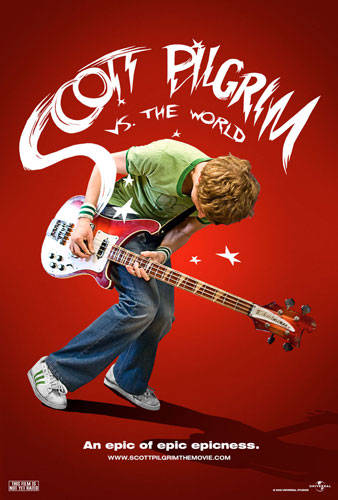
*Scott Pilgrim vs. The World For fans of Bryan Lee O’Malley’s just-completed comics saga Scott Pilgrim, the announcement that Edgar Wright (2004’s Shaun of the Dead, 2007’s Hot Fuzz) would direct a film version was utterly surreal. Geeks get promises like this all the time, all too often empty (Guillermo del Toro’s Hobbit, anyone?). But miraculously, Wright indeed spent the past five years crafting the winning Scott Pilgrim vs. the World. The film follows hapless Toronto 20-something Scott Pilgrim (Michael Cera), bassist for crappy band Sex Bob-omb, as he falls for delivery girl Ramona Flowers (Mary Elizabeth Winstead), only to find he must defeat her seven evil exes — like so many videogame bosses — before he can comfortably date her. As it happens, he’s already dating a high-schooler, Knives (Ellen Wong), who’s not coping well with Scott moving on. Cera plays a good feckless twerp; his performance isn’t groundbreaking, but it dodges the Cera-playing-his-precious-self phenomenon so many have lamented. The film’s ensemble cast maintains a sardonic tone, with excellent turns by Alison Pill, Aubrey Plaza, and newcomer Wong. Jason Schwartzman is perfectly cast as the ultimate evil ex-boyfriend — there’s really no one slimier, at least under 35.The film brilliantly cops the comics’ visual language, including snarky captions and onomatopoetic sound effects, reminiscent onscreen of 1960s TV Batman. Sometimes this tends toward sensory overload, but it’s all so stylistically distinctive and appropriate that excess is easily forgiven. (1:52) California, Four Star, Presidio. (Sam Stander)

Step Up 3D The third installment of the Step Up enterprise graduates performing arts high school and moves to the sidewalks, rooftops, and warehouses of New York City, as well as the occasional venue — part underground club, part ad-plastered sports arena — where packs of street dancers battle and mop up the floor with their rivals, employing only the weaponry of a fierce routine. That, and the fast-forward button in the editing suite — beyond drop kicks and droplets of water coming out of the screen at your face, Step Up 3D unabashedly adopts the choreographed F/X of contemporary action films, manipulating footage to make the dancers look like nimble, ferocious, supernatural creatures with a youthful disdain for gravity and the space-time continuum. There is a plot of sorts, involving a crew called the Pirates; their fearless leader Luke (Rick Malambri); his mysterious lady friend Natalie (Sharni Vinson); an NYU freshman named Moose (Adam Sevani of 2008’s Step Up 2: The Streets), who was, in Luke’s oft-repeated words, "born from a boombox" (or BFAB); and the warehouse wonderland where the Pirates live and train, amid a decor of tape-deck-womb walls and galleries of limited-edition sneakers. It’s best, though, not to follow along too closely on the rare occasions when director Jon Chu (Step Up 2) mistakenly lets more than four lines of earnest dialogue stack up without a dance-scene intervention. The near-continuous wave of choreographed outbursts is like eye candy injected with multiple shots of 5-Hour Energy drink, but those who flinch at the idea of Auto-Tuning dance performance may want to stay home and rent 2000’s Center Stage. (1:46) 1000 Van Ness, SF Center. (Rapoport)

*The Switch Has any hard-working actor ever made as many mediocre, albeit vigorously marketed, movies as Jennifer Aniston? It seems like an age since her last good one, Nicole Holofcener’s Friends with Money (2006), though some might go as far back as 2002’s The Good Girl, her dramatic and cinematic breakthrough. Perhaps that dry spell seems extra long due to Aniston’s tabloid overexposure, or maybe it’s just the feeble conceits (a la 2009’s Love Happens) that Aniston allows herself to get roped into. In any case, armed with a sharp script based on a Jeffrey Eugenides short story and a less-than-perfect but comically well-equipped everyman foil in Jason Bateman, The Switch turns out to be a refreshing break from Aniston’s run of predictability: it’s actually good, girl (if a bit far-fetched that even a neurotic, successful financial whiz could be so emotionally constipated). Heeding her biological alarm clock over the objections of best friend Wally (Bateman), Kassie (Aniston) decides to get artificially inseminated by handsome, smart, and charming donor Roland (Patrick Wilson), but nothing goes according to plan when Wally gets wasted at her insemination party and — no use crying over spilled semen — woozily decides to substitute his own emissions for Roland’s. Funny, tender, heart-strings-tugging shenanigans ensue when Kassie returns to NYC after seven years with her adorable, neurotic mini-Wally Sebastian (Thomas Robinson). Bateman is as reliably excellent as ever. Blades of Glory (2007) directors Will Speak and Josh Gordon put care into the details — from the lighting, to the scene-swiping cameos by Juliette Lewis and Jeff Goldblum, to the on-point yet relatively realistic dialogue, and it shows, making this, along with The Kids Are All Right, a, ahem, seminal year for donor-coms. (1:56) 1000 Van Ness, Shattuck. (Chun)

Tales from Earthsea Drawn from Ursula K. Le Guin’s Earthsea series of fantasy novels, the feature debut of Goro Miyazaki, the legendary Hayao Miyazaki’s son, is the latest to come out of Japan’s Studio Ghibli. It tells the story of angsty patricidal prince-refugee Arren, who finds himself in the company of the wise Archmage Sparrowhawk and must help him and his friends defeat a Maleficent-esque evil sorcerer. But this film’s fantastical world tends too often toward the unengagingly mundane, with a cast of half-baked archetypes battling over overwrought metaphysical concepts. To boot, too many of the weird creatures and unreal elements seem reminiscent of the elder Miyazaki’s creations in films like Princess Mononoke (1997) and Spirited Away (2001). Ghibli is famed for its relentlessly creative productions, but Earthsea misses the mark, even if it is entirely watchable. It’s worth noting that Le Guin herself has written a lengthy piece on the film’s many problems. (1:55) Sundance Kabuki. (Stander)

*Toy Story 3 You’ve got a friend in Pixar. We all do. The animation studio just can’t seem to make a bad movie — even at its relative worst, a Pixar film is still worlds better than most of what Hollywood churns out. Luckily, Toy Story 3 is far from the worst: it’s actually one of Pixar’s most enjoyable and poignant films yet. Waiting 11 years after the release of Toy Story 2 was, in fact, a stroke of genius, in that it amplifies the nostalgia that runs through so many of the studio’s releases. The kids who were raised on Toy Story and its first sequel have now grown up, gone to college, and, presumably, abandoned their toys. For these twentysomethings, myself included, Toy Story 3 is a uniquely satisfying and heartbreaking experience. While the film itself may not be the instant classic that WALL-E (2008) was, it’s near flawless regardless of a viewer’s age. Warm, funny, and emotionally devastating—it’s Pixar as it should be. (1:49) Shattuck. (Peitzman)

Vampires Suck (1:40) 1000 Van Ness.

The Wildest Dream: Conquest of Everest The Everest documentary has, by now, become a genre unto itself. It’s got its own tropes (sweeping shots of the mountain’s face, somber voice-over philosophizing about the human struggle with nature) and its own canon (topped, perhaps, by the harrowing 1998 IMAX hit Everest). The latest entry into this field is National Geographic Entertainment’s The Wildest Dream, which chronicles early-20th century explorer George Mallory’s lifelong — and ultimately life-ending — quest to reach Everest’s summit, and modern mountaineer Conrad Anker’s attempt to recreate his predecessor’s final climb. Director Anthony Geffen unfolds his tale in standard adventure-doc fashion. We get a lot of scratchy footage from Mallory’s climbs, a few risibly awkward dramatic re-creations, and quite a lot of portentous voiceover work. These are worn techniques, to be sure, but that doesn’t make the story told any less compelling. Mallory himself emerges as a particularly fascinating figure — a talented and charming scholar, a devoted husband, and an irresponsible, borderline suicidal obsessive. It’s a shame that we’re only able to observe him at a century’s distance. (1:33) Opera Plaza. (Zach Ritter)

*Winter’s Bone Winter’s Bone has already won awards at the Berlin International Film Festival and the Sundance Film Festival, but it’s the kind of downbeat, low-key, quiet film that may elude larger audiences (and, as these things go, Oscar voters). Like Andrea Arnold’s recent Fish Tank, it tells the story of a teenage girl who draws on unlikely reserves of toughness to navigate an unstable family life amid less-than-ideal economic circumstances. And it’s also directed by a woman: Debra Granik, whose previous feature, 2004’s Down to the Bone, starred Vera Farmiga (2009’s Up in the Air) as a checkout clerk trying to balance two kids and a secret coke habit. Drugs also figure into the plot of the harrowing Winter’s Bone, though its protagonist, Ree Dolly (Jennifer Lawrence), is faced with a different set of circumstances: her meth head father has jumped bail, leaving the family’s humble mountain home as collateral; the two kids at stake are her younger siblings. With no resources other than her own tenacity, Ree strikes out into her rural Missouri community, seeking information from relatives who clearly know where her father is — but ain’t sayin’ a word. It’s a journey fraught with menace, shot with an eye for near-documentary realism and an appreciation for slow-burn suspense; Lawrence anchors a solid cast with her own powerful performance. Who says American independent film is dead? (1:40) Empire, Four Star, Opera Plaza, Shattuck. (Eddy)

Appetite: The scene at SF CHEFS

0

SF CHEFS, the week-long celebration of all things food and drink in SF ushered in its second year last week and it was as full, fun, and delectable as the first. From industry seminars like the intriguing Tales from the Still, which kicked off the week last Tuesday, to the Grand Tasting tent in Union Square, there was never a dull moment… nor a hungry one.

The Performant: The Witching Hour — Puritan girls gone wild and midnight museum marauders

0

Checking out the local arts and culture scene …

There’s no doubt about it—San Franciscans love a rock opera. From the faux-real heavy metal anthems of “Live Evil” to the afterlife explorations of “Exit Sign,” the suicide art movement of “Thanatics” to the human sacrifices of “Wicker Man,” we like our rock operas loud, messy, and tinged with darkness and humor both. So an original rock opera about the Salem Witch Trials seems an obvious pairing between our love of the darkside plus power chords. Appropriately held at the Temple nightclub on Howard, “Abigail the Rock Opera” straddles the SF rock opera line between serious and silly.

There’s some damn fine singing, particularly from Alexis Lane Jensen who plays Betty Parris, and Daniel Knop, who plays her father Samuel Parris as well as a curiously fey Giles Corey in a silver mop-top/Andy Warhol wig and every 60’s British Invasion mannerism to ever make it onto the Ed Sullivan show. There’s some really solid rocking out thanks to the band, particularly guitarist Kurt Brown (who not coincidentally co-wrote the music with Knop). Plus there are dead babies, bloody aprons, moonlit excursions in the woods, goth-y girls in leather corsets and modest bonnets, and angry men wearing glittery facepaint, Thanksgiving pageant hats, and smug patriarchal entitlement.

There are some downsides too—namely over-reliance on video projection, hard-to-follow lyrics, and not enough campy abandon. I’d have liked to see the goth angle played up more as well as the glam. Perhaps a Klaus Nomi or Gary Numan homage tucked in between the standard rock anthems, or even a little synthesized EBM and some serious stomping. But for now they’ll be performing every Thursday at 9 p.m. through September, and one hopes they’ll make it at least to Halloween, with or without a darkwave makeover.

Meanwhile, it may have been midnight, but the YBCA was far from dark during the DIYbca party last Saturday. People dressed in hand-crafted costumes floated through the hallways of the museum like so many neon-colored moths, drawn to the flames of creative crowd-sourcing and hi tech/lo brow design hacks. In the Forum, reality television was getting a send-up with the Drinking and Dancing competition featuring fun-guy trio Adonisaurus, while in the gallery, old-school industrial noisemakers Kwisp jammed on bicycle parts, metal sheets and springs, and bits of old electronics before leading a hands-on, build-your-own thumb piano workshop (the best use for bobby pins and cigar boxes ever!).

A stencil workshop with queer street artist Jeremy Novy, creative cobbling with Mrs. Vera and SCRAP, a Puma shoe design competition, and a create your own techno music lab hosted by LoveTech rounded out the midnight hour, blurring the line between performer and participant to its most malleable degree. In other words, even the fun was being crowd-sourced, and pretty successfully so. Party promoters take note. You can hire all the big brand bands and fog machines and light-show designers you want, but for a really memorable event, you might want to consider adding a crafting circle to your lineup. Just saying. [Editor’s Note for craft aficionados — there is a wild Haute Gloo craft table every Friday night at the Stud‘s Some Thing drag party! And it totally works.]

On the Cheap Listings

0

On the Cheap listings are compiled by Paula Connelly. Submit items for the listings at listings@sfbg.com. For further information on how to submit items for the listings, see Picks.

WEDNESDAY 18

“El Grito de la Mission” Southern Exposure, 3030 20th St., SF; (415) 863-2141. 6pm, free. Join Southern Exposures and the youth, artists, and community partners who participated in the Mission Voices Summer program for a final exhibition featuring new work, installations, interactive performance, food, and refreshments.

Hear It Local 111 Minna Gallery, 111 Minna, SF; (415) 974-1719. 6:30pm, free. Celebrate the San Francisco launch of www.hearitlocal.com, which provides a community-building platform for the local, independent music scene. Featuring performances by the Nice Guy Trio, Quinn Deveaux, and Kelly MacFarling, a music photography exhibit by Niall David and Audra Marie Dewitt, and more.

NASA Space Telescope Randall Museum, 199 Museum Way, SF; (415) 554-9600. 7:30pm, free. Astrophysicist Bryan Mendez will tell all there is to know about NASA’s new Wide-field Infrared Survey Explorer (WISE) telescope, launched unmanned in 2009 to search for asteroids, stars, the origins of stellar and planetary systems, and anything else the galaxies could reveal.

THURSDAY 19

Chrome Chrome Retail, 580 4th St., SF; (415) 820-5070. Noon, free. All Chrome products will be 30% off all day while all proceeds from the Noon-3 BBQ and the 4pm-8pm dollar beer happy hour will benefit the San Francisco Bike Kitchen.

Drunken Dish Asian Art Museum, 200 Larkin, SF; (415) 581-3500. 5pm, $10. Head to this month’s installment of Matcha, the Asian Art Museum’s monthly late night discounted party, for a talk and demonstration on Shanghai cuisine, specifically, how to make drunken chicken. Also featuring special gallery tours, cocktails, DJ music, and more.

Jaws Hyde Street Pier, 2905 Hyde, SF; (415) 561-6662. 7:30pm, $5 suggested donation. If you thought Jaws was frightening to watch on land, see if you can survive watching it on the Eureka, “the longest floating wooden ship on Earth.” Part of the San Francisco Maritime Nat’l Park Association’s film series to raise money to benefit their education and preservation programs.

“Persistent Voices” Magnet, 4122 18th St., SF; (415) 581-1600. 8pm, free. Inspired by the anthology, Persistent Voices: Poetry by Writers Lost to AIDS, poets will read and perform works from the anthology in addition to some new pieces inspired by the book. Featured readers include Judy Grahn, Kevin Killian on Steve Abbott, Jaime Cortez, Thandiwe Thomas, and more.

SF Jazz Summerfest Union Square, Geary at Powell, SF; www.sfjazz.org. 6pm, free. Heat up your foggy summer blues with a free jazz concert in the park with Lavay Smith and Her Red Hot Skillet Lickers, known for performing classic jazz and blues mixed with big band, salsa grooves.

SATURDAY 21

Dahlias Hall of Flowers, 9th Ave. at Lincoln, SF; (415) 994-2448. Sat. 10am-5pm, Sun. 10am-4pm; free. Did you know that the Dahlia is San Francisco’s official flower? The Dahlia Society of California, responsible for the planting and upkeep of Golden Gate Park’s Dahlia Dell, is holding it’s annual show and exhibition of these fantastic flowers.

Hello Kitty Must Die San Francisco Public Library, Chinatown branch, 1135 Powell, SF; (415) 355-2888. 2:30pm, free. Hear author Angela S. Choi read from and discuss her new book, that rips into stereotypes about the well-groomed, well-behaved Asian wife with a tale about a serial killer happy to teach others how to get rid of unwanted fiancés and bosses.

Hot Glass Cold Beer Public Glass, 1750 Armstrong, SF; (415) 671-4916. 6pm; $25 donation, includes glass and beer. Take in an evening of glassblowing demonstrations by artists Paul DeSomma, Marsha Blaker, and Jeff Rogers while listening to live music and enjoying cold beer in your new one-of-a-kind, hand blown drinking glass.

SF Street Food Fest Folsom between 25th and 26th St., SF; (415) 824-2729 ext. 303. 11am-7pm, free. Enjoy some casual, affordable, delicious food made by San Francisco food entrepreneurs. Hosted by La Cocina, this Street Food Festival aims to further advocate for the creation of policies that support the formalization of mobile food vending to connect communities to a food from all classes and cultures.

BAY AREA

Art and Soul Frank H. Ogawa Plaza, City Center, 14th St. and Broadway, Oakl.; (510) 444-CITY. Sat.-Sun. noon-6pm, $10. Celebrate the past, present and future music of Oakland at this two-day concert and marketplace featuring music performances by Cake, En Vogue, Tony! Toni! Toné!, MC Hammer, Pete Escovedo, The Bittersweets, Lenny Williams, and more. Also featuring an Artisan Marketplace, with crafts and art for purchase, food vendors offering multicultural menus, dance performances, and activities.

SUNDAY 22

Sunday Streets John F. Kennedy Drive and MLK Drive, Golden Gate Park, SF; Great Highway from Lincoln to SF Zoo, SF; www. sundaystreetssf.com. 10am-3pm, free. Take to the streets for a day of healthy, family-friendly activities. This month’s street closure is “Penguins to penguins,” or Golden Gate Park to the SF Zoo.

TUESDAY 24

“Microscopic Giant” Space Gallery, 1141 Polk, SF; www.bucktoothmechanics.blogspot.com. 8pm, free. A night of local creativity with spoken word performances, storytelling, and poetry by Tracy Jones, April Wolfe, Steven Gray, Charlie Getter, and the host of NPR’s Snap Judgment Glynn Washington, open mic, live painting by artists Aaron Lawrence, Nolan Yelonek, and Noa- , and live music by DigDug.

Music Listings

0

Music listings are compiled by Paula Connelly and Cheryl Eddy. Since club life is unpredictable, it’s a good idea to call ahead to confirm bookings and hours. Prices are listed when provided to us. Submit items at listings@sfbg.com. For further information on how to submit items for the listings, see Picks.

WEDNESDAY 18

ROCK/BLUES/HIP-HOP

Black Francis, Roy Zimmerman Great American Music Hall. 9pm, $21.

Bodeans, Dan Navarro Independent. 8pm, $20.

Brothers Comatose, Escalator Hill, We Is Shore Determined Hotel Utah. 9pm, $6.

Casiokids, Light Pollution, K. Flay, Einar Stokka Café Du Nord. 9pm, $10.

Greg Davis, Aures, Mololy-Nagy Hemlock Tavern. 9pm, $7.

Ha Ha Tonka, Red Light Mind, Buxter Hoot’n Elbo Room. 9pm, $8.

Craig Horton Biscuits and Blues. 8 and 10pm, $15.

Brian McKnight Yoshi’s San Francisco. 8 and 10pm, $35-45.

Rantouls, Lateenos, Larry and the Angriest Generation, Jinxes Thee Parkside. 8pm, $8.

Wavves Amoeba, 1855 Haight, SF; www.amoeba.com. 6pm, free.

Wavves Rickshaw Stop. 7:30pm, $14.

Woven Bones, Sandwitches, Splinters Bottom of the Hill. 9pm, $10.

DANCE CLUBS

Booty Call Q-Bar, 456 Castro, SF; www.bootycallwednesdays.com. 9pm. Juanita Moore hosts this dance party, featuring DJ Robot Hustle.

Breezin Koko Cocktails, 1060 Geary, SF; (415) 885-4788. 9:30pm, free. With DJs Amy A and Brynnie Mac spinning rock and 70s.

45 Club Knockout. 9pm, $6. Rock n’ soul with Honey, Blasted Canyons, and DJs dX the Funky Granpaw, Dirty Dishes, and English Steve.

Hands Down! Bar on Church. 9pm, free. With DJs Claksaarb, Mykill, and guests spinning indie, electro, house, and bangers.

Jam Fresh Wednesdays Vessel, 85 Campton, SF; (415) 433-8585. 9:30pm, free. With DJs Slick D, Chris Clouse, Rich Era, Don Lynch, and more spinning top40, mashups, hip hop, and remixes.

Mary-Go-Round Lookout, 3600 16th St, SF; (415) 431-0306. 10pm, $5. A weekly drag show with hosts Cookie Dough, Pollo Del Mar, and Suppositori Spelling.

RedWine Social Dalva. 9pm-2am, free. DJ TophOne and guests spin outernational funk and get drunk.

Respect Wednesdays End Up. 10pm, $5. Rotating DJs Daddy Rolo, Young Fyah, Irie Dole, I-Vier, Sake One, Serg, and more spinning reggae, dancehall, roots, lovers rock, and mash ups.

Synchronize Il Pirata, 2007 16th St, SF; (415) 626-2626. 10pm, free. Psychedelic dance music with DJs Helios, Gatto Matto, Psy Lotus, Intergalactoid, and guests.

THURSDAY 19

ROCK/BLUES/HIP-HOP

Abriel, Imperfect Deity, To Memory and Me DNA Lounge. 5:30pm, $12. With the Light Iris, Our Living Memory, Falling to Pieces, Mirros, Apothesary, and A Moment of Clarity.

Catholic Radio, Smile Brigade, Spiral Agnew Kimo’s. 9pm.

Clipd Beaks, Moccretro, Hollow Hearth, Hans Keller Café Du Nord. 9pm, $10.

Darker My Love, Sonny and the Sunsets Independent. 8pm, $14.

Brandon Flowers Slim’s. 9pm, $27.50.

Grand Lodge, Lijie Hotel Utah. 8pm, $7.

Hot Hot Heat, 22-20s, Hey Rosetta! Rickshaw Stop. 8pm, $15.

Hunx and His Punx, Shannon and the Clams, Okmoniks, Goochi Boiz, Miss Chain and the Broken Heels Thee Parkside. 9pm, $10.

Ida, Michael Hurley, Westwood and Willow Bottom of the Hill. 9pm, $12.

Lickets, Odd Owl, Tied to the Branches Hemlock Tavern. 9pm, $7.

Brian McKnight Yoshi’s San Francisco. 8 and 10pm, $35-45.

Darrell Scott, Elliot Randall Great American Music Hall. 8pm, $21.

Wild Things, Lens, Greg Ashley Knockout. 9:30pm, $7.

FOLK/WORLD/COUNTRY

Estamos Ensemble New Frequencies, YBCA Sculpture Court, 701 Mission, SF; (415) 978-2787. 8pm, $25

Hot Club of Cowtown, Whiskey Richards, B Stars Amnesia. 8:30pm, $10.

Claudio Santomé and Marcello Puig Red Poppy Art House. 8pm, $12-15.

Steel Pulse Fillmore. 9pm, $35.

Tipsy House Plough and Stars. 9pm.

DANCE CLUBS

Afrolicious Elbo Room. 9:30pm, $5-7. DJs Pleasuremaker and Señor Oz spin Afro-tropical, samba, and funk.

Caribbean Connection Little Baobab, 3388 19th St, SF; (415) 643-3558. 10pm, $3. DJ Stevie B and guests spin reggae, soca, zouk, reggaetón, and more.

Club Jammies Edinburgh Castle. 10pm, free. DJs EBERrad and White Mice spinning reggae, punk, dub, and post punk.

Drop the Pressure Underground SF. 6-10pm, free. Electro, house, and datafunk highlight this weekly happy hour.

Electric Feel Lookout, 3600 16th St, SF; (415) 431-0306. 9pm, $2. With DJs subOctave and Blondie K spinning indie music videos.

Good Foot Som., 2925 16th St, SF; (415) 558-8521. 10pm, free. With DJs spinning R&B, Hip hop, classics, and soul.

Jivin’ Dirty Disco Butter, 354 11th St., SF; (415) 863-5964. 8pm, free. With DJs spinning disco, funk, and classics.

Koko Puffs Koko Cocktails, 1060 Geary, SF; (415) 885-4788. 10pm, free. Dubby roots reggae and Jamaican funk from rotating DJs.

Mestiza Bollywood Café, 3376 19th St, SF; (415) 970-0362. 10pm, free. Showcasing progressive Latin and global beats with DJ Juan Data.

Nightvision Harlot, 46 Minna, SF; (415) 777-1077. 9:30pm, $10. DJs Danny Daze, Franky Boissy, and more spinning house, electro, hip hop, funk, and more.

Peaches Skylark, 10pm, free. With an all female DJ line up featuring Deeandroid, Lady Fingaz, That Girl, and Umami spinning hip hop.

Popscene 330 Rich. 10pm, $10. Rotating DJs spinning indie, Britpop, electro, new wave, and post-punk.

SOL Club 525, 525 Harrison, SF; www.sol2010.eventbrite.com. 9pm, $15. With DJs Andy P., Skander and Sohrab, Rhetoric, Sepehr, and more spinning house, tech, and tribal.

Solid Thursdays Club Six. 9pm, free. With DJs Daddy Rolo and Tesfa spinning roots, reggae, dancehall, soca, and mashups.

Tropicana Madrone Art Bar. 9pm, $5. With DJs Don Bustamante, Apocolypto, Sr. Saenz and guests spinning salsa, cumbia, reggaeton, and merengue.

FRIDAY 20

ROCK/BLUES/HIP-HOP

Blisses B, Be Brave Bold Robot, Grownup Noise Kimo’s. 9pm.

Crooked Still, Jesse DeNatale Great American Music Hall. 8pm, $16.

Excuses for Skipping, Cliks, Killola, Hunter Valentine Milk. 8:30pm, $10.

Gentleman Jesse and His Men, Personal and the Pizzas, Barreracudas, Wrong Words, Meercaz Thee Parkside. 9pm, $10.

Ghostland Observatory Warfield. 9pm, $25.

Jogger, We Are the World, Shlohmo, Matthewdavid Rickshaw Stop. 8:30pm, $12.

Morlocks, Hot Lunch Hemlock Tavern. 9:30pm, $10.

New Orleans Bingo! Show, Kim Boekbinder Independent. 9pm, $15.

Persephone’s Bees, Soft White Sixties, Angel Island, DJ Omar Café Du Nord. 9:30pm, $12.

Pinkerton, Hot Toddies, As A People Bottom of the Hill. 10pm, $10.

Polkacide, Khi Darag, Loop Station, Space Blaster Blue Macaw, 2565 Mission, SF; (415) 920-0577. 9pm, $10.

Johnny Rawls Biscuits and Blues. 8 and 10pm, $20.

Still Time, Shamblers, John Howland Slim’s. 9pm, $15.

Ttotals, Diego Gonzalez Hemlock Tavern. 6pm, $5.

JAZZ/NEW MUSIC

Audium 9 1616 Bush, SF; (415) 771-1616. 8:30pm, $15.

Black Market Jazz Orchestra Top of the Mark. 9pm, $10.

David Belove Trio Art Tap, Yerba Buena Center for the Arts, 701 Mission, SF; (415) 978-2787, www.ybca.org. 6pm, free.

Eleven Eyes Coda. 10pm, $10.

Jacqui Naylor Quartet Rrazz Room, Hotel Nikko, 222 Mason, SF; www.therrazzroom.com. 9pm, $35.

Lisa Engelken Band Red Poppy Art House. 9pm, $12-20.

Marlena Teich and group Savanna Jazz. 7:30pm, $8.

FOLK/WORLD/COUNTRY

Charanga Habanera Yoshi’s San Francisco. 8 and 10pm, $20-26.

“Cuba Afro Rock Revolution” Yerba Buena Center for the Arts, 701 Mission, SF; (415) 978-2787. 8pm, $28-$50. With X Alfonso, Osamu, and special guest Pedro Calvo.

Toshio Hirano Mercury Café, 201 Octavia, SF; (415) 252-7855. 7:30pm, free.

Hot Club of Cowtown, Lady A and the Heel Draggers, Betty Soo Amnesia. 9pm, $10.

Lagos Roots Afrobeat Ensemble Elbo Room. 9:30pm, $12. With DJ Shawna, Tribal Fusion Bellydance, and Deb Rubin.

Summer Samba Party Il Pirata, 2007 16th St., SF; (415) 626-2626. 10pm, $10. With Pagode de Mesa, Jorge Alabe, Claudinho Sorriso, Brian Moran, and guests.

Bucky Walters, Snap Jackson, The Knock on Wood Players Plough and Stars. 9pm.

DANCE CLUBS

Afrobeat No Go Die Madrone Art Bar. 9:30pm, $5. With DJs Jeremiah and the Afrobeat Nation and Jose Rivera.

Club Dragon Club Eight, 1151 Folsom, SF; www.eightsf.com. 9pm, $8. A gay Asian paradise. Featuring two dance floors playing dance and hip hop, smoking patio, and 2 for 1 drinks before 10pm.

Dirty Bird Mezzanine, 444 Jessie, SF; (415) 625-8880. 9pm, $20. With DJs Claude Von Stroke, Juston Martin, Christian Martin, and Worthy.

Dirty Rotten Dance Party Madrone Art Bar. 9pm, $5. With DJs Morale, Kap10 Harris, and Shane King spinning electro, bootybass, crunk, swampy breaks, hyphy, rap, and party classics.

Episco Disco Grace Cathedral, 1100 California, SF; (415) 869-7817. 7pm, free. With live music by Coconut, Paradise Now, and Aero-Mic’d and art by Land and Sea and Sean McFarland.

Exhale, Fridays Project One Gallery, 251 Rhode Island, SF; (415) 465-2129. 5pm, $5. Happy hour with art, fine food, and music with Vin Sol, King Most, DJ Centipede, and Shane King.

Fat Stack Fridays Koko Cocktails, 1060 Geary, SF; (415) 885-4788. 10pm, free. With rotating DJs B-Cause, Vinnie Esparza, Mr. Robinson, Toph One, and Slopoke.

Fubar Fridays Butter, 354 11th St., SF; (415) 863-5964. 6pm, $5. With DJs spinning retro mashup remixes.

Good Life Fridays Apartment 24, 440 Broadway, SF; (415) 989-3434. 10pm, $10. With DJ Brian spinning hip hop, mashups, and top 40.

Hot Chocolate Milk. 9pm, $5. With DJs Big Fat Frog, Chardmo, DuseRock, and more spinning old and new school funk.

Oldies Night Knockout. 9pm, $2-4. One-hit wonders and scratchy soul with DJs Primo, Daniel, and Lost Cat.

Radioactivity 222 Hyde, SF; (415) 440-0222. 6pm. Synth sounds of the cold war era.

Rockabilly Fridays Jay N Bee Club, 2736 20th St, SF; (415) 824-4190. 9pm, free. With DJs Rockin’ Raul, Oakie Oran, Sergio Iglesias, and Tanoa “Samoa Boy” spinning 50s and 60s Doo Wop, Rockabilly, Bop, Jive, and more.

“SF Drag King Contest” DNA Lounge. 9pm, $25-35. With MCs Fudgie Frottage and Sister Roma, plus special guest Jane Wiedlin.

Sisters of the Underground Club Six. 9pm, $5. With DJs Shortee, Lady Fingaz, Pony P, Celskii and Deeandroid, and many more spinning hip hop.

Some Thing The Stud. 10pm, $7. VivvyAnne Forevermore, Glamamore, and DJ Down-E give you fierce drag shows and afterhours dancing.

SATURDAY 21

ROCK/BLUES/HIP-HOP

Chris Cain Band Biscuits and Blues. 8 and 10pm, $20.

Cool Water Canyon, Vintage Music Collective Independent. 9pm, $15.

Hepcat, Inciters, Selecter DJ Kirk Slim’s. 9pm, $23.

“Joe Strummer Tribute” Bottom of the Hill. 9pm, $10. With Armagideons, Hooks, Monkey, Sistas in the Pit, Stigma 13, and Interecords.

Man/Miracle, Slang Chickens, Yellow Dress Hemlock Tavern. 9:30pm, $7.

No Alternative, VKTMS Bender’s, 806 S. Van Ness, SF; www.bendersbar.com. 10pm, $5. Benefit for the Haight Ashbury Homeless Youth Alliance.

Nobunny, Mean Jeans, Anomalys, Charlie and the Moonhearts Thee Parkside. 9pm, $10.

Return to Mono, Foreign Cinema, Sentinel, Bring the Tiger Red Devil Lounge. 8pm, $10.

Sons of Doug, Steve Pile Band, Jeremy D. Antonio Hotel Utah. 9pm, $7.

Sputterdoll, Pedro Gil, Skyflakes, Rocking Kids Sing-A-Long, Keenwild Thee Parkside. 3pm, free.

Tussle, Sword and Sandals, ASSS Amnesia. 9pm, $5.

JAZZ/NEW MUSIC

Audium 9 1616 Bush, SF; (415) 771-1616. 8:30pm, $15.

Ensemble Mik Nawooj Red Poppy Art House. 9pm, $15-20.

Eric Kurtzrock Trio Ana Mandara, Ghirardelli Square, 891 Beach, SF; (415) 771-6800. 8pm, free.

Giovenco Project Coda. 7pm, free.

Jacqui Naylor Quartet Rrazz Room, Hotel Nikko, 222 Mason, SF; www.therrazzroom.com. 9pm, $35.

Lucky Stars, B Stars Verdi Club, 2424 Mariposa, SF; www.oldtimey.net. 9:30pm, $12.

Suzanna Smith and group Savanna Jazz. 7:30pm, $8.

FOLK/WORLD/COUNTRY

Charanga Habanera Yoshi’s San Francisco. 8 and 10pm, $20-26.

“Cuba Afro Rock Revolution” Yerba Buena Center for the Arts, 701 Mission, SF; (415) 978-2787. 8pm, $28-$50. With X Alfonso, Osamu, and special guest Pedro Calvo.

Maurice Tani, Jenn Courtney, 77 El Deora, Misispi Rider Noe Valley Ministry, 1021 Sanchez, SF; (415) 454-5238. 8:15pm, $17.

Tito Garcia y su Orquesta Internacional The Ramp, 855 Terry Francois, SF; (415) 621-2378. 5pm.

Tornotics Plough and Stars. 9pm, $6-$10 sliding scale.

Craig Ventresco and Meredith Axelrod Atlas Café. 4pm, free.

DANCE CLUBS

Bar on Church 9pm. Rotating DJs Foxxee, Joseph Lee, Zhaldee, Mark Andrus, and Nuxx.

Bootie DNA Lounge. 9pm, $6-12. Mash-ups with DJ Ajax vs. Ryan Lendt, plus residents Adrian and Mysterious D.

Booty Bassment Knockout. 10pm, $5. Hip-hop with DJs Ryan Poulsen and Dimitri Dickenson.

Club 1994 Paradise Lounge. 10pm, $10. Presented by Jeffery Paradise and Ava Berlin, featuring 90’s music, themed photo booth, fashion show, and more.

Cock Fight Underground SF. 9pm, $7. Gay locker room antics galore with electro-spinning DJ Earworm.

Fire Corner Koko Cocktails, 1060 Geary, SF; (415) 885-4788. 9:30pm, free. Rare and outrageous ska, rocksteady, and reggae vinyl with Revival Sound System and guests.

Fringe Madrone Art Bar. 9pm, $5. With DJs Blondie K and subOctave spinning indie music videos.

Full House Gravity, 3505 Scott, SF; (415) 776-1928. 9pm, $10. With DJs Roost Uno and Pony P spinning dirty hip hop.

HYP Club Eight, 1151 Folsom, SF; www.eightsf.com. 10pm, free. Gay and lesbian hip hop party, featuring DJs spinning the newest in the top 40s hip hop and hyphy.

Non Stop Bhangra Rickshaw Stop. 9pm, $15. Bhangra beats with Dholrhythms Dance Troupe.

Paint Factory Club Six. 9pm, $5. With DJs Romanowski, Centipede, and Mr. Robinson spinning house, downtempo, and hip hop and live painting by Nome Edonna and Ian Ross.

Prince vs. Michael Madrone Art Bar. 8pm, $5. With DJs Dave Paul and Jeff Harris battling it out on the turntables with album cuts, remixes, rare tracks, and classics.

Rock City Butter, 354 11th St., SF; (415) 863-5964. 6pm, $5 after 10pm. With DJs spinning party rock.

Saturday Night Soul Party Elbo Room. 10pm-2am, $5. DJs Lucky, Paul Paul, and Phengren Oswald spin butt-shakin’ ’60s soul.

Spirit Fingers Sessions 330 Ritch. 9pm, free. With DJ Morse Code and live guest performances.

Wet and Wild Club 8, 1151 Folsom, SF; (415) 431-1151. 10pm, $8. With DJs Techminds and Kipp Glass.

SUNDAY 22

ROCK/BLUES/HIP-HOP

“Battle of the Bands” DNA Lounge. 5:30pm, $12. With Boondock Squad, Thanks for Leaving, Out for Blood, and more.

“Bay Vibes Summer Musicfest 3” Café Cocomo. Noon-2am, $35. Two stages of music with Isabella, Native Elements, Dogman Joe, My Peoples, Afrolicious, and more.

Butlers, Only Sons, Burnt House Bottom of the Hill. 5:30pm, $8.

Mike Coykendall and the Golden Shag, Brian Belknap, Tom Heyman Make-Out Room. 8pm, $8.

Horde and the Harem, Aimless Never Miss, Buttercream Gang, And I Was Like, What? Rickshaw Stop. 7pm, $10.

Sarah Jaffe, Glassines, Kristy Kruger Hemlock Tavern. 8pm, $8.

Lazy Loper, Con Brio, Shake Well Amnesia. 9:30pm, $8-10.

Moonlight Orchestra, Stormy California Thee Parkside. 8pm, $7.

“Rock Make Street Festival” Treat and 18th St, SF; www.rockmake.com. 11am-6pm, free. With Tartufi, AB and the Sea, Still Flyin’, Leopold and His Fiction, and more.

Summer Twins, Twinks, Danger Babes, Omni, DJ Neil Martinson Knockout. 9pm.

They Might Be Giants, Rogue Wave Sigmund Stern Grove, 19th Ave at Sloat, SF; www.sterngrove.org. 2pm, free.

JAZZ/NEW MUSIC

Ernie Small Memorial Big Band Savanna Jazz. 7:30pm, $5.

Sunday Sessions Madrone Art Bar. 6pm, free. With organist Will Blades leading a jazz jam session.

FOLK/WORLD/COUNTY

Annete A. Aguilar and Stringbeans Coda. 8pm, $10.

Back 40, Carburetors Thee Parkside. 4pm, free.

Charanga Habanera Yoshi’s San Francisco. 6 and 8pm, $20.

Charity and the JAMband, Elizabeth Mitchell Park Chalet, 1000 Great Highway, SF; (415) 386-8439. 3pm, free. An outdoor family concert.

Crow Quail Night Owls Amnesia. 6-9pm, $8-10.

Gente do Samba The Ramp, 855 Terry Francois, SF; (415) 621-2378. 5pm.

Queen Makedah Café Cocomo. 5pm, $25-$60.

John Sherry, Kyle Thayer and friends Plough and Stars. 9pm.

DANCE CLUBS

DiscoFunk Mashups Cat Club. 10pm, free. House and 70’s music.

Dub Mission Elbo Room. 9pm, $6. Dub, roots, and classic dancehall with DJs Sep, Ludachris, and guest Bella.

Gloss Sundays Trigger, 2344 Market, SF; (415) 551-CLUB. 7pm. With DJ Hawthorne spinning house, funk, soul, retro, and disco.

Honey Soundsystem Paradise Lounge. 8pm-2am. “Dance floor for dancers – sound system for lovers.” Got that?

Jock! Lookout, 3600 16th St, SF; (415) 431-0306. 3pm, $2. This high-energy party raises money for LGBT sports teams.

Kick It Bar on Church. 9pm. Hip-hop with DJ Zax.

Lowbrow Sunday Delirium. 1pm, free. DJ Roost Uno and guests spinning club hip hop, indie, and top 40s.

Religion Bar on Church. 3pm. With DJ Nikita.

Stag AsiaSF. 6pm, $5. Gay bachelor parties are the target demo of this weekly erotic tea dance.

Swing Out Sundays Rock-It Room. 7pm, free (dance lessons $15). DJ BeBop Burnie spins 20s through 50s swing, jive, and more.

MONDAY 23

ROCK/BLUES/HIP-HOP

Crowded House, Lawrence Arabia Warfield. 8pm, $45-62.50.

Decapitated, Faceless, All Shall Parish, Red Chord, Veil of Maya, Cephanic Carnage Fillmore. 3:30pm, $25. With Decrepit Death, Carnifex, Animals as Leaders, and Vital Remains.

Girl in a Coma, Gringo Star, Agent Ribbons Bottom of the Hill. 9pm, $12.

DANCE CLUBS

Black Gold Koko Cocktails, 1060 Geary, SF; (415) 885-4788. 10pm-2am, free. Senator Soul spins Detroit soul, Motown, New Orleans R&B, and more — all on 45!

Death Guild DNA Lounge. 9:30pm, $3-5. Gothic, industrial, and synthpop with Decay, Joe Radio, and Melting Girl.

Karaoke Killed the Cat Elbo Room. 9pm, $5. Karaoke.

Krazy Mondays Beauty Bar. 10pm, free. With DJs Ant-1, $ir-Tipp, Ruby Red I, Lo, and Gelo spinning hip hop.

M.O.M. Madrone Art Bar. 6pm, free. With DJ Gordo Cabeza and guests playing all Motown every Monday.

Manic Mondays Bar on Church. 9pm. Drink 80-cent cosmos with Djs Mark Andrus and Dangerous Dan.

Musik for Your Teeth Revolution Café, 3248 22nd St., SF; (415) 642-0474. 5pm, free. Soul cookin’ happy hour tunes with DJ Antonino Musco.

Network Mondays Azul Lounge, One Tillman Pl, SF; www.inhousetalent.com. 9pm, $5. Hip-hop, R&B, and spoken word open mic, plus featured performers.

Skylarking Skylark. 10pm, free. With resident DJs I & I Vibration, Beatnok, and Mr. Lucky and weekly guest DJs.

TUESDAY 24

ROCK/BLUES/HIP-HOP

Alvon Biscuits and Blues. 8 and 10pm, $15.

Audacity, Todd C and the Clown Sound, Mill Valley’s Most Honest Men Hemlock Tavern. 6pm, $5.

Bad Brains, Broun Fellinis Slim’s. 9pm, $26.

La Corde, Cat Party, Dadfag, DJs Deadbeat and Yule Be Sorry Knockout. 9:30pm, $5.

Eastern Conference Champs, Voxhaul Broadcast Hemlock Tavern. 9pm, $6. Grand Lake, It’s for Free Grace, Sean Smith and the Present Moment, James and Evander Café Du Nord. 9pm, $10. Psalm One, Open Mike Eagle, League510 Elbo Room. 9pm, $8. Scene of Action, Paper Sons, Pebble Theory Bottom of the Hill. 9pm, $8. Shaimus, Star Anna and the Laughing Dogs Hotel Utah. 8pm, $8. Something Corporate Warfield. 8:30pm, $30. DANCE CLUBS Alcoholocaust Presents Argus Lounge. 9pm, free. With DJ D-runk and D. Jake. Eclectic Company Skylark, 9pm, free. DJs Tones and Jaybee spin old school hip hop, bass, dub, glitch, and electro. Share the Love Trigger, 2344 Market, SF; (415) 551-CLUB. 5pm, free. With DJ Pam Hubbuck spinning house. Womanizer Bar on Church. 9pm. With DJ Nuxx


Film Listings

0

Film listings are edited by Cheryl Eddy. Reviewers are Kimberly Chun, Michelle Devereaux, Max Goldberg, Dennis Harvey, Johnny Ray Huston, Louis Peitzman, Lynn Rapoport, Ben Richardson, and Matt Sussman. 

OPENING

*Animal Kingdom More renowned for its gold rush history and Victorian terrace homes than its criminal communities, Melbourne, Australia gets put on the same gritty map as Martin Scorsese’s ’70s-era New York City and Quentin Tarantino’s ’90s Los Angeles with the advent of director-writer David Michôd’s masterful debut feature. The metropolis’ sun-blasted suburban homes, wood-paneled bedrooms, and bleached-bone streets acquire a chilling, slowly building power, as Michôd follows the life and death of the Cody clan through the eyes of its newest member, an unformed, ungainly teenager nicknamed J (James Frecheville). When J’s mother ODs, he’s tossed into the twisted arms of her family: the Kewpie doll-faced, too-close-for-comfort matriarch Smurf (Jacki Weaver), dead-eyed armed robber Pope (Ben Mendelsohn), Pope’s best friend Baz (Joel Edgerton), volatile younger brother and dealer Craig (Sullivan Stapleton), and baby bro Darren (Luke Ford). Learning to hide his responses to the escalating insanity surrounding the Codys’ war against the police — and the rest of the world — and finding respite with his girlfriend, Nicky (Laura Wheelwright), J becomes the focus of a cop (Guy Pearce) determined to take the Codys down — and discovers he’s going to have use all his cunning to survive in the jungle called home. Stunning performances abound — from Frecheville, who beautifully hides a growing awareness behind his character’s monolithic passivity, to the adorably scarifying Weaver — in this carefully, brilliantly detailed crime-family drama bound to land at the top of aficionados’ favored lineups, right alongside 1972’s The Godfather and 1986’s At Close Range and cult raves 1970’s Bloody Mama and 1974’s Big Bad Mama. (2:02) Metreon, Shattuck. (Chun)

Army of Crime In 1941 Paris, a group of resistance fighters — mostly foreign-born, many Jewish — form an underground network to sabotage the ever-growing Nazi presence in France. Their schemes range from the clever (playing loud piano to disguise the sound of a printing press) to the violent (grenades tossed under buses). Tension builds as the film progresses, though we learn in the first three minutes which characters will have “Died for France” at the end. In addition to its important historical lesson (with a modern-day nod toward the shifting definition of what makes a terrorist), Army of Crime also boasts a strong, easy-on-the-eyes ensemble cast and a depiction of wartime Paris that favors glamorous nostalgia. (2:13) Sundance Kabuki. (Eddy)

Hugh Hefner: Playboy, Activist, and Rebel See “Bunny Business.” (2:04) Lumiere, Shattuck.

Lebanon Das Boot in a tank” has been the thumbnail summary of writer-director Samuel Maoz’s film in its festival travels to date, during which it’s picked up various prizes including a Venice Golden Lion. On the first day of Israel’s 1982 invasion (which Maoz fought in), an Israeli army tank with a crew of three fairly green 20-somethings — soon joined by a fourth with even less battle experience — crosses the border, enters a city already halfway reduced to rubble, and promptly gets its inhabitants in the worst possible fix, stranded without backup. Highly visceral and, needless to say, claustrophobic (there are almost no exterior shots), Lebanon may for some echo The Hurt Locker (2009) in its intense focus on physical peril. It also echoes that film’s lack of equally gripping character development. But taken on its own willfully narrow terms, this is a potent exercise in squirmy combat you-are-thereness. (1:33) Embarcadero, Shattuck, Smith Rafael. (Harvey)

Lottery Ticket When Bow Wow wins $370 million in the lottery, his neighbors are, understandably, a bit jealous. The all-star ensemble also features Ice Cube, Loretta Devine, Mike Epps, and Charlie Murphy. (1:39)

*Mao’s Last Dancer Based on the subject’s autobiography of the same name, this Australian-produced drama chronicles the real-life saga of Li Cunxin (played as child, teen, and adult by Huang Wen Bin, Chengwu Guo, and Chi Cao), who was plucked from his rural childhood village in 1972 to study far from home at the Beijing Dance Academy. He attracted notice from Houston Ballet artistic director Ben Stevenson (Bruce Greenwood) during a cultural-exchange visit, and was allowed to go abroad for a Texas summer residency. At first the film looks headed toward well-handled but slightly pat inspirational territory pitting bad China against good America, as it cuts between Li’s grueling training by (mostly) humorless Party ideologues, and his astonishment at the prosperity and freedom in a country he’d been programmed to believe was a capitalist hellhole of injustice and deprivation. (Though as a Chinese diplomat cautions, not untruthfully, he’s only been exposed to “the nice parts.”) Swayed by love and other factors, Li created an international incident — tensely staged here — when he chose to defect rather than return home. But Jan Sardi’s script and reliable Aussie veteran Bruce Beresford’s direction refuse to settle for easy sentiment, despite a corny situation or two. Our hero’s new life isn’t all dream-come-true, nor is his past renounced without serious consequence (a poignant Joan Chen essays his peasant mother). The generous ballet excerpts (only slightly marred by occasional slow-mo gimmickry) offer reward enough, but the film’s greatest achievement is its honestly earning the right to jerk a few tears. (1:57) Albany, Embarcadero. (Harvey)

Nanny McPhee Returns Emma Thompson reprises her role as the magical nanny, this time helping out harried mother Maggie Gyllenhaal. (1:48) Presidio, Shattuck.

The Switch Sperm-donor humor: now officially a tired trend. (1:56) Shattuck.

Vampires Suck And they’re ripe for parody, too. (1:40)

ONGOING

Agora (2:06) Shattuck.

*Alamar (1:13) Roxie.

Cats and Dogs: The Revenge of Kitty Galore (1:40) 1000 Van Ness, SF Center.

The Concert (1:47) Clay.

Despicable Me (1:35) 1000 Van Ness, SF Center.

Dinner for Schmucks (1:50) 1000 Van Ness, SF Center.

*The Disappearance of Alice Creed (1:40) Sundance Kabuki.

Eat Pray Love The new film based on Elizabeth Gilbert’s chart-busting memoir, Eat Pray Love, benefits greatly from the lead performance by Julia Roberts, an actor who can draw from her own reserves of pathos when a project has none of its own. The adaptation, about a whiny American author farting around the globe in search of what amounts to spiritual room service, is nothing without her. The journey begins with the Type-A, book contract-inspired premise that Gilbert will travel to three appointed countries over the course of a year in order that, having thrice denied herself absolutely nothing, she might come out the other end a better-balanced human being. The first stop is Italy, where her entire plan is to finally unbutton her jeans and indulge in a celebrated cuisine, as if her home base of Manhattan were a culinary backwater. But this film is all about tired equivalencies, so Italy equals food, and expressive hand gestures, and “the art of doing nothing.” India, her next stop, equals enlightenment (her discovery that the guru she’s come to see is currently at an ashram in New York is an irony lost on the movie). And Bali, her final getaway, apparently equals contradictory but flattering aphorisms and thematically hypocritical romances. The sole appeal to a moviegoer here is aspirational. What’s so embarrassing about Eat Pray Love is its insistence that this appeal sprouts from the spiritual quest itself, and not just from the privilege that enables Gilbert to have such an extravagant quest in the first place. But then, self-awareness is supposed to be a obstacle to enlightenment. She’s got nothing to worry about there. (2:30) Cerrito, Elmwood, Empire, Marina, 1000 Van Ness, SF Center, Sundance Kabuki. (Jason Shamai)

The Expendables Exactly what you’re expecting: a completely ludicrous explosion-o-thon about mercenaries hired by Bruce Willis to take down a South American general who’s actually a puppet for evil CIA agent-turned-coke kingpin Eric Roberts. Clearly, Sylvester Stallone (who directed, co-wrote, stars, and even coaxed a cameo out of Schwarzenegger) knows his audience, but The Expendables — bulging with a muscle-bound cast, including Dolph Lundgren, Terry Crews, Jason Statham, and Steve Austin, plus Jet Li, who suffers many a short-guy joke — is content to simply tap every expected rung on the 80s-actioner homage ladder. There’s no self-awareness, no truly witty one-liners, no plot twists, and certainly no making a badass out of any female characters (really, couldn’t the South American general’s daughter have packed some heat, or kicked someone in the balls — anything besides simply heaving her cleavage around?) The only truly memorable thing here is the inclusion of Mickey Rourke as Stallone’s tattoo-artist pal; I would possibly wager that Rourke was allowed to write his own weepy monologue, delivered in a close-up so extreme it’s more mind-searing than any of the film’s many machine-gun brawls. (1:43) 1000 Van Ness, Sundance Kabuki. (Eddy)

The Extra Man (1:45) Elmwood, Embarcadero.

Farewell (1:53) Opera Plaza, Shattuck.

Get Low Born from the true story of Felix Bush, an eccentric Tennessee hermit who invited the world to celebrate his funeral in advance of his own death, Get Low is a loose take on what might inspire a man to do a thing like that. It’s a small story, and unlikely to attract the attention of popcorn-addled viewers in the midst of the summer blockbuster season, but Get Low has a whopper of a character in Felix Bush. Robert Duvall becomes Bush, constructing a quiet man who sees it all and speaks only when he has something to say, and supporting roles from Sissy Spacek and Bill Murray are expectedly solid, but the real surprise is what a strong eye director Aaron Schnieder has. In allowing scenes to unfold on their own terms and in their own time, Schneider gives a real humanity to what could have been a Hallmark movie. (1:42) Albany, Embarcadero, Piedmont. (Peter Galvin)

*The Girl Who Played With Fire (2:09) Embarcadero, Piedmont, Shattuck, Smith Rafael.

*The Girl With the Dragon Tattoo (2:32) Shattuck.

Harimaya Bridge (2:00) Four Star.

*I Am Love (2:00) Elmwood, Opera Plaza.

Inception (2:30) Empire, Marina, 1000 Van Ness, Sundance Kabuki.

*Joan Rivers: A Piece of Work (1:24) Opera Plaza, Red Vic.

*The Kids Are All Right In many ways, The Kids Are All Right is a straightforward family dramedy: it’s about parents trying to do what’s best for their children and struggling to keep their relationship together. But it’s also a film in which Jules (Julianne Moore) goes down on Nic (Annette Bening) while they’re watching gay porn. Director Lisa Cholodenko (1998’s High Art) co-wrote the script (with Stuart Blumberg), and the film’s blend between mainstream and queer is part of what makes Kids such an important — not to mention enjoyable — film. Despite presenting issues that might be contentious to large portions of the country, the movie maintains an approachability that’s often lacking in queer cinema. Of course, being in the gay mecca of the Bay Area skews things significantly — most locals wouldn’t bat an eye at Kids, which has Nic and Jules’ children inviting their biological father (“the sperm donor,” played by Mark Ruffalo) into their lives. But for those outside the liberal bubble, the idea of a nontraditional family might be more eye-opening. It’s not a message movie, but Kids may still change minds. And even if it doesn’t, the film is a success that works chiefly because it isn’t heavy-handed. It refuses to take itself too seriously. At its best, Kids is laugh-out-loud funny, handling the heaviest of issues with grace and humor. (1:47) Bridge, California, Cerrito, 1000 Van Ness, Piedmont, Presidio, SF Center. (Peitzman)

*Life During Wartime The Kids Are Alright isn’t the only film this summer that subtly skewers the suburban upper-middle class by following a seemingly well-adjusted family as they’re thrown into crisis when a shadowy father figure attempts to enter their orbit. Only in the case of Todd Solondz’s Life During Wartime, instead of a sperm donor, Dad is a convicted child molester. A quasi-sequel to 1998’s Happiness, Life picks up 10 years later to survey the still-damaged Jordan sisters. After discovering that her husband Allen (Michael Kenneth Williams) is still making sexually harassing phone calls, mousy Joy (squeaky-voiced British actress Shirley Henderson) flees to Florida, where her older sister Trish (Allison Janney) has attempted to start a new life for herself and her children. Oldest Billy (Chris Marquette) is now a bitter college student, and youngest son Timmy (Dylan Riley Snyder) still doesn’t know the horrible truth about his father Bill (Ciarán Hinds), who has just been released from prison. Third sister Helen (Ally Sheedy), has had success in Hollywood, but still feels victimized by her family. Despite the entirely new cast, happiness remains just as elusive as before. Pleasure, when it can be found, is fleeting. Characters’ awkward conversations with each other inevitably sputter and stall, and even the best intentions are no measure against disaster. Solondz may be a scathing observer, but he is not above being sympathetic when its called for. Neither does he gloss over the serious questions — what are the limits of forgiveness? When is forgetting necessary? (1:37) Lumiere. (Sussman)

Lourdes (1:39) Roxie.

Middle Men (1:45) 1000 Van Ness, Sundance Kabuki.

The Other Guys (1:47) California, 1000 Van Ness, Presidio.

Patrik Age 1.5 (1:38) Lumiere.

Peepli Live (1:46) Balboa.

Salt (1:31) 1000 Van Ness, Sundance Kabuki.

*Scott Pilgrim vs. The World For fans of Bryan Lee O’Malley’s just-completed comics saga Scott Pilgrim, the announcement that Edgar Wright (2004’s Shaun of the Dead, 2007’s Hot Fuzz) would direct a film version was utterly surreal. Geeks get promises like this all the time, all too often empty (Guillermo del Toro’s Hobbit, anyone?). But miraculously, Wright indeed spent the past five years crafting the winning Scott Pilgrim vs. the World. The film follows hapless Toronto 20-something Scott Pilgrim (Michael Cera), bassist for crappy band Sex Bob-omb, as he falls for delivery girl Ramona Flowers (Mary Elizabeth Winstead), only to find he must defeat her seven evil exes — like so many videogame bosses — before he can comfortably date her. As it happens, he’s already dating a high-schooler, Knives (Ellen Wong), who’s not coping well with Scott moving on. Cera plays a good feckless twerp; his performance isn’t groundbreaking, but it dodges the Cera-playing-his-precious-self phenomenon so many have lamented. The film’s ensemble cast maintains a sardonic tone, with excellent turns by Alison Pill, Aubrey Plaza, and newcomer Wong. Jason Schwartzman is perfectly cast as the ultimate evil ex-boyfriend — there’s really no one slimier, at least under 35.The film brilliantly cops the comics’ visual language, including snarky captions and onomatopoetic sound effects, reminiscent onscreen of 1960s TV Batman. Sometimes this tends toward sensory overload, but it’s all so stylistically distinctive and appropriate that excess is easily forgiven. (1:52) California, Four Star, Presidio, Shattuck. (Stander)

Step Up 3D (1:46) 1000 Van Ness, SF Center.

Tales from Earthsea Drawn from Ursula K. Le Guin’s Earthsea series of fantasy novels, the feature debut of Goro Miyazaki, the legendary Hayao Miyazaki’s son, is the latest to come out of Japan’s Studio Ghibli. It tells the story of angsty patricidal prince-refugee Arren, who finds himself in the company of the wise Archmage Sparrowhawk and must help him and his friends defeat a Maleficent-esque evil sorcerer. But this film’s fantastical world tends too often toward the unengagingly mundane, with a cast of half-baked archetypes battling over overwrought metaphysical concepts. To boot, too many of the weird creatures and unreal elements seem reminiscent of the elder Miyazaki’s creations in films like Princess Mononoke (1997) and Spirited Away (2001). Ghibli is famed for its relentlessly creative productions, but Earthsea misses the mark, even if it is entirely watchable. It’s worth noting that Le Guin herself has written a lengthy piece on the film’s many problems. (1:55) Sundance Kabuki. (Sam Stander)

*Toy Story 3 (1:49) 1000 Van Ness, Shattuck, Sundance Kabuki.

Vengeance Prolific Hong Kong director Johnnie To’s two best films to date are 1999’s The Mission and its sorta-sequel, 2006’s Exiled. Both are about hired killers going about their business — a favored To plot that allows him to explore his fascination with male bonding, particularly amid crooks who fiercely adhere to the underworld’s sticky loyalty codes. His latest stateside release is 2009’s Vengeance; I had to double-check to make sure this was a new movie, because how could To have not made one called Vengeance already? The turf is classic To; The Mission and Exiled star Anthony Wong is, of course, the chief assassin; as always, he’s a cool, stone-faced cat of the sunglasses-at-night variety. There are elegantly staged gun battles, a post-skirmish tending-our-wounds scene, a daring getaway via a series of fire escapes, and lots of slo-mo. But there’s one new element here: 60-something Johnny Hallyday, dubbed “the French Elvis” in the 1960s. His Costello is a killer-turned-chef seeking revenge for the death of his Macau-based daughter’s family. He hasn’t been in the game for decades, so he hires Wong and co. to help him annihilate the bad guys. Hallyday has a certain glamorous presence, but at times it feels like he’s been grafted onto Vengeance just so it won’t feel like To is repeating himself (again). Costello is losing his memory at a rapid rate, so much time is spent waiting for him to shuffle through his Memento-style sheaf of Polaroids, struggling to recall who he’s with, why he’s there, and finally, “What is revenge?” Indeed, as another character points out, “What does revenge mean when you can’t remember anything?” Wong’s gunslingers may have just met Costello, but he’s paid for their loyalty — and earned their respect. Plus, his Paris restaurant is called “Frères,” so of course his newfound “brothers” will finish the job. (1:48) Four Star, Sundance Kabuki. (Eddy)

The Wildest Dream: Conquest of Everest (1:33) Opera Plaza.

*Winter’s Bone (1:40) Empire, Lumiere, Shattuck.

Smoked dry

7

DRUGS Personally, I’ll smoke any dried-up old horseshit you hand me. I don’t care. Brown buds, flat buds, wet seedy buds, leaves, stems, branches, even stuff that’s already been smoked. You got it, let’s roll it.

But I’m also not stupid: pricey gorgeous buds are the best. The tight-purple supernugs have the best smell and the best taste; they are the ultimate gateway to the total marijuana experience. On the other hand, top-shelf Prada buds will fuck you up, financially and otherwise. A dab will definitely do you.

Except at my house. If there’s weed anywhere near me, I’ll smoke it right up. I don’t care how sacred the bud is, or even if I had to scalp a hippie just to pay for it. I am a high-energy, compulsive, scatterbrained cat-lady freak-out type who isn’t a major boozer, thank God. So I’m basically the perfect candidate for chain-spliffing. And I don’t have a problem with that, in case the church people were wondering. I need my weed and I need it to be abundant and cheap. That’s why being a legal stoner smoked me dry.

It took me about three months in the fully legit scene to finally realize that my zero cash flow was entirely the weed’s fault. Oh, of course, of course: weed doesn’t smoke people; people do. I know all that. But I’m telling you, sister––you need to get a load of this dispensary weed. It will blow your mind and bring you to your knees (and don’t bother getting up, honey, because you’ll have to blow a lot of stoners to make your rent at these rates). The buds at the pot clubs are so purple, so crystal-y and seductive that it’s not offensive in the least to admit they were asking for it — for me to smoke every last one of them, that is. Like Jeffrey Dahmer, I couldn’t help myself.

No, the pressure of constant availability was simply too much. I couldn’t deal with all that convenience. Three blocks away was just too close. Realistically, the pot club would need a moat filled with cannibals and a legion of snipers with perfect aim to keep a person like me away. And imagine — I am just one Roberta Seawhore among many. I was there every other day, talking weed sass with the staff, sampling this, sampling that, always walking out with at least two to three kinds of Cannabis Cup–level bud products and paraphernalia. Long gone were the silly days of yore when I’d have to go through lazy stoner drug mules, who would maybe show up six days later, if ever, with a few scraps of pot-related plant parts that crawled directly out of a witch’s humid crotch. Ga. How plebeian.

So who did I think I was with my fancy-ass buds, anyway — the pope? I’m the kind of broad who shops flip-flops on the Payless sale rack––and now I’m some ganja quality-control expert? Please. “But it’s medicine,” I reminded myself daily. “You legally need to smoke an enormous amount of papal-quality weed, Roberta. That’s why the nice pot-doctor lady prescribed you the EZ Vape2––because you are sick. You have insomnia, dude. Because of your very critical medical-marijuana-necessitating crazy-head condition, you not only deserve the city’s sweetest buds, you simply must have them, 24/7, even if it makes you homeless. Relax, marijuana is good for you.”

Here’s what I learned: Pot clubs are perfect for yuppies who posses a freakish sense of self-control. Everyone else is too low budge.

Which is exactly why, one foggy new-moon morning, I looked deep into my dark Persephone soul and mustered the courage to do the unthinkable: I set fire to my pot card. A few bittersweet tears of relief (mixed with intense pangs of regret and panic) elbowed their way out my left eye as I watched that pretty little pot card burn in the cat dish. Sigh. Heavy is my heart under the weight of the world. Then I rolled a fat one.

From that day forward, however, I resolved to only buy buds, or whatever you call those shriveled, turd-like things, from the renegade marijuana underground — from those brave women and men who boldly said “Never mind!” to the law and scammed PG&E for the noble purpose of getting us all hella stoned. In other words: “Hey, criminals — the bitch is back. Who do I have to blow for some free shake?”

But I’d be lying if I said the financial and self-control fallouts of having unlimited access to superbuds were the only reasons I destroyed my card: In all honesty, I was getting too fucked up, thanks to the edibles.

Indeed, one of the first things I noticed when I became legit is that smoking weed is so last year. Only losers and totally boring Deadheads still smoke it. Everybody else eats it, drinks it, or swallows it, which is where, if you are not careful, you may cross the line from harmless stoner dingbat to depressing drug addict nodding off. Just ask me.

At $15 bucks a pop, the Showstopper hash cookie had better be the shit. It turns out that it is, big time. Although nothing special to look at it, this buttery, chocolate-chip morsel is similar to a ‘ludey combination of MDMA, mushrooms, and weed — a pretty sublime experience for a pot cookie. At first, half a cookie did the trick. But soon I was eating a whole one and contemplating taking two in one afternoon.

Clearly, the point of edibles is to get you majorly fucked up, and I initially had no problem with that concept because, as you will remember, I am sick! But did I really need the $50 container of hash oil, too? You bet I did. As soon as the cute hipster stonerrista at the dispensary finished explaining the proper way to spread the dark, golden oil on my spliff papers, I was thinking, “Three blocks is too far away, man. I need to be lighting this shit up RIGHT NOW.”

I ate my $15 cookie on the way home, where I smeared the hash oil on a Zig Zag with a safety pin, sparked it up, and soon started nodding off on the couch. So early ’90s, right? And it was just noon on a Saturday, and all I had to do was laundry, which prompted me to wonder, “Why am I getting this high? What am I after here? Maybe I should just start using heroin or morphine. Or maybe heroin and morphine together. What the fuck is going on, Seawhore?”

Suddenly, those lightweight days of just huffing whatever crap landed my way seemed so sweet and innocent in contrast to my new life as a hardened doper. And didn’t I feel bad for abandoning my grower peeps? Yes, I did feel bad. And stupid, too. After all, Roberta Seawhore isn’t in this habitual pot-smoking biz to get completely out of her head. I like to think of marijuana as Roberta’s little helper––not as the k-hole heroin-bomb of the plant world.

Don’t get me wrong here, people. I am thankful the dispensaries exist, and the legalization of marijuana is a huge step forward for mankind. But if you are a Payless flip-flop shopper with no self-control like me, I suggest you think twice before getting legal. Can you handle the ease? Or are you better off chasing an unreliable drug mule throughout the Mish just to get an oregano fix? Only you know the answer to that. I wish you the best.

New and improv-ed

0

The launching of the San Francisco Improv Festival, back in 2004, signaled a major resurgence for improvisational theater in the Bay Area, long dominated by the exceptional BATS (Bay Area Theatre Sports) and related groups, but recently joined by a host of newer outfits as well. The rollicking festival attracted eager audiences, while bringing together a somewhat disparate local and intergenerational community of improvisers with national and even international acts. There was cross-pollination everywhere, in meetings on and offstage between players and groups, in workshops and master classes, and of course in many a bar. It all contributed to the latest wave in a tradition of Bay Area improv that reaches back to the storied days of the Committee in the 1960s.

Then things got rocky as well as rollicking as SFIF organizers shifted around and founding members headed to other projects and/or climes, culminating in last year’s hiatus. The cancellation of SFIF 2009 might have been more discouraging had not the members of Crisis Hopkins, the San Francisco–based improv and sketch comedy troupe, thought fast and leaped into the breach, organizing a last-minute smorgasbord they called the Temporary Improv Festival. Still, while TIF proved a modest success, the name alone inadvertently contributed to an impression that the peak might have already occurred.

Nothing could be further from the truth. As if to prove the point, SFIF has risen once more, like a soggy phoenix from a still-cresting wave. The revival of SFIF, which comes under new Crisis-led management, frankly looks more ambitious than ever. It even comes with an iPhone app.

“Which is ridiculous,” says Sam Shaw, Crisis Hopkins member and a cofounder of SFIF in 2004. “The people I’m working with — including Anthony Veneziale from The Freeze, and Jamie Wright, Cassidy Brown, Chris Hayes, and Chris Libby — we’ve come up with these little touches that I never would have thought of. We’re going to have a food truck for primetime shows hanging out in front of the [Eureka] theater. We’ve got Solstice, this bar in Pacific Heights, [to] help us serve alcohol, so we’ll have a full bar. There’s a lot going on.”

Of course, the real meat is in the shrewd and eclectic programming. In addition to a generous number of local, national, and international troupes, SFIF 2010 is hosting workshops (including an already sold-out improv “boot camp” with Armando Diaz) and inaugurating the SFIF Award for Outstanding Contribution to the Improv Community, which this year goes to beloved veteran performer Barbara Scott of BATS, True Fiction Magazine, Tonal Chaos, and other groups.

Also among the special events is an intriguing “Look Back at The Committee,” featuring a panel discussion with founding director Alan Myerson and other unannounced guests in conversation with improv historian and Monty Python pal Kim “Howard” Johnson. Shaw says this last event, connecting the improv scene with some of its heftier roots, realizes a long-held dream.

“I cofounded the fest with Shaun Landry in 2004, and ever since then I’ve wanted to do a program on The Committee. It was San Francisco’s Second City from 1963 to 1973,” he explains. “They did topical political satire; they did sketch comedy and improvisation.” Led for a time by the wildly influential improv director-performer Del Close, The Committee also spearheaded major developments in the form, in particular an exciting long-form structure called the Harold (a name coined by Committee musical director Allaudin Mathieu). “It’s like a 30-minute riff on a topic where the audience goes along for the ride,” says Shaw. “And it was born in San Francisco.”

Half-way out in the year from SF Sketchfest, the popular comedy showcase held each January, and centered in the same 200-seat venue downtown, SFIF looks more than ever like a natural compliment to its unaffiliated cousin. “We love Sketchfest, and we love doing it every year,” says Shaw, who notes the complimentary aspects to their programming as well. As for the Festival’s performance roster, the names alone tantalize. OJ in a Sippy Cup, for instance, just sounds refreshing.

“OJ in a Sippy Cup is a pretty awesome name,” admits Shaw. “They’re a duo from New York City, and they’re very fun. I have to say that I love the name Slave Leia. That’s an all-woman improv team from L.A.” Among other highlights, Shaw points to Men: A User’s Guide, “a really exciting duo from the Netherlands. They’re very highly trained long-form performers doing a show on men and men’s issues, and it’s just hilarious.” He sheds light on an enigmatic title, The Super-Dupers: Doo-Wop-Ner. “That is going to be doo-wop small claims court improvising,” he says, clearly impressed. “Their submission just said ‘doo-wop small claims court.’ And we let them in.”

Clearly, one take-home lesson is the sheer variety of improv out there. The common denominator remains the all-inclusive collaboration in the moment, in which audiences participate to varying degrees. “The fourth wall is very porous,” agrees SFIF’s executive producer Jamie Wright, a Bay Area native who came to improv from afar while bartending at Amsterdam’s famous Boom Chicago comedy club. But he stresses that interaction shouldn’t sound intimidating. “I’m an improviser and even I don’t like getting singled out by a comedian. Improv is really inviting, a very joyful thing to go to and watch. It’s also impressive. You are going to see something completely unique, and you’re going to be part of it — one way or another.”

SAN FRANCISCO IMPROV FEST

Aug. 12–21, $15–$50

Eureka Theater

215 Jackson, SF

(800) 838-3006

www.sfimprovfestival.com

Edgar Wright vs. the World

0

Go here to read Sam Stander’s review of Scott Pilgrim vs. the World in this week’s Guardian. What follows is Stander’s complete interview with director Edgar Wright.

San Francisco Bay Guardian: What is your favorite visual effect or sight gag in all of Scott Pilgrim?

Edgar Wright: Oh my god. There’s so much … I probably have to pick, off the top of my head, I like watching the twins scene because it was only very recently finished, so I’d have to pick that.
 
SFBG: How did you originally get involved in adapting Scott Pilgrim?

EW: I was given the book six years ago, when the first volume came out, by … the producers who had kind of leapt on the rights to it before it was even in bookstores. And I really loved the book, and I thought it would be a really interesting thing to try and adapt. At that point there was only the one book. [We] began a five-year process of working on it as [author Bryan Lee O’Malley] continued to develop the books, so the development of the film and the books kind of went in tandem in places. So it’s kind of been, six years ago I was given the book, and now the final book just was released, and the film is coming out, too.
SFBG: How many books were there when the film was in production? Were there four?

EW: By the time we started filming, there were five and the sixth book had been kind of half-written. But over the course of the production, I’m thinking of various stages where we stalled for time as much as we could, so that we could get as much material as possible. But there was a decision made early on that the two things would have to be different beasts, and Bryan was certainly aware of that, and understood that that would be the case. In a way, I think he actually preferred there being two different versions, that the film could be an alternate-reality version of the comic.
 
SFBG: But you still definitely kept a lot of the details of the comic. I was curious what inspired the choice to visually represent sound effects.

EW: I kind of figured that, you know, it’s a huge part of comics that most people completely jettison, because usually comic book adaptations are striving for reality. I thought, as well, it made sense within Scott Pilgrim that the character would choose to live his life like that, that Scott Pilgrim, as a character who’s grown up on a diet of Saturday morning cartoons and gaming, would actually choose to live his life that way if he could, and have points pop up and sound effects pop out when the doorbell rings. Because the books are funny and imaginative, it was just a way of embracing that kind of imagination within the artwork. It wasn’t a film where we had to strive for absolute realism like The Dark Knight. We had a chance to embrace the bubblegum, pop art nature of the artwork.

SFBG: It reminded me in places of the opening titles to ’60s Batman, which I enjoyed.

EW: Oh, I was always a fan of that show as a kid. I like some of those ’60s comic book adaptations that would embrace the form of the comics a little more. I guess, you know, in the ’80s, with the Tim Burton Batman, comic book movies started to strive for legitimacy, but we didn’t really have to do that with this. It was something where we could actually have fun with the form.
 
SFBG: I was wondering if the characters of Shaun from Shaun of the Dead or Tim from Spaced — how you see them in relation to Scott as a protagonist, or even Ramona?

EW: I think Scott Pilgrim has some things in common with Shaun and Tim Bisley. Tim Bisley and Shaun are both older than Scott Pilgrim, and I think maybe, you know, Tim is in his mid-20s, so he’s a bit more frustrated than Scott Pilgrim is. I think Scott Pilgrim is still in that sort of stage in his life where he’s powered by blind optimism, and I don’t think he’s necessarily a character who’s been worn down by the harsh realities of life yet, and that kind of effects everything he does, in terms of — the way that he pursues Ramona is like the way you pursue a shiny object in a videogame. I don’t think he’s really had his hard knocks yet, and this film is slightly about him getting his karmic comeuppance. I think Shaun is Scott Pilgrim plus about ten years, where he’s kind of settled into a slightly more lazy, depressed state. He’s kind of given up, slightly.
 
SFBG: I was curious, who came first: Gideon or Jason Schwartzman?

EW: Gideon came first. There was a drawing of Gideon back in 2004. I remember when I first read the first book, there was the first book and the script for the second book, but then there were also sketches of all the other exes and their stats that Bryan had drawn. So he’d drawn all of them way back in 2004. But the Gideon sketch back in 2004 looks uncannily like Jason and what he eventually drew for the sixth book.
 
SFBG: In light of having just made a movie entirely referencing videogames, what do you have to say to Roger Ebert’s constant claim that videogames aren’t a form of art?

EW: I think that the film shows both the good and the bad, in a way, in terms of, there’s elements of Scott Pilgrim’s character as maybe a slightly thoughtless person in the way that he powers through life and doesn’t necessarily think about the feelings of the people around him, and even treating them sometimes like bit players on his quest, that that shows maybe a downside to being lost in the world of gaming, and he’s forced to face the consequences later in the film. But then, I think sometimes the criticism about videogames stems from games that are pretty generic, because there is art and brilliant design and amazing ideas at work in gaming and game design, and I think that that would be difficult to deny, in a sense, that there are artists as good as the people working at Pixar working in games today.

But I think that some of the negative articles that are written about games are usually referring to games that are more generic and just concentrate on violence and destruction, that are kind of Xeroxes of films. So I think sometimes there are probably some games that undo the good work done by others, maybe. I’m sure that’s part of it. And then you get videogame adaptations … that are Xeroxes of a Xerox. I can see where that criticism comes from, I don’t necessarily agree with it, because I feel like … on a design level, Nintendo has become sort of the Walt Disney for our era, in a way. I mean, the characters are so identifiable and so beloved. And you get some games that are just works of beauty and interaction, so I can see it go both ways, you know. I would hope Roger Ebert would enjoy this film on the basis that we namechecked Beyond the Valley of the Dolls, so I would hope we could score brownie points even if he didn’t like the videogame stuff in it.
 
SFBG: With the development of the characters, certainly a lot of the comedy of the characters in the comics comes from playing with various stereotypes — of the way people behave in relationships, also jokes about Knives’ Chinese heritage and Wallace being gay, and different characters coming from different contexts like that. I was curious what level of depth do you perceive these characters having, as opposed to being sort of absurd caricatures?

EW: Well, I think a lot of those people came from friends and colleagues of Bryan Lee O’Malley, because Toronto is a very multicultural society, and Bryan himself is half Irish and half Japanese. The two characters you just mentioned, I know Knives and Wallace are based on real people. In the books at least, and certainly in the film, it’s an attempt to show actually a very ethnic community. We tried, in terms of the gay characters in the film to kind of, in hopefully a progressive way, not make a big deal about it. I’m actually quite proud that we have a PG-13 rating when sometimes that has been, you know — depicting homosexual relationships is sometimes frowned upon by the MPAA, or given a more restrictive rating. So it’s actually nice in a studio comedy to have characters who are gay and out, and there’s no stigma about it whatsoever.
 
SFBG: Definitely, in the United States, Shaun of the Dead and Hot Fuzz are really seen as archetypally very English comedies. Were you trying to work as a Canadian comedy director with Scott Pilgrim, or how do you see it relating to that?

EW: I don’t know, I’ve always found that question difficult to answer because I don’t really know how my sense of humor or what I find funny particularly relates to Britain, because I grew up on comedy from all around the world. Obviously, I really like a lot of British comedy, but a lot of my favorite comedy films are American. I wouldn’t like to thing that my sense of humor is completely defined by where I’m from. So I didn’t try and put a Canadian hat on to direct Scott Pilgrim. I tried to just be myself.
 
SFBG: I was curious about the music in the movie. I thought it was really interesting that you got some of the bands that it seemed like Bryan Lee O’Malley was sort of lampooning in the comic to do the actual music, and I was wondering what the process was for picking those bands and getting them involved.

EW: Basically, we had an embarrassment of riches in terms of the people that came on to collaborate. I know that Bryan had drawn Envy Adams based on a live shot of Metric in performance … but I think that most of the bands are a mélange of bands that he played with when he was in a band himself. I think some of the bands in Scott Pilgrim are kind of lampooning his own efforts, and other bands that were doing that circuit at the time. But, you know, in terms of the artists coming on board, everybody was really excited to be a part of it. And I think in the case of the bands, they got to also play a part, they’re sort of almost cast as characters in the film. I mean, Broken Social Scene’s songs in the film don’t sound anything like Broken Social Scene, and Beck was channeling his earlier, fuzzier roots. So I think people had fun playing a part rather than playing themselves. Even the Metric track that’s in the film is them almost doing a pastiche of themselves. In that case, with the track “Black Sheep,” [Metric frontwoman] Emily Haines had said it was a track they left off the last album because they thought it maybe sounded like somebody doing an impression of Metric. And so when I heard that, I said, ‘Well, that’s the song that we want!’”
 
SFBG: You also worked on the screenplay for the upcoming Tintin film, right?
EW: I did. Not for very long, sadly, because I got busy on Scott Pilgrim, but I worked on a couple of drafts, and it was very exciting to work on.
 
SFBG: Was that adaptation-of-a-comic experience similar to Scott Pilgrim or notably different?

EW: Well, different in the sense that [Tintin creator] Hergé is dead, so you don’t get a chance to — in that case, radically different, because you’re only going on his work and his life, rather than actually being able to talk to the creator himself. Unlike with Scott Pilgrim, I couldn’t call Hergé every day, so I could only go on reading those books and trying to recapture how I felt about them when I was eight when I read them.
 
SFBG: All right, anything else you want to say about the film?

EW: Go and see it in theaters.

Scott Pilgrim vs. the World opens Fri/13 in Bay Area theaters.

Te Vaka paddles up with news from the South Pacific

0

Opetaia Foa’i’s mother’s ancestral home is sinking into the ocean. And he’s not supposed to talk about it. Tuvalu, comprised of four South Pacific Islands whose combined mass comes to a grand total of ten square miles, has its own language, a distinct cultural heritage like many of its neighbors. But what struck Foa’i (who was born on Samoa and raised in an islander community on New Zealand) saw when he went back was that rising ocean levels had reached up the air strip his plane landed on. So he wrote a song about it. His music and dance group, Te Vaka (which comes to Great American Music Hall Fri/13) plays music that evokes not only the ancient tales of those faraway seas, but also the fact that they matter, here and now.

“I was in the bad books of my parents,” Foa’i tells me. We’re sitting with his wife, band manager Julie Foa’i, at a table in the courtyard of the Phoenix Hotel on Eddy Street. At the start of a whirlwind two year tour, the band is a bit boggled by their first view of the U.S. on this pass through. “We’re like, is the rest of our American tour going to look like this?” Julie tells me of the group’s quick trip out for supplies in the textured Civic Center-Tenderloin area before today’s drive to Santa Cruz. Her bewilderment is fetching, but it belies the fact the band has been touring the world for the last 15 years, during which time they’ve performed in Peter Gabriel’s WOMAD world music concert series, and in a whole passel of festivals the world over.

But back, for a moment, to the whole ocean taking over ancestral home thing. Opetaia wasn’t supposed to talk about it because in Tuvalu culture to speak of the rising waters, attributed scientifically to the dissipation of the polar ice caps, was to give them power. Simply not done. But Opetaia is a man who wanted a voice. One doesn’t go from doing covers in New Zealand bars to assembling a ten-piece ensemble of talented young island musicians, touring the world with them, and even recording with Peter Gabriel without a desire to be heard.

Not that he did it alone — there is a much loved story in the group of Julie quietly writing on a piece of scrap paper at a meeting “Take this music to the world”: she continues to be a driving force behind the group’s conquests. Te Vaka’s name comes from the word for “canoe,” paying tribute to the ancients that Opetaia says “sailed the ocean in a simple canoe using the environment to guide them. These guys, they populated the islands and they carried on — that’s why there’s this thread of culture connecting all the islands.” One senses the group thrives on that connection between cultures, cannot believe their luck when a new city is picking up what they’re putting down.

The song about the rising waters, “Toko Matua,” went on “Nukukehe,” Te Vaka’s third album. Subsequent releases have turned a gaze on AIDS, over fishing in the South Pacific — as well as the joys of island life. In addition to traditional music, Opetaia cites the artists that impressed him when he first went to the New Zealand mainland as a child with his parents for formal education: Jimi Hendrix, Joan Armatrang, Joni Mitchell. The band’s repertoire is now vast enough that they can tailor shows to their audience, upbeat for dancing crowds, slowed down for the times when a more traditional sound is appropriate.

And oh, those joys of island life. 

I mention an observation from many a review I’ve read of Te Vaka’s stage show: that it is undeniably, hip-thrustingly sensual. Is that a conscious effort on the part of the band? “We actually underdo everything!” laughs Opetaia. “If they call that sensual… If you want something sexy, go to Tahiti and the Cook Islands. The ritual of shaking hips, it has sexual connotations. That’s the original meaning, courting.” He smiles. “It’s not done on purpose.” “Although the girls do wear coconut bras,” Julie tells me. Apparently, the band has a boatload of costume changes at a typical show.

Which tends to confounds customs. Between the skins and feathers of the costumes to the backbone of the group’s percussion, the traditional log drums, they tend to get hassled a bit in the airport. Not to mention those drums are heavy. “We can’t do without them,” muses Opetaia. “But I can understand why other bands have ditched them.”

That’s not all that other groups from their region have ditched, either. The couple can’t name a single other band who has successfully brought the traditional sounds to the rest of world. “We’re the first that delivered it more South Pacific than any other group,” Opetaia says. Julie adds “we’re not vaguely related to what’s happening in Australia and New Zealand, most groups are doing reggae.” “It’s really sad,” Opetaia chimes in “I thought a lot of people would follow, there’s a lot of great musicians out there — but you’ve got to have patience” to make it big on the international scene “I think that’s what they need.” Of those who have turned to the fallback of modern island cultures everywhere, reggae, he says “they make more money than we do, but we don’t do this to be rock stars.”

But that patience that he was talking about is beginning to pay off for Te Vaka. Earlier this week, the group was selected to play the after-party for the Edmonton Folk Music Festival, a packed, high energy affair in a cavernous hotel ballroom. They were under the impression they’d be background music to the crowd, but were surprised when the floor started shaking beneath them. “You see that at rock parties — but people were jumping!” says Opetaia, aglow with the way the South Pacific’s sounds are resonating far beyond the reach of even the most intrepid canoe paddler.

Te Vaka

Fri/13 9 p.m., $26

Great American Music Hall

859 O’Farrell, SF

(415) 885-0750

www.gamh.com


Hot sexy events August 11-17

0

It’s nice to see a couple of homegrown boys cinching their ties to their community. Dan and JD of Two Knotty Boys make some of the city’s more evocative bondage scenes – scroll through the galleries on their website for various visions of unrestrained restrained beauty, like two Manic Panic red heads impelled by the boys’ handiwork to assume an intimate “cuddle.” It’s this kind of imaginative use of ropes – they also do a series of “decorative bondage” in which corsets, bras, panties, and even dresses are crafted onto models by tightly pulled knots and loops – that make them the perfect teachers of the art. Couples especially are invited to their class at Good Vibrations this week (Wed/11): just remember to bring your ropes and you’re bound for inspiration.


Sex Bondage

Learn how to tie in furniture, vibrators, and more to your rope bondage play in this two hour workshop by SF’s good old boys, Dan and JD. The class is meant to be a serious, but humorous look at how you can aspire to the Two Knotty Boys’ level of corded mastery.

Wed/11 6-8 p.m., $25-30

Good Vibrations

1620 Polk, SF

(415) 345-0500

www.goodvibes.com


Sex Tapes for Seniors

Finally, a stage show about how those hot feelings south of of your control top don’t cease when you hit 60. Mario Cossa’s world premier plot takes us to Shambala Springs retirement home, where a group of sexually diverse couples are filming hot, wrinkly scenes of lust – to the chagrin of their peers and adult offspring. Not explicit by any means, the show is nonetheless a comic exploration of the bump and grind in the golden years.

Fri/13 (through Sun/22) 8 p.m., $25-40

Victoria Theater

2961 16th St., SF

(800) 838-3006

www.stfsproductions.com


San Fran Sexy Zine Launch

Before Kinky Salon takes a well deserved six week break, won’t you grab your partner (or single girlfriends) and head to the party for their new printed smut, San Fran Sexy? Here’s hoping it’s as successful as the city’s last licentious launch, the trans mag Original Plumbing. The first hour of the night celebrates the zealous zine and afterwards all the carnal cavorting the party is known for takes center stage. Ah, illiteration… 

Sat/14 9 p.m., $25 members only

Mission Control

2519 Mission, SF

www.kinkysalon.com


Iron Dom Contest (Updated: Correction! The Iron Dom competition is actually scheduled for Sat/20)

We’ve all played this game before. You’re stuck on a desert island – what three things would you need to create the bondage scene of your dreams? If you’re a candidate for top honors in Domina’s contest this Saturday, you won’t be picky – the point is to craft the best possible BDSM situation you can from what you’re given in terms of props (DIY castoffs) and partner (enthusiastic, yes. Your gender/sexual proclivity of choice, possibly not). Do you have what it takes to be the next Iron Dom? Kitchen Stadium – er, the Citadel is waiting to see. All proceeds go to the Somona County AIDS Food Bank.

Sat/14 doors 2:30 p.m., contest starts 5 p.m., $20-25

SF Citadel

1277 Mission, SF

(415) 626-1746

www.sfcitadel.org


Big

Stroke your hand seductively over your load of love – that belly’s getting you laid tonight! Particularly if you lope over to The Stud, where South Bay’s hottest chubby chase session is relocating for the evening. Skinny minnies out there? Remember, the bigger they come, the harder they come. Get you a fattie, stat.

Sun/15 6 p.m.-12 a.m., 

The Stud

399 Ninth St., SF

(415) 863-6623

www.studsf.com


Use Your Words: Hot and Sexy Talk

Can Tina Horn talk you into sexy time? The queer BDSM porn star would sure like to try. And it’s only right to let her – after all, Horn is facilitating this workshop so that you beatimous self can grab their reins of your voicebox to take your love making to new heights. It’s called dirty talk, y’all: get some.

Tues/17 6-8 p.m., $25-30

Good Vibrations

1620 Polk, SF

(415) 345-0500

www.goodvibes.com

Triad quartet

0

cheryl@sfbg.com

FILM In 2008, the Pacific Film Archive did a retrospective on prolific Hong Kong director Johnnie To, highlighted by his two best films to date: 1999’s The Mission and its sorta-sequel, 2006’s Exiled. Both are about hired killers going about their business — a favored To plot that allows him to explore his fascination with male bonding, particularly amid crooks who fiercely adhere to the underworld’s sticky loyalty codes.

His latest stateside release is 2009’s Vengeance; I had to double-check to make sure this was a new movie, because how could To have not made one called Vengeance already? And a casual fan could be forgiven if he or she found this film familiar. The turf is classic To: hired killers, etc. The Mission and Exiled star Anthony Wong is, of course, the chief assassin; as always, he’s a cool, stone-faced cat of the sunglasses-at-night variety. Taking orders from Simon Yam (as always, buffoonish-homicidal), Wong and his men (fellow To faves Lam Ka Tung and Lam Suet) blow away disloyal minions. There are elegantly staged gun battles, a post-skirmish tending-our-wounds scene, a daring getaway via a series of fire escapes, and lots of slo-mo.

So why not just stay home and rent Exiled instead? Well, there’s one new element here: 60-something Johnny Hallyday, dubbed “the French Elvis” in the 1960s. His Costello is a killer-turned-chef seeking revenge for the death of his Macau-based daughter’s family. He hasn’t been in the game for decades, so he hires Wong and company to help him annihilate the bad guys. Hallyday has a certain glamorous presence, but at times it feels like he’s been grafted onto Vengeance just so it won’t feel like To is repeating himself (again). Costello is losing his memory at a rapid rate, so much time is spent waiting for him to shuffle through his Memento-style sheaf of Polaroids, struggling to recall who he’s with, why he’s there, and finally, “What is revenge?”

Indeed, as another character points out, “What does revenge mean when you can’t remember anything?” Wong’s gunslingers may have just met Costello, but he’s paid for their loyalty — and earned their respect. Plus, his Paris restaurant is called “Frères,” so of course his newfound “brothers” will finish the job. Forgetfulness (for Costello) and déjà vu (for everyone else) aside, when the focus onscreen turns to servin’ up some payback, To fans will be in bullet-ballet heaven.

VENGEANCE opens Fri/13 at the Sundance Kabuki.


Geek love

0

arts@sfbg.com

FILM For fans of Bryan Lee O’Malley’s just-completed comics saga Scott Pilgrim, the announcement that Edgar Wright (2004’s Shaun of the Dead, 2007’s Hot Fuzz) would direct a film version was utterly surreal. Geeks get promises like this all the time, all too often empty (Guillermo del Toro’s Hobbit, anyone?). But miraculously, Wright indeed spent the past five years crafting the winning and astoundingly faithful (if slightly divergent plot-wise) Scott Pilgrim vs. the World. The film follows hapless Toronto 20-something Scott Pilgrim (Michael Cera), bassist for crappy band Sex Bob-omb, as he falls for delivery girl Ramona Flowers (Mary Elizabeth Winstead), only to find he must defeat her seven evil exes — like so many videogame bosses — before he can comfortably date her. As it happens, he’s already dating a high-schooler, Knives (Ellen Wong), who’s not coping well with Scott moving on.

To address a primary concern up front, Cera plays a good feckless twerp. His performance isn’t groundbreaking, but it dodges the Cera-playing-his-precious-self phenomenon so many have lamented. Scott is the protagonist, surely, but he’s not exactly a hero. He’s a puny human, which makes his (mostly) unstoppable fighting technique all the more impressive. He’s battling larger-than-life foes imbued with real-life superpowers like self-confidence and cultural cache. The film’s ensemble cast maintains a sardonic tone, with excellent turns by Alison Pill, Aubrey Plaza, and newcomer Wong. Jason Schwartzman is perfectly cast as the ultimate evil ex-boyfriend, hipster asshole Gideon Graves — there’s really no one slimier, at least under 35.

Some of Pilgrim‘s characters operate on winking stereotypes, most notably the pronouncedly Chinese Knives and Scott’s “totally gay” roommate Wallace (Kieran Culkin). The comics’ light gags can seem a tad tasteless when applied to “real” people. But for all Wallace’s comically exaggerated promiscuity, hetero Scott cheats on his partner in a truly reprehensible manner. Says Wright, speaking over the phone, “We tried, in terms of the gay characters in the film to kind of, in hopefully a progressive way, not make a big deal about it.”

The film brilliantly cops the comics’ visual language, including snarky captions and onomatopoetic sound effects, reminiscent onscreen of 1960s TV Batman. Sometimes this tends toward sensory overload, but it’s all so stylistically distinctive and appropriate that excess is easily forgiven. “It wasn’t a film where we had to strive for absolute realism like [2008’s] The Dark Knight,” Wright explains. “We had a chance to embrace the bubblegum, Pop art nature of the artwork.”

All the action in the movie is videogame-derived, with pixel-drenched effects and 8-bit bleats galore; call it the film’s mise-en-Sega. It’s hard to think of another movie that has hewed this aesthetically close to videogames as a form — maybe Tron (1982) — since game-to-film adaptations often try to mine the source material for other genre signifiers. Besides comics and games, Pilgrim finds a third frame of reference in indie rock. The characters’ bands seem like riffs on certain Canadian acts, but Wright says they’re more “a mélange of bands that [O’Malley] played with when he was in a band himself.” Among the contributors to the diegetic soundtrack are Broken Social Scene, Metric, and Beck, who are, as Wright says, “playing a part rather than playing themselves.”

If Pilgrim is a hit, steel yourself for a whole wave of candy-coated imitators. But for now, revel in the fact that we have a film that so intuitively understands its characters and its audience. It’s a killer action film, a charming rom-com, and a weirdo cult rock movie all rolled into one. As the back cover of the first volume of the comic reads, “This is Scott Pilgrim. This is your life.”

SCOTT PILGRIM VS. THE WORLD opens Fri/13 in Bay Area theaters.

MORE AT SFBG.COM Pixel Vision blog: Sam Stander’s complete Edgar Wright interview.


Film listings

0

Film listings are edited by Cheryl Eddy. Reviewers are Kimberly Chun, Michelle Devereaux, Max Goldberg, Dennis Harvey, Johnny Ray Huston, Louis Peitzman, Lynn Rapoport, Ben Richardson, and Matt Sussman. For rep house showtimes, see Rep Clock. For first-run showtimes, see Movie Guide.

OPENING

Eat Pray Love Julia Roberts has a midlife crisis. (2:30) Cerrito, Elmwood, Marina.

The Expendables Sylvester Stallone directs and stars (along with just about every other action hero, ever) in this mercenaries-in-the-jungle-with-big-guns adventure. (1:43)

The Extra Man The polar opposite of buddy cop action flicks and spoofs a la The Other Guys, with only a faint resemblance to the bromances of Judd Apatow, Adam McKay, Will Ferrell, Seth Rogen, and so on, The Extra Man is a gently weird throwback to another era, much like its title character, Henry Harrison (Kevin Kline). Sweet, cross-dressing-curious teacher and would-be writer Louis Ives (Paul Dano) is drifting though life passively when he stumbles on eccentric playwright Harrison’s room-for-let and his oddball realm of hangers-on. A blustery, prickly, proudly misogynistic collector of Christmas balls, given to spasms of improvisational dancing, Harrison relishes his role as an escort to aged socialites, crankily shucking and jiving to score invites to fancy dinner parties and vacation homes in Florida. When Ives isn’t courting environmental magazine editor Mary (Katie Holmes) or hiding from the fearsome-looking wooly recluse Gershon (John C. Reilly), the mentor-able young man turns out to be more adept at the role than Harrison ever imagined. And like fossilized grande dames in Chanel, literate audiences also might be charmed by director-writer Shari Springer Berman’s unassuming, crushed-out bon mot, based on the novel by Jonathan Ames, to a few mannered, less-than-examined, happily twisted New York City subcultures. (1:45) Elmwood, Embarcadero. (Chun)

Harimaya Bridge The Harimaya Bridge might be the first film I’ve seen that portrays the American-Japanese culture clash so beloved by stateside filmmakers (see: 2003’s Lost in Translation) from the viewpoint of an African American man in Japan. The debut feature for short-film director Aaron Woolfolk, Bridge follows a retired man who travels to Japan after the death of his estranged son, with intentions to retrieve his son’s paintings for an art show. Likely based on Woolfolk’s personal experiences living in Japan, The Harimaya Bridge has both the look and feel of a short, an attribute that makes the otherwise agreeable film seem much too long and drawn-out. Or maybe, all along Woolfolk intended to replicate the dour melodrama and often glacial pacing of popular Japanese film. Meta-filmmaking? (2:00) Presidio. (Peter Galvin)

Lourdes Jessica Hausner’s Lourdes is a film about the people who things happen to rather than the things that happen to people. This is one of its merits yet also its greatest handicap because, really, not much does happen. Wheelchair-bound Christine (Sylvie Testud) makes the pilgrimage to the titular site of Catholic healing in the Pyrenees. When a miracle occurs and Christine walks, the other, less-enlightened denizens of Lourdes lampoon her, and God, for her inexplicable recovery. Hausner limns every scene with exaggerated blues, reds, and whites while relying on long takes and a certain clinical distance from the characters. The film’s atmosphere recalls Julian Schnabel’s The Diving Bell and the Butterfly (2007) but since Christine, unlike Jean-Dominique in that film, can speak and move, she doesn’t need to rely on her imagination to make sense of the world, and that would’ve been nice. Testud is subtle and sweet, but personality falls short here. Maybe it went out with her character’s legs. (1:39) Roxie. (Ryan Lattanzio)

Patrik Age 1.5 Freshly settled in suburbia, gay couple Goran (Gustaf Skarsgard) and Sven (Torkel Petersson) are eager to adopt a child — or at least Goran is, with Sven reluctantly caving in. But when against the odds they’re informed a native-born boy is available, a misplaced bit of bureaucratic punctuation means they get not the 18-month-old toddler expected but 15-year-old Patrik (Tom Ljungman). He’s a foul-tempered foster home veteran who makes it clear he’s no happier cohabiting with two “homos” than they are with him. Nevertheless, they’re stuck with each other at least through the weekend, allowing a predictable mutual warming trend to course through Ella Lemhagen’s agreeable seriocomedy. While formulaic in concept, the film’s low-key charm and conviction earn emotions that might easily have felt sitcomishly pre-programmed. (1:38) Lumiere, Shattuck. (Harvey)

Peepli Live Bollywood superstar Aamir Khan uses his powers for good in producing Peepli Live, Anusha Rizvi’s occasionally funny but also sobering satire. Poor and possibly a bit simple-minded, farmer Natha (Omkar Das Manikpuri) declares he’ll commit suicide after learning his family will receive enough benefits to save their land if he offs himself. He’s encouraged by his unmarried brother, received with skepticism by his exasperated wife, and harangued (as he clearly has been his entire life) by his sharp-tongued, bedridden mother. Once the media gets wind of Natha’s decision, he becomes a cause célèbre; ambitious reporters descend on Peepli, his tiny village, hoping to launch or further their careers with exclusive scoops (including one camera crew who proudly shares an exclusive close-up of Natha’s bowel movements). The bewildered man also becomes a political pawn among government muckety-mucks, who eagerly use him as leverage in a fast-approaching election. Though obviously an exaggeration, Peepli Live is grounded by the fact that India has had a real-life epidemic of farmer suicides. Stirring original music (though the film is not a musical) and an unpretentious filming style help Peelpli Live convey pressing themes of class and economics without slipping into preachiness. (1:46) Balboa. (Eddy)

The Oxford Murders One doesn’t need the deductive skills of Sherlock Holmes to see that things don’t quite add up in The Oxford Murders, cult Spanish director Álex de la Iglesia’s surprisingly stuffy adaptation of Guillermo Martinez’s 2003 murder mystery of the same name. Martin (Elijah Wood), an American graduate student, arrives at Oxford with the hopes of studying with the famous and prickly Wittgenstein scholar Arthur Seldom (John Hurt). After Seldom drubs Martin in a post-lecture Q&A, both men simultaneously come upon the corpse of Martin’s elderly landlady, a discovery appended by a cryptic note that reads, “the first of the series.” What follows is both a philosophical and criminal investigation as professor and student seek to prevent the next murders by determining whether the killer is a master domino layer or just a bookish nut-job. Iglesia has built his following on flash, and aside from one impressive tracking shot cribbed from 1958’s Touch of Evil and a few grisly air kisses to 1995’s Se7en, he yields far too much screen time to Seldom and Martin’s tendentious Philosophy 101 sparring matches. Although certainly more clever than your average Dan Brown whodunit, The Oxford Murders is no less ludicrous (or entertaining for that matter) for kitting out the bones of a CSI episode in the upper-crust finery of a university don. (1:50) Opera Plaza. (Sussman)

*Scott Pilgrim vs. The World See “Geek Love.” (1:52) California, Four Star, Presidio.

Tales from Earthsea Goro Miyazaki (son of Hayao) directs this animated, environmentally-themed fantasy. (1:55)

Vengeance See “Triad Quartet.” (1:48) Sundance Kabuki.

ONGOING

Agora There’s a good movie somewhere in Agora, but finding it would require severe editing. It’s not that the film is too long, though it does drag in stretches. The problem is that there are too many stories being told: Hypatia of Alexandria, the central figure, only emerges as the focus well into the film. Meanwhile, there’s Davus (Max Minghella), the slave boy in love with her; Orestes (Oscar Isaac), the student who tries to win her affection; Synesius (Rupert Evans), the devout Christian. We jump from character to character and plot to plot — the conflict between the pagans and the Christians, the conflict between the Christians and the Jews, and Hypatia’s studies in astronomy. Agora is so scattered that by the time it reaches its tragic conclusion — only a spoiler if you haven’t already Googled Hypatia — there’s little room to breathe, let alone grieve. While Hypatia herself is a fascinating subject, Agora is weighed down by all the stories it’s intent on cramming in. (2:06) Opera Plaza, Shattuck. (Peitzman)

*Alamar Pedro González-Rubio’s gorgeous Alamar (“to the sea”) is set between landscapes (land and sea) and ways of telling (fiction and documentary). The bare frame of a plot places a young boy with his father and grandfather, Mayan fishermen working the Mexican Caribbean. The sweetness of this idyll is tempered by its provisional bounds: the boy will return to his mother in Rome at the end of his compressed experience of a father’s love. Every shot is earned: there are several in which the camera bucks with the boat, physically linked to the actors’ experience. The child is at an age of discovery, and González-Rubio channels this openness by fixing on the details of the fisher’s elegant way of life and the environmental contingencies of their home at sea. (1:13) Sundance Kabuki. (Goldberg)

*Anton Chekhov’s The Duel Conformity vs. freedom, small-town whispers vs. the heavy hand of the law — Georgian director Dover Kosashvili successfully teases out some of the tensions in the Anton Chekhov novella, encapsulating the provincial pressures brought to bear on deviants and nonconformists during a steamy summer in a seaside resort town in the Caucasus. Dissolute civil servant and would-be intellectual Laevsky (Andrew Scott) is in the bind, as he gripes to the town doctor Samoylenko (Niall Buggy). Laevsky has everything he wants: he’s coaxed the creamy, married Nadya (Fiona Glascott) into living with him openly, yet now that her husband has died, he desires nothing more than to be free of her. In the meantime upstanding zoologist Von Koren (Tobias Menzies) simmers in the background, gaging Laevsky’s social mores and practically oozing contempt. Matters come to a head as Laevsky begs a loan from Samoylenko to escape his ripening paramour, who is also beginning to feel the gracious perimeters of the town closing in around her. From the buttons-and-bows millinery details to the oppressive dark wood furnishings, Kosashvili even-handedly builds a compelling Victorian-era mise en scene that seems to perfectly evoke the Chekhov’s milieu — it’s only when the title entanglement comes to pass that we finally see which side he’s on. (1:35) Smith Rafael. (Chun)

Cats and Dogs: The Revenge of Kitty Galore (1:40) 1000 Van Ness, SF Center.

Charlie St. Cloud The best thing one can say about Charlie St. Cloud is that it isn’t quite as terrible as the trailers would have you believe. Yes, the story is Nicholas Sparks-level silly: the eponymous Charlie (Zac Efron) loses his brother Sam (Charlie Tahan) in a tragic drunk driving accident, then spends the rest of the film playing baseball with his ghost. Add to that a romantic subplot involving fellow sailor Tess (Amanda Crew). There’s nothing you don’t already know about Charlie St. Cloud: each scene is laid out far in advance. So while the film itself is reasonably competent, it never surprises or unnerves an audience well-versed in its tropes. Efron, star of Disney’s delightful High School Musical series, is predictably charming, but even a few wet t-shirt scenes — yes, really — don’t distract from the story. Not to mention the fact that Tahan’s Sam is seriously grating. You’re dead, it sucks: no need to whine about it. (1:40) 1000 Van Ness. (Peitzman)

The Concert (1:47) Embarcadero.

Cyrus It’s tempting to label Mark and Jay Duplass’ Cyrus as “mumblecore goes mainstream.” Yes, the mumblecore elements are all there: plentiful moments of awkward humiliation, characters fumbling verbally and sometimes physically in desperate attempts to establish emotional connections, and a meandering, character-driven plot, in the sense that the characters themselves possess precious little drive. The addition of bona fide indie movie stars John C. Reilly, Catherine Keener, and Marisa Tomei — not to mention Hollywood’s chubby-funny guy du jour, Jonah Hill — could lead some to believe that the DIY-loving Duplass brothers (2005’s The Puffy Chair, 2008’s Baghead) have gone from slacker disciples of John Cassavetes (informally known as “Slackavetes”) to worshippers at the slickly profane (with a heart) altar of Judd Apatow. But despite the presence of Apatow protégé Hill (2007’s Superbad) in the title role, Cyrus steers clear of crowd-pleasing bombast, instead favoring small, relatively naturalistic moments. That is to say, not much actually happens. Mumblecore? More or less. Mainstream? Not exactly. Despite playing a character with some serious psychological issues, Hill comes off as likeable. Unfortunately the movie is neither as broadly comic nor as emotionally poignant as it needs to be — the two opposing forces seem to cancel each other out like acids and bases. (1:32) Shattuck, Sundance Kabuki. (Devereaux)

Despicable Me Judging from the adorable, booty-shaking, highly merchandisable charm of its sunny-yellow Percocet-like minions, Despicable Me‘s makers have more than a few fond memories of the California Raisins. That gives you an idea of the 30-second attention-span level at work here. Thanks to Pixar and company, our expectations for animated features are high, but despite the single lob at Lehman Brothers aimed toward the grown-ups, the humor here is pitched straight at the eight and younger crowd: from the mugging, child-like minions to the all-in-good-fun, slightly quease-inducing 3-D roller-coaster ride. Gru (Steve Carell) is Despicable‘s also-ran supervillain — a bit too old and too unoriginal for a game that’s been rigged in the favor of the youthful, annoyingly perky Vector (Jason Segel), who’s managed to swipe the Giza Pyramids and become the world’s number one bad dude. When Vector steals away the crucial shrink ray needed for Gru’s plot to thieve the moon, the latter pulls out the big guns: three adorable orphans who have managed to penetrate Vector’s defenses with their fund-raising cookie sales. It turns out kids have their own insidiously heart-warming way of wrecking havoc on one’s well-laid plans. Filmmakers Pierre Coffin and Chris Renaud do their best to exploit the 3-D medium, but Avatar (2009) this is not. Nor will many adults be able to withstand the onslaught of cute undertaken by all those raisins, I mean, minions. (1:35) 1000 Van Ness, SF Center. (Chun)

Dinner for Schmucks When he attracts favorable notice and a possible promotion from his corporate boss, Tim (Paul Rudd) is invited to an annual affair in which executives compete to see who can dig up the freakiest loser dweeb for everyone to snicker at. He literally runs into the perfect candidate: Barry (Steve Carrell), an IRS employee whose hobby is making elaborate tableaux with stuffed dead nice in tiny human clothes. He’s also the sort of person who, in trying to be helpful, inevitably wreaks havoc on the unlucky person being helped. Which means the 24 hours or so before the “Biggest Idiot” contest provide plenty of time for well-intentioned Barry to nearly destroy Tim’s relationship with a girlfriend (Stephanie Szostak), reunite him with Crazy Stalker Chick (Lucy Punch), and imperil his wooing of a multimillion-dollar account. Director Jay Roach (of the Austin Powers and Meet the Fockers series) has a full load of comedy talent on board here. So why are the results so tepid? This remake softens the bite of Francis Veber’s 1998 original French The Dinner Game by making Tim not a yuppie scumbag but a nice guy who just happens to have a jerk’s job (his company seizes ailing firms and liquidates them), and who doesn’t really want to expose hapless Barry to humiliation. But even with that satirical angle removed and a wider streak of sentimentality, it should cough up more laughs than it does. (1:50) Four Star, 1000 Van Ness, Presidio, SF Center. (Harvey)

*The Disappearance of Alice Creed The reliably alarming Eddie Marsen (concurrently Life During Wartime‘s pederast) plays bullying Vic, one-half of a criminal duo — with puppyish Danny (Martin Compston) his younger subordinate — who abduct grown child of wealth Alice (Gemma Arterton) for ransom in a carefully-thought-out kidnapping. This simple setup, for the most part very simply set in the two abandoned-apartment-complex rooms where Alice is held captive, allows talented British writer-director J. Blakeson to spring a number of escalating narrative surprises. The whole endeavor is almost too chamber-scaled to justify being seen on the big screen (let alone being shot in widescreen format). But it does have some mighty satisfying tricks up its sleeve. (1:40) Sundance Kabuki. (Harvey)

Farewell (1:53) Lumiere, Shattuck.

Get Low Born from the true story of Felix Bush, an eccentric Tennessee hermit who invited the world to celebrate his funeral in advance of his own death, Get Low is a loose take on what might inspire a man to do a thing like that. It’s a small story, and unlikely to attract the attention of popcorn-addled viewers in the midst of the summer blockbuster season, but Get Low has a whopper of a character in Felix Bush. Robert Duvall becomes Bush, constructing a quiet man who sees it all and speaks only when he has something to say, and supporting roles from Sissy Spacek and Bill Murray are expectedly solid, but the real surprise is what a strong eye director Aaron Schnieder has. In allowing scenes to unfold on their own terms and in their own time, Schneider gives a real humanity to what could have been a Hallmark movie. (1:42) Albany, Embarcadero, Piedmont. (Galvin)

*The Girl Who Played With Fire Lisbeth Salander is cooler than you are. The heroine of Stieg Larsson’s bestselling book series is fierce, mysterious, and utterly captivating: in the movie adaptations, she’s perfectly realized by Noomi Rapace, who has the power to transform Lisbeth from literary hero to film icon. Rapace first impressed audiences in The Girl With the Dragon Tattoo (2009), a faithful adaptation of Larsson’s premiere novel, and she returns as Lisbeth in The Girl Who Played With Fire. The sequel, as is often the case, isn’t quite on par with the original, but it’s still a page-to-screen success. And while the first film spent equal time on journalist Mikael Blomkvist (Michael Nyqvist), The Girl Who Played With Fire is almost entirely Lisbeth’s story. Sure, there’s more to the movie than the hacker-turned-sleuth — and the actor who plays her — but she carries the film. Rapace is Lisbeth; Lisbeth is Rapace. I’d watch both in anything. (2:09) Albany, Embarcadero, Piedmont, Smith Rafael. (Peitzman)

*The Girl With the Dragon Tattoo By the time the first of Stieg Larsson’s so-called “Millennium” books had been published anywhere, the series already had an unhappy ending: he died (in 2004). The following year, The Girl With the Dragon Tattoo became a Swedish, then eventually international sensation, its sequels following suit. The books are addicting, to say the least; despite their essential crime-mystery-thriller nature, they don’t require putting your ear for writing of some literary value on sleep mode. Now the first of three adaptive features shot back-to-back has reached U.S. screens. (Sorry to say, yes, a Hollywood remake is already in the works — but let’s hope that’s years away.) Even at two-and-a-half hours, this Girl With the Dragon Tattoo by necessity must do some major truncating to pack in the essentials of a very long, very plotty novel. Still, all but the nitpickingest fans will be fairly satisfied, while virgins will have the benefit of not knowing what’s going to happen and getting scared accordingly. Soon facing jail after losing a libel suit brought against him by a shady corporate tycoon, leftie journalist Mikael Blomkvist (Michael Nyqvist) gets a curious private offer to probe the disappearance 40 years earlier of a teenage girl. This entangles him with an eccentric wealthy family and their many closet skeletons (including Nazi sympathies) — as well as dragon-tattooed Lisbeth Salander (Noomi Rapace), androgynous loner, 24-year-old court ward, investigative researcher, and skillful hacker. Director Niels Arden Oplev and his scenarists do a workmanlike job — one more organizational than interpretive, a faithful transcription without much style or personality all its own. Nonetheless, Larsson’s narrative engine kicks in early and hauls you right along to the depot. (2:32) Shattuck, Smith Rafael. (Harvey)

*I Am Love I Am Love opens in a chilly, Christmastime Milan and deliberately warms in tandem with its characters. Members of the blue-blood Recchi family are content hosting lavish parties and gossiping about one another, none more than the matriarch Emma (Tilda Swinton). But when prodigal son Edoardo befriends a local chef, Emma finds herself taken by both the chef’s food and his everyman personality, and is reminded of her poor Soviet upbringing. The courtship that follows is familiar on paper, but director Luca Guadagnino lenses with a strong style and small scenes acquire a distinct energy through careful editing and John Adams’ unpredictable score. Swinton portrays Emma’s unraveling with the same gritty gusto she brought to Julia (2008), and her commitment to the role recognizes few boundaries. You’ve probably seen this story before, but it has rarely been this powerful. (2:00) Opera Plaza, Shattuck. (Galvin)

Inception As my movie going companion pointed out, “Christopher Nolan must’ve shit a brick when he saw Shutter Island.” In Nolan’s Inception, as in Shutter Island, Leonardo DiCaprio is a troubled soul trapped in a world of mind-fuckery, with a tragic-vengeful wife (here, Marion Cotillard) and even some long-lost kids looming in his thoughts at all times. But Inception, about a team of corporate spies who infiltrate dreams to steal information and implant ideas, owes just as much to The Matrix (1999), Eternal Sunshine of the Spotless Mind (2004), and probably a James Bond flick or two. Familiar though it may feel, at least Inception is based on a creative idea — how many movies, much less summer blockbusters, actually require viewer brain power? If its complex house-of-cards plot (dreams within dreams within dreams) can’t quite withstand nit-picking, its action sequences are confidently staged and expertly directed, including a standout sequence involving a zero-gravity fist fight and elevator ride. Though it’s hardly genius — and Leo-recycle aside — Inception is worth it, if you don’t mind your puzzle missing a few pieces. (2:30) Empire, Marina, 1000 Van Ness, Sundance Kabuki. (Eddy)

*Joan Rivers: A Piece of Work Whether you’re a fan of its subject or not, Ricki Stern and Annie Sundberg’s documentary is an absorbing look at the business of entertainment, a demanding treadmill that fame doesn’t really make any easier. At 75, comedian Rivers has four decades in the spotlight behind her. Yet despite a high Q rating she finds it difficult to get the top-ranked gigs, no matter that as a workaholic who’ll take anything she could scarcely be more available. Funny onstage (and a lot ruder than on TV), she’s very, very focused off-, dismissive of being called a “trailblazer” when she’s still actively competing with those whose women comics trail she blazed for today’s hot TV guest spot or whatever. Anyone seeking a thorough career overview will have to look elsewhere; this vérité year-in-the-life portrait is, like the lady herself, entertainingly and quite fiercely focused on the here-and-now. (1:24) Empire, Opera Plaza, Smith Rafael. (Harvey)

*The Kids Are All Right In many ways, The Kids Are All Right is a straightforward family dramedy: it’s about parents trying to do what’s best for their children and struggling to keep their relationship together. But it’s also a film in which Jules (Julianne Moore) goes down on Nic (Annette Bening) while they’re watching gay porn. Director Lisa Cholodenko (1998’s High Art) co-wrote the script (with Stuart Blumberg), and the film’s blend between mainstream and queer is part of what makes Kids such an important — not to mention enjoyable — film. Despite presenting issues that might be contentious to large portions of the country, the movie maintains an approachability that’s often lacking in queer cinema. Of course, being in the gay mecca of the Bay Area skews things significantly — most locals wouldn’t bat an eye at Kids, which has Nic and Jules’ children inviting their biological father (“the sperm donor,” played by Mark Ruffalo) into their lives. But for those outside the liberal bubble, the idea of a nontraditional family might be more eye-opening. It’s not a message movie, but Kids may still change minds. And even if it doesn’t, the film is a success that works chiefly because it isn’t heavy-handed. It refuses to take itself too seriously. At its best, Kids is laugh-out-loud funny, handling the heaviest of issues with grace and humor. (1:47) Bridge, California, Cerrito, 1000 Van Ness, Piedmont, SF Center. (Peitzman)

*Let It Rain Well-known feminist author Agathe Villanova (writer-director Agnès Jaoui) is taking a rare break from her busy Paris life, visiting her hometown to see family, vacation with boyfriend Antoine (Frédéric Pierrot), and do a little stumping for her nascent political career. But despite the ever-picturesque French countryside as background, all is not harmonious. Antoine complains Agathe’s workaholism (among other things) is killing their relationship, particularly once she agrees to be time-consumingly interviewed for film about “successful women” by shambling documentarian Michel (coscenarist Jean-Pierre Bacri) and local Karim (Jamel Debbouze). Her married-with-children sister Florence (Pascale Arbillot) is having a secret affair with Michel, but seems more focused on old resentments springing from Agathe being their late mother’s favorite. Karim — son of the family’s longtime housekeeper (Mimouna Hadji) — bears his own grudge against the clan and brusque, officious Agathe in particular. Being happily wed, he’s further bothered at his hotel day job by his attraction to co-worker Aurélie (Florence Loiret-Caille). These various conflicts simmer, then boil over as the documentary shooting goes from bumbling to disastrous. In 2004, Jaoui delivered a pretty near perfect Gallic ensemble seriocomedy in Look at Me. This isn’t quite that good. Still, her seemingly effortless skill at managing complex character dynamics, eliciting expert performances (including her own), and weaving it all together with insouciant panache makes this a real pleasure. The problem with Agnès Jaoui: she’s so good it chafes that (acting-only gigs aside) she’s made just three films in ten years. Pick it up, girl! (1:39) Elmwood, Smith Rafael. (Harvey)

*Life During Wartime The Kids Are Alright isn’t the only film this summer that subtly skewers the suburban upper-middle class by following a seemingly well-adjusted family as they’re thrown into crisis when a shadowy father figure attempts to enter their orbit. Only in the case of Todd Solondz’s Life During Wartime, instead of a sperm donor, Dad is a convicted child molester. A quasi-sequel to 1998’s Happiness, Life picks up 10 years later to survey the still-damaged Jordan sisters. After discovering that her husband Allen (Michael Kenneth Williams) is still making sexually harassing phone calls, mousy Joy (squeaky-voiced British actress Shirley Henderson) flees to Florida, where her older sister Trish (Allison Janney) has attempted to start a new life for herself and her children. Oldest Billy (Chris Marquette) is now a bitter college student, and youngest son Timmy (Dylan Riley Snyder) still doesn’t know the horrible truth about his father Bill (Ciarán Hinds), who has just been released from prison. Third sister Helen (Ally Sheedy), has had success in Hollywood, but still feels victimized by her family. Despite the entirely new cast, happiness remains just as elusive as before. Pleasure, when it can be found, is fleeting. Characters’ awkward conversations with each other inevitably sputter and stall, and even the best intentions are no measure against disaster. Solondz may be a scathing observer, but he is not above being sympathetic when its called for. Neither does he gloss over the serious questions — what are the limits of forgiveness? When is forgetting necessary? (1:37) Clay, Shattuck. (Sussman)

Making Plans for Lena Christophe Honoré’s latest presents an ensemble of difficult characters related to or entangled with a recently divorced mother of two. The titular Lena (Chiara Mastroianni) feels somewhat like a Noah Baumbach protagonist, a failing human being who is nonetheless pitiable and even relatable. At the core of this tense family drama are Lena’s relationships with her young son Anton (Donatien Suner), who is in many ways more mature than she is, and with her ex-husband Nigel (Jean-Marc Barr), whose name inspired the pun of the title, which refers to the XTC track “Making Plans for Nigel.” In the film’s most intriguing sequence, bookworm Anton reads his mother a story, which is in turn reproduced onscreen, of a woman who kills many suitors by dancing them to death. Besides that fantastical interlude, which hardly lightens the movie’s fundamental sadness, the film’s naturalistic depiction of family life rings true if also worryingly dissonant. (1:47) Sundance Kabuki. (Sam Stander)

Middle Men George Gallo’s Middle Men, though far beyond the salvage of so-bad-it’s-good, makes for the ultimate airplane movie (re: mind-numbing). Nothing audible is ever interesting, there are visual gimmicks galore, and you can more or less doze off and avoid missing much. Purportedly the events that unfold, from the 80s onward, are based on actual ones — but that’s like the Coen Brothers claiming Fargo (1996) was a true story. Pish posh. Jack (Luke Wilson) is a Texan who cleans up people’s messes. He gets entangled with the biggest idiots of all time, played by Giovanni Ribisi and Gabriel Macht, and soon they launch what will become the bastion of Americana: Internet porn. Everything is tits-and-giggles until the Russian mob wants a cut. It’s downright apoplexing how shallow, flashy, and lazy this movie is. If you must go, bring a friend and play I Spy A Desperate Has-Been (James Caan, Kelsey Grammer, Kevin Pollak). And Luke Wilson, formerly known as Fire of My Loins? Definitely not cute anymore. (1:45) 1000 Van Ness, Shattuck, Sundance Kabuki. (Lattanzio)

The Other Guys Will Ferrell and Adam McKay can do no wrong in some bro-medy aficionados’ eyes, but The Other Guys is no Talladega Nights: The Ballad of Ricky Bobby (2006) or Anchorman: The Legend of Ron Burgundy (2004). The other two Ferrell-McKay team-ups made short work of men’s jobs, in addition to genre filmmaking tropes, with crisper, cut-to-the-gag punchiness. And despite its laugh-out-loud first quarter — and some surprising TLC references by Michael Keaton, of all people, The Other Guys is about half a genuinely hilarious film that pokes fun at masculinity, as well as, interestingly, whiteness and beyond-the-pale, big-bucks white-collar crime. This lampoon of action buddy-cop flicks is dealt a semi-fatal blow when excess-loving, damage-dealing supercops Samuel Jackson and Dwayne Johnson exit, manically chewing scenery as they go. Two forgotten desktop jocks, forensic accounting investigator-with-a-past Allen (Ferrell) and ragaholic screwup Terry (Mark Wahlberg), must step it up when the dynamic duo dissipates, and go after crooked financier David Ershon (Steve Coogan). The second half of The Other Guys could have used some of the dramatic tension budding between buddy team Jackson-Johnson and reluctant cohorts Ferrell-Wahlberg, especially when Wahlberg begins to get bogged down in single-gear disbelief. But perhaps we should just be grateful for what few yuks we can glean from the atrocities of Great Recession-era robber barons. (1:47) California, 1000 Van Ness, Presidio. (Chun)

Salt Angelina Jolie channels the existential crisis of Jason Bourne and the DIY spirit of MacGyver in a film positing that America’s most pressing concern is extant Russian cold warriors, who are plotting to reestablish their country’s pre-glasnost glory via nuclear holocaust and a Dark Angel–style army of spy kids. Jolie plays CIA agent Evelyn Salt, a woman who can stymie the top-shelf surveillance system at work using her undergarments and fashion a shoulder-mounted rocket out of interrogation-room furniture and cleaning supplies. These talents surface after Salt is accused of being a Russian operative in league with the aforementioned disturbers of the new world order and takes flight, with her agency coworkers (Liev Schreiber and Chiwetel Ejiofor) in hot pursuit. What ensues is a vicious and confounding assault on the highest levels of the U.S. government, most known rules of logic, and the viewer’s patience and powers of suspending disbelief. Salt’s off-the-ranch maneuverings are moderately engaging, particularly in the first leg of the chase, but clunky expository flashbacks, B-movie-grade dialogue, and an absurd plotline slow the momentum considerably. (1:31) Empire, Sundance Kabuki. (Rapoport)

The Sorcerer’s Apprentice Socially awkward science nerd Dave (Jay Baruchel) toils away on his suspiciously elaborate NYU physics project, unaware that he’s about to have a Harry Potter-style moment of awakening. Enter Balthazar (Nicolas Cage), a centuries-old, steampunky sorcerer who believes Dave to be “the Prime Merlinian” — i.e., the greatest conjurer since Merlin himself. (Literally) rising from ashes to provide conflict are fellow sorcerers Horvath (Alfred Molina) and Morgana (Alice Krige); signing on for romantic-interest purposes are Monica Bellucci and newcomer Teresa Palmer. The Sorcerer’s Apprentice spins off Disney classic Fantasia (1940) in only the loosest sense, though there is a scene of dancing brooms. The bland Baruchel’s rise to fame continues to mystify, but at least Cage and Molina seem to be having a blast exchanging insults and zapping each other around. (1:43) SF Center. (Eddy)

Step Up 3D The third installment of the Step Up enterprise graduates performing arts high school and moves to the sidewalks, rooftops, and warehouses of New York City, as well as the occasional venue — part underground club, part ad-plastered sports arena — where packs of street dancers battle and mop up the floor with their rivals, employing only the weaponry of a fierce routine. That, and the fast-forward button in the editing suite — beyond drop kicks and droplets of water coming out of the screen at your face, Step Up 3D unabashedly adopts the choreographed F/X of contemporary action films, manipulating footage to make the dancers look like nimble, ferocious, supernatural creatures with a youthful disdain for gravity and the space-time continuum. There is a plot of sorts, involving a crew called the Pirates; their fearless leader Luke (Rick Malambri); his mysterious lady friend Natalie (Sharni Vinson); an NYU freshman named Moose (Adam Sevani of 2008’s Step Up 2: The Streets), who was, in Luke’s oft-repeated words, “born from a boombox” (or BFAB); and the warehouse wonderland where the Pirates live and train, amid a decor of tape-deck-womb walls and galleries of limited-edition sneakers. It’s best, though, not to follow along too closely on the rare occasions when director Jon Chu (Step Up 2) mistakenly lets more than four lines of earnest dialogue stack up without a dance-scene intervention. The near-continuous wave of choreographed outbursts is like eye candy injected with multiple shots of 5-Hour Energy drink, but those who flinch at the idea of Auto-Tuning dance performance may want to stay home and rent 2000’s Center Stage. (1:46) 1000 Van Ness, SF Center. (Rapoport)

*Toy Story 3 You’ve got a friend in Pixar. We all do. The animation studio just can’t seem to make a bad movie — even at its relative worst, a Pixar film is still worlds better than most of what Hollywood churns out. Luckily, Toy Story 3 is far from the worst: it’s actually one of Pixar’s most enjoyable and poignant films yet. Waiting 11 years after the release of Toy Story 2 was, in fact, a stroke of genius, in that it amplifies the nostalgia that runs through so many of the studio’s releases. The kids who were raised on Toy Story and its first sequel have now grown up, gone to college, and, presumably, abandoned their toys. For these twentysomethings, myself included, Toy Story 3 is a uniquely satisfying and heartbreaking experience. While the film itself may not be the instant classic that WALL-E (2008) was, it’s near flawless regardless of a viewer’s age. Warm, funny, and emotionally devastating—it’s Pixar as it should be. (1:49) 1000 Van Ness, Shattuck, Sundance Kabuki. (Peitzman)

The Wildest Dream: Conquest of Everest The Everest documentary has, by now, become a genre unto itself. It’s got its own tropes (sweeping shots of the mountain’s face, somber voice-over philosophizing about the human struggle with nature) and its own canon (topped, perhaps, by the harrowing 1998 IMAX hit Everest). The latest entry into this field is National Geographic Entertainment’s The Wildest Dream, which chronicles early-20th century explorer George Mallory’s lifelong — and ultimately life-ending — quest to reach Everest’s summit, and modern mountaineer Conrad Anker’s attempt to recreate his predecessor’s final climb. Director Anthony Geffen unfolds his tale in standard adventure-doc fashion. We get a lot of scratchy footage from Mallory’s climbs, a few risibly awkward dramatic re-creations, and quite a lot of portentous voiceover work. These are worn techniques, to be sure, but that doesn’t make the story told any less compelling. Mallory himself emerges as a particularly fascinating figure — a talented and charming scholar, a devoted husband, and an irresponsible, borderline suicidal obsessive. It’s a shame that we’re only able to observe him at a century’s distance. (1:33) Embarcadero. (Zach Ritter)

*Winter’s Bone Winter’s Bone has already won awards at the Berlin International Film Festival and the Sundance Film Festival, but it’s the kind of downbeat, low-key, quiet film that may elude larger audiences (and, as these things go, Oscar voters). Like Andrea Arnold’s recent Fish Tank, it tells the story of a teenage girl who draws on unlikely reserves of toughness to navigate an unstable family life amid less-than-ideal economic circumstances. And it’s also directed by a woman: Debra Granik, whose previous feature, 2004’s Down to the Bone, starred Vera Farmiga (2009’s Up in the Air) as a checkout clerk trying to balance two kids and a secret coke habit. Drugs also figure into the plot of the harrowing Winter’s Bone, though its protagonist, Ree Dolly (Jennifer Lawrence), is faced with a different set of circumstances: her meth head father has jumped bail, leaving the family’s humble mountain home as collateral; the two kids at stake are her younger siblings. With no resources other than her own tenacity, Ree strikes out into her rural Missouri community, seeking information from relatives who clearly know where her father is — but ain’t sayin’ a word. It’s a journey fraught with menace, shot with an eye for near-documentary realism and an appreciation for slow-burn suspense; Lawrence anchors a solid cast with her own powerful performance. Who says American independent film is dead? (1:40) Empire, Lumiere, Shattuck. (Eddy)

A different lit: Another kind of Castro sex store

0

“It’s really one of the only places in the Castro that isn’t focused on drinking or shopping,” says events coordinator Oscar Raymundo of his book nook on the neighborhood’s main drag, A Different Light. Ambling down Castro Street, one really doesn’t see too much geared towards the intellectual pursuit – punnily-named beauty salons, cheap bars, and spendy restaurants are far more evocative of the enclave’s milieu. Raymundo would be the first to admit, however, that the bookstore where he works deals in a theme that plays a central role in Castro life: sexuality, and the varying ways in which the LGBT community lives the theme.

Inside the Light, you see the true meaning of this last sentence. A bin of DVDs cheerfully promising vivid anal sex scenes at quite reasonable prices. Evocative postcards, prints on the wall – and for the more literary minded among us, the books themselves. Raymundo says that A Different Light attempts to find “the stories that aren’t told as often. A lot of books fall into this Chelsea, West Hollywood kind of scene – we want to find the stories that are more off the beaten track.”

So for those that are looking for a less mainstream version of gay sex, there is a chapter here for you. Tales of love in the urban rural south, the vagaries of a more-or-less polygamous marriage. There is lesbian lit as well, how-tos for a healthy, sex-positive life like The Ethical Slut and The Bottoming Book. Hell, should everything in A Different Light be considered fodder for lust and liaison, the store has tales for even the most esoteric of arousals: a volume of Harry Potter, captured on audio for to make possible the most effusive sort of literary enjoyment. 

Raymundo says that the store wants to be considered a sort of “community hub,” a sentiment that is fostered by a steady stream of authors that make their way to the small store for readings and signings of books by grateful fans. America’s favorite drag queen appeared here earlier in the year to promote Workin’ It: RuPaul’s Guide to Life, Liberty, and the Pursuit of Style (sans “face,” to the consternation of fans who had lined up around the block to bask in her bleached blonde light), and recent appearances have included Axel Ironrod, creator of Tarquin and Paul, the studly protagonists of Ironrod’s series Leather Masters and Slaves, as well as David Jedeikin, who talked about his book Wander the Rainbow, a self published account of the author’s foray through the sex tourism capitals of the world (sort of like Eat, Pray, Love without the womenfolk or aestheticism.)

A favorite event of the event coordinator himself? Raymundo harkens back to the day when Aiden Shaw, “the most highly paid male porn star of the ’90s,” lent his spark to A Different Light upon the release of the actor’s fourth memoir. “He was surprising, really eloquent,” Raymundo says. 

Johnnie Waters ups the freaky celeb factor at his A Different Light author signing

Of course, reality TV hosts and porn stars do not a “community hub” make. To this end, A Different Light is partnering with the Magnet, the SF AIDS Foundation gallery-lounge around the corner from the bookstore whose lobby offers free Internet access and a chance for neighborhood gay men to connect on matters besides $2 well drinks and $200 designer denim. The two organizations have created a bi-monthly book club (second and fourth Tuesdays of the month 7:30 p.m. at the Magnet) to dish on the stories that come to life within the walls of A Different Light. Again, still sexy. Most of the selections to date have been from authors making stops in the bookstore: John Waters, dashing through with his odd little ode to those that made him how he be, Role Models, made a stop through, and next week the gang’ll be discussing Insignificant Others, a novel of the unraveling of a polygamous Boston couple (those exist?) by Stephen McCauley.


Upcoming author appearance:

Del Shores and the cast of TV’s Sordid Lives

Fri/13 7 p.m., free

A Different Light

489 Castro, SF

(415) 431-0891

www.adol-books.blogspot.com


Gods of Distortion: The Interviews (Part Two)

1

Check out Ben Richardson’s story on the Southern Lord Mini-Tour in this week’s Guardian. Here, he talks with Mike Dean, bassist and singer of Corrosion of Conformity.

San Francisco Bay Guardian: You guys are practicing in North Carolina now, in preparation for the tour?

Mike Dean: That’s right, yeah. It might be useful.

SFBG: How long has it been since you’ve played all these Animosity songs?

MD: Quite a while. Easily 23, 24 years, something like that. 23 years!

SFBG: How does that feel? Is it like putting on an old garment?

MD: Either I remember the stuff precisely, and it is like putting on an old garment – it feels just like yesterday, and I can play it – or there are parts of songs that I have no recollection of. It’s either completely natural or kind of strange.

SFBG: Can you point to any particular parts that seem unfamiliar?

MD: There’s a bridge-like part in the middle of the song “Holier,” that I completely forgot about!

SFBG: This must be due in part to the fact that your technique has changed a lot over the years. At this point you’re a veteran, a very well-schooled musician – not to say that you weren’t good to begin with…

MD: It’s funny that you should mention that. It’s an astute observation, because sometime around the time we did [1987’s] Technocracy, I started to play with my fingers more and more, and sort of leave the picking thing behind. Basically, it was like starting all over again, to some extent. Now, I can do all the things on Animosity and Technocracy with my fingers, as opposed to a pick, which I would just be dropping anyway.

SFBG: So you recorded Animosity playing with a pick, but now you can play all those parts with your fingers.

MD: Yeah, I guess I’m losing points for authenticity that way.

SFBG: Well, I’m a fan of the pick-less bass playing, in general, so I gotta support that approach.

MD: I am too, but I try to have a real open mind about it now. You’ll see videos, certain songs in which John Entwistle [of the Who] or John Paul Jones [of Led Zeppelin] use a pick to mix it up.

SFBG: Tell me a little bit about how you got involved with this Southern Lord Mini-Tour. How did it all come together?

MD: That’s an interesting story. I’ve done a little recording for a band that was on Southern Lord called Earthride. Maybe about five years ago. I kinda knew Greg [Anderson, owner of Southern Lord Records] from that business. Greg was kind of a hardcore fan when he was really young. I believe that Corrosion of Conformity stayed at his house in Seattle back in the day. I have a foggy recollection of that happening. It took me a while to sort of put that person together with the guy in SunnO)))) and Goatsnake, but eventually I made that connection. Dealing with him is pretty cool, and there are a lot of artists on his label that I admire, like Wino and Goatsnake, whom I thought were really good the first time I heard them – it’s hard to go wrong with basically the rhythm section from the California version of The Obsessed and the singer for Scream.

http://www.youtube.com/watch?v=Vk3rlgFrL3w&feature=related

SFBG: Did he reach out to you, or you to him?

MD: He reached out to us. He was looking to re-issue some old stuff, and that still hasn’t happened too much. We mentioned that we were gonna record a new release, and that may happen. So we just started talking to him about doing that, and he said “hey you wanna play some shows out here?” and we were like “oh yeah!” It kinda lit a fire under our ass to get some new songs down and go out and play ’em.

SFBG: This is the new release as a trio that I’m hearing rumors about, with the Animosity line-up?

MD: Yeah. The only tangible thing that’s done is a seven-inch vinyl, two versions of one song called “Your Tomorrow.” That should be available by the time we’re out playing on the West Coast. It was kind of a hurry-up production, though it sounds really good, and looks really good too.

SFBG: Are there any plans to do any new C.O.C. material with [singer-guitarist] Pepper [Keenan]?

MD: There are plans to do that. We have a multi-pronged general plan, to perhaps take this and do a full-length three-piece release, and get out there and play it some. That’ll be quite a story – it’s been a long time, and I think we have some new material that we’re excited about. I think at the point after we’ve done that, it’ll be a story to get the Deliverance line-up together. Before we got the three-piece together, we were supposed to go to Europe and play some festivals, we had some offers, but Pepper’s busy with his other group, Down, so his schedule’s a little jacked up. So almost as a joke, I said, “Well we should do a three-piece tour!” Everybody stopped and went “Uhhhh….maybe we should!”

SFBG: What had you been up to since C.O.C. went on hiatus, in 2006? You mentioned recording Earthride…

MD: Well, C.O.C. had been going without [drummer] Reed [Mullin], and in some point around 2004, we decided to make a record with Stanton Moore, from GalacticIn the Arms of God. That’s something I’m pretty proud of, something we did ourselves in Galactic’s now-demolished rehearsal space, which was flooded out of the warehouse district of New Orleans. We had a nice little tour with Clutch, in the UK. At that point, [C.O.C. guitarist] Woody [Weatherman] and I started a band that we tentatively called Righteous Fool, and he moved up to the mountains, to basically go into agriculture and have a kid — that kind of put a damper on our plans. Then I started getting in contact with Reed for the first time in quite a few years, and we started jamming together, and that became Righteous Fool, and through that combination of circumstances we have Righteous Fool opening up for the three-piece-C.O.C gigs we have lined up in a couple weeks. It’s a slightly greasier kind of feel.

SFBG: I was gonna ask, since there’s only one song up on the Righteous Fool MySpace, and it seems more in the uptempo vein, like the older C.O.C. stuff: what are your plans for the Righteous Fool sound? What side of your musical personality do you get to express in that project?

MD: Well…it’s kind of in its infancy. We’re a couple years into it, and some good songs have emerged, but it’s difficult to call where that’s gonna go. We have a pretty solid musical presence in the form of Jason Browning. I don’t really know what to say about that. There’re a lot of directions we could go. I think there’s going to be more of an emphasis on vocal harmonies, things like that. We have a couple fun things we do, with a Fleetwood Mac song, and a Skip James song.

SFBG: Well I think people are curious to see what’s going to happen with that, and excited to see the band live. You’ll be playing two sets in a pretty short duration on this tour. What do you think the audience reaction is going to be, going from a super-slow, enveloping Goatsnake set right into this pissed-off hardcore Animosity stuff.

MD: It’ll be interesting to see. There are a lot of people who perform that kind of music [doom metal, a la Goatsnake] at some point in their life, in their younger life, in their previous life, who might have been into the hardcore kind of thing, so there’s a lot of overlap there, in terms of the cast of characters who perform that kinda stuff well. At the time – it’s kind of humorous to think, now – some of the parts on Animosity that were slower, briefly dirge-like, somewhat Black Sabbath inspired – that was considered slow, and within a certain kind of close-minded scene, was actually controversial. It was a controversy that you would play a few measures of something slow or heavy rock-inspired.

I think we were credited with being on the forefront of that, but in a way, we were just imitating Black Flag, but taking our Black Sabbath influence a little more literally, and indulging some more regressive influences. We did something original with borrowed ideas. There are people that would say we were involved in the beginnings of that type of thing, y’know. I don’t think that would be too pompous to say. [Laughs] If it is, I just said it, so…

SFBG: You mentioned having respect for Wino earlier. Being in Saint Vitus in that SST scene, he encountered people who would really be pissed off that he would play slow, super-Sabbathy songs.

MD: That was a pretty crazy thing. I’d already been initiated to the music of the Obsessed by that time, and picked up an appreciation for it. And so to see that dude in Saint Vitus not playing a guitar! It was just absurd, but it kind of wound him up, and made him a more intense vocalist. He’s been playing some shows with Saint Vitus recently, and I’ve heard that that’s still the case. I haven’t witnessed any Saint Vitus in quite a few years.

SFBG: You should take the opportunity, if it arises. I’ve seen two shows in this resurrected Saint Vitus era and…

MD: There’s no Armando on drums…they have some other dude on drums…

SFBG: Yeah, they have a different drummer, but Wino and Dave [Chandler, guitarist] are still really potent.

MD: So Saint Vitus comes to Raleigh, NC in like 1986, and Wino stays at my house (it’s a house a lot of people live at) and here he is on this tour not playing guitar. He picks up an acoustic guitar and plays tunes in a couple funny different ways, and plays Robert Johnson songs verbatim, as they are on the one LP – Robert Johnson Complete Recordings – we were just like, “Oh, my God!”

SFBG: I’m curious as to how you got from playing hardcore with Sabbath interludes to playing that reinvented C.O.C. sound from the early nineties, which is much more directly Sabbath-influenced. But that transition corresponds with the time when you were out of the band…

MD: I think we were already looking in that direction. You go out there and you play hardcore music, and you’re on tour, and the quality of it – of some of the bands you see – isn’t that great, and you’re listening to music partially devoid of melody. You want to unwind, and listen to some older stuff, and you realize that the craftsmanship of the older stuff is a little more advanced, even though its time has come and gone. Whats the next logical thing if you’re listening to Sabbath, or the next logical regression, to try to take something new? Deep Purple! We were listening to a lot of that. It’s funny, because after I quit the band they ended up with a singer [Pepper Keenan] who’s obviously really Ian Gillian-inspired, and they hooked up with a producer who had really sound music theory ideas. That resulted in Blind.

I had kinda moved on. I met a nice girl and moved to San Francisco for half a year. I lived in Philadelphia and I was delivering things on my bike. I heard the Blind record, and I was like “Oh mah god, its really good!” That minute came and went, and around the end of 1993, they had a dispute coming up with new material, and they were looking for a bass player and a singer. They asked me, did I want to come and make a record, and I was like “Yeah, all right!”

SFBG: That’s been the thing doing research for this interview…I think the archetypal narrative for rock bands is that they have members in and out and it gets complicated, and there are a lot of hard feelings, whereas it seems like with C.O.C. there’ve been all these people in and out of the band, but it’s been very amicable. You left and came back; you’re playing in Righteous Fool with guys who had been in the band before…

MD: Well, you know, that’s not to say that there weren’t heated incidents involved in some of this revolving door activity. There might be some negativity that occasionally rears its head. But I think everybody tries to be an adult, and a compassionate person. I think Kyuss would be the band that had that more amicable situation. Drummers in and out, a couple bass players…

SFBG: I thought some guys from that band don’t even speak anymore…

MD: Well now, yeah, you’re right. The funny thing is that they were all supposed to be on Roadburn in Holland like the same day. Nick Oliveri playing his acoustic stuff. Mr. Garcia doing some Kyuss stuff…

SFBG: It seems like a lot of these differences are being put aside in the interest of these tours that are resurrecting bands – bands that have been broken up for awhile and are coming back to tour.

MD: There’s a big rash of that right now, and it’s one of things that actually kinda gives me pause about doing this, to some extent. The only thing I can do to allay my feelings of not wanting to be part of that is to attempt to offer something new. At this point, we have four or five new songs that we can perform. We’re doing this as part of readying ourselves to do something new. And I know people are excited about the old stuff, and its fun to play, fun to reinterpret, and we enjoy it, but it’s also about having something new. Because there are a lot of 40-, 45-year-old people who were in some moderately famous musical endeavor when they were 20, and they’re all coming out of the woodwork. There’s just a new market for it.

SFBG: Is it possible for you to expand on the drawbacks of these nostalgia tours? Not asking you to slag anyone off, obviously. Are there things that you could point to that give you the bad vibe with that trend?

MD: No, not really. I’m not going to point to anyone who’s substandard or insincere. At some point it just becomes a little redundant. I’m kind of an unlikely subject [for a retro-focused tour] because I’ve never been real big on the nostalgia factor. But here we are.

SFBG: It just seems like if it’s overdone, it can take away the spotlight from some of the cool new bands. But it cuts both ways, right, because if you have these nostalgia tours, you can have new bands as openers, and take advantage of the known quantity, the big name. If there’s a similarity in the music, then the fans of Saint Vitus, say, get exposed to up-and-coming bands in the same genre that the older cats who listen to Saint Vitus might not have heard of.

MD: Well Saint Vitus this doesn’t really even apply to…

SFBG: Well, yeah. You’re right…

MD: …regular time, the laws of time, don’t really apply to them. They started off working this old crazy freedom-rock ethos anyway. They started off being out of style, and they’re a special case.

SFBG: A bad example for me to cite. In general, do you think it’s a good time in musical history to be a metal band?

MD: It might be! One of these trips has a corporate sponsorship, so apparently someone believes that this can help with product placement and identity. That’s…pretty crazy.

SFBG: Do you follow any newer, up-and-coming music? I’ve been impressed in recent years by the resurgence of a lot of North Carolina-based bands that have been making names for themselves…

MD: You know, the funny thing is, Between the Buried and Me…we had no earthly idea that they were from Raleigh, North Carolina. I was just like “that band with the really badass drummer, and sort of exaggerated dynamics – they’re from Raleigh?! Really?!” I’m not actively following stuff like that, but I’ve heard of them, and I’ve heard them.

SFBG: How about Valient Thorr?

MD: Valient Thorr I’ve actually seen, and the funny thing is I do a lot of…I work a lot of events, I do rigging, and I used to do straight-up stagehand stuff, so I’ve moved Valient Thorr’s gear, at the Warped Tour. They were like, “No, no, you can’t move our gear, you’re Mike Dean!” And I was like, “Dude, the rent is due, every month, I will move it.” I like them, I like their crazy anti-war video from several years ago, with Mr. Brian Walsby. Have you seen that? Being on the Volcom label, no one ever sees their shit.

SFBG: It seems to me like Southern metal has experienced a crazy boom in the last five, 10 years or so. All these bands out of Georgia – Baroness, Mastodon, Kylesa, Black Tusk. You’re sort of in a unique position to speak to how well Southern rock can combine with heavy music.

MD: A lot of the bands that you just mentioned there are good, non-stereotypical versions of what you would call “Southern metal.” There are other acts that kind of exploit that in an uninteresting way. There’s a lot interesting musicianship in that stuff, which is pretty cool. I’m not a big flag-waver, but all those bands are pretty good. It’s kind of astounding how popular and successful Mastodon are.

SFBG: It’s crazy. I’ve seen them go from the club shows to the college amphitheaters. It’s crazy to see the change in the kind of people who you see at the show.

MD: I’ve never been to a Mastodon show. I’ve may have seen them open for somebody a long time ago, but I’ve never been to one of these big shows. I’d be curious to see.

SFBG: They’re total pros in one sense – the performance is really top notch. But the guitarist, Brent, is kind of a wild man, and I think they’re almost better when he’s three sheets to the wind, because it ups the intensity. If he’s getting angrier and angrier as the show goes on, his solos get more expressive…

MD: A whole album based on Moby Dick.

SFBG: Can’t argue with that, right?

MD: Those kids’ English teachers gotta be proud!

SFBG: One of the things I was struck by, listening to Animosity to prepare for this interview, was the strident political nature of a lot of the lyrics. Even though we live in very politically contentious times, there really hasn’t been the kind of musical reaction that existed under Reagan, when people were using music as a channel for their dissent. Do you have any insight, having written a seminal political hardcore album, about why that isn’t going on today?

MD: That’s an interesting observation. I don’t really know the answer to that. I don’t think there’s as much consensus, because of the disparate nature of media now, or the wider number of outlets. At that time, we had cable TV in its infancy, we had print media, we had three networks – I think that people would be more tuned in to the same media outlets at that point, and they would either accept it or reject it. I think there was more potential for mass consensus even in terms of dissent. Now it’s just so diffuse; people just look at things that reinforce their worldview. A lot of those worldviews don’t have anything to do with reacting to political situations, or reacting to wars that are going on. Also, I think expressing oneself through music didn’t result in any massive type of change. I don’t think its really an effective means of effecting any kind of change. It’s just blowing of steam…

SFBG: Well, Bono cured hunger in Africa. So, there’s that.

MD: I crewed for U2 on their 360 show as a local, working the spotlight, and the guy on the spotlight above me pissed himself in the spot chair – I got to watch the piss drip down.

SFBG: He couldn’t leave?

MD: Yeah, he couldn’t leave. I watched him drink some coffee beforehand, and I was wondering…

SFBG: You said it was the spotlight above you? That sounds like a bad situation…

MD: Fortunately, they were offset.

SFBG: Did you see a trickle of urine going by, a couple feet from you?

MD: I did. Yeah, I did.

SFBG: That’s brutal.

MD: They landed the truss, and the guy just left – he resigned on the spot.

THE SOUTHERN LORD WEST COAST MINI TOUR

Corrosion of Conformity, Goatsnake, Black Breath, Eagle Twin, Righteous Fool

Tue/10, 7 p.m., $25

DNA Lounge

375 11th St., SF

www.dnalounge.com

Gods of Distortion: The Interviews (Part One)

1

Check out Ben Richardson’s story on the Southern Lord Mini-Tour in this week’s Guardian. Here, he talks with Southern Lord founder and Goatsnake and SunnO))) guitarist Greg Anderson.

San Francisco Bay Guardian: So, first off, could you describe the planning of the Power of the Riff festival, and the Southern Lord Mini Tour that’s sort of spun off of that?

Greg Anderson: Well, last summer we did a Southern Lord event in Seattle with SunnO))), the other group that I play in. Basically it was two nights up there at this venue Neumo’s, and SunnO))) headlined each night, playing different sets each night. The support for both shows was Lord bands: we had Black Breath, Accused, Pelican, Earth, Trap Them. It was great! So the promoter of that venue – who put that on for us last year – called and asked if we wanted to do something similar this year – another Southern Lord event. So we were trying to put something together for that, and right around the same time, another good friend of mine told me that he’d been asked to put together something down here in Los Angeles, at the Echo and the Echoplex, and was I interested in getting involved in that. So with these things impending on the horizon, I thought I’d put together a decent line-up of Lord bands and make it happen.

Also, at the same time, I’d been talking with Mike Dean from C.O.C., who told me that they wanted to get out and play some shows with the three-piece line-up, the 80s Animosity line-up, and asked me if I was interested in working with them on that. So I thought I’d base it around them being the headliner and some of our bands on the bill as well. So that’s how it came together, and over the last couple months, I’ve been slowly putting together the pieces, getting other bands on board.

San Francisco just seemed like a natural choice, also, to do a show. San Francisco’s always been very supportive of Southern Lord and heavy music in general, so I thought “we’ve gotta do a show in San Francisco with this package – it’s gotta happen!”

SFBG: How long have you known Mike?

GA: He stayed at my house in 1986, when C.O.C. played in Seattle, actually, on the Animosity tour. It was an amazing show, and back then there were a lot of bands crashing on people’s floors. They still do, of course. I had a lot of bands stay at my house, and they were one of them. I met him then, but I didn’t reconnect with him as far as a working relationship goes until about 2003 – he was on the Probot record, as one of the vocalists on that, and I reconnected with him that way. A couple years later, he produced and recorded a record by this band on Southern Lord called Earthride.

It was kind of off and on. C.O.C.’s come to town, and I’ve talked to him and what-not. I have a lot of respect for his playing, over the years.

SFBG: Did the idea of playing the shows this summer precede the idea of releasing the seven-inch you guys are putting out, with the new track by that Animosity trio line-up?

GA: No, it all kinda came at the same time. I suggested it might be cool to have some new material, and he was really gung ho for doing that too, so we’re putting it together really for the shows that they’re playing – in time for the shows.

We thought it’d be cool. There are a lot of bands getting back together these days that rarely if ever have any new material, or really anything new. We had talked about that, and told me “hey, we’re actually playing a handful of new songs at these shows, so we’re really into writing new material.” So I said, “well, lets try to get something out there,” and that’s how the seven-inch happened.

SFBG: What’s your feeling on older, defunct, previously broken-up bands coming out of the woodwork? I saw an interesting comment of yours in another interview about the “Kyuss Syndrome,” in which a band isn’t a draw while they’re together, but if you give them some time, they build up this huge fanbase, whether or not they’re actually active and playing shows. What kind of ramifications do you see this trend having?

GA: First of all, I think it’s really great, actually. Some people kind of have a bitter attitude about it. They say “where were these people back in the day!” But the truth of the matter is that its really based around the internet, and the fact that information is so easily available, and cataloged and documented meticulously on the internet. You can find out a lot of stuff!

The other thing about the internet is that it’s like a trail, a path you can get on, on which you find one thing, and it leads to another thing, and it’s just a snowball effect. I think it’s just an amazing tool for discovery. It’s great, because there’s important music that’s been made, that before the internet, or without the internet, would have been much more difficult to learn about. Now, it’s easy, and I think people are getting turned on to all this stuff. The interest grows, and it makes it possible for these bands to come out and play to three to four times as many people as they did in their heyday.

It’s amazing! I’ve seen it in different genres. I saw At the Gates play in Los Angeles, and they sold out this huge place. I saw them in their first tour in the U.S., in the mid-nineties, and there were 50 people. It was the same thing with Saint Vitus. I saw them in the 80’s and it was a very select audience; very few people were there. Then, they come back, and they’re playing for three or four hundred people. I think it’s cool, I think it’s a real testament to the fact that this music is valid and incredible. It needs to be heard, and it needs to be given the respect that it’s due.

SFBG: Particularly in the case of At The Gates, there’s almost a sense of justice, in that a lot of people made a lot of money aping ATG when they weren’t around. Now they’re able to take advantage of a bunch of people who were introduced to the music through other bands that were playing an At the Gates style.

Do you think the proliferation of big summer metal festivals has had an effect on bands reforming? From what I can glean, that seemed to be an influence on Goatsnake getting back together, having this opportunity to play Roadburn, and you guys thinking “hey, why not?”

GA: I think there are two big factors: one – I won’t lie – the money is really attractive, especially when you get older, and you’ve got families, mortgages, etc. You can’t just crash on people’s couches – you’ve got responsibilities. When these festivals come along, or sponsorship from Scion or Converse comes along, it makes it so it can actually happen – the resources are there. And that’s something that wasn’t available – to my knowledge – in the 80s. These opportunities involving people with deep pockets who are willing to put it into underground music. It just didn’t exist. It definitely didn’t exist in the 80s and in the 90s, with the alternative music boom, stuff was available, but for underground metal and hardcore it wasn’t available.

Now, you’ve got these corporate sponsors who are putting together these insane events, and a lot of times – they’re free! Like the Power of the Riff fest that we’re putting on. We were able to get the funding to make it a free event. And at the request of the sponsor – they demanded that it be a free event – and we were like, “Wow! This is cool!” I think it’s an interesting time right now. There’s nothing like it. That wasn’t possible before. Like you’re saying with your question, it makes it so that these bands can get out there and do stuff. They have the resources to do that.

A lot of the bands I’ve seen are really kicking ass! I saw Saint Vitus a couple weeks ago, and it was mind-blowing – it was absolutely mind-blowing. They had it, man, they were killing. Eyehategod, same thing! These bands are charged! I saw Death Row play, which is like the original Pentagram – they were killer. It’s an interesting and cool time in music right now.

SFBG: Your bringing up Eyehategod and Death Row provides a good segue to my next question: does the doom metal genre have a particular affinity for a lot of interpollination between bands and musicians? For this kind of freewheeling collaboration, in which Goatsnake is tied into the Obsessed, and tied into SunnO))). I think of Eyehategod in the same way, with their connections to Down, and therefore C.O.C., and so forth. Do you think there’s something particular about doom-stoner metal that enables or inspires this kind of collaboration?

GA: I’ve never really thought about it before, to be honest with you. It’s just kind of a friendship or a brotherhood between the musicians, and kind of a desire to take things in different directions and do different things with it. You mentioned the Eyehategod thing, and that whole New Orleans scene is super, super-intertwined. Outlaw Order, Crowbar, Arson Anthem, and all these other bands that all share members. I think it’s really cool. Soilent Green. There’s tons of those bands, and I think it’s cool when bands can branch and do different side-projects. For me, as a fan, it’s interesting, and if you’re into the player or the players, and what they’re doing, it’s a real treat to have all these different outlets, rather than just doing one band, and one album a year.

I think it has to do with the punk rock roots that these people have and come from, and the DIY aesthetic of doing things on your own, and not really having to answer to a major label or someone telling you, “Well, you can’t do that, and you can only focus on this one band.” It’s kind of a shame, when you think about it. What if that spirit, and that mentality was happening with bands like Led Zeppelin and Sabbath? We’d have all these spin-offs and different projects that they were involved in, that were kind of pushing boundaries and doing different things. I think these [younger] people do what the hell they wanna do.

SFBG: Well you’re making my job easy, mentioning the punk rock ethos and the DIY ethos of these musicians, because my next question was about all the connections that exist between the 80s hardcore scene and the doom metal bands, and the doom bands that grow out of that scene and the musicians that play in hardcore bands and then do metal bands. I think I remember reading that you were a hardcore fan in your youth, and played in a more hardcore-oriented band. Do you have any insight into how those connections came to be? Stylistically, the types of music have some serious differences, and I know that at particular points in history, there was a lot of animosity between people who like their music fast and those who like it super-slow. Is there anything you can point to that speaks to the connection between those two worlds?

GA: I’m not sure I can explain or pinpoint why that’s a phenomenon, but you’re definitely right. What I was thinking when you were asking the question – I was thinking about Black Sabbath, because I think they’re one of those bands that everyone likes, and there are a couple hardcore bands like that too, like the Cro-Mags, and Bad Brains. Everyone can agree on those bands – at least a lot of people can.

I grew up in Seattle, and we didn’t get a chance to see a lot of outside, touring bands, because we were way up in the corner – we were sort of geographically isolated. There’s a lot of stuff that can happen because of that, and one result was the grunge explosion, where a strong local scene grew and was cultivated because there wasn’t a lot of outside influence. That also adds to how people got some of their open-mindedness. Grunge is a fusion of a bunch of different musical styles – punk included, metal included. What I thought was cool about Soundgarden, from the beginning, was that they sounded like a fusion of Zeppelin, Sabbath, and [Black] Flag. And the most important band in that scene growing up, at least for me, was the Melvins, who were the perfect combination of Black Sabbath and Black Flag. To have these prejudices against certain styles of music didn’t seem right to me, because there were all kinds of cool music happening around me. I know what you’re talking about – some of the punk rock attitude, and some of the metal attitude can be pretty narrow-minded at times. But at the time that I grew up in, the bands that I was heavily influenced by were available for me to see on a regular basis. That wasn’t the attitude, and it was obvious why it wasn’t the attitude.

I was turned onto metal first – Metallica, Motorhead, Raven, Slayer, Venom. Through those bands, and their attitude, and who they thanked on their records, and which T-shirts they wore, I got turned onto punk rock. And hardcore was a revelation because metal was played so fast and heavy, but then there were these hardcore bands that were playing even faster, like C.O.C. or D.R.I. The excitement involved in discovering new music has carried on throughout my entire life. And that was the start of it: being into metal, and then getting into hardcore.

SFBG: So the liner notes and sweaty T-shirts were like the internet of the 80s? Sticking with that theme of Seattle, and hardcore, and being psyched about discovering new music, can you talk to me about how you first came in contact with Black Breath, and the process of getting them on Southern Lord, and getting them on the tour this summer?

GA: It’s actually an interesting story! Over the last couple of years, especially playing with SunnO))), and working on this last record we were working on, I really turned away from, or wasn’t listening to much aggressive music. It was either experimental, or I was actually really into jazz music. It’s not like I was turning my back on heavy music, but my taste had just drifted a bit.

And then something snapped. I started listening to old hardcore records, like Jerry’s Kids, and Crucifix, which was sort of a reaction to where my mind was with the SunnO))) stuff. I wanted something that was the complete opposite of it. And so I was rediscovering stuff that I was listening to when I was younger, and I really got heavily into that. And I started searching about bands now that were happening, and I got turned onto His Hero is Gone, and a band called Cursed, and I was like “gosh, there’s actually some great music happening in the hardcore scene that I didn’t have any clue about!”

I got more into checking out the hardcore stuff that was happening over the last couple of years, and I got a record in the mail – a 12-inch, in the mail – by Black Breath. The font of their band logo was stolen from Celtic Frost, and they listed Poison Idea and Dismember as influences, and they were from Seattle, and I was like “Wow!” Because I actually get a lot of demo submissions, and most of it’s just CD-Rs, and honestly I just don’t have time to listen to ’em, but when we get a 12-inch we stop and think “that’s cool!”

SFBG: If I publish that information, you’re gonna get a lot more twelve-inches…

GA: [Laughs] If people are going to take the time to do that, it almost warrants me taking the time to listen to it. I think it’s a cool thing.

So I threw this record on, and I was totally blown away by the energy and intensity of it, and it so happened that this was close to a time that I was going back up to Seattle for Christmas. I ended up looking at the local paper to see what was going on around town, and they were playing one of the venues in Seattle. I went down to check it out, and their live show totally, totally blew me away. I hit ’em up after the show to see if they wanted to get a drink and talk about stuff, and it just kinda went from there.

SFBG: What was their reaction to that? It sounds sort of like the Miracle on 34th St. of metal…

GA: The funny thing is – and one of the things that really sold me on these guys – was that they were more impressed by the old hardcore band that I was in in Seattle – this band called Brotherhood, a hardcore band in the late 80’s. Being able to talk about that sold them on me. We bonded on a lot of different music. They’re really into the Swedish death metal of the 90s, which I’m really obsessed with as well.

Those guys actually turned me onto to a lot of other music as well. There’s this band that we just signed called Nails – they played a couple shows with Black Breath and I thought, “God, that’s great!”

SFBG: One last band-signing question. I noticed in another interview you did, you used a phrase “vigilantly heavy” to describe bands that you you appreciate. I can sort of figure out from context what you mean, but you applied it to Black Breath and I was hoping to get a more detailed description of how you’re using the word “vigilantly” in that way.

GA: I think it’s about being focused on what you’re doing. I notice a lot of intense focus from those guys on creating really amazing songs and riffs, especially. I’ve talked to them, and had in-depth conversations about that, and about how they write songs, and what they want. And they’re not just throwing the stuff together, and that’s pretty obvious. That’s one thing I’ve seen, with a lot of music these days. I won’t name any names, but there are more bands than ever, and more labels than ever – that’s kind of the curse of the internet, that there’s just too much music, too much information! It makes it more difficult to really find the good stuff. But I’m a seeker, man, and I enjoy that part of it, whether that’s going to a used record store and spending two hours flipping through all the used records, or really searching out music. When I find out about a band, I want to know everything about them – what other bands the members have been in, who’s influenced by them, who their influences were. That’s the same type of thing with Black Breath. They’re not just blowing stuff out there, and they’re really careful about what they do.

http://www.youtube.com/watch?v=HpOqsSV_S7c&feature=related

SFBG: To switch gears to a couple of Goatsnake questions to wrap up: do you remember the moment you first heard a Sunn amplifier?

GA: I do. I have two different recollections. One is Buzz Osbourne [of the Melvins], using the solid-state versions of the Sunn amps. I actually had no idea that Sunn had made a tube amp. I thought they were all about solid-state. In a lot of ways, to use a geek analogy, they were kind of the Peavey of the Northwest. They were based in central Oregon, in a town called Tualatin, and their whole thing, at least how I saw it, was that they were creating solid state amps and putting them out there at a reasonable price, for people who were getting into music. It was a good and cost-effective alternative to a Marshall, like a high-end model. Peavey was the same way – an inexpensive amplifier, usually solid-state, for people who were just learning to play guitar. Now, playing guitar is just so accepted and so huge that every company has a line of amps now that is targeted to this audience.

So this to me was what Sunn was about, and back in those days, you could go to any fucking pawn shop or any used store and get a Sunn head for really cheap! Especially pawn shops. That’s why bands like the Melvins picked up on them – because they were readily available.

The first time I heard the Model T, which is the amp I use in SunnO))), was actually in the mid-90’s. I was seeing this band in Olympia called Life, and the guitar player was this dude – actually a San Francisco dude, now – Tim Green, who went on to be in the [Fucking] Champs, and records bands now in San Francisco. And he played in this band that was amazing. Pretty Eyehategod-influenced. I went and saw him play in this basement, and he had this Sunn head, a tube amp, and I was like “what the hell is that!” It was super-loud, ripping, super-heavy, and immediately after I saw that, I searched one out – I had to have that amp. That was the beginning. I had never seen anyone play Sunn tube heads. I didn’t know they existed! And of course, after my search, I realized that they made a lot of them. But they stopped making them around the mid-70s, and that’s when they started making the solid-states, as a more reasonably-priced option.

SFBG: Do you remember the specific influences that were working on you around the time that Goatsnake was created?

GA: I moved to Los Angeles from Seattle in the mid-90s, and I had played in this band in Seattle called Engine Kid that was more – it was more about melody and dynamics, and we were really influenced by a lot of the stuff that was happening in Chicago, the Touch and Go style of bands like Shellac and Slint and Bastro and those kinda bands. But we were always into the heavy stuff too, and the Melvins, so there was that kinda influence.

When I moved to L.A., I had a chance to jam with the rhythm section from the Obsessed, because [Scott] Wino [Weinrich, singer-guitarist in the Obsessed] had just basically left town, and he was the leader of the band, and the band ended. They were just looking to do something new, and a friend of mine knew them and knew that I was looking to do something new too, so we put it together, under the guise of creating a heavy band, but with no guidelines.

At that point, I was listening to a ton of Eyehategod and a lot of Kyuss, and Slayer. Our common interests in that band – the bass player, drummer and I – were Pentagram, St. Vitus, and Trouble. That type of stuff. Basically, I started bringing them some music that I had written, and it was really heavy.

But we didn’t have a vocalist. And we thought, “how are we gonna do this?” We thought it would be too obvious to get a screamer, in the Eyehategod style. I really like that kind of music, but we wanted to go somewhere different, and to have some bit of melody in there. Pete Stahl was an old friend of all of ours, and we played him some of the demos, and he said “this is great, I think I could really do something with this.” It was a perfect combination, because the music’s really heavy, and I think you really expect someone to come screaming over it, but the vocals are really soulful, and really melodic. It was a really interesting contrast, and it set it apart from a lot of the other stuff coming out at that time.

SFBG: Was the harmonica Pete’s idea? That’s one of the things that put the music’s uniqueness over the top for me, is that it has this element that no other band takes advantage of.

GA: He’s a great harp player, too! When he first started doing it, I thought, “this reminds me of the first Sabbath record,” of “Wizard.” One thing I didn’t mention when you asked about the influences – at that point, I was overly super-obsessed with Sabbath. They’re my favorite band of all time, but at that time especially, I wanted to tap into something that had that sort of vibe. A lot of the music that was written for Goatsnake — all the time, but especially back then – was just sort of re-working Sabbath riffs. Turning them around, and playing them with much more distortion and tuned down a little bit more. Sabbath has always been, and always will be the most important inspiration for me. Also Sabbath, in my eyes, were basically just a heavy blues band. People ask me “Is Goatsnake stoner rock?” and I say, “No, it’s blues played slower, down-tuned and played a little heavier than you might have been used to hearing.”

SFBG: Can Goatsnake fans expect sort of a retrospective set? Is it gonna match up pretty closely with what you guys played at Roadburn?

GA: Yeah, it’s pretty much the same material that we’ve been working on. The big difference is that on Roadburn, we were playing with the original bass player for Goatsnake, Guy [Pinhas], who was in The Obsessed, and Acid King after that. But he lives in Europe, and he’s not able to come out for these other shows, so we’re going to be playing with Scott Reeder, who was in Kyuss, and who was actually in the Obsessed also – Guy took Scott’s place in the Obsessed. It’s amazing, because he’s actually played with Goatsnake before. He played on the last EP that we released, as well.

His playing is very different than Guy’s, and we’re going to attempt one song off the EP that we did with Scott. So we’re working on that, and he’s fitting in well with the other material. Actually, the last time Goatsnake played San Francisco was with Scott, in 2004. We played another Southern Lord showcase [at the Elbo Room].

SFBG: Is there a future plan for other Goatsnake shows down the road? I know you’re super-busy with your other band and, of course, your label, but I’m assuming that the people who read this interview will be dying to hear whether there’s a chance of a more extensive tour, or some new recordings.

GA: There definitely won’t be any extensive touring. Given all of our schedules, that’s just not possible. To be honest with you, I don’t think it’s an appropriate thing for this band to do. We’ve sort of made the decision, “We’re all having a good time, but let’s keep this special. Let’s do special events, and not beat it into the ground.” I think it’ll be every once in a while. We have actually already committed to doing one other show at the end of October, here in Los Angeles. Friends of ours and labelmates Pelican are doing their tenth anniversary show, and they asked us to play that show with them. That band Nails that I mentioned are going to open.

Other than that, we’ve gotten a lot of offers, and a lot of interesting ones, which have been really flattering. But we’re taking the mellow approach to it. Definitely not a “get in the van” kind of approach.

But I would love to make some more music with these guys. It’s just a matter of scheduling, and seeing what that’s about. That’s definitely something that I’m hoping for, but we’ll see. I don’t want to push anything. If it happens, it happens, and I’ll be stoked, but if it doesn’t, so be it.

THE SOUTHERN LORD WEST COAST MINI TOUR

Corrosion of Conformity, Goatsnake, Black Breath, Eagle Twin, Righteous Fool

7 p.m., $25

DNA Lounge

375 11th St., SF

www.dnalounge.com

Hot sexy events Aug 4-10

1

The ocean breezes toss your hair haphazardly, whipping it from side to side for that perfect Saturday morning tousled look. Man that wind –  or is that actually from all the mid-air flogging? At thiis peer workshop, you better watch out for the safety of your earlobes. A feller named Jonathan Eros (who often goes by his Burning Man Ranger name of Grizzly) puts on public bimonthly get-togethers and sweet bear that he is he’ll have loaner whips on hand for newbies. Grizzly also publishes a list of appropriate and accessible flogging devices on his website – truth be told, he’s quite comprehensive. Check out his al fresco flaying if you’re interested in jumping into the whip scene, or even if you’ve got a special flick of the wrist you’d care to share with some new friends.


Ask the Doctor: Anal Sex

Should the thought of the city’s unofficial sexpert Carol Queen explaining the ins and outs of anal sex not be enough motivation for you to ease your way into this talk, heed this: they’re giving away tickets to the new Giovanni Rebisi flick about the adult Internet website business, Middle Men.

Wed/4 6:30-7:30 p.m., free

Good Vibrations

603 Valencia, SF

(415) 522-5460

www.goodvibes.com


Steamworks DJ Night

My god – did you know $5 gets you a month’s entry to the steamiest spot in the East Bay (where SF’s prude “no closed doors” rules don’t apply – be safe out there, folks!). Get your heart pumping tonight to DJ Tristan Jaxx’s sweaty beats.

Sat/7 11 p.m., $5

Steamworks

2107 Fourth St., Berk.

(510) 845-8992

www.steamworksonline.com


Bullwhips by the Bay

Like I said – outdoor whippery in the park. Protective earwear recommended.

Sun/8 11:30 a.m.-1 p.m., free

Golden Gate Park, southeast of Polo Field (see website for exact location)

www.laughingbear.com


“The Real L” Word Viewing Party

Bartenders Amy and Donny serve up cheap beer and strong drinks at the dyke dive’s weekly party to watch Showtime’s series about the hijinx of a bunch of lovely ladies in La-La Land.

Sun/8 10 p.m.-11 p.m.

Lexington Club

3464 19th St., SF

(415) 863-2052

www.lexingtonclub.com


Erotic Needlepoint Workshop

Oh my! Drop (stich) into Amy Leonard’s class to make your sweetie the gosh darn most exciting dish towel they’ve ever laid eyes on. Perhaps you’ll embroider a scene from those hot thirty minutes in the Sur La Table elevator? Who can say: the choice is yours.  

Sun/8 3 p.m., $10

Femina Potens

2199 Market, SF

(415) 864-1558

www.feminapotens.org


The Art of Feminine Dominance

Mistress Midori, who performs a mean Japanese bondage scene, elaborates on how to find your dom within – the science, politics, practices, and fashion of the game. Are you ready for the upper hand?

Tues/10 6-8 p.m., $25-30

Good Vibrations

1620 Polk, SF

(415) 345-0400

www.goodvibes.com


The kids aren’t alright

1

arts@sfbg.com

FILM The Kids Are Alright isn’t the only film this summer that subtly skewers the suburban upper-middle class by following a seemingly well-adjusted family as they’re thrown into crisis when a shadowy father figure attempts to enter their orbit. Only in the case of Todd Solondz’s Life During Wartime, instead of a sperm donor, Dad is a convicted child molester.

A quasi-sequel to 1998’s Happiness, Life picks up 10 years later to survey the still-damaged Jordan sisters. After discovering that her husband Allen (Michael Kenneth Williams) is still making sexually harassing phone calls, mousy Joy (squeaky-voiced British actress Shirley Henderson) flees to Florida, where her older sister Trish (Allison Janney) has attempted to start a new life for herself and her children. Oldest Billy (Chris Marquette) is now a bitter college student, and youngest son Timmy (Dylan Riley Snyder) still doesn’t know the horrible truth about his father Bill (Ciarán Hinds), who has just been released from prison. Third sister Helen (Ally Sheedy), has had success in Hollywood, but still feels victimized by her family.

Despite the entirely new cast, happiness remains just as elusive as before. Pleasure, when it can be found, is fleeting. Characters’ awkward conversations with each other inevitably sputter and stall, and even the best intentions are no measure against disaster. Solondz may be a scathing observer, but he is not above being sympathetic when its called for. Neither does he gloss over the serious questions — what are the limits of forgiveness? When is forgetting necessary? — Life grabbles with, something that was quite clear when I talked with the affable Solondz in his San Francisco hotel room.

SFBG Why did you decide to return to these characters?

Todd Solondz When I finished Happiness, I never imagined I would. But it just shows that my imagination wasn’t so fertile, because about 10 years later I wrote the first scene of Life During Wartime and I liked what I had written. Also, knowing that I could recast the movie freed me up to have fun and get at things I hadn’t gotten before in quite the same way.

SFBG Diverse casting is another hallmark of yours, and you always get such strong performances from your actors. Do you have specific people in mind once you’ve written the script?

TS I like to shake it up and try out different people. For this film, I knew I wanted Ally Sheedy but I wasn’t sure I was going to be able to get her. Almost everybody has read everything for my movies because I don’t have much in the way of rehearsal. Usually the audition is the rehearsal since we usually can’t afford anything more.

SFBG Your films elicit this queasy response. The audience’s laughter always seems nervous. How do you find a balance between humor and sadness?

TS It’s a moral challenge. As an audience member, you’re highly attuned to the laughter you like and the laughter you don’t like, and it becomes a moral decision — laughing or not laughing. My movies are comedies, but terribly sad comedies.

SFBG Life During Wartime interrogates the possibility of “forgiving and forgetting.” Yet you’re always careful not to condemn your characters too harshly, no matter how antisocial or appalling their behavior.

TS Yes, but you have to be careful. I have no sympathy for [Hinds’ character] Bill Maplewood or someone who could commit those crimes, but he is tragic since he also loved his son. People want to embrace humanity or love mankind, but those are abstractions so they don’t really mean anything. Rather, to what extent can you allow someone like Bill Maplewood into that embrace of humanity? To me pedophilia has no inherent interest. It’s how it serves as a metaphor for that which is most demonized, ostracized, and feared that interests me. I think in this country more people would rather have dinner with Osama bin Laden than with Bill Maplewood.

SFBG Can you divulge anything about the film you’re working on now?

TS The title is Dark Horse, and all I can say is that there is no child molestation, rape, or masturbation in it, so I know what’s left. But we’ll see how marketable it is.

LIFE DURING WARTIME opens Fri/6 in Bay Area theaters.