Scene

Don’t stop this crazy thing

0

arts@sfbg.com 

Coldcut used to brag that it was “Ahead of Our Time.” In the late 1980s, they slapped the phrase onto a host of groundbreaking forays into cut-and-past sound mathematics like “Beats + Pieces,” “Doctorin’ the House,” and “Stop This Crazy Thing,” freewheeling tunes that treated the history of sound as an enormous candy shop, copyright laws be damned.

And now? Coldcut’s long-running company Ninja Tune reflects the musical times in all its heterogeneous subgenres and variations on familiar themes. When Matt Black and Jonathan More launched Ninja Tune in 1990, it was to create an outlet for the group’s abiding passion in instrumental beats (which the British press would soon garnish with colorful nicknames like “trip-hop” and “sampledelia”). It was built on Coldcut-related productions like DJ Food’s Jazz Brakes series and Bogus Order’s Zen Brakes. Over time, the label flowered into a major indie with two sublabels (Counter and Big Dada) and dozens of artists passing through its doors, from Amon Tobin and Roots Manuva to Antibalas and Mr. Scruff. Today, it releases iconoclastic statements from the L.A. beat scene (Daedelus), the Baltimore indie/electro scene (Spank Rock and the Death Set), and London’s grime and bass worlds (the Bug).

During a phone interview from London, Coldcut’s Black says, “All the artists on the label have their own character. It’s like a collection of audibles, really. There’s a consistency in the fact that we’re all quite out there.” He adds that Ninja Tune is more “advanced” than it was in its first decade, when most of the roster — including production units like the Herbaliser and Funki Porcini — fit under the “trip-hop” rubric. “I felt that some of the early releases interpreted the Coldcut blueprint too literally, just getting some funky loops and sounds and stringing it out for a bit.” Part of this is due to maturity. The Herbaliser, for example, began making beat “loops” for discerning headz but has since grown into a full-fledged band. Even DJ Food, which now solely consists of producer Strictly Kev, has become a purveyor of soundtrack music inspired as much by David Axelrod as Marley Marl.

The mutating Ninja Tune amoeba is being chronicled through a series of 20th anniversary promotions. The deluxe box set Ninja Tune XX includes a hardcover book, six CDs, and six 7-inch vinyl records. The book, Ninja Tune: 20 Years of Beats & Pieces (Black Dog Publishing, 1992 pages, $29.95), is also available separately as a paperback. “If you look at the arrangements and the musicality on the music on the XX set, it’s a lot more advanced than it was a few years ago,” says Black, pointing to San Francisco’s Brendan “Eskmo” Angelides as an example.

Eskmo isn’t the first Bay Area artist to record for Ninja Tune; that honor belongs to rap experimentalist cLOUDDEAD, which released the U.K. edition of its 2001 self-titled album through Big Dada. However, he gives Ninja Tune a foothold in the thriving bass and organic electronic music scene through the symphonic boom of tracks like “Hypercolor.” Eskmo says that signing with Ninja Tune, which just released his self-titled debut, has been “really inspirational,” adding, “It’s a unique thing in this day and age for an independent to be flourishing and still put out creative stuff.”

According to Stevie Chick’s book 20 Years of Beats & Pieces, Ninja Tune emerged in the wake of the music industry’s brief yet disillusioning courtship of Coldcut, who dazzled with a game-changing remix of Eric B. & Rakim’s “Paid In Full” (the classic “Seven Minutes of Madness” mix) and U.K. pop hits like Yazz’ “The Only Way Is Up” and Queen Latifah’s “Find a Way.” The label began as Coldcut’s middle finger to demands that they become another group of pop-dance hacks like Stock Aitken Waterman. “We really liked making instrumental hip-hop, fucking around, not having to make another ‘pop’ track,” Black tells author Chick. On albums such as 1997’s Let Us Play, Coldcut found an equilibrium between advocating the wonders of cutting-edge technology and vinyl consumption and promoting anticapitalist themes.

An inevitable byproduct of Ninja Tune’s success (as well as that of its great rival, Warp Records) is that its fashion-forward yet radical communal lifestyle seems more myth than reality. In 2005, the label released Amon Tobin’s soundtrack for the Ubisoft video game Splinter Cell: Chaos Theory. Last year, Speech Debelle won the U.K. Mercury Prize for her Speech Therapy debut. A few months later, the British rapper announced that she wanted off the Big Dada label because it didn’t promote her work enough. Meanwhile, several roster artists have scored popular car commercials, from Mr. Scruff’s “Get a Move On” for the Lincoln Navigator to the Heavy’s “How You Like Me Now?” for KIA Sorento minivans.

“We’ve adapted our game,” Black explains. “We’ve got a company called Sync, Inc. and they specialize in getting sync licenses or getting our music placed in films, TV, video games, and adverts. That’s become an important part of our business.” When asked if that contradicts Coldcut’s earlier independent philosophy, he answers, “We give our artists a lot of freedom. If an artist wants to license a track to Coca-Cola, we wouldn’t necessarily block them. Coldcut has turned down a lot of syncs, particularly car ads, ever since we did one for Ford and realized that was a terrible idea.” Ironically, the song used was “Timber,” an instrumental decrying the eradication of rain forests. Even though Coldcut gave half of the licensing money to Greenpeace, says Black, “We didn’t feel comfortable with it.”

Two decades on, Ninja Tune continues to weather the rapid changes of the music industry while sustaining Coldcut’s dream of an independent haven for progressive artists. But the future ain’t free. “I believe the corporations are the Nazis of our age,” Black says. “But you sometimes have to talk to the Nazis because they’re a reality.”

NINJATUNE XX

With Amon Tobin, Kid Koala, DJ Food and DK, Toddla T and Serocee, Dj Kentaro, Eskmo, Ghostbeard, An-Ten-Nae, Motion Potion

Fri/29, 9 p.m.-4 a.m.; free with rsvp

1015 Folsom

103 Harriet, SF

www.ninjatunexx.xlr8r.com


Stage

0


Stage listings are compiled by Guardian staff. Performance times may change; call venues to confirm. Reviewers are Robert Avila, Rita Felciano, and Nicole Gluckstern. Submit items for the listings at listings@sfbg.com. For further information on how to submit items for the listings, see Picks. For complete listings, see www.sfbg.com.


OPENING

Equus Boxcar Theatre Playhouse, 505 Natoma; 776-1747, www.boxcartheatre.org. $10-25. Opens Wed/27, 8pm. Runs Wed-Sat, 8pm. Through Nov 20. Boxcar Theatre kicks off its fifth season with Peter Shaffer’s drama, directed by Erin Gilley.

Failure to Communicate The Garage, 975 Howard; (800) 838-3006, www.brownpapertickets.com. Call for prices. Opens Fri/29, 8pm. Runs Fri-Sat 8pm; Sun, 2pm. Through Nov 14. Perfomers Under Stress opens its sixth season with the world premiere of a physical theater piece by Valerie Fachman.

The Unexpected Man EXIT Theatre, 156 Eddy; (800) 838-3006, www.brownpapertickets.com. $18-25. Opens Fri/29. Runs Fri-Sat, 8pm; Sun, 3pm. Through Nov 14. Spare Stage revives Yasmina Reza’s ironic comedy, starring Ken Ruta.

BAY AREA

Becoming Britney Center REPortory Company, Knight Stage 3 Theatre, 1601 Civic Drive, Walnut Creek; (925) 943-SHOW, www.centerREP.org. $25. Previews Thurs/28-Fri/29, 8:15pm. Opens Sat/30, 8:15pm. Runs Thurs-Sat, 8:15pm; Sun, 2:15pm. Through Nov 14.Center REPortory Company presents an original musical about a naïve pop star, written by Molly Bell and Daya Curley.

Palomino Aurora Theatre, 2081 Addison, Berk; (510) 843-4822, www.auroratheatre.org. $10-55. Previews Fri/29-Sat/30 and Nov 3, 8pm; Sun/31, 2pm; Tues/2, 7pm. Opens Nov 4, 8pm. Runs Wed-Sat, 8pm; Sun, 2 and 7pm; Tues, 7pm. Through Dec 5. David Cale brings his new solo play about a gigolo to Aurora Theatre for its Bay Area premiere.

Pirates of Penzance Novato Theatre Company Playhouse, 484 Ignacio, Novato; 883-4498, www.novatotheatercompany.org. $12-22. Opens Thurs/28, 8pm. Runs Thurs-Sat, 8pm; Sun, 3pm. Through Nov 21. Novato Theatre Company revives the popular Gilbert and Sullivan swashbuckling tale.

ONGOING

Christian Cagigal’s Obscura: A Magic Show EXIT Cafe, 156 Eddy; (800) 838-3006, www.brownpapertickets.com. $15-25. Thurs-Sat, 8pm. Through Dec 18. Magician Christian Cagigal presents a mix of magic, fairy tales, and dark fables.

Dracula’s School for Vampires Young Performers Theatre, Fort Mason Center, Bldg C, Third Floor, Room 300; 346-5550, www.ypt.org. $7-10. Sat, 1 pm; Sun, 1 and 3:30pm. Through Nov 14. Young Performers Theatre presents a Dracula comedy by Dr. Leonard Wolf.

Equus Boxcar Theatre Playhouse, 505 Natoma; 776-1747, www.boxcartheatre.org. $10-25. Opens Wed/27, 8pm. Runs Wed-Sat, 8pm. Through Nov 20. Boxcar Theatre kicks off its fifth season with Peter Shaffer’s drama, directed by Erin Gilley.

Futurestyle ’79 Off-Market Theater, Studio 250, 965 Mission; (800) 838-3006, www.brownpapertickets.com. $15-20. Wed, 8pm. Through Wed/27. A fully improvised episodic comedy played against the backdrop of SF in 1979.

Glory Days Boxcar Studios, 125 Hyde; www.jericaproductions.com. $30. Fri-Sat, 8pm; Sun, 2pm (no performance Sun/31). Through Nov 7. Jerica Prodcutions and the Royal Underground Theatre company present Nick Blaemire’s and James Gardiner’s one-act musical.

Habibi Intersection for the Arts, 446 Valencia; 626-2787, www.theintersection.org. $15-25. Thurs-Sun, 8pm. Through Nov 7. Intersection for the Arts and Campo Santo present the world premiere of a play by Sharif Abu-Hamdeh.

*Hamlet Alcatraz Island; 547-0189, www.weplayers.org. By donation. Sat-Sun, times vary. Through Nov 21. Outside of an actual castle, it would hard to say what could serve as a more appropriate stand-in for Kronborg castle of Helsingør—also known as Elsinore—than the isolated fortress of Alcatraz Island, where WE Players are presenting Hamlet in all its tragic majesty. As audience members tramp along

stony paths and through prison corridors from one scene to the next, the brooding tension the site alone creates is palpable, and the very walls impart a sense of character, as opposed to window-dressing. Deftly leaping around rubble and rock, a hardy troupe of thespians and musicians execute the three-hour

production with neat precision, guiding the audience to parts of the island and prison edifice that aren’t usually part of the standard Alcatraz tour package. Incorporating movement, mime, live music, and carefully-engineered use of space, the Players turn Alcatraz into Denmark, as their physical bodies meld into Alcatraz. Casting actress Andrus Nichols as the discontent prince of Denmark is an incongruity that works, her passions’ sharp as her swordplay, the close-knit family unit of Laertes, Ophelia, and Polonius are emphatically human (Benjamin Stowe, Misti Boettiger, Jack Halton), and Scott D. Phillips plays the

appropriately militaristic and ego-driven Claudius with a cold steel edge. (Gluckstern)

Hedda Gabler Phoenix Theatre, suite 601, 414 Mason; (800) 838-3006, www.offbroadwaywest.org. $35.

The action unfolds in the parlor of the newly married Tesmans, young mediocre academic George (Adam Simpson) and town beauty Hedda, née Gabler (a crisp, tightly wound and nicely understated Cecilia Palmtag), a woman of exceptional intelligence, ambition and pride—to call her fiery wouldn’t be bad either, especially since she’s so fond of shooting off her late father’s pistols. Frustrated by her paltry new life, Hedda seeks news of an old flame, Eilert Lovborg (Paul Baird), via the admiring and vaguely lecherous Judge Brack (Peter Abraham) and a timid acquaintance from school days, Thea (Joceyln Stringer). The semi-wild but brilliant Lovborg has published a new book that imperils George’s chances for a professorship. Less interested in securing George’s career than controlling Lovborg’s destiny, Hedda soon manipulates events around her with bold determination and tragic consequences. Passionate, violent and psychologically complex, Henrik Ibsen’s titular heroine is at turns sympathetic and disturbing, an independent soul trapped in and warped by a society that allows her too little scope—a modern predicament that has inspired many modern and postmodern adaptations. Off Broadway West’s straight-ahead production of the late-19th-century drama, helmed by artistic director Richard Harder, remains faithful to the period setting. This includes Bert van Aalsburg’s respectable scenic design and Sylvia Kratins impressive costumes, as well as the old if fine translation by William Archer, who first introduced Ibsen to the English-speaking world. Unfortunately, the quaint diction is not handled with equal grace across an uneven cast. Palmtag’s solid, at times admirable performance in the lead, however, goes a good way toward grounding an otherwise patchy production. (Avila)

Last Days of Judas Iscariot Gough Street Playhouse, 1620 Gough; (510) 207-5774, www.CustomMade.org. $10-30. Thurs-Sat, 8pm. Through Sat/30. Custom Made Theatre Company presents the 2005 play by New York’s Stephen Adly Guirgis (Our Lady of 121st StreetJesus Hopped the A Train), which places purgatorial Judas (Kristoffer Alberto Barrera) on trial to determine his deserved fate for dropping a dime on Jesus and all that jazz. Flamboyant, sycophantic and horny prosecutor El-Fayoumy (Ben Ortega) and defense attorney Loretta (Amelia Avila) call between them a series of brow-raising witnesses—including Mother Teresa (Brandy Leggett), Sigmund Freud (Catz Forsman), and Satan (Richard Wenzel)—as Judas (seated on the upper tier of Sarah Phykitt’s suitably imposing split-level set) stares stoically in relative silence or appears in a series of childhood flashbacks. Characteristically funny and streetwise, as well as versed in the Catholic rigmarole as filtered through a NYC-boroughs sensibility, Guirgis’s play is also unusually tedious in its jokey, poky unfolding since—offering not much more than a cipher in the largely mute Iscariot—the proceedings lack a strong sense of dramatic stakes. It feels more like a revue than a play, or like an unnecessarily long-winded excuse for the final, well-turned concluding monologue by a heretofore marginal character (a speech delivered with admirable understatement by director Brian Katz). (Avila)

Law and Order: San Francisco Unit: The Musical! EXIT Theater, 156 Eddy; (800) 838-3006, www.brownpapertickets.com. $10. Mon, 8pm. Through Nov 15. Funny But Mean comedy troupe extends its newest show at a new venue.

Mary Stuart The Ashby Stage, 1901 Ashby, Berk; (510) 841-6500, www.shotgunplayers.org. $15-30. Thurs-Sat, 8pm; Sun, 5pm. (also Wed/27, Nov 3; 7pm). Through Nov 7. Shotgun Players presents Friedrich Schiller’s historical drama, directed by Mark Jackson.

*Pearls Over Shanghai Thrillpeddlers’ Hypnodrome, 575 10th St; (8008) 838-3006, www.brownpapertickets.com. $30-69. Sat, 8pm. Through Dec 19. Thrillpeddlers’ acclaimed production of the Cockettes musical continues its successful run.

Proof Exit Stage Left Theatre, 156 Eddy; www.belljartheatre.com. $20. Fri-Sat, 8pm. Through Sat/30. Bell Jar Theatre presents David Auburn’s award-winning play.

*The Real Americans The Marsh MainStage, 1062 Valencia; (800) 838-3006; www.themarsh.org. $20-50. Wed-Fri, 8pm; Sun, 5pm. Through Nov 6. The fifth extension of Dan Hoyle’s acclaimed show, directed by Charlie Varon.

*SHIToberfest Off-Market Theaters, 965 Mission; (800) 838-3006, www.brownpapertickets.com. $20. Fri-Sat, 8pm. Through Sat/30. This special October run of PianoFight’s bowel-loosening comedy series, the S.H.I.T. Show (for acronym fans, that’s the Stop Hating Imagination Time Show), revolves dizzyingly around the subject of beer, Germans and, perhaps less explicably, flatulent dolphins, among much else in the wide open seas of poor taste. Is it hilarious? It is. And you don’t even need to smuggle in a forty to make it so, though it certainly doesn’t hurt. Fine comic acting throughout a charismatic cast (including writer-director-producers Alex Boyd, Zach Cahn, Jed Goldstein, Ray Hobbs, Devin McNulty, Evan Winchester and Duncan Wold, with help from Nicole Hammersla, Gabrielle Patacsil, Rob Ready, Derricka Smith, Andy Strong, Jacque Vavroch and Dan Williams) combines here with generally solid to exceptional sketch work, video and song. Add in a permeating spirit of revelry, debauchery and irreverence and the evening becomes a diversion of the first order, culminating in an utterly sacrilicious sketch about a bunch of toasted beer-brewing monks treated to a papal visit—one of the best venial sins for your buck. When it comes to Octoberfesting this year, “Bavaria” is just S.H.I.T.–faced for Bay Area. (Avila)

Shocktoberfest!! 2010: Kiss of Blood Hypnodrome Theatre, 575 10th; (800) 838-3006, www.brownpapertickets.com. $25-35. Thurs-Fri, 8pm (Thurs/28-Sun/31 include performances of The Forsaken Laboratory by the Brazilian Grand Guignol group Vigor Mortis). Through Nov 19. Thrillpeddlers’ seasonal slice of eyeball is comprised of three playlets variously splattered with platelets, all directed by Russell Blackwood and bridged by a rousing burst of bawdy song from the full cast. Rob Keefe’s Lips of the Damned (after La Veuve by Eugene Heros and Leon Abric) takes place in a rat-infested museum of atrocities just before the fumigating starts, as an adulterous couple—comprised of a kinky married lady (a vivacious Kara Emry) and a naïve hunk from the loading dock (Daniel Bakken)—get their kicks around the guillotine display, and their comeuppance from the jilted proprietor (Flynn DeMarco). Keefe’s delightfully off-the-wall if also somewhat off-kilter Empress of Colma posits three druggy queens in grandma’s basement, where they practice and primp for their chance at drag greatness, and where newly crowned Crystal (a gloriously beaming Blackwood) lords it over resentful and suspicious first-runner-up Patty Himst (Eric Tyson Wertz) and obliviously cheerful, non-sequiturial Sunny (Birdie-Bob Watt). When fag hag Marcie (Emry) arrives with a little sodium pentothal snatched from dental school, the truth will out every tiny closeted secret, and at least one big hairy one. Kiss of Blood, the 1929 Grand Guignol classic, wraps things up with botched brain surgery and a nicely mysterious tale of a haunted and agonized man (Wertz) desperate to have Paris’s preeminent surgeon (DeMarco) cut off the seemingly normal finger driving him into paroxysms of pain and panic. Well-acted in the preposterously melodramatic style of the gory genre, the play (among one or two other things) comes off in a most satisfying fashion. (Avila)

Sunset Limited SF Playhouse, 533 Sutter; 677-9596, www.sfplayhouse.org. $40-50. Tues-Wed, 7pm; Thurs-Fri, 8pm; Sat, 3 and 8pm. Through Nov 6. This 2006 play by Cormac McCarthy exhibits some of the best and worst of the celebrated author, but significantly more of the latter. It sets an aging white academic and failed suicide (Charles Dean) in a room with his rescuer and would-be savior, a poor black social worker (Carl Lumbly), who has just snatched him from a railway platform ahead of a tête-à-tête with a train called the Sunset Limited. Both characters remain nameless, emphasizing the abstract pseudo-Socratic dimensions attendant on the dialogue-driven realism here (staged with a knowing wink in director Bill English’s scenic design, a partially walled wood-framed shack with see-through slits between the thin horizontal planking). The black man is a born-again Christian and ex-con convinced Jesus has just given him a major assignment. His dogmatic certainty is matched by the white man’s nihilism and despair. “I believe in the primacy of the intellect,” the miserable prof tells his host, who’s locked the door on his self-destructive guest in an effort to buy time to change his mind. Leaving aside the historically clichéd, problematic and baggage-heavy dynamic of a poor black American devoted to the welfare of a rich white one, neither man moves from his respective position one inch (at least until perhaps and partially at the very end), which constrains the dramatic development. Moreover, both sides argue feebly, mainly by gainsaying whatever it is the other one says, making this not a great intellectual debate either. SF Playhouse’s production sets two fine actors at this heavy-handed twofer, but little can be done to redeem so static and arid an exercise. (Avila)

Susie Butler Sings the Sarah Vaughan Songbook Exit Theater Cafe, 156 Eddy; (510) 860-0997, www.brownpapertickets.com. $15-20. Sat, 8:30pm. Through Nov 20. Local actress and singer Susie Butler takes on the Sassy songbook.

Zombie Town Stage Werx Theatre, 533 Sutter; www.stagewerx.org. (800) 838-3006, www.brownpapertickets.com. $24. Thurs-Sat, 8pm (also Sun/31, 5pm). Through Sun/31. Catharsis Theatre Collective presents a documentary play about zombie attacks in Texas.

BAY AREA

*Compulsion Berkeley Repertory Theatre, Thrust Stage, 2025 Addison; (510) 647-2949, www.berkeleyrep.org. $29-85. Dates and times vary. Through Sun/31. Director Oscar Eustis of New York’s Public Theater marks a Bay Area return with an imaginatively layered staging of Rinne Groff’s stimulating new play. Compulsion locates the momentous yet dauntingly complex cultural-political outcomes of the Holocaust in the career of a provocative Jewish American character, Sid Silver, driven by real horror, sometimes-specious paranoia, and unbounded ego in his battle for control over the staging of Anne Frank’s Diary. A commandingly intense and fascinatingly nuanced Mandy Patinkin plays the brash, litigious Silver, based on real-life writer Meyer Levin, a best-selling author who obsessively pursued rights to stage his own version of Anne Frank’s story. The forces competing for ownership of, and identification with, Anne Frank and her hugely influential diary extend far beyond her father Otto, Silver, or the diary’s publishers at Doubleday (represented here by a smooth Matte Osian in a variety of parts; and a vital Hannah Cabell, who doubles as Silver’s increasingly alarmed and alienated French wife). But the power of Groff’s play lies in grounding the deeply convoluted and compromised history of that text and, by extension, the memory and meanings of the Holocaust itself, in a small set of forceful characters—augmented by astute use of marionettes (designed by Matt Acheson) and the words of Anne Frank herself (partially projected in Jeff Sugg’s impressive video design). The productive dramatic tension doesn’t let up, even after the seeming grace of the last-line, which relieves Silver of worldly burdens but leaves us brooding on their shifting meanings and ends. (Avila)

Dracula Center REPertory Company, 1601 Civic, Walnut Creek; (925) 943-SHOW, www.centerrep.org. $36-42. Wed, 7:30pm; Thurs-Sat, 8pm; Sun, 2:30pm (also Nov 20, 8pm). Through Nov 20. Eugene Brancoveanu stars as the Count in a production directed by Michael Butler.

*East 14th: True Tales of a Reluctant Player Marsh Berkeley, 2120 Allston, Berk; www.themarsh.org. $20-50. Dates and times vary. Through Nov 21. Don Reed’s solo play, making its Oakland debut after an acclaimed New York run, is truly a welcome homecoming twice over. (Avila)

*The Great Game: Afghanistan Roda Theatre, 201 Addison, Berk; (510) 647-2949, www.berkeleyrep.org. $17-73. Call for times. Through Nov 7. Berkeley Rep presents the West Coast premiere of a three-part show about Afghanistan.

*Loveland The Marsh Berkeley, 2120 Allston Way; (800) 838-3006, www.brownpapertickets.com. $20-50. Fri, 7pm; Sat, 5pm. Through Nov 13. Ann Randolph’s acclaimed one-woman comic show about grief returns for its sixth sold-out extension.

Superior Donuts TheatreWorks at the Mountain View Center for the Performing Arts, 500 Castro; (650) 463-1960, www.theatreworks.org. $19-67. Tues-Wed, 7:30pm; Thurs-Fri, 8pm; Sat, 2 and 8pm; Sun, 2 and 7pm. Through Sun/31. This latest from Tracy Letts (August: Osage CountyKiller Joe) starts out as a delicious treat but a hollowness in the center of it all leaves one less than fully unsatisfied. Director Leslie Martinson’s cast shines, however, as the action unfolds in crisp, engaging scenes set in the titular run-down donut shop in Chicago’s slowly gentrifying Uptown neighborhood. Owner-operator Arthur Przybyszewski (Howard Swain) is an aging baby boomer and second-generation Polish immigrant who fled to Canada to avoid the Vietnam draft and returned years later to take over his parents shop, alienated and hesitant, though well liked by his regulars. At least most: As the play opens his shop has been vandalized. Two beat cops are on the scene, James (Michael J. Asberry) and Randy (Julia Brothers), the latter eventually displaying a visible crush on an oblivious, then discombobulated Arthur. When an impressive young African American man named Franco (Lance Gardner) comes in and charms his way into a job, Arthur gradually finds himself drawn out of his shell and faced with the challenge of valuing another human being more than his own hide—a challenge underscored by Arthur’s several monologues, in which his personal history comes to the fore. The play feels pat and a little lazy-sentimental in the end, but there’s no denying the entertainment afforded here, especially by the magnetic pairing of leads Swain and Gardner. (Avila)

Winter’s Tale Live Oak Theatre, 1301 Shattuck, Berk; (510) 649-5999, www.aeofberkeley.org. $12-15. Fri-Sat, 8pm (also Sun/31, Nov 7, and Nov 14, 2pm; Nov 18, 8pm). Through Nov 20. Actor’s Ensemble of Berkeley presents the rarely-performed Shakespeare play.

PERFORMANCE/DANCE

“Beloved: A Requiem for Our Dead” CELLspace, 2050 Bryant; (510) 207-6101. $10-20. Fri/29, 8pm. Mangos With Chili presents a night of conjuring, memory, mourning and celebration.

“The ChatRoulette Halloween Show” Makeout Room, 3225 22nd St; www.chatrouletteshow.com. $12-15. Sat/30, 7:30pm. The Illuminated Theater presents a special Halloween edition of its show.

Alicia Dattner Off-Market Theater, 965 Mission; (917) 363-9646, www.aliciadattner.com. $20. Fri/29, 8pm.

“Fright Nights at the Wharf” Castagnola’s, 286 Jefferson; (800) 838-3006, www.brownpapertickets.com. $10. Fri/29-Sat/30, 8pm. An evening of stand-up comedy by the water.

“Ghost Stories and other Horrors!” Jellyfish Gallery, 1286 Folsom; www.firesidestorytelling.com. $5. Wed/27, 8pm. Fireside Storytelling presents an evening of ghoulish tales.

“Kaleidoscope Cabaret” Brava Theater, 2781 24th St; (800) 838-3006, www.brownpapertickets.com. $20-25. Sat/30, 8pm. An evening of drag, burlesque, song, and aerial art by performers of color.

“Karaghiozis Saves the Economy” Hallidie Plaza, Market and 5th; 648-446, www.shadowlight.org. Free. Sun/31, 7pm. A Greek shadow theatre performance by Leonidas Kassapides.

“Make Drag, Not War!” Dance Mission Theater, 3316 24th St; www.dancemission.com. $15-20. Sun/31, 8pm. A drag show and dance party hosted by Artist Malcolm Drake.

“MUNI Diaries Live!” Makeout Room, 3225 22nd St; 647-2888, www.munidiaries.com. $5. Fri/29, 7:30pm. An evening of MUNI stories.

“Road trip to Pluto” 4 Star Theatre, 2200 Clement; (800) 838-3006, www.brownpapertickets.com. $9.99-12. Thurs/28, 8:30pm. Bitter Show reprises its contribution to the SF Fringe Fest.

“Romane Event Comedy Show: Super Special Election and Halloween Edition” Makeout Room, 3225 22nd St; 647-2888, www.pacoromane.com. Wed/27, 7:30pm. Paco Romane’s guests include Will Durst, Casey Ley, Grant Lyon, and Pamela Ames.

Devendra Sharma CounterPULSE, 1310 Mission; www.counterpulse.org. $14-24. Thurs/28-Sat/30, 8pm; Sun/31, 2pm. CounterPULSe’s “Performing Diaspora” program presents a contemporary take on Nautanki theater by Sharma.

“Stories From a Haunted Forest” Presidio’s Log Cabin, 1299 Story; www.bindlestiffstudio.org. Free. Sat/30, 7pm. Bindlestiff Studio presents a one-night-only phantasmic experience.

“Teatro Zinzombie!” Pier 29 at Battery; 438-2668, www.love.zinzanni.org. 117-167. Sun/31, 5:15pm. TeatroZinzanni is haunted for one night.

Trailer Park Boys Palace Fine Arts Theatre, 3601 Lyon; 567-6642, www.ticketmaster.com. $45-58. Thurs/28, 7:30pm. The fabled boys appear live in concert.

“Twilight Vixen Revue” SOMArts, 934 Brannan; (800) 838-3006, www.brownpapertickets.com. $12. A special Halloween edition.

“Upper Cut” The Dark Room, 2263 Mission; www.darkroomsf.com. $10. Thurs/28, 8pm. A weekly improve and sketch comedy open mic.

BAY AREA

Hubbard Street Dance Chicago Zellerbach Hall, UC Berkeley campus, Berk; (510) 642-9988, www.calperformances.org. $31-68. Fri/29-Sat/30, 8pm. The acclaimed dance company performs some West Coast premieres.

“Persephone’s Boots” Codornices Park, Berk; www.raggedwing.org. Free. Wed/27-Sun/31, 5:30pm. Ragged Wing Ensemble presents the world premiere of a performance created by Anna Schneiderman and the ensemble.


Hey boo

0

marke@sfbg.com

Time to slice some holes in a bedbugged sheet and hack through this year’s Phantasmatorium of Flabberghastly Fantastic Halloween Parties. Our chilling soundtrack is provided by terror-iffic local post-electro haunter oOoOO, who’s being broomed into the contentious new witch house subgenre, but who sends his own unique shiver down the spines of my stiletto eyeballs. You go, ghoul. (That joke kills me every time.)

Find oOoOO’s ghoulish tunes at www.myspace.com/wkwkwkwkwkwkwkw

POPSCREAM

Long-running 18+ mainstay Popscene unleashes the horror, the horror of Brit pop bliss on a suspecting crowd of young fabs. DJs Omar and Aaron Axelsen bloody the decks — and this is the official warm-up party for the huge Spookfest at Cow Palace (www.cowpalace.com), so you know there’ll be special guests. Thu/28, 9 p.m., $10. 330 Ritch, SF. www.popscene-sf.com

DEBASER HALLOWEEN

The city’s best alternative retro-’90s club is reaching into the mothballs and pulling out the flannel and the neon — look out it’s gonna be a warehouse party theme! That’s right, rave meets grunge for all you young freaks. DJ Chris Orr makes sure it’s all quality. OMG free Glo-Stiks while they last. Dress up, peeps. Fri/29, 9 p.m., $5. 111 Minna, www.111minnagallery.com

DEATH BY DISCO

Calling all pink furry freaks and majik man-moths — inimitably beastly Burner crew Pink Mammoth hosts a night of chunky techno with an arsenic lace of dubstep. Phantasmic DJs Gravity and Jdub Ya whip your wool into a frenzy. Fri/29, 9 p.m., $5. Shine, 1337 Mission, SF. www.pinkmammoth.org

ICEE HOT HALLOWEEN

The scariest thing about this party is how good the music’s gonna be: Ghosts on Tape, L-Vis 1990, SBTRKT, Rollie Fingers, and Disco Shawn bring the down-low future funky for a cute crowd that creeps. Fri/29, 10 p.m., $10. Elbo Room, 647 Valencia, SF. www.elbo.com

NINJA TUNE XX

Everybody freak out! The 20th anniversary party for headtrip-tastic label Ninja Tune comes equipped with massive heavy hitters Amon Tobin, Kid Koala, DJ Food, Eskmo, and tons more — this isn’t necessarily a Halloween party, but it’ll tear you up nonetheless. Fri/29, 9 p.m.–4a.m., free with RSVP at website. 103 Harriet, SF. www.1015.com/onezerothree

ONRA

French future funkster who Frankensteins J Dilla slickness, Dam Funk sizzle, and Flying Lotus sass performs live with Buddy Sativa on synths. Boo-gielicious all-vinyl Sweater Funk crew warms up the operating tables. Fri/29, 10 p.m.–late, $10. SOM, 2925 16th St., SF. www.som-bar.com

GO BOO!

It’s a disco bloodbath, hawney. Legendary old-school disco and hi-NRG DJs Glenn Riviera, Andre Lucero, and Steve Fabus join Sergio Fedasz for an amped up version of monthly mirrorball extravaganza Go Bang! Sat/30, 9 p.m.–late, $5 (free until 10) Deco Lounge, 510 Larkin, SF. www.decosf.com

BIG TOP HALLOWEENIE

It’s a major electro-pop sausagefest (with a fab crowd redeeming the buzzsaw tunes), as this monthly circus-themed queer hoo-haw stuffs it up your Motel Hellhole. Highlights: Drag rapper Kalisto and witchy mama Mutha Chuka perform, and Tweeka Turner hosts a haunted crackhouse upstairs. Sat/30, 9 p.m.–late, $5. Club Eight, 1151 Folsom, SF. www.joshuajpresents.com

BLOW UP HAUNTED MANSION

Arise, ye amped-up ghosts of electro bangers, throw on your uber-stylish dancing togs, and make the scene, as the raucous Blow Up crew conjures its annual Halloween bash. Plus: full blown costume contest. Sexytime, sexytime. Sat/30, 9 p.m.–3 a.m., $10–$20. Kelly’s Mission Rock, 917 Terry Francois Blvd., SF.www.blowupsf.com

DAS KLUB

Um, how could we argue with a “20,000 Homos Under the Sea” theme (insert seamen crack here). Bathhouse disco captain DJ Bus Station John joins forces with queer punk Hey Sailor crew to swab your alternaqueer poop deck. Sat/30, 10 p.m., $5 in costume, $7 without. Das boo! Club 93, 93 Ninth, SF.

HAUNTED TEMPLE

Local dance-rock fixture Jaswho? celebrates the release of his electrofied new album Nudroid Musik by performing live at this hair-raising affair, with backup from DJs Paul Hemming, Brian Salazar, and many more as Temple becomes a haunted graveyard. Sat/30, 10 p.m., $30. Temple, 540 Howard, SF.www.templesf.com

LESBO BLOODBATH IV

Sapphic spooks and gore-geous lesboos haunt the girlicious Lexington Club, with rockin’ DJs Jenna Riot and LA’s Miss Pop. Killin ’em Kelsey hosts the costume contest for amazing prizes, and I’m totally going as Vagina Den-Tatas, grrrl. Sat/30, 9 p.m., free. Lexington Club, 3161 19th St., SF.www.lexingtonclub.com

TABOO HALLOWEEN EXTRAVAGANZA

Soulful house godfather David Harness wowed the pants off ’em at the Fag Fridays reunion a couple weeks ago, follow him deeper at this installment of his lovely mixed Taboo monthly. Now with more spooky! Sat/30, 9 p.m., $10. Eve Lounge, 575 Howard, SF. www.eveloungesf.com

HALLOWEEN: A PARTY!

The name may be laughable generic (irony kills!) but the shindig’s anything but/butt: Peaches Christ and Trannyshack’s Heklina bring you a nightmarish night of outsized drag gutsiness, with tons of psycho performers and special guest Julie Brown. “Homecoming Queen’s Got A Gun” — and she gonna pop yo ass. Sun/31, 9:30 p.m.–3 a.m., $20 advance. DNA Lounge, 375 11th St., SF. www.dnalounge.com

I KNOW WHAT YOU DID LAST COCKTAILGATE

Suppositori “Skeletor” Spelling and her kooky coven of trash-drag underlings happily horrify you with a scary movie-themed night of pustulent performances and Satan-knows-what-else. Bring a towel and scream in it. Sun/31, 9 p.m., $4. Truck, 1900 Folsom, SF. www.trucksf.com


Paradise lost

0

arts@sfbg.com

DANCE Expanding like a landscape, the view into ODC’s theater from its narrow hallway entrance has become a theatrical experience. Passing through, you can’t help but be in a good mood. For the site’s official opening program, ODC Theater Director Rob Bailis invited two local choreographers of quite different temperament to create their own scenery. Planned or not, Yannis Adoniou and Ben Levy explored similar territories — the debt that each of them owes to his heritage as an artist and human being. Adoniou is of Greek and Levy of Jewish Persian descent. Neither lapsed into sentimentality; the two pieces were fierce and dark, and each connected like a powerful punch.

Adoniou based Kunst-Stoff’s Rebetiko on the underground music that Greek emigrants brought with them when they were forcefully expelled from Turkey in the early part of the 20th century. It’s a work in which haunting memories and contemporary pain flow through choreography that whimpers, rebels, and howls yet finishes on a note of peace, or at least resignation. At 45 minutes, Rebetiko is a stretch for its material. Nonetheless, it is perhaps Adoniou’s most integrated and finest work to date. Marina Fukushima, Chin-chin Hsu, Daniel Howerton, Daiane Lopes da Silva, and Julia Stiefel were the ferocious dancers; Catherine Clambanevea the excellent singer.

Adoniou plunges his refugees into a sea of darkness (fabulous lighting by Lisa Pinkham) and ominous city sounds (music and songs by Minos Matsas). They struggle, hide, escape, and survive — barely. Whips lash, ropes imprison, bodies are pulled to ground. Lopez da Silva whirls herself into a fury like a goddess of revenge and Howerton runs, hunted by invisible pursuers. Hsu seems stunned, frozen in deep plié or doubled over. Yet out of the darkness emerges a ray of hope, a tentative Greek folk dance duet for Howerton and Fukushima. Still, at the end he collapses — a man overcome, a culture destroyed.

Setting off the gloom is a luminous banner that spills onto the stage. Under Pinkham’s masterful lighting, it variously suggests turbulent memories, a place of safety, a paradise lost. It also pays fine tribute to rebetiko’s culture of shadow puppetry.

In Our Body Remembers, LEVYdance strips away the layers that have accumulated in our bodies, sending us back into an inchoate state of being. If I understood choreographer Levy correctly, he looks at this unspooling with a mix of trepidation, bemusement, and awe. Sarah Phykitt’s lighting and set divides the stage into various areas of activity, making fine use of ODC’s new space. Kardash (Marty Huerta and Murat Bayhan) create the aural landscape.

Initially Our Body uses an epigrammatic, quasi-narrative structure, out of which bursts an increasingly physical flood of energy that borders on the violent. Drawing turbulent emotion and motion from Persian dance’s curvy lines and gentle undulations seems like an act of foolish bravado. Yet Levy succeeds admirably. A charming dance for hands pays tribute to Middle Eastern and Asian traditions of using fingers as something more than the end of an arm.

The dancers (Aline Wachsmuth, Ali Schechter, Morgelyn Tenbeth Ward, and Bianca Cabrera) are credited with movement. Levy provides the direction and — no doubt — the drive. My one reservation about Our Body pertains to the writing scene in which Wachsmuth gives and denies written cues about her body’s function. It didn’t add enough to the piece’s thrust.

The tempest starts slowly. Little tremors shake these women as they pass snippets of paper — gossip? memory? — to Wachsmuth, who becomes increasingly agitated. Putting heels on the barefoot dancers, Our Body hits high gear, sending the dancers down the runway, primping and posing, but with a decidedly aggressive note. When they begin tearing clothes off of each other, this is no mere catfight. It’s anger, chaos, and violence at its most extreme, and it’s frightening. Finally, stripped down with feathery snowflakes falling on them, the dancers awaken into a dream state. I couldn’t decide whether Levy was sarcastic or lyrical.

KUNST-STOFF AND LEVYDANCE

Thurs/28–Sat/30, 8 p.m.; $15–$18

ODC Theater

3153 17th St., SF

(415) 863-9834

www.odcdance.org


For the grace of Ralph Lemon

0

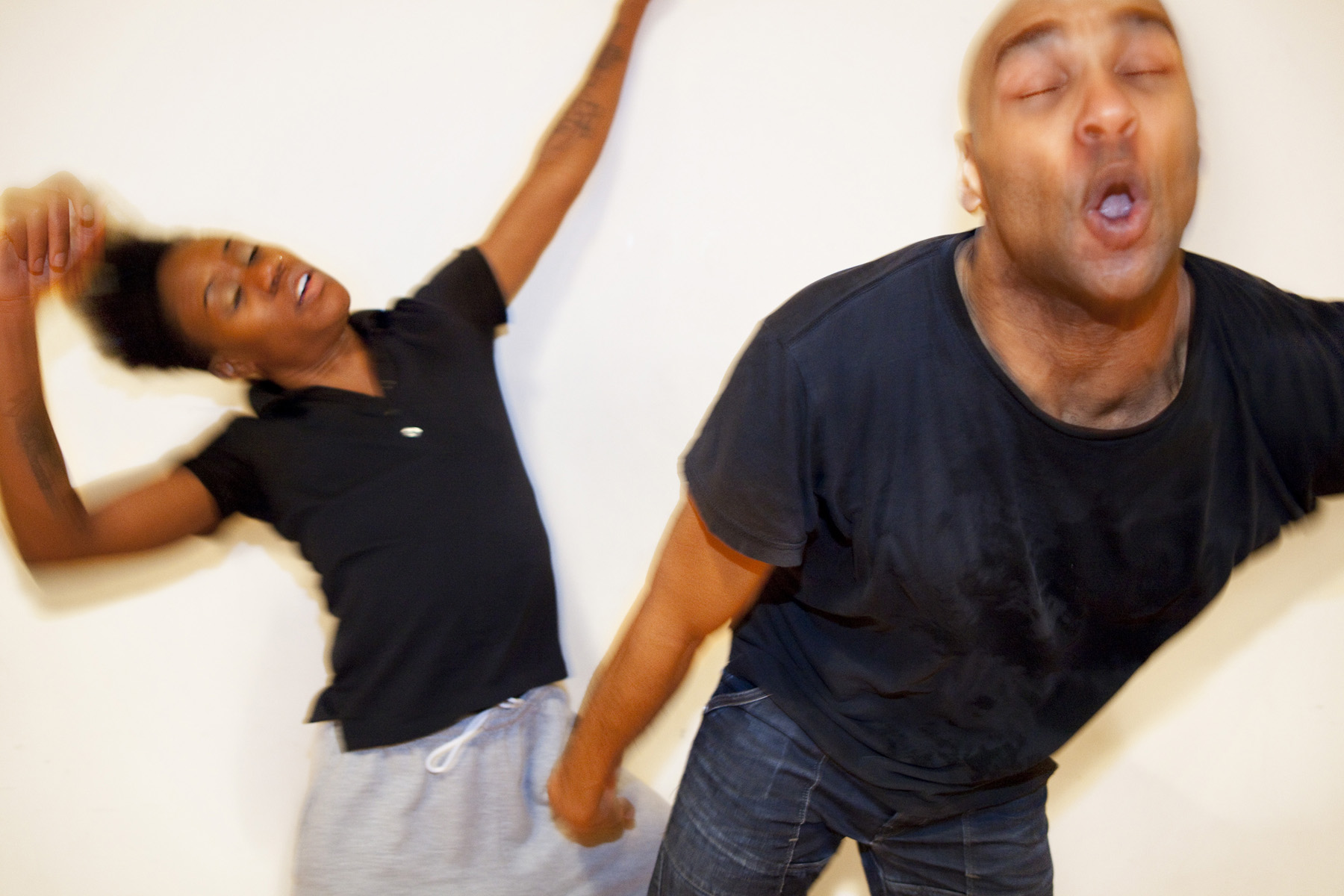
Ralph Lemon, the acclaimed choreographer/visual artist, recently presented How Can You Stay in the House All Day and Not Go Anywhere? (October 7-10) at the Yerba Buena Center for the Arts. After the Fri/8 show, Angela Mattox, the space’s Performing Arts Curator, led a question-and- answer session with Lemon and the performers. One audience member asked about a section where video images of animals walked across a screen. First came a dog, then Lemon clad in a rabbit suit, then a flamingo, continuing with an assortment of animals including a giraffe and a walrus. The question pertained to the motivation of the scene. Jim Findlay, the video designer, responded that Lemon’s only direction had been to create grace. At this point Mattox, the curator, began to cry, touched deeply that an artist would strive for grace. The event was moving to witness, but I left with a nagging question: what exactly is grace?
Grace carries a variety of connotations. Lithe ballet dancers are described as graceful. Many religious denominations seek God’s grace. A grace period is an extension of a due date. But grace also seems to be something less tangible, a mixture of elegance, good favor, moral stamina, and honor. I don’t know exactly what grace is. I don’t know what it means to create grace, especially in a dance context. I don’t know if Ralph Lemon’s show achieved grace.

How Can You Stay in the House All Day and Not Go Anywhere? featured both a film with live narration by Lemon and a performance with dancers. In the film, Lemon talked about his eight-year collaboration with centenarian Walter Carter and his wife Edna of Bentonia, MS. Mirroring Russian filmmaker Andrei Tarkovksy’s 1972 sci-fi romance Solaris, feeble and wobbly Walter and Edna reenacted some of the scenes in their mundane Mississippi home. In conjunction with Solaris’ romance between a cosmonaut and his dead wife and Walter and Edna’s enfeebled restaging, Lemon also spoke of the loss of his partner Asako Takami to cancer. The result was a meditation on love, loss, and reflections at the end of a lifetime.

The performance component consisted of four distinct sections. The first was a grueling tortuous dance that lasted 20 minutes. The dancers frenetically pushed themselves to exhaustion, endlessly throwing themselves through space with no seeming order. Succeeding that, performer Okwui Okpokwasili sobbed uncontrollably for eight minutes, her back convulsing as she faced away from the audience. This was followed by the above described animal video attempting grace. The show concluded with a contemplative sparse duet with Lemon and Okpokwasili. These four performance parts departed dramatically from the explicit film section, leaving the audience a performance section of perplexing bare minimalism.

http://www.youtube.com/watch?v=KS1PVIMpwLo

Did this all add up to grace? What struck me more than such aspirations was the sheer courage involved in presenting this material. It wasn’t created to be liked. It was created as a challenge, not to the audience, but to art itself. Can a twenty-minute dance with no form that pushes the limits of exhaustion be sustained? Is it watchable? People walked out of the performance. It takes great courage to present work that is not innately likeable.

The piece was also filled with humility. Particularly in the film section, it was as if Lemon had laid down on a table before strangers, sharing his intimate experience with loss, and Walter and Edna’s lifelong voyage together. Not only does it take guts to present that kind of subject matter and make oneself vulnerable, it also demands humility.

I suspect it is near impossible to create work embodying grace, love, courage, or any of those revered and venerated noble themes. But to paraphrase another point by Lemon in the question-and-answer session, it’s the struggle that’s important, more so than whether or not we succeed. 
 

Our Weekly Picks: October 20-26

0

THURSDAY 21

THEATER

“The Laramie Residency”

Just when you thought it was safe to come out of the closet, a chilling spike in suicide rates among gay teenagers who have been bullied or harassed has reemerged as national news. Which makes this rare double-header of The Laramie Project and its sequel, The Laramie Project: Ten Years Later, Epilogue uncannily apropos. Written in response to the notorious murder of Matthew Shepard, a young gay man in small-town Wyoming, both plays were created from hundreds of interviews with the inhabitants of Laramie. The results offer a detailed examination of how violence affects not only the perpetrators victims, but an entire community. “The Laramie Residency” also includes a special Thursday dialogue between director and coauthor Moisés Kaufman and Tony Taccone of the Berkeley Rep. (Nicole Gluckstern)

Thurs/21, 7 p.m.; Fri/22–Sat/23, 8 p.m., $10–$55

Jewish Community Center of San Francisco

3200 California, SF

(415) 292-1233

www.jccsf.org

FILM/PERFORMANCE

All About Evil: The Peaches Christ Experience in 4-D”

Horror fans are well familiar with the tag line for Wes Craven’s 1972 Last House on the Left: “To avoid fainting, keep repeating ‘It’s only a movie … It’s only a movie…'” Well, it wouldn’t be Halloween in San Francisco without Peaches Christ, whose alter ego, the less-flashy but no less fabulous filmmaker Joshua Grannell, brings his All About Evil to life at the very Mission District theater where it was shot. The film and its accompanying pre-show performance have been out roaming the U.S. and the U.K. for the past several months; expect the hometown gig to be extra-specially spooky, with musical and multimedia numbers by Peaches and Evil cast members. And since the Victoria plays an important supporting role in the film, expect interactive surprises galore. Only a movie? Don’t be so sure! (Cheryl Eddy)

Through Sun/24

8 p.m., $20

Victoria Theater

2961 16th St, SF

www.peacheschrist.com

MUSIC

Joshua Bell with the San Francisco Symphony

An average street performer isn’t always average. In 2007, the acclaimed violinist Joshua Bell participated in an experiment in which he played for 45 minutes as an anonymous busker in the D.C. Metro. The few who bothered to pause in their morning bustle and pull out their headphones realized they were in the presence of greatness. Renowned worldwide, virtuoso Bell joins the San Francisco Symphony in Bruch’s Violin Concerto No. 1. Conducted by James Conlon, the evening also includes Wagner’s Prelude to Act I of Die Meistersinger von Nürnberg, as well as Dvorák’s In Nature’s Realm and the overtures to Carnival and Othello. (Emmaly Wiederholt)

Thurs.–Sat., 8 p.m.; Sun, 2 p.m., $15–$150

Davies Symphony Hall

201 Van Ness, SF

www.sfsymphony.org

MUSIC

Steve Lawler

You can either love or hate seminal Ibiza club Space, and there’s been plenty of room to do both in its 20-year history. But just when you throw up your hands in a bad way at all the astringent trance, tipsy Brits, and noodling minimal, boom!, a DJ comes along who can drag you back to the dance floor. Rightly respected Brit Steve Lawler, known as the “King of Space,” scored that tiara by leapfrogging styles and keeping his sets limber. There’s some fluttering bass, chunky old-school breakdowns, and searing tech in his bag as well as, gasp, snippets of wistful melody. Lawler especially rocks the hard-driving, samba-esque Spanish-Berlin sound that’s become Ibiza’s best recent export. (Marke B.)

9:30 p.m., $10–>$20

Vessel

85 Campton Place, SF

(415) 433-8585

www.vesselsf.com

DANCE

Kunst-Stoff and LEVYdance

Dancers are famous for their kinesthetic memory. Without activating the brain, their muscles recall whole dances — or at least fragments. Show them a step or two and the rest follows. But dancers also seem to be able to dig even deeper, into something akin to an ancestral memory. It may take personal affinity but also a lot of hard research to unearth the kind of treasure trove that then can be used creatively. Two temperamentally different choreographers, Yannis Adoniou, of Greek descent, and Ben Levy, from a Jewish-Persian family, have done the excavations. Adoniou’s Rebetiko, commissioned by CounterPULSE’s Performing Diaspora Program, and Levy’s Our Body Remembers should make for an intriguing evening of might be called “kinetic history.” (Rita Felciano)

Through Oct. 30

Thurs.–Sat. and Sun/24, 8 p.m., $18

ODC Theater

3153 17th St., SF

(415) 863-9834

www.odctheater.org

FRIDAY 22

MUSIC

Stone Foxes

Let’s talk foxes, shall we? The native gray one is uncommon in San Francisco. The exotic red species, however, is a regular interloper of the Presidio. The Stone Foxes, four young dudes who play mean blues, are more like the former: genuine, rare, and always a treat to see in the wild. Sometimes you don’t want indie or nu-gaze or psych-doom-metal — you simply need real rock ‘n’ roll. Their sophomore album Bears and Bulls was released this past July, and though not as raw as their killer debut, it exudes a new and natural confidence. This is their official vinyl release show, so bring extra cash. (Kat Renz)

With Soft White Sixties and Real Nasty

10 p.m., $12

Bottom of the Hill

1233 17th St., SF

(415) 621-4455

www.bottomofthehill.com DANCE

Paco Gomes and Dancers

In his choreography, Brazilian-born Paco Gomes speaks with a powerfully articulated and mature voice. His dances beautifully integrate modern and Afro-Brazilian influences; as a company director he gathers around him — and trains — multi-ethnic dancers who seem to thrive under his tutelage. Now, with guest choreographers Jorge Silva and J. Pazmino, Gomes is presenting Amor O, an evening of works old and new that circles around love: of self, of friends, and also as remembered and lived within families. In addition, the program includes an excerpt of a new work in progress planned for an upcoming international tour. It examines love within another “family,” the Orixas, from the Yoruba religion. Perhaps it’s a consolation that in the world of the gods, not everything went smoothly either. (Felciano)

Through Sat/23

8 p.m., $15

Garage

975 Howard, SF

(415) 518-1517

www.975howard.com

MUSIC

Karl Blau

Eclectic K Records artist Karl Blau throws a wrench into the indie/folk scene with a chameleon-like ability to work within multiple genres. Ignoring the usual expectations of singer-songwriter stereotypes, Blau is known to inject everything from hip-hop and electronic influences to world and reggae music into his solo albums. He’s also worked with some notable names in Phil Elvrum (The Microphones, Mount Eerie) and Laura Veirs. Blau can currently be found playing bass for droney doom-metal band, Earth. It’ll be interesting to see how he melds all these elements together in a live setting. (Landon Moblad)

With Dina Maccabee and Birds and Batteries

7 p.m., free ($5 donation suggested)

Viracocha

998 Valencia, SF

(415) 374-7048

www.viracochasf.com

MUSIC

Lyrics Born

If it was any other rapper describing his newest album as “more synth-oriented” and “dealing with a lot of issues that are more mature than the last few albums, from abandonment to betrayal to incredible joy,” I’d say watch out for a lawsuit from one Mr. West. But since half of Latryx (with Lateef the Truthspeaker) and cofounder of Quannum Records, Lyrics Born is known for bringing his own brand of substance to the scene while pushing the genre forward. His new material, which features emerging artists Trackademicks, Francis and the Lights, and Sam Sparro, will be on display at this release party. (Ryan Prendiville)

With Chali 2na and the House of Vibe and Rakaa

9 p.m., $25

Independent

628 Divisadero, SF

(415) 771-1421

www.theindependentsf.com

SATURDAY 23

MUSIC

Triptykon

After almost 30 years in the arena, Tom G. Warrior has earned his status as heavy metal royalty. The Swiss singer and guitarist formed Hellhammer in 1982 and went on to found Celtic Frost two years later. Both bands contributed immeasurably to the development of extreme metal, and their influence reverberates throughout the genre today. Having parted ways with Celtic Frost in 2008, Warrior formed Triptykon, planning to pick up where Monotheist (Celtic Frost’s 2006 LP) left off. The new band’s music combines slabs of doomy guitar, razor-wire black metal, and Warrior’s paint-peeling vocals, breaking down genre boundaries in pursuit of heaviness. Come out and play. (Ben Richardson)

With 1349 and Yakuza

9 p.m., $23

Slim’s

333 11th St, SF

(415) 255-0333

www.slims-sf.com

EVENT

“SF DocFest Roller Disco Costume Party”

Have you ever stared longingly at the roller skaters in Golden Gate Park? Always wanted to join in but too embarrassed by your lack of boogie? Still hung up over the accident you had at a fifth grade skate party? Well, get over it. The Roller Disco Costume Party offers a simple solution: anonymity. As part of DocFest, admission is free with a ticket stub or just $5 if you strap on your best costume (which could potentially double as padding in case of collision.) (Prendiville)

8 p.m., free–$10

CELLSpace

2050 Bryant, SF

www.sfindie.com

MUSIC

Taj Mahal, Toumani Diabaté, Vieux Farka Touré

Tonight the Paramount plays host to a blues exploration featuring American bluesman Taj Mahal, Malian kora player Toumani Diabaté, and Malian guitarist Vieux Farka Touré. To trace the roots of the blues immediately leads to Africa, and in particular to Mali, and each of these three frontmen represents a different facet of that exploration. Mahal has spent decades reinterpreting the blues through far-flung musical traditions from the Caribbean and Hawaii to Europe and Latin America; Diabaté brings to the fore the centuries old West African tradition of the kora; and Touré, the torch-bearing son of the late Ali Farka Touré, represents a more recent cross-pollination of traditional Malian sounds with American blues and rock. While each of the three musicians is a monster in his own right, together they represent a veritable blues trifecta. (Mirissa Neff)

8 p.m., $25–$75

Paramount Theatre

2025 Broadway, Oakl.

(510) 465-6400

EVENT

“B.Y.O.Q.: Bring Your Own Queer”

Gurla-Q, you better bring it: a cavalcade of queer artists, musicians, and performers is avalanching Golden Gate Park for a full day of heady debauchery. Vinyl soul from the Hard French party DJs, homo-futurist sounds from Honey Soundsystem, Las Bomberas de la Bahia’s Afro-Puerto Rican percussion and dance, local indie faves Excuses for Skipping, fashion shows, a candygram booth, art displays, and so much more to turn you hot pink with multitasking. Plus, special guest John Cameron Mitchell giving you Hedwig fierceness. The annual B.Y.O.Q. has been a sweet, sweet success, conjuring up the activist days of yore while introducing some amazing new talent. Don’t wrap your internal pansy up in a plain brown bag, let her shine and shine. (Marke B.)

Noon–6 p.m., free

Golden Gate Park Music Concourse, SF

www.byoq.org

SUNDAY 24

MUSIC

Reigning Sound

Reigning Sound burst out of the gates in 2002 with the garage-punk classic, Time Bomb High School. Since then, the Tennessee-based group — performing as part of the ninth Budget Rock festival — has continued to refine its brand of country, soul, and classic R&B touches by way of organ-filled, distorted guitar-driven rock ‘n’ roll, most recently on 2009s Love & Curses. The band also recently backed up original Shangri-la member Mary Weiss on her 2007 comeback album, further evidence of the range its capable of. As far as modern garage rock goes, Reigning Sound is as classy and fun a group that you’re likely to find. (Moblad)

With Flakes, Ty Segall, and Touch-Me-Nots

9 p.m., $15

Bottom of the Hill

1233 17th St, SF

(415) 621-4455

www.bottomofthehill.com 

The Guardian listings deadline is two weeks prior to our Wednesday publication date. To submit an item for consideration, please include the title of the event, a brief description of the event, date and time, venue name, street address (listing cross streets only isn’t sufficient), city, telephone number readers can call for more information, telephone number for media, and admission costs. Send information to Listings, the Guardian Building, 135 Mississippi St., SF, CA 94107; fax to (415) 487-2506; or e-mail (paste press release into e-mail body — no text attachments, please) to listings@sfbg.com. We cannot guarantee the return of photos, but enclosing an SASE helps. Digital photos may be submitted in jpeg format; the image must be at least 240 dpi and four inches by six inches in size. We regret we cannot accept listings over the phone.

Dream, dream, dream

0

MUSIC Deerhunter’s new album is the most cohesive in the group’s young career. Compared to the booming opening seconds of 2008’s Microcastle, the lead-in to Halcyon Digest (4AD) is downright mousy. A simple drum machine sputters in and out like a robot clinging to life before a dreamy guitar line sets the scene for five minutes of textured feedback and a distorted vocal melody from lead singer Bradford Cox. It’s a pretty start to what is often a stunningly beautiful album.

Gone (for the most part) are the more brawny, driving moments of Microcastle and the My Bloody Valentine-style shoegaze tracks from its accompaniment, Weird Era Cont. The new material has more in common with the mellower, head-in-the-clouds style of Atlas Sound, Cox’s solo project. But perhaps the biggest stride comes in the full embracement of hooks and melodies that were often buried in previous efforts. This is a pop album through and through, in the best sense of the word.

Tracks like “Don’t Cry” and “Basement Scene” evoke squeaky-clean 1950s artists like Buddy Holly and the Everly Brothers if they’d been doped up on morphine. Elsewhere, the sparse five minutes of “Sailing” drift by on little other than Cox’s bare vocals, largely stripped of the megaphone distortion and short-echo slapback found throughout most of the album.

Fans will most certainly also notice the band’s expanded sonic palette. Self-recording in its home base of Athens, Ga., Deerhunter enlisted the Midas-touch mixing help of Ben Allen, known for his glossy stamps on Gnarls Barkley recording and Animal Collective’s Merriweather Post Pavilion. Thrown into the band’s customary psychedelic haze is everything from banjo (“Revival”) and saxophone (“Coronado”) to what sounds like a harpsichord on “Helicopter.”

It should be interesting to see how this new album plays out onstage. So much discussion over the past few years has mentioned the ferocity of Deerhunter’s live show — Karen O of the Yeah Yeah Yeahs once referred to it as a near-“religious experience” in the NME. The band will have to find a bridge between its known intensity and the more hushed attention to songwriting found on Halcyon Digest. Considering these guys have yet to take a single misstep, I’m thinking it won’t be a problem. 

DEERHUNTER

With Real Estate, Casino vs. Japan Fri/29, 9 p.m.; $17

Great American Music Hall

859 O’Farrell, SF

(800) 225-2277

www.gamh.com


Also Sat/30, 9 p.m., $17

Slim’s

333 11th St, SF

(800) 225-2277

www.slims-sf.com

Summer in the fall

0

arts@sfbg.com

MUSIC As I sit sipping some morning coffee, Elizabeth Morris of Allo Darlin’ is wrapping up an unseasonably sunny London afternoon. “I don’t know what’s happening, but it’s really warm weather,” she says over the phone. “The last week was really cold and miserable, and then the last two days have been absolutely beautiful.”

It seems fitting to be discussing Allo Darlin’s self-titled album with Morris on a day when the sun won’t be denied. You’d be hard-pressed to find a more perfect “summer” album released in October. Full of shimmery electric guitar, tambourine shakes, and bass lines that would sound at home on lost Motown cuts, the group’s music oozes charm, occupying some sort of space between Belle & Sebastian and a modern, garage-y spin on the Shangri-Las. Out at the forefront of it all is Morris with her ukulele and enchanting vocals.

Originally born and raised in Australia, Morris moved to London five years ago, shortly after finishing school in Brisbane, hoping to do something with the songs she’d begun writing. In Brisbane, Morris doubted her talents and ability to fit in, but London’s music scene proved to be a much more fertile ground for her. “Brisbane at the time was really grunge-y, noise rock, avant-garde kinda stuff — which is cool, but I felt really out of place and would never have felt confident playing little pop songs,” she explains. “I’d definitely written a bunch of songs, but I thought they were all pretty much rubbish. I didn’t feel like I’d written anything good until I moved to London.”

Once settled in London, Morris fronted the Darlings, a group made up of coworkers from the TV and film sound production facility she worked at. After that group dissolved, she began playing solo before winding up with a backing band made up of friends of friends, brothers of friends, and members of some of her favorite local bands. It all came together with a little help from the Boss.

“I was asked to do a Bruce Springsteen song for this tribute compilation and I knew Paul (Rains, Allo Darlin’ guitarist-keyboardist) was really into him. So I asked if he wanted to do this song with me, and that’s kinda how I got started playing with these guys. So we were brought together by Springsteen,” Morris says with a laugh.

In the interview, Morris talks excitedly about some of her musical loves: Jonathan Richman, Steve Martin’s banjo playing, the Go-Betweens, old reggae. She and her bandmates share an affection for Yo La Tengo and their parents’ old Beach Boys’ records. Her earnest and enthusiastic admiration mirrors the tone of her lyrics, which play a major role in making Allo Darlin’ fun. One minute she’s combining lines about love and chili, the next she’s breaking into a verse from Weezer’s “El Scorcho” or singing what’s gotta be the first pop song ever written about Ingmar Bergman’s Wild Strawberries (1957). Her lyrical style is clever and unique — by turns romantic, silly, pensive, or yearning.

“I kind of always write from emotion or feeling rather than anything else. I never really sit and write things in a notebook or compose words,” Morris says. “I’ve tried to write story-songs or songs about characters, but it just never really works. I’m not very poetic, I guess. I’m better at seeing things how they are, trying to put them into words with a nice melody and seeing what happens.”

Allo Darlin’s upcoming tour marks the group’s third trip to the U.S., but it’s their first time in California. Despite the impersonal nature of a phone conversation, Morris’ excitement is palpable. She’s even picking up some American slang. “All the bookers say ‘psyched’ — like ‘We’re psyched that you’re coming.’ It’s really cute,” she says, laughing.

“So yeah, we’re psyched to be doing the West Coast.”

ALLO DARLIN’

with Eux Autres, Terry Malts

Wed/27, 8 p.m.; $10

Rickshaw Stop

155 Fell, SF

(415) 861-2011

www.rickshawstop.com

How they’re sitting

182

caitlin@sfbg.com

I’ve been hanging out with the Haight Street kids. Over the course of a week or so, I smoked weed, drank malt liquor, witnessed nasty run-ins with police officers — all events that anyone who has walked down the sidewalks of that legendary street would expect. But I also met people who’d give away their last dollar to a friend, people who know a thing or two about community, and people who don’t see sidewalks only as thoroughfares to commerce.

Ironically, though the homeless kids on Haight are the explicit inspiration for Proposition L, the sit-lie measure on the Nov. 2 ballot, their voices have been significantly absent from the vitriolic debate on its merits and faults. Ironic because of all people, it’s these young men and women — and the citizens of San Francisco who interact humanely with them — who could teach us the most about what public space in San Francisco could be.

I didn’t just stand with a notebook, fire questions, and walk away. I took a seat and spent time with the kids, to see for myself whether its true that they’re harassing people, letting their dogs run amok, and generally ruining everyone’s lives as much as sit-lie supporters say they are. That it turned out to be uplifting was an added bonus. I got to see what many don’t on their way to shop for souvenir bongs, retro dresses, and designer skateboards — the reason young people from around the country come to the neighborhood.

It doesn’t have anything to do with fancy Victorians and boutiques, which may explain the disconnect between the street kids and their detractors. They come for the legacy of individuals brave enough to slough off social mores that Haight-Ashbury residents are so ostensibly proud of — not to mention the companionship of others who are comfortable with their rejection of and by society. They come to share stories and pipes and encouragement, and it was cool to watch a streetscape in San Francisco that wasn’t geared solely to commerce.

And while the young people I talked to told me how much they liked to travel, to live free of convention and without ties to the workday world, after a while most acknowledged that they had left behind families who couldn’t or didn’t care for them, home situations that were uncomfortable enough to make life on the streets seem like a better alternative.

Although violent incidents, uncivil behavior, and threatening dogs are well-documented by other news sources, I didn’t see any of that when I was hanging out on Haight. That doesn’t mean that these things don’t exist — but it might suggest that some of the strident supporters of Prop. L are seeing what they want to see.

SPANGING

Steven, who asked us not to use his full name, is 20 and homeless. He grew up in Stockton, became a welder after high school, then decided he “didn’t want the hassle” of staying put for a wage job. His fingernails play host to an ungodly amount of dirt, but his tight blonde curls, pretty golden eyes (“they look like a lion’s!” says one friend in amazement) and mellow, generous demeanor make him a popular hub among his homeless peers.

It doesn’t hurt that he sells weed, small amounts at a time to passing tourists and acquaintances. He silently passes a pipe around to his companions with the slightest provocation. Steven approached me on the street before he knew I was a journalist, a fact that seemed to make little difference to him.

He says he came to the Haight “for the people,” for the area’s reputation of open souls and unconventional artists that originated in the glory days of Janis Joplin and the Grateful Dead. Like most of the kids I talked to, he eschewed the often dangerous shelter scene to sleep in Golden Gate Park or nearby Buena Vista Park despite the police surveillance that could result in spendy fines for park camping.

Although Steven’s worldly possessions fit into the large camping backpack he carries with him 24 hours a day, and even though he’s been living on Haight less than nine months — broken by a jaunt to Eugene, Ore., where he found it “too rainy” to join the town’s expansive street kid community — he doesn’t plan on being homeless forever. It’s just that nothing about this economic climate inspires him to sell his freedom for a paycheck. He plans to go to a four-year college eventually. He sees an education as the only way to get a “real” job. “But until then, why not do this?” he asks. I’m not sure if he’s waiting for my answer.

“This” is sit on Haight Street and “spange,” the term used for “flying a sign” and asking shoppers and neighbors walking by for money, often in a creative way. Of the many crimes street kids are guilty of in the eyes of supporters, spanging is the only one Prop. L would effect.

If Francisco voters approve it, anyone who sits or reclines on the sidewalk (with exceptions for the handicapped and those with permits — but not for the tired, workers on breaks, or people waiting for buses) will be subject to a fine of $50 to $100 for the first offense and $300 to $500, or a maximum of 10 days in jail, for someone found guilty twice within 24 hours of unduly supporting his or her body on the sidewalk between 7 a.m. and 11 p.m. Similar laws can be found up and down the West Coast — although Portland’s was pulled from the books last year after being found unconstitutional because it targeted the homeless.

I ask street kid after street kid why they’ve chosen this lifestyle. Many wouldn’t have it any other way. “Why do people want us off the street?” says Oz, a 21 year old from upstate New York who deals alongside Steven. “Probably because they can’t do this themselves.”

Though I’m skeptical at first, after a while I see why the unconventional group of “travelers” on Haight choose to spend their time spanging. Conversations get struck up with the most unusual people — the old hippie who bought a new Mad Hatter cap for the weekend, the suburban woman who might or might not like to buy some weed (she can’t decide). When a few businesses ask us to move so they can sweep the sidewalk or clear a doorway, the street kids I’m watching relocate with little protest. Many who walk past Steven seemed to find humor in his sign, which that day reads “Are you one paycheck away from having this be your job too?” He says he likes to switch his message daily. “Keep it fresh.”

By hanging out with the spangers, I get to see a Haight Street with human interaction at its core. People walk by, often dropping off surprisingly generous gifts: a ex-Grateful Dead roadie with a massive beard who lives in Fairfax and stopped by the neighborhood for a quick lunch with his daughter parks in front of Steven’s group and approaches them. “You kids hungry? You look like you could use a pizza.”

He emerges a half-hour later with a large cheese pie and drives away after chatting for a few minutes about the old days, to the glee of the group (many of the street kids are Dead Heads). The kids eat their fill, then start handing out the remaining pizza to people walking by, a comic role reversal. “I like to support the community — they get back all the money they get sucked out of them,” Steven tells me.

“NARCOTIC FUELED, ANTISOCIAL THUGS”

The campaign to put a sit-lie ordinance into effect in San Francisco kicked into gear with a Saturday morning stroll. As San Francisco Chronicle columnist C.W. Nevius — who regularly publicizes complaints against the Haight street kid culture — reported Feb. 27, Mayor Gavin Newsom recently relocated to the neighborhood and saw evidence of drug use on the main stretch of Haight where he was walking with his infant daughter. “As God as my witness, there’s a guy on the sidewalk smoking crack,” Newsom reportedly said.

The mayor threw his support behind a sentiment already being voiced by the Haight Ashbury Improvement Association, a resident-merchant alliance in the area. HAIA sees the street kids as disruptive outsiders. “These are not the flower children of the 1960s. It’s narcotic fueled, antisocial thugs who act like a quasi-gang,” Ted Loewenberg, president of the association, was quoted as saying in Business Week.

Adds the Prop L website: ” … the Haight-Ashbury district — once synonymous with peace and love — this corridor is now a hot spot for street bullies, pit bulls, and drug abuse.” It’s a deft cultural lobotomy that dissociates drugs from the Summer of Love, and a devious one that implies that street kids weren’t major players in that social revolution.

As for the bullies, I didn’t see any violence from the street kids in the days and nights I spent out on Haight Street.

I couldn’t get cops to talk to me about it, either. There were two police officers on foot traversing Haight’s main strip and I introduced myself when they stood chatting with a coffee shop owner in the afternoon sunshine and asked them about the sort of neighborhood complaints they regularly received about the street kids.

“No comment,” Cop No. 1 told me. Okay, Cop No. 2, your thoughts? “I don’t speak English.”

To my requests that they share their view of crime on Haight, I could get one response: “It’s complicated.” Later, when I returned to write down their badge numbers, they were standing silently, staring at a lone young man sitting against a wall next to his skateboard. The kid was looking at the ground. Eventually they handcuffed him and put him in a police car while he pleaded meekly about it “only being a little bit of weed — and I was only skateboarding on the sidewalk.”

The most aggression I witnessed from any party took place while I was tapping my feet to a group of traveling bluegrass musicians performing around 10 p.m. on a Thursday. Their cover of Del Shannon’s “Runaway” had inspired an older homeless man to strike up a curiously graceful stomp dance on the sidewalk. He was so drunk and fully immersed in the music that the bottle of Jim Beam in his flailing hand didn’t even register when the police officer approached him and asked, “What do you think you’re doing?”

The musicians began to pack up. “I could have told you this would happen 20 minutes ago,” one tells me, nodding toward the old man. “Don’t say a word or I’ll fucking take you in,” said the cop, who poured out the half-full bottle and wrote a ticket for the older man, who had made a few feeble protests that ended abruptly with the cop’s obscenity.

The officer said he’d received a complaint about the music, a line I heard from each cop I came into contact with on Haight — including one officer who cautioned a family with a toddler to pack up the bracelets they were selling to pay the towing charges on their van. “People don’t like to see people with kids out here, you better move it along,” the cop said.

“I’ve seen aggression because people start shit,” Steven tells me when I ask him about his experience with street violence. A man has just walked by chanting “dirty, dirty” in Steven’s and his friends’ faces. “They don’t like to see people sit on the ground.”

“There are people who come down here just to make themselves look better,” chimes in Oz. “Like ‘ha ha ha, I have air conditioning.’ All kinds of people start shit”

I asked if they knew they were the focus of a massive political debate in San Francisco. “No, what debate?” asked Steven.

“You mean sit-lie?” Oz asks. “It probably has to do with tourism. I don’t see why else they would do that.”

Even the most well-known recent case of Haight Street violence — which was reported June 11 by New York Times reporter Scott James as having “inspired a grass roots movement” that propelled Prop. L, seems to be a question of mutual aggression on the two sides of the street kids issue.

The story goes that a man named Thomas was hosing down the sidewalk in front of his house — a practice that is growing more common in the Haight to make property inhospitable to the homeless. He found himself “surrounded and engaged in a heated confrontation,” as James reports. Thomas reportedly shouted “Do you want a piece of me?” and a scuffle erupted between him and Chad Potter, a 26-year old homeless man, culminating with Potter being arrested and set free the next day. Thomas says Potter and friends continued to harass him after the incident.

James Orr, 24, is busking with his flute when I meet him sitting by a store that sells flowing hippie skirts and bumper stickers that command future tailgaters to “Coexist.” He’s looking to trade his wind instrument for a banjo, which he plays in addition to guitar. A rolling stone, Orr is in town for the Hardly Strictly Bluegrass festival that weekend — he travels the country going to festivals, and even scored a job recently at upstate New York’s Mountain Jam for the event’s blog site, taking photos with a borrowed camera of performances by (ex-member of The Band) Levon Helm and Michael Franti.

Orr’s quite erudite and eager to “say something articulate” about the situation of the street kids and travelers on Haight. He tells me that yeah, he’s seen aggression go down here on occasion. But he resents those situations leading to laws against sitting on the street.

“It’s another example of the few that do mess up casting a bad light on everyone else. Most of us just want to make some money, put a smile on someone’s face.” As a busker, he finds it baffling that people who are against the presence of the homeless would want him to stop plying his trade by making sitting illegal. “You should point out also that it’s how we make money!” he exclaims.

THE PIT BULLS

Snarling ruffians on frayed rope leashes stalking the city streets! As evidenced by the Civil Sidewalks campaign, dogs — specifically pit bulls — are another source of controversy on the pavement. Last December, SFist identified a C.W. Nevius tirade against the breed as example of its ongoing feature “Pit Bull Hate Watch.” The paper has pointed out that the demonized dogs can make great members of society and are often the subject of a media smear campaign.

But for many homeless youth, their dogs aren’t the means of imposing chaos on the gentry. They keep them for the same reasons we do: friendship, protection, love — and during the days I spent on Haight, it was a pleasure to pat the doggies while interviewing their owners. Most were as gentle and laid back as the kids they sprawled next to, a reasonably expected result from the 24 hours a day of socialization with humans that the homeless lifestyle affords.

Smiley is an inveterate street kid unlikely to go indoors anytime soon. “I don’t know how to do anything else,” she tells me. Now in her early 20s with a shock of magenta, purple, and dirty blonde hair and fanciful purple ear plugs that pierce her lobes before spiraling nearly to her shoulders, she’s been traveling since she was 12 — “a Bohemian by blood,” as she puts it. Not only did her parents move their household regularly throughout her childhood, but their heritage is Romani, from the traveling tribes of Eastern Europe.

For Smiley, travel outside the bounds of business trips and weekend vacations is her life’s norm, and Haight Street’s legacy resounds in her nomadic soul. “Most of the people that travelers idolize were here,” she tells me.

Smiley has a year-old behemoth black mutt with droopy eyes. He obliges her as she leans into him holding her spanging sign, which tells the world the pup needs Benadryl for an upcoming van ride to Southern California. “He’s carsick,” she tells me sheepishly. She admits that the dog can limit her mobility on public transportation, but his benefits outweigh his cost. He keeps her warm at night — and, more important for a young woman who is often on her own, he protects her. For a moment breaking out of tough girl mode, she tell me, “oh yeah, I don’t have to worry about anything when he’s around.”

We talk about the perceived threat of dogs on Haight Street. “They want us to leash them, which I guess I understand — but look at that!” A well-dressed woman in her 40s has her Chihuahua off its leash and it has run into the busy street, with her in hot pursuit. “That dog’s out of control,” Smiley smiles.

PISS

Sitting against a mural on a wall where Haight meets Clayton, I watch Piss, an outgoing, gangly guy in his early 20s with a curly blonde mohawk in a growing-out stage. I ask him where he got his unusual moniker. “I like to get drunk and piss on things,” he says.

Well. Originally from Billings, Mont., Piss has been traveling since his mid-teens. “Let’s just say me and my family don’t get along,” he tells me.

His answers to my questions about why he’s on the streets follow a path I see with many of the younger homeless youth: they insist that the lure of the open road was too hard to ignore, but eventually reveal that their parents kicked them out or were unable to care for them at a young age. Many, like Juju, another small-time weed dealer I met, bounced from family member to family member until frictions with them and their significant others left no recourse but the street.

Piss says he’s been to every state in the country, plus Canada and Mexico. With so many years on the road, he is, as they say, letting his freak flag fly. Piss has a blue, vaguely tribal tattoo that curls around his right eye. He’s wearing white tube socks on the dirty pavement. At first glance, he could be crazy — and maybe he is. Whatever his motivation for travel, it’s not to blend in with the locals.

Piss is also actively spanging passersby in a manner that oscillates between off-putting and charming. “You got some money for some crack and ice cream?” he inquires of a passing trio of young women. They shake their head, but before they’re gone completely he continues “I’m just kidding! I don’t like ice cream! Hey miss, you have a nice ass … day!”

Over the course of the hour that I watch him a stand up routine emerges. Beneath the grime, he’s a charismatic kid with an enviable sense of comedic timing.

As he ranges up and down a 20-foot stretch of sidewalk, belly laughs are elicited from a few targets, dollars surfacing here and there. One man carrying an accordion and wearing an expensive-looking pair of leather Chaco sandals donates a handful of strawberries to Piss and to those of us acting as his entourage.

But Piss’ play is a little rough — like a big puppy — and he’s alienating the people who don’t crack up over crack. A couple of people walk away quickly from his petitions shaking their heads over one of the zingers, their suspicions confirmed about those rowdy Haight Street kids.

He’s not doing anything more than what young travelers do all over the world. Thousands of families bid see you later to young adults en route to Prague, Peru, and Perth each year, where they lug their dirty backpacks through the world’s most wondrous towns.

Of course, these kids aren’t sleeping in the public parks of Cuzco — but in countries with plenty of cheap travelers’ hostels, you don’t have to. And though international flights cost more than the van rides and freight train hops that brought in most of the Haight Street kids, backpackers abroad do the same things: take fewer showers and flaunt social norms — not because they want to cause a problem for the natives of the lands they pass through, but because they are young, and discovering themselves for the first time, and can’t see much past that. Piss isn’t being violent, but he has lost the language to deal with “normies” and he’s seen as unpredictable to the not-traveling, not-disenfranchised around him. Which to those who see public space as a place that should be predictable, mean he’s a threat.

The clash between the settled and transient in the Haight is not new. Indeed, it’s what made the neighborhood famous. As far back as the mid-1960s, officials have been simultaneously fighting and publicizing the Haight’s worldwide reputation as a traveler’s meeting place, a place with a culture of loosened societal moorings and enlightenment through free love, drugs, and art.

Businesses claim that the omnipresent homeless drive away paying customers from Haight Street. It a curious claim in an area where the vagrant hippie culture made the place the tourist attraction it is today, and one that is belied by the entry of Whole Foods, which plans to open a branch this year at a lot at Haight and Stanyan vacant since 2006. When contrasted with the Tenderloin — another neighborhood with a visible street community — and its chronic problems attracting a grocery store, the Haight street kids’ effect on local commerce doesn’t seem to be all that grave.

They certainly aren’t making the place any less desirable of a neighborhood to live in for the wealthy. Real estate website Trulia.com puts the median listing price for homes in the Haight-Ashbury neighborhood at $962,264.

The Haight Street kids I spoke could all too easily see what sit-lie would mean for San Francisco. When you control public space, you control who is in public space — and they have no illusions about whether or not they’re included in the perfect world of those who push the measure. If it’s enacted, the subculture that made Haight famous — part of which still survives today in a different form — would be gone, leaving it sterile and safe for the head shops and clothing boutiques, an even less authentic version of the ’60s love fest their patrons come to the street for. One wonders if a scrubbed-clean Haight is even what the residents and business owners who have thrown their lot behind sit-lie truly want, or if they’ve been duped into sit-lie’s efficacy by the same forces that on a national level have convinced us that curtailing civil liberties will lead to freedom for the real Americans. It comes down to this: What do we want Haight Street to be? Do we want to capitalize and benefit from the accepting, messy, wildly creative legacy the 20th century endowed our streets, or do we want a clean, friendly, outdoor mall? The powers of homogenization and gentrification can demonize the little heathens on Haight Street all they want, but they’ve miscalculated if they think that they don’t belong in San Francisco — after all, Haight created them, not the other way around.

Our 44th Anniversary Issue also includes stories by Sarah Phelan on SF’s disadvantaged youth, Rebecca Bowe’s look at ageing out of the foster care system, and Tim Redmond’s editorial on the issues facing our rising generation

Stage listings

0

Stage listings are compiled by Guardian staff. Performance times may change; call venues to confirm. Reviewers are Robert Avila, Rita Felciano, and Nicole Gluckstern. Submit items for the listings at listings@sfbg.com.

THEATER

OPENING

Dracula’s School for Vampires Young Performers Theatre, Fort Mason Center, Bldg C, Third Floor, Room 300; 346-5550, www.ypt.org. $7-10. Opens Sat/23, 1pm. Runs Sat, 1 pm; Sun, 1 and 3:30pm. Through Nov 14. Young Performers Theatre presents a Dracula comedy by Dr. Leonard Wolf.

BAY AREA

Dracula Center REPertory Company, 1601 Civic, Walnut Creek; (925) 943-SHOW, www.centerrep.org. $36-42. Previews Fri/22-Sat/23, 8pm; Sun/24, 2:30pm. Opens Tues/26, 7:30 pm. Runs Wed, 7:30pm; Thurs-Sat, 8pm; Sun, 2:30pm (also Nov 20, 8pm). Through Nov 20. Eugene Brancoveanu stars as the Count in a production directed by Michael Butler.

The Great Game: Afghanistan Roda Theatre, 201 Addison, Berk; (510) 647-2949, www.berkeleyrep.org. $17-73. Call for times. Through Nov 7. Berkeley Rep presents the West Coast premiere of a three-part show about Afghanistan.

Winter’s Tale Live Oak Theatre, 1301 Shattuck, Berk; (510) 649-5999, www.aeofberkeley.org. $12-15. Opens Fri/22, 8pm. Fri-Sat, 8pm (also Oct 31, Nov, 7, and Nov 14, 2pm; Nov 18, 8pm). Through Nov 20. Actor’s Ensemble of Berkeley presents the rarely-performed Shakespeare play.


ONGOING

Absolutely San Francisco Phoenix Theatre, Stage 2, 414 Mason; 433-1235, www.absolutelysanfrancisco.com. $20-25. Fri-Sat, 8pm. Through Sat/23. A one-woman musical starring Karen Hirst, with book and music by Anne Doherty.

Anita Bryant Died For Your Sins New Conservatory Theatre Center, 25 Van Ness; 861-8972, www.nctcsf.org. $24-40. Wed-Sat, 8pm; Sun, 2pm. Through Sun/24. New Conservatory Theatre Center presents a show by Brian Christopher Williams.

Cat on a Hot Tin Roof Actors Theatre, 855 Bush; 345-1287, www.actorstheatresf.org. $26-38. Wed-Sat, 8pm. Through Fri/22. Actors Theatre presents Tennessee Williams’ sultry, sweltering tale of a Mississippi family, directed by Keith Phillips.

Christian Cagigal’s Obscura: A Magic Show EXIT Cafe, 156 Eddy; (800) 838-3006, www.brownpapertickets.com. $15-25. Thurs-Sat, 8pm. Through Dec 18. Magician Christian Cagigal presents a mix of magic, fairy tales, and dark fables.

A Funny Thing Happened on the Way to the Forum Eureka Theatre, 215 Jackson; 255-8207, www.42ndstmoon.org. Wed, 7pm; Thurs-Fri, 8pm; Sat, 6pm; Sun, 3pm (also Sat/16, 1pm). Through Sat/ 24. Although a little slow and awkward at the start, not long into 42nd Street Moon’s staging of Stephen Sondheim classic and classical (being inspired by the farces of Plautus) musical comedy (with book by Burt Shevelove and Larry Gelbart) you feel it’s making up in enthusiasm and grit what it lacks in Broadway-sized budgets. It helps that artistic director Greg MacKellan has assembled an able cast, especially in the principal roles. It can’t be easy to follow in the cavorting footsteps of Zero Mostel and Nathan Lane, but Megan Cavanagh has absolutely no trouble wooing the audience in the central role of Pseudolus, the clever slave bargaining and scheming for his freedom. Strong performances come too from Michael Rhone as fellow slave Hysterium (a name that speaks for itself), Bob Greene as horny paterfamilias Senex, and Rob Hatzenbeller as the self-loving captain Miles Gloriosus. Nice costuming (by Louise Jarmilowicz), a hint of Roman architecture (courtesy of set designer Jon Wai-keung Lowe), generally spiffy choreography (by Tom Segal) and jaunty musical accompaniment from musical director Dave Dobrusky and horn player Nick Di Scala all add lift to a gradual charmer of a show. (Avila)

Futurestyle ’79 Off-Market Theater, Studio 250, 965 Mission; (800) 838-3006, www.brownpapertickets.com. $15-20. Wed, 8pm. Through Oct 27. A fully improvised episodic comedy played against the backdrop of SF in 1979.

Habibi Intersection for the Arts, 446 Valencia; 626-2787, www.theintersection.org. $15-25. Thurs-Sun, 8pm. Through Nov 7. Intersection for the Arts and Campo Santo present the world premiere of a play by Sharif Abu-Hamdeh.

*Hamlet Alcatraz Island; 547-0189, www.weplayers.org. By donation. Sat-Sun, times vary. Through Nov 21. Outside of an actual castle, it would hard to say what could serve as a more appropriate stand-in for Kronborg castle of Helsingør—also known as Elsinore—than the isolated fortress of Alcatraz Island, where WE Players are presenting Hamlet in all its tragic majesty. As audience members tramp along stony paths and through prison corridors from one scene to the next, the brooding tension the site alone creates is palpable, and the very walls impart a sense of character, as opposed to window-dressing. Deftly leaping around rubble and rock, a hardy troupe of thespians and musicians execute the three-hour production with neat precision, guiding the audience to parts of the island and prison edifice that aren’t usually part of the standard Alcatraz tour package. Incorporating movement, mime, live music, and carefully-engineered use of space, the Players turn Alcatraz into Denmark, as their physical bodies meld into Alcatraz. Casting actress Andrus Nichols as the discontent prince of Denmark is an incongruity that works, her passions’ sharp as her swordplay, the close-knit family unit of Laertes, Ophelia, and Polonius are emphatically human (Benjamin Stowe, Misti Boettiger, Jack Halton), and Scott D. Phillips plays the appropriately militaristic and ego-driven Claudius with a cold steel edge. (Gluckstern)

Last Days of Judas Iscariot Gough Street Playhouse, 1620 Gough; (510) 207-5774, www.CustomMade.org. $10-30. Thurs-Sat, 8pm; Sun, 7pm. Through Oct 30. Custom Made Theatre Company presents the 2005 play by New York’s Stephen Adly Guirgis (Our Lady of 121st Street, Jesus Hopped the A Train), which places purgatorial Judas (Kristoffer Alberto Barrera) on trial to determine his deserved fate for dropping a dime on Jesus and all that jazz. Flamboyant, sycophantic and horny prosecutor El-Fayoumy (Ben Ortega) and defense attorney Loretta (Amelia Avila) call between them a series of brow-raising witnesses—including Mother Teresa (Brandy Leggett), Sigmund Freud (Catz Forsman), and Satan (Richard Wenzel)—as Judas (seated on the upper tier of Sarah Phykitt’s suitably imposing split-level set) stares stoically in relative silence or appears in a series of childhood flashbacks. Characteristically funny and streetwise, as well as versed in the Catholic rigmarole as filtered through a NYC-boroughs sensibility, Guirgis’s play is also unusually tedious in its jokey, poky unfolding since—offering not much more than a cipher in the largely mute Iscariot—the proceedings lack a strong sense of dramatic stakes. It feels more like a revue than a play, or like an unnecessarily long-winded excuse for the final, well-turned concluding monologue by a heretofore marginal character (a speech delivered with admirable understatement by director Brian Katz). (Avila)

Love Song Exit Theatre, 156 Eddy; (800) 838-3006, www.brownpapertickets.com. $20. Thurs-Fri, 8pm; Sat, 3 and 8pm. Through Sat/23. An offbeat comedy by John Kolvenbach, directed by Loretta Janca.

Mary Stuart The Ashby Stage, 1901 Ashby, Berk; (510) 841-6500, www.shotgunplayers.org. $15-30. Thurs-Sat, 8pm; Sun, 5pm. (also Wed/20, Oct 27, Nov 3; 7pm). Through Nov 7. Shotgun Players presents Friedrich Schiller’s historical drama, directed by Mark Jackson.

Nina and the Monsters Shotwell Studios, 3252A 19th; 509-8656, 509-8656. $10-15. Fri-Sat, 8pm (also Sun/24, 2pm). Ninjaz of Drama with Footloose present a modern-day fairy tale.

*Pearls Over Shanghai Thrillpeddlers’ Hypnodrome, 575 10th St; (8008) 838-3006, www.brownpapertickets.com. $30-69. Sat, 8pm. Through Dec 19. Thrillpeddlers’ acclaimed production of the Cockettes musical continues its successful run.

Proof Exit Stage Left Theatre, 156 Eddy; www.belljartheatre.com. $20. Fri-Sat, 8pm. Through Oct 30. Bell Jar Theatre presents David Auburn’s award-winning play.

*The Real Americans The Marsh MainStage, 1062 Valencia; (800) 838-3006; www.themarsh.org. $20-50. Wed-Fri, 8pm; Sun, 5pm. Through Nov 6. The fifth extension of Dan Hoyle’s acclaimed show, directed by Charlie Varon.

*Scapin American Conservatory Theatre, 415 Geary; 749-2228, www.act-sf.org. $10-90. Tues-Sun, times vary. Through Sat/23. Bill Irwin, the innovative former Pickle Family clown and neo-vaudevillian turned Broadway star, makes a San Francisco return at the helm—and in the title role—of American Conservatory Theater’s production of Moliere’s classic farce. It’s an excuse for some arch meta-theatrical high jinx as well as expert clowning, a love fest really, with many fine moments amid a general font of fun whose heady purity seems like it should fall under some FDA regulation or other—clearly, somebody has paid someone to look the other way, and for once the corruption is unreservedly welcome. Joining the fun is Irwin’s old comrade-in-arms and, here, sacks, Geoff Hoyle, as miserly and dyspeptic daddy Geronte. Other ACT regulars and veterans flesh out a winning cast, among them the ever versatile and inimitable Gregory Wallace as Octave, a flouncing Steven Anthony Jones as put-out patriarch Argante, René Augesen as boisterously unlikely “virgin” Zerbinette, and a wonderfully adept and scene-stealing Judd Williford in the role of Scapin sidekick Sylvestre. As for Irwin, his comedic sensibility shows itself scrupulously apt and timeless at once, and his sure, lithesome performance intoxicating and age-defying. As a director, moreover, he gives as generously to each of his fellow performers as he does to his adoring, lovingly tousled audience. (Avila)

The Shining: Live The Dark Room, 2263 Mission; 401-7891, www.darkroomsf.com. $7-10. Fri-Sat, 8pm. Through Sat/23. The Dark Room becomes the Overlook Hotel in this stage production of the horror classic.

*SHIToberfest Off-Market Theaters, 965 Mission; (800) 838-3006, www.brownpapertickets.com. $20. Fri-Sat, 8pm. Through Oct 30. This special October run of PianoFight’s bowel-loosening comedy series, the S.H.I.T. Show (for acronym fans, that’s the Stop Hating Imagination Time Show), revolves dizzyingly around the subject of beer, Germans and, perhaps less explicably, flatulent dolphins, among much else in the wide open seas of poor taste. Is it hilarious? It is. And you don’t even need to smuggle in a forty to make it so, though it certainly doesn’t hurt. Fine comic acting throughout a charismatic cast (including writer-director-producers Alex Boyd, Zach Cahn, Jed Goldstein, Ray Hobbs, Devin McNulty, Evan Winchester and Duncan Wold, with help from Nicole Hammersla, Gabrielle Patacsil, Rob Ready, Derricka Smith, Andy Strong, Jacque Vavroch and Dan Williams) combines here with generally solid to exceptional sketch work, video and song. Add in a permeating spirit of revelry, debauchery and irreverence and the evening becomes a diversion of the first order, culminating in an utterly sacrilicious sketch about a bunch of toasted beer-brewing monks treated to a papal visit—one of the best venial sins for your buck. When it comes to Octoberfesting this year, “Bavaria” is just S.H.I.T.–faced for Bay Area. (Avila)

Shocktoberfest!! 2010: Kiss of Blood Hypnodrome Theatre, 575 10th; (800) 838-3006, www.brownpapertickets.com. $25-35. Thurs-Fri, 8pm (Thurs/21, Fri/22, Oct 28, Oct 29, Oct 30, and Oct 31 include performances of The Forsaken Laboratory by the Brazilian Grand Guignol group Vigor Mortis). Through Nov 19. Thrillpeddlers’ seasonal slice of eyeball is comprised of three playlets variously splattered with platelets, all directed by Russell Blackwood and bridged by a rousing burst of bawdy song from the full cast. Rob Keefe’s Lips of the Damned (after La Veuve by Eugene Heros and Leon Abric) takes place in a rat-infested museum of atrocities just before the fumigating starts, as an adulterous couple—comprised of a kinky married lady (a vivacious Kara Emry) and a naïve hunk from the loading dock (Daniel Bakken)—get their kicks around the guillotine display, and their comeuppance from the jilted proprietor (Flynn DeMarco). Keefe’s delightfully off-the-wall if also somewhat off-kilter Empress of Colma posits three druggy queens in grandma’s basement, where they practice and primp for their chance at drag greatness, and where newly crowned Crystal (a gloriously beaming Blackwood) lords it over resentful and suspicious first-runner-up Patty Himst (Eric Tyson Wertz) and obliviously cheerful, non-sequiturial Sunny (Birdie-Bob Watt). When fag hag Marcie (Emry) arrives with a little sodium pentothal snatched from dental school, the truth will out every tiny closeted secret, and at least one big hairy one. Kiss of Blood, the 1929 Grand Guignol classic, wraps things up with botched brain surgery and a nicely mysterious tale of a haunted and agonized man (Wertz) desperate to have Paris’s preeminent surgeon (DeMarco) cut off the seemingly normal finger driving him into paroxysms of pain and panic. Well-acted in the preposterously melodramatic style of the gory genre, the play (among one or two other things) comes off in a most satisfying fashion. (Avila)

Sunset Limited SF Playhouse, 533 Sutter; 677-9596, www.sfplayhouse.org. $40-50. Tues-Wed, 7pm; Thurs-Fri, 8pm; Sat, 3 and 8pm. Through Nov 6. This 2006 play by Cormac McCarthy exhibits some of the best and worst of the celebrated author, but significantly more of the latter. It sets an aging white academic and failed suicide (Charles Dean) in a room with his rescuer and would-be savior, a poor black social worker (Carl Lumbly), who has just snatched him from a railway platform ahead of a tête-à-tête with a train called the Sunset Limited. Both characters remain nameless, emphasizing the abstract pseudo-Socratic dimensions attendant on the dialogue-driven realism here (staged with a knowing wink in director Bill English’s scenic design, a partially walled wood-framed shack with see-through slits between the thin horizontal planking). The black man is a born-again Christian and ex-con convinced Jesus has just given him a major assignment. His dogmatic certainty is matched by the white man’s nihilism and despair. “I believe in the primacy of the intellect,” the miserable prof tells his host, who’s locked the door on his self-destructive guest in an effort to buy time to change his mind. Leaving aside the historically clichéd, problematic and baggage-heavy dynamic of a poor black American devoted to the welfare of a rich white one, neither man moves from his respective position one inch (at least until perhaps and partially at the very end), which constrains the dramatic development. Moreover, both sides argue feebly, mainly by gainsaying whatever it is the other one says, making this not a great intellectual debate either. SF Playhouse’s production sets two fine actors at this heavy-handed twofer, but little can be done to redeem so static and arid an exercise. (Avila)

Susie Butler Sings the Sarah Vaughan Songbook Exit Theater Cafe, 156 Eddy; (510) 860-0997, www.brownpapertickets.com. $15-20. Sat, 8:30pm. Through Nov 20. Local actress and singer Susie Butler takes on the Sassy songbook.

Zombie Town Stage Werx Theatre, 533 Sutter; www.stagewerx.org. (800) 838-3006, www.brownpapertickets.com. $24. Thurs-Sat, 8pm (also Oct 31, 5pm). Through Oct 31. Catharsis Theatre Collective presents a documentary play about zombie attacks in Texas.

BAY AREA

*Compulsion Berkeley Repertory Theatre, Thrust Stage, 2025 Addison; (510) 647-2949, www.berkeleyrep.org. $29-85. Dates and times vary. Through Oct 31. Director Oscar Eustis of New York’s Public Theater marks a Bay Area return with an imaginatively layered staging of Rinne Groff’s stimulating new play. Compulsion locates the momentous yet dauntingly complex cultural-political outcomes of the Holocaust in the career of a provocative Jewish American character, Sid Silver, driven by real horror, sometimes-specious paranoia, and unbounded ego in his battle for control over the staging of Anne Frank’s Diary. A commandingly intense and fascinatingly nuanced Mandy Patinkin plays the brash, litigious Silver, based on real-life writer Meyer Levin, a best-selling author who obsessively pursued rights to stage his own version of Anne Frank’s story. The forces competing for ownership of, and identification with, Anne Frank and her hugely influential diary extend far beyond her father Otto, Silver, or the diary’s publishers at Doubleday (represented here by a smooth Matte Osian in a variety of parts; and a vital Hannah Cabell, who doubles as Silver’s increasingly alarmed and alienated French wife). But the power of Groff’s play lies in grounding the deeply convoluted and compromised history of that text and, by extension, the memory and meanings of the Holocaust itself, in a small set of forceful characters—augmented by astute use of marionettes (designed by Matt Acheson) and the words of Anne Frank herself (partially projected in Jeff Sugg’s impressive video design). The productive dramatic tension doesn’t let up, even after the seeming grace of the last-line, which relieves Silver of worldly burdens but leaves us brooding on their shifting meanings and ends. (Avila)

*East 14th: True Tales of a Reluctant Player Marsh Berkeley, 2120 Allston, Berk; www.themarsh.org. $20-50. Dates and times vary. Through Nov 21. Don Reed’s solo play, making its Oakland debut after an acclaimed New York run, is truly a welcome homecoming twice over. (Avila)

*Loveland The Marsh Berkeley, 2120 Allston Way; (800) 838-3006, www.brownpapertickets.com. $20-50. Fri, 7pm; Sat, 5pm. Through Nov 13. Ann Randolph’s acclaimed one-woman comic show about grief returns for its sixth sold-out extension.

Superior Donuts TheatreWorks at the Mountain View Center for the Performing Arts, 500 Castro; (650) 463-1960, www.theatreworks.org. $19-67. Tues-Wed, 7:30pm; Thurs-Fri, 8pm; Sat, 2 and 8pm; Sun, 2 and 7pm. Through Oct 31. This latest from Tracy Letts (August: Osage County, Killer Joe) starts out as a delicious treat but a hollowness in the center of it all leaves one less than fully satisfied. Director Leslie Martinson’s cast shines, however, as the action unfolds in crisp, engaging scenes set in the titular run-down donut shop in Chicago’s slowly gentrifying Uptown neighborhood. Owner-operator Arthur Przybyszewski (Howard Swain) is an aging baby boomer and second-generation Polish immigrant who fled to Canada to avoid the Vietnam draft and returned years later to take over his parents shop, alienated and hesitant, though well liked by his regulars. At least most: As the play opens his shop has been vandalized. Two beat cops are on the scene, James (Michael J. Asberry) and Randy (Julia Brothers), the latter eventually displaying a visible crush on an oblivious, then discombobulated Arthur. When an impressive young African American man named Franco (Lance Gardner) comes in and charms his way into a job, Arthur gradually finds himself drawn out of his shell and faced with the challenge of valuing another human being more than his own hide—a challenge underscored by Arthur’s several monologues, in which his personal history comes to the fore. The play feels pat and a little lazy-sentimental in the end, but there’s no denying the entertainment afforded here, especially by the magnetic pairing of leads Swain and Gardner. (Avila)

Get angry and make ’em do it!

9

After crashing the country’s economy and turning the world against us, Republicans are clawing their way back into power by stoking voter anger at political and economic systems that are stacked against the common citizen, a tactic that progressives need to adopt if we ever hope to move our agenda forward.

“Anger, not hope, is the fuel of political and economic change,” Jamie Court, head of Consumer Watchdog, writes in his new book, The Progressive’s Guide to Raising Hell: How to win grassroots campaigns, pass ballot box laws, and get the change we voted for (Chelsea Green Publishing, 2010).

Court writes that progressives are rightfully disappointed and disillusioned that after helping to elect President Barack Obama, he and Congressional Democrats turned around and gave Wall Street, the military-industrial complex, and the health insurance companies everything they wanted, with Obama even caving in on requiring all Americans to purchase health insurance, something he opposed as a candidate.


Yet Court said politicians never do the right thing and push progressive political change unless they’re forced to do so. He opened the book with a scene in which President Franklin Delano Roosevelt met with progressive political leaders, listened to their proposals, and then told them, “I agree. I am all for your plan. Now make me do it.”

It’s a concept that the conservative Tea Party movement understands well, and even though they may be crazy and wrongheaded in their utterly unsustainable and destabilizing policy agenda, they have effectively used anger as a political tool, and as a result, the NY Times reports they are poised to wield a disproportionate amount of political power after this election.

It’s the same story on the local level, where the only real anger in this election cycle is coming from those mad at public employee unions and their pension deals, and vagrants who sit uncivilly on sidewalks. These people will keep pushing for what they expect, but many progressives act as if it’s enough to prevent truly heinous Republicans like Meg Whitman from taking power, rather than trying to push Jerry Brown or Board of Supervisors’ progressives from day one to start empowering people over corporations.

“After the vote, power vacuums fill with familiar values, if not faces. Promises give way to fiscal realities, hope succumbs to pragmatism, and ambition concedes to inertia. The old tricks of interest group – confuse, diffuse, scare – prevail over the better angels of American nature,” Court writes, relaying a familiar electoral pattern.

Yet in this election, when the best outcome seems to be simply dodging a bullet, is there any hope for progressive political change? Isn’t the system just too broken? I asked Court these questions when he stopped by the Guardian office for a chat recently, and he retains a belief that with the right kind of tactics and agenda, progressives can still seize the political initiative and power.

http://www.youtube.com/watch?v=J3RD0YObHok

“I wrote it to reengage progressives because they are so despondent,” Court told me. “It’s about how to use anger and focus anger…Politicians don’t answer polite mobs, they only answer angry mobs and the Tea Party is the only angry mob in the room.”

Progressive have understandable doubts about the responsiveness of the current political system, but Court said, “I know if we don’t try to make it work, we’re never going to get there.”

And his book lays out the path to get there, step by step, based on some of the legislative and political successes that Consumer Watchdog and other progressives have had in recent years, such as rejecting the well-funded corporate con jobs in Propositions 16 and 17 earlier this year. Yet it involves an approach based on principle and not parties, and with being relentless in pursuing the kind of world we need.

“If you want to fight corporate power, you have to fight Democrats and Republicans,” Court said.

Specifically, Court is calling for progressives to push a California ballot measure that would establish a public health care option here, the very thing that Obama and the Democrats failed to include in their health reform package, and which will dash any hopes of it working if the people are forced to rely on unregulated insurance company products.

“The biggest thing is mandatory health insurance, which is a ticking time bomb,” Court said, one set to go off in 2014 when that aspect of Obama’s health care reform kicks in.

Corporate and political power working together seem to be a force too strong to overcome, but as Court writes, “Public opinion is the most powerful force in the world. While it can be muted, distracted, and co-opted, it cannot be controlled, except by the public.”

From here, cinema

0

I saw my first movie when I was four or five: it was a revival of 101 Dalmations (1961), and I liked it enough to ask my mother if we could sit through it a second time (we did). I saw my second first movie when I was 19: it was a nine-minute short by Bruce Baillie titled Valentin de las Sierras (1967), and after seeing it I knew film history must be full of secrets. It was only after moving to Berkeley a few years later that I began to contextualize Baillie’s tactile daydream of a Mexican village — a singular vision, to be sure, but one emblematic of a regional avant-garde as difficult to survey as San Francisco itself.

Here’s to trying: “Radical Light”‘s ambitious ecology of alternative film and video in the Bay Area encompasses an invaluable anthology of firsthand accounts, secondhand appreciations, and historical overviews; a film series with many artists-in-attendance and restored prints (through the winter at the Pacific Film Archive and various SF Cinematheque affiliates); and a gallery show of ephemera at the Berkeley Art Museum.

To first address the question underlying the whole series: why here? Some of the book’s contributors offer fanciful conjectures: it must be the ghost of Muybridge, an island ecology, a city that won’t hold a straight line, the quality of light, or, more realistically, the influence of the Beats’ vow of poverty. While I’m attracted to environmental speculations like these, it seems important not to let them overshadow the essential evidence of hard work without promise of financial compensation or art world status. This is clearest in the Bay Area’s rich tradition of artist-run, self-reliant screenings: museum takeovers, backyard hoedowns, and basement salons.

It would be difficult to overstate the importance of Frank Stauffacher’s post-World War II “Art in Cinema” series at the San Francisco Museum of Art (before it became “modern”) in establishing this climate of creative investment. Handsome as hell and himself a fine filmmaker, Stauffacher audaciously placed cinema in an art context, colliding European avant-gardes, Hollywood outliers, and homegrown talent in a museum setting a few decades ahead of schedule. In essence, he prepared the audience for what became known as independent filmmaking (before that term was commoditized). Which is more remarkable: that Stauffacher showed Christopher Maclaine’s still incendiary The End (1953), precipitating a chair-clearing uproar, or that he fronted Maclaine (a bagpipe-playing speed freak known as North Beach’s Antonin Artaud when there was plenty of competition) the funds to make this unsellable thing? Most of “Art in Cinema”‘s audience wasn’t ready for The End, but one young spectator found it a revelation: his name was Stan Brakhage.

Less than 10 years later, after Stauffacher’s tragic death in 1955, Baillie and his Canyon Cinema collaborators (notably, Chick Strand and Ernest Callenbach) came down from the hills over Oakland and expanded their bohemian screenings to include public production equipment, a journal, and the distribution co-op that is today run by filmmaker Dominic Angerame. The early Canyon group’s ambitions were local, but nonetheless represented an alternative cinema practice as profoundly liberating as that of their Nouvelle Vague contemporaries — one taken up by the dozen or so major series (e.g. No Nothing Cinema, Total Mobile Home, Other Cinema) and college film departments (especially San Francisco Art Institute and San Francisco State University) detailed in “Radical Light.”

Though wildly eclectic in form and content, the “Radical Light” films cohere around a widespread distrust of moral authority, whether political or aesthetic, as well as an abiding interest in the bending truths of portraiture, documentary, ethnography, and found footage. The anarchic and mystical are preferred modes, though not mutually exclusive ones. There is a long tradition of collaboration between filmmakers and, perhaps more strikingly, with poets, painters, and musicians. To cite but a few examples: Larry Jordan’s Visions of a City (1979, begun 1957) is drawn from material shot to accompany readings by Michael McClure and Philip Lamantia; Bruce Conner did lightshows at the old Avalon Ballroom before making music videos for Devo and documenting the Mabuhay Gardens punk scene; and Brakhage made In Between (1955) while living with Robert Duncan and Jess (and set the film to a John Cage composition). Early “Art in Cinema” habitués like Jordan Belson, Harry Smith, and James Broughton all approached film from different mediums, and later artists like Nathaniel Dorsky, Warren Sonbert, and Konrad Steiner explored the poetic or musical resonances of moving images. It runs the other way too — unsurprisingly, it takes someone like poet Bill Berkson to get Dorsky’s films in a (parenthetical) nutshell: “(Without being stupid about it, Dorsky really seems to put every conscious instant up against the growth chart of Eternity.)”

Indeed, all these films burn brightly as you watch. Witness all the different ways in which the makers seek to alter the cinematic experience, turning it into a Zen monastery (Dorsky), paranoid classroom (Craig Baldwin), troubled innerspace (Gunvor Nelson), innocent grindhouse (George and Mike Kuchar), confessional (Lynn Hershman Leeson), firing squad (Maclaine), astral plain (Belson), cross-examination (Trinh T. Minh-ha), beat street (Dion Vigne), all-night roadhouse (Conner), “unguided playground” (how Ernie Gehr described the images in his 1991 film, Side/Walk/Shuttle, two weeks ago), and on and on. If “Radical Light”‘s chronologically-based film programs serve an informative purpose similar to the well-labeled sectioning of a botanical garden, the thematic programs come off more as a noisy farmers market where the full variety of produce jams a narrow aisle. As always, the fruit tastes best when you know where it came from.

RADICAL LIGHT: ALTERNATIVE FILM AND VIDEO IN THE SAN FRANCISCO BAY AREA

Through April 30, 2011, $5.50–$10

(Book launch Fri/15, 7:30 p.m.)

Pacific Film Archive

2575 Bancroft, Berk.

Berkeley Art Museum

2626 Bancroft, Berk.

(510) 642-0808

bampfa.berkeley.edu/visit

Spread ’em

0

The city has its fair share of microclimates, microbreweries, microlocal eateries, and even microtrannies. Also: micronightlife. The wobbly stilettos of North Beach on Fridays, the indie electro tang of Mondays in the Castro (served especially kinky at DJ Richie Panic and Key&Kite’s packed “nutter-butter” Wanted weekly — Mondays, 9 pm, free, QBar, 456 Castro, www.sfwanted.com), the late night surf-rock bar crawls out near Ocean Beach … It’s easy to stereotype some of our heirloom hotspots — or get locked into them — but, um, you’re the one who brings the party, so spread it around a tad.

Here are some off-the-blackout-path watering holes I’ve recently had the pleasure of stumbling out of, none too pricey: The Republic (3213 Scott, SF. www.republicsf.com) in the Marina is, yes, a fancy sports bar, but it’s a chill place to meet friends and mingle with a shockingly snob-free and diverse crowd. Glittery lodge Swank (488 Presidio, SF. 415-346-7431) in Laurel Heights didn’t destroy my credit rating, and its cozy fireplace is perfect for the rainy nights ahead. Cole Valley’s EOS (901 Cole, SF. www.eossf.com) is perf for sipping a spot of primo vino and N Judah people-watching. Bloom’s Saloon (1318 18th St., SF. 415- 552-6707) in Potrero Hill still has the best beer-guzzling view of the city, even if it recently had to rope off the patio due to complaints, boo. And tony new SoMa resto Heaven’s Dog (1148 Mission, SF., www.heavensdog.com) has a gangbusters bar, with nom-nom pre-Prohibition concoctions like the gingered Monk Buck and kicky Daisy de Santiago, surely some Chilean child’s drag handle.

If you missed the bonkers opening weeks of the civic-minded Public Works (161 Erie, SF. www.publicsf.com), you’ll soon be hooked by the late-night club and gallery’s crazy-canny programming, like the one-off return of gloriously debaucherous shindig Fag Fridays (Fri/15, 9 p.m.-4 a.m., $10), with DJs David Harness, Rolo, and Juanita More and the future dub power of Surefire Sound (Sat/16, 9 p.m.-4 a.m., $15), with Bristol steppers Pinch and Gemmy. Public Works was launched by a who’s who of local nightlife talent, including longtime invisible hand of the SF club scene Pete Glikshtern, who’s also behind the neato new Jones (620 Jones, SF. www.620-jones.com), which rightly focuses on its enormous outdoor terrace and downtown-glamour feel.

One of the zazzliest transformations on the scene, however, has to be that of 11th Street Corridor mainstay Holy Cow (1535 Folsom, SF. www.theholycow.com) which just got a knockout steampunky makeover by artist Dara Young. Fear not, “woo!” girls and bro-bros, your chartered party limos will still drop you off to top-40 bliss Thursday through Saturday. But owner Bill Herrmann is expanding the Cow’s party palate, by giving the homo-futurist Honey Soundsystem’s weekly Honey Sundays (Sundays, 9 p.m., $3) a new home, now that Paradise Lounge has bit the dust. (Holy Cow was the original site of the Stud in the 1960s, so edgy queer nightlife comes full circle.) And there are more pleasant shocks on the way. Herrmann’s a guy I can’t help but adore — a slick Burner with a head-turning look, he genuinely enjoys hosting parties, whether the clientele is gelled-up meatmarketeers or post-techno fairies. Expanding definitions!


MERCURY SOUL

Techno meets classical when composer Mason Bates and conductor Benjamin Schwartz thread live orchestral performances through thumping DJ sets at this roving party (www.mercurysoul.org). It’ll give you auditory shivers on the dance floor.

Thu/14, 9 p.m., $8–$10. The New Parrish, 579 18th St., Oakl. www.thenewparrish.com and Fri/15, 5 p.m.–9 p.m., $5, 111 Minna, SF. www.111minnagallery.com


ELECTRIC WIRE HUSTLE

Electronic soul outfit from New Zealand that manages the neat trick of combining D’Angelo steaminess, Avalanches effects, and DJ Shadow atmospherics. With smoothie singer Jesse Boykins III.

Fri/15, 10 p.m., $10. SOM, 2925 16th St., SF. www.som-bar.com


GASLAMP KILLER

L.A. future bass slammer always gets heads banging with his special brand of experimental fuzz. I’m living for the stoner cosmic-laptop kids this year. With Daedelus, 12th Planet, and Teebs.

Fri/15, 10 p.m.–4 a.m., $15. 103 Harriet, SF. www.1015.com 


Treasure Island Music Fest preview, take one

0

Cords. Pedals. Buttons. Plugs and pieces. What is electronic music but a soundtrack of electricity flowing from one plastic part to another; a collection of volts humming and vibrating in an ironically harmonious fashion that somehow manages to tantalize our organic bones and flesh? Treasure Island’s Saturday lineup is dedicated to the electronic elements of today’s sound waves, but the event’s artist grouping distorts the genre’s seemingly obvious definition to one that is tattered with new sound bytes and unlikely additions.

Out goes the assumption that “electronic music” equals tranquilized club kids, and in come the offshoots of chill wave, electro-pop, electro-rock, folktronica, dance rock, and all kinds of made-up names. From the dance-party infiltrators, LCD Soundsystem, to the “next level shit” of Die Antwoord, each of the 13 acts playing Saturday’s Island stage hold unique qualities. DeadMau5 and Kruder and Dorfmeister remain strictly digital; Little Dragon and Holy Fuck incorporate traditional instruments; French duo Jamaica bans synth completely, while Miike Snow and Wallpaper might consider their vintage plug-in pianos family members. When it comes to defining today’s electronic scene, DJs and professional remixers definitely count, but the full set of rules is still TBD.

Music is what frees us from our overloaded lives, cutting through our webbed-out existence with sounds that take us “away from it all,” yet electronic music seems to work as both an escape and a reminder. Aren’t we tired of hearing our computers bleep? How about those ridiculously catchy videogame noises and horrid ringtones that rot the brain? Electronically-inclined musicians are adding such sounds to their repertoire, disguising them with mustaches and wigs, tangling them with bass and dreamy melodies then handing them back in a totally rad new package.

It’s a streamlined recycling process, melting, molding, and converting junk sounds into something that injects new movement into our robot routines. No, not everything has been thought of before — here is one area where fresh sounds are being discovered.

In fact, things are so new and up in the air that some bands included in the electronic half of this weekend don’t even consider themselves part of the genre. Sarah Barthel, half of the newest blog sensation Phantogram, is one example, though she and bandmate Josh Carter use a fair amount of outlet-powered instruments like samplers, synths, beat machines, and loop machines. “Sound has so many options today. It’s mind boggling and amazing,” she says while riding in a tour van to Atlanta.

Phantogram’s mysterious electro-rock doesn’t necessarily call out “brand new” when it spins, mostly due to its throwbacks to ’90s trip-hop. But similar to a fair portion of Saturday’s bill, the duo is living somewhere off the classic genre map.

“People will ask, ‘Where’s your drummer? Why don’t you have one?” and I just tell them, ‘We don’t want one,'” Barthel says with a laugh, remembering that just moments prior she had expressed her excitement over Phantogram’s newest addition to the tour family— a real drummer to replace their box with buttons. “In general, we’re just trying to go for a different aesthetic. And typically, more traditional elements like a live drummer wouldn’t fit that. But right now, it’s totally working.”

Electronic music today is full of contradictions — as many loopholes as loops. Anything goes and nothing fits quite right, which is why Antoine Hilarie of Jamaica doesn’t even know how to answer the question, What is electronic music?

“I don’t have the slightest idea, to be honest,” he says, before taking it a philosophical step farther and questioning the point of my question altogether. “Genre-defining is a bit obsolete in my opinion. These days I only listen to bands I like, whether they’re rap, electronic music, rock, or folk.”

It’s a genre that can incorporate all genres, meaning it’s own definition is completely lost for words. But none of the bands on Saturday will be playing unplugged. And if the power does disconnect any of our electric artists, we’ll have a very quiet island. 

TREASURE ISLAND MUSIC FESTIVAL

Sat/16, noon–11 p.m.; Sun/17, noon–10:30 p.m.;

$67.50–$475

Treasure Island, SF

www.treasureislandfestival.com


Treasure Island Music Fest preview, take two

0

Don’t make Gollum come over here. Is 2010 the year that Treasure Island’s indie rock programming skews “precious, precious,” playing to our staider, more subdued selves, in search of sure things and still uncertain that we’ve recovered from that doozy of a Great Recession hangover?

How else would Ms. Indieface Snap-Judgement — always a tough critic — size up a day crowned by the excellent, seldom-seen, but never-too-outta-hand Belle and Sebastian? A day studded with such dutiful students of well-behaved melodicism as She and Him (whose “Home,” off Volume 2 [Merge], is either ironic or one of the most overly-sugared numbers this year) and the National, deep-throating dryly and eloquently about masculine banalities via Matt Berninger’s well-used baritone?

Down, girl — no blubbering, land-lubber. Listen to the still-raging, feisty Superchunk, navigating its own frothing white-water distortion. Behold a different breed of rock-out madness in the crowd-control maestros of Monotonix and the passionate school-band kids of Ra Ra Riot. You know there’s no way to dismiss Treasure Island’s rock seafarers as simply too-cute weak geeks and stubborn post-punk freaks.

Nay, matey, if anything unites the washed and unwashed swept ashore Sunday at Treasure Island fest, it’s the conceit that indie is completely fractured in 2010: a broken social scene, for sure, encapsulated by no one sound. This year’s rock labels skew toward the other coast — more Matador/4AD and Merge than Sub Pop — and the bands trend older rather than younger, tending toward the proven rather than the unknown. A few common themes thread through disparate bands’ songs in ways that might amuse followers of the collective unconscious — whether it’s the ghosts that float through Belle and Sebastian and the National’s latest discs, or the way Superchunk hollers, “I stopped swimming/ Learned to surf” on, of course, “Learned to Surf,” while Surfer Blood, natch, warbles, “If you move out west, you better learn how to surf” in “Floating Vibe.”

Catholic tastes, classical gases come out to play, although nothing is ever clear-cut. In fact, Belle and Sebastian appear to be making moves toward Saturday’s electronics with Write About Love (Matador), as subtle synthesizers shimmer along the surfaces of “I Didn’t See It Coming,” and guest vocalist Norah Jones slathers buttery soul over the mannered Dusty-goes-to-Memphis-Sunday-service of “Little Lou, Ugly Jack, Prophet John.” Picture B&S dragging itself — via Northern soul and brassy, oh-so-forward grooves — into, gulp, the 1970s and even ’80s. Not that Stuart Murdoch is going easily into middle age: tracks such as “Calculating Bimbo” hinge on barbed jabs. Are B&S feeling sinister and bitter to be woken from a twee dream, one that the Pains of Being Pure at Heart and the Crystal Stilts seemed to be taking for their own last year?

There’s no need to retreat to precious twee when bands like the National are brooding so prettily and anthemically. On High Violet (4AD), the blandly, grandiosely monikered combo sounds like ‘burb-bound Ian Curtises wandering betwixt the sadlands of Bruce Springsteen and the cushy enclaves of Coldplay. Ms. Snap wonders how the group can reproduce the recording’s plush, simultaneously warm and coolly detached production in concert. It’s as much a character as any of the dour, pathetic, and somewhat mean-spirited men populating High Violet.

Better still are groups like Broken Social Scene, which keep you guessing while lobbing one wobbly, janky curveball after another on Forgiveness Rock Record (Arts and Crafts), dipping toes into puddles of foghorn-like electronics (“World Sick”), toying with dynamic highs and lows while embracing the rock-out (“Meet Me in the Basement”) and the close-up (“Sentimental X’s”). You forgot that indie rock could still do it, but songs like “Forced to Love” and “Sweetest Kill” jolt you out of cozy complacency.

TREASURE ISLAND MUSIC FESTIVAL

Sat/16, noon–11 p.m.; Sun/17, noon–10:30 p.m.;

$67.50–$475

Treasure Island, SF

www.treasureislandfestival.com


Lost city

2

arts@sfbg.com

WRITERS ISSUE With its vast divide between the rich and poor, its lusty appetite for sex, and its backroom real estate deals, it would seem that even the boutique and completely gentrified San Francisco of today offers to writers of crime fiction a rich vein of noir opportunity. Yet the lone novelist today determinedly probing the dark side of San Francisco’s endless battle to clean up the streets is Peter Plate. His latest novel, Elegy Written on a Crowded Street (Seven Stories Press, 176 pages, $13.95), is Plate’s ninth in a hardboiled writing career that spans the era of out of control gentrification in San Francisco. With little fanfare or support, against the real life backdrop of police sweeps of the homeless and the start of the dot com boom, Plate has produced a shelf of books that represent a lonely, yet noble and deeply radical literary effort to write noir crime fiction in which not the cops but the criminals are the protagonists.

Plate’s novels are full of delicious hooks. They reliably begin with some of the best premises in noir fiction today. Fogtown (Seven Stories Press, 2004) opens as a crowd of Market Street homeless and down and outers witness the crash of an armored Brinks truck at dawn that temporarily fills the desolate street with crisp, new hundred dollar bills. In Police and Thieves (Seven Stories Press, 1999), Doojie, a small-time Capp Street weed dealer, accidently witnesses the murder of a homeless man by a police officer and spends the rest of the book on the run from the murderous cop who seeks to silence him.

Like Doojie, Plate’s characters are always in the wrong place at the wrong time, unwilling spectators as the city changes around them. The free money in Fogtown offers the Market Street dwellers a tantalizing glimpse of the kind of new carefree life being lived all around them by the rich who have newly arrived to the city. Yet, like the upscale new eateries and clubs popping up everywhere, the money is off limits to them, and those who take the money instantly become, like Doojie, hunted by police. Plate’s strength is in conveying the hopelessness and despair of lone characters pitted in Doestoyevskian battle with societal forces far greater than they are. As they are slowly ground down by this struggle, we feel their terror, incomprehension and paranoia. As the drug dealer and SRO hotel manager, Jeeter, says in Fogtown, “Rights? You don’t have any rights. You have choices. That’s all you have. And you made the wrong one.”

In this context, noir fiction for Plate is protest fiction. A longtime street activist, Plate writes with the gut instincts of a protester, taking his novels right to the barricades where different visions of San Francisco violently clash. One Foot Off The Gutter (Incommunicado, 1995), is a mordant postcard from a Mission District just about to enter its gentrification era in which a homeless cop, a Latino gang member, and a yuppie doctor all covet the same Victorian houses at 21st Street and Folsom. Soon The Rest Will Fall (Seven Stories, 2006) is set in the Trinity Plaza Apartments on Market Street at the height of housing activists’ struggle to save the low income housing from demolition. Plate has so reliably found the pulse of change in the city that at times his work has blurred tragically with reality. Police and Thieves ends with a fire at the Crown Hotel on Valencia Street. Just months after the book’s publication, the real life Crown Hotel burned to the ground.

Since Plate finished his Mission Quartet at the close of the dot-com era, he has turned his attention to San Francisco’s Main Street, Market Street. Recently, in its inaugural issue, the incipient local newspaper San Francisco Public Press reported that one lone real estate speculator owns 62% of the vacant real estate between 5th and 6th on Market Street and that he is willfully leaving those properties vacant until he can make the money he thinks he deserves off of the property. Those uselessly abandoned and boarded up buildings at the very heart of the city are the recurring backdrop for much of Elegy Written On a Crowded Street, perhaps Plate’s darkest and most emotional work to date.

Elegy is not so much a traditional crime fiction thriller, but a lyrical roman noir in which police and thieves battle not each other but the stifling conditions of the city. Plate’s latest evokes Don Carpenter’s 1966 classic Hard Rain Falling (reissued this year by New York Review of Books), an unrelenting work that also took place largely on Market Street. Carpenter’s novel brings to life the old dive 24-hour pool halls and dirty hotel rooms of a 1950s San Francisco where the promise of the Gold Rush American West has faded. The novels’ restless young pool hustlers and small time thieves can only shuttle aimlessly back and forth in the new remote control city, like the 8 Ball, waiting to fall. Elegy’s characters are their descendents, still on Market Street and still waiting.

Down this mean street walks May Jones a tough, hard-drinking bail bondswoman, who is nearing forty with no prospects. Like everyone around her, Jones dreams of escape from the city. Even Jones’ clients are leaving for Portland. “It’s got trees. Good people. Cheap housing,” an erstwhile, young crusty-punk bank robber earnestly tells Jones as she prepares to skip bail. But Jones is condemned to remain, while all around her are the undead ghosts of those already disappeared and the soon to be departed. The cleaned up San Francisco is haunted. The living are exhausted. Jones says to herself, “I have pipelines to the lands of the dead.’

Jones echoes the food stamp caseworker, Charlene Hassler from Plate’s welfare reform novel, Snitch Factory (Incommunicado, 1996). Like Hassler, Jones is being worn down between the insatiable needs of her clients and the treacherous intrigues that surround her job. Jones’ client is Mary Anderson, a pregnant twenty-year-old African-American who has killed her boyfriend, the SFPD’s star snitch on Fillmore Street. By keeping her client out of jail, Jones finds herself on the cops’ shitlist and in fear for her life. As in other Plate novels, a police hunt for Jones ensues. As in other recent Plate novels, after the initial hook, the plot soon becomes murky and this hunt becomes elliptical and hard to follow, perhaps even a bit ridiculous. A plot sideline in which Jones has a brief fling with a dyke she meets at the End Up goes nowhere. The ghosts of Lenin and punk rock legend, Will Shatter make surprise cameos that stretch the reader’s credulity. Yet, Plate’s spot on descriptions of Market Street today and the universe of dread his characters inhabit there remains compelling throughout and one never doubts that the unraveling narrative is what life feels like for his characters. Plate writes with a tightly wound urgency throughout and Elegy makes a persuasive case that what is happening at 5th and Market today is happening to the city as a whole.

Fantastical plot aside, it is the weight of the dead that is the true subject of Elegy. The book opens with a dreamy scene, shrouded in fog, in which Jones watches the dead body of one of her former clients as it bobs up and down in the surf, unable to either reach the shore or go under for good. Some policemen have waded into the water to grapple with the dead man and bring him in, but the body proves too difficult to apprehend and the cops are pulled down with the it into the crashing waves. Throughout Elegy, Plate’s characters similarly bob along, paralyzed and unable to take decisive action, only pulling each other down, and as the novel ends, May Jones is more or less back where she started. Sadly, like many of Plate’s recent books, the novel fails to fully satisfy because there is no resolution to the plot. Plate’s characters do not seem changed by their ordeal; they only become more numb. Yet perhaps that is the point. Plate seems to be saying that as long as the city fails to grapple with its own dead, nothing can change, and the city is condemned to go around and around in a sort-of netherworld, reliving its past traumas in new conflicts. “It’s a moment in hell that should be taking place beneath the ground,” Plate writes of a brutal police assault on a drunken derelict in Elegy, and it sums up the whole book. The dead won’t stay buried.

While an elegy is a funeral song, a lamentation for the dead, it also suggests a last word. With Elegy has Plate said all he has to say about San Francisco? One hopes not. Perhaps no writer working today has left such a record of what it feels like to live in the American city in the era of gentrification. Yet, in life as in Plate’s fiction, knowing the truth can take its toll, as Doojie finds out when he is hunted by the police for the truth he alone knows. By the end of Elegy, May Jones has spent so much time wallowing in the murky depths where her clients dwell, that her identification with them is complete and her fate has become inseparable from theirs.

The exhausted tone of Elegy suggests that like Jones, Plate, the lifelong activist and engaged writer, has perhaps stared into the abyss too long. Nonetheless, his nine novels are a significant achievement, the life’s work of a doggedly engaged writer. In each book, I have found scenes that remain unforgettable in my own mind and that have permanently altered my own perceptions of San Francisco and its streets. While Plate’s novels are each flawed in their own way, I love them with the Algren-like compassion he clearly has for his memorable characters, like the homeless cop who lives in his squad car in Gutter, and the ex-con who robs a pot club while dressed like Santa Claus in Soon the Rest Will Fall. Taken as a whole, Plate’s novels offer a compelling and defiant portrait of the psychic toll the disappearance of loved people, places, and opportunity from the city has taken on those left behind.


Stage listings

0

Stage listings are compiled by Guardian staff. Performance times may change; call venues to confirm. Reviewers are Robert Avila, Rita Felciano, and Nicole Gluckstern. Submit items for the listings at listings@sfbg.com. 

THEATER

OPENING

Habibi Intersection for the Arts, 446 Valencia; 626-2787, www.theintersection.org. $15-25. Previews Thurs/14-Sun/17, 8pm. Opens Mon/18, 8pm. Runs Thurs-Sun, 8pm. Through Nov 7. Intersection for the Arts and Campo Santo present the world premiere of a play by Sharif Abu-Hamdeh.

Nina and the Monsters Shotwell Studios, 3252A 19th; 509-8656, 509-8656. $10-15. Opens Fri/15, 8pm. Runs Fri-Sat, 8pm (also Sun/17 and Oct 24, 2pm). Ninjaz of Drama with Footloose present a modern-day fairy tale.

Proof Exit Stage Left Theatre, 156 Eddy; www.belljartheatre.com. $20. Opens Fri/15, 8pm. Runs Fri-Sat, 8pm. Through Oct 30. Bell Jar Theatre presents David Auburn’s award-winning play.

Susie Butler Sings the Sarah Vaughan Songbook Exit Theater Cafe, 156 Eddy; (510) 860-0997, www.brownpapertickets.com. $15-20. Opens Sat/16, 8:30pm. Runs Sat, 8:30pm. Through Nov 20. Local actress and singer Susie Butler takes on the Sassy songbook.


ONGOING

Absolutely San Francisco Phoenix Theatre, Stage 2, 414 Mason; 433-1235, www.absolutelysanfrancisco.com. $20-25. Fri-Sat, 8pm. Through Oct 23. A one-woman musical starring Karen Hirst, with book and music by Anne Doherty.

Anita Bryant Died For Your Sins New Conservatory Theatre Center, 25 Van Ness; 861-8972, www.nctcsf.org. $24-40. Wed-Sat, 8pm; Sun, 2pm. Through Oct 24. New Conservatory Theatre Center presents a show by Brian Christopher Williams.

*The Brothers Size Magic Theatre, Bldg D, Fort Mason Center; 441-8822, www.magictheatre.org. $20-60. Dates and times vary. Through Sun/17. Magic Theatre presents the West Coast premiere of Tarell Alvin McCraney’s play, directed by Octavio Solis.

Cat on a Hot Tin Roof Actors Theatre, 855 Bush; 345-1287, www.actorstheatresf.org. $26-38. Wed-Sat, 8pm. Through Oct 22. Actors Theatre presents Tennessee Williams’ sultry, sweltering tale of a Mississippi family, directed by Keith Phillips.

Christian Cagigal’s Obscura: A Magic Show EXIT Cafe, 156 Eddy; (800) 838-3006, www.brownpapertickets.com. $15-25. Thurs-Sat, 8pm. Through Dec 18. Magician Christian Cagigal presents a mix of magic, fairy tales, and dark fables.

Disoriented Off-Market Theater, 960 Mission; (800) 838-3006, www.brownpapertickets.com. $20. Sun, 7pm. Through Oct 17. A trio of solo performances by Asian-American women.

A Funny Thing Happened on the Way to the Forum Eureka Theatre, 215 Jackson; 255-8207, www.42ndstmoon.org. Wed, 7pm; Thurs-Fri, 8pm; Sat, 6pm; Sun, 3pm (also Sat/16, 1pm). Through Oct 24. 42nd Street Moon presents the Sondheim musical farce, starring Megan Cavanagh.

Futurestyle ’79 Off-Market Theater, Studio 250, 965 Mission; (800) 838-3006, www.brownpapertickets.com. $15-20. Wed, 8pm. Through Oct 27. A fully improvised episodic comedy played against the backdrop of SF in 1979.

Hamlet Alcatraz Island; 547-0189, www.weplayers.org. By donation. Sat-Sun, times vary. Through Nov 21. Outside of an actual castle, it would hard to say what could serve as a more appropriate stand-in for Kronborg castle of Helsingør—also known as Elsinore—than the isolated fortress of Alcatraz Island, where WE Players are presenting Hamlet in all its tragic majesty. As audience members tramp along stony paths and through prison corridors from one scene to the next, the brooding tension the site alone creates is palpable, and the very walls impart a sense of character, as opposed to window-dressing. Deftly leaping around rubble and rock, a hardy troupe of thespians and musicians execute the three-hour production with neat precision, guiding the audience to parts of the island and prison edifice that aren’t usually part of the standard Alcatraz tour package. Incorporating movement, mime, live music, and carefully-engineered use of space, the Players turn Alcatraz into Denmark, as their physical bodies meld into Alcatraz. Casting actress Andrus Nichols as the discontent prince of Denmark is an incongruity that works, her passions’ sharp as her swordplay, the close-knit family unit of Laertes, Ophelia, and Polonius are emphatically human (Benjamin Stowe, Misti Boettiger, Jack Halton), and Scott D. Phillips plays the appropriately militaristic and ego-driven Claudius with a cold steel edge. (Gluckstern)

IPH… Brava Theater, 2781 24th St, 647-2822, www.brava.org. $15-35. Thurs-Sat, 8pm. Through Sat/16. Brava Theatre and African-American Shakespeare Company present the US premiere of an adaptation of Iphigenia at Aulis.

*Jerry Springer the Opera Victoria Theatre, 2961 16th; www.jerrysf.com. $20-36. Wed-Sat, 8pm. Through Sat/16. Highbrow meets low in one big, boisterous mono-brow middle as one of the baser of daytime talk-show hosts meets his audience and maker—or anyway Jesus and Satan—in a TV show purgatory that really is purgatory. The form is operatic, the subject matter the stuff of soap, and the resulting tawdry spectacle all but irresistible in Ray of Light Theatre’s production of the 2003 British musical by Richard Thomas (music, book and lyrics) and Stewart Lee (book and lyrics). If the conceit feels a bit one-note, it’s a note taken very cleverly and ably for all its worth. A smart, smarmy and dyspeptic Patrick Michael Dukeman excels in the title role, as the chorus, meanwhile, comprised of Jerry’s rabid studio audience, puts the unbridled hooligan glee in glee club, lending Wagnerian weight to such key phrases as “step-dad” or “chick with a dick.” The grand and just slightly sleazy Victoria Theatre makes the perfect venue for this fine irreverence, filling it charmingly with rafter-shaking vulgarity and mayhem.

Kiss of Blood Hypnodrome Theatre, 575 10th; (800) 838-3006, www.brownpapertickets.com. $25-35. Thurs-Fri, 8pm. Through Nov 19. Thrillpeddlers’ seasonal slice of eyeball is comprised of three playlets variously splattered with platelets, all directed by Russell Blackwood and bridged by a rousing burst of bawdy song from the full cast. Rob Keefe’s Lips of the Damned (after La Veuve by Eugene Heros and Leon Abric) takes place in a rat-infested museum of atrocities just before the fumigating starts, as an adulterous couple—comprised of a kinky married lady (a vivacious Kara Emry) and a naïve hunk from the loading dock (Daniel Bakken)—get their kicks around the guillotine display, and their comeuppance from the jilted proprietor (Flynn DeMarco). Keefe’s delightfully off-the-wall if also somewhat off-kilter Empress of Colma posits three druggy queens in grandma’s basement, where they practice and primp for their chance at drag greatness, and where newly crowned Crystal (a gloriously beaming Blackwood) lords it over resentful and suspicious first-runner-up Patty Himst (Eric Tyson Wertz) and obliviously cheerful, non-sequiturial Sunny (Birdie-Bob Watt). When fag hag Marcie (Emry) arrives with a little sodium pentothal snatched from dental school, the truth will out every tiny closeted secret, and at least one big hairy one. Kiss of Blood, the 1929 Grand Guignol classic, wraps things up with botched brain surgery and a nicely mysterious tale of a haunted and agonized man (Wertz) desperate to have Paris’s preeminent surgeon (DeMarco) cut off the seemingly normal finger driving him into paroxysms of pain and panic. Well-acted in the preposterously melodramatic style of the gory genre, the play (among one or two other things) comes off in a most satisfying fashion. (Avila)

Last Days of Judas Iscariot Gough Street Playhouse, 1620 Gough; (510) 207-5774, www.CustomMade.org. $10-30. Thurs-Sat, 8pm; Sun, 7pm. Through Oct 30. Custom Made Theatre Company presents the 2005 play by New York’s Stephen Adly Guirgis (Our Lady of 121st Street, Jesus Hopped the A Train), which places purgatorial Judas (Kristoffer Alberto Barrera) on trial to determine his deserved fate for dropping a dime on Jesus and all that jazz. Flamboyant, sycophantic and horny prosecutor El-Fayoumy (Ben Ortega) and defense attorney Loretta (Amelia Avila) call between them a series of brow-raising witnesses—including Mother Teresa (Brandy Leggett), Sigmund Freud (Catz Forsman), and Satan (Richard Wenzel)—as Judas (seated on the upper tier of Sarah Phykitt’s suitably imposing split-level set) stares stoically in relative silence or appears in a series of childhood flashbacks. Characteristically funny and streetwise, as well as versed in the Catholic rigmarole as filtered through a NYC-boroughs sensibility, Guirgis’s play is also unusually tedious in its jokey, poky unfolding since—offering not much more than a cipher in the largely mute Iscariot—the proceedings lack a strong sense of dramatic stakes. It feels more like a revue than a play, or like an unnecessarily long-winded excuse for the final, well-turned concluding monologue by a heretofore marginal character (a speech delivered with admirable understatement by director Brian Katz). (Avila)

Love Song Exit Theatre, 156 Eddy; (800) 838-3006, www.brownpapertickets.com. $20. Thurs-Fri, 8pm; Sat, 3 and 8pm. Through Oct 23. An offbeat comedy by John Kolvenbach, directed by Loretta Janca.

Mary Stuart The Ashby Stage, 1901 Ashby, Berk; (510) 841-6500, www.shotgunplayers.org. $15-30. Thurs-Sat, 8pm; Sun, 5pm. (also Oct 20, Oct 27, Nov 3; 7pm). Through Nov 7. Shotgun Players presents Friedrich Schiller’s historical drama, directed by Mark Jackson.

*The Real Americans The Marsh MainStage, 1062 Valencia; (800) 838-3006; www.themarsh.org. $20-50. Wed-Fri, 8pm; Sun, 5pm. Through Nov 6. The fifth extension of Dan Hoyle’s acclaimed show, directed by Charlie Varon.

*Scapin American Conservatory Theatre, 415 Geary; 749-2228, www.act-sf.org. $10-90. Tues-Sun, times vary. Through Oct 23. Bill Irwin, the innovative former Pickle Family clown and neo-vaudevillian turned Broadway star, makes a San Francisco return at the helm—and in the title role—of American Conservatory Theater’s production of Moliere’s classic farce. It’s an excuse for some arch meta-theatrical high jinx as well as expert clowning, a love fest really, with many fine moments amid a general font of fun whose heady purity seems like it should fall under some FDA regulation or other—clearly, somebody has paid someone to look the other way, and for once the corruption is unreservedly welcome. Joining the fun is Irwin’s old comrade-in-arms and, here, sacks, Geoff Hoyle, as miserly and dyspeptic daddy Geronte. Other ACT regulars and veterans flesh out a winning cast, among them the ever versatile and inimitable Gregory Wallace as Octave, a flouncing Steven Anthony Jones as put-out patriarch Argante, René Augesen as boisterously unlikely “virgin” Zerbinette, and a wonderfully adept and scene-stealing Judd Williford in the role of Scapin sidekick Sylvestre. As for Irwin, his comedic sensibility shows itself scrupulously apt and timeless at once, and his sure, lithesome performance intoxicating and age-defying. As a director, moreover, he gives as generously to each of his fellow performers as he does to his adoring, lovingly tousled audience. (Avila)

The Shining: Live The Dark Room, 2263 Mission; 401-77891, www.darkroomsf.com. $7-10. Fri-Sat, 8pm. Through Oct 23. The Dark Room becomes the Overlook Hotel in this stage production of the horror classic.

Sunset Limited SF Playhouse, 533 Sutter; 677-9596, www.sfplayhouse.org. $40-50. Tues-Wed, 7pm; Thurs-Fri, 8pm; Sat, 3 and 8pm. Through Nov 6. This 2006 play by Cormac McCarthy exhibits some of the best and worst of the celebrated author, but significantly more of the latter. It sets an aging white academic and failed suicide (Charles Dean) in a room with his rescuer and would-be savior, a poor black social worker (Carl Lumbly), who has just snatched him from a railway platform ahead of a tête-à-tête with a train called the Sunset Limited. Both characters remain nameless, emphasizing the abstract pseudo-Socratic dimensions attendant on the dialogue-driven realism here (staged with a knowing wink in director Bill English’s scenic design, a partially walled wood-framed shack with see-through slits between the thin horizontal planking). The black man is a born-again Christian and ex-con convinced Jesus has just given him a major assignment. His dogmatic certainty is matched by the white man’s nihilism and despair. “I believe in the primacy of the intellect,” the miserable prof tells his host, who’s locked the door on his self-destructive guest in an effort to buy time to change his mind. Leaving aside the historically clichéd, problematic and baggage-heavy dynamic of a poor black American devoted to the welfare of a rich white one, neither man moves from his respective position one inch (at least until perhaps and partially at the very end), which constrains the dramatic development. Moreover, both sides argue feebly, mainly by gainsaying whatever it is the other one says, making this not a great intellectual debate either. SF Playhouse’s production sets two fine actors at this heavy-handed twofer, but little can be done to redeem so static and arid an exercise. (Avila)

Superior Donuts TheatreWorks at the Mountain View Center for the Performing Arts, 500 Castro; (650) 463-1960, www.theatreworks.org. $19-67. Tues-Wed, 7:30pm; Thurs-Fri, 8pm; Sat, 2 and 8pm; Sun, 2 and 7pm. Through Oct 31. TheatreWorks presents Tracy Letts’ tale of friendship and redemption in a Chicago donut dispensary.

Zombie Town Stage Werx Theatre, 533 Sutter; www.stagewerx.org. (800) 838-3006, www.brownpapertickets.com. $24. Thurs-Sat, 8pm (also Oct 31, 5pm). Through Oct 31. Catharsis Theatre Collective presents a documentary play about zombie attacks in Texas.


BAY AREA

Angels in America, Part One Pear Avenue Theatre, 1220 Pear, Mtn View; (650) 254-1148, www.thepear.org. $15-30. Thurs-Fri, 8pm; Sat, 2 and 8pm; Sun, 2pm. Through Sat/16. Pear Avenue Theatre kicks off its fall “Americana” program with the Tony Kushner play.

*Compulsion Berkeley Repertory Theatre, Thrust Stage, 2025 Addison; (510) 647-2949, www.berkeleyrep.org. $29-85. Dates and times vary. Through Oct 31. Director Oscar Eustis of New York’s Public Theater marks a Bay Area return with an imaginatively layered staging of Rinne Groff’s stimulating new play. Compulsion locates the momentous yet dauntingly complex cultural-political outcomes of the Holocaust in the career of a provocative Jewish American character, Sid Silver, driven by real horror, sometimes-specious paranoia, and unbounded ego in his battle for control over the staging of Anne Frank’s Diary. A commandingly intense and fascinatingly nuanced Mandy Patinkin plays the brash, litigious Silver, based on real-life writer Meyer Levin, a best-selling author who obsessively pursued rights to stage his own version of Anne Frank’s story. The forces competing for ownership of, and identification with, Anne Frank and her hugely influential diary extend far beyond her father Otto, Silver, or the diary’s publishers at Doubleday (represented here by a smooth Matte Osian in a variety of parts; and a vital Hannah Cabell, who doubles as Silver’s increasingly alarmed and alienated French wife). But the power of Groff’s play lies in grounding the deeply convoluted and compromised history of that text and, by extension, the memory and meanings of the Holocaust itself, in a small set of forceful characters—augmented by astute use of marionettes (designed by Matt Acheson) and the words of Anne Frank herself (partially projected in Jeff Sugg’s impressive video design). The productive dramatic tension doesn’t let up, even after the seeming grace of the last-line, which relieves Silver of worldly burdens but leaves us brooding on their shifting meanings and ends. (Avila)

*East 14th: True Tales of a Reluctant Player Marsh Berkeley, 2120 Allston, Berk; www.themarsh.org. $20-50. Dates and times vary. Through Nov 21. Don Reed’s solo play, making its Oakland debut after an acclaimed New York run, is truly a welcome homecoming twice over. (Avila)

*Loveland The Marsh Berkeley, 2120 Allston Way; (800) 838-3006, www.brownpapertickets.com. $20-50. Fri, 7pm; Sat, 5pm. Through Nov 13. Ann Randolph’s acclaimed one-woman comic show about grief returns for its sixth sold-out extension.

Trans action time

0

le.chicken.farmer@gmail.com

CHEAP EATS And then there was Kiz’s wedding, and I was honored to be a part of her get-ready team. Although: I had nightmares about branding her face with a curling iron or, worse, catching her hair on fire.

She must have had the same nightmares, because when the big day finally came, she barely let me touch her hair. This was probably for the best. She looked awesome and entirely unmismanaged by her get-ready team, and anyway the ceremony was held outside, at the lighthouse in Santa Cruz, in a wind so strong that the four women holding the chuppah damn near missed the vows for parasailing to Reno. Kiz’s naturally fantastic hair was pretty much horizontal the whole time anyway. It stayed fantastic, but horizontally fantastic.

Wind notwithstanding, both she and her dude went ahead and said they did, and that was it, give or take a lot of other things.

For example: three times in the past 30 days I have heard straight newlyweds include, as a part of their ceremony, shout-outs to California gays. Meaning straight people with a conscience are feeling increasingly weird about their participation in a bigoted and discriminatory system that excludes many of their close friends.

Cool!

Cooler yet will be when straight couples start to stop getting married, in protest. Proving beyond a shadow of a doubt that in fact antiquated marriage laws undermine marriage, whereas queerness might could rejuvenate it.

Coolest of all will be when I get married. Won’t that be a hoot? Won’t that change the cynical way everyone feels (or at least I feel) about the eroding, outmoded institution?

For the moment, of course, there is nothing preventing trans people in most states from being married — legally (as long as no nasty dispute ever arises inspiring someone to prove for the sake of financial gain or custody or some such that their marriage was never really valid — which, really, how often does anything like that happen in this neat, clean world we live in?)!

My more immediate concern is one no amount of legislation can ever redress, undress, or even approach: how to get on the menu. As it is, there are not a lot of guys willing to be seen in broad daylight with girls like me, let alone take us home to mother. Let alone stand on some windy precipice and say they do. I’m working on this. I have ideas. Big ‘uns.

But speaking of going behind a rock and yipping like a coyote, there’s Los Coyotes right there near the 16th Street BART station. I’ve walked by it a zillion times without it ever registering, until Earl Butter was kind enough to notice the picture in the window of meat and melted cheese all over a bed of french fries.

He did what you’re supposed to do: he told me, so at the next imaginable mealtime we were there, sharing a big plate of carne asada fries and a pretty small bowl of birria.

The birria was greasy and bare-bones. In this case, that means we found a lot of weird pieces of bone without any meat on them. But there was a lot of meat too. And nothing else. Oh well … that’s birria, as the saying goes. Just goat and goodness, and you gotta love that.

Well, I do. Points for serving it any old day of the week. And points for adding carne asada fries to the Mission District burrito scene. It wasn’t the best carne asada. Or the best cheese, or the best fries, for that matter. But somehow when you added them all up, it was a damn great thing to be eating.

And we each drank a lemonade and each ate some green chips with a variety of salsas, including a mango one. And one that was just strips of pickled nopales and onions, speaking (still) of coyotes.

The atmosphere is really good, too. A lot of cool, colorful tile work, and color and brightness in general, plus Mexican soap operas on TV.

New favorite taqueria? Next time I’ll get a burrito, and weigh back in.

Taqueria Los Coyotes

Mon.–Thu. 9:30 a.m.–10 p.m.;

Fri.–Sat. 9 a.m.–3 a.m.

3036 16th St., SF

(415) 861-3708

MC,V

Beer and wine

Appetite: 3 recent food books pique our palates

0

These three books (one factual journey, one memoir, one cookbook) have two things in common: they’re all new this year and centered around food.

TWAIN’S FEAST by Andrew Beahrs — Andrew Beahrs, an East Bay local, displays his affection for the great Mark Twain in this thoroughly researched book. Twain’s Feast explores the history of foods Twain waxed eloquent about that are either gone entirely or slowly making their way back into the American landscape.  Experiencing food and coffee in his European travels “as tasteless as paper”, Twain found American cooking of his time “generous”, “genuine”, “real”. Of course, the prairie hens he grew up with, fresh possum and raccoon, New Orleans’ sheep-head and croakers, and the “heaven on the half shell” of San Francisco’s own oysters and mussels, are largely extinct or rare nowadays.

The book is, yes, a poignant ode to the pre-mass-produced, homogenized, dangerously grown American “food” we now know. It’s also a hopeful challenge to the reader, worded gently in the epilogue: “… choices about what we eat help to determine which American landscapes survive and thrive.”

There are many worthy stories here, both for the Twain aficionado and food historian. What I came away with, besides a reminder to support the craftswomen and men making food and growing animals with care (which we’re heavily blessed with in the Bay Area), was Twain’s insataible passion for robust flavor, a hunger to drink life to the dregs. I relate to the way he eats… and heartily writes about it.

As Beahrs says, “… Twain’s love for a dish was inseparable from his love of life.” Amen.

HUNGRY TOWN by Tom Fitzmorris — Make no bones about it, I have a mad love affair with New Orleans, a city you hear me go on about often enough. Naturally, I ate up (no pun intended) Tom Fitzmorris‘ new Hungry Town, a leading Nola restaurant reviewer both in print and on the radio for decades.

He knows the city’s food scene intimately: its history, key players, essential recipes (included in the book), and the post-Katrina struggle that has brought the culinary magic of the ultimate Southern city back to even greater heights (and more restaurants) than before the storm. His post-Katrina assessments are honest insights into just how torn apart families and businesses were, including his own. But he unabashedly claims: “Food Saves New Orleans”.

I value his commitment to Creole and Cajun as the “default” styles of cooking in New Orleans, essential to the city’s future. He states: “The genius of New Orleans cooking is not that we cook better than anyone else. It’s that nobody in the world cooks our local specialties – except when they consciously imitate us (usually badly, I’ve found). The day that our food fails to be flagrantly distinctive… is the day we become Anywhere, USA. That’s also the day I’m leaving town.”

THE SUNSET COOKBOOK — Cooks take note: 10/19 is the release date of the massive, 1000+ recipe tome that is the latest edition of the Sunset Cookbook. It’s a fine one. Not only are the clean, bright photos dangerous to peruse on an empty stomach, but the book manages to be both approachable and widely comprehensive, with sections on every aspect of a meal you can think of from bread to cocktails to preserves and pickles.

Sunset magazine‘s food editor, Margo True, is also the book’s editor and she maintains a cohesive standard of ‘farmers-market-fresh’ ingredients with regional Western foods. Yes, Sunset magazine is based in the Bay Area, so California ethos displays prominently with international influences married to a rich range of produce. But the styles of cooking cover the world, showcasing food of the West as what it truly is: global.

Many recipes tempt me here, including this snack and shake:

Avocado Fries
SERVES 6 | TIME 30 minutes

Canola oil for frying
1⁄4 cup flour
1⁄4 tsp. kosher salt, plus more to taste
2 eggs, beaten to blend
11⁄4 cups panko (Japanese-style bread crumbs)
2 firm-ripe medium Hass avocados, pitted, peeled, sliced into 1⁄2-in. wedges

1. Preheat oven to 200°. In a medium saucepan, heat 11⁄2 in. oil until it registers 375° on a deep-fry thermometer.

2. Meanwhile, mix flour with salt in a shallow plate. Put eggs and panko in separate shallow plates. Dip avocado wedges in flour, shaking off excess. Dip in egg, then panko to coat. Set on two plates in a single layer.

3. Fry a quarter of the avocado wedges at a time until deep golden, 30 to 60 seconds. Transfer wedges to a plate lined with paper towels. Keep warm in oven while cooking remainder. Sprinkle with salt to taste.

California Date Shake
One of the great foods of the Sunshine State, the date shake is exactly what you want to be slurping while visiting baking-hot date country near Palm Springs. Our favorite shake is the one at Shields Date Gardens, in Indio. Shields uses its own date “crystals”—dehydrated Deglet Noor and Blonde dates (the latter is one of its signature varieties). You can order these online or substitute fresh, as we’ve done here. This shake is sensational with a shot of rum stirred in.

Makes 1 shake (11⁄3 cups) | TIME 10 minutes

4 pitted Medjool dates (about 3 oz.), coarsely chopped
1⁄4 cup very cold milk
11⁄4 cups high-quality vanilla ice cream

In a blender, blend dates and milk until smooth and super-frothy. Add ice cream and pulse a few times, until just blended.

Subscribe to Virgina’s twice monthly newsletter, The Perfect Spot

Slim’s Presents: Lo Cura, Manicato & DJ Funk – C

0

Direct from San Francisco’s fertile music scene, LoCura taps into the diverse sounds that have a rich history in the Bay Area, weaving them together in an uncanny way to reveal their common roots. Mixing Flamenco with Reggae and weaving Cumbia with Ska through contagious rhythms and multiple languages, their music transports you through a day in the life of the modern metropolis experience across the globe where the movement of people and ideas are constantly flowing. Reflecting lead vocalist Kata’s own experience of growing up in Spain, Italy, and the U.S., LoCura’s music rides the borders of identity and migration piecing together a mosaic of myriad cultures and experiences. In Spain the expression “Ida y Vuelta” is used to describe styles of music that made a “round-trip” from Spain to Latin America while mixing with music from the African slave and Indigenous populations. Using the idea of music traveling and acting as creative resistance, LoCura mixes it up with their own Califas Flamenkito, Reggae, and Cuban Son styles. Moved by the music that crosses borders and takes root in new lands, LoCura draws on the creative ‘rebelde’ spirit to cultivate the cures passed on from our ancestors.
$16. Doors 8, Show 9
Saturday, October 9th at 8PM @ Slim’s

Our Weekly Picks: October 6-12, 2010

0

WEDNESDAY 6

MUSIC

Caribou

Electronic music whiz Dan Snaith, a.k.a. Caribou, has a spirited stage show. In contrast to the solo job of the albums, Caribou gigs include a full live band and have been known to feature multiple drummers and percussionists (including Snaith himself), plus trippy, projected visuals. For a taste of his knack for polishing 1960s psych and ’70s krautrock weirdness with a modern dance club sheen, check out this year’s Polaris Music Prize runner-up, Swim, or 2003’s excellent Up In Flames. (Landon Moblad)

With Emeralds

9:30 p.m., $18

Regency Ballroom

1290 Sutter, SF

1-800-745-3000

www.theregencyballroom.com


THURSDAY 7

PERFORMANCE

Ralph Lemon

Early in his career Ralph Lemon made intimate, highly formal, nonnarrative dances. Then he engaged in huge, multiyear, multidisciplinary enterprises that took him from Abidjan to Beijing and Kyoto. Now he has come home — sort of. Lemon was raised in Minnesota, but in researching his family he encountered a now 102-year old Mississippian with whom he has worked for the last eight years on How Can you Stay in the House and Not Go Anywhere? The work consists of a performance, film, and visual arts installation — all on one ticket. Lemon’s work has always been well considered and choreographically cogent. No reason to think How Can You? will diverge from the norm. (Rita Felciano)

Through Sat/9

8 p.m., $25–$30

Novellus Theater

Yerba Buena Center for the Arts

701 Mission, SF

(415) 978-2787

www.ybca.org


MUSIC

Glass Candy

The music industry is a fickle mistress, and when bands take a long time to release material it becomes really easy to forget their past accomplishments. Take Glass Candy: it’s been a minute since the band made any significant waves, instead laying low the past few years and releasing 12-inch singles on trusty record label Italians Do It Better. The band’s style is a mash of disco and contemporary electronics that recall the best John Carpenter scores if they had blasé vocals by Nico. Candy’s singer Ida No remains the group’s greatest asset, and her delivery manages to be silly and sexy at the same time. This show proves that Italians Do It Better understands how to properly conduct a comeback, casting Candy, the label’s biggest successes, as headliners on an all-star bill that includes spin-off outfit Chromatics and, most surprisingly, label owner Mike Simonetti with a DJ set. (Peter Galvin)

With Chromatics, DJ Mike Simonetti, Soft Metals, and DJ Omar

9 p.m., $15

Rickshaw Stop

155 Fell, SF

(415) 861-2011

www.rickshawstop.com


MUSIC

Tera Melos

Roseville three-piece Tera Melos storms Bottom of the Hill for a night of loud, mathy, prog-inspired rock ‘n’ roll. With new album Patagonian Rats fresh off the presses, Tera Melos seems poised to make some noise in indie-rock circles all over the country. Guitarist Nick Reinhart possesses a bottomless bag of wildly frantic riffs and finger taps, while the rhythm section thrashes along with shifting time signatures and complex song structures. Tera Melos isn’t the first or only band to make this kind of music these days, but it’s certainly one of the best. (Moblad)

With Skinwalker and Glaciers

9 p.m., $10

Bottom of the Hill

1233 17th St., SF

(415) 621-4455

www.bottomofthehill.com


DANCE

Margaret Jenkins Dance Company

If you are at all interested in seeing out how mature artists — let’s say, with a track record of more than 35 years — keep turning out good work, there is probably no better way than to keep watching the Margaret Jenkins Dance Company. Jenkins’ MO — she suggests ideas; the dancers come up with responses; she edits the responses — has worked remarkably well, even for San Francisco Ballet dancers, who certainly are not trained along the lines of individual responsibility. This one-night stand offers a return of the wondrous first section of last year’s Other Suns I and a preview peek at Light Moves. Jenkins works for the first time with multimedia artist Naomie Kremer, who creates moving images based on her own paintings. (Felciano)

8 p.m., $18–$26

Jewish Community Center of San Francisco

3200 California, SF

(415) 292-1200

www.jccsf.org/arts


FRIDAY 8

MUSIC

Fool’s Gold

Drag rock is very big right now. Who needs authenticity when you can see a band like Edward Sharpe and the Magnetic Zeros being all folk, as if everyone just forgot about Ima Robot? (Oh wait, we did.) Well, same deal with Fool’s Gold and afropop. Of course, Vampire Weekend tries to do the same thing (it’s also known as Graceland-ing), but Fool’s Gold doesn’t have that annoying ka-ching of a cash register in every one of its songs. With a pair of ’60s throwbacks opening, it should make for a musical voyage through time and space. (Ryan Prendiville)

With Bitter Honeys and Soft White Sixties

8:30 p.m., $12

Rickshaw Stop

155 Fell St., SF

(415) 861-2011

www.rickshawstop.com


MUSIC

“Tankcrimes Brainsqueeze”

Tankcrimes is a resolutely underground Oakland record label, kicking out small-scale, mostly vinyl releases of criminally overlooked punk and metal bands. Focusing on breakneck tempos, DIY values, and that delicious intersection between punk’s manic energy and metal’s lumbering power, the label has nurtured a small stable of unimpeachable acts. “Tankcrimes Brainsqueeze” is a two-day festival celebrating these crossover crusaders, headlined by Richmond, Va., party animals Municipal Waste and Oakland’s own splattercore dungeon masters Ghoul. Hard-punning death metallers Cannabis Corpse will also appear. Look forward to 48 hours of demented double-time, disemboweled corpses, and decimated beer supplies. (Ben Richardson)

With Vitamin X, Toxic Holocaust, Direct Control, A.N.S., Voetsek, Ramming Speed, and more

Fri/8, 7:30 p.m.; Sat/9, 7 p.m., $15–$17 (two-day pass, $30)

Oakland Metro

630 Third St., Oakl.

(510) 763-1146

www.oaklandmetro.org


MUSIC

Davy Jones

As a member of the Monkees, Davy Jones was one of the original teen idols — he sang lead on some of their biggest hits, including “Daydream Believer” and “A Little Bit Me, A Little Bit You.” Unlike many of the other early pop heartthrobs, however, he has since gone on to a highly successful four-decade (and counting) career in show biz. His many other memorable performances and appearances over the years include a variety of acclaimed stage roles, television cameos (think The Brady Bunch) and solo albums. Expect a little bit of everything at these intimate shows. (Sean McCourt)

Fri/8, 8 p.m.; Sat/9-Sun/10, 7 p.m.

(also Sat/9, 9:30 p.m.), $45–$47.50

Rrazz Room

Hotel Nikko

222 Mason, SF

(415) 866-3399

www.therrazzroom.com


SATURDAY 9

EVENT

“Behind the Scenes on Treasure Island with Harrison Ellenshaw”

Now considered a swashbuckling classic, Disney’s Treasure Island (1950) was the first entirely live-action film that the studio produced. And one of the people who helped bring the tale of Long John Silver to life was the immensely talented Peter Ellenshaw, who created a series of matte paintings that provided the wondrous sense and grand scope of the various background scenes. His son Harrison, an equally accomplished artist in his own right (having worked on projects such as The Empire Strikes Back (1980)) will be on hand today to discuss his father’s work on the perennial pirate favorite, sharing some of his family’s history and the secrets that went into creating the magic for Walt Disney. (McCourt)

3 p.m., $9–$12;

Screenings, 1 and 4 p.m. daily through Oct. (except today), $5–$7

Walt Disney Family Museum Theater

104 Montgomery, Presidio, SF

(415) 345-6800

www.waltdisney.org


MONDAY 11

DANCE

WestWave Dance Festival

Monday nights are livening up this fall during WestWave Dance’s 19th annual contemporary choreography festival. Designed to allow new and established choreographers to develop and present work without the hassles of self-production, the festival presents 20 choreographers from the Bay Area and beyond in four showcases through December. Evening two of the series is an eclectic mix of choreographers hailing from various backgrounds and aesthetics: Viktor Kabaniaev, Tammy Cheney, Rachel Barnett, Annie Rosenthal Parr, and Kara Davis’ project-agora deliver to audiences a sampling of what our rich and unique contemporary dance scene has to offer. (Emmaly Wiederholt)

8 p.m., $22

Cowell Theater

Fort Mason Center

Marina at Laguna, SF

www.westwavedancefestival.org


MUSIC

Valient Thorr

Chapel Hill, N.C’.s Southern rocking punks Valient Thorr may sound good on record, but they have to be seen to be believed. Frontperson “Valient Himself” is a bearded lunatic, flying around the stage and spreading the rock gospel with the verbose alacrity of a storefront preacher. The band behind him provides no-holds-barred punk-rock rave-ups with a hefty dose of Southern rock filigree and a dash of unhinged weirdness. New platter The Stranger was produced by knob-god Jack Endino, who thickened the sound without diluting the band’s digressive tendencies. The Thorriors will be cranking it out from atop Bottom of the Hill’s lofty stage, raining down sweat while they do it. (Richardson)

With Red Fang and FlexXBronco

9 p.m., $12

Bottom of the Hill

1233 17th St., SF

(415) 626-4455

www.bottomofthehill.com


TUESDAY 12

MUSIC

PS I Love You

Sure, the White Stripes blew the doors open for guitar drum duos to rock and have mainstream success, but the Black Keys proved that it wasn’t all just a quasi-incestuous fluke. Now all the boys feel comfortable doing it together. We’re not going to try and claim that Ontario, Canada’s PS I Love You is the only stripped down, sticks and picks outfit in town tonight, but if the spiraling, echoing post-pop songs off their just released first album (the single “Facelove” in particular) are any indication, you’d be hard up to find one that gives it to you like this. (Prendiville)

With Gold Medalists and Downer Party

9 p.m., $7

Hemlock Tavern

1131 Polk St., SF

www.hemlocktavern.com 


The Guardian listings deadline is two weeks prior to our Wednesday publication date. To submit an item for consideration, please include the title of the event, a brief description of the event, date and time, venue name, street address (listing cross streets only isn’t sufficient), city, telephone number readers can call for more information, telephone number for media, and admission costs. Send information to Listings, the Guardian Building, 135 Mississippi St., SF, CA 94107; fax to (415) 487-2506; or e-mail (paste press release into e-mail body — no text attachments, please) to listings@sfbg.com. We cannot guarantee the return of photos, but enclosing an SASE helps. Digital photos may be submitted in jpeg format; the image must be at least 240 dpi and four inches by six inches in size. We regret we cannot accept listings over the phone.