Scene

Dugan O’Neal talks about directing TV On The Radio’s “Will Do” video

0

A few years back Dugan O’Neal was featured in the Guardian’s SCENE magazine to highlight Two Renegade Cops, the retro 70s pulp TV series he’d created with fellow Bay Area artist Leighton Kelly. O’Neal has since moved to LA to immerse himself in directing music videos and short films. 

It caught my eye that he’d recently directed the TV On The Radio video “Will Do.” The song is off their latest recording Nine Types of Light, an album that has a video attached to each song. The amalgam of those videos has been pieced together as a Nine Types of Light film that you can watch here

With the band poised to play two dates at the Independent next week it seemed high time to touch base with former SF local O’Neal to hear about his experience working with TVOTR and other projects he has on the burner. We caught up with him at his studio in Silverlake. 

San Francisco Bay Guardian: When did you leave SF for LA?

Dugan O’Neal: Two years ago, though it feels like more. I was coming down here a lot after Two Renegade Cops. Leighton and I had a lot of meetings with our management company and every time I came down it made more and more sense for me to be here. And then he went traveling for a year…

SFBG: Are you still doing anything related to Two Renegade Cops?

DO: No, that was just a limited thing. Fuel TV owns it. But Leighton and I have a whole book of ideas that we want to do. He’s still traveling and has this amazing blog where he creates a piece of art every day. So it just made sense for me and Brandon [Hirzel] to move to LA. We were working a lot with David Myrick who was already down here… he shot that SCENE cover for the Guardian a few years ago and he also shot the TV On The Radio “Will Do” video. 

SFBG: Tell me more about working on TVOTR’s video. I hear my NYC friend Ivan Bess was on the project…

DO: Yeah, working with Ivan was great. We shot a bunch of stuff in New York and fortunately he was able to help out with that. 

SFBG: Which parts were filmed in New York?

DO: Everything with the band. The shots that were narrative based with just lead singer Tunde [Adebimpe] and Joy [Bryant] were filmed here in Silverlake. Even the outdoors stuff was done in the neighborhood. 

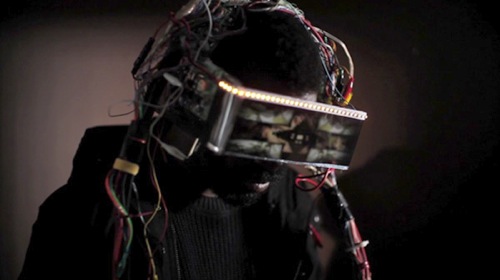
SFBG: Who designed the goggles?

DO: These twin brothers named Nikolai and Simon Haas. It was crazy because I turned in the treatment to the band on Friday, got the job on Saturday, and was on a plane to New York on Tuesday. Tunde had seen my “Eskmo” video and it resonated with him. And I’d wanted to use the virtual reality idea to create a narrative. But when I got the job we basically had a day and a half to figure out and make the virtual goggles. My rep Danielle had to fly with these crazy contraptions…

SFBG: Wow, with the wires everywhere they must have looked like a bomb…

DO: Yeah they totally looked like a bomb! I couldn’t believe that they didn’t get checked… she just carried them on to the plane! That was kind of disturbing. I mean I got patted down like 40 times…

SFBG: Because of your beard…

DO: Yeah. But TVOTR killed. Most of the people who directed the other videos were friends of theirs. I was the only one who wasn’t already in their circle. But once I started working with them we realized that there were a lot of connections, especially through Kyp [Malone], to my Bay Area family… the Yard Dogs and the folks at Five and Diamond. 

SFBG: How does the “Will Do” video fit into the larger picture of the film?

DO: It’s not like there’s one consistent story or plotline, but all the videos are saying a similar thing in different ways. There’s a cohesive vibe. There are interview parts that tie it all together. The second half feels more like a story because there are about 3-4 videos that lead into one another. 

SFBG: Tell me about the other stuff you’re working on. 

DO: I directed a video for a new artist on Rhymesayer named “Grieves”.. it’s kind of atmosphere and underground hip-hop ish. It’s an awesome song and I got to work with Kyle Mooney of Good Neighbor Stuff. So I’ve been doing that and writing treatments. But any time there’s a lull I’ll make my own stuff. 

SFBG: I saw one of your videos… the one where you’re at the window…

DO: Oh the “Happy Birthday” one… that was fun. But that’s the worst part of this kind of work. You’re always pitching things but then you’re stuck waiting. You have to make sure you’re still producing because that’s how you attract more work. I was really inspired by Leighton’s blog… so I started to created a video every week, just forced myself to hit that deadline. For me it was cool to see the progression, and to see how many times I hit a wall in the middle of producing a video… but finally I just learned to trust the process. 

SFBG: And the move to LA has been good for you?

DO: Yeah. I love it down here. Living in San Francisco was super instrumental to finding out what I wanted to say as an artist and a filmmaker. There was such freedom there and less of a focus on commercial work. A lot of people there just want to create art and everyone’s down to participate. But I always knew I would come back to LA.


Go Deep and get slicked at El Rio

Woman scantily clad and covered in lube is hot enough, but then the bell rings. They slip, they slide, they ride; lady parts will flail again in a tub full of slippery goop this Thursday at El Rio’s Go Deep! Lube Wrestling

Girl on girl wrestling at my favorite dive bar? Yes, this seems like a trick, but Go Deep! is a real event, produced by the lovely Dottie Lux of Red Hot Burlesque. The new monthly night started in April and Dottie says the sexy matches couldn’t have been more successful. “I stood with my mouth agape for three solid hours — it was super fun, amazing, and totally hilarious.” 

The current line-up of  “celebrity wrestlers” are local, fearless femmes handpicked by Dottie. From stylists to sassy clowns, the request for daring athletes was sent to over 40 businesses and organizations in the Bay, targeted at any lass who has a connection to “something larger.”  Contestants are encouraged to bring a posse, a supportive group of pals to cheer and wail and gush over their slimy acquaintance in the ring. So far the wrestling isn’t set up like a tournament, meaning everybody is a winner– literally, every girl gets a prize from Dottie’s box, including donated sex toys, garter belts, steamy books — and bacon?

“Bacon is always a prize,” Dottie says, pointedly not following up the comment any sign of mirth. This is serious: pin a hottie and bring home the salty meat. 

godeep_1

Ideally, participation in the ring will open up to the lady community at large as the event builds its fan base. If you’re interested in stripping down and pinning an unfamiliar femme, Dottie is currently accepting applications. Just remember, this ain’t no easy romp in the kiddie pool. 

“These women are out of breath. They’re working hard in there,” she says, noting the difficulties a challenger must face. “Gravity, stabilization, balance? All gone. All the usual resources you would normally have during wrestling are gone. It’s just too slippery.”

godeep_3

So far the rules simply summarized: women only, no shoes, no choking, be nice, don’t be drunk. Oh, and private parts must be legally covered — boo! Thankfully this rule has a tendency to slip. Bikinis and lube don’t sit well, at least as far as modesty’s concerned. 

“We had to learn how to better secure clothing. The girls kept losing their tops.” Keeping her eyes open for this type of situation is Dottie’s main job during the event. When a human body is glazed, the senses get a little blurry. At one point during the last Go Deep!, “we paused the show and the crowd started chanting, ‘double-knot, double-knot.'” The tops were retied fairly successfully. You wrestle and you learn. 

“Some girls tried electrical tape on their nipples. Sports bras are great. I think they should try out t-shirts, maybe little t-shirts.” From slings to spacesuits, I’m pretty sure the crowd will support any and all wrestler wardrobe choices — as long as the moves remains wet and wild. Last month’s audience was perfectly rowdy and Dottie hopes that people will continue to come with lots of enthusiasm. It’s not every day a scene from the L-Word or stereotypical frat boy’s dream comes to life. Thankfully, the female-objectifying crowd you might suspect to show up at event promising nearly naked wrestling won’t be invited. 

“As for the douche factor, it’s absolutely something I’m going to keep my eye on. My number one as a producer of this event is to make sure women are safe,” Dottie reassures. “I don’t want to kick people out, but I wouldn’t put it past me.”

godeep_2

Dottie plans to continue marketing the event to people and places that understand this is a woman-positive event, and she wants to keep it at El Rio, regardless of how popular the event becomes. If it would move to a larger venue, she’d loose some of the control and endanger it’s sanctity. “It’s an event for us, by us.”

I can only hope it goes down something like this:

http://www.youtube.com/watch?v=kakTqKppyxA

Go Deep!

Thurs/5 9 p.m., $10-15 sliding scale

El Rio 

3158 Mission, SF

(415) 282-3325

www.elrio.com


Hot sexy events: May 4-10

3

I’ve been informed that there is an art installation being installed at the English bohemian seaside town of Brighton that will change my life – “the lives of all women, forever”! It’s a wall of 400 plaster cast lady’s genitals, entitled “The Great Wall of Vagina.”

Included in the nine meter wall installation (which will debut at the Brighton Fringe Festival, according to Juxtapoz) are the pussies of transgendered folks, recent mothers, family members, before and after shots of a woman who underwent labiaplasty. It seeks to represent the genitalia gamut, defy the cult of normalcy that’s been drummed into us by the perfect pussies of mainstream pornography. 

It is a phenomenal work — it took five years to cast the participants and then cast their body parts – and I applaud anything that brings feminine sexuality into the public mindframe. I want to like this project, I do! And yet, and yet… 

A one Jamie McCartney was the brave soul to undertake the project, which explains but does not excuse his lack of anatomical knowledge (the casts rarely show their subjects’ vaginas, but rather their labias, “vaginal vestibule,” and clitoris).

Anatomy lesson, for those inclined.

And change the lives of women? That’s what his website says about the piece, and though I think the “Wall” is a neat idea, if we’re digressing with the over-Barbification of women’s sexuality, we need to think about who exactly that message needs to be addressed to. If nothing else, every woman has her own vagina to look at – the same cannot be said of men. 

And before I escort you onto the weekly sex events, let me beat my fist once more against the Wall. 400 vaginas, all makes and models, all bald as a cueball. In the interest of education, can Mr. McCartney please post a plaque next to his pussies that says “not pictured: pubic hair”?


“100 Ways to Play: A Catalog of Kink”

“A plethora of perversity.” “It still seems scary, but now in a good way.” “Like drinking from a fire hose. I attended, twice.” God bless participant surveys at sex events. The Citadel hosts this buffet of BDSM every once in awhile so that newbies can sample a taste of all sorts of sex play (fetish, impact, medical, and psychological are all represented) and old hands can get out of that metal-studded rut they may have found their dungeon-time stuck in. 

Thurs/5 7-10:30 p.m., $15-25

SF Citadel

1277 Mission, SF

(415) 626-2746

www.sfcitadel.org


Lube Wrestling Party

We’re taking “bump and grind” to the next level here. Because not only will the lovelies from Red Hots Burlesque be shimmy-shaking all over El Rio’s stage – getting down on the floor will be some sweaty, shiny girls hammerlocking and elbow dropping (maybe?) all over the damn place. Well, hopefully in the designated lube wrestling area, unless you like a little slick in your seven and seven. 

Thurs/5 9 p.m., $10-15 sliding scale

El Rio 

3158 Mission, SF

(415) 282-3325

www.elrio.com


Essence: On Fire

Calling all Sagittari, Leos, and Aries(es?): Mission Control’s sacred sexuality party turns the dial to fire for this month’s celebration of the life force-giving powers of Eros. New Age? In fact, Essence features a temple of innocence, temple of deep Eros, and chamber of dark arts. So leave your cynical friend at home – this is not their sex party. 

Sat/7 10 p.m.-3 a.m., $25-35 members only

Mission Control 

www.missioncontrolsf.org


Get your master’s in the filthy arts

Do you faun behind your drink at our city’s dirty storytelling nights, yearning to be among the foul-mouthed floozies onstage? Bawdy Storytelling’s grande dame Dixie De La Tour recognizes your needs, and to help out her less filthily verbose community members, is offering this three week course in staged dirty storytelling. Participants receive a diploma, a coursebook, and a video of themselves regailing classmates to study and share (perhaps with some special someones?)

Sun/8, May 15, and May 22 2-6 p.m., $250 for three class series

The Jellyfish Gallery

1286 Folsom, SF

www.dirtystorytellingworkshop.eventbrite.com


The San Francisco Men’s Spanking Party

Now don’t get this party wrong, this isn’t a play party for the hardcore leathermen. No no, this is more for the frisky fella interested in a little “fraternity hazing” or a scene where daddy spanks his bad boy into submission (um, leathermen: don a polo and flip-flops or maybe a tie?). Traipse on down to this safe environment to explore your yen for a little punishment (given or received) in your life. 

Sun/8 1-6 p.m., $20

Power Exchange

220 Jones, SF

www.voy.com/201188


“Give Spanks: Spanking for Sexual Pleasure”

So our story on Mistress Minax’s toy box piqued your pleasure points – but now you’re not quite sure how to make that first step down the BDSM dungeon stairs? Your wish is Good Vibes’ command – Minax will be lending a strong, swift hand to the sex toy company’s spanking workshop. A clothed demo will accompany this class, as well as tips on how to coax an unsure partner into the pleasure of pain. 

Tues/10 6-8 p.m., $20-25

1620 Polk, SF

(415) 345-0500

www.goodvibes.com

TV eye

0

arts@sfbg.com

HAIRY EYEBALL In 1976 artist Clive Robertson reflected on a performance he gave that same year, in which he dressed up as and restaged pieces by the famous postwar German performance artist Joseph Beuys. “We have to adapt legends so that they become portable and can fit into our pockets,” he wrote. “Unfortunately for the artist, that is the fight we label history.”

Robertson was addressing his own anxiety of influence in the face of Beuys’ then-ascendant status within the art world, but his comments also provide a gloss on the struggle that curators and art historians face in their own practice. In the case of “God Only Knows Who the Audience Is,” a parting gift from the graduating students of California College of the Arts’ Graduate Program in Curatorial Practice, currently on view in the galleries of the school’s Wattis Institute, it is a struggle undertaken with great intelligence and economy.

Smartly conceived and staged, “God Only Knows” is a dialogic tale of two histories. One is a survey of the nonprofit artist-run organization and gallery space La Mamelle (which became ART COM in the 1980s) that existed in various incarnations from 1975 through 1995 and forms an important, if under-recognized, chapter of Bay Area art history. The other traces a concurrent shift in performance art, largely made possible by the advent of video technology, away from the artist’s body and toward the disembodied artist.

La Mamelle was, appropriate to its name, a nurturing organ for the local art scene. In addition to hosting events and organizing exhibits, the organization released videos, audio-zines, and microfiches, and published anthologies as well as the regular magazine in which pieces such as Robertson’s “The Sculptured Politics of Joseph Beuys,” quoted above, first appeared.

The constant proliferation of publications and media put local artists such as Chip Lord, the video collective Ant Farm, Lynn Hershman, and Bonnie Sherk — who all have pieces or documentation of early performances on display here — in touch with other artists around the world and vice versa. The aforementioned artists had wandered to the end of the conceptual inroads that had been laid down by the likes of Andy Warhol and Beuys, and were now operating in a new media wilderness, with only their VHS cameras to guide them.

“God Only Knows” successfully locates these artists and their work within a continuum of practices that stretches into the present. Others have followed Robertson in treating Beuys and his practice as source material (“identity transfer” in his words), as evinced by nearby pieces in the first floor’s survey of performance art that de-centers the artist’s body as both a performance’s agent and its living trace, such as Whitney Lynn’s 2010 re-do of another Beuys performance, or Luis Felipe Ortega and Daniel Guzmán’s 1994 video Remake, in which the duo stages “improved upon” versions of canonical performance art pieces.

The exhibit’s second floor takes us into the ’80s and ’90s, where the message is clear: television opened up the potential for art to reach new audiences. Greeted by the ponderous, mustachioed visage of Douglas Davis in his The Last Nine Minutes, a live-to-video performance realized in 1977 for Documenta 6, we immediately see how video dissolved the time lag between action and its documentation. Bill Viola’s 44 portraits of television viewers (1983-84) staring silently into their TV sets, made for WGBH in Boston, screens on the other side of the entrance.

In the middle of the gallery, playing across what the accompanying brochure calls an “archipelago” of viewing stations, are various video pieces by La Mamelle and ART COM artists, as well as those by artists such as the Borat-like Olaf Breuning, whose work plays off of the spectacle of TV shows. Meanwhile, at the back of the room, Mario Garcia Torres’ jarring 2008 nine-channel compilation of artists’ TV cameos from the past four decades (Dali doing a car commercial; Warhol appearing as himself on The Love Boat) tabulates the increasing banality of art’s intersection with television.

Yet despite the histories laid out in “God Only Knows Who the Audience Is,” Bravo’s Work of Art, YouTube, and the continual meddling presence of James Franco, video has yet to kill the performance art star — or at least the demand for the star’s body, as demonstrated by Marina Abramovic’s recent MOMA retrospective, in which the real attraction was not the controversial restagings of her greatest hits, but her daily physical presence.

The irony, of course, is that exhibit’s online half-life, which continues today. The Flickr and Tumblr are still there. The artist is still present to those who navigate to those pages, even though Abramovic left the building long ago. God only knows who’s still watching.


DISAPPEARING ACTS

The title of German painter Christoph Roßner’s current solo show at Romer Young, “The Hat, That Never Existed,” is a tip-off. Roßner’s smudged, over-painted, and half-erased depictions of things and people — trees, candles, top hats, houses, old men — scan as disappearing acts rather than fixed portraits (the way the canvases have been hung even suggests that a few have gone missing from the gallery). “Ghoulish” is the operative word here. Not much separates the faceless specter of Ghost from the skeletal visage in Grinser; and Roßner can make even a rock look like an Expressionist coffin. That’s not lazy journalistic shorthand, either: Roßner’s rough-hewn bleakness is of a piece with the Old World aesthetics of, say, George Grosz. The séance lasts only one more week, though, so act fast.

GOD ONLY KNOWS WHO THE AUDIENCE IS

Through July 2

CCA Wattis Institute for Contemporary Art

1111 Eighth St.

(415) 551-9210

www.wattis.org

THE HAT, THAT NEVER EXISTED

Through May 14

Romer Young Gallery

1240 22nd St., SF

(415) 550-7483

www.romeryounggallery.com


Our Weekly Picks: May 4-11, 2011

0

WEDNESDAY

MAY 4


MUSIC

Wanda Jackson

Over her 50-plus years in show business, she’s been called “the Queen of Rockabilly” and “the Sweet Lady with the Nasty Voice” — and now fans can rightly call Wanda Jackson a true musical icon, with her recent induction into the Rock and Roll Hall of Fame. Don’t let that enshrinement fool you into thinking she’s retired, though. She can still belt out tunes like nobody’s business, and proved that yet again with the release of The Party Ain’t Over, her Jack White-produced album that came out earlier this year. Forget about the recent big fuss over in England; come to tonight’s show if you want to see some real royalty. (Sean McCourt)

With Red Meat and DJ Britt Govea

8 p.m., $21

Great American Music Hall

859 O’Farrell, SF

(415) 885-0750

www.gamh.com


MUSIC

J Mascis

It has been a good couple of years to be a Dinosaur Jr. fan. In 2005, lead singer J Mascis and bandmate Lou Barlow put aside their grievances enough to play shows as the original lineup, along with drummer Murph. In an era of live record performances from bands well past their prime, that would have been enough, but the band released new albums that were as good as ever. (In the case of 2009’s Farm, maybe better.) So now, almost just to show that he can, between Dinosaur Jr. tours and recording sessions, Mascis releases the solo album, Several Shades of Why. Exchanging shredded electric guitars for (still a little fuzzy) acoustics, it’s another surprise, but in the best way. (Ryan Prendiville)

With Black Heart Procession

8 p.m., $20

Independent

628 Divisadero, SF

(415) 771-1421

www.theindependentsf.com


THURSDAY

MAY 5


MUSIC

Frank Fairfield

Frank Fairfield’s adaptations of blistering American ballads are proudly faithful, but his ability to coax the rightness from battered banjos and fiddles (and to squeeze his voice as if onto fresh shellac) goes way beyond technique. “I don’t even know if [this music] has that much to do with tradition,” Fairfield told one interviewer. “I think it’s just people doing whatever they feel like doing. A lot of this stuff just gets mished and mashed, and that’s the beautiful thing about America.” The fact that he’s a young Angeleno who dresses the old-timey part may raise eyebrows — but trust your ears. He makes an intriguing opener for Cass McCombs, a troubadour cut from a different cloth. (Max Goldberg)

With Cass McCombs

8 p.m., $15

Swedish American Music Hall

2170 Market, SF

(415) 861-5016

www.cafedunord.com


FRIDAY

MAY 6


DANCE

Ahdanco/Abigail Hosein Dance Company

While dance can be described as poetry in motion, Ahdanco’s 2011 home season offers both poetry and motion in a dynamic dialogue. For one of the two new works on the program, the dancers share the stage with spoken word artists from the Bay Area Poetry Slam Circuit, weaving Abigail Hosein’s choreography with powerful narrative stories. The other dance is a trio set to an original score composed of four loop stations, trumpet, cello, upright bass, guitar, and female vocals performed live by ambient band, Entamoeba. Hosein’s strong female dancers (many of whom are Mills College alumni) skillfully balance the physical and theatrical. (Julie Potter)

Thurs/6–Fri/7, 8 p.m.; Sun/8, 6 p.m., $20

Ashby Stage

1901 Ashby, Berk.

(510) 837-0776

www.ahdanco.org


EVENT

“Bikes and Beats”

In response to SF’s burgeoning biking scene — and that empty moment on the first Fridays of the month when you realize that the SF Bike Party is over and the rest of your evening is TBA — comes this night club-bike club. Organizers’ goal for this fundraiser for Sunday Streets and the Wigg Party is to make bike culture as un-scary and fun as possible — even to those without handlebar calluses. Bike crafts and fashion will be on display, as well as a dope, divergent musical lineup featuring the Polish Ambassador, Non-Stop Bhangra, Madrone’s Motown on Mondays crew, and that party on two wheels well known to SF cruisers, DJ Deep. (Caitlin Donohue)

10 p.m.–3 a.m., $6–$10

Public Works

161 Erie, SF

(415) 932-0955

Facebook: Bikes & Beats


DANCE

“SCUBA 2011”

A terrific idea, SCUBA, a small presenters consortium, has been pooling resources for close to a decade to offer gigs to hot young choreographers, whether homegrown or invited from participating venues. So far, ODC Theater director Rob Bailis’ choices have always been worthwhile. The mix has been rich and varied. On this program, SF’s own Katie Faulkner, who will premiere Sawtooth, will be joined by Amelia Reeber from Seattle and Chris Yon from Minneapolis. Reeber is bringing this is a forgery, a multimedia work that examines choices and transformation. Yon draws on husband-wife vaudeville acts for his duet, The Very Unlikeliness (I’m Going to Kill You), with partner with Taryn Griggs. (Rita Felciano)

Fri/6–Sat/7, 8 p.m.; Sun/8, 7 p.m., $15–$18

ODC Theater

3153 17th St. SF

(415) 863-9834

www.odctheater.org


SATURDAY

MAY 7


MUSIC

“Walk Like An Egyptian”

What’s Zambaleta, you say? In Egypt, Zambaleta is a spontaneous chaotic street party that happens when everyone is participating, through music or dance. In the Mission, Zambaleta is a world music and dance school with an inclusive environment and celebratory spirit. This weekend’s “Walk Like An Egyptian” festival captures that spirit, featuring Bay Area music from blues and folk to jug bands and indie. The lineup of 18 bands includes an appearance by Annie Bacon’s Folk Opera — plus, proceeds from the festival support community programs at the world music and dance center. Come walk — and party — like an Egyptian. (Potter)

Sat/7, 1 p.m.–midnight;

Also Sun/8, noon–8 p.m., $5–$20

Restoration Workshop

630 Treat, SF

(415) 341-1333

www.zambaleta.org


EVENT

CELLspace Birthday Benefit Funkathon

Celebrate the 15th birthday of CELLspace, San Francisco’s original hub for artistic work and gatherings, by partying down at a Funkathon featuring Action Jackson and other funky music and dance acts. And this is just one event among many, including an art auction May 5, a swap meet and dance party May 6, and a party May 8 that coincides with the Sunday Streets closure of Mission District streets to automobile traffic. CELLspace, a venerable institution that offers classes on everything from welding to breakdancing, is going through ambitious fundraising efforts as it seeks the permits and resources to expand its nightlife offerings, so come have a funky time while supporting a great cause. (Steven T. Jones) 9 p.m., $10–$20

CELLspace

2050 Bryant, SF

(415) 410-7597

www.cellspace.org


FILM/PERFORMANCE

“Ultimate Mommie Dearest

Oh, I know you’ve already seen 1981’s Mommie Dearest. And I know you can quote all the famous lines (personal favorite: “Tina! Bring me the ax!”) But you’ve never experienced the ultimate Mommie Dearest — because it’s never been attempted until this once-in-a-lifetime event. Marking the cult classic’s 30th anniversary is a dame who surely has never touched a wire hanger in her life, Peaches Christ, and celebrated Peaches cohorts Heklina, Martiny, and (in honor of Mother’s Day), Mrs. Christ herself! A restored print of the film caps a night that also includes the musical stage spectacular Trannie Dearest, a drag tribute to Joan Crawford’s unfailingly dramatic life. Do I even have to add that costumes are encouraged? (Cheryl Eddy)

8 p.m., $25–$40

Castro Theatre

429 Castro, SF

www.peacheschrist.com


EVENT

Urban Cycling Workshop

If I had a nickel for every car devotee or exasperated Muni rider who’s lamented, “Oh, I would totally ride a bike if there weren’t so many scary cars!” I’d be, well, not rich but could certainly buy some fresh handlebar tape ($16 per roll). How awesome, then, that the hardworking bike advocates at the San Francisco Bicycle Coalition are offering a four-hour, in-classroom, free introductory course geared toward newbies and cyclists who want to feel more comfortable riding our tiny but intense peninsula. The class covers all the basics, from choosing the best bike to pulling emergency maneuvers, to knowing your legal rights. Ding, ding! (Kat Renz)

2 p.m., free (preregistration required; ages 14 and up)

Fort Mason Center, Bldg. C, Rm. 362

Laguna at Marina, SF

(415) 431-2453 x312

www.sfbike.org/edu


MONDAY

MAY 9


MUSIC

Mogwai

Much like the mythical creatures from Gremlins (1984) that they are named after, Mogwai’s sound can be soft and serene at one moment, then morph into an entirely different dynamic, with blistering guitars and noisy effects multiplying around you. The Glasgow-bred rockers returned in February with its seventh record, and its first Sub Pop release, Hardcore Will Never Die, But You Will, which continues the band’s mostly instrumental and highly successful approach to making music. Creating lush sonic soundscapes richly textured with a wide array of different riffs and tones, the five-piece group is definitely one to catch live if you can. (McCourt)

With Errors

8 p.m., $23.50–$26

Regency Ballroom

1290 Sutter, SF

1-800-745-3000

www.theregencyballroom.com


TUESDAY

MAY 10


DANCE

Project.B.

If you have seen Tanya Bello dance — Shift Physical Theater, Robert Moses’ Kin, and Janice Garrett + Dancers come to mind — you won’t have forgotten her. She probably was the shortest (but also the fastest and fiercest) tearing across the stage. Bello is small but she dances big. Lately she has taken advantage of the Garage’s RAW (Resident Artist Workshop) program to hone her choreographic skills. Moveable Feast, her first full-evening work, is plugging into her experience working with choreographers both here and on the East Coast. The idea is to show three versions of one piece in which components — lights, dancers, sets, music — get shuffled around. In the end the audience decides which one worked best. (Felciano)

May 10-11, 8 p.m., $15

Garage

975 Howard, SF

(415) 518 1517 www.brownpapertickets.com 


The Guardian listings deadline is two weeks prior to our Wednesday publication date. To submit an item for consideration, please include the title of the event, a brief description of the event, date and time, venue name, street address (listing cross streets only isn’t sufficient), city, telephone number readers can call for more information, telephone number for media, and admission costs. Send information to Listings, the Guardian Building, 135 Mississippi St., SF, CA 94107; fax to (415) 487-2506; or e-mail (paste press release into e-mail body — no text attachments, please) to listings@sfbg.com. Digital photos may be submitted in jpeg format; the image must be at least 240 dpi and four inches by six inches in size. We regret we cannot accept listings over the phone.

Stage Listings

0

Stage listings are compiled by Guardian staff. Performance times may change; call venues to confirm. Reviewers are Robert Avila, Rita Felciano, and Nicole Gluckstern. Submit items for the listings at listings@sfbg.com. For further information on how to submit items for the listings, see Picks. For complete listings, see www.sfbg.com.

THEATER

OPENING

Silk Stockings Eureka Theatre, 215 Jackson; 255-8207, www.42ndstmoon.org. $24-44. Previews Wed/4, 7pm; Thurs/5-Fri/6, 8pm. Opens Sat/7, 6pm. Runs Wed, 7pm; Thurs-Fri, 8pm; Sat, 6pm; Sun, 3pm. Through May 22. 42nd Street Moon presents a Cole Porter production.

ONGOING

Absolutely San Francisco Alcove Theater, 414 Mason; 992-8168, www.absolutelysanfrancisco.com. $32-50. Check for dates and times. Open-ended. Not Quite Opera Productions presents a musical.

*Caliente Pier 29, The Embarcadero; 438-2668, www.love.zinzanni.org. $117-145. Wed-Sat, 6pm; Sun, 5pm. Open-ended. Ricardo Salinas, cofounder of famed Mission-born radical Latino comedy trio Culture Clash, penetrates the velvet enclave of Teatro ZinZanni, taking the helm for its latest Euro-style dinner-cirque cabaret show. Under Salinas’ inspired direction, the evening plays as a revolt by brown-hued kitchen and wait staff against a ruthless takeover by, what else, a Chinese conglomerate. Multiculti clashes ensue, with the underdogs led by a brother-sister team played charmingly by ZinZanni regulars Christine Deaver and Robert Lopez, and with much expert repartee and physical humor neatly enveloping characteristically stunning feats of acrobatics and circus arts that leave forkfuls of grub hovering before slack-jawed mouths. I don’t know how many actual kitchen staffers out there can afford the ticket price (though it does come with a tasty five-course meal in addition to a first-class show), but the blend of Salinas and company’s shrewd if subdued social commentary and big-heated Latin-fueled humor—not to mention the exquisite musical numbers featuring guest star Rebekah Del Rio—lead to something altogether harmonious. (Avila)

Cancer Cells The Garage, 975 Howard; 518-1517, www.975howard.com. $15. Fri-Sat, 8pm; Sun, 2pm. Through May 22. Performers Under Stress and directors Geoff Bangs and Scott Baker offer this well-conceived program of late Pinter works, a total of nine plays and poems intelligently arranged and unevenly but in some cases vibrantly performed (especially in the case of One for the Road) in a fleet 90-minute evening. With the titular poem, written as the esteemed playwright was undergoing chemo (and recited here with somewhat unnecessary emotion by Valerie Fachman), a telling definition of cancer cells arises: “They have forgotten how to die/ And so extend their killing life.” Given the unbridled political nature of the work that follows—including the devastatingly stark (yet ever articulate to the point of being unexpected) dramatic vocabulary of Mountain Language, a compact depiction and rumination on state-sponsored genocide—those cancer cells grow out of their literal referent into a literary metaphor for the warping, perverting, and devastating consequences of supreme, unchecked power and its Olympian delusions. Pinter’s late works, written with a pronounced urgency in the face of ever-widening war and genocide, advance his shrewd and potent ability for exposing the obscenity beneath the shell games of language as deployed by power in pursuit of its imperial and totalitarian aims. (Avila)

Collected Stories Stage Werx, 533 Sutter; Z(800) 838-3006, www.brownpapertickets.com. $20-25. Fri-Sat, 8pm. Through Sat/ 7. Stage Werx presents David Margulies’ drama about art, ethics, and betrayal.

Cordelia NOHspace, 2840 Mariposa; (800) 838-3006, www.brownpapertickets.com. $18-20. Wed-Thurs, 7pm; Fri-Sat, 8pm. Through Sat/7. Theatre of Yugen presents world premiere of an abstraction of Shakespeare’s King Lear.

Devil/Fish 2781 24th St; www.cirquenoveau.com. $26. Fri-Sat, 7pm; Sun, 6pm. Through May 22. Cirque Noveau presents a story involving aerial performance, acrobatics, and more.

*Geezer Marsh, 1062 Valencia; (800) 838-3006, www.themarsh.org. $20-50. Thurs, 8pm; Sat, 5pm; Sun, 3pm. Through July 10. The Marsh presents a new solo show about aging and mortality by Geoff Hoyle.

*Killer Queen: The Story of Paco the Pink Pounder Michael the Boxer Gym and Barbershop, 96 Lafayette; (800) 838-3006, www.brownpapertickets.com. $20. Thurs-Sat, 8pm; Sun, 7pm. Through Sun/8. The boxing ring is no metaphor in Killer Queen, a vital and walloping new solo play by Peter Griggs set in a small, real-life boxing gym in SoMa (before moving to another in Los Angeles later in the run). And yet the ring—around which a privileged audience is excitingly pressed—encompasses so much of the queer American experience since the 1970s and ’80s that every punch, literary or otherwise, reverberates with wider significance and poetical precision. Griggs, as a gay youth of color who grows up to be the first openly gay title holder in his class, occupies that ring and that life with a rare and utterly persuasive intensity as he alternately cajoles, flirts with, dismisses, and even menaces his audience between a captivating narrative and highly credible boxing choreography (including a tense training scene with the gym’s Michael Onello). An effeminate boy growing up in a violently homophobic society, “Paco” (as he’s nicknamed despite not being Latino) discovers boxing—and Queen—in time to save his life, thanks to two crucial surrogate fathers. Set to the music of the seminal rock band (sometimes using original recordings, sometimes interpretations by nearby piano accompanist Stephen Mello), the music is, like the ring, anything but arbitrary, and beautifully deployed overall. There are some rough or abrupt transitions and some muddiness in the underscoring of dialogue, but these are minor and passing and hardly take away from a unique, enthralling work directed with incisive attention to emotional as well as social truths by Wolfgang Wachalovsky (cofounder of queer performance incubator THEOFFCENTER, which co-produced with Burning Monk Collective). Indeed, it’s the very rawness around the edges of this studiously developed piece—including a passionate digression concerning the current “It Gets Better” campaign pitched at queer youth—that gives it an immediate and politically-charged quality above and beyond the electricity of the setting and the pulsating athletic movement it foregrounds. Beyond the stage-ring, moreover, the play remains as serious as its site-specific setting: its development has led to the founding in LA of an Empowerment Center for disadvantaged queer youth as well as the first Gay Boxing League. (Avila)

Loveland The Marsh, 1062 Valencia; (800) 838-3006, www.themarsh.org. $20-35. Fri, 8pm; Sat, 8:30pm (also Sun/8, 7pm). Through Sun/8. Ann Rudolph’s one-woman show continues its successful run.

Party of 2 — The New Mating Musical Shelton Theater, 533 Sutter; 1-800-838-3006, www.partyof2themusical.com. $27-29. Fri, 9pm. Open-ended. A musical about relationships by Shopping! The Musical author Morris Bobrow.

Secret Identity Crisis SF Playhouse, Stage 2, 533 Sutter; 869-5384, www.un-scripted.com. $10-20. Thurs-Sat, 8pm (no show Sat/7). Through May 14. Un-Scripted Theater Company presents a story about unmasked heroes.

Shopping! The Musical Shelton Theater, 533 Sutter; (800) 838-3006, www.shoppingthemusical.com. $27-29. Sat, 8pm. Open-ended. A musical comedy revue about shopping by Morris Bobrow.

A Streetcar Named Desire Actors Theatre, 855 Bush; 345-1287, www.actorstheatresf.org. $26-38. Wed-Sat, 8pm. Through June 4. Actors Theatre of San Francisco presents the Tennessee Williams tale.

Talking With Angels Royce Gallery, 2901 Mariposa; (800) 838-3006, www.brownpapertickets.com. $21-35. Thurs-Sat, 8pm. Through May 21. A play by Shelley Mitchell set in Nazi-occupied Hungary.

Vice Palace: The Last Cockettes Musical Thrillpeddlers’ Hypnodrome, 575 10th St; (800) 838-3006, www.brownpapertickets.com. $30-35. Fri-Sat, 8pm; Sun, 7pm. Through July 31. Thrillpeddlers presents composer Scrumbly Koldewyn’s revival of the 1972 musical revue.

BAY AREA

East 14th – True Tale of a Reluctant Player The Marsh Berkeley, 2120 Allston Way, Berk; (800) 838-3006, www.themarsh.org. $20-50. Sat, 8pm; Sun, 7pm. Through Sun/8. Don Reed’s one-man show continues.

*Eccentricities of a Nightingale Aurora Theatre, 2081 Addison; (510) 843-4822, www.auroratheatre.org. $10-55. Tues, 7pm; Wed-Sat, 8pm; Sun, 2 and 7pm. Through Sun/8. Bracketed literally from beginning to end by fireworks, Aurora Theatre’s production of Tennessee Williams’ The Eccentricities of a Nightingale offers some serious bang. On the surface, a tragic-comic tale of unrequited love in small-town Mississippi, Eccentricities plunges into deeper waters, exploring the ever-waged war between societal norms and its misfits — and the struggle to remain true to oneself — with a subtly layered approach. Protagonist Alma (Beth Wilmurt), the titular Nightingale, isolated by her complicated family circumstances and her own mild eccentricities, carries a long-burning torch for the boy-next-door, a rather callow young doctor (Thomas Gorrebeeck) with a terrifyingly overprotective mother (Marcia Pizzo). But Alma’s yearning, as much habit as attraction, has less to do with a dream of settling down with a nice doctor husband, but rather of freeing herself from the conventions that threaten to crush her spirit. Alma’s nervous artistic temperament hides a solidly pragmatic core, and when she has her young doctor alone in a hotel room at last, her plea for him to “give me an hour and I’ll make a lifetime of it,” rings not of desperation but of the adventure she craves. Director Tom Ross deftly brings out the gentle humor and bittersweet victory in the text via a strong cast and stellar design team. (Gluckstern)

Lady With All the Answers Center REPertory Company, Lesher Center for the Arts, Knight Stage 3 Theatre, 1601 Civic Center, Walnut Creek; (925) 943-SHOW, www.centerrep.org. $45. Thurs-Sat, 8:15pm; Sun, 2:15pm. Through May 15. Center REPpresents Kerri Shawn’s one-woman play about Ann Landers.

Not a Genuine Black Man The Marsh Berkeley, TheaterStage, 2120 Allston Way, Berk; (800) 838-3006, www.themarsh.org. $20-50. Thurs, 7:30pm. Through Thurs/5. Brian Copeland’s one-man show continues.

Out of Sight The Marsh Berkeley, Theaterstage, 2120 Allston Way, Berk; (800) 838-3006, www.themarsh.org. $20-50. Sat, 5pm (no show Sat/9); Sun, 3pm. Through May 8. Sara Felder’s one-woman show returns.

Passion Play Live Oak Theatre, 1301 Shattuck, Berk; (510) 649-5999, www.aeofberkeley.org. $10-15. Fri-Sat, 7pm (also Sun/8, and may 15, 2pm). Through May 21. Actors Ensemble of Berkeley presents the West Coast premiere of a time-travel play by Sarah Ruhl.

Three Sisters Berkeley Repertory Theatre, Thrust Stage, 2025 Addison, Berk; (510) 647-2949, www.berkeleyrep.org. $29-73. Dates and times vary. Through May 22. Berkeley Rep presents a new version of Chekhov’s 1901 play by Sarah Ruhl (In the Next Room, Eurydice), directed by Les Waters. The language sounds generally and pleasingly modern in the mouths of the titular Prozorov sisters—Olga (Wendy Rich Stetson), Masha (Natalia Payne), and Irina (Heather Wood)—although the production is rather traditional in staging (period set by Annie Smart, and corresponding costumes by Ilona Somogyi). We follow the restless siblings and their flock of soldier-admirers through a handful of years in their provincial town, where their late father was an elite military officer. In this period, the dashing officer Vershinin (Bruce McKenzie) brings a spark of new life—especially to the unhappily married Masha—and stokes the sisters’ ultimately unanswered desire to return to their beloved Moscow. The production breathes a good deal of life into the play, whose half-foolish and heartbreakingly funny characters so palpably exude a complex set of longings and misplaced desires, but it labors under an initial stiffness and a somewhat jagged set of performances. (Payne’s twitchy Masha, for instance, whose features maintain throughout a look of unwelcome surprise, feels incongruent at times). Some of the more moving turns concentrate here in the supporting characters, including James Carpenter as Chebutykin, the fawning old doctor who has forgotten all he used to know; Thomas Jay Ryan as Tuzenbach, the self-conscious Russian of German descent desperately smitten with Irina; and Alex Moggridge as the sisters’ much put-upon, feckless, alternately gentle and petulant brother, Andrei. (Avila)

The World’s Funniest Bubble Show The Marsh Berkeley, Cabaret, 2120 Allston Way, Berk; (800) 838-3006, www.themarsh.org. $8-50. Through July 10. The Amazing Bubble Man performs.

PERFORMANCE

DIVAfest EXIT Theatre, 156 Eddy; 673-3847, www.theexit.org. Check for times and prices. Through May 28. Plays and performances by women artists, including Maggie Cronin, Christina Augello, Margery Fairchild, Cheryl Smith, and Diane di Prima. 

Film Listings

0

Film listings are edited by Cheryl Eddy. Reviewers are Kimberly Chun, Michelle Devereaux, Peter Galvin, Max Goldberg, Dennis Harvey, Johnny Ray Huston, Louis Peitzman, Lynn Rapoport, Ben Richardson, and Matt Sussman. For rep house showtimes, see Rep Clock. For first-run showtimes, see Movie Guide.

SAN FRANCISCO INTERNATIONAL FILM FESTIVAL

The 54th annual San Francisco International Film Festival runs through Thurs/5. Venues are the Sundance Kabuki, 1881 Post, SF; Castro, 429 Castro, SF; New People, 1746 Post, SF; San Francisco Museum of Modern Art, 151 Third, SF; and Pacific Film Archive, 2575 Bancroft, SF. For tickets (most shows $13) and complete schedule visit www.sffs.org.

OPENING

The Beaver See “The Darkness Underneath.” (1:31)

*Cave of Forgotten Dreams The latest documentary from Werner Herzog once again goes where no filmmaker — or many human beings, for that matter — has gone before: the Chauvet-Pont-d’Arc Cave, a heavily-guarded cavern in Southern France containing the oldest prehistoric artwork on record. Access is highly restricted, but Herzog’s 3D study is surely the next best thing to an in-person visit. The eerie beauty of the works leads to a typically Herzog-ian quest to learn more about the primitive culture that produced the paintings; as usual, Herzog’s experts have their own quirks (like a circus performer-turned-scientist), and the director’s own wry narration is peppered with random pop culture references and existential ponderings. It’s all interwoven with footage of crude yet beautiful renderings of horses and rhinos, calcified cave-bear skulls, and other time-capsule peeks at life tens of thousands of years ago. The end result is awe-inspiring. (1:35) (Eddy)

*Incendies When tightly wound émigré Nawal (Luba Azabal) dies, she leaves behind adult twins Jeanne (Mélissa Désormeaux-Poulin) and Simon (Maxim Gaudette) — and leaves them documents that only compound their feelings of grief and anger, suggesting that what little they thought they knew about their background might have been a lie. While resentful Simon at first stays home in Montreal, Jeanne travels to fictive “Fuad” (a stand-in for source-material playwright Wajdi Mouawad’s native Lebanon), playing detective to piece together decades later the truth of why their mother fled her homeland at the height of its long, brutal civil war. Alternating between present-day and flashback sequences, this latest by Canadian director Denis Villeneuve (2000’s Maelstrom) achieves an urgent sweep punctuated by moments of shocking violence. Resembling The Kite Runner in some respects as a portrait of the civilian victimization excused by war, it also resembles that work in arguably piling on more traumatic incidences and revelations than one story can bear — though so much here has great impact that a sense of over-contrivance toward the very end only slightly mars the whole. (2:10) Embarcadero. (Harvey)

Jumping the Broom It’s wedding (movie) season! Angela Bassett and Paula Patton star in this one. (1:48) Shattuck.

Last Night Married for three years and together “since college,” New York City yuppies Michael (Sam Worthington) and Joanna (Keira Knightley) have a comfortable, loving relationship, though it’s unclear how much passion remains. Still, it doesn’t take much for Joanna to bristle jealously when she meets Michael’s co-worker and frequent business-trip companion, Laura (Eva Mendes). As Michael and Laura flirt their way to an overnight meeting in Philly, Joanna runs into an old flame (Guillaume Canet); before long, it becomes a cross-cutting race to see who’ll cheat first. Writer-director Massy Tadjedin isn’t spinning a new story here — and though the film offers a sleek look at contemporary marriage, Last Night takes itself a tad too seriously, purporting to showcase realistic problems and emotions amid a cast beamed directly from Planet Gorgeous Movie Star. Beautiful people: they’re just like us? (1:30) (Eddy)

*Meek’s Cutoff See “Nothing Was Delivered.” (1:44) Albany, Embarcadero.

Queen to Play From first-time feature director Caroline Bottaro comes this drama about … chess. Wait! Before your eyes glaze over, here are a few more fast facts: it’s set in idyllic Corsica and features, as an American expat, Kevin Kline in his first French-speaking role. (Side note: is there a Kline comeback afoot? First No Strings Attached, then The Conspirator, and now Queen to Play. All within a few short months.) Lovely French superstar Sandrine Bonnaire plays Héléne, a hotel maid who has more or less accepted her unremarkable life — until she happens to catch a couple (one half of which is played by Jennifer Beals, cast because Bottaro is a longtime fan of 1983’s Flashdance!) playing chess. An unlikely obsession soon follows, and she asks Kline’s character, a reclusive doctor who’s on her freelance house-cleaning route, to help her up her game. None too pleased with this new friendship are Héléne’s husband and nosy neighbors, who are both suspicious of the doctor and unsure of how to treat the formerly complacent Héléne’s newfound, chess-inspired confidence. Queen to Play can get a little corny (we’re reminded over and over that the queen is “the most powerful piece”), and chess is by nature not very cinematic (slightly more fascinating than watching someone type, say). But Bonnaire’s quietly powerful performance is worth sticking around for, even when the novelty of whiskery, cardigan-wearing, French-spouting Kline wears off. (1:36) Embarcadero, Shattuck, Smith Rafael. (Eddy)

Something Borrowed Kate Hudson and Ginnifer Goodwin play frenemies of the highest order in this rom-com adapted from the best-selling novel. (1:53) Shattuck.

There Be Dragons Dougray Scott and Wes Bentley star in this drama set against the backdrop of the Spanish Civil War. (2:00)

*These Amazing Shadows If you love movies, it’ll be hard to resist These Amazing Shadows (subtitled “A story about the National Film Registry and the power of the movies”) — it’s chock full o’ clips from films that’ve been deemed worthy of inclusion in the National Film Registry’s elite ranks. This includes, of course, the likes of 1942’s Casablanca and 1939’s Gone With the Wind, but also more recent cultural touchstones like 1985’s Back to the Future and a number of experimental, short, and silent works, and even a few cult films too. Along the way film scholars and makers (including locals Barry Jenkins, Rick Prelinger, and Mick LaSalle) chime in on their favorite films and stress why preserving film is important. There’s a healthy dose of film history, as well, with mentions of groundbreaking director Lois Weber (one of early cinema’s most prolific artists, despite her gender) and a discussion of why racially questionable films like 1915’s The Birth of a Nation — a film that Boyz n the Hood (1991) director John Singleton recommended for Registry inclusion — are historically important despite their content. Dedicated film buffs won’t discover any surprises, and there’s not much discussion of queer film (unless John Waters talking about 1939’s The Wizard of Oz counts?), nor any mention of the current shift from film to digital formats (of course preserving old films is important, but will the Registry also start considering digital-only films for inclusion?) But perhaps these are topics for another film, not this nostalgia-heavy warm fuzzy that’ll affect anyone who remembers the magic of seeing a personally significant film — join the mob if it’s 1977’s Star Wars — for the first time. (1:28) Sundance Kabuki. (Eddy)

*Thor When it comes to superhero movies, I’m not easily impressed. Couple that with my complete disinterest in the character of Thor, and I didn’t go into his big-screen debut with any level of excitement. Turns out Kenneth Branagh’s Thor is a genre standout — the best I’ve seen since 2008’s Iron Man. For those who don’t know the mythology, the film follows Thor (Chris Hemsworth) as he’s exiled from the realm of Asgard to Earth. Once there, he must reclaim his mighty hammer — along with his powers — in order to save the world and win the heart of astrophysicist Jane Foster (Natalie Portman). Hemsworth is perfectly cast as the titular hero: he’s adept at bringing charm to a larger-than-life god. The script is a huge help, striking the ideal balance between action, drama, and humor. That’s right, Thor is seriously funny. On top of that, the effects are sensational. Sure, the 3D is once again unnecessary, but it’s admittedly kind of fun when you’re zooming through space. (2:03) (Peitzman)

ONGOING

The Adjustment Bureau As far as sci-fi romantic thrillers go, The Adjustment Bureau is pretty standard. But since that’s not an altogether common genre mash-up, I guess the film deserves some points for creativity. Based on a short story by Philip K. Dick, The Adjustment Bureau takes place in a world where all of our fates are predetermined. Political hotshot David Norris (Matt Damon) is destined for greatness — but not if he lets a romantic dalliance with dancer Elise (Emily Blunt) take precedence. And in order to make sure he stays on track, the titular Adjustment Bureau (including Anthony Mackie and Mad Men‘s John Slattery) are there to push him in the right direction. While the film’s concept is intriguing, the execution is sloppy. The Adjustment Bureau suffers from flaws in internal logic, allowing the story to skip over crucial plot points with heavy exposition and a deus ex machina you’ve got to see to believe. Couldn’t the screenwriter have planned ahead? (1:39) Shattuck. (Peitzman)

African Cats (1:40) 1000 Van Ness, Shattuck.

*Bill Cunningham New York To say that Bill Cunningham, the 82-year old New York Times photographer, has made documenting how New Yorkers dress his life’s work would be an understatement. To be sure, Cunningham’s two decades-old Sunday Times columns — “On the Street,” which tracks street-fashion, and “Evening Hours,” which covers the charity gala circuit — are about the clothes. And, my, what clothes they are. But Cunningham is a sartorial anthropologist, and his pictures always tell the bigger story behind the changing hemlines, which socialite wore what designer, or the latest trend in footwear. Whether tracking the near-infinite variations of a particular hue, a sudden bumper-crop of cropped blazers, or the fanciful leaps of well-heeled pedestrians dodging February slush puddles, Cunningham’s talent lies in his ability to recognize fleeting moments of beauty, creativity, humor, and joy. That last quality courses through Bill Cunningham New York, Richard Press’ captivating and moving portrait of a man whose reticence and personal asceticism are proportional to his total devotion to documenting what Harold Koda, chief curator at the Costume Institute at the Metropolitan Museum of Art, describes in the film as “ordinary people going about their lives, dressed in fascinating ways.” (1:24) Embarcadero, Shattuck. (Sussman)

Certified Copy Abbas Kiarostami’s beguiling new feature signals “relationship movie” with every cobblestone step, but it’s manifestly a film of ideas — one in which disillusionment is as much a formal concern as a dramatic one. Typical of Kiarostami’s dialogic narratives, Certified Copy is both the name of the film and an entity within the film: a book written against the ideal of originality in art by James Miller (William Shimell), an English pedant fond of dissembling. After a lecture in Tuscany, he meets an apparent admirer (Juliette Binoche) in her antique shop. We watch them talk for several minutes in an unbroken two-shot. They gauge each other’s values using her sister as a test case — a woman who, according to the Binoche character, is the living embodiment of James’ book. Do their relative opinions of this off-screen cipher constitute characterization? Or are they themselves ciphers of the film’s recursive structure? Kiarostami makes us wonder. They begin to act as if they were married midway through the film, though the switch is not so out of the blue: Kiarostami’s narrative has already turned a few figure-eights. Several critics have already deemed Certified Copy derivative of many other elliptical romances; the strongest case for an “original” comes of Roberto Rossellini’s Voyage to Italy (1954). The real difference is that while Rossellini’s masterpiece realizes first-person feelings in a third-person approach, Kiarostami stays in the shadow of doubt to the end. (1:46) Opera Plaza, Smith Rafael. (Goldberg)

The Conspirator It may not be your standard legal drama, but The Conspirator is a lot more enjoyable when you think of it as an extended episode of Law & Order. The film chronicles the trial of Mary Surratt (Robin Wright), the lone woman charged in the conspiracy to assassinate Abraham Lincoln. It’s a fascinating story, especially for those who don’t know much of the history past John Wilkes Booth. But while the subject matter is compelling, the execution is hit-or-miss. Wright is sympathetic as Surratt, but the usually great James McAvoy is somewhat forgettable in the pivotal role of Frederick Aiken, Surratt’s conflicted lawyer. It’s hard to say what it is that’s missing from The Conspirator: the cast — which also includes Evan Rachel Wood and Tom Wilkinson — is great, and this is a story that’s long overdue to be told. Still, something is lacking. Could it be the presence of everyone’s favorite detective, the late Lennie Briscoe? (2:02) Embarcadero, Empire, 1000 Van Ness, Piedmont. (Peitzman)

Dylan Dog: Dead of Night (1:47) SF Center.

Fast Five There are plenty of laugh-out-loud moments in Fast Five, in addition to a much demolition derby-style crunch — instances that stretch credulity and simultaneously trigger a chuckle at the OTT fantasy of the entire enterprise. Two unarmed men chained to the ceiling kick their way out of a torture cell, jump favela rooftops to freedom with nary a bullet wound in sight, and, in the movie’s smash-’em-up tour de force, use a bank vault as a hulking pair of not-so-fuzzy dice to pulverize an unsuspecting Rio de Janeiro. Not for nothing is rapper Ludacris attached to this franchise — his name says it all (why not go further than his simple closing track, director Justin Lin, now designated the keeper of Fast flame, and have him providing the rap-eratic score/running commentary throughout?) In this installment, shady hero Dominic (Vin Diesel) needs busting out of jail — check, thanks to undercover-cop-turned-pal Brian (Paul Walker) and Dominic’s sis Mia (Jordana Brewster). Time to go on the lam in Brazil and to bring bossa nova culture down to level of thieving L.A. gearheads, as the gearhead threesome assemble their dream team of thieves to undertake a last big heist that will set ’em up for life. Still, despite the predictable pseudo-twists — can’t we all see the bromance-bonding between testosteroni boys Diesel and Dwayne Johnson coming from miles of blacktop away? — there’s enough genre fun, stunt driving marvels, and action choreography here (Lin, who made his name in ambitious indies like 2002’s Better Luck Tomorrow, has developed a knack for harnessing/shooting the seeming chaos) — to please fans looking for a bigger, louder kick. (1:41) Empire, 1000 Van Ness. (Chun)

*Hanna The title character of Hanna falls perfectly into the lately very popular Hit-Girl mold. Add a dash of The Boys from Brazil-style genetic engineering — Hanna has the unfair advantage, you see, when it comes to squashing other kids on the soccer field or maiming thugs with her bare hands — and you have an ethereal killing/survival machine, played with impassive confidence by Atonement (2007) shit-starter Saoirse Ronan. She’s been fine-tuned by her father, Erik (Eric Bana), a spy who went out into the cold and off the grid, disappearing into the wilds of Scandinavia where he home-schooled his charge with an encyclopedia and brutal self-defense and hunting tests. Atonement director Joe Wright plays with a snowy palette associated with innocence, purity, and death — this could be any time or place, though far from the touch of modern childhood stresses: that other Hannah (Montana), consumerism, suburban blight, and academic competition. The 16-year-old Hanna, however, isn’t immune from that desire to succeed. Her game mission: go from a feral, lonely existence into the modern world, run for her life, and avenge the death of her mother by killing Erik’s CIA handler, Marissa (Cate Blanchett). The nagging doubt: was she born free, or Bourne to be a killer? Much like the illustrated Brothers Grimm storybook that she studies, Hanna is caught in an evil death trap of fairytale allegories. One wonders if the super-soldier apple didn’t fall far from the tree, since evil stepmonster Marissa oversaw the program that produced Hanna — the older woman and the young girl have the same cold-blooded talent for destruction and the same steely determination. Yet there’s hope for the young ‘un. After learning that even her beloved father hid some basic truths from her, this natural-born killer seems less likely to go along with the predetermined ending, happy or no, further along in her storybook life. (1:51) 1000 Van Ness, SF Center. (Chun)

Hoodwinked Too! Hood vs. Evil (1:25) 1000 Van Ness.

*In a Better World Winner of this year’s Best Foreign Language Film Oscar, this latest from Danish director Susanne Bier (2004’s Brothers, 2006’s After the Wedding) and her usual co-scenarist Anders Thomas Jensen (2005’s Adam’s Apples, 2003’s The Green Butchers) is a typically engrossing, complex drama that deals with the kind of rage for “personal justice” that can lead to school and workplace shootings, among other things (like terrorism). Shy, nervous ten-year-old Elias (Markus Rygaard) needs a confidence boost, but things are worrying both at home and elsewhere. His parents are estranged, and his doting father (Mikael Persbrandt) is mostly away as a field hospital in Kenya tending victims of local militias. At school, he’s an easy mark for bullies, a fact which gets the attention of charismatic, self-assured new kid Christian (William Jøhnk Nielsen), who appoints himself Elias’ new (and only) friend — then when his slightly awed pal is picked on again, intervenes with such alarming intensity that the police are called. Christian appears a little too prone to violence and harsh judgment in teaching “lessons” to those he considers in the wrong; his own domestic situation is another source of anger, as he simplistically blames his earnest, distracted executive father (Ulrich Thomsen) for his mother’s recent cancer death. Is Christian a budding little psychopath, or just a kid haplessly channeling his profound loss? Regardless, when an adult bully (Kim Bodnia as a loutish mechanic) humiliates Elias’ father in front of the two boys, Christian pulls his reluctant friend into a pursuit of vengeance that surely isn’t going to end well. With their nuanced yet head-on treatment of hot button social and ethical issues, Bier and Jensen’s work can sometimes border on overly-schematic melodrama, meting out its own secular-humanist justice a bit too handily, like 21st-century cinematic Dickenses. But like Dickens, they also have a true mastery of the creating striking characters and intricately propulsive plotlines that illustrate the points at hand in riveting, hugely satisfying fashion. This isn’t their best. But it’s still pretty excellent, and one of those universally accessible movies you can safely recommend even to people who think they don’t like foreign or art house films. (1:53) Lumiere. (Harvey)

Insidious (1:42) California.

*Jane Eyre Do we really need another adaptation of Jane Eyre? As long as they’re all as good as Cary Fukunaga’s stirring take on the gothic romance, keep ’em coming. Mia Wasikowska stars in the titular role, with the dreamy Michael Fassbender stepping into the high pants of Edward Rochester. The cast is rounded out by familiar faces like Judi Dench, Jamie Bell, and Sally Hawkins — all of whom breathe new life into the material. It helps that Fukunaga’s sensibilities are perfectly suited to the story: he stays true to the novel while maintaining an aesthetic certain to appeal to a modern audience. Even if you know Jane Eyre’s story — Mr. Rochester’s dark secret, the fate of their romance, etc. — there are still surprises to be had. Everyone tells the classics differently, and this adaptation is a thoroughly unique experience. And here’s hoping it pushes the engaging Wasikowska further in her ascent to stardom. (2:00) Albany, Lumiere, Piedmont. (Peitzman)

Kill the Irishman If you enjoy 1970s-set Mafia movies featuring characters with luxurious facial hair zooming around in Cadillacs, flossing leather blazers, and outwitting cops and each other — you could do a lot worse than Kill the Irishman, which busts no genre boundaries but delivers enjoyable retro-gangsta cool nonetheless. Adapted from the acclaimed true crime book by a former Cleveland police lieutenant, the film details the rise and fall of Danny Greene, a colorful and notorious Irish-American mobster who both served and ran afoul of the big bosses in his Ohio hometown. During one particularly conflict-ridden period, the city weathered nearly 40 bombings — buildings, mailboxes, and mostly cars, to the point where the number of automobiles going sky-high is almost comical (you’d think these guys would’ve considered taking the bus). The director of the 2004 Punisher, Jonathan Hensleigh, teams up with the star of 2008’s Punisher: War Zone, Ray Stevenson, who turns in a magnetic performance as Greene; it’s easy to see how his combination of book- and street smarts (with a healthy dash of ruthlessness) buoyed him nearly to the top of the underworld. The rest of the cast is equally impressive, with Vincent D’Onofrio, Val Kilmer, Christopher Walken, and Linda Cardellini turning in supporting roles, plus a host of dudes who look freshly defrosted from post-Sopranos storage. (1:46) Opera Plaza. (Eddy)

Legend of the Fist: The Return of Chen Zhen (1:46) Four Star.

*Limitless An open letter to the makers of Limitless: please fire your marketing team because they are making your movie look terrible. The story of a deadbeat writer (Bradley Cooper) who acquires an unregulated drug that allows him to take advantage of 100 percent of his previously under-utilized brain, Limitless is silly, improbable and features a number of distracting comic-book-esque stylistic tics. But consumed with the comic book in mind, Limitless is also unpredictable, thrilling, and darkly funny. The aforementioned style, which includes many instances of the infinite regression effect that you get when you point two mirrors at each other, and a heavy blur to distort depth-of-field, only solidifies the film’s cartoonish intentions. Cooper learns foreign languages in hours, impresses women with his keen attention to detail, and sets his sights on Wall Street, a move that gets him noticed by businessman Carl Van Loon (Robert DeNiro in a glorified cameo) as well as some rather nasty drug dealers and hired guns looking to cash in on the drug. Limitless is regrettably titled and masquerades in TV spots as a Wall Street series spin-off, but in truth it sports the speedy pacing and tongue-in-cheek humor required of a good popcorn flick. (1:37) 1000 Van Ness, SF Center. (Galvin)

*The Lincoln Lawyer Outfitted with gym’d-tanned-and-laundered manly blonde bombshells like Matthew McConaughey, Josh Lucas, and Ryan Phillippe, this adaptation of Michael Connelly’s LA crime novel almost cries out for an appearance by the Limitless Bradley Cooper — only then will our cabal of flaxen-haired bros-from-other-‘hos be complete. That said, Lincoln Lawyer‘s blast of morally challenged golden boys nearly detracts from the pleasingly gritty mise-en-scène and the snappy, almost-screwball dialogue that makes this movie a genre pleasure akin to a solid Elmore Leonard read. McConaughey’s criminal defense attorney Mickey Haller is accustomed to working all the angles — hence the title, a reference to a client who’s working off his debt by chauffeuring Haller around in his de-facto office: a Lincoln Town Car. Haller’s playa gets truly played when he becomes entangled with Louis Roulet (Phillippe), a pretty-boy old-money realtor accused of brutally attacking a call girl. Loved ones such as Haller’s ex Maggie (Marisa Tomei) and his investigator Frank (William H. Macy) are in jeopardy — and in danger of turning in some delightfully textured cameos — in this enjoyable walk on the sleazy side of the law, the contemporary courtroom counterpart to quick-witted potboilers like Sweet Smell of Success (1957). (1:59) 1000 Van Ness. (Chun)

*My Perestroika Robin Hessman’s very engaging documentary takes one very relatable look at how changes since glasnost have affected some average Russians. The subjects here are five thirtysomethings who, growing up in Moscow in the 70s and 80s, were the last generation to experience full-on Communist Party indoctrination. But just as they reached adulthood, the whole system dissolved, confusing long-held beliefs and variably impacting their futures. Andrei has ridden the capitalist choo-choo to considerable enrichment as the proprietor of luxury Western menswear shops. But single mother Olga, unlucky in love, just scrapes by, while married schoolteachers Lyuba and Boris are lucky to have inherited an apartment (cramped as it is) they could otherwise ill afford. Meanwhile Ruslan, once member of a famous punk band (which he abandoned on principal because it was getting “too commercial”), both disdains and resents the new order just as he did the old one. Home movies and old footage of pageantry celebrating Soviet socialist glory make a whole ‘nother era come to life in this intimate, unexpectedly charming portrait of its long-term aftermath. (1:27) Balboa. (Harvey)

*The Princess of Montpensier Marie (Mélanie Thierry), the titular figure in French director Bertrand Tavernier’s latest, is a young 16th century noblewoman married off to a Prince (Grégoire Leprince-Ringuet) of great wealth and property. But they’ve barely met when he’s called off to war — leaving her alone on his enormous estate, vulnerable to myriad suitors who seem to be forever throwing themselves at her nubile, neglected body. Lambert Wilson (2010’s Of Gods and Men) is touching as the older soldier appointed her protector; he comes to love her, yet is the one man upstanding enough to resist compromising her. If you’ve been jonesing for the kind of lush arthouse period epic that feels like a big fat classic novel, this engrossing saga from a 70-year-old Gallic cinema veteran in top form will scratch that itch for nearly two and a half satisfyingly tragic-romantic hours. (2:19) Opera Plaza, Smith Rafael. (Harvey)

*Of Gods and Men It’s the mid-1990s, and we’re in Tibhirine, a small Algerian village based around a Trappist monastery. There, eight French-born monks pray and work alongside their Muslim neighbors, tending to the sick and tilling the land. An emboldened Islamist rebel movement threatens this delicate peace, and the monks must decide whether to risk the danger of becoming pawns in the Algerian Civil War. On paper, Of Gods and Men sounds like the sort of high-minded exploitation picture the Academy swoons over: based on a true story, with high marks for timeliness and authenticity. What a pleasant surprise then that Xavier Beauvois’s Cannes Grand Prix winner turns out to be such a tightly focused moral drama. Significantly, the film is more concerned with the power vacuum left by colonialism than a “clash of civilizations.” When Brother Christian (Lambert Wilson) turns away an Islamist commander by appealing to their overlapping scriptures, it’s at the cost of the Algerian army’s suspicion. Etienne Comar’s perceptive script does not rush to assign meaning to the monks’ decision to stay in Tibhirine, but rather works to imagine the foundation and struggle for their eventual consensus. Beauvois occasionally lapses into telegraphing the monks’ grave dilemma — there are far too many shots of Christian looking up to the heavens — but at other points he’s brilliant in staging the living complexity of Tibrihine’s collective structure of responsibility. The actors do a fine job too: it’s primarily thanks to them that by the end of the film each of the monks seems a sharply defined conscience. (2:00) California, Opera Plaza. (Goldberg)

*Poetry Sixtysomething Mija (legendary South Korean actor Yun Jung-hee) impulsively crashes a poetry class, a welcome shake-up in a life shaped by unfulfilling routines. In order to write compelling verse, her instructor says, it is important to open up and really see the world. But Mija’s world holds little beauty beyond her cheerful outfits and beloved flowers; most pressingly, her teenage grandson, a mouth-breathing lump who lives with her, is completely remorseless about his participation in a hideous crime. In addition, she’s just been disgnosed with the early stages of Alzheimer’s, and the elderly stroke victim she housekeeps for has started making inappropriate advances. Somehow writer-director Lee Chang-dong (2007’s Secret Sunshine) manages not to deliver a totally depressing film with all this loaded material; it’s worth noting Poetry won the Best Screenplay Award at the 2010 Cannes Film Festival. Yun is unforgettable as a woman trying to find herself after a lifetime of obeying the wishes of everyone around her. Though Poetry is completely different in tone than 2009’s Mother, it shares certain elements — including the impression that South Korean filmmakers have recognized the considerable rewards of showcasing aging (yet still formidable) female performers. (2:19) Smith Rafael. (Eddy)

Pom Wonderful Presents: The Greatest Movie Ever Sold Don’t even think about shortening the title: Morgan Spurlock’s new documentary POM Wonderful Presents: The Greatest Story Ever Sold is ingenious, bitingly funny, and made possible by corporate sponsorship. POM paid good money to earn a spot about the title, so damned if I’m going to leave them out. Instead of keeping product placement subliminal — or at least trying — Spurlock shows exactly what goes into the popular marketing practice. His film isn’t so much critical as it is honest: he doesn’t fight product placement, but rather embraces it to his own advantage. It’s win-win. Spurlock gets to make his movie without losing any cash, and the audience gets a hilarious insider look into a mostly hidden facet of advertising. As he says, it’s about transparency, and no one can claim Spurlock is trying to go behind our backs. And what of the advertising that pops up throughout the film? I can only speak to my own experience, but yes, I’m drinking POM as I write this. (1:26) SF Center, Shattuck. (Peitzman)

Potiche When we first meet Catherine Deneuve’s Suzanne — the titular trophy wife (or potiche) of Francois Ozon’s new airspun comedy — she is on her morning jog, barely breaking a sweat as she huffs and puffs in her maroon Adidas tracksuit, her hair still in curlers. It’s 1977 and Suzanne’s life as a bourgeois homemaker in a small provincial French town has played out as smoothly as one of her many poly-blend skirt suits: a devoted mother to two grown children and loving wife who turns a blind eye to the philandering of husband Robert (Fabrice Luchini), Suzanne is on the fast track to comfortable irrelevance. All that changes when the workers at Robert’s umbrella factory strike and take him hostage. Suzanne, with the help of union leader and old flame Babin (Gerard Depardieu, as big as a house), negotiates a peace, and soon turns around the company’s fortunes with her new-found confidence and business savvy. But when Robert wrests back control with the help of a duped Babin, Suzanne does an Elle Woods and takes them both on in a surprise run for political office. True to the film’s light théâtre de boulevard source material, Ozon keeps things brisk and cheeky (Suzanne sings with as much ease as she spouts off Women’s Lib boilerplate) to the point where his cast’s hammy performances start blending into the cheery production design. Satire needs an edge that Potiche, for all its charm, never provides. (1:43) Clay, Shattuck, Smith Rafael. (Sussman)

Prom (1:44) 1000 Van Ness.

Rio (1:32) 1000 Van Ness, SF Center.

The Robber (1:37) Lumiere, Shattuck.

Scre4m Back in 1996, Wes Craven’s Scream revitalized the slasher genre with a script (by Kevin Williamson) that poked fun at horror clichés while still delivering genuine scares. The sequels offered diminishing returns on this once-clever formula; Scream 4 arrives 11 years past Scream 3, presumably hoping to work that old self-referential yet gory magic on a new crop of filmgoers. But Craven and Williamson’s hall-of-mirrors creation (more self-satisfied than self-referential, scrambling to anticipate a cynical audience member’s every second-guess) is barely more than than a continuation of something that was already tired in 2000, albeit with iPhone and web cam gags pasted in for currency’s sake. Eternal Ghostface target Sidney Prescott (Neve Campbell) returns to her hometown to promote what’s apparently a woo-woo self-help book (Mad Men‘s Alison Brie, as Sidney’s bitchy-perky publicist, steals every scene she’s in); still haunting Woodsboro are Dewey (David Arquette), now the sheriff, and Gale (Courteney Cox), a crime author with writer’s block. When the Munch-faced one starts offing high school kids, local movie nerds (Rory Culkin, Hayden Panettiere) and nubile types (Emma Roberts, Hayden Panettiere) react by screening all seven Stab films, inspired by the “real-life” Woodsboro murders, and spouting off about the rules, or lack thereof in the 21st century, of horror sequels. If that sounds mega-meta exhausting, it is. And, truth be told, not very scary. (1:51) 1000 Van Ness. (Eddy)

I Am File in the dusty back drawer of An Inconvenient Truth (2006) wannabes. The cringe-inducing, pretentious title is a giveaway — though the good intentions are in full effect — in this documentary by and about director Tom Shadyac’s search for answers to life’s big questions. After a catastrophic bike accident, the filmmaker finds his lavish lifestyle as a successful Hollywood director of such opuses as Bruce Almighty (2003) somewhat wanting. Thinkers and spiritual leaders such as Desmond Tutu, Howard Zinn, UC Berkeley psychology professor Dacher Keltner, and scientist David Suzuki provide some thought-provoking answers, although Shadyac’s thinking behind seeking out this specific collection of academics, writers, and activists remains somewhat unclear. I Am‘s shambling structure and perpetual return to its true subject — Shadyac, who resembles a wide-eyed Weird Al Yankovic — doesn’t help matters, leaving a viewer with mixed feelings, less about whether one man can work out his quest for meaning on film, than whether Shadyac complements his subjects and their ideas by framing them in such a random, if well-meaning, manner. And sorry, this film doesn’t make up for Ace Ventura: Pet Detective (1994). (1:16) Shattuck. (Chun)

*Source Code A post-9/11 Groundhog Day (1993) with explosions, Inception (2010) with a heart, or Avatar (2009) taken down a notch or dozen in Chicago —whatever you choose to call it, Source Code manages to stand up on its own wobbly Philip K. Dick-inspired legs, damn the science, and take off on the wings of wish fulfillment. ‘Cause who hasn’t yearned for a do-over — and then a do-over of that do-over, etc. We could all be as lucky — or as cursed — as soldier Colter Stevens (Jake Gyllenhaal), who gets to tumble down that time-space rabbit hole again and again, his consciousness hitching a ride in another man’s body, while in search of the bomber of a Chicago commuter train. On the upside, he gets to meet the girl of his dreams (Michelle Monaghan) — and see her getting blown to smithereens again and again, all in the service of his country, his commander-cum-link to the outside world (Vera Farmiga), and the scientist masterminding this secret military project (Jeffrey Wright). On the downside, well, he gets to do it over and over again, like a good little test bunny in pinball purgatory. Fortunately, director Duncan Jones (2009’s Moon) makes compelling work out of the potentially ludicrous material, while his cast lends the tale a glossed yet likable humanity, the kind that was all too absent in Inception. (1:33) 1000 Van Ness. (Chun)

Stake Land Not gonna lie — the reason I wanted to review this one was because of the film still in the San Francisco International Film Festival catalogue. Rotten-faced vampire with a stake through its neck? Yes, please! But while Jim Mickle’s apocalyptic road movie does offer plenty of gore, it’s more introspective than one might expect, following an orphaned teenage boy, Martin (Connor Paolo, Serena’s little bro on Gossip Girl), and his gruff mentor, Mister (Snake Plissken-ish Nick Damici), on their travels through a ravaged America. As books, films, and comics have taught us, whenever a big chunk of the human race is wiped out (thanks to zombies, vampires, an unknown cataclysm, etc.), the remaining population will either be good (heroic, like Mister and Martin, or helpless, like the stragglers they rescue, including a nun played by Kelly McGillis), or evil — cannibals, rapists, religious nuts, militant survivalists, etc. Stake Land doesn’t throw many curveballs into its end-times narrative, but it’s beautifully shot and doesn’t hold back on the brutality. Larry Fessenden (director of 2006’s The Last Winter) produced and has a brief cameo as a helpful bartender. (1:38) Roxie. (Eddy)

Tyler Perry’s Madea’s Big Happy Family (2:00) 1000 Van Ness, Shattuck.

Water for Elephants A young man named Jacob Jankowski (Robert Pattinson) turns his back on catastrophe and runs off to join the circus. It sounds like a fantasy, but this was never Jacob’s dream, and the circus world of Water for Elephants isn’t all death-defying feats and pretty women on horses. Or rather, the pretty woman also rides an elephant named Rosie and the casualties tend to occur outside the big top, after the rubes have gone home. Stumbling onto a train and into this world by chance, Jacob manages to charm the sadistic sociopath who runs the show, August (Christophe Waltz), and is charmed in turn by August’s wife, Marlena (Reese Witherspoon), a star performer and the object of August’s abusive, obsessive affections. Director Francis Lawrence’s film, an adaptation of Sarah Gruen’s 2006 novel, depicts a harsh Depression-era landscape in which troupes founder in small towns across America, waiting to be scavenged for parts — performers and animals — by other circuses passing through. Waltz’s August is a frightening man who defines a layoff as throwing workers off a moving train, and the anxiety of anticipating his moods and moves supplies most of the movie’s dramatic tension; Jacob and Marlena’s pallid love story feeds off it rather than adding its own. The film also suffers from a frame tale that feels awkward and forced, though Hal Holbrook makes heroic efforts as the elderly Jacob, surfacing on the grounds of — what else? — a modern-day circus to recount his tale of tragedy and romance. (2:00) Empire, 1000 Van Ness, SF Center. (Rapoport)

*Win Win Is Tom McCarthy the most versatile guy in Hollywood? He’s a successful character actor (in big-budget movies like 2009’s 2012; smaller-scale pictures like 2005’s Good Night, and Good Luck; and the final season of The Wire). He’s an Oscar-nominated screenwriter (2009’s Up). And he’s the writer-director of two highly acclaimed indie dramas, The Station Agent (2003) and The Visitor (2007). Clearly, McCarthy must not sleep much. His latest, Win Win, is a comedy set in his hometown of New Providence, N.J. Paul Giamatti stars as Mike Flaherty, a lawyer who’s feeling the economic pinch. Betraying his own basic good-guy-ness, he takes advantage of a senile client, Leo (Burt Young), when he spots the opportunity to pull in some badly-needed extra cash. Matters complicate with the appearance of Leo’s grandson, Kyle (newcomer Alex Shaffer), a runaway from Ohio. Though Mike’s wife, Jackie (Amy Ryan), is suspicious of the taciturn teen, she allows Kyle to crash with the Flaherty family. As luck would have it, Kyle is a superstar wrestler — and Mike happens to coach the local high school team. Things are going well until Kyle’s greedy mother (Melanie Lynskey) turns up and starts sniffing around her father’s finances. Lessons are learned, sure, and there are no big plot twists beyond typical indie-comedy turf. But the script delivers more genuine laughs than you’d expect from a movie that’s essentially about the recession. (1:46) Bridge, California, Piedmont. (Eddy)

REP PICKS

*A Place in the Sun A poor relation to wealthy manufacturers, George Eastman (31-year-old Montgomery Clift) accepts his uncle’s offer of a job, starting at the bottom but proving a quick study. As he rises up the ladder, he acquires an altatross — an atypically demure Shelley Winters as factory girl Alice — that becomes a serious liability as his stature rises enough to attract socialite goddess Angela (17 year-old Elizabeth Taylor). This kickoff to the Mechanics Institute’s month-long Taylor tribute was a sensation in 1951. Taylor had been a juvenile star (1944’s National Velvet), then a teenage ingenue, but this film established her as the most beautiful movie star of her generation — matched with dreamily vague Clift, a newcomer who’d created a sensation himself in 1948’s Red River and 1949s The Heiress. George Stevens — smack amidst his journey from being a lively iconoclast (Astaire and Rogers, Tracy and Hepburn, 1939’s Gunga Din) to the decreasingly prolific maker of solemn Oscar-bait epics — filmed the two of them in swooning, gigantic close ups that were the most star-makingly heated since Garbo met John Gilbert. In 1951, nobody read Clift’s aching sensitivity as gay; women wanted to clutch his bony, Brylcreemed body to their bosoms. Despite the actor’s tragic history — guarantee of his continued mythologizing — he’s a remote screen presence, as opposed to Taylor’s superficial ease. (She became an interesting actress later, when permitted to play harpies and hysterics.) But he’s very poignant in a monologue where George confesses all — well, nearly all — his vulnerable points to a potential future father-in-law. This adaptation of Theodore Dreiser’s 1925 An American Tragedy — an actual Great American Novel, published the same year as yea greater The Great Gatsby — is fairly frank for its era about unwedded pregnancies, the inaccessibility of abortion, and unbridgeable class divides. But it’s also aged unevenly, with awkward use of back-projection and a crucial softening of the novel’s most intense narrative turning point. The climatic courtroom drama is graceless; later progress more Christian-inspirational than Dreiser envisioned; nor does the fabled romance chemistry register as it once did. Still, this is a moment in film history: not one of Elizabeth Taylor’s best performances, but the one that secured her status as upmarket bombshell for a generation. Plus it won six Oscars, including Best Director. (2:02) Mechanics’ Institute. (Harvey)


 

Blast rocks Marrakech tourist restaurant: live report

4

Chaos here on the giant, tourist-packed Djemaa El Fna square in Marrakech, Morocco as an explosion has just rocked the Argana terrace restaurant two stories above the square at around noon local time.

We’ve seen apparent evidence of casualities being pulled from the wreckage of the dining room. A Reuters photographer has found out from the police that the source was gas, specifically reserve cannisters stored along the staircase (also, everyone here smokes a lot). Al Jazeera is reporting this now — as well as 10 dead. If we learn more we will update this post.

A previous large explosion at a Moroccan tourist cafe occurred in Casablanca in 2003, part of a series of Islamist suicide bombings that left 45 people dead.

UPDATE 1:56 p.m. local time: AP is now reporting 14 dead and word is still going around that the cause was a gas canister explosion, although AP is also reporting that the explosion resulted from a “concentration of gas in the basement” and that the state news agency MAP quotes an Moroccan interior ministry statement calling the explosion a “criminal act.” This raises concern among some observants, because two weeks ago in response to public demonstrations, King Mohammed VI “pardoned or reduced the sentences of 190, mainly Salafi jihadist, prisoners — roughly one in 10 of the 2,000 or so people tried, sentenced and jailed after the Casablanca bombings” according to the New York Times.

Our own observation of the damage suggests that a basement explosion is questionable. Damage appears to be concentrated on the second level (and the third floor windows were blown out), yet hawkers’ stalls on the square near the first floor seemed undamaged, although we were unable to get too close to the building. Also, the building itself is still standing.

Whatever the cause, after the concussive blast the scene itself was incredibly grisly, with injured staff and patrons, some visibly dismembered, being removed on yellow tablecloths or curtains, bodies strewn over railings, and members of the public frantically gesturing from the blackened terrace for assistance. Beams and sections of roofing were dangling from above the terrace, and crowds below watched helplessly until a fleet of ambulances tore through the packed square. Locals attempted to assure foreigners who had made their way to Cyber Parc Arsat Moulay Abdeselam — the city’s public wi-fi hotspot and rare green space — of their nation’s safety for tourism and lack of terrorist violence. 

UPDATE 7:15 p.m. local time: A tense and eventful day here in Marrakesh, as much of the Djemaa el Fna — usually writhing with snake charmers, storytellers, Berber musicians, and juice vendors — has been cordoned off by police for the blast investigation. A largely Moroccan crowd gathered to watch in silence; the tourists (a group of Welsh charity hitchhikers at our hotel, for example) mostly seemed to hole up in their hotels and share stories of near-misses and might-have-beens.

The word on the “Arab street” — literally, as we ate shwarma on Rue Bab Agnaou — veered from gas canisters as a cause to a basement water heater to a bomb. The Moroccan government is now officially investigating it as a bomb attack, but is stopping short from calling it terrorism. The death toll is now at 15, and the square is lined with police anti-riot vehicles. Shops remain open in the souks but the mood is somber, and even the more aggressive street vendors have dialed back their hustle, offering supportive words and plentiful information.

Both Al Qaeda in the Islamic Maghreb and the Polisario Front, which seeks to drive Morocco out of Western Sahara, are on the list of initial suspects in the explosion. Should the blast prove to be a terrorist bombing, it would be “the largest in Morocco since 2003, when 12 suicide bombers attacked five targets in Casablanca, killing 33 people,” the New York Times says in an article on the explosion. The King has promised a full investigation, as well as to pay for burial of the dead, according to the official Moroccan MAP news agency.

UPDATE AND WRAP-UP, May 1, Madrid, SpainWith the bombing now being blamed on Al Qaeda in the Maghreb, and the victims of this heinous attack all identified, I wanted to answer some readers’ questions. David and I were about 200 meters from the Argana Cafe, at a locutorio (cyber cafe), when we heard the blast. We finished up quickly and walked out onto the square, where we saw the immediate aftermath. We had spent the previous nine days traveling all over Morocco (it’s huge and incredibly diverse) and talking to people. Although we sensed much frustration with the country’s economic situation, and even a little with its politics, we never felt threatened in any way. Even after the explosion, Moroccan life proved especially resilient — there’s just too many people, including tourists, and too much going on to stop everything in its tracks for long.  Below is my original report.

FEAST: 6 best breakfast bets

0

SF: a brunch town if ever there was one. The life of the alternative journalist is such that we’re rarely awake at sunrise, wondering from where the hell our next hangtown fry will materialize. But there are times when it behooves one to dine at 8 a.m. on a weekday (occasions that usually correspond to the appearance of a mother or father). Set that alarm, sweetie: here’s where you’ll find Guardian staff dragging to before a big day.


JUST FOR YOU

A menu peppered with delightful little zingers like “What’s grits? It’s that pasty white stuff … like you had in prison,” makes this my favorite sassy breakfast joint in Dogpatch. Just For You offers classic breakfast fare with a Southern twist — biscuits, cornbread, grilled catfish filets, or creole crab cakes to go along with your eggs and home fries. Breakfast is served all day, and if you’re an early bird, you can even score a deal-worthy plate of two pancakes with coffee for just $4.75 — but only if you get there between 7:30 and 8:30 a.m. weekdays. A strict schedule — just like you had in prison. (Rebecca Bowe)

732 22nd St., SF. (415) 647-3033, www.justforyoucafe.com


JOANN’S CAFE

Two good reasons to get up early in the morning. One: you are going on an exciting air voyage. Two: a nice meal is waiting for you. Or both — that’s generally the happy confluence that brings me to JoAnn’s, a cheery diner-like entity en route to the airport, where a display case full of homemade muffins greets early risers and a menu full of American classics and salsa-tinged breakfast items await to congratulate the new dawn. The tiny joint opens at 7:30 a.m. every day, and even if you are flying solo (my favorite), JoAnn’s counter seating provides the perfect perch to munch orange french toast and ponder whether you prefer the x-ray scan or the pat-down. (Caitlin Donohue)

1131 El Camino, South San Francisco. (650) 872-2810


JIM’S RESTAURANT

Jim’s is the ultimate greasy spoon, unpretentious, no-fuss diner food perfect for when you just want a simple breakfast and to avoid the scene. You won’t find brioche french toast or bottomless sherbet-colored sparkling drinks on the menu; instead, you’ll find classic breakfast options: eggs, pancakes, waffles — and beer, if that hangover’s knocking. Five bucks gets you eggs, hash browns, bacon, fruit, and toast; for $3 more, you can upgrade to hangtown fry. Speaking of relics, this joint is like the diner that time forgot. Wood-paneled walls and AM Gold on the stereo could keep you lingering till the afternoon. (Jackie Andrews)

2420 Mission, SF. (415) 285-6020


NEW POTRERO MARKET

I like to live outside the laws — of good nutrition, that is — and skip breakfast. But on those days when I’m extra-hungry or extra-rich, I’ll pick up a piece of fruit at New Potrero Market, right by the Guardian office. (Just go with whichever looks the most appealing — usually the bananas are pretty good, although they don’t always have them in stock. Apples are a good alternative. I don’t like oranges. Too much work, especially in the morning.) I don’t drink coffee, but I make up for it in Diet Cokes, which are also available at New Potrero Market. True convenience. (Cheryl Eddy)

301 18th St., SF. (415) 282-2225


BREAKFAST AT TIFFANY’S

When I want sheer comfort with a side of 1970s and Audrey Hepburn, I head to Breakfast at Tiffany’s. There, servers call you “hon” as the Beach Boys play on cassette tapes and you sip coffee, gazing at a faded Breakfast at Tiffany’s poster. But this dive provides a lot more to sink one’s teeth into than kitsch. I love Tiffany’s pancakes loaded with fresh blueberries, and they taste even better as you sit at the counter, watching them transform from batter to fluffy cakes on the griddle. For savory contrast (and if you have room), order giant hash brown “sandwiches” stuffed with ham, cheese, onions, and all-around goodness. (Virginia Miller)

2499 San Bruno, SF (415) 468-0977


CAFE LEILA

Don’t be thrown off by Cafe Leila’s flowery San Pablo facade or frilly name. Once you’re inside, it’s serious breakfast time whether you’re a morning person or a hungover owl. With a big dining room and sunny, cute patio, you’ll be sure to find a good amount of personal space to scarf down one of their many innovative breakfasts. Aside from a few everyday bagel options, Cafe Leila comes up with crazy omelet ideas that make me feel special, like the date omelet, a pile of farm eggs with dates and feta. And with three kinds of hot sauce, my condiment voice is always saying “Leilaaaaa.” (Hannah Tepper) 

1724 San Pablo, Berk. (510) 525.7544, www.cafeleila.com


Return of the skronk

0

arts@sfbg.com

MUSIC There’s a point at the start of Bill Orcutt’s recently reissued, acclaimed 2009 album, A New Way to Pay Old Debts (Editions Mego), during the violent, staccato blues of “Lip Rich,” when a telephone rings. Slight pause. And then the San Francisco musician picks up where he left off, with shattered, crashing runs of proudly broken-ass guitar notes, the occasional shout and cry. Pummeling his old Kay acoustic until it reverberates like a piano, Orcutt sounds as if he’s busy ripping apart blues guitar lines at the end of a long metal-clad tunnel — and exorcising a few demons while he’s at it. There, at Orcutt’s end, semis, motorcycles, and homegirls rumble past and Mississippi blues players still wander, stumbling into pale-faced strangers deconstructing Delta drone with their bare hands, nails, and bones.

The reality is that the police sirens, roaring buses, and streetside groans on New Way — all of which lend the music the beautifully devolved faux-authenticity of an old field recording — are the same sounds you can hear any day at 24th and York streets in the Mission. Orcutt and family moved to that spot when they relocated to San Francisco after the 1997 breakup of his old band Harry Pussy, the noise-experimental band he founded in Miami along with fearsome vocalist-drummer Adris Hoyos. New Way — a document of a new solo approach in an old room perched above an even older Mission thoroughfare—was recorded during the spring of ’09 in a window-lined spot within their corner apartment.

“It was just insanely loud,” Orcutt recalls now from his current home in Sunnyside. It’s late, but it’s one of the few times Orcutt, who holds down a job as a software engineer, can talk. “There were constantly trucks and people going by outside, so there was no way to record and keep the background out. I realized I should just go with whatever happened — and the phone rang in the middle of the take.”

As chance would have it, one of Orcutt’s favorite guitarists, English experimentalist Derek Bailey, also had a recording released, posthumously, that was punctuated by a disruptive phone call (“Wrong Number” on More 74 [Incus]).

At least it wasn’t simply a noisy trendoid bellowing in the brunch queue outside St. Francis Fountain.

“When we moved there, St. Francis was closed — it was weird when it first reopened,” says a dryly amused Orcutt. “Suddenly there were people waiting for tofu scramble, and we were like, ‘Why?'”

“Why?” also comes to mind as one listens to New Way: why hasn’t Orcutt played and recorded since the dissolution of Harry Pussy? Perhaps it was the move or work demands — more important, Orcutt got reinterested in playing music when he began to assemble a retrospective of Harry Pussy’s music for Load Records, You’ll Never Play This Town Again: Live, Etc 1997 (2008), and began to listen the furious skronk his band generated and the remarkably damaged, thick, and grotty guitar sound he developed.

“I hadn’t heard that music in 10 years. It was pretty extreme, and I forgot what it sounded like,” he says. “I was like, ‘Whoa, that is weird.’ I was listening to a lot of it because I had to, and it naturally made me want to pick up a guitar and start playing again.”

It was a slight case of being inspired by yourself — though the modest Orcutt immediately disavows this (“That sounds weird — don’t say that!”) — and remembering your roots, be they buried in the same hot soil as Mississippi Fred McDowell, or the same swampy morass as kindred noisy Floridian Rat Bastard. “Honestly, there were like two or three people that were doing strange stuff in Miami at that time,” Orcutt remembers. “It wasn’t much of a scene. It was just isolated weirdos going off on their own tangents — that pretty much described us.”

Orcutt’s incredible, atonal guitar playing is the uncommon element connecting Hoyos’ formidable shrieks and 24th Street grind. These days Orcutt prefers to play acoustic rather than electric, though it’s rigged as a four-string, with the A and D strings removed, much the same way his electric once was. The modification predates Harry Pussy: “It just stuck,” he notes. “At this point, there’s no rational reason for doing it. It’s just what I sound like in my own head.”

The acoustic was also an intuitive choice, and as Orcutt started listening to guitarists such as McDowell, Bailey, and Carlos Montoya, “just to see what had been done before and to get the lay of the land and an understanding of what the perimeters were,” its sound and mobility started to appeal. “It’s a nice way to be self-contained and self-reliant. As long as you can get it on the plane, you’re good. And in a really small venue, you can even get away without having a PA,” he explains. “If I have to, I could wind up at the BART Station and I’m good to go.”

And it exposed Orcutt as a musician, apart from the protective mob of a band. “Honestly, once I got into it, I really wanted to play solo,” he observes. “When I started playing in front of people, it was scary, but I have this weird compulsion to play solo.” That urge is still a puzzle — in Harry Pussy, he adds, “Adris [Hoyos] definitely led the way and it was easy to hang back. I don’t know …” Slight pause. “There’s some kind of process I’m working through by playing solo, and I’m definitely still working on whatever it is.”

Appetite: Island bites, part three

0

After a dreamy week in Hawaii, I have a slew of recommendations to share with you in a multi-part series. In part one, I covered farmers market street food in Oahu. In part two, Honolulu’s cocktail scene. Now we dine in Honolulu, on the hunt for the best. (Next up, Kauai.)


THE SPENDY

Sushi Sasabune:

Starting off with a bang, the first course was Canadian albacore sashimi in miso. All photos by Virginia Miller

Though Honolulu’s Sasabune is related to the restaurant by the same name in LA, I had a superior experience here in Hawaii – probably due to the fact that I went whole hog here and ordered the 13 course omakase menu. It’s around $120 per person at lunch and costs over $200 for the same menu at dinner.

Lunch is peaceful – only the hardcore patronize Sasbune during the daytime hours. The restaurant’s decor is humble and pleasant with classic jazz playing.

13 courses really means over 20 varied bites as many courses include two different pieces of nigiri. You can spend less by stopping before your 13 courses have been brought out – just give the sushi chefs a few minutes’ warning, they prep a course or two ahead. 

Though I was stuffed around course nine, I couldn’t bring myself to tell them to stop, such was my desire to see what they would serve me next. Everything was impeccably fresh and expertly prepared — one of the best sushi meals of my life.


The Royal Hawaiian Hotel’s Azure:

Azure’s butter-poached filet of Wagyu beef

Island spirit and urban sophistication reign at Azure, one of the newer, hotter restaurants in Waikiki. It’s dinner companion is the magical Mai Tai Bar, which sits just outside its front door. 

I sat at a cabana-covered area on the sand amid ocean breezes, sipping from the well-chosen wine list. The a la carte menu is pricey ($12-29 for appetizers, $35-60 for entrees), making the ‘steal’ the five-course, $69 tasting menu – it only costs an additional $20 for wine pairings.

My tasting menu included a sashimi starter of Hawaiian yellowtail ahi and Japanese hamachi over an avocado and watermelon radish salad. Ginger syrup and a hint of lemongrass enhance the dish’s Asian spirit. A 2009 Crios de Susana Balbo malbec rose made for a refreshing pairing.

The second course was the strongest: the ocean cappuccino, a creamy bouillabaisse with chunks of Dungeness crab, black tiger shrimp, and potato, accented by Thai basil. Another highlight was an intermezzo between third and fourth courses, a lemon basil sorbet infused with pop rocks.

Third course was the Kona lobster tail risotto. Though I adore lobster tail, the risotto was not on par with the silky texture I expect from a Italian risotto.

Fourth course was butter-poached filet of Wagyu beef. The sweetness of Madeira and brandy played off the earthiness of taro and black truffle in the sauces. The presentation of the dish was striking: crowned with a fried duck egg, it came out under glass cover, smoke swirling inside.

For dessert we had local Kula strawberries and fior di latte cheese ice cream drizzled in balsamic and cinnamon syrup. A clean, straightforward finish.


Hiroshi:

Luxurious miso butterfish at Hiroshi

Our experience turned out to be a mixed bag at Hiroshi: despite the sweetest hosts at the door, our waiter was lackluster and disinterested. No explanation of dishes were offered until we asked for them. The other downside? A corporate, bland decor that lacks warmth or even casual sophistication. 

I’m keeping it on my recommendation list for one reason alone: chef Hiroshi Fukui’s creative food. A fish fanatic, he catches some of the menu’s offerings himself.

Fukui’s foie gras sushi ($10.50) was as decadent as it sounds: two nigiri pieces topped with lush foie gras and drizzled with a teriyaki-shiso glaze. Portuguese sausage potstickers ($9) came surrounded by sweet corn and tatsoi (rosette bok choy) with a kimchee foam that I wish had tasted more like kimchee.

Another stand-out was the miso yaki butterfish ($14.50). The small serving of butterfish melts and lingers like a luxurious dream, brightened with lemon ume gelee. Chef Hiroshi shows off his deft hand with a crispy skin New Zealand snapper ($24.95). The fish flakes beautifully in a tomato-hijiki (brown sea vegetable) broth. Tofu, fennel, edamame, and local Kahuku corn round out the platter. Try to ignore the service as you savor some of the more imaginative dishes and impeccable fish preparation in Honolulu.


THE MID-RANGE

Side Street Inn:

Prepare ye for gigantic plates of family-style Hawaiian food. Side Street Inn has two locations and both are packed with locals gorging on mountains of meat. Given the size of the plates ($11-15 for your average dish, $17-26 for steak/beef and pork entrees), eating here can be a steal. Beware of over-ordering. 

You’ll leave happy after traditional dishes like fresh ahi poke tossed with Maui onions, signature pan-fried island pork chops ($22), or lilikoi-glazed baby back ribs ($17). 

The two most satisfying dishes out of the eight I tried? One was the straightforward, utterly comforting kim chee fried rice ($13), a mountain of rice laced with everything from Portuguese sausage to peas. Number two was the catch of the day, the opakapaka (Hawaiian pink snapper), a giant whole fish grilled in citrus and oil. Flaky and delicious, this was the more elegant of the otherwise hearty platters, and a fine example of local fish specialties. It’s easy to see why this is a local classic. But whatever you do, come starving.


Alan Wong’s Pineapple Room: 

The Pineapple Room’s superb Loco Moco

As my schedule sadly did not afford time for dinner at Alan Wong‘s signature restaurant, I made do with what I would knew would be a distant second, lunch at his more casual Pineapple Room inside the Macy’s at the Ala Moana Center.

The Pineapple Room threw me off with its mall setting and Denny’s-style diner place settings. They would have been fine if they fit the decor, but it was a discordant mix of vintage Hawaiian plantation with dated 70’s tableware. But casual is great as long as the food is good, and here the food is playful and generously-portioned, one dish often enough for two.

$15.75 is a lot for a rueben, but Wong’s is a big one. Too bad the reuben didn’t hold up to exemplary versions elsewhere, although the addition of kimchee is conceptually brilliant. The sandwich was dry and the pastrami decent but lackluster — a side of wasabi potato salad fared much better.

The popular stir-fried soybeans ($8.50) were likewise disappointing: a pile of beans soaked in sesame oil, garlic, and chilies. They sounded better than they tasted, missing the crisp snap and heat that could have made the dish addictive.

The dish that got me, however, was Wong’s updated version of classic Loco Moco ($18.50). Using quality Kuahiwi Ranch natural beef for the hamburger patty, it rested on fried rice in a veal jus, topped with two Peterson Farm fried eggs. This was a blue collar dish elevated to culinary heights.

Skip the cocktails – the passionfruit “mojito” ($12) sounded good, made with cachaca, basil, tarragon, and mint, but I could not taste any cachaca. Better to go with Wong’s house-made fountain sodas. At $6 a pop, they hold a lot more flavor. I loved the intense tart of the yuzu soda.


THE CHEAP

Char Hung Sut: 

Making manapua at Char Hung Sut

Dingy Char Hung Sut was among the best food of my entire Hawaiian trip. Chinese women and men rolled dough for pork buns and formed dumplings as friendly staff chatted me up while I ordered just about everything on the menu. For less than $5, I walked out with a bag full of dim sum from this humble, take-out only storefront. 

The sticky sweet half moon dumpling contrasted nicely with the savory manapua (local term for pork bun): among THE best pork buns I’ve ever tasted. Completely unique to traditional Chinese versions, these are Hawaiian-style pork buns. The filling’s dark pink color comes from marinating the pork with just a bit of saltpeter (stone salt) prior to slow roasting. Dumplings were equally exemplary. Order everything. You’ll leave happy.


Liliha Bakery:

Liliha Bakery is a dated bakeshop serving what is now legendary in Honolulu: Liliha Bakery’s Coco Puffs. I can’t say I get the craze exactly. Chocolate pudding filled mini-cream puffs aren’t exactly melt-in-your-mouth. The pastry is a little dry and thick pudding filling is decidedly old school. But more power to ’em.

Where they got me was with lilikoi (passion fruit) or haupia (coconut cream)-filled malasadas. These sugar-crusted, Portuguese donut-like pastries are perfection filled with either. I have been craving them ever since I left the islands.

–Subscribe to Virgina’s twice monthly newsletter, The Perfect Spot


Film Listings

0

Film listings are edited by Cheryl Eddy. Reviewers are Kimberly Chun, Michelle Devereaux, Peter Galvin, Max Goldberg, Dennis Harvey, Johnny Ray Huston, Louis Peitzman, Lynn Rapoport, Ben Richardson, and Matt Sussman. For rep house showtimes, see Rep Clock. For first-run showtimes, see Movie Guide.

SAN FRANCISCO INTERNATIONAL FILM FESTIVAL

The 54th annual San Francisco International Film Festival runs through May 5. Venues are the Sundance Kabuki, 1881 Post, SF; Castro, 429 Castro, SF; New People, 1746 Post, SF; San Francisco Museum of Modern Art, 151 Third, SF; and Pacific Film Archive, 2575 Bancroft, SF. For tickets (most shows $13) and complete schedule visit www.sffs.org.

OPENING

*…But Film is My Mistress and Images from the Playground Swedish critic Stig Bjorkman will visit the Rafael with two recent documentaries he’s made about

his country’s–and one of the last century’s–greatest filmmakers, Ingmar Bergman. The feature-length Mistress adds commentary from admiring colleagues Olivier Assayas, John Sayles, Arnaud Desplechin, Bertolucci, Scorcese, Lars von Trier and Woody Allen to a scrutiny of Bergman’s working methods, as glimpsed in eight features from 1966’s Persona to 2003’s Saraband. It’s fascinating to watch Liv Ullmann and Ingrid Bergman endlessly questioning their scenes on 1978’s Autumn Sonata, charming to watch the director walk arm-in-arm down a street with his invaluable cinematographer Sven Nykvist. Bjorkman’s half-hour Images from the Playground is comprised of home movies and behind-the-scenes footage mostly shot by Bergman himself from the early 1950s onward, accompanied by audio reflections from him and major collaborators. In contrast to the filmmaker’s rep for doom and gloom, these clips show everybody having a pretty good time on the job, goofing for the camera, while his unbridled enthusiasm for his actresses suggests something was swinging in Sweden well before the Sixties. Dennis (1:35) Smith Rafael. (Harvey)

Dylan Dog: Dead of Night Brandon Routh stars as the titular supernatural investigator in this adaptation of the Italian comic-book series. (1:47)

Fast Five Vin Diesel and Paul Walker: still furious after all these years. (1:41)

Hoodwinked Too! Hood vs. Evil Hayden Panettiere, Glenn Close, and Joan Cusack lend their voices to this 3D animated sequel. (run time not available) Legend of the Fist: The Return of Chen Zhen Donnie Yen stars in Andrew Lau’s period martial arts actioner. (1:46) Four Star.

*My Perestroika Robin Hessman’s very engaging documentary takes one very relatable look at how changes since glasnost have affected some average Russians. The subjects here are five thirtysomethings who, growing up in Moscow in the 70s and 80s, were the last generation to experience full-on Communist Party indoctrination. But just as they reached adulthood, the whole system dissolved, confusing long-held beliefs and variably impacting their futures. Andrei has ridden the capitalist choo-choo to considerable enrichment as the proprietor of luxury Western menswear shops. But single mother Olga, unlucky in love, just scrapes by, while married schoolteachers Lyuba and Boris are lucky to have inherited an apartment (cramped as it is) they could otherwise ill afford. Meanwhile Ruslan, once member of a famous punk band (which he abandoned on principal because it was getting “too commercial”), both disdains and resents the new order just as he did the old one. Home movies and old footage of pageantry celebrating Soviet socialist glory make a whole ‘nother era come to life in this intimate, unexpectedly charming portrait of its long-term aftermath. (1:27) Balboa. (Harvey)

*The Princess of Montpensier Marie (Mélanie Thierry), the titular figure in French director Bertrand Tavernier’s latest, is a young 16th century noblewoman married off to a Prince (Grégoire Leprince-Ringuet) of great wealth and property. But they’ve barely met when he’s called off to war — leaving her alone on his enormous estate, vulnerable to myriad suitors who seem to be forever throwing themselves at her nubile, neglected body. Lambert Wilson (2010’s Of Gods and Men) is touching as the older soldier appointed her protector; he comes to love her, yet is the one man upstanding enough to resist compromising her. If you’ve been jonesing for the kind of lush arthouse period epic that feels like a big fat classic novel, this engrossing saga from a 70-year-old Gallic cinema veteran in top form will scratch that itch for nearly two and a half satisfyingly tragic-romantic hours. (2:19) Smith Rafael. (Harvey)

Prom Every teen movie has a prom scene; this ensemble movie’s just cutting to the chase is all. (1:44)

The Robber A bank robber uses his marathoning skills to escape crime scenes in this Austrian thriller based on a true story. (1:37)

Stake Land See “Land of the Undead.” (1:38) Roxie.

Too Perfect Five 14-year-old boys come of age in this Bay Area-made film. (1:15) Orinda.

ONGOING

The Adjustment Bureau As far as sci-fi romantic thrillers go, The Adjustment Bureau is pretty standard. But since that’s not an altogether common genre mash-up, I guess the film deserves some points for creativity. Based on a short story by Philip K. Dick, The Adjustment Bureau takes place in a world where all of our fates are predetermined. Political hotshot David Norris (Matt Damon) is destined for greatness — but not if he lets a romantic dalliance with dancer Elise (Emily Blunt) take precedence. And in order to make sure he stays on track, the titular Adjustment Bureau (including Anthony Mackie and Mad Men‘s John Slattery) are there to push him in the right direction. While the film’s concept is intriguing, the execution is sloppy. The Adjustment Bureau suffers from flaws in internal logic, allowing the story to skip over crucial plot points with heavy exposition and a deus ex machina you’ve got to see to believe. Couldn’t the screenwriter have planned ahead? (1:39) (Peitzman)

African Cats (1:40)

Arthur (1:45)

Atlas Shrugged (1:57)

*Bill Cunningham New York To say that Bill Cunningham, the 82-year old New York Times photographer, has made documenting how New Yorkers dress his life’s work would be an understatement. To be sure, Cunningham’s two decades-old Sunday Times columns — “On the Street,” which tracks street-fashion, and “Evening Hours,” which covers the charity gala circuit — are about the clothes. And, my, what clothes they are. But Cunningham is a sartorial anthropologist, and his pictures always tell the bigger story behind the changing hemlines, which socialite wore what designer, or the latest trend in footwear. Whether tracking the near-infinite variations of a particular hue, a sudden bumper-crop of cropped blazers, or the fanciful leaps of well-heeled pedestrians dodging February slush puddles, Cunningham’s talent lies in his ability to recognize fleeting moments of beauty, creativity, humor, and joy. That last quality courses through Bill Cunningham New York, Richard Press’ captivating and moving portrait of a man whose reticence and personal asceticism are proportional to his total devotion to documenting what Harold Koda, chief curator at the Costume Institute at the Metropolitan Museum of Art, describes in the film as “ordinary people going about their lives, dressed in fascinating ways.” (1:24) (Sussman)

Ceremony It’s easy to dismiss Ceremony as derivative. The plot isn’t exactly original. But recycled material aside, it’s an entertaining indie diversion and a promising feature-length debut from writer-director Max Winkler. The underrated Michael Angarano stars as Sam Davis, a pretentious shit who owes a lot to Holden Caulfield by way of Rushmore‘s Max Fischer. Sam tricks his best friend Marshall (Reece Thompson) into accompanying him on a weekend getaway, with the real objective of winning back his lost love Zoe (Uma Thurman). But Zoe is all set to marry blowhard Whit Coutell (Lee Pace) and is not too keen on blowing off her wedding. None of the characters are all that likable — a quirky indie comedy must — and there are few surprises. But Winkler’s script is cute, and his cast is charming enough to carry the material along. The scenes between Angarano and Thompson are the film’s best. Here’s hoping they stand out enough to earn these young actors the recognition they deserve. (1:40) (Peitzman)

Certified Copy Abbas Kiarostami’s beguiling new feature signals “relationship movie” with every cobblestone step, but it’s manifestly a film of ideas — one in which disillusionment is as much a formal concern as a dramatic one. Typical of Kiarostami’s dialogic narratives, Certified Copy is both the name of the film and an entity within the film: a book written against the ideal of originality in art by James Miller (William Shimell), an English pedant fond of dissembling. After a lecture in Tuscany, he meets an apparent admirer (Juliette Binoche) in her antique shop. We watch them talk for several minutes in an unbroken two-shot. They gauge each other’s values using her sister as a test case — a woman who, according to the Binoche character, is the living embodiment of James’ book. Do their relative opinions of this off-screen cipher constitute characterization? Or are they themselves ciphers of the film’s recursive structure? Kiarostami makes us wonder. They begin to act as if they were married midway through the film, though the switch is not so out of the blue: Kiarostami’s narrative has already turned a few figure-eights. Several critics have already deemed Certified Copy derivative of many other elliptical romances; the strongest case for an “original” comes of Roberto Rossellini’s Voyage to Italy (1954). The real difference is that while Rossellini’s masterpiece realizes first-person feelings in a third-person approach, Kiarostami stays in the shadow of doubt to the end. (1:46) Smith Rafael. (Goldberg)

*Circo The old notion of “running away with the circus” seldom seemed appealing — conjuring images of following an elephant around with a shovel — and it grows even less so after watching Aaron Schock’s warm, touching documentary. The kids here might one day run away from the circus. They’re born into Grand Circo Mexico, one of four circuses run by the Ponce family, which has been in this business for generations; if they’re old enough to walk, they’re old enough to perform, and help with the endless setup and breakdown chores. (Presumably child labor laws are an innovation still waiting to happen here.) Touring Mexico’s small towns in trucks with a variety of exotic animals, it’s a life of labor, with on-the-job training in place of school — arguably not much of a life for child, as current company leader Tino’s wife Ivonne (who really did run away with the circus, or rather him, at age 15) increasingly insists. Other family members have split for a normal life, and Tino is caught between loyalty to his parents’ ever-struggling business and not wanting to lose the family he’s raised himself. This beautifully shot document, scored by Calexico and edited by Mark Becker (of 2005’s marvelous Romantico), is a disarming look at a lifestyle that feels almost 19th century, and is barely hobbling into the 21st one. (1:15) (Harvey)

The Conspirator It may not be your standard legal drama, but The Conspirator is a lot more enjoyable when you think of it as an extended episode of Law & Order. The film chronicles the trial of Mary Surratt (Robin Wright), the lone woman charged in the conspiracy to assassinate Abraham Lincoln. It’s a fascinating story, especially for those who don’t know much of the history past John Wilkes Booth. But while the subject matter is compelling, the execution is hit-or-miss. Wright is sympathetic as Surratt, but the usually great James McAvoy is somewhat forgettable in the pivotal role of Frederick Aiken, Surratt’s conflicted lawyer. It’s hard to say what it is that’s missing from The Conspirator: the cast — which also includes Evan Rachel Wood and Tom Wilkinson — is great, and this is a story that’s long overdue to be told. Still, something is lacking. Could it be the presence of everyone’s favorite detective, the late Lennie Briscoe? (2:02) (Peitzman)

*Hanna The title character of Hanna falls perfectly into the lately very popular Hit-Girl mold. Add a dash of The Boys from Brazil-style genetic engineering — Hanna has the unfair advantage, you see, when it comes to squashing other kids on the soccer field or maiming thugs with her bare hands — and you have an ethereal killing/survival machine, played with impassive confidence by Atonement (2007) shit-starter Saoirse Ronan. She’s been fine-tuned by her father, Erik (Eric Bana), a spy who went out into the cold and off the grid, disappearing into the wilds of Scandinavia where he home-schooled his charge with an encyclopedia and brutal self-defense and hunting tests. Atonement director Joe Wright plays with a snowy palette associated with innocence, purity, and death — this could be any time or place, though far from the touch of modern childhood stresses: that other Hannah (Montana), consumerism, suburban blight, and academic competition. The 16-year-old Hanna, however, isn’t immune from that desire to succeed. Her game mission: go from a feral, lonely existence into the modern world, run for her life, and avenge the death of her mother by killing Erik’s CIA handler, Marissa (Cate Blanchett). The nagging doubt: was she born free, or Bourne to be a killer? Much like the illustrated Brothers Grimm storybook that she studies, Hanna is caught in an evil death trap of fairytale allegories. One wonders if the super-soldier apple didn’t fall far from the tree, since evil stepmonster Marissa oversaw the program that produced Hanna — the older woman and the young girl have the same cold-blooded talent for destruction and the same steely determination. Yet there’s hope for the young ‘un. After learning that even her beloved father hid some basic truths from her, this natural-born killer seems less likely to go along with the predetermined ending, happy or no, further along in her storybook life. (1:51) (Chun)

Henry’s Crime Keanu Reeves is one of those actors who’s spectacularly franchise-wealthy — due to those Matrix movies wherein his usual baffled solemnity was ideal — yet whom the public otherwise feels scant evident loyalty toward, and producers don’t know what to do with. Now that he’s aging out of his looks, can he transform into a character actor? Maybe. Reeves played charming suitors in Something’s Gotta Give (2003) and The Private Lives of Pippa Lee (2009), both very much supporting roles. He seems increasingly interested in indie films, which he surely doesn’t need to pay the rent, and he’s certainly the best reason to see Henry’s Crime, a pleasant, middling, retro crime caper costarring frequently better actors at dimmer wattage than usual. The film is an old hat out of the Damon Runyon trunk, in which lovable crooks mix it up with hoity theatrical types and nobody gets hurt except (barely) the really bad guys. James Caan — who starred in similar enterprises during their post-The Sting heyday plays the veteran convict-conman who schools Reeves’ hapless Buffalo, N.Y., toll-taker Henry after our hero is slammer-thrown for an armed robbery he didn’t know he was embroiled in until it was over. Upon release, Henry discovers the targeted bank and nearby theater had a Prohibition-era secret tunnel between them. Having already done the time, he figures he might as well do the crime by finishing the aborted bank job for real. He enlists local stage diva Julie (Vera Farmiga) as well as Caan’s parole-coaxed Max. Resulting wacky hijinks render Max a theater “volunteer” and Henry as Julie’s Cherry Orchard costar, all so they can access the walled-up passageway to the bank vault. Much of this is ridiculous, of course, and not intentionally so. The climax is classic movies-getting-how-theater-works-wrong. But its contrivance functions to some extent because the lead actor convinces us it should. (1:48) (Harvey)

Hop (1:30)

*In a Better World Winner of this year’s Best Foreign Language Film Oscar, this latest from Danish director Susanne Bier (2004’s Brothers, 2006’s After the Wedding) and her usual co-scenarist Anders Thomas Jensen (2005’s Adam’s Apples, 2003’s The Green Butchers) is a typically engrossing, complex drama that deals with the kind of rage for “personal justice” that can lead to school and workplace shootings, among other things (like terrorism). Shy, nervous ten-year-old Elias (Markus Rygaard) needs a confidence boost, but things are worrying both at home and elsewhere. His parents are estranged, and his doting father (Mikael Persbrandt) is mostly away as a field hospital in Kenya tending victims of local militias. At school, he’s an easy mark for bullies, a fact which gets the attention of charismatic, self-assured new kid Christian (William Jøhnk Nielsen), who appoints himself Elias’ new (and only) friend — then when his slightly awed pal is picked on again, intervenes with such alarming intensity that the police are called. Christian appears a little too prone to violence and harsh judgment in teaching “lessons” to those he considers in the wrong; his own domestic situation is another source of anger, as he simplistically blames his earnest, distracted executive father (Ulrich Thomsen) for his mother’s recent cancer death. Is Christian a budding little psychopath, or just a kid haplessly channeling his profound loss? Regardless, when an adult bully (Kim Bodnia as a loutish mechanic) humiliates Elias’ father in front of the two boys, Christian pulls his reluctant friend into a pursuit of vengeance that surely isn’t going to end well. With their nuanced yet head-on treatment of hot button social and ethical issues, Bier and Jensen’s work can sometimes border on overly-schematic melodrama, meting out its own secular-humanist justice a bit too handily, like 21st-century cinematic Dickenses. But like Dickens, they also have a true mastery of the creating striking characters and intricately propulsive plotlines that illustrate the points at hand in riveting, hugely satisfying fashion. This isn’t their best. But it’s still pretty excellent, and one of those universally accessible movies you can safely recommend even to people who think they don’t like foreign or art house films. (1:53) (Harvey)

*Jane Eyre Do we really need another adaptation of Jane Eyre? As long as they’re all as good as Cary Fukunaga’s stirring take on the gothic romance, keep ’em coming. Mia Wasikowska stars in the titular role, with the dreamy Michael Fassbender stepping into the high pants of Edward Rochester. The cast is rounded out by familiar faces like Judi Dench, Jamie Bell, and Sally Hawkins — all of whom breathe new life into the material. It helps that Fukunaga’s sensibilities are perfectly suited to the story: he stays true to the novel while maintaining an aesthetic certain to appeal to a modern audience. Even if you know Jane Eyre’s story — Mr. Rochester’s dark secret, the fate of their romance, etc. — there are still surprises to be had. Everyone tells the classics differently, and this adaptation is a thoroughly unique experience. And here’s hoping it pushes the engaging Wasikowska further in her ascent to stardom. (2:00) (Peitzman)

Kill the Irishman If you enjoy 1970s-set Mafia movies featuring characters with luxurious facial hair zooming around in Cadillacs, flossing leather blazers, and outwitting cops and each other — you could do a lot worse than Kill the Irishman, which busts no genre boundaries but delivers enjoyable retro-gangsta cool nonetheless. Adapted from the acclaimed true crime book by a former Cleveland police lieutenant, the film details the rise and fall of Danny Greene, a colorful and notorious Irish-American mobster who both served and ran afoul of the big bosses in his Ohio hometown. During one particularly conflict-ridden period, the city weathered nearly 40 bombings — buildings, mailboxes, and mostly cars, to the point where the number of automobiles going sky-high is almost comical (you’d think these guys would’ve considered taking the bus). The director of the 2004 Punisher, Jonathan Hensleigh, teams up with the star of 2008’s Punisher: War Zone, Ray Stevenson, who turns in a magnetic performance as Greene; it’s easy to see how his combination of book- and street smarts (with a healthy dash of ruthlessness) buoyed him nearly to the top of the underworld. The rest of the cast is equally impressive, with Vincent D’Onofrio, Val Kilmer, Christopher Walken, and Linda Cardellini turning in supporting roles, plus a host of dudes who look freshly defrosted from post-Sopranos storage. (1:46) (Eddy)

The King’s Speech Films like The King’s Speech have filled a certain notion of “prestige” cinema since the 1910s: historical themes, fully-clothed romance, high dramatics, star turns, a little political intrigue, sumptuous dress, and a vicarious taste of how the fabulously rich, famous, and powerful once lived. At its best, this so-called Masterpiece Theatre moviemaking can transcend formula — at its less-than-best, however, these movies sell complacency, in both style and content. In The King’s Speech, Colin Firth plays King George VI, forced onto the throne his favored older brother Edward abandoned. This was especially traumatic because George’s severe stammer made public address tortuous. Enter matey Australian émigré Lionel Logue (Geoffrey Rush, mercifully controlled), a speech therapist whose unconventional methods include insisting his royal client treat him as an equal. This ultimately frees not only the king’s tongue, but his heart — you see, he’s never had anyone before to confide in that daddy (Michael Gambon as George V) didn’t love him enough. Aww. David Seidler’s conventionally inspirational script and BBC miniseries veteran Tom Hooper’s direction deliver the expected goods — dignity on wry, wee orgasms of aesthetic tastefulness, much stiff-upper-lippage — at a stately promenade pace. Firth, so good in the uneven A Single Man last year, is perfect in this rock-steadier vehicle. Yet he never surprises us; role, actor, and movie are on a leash tight enough to limit airflow. (1:58) Castro. (Harvey)

*Limitless An open letter to the makers of Limitless: please fire your marketing team because they are making your movie look terrible. The story of a deadbeat writer (Bradley Cooper) who acquires an unregulated drug that allows him to take advantage of 100 percent of his previously under-utilized brain, Limitless is silly, improbable and features a number of distracting comic-book-esque stylistic tics. But consumed with the comic book in mind, Limitless is also unpredictable, thrilling, and darkly funny. The aforementioned style, which includes many instances of the infinite regression effect that you get when you point two mirrors at each other, and a heavy blur to distort depth-of-field, only solidifies the film’s cartoonish intentions. Cooper learns foreign languages in hours, impresses women with his keen attention to detail, and sets his sights on Wall Street, a move that gets him noticed by businessman Carl Van Loon (Robert DeNiro in a glorified cameo) as well as some rather nasty drug dealers and hired guns looking to cash in on the drug. Limitless is regrettably titled and masquerades in TV spots as a Wall Street series spin-off, but in truth it sports the speedy pacing and tongue-in-cheek humor required of a good popcorn flick. (1:37) (Galvin)

*The Lincoln Lawyer Outfitted with gym’d-tanned-and-laundered manly blonde bombshells like Matthew McConaughey, Josh Lucas, and Ryan Phillippe, this adaptation of Michael Connelly’s LA crime novel almost cries out for an appearance by the Limitless Bradley Cooper — only then will our cabal of flaxen-haired bros-from-other-‘hos be complete. That said, Lincoln Lawyer‘s blast of morally challenged golden boys nearly detracts from the pleasingly gritty mise-en-scène and the snappy, almost-screwball dialogue that makes this movie a genre pleasure akin to a solid Elmore Leonard read. McConaughey’s criminal defense attorney Mickey Haller is accustomed to working all the angles — hence the title, a reference to a client who’s working off his debt by chauffeuring Haller around in his de-facto office: a Lincoln Town Car. Haller’s playa gets truly played when he becomes entangled with Louis Roulet (Phillippe), a pretty-boy old-money realtor accused of brutally attacking a call girl. Loved ones such as Haller’s ex Maggie (Marisa Tomei) and his investigator Frank (William H. Macy) are in jeopardy — and in danger of turning in some delightfully textured cameos — in this enjoyable walk on the sleazy side of the law, the contemporary courtroom counterpart to quick-witted potboilers like Sweet Smell of Success (1957). (1:59) (Chun)

Miral (1:42)

*Of Gods and Men It’s the mid-1990s, and we’re in Tibhirine, a small Algerian village based around a Trappist monastery. There, eight French-born monks pray and work alongside their Muslim neighbors, tending to the sick and tilling the land. An emboldened Islamist rebel movement threatens this delicate peace, and the monks must decide whether to risk the danger of becoming pawns in the Algerian Civil War. On paper, Of Gods and Men sounds like the sort of high-minded exploitation picture the Academy swoons over: based on a true story, with high marks for timeliness and authenticity. What a pleasant surprise then that Xavier Beauvois’s Cannes Grand Prix winner turns out to be such a tightly focused moral drama. Significantly, the film is more concerned with the power vacuum left by colonialism than a “clash of civilizations.” When Brother Christian (Lambert Wilson) turns away an Islamist commander by appealing to their overlapping scriptures, it’s at the cost of the Algerian army’s suspicion. Etienne Comar’s perceptive script does not rush to assign meaning to the monks’ decision to stay in Tibhirine, but rather works to imagine the foundation and struggle for their eventual consensus. Beauvois occasionally lapses into telegraphing the monks’ grave dilemma — there are far too many shots of Christian looking up to the heavens — but at other points he’s brilliant in staging the living complexity of Tibrihine’s collective structure of responsibility. The actors do a fine job too: it’s primarily thanks to them that by the end of the film each of the monks seems a sharply defined conscience. (2:00) (Goldberg)

*Poetry Sixtysomething Mija (legendary South Korean actor Yun Jung-hee) impulsively crashes a poetry class, a welcome shake-up in a life shaped by unfulfilling routines. In order to write compelling verse, her instructor says, it is important to open up and really see the world. But Mija’s world holds little beauty beyond her cheerful outfits and beloved flowers; most pressingly, her teenage grandson, a mouth-breathing lump who lives with her, is completely remorseless about his participation in a hideous crime. In addition, she’s just been disgnosed with the early stages of Alzheimer’s, and the elderly stroke victim she housekeeps for has started making inappropriate advances. Somehow writer-director Lee Chang-dong (2007’s Secret Sunshine) manages not to deliver a totally depressing film with all this loaded material; it’s worth noting Poetry won the Best Screenplay Award at the 2010 Cannes Film Festival. Yun is unforgettable as a woman trying to find herself after a lifetime of obeying the wishes of everyone around her. Though Poetry is completely different in tone than 2009’s Mother, it shares certain elements — including the impression that South Korean filmmakers have recognized the considerable rewards of showcasing aging (yet still formidable) female performers. (2:19) Smith Rafael. (Eddy)

Pom Wonderful Presents: The Greatest Movie Ever Sold Don’t even think about shortening the title: Morgan Spurlock’s new documentary POM Wonderful Presents: The Greatest Story Ever Sold is ingenious, bitingly funny, and made possible by corporate sponsorship. POM paid good money to earn a spot about the title, so damned if I’m going to leave them out. Instead of keeping product placement subliminal — or at least trying — Spurlock shows exactly what goes into the popular marketing practice. His film isn’t so much critical as it is honest: he doesn’t fight product placement, but rather embraces it to his own advantage. It’s win-win. Spurlock gets to make his movie without losing any cash, and the audience gets a hilarious insider look into a mostly hidden facet of advertising. As he says, it’s about transparency, and no one can claim Spurlock is trying to go behind our backs. And what of the advertising that pops up throughout the film? I can only speak to my own experience, but yes, I’m drinking POM as I write this. (1:26) (Peitzman)

Potiche When we first meet Catherine Deneuve’s Suzanne — the titular trophy wife (or potiche) of Francois Ozon’s new airspun comedy — she is on her morning jog, barely breaking a sweat as she huffs and puffs in her maroon Adidas tracksuit, her hair still in curlers. It’s 1977 and Suzanne’s life as a bourgeois homemaker in a small provincial French town has played out as smoothly as one of her many poly-blend skirt suits: a devoted mother to two grown children and loving wife who turns a blind eye to the philandering of husband Robert (Fabrice Luchini), Suzanne is on the fast track to comfortable irrelevance. All that changes when the workers at Robert’s umbrella factory strike and take him hostage. Suzanne, with the help of union leader and old flame Babin (Gerard Depardieu, as big as a house), negotiates a peace, and soon turns around the company’s fortunes with her new-found confidence and business savvy. But when Robert wrests back control with the help of a duped Babin, Suzanne does an Elle Woods and takes them both on in a surprise run for political office. True to the film’s light théâtre de boulevard source material, Ozon keeps things brisk and cheeky (Suzanne sings with as much ease as she spouts off Women’s Lib boilerplate) to the point where his cast’s hammy performances start blending into the cheery production design. Satire needs an edge that Potiche, for all its charm, never provides. (1:43) Smith Rafael. (Sussman)

Red, White and Blue (1:42) Roxie.

Rio (1:32)

Scre4m Back in 1996, Wes Craven’s Scream revitalized the slasher genre with a script (by Kevin Williamson) that poked fun at horror clichés while still delivering genuine scares. The sequels offered diminishing returns on this once-clever formula; Scream 4 arrives 11 years past Scream 3, presumably hoping to work that old self-referential yet gory magic on a new crop of filmgoers. But Craven and Williamson’s hall-of-mirrors creation (more self-satisfied than self-referential, scrambling to anticipate a cynical audience member’s every second-guess) is barely more than than a continuation of something that was already tired in 2000, albeit with iPhone and web cam gags pasted in for currency’s sake. Eternal Ghostface target Sidney Prescott (Neve Campbell) returns to her hometown to promote what’s apparently a woo-woo self-help book (Mad Men‘s Alison Brie, as Sidney’s bitchy-perky publicist, steals every scene she’s in); still haunting Woodsboro are Dewey (David Arquette), now the sheriff, and Gale (Courteney Cox), a crime author with writer’s block. When the Munch-faced one starts offing high school kids, local movie nerds (Rory Culkin, Hayden Panettiere) and nubile types (Emma Roberts, Hayden Panettiere) react by screening all seven Stab films, inspired by the “real-life” Woodsboro murders, and spouting off about the rules, or lack thereof in the 21st century, of horror sequels. If that sounds mega-meta exhausting, it is. And, truth be told, not very scary. (1:51) (Eddy)

Soul Surfer (1:46)

*Source Code A post-9/11 Groundhog Day (1993) with explosions, Inception (2010) with a heart, or Avatar (2009) taken down a notch or dozen in Chicago —whatever you choose to call it, Source Code manages to stand up on its own wobbly Philip K. Dick-inspired legs, damn the science, and take off on the wings of wish fulfillment. ‘Cause who hasn’t yearned for a do-over — and then a do-over of that do-over, etc. We could all be as lucky — or as cursed — as soldier Colter Stevens (Jake Gyllenhaal), who gets to tumble down that time-space rabbit hole again and again, his consciousness hitching a ride in another man’s body, while in search of the bomber of a Chicago commuter train. On the upside, he gets to meet the girl of his dreams (Michelle Monaghan) — and see her getting blown to smithereens again and again, all in the service of his country, his commander-cum-link to the outside world (Vera Farmiga), and the scientist masterminding this secret military project (Jeffrey Wright). On the downside, well, he gets to do it over and over again, like a good little test bunny in pinball purgatory. Fortunately, director Duncan Jones (2009’s Moon) makes compelling work out of the potentially ludicrous material, while his cast lends the tale a glossed yet likable humanity, the kind that was all too absent in Inception. (1:33) (Chun)

Trust Outta-hand sexting and predatory online pedophilia gets Schwimmerized with Trust, which creeps into the theaters with all the sudden stealth of a—surprise!—predatory online pedophile. Nevertheless, like any relevant drama torn from the headlines, Trust starts off with promise, as director David Schwimmer attempts to replicate the budding chat-room romance of Annie (Liana Liberato) and her supposed male tween counterpart with playful onscreen text. The constant, increasingly intimate chatting takes a sexy turn while the crush confesses that he’s actually in college, then older still, and finally instigates a meet-up. Few can accuse Annie’s ad-man father Will (Clive Owen) and quirky mom Lynn (Catherine Keener) of being uncaring—but the consequences of Annie’s relationship quickly upend the family in ways that have the frustrated, guilt-ridden Owen rampaging with the barely capped rage that he does so well (a skill that threatens to typecast him). Liberato, who flips from fresh-faced hope to utter desperation, and Keener, who can make drinking a glass of water compelling, do much better, though Trust never truly grabs even the most wired social networker. Must be all that annoying texting. (1:55) (Chun)

Tyler Perry’s Madea’s Big Happy Family (2:00)

Water for Elephants A young man named Jacob Jankowski (Robert Pattinson) turns his back on catastrophe and runs off to join the circus. It sounds like a fantasy, but this was never Jacob’s dream, and the circus world of Water for Elephants isn’t all death-defying feats and pretty women on horses. Or rather, the pretty woman also rides an elephant named Rosie and the casualties tend to occur outside the big top, after the rubes have gone home. Stumbling onto a train and into this world by chance, Jacob manages to charm the sadistic sociopath who runs the show, August (Christophe Waltz), and is charmed in turn by August’s wife, Marlena (Reese Witherspoon), a star performer and the object of August’s abusive, obsessive affections. Director Francis Lawrence’s film, an adaptation of Sarah Gruen’s 2006 novel, depicts a harsh Depression-era landscape in which troupes founder in small towns across America, waiting to be scavenged for parts — performers and animals — by other circuses passing through. Waltz’s August is a frightening man who defines a layoff as throwing workers off a moving train, and the anxiety of anticipating his moods and moves supplies most of the movie’s dramatic tension; Jacob and Marlena’s pallid love story feeds off it rather than adding its own. The film also suffers from a frame tale that feels awkward and forced, though Hal Holbrook makes heroic efforts as the elderly Jacob, surfacing on the grounds of – what else? – a modern-day circus to recount his tale of tragedy and romance. (2:00) (Rapoport)

White Irish Drinkers What is 20-year TV veteran John Gray (of series The Ghost Whisperer) doing writing-directing yet another indie Mean Streets (1973) knockoff? That’s fresh-outta-film-school business. Why is anyone doing one of those so long after the expiration date for that second (or by now third) generation shit? This trip down some very familiar roads — 1997’s Good Will Hunting and 1977’s Saturday Night Fever being others — stars SF native Nick Thurston as a 1975 Brooklyn youth with a violent alcoholic father (Stephen Lang), long-suffering mother (Karen Allen), and an older brother drifting into criminality (Geoffrey Wigdor). As outside influences this talented closet artist has the requisite upscaling girl (Leslie Murphy) urging him to dream big, and a wistfully downtrodden employer (Peter Riegert) providing the plot gimmick as a failing movie-palace owner who hopes to turn around his fortunes with a one-night-stand by the Rolling Stones. Everything about White Irish Drinkers feels recycled from other movies. Though the performers work hard and the progress is entertaining enough, there’s way too much déjà vu here for one film to bear and still stand on its own punch-drunk legs. (1:49) (Harvey)

*Win Win Is Tom McCarthy the most versatile guy in Hollywood? He’s a successful character actor (in big-budget movies like 2009’s 2012; smaller-scale pictures like 2005’s Good Night, and Good Luck; and the final season of The Wire). He’s an Oscar-nominated screenwriter (2009’s Up). And he’s the writer-director of two highly acclaimed indie dramas, The Station Agent (2003) and The Visitor (2007). Clearly, McCarthy must not sleep much. His latest, Win Win, is a comedy set in his hometown of New Providence, N.J. Paul Giamatti stars as Mike Flaherty, a lawyer who’s feeling the economic pinch. Betraying his own basic good-guy-ness, he takes advantage of a senile client, Leo (Burt Young), when he spots the opportunity to pull in some badly-needed extra cash. Matters complicate with the appearance of Leo’s grandson, Kyle (newcomer Alex Shaffer), a runaway from Ohio. Though Mike’s wife, Jackie (Amy Ryan), is suspicious of the taciturn teen, she allows Kyle to crash with the Flaherty family. As luck would have it, Kyle is a superstar wrestler — and Mike happens to coach the local high school team. Things are going well until Kyle’s greedy mother (Melanie Lynskey) turns up and starts sniffing around her father’s finances. Lessons are learned, sure, and there are no big plot twists beyond typical indie-comedy turf. But the script delivers more genuine laughs than you’d expect from a movie that’s essentially about the recession. (1:46) (Eddy)

Your Highness One of the dangers of reviewing a film like Your Highness is that stoner comedies have a very specific intended audience. A particular altered state is recommended to maximize one’s enjoyment. I tend not to show up for professional gigs with Mary Jane as my plus-one, so I had to view the latest from Pineapple Express (2008) director David Gordon Green through un-bloodshot eyes. While Express was more explicitly ganja-themed, Your Highness is instead a comedy that approximates the experience of getting as high as possible, then going directly to Medieval Times. Never gut-bustingly funny, Your Highness still reaps chuckles from its hard-R dialogue and plenty of CG-assisted sight gags involving genetalia. James Franco and Danny McBride star as princes, one heroic and one ne’er-do-well, who quest to save a maiden kidnapped by an evil wizard (Justin Theroux). Natalie Portman turns up as a thong-wearing warrior, just ’cause it’s that kind of movie. Forget the box office; only time and the tastes of late-night movie watchers will dictate whether Your Highness is a success or a bust. Case in point: nobody thought much of Half Baked (1998) when it was released, but in certain circles, it’s become a bona fide classic. Say it with me now: “Fuck you, fuck you, fuck you, you’re cool, and fuck you. I’m out!” (1:42) (Eddy)


Why the Eagle is home

4

Some people don’t fit in. Anybody who has walked in the margins for any period of time gets this. And anybody who gets this, honestly, understands that within the margins of the outsider, there are narrower margins to inhabit. If you came to San Francisco, or the Bay Area, as an outsider’s outsider, you may have found a home of sorts at the Eagle Tavern.

I came to San Francisco a long time ago. I came out, I did my time in the Castro. I migrated out of there as I migrated out of my 20s and wound up hanging in the SoMa bars, where I felt more comfortable and had more in common with the men who frequented them. The scene down there was edgier for sure, maybe outright crazy at times, but at least it seemed a little more down to earth. The people were interesting and fun. Artists, musicians, addicts, hustlers, drag queens. Home.

Beyond my identity as a queer man, I’ve also worked as a musician for the last three or so decades. I’ve had a reasonable amount of mainstream success. But I also do a lot of smaller projects, which don’t always make me money but are in many ways what I live and breathe for.

About 10 years ago, one of my musical brothers in arms, Doug Hilsinger, who is the talent booker at the Eagle, asked my to play with the Cinnamon Girls, his Neil Young tribute … The catch, well you gotta wear a dress. In fact, well, you get to have a couple of drinks and rock out LOUD (really loud) and play Neil songs … and we do, and if you’ve heard us, you know we do it right, and we do it well. It’s shambolic, drunken, and artful. Awesome fun, the art of the bar band, a stage to play on and an audience to listen.

Do a little cultural deconstruction here: a band of straight and gay musicians get together and play Neil Young songs at a leather bar in San Francisco, simply for fun, to a mixed audience (the Eagle is notoriously mixed straight and gay on music nights). I believe you call this cultural cross-pollination, when groups of people who might not anticipate socializing do so by accident and create some unanticipated unity. It’s not at a scripted event, but it is part of the day-to-day workings of the Eagle Tavern in San Francisco. Could you please tell me, if you happen to know, if there is any other place on the planet (seriously) where something like this happens? People throw around phrases like “unique San Francisco institution” a little to easily sometimes. THIS is the real deal.

And this is, by the way, one of about 100 plus events that may happen at the Eagle in any given year. What else may happen? AIDS fundraisers, political rallies (I’ve seen no fewer than five city supervisors and two state senators plying the crowd at the Sunday beer bust). Hilsinger’s regular Thursday night indie music night has seen a host of great and notable artists for a decade, offering a venue to people who might otherwise have a hard time finding a stage. I’ve been to memorials and wakes there. My partner Troy and I had our reception for our illegal San Francisco gay marriage at the Eagle back in 2004.

The Eagle isn’t really as much a bar as it is an oddball equivalent of the old school public house, the bar that also has become a community center. Add to all of this a history of more than 30 years, far enough back to when leather was really the outsider community within the community, old enough to have lost a lot of clientele and fought hard to stay in business during the AIDS crisis. Old enough to have weathered the shifting demographic of SoMa during the dot-com and Web 2.0 economic tidal shifts. That’s called institutional endurance, and its rare. You can ask any bar owner or restaurant owner about this.

The Eagle Tavern, for all of these reasons and many more, is culturally significant in this town. Should it close so that an owner (who doesn’t live in town and who has shown callously that he doesn’t give a damn about the community) can “clean it up” and make, presumably, a straight bar that caters to the bridge-and-tunnel scene (or even a new, trendy gay bar focused on younger clientele), we as a city are going to lose something that simply cannot be replaced.

Victor Krummenacher is a musician and designer.


Being Leonard Cohen

0

arts@sfbg.com

SAN FRANCISCO INTERNATIONAL FILM FESTIVAL “Is this what you wanted/ To live in a house that is haunted/ By the ghost of you and me?”

Likewise, try as its makers might, the specter of Leonard Cohen looms over the short films by Alex Da Corte, Christian Holstad, and the other artists who try their hand at making 11 new pieces inspired by the 11 tracks comprising New Skin for the Old Ceremony, the 1974 long-player that some consider the songwriter’s most sublime.

There’s no need to breathe life into these tunes, dusted off under the spotlight once more, now that Cohen has been touring his way back to financial solvency. Instead, these shorts — roving from the abstract (Theo Angell’s “video-quilted” Field Commander Cohen) to the narrative (Grouper videographer-collaborator Weston Curry’s barfly-populated Lover Lover Lover) — seemingly hope to engage with the songs themselves with at times thought-provoking, at moments banal results. Courageous, considering these still vital-sounding odes to the flesh and the spirit—songs like “Chelsea Hotel No. 2” and “Who by Fire” simultaneously revel in the tangle of carnal sheets, the bruises of the urban battlefield, and the graceful act of transcending the fires of desire.

The artist-filmmakers got their chance to take on this longing via the singer-songwriter’s daughter, videographer Lorca Cohen, and Hammer Museum programs coordinator Darin Klein, a onetime regular in the SF art-book arts-zine scene and a close friend of Lorca (who recently had a baby daughter with kindred Canadian folk scion Rufus Wainwright, cousin of Anna McGarrigle’s offspring, Sylvan and Lily Lanken, whose whimsical, paper cutout-riddled video for “There Is a War” appears in New Skin). Apparently it’s all in the family — with Lorca urging her father’s publishing company, Unified Hearts, to allow the entire LP’s songs to be used, after initially curating a few shorts.

Co-curator Klein enlisted such artists as Brent Green, Weston Curry, Kelly Sears, and experimental music duo Lucky Dragons. “The amazing thing is that we really got 11 different flavors of filmmaking,” he says from L.A. “That was superexciting and watching them come in, one by one, was like getting presents in the mail for a couple weeks.”

Shining a light directly on a fresh-faced, 30-ish Cohen is Donald Brittain’s and Don Owen’s 1965 documentary, Ladies and Gentlemen … Mr. Leonard Cohen, which screens alongside New Skin. Short, sharp, sweet — and surprisingly snark-ish — Brittain’s voice tussles with Cohen’s, taking quick jabs at what the filmmaker sees as inconsistencies from the already acclaimed poet-novelist, only then emerging as a songwriter: “[Cohen] is fascinated by the violence of the Mediterranean, but has developed a strong dislike for meat,” the narrator notes, in one instance, with amusement and an audibly cocked eyebrow.

Weaving in home movies of the poet as a young pup, Ladies and Gentlemen trails Cohen closely as he pretends to sleep, write, and bathe in his $3-a-night hotel room (“A man has invited a group of strangers to observe him cleaning his body,” muses Cohen later, watching the footage on camera in a proto-meta moment. “I find it sinister, and of course, I find it flattering”), tosses the I Ching at a house party and takes to the stage, mixing poetry with wryly comic spoken word. The bop horn blasts, Cohen’s discomfortingly close resemblance to Dustin Hoffman and the noirishly glamorous B&W camerawork add up to pure beat-era pleasure, as thoughtful and jazzed on life as its subject, as ruminative and passionate as a John Cassavetes clip — and still unaware of the many songs from so many hotel rooms still to come. 

NEW SKIN FOR THE OLD CEREMONY

Tues/26, 9 p.m., $15

Sundance Kabuki

1881 Post, SF

www.sffs.org


Wicked, man

7

marke@sfbg.com

RAVE CULTURE Here’s a classic San Francisco rave story for you. First the official legend: “In the spring of 1991, a small, brave crew of acid house seekers set sail from southeast England in search of adventure. San Francisco was the destination. They made their mark under the Golden Gate Bridge at Baker Beach with the first in a six-year run of wild and lawless Full Moon parties.” And now the party reality: the crew set up during heavy fog after touching down from Britain — and at least two of Wicked’s four members, Garth and Jenö, had absolutely no freaking clue that they were beneath the Golden Gate Bridge.

“We Brits were virgins to that beach,” Garth told me. “We were all enjoying a psychedelic dance when the sun started to come up, and the fog peeled back to reveal the bridge above our heads, lit up like a spaceship! We were hooked from that moment on. The decks were set up on a blanket on the sand. No table. Walkman speakers made makeshift monitors. One well-prepared gay friend improvised a cardboard dancefloor for himself and went about his vogueing like he was back at the Endup or Paradise Garage.”

The Wicked Brit saucer, launched from the illustrious Tonka Sound System renegade rave base, touched down on our shores at a moment when the Bay Area psychedelic sound and spirit was flagging. The West Coast underground party scene was being commercialized into the kind of slick, infantile, overproduced spectacles that unfortunately came to define rave in many ’90s people’s minds. And the music was veering from true basement soul to Big Bird carnival woo-woo — not that there was anything too awful about that, at the time it was fresh. But a pagan squadron of prog-rocky, deep acid house and baggy beats lovers setting up on a beach was a blast of fresh air.

Update on the Wicked crew: Almost all have benefited from our wonderful current dance music moment that values historical broad-mindedness over genre lockstep. (Really, the era-roving Wicked DJs have never sounded better than right now). Garth now lives in Los Angeles and has been releasing a steady stream of re-edits and remixes on his two labels, and through his King & Hound project with beloved local disco archivist James Glass. Former punk protestor and anarchist bookstore haunter Jenö plays live acid house every first Saturday at 222 Hyde, broadcasts the weekly “Noise from the Void” radio show (Tuesdays at 9 p.m. at www.90hz.org), and is codirecting a documentary on the social implications of San Francisco’s early rave scene, due out this summer. Thomas is in New York City as one-half of the awesome Rub N Tug production team and owns Whatever We Want Records. And Markie? The dude is and always will be Markie, party legend.

On the eve of the full moon Wicked: 20 Years of Disco Glory reunion party (the name is a cheeky play on one of Garth’s already cheeky dance floor hits), I talked to Garth, Jenö, and Thomas over e-mail.

SFBG It seems like a boatload of Brits emigrated here in the ’90s and had a huge impact on the party scene — in fact, they’re still coming. Is there something special about San Francisco that draws you guys? 

Garth I think a lot of Brits followed us here after they heard what was going on in the Bay Area, the freedom. The U.K. party scene was outlawed by Thatcher’s conservative government when it passed the criminal justice bill, which made it illegal for groups of more than 10 people to congregate while listening to repetitive beats. So there was a kind of party exodus: trance heads went to India (specifically Goa), other Brits went to Thailand, Australia, and Spain in search of a more fun life. San Francisco is particularly appealing to Brits because the climate suits us. It’s never too hot or too cold, and there’s a good dose of fog. It’s very liberal, the architecture is Victorian, it’s by the ocean with hills and those trams — plus great food and a strong, self-sustaining music scene.

Thomas It’s poetic, cosmopolitan, and charming without being European: we like that.

SFBG You definitely did bring a pagan spirit with you — not just with the full moon and witchy Wicked angles, but also in the sense of reinfusing the local music scene with a particularly enchanting Northern California-British psychedelic rock sensibility. Is that spirit still alive? After seeing how the West Coast techno scene has progressed in the past 20 years, do you have any thoughts or gripes? 

Garth Life’s too short for gripes. And I don’t consider it a “West Coast techno scene,” really. It’s all just music. We’ve always played the best in disco, acid house, psych rock, and all points in between. It’s the tempo that keeps things moving, and move it always will.

Jenö I wouldn’t consider Wicked as even being a part of the techno scene. Our music was a lot broader than that, dominated more by psychedelic house and soulful disco grooves. But we definitely influenced the West Coast music scene, and that influence can still felt today in the style and sounds of the current crop of local DJ crews, from the Sunset parties to the hipster clubs currently delving into obscure house and disco-driven sounds.

Thomas I’ll tell you this: I live in New York, and there’s too much disco.

SFBG Any good stories from the early days of Burning Man? 

Garth We were the first and only sound system there in 1995, and of the 5,000 or so people out on the playa, we had a few thousand of them all grooving out under the open skies: no marquees, no lightshow, just a kick ass 15K Turbosound system, right out of the box. During the height of my five-hour set on Saturday night, one naked freak (they never seem to be clothed) ran up and flipped the tables on top of me. There was thunder and lightning and a mad electrical hum until we got the gear up and running again. The crowd went apeshit — it’s still the highlight of my DJ career!

Jenö I didn’t make it the Wicked BM camps back then. But I did attend the last-ever Stonehenge Free Festival in the U.K. during summer solstice in 1984, which was the epiphany that drove me to want to create my own anarchic and free-spirited musical gatherings. Very similar to BM in style and substance — art and music-driven with countercultural ideals, but without the dust and ridiculously expensive admission of Black Rock City.

Thomas I didn’t go because I didn’t think I’d get served a proper cocktail. A foolish mistake on many levels.

SFBG Top five quintessential Wicked records?

Wicked DJ Garth & Eti, “20 Minutes of Disco Glory” — all the boys did excellent remixes of this seminal West Coast classic.

!!!, “Hello Is This Thing On? (Rub N Tug Remix)” — this incredible remix really sums up the Wicked sound, and they recorded it on a full moon!

Colm III, “High as a Mountain” — the title of this 1988 release says it all. Jenö brought it with him from England and played it at the first SF Full Moon party.

Marshall Jefferson, “Open Your Eyes” — deep vibes from the master of early Chicago house. More than just good music, it’s a spiritual journey.

The Man Collective, “No Hassle From the Man” — anthem. It’s rock and rave and soul and psych and passion. That’s maybe what we’re all about. 

WICKED: 20 YEARS OF DISCO GLORY

Sat/23, 10 p.m.–7 a.m., $20 advance

Mighty

119 Utah, SF

www.mighty119.com

Facebook: Wicked Disco Glory


Occupational hazards

0

arts@sfbg.com

SAN FRANCISCO INTERNATIONAL FILM FESTIVAL The drama of the workplace invariably hinges on the frisson of learned and instinctive behaviors. Films that get the workplace right have a special dynamism insofar as a whole social order is at stake: this is the secret connection between Erving Goffman’s The Presentation of Self in Everyday Life “(consider[ing) the way in which the individual in ordinary work situations presents himself and his activity to others”) and the fine art of office comedies. There’s at least one of these in this year’s SFIFF — the nimble Japanese film Hospitalité along with a few sterner features that make unusual commitments toward reflecting a work environment.

In Hospitalité, Mikio runs a print shop backing up to a cozy domicile. Under the same roof are his young wife, Natsuki; his daughter from a previous marriage, Eriko; and his recently divorced sister, Seiko. Crucially, we still haven’t sorted this web of relations when the balance is disturbed by the arrival of a stranger. A relatively harmless variation of Joseph Cotton’s character in Shadow of a Doubt (1943), Kagawa parlays a vague family connection into a job, a room, and more.

Early in the film, Mikio runs into his ex-wife at the market and invites her to take Eriko for a few hours. It’s a mildly puzzling scene since writer-director Koji Fukada has let us believe (along with Kagawa) that Eriko’s mother was dead — but not nearly so baffling as the nonsensical vision of a blonde bombshell in her bathrobe waiting for Mikio and Natsuki at home (Kagawa’s Brazilian wife, it turns out). This is how Hospitalité goes, one uncertainty following another. The difficulty distinguishing what’s threatening from what’s just odd is part of the film’s charm, and Fukada deftly manages the constrained frames of his shop around the corner to unravel his characters’ mannered reactions. The mechanical operation of the printers provides nice comic counterpoint in several scenes; it also seems an almost poignant choice of occupation for a story concerning the pitfalls of self-sufficiency.

The sunken figures of Christoph Hochhäusler’s The City Below also live at work, but there’s nothing domestic about this world of glass and sheer verticality. Actual Frankfurt is made subsidiary to its enveloping high-finance architecture. The visual field is worryingly destabilized in these lofts and offices; Hochhäusler has pulled off the neat trick of realizing expressionistic motifs as translucence rather than shadow. The City Below’s story doesn’t truck with psychological realism, so it’s probably useful knowing that it was inspired by the David and Bathsheba myth. This being late capitalism, our David (the aging venture capitalist Roland) doesn’t need to send the husband to war to have his Bathsheba (maddeningly opaque Svenja). He contrives a transfer to fill a post in Jakarta, where a former colleague was recently kidnapped and murdered.

Hochhäusler gestures toward familiar motifs of betrayal, seduction, and deception, but with the floridness drained away. You can see the difference from something like Oliver Stone’s Wall Street: Money Never Sleeps (2010) in the film’s gliding camera movements, a flourish typically deployed as shorthand for power’s intoxicating effects. Hochhäusler works from unnerving angles and chops up the glide so as to retrace the same ground like a record needle stuck in a groove — one of the film’s many striking alienation effects. The title takes on a radical redefinition with a sudden exit reminiscent of the one that swallowed up Manoel de Oliveira’s A Talking Picture (2003). But even before then, the meltdowns to come have already blocked the easy flow of time and space.

The Last Buffalo Hunt might seem a leap from here, but listen to Terry Albrecht explaining how burned out he feels from decades of guiding tourist-hunters for a shot at the once-plentiful beasts: “You know how it is … another day at the office.” A documentary pitched uneasily between third-person essay and first-person observation, The Last Buffalo Hunt is the result of more than five years of tracking Albrecht and his patrons in Utah’s choked Henry Mountains. Lee Anne Schmitt and coproducer Lee Lynch do not make this material easy to absorb either at the level of sensory impressions or intellectual understanding. It’s a familiar story by now — that as the West was won, it was made consumable as iconography and fantasy — but rarely has the laboriousness of this task been brought into such close focus as it is here.

In her previous film, California Company Town (2008), Schmitt created a ruminative space by supplementing her landscape surveys with essayistic illuminations of what had been wrought in this or that place. The soundtrack in The Last Buffalo Hunt works similarly, situating the annual hunts in shards of history and variations on the Western theme (ranging from popular song to Frederick Jackson Turner’s discourses). But Schmitt’s foray into this landscape is more precarious for the simple reason that she and Lynch are dependent on Terry and his men. He’s a different kind of guide to them than he is to the hunters, to be sure, but similarly indispensable.

When I saw the film at the International Film Festival Rotterdam, one viewer commented on the Western memorabilia glimpsed in Terry’s home — that it seemed typical of how American individualism devolves into a refusal to see beyond one’s myths. I suppose he’s right, but there’s something sad about how little the myth has done for Terry. At the end of his career, his livelihood is far from triumphal. Early in The Last Buffalo Hunt we see a century-old photograph of a man standing in front of a mountain of skins, and the present-tense hunts seem entirely predicated on such photo-ops. The narration suggests a common link in entitlement, though this hardly feels like a solution. If the protracted death of a single bison is finally as irreducible as Terry’s hard day at the office, they both end up in the animatronic display of history, the Indians long forgotten. 

THE 54TH ANNUAL SAN FRANCISCO INTERNATIONAL FILM FESTIVAL runs April 21–-May 5. Venues are the Sundance Kabuki, 1881 Post, SF; Castro, 429 Castro, SF; New People, 1746 Post, SF; San Francisco Museum of Modern Art, 151 Third, SF; and Pacific Film Archive, 2575 Bancroft, SF. For tickets (most shows $13) and complete schedule visit www.sffs.org.


Film Listings

0

Film listings are edited by Cheryl Eddy. Reviewers are Kimberly Chun, Michelle Devereaux, Peter Galvin, Max Goldberg, Dennis Harvey, Johnny Ray Huston, Louis Peitzman, Lynn Rapoport, Ben Richardson, and Matt Sussman. For rep house showtimes, see Rep Clock. For first-run showtimes, see Movie Guide.

SAN FRANCISCO INTERNATIONAL FILM FESTIVAL

The 54th annual San Francisco International Film Festival runs April 21–May 5. Venues are the Sundance Kabuki, 1881 Post, SF; Castro, 429 Castro, SF; New People, 1746 Post, SF; San Francisco Museum of Modern Art, 151 Third, SF; and Pacific Film Archive, 2575 Bancroft, SF. For tickets (most shows $13) and complete schedule visit www.sffs.org.

THURS/21

Castro Beginners 7.

FRI/22

Kabuki The Place In Between 2. “Irresistable Impulses” (shorts program) 3:15. The Good Life 3:45. Miss Representation 6. Hahaha 6:15. I’m Glad My Mother is Alive 6:45. Attenberg 7. Walking Too Fast 8:45. Meek’s Cutoff 9. Microphone 9:15. The City Below 9:30. Stake Land 11:30.

New People Hot Coffee 6:30. Nainsukh 9:15.

PFA Silent Souls 7. Jean Gentil 8:40.

SAT/23

Kabuki “Youth Media Mash-Up” noon. Mysteries of Lisbon 12:15. The Autobiography of Nicolae Ceausescu 12:45. The Colors of the Mountain 1. Year Without a Summer 3. Life, Above All 4. “Mind the Gap” (shorts program) 4:45. Better This World 6. The Future 6:15. Le Quattro Volte 6:45. The Light Thief 7:15. World on a Wire 8:45. Living On Love Alone 9:30. “Get With the Program” (shorts program) 9:45. The Troll Hunter 11:30.

New People Pink Saris 1. The Last Buffalo Hunt 3:20. The Pipe 6. Hospitalité 9.

SFMOMA The Mill and the Cross 12:30. !Women Art Revolution 3.

PFA Foreign Parts 2:15. The Green Wave 4. Autumn 6:15. The High Life 8:40.

SUN/24

Kabuki “Irresistable Impulses” (shorts program) noon. A Cat in Paris 12:30. Jean Gentil 1. Nainsukh 2:30. The Green Wave 2:45. Walking Too Fast 3. “Cupid With Fangs” (shorts program) 3:15. Silent Souls 4:45. Crime After Crime 6. At Ellen’s Age 6:15. The Colors of the Mountain 6:30. “The Deep End” (shorts program) 7. Asleep in the Sun 8:45. “State of Cinema: Christine Vachon” 9. The Stool Pigeon 9:15. “From A to Zellner” (shorts program) 9:45.

New People A Useful Life noon. Microphone 2. The Autobiography of Nicolae Ceausescu 5:15. The Future 9:15.

PFA Something Ventured 2. Children of the Princess of Cleves 4:15. Chantrapas 6:15. The Arbor 8:45.

MON/25

Kabuki Children of the Princess of Cleves 2. The City Below 4. Meek’s Cutoff 4:30. Hot Coffee 6:30. Autumn 6:45. Cave of Forgotten Dreams 7. She Monkeys 7:15. Salon: The Social Justice Documentary 8:30. Hahaha 9. The Light Thief 9:15. I’m Glad My Mother is Alive 9:30. Stake Land 9:45.

New People The Troll Hunter 6:15. Year Without a Summer 9:15.

PFA A Useful Life 7. !Women Art Revolution 8:40.

TUES/26

Kabuki Hot Coffee 2. Hahaha 3:30. Ulysses 4. Chantrapas 6. Jean Gentil 6. The Sleeping Beauty 6:15. Nostalgia for the Light 6:30. She Monkeys 8:45. New Skin For the Old Ceremony 9. The Whistleblower 9:15. Cave of Forgotten Dreams 9:30.

New People The Last Buffalo Hunt 6:30. “Cupid With Fangs” (shorts program) 9.

PFA Better This World 6:30. Position Among the Stars 8:50.

OPENING

African Cats This Earth Day release, narrated by Samuel L. Jackson, follows cheetah and lions on the African savanna. (1:40) Shattuck.

Ceremony It’s easy to dismiss Ceremony as derivative. The plot isn’t exactly original. But recycled material aside, it’s an entertaining indie diversion and a promising feature-length debut from writer-director Max Winkler. The underrated Michael Angarano stars as Sam Davis, a pretentious shit who owes a lot to Holden Caulfield by way of Rushmore‘s Max Fischer. Sam tricks his best friend Marshall (Reece Thompson) into accompanying him on a weekend getaway, with the real objective of winning back his lost love Zoe (Uma Thurman). But Zoe is all set to marry blowhard Whit Coutell (Lee Pace) and is not too keen on blowing off her wedding. None of the characters are all that likable — a quirky indie comedy must — and there are few surprises. But Winkler’s script is cute, and his cast is charming enough to carry the material along. The scenes between Angarano and Thompson are the film’s best. Here’s hoping they stand out enough to earn these young actors the recognition they deserve. (1:40) Lumiere. (Peitzman)

Pom Wonderful Presents: The Greatest Movie Ever Sold Don’t even think about shortening the title: Morgan Spurlock’s new documentary POM Wonderful Presents: The Greatest Story Ever Sold is ingenious, bitingly funny, and made possible by corporate sponsorship. POM paid good money to earn a spot about the title, so damned if I’m going to leave them out. Instead of keeping product placement subliminal — or at least trying — Spurlock shows exactly what goes into the popular marketing practice. His film isn’t so much critical as it is honest: he doesn’t fight product placement, but rather embraces it to his own advantage. It’s win-win. Spurlock gets to make his movie without losing any cash, and the audience gets a hilarious insider look into a mostly hidden facet of advertising. As he says, it’s about transparency, and no one can claim Spurlock is trying to go behind our backs. And what of the advertising that pops up throughout the film? I can only speak to my own experience, but yes, I’m drinking POM as I write this. (1:26) SF Center. (Peitzman)

Red, White and Blue Noah Taylor stars in this mystery punctuated by shocking twists. (1:42) Roxie.

Trust A teenager is victimized by an internet predator in this drama. Clive Owen and Catherine Keener play her horrified parents. (1:55) Opera Plaza.

Tyler Perry’s Madea’s Big Happy Family She’s baaack. (2:00) Shattuck.

Water for Elephants A young man (Robert Pattinson) joins a circus (populated by the likes of Reese Witherspoon and Christoph Waltz) in this drama based on the best-selling novel. (2:00) Balboa, Marina.

White Irish Drinkers What is 20-year TV veteran John Gray (of series The Ghost Whisperer) doing writing-directing yet another indie Mean Streets (1973) knockoff? That’s fresh-outta-film-school business. Why is anyone doing one of those so long after the expiration date for that second (or by now third) generation shit? This trip down some very familiar roads — 1997’s Good Will Hunting and 1977’s Saturday Night Fever being others — stars SF native Nick Thurston as a 1975 Brooklyn youth with a violent alcoholic father (Stephen Lang), long-suffering mother (Karen Allen), and an older brother drifting into criminality (Geoffrey Wigdor). As outside influences this talented closet artist has the requisite upscaling girl (Leslie Murphy) urging him to dream big, and a wistfully downtrodden employer (Peter Riegert) providing the plot gimmick as a failing movie-palace owner who hopes to turn around his fortunes with a one-night-stand by the Rolling Stones. Everything about White Irish Drinkers feels recycled from other movies. Though the performers work hard and the progress is entertaining enough, there’s way too much déjà vu here for one film to bear and still stand on its own punch-drunk legs. (1:49) Lumiere, Shattuck. (Harvey)

ONGOING

The Adjustment Bureau As far as sci-fi romantic thrillers go, The Adjustment Bureau is pretty standard. But since that’s not an altogether common genre mash-up, I guess the film deserves some points for creativity. Based on a short story by Philip K. Dick, The Adjustment Bureau takes place in a world where all of our fates are predetermined. Political hotshot David Norris (Matt Damon) is destined for greatness — but not if he lets a romantic dalliance with dancer Elise (Emily Blunt) take precedence. And in order to make sure he stays on track, the titular Adjustment Bureau (including Anthony Mackie and Mad Men‘s John Slattery) are there to push him in the right direction. While the film’s concept is intriguing, the execution is sloppy. The Adjustment Bureau suffers from flaws in internal logic, allowing the story to skip over crucial plot points with heavy exposition and a deus ex machina you’ve got to see to believe. Couldn’t the screenwriter have planned ahead? (1:39) Balboa, Shattuck. (Peitzman)

Arthur (1:45) Empire, 1000 Van Ness, SF Center.

Atlas Shrugged (1:57) Shattuck, SF Center.

*Bill Cunningham New York To say that Bill Cunningham, the 82-year old New York Times photographer, has made documenting how New Yorkers dress his life’s work would be an understatement. To be sure, Cunningham’s two decades-old Sunday Times columns — “On the Street,” which tracks street-fashion, and “Evening Hours,” which covers the charity gala circuit — are about the clothes. And, my, what clothes they are. But Cunningham is a sartorial anthropologist, and his pictures always tell the bigger story behind the changing hemlines, which socialite wore what designer, or the latest trend in footwear. Whether tracking the near-infinite variations of a particular hue, a sudden bumper-crop of cropped blazers, or the fanciful leaps of well-heeled pedestrians dodging February slush puddles, Cunningham’s talent lies in his ability to recognize fleeting moments of beauty, creativity, humor, and joy. That last quality courses through Bill Cunningham New York, Richard Press’ captivating and moving portrait of a man whose reticence and personal asceticism are proportional to his total devotion to documenting what Harold Koda, chief curator at the Costume Institute at the Metropolitan Museum of Art, describes in the film as “ordinary people going about their lives, dressed in fascinating ways.” (1:24) Embarcadero, Shattuck. (Sussman)

Certified Copy Abbas Kiarostami’s beguiling new feature signals “relationship movie” with every cobblestone step, but it’s manifestly a film of ideas — one in which disillusionment is as much a formal concern as a dramatic one. Typical of Kiarostami’s dialogic narratives, Certified Copy is both the name of the film and an entity within the film: a book written against the ideal of originality in art by James Miller (William Shimell), an English pedant fond of dissembling. After a lecture in Tuscany, he meets an apparent admirer (Juliette Binoche) in her antique shop. We watch them talk for several minutes in an unbroken two-shot. They gauge each other’s values using her sister as a test case — a woman who, according to the Binoche character, is the living embodiment of James’ book. Do their relative opinions of this off-screen cipher constitute characterization? Or are they themselves ciphers of the film’s recursive structure? Kiarostami makes us wonder. They begin to act as if they were married midway through the film, though the switch is not so out of the blue: Kiarostami’s narrative has already turned a few figure-eights. Several critics have already deemed Certified Copy derivative of many other elliptical romances; the strongest case for an “original” comes of Roberto Rossellini’s Voyage to Italy (1954). The real difference is that while Rossellini’s masterpiece realizes first-person feelings in a third-person approach, Kiarostami stays in the shadow of doubt to the end. (1:46) Opera Plaza, Smith Rafael. (Goldberg)

*Circo The old notion of “running away with the circus” seldom seemed appealing — conjuring images of following an elephant around with a shovel — and it grows even less so after watching Aaron Schock’s warm, touching documentary. The kids here might one day run away from the circus. They’re born into Grand Circo Mexico, one of four circuses run by the Ponce family, which has been in this business for generations; if they’re old enough to walk, they’re old enough to perform, and help with the endless setup and breakdown chores. (Presumably child labor laws are an innovation still waiting to happen here.) Touring Mexico’s small towns in trucks with a variety of exotic animals, it’s a life of labor, with on-the-job training in place of school — arguably not much of a life for child, as current company leader Tino’s wife Ivonne (who really did run away with the circus, or rather him, at age 15) increasingly insists. Other family members have split for a normal life, and Tino is caught between loyalty to his parents’ ever-struggling business and not wanting to lose the family he’s raised himself. This beautifully shot document, scored by Calexico and edited by Mark Becker (of 2005’s marvelous Romantico), is a disarming look at a lifestyle that feels almost 19th century, and is barely hobbling into the 21st one. (1:15) Lumiere, Shattuck. (Harvey)

The Conspirator It may not be your standard legal drama, but The Conspirator is a lot more enjoyable when you think of it as an extended episode of Law & Order. The film chronicles the trial of Mary Surratt (Robin Wright), the lone woman charged in the conspiracy to assassinate Abraham Lincoln. It’s a fascinating story, especially for those who don’t know much of the history past John Wilkes Booth. But while the subject matter is compelling, the execution is hit-or-miss. Wright is sympathetic as Surratt, but the usually great James McAvoy is somewhat forgettable in the pivotal role of Frederick Aiken, Surratt’s conflicted lawyer. It’s hard to say what it is that’s missing from The Conspirator: the cast — which also includes Evan Rachel Wood and Tom Wilkinson — is great, and this is a story that’s long overdue to be told. Still, something is lacking. Could it be the presence of everyone’s favorite detective, the late Lennie Briscoe? (2:02) Embarcadero, Empire, 1000 Van Ness, Piedmont, Presidio. (Peitzman)

*Hanna The title character of Hanna falls perfectly into the lately very popular Hit-Girl mold. Add a dash of The Boys from Brazil-style genetic engineering — Hanna has the unfair advantage, you see, when it comes to squashing other kids on the soccer field or maiming thugs with her bare hands — and you have an ethereal killing/survival machine, played with impassive confidence by Atonement (2007) shit-starter Saoirse Ronan. She’s been fine-tuned by her father, Erik (Eric Bana), a spy who went out into the cold and off the grid, disappearing into the wilds of Scandinavia where he home-schooled his charge with an encyclopedia and brutal self-defense and hunting tests. Atonement director Joe Wright plays with a snowy palette associated with innocence, purity, and death — this could be any time or place, though far from the touch of modern childhood stresses: that other Hannah (Montana), consumerism, suburban blight, and academic competition. The 16-year-old Hanna, however, isn’t immune from that desire to succeed. Her game mission: go from a feral, lonely existence into the modern world, run for her life, and avenge the death of her mother by killing Erik’s CIA handler, Marissa (Cate Blanchett). The nagging doubt: was she born free, or Bourne to be a killer? Much like the illustrated Brothers Grimm storybook that she studies, Hanna is caught in an evil death trap of fairytale allegories. One wonders if the super-soldier apple didn’t fall far from the tree, since evil stepmonster Marissa oversaw the program that produced Hanna — the older woman and the young girl have the same cold-blooded talent for destruction and the same steely determination. Yet there’s hope for the young ‘un. After learning that even her beloved father hid some basic truths from her, this natural-born killer seems less likely to go along with the predetermined ending, happy or no, further along in her storybook life. (1:51) Empire, Four Star, 1000 Van Ness, SF Center. (Chun)

Henry’s Crime Keanu Reeves is one of those actors who’s spectacularly franchise-wealthy — due to those Matrix movies wherein his usual baffled solemnity was ideal — yet whom the public otherwise feels scant evident loyalty toward, and producers don’t know what to do with. Now that he’s aging out of his looks, can he transform into a character actor? Maybe. Reeves played charming suitors in Something’s Gotta Give (2003) and The Private Lives of Pippa Lee (2009), both very much supporting roles. He seems increasingly interested in indie films, which he surely doesn’t need to pay the rent, and he’s certainly the best reason to see Henry’s Crime, a pleasant, middling, retro crime caper costarring frequently better actors at dimmer wattage than usual. The film is an old hat out of the Damon Runyon trunk, in which lovable crooks mix it up with hoity theatrical types and nobody gets hurt except (barely) the really bad guys. James Caan — who starred in similar enterprises during their post-The Sting heyday plays the veteran convict-conman who schools Reeves’ hapless Buffalo, N.Y., toll-taker Henry after our hero is slammer-thrown for an armed robbery he didn’t know he was embroiled in until it was over. Upon release, Henry discovers the targeted bank and nearby theater had a Prohibition-era secret tunnel between them. Having already done the time, he figures he might as well do the crime by finishing the aborted bank job for real. He enlists local stage diva Julie (Vera Farmiga) as well as Caan’s parole-coaxed Max. Resulting wacky hijinks render Max a theater “volunteer” and Henry as Julie’s Cherry Orchard costar, all so they can access the walled-up passageway to the bank vault. Much of this is ridiculous, of course, and not intentionally so. The climax is classic movies-getting-how-theater-works-wrong. But its contrivance functions to some extent because the lead actor convinces us it should. (1:48) Embarcadero. (Harvey)

Hop (1:30) 1000 Van Ness, Shattuck.

*In a Better World Winner of this year’s Best Foreign Language Film Oscar, this latest from Danish director Susanne Bier (2004’s Brothers, 2006’s After the Wedding) and her usual co-scenarist Anders Thomas Jensen (2005’s Adam’s Apples, 2003’s The Green Butchers) is a typically engrossing, complex drama that deals with the kind of rage for “personal justice” that can lead to school and workplace shootings, among other things (like terrorism). Shy, nervous ten-year-old Elias (Markus Rygaard) needs a confidence boost, but things are worrying both at home and elsewhere. His parents are estranged, and his doting father (Mikael Persbrandt) is mostly away as a field hospital in Kenya tending victims of local militias. At school, he’s an easy mark for bullies, a fact which gets the attention of charismatic, self-assured new kid Christian (William Jøhnk Nielsen), who appoints himself Elias’ new (and only) friend — then when his slightly awed pal is picked on again, intervenes with such alarming intensity that the police are called. Christian appears a little too prone to violence and harsh judgment in teaching “lessons” to those he considers in the wrong; his own domestic situation is another source of anger, as he simplistically blames his earnest, distracted executive father (Ulrich Thomsen) for his mother’s recent cancer death. Is Christian a budding little psychopath, or just a kid haplessly channeling his profound loss? Regardless, when an adult bully (Kim Bodnia as a loutish mechanic) humiliates Elias’ father in front of the two boys, Christian pulls his reluctant friend into a pursuit of vengeance that surely isn’t going to end well. With their nuanced yet head-on treatment of hot button social and ethical issues, Bier and Jensen’s work can sometimes border on overly-schematic melodrama, meting out its own secular-humanist justice a bit too handily, like 21st-century cinematic Dickenses. But like Dickens, they also have a true mastery of the creating striking characters and intricately propulsive plotlines that illustrate the points at hand in riveting, hugely satisfying fashion. This isn’t their best. But it’s still pretty excellent, and one of those universally accessible movies you can safely recommend even to people who think they don’t like foreign or art house films. (1:53) Embarcadero, Shattuck. (Harvey)

Insidious (1:42) 1000 Van Ness.

*Jane Eyre Do we really need another adaptation of Jane Eyre? As long as they’re all as good as Cary Fukunaga’s stirring take on the gothic romance, keep ’em coming. Mia Wasikowska stars in the titular role, with the dreamy Michael Fassbender stepping into the high pants of Edward Rochester. The cast is rounded out by familiar faces like Judi Dench, Jamie Bell, and Sally Hawkins — all of whom breathe new life into the material. It helps that Fukunaga’s sensibilities are perfectly suited to the story: he stays true to the novel while maintaining an aesthetic certain to appeal to a modern audience. Even if you know Jane Eyre’s story — Mr. Rochester’s dark secret, the fate of their romance, etc. — there are still surprises to be had. Everyone tells the classics differently, and this adaptation is a thoroughly unique experience. And here’s hoping it pushes the engaging Wasikowska further in her ascent to stardom. (2:00) Albany, Embarcadero, Piedmont, Presidio. (Peitzman)

Kill the Irishman If you enjoy 1970s-set Mafia movies featuring characters with luxurious facial hair zooming around in Cadillacs, flossing leather blazers, and outwitting cops and each other — you could do a lot worse than Kill the Irishman, which busts no genre boundaries but delivers enjoyable retro-gangsta cool nonetheless. Adapted from the acclaimed true crime book by a former Cleveland police lieutenant, the film details the rise and fall of Danny Greene, a colorful and notorious Irish-American mobster who both served and ran afoul of the big bosses in his Ohio hometown. During one particularly conflict-ridden period, the city weathered nearly 40 bombings — buildings, mailboxes, and mostly cars, to the point where the number of automobiles going sky-high is almost comical (you’d think these guys would’ve considered taking the bus). The director of the 2004 Punisher, Jonathan Hensleigh, teams up with the star of 2008’s Punisher: War Zone, Ray Stevenson, who turns in a magnetic performance as Greene; it’s easy to see how his combination of book- and street smarts (with a healthy dash of ruthlessness) buoyed him nearly to the top of the underworld. The rest of the cast is equally impressive, with Vincent D’Onofrio, Val Kilmer, Christopher Walken, and Linda Cardellini turning in supporting roles, plus a host of dudes who look freshly defrosted from post-Sopranos storage. (1:46) Opera Plaza. (Eddy)

The King’s Speech Films like The King’s Speech have filled a certain notion of “prestige” cinema since the 1910s: historical themes, fully-clothed romance, high dramatics, star turns, a little political intrigue, sumptuous dress, and a vicarious taste of how the fabulously rich, famous, and powerful once lived. At its best, this so-called Masterpiece Theatre moviemaking can transcend formula — at its less-than-best, however, these movies sell complacency, in both style and content. In The King’s Speech, Colin Firth plays King George VI, forced onto the throne his favored older brother Edward abandoned. This was especially traumatic because George’s severe stammer made public address tortuous. Enter matey Australian émigré Lionel Logue (Geoffrey Rush, mercifully controlled), a speech therapist whose unconventional methods include insisting his royal client treat him as an equal. This ultimately frees not only the king’s tongue, but his heart — you see, he’s never had anyone before to confide in that daddy (Michael Gambon as George V) didn’t love him enough. Aww. David Seidler’s conventionally inspirational script and BBC miniseries veteran Tom Hooper’s direction deliver the expected goods — dignity on wry, wee orgasms of aesthetic tastefulness, much stiff-upper-lippage — at a stately promenade pace. Firth, so good in the uneven A Single Man last year, is perfect in this rock-steadier vehicle. Yet he never surprises us; role, actor, and movie are on a leash tight enough to limit airflow. (1:58) Shattuck. (Harvey)

*Limitless An open letter to the makers of Limitless: please fire your marketing team because they are making your movie look terrible. The story of a deadbeat writer (Bradley Cooper) who acquires an unregulated drug that allows him to take advantage of 100 percent of his previously under-utilized brain, Limitless is silly, improbable and features a number of distracting comic-book-esque stylistic tics. But consumed with the comic book in mind, Limitless is also unpredictable, thrilling, and darkly funny. The aforementioned style, which includes many instances of the infinite regression effect that you get when you point two mirrors at each other, and a heavy blur to distort depth-of-field, only solidifies the film’s cartoonish intentions. Cooper learns foreign languages in hours, impresses women with his keen attention to detail, and sets his sights on Wall Street, a move that gets him noticed by businessman Carl Van Loon (Robert DeNiro in a glorified cameo) as well as some rather nasty drug dealers and hired guns looking to cash in on the drug. Limitless is regrettably titled and masquerades in TV spots as a Wall Street series spin-off, but in truth it sports the speedy pacing and tongue-in-cheek humor required of a good popcorn flick. (1:37) California, Four Star, 1000 Van Ness, SF Center. (Galvin)

*The Lincoln Lawyer Outfitted with gym’d-tanned-and-laundered manly blonde bombshells like Matthew McConaughey, Josh Lucas, and Ryan Phillippe, this adaptation of Michael Connelly’s LA crime novel almost cries out for an appearance by the Limitless Bradley Cooper — only then will our cabal of flaxen-haired bros-from-other-‘hos be complete. That said, Lincoln Lawyer‘s blast of morally challenged golden boys nearly detracts from the pleasingly gritty mise-en-scène and the snappy, almost-screwball dialogue that makes this movie a genre pleasure akin to a solid Elmore Leonard read. McConaughey’s criminal defense attorney Mickey Haller is accustomed to working all the angles — hence the title, a reference to a client who’s working off his debt by chauffeuring Haller around in his de-facto office: a Lincoln Town Car. Haller’s playa gets truly played when he becomes entangled with Louis Roulet (Phillippe), a pretty-boy old-money realtor accused of brutally attacking a call girl. Loved ones such as Haller’s ex Maggie (Marisa Tomei) and his investigator Frank (William H. Macy) are in jeopardy — and in danger of turning in some delightfully textured cameos — in this enjoyable walk on the sleazy side of the law, the contemporary courtroom counterpart to quick-witted potboilers like Sweet Smell of Success (1957). (1:59) Four Star, 1000 Van Ness. (Chun)

Miral (1:42) California.

*Of Gods and Men It’s the mid-1990s, and we’re in Tibhirine, a small Algerian village based around a Trappist monastery. There, eight French-born monks pray and work alongside their Muslim neighbors, tending to the sick and tilling the land. An emboldened Islamist rebel movement threatens this delicate peace, and the monks must decide whether to risk the danger of becoming pawns in the Algerian Civil War. On paper, Of Gods and Men sounds like the sort of high-minded exploitation picture the Academy swoons over: based on a true story, with high marks for timeliness and authenticity. What a pleasant surprise then that Xavier Beauvois’s Cannes Grand Prix winner turns out to be such a tightly focused moral drama. Significantly, the film is more concerned with the power vacuum left by colonialism than a “clash of civilizations.” When Brother Christian (Lambert Wilson) turns away an Islamist commander by appealing to their overlapping scriptures, it’s at the cost of the Algerian army’s suspicion. Etienne Comar’s perceptive script does not rush to assign meaning to the monks’ decision to stay in Tibhirine, but rather works to imagine the foundation and struggle for their eventual consensus. Beauvois occasionally lapses into telegraphing the monks’ grave dilemma — there are far too many shots of Christian looking up to the heavens — but at other points he’s brilliant in staging the living complexity of Tibrihine’s collective structure of responsibility. The actors do a fine job too: it’s primarily thanks to them that by the end of the film each of the monks seems a sharply defined conscience. (2:00) Albany, Opera Plaza. (Goldberg)

*Poetry Sixtysomething Mija (legendary South Korean actor Yun Jung-hee) impulsively crashes a poetry class, a welcome shake-up in a life shaped by unfulfilling routines. In order to write compelling verse, her instructor says, it is important to open up and really see the world. But Mija’s world holds little beauty beyond her cheerful outfits and beloved flowers; most pressingly, her teenage grandson, a mouth-breathing lump who lives with her, is completely remorseless about his participation in a hideous crime. In addition, she’s just been disgnosed with the early stages of Alzheimer’s, and the elderly stroke victim she housekeeps for has started making inappropriate advances. Somehow writer-director Lee Chang-dong (2007’s Secret Sunshine) manages not to deliver a totally depressing film with all this loaded material; it’s worth noting Poetry won the Best Screenplay Award at the 2010 Cannes Film Festival. Yun is unforgettable as a woman trying to find herself after a lifetime of obeying the wishes of everyone around her. Though Poetry is completely different in tone than 2009’s Mother, it shares certain elements — including the impression that South Korean filmmakers have recognized the considerable rewards of showcasing aging (yet still formidable) female performers. (2:19) Shattuck, Smith Rafael. (Eddy)

Potiche When we first meet Catherine Deneuve’s Suzanne — the titular trophy wife (or potiche) of Francois Ozon’s new airspun comedy — she is on her morning jog, barely breaking a sweat as she huffs and puffs in her maroon Adidas tracksuit, her hair still in curlers. It’s 1977 and Suzanne’s life as a bourgeois homemaker in a small provincial French town has played out as smoothly as one of her many poly-blend skirt suits: a devoted mother to two grown children and loving wife who turns a blind eye to the philandering of husband Robert (Fabrice Luchini), Suzanne is on the fast track to comfortable irrelevance. All that changes when the workers at Robert’s umbrella factory strike and take him hostage. Suzanne, with the help of union leader and old flame Babin (Gerard Depardieu, as big as a house), negotiates a peace, and soon turns around the company’s fortunes with her new-found confidence and business savvy. But when Robert wrests back control with the help of a duped Babin, Suzanne does an Elle Woods and takes them both on in a surprise run for political office. True to the film’s light théâtre de boulevard source material, Ozon keeps things brisk and cheeky (Suzanne sings with as much ease as she spouts off Women’s Lib boilerplate) to the point where his cast’s hammy performances start blending into the cheery production design. Satire needs an edge that Potiche, for all its charm, never provides. (1:43) Clay, Shattuck, Smith Rafael. (Sussman)

Rio (1:32) 1000 Van Ness, Presidio, SF Center.

Scre4m Back in 1996, Wes Craven’s Scream revitalized the slasher genre with a script (by Kevin Williamson) that poked fun at horror clichés while still delivering genuine scares. The sequels offered diminishing returns on this once-clever formula; Scream 4 arrives 11 years past Scream 3, presumably hoping to work that old self-referential yet gory magic on a new crop of filmgoers. But Craven and Williamson’s hall-of-mirrors creation (more self-satisfied than self-referential, scrambling to anticipate a cynical audience member’s every second-guess) is barely more than than a continuation of something that was already tired in 2000, albeit with iPhone and web cam gags pasted in for currency’s sake. Eternal Ghostface target Sidney Prescott (Neve Campbell) returns to her hometown to promote what’s apparently a woo-woo self-help book (Mad Men‘s Alison Brie, as Sidney’s bitchy-perky publicist, steals every scene she’s in); still haunting Woodsboro are Dewey (David Arquette), now the sheriff, and Gale (Courteney Cox), a crime author with writer’s block. When the Munch-faced one starts offing high school kids, local movie nerds (Rory Culkin, Hayden Panettiere) and nubile types (Emma Roberts, Hayden Panettiere) react by screening all seven Stab films, inspired by the “real-life” Woodsboro murders, and spouting off about the rules, or lack thereof in the 21st century, of horror sequels. If that sounds mega-meta exhausting, it is. And, truth be told, not very scary. (1:51) 1000 Van Ness. (Eddy)

Some Days Are Better Than Others First-time director Matt McCormick doesn’t break any new stylistic or thematic ground with his ensemble drama, but Some Days Are Better Than Others does boast an interesting bit of stunt casting. Indie rock fans will recognize the Shins’ James Mercer as mopey Eli, who drifts between temp jobs trying to earn enough money to go back to school because he hates working so much; fellow musician Carrie Brownstein appears as Katrina, a recently-dumped, reality TV-obsessed dog-shelter worker; her character is the kind of emo thrift-shopper that Portlandia would had no trouble poking fun at. Other points on this sad-sack square are a lonely woman ((Renee Roman Nose) who finds an erstwhile cremation urn, and an elderly man (David Wodehouse) obsessed with the kaleidoscope-like patterns he captures while filming soap bubbles. Moments of wry humor (Katrina checks messages at “mumblemail.net”) and some Ghost World-ish jabs at mainstream go-getters (including a moving-company douchebag who hires Eli to help clean out a recently-deceased woman’s house) keep Some Days from being a total downer, but be warned: this is one melancholy movie. Shins fans will enjoy the scene where Eli, alone in his room, rehearses for a yearned-for karaoke date with a Bonnie Tyler classic. (1:33) Roxie. (Eddy)

Soul Surfer (1:46) 1000 Van Ness, SF Center.

*Source Code A post-9/11 Groundhog Day (1993) with explosions, Inception (2010) with a heart, or Avatar (2009) taken down a notch or dozen in Chicago —whatever you choose to call it, Source Code manages to stand up on its own wobbly Philip K. Dick-inspired legs, damn the science, and take off on the wings of wish fulfillment. ‘Cause who hasn’t yearned for a do-over — and then a do-over of that do-over, etc. We could all be as lucky — or as cursed — as soldier Colter Stevens (Jake Gyllenhaal), who gets to tumble down that time-space rabbit hole again and again, his consciousness hitching a ride in another man’s body, while in search of the bomber of a Chicago commuter train. On the upside, he gets to meet the girl of his dreams (Michelle Monaghan) — and see her getting blown to smithereens again and again, all in the service of his country, his commander-cum-link to the outside world (Vera Farmiga), and the scientist masterminding this secret military project (Jeffrey Wright). On the downside, well, he gets to do it over and over again, like a good little test bunny in pinball purgatory. Fortunately, director Duncan Jones (2009’s Moon) makes compelling work out of the potentially ludicrous material, while his cast lends the tale a glossed yet likable humanity, the kind that was all too absent in Inception. (1:33) Balboa, Marina, 1000 Van Ness. (Chun)

*Win Win Is Tom McCarthy the most versatile guy in Hollywood? He’s a successful character actor (in big-budget movies like 2009’s 2012; smaller-scale pictures like 2005’s Good Night, and Good Luck; and the final season of The Wire). He’s an Oscar-nominated screenwriter (2009’s Up). And he’s the writer-director of two highly acclaimed indie dramas, The Station Agent (2003) and The Visitor (2007). Clearly, McCarthy must not sleep much. His latest, Win Win, is a comedy set in his hometown of New Providence, N.J. Paul Giamatti stars as Mike Flaherty, a lawyer who’s feeling the economic pinch. Betraying his own basic good-guy-ness, he takes advantage of a senile client, Leo (Burt Young), when he spots the opportunity to pull in some badly-needed extra cash. Matters complicate with the appearance of Leo’s grandson, Kyle (newcomer Alex Shaffer), a runaway from Ohio. Though Mike’s wife, Jackie (Amy Ryan), is suspicious of the taciturn teen, she allows Kyle to crash with the Flaherty family. As luck would have it, Kyle is a superstar wrestler — and Mike happens to coach the local high school team. Things are going well until Kyle’s greedy mother (Melanie Lynskey) turns up and starts sniffing around her father’s finances. Lessons are learned, sure, and there are no big plot twists beyond typical indie-comedy turf. But the script delivers more genuine laughs than you’d expect from a movie that’s essentially about the recession. (1:46) Bridge, California, Piedmont. (Eddy)

Your Highness One of the dangers of reviewing a film like Your Highness is that stoner comedies have a very specific intended audience. A particular altered state is recommended to maximize one’s enjoyment. I tend not to show up for professional gigs with Mary Jane as my plus-one, so I had to view the latest from Pineapple Express (2008) director David Gordon Green through un-bloodshot eyes. While Express was more explicitly ganja-themed, Your Highness is instead a comedy that approximates the experience of getting as high as possible, then going directly to Medieval Times. Never gut-bustingly funny, Your Highness still reaps chuckles from its hard-R dialogue and plenty of CG-assisted sight gags involving genetalia. James Franco and Danny McBride star as princes, one heroic and one ne’er-do-well, who quest to save a maiden kidnapped by an evil wizard (Justin Theroux). Natalie Portman turns up as a thong-wearing warrior, just ’cause it’s that kind of movie. Forget the box office; only time and the tastes of late-night movie watchers will dictate whether Your Highness is a success or a bust. Case in point: nobody thought much of Half Baked (1998) when it was released, but in certain circles, it’s become a bona fide classic. Say it with me now: “Fuck you, fuck you, fuck you, you’re cool, and fuck you. I’m out!” (1:42) 1000 Van Ness, SF Center. (Eddy) 


Leathered looks: Fashion takes at International Ms. Leather

2

The four-day celebration of leatherwomen has come to a shiny, exhausted, possibly bruised, and blushing close. The 2011 International Ms Leather title was awarded to New York’s Sara Vibes Saturday night and she proudly accepted her glorious hide-sash with a naughty grin. Vibe and fellow contestants looked stunning in an array of leather accessories throughout the pageant, but intermission exposed an entire audience of notable leather-bound fashion from hat to boot.

Super-tight leather pants, bare-asses ‘n’ chaps, vests, and corsets are obvious go-tos for any leather event, but this crowd ventured into capes, hats, full dresses, flowing skirts, multiple belts, and bracelets. Leather dominated the fabric scene, replacing the usual cotton-poly blends and turning a t-shirt shape into an erotic instigator. I didn’t see any leather stockings — practicality is still valid, especially when the after party is taking place in a designated ‘play room.’ 

This slideshow is only a minor glimpse, mostly some notable lady leathers. Check out Leatherati’s photos of the event and shots of the actual contest. 


The Performant: I’m aware of the dark

0

David Thomas and Joanna Haigood explore the shadows of the American Dream

“There’s no real trick to living life like a ghost,” David Thomas assures an excited contingent of experimental music enthusiasts from a makeshift stage set up in performer Erica Blue’s Oakland warehouse residence. Best known for his iconoclastic avant-rock combo Pere Ubu, Thomas’s stage persona may be less openly confrontational than in younger days, but he wears the mantle of curmudgeonly grand-père with a sense of historical imperative. 

Accompanied by multi-faceted musician (and jovial straight man) Ralph Carney on clarinet, Thomas’s additional instrumentation involved nothing more than a small button accordion punctuated by a few spare samples pulled up on a cigarette-ash-streaked iPad. His singing voice was weathered yet resonant, like the creaking of an old barn door, and he made good use of the melodic rumble of his speaking voice in the conversational manner of a clairvoyant storyteller, interspersing long, poetic passages from works such as “Mirror Man” with tragic-comic tunes such as “Sad.Txt.” admonishing that “time will catch up to you/like it caught me too.” Within each song shimmered an elusive portrait of the America of the dispossessed: roadside cafes and long lonesome stretches, broken hearts attached to broken people, living ghosts, and dark spaces. “I’m aware of the dark,” he crooned during his encore, while an empathetic shiver passed through the room. 

Opening act, The Wounded Stag, an inventively disturbing collaboration between performance artist Dan Carbone and musician Andrew Goldfarb, a.k.a. The Slow Poisoner (plus a cameo appearance by dancer Erica Blue) provided a worthy introduction to the darkside, with lyrics like “please don’t let me go to heaven with a swollen gun in my pocket,” and “aren’t we all already dead?” Crooning, warbling, screaming, even grunting like a monkey, singer-lyricist Carbone’s expressive use of props and masks underscored his theatrical background while Goldfarb, another amiable foil, provided the swamp-rock tinged musical ballast with his electric guitar and a single, expressive kickdrum. 

On the other side of the Bay Bridge, Joanna Haigood’s Zaccho Dance Theatre company was remounting their 2008 exploration of racism in America, The Monkey and the Devil at YBCA. Inventively set in an installation known as “a house divided” (designed by Charles Trapolin), two section of a single wooden edifice split in two and mounted on shaky, unbalanced foundations, Monkey featured two couples, one black, one white. Mocking each other’s mannerisms and posturing for dominance, the women started the piece off, culminating in a pitched battle royale in a boxing spotlight “ring”. Settling back into their separate quarters, they proceeded to hurl racially-charged epithets at each other in muted monotones until abruptly the tenor of the scene shifted to one of palpable threat as the men leapt to the top of each “house” and then through the windows, menacing the women with silence and measuring tapes which coiled and uncoiled like whips.

In the final tableau, each couple danced in desperate tandem, being spun violently around and around by a member of the other duo to a soundtrack of waves and traffic which crashed over their bodies slamming against the wooden walls of their unstable fortresses. After a pause the cycle resumed itself, this time with the men in the posturing position. Then once more with the women, an endlessly repeating loop, as fitting a metaphor for the persistence of racism in America as any written word.


Appetite: Island bites, part two

0

After a dreamy week in Hawaii, I have a slew of food and drink recommendations to share. Part one of these covered farmers market and street food in Honolulu and snacks from the North Shore of Oahu. This time, we sleep and drink in Honolulu. In part three, we’ll talk Honolulu restaurants.

Though I arrived islandside with a head full of romantic, slightly improbable Blue Hawaii dreams — me wearing a vintage bathing suit, lei, and a mai tai being serenaded by Elvis — my vacation reality was no letdown. No doubt the touristy scourge of chain shops, restaurants, and photo-snapping throngs do indeed exist in Waikiki, but contrary to what some told me, Hawaii’s largest city can be clean and relaxed. Though you truly find “island time” on Kauai and quieter locales, Honolulu is by no means hectic (if you ignore the traffic). It is that island city where you can while away hours at the beach, explore hole-in-the-wall eats, or listen to live music as the sun sets.

Hotel Renew, Waikiki Beach: 

With Asian-modern, Zen-like decor, clean lines and big city chic, these rooms are a welcome respite from the all-day party of Waikiki surfers and sunbathers. No pool or beachfront property here, though upper rooms on the south side have views of the beach. After long walks and lots of sun, I was grateful to enter the heavy front doors of Renew and be welcomed by the tinkle of the lobby’s water fountain. I’d grab a glass of water laced with fresh oranges and head up to my room with ultra-comfy bed and an ocean view.

The winning points of Hotel Renew, which is located on the eastern end of Waikiki, is affordability and peace. Plus, you can always take their complimentary boogie boards and towels a block away to the beach. But the best part? As overpriced as Waikiki can be, here you can get a room on a busy weekend for $180 to $225 a night. 


COCKTAILS

The cocktail renaissance is finally hitting Hawaii. Here’s a handful of places and bartenders forging the way.

Lobby Bar at The Waikiki Edition:

Although it is to be found by pushing aside a bookshelf in a hotel lobby, the Lobby Bar is no speakeasy — it’s a white, urban bar with muted lighting and long couches with a semi-exclusive, yet unpretentious air in The Edition, a hot hotel perfect for ultra-cool poolside lounging.

Bar manager Sam Treadway hails direct from Boston’s best-known cocktail bar, Drink and he’s clearly loving the warm island breezes, playing off of the canon of island classics, like the deconstructed mai tai ($11). Treadway has toned down the drink’s characteristic sweetness, amping up the rum (Pyrat XO) and orgeat (almond syrup) and topping it off with mai tai foam and a shiso leaf. He served me a lovely rum manhattan made with Montecristo 12 year rum, and he’s also handy with mezcal. The Agony and the Ecstasy ($11 – nice literary reference) is a winning mix of Del Maguey’s Mezcal Vida, St. Germain, and fresh grapefruit juice, topped with a house ginger beer. Spicy, smoky, gently sweet.

The cherry on top? Treadway combines Mezcal Vida, Campari, and soda to create, yes, a mezcal negroni. I long for the day when I can get one here, in my own negroni-obsessed city.

Town:

Another of the city’s great bartenders is Town‘s Dave Power. Located in Kaimuki, just a few minutes drive from Waikiki, Town feels like I’m back home in San Francisco. Local, organic foods served with with rustic, Italian technique, all-American heart, gourmet animal parts, and classic cocktails (all $10).

Power executes cocktails simply but with a beautifully, even literary, bent. His tequila negroni is a revelation. He explains that his inspiration is M.F.K. Fisher‘s love of equal parts gin, vermouth, and bitters in her cocktail. His version adds an equal part of Don Julio Reposado and a Campari infused with local Hawaiian Kiawe wood chips for a gentle smoky taste.

He also makes a Very Very Good Martini (this being how it’s listed on the menu) and my beloved Death’s Door — something you don’t see much in these parts — and a white manhattan with moonshine (white whiskey) and Dolin Blanc vermouth.

I’d recommend eating as well as drinking here. It’s a special place that evokes other big cities, but uses Hawaiian ingredients and laid-back charm.

Mai Tai Bar:

I am in love with the Royal Hawaiian Hotel. A pink, playful beacon that jumps out of the town’s blanket of highrises, it is the one hotel that evokes the history of old Waikiki. Built in 1927 and dubbed the Pink Palace of the Pacific, this is the classic Hawaii I dreamed of.

I’ll stay there one day. But in the meantime, one can always head through its grove of trees laden with hanging lights, past torches, through the lobby, and out to the back lawn where the Mai Tai Bar looks out over the beach. Live music at sunset and my own private cabana on the beach made this scene one of the most magical I spent in Honolulu.

This is not the place for refined cocktails but the bar has a history of providing tropical oceanside drinks. Manager Mike Swerdloff is a wine lover himself, but keeps up on the national cocktail scene and is passionate about great service, food and drink.

As for cocktails, there are various versions of the mai tai here — all too sweet for me, but they’re destined to be crowd-pleasers, and are greatly enhanced by the paradisical surroundings. Were I to really go for sweetness here, I’d prefer the Chi ($13), made from coconut and Maui’s organic Ocean Vodka and perked up with fresh pineapple and basil; or Pina Rocks ($10): Bacardi 8 year, coconut cream, pineapple, and a lemon-thyme float.

We had a lot of fun with our Smoking Gun mai tai, a winner in last year’s Mai Tai Festival on Kona. A glass of Whaler’s dark rum, Bacardi White, and a housemade velvet falernum was torched with smoke, then topped with a brown sugar-torched pineapple wedge. The presentation was quite dramatic — smoke even spilled out from the glass — but I could still taste the propane when I sipped the drink. That aside, the Smoking Gun yielded a delightfully sweet, smoky island imbibement that evoked roasting marshmallows over a campfire.

Lewers Lounge:

Inside the gorgeous Halekulani Hotel hides a classic New York hotel bar, rich with history and flush with jazz. And the music really is the reason to come. Nightly live jazz sets the classy, upscale tone of Lewers — don’t you dare wear shorts or flip-flops because this elegance is maintained with a strict dress code. You’ll also need a reservation on many nights.

Despite the legendary stamp of Dale DeGroff on the menu (he created it), drinks are of the sweet, fruity variety, like the refreshing ginger lychee caipirissima ($12). More ambitious efforts like the Amante Picante ($12) — tequila with cucumber, cilantro, green tabasco — have the right idea but lack balance. All in the execution?

What is impressive is the bar’s dessert menu. The ever-popular Halekulani coconut cake ($9) is ordered for weddings all over the islands, even from as far as LA. Adult gourmet versions of popsicles and ice cream sandwiches on ice are also available. One can always order from the spirits and wine lists and enjoy a sip of brandy and a slice of cake while taking in Tennyson Stephens and Rocky Holmes’ delightful jazz duo.

La Mariana:

No, I am not recommending La Mariana Sailing Club for the drinks — this write-up is a nod to the historical appeal and charm of a rundown but well-loved space. One of the last remaining kitschy tiki bars from the 1950′s, it can be an adventure just getting here.

Located way out on a harbor, you won’t be sure you’ve found it even when you’ve arrived at the right spot. Park on the street near the “sailing club” sign, then walk around to the right side of the building and enter through the back along the water. Tiki decor and thatched roofs abound in a multi-room layout with open air patio.

The day after the Japanese tsunami hit Hawaii’s shores, I sat here with a pina colada watching boat owners pull their damaged sailboats out of the water. Crusty, sun-scorched sailors sipped mai tais and beers around me, comparing damage done to their boats.

If you go, be sure to read the story of owner Annette Nahinu on the menu. She’s the sort of local character that will make you fall in love with Honolulu and its colorful international history.

Note: I tried to make it to a new Honolulu hotspot that local bartenders recommended, Apartment 3, but couldn’t make it there on a day when Kyle was bartending (Friday nights at the moment). I hear he’s a whiskey lover like myself, and I was sure he’d be another envelope-pushing bartender on this list.

–Subscribe to Virgina’s twice monthly newsletter, The Perfect Spot


Bar Crawler

0

The Guardian Guide to local drinking presents bar crawls through some of San Francisco’s beloved neighborhoods and nightlife hot spots, as well as an overview of the Bay’s vibrant independent bar scene.

Issue Date: Wednesday, June 8, 2011
Advertising Deadline: Friday, June 3, 2011

Contact your account executive at (415) 487-4600 or admanagers@sfbg.com