

› kimberly@sfbg.com
SONIC REDUCER Perhaps Fall Out Boy said it most succinctly: this ain’t a scene — it’s an arms race. Joe Boyd — Hannibal Records founder, producer, general 1960s-era scenemaker and welcome arm for many an intrepid musical tourist, and now author of White Bicycles: Making Music in the 1960s (Serpent’s Tail, $18) — has seen battle on the front lines of UK rock. He knows when to drop his fascinating bombs, when to jump into the fray — such as when he stage-managed Bob Dylan’s landmark electric Newport performance — and when to step back and let nature or L. Ron Hubbard take the course — like the time his discoveries the Incredible String Band glommed on to Scientology. Battle-scarred but unbroken, Boyd has soldiered on down the road with Muddy Waters and Coleman Hawkins, scored early production credits overseeing Eric Clapton and the Powerhouse’s “Crossroads” and Pink Floyd’s first single, discovered Nick Drake and Fairport Convention, and gone on to make records for songwriting enlistees ranging from Toots and the Maytals and REM to Billy Bragg and Vashti Bunyan, in addition to organizing inspired scores for films such as McCabe and Mrs. Miller. So trust that Boyd knows whereof he speaks when he says that when it came to writing his first book, it was best to take a long view.
“Of course, I have read a lot of music books in my time,” the 64-year-old says on the phone from London, “and there’s a lot of books that I’ve read that are full of interesting information, but they’re very stodgy, and they’re very crammed with information that only guys who live alone with 8,000 LPs really want to know about. So I was very conscious of wanting to write a book that, every once in a while, occasionally, a young person or a female might want to read.”
Is Boyd trying to say that most music books seem to cater to male collectors? “Yeah, I’ve done a lot of book signings, and I can tell you what the queue looks like. There’s a lot of beards. There’s a lot of bald pates. There’s a lot of gray hair, and every once in a while there’s a twentysomething woman in the queue, and then you kind of make sure your hair is combed straight,” Boyd says mirthfully. “Then she comes up to the head of the queue and says, ‘Will you please sign it “To Peter”? It’s for my father for his 60th birthday.’<\!q>”
Of course, in attempting to dodge the earnest fan, Boyd has taken fire from the obsessives who say he didn’t include enough about, for instance, John Martyn. And some women, as luck and long lines would have it, have griped that he didn’t include enough about his love life. Guess they didn’t get to the end of a chapter deep in where, almost as a punch line, he allows that his on-and-off girlfriend Linda Peters — who was with him when he was producing his sole number one hit, “Dueling Banjos,” for Deliverance — eventually married Fairport Convention guitarist Richard Thompson.
Telling his tales plainly as if, he confesses, he’s “sitting at a table with a bottle of wine, dominating the conversation,” Boyd throws out his take on the fetal ABBA; the quasi-resident combo at his UFO Club, Pink Floyd; artists less known stateside, such as the Watersons; and crazy diamonds in the elegant rough such as the painfully shy Drake. Boyd produced 1969’s Five Leaves Left and 1970’s Bryter Layter (both Hannibal) and witnessed some of Drake’s sad decline, going as far to write, “There is certainly a virginal quality about his music, and I never saw him behaving in a sexual way with anyone, male or female. Linda Thompson tried to seduce Nick once, but he just sat on the end of the bed, fully clothed, looking at his hands…. Yet Nick’s music is supremely sensual: the delicate whisper of his voice, the romantic melodies, the tenderly sad lyrics, the intricate dexterity of his fingers on the guitar.”
“I don’t really say anything that isn’t already out there,” Boyd says now. “In a way what I’m saying is his privacy remains inviolate.” Boyd’s ear has also remained inviolate, as seen with the ’90s attention to Drake, whose “Pink Moon” Boyd licensed to Volkswagen, although “by the time the commercial came out, the records had been selling more and more,” from the initial 3,000 to 100,000 a year. “My feelings are best described as ‘what took you so long?’<\!q>”
Regardless, he continues, “I never made the sort of records that you put into the normal process. You had to come up with original strategies and eccentric ways of presenting a group in order for the kind of records that I made to sell.”
These days Boyd prefers to battle the page (his next book is on world music) rather than run a label after all he has been through with Rykodisc, which bought Hannibal, and Palm Pictures, which in turn swallowed Rykodisc. Still, the feisty music lover isn’t above a parting volley. “I’m optimistic about the music industry,” he says, equal parts wag and curmudgeon. “I think the dinosaurs will go to the tar pits and that will be fine. And all their distant cousins will turn into birds.”<\!s>
JOE BOYD
Tues/20, 7:30 p.m., free
Black Oak Books
1491 Shattuck, Berk.
(510) 486-0698
Also March 21, 7 p.m., free
Booksmith
1644 Haight, SF
(415) 863-8688
LISTEN, DON’T BE DISSIN’
DR. DOG
We All Belong (Park the Van) finds the Philly psych-swamp canines breaking out some toothsome songcraft. Thurs/15, 9 p.m., $10–<\d>$12. Cafe du Nord, 2170 Market, SF. (415) 861-5016
PINK CLOUDS AND THE PSYCRONS
Gnarly SF psych rockers caterwaul alongside paisley-drenched Kyoto kids — all hail garage skronk, mademoiselle. Sun/18, 8 p.m., $10–<\d>$12. Bottom of the Hill, 1233 17th St., SF. (415) 621-4455
UNDER BYEN
Does this highly touted sprawling ensemble boil down to Denmark’s Bjorkestra — with kalimba, strings, and tuba? Mon/19, 8 p.m., $13. Great American Music Hall, 859 O’Farrell, SF. (415) 885-0750
SNAKE FLOWER II
Matthew M. Melton (Memphis Break-ups, the River City Tanlines) was stranded by his bandmates in San Francisco but has managed to peel out the muy groovy reptilian garage punk once more. March 26, 8 p.m., $5–<\d>$20 (Mission Creek fundraiser). 12 Galaxies, 2565 Mission, SF.
Scene
Big wheel
WEDNESDAY
March 14
EVENT
Pi Day
How hot is math right now? Hot enough for me to date a geek just so I can leave him and upgrade once he becomes a billionaire. Right now I’m breaking out my high school textbooks in preparation for Pi Day at the Exploratorium on March 14 (a.k.a. 3.14). And it’s also Albert Einstein’s birthday! The museum will celebrate with a gathering around the pi shrine at 1:59 p.m. to sing Pi Day songs and make a beaded pi string. (Elaine Santore)
1:59 p.m., $8-$13
Exploratorium
Palace of Fine Arts
3601 Lyon, SF
(415) 561-0360
www.exploratorium.edu
MUSIC
Dead Science
After signing to Berkeley’s Absolutely Kosher Records, Seattle’s the Dead Science are running as pop weirdos, though the band’s sometimes silky, sometimes scuzzy jazz rock dynamism reminds me more of groups such as the Dirty Three and Tin Hat Trio. Whatever its correct classification might be, the trio cooks up the kind of dense, dreamy sound that could score a nightclub scene in a David Lynch movie. (Max Goldberg)
With Parenthetical Girls
8 p.m., $7
21 Grand
416 25th St., Oakl.
(510) 444-7263
www.21grand.org
Purple reign
› a&eletters@sfbg.com
I first heard the Delinquents in 1999, when "That Man!" was in heavy rotation on KMEL. Its subject matter — caring for the kids while the wifey’s out cheating — was unique in gangsta rap. "We came from the left with that," G-Stack says, yet the freshness of the concept, combined with a funky Mike D beat and memorable Harm hook, made it an instant classic. By then their 1999 album, Bosses Will Be Bosses (Dank or Die) was six months old, and they already had a storied past.
Part of the Bay’s early ’90s independent scene, building a buzz from the ground up, G-Stack and V-White dropped their debut, the cassette-only Insane, circa 1993, on their label, Dank or Die. After a pair of 1995 EPs — The Alleyway and Outta Control (both Dank or Die) — the Delinquents signed to Priority at the same time the imprint inked its distribution deal with Master P’s then-Richmond-based No Limit Records. Yet during the promotional campaign for the 1997 full-length Big Moves, the duo learned the difference between being on Priority and being a priority.
"This was when ‘I’m ’bout It, ’bout It’ blew up for Master P," a relaxed Stack recalls at the East Oakland studio where he’s completing G-Stack Presents: Welcome 2 Purple City (4TheStreets), due March 27. "We promoting our album down south, West Coast, Midwest. Down south everything halted. We going into stores, they got huge Master P displays, and they didn’t even know we was coming out." The effect of this tepid label support, moreover, was compounded by backlash from their home audience, who equated independence with authenticity.
"At that time," Stack explains, "if you signed to a big label, people thought you weren’t real anymore. That affected our underground fan base. Then Priority didn’t support us. So we went back independent with Bosses, and our fans started messing with us again."
"Now we got a record buzzin’ on the streets. And radio wouldn’t support us, so a lot of local rappers started meeting, and everybody went up to KMEL. Nobody had a record at the time, and ours was doing good, so everybody pushed our record." He reviews the memory with satisfaction. "We kinda forced them to play it."
While the success of "That Man!" helped move 65,000 copies of Bosses, radio play was short-lived, because Clear Channel–owned KMEL had stopped playing local music. Yet even during the Bay’s leanest hip-hop years from 2000 to ’03, the Delinquents maintained a loyal following, selling out shows, moving units, and putting new talent on, as well as throwing the free Lake Berryessa Bash — think of a sideshow on Jet Skis — for thousands of fans every couple years. "They were the crazy glue of the town," says Dotrix 4000, who, as half of Tha Mekanix, produced several hot tracks on Purple City. "They held the scene together when it could’ve fell apart."
While the Delinquents have never lost their iconic status in the Bay — witness Stack’s representation of East Oakland on Mistah FAB’s geographical hit "N.E.W. Oakland" — they have strikingly chosen to pursue solo careers right as the region’s commercial fortunes are on the rise. Both rappers insist the decision has nothing to do with aesthetics or personal differences, and this is apparent from the warm vibe when V-White arrives for the photo shoot. Promoting his just-released Perfect Timin’ (V-White Ent./SMC), V explains the move as a way to stay original in what they see as an increasingly contentless hyphy movement.
"Chuck E. Cheese music," V says. "When I came up, the Bay was about game-spitters, cats with swagger. Now it’s, like, make up a word — do something stupid. That ain’t where I’m coming from. I’m with the reality rap, from them days when you rapped about what you was going through."
Stack is similarly defiant: "Our machine wasn’t built on what radio did for us. Now it’s hella different. If you independent, people think you’re weak. You need the radio to support you. I don’t like how it is now — I don’t kiss ass."
"I don’t have to make music the radio gotta play," V concludes. "I’m making music from my heart." Judging from Timin’ — a 27-track opus largely produced by protégé Big Zeke, spiked with hitworthy tracks by E-A-SKI and an intriguingly nonhyphy Traxamillion — V has a big heart, punctuating his tales of street crime with more personal memories, such as his daughter catching her first fish.
Stack meanwhile is using Purple City to introduce his own young crew, the Heem Team, as well as his alter ego, Purple Mane, who’s something like a dope-slinging superhero. A warm-up for Purple Hood, Stack’s proper solo debut, slated for July, Purple City began as a mixtape but morphed into a formidable album, including all-original beats by the likes of Tone Capone, FAB associate Rob-E, and Stack’s in-house team Sir Rich and Q. (For the record, the Delinquents were on the purple aesthetic — stemming from a variety of weed popular in Oakland — by the time of their 2003 mixtape, The Purple Project, a year before Big Boi and Dipset adopted it.)
The solo careers of V and Stack raise the question of what will happen to the Delinquents as a group. Both confirm a new album is on the table — most likely the final Delinquents project.
"We’ve been rapping since ’93," V says. "If I’m doing the same thing I was doing in ’93, that means I ain’t grew none. We’re just getting older."
"I feel very comfortable doing the last Delinquents album," Stack adds. "I can actually feel like I’ve completed it." *
SFIAAFF: Got fangs?
› kimberly@sfbg.com
What a difference an indie blockbuster makes. The last time I spoke to Better Luck Tomorrow writer and director Justin Lin, he was energetically doing the grassroots festival rounds, beating the shrubbery on the importance of Asian Americans making Asian Pacific Islander films with empowered, complex characters. Yet judging from the craft, ideas, humor, and humanity that went into Lin’s compelling final product, luck was only one part of it. Rather, it was a game of wit, tenacity, and persuasion that archetypal overachiever Lin excelled at (he’d already made one indie, 1997’s Shopping for Fangs). It probably seemed like gravy, with rice noodles on the side, when the MTV Films–released Better Luck Tomorrow broke new ground during its 2003 opening weekend, earning almost $400,000 in 13 theaters, averaging $30,650 per screen and thus beating the averages of other MTV releases such as Jackass: The Movie.
Now, five years after I first talked to Lin, he has paid off the quarter-mil credit card debt he’d accrued in financing Better Luck Tomorrow and parlayed his success into studio work: 2006’s Annapolis and The Fast and the Furious: Tokyo Drift, a sequel that attempted to correct the damage done by the first film’s rewrite of Asian car culture. Lin is still one of the only API faces behind the camera in Hollywood ("At directors guild meetings you definitely stick out," he confesses with a chuckle), but in the process of gaming the studio system, he’s been able to return to what he calls "passion projects." In fact, earlier in the day of our interview, he’d just completed Finishing the Game — his imagined retelling of the making of Bruce Lee’s posthumous cash-in deathsploitation flick, Game of Death — a comic take on Asian American masculinity, Hollywood, and the stories we tell ourselves to make it through the next scene.
SFBG How did Finishing the Game come to pass?
JUSTIN LIN The idea has been with me since I was a kid. It’s funny because as a filmmaker, there’s the journey you kind of dream up, and there’s the reality that hits you. You take out 10 credit cards and are in six-figure debt — it does affect your choices. I was fortunate. Better Luck Tomorrow opened up avenues, and one of those was to make studio movies. In reality, not many people get those opportunities, and it’s a whole different set of challenges and rules. It’s insane. Walking on set on a big Hollywood action movie, I would think, "$250,000 was the budget of Better Luck Tomorrow — here you spend that buying lunch."
SFBG Is it harder to get films with Asian American narratives and Asian American characters made?
JL Yeah, even for a $250,000 budget movie — that’s still tons of money, as far as Asian American film goes, and it’s all about gross profits and getting the films out, distribution and exhibition.
It’s funny — when I get into the studio world, I go to marketing meetings and meetings that most people don’t get into, and I’ve learned it’s all about numbers. Better Luck Tomorrow proved there was an audience, and it crossed over. But with Finishing the Game, the conversation always went back to Better Luck Tomorrow, because as far as Asian American films go, that’s the only thing they have to refer to, and it’s a challenge to prove it’s a valid business model for investors. I hope to conquer that with Finishing the Game — you can’t be treating these films as if they’re big-event blockbusters. Hopefully we are building our community with shared experiences.
SFBG You made Finishing the Game independently?
JL I approached studios early on. But I could see them wanting to develop it into a kung fu movie. Right now, the Asians on film have to exist for Asian reasons. Usually when you see Asian faces they’re Asian for a reason, whether they’re tourists or kung fu masters.
I don’t think it’s racism. That’s just the mind-set that exists in these rooms — the reality of it is, when you go in these casting offices and when they cast, it’s usually black and white. I think it’s going to take filmmakers to go in and say, "I want the casting to be color-blind." Even getting Asian American actors in to meet heads of casting is important — you may not get the job, but they can see your work. These are little baby steps. No one talks about it or knows about it.
SFBG How do you feel about Bruce Lee?
JL As a kid, I had a push-pull relationship with Bruce Lee, who was empowered, sexy, and cool and everything wrapped into one. At the same time, you’re walking down the street, and they’re expecting you to know kung fu and doing his yell at you.
But his screen presence and fearlessness made him so great. At the time I was totally confused — I saw Game of Death and didn’t know the backstory that 80 percent of it was made with a fake stand-in. As the idea evolved, all these other issues came up. There’s a made-up scenario of a casting process to replace him and, especially in the last five years, issues of identity and what it means to be in the film industry and society as a whole and the politics and agendas that go into it. In Asian American cinema too, I think it’s time for us to laugh — at ourselves, even.
FINISHING THE GAME
Thurs/15, 7 p.m., $40 opening night gala screening, $60 screening and Asian Art Museum reception
Castro Theatre
429 Castro, SF
(415) 865-1588
www.asianamericanmedia.org
SFIAAFF: 25 Alive: SF International Asian American Film Festival
SFIAAFF Extras:
Kim Chun on director Justin Lim
Cheryl Eddy on this year’s crop of war docs
Matt Sussman on the films of Hong Sang-soo
Air Guitar Nation (Alexandra Lipsitz, US, 2006). Considering the so-called sport of air guitar consists of one-minute spates of cheesy posturing by proudly self-identified poseurs whose musical chops (and instruments) are a figment of the imagination, mockumentarian Alexandra Lipsitz manages to squeeze plenty of drama, one-liners, self-importance, and rock ‘n’ roll chutzpah out of her spot-on material. Brooklyn actor David Jung — in the kimonoed, Hello Kitty–breastplated air guitarist guise of C-Diddy — is the reason Air Guitar Nation is Asian and American: Lipsitz follows Jung as he hams his way into the US air guitar crown, doing battle with stubborn arch nemesis Björn Türoque (Nous Non Plus–Les Sans Culottes bassist-vocalist Dan Crane), and then travels to Finland to compete in the world championship against Euros who take their air guitar very seriously. Seriously. Regardless, Jung is the real reason this doc rocks, guitar or no guitar. For his good humor, over-the-top buffoonery, and ready wisecracks, I give him at least a 5.8. (Kimberly Chun)
Sun/18, 7:15 p.m., 1000 Van Ness; March 24, 7:15 p.m., Camera 12 Cinemas
Do Over (Cheng Yu-Chieh, Taiwan, 2006). Hopefully, you’ve got a little room left in your heart for one more movie of interlocking stories with connections to each other that aren’t immediately apparent (patent pending). Taiwanese director Cheng Yu-Chieh’s first feature film follows the events in the lives of five people on New Year’s Eve and New Year’s Day as they spiral downward into compelling, if improbably concurrent, personal crises. You may leave the theater having forgotten a plot point or two, but you will certainly remember the satisfyingly disorienting fight scene shot from a behind-the-shoulder perspective, or the image of four people with their ears to a table listening for lottery numbers being announced in the room below. (Jason Shamai)
Mon/19, 6:45 p.m., 1000 Van Ness; March 23, 8:45 p.m., Pacific Film Archive; March 25, 4 p.m., Camera 12 Cinemas
The Great Happiness Space: Tales of an Osaka Love Thief (Jake Clennell, US, 2006). On any given night in downtown Osaka’s neon jungle, one can see handsome young men — uniformed in designer suits, their meticulous Rod Stewart shags in various shades of bottled blond — incessantly chat up nearly every passing woman in sight. These would-be suitors are actually hosts, male drinking companions who are, as host club boss Issei explains, "in the business of selling dreams" to female clients with empty hearts and deep pockets. The sad irony that the majority of these women support themselves doing "night work," whether as hostesses themselves or prostitutes, is lost on neither director Jake Clennell nor his subjects, the employees and customers at popular host bar Rakkyo. The thoughtful candor with which the hosts and their regulars speak of their investment in "fake love" only underscores the financial and emotional costs demanded by such a fantasy. But beneath the bankrupt surfaces, Clennell finds a stronger desire for connection that’s tended to in, as one host poetically describes it, this "space to rest your heart." (Matt Sussman)
Sun/18, 9:30 p.m., Van Ness 1000; March 23, 7 p.m., Pacific Film Archive; March 25, noon, Camera 12 Cinemas
In Between Days (So Yong Kim, South Korea/US/Canada, 2006) Fighting a world as cold as a city freeway overpass and as lonely as the reverb in a karaoke box for one, In Between Days is closer to a contemporary South Korean feature — formed from an individual, female point of view — than anything belched forth from Sundance’s labs. The film’s friction between South Korean and North American identities lives and breathes within Aimie (Jiseon Kim), who resentfully semi-inhabits a Toronto block apartment. So Yong Kim’s camerawork holds Aimie close even as she’s dismissive of a boy she likes and cruel to her divorced live-in mother, whom she keeps on the periphery. Impulsive actions with permanent results — be they skipped classes or homemade tattoos — are at the fore of this past-haunted tale of first sorta-love gone wrong. Waking up with Aimie each morning and more than once watching her looking at something painful just around the corner, Kim is as attuned to intimate frustration and revelation as Gina Kim (Invisible Light, Never Forever). Together, they’re two of the top young feature directors in the United States today. (Johnny Ray Huston)
Fri/16, 7 p.m., Pacific Film Archive; Sat/17, 2:30 p.m., Van Ness
It’s Only Talk (Ryuichi Hiroki, Japan, 2005). Like Sofia Coppola with a sense of humanity, Ryuichi Hiroki takes his bored and aimless female characters seriously. This film — like his lovely 2004 road movie Vibrator — features an unwell woman with more time on her hands than is probably good for her. Last time the trouble was bulimia; this time it’s manic depression. Yuko (the impossible to dislike Shinobu Terajima) has been living off the insurance money from her parents’ deaths for several years and has just moved to the outskirts of Tokyo, where she spends her more chemically balanced days snapping pictures and smiling beatifically. Horny as the next girl, she further occupies herself with a series of relationships that range from the involuntarily platonic to the incestuous. Hiroki makes truly therapeutic films, the kind that dispense with pat resolutions in favor of a general reassurance that life can be beautiful even when it sucks. (Shamai)
Sat/17, 6 p.m., Pacific Film Archive; Tues/20, 9:15 p.m., Van Ness; March 22, 6:45 p.m., Van Ness
King and the Clown (Lee Jun-ik, South Korea, 2005). The world’s but a stage, and we are merely players — either playing or being played — in this loving, gender-twisting tribute to entertainers of the Chosun Dynasty in the 1500s. On the road to Seoul, a pair of actors — enterprising scruffster Jang-seng (Karm Woo-sung) and beauteous cross-dresser Gong-gil (Lee Joon-gi) — discovers the key to the kingdom and possible fortune in poking dangerous fun at their regent and his courtesan. But in the process of tweaking authority, the companions find themselves straying a little too close to ugly reality while clowning for their lives and triggering a bloody burst of truth telling, along with some unexpected guffaws from imperial quarters. (Chun)
Sun/18, 2:45 p.m., Castro; March 24, 2 p.m., Camera 12 Cinemas
Pavement Butterfly (Richard Eichberg, Germany/UK, 1929). Roland Barthes may have rhapsodized over Greta Garbo’s face, but Anna May Wong’s eyes in Pavement Butterfly belong no less to "that moment in cinema when capturing the human face still plunged audiences into the deepest ecstasy." At times they are narrow slits through which flicker sparks of vindictiveness. At others they open to seemingly inhuman proportions, tremulous moons that drip rivulets of tears. Like the similarly coiffed Louise Brooks, Wong did some of her greatest work with European directors. Here, Richard Eichberg casts Wong as a circus fan dancer on the lam after being framed for murder. Given her namesake, strains of Giacomo Puccini (as well as a blackmailer) trail behind this butterfly’s fateful climb from Paris’s bohemian demimonde to the scaffold of high society. While the narrative damns her to the gutter, Wong’s optical pyrotechnics alone confirm her rightful place in that empyrean of stars Hollywood so stubbornly refused her. (Sussman)
Sun/18, 12:30 p.m., Castro
The kimono photo is real …
By Tim Redmond
Or so says the person who took it.
Remember: I was given a print of the photo of Newsom in a pink kimono with alleged stalker Han Shin from someone who says he got if directly from Shin. I had no idea who took it. But the photographer just came forward and called me. I can’t use his name, but here’s the story he tells (and it rings true).
The photo was taken at Sup. Bevan Dufty’s campaign kickoff. Newsom was there, wearing a Dufty t-shirt over his dress shirt. Han Shin showed up and presented Dufty with the kimono. Dufty tried it on, then Shin took it over to Newsom and draped it over the mayor’s shoulders. Then Shin handed his little camera to a person on the scene — the one who just called me — and that person snapped the pic.
It wasn’t a high-quality camera and there were lots of sources of light on the scene, which explans the weird shadow patterns.
For the record, the person who called me has a history in local politics and no reason to make this up.
The “ire” in “satire”
TELEVISION Nowhere is it written that conservatives can’t be funny. Conservatives can, in fact, be absolutely rip-roaringly funny. Take South Park, which is conservative in its own smug libertarian way, or anything ever done by Christopher Buckley or Mike Judge (whose last film, Idiocracy, is as conservative as it is bitingly hilarious). So when Fox News trotted out The Half Hour News Hour, its version of Comedy Central’s liberal vanguard The Daily Show, there was no guarantee that it was going to be terrible. But it was. So terrible that there has been speculation among right-wing bloggers that the show is an evil Democratic plot to prove Republicans can’t do comedy. They may have a point. This show has a Metacritic.com score of 14, the lowest score a show has received in the site’s history. It has less than half the score of Pepper Dennis. Yes, it’s that bad.
Produced by Joel Surnow and Manny Coto — who also created 24, America’s favorite source of torture porn — The Half Hour News Hour debuted Feb. 18. The opening skit, set in January 2009, featured newly elected President Rush Limbaugh and Vice President Ann Coulter. Limbaugh gloated that "the grown-ups are finally back in charge" and that he was glad "Howard Dean has finally gotten the medical attention he so clearly needed." This statement was odd, considering Limbaugh’s recent prescription drug problems; it could have been funny if it contained even a single iota of self-awareness. The scene only made sense in the show’s context of the Republicans being out of power for years — meaning that their simply being in a position of authority is a joke in itself. Since two branches of government are firmly in Republican control and the other only changed hands a couple months ago, this reveals more about the forever embittered, always-the-underdog Republican psyche than it does anything reutf8g to humor.
The rest of the show involved jokes that were both stupidly obvious and hardly topical, such as making fun of Ed Begley Jr.’s electric car (1987 called — it wants its joke back) and the ACLU defending hate groups (1957 called — ditto). Even worse, The Half Hour News Hour never mentioned George W. Bush. It’s understandable that Fox doesn’t want to go after its own, but for a show that’s supposed to be topical, that’s unforgivable. Maybe Fox should stop trying to be funny and go back to being unintentionally hilarious, like it is with the rest of its programming. (Aaron Sankin)
www.foxnews.com/specials
› a&eletters@sfbg.com Forty years ago Bruce Nauman made a squat, unpainted block of plaster sculpture titled A Cast of the Space under My Chair. This single work, one of dozens in the Berkeley Art Museum’s absorbing exhibition "A Rose Has No Teeth: Bruce Nauman in the 1960s," is said to have provided enough inspiration to fuel the career of British artist Rachel Whiteread, who famously cast the interior of a condemned Victorian house. Nauman’s sculpture, here seen as cast exhibition copy, could easily be overlooked. It’s modest in scale and, like much of this show, constructed with the most basic materials. The piece points, as do others, to Nauman’s uncanny and influential ability (Matthew Barney’s use of physical endurance and film are connected to Nauman) to activate negative space, be it a physical zone or the creative void artists face in the studio. As is evidenced here, he exalts, questions, liberates, and gibes the anxiety-ridden act of making art, irrespective of material form. He quite often relies on the one thing always at hand: his body. The show, curated by BAM’s Constance Lewallen, is limited to works made during five prolific years while Nauman lived in Northern California. There are an impressive number of classics here, including Self-Portrait as a Fountain, a 1966–67 photograph of the artist squirting an arc of water from his mouth, and Wax Impressions of the Knees of Five Famous Artists, a 1966 phlegm-colored, rectangular wall sculpture that subverts the promise of its title (it’s fiberglass, and all the knees are Nauman’s). But the exhibition is less about masterpieces than it is about the spirit of experimentation that’s always been a hallmark of Bay Area art making. In four galleries fitted with drawings, sculpture, photography, film, video, and neon, text, and sound works, the show easily proves its thesis: Nauman established his artistic vocabulary — using whatever means necessary to focus on the physical, playful use of language and that sense of void — while living here. "Rose" also communicates the thrill of seeing the vision, propelled by a sustained, successful run of art production, of an artist who became one of the most important of his generation. It’s rare to see static and projected works installed together so handsomely, and the spare yet lively exhibition design is a key to the show’s success. Nauman’s promiscuous use of media is in glorious effect throughout. In the first gallery, fiberglass sculptures cast from architecture and forming homely objects sit next to videos that find the artist slowly and sometimes suggestively interacting with a corner of a room or a glowing fluorescent light tube. Nearby, small ceramic works from 1965 depict imploding cups and saucers. Drawings and neon present Nauman’s interest in text and wordplay. Later the exhibition adds Nauman’s quasi-how-to 16mm films, pieces that illustrate his interest in the notion of making. Andy Warhol made dry, deadpan films concurrently, but Nauman’s are more boyishly wry and reveal the artist getting his hands dirty, literally. Challenging the hegemony of minimalism, Nauman channeled the 1960s spirit of political and lifestyle fomentation. His classic studio videos, in which he engaged in repetitive, sometimes strenuous physical acts for the camera (Bouncing in the Corner, No.1 and Stamping in the Studio, both 1968, among them), directly link the artist to his work. Lewallen’s decision to focus on pieces made in a specific region, one outside the art world mainstream, introduces elements of Bay Area art history and the contested notion of regionalism and place in a contemporary art scene ruled by international biennials and art fairs. Here we see pieces made while Nauman was in the nascent graduate art program at secluded UC Davis, where he studied with William Wiley and Robert Arneson and TA’d for Wayne Thiebaud. That backdrop indirectly surveys the role of graduate schools when they were affordable — and in this case, laid-back and apart from the limelight and marketplace. Nauman has always seemed to operate as a lone cowboy and has long resided in New Mexico, far from art world centers. He’s notoriously reticent about attending openings, though he surprised everyone by showing up in Berkeley for this one. The exhibit’s catalog pinpoints Nauman’s onetime studio at 144 27th St. in the Mission District, a neighborhood still attractive to artists. But "Rose" doesn’t so much suggest a Bay Area aesthetic as use location as a framing device. In a 1970 interview Nauman said that his work was initially confused with funk art, a 1950s-born movement that had a strong Bay Area presence in the early work of Bruce Conner and others. "It looked like it in a way," he said, "but really I was just trying to present things in a straightforward way without bothering to shine them and clean them up." Scruffy still works around here, and in that spirit the show generates a frisson of hometown pride that feels anything but sentimental. It’s heartening to see what amazing things emerge from under the radar. * A ROSE HAS NO TEETH: BRUCE NAUMAN IN THE 1960S Through April 15 Wed. and Fri.–Sun., 11 a.m.–5 p.m.; Thurs., 11 a.m.–7 p.m., $4–$8 (free first Thurs.) Berkeley Art Museum 2626 Bancroft Way, Berk. (510) 642-0808 www.bampfa.berkeley.edu
Scruff trade
An evening of esoteric indie rock
So there’s this guy named Tommy Lee. Maybe you’ve heard of him? Played drums in a little-known rock band? Married some blonde in a red bathing suit? Starred in a salacious home video? Well, apparently this obscure musician is still making his art in the small, private, cult-following-type venues he’s become accustomed to (like Oakland’s Oracle Arena, on two different reality shows, and in a book he’s co-writing, among about a dozen other gigs).
And because I’m on the inside of the indie scene, with my ear to the ground and finger on the pulse and my nose buried deep in music mags you’ve never heard of, I caught wind of Mr. Lee’s recent appearance in the Bay Area. Not only caught wind, mind you, but rode that wind all the way to the stage and then behind it, where I watched this lean, muscled, tattooed, talented, teenager-in-a-man’s-body (If only he could be saved from his obscurity so the rest of the world could appreciate his crush-worthiness…) wail away on the drums while his friends from other little known bands (Guns N Roses, anyone? Black Crowes? Nah, I haven’t heard of ’em either…) and a guy they found on a TV show played along in their tiny garage band named Rockstar Supernova .
Now’s probably the part where I should review the show, but thanks to appropriately rockstar amounts of beer and Jagermeister that took me a week to recover from (and therefore that long to write about it), you’ve probably already read about the show somewhere else. And considering that I met (and liked) the fantastic Mr. Lee before he went on stage, I’m not exactly an unbiased observer anyway.
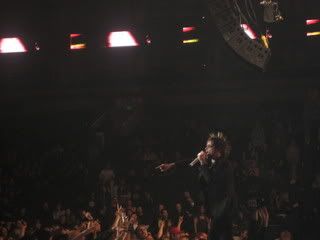
Instead? Look at some pictures from the Rockstar Supernova show on Thursday, February 22 (with Juke Cartel, fronted by Rockstar Supernova reality show runner-up Toby Rand, and Panic Channel, featuring Dave Navarro):
Lukas Rossi, the former Hooter’s cook from Canada who won the reality show contest and now fronts Rockstar Supernova
Tommy Lee on keyboards during a cover of The Verve’s Bittersweet Symphony

The encore, a cover of Prince’s Purple Rain, climaxes with – what else? – a rain storm of purple confetti
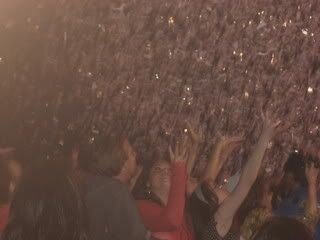
(Molly Freedenberg)
Noisepop cracks up: trading jibes with Patton Oswalt
Our little bundle of noise is almost all grown up. Damning the brooding tradition of adolescence, Noise Pop has learned to laugh at itself — and anything that involves swigging beer and heckling Patton Oswalt without a two-drink minimum sounds like pure fucking genius to me. I recently spoke to Oswalt on the phone from Burbank. After soaking in enough indie to keep you cloaked in scene points until next year, you may want to check out his act alongside fellow comedians Brian Posehn and Marian Bamford. (K. Tighe)
SFBG You’ve been gigging at indie rock venues for a while — and now you are getting booked at festivals such as Noise Pop and Coachella. A lot of bands must be pissed off at you.
PATTON OSWALT Getting invited to these things is really flattering, but my rider’s still simple. As long as there is old scotch, I’m fine.
SFBG Have you ever been to the Noise Pop festival?
PO No, but I’m really excited. I’ve only ever listened to Genesis, so I’m hoping to discover new stuff.
SFBG You used to live in San Francisco. Are there any old haunts you still frequent when you play here?
PO I have about 10 old haunts. They are all Starbucks now.
SFBG El Farolito or Cancun?
PO La Cumbre all the way. They are mighty, mighty, mighty, and they’ve never fallen.
SFBG Your San Francisco act is always incredibly liberal — how much do you need to alter your political material from city to city?
PO I don’t have a tailored act. I trust the audiences to rise to the occasion. There are more and more pockets of resistance everywhere. Besides, the things I say aren’t all that outrageous compared to what is actually going on.
SFBG Any early thoughts on the 2008 presidential race?
PO I’m saying it now: the Democratic ticket will be Mickey Rourke and the original lineup of Journey.
COMEDIANS OF COMEDY
Sun/4, 5:30 and 8:30 p.m., $24
Independent
628 Divisadero, SF
(415) 771-1421
MORE NOISE POP PICKS
FEB. 28
DAMIEN JURADO
At a recent gig in Seattle, Damien Jurado recounted an interview with a French journalist who had asked him if folk music was the new grunge. The singer-songwriter dismissed the question, but it was clear he was as comfortable cracking wise as he is creating the bleak portraits and doleful characters that inhabit his songs. Jurado’s latest release is not new but a reissue of Gathered in Song (Made in Mexico), which was originally put to tape in 1999 by friend and fellow plaintive songwriter David Bazan. Three months older though still freshly minted is And Now That I’m in Your Shadow (Secretly Canadian), a milestone recording with Jurado’s first permanent band, including cellist Jenna Conrad and percussionist-guitarist Eric Fisher. Here the trio essays the same lyrical and windswept landscapes that dominate Jurado’s discography, though gone are the upbeat pop numbers that have peppered past albums. The result is at once tender and forlorn. John Vanderslice headlines; the Submarines and Black Fiction also perform. (Nathan Baker)
8 p.m. Independent, 628 Divisadero, SF. $14. (415) 771-1421
MARCH 1
TRAINWRECK RIDERS
Despite critical acclaim for their latest album, Lonely Road Revival (Alive), Trainwreck Riders remain as down-home as their sound. Proof the San Francisco boys haven’t gone Hollywood yet: vocalist Andrew Kerwin still works at Amoeba in the city, and the band recently got arrested and Tasered by Houston police at a show with former labelmates Two Gallants. Songs such as "In and Out of Love" combine roots rock, punk, and country that sound familiar, retro, and refreshing all at once. The harmonica in "Christmas Time Blues" makes me want to flee to my favorite dive bar to sulk, even on a good day. (Elaine Santore)
9 p.m. Rickshaw Stop, 155 Fell, SF. $12. (415) 861-2011
MARCH 2
DAVID DONDERO
If ever there were a diamond in the indie rock rough, it is David Dondero. National Public Radio named him one of the 10 best living songwriters, but he still tours in his truck and has probably served you pints at Casanova. Nick Drake may have lamented that "fame is but a fruit tree," but he checked out long before his notoriety took root and grew. Dondero, on the other hand, has worked for years in relative obscurity. His latest effort, South of the South (Team Love), was bankrolled by Conor Oberst, an overdue invitation to the feast from a man who freely admits to copping Dondero’s style. Jolie Holland headlines; St. Vincent opens. (Baker)
9 p.m. Fillmore, 1805 Geary, SF. $20. (415) 346-6000
TED LEO AND THE PHARMACISTS
Naming your band is one of the early hurdles for any would-be rock star. Ted Leo and his mates had a stroke of genius the day they alighted on the Pharmacists, arguably trumping even the Beatles for best tongue-in-cheek rock ‘n’ roll pun. Not that ingenuity is lacking in this outfit, which packs as much fevered punk energy into a four-minute tune as a mitochondrion does into a cell. For those who slept through freshman biology, that’s the part of a cell that, among other things, processes adrenaline. And anyone who has ever attended a Leo show is all too familiar with this chemical. (Baker)
8 p.m. Great American Music Hall, 859 O’Farrell, SF. $18. (415) 885-0750
MARCH 4
CAKE
The genre-bending Sacramento band known for funky arrangements, monotone vocals, droll lyrics, and a whole set of cabaret, country, and soul cover songs (including Gloria Gaynor’s "I Will Survive" and Black Sabbath’s "War Pigs") finishes Noise Pop with characteristic verve and vibraslap. This indie-turned-mainstream-turned-indie quartet has gotten increasingly political in recent years — check out the band’s Web site (www.cakemusic.com) if you want to see what I mean — so expect some social commentary with your catchy ditties. It’s also worth showing up for the textured pop sound and cheeky lyrics of opening band the Boticcellis; Money Mark and Scrabbel also perform. (Molly Freedenberg)
7:30 p.m. Bimbo’s 365 Club, 1025 Columbus, SF. $25. (415) 474-0365
Noise Pop: Miss him?
› a&eletters@sfbg.com
The first time Roky Erickson performed in San Francisco was in the summer of 1966, fronting his Austin, Texas, band the 13th Floor Elevators, whose garage rock classic "You’re Gonna Miss Me" was rising up the national charts. Sharing the bill at the Fillmore with Grace Slick’s first band, the Great Society, Erickson sang of psychedelic reverberations and reincarnations in both sagely reassuring croons and blood-curdling yelps. The Elevators’ name shows up on Fillmore-Avalon posters so often that even today they’re still thought of as an honorary San Francisco psychedelic band of sorts.
The last time Roky performed in the city was in the early 1980s, and he was singing of two-headed dogs and aliens from the most tawdry of B-grade horror films. Times had changed, yes, but Erickson had changed more, irreversibly fried by a three-year stint in a maximum-security Texas state hospital after he was declared insane in 1969. The one thing undeniably the same was that one-of-a-kind voice, crushing Little Richard, James Brown, and Buddy Holly through the blender of a particularly Texan brand of acid-baked dementia.
Performers from GWAR to Marilyn Manson have made a lucrative career by fashioning an act from gothic horror. Erickson, to all appearances, has actually lived it, and if his record sales have been tiny in comparison to those of others, the fervor of his cult following is second to few. "Roky’s aesthetic rings true with younger music-media fans," says Billy Angel, who played autoharp as part of Erickson’s backup band the Aliens when Erickson reemerged in the late 1970s. "He brought to vision many years ago the now-contemporary experience of rock music coming through the sound system while film noir beams from the video screen."
Erickson’s first San Francisco appearance in about 25 years — as part of Noise Pop on March 1 — comes at a time when most fans had given up hope of seeing him onstage. Withdrawing from music entirely for about a decade, he began performing again in late 2005 after a bitter fight for his custody between his mother and his brother Sumner — the latter also a renowned musician but quite a different one: a tuba player for the Pittsburgh Symphony Orchestra. You couldn’t make it up, but we know it’s true because the whole battle was caught on film, in the mesmerizing and disturbing documentary You’re Gonna Miss Me (screening at the Roxie Film Center on Feb. 28).
As his family feuds over what’s best for its prodigal son and praise pours in from such interviewees as Patti Smith, Erickson wanders through the film like a ghostly observer. Apparently neither gratified nor agitated by the attention of either fanatical fans or would-be caretakers, he’s more interested in adjusting his army of televisions and stereos to just the right impossibly painful, cacophonous loudness. As much as most everyone on camera gushes over his genius and tragedy, what Erickson thinks about his cult and incapacitation remains a mystery.
There’s just one scene in the 90-minute film in which he seems at ease and makes one suspect his upcoming show might not be the psychodrama we fear. A therapist asks him to play a song; Erickson starts to strum an acoustic guitar and sing with folky, gentle tenderness, his vocal chops fully intact. Suddenly, he doesn’t seem like a nearly inert burnout fawned and fought over like a familial football. Music courses through his system — his thoughts and voice are clear and calm. It might be the only psychic skin he has left, but he wears it well. *
YOU’RE GONNA MISS ME
Feb. 28, 9:15 p.m., $10
Roxie Film Center
3117 and 3125 16th St., SF
(415) 863-1087
ROKY ERICKSON AND THE EXPLOSIVES
With Oranger, Howlin Rain, and Wooden Shjips
March 1, 8 p.m., $25
Great American Music Hall
850 O’Farrell, SF
(415) 885-0750
The rise and fall of the Donnas
› kimberly@sfbg.com
The Donnas have every right to be bitter — and the general nonexistence of delectable male groupies is just one item on a laundry list of spoilers. "Seriously, if there were hot guys throwing themselves at me, I would take advantage of them!" complains vocalist Brett Anderson, lounging on the patio outside engineer Jay Rustin’s Sherman Oaks recording studio, where the Donnas are recording their next album.
What’s the issue on this mild winter day in an intensely girly garden paradise cluttered with poodle-haired pups, dive-bombing hummingbirds, and wildly whistling songbirds? The unequal treatment undergone by one of the most celebrated and derided groups of female rock musicians to hit the country’s pop radar since the Go-Go’s. Essentially, "it’s not the same!" Anderson and guitarist Allison Robertson yelp simultaneously.
"It’s much harder for a girl to get a blow job," adds Robertson, ever the analytical Donna, even in matters of quickies. "A lot of guys on the road in rock bands don’t always bang every girl — they just get blow jobs really fast. Guys can do that. It takes 10 minutes or five minutes. But with girls, it’s just not the same. We all know — it’s a little more involved. You need a little more privacy usually, I dunno."
Their tour bus just has tiny bunks shielded by curtains. "Literally, a Porta Potty is more private than a bunk," says Anderson, still the wisecracking, immaculately turned-out amazon in a sweater, skinny jeans, flats, and Springsteen T.
Once Palo Alto’s misfit all-girl rockers from Jordan Middle School, San Francisco’s punk-metal-pop sweethearts on Lookout!, then Atlantic’s up-and-comers splashed all over MTV, the Donnas are now, 13 years along, veterans at the ripe ages of 27 and 28 who can say they’ve been and done that and seduced, if not 40 boys in 40 nights, then thousands of listeners. Today labelless, off their well-worked and beloved touring circuit, and working through a Saturday on a disc with nary a flunky pushing a pop agenda, the Donnas are free, though their trajectory has been tough — littered with put-downs (some said they were the products of a Svengali in the form of Radio Trash–Super*Teem label owner Darrin Raffaelli, who initially collaborated with the teen band once called Ragady Anne then the Electrocutes), innuendo (who could ignore the unsettling amounts of older stalker dudes at their shows?), and rumor. "A lot of people think we’ve gotten dropped and we owe [Atlantic] thousands of dollars and we can’t pay them back!" Robertson explains. "Also that we’re broke and we’ve broken up."
"Also that we’re lazy," Anderson jumps in, imitating an imaginary slurring, boozy Donna. " ‘Oh yeah, we’re working on our record. Gimme another beer!’ "
Contrary to conjecture, it turns out that the Donnas weren’t dropped from Atlantic but left amicably, deciding not to renew in the face of pressure to go more pop after 2002’s Spend the Night failed to take off on rock radio despite much MTV play for their video "Take It Off" and 2004’s Gold Medal failed to remedy matters. "Our big joke was that we were making Gold Medal so Spend the Night would go gold," Anderson quips. Fortunately, the women who once aced their high school courses and recorded their first 7-inches after hours at a local Mailboxes Etc. are used to driving themselves — even when they couldn’t operate a motor vehicle.
"They started when they were in seventh grade," Anderson’s mother, Bonnie, says over the phone from Palo Alto. She’s one of a contingent of Donnas parents including Robertson’s musician dad, Baxter, and bassist Maya Ford’s English instructor father, John, who founded Poetry Flash. "We had to drive. We were the roadies. Mostly we drove them to different shows, unloaded them, watched them, and went, ‘Omigod,’ and loaded ’em up again. We lived vicariously through them."
But then, the Donnas’ career has been marked by such disjunctions: they were the good students who got into UC Santa Cruz (Robertson and Ford), UC Berkeley (Anderson), and NYU (drummer Torry Castellano) as well as sexy, nice girls-gone-bad who foregrounded female desire, fast tempos, and crunchy metal-fleck glam rock licks, fashioning a sound that might have emerged from Rikki Rockett and Vince Neil if they took the rock train to the next gender. All appetite and attitude, riding the tension between the needs to please and be pleased, the Donnas projected the carefree party-hard image that presaged Andrew W.K. while undergoing their share of trauma and drama, starting with a car accident on the cusp of 2001’s Turn 21 (Lookout!) and continuing through the trouble-plagued Gold Medal sessions, which saw Castellano’s painful case of tendonitis, Anderson’s ravaged vocal chords, Robertson’s divorce, and ordinarily prolific lyric writer Ford’s dry spell. "I kind of ran out of ideas and just got depressed," Ford says on the phone in Los Angeles. "I think I felt, like, a lot of pressure, and it’s never a good situation to be under the gun."
But the Bay Area–bred band stuck together, even when they always felt like outsiders amid Lookout!’s East Bay punk scene. "The thing that’s the most impressive about the Donnas is that through all of this, being teenagers, being best friends, having dreams of school and different careers, parental pressure to pursue those, highs and lows in terms of record sales and attention, they’ve stuck together," says manager Molly Neuman, once the drummer of riot grrrl groundbreakers Bratmobile and a force behind the now-catalog-driven Lookout! alongside her ex-husband, Christopher Appelgren.
The frustrating thing — even on this Grammy weekend, as the Dixie Chicks were getting ready to receive their dust collectors across town — was hitting the wall on rock radio as so many other female bands have. All the while they were dancing backward, away from the on-air jokes about synchronized periods and D-cups and being told repeatedly, " ‘We don’t play female rock on our rock station,’ " unless it’s Evanescence or No Doubt, Robertson says.
After trying Atlantic’s pop strategy and working with songwriters such as Dave Stewart ("You write songs with a guy who’s had these number one hits, and you see he still has to sit and go, ‘Dog, no. Frog, no’ — that’s nice," Anderson says. "You feel like, ‘Oh shit, he has to do that too’ "), they’re hoping to strike a balance with the new record, cooking up hard rock ear candy that satisfies a craving for sweet riffs and hard-to-shake hooks without falling prey to the monochromatic hardness of, say, Spend the Night. The songs they’ve tracked so far focus on Donna favorites — partying and dancing — with glances at the equalizing effects of nightfall and the loneliness of the road. And perhaps the gumption that gave these women the courage to face prove-it punks and surly sods every night on tour, the same sassiness that some mistake for brattiness, has been tempered with time.
"We were listening to old records and thinking, ‘Shit! Like, we’re scary!’ " Anderson says, laughing.
"This album," Robertson says softly, "is more like ‘Come party with us.’ " *
DONNAS
With Boyskout, Bellavista, and Push to Talk
March 2, 9 p.m., $20
Bottom of the Hill
1233 17th St., SF
(415) 621-4455
Sonic Reducer will return next week.
Academy fight song
First things fuckin’ first: I know I’m not the only film fan who’s still pissed about Crash winning over Brokeback Mountain in 2006’s Best Picture race. In fact, let’s change the subject before I punch the nearest preachy ensemble drama (look out, Babel!). Cinemaniacs actually have a bigger problem this year, with the prospect of an Academy Awards ceremony chockablock with predetermined winners. You might as well time your corner-store run during the Best Actor and Best Actress awards, cause there’s zero mystery about who’s gonna snag those trophies (this way you can actually watch the People Who Died montage for once). But who else will win besides Forest Whitaker and Helen Mirren? Can we make it through four hours of entertainment-related programming without mentioning Anna Nicole Smith? And are there any showdowns worthy of honorary Oscar recipient Ennio Morricone’s iconic The Good, the Bad, and the Ugly score?
Best picture: Surprisingly, who’ll go home with the biggest O is anyone’s guess. The choices are Babel (which won the Golden Globe), The Departed (a big-budget box office hit), Letters from Iwo Jima (stellar movie, but Clint Eastwood’s already got like 57 of these things), Little Miss Sunshine (the little indie that could?), and The Queen (a good movie made great by Mirren’s performance). I’m aiming at my Oscar dartboard (it’s taped on a Crash poster) and picking Babel. Or Little Miss Sunshine. Or The Departed. Yep, I’m useless.
Best director: If Martin Scorsese doesn’t win for The Departed, I’m shaving my hair into a Mohawk. Paul Greengrass (United 93) I could maybe live with. But if Alejandro González Iñárritu (Babel) gets his mitts on Marty’s trophy, it’s Bickle time.
Supporting actor: Frankly, I’m just psyched that the Academy chose to nominate The Departed ‘s Mark Wahlberg (funny, bitchy) instead of going the predictable route with Jack Nicholson (over-the-top in a bad way; what the fuck was that Tony Montana scene about anyway?). Despite mutterings about how Norbit‘s hideous existence is gonna harm his chances, Eddie Murphy’s Dreamgirls comeback will prove hard to beat, what with the singing, dancing, and acting chops — and nary a fat suit in sight.
Supporting actress: It’s Dreamgirls‘ J-Hud all the way. Insert your own "and I am telling you" pun here. Think she’ll thank Beyoncé in her acceptance speech?
Foreign-language film: Pan’s Labyrinth is on a roll. Give Guillermo del Toro his much-deserved due. You know you loved Blade 2 as much as I did.
Original screenplay: Even with the hokey thing about the stag, The Queen, written by the havin’–a–banner year Peter Morgan, is pretty appropriately regal. But the superfreaky Little Miss Sunshine contains the line "Do what you love, and fuck the rest," which may be kind of a cliché but is endearing enough to win me over. Kind of like the movie itself.
Adapted screenplay: Wizard sleeves! Vanilla faces! Gypsy tears! Wa wa wee wa! Oh, all the nominees in this category are deserving, but if they don’t give this to Borat genius Sacha Baron Cohen and his crew, the Academy will have chosen wisely. Not.
Documentary: Al Gore will never be president, but he can win an Oscar. (Or at least his movie, An Inconvenient Truth, can.) He’s kind of like Ronald Reagan in reverse.
Costume: I almost want to say Curse of the Golden Flower, for the sheer fact that it made Gong Li’s knockers defy gravity. However, I think the sequin-per-capita rule applies here: Dreamgirls, you may not have snagged a Best Picture nom, but getting snubbed has never looked so glamorous. (Cheryl Eddy)
ACADEMY AWARDS
Sun/25, 5 p.m., ABC
www.oscar.com
Happy returns
› a&eletters@sfbg.com
A man hides from the world in a shabby seaside rooming house until two men arrive determined to take him away. The latter represent a kind of conformity, brutal and ruthless in its determination and tactics. The turning point in their showdown with the wayward man will be the birthday party they help his smitten elderly landlady throw for her sole tenant.
The mystery-laden simplicity of The Birthday Party ‘s plot provides ample room for absorbing the subtle details of the relationships it presents, and Berkeley’s Aurora Theatre brings those out expertly. Artistic director Tom Ross’s production is not only sure and intelligent but palpably enthusiastic in its essaying of this nearly 50-year-old play, which is both Harold Pinter’s first full-length work and Aurora’s first production of his work since he won the Nobel Prize for Literature in 2005.
A scene of domestic nonbliss opens the play: housewife Meg (Phoebe Moyer) and deck-chair attendant Petey (Chris Ayles) are an aging couple mired in a domestic routine whose laconic, staccato rhythms are bleakly comedic. Their empty chat introduces the mix of precise characterization and the ruse that the play will go on developing. Their frowsy little boarding house, meanwhile, offers (in the choice details of Richard Olmsted’s set design) a muted clash of wallpaper, a lumpy armchair with soiled cushions, and a small, serviceable dining table among an obligatory arrangement of homey knickknacks. The place, it seems, is avoided like the plague by all but permanent resident Stanley (a dyspeptic antihero brilliantly realized by James Carpenter).
Vaguely suggesting guilt, despondency, or disgust, Stanley rises late, jabs at his cornflakes, complains about them and the tea, lights a cig, then spends the day doing nothing. The psychosexual aspects of this ad hoc family get played up grotesquely in Meg’s mommy lust for the younger man, in the clash of her youthful eagerness and frumpy exterior, and maybe just a bit in the ultimately impotent patriarch Petey’s playful moniker. The seductive girl next door, Lulu (Emily Jordan), and the arrival of Goldberg (Julian Lopez-Morillas) and McCann (Michael Ray Wisely) up the ante, threatening to sunder the bonds of the little household.
The genteel Goldberg and strong-arm McCann are precise and lively versions of their terrorist types and flaunt their respective Jewish and Irish Catholic backgrounds just enough to give their authoritarianism a religious as well as secular inflection. But power’s way is the way of the playground, and the power play by Goldberg and McCann has a lot of play in it. They’re keen on a set of games that never leave them far from grade school bullies.
The birthday party, the central event of the play, provides a kind of formal, ritual occasion for children still fighting, struggling, and pushing each other around, stubbornly refusing to give any ground. The pushing and shoving never really stops, but the party offers a set of temporary restrictions — new parameters for the game. And it’s a literal game of blind man’s bluff that caps the dreary, drunken celebration at which Stanley (who insists it is not his birthday) is the unwilling guest of honor.
Fifty years of modern theater, including not least Pinter’s subsequent work, have no doubt made a play like The Birthday Party more approachable, but it remains too esoteric for many. Instead of the elusive language used in The Birthday Party, audiences often expect something more akin to a crossword puzzle — enter the appropriate words in their respective boxes, and you achieve a definitive solution: nice, neat, and self-contained.
But if The Birthday Party is a puzzle, it is open-ended and without a solution, or rather with a series of partial and contingent solutions. Words are not really evidence here. Evidence has to be gathered between and behind the lines.
As if to underscore this limit of language, Stanley’s final word isn’t a word at all. It’s a horrifying howl that rises like bile in the throat of a man who has finally been tamed, blinded, and led off. As mysterious as it is immediate, it might be, fatalistically speaking, his last gesture of defiance, a final assertion of individuality and independence. More hopefully, it may be the first expression of some new measure of understanding for which there are no words yet. (Nine across: what a new animal sounds like.) Either way, something has happened. That much is certain. So happy birthday. *
THE BIRTHDAY PARTY
Through March 4
Wed.–Sat., 8 p.m.; Sun., 2 and 7 p.m., $28–$50
Aurora Theatre
2081 Addison, Berk.
(510) 843-4822
www.auroratheatre.org
Robe of glory
› a&eletters@sfbg.com
"The Jim Kweskin Jug Band was sort of the first group of goofballs who didn’t wear uniforms, who didn’t have set patter. It was the acoustic precursor of the Grateful Dead," Geoff Muldaur says on the phone from Los Angeles. "Bob Weir got our first album and ran over to Jerry and said, ‘We’ve gotta form a jug band. You’ve gotta hear this shit!’ "
Before iTunes and Pandora.com, getting your hands on a new record was sometimes like receiving a password to a part of your spirit you didn’t know existed. Since Muldaur’s early days with Kweskin and blues integrator Paul Butterfield, his vocal chops have become legendary at the very least. "There are only three white blues singers," Richard Thompson once said. "Geoff Muldaur is at least two of them." Muldaur has been an equally powerful force in the interpretation and expansion of the American songbook.
On "Wait ‘Til I Put On My Robe," one of the most moving songs on Muldaur’s 2000 solo album, Password (Hightone), there is an immediate feeling of ascension as Muldaur’s sings, "Going up the river so chilly and cold / Chills the body but not the soul." The stunning arrangement of this traditional gospel tune comes from Clarence Clay and William Scott, two blind African American street musicians recorded in Philadelphia in 1961. It sounds like Muldaur’s back in ’61 joining in on what he describes as the "weird, modal, wonderful, jumping" harmonies.
Although he was an essential part of the exponential surge that happened in the folk and blues scene in the ’60s, Muldaur is still in awe of the musical movement. He assures me that no matter what I’ve heard about those times in Cambridge, Mass.; Woodstock, NY; San Francisco; and beyond, "it’s all true! When I was hanging out with Jim Kweskin, Fritz Richmond, Bill Keith, and Maria [Muldaur, his wife at the time], I just assumed that’s how life was and that we were just sort of good. But the combination of those people was unmatchable. Bill Keith left Bill Monroe to join the jug band. Maria was shocking — she was so good."
With the exceptions of a quickie gig at the Lincoln Center in 2001 and a tribute concert in Japan for Fritz Richmond after the king of the jug and washtub bass died in 2005, Muldaur and Kweskin haven’t had a chance to really sit down and play together for many years. Muldaur is as excited as anybody for their reunion at the Freight and Salvage Coffeehouse. "Just playing with Kweskin, man — it’s magic," he says. "Look, I go to the gym so I can keep this shit up!"
Playing in Berkeley will be a metaphysical homecoming. Muldaur lived in Mill Valley from 1988 to ’89 and would sneak across the bridge to revisit places where he had jammed in the ’60s. "When [the Jim Kweskin Jug Band] came out to the West Coast at first, to LA, it was like oil and water," Muldaur says. "But when we came to San Francisco and Berkeley, we were right at home because there were already freaks like us. The jug band and the scene in Cambridge was very much like in Berkeley, but Berkeley stayed that way."
Terry Gilliam told Muldaur his crew members used to get on their knees every morning and pray to Muldaur’s version of "Brazil," which gave the 1985 film its name. "It represented this insane, wacky, other place in reality," Muldaur says. With a major jug band documentary and an immense CD set charting Muldaur’s influences in the works, that other place in reality will soon be here to stay. *
GEOFF MULDAUR
With Jim Kweskin
Fri/16, 8 p.m., $19.50
Freight and Salvage Coffee House
1111 Addison, Berk.
(510) 548-1761
“Christmas on Earth” in February
The pull quote snagged by most critics from John Cameron Mitchell’s Shortbus was Justin Bond’s quip "It’s like the ’60s, only with less hope," delivered while surveying the myriad sexual couplings and groupings in his salon’s back room. Bond’s pithy line encapsulated the film’s ideal of community through polymorphous perversity, even if that vision is tempered by an awareness of the initial sexual revolution’s blind spots and a hangover from the 20 years of sexual-identity politicking in its wake. Yet Mitchell’s film is neither jaded nor self-serious and never pimps out its graphic sex scenes for purposes of cynical titillation. Reflecting the loose, workshop methods with which Mitchell and his cast developed the film, sex in Shortbus is for the most part something revelatory, experimental, and at times quite playful. But Mitchell draws the narrative parallels a little too neatly: when else could the film’s sex therapist finally achieve orgasm but at the story’s, uh, climax?
As the centerpiece of the inaugural screening of San Francisco Cinematheque’s four-part "Oppositional and Stigmatized" series of iconoclastic, taboo-confronting cinema, Barbara Rubin’s Christmas on Earth — one of the most sexually explicit and formally innovative works of ’60s underground film — offers a historic correlative to Mitchell’s degree zero approach to filming real-time sex. Made the same year as Jack Smith’s Flaming Creatures, Rubin’s joyously anarchic 1963 record of an orgy held in a New York City apartment is remarkable not simply because Rubin was 19 when she made it but because it porously images and imagines sex in ways Mitchell’s uptight narrative only partially succeeds at pulling off. Christmas presents sex as something messy, spontaneous, and ongoing, not as an existential telos.
Comprising two superimposed projections, one nestled inside the other, the film both abstracts and renders in extreme close-up the bodies and activities of its four male and sole female participants. The projectionist is encouraged to add to the kaleidoscopic effect by continually changing color slides in front of the two reels. The dual-screen presentation, coupled with Rubin’s prescribed soundtrack of live rock ‘n’ roll radio, creates a striking and often humorous image interplay. Penises flit about the outer projection like fat cherubs, while at other times, a vagina becomes the curvilinear landscape within which the inner projection’s extended sequences of man-on-man action take place. There are money shots, yet there is nothing hardcore about Rubin’s film. Instead, it revels in a kind of ecstatic innocence, gleefully and willfully flaunting its disregard for categories such as gay and straight, reportage and assemblage, skin flick and art flick.
Despite the singularity of its vision, Christmas wasn’t created in a vacuum. As Andrew Belasco’s recent illuminating portrait of Rubin and her work in Art in America reveals, the film came out of a mid-’60s New York creative milieu, set on shaking up an aesthetically and sexually uptight America, in which Rubin played an active part. Whether as a filmmaker, organizer, agitator, or all three at once, Rubin was a connective node for many countercultural figures. The creative collaborations and events that arose from her catalytic networking are as much a testament to her involvement with the scene as the small body of cinematic work she left behind.
Rubin’s misdiagnosed depression led to a stint at the Silver Hill rehab clinic in Connecticut, where she supposedly gave Edie Sedgwick bulimia tips. After being bailed out, she hooked up with Jonas Mekas and his Film-Maker’s Cooperative. Rubin became Mekas’s indispensable right hand; he was her mentor and greatest champion. Her list of associates and friends included Bob Dylan, Andy Warhol, Allen Ginsberg, and the Velvet Underground (whom she took Warhol to see for the first time in 1965). She also participated in Warhol and the Velvets’ traveling multimedia onslaught, the "Exploding Plastic Inevitable," and served as one of the Factory’s many informal staff photographers. By the end of the decade, though, she’d become a devoted student of Jewish mysticism and distanced herself from her younger, rabble-rousing persona. Entrusting the cinematic artifacts of her earlier life to Mekas, Rubin moved to France. Over the years she gradually severed her New York contacts, eventually dying in isolation in 1980. She was only 35.
Given our historic hindsight, Christmas might seem quaint or naive, its dialectic vision of guiltless sexual pleasure clearly the product of an earlier time. While not necessarily hopeful in the sense that Bond characterizes the 1960s in Shortbus, Rubin’s best-known film is very much suffused with a belief in the potential for new cinematic, sexual, and interpersonal possibilities. It is a belief deliciously put into practice by the contingency built into the screening experience. It is a belief not too distant from the aims of Mitchell’s own Lower East Side story. (Matt Sussman)
FORBIDDEN AND TABOO
Sun/18, 7:30 p.m., $6–$8
Yerba Buena Center for the Arts
701 Mission, screening room, SF
(415) 978-2787
www.sfcinematheque.org
Love rebuff
SONIC REDUCER Hey, subliminal kids, watch out for those Music and Lyrics billboards all over town — they’re as deadly as Pretty Ricky’s between-the-sheets crunk, chased by Justin Timberlake covers such as the Klaxons’ strings-laced "My Love" and Rock Plaza Central’s mead-soaked "Sexy Back." The poster pic is so mundane that it catches then holds your attention: Hugh Grant and Drew Barrymore shyly demur from meeting the viewer’s, and each other’s, eyes, choosing instead to moon over — what? Music, lyrics, Craigslist casual encounter ads, old mug shots? With Valentine’s Day shuffling furtively around the corner, I’d venture that it’s best Hugh and Drew weren’t out bonding over some cozy Cattle Decapitation appearance, because as all we brave, San Francisco live-music lovers know, hot hookups and cool shows don’t necessarily mix.
Unspoken rule number 14 of San Francisco rock, according to your cruise director on the Glumboat: don’t hit on the local wildlife at shows. San Francisco’s SFMFs (single female music fans, for all you acronym haters) know, Joe. Single is an increasingly obsolete format in vinyl, CD, and skin and bones — consider it a mission impossible to meet nonattached men, women, or potted plants at shows. I don’t care which way you swing (if — caveat — you’re not in the band itself), you’re more likely to have a close, personal relationship with the bouncer who’s forcibly removing you from the club than someone you’d potentially want to date. You have a better chance meeting some fast ninetysomething at a retirement home than at a show.
If you’ve just moved to town: so sorry to bust up your illusions of glam romance, but concerts here are simply not pickup scenes — for anyone other than the guys and girls in the band. Hip-hop, folk, C&W, blues, pop, and rock lovelorns — you’re all outta luck, though indie rock is the absolute worst. You know that cute, floppy-haired, gangly boy rocker in a polo shirt and Converse by the side of the stage? He may be by himself (and likely he has a futsy partner tucked away at home), but that doesn’t mean he actually wants to talk to anyone — let alone get a phone number.
All this is what I’ve gathered during my many years of showgoing — and a quick, extremely unscientific poll of singletons in Guardian editorial bears me out. Sample responses: "Everyone’s all cliqued up at shows." "You go with your friends, find your spot, and you don’t talk to other people. Ever." "At dance clubs you meet other people because you’re actually dancing with each other. At live shows everyone’s looking at the stage." "It’s too loud to talk." "San Francisco has a reputation of being aloof." "Maybe you can talk to someone when you’re standing in line at the bar?"
"Either it’s all guys or the one girl you want to hit on will be someone in the band’s girlfriend," said calendar editor Duncan Scott Davidson, who’s also clocked time as a doorguy at Slim’s, the Endup, and 111 Minna. "The only time I ever tried to pick up someone was at a Bomb show, and she turned out to be Bomb drummer Tony Fag’s girlfriend." Irony abounds.
He’s actually seen guys trying to hit on women at shows, he added, "But what do you say? ‘This band really rocks, huh?’ "
My favorite answer is "People are just there for the music," which does say something about our fair scene’s integrity if you believe music lovers are simply there to see and hear, not to hook up. And perhaps it imparts even more about the nature of local original music, which is less about the damsels than going dumb, less about the sex than the noise sax solos — with the Lovemakers in the horny minority. Chalk it up to the Bay Area’s feminist legacy and the p.c. ’90s, but on the plus side of the non-meat-market music scene, I’ve often felt as safe and unpressured while checking out music solo as any hulking dude in a black hoodie at a Mastodon show. Perhaps our live scene is thriving on that focus and the passion we have for the music — and lyrics — itself.
Ahem. I don’t know about you, horndogs, but pure intentions certainly get me all hot and bothered, though they don’t help when we’re sulking alone in the corner at the Husbands’ Valentine hoedown. If ya got a problem with that, prove me wrong. *
SWINGING SOUNDS O’ THE STRATOSPHERE
BLOODY HOLLIES
A question for the ages: Who to Trust, Who to Love, Who to Kill — and the title of the fierce San Diego blues punks’ new Alive disc. Wed/7, 9 p.m. Annie’s Social Club, 917 Folsom, SF. $5. (415) 974-1585
KINGS AND QUEENS
Nevada City homegrownies make haunting pop prog. P.S. K&Q’s Rich Good once teamed with Joanna Newsom in the Pleased. Thurs/8, 9:30 p.m. Hemlock Tavern, 1131 Polk, SF. $6. www.hemlocktavern.com
MIRAH
Recently remixed up with Mt. Eerie and Anna Oxygen on Joyride, the K artist is too cute for her horn-rims. Little Brazil and the Affair also play. Fri/9, 10 p.m. Bottom of the Hill, 1233 17th St., SF. $8–$10. (415) 621-4455
RED THREAD
The moody Oaklanders are stitching up new songs for a summer album. Fri/9, 9:30 p.m. Hemlock Tavern, 1131 Polk, SF. $7. www.hemlocktavern.com
TYVA KYZY
Riot rrroar — the all-female Tuvan throat singers wrap their power pipes around lullabies and tunes about tea. Sun/11, 8 p.m. Great American Music Hall, 859 O’Farrell, SF. $21. (415) 885-0750
ZS
The NYC chamber noise–niks sit down with Death Sentence: Panda! and Sword and Sandals. Sun/11, 9 p.m. Bottom of the Hill, 1233 17th St., SF. $8. (415) 621-4455
Believe the buzz
› a&eletters@sfbg.com
Signed to Frenetic Records and publicized by Fanatic Promotion, local boys–made–groovy the Makes Nice are surprisingly mellow. Perhaps they’ve been consorting with a resurrected British freakbeat muse — it’s been "more relaxed than you’d think, given the name and all," vocalist-guitarist Josh Smith writes via e-mail, discussing the group’s deal with Frenetic. The San Francisco label — also home to releases by one of Smith’s previous bands, the Fucking Champs — is proving an ideal base for these kind and raucous rockers. Their debut, Candy Wrapper and 12 Other Songs, is a head rush without the dizziness. Think honey versus synthetic sweeteners, Tartine Bakery’s shimmering morning buns versus Costco’s limp croissants.
Throughout Candy Wrapper there’s a certain calm — call it the clarity that comes with good ole musicianship. Phil Manley of Trans Am expertly engineered the album at Lucky Cat, and he emphasized how the jazzlike rapport among the players helps the ripping guitar solos become play-it-again hooks, while the drum beats groove like funky piano solos. "I always know that your opinions are stale / When you say fresh, I know it’s fucking stale / And it don’t mean nothing at all," the boys harmonize smoothly over staccato syncopation on the title track. On "As Long As I Can" a crowded drumbeat that could throw off lesser percussionists dances in the agile hands of Jack Matthew (also a member of Harold Ray Live in Concert). When I compare the vocals on "Anna Karina" to those of punk groups on Fat Wreck Chords, Smith responds, "They were supposed to have been stolen from Les Fleur de Lys, Powder, SRC, and maybe the Everly Brothers." The members of the Makes Nice don’t have SRC’s fantastic hair, but the Mothballs’ Aaron Burnham plays bass that would stand strong in any decade of rock.
But how to describe the nature of this superfun trio? A mandolin is subtle and effective because of its double strings. So maybe we could label the Makes Nice a double trio, though they would prefer either a ragingly ridiculous moniker or none at all. "If it’s cool, I would prefer to call my songs post-techstep neofreakbeat," Smith jokes. "I’d call Aaron’s songs anachronistic Spartacus watchband croon-wop. I’d consider Jack’s songs to be hybrid vapor-wetware tragicomedy…." Maybe they play un–surf rock for those who don’t like genre surf rock and don’t know how to surf. "I wish we could play surf music," Burnham writes, pretending to brood. "We sorta tried and failed."
I like to blame the vicious surf gangs in Santa Cruz for stymieing my surfing education. But honestly, I was just as happy to bodysurf in safer spots and then — sunned, exhausted, and deliriously happy (remember that time before laptops?) — find a big smooth rock and rest on it, reading comics. Eventually, I added a Walkman to this scene, then a lover. The Makes Nice capture such windswept feelings in the tunes "She Don’t Ever Let Go" and "California Sun."
Talented local artist Hellen Jo (www.helllllen.org — that’s five l’s) designed Candy Wrapper ‘s cover, an eye-grabbing minicomic depicting a terrible car accident. "I met Hellen about five years ago while we were both students at UC Berkeley, and we’ve pretty much been friends and mutual fans ever since," Burnham writes. "We sent her a few songs with lyrics and asked her to choose one to depict with a minicomic for the cover. And she did, exceeding all of our expectations. We emptied out the band piggy bank for her, of course."
Likewise, Candy Wrapper speaks clearly to a graphic-novel generation that sees stories in everything. Along with such similar punky doo-woppers as the Tralala, the Makes Nice are building a bridge recalling the missing link that the original freakbeat bands provided to psych rock in the 1960s. A bridge to what? Duh, to whatever is next. *
MAKES NICE
With the Moore Brothers and Miguel Zelaya
Feb. 14, 9 p.m., $8
Make-Out Room
3225 22nd St., SF
(415) 647-2888
www.makeoutroom.com
www.myspace.com/themakesnice
Brutal fucking movie
› a&eletters@sfbg.com
A corpse is a corpse, of course, of course. And no one can talk to a corpse, of course. Unless, of course, that corpse is brought to you by the famous Mr. David Lynch. In this case the corpse gets up and shuffles away, walking the earth like something out of a Samuel Beckett play directed by George Romero.
My thirty-three-year practice of the Transcendental Meditation program has been central to my work in film and painting and to all areas of my life.
"Are you looking for an opening?" Look over here, if you dare, and make your entrée through a tableau of rabbit-headed domesticity complete with sitcom-style applause and a laugh track inserted at decidedly odd moments. Entrances and exits are everything in Inland Empire, which takes place in a universe so slippery your front door may no longer open into your living room but rather into a dark alleyway — and your identity might change if you step through.
So in July 1973 I went to the TM Center in Los Angeles and met an instructor, and I liked her. She looked like Doris Day.
"You have a new role to play?" Yes, you do, at the place where evil was born; your creepy new neighbor is more than happy to warn you of your imminent danger even as you stride around the ornate mansion that you and your violently jealous husband occupy. No matter, though. That new role is your big break, and your star turn in On High in Blue Tomorrows could mean you’ve finally stepped over the threshold into that magical land "where stars and dreams come true." Not coincidentally, it’s also where evil was born — and where hammy Southern accents go to die.
I call that depression and anger the Suffocating Rubber Clown Suit of Negativity. It’s suffocating, and that rubber stinks.
Federico Fellini’s 8 1/2 fantasy is Lynch’s almost three-hour New Nightmare, both a film and a studio lot overrun with elliptical numerical references: stages 4, 5, 6, 32, and 35; page 57. Where are we? Hollywood or Poland? And what time is it exactly? Is it 9:45 or just after midnight? Is it real time or remembered time, those two warring temporal spaces at the core of so many film noirs? Douglas Sirk–ian blue tomorrows are always just out of reach, but this is a rare instance in which the answer It’s only a movie isn’t very comforting — both viewers and characters seem trapped in a hellish real or imagined world that Lynch himself can’t or won’t explain. One thing is for certain: if you’re running along the Walk of Fame, it’s safe to say you’re in danger.
It’s so magical — I don’t know why — to go into a theater and have the lights go down. It’s very quiet, and then the curtains start to open. Maybe they’re red. And you go into a world…. It’s best on a big screen. That’s the way to go into a world.
Oh yes, Inland Empire was shot entirely on digital video. And it’s not that fancy-shmancy digital either. No, it’s crap digital. But it’s glorious crap — at once making the horror more potently ugly and profane and lending it the quality of gauzy impressionism. By the 4,000th squashed close-up of Laura Dern’s twisted face, you’re thinking there’s nothing so grotesque as a degraded image — see YouTube, tweaked-out coverage of the Iraq War. Then Lynch’s digital expressionism rallies, the incandescent flares of pixilated light at the twilight’s last gleaming. Everything is illuminated unless it’s not. A cut is not a cut but rather a buzzing lightbulb; a long shot is not a long shot but instead a menacing corridor.
I love Los Angeles.
Delivering her lines like a long-lost relative of Maria Ouspenskaya in The Wolf Man and lensed and styled to look like a cross between Jane Wyman and an evil squirrel, Grace Zabriskie plays the ultimate nosy neighbor — one who inaugurates this pleasure and boredom zone by opening a window into the leading lady’s future. Her director has a digital-video eye for combinations of lemon and gray as well as cheap Pepto-Bismol pinks and barf tones — he can make a palatial mansion look as grim as Eraserhead‘s dead living room. This is a movie about the horror of set design, the terror of lamps. Lynch can’t help but look for and stare down the rabbit hole, that spot where it’s hard to disappear, that place just down the way, the space that’s tucked back, difficult to see from the road — the lost highway that connects to the dark hallway and the innumerable nooks and crannies of negative space. As always, he fixates on the sinister brutality in pop’s lexicon; this time, instead of candy-colored clowns tiptoeing into bedrooms, it’s hearts wrapped up in clover.
It was the light that brought everybody to LA to make films in the early days. It’s still a beautiful place.
Is Inland Empire really The Passion of Laura Dern? Yes, this is Dern’s movie, her face being cut up in nearly every scene ("brutal fucking murder," as one character puts it), and Laura, what do you make of it? Are you in there? A spotlight trained on you, long and lean, running horizontally through the night in silent slow-motion, then toward the camera, then fast, then screaming like Rita Hayworth in the mirrors at the end of The Lady from Shanghai, but for three hours. Come back, Bette Davis and Joan Crawford, Gene Tierney and Mary Pickford, Judy Garland and Barbara Stanwyck, Joan Fontaine and Natalie Wood, Marlene Dietrich and Marilyn Monroe: Lynch wants to make you stars again! A coast-to-coast search will soon be under way for the shot-for-shot remake of Inland Empire.
And sometimes things happen on the set that make you start dreaming.
No doubt, as the fate-strapped actress Nikki Grace, Dern makes an exquisite corpse. Oh, wait — she’s actually Susan Blue, Nikki’s alter ego and the character she plays in her latest film, a Southern potboiler that also stars Devon Berk (Justin Theroux) as Billy Side. Susan wanders through her fever dream screaming desperately for Billy, who always seems to be around the next darkly lit corner but rarely materializes. As the giant talking bunnies say, it all has "something to do with the telling of time." Of course, Nikki and Susan might have just fused into some kind of Lynchian-Freudian beast. The infamous Lynch psychofugue. It’s an assumption borne out by a third Dern personality, a ball-busting broad with a mysterious bruise on her lower lip who permanently totes a rusty screwdriver.
What struck me about O.J. Simpson was that he was able to smile and laugh.
Dern’s performance is like a disco ball in a hall of mirrors; it’s rarely clear which character she’s playing, but she’s never less than entirely committed. One minute she’s a kittenish starlet, long legs stretched out across a sun-drenched gazebo. The next she’s a haggard has-been with a busted lip, climbing a set of dingy steps into a dark office, where she tells the man seated there — who is he exactly? And who’s he talking to on the phone? — about how she once thwarted a rapist by plucking out one of his eyeballs.
I don’t necessarily love rotting bodies, but there’s a texture to a rotting body that is unbelievable. Have you ever seen a little rotted animal?
"Hey — look at me and tell me if you’ve known me before." This line repeats throughout Inland Empire, and yeah — there’s definitely David Lynch déjà vu at work here: Mulholland Drive‘s twisted Tinseltown, Twin Peaks‘ slutty-girl world, Blue Velvet‘s dark suburbia, Wild at Heart‘s seedy glamour and endless Dern worship. Plus the inevitably singular moments: Where, before or since, has a splattered bottle of ketchup foreshadowed a murder? Committed on the exact square foot of cement that encases Dorothy Lamour’s Hollywood Boulevard star?
I love seeing people come out of darkness.
Just as it’s tempting to view Mulholland Drive‘s semiuseless dude passages as a simple opportunity for Lynch to spank Quentin Tarantino, this time around his humane take on Eastern Europe might be a genial yet hostile retort to Eli Roth. The director himself won’t say anything about his movies or their influences — he’ll never fess up that Mulholland Drive is essentially Carnival of Souls moved from Salt Lake City to showbiz central, even if one of Inland Empire‘s most terrifying moments echoes the zombies-running-at-the-camera shock tactics of Herk Harvey’s 1962 cult classic. (The scariest Dern close-up adds more voltage to the peak jolt of Takeshi Shimizu’s video version of Ju-on, which goes to show, what comes around goes around.) Inland Empire‘s new capitalist whores might be talking with or back to the ones in Lukas Moodysson’s Lilya 4-Ever and Ilya Khrjanovsky’s 4, a recent movie with an amazing sound design overrun by Lynchian subsonic rumbles.
Fellini had me sit down. He was in a little wheelchair between two beds, and he took my hand, and we sat and talked for half an hour…. That was Friday night, and Sunday he went into a coma and never came out.
Inland Empire is more than long enough to have some dodgy or cringeworthy moments, which include a fair amount of bad acting by models, the jarring soundtrack misfire — rare for Lynch — of Beck’s "Black Tambourine," and a final lip sync of Nina Simone’s "Sinnerman." No one can double for the late Dr. Simone! But Dern, her dirty strands of hair looking like facial wrinkles and bruises, can double over endlessly. By the time she’s on Hollywood Boulevard, caught between a young female junkie and a homeless untouchable calmly discussing how to get the bus to Pomona, she’s suffered a shattering fall from the confines of her lavish, hermetically sealed estate in the recesses of the Inland Empire (both the one in her zip code and the one in her mind).
I went to a psychiatrist once.
"You gotta swing your hips, now. Come on, baby. Jump up. Jump back. Well, now, I think you’ve got the knack. Now that you can do it, let’s make a chain, now. (Come on baby, do the Loco-motion.) A chug-a chug-a motion like a railroad train, now. (Come on baby, do the Loco-motion.) Do it nice and easy, now, don’t lose control: a little bit of rhythm and a lot of soul. So come on, come on, do the Loco-motion with me."
So I say: Peace to all of you. *
All the sentences in italics are from Catching the Big Fish: Meditation, Consciousness, and Creativity, by David Lynch (Tarcher/Penguin, 2006).
INLAND EMPIRE
Opens Fri/9
See Movie Clock at www.sfbg.com
www.inlandempirecinema.com
NOISE: Rrrr…sputter, cough, blech, no RTX
Bummer, dude. RTX canceled their WC Warehouse show Friday because they’re van broke down outside of LA. Ah well, the Oakland Art Murmur was happening, as was the scene at the Warehouse (which was expecting a performance by Ariel Pink – hot from the Lipo – in RTX’s stead but who knows if that ever happened). We pressed our noses to the glass of Mama Buzz’s new cupcake cafe instead.
Tiki wiki
› kimberly@sfbg.com
SONIC REDUCER What exactly does exotica mean to a little brown girl from a tropical island? How does tiki translate to someone who once identified those fierce masks by name, as Lono, Kane, or Ku? To most, exotica tuneage boils down to Martin Denny and Esquivel; tikis, to that last retro revival that surfed in alongside early ’90s alternative culture. But for this wahine from cosmo Honolulu, exotica meant Quadrophenia mods and Italian scooters zipping around a freezing little island on the other side of the globe — and tikis were simply a fact of life, like those special guest appearances by Pele on street corners. Tiki was all around — it was more radically exotic to sport leather motorcycle jackets under the hot Hawaiian sun.
So Bay Area tiki culture’s latest return — in the form of Alameda’s Forbidden Island and Oakland’s Kona Club — is both surreal and heartwarmingly familiar, a roughed-out, kitschy-koo Hawaiian fusion. I always associated the tiki cult of the ’50s and ’60s with World War II vets nostalgic for humahumunookienookie high times, filtered through mediocre Chinese grub and juicy beverages that even a teetotalin’ mom could easily get toasted on. Here it’s all about vintage peeps, ex-locals, and hearty-drinking pirates in search of novel booty. And the Bay Area is the ideal spot for an ersatz islander experience, what with Oakland being the home of the first Trader Vic’s, Alameda’s Otto von Stroheim continuing to roll out the Tiki News zine, San Francisco’s ReSearch spurring an exotica rediscovery with its Incredibly Strange Music volumes, and the area providing ground zero for the San Francisco Bay Area Tiki Weekend.
The aforementioned gathering is thrown by Forbidden Island co-owner Martin Cate, and the loving care he and fellow big kahunas Michael and Emmanuel Thanos (who also own the Conga Lounge in Oakland) lavished on the nine-month-old lounge is obvious. On this frigid, drizzly Saturday night there’s something vaguely subversive about retreating to a tiki-strewn fantasy island when it’s colder than a sea lion’s tittie outside. Forbidden Island is a fruity-drink lover’s fever dream, boasting fresh-squeezed juices and stealth quantities of silver rum that sneak up and slam you in the puss. Cocktail umbrellas spear dollars to the cork ceiling over an early ’60s back bar, bamboo-sheltered booths, and a dramatically lit Polynesian god overseeing the grizzled locals, water cooler refugees, and fresh- and Fog Cutter–faced collegians, downing spicy grog and Scorpions by the bowl. As I suck down a delish Banana Mamacow of coconut, cream, and rum, my bud Dr. B points out the bodacious, bare-chested native maid in the black velvet masterwork by the bar: "If I had that in my room when I was a teenager, I’d never have left the house." My only disappointment: nary a note of bird whistles, a bongo beat, nor a wisp of exotica in earshot, though the jukebox is said to be crammed with the stuff. Where’s the mai tai moment for the mind’s ear?
Next up on the relative newbie list is the year-old Kona Club on a silent stretch of Piedmont Avenue in Oakland, just a stagger or so away from Trader Vic’s founder Victor Bergeron’s final resting spot at Mountain View Cemetery. Love the tapa cloth–covered walls decorated with ukuleles and old wooden surfboards; the smell of dried lauhala; and the unduutf8g hips of the life-size hula-girl robot. And I’m told the smoke-spewing volcano behind the bar is da bomb. As the Pixies blast over the sound system and Dr. B fetches more Macadamia Nut Chi Chis, I sprawl over a corner table — the sizable crowd appears to be simultaneously more hipster and fratty. Maybe it’s the quiet village of Piedmont that binds us together — the burbies outside are tucked in early while we belly up in our mini-wacky-wiki-Waikiki inside the onetime British brew pub King’s X. Who doesn’t want to recapture some mongrel carefree vacation sensation — in a silly-shack adult Disneyland of thatched straw?
I get rummy and restless, and a clutch of drinkers nearby watches raptly as I manage to make barfly magic and balance a saltshaker on its tip, bolstered only by a teeny mound of grains, for 20 minutes until a barmaid stomps by in a huff and it falls. "Now that’s amazing," the bouncer gathering glasses around me says. The tiki gods are smiling.
GOOD TIMES, OLD TIMEY You can’t toss the tikis out with the tepid bathwater, and you can’t count out bluegrass and old-time music with hoedowns like the San Francisco Bluegrass and Old-Time Festival around. Affiliated with the Northern California Bluegrass Society, the completely volunteer-run, nonprofit eighth annual shindig runs from Feb. 1 to 10; showcases up-and-coming locals such as the Earl Brothers, Circle R Boys, Squirrelly Stringband, the Deciders, Jimbo Trout and the Fishpeople, the Crooked Jades’ Jeff Kazor and Lisa Berman, and the Wronglers (with Hardly Strictly Bluegrass Festival founder Warren Hellman); and closes with a square dance at the Swedish American Hall. This year’s fest also shines a light on a slew of Portland, Ore., combos, summing up a West Coast scene that’s younger than those in other parts, publicity volunteer Elizabeth Smith tells me. "I think that there’s an interest in roots music that’s pervasive in the Bay Area," she explains. "If you go back and look at the hippie scene in San Francisco and the fact that folks in the Dead were involved in bluegrass, you can see an evolution over time." Old times don’t have to mean bad times. *
FORBIDDEN ISLAND
Tues.–Thurs., 5 p.m.–midnight; Fri.–Sat., 5 p.m.–2 a.m.; Sun., 3–10 p.m.
1305 Lincoln, Alameda
(510) 749-0332
www.forbiddenislandalameda.com
KONA CLUB
Daily, noon–2 a.m.
4401 Piedmont, Oakl.
(510) 654-7100
SAN FRANCISCO BLUEGRASS AND OLD-TIME FESTIVAL
Feb. 1–10
See Web site for info
www.sfbluegrass.org
On the Download — Ridin’ the wi-fi
ON THE DOWNLOAD Don’t doubt it: southern hospitality is real, and it’s especially so in the rap game now that Lil Wayne and Chamillionaire have released free downloadable mixtapes of their latest rhymes on their Web sites. As mixtapes so often incorporate other rappers’ beats without written permission, the circuit, despite its hype and promotional benefits, has become a sizable source of controversy in the recording industry following the Jan. 16 arrests of DJ Drama and Don Cannon in Atlanta. In a Jan. 21 Reuters-Billboard article, Young Jeezy, a rapper who’s collaborated with Drama and other mixtape DJs, is quoted as saying he was "getting booked for shows in Detroit, D.C., places [he’d] never been" because of his mixtapes, which have each sold thousands. According to the same article, the Recording Industry Association of America is behind these arrests, apparently intending to target "illegal CDs" by way of "anti-piracy activity" — problematic designations at a time when artists and major labels monetarily support their proliferation. Luckily, legalities aren’t trapping Chamillionaire’s and Wayne’s new tapes, which both showcase major steps forward in their talent.
Chamillionaire, hailing from Houston and best known for megahit "Ridin’," posted Mixtape Messiah Pt. 2 on his relaunched site for free download on Christmas Eve. It’s a bitchin’ present, to be sure. This guy’s mixes are anticipated for a reason: his flow’s got such a malleable step that even the simplest rhymes smack of brilliance, plus the man can sing his own choruses. No Akon necessary! (It is, however, a terrific bonus that he appears on "Ridin’ Overseas.") Despite the title, Chamillionaire is disarmingly charming in his sentiments throughout — he comes across as a genuinely nice guy, pledging an end to dis tracks on the skit following his take on Nas’s "Hip Hop Is Dead," a remix that’s considerably more thrilling than what Nas himself committed to record.
As if topping Nas on his own beat wasn’t enough, "Roll Call Reloaded" shows Koopa convincingly imitating several friends, including Lil’ Flip, Slim Thug, and Bun B and Pimp-C of UGK. The gee-whiz factor doesn’t stop there: "I Run It" would be single material if it weren’t all about the biz, and "Get Ya Umbrellas Out" lays down a swaggering, believable promise of continued greatness over an AZ beat: "I’m about to bring the rain so they know how the thunder sound / Get ya umbrellas out."
Umbrellas are also advised as Lil Wayne continues to "make it rain on them" with his own playfully warped flow on Lil Weezyana the Mixtape Vol. 1. Credited to Lil Wayne and Young Money, it’s mixed by Raj Smoove and features MCs from the Young Money label, Wayne’s own imprint alongside Cash Money. The other MCs — including Curren$y and a secret weapon known only as Elle — don’t quite shine like Wayne, who blazes over Jay-Z’s "Show Me What You Got" in a way that leaves one feeling pretty uneasy about Jigga’s supposedly tight rein over the scene. Wayne’s rhymes are always intriguing, including such clever quips as "In the game, I’m manning up like Eli" and "Coupe blue like the do on Marge."
Smoove’s beats constantly switch up their style, allowing Wayne to exhibit his ability to kill just about any beat: "Secretary" employs a scratch-based hip-hop track, while "Vans" is finger snaps and an 808 behind a whispering Weezy. There are more serious moments, as on "Amen" and "I Like Dat," and the sincerity on these tracks is as compelling as the surreal wordplay elsewhere. This tape, alongside last year’s Dedication 2 (Gangsta Grillz) with the aforementioned DJ Drama, shows how dramatically far Wayne’s skill has come since his days in the Hot Boyz — you may not have guessed it from "Go DJ," but this guy is now spittin’ with the best. *