

PREVIEW There is something to be said for staying put. For one thing, you become part of a community. Anne Bluethenthal may have grown up in Greensboro, N.C. — not the easiest place when she was a kid if you were shy and Jewish — but she has been living and working in the Mission for more than 20 years. In one of her earliest pieces in San Francisco, Fish Can Sing, she paid tribute to Milly, the girl who walked away when the other kids threw stones at her. When Bluethenthal posits that the personal is political, she knows whereof she speaks. All the work she creates with Anne Bluethenthal & Dancers comes out of a deep womanly awareness of what it means to be a partner, a mother, a daughter, a friend, a female. Her collaborators, her dancers, the people who inspire her are (mostly) women — some gay, some not. Increasingly she has embraced and been embraced by women artists from non-Western cultures. Who has not embraced her are the foundations. She doesn’t fit their criteria. She is not edgy; she is not avant-garde; she is not political (in the most commonly understood way). She is outside the latest trend. Her voice is soft; her voice is quiet. But she won’t go away despite the reality that putting together shows is a constant uphill struggle. She manages because enough people believe in her work; people like Laura Elaine Ellis and Frances Sedayo, who have danced with her for years. Is Bluethenthal a "bleeding heart liberal"? You bet she is, and in Cariño: Economy of the Heart, you can count on an outpouring. "Cariño" is a term of endearment used between friends, family, and lovers. It fits.
Anne Bluethenthal & Dancers March 21-23 and March 27–29, 8 p.m. March 23, 6 p.m. Project Artaud Theatre, 450 Florida, SF. $25 (March 27, pay what you can). 1-800-838-3006, 706-9535, www.abdproductions.org, www.brownpapertickets.com.
San Francisco
“Cariño: Economy of the Heart”
Hot fusion
If you’ve done any traveling at all, you know about Peruvian dance and music. You will have seen the small groups of black-caped musicians (occasionally accompanied by dancers) playing pan pipes anywhere from Tokyo to New York City, Copenhagen to Atlanta. But there is another aspect of this country’s culture, one that originated halfway around the world. Early in their sixteenth century conquests, Peru’s Spanish colonial powers imported slaves from Africa to work the silver mines. But with the abolition of slavery in 1854, the thriving Afro-Peruvian culture gradually started melting away. By the mid-twentieth century it was composed of fading memories, dances half-remembered, and musical instruments in disrepair. One was the cajon, today known from flamenco dancing; a wooden box Afro-Peruvians used for percussion instead of the forbidden drum. One man, Ronaldo Campos, realized what a tragedy the loss of these cultural traditions would be. In 1969 he founded Perú Negro (now run by his son), and with the help of ethnologists they began to save and revitalize Peru’s African heritage. If you have seen the Bay Area’s El Tunante perform Peru’s national dance, the zamacueca (now often called the marinera), at the San Francisco Ethnic Dance Festival, you’ll have had a taste of how European, Indian, and African cultures have mixed in Peru. Perú Negro’s one-night-only concert presents a collection of dances, including the percussive zapateos; the popular zamacueca, which is danced with handkerchiefs; the landó, originally from Angola but entering Peru by way of Brazil; and the toro mato, which mocks the stiff-boned formality of the European minuet. Thematically, the dances both lament and celebrate the slaves’ daily working and living conditions. In addition to the guitar, you may also hear quijadas, or jaw bones, and cajitas, small box drums worn around the neck. (Rita Felciano)
PERÚ NEGRO
Thurs/20, 8 p.m., $22–$42
Zellerbach Hall
UC Berkeley, Lower Sproul Plaza (near Bancroft at Telegraph), Berk.
(510) 642-9988
Discounts that do good
› news@sfbg.com
GREEN CITY Coupon books don’t tend to be of much use to green-minded consumers or businesses. They’re usually just chock full of special offers from fast food restaurants and wasteful chain stores. That’s why former credit auditors Anne Fisher Vollen and Sheryl Cohen started the Green Zebra Savings Guide. They wanted to use the good old-fashioned clip-outs to draw customers to, and educate them about, environmentally conscious companies.
"It is our hope that discounts will give Green Zebra users incentive to try out a new green alternative to a traditional product or service," Vollen told the Guardian. "Then if it lives up to their expectations, [we hope] they will continue to patronize that business even without the discount."
First published in San Francisco in 2007, Green Zebra promotes bargains for enterprises such as green retailers, bike shops, and independent bookstores. It also offers useful educational tips on topics such as greening your home, purchasing eco-friendly beauty products, and creating a zero-waste lunch. To make it into the book, companies have to meet two of the following criteria: they must offer a discount on a green product or service, run their business in a sustainable manner, be locally owned, and/or contribute significantly to the community.
This past year, Vollen and Cohen expanded the guide to include separate editions for Marin County and the peninsula. Helping people buy from Bay Area businesses rather than larger chains is a critical aspect of Green Zebra’s mission. By promoting independent, locally owned firms, Vollen said, "We are not only strengthening the local economy but also helping preserve the uniqueness of San Francisco, rather then contributing to the strip-mallization that has become so rampant in the US."
Vollen understands that living in modern day America makes it hard, if not impossible, to reform everything about our lives. But she hopes Green Zebra will encourage people to start with small steps, inspired by issues they’re passionate about. The mother of two and MBA graduate told us her own personal passion of late has been finding ways to eliminate water bottle waste. "Less than 10 percent of bottles get recycled, and it’s a petroleum product," she said.
The guide’s mode of production also embodies the spirit of doing what we can to minimize our impact on the planet. Each edition, Vollen said, is printed on "100 percent recycled fiber, 98 percent postconsumer waste paper, processed chlorine-free." In addition, Green Zebra offsets its carbon emissions by helping to fund a methane digester at a family farm. The digester not only takes climate-warming methane out of the atmosphere, it turns the gases into renewable electricity. Another way Vollen and Cohen hope to lead by example is by donating roughly 50 percent of the guide’s proceeds to charity. A portion of this year’s profits went to the San Francisco Green Schoolyard Alliance, an organization that teaches children eco-friendly gardening, architecture, and design skills.
Most Green Zebra sales are through public and private school fundraisers, but copies of the guide are available for purchase online at www.thegreenzebra.org.
Newsom’s commission games
EDITORIAL Mayor Gavin Newsom didn’t want Debra Walker, an artist and activist, running the Building Inspection Commission. He doesn’t want Theresa Sparks, a transgender woman and community leader, running the Police Commission. And now, we’ve learned, he doesn’t want Robert Haaland, a labor activist and one of the city’s most visible transgender leaders, to serve as vice president of the Board of Appeals.
But of course, the mayor thinks it’s perfectly fine to put two employees of Pacific Gas and Electric Company — an outfit that is suing the city, breaking the law, trying to subvert public power and cheating the public out of hundreds of millions of dollars a year — on city commissions.
This is what the second term of Mayor Newsom, who is now openly running for governor, looks like. It’s not pretty.
We knew the mayor had his sights on higher office, but now that it’s out in the open, almost everything he does at City Hall seems to be aimed not at improving San Francisco but at increasing his odds of moving up in the political world. Why, for example, would Newsom appoint Mary Jung, a PG&E customer services manager, to the Civil Service Commission, and Darlene Chiu, a PG&E City Hall flak, to the Small Business Commission? What possible qualifications could someone whose job involves promoting the interests of a giant corporation that routinely screws small business people have as an advocate for the city’s local merchants? Why would the Civil Service Commission, which deals with city employee issues, need the expertise of someone whose employer wants to prevent the city from creating more public jobs?
Why would Newsom be doing this — if he didn’t need the support of PG&E and its allies for his next political step?
Why would he be directing his appointees to keep out of leadership posts anyone with strong progressive credentials if he weren’t trying to build new bridges to the developers, the big employers, the police unions, and the more conservative interest groups he’ll need for a statewide campaign?
The bottom line is, Newsom needs to stop thinking about running his next campaign and start running the city — because this sort of commission funny business, this practice of treating important agencies that manage key city departments as nothing more than political patronage posts for rewarding allies and punishing enemies, is terrible for San Francisco.
It’s too late to do anything about Mary Jung, but the supervisors can, and should, overturn the Chiu appointment — and let the mayor know that putting PG&E executives on city commissions is unacceptable under any circumstances.
Meanwhile, the Board of Appeals votes for new officers March 19. By tradition, the top posts on the five-member panel rotate based on seniority, with an appointee of the mayor holding one job, and a board appointee the other. But Newsom’s three members have indicated that they won’t allow Haaland — a conscientious commissioner with an excellent record — to serve as vice president. That’s a slap in the face to labor, the queer community, and the supervisors. Newsom ought to show some political integrity and tell his appointees not to suddenly change the rules.
Resistance is futile — or is it?
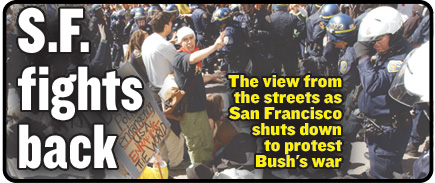
It was a time without precedent in American history. The commander-in-chief voiced his intention to take the country to war — a voluntary, preemptive war with no clear catalyst, no faraway invasion or Pearl Harbor or sinking of the Maine — and millions of people shouted their opposition. With plenty of time to avert war, the protesters warned the invasion would be a costly disaster.
They were right. And it didn’t matter.
The war in Iraq was a test of our democratic ideals. It was a test that this country failed, a failure that has been felt by the people of the United States, Iraq, and elsewhere for the last five years. For many, the refusal of the US government to heed the demands of its citizens left them disillusioned and disempowered.
But others say it sparked a political change that woke up an apathetic citizenry, pulled the Democratic Party back to the left, and may have averted war with Iran.
It’s certainly arguable that the presidential campaign of Barack Obama owes its energy and success in part to the antiwar movement — and if Obama wins, he will be the first president in a long time who took office thanks to the support of a strong grassroots progressive movement.
Nowhere was the clash of people power and government will more acute than on the streets of San Francisco, where a series of massive marches, some drawing nearly 100,000 people, filled the streets prior to the invasion of Iraq on March 19, 2003. The onset of war led protesters to effectively shut down the city, resulting in about 2,300 arrests and millions of dollars in costs to the city.
President George W. Bush dismissed the protests, of course, but he wasn’t the only one. Political leaders such as Rep. Nancy Pelosi, then-Mayor Willie Brown and soon-to-be Mayor Gavin Newsom (who didn’t attend any of the marches, unlike progressives on the Board of Supervisors) condemned the peace movement for hurting an innocent city. But with the “battle for San Francisco” making international news, the protesters were more concerned with the global audience.
A month earlier, on the weekend of Feb. 15 and 16, there were coordinated protests against the impending war in about 800 cities around the world, drawing around 10 million people. The peace march in Rome included about 3 million people, earning a listing in the Guinness Book of World Records as the largest anti-war rally in history. People have never made such a loud and clear statement against an incipient war.
Beyond the numbers, the antiwar movement was also right. On every major issue and prediction, the messages from the street proved correct while those from the White House were wrong. The US wasn’t welcomed as liberators. There were no weapons of mass destruction. Iraq after the invasion isn’t a stable democracy or shining beacon to anyone but the new generation of jihadis Bush created.
We can blame a hard-headed president, ineffectual opposition party, failure of the national media, or the national climate of fear following Sept. 11. But rather than refighting that lost battle, now is the time to gain perspective on the events of five years ago and determine what it means for democracy and the post-Bush national agenda.
TO THE STREETS
There were two main umbrella groups organizing protests before the war: Direct Action to Stop the War (DASW) and International ANSWER (Act Now to Stop War and End Racism). ANSWER has remained active and DASW has recently been reconstituted for the fifth anniversary of the war, using direct action in San Francisco as well as other urban centers and outposts like Chevron’s refinery in Richmond, which has reportedly been processing Iraqi oil.
“With the fifth anniversary coming up, we’re going back to direct action on the streets,” said Henry Norr of DASW. “But I don’t have any illusions that it’s going to be like it was five years ago.”
The maddening march to an ill-advised war created a political dynamic in which a broad cross-section of Americans was willing to hit the streets.
“We had a wonderfully diverse group of people, from soccer moms to anarchists,” said Mary Bull, who cofounded DASW, a collective of various affinity groups and concerned individuals formed in October of 2002 as Bush started beating the drums of war.
It was a group fiercely determined to prevent the war — and really believed that was possible. In fact, Bull recalls how she and other members of the group burst out crying at one meeting when a key activist said the war was going to happen.
Richard Becker, who cofounded ANSWER and serves as its West Coast coordinator, said that in the summer of 2002, “we came to the conclusion that [the war] was going to happen.” The group called its first big protest for Sept. 15, 2002, and another one two weeks later. But the movement really exploded on Oct. 26 when almost 100,000 people took to Market Street, much of it a spontaneous popular uprising.
“We were overwhelmed,” Becker said. “We were in a perpetual state of mobilization to keep up with what was going on. But then it didn’t stop the war.”
Did he think they could?
“I think a lot of people thought maybe it was possible to stop it. And we thought maybe it was possible to stop it,” Becker said.
The high point, according to Becker and Norr, was Feb. 17, 2003, when the New York Times ran a front page analysis piece entitled “A new power in the streets” that claimed “the huge anti-war demonstrations around the world this weekend are reminders that there may still be two superpowers on the planet: the United States and world public opinion.” But then Colin Powell went to the United Nations to argue for the invasion, and the Democrats in Congress did nothing, and it became clear war was coming.
Norr stayed out there protesting, being arrested several times and even shot in the leg by Oakland police with a rubber bullet during a protest at the Oakland docks. And he thinks some good came from the experience.
“The lesson for people is the political and economic elites are committed to preserving and extending empire. And they basically say as much in their own writing,” Norr said. “Wars are not anomalies.”
Despite being a frustrating and depressing exercise, most saw benefits to the failed movement. “People got an incredible education about how the system really worked,” Becker said. “Building a movement is mostly about a series of setbacks.”
Medea Benjamin, cofounder of both Global Exchange and CodePink and fixture of the anti-establishment peace movement for years, was upbeat about the protests. “We did our job as citizens. We did what we were supposed to do: organize, get people to take action, get people onto the streets,” she said. “We did everything we could think of.
“What you take from it is we don’t have a very well-developed democracy because the people spoke and the government didn’t listen.”
 The ever-evolving “Democracy Wall” on Valencia Street, March 2003, helped stir up debate (Photo by Lars Howlett)
FACING ARREST
The collective action of five years ago starts with a series of personal stories — tens of thousands of them — so let me briefly begin with mine.
My arrival in San Francisco was closely tied to the march to war. I was living in Sacramento and working as the news editor of the Sacramento News & Review when Bush began his saber rattling against Saddam Hussein, but by the end of 2002 I had a falling out with my boss and found myself jobless.
Like most Northern Californians who opposed the war, I came to San Francisco on Jan. 18 to make my voice heard and experienced a bit of serendipity on my way to Justin Herman Plaza: while reading the Guardian on Muni, I saw their advertisement for a city editor, a job that was ideal for me at a paper I’ve always loved. Needless to say, it was a great day, empowering and full of possibilities.
Less than two months later I was on the job, and on the second week of that job I was back on the turbulent streets of San Francisco, part of a Guardian team covering the eruption of this city on the first full day of war. When I stepped off the cable car just after 7 a.m., people were streaming up Market Street and I joined them.
When a large group stopped at the intersection of Market and Beale, I stopped too, taking notes and bearing witness to this historic, exciting event. I had a press pass issued by the California Highway Patrol that allowed me to cross police lines, so when police in riot gear surrounded us and threatened arrest, I held my ground with 100 or so protesters.
After interviewing about a dozen people about why they were there and that they hoped to accomplish (see “On the bus: Journalists, lawyers, four-year-olds — the cops were ready to bust anyone Thursday morning“), I was arrested with the others and taken to a makeshift jail and processing center at Pier 27 (no charges were filed in my case, and charges against all of the 2,300 people arrested here in those first few days of the war were later dropped).
I recently tracked down a few of the people who appeared in my article, including Daphne and Ross Miller, who were at the center of the most interesting drama to play out during our standoff with the police. She’s a family practice physician, he’s an architect, and they live in Diamond Heights with their two children, Emet, who is almost 9, and Arlen, 12, who was away on vacation when the war began.
“We were genuinely shocked that the war started,” Ross told me. “We were at some of the earlier protests and really thought there was no way [Bush] could do it.”
They woke up March 20, 2003, to news that the war had begun and immediately walked to the BART station with Emet and rode to the Embarcadero station, not really planning for the day ahead but just knowing that they had to make themselves heard.
“We were pissed as hell. I don’t think I’ve ever been so angry in my life,” Daphne said.
They quickly came up with a plan. “We basically decided that if anyone was going to be arrested, it was going to be Ross and I’d stay with Emet. But it didn’t end up that way and I ended up in the arrest circle.”
Daphne had their house keys and threw them over the police line to Ross at one point. A photographer in the circle had gotten shots of a man named Roman Fliegel being roughed up by police as they pulled him off his bicycle, which was towing a trailer with a sound system, and decided to throw his backpack with camera gear out as well. When Ross — who had four-year-old Emet on his shoulders — caught it and refused police orders to give it to them, police grabbed Emet and roughly arrested Ross, leaving a gash on his forehead.
“Rage surged through the crowd, and it seemed as if things might get ugly, but the police kept a tight lid on the situation, using their clubs to shove back protesters who had moved forward,” I wrote at the time.
Emet was delivered into the circle with Daphne as the arrests continued, many quite rough. “At that point, as a mom, I had to exercise the most restraint ever,” said Daphne, who was angry about the situation but fearful about what she was exposing her son to. “Please, don’t let any violence happen here,” she pleaded with the crowd. Eventually, commanders on the scene let the mother and child go.
“The officer who let me go said that if he saw me again out there, he would call Child Protective Services on me,” Daphne said. But two days later, still brimming with outrage at her country’s actions, she ditched a downtown medical conference to rejoin the street protests, this time solo.
The couple say they’ve lost friendships over the war and have become more engaged with politics, coming to believe that Bush and the neocons are malevolent figures who knew how badly the war would go and did it anyway to establish a large, permanent military base in Iraq.
“Since that day, we’ve been far more active,” Ross said. “We realized you can’t just trust the system. You have to push.”
But that determination was mixed with feelings of disempowerment and depression. They attended some of the protests that following year, but the couple — like most people — just stopped going at some point because they seemed so futile.
“There was a horrible sense of resignation and a genuine depression that followed,” Ross told me.
The nadir was when Bush was reelected and they considered leaving the country. But then, Ross said, “we decided we’re not just going to run away and we’re not going to accept this.” Looking back, even with the scare over Emet, they express no regrets.
“It was the right thing to do because it was the wrong war to have. I’d do it again and again and again if I had to,” Ross said
They’re guardedly hopeful that Barack Obama could begin to turn things around if he’s elected. “I think the right president can at least start to dismantle this,” Daphne said. “I think thousands of people marching in the streets is something he would listen to.”
 A die-in on the streets of San Francisco in March 2007 marked the fourth anniversary of the invasion (Photo by Charles Russo)
WITNESS TO HISTORY
Covering the peace movement in those early days was a heady experience, like reporting on a revolutionary uprising or working in a foreign country where the people are organized and active enough to be able to shut down society and brave enough to risk bodily injury for their beliefs.
I was at the founding meeting of CodePink — which became the most effective group at personally confronting the warmongers and keeping the war in the public eye — one evening at Muddy Waters in the Mission District shortly after the war started.
Looking back, Benjamin rattled off a long list of the alliances the group built — with labor, churches, businesses, and a wide array of social movements — and creative actions intended to build and demonstrate popular support for ending the war.
“We’ve done so many things and what did we get? We got a surge,” she said. “It shows the crisis in our democracy, the crisis of the two-party system, the crisis of a dysfunctional opposition party.”
Yet she said the peace movement has been remarkably successful in convincing the public that the war was a mistake and that it’s time for the troops to come home, even if the Democrats have been slow to respond to that shift.
“The progress we’ve made is turning around public opinion and that’s going to play a big role in the upcoming elections,” she said. For Norr, the role of the news media is a particular sore spot. He was a technology reporter for the San Francisco Chronicle who called in sick on the first full day of war and was arrested on Market Street with his wife and daughter, resulting in suspension by editor Phil Bronstein for his actions.
I wrote several stories on the issue, which culminated in Norr being fired and Bronstein unilaterally banning Chron employees from peace protests. I even borrowed CodePink’s guerilla tactics when Bronstein repeatedly refused to return my calls or address why he had singled out antiwar protesters for uniquely punitive treatment. I confronted him during a speech he gave at the Commonwealth Club (see “Lies and half-truths,” 5/7/03). That was the tenor of the times: we were all tired of being lied to and we decided to push back.
Norr was particularly frustrated with his own paper’s reporting of the war and started sending articles by the foreign press to his paper’s news desk, trying to wake his colleagues up to the pro-war propaganda being passed off as journalism in this country.
He was also disappointed with the country and with the Chronicle — both the management and his fellow reporters, who did little to support him — but the experience caused him to return to his roots as a progressive activist.
“The war and losing the job and everything brought an abrupt end to my consumerist phase and dumped me back into the world of being an activist,” said Norr, who serves on the KPFA 94.1 FM local station board and has made three recent trips to the Palestinian territories while working with the International Solidarity Movement.
Benjamin said Americans shouldn’t expect the next president to end the war — not without lots of pressure from a renewed and vocal peace movement. “This is the time to set the stage for the post-Bush agenda,” Benjamin said. “Don’t put your hopes in Barack Obama in getting us out of Iraq. Put your hopes in the people.”
 A rally and nonviolent direct action at the Richmond refinery targeted Chevron on March 15 (Photo by Lane Hartwell)
THE AFTERMATH
The San Francisco Police Department, which spent more than $2 million on overtime costs responding to peace protests between March 15 and April 16, 2003, generally behaved with restraint and professionalism, but there were several exceptions.
The most costly and disturbing incident came when Officer Anthony Nelson began aggressively swinging his long riot baton at protesters, badly shattering the arm of peaceful protester Linda K. Vaccarezza, who suffered a permanent disability in her career as a court reporter.
Nelson’s incident report falsely stated that Vaccarezza had threatened him with a sign attached to a solid pole, but video of the incident later clearly showed there was no pole and that she was retreating when he teed off on her (see “The home front,” 05/19/04).
Vaccarezza received an $835,000 settlement from the city in November of 2004. On Oct. 5, 2005, two and a half years after the incident, SFPD fired Nelson for lying about what happened that day, and the City Attorney’s Office has been successfully fighting Nelson’s appeals in court ever since, putting in more than $100,000 in attorney time and costs into the Nelson and Vaccarezza cases.
The other significant ongoing litigation from the antiwar protests involved Mary Bull, who was arrested during an early protest for pouring fake blood in front of the entrance to Chevron’s San Francisco office before being allegedly strip searched and left naked in her San Francisco Jail cell for 36 hours.
Ironically, Bull was among those who brought a successful class action lawsuit against Sacramento County after she and others protesting a logging plan were strip searched, setting a precedent and led most counties to reform their strip-search policies. She used her share of the $15 million judgment to buy an organic permaculture farm in Sebastopol.
Her San Francisco case, in which Bull won a multimillion-dollar judgment, is still under appeal and now in mediation. Bull said the protests five years ago did make a difference, something she tells those who fret about its apparent failure. “I tell them to look at what issues the candidates are talking about now and I thank them for protesting then.”
“Even though we had millions throughout the world, we were sort of blocked, but now we’re regaining that momentum,” Melodie Barclay, a massage therapist who was also arrested with me on the first day of the war, told me recently. “We can’t judge it by the fact that we didn’t get the momentum we wanted.”
Norr started his antiwar activism working with Students for a Democratic Society in Boston, protesting the Vietnam War, which he said shares many similarities with the current situation, for good or for ill. He said that people tend to forget that while the protests then were huge and helped end the war, the movement did wane after Nixon ended the draft and substituted massive aerial bombardment for boots on the ground.
“The protests dropped off considerably,” he said. “A lot of the things that drove people to take risks in the late ’60s had faded by the early ’70s.”
He thinks the current administration learned a lesson from those days: it’s easier to maintain a war effort if the average citizen isn’t affected.
But there are other factors as well keeping a lid on the antiwar outrage.
“The culture has changed too. Young people are oversaddled with debt. People in schools seem to be docile. The culture as a whole seems to be more individualist and consumerist,” Norr said.
Yet some young people have woken up and many of them are funneling their energies into a peace group that was formed in the summer of 2005: World Can’t Wait, as in: the world can’t wait for the end of Bush’s second term before we change our direction and leadership.
“We don’t just want them gone, we need to repudiate their program,” said Giovanni Jackson, a 26-year-old WCW student organizer. “If we’re going to change anything, we need the youth.”
Jackson was at WCW’s founding convention in New York City, which came just as New Orleans was being flooded and then essentially abandoned by the federal government.
“When [Kerry] lost, people felt demoralized and World Can’t Wait kind of stepped into that situation,” Jackson said. “There was a lot of demoralization in the antiwar movement at that time.”
The group organized protests and student walkouts on Nov. 2, 2005.
“Everyone has their moments of doubt,” he said, “but I’m motivated by the crimes we see everyday.”
THE LESSONS
One of the biggest barriers to galvanizing people and turning the fifth anniversary of the war into something that might make a difference is the presidential election, which is diverting the energy of many potential protesters — and at the same time, offering some hope that a new president may lead to peace.
After all, every single one of the Democratic presidential candidates has promised to withdraw troops from Iraq, with varying timelines and numbers of US personnel left behind. And with enough encouragement, they might be willing to help change the status quo.
Many of the activists who volunteered their time and money to help move the Obama campaign into its front-runner position came out of the antiwar movement, and Obama’s strong stand against the war has been a key factor in his popularity.
Becker and some other activists don’t have much faith that a change in presidents will change the course in Iraq, although he agrees that much of the energy now surrounding Barack Obama derives directly from the antiwar movement.
“There’s been a huge upsurge of hope for Obama and that he might bring about the kind of change we need,” Bull said, adding that she doesn’t share that hope, believing the only path to peace is to pressure Obama and other leaders to commit to more progressive positions.
Norr said, “On one level, people have illusions about the power of peaceful protests. People believe in democracy, as well they should. We feel like the rulers should be paying attention to public opinion.
“It’s a remarkable story how broadly and quickly the American people have turned against the war. Public opinion was certainly ahead of the Democrats.”
And people will only grow more disenchanted with Iraq and its multitude of costs. “The people here are paying for this war, and everyday we have new stories about health clinics being shut down,” Becker said.
Becker was amazed last March as massive demonstrations for immigrant rights seemed to explode out of nowhere. “We think there will be more things like that,” he said.
Because after five years of organizing communities to resist the military-industrial complex’s plans, Becker thinks there’s been some visible progress.
“There isn’t a town or hamlet in the US that doesn’t have activism going on, but you wouldn’t know it from the corporate media,” Becker said. “It’s a mistake for people to feel discouraged.”
South By Culture: Home again … and advice for next year
Culture editor Molly Freedenberg hits SXSW for the first time to explore the festival’s extracurricular aspects. For Music Editor Kimberly Chun’s take on SXSW’s tunes, click here.
I’m finally back from South by Southwest. And by “back” I don’t only mean “in San Francisco.” The latter happened early Sunday morning. But I only recovered, brushed my teeth, got out of bed, and unpacked last night. Yes, it was that much fun, and that exhausting. (Yes, I also have a habit of squeezing every bit of fun out of every moment I can, which often leads to days of bed rest, but that’s another story…)
Now that I have some time to reflect, I can say deciding to go was one of the best ideas I ever had. (Way better than paying $180 to see Buffy the Musical.) First off, Austin’s rad. Now I completely understand why everyone I know is moving there. Rent is cheap. People are interesting. It’s got the politics, art, music, and culture of Portland and San Francisco but without the rain and gloom of either; and it’s got the weather of Los Angeles, but without the smog, the sprawl, or the especially high ratio of douche-bags to cool people our sister to the South has got.

The unofficial SXSW (female) uniform: summer dresses and cowboy boots.
And second, the festival itself. How do I explain this? It isn’t simply that there’s music everywhere. It’s that everyone is there because they love being there. This is summer camp for music geeks. Or Sturgis. Or (don’t kill me for saying this) Burning Man. Southby isn’t just a big, spread-out Coachella or Bonnaroo – both of which are contained, commercial festivals in the traditional sense. This is more of a temporary culture – where every venue is dedicated to playing music from morning to night, and where every person there is so dedicated to music they want to spend several days immersed in it.
In fact, I found the experience of being at Southby much the same as being at Burning Man: intending to go one place and ending up at another, running into people I never expected to see, leaving the house at 11 a.m. with the intention of coming home for dinner and not seeing my bed until 4 a.m. Drinking early, forgetting to eat, thinking I’d found the most inspiring thing I’d ever seen and then, two blocks later, finding something even more inspiring. Sure, at Burning Man it’s guerrilla art or random performance or the joy of seeing Barbie Death Camp for the first time – at Southby, it’s rock bands that sound like Led Zeppelin (Parlour Mob) or discovering the punk band I’m listening to actually sings one my favorite song on an old, unlabelled mix tape (Meat Men) or finding my way into the Perez Hilton party (not as exciting as it sounds) with a writer friend from L.A. But the fundamental feeling is the same: riding the wave of the unexpected. I bet you could even draw parallels between relationships at Burning Man – how some are formed and how some are ruined – and those at Southby.
And just like Burning Man, Southby isn’t for everyone. The pace is breakneck. The beer is unlimited. And if you don’t like crowds, walking, or loud noise, it could be your biggest nightmare. But for people like me, it’s an absolute fantasy.
Which is to say, yes, of course, I’m going to go again. But I’ll do a few things differently. Here’s my advice for other Southby virgins, based on what I learned this year:
Newsom to small business: Drop dead!
By Bruce B. Brugmann
And so Mayor Newsom, who wants to run for governor when he still hasn’t learned to manage the city as mayor,
has bestowed the ultimate insult to small business in the City and County of San Francisco.
He has named a City Hall lobbyist for PG@E to the Small Business Commission.
Yes, you read correctly, Mayor Gavin Newsom has appointed Darlene Chiu, a PG@E lobbyst in City Hall, to the SBC.
How in the world does a company that has been screwing small business for decades inside and outside City Hall, stealing our cheap Hetch Hetchy public power for decades and forcing small business and residents to buy its expensive private power, yanking upwards of $650 million a year out of the city’s economy with its high rates, corrupting City Hall for decades with its lobbying muscle, qualify as a member of the Small Business Commission?
We put the issue in a diplomatic question and emailed it to the mayor. His press secretary, Nathan Ballard,
issued this statement this afternoon on Chiu’s glowing qualifications:
“Darlene Chiu was appointed to replace Florence Alberts after her term expired. Darlene has first hand knowledge of the challenges facing small businesses in San Francisco. She grew up working in her family’s these retail businesses in Chinatown, managing nine to l5 employees. She will also bring her knowledge of City government and communications to the Commission, which will be important to the successful operations and promotion of the assistance center.” (As one small business leader told me, “I don’t recall in the requirements of being on the commission that growing up as a child of small business owners quite meets the criteria.”)
No, no, no: PG@E is placing Chiu, via Newsom, on the SBC to help PG@E continue to facilitate the “successful operations and promotion” of further PG@E corruption in City Hall to protect its illegal private power utility in San Francisco. The supervisors can and should move quickly to reject the PG@E appointment.
More: Newsom to the Civil Service Commission: Drop dead. He appointed Mary Jung, a PG@E customer services manager, to the Civil Service Commission.
Meanwhile, as he further cemented PG@E power inside City Hall, he whacked three well qualified and conscientious commissioners: Debra Walker, an artist and activist, from heading the Building Iinspection Commission, Theresa Sparks, a transgender woman and community leader, from running the Police Commission, and Robert Haaland, a labor activist and one of the city’s most visible transgender leaders, from serving as vice president of the Board of Appeals.
Newsom is running for higher office and, as our editorial in tomorrow’s Guardian puts it, “almost everythihg he does at City Hall seems to be aimed not at improving San Francisco but at increasing his odds of moving up in the political world…Why would Newsom be doing this–if he didn’t need the support of PG@E and its allies for his next political step.
“Why would he be directing his appointees to keep out of leadership posts anyone with strong progressive credentials if he wasn’t trying to build new bridges to the developers, the big employers, the police unions and the more conservative interest groups he’ll need for a statewide campaign?” B3
Best Boredoms interview ever: Eye gives up the goods on eve of Fillmore show

The Boredoms‘ Eye Yamantaka is ordinarily a man of few words, but the Japanese experimental music veteran let the flood gates fly open via my e-mail interview. No snores here – just expect to whet your appetite for the Boredoms‘ Tuesday, March 18, show at the Fillmore. Ex-Black Dice drummer and current Soft Circle impressario Hashim Kotaro Bharoocha provided the translation.
SFBG: The new album is amazing — it sounds like positively symphonic! What was the idea, goal, or focus?
Eye Yamantaka: Recently I have been getting into symphonic progressive rock. I
want to buy music like that, but I don’t know who’s making it. I’m also a fan of progressive heavy metal from Scandinavia. On the album, I am taking a minimalist approach by manipulating sounds on the turntable (I am using church pipe organ music by Jon Gibson).
The sub-patterns from the church organ sounded like human voices to me, so we had that scored, and had an actual choir sing it. We weren’t doing anything on Christmas Eve, so we decided to do a show that day, and the choir fit the night perfectly.

SFBG: I remember interviewing Eye and Yoshimi years ago in the late ’80s in San Francisco. How would you say the band has evolved since then? What has your muse been telling you? Where have your
interests led you?
EY: The band went through significant changes on SPR and GO!!!!!! We started to take a minimalist approach from SPR, but after this album we took that approach to the extreme. I think that those records were a rebirth point for us. After those records, we got rid of the guitar and bass in the ensemble, and I started to DJ a lot more (I was DJing a lot more than performing with the band). We started to think in terms of performing as if we were a record player, rather than playing as a normal band.
SPORTS: A new Giant’s phenom

By A.J. Hayes
PHOENIX — Norman Rockwell would hardly recognize today’s big league newbie.
The stereotypical hayseed wearing an ill-fitted suit and aw-shucks grin that Rockwell depicted in his “The Rookie” (1957), is much a thing of the past. If he really ever existed.
Today’s spring phenoms, more often than not have wallets larded with million dollar signing bonuses. They tool around in snazzy sports cars and idle away the hours plugged into their I-Pod thingies.
The kids today!

On first glance you might think Giants rookie infielder Travis Denker is just another pampered pup – especially when you hear that he inked his first shoe deal at an age when most kids are still trying to coordinate their Granimals.
But don’t jump to conclusions.
Yes, its true Denker did land his first professional sponsorship as a mere four year old – more on that later – but he’s also a bubble gum-snapping, run-out-every-ground-ball 22-year-old whirlwind that makes even the most jaded fans feel gooey inside.
“You can tell just by the way he stands at his position that Denker looks like a ball player. He could be Al Dark or Eddie Stanky,” gushed my 72-year-old friend Joel who’s seen every Giants club dating back to the mid-1940s. “He exudes a certain grittiness. He looks like he’s been in the majors for 15 seasons, not 15 minutes.”
The truth is the 5-foot-9, 193 pound Denker has never played a game in the big leagues yet, and in fact hasn’t played above Single-A ball. There’s no guarantee he will blossom into a big leaguer.
But the way Denker performed late last season for the San Jose Giants – helping the minor league club to the California League Championship – and the way he’s looked in major league camp this month, the scrappy Denker has optimistic San Francisco fans recalling the likes of Robby Thompson, Chris Speier and Dirty Al Gallagher.
“The pitchers are smarter and the game is much faster at the major league level,” said Denker. “But I feel I belong.”
Travis Denker
The Giants are in a rebuilding mode and are loading up on young talent. Other untested players who have looked good in camp include outfielders Clay Timpner and John Bowker and infielders Emmanuel Burriss and Brian Bocock.
Of all of them, the hard-nosed Denker appears closest to the majors.
Making the second baseman’s rise so much more enjoyable is the fact that the Giants have the arch-enemy Los Angles Dodgers to thank for him.
After going more than 20 years between trades, the century old rivals swapped players last August. The Giants sent veteran pinch-hitter Mark Sweeney to Los Angels in exchange for Denker.
Though he was battling some nagging muscle strains at the time, Denker batted a blistering .400 (10-for-25) over the Little Giants final regular season seven games. In seven post-season contests he batted .480, with 3 home runs and 7 RBI.
Denker could have easily mailed it in once joining the Giants organization or sat out for medical reasons, but he quickly assimilated to his new team and practically insisted on playing down the stretch.
“I wanted to be part of a championship club,” he said last week. “I knew I may never get another shot at something like that. I really wanted in.”
After leading all Dodgers minor leaguers in batting (.310), home runs (21) and RBI (68) in 2005, Denker struggled in 2006. But he was batting .294, with 10 homers and 57 RBI for Los Angeles’ Inland Empire club last summer when he was acquired by the Giants.
Despite growing up an hour from Dodger Stadium in Brea, Denker was not heart-broken by the deal to San Francisco.
“As a kid I was more an Angels fan, than a Dodgers fan,” he said. “And I’ve always loved the Giants colors.”
San Francisco orange and black does favor Denker. But it was another bruising color scheme – black and blue – that is most associated with the sport that led to Denker being sponsored by the Vans shoe company as a tyke.
“I was your typical California kid scooting all over on my skateboard, and next thing I knew I was in Florida on a skateboarding tour sponsored by Vans and Bactine – the bug bite stuff.”
Denker stuck with street surfing until scouts started showing up at his high school baseball games. Denker inked a deal with the Dodgers after batting a hearty .425 (34-for-80), with 11 home runs and 22 RBI as a senior at Brea High.
“I might jump on a board to go down to the corner store, but the competitive stuff is over,” Denker said. “It’s all about baseball now.”
PG&E’s Green War Chest?
Greetings, Californians for a Clean Energy Future! Welcome to the fold of innocuous sounding, pseudo-environmental political front groups. This one is brought to us by our buddies over at Pacific Gas and Electric Co.
The group, which doesn’t seem to have a Web site or any other physical manifestation outside of filings with the California Secretary of State, already has $340,000 ready and waiting for the upcoming election cycle. According to a Secretary of State spokesperson, the group was born on Dec. 21, 2007. The only contact is the law firm Nielsen Merksamer, which has a history of teaming up with PG&E to break the law for political gain.
So far, they haven’t spent a cent — all of which were dumped into the committee by PG&E in three lump sums. Wonder what they’re going to spend all that money on? Since it’s calling itself a “coalition of environmentalists, taxpayers, and Pacific Gas and Electric Company,” it could go for or against nearly anything — including boosting Prop 98 on this June’s ballot. If passed, the measure would kill rent control and make it illegal for governments to use eminent domain to seize utility infrastructure and use it to provide the services themselves, an idea San Francisco has considered in the past and Stockton is currently pursuing.
March on the governor’s house
I’m usually the one who talks about how we have to solve financial problems locally, since the state and the feds won’t give us what we need. And I still believe that, and I support a parcel tax for the local schools and I support using the rainy day fund and if we were allowed to raise property taxes in San Francisco, I’d support that.
But right now, while teachers and parents and students are flooding school board meetings around the state denouncing cuts, the real problem is in Sacramento, where the governor doesn’t seem to care.
So maybe all of those angry people should take a little trip to Los Angeles and march on Schwarzenegger’s house. He’s home most weekends, I’m told. I think he lives in Brentwood.
50,000 protesters in Brentwood? Maybe he’d have to listen.
Desperately seeking cinema
> a&eletters@sfbg.com
Jennifer Reeves’s movies are personal wishing wells, each a repository of dreams and worries. As we see ourselves reflected in the water’s surface after tossing in a coin, so too is Reeves’s presence apparent in the handmade, fussed-over quality of her moving pictures. I use that broad designation pointedly, as her films are as varied in material and form as they are prosaic in mood and temperament. Over 15 years of independent filmmaking, the New York–based artist has created hand-painted films in the style of her mentor Stan Brakhage, freewheeling shorts, fiction fantasias, 16mm double-projections, feature narratives, and experiments in high definition. San Francisco Cinematheque hosts the formally restless filmmaker for a three-program tour.
Reeves’s early shorts channel riot-grrrl spark with scratched-up film stock. Elations in Negative (1990) is a good sample of the celluloid-mad sexual politics of these 16mm beaters, though Taste It Nine Times (1992), with its vivid pickle-biting innuendos, will be missed from the Cinematheque run. In painted films like The Girl’s Nervy (1995) and Fear of Blushing (2001), Reeves’s appropriation of Brakhage’s technique conveys playful femininity in color, pattern, and music.
Though Reeves toyed with narrative early on, most notably in 1996’s psychodrama Chronic, 2004’s The Time We Killed represented a kind of breakthrough. An unhurried 94 minutes passes through the dark mirror of an agoraphobic poet keeping to her New York apartment during the buildup to the Iraq War. "Terrorism brought me out of the house, but the war on terror drove me back in," Robyn (Lisa Jarnot) says in her peripatetic voice-over, adding later, "I’m afraid of catching the amnesia of the American people." Reeves’s magnetically immersive filmmaking is such that the political situation neatly folds into an extended experiment in subjectivity — besides being an unstinting portrait of madness (it’s everywhere in this film: in a record’s spin and neighbors’ voices echoing through the walls, in dogs’ faces, bathwater, and masturbation), The Time We Killed also serves as an understated chronicle of the collateral psychic and moral damage of our country’s manufactured warmongering.
The Time We Killed is heavier than Reeves’s other work, though it’s not without humor; she finds the ridiculous, unwieldy side of depression in Robyn’s litany of death fantasies and a painfully misguided interaction with a curious neighbor. Robyn’s locked in, but Reeves is formally unfettered, mixing conventional 16mm footage with lyrical, associative streams of inner life shot in high-contrast black-and-white. The filmmaker raids her home-movie archive for the film, in addition to using her own apartment and acting as Jarnot’s body double during the extended shooting. This air of transference makes The Time We Killed weirdly transparent, so we feel as intimately connected to Reeves’s isolated work in the editing room as we do to Robyn’s experience in the apartment.
Since The Time We Killed, Reeves has returned to more typically experimental filmmaking. Her 2006–07 Light Work variations strike an ideal balance of abstract and representational visions, in the process cataloging the changing textures of cinema. In the affecting He Walked Away (2007), Reeves dissects, refracts, and abstracts footage from her older movies to create a tri-tipped memorial piece in which the intrinsically elegiac nature of cinema is connected to the dissolution of film technology, which is then tied to the disappearing loves and friendships that shadow personal lives.
As with Guy Maddin — another filmmaker who favors overheated evocations — one has the sense that Reeves could make a hundred interesting movies from the same scraps of footage. "I want to counter the turncoats who say film’s dead," Reeves announces on her excellent new blog. "Try telling a painter that she can only use digital paint on a Mac for the rest of her life. She’d be pissed." But if she were Jennifer Reeves, she certainly wouldn’t slow down.
IMMERSIVE CINEMA: JENNIFER REEVES
Artists’ Television Access, Sat/15, 8:30 p.m.
Yerba Buena Center for the Arts, Sun/16, 7:30 p.m.;
Tues/18, 7:30 p.m.; $6–$8
See Rep Clock for venue information
Hope Mohr Dance
PREVIEW After training in ballet, San Francisco native Hope Mohr moved to New York City, where she danced with Lucinda Childs and Douglas Dunn before spending four seasons with the Trisha Brown Dance Company. After eight years, she decided that she could continue her career back in her hometown. Significantly, upon returning in 2005, she joined the company of Margaret Jenkins, who had also left the Big Apple to resettle in her Bay Area stomping grounds more than 30 years ago. Even then, however, Mohr knew that she would eventually want her own group. This upcoming concert is the debut of her newly formed Hope Mohr Dance troupe, in which she’ll present four pieces with 13 dancers. Of key interest is her 2007 collaboration with video artist Douglas Rosenberg, Under the Skin, a commissioned work from Stanford University that grew out of a series of workshops Mohr conducted with breast cancer survivors. Five trained dancers and three survivors perform together in the piece. When Bill T. Jones created his 1994 Still Here, conceived on a similar premise, it raised a firestorm of criticism about so-called "victim art." Mohr is confident that the fertile tension between the subject matter and the dance’s formal demands has allowed her to create a work that stands on its artistic merits. The other three pieces, Moments of Being (a premiere), Elision, and more awake than dreaming, are non-narrative investigations of what gave Mohr’s debut program its title, "Let the Body Speak."
HOPE MOHR DANCE Fri/14-Sun/16, 8 p.m. Dance Mission Theater, 3316 24th St, SF. $18. (415) 273-4633
San Francisco Contemporary Music Players
PREVIEW While electronics have transformed the very core of contemporary dance music, rap, and pop, so-called art music of the concert hall persuasion still centers on acoustic instruments reverberating in real time. But some of the earliest feats of sound manipulation, predating the Beatles’ trippy tape loops and even the ’60s soul tracks destined for an afterlife in eternal sampledom, were achieved by German composer Karlheinz Stockhausen, who was decidedly not a populist. In current terms, "electronic" music tends to denote the limitless reorganization of beats and breaks, but Stockhausen dispensed with regular rhythms altogether, turning his attention to the most basic components of sound itself, using now-primitive equipment to generate sine waves and splice magnetic tape. The most famous result of his experiments, aside from a nod from the Fab Four on the cover of Sgt. Pepper’s, may be the 40-minute tape-based work Kontakte, for piano, percussion, and electronics, premiered in 1960. Pianist Julie Steinberg, who also moonlights as a percussionist for this performance by the San Francisco Contemporary Music Players, emphasizes the prohibitive complexity of performing Kontakte live. "We have to know the electronics perfectly," she says of playing along with Stockhausen’s original four-channel futuristic noise collage, now a digital version realized by a sound projectionist as the performers play. Conceived in recognition of the late composer’s 80th birthday by percussionist Willie Winant, whose cutting-edge creds include work with Mr. Bungle, John Zorn, Sonic Youth, Wilco, and the Mystic Knights of the Oingo Boingo, this is a rare realization of what Winant calls "a masterwork" and a "seminal piece."
SAN FRANCISCO CONTEMPORARY MUSIC PLAYERS Mon/17, preconcert talk 7:15 p.m., concert 8 p.m.; $10–$27; Yerba Buena Center for the Arts, 701 Mission, SF; 978-ARTS, www.sfcmp.org
“Friedlander”
REVIEW Throughout Lee Friedlander’s 50-year oeuvre, much of which is now on display at San Francisco Museum of Modern Art, the photographer has been lauded for his liveliness, optimism, and mobility. Yet his paean to modern Americana often resembles monochrome memento mori. Taken as a whole, Friedlander’s work has always seemed driven to two poles: the ephemeral and the haunting.
Heavily impressed by the avant-naturalism of European photographers Eugène Atget and Henri Cartier-Bresson, as well as the post–World War II experimentalism of Robert Frank, Friedlander staked his claim at a moment in the 1950s when the photograph transcended the moribund category of journalistic tool and became its own art form. Modeling much of his working method around Cartier-Bresson’s so-called decisive moment, Friedlander’s timeless images still have a striking past tense about them. Now ossified on film, these thousand microcosmic moments, captured throughout the 1960s and ’70s, seem like lively obituaries.
While Friedlander first made a name for himself as a contractor for Atlantic Records — where he shot such musicians as Ornette Coleman — he was never a celebrity photographer. In fact, his most intriguing work resulted from a personal obsession with traveling and shooting the country, crisscrossing between New York and his home state of Washington. And so the images of nocturnal motel rooms, cycloptic TV sets, and storefront tessellations conjure the American dynamism and dread of Vladimir Nabokov or David Lynch. The plethora of windows and mirrors in his street photography admit countless apertures through which to see his subjects. But Friedlander’s playful sense of humor always appears just within the clutches of something inexplicably sinister — like the cartoonish shadows that often hover into his frame. Though his more recent work — in portraiture, nudes, and particularly in nature — may suffer slightly from the inevitable cooling of youth’s ambition, Friedlander’s baroque attention to detail and depth of field are unmatched. This is a definitive exhibition on one of America’s most ingenious, albeit conflicted, photographers. The photographer’s son Erik Friedlander will perform pieces from his album Block Ice and Propane (SkipStone, 2007) on April 24, 8 p.m., $12–$15, at Phyllis Wattis Theater.
"FRIEDLANDER" Through May 18. Mon.–Tues., Fri.–Sun., 11 a.m.–5:45 p.m.; Thurs., 10 a.m.–8:45 p.m.
$7–$12.50, free for members and 12 and under. San Francisco Museum of Modern Art, 151 Third St., SF. (415) 357-4000, www.sfmoma.org
Big “Footprints”
› a&eletters@sfbg.com
Since its inception in 2004, the SFJAZZ Collective has changed out six of its eight original members. But now in the midst of its fifth season, the band sounds and, more importantly, interacts more cohesively than ever.
"All the people we’ve had, have been very beneficial to the band," says pianist and original member Renee Rosnes, during a recent rehearsal at the Masonic Auditorium. "They just bring another color to the music." Veteran saxophonist Joe Lovano, who joined last summer and replaced Joshua Redman, now nominally serves as resident sage, the position formerly held by vibraphonist Bobby Hutcherson. Also last summer, youthful Stephon Harris took Hutcherson’s slot, and this spring trombonist Robin Eubanks was added for the San Francisco residency and both the national and European tours. Despite the shifts, the ensemble’s firepower hasn’t diminished and the members are especially eager to tackle Wayne Shorter’s quixotic music, which they’ll be playing along with their own.
Saxophonist Shorter’s career has evolved from writing and playing on the front line of hard-bop standard-bearing Art Blakey’s Jazz Messengers to a similar position with Miles Davis’s great shape-shifting quintet of the early ’60s. While playing with Davis, Shorter compiled one of the most distinguished solo careers ever with an incomparable series of albums on Blue Note (1964’s JuJu and Night Dreamer and 1965’s The All Seeing Eye) that forever cemented his stature as a major composer. Subsequent turns as the cofounder of Weather Report and now the leader of an exquisite quartet have simply embellished Shorter’s reputation.
Rosnes considers her time playing with Shorter a revelation. "It was such an impactful experience," Rosnes explains. "The intensity and passion that he played with literally took my breath away."
On the brief 1988 tour that took the all-star band through the United States and Europe, Rosnes played a nightly duet with Shorter on his Brazilian ballad "Diana." "There was complete spontaneity from night to night. He cherishes a lot of freedom within the music, and that really opened up my mind," she says.
Since each Collective member arranges a tune from the season’s composer, Rosnes has written the chart for "Diana" as well as Shorter’s classic "Footprints." Other arrangements include "Armageddon" by saxophonist Miguel Zenón, "Aung San Suu Kyi" by trumpeter Dave Douglas, "El Gaucho" by bassist Matt Penman, "Yes or No" by drummer Eric Harland, and "Infant Eyes" by saxophonist Lovano. Rosnes says the arrangements give the band a more personal voice, which is appropriate when considering Shorter’s considerable body of work. "He plays life," Rosnes says, "through his horn."
SFJAZZ COLLECTIVE
Sat/15, 8 p.m., $34–<\d>$52
Zellerbach Hall
UC Berkeley, near Bancroft at Telegraph, Berk.
Clubs: Cumbia/electro underground surfaces at Tormenta Tropical

By Michael Harkin
The South American sound of cumbia has its very own hour-of-power in San Francisco: Tormenta Tropical, whose fourth incarnation rolled up to the Mezzanine last Saturday after prior appearances at Rickshaw Stop and the Dark Room at Club Six. Tormenta is a new monthly party thrown by Bersa Discos, an Oakland record label showcasing the experimental cumbia/electro/dancehall underground of Argentina.
Bersa especially digs into what’s up around Buenos Aires, where the label’s two founders, Disco Shawn and Oro 11 (say that 11 as “once”/OHN-say), moved separately from the Bay Area and met up amid the woolly, melodica-filled excitement to be had at club nights like Zizek.
It was, in fact, several regulars from Zizek that started off the night as Zizek Urban Beats Club, including sets by El Remolón, Frikstailers, and other fixtures from the Buenos Aires night that so inspired Bersa’s founders as well as such hip jocks as DJ/Rupture and Diplo of Hollertronix and Mad Decent. The crew are touring to SXSW this week, also making appearances in New York and Chicago later this month.