San Francisco

Anti-war movement seeks allies

7

By Jobert Poblete

This Saturday (March 20) will mark the seventh anniversary of the Iraq war and local groups are mobilizing for another round of protests to oppose the occupation of Iraq and the expansion of the war into Afghanistan. But this year’s program will also highlight local struggles as well, with speakers delving into the fight for more public education funding and the march passing by two hotels where union workers are in strained negotiations for a new contract.

The protest is being organized by ANSWER – Act Now to Stop War and End Racism – a coalition notorious for its everything-but-the-kitchen-sink approach to protest. Besides its plugs for Iraq, Afghanistan, public education, and local labor struggles, flyers promoting Saturday’s protest include demands around jobs, Palestine, Latin America, and Haiti. ANSWER organizer Chris Banks told us that these seemingly disparate issues are connected.

“There is a finite amount of resources in our society,” Banks said. “And if those resources are used on wars and to bail out banks, then we can’t use them for schools, health care, and public transit. The wall between foreign policy and domestic policy is a fictitious wall.”

This year’s protest will focus on the economic crisis and on “bailing out people instead of banks.” Students who helped organize the recent March 4 Day of Action are part of the coalition mobilizing for the Saturday protest and students and teachers will be among the speakers at the rally at Civic Center. Protest endorsers include the United Educators of San Francisco, a union that represents more than 6,000 public school employees. Dennis Kelly, president of UESF, told us that the protest “ties directly in with our concerns about the California state budget, that the priorities being set are the wrong priorities.”

The rally will be followed by a march that will pass by the Hilton and the Four Seasons, two hotels where members of Unite Here Local 2 are without a contract because of a negotiating impasse with management. The biggest point of contention between the hotels and union is over health care. (Union members currently pay $10 a month for family coverage but the hotels want to increase that to $200 a month.)

Israel Alvaran, a community organizer at Local 2, said that the health care issue provides a connective thread between the anti-war movement and his union’s struggles. “We believe in stopping the wars in the Middle East,” Alvaran said. “They’re driving the war economy that’s preventing people at home from getting affordable health care, public education, programs for creating jobs and building the economy.”

Alvaran hopes the March 20 protest will help raise the visibility of hotel workers and show the hotel corporations that the union has broad community support. He also said that including workers’ struggles in the protest is important because it exposes young activists joining the anti-war movement to labor and union issues.

Banks echoed this desire to raise public consciousness about local issues. “As much as possible, we want people to make the connection between local struggles and imperialist wars,” Banks said. “People go into political motion for different reasons. We want them to come out on March 20 and they’ll have opportunities to hear speakers representing different movements.”

Saturday’s protest will begin with a rally at Civic Center Plaza at 11 a.m. At noon, protesters will march through downtown San Francisco before returning to Civic Center. 

Sunshine sleuth nets $3.5 million for SF

Sunshine advocate Kimo Crossman is sometimes counted as a thorn in the side of city government agencies due to his tendency to pepper them with public-records requests. But in the last couple days, he earned a gold star from the San Francisco Assessor-Recorder for pointing out that when Morgan Stanley walked away from five high-profile San Francisco properties, it neglected to pay a transfer tax. Thanks to an email from the ever-inquisitive Crossman, the assessor-recorder was able to collect roughly $3.5 million and feed it to the city’s ailing General Fund.

It started when Crossman read an article on Bloomberg.com about Morgan Stanley walking away from five San Francisco skyscrapers last December that it purchased in 2007: One Post, Foundry Square I, 201 California St., 60 Spear St. and 188 Embarcadero — collectively valued at around $279 million.

He was annoyed. “Individuals can’t walk away from their obligations,” he said. But for the huge financial firm, “it doesn’t appear that they have any negative repercussions.”

The surrender of properties was described as a “transfer,” so he sent a note to the city asking, “is the SF city transfer tax incurred when Morgan Stanley walks away from SF office buildings which they are calling a ‘Transfer’?”

Why indeed it is, came the reply.

“Some transactions trigger transfer tax, while others may not trigger transfer tax because of an existence of an exlusion in the SF Real Property Transfer Tax Ordinance,” explained Zoon Nguyen, deputy assessor-recorder, in an email. “I wanted to let you know that no exclusion was applied toward the Morgan Stanley transaction. As a result, the Assessor-Recorder’s Office collected about $3.5M in transfer tax revenue for the City and County General Fund. I want to thank you, once again, for being engaged in these tax issues. I certainly appreciate knowing that there are people, like you, who are also monitoring these transactions. I would ask that you continue to send us these emails.”

Crossman told the Guardian, “I did it just to help the city and because I was mad at the banks walking away from their loans.”

However, this might just turn out to be the most lucrative cut-and-paste that Crossman has ever executed. There is a possibility of earning a “taxpayers reward” for bringing this to the city’s attention, he tells us. According to legislation passed by the Board of Supervisors in 2006, taxpayers who sniff out tax evasions such as this can, in certain cases, earn up to 10 percent of the collected tax revenue as a bonus — in this case, the maximum would be a whopping $350,000. But it’s entirely at the discretion of the assessor-recorder, and Crossman isn’t holding his breath.

“I’m not the most favorite person in City Hall,” he laughed. We placed a call to the assessor-recorder for details, but haven’t heard back yet.

Prop 17 discourages going car-free

6

Efforts to encourage car-sharing and ways of getting around that don’t involve owning a car would be undermined by Proposition 17, a June ballot measure that I wrote about in this week’s cover story. While I didn’t mention that impact in the story, it is of real concern to people like me who don’t own cars and encourage others to try the car-free lifestyle on for size.

The measure, sponsored by Mercury Insurance, allows companies to substantially increase monthly premiums on customers who haven’t had continuous insurance coverage. That would be one more barrier to people making the leap of faith to give up their cars and rely on bicycles or public transit, a switch that ought to be encouraged in increasingly traffic-congested cities such as San Francisco.

As I wrote about in another cover story last year, I made the decision several years ago to give up my car, although I still sometimes rent cars to visit my children. Consumer advocates say the cost of renting cars or using car-sharing services – particularly locally owned companies that can’t self-insure like the corporate behemoths – could increase and there would be a disincentive to consider trying it.

 “Anyone who has used car sharing (or for that matter rental cars) as their means of transportation would almost certainly not be considered continuously insured and would face the Prop 17 surcharge if they had to go back to private insurance at some point,” Doug Heller, an insurance expert with Consumer Watchdog, told me.

Currently, the law allows insurance companies to issue discounts to those who have maintained continuous policies with them (Prop. 17 would expand that to allow drivers to change companies and keep their discounts, which would be offset by surcharges on customers who were new or had a lapse in their coverage), and those companies use that discount to actively try to discourage people from experimenting with car-free lifestyles.

Brian Smith, who works for an environmental nonprofit in Oakland, recalls getting that kind of hard sell when he made the leap and got rid of his car.

 “When I cancelled my car insurance, AAA warned me not to. They said, ‘We will make it much more expensive when you come back.’ I said, ‘I sold my car, I don’t need car insurance.’ They said ‘We are just giving you a warning, Sir.’ I said, ‘Cancel it you fucking bastards. I’m never coming back.’ That was 10 years ago.’” Smith wrote to me about the issue.

Proponents of the measure say it would save some drivers $250 per year, while opponents (citing data from Mercury) say the surcharges for everyone else would be about $1,000 per year. So for the soldiers who go off to boot camp, the college students who get an internship in a city with good public transit or bikeways, unemployed individuals who need to trim expenses, or people who want to experiment with going car-free, they would all pay for more for insurance if they went back to driving a car than those who continuously maintained a car-dependent existence.

So, add this to the list of good reasons – and there are many of them in this week’s cover story — to oppose Prop. 17. 

If we’re going to be whores, let’s at least get paid

2

The San Francisco City Planning Commission will be voting March 18th on a proposal to build luxury condos next to the Transamerica building. The developers are two out-of-town outfits that support Republican candidates. And therein lies an interesting tale.


Back in 1984, when dinosaurs roamed the Earth and newspapers made a lot of money and Dianne Feinstein was mayor, San Francisco was host to the Democratic National Convention, which nominated a guy named Walter Mondale (talk about dinosaurs) to run against Ronald Reagan for president. Running the convention, and all the parties and galas, cost a fair amount of cash, and Feinstein hit up all the big civic donor types to chip in.


One of the people atop her list was Walter Shorenstein, the local real-estate tycoon who was a huge donor to Democratic Party candidates (Bill Clinton used to stay at Shorenstein’s house when he was in town). Shorenstein was also trying to get permits to build some new highrises — and some of his buildings were so grossly out of proportion that even Feinstein’s Planning Commission, which loved all things big and highrise, was balking a little.


So Walter calls the mayor and says this: Don’t you dare ask me to donate to your Democratic Convention if your planners are going to jerk me around on my permits. And Feinstein, of course, made sure the Planning Commission backed down and Shorenstein got exactly what he wanted.


We did a big story, and even the Chronicle, which wasn’t big on criticizing Feinstein or Shorenstein, wrote about it, and there was all manner of outrage — as there should have been. It was terribly unseemly, and made the city look bad, and made Feinstein look like she could be pushed around by developers ….


And for all that, at least the special favors were going to a local guy who was donating money to Democrats and to the city’s convention efforts. Hideous as it was, as least San Francisco (and Feinstein, and Mondale) were getting something out of it.


Fast forward to today — when Gavin Newsom’s Planning Commission is considering an awful, out-of-scale project that even architecture magazines don’t like. And who benefits from the special favors? Not a local guy helping out with a local project, but an offshore corporation and a developer from L.A. who is on Meg Whitman’s Finance Committee.


I mean, if we’re going to be whores here in Democratic San Francisco, shouldn’t we at least get paid for it? 


Herrera stands up to PG&E

Yesterday, at the California Public Utilities Commission, PG&E executives raised some eyebrows with their presentation about Proposition 16, the ballot initiative designed to make it difficult for municipalities to enter the electricity business. CPUC President Michael Peevey expressed his skepticism about a measure that would require only a simple majority vote to set up a two-thirds majority system.

Today, PG&E might suddenly have bigger problems on its hands than scolding remarks from the CPUC and the Legislature, thousands of pissed off SmartMeters customers, the threat of competition from municipalities, and a slew of editorials from newspapers throughout the state chiding the utility giant for trying to amend the state’s constitution for its own financial gain.

San Francisco City Attorney Dennis Herrera is leading a lawsuit to strike Proposition 16 from the June ballot. The complaint calls Prop 16 “wholly false and misleading” and said the company “profoundly misled the citizens who were induced to sign the petition.”

“We’re not seeking to fix it, we’re seeking to nix it,” Herrera’s press secretary Matt Dorsey explained.

The lawsuit was filed jointly by the San Francisco Local Agency Formation Commission, the City and County of San Francisco, the Sacramento Municipal Utility District, the City of Moreno Valley, the City of Redding, the California Municipal Utilities Association, the San Joaquin Valley Power Authority, the Modesto Irrigation District, and the Merced Irrigation District.

A hearing date has been set for May 4 in Sacramento Superior Court, according to Dorsey.

Snap Sounds (and Q&A): Art Museums

0

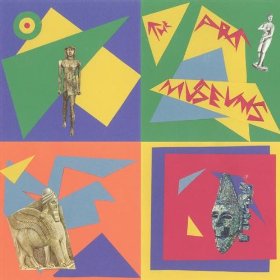
THE ART MUSEUMS

Rough Frame

(Woodsist)

San Francisco’s Josh Alper and Glenn Donaldson lightly place these love songs within comic frameworks. The opening track describes a shy, lovelorn music fan too shy to twist and shout, peppering the scenario with observations such as, “He’s worn his pants like that / For a very long time.” It also mentions a Buggles record, but Television Personalities and Guided By Voices are better reference points to the Art Museums’ sound. In their world, a sculpture garden is a good place to discuss cinema. The Bay Area fey pop tradition carried on by Slumberland bands gets a wry twist here with couplets like “What’s this rain inside my eye / She’s always been a better man than me.” Want to know more? Donaldson was gracious enough to answer some questions about the Art Museums’ aesthetic.

SFBG What are some of your favorite museums? What do you like about them?
ART MUSEUMS Record stores. The records.

SF What sculpture gardens do you like? If you could design one, what would be in it?
AM I prefer arboretums.

SFBG You’re at a Paris cafe — what would you order, and what would you want to do there?
AM After cappuccino, I would take the train to Barcelona.

SFBG If you could bring only one book of poetry to the cafe, what would it be?
AM Anything by Johnny Rogan.

SFBG What are your favorite films about mods? Who do you enjoy discussing cinema with?
AM The Style Council — Far East and Far Out. Girls who wear glasses.

SFBG When the Art Museums hits the road, what do you pack in your suitcases?
AM Corduroy pants, vintage guitars, Roland electronic drums and Walgreens sunglasses.


Banks declare SF Weekly and parent company in loan default

7

The Bay Guardian’s lawsuit against SF Weekly and its parent company took a dramatic turn this week when a banking syndicate announced that Village Voice Media has defaulted on its $77 million loan.


San Francisco Superior Court Commissioner Everett A. Hewlett, Jr. also ordered that all of the Weekly’s advertising income be sequestered in an account designated by the Guardian and held there until April 5, when the Guardian will ask the court to appoint a receiver to take control of the Weekly’s assets.


The Weekly and its parent owe the Guardian more than $21 million as the result of a 2008 lawsuit verdict. A San Francisco jury found that the Weekly had sold ads below cost in an effort to damage the Guardian.


The case is on appeal, but the Weekly and Village Voice Media haven’t posted an appeal bond — essentially an insurance policy that would guarantee payment of the judgment. So the Guardian has the legal right to collect the money.
VVM has been hiding its money behind a complex corporate structure,
but in recent weeks the Guardian has won a series of court decisions that have allowed us to seize two Weekly vehicles, all of the income that the newspaper’s subtenants pay for leasing office space, and 50 percent of the Weekly’s ad revenue (and 100 percent of the revenue from credit card payments).


In an effort to block us from collecting that revenue, the Weekly filed a motion March 16 seeking a restraining order that would have stopped the Guardian from contacting Weekly advertisers. The court refused to issue the order – but as part of its application, VVM disclosed some rather dramatic facts.


Among the exhibits filed in court: A March 12 letter from the Bank of Montreal, which leads a banking syndicate that has helped VVM expand and advance its alternative newspaper empire. The letter, signed by Managing Director Thomas McGraw, states that because of the “recent economic downturn and the resulting financial difficulties,” VVM had been “unable to meet its amortization payments” and had been forced to renegotiate the loan in June, 2009. That new agreement had required that VVM send all of its profits — that is, “all revenue above its costs, plus a minimal operating cushion” — directly to the bank.


And now that the Guardian has been awarded a lien on all of the Village Voice papers and the right to half the Weekly’s income, the bank had declared VVM in default on the entire loan, which now stands at $77 million.


The default allows the bank to claim that it has the first right to any Weekly ad revenue, and VVM lawyer Randall Farrimond tried to make that argument to Commissioner Hewlett. But Hewlett was skeptical: “The Court never determined that the Bank of Montreal had any rights that had been adjudicated yet,” Hewlett said at a March 16 hearing. In fact, after hearing that the bank had sent its own letters to Weekly advertisers ordering them to send payments directly to the bank, Hewlett noted:


“Now, I’m not terribly sympathetic with Bank of Montreal doing what they did. “I mean it is possible that, absent some adjudication of their interests, that they are in contempt of court by interfering with the Court’s order.”


Hewlett said he had no intention of granting the restraining order or changing the essence of his earlier ruling — that the Guardian had the right to half SF Weekly’s income stream. But to save the advertisers from confusion over who to pay, he ordered that all money collected from advertisers be placed in a bank account chosen by the Guardian, in a bank that was not part of Bank of Montreal’s syndicate.


The Guardian will be back in court April 5 to ask for the appointment of a receiver, who would take control of the Weekly’s business operations and, under court guidance, divide any revenue between the Guardian and any other creditors.
In the meantime, VVM and the Bank of Montreal have asked a judge in Delaware – where SF Weekly is formally incorporated – to block collection efforts in California.


At a surprise hearing where the Guardian’s lawyers were given only five minutes warning and had no opportunity to present any evidence, the Delaware Chancery Court was nonetheless very skeptical of Bank of Montreal’s claims, and essentially ruled only to maintain the status quo until the Court could make a more informed decision.


The case continues to draw extensive news media interest; the Stranger, a Seattle alternative paper, ran a lengthy, detailed story on the case March 17.


You can read the key documents (including a declaration from Weekly publisher Josh Fromson and the bank letters) in the recent filing here. (PDF)

Google sez bike this way

0

Just in time for the sun’s critically acclaimed debut, the Internets has once again plotted to increase our digital dependence. Google Maps now has a bicycling option!

If you’re a biker in San Francisco or Oakland, you don’t need me to tell you that you gotta pick your routes around these cities. One false move and you’re falling into the ruts of MUNI train tracks or on a freeway on-ramp (don’t laugh, it happens… to me). But no longer, or at least less often, will you have to deal with these small catastrophes.

Just type in your start and finish and the Goog has your most two wheel friendly route between A and B sorted. Sure, it’s basically an algorithm that connects the marked paths and wide shoulders easily visible on your SF Bike Map– Google’s still at beta when it comes to the ins and outs of our city’s considerable altitude changes, or our multi-tiered, if not hierarchical ways of getting the bridge and tunnelers in and out of here. A quick search for the route between my pad and my night job advised me to head up Eddy Street, which my quads tend to eschew for the less demarcated, but more planar blocks of Turk and Golden Gate. And tell the site you’re headed for a wild night out from SF to East Bay to see that new William T. Wiley showing at UC Berkeley and the site will recommend pedaling across the Bay Bridge- via the Ferry Building. But they’re trying, goddammit.

At least now your out of town houseguests won’t wind up hyperventilating on Van Ness Avenue on that loaner cruiser bike anymore. So for today, digital corporate megalith, you get golf claps- you are one step closer to becoming the website I go to for everything, all the time, always.

Occupation! exhibit highlights racism at SF businesses

1

By Cécile Lepage

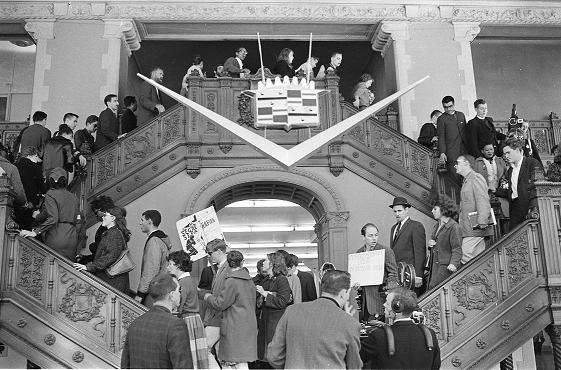
San Francisco has always had a liberal streak, but not so its business community, as a current exhibit highlights. In 1963 and ‘64, San Francisco was hit with massive demonstrations that denounced businesses’ discriminatory hiring practices and demanded equal work opportunity for African-Americans. Crowds picketed on Auto Row, in front of Mel’s Drive-In, Lucky Store, the Sheraton Palace Hotel, and Bank of America.

The Main Library exhibit “Occupation! Economic Justice as a Civil Right in San Francisco, 1963-64” retraces a struggle for economic justice that was specific to the city by the Bay, where thousands of African-Americans had moved to during World War II to work on the shipyards. When the war effort wound down, they were the first to be fired. Only direct actions—sit-ins, sleep-ins, and shop-ins—were able to shake the status quo: they led to more than 260 employment agreements for minority workers. There’s only a few days left to discover this important yet underrepresented piece of SF history: the display ends on March 27.

We spoke with curator Nancy J. Arms Simon about the exhibit and its relevance:

SFBG: How did this exhibition come to be?

NAS: It was actually the brainchild of Susan Goldstein, from the San Francisco History Center, and Catherine Powell, the director of the Labor Archives and Research Center. They had talked about collaborating on an exhibit related to labor, drawing from both collections.

In the meantime, I had fallen in love with the photographs of the photojournalist Phiz Mezey that I had discovered at the Labor Archives. She documented the April ‘64 demonstrations on Auto Row. So, it was a perfect blending. Those pictures are amazing because esthetically they’re incredible. On every single one of them, the layout just keeps your eyes circling. And the other part is that Phiz Mezey had been removed from her position at San Francisco State University, where she had been a professor. She had refused to sign the Communist Levering Act that all public employees were required to sign. In the 1950s, anyone who worked for a state agency had to sign an anti-communist oath.

While she was petitioning San Francisco State for years to get her job back, which she did in 1978, she was also trying to support herself and her kids. And so she became a documentary photographer. So I had become intrigued with her and with that story. When I started the project, I thought it would be an exhibit on the Auto Row protests. I didn’t even realize that this was part of a greater series of events that had spanned for two years.

SFBG: What were people asking for?

NAS: What they wanted was jobs, what I refer to as front-end jobs. I don’t like the idea of using the terms skilled and unskilled labor, because too many things that are very skilled get lumped under unskilled labor.

Blacks in San Francisco were assigned to jobs where they didn’t interact with the public. Basically, they weren’t allowed to. So they were allowed to be mechanics, janitors, but they weren’t allowed to be service people: bank tellers, waitresses, salesmen. There were two big pushes conjointly going on. There was the push for equality in housing, to end the segregation in housing, and also this push for jobs. If you don’t have access to jobs, there’s so much that you lose along with that. There’s that compounded effect of not saving to send your kids to college or provide for your own retirement… 

SFBG: But during the Second World War, [President] Roosevelt had enacted the Fair Employment Practices Act that made discrimination unlawful with companies that held government contracts.

NAS: But it was slated to end once the war was over. It was voted through to continue slowly across the country state by state, but it wasn’t nationwide until ‘64, when LBJ signed the Civil Rights Act. So for 20 years, from 1945 to 1964, people who had known a certain quality of life were fighting just to maintain it. Laws to promote equality might have been enacted, or agreements might have been signed, but having the law didn’t mean anything. There was this understanding that you can never let out the pressure; you have to keep pushing to make sure that that equality is actually enacted.

SFBG: How did the protesters organize their actions?

NAS: There’s a lot of lessons on how you effectively make change. There was a lot of unity amongst the groups, CORE, the WEB Du Bois Club, and the Ad-hoc Committee to End Discrimination. They had lawyers in place. Before a protest, they would decide who could afford to get arrested, and who couldn’t. So the people who could afford to get arrested would go to a certain level, they would maybe go inside the building. And all the leaders always made a point to get arrested, because they knew that that would get more press. And they also intentionally clogged the courts. They made sure that hundreds of people would get arrested just to slow things down and make it more difficult on the system.

It was really effective. And I think there’s a lot of these lessons that we miss today. They started with Mel’s Diner and they did get the owner to sign the agreements. Over at Lucky Store grocery, they did a shop-in. This is non-violent protest at its most beautiful! They went in and filled their shopping carts, they got to the counter and got them all run through. Remember, this is all scanned by hand. And then, once everything was scanned, they would say, “I will pay for these groceries once you give better jobs to Blacks,” and then they would leave. And all these bagged groceries filled the entire floor! All this stuff had to be put away. Plus people were picketing outside the store. So not only are you creating this major headache and throwing this wrench in the wheel, you’re also blocking people from shopping. So they were significantly cutting into their income.

SFBG: The Sheraton Palace Hotel rally was the biggest protest to take place.

NAS: It was really hard to narrow it down to a few statements to get into a showcase! About 1,500 protesters surrounded the hotel on March 6, 1964. There were other events leading up to that, though, they had tried negotiations, they had started smaller pickets outside. There would have been a court order to end the picket. So this is all building up.

During the major protest, I think 450 people entered the building and wouldn’t leave the lobby. The police carried them out, but they came back. They slept in overnight. And then the mayor, Jack Shelley, stepped in. He worked on the negotiation process and made it happen. After that, literally, the day they signed the agreement, they started picketing on Auto Row. This is how well organized they were. At the same time, other businesses were signing agreements for hiring Blacks, because they didn’t want this kind of press to happen. Remember, this is all happening in “liberal” San Francisco, so the fact that this is not good press for them counted.

SFBG: In the outcomes, you were careful to underline how these events had an impact on individuals’ lives.

NAS: It’s so easy for us in hindsight to know that civil rights were the right thing to fight for. But just think about what it would take out of somebody to get arrested. Tracy Sims, who later became Tamam Tracy Moncur, basically took the fall for her group. Because there were so many people arrested, they sent them to court in groups of 10 to12 people. She ended up getting 60 days in jail, plus a $200 fine. It was horrible for her. She was an idealistic 18-year-old. She knew she was doing the right thing. They were successfully changing laws just to confirm she was doing the right thing. And then she’s punished. After she served her time, her mother was already back on the East Coast, and she went to live with her mom.

SFBG: You were able to gather artifacts to tell this story, pins in particular.

NAS: These are all part of the Labor Archive collection. Graphically, they’re so simple, easy to read. You see them in photographs and they absolutely pop out. My favorite one is this “= Quality” one. It’s timeless. You’ve got the word play of equality equals quality. It’s got the silhouettes of a white child and a black child. What does equality really mean? It means equal quality for everybody. It’s not just a word. I really love that one, because it’s still so contemporary. Objects have got a power of their own. If you can stop and think of what’s involved, why they were created, and all the places they’ve been to… Some of the old pins will have the printer’s union stamp and the sheet metal workers’ stamp Look at that! That’s pride in your work right there.

Personal shopping at Collage Clothing

4

The perfect wardrobe is a collection of vintage beauties and trendy new things, but shopping in this form takes devotion. Thrashing through thrift stores may not be your style and consignment shops often have a tendency to overwhelm with rack after rack of fashion-flops. Alas, Collage Clothing and its queen bee Erica Skone-Rees are making your life easier. The closet-size shop in Potrero Hill hosts an ever-changing assortment of local designers, consignment and vintage pieces, meaning you can leave the hunting and gathering to someone else. 


Every inch in the adorable shop is carefully attended— manager and buyer Skone-Rees is a former merchandiser with a gift for making each item in the store look irresistible. Collage Clothing opened its French doors in November as the new neighbor to its mother store, Collage Gallery, an 18-year-old, Potrero Hill staple for vintage furniture and locally made jewelry. 


The front-window display alone is enough to get people inside and browsing— from mannequins to antiques, Skone-Rees rearranges the display every two days, paying mind to details and setting up featured items as if they were famed works of art. 


“Runners will go by in the morning and send me emails once they get home, telling me ‘the window looked great today’,” she says with a proud smile. “And guys from Blooms (Bar across the street) will stand outside, smoking their cigarettes and watch me change the display. People really get a kick out of this window.”


The store carries items for both men and women, and if you’re clueless about what to try on or just in need of some direction, Skone-Rees is one to ask. The first time I went into the shop, I came out with a sexy blue-suede dress straight out of the 90s. Skone-Rees and I chatted while I walked around the store in my new body-glove, chatting like we were old pals. As special as it was, Skone-Rees offers this kind of big-sister service to all of her customers. 


“This store is like my baby— I eat, sleep and breath Collage and I love it.”


Each month Collage Clothing and Collage Gallery host a double-trunk show, offering customers a chance to meet and greet local designers, buy up some goods and toast with champagne. This month’s event— Thurs/18 from 6-9pm— features the FLEECE-A-NISTA collection by Jeanne Feldkamp and Topi Hat Designs. 


Check out the gallery for current items hot on the rack this week.


Collage Clothing

1331 18th St

(between Texas St & Missouri St) 

San Francisco, CA 94107

(415) 755-8306

www.collage-gallery.com/


Closer edits: An interview with classic DJ dynamo Greg Wilson

0

In this week’s issue of the Guardian, I finally got the total fanboy pleasure of writing about, and talking to, one of my true DJ inspirations, electro-funk originator and dance edit king Greg Wilson. (He’ll be performing at Triple Crown on Fri/19). Kicking his career off in 1975, the man has the kind of stamina and skills most spinners can only dream about. (And I didn’t even get into the fact that he was the first professional DJ hired for a regular gig at the hugely influential Hacienda club in Manchester.) In the late ’70s and early ’80s, Wilson provided a crucial link between the often segregated black soul and white dance scenes — he was known as a “black music specialist,” eek — and his panoramic edits were the fruitful results of his colorblind cross-pollination. Here’s our email chat in full, his replies coming after a “brilliant night in Melbourne,” Australia.

http://www.youtube.com/watch?v=zY-EgzcN6_k

SFBG: It’s such perfect timing to have you come to SF for the tour. We’re finally getting an edit fan scene going here, as well as our usual host of groove revivalists and analogue equipment fetishists. As to the US edit scene in general, I’m wondering if you’ve heard and what you think of some of the newer acts and labels like Wolf + Lamb, Soul Clap, Tensnake, and SF’s own King & Hound. I’m also curious as to your thoughts on more established soul re-editors like Moodymann. Are there any other Americans you particularly admire? I’d like to try to tease out some of the influence you’ve had here in the past 20 years.
Greg Wilson: I suppose it’s been more the other way around, with me editing or mixing tracks by US artists. On [recently released compilation] Credit To The Edit Vol 2, a third of the album is made up of US tracks — “Don’t Turn it Off” by 40 Thieves, “Starlight” By Escort, “Oh Snap!” by Nick Chacona & Anthony Mansfield and ‘One Life Time To Live’ by Gary Davis. I’ve obviously picked up on some of the US edits, via Prince Language, Rong, Rvng Of The Nrds etc, but there’s probably loads of good stuff I’m missing out on.

http://www.youtube.com/watch?v=AWiKEBuFiNY

SFBG: Can you tell me the story of your relationship with [musician, DJ, and Green Gorilla crewmember] Anthony Mansfield? You talk about it a bit in the liner notes for Credit to the Edit Vol 2. I’m hoping you can expand upon that a bit, since he’s such an integral part of the scene here.
GW: Anthony introduced me to a lot of the people on the San Francisco scene when I was last over. The remix I did of ‘Oh Snap!’ was a big tune for me, and we’ve become friends as a result. When I came over in 2008 he took me to Haight-Ashbury, which, being a ’60s obsessive, was the first place on my to go to list. He also took me across the Golden Gate bridge and right up to where you look out over the Pacific. The fog was rolling in and it felt like we were at the edge of the world, which I suppose we were in a sense. It really was one of the most incredible sights I’ve ever seen.

Greg in one of his 1984 electro promos

SFBG: Obviously and strangely for the US, it was the excellent BBC Essential Mix that reintroduced you to many of the heads here, even though you’d been active again for years before that. Of course, the only way we heard that mix was over the Internet, which brings me to my question. One of the differences from when you were DJing before your retirement period has got to be the ways in which DJs and  music-makers distribute music and promote themselves. I know you’re open to using the latest technology to make tracks. How do you feel about the current digital distribution era, and can you talk a bit about what it was like in the past? It seems a far cry from the record pool and radio days.
GW: Yes, two very different times — back in the 70s and early 80s, I received promo copies from all the UK companies, and bought US imports from a shop called Spin Inn in Manchester, which was the only place in the North to shop if you wanted to be taken seriously as a black music specialist. It was these two sources that kept me ahead of the game back then. During the Electro era I also began receiving promos from a few New York labels, which gave me exclusives on a few tracks like ‘E.T Boogie’ by the Extra T’s and Indeep’s ‘Last Night A DJ Saved My Life’.

Nowadays most of the stuff I pick up on is sent directly to me online. I still buy stuff from places like Juno and Piccadilly, and have records and CDs posted to me, but the majority of newer tracks I play come to me via online contacts. The Internet is key to everything I do, without it I could never have returned to deejaying in the way I have, and certainly not toured around the world.

I think it’s an exciting time. Some people pine for the old days, but, as great as they were, I don’t like to dwell on the past too much in a nostalgic way, but use it to inform the future. I like the way younger people, who didn’t have direct experience of the original disco era are drawing influence from it and re-shaping from their own perspective here and now. For me, music, not matter how old it might be, is always alive and evolving, so I’m all for bringing it into a new context.

My Essential Mix illustrated this, balancing the past with the present. This is what I always strive for — connecting back, but moving on. I was shocked at the overwhelming positivity response to the Essential Mix. I’d expected it to appeal to some, but not to others, but it was almost totally positive. I also hadn’t taken into account that within days of it being broadcast in England, it would be uploaded onto blogs worldwide. I had no idea that it would have global impact.

Greg in 1976

SFBG: One of the reasons I think the edit scene is so hot in the US right now is not just because editing technology is so readily available, but because edits are a slight technological tweak to classics that serve to introduce these songs to a new generation in a relatable way. They’re not the exhaustive distortions of techno dance remixes, but neither are they the technophobic “rare grooves” Holy Grails of the purists. The sound seems to be a perfect balance of creative manipulation and relaxed classicism, which seems right for the times. Am I just pissing on myself theoretically?     
GW: For me, it’s as simple as putting together a version of a track to play out yourself. This may be a straightforward edit, or a little bit more involved, bringing in outside elements. It might be a simple extension, or it could be a track you love everything about, but for one part, which you can now cut out. It gives older music a contemporary twist, which I’m all for if it’s done with love and respect for the original.

http://www.youtube.com/watch?v=PMhnX0En9eQ

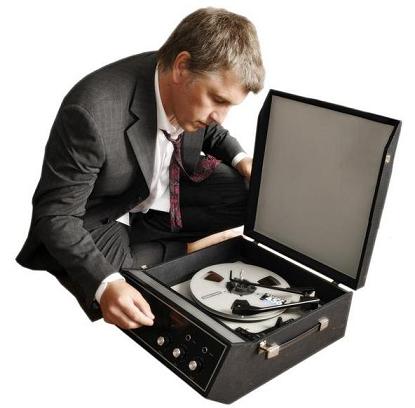
SFBG: About that wonderful Revox B77 of yours. Can you get a bit wonky  about it — what’s the model, how do you store it and transport it, and how do you keep it up? Fanboys are dying to know!
GW: I have my own B77s (flight-cased) for UK gigs and we hire them in when I play overseas (Revox R99’s also work for me). I used to take my own on the flights around Europe, but it could be steep on the XS. It can give the promoters a bit of a headache tracking them down, but everyone has managed to find a unit somewhere. People would be disappointed if I turned up without one, as it’s an essential part of what I do – spinning sounds, samples, and textures over the tracks I play, and creating dub fx. It’s become my trademark and on the rare occasions when I do DJ without it I feel really weird. I don’t know where to put my hands!

Peace-out

0

kimberly@sfbg.com

SONIC REDUCER Who would have thunk that Sonic Reducer would rattle on for so long — unreduced, unredacted, Sonic even while covering Mr. Winkle or Mundane Journeys. It’s been more than seven years since Cheetah Chrome gave me the casual A-OK to borrow the name of his song, and now the end is nigh: this is the final SR in the Guardian, but what a deliciously lengthy, rich, overwhelming run it has had.

Scanning the first Jan. 7, 2003, column — chock-full of New Year’s Eve tidbits concerning one of Dengue Fever’s first shows in SF, Bud E. Luv’s turn as the Ozzy and Sharon Osbourne’s NYE attraction (playing big band versions of “Iron Man,” natch, amid strippers and absurdly outsized sex toys), and an evening out to the Coachwhips/Pink and Brown-reunion house party in a South Van Ness basement, trapped by a moat of mud, buffeted by revelers, and besieged by circuit-breaking blackouts. Lo, there was also scandalous news of rumored onstage fellatio at a Tigerbeat6 showcase and an update on Kimo’s efforts to halt the sonic seepage at its ear-bleed noise shows.

The early ’00s in SF were a giddy, madly experimental, and hyperfertile period for local music — a delirious convergence of imaginations cocked and loaded by the dot-com gold rush, exploded with the blizzard of pink slips and the onset of plentiful time and energy, and the excitement of so many ripe minds coming together — oof — at once, if from widely divergent corners of the cultural landscape: how else to explain the peaceful coexistence of Joanna Newsom and Caroliner, Deerhoof and Comets on Fire, Soft Pink Truth and Hunx and His Punx, Vetiver and Turf Talk, the Morning Benders and the Lovemakers, the Oh Sees and every other band John Dwyer has been involved in, in this fair citay?

Perhaps one day I’ll boil down these 350-plus columns — snipes, jests, always-in-good-fun jabs, and all — and come up with a rough sketch of this equally rough and rewarding zero-hour decade’s blurry contours. In the meantime, glancing hazily back over past columns, I unearthed a few highlights — from lowlifes or bright lights:

Mark Pauline of Survival Research Laboratories on not performing in Europe, 2003: “We were good enough to cause national alerts and bad international events, so we never got asked back. Again, good work.”

eXtreme Elvis on SF, 2003: “Too much of culture that surrounds San Francisco has to do with that idea of no spectators. No spectators means everyone’s a DJ, everyone plays didgeridoo, everyone has a band, everyone is a spoken-word artist. There’s a kind of culture of narcissism — guilty as charged, right?”

Inca Ore’s Eva Saelens on touring, 2006: “When you break through, it’s like being in another world. Sometimes I’ll try to push an explosion or try to lose my mind, and if you do that on a nightly basis, it’s unreliable and it’s also abusive. You’re pushing your emotions in an athletic way, almost.”

Nick Cave on Grinderman, 2007: “An overriding theme of mine is, I guess, a man and a woman against the world. But for this record, the woman seems to be down in the street, engaged in life, and the man is kind of left on his own, with, um, y’know, a tube of complimentary shampoo and a sock.”

The Cure’s Robert Smith on dumb pop, 2007: “I’m saying that most good pop singles are stupid — otherwise they’re not good pop singles. I’m from an age when disposable wasn’t necessarily a bad thing.”

Joe Boyd on music book signings, 2007: “I can tell you what the queue looks like. There’s a lot of beards. There’s a lot of bald pates. There’s a lot of gray hair, and every once in a while there’s a 20-something woman in the queue, and then you kind of make sure your hair is combed straight. Then she comes up to the head of the queue and says, ‘Will you please sign it “To Peter”? It’s for my father for his 60th birthday.'”

Lady Gaga on pop perfection, 2008: ” If it isn’t flawless, I gotta work myself up to where it is — otherwise I’m just another pop chick with blonde hair.”

Will Oldham on music, 2008: “You can find in music just about any ideal emotional landscape you crave, whether it’s angst or rebellion or celebration or union or dissolution. It’s all there, and none of it’s going to call you back or text you at four o’clock in the morning or blame you for anything you did or didn’t do or slap you with a paternity suit.”

Six Organs of Admittance’s Ben Chasny on “Ewok Song,” 2009: “I know it by heart, and it’s the precursor to all these kids with wizard hats. It all comes down to the Ewoks singing around the fire. Akron/Family ain’t got nothing on the Ewoks, man.”

Laurent Brancowitz of Phoenix on his old Daft Punk bandmates, 2009: “They decided to go to a lot of rave parties, and I didn’t, because I didn’t like the nightclub life. I’m a bit of a snob about it — I find it very vulgar.”

Jarvis Cocker on his song “Caucasian Blues,” 2009: “I was interested in how blues music has gone from the music of protest, of the oppressed, to the blandest, safest music for white people to listen to in bars.”

Oh, but that was then — and I loathe nostalgia, if that isn’t already clear from the past seven years of cranky natterings and screams at the sky against boring, snorey Sha Na Na-style regurgitations. And this is now. Look for more from me in these and other pages, but never look back in regret.

A lost San Francisco saga

1

arts@sfbg.com

MUSIC “There are great artists and musicians who will never be discovered,” says Herman Eberitzsch Jr. III “That’s the way it is,” he reasons. “There’s only so much room at the top.”

That’s why you’ve most likely never heard of Eberitzsch (pronounced “eh-bur-itch”) despite his remarkable music talent. He has a name straight out of a gothic fairy tale — far from the iconic, slick-sounding syllables associated with San Francisco’s psychedelic soul renaissance during the late 1960s and ’70s. Yet his recordings hold up to the best of them. “We had a strong conviction that we were the next big thing,” Eberitzsch says. “But we weren’t.”

Each generation harbors a certain aesthetic mood that mutates and evolves under the prescient vision of a limited number of innovators. Their fresh styles, resonant at first, then become formulated and stagnant, disseminated in the norm. We then await the next genius, or at least a movement of collective creativity, to shake things up. But what attunes us to one artistic strand, pregnant with a world of open-ended meaning and feeling, rather than another with just as much potential richness? How do we come to discern between the vanguard and the wayward? And what if we miss something in the process?

Eberitzsch’s unlikely story might just read like a rediscovery of what we overlooked. He recorded hours of bluesy soul fueled by free-form jazz throughout the ’70s that never saw commercial release. He arranged, wrote, sang, and funkified the keys on dozens of songs with mainstays of Santana’s circuit (Coke Escovedo, Linda Tillery), Lee Oskar of War, and Sly Stone’s drummer, Greg Errico, among many others. Most of the musicians who recorded on Eberitzsch’s own arrangements were, by and large, no-namers, yet it’s their music which now stands out.

Eberitzsch’s songs leap and wander. They gracefully move the spirit while grounding the body in rich, earthy grooves. They are a naive and inspiringly audacious attempt at channeling the sort of raw expression that challenges, mesmerizes, fights, and loves. In the midst of so much experimental and groundbreaking sound, Eberitzsch’s music either missed the ears of the right A&R rep or was just not the right kind of different.


A CHANCE REDISCOVERY

Now Eberitzsch is sitting across from me in a café near his former Potrero district home, excited to tell his story. He greets me as Allen Ginsberg (my look-alike visage intact, masked in dark beard and glasses), and I feign appreciation for the well-meaning reference, knowing that although Ginsberg had quite a poetic sharpness, he wasn’t the best-looking fellow. But Eberitzsch’s generous charm and earnest happiness with the course his life has taken, despite the disappointments, quickly win me over. Waves of amiable energy overtake the slightly weathered rasp in his voice. A youthful, idealistic Eberitzsch naturally emerges in the course of minutes. In a way, he’s been waiting for this interview for 40 years.

“Atlantic told me, ‘We don’t hear it at this time,'<0x2009>” Eberitzsch says, highlighting the elusive way a record company executive might elongate time, stretching the curt word like a worn rubber band. “But when you invest your life and your heart and soul into a project of your own creation, your own little children of songs, you don’t throw them away. You don’t send them down the River Styx,” he says, laughing. “So I put ’em in the basement.”

That’s where record collector Daniel Borine mistakenly found the two-inch apex tapes, 35 years later, while doing photo research for a reissue project on lost Bay Area modern soul. What those tapes hid — a dusty time capsule of relentless insight and vigor — amazed Borine. In a move away from the prideful hoarding that typically characterizes collectors, Borine wanted to share the tapes with a larger audience and finally do justice to Eberitzsch’s music. He pursued the new and quickly growing business of recorded music archaeology and preservation, an endeavor that mirrors what so many archivists have done already for literature, film, and visual art. Borine had the tapes mastered and organized the tracks into coherent volumes. He plans to put out four full-length records of Eberitzsch’s brilliant efforts, titled the HE3 Project, over the coming years on his own upstart Family Groove Records.

The first chapter of the compilation is set for release on March 30. It focuses on Eberitzsch’s trailblazing efforts from three distinct recording sessions between 1971 and 1974. These recordings capture Eberitzsch’s far-reaching artistry — a grounded and soulful angle on space-jazz psychedelia, informed as much by Weather Report as by Robert Johnson. This is the story of the man behind the HE3 Project.


ORIGINS OF A WOULD-BE TRAILBLAZER

Herman Eberitzsch Jr. III was born in San Francisco’s colorful Portola neighborhood in 1947. He grew up in a German household, where he learned to play the classical composers — Mozart, Bach, Beethoven, and Brahms — at a young age. But somewhere along the way Eberitzsch caught the funk and couldn’t let go. “In my room I listened to James Brown,” he recalls. “When I grooved and played the boogie, I had a powerful left foot that shook the ground. My left foot took down the house, so I eventually had to move out.”

Eberitzsch conjured doo-wop on the corner with the young funky drummer Greg Errico, who lived down the street. He was enraptured by the blues in Oakland, danced to jazzy R&B grooves in San Francisco, and witnessed the emergence of a new psychedelic sound at the Fillmore and in the streets. Immersed in the Bay Area’s magnetic music community, he naturally gravitated to the keys again. “I figured out how to play funky style clavinet and piano,” Eberitzsch says. “They called me Funky Knuckles for short.”

At 21, the freshly-dubbed Funky Knuckles joined a band with Boots Hughston called Sword and the Stone, and was booked by Bill Graham to perform at the Fillmore. The outfit transitioned into a quartet, Shane, with Santana’s David Brown on bass. They hustled around the city making $10 an hour and all the beer they could drink. The city bubbled over with an unparalleled creative force. The time was electric.

That same year — 1968 — Eberitzsch attended UC Berkeley to study psychiatry. But he quit after one semester to pursue music as a career, preferring the organic therapeutic powers of rhythm and melody to the structured treatment of question and answer. “Music is a much more pure form of psychiatry. It has two potentials: it either incites you to create, or it soothes the savage beast,” he says. “I became a knowledgeable person of people through music.” And cyclically, Eberitzsch’s improvisational music erupted from kinetic relationships with people.

Read part two of “A lost San Francisco saga” here.

Pool loops

0

superego@sfbg.com

SUPER EGO “Don’t you think that scratching records might annoy the people who spent a long time in the studio making them?”

I’m snickering at a jaw-droppingly antiquated — yet actually quite relevant — video from 1983 titled “1st UK DJ to Mix Live on TV.” It features famous, fresh-faced turntablist Greg Wilson, gracefully fending off tin-eared questions from Tube program host Jools Holland while demonstrating to an antsy, angular-haired audience what this whole “mixing records” thing is about.

The scratching bit’s a hoot because Wilson — who recently emerged from an 18-year retirement and will be performing at Triple Crown on Friday — isn’t scratching at all. He’s merely cueing up the record, a simple act that draws gasps. “Well, that’s it, that’s the danger,” Wilson replies to Holland, poker-faced, his soft brown Afro unshaken. “But when a record’s been played in the club for a long time, people get a bit fed up hearing it, and it’s nice to hear it in a different way. And that’s why I kind of … play about with them a bit.”

Wilson goes on to blow post-punk minds by phasing on two — two — tables at once. Then he takes it to a whole other level by revving up his trademark, Steampunk-prophesying Revox B77 reel-to-reel effects machine, real-time sampling David Joseph’s Jheri curl-slick classic “You Can’t Hide (Your Love From Me),” filling out the back-end with sly loops and layering on psychedelic dub echoes. It’s a wondrous bit of analog theater that I imagine, in this “digital age” I keep hearing about, would cause the same kind of pop-culture rupture if played out on American Idol today.

Or maybe not so much. Two of the big nightlife media hooks of the past few years have been the disco revival and the vinyl resurgence — twinned digital-reactionary movements that recall the late-1990s hip-hop and soul crate-digging of hometown heroes like DJ Shadow and Ren the Vinyl Archeologist, a fruitful response to the CD reissue mania of that time. Every technology carves out an implicit niche for its own backlashes. Now, it swallows them too. Despite all the retro nostalgia, DJs need the Internet to get their mixes out and research rare tunes. Plastic and silicon moving in tandem — it’s a real mishmash.

Wilson, who spent his decks hiatus pursuing his production career, may still keep one hand on the vintage — that Revox B77 still travels with him — but he’s made no secret of his enthusiasm for new fad gadgets, and felt that with the simultaneous rise of disco re-fever and software hijinks, a comeback was due.

“I think it’s an exciting time,” he e-mailed me from Australia, in the midst of a bonkers world tour to support his latest compilation of rejiggers, Credit to the Edit, Vol. 2 (Tirk). “Some people pine for the old days. But great as they were, I don’t like to dwell on the past too much in a nostalgic way, but use it to inform the future. I like the way younger people, who didn’t directly experience the original disco era, are drawing influence from it, reshaping it from their own perspective here and now. For me, music — no matter how old it might be — is always alive and evolving, so I’m all for bringing it into a new context.”

Wilson made his name in the ’70s and ’80s by birthing the electro-funk movement in the U.K. (www.electrofunkroots.co.uk), which pipelined many hard-to-find American dance releases to British crowds, and he came of age in a world of DJ record pools — strategic vinyl-sharing cabals that hooked cash-strapped DJs up with record companies eager to get their releases heard. Record pool culture opened the doors for innumerable disco and funk edits: DJs wanted to sound unique, so they mixed (or had someone else mix) their own versions of hits, stamping them with an individual sonic imprint. Thus the hugely influential edit scene was born, paving the way for a spectrum of club remixes from genius and egregious.

No one handled edits quite like Wilson, whose pitch-perfect additions, stretches, and overlaps and live technique proved to be a bulletproof blueprint. The disco edit scene, a subsection of disco revivalism that also digs up more contemporary “lost” tracks, keeps looping back into view, the most recent fanatic attack including acts like Wolf + Lamb, Soul Clap, Les Edits Du Golem, and Tensnake, and labels like Rong, Wurst, and Ugly.

Our very own rulers of the local edit scene are King & Hound (www.myspace.com/garthgrayhound), a collaborative effort between two SF DJ legends, Garth and James Glass, on the Golden Goose label. The two met in the early ’90s at the notorious Record Rack music store and have lately released tasty versions of David Ian Xtravaganza’s kiki 1989 “Elements of Vogue” and Can’s space-groovy “A Spectacle.”

“I have quite a few of Greg’s records,” Garth told me over e-mail. “I recently rediscovered one of his early hip-hop records called ‘We Don’t Care’ by Ruthless Rap Assassins, which I bought in 1987!” Glass joined in, “I grew up in London listening to Greg’s mixes and I’d hear him out and about.” Both of them shake off suggestions of Wilsonian influence, however. “But we’re all doing the same thing — taking out the cheese and respecting the quality,” Glass said.

Wilson’s brilliant 2009 Essential Mix mix for the U.K.’s BBC1 radio found Massive Attack and Talking Heads sharing space with Geraldine Hunt and Chic, and reintroduced him to American ears (“I think that mix illustrates what I always strive for: connecting back but moving on,” he told me. “I was shocked at the overwhelmingly positive response.”) But to Bay players he was always in the loop, working with the invaluable Anthony Mansfield of the Green Gorilla crew and Qzen and even visiting Haight Street a few years back to feed his ’60s obsession.

I recently had the opportunity to explore a bit of the Bay Area’s record pool and disco edit past with DJ Jim Hopkins of the ubiquitous Twitch Recordings, and who currently spins eclectic sets at venues like 440 Castro and Trax. He’s no stranger to the edit scene, becoming one of the youngest edit contributors in the early ’80s to San Francisco disco and Hi-NRG record pool Hot Tracks and later, after Hot Tracks owner Steve Algozino passed away from AIDS, Rhythm Stick, helmed by Algozino’s protégée Jenny Spiers. (He also namechecks the Bay’s Disconet and New Wave-friendly Razor Maid.) Hopkins got his edit start as a teen in the ’70s, using the pause button on his dad’s tape deck to make his own edits, and soon grabbed professional attention. “Record companies wanted several versions of their records available for DJs, and record pools wanted to put out compilation issues for subscribers that featured unique takes on tracks, so I happily provided,” he told me. “It’s funny that those things are worth a fortune today.”

Hopkins just started an online organization called the San Francisco Disco Preservation Society (find it at www.twitchrecordings.com) to collect and celebrate Bay-centric edits and reel-to-reel mixes. “As for the edit scene now, there seem to be two kinds being produced. There are easy-sounding ones that just extend the good parts. Then there are more serious ones that take the original and make it into something new and more moody. I think that’s good for the future — because sometimes I have to laugh. Disco kids these days are pulling anything out of vinyl resale bins from 20 years ago and calling it ‘classic’ when most of it is crap. It was crap back then, too. Making it into anything different is doing it a favor, really.”

Read Marke B.’s full interview with Greg Wilson here.

GREG WILSON: CREDIT TO THE EDIT TOUR

Fri/19, 10 p.m.–4 a.m., $15/$20

Triple Crown

1772 Market, SF

www.triplecrownsf.com

HONEY SUNDAYS PRESENTS JIM HOPKINS

Sun/21, 10 p.m., $3

Paradise Lounge

1501 Folsom, SF

www.paradisesf.com


Urban Tavern

1

paulr@sfbg.com

DINE A cardinal rule of urban living is that hotel restaurants are to be approached with caution, especially if the hotel is a tentacle of one of the national chain monsters. Some of San Francisco’s best restaurants are in hotels, but those hotels tend to be chic and boutique-y. In the bigger, blander establishments, you’re likely to find yourself eating cioppino from a hollowed-out round of sourdough bread while the whole restaurant spins slowly, like a sideways Ferris wheel in some sad circus.

Urban Tavern is in the Hilton near Union Square — an ominous portent — but once you’re inside, you’d never know you were on the ground floor of a gigantic corporate box. The space doesn’t look like any tavern I’ve ever been in, but it certainly is urban in the best sense: designed but not over-designed, with a few big touches — such as the multicolored horse, sculpted of metal — and plenty of small ones, such as the lampposts made to look like the trunks of slender trees. The restaurant is also bigger than it looks from the street; it runs deep into the building, and maybe this is one reason that noise, which from the signs (many hard surfaces and a general modernist edge) should be a horrific problem, is hardly an issue at all.

Urban Tavern styles itself a “gastropub,” but it could as well be a wine bar since the wine list is extensive and interesting — and, as an added fillip, all bottles are half-price on Sundays. (The mark-down includes half-bottles, which are as well-represented here as any place I’m aware of.) But whether your fancy is beer, wine, or a soigné cocktail, chef Colin Duggan’s cooking holds up its end of the deal, and then some. Duggan was present at the restaurant’s creation in August 2008, and his current menu reflects a tasty dynamism with, as seems to be de rigueur at the moment, a German touch or two, such as a wonderful fresh pretzel ($11), served with slices of grilled caggiano beer sausage (garlicky, like kielbasa), and a broad smear of country mustard.

If your heart lies on the other side of the Rhine, you’ll certainly respond to the cheese puffs (a.k.a. gougères, $5 for three), which are indeed puffy — like little domed stadiums with big pockets of warm, fragrant air inside — and also impressively glazed, I would guess from a proper egg wash. In a similar vein we find a pair of turnovers ($10), pastry triangles the size of sandwich halves filled with crab and king trumpet mushrooms for a sea-sweet, if slightly muted, effect.

The main courses do tend toward tavernishness. There is a burger, along with steak frites and a couple versions of ribs, baby-back and spare, the last being served with a red-wine-based jus we found meaty and slightly sweet. But there is plenty of sophistication too, as in a sturgeon filet ($22) plated atop a jumble of green lentils, sun-dried tomatoes, and braised winter greens. Sturgeon are best-known for their roe, which we call caviar, but their white flesh is dense, meaty, and possibly the most delicious of the freshwater fish. In this country, sturgeon are also farm-raised to an environmental standard that makes them a “good alternative,” according to the Seafood Watch program of the Monterey Bay Aquarium.

Of course, no gastropub menu would be complete without a vegetarian option, which at Urban Tavern is called a stew ($15) and consists of an iron skillet filled with a variety of roasted vegetables, including broccoli and cauliflower florets, butter beans, carrots, butternut squash, split brussels sprouts, and zucchini, all liberally seasoned with Parmesan cheese and moistened, at your discretion, from the pitcher of vegetable reduction on the side. It takes a certain nerve to do so little to vegetables and a certain faith that from the babble of different voices, a melody will emerge. But it does.

Desserts seem a little pricey at $9 a pop. We very much liked the peanut butter cup, a big disk of peanut butter mousse lacquered with dark chocolate in perhaps the ultimate marriage of New World delectables. The cup was presented with a wafer of peanut brittle and pat of peanut butter ice cream, which we found creamy and peanut buttery but slack somehow, as if a contrasting ingredient had gone missing. The banana trifle, served in a milk jar, was like a slice of banana-cream pie transformed into a parfait with good banana flavor but a bit too much sweetness. Even sweeter than German wine, and that’s pretty sweet.

URBAN TAVERN

Breakfast: 8:30–11 a.m.;

Lunch: 11:30 a.m.–2:30 p.m.; Dinner: 5:30–10 p.m.

333 O’Farrell, SF

(415) 923-4400

www.urbantavernsf.com

Full bar

AE/DC/DS/MC/V

Well-controlled noise

Wheelchair accessible


Homecoming

1

le.chicken.farmer@gmail.com

CHEAP EATS Dear Earl Butter,

Thank you for putting real flowers and tiny plastic battery-operated candles in your closet for me. I slept like an angel that snores like a truck driver. Speaking of which, thank you for the chili and cornbread too. It made my homecoming that much sweeter and spicier, in addition to giving me gas. Which I am happy to have, and allowed to have, praise God, now that I’m back in a Free Country.

Plus the Maze of course, being beautiful, was waiting for me at the airport with a huge colorfully hand-painted sign that read, “Welcome home, Dani. We love you.” Signed: “The Bay Area.”

He admits having had help with the wording from at least one person, and with the painting from a couple more, so maybe there is some truth to this. If so, the feeling is very very mutual.

I will never leave the Bay Area ever again, not even to go camping. Just think, while my ex and my ex’s ex-ex are holed up together in their dark, cold, provincial town in southern Germany, clinging to each other’s small corner of obscurity, writing and editing their mediocre novel that is set in San Francisco, I get to live here. And love and be loved, and play and work and eat here.

I can’t speak for working, exactly, but it’s the greatest playing and eating place in the world that I know of. Here.

There, do you know what they eat, Earl? Well, the ex’s ex-ex doesn’t cook, and my ex’s specialty is ramen noodles. That’s what they call cooking. When they go out, it’s for sushi. Really really bad landlocked German sushi. Imagine!

Meanwhile, I have been shucking fresh-picked oysters and scallops on the west coast of France, inventing home-raised cherry chicken-heart stew, eating up Paris and Rome, hobnobbing with extraterrestrials, crunching into crack conch in the Caribbean, and passing the guitar with a couple Haitian boys outside their single-family chicken-coop shack.

And now … now I get to go get a burrito. Whenever. The fuck. I want. Because that’s what San Francisco is. It’s “what kind of beans,” the best of all-things-edible, and raw onions and garlic no matter who you might breathe on afterward. No problem. We live here.

Anyway, I do. You do. And I do again. I can’t think of a more appropriate way to celebrate my 20-year anniversary of moving to San Francisco than moving back to San Francisco.

St. Patrick’s Day 1990 was the day. I still remember my amazement, the air and the sky. Thank you for getting me back in, Earl — albeit on the ground floor, literally, with an option on your upstairs apartment’s closet. But I breathe better in closets than I did in small-town Germany, and I see more sky in one heartbeat here, through my dirty, barred sidewalk window, than I saw all this winter there. The Winter of My Discombobulation.

And now, if you will excuse me, m’dear, I have to go recombobulate.

Peace and pickles,

Your L.E.

Dear Lady of SF,

That is great. We went to Urbun Burger because the Mission has a lot of places to eat. You wanted to walk around because you have returned. I know the area and fear I will never be able to leave, except, perhaps for my parents’ funerals. We went to the Community Thrift where 15 or so years ago, you found that really neat 49ers glass, and that made me jealous because I never, ever found a glass I really liked. Years later, when I read in your column that it had broken, I was happy. Karma, sigh, is on me.

But Urbun Burger. Lotta money, lotta meat. These burgers are 1/2 pounders. It was not $10 for my California Sensation burger, it was $9.50, and naturally I did not pay. There are a couple of burgers over $10, but they come with good fries. Super selection of condiments and a real nice, lively atmosphere. I enjoyed the colors in there. So did you.

And so it ends, my fit of usefulness to the good people of San Francisco. Yours begins anew. Welcome back. I hear it is a very good town.

Earl Butter

URBUN BURGER

Mon.-Thu. 11 a.m.–10 p.m.;

Fri.–Sat. 11 a.m.–3 a.m.; Sun. 11 a.m.–10 p.m.

581 Valencia, SF

(415) 551-2483

MC/V

Beer & Wine

L.E. Leone’s new book is Big Bend (Sparkle Street Books), a collection of short fiction.


Thawing ICE

0

sarah@sfbg.com

Top San Francisco officials are still refusing to implement legislation approved by the Board of Supervisors that requires due process to play out before immigrant youth accused of felonies are turned over to the federal government, despite recent developments that call into question arguments that have been made against that policy.

Mayor Gavin Newsom, whose veto of the legislation was overridden by the board in November 2009, has been the main obstacle to putting the new policy in place. He has argued that it violates federal law, that the city faces civil liability for harboring undocumented immigrants accused of crimes, and that only serious criminals have been affected by his unilateral 2008 decision to turn minors over to federal authorities before they have been convicted.

But then Muni bus driver Charles Washington’s wife, Tracey Washington, and 13-year-old stepson, undocumented immigrants from Australia, were placed under the control of U.S. Immigration and Customs Enforcement and ordered deported after the boy got into a fight at his middle school.

The case generated sympathetic media coverage because the felony charges and deportation order seemed excessive, so the federal government issued a 60-day reprieve to allow the family to finish applying for green cards and so the boy could have his day in juvenile court.

“All this got triggered by the non-implementation of a law that the board duly enacted last year,” Washington said March 11, a week after getting his reprieve, expressing exasperation with city officials. “The police are overcharging kids and waiting for someone else to whittle the charges down, and the probation officers are referring the kids to ICE, waiting for someone else to deal with the situation.”

Newsom’s policy required the city’s juvenile probation department to refer Washington’s stepson to federal immigration authorities after local police charged the boy with felony robbery, assault, and extortion in a dispute over 46 cents. Authorities then required his mother, rather than his stepfather, to come pick him up and placed an electronic monitoring device on her pending a deportation hearing.

Newsom’s policy has had a big impact in the city’s immigrant communities. Since July 2008 when the mayor ordered changes to Sanctuary City policies that had been in place for two decades, 125 youths have been referred to ICE, according to a March 9 report from the city’s Juvenile Probation Department.

In addition to the Mayor’s Office, the JPD has refused to enforce policies enacted through legislation by Sup. David Campos that are technically supposed to be the new city policy on referring undocumented youth, and the City Attorney’s Office has not required city employees to follow the new law, arguing it can only give advice and not compel departments to take action.

“With the benefit of legal advice provided by the City Attorney’s Office and outside legal counsel, and in light of current restrictions imposed by federal law, particularly the position taken by federal law enforcement authorities, the department has concluded that it cannot modify its policies and practices,” probation chief William Siffermann said at a March 4 hearing of the Board of Supervisors Rules Committee on why his department didn’t implement the legislation.

Grilled by Campos, Siffermann could not identify a federal law that requires city officials to report kids to federal immigration authorities upon arrest. Instead, Sifferman pointed to what many in the criminal justice community see as U.S. Attorney Joseph Russoniello’s overly broad interpretation of federal immigration laws, including his allegation that transporting arrested juveniles to court hearings amounts to “harboring aliens.”

But the Washingtons’ case struck a raw nerve at City Hall, and the Obama administration’s conciliatory response, along with other recent legal developments, indicate that it isn’t the feds that are preventing implementation of Campos’ legislation.

In February, Superior Court Judge Charlotte Woolard ruled in a civil case that the Bologna family — of which three members were murdered in 2008, allegedly by Edwin Ramos, an undocumented immigrant who had been in city custody as a juvenile — can’t hold the city liable for failing to prevent the murders.

That crime had been sensationalized by the San Francisco Chronicle, the San Francisco Examiner, and nativist groups, putting pressure on Newsom to change the Sanctuary City policy. Newsom’s spokespeople repeatedly have referred to it as an example of the civil liability the city faced.

On March 1 (the same day Washington first went public), City Attorney Dennis Herrera replied to allegations that his office has not done enough to implement Campos’ amendment by citing its victory in the Bolognas’ civil case, which sought punitive damages and to invalidate the city’s sanctuary ordinance.

Herrera also asked Gary Grindler, acting deputy attorney general at the U.S. Department of Justice, to direct the U.S. Attorney’s Office in the Northern District of California to “not use its limited resources to criminally prosecute local officials and employees who abide by California and local laws regarding the reporting of undocumented juvenile immigrants to the federal immigration authorities.”

Herrera based his March 12 request on an Oct. 19, 2009 memo that Grindler’s predecessor, David Ogden, issued curtailing federal action against medical marijuana dispensaries, which Herrera argued could serve as the model for clarifying the federal position on the city’s sanctuary law.

“If city officials and employees follow the mandates of state law, including those regarding the confidentiality of records of juvenile detainees, and the requirements of the amendment permitting the reporting to ICE of juveniles only after they have been adjudicated as wards of the court for criminal conduct, then the U.S. Attorney should not make it a priority to use its scarce federal resources to prosecute those city officials on the theory that by not reporting them at an earlier point, the city officials or employees are guilty of harboring,” Herrera wrote.

Campos said he welcomes any effort to get clarification from the feds, but believes such clarification is not necessary — and may not be forthcoming anyway. “So San Francisco should move forward. The law, in my view, allows us to do so, and it’s the right thing to do.”

Bay Area black metal: Ludicra’s gripping new “Tenant”

0

It’s hard to believe, but black metal is around 20 years old. During its second decade, the music has been gradually subsumed into the metal mainstream, cannibalized, recombined, and reinvented. Pulled in one direction by the commercialization of bands like Dimmu Borgir, and in the other direction by the hermetic inaccessibility of solo studio acts like San Francisco’s Leviathan, fans and metal taxonomers have circled the wagons around arbitrary criteria, judging bands on whether or not they use a keyboard, or whether or not they’re from Scandinavia.

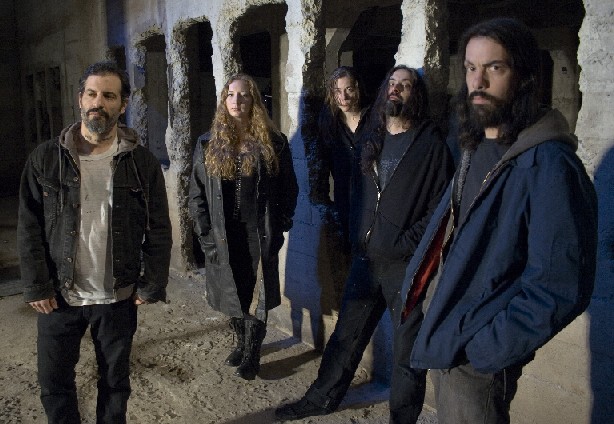
Thankfully, in the Bay Area, we’ve got a black metal band who couldn’t care less what the guarantors of kvlt (sic) purity have to say. San Francisco’s Ludicra hit stores with their fourth full-length today, and Tenant (Profound Lore Records) showcases an act at the height of their considerable powers, churning out organic-sounding, progressive black metal mixed with affecting, punk-rock humility. In place of frozen Norwegian rivers or blood-soaked Vikings, the album derives its themes from the eerie, uncanny, and horrifying aspects of urban living, as its title eloquently suggests.

Guitarists John Cobbett (also of Hammers of Misfortune) and Christy Cather favor warmer guitar tones of the type that won Wolves in the Throne Room so much critical aplomb, and they’re buttressed in this choice by the throat-shredding vocals of Laurie Sue Shanaman, which give the music a visceral, catharctic potency. Drummer Aesop Dekker is nimble if understated, and brings a welcome humanity to a genre that is generally so chops- and blast-beat-heavy.

The scything 6/8 riff that begins album opener “Stagnant Pond” is a harbinger of things to come, ascending into meditative chaos before giving way to the stately, mid-tempo blast that opens “A Larger Silence.” “In Stable” is the LP’s barn-burner, with its pulsing, black ‘n’ roll verse and massive ending build.

All of the album’s seven tracks are longer than five minutes, and two top nine, so it’s a testament to the Ludicra’s arranging talent that the songs breeze by as fast as they often do. Whether it’s a stop-on-a-dime meter shift or a clever bit of pagan-folk filigree, its hard not to be impressed by the band’s songwriting acumen. “Clean White Void” displays a notable NWOBHM influence, a stark contrast to the relentless blast beats on “Truth Won’t Set You Free” and the meditative chanting in the album-closing title track “Tenant.” Taken as a whole, the album is a gripping evocation of anger, fear, and sadness – what’s more black metal than that?

Who profits from ICE’s electronic monitoring anklets?

1

One of the many troubling things to emerge from the threatened deportation of the wife and stepsons of Muni bus driver Charles Washington is the extent to which the Department of Homeland Security (DHS) is using electronic monitoring bracelets to track immigrants–and is turning to private contractors to deliver these services.
Take the Washingtons’ case. Charles Washington told reporters that US Immigration and Customs Enforcement (ICE) told him they would release his teenage stepson, if his wife Tracey, went to ICE’s Sansome Street office in San Francisco and agreed to wear an electronic anklet (pictured below).

Tracey's anklet
Tracey Washington agreed to the deal, worried about her 13-year old son, who had spent close to a week in detention at juvenile hall, after he got into a fight at school over 46 cents, and who was now in the hands of federal immigration authorities. And she had cause to worry. The feds have been known to transfer teenage immigrants arrested in San Francisco to detention facilities in Florida, Virginia and Oregon, while their deportation is pending.
So, the Washingtons hurried down to Sansome Street to retrieve their son.  And, there Tracey Washington was given deportation orders for herself and her son, and an electronic monitoring device, which contains a GPS device to monitor her movements 24/7, was placed around her ankle.
Tracey says the device was too tight at first, and, though it has since been adjusted, wearing it makes her feel as if she has committed a serious crime. But so far, no one in her family has actually been found guilty of a crime in this Kafkaesque episode.
Instead, her 13-year-old son has been charged with felony robbery, assault and extortion, charges that sound serious but have yet to be adjudicated in a juvenile justice court, and that were made in the wake of a schoolyard fight, which did not involve weapons, after the parent of the victim called the police.
But these felony charges are the reason why a juvenile probation officer called ICE, who picked up the boy, and, within 5 hours, released him to his mother, once they’d locked an electronic monitoring device on her ankle.
As for the question of the Washingtons’ visa overstay, which is ICE’s grounds for the anklet, the couple say they called the US Citizenship and Immigration Service (US CIS), not once, but twice, two days after they got married in April 2009, when Tracey, who met Charles on vacation six years ago, was midway through a 90-day visa waiver.
The couple say they were given misinformation on the phone about the urgency of applying for a green card, and that’s how they came to be only at the beginning of that process when their son got nabbed—a lag that Charles Washington attributes to the time it took for his family to save up the thousands of dollars that green card applications cost.
And apparently there is no way for the Washingtons or the US government to verify what happened when the couple called US CIS, and spoke to an operator. US CIS spokesperson Sharon Rummery told the Guardian that it is impossible to ascertain if a contractor with the US government misinformed the family.
‘I can’t say that it’s true or not, because it was a private conversation between one of the operators who works on our customer service line,” Rummery said. “Our operators are highly trained and are backed up by our trained officers,” Rummery continued, confirming that the operators are contractors, not US CIS staff.
Either way, Tracey Washington is left wearing an anklet. And as a hard-working, bus-driving US citizen, her husband Charles is not pleased that his tax dollars are being put to use in a way that leaves his wife stressed and feeling like a criminal.

“It’s my belief they are wasting tax payer money,” Washington said, eight days after US ICE granted his wife and stepson 60-day deportation reprieve. “With all the publicity this case has received, and the fact that our green card application has been sent in, I don’t see why she needs to be on the anklet. Everything that immigration has requested, we have complied with.”

So, just how widely spread is the use of anklets to track immigrants?

In 2002, federal immigration authorities created a $3 million Alternatives to Detention (ATD) program, to ensure that “aliens released from detention appear for their court hearings,” according to a 2010 ICE report.Fast forward to 2010 and the program’s FY 2010 budget is set at $69.9 million.
And somewhere along the way, the program began requiring immigrants who are in the process of applying for residency to wear electronic monitoring ankle bracelets 24/7—a requirement otherwise reserved for rapists, child molesters and other convicted criminals on parole.
This pilot program, which began in eight cities, including San Francisco, has since grown to a nationwide multimillion opportunity for contractors and now involves at least 30 cities: Atlanta, Charlotte, Baltimore, Boston, Hartford, Buffalo, Chicago, Kansas City, Dallas, Denver, Detroit, El Paso, Houston, Los Angeles, Delray Beach, Miami, Orlando, Newark, New Orleans, New York, Philadelphia, Phoenix, Portland, Seattle, San Francisco, Salt Lake City, San Antonio, San Diego, St. Paul and Washington.
In July 2009, DHS/ICE’s office of Detention and Removal Operations (DRO) awarded a $372 million, 5-year contract to BI Incorporated, a Boulder Colorado-based company, to provide support services for its Intensive Supervision Appearance Program  (ISAP) 11, as the federal government previously called its electronic monitoring program.
G4S Government Services of Atlanta, Georgia, which held the previous ISAP’s pilot contract, and put in a S489 million bid for ISAP 11, protested the BI award, arguing that DHS’ evaluation and BI’s price proposal were “unreasonable.”
Either way, DHS’ “statement of work” documents, which were posted online as part of that contract bid, suggest that ICE plans to use ATD on an even wider basis, in future.
“Approximately, 32,000 persons are held in secure detention by DRO each day,” the contract’s statement of work (SOW) section states, noting that this figure includes “aliens in the United States who are in violation of the Immigration and Nationality ACT (INA) who pose a threat to community safety, national security, and/or may be a flight risk, in addition to those aliens required to be detained under specific provisions of the INA.”
“Limited detention capacity and an increasing detainee population coupled with the need to lower alien absconder rates have sparked national efforts over the past several years to integrate into DRO’s general practices the use of various alternatives to detention for aliens who do not require mandatory detention in accordance with the INA,” the contract continues. “Alternatives to detention offer the prospect of a considerable cost savings over secure detention for eligible aliens.”
“Depending on available funding during the execution of the ISAP 11 contract, DRO intends to expand its ISAP coverage,” the contract notes. An attached appendix shows a list of 165 cities in which the program would operate nationwide. In addition to San Francisco and Los Angeles, California cities on the list include Bakersfield, San Diego, El Centro, Fresno, Imperial, Lancaster, Lompoc, Sacramento, San Jose, San Pedro, Santa Ana, Stockton, and Ventura.
Under the current contract, BI was expected to be fully prepared with sufficient staff and equipment to fulfill all statement of work requirements for 16,750 ISAP II slots, within two months of assuming control of the program. San Francisco was expected to fill 850 of these slots, putting it in fourth place behind Los Angeles (3,400 slots), New York, (1,500 slots) and Washington, D.C., (1,025).
And by the end of the five-year contract, the numbers of slots are expected to rise to 27,237 slots—a 10,487 increase, along with a steady increase in participating cities. Under those estimates, San Francisco is expected to have 957 slots five years from now,
The federal government touts ISAP, which relies on telephonic reporting, unannounced home visits, and regular face-to-face interviews, as well as electronic GPS monitoring devices, as a “cost-effective alternative to detention for aliens being processed through the Immigration Court system.”
ICE’s Lori Haley stressed that the program, with its focus on alternatives to detention, is part of the department’s “commitment to immigration reform.”
“Our mission is to ID non-citizens here without legal status and move them through the immigration process how the court sees fit,” Haley said.
She also stressed that the anklet program is preferable to detention and is suitable for folks with families who are not posing a danger to their community.
“We also found that as people get closer to the conclusion of the process, they may need a stronger level of monitoring,” Haley added, alluding to the reaction of folks on realizing that they are going to be deported after all.
These statistics paint a perhaps surprising picture to the average American, who likely wasn’t aware that there are thousands of immigrants in the US, who haven’t committed a serious crime, yet are walking around wearing these onerous, privacy-invading devices, hidden beneath their pants, or while they shower, or go to bed, while they await a ruling from the courts on their request to stay here permanently.
And these numbers are only going to grow bigger, if ICE has its way.
“Depending how long an alien remains in the ATD program and the number of individuals enrolled in the ATD program, implementing ATD nationwide would require between $88 million and $513 million,” ICE stated in its 2010 report to Congress. “The most realistic scenario for expansion requires a reduction in the average length in the ATD program to 180 days, down from the current average of 310 days. Reducing the average length on the program requires significant coordination within the Department of Justice, Executive Office for Immigration Review.”
“310 days in an anklet” sounds like the name of a funny film. Unfortunately for the 800 people in San Francisco, including Tracey Washington, who are apparently walking around wearing these devices in any given year, the situation is not funny, but it is all too real. And is this really the way to reform the federal immigration system in a humane and meaningful way?

Willie Brown to speak in favor of Prop 16 tomorrow

A public forum will be held tomorrow at the California Public Utilities Commission to discuss Proposition 16, the ballot initiative that PG&E is bankrolling in order to require a two-thirds majority vote before any municipality can become an electricity provider.

The Guardian has received word that former San Francisco Mayor Willie Brown will be speaking in support of Prop. 16. We initially heard that he would be speaking on behalf of the California Chamber of Commerce, so we placed a call with the COC to verify whether that was the case. That prompted Robin Swanson, spokesperson for the Yes on 16 Campaign, to call and clarify that Brown is speaking on his own behalf. “He’s just speaking in support of Prop 16,” she said, speculating that maybe he was interested in the issue due to his own experience in local government.

Willie Brown formerly worked for PG&E providing “consulting services,” according to a 2007 annual report.
When asked whether Brown was approached by either PG&E or the Yes on 16 Campaign to speak in support of the initiative, Swanson said, “I don’t know how that came about.”

We placed a call to Brown to ask him directly, but haven’t heard back yet.

The public forum, which will begin with a press conference on the steps of the CPUC building at 505 Van Ness, will be held from 1 p.m. to 5 p.m. Additional information can be found here.

Editorial: Who wins with the Transamerica condos?

4

The developers aren’t offering to build something that will create permanent jobs for local residents. They want a huge favor from San Francisco: they want the city to ignore its own planning rules, ignore its park-shadow ordinance, and hand over a piece of city street, just to make their project more profitable.

EDITORIAL  As the Planning Commission prepares to vote March 18 on a pointless and overly large condominium complex next to the Transamerica Pyramid, let us take a moment to look at who would benefit from the project’s approval.

The project sponsors, Aegon USA and Lowe Enterprises, would get the right to shadow public parkland, turn a city street into a private parking garage, and construct a project far beyond the allowable height for the location. They’d construct 248 luxury condos, which the city doesn’t need and will do nothing for the housing crisis. The developers would also make a lot of money on the deal; that’s why they want spot zoning to double the allowable height. When it comes to these sorts of projects, taller is more profitable.

And the two companies asking for these civic favors aren’t exactly San Francisco outfits that share the city’s values.

Aegon is a giant insurance and finance company based in the Netherlands that bought out the local Transamerica Company in 1999. The money Aegon makes on the deal won’t stay in San Francisco; even Aegon’s American subsidiary doesn’t have a home office here.

The company’s PAC is a major contributor to Republican causes and candidates (although some Democrats get money, too, particularly the likes of Sen. Blanche Lincoln of Arkansas, one of Aegon’s top-dollar friends, who is among the main reasons the Senate won’t pass a public option for health insurance). And over the past 10 years, Aegon PAC has contributed $39,500 to Lifepac, a Columbus, Ohio-based anti-abortion group.

Then there’s Lowe Enterprises, based in Los Angeles. The company’s chairman, Robert Lowe, and his employees were among Arnold Schwarzenegger’s top donors, with a whopping $159,500 in contributions to the Republican governor. Lowe is also a big supporter of Meg Whitman’s campaign for governor, and is on her finance committee.

So here we are in Democratic San Francisco, with a mayor who will be running on a Democratic ticket for statewide office (and a mayor, by the way, who loves to talk about supporting small local business and keeping money in the local economy) preparing to give a huge financial gift to a pair out out-of-town companies that share their wealth with right-wing Republicans.

Of course, it’s no surprise that a real estate developer would support Republican candidates &#151; and it’s no surprise an insurance company would be working against health care reform. And if the city granted or denied building permits based on the politics of the applicant, there’d be serious legal consequences (and there should be). These things ought to be decided on the merits; developers who contribute to Democrats (like the Shorenstein Company) deserve the same scrutiny as the ones who give to Republicans.

But this isn’t a typical development deal. Aegon and Lowe aren’t asking for a permit for a project that meets the current zoning laws. They aren’t offering to build something that will create permanent jobs for local residents. They want a huge favor from San Francisco: they want the city to ignore its own planning rules, ignore its park-shadow ordinance, and hand over a piece of city street, just to make their project more profitable — and to give them more money that can go to opposing health-care reform and opposing abortion rights and electing right-wing Republicans. And they’re offering the city nothing in return.

On the merits, the project richly deserves to be rejected. The only reason to approve it is to grant a civic boon to a bunch of out-of-town corporations that ought to be embarrassed to be asking a favor from San Francisco. And the Planning Commission should be embarrassed to consider granting it.