San Francisco

Music listings

0

Music listings are compiled by Paula Connelly and Cheryl Eddy. Since club life is unpredictable, it’s a good idea to call ahead to confirm bookings and hours. Prices are listed when provided to us. Submit items at listings@sfbg.com.

WEDNESDAY 31

ROCK/BLUES/HIP-HOP

"Blue Bear School of Music Band Showcase" Café du Nord. 7:30pm, $12-20.

Hugh Cornwell Red Devil Lounge. 8pm, $10-20. Benefit for victims of the Haitian earthquake.

Epiphanette Grant and Green. 9pm, free.

"Fundraiser for Precita Eyes 14th Annual Urban Youth Arts Festival" El Rio. 8pm, $5-20. With Genie, A-1, Orukusaki, Cio Castaneda, and more.

Laura Gibson and Ethan Rose, Emily Jane White, Garrett Pierce Rickshaw Stop. 8pm, $10.

Ari Herstand, Brett Hunter Trio Hotel Utah. 8pm, $8.

Kidz in the Hall, 88 Keys, Izza Kizza, Donnis Independent. 8pm, $15.

Koalacaust, Ghost Town Refugees, Travis Hayes Bottom of the Hill. 9pm, $7.

Never Shout Never, Cab, Hey Monday, Every Avenue, Summer Set Regency Ballroom. 6pm, $18.

Perfect Age of Rock n’ Roll Blues Band with guests Elvin Bishop, Tim Reynolds, and Ray Manzarek Great American Music Hall. 8pm, $30.

Radio Moscow, Assemble Head in Sunburst Sound, Naam, Zodiac Death Valley Elbo Room. 9pm, $10.

Kevin Russell Biscuits and Blues. 8pm, $15.

Rachel Wonder, Tiny Little Blackouts, Skyflakes, Golda and the Guns Rock-It Room. 8:30pm, $5.

FOLK/WORLD/COUNTRY

Kasey Anderson Plough and Stars. 9pm.

Gaucho, Michael Abraham Jazz Session Amnesia. 8pm, free.

Kami Nixon and Bill Spooner Café Royale, 800 Post, SF; (415) 441-4099. 7pm, free. Featuring Sharon Maher.

DANCE CLUBS

Booty Call Q-Bar, 456 Castro, SF; www.bootycallwednesdays.com. 9pm. Juanita Moore hosts this dance party, featuring DJ Robot Hustle.

Greatest Hits Knockout. 9pm, $4. With DJs Sergio Iglesias and Omar.

Hands Down! Bar on Church. 9pm, free. With DJs Claksaarb, Mykill, and guests spinning indie, electro, house, and bangers.

Jam Wednesday Infusion Lounge. 10pm, free. DJ Slick Dee.

Machine Sloane, 1525 Mission, SF; (415) 621-7007. 10pm, free. Warm beats for happy feet with DJs Sergio, Conor, and André Lucero.

Mary-Go-Round Lookout, 3600 16th St, SF; (415) 431-0306. 10pm, $5. A weekly drag show with hosts Cookie Dough, Pollo Del Mar, and Suppositori Spelling.

RedWine Social Dalva. 9pm-2am, free. DJ TophOne and guests spin outernational funk and get drunk.

Respect Wednesdays End Up. 10pm, $5. Rotating DJs Daddy Rolo, Young Fyah, Irie Dole, I-Vier, Sake One, Serg, and more spinning reggae, dancehall, roots, lovers rock, and mash ups.

Synchronize Il Pirata, 2007 16th St, SF; (415) 626-2626. 10pm, free. Psychedelic dance music with DJs Helios, Gatto Matto, Psy Lotus, Intergalactoid, and guests.

Yoruba Dance Sessions Bacano! Som., 2925 16th St, SF; (415) 558-8521. 9pm, free. With resident DJ Carlos Mena and guests spinning afro-deep-global-soulful-broken-techhouse.

THURSDAY 1

ROCK/BLUES/HIP-HOP

Jonny Craig, Tides of Man, Eye Alaska, Honor Bright, Mod Sun Bottom of the Hill. 7:30pm, $12.

Cult of Youth, Veil Veil Vanish, Ssleeping Desiress Knockout. 9:30pm, $5.

Destruments feat. Monophonic Horns Coda. 9:30pm.

Lesbian, White Mice, CCR Headleaner, Nuclear Death Wish Hemlock Tavern. 9pm, $6.

Allison Lovejoy and Graves Brothers Deluxe, Brother’s Horse, Fuzzbucket, Ed, Atomic Lucy Paradise Lounge. 9pm, $7. Benefit for the Haight-Ashbury Street Fair.

Tim Reynolds and TR3, Alma Desnuda, Marcus Eaton Red Devil Lounge. 8pm, $15-30. Benefit for victims of the Haitian earthquake.

Surfer Blood Amoeba, 1855 Haight, SF; (415) 831-1200. 6pm, free.

Steve Taylor Revolution Café, 3248 22nd St, SF; (415) 642-0474. 8:30pm, free.

Terror, Ignite, Hour of the Wolf, Crucified, Boundaries Thee Parkside. 8:30pm, $15.

Terror Pigeon Dance Revolt, Shakes, Blank Tapes, Pony Village Amnesia. 9pm.

Pat Wilder Biscuits and Blues. 8pm, $15.

*Zion I Rickshaw Stop. 8:30pm, $20.

JAZZ/NEW MUSIC

Habib Koite and Bamada Yoshi’s San Francisco. 8pm, $24.

Patrick Wolff Socha Café, 3235 Mission, SF; (415) 643-6848. 8:30pm, free.

FOLK/WORLD/COUNTRY

Heather Combs, Austin Willacy, Stewart Lewis, Chi McClean Hotel Utah. 8pm, $8.

DANCE CLUBS

Afrolicious Elbo Room. 9:30pm, $5-7. DJs Pleasuremaker and Señor Oz spin Afrobeat, Tropicália, electro, samba, and funk.

Assemblage 23, Angel Theory, Savi0r DNA Lounge. 8:30pm, $16.

Afrolicious Elbo Room. 9pm, $6. DJs Pleasuremaker and Señor Oz spin Afrobeat, Tropicália, electro, samba, and funk.

Caribbean Connection Little Baobab, 3388 19th St, SF; (415) 643-3558. 10pm, $3. DJ Stevie B and guests spin reggae, soca, zouk, reggaetón, and more.

Club Jammies Edinburgh Castle. 10pm, free. DJs EBERrad and White Mice spinning reggae, punk, dub, and post punk.

Drop the Pressure Underground SF. 6-10pm, free. Electro, house, and datafunk highlight this weekly happy hour.

Electric Feel Lookout, 3600 16th St, SF; (415) 431-0306. 9pm, $2. With DJs subOctave and Blondie K spinning indie music videos.

Funky Rewind Skylark. 9pm, free. DJ Kung Fu Chris, MAKossa, and rotating guest DJs spin heavy funk breaks, early hip-hop, boogie, and classic Jamaican riddims.

Good Foot Yoruba Dance Sessions Bacano! Som., 2925 16th St, SF; (415) 558-8521. 9pm, free. A James Brown tribute with resident DJs Haylow, A-Ron, and Prince Aries spinning R&B, Hip hop, funk, and soul.

Heat Icon Ultra Lounge. 10pm, free. Hip-hop, R&B, reggae, and soul.

Holy Thursday Underground SF. 10pm, $5. Bay Area electronic hip hop producers showcase their cutting edge styles monthly.

Kick It Bar on Church. 9pm. Hip-hop with DJ Jorge Terez.

Koko Puffs Koko Cocktails, 1060 Geary, SF; (415) 885-4788. 10pm, free. Dubby roots reggae and Jamaican funk from rotating DJs.

Lacquer Beauty Bar. 10pm-2am, free. DJs Mario Muse and Miss Margo bring the electro. Mestiza Bollywood Café, 3376 19th St, SF; (415) 970-0362. 10pm, free. Showcasing progressive Latin and global beats with DJ Juan Data.

1320.SF Temple. 9pm, $10. With DJs David Murphy, David Phipps, Nalepa Dub Orchestra, Flying Skulls, Virtual Boy, and more spinning electronic music.

Peaches Skylark, 10pm, free. With an all female DJ line up featuring Deeandroid, Lady Fingaz, That Girl, and Umami spinning hip hop.

Popscene 330 Rich. 10pm, $10. Rotating DJs spinning indie, Britpop, electro, new wave, and post-punk.

Represent Icon Lounge. 10pm, $5. With Resident DJ Ren the Vinyl Archaeologist and guest. Rock Candy Stud. 9pm-2am, $5. Luscious Lucy Lipps hosts this electro-punk-pop party with music by ReXick.

Studio SF Triple Crown. 9pm, $5. Keeping the Disco vibe alive with authentic 70’s, 80’s, and current disco with DJs White Girl Lust, Ken Vulsion, and Sergio.

FRIDAY 2

ROCK/BLUES/HIP-HOP

Astronautalis, Oona, Le Vice Rickshaw Stop. 8:30pm, $10.

Larry Graham and Graham Central Station, Slave, DJ Harry D Regency Ballroom. 9pm, $46.

Honor Society, Just Kait, Ashlyne Huff Great American Music Hall. 8pm, $18.

Maria Muldaur Biscuits and Blues. 8 and 10pm, $22.

Okmoniks, Touch-Me-Nots, Wrong Words Hemlock Tavern. 9:30pm, $6.

Passenger and Pilot, Cola Wars, All My Pretty Ones El Rio. 9pm, $6.

Kally Price Revolution Café, 3248 22nd St, SF; (415) 642-0474. 8:45pm, free.

Scraping for Change, Solid State Logic, Cloverleaf Drive, Fever Charm Slim’s. 8pm, $14.

Texas Thieves, Sharp Objects, Ruleta Rusa, Bad Tickers Thee Parkside. 9:30pm, $7.

*Zion I Independent. 9pm, $20.

JAZZ/NEW MUSIC

Audium 9 1616 Bush, SF; (415) 771-1616. 8:30pm, $15.

Black Market Jazz Orchestra Top of the Mark. 9pm, $10.

Habib Koite and Bamada Yoshi’s San Francisco. 8 and 10pm, $22-26.

Eric Kurtzrock Trio Ana Mandara, Ghirardelli Square, 891 Beach, SF; (415) 771-6800. 8pm, free.

Miya Masaoka, David Wessel, Nils Bultmann Meridian Gallery, 535 Powell, SF; www.meridiangallery.org. 8pm, $10.

Shotgun Wedding Symphony Coda. 10pm, $10.

FOLK/WORLD/COUNTRY

Dead Dreams Connecticut Yankee, 100 Connecticut, SF; (415) 552-4440. 10pm, $10.

Jesse Jay Harris, 77 El Deora, East Bay Greaser, Merle Jagger Café du Nord. 9pm, $10.

Left Coast Special Socha Café, 3235 Mission, SF; (415) 643-6848. 8:30pm, free.

Manicato, Palenke Soul Tribe, Funky C and Joya Elbo Room. 10pm, $15.

Rob Reich and Craig Ventresco Amnesia. 7pm, free.

Yonder Mountain String Band Fillmore. 9pm, $25.

DANCE CLUBS

Activate! Lookout, 3600 16th St, SF; (415) 431-0306. 9pm, $3. Face your demigods and demons at this Red Bull-fueled party.

"Ball of Justice" DNA Lounge. 7:30pm, $20. With live performances by Los Straightjackets and the Phenomenots, plus Fishnet Follies Burlesque Revue, DJ Melting Girl, and more.

Bar on Church 9pm. Rotating DJs Zax, Zhaldee, and Nuxx.

Brass Tax Amnesia. 9:30pm, $5. DJs Ding Dong, Ernie Trevino, and Lil’ Bear Hat spin house, breaks, electro, and hip-hop.

Braza! Som., 2925 16th St., SF; (415) 558-8521. 10pm, $10.

DatA Paradise Lounge. 10pm, $12. With DJs Jeffery Paradise and Ava Berlin spinning disco, funk, dance, and more.

Deeper 222 Hyde, 222 Hyde, SF; (415) 345-8222. 9pm, $10. With rotating DJs spinning dubstep and techno.

Dirty Rotten Dance Party Madrone Art Bar. 9pm, $5. With DJs Morale, Kap10 Harris, and Shane King spinning electro, bootybass, crunk, swampy breaks, hyphy, rap, and party classics.

Exhale, Fridays Project One Gallery, 251 Rhode Island, SF; (415) 465-2129. 5pm, $5. Happy hour with art, fine food, and music with Vin Sol, King Most, DJ Centipede, and Shane King.

Fat Stack Fridays Koko Cocktails, 1060 Geary, SF; (415) 885-4788. 10pm, free. With rotating DJs Romanowski, B-Love, Tomas, Toph One, and Vinnie Esparza.

Gay Asian Paradise Club Eight, 1151 Folsom, SF; www.eightsf.com. 9pm, $8. Featuring two dance floors playing dance and hip hop, smoking patio, and 2 for 1 drinks before 10pm.

*Golden Era Mighty. 10pm, $10. With DJs Apollo, Sake One, D-Sharp, Ren the Vinyl Archaeologist, Jah Yzer, Proof, Whooligan, and Vickity Slick spinning a tribute to the Golden Era of hip hop.

Life Fridays Apartment 24, 440 Broadway, SF; (415) 989-3434. 10pm, $10. With DJ Brian spinning hip hop, mashups, and top 40.

Hot Chocolate Milk. 9pm, $5. With DJs Big Fat Frog, Chardmo, DuseRock, and more spinning old and new school funk.

Look Out Weekend Bambuddha Lounge. 4pm, free. Drink specials, food menu and resident DJs White Girl Lust, Swayzee, Philie Ocean, and more.

M4M Fridays Underground SF. 10pm-2am. Joshua J and Frankie Sharp host this man-tastic party.

Oldies Night Knockout. 9pm, $2-4. Doo-wop, one-hit wonders, and soul with DJs Primo, Daniel, and Lost Cat.

Rockabilly Fridays Jay N Bee Club, 2736 20th St, SF; (415) 824-4190. 9pm, free. With DJs Rockin’ Raul, Oakie Oran, Sergio Iglesias, and Tanoa "Samoa Boy" spinning 50s and 60s Doo Wop, Rockabilly, Bop, Jive, and more.

Strangelove: Vinyl Night Cat Club. 10pm, $6.

SATURDAY 3

ROCK/BLUES/HIP-HOP

Mark David Ashworth, Beehavers, Mira Cook Kaleidoscope, 3109 24th St, SF; www.kaleidoscopefreespeechzone.com. 9pm, free.

"Benefit for City of Hope Cancer Center of LA" Slim’s. 8:30pm, $20. With Mo’Fessionals, Fungo Mungo, Bang Data, and Butterscotch.

Contribution Great American Music Hall. 9pm, $20.

Damn Near Dead Abbey Tavern, 4100 Geary, SF; (415) 221-7767. 9pm, free.

Deadfall, Dean Dirg, Face the Rail El Rio. 10pm, $7.

English Beat, Impalers Bimbo’s 365 Club. 9pm, $22.

Five for Fighting, Matt Wertz Regency Ballroom. 9pm, $32.

Ghost Pepper, Fred Torphy, Sean Leahy Trio Connecticut Yankee, 100 Connecticut, SF; www.theyankee.com. 9pm, $10.

John Lee Hooker Jr. Biscuits and Blues. 8 and 10pm, $22.

Impediments, Danny James and Pear, Colossal Yes Amnesia. 7pm, free.

Inca Silver, Kalrissian Make-Out Room. 7:45pm, $7.

Love Dimension, Honey, Spyrals, Greg Ashley Hemlock Tavern. 9:30pm, $7.

Jonah Matranga, Hours of Op Epicenter Café, 764 Harrison, SF; (415) 543-5436. 7pm, $10.

Murkin, J. Ward, Head Slide Thee Parkside. 3pm, free.

Scissors for Lefty, Hundred Days, Saint Motel Bottom of the Hill. 10pm, $12.

Spandex Tiger Grant and Green. 9:30pm, free.

Tyrone Wells, Tony Lucca, Roy Jay Café du Nord. 9:30pm, $16.

JAZZ/NEW MUSIC

Audium 9 1616 Bush, SF; (415) 771-1616. 8:30pm, $15.

Broun Fellinis Coda. 10pm, $10.

Eric Kurtzrock Trio Ana Mandara, Ghirardelli Square, 891 Beach, SF; (415) 771-6800. 8pm, free.

"Filipino American Jazz Appreciation Month Celebration" San Francisco Main Library, Koret Auditorium, 100 Larkin, SF; (415) 557-4430. 1-5pm, free.

Habib Koite and Bamada Yoshi’s San Francisco. 8 and 10pm, $26.

Ricardo Scales Top of the Mark. 9pm, $15.

Isaac Schwartz Socha Café, 3235 Mission, SF; (415) 643-6848. 8:30pm, free.

FOLK/WORLD/COUNTRY

Gonzalo Bergara Revolution Café, 3248 22nd St, SF; (415) 642-0474. 8:45pm, free.

Jarrett Fenlon, Tenderloins Hotel Utah. 9pm, $10.

Craig Ventresco and Meredith Axelrod Atlas Café. 4pm, free.

Yonder Mountain String Band Fillmore. 9pm, $25.

DANCE CLUBS

Bar on Church 9pm. Rotating DJs Foxxee, Joseph Lee, Zhaldee, Mark Andrus, and Niuxx.

*Bardot A Go Go’s Serge Gainsbourg Dance Party Knockout. 9pm, $10. With DJs Brother Grimm, Pink Frankenstein, and Cali Kid.

Crystal Method Ruby Skye. 9pm, $25.

Debaser Knockout. 9pm, $5. DJs Jamie Jams and Emdee spin 90s alternative.

Everlasting Bass 330 Ritch. 10pm, $5-10. Bay Area Sistah Sound presents this party, with DJs Zita and Pam the Funkstress spinning hip-hop, soul, funk, reggae, dancehall, and club classics.

Fire Corner Koko Cocktails, 1060 Geary, SF; (415) 885-4788. 9:30pm, free. Rare and outrageous ska, rocksteady, and reggae vinyl with Revival Sound System and guests.

Foundation Som., 2925 16th St., SF; (415) 558-8521. 10pm.

Gemini Disco Underground SF. 10pm, $5. Disco with DJ Derrick Love and Nicky B. spinning deep disco.

Get Loose Beauty Bar. 10pm, free. With DJ White Mike spinning dance jams.

HYP Club Eight, 1151 Folsom, SF; www.eightsf.com. 10pm, free. Gay and lesbian hip hop party, featuring DJs spinning the newest in the top 40s hip hop and hyphy.

Kontrol Endup. 10pm, $20. With resident DJs Alland Byallo, Craig Kuna, Sammy D, and Nikola Baytala spinning minimal techno and avant house.

Leisure Paradise Lounge. 10pm, $7. DJs Omar, Aaron, and Jet Set James spinning classic britpop, mod, 60s soul, and 90s indie.

New Wave City DNA Lounge. 9pm, $7-12. Eighties dance party.

Rebel Girl Rickshaw Stop. 10pm, $5. "Electroindierockhiphop" and 80s dance party for dykes, bois, femmes, and queers with DJ China G and guests.

Saturday Night Soul Party Elbo Room. 10pm, $10. Sixties soul on 45s with DJs Lucky, Phengren Oswald, and Paul Paul.

So Special Club Six. 9pm, $5. DJ Dans One and guests spinning dancehall, reggae, classics, and remixes.

Social Club Lookout, 3600 16th St, SF; (415) 431-0306. 9pm. Shake your money maker with DJs Lee Decker and Luke Fry.

Soundscape Vortex Room, 1082 Howard, SF; www.myspace.com/thevortexroom. With DJs C3PLOS, Brighton Russ, and Nick Waterhouse spinning Soul jazz, boogaloo, hammond grooves, and more.

Spirit Fingers Sessions 330 Ritch. 9pm, free. With DJ Morse Code and live guest performances.

Tiefschwarz Mighty. 10pm, $15. Spinning techno and house.

White Party Trigger, 23 Market, SF; (415) 551-2582. 9pm, $10. With DJ Claksaarb. White attire required.

SUNDAY 4

ROCK/BLUES/HIP-HOP
Flatliners, Broadway Calls, Cobra Skulls, Longway Thee Parkside. 8pm, $10.
*Grayceon, Lesbian, Hazzard’s Cure Knockout. 6pm, $5.
Music for Animals, Mata Leon, Links, Doll and the Kicks Rickshaw Stop. 7pm, $12.
Triclops!, Brent Weinbach and Alex Koll, Tubers, SF School of Rock, Peijman and Ben Kunin Bottom of the Hill. 5pm, $10.
U-Melt Connecticut Yankee, 100 Connecticut, SF; www.theyankee.com. 8pm.
JAZZ/NEW MUSIC
Brass Menazeri vs. Emperor Norton’s Jazz Band Amnesia. 9pm, $7-10.
"Hot Air Music Festival" San Francisco Conservatory of Music, 50 Oak, SF; www.hotairmusic.org. 2-10pm, free. Contemporary music marathon run by SFCM students.
Habib Koite and Bamada Yoshi’s San Francisco. 5 and 7pm, $5-26.
FOLK/WORLD/COUNTRY
Tomorrow Men, Hurtinanny Thee Parkside. 4pm, free.
DANCE CLUBS
Afterglow Nickies, 466 Haight, SF; (415) 255-0300. An evening of mellow electronics with resident DJs Matt Wilder, Mike Perry, Greg Bird, and guests.
Call In Sick Skylark. 9pm, free. DJs Animal and I Will spin danceable hip-hop.
Dance-A-Thon Shoebox Studios, 864 Folsom, SF; (415) 861-5976. 10am-6pm, $10. Featuring dance classes all day to celebrate the opening of the new studio.
Death Guild DNA Lounge. 9:30pm, $3-5. Goth, industrial, and synthpop with DJs Joe Radio, Decay, and Melting Girl.
DiscoFunk Mashups Cat Club. 10pm, free. House and 70’s music.
Dub Mission Elbo Room. 9pm, $6. Dub, roots, and classic dancehall with DJ Sep, Vinnie Esparza, and guest DJ Sun.
Gloss Sundays Trigger, 2344 Market, SF; (415) 551-CLUB. 7pm. With DJ Hawthorne spinning house, funk, soul, retro, and disco.
Honey Soundsystem Paradise Lounge. 8pm-2am. "Dance floor for dancers – sound system for lovers." Got that?
Jock! Lookout, 3600 16th St, SF; (415) 431-0306. 3pm, $2. This high-energy party raises money for LGBT sports teams.
Kick It Bar on Church. 9pm. Hip-hop with DJ Zax.
Lowbrow Sunday Delirium. 1pm, free. DJ Roost Uno and guests spinning club hip hop, indie, and top 40s.
Religion Bar on Church. 3pm. With DJ Nikita.
Shuckin’ and Jivin’ Knockout. 10pm, free. Jivers and stompers with DJs Dr. Scott and Oran.
Stag AsiaSF. 6pm, $5. Gay bachelor parties are the target demo of this weekly erotic tea dance.
MONDAY 5
ROCK/BLUES/HIP-HOP
Angels and Airwaves, Say Anything Warfield. 9pm, $29.
Rocco Deluca Café du Nord. 9pm, $15.
"Felonious Presents: Live City Revue" Coda. 9pm, $7.
Dave Lionelli, Ben Fuller, Jon Ji Rock-It Room. 10pm.
Macabea, Ruinitas Elbo Room. 9pm, $5.
Owl City, Lights, Paper Route Fillmore. 6:30pm, $20.
Puddle of Mudd, Burn Halo, Veer Union Slim’s. 8pm, $25.
DANCE CLUBS
Bacano! Som., 2925 16th St, SF; (415) 558-8521. 9pm, free. With resident DJs El Kool Kyle and Santero spinning Latin music.
Black Gold Koko Cocktails, 1060 Geary, SF; (415) 885-4788. 10pm-2am, free. Senator Soul spins Detroit soul, Motown, New Orleans R&B, and more — all on 45!
M.O.M. Madrone Art Bar. 6pm, free. With DJ Gordo Cabeza and guests playing all Motown every Monday.
Manic Mondays Bar on Church. 9pm. Drink 80-cent cosmos with DJs Mark Andrus and Dangerous Dan.
Monster Show Underground SF. 10pm, $5. Cookie Dough and DJ MC2 make Mondays worth dancing about, with a killer drag show at 11pm.
Network Mondays Azul Lounge, One Tillman Pl, SF; www.inhousetalent.com. 9pm, $5. Hip-hop, R&B, and spoken word open mic, plus featured performers.
Skylarking Skylark. 10pm, free. With resident DJs I & I Vibration, Beatnok, and Mr. Lucky and weekly guest Djs.
TUESDAY 6
ROCK/BLUES/HIP-HOP
Church Great American Music Hall. 8pm, $30.
Adam Green, Dead Trees Café du Nord. 8pm, $15.
Jeepster, Build Us Airplanes, X-Ray Press, Aimless Never miss Elbo Room. 9pm, $6.
Owl City, Lights, Paper Route Fillmore. 6:30pm, $20.
DANCE CLUBS
Alcoholocaust Presents Argus Lounge. 9pm, free. With DJs What’s His Fuck, Taypoleon, and Mackiveli.
Eclectic Company Skylark, 9pm, free. DJs Tones and Jaybee spin old school hip hop, bass, dub, glitch, and electro.
La Escuelita Pisco Lounge, 1817 Market, SF; (415) 874-9951. 7pm, free. DJ Juan Data spinning gay-friendly, Latino sing-alongs but no salsa or reggaeton.
Mixology Aunt Charlie’s Lounge, 133 Turk, SF; (415) 441-2922. 10pm, $2. DJ Frantik mixes with the science and art of music all night.
Rock Out Karaoke! Amnesia. 7:30pm. With Glenny Kravitz.
Share the Love Trigger, 2344 Market, SF; (415) 551-CLUB. 5pm, free. With DJ Pam Hubbuck spinning house.
Womanizer Bar on Church. 9pm. With DJ Nuxx.


Alerts

0

alert@sfbg.com

WEDNESDAY, MARCH 31

Ecology Emerges


Join panelists Sam Schuchat (California Coastal Conservancy), Kristen Schwind (Bay Localize), and Harold Gilliam (SF Chronicle, SF Examiner) to discuss Bay Area-based experiments that shaped national and international ecological movements. The forum is part of the Ecology Emerges lecture series, a discussion series focusing on the history of Bay Area ecological activism.

6 p.m., free

San Francisco Main Library

Koret Auditorium

100 Larkin, SF

www.shapingsf.org

THURSDAY, APRIL 1

CounterPULSE Artists in Residence


See new works from CounterPULSE’s Winter 2010 artists in residence. Kendra Kimbrough Barnes examines the effects of incarceration on families in a dance piece and Jose Navarrete and Violeta Luna address the ill effects of water privatization in a production that includes dance, performance art, music, installation, and video.

8 p.m., $15–$20

CounterPULSE

1310 Mission, SF

(415) 626-2060

FRIDAY, APRIL 2

Women in Black vigil


Join this weekly vigil to protest Israel’s occupation of Palestine and continued U.S. funding of the Israeli Army. Make a statement that Jerusalem should be a shared capitol for all people of Israel and Palestine by calling or faxing the Consul General at the Israeli Consulate at (415) 844-7501 or fax (415) 844-7555.

Noon, free

Bancroft at Telegraph, Berk.

(510) 548-6310

SATURDAY, APRIL 3

Pacific Center community meeting


Attend an informational meeting about the future of the Pacific Center, the third-oldest LGBTQ Community Center in the U.S. as its supporters consider options for relocating in July when their landlord plans to sell the building they’ve occupied since 1973. Protesters of the center will be present to demand that the Pacific Center offer more services to homeless people in the queer community.

11 a.m., free

Pacific Center

2712 Telegraph, Berk.

(510) 548-8283

Plant your activism


Attend this roundtable discussion about the use of plants and chemicals from around the world, prohibited or not, and how they have influenced cultures past and present.

1:30 p.m., free

Long Haul

3124 Shattuck, Berk.

(510) 540-0751

SUNDAY, APRIL 4

Homes Not Jails rally


Make a statement that people’s rights should come before property rights at this rally and march to a building takeover site in support of seizing vacant houses for people living on the streets.

Noon rally, march to follow; free

Rally at 24th St. at Mission, SF

www.homesnotjailssf.org

TUESDAY, APRIL 6

Save Emeryville Child Development Center


Attend this Emeryville city council meeting where members will vote on the proposed plan to outsource ECDC’s services and fire all of ECDC’s teachers. ECDC has been providing children four months old to pre-K with a state-subsidized neighborhood program for 31 years.

6 p.m., free

Emeryville City Hall

1333 Park, Emeryville

Contact members at (510) 596-4376 2

Mail items for Alerts to the Guardian Building, 135 Mississippi St., SF, CA 94107; fax to (415) 255-8762; or e-mail alert@sfbg.com. Please include a contact telephone number. Items must be received at least one week prior to the publication date.

Radio: It’s about local, dammit

8

By Johnny Angel Wendell


arts@sfbg.com

As the 2010 midterm elections approach, so rises the heat level in one of the American news media’s most vitriolic battlegrounds: AM (and increasingly FM) news/talk radio. Dominated almost entirely by the American right in all its permutations, the genre is part of what Hillary Clinton once deemed a "vast right-wing conspiracy." And while she may have overstated the case somewhat, talk radio is the angry white male’s jungle drum. As the broadcast point for the economic and social theorizing emanating from billionaire-funded think tanks like the Heritage Foundation and American Enterprise Institute, as well as repeating anti-government (when the government is not being run by Republicans) doggerel whose roots run all the way back to Father Coughlin’s screeds in the 1930s, it’s as effective a tool for mounting outrage (which is never aimed at corporate America, a telling sign, populism-wise).

Because of this obvious one-sidedness masquerading as news, many media critics on the left have demanded the reinstatement of the Fairness Doctrine — a law enacted in 1949 that required the holders of broadcast licenses to present issues of public importance in a way that a government commission deemed fair and equal, so both sides of an issue got equal time. The doctrine remained the standard by which talk radio operated until it was repealed in the late 1980s. Shortly after that, Rush Limbaugh began his ascent to the summit of talk radio, becoming its most popular voice. If the Fairness Doctrine was still in place, however, that might never have happened.

President Obama has said that he has no interest in restoring the doctrine, claiming it’s a distraction. Despite the fact that reinstating it would personally benefit yours truly as a left-leaning talk show host, I’m also opposed to it — it does not solve what truly ails talk radio today.

What’s really wrong with talk isn’t the imbalance between right and left — it’s local vs. national, live vs. syndicated. Tune in to nearly 80 percent of talk outside of morning and afternoon drive time, and it’s one national show after another: Rush Limbaugh, Sean Hannity, Glenn Beck, Dr. Laura. Their politics are irrelevant — they’re broadcasting on local frequencies and not discussing local events.

Talk radio does not need partisan balance. At this point, half the country gets its news from the Internet, where thousands of Web sites provide every conceivable point of view. What talk does need — and badly — is a requirement that stations devote at least half their time to local issues. Most of the day or part of the evening should be devoted to what actually affects the audience — schools, traffic, cops, corruption, our kids, our money, what we see and hear right in front of us.

Radio chains might scream bloody murder at this because syndication is cheaper. But the two most popular AM stations in the state — KFI AM640 in Los Angeles and KGO 810 in San Francisco — are locally-based stations. KGO has no syndicated programming at all Monday through Friday, and consistently has been the top-rated station in the city.

A Fairness Doctrine would be seen (rightfully so) as a way to shut up the right. But a 50/50 Doctrine would not — and given that the polarity of opinion on local issues is less (because it’s real and present), the blatant disregard for fact would evaporate quickly. This is worth lobbying for — if anything meant "bringing it all back home," local talk would be the optimal place to begin. *

Johnny Angel Wendell is a talk show host at KTLK AM 1150 in Los Angeles and has been on Green 960 and KIFR 106.8 in SF.

Editorial: CCA: Get it done by the deadline

1

If the mayor and his handpicked PUC director, Ed Harrington, and his handpicked commissioners dawdle and delay, they’ll be giving a corrupt private utility exactly what it wants

EDITORIAL San Francisco has been talking about creating a community-choice aggregation system to sell cleaner electricity for five years now. There have been hearings, studies, debates, discussions, and negotiations. And now it’s coming down to the wire: to avoid the prospect of a Pacific Gas and Electric Company initiative on the June ballot that cuts the city’s effort off at the knees, San Francisco officials need to get CCA up and running before June 8.

But the mayor and the Public Utilities Commission don’t seem to have any sense of urgency. And the slow pace of negotiations with the contractor that would handle the electricity purchases is playing right into PG&E’s hands. If the mayor and his handpicked PUC director, Ed Harrington, and his handpicked commissioners dawdle and delay, they’ll be giving the corrupt private utility exactly what it wants.

It’s particularly frustrating since Marin County – which, unlike San Francisco, has no federal mandate for public power – is far ahead of this city, has a CCA program ready to go, and most likely won’t be affected by the PG&E initiative. What on earth is wrong with San Francisco?
CCA would allow the city to create the equivalent of an electricity buyer’s co-op, so that San Francisco could purchase electricity in bulk from providers that offer a more renewable mix. PG&E gets only a tiny portion of its power from renewables. With the advantage of wholesale purchases and no corporate profit, the city ought to be able to offer lower rates.

The contractor that won the bid to put the co-op together, Power Choice LLC, is run by people with substantial experience in the electricity business. The city’s been in talks with Power Choice about a contract since Feb. 9 – but progress is slow.

Harrington told us that he expects to have “a contract as soon as we can get a contract” but there’s no deadline. That’s crazy – there’s a very real deadline looming, a time bomb planted by PG&E, and the city needs to take it seriously. PG&E has used vast sums of corporate money to place a measure on the June ballot that would make it almost impossible to create new public-power entities; Proposition 16 would mandate a two-thirds local vote for any public agency that wants to sell retail electricity. And the company is spending $35 million on a campaign to get it passed.

That election is barely two months away – and if Prop. 16 passes before San Francisco has a signed contract and a CCA program under way, five years of work, led by Sup. Ross Mirkarimi and the Local Agency Formation Commission, could be for nothing. The best chance the city has to fight global warming, promote renewable energy, take control of its own energy future, and offer more stable, cheaper rates to customers could be gone, forever.

What’s the hang-up? Nobody’s talking, since the negotiations are still ongoing, but from what we hear, Harrington, Newsom, and the PUC members are worried about “risk” – that is, the risk that the San Francisco CCA might have to raise rates above what PG&E is currently charging to make the numbers pencil out. (Part of the risk: PG&E will have 60 days to try to convince customers to "opt out" of the CCA and stay with the private utility. If a critical mass of residents and businesses doesn’t stick with the CCA program, the economics could be dicey.)

But the risk discussions are missing a critical point: PG&E’s rates are going to go up, dramatically, over the next few years. The company already has an application for a stiff rate hike this year, and it’s inconceivable that the utility’s prices will do anything but continue to climb. So meeting the current rates is a moot point. And as Harrington acknowledged, renewable power rates are "much, much more stable than natural gas, oil, those kinds of things."

Besides, the real risk is that San Francisco will continue to violate the Raker Act and allow PG&E’s illegal monopoly to continue unabated. The PUC needs to get moving, now. Harrington should set a deadline, well in advance of the June election, and direct his staff to make every possible effort to get the program going by then. Newsom should publicly announce his support for the project and demand that the PUC finish its work in time to beat PG&E’s anti-public-power measure (unless he wants to run for lieutenant governor as the mayor who went back on his own positions and allowed PG&E to control the city).

Because right now, the only thing that has to happen for PG&E to win is nothing. *

CCA: Get it done by the deadline

1

EDITORIAL San Francisco has been talking about creating a community-choice aggregation system to sell cleaner electricity for five years now. There have been hearings, studies, debates, discussions, and negotiations. And now it’s coming down to the wire: to avoid the prospect of a Pacific Gas and Electric Company initiative on the June ballot that cuts the city’s effort off at the knees, San Francisco officials need to get CCA up and running before June 8.

But the mayor and the Public Utilities Commission don’t seem to have any sense of urgency. And the slow pace of negotiations with the contractor that would handle the electricity purchases is playing right into PG&E’s hands. If the mayor and his handpicked PUC director, Ed Harrington, and his handpicked commissioners dawdle and delay, they’ll be giving the corrupt private utility exactly what it wants.

It’s particularly frustrating since Marin County — which, unlike San Francisco, has no federal mandate for public power — is far ahead of this city, has a CCA program ready to go, and most likely won’t be affected by the PG&E initiative. What on earth is wrong with San Francisco?
CCA would allow the city to create the equivalent of an electricity buyer’s co-op, so that San Francisco could purchase electricity in bulk from providers that offer a more renewable mix. PG&E gets only a tiny portion of its power from renewables. With the advantage of wholesale purchases and no corporate profit, the city ought to be able to offer lower rates.

The contractor that won the bid to put the co-op together, Power Choice LLC, is run by people with substantial experience in the electricity business. The city’s been in talks with Power Choice about a contract since Feb. 9 — but progress is slow.

Harrington told us that he expects to have "a contract as soon as we can get a contract," but there’s no deadline. That’s crazy — there’s a very real deadline looming, a time bomb planted by PG&E, and the city needs to take it seriously. PG&E has used vast sums of corporate money to place a measure on the June ballot that would make it almost impossible to create new public-power entities; Proposition 16 would mandate a two-thirds local vote for any public agency that wants to sell retail electricity. And the company is spending $35 million on a campaign to get it passed.

That election is barely two months away — and if Prop. 16 passes before San Francisco has a signed contract and a CCA program under way, five years of work, led by Sup. Ross Mirkarimi and the Local Agency Formation Commission, could be for nothing. The best chance the city has to fight global warming, promote renewable energy, take control of its own energy future, and offer more stable, cheaper rates to customers could be gone, forever.

What’s the hang-up? Nobody’s talking, since the negotiations are still ongoing, but from what we hear, Harrington, Newsom, and the PUC members are worried about "risk" — that is, the risk that the San Francisco CCA might have to raise rates above what PG&E is currently charging to make the numbers pencil out. (Part of the risk: PG&E will have 60 days to try to convince customers to "opt out" of the CCA and stay with the private utility. If a critical mass of residents and businesses doesn’t stick with the CCA program, the economics could be dicey.)

But the risk discussions are missing a critical point: PG&E’s rates are going to go up, dramatically, over the next few years. The company already has an application for a stiff rate hike this year, and it’s inconceivable that the utility’s prices will do anything but continue to climb. So meeting the current rates is a moot point. And as Harrington acknowledged, renewable power rates are "much, much more stable than natural gas, oil, those kinds of things."

Besides, the real risk is that San Francisco will continue to violate the Raker Act and allow PG&E’s illegal monopoly to continue unabated. The PUC needs to get moving, now. Harrington should set a deadline, well in advance of the June election, and direct his staff to make every possible effort to get the program going by then. Newsom should publicly announce his support for the project and demand that the PUC finish its work in time to beat PG&E’s anti-public-power measure (unless he wants to run for lieutenant governor as the mayor who went back on his own positions and allowed PG&E to control the city).

Because right now, the only thing that has to happen for PG&E to win is nothing. *

Yee’s two-fer: Bashing Palin while promoting sunshine

5

Sen. Leland Yee scored a two-fer yesterday when he blasted a California State University organization for hiding how much it’s playing Sarah Palin for a speaking gig, raising an important sunshine issue and knocking Palin’s populism-for-pay schtick in the process. And at the heart of the issue is how public education institutions increasingly use foundations to avoid accountability.

That issue was recently raised in San Francisco, when City College Foundation sought to keep its financial dealings secret. The Guardian sounded the alarm last month, and City College Trustee John Rizzo, who led the fight for more sunshine, negotiated a more open arrangement that the Board of Trustees unanimously approved last week.

“We got most of what we wanted,” Rizzo told us. “Most of the things are open and they have to give us a quarterly report on donations.”

Yee – who the Society of Professional Journalist-NorCal recently honored with a James Madison Award for his struggles to promote greater government transparency and protections for journalists – has long been fighting for more sunshine in the CSU and UC systems, which is particularly important as they make deep cuts to higher education spending. For example, Yee’s Senate Bill 330 would explicitly require those systems to adhere to the California Public Records Act.    

“These are public institutions that should embrace transparency and accountability,” Yee said yesterday in a press release announcing his request that CSU-Stanislaus’s foundation disclose how much it is paying Palin for a $500 per head speech on June 25. The press release triggered a front-page story in today’s San Francisco Chronicle, with CSU and foundation officials rebuffing Yee’s request.

So now, Yee gets to bash Palin and make an important stand for sunshine, both of which will likely help his nascent campaign to be elected mayor of San Francisco next year.

As Yee wrote in a letter to campus President Hamid Shirvani, who also serves as the chair of the foundation: “The sensational nature of former Governor Palin’s political commentary, coupled with an ongoing book tour, has allowed her to charge top dollar for speaking engagements. As was reported in the media, her speaking appearances typically command $100,000 per event. To that end, I request the foundation to respond to the following issues: 1. Is the former governor being compensated by the CSUS Foundation in any form for her participation in the event on June 25th?  If so, please describe the amount and nature of the compensation being awarded to the former governor.  2. Please disclose any contracts between the former governor and the CSUS Foundation involving the June 25 speaking engagement.”

Later in the press release, he added: “The CSU should immediately disclose how much money is being diverted from students to pay Sarah Palin’s exorbitant speaking fees. At a time when students are struggling to afford an education at CSU, I would hope that spending potentially hundreds of thousands of dollars on a guest speaker for a black-tie gala would be low on the priority list.  Money that is spent on bringing an out-of-touch former politician to campus could be spent on scholarships and other financial assistance during these challenging budget times.”

Win or lose, this is the right fight for Yee, both morally and politically. Go git ‘er!

Study: Cuts to health programs a bad plan for state economy

It doesn’t take a Ph.D. to understand that people who earn less shell out a greater percentage of their income from month to month than those occupying more elite ranks. Anyone fortunate enough to be holding down even a low-paying gig in a state where unemployment stands at 12.5 percent knows that basic living expenses can quickly consume a paycheck in San Francisco.

A study released by the Center for Labor and Research Education at the University of California at Berkeley has found that cutting relatively low-paying jobs in the state’s health and human services sector would deal a harsher blow to California’s financial health than alternative budget-balancing measures, like raising taxes on the wealthiest residents. Gov. Arnold Schwarzenegger has proposed cutting $6.4 billion from California’s health and human services budget, part of his solution for closing a roughly $20 billion budget gap.

“The budget proposals that the governor is making would … significantly worsen the economic crisis in the state, rather than pull us out,” said Ken Jacobs, chair of the Labor Center at UC Berkeley.

The report highlights “multiplier” effects of hypothetical cuts to statewide health and human services programs. The study examined the impacts of cutting $1 billion each from Medi-Cal, Healthy Families, and CalWORKS – state programs that assist low-income families – and found that the resulting losses would total 98,600 jobs for all three combined. The worst impacts from cuts to those programs would come from indirect consequences, according to Jacobs. Since those programs are funded in part from federal dollars, a loss in federal funding matched for every dollar the state invests also takes a toll.

A $1 billion cut to state funding for In-Home Supportive Services (IHSS), which aids disabled and elderly people who want to remain in their homes, would result in a statewide loss of 215,900 jobs, the report found.

Meanwhile, generating that same $1 billion through taxes from households in the highest income bracket in California would result in a comparatively lower job loss of 6,400, the research group estimated.

Health Access, a nonprofit consumer advocacy group, used the study’s findings in its own report to predict ramifications of the actual proposals in Schwarzenegger’s budget. According to Health Access, a minimum of 42,384 jobs would be lost as a result of proposed health cuts to Healthy Families and Medi-Cal, with more than $2.7 billion lost in business activity. It predicted 370,000 jobs would be wiped out if IHSS were eliminated altogether.

In a tumultuous economic downturn like the one facing California right now, “the best stimulus is funds in the pockets of low-income families,” according to Jacobs. Cutting these health and human service programs, which employ low-income workers and serve residents living near the poverty line, would do just the opposite.

Speaking of multipliers, Jacobs noted that corporate tax cuts produce the absolute worst bang for the buck out of any other schemes to fix the economy.

Bay Area Sistah Sound celebrate two years of femme beats

0

The ladies of Bay Area Sistah Sound know their place — and it’s in the beat kitchen. The all female DJ crew (which includes DJ Zita, the legendary Pam the Funkstress and newest addition to the cast, DJ Similak Chyld) is celebrating its second anniversary at 111 Minna on Fri/2. It seemed like a good time to reflect with the women on their past two years.

A lot has changed around these parts since DJ Zita moved back to the Bay area after living for a spell in Hawaii. Upon her return to San Francisco, she found the famously inclusive city lacking on the female pride front. “I noticed the fact that the [hip hop DJ] scene was male dominated. There were a lot of women, but they were all doing their own thing. There was no solidarity.” Zita, a founding member of Sisters in Sound, the first all woman group of DJs on the islands, decided to change all that.

It’s still true that when you go into a lot of the larger hip hop/R & B clubs in town these days, you’ll still encounter a dude heavy clientele. But the number of women-run groups and women-featured nights — and no, we’re not talking about the Lusty Lady — is on the rise. You’ve got Coo-yah Wednesdays at Paradise Lounge, with resident reggae spinners Daneekah and Green B, RRS Feed, Peaches at Skylark on Thursday nights, a funky — a funky, souly, hip hop affair orchestrated by promoter Masaye Waugh, who formerly slung drinks at Everlasting B.A.S.S. when the party was at club 330 Ritch.

“I really love the B.A.S.S. party,” says Waugh. “That was right around when I was learning about what it means to be a female DJ in the business.” Later, Masaye texts me “I was so excited and inspired by [Everlasting B.A.S.S.] and it made me understand/appreciate more what I had gotten into. Have you seen Pam scratch with her boob? That’s a party!”

Waugh understands why more and more women are choosing to work together, B.A.S.S. style. “It’s that communal feeling of working with other women,” she says. That sentiment of solidarity was what led DJ Zita to round up Pam the Funkstress and DJ Neta, who has since left to pursue family life and a PhD, to form a mainland female DJ crew. “Pam [of activist hip hop duo The Coup] and Neta were veterans,” Zita tells me. “They’d been holding down for a minute.”

Zita started inviting female singers and B-girls to perform with them each month, and found they were able to spin their own kind of nightlife. “There’s more of a vibe of respect for women at our parties,” says Zita, whose B.A.S.S. crowds tend to be majority female.

The DJ is excited to see B.A.S.S.’s contribution to women run nightlife in the city. “We’re inspiring other female DJs to come out,” says Zita, who had to upgrade from last year’s anniversary space to two room 111 Minna in order to accommodate B.A.S.S.’s growing fan base and lineup (eighteen woman DJs will be featured on Friday).

So what does year three hold for the ladies of B.A.S.S.? The addition of DJ Similak Chyld, for one. Similak, whose also scratched with Future Primitive Sound, had never been in an all female project before, and initially had some hesitations. But after having done some shows with the crew, she’s noticed some upsides to a gender specific crowd. “There’s no dudes that are there just to gawk,” the diminutive DJ says. “If there’s so many women, they tend to just shut the fuck up.” Plus, it’s a chance to spin with some women she’s looked up to for awhile. “Zita called me [to ask me to be a part of B.A.S.S.]- who calls people anymore? I remember being humbled and blown away. I mean, I saw Pam’s shows over ten years ago!”

Zita says future plans include the continued expansion of B.A.S.S.’s lineup, as well as global takeover. “We’d like to start touring beyond the Bay- down to Southern California, across the country, or… world tour! It’s going to be exciting to see what 2010 brings.”

Everlasting B.A.S.S. Two Year Anniversary

Fri/2 9 p.m., $5-20

111 Minna

111 Minna, SF

www.bassladydjs.com

A good, stubborn Irishman

0

He was one of the last of the old-line labor leaders who once had great influence in many cities. He was Irish-Catholic, of course, a resident of the city’s principal working class district, and from one of the blue-collar trades.

 His name was Joseph Michael O’Sullivan. He had been president of the San Francisco Building and Construction Trades Council and for four decades head of its main carpenters union local.
 
Those who would truly understand the history of San Francisco and in  particular the key role organized labor has played in the city’s development, as in that of so many other cities, must pay attention to the memory of Joe O’Sullivan.

 He was a very good man. He also was a very stubborn man. I remember, for instance, that time in 1976 when he insisted on going to jail.

 O’Sullivan and three other construction union officials had been sentenced to jail for having led a strike by municipal craftsmen — who, as public employees, supposedly did not have the legal right to strike. O’Sullivan — then aged 74 and ailing — didn’t have to go to jail, since union lawyers were certain they could overturn the sentences, as they ultimately did.

The other union officials were content to have the lawyers handle the matter through court appeals, but O’Sullivan refused to be “a damned labor bureaucrat.” He preferred to be a labor activist, and so turned himself over to the San Francisco County sheriff for a five-day stay behind bars.

 O’Sullivan thought that was a small price to pay for the badly needed opportunity it would give the city’s unions to bounce back from the severe beating they had suffered in the craftsmen’s strike. Surely, he thought, the unions would mount a major campaign to protest the jailing of one of their best known and most respected leaders over one of the most fundamental of labor rights.

 That would draw maximum attention to the injustice of a court ruling which had denied that fundamental right to thousands of working people. It would show that the unions still were capable of the militancy that had earned San Francisco a reputation as one of the country’s premier “union towns.”

And it would be an ideal way for the unions to seek the support essential to restoring their former influence — the support of public employees and others in the heavily non-union white collar occupations that had come to dominate the city’s economy and that of so many other cities as unionized blue collar occupations once did.

 But the unions allowed Joe O’Sullivan to enter jail, and to leave jail, quietly and alone.  There were no protest rallies. no demonstrations, no marches, no angry speeches, no picketing, no sympathy strikes, none of the militant actions that had marked labor’s rise to economic, political and social prominence.
 There was only grumbling, among most of the city’s other labor leaders, that O’Sullivan was “grandstanding” in trying to get them top rely on more than just largely unpublicized courtroom arguments.

 But the arguments won the unions very little. About all they got was a narrow court ruling that, although indeed overturning the decision which had ordered the strike leaders to jail, did so on purely technical grounds. The ruling did not upset the previous finding that city employees could not legally strike.

Union strategists argue to this day whether activist tactics would have countered that anti-unionism of the 1970s, as they argue whether such tactics would be the best way to counter the anti-unionism that has plagued the labor movement of San Francisco and other cities ever since.
 
Such questions rarely even occurred to O’Sullivan. Activism was virtually the only tactic he knew. He learned it very early in life, as an 11-year-old telegraph messenger working with the Irish Republican Army in 1913, against the British forces occupying his native village of Tralle, County Kerry.

 Young O’Sullivan, entrusted by the British authorities to deliver messages to the occupying British troops, showed the messages first to local IRA leaders — despite the leaders’ warnings “that if I was caught, it would be the finish for me.”
 
 So why did he do it? “The messages were very important, they wanted them, and I felt that whatever I could do for Ireland … well, I would do it.”
 
 O’Sullivan left the messenger’s job to work with his father, a master carpenter and secretary of the carpenters union in Tralle, but continued his IRA activities.
 
“Whenever they were going to ambush a British lorry,” he recalled, “the IRA had to know when it was leaving to come out in the country. So I would put out a gas lamp, then another boy a mile away would see that and he would put out another one.  That would be the signal. The IRA would did a trench in the road and the lorry would fall into it. Our guys would call on them to surrender. We’d take the rifles and ammunition, and their shoes, and then make them walk back into town. . .
 “We never went to kill them — though people were killed, that was for sure . . . But there was more caskets going back to England than were being lowered in the ground in Ireland.”

 O’Sullivan’s IRA activities ended abruptly one night when two British soldiers burst into the cottage where he lived and dragged him away at gun point after O’Sullivan’s mother, certain he was to be killed, “started throwing holy water on me.”  Once outside the cottage, O’Sullivan knocked away the rifle of one of the soldiers and ran. Although wounded by the other soldier, he escaped, eventually making his way to the United States.

 O’Sullivan arrived in San Francisco in 1925, seeking work through the carpenters union local he eventually would head. At the time, the local was leading a major strike aimed at forcing contractors to bargain with construction unions on pay and working conditions.  Contractors had brought in more than 1,000 non-union strikebreakers from Southern California to replace the strikers, and they became the striking union’s main targets.

 “We formed ‘wrecking crews’ — ‘thugs,’ they used to call us in the newspapers — and got $1.50 a day from the union to get into a job, roust the scabs, break their tools,” O’Sullivan remembered. “When we shut a job down, nobody worked — they got out fast. We just used our hands, but we worked the scabs over good …. Maybe it was the right thing to do, maybe it was wrong — but that’s the way it got done.”

 At one point, O’Sullivan and the six other members of his “wrecking crew” were arrested for the murder of a strikebreaker. They were held three weeks, until two other men confessed to the killing.

 The construction unions lost the strike after a year of fierce struggle and O’Sullivan, blacklisted by employers, had to move to the  city of Vallejo across San Francisco Bay to find work. But he later returned to San Francisco and, in 1935, was elected to head Carpenters Local No. 22.  O’Sullivan held that job until 1977, helping lead carpenters and other building tradesmen in the struggles that finally won them the right to effective union representation.

 The relatively high pay and benefits and decent working conditions of the tradesmen today are taken for granted. But the workers wouldn’t have them if it wasn’t for their unions, which had to fight hard to get employers to grant even the simplest amenities.  O’Sullivan’s nephew James vividly recalled his uncle’s great pride in getting “fresh water and toilets on the job for the carpenters and a pension plan to take care of them when they grew old.”

O’Sullivan was stubborn to the end. He left union office only because of the adoption, over the strong objections of O’Sullivan and many of his local’s members, of an amendment to the carpenters’ national constitution that prohibited anyone over 70 — O’Sullivan included — from seeking union office.

But he was no grim advocate, despite his stubbornness, dedication and determination. I recall watching him turn on his considerable Gaelic charm in Israel, where he had gone with a delegation of touring labor leaders in 1973. The most important day of the tour was March 17, when the leaders were to confer with David Ben-Gurion.

As the senior member of the delegation, O’Sullivan greeted the legendary former prime minister, who stood before the visitors with an air of immense and almost forbidding dignity.  Joseph Michael O’Sullivan, looking and sounding only as someone who had been baptized in Ireland with such a name could look and sound, quickly broke the ice.

 “Mr. Ben-Gurion,” he said, “let me be the first to wish you a happy St. Patrick’s Day.”

Dick Meister, formerly labor editor of the SF Chronicle and KQED-TV Newsroom, has covered labor and politics fror a half-century. Contact him through his website, www.dickmeister.com, which includes more than 250 of his recent columns.

Deadline looms for San Francisco’s green power program

Negotiations between city government and Power Choice LLC, a contractor selected to implement San Francisco’s Community Choice Aggregation (CCA) program, began Feb. 9. Almost seven weeks later, there’s still no end in sight — but if a deal isn’t secured soon, San Francisco could risk losing an opportunity to implement a cutting-edge green power program that would significantly reduce the city’s reliance on fossil fuels and give customers an alternative electricity provider.

About a half-decade of studies, debate, public meetings, and input from all sides have brought San Francisco’s CCA to the threshold of finally becoming a reality. The program would offer an energy mix comprised of 51 percent renewable power by 2017 for those who opted in.  

Assuming the program can operate successfully without an adverse impact to customers’ wallets, San Francisco could become a shining example of how to transition to a more sustainable energy model. It could represent giant step — rather than an inch-by-inch crawl — toward carbon-free power generation serving the needs of a major U.S. city.

As the negations drag on and a serious deadline looms closer and closer, some observers are growing anxious. No one can tell for sure what’s happening behind closed doors, but one thing is certain: PG&E is spending millions to try and torpedo CCA through a sophisticated public relations campaign, and it would have a much easier time derailing the project if it met with delays. PG&E would lose some of its customer base if the CCA program were a success.

PG&E has, intentionally or not, imposed a critical deadline on San Francisco’s CCA program implementation by introducing Proposition 16 — a ballot initiative that could slam shut this window of opportunity. Prop 16 would require a two-thirds majority vote before any CCA statewide could get off the ground, making it almost impossible to move forward.

If San Francisco’s CCA program hasn’t gotten underway by June, when Californians will vote on Prop 16, years of effort could be rendered futile if the initiative passes.

As SFPUC General Manager Ed Harrington told the Guardian, “We will get a contract as soon as we can possibly get a contract — but I can’t tell you the date.”

Several things would have to happen before the June deadline in order to guarantee that the city’s CCA would not be affected by the outcome of Prop 16. The program contract would have to be approved by the SFPUC, signed off on by the Board of Supervisors, and a 60-day opt-out period would need to be initiated before the start of service.

With so much to do in such little time, some observers are worried that the whole thing could fall apart. “Something seems to be awry,” noted John Rizzo of the Sierra Club, noting, “The PUC has historically fought and delayed CCA.”

The program is the product the joint efforts of two city bodies, the SFPUC and the Local Agency Formation Commission (LAFCo), which is chaired by Sup. Ross Mirkarimi. Historically, LAFCo and the SFPUC have not worked well together, with Mirkarimi trying to prod the power-and-water agency forward, and publicly bemoaning its recalcitrance.

Mayor Gavin Newsom — who has forged partnerships with PG&E in the past, received several campaign contributions from high-ranking PG&E employees, and traveled to Mexico on the utility’s dime — appoints commissioners to the SFPUC. The mayor’s apparent alliance with PG&E combined with his sway over the SFPUC has led program advocates to voice suspicion over the years that its progress was being hampered by something more than ordinary bureaucracy.

Harrington, who heads up the SFPUC, said everyone sitting at the negotiating table is well aware of the Prop 16 deadline.

“The hope is to do it, obviously, as fast as possible,” he said. “I think that we are doing well in terms of rate discussion [and] renewable discussion, they’re very much with us in terms of getting renewables as fast as possible, and meeting the goals that the Board [of Supervisors] and everybody else has set for years now.”

“But the real discussion at this point is risk,” he said. “And trying to figure out how that risk is done in a way that protects our customers and the city is a big deal.” A key program goal since the beginning has been to meet or beat PG&E rates, which will climb by some 30 percent in the next few years if its current rate-hike proposals are approved by state regulatory bodies.

“The other part is just how do you implement this?” Harrington continued. “You’re going to have to contract with people who will in turn contract with generators. What if one of them went under, what if there are price hikes? How do we step in for them?”

At the same time, Harrington acknowledged that in the long-term, this program has the capacity to shift the city’s electric and economic outlook by offering more stability, and minimizing risk.

“In general, the kinds of renewable power that we’re talking about are much, much more stable than natural gas, oil, those kinds of things,” he said. “And so while at the very first day of this we’re not going to own anything … as you start to have ownership interest in power supplies that are sustainable, renewable power, that price fluctuation should be a whole lot less, and our customers should be exposed to a whole lot less price fluctuation and risk than people who still have big things that are in natural gas and those areas.”

Harrington said he believed the CCA program would be attractive to San Franciscans because of its environmental edge. “I think people here want to take care of the world, they want to do things that are right. They probably don’t want to spend a lot of money to do it — and I don’t think they have to,” he said. “That’s the part that makes me crazy: If we can provide greener power for equal to or less than PG&E … why wouldn’t we try to do that for the city?”

Us and the Weekly: It wasn’t personal

4

I really liked The Stranger’s article a couple of weeks ago about our battle with SF Weekly and it’s corporate parent, Village Voice Media. Eli Sanders is a good reporter, and he got most of it right.


But he did the same thing that a lot of people covering this legal battle have done, and it’s starting to get annoying. Everyone seems to want to play this as a battle of egos between Guardian Editor and Publisher Bruce Brugmann and VVM Executive Editor Mike Lacey. It’s as if we filed suit against them — and endured years of litigation and now collection efforts — just out of spite. It’s as if we were willing to go through all this just because Bruce didn’t like Mike Lacey.


Here’s Sanders’ spin:


These two men have hated each other for decades, but with increasing venom since 1995, when Lacey showed up in San Francisco in cowboy boots to announce that he and his partners had just purchased the tiny SF Weekly and planned to make a huge success of it.


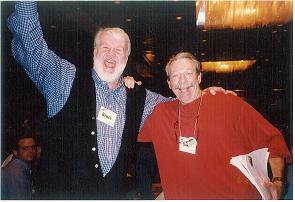
The thing is, Bruce and Mike haven’t hated each other for decades. They weren’t terribly close, but they got along fine — and sometimes, they were political allies. In 1997, three years AFTER Lacey’s company bought our competitor, SF Weekly, the two joined forces at an Association of Alternative Newsweeklies convention in Montreal to help push a bylaws measure that kept daily newspapers out of our trade association. And as the picture above shows, they were almost, sorta, kinda pals. At least for a few minutes.


The last thing we wanted to do was sue these guys. It wasn’t personal; we had no choice. Sure, the Guardian and VVM have very different approaches to journalism and politics, but we’d have been happy to compete with them — the way newspapers with different viewpoints should, on a level playing field. And for all the rhetoric on all sides, the legal animosity only started when the Weekly actively tried to put us out of business by selling ads below cost.


I dunno; the VVM people have been awfully rude to me of late, and I guess they like this mano-a-mano shit, but the reality is: We sued to stop illegal conduct that was threatening our business. That’s the real story.


Lawsuit could expose SFPD-ABC collaboration

43

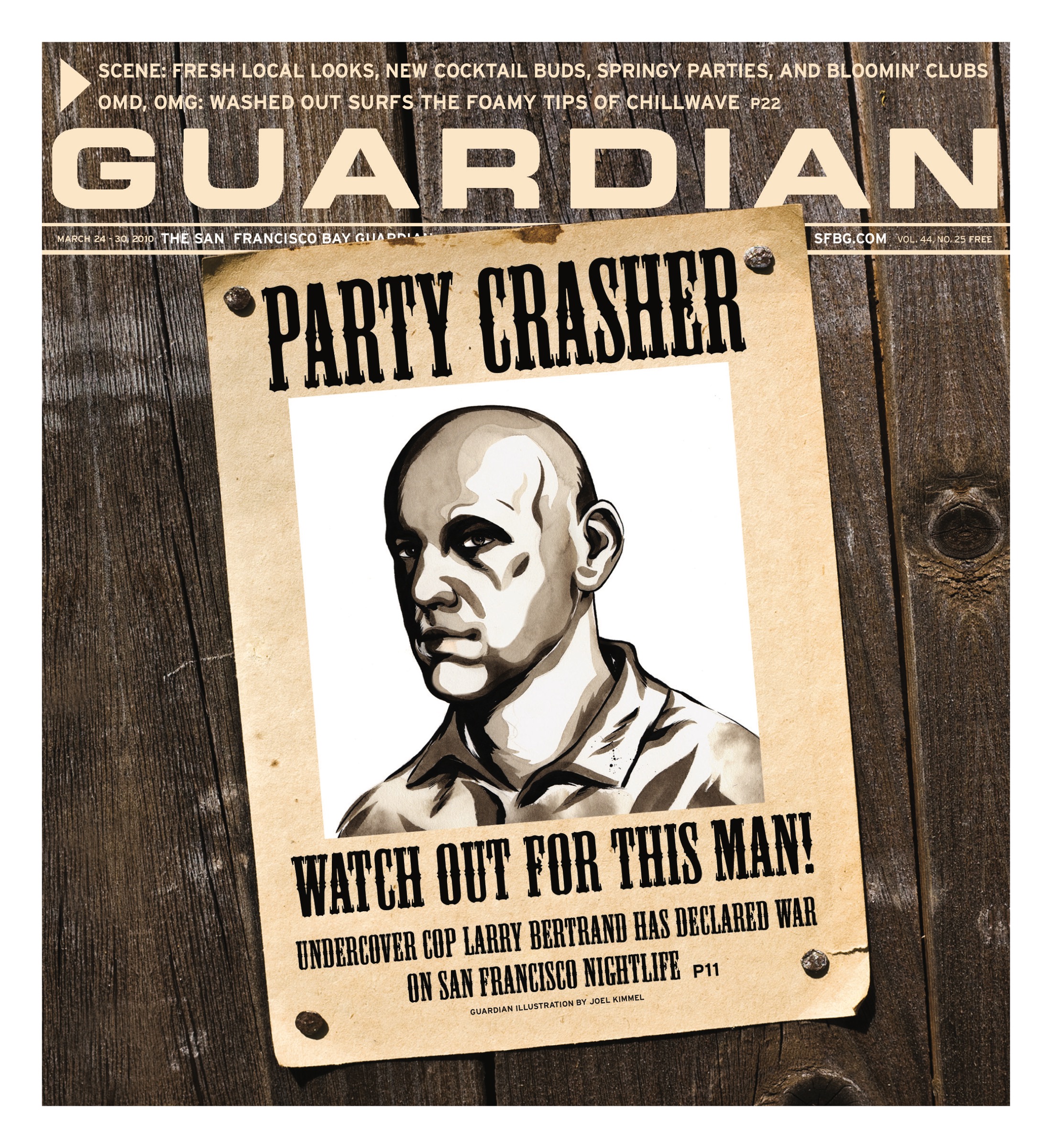
Imminent legal actions against San Francisco, its Police Department, and the California Department of Alcohol Beverage Control could reveal whether a pair of undercover agents went rogue in harassing nightclubs and aggressively busting parties or whether they were acting at the direction of top officials.

Attorney Mark Webb – whose work on a racketeering lawsuit against the policing agencies was the subject of cover stories in the Guardian and the SF Weekly – told us that on Monday, he plans to file that racketeering claim against the city (which will then become a lawsuit if the city rejects it, as it routinely does) and a related lawsuit in Superior Court involving the rough, unnecessary arrest of bartender Javier Magallon and harassment of Mike Quan, owner of The Room, Playbar, and Mist. Narrated surveillance video associated with the case was posted on YouTube yesterday.

Central figures in the lawsuit are SFPD Officer Larry Bertrand and ABC agent Michelle Ott, plain-clothes partners in an aggressive crackdown on nightlife over the last year. Webb said he plans to immediately seek police records and communications and to depose Bertrand and Ott to try to determine who ordered the crackdown, why, and when higher-ups became aware of their aggressive tactics.

“I would like to know if Bertrand is being sent places or if he’s just a lone wolf, and the CADs will show that,” Webb said, referring to computer-assisted dispatch reports that track activities and communications involving individual officers. Those and other records that Webb can access through the court-ordered discovery process could finally shed light on what’s behind the crackdown.

Webb had sought to have Mayor Gavin Newsom mediate this dispute before the cases were filed, saying the racketeering lawsuit will be expensive and divisive, and all the nightlife community really wants is an end to the harassment and assurance that it wouldn’t restart once the media attention passes. And Webb did have conversations with top Newsom aide Mike Farrah and with Nicolas King, Newsom’s liaison to the SFPD, but neither indicated that Newsom was willing to get personally involved. Newsom spokesperson Tony Winnicker also told us Newsom preferred to let Police Chief George Gascon handle the matter.

So Webb said he now plans to move forward with litigation. “If they’re not answering the call at City Hall, let’s get into the arena,” Webb told us.

Webb is an experienced litigator who has won multi-million judgments and who started his career in New York City helping prosecute Racketeer Influenced and Corrupt Organizations (RICO) Act cases against the mob, and now he plans to use RICO laws against what he says is a city-state enterprise to interfere with lawful nightlife activities in San Francisco.

“Webb gets it. It’s a weird mentality, the really good trial attorneys, and Webb is that,” said attorney Mark Rennie, who has spent decades working with the city’s entertainment industry and has helped advise Webb on the case.

Among the parties involved in the RICO claim are those involved in Webb’s other lawsuit against the city, as well as Club Caliente, its owner Maurice Salinas, Azul, its owner John Bauer, New York nightclub owners Phillipe Rieser and David Brinkley, Vessel, and Siobhan Hefferman, who was arrested by Bertrand and Ott at a private party. Others may be added soon.

Great American Music Hall, Slims, and DNA Lounge also claim to have been harassed by the ABC and have been involved in several meetings that led up to Webb’s lawsuit, but they’re not taking part in the lawsuit yet, partially because they fear retribution from the ABC.

“I probably would have jumped in, but I don’t want to walk into a hearing suing the ABC,” Slims and GAMH general manager Dawn Holliday told us, referring to Slims’ April 1 appeals hearing stemming from noise complaint citations triggered by one particularly cranky neighbor.

DNA Lounge, which has regularly documented the harassment campaign on its blog, decided to wait with the other two clubs before joining the suit. “We thought it was important to stand as a community and there were too many venues that were worried about retribution from the police or ABC if they joined the suit,” DNA general manager Barry Synoground told us. 

But Synoground said he’s anxious to see what Webb’s suit unearths, noting that Bertrand and Ott haven’t been visible in recent weeks as complaints against them went public, and saying he thinks Commander James Dudley and other top SFPD brass are really driving this crackdown: “We may have taken one of his tools off the street, but he’ll find another.”

Synoground said most SFPD officers are very professional and they have no problem working with them, but Bertrand and Ott have unnecessarily and aggressively interfered with their business. Holliday goes even further in praising the SFPD, saying she has a good relationship with Bertrand and everyone in Southern Station, blaming her clubs’ troubles on the ABC and the unwillingness of top city officials to stand up for them.

So the internal SFPD communications, and those between the city and the ABC, could prove revealing. “On April 17, I can send out subpoenas to the cops and I can take Bertrand’s deposition 30 days from Monday,” Webb said, citing statutory response periods.  

Webb expressed confidence in his case and said the police shakedowns and harassment fit well with the RICO statute, which has been used against a wide variety of enterprises over the years, including government agencies.

In fact, an American Bar Association book, “Civil RICO: A definitive guide,” by Gregory P. Joseph, seems to support Webb’s confidence. “Any person injured in his business or property by reason of a violation of Section 1962 of this chapter may sue therefore in any appropriate United States district court and shall recover threefold the damages he sustains and the costs of the suit, including reasonable attorney fees.’ This simple sentence has generated an avalanche of litigation,” the book begins.

It makes clear the intent of Congress that RICO laws “shall be liberally construed to effectuate the remedial purposes” of targeted individual seeking protection from harassment. A 1981 U.S. Supreme Court ruling (U.S. vs. Turkette) made clear even legitimate enterprises such as government agencies could be sued, and a 1994 ruling (NOW vs. Scheidler) settled a long dispute over whether the racketeering needed to be economically motivated, finding that it doesn’t.

Racketeering was defined by Congress as simply committing any of a long list of “predicate acts,” which include violence or the threat of violence, kidnapping (including false arrest), extortion, physical interference with business, malicious prosecution, and abuse of authority, all of which Webb says apply in his case. He is also reviewing the Guardian’s Death of Fun coverage from the last four years to find more examples of predicate acts involving the SFPD.

The hardest part of proving his case could be to show that it interfered with interstate commerce, although Webb said that’s met by efforts by Bertrand and Ott to prevent Rieser and Brinkley from transferring a liquor license from New York. But “Civil RICO” also said caselaw has established that “RICO requires no more than a slight effect upon interstate commerce,” citing the 1989 case U.S. vs. Doherty.

Like many who have had run-ins with Bertrand and Ott, Webb said he’s anxious to see what he finds in discovery: “What’s fascinating about this is you can uncover the whole system.”

Workers rally against Newsom’s layoff scheme

8

By Jobert Poblete

Dozens of workers at San Francisco General Hospital rallied March 25 to protest layoffs there and throughout the city as ordered by Mayor Gavin Newsom. More than 17,000 city workers received layoff notices in the last few weeks, including hundreds at the hospital. The protest was organized by SEIU Local 1021, which represents around 12,000 city employees, 9,000 of whom have received pink slips. 

Many of these workers are expected to be re-hired as part-time employees, working 37.5 hours a week or less. The move is expected to shave $50 million from a more than $500 million budget deficit. The Mayor’s Office is calling this a “reorganization” that will minimize the impact on services and maintain employment. But the plan, which was proposed by Newsom last month without first consulting with the city’s unions, has met fierce resistance from employees and their labor representatives and is now the subject of negotiations between the mayor and 41 city employee unions.

SEIU acknowledged the city’s fiscal troubles but is upset about what it calls a unilateral change in its members’ wages and benefits. “Essentially what they’re doing is unilaterally cutting wages and benefits without negotiating it,” SEIU organizer Gabriel Haaland told us. “It’s not a question of whether we’re willing to sacrifice, but that choice has been taken away.”

Hospital workers, carrying signs that read “Patient Care is Not Part Time,” also raised concerns about the layoff-rehire scheme’s potential effects on the quality of services at the hospital. “It can’t work in the emergency room and it can’t work in the rest of the hospital,” said Ed Kinchley, a social worker who works in the hospital’s emergency room.

Shari Zinn, an X-ray technician in the hospital, said her department already runs below minimum staffing levels, forcing patients to wait two to four hours for X-rays. Since X-ray technicians are hard to retain, she is not being laid off, but clerks and aids in her department are. “If there isn’t a clerk or aid,” Zinn said, “then an X-ray tech has to stop what they’re doing. Fewer patients can be served.”

Hospital officials would not comment on the layoffs.

At the rally, speakers called on the city to come up with revenue measures and other ways to balance the budget. “The city has really pushed us too far,” Sin Yee Poon, SEIU’s chief elected officer, told the assembled workers. “They’re balancing they’re budget on us, just us.”

Judicial candidate interviews: Michael Nava

0

There are two contested races for judge in San Francisco — one open seat, and one incumbent who’s facing a direct challenge. We’ll be interviewing the candidates over the next few weeks, and posting the interview tapes so you can listen in. The first interview: Michael Nava, who’s running for Seat 15, challenging incumbent Judge Richard Ulmer. Daniel Dean is also in that race. We asked Nava to explain why he’s challenging a sitting judge (not a common practice, although Nava thinks perhaps it should be more common) and how his background as an openly gay Latino man would bring a different perspective to the bench.

Taking with Nava were Tim Redmond, Bruce Brugmann and Steven T. Jones.

You can listen to the interview here:

Michael Nava for judge endorsement interview by SFBG

A great sit-lie debate

24

KPFA’s morning show had a great debate this morning around the sit-lie law, featuring Gabriel Haaland, a longtime Haight resident, and Ted Lowenberg, president of the Haight Ashbury Improvement Association. You can listen to it here.


In the discussion — nicely moderated by Brian Edwards-Tiekert — you could see the essential problem with the law emerging.


Haaland pointed out that blocking or obstructing the sidewalk is already illegal; so is aggressive panhandling, assault and all of the other behaviors Lowenberg complained about. Lowenberg’s response: Yes, that’s true, but it’s hard to arrest someone on those charges; you have to fill out paperwork. What we need is to give the police more discretion to use their judgment to make arrests when they think that’s what’s needed.


“The police need the immediate ability to respond without paperwork,” he said.


And that’s precisely what bothers a lot of us about this law.


The San Francisco police have a long history of abusing their “judgment” in cases involving marginalized populations. A lot of us don’t believe that arrests will be limited to violent bad actors — and we have many, many years of evidence to back us up.


Haaland pointed out that the last time a sit-lie law was enforced, in the 1970s when the cops wanted to crack down on the hippies on Haight Street, it wound up being used against gay men in the Castro. This time, it could be any of a wide range of people who wind up sitting on the sidewalks, for a lot of reasons.


Lowenberg kept talking about “street thugs” and complaining that the district attorney hasn’t prosecuted them when they’ve attacked people — in one case, gouging someone’s eyes and biting him. But attacking someone on the street is already illegal; does anyone really think that the D.A., and the law-enforcement model, will be any more effective with the new law in place?


It won’t — but that’s not the point. I think what Lowenberg and his allies want is to give the police more power, to let them “clean up the streets” as they see fit. It’s not about courts and prosecution; it’s about curbside justice. And that’s never worked well in San Francisco.


For Jim: Jim Marshall, 1936-2010

2

Legendary Bay-based rock photographer Jim Marshall, who was featured in a Guardian cover story on March 3, 2010, passed away in his sleep Tuesday night in New York at the age of 74. The people who worked with him on the cover story, Johnny Ray Huston and Mirissa Neff, remember him.

Johnny Ray Huston, writer: When someone dies it’s impossible not to think of the last time you saw them. With Jim Marshall, I wish that last time had been different. Jim had called me in the morning to see if I wanted to meet him at his favorite dinner spot. That night, I arrived about 15 minutes late, finding him alone at a table in the center of the place with a glass of wine. It was noisy, and I had to shout more than usual for Jim to hear what I said. I showed him some crummy digital shots I’d taken of a few Bay Area musicians I’d daydreamed about him really photographing, but he seemed distracted, quieter than usual. When we said goodbye later on the corner by his apartment, I assumed his mind was on the future. He was about to leave on a trip, first going to Texas for the monster that is South by Southwest, and then to New York, for a gallery show of his photography and the release of Match Prints, his latest book, a collaboration with Timothy White.

Jim was unfailingly generous. On the day the article I’d written about him was published, he called to say he wanted to give me a print, any print, from his body of work. This kind of offering was second nature for him, but overwhelming for me to contemplate considering the breadth of his vision. At a time when music photography is consumed and tamed by style, all one has to do is look to Jim’s photos for their untamed depth. When my boyfriend Cedar recently interviewed Nancy Wilson, he was amazed to hear her say she had always styled herself for album cover photos. Jim’s peak photos are of true musical artists who had been styling themselves for years. They stepped in front of Jim’s camera without some trite go-between in the way, and with a trust forged by their relationship to him and respect for what he did.

One night after some whiskey at my apartment, I coerced Jim to go to a birthday party for one of my friends, even though it was a Chinese restaurant and Jim hated Chinese food. Jim’s matter-of-fact profanity or vulgarity could be hilarious, as when crab rangoon was placed on the table in front of him and he suspiciously grabbed some, muttering under his breath, “This better not make me puke.” Jim took the tab, even though he had only met the birthday host an hour before. Jim always took the tab.

Jim loved Cadillacs. It was a pleasure to ride with him because of how well he knew his cars. In his newest model, it could also be funny — he didn’t wear a seat belt, so a drive with him meant listening to the incessant ringing of the seat belt alarm coupled with the instructive but useless voice of the GPS. He was blissfully oblivious to both, thanks to deafening encounters with the likes of Jimi Hendrix.

My best friend Corina works at the place where Jim most loved to eat, and while I’m forever grateful to Tim Redmond for encouraging me to meet Jim, I’d first heard about him from her. One Sunday Corina texted me that Jim was at the restaurant and wanted me to come over for drinks after dinner. Corina, Cedar, Corina’s boyfriend Nathan and I all wound up at Jim’s place, as well as a young woman visiting from another country who Jim was romancing when I first got to the restaurant. She had been eating at a different table, but he’d soon gotten her to sit with him. Back at Jim’s apartment, as we talked and drank, the woman put on a CD. It turned out she was a musician, and she wanted us to hear her band. They weren’t bad in an avant-folk 12-piece way, but Jim’s critique of their off-kilter noise was merciless and entertaining. (And it didn’t stop him from getting a kiss from her later.)

When Jim – “Jaguar Jim” back in the Beat era’s heyday – found out that Cedar was a poet with a book due from City Lights, he gave him some rare volumes, including one by David Meltzer. I remember standing on Jim’s front steps that night talking with Nathan about how great the young year was, and how glad I was to be getting to know Jim. At that moment, partly through Corina’s affection for him, I found myself alone with my boyfriend and two best friends in the city, something that wasn’t happening often enough.

Jim had lived in his apartment in the Castro for decades, and he liked to joke that they’d have to wheel him out of it, so it’s one of those deep ironies of life and death that he left this world in New York City. To have met Jim so late in his life is something I can’t fully understand right now. There are so many people I wanted Jim to meet and get to know. But he knew plenty, and many of the best, perhaps better than they could know him. Because of how well he saw them. I feel lucky to have met him, and am grateful he showed me the scrapbook he kept when he was first dreaming about owning a camera. More attention is going to be paid to Jim’s work in the coming months and years. He had a lot of famous admirers, but his day-to-day life in San Francisco was buoyed by people like his friend and assistant Amelia Davis, and Corina and the people at La Med. I can still hear Jim’s pirate-y laugh, and that craggy, lively voice that Corina and I loved to imitate. I can still see his photos.

Mirissa Neff, art director: I met Jim Marshall just a few weeks ago. Our senior arts editor Johnny Ray Huston was interviewing him for the cover story and thought I should meet Jim to go over images, saying “he’d love you.” We all met at his Castro apartment and then walked around the corner to his regular lunch spot, La Mediterranee. For a little guy of 74 Jim had an outsized personality, a gruff demeanor, and a nose that showed signs of his old coke addiction (he was happy to complain to anyone who’d listen that his doctor had made him quit a few years back).

Yet Jim remained completely endearing. As Johnny and I flipped through hundreds of Jim’s stellar portraits, attempting to choose a few images to run (which was no easy task), Jim centered the conversation around an art opening he wanted to attend that night. After describing the event he looked at me and said, “So I’ll pick you up in my Cadillac around 7?” It was less of a question than a directive. I couldn’t make it… which of course I now regret. But being in his presence for that afternoon was a gift.

Obama nominates Melinda Haag

0

President Obama has nominated veteran attorney Melinda Haag to serve as the U.S. Attorney for the Northern District of California, which stretches from the Monterey Coast to California’s northern border with Oregon and from the Pacific Ocean nearly to Sacramento, an area that more than 7.3 million people call home. Obama also nominated Jerry E. Martin as U.S Attorney for the Middle District of Tennessee, and James A. Lewis as U.S. Attorney for Central District of Illinois.

“I am so pleased the President has nominated veteran attorney Melinda Haag to serve as the top federal prosecutor in San Francisco,” said U.S. Sen. Barbara Boxer, who recommended Haag for the post. “She is well respected in the California legal community and will bring more than two decades of experience handling white collar crime cases to the U.S. Attorney’s Office.”

Boxer likely isn’t the only one pleased by this nomination: San Francisco’s embattled immigrant community has been hoping that Obama would replace the current top federal prosecutor Joseph Russoniello, an ardent opponent of sanctuary legislation.

According to a press release issued by Boxer’s office, Haag has been a partner since 2003 at San Francisco-based Orrick, Herrington & Sutcliffe in the white collar criminal defense and corporate investigations group, which handles cases involving fraud, antitrust violations, environmental crimes, health care fraud and other corporate matters. 

Before that, former U.S. Attorney and current FBI Director Robert Mueller recruited Haag to serve in the San Francisco U.S. Attorney’s Office, where she headed the White Collar Crime Unit and was the deputy chief of the General Crimes Unit. Haag also has experience as a prosecutor in the Los Angeles U.S. Attorney’s Office.

Haag received her bachelor’s degree from the University of California San Diego and she earned her law degree at UC Berkeley.

Sit, lie, stand and fight

14

A version of the following op-ed by Ben Rosenfeld ran in this week’s Guardian, edited for space reasons, and it’s generating quite a lively discussion here. He has asked us to post this extended dance mix of his piece, which offers more political context and gets into some of the issues raised in this weeks’ cover story, which is also generating heated debate. So here it is:

            This is a call out to creative, fun-loving San Franciscans: The mayor, the police chief, and their downtown cronies have declared war on our grassroots arts culture, and they are coming for your actual and conceptual space next. All that stands between the town you love and their vision of San Francisco as one big mercantile zone is a single vote progressive majority on the Board of Supervisors. But come November, they see the chance to take that away. The future they promise is already manifest in their many recent attacks on public and private gatherings, and their efforts to wrest the commons from the commoners.

            On Halloween 2009, the San Francisco Police, under their new chief, Los Angeles transplant George Gascón, shut down the Take Back Halloween Flashdance in front of the Ferry Building before DJ Amandeep “Deep” Jawa even arrived. Then they shut down several smaller street parties. (SFBG, 11/2/09) Their official reason—that organizers lacked permits—is what Bill Clinton famously termed an explanation, but not an excuse. The SFPD has a long history not only of tolerating unpermitted gatherings, but of re-routing traffic around and even escorting them. They are fully empowered to grant the equivalent of on-the-fly permits, a concept recognized in federal parks regulations. Applying for an actual permit is cumbersome, costly, anti-spontaneous, and reinforces the government’s view of itself as censor.

            Since Halloween, Chief Gascón’s force has been striking a mighty blow against crime by writing scores of open container citations to revelers in Dolores Park; fining or forcing the closure of SOMA clubs and bars for failing to conform to every fickle letter of the law; and sending undercover officers into warehouse and studio parties to bust them from within, sometimes violently, and without warrants. Their alpha party-crasher is a twitchy undercover cop named Larry Bertrand. He reportedly makes a habit of gratuitously attacking partygoers and vandalizing property, especially DJ equipment. One DJ wrote on a confidential email list: “I have been telling every DJ I know to run with their gear when your party gets busted [by Bertrand].” Not only has the chief failed to rein in Bertrand, but he wants to put a Taser in his hand, and in the hands of a rotten core of approximately 100 other officers whom the Chron found in 2006 are responsible for most citizen complaints, but whom the Department and this chief have systematically failed to discipline.

            Perhaps the most un-San Franciscan of all of Gascón’s initiatives is his demand for an anti-sit/lie ordinance, which would literally criminalize the very act of sitting or lying on certain public sidewalks at certain times. Never mind the fact that most violent crime is committed by people standing up and in striking range. Gascón appears to share the mayor’s philosophy that homelessness is just an aesthetic problem the rest of us should hose off our sidewalks. Not only is the idea just plain mean, it is anathema to San Francisco’s culture of compassion and broadmindedness, and its affirmative celebration of vibrant street culture. The danger is not that the police will arrest everyone who dares to take a load off or sit and sip a Snapple against the side of a building, but that they will enforce the law selectively according to their own purity tests, while robbing the rest of us of a diverse street scene that makes us all richer.

            To be sure, essential San Francisco has reasserted itself in the teeth of earlier culture wars, if in ever wealthier iterations. When Willie Brown stood in front of Critical Mass in 1997 and declared it illegal, riders blew by him like he was a grand prix flagman, and ridership surged from one or two thousand to five to seven thousand. What’s different this time are the demographics. San Francisco is richer than ever before, even at the height of the dot.com boom. Rents are through the roof. Everywhere, industrial warehouses and studios are drying up and concept industrial restaurants and bars are sprouting up. A new wave of young, hip residents has arrived seeking Dionysus, but they want no part of the political machinations under his robe. They are liberal, but they are not active. At least not yet. The mayor, the chief, and the norm core they serve are counting on our collective non-engagement. If we don’t band together—hipsters, activists, artists, and fun-loving folk all—we will watch the San Francisco we cherish slip away.

            On March 27, reclaim public space. Sit and lie on the public sidewalk. March and sing in the public street. Picnic on the pavement. Pop open a beer in Dolores Park. Do it without a permit. The Constitution is your permit. San Francisco’s heritage of artistic experimentation is your permit. Hell, the people telling you to get a permit flocked here because people like you marched around them in the first place and made this City a model of art and innovation for the world. Do it for them too. This is a defining moment. They are playing for keeps and so must we. Let’s bask in San Francisco’s ongoing heyday, not in quaint stories of the good times that used to be.

Hammers of fortune!

0

Big news on the local metal scene: San Francisco prog-shredders Hammers of Misfortune have just signed to Metal Blade Records. Hot off the Metal Blade press-release telegraph:

“Metal Blade Records is pleased to announce the signing of San Francisco’s progressive metal outfit HAMMERS OF MISFORTUNE. Metal Blade Records will release four of the band’s previous releases in late summer 2010 with a new studio album expected in 2011.”

According to the release, the band (conceived as “break-up proof” by band founder John Cobbett) will continue to produce their own albums. Along with Cobbett (who’s also in Ludicra) on guitar, Hammers’ regular members include Chewy Marzolo on drums (also a member of swingin’ side project King City), multi-instrumentalist (keyboards, flute, and haunting vocals) Sigrid Sheie, and bassist Max Barnett (of Old Grandad fame). News to me, thanks to Metal Blade’s PR, is that guitarist-vocalist Leila Abdul-Rauf (whose previous band, solid black-metal outfit Saros, is on “indefinite hiatus,” according to their Myspace page) has joined the Hammers line-up.

http://www.youtube.com/watch?v=DwPZ3lqg19g

Frankly, I’m stoked — in a world where far too many shitty, quasi-metal bands get record contracts, this is great news for one of San Francisco’s most innovative, talented, hardworking, and (lest we forget) awesomely furious bands. Horns up, Hammers!

Read Josh Wilson’s 2007 profile of the band in the Guardian here; check out the full press release on Metal Blade’s site here.

Appetite: Dreaming of the islands …

1

This weekend affords the last of a series of Hawaiian escapes here in San Francisco, especially Aloha Fridays at Gordon Biersch, which would be especially idyllic in the Spring gorgeousness we’ve been experiencing. 


But it’s also a time to dream of stealing away to the islands not just for drinks but for food. A recent event at Burlingame’s striking Sub-Zero & Wolf Showroom highlighted the locavore, farm-fresh movements infusing Hawaii’s culinary scene with new life.


It was a February night of island breezes and mai tais with three of Hawaii’s biggest chefs, Roy Yamaguchi (yes, that Roy of Roy’s restaurants), Alan Wong and D.K. Kodama, plus a mixologist, winemaker, Hawaiian products (like sweet and spicy Kilauea hot sauce), transforming Sub Zero’s kitchens into a Hawaiian luau.


Roy Yamaguchi serves us his latest


Fresh-flower leis were draped over our necks as we were handed shiso, ginger, and elderflower soju-based cocktails, then escorted to a three-course tasting in a back room before other guests joined us in the main areas. The table was laden with flowers and artistic fish dishes from all three chefs. I was pleasantly surprised at the range and quality of tastes. Proud of Hawaii’s recent resurgence in locally grown produce and sustainable, local seafood and animals (they’re even raising Maine lobsters on the islands), everyone from chefs to farm owners (brought together by Hawaii’s Visitors Bureau) talked of Hawaiian grass-fed cows and a new iPhone app, What Chefs Eat, which gives Hawaiian chefs’ recommends for the best in non-touristy food joints. Keep up with Hawaiian food news at Share Your Table, and head to Gordon Biersch this Saturday, transported to Hawaii via the Bay. 


Harry Bridges: Working class hero

0

He died 20 years ago this month, but I can still see him, a tall, wiry, gray-haired, hawk-nosed man. I can hear him.

I see him pacing restlessly back and forth behind the podium at union meetings, nervously twirling a gavel, puffing incessantly on a cigarette. I hear him calling on members, white, black, Asian, Latino, in the broad accent of his native Australia, actually encouraging debate and dissent.

He died in San Francisco at the age of 88 — Harry Bridges, co-founder and for 40 years president of one of the most influential organizations in this or any other country, the International Longshore and Warehouse Union.

Bridges often was irritating to the ILWU’s friends and foes alike. He was irascible and obstinate. But he was unquestionably one of the past century’s greatest leaders.

Bridges was not in it for money. His salary as union president was far less than he would have made had he remained a working longshoreman. Bridges was in it because of his unswerving belief in “the rank-and-file,” as he once told me, a naive and inquisitive young Chronicle reporter — “the working stiff, that’s who! Can you understand that?”

I understood, eventually. And though I and others sometimes harshly questioned Bridges’ specific notions of what was needed by working people, none could legitimately question his incredible commitment, skill and integrity.

“The basic thing about this lousy capitalist system,” Bridges declared, “is that the workers create the wealth, but those who own it, the rich, keep getting richer and the poor get poorer.”

Harry Bridges’ lifelong task, then, was to shift wealth from those who owned it to those who created it – a task he began in 1934, when he led his fellow longshoremen in a strike aimed at winning true collective bargaining rights from West Coast shipowners.

As Bridges’ biographer Charles Larrowe recalled, “The shipowners said ‘no,’ said it with tear gas vigilantes and billy clubs wielded by cops who thought they were in the front lines against a communist takeover. Up and down the coast, the waterfront was turned into a battlefield.”

Police bullets killed 10 men during the three-month-long strike that also prompted a four-day general strike in San Francisco. But the longshoremen ultimately got what they had demanded, most importantly, an end to the notorious system of job allocation known as the “shape-up. “

Previously, jobs were parceled out by hiring bosses in exchange for kickbacks from the longshoremen who lined up on the docks every morning clamoring for work. But after the strike, job assignments were made by an elected union dispatcher at a union-controlled hiring hall, using a rotation system that spread the work evenly among longshoremen. The victory was downright revolutionary, and had a profound impact on workers and employers nationwide.

Within two years, Bridges joined with Lou Goldblatt, the brilliant young leader of the warehousemen who worked closely with longshoremen on the docks. They brought the two groups together into a single powerful union. the ILWU, under the banner of the newly established Congress of Industrial Organizations — the CIO.

The union ultimately extended its jurisdiction to virtually all waterfront workers on the Pacific coasts of the United States and Canada and to workers in a wide variety of occupations in Hawaii.

Bridges and Goldblatt used their potent base to help lead drives by other CIO unions that spread unionization from the waterfront to many other industries throughout the West at a time when employers treated workers as chattel, giving them little choice but to accept near-starvation wages and whatever else the employers demanded.

For the ILWU, Bridges and Goldblatt drafted a union constitution that still is unique in the control it grants members. Many union constitutions give members very little beyond the right of paying dues in exchange for the services provided them by the union’s securely entrenched bureaucrats. But the ILWU constitution guarantees that nothing of importance can be done without direct vote of the rank-and-file.

No one can take ILWU office except through a vote of the entire membership; no agreement with employers can be approved except by a vote of all members; the union cannot take a position on anything without membership approval.

The ILWU helped set important precedents that enhanced the civil liberties of everyone through its strong opposition to those who tried to deny constitutional rights to Bridges and others by labeling them Communists. The union’s efforts included an eight-year-battle against attempts to deport Bridges to Australia that ended with a Supreme Court ruling that enabled him to become a U.S. citizen in 1945.

The ILWU under Bridges was an outspoken foe of U.S. involvement in Vietnam, even at a time when most other unions enthusiastically supported involvement. And members backed their opposition to oppressive regimes abroad by refusing to handle cargo bound for or coming from their countries.

Thanks in large part to Bridges, the ILWU also was one of the first unions to be thoroughly integrated racially, and otherwise has always been probably the country’s most socially conscious union. And its members, now including women, have long been among the most highly compensated workers in any field, while at the same time benefitting from labor-saving equipment that makes their work easier. The new equipment and methods on the docks have brought employers higher profits, which union negotiators have made certain they share with dock workers.
The ILWU used its employer-provided pension funds to finance construction of low-rent apartments in San Francisco’s St. Francis Square, an extremely rare example of what the union calls “cooperative, affordable, integrated working-class housing.”

Harry Bridges led the way to that and much more which benefited the working stiffs to whom he devoted his life — and many, many others. As a newspaper that once reviled him as a dangerous radical said on his death, “He sought the best of all possible worlds. This one is much better due to his efforts.” Boy, is it.

Dick Meister, formerly labor editor of the SF Chronicle and KQED-TV Newsroom, has covered labor and politics for a half-century. Contact him through his website, www.dickmeister.com, which includes more than 250 of his recent columns.

SCENE: Jazz Mafia Keeps it in the family

1

Written by Lilan Kane. From Scene: The Guardian Guide to Bay Area Nightlife and Glamour — on stands now in the Guardian

Jazz in its most fashionable and handsome form found itself around a table at Coda recently. I had the pleasure of meeting with dapper Jazz Mafia members Adam Theis, Joe Bagale, and Dublin to gain some insight into their music and experiences as members of one of the Bay’s most youthful jazz ensembles.

The Mafia (www.jazzmafia.com), as one might expect, is a collective that incorporates several smaller groups containing dozens of members into a large and tuneful family. The first of these groups, Realistic Orchestra, was established about 10 years ago when various jazz forces of the Bay Area started to intertwine and jam together. (Other branches of the family include Brass Mafia, Spaceheater, and the Shotgun Wedding Quintet.)

Main Mafia figures Theis (trombonist, arranger, and bandleader) and Dublin (emcee, vocalist, rapper) are still at the forefront of Realistic Orchestra. They’ve held a Tuesday night residency at Coda for several years, rotating various Jazz Mafia acts. The night I interviewed them, singer and multi-instrumentalist Joe Bagale was taking the stage, with Theis manning the bass.

Before moving to the elegantly appointed Coda, the Mafia had a raucous six-year run at Bruno’s, racking up several awards and introducing jazz to a new generation of night-lifers. The sharpshooters have played with Lyrics Born, Santana, Bobby McFerrin, Sly and the Family Stone drummer Gregg Errico, and many more. A highlight: recently Joe was closing a Saturday night show with Donny Hathaway’s version of John Lennon’s song “Jealous Guy.” He was lost in the moment of it with his eyes closed and his heart pouring out into the microphone. He opened his eyes to find Stevie Wonder in front of him. Wonder got onstage and the band prompted him to revisit an old B-side cut, “All Day Sucker.” Suffice to say, the house was rocked and shocked.

But Mafia members’ interests aren’t limited to revamping standards with star power. In 2008, Theis won the prestigious Gerbode-Hewlett Foundation’s Emerging Composers Grant, which he used to fund his latest project, “Brass Bows and Beats,” a 50-minute innovative suite with strings, vocals, horns, a DJ, and even a didgeridoo. When Theis took the group to the Playboy Jazz Festival last year, host Bill Cosby called Bagale to the stage, facetiously suggested that the variety of genres in the piece would sound like skimming through all the channels of satellite radio really fast. Admittedly, this concept — infusing hip-hop, jazz, classical, soul, electronic, and more — is ambitious. But Brass Bows and Beats debuted with a sold-out performance at the Palace of Fine Arts in San Francisco last April and was deemed an artistic success. (Theis will also be jazzing up the San Francisco Symphony’s performance of Shostakovich’s Symphony 8 in April.)

Dublin, the MC of the group, adds a hip-hop element to the mix — and a connection to younger fans. He recently paired with producer Elon to release a solo record, Ease The Pain (Jazz Mafia Recordings), featuring singers Emily Schmidt and Forrest Day. And Bagale, although able to call up the deepest soul and sharpest wit in his vocal stylings, enjoys taking a background role as head vocal arranger. “One of the coolest experiences for me is to be able to write and arrange for other singers and not be the focal point,” he said.

About those arrangements — it’s in its orchestral distribution of sounds that the Mafia really shines. Its talented members have the capacity hear and highlight a dazzling array of instrumental lines, often numbering up to 45. Then the group’s arrangers write them out instrument by instrument, voice by voice, line by line. “To do one three-minute or so tune, I usually put in 50 to 100 hours,” Theis said.

In an attempt to reach more young jazz enthusiasts, the Mafia is planning a summer tour across Canada, New York, and New England, the first major tour it has undertaken. These young men and women are trying to expand the palette of the live scene, one arrangement at a time.

JAZZ MAFIA TUESDAYS

Tuesdays, 9 p.m., $7

Coda Lounge

1710 Mission, SF

www.codalive.com

ADAM THEIS AND ALL-STAR JAZZ MAFIA ENSEMBLE WITH SF SYMPHONY

April 2, 8 p.m., $15–$130

Davies Symphony Hall

201 Van Ness, SF

www.sfsymphony.org

JAZZ MAFIA TOUR FUNDRAISER FEATURING BRASS, BOWS, AND BEATS

April 25, 3 p.m. and 7 p.m., $25–$75

Yoshi’s SF 1330 Fillmore, SF

www.yoshis.com

Can Newsom save SF parties?

11

Why won’t Mayor Gavin Newsom save San Francisco’s nightlife and culture? That question was raised toward the end of this week’s cover story on party-crashing cops, but it’s worth highlighting here because Newsom seem uniquely suited to the task of mediating this damaging dispute.

Newsom owned a restaurant and bar before being elected mayor with the strong support of the San Francisco Police Officers Association. The business community is one of his key constituencies, and he constantly talking about the need to promote tourism, which relies on our cultural vitality. He’s the most natural, logical bridge for this divide.

That’s why attorney Mark Webb, who represents several clubs and individuals who have been harassed by SFPD Officer Larry Bertrand, has explicitly been calling for Newsom to get involved.

“I really believe his involvement could help us get to a place of calm,” Webb said. “We have to stop this petty infighting and we have to embrace the cause, which is to make San Francisco’s nightlife an inviting environment.”

DNA Lounge, which is not part of Webb’s lawsuit but has been fighting against harassment by Bertrand and the ABC, also wants to see Newsom broker some peace talks. 

“Absolutely, Gavin certainly has the juice to deal with this problem and we would welcome his involvement,” DNA general manager Barry Synoground told us. “We don’t know why there is such vehemence against nightlife and entertainment…What kills me is we have a large group of responsible purveyors, but we’re not being treated as such. We’re being treated like criminals.”

But Newsom has resisted the call, with his press secretary Tony Winnicker telling us, “I wouldn’t rule it out, but the mayor has department heads for that reason,” saying he preferred for Police Chief George Gascon to tell with it. But the problem is this isn’t a police issue, it’s a political one.

DNA Lounge (which has reguarly blogged the crackdown) has highlighted how SFPD Commander James Dudley sees nightlife in the city: as a nuisance to be abated, rather than an important culture to be embraced and celebrated. Winnicker claims that Newsom understands this: “The mayor understands the importance of a vibrant nightlife.”

But that understanding hasn’t translated into official city policy. Attorney Mark Rennie, who handles permitting and compliance issues for about 40 nightlife and culture clients, said that San Francisco has become notorious for making life difficult for club owners and other purveyors of fun. 

“The city has always had this love-hate relationship with nightclubs. But it’s really bad now,” Rennie said, noting how welcoming other local cities are toward nightclubs, which are important economic drivers. “Berkeley gets it. Oakland gets it. I don’t know why San Francisco doesn’t get it.”

Which is strange because, of all people, Newsom should get it. He should understand the natural tension between certain elements of both the police and nightlife communities and, valuing them both, try to find a way to solve this problem. So whatdaya say, Gavin? After you’re done try to clean up the mess you created with the labor unions, how about stepping in to address a problem that is closer to your sweet spot?


Image by Luke Thomas/Fog City Journal

See you at the bar

0

By Allan McNaughton

This week, San Francisco and the world said goodbye to a good friend, a true gentleman, and a diehard rock and roll fan. Bruce Roehrs, columnist and reviewer for Maximumrocknroll magazine and a staple on the local punk rock scene, passed away peacefully at his home. The exact time and circumstances of his death have yet to be determined.

Roehrs was born in Philadelphia and spent his childhood in Fort Myers, Fla. His mother, Elizabeth, raised him and his younger brother, Ted, in a single-parent household. He was proud to cite her as the main influence on his life, and the many strengths of Roehrs’ character (his manners, work ethic, optimism, and loyalty) are a testament to her parenting. In the mid-1960s, he attended the University of Miami, where his interest in basic three-chord rock progressed into a passion for all forms of jazz, blues, and rock ‘n’ roll. After college, he spent time in Gainesville, Fla., and then Tucson, where he drove a Yellow Cab. Wherever he lived, he had to be close to a major city, where he could be sure to catch live music.

Roehrs moved to San Francisco in the early 1980s and soon became a fixture on the punk rock scene. His obvious passion for rock ‘n’ roll led to him being drafted by Maximumrocknroll founder Tim Yohannan to write for the magazine. His enthusiasm for the music he championed jumped off the page from his first reviews until the day he died.

In Roehrs’ most recent column for the magazine, the April issue, he froths at the mouth over the recent reunion of New York hardcore pioneers Agnostic Front while still devoting dozens of column inches to obscure punk, skinhead, and hardcore bands from Australia, Germany, and Boise, Idaho. His columns earned him thousands of fans all over the world. The massive outpouring of tributes that have appeared online since his passing give some idea of this love and respect. The stories his friends are sharing continue to give more insight on his unique personality, from the time Grand Funk Railroad gave him a bunch of acid to sell and he came back with $8 (he’d been giving it away to pretty girls), to his weekly grocery deliveries to a 90-year-old woman in his union. He always had a firm handshake for the fellas and a charming word for the ladies.

Roehrs’ many friends in San Francisco knew him as a fixture right in front of the stage whenever a great band was playing. He was a true music fan, from the latest just-out-of-the-garage projects of his drinking buddies to international stars like Motorhead, Cock Sparrer, and the U.K. Subs. He traveled extensively to pursue his passion, from flying to Texas or London to see his favorite bands, to driving through the South following his beloved AntiSeen.

While most of us find that our music tastes get mellower with age, Bruce joked that his tastes got harder, faster, and louder as he got older. He had less time for “wimpy shit” like the Undertones, although I know he always retained a soft spot for the Fall. He grabbed life by the neck the same way he would get you in an affectionate headlock if he saw you in the pit. He was also a longtime member of the Rumblers Car Club, was known to enjoy surfing and skiing, and could hold a reasoned conversation on pretty much any topic connected to history or current events. Still, nothing could top listening to loud, fast music over a couple of beers.

Roehrs will be sadly missed by his brothers Ted, Christopher, and Robert, his union brothers from San Francisco Carpenters Union Local 42, his brothers from the Rumblers CC, the staff and shitworkers of Maximumrocknroll, and his massive family of friends and fans on the international music scene. I’ll end this the way he would end his column: See you at the bar, you fucks!

For updates and memorial information, see www.maximumrocknroll.com