San Francisco

The good old days in Rock Rapids, Iowa, the Fourth of July, 1940-1953

0

(Note: In July of 1972, when the Guardian was short a Fourth of July story, I sat down and cranked out this one for the front page on my trusty Royal Typewriter. I now reprint it each year on the Bruce blog, with some San Francisco updates and postscripts.)

Back where I come from, a small town beneath a tall standpipe in northwestern Iowa, the Fourth of July was the best day of a long, hot summer.

The Fourth came after YMCA camp and Scout camp and church camp, but before the older boys had to worry about getting into shape for football. It was welcome relief from the scalding, 100-degree heat in a town without a swimming pool and whose swimming holes at Scout Island were usually dried up by early July. But best of all, it had the kind of excitement that began building weeks in advance.

The calm of the summer dawn and the cooing of the mourning doves on the telephone wires would be broken early on July Fourth: The Creglow boys would be up by 7 a.m. and out on the lawn shooting off their arsenal of firecrackers. They were older and had somehow sent their agents by car across the state line and into South Dakota where, not far above the highway curves of Larchwood, you could legally buy fireworks at roadside stands.

Ted Fisch, Jim Ramsey, Wiener Winters, the Cook boys, Hermie Casjens, Jerry Prahl, and the rest of the neighborhood would race out of  their houses to catch the action. Some  had cajoled firecrackers from their parents or bartered from the older boys in the neighborhood: some torpedoes (the kind you smashed against the sidewalk); lots of 2 and 3-inchers, occasionally the granddaddy of them all, the cherry bomb (the really explosive firecracker, stubby, cherry red, with a wick sticking up menacingly from its middle; the kind of firecracker you’d gladly trade away your best set of Submariner comics for).

Ah, the cherry bomb. It was a microcosm of excitement and mischief and good fun. Bob Creglow, the most resourceful of the Creglow boys, would take a cherry bomb, set it beneath a tin can on a porch, light the fuse, then head for the lilac bushes behind the barn.

“The trick,” he would say, imparting wisdom of the highest order, “is to place the can on a wood porch with a wood roof. Then it will hit the top of the porch, bang, then the bottom of the porch, bang. That’s how you get the biggest clatter.”

So I trudged off to the Linkenheil house, the nearest front porch suitable for cherry bombing, to try my hand at small-town demolition. Bang went the firecracker. Bang went the can on the roof. Bang went the can on the floor. Bang went the screen door as Karl Linkenheil roared out in a sweat, and I lit out for the lilacs behind the barn with my dog, Oscar.

It was glorious stuff – not to be outdone for years, I found out later, until the Halloween eve in high school when Dave Dietz, Ted Fisch, Ken Roach, Bob Babl, and rest of the Hermie Casjens gang and I made the big time and twice pushed a boxcar loaded with lumber across Main Street and blocked it for hours. But that’s another story in my Halloween blog of last year.

Shooting off fireworks was, of course, illegal in Rock Rapids, but Chief of Police Del Woodburn and later Elmer “Shinny” Sheneberger used to lay low on the Fourth. I don’t recall ever seeing them about in our neighborhood and I don’t think they ever arrested anybody, although each year the Rock Rapids Reporter would carry vague warnings about everybody cooperating to have “a safe and sane Fourth of July.”

Perhaps it was just too dangerous for them to start making firecracker arrests on the Fourth – on the same principle, I guess, that it was dangerous to do too much about the swashbuckling on Halloween or start running down dogs without leashes (Mayor Earl Fisher used to run on the platform that, as long as he was in office, no dog in town would have to be leashed. The neighborhood consensus was that Fisher’s dog, a big, boisterous boxer, was one of the few that ought to be leashed).

We handled the cherry bombs and other fireworks in our possession with extreme care and cultivation; I can’t remember a single mishap. Yet, even then, the handwriting was on the wall. There was talk of cutting off the fireworks supply in South Dakota because it was dangerous for young boys. Pretty soon, they did cut off the cherry bomb traffic and about all that was left, when I came back from college and the Roger boys had replaced the Creglow boys next door, was little stuff appropriately called ladyfingers.

Fireworks are dangerous, our parents would say, and each year they would dust off the old chestnut about the drugstore in Spencer that had a big stock of fireworks and they caught fire one night and much of the downtown went up in a spectacular shower of roman candles and sparkling fountains.

The story was hard to pin down, and seemed to get more gruesome every year – but, we were told, this was why Iowa banned fireworks years before, why they were so dangerous and why little boys shouldn’t be setting them off. The story, of course, never made quite the intended impression; we just wished we’d been on the scene My grandfather was the town druggist (Brugmann’s Drugstore, “where drugs and gold are fairly sold, since 1902″) and he said he knew the Spencer druggist personally. Fireworks put him out of business and into the poorhouse, he’d say, and walk away shaking his head.

In any event, firecrackers weren’t much of an issue past noon – the Fourth celebration at the fairgrounds was getting underway and there was too much else to do. Appropriately, the celebration was sponsored by the Rex Strait post of the American Legion (Strait, so the story went, was the first boy from Rock Rapids to die on foreign soil during World War I); the legionnaires were a bunch of good guys from the cleaners and the feed store and the bank who sponsored the American Legion baseball team each summer.

There was always a big carnival, with a ferris wheel somewhere in the center for the kids, a bingo stand for the elders, a booth where the ladies from the Methodist Church sold homemade baked goods, sometimes a hootchy dancer or two, and a couple of dank watering holes beneath the grandstand where the VFW and the Legion sold Grainbelt and Hamms at 30¢ a bottle to anybody who looked of age.

Later on, when the farmboys came in from George and Alvord, there was lots of pushing and shoving, and a fist fight or two.

In front of the grandstand, out in the dust and the sun, would come a succession of shows that made the summer rounds of the little towns. One year it would be Joey Chitwood and his daredevil drivers. (The announcer always fascinated me: “Here he comes, folks, rounding the far turn…he is doing a great job out there tonight…let’s give him a big, big hand as he pulls up in front on the grandstand…”)

Another year it would be harness racing and Mr. Hardy, our local trainer from Doon, would be in his moment of glory. Another year it was tag team wrestling and a couple of barrel-chested goons from Omaha, playing the mean heavies and rabbit-punching their opponents from the back, would provoke roars of disgust from the grandstand. ( The biggest barrel-chest would lean back on the ropes, looking menacingly at the crowd and yell, “ Aw, you dumb farmers. What the hell do you know anyway?” And the grandstand would roar back in glee.)

One year, Cedric Adams, the Herb Caen of Minneapolis and the Star-Tribune, would tour the provinces as the emcee of a variety show. “It’s great to be in Rock Rapids,” he would say expansively, “because it’s always been known as the ‘Gateway to Magnolia.” (Magnolia, he didn’t need to say, was a little town just over the state line in Minnesota which was known throughout the territory for its liquor-by-the-drink roadhouses. It was also Cedric Adams’ hometown: his “Sackamenna.”) Adams kissed each girl (soundly) who came on the platform to perform and, at the end, hushed the crowd for his radio broadcast to the big city “direct from the stage of the Lyon County Fairgrounds in Rock Rapids, Iowa.”

For a couple of years, when Rock Rapids had a “town team,” and a couple of imported left-handed pitchers named Peewee Wenger and Karl Kletschke, we would have some rousing baseball games with the best semi-pro team around, Larchwood and its gang of Snyder brothers: Barney the eldest at shortstop, Jimmy the youngest at third base, John in center field, Paul in left field, another Snyder behind the plate and a couple on the bench. They were as tough as they came in Iowa baseball.

I can remember it as if it were yesterday at Candlestick, the 1948 game with the Snyders of Larchwood. Peewee Wenger, a gawky, 17-year-old kid right off a high school team, was pitching for Rock Rapids and holding down the Snyder artillery in splendid fashion. Inning after inning he went on, nursing a small lead, mastering one tough Larchwood batter after another, with a blistering fastball and a curve that sliced wickedly into the bat handles of the right-handed Larchwood line-up.

Then the cagey Barney Snyder laid a slow bunt down the third base line. Wenger stumbled, lurched, almost fell getting to the ball, then toppled off balance again, stood helplessly holding the ball. He couldn’t make the throw to first. Barney was safe, cocky and firing insults like machine gun bullets at Peewee from first base.

Peewee, visibly shaken, went back to the mound. He pitched, the next Larchwood batter bunted, this time down the first base line. Peewee lurched for the ball, but couldn’t come up with it. A couple more bunts, a shot through the pitcher’s mound, more bunts and Peewee was out. He could pitch, but, alas, he was too clumsy to field. In came Bill Jammer, now in his late 30’s, but in his day the man who beat the University of Iowa while pitching at a small college called Simpson.

Now he was pitching on guts and beer, a combination good enough for many teams and on good days even to take on the Snyders. Jammer did well for a couple of innings, then he let two men on base, then came a close call at the plate. Jammer got mad. Both teams were off the bench and onto the field and, as Fred Roach wrote in the Rock Rapids Reporter, “fisticuffs erupted at home plate.” When the dust cleared, Jammer has a broken jaw, and for the next two weeks had to drink his soup through a straw at the Joy Lunch. John Snyder, it was said later, came all the way in from center field to throw the punch, but nobody knew for sure and he stayed in the game. I can’t remember the score or who won the game, but I remember it as the best Fourth ever.

At dusk, the people moved out on their porches or put up folding chairs on the lawn. Those who didn’t have a good view drove out to the New Addition or parked out near Mark Curtis’ place or along the river roads that snaked out to the five-mile bridge and Virgil Hasche’s place.

A hush came over the town. Fireflies started flickering in the river bottom and, along about 8:30, the first puff of smoke rose above the fairgrounds and an aerial bomb whistled into the heavens. BOOM! And the town shook as if hit by a clap of thunder.

Then the three-tiered sky bombs – pink, yellow, white, puff, puff, puff. The Niagara Falls and a gush of white sparks.

Then, in sudden fury, a dazzling display of sizzling comets and aerial bombs and star clusters that arched high, hung for a full breath and descended in a cascade of sparks that floated harmlessly over the meadows and cornfields. At the end, the flag – red, white and blue – would burst forth on the ground as the All-American finale in the darkest of the dark summer nights. On cue, the cheers rolled out from the grandstand and the cars honked from the high ground and the people trundled up their lawn chairs and everybody headed for home.

Well, I live in San Francisco now, and I drive to Daly City with my son, Danny, to buy some anemic stuff in gaudy yellow and blue wrapping and I try unsuccessfully each year to get through the fog or the traffic to see the fireworks at Candlestick. But I feel better knowing that, back where I come from, everybody in town will be on their porches and on the backroads on the evening of the Fourth to watch the fireworks and that, somewhere in town, a little boy will put a big firecracker under a tin can on a wood porch, then light out for the lilacs behind the barn.

P.S. Our family moved in l965 from Daly City to a house in the West Portal area of San Francisco. There are, I assure you, few visible fireworks in that neighborhood. However, down where we work at the Guardian building at the bottom of Potrero Hill, the professional and amateur action is spectacular.

From the roof of the Guardian building at 135 Mississippi, and from any Potrero Hill height, you can see the fireworks in several directions: the waterfront fireworks in the city, fireworks on the Marin side of the Golden Gate bridge, fireworks at several points in the East Bay, fireworks along the Peninsula coast line.

And for the amateur action, parents with kids, kids of all ages, spectators in cars and on foot, congregate after dusk along Terry Francois Boulevard in San Francisco along the shoreline between the Giants ballpark and Kellys Mission Rock restaurant.

The action is informal but fiery and furious: cherry bombs, clusters, spinning wheels, high flying arcs, whizzers of all shapes and sizes. The cops are quite civilized and patrol the perimeter but don’t bother anybody. I go every year. I think it’s the best show in town. B3.

Madam majesty

0

“Who do you think you are, the queen of fucking England?”

That’s Joe Pesci to Helen Mirren in Love Ranch, a film that takes Mirren about as far as possible from her titular role in 2006’s The Queen. She stars as Grace Botempo, co-owner of Nevada’s first legal brothel alongside her husband, Pesci’s Charlie. The fact that the regal British dame is entirely convincing as an American madam speaks to her impressive versatility.

In fact, Love Ranch is more of a showcase for Mirren than anything else. While the movie as a whole is engaging — insofar as it’s a 1970s period piece about legalized prostitution — the plot is mostly predictable. Grace finds herself drawn to the Argentinean prize fighter her husband forces her to manage. In Bruza (Sergio Peris-Mencheta), she gets the attention and appreciation Charlie can no longer offer. In Grace, Bruza gets a woman who looks damn good at 64.

The unlikely relationship between the two is actually Love Ranch‘s weakest element. It’s clear why they’re drawn to each other, despite the age and cultural gaps between them, but the affair plays out like an indie flick cliché. From the moment Grace and Bruza meet, you sense where things are going — and that takes away most of the excitement from the eventual consummation.

Still, there’s a lot to like about Love Ranch, which should be taken as more of a character piece anyway. Aside from Mirren, who carries most of the weight, Pesci returns to form as the violent and volatile Charlie. Then there are the prostitutes, a veritable who’s who of sexy, seedy actors: Bai Ling, Taryn Manning, and Gina Gershon, who turns in her finest work since 1995’s Showgirls.

Obviously Love Ranch is in a different class than Showgirls, but there is something charmingly trashy about it regardless. Part of what makes it so enjoyable is seeing Mirren in this context, watching her get ravaged by a much younger man, break up girl-on-girl fights, and say things like, “I’ve got 25 psychotic whores to manage. That’s a full dance card.” It’s doubtful the film would be worthwhile without Mirren’s efforts. We care about Grace because of her sympathetic portrayal, but also because she’s Helen effing Mirren. And though there’s something disingenuous, perhaps even gimmicky about that, it works despite itself. We’re drawn to Grace, even when Love Ranch‘s third act proves disappointing, and that’s enough to keep watching.

LOVE RANCH opens Wed/30 in San Francisco.

D. 10 candidates DeWitt Lacy, Tony Kelly and progressive planners blast Lennar’s plan

8

Recently, I spent some time talking with D. 10 candidates DeWitt Lacy and Tony Kelly about Lennar’s redevelopment plan for the shipyard and Candlestick Point. I also attended a Progressive Planners forum that addressed the massive development proposal. Those conversations and the issues they raised seem timely in light of the city’s crazily tight schedule for trying to ram final approvals for the project past government agencies this summer. And in light of three appeals that have been filed against the city’s recently certified final environmental impact report for the plan, raising concerns that the city will get bogged down in expensive and time-consuming litigation if it doesn’t get the plan right, while it still can.

(Lest other D. 10 candidates complain that they weren’t interviewed, too, I’d like to clarify that I’ll be covering the race between now and November, and I look forward to hearing what they all think at the Board’s July 13 meeting to hear appeals of the city’s final environmental impact report (FEIR) for the project. )

Both Lacy and Kelly are critics of Lennar’s plan, but not in a knee-jerk obstructionist way. Instead, they bring considered and informed critiques to the table at a time when the community desperately needs good advice and a workable strategy, if residents are to get needed amendments and concessions, before the developer get the green light, or before the Board puts  a moratorium on the project until the city’s FEIR flaws are ironed out.

Lacy is a bright and earnest candidate who learned lessons from the school of life, while growing up in San Jose in a working class family. Lacy says his father worked in an Adidas warehouse until he was injured on the job, and his mother worked as a secretary in Atari’s corporate office, but was laid off after two years.

Lacy recalls how his parents opened their own janitorial business, in the hope of making a better life for their six children.  He says that it was while cleaning homes alongside his mother, that he began to recognize the need for working class improvement and growth.

 In 1995, Lacy moved to San Francisco, where he has worked in the District Attorney’s office and formed his own law practice—experience that could serve District 10 well, since it’s home to many working-class residents and will be ground zero in the battle for construction-related contracts and environmental and economic justice, if Lennar’s massive redevelopment plan goes ahead,

“I know how to craft legislation for social justice,” Lacy said.

Lacy observes how Michael Cohen, Gavin Newsom’s top economic advisor in the Mayor’s Office of Economic and Workforce Development, has repeatedly told folks that land transferred to Lennar will be subject to a “right of reverter.”
This means the Redevelopment Agency may re-take ownership of the land, if the developer fails to substantially complete the infrastructure in the time frame set forth in the city’s development and disposition agreement (the DDA)

But Lacy observes that this “nuclear option” isn’t likely to happen with so much riding on the Lennar deal, and he stresses that additional controls are needed, if the city is to ensure that the deal remains in the best interest of San Francisco, not just the developer.

Lacy’s probably right about that. (Remember how hard the community had to fight to just get an extra 15 days to read and comment on the project’s six volume draft EIR over the winter holidays?)

And how much political pressure was exerted to ram the city’s EIR for this project across the certification line on June 3, five days before Santa Clara voters decided to support a stadium for the 49ers near Great America.

“What’s needed is an impartial arbiter,” Lacy said. “The city needs regulatory controls and the capacity to fine Lennar if it breaks promises to build affordable housing, create jobs and hire locals. You’re not going to be able to hold their feet to the fire without that.”

“I’m not saying that we should be obstructionists, critics who are trying to prevent stuff for the sake of a political battle,” Lacy added. “But we need new blood. The benefit of my campaign is that I’m not downtown’s candidate. I’m a civil rights attorney, who can help the district by figuring out what battles we need to be fighting and which battles are winnable. And I want to make sure there are jobs and business opportunities for working-class folks in San Francisco. You shouldn’t have to be a doctor or lawyer to afford to live here.”

Lacy believes the Navy should remove the radiologically impacted landfill on the shipyard’s Parcel E2.
“That ground has to be taken out of there,” Lacy said. “I would hope the City Attorney’s Office would get involved and advocate for the people. But leadership is about taking a stance when no one else is.”

With the city suggesting that it can still win back the 49ers, Lacy said that he too, would love it if the 49ers decided to stay.
 
“But not at the cost of our health and safety,” Lacy said, referring to the city’s repeated claim that it needed to rush certification of the final EIR for Lennar’s project, if there was to be any hope of winning back the team.

“ I don’t think the solution is the rush,” Lacy said. “I say, let’s make sure we clean up the shipyard properly—and bring back the Warriors [a professional basketball team that relocated to San Francisco in 1962, until 1971, when it moved to Oakland].”

I also hung out with D. 10 candidate Tony Kelly, at an event that POWER hosted as part of a Progressive Planners Forum, the day after Lacy and I unsuccessfully tried to access the shipyard, and the same day that POWER was also blocked from the yard.

Kelly has been tracking issues in and around District 10 for years, and, much like Lacy,  he’s not afraid to speak his mind on the issues.

For instance, Kelly is incensed by the city’s attempt to ram through approval of the final EIR for Lennar’s development, when the Navy has yet to complete an environmental impact statement related to its proposed clean up activities at the shipyard..
“Is the EIS ever a trailer to the EIR?” Kelly asked. “It’s like planning on Mars.”

Kelly has also expressed concern over the developer’s plan to build two peaker plants in the community.

And he is worried about the consequences of the city’s plan to turn the entire Bayview into a project survey area for Lennar’s Candlestick/Shipyard plan.

“How do you pay for any other improvements in the Bayview, when the shipyard redevelopment plan sucks all the air out of the room?” Kelly said

But Kelly’s biggest concern right now is that once Lennar gets its final approvals this summer, “the developer will never talk directly to the community again.”

At the Progressive Planners Forum that Kelly attended, speakers also voiced measured criticisms of Lennar’s plan.

“The plan has some important elements, especially in the job areas, but I think it adds up to gentrification, which is disruptive to the surrounding community, families and the last bastion of the black community in San Francisco,” said Chester Hartman, who has authored over 18 books on race and urban planning, including the acclaimed City For Sale: The Transformation of San Francisco.

“There is a need for a response in terms of an alternative approach,” Hartman advised.
“It doesn’t have to be a detailed, but it should include a basic philosophy and goals, and retain good parts of the original plan.”

Peter Marcuse, Professor of Urban Planning at Colombia University, said the situation at the shipyard reminded him of the ongoing oil disaster in the Gulf.

“Cap the land sounds like cap the spill,” Marcuse said, noting that in both cases the community is fighting to get folks who dumped toxins to clean them up.

Marcuse criticized the privatization of the planning process, as illustrated by the City’s claim that it has entered into a “public-private” partnership with Lennar,  and the community’s experience that the city and the developer keep ignoring or dismissing the public’s feedback and opinions.

 “There should have been a range of alternatives open for discussion,” Marcuse said. “Instead, there is a sense, of this mega project’s inevitability. And once the developer has title to the land, the city has to negotiate what should be a public matter.”

Marcuse critiqued the use of tax increment financing, which will use increased taxes on property throughout the Bayview to finance improvements in one relatively small area, the 770 acres of land that, as Marcuse put it, “got sold to Lennar for $1.”

“This is a form of government subsidy,” Marcuse warned.

“There have been some negotiations,” Marcuse continued. He pointed to the community-led Prop. F, which in the spring of 2008 sought to establish 50 percent affordable housing in the development. And the community benefits agreement (CBA) that the San Francisco Labor Council hammered out at in May 2008, in an attempt to nail down benefits for the community in exchange for the Council’s support for the Lennar-financed Prop. G in June 2008.

“But these negotiations with Lennar start on basis that Lennar’s interests have to be protected equally with those of the City and its residents,” Marcuse commented. “It ought to be a public responsibility to show the community what the alternates to Lennar’s vision are.”

Marcuse concluded by suggesting a moratorium on Lennar’s plan to allow for a community-based visioning process, in which residents could express their desire for housing, diversity, open space and protection against environmental hazards

‘The City should then come up with an alternative to Lennar’s plan—and listen to Lennar,” he said. “But this is a public responsibility, rather than a private negotiation with a corporation that has been a beneficiary of a huge subsidy and starts to make a huge profit, the minute its housing units begin to sell.”

Miriam Chion, who works for the Association of Bay Area Governments (ABAG), also expressed concerns with Lennar’s massive plan, which proposes to build thousands of mostly luxury condos at Candlestick Point, with a smaller number on the shipyard.

“We are in the 21st century, how can we continue to use same mechanisms of displacement?” Chion said. “And how can we do that to the African American community, which we have displaced over and over, and which has managed to build a community here, in spite of everything?”

According to Lennar’s plan, 68 percent of its proposed 10,000 units will be built at market rate. Of the remaining 32 percent of units, only 15 percent will be built at truly affordable rates, with an additional 15 percent geared towards the working middle-class income levels, such as those enjoyed by police, fire fighters, nurses and teachers.

But two Bayview residents who attended POWER’s progressive planners’ forum expressed frustration at what they perceived as outsiders trying to tell locals what’s best.

“If you haven’t lived here, you don’t know about the Bayview,” one resident said. “If they are going to do what they are going to do, they should do it all the way, and change things for the better. I’m tired of seeing kids under 12, playing outside at 11 p.m. So, if you are not from here, you can’t come on my ground and pass judgment. If you’d been and lived here, I don’t think you’d see this negatively.”

“$700 million has been spent on cleaning up shipyard, and producing highly technical reports on it,”  another local resident said. “Highly intellectual discussions are not helping, we need some action today.”

“No one here is against development,” countered long-term Bayview resident Espanola Jackson, while a Bayview resident named Nyese resurrected longstanding concerns that the developer fatally broke community trust when it failed to control asbestos dust at the site, when it began grading the shipyard’s Parcel A .

“Four years ago, I found out that they were sending home workers at the shipyard, without informing the surrounding community,” Nyese recalled. “My son was having excessive nosebleeds, so it was phenomenally insulting that they didn’t not notify us.”
“Lennar is just a name, a conglomeration of shareholders,” Nyese further noted. “We need development. But we don’t need it on chemically toxic land.”

These competing concerns indicate that all the candidates in the D. 10 race are going to have to be asking critical questions as they track the progress of Lennar, the city and the Navy’s plans this summer. Failure to do so will cost them credibility within the community—and possibly the supervisor’s race this fall, though downtown money will pour in to support whichever candidate is deemed most likely to rubberstamp present and future development and contracting plans. Stay tuned. It’s going to be a (politically) hot July.


Political litmus test for Hunters Point Shipyard access?

4

Even though the U.S. Navy abandoned the Hunters Point Shipyard in 1974, the military has continued to control access to the shipyard that helped launch the A-Bomb. That’s because the Navy still owns most parcels of land on the shipyard and remains on the hook for cleaning up pollutants on these sites, including a radiologically impacted dump on Parcel E2, which has been deemed to be the dirtiest land on the site.

Currently, the Navy is proposing to cap, not excavate this landfill, despite repeated requests from the local community, and a citywide vote in support of Proposition P in 2000, which urged the Navy to clean up the land to the best extent possible, which would mean excavating the Parcel E2 landfill and replacing it with clean uncontaminated soil. And oddly, the City appears to want government agencies and officials to sign off on its final EIR for Lennar’s massive 770-acre redevelopment plan for the shipyard and Candlestick Point, even though the Navy has not yet completed an environmental impact statement (EIS) related to its proposed shipyard cleanup activities.

Currently, the Navy controls access to the facility beyond a couple of trailers that the city’s Redevelopment Agency has set up just within the yard’s main gate. And to gain access to the shipyard these days, you need to call or visit Redevelopment’s trailer and get a pass. Or, alternatively, if you know any of the artists who continue to rent studios at shipyard, you can call them to try and get the city to give you a pass.

Underlying these limits to accessing the shipyard are some legitimate safety concerns related to equipment and excavations on what is now an active clean up and construction site, along with fears that untoward characters could break into the abandoned buildings or bother the artists who still have studios in operation at the shipyard. But has an additional political litmus test been put in place when it comes to critics of Lennar’s redevelopment plan, who want to access to the yard? If so, does it mirror the tap dancing that the local community has had to undergo to get its voices heard as Lennar pushes to get final approval for its shipyard/ Candlestick Point redevelopment plan.

Those questions resurfaced last week when a private security guard manning the shipyard’s front gate denied access to D. 10 supervisor candidate DeWitt Lacy, who had dropped by hoping to take this reporter around the yard as part of an ongoing conversation about Parcel E2, which Lacy believes needs to be excavated completely, and how best to hold the Navy accountable for cleaning up a mess it created decades ago. The security guard told Lacy that folks who want to visit must get a pass at the Redevelopment Agency trailer.

At the Redevelopment trailer, Micah Fobbs, administrative assistant for W.B. Kennedy and Associates, which has a contract with Redevelopment’s Citizen’s Advisory Committee. told Lacy that without a preauthorized pass, he couldn’t let us onto the site. Fobbs added that he would be happy to take us on a tour himself, but he could not leave the trailer unmanned, since he was the only staff member there at the time. Fair enough. Though the rebuff gave us the feel that the City doesn’t want pesky investigative reporters that have been critical of the development running around the site. “And if they found out I was a civil rights attorney, they probably wouldn’t want me out here, either,” Lacy joked.

But the next day, I encountered what sounded like overt hostility to other critics of Lennar’s plan, when I tried to ride along on what had been billed as a “Toxic Tour of the Navy Shipyard” by POWER (People Organizing to Win Employment Rights). POWER had advertised its tour in an email which said it would involve 23 expert urban planners, who happened to be in the Bay Area for a Progressive Planning Forum. The tour was billed as happening on the morning of June 17, before an afternoon discussion at POWER’s Third Street office in the Bayview, which was to focus “on alternative approaches to the city’s current plan for development at the Shipyard/ Candlestick Point.”

Caught in traffic, I didn’t arrive at the Boys and Girls Club on Kiska Road in Bayview Hunters Point in time to join POWER’s kick-off get together. So, I headed direct to the shipyard, a move that meant I arrived alone and ahead of the school bus that POWER had rented for the occasion. At the gate, I was told by the security guard that I couldn’t get in, that another guard lost his job for letting unauthorized individuals onto the site, that POWER didn’t have a pass and that they’d been warned to watch for POWER “because they want to stop the development.”

“If you are not authorized with badges, you are not let through,” the guard said, giving me the telephone number of the Hunters Point Duty police officer, who in turn said I needed to call the San Francisco Redevelopment Agency, which in turn told me to call the folks at the Redevelopment Agency’s shipyard trailer. And so I called Fobbs again, who confirmed that the Navy still controls all the property, except Parcel A which has already been conveyed to the City which in turn has granted developer Lennar the right to develop thousands of condos on that particular parcel.

“As far as viewing the rest of the property, you have to put in a request, and no photography or videography is allowed,” Fobbs said. This stated ban on photography came as a surprise, given recent photos of the shipyard that ran in a New York Times article about Lennar and the city’s vision for the 770-acre property.

And the sudden difficulties in gaining media access seemed odd, given that Lennar’s PR firm, Sitrick and Company, offered to take the media on a tour on the morning of June 3—the day the Redevelopment and Planning Commissions subsequently approved the final EIR for Lennar’s plan to redevelop the rest of the shipyard, plus Candlestick Point, a FEIR that has now been appealed to the Board, on the grounds that it was rushed for political reasons, leading to fatal flaws in the final document.

“Well, if folks come here through Redevelopment or the Mayor’s Office, then they have been able to take photographs,” Fobbs said. “But we have had people trying to climb fences and get through doors of some of the buildings.” (Fobbs last comment was a reference to a recent climbing of the fence that the Nation of Islam’s Leon Muhammad engaged in, in an effort to determine if air quality monitoring devices near the Nation’s school and Oakdale public housing site were operating. (After Muhammad scaled the fence and reported that he’d found an empty bin where monitoring equipment was supposed to be, a kafuffle ensued, with the US EPA saying Muhammad was looking in the wrong place for the monitors which, it claimed, were in operation.)

Ultimately, Fobbs told me to call Redevelopment’s Audrey Kay if I wanted a tour, and several shipyard artists told me they would be happy to arrange a day pass so I can visit their studios and hear concerns that they will be required to move from a couple of shipyard buildings before replacement studios have been completed–an arrangement that would amount to a breach of promise that Lennar and the city previously made to the shipyard artists.

Shortly after I was turned away for a second time, POWER’s bus arrived at the gate, only to be blocked–a denial of access that meant 23 progressive planners were forced to view the shipyard from various remote viewing spots atop the hills that surround the site.

Together these episodes left me wondering what kind of political litmus test could end up being enforced at the site, if Lennar’s mega project gets the green light this summer, and what will happen if the Board decides to kick the plan back to the drawing board until the Navy completes a environmental impact statement and all of the community’s ongoing environmental and economic justice concerns are addressed.

So stay tuned, and don’t forget to mark July 13 on your calendar when the full Board of Supervisors is tentatively to hear appeals of the project’s final EIR, which the Planning and Redevelopment Commissions rubberstamped June 3. And, as always, it will be revealing to see which candidates in the hotly contested race for D. 10 supervisor, show up and speak truth to power.


Can do: Malcolm Mooney discovers a Tenth Planet in SF

0

Since recording debut album Monster Movie with seminal Krautrock band Can back in 1969, vocalist and visual artist Malcolm Mooney has mostly made his home in the States. More recently, he has recorded with San Francisco-based band Tenth Planet, with whom he takes the stage Thurs/1 at Bottom of the Hill.

Mooney is up there in years (though the Internet fails to provide me with his actual age), and in some ways a relic of a very odd moment in musical history — the birth of Can — but his broad artistic pursuits suggest he’ll have something new and different to offer.

http://www.youtube.com/watch?v=hWl7qSXEuV4

http://www.youtube.com/watch?v=8BP-RU2Ckuk

MALCOLM MOONEY AND TENTH PLANET
With Stephen Kent, Extra!
9 p.m., $10
Bottom of the Hill
1233 17th St, SF
(415) 621-4455
www.bottomofthehill.com

Sparks reveals her conservativism in exchange with Walker

26

During the District 6 supervisorial candidate debate that San Francisco Young Democrats held last week, a two-question exchange between two of the leading candidates – progressive Debra Walker and downtown-backed Theresa Sparks – offered a revealing look at their starkly different worldviews and priorities, which is more important in this race than people’s machine politics conspiracy theories.

During the second portion of the event, candidates were allowed to ask a question of another candidate, and Walker and Sparks focused on one another with pointed questions (this occurred at around the 30-minute mark, although the video doesn’t seem to allow users to forward to that point, forcing you to endure the often insipid commentary).

Walker went first, asking Sparks why, during her more than four-year tenure on the Police Commission – a body in charge of disciplining police officers accused of serious misconduct after citizen complaints are investigated and found valid by the Office of Citizen Complaints, with each case assigned to a particular commissioner – Sparks didn’t hold any hearings or act to punish any officers.

Sparks said the accusation wasn’t true, and that she did hold one hearing during that time, and then said that the Police Commission is prohibited by the city charter from intervening in the internal workings of the Police Department, implying that the body isn’t actually in charge of disciplining officers. Walker said Sparks was wrong and tried to ask a follow-up question and was cut off by moderator Melissa Griffin.

So this week, I called both candidates to try to get to the bottom of the dispute. “She indicated it’s not the commission’s job to focus on these things, and that’s absolutely not the case,” Walker said. “She was incorrect saying it wasn’t the job of commissioners to do this.”

And when I talked to Sparks, she didn’t dispute that fact, but conveyed how complicated the process was when officers are accused of serious misconduct (minor misconduct just goes to the chief), with lawyers seeking stipulated settlements and whatnot, and repeatedly emphasizing “it’s a bad system.” One reason it’s so bad is her own lack of qualifications: “You can’t have people like me, whose only legal background is watching Law and Order, trying to handle these cases.”

Sparks was appointed by Mayor Gavin Newsom, who is backing her supervisorial bid, which is also expected to have strong support from the San Francisco Police Officers Association. She wouldn’t say how many cases she was assigned during her tenure, but OCC records show more than 300 cases assigned to the commission during her tenure and the long backlog left in her wake has been the subject of criticism by everyone from Police Chief George Gascon to new Police Commission Jim Hammer.

Rather than supporting this civilian oversight of problem officers, Sparks wants to turn those duties over to Gascon’s office, telling us, “We need to give this chief more authority to fire officers rather than going through this ridiculous process.”

At the debate, after seeming stung by a question she jokingly called a “softball,” Sparks fired back by asking Walker whether she supported the proposed tax measures now being considered by the Board of Supervisors to help close the city’s large budget deficit, framing the question by saying they would hurt small business.

Walker answered by voicing her support for small business, but noting how essential city services such as public health programs were being deeply cut and that the city needed new revenue to deal with its structural budget deficit, although she said that she had yet to decide which of the tax measures she supported considering none have been approved for the ballot yet.

This week, Moody’s Investor Services lowered the citys’ credit rating precisely because Newsom’s budgets have not addressed that structural budget deficit, and even the Controller’s Office has ordered more than a $100 million placed on reserve because of doubts about the mayor’s revenue assumptions.

So for Sparks to characterize the need for new revenue as an unfair attack on small business indicates a short-sighted, right-wing approach to municipal finances, an approach Walker rejects, telling us, “I think we need to be responsible and do the right thing in dealing with the city’s needs…It’s going to cost us and the people who come after us more and more because of these cuts.”

When I spoke with Sparks, noting the Moody’s report, she seemed to back away from how she was trying the characterize the revenue measures at the debate. “I do think the city needs new revenue, but I don’t think that taxing small business is the way to go,” she said, referring to a proposal by Sup. David Chiu to tax commercial rents, which would be paid by the landlords.

So I asked Sparks whether she supported any of the proposals or if she was advocating any other revenues measures, and she said, “Quite honestly, I need to think about that because I do think we need more revenue.”

Which is pretty much the same answer Walker gave in a far more honest and direct way in that debate, without trying to pander to the fears of small businesspeople. The bottom line is that the downtown corporations who are backing Sparks have done nothing to help the city during this prolonged recession, while demanding even greater police responses to deal with poor people sitting on sidewalks and other perceived problems, and that hypocrisy should be front and center in this election.

The problem with the Students First initiative

219

I’m not surprised that there’s an initiative in circulation that would set this as city policy:


The proximity of a student’s home to the assigned school should be the highest priority in San Francisco Unified School District’s student assignment system.


For those of you who are new to San Francisco: To enroll a child in a San Francisco public school, parents apply to seven schools and then pray their child gets into one of them. Unless a child has a sibling at a particular school, he or she will be assigned based on a secret algorithm created by monkeys throwing darts (or something like that).

Actually, most people (about 80 percent) get at least one of their school choices. And yeah, the algorithm is a bit complicated. But there’s a good reason why:

Many San Francisco neighborhoods are still racially segregated. Which means if everyone goes to his or her neigborhood school, we will have some schools at are 70 percent black, some that are 70 percent white and some that are 70 percent Asian. And that’s a bad idea.

San Francisco fought for years to comply with a 1983 consent decree in a lawsuit filed by the NAACP. THe idea was to desegregate the schools; part of the process that was developed involved giving parents a choice (which many want) over where to sent their kids — and a system for maintaining some degree of ethnic balance in the school. Subsequent litigation has made it almost impossible to use race as a factor in placing kids, so now the district uses a different system. Since we’ve stopped using race, the federal monitor reported five years ago on

the increasing resegregation prevalent in the District since 1999, and the parameters of an achievement gap that only became apparent over the past few years.


The district’s making progress on a lot of fronts, but the achievement gap and segregation are still serious issues in the district. The other serious issue is resources: In an era when there’s no public money, kids who go to schools where most of the parents are rich get better educational services. The parents raise money to pay for libraries, special classes, music, art, enrichment programs etc. Schools that have a demographic base that doesn’t allow for extensive fundraising can’t offer those programs to the students.

So ideally, you’d have a mix — poor kids and rich kids in the same schools. Some of that has happened at McKinley Elementary, where my daughter is going into third grade and my son just finished fifth. There are better-off families who contribute and raise money, people with financial connections who get grants etc. — and that benefits the majority of the kids, who come from lower-income families.

Actually, ideally you’d have fair property taxes, and every kid in every school would get enough tax money to thrive. But you get the point.

So this “neighborhood schools” rhetoric sounds good. But until we desegregate the neighborhoods — and change the distribution of wealth — it just ain’t gonna work. The system we have is imperfect — but it’s certainly better than what it could be if we just send everyone to school where they live.

Cake throws down to bring solar to Telegraph Hill

0

The high-water mark in the unsuccessful 2008 campaign to pass Proposition H, the Clean Energy Act – a partial public power measure that Pacific Gas & Electric buried with a deceptive, $10 million propaganda blitz – was arguably when the hit band Cake played a benefit concert for the measure at The Independent.

Tonight (July 1), the ever eco-conscious Cake returns to that venue with a similar mission, this time dubbed Climatepalooza 2010, with the goal of building a solar roof at the Telegraph Hill Community Center, honoring a request by Telegraph Hill political powerhouse and San Francisco Democratic Party chair Aaron Peskin and Prop. H campaign manager Julian Davis, who has a personal relationship with some band members.

“Climatepalooza 2010 promises to be a wonderful event. It give folks a chance to hear some great music and do the right thing for the environment, and it also supports Tel-Hi, a vitally important neighborhood institution,” Peskin said in a statement released by the nonprofit group One Atmosphere, which has also been involved in organizing the event.

That group, which has worked Al Gore, Nancy Pelosi, and other party bigwigs also got a quote from Mayor Gavin Newsom (who opposed Prop. H): “It’s great to see San Francisco putting together events like Climatepalooza. It combines the best of San Francisco – caring for your neighbors, doing something positive for the environment, and having a great time. Everyone needs to help in the fight against global warming. This is a terrific way for people to get involved.”

Apparently Cake and the power of the sun can create unlikely bedfellows.

Lips, Inc.

0

SUPER EGO Pride was huge and mostly cute, although I was bummed out by all the trash. (The litter, I mean.) I say next year everyone who goes has to prove their queer credentials by designing dazzling outfits recycled from castoff compostable cups, clove butts, loose boa feathers, meat-on-a-stick sticks, leftover rainbow Smirnoff wristbands, and broken drag newbie heels.

Stand and wobble with me, sustainable sisters of the night!

Still, it was nice to see Pride acknowledge the tastes of its changing demographic with an expanded emphasis on Latin music, soul, and hip-hop at the dance stages. That replaced classic diva house and disco with an alternative musical history of Pride, and it was a lovely change. This year, it fell to the radical faeries of the Freedom Village to preserve that certain old-school strain of gay celebration with rare disco tunes, historical shrines (walking through the rest of the celebration, you’d have been hard-pressed to find any visual evidence that Pride was older than Rihanna’s hair), and, of course, a drag queen named Margaret Cholo drinking her own urine as she lip-synced to “Party in the USA.” Pride.

I’m on a homo-historical bent lately because word just came down that my spiritual pen mother, the ever-saucy nightlife gossip columnist Sweet Lips of the Bay Area Reporter, is retiring at age 87 after 39 years of covering a vibrant slice of the San Francisco gay scene. Child, she did not go easy — for the past few years she was homebound, but that didn’t stop her from sending her “spies” out into the bars and reporting all the scandal and drama. I was terrified of these spies. Sweet Lips knew all, and wasn’t afraid to say it.

In 39 years I’ll be 42, and I write about all kinds of scenes besides the gay one. But I stand on the padded and studded shoulders of Sweet Lips, Mr. Marcus (her leather-scene chronicling coworker who passed away earlier this year), and all the other dishy, insomniac, probably slightly alcoholic, definitely devoted nightlife columnists who came before me. Thank you, Ms. Lips: Long live the mouthy queens.


DAM FUNK

If you haven’t tuned in to this Angelino master of Princely funk — or at least tripped out once to the deconstructed ’80s wonder of his recent Toeachizown — then you crazy. Live, he’s even better, and will be joined by synth-loner Nite Jewel. (They’ll both join forces for a Nite Funk performance as well.) DJ Pickpocket presides.

Thu/1, 9 p.m., $15 advance. Mezzanine, 444 Jessie, SF. www.mezzaninesf.com


SINGULAR SENSATION

Let’s get sweaty! Far-too-hip Los Angeles dance instructor Ryan Heffington is coming to town to Olivia Newton your John on the dance floor. Think Richard Simmons without the peek-a-boo shorts and closet. Fauxnique and Husband host, DJs Pee Play and Stanley Frank lube up the legwarmers.

Thu/1, 10 p.m., $7. Paradise Lounge, 1501 Folsom, SF. www.paradisesf.com


MARQUES WYATT

With his weekly Deep parties, Marques has pretty much held down the L.A. fort for soulful house music, single-handed, for the past 13 years or so. His sets can get heady — he’s not afraid to take you into some fierce and spiritual headspace — but build so much organic rhythmic momentum that you won’t mind leaping into the void. With M3 and Jayvi Velasco.

Fri/2, 9 p.m., $10. Triple Crown, 1760 Market, SF. www.triplecrownsf.com


JANAKA SELEKTA

Bay homeboy Janaka wickedly melds classical Indian sounds to deep dub and dread bass, and new album Pushing Air is full of sweeping melodies and haunting breakdowns. He’ll be supporting the rumbly nodding of our own Mighty Dub Killaz at one of SF’s raddest weekly parties, Dub Mission.

Sun/4, 9 p.m., $8–$11. Elbo Room, 647 Valencia, SF. www.elbo.com


INDEPENDANCE

An annual July Fourth weekend tradition, Stompy and Sunset’s 12-hour extravaganza on the patio of Cafe Cocomo brings together some of the best names in funky house and techno in town. This year, they’re adding legendary deep house pioneer Kerri “Kaoz” Chandler as headliner. Could it get any better? Hell yeah, there’s a BBQ before 9 p.m., too

Sun/4, 2 p.m., $10–$20. Cafe; Cocomo, 650 Indiana, SF. www.pacificsound.net

Is there still a political machine in San Francisco?

2

There’s some interesting discussion going on about Jane Kim, Willie Brown, Gavin Newsom, and political machines here. Check it out if you haven’t read it already.

Kelly Malone crafts up a new kind of SF playspace

0

I’m going to venture a thought that may prove controversial, but it bears saying. San Francisco is not a crafter’s wonderland. Now, certainly it is fertile ground for artistic genius. But craft? Such a small, persnickety pastime thrives better in towns with worse weather, or less going on, or in ones with an idyllic beach or field where no one asks you if you’d like a weed infused peanut butter and jelly sandwich every god damn twenty minutes. Perhaps this explains the widespread popularity of Workshop, a crafting social space where you can zone out for an evening of PBRs and careful make-time.

Workshop co-founder Kelly Malone grew up with a functional notion of craft. Her dad’s a carpenter and her mom a part time seamstress. The couple would sit in the garage and sewing room, respectively, “and I was like, well that’s kind of lame,” Malone tells me one morning at Workshop, after we have gotten coffee across the street at Matching Half Cafe and I had managed to spill it on my dress, twice. Malone’s mom would try to teach her stitches back then, but “I’d get all goth on her, and tell her to piss off with the sewing.” It wasn’t until college that Malone got into crafting, after which she nabbed New York creative gigs for Victoria’s Secret and Betsy Johnson before moving to San Francisco.

Once here, she assembled her crafty friends in her backyard for Indie Mart, a hip DIY craft fair where Malone would cram in 25 vendors, stick a DJ in the bushes and was the funnest thing ever until the bathroom line got too long. So they moved it out to larger venues like the blocks outside Thee Parkside bar, and The Independent (it’s still going strong). Malone battled ovarian cancer (three rounds of chemo, but in remission as of last month), and decided that she wanted a permanent spot to capitalize on the SF craft mania that Indie Mart seemed to tap into.

So she sold nearly everything she owned, and got a Western Addition space that had lived previously as a T-shirt company, and as a dry cleaner for thirty years previous. Her vision paid off. Nowadays, she can’t post the one-off classes to the website quick enough – they sell out, nearly every one of the 13 the center usually offers a week. When Workshop opened, Malone had expected to teach no more than four a week.

“I didn’t realize that home ec doesn’t exist anymore – no one knows how to sew,” she tells me. “We all used to make things, but now we don’t create our own things anymore. I don’t nerd out on the politics of it too much, but I like seeing people make their own commerce.” 

Workshop classes do seem to attract their fair share of aspiring professionals eager to beat their cyclical unemployment. A recent screen-printing course I took played host to a girl in a homemade dress that seemed intent on learning the functionality of making prints, even though we shared the space that night with a sweethearted pack of leftover Pride tourists that came for the good times that Malone’s affable instructors provide. Some students have become Indie Mart vendors, even gone on to sell their wares to stores, and an Indie Business class at Workshop has found an eager audience.

But crafting is still clearly the source of much amusement here. My screen-printing instructor, Nicole Schwieterman, seemed equally concerned with the amount of fun students were having as their grasp of the technical skills involved. “It’s supposed to look like that, right?” she smiled when I sheepishly showed her the excessive mess my paint slops had made. Most people left with a finished product, of sorts, but I’m guessing only half will ever avail themselves to Workshop’s open studio hours.


The Workshop team’s votives of their space’s patron saints. Holla, Mr. Wizard, Martha Stewart, Bob Vila, and Shepard Fairey! Photo by Caitlin Donohue

Popular classes include glass terrarium making and rock ‘n roll sewing (for beginners), from which participants walk away with a homemade beer cozie. Examples of these lovely floral and/or screen-printing specimens lie piled in a basket in a corner of Workshop’s front room in accordance with a house rule that all drinks must be drunk thusly, well insulated. It’s good times — I liked the teacher ladies so much that when the three hour class had finished, I wanted to crack another beer, nest into the lounge area by the front door, and suck in more of the fun-productive ambience.

I can’t decide which of my three visits to Workshop I enjoyed most. The first was my initial stumble-upon when I caught their Divisadero Art Walk party. The same room I learned to screen-print in was packed with alterna-looking young people, and a girl headed up a punk band whose instruments were hooked up to more amps than seemed strictly necessary for a space so small. “We have our fair share of social events,” Kelly told me when I came back to chat with her on my second trip to figure out how this place came to be. And of course, there was the third time, making owl print T-shirts and killing beers with my roommate and a bunch of nice strangers. 

I take it back, I’m obviously going with the third time. You can hear a cute little indie band any day of the week, and hanging with successful creatives is cool, but a night on the town just making stuff? Totally San Francisco — or at least now we can pretend that it is.


Workshop

1798 McAllister, SF

(415) 874-9186

www.workshopsf.org


Sibling rivalry with the stars of “The Last Airbender”

0

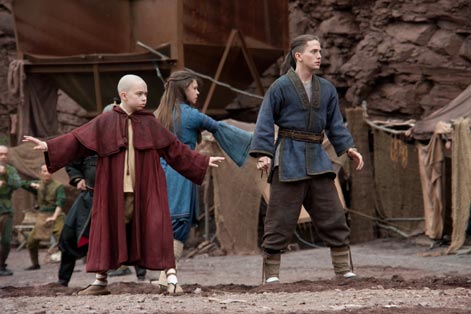
While Twihards know Jackson Rathbone from his portrayal of Jasper Hale in the first three Twilights films, Nicola Peltz is a relative newcomer. But both are sure to get a burst of fame with their starring roles in M. Night Shyamalan’s The Last Airbender, an epic live-action adaptation (out Fri/2) of the animated Nickelodeon series. Rathbone and Peltz play siblings Sokka and Katara, refugees of the water tribe who join forces with Aang (that’d be the last airbender) to save the world. In talking to the actors about their filming experiences, it’s clear they’ve got the sibling rivalry thing down pat: their snarky back-and-forth dominated the conversation.

San Francisco Bay Guardian: I’ve got to start by asking you guys the obvious question, which is if you were familiar with the series Avatar: The Last Airbender before you signed on to the movie.

Nicola Peltz: Yes, I was. I actually have six brothers and a sister, and two of my younger brothers that are seven, we watch the cartoon all the time together. And when I got the role, they literally didn’t believe me. They were like, “You’re lying!” “No, I’m really not!” They’re really excited for me.

Jackson Rathbone: I knew of it, too. I hadn’t seen the entire series, but a lot of my really good friends had, so I told them I was going out for the role, and they were extremely impressed. It was nice to have my friends behind me on this one.


SFBG: How would you say the movie is different from the series, and do you think it’ll still appeal to those fans?

JR: I think it definitely will still appeal to all the hardcore fans, because the filmmakers were fans of the series themselves. [M.] Night [Shyamalan] really wanted to make the film for his daughters, who loved the series.

NP: Yeah, it was actually his daughter’s idea to make the film, because she fell in love with the series so much, and she loved the characters. And I think this movie’s so interesting because it is for all ages. It’s not like just a kids’ movie. A lot of grown-ups were into the cartoon as well.

SFBG: How are Last Airbender fans different from, say, Twilight fans?

NP: Jackson?

JR: [laughs] I think with Twilight fans, there’s definitely a larger female fanbase, just based off the first two films. I think Eclipse is going to probably bring a lot more guys in. But for The Last Airbender, I find that it’s across the board. I mean, like Nikki’s just said, it’s kind of an all ages thing.

NP: It’s a family movie. You know, like some Friday nights, people go to them. It’s like the perfect movie, because everyone’s gonna love it. It’s not like the parents are going to be bored watching a kids’ movie.

JR: Yeah, it’s like the first Shrek. It’s a family film, except this is an action film so it’s going to be a lot more entertaining for everyone, because it’s really exciting. There’s all this martial arts, there’s all this special bending. It’s gorgeous.

SFBG: As a fan of the series myself, my main concern was if Appa [a “sky bison”] and Momo [a “winged lemur”] were involved in the movie. [Both appear in CG form.]

NP: Yes! Of course. It wouldn’t be a movie without Appa and Momo.

JR: You’ve gotta have those characters. They’re so much fun. My only regret is that I didn’t get to work with Momo as much.

NP: Yeah, same here. Actually, one of those scenes, I got to feed him a little peach. That was the only thing, but it was really cute.

SFBG: You’ve talked about how it’s a pretty intense action movie. How much stuntwork was involved?

NP: Yeah, there was a lot. I learned kung-fu and tai chi. I started in October last year, and then we went through the end of the movie, but we all went in February, moved to Philly and we did boot camp. We did hours and hours and hours a day, and it was so much fun. We got to do — did you do wire work? You did, right?

JR: I didn’t do wire work, because I don’t have special bending abilities. No, I just did mainly kung-fu, like hand-to-hand kind of kung-fu, and then they taught me wrestling and grappling moves. Because they wanted Sokka to be more like a young warrior, who doesn’t necessarily have the technical ability but he definitely has the heart. And a boomerang. And a really sharp wit.

NP: Oh, do you want to tell him what happened when you first tried to use your boomerang?

JR: …No.

SFBG: Well, now I have to hear.

JR: OK, well, the boomerang’s a little bit different than the boomerang that you think of from Australia or whatever. But the shape is actually of a common, real boomerang. And so when I went to go throw it—

NP: He hit the only rock in Greenland! The only big stone in Greenland.

JR: Greenland is all rocks and ice! It’s everywhere. But I was throwing it up in an incline, it went straight up, and—

NP: It never came back.

JR: It went straight. It broke.

SFBG: But I assume your skills improved?

JR: Yeah, definitely, definitely. However, I did break like four boomerangs and three spears.

NP: Yeah, he had like six boomerangs throughout the movie.

JR: Well, that’s because I was learning to do tricks with them. I would like flip it behind my back and catch it and try to just make it as cool as possible.

NP: He would attempt, but…

SFBG: You guys definitely have this rapport down — you do seem like siblings. How did you develop that on set?

JR: Well, basically, the first day of filming, I picked Nicola up and I dunked her in a snowbank, to really get the brother and sister thing going. That’s the only reason.

NP: Oh, yeah, he was getting into character, as he tells everybody. But at the Kids’ Choice Awards, I got to slime him.

JR: Yeah, that’s called payback.

SFBG: That’s awesome. Although getting slimed is kind of a good thing. I would love to get slimed.

NP: Actually, it was fun. I tasted it.

SFBG: How was that?

NP: It was slimy.

JR: I had no choice but to taste it. So thank you.

SFBG: With all this back-and-forth, I feel like a fight is inevitable. If Sokka and Katara threw down, who would win?

JR: Katara.

NP: Come on!

JR: There’s no way Sokka would ever raise a fist to his little sister.

NP: OK, well, even if he did, I would win. Obviously. I’m a water bender! Please. He has a boomerang.

SFBG: Can you talk about what it was like working with M. Night Shyamalan?

JR: It was incredible. Being young actors, it’s one of those things, you get to work with somebody that you’ve respected and admired. He’s just an incredible artist and a really awesome, down-to-earth family guy.

NP: Yeah, he’s a really great guy. When I saw The Sixth Sense, I was like — it’s one of my favorite movies ever. And now I get to work with him, which is so much fun. Family and morals and values are really important to him, and it definitely shines in the movie. You can definitely tell. But he was so much fun to work with.

SFBG: He’s known for having a very particular mark. Does that carry over to The Last Airbender? Because this does seem very different from his past projects.

NP: Yeah, it is different. He did a lot of scary movies and this is a movie for all ages.

JR: It’s a family film. He did thrillers. With The Happening, he did his first R-rated film. And here with The Last Airbender, he’s doing his first family film. It’s an action, epic, fantasy adventure — there’s a lot of CGI. ILM did the CGI.

NP: We also went to Greenland, though. So a lot of it was real, which was really cool.

SFBG: Now you’ve probably been asked this before, but if you had to pick one bending power, what would you choose?

NP: Water! And I’m not just saying that because I’m a water bender in the movie. But water’s so interesting because it can harm you but it can also save you. It does heal people, but at the same time, there are tsunamis, which harm things. I think it’s the most interesting element.

JR: Oh, yeah, definitely. I’ve always been a big fan of Bruce Lee, and in his book, Artist of Life, he talks about how to be like water and what that means. You kind of go with the flow. Water can become strong and become like ice, and in it’s flowing form even, in hundreds of years, it’ll carve the Grand Canyon. Water’s a very powerful element.

The Last Airbender opens Fri/2 in Bay Area theaters.

An online defense of print—and a plug for the Public Press’ first print edition

2

I spent my lunch hour yesterday indulging in what media critics say could soon be a lost experience: reading the first print issue of a newspaper.

As I turned the pages of a pilot print edition of the San Francisco Public Press, which has been in existence online since March 2009, I was surrounded by folks who were tapping out messages on plastic coated cell phones or sitting scrunched at table trying to read stuff on laptops.

And I began to wonder, will there be a print renaissance in my life time as upcoming generations begin to feel the impacts of too much screen and keyboard time? And begin to realize the benefits of having a print presence in this increasingly digital world? Or is print really going to go the way of the dinosaurs?

Maybe it’s because I’m old school, but I actually believe there’s a future for print journalism, though it may be a limited one. To my mind you can’t beat the sensation that comes from leafing through a newspaper, while sipping morning coffee, or the welcome relief of reading the news in hard copy, after staring at computer screens all day. And then there’s the fact that I’m never going to get mugged, or have my car broken into, because someone wants to steal a newspaper–something that can’t be said if you leave your Kindle or Blackberry or fancy laptop around.

Yeah, I never have to worry about sand at the beach, or water in the bath, when I read a print newspaper. And I can rest assured that when I am done with my paper, and leave it in a coffee shop, someone else can read it, or recycle it in their blue bin or reuse it as the proverbial bird cage liner or fish wrap.

Now, what’s especially interesting about the San Francisco Public Press—and distinguishes it from most other print newspapers currently available—is that it’s free of advertisements. Or, as the folks at the Public Press like to say, it’s “ad-free news in the public interest.”

    “Why no ads?” the Public Press asks. “As the newspaper advertising market has drained to Internet competitors, we need to search for other sources of income to support quality journalism. Advertising has also warped the content of the newsroom, both explicitly and subtly, encouraging newspapers to shift their coverage to topics of interest to businesses and wealthy readers—the target of ads. Noncommercial news, while often less lucrative, has the luxury of independence.”

The Public Press also devotes some wordage to explaining why they have turned to ink:
    “Newspapers help bridge the digital divide,” they state, noting that San Francisco’s 2009 City Survey showed that more than 34 percent of households with income under $50,000 cannot access the Internet at home via personal computers.
    “Newspapers serve as communal touchstones,” they continue, observing how isolating digital widgets can be, compared to reading a print newspaper in public.
    “We want to pay our hardworking staff for the work they do,” they add, reminding us that folks buy 50 million newspapers everyday in the US, but are still averse to paying for news online.
    “People use paper and electronic devices differently,” they conclude. “There are times and places when even the most tech-savvy Bay Area digerati enjoy some screen relief.”

I got my hands on a copy of the San Francisco Public Press’ first print edition, because Lila Lahood, SFPP’s director of operations, and SFPP contributor Christopher D. Cook, who wrote a timely piece about Lennar using federal taxpayer funds to balance its books, stopped by the Guardian with a stack of papers.

And while they were in newspaper delivery mode, Lahood and Cook also shared their thoughts on “Lessons Learned” from their first foray into print.

“We missed our deadline,” Lahood admitted, observing how, in future, the Public Press plans to focus less on breaking news and more on timely features to avoid deadline stress. The plan going forward, Lahood said, is to publish a print edition on a quarterly basis, with the hope of becoming a monthly print publication at some point next year.

“Some of us we stayed up the whole night, filings our full package at 6 in the morning,” Lahood added, tipping her hat to the “strong and committed core” of Public Press workers that made this first print edition possible.

‘Though most of us are journalists, we worked for publications that were already in existence before we arrived,” Lahood continued, acknowledging that the team had much to learn about putting out a print edition from start to finish this first time around.

‘But we showed it could be done,” Cook added.  “There is a solid professional publication now in the public sphere, making a dent in the San Francisco community.”

Available in 35 bookstores and newsstands in the Bay Area, the Public Press’ print edition is also available on the street for $2 a pop—an exercise in sales that isn’t as easy as the guys who peddle the Street Sheet (a monthly tabloid written primarily by homeless and formerly homeless people) make it look.

“It’s hard to sell newspapers on the street,” Cook acknowledged. “We knew it was going to be challenging. When you are out there, standing on the corner in the urban crunch, no one has an interest, but the minute you connect to folks, on an individual level, it changes.”

On June 22, the Public Press’s first pilot newspaper hit the streets. At 28 pages long, it includes two sections, three investigative reports, a full-page graphic novel and 50 articles from staff members and a broad spectrum of public media and civic groups, including KALW, KQED, Commonwealth Club, World Affairs Council, California Watch and Consumers Union.

I found the Public Press’ special section on Treasure Island intriguing and informative—the kind of in-depth investigation that’s hard for one journalist to pull off, but is crucial if the city of San Francisco and all its many residents are going to make informed planning and development decisions.

I appreciated the wide-range of articles in the Public Press’ main section, including items on the ongoing battle over the future of the open-air sewage digesters that have been stinking up the Bayview for decades now.

I loved the “Sit, Lie, Get Deported” comic strip that merges photos with hand-drawn illustrations and uses the actual words of politicians, city officials, activists and gadflies to help illustrate its point.

And I’m still trying to finish the crossword. In fact,  I plan to read the SFPP’s first printedition from front to back over the July 4 holiday weekend, when I’ll have the time to really absorb and enjoy it.

“Ideally, news will appear in print first, then online, so there’s interest in seeking out the print edition,” Lahood told me, noting that the Public Press’ first edition amounts to about 70,000 words. “So, it a novel, in length,” Lahood laughed. “People are, if not starving, at least very hungry for news analysis and investigative reporting. There are a lot of online sites that aggregate other publications content, and then there’s the corporate model of the Chronicle, but while there is some good reporting in town, there are fewer reporters.”

No kidding. All the more reason for this reporter to write an online defense of print, in the hope that you rush out to secure your copy of the Public Press’s first print edition and evaluate this new model of journalism. I think you’ll be glad you did.

All hail the big red noses, honk honk

0

Just in time for summer, it’s circus week on SFBG. Caitlin Donohue visited Circus Bella in this week’s issue, and now we take an indepth and colorful look inside the San Francisco Clown School and Circus Finelli. Allez-oop!

Our Weekly Picks: June 31-July 6

0

WEDNESDAY 30

FILM

The Hidden Fortress

There are certain experiences that, when given the chance, you should never pass up. Skydiving, for instance. Eating unusually good pizza. Seeing a Kurosawa film on the big screen. Well rejoice, reader, because at least one of those three is within your immediate grasp. UC Berkeley’s Pacific Film Archive is celebrating the centennial of Akira Kurosawa’s birth with a summer-long retrospective. On June 30, it will be showing The Hidden Fortress (1958), which directly inspired the (good) Star Wars trilogy and by proxy, pretty much every lighthearted action/fantasy caper you’ve ever seen. Also keep an eye out for The Seven Samurai (1954) on July 17, Yojimbo (1961) on July 24, and Ran (1985) on Aug. 21. (Zach Ritter)

7 p.m., $5.50–$9.50

Pacific Film Archive

2575 Bancroft, Berk

(510) 642-5249

www.bampfa.berkeley.edu


EVENT

God’s Lunatics

One of the main problems with today’s secularist revival is that it has no sense of the grotesque. Richard Dawkins and Sam Harris are bright dudes, but they can be just as dour and unyielding as their fundamentalist targets. They tend to lose sight of the notion that fanatics are more susceptible to mockery than they are to sober polemics. Enter award-winning author Michael Largo, whose new book God’s Lunatics takes the reader on a whirlwind tour of faith’s more ridiculous manifestations. The work presents a Victorian freak show of cult leaders, mystics, and crusaders from throughout history, chronicling the chaos and pitch-black comedy that inevitably results when humans exchange rational thought for passionate, earnest insanity. (Ritter)

7 p.m., free

Modern Times Bookstore

888 Valencia, SF

(415) 282-9246

www.mtbs.com


THEATER

Young Frankenstein

If you’ve seen Mel Brooks’ classic spoof Young Frankenstein (1974), you know that migrating humps, rolls in ze hay, and correcting people’s mispronunciation of his name are all in a day’s work for the young Dr. Frankenstein. But apart from his monster’s debut, which features a classy take on “Puttin’ on the Ritz,” he’s not necessarily one for musical numbers. Until 2007, that is, when the stage musical adaptation of the film premiered in Seattle, then migrated to Broadway, following in the footsteps of Brooks’ successful musical reworking of The Producers (1968) with collaborator Thomas Meehan. Now SF gets a taste of the wackiness, perhaps followed by the inevitable (if unfortunate) readaptation into film. (Sam Stander)

Through July 25

Tues.–Sat., 8 p.m. (also Wed. and Sat., 2 p.m.);

Sun, 2 p.m., $30–$99

Golden Gate Theatre

One Taylor, SF

(415) 551-2000

www.shnsf.com


THURSDAY 1

VISUAL ART

“Renaissance”

Many of the images in Bill Armstrong’s “Renaissance” series possess the eeriness of a certain strain of uncanny portrait photography, but these photos don’t incorporate living models. They’re defocused captures of Renaissance-era drawings that Armstrong has painted over with bright swathes of color. The out-of-focus effect combines with his choice of colors to lend the photos a haunting depth, so much so that it’s sometimes easy to forget the inanimate qualities of the subjects. Despite their vivaciousness, the sometimes bizarre hues prevent the images from seeming entirely organic. By photographing works of printed art, Armstrong plays with the idea of the photographic subject, resulting in these deceptively simple and fascinating shots. (Stander)

Through Aug. 28

Opening 5:30–7:30 p.m., free

Dolby Chadwick Gallery

210 Post, SF

(415) 956-3560

www.dolbychadwickgallery.com


FRIDAY 2

FILM

San Francisco Frozen Film Festival

The San Francisco Frozen Film festival’s mission statement insists “we seek to unfreeze the arts frozen beneath the weighty realities of prejudice, poverty, ignorance, and isolation.” I’m just hoping that means the name does not, in fact, reference Mark Twain’s played-out ol’ chestnut about summer temperatures in San Francisco. Whatever. This intriguing, up-and-coming fest plunges into its fourth incarnation with Dive, a doc about Dumpster diving, and continues with a variety of shorts programs (doc, experimental, animated, comedic — there’s even a “crime and western” category!), plus features like Do It Again (Kinks), about a fan’s rabid quest to get his favorite band to reunite, and 16 mm New Jersey surf film A Pleasant Surprise. (Cheryl Eddy)

Through Sat/3, $10

Roxie, 3117 16th St, SF

www.frozenfilmfestival.com


THEATER

Left of Oz

No matter how many times The Wizard of Oz is revamped, remade, or spoofed, the results are always different from what came before. This summer season, Left of Oz comes to Ashby Stage, and if you couldn’t guess by the title, the tagline — “Dorothy Comes Out!” — gives away the game. Dorothy swaps the yellow brick road for a bus to San Francisco, where she hopes to find herself and some Sapphic loving. Left borrows clichés associated with San Francisco (tie-dye, marijuana, yoga) and merges them with the fantasy elements of Victor Fleming’s 1939 movie, flipping the whole sparkly thing on its head. There may have been previous queer readings of Oz, but Left has to be among the most playful. (Ryan Lattanzio)

Through July 18

Fri.–Sat., 8 p.m.; Sun, 7 p.m., $25–$50

Ashby Stage

1901 Ashby, Berk.

(510) 841-6500

www.leftofoz.com


MUSIC

Carte Blanche

It may be impossible to predict the music game, but so far DJ Mehdi is 1 for zero. Sure, these days it’s not uncommon for a hip-hop single to blatantly cop a beat from Daft Punk, but French DJ Mehdi Favéris-Essadi has been mixing the hip-hop and dance since the days when finding Daft Punk on your rap CD was like finding a cockroach in your cereal. Now the Ed Banger cohort has hooked up with U.K. house DJ Riton to form the duo Carte Blanche, and the pair are banging out hard Chicago house like it’s next in line to take over the world. With Mehdi’s track record, I wouldn’t necessarily count it out. With White Girl Lust, Alona, and Shane King. (Peter Galvin)

9 p.m., $15

Mezzanine

444 Jessie, SF

(415) 625-8880

www.mezzaninesf.com


EVENT

“Mission Muralismo Celebrates the Graff Convention”

If there’s one thing the de Young Museum is prospering at recently, it’s the way it has been bringing SF communities not usually done right by the fine art world into its fold, and respectfully. From establishing its Native American Programs Board to this week’s continuation of the Mission Muralismo street art event series, more of the neighborhood is finding reasons to get its bags searched to enter that crazy bronze building. At the Graff Convention, the city’s top burners and sprayers will share their knowledge in lecture form, and Audiobraille will supply funky Latin jazz beats. Just don’t bring your new aerosol — that shit will get taken for sure. (Caitlin Donohue)

5–8:45 p.m., free

de Young Museum

50 Hagiwara Tea Garden Dr., SF

(415) 750-3600

www.famsf.org


SATURDAY 3

MUSIC

Fillmore Jazz Festival

San Francisco has no shortage of street fairs. But unlike those held in the duller byways of suburbia, each gathering has its own neighborhood flavor: the Haight hosts a hippie happening, Union Street conveys a yuppie flair, and the Fillmore pays homage to the music that made it famous back in the day: jazz. Ella Fitzgerald and Duke Ellington rocked the local clubs then, and while the area has changed dramatically over the years, there’s a bit of a flashback feel during this annual fest. Along with the usual street food and craft vendors, there’ll be stages of talent, including Bobbie Webb and the Smooth Blues Band, Kim Nalley, Marcus Shelby Orchestra, the Coltrane Church, and much more. (Eddy)

Through Sun/4

10 a.m.–6 p.m., free

Fillmore between Jackson and Eddy, SF

www.fillmorejazzfestival.com


SUNDAY 4

EVENT

“Pooches on Parade”

For its second year in a row, Half Moon Bay hosts “Pooches On Parade,” where you can show off your dog-walking skills — oh, and your dog, of course — if Fido or Fifi is up to par, that is. If you don’t have a dog, the event coordinators are willing to spare their imaginary dogs, Cuff and Link. Even a stuffed animal will suffice. Afterward, if all the doggone mayhem awakens your carnivorous appetite, there’s a “Bark BQ” where you and your pooch can dine while enjoying a live band. Unless you’re a staunch cat person, so many dogs in one place is probably reason enough to make the trip down coastside. (Lattanzio)

Noon, free ($10 for same-day parade registration)

Main Street

Half Moon Bay

www.poochesonparade.org


EVENT/DANCE

“Tango in the Square”

As we’ve all been repeatedly reminded, “it takes two to tango.” But before pairing off, it might be useful to learn a few basics by yourself. You can start by promenading (yes, that’s a step) over to Union Square for “Tango in the Square.” The event is part of Union Square’s 2010 Jewels in the Square series, which offers free lessons in milonga, tango, and vals (tango waltz). With hot new moves, you’ll be ready to hit the square’s open dance floor. Choose among a variety of partners (professional and amateur), watch performances by experienced tango dancers, or simply enjoy the live music by the Argentine tango band Tangonero. (Gaydos)

2 p.m., free

Union Square

Powell and Geary, SF

www.unionsquarepark.us/JewelsJuly


EVENT

Fourth of July Waterfront Celebration

If patriotic displays of gunpowder are what you seek on America’s 234th birthday, Bay Area skies will not let you down. Particularly brave San Francisco residents and their pushy out-of-town guests can head to Pier 39 for a full day of Uncle Sam-endorsed fun, with live music (including “the soft rock explosion of Mustache Harbor” — God bless irony, and God bless the U.S.A.), street performers, and fireworks galore. Pray for an unfoggy night, kids. Alternative: live in the Mission? Get thee to your roof to spot all the homespun, charmingly dangerous fireworks that inevitably appear every July 4. You’ll be up all night listening to them anyway. (Eddy)

3–9:30 p.m., free

Pier 39, SF

www.pier39.com/Events


The Guardian listings deadline is two weeks prior to our Wednesday publication date. To submit an item for consideration, please include the title of the event, a brief description of the event, date and time, venue name, street address (listing cross streets only isn’t sufficient), city, telephone number readers can call for more information, telephone number for media, and admission costs. Send information to Listings, the Guardian Building, 135 Mississippi St., SF, CA 94107; fax to (415) 487-2506; or e-mail (paste press release into e-mail body — no text attachments, please) to listings@sfbg.com. We cannot guarantee the return of photos, but enclosing an SASE helps. Digital photos may be submitted in jpeg format; the image must be at least 240 dpi and four inches by six inches in size. We regret we cannot accept listings over the phone.

Powder keg

5

news@sfbg.com

Ask any pollster, political consultant, or academic who studies the American electorate about the mood of the voters this year and you’ll get the same one-word answer: Angry.

Everyone’s pissed — the liberals, the conservatives, the moderates, the people who don’t even know where they fit in. It’s an unsettled time and, potentially, very bad news for a progressive agenda that seeks to address issues ranging from poverty and war to the long-term health of the public and the planet.

The Democrats, who swept into power with an enormously popular president just 18 months ago, may lose control of Congress. The tea partiers have driven the Republicans so far to the right that some candidates for Senate are openly talking about eliminating Social Security. The unemployment rate — the single most important factor in the politics of the economy — remains high and doesn’t show any signs of improving.

And the progressive left seems frustrated and demoralized, particularly in California. The Golden State, which once led the nation in innovation and enlightened social policy, now seems to be leading the politically dysfunctional race to the bottom.

The nation could be headed for a dangerous era, rife with the potential for right-wing demagoguery and other nasty political schisms. The state of the economy could easily fuel a more powerful movement to shrink the scope of government and a continuing backlash against the public sector — and the financial backers of the antitax and antiregulation movement are drooling at the prospect.

But there’s also a chance for progressives to seize a populist narrative and shift the discussion away from traditional disagreements and toward those areas, particularly the destructive influence on government by powerful corporations, where the grassroots right and grassroots left might actually agree.

The anger that voters feel toward a government that isn’t meeting their needs is starting to find other outlets. People are as mad about the abuses of big business — the Wall Street meltdown, the bailouts, the BP oil spill, the political manipulation — as they are about the failures of Congress and the president. If you ask Americans of every political stripe who they least trust — big government or big business — even conservatives aren’t so sure anymore.

For 30 years, the central narrative of American politics has revolved around the size and effectiveness of government. Now there’s a chance to shift that entire debate in American politics toward the largely unchecked power of corporations. It is, populist writer Jim Hightower told us, “an enormous opportunity handed to us by the bastards.”

But so far, none of the Democratic leaders in California are taking advantage of it to start dispelling damaging myths and crafting political narratives that might begin to create some popular consensus around how to deal with society’s most pressing problems.


THE PEOPLE WANT TAXES

There have been many polls gauging voter anger, but one of the most comprehensive and interesting recent ones was “Californians and Their Government,” a collaborative study by the Public Policy Institute of California and the James Irvine Foundation that was released in May.

It shows that Californians are mad about the state’s fiscal problems, disgusted with their political leaders, divided by ideology, and deeply conflicted over the best way forward. An astounding 77 percent of respondents say California is headed in the wrong direction and 81 percent say the state budget situation is a “a big problem.”

But the anti-incumbent message isn’t necessarily an anti-government message. Most Californians are willing to put more of their cash into public-sector programs, even during this deep recession. When asked to name the most important issues facing the state, 53 percent mentioned jobs and the economy . The state budget, deficit, and taxes only got the top billing of 15 percent.

And contrary to the conventional wisdom espoused by moderate politicians and political consultants, most voters say they are willing to pay higher taxes to save vital services. “Californians tell us they continue to place a high value on education and want education to be protected from cuts. And they’re willing to commit their money to help fund that,” PPIC director Mark Baldassare told the Guardian.

The survey found that 69 percent of respondents say they would pay higher taxes to protect K-12 education from future cuts, while 54 percent each say they would pay higher taxes to prevent cuts to higher education and to health and human services programs. In other words, voters seem to recognize where we’ve cut too deeply — and where we haven’t cut enough: only 18 percent of respondents would be willing to pay higher taxes to prevent cuts to prisons and corrections.

Baldassare said the June primary results also showed that people are willing to pay more in taxes for the services they value. “Around the state, there was a lot of evidence that people responded favorably to requests by their local governments for money, particularly for schools,” he said.

Both the California Legislature and Gov. Arnold Schwarzenegger are held in very low esteem with voters, according to the PPIC study, and Schwarzenegger’s 23 percent rating is the lowest in the poll’s history.

Barbara O’Connor, political communications professor who heads the Institute for the Study of Politics and the Media at Sacramento State University, told us that voter unhappiness with elected leaders is no surprise. Right now, most people are afraid that their basic needs won’t be met over the long run.

“The common narrative is fear, and fear channels into anger,” O’Conner said.

And that fear is being tapped into strongly this year by the Republican candidates, who are trying to scare voters into embracing their promises to gut government and keep taxes as low as possible.

“If there’s any lesson to be learned from Meg and Carly’s early ads, it’s fear-mongering, fear-mongering all the time — and that doesn’t create a very positive narrative,” O’Connor said of gubernatorial candidate Meg Whitman and U.S. Senate candidate Carly Fiorina.

O’Connor noted that Barack Obama’s campaign had great success in using a positive, hopeful message and said she believes the right leader can also do so in California. “I talked to Jerry [Brown]’s people about it and said you can’t just run a negative campaign because that’s what Meg is doing.”

Despite the tenor of the times, O’Connor said she’s feeling hopeful about hope. She also believes Californians would respond well to a leader like Obama who tried to give them that hope — if only someone like Brown can pick up that mantle. “I think the environment is right for a positive message. But the question is: do we have people capable of delivering it?”

She said the no-new-taxes, dismantle-government rhetoric has started to wear thin with voters. “The real fiscal conservatives are badly outnumbered in Californian,” O’Connor said. As for the corporate sales jobs, O’Connor said voters have really started to wise up. “They aren’t going to be scammed.”

The results of the June primary election showed that voters across the spectrum were also disturbed by big special-interest money. Proposition 16, backed by $46 million from Pacific Gas and Electric Co., went down to defeat — even in counties that tend to vote Republican.

And this fall, with two rich former CEOs spending their personal wealth to win two of California’s top elected offices and energy companies pushing a measure to roll back California’s efforts to combat global warming, there could be great opportunity in a narrative targeting those at the top of our economic system.


THE TOP AND THE BOTTOM

Some observers say that whatever their shared feelings about corporate scams, conservatives and liberals in the state are just too far apart, and that there’s little hope for any substantive agreement. “People are becoming more polarized,” said consultant David Latterman, who often works for downtown candidates and interests. “I think we’re beyond compromise.”

Allen Hoffenblum, a Los Angeles-based Republican strategist, agreed. “The voter are all mad, but they’re mad at different things. I just don’t see where they come together.”

But Hightower, who has spent a lifetime in politics as a journalist, elected official, author, and commentator, has a different analysis.

“As I’ve rambled through life,” he wrote in a recent essay, “I’ve observed that the true political spectrum in our society does not range from right to left, but from top to bottom. This is how America’s economic and political systems really shake out, with each of us located somewhere up or down that spectrum, mostly down.

“Right to left is political theory; top to bottom is the reality we actually experience in our lives every day — and the vast majority of Americans know that they’re not even within shouting distance of the moneyed powers that rule from the top of both systems, whether those elites call themselves conservatives or liberals.”

In an interview, he told us he sees a lot of hope in the fractured and potentially explosive political ethos. “There’s all this anger,” he said. “People don’t know what to do. And I think the one focus that makes sense is the arrogance and abuse of corporate executives.”

In fact, Hightower pointed out, the teabaggers didn’t start out as part of the Republican machinery. “Wall Street and the bailouts sparked the tea bag explosion,” he said. It wasn’t until big right-wing outfits like the Koch brothers, who own oil and timber interests and fund conservative think tanks, started quietly funding tea party rallies that the anti-corporate, anti-imperial edge came off that particular populist uprising.

“At first, the teabaggers didn’t even know where the money was coming from,” Hightower said. “You can’t be mad at the teabaggers; we should have been out there organizing them first.”

There’s plenty of evidence that anger at big business is growing rapidly — and rivals the distrust of big government that has defined so much of American politics in the past 30 years. The bailouts were “the first time in a long time that people have been slapped in the face by collusion between big business and its Washington puppets,” Hightower noted.

Then there’s the Supreme Court decision in Citizens United v. Federal Elections Commission. In January, a sharply divided court ruled 5-4 that corporations had the right to spend unlimited amounts of money supporting or opposing political candidates. Progressives were, of course, outraged — but conservatives were, too.

Polls show that more than 80 percent of Democrats think the decision should be overturned. So do 76 percent of Republicans. “This is a winner for our side,” Hightower noted. “But our side’s not doing anything about it.”

Sure, President Obama denounced the ruling in his State of the Union speech and promised reform. But the bill the Democrats have offered in response does nothing to stop the flow of money; it would only increase disclosure requirements. And in response to furor from the National Rifle Association, it’s been amended and is now so full of holes that it doesn’t do much of anything.

Political consultants advising Whitman are clearly looking for ways to direct the voter unhappiness into a demand for lower taxes and smaller budgets. She’s already vowed to fire 40,000 state workers, and her most recent campaign ad attacks Brown for expanding public programs and raising the state deficit.

So far Brown hasn’t challenged that narrative — and some Democrats say he shouldn’t. It would be safer, they say, for Brown to get out front and demand his own cuts in Sacramento. “Going after public-sector pensions is a winner,” one Democratic campaign consultant, who asked not to be named, told us. “If Whitman beats Brown on those issues, she wins.”

But that approach is never going to be effective for Democrats. If the argument is over who can better cut government spending, the GOP candidates will always win. The better approach is to see if progressives can’t shift the debate — and the anger — toward the private sector.

As Hightower put it: “You can yell yourself red-faced at Congress critters you don’t like and demand a government so small that it’d fit in the backroom of Billy Bob’s Bait Shop and Sushi Stand, but you won’t be touching the corporate and financial powers behind the throne.”

That’s where the discussion has to start. And there’s no better place than California.

The Golden State is a great example of what happens when the tax- cutters win. In 1978, the liberals in Sacramento, operating with a huge state budget surplus, couldn’t figure out how to derail the populist anger of property tax hikes. So Proposition 13, the beginning of the great tax revolt, passed overwhelmingly. Over the next decade, more antitax initiatives went before the voters, and all were approved.

Now the state is heading toward fiscal disaster. The schools are among the worst-funded in the nation. The world-famous University of California system is on the brink of collapse. Community colleges are turning away students. The credit rating on California bonds have fallen so far that it’s hard for the state to borrow money. And there’s still a huge budget gap.

The tax-cut mentality that led to the so-called Reagan revolution started in California; a political movement that shifts the blame for many of the state’s problems away from government and onto big business ought to be able to start here as well. And it’s potentially a movement that could bring together people who normally find themselves on opposite sides of the fence.

A case in point: the measure the oil companies have put on the November ballot to repeal the state’s greenhouse gas limits. The corporations backing the initiative, led by Valero, argue that California’s attempts to slow climate change will cost jobs. That’s a line we’ve heard for decades. Every tax cut, every move toward deregulation, is defended as helping spur job growth.

But the past four presidents have done nothing but cut taxes and reduce regulations — and the result is facing Americans on the streets every day. There is also growing evidence that even Republican voters don’t believe everything big businesses tell them anymore. And they’re starting to grasp that sometimes deregulation leads to outcomes like larcenous CEOs and unstoppable oil leaks.

So the potential for a successful progressive populist movement is out there. But it’s not going to happen by spontaneous combustion.


SF SHOWS THE WAY

On the national level, one of the factors creating this gloomy electorate is the failure of President Obama to keep the coalition that elected him active and engaged. The intense partisanship in Washinton has turned off many independent Obama voters, while his progressive supporters have been disappointed by issues ranging from his escalation in Afghanistan to tepid reforms on health care and Wall Street.

“One of the narratives now is where are the Obama voters and will they participate?” Jim Stearns, a San Francisco political consultant who works mostly on progressive campaigns, told us. “They still love Obama but they’re not moved by him anymore.”

Perhaps more important, they have lost the sense of hope that he once instilled. The Republican Party’s descent into right-wing extremism and the strong anticorporate narratives that have emerged in the last year — from BP’s oil spill to PG&E’s political manipulation to Goldman Sachs’ self-dealing to the prospect of unrestricted corporate campaign propaganda unleashed by the Citizens United ruling — have created the possibility that the negative narratives by the left may crowd out the positive ones.

“Meg Whitman is someone you can hate. She’s the rich Republican CEO trying to buy her way into office,” Stearns said. “But it’s a depressing message.”

But Stearns said there is another, most hopeful political narrative that is emerging in San Francisco, one that might eventually grow into a model that could be used at the state and federal levels. “We’re lucky in San Francisco. Progressive voters are engaged.”

He noted that San Francisco’s voter turnout was higher than expected in the June primary, and far higher than the record low state number, even though there really weren’t any exciting propositions or closely contested races on the local ballot — except for the Democratic County Central Committee, where progressives maintained their newfound control. And it’s because of the organizing and coalition-building that the left has done.

“What you’ve seen over the last few years is a coalition of labor, neighborhood groups, environmentalists, and the progressives now operating through the Democratic Party. That’s a great coalition with a lot for people to trust,” Stearns said.

Meanwhile, downtown has all but collapsed as a unified political force. “They don’t really have a political infrastructure,” Stearns said of downtown. “Normally it would be the mayor who gets everyone in line and working together.”

Even Latterman, the downtown-oriented consultant, agrees that the business community is no longer setting San Francisco’s agenda because it’s become fractured and unable to push a consistent political narrative: “There’s certainly been a lack of coordination.”

He also agrees that progressives have become more organized and effective. “Clearly, the Democratic Party of San Francisco has become a conduit for progressive politics and politicians, but not issues,” Latterman said. “What a lot of people get wrong in the city is the difference between politics and policy.”

Part of the reason is economic. With scarce resources, a high threshold for approving new revenue sources, and a fiscally conservative mayor unwilling to talk taxes, it’s been difficult to move a progressive agenda for San Francisco. And in Sacramento, it’s barely part of the discussions.

“The people of California have been held hostage by a handful of Republicans who are making us cut everything we care about,” while in San Francisco “Newsom is taking an entirely Republican approach to the budget,” Stearns said.

Looking toward the fall races, Stearns said the progressive coalition and majority on the Board of Supervisors will be tested on issues such as Muni reform, and the question will be whether fiscal conservatives like Sup. Sean Elsbernd can blame Muni’s problems on drivers, or whether progressives can create and sell a broader package that includes new revenue and governance reforms.

“The drivers are going to get their guarantee taken out of the charter, that’s going to happen. But people know that isn’t all that’s wrong with Muni,” Stearns said.

But to craft a more comprehensive solution, he said the progressives are going to need to use their growing coalition to connect the dots for voters. “We need to run a citywide campaign around a whole constellation of issues,” Stearns said, citing Muni, schools, taxes, resistance to mean-spirited measures like sit-lie, and the larger issues raised by the Brown and Barbara Boxer campaigns. “We need to figure out a way to put all that in the same coalition and run one campaign around it. And we can do that because progressives retained control of the DCCC.”


THE STRUGGLE AHEAD

Although they’ve made great strides, San Francisco progressives are still struggling with a mayor who sees the solution to every budget crisis as cuts — and with a growing number of efforts to blame public employees for the city’s fiscal problems. Even Jeff Adachi, the public defender once considered a standard-bearer for progressive causes, is pushing a ballot measure that would require city workers to pay more for their pensions.

Gabriel Haaland, who works with Service Employees International Union Local 1021, made the right point in the pension debate. “Big financial institutions crashed the stock market,” he said recently, “and now they want to blame city workers.”

In a blog post on the political website Calitics, Robert Cruickshank put it clearly: “The notion that ‘everyone needs to give back’ just doesn’t make sense given our economic distress. We’ve already given back too much. We gave back our wages. We gave back our ability to afford health care and housing and transportation. We gave back the robust public- sector services that created widespread prosperity in the 1950s and 1960s. We gave back affordable, quality education. And too many of us have given back our future.

“No, it’s time for someone else to give back. It’s time for the wealthiest Californians and the large corporations to give back. For 30 years now they have benefited from economic policy designed to take money and benefits from the rest of us and give it to those who already have wealth and power.”

That’s a message that ought to appeal to anyone who’s hurting from this recession. It ought to cross red and blue lines. It ought to be the mantra of a new progressive populism that can channel voter anger toward the proper target: the big corporations that created the problems that are making us all miserable.

If Jerry Brown could adopt that narrative, he could change the state of California — and the state of the nation.

Let us entertain you

0

caitlin@sfbg.com

STAGE It’s not every day that I have a circus all to myself. And it’s making me exceedingly nervous. Mark Wessels, one of Circus Bella’s veteran clowns, is being installed by his coworkers on a unicycle whose dizzying height — which already recalls that of a vintage penny-farthing — is further exacerbated by its position on a five-foot platform. “I’ll be fine if I fall,” Wessels says. “I’ll try not to fall.”

It’s the professional-grade Circus Bella’s first full rehearsal of the year, one month before its July 3 performance in Yerba Buena Gardens, and I’m the lucky audience of one to its beautiful madness. Between superhuman feats, the affable Bellas come up to introduce themselves. Contortionist Ariana Ferber Carter rearranges her vertebrae in a lung-constricting backbend at my feet. “I can’t keep my back warm all the time,” the 18-year-old cheerfully deadpans after telling me she “only” stretches three hours a day, max.

“We try to run a tight ship here, but have fun. We use the word ‘delight’ a lot,” Abigail Munn tells me during a break. She’s the fetching aerialist and costume designer who cofounded the troupe in 2008 with slack-wire walker David Hunt. The two had noticed a dearth of traditional circus in the Bay Area. Everyone was all into the “Montreal thing,” as Hunt puts it — Cirque du Soleil-type concept theatrics. He recalls the moment when we said “What the hell is wrong with the ring?”

As veterans of the Bindlestiff Family Cirkus, Zoppé Family Circus, and New Pickle Family Circus, Munn and Hunt wanted to take the circus experience back to the days when women wore sequins and the juggling was done by people with big red noses — not faceless cerulean orbs. Bella performers each develop their own acts separately, taking a page from classic troupes. Band director Rob Reich composes original scores after viewing the performers practice. The whole show takes place in a single ring, demarcated by a big blue ground covering splashed with gold stars. Best of all, Bella keeps prices accessible; indeed, most shows are free.

But running a circus, unsurprisingly, is somewhat of a balancing act. The cost of costumes, three new troupe members, the full band … on closer inspection it seems as if Circus Bella’s most awe-inspiring feat is its very existence. Munn acknowledges that retaining the troupe can be challenging, but that the circus game is the same one all struggling artists play. “We try to maintain a medium level of starving,” she tells me, only half joking. The group is accepting charitable donations as we speak, and about half the troupe’s nine in-ring members have day jobs teaching kids’ classes at places like the Circus Center near Kezar Stadium or have their own solo act side hustles.

After meeting the gang, I realize that I caught the Bella show last fall at the Yerba Buena Gardens by happenstance one cloudy day, not long after I moved back to the city. I like to think it was a uniquely San Francisco moment — to be walking through downtown’s concrete megaliths and suddenly run across a trapeze aerialist. Munn flipped high above my head in a sparkling blue unitard. The clowns alternated physical comedy that tickled the little ones in the audience with balancing tricks of the oh-shit-oh-shit-oh-shit persuasion. I don’t know, maybe that happenstance magic arise elsewhere in the world. Vegas, maybe. Still …

CIRCUS BELLA AT THE YERBA BUENA GARDENS FESTIVAL

Sat/3 12, 2:15 p.m., free

Yerba Buena Gardens

Mission between Third and Fourth streets, SF

(415) 205-8355

www.circusbella.com

Lennar’s litmus test

3

sarah@sfbg.com

None of the many stakeholders tracking the progress of Lennar Corp.’s massive Candlestick Point-Hunters Point Shipyard redevelopment plan registered surprise when the Board of Supervisors received three appeals to the Planning Commission’s June 3 certification of the project’s final environmental impact report (FEIR).

Instead, everybody who has been watching the political juggernaut that has been pushing for quick approval of the project over the past month said they anticipated that the FEIR would be appealed, and perhaps litigated. But the real question is whether the project will be substantially changed.

In the seven months since the project’s draft EIR was released, the Planning and Redevelopment Commissions have repeatedly rejected all arguments and recommendations made by its critics to improve or delay the plan, rushing the approval along on a tight schedule (“The Candlestick Farce,” 12/21/09).

The rush job occurred even as numerous groups and individuals warned that the DEIR comment period was too short, (“DEIR in the headlights,” 02/03/10) and complained that the city and the developer had dismissed crucial data and testimony while exploiting fears the San Francisco 49ers would leave town if the city didn’t act quickly (“Political juggernaut,” 06/02/10).

What’s less clear is whether the Board of Supervisors has the political will to heed these appeals and correct what opponents say are serious flaws in the city’s FEIR. The appeal that the Sierra Club, Golden Gate Audubon Society, California Native Plant Society, and San Francisco Tomorrow filed June 21 lists nine deficiencies.

These included the FEIR’s failure to look into an alternate Bus Rapid Transit (BRT) route around Yosemite Slough or adequately assess impacts resulting from the landfill cap on Parcel E2 and the transfer of 20 acres of public shoreline land in Candlestick Point State Recreation Area (CPSRA) to build high-end housing.

“The FEIR failed to analyze those elements of the project’s sustainability plan that could have significant environmental impacts, including two proposed heating and cooling plants (which appear to be power plants) to serve 10,500 housing units and a projectwide recycling collection system,” the coalition further charged.

The appeal also voiced concern that the FEIR failed to adequately assess impacts resulting from the construction and maintenance of the development’s underground utility matrix, impacts to the bird-nesting in the proposed 34-acre wetland restoration project at the state park, and delays to eight Muni lines.

But the Sierra Club-led coalition also indicated that by removing provisions for a bridge over Yosemite Slough, transfer of land in the state park, and compromised clean-up efforts at Parcel E2, resolution of many of these disputed issues could be expedited.

“If the Board of Supervisors acts promptly, revisions to the EIR may be made quickly and result in a minimal delay in the progress of the project,” the coalition stated.

The Sierra Club’s Arthur Feinstein told the Guardian that the coalition’s top three concerns are “very important, but the six other issues are also very real.”

“Here we have a city cutting 10 percent of its bus service while saying that eight bus routes will need to be improved because of the project, and admitting that the development will increase air pollution in a district that has the highest rates of asthma and cancer without identifying mitigations such as reducing parking spaces in the proposal,” Feinstein said.

POWER (People Organized to Win Employment Rights) also filed an FEIR appeal June 21 listing a broader range of environmental and economic justice-related concerns.

These included the FEIR’s failure to analyze and mitigate for displacement that would be triggered in the surrounding neighborhood by developing 10,500 mostly market-rate housing units in the area and “failure to provide for adequate oversight and enforcement of the terms of the early transfer” of the shipyard from the Navy.

POWER also cited the FEIR’s failure to adequately mitigate against the impact of sea level rise, the risks associated with potential liquefaction of contaminated landfill at the shipyard in the event of an earthquake, and health risks related to chemicals of concern at the shipyard. The group also faulted the city’s failure to get the Navy to prepare an environmental impact statement on its clean-up plan before the FEIR was completed.

Finally, Californians for Renewable Energy (CARE) filed a five-point appeal June 23 charging that the project contravened the intent of Proposition P (which voters approved in 2000, urging the Navy to remediate shipyard pollution to the maximum extent possible), that the project’s FEIR is incomplete because the Navy (which still retains jurisdiction over the project lands) has not yet completed its EIS, and that the FEIR approval process was tainted by 49ers-related political pressure.

“The pre-set goal of maintaining the 49ers in San Francisco has colored the environmental analysis of this decision,” CARE noted, referring to the city’s rush to get the project’s FEIR certified on June 3 — five days before Santa Clara County voters approved a new stadium for the 49ers near Great America .

The appeal filings mean the Board of Supervisors is required to hold a hearing within 30 days, a move that places a roadblock, at least temporarily, in the way of the city’s tight schedule to secure final approvals for Lennar’s megaproject before summer’s end.

Board President David Chiu told the Guardian that the Board’s Land Use Committee will move forward with a July 13 meeting to hear a list of proposed amendments related to the underlying plan along with the FEIR appeals.

“We are back at the board Land Use Committee July 12 with 10 items related to the project,” said Chiu, who is a member of the Land Use Committee. The three-member committee is chaired by Sup. Sophie Maxwell, who represents the project’s District 10; Sup. Eric Mar is vice-chair.

“The next day, July 13, has been tentatively set for a full meeting of the full board,” Chiu continued. He acknowledged that the FEIR related materials are dense and complex, telling us that “they form the largest pile on my desk, and it’s about five inches high.”

But he wasn’t about to prejudge the outcome. “We do need to clean up the area and rebuild it in such a way that it will dramatically increase affordable housing and jobs and support a livable diverse community,” Chiu said. “Obviously there are still a lot of questions and concerns about the proposed project and the board will push to make sure all these issues are adequately addressed.”

CARE president Michael Boyd said he hoped the board would take his group’s appeal seriously and fix the plan’s fundamental shortcomings. “That means going back to square one,” he said.

But others were less sure that the board would seek to overturn the entire plan. “Everyone in the community would like the best level of clean-up,” said Saul Bloom, whose nonprofit Arc Ecology has tracked the proposed shipyard clean-up for three decades. “But what’s possible and practical? And will the city be supportive of that or the most expeditious solution?”

Bloom reserved gravest concern for plans to cap, not remove, the contaminants from the shipyard’s Parcel E2. “The concern is that if you put a cap on E2 without a liner then contaminants could scootch out during a seismic event, or over time, and cause problems because of the parcel’s close proximity to surrounding groundwater and the San Francisco Bay,” he said. “But to place a liner in there is very expensive because you’d have to excavate E2, at which point you might as well replace it with clean soil.”

Bloom acknowledged that the Navy has argued that excavation would cause a nasty smell and nobody knows what is going to be released in the process.

“But long-term Bayview residents like Espanola Jackson have made the point that the community already lives within nose-shot of the southeast sewage treatment plant and would rather put up with a few years of nasty smells, given the relative benefits of cleaning the yard up,” he said. “And how do we know a cap will be protective given the Navy’s argument that we don’t know what’s down there?

“The thing that makes the most sense here is to clean up the shipyard to the best possible extent, but the city isn’t planning to do that,” Bloom added. “And the environmental community’s bottom line has always been the bridge [over Yosemite Slough, which the Sierra Club opposes]. So the sense is that if the bridge goes away, so does their problem.”

Kaiser workers seek election between rival unions

34

Thousands of Kaiser Permanente workers have filed petitions to change unions in what could be the biggest battle yet between Service Employees International Union and its upstart rival National Union of Healthcare Workers. If called by federal regulators, the election would involve more than 45,000 workers, the biggest private sector organization since Ford Motors employees joined United Auto Workers in 1941.

“This is the election everyone has been anticipating for the last year and a half,” NUHW spokesperson Sadie Crabtree told us.

That was when Sal Rosselli and other former leaders of the Oakland-based United Healthcare Workers were ousted by former SEIU President Andy Stern and other leaders of their parent union, SEIU, and formed NUHW. Since then, the two unions have clashed bitterly and regularly, in various workplaces, through the media, in leadership battles, and in a San Francisco court case that ended in April.

“The NUHW petition, if the National Labor Relations Board agrees it was filed appropriately, could force an election between SEIU-UHW and NUHW at Kaiser. Voting for NUHW would risk all the gains SEIU-UHW members made in a hard-fought four-month contract campaign against takeaways by Kaiser,” was how an SEIU-UHW press release cast today’s action.

NUHW opted for a nod to the Fourth of July in its release: “Thousands of Kaiser healthcare workers fired the first shot today in a long-anticipated battle for independence that will determine the future of California’s largest union, SEIU. They filed a petition that will trigger elections for 45,000 SEIU members to choose between the troubled incumbent and the state’s fastest-growing union, the new National Union of Healthcare Workers.”

About 2300 Kaiser workers – representing three of the seven bargaining units – already voted in January to join NUHW, but the petitions now being turned in by the remaining four unions represent the most significant segment of Kaisier workers, including the 44,000-member service, technical, and clerical unit.

Federal law calls for elections when at least 30 percent of a union’s members ask for one, and Crabtree told us, “We have more than we need.” Now, the NLRB must verify the petitions and schedule the election.

The Guardian & San Francisco Symphony Present: An Alfred Hitchock Photo Contest

0

SNAP A PHOTO similar to Hitchcock in front of the Golden Gate Bridge or Mission Dolores (as shown).

THE MOST ACCURATE, most original, and most fun photo entries will win a pair of concert tickets to Alfred Hitchcock’s Psycho with the San Francisco Symphony, Saturday, July 17th at 8pm.

THE WINNER’S PHOTO
will be published in the Guardian and posted on sfbg.com/promo/hitchcock the week of July 14th.

TO ENTER EMAIL
promos@sfbg.com subject line: “Hitchcock Photo” by Monday, July 12, at noon.  One entry per person.

Rep Clock

0

Schedules are for Wed/30–Tues/6 except where noted. Director and year are given when available. Double and triple features are marked with a •. All times are p.m. unless otherwise specified.

BRIDGE 3010 Geary, SF; www.peacheschrist.com. $13. "Midnight Mass:" Purple Rain (Magnoli, 1984), Fri-Sat, midnight.

CASTRO 429 Castro, SF; (415) 621-6120, www.castrotheatre.com. $7.50-10. •Singin’ in the Rain (Donen and Kelly, 1952), Wed, 3:05, 7, and It’s A Great Feeling (Butler, 1949), Wed, 5:10, 9:05. •In a Lonely Place (Ray, 1950), Thurs, 2:35, 7, and The Player (Altman, 1992), Thurs, 4:30, 8:55. •What’s the Matter With Helen? (Harrington, 1971), Fri, 2:30, 7, and What Ever Happened to Baby Jane? (Aldrich, 1962), Fri, 4:20, 9:05. •The Star (Heisler, 1952), Sat, 1. 5:05, 9:10, and Sunset Blvd. (Wilder, 1950), Sat, 2:55, 7. A Star is Born (Cukor, 1954), Sun, noon, 3:30, 7. •The Aviator (Scorsese, 2004), Mon, noon, 6, and Boogie Nights (Anderson, 1997), Mon, 3:05, 9:05. •Gods and Monsters (Condon, 1998), Tues, 2:30, 7, and Ed Wood (Burton, 1997), Tues, 4:30, 9:05.

CHRISTOPHER B. SMITH RAFAEL FILM CENTER 1118 Fourth St, San Rafael; (415) 454-1222, www.cafilm.org. $6.50-10.25. Babies (Balmès, 2010), call for dates and times. The Girl With the Dragon Tattoo (Oplev, 2009), call for dates and times. Micmacs (Jeunet, 2010), call for dates and times. Touching Home (Miller and Miller, 2009), call for dates and times. Have You Heard from Johannesburg? (Field, 2006), Wed-Thurs, call for times. Joan Rivers: A Piece of Work (Stern and Sundberg, 2010), Wed-Thurs, call for times. Every War Has Two Losers (Reiss, 2009), Wed, 7:15. Filmmaker Haydn Reiss in person with Alice Walker and Norman Solomon. The Sun Behind the Clouds (Sonam and Sarin, 2010), July 2-8, call for times.

JACK LONDON SQUARE PAVILION THEATER 98 Broadway, Oakl; www.oakuff.org. Free. "Oakland Underground Film Festival: "Hot Summer and Salon with Tracy Snelling," Fri, 7:30.

PACIFIC FILM ARCHIVE 2575 Bancroft, Berk; (510) 642-5249, www.bampfa.berkeley.edu. $5.50-9.50. "Akira Kurosawa Centennial:" The Hidden Fortress (1958), Wed, 7. No programs July 1-6.

RED VIC 1727 Haight, SF; (415) 668-3994. $6-10. Casino Jack and the United States of Money (Gibney, 2010), Wed-Thurs, 7, 9:30 (also Wed, 2). Kick-Ass (Vaughn, 2010), Fri-Sat and Mon, 7, 9:25 (also Sat, 2, 4:30). Closed Sun/4 and Tues/6.
ROXIE 3117 and 3125 16th St, SF; (415) 863-1087, www.roxie.com. Free-$10.75. Have You Heard from Johannesburg? (Field, 2006), Wed-Thurs, 7. Lovers of Hate (Poyser, 2010), Wed-Thurs, 9:30. La Mission (Bratt, 2009), Wed-Thurs, 7. San Francisco Frozen Film Festival, cutting-edge films from indie artists, Fri-Sat. Full schedule at www.frozenfilmfestival.com.
"TEMESCAL STREET CINEMA" 49th St at Telegraph, Oakl; www.temescalstreetcinema.com. Free. P-Star Rising (Noble), Thurs, 8. With free popcorn and live music.

Music listings

0

Music listings are compiled by Paula Connelly and Cheryl Eddy. Since club life is unpredictable, it’s a good idea to call ahead to confirm bookings and hours. Prices are listed when provided to us. Submit items at listings@sfbg.com.

WEDNESDAY 30

ROCK/BLUES/HIP-HOP

Anaura, Kim Garrison, Upstairs Downstairs Hotel Utah. 8pm, $7.

Beach Side Stranglers, Lonely Kings El Rio. 9pm, $3-5.

Blitzen Trapper Fillmore. 9pm, $20.

Big Cat and the Hipnotics Biscuits and Blues. 8:30pm, $5.

"Blue Bear School of Music Showcase" Café du Nord. 7:30pm, $12-20.

Can’t Find a Villain, Mon Bon, My Pet Monster Elbo Room. 9pm, $7.

Dum Dum Girls, Crocodiles, White Cloud, DJ Mario Orduno Bottom of the Hill. 9pm, $12.

Mates of State, Free Energy Great American Music Hall. 7pm, $20. With comedian Nick Thune and DJ Jason Hammel.

Warren Teagarden, Crazies Will Destroy You, Interchangeable Hearts Hemlock Tavern. 9pm, $6.

DANCE CLUBS

Blingo Butter. 10pm, $2. DJ Chad Salty and friends will provide tunes while party-goers play this amped up version of bingo, including the possibility of a dance off, chugging raw eggs, and more.

Booty Call Q-Bar, 456 Castro, SF; www.bootycallwednesdays.com. 9pm. Juanita Moore hosts this dance party, featuring DJ Robot Hustle.

Bump Som. 10pm. With DJs Samala, Guillermo, Mr. Grant, and Dominic the English Gent spinning funk, boogie, electro, house, and dancehall.

Hands Down! Bar on Church. 9pm, free. With DJs Claksaarb, Mykill, and guests spinning indie, electro, house, and bangers.

Jam Fresh Wednesdays Vessel, 85 Campton, SF; (415) 433-8585. 9:30pm, free. With DJs Slick D, Chris Clouse, Rich Era, Don Lynch, and more spinning top40, mashups, hip hop, and remixes.

Mary-Go-Round Lookout, 3600 16th St, SF; (415) 431-0306. 10pm, $5. A weekly drag show with hosts Cookie Dough, Pollo Del Mar, and Suppositori Spelling.

RedWine Social Dalva. 9pm-2am, free. DJ TophOne and guests spin outernational funk and get drunk.

Respect Wednesdays End Up. 10pm, $5. Rotating DJs Daddy Rolo, Young Fyah, Irie Dole, I-Vier, Sake One, Serg, and more spinning reggae, dancehall, roots, lovers rock, and mash ups.

Synchronize Il Pirata, 2007 16th St, SF; (415) 626-2626. 10pm, free. Psychedelic dance music with DJs Helios, Gatto Matto, Psy Lotus, Intergalactoid, and guests.

THURSDAY 1

ROCK/BLUES/HIP-HOP

Alvon Biscuits and Blues. 8 and 10pm, $15.

Busta Rhymes, Feyvva Punkette, X Sample DNA Lounge. 7:30pm, $40.

Dead to Me, Big Kids, 1994, Perfect Machines Thee Parkside. 9pm, $10.

Huddy’s Amnesia. 7pm, free.

Mates of State, Free Energy Great American Music Hall. 7pm, $20. With comedian Nick Thune and DJ Jason Hammel.

Modern Action, Severance Package, Roofie and the Nightstalker, Bad Tickers Kimo’s. 9pm, $7.

Malcolm Mooney and Tenth Planet, Stephen Kent, Extra! Bottom of the Hill. 9pm, $10.

Pigs, Pins of Light, Pegataur Hemlock Tavern. 9pm, $6.

Gimli’s Tit, Pandiscordian Necrogenesis, Perineum, White Pee Amnesia. 9pm, $5.

Truth and Salvage Co., Dead Winter Carpenters, Honeymoon Café du Nord. 9pm, $10.

Whiskey Richards, Quick and Easy Boys Maggie McGarry’s, 1353 Grant, SF; (415) 399-9020. 9pm.

Wonder Girls, 2AM Fillmore. 8pm, $50.

FOLK/WORLD/COUNTRY

Dark Hollow Band Atlas Café. 8pm, free.

DANCE CLUBS

Afrolicious Elbo Room. 9:30pm, $5-7. DJs Pleasuremaker and Señor Oz with guest Zongo Junction spin Afro-tropical, samba, and funk.

Basstown Knockout. 9:30pm, $2. Classic 80s rap, hip-hop, and breakdance anthems with Special Lord B.

Calibre, Marcus Intalex, Beatropolis, Method One Rickshaw Stop. 9pm, $20. Also with DJ M, Kuze, MC Child, and Ax!om MC.

Caribbean Connection Little Baobab, 3388 19th St, SF; (415) 643-3558. 10pm, $3. DJ Stevie B and guests spin reggae, soca, zouk, reggaetón, and more.

Club Jammies Edinburgh Castle. 10pm, free. DJs EBERrad and White Mice spinning reggae, punk, dub, and post punk.

Drop the Pressure Underground SF. 6-10pm, free. Electro, house, and datafunk highlight this weekly happy hour.

Electric Feel Lookout, 3600 16th St, SF; (415) 431-0306. 9pm, $2. With DJs subOctave and Blondie K spinning indie music videos.

Good Foot Som., 2925 16th St, SF; (415) 558-8521. 10pm, free. With DJs spinning R&B, Hip hop, classics, and soul.

Holy Thursday Underground SF. 10pm, $5. Bay Area electronic hip hop producers showcase their cutting edge styles monthly.

Jivin’ Dirty Disco Butter, 354 11th St., SF; (415) 863-5964. 8pm, free. With DJs spinning disco, funk, and classics.

Koko Puffs Koko Cocktails, 1060 Geary, SF; (415) 885-4788. 10pm, free. Dubby roots reggae and Jamaican funk from rotating DJs.

Lacquer Beauty Bar. 10pm-2am, free. DJs Mario Muse and Miss Margo bring the electro.

Mestiza Bollywood Café, 3376 19th St, SF; (415) 970-0362. 10pm, free. Showcasing progressive Latin and global beats with DJ Juan Data.

Peaches Skylark, 10pm, free. With an all female DJ line up featuring Deeandroid, Lady Fingaz, That Girl, and Umami spinning hip hop.

Popscene 330 Rich. 10pm, $10. Rotating DJs spinning indie, Britpop, electro, new wave, and post-punk.

Singular Sensation Paradise Lounge. 10pm, $7. With DJs Pee Play, Stanley Frank, and Husband spinning dance tunes.

Solid Thursdays Club Six. 9pm, free. With DJs Daddy Rolo and Tesfa spinning roots, reggae, dancehall, soca, and mashups.

Studio SF Triple Crown. 9pm, $5. Keeping the Disco vibe alive with authentic 70’s, 80’s, and current disco with DJs White Girl Lust, Ken Vulsion, and Sergio.

FRIDAY 2

ROCK/BLUES/HIP-HOP

*Cage, Hate Your Guts, DJ Chauncey Slim’s. 9pm, $16.

*Grayceon, Lozen, Kowloon Walled City Hemlock Tavern. 9:30pm, $8.

Hot Lunch, Only Sons Café du Nord. 9:30pm, $10.

Derick Hughes Biscuits and Blues. 8 and 10pm, $20.

Damien Jurado, Kay Kay and His Weathered Underground, Merch Bottom of the Hill. 9pm, $12.

Nothington, Riot Before, Heartsounds Thee Parkside. 9pm, $8.

Steel Train, Matt Embree, Young the Giant Great American Music Hall. 8pm, $16.

Titanium Sporkestra, Gomorran Social Aid and Pleasure Club, Rube Waddell, Khi Darag Rickshaw Stop. 8pm, $12.

JAZZ/NEW MUSIC

Audium 9 1616 Bush, SF; (415) 771-1616. 8:30pm, $15.

Black Market Jazz Orchestra Top of the Mark. 9pm, $10.

Iron Lung, Slices, Landmine Marathon, Black Hole of Calcutta, Vaccuum Kimo’s. 9pm, $8.

Ottmar Liebert and Luna Negra Yoshi’s San Francisco. 8 and 10pm, $22-30.

FOLK/WORLD/COUNTRY

Left Coast Special Socha Café, 3235 Mission, SF; (415) 643-6848. 8:30pm, free.

Rob Reich, Craig Ventresco Amensia. 6pm, free.

DANCE CLUBS

Brass Tax Amnesia. 10pm, $5. With DJs Ding Dong, JoeJoe, Ernie, and MACE.

Braza! Som., 2925 16th St., SF; (415) 558-8521.10pm, $10. With Djs Vanka and Elan.

Carte Blanche Mezzanine. 9pm, $17. With DJs Mehdi and Riton spinning strictly house music.

Deeper 222 Hyde, 222 Hyde, SF; (415) 345-8222. 9pm, $10. With rotating DJs spinning dubstep and techno.

Dirty Rotten Dance Party Madrone Art Bar. 9pm, $5. With DJs Morale, Kap10 Harris, and Shane King spinning electro, bootybass, crunk, swampy breaks, hyphy, rap, and party classics.

Family Vibes Elbo Room. 9pm, $8-10. Bhangra and dubstep with Non Stop Bhangra, Surya Dub, and J. Boogie’s Dubtronic Science.

Fat Stack Fridays Koko Cocktails, 1060 Geary, SF; (415) 885-4788. 10pm, free. With rotating DJs Romanowski, B-Love, Tomas, Toph One, and Vinnie Esparza.

Fubar Fridays Butter, 354 11th St., SF; (415) 863-5964. 6pm, $5. With DJs spinning retro mashup remixes.

Club Dragon Club Eight, 1151 Folsom, SF; www.eightsf.com. 9pm, $8. A gay Asian paradise. Featuring two dance floors playing dance and hip hop, smoking patio, and 2 for 1 drinks before 10pm.

Good Life Fridays Apartment 24, 440 Broadway, SF; (415) 989-3434. 10pm, $10. With DJ Brian spinning hip hop, mashups, and top 40.

Hot Chocolate Milk. 9pm, $5. With DJs Big Fat Frog, Chardmo, DuseRock, and more spinning old and new school funk.

Oldies Night Knockout. 9pm, $2-4. Doo-wop and one-hit wonders with DJs Primo, Daniel, and Lost Cat.

Rockabilly Fridays Jay N Bee Club, 2736 20th St, SF; (415) 824-4190. 9pm, free. With DJs Rockin’ Raul, Oakie Oran, Sergio Iglesias, and Tanoa "Samoa Boy" spinning 50s and 60s Doo Wop, Rockabilly, Bop, Jive, and more.

Some Thing The Stud. 10pm, $7. VivvyAnne Forevermore, Glamamore, and DJ Down-E give you fierce drag shows and afterhours dancing.

Strangelove Cat Club, 1190 Folsom, SF; 9:30pm, $6. With DJs Tomas Diablo, Unit 77, Orko, and Xander spinning goth and industrial.

Swing Goth presents Bela Lugosi’s True Blood Ball DNA Lounge. 9:30pm, $18-20. Rockabilly, 80s, gothic, and swing with David J, Three Bad Jacks, BloodWIRE, DJ Melting Girl, and more.

SATURDAY 3

ROCK/BLUES/HIP-HOP

Frank Bey Biscuits and Blues. 8 and 10pm, $22.

Damon and the Heathens, Westwood and Willow, DownDownDown, Finish Ticket Bottom of the Hill. 9pm, $10.

Gravehill, Cardiac Arrest, HOD, Fatalist, DJ Rob Metal Thee Parkside. 9pm, $8.

Lotus Moons, Spyrals Amnesia. 9pm, $5.

Midnight Strangers, Apopka Darkroom, Dylan Haight Hemlock Tavern. 9:30pm, $6.

Minibosses, Roar Hemlock Tavern. 5pm, $6.

Pinback presents the Rob and Zach Show, Little White Teeth Independent. 9pm, $20.

Dana Salzman and the East Bay All-Stars Slim’s. 9pm, $14.

Sprains, Lost Puppy Thee Parkside. 3pm, free.

Voodoo Fix, Dave McGraw and Crow Wing Hotel Utah. 9pm, $8.

JAZZ/NEW MUSIC

Audium 9 1616 Bush, SF; (415) 771-1616. 8:30pm, $15.

Eric Kurtzrock Trio Ana Mandara, Ghirardelli Square, 891 Beach, SF; (415) 771-6800. 8pm, free.

Josh Roseman Unit Coda. 10pm, $10.

Ottmar Liebert and Luna Negra Yoshi’s San Francisco. 8 and 10pm, $22-30.

FOLK/WORLD/COUNTRY

Jordan Karp Socha Café, 3235 Mission, SF; (415) 643-6848. 8:30pm, free.

Femi Kuti Fillmore. 9pm, $35.

Sonic Medicine Wheel Bollyhood Café. 8pm, $5.

DANCE CLUBS

Dead After Dark Knockout. 6-9pm, free. With DJ Touchy Feely.

Death to the Throne Club 8, 1151 Folsom, SF; www.eightsf.com. 9pm, $10. With DJs Sticky K, Eli Glad, High5, Jamal, and Philty Rodriguez spinning electro and dubstep.

Debaser Knockout. 9pm, $5. Re-live the 90s with DJs Jamie Jams and Emdee.

Electric Masquerade Rickshaw Stop. 9pm, $12. With Ben Oprstu, Robot Love, Ribotto, Pleather, and Anti-Bio-Tick.

Everlasting Bass 330 Ritch. 10pm, $5-10. Bay Area Sistah Sound presents this party, with DJs Zita and Pam the Funkstress spinning hip-hop, soul, funk, reggae, dancehall, and club classics.

Fire Corner Koko Cocktails, 1060 Geary, SF; (415) 885-4788. 9:30pm, free. Rare and outrageous ska, rocksteady, and reggae vinyl with Revival Sound System and guests.

Foundation Som., 2925 16th St., SF; (415) 558-8521. 10pm. With DJs Shortkut, Apollo, Mr. E, and J Boogie.

Gemini Disco Underground SF. 10pm, $5. Disco with DJ Derrick Love and Nicky B. spinning deep disco.

Get Loose! Beauty Bar. 9pm, free. With DJ White Mike spinning dance jams.

HYP Club Eight, 1151 Folsom, SF; www.eightsf.com. 10pm, free. Gay and lesbian hip hop party, featuring DJs spinning the newest in the top 40s hip hop and hyphy.

Kontrol Endup. 10pm, $20. With resident DJs Alland Byallo, Craig Kuna, Sammy D, and Nikola Baytala spinning minimal techno and avant house.

Leisure Paradise Lounge. 10pm, $7. DJs Omar, Aaron, and Jet Set James spinning classic britpop, mod, 60s soul, and 90s indie.

New Wave City: Synth Night DNA Lounge. 9pm, $7-12. Synthed-up 80s with Skip and Shindog.

Rock City Butter, 354 11th St., SF; (415) 863-5964. 6pm, $5 after 10pm. With DJs spinning party rock.

Saturday Night Soul Party Elbo Room. 10pm, $10. Soul with DJs Lucky, Phrengren Oswald, and Paul Paul.

Souf Club Six. 9pm, $10. With DJs Ms. Independent, Jeanin Da Feen, Bozak, and Kee spinning N.O. Bounce, Southern crunk, and chopped and screwed.

Soundscape Vortex Room, 1082 Howard, SF; www.myspace.com/thevortexroom. With DJs C3PLOS, Brighton Russ, and Nick Waterhouse spinning Soul jazz, boogaloo, hammond grooves, and more.

Spirit Fingers Sessions 330 Ritch. 9pm, free. With DJ Morse Code and live guest performances.

SUNDAY 4

ROCK/BLUES/HIP-HOP

God Bless the U.S. Amnesia. 9pm, $5. With Bobb Saggath and Titanium Sporkestra.

FOLK/WORLD/COUNTRY

Eldorado, Poontonies, Grooming the Crow, Everlovin’ Thee Parkside. 3pm, free.

DANCE CLUBS

Afterglow Nickies, 466 Haight, SF; (415) 255-0300. An evening of mellow electronics with resident DJs Matt Wilder, Mike Perry, Greg Bird, and guests.

Call In Sick Skylark. 9pm, free. DJs Animal and I Will spin danceable hip-hop.

DiscoFunk Mashups Cat Club. 10pm, free. House and 70’s music.

Dub Mission Elbo Room. 9pm, $6. Dancehall with Mighty Dub Killaz featuring Janaka Selekta, Papa Roads and Anthony Dellavalle, and DJ Sep.

Gloss Sundays Trigger, 2344 Market, SF; (415) 551-CLUB. 7pm. With DJ Hawthorne spinning house, funk, soul, retro, and disco.

Honey Soundsystem Paradise Lounge. 8pm-2am. "Dance floor for dancers – sound system for lovers." Got that?

Jock! Lookout, 3600 16th St, SF; (415) 431-0306. 3pm, $2. This high-energy party raises money for LGBT sports teams.

Kick It Bar on Church. 9pm. Hip-hop with DJ Zax.

Religion Bar on Church. 3pm. With DJ Nikita.

Stag AsiaSF. 6pm, $5. Gay bachelor parties are the target demo of this weekly erotic tea dance.

MONDAY 5

ROCK/BLUES/HIP-HOP

Shari La Las, Sam Coad and the Gums, Snails El Rio. 7pm.

*Tommy Guerrero, Ray Barbie Milk. 9pm, $10.

FOLK/WORLD/COUNTRY

Belle Monroe and Her Brewglass Boys Amensia. 8:30pm, free.

DANCE CLUBS

Black Gold Koko Cocktails, 1060 Geary, SF; (415) 885-4788. 10pm-2am, free. Senator Soul spins Detroit soul, Motown, New Orleans R&B, and more — all on 45!

Death Guild DNA Lounge. 9:30pm, $3-5. Gothic, industrial, and synthopop with Decay, Joe Radio, and Melting Girl.

Krazy Mondays Beauty Bar. 10pm, free. With DJs Ant-1, $ir-Tipp, Ruby Red I, Lo, and Gelo spinning hip hop.

M.O.M. Madrone Art Bar. 6pm, free. With DJ Gordo Cabeza and guests playing all Motown every Monday.

Manic Mondays Bar on Church. 9pm. Drink 80-cent cosmos with Djs Mark Andrus and Dangerous Dan.

Musik for Your Teeth Revolution Café, 3248 22nd St., SF; (415) 642-0474. 5pm, free. Soul cookin’ happy hour tunes with DJ Antonino Musco.

Network Mondays Azul Lounge, One Tillman Pl, SF; www.inhousetalent.com. 9pm, $5. Hip-hop, R&B, and spoken word open mic, plus featured performers.

Skylarking Skylark. 10pm, free. With resident DJs I & I Vibration, Beatnok, and Mr. Lucky and weekly guest DJs.

TUESDAY 6

ROCK/BLUES/HIP-HOP

Bias Tape, Cousin Chris Show, Spell Talk El Rio. 8pm, $5.

Dadfag, Gay Beast, Ezee Tiger and the Soundguys Hemlock Tavern. 9pm, $6.

Leopold and His Fiction, American Aquarium, Kasey Anderson Hotel Utah. 8pm, $8.
Bobby Long, He Is We, Trouble Over Tokyo Bottom of the Hill. 9pm, $12.
Secret Cities, Bye Bye Blackbird, Lucky Cloud Nine Elbo Room. 9pm, $6.
Surprise Me Mr. Davis, Fred Torphy Café du Nord. 8pm, $15.
Walter Trout Biscuits and Blues. 8pm, $24.
DANCE CLUBS
Alcoholocaust Presents Argus Lounge. 9pm, free. With DJs Mackiveli, Taypoleon, and What’s His Fuck.
Eclectic Company Skylark, 9pm, free. DJs Tones and Jaybee spin old school hip hop, bass, dub, glitch, and electro.
Flowers, DJ Moses, Wil Ivy Knockout. 9pm, free.
Rock Out Karaoke! Amnesia. 7:30pm. With Glenny Kravitz.
Share the Love Trigger, 2344 Market, SF; (415) 551-CLUB. 5pm, free. With DJ Pam Hubbuck spinning house.
Womanizer Bar on Church. 9pm. With DJ Nuxx.

Stage listings

0

Stage listings are compiled by Guardian staff. Performance times may change; call venues to confirm. Reviewers are Robert Avila, Rita Felciano, and Nicole Gluckstern. Submit items for the listings at listings@sfbg.com.

THEATER

OPENING

Beijing, California Thick House Theater, 1695 18th St; www.asianamericantheater.org. $15-25. Opens Thurs/2, 8pm. Plays Thurs-Sat, 8pm; Sun, 5pm. Through July 17. Asian American Theater Company presents a new play by Paul heller set in the year 2050, when China invades America.

Posibilidad, or Death of the Worker Dolores Park and other sites; 285-1717, www.sfmt.org. Free. Previews Sat/3, 2pm. Opens Sun/4, 2pm. Runs Sat-Sun, Sept 6, 2pm; Sept 17, 8pm. The San Francisco Mime Troupe opens its 51st season with a modern song and tango about politics in the workplace.

BAY AREA

Left of Oz Ashby Stage, 1901 Ashby, Berk; (800) 838-3006, www.brownpapertickets.com. $25-50. Opens Fri/2 8pm. Runs Fri-Sat, 8pm, Sun, 7pm. Through July 18. Stephanie’s Playhouse presents a lez-queer musical comedy following the out west adventures of Dorothy.


ONGOING

Abigail: The Salem Witch Trials Temple SF, 540 Howard; www.templesf.com. $10. July 8, 29, Aug 5, 12, 19, 26, 9pm. Through Aug 26. Buzz Productions, with Skycastle Music and Lunar Eclipse Records, presents an original rock opera based on the Salem witch trials.

*Blackbird: Honoring a Century of Pansy Divas Mama Calizo’s Voice Factory, 1519 Mission; 786-9325, www.evezen.org. Thurs-Sat, 8pm. Through July 10. The intimate Blackbird Funeral Parlour Speakeasy is somber-toned and deceptively hushed, complete with period furnishings, a see-through dressing room, softly flickering altar, and obligatory piano. Only a few moments into Seth Eisen’s exceptional one-man cabaret, however, and the place is alive and kicking: doleful aspects of the décor making ample room for a sly, vigorous, soulful performer and a completely unexpected journey through some vibrant underground queer history (backed by fellow Circo Zero alum Sean Feit’s sharp musical direction and breezy accompaniment, and Alanna Simone’s gently humorous and haunting video pieces). Your guide is 100-year-old Jean Marlin, author of the notorious 1930s Pansy Craze, 75 years dead and looking fabulous in tails, bold green cravat, dapper purple hankie and a topping of regal black plumage (costumer Jack Davis demonstrates a genius throughout for turning a shoestring budget into a G-string–supported extravaganza). A multifaceted performer with quick tongue, nimble steps, and hearty voice (giving life to an assortment of extraordinary songs), Eisen uses drag, dance, puppetry, and performance art techniques to give flight to worthy exotic blackbirds known and forgotten—drag queen Zen priest Tommy Issan Dorsey; sexually ambiguous Danny Kaye; Brazil’s inimitable Ney Matogrosso; the definitely outré Klaus Nomi; and disco treasure Sylvester, whose live rendition of the Beatles’ "Blackbird" at SF’s War Memorial Opera House is one of several standout moments in this rollicking and poignant act of resurrection, insurrection, and homage. (Avila)

Die Walküre War Memorial Opera House, 301 Van Ness, SF; www.sfopera.com. $15-360. Wed/30, 7pm. Through Wed/30. San Francisco Opera presents the second installment of Wagner’s Ring cycle, directed by Francesca Zambello.

"Durang Me!" Next Stage, 1620 Gough; 1-800-838-3006, www.custommade.org. $10-28. Thurs-Sat, 8pm. Through July 10. Christopher Durang’s The Actor’s Nightmare could just as easily be called The Accountant’s Nightmare, as befuddled Everyman and presumed non-actor George Spelvin (Eric O’ Kelly) attempts to navigate his way out of a confused rendition of Noel Coward’s "Private Lives" dressed as Prince Hamlet and menaced by a trashcan-bearing Beckett-arian (AJ Davenport). This traditional companion piece to Durang’s Catholic School send-up Sister Mary Ignatius Explains It All for You references a Catholic boyhood several times, but it is the anxiety of the present moment that prevails, as the stage clears, and Spelvin is chased into a corner by an unforgiving spotlight to deliver his frantic last-ditch attempt at a soliloquy: his ABC’s. The titular Sister Mary Ignatius (AJ Davenport), by turns arctic and expansive, attempts to explain all, while periodically trotting out her star pupil Thomas (Cole Cloud) to recite catechism and spell eck-u-men-ickle for cookies. Davenport plays the pedantic side of Sister Mary with humorous vigor, but when a group of her former students drop by "to embarrass her" she doesn’t quite pull off embodying the ogress of their now-adult nightmares. Of her former students, it is probably Aloysius Benheim (Eric O’Kelly) who comes across as the most damaged by her tyranny, and not coincidentally, suffers the piece’s greatest humiliation. (Nicole Gluckstern)

La Fanciulla Del West War Memorial Opera House, 301 Van Ness; www.sfopera.com. $15-360. Fri/2, 8pm. Through Fri/2. San Francisco Opera presents Puccini’s opera, with Deborah Voigt as Minnie.

How the Other Half Loves Phoenix Theatre, 414 Mason; (800) 838-3006, www.offbroadwaywest.org. $35, Thurs-Sat, 8pm. Through July 31. Off Broadway West Theatre Company presents an early play by Alan Ayckbourn.

Krapp’s Last Tape Exit on Taylor, 277 Taylor; 1-800-838-3006, www.cuttingball.com. $15-30. Thurs-Sat, 8pm. Through Sat/3. Cutting Ball Theater remounts its strong recent production of Samuel Beckett’s hour-long solo play, featuring a full-fledged and satisfying turn by a hearty, slyly comic Paul Gerrior as the titular Krapp, reflecting on the fleeting sense of self recorded on reel-to-reel tapes over the course of a long life. Artistic director Rob Melrose approaches the material with supreme assurance and passionate but never stifling fidelity. David Sinaiko provides the recorded voice of the younger Krapp, expertly balancing a passion and unselfconscious pomposity that has Gerrior’s Krapp alternately bemused, euphoric, and wincing through one of Beckett’s most autobiographical and surprisingly affirming pieces. Melrose’s choice use of scenic elements, meanwhile, including the palpably solid 1950s-era tape machine, places Gerrior (suitably odd and natty in costumer Maggie Whitaker’s dapper vest, high-water trousers and white shoes) in a kind of communion with the reel and the real—an affecting and quietly unsettling relationship, pitched against an infinite blackness all around, that has Krapp at one point resting his head gently on the machine as he and the insubstantial voice of his younger self relive a moment of intimacy with a long-gone lover. (Avila)

The New Century New Conservatory Theatre Center, 25 Van Ness, SF; 861-8972, www.nctcsf.org. $22-40. Wed-Sat, 8pm; July 11, 2pm. Through July 11. New Conservatory Theatre Center performs Paul Rudnick’s bill of short comedies.

Peter Pan Threesixty Theater, Ferry Park (on Embarcadero across from the Ferry Bldg); www.peterpantheshow.com. $30-125. Tues and Thurs, 7pm; Fri-Sat, 7:30pm (also Sat, 2pm); Wed, 2pm; Sun, 1 and 5pm. Through August 29. JM Barrie’s tale is performed in a specially-built 360-degree CGI theater.

Reading My Dad’s Porn and French Kissing the Dog The Marsh Studio Theater, 1074 Valencia; (800) 838-3006, www.themarsh.org. Thurs-Sat, 8pm. Through July 17. The title of San Francisco writer-performer Cherry Zonkowski’s confessional solo show gives only a little away—a passing detail from the Nordic diversions of a spirited army brat and daughter of an alcoholic father—but the rest of the narrative leaves even less to the imagination. An account of Zonkowski’s initiation into the sex party and BDSM scene, Reading My Dad’s Porn bounces gleefully between comically graphic depictions of sweaty, writhing Bay Area meet-and-greets and a childhood and young adulthood buried in family dysfunction, a loveless marriage, and the grueling teaching load of a recent English PhD. Ultimately, it’s the story of a woman finding her own identity and community, and if the outlines sound familiar they also feel that way. The straightforward plot—peppered with humorous details and asides (as well as the odd song, accompanied by accordionist Salane Schultz, alternating nights with Aaron Seeman)—lacks both urgency and characters of much complexity. The story’s patina of outré sex, meanwhile, is far from revelatory and too superficial and jokey to offer much dramatic heft. Nevertheless, the show, developed with director David Ford, draws a limited appeal from the force of Zonkowski’s extroverted personality, whose orientation sexual and otherwise skews toward fun—although her more aggressive attempts to corral the audience into participating (mainly vocally) in the show’s narrative high jinx may put some off even more than the fisting by the snack table. (Avila)

What Mama Said About Down There Our Little Theater, 287 Ellis; 820-3250, www.theatrebayarea.org. $15-25. Thurs-Sun, 8pm. Through August 28. Writer-performer-activist Sia Amma presents this largely political, a bit clinical, inherently sexual, and utterly unforgettable performance piece.

BAY AREA

The Drawer Boy Marion E. Greene Black Box Theatre, 531 19th St, Oakl. www.brownpapertickets.com. $10. Thurs-Sat, 8pm; Sun, 2pm. Through Sun/4. TheatreFIRST presents Michael Healey’s comedy about two aging farmers with a family secret.

*East 14th: True Tales of a Reluctant Player Marsh Berkeley, 2120 Allston, Berk; www.themarsh.org. $20-50. Sat/3, July 24, 31, 8pm; July 18, 25, Aug 1, 7pm; Fri/ 2, July 9, 16, 9pm. Through August 1. Don Reed’s solo play, making its Oakland debut after an acclaimed New York run, is truly a welcome homecoming twice over. (Avila)

"Fireworks Festival" Berkeley Repertory Theatre, Thrust Stage, 2025 Addison, Berk; (510) 647-2949, www.berkeleyrep.org. $25-35. Through Sat/3, showtimes vary. This performance festival includes work by John Leguizamo, David Sedaris (whose show is already sold out), Dan Hoyle, and Wes "Scoop" Nisker.

Les Liasons Dangereuses Redwood Ampitheatre, 30 Sir Francis Drake, Ross; (415) 251-1027, www.porchlight.net. $15-30. Thurs-Sun, 7:30pm; also July 7, 7:30pm. Through July 10. Porchlight Theatre Company presents a production of Christopher Hampton’s adaptation of the 1782 novel.

Loveland The Marsh Berkeley, 2120 Allston, Berk; (800) 838-3006, www.themarsh.org. $25-50. Fri/ 2, 9, 7pm; Sat/3, 5pm; July 11, 2pm. Through July 11. Ann Randolph’s comic solo show about an irreverent woman’s trip back to her childhood home in Ohio.

Shaker Chair Pear Avenue Theatre, 1220 Pear Avenue, Mtn View; (800) 838-3006, www.brownpapertickets.com. $15-30. Thurs-Sat, 8pm; Sun, 2pm (also July 10, 2pm; no performance Sun/4). Through July 11. Pear Avenue Theatre presents Adam Bock’s play about a middle-aged widow who applies Shaker philosophy to her lifestyle.

Speech & Debate Aurora Theatre, 2081 Addison, Berk; www.auroratheatre.org. $34-55. Wed-Sat, 8pm; Sun, 2pm, 7pm; Tues, 7pm. Through July 18. Aurora Theatre closes its 18th season with Stephen Karam’s comedy about three teen misfits connected to a small town sex scandal.


PERFORMANCE/DANCE

BATS Improv Theatre Bayfront Theater, Fort Mason Center, B350 Fort Mason; 474-6776, www.improv.org. Fri-Sat, 8pm. Through July 31. Bay Area Theatresports presents an evening of theater and comedy.

The Bowls Project: Secrets of the Apocalyptic Intimate Yerba Buena Center for the Arts, Sculpture Court, 701 Mission; 978-2787, www.ybca.org. Tues/6, 6-8pm, free. Through August 22. Charming Hostess presents a series of performances in conjunction with an interactive sound sculpture.

Hannibal Buress Rickshaw Stop, 155 Fell; 861-2011, www.rickshawstop.com. Wed/30, 8pm. $12. The Saturday Night Live writer performs along with W. Kamau Bell and Jen Slusser.

Curtain Up! The Life and Times of Ethel Merman Martuni’s, 4 Valencia; 241-0205, www.dragatmartunis.com. Wed/30, 7pm. Tom Shaw Trip presents an evening devoted to the famous indomitable diva.

Kinsey Sicks: Each Hit & I Rrazz Room, 222 Mason; (866) 468-3399, www.theRRazzroom.com. Tues/6, 7pm. $35-40. An all new musical revue with parodies of Katy perry and others.

Liz Grant Variety Pack Comedy Show Purple Onion, 140 Columbus; 200-8781, www.brownpapertickets.com. Fri, 4:30pm. Through Sept 3. $10. A changing lineup of stand up comedy.

Qcomedy Showcase Martuni’s, 4 Valencia; 241-0205, www.Qcomedy.com. Mon, 5pm. A weekly show of queer comedy.

The Romane Event Make Out Room, 3225 22nd St; 647-2888, www.pacoromane.com. Wed/30, 7:30pm. $7. A comedy event led by SF comedian Paco Romane.

BAY AREA
Backroom Comedy 5332 College, Oakl; (510) 655-3929, www.candychurilla.com. Wed/30, 8pm. Free, A stand up comedy show hosted by Candy Churilla.