San Francisco

Looking for silver lining in SF bee hate crime

4

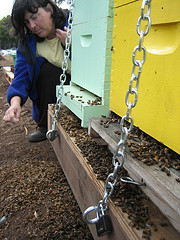
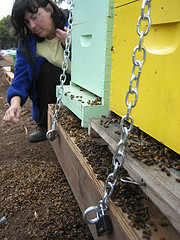
SF Bee Cause director and beekeeper extraordinaire Karen Peteros talked to the media last afternoon, as a group of reporters clustered around the sad sight of thousands of dead bees in and around two of three hives that were attacked by an unknown person who sprayed insecticide into their entrances, probably on Tuesday night.

A few of the bees were still wiggling a little, but Peteros said none of them can be saved.
“They’ve been poisoned,” she said, as a carnivorous wasp pulled at a dead bee carcass next to her feet.

“We’ll be able to salvage the bee hive boxes,” Peteros added, explaining how she’ll have to scorch and set the boxes aside for a year to make sure they are clear of poisons.

Peteros acknowledged that some folks are deadly afraid of bees, and noted that the Hayes Valley Farm had a number of interactions with a neighbor who complained about bees.
“But when fear takes over any rational consideration of science, that’s too bad,” she said.

Peteros told reporters how bees are crucial pollinators to the world’s food supply, and produce honey, which has anti-microbial properties, and propolis (the resin bees collect from trees to help glue their hive together), which is used in the cosmetics industry.

“And then there’s apitherapy, in which people get bees to sting them at the site of arthritis or other degenerative disorders, to shock their immune systems in a beneficial way.

Peteros said she is not aware of any other violence against honey bees being committed in San Francisco, other than folks perhaps kicking over hives and/or trying to steal honey.

“I’ve never heard of anyone spraying pesticide into a hive,” she said. “I get it that for some folks, a bee sting can be deadly. But bees aren’t interested in people, they are interested in flowers, and only certain flowers that produce nectar and pollen that they want. So, just because some folks are afraid of bees, mostly because they are confusing them with yellow jacket wasps which are aggressive and sting repeatedly, is no reason to exclude hives from a city, especially a city that encourages urban agriculture and therefore needs pollinators.”

Hayes Valley Farm is planning a wake for all their poor dead bees this Sunday afternoon.

“But we can’t compost them because they are contaminated with pesticide,” Peteros said.
“Bees are wildlife, wonderful creatures right in our midst,” she added. “We are trying to create transitional job opportunities based on apiculture, so folks can assist community gardens who want to attract and cultivate bees.

“We have other hives at Alemany Farm, so we can sell honey to get revenue,” she said. “If people want to contribute to help us replace the lost hives and bees, they can got to the Hayes Valley Farm website and mark their donation for bees. No amount is too small.”

Looking into the future, Peteros said the farm has a vision of getting an acre of land at McLaren Park, which has a lot of wild areas.

“The dream is to do a pollinator demonstration garden that attracts a multitude of pollinators, including bees and butterflies,” Peteros said. “And we are talking to the Friends of the Urban Forest about the ‘wildlife factor’ when they do plantings.”

Last but not least, Peteros explained why San Francisco is a particularly great city to raise and attract bees.

“It’s because of all our eucalyptus trees,” Peteros said, acknowledging that her answer likely won’t please native plant enthusiasts. “But because the blue gums bloom in December and the red gum bloom until October, there are only two months when something isn’t blooming that’s a good source of pollen and nectar.”


Board reverses mayor’s mental health cuts

9

San Francisco’s $6.5 billion budget, which the Board of Supervisors approved late Tuesday nigth, included a complete restoration of outpatient mental health services funded through the city’s Department of Public Health. The board is expected to finalize the same budget after a second reading scheduled for July 27.

The board reversed a more than $4.1 million cut to community behavioral health services proposed by Mayor Gavin Newsom in early June, which would have affected a dozen agencies and approximately 1,000 patients. As the Guardian reported on June 8, Newsom’s massive cut to the DPH would have resulted in a much greater loss to community nonprofits that leverage federal dollars from city funding to treat San Francisco’s most severely mentally ill homeless and poor.

Sup. Bevan Dufty told the Guardian he was very impressed by Citywide Case Management and Community Focus after walking rounds with one of the nonprofit’s caseworkers. Citywide is one of the San Francisco’s best performing mental health nonprofits, according to DPH reviews, and it would also have been the hardest hit under Newsom’s plan.

“It’s clear to me that this is a program that we ought to be doubling rather than cutting,” Dufty told us. “The more that people saw what they were doing, the more people would get behind what they were doing. Other cities are building models based on what Citywide Case management is doing now.”

Citywide Director Dr. David Fariello wrote the Guardian this letter about restoration of funding to his program to the Guardian: “We have good news for the supporters of Citywide Case Management and Community Focus mental health services. As you remember we were facing the prospect of 38 percent budget lose and cutting services to 240 of the severely mentally ill clients that we treat. On July 20, the Board of Supervisors voted for a full restoration of outpatient mental health services. This means that we will not need to cut services to the clients we serve.
“Your article, as well as phone calls, emails, and letters from supporters made clear to the Mayor’s Office and to the Board of Supervisors how critical our services are. Citywide/Community Focus supporters generated more input than any other budget cut issue. The Mayor restored 40 percent of our cuts, even after submitting his budget to the Board of Supervisors. Ours was the only cut to be so restored. The Board restored the remainder along with other outpatient mental health programs.
“Thank you for your support. In return, we are rededicating ourselves to providing comprehensive, cutting-edge, quality treatment to those San Franciscans at highest risk because of their mental illness.”

SF hospitality workers to protest Hyatt today

0

San Francisco hospitality workers will join hotel employees in 14 other cities across the United States and Canada today, July 22, in a protest and civil disobedience demonstration against the Hyatt Corporation. The action in San Francisco begins at Local 2 Plaza, between 3rd and 4th streets on Market, at 4 p.m. The demonstration will eventually move toward Union Square and the Grand Hyatt San Francisco hotel, organizers said.

More than 1,000 protesters are expected in San Francisco, with approximately 150 prepared to be arrested, hospitality union Unite Here Local 2 spokeswoman Riddhi Mehta told the Guardian. Tens of thousands of hotel workers are anticipated to participate in protests across North America, and more than 1,000 plan to be arrested.

The union is demanding a contract with the Hyatt Corporation that does not unduly burden middle-class workers with health care costs, Mehta said.

“The Hyatt Corporation has repeatedly said they want workers to pay hundreds of dollars per month for family medical,” Mehta told the Guardian. “Workers have sacrificed wages for decades to keep health care, to the point that their average income is $30,000 to $35,000 per year.”

Union hospitality workers have been without a contract in the city for nearly a year, resulting in an organized boycott of eight San Francisco hotels, including the three owned by the Hyatt Corporation. Union leaders criticize Hyatt’s attempts to “lock workers into recession” while the corporation has made windfall profits since the company first offered public sale of stock last November, according to the Hotel Workers Rising website.

Laura’s Law’s reactionary backers demonize progressives

23

San Francisco Chronicle columnist C.W. Nevius often gets things wrong in his columns, sometimes painfully so. Nobody’s perfect and we all make mistakes. But what’s less excusable is the fact that Chuck’s erroneous reporting, prominently presented by his newspaper, almost always serves a conservative political agenda. Even worse is that he won’t admit when he gets something wrong, even when directly confronted with accurate information – a cardinal sin for anyone who considers himself a journalist.

I experienced Chuck’s incurious intransigence at Tuesday’s Board of Supervisors meeting, the same day his column on Laura’s Law – which Sup. Michela Alioto-Pier is proposing to implement in San Francisco — appeared in the paper. Laura’s Law is a controversial measure that would allow counties to force medication and other psychiatric treatments on individuals who show signs of schizophrenia and other serious mental health issues, but who haven’t committed any crimes.

As with a Chronicle editorial the day before, Nevius took an overheated whack at progressives for not wholeheartedly supporting the measure: “Laura’s Law, which provides court-ordered mental health treatment for those individuals, is the kind of bold, breakthrough idea the city was once known to promote. But today, when it is considered by the Board of Supervisors, it will face an uphill battle. This is San Francisco at its worst, protecting small constituencies, worrying about legal consequences and letting lobbyists carry the agenda. It is an embarrassment for the city that used to know how to take a courageous stand.”

But none of that was true. The reality is that forcing treatment on mental health patients is an issue that divides that community and raises civil liberties concerns. This is an issue on which reasonable people can disagree, but Nevius’s column never aired that perspective, and it didn’t even mention that forced medication was an aspect of this law, so I asked him why and whether he understood that.

Nevius vehemently denied that forced medication was part of Laura’s Law, even though Dr. James Dillard from SF General Hospital had just testified that “medication is the single most important aspect of this care,” given that the patients involved are often exhibiting psychotic behavior, testimony on which Nevius took no notes and seemed to be playing with his phone during.

So I pulled out my own Iphone and quickly pulled up this recent article by the Chronicle’s Kevin Fagan, where the opening sentence defines the purpose of the law as “to compel the mentally ill to take medications.” Still, Nevius didn’t believe it, illogicaly quibbling over the definition of “compel,” and we stepped out into the hall to argue for a moment. There, representatives for the California Network of Mental Health Clients were gathered to oppose implementation of the law, distributing literature calling it, “an outdated, coercive, unproven, and divisive law that codifies involuntary outpatient commitment.” I left them to educate Nevius and went back inside, but after a few minutes he pulled me out to listen to one guy say that the law didn’t have strong enough teeth, thinking this supported his point. But when I asked point blank whether the law was about involuntary treatment, he agreed it was – and still Nevius wouldn’t relent.

Now, this is a complex issue, and Laura’s Law may actually be a good idea on balance. But rather than relying solely on horrific anecdotes of mentally ill people who commit crimes, as both Nevius and Alioto-Pier are doing, a smart and thorough legislative process will take into account a broad array of issues, including civil liberties concerns.

That’s what the progressive supervisors who Nevius tried to demonize did during the hearing, asking many questions for which Alioto-Pier didn’t have good answers. Dr. Mitch Katz, who runs the city’s Department of Public Health, the agency that would implement the law, opposes Laura’s Law but neither Alioto-Pier or Nevius could explain why in a way that made sense, and Katz was out of town during the hearing.

So rather than be pressured by these hyperventilating reactionaries, the board did the right thing and – over Alioto-Pier’s objections — delayed consideration of the item by two weeks, expressing support for the notion of improved pubic safety and mental health treatment, noting that the budget proposed by Mayor Gavin Newsom would have slashed mental health treatment services in the city, and asking for more information to reach a well-considered decision.

Nevius loves to paint progressives as wild-eyed ideologues who won’t listen to reason, but once again, this episode seems to show that it is this city’s so-called “moderates” that are most prone to going off on half-cocked ideological crusades using the most reactionary arguments.

Thousands of bees murdered at Hayes Valley Farm

9

Very sad news about a massive honey bee crime at Hayes Valley Farm: apparently, sometime between the late afternoons of July 19 and July 20, someone sprayed pesticide into two San Francisco Bee-Cause (SFBC) honey bee colonies at Hayes Valley Farm (HVF) and tried to do the same to a third, smaller colony, according to Karen Peteros, SFBC’s bee keeper.

Peteros reports that thousands of bees died immediately or rushed for air in the first two hives, blocking the entrance and making escape impossible. And that he third colony, maintained by Chris Burley, lost 60-70 percent of its members.

 “The distinct scent of household pesticide could be smelled around the entrance and ventilation holes of the SFBC hives, and around the piles of dead bees,” Peteros writes. “ A sample of the residue from around the ventilation holes and a sampling of the dead bees have been preserved for analysis.  A police report has been filed.”

She also reports that each of the two exterminated colonies was healthy and thriving and likely consisted of 60,000-100,000 individuals, and was set to produce 20-30 medium frames of honey which HVF planned to sell to support the work of SFBC.

It’s hard to imagine what was going through the perpetrator(s)’ heads. But whatever their motive, it seems there is a need for more education about bees in general and the vital role they play in pollination in particular—a role that helps produce one third of the world’s food supply.

Unlike wasps, which prey on spiders and ladybugs and other insects and have the ability to sting multiple times, bees are entirely vegetarian, a switch their ancestors made back in the great angiosperm explosion some 80 million years ago that produced our modern-day flowers. That switch means bees live on and raise their brood entirely from pollen (also known as bee bread) and nectar, and are unlikely to sting you, unless you approach their hives. (Could be the folks responsible for this massacre got stung quite a few times in the process of spraying all these bees, so that could be a helpful clue in tracking them down.)

But most people consistently confuse wasps, which are hairless and can sting multiple times, with bees, which are fuzzy and can only sting once, and then die, unless they happen to be the queen bee, which can sting many times.
A recent example of the general ignorance about bees were July 2 news reports that folks had been stung by “bees” at the Alameda County Fair’s fireworks show. It turned out that the insects were in fact yellow jackets, which are a type of wasp. But national news outlets repeatedly reported that bees were to blame.

Thousands of dead bees litter ground at HVF

Thousands of dead bees litter the ground at Hayes Valley Farm


Thousands of bees murdered at Hayes Valley Farm

0

Very sad news about a massive honey bee crime at Hayes Valley Farm: apparently, sometime between the late afternoons of July 19 and July 20, someone sprayed pesticide into two San Francisco Bee-Cause (SFBC) honey bee colonies at Hayes Valley Farm (HVF) and tried to do the same to a third, smaller colony, according to Karen Peteros, SFBC’s bee keeper.

Peteros reports that thousands of bees died immediately or rushed for air in the first two hives, blocking the entrance and making escape impossible. And that he third colony, maintained by Chris Burley, lost 60-70 percent of its members.

 “The distinct scent of household pesticide could be smelled around the entrance and ventilation holes of the SFBC hives, and around the piles of dead bees,” Peteros writes. “ A sample of the residue from around the ventilation holes and a sampling of the dead bees have been preserved for analysis.  A police report has been filed.”

She also reports that each of the two exterminated colonies was healthy and thriving and likely consisted of 60,000-100,000 individuals, and was set to produce 20-30 medium frames of honey which HVF planned to sell to support the work of SFBC.

It’s hard to imagine what was going through the perpetrator(s)’ heads. But whatever their motive, it seems there is a need for more education about bees in general and the vital role they play in pollination in particular—a role that helps produce one third of the world’s food supply.

Unlike wasps, which prey on spiders and ladybugs and other insects and have the ability to sting multiple times, bees are entirely vegetarian, a switch their ancestors made back in the great angiosperm explosion some 80 million years ago that produced our modern-day flowers. That switch means bees live on and raise their brood entirely from pollen (also known as bee bread) and nectar, and are unlikely to sting you, unless you approach their hives. (Could be the folks responsible for this massacre got stung quite a few times in the process of spraying all these bees, so that could be a helpful clue in tracking them down.)

But most people consistently confuse wasps, which are hairless and can sting multiple times, with bees, which are fuzzy and can only sting once, and then die, unless they happen to be the queen bee, which can sting many times.
A recent example of the general ignorance about bees were July 2 news reports that folks had been stung by “bees” at the Alameda County Fair’s fireworks show. It turned out that the insects were in fact yellow jackets, which are a type of wasp. But national news outlets repeatedly reported that bees were to blame.


Restore Hetch Hetchy throws another curveball

8

It would be lovely to be able to talk seriously about removing the dam in Hetch Hetchy Valley, to restore John Muir’s “holiest temple” and expand hiking and camping areas in Yosemite. But I’m not ready to go there right now — and to claim that giardia in the water is a good reason to dynamite O’Shaugnessy Dam is a bit beyond silly.


The Chron writes about the Restore Hetch Hetchy movement every now and then, and there’s always a lot of talk about the water system. But the paper never seems to mention the other part of the dam — it generates electricity. And it was, and remains, the lynchpin of what’s supposed to be a public power system in San Francisco.


Congress would never have allowed San Francisco to build the dam if it was just for water. The whole deal, memorialized in the Raker Act of 1913, hinged on the city using the dam for both water and power, and using the power to establish a public-power beachead in Northern California to compete against Pacific Gas and Electric Co. Tear down the dam and the city loses not only a pristine water supply but enough non-fossil-fuel electricity to power a significant part of its electricity needs.


I know that there’s a lot of controversy about large hydro as renewable power, but the dam’s already there, and I think everyone agrees that existing hydro is a better source of electricity than coal, oil, natural gas or nukes.


In a perfect world (and we’ll get there one day), San Francisco would have a municipal power system that relied entirely on solar, wind, and tidal energy. And we’d have a Bay Area water system that reduces use dramatically, recycles gray water, shifts agriculture to drought-resistant sustainable crops, replaces lawns with native ground cover and requires far less fresh-water input every year. At that point, the dam will be redundant and pointless. Bombs away.


But until we no longer rely on a privately-controlled electrical grid based on fossil-fuel and nuclear generation, we just can’t afford to lose the dam. Why the Chron never talks about that side of the equation remains one of the great mysteries of local journalism.


McGoldrick to challenge Fang for BART Board?

14

The calls are already going out: former Supervisor Jake McGoldrick ought to challenge James Fang for BART Board. Bruce Balshone reported enthusiastically on the draft Jake effort in the Examiner, and when I called McGoldrick tonight, he seemed open to the idea. After all, Fang has been on the board 20 years, is the lone Republican elected official from San Francisco — and frankly, hasn’t done much of anything important in terms of improving transit (or controlling the BART police).


I called McGoldrick tonight to ask about it, and he told me he’s open to the idea. “I’m just juggling and weighing parts of my life,” he said. “I’m a teacher, the president of a union, the president of the Richmond District Democratic Club and a grandfather.” But he added: “The one thing that’s absolutely true is that James Fang need to be replaced. It doens’t have to be me, but I’m giving it serious consideration.”


Of course, he said (in typical McGoldrick fashion) that his family has to sign off: “I finally got home after eight years at City Hall and made some soup instead of being a supe,” he said. “I asked my wife about it, and she thought I was talking about Bart Simpson or something.”


Stay tuned.

The Performant: When I die I will be offcenter

0

Scoping out the local arts and culture scene …

If there were a Best of the Bay category for performance space with the catchiest moniker, I’ve always felt that Mama Calizo’s Voice Factory had a clear lock on the title. That’s just one of the many things about the place I’ll miss when it shuts its doors, possibly for good, at the end of this month (though a loose association of affiliated artists including acting MCVF director Ernesto Sopprani, have announced their intention to continue as Theoffcenter, so look for future programming from them in an as-yet-undetermined location).

Speaking of clever monikers, for a last show in a vital location, you couldn’t ask for a better than Alicia Ohs’ dance-theatre production, “When I Die I Will be Dead.” But walking into Mama Calizo’s, instead of death’s muffled pall, a scene of lively chaos immediately unfolded. Each member of the oddience was given a number upon entering the space, split into two groups, and taught a quick dance routine that none of us mastered in the few short moments we were given to try.

As the casting director, Alicia Ohs, dressed in a white button-down short exhorted us to “Eat Nails!” we shuffled our feet and flopped our arms around lamely. Clearly Broadway bound we were not. Mercifully allowed our seats after about five minutes, the rest of the mostly comical “New York, I Love You! I Hate You…Now Dance” ensued; a “Chorus Line” send-up complete with a “One” finale. The evening’s second piece, “Dokuen,” was more nuanced. From the physical comedy of an auditionee being locked in a trunk of memories (Hana Erdman), to the raw anguish of dancers José Navarrete and Ay.Lin hurling paint at the walls, flowers across the floor, and abuse at each other, the self-revelatory vignettes spoke voluminously of loss though few words were used. The reappearance of Erdman as memory’s avatar made the act of saying farewell a study in grace—an appropriate finale for yet one more casualty in the trenches of the art wars.

Meanwhile, across town, in the crowded Café Royale, loss of life, limb, and the last tattered shreds of (in)dignity were being explored by San Francisco Theatre Pub with their free staged reading of “Ubu Roi” — adapted by company member Bennett Fisher. As the oafish would-be-king of Poland played by Sam Leichter cursed, spat, and clawed his way to the top, his power-hungry wife Mere Ubu (Catherine Lardas) gave the term Machiavellian a feminine touch as she urged him forward, then stood out of the way of his inglorious fall. Though it initially seemed that as many people came to hear the guest deejay (DJ Wait What) spin as to see the classic forerunner of absurdist theatre (overheard: “I think it’s about a king. It’s set in France.”), the café crowd soon became a cheering, catcalling, mass of enthusiastic participation. Directors of reading series take note: a spoonful of alcohol helps the medicine go down. And bartenders: a spoonful of Ubu can only help the alcohol sales go up.

Café Royale
800 Post, SF
(415) 441-4099
www.caferoyale-sf.com
sftheaterpub.wordpress.com

Sunset for Suncal in Alameda

0

Alameda Island resident and community organizer Gretchen Lipow says the effort to oust developer SunCal, which threatened to sue the city last night when it was clear the jig was up, began two years ago.

“We divided the city into grids and went out and walked the streets, starting when SunCal brought their initiative out,” Lipow recalled, referring to Measure B.

SunCal, which was Alameda chose in 2007, after other developers including Lennar pulled out of the competition to be the island’s next master developer, succeeded in alienating many city residents, when it introduced Measure B, which included multiunit housing, a provision that violated a 1973 law banning anything larger than a duplex on the island.

And SunCal then succeeded in alienating city staff over its failure to provide promised transit plans and financing details, as the Measure B vote approached. In the end, Alameda Mayor Beverly Johnson and Councilmember Frank Matarrese both withdrew their support for SunCal’s measure, which bombed in February, losing by 85 percent.

Meanwhile, Lipow and other community members began working on an alternate plan, in recognition that it’s hard to fight a plan if you don’t have a counter plan in its place.

“I won’t call it a vision because that word has become horribly abused in this process, but we have been working on an alternate idea that we felt was much more compatible with the nature and land out there, in what is a somewhat isolated area,” Lipow said.

She recalls how at the time the community first got together to fight SunCal, the developer had not yet put what she calls “their anti-slow growth measure” on the ballot, but that when they did, the move only helped to crystallize all that was wrong with the developer’s approach.

“They tried to take the political decision-making out of the hands of the city,” Lipow said. “Talk about a land grab.”

Lipow says the community she represents did not agree with the developer’s “vision” for the former Alameda Naval Air Station.
“We do not see it as a condo village,” Lipow said. “That makes no sense. It’s a Superfund site that is still being cleaned up.”

Lipow said that along the way, folks on Alameda Island began to ask who was going to pay for SunCal’s proposed redevelopment plan—and realized that payment for a plan they didn’t want was going to end up coming out of their own pocket, and yet, there was little certainty if anything would ever end up being built.

“It’s all based on redevelopment bonds and speculation,” Lipow said. “And we see what’s going on in San Francisco, where the city is now saying they can’t get anyone to invest in the [Candlestick Point-Shipyard] deal.”

Lipow recalls how the community investigated SunCal.

“We found that its financial background is abhorrent,” Lipow said. “Since 2008, SunCal has filed about 30 bankruptcies and there are a hundred lawsuits against them. They collapsed with Lehman Brothers.”

Lipow points to a disturbing lack of information about SunCal’s financial partner, D. E. Shaw, who allegedly runs an underground hedge fund.

“No one knows this guy,” Lipow said. “There has never been on a single piece of correspondence between Shaw and the city.”

Asked if Alameda’s ouster of SunCal opens the door to other and perhaps equally spurious developers, Lipow said, “The community is now organized enough to have meetings, and we understand we need to come up with something.”

Redevelopment requires “duty of loyalty” from Arc Ecology

0

As a longtime member of the Mayor’s Hunters Point Shipyard Citizens Advisory Committee (CAC), Scott Madison took exception to a “duty of loyalty” clause in Arc Ecology’s most recent contract with the Redevelopment Agency.

This new requirement in Arc’s contract came up for discussion during the CAC’s July 12 meeting, Madison said.The rest of CAC did not rise up in support of his concerns, Madison adds. But he is convinced the requirement will harm the community that surrounds the 770-acre area that the city and Lennar want to develop with their massive Candlestick-Shipyard redevelopment plan.

The Board of Supervisors will consider that plan at their July 27 meeting, along with suggestions that Arc and the Sierra Club have been making for years. These suggestions include strengthening the terms governing the transfer of Parcel E-2, the most polluted shipyard site, and removing what Arc and the Sierra Club believe is an unnecessary bridge over the environmentally sensitive Yosemite Slough.

Arc has been monitoring the environmental impacts of the shipyard since 1984, and has provided neighborhood groups with information and technical support related to cleanup and redevelopment since 1986. And more recently, Arc Ecology opened a “community window on the shipyard cleanup” on Third Street, which is also accessible online, to provide information and resources for more meaningful community involvement in the cleanup.

Arc hosts environmental education discussions and community workshops and submits written comments to the Navy about the cleanup and to appropriate agencies on related shipyard redevelopment and reuse plans.

“We are working with the BVHP community to ensure that the transfer, redevelopment, and reuse are to the maximum benefit of the neighboring community,” Arc’s website states.

But in the past few years, as Lennar’s political Candlestick-Shipyard juggernaut has been gathering speed, Arc has ruffled feathers in the Mayor’s Office by developing Alternatives For Study, a document that explores detailed alternativesto the current Candlestick-Shipyard plan.

None of ARC’s alternatives are opposed to the development, but they all suggest ways to improve it, including an option that would not involve building a bridge over the slough, or a stadium on the shipyard, and would prevent the taking of 23 acres of state park land which Lennar wants so it can build luxury waterfront condos in the middle of the current Candlestick Point State Recreation Area, a plan that would be unthinkable if it was proposed for Crissy Field.

But the city, and in particular Michael Cohen, Mayor Gavin Newsom’s top economic advisor, view these alternatives, as signs of disloyalty, as they seek to rush Lennar’s massive 770-acre redevelopment plan over the finishing line, while arguing that any further amendments will make the plan more difficult for Lennar to shop around to investors, especially in light of the depressed economy.

The growing coziness between the city and the developer was put on full public display last week, when Sup. David Campos asked the project’s proponents to step forward at the Board’s July 13 hearing on the project’s EIR.

As Lennar Urban’s Kofi Bonner began to rise from his seat in the public seating area, Cohen, who had just finished answering Campos’ questions about the bridge and the project’s financing liabilities from the city’s bullpen in the Board’s chambers, raced over to the podium before Bonner had a chance to speak.

This uneasy closeness between city and developer, along with Arc’s extensive background in shipyard related matters, are why Madison believes the city’s residents are best served when Arc can express its opinions freely, even if that involves critiquing plans that the city seems to have grown increasingly defensive about, ever since it entered into a partnership with the Florida-based Lennar.

“Yes, it’s true that the city is paying for this contract with Arc, but it seems to me that this particular contractor’s responsibility should be primarily to the Citizen’s Advisory Committee, and not the city,” Madison said. “What if Arc reaches a conclusion that is odd with the developer, city agencies and other consultants? Would Arc be prohibited from making it public?”

Madison says the city has claimed that Arc would not be prohibited from such activities, and that the contract contains standard language. But he also adds that certain parties who are boosters for the city’s redevelopment plan object to what Arc and Bloom are doing in terms of raising valid science-based concerns.

“At the meeting, Al Norman said he hopes the Redevelopment Agency handcuffs Saul, not just by the hands but by the ankles,” Madison claimed.

And Bloom said that after his group made a video of him walking around wearing a “Can I buy your park?” billboard to illustrate what Lennar’s plan will do to the only state park in San Francisco, he was told that if Willie Brown was still mayor, Arc would have lost its contract, and all department heads who had been supportive of awarding it to Arc, would have been fired, too

Bloom notes that under Mayor Brown, he was awarded several contracts and helped author Prop. P, the measure that voters approved in 2000, which called upon the Navy to clean up the shipyard to the highest levels practical.

“Even Willie understood the need for balance,” Bloom said.
 
Bloom protested the city’s “duty of loyalty” requirement at the CAC’s July 12 meeting, but has apparently decided that the clause isn’t an insurmountable obstacle, because he has apparently since signed the contract. UPDATE: I just spoke to Bloom who told me that he has not yet signed the contract and is still working to get Redevelopment to see the problem with this requirement.

“At the CAC meeting, the committee endorsed the proposal to give us the contract,” Bloom explained. “But it’s up to the Redevelopment Commission to approve the contract, something they are set to consider at their September 7 meeting. We are making the argument that they need to think about the contract in broader terms.”

And Madison notes that it’s common sense that if you want a truly independent voice advising Redevelopment on the shipyard cleanup plan, then that voice should be allowed to be genuinely independent.

“The fact that the city is paying the bill for the contract shouldn’t require an organization to sign an extraordinary Duty of Loyalty, which conflicts with its true loyalty to the surrounding community,” Madison said.

The Guardian’s recent immediate disclosure request to Redevelopment should reveal the exact terms of Arc’s Duty of Loyalty requirement. And Matt Dorsey, spokesperson for the City Attorney’s Office says such clauses are rare.

“We are unaware of any confidentiality requirements being made, except in very rare circumstances, such as contracts related to the airport where there may be terrorist concerns,” Dorsey said. Stay tuned.

San Francisco Jewish Film Festival: “Protektor” and “A Small Act”

0

(For more on the San Francisco Jewish Film Festival, check out the two articles in this week’s Guardian.)

Protektor (Marek Najbrt, Czech Republic, 2009) Marek Najbrt’s pomo period piece — spiced by switches from color to monochrome, soundtracked DJ mashups, and other bendy tropes — provides an elegant yet energetic reprise of some familiar themes. Rising Czech film actress Hana (Jana Plodkova) refuses to leave Prague despite the considerable danger posed by her (secret) Jewish identity. Husband Emil (Marek Daniel) is a popular radio host who struggles to protect her as he nonetheless rises in favor under the wartime Nazi “protectorate.” But Hana proves uncontrollable as wife and (eventually boycotted) thespian, unable to keep her libido or boredom safely wrapped. And Emil’s bosses soon enforce a cruel choice. Protektor is self-conscious, but also surprising — the highly stylized presentation lends what could have played as an ordinary, earnest victim scenario an edge more seductive than distracting. Mon/26, Castro, 4:30 p.m.; Sat/31, 9:45 p.m., Roda. (Dennis Harvey)

http://www.youtube.com/watch?v=mk_5Oi5PFzs

A Small Act (Jennifer Arnold, United States, 2009) Ain’t gonna lie — I settled in to watch A Small Act thinking I’d be bored by a well-intentioned but manipulatively “uplifting” story. Boy, was I wrong. This is a complex, layered tale that features all the elements a compelling documentary requires, starting with its fascinating subjects. Born into poverty, Kenyan youth Chris Mburu was able to pursue his education thanks to Hilde Back, a Swedish woman who donated a few dollars a month to sponsor his education. Though they’d never met, he could not forgot the stranger who’d enabled him to finish high school (he ended up going to college, then Harvard Law School, and now has a prestigious job at the United Nations). Years later, Mburu named a foundation after Beck to give scholarships — and hope for a future beyond teenage pregnancy and a life of back-breaking labor — to Kenyan kids from his home village. Now, the joyful moment where Mburu and Beck meet for the first time comes pretty early in the film, which is when I realized that filmmaker Jennifer Arnold was going to dig way deeper with her doc than I originally suspected. First, there’s a whole plot thread about three bright kids who are frantically studying to take Kenya’s national exam (high marks would qualify them for one of Mburu’s scholarships), plus one about Beck’s life in Sweden (and her past as a Holocaust survivor), plus yet another about post-election unrest in Kenya that threatens not just the children we’ve met in the movie, but Mburu’s own family. It all unfolds with the urgency of real life, and the message that emerges is summed up best by Mburu: “Education is a life and death issue.” Sat/24, Castro, 11 a.m.; Sat/31, CineArts, noon; Aug 5, Roda, 4:30 p.m.; Aug 8, Rafael, noon. (Cheryl Eddy)

The 30th San Francisco Jewish Film Festival runs July 24-Aug 9 at the Castro, 429 Castro, SF; Roda Theatre, 2025 Addison, Berk; CineArts@Palo Alto Square, 3000 El Camino Real Bldg Six, Palo Alto; and Christopher B. Smith Rafael Film Center, 118 Fourth St, San Rafael. Tickets (most shows $11) are available by calling (415) 256-TIXX or visiting www.sfjff.org.

Newsom’s extortion

3

The mayor really wanted the supervisors to get rid of two reform measures that would have shifted to the board some of the appointments to the Recreation and Park Commission and Municipal Transportation Agency. The landlords really wanted the board to scrap a plan to reform the Rent Board. And both got exactly what they wanted.


I agree that the budget has some good news, that Newsom has agreed to fund more than $40 million worth of necessary services that he initially wanted to cut. But the price was high: The supervisors had to go along with Newsom’s attempt to undermine structural reforms at two city agencies. The mayor essentially held the board hostage: If he didn’t get his way on issues totally unrelated to the budget, then he’d refuse to pay for a long list of things that the supes wanted. (And these weren’t pet projects of board members; we’re talking about life-saving essential services. The mayor in effect said that he’d allow desperately sick people to die on the streets for lack of a bed at SF General if the board tried to take away his ability to pack Rec-Park and MTA with his favorite political hacks. Sweet guy, huh?)


Is balanced representation on two important city agencies worth the price of $43 million in cuts to essential programs? That’s a nasty question, and the mayor put the board in a very bad position. In the end, the supes could have stood up to his extortion, and didn’t.


Meanwhile, the landlords threatened to spend millions to defeat a measure reforming the Rent Board — and then they threatened to also pour money in to supporting Public Defender Jeff Adachi’s pension measure, which labor is really nervous about. And there was always the implied threat that landlord money would go into the district supervisor races. So progressives decided that they couldn’t win that battle and the rent board measure died


And, of course, Newsom’s sit-lie law and his plan to kick members of the Board of Supervisors (but not himself) off the Democratic County Central Committee are both still on the ballot. He didn’t give up a thing.


So the landlords and the mayor won this round, but the supes can still fight back. What Newsom did was unconscionable; it’s not as if he was negotiating a tax hike measure against cuts, or a measure that would have mandated new spending against reductions somewhere else. He took two items that had nothing to do with finance and made them bargaining chips in the budget discussions.  If the supervisors did that, they’d be violating state law, which forbids vote trading.


So what San Francisco needs now is a law that bars the chief executive from vote-trading, too. Let’s get that introduced and approved — and see if Newsom wants to veto it.

According to Matthew

0

It is an understatement to say that the work of Matthew Barney elicits strong reactions. Critics have alternately hailed him as “the most important American artist of his generation” (that’s the New York Times’ Michael Kimmelman) and complained of his art’s Wagnerian grandiosity, needless inscrutability, pretentiousness, and icy perfection (“loveless” was one of the words the San Francisco Chronicle’s Kenneth Baker used to describe “Drawing Restraint 9,” Barney’s 2006 show at SFMOMA).

As someone whose initial infatuation with Barney’s work is increasingly tempered by skepticism, I think there is truth to both camps. You’ll be able to deliver — or perhaps revise — your own verdict at the Roxie Theater, which is presenting all 7.5 hours of the epic Cremaster Cycle (1995-2002), Barney’s five-part, officially-never-gonna-be-available-on-commercial-DVD magnum opus. The theater is also screening De Lama Lâmina, Barney’s near hour-long 2004 film, in which he collaborates with a Brazilian Carnaval krewe to orchestrate a performance aboard a float in Salvador da Bahia’s annual parade.

Barney’s art becomes increasingly frustrating and seductive the longer one attempts to decode its carefully staged and indisputably visually stunning pageantry, which encompasses death metal covers of Johnny Cash, the esoteric intricacies of Masonic symbolism, Busby Berkeley-style revues in football stadiums, androgynous water sprites, and the complex biology of sexual differentiation in the fetus (the series is named after the muscle that controls the descent of the testes). The one constant is Barney’s display of his body: frequently nearly-nude, but more often subject to some physically demanding ordeal or engaged in an athletic feat.

As Daniel Birnbaum astutely observes in Artforum, “Barney is a believer in ‘the meaning of meaning.'” Which is to say, nothing is done just for show in Barney’s world, even if the systems of meaning he draws upon — developmental biology, Celtic mythology, Mormonism, minimalist sculpture — are themselves enclosed within, and at times frustratingly occluded by, his art’s glossy packaging and Hollywood-level production values. It’s hard not to ask: what does it all mean? But the question easily gets lost within the Cremaster Cycle‘s lavishly appointed echo chambers.

That said, Barney’s art offers no shortage of beautiful moments and otherworldly imagery. His universe encompasses elegance (Aimee Mullins as a gorgeous cheetah woman in Cremaster 3) and horror (the conception scene early on in Cremaster 2). Whether or not all this beauty is truth is still up for debate.


THE ODD COUPLE

Robert Koch Gallery is currently home to quite the odd couple. From the 1960s to 1985, Czech artist Miroslav Tichy, formerly a painter, took thousands of surreptitious pictures of women in his hometown of Kyjov using various homemade cameras made from whatever was on hand: cardboard tubes, wood, sanded Plexiglass lenses.

The photographs — creased, badly printed, all in soft focus — are as dreamy as they are creepy: Tichy often cropped off the heads of his unknowing subjects (many of whom are in swimwear), leaving their identities anonymous while reducing them to bared legs and torsos. Despite their aura of timelessness, you feel dirty looking at Tichy’s photos. It’s hard, though, not to keep staring.

Plenty of isolated gams appear in the work of Hungarian artist Foto Ada, also at Koch, but the effect is far less sinister. Ada (maiden name, Ada Ackermann, married name, Elemérné Marsovsky) created her remarkable photo-collages from the late 1930s through World War II, clipping magazine and newspaper images of soldiers, Hollywood starlets, and industrial landscapes into sharp and humorous comments on the accelerated culture of her time. The Nazis, in particular, gets theirs: Hitler and Goebbels converse in skeleton-filled catacombs, appropriately oblivious to the death that surrounds them.

THE CREMASTER CYCLE PLUS DE LAMA LÂMINA

July 30– Aug. 8, $5–$9.75

Roxie Theater

3117 16th St., SF

(415) 863-1087

www.roxie.com

MIROSLAV TICHY + FOTO ADA

Through Aug. 21, free

Robert Koch Gallery

49 Geary, SF

(415) 421-0122

www.kochgallery.com


Fantasy island

3

johnny@sfbg.com

MUSIC The Aunt Charlie’s in the video for Myles Cooper‘s song “Gonna Find Boyfriends Today” is a massive tree with a vagina dentata doorway where cupcakes, eggs, top-hatted Mr. Peanuts and white-gloved strawberries dance, while Muppets sing a chorus. Nestled in the tenderest spot of the city’s loins, just off Market Street, the Aunt Charlie’s of San Francisco is a different place, but not really. One night a week, it’s the site of High Fantasy, a club hosted by Cooper and Alexis Penney that — as Cooper says — “belongs to the fantasies of those who come and need to imagine and party.”

Aunt Charlie’s is also one nexus of a mini-movement of sorts of truly new gay pop music in 2010. Witty, both ironic and utterly sincere, and catchier than any mega-production you might hear on the radio, Cooper’s bedroom reggaeton — or, to use his phrase, digital dancehall — debut single is one of its anthems. “I made a YouTube video to remember the song when I wrote it,” he explains, when asked about “Gonna Find Boyfriends Today”‘s genesis. “I still have it. I was on Ambien late at night. The writing took like 30 seconds, but coming up with the chord changes and sound was more cognitive. I was listening to ‘Supermodel,’ the Rupaul song, and the first line is ripped off from it.”

Decked out in gonzo cartoon cover art by Skye Thorstenson, who made the song’s video, “Gonna Find Boyfriends Today” has just been released as a 7-inch single by Transparent in England, where the fabled weekly New Musical Express recently placed Cooper ninth on a list of “The 50 Most Fearless People in Music,” one spot below Lady Gaga. Tonight, the fearless man with the brush cut and Mr. Rogers attire is camped out a table at Aunt Charlie’s, where DJ Bus Station John is prepping for his weekly night, Tubesteak Connection. “Bus Station, where is my boyfriend tonight?,” a regular calls out from the bar. “Oh, she’s around,” John answers.

Cooper is about to go on a summer trip to Chicago, then Africa, then Chicago again. Two nights before, at High Fantasy, a chorus of four performers serenaded him with Toto’s “Africa.” “I felt like somebody cared,” he says, with characteristic low-key geniality. Many people travel to Africa, but not many make music videos with close relatives during the trip — that’s Cooper’s goal. “I’m writing a song, an anthem called ‘You’ve Got to Love Your Family’,” he says. “I don’t always get along with my family, and I feel like this is a test. It’ll be funny to do the video with them lip-syncing the song. We’ll be on safari, and it’ll capture my family’s funny interaction with me. My mom never wants to be on camera.”

It’s this kind of true directness and simple originality that likely inspired NME to deem Cooper one of the 10 most fearless musicians on the globe. His surface appearance of intense normalcy is paired with wild creativity. “I got these shoes because they kind of remind me of a Noe Valley 50-year-old in a way that’s sexy to me,” he says, pointing down to his feet. “My fashion choices are perverse and I like to be in costume.” At High Fantasy, that costume might include a glitter-encrusted Bart Simpson T-shirt with Tupac tattooed on Bart’s stomach. At a Lilith Fair-inspired drag night he once put on at The Stud, his look included “a flannel skirt and a dolphin airbrushed on my ankle and and really ugly Doc Marten sandals and a tie-dyed shirt and gross curly wig.”

Cooper’s look and outlook has some connections to a recent day gig working with boys and girls aged 5 and 6. There might be moments where he wishes some kids’ face were an iPad so he can create or communicate on the job, but there’s an honest and committed through-line between his daytime life and nightlife. A recent show by his group Myles Cooper USA included giant acid house yellow smiley faces that were painted by the kids. He says he recently gave them a fashion poll: which label is better, Ed Hardy or Baby Phat? Baby Phat won by one vote, cast by him (“I like the cat on the logo”).

Cooper used to play in the Passionistas, a three-piece that put out one excellent pop-punk album in 2007 before disbanding. Going solo allows him to edit himself while giving his imagination free rein. That means he can incorporate his visits to Chicago (and greater journey to and from the Windy City and Africa) into the music he’s making today; the city is where he filmed the video for his next single, “Hair,” a many-voiced delight that places him alongside Morrissey and Jens Lekman in the hairdo-song hall of fame. “House music has always been a mysterious thing to me, because I’ve always thought of it as this perfected music that wasn’t made by people,” he says, when asked about the sound of Chicago. “I don’t think that anymore, I see how human it is. Even if the people I see are just playing records, I want to see what tempo they are, what key they’re in, what people are doing as they hear the music, and what they’re looking like when they do it.”


BIG LOVE

“I had a crush on Myles for a while, I thought he was so hot and the perfect boyfriend for me,” Alexis Penney says at Aunt Charlie’s. It’s a few weeks later, and Penney is prepping the bar for another night of High Fantasy. We’ve met at the apartment she shares with Dade Elderon of Party Effects, where she puts Band-Aids in a pair of high-heeled shoes before we head out, a little move that seems especially necessary less than half an hour later, when she’s scaling — quickly and faultlessly — a wooden ladder-like staircase to find and gather decorations. “The trick to having a club is that you have to go out a lot, so people know you,” Penney declares, gathering and arranging a train of white tulle that’s just long enough for the Bride of Godzilla.

Thing is, Penney — who grew High Fantasy out of Thing, a night she put on with Seth Bogart of Hunx and His Punx — shouldn’t necessarily need to go out to be known. Her first recording, “Lonely Sea,” produced by Nick Weiss of Teengirl Fantasy, could be the number one hit of 2010 for anyone who ever had a heart. Like Cooper’s “Gonna Find Boyfriends Today,” it takes touchstones of gay pop past — in this case, the churchy keyboard sounds and insistent crossover house beat of songs like “Supermodel” and Crystal Waters’ “Gypsy Woman” — and adds some plaintive MIDI saxophone sounds at just the right moment, while wedding it to a beautifully frank and completely modern vocal about a broken relationship.

Penney is a busy girl. She edits, writes and photographs for SORE, an online magazine that captures San Francisco gay nightlife. SORE was born in Kansas City, where Penney is from, when she and a friend named Roy and Cody Critcheloe from the group SSION decided they wanted “a sort of punk answer” to the popular lifestyle magazine BUTT. “I photograph things because I think they look funny, I don’t do it because it’s nightlife photography,” Penney says, bunching a ball of electric blue tulle into a ball against the back wall of the bar. “My ultimate fantasy for SORE, which will never happen, would be for it to be a print magazine. None of this ‘We talk about sex, but we make $100,000 a year’ material. Real gay life.”

Penney’s gay life, buoyed by friends like Monistat, is realer than most. “I wander around in my T-shirt and jeans a lot in the daytime, that’s normal,” she says. “But I needed to challenge myself with fashion. And [cross-dressing] went in line with the fact that I was dating someone [Bogart] who owned a vintage store. We were constantly thrifting and I had so much clothing at my disposal. I decided I’d just wear a bra, because you just don’t see a guy wearing a bra. Or I’d wear a bra and a lift, or a really slutty cocktail dress. I dress in women’s clothes interchangeably. I don’t trip about it. As much as people in SF say they’re trans-friendly, people really trip about gender. A lot of drag queens, they’re in or they’re out. I don’t even care.”

True. Except in Penney’s case, not caring is actually caring more than most people have the guts to in a society where every micro-subculture seems to breed conformity. It’s this directness, different from Cooper’s, or Bogart’s flirty and radically seductive candor, that distinguishes the music that Penney has made so far with Weiss. “I instantly felt a musical connection with Alexis, and the shine of her confident aura,” Weiss writes, when asked about first meeting Penney and the making of “Lonely Sea.” “My celebratory buoyant house beat mixed with Alexis’ love-lost lyrics so instantly I knew we had a hit.”

Both Penney and Bogart (as H.U.N.X.) have been recording with Weiss, and the results are everything from moving (“Lonely Sea”) and slinky and ebulliently powerful (Penney’s “Like the Devil”, the sun to “Lonely Sea”‘s elemental moon, and every bit its equal) to sexy in an existentially lonely way (H.U.N.X.’s “Can A Man Hear Me”) and hilarious (H.U.N.X.’s vampire cruising track “I Vant to Suck Your Cock”). For the prodigious Weiss, the connection to Penney might go back to a shared childhood love of Annie Lennox, particularly her 1992 album Diva. “Seth and Alexis are both really hyper-specific about what they’re going for,” he says, breaking down the collaborations. “Seth likes to work really fast and doesn’t usually go over two takes on a song. Alexis likes to throw out tons of reference points while we’re writing: ‘Give me something a little more trip hop-acid-tropical-wave-current please! And could you make it a little more world?'”

“Myles [Cooper] and I nerd out over music and songwriting over text message. He’s totally a visionary,” Weiss goes on to enthuse. In the separate but connected sounds of Cooper, Penney, H.U.N.X. and Teengirl Fantasy, all the wonderful gender-blur and sexuality of 1992 — when Lennox went solo and Boy George burst back into the limelight via The Crying Game — are remade anew, at a time when lifestyles feels like strait-jackets. There is inspiration to be taken from these artists’ love and support for one another on a daily and a big-picture basis. It’s the kind of force that can make changes within a broader culture, at least on small, rippling levels. This is gay pop in 2010: not striking mannered classic gay or rock poses, but instead allowing fabulous and tricky versions of one’s self to manifest and bloom.

“I could talk for days about nothing,” Penney says at one point, just before another night of High Fantasy begins. But really, she has something to say: “My relationship with music is that if I can’t connect emotionally with it, I just don’t like it.” And another thing: “I get really messy and really wasted but I always know where I’m at and who I am.” And another: “I always respect the person who you remember from the party. I want to be irreverent and confident enough to look like a freak.” And another: “Everyone wants to be something, but not everyone admits it to themselves.” And yet another: “I’m 23, I’ve tried every drug, I’ve never said no to sex, and here I am — I’m totally crazy.”

And — what the hell — one more thing: “I’ve got a lot to give. I’ve got a big heart, and a big boner.”

www.mylescooper.com
www.myspace.com/alexispenneymusic
www.myspace.com/gayestmusicever
www.myspace.com/mylescooper

Tough stuff

0

SAN FRANCISCO JEWISH FILM FESTIVAL Jews are not thugz, an assumption only affirmed when they commit crimes of financial-sector greed (Bernie Madoff). Jews involved in violent Godfather-style mayhem? That flies so against cultural-cliché winds as to seem inherently ridiculous.

Yet Jewish gangs battled Irish and Italian ones for turn-of-the-19th-century Manhattan turf. During Prohibition, they became more businesslike, expanded reach, and powered hitman outfit Murder Incorporated, even brokering syndicate cooperation between hitherto rivalrous “yids and dagos.”

Needless to say, such activities embarrassed mainstream Jews, providing ammo to anti-Semites. But movies seldom portrayed that reality. Hollywood has traditionally been reluctant to embrace the J-word or identity, despite Jewish artists and entrepreneurs’ huge industry contributions from earliest days. The same studio heads who imitated upper-crust goyim lifestyles and Anglicized Jewish stars’ backgrounds were disinclined to let their rare screen representations encompass machine guns and shakedowns.

Curated by former programming director Nancy Fishman, “Tough Guys: Images of Jewish Gangsters in Film” reprises a few times that policy of polite cinematic omission was lifted. Two features showcased are familiar: Howard Hawks’ original 1932 Scarface is included because it “would have had a Jewish subtext” for audiences familiar with star Paul Muni’s Yiddish theater work. Barry Levinson’s 1991 Bugsy has dithery Warren Beatty as pioneering Vegas mobster Siegel, in a soft-focus biopic with swank but little danger.

Two more, however, are seldom-revived B flicks providing pulpy fun. Pre-Fugitive TV star David Janssen plays a real-life gambler-bootlegger in 1961’s King of the Roaring 20s: The Story of Arnold Rothstein. His Rothstein grows up poor and rebellious (dad blames “a dybbuk in him”) alongside BFF Johnny (Mickey Rooney), whom he eventually betrays because winners don’t drag losers up the success ladder. There’s a steep fall for both.

Lepke (1975) has Tony Curtis in one of his edgier roles as Louis Bechalter, sole U.S. mob boss to be executed. A union racketeer turned mob assassin, he gets married in a formal “Heeb wedding,” as Italian-American gangster pals put it. There’s also a scene placing bizarre emphasis on bagels. Uninspired but entertaining Lepke was a relatively prestigious endeavor from Israeli director Menahem Golan, later the ledger-shuffling Cannon Group tycoon responsible for such marvels as 1984’s Breakin’ 2: Electric Boogaloo. This series asks if Jewish gangster films are “good for the Jews.” Was Golan? Dunno, but he’s been great for cinematic camp.

Bringing out the dead

4

arts@sfbg.com

SAN FRANCISCO JEWISH FILM FESTIVAL The question of how to represent the Holocaust is one that rightly haunts film history — rightly, because it was the Nazis themselves who most rigorously documented their destruction of Europe’s Jews, and thus it is to the Nazis that any filmmaker incorporating archival evidence owes a dubious debt. Certainly, documentary contemplations of the Holocaust have been instrumental not only to our philosophical understanding of the history, but also to the development of documentary form itself (I’m thinking of 1955’s Night and Fog, 1985’s Shoah, 1969’s The Sorrow and the Pity, and, less readily available, the works of Abraham Ravett and Péter Forgács). But given the relative invisibility of more recent genocides and the political inflection of what Norman Finkelstein uncharitably calls the "Holocaust Industry," it seems clear that a contemporary work needs a more dimensional rationale than "never forget."

The 30th San Francisco Jewish Film Festival includes several documentaries that at least peripherally touch on the Holocaust, but two are particularly ambitious: Einsatzgruppen: The Death Brigades and A Film Unfinished. The former is an exhaustive cataloging of the Nazi execution squads’ brutal charge to render the Eastern front: Judenfrei, incorporating textbook history, eyewitness accounts (adhering to Shoah‘s trifurcated structure of Jewish survivors, local collaborators and onlookers, and former Nazis on hidden camera), and an unrelenting case of archive fever. The same color footage of starving Jewish children we see in Einsatzgruppen washes up in Yael Hersonski’s A Film Unfinished, but here it’s the provenance of these images, filmed by Nazis in the Warsaw Ghetto, that’s being scrutinized.

Director Michael Prazan is primarily interested in how the Einsatzgruppen’s killing was done. This leaves plenty to sort out during the film’s three hours, especially given the still contentious issue of local collaboration — a Ukrainian woman he interviews movingly conveys the shattering realization that the murderers who spoke her language so well were indeed her people. But in Einsatzgruppen, eyewitness accounts like these are tangential to the grand historical perspective glued together by voice-over and traumatic archival images (Claude Lanzmann assiduously avoided both in Shoah). The voice-over speaks from nowhere, while the images of bloody pogroms and fresh corpses viewed from the vantage point of their killers are merely speechless.

Reappropriating Nazi propaganda is an old story — Frank Capra grabbed some of Triumph of the Will (1935) for Why We Fight (1943-1945), as does director John Keith Wasson at the beginning of his fine SFJFF film, Surviving Hitler: A Love Story. Contrary though the meanings may be, it’s difficult to sidestep the totalizing operation of propaganda. Keenly aware of this epistemological trouble, A Film Unfinished‘s Hersonski does everything she can to address Nazi footage in its specificity. Her coordination of primary documents is breathtaking, aligning the Nazi reels with the descriptive (and at times deconstructive) diaries of ghetto inhabitants and the court testimony of one of the cameramen. The invocatory effect acknowledges the gaps of the visible history as it articulates its layers. Hersonski is similarly clever in staging her interviews: she films survivors watching the reels in darkened theaters, alone, offering comments and startling yelps of recognition ("Oy, I knew that woman!")

Before a contemporary filmmaker leans on horrific archival images as self-evident documents, he or she really ought to see the clip in A Film Unfinished of Jewish prisoners being rounded up for a film shoot, terrified that they were being led to slaughter — which they were, of course. The filming was a rehearsal for the murders, and, as Einsatzgruppen shows us ad nauseam, the camera was occasionally present for the final moments as well. The death brigade’s supervisorial role in the Eastern European killings afforded them their "objective" camera positions — a fact that should give any well-meaning documentarian pause.

SAN FRANCISCO JEWISH FILM FESTIVAL

July 14–Aug. 9, most shows $11

Castro, 429 Castro, SF; Roda Theatre, 2025 Addison, Berk; CineArts@Palo Alto Square, 3000 El Camino Real Bldg Six, Palo Alto; Christopher B. Smith Rafael Film Center, 118 Fourth St., San Rafael

(415) 256-TIXX

www.sfjff.org

Here’s lookin’ at you, Vic

1

cheryl@sfbg.com

FILM Ah, Friday night at the movies: chatty mobs, unable to detach from their smart phones or fathom seeing a movie that isn’t both brand-new and unnecessarily 3-D’d. With such a bummer scene in the outside world, might as well stay home and watch edited-for-TV Seagal flicks on TBS, right?

Insert screeching needle-on-a-record sound here. Third option: head to one of the city’s most offbeat repertory theaters, collectively-run Haight Street landmark the Red Vic, which celebrates its 30th birthday this week.

“So often we hear people say, ‘Oh, we love the Red Vic! But we haven’t been there in years,'” collective member Claudia Lehan says. “That’s our biggest joke. We’re still here, we’re hanging in, but we need people to come to the movies. We’re doing our best to provide what people want.”

For the past three decades, that has meant a unique space (bench-style seating; organic popcorn and home-baked treats) with programming that reflects the theater’s eclectic spirit. Along with films skating the gap between first-run cineplex and DVD (Kick-Ass, The Runaways), a recent Red Vic calendar also lists the Burning Man Film Festival, local-interest doc It Came From Kuchar, a surf-movie night, a San Francisco Museum and Historical Society-presented program on the Haight, and the cult classic Freaks (1932).

“I think we’re a unique night out,” Lehan says. “The whole experience — the movie itself, it’s such an intimate theater, and it’s community-based.”

On a recent afternoon, I met with current collective members Lehan, Jack Rix, and Susie Bell; the fourth and newest member, Sam Sharkey (who late-night movie fans will know from Landmark Theatres), was out of town. Also joining us was Jack’s wife, Betsy Rix; she, along with Jack, Brad Reed, and Terry Seefeld, cofounded the Red Vic in 1980, with the help of other key players, including Martha Beck (who appears in the Red Vic’s adorable pre-show trailer) and Gary Aaronson.


RED HEADS

“We were all door-to-door canvassers in the ’70s,” Betsy remembers. “We’d go out after, and say, ‘There’s gotta be something better out there for us to do.’ We started thinking about starting a business together: a bookstore, or a movie theater. Movie theater seemed like a really good idea. At that time, there was a thriving repertory scene. We talked right away about having couches, nondisposable popcorn bowls — just to make it a totally different kind of movie theater. We plugged away on the idea for over a year.”

After some scouting, the group found its first venue, just down the street from its current location at 1727 Haight. “The Red Victorian Bed and Breakfast had an international marketplace that was closing up. It was a great big space,” Betsy says. “We got a lease for 10 years and renovated it.”

Visit the Red Vic’s cozy lobby, and you’ll see their first calendar hanging on the wall. You might be fooled into thinking the theater opened in 1980 on July 14, with a screening of the 1942 classic Casablanca. That was the original plan — until all of the projection equipment was stolen. Fortunately, the group was insured, but they had to delay their debut until new equipment could be ordered. When it arrived, they opened with the film scheduled for that day, July 25: 1977’s Outrageous!

Within the first month, Betsy says, they had their first bomb (1969 Oscar winner Midnight Cowboy) and their first hit, Jacques Rivette’s Celine and Julie Go Boating (1974). From the beginning, Red Vic audiences were determined to support the theater’s more unexpected film choices. A recent favorite has been Tommy Wiseau’s The Room (2003), a terrible-amazing vanity project that’s drawn hoards of devotees to its frequent Red Vic midnight showings. At $25 a pop, Wiseau bobbleheads are an in-demand item at the concession stand.


BIG(GER) RED

Though the Red Victorian hotel would give the Red Vic its name, the theater’s address would eventually change. “We’d had a fairly antagonistic relationship with the landlady,” recalls Betsy. “We knew for many years that in 1990, when the lease was up, we had to go.”

Fortunately, “it worked out better for everyone,” Jack Rix says. He and Betsy ended up buying the building that houses the Red Vic today, flanked by Escape from New York Pizza and the Alembic Bar. “Awesome neighbors,” agree the collective members, who tend to cheerfully talk over each other like family members. Though Jack suggests that the success of a collective is “like making sausage — you don’t really want to delve into it too much,” it’s clear the unique structure of the theater’s “management” has enabled it to thrive. The non-collective members at the Red Vic are volunteers who work in exchange for free movies.

The Red Vic’s permanent home holds 143; in keeping with the theater’s cinephile roots, “we remain committed to 35mm. We really try to show things in 35mm,” Jack says.

This dedication can sometimes lead to extremes (thanks to a distributor snafu, they once had to contact director Jim Jarmusch directly to borrow one of his films). But you’ll never see video at the Red Vic, unless the work was specifically made for it.

“If it’s made on video, and meant to be screened on video, we do have a pretty kick-ass projector,” Lehan says. “But if it’s made for 35mm … “

That projector comes in handy when local filmmakers, whose projects are often created using the more accessible video format, are on the calendar. “We really enjoy showing local films that people aren’t going to get to see anywhere else,” Jack says. “Lately something that’s worked pretty well is to rent the theater to filmmakers. It seems to work well both ways, because we get a minimum amount of business that’s guaranteed, and filmmakers get their movie shown.”


RED-HOT TICKETS

Though making gobs of money isn’t exactly the Red Vic’s goal, it has had some certified hits over the years. Used to be you couldn’t pick up one of the Red Vic’s signature red-and-black calendars without seeing trippy, time-lapse-heavy Baraka (1992) on the schedule. “We’re taking a break [from Baraka] for a little bit,” Lehan says with a chuckle.

Other success stories (besides The Room, as noted above) include two films coming up in August, El Topo (1970) and Dead Man (1995), plus anything by Werner Herzog, 1998 big-wave surf film Maverick’s (“Lines around the block,” Susie Bell recalls), and The Big Lebowski (1998), which returns every year on April 20, the high holiday for stoners. The Red Vic’s political leanings also draw crowds (“A new Noam Chomsky documentary will always do well,” per Bell), along with “stuff that’s really beautiful that looks good up on the big screen,” according to Jack.

For the past several years, the Red Vic has screened Hal Ashby’s 1971 dark comedy Harold and Maude on its birthday, July 25. It was a favorite of the late Steve Kasper, a friend and regular customer from the Red Vic’s earliest days. “He loved Harold and Maude,” Betsy says. “I don’t think we had really thought about showing it, but he brought it in. He was the one who started handing out daisies [after the film, a tradition that continues]. And it just really caught on.”

For 30 years, its cozy sense of community has remained unchanged. But the Red Vic, like other repertory theaters, has felt the 21st century pinch: DVDs, video-on-demand, and the Internet mean that less people bother seeking out off-the-beaten-path exhibitors. For the most part, though, collective members remain cautiously optimistic about the decades ahead.

“The first time we showed Aguirre: The Wrath of God (1972), which is a movie I really love, it did really well. I remember being amazed that we could show something like that and people would show up to see pure art on the wall of your funky little movie theater,” Jack says, before turning philosophical. “These are tough times for repertory theaters. To a certain extent, it’s use it or lose it. If people don’t support little theaters, they’re definitely not going to be around much too much longer.” 

HAROLD AND MAUDE

July 25–28, 7:15 and 9:15 p.m.

(also Sun/25, 2 and 4 p.m.; July 28, 2 p.m.), $6–$9

Red Vic Movie House

1727 Haight, SF

(415) 668-3994

www.redvicmoviehouse.com

Growing pains

1

steve@sfbg.com

The medical marijuana movement was born and raised in the Bay Area, and now the city of Oakland is poised to take the next big step forward by being the first city to explicitly allow and permit several massive cannabis cultivation facilities on industrial land, making millions of dollars in taxes in the process.

It’s the latest move in a growing trend toward Bay Area cities figuring out how to regulate and tax a booming industry that could really explode if California voters approve Proposition 19 in November, which would legalize even recreational uses of marijuana and give local jurisdictions more authority to control it.

Pot growing has long been the murkiest realm within an increasingly legitimate and professional medical marijuana industry (see “Marijuana goes mainstream,” 1/27/10). While Oakland, Berkeley, and San Francisco all have well-defined and regulated systems governing the 30 licensed cannabis dispensaries in those three cities, most of their growers are underground operations with no official oversight.

Public officials on both sides of the bay — who almost universally voice their support for the medical marijuana industry — say there can be problems associated with unregulated grows. Jerry-rigged wiring can pose a fire danger, and valuable crops can be targeted by criminals. Growers can be raided by police even when they have valid paperwork. And cash-strapped city governments aren’t able to tax or regulate an industry that has kept on booming throughout the Great Recession.

“There is no system to regulate production,” Oakland City Council member Rebecca Kaplan, who has authored cultivation regulations, along with co-sponsor Council member Larry Reid. Although the city may lack resources to enforce new requirements on growers, Kaplan believes growers will sign up voluntarily: “Every time we’ve created a permitting system, people have sought to use it. They want to be above board.”

The measure would permit growing facilities of more than 100,000 square feet, charging them each a $5,000 permit fee and $211,000 “regulatory fee,” as well as a gross receipts tax to be determined. The Oakland City Council approved the measure July 20 after Kaplan agreed to have staff also create a permit system for smaller growers, with both regulatory systems slated to take effect Jan. 1, 2011.  Kaplan has also proposed a November ballot measure to increase the current gross receipts tax on cannabis-related businesses from 1.8 percent now to up to as high as 11.2 percent, which the council is set to consider July 22.

Kaplan’s cultivation proposal initially generated a backlash from some small growers and Harborside Health Center, Oakland’s largest dispensary, because of its focus on creating mega-facilities that could monopolize the market and hurt the small growers who have been at the heart of the medical marijuana movement.

“All we’re asking for is a level playing field and a fair opportunity to compete with these factories,” attorney James Anthony, who represents Harborside and its network of growers, told the Guardian. “As medical cannabis comes into the light, it’s still capitalism out here in the world.”

Oakland developer and business person Jeff Wilcox, who is new to the marijuana industry, has been aggressively pushing to create a massive cannabis growing and manufacturing facility on his 7.4-acre warehouse complex near the Oakland Coliseum, covering 172,000 square feet over four buildings.

On May 21, Wilcox and his company, AgraMed, released a report showing how the facility could produce about 21,100 pounds of high-grade marijuana per year, generating about $60 million in gross sales and more than $2 million a year in taxes for Oakland, assuming a 3 percent tax rate (or about $3.5 million if the rate is set at 5 percent). The report was based partly on information gathered from independent local growers.

“By closing the loop and regulating the entire industry, we can ensure the healthy production and use of cannabis, and ensure its legitimate standing in our society. We’re working with public health and public safety agencies to make sure we do this right,” Wilcox, who did not return Guardian calls for comment, said in his press release.

Anthony said he was wary of Oakland politicians handing so much market power to one person: “It’s not for the government to pick the winners and losers through a regulatory scheme.” But he does agree that growers are overdue for regulation. “It’s time for cultivation to come into the light.”

State law requires growers to be part of the collective that uses or distributes the product, and the facility proposed by Wilcox would contract with many collectives, a model that hasn’t been tested in the courts yet. In fact, Council member Nancy Nadel has expressed concern that what she called “a structurally flawed proposal” could be on shaky legal ground (City Attorney John Russo, who has endorsed Prop. 19, did not return our calls with questions about the Oakland measure’s legality. His office also has not issued an opinion because it conflicts with federal law).

“Though state law allows for the operation of medical marijuana cooperatives by primary caregivers and patients, it does not legitimize large-scale growing operations. Just in the past few months, the DEA has raided two medical cannabis testing labs in Colorado. We need to retain a level of good sense and discretion,” Nadel wrote in a July 13 memo to her council colleagues, urging them to hold off on approving the measure until after voters decide Prop. 19 in November.

Yet Kaplan told us that even though the council moved the legislation forward, staff would continue to work through its myriad regulatory details and no permits will be issued until January. She also agreed that “it’s really important for Prop. 19 to pass,” giving Oakland more explicit authority to regulate the industry.

Oaksterdam University founder Richard Lee, who bankrolled the campaign to place Prop. 19 on the ballot, supports Kaplan’s regulations (although he told us he would like to see a greater focus on small cultivators) and called regulation of growers “a historic next step” that further legitimizes the industry.

“I think this will help Prop. 19 pass and help Oakland be ready when it does,” Lee said, voicing support for Wilcox and other business people who seek to join this movement. “We need everyone we can get on our side.”

Most polls show that Californians are split fairly evenly on Prop. 19. Even so, several California cities are already making preparations to use the new taxation and regulation authority that the measure would bestow.

Lee said Sacramento, Oakland, Stockton, Long Beach, San Jose, and Berkeley all have been working on cannabis regulatory schemes for voters to approve. For example, on July 13, the Berkeley City Council placed a measure on the November ballot proposing a gross receipts tax of 2.5 percent on medical marijuana and a 10 percent tax on recreational pot, as well as a system for permitting up to 10 medical marijuana growing operations.

“State law is really a mess at the moment and there are a number of things happening now that violate state law,” Lee told us. “That’s why Prop. 19 is going to be a cleanup law to deal with a lot of the stuff that’s going on now.”

Kaplan, who has been working on her ordinance for almost a year and got help from students in UC Berkeley’s Goldman School of Public Policy, agreed that the current legal requirements for growing medical marijuana are unclear: “There isn’t a right way [to permit cultivation facilities] under state law. The law isn’t clear.”

Attorney David Owen, who has researched medical marijuana laws for the new SPARC dispensary in San Francisco and for local growers, echoed the point. “The short answer is that we know so little about the boundaries of state law.”

Prop. 215, the 1996 measure that legalized medical marijuana, was broadly written and then codified largely by Senate Bill 420, portions of which were later struck down by the courts. But enforcement of marijuana laws has primarily been done by the federal government, which backed off after President Barack Obama took office, leaving state and local officials to regulate a fast-growing industry using standards that the courts have yet to clarify.

“We don’t have appellate court decisions to interpret a lot of key terms in state law,” Owen said. “We don’t really know what state law says.”

For example, Owen said the widely used term “dispensary” doesn’t even appear in state law. Local jurisdictions often define how much pot a patient can grow. For example, Oakland allows groups of three patients to grow up to 72 plants in 96 square feet. But most of those standards haven’t been held up by the courts. And even though state law says growers must be part of the same collective as their patients, Owen said, “In theory, you could have a collective with 37 million members.”

Although Owen said a large scale doesn’t necessarily make a marijuana operation illegal, he said permitting a 170,000 square foot facility is bound to draw attention from the feds: “I guarantee the DEA will be at their doorstep the day they open.”

Council member Nadel said Oakland could be liable then as well, noting that it would be permitting a facility that would meet about 60 percent of the entire Bay Area’s demand for 35,000 pounds of pot per year. “Thus, to prevent diversion to illegal markets and collective members outside of the cultivation collective (which would violate state law), the city must act responsibly and set a limit on the total size of cultivation allowed in Oakland. While the memo from the Council members discusses the alternative method [permitting a smaller capacity], it does not recognize the problems with projecting sales to dispensaries outside the Bay Area,” Nadel wrote.

Kaplan said the ordinance is a starting point that can be further refined by staff. But she emphasized the need to regulate the industry, warning of risks to Oakland residents. Her measure’s staff report attributes at least seven house fires, eight robberies, seven burglaries, and two homicides to unregulated growing operations in 2008 and 2009. Kaplan also said she worries about the possibility of “another Oakland Hills fire.”

Yet Kaplan, who is running for mayor, also told us the taxes are important in a city that was recently forced to fire 80 police officers. “Given Oakland’s budget crisis,” she said, “the revenue for the city is no small thing.”

Deal time

1

sarah@sfbg.com

Lennar Corp.’s massive redevelopment plan for Candlestick Point-Hunters Point cleared a critical hurdle July 14 when the Board of Supervisors voted 8-3 to affirm the Planning Commission’s certification of the project’s final environmental impact report, with Sups. John Avalos, Chris Daly, and Eric Mar opposed

Board President David Chiu called the vote "a milestone." Termed-out Sup. Sophie Maxwell, whose District 10 includes Candlestick Point and the former Hunters Point Naval Shipyard, saw the vote as evidence that city leaders support the ambitious plan. Yet many political observers saw the vote as proof that Lennar and its Labor Council allies have succeeded in lobbying supervisors not to support opponents of the project.

"I’m concentrating on pushing this over the finish line," Maxwell said at the hearing in the wake of the vote, which came in the wee hours of July 14 after a 10-hour hearing. Supervisors can still amend Lennar’s development plan during a July 27 hearing and project opponents are hoping for significant changes.

Mar said he wants to focus on guaranteeing that the city has the authority to hold Lennar responsible for its promises. "I want to make sure that we have the strongest enforcement we can," he said.

Lennar’s plan continues to face stiff opposition from the Sierra Club, the Golden Gate Audubon Society, the California Native Plant Society, San Francisco Tomorrow, POWER (People Organized To Win Employment Rights) and CARE (Californians for Renewable Energy).

Representatives for these groups, whose appeals of the EIR certification were denied by the board, say they are now weighing their options. Those include taking legal action within 30 days of the board’s second reading of and final action on the developer’s final redevelopment plan, which will be Aug. 3 at the earliest.

Supervisors are expected to introduce a slew of amendments July 27, when they consider the details of the proposal and its impacts on the economically depressed and environmentally polluted.

Michael Cohen, Mayor Gavin Newsom’s top economic advisor, admitted July 19 that all these various demands will likely delay project construction. "But 702 acres of waterfront land in San Francisco is an irreplaceable asset," Cohen reportedly told the San Francisco Chronicle. "It’s not a question of if — but when — it gets developed."

Chiu already has introduced five amendments to the plan in an effort to alleviate concerns about shipyard toxins, Lennar’s limited financial liability, a proposed bridge over Yosemite Slough, and the possibility that local residents will need more access to healthcare and training if they are to truly benefit from the development plan.

Sup. Ross Mirkarimi told the Guardian that he expects the board will require liquidated damages to ensure the city has some redress if the developer fails to deliver on a historic community benefits agreement that labor groups signed when Lennar was trying to shore up community support for Proposition G, the conceptual project plan voters approved in June 2008.

Mirkarimi said the board would also seek to increase workforce development benefits. "Thirty percent of the target workforce population are ex offenders. So while they might get training, currently they won’t get jobs other than construction," Mirkarimi observed.

He supports the health care access amendment and the public power amendment Chiu introduced July 21, pointing to Mirkarimi’s previous ordinance laying the groundwork for public power in the area. "This ordinance established that where feasible, the City shall be the electricity provider for new City developments, including military bases and development projects," Mirkarimi said. "PG&E was ripped when we pushed that through."

But Sierra Club activist Arthur Feinstein isn’t sure if additional amendments will help, given intense lobbying by city officials and a developer intent on winning project approvals this summer before a new board and mayor are elected this fall.

"Chiu’s amendments gave us what we asked for over Parcel E-2" Feinstein said, referring to a severely contaminated section of the shipyard for which Chiu wants an amendment calling for a board hearing on whether it’s clean enough to be accepted by the city and developed on.

But Feinstein is less than happy with Chiu’s Yosemite Slough amendment, which would limit a proposed bridge over it to a width of 41 feet and only allow bike, pedestrian, and transit use unless the 49ers elect to build a new stadium on the shipyard. In that case, the project would include a wider bridge to accommodate game-day traffic.

"The average lane size is 14 feet, so that’s a three-lane bridge. So it’s still pretty big. And it would end up filling almost an acre of the bay," Feinstein said.

Feinstein thanked Mirkarimi and Campos for asking questions that showed that the argument for the bridge has not been made. "But it’s disappointing that a progressive Board would be willing to fill the Bay for no reason," Feinstein said.

He concurred with the testimony of Louisiana-based environmental scientist Wilma Subra and environmental and human rights activist Monique Harden, who challenged the wisdom of the Navy digging out toxins while the developer installs infrastructure at the same site.

Subra said contamination is often found at Superfund sites after they have been declared clean when contractors to later dig into capped sites and expose workers and the community to contamination. Harden said the plan to begin construction on some shipyard parcels while the Navy removes radiological-contamination from shipyard sewers is "like a person jumping up and down on a bed that another person is trying to make."

But Cohen, who has aggressively pushed the project on Newsom’s behalf, countered that there is no scientific evidence to support such concerns. "It’s a very common situation," Cohen said. "It’s the basis for shipyard artists and the police being on the site for many years … It’s safe based on an extraordinary amount of data."

But Feinstein pointed to his experience working for the Golden Gate Audubon Society at the former Alameda Naval Station. He recalls how a remediation study was completed, but then an oil spill occurred at the site, which had been designated as a wildlife refuge.

"The military didn’t know about everything that happened and was stored on site, and it’s easy to miss a hot spot," he said. "And who’ll be monitoring when all these homes are built with deeds that restrict the renters and owners from digging in their backyards?"

Feinstein said he’s concerned that only Campos seemed to be asking questions and making specific requests for information around the proposed project’s financing

"Lennar is paying city staff and consultants and promising labor huge numbers of jobs. When you are throwing that much money around, it’s hard for people to resist — and the city has been co-opted," Feinstein said. "And how much analysis and resistance can you expect from city commissions when the Mayor’s Office is the driving force behind the project? So we don’t have a stringent review. The weakness of the strategy of ignoring our bridge concerns is that when we sue, we may raise a whole bunch of issues."

Arc Ecology director Saul Bloom says Chiu’s bridge proposal "screwed up the dialogue. We were close to a deal," Bloom claims. "But while that amendment allowed one board member to showboat, it prevented the problem from being solved."

Bloom is concerned that under the financing deal, the project won’t make any money for at least 15 years and will be vulnerable to penalties and bumps in the market — an equation that could lead the developer to build only market rate housing at the site.

"It’s a problematic analysis at best," he said.

"The bigger the development, the more it benefits people who have the capacity to address it — and that’s not the community," Bloom said. "So there’ll be more discussion of the bridge, and that’s where the horse-trading is going to be."

He also said the bridge has now taken on a symbolic value. "The thing about the bridge is that it’s not actually about the bridge any more," Bloom added. "It’s about Lennar telling people, ‘You will support us.’ If they get the bridge, it will give them free rein, an unencumbered capacity to do as they see fit. They are willing to make deals, but they have to have the bridge because it defeats the people who have been the most credible and visible — and then they have no opposition."

Booze or mismanagement?

3

news@sfbg.com

The centennial celebration of the Bay to Breakers race and party is once again being targeted for a crackdown on alcohol. But many participants say the problem is mismanagement more than booze or public urination.

Organizers this month announced that all racers and revelers in possession of alcohol will be cited and possibly detained by the San Francisco Police Department. Those pushing floats or, as event spokesperson Sam Singer put it, “alcohol delivery devices,” will be cited as well.

After hearing concerns from residents along the race route and losing corporate sponsor ING, executives from organizer AEG said its decision to curb excessive drinking is an attempt to save the venerable event.

“We received significant complaints from neighbors and residents about people peeing, puking, and passing out on their doorsteps who were not registered to race but were there to take advantage of the event and stage an open street party at expense of the community,” Singer told us. “Bay to Breakers will be 100 [years old] next year and, unless we take steps to ensure public safety, we are concerned for its future.”

Drawing more than 100,000 spectators and racers annually, Bay to Breakers is one of the largest races in the world. Even greater than its size is the reputation it has garnered as one of the city’s premier street parties, where revelers wear ridiculous costumes or sometimes nothing at all.

That reputation caused ING to pull out, announcing that it “evaluates its sponsorship programs and strategies to make sure they align with the goals of the business. The decision to not renew our sponsorship was based simply on ING’s shifting priorities.”

The company and others associated with the event last year tried unsuccessfully to ban kegs and glass bottles along with alcohol carried on floats. But opposition from participants and area Sup. Ross Mirkarimi saved the party.

Yet Singer said the outcome of the failed ban only strengthened organizers’ conviction to prohibit alcohol in subsequent years. “After the ban was put forward, a negotiation between people who are the party element took place and we ultimately allowed alcohol that year,” Singer said. “However, because alcohol was originally banned and the ban was later eased, the confusion contributed to having a safer experience. Most of the drinking element stayed away, which led us to realize we have to prohibit alcohol to keep a certain type of people away from the race.”

That “certain type of people” who seek to uphold the lenient alcohol precedent last year banded together to form Citizens for the Preservation of Bay to Breakers. CPBB cofounder Edward Sharpless said the group considers the ban a simplistic distraction from AEG’s gross mismanagement of an event whose biggest problems could be easily mitigated.

“They have no respect for the event and no interest in preserving the San Francisco tradition of Bay to Breakers,” Sharpless said. “They have failed to provide an adequate amount of Porta Potties or set up appropriate barriers. It has nothing to do with booze or floats. They are merely trying to mask their incompetence by pointing the finger yet again.”

According to the race website, AEG provided only 705 portable toilets last year. Although that number may be sufficient for the 30,000 racers, it proved too few for the more than 100,000-person event. Even Mayor Gavin Newsom last year ran in the event without registering, he told the San Francisco Chronicle.

“They just aren’t addressing issues,” Sharpless said. “Their mind-set has been to support only the 30,000 registered runners, and once those people have gone by it’s everyone else’s problem. It doesn’t work like that.”

Wayne Lanier, a resident at 256 Ashbury St., last year tried to stop a young man from urinating in his yard, informing him that he would take a photograph and notify the police. “He responded with, ‘I don’t care, I’m from L.A.,'<0x2009>” Lanier told us. “They had an attitude that expressed their right to party and who were we to question it. It was just unbelievable.”

Sharpless said he wants to heed residents’ complaints. “The management is supposed to be professional, so something like public urination and a little bit of public drunkenness should be dealt with,” Sharpless said. “The priority is the neighbors, their private property, and their well-being. Just sticking your head in sand and turning a blind eye to the problem is not a solution.”

Sharpless and others met with officials in the Mayor’s Office July 12, seeking a dialogue between community groups, residents, city officials. and AEG. Some press coverage framed the meeting as simply about drunkenness, but Sharpless said mismanagement of the event was a key topic.

“The meeting was scheduled two weeks ago, before AEG decided to announce the ban,” Sharpless said. “The reason Sam announced the ban subsequently is because he wanted to make it look like it was about a ban on alcohol when really it was a focus group on neighborhood damage.”

AEG is expected to present a plan for next year’s event toward the end of summer. “We will be working with the police department on having a larger and more strategically placed police force to help ensure safety,” Singer said. “We are also planning on doing extensive outreach and advertising to inform the public of this year’s new rules.”

Sharpless remains confident that the party will go on. “It looks like we have a good, constructive start,” he said. “Of course we don’t support the alcohol ban. This isn’t just a 12K race. This is Bay to Breakers. This is a civic institution that represents the uniqueness of San Francisco, and we will fight to save it.”

Benefits: July 21-July 27

0

Ways to have fun while giving back this week


Thursday, July 22

“Battles Yet to be Won”
This benefit for political prisoner Marie Mason, who was sentenced to 22 years in 2009 on charges of property destruction related to her involvement in animal rights and environmental activism, will feature speakers Jeff Luers, Linda Evans, and Karen Pickett and tunes by KUSF DJ Carolyn Keddy. The speakers will contextualize Mason’s severe sentence with the U.S. governments past attempts at supressing the Black Panthers, the American Indian movement, Chicano rights, Puerto Rican Independentistas, and other political movements.
7:30 p.m., $5-$20 sliding scale
Submission Gallery
2183 Mission, SF
www.supportmariemason.org

Beer, Bites, and Bikes
Eat organic and locally made sausages and drink fine brews at this fundraiser for the San Francisco Bicycle Coalition’s Green Streets Project to improve Market street for cyclists.
6 p.m., $20
Show Dogs
1020 Market, SF
www.sfgreatstreets.org

Saturday, July 24

Pet-a-palooza
Help raise funds for the Alameda Animal Shelter, the Northern California German Shorthaired Pointer Rescue, and Friends of the Alameda Animal Shelter at this annual benefit party featuring an afternoon street fair from 1pm-6pm with a photobooth, a doggie fashion show, vendors, and more and an evening silent auction with entertainment.
1 p.m.-9 p.m., $20
Autobody Fine Art
1517 Park, Alameda
(510) 865-2608

Tuesday, July 27

Vote Health
Attend this 25th anniversary party for Vote Health, an Alameda based public health care advocacy group that supports a universal, single payer health care system for both the state and national levels. Featuring guest speaker Dr. Steffie Woolhandler, a founding member of Physicians for a National Health Program (PNHP) and renowned advocate for a  national single payer health system.
7 p.m., $15 suggested donation
California Nurses Association
2000 Franklin, Oakl.
(510) 658-1147

Quick Lit: July 21-July 27

0

Literary readings, book tours, and talks this week

Classic SF Noir, Cooking from the Farmer’s Market, sustaible design in the California Academy of Sciences, holistic tips for the  mind and home, Richard Walter, Yogiraj, and more.

Wednesday, July 21 

Cooking From the Farmer’s Market
Jodi Liano presents her book that helps home chefs identify, select, and prepare over 100 types of fruits and vegetables fresh from the market.
7 p.m., free
Books Inc. Berkeley
1760 4th St., Berk.
(510) 525-7777

Deep Medicine
Surgeon and holistic healer Dr. William Stewart explains how to tap into the mind’s power to heal the body.
7 p.m., free
Books Inc. Laurel Village
3515 California, SF
(415) 221-3666


Share This!

Deanna Zandt discusses the importance of social media as tools for change.
7:30 p.m., free
Books Inc. Marina
2251 Chestnut, SF
(415) 931-3633

Trust
Australian journalist and author Kate Veitch discusses her new novel about one woman’s journey to define what it means to her to be a “good woman,” balancing being a daughter, sister, wife, and mother.
7:30 p.m., free
The Booksmith
1644 Haight, SF
(415) 863-8688

Thursday, July 22

“A Roof Full of Wild Flowers”
As part of the Bone Room Presents natural history lecture series, California Academy of Sciences Senior Curator and Botanist Frank Alameda will talk about the living, growing, 2.5 acre roof on the new California Academy of Sciences building. Alameda will discuss the construction of the roof and the part that it plays in the sustainability of the museum as a whole.
7 p.m., free
Bone Room
1573 Solano, Berk.
(510)526-5252

“Down with Stereotypes”
Alison Owings will read from her two books, Hey, Waitress! The USA from the Other Side of the Tray and the forthcoming Indian Voices / Listening to Native Americans, and discuss how the tales of Beulah Compton, a waitress union leader in Seattle in the 1940’s and 1950’s, and Tom Phillips (Kiowa), a powwow emcee and drug counselor at the Friendship House American Indian Healing Center, have in common.
7 p.m., free
Modern Times Bookstore
888 Valencia, SF
www.mtbs.com

Essentials of Screenwriting
Veteran screenwriter and legendary professor at UCLA’s film school, Richard Walter will read from his new book filled with his tricks of the trade that have led to many award-winning films.
7 p.m., free
Borders
400 Post, SF
(415) 399-1633

Feng Shui Your Mind
Holistic healers Jill Lebeau and Maureen Raytis share their strategies for decluttering and destressing your life.
7 p.m., free
Books Inc. Berkeley
1760 4th St., Berk.
(510) 525-7777

San Francisco Noir 2 vs. Los Angeles Noir 2
Hear from the editors of the lastest installments in the Noir series, San Francisco Nior 2 and Los Angeles Noir 2: the Classics. Featuring San Francisco Noir 2 editor Peter Maravelis, contributor Eddie Muller, and special guest Cara Black and Los Angeles Noir 2 editor Denise Hamilton.
7 p.m., free
Cantina
580 Sutter, SF
www.akashicbooks.com

The Thousand Autumns of Jocob de Zoet
David Mitchell brings us a new novel, set in coastal Japan in 1799, that follows a Dutch accountant that loses himself in a world of Japanese intrigue and danger.
7:30 p.m., free
The Booksmith
1644 Haight, SF
(415) 863-8688

Saturday, July 24

“The Bard in Bollywood”
Shakespearean scholar, Gitanjali Shahani, will explore the many adaptations, manifestations, and appropriations of Shakespeare in popular Hindi cinema using clips from Shakespeare Wallah, Maqbool, and Omkara to illustrate how Bollywood has re-imagined Shakespeare through the ages.
7 p.m., $8-$10 sliding scale
Artists’ Television Access
992 Valencia, SF
www.thirdi.org

 
“Fly Trap Theater”
This kid-friendly presentation by staffers from the Conservatory of Flowers offers an up close look at carnivorous plants and how they attack and eat bugs. There will even be a fly trap dissection, so onlookers can see the plants’ trapping mechanisms, followed by bug and plant puppet crafts.
2 p.m., free
Paxton Gate’s Curiosities For Kids
766 Valencia, SF
(415)252-9990

Himalayan Kriya Master Yogiraj SatGurunath Siddhanath
Attend this gathering where Yogiraj will discuss life from an enlightened viewpoint and share his mission of Earth peace through self peace.
7 p.m., $20 suggested donation
St. Gregory of Nyssa Episcopal Church
500 DeHaro, SF
1-866-YOGI-RAJ


Redstone Labor and Culture Walk

Learn about the history behind the murals in the lobby of the Redstone Building, a building that was the headquarters of the 1934 General Strike, followed by a guided walk through the vibrant surrounding neighborhood highlighting the Mission’s art, ethnic history, and class struggle.
1 p.m., free
Meet at Redstone Building
16th St. and Capp, SF
RSVP at (415) 841-1254

Sunday, July 25

Barak Obama and the Jim Crow Media
Author Ishmael Reed will read and discuss his new book, Barak Obama and the Jim Crow Media: The Return of the Nigger Breakers, about how Obama’s opponents use modern reincarnations of the ugly demons of slavery-era tactics to “break” black people.
2 p.m., free
Koret Auditorium
San Francisco Main Library
100 Larkin, SF
(415) 557-4400

Laborfest Book Fair and Poetry Reading
All day long, the Mission Cultural Center will feature multiple rooms where authors, activists, educators, and organizers will present labor themed panel discussions, book discussions, poetry readings, historical lectures, tabling, socializing, and more.
9:30am-5pm, free
Mission Cultural Center for Latino Arts
2868 Mission, SF
www.laborfest.net

Tuesday, July 27

Death is Not an Option
Suzanne Riveca’s new collection about girls and women in a world where sexuality and self-delusion collide.
7 p.m., free
Books Inc. Berkeley
1760 4th St., Berk.
(510) 525-7777

Found in Translation Book Group
Once a month, Scott Esposito of the Center for the Art of Translation and the Quarterly Conversation hand-selects fiction from around the world for a spirited discussion. Learn about the classic novel by Honoré de Balzac, Eugénie Grandet, and his epic 100- book series Comedie humaine which provides an immense panorama of post-Napoleon France.
7 p.m., free
The Booksmith
1644 Haight, SF
(415) 863-8688

“Jesse Schell: Visions of Gamepocalypse”
Hear game designer and CEO of Schell Games Jesse Schell discuss the social, cognitive, and technological trends in computer game design and use.
7:30 p.m., $10
Novellus Theater
YBCA
701 Mission, SF
(415) 978-2787

Music listings

0

Music listings are compiled by Paula Connelly and Cheryl Eddy. Since club life is unpredictable, it’s a good idea to call ahead to confirm bookings and hours. Prices are listed when provided to us. Submit items at listings@sfbg.com.

WEDNESDAY 21

ROCK/BLUES/HIP-HOP

Barenaked Ladies, Kris Allen, Angel Taylor Regency Ballroom. 7:30pm, $48-75.

“Bomb Tracks n Cognac Starring Andre Nickatina” Slim’s. 7:30 and 11:30pm, $29. With Bizzy Bone and Glasses Malone (late show) and Smoov-E, Tmills, and Dot Dot Curve (early show).

Debbie Davies and Robin Rogers Band Biscuits and Blues. 8 and 10pm, $15.

Grand Archives, S, Northern Key Rickshaw Stop. 8pm, $12.

Liturgy, Common Eider King Eider, Base of Bass Hemlock Tavern. 9pm, $7.

Jay Nash, Joe Firstman, Rachael Sage Café du Nord. 8pm, $12.

*Jonathan Richman, Olof Arnalds Swedish American Hall (upstairs from Café du Nord). 8pm, $15.

*Spits, Nobunny, Scumby, Carolyn the DJ Bottom of the Hill. 9pm, $12.

Tom Shaw Trio with Laurie De Seguirant Martuni’s, Four Valencia, SF; (415) 241-0205. 7pm, $7.

Gaby V., Tracorum Hotel Utah. 9pm, $10.

FOLK/WORLD/COUNTRY

Ballyhoo, Mike Pinto, My Peoples Elbo Room. 9pm, $10.

Michael Abraham Jazz Sessions, Gaucho Amnesia. 8pm, free.

Drew Piston and Melissa Jones Café Royale, 800 Post, SF; (415) 641-6033. 8pm, free.

DANCE CLUBS

Booty Call Q-Bar, 456 Castro, SF; www.bootycallwednesdays.com. 9pm. Juanita Moore hosts this dance party, featuring DJ Robot Hustle.

Hands Down! Bar on Church. 9pm, free. With DJs Claksaarb, Mykill, and guests spinning indie, electro, house, and bangers.

Jam Fresh Wednesdays Vessel, 85 Campton, SF; (415) 433-8585. 9:30pm, free. With DJs Slick D, Chris Clouse, Rich Era, Don Lynch, and more spinning top40, mashups, hip hop, and remixes.

Mary-Go-Round Lookout, 3600 16th St, SF; (415) 431-0306. 10pm, $5. A weekly drag show with hosts Cookie Dough, Pollo Del Mar, and Suppositori Spelling.

RedWine Social Dalva. 9pm-2am, free. DJ TophOne and guests spin outernational funk and get drunk.

Respect Wednesdays End Up. 10pm, $5. Rotating DJs Daddy Rolo, Young Fyah, Irie Dole, I-Vier, Sake One, Serg, and more spinning reggae, dancehall, roots, lovers rock, and mash ups.

Synchronize Il Pirata, 2007 16th St, SF; (415) 626-2626. 10pm, free. Psychedelic dance music with DJs Helios, Gatto Matto, Psy Lotus, Intergalactoid, and guests.

THURSDAY 22

ROCK/BLUES/HIP-HOP

Darryl Anders’ AgapeSoul Coda. 9pm, $10.

*Dead Weather, Harlem Warfield. 8pm, $42.

Foreign Exchange Yoshi’s San Francisco. 10:30pm, $25.

Foxtail Somersault, Vir, Astral, Tomihira Bottom of the Hill. 8:30pm, $12.

Glassines, We are Kings Road, Sunshine Factory Amnesia. 9pm, $5.

Graves Brothers Deluxe, Human Toys, Juanita and the Rabbit Hemlock Tavern. 9pm, $8.

Artwork Jamal Biscuits and Blues. 8 and 10pm, $15.

Leela James Yoshi’s San Francisco. 8pm, $30.

*Lecherous Gaze, Lazy Dogs, Red Handed, Mojo Hand Eagle Tavern. 9:30pm, $7.

Pat McGee Hotel Utah. 7:30pm, $15.

*Me in the Zoo, Sonya Cotton, Ben and Ashi Café du Nord. 9pm, $12.

“School of Rock presents Live Aid Remade” Thee Parkside. 8pm, $15.

Sick of It All, Trash Talk, 50 Lions, Alpha and Omega Slim’s. 8pm, $15.

Jimmy Sweetwater, Vandella Great American Music Hall. 8pm, $14. Farewell tribute to Sweetwater with various artists.

FOLK/WORLD/COUNTRY

Ayme and David, Golden Aarow Holy Face Amensia. 7pm, free.

Brave New Girl Revolution Café, 3248 22nd St., SF; (415) 642-0474. 8:30pm, free.

Jeannie and Chuck’s Country Roundup Atlas Café. 8pm, free.

Paul Manousos Café Royale, 800 Post, SF; (415) 641-6033. 8pm, free.

DANCE CLUBS

Afrolicious Elbo Room. 9:30pm, $5-7. DJs Pleasuremaker and Señor Oz spin Afro-tropical, samba, and funk.

Caribbean Connection Little Baobab, 3388 19th St, SF; (415) 643-3558. 10pm, $3. DJ Stevie B and guests spin reggae, soca, zouk, reggaetón, and more.

Coyu Vessel, 85 Campton, SF; (415) 515-4091. 9:30pm, $10-$20.

Dirty Dishes The LookOut, 3600 16th St., SF; (415) 431-0306. 9pm, $3. With food carts and DJs B-Haul, Gordon Gartrell, and guests spinning indie electro, dirty house, and future bass.

Drop the Pressure Underground SF. 6-10pm, free. Electro, house, and datafunk highlight this weekly happy hour.

Gigantic Beauty Bar. 9pm, free. With DJs Eli Glad, Greg J, and White Mike spinning indie, rock, disco, and soul.

Good Foot Som., 2925 16th St, SF; (415) 558-8521. 10pm, free. With DJs spinning R&B, Hip hop, classics, and soul.

Gymnasium Matador, 10 Sixth St, SF; (415) 863-4629. 9pm, free. With DJ Violent Vickie and guests spinning electro, hip hop, and disco.

Jivin’ Dirty Disco Butter, 354 11th St., SF; (415) 863-5964. 8pm, free. With DJs spinning disco, funk, and classics.

Koko Puffs Koko Cocktails, 1060 Geary, SF; (415) 885-4788. 10pm, free. Dubby roots reggae and Jamaican funk from rotating DJs.

Meat DNA Lounge. 9:30pm, $2-5. Industrial with BaconMonkey, Netik, and Melting Girl.

Mestiza Bollywood Café, 3376 19th St, SF; (415) 970-0362. 10pm, free. Showcasing progressive Latin and global beats with DJ Juan Data.

Peaches Skylark, 10pm, free. With an all female DJ line up featuring Deeandroid, Lady Fingaz, That Girl, and Umami spinning hip hop.

Popscene 330 Rich. 10pm, $10. Rotating DJs spinning indie, Britpop, electro, new wave, and post-punk.

Solid Thursdays Club Six. 9pm, free. With DJs Daddy Rolo and Tesfa spinning roots, reggae, dancehall, soca, and mashups.

FRIDAY 23

ROCK/BLUES/HIP-HOP

Admiral Radley, Sea of Bees, Built Like Alaska Biscuits and Blues. 10pm, $14.

*Cynic, Intronaut, Dysrhythmia Slim’s. 8pm, $19.

Foreign Exchange Amoeba, 1855 Haight, SF; (415) 831-1200. 6pm, free.

Foreign Exchange Yoshi’s San Francisco. 10:30pm, $25.

Leela James Yoshi’s San Francisco. 8pm, $30.

Candye Kane Biscuits and Blues. 8 and 10pm, $20.

Ivan Neville’s Dumpstaphunk Great American Music Hall. 9pm, $22.

Neckmeat, Dylan Connor, Eli Braden Café du Nord. 9:30pm, $10.

Miniature Tigers, Spinto Band, Angel Island Hotel Utah. 9pm, $12.

Mushroom, McCabe and Mrs. Miller Make-Out Room. 7:30pm, $8.

Odessa Chen Band Art Tap, Yerba Buena Center for the Arts, 701 Mission, SF; (415) 978-2787, www.ybca.org. 6pm, free.

Ray Band Coda. 10pm, $10.

Tainted Love Bimbo’s 365 Club. 9pm, $23.

Chantelle Tibbs, Sharon Hazel Township, Battlin’ Bluebirds El Rio. 9:30pm, $5.

Tigers Jaw, Sidekicks, Hard Girls, Albert Square Thee Parkside. 9pm, $8.

Toad the Wet Sprocket Fillmore. 9pm, $32.50.

White Cloud, Red Blue Yellow, Paranoids Hemlock Tavern. 9:30pm, $7.

JAZZ/NEW MUSIC

“The Art of the Duo: Complex Stories, Simple Sounds” Yerba Buena Center for the Arts, 701 Mission, SF; (415) 978-2787, www.ybca.org. 8pm, $25. With Kinan Amzeh and Dinuk Wijeratne, and Ben Goldberg and Myra Melford.

Audium 9 1616 Bush, SF; (415) 771-1616. 8:30pm, $15.

Baxtalo Drom, The Lucky Road Amensia. 9pm, $5.

Black Market Jazz Orchestra Top of the Mark. 9pm, $10.

Mercury Falls Revolution Café, 3248 22nd St., SF; (415) 642-0474. 8:45pm, free.

Rob Reich and Craig Ventresco Amensia. 6pm, free.

FOLK/WORLD/COUNTRY

Kinan Azmeh’s Duo, Ben Goldberg and Myra Melford YBCA Forum and Sculpture Court, 701 Mission, SF; (415) 978-2787. 8pm, $25.

DANCE CLUBS

*Afrobeat Lab Elbo Room. 10pm, $10. Featuring a live performance by ALBINO! with DJs Señor Oz and guests.

*Duniya Dancehall Blue Macaw, 2565 Mission, SF; (415) 920-0577. 10pm, $10. With live dance performances by Duniya Drum and Dance Co. and DJs DubSnakr and Juan Data spinning bhangra, bollywood, dancehall, African, and more.

Exhale, Fridays Project One Gallery, 251 Rhode Island, SF; (415) 465-2129. 5pm, $5. Happy hour with art, fine food, and music with Vin Sol, King Most, DJ Centipede, and Shane King.

Fat Stack Fridays Koko Cocktails, 1060 Geary, SF; (415) 885-4788. 10pm, free. With rotating DJs Romanowski, B-Love, Tomas, Toph One, and Vinnie Esparza.

Fubar Fridays Butter, 354 11th St., SF; (415) 863-5964. 6pm, $5. With DJs spinning retro mashup remixes.

Club Dragon Club Eight, 1151 Folsom, SF; www.eightsf.com. 9pm, $8. A gay Asian paradise. Featuring two dance floors playing dance and hip hop, smoking patio, and 2 for 1 drinks before 10pm.

Good Life Fridays Apartment 24, 440 Broadway, SF; (415) 989-3434. 10pm, $10. With DJ Brian spinning hip hop, mashups, and top 40.

Hot Chocolate Milk. 9pm, $5. With DJs Big Fat Frog, Chardmo, DuseRock, and more spinning old and new school funk.

House of Voodoo Medici Lounge, 299 9th St., SF; (415) 501-9162. 9pm, free. With DJs voodoo and Purgatory spinning goth, industrial, deathrock, glam, and eighties.

Psychedelic Radio Club Six. 9pm, $7. With DJs Kial, Tom No Thing, Megalodon, and Zapruderpedro spinning dubstep, reggae, and electro.

Rockabilly Fridays Jay N Bee Club, 2736 20th St, SF; (415) 824-4190. 9pm, free. With DJs Rockin’ Raul, Oakie Oran, Sergio Iglesias, and Tanoa “Samoa Boy” spinning 50s and 60s Doo Wop, Rockabilly, Bop, Jive, and more.

Slam! Rickshaw Stop. 9pm, $10. Electro techno costume party with DJs Havoc, Tracer, Denise, and Mean Chaveen.

Some Thing The Stud. 10pm, $7. VivvyAnne Forevermore, Glamamore, and DJ Down-E give you fierce drag shows and afterhours dancing.

Trannyshack DNA Lounge. 10pm, $12. Siouxie Sioux tribute.

SATURDAY 24

ROCK/BLUES/HIP-HOP

Fishbear, Bob Hill Band, Moonlight Orchestra Slim’s. 8pm, $15.

Funk Revival Orchestra, Destruments Boom Boom Room. 9:30pm, $12.

Leela James Yoshi’s San Francisco. 8 and 10pm, $30.

Francesca Lee and the New Believers, Welcome Matt, Owen Roberts Café du Nord. 9:30pm, $12.

Nerv, Negative Trend, Grannies, Lewd, Nihilist Cunt Submission, 2183 Mission, SF; www.sf-submission.com. 8pm, $7.

Off With Their Heads, Static Thought, In Defence Thee Parkside. 9pm, $8.

River City Tanlines, Top Ten, Leaders Hemlock Tavern. 9:30pm, $8.

Robyn Amoeba, 1855 Haight, SF; (415) 831-1200. 7pm, free.

*Robyn, Kelis, Dan Black, Far East Movement Mezzanine. 7pm, $25-40.

Sleepytime Gorilla Museum, Little Teeth, miRthkon Great American Music Hall. 9pm, $19.

Lavay Smith and Her Red Hot Skillet Lickers Biscuits and Blues. 8 and 10pm, $20.

Sore Thumbs, Code 4-15, Dynamite 8, Switchblade Riot Bottom of the Hill. 9pm, $10.

Tainted Love Bimbo’s 365 Club. 9pm, $23.

Tang!, Crazy Ballhead Elbo Room. 10pm, $10.

JAZZ/NEW MUSIC

Audium 9 1616 Bush, SF; (415) 771-1616. 8:30pm, $15.

Dinner set Coda. 7pm, $5.

Eric Kurtzrock Trio Ana Mandara, Ghirardelli Square, 891 Beach, SF; (415) 771-6800. 8pm, free.

FOLK/WORLD/COUNTRY

Brazil Vox Revolution Café, 3248 22nd St., SF; (415) 642-0474. 8:45pm, free.

Mark Digiacomo Café Royale, 800 Post, SF; (415) 641-6033. 8pm, free.

Fuzzpod, Ableton Andy, Amalgamation, Freddy McGuire, DF Tram Amnesia. 6pm, $7-$10. Presented by the Songbird Festival.

Moore Brothers, Paula Frazer, Sweet Chariot Amnesia. 9pm, $7.

Orquesta America The Ramp, 855 Terry Francois, SF; (415) 621-2378. 5pm, free.

DANCE CLUBS

Bar on Church 9pm. Rotating DJs Foxxee, Joseph Lee, Zhaldee, Mark Andrus, and Nuxx.

Barracuda 111 Minna. 9pm, $5-10. Eclectic 80s music with Djs Damon, Phillie Ocean, and Javier, plus free 80s hair and make-up by professional stylists.

Bootie DNA Lounge. 9pm, $6-12. Mash-ups with a birthday set by Mysterious D.

Cockblock Rickshaw Stop. 100m, $7. DJs Nuxx and Zax spin dance music for homos and friends.

Colombia y Panama Coda. 10pm, $5. With DJs Beto, Vinnie Esparza, and Guillermo.

Gemini Disco Underground SF. 10pm, $5. Disco with DJ Derrick Love and Nicky B. spinning deep disco.

Go Bang! Deco SF, 510 Larkin, SF; (415) 346-2025. 9pm, $5. Recreating the diversity and freedom of the 70’s/ 80’s disco nightlife with DJs Tres Lingerie, Steve Fabus, Nicky B., and more.

HYP Club Eight, 1151 Folsom, SF; www.eightsf.com. 10pm, free. Gay and lesbian hip hop party, featuring DJs spinning the newest in the top 40s hip hop and hyphy.

Reggae Gold Club Six. 9pm, $15. With DJs Daddy Rolo, Polo Mo’qz, Tesfa, Serg, and Fuze spinning dancehall and reggae.

Rock City Butter, 354 11th St., SF; (415) 863-5964. 6pm, $5 after 10pm. With DJs spinning party rock.

Smack! Underground SF. 10pm, $5. Hosted by Juanita MORE with DJs Chuck Hampton and Jason Kendig spinning underground Detroit club music.

Spirit Fingers Sessions 330 Ritch. 9pm, free. With DJ Morse Code and live guest performances.

SUNDAY 25

ROCK/BLUES/HIP-HOP

DJ Hit Force, Thunderbleed Blind Vengeance Hemlock Tavern. 9pm, $3.

Lycaon Pictus, MC Subzero Permafrost, Kemo Sabe, DJ Junk Drawer Amnesia. 9pm, $7-10.

Memorials, Points North, Ben Nenkert, Burnouts, Seth Chapla Slim’s. 8:30pm, $15.

Nihlotep, Locusta, Argentinum Astrum, Pale Chalice Thee Parkside. 8:30pm, $8.

Queensryche Regency Ballroom. 8pm, $40.

100 Monkeys, Kissing Club Great American Music Hall. 8pm, $14.

Thollem, Dieterich, Amendola, Shudder Café du Nord. 9pm, $10.

Toadies, Dead Country, Famous Bottom of the Hill. 9pm, $16.

FOLK/WORLD/COUNTY

Country Casanovas Thee Parkside. 4pm, free.

Forro Brazuca The Ramp, 855 Terry Francois, SF; (415) 621-2378. 5pm, free.

Jovanotti, Bomba Estéreo Sigmund Stern Grove, 19th Ave at Sloat, SF; www.sterngrove.org. 2pm, free.

Alex Walsh Bazaar Café, 5927 California, SF; (415) 831-5620. 6pm, free.

DANCE CLUBS

DiscoFunk Mashups Cat Club. 10pm, free. House and 70’s music.

Dub Mission Elbo Room. 9pm, $6. Dub, roots, and classic dancehall with DJs Sep, Ludachris, and guest McPullish.

Gloss Sundays Trigger, 2344 Market, SF; (415) 551-CLUB. 7pm. With DJ Hawthorne spinning house, funk, soul, retro, and disco.

Honey Soundsystem Paradise Lounge. 8pm-2am. “Dance floor for dancers – sound system for lovers.” Got that?

Jock! Lookout, 3600 16th St, SF; (415) 431-0306. 3pm, $2. This high-energy party raises money for LGBT sports teams.

Kick It Bar on Church. 9pm. Hip-hop with DJ Zax.

Lowbrow Sunday Delirium. 1pm, free. DJ Roost Uno and guests spinning club hip hop, indie, and top 40s.

Play DNA Lounge. 5pm, $35. House with Joe Gauthreaux.

Religion Bar on Church. 3pm. With DJ Nikita.

Stag AsiaSF. 6pm, $5. Gay bachelor parties are the target demo of this weekly erotic tea dance.

MONDAY 26

ROCK/BLUES/HIP-HOP

Bear in Heaven, Twin Sister, Beach Fossils Rickshaw Stop. 8pm, $12.

“Cat’s Pajamas” Make-Out Room. 8pm, $7-12. With Dusty Rose, Mr. Lucky, Ramshackle Romeos, and Cabaret Nouveaux with Allison Lovejoy.

Dangerous Summer, Morning Of, Places and Numbers Bottom of the Hill. 8pm, $12.

Warnwulf, Whiskey Thieves, Intrinsic Elbo Room. 9pm, $5.

FOLK/WORLD/COUNTRY

Gentry Bronson and Kaitlin McGraw Café Royale, 800 Post, SF; (415) 641-6033. 8pm, free.

Earl Brothers Amnesia. 7pm, free.

DANCE CLUBS

Black Gold Koko Cocktails, 1060 Geary, SF; (415) 885-4788. 10pm-2am, free. Senator Soul spins Detroit soul, Motown, New Orleans R&B, and more — all on 45!

Death Guild DNA Lounge. 9:30pm, $3-5. Gothic, industrial, and synthpop with Decay, Joe Radio, and Melting Girl.

Krazy Mondays Beauty Bar. 10pm, free. With DJs Ant-1, $ir-Tipp, Ruby Red I, Lo, and Gelo spinning hip hop.

M.O.M. Madrone Art Bar. 6pm, free. With DJ Gordo Cabeza and guests playing all Motown every Monday.

Manic Mondays Bar on Church. 9pm. Drink 80-cent cosmos with Djs Mark Andrus and Dangerous Dan.

Musik for Your Teeth Revolution Café, 3248 22nd St., SF; (415) 642-0474. 5pm, free. Soul cookin’ happy hour tunes with DJ Antonino Musco.

Network Mondays Azul Lounge, One Tillman Pl, SF; www.inhousetalent.com. 9pm, $5. Hip-hop, R&B, and spoken word open mic, plus featured performers.

Skylarking Skylark. 10pm, free. With resident DJs I & I Vibration, Beatnok, and Mr. Lucky and weekly guest DJs.

TUESDAY 27

ROCK/BLUES/HIP-HOP

Michael Beach Elbo Room. 9pm, $6.

Delta Mirror, Borneo, Here Comes the Saviours Rickshaw Stop. 7pm, $10.

Goodnight Loving, Touch-Me-Nots, Switchbacks Hemlock Tavern. 9pm, $7.

Laura Marling Great American Music Hall. 8pm, $20.

Neon Trees, Civil Twilight, Paper Tongues, Pacific Hurt Slim’s. 8pm, $16.

*Night Marchers, Obits, Moonhearts Bottom of the Hill. 9pm, $15.

Prayers for Atheists, George Watsky, Aquifer Thee Parkside. 8pm, $7.

FOLK/WORLD/COUNTRY

West Coast Singer/Songwriter Competition Café Royale, 800 Post, SF; (415) 641-6033. 8pm, free.

DANCE CLUBS

Alcoholocaust Presents Argus Lounge. 9pm, free. “Stump the Wizard” with DJ Wizard and DJ Goat Leg.

Eclectic Company Skylark, 9pm, free. DJs Tones and Jaybee spin old school hip hop, bass, dub, glitch, and electro.

Rock Out Karaoke! Amnesia. 7:30pm. With Glenny Kravitz.

Share the Love Trigger, 2344 Market, SF; (415) 551-CLUB. 5pm, free. With DJ Pam Hubbuck spinning house.

Womanizer Bar on Church. 9pm. With DJ Nuxx.