San Francisco

It’s a beautiful day

0

It was mayhem out at 30th and Mission last night, people pouring into the streets, shouting and shooting off fireworks and cars cruising along, slowly throught the crowd, big “Gigantes” banners hanging out the doors and windows. A beautiful night in San Francisco, people coming together to celebrate, G.W. Bush and Nolan Ryan looking dejected and rejected, that rare sense of victory in the air … and it’s a beautiful morning, good weather across most of the state, turnout heavy in my precinct, anyway, and that’s very bad news for Meg Whitman, whose only real hope is that Democrats don’t show up at the polls.


So maybe we’ll have more to celebrate tonight.


It’s hard to predict the outcome of the state and local elections based on the latest polls, since at least a third of the voters have already cast their ballots. If Whitman and Brown were tied a month ago, when absentee voting started, and Brown is up 5-10 points today, which poll reflects how the voting actually went over the past four weeks? If Prop. 19 was ahead three weeks ago and is behind now, did supporters lready vote for it?


But I think I can safely predict that one the statewide level, big money isn’t going to take the day: Whitman’s going to lose, Carly Fiorina’s going to lose and Prop.23 is going to lose. If the left turns out to vote. Polls are open until 8.

Live Shots: World Series Celebratory Mayhem, 11/1/10

0

That’s right y’all, the news is gigantethe Giants won the World Series! And last night San Francisco lost no time in straightening their beards, assuming their best Freddy Sanchez expression, and vaulting over ignited mattresses. Streets were shut down around the city — Polk, Civic Center, and Castro had some particularly wild parties — but for our money, the Mission mayhem had ’em beat. SFBG photog Charles Russo was in the thick of the madness. Now one more time, all together: OOOOOOOO! RIBE! See you in the ticker tape.

World Series bedlam!

In case you didn’t notice, San Francisco erupted into a street party last night, Nov. 1, after the Giants won the World Series. Wandering through a sea of orange-and-black that swelled into the streets of the Mission, I got showered with beer and champagne about half a dozen times, and my ears are still ringing from all the hooting and hollering, horn-honking, firecracker bursting and police siren wailing that filled the air.

One of the craziest scenes I witnessed the entire night was when some people set a mattress on fire in the middle of the intersection at 22nd and Mission. As the blaze got brighter and everyone yelled louder and laughed harder, a fire truck started blaring its horn and inching its way through the crowd. But after the burning mattress situation was under control, the firefighters had a new problem — a dance party was unfolding on the roof of the fire engine. The crowd swarmed around it, people climbed on up, and even swung open the doors and got into the fire truck, and suddenly the brightly flashing emergency lights seemed more like a strobe light. When the truck sounded its deafening horn, it almost sounded as if the drivers were participating in the madness.

The celebration went on. There were brass bands, fireworks, spontaneous high-fives and embraces, dancing in the streets, and people hanging out of their cars half-naked waving Giants flags and laughing wildly. That was just one San Francisco neighborhood — it seems that similar out-of-control scenes played out in the Castro, near the Civic Center, and around the ballpark.

The riot cops came eventually, of course, and I’ve put a call out to the SFPD to find out how many total arrests were made by the end of the night. On my way into work this morning, I saw people washing graffiti off of brick walls and windows, and the sidewalks were littered with shards of broken glass and debris. San Francisco awoke today for the first time ever as a World Series city, but with one giant hangover.

Guardian: Endorsements for small business in San Francisco

1

Alas, this year some of the small business groups and leaders in San Francisco, such as the Small Business Advocates and Scott Hauge at Small Business California, once again came out with endorsements that were virtually identical with those of the downtown/Chamber of Commerce/PG&E/landlord/real estate gang. (See Guardian blogs.) Their candidates were, and the big downtown money went to, Steve Moss in District l0, Theresa Sparks in District 6, and Scott Wiener in District 8 and they all backed the Sit-Lie Ordinance and took identical positions on all the other local props.
There are many small business people who do not subscribe to the downtown line and vote more independently. I decided this year to do a special blog and email blast on the endorsements of the Guardian, which are done from the perspective of an independent, locally owned and operated alternative newspaper. I think it’s also good for people to know that there are a lot of independents and progressives out there in the small business community who support such things as public power, a city health plan for workers, more progressive taxation, and foot patrols by police for the neighborhoods and not just kicking kids off the sidewalks. b3

To the small business community in San Francisco:

Here are our 2010 endorsements of state and San Francisco candidates and propositions from the San Francisco Bay Guardian, a locally owned and operated, independent alternative weekly newspaper in San Francisco. The Guardian is a newspaper that is of, by, and for small business. We always question candidates carefully on their small businesses record and policies and consider small business to be a crucial criterion for candidates and propositions in our endorsement process. In a major story on the Guardian in its pre-election Sunday edition (Oct. 31), the Chronicle reported that Guardian endorsements “are widely considered the most influential in this left-leaning town.” We have done endorsements in every election since our founding in 1966.

For us, this is a serious, intensive process of many months: we interview all the major local candidates, put up podcasts of interviews on our website at sfbg.com, do extensive independent checking on the candidates and issues and their background and record and do independent reporting on the campaign and issues. You may agree with us; you may not. But you can have faith in our one and only campaign promise: Our Clean Slate represents what we think is best for San Francisco and San Francisco small business.
b3


Arizona Gov. Jan Brewer comes to San Francisco

Arizona Governor Jan Brewer came to San Francisco Nov. 1 to attend a federal hearing on SB 1070, the controversial immigration law that critics say will encourage racial profiling. The law was partially struck down this past July when District Court Judge Susan Bolton ruled that it was unconstitutional. U.S. Attorney General Eric Holder brought the case against the state of Arizona and Brewer.

The U.S. Court of Appeals for the Ninth Circuit in San Francisco began hearing arguments Nov. 1 concerning Arizona’s appeal of the ruling. Apparently, word spread far and wide that Brewer would be in the city, and a boisterous crowd of SB 1070 opponents crowded outside the federal courthouse. They chanted, displayed signs, and some wore black-and-white face paint in honor of the Day of the Dead, a Mexican holiday celebrated Nov. 1 and 2.

At one point, SB 1070 opponents rushed into the middle of the street and unfurled a giant banner which read, “Stop Family Separations.” Representatives from immigrant rights coalitions, social-justice groups, and labor unions joined hands, sang chants, jumped up and down, and cried out in Spanish that they were all together in the struggle. Camera people and police officers wove through the crowd.
 
Rev. Jacqueline Duhart, a Unitarian Universalist, joined Rev. David Takahashi Morris in displaying a bright yellow banner proclaiming, “Stand on the Side of Love.”
 
Duhart said she was against SB 1070 because it “causes hate to be a primary motivator,” and “denies the worth and dignity that we all have.”

Supporters of Arizona’s law showed up to wave signs, too. They were outnumbered by opponents, but voiced their opinions at high volume. One woman, gesturing toward protesters who waved banners denouncing SB 1070 as racist and a modern-day version of Jim Crow, leaned backward and belted out, “This is nothing like the civil rights movement!” and let out a peal of laughter. She was holding one side of a giant Arizona flag that had been altered with a picture of a rattlesnake and the words, “Bite Me.”

Critics of the law say it law would open the door to racial profiling and result in tearing families apart.

Rufus Wainwright Performs World Premiere with the San Francisco Symphony

0

Revel in this delightfully eclectic evening of music, featuring the world premiere of Five Shakespeare Sonnets by contemporary pop icon Rufus Wainwright, also the cycle’s featured vocalist.
November 11, 12, and 13 at 8pm
Tickets start at $15
sfsymphony.org
Davies Symphony Hall, 201 Van Ness, San Francisco

WIN TWO TICKETS to see the film by sending an e-mail to promos@sfbg.com with you full name and the subject line “RUFUS” by midnight on Wednesday, 11/8.

Hey, D2 voters: BOO!!!!

19

Why are the rich people in District 2 so scared of Chris Daly, Aaron Peskin, and other progressives? Just the hint that a supervisorial candidate like Janet Reilly might have some vague, tangential connection to a (gasp!) progressive is enough send trembles of fear through their delicate nervous systems, and to fill mailboxes with alarmist warnings of dark progressive plots.

“I eat small children,” Daly deadpanned when I asked him about the campaign by candidate Mark Farrell and some of his wealthy venture capitalist buddies – along with moneyed socialite Dede Wilsey, the yacht-loving, renter-hating Thomas Coates, and their Common Sense Voters SF front group – to hurt frontrunner Reilly’s chances by inaccurately claiming she’s somehow Daly’s puppet.

Nevermind the fact that Daly doesn’t support Reilly, and that he wouldn’t even endorse Reilly a few year ago during her Assembly campaign against Fiona Ma when the Guardian and many progressives were supporting Reilly. “Fiona was a better supervisor than Reilly is going to be,” Daly told us, a prediction that I don’t agree with, but one that shows how ridiculous the website, mailers, and doorhangers that claim Daly is “behind Janet Reilly’s agenda” are.

Nonetheless, Mayor Gavin Newsom, who supports Reilly, has sent out two press releases in the last two days claiming that “Janet Reilly opposes Chris Daly’s agenda as much as I do. She has the full support of our city’s greatest moderate leaders and she will be a strong moderate voice on the board.”

Daly, who is amused by this fearful battle of the rich people, couldn’t agree more. “There is no bigger opponent of Daly’s agenda to build more affordable housing in San Francisco than Gavin Newsom and Janet Reilly. Because that’s my biggest issue,” Daly told us. “Apparently they are afraid of affordable housing in D2.”

But Daly isn’t the only boogeyman who strikes terror into the hearts of the residents of Sea Cliff, Pacific Heights, and other wealthy D2 enclaves. Farrell and his ilk also made such a big deal of Reilly’s association with Peskin, who actually is supporting Reilly, that she announced that if Newsom leaves for Sacramento in January, her vote for interim mayor would only go to a moderate who had never served on the Board of Supervisors with any current members, thus eliminating the chance of supporting Peskin.

Although we at the Guardian held our noses and endorsed Reilly as the best of a bunch of bad choices in San Francisco’s most conservative district, we were appalled during her endorsement interview at just how myopically conservative she had become since her Assembly run, when universal health care was her big issue. Listen for yourself here and decide whether she’s planning to be Daly’s minion.

Geez, what exactly are these people so scared of? Perhaps it’s as simple as Lewis Lapham put it a couple weeks ago, when we discussed the political dynamics of big cities: “The rich are afraid of the poor.”

Provisional votes count

1

With the election just days away, what should you do if you were issued a vote-by-mail ballot, but can’t mail it and want to vote at the polls, instead?

According to the San Francisco Department of Elections, you have the right to cast a provisional ballot at your local polling place. (If you don’t know where your polling place is, click here to look it up.)

But what if you show up at your polling place, and your name isn’t on the official roster of registered voters for the precinct and your voting eligibility cannot be verified by the pollworker?
Again, you can cast a provisional ballot.

The same holds true for folks who moved to San Francisco, but forget to re-register to vote here. Or want to vote a party ballot that does not match their registration. Or are a first-time voter listed in the original roster with “ID Required” printed under your name but are unable to show acceptable identification, which includes a valid California state driver’s license, a California state identification mumber or the last four digits of your Social Security number.)

So, how do you actually cast a provisional vote?
A poll worker will hand you a a ballot and a provisional ballot envelope.
You’ll need to complete the voter’s section of the provisional envelope. (This involves filling in your name, date of birth, current address and previous address).
You’ll need to sign the declaration confirming that you are a resident of San Francisco and are eligible to vote in this election.
You’ll need to remember to sign your name at the bottom of the envelope.
You’ll need to mark your ballot cards for the candidates and measures you support.
You’ll need to insert your ballot cards into the provisional envelope, seal it and return it to the poll worker.
You’ll need to keep the six-digit number printed on your provisional voter receipt.

Ok, but how will you know if your provisional ballot was actually counted?
Call 1-866-325-9163 or visit the Department of Elections website   no sooner than 41 days after the election.

And to verify your provisional ballot on-line, you’ll need to provide the six-digit number printed on your provisional voter receipt.

Vote early, vote often!

Steve Moss: The big duck goes on and on and on

30

And so you will remember, from my earlier blog (STEVE MOSS: THE BIG DUCK) that I asked Steve Moss some questions in the critical District 10 race. He answered but ducked the questions, so I put forth the relevant follow up questions. No answer at all. But the blog comments provide some interesting back and forth with Moss supporters and others in the district.  (Yes, I don’t like anonymous comments and I always sign my comments as Bruce and B3.)

Moss told us in the Guardian endorsement interview that he fully supports more sunshine and accountability in non profits. So let’s take him at his word on this one and raise again the questions he has been ducking. PG&E has invested millions of dollars over the past 10 years into Moss, his non profit (and by extension his for profit firm and the Potrero View, which he now owns and uses for his personal and political agenda.)

More, Moss’s non profit collected $1,290,000 in the past three years from the California Public Utilities Commission for energy efficiency projects, according to SF Power’s annual revenues in its 2008 to 20l0 report on its website. Loretta Lynch, former president of the CPUC, explained to us that this money for energy efficiency programs are funded by ratepayers, not utilities, and that PG&E decides each year whether Moss/SF Power gets any of this money and how much. Lynch lives on Potrero Hill.

The report also disclosed that SF Power got $150,000 from the San Francisco Public Utilities Commisson in 2008 and $125,000 in 2009.) Both the CPUC and SF PUC are widely recognized PG&E- friendly bastions. Moss got hundreds of thousands more in previous years since he incorporated his non profit in 2001.  And, according to a statement in the report, Moss is still hustling money from the big polluters in District 10 (from PG&E, Mirant and its power plant and the mayor’s office et al).

This district has been brutalized for decades by PG&E, for starters with the belatedly shuttered Hunters Point power plant and with the still fuming Potrero Hill power plant, and with the concentration of gas pipelines under the district. If elected, Moss would be the first supervisor in memory who would be a direct financial captive of PG&E.

It is only fair to the residents and businesses in his district that Moss explain before election day some basic questions: how much money in total and by year has PG&E invested in him and his non profit and profit businesses? Why has he been secretive about it?
Will he keep hustling PG&E and Mirant for more money if elected? Will he cut his ties to PG&E and the non profit/profit firms and when? How can his constituents trust him considering PG&E’s investments in him?

Other critical questions concern the $250,000 or so investment that the downtown/Chamber/PG&E/real estate/landlord/BOMA gang has made in Moss and his campaign with the full expectation of getting good returns with friendly votes that would most likely be inimical to the interests of his district. Given the huge, unprecedented money gushing into his campaign from commercial landlords, developers, PG&E, and the Chamber gang, how can district residents and businesses trust him on the critical issues of public power, closing down the Potrero power plant, tenant rights, land use, Lennar and other big developments, affordable housing, and protecting the neighborhoods and small businesses?

The critical pre-election question: If Moss can’t answer these key questions fully and forthrightly, and he keeps the Big Duck going, how can he be trusted as a district supervisor?

Full disclosure: I look out from my office window at 135 Mississippi St. at the Potrero Hill power plant, pumping out poisons every minute of every day, courtesy of PG&E and Mirant, and the PUC/City Hall.

UPDATED: SF resident fights for his right to post political signs

5

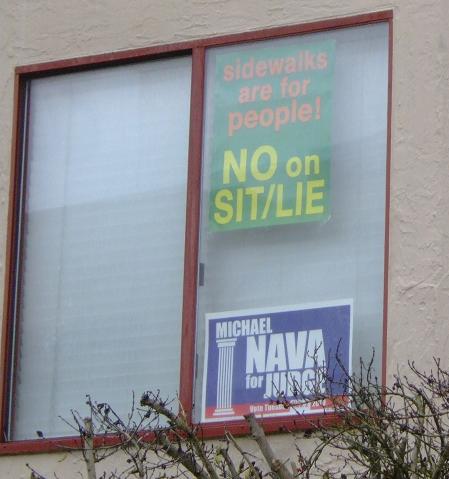
In September, shortly after Elliot Kamin placed two political signs in the window of the condo he rents near Ocean Beach in the Richmond District, he received a letter from his property manager saying, “The signs you have posted in your window are a clear violation of the rules and regulations of the association. Please remove the signs immediately.” But now, with help of the American Civil Liberties Union, the signs are back up and Kamin is no longer being threatened with fines.

Ironically, one of the restored signs reflected Kamin’s concern for civil liberties, urging voters to reject Prop. L, the proposed law that would criminalize sitting or lying on San Francisco sidewalks.

“It is a problem that a lot of condo associations don’t seem to be aware that free speech rights don’t stop at the condo gates,” ACLU attorney Linda Lye told the Guardian. She suggests that some condo residents might be willingly complying with requests to remove signs because they are unaware of the laws.

California Civil Code Section 1353.6 states that homeowners associations “may not prohibit posting or displaying of non commercial signs, posters, flags, or banners on or in property that belongs to a condo owner.”

Kamin called the property management company, which works with the homeowners association that set the rules, and he was told they wouldn’t recognize that legal right, which they said was trumped by their rules for the properties. So Kamin called the ACLU and together, they filed a suit against the Citiscape Property Management Group and the Ocean Beach Homeowners Association.

“If you really want to piss me off, tell me that someone has more rights because they own property,” Kamin said.

OBHA finally relented and entered into a settlement last week that allowed Kamin to put up his two signs, which opposed Prop. L, the proposed sit-lie ordinance and supported judicial candidate Michael Nava. A call to OBHA wasn’t answered and a message left at CPMG hasn’t yet been returned.

“What good are rights if they’re only on paper?” Kamin said.

UPDATE: I just got a call back from Kevin Wyley, president of CPMG, who said the incident began when an individual board member sent Kamin the letter telling him to take down the sign. Wyley didn’t become involved with the situation for about another week: “I was not aware that the board member had told the tenant he could not put up the signs,” he told us. “The board member had mistakenly told the tenant he couldn’t put up a sign.”

Once he was able to reach all the board members to get their assent, Wyley said he contacted Kamin and the ACLU to let them know the signs could remain, although they continue to disagree with the ACLU over whether tenants may have more than nine square feet of total signage.

Wyley said hsaid it took a few more days to get some traveling board members to weigh in on the issue, but once they

Democracy = cheap drinks and free sex toys

0

Voting’s pretty good as it stands — representative government, dictator avoidance, all that jazz. But this fall, the choose-this-or-that got a little nutty. Have you seen the voter’s pamphlet? The ballots alone are four double-sided pages long. After all that paperwork, you’re gonna need a pick me up on Nov. 2. 

Call upon this pleasure two-pack of election day specials – yes, the title of this post is an accurate descriptor – to lift the weight you’ve been carrying on your back called “the future of California is in your hands.” Cheap drinks and free sex toys. Oh yeah, and check our complete endorsements for the low-down on just what’s on those ballots this year for San Francisco and East Bay.

Straight Up Vote

Bring your voter’s stub (this works if you’ve voted by mail or in-person) for a 50 cent drink at participating bars. Velvet Cantina, Tonic, and the Elite Cafe are all participating, but most participants are slopping around in the Castro. Anyway, find a list of all those aiding and abetting on their website. 

www.straightupvote.org


Vibrate the Vote

After you chuck that ballot down the appropriate chute, head to any Good Vibrations store, where dropping the name of this paragraph on election day will score you a free Pearl Drop vibrator. The generous giveaway is a part of an online voting contest that can enter you to win the top-rated toys on the Good Vibes website. 

www.goodvibes.com


Don’t nobody give a damn about us!

0

As Supervisor John Avalos’ proposal to mandate local hiring for publicly-funded construction projects heads for a committee hearing next week, local hiring protests continue to break out around UCSF’s Mission Bay groundbreaking celebrations for a $1.5 billion hospital project that the UC Board of Regent recently approved.

The problem, according to community advocates, revolves around UC’s apparent absence of a community hiring plan. Rumor has is that local residents will only get 12-13 percent of the construction jobs, even though the site is only a T-Third ride away from Bayview Hunters Point and other low-income communities where unemployment rates have risen steeply in the last four years.

Yesterday evening, I went to a university-community celebration where UCSF Chancellor Susan Desmond-Hellmann was in attendance. So, I asked her about UC’s local hiring plan. Desmond-Hellmann said I’d need to speak to UCSF’s Barbara French, who recently advised community-based organizations that construction at the site won’t start until December, and that the groundbreaking activities are happening now to take advantage of the weather.

So, while I’m waiting to hear back from French, check out a slideshow (see above) of the Oct. 27 local hiring protest at UC Mission Bay. There’s been coverage of how MC Hammer talked to the protesters Oct. 26, when the Secret Service got upset about the local-hiring demonstration outside the groundbreaking that House Speaker Nancy Pelosi attended. And how Hammer came back with a “we want jobs” message.

But there has been no coverage of how filmmaker Kevin Epps (who is responsible for Straight Outta Hunters Point and Black Rock) was on hand filming the Oct. 27 protest, or how UC’s Terry Rawlins dropped by, or how Terry Anders of the Anders & Anders Foundation) took part in the local hiring protest saying, “This is the first piñata we want to crack open,” or how  Mindy Kener, who is also with Anders & Anders, added, “We want all the candy to fall out.” Or how Aboriginal Blacks United’s Alex Prince, who led the protest to demand fair and equal access to high-paying union jobs on the UC Mission Bay project near the economically depressed Third Street corridor, was accompanied by Heaven, ABU’s cuter than cute mascot dog.

“We want to make sure folks get trained and everything that’s necessary, so there is no dispute,” Prince told me. “UC has not really been helpful. They just said they want to meet with us.”

Osiris Coalition member Greg Doxey, who helped negotiate labor’s community benefits agreement with Lennar in 2008, emphasized the importance of passing local hiring legislation that has some teeth.
“We’ve found that no matter how much dollars is committed for training, it doesn’t help if developer is not committed to doing any training,” Doxey said. “That’s why we are supporting Local SF, Sup. John Avalos’ legislation. We want some teeth. All we have right now is a good faith policy. Avalos’ legislation will give us teeth to set fines to be put in place.”

Charles Hopkins, another local resident, said all the community wants is its fair share.
“It’s sustainable for San Francisco to have local hire,” Hopkins said.

A group of unemployed Asian-American members of the iron unions also participated in the ABU rally where they held up signs saying “Show us the $$$”.

An employee of Cambridge, which along with San Francisco-based DPR, is one of the prime contractors at the site, did come out to talk to the protesters.
“If folks want to put their names on the list, they can,” the Cambridge employee, who declined to give his name, said. “But the unions have their own procedures, when it comes to who they dispatch, including seniority.”

Mindy Kener of the BVHP-based Anders and Anders Foundation said she’d like to see more women hired on local construction sites.“The women want to work and get off the welfare lines,, they need to work and it’ll make a big difference in our neighborhood if we put people to work who live on the T-Third line,” Kener said. “All we need is for UC to give the green light to put our neighborhood to work.”Carlos Rodriguez, a Local 261 member who has been out of work for two years, worries that workers are being forgotten while deal making is going on.“I see how unions talk to management, they forget about the laborers,” Rodriguez said.

A man on a bicycle stopped to see what was going on.
“It’s not going to work, when they can get illegal aliens to work for $6.50 an hour,” the man said, as he resumed his peddling.

Across the street, filmmaker Kevin Epps also indicated that he thought part of the local hire problem is rooted in racism.
“Deeply rooted, institutionalized racism,” Epps said. “We are talking about power, and power doesn’t give up without another power taking it away.”
Standing nearby was UC contract compliance manager Terry Rawlins, who clarified that UC isn’t currently hiring folks to work on the construction site.
But doesn’t the university have leverage?

“Not directly,” Rawlins said, “We try to establish goals, based on cooperation with unions, and without violating any bargaining agreements.”

But UCSF Director of Design and Construction J.Stuart Eckblad told the Guardian that he thought the workers were asking for the right thing.
“I’m all for maximizing the opportunities and participation of the local community,” Eckblad said.” The question is what is realistic, and there are issues of what is really available with labor and the trades.”

Joshua Arce of the Brightline Defense Project noted that folks have been distracted by Lennar’s shipyard project from the reality that there are 6,000 jobs coming on line, a stone’s throw from the Bayview, the Mission and Market Street.
“What is equitable?” Arce asked. “A good faith approach, a market-based approach or a mandatory approach? At the end of the day, it’s about equity, and no one would dispute that this situation is inequitable. Let’s just agree that it’s not equitable [to have no local hiring plan] on a big project like this in a community that is facing such high unemployment levels.”

“There are hundreds of good-paying, union jobs on this projects while we have people in our communities that are dying for lack of work,” ABU president James Richards told me. “We have qualified union workers standing outside the job site that are ready, willing, and able to work and if the community doesn’t work, no one works.Good faith efforts have never worked and now they want us to be fooled again. So, we are going to step it up, and we don’t give a damn about the unions, either. The person who fights for these jobs, deserves these jobs. So, let’s begin to tell the truth. Many of the folks in the labor unions don’t speak English, they are not from San Francisco, and most are not even from this country. Everyone is dancing around the truth. Everyone knows the truth, but they don’t speak it.”

But ABU’s tent looked inclusive at the protest, Arce noted, as he pointed  out the power of teaming up with all marginalized groups in San Francisco.

“I could go for that,” Richards said.  “We got blacks, Mexicans, Asians, whites, everybody in ABU. It’s ain’t no racist thing.  But let us work, too. “Why do we always have to get in last? Don’t nobody give a damn about us! 

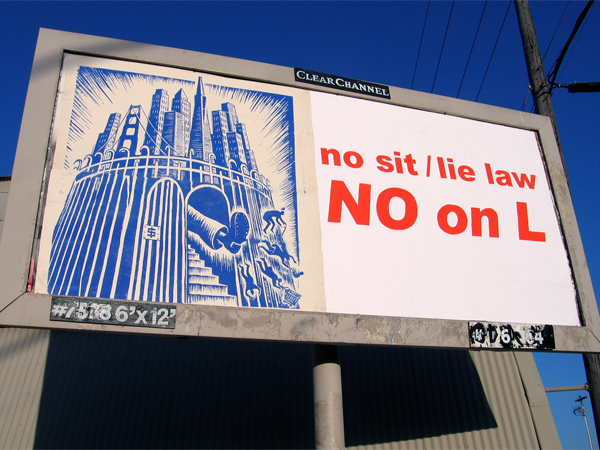
The Sit Lie Posse can “liberate” a billboard in 10 minutes

A press release went out yesterday announcing that a group called the Sit Lie Posse had “liberated” six billboards and 60 bus shelters with original artwork in opposition to Proposition L, San Francisco’s proposed sit / lie ordinance. The posters bear three different images, including one featuring a “Gascon-topus,” illustrated with the face of San Francisco Police Chief George Gascon and the body of a gigantic octopus. Gascon is a strong advocate for the ordinance, which would ban sitting and lying down on San Francisco sidewalks.

While members of the posse did not provide a phone number or reveal their true identities, the Guardian did manage to get in touch via email with a spokesperson of the posse, who goes by the name Jim Rawley.

Rawley says he chose his name in honor of the character from John Steinbeck’s The Grapes of Wrath, who manages the utopian Weedpatch camp and treats the impoverished Joad family with dignity and respect. Rawley also reveals the technique the Sit Lie Posse uses to liberate bus-shelter ads, and tells us how long it takes for the crew to put up displays of their artwork throughout the city. A few of our questions and answers appear below.

San Francisco Bay Guardian: Does the Sit Lie Posse have a budget? If so, how much?
Jim Rawley: The Sit Lie Posse is a volunteer group unaffiliated with any electoral campaign. We made our guerrilla ads by hand and paid for our materials out of pocket. It cost us $150 to liberate six billboards and 60 bus shelter ads.

 
SFBG: How long does it take to liberate a billboard? How about a bus shelter ad? Does the posse use wheat-paste?
JR: Our billboards took about 10 minutes and the bus shelters took 2-3 minutes. We accessed the bus shelters using a master key and attached our work with Velcro, the industry standard for bus shelters because of quick, easy insertion. We attached our billboards with wheat-paste. Despite the efforts of Clear Channel and a heavy rainstorm, our bus shelters and billboards are still up.


SFBG: The Sit / Lie Posse has created quite a stir. C.W. Nevius writes in this morning’s column: “Opponents are attempting to make a comparison with the civil rights movement in the South in the ’50s and ’60s. Apparently their view is that an unkempt panhandler camping on the sidewalk equates to the Freedom Riders opposing racial discrimination. Weird.” What would you say to Nevius in response?

 JR: We expected that the Chronicle would try to ridicule, belittle and smear our work, especially since C.W. Nevius and his advocacy columns instigated Prop L. In the 1950s and 60s civil rights workers were maligned by the mainstream press, harassed by the police and subject to physical violence. It takes time for social movements to gain legitimacy in the eyes of the state and the corporate media. In their own words, Chronicle columnist C.W. Nevius and Police Chief George Gascon have said that Prop L enforcement would exclude tourists and center on the homeless. Regardless of your opinion on homelessness, it’s clearly discrimination when the law is based upon a person’s appearance and applies only to certain groups – the poor and people of color. Even more so when the stated intent of the enforcement is to drive certain people out of a neighborhood. This is San Francisco’s kindler, gentler version of Jim Crow segregation.


SFBG: What was the inspiration behind the Gascon-topus?

JR: We came up with the Gascon-topus as a reference to sci-fi movie posters. Prop L will give unchecked power to the police to conduct unconstitutional searches and arrests. In the face of such a monstrous attack on civil liberties, we wanted to respond with wit, humor and satire.


SFBG: Why do you think it’s important to fight against expanded policing in public space?

JR: It’s important to fight additional policing in pubic space to preserve our civil liberties and to save the character of San Francisco. Most San Franciscans don’t want to sacrifice the city’s diversity and rebellious creativity in order to recreate San Francisco as one massive, sanitized shopping mall with all action controlled by the police. Most San Franciscans don’t want undocumented immigrants and day laborers to be deported after a bogus bust for sitting. Most people don’t want to see the poor disqualified from government housing because they committed the crime of sitting. Most people don’t want to be subjected to unconstitutional drug searches after being detained for sitting, nor do people want to see parolees sent back to prison for the crime of sitting. Public space and civil liberties are vital to a healthy democracy. Public space is the only area beyond private property and the marketplace where San Franciscans can come together to exercise civil rights and collectively shape the future of the city. We need to defend that space and extend it against threats from wealthy business interests and their allies in government.

Avalos: I have not buckled to anyone’s pressure over local hiring

1

Last week, Sup. John Avalos introduced Local SF legislation to require contractors to meet a local hiring goal of 50 percent. And as the Guardian reported at the time, Avalos’ legislation represents a major departure from the city’s First Source Program, which only requires contractors on publicly subsidized projects to show “good faith” efforts to meet 50 percent goal.  Avalos’ legislation came on the heels of a report from the city’s Office of Economic and Workforce Development that showed only a 20 percent local hire rate in 29 publicly funded projects, despite the existence of First Source.

“My legislation will ensure that San Franciscans have a guaranteed shot to work on the City’s public works projects and that the local dollars invested in public infrastructure be recycled back into San Francisco’s economy and local communities,” Avalos said last week, noting that his legislation was developed over a series of stakeholders meetings with reps from city agencies, the Mayor’s Office, labor and building trades, the environmental community, neighborhood advocates, contractors, local hiring advocates and unemployed workers. And he vowed to keep this roundtable approach going as his legislation moves forward.

So we were surprised to read a Weekly blog post today that claimed that Avalos had allegedly buckled to union pressure and watered down his local hire requirements. Especially since his legislation hasn’t even had its Nov. 8 hearing before the Board’s Land Use and Economic Development Committee…

Reached by phone Avalos clarified that he has not buckled to anyone’s pressure.
“I haven’t backed down on anything,” Avalos said. “And I have not made any amendments to my legislation. I did say when I introduced my legislation that this is a starting point and we’ll see where it ends up. We could pass legislation that wants 50 percent local hiring next year, and it would probably get vetoed and it wouldn’t be realistic. So, we have to phase it in and make sure we are creating a system that is going to push the trades to be more inclusive of local residents.”

Avalos noted that some trades and unions are already doing a good job of hiring San Francisco residents on public works projects, but reiterated that the city’s current policy only requires contractors to present paperwork to show they made a “good faith” effort—and that this approach has fallen far short of the city’s 50 percent local hire goal.

Avalos’ legislation–and his claims about First Source’s shortcomings–are  backed up by two recent studies.

The first report, released by Chinese for Affirmative Action and Brightline Defense Project this August, was titled “The Failure of Good Faith.” It showed that the city’s current policy only “yielded roughly 24 percent on employment opportunities” on public construction projects in San Francisco.

The second report, released by L. Luster & Associates on October 18, was titled “Labor Market Analysis San Francisco Construction Industry.” It confirmed that the construction workforce statewide has been in a “free-fall of job losses for the past four years.”

Noting that the Bay Area has not been as hard hit as other regions in California, the Luster report observed that the tri-county district of San Francisco, San Mateo and Marin counties, which had 45,100 construction jobs in August 2006, “lost nearly one-third of these jobs falling to 31,200 construction jobs by May 2010.”

“In San Francisco, unemployment in the construction sector has had a particularly negative impact on the city’s less educated residents,” the report stated. “For them, construction has provided access to higher paying jobs in a labor market that otherwise might provide them access mainly to positions paying lower end wages. Any local hire effort will be undertaken against the backdrop of this unprecedented construction job loss, and resulting unemployment among the existing San Francisco construction workers.”

One such group of unemployed workers—some of them in a union, others not—could be seen protesting yesterday outside the gates of the construction site on 16th Street in Mission Bay where UCSF has been celebrating the groundbreaking of its new Medical Center, a $1.5 billion project to be funded “through a combination of debt financing, philanthropic gifts and hospital reserves,” according to UC press releases.

But in an email to Joshua Arce of Brightline Defense, UCSF’s Barbara French noted that though UC is “actively working now to evaluate the workforce needs for every trade, for every phase of the project, and intend to make those public in December”, UC has not started construction on the project and won’t until December.
“ We haven’t signed the contract with the general contractor and we don’t yet have our permits,’ French wrote. “ The community may have believed that the celebrations this week truly marked the start of active construction. Not so. These were community celebrations held now in the hopes of getting good weather. “

Meanwhile, Avalos acknowledges that UC is not under the jurisdiction of San Francisco.
“But I know that they are doing a critical amount of building, and investing tax payer dollars there, so therefore the community should have some benefit from that, even though it’s complicated by this being the state’s money, so you could make the argument that all of California’s workers should have access,” Avalos told the Guardian. “But this land use impacts the surrounding community, so it makes sense that we have local hire legislation and access to serious end-use jobs at the hospital, which will include medical and support staff, building and janitorial maintenance and cafeteria related work.”

Avalos noted that the city is building infrastructure all around that project, including parks, Muni and light rail spruce-ups.
“There are huge surrounding investments,” Avalos said.

Either way, here’s hoping that by December, when folks begin to stress about providing for their families over the holiday season, all the workers in the following video clip will be able to put down their bullhorns and pick up decent-paying work, instead. And that this work will last for more than a couple of days.

Civil rights groups demand Secure-Comm documents from ICE

1

In a turnabout from the usual immigration-related situation (in which ICE demands documents from immigrants) civil rights groups in Washington, DC. Arlington, VA. Santa Clara, CA. and San Francisco are requesting the release of documents concerning opt-out procedures in Immigration and Customs Enforcement’s controversial “Secure Communities” program.

Signed by the Arlington Coalition Against “Secure Communities” (S-Comm) Program, Asian Law Caucus, Asian Law Alliance, Bernal Heights Neighborhood Center, Causa Justa: Just Cause (CJJC), Center for Employment Training- San Jose, Central American Resource Center, Chinese for Affirmative Action, Community Legal Services in East Palo Alto, Communities United Against Violence, DC Jobs with Justice, Empower DC, Immigrant Legal Resource Center, Instituto Familiar de la Raza, La Raza Centro Legal , National Lawyers Guild San Francisco Bay Area Chapter, Plymouth Congregational UCC Board of Social Action, Sacred Heart Community Services, San Francisco Day Labor Program Services, Immigrant Rights, and Education Network, Silicon Valley Alliance for Immigration Reform, Silicon Valley DeBug, Somos Mayfair, Steering Committee for Immigration Reform, JFI San Jose Tenants and Workers United and Young Workers United, the statement that these groups released today reads as follows:

”We are four municipalities that have formally requested to opt-out of the federal immigration enforcement, “Secure Communities” (i.e., “S-Comm”) program,” their press release stated. “We did so after participating in town hall meetings, debate, testimony, research, and democratic processes that culminated with representatives in Washington DC, Santa Clara, California, Arlington, Virginia, and San Francisco clearly voting to opt-out of sharing information with ICE. “

“We did so because we believe in preserving public safety for everyone in our diverse cities, and also because we reject a program that disguises a record number of deportations (392,862) as a safety initiative rather than a humanitarian and moral crisis.”

”To be clear, our counties never ‘opted-in’ to this dangerous ICE program in the first place. This program, which has been shrouded in secrecy, was imposed on our counties without the input of our local government, communities, local law enforcement and in the case of San Francisco against their explicit written requests. Now that Washington DC has formally opted out, we ask that ICE immediately and without further delay let our counties and any other counties requesting to do so out of S-Comm.”

”We are committed to moving ahead with the opt out process despite ICE now contradicting itself and claiming the program is compulsory. We support CCR, NDLON, and Cordozo Law School going to court today to demand release of what ICE has refused to divulge. The emergency injunction filed today does what should be automatic in any democracy, it seeks to make public information on S-Comm and our ability to opt-out by stopping the sharing of any fingerprints by these jurisdictions with ICE.. This necessary injunction comes at the beginnings of negotiations with ICE and local jurisdictions scheduled for Nov. 5 to Nov. 9.”

SF vote-by-mail provides early political snapshot

6

San Francisco’s Department of Elections had received 41,620 vote-by-mail returns so far That’s a fifth of the 210,993 vote-by-mail forms that were requested this year.
And while we don’t know which districts these folks voted in, we do know how they were registered: Over half were Democrats (24,153 votes), a quarter were decline-to-state (10,563 votes), and a fifth were Republican (5,565 votes).

I was surprised to learn that there are more vote-by-mail requests from folks registered with the American Independent Party (573) than with the Green Party, but not surprised to see that 200 folks were registered as Libertarians and 81 as Peace and Freedom Party.

Unfortunately, we can’t compare SF’s vote-by-mail snapshot with the statewide picture.
According to folks at the California Secretary of State’s office, votes won’t be broken down into vote-by-mail categories until after the election is certified…

FEAST: 5 sardinerias

0

When it comes to sardines, you have to think outside the earthquake shelter. On the flavor-o-meter, the tinned food of last resort (served on tarps with Saltines and stale water) bears no resemblance to its wild, fresh self. Even a humble sardine doesn’t deserve to be jammed in like a sardine, oil slicked, and left to age in the farthest reaches of the cupboard.

As several San Francisco eateries are ably proving, sardines, when treated with respect, are a tasty addition to the dining table. And healthy. And sustainable (they’re on the Monterey Bay Aquarium’s Super Green list!) Everyone from Andrew Weil to the Italian grandmother we all wish we had proclaim the virtues of the pungent silver herring. And with good reason: its tiny, 25-calorie body is packed with essential fatty acids, iron, protein, and calcium.

Let’s face it, the good people of Sardinia didn’t get their beautiful skin and convivial personalities from eating schweinebraten on spätzle. They’re all high on EFAs. Sardine EFAs.

PESCE

Pesce was one of the first and finest restaurants to introduce San Franciscans to the joys of sardine cuisine. The casual Russian Hill restaurant offers small plates of fish, pasta, and vegetables (and please, can we call it cicchetti, as they do, instead of “Italian tapas”?) patterned on the cooking of Venice. Pesce serves its sardines (all from Monterey Bay) simply — grilled, on a bed of mixed greens and pickled vegetables with a wedge of lemon. The result is tart, briny, and clean. If you’re still on the fence about sardines, Pesce is the place that will convert you to a bona fide a-fishyanado.

2227 Polk, SF. (415) 928-8025. www.pescesf.com

RAGAZZA

In Provence, shmear means aoli. They put it on meat; they put it on vegetables; they put it on fries; they put it on fish. Heck, they probably put it on ice cream. At Ragazza, the new relative of Glen Park’s Gialina Pizzeria on Divis, the chefs splat a huge dollop of it on its sardines. Apart from the aoli, Ragazza takes an Italianesque approach, stuffing them with an earthy mixture of breadcrumbs, olive oil, garlic, oregano, and onion and baking them in the restaurant’s gas-fired Wood Stone oven. The result is a crispy exterior over sardines that almost melt away on the fork. Add some mixed greens and a robust Italian red and you can practically feel your arteries unclogging. Oh, Ragazza also has pizza.

311 Divisadero, SF. (415) 255-1133. www.ragazzasf.com

NOPA

There’s locavore, 100-mile radius locavore, and there’s ultra-loca, five-mile radius locavore. While most of the city’s sardine-serving restaurants get their sardines from Monterey Bay, Nopa gets its from our very own San Francisco Bay. This is great news because our local sardines nearly went extinct in the 1950s. And — sardine cognoscenti consider the Pacific sardine as flavorful as those on the Sardinian coast (take that, overpriced cans from Norway). Speaking of flavorful, Nopa serves the little San Franciscans baked in its wood-fire oven with fingerling potatoes and frisee. The only thing missing is an order of flatbread, a gems salad, wine, and the burnt honey crème brulee.

560 Divisadero, SF. (415) 864-8643. www.nopasf.com

BARBACCO ENO TRATTORIA

You have to give Barbacco credit. Unlike most of the restaurants that have rediscovered the sardine, Barbacco doesn’t seem to be operating on the principle that sardines are an after-5 p.m.-only food. Although not exactly in the let’s-have-herrings-for-breakfast! camp, Barbacco at least believes that noon is a perfectly reasonable time to start the jonesing. The bustling, suits-heavy Financial District eatery is the creator of what may be the city’s only sardine sandwich (if this isn’t true, we’d like to know). Barbacco also breaks the don’t-get-too-weird-with-sardines taboo, pairing its sardines with a hefty piece of seared calamari. Not most people’s first choicem perhaps, but the two get along swimmingly, especially when served on an Acme torpedo roll and slathered with arugula and Barbacco’s housemade “roasted tomatoe condimento.”

220 California, SF. (415) 955-1919. www.barbaccosf.com

FERRY PLAZA SEAFOOD

When you don’t want others dictating what you can and can’t have on your sardines, duck into Ferry Plaza Seafood. This celebrated purveyor of all things aquatic sells wild, locally caught sardines (and by this we mean our our SF as well as Monterey bay) when available. “We love sardines,” said one salty staffer. “Especially the local ones. They just glisten.” They recommend bringing out the glisten by brushing with olive oil, salt, and pepper; grilling a few minutes on each side; and dressing with lemon. Call first for availability, these guys swim in and out of supply.

One Ferry Building, #11B, SF. (415) 274-2561. www.ferryplazaseafood.com 


FEAST: 7 burrito-free late nights

0

We’re spoiled rotten living in the city where if you fling an ankle boot, it’s bound to hit a taqueria open past last call. Its like a burrito vortex — go out in San Francisco and at some point you will get wrapped up in flour tortilla and snuggle in with your old buddies, carnitas and shredded cheese. But gooey and warm as it is in there, you must resist the pull to turn into a burrito. I know, I know, we’re gonna hold your hand through this one. We’ve assembled the meeting places for Burritos Anonymous: purveyors of snacks so fine — and open at least until 1 a.m. on weekends — that your frijoles negros withdrawal-twitches will subside and your post-bar, pre-bed caloric intake will rejoin your regularly programmed San Francisco culinary adventuring. We’re talking calamari bulgogi, vegan smoked duck sandwiches, chilaquiles, pambazos, and beef brisket with a side of cucumber salad. We’re talking late night. Clip this page and store it near your bus fare.

TOYOSE

There’s a converted garage in the heart of the Sunset District stuffed with carousing young’uns into the wee hours. Its charmingly narrow dining area has enough foliage and hanging screens between tables to hide 1 a.m. sloppiness — and enough Korean delicacies to entertain the most rabble-rousing group for hours. Try their noodle dishes, which can feed four with their toss-it-yourself mounds of veggies, cold rice noodles, and chile sauce. House favorites include the seafood pancake, kimchee fried rice, bulgogi, soju smoothies, and the damn largest bottles of Korean lager seen this side of the Pacific.

Open until 2 a.m. daily.

3814 Noriega, SF, (415) 731-0232


NOMBE

A hip izakaya whose name roughly translates to “he who doesn’t remember the walk over.” Nombe’s menu can be boggling, but that doesn’t detract a smidge from the table of pickled daikon, stewed onion pork belly, steaming bowls of ramen, and sake flights that is apt to materialize after speaking with the friendly serving staff. Motor skills eschewing spoons and forks for the moment? Play swords with something off the tasty skewer menu.

Open until 2 a.m. weekends

2491 Mission, SF. (415) 681-7150. www.nombesf.com

REACTION RESTAURANT

When the owners of all-ages art-punk venue Sub-mission decided to open up a dining room next door, they kept it accessible. Reaction’s got a menu full of little-seen Mexico City specialties that won’t break the bank of their underage clientele, but still don’t relapse into the boring realm that sub–$5 food often falls. Our favorite is the pambazo, a roll that’s been dipped in red sauce, grilled, then stuffed with your choice of meats or beans. You’ll also find huaraches, gorditas, and burgers — all in a sleek, red and black ambience that won’t harsh your buzz.

Open until 3 a.m. weekends

2183 Mission, SF. (415) 552-8200

J & V CAFE

There’s late night, and there’s late night. If the sun’s coming up and you’re not ready to mix and mingle with the morning suits, head to Bayview. Not that J & V will be filled with drunken sops like you — a well-turned, few-frills cafe located in the middle of SF’s wholesale produce market, the work day here begins in the dark of the night. Standard diner fare, decent espresso, a few quality Mexican specials — no b-words, but plenty of heaping chilaquiles plates to palliate that come-down.

1 a.m.-2 p.m. Mon.-Fri.

2095 Jerrold, SF. (415) 821-7786. www.jandvcatering.com

THE LIBERTIES

A place that takes no liberties with the notion of good pub food available when you need it most. The Liberties offers stomach-liners like mashed potato-topped cottage pie, bangers, and Anglo-happy chicken curry for those who’d rather have their biggest meal of the day post their biggest pints of the day.

Open until 2 a.m. weekends

998 Guerrero, SF. (415) 282-6789. www.theliberties.com

TOMMY’S JOYNT

With an exterior decorated in shades of circus tent, the 63-year old legend is a great place for Mom’s cooking at hours Momma woulda freaked had you started rustling around in the kitchen. Hofbrau service has you line up with a tray and point to which braised meat and starch you’d like heaped on your plate. Beef brisket? Buffalo stew (their specialty)? Veggiesaurus? No worries. Scoops of pasta salad, greens, and potatoes await.

Open until 1:40 a.m. daily.

1101 Geary, SF. (415) 775-4216. www.tommysjoynt.com

LOVE N HAIGHT DELI & CAFE

Stating the obvious: vegans get short shrift when it comes to late night. Seriously, how often can you order the same thing Carnivorous Carl is having … minus the protein and sauce? Unfair. Pay it no mind — with Love N Haight’s head-whirlingly large menu of vegan (and some meat) sandwiches, you’ve got the upper hand. Sure, the fake roast duck may taste similar to the fish and the chicken — but its a chewy, satisfying kind of same.

Open until 2 a.m. weekends.

553 Haight, SF. (415) 252-819


Flash: I won’t be throwing out the first pitch today to open the World Series

0

Amazing.  Peter Hartlaub nominated me Tuesday (Oct. 26) in his Chronicle pop culture column to throw out the first pitch to open the World Series game in San Francisco. 

In the spirit of  “getting the rest of the country into the swing of things” in San Francisco,  he also nominated actor Sean Penn, Rep. Barbara Lee, and Assemblyman Tom Ammiano. And he suggested Lawrence Ferlinghetti read the national anthem, that Tony Hall sing the national anthem,  that the Sisters of Perpetual Indulgence become the new ball dudes, and that a slow-moving  flotilla of Critical Mass kayaks make the other boats late for the game in McCovey Cove.  

Hartlaub had the right approach. “There are definitely advantages to having the rest of the country develop the false impression that your region is filled with nothing but crackpots,” he wrote. “It seems to motivate the team. And in a roundabout way the weird looks from the rest of the country help preserve our culture.” 

Well,  I’m available and I’m happy to report that I’m actually qualified to toss out the first pitch and get the ball to homeplate.

I was a left-handed pitcher back in my playing days in summer playground and the Junior Legion baseball  in my hometown of  Rock Rapids, Iowa. I had a blazing fastball and a wicked curve and a drop ball that I couldn’t control. Nobody ever hit a homerun off of me. 

Alas, I’m sad to report, PG&E opposes my appearance. It’s getting late. And I suspect I won’t get an invitation. 

I guess I’ll soon be off to Blooms or the Connecticut Yankee bars to watch the game and drink Potrero Hill martinis. b3

French Cinema Now! Two to see — and one to avoid

0

The San Francisco Film Society’s “French Cinema Now” kicks off Thurs/28 with a week of spankin’ new Gallic films. Not sure which flick to choose, budding Cahiers du Cinéma contributor? Read on for a batch of brief reviews.

Copacabana (dir. Marc Fitoussi) It feels strange to call Copacabana subtle, especially when the film’s main character Babou (Isabelle Huppert) is consistently over-the-top. But this is a slight comedy, a character study to showcase Huppert’s considerable talent. Not that there’s anything wrong with that. Copacabana depends on its strong lead, and there are few stronger than Huppert, one of the most dynamic and adaptive French actors working today. Babou is aloof and frustrating but also warm and well-intentioned. The film follows her struggle to start a new career and prove herself to her daughter Esmeralda, played by Huppert’s real-life offspring Lolita Chammah. The plot is a bit unfocused, as Babou ventures off to Belgium to sell timeshares for a suspect company. But Huppert keeps Copacabana grounded, creating an experience that’s richly rewarding albeit unconventional. While the film doesn’t delve deeply into her fraught relationship with Esmeralda, we know enough to care. Babou may be one of Huppert’s lighter characters, but that doesn’t make her any less captivating. Thurs/28, 6:45 p.m.; Fri/29, 9:30 p.m.

Rapt (dir. Lucas Belvaux) At first glance, Rapt is your traditional kidnapping drama, with wealthy industrialist Stanislas Graff (Yvan Attal) held captive for a hefty ransom — 50 million euro, to be precise. The relationship between Stan and his brutal kidnappers is interesting, but Rapt’s most engaging scenes focus on the way Stan’s family and business partners respond to his plight. This isn’t the average high-stakes crime thriller, in which the loyal wife will go to any means necessary to get her husband back. Instead, the family argues over how much to pay — they haggle for Stan’s life. And in his absence, he’s revealed to be a philanderer, a gambler, and kind of a jerk. Attal is well cast as Stan — at times, he is both sympathetic and reprehensible. But those left behind command more attention: his all-too-understanding wife Francoise (Anne Consigny) and his ambitious assistant Andre (Andre Marcon). Rapt is an impressive addition to the genre, using kidnapping to tell a story more original than what one might expect. Thurs/28, 9:30 p.m.; Mon/1, 9:15 p.m.

Irene (dir. Alain Cavalier) Irene is the definition of passion project, an incredibly personal film about director Alain Cavalier’s deceased wife. It’s a tough movie to criticize, in that Cavalier clearly poured his heart and soul into it. But Irene is, frankly, a self-indulgent mess, the kind of movie no filmmaker should be allowed to make. Cavalier talks incessantly, adopting a throaty whisper that might be intended to give him gravitas but mostly ends up grating. His love for his subject is apparent throughout, but the navel-gazing is completely unbearable. For over 80 minutes, Cavalier reads through excerpts from his diary, relives the day his wife died (nearly 40 years in the past), and obsesses over peculiar minutiae. In one of Irene’s strangest scenes, Cavalier reenacts his birth using an egg and a watermelon. The whole enterprise plays out like a French art film cliché. It’s masturbatory, yes, but far worse than that — it’s boring. Fri/29, 5 p.m.; Sat/30, 1:45 p.m.

“French Cinema Now”

Oct 28-Nov. 3, $12.50

Embarcadero Center Cinema

One Embarcadero Center, Promenade Level, SF

www.sffs.org

Local metal review: Slough Feg’s “The Animal Spirits”

0

All good heavy metal strives to challenge the listener, pushing buttons and boundaries. Some of its most successful incarnations make people downright uncomfortable, achieving escalating extremes of tempo, tuning, and tone.

Slough Feg is one of San Francisco’s most unique underground bands, an honorific that stems directly from its unique approach to the challenge of challenging. Eschewing thrash’s BPM arms race, death metal’s knuckle-dragging celebration of “brutality,” and black metal’s dissonant, low-fi navel-gazing, the quartet (now two decades or, if you prefer, five drummers old) manages to discomfit with an unlikely tool: melody. New album The Animal Spirits was released Tues/26 on Profound Lore Records.

http://www.youtube.com/watch?v=1SJCdqguiyk

Bursting with major-scale chord changes, Celtic-folk influences, and vocal lines that make the tautological adjective “sing-song” suddenly useful, the band’s music is resolutely unlike anything you’ve ever heard before. Some of the heavy metal staples are present – the acrobatic drumming and soaring, dual-guitar harmonies, for example – but that’s where the easy descriptions end.

The Animal Spirits‘ song titles evince an ecclesiastical theme, which is made immediately apparent in the music – album-opener “Trick the Vicar” rampages through two minutes of triplet-driven NWOBHM wordplay, all of it pertaining to clergy. “Out of the frying pan/into the Friar” is but one of many examples.

Though the lyrics are a bewildering mix of the high- and lowbrow, a strand of gleeful silliness is apparent throughout, even when Slough Feg tackles weighty historical subjects like Martin Luther (“The 95 Theses”), alchemy (“Materia Prima”), or trans-pacific feats of seamanship (“Kon-Tiki”). The Alan Parsons Project cover (“The Tell-Tale Heart”), conversely, is defiantly straight-faced. Closer “Tactical Air War” features a guest appearance by Bob Wright, vocalist in cult local metal band Brocas Helm.

No matter how frenzied the music around him becomes, drummer Harry Cantwell never seems to tire, and his versatility is a crucial complement to the band’s idiosyncratic arrangements. Bassist Adrian Maestas excels at the genre’s distinctive low-end gallop, though his forays up the fretboard are also a valuable addition to the sound. Guitarist Angelo Tringali is laden with responsibility, forming one half of the harmonic partnership that lies at the heart of the band’s music.

The complementary half is provided by guitarist-singer Mike Scalzi, who founded the band in his native Pennsylvania. Scalzi’s vaudevillian vocal delivery and incomparable songwriting approach are the defining elements of Slough Feg, and it is his desire to alienate people through melody that makes the band sound the way it does. A charismatic iconoclast, Scalzi has lately begun contributing to metal blog Invisible Oranges, promulgating his strong opinions with the help of a prose style he honed at his day job: teaching community college philosophy courses.

Check back in this space soon for an extensive interview with Scalzi, one of the few people in the world who can discuss Saint Vitus B-sides and use the word “ontology” correctly in a sentence, though, it must be said, not simultaneously.

Your first world series is always the best

1

Dick Meister. former labor editor of the SF Chronicle and KQED-TV Newsroom, has covered labor and politics for a half century. Contact him through his website, www.dickmeistersf.com, which includes more than 250 of his columns.

Whoopie! Our valiant Giants are in the World Series again, for the fourth time since they moved to the city from New York in 1958. Pretty exciting, the first series for the Giants since the 2002 series that was won, alas, by the New York Yankees.

Pretty exciting stuff coming up in this year’s series too, Giants vs. Texas  Rangers. But it was more than excitement that swept San Francisco during that first SF Giants World Series and the regular season leading up to the series.  It was near-hysteria. As a young reporter for the SF Chronicle in those days, I felt it up close and very personal.
Merchants filled the newspapers with ads that offered goods “the Giants look up to,” promised “big league values,” and, of course, congratulated the Giants and their fans. for every victory leading to the series.

The hype was too much for some of us at the Chronicle, even me, a former ballplayer. I joined 10 others to sign an anti-baseball petition prompted by the airing at the paper — loudly and daily — of the radio broadcasts of Giants’ games.

 “It is not that we have any inherent objection to the Great American Pastime,” the petitioners explained. “Our protest is against the unilateral establishment of an electronic device which broadcasts to a captive city room the trivia associated with the sport. Exhortations like ‘Willie Mays,’ while they obviously provoke a pseudo-religious ecstasy among fans, leave a number of us writhing in embarrassment.”

We gained nothing by our petition. Worse, City Editor Abe Mellinkoff  added insult to injury by sending us out, transistor radios in hand, to capture the mood of the “man on the street” during the World Series’ broadcasts. I was the first to get the assignment. I was supposed to rush up to people in the street after particularly exciting plays, get their excited comments and weave them into one of the fluffy page one feature stories my editors favored – “wiggly rulers,” as they called them, after the wavy lines used to set them off.

But I stuffed the radio into a jacket pocket and wandered aimlessly around Chinatown, where there were few Giants fans in evidence, returning later to explain lamely that I just couldn’t find any men in the street who cared about the World Series.

The next day, the radio was turned over to another reporter, but he had no more interest in the assignment than I. City Editor Mellinkoff, hinting darkly that he might fire the lot of us for insubordination, got his story on the third try – even though the reporter he sent out that day spent the whole time in his favorite drinking establishment down the street.

The reporter returned to the office barely able to walk, much less type a story or give a coherent excuse for not doing so. We propped him up carefully behind a desk in the far reaches of the city room, safely hidden from the nearsighted city editor, then dictated a story to another reporter at the desk directly in front of his, using the names of friends for our men on the street and quotes we had turns making up to go along with the names.

As he completed a page, the reporter who was typing the story would turn and lay it on the desk of the reporter who supposedly was writing the story, one of us would shout, “Boy!,” and a copy boy would grab the page and rush it to the city editor’s desk at the front of the room.

It was a very lively story, quite possibly the best wiggly ruler the Chronicle had run in several months.

Dick Meister. former labor editor of the SF Chronicle and KQED-TV Newsroom, has covered labor and politics for a half century. Contact him through his website, www.dickmeistersf.com, which includes more than 250 of his columns.