San Francisco

Black history, local hire, living color

31

City Hall kicked off its annual Black History month celebrations with a talk by Los Angeles philanthropist and former Xerox Corp. VP Bernard Kinsey about the importance of debunking myths about the absence of blacks in American history. And Mayor Ed Lee, who had just met with five dozen unemployed black construction workers from the Bayview, revealed how, when he was growing up in the projects in Seattle, his neighbors were black, and an African American named Darnell was one of the most loyal patrons of the restaurant that Lee’s father was trying to make succeed.


“And when my dad suddenly died of a heart attack, Darnell was the first person to offer my brother a job at his gas station,” Lee said. “So, this is not just about recognizing African American history, but recognizing what they did for us, and  making sure that no there are jobs and we protect the family structure. I know what it is to be helped by the African American culture.”


Lee’s recollections of Darnell came less than an hour after he met with Aboriginal Blackmen United, a group that represents unemployed construction workers in the Bayview, to discuss how its members can get hired at UCSF’s $1.5 billion hospital complex at Mission Bay and other local building sites.


At that meeting, ABU President James Richards thanked Lee for getting UC to clarify the details of its voluntary local hire plan at the Mission Bay hospitals.
But he warned that the fight is just starting. “We’ve got the unions to deal with,” Richards told Lee, referring to the reality that the unions also want their members to get work at the UCSF site.


Lee said he’d do his best to help.
“The African American community in San Francisco has not got its fair share,” he said. “I can’t say that everyone in the room is going to get a job, but I’ll open up doors and do my best.”


And then Lee confirmed that local hire is one of his top five priorities.
“My top priorities are the budget, pension reform, the America’s Cup, finding a good police chief and local hire,” he said. “I said that directly to every union leader yesterday. Some unions will be there, others will resist.”


ABU’s Richards said the need to have a G.E.D. to get into the city’s ob training programs is a barrier to employment for many in the Bayview.
“We have a lot of people, who are not able to get into CityBuild because they don’t take folks anymore who don’t have their G.E.D,” he said.


And he warned that the city’s black community is in crisis.
“I know there is a budget crisis, but this is a life crisis,” Richards said. “Young people are dying and it’s not even newsworthy any more.”


Lee suggested ABU work with the City to avoid the need to hold protests at construction sites in future,
“Let’s plan together, so you don’t have to go to all the sites,” Lee said. “I am for people getting their GED. But if someone has evidence that they are making an attempt to get their GED, we need to reward that with jobs. So that the GED is not a barrier, it’s a hope.”


And then Lee was off to attend his next round of meetings, which included the city’s Black History month event, where speakers noted that during Bernard Kinsey’s career with Xerox, he helped increase the hiring of blacks, Latinos and women,


Kinsey told the audience that he and Shirley Kinsey, his wife of 44 years, share a passion for African-American history and art. And that their world-famous Kinsey Collection, which contains art, books and manuscripts documenting African American triumphs and struggles from 1632 to the present, is currently on display at the National Museum of American History in Washington D.C, and a number of pieces are at the San Francisco African American Historical and Cultural Society. He noted that the posters of African Americans in the Civil War were reproductions of some of the art in those exhibits. 


Sup. Malia Cohen noted that about 200,000 African Americans participated in that war. Sup. Ross Mirkarimi, who represents the city’s Western Addition, where redevelopment triggered massive displacement of the black community in the 1960s, noted that eight members of the current Board of Supervisors, who selected Lee as the city’s first Chinese American mayor, are people of color.


“This is true representation,” Mirkarimi said, noting that the fact that the city’s African American population continues to drop (reportedly down from 6 percent to 3.9 percent, according to the 2010 Census) to “is a reminder that even the most forward-thinking cities have a lot of work to do.”


And Kinsey urged African Americans to start describing their ancestors as “enslaved.”


‘It will change how you look at your ancestors,” he said, “You don’t have a clue about what they sacrificed to get you to where you are today. We don’t tell you the ‘ain’t-it-awful’ story about slavery. We tell you the story of how we overcame.”


“You need three things for a successful life,” Kinsey added “Something to do. Someone to love. And something to look forward to.”


Kinsey said he and his wife have espoused two life principles, ‘To whom much is given much is required” and live “A life of no regrets.” And then he told a story about an eagle who was raised by a chicken.


The eagle ended up ashamed of his feathers, because the chickens never told him he was an eagle because they were afraid he’d end up ruling the barnyard.“He even grew up ashamed of his daughters,” Kinsey said.


Eventually, the eagle met another eagle, who told him the truth. “You ain’t no chicken,” the other eagle said.


“And this is the message,” Kinsey said. “Don’t think chicken thoughts, or dream chicken dreams. Think like an eagle.”


He warned the audience to be careful of buying into myths that would have them believe that African Americans played no role in building the U.S.
“There are stories that made America and stories that America made up,” Kinsey said. “And too often, the myth becomes the choice.”


And then he concluded by expounding on “the myth of absence.”
‘”African Americans are not seen, not because of their absence, but because of the presence of a myth that prepares and requires their absence,” Kinsey said. “And the manipulation of the myth changes the color of the past. It’s no accident that the dominate images from the past are white. And many of us have swallowed the pill.”


Why aren’t Brown and Pak registered lobbyists?

13

Powerful business interests constantly put pressure on City Hall to do their bidding rather than act in the public interest. Theoretically, they’re supposed to report who they’re lobbying, on whose behalf, and how much they’re being paid, but that doesn’t always happen. Instead, some of this city’s most powerful players operate with little public scrutiny.

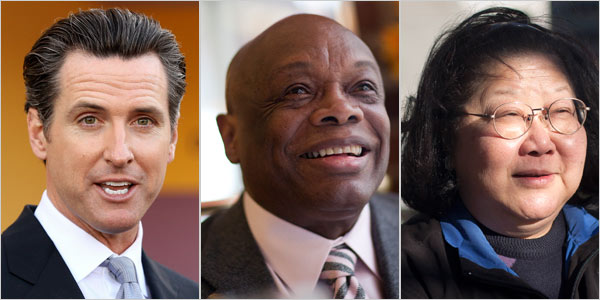
Consider former Mayor Willie Brown – a corporate attorney and Chronicle columnist – and his close ally, Chinatown Chamber of Commerce head Rose Pak. Much was made, from the New York Times to local blogs, of how they engineered the selection of Ed Lee as interim mayor. More recently, there were questions about whether they influenced the narrow and controversial appointment of Richard Johns to the Historic Preservation Commission.

But neither Brown nor Pak is on the long list of lobbyists registered with the city. Neither is Rob Black, who lobbies City Hall on behalf of the San Francisco Chamber of Commerce and is a regular fixture at Board of Supervisors meetings. Why? I don’t know because none of the three would return my calls asking that question [see UPDATE below for Black’s comments].

So I asked John St. Croix, who runs the Ethics Commission, the regulatory agency that oversees lobbying and other activities by which wealth influences government. But he didn’t know the answer either. “If someone is paid specifically to lobby government, they should register,” St. Croix told us.

But his underfunded agency is mostly complaint-driven in its enforcement actions, and even though I complained, he didn’t seem inclined to act against these powerful local players. Hell, his agency hasn’t even done anything about the blatantly illegal collusion between a Brown-funded independent expenditure and the campaign of Jane Kim, despite reports in both the Guardian and the Bay Citizen (the local arm of the New York Times) back in October.

And so it goes in this supposedly progressive city.

UPDATE ON 2/4: Black just got back to me after being out sick with the flu. He said the Chamber used to be considered a “registered lobby entity” that was required to report all contacts with public officials and the issue involved. But the Board of Supervisors changed that law last year, requiring lobbyist registration only from individuals who are paid at least $3,000 per quarter for lobbying. And the definition of lobbying doesn’t include attending or speaking at public hearings or writing letters. So while the SF Chamber’s Black, Steve Falk, and Jim Lazarus all lobby city officials, Black said, none of them have exceeded that threshold. “If we hit the monetary threshold, we’ll start filing individually,” he said.

Live Shots: Stag Dining “Speakeasy” Clandestine Dinner, 01/29/2011

0

These days, it’s hip to be in the know of well-kept secrets. OK, maybe that’s confusing, but what I’m trying to say is there’s an ever-growing list of underground events going on in San Francisco, but if you don’t know about them, well, than you better start getting on it. Now. I’ll give you a hint. Secret restaurants are popping up everywhere and it’s the kind of eating experience you don’t want to miss out on.

Case in point: this past weekend, Stag Dining Group hosted a clandestine dinner at a mysterious locale, which included a myriad interesting dishes, from Japanese lobster custard to skewered duck hearts in mole sauce.

The chefs, Ted Fleury and Jordan Grosser, were bustling in the kitchen to get six courses out to almost eighty people at the same time, while Cocktail Lab was busy concocting a new libation for every course, filled with everything from chili peppers to flaming cinnamon sticks. And boy, my drinking habits are not up to snuff these days … I could not keep up!

The food was tasty and carefully crafted, and I especially loved dessert, a thick creamy chocolate mousse, topped with a see-through thin olive-oily piece of cinnamon toast. My only crit note was the lack of carbs in the meal. I definitely felt the need for one dish that might be considered “hearty.”

Stag Dining is comprised of a bunch of affable dude-bros who have been friends for years and decided to collaborate to create a supper club. Beyond the delectable delights, I also loved that they did a spiel about their values, right down to their handmade recycled menus and to the fact that eating sustainably is really becoming a must. Sometimes people overlook the “spiel” — but I’m one of those people who is constantly giving them and feel that it’s so important to educate whenever possible. (My broken record spiels include: “Check your bathroom products … they might contain parabens!” “Non-organic strawberries taste like crap … and can kill you!” “Did you know that health care in other countries is way better than in America? Write a letter!” It’s something people still do!)

So folks, now you’re a little in the know for something well worth being in the know about, start exploring some of these hidden edible treasures, which are sure to tantalize and tickle your taste buds.

Saving Lyon-Martin

0

rebeccab@sfbg.com

When word got out that the Lyon-Martin Health Services clinic faced imminent closure, Luette Chavez’s cell phone started ringing off the hook. Her friends were going into panic mode.

“It’s shocking to think that something that’s so important to so many people could just be lost so easily,” Chavez told us. The clinic serves nearly 2,500 patients, regardless of their ability to pay for health care. It offers specialized services for queer women and transgender people, providing everything from primary care to mental health services to hormone treatment. A Hurricane Katrina survivor, medical school student, and part-time sex worker, Chavez volunteers at the clinic and relies on it for health care. Her dream is to someday start a free clinic in New Orleans that is cast in the mold of Lyon-Martin. But for now, all of her energy is consumed with the widespread effort to raise enough money to keep the clinic afloat. To survive, Lyon-Martin must pay off a $250,000 debt immediately.


CASH FLOW PROBLEM

As one volunteer among many, Chavez has adopted the mindset that failure is not an option. “I have absolutely every confidence that we will be able to save it ourselves because we’re running ourselves into the ground doing it,” she said.

Lyon-Martin’s board of directors initially voted to shut down the clinic at the close of business Jan. 27, citing insurmountable financial problems. That decision was rescinded, however, following an emergency meeting held at the LGBT Center shortly after news of its pending closure went viral. By Jan. 28, an emergency fund drive had netted close to $100,000 in pledges and cash donations. A fundraiser held Jan. 30 at El Rio drew nearly 700 supporters and roped in another $28,000.

Despite the outpouring of support, the long-term future of the 30-year-old clinic remains uncertain. Lyon-Martin can restructure and avoid shutdown if it manages to clear the $250,000 urgently owed, but it must find $500,000 to continue operating in the same capacity as it has. It has stopped accepting new patients, but will likely be able to serve current patients until at least the end of February.

“Without Lyon-Martin, a community that is historically marginalized won’t have anywhere to turn,” stated an open letter to supporters from Board Chair Lauren Winter, who was unavailable for comment.

A combination of state funding cuts, increased demand, and poor financial management created a perfect storm for Lyon-Martin. A key source of the trouble was that the clinic had not been keeping up with its billing, and after a certain amount of time, it could no longer claim reimbursements from Medi-Cal. Yet external factors such as state and local budget cuts contributed to the problem, too, and Lyon-Martin is not alone in that respect.

All across San Francisco, community clinics that serve low-income and uninsured people are struggling to do more with less. Jim Illig, president of the San Francisco Health Commission, told us that he knows of several other clinics in dire financial straits.

“There are a lot of clinics on the edge because they have dedicated their mission to serving the uninsured,” he said. “Any nonprofit clinic that you see — they’re struggling.” The Haight Ashbury Free Clinics, another nonprofit healthcare organization serving the uninsured, recently announced a merger with Walden House, a substance-abuse treatment center. The merger allowed the venerable health-care nonprofit to continue offering services after its budget was slashed by 50 percent due to reduced support from the city’s General Fund. Even as the cuts took effect, demand for the free clinic’s services rose 10 percent from 2009 to 2010.

“Every time I look into the waiting room, it’s full,” said Jeff Schindler, chief development officer.

If Lyon-Martin closes, its patients will have to be transferred to other clinics, but there’s high demand everywhere. Such an outcome might evoke a sense of dèjá vu for some. Last fall, when an LGBT-focused clinic called New Leaf shut down due to crippling financial problems, many of its clients were transferred to Lyon-Martin.


COMMUNITY SURPRISED, UPSET

The front office manager at Lyon-Martin, who wished to be identified only as Braz, said she’d had no warning that closure was imminent. “Just closing down like that seemed impossible. We couldn’t ethically do that,” she said. “Our patients are freaking out right now.”

Once people became aware that the clinic was on the brink of closure, some aired the criticism that the board should have been more forthright about financial troubles. The Bay Area Reporter, a San Francisco publication covering LGBT issues, published an editorial calling for the resignation of the six-member board, and several sources told the Guardian they expected the board members to step down.

Meanwhile, health officials and elected representatives have stepped into the mix, but no promises of governmental financial assistance had been secured by the time the Guardian went to press.

Department of Public Health Director Barbara Garcia was unavailable for comment, but released a prepared statement: “The Department of Public Health has been in close discussions with Lyon-Martin and the pressing need to make immediate changes to the way they conduct their financial affairs. We value the important health care services they deliver and will continue to work with them to find the best long-term outcome for the clinic and the patients.”

Sup. Scott Wiener told the Guardian that he’d been in discussions about Lyon-Martin with Garcia and Sup. David Campos. Sups. Ross Mirkarimi and Jane Kim also attended the emergency meeting, and California Sen. Mark Leno was said to be attempting to secure some state funding for the clinic. As the push to save the clinic continues, a parallel effort is moving forward to craft a contingency plan for how Lyon-Martin’s nearly 2,500 patients can access care in the event that it doesn’t survive.


COMPETENT CARE

Lyon-Martin patients and others familiar with its services stressed that the women’s clinic is a critical resource for lesbians and the transgender population, because medical staff are trained in that specialized area of care.

“The service there is incredible,” noted Cheryl Simas, who has been a patient there for three years. “They explain everything to you, you’re listened to, and you’re treated with care and respect.” Simas said it was a dramatic difference from an experience she’d had in the mid-1990s, when her healthcare provider was barely comfortable pronouncing the word “lesbian.”

Lyon-Martin medical staffers receive training on transgender patient care, and it even offers training in that realm for medical professionals from cities throughout the United States. “They are internationally renowned as a model for what it means to offer transgender care,” noted labor organizer Gabriel Haaland, who said he was once denied health care due to his transgender identity. “The healthcare system is a fairly traumatic experience for most transgender people,” he added.

If Lyon-Martin closed, “it’d be pretty tragic,” noted Carlina Hansen, executive director of the Women’s Community Clinic, which works closely with Lyon-Martin. When it comes to health care, “We live in an unusual city, in that there is a lot of need among low-income people, due in part to a high cost of living. “Every clinic in San Francisco provides an integral part of that network,” and each clinic fills a specific need, Hansen noted. “The diversity of the clinics matches the diversity of our community.”

Division of labor

0

sarah@sfbg.com


In the wake of a three-day protest by unemployed workers outside UCSF’s Mission Bay hospital construction site — and under pressure from city leaders — UC officials have announced voluntary local hiring targets at the $1.5 billion complex.


Targets start at hiring 20 percent of the project’s workers in San Francisco during 2011 and increase that by 5 percent each year until the hospital complex is completed, UCSF news director Amy Pyle told us. But she denies that UC was pressured into its decision. UC is a state agency that is exempt from local rules when it builds facilities for UCSF and other campuses.


“Our voluntary goals are not a result of their protest,” Pyle insisted. “We have been aware of the local hire concerns since before they were protesting.”


The protests have focused on the need to hire workers for southeast San Francisco, where unemployment rates are the highest in the city, particularly among the city’s African American population.


“Of course we are looking to be good neighbors and hire people from an area we know has been hard hit,” Pyle said, clarifying that under the University of California’s hiring program, “local residents mean people who live in San Francisco generally.”


Mission Bay Hospitals Projects executive director Cindy Lima said uproar at the site stemmed in part from perceptions that lots of work is available now, but she said that isn’t true.


“Job opportunities should ramp up in May, but right now, they are installing structural piles,” Lima said. “So if there is an opportunity for a carpenter or a laborer to get decks built, we call the union.” UC’s voluntary local hire announcement came after Mayor Ed Lee urged UC officials to formalize a community hiring plan for Mission Bay, and Aboriginal Blackmen United (ABU) president James Richards agreed to call off his group’s protest outside UC’s Mission Bay hospital complex, at least for now.


ABU member Fred Green, an unemployed construction worker who has lived in the Bayview for 50 years and has five children, said the protesters tried to remain peaceful. “But an empty belly makes you do strange things,” Green said. “If there’s enough work for everybody, why should we be stuck at home while someone comes into my community and takes food out of my kids’ mouths?”


Troy Moor, who has lived in the Bayview for 47 years and has two kids, speculated that if ABU blocked both gates to the project, it would cost UC thousands of dollars a day in lost productivity. “Here at the front gates, we are visible. But we figure that if by next week, nothing is happening, we’ll start making them lose money,” he said.


Michelle Carrington is a 58-year-old flagger and operating engineer from the Bayview who has been unemployed for 10 years. She said Dwayne Jones, who worked in the Mayor’s Office and helped her graduate from Young Community Developers, was “working to try and get us jobs.”


Jones, who is now with Platinum Advisors as a consultant to DPR Construction, UC’s prime contractor at its Mission Bay site, put in an appearance on day three of ABU’s protest. But he said his work with DPR had nothing to do with the ABU protest.


“UC is very committed to maximizing local hire where we can,” Lima told the Guardian. “It’s unfortunate there is a protest because it gives the sense we haven’t been working with the community when in fact we have been working with the Mayor’s Office, CityBuild, and every stakeholder interested in this project, including ABU.”


Richards said ABU mounted its protest to challenge UC’s claims that it has hired more local residents at the site. They were also angry over a flyer that encouraged residents interested in working at the site to sign up with the San Francisco Workforce Collaborative, in partnership with Rev. Arelious Walker’s BayView Hope Community Development Corporation, feeling as if the UC was trying to divide their community. Walker did not return our calls for comment.


“We were with Walker when he was fighting the Nation of Islam’s attempt to stop development at the shipyard, so it hurts so bad to see this,” Richards said. “Never again will we stand by and let people come into the southeast community and take our jobs. We’re going to fight until the end. If the community doesn’t work, no one works.”


But even as UC announced its voluntary Mission Bay goals, community advocates pressed UCSF to set higher targets, citing the city’s failure to attain 50 percent local hire goals under San Francisco’s decade-long policy of seeking to hit that goal.


Joshua Arce of the Brightline Defense Project said he is glad Lee expressed support for Sup. John Avalos’ local hire legislation, “but we are waiting to see if he implements the law as written or a watered-down version.”


Then-Mayor Gavin Newsom allowed Avalos’ legislation to become law without signing it, bowing to the veto-proof 8-3 majority that approved it. But in a 12/23/10 letter explaining his position, Newsom recommended modifications to accommodate the concerns of the building trades, whose members come from across the Bay Area.


“I know the passage of this policy has created high expectations among some residents of San Francisco,” Newsom wrote. “The city owes it to them to implement this policy in a way that will result in a successful program that is fiscally responsible and reflects the best thinking of the many stakeholders invested in San Francisco.”


But with Newsom moving to Sacramento, California Assembly member Tom Ammiano and Sens. Mark Leno and Leland Yee are urging legislators to support San Francisco’s newly approved local hire law as approved.


In a Jan. 25 letter that Leno and Yee signed, Ammiano encouraged Bay Area officials to work with the city to explore mutually beneficial “reciprocity agreements” in which local cities would support one another’s programs “aimed at providing disadvantaged job seekers opportunities in the construction sector.”


“In neighborhoods like the Bayview, the Mission, and the Western Addition, the promise of jobs — particularly living wage construction jobs — has been an unfulfilled promise for generations,” Ammiano wrote.


But in a Jan. 28 press release, UC officials clarified that “as one of 10 campuses of a statewide constitutional corporation and public trust,” UCSF is not subject to Avalos’ mandatory requirement and is prohibited from adopting mandatory requirements based upon residency.


Instead, UC promised to do more community outreach and try to carve out financial incentives to encourage contractors to hit UC’s targets at Mission Bay.


Lima said the hospital complex is a historic opportunity to put as many San Franciscans to work as possible. “We have set an ambitious hiring target but we recognize that the economic activity generated by the project can significantly benefit our neighbors and local residents,” she said


After his Jan. 27 meeting with UC, Richards told ABU members that “when DPR needs someone for a job, they’re gonna call Dwayne Jones, and then Dwayne will let us know. There are hundreds of jobs, but I don’t know if they are in every trade. So, I feel good. But not so good that I can say that 10 carpenters will be hired tomorrow. There’s not enough need for that right now. But the work that’s there, when they call, you’re going to know it.”


Lima said UC’s meeting with Richards was “positive”.


“We clarified some misunderstandings and made some progress,” Lima said, noting that work at the site will become increasingly available starting in May. “Our goal is still to create jobs for San Francisco residents and make this project happen. We are continuing to try and match people who need to go to work with available job opportunities. The bottom line is that there are a lot of people in this city who are out of work and a lot of groups with different intentions in mind and we get tangled in that process.”


Lima vowed to work closely with DPR Construction and major subcontractors to ensure qualified local residents — including those from neighborhoods closest to the site — can access the construction jobs. And she promised that results will be reported regularly and the size of the workforce will increase steadily, peaking with 1,000 workers in 2012.


“We are mindful that while these goals challenge us, they are also within reach,” Lima said, noting that UCSF has been engaged in creating job opportunities in the construction trades for San Franciscans since 1993. “Our success will depend on the participation and commitment of the broader community and the trade unions.”


UC’s move comes less than two weeks after Lee announced at the annual San Francisco Labor Council Martin Luther King Jr. Day breakfast that one of his top priorities is implementing Avalos’ mandatory local hire policy.


Lee’s comments suggest a different approach from Newsom’s, but it’s still not clear whether Lee intends to follow the “critical steps” that Newsom felt the city should take “to ensure the responsible and successful implementation of Avalos’ legislation.”


Arce said he was happy to see Lee address the issue at the MLK Day event. “Lee said that if we are using local dollars to create local jobs, those jobs should go to local workers,” Arce recalled, noting that the following week Lee started to coordinate with the Office of Economic and Workforce Development and CityBuild to engage community stakeholders and lay out a road map to implement Avalos’ legislation.


“They set a deadline of March 25 as the target date by which the language of Avalos’ mandatory legislation must be included in all public bids and contracts,” Arce said. “And it’s our understanding that Mayor Lee called UC Chancellor Susan Desmond-Hellmann directly on the morning of Jan. 27 [before ABU’s Richards met with UC officials] to ask that UCSF formalize a community hiring plan for Mission Bay as soon as possible.”


Avalos said he was “very encouraged” by Lee’s remarks. “To say that at the Martin Luther King Labor Breakfast was a big deal,” Avalos said, noting that the building trades were also in the room. “I feel Ed Lee wants to implement the legislation how it is written. He needs help doing that. He needs to create a process to make it happen, and I believe the folks who helped draft the legislation will be ready to do that. That’s not to say that this couldn’t go wrong, but I feel pretty confident that he will implement as strong a local hire model as possible.”

The price of mental health cuts

0

By Hetty Beth Eisenberg

OPINION The massacre in Tucson is a tragic wake-up call for the public mental health system of our own county. Among the many pressing angles to the story, it is vital to consider the severe cuts to mental health services in Pima County last year.

Although only a small fraction of the mentally ill commit acts of violence, we must contemplate the larger issue of what happens when a community fails to prioritize mental health. Acute mental health services are such an essential tool for caring for the severely mentally ill that one is staggered by the low priority they’ve been given by our forward-thinking community in San Francisco.

Throughout the nation, the mentally ill are among our most disenfranchised constituents. In San Francisco, a considerable fraction of our severely mentally ill populations are indigent, homeless, and without health insurance. Acute care services for the mentally ill therefore lose money. In these hard financial times, city officials, like those in Pima County, are making painful decisions. Over the past three years, mental health services in San Francisco have been cut to austerity levels.

To see the short-sightedness of these cuts, one must consider not only the most drastic scenarios. For every Jared Loughner, there are thousands of individuals whose profound burdens could be alleviated with the help of these services. Inpatient psychiatry at San Francisco General Hospital provides the highest level of mental health care in our county. Unlike private hospitals, SFGH takes all patients, regardless of their insurance, and regardless of the risk of violence. The inpatient service at SFGH provides the only safety net for those patients who are the most extreme danger to themselves and others.

From 2008 to 2010, the number of acute psychiatry beds at SFGH was cut from 84 to 42. The consequences of the cuts were palpable. They led to the disintegration of the Cultural Focus Program, a nationally-recognized model of ethical inpatient psychiatric care. The most ill patients were crowded onto two remaining acute units. The staff was then put in the position of having to move patients to understaffed units, so-called subacute, before they were clinically ready.

In January, one of two remaining acute psychiatry units at SFGH was cut. This leaves 21 acute beds available to the entire city. It’s now impossible to separate the most violent patients. The unit has become hyperacute, with an increasingly agitated population amplifying itself. Staff feel unsafe and cannot provide adequate care for their patients. As they grapple with understaffing, many cite what happened at Napa State Hospital recently when a psychiatric worker was murdered — an incident attributed to understaffing.

Meanwhile, there is considerable pressure to discharge these patients quickly. A vast number end up on the streets, in jails, overwhelming outpatient programs, or bouncing back to the emergency room — racking up even higher costs.

Due to budgetary pressures, the Department of Public Health insists that our unstable patients should be funneled into outpatient services. While outpatient programs provide vital means for supporting the chronically mentally ill when they are stable, they are also being cut — and are insufficient to protect acute patients.

These budget cuts make it plain that we are dealing with a clumsy model of mental health — one that lacks essential mechanisms. Such a model reflects a poor understanding of mental illness.

Arizona provides a clarion call to California: we must hear the implicit warning. These cuts to acute mental health services in San Francisco, a city with a large mentally ill population, must be reversed. Each day that they persist heightens the very real tragedy for our patients, our healthcare workers, and our entire community. *

Hetty Beth Eisenberg, MD, MPH, is a resident physician in psychiatry at San Francisco General Hospital.

Early indicators

13

Land use politics and the way development decisions are made at City Hall fed San Francisco’s ascendant progressive movement over the last decade. So in the wake of a still-unfolding political realignment, an early key vote is making some preservationists and developer foes nervous.

At the center of that concern is Sup. Jane Kim, who broke with her progressive colleagues Jan. 25 to be the swing vote in the board’s 6-5 approval of attorney Richard Johns to the historian’s seat on the Historic Preservation Commission. Progressives and preservationists opposed the nomination on the grounds that Johns isn’t a historian and that he has close ties to former Mayor Willie Brown, a friend of developers whose longtime chief of staff was Johns’ wife, Eleanor.

And they’re suspicious of Brown’s support – both overt and stealthy – for Kim’s supervisorial campaign (see “Willie Brown and the accusations of machine politics in D6,” 10/16/10, Guardian Politics blog).

Kim didn’t explain her vote at the full board meeting, and her comments at the Rules Committee (which she chairs) and to the Guardian that Johns “was qualified” and she could “see no reason not to support his nomination” irked many of her progressive supporters who consider development the big issue.

Feeding concerns about the potential blunting of historic preservation and other tools used to scrutinize development projects was the Jan. 25 announcement by Sup. Scott Wiener that he is calling for hearings into whether the commission is improperly hindering development and other policy priorities.

“The Historic Preservation Commission — and I supported the creation of the Historic Preservation Commission — has become an increasingly powerful commission reaching into a lot of different areas of policy in the city,” Wiener said during the discussion of Johns’ nomination, citing housing, parks, and libraries as areas the commission has affected. “It’s important to have a diversity of backgrounds and viewpoints on this commission, and if we’re going to have a committee made up exclusively of advocates for historic preservation, only advocates, that is a problem.”

Former board President Aaron Peskin, who led the effort to create the commission through the voter-approved Proposition J in 2008, disputes the allegation that the commission has become too powerful, as well as the claim that Johns is qualified to serve in the historian’s seat, one of six seats on the commission that now requires professional qualifications.

“The facts do not support Sup. Wiener’s allegations,” Peskin told us, noting that the Board of Supervisors and the mayor retain the authority to decide what is and isn’t historically significant. Yet Wiener said that even commission- and staff-level actions affect other city goals. “The conducting of a survey does have legal impact,” Wiener told us.

But Peskin said San Francisco has very few protected buildings compared with other major U.S. cities, something voters sought to change through Prop. J, and Peskin said he was disappointed that Kim didn’t support the law’s dictates. “This is the second time in 2011 when the slim alleged progressive majority has not stayed together,” he said, referring also to the election of David Chiu as board president.

Peskin and others who fight land-use battles say they don’t yet want to jump to the conclusion that developers might have an easier time with this board. “It’s my profound hope is that this is a learning experience,” Peskin said of Kim’s vote.

Veteran land use attorney Sue Hestor noted that neither Kim nor Wiener has a record on land use issues by which to judge them and she didn’t want to make a big deal of their Jan. 25 actions. Yet she said that development is a huge issue in the Tenderloin, SoMa, and Rincon Hill areas that Kim represents, so there are major tests of her progressive values coming soon.

“In District 6, it’s the defining issue because it’s the most explosive district in terms of growth,” Hestor said. “Land use is about who gets to live in the city.”


WHOSE CITY?

While most of the discussion about the Johns nomination focused on his qualifications as a historian — indeed, that was the basis of most of the opposition to his nomination, by both activists and progressive supervisors — there was some telling subtext focused on Hestor’s point that land use is the most fundamental progressive issue.

At the Jan. 20 Rules Committee meeting, Kim even asked Johns about his “vision for affordable housing as it related to preservation.” But the answer she received wasn’t terribly reassuring to those who see the lack of affordable housing for low-income city residents as a serious problem that the city is failing to address (see “Dollars or sense?” 9/29/10).

“San Francisco is made up of lots of different groups of people with lots of different backgrounds,” Johns said at the hearing, noting that it is important to “preserve the culture and the past that have brought us to where we are. But part of that past is the ability to grow.”

In an interview with the Guardian, Johns expanded on the point, sounding a more pro-growth point-of-view than many of his colleagues on the commission are likely to share. “Development and preservation can go hand-in-hand,” Johns said. “Maybe it’s the development that allows what might be a slowly deteriorating building to be fixed up properly.”

As an example, he cited his 20 years of work on preserving the Old Mint Building — his main claim to expertise as a historian — which was ultimately accomplished as part of the development project that included office and commercial development and the Mint Plaza public space.

“People of all income levels have a right to live in San Francisco,” Johns said, adding, “The real need some people would say is the need for middle class housing.” When we noted that it’s often the low-income residents who are ousted when old buildings get modernized, he said, “You have to think about the desirability of people to live in crummy housing.”

Chiu and Kim both downplayed the importance of the Johns vote. “People are trying to read too much into this,” Chiu said, explaining that he opposed the nomination because he simply felt Johns didn’t meet the criteria as a historian. “What was relevant is what city law says.”

Kim told us that it wasn’t until the full board meeting that she learned how her progressive colleagues felt about the matter, and that she didn’t want to change how she voted in committee. “It was not important enough for me to change my vote based on my verbal commitments,” Kim said later.

Yet on the evening of the vote, Kim told the Guardian that she felt “pressure” to support Johns, although she wouldn’t say from whom. “I was put in a bad position on this issue,” she said. Many progressives have speculated that pressure came from Brown, which Kim denies. “We didn’t talk about this, not once,” she said.

But in his Jan. 30 column in the San Francisco Chronicle, Brown crowed about the victory by “my friend Richard Johns” and called Chiu’s opposition to him “a mistake that could haunt him for some time,” saying Chiu has set up Sups. Malia Cohen and Kim “to be the swing votes on every issue where moderates and progressives split.”

Rebecca Bowe contributed to this report.

Panabay rising

4

MUSIC Last year was a big one for Los Rakas. The Oakland-by-way-of-Panama duo, Raka Rich and Raka Dun, have been hustling their frenetic Panabay stylings since they banded together as high school students in 2005. But on the cusp of their second mixtape, La Tanda Del Bus, the arresting diversity of their influences and musical ideas began to coalesce. The far reaches of the blogosphere and the streets took notice.

Los Rakas’ “Abrazame” — a song reworked from Gyptian’s crossover hit “Hold You” and remixed into sure shot form by Brooklyn producer Uproot Andy — overcrowded year-end lists as the pinnacle summer jam of 2010. In the video, parallel love stories unfold and collapse over the backdrop of San Francisco’s Carnaval Festival. Shuffling polyrhythms swarm underneath simple Casio chords as Raka Rich moves effortlessly from trading syrupy verses with guest songstress Faviola to bursts of rapid-fire lyricism.

Meanwhile, the video for Los Rakas’ “Soy Raka” — a youthful ode to turfin’ in the streets of Oakland — has surpassed 250,000 hits on YouTube. What other rap groups spit a chorus like “Tengo mi pistola y diente de oro” on the same playlist as a sweltering love ballad? The video not only helped spawn the syncopated dance movement in Panama, but also inspired kids to prefix their names with Raka — “you know, like Raka Miguel” — Dun tells me excitedly in a thick Spanish accent. “In Panama, ‘That’s raka’ or ‘We’re from raka’ means ‘that’s ghetto’ or ‘we’re from the ghetto.’ But it’s an empowering term. It means that we’re proud of who we are and where we come from.”

This sort of community-centered spirit has inspired Los Rakas since the beginning of its rhapsodic ventures. In 2006, Rich and Dun released their first Panabay Twist mixtape with the help and studio support of local outreach organizations Youth Uprising, BUMP (Bay Unity Music Project), and Youth Movement Records. Its single, “Mi Barrio,” in many ways a precursor to the anthemic “Soy Raka,” is driven by the standard hip-hop commandment to represent where you’re from. But the song also honors a more difficult and subtle hip-hop ideal: one love. Los Rakas might boast about Oakland and Panama stomping grounds, but the duo also calls out for us to be “orgulloso and put your flag in the air.” Which flag, exactly?

“Oakland influenced us,” says Dun, who moved to the Bay when he was 14. “It didn’t just shape our instrumentals and lyrical style, from Zion I to E-40—Oakland has the history of the Black Panthers and politicism, so we naturally put that content in our music too.”

Los Rakas sound a bit different from, say, any other Bay Area rapper, because Rich and Dun’s music is informed by the infectious rhythms and punctuated Spanish flows heard in Panama’s pop music of the day, plena. A sprawling folk genre that originated in the Caribbean and related regions of Central America, plena has recently been digitized for a new generation, becoming a Panamanian spin on reggaeton.

But the influences don’t stop there. “In Panama we listen to all types of music: reggae, dancehall, salsa, meringue,” says Dun. “When I met Rico, he was listening to Tupac and we traded music. Hip-hop caught my attention fast. I found out about Tribe [Called Quest], Lil Kim, Nas. I researched where it came from, and how it evolved, and just fell in love with it.” Although the connections aren’t obvious at first, hip-hop and plena have a lot in common. They’re both hybrid genres, forms of pastiche that draw from a wide range of sonic traditions and background, computerizing folk and funk for the bass-hungry children of the always-evolving soundsystem.

Unsurprisingly, Los Rakas garnered attention from an emerging scene of enthusiasts, producers, DJs, writers, and musicians concerned with the musical diaspora of the Afro-Caribbean, or more acutely, what British sociologist Paul Gilroy has called the Black Atlantic. The term denotes the webbed network of the African diaspora culture that is not so much organized by a clear conception of roots but by a rhizomatic set of exchanges and networks: migrations, ships, trade, Creole, European miscegenation, flights, origin myths, stories of repatriation, and now the most diffusive cross-cultural exchange device of them all, the Internet.

Keep in mind that 2010 was the year that Diplo and Switch’s over-the-top dancehall project, Major Lazer, took clubs by storm, and even Rihanna finally started reppin’ roots, rhythm, and wires with “Rude Boy” and multicolored neon booty shorts. Even if MIA’s third full-length was lackluster, something of her world-town swagger has penetrated our times, while her “Bird Flu” call to arms has circulated through our quickly multiplying musical economies. Check the formula: add world genre to rap and uptempo dancehall/Bmore/house/techno; reconfigure percussion patterns in a drum machine; loop melodic fragments of a regional instrument; add inner-city noise, gunshots, chants, or field recordings of aggressive animal life; manipulate with a swill of static, fuzz, and a heavy dose of low end. Bump loud. Call it third world democracy.

Los Rakas, without even asking for it, has popped up in countless mixes and blog posts loosely labeled under the category of tropical bass. Rich and Dun contributed the steady banger “Afro Latino” to the recent Banana Clipz EP, produced by tropical harbingers Chief Boima and Ora 11 of Bersa Discos, and released on their Ghetto Bassquake blog and upstart. Speaking of Bersa, it hosts the crazy monthly Tormenta Tropical, which spotlights new sounds of electro-cumbia and related frontiers arising from the Black Atlantic. “That movement, I’m not sure what to call it, embraced us,” says Dun. It only makes sense that Los Rakas — navigating Oakland and Panama, turfin’ and plena, hiphop and digital polyrhythms, the new and the old — has returned the favor.

AUDYSSEY PRESENTS THE NEIGHBORHOOD: LOS RAKAS

with Roach Gigz

Wed/2, 9 p.m.–-2 a.m.; free

111 Minna Gallery

111 Minna, SF

(415) 974-1719

www.111minnagallery.com

Po’ girl

0

le.chicken.farmer@gmail.com

CHEAP EATS It was minus two in Boston when I got on the airplane. I was all bundled up in borrowed and stolen clothing, trying to tap what was left of the warmth from our show there. Between 200 and 300 bodies, and, no, I didn’t get laid, but on the other hand I never felt more loved. There may have been one or two dry eyes in the house, but there were not a lot of dry pairs of underpants. Myself, I was completely creamed by the whole thing. I’m still a little shaken.

At the airport, on the weather on the news on TV, they showed a live shot of San Francisco, just before dawn, and said that it was 60 there, that San Franciscans would wake up to a clear, beautiful day.

But that wasn’t where I was going. I was going to New Orleans. New Orleans is where I am, and I intend to have a lot to say about the food scene here. Crawdad de la Cooter, who grew up in this neck of the swamp, thinks I’m not going to want to come home. I think it’s going to take more than red beans and rice and gumbo to change my life at this point.

Now Kayday, she gave us all a scare. After nine months of not finding a job in San Francisco, she found a job in L.A., and on the day before the big move, she got a call from her new employer saying that she’d been, in effect, laid off. Talk about cutting it close! She called me right afterward.

“I have good news,” she said. Then she told me the bad news.

“How are you feeling about this?” I asked.

She was shocked, she said, and also euphoric.

I said, “I’m sorry.” I said, “Congratulations!”

This was, unequivocally, bacon for my own musical future. When I come home now, my new band will be all in one piece and place, which is important for things like bands and chandeliers.

Last night while I was sleeping, a curtain rod did not fall on my head. However, almost the whole rest of my household here was of the opinion that one had. New Orleans is like that. It’s a haunted city. Things go bump in the night, and clang and crack and “Ow! Goddamn it!”

So far I am charmed. My first meal was a fried oyster po’ boy, and the first thing I saw when I left the house this morning was three giraffes — real, live, leafy-toothed giraffes that were not in any way a figment of my imagination, because it turns out there’s a zoo just across the park.

Tell you why I’m here: one of the families whose cute little nine-month-old childern I care for just moved from Berkeley to New Orleans, just for the semester. This childern, both his moms are perfessers, one at State, and one — uh oh — at Tulane. I’m here to help, but also to eat myself silly and have scary adventures to write home to you and/or Earl Butter about.

Since the fried oyster po’ boy I imbibed last night was, as the saying goes, nothing to write home to you and/or Earl Butter about, I will instead regale you with misinformation about a meal I ate with Kayday before I even left San Fran.

On a cold, cold and windy, windy night, the likes of which you haven’t seen and are not likely to see in some time, according to The Weather Channel, Kayday and I ventured our way over to Bernal Heights around dinner time. We were going to squeeze in one last practice at Bambam’s house before Kayday moved to the city of Angels and I to the city of Saints.

It all seemed like Not A Bad Idea at the time. To get something to eat first. So we wound up at Blue Elephant on Cortland Avenue. And we ordered imperial rolls, duck curry, and something else that I have forgotten. But the imperial rolls were not forgettable. They were great. And the duck curry, which is of course a red coconut milk curry with tomato, pineapple, and roasted duck, was fantastic.

Kayday told me she was going to make a blog about living in L.A. called “My Year of Living Los Angelesly,” and I thought that that was a fairly brilliant idea.

I still think so, but now someone else is going to have to do it.

BLUE ELEPHANT

Daily, Lunch: 10:30 a.m.–3 p.m.;

Dinner: 5 p.m.–10 p.m.

803 Cortland, SF

(415) 642-9900

AE/D/MC/V

Beer and wine

Short takes on Indiefest ’11

1

So much to see, independently! Below are some quick reviews of flicks that caught our attention …

SAN FRANCISCO INDEPENDENT FILM FESTIVAL Feb 3–17, most shows $11. Roxie Theater, 3117 16th St., SF. 1-800-838-3006, www.sfindie.com

Bloodied but Unbowed (Susanne Tabata, Canada, 2010) “Nobody tells you that by the time you’re 25 half your friends will be gone” is just one of the memorable lines in Bloodied but Unbowed, director-writer Susanne Tabata’s affectionate and probing doc on the Vancouver punk-hardcore scene. It could have been any scene from around the U.S. in the early 1980s — except most weren’t as politicized and didn’t birth bands like the perpetually touring D.O.A., with speed-demon-in-the-pocket drummer Chuck Biscuits, who the Clash called the best, and the Subhumans, who made an impact with such songs as “Slave to My Dick” and whose vocalist Gerry “Useless” Hannah ended up serving five years in the pen for his involvement in the anarchist group Direct Action. Culling telling quotes from the musicians, managers, and knowledgeable onlookers like Jello Biafra, Henry Rollins, and Duff McKagen, Tabata contextualizes the scene up north, while also capturing the moment with the still-vital music, genuine-article photos and footage from Dennis Hopper’s Out of the Blue (1980), and those ironclad anecdotes, ending with the images of a road-worn D.O.A. and an encounter with the vanquished hope of the punk scene, Art Bergmann. What came after hardcore? Heroin is the bittersweet, inevitable punch line. But as narrator Billy Hopeless of the Black Halos offers at Bloodied but Unbowed‘s close, the memories and the music survive — and continue to inspire others to write their own chapters. Feb. 11 and 14, 7 p.m. (Kimberly Chun)

We Are What We Are (Jorge Michel Grau, Mexico, 2010) Hewn from the same downbeat, horror-in-the-cruddy-apartment-next-door fabric as 2008’s Let the Right One In, Mexican import We Are What We Are is a disturbing, well-crafted peek into the grubby goings-on of a family of urban cannibals. In the opening minutes, the patriarch collapses and dies in a shopping center; the rest of writer-director Jorge Michel Grau’s film follows the frantic actions of his widow and three kids, notably oldest son and apparent heir-to-the-hunt Alfredo (Francisco Barreiro), who seems way to timid to become the resident Leatherface. With Lady MacBeth-ish sis Sabina (Paulina Gaitán) urging him on — and volatile younger brother Julián (Alan Chávez) doing his best to blow the family’s tenuously-held cover — Alfredo grapples with the gory task at hand. (And I do mean gory.) If you miss this must-see at IndieFest (it’s sure to be a hot ticket), stay tuned for a theatrical release later in 2011. Fri/4, 7 p.m. (Eddy)

The Drummond Will (Alan Butterworth, U.K., 2010) For a quirky, fast-paced comedy, The Drummond Will has a high body count. It’s a mystery in the vein of Edgar Wright’s Hot Fuzz (2007), but it’s a much more subtle enterprise overall. Straight-laced Marcus (Mark Oosterveen) and charming Danny (Phillip James) travel from the city to the country for their father’s funeral. They soon learn that they stand to inherit his house, which — as it turns out — comes with a set of bizarre complications. Shot in black-and-white, The Drummond Will transitions seamlessly from fish-out-of-water comedy to bloody whodunit. As the deaths escalate, so do the laughs. Because, yes, sometimes it’s funny when people keep dying. I don’t know why the English seem to have a particular talent for gallows humor — the aforementioned Hot Fuzz, 2008’s In Bruges, the original Death at a Funeral (2007) — but let’s be glad they do. And here’s hoping first-time director Alan Butterworth (who co-wrote the film with Sam Forster) has more farce up his sleeve. Fri/4, 7 p.m.; Sun/6, 2:30 p.m. (Louis Peitzman)

Food Stamped (Shira Potash and Yoav Potash, U.S., 2010) Indeed, this is a doc by and about a Berkeley couple who temporarily set aside their Whole Foods-y ways and take the “food stamp challenge,” spending no more than $50 on a week’s worth of groceries (roughly $1 per meal, they figure). And they’re gonna eat only healthy meals, dammit, if they have to dumpster-dive to do it. But Food Stamped is, thankfully, not a self-righteous yuppie safari into po’ town — the Potashs’ experiment provides the framework for an investigation into ways diets could be improved among lower-income families, including visits to farmers’ markets and a farm in Maryland where food is grown for an entire school system. At a slim 60 minutes, Food Stamped is the ideal length to make its point succinctly, without getting preachy — though (and the filmmakers acknowledge this) their food-stamp project is merely a temporary stunt designed to open the eyes of those who’ve never actually needed food stamps to survive. These IndieFest screenings are copresented by the San Francisco Food Bank, which will be accepting donations on-site. Feb. 13, 4:45 p.m.; Feb. 15, 7 p.m. (Cheryl Eddy)

Free Radicals (Pip Chodorov, France, 2010) There’s a paradox at the core of Pip Chodorov’s feature, in that it employs perhaps the most commonplace and programmatic form of contemporary commercial moviemaking — documentary — to explore perhaps the most unique and expressive manifestation of film: experimental cinema. Free Radicals takes its title from a film by Len Lye, and one of the best aspects of Chodorov’s approach is that it doesn’t mercilessly chop up avant-garde works in the service of generic contemporary montage. He’s willing to show a work such as Lye’s film in its entirety, without intrusive voice-over. Chodorov is the son of filmmaker Stephan Chodorov, and his familiar and familial “home movie” approach to presentation is both an asset and a liability. It’s helpful in terms of firsthand and sometimes casual access to his subjects — he largely draws from and focuses on a formidable, if orthodox male, canon: Stan Brakhage, Robert Breer, Peter Kubelka. But it also opens the door for a folksy first-person approach to narration that can err on the side of too-cute. It’s subtitle — A History of Experimental Cinema — to the contrary, Free Radicals functions best as a celebration or appreciation of some notable and vanguard filmmakers and their efforts, rather than as an overview of experimental film. Feb. 13, 8:30 p.m.; Feb. 17, 7 p.m. (Johnny Ray Huston)

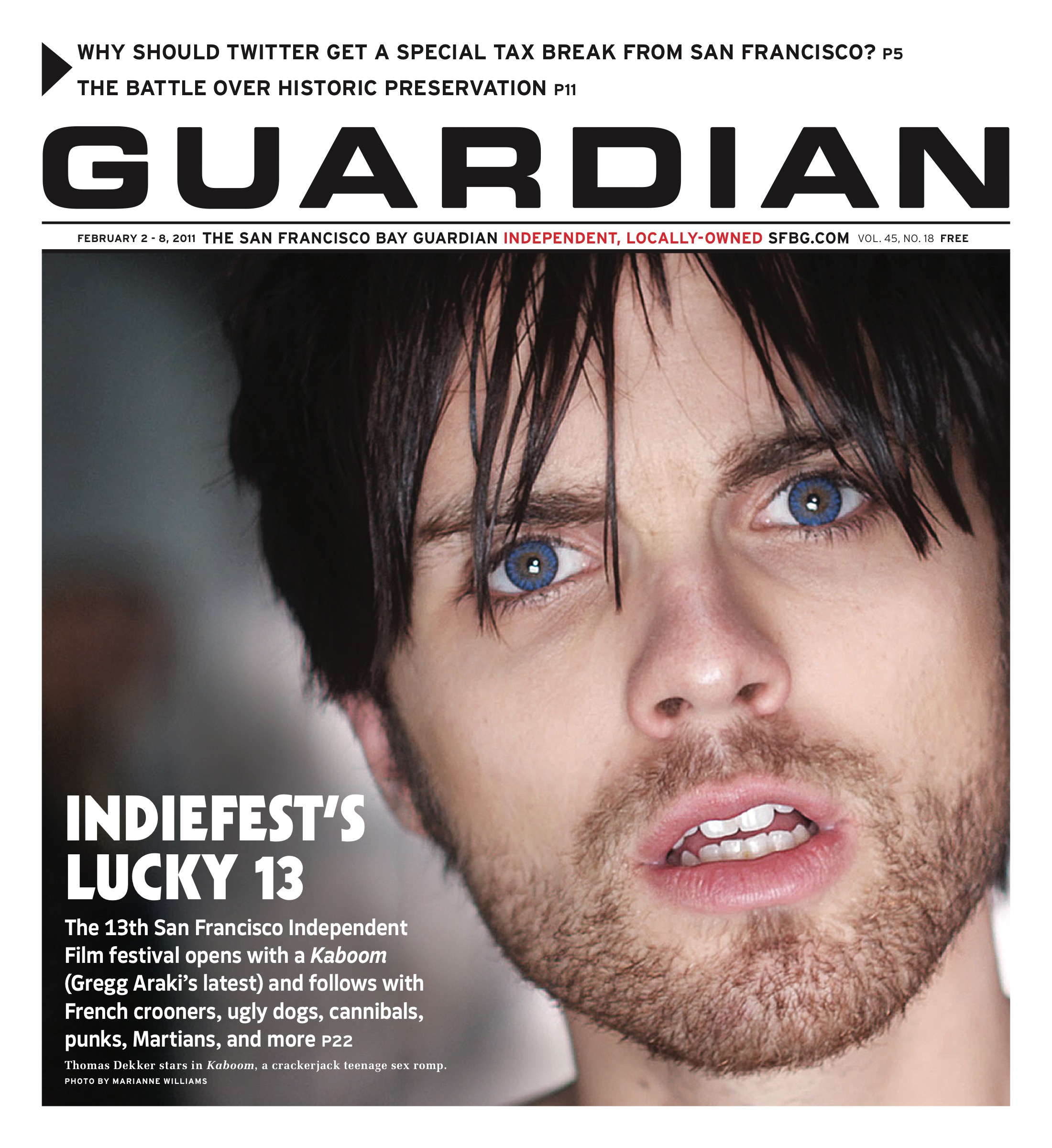
Kaboom (Gregg Araki, U.S.-France, 2010) Gregg Araki’s crackerjack teen sex romp is pure verve — a return to devil-may-care form for fans of The Doom Generation (1995) and Nowhere (1997). Kaboom is right: besides sneaking under the blue velvet rope for a classical mindfuck death trip (there’s even a good part for Jennifer Lynch), Araki and his winning cast let loose a fusillade of dorm-room chatter that runs metaphorical language to its limits. The cult-bidden mystery is too squarely accounted for, but then Kaboom is really as much The Palm Beach Story (1942) as Twin Peaks. Our coed heroes are Stella (Haley Bennett) and Smith (Thomas Dekker), and they’re the only platonic thing in the movie. Taken with Araki’s lasting affection for 1990s culture jamming, this rock-solid friendship is actually quite touching, but Kaboom works best when sliding up and down the Kinsey scale, huffing comic book paranoia for the fun of it. Thurs/3, 7 p.m. (Max Goldberg)

Mars (Geoff Marslett, U.S., 2010) Thanks to Mars, the question “Can mumblecore survive in outer space?” has been answered. (And it’s actually less annoying out there than it is on Earth!) Austin, Texas, writer-director Geoff Marslett’s rotoscope-animated tale follows three astronauts (including m-core heavy Mark Duplass) on a Mars mission, two of whom(Duplass and Zoe Simpson) spark romantically en route. Meanwhile, a solo robot delegation lands ahead of them, discovering new life forms and new emotions, as it sparks romantically, á la Wall-E (2008), with a Mars explorer thought lost a decade before. All the squee gets a little dippy toward the end, but the contrast between slacker and sci-fi genres mostly works. Added points for casting Texas hero Kinky Friedman as the POTUS; Giant Sand’s Howe Gelb did the film’s music and plays the sarcastic head of mission control. Fri/4, 9:15 p.m.; Mon/7, 7 p.m. (Eddy)

Special Treatment (Jeanne Labrune, France, 2010) Let’s get this out of the way first: Isabelle Huppert can do no wrong. That’s not to say she doesn’t occasionally pick terrible projects — she’s just never the thing that’s wrong with them. Special Treatment isn’t so much terrible as it is terribly misguided, contrasting the worlds of psychiatry and prostitution with broad, cartoonish strokes. Huppert plays Alice, a lady of the night who’s thinking about giving up the trade. I don’t blame her; the clients Special Treatment presents her with are the dullest of perverts. One wants her to dress up like a Japanese schoolgirl with a teddy bear and a giant lolly. Another goes the collar and dog bowl route. It’s 2011 — can’t we be a bit more creative with our fetishes? On the opposite end, there’s disenchanted therapist Xavier (Bouli Lanners). And wouldn’t you know it? His patients are photocopies from psychiatry textbooks. There’s a point to be made about the link between paying for sex and paying for someone to listen, but Special Treatment lacks the depth to drive it home. Sat/5 and Feb. 9, 7 p.m. (Peitzman)

Superstonic Sound: The Rebel Dread (Raphael Erichsen, U.K., 2010) “Everything I am came out of music,” says Don Letts — the second-generation Jamaican British DJ, director, and entrepreneur credited with turning punks on to reggae in the late 1970s — in this documentary about his life and work. Much like his contemporary, the late Malcolm McLaren, Letts was a cultural cross-pollinator, working in different mediums while encouraging subcultures to feedback into and off of each other to create something explosive and new. While this serviceable doc lets Letts himself retrace ground that’s been extensively covered elsewhere (it’s worth noting, though, that nearly all the archival footage used was shot by Letts himself), the scenes with his formerly estranged son, who’s also a DJ, are tender and unexpected. Feb. 12, 7 p.m.; Feb. 16, 9:15 p.m. (Matt Sussman)

Transformation: The Life and Legacy of Werner Erhard (Robyn Symon, U.S., 2010) The last thank you in the end credits of this documentary, in bold, is for Werner Erhard. The exiled former est leader and “personal growth” preacher or pioneer should thank director Robyn Symon — I think? – for Transformation, since it’s a 77-minute advertisement for him. Certainly, Erhard is a potentially rich choice in terms of subject matter, but very early on, it’s clear that Symon is out to paint a romantic, positive portrait: testimonials on his behalf are coupled with a low-volume acoustic guitar musical backdrop, and Erhard is even interviewed on the beach. Every once in a while an offhand moment — such as a brief mention of Scientology figurehead L. Ron Hubbard’s predatory view of Erhard — disrupts the soothing flow and opens the possibility of a broader, critical look at the “personal growth” phenomenon. (For the most part, it’s only been dramatized, usually through parody, in films such as 1999’s Magnolia and 1995’s Safe.) As a cultural and even historical figure, Erhard is worthy of an appraisal that’s neither enraptured nor utterly damning. This isn’t it. Thurs/3, 9:15 p.m.; Sat/5, 7 p.m.; Tues/8, 9:15 p.m. (Huston)

Worst in Show (Don Lewis, U.S., 2010) All films about animals in the competitive arena must acknowledge the fundamental truth that the animals themselves are nowhere near as entertaining as their owners. A dog just wants to play, eat, crap, sleep, and maybe have its belly rubbed. The dog’s owner, on the other hand, wants other things — titles, media attention, perhaps an endorsement deal — because they have convinced themselves (as they must convince the judges, and to some degree, the public) that their dog does not just want to play, eat, crap, sleep, and maybe have its belly rubbed. No! Their dog is special. Doc Worst in Show understands this basic drama and finds plenty of eager players in the canine and bipedal contenders, both new and returning, at Petaluma’s annual Ugliest Dog in the World Competition. Amid all the patchy fur, bad eyes, underbites, and malformed legs, it’s the big hearts and outsized egos that truly stand out in this portrait of pageant motherhood at its most extreme. Feb. 9, 9:15 p.m.; Feb. 13, 2:30 p.m. (Sussman)

Je T’aime, I Love You Terminal (Dani Mankin, Israel, 2010) It’s unfair to judge a film by its title, but Je t’aime, I Love You Terminal lets you know exactly what you’re in for. This twee indie romance is Before Sunrise (1995) meets Once (2006) meets every other twee indie romance you’ve ever seen. The film is more mediocre than it is bad, exploring the single-day love affair between two strangers stranded in Prague. Ben is moving from Israel to New York to marry the one that got away. Naturally, he also sings and plays guitar. Emily, an impulsive free spirit, teaches Ben a valuable lesson about living in the moment. Saying this story has been done before is an understatement: Je t’aime packs on indie cliché after indie cliché, without really bothering to develop Ben or Emily into interesting characters on their own. This is a retread without anything to distinguish it from the rest, dragging it down from shrug-worthy to eye-rolling. Feb. 12, 4:45 p.m.; Feb. 14, 9:15 p.m. (Louis Peitzman)

Every little star

0

HAIRY EYEBALL In 1979, the UC Berkeley Art Museum and Pacific Film Archive received a generous and somewhat unusual gift from the sister of the late German-born, pioneering American sculptor Eva Hesse: an assortment of small experimental works, made by Hesse herself, in materials such as latex, cloth, wax, fiberglass, wire mesh, and masking tape. What made these objects so unusual was their very indeterminacy. Should they be thought of as proper Hesse pieces? Were they studies for the large-scale sculptures that came to define Hesse’s output throughout the 1960s, or standalone technical experiments with different materials and processes? Alternately, were they intended to simply be as is — Hesse had given away similar objects as gifts and kept others arranged throughout her studio.

Hesse, who tragically died of a brain tumor in May 1970 at 34, left little to no indication. “Eva Hesse: Studiowork,” the stunner of an exhibit currently up at the Berkeley Art Museum, is then a homecoming of sorts for many of the pieces on display. Originally curated by Hesse scholar Briony Fer and Barry Rosen of the Hesse Estate for Edinburgh’s Fruit Market Gallery in 2009, this testament to the benefits of gutsy scholarship and cross-institutional support boldly embraces the precariousness of Hesse’s curious objects head-on and encourages us to see them on their own terms.

Entering the gallery space, you immediately encounter a group of previously unseen paper works arranged out in the open on a low plinth, like scattered autumn leaves. The forms vary in thicknesses and degrees of curvature: a worked shape of adhesive-enforced cheesecloth resembles a sunken pumpkin; a crinkled piece of tissue thin papier-mâché a bowl or shard of skull. The slightest breeze could send it flying. Hesse purposefully used fragile or impermanent substances — much to the bane of conservators — as a way to imbue her sculpture with a self-sustaining mutability, a means to continue the processes her initial crafting set into motion. In this sense, time is also one of her materials, as evinced by the caved-in latex bricks and box-like containers that have oxidized over the decades to a rich mahogany color.

The delicacy of the paper works is offset by the three large vitrines in the adjacent room each filled with a variety of objects that alternately read as: replicas of exotic coral or dried chili peppers; dirty jokes; rudimentary toy prototypes; or, more directly, obstinate lumps, variously crafted from latex, wax, painted wood and rubber tubing. The soft, round, protuberant forms of our bodies are evoked everywhere, and yet to call a fold of latex “vaginal” or a coil of tubing “intestinal” somehow feels inadequate to conveying the uncanny physicality of these pieces. It’s as if someone had made you a model of your own hand to hold.

“There is no wishing away the fact that it is hard to know what to make of these things because they are intractable in some way,” cautions Fer at the start of her warm and deeply perceptive catalog essay. Rather than function as a limitation, this interpretive resistance posed by the studio works invites us to un-see them as sculpture and to view Hesse’s careful making and undoing of material as posing a perhaps unnameable but immanently enriching possibility.


DOWN ON THE STREET

My first glimpse of Katy Grannan’s street photography was a startling color photo included in Fraenkel Gallery’s 30th anniversary show “Furthermore.” The picture was of an elderly woman wrapped in a mink stole, her face obscured by windswept gray hair as she walked down a sun-bleached street. When viewing it next to the other portraits in “Boulevard,” Grannan’s third solo show at Fraenkel, I realized it wasn’t so much the woman’s “odd” outward appearance that attracted the photographer, but the sense of purposefulness conveyed in her frozen stride.

It would be quite easy to dismiss the pictures in “Boulevard” on the grounds that Grannan is a latter-day Diane Arbus, inherently exploiting her “singular” subjects in the act of photographing them. Many appear to be regular denizens of the street — the homeless, addicts, hustlers — or are folks whose self-presentation defies established norms: an aging Marilyn Monroe impersonator, a trans woman with a 100-yard stare, an extremely hirsute biker-type.

Such a charge is unfair, and I suspect, likely the work of our own unease at looking at people who we would normally turn away from, or perhaps stare at furtively, if encountered on the street. Grannan, though, seems to want to give them their moment without overextending the encounter. Hence, a photograph. She doesn’t pose her subjects and none look directly at the camera. It’s as if, as with the fur-wrapped crone, she stopped them midstride, got her shot, and they went on their way. She respects their anonymity as well (each photo is titled after the city, Los Angeles or San Francisco, where it was taken). The discomfort in looking at Grannan’s work — she extends her gaze in The Believers, a related solo film installation at 1453 Valencia — partly comes from how technically accomplished and flawless it is: she shoots midday to capture her subject’s every wrinkle, blemish, and faded tattoo.

It feels off and disingenuous to call Grannan’s work “beautiful,” but it’s hard not to look and keep looking at the people in her neighborhood, some of whom are our neighbors as well.

EVA HESSE: STUDIOWORK

Through April 10, $5

Berkeley Art Museum

2626 Bancroft Way, Berk.

www.bampfa.berkeley.edu

KATY GRANNAN: BOULEVARD

Through Feb. 19, free

Fraenkel Galley

49 Geary, SF

www.fraenkelgallery.com

arts@sfbg.com

Our Weekly Picks: February 2-8

0

WEDNESDAY 2

MUSIC

Billy and Dolly

Have you noticed? Like clockwork, the buds on the ornamental plum trees are starting to power pop their thin pink petals, making sidewalks more poetic all across the city. Ephemeral yet impressive, the changing season awakens melodies of Billy and Dolly, the local singing and songwriting duo formerly of the Monolith. The guy-girl combo is backed by the Tell-Tale Hearts, a sonic unity of 20 Minute Loop’s rockin’ guitar-bass team and the Monolith’s drummer. The harmonies are deliciously poppy and achingly bittersweet, reminiscent of Elliott Smith, were he not so chronically bummed and had a lovely lady voice as a complement. Beware: between the trees and the tunes, it’s all so pretty, it just might hurt your heart. (Kat Renz)

With Tristen and the Corner Laughers

8 p.m., $10

Rickshaw Stop

155 Fell, SF

(415) 861-2011

www.rickshawstop.com


MUSIC

Hymn For Her

You think living in a studio apartment with two roommates is cozy? Well, think again. ‘Cause you’ve got nothing on Lucy Tight and Wayne Waxing, of Americana duo Hymn For Her that live, record, and tour in their 16-foot, 1961 Bambi Airstream trailer — along with a baby and dog. And they somehow manage to fit a three-stringed, broom-handle cigar box, banjo, dobro, bass drum, hi-hat, and harp in there, too. In true Hymn For Her fashion, its newest release, the cleverly spelled Lucy and Wayne and the Amairican Stream, was recorded at various campgrounds and friends’ driveways while on tour. Better catch them before they pack up Bambi and hit the road. (Jen Verzosa)

With Tippy Canoe

Wed/2, 7 p.m., free

Mama Buzz Café

2138 Telegraph, Oakl.

(510) 465-4073

www.mamabuzzcafe.com

With That Ghost

Thurs/3, 9 p.m., call for price

Amnesia

853 Valencia, SF

(415) 970-0012

www.amnesiathebar.com

Sun/6, 9 p.m., $6

Hemlock Tavern

1131 Polk, SF

www.hemlocktavern.com


THURSDAY 3

DANCE

Jess Curtis/Gravity

Jess Curtis/Gravity is a company that lives up to, and defies, the connotations in that noun attached to the name of its artistic director. Choreographer-performer Curtis and his eclectic collaborators display an alternately cool and passionate, always irreverent intelligence, wholly immersed in the unfathomable ocean of the human body. They’re the Jacques Cousteaus of this deep: its champions and endlessly curious, enthralled students. For audiences, that means a good time, a weird time, a heavy-breathing and emotionally up-heaving time, and a time to question things we thought we knew. The company’s latest voyage, Dances for Non/Fictional Bodies, is a sprawling work whose central event — a subjectivity-shifting convergence of “nontraditional” dancer-bodies — sets sail this weekend. (Robert Avila)

Thurs/3–Sat/6, 8 p.m., $25

Yerba Buena Center for the Arts

701 Mission, SF

(415) 978-2787

www.ybca.org


MUSIC

Ozzy Osbourne

Though he’s backed by a new lead guitarist (Greek virtuoso Gus G.) and brandishing a new album, Ozzy Osbourne isn’t likely to conquer much new territory on his 2011 Scream tour. Nor does anyone want him to. The Prince of Fucking Darkness is still revered by a healthy portion of the headbanging public, a polity that will undoubtedly spend the show demanding a hearty helping of songs from his ant-snorting, dove-decapitating, “Crazy Train”-riding salad days. Whatever your opinion on the world’s most incomprehensible celebrity, his charisma can still get an arena rocking. Whether that’s because of — or in spite of — his infallible propensity for mooning the audience, no one can say. But as the Blizzard of Ozz would no doubt put it: “who fucking cares?” (Ben Richardson)

With Slash featuring Myles Kennedy

7:30 p.m., $44–$92

H.P. Pavilion

525 West Santa Clara, San Jose

(408) 287-7070

www.hppsj.com


FRIDAY 4

EVENT

“San Francisco Bike Party February 2011 Ride: Love Your Bike”

It’s prettiest much the buzziest thing on SF bikes since American-made handlebar beer can — uh, cup — holders: the SF Bike Party, spawned from the San Jose Bike Party and a member of the same family as the East Bay Bike Party. Sources say the mass bike ride, which makes complete stops for traffic lights and the occasional drink-and-mingle sidewalk party, marks a logical evolution for the city bike activism. Despite what the comments on SF Gate say, cycles in the city are no longer the purview of a handful of iron-calved fixie followers — there’s room for a little softness among the two-wheeled, which explains this month’s V-Day-ready ride theme: “love your bike.” A map of the route will be available on the group’s website closer to push-off. (Caitlin Donohue)

7:30 p.m., free

www.sfbikeparty.wordpress.com


MUSIC

Madlib

Titles are de rigueur in hip-hop. O.D.B. once attended a debutante ball that ended before his introduction finished. (His date was devastated.) Otis Jackson Jr., best known as Madlib and other variations (Madvillain with fellow schizo MF Doom, Jaylib with late sobriquet champion J Dilla) has racked up numerous names over the last two decades. For Madlib, the aliases are appropriate given the diverse projects he tackles as DJ, producer, MC, and uber stoner (expect at least a contact high.) His latest release, Madlib Medicine Show, is a gargantuan monthly series of 12 albums that attempt to fill in the blanks on your understanding of hip-hop. (Ryan Prendiville)

With Robot Koch, Change the Beat, and more

10 p.m., $15

103 Harriet, SF

(415) 431-1200

www.1015.com


DANCE

“Rotunda Dance Series: Leung’s White Crane Chinese Lion Dancing”

Just a day after Chinese new year begins, the blaring drums, clashing cymbals, soaring lions, and dancing dragons of Leung’s White Crane Chinese Lion Dancing appear in San Francisco City Hall, bringing the colorful ancient tradition to the free lunchtime Rotunda Dance Series, copresented by Dancers’ Group and World Arts West. The three Leung brothers — Kuen, Kwan and Allen — moved to SF in the 1970s, carrying the Lion Dancing teachings of their master Kwong Boon Fu from Hong Kong. Performing internationally and teaching in Chinatown for more than 35 years, they are treasured for their larger-than-life performances in the city’s Chinese New Year Parade. (Julie Potter)

Noon, free

San Francisco City Hall

One Dr. Carlton B. Goodlett Place, SF

(415) 720-8830

www.dancersgroup.org


SATURDAY 5

EVENT

“Free University of San Francisco Teach-in”

An idea this crazy just might work! Sick of the gouge-y tuition hikes in our public and private education systems, a band of merry SF radicals have decided to launch an ambitious campaign to free learnin’. After a surprisingly light number of planning meetings, this is the first of the Free University’s offerings: a weekend of classes to inspire and hopefully serve as a community-builder for those who think our current university system is broken. On the lectern: beat poet Diane di Prima on 19th century visionary poetry, revolutionary poet Bobby Coleman on SF labor history, classes on criminal procedure, paganism, Kerouac, and more. (Donohue)

Sat/5, 9:30 a.m.–4 p.m.;

Sun/6, 9 a.m.–4 p.m., free

Viracocha

998 Valencia, SF

www.fusf.wordpress.com


SUNDAY 6

FILM

Every Man for Himself

Forever the enfant terrible of cinema, Jean-Luc Godard is skipping the lifetime achievement lineup at this year’s Oscars. This has stirred up a predictably dumb controversy in the American press over bullshit claims that Godard is anti-Semitic. Never mind the philistines — we’re still awaiting a local screening of the maestro’s 2010 Film Socialism. In the meantime, a 35mm restoration of 1980’s Every Man for Himself at the Red Vic does nicely. Godard called this lyrical examination of art and commerce intertwined his second first film, and its formal ingenuities and philosophical knots remain refreshing. Support the Red Vic by ponying up for extra popcorn! (Max Goldberg)

Sun/6–Mon/7, 7:15 and 9:15 p.m.

Also Sun/6, 2 and 4 p.m., $6–$9

Red Vic Movie House

1727 Haight, SF

(415) 668-3994

www.redvicmoviehouse.com


MONDAY 7

EVENT

Replikaaa Silent Happening: A Multimedia Performance Art Event”

Sometimes you just don’t have much to say. Or perhaps your ears are ringing from all those noisy bars. To exercise the other senses visit this chic silent cocktail party where guests practice the art of nonverbal communication, watching and connecting without words. The unusual and participatory social experience presented by Al’Myra Communications includes a preview screening of Tayeb Al-Hafez’s silent film Replikaaa, a mysterious and futuristic work about five DNA and organ traffickers, to be followed by local artist performances. Reserve a free ticket online and then shut your mouth. Whether you wink, gesticulate, or show some funky dance moves is up to you. Chatty Cathys discouraged. (Potter)

7 p.m., free

Z Space

450 Florida, SF

(415) 891-9544

www.replikaaathemovie.com


TUESDAY 8

MUSIC

Sebadoh

In the vein of Guided By Voices and Pavement, Sebadoh has been dubbed “the quintessential indie rock band of the 1990s” — and like that decade’s flannel-shirt trend, they’re back. After getting the heave-ho in 1988 as bassist of alt-rock band Dinosaur Jr. (he rejoined in 2005), multi-instrumentalist Lou Barlow focused on the DIY project he had started with Eric Gaffney. Sebadoh soon became infamous for its bipolar swings from lo-fi, touchy-feely folk to experimental noise rock. With the addition of bassist Jason Loewenstein, the three-piece became a hit among the hip. Eventually Gaffney jumped ship (he rejoined in 2007) and was replaced by drummer Bob Fay. This lineup recorded the band’s most accessible albums, 1994’s Bakesale and 1996’s Harmacy, both of which are being re-released by Sub Pop Records this year and are the reason for the current tour. (Verzosa)

With Quasi

7 p.m., $20

Great American Music Hall

859 O’Farrell, SF

www.gamh.com


FILM

The Ipcress File

Move over, Christopher Walken: there’s a new star du jour for celebrity imitation freaks. You can’t help but try your hand at Michael Caine’s Cockney accent after watching the hilarious clip from the BBC show The Trip of comedians Steve Coogan and Rob Brydon engaging in a rousing round of dueling Caine-jos. (Search “This is how Michael Caine speaks” on YouTube. You’re welcome.) Polish your early-period Caine impersonation by checking out a rare screening of 1965 secret-agent thriller The Ipcress File, which showcases the legendary actor in his first starring role. The film plays as part of four nights of highlights from the “Mostly British Film Festival,” with other entries hailing from New Zealand and Australia. (Cheryl Eddy)

7 p.m., $10.25

Christopher B. Smith Rafael Film Center

1118 Fourth St., San Rafael

(415) 454-1222

www.cafilm.org


The Guardian listings deadline is two weeks prior to our Wednesday publication date. To submit an item for consideration, please include the title of the event, a brief description of the event, date and time, venue name, street address (listing cross streets only isn’t sufficient), city, telephone number readers can call for more information, telephone number for media, and admission costs. Send information to Listings, the Guardian Building, 135 Mississippi St., SF, CA 94107; fax to (415) 487-2506; or e-mail (paste press release into e-mail body — no text attachments, please) to listings@sfbg.com. Digital photos may be submitted in jpeg format; the image must be at least 240 dpi and four inches by six inches in size. We regret we cannot accept listings over the phone.

Stage Listings

0

THEATER

ONGOING

Audition – A Play Exit Theater, 156 Eddy; (800) 838-3006, www.brownpapertickets.com. Call for price. Thurs and Sat, 8pm; Sun, 3pm. Through Feb 13. GenerationTheatre presents a comedy of the absurd by Roland David Valayre.

Bone to Pick and Diadem Exit on Taylor, 277 Taylor; (800) 838-3006, www.cuttingball.com. $15-50. Thurs-Sat, 8pm; Sun, 5pm. Through Feb 13. Cutting Ball Theatre presents a pair of plays by Eugenie Chan.

Clue Boxcar Playhouse, 505 Natoma; 776-1747, www.boxcartheatre.org. $15-35. Wed-Fri, 8pm; Sat, 7 and 10pm. Through Feb 19. A play based on a film based on a board game is just the kind of tangled genealogy much goodtime theater is made of these days. So there’s nothing too new about Boxcar’s stage adaptation of the manic 1985 comedy derived from a once popular Parker Bros. diversion. In fact, it’s at least the second stage adaptation of same to be offered in San Francisco. (Impossible Productions remounted its version at the Dark Room just last year.) Nevertheless, led by adapter-director Nick A. Olivero, Boxcar’s production pursues its vision like a mad yen, with a loving fidelity and self-referential glee that are not so much inspired as just plain zealous (although Olivero’s scenic design does reach new heights: a TV-toned board-game set that the audience peers down on from six-feet-high balconies ringing the stage). Performances are dutiful and solid for the most part, with especially nice work from Brian Martin (as the butler) and J. Conrad Frank (as Mrs. Peacock). Although there’s something vaguely and not unpleasantly hypnotic about it all, groups of cult-film line-gleaners may be the best audience for this one. (Avila)

*The Companion Piece Z Space at Theatre Artaud, 450 Florida; (800) 838-3006, www.zspace.org. $20-$40. Thurs 7pm; Fri-Sat, 8pm; Sun, 5pm. Through Feb 13. Z Space presents the world premiere of a new play by Mark Jackson, with Beth Wilmurt and Christopher Kuckenbaker.

Next to Normal Curran Theatre, 445 Geary; (888) SHN-1799, www.shnsf.com. $30-99. Call for dates and times. Through Feb 20. Diana Goodman (Alice Ripley) is a woman too restlessly witty and big-souled to sit easy in the suburban home she shares with her husband (Asa Somers), 16-year-old daughter (Emma Hunton), and 18-year-old son (Curt Hansen). What’s worse, the 18-year-old died as a baby about 17 years ago, and has not been taking the news lying down. A mother’s grief winds through this sometimes clever, mostly sappy, and ultimately tedious Broadway rock musical about a bipolar woman and the impact of her illness on her family. Director Michael Greif’s (Rent) kinetic staging takes place across a three-level industrial-box set that houses musicians in its outer corners as well as the stereotypical family dwelling in its center. The set’s outer façade (moving panels featuring giant eyes and mouth) meanwhile suggests the whole thing as a model of the mind we’re witnessing come apart. The 2008 musical by Brian Yorkey (book and lyrics) and Tom Kitt (music) won a Pulitzer for its supposedly bold depiction of mental illness. But despite reasonable scoffing at the paternalistic, pharmacologically fueled regime of mainstream treatment (embodied by Jeremy Kushnier’s various doctors), neither Tony-winner Ripley’s jagged performance nor Yorkey’s book transcends a stultifying and finally grating set of narrative clichés, which the driving, mostly generic-sounding score only makes more obvious. A Woman Under the Influence this isn’t. (Avila)

Out of Sight The Marsh, 1062 Valencia; (800) 838-3006, www.themarsh.org. $15-35. Thurs and Sat, 8pm; Sun, 3pm. Through Feb 13. The Marsh presents a new solo show by Sara Felder.

Party of 2 – The New Mating Musical Shelton Theater, 533 Sutter; (800) 838-3006, www.partyof2themusical.com. $27-29. Sun, 3pm. Open-ended. A musical about relationships by Shopping! The Musical author Morris Bobrow.

*Pearls Over Shanghai Thrillpeddlers’ Hypnodrome, 575 Tenth St; 1-800-838-3006, www.brownpapertickets.com. $30-69. Sat, 8pm. Through April 9. Thrillpeddlers’ acclaimed production of the Cockettes musical continues its successful run.

Spalding Gray: Stories Left to Tell Gough Street Playhouse, 1620 Gough; (510) 207-5774, www.custommade.org. $10-25. Thurs-Sat, 8pm. Through Feb 19. Custom Made Theatre presents stories by the late writer and performer.

Treefall New Conservatory Theatre Center, 25 Van Ness; 861-8972, www.nctsf.org. $24-40. Call for dates and times. Through Feb 27. New Conservatory Theatre Center presents a tale of erotic attraction by Henry Murray.

BAY AREA

The Agony and the Ecstasy of Steve Jobs Berkeley Rep, Thrust Stage, 2025 Addison, Berk; (510) 647-2949, www.berkeleyrep.org. $14.50-73. Call for dates and times. Through Feb 27. Storyteller Mike Daisey spins a yarn about the Apple head.

Collapse Aurora Theatre, 2081 Addison, Berk; (510) 843-4822, www.auroratheatre.org. $34-55. Wed-Sat, 8pm; Sun, 2 and 7pm; Tues, 7pm (also Feb 19, 2pm). Through March 6. Aurora Theatre presents a comedy by Allison Moore.

East 14th – True Tales of a Reluctant Player The Marsh Berkeley, 2120 Allston Way, Berk; (800) 838-3006, www.themarsh.org. $20-50. Call for times. Through Feb 13. Don Reed’s one-man show continues its extended run.

Grapes of Wrath Marion E. Green Black Box Theater, 531 19th, Oakl; www.theatrefirst.com. $10-30. Thurs-Sat, 8pm; Sun, 2pm. TheatreFIRST presents Frank Galati’s stage adaptation of the John Steinbeck novel.

Heartbreak House Live Oak Theatre, 1301 Shattuck, Berk; (510) 649-0999, www.berkeleyrep.org. $12-15. Fri-Sat, 8pm (also Feb 13, 2pm; Feb, 17, 8pm). Through Feb 19. Actors Ensemble of Berkeley presents the George Bernard Shaw comedy set just before World War I.

The Last Cargo Cult Berkeley Repertory Theatre, Thrust Stage, 2025 Addison, Berk; (510) 647-2949, www.berkeleyrep.org. $14.50-73. Call for dates and times. Through Feb 20. As fans of J. Maarten Troost have learned, life on an island “paradise” is far less idyllic than the imagination yearns to believe. So it’s hardly surprising that Mike Daisey’s monologue The Last Cargo Cult begins with a white-knuckle ride in a prop plane piloted by a man with a milky eye. Daisey’s destination, the Pacific island of Tanna, is the location of one of the world’s last so-called “cargo cults”, and their big celebration “John Frum Day” is approaching. Daisey’s intention to hang out at the festivities smacks a little of entitled voyeurism, but the parallel he manages to draw between the complexities of a religion dedicated to a mythical cargo of “awesome shit”, and our own dedication to the acquisition of same, is a striking one. From our almost blind faith in the value of basically valueless currency, to our even blinder faith that indenturing ourselves by debt will enrich us, the foundations of our own “cargo cult” are revealed smartly by Daisey to be just as precarious as if built at the base of a volcano as in Tanna. Still, I found the most revealing thing about the evening to be the moment when the couple next to me took off with a $100 bill they’d acquired free-of-charge at the door, to which I can’t help but ask them: “Did you get your money’s worth?” (Gluckstern)

Not a Genuine Black Man The Marsh Berkeley, TheaterStage, 2120 Allston, Berk; 826-5750, www.themarsh.org. $20-50. Fri, 8pm. Through Feb 18. Brian Copeland brings back his long-running solo show.

Strange Travel Suggestions The Marsh Berkeley, Cabaret, 2120 Allston Way, Berk; (800) 838-3006, www.themarsh.org. $15-35. Thurs-Fri, 8pm; Sat, 5pm. Through Feb 19. Jeff Greenwald stars in a one-man show about the vagaries of wanderlust.

The 39 Steps TheatreWorks at the Mountain View Center for the Performing Arts, 500 Castro, Mtn View; (650) 463-1960, www.theatreworks.org. $24-79. Tues-Wed, 7:30pm; Thurs-Fri, 8pm; Sat, 2 and 8pm; Sun, 2 and 7pm. Through Feb 13. TheatreWorks presents Patrick Barlow’s comic adaptation of the book and movie of the same name.

World’s Funniest Bubble Show The Marsh Berkeley, 2120 Allston Way, Berk; (800) 838-3006, www.themarsh.org. $8-11. Sun, 11am. Through April 3. The Amazing Bubble Man extends the bubble-making celebration.

PERFORMANCE/DANCE

BAY AREA

Marga’s Funny Mondays The Cabaret at The Marsh Berkeley, 2120 Allston; (800) 838-3006, www.themarsh.org. Mon/7, 8pm. $10. Marga Gomez hosts a Monday night comedy series.


Stage listings are compiled by Guardian staff. Performance times may change; call venues to confirm. Reviewers are Robert Avila, Rita Felciano, and Nicole Gluckstern. Submit items for the listings at listings@sfbg.com. For further information on how to submit items for the listings, see Picks. For complete listings, see www.sfbg.com.

Rep Clock

0

Schedules are for Wed/2–Tues/8 except where noted. Director and year are given when available. Double and triple features are marked with a •. All times are p.m. unless otherwise specified.

ARTISTS’ TELEVISION ACCESS 992 Valencia, SF; www.atasite.org. $6-10. “Reagan’s 100th Birthday,” a collection of the former Prez’s finest and most ironic on-screen moments curated by Bryan Boyce, Sun, 7:30.

CASTRO 429 Castro, SF; (415) 621-6120, www.castrotheatre.com. $7.50-10. “SF Sketchfest Great Collaborators Series: Tribute to Murphy Brown,” with Candice Bergen and Diane English in person for a Q&A moderated by Connie Chung, Wed, 7. For more info on this event (tickets, $25), visit www.sfsketchfest.com. “Anne Francis: 1930-2011:” •Bad Day at Black Rock (Sturges, 1955), Fri, 1:30, 5:05, 8:55, and Forbidden Planet (Wilcox, 1956), Fri, 3:10, 7. “SF Sketchfest: True Stories 25th Anniversary: David Byrne in Conversation with Paul Myers:” True Stories (Byrne, 1986), Sat, 5. For more info on this event (tickets, $35), visit www.sfsketchfest.com. “SF Sketchfest and Midnight Mass present Idol Worship: An Evening with Cloris Leachman hosted by Peaches Christ:” High Anxiety (Brooks, 1977), Sat, 8:30. For more info on this event (tickets, $25), visit www.sfsketchfest.com.

CHRISTOPHER B. SMITH RAFAEL FILM CENTER 1118 Fourth St, San Rafael; (415) 454-1222, www.cafilm.org. $6.50-10.25. The Illusionist (Chomet, 2010), call for dates and times. Nuremberg: Its Lesson for Today (Schulberg, 1948/2010), call for dates and times. “Mostly British Film Festival:” Topp Twins: Untouchable Girls (Pooley, 2009), Mon, 7; The Ipcress File (Furie, 1965), Tues, 7.

COUNTERPULSE 1310 Mission, SF; www.counterpulse.org. $5-10. “50Faggots: How Gay Do You Want to Be Today,” Sat, 3. Screening of online documentary series followed by discussion with director Randall Jenson.

GRAY AREA FOUNDATION FOR THE ARTS 55 Taylor, SF; www.cinemaspeakeasy.com. $5. “Cinema Speakeasy: San Francisco Presents Shorts!”, Thurs, 8.

HUMANIST HALL 390 27th St, Oakl; www.humanisthall.org. $5. South of the Border (Stone, 2009), Wed, 7:30.

MECHANICS’ INSTITUTE 57 Post, SF; (415) 393-0100, rsvp@milibrary.org. $10. “CinemaLit Film Series: New Year’s Revolutions:” Libeled Lady (Conway, 1936), Fri, 6.

PACIFIC FILM ARCHIVE 2575 Bancroft, Berk; (510) 642-5249, www.bampfa.berkeley.edu. $5.50-9.50. “Film 50: History of Cinema: Fantasy Films and Realms of Enchantment:” The Cabinet of Dr. Caligari (Wiene, 1920), Wed, 3:10. “Radical Light: Alternative Film and Video in the San Francisco Bay Area:” “Found Footage Films,” Wed, 7:30; “Versions of Veracity: Video, the 1980s,” Sun, 5:30. “African Film Festival 2011:” Shirley Adams (Hermanus, 2009), Thurs, 7; Beyond the Ocean (de Latour, 2008), Sat, 6:30. “Suspicion: The Films of Claude Chabrol and Alfred Hitchcock:” La Femme Infidèle (Chabrol, 1969), Fri, 7; Violette Nozière (Chabrol, 1978), Fri, 9; Vertigo (Hitchcock, 1958), Sat, 8:35. “School Days:” “Screenagers: 13th Annual Bay Area High School Film and Video Festival,” Sat, 3:30. “Cruel Cinema: New Directions in Tamil Film:” Paruthiveeran (Sultan, 2007), Sun, 2.

RED VIC 1727 Haight, SF; (415) 668-3994; www.redvicmoviehouse.com. $6-10. Ziggy Stardust and the Spiders from Mars (Pennebaker, 1973), Wed-Thurs, 2, 7:15, 9:15. Unstoppable (Scott, 2010), Fri-Sat, 7:15, 9:20 (also Sat, 2, 4). Every Man For Himself (Godard, 1980), Sun-Mon, 7:15, 9:15 (also Sun, 2, 4). The Jerk (Reiner, 1979), Feb 8-9, 7:15, 9:20 (also Feb 9, 2).

ROXIE 3117 and 3125 16th St, SF; (415) 863-1087, www.roxie.com. $5-9.75. Lemmy (Olliver and Orshoski, 2010), Wed, 7, 9:30. San Francisco Independent Film Festival, Feb 3-17. See film listings or www.sfindie.com for more info.

WAR MEMORIAL VETERANS BUILDING 401 Van Ness, SF; www.upheavalproductions.com. Free. Occupation Has No Future: Militarism and Resistance in Israel/Palestine (Zlutnick, 2020), Thurs, 7:30. Screening followed by a discussion with director David Zlutnick and members of Dialogues Against Militarism. YERBA BUENA CENTER FOR THE ARTS 701 Mission, SF; (415) 978-2787, www.ybca.org. $6-8. “Volume 14: Middle East,” nine videos focusing on the Middle East compiled by ASPECT: The Chronicle of New Media Art, Jan 13-March 27 (gallery hours Thurs-Sat, noon-8; Sun, noon-6). Shoah (Lanzmann, 1985), Sat, 1 (first half); Sun, 1 (second half); Feb 13, 11am (complete film with one-hour break). 

Music Listings

0

WEDNESDAY 2

ROCK/BLUES/HIP-HOP

Corruptors, Heroine, Vanishing Breed Knockout. 9:30pm, $6.

Generalissimo, Blind Shake, Guitar vs. Gravity Hotel Utah. 9pm, $7.

Bobby Long Café Du Nord. 9:30pm, $15.

*Motorhead, Clutch, Valient Thorr Warfield. 8pm, $38.

Professor Burns and the Lilac Field, Eric Maskol, Maya Dorn Milk. 8:30pm, $5.

Das Racist, Hottub, DJ Vin Soi Independent. 8pm, $15.

Sweet Chariot, Victory and Associates, Calls Elbo Room. 9pm, $6.

Tristen, Billy and Dolly, Corner Laughers Rickshaw Stop. 8pm, $10.

Tunnel, Foolproof Four, Word Bottom of the Hill. 9pm, $8.

Wood Brothers Yoshi’s San Francisco. 8pm, $17.

JAZZ/NEW MUSIC

Dink Dink Dink, Gaucho, Michael Abraham Amnesia. 7pm, free.

Ben Marcato and the Mondo Combo Top of the Mark. 7:30pm, $10.

Michael Parsons Revolution Café, 3248 22nd St, SF; (415) 642-0474. 8:30pm, free.

Paula West and George Mesterhazy Quartet Rrazz Room. 8pm, $35.

DANCE CLUBS

Booty Call Q-Bar, 456 Castro, SF; www.bootycallwednesdays.com. 9pm. Juanita Moore hosts this dance party, featuring DJ Robot Hustle.

Cannonball Beauty Bar. 10pm, free. Rock, indie, and nu-disco with DJ White Mike.

Hands Down! Bar on Church. 9pm, free. With DJs Claksaarb, Mykill, and guests spinning indie, electro, house, and bangers.

Jam Fresh Wednesdays Vessel, 85 Campton, SF; (415) 433-8585. 9:30pm, free. With DJs Slick D, Chris Clouse, Rich Era, Don Lynch, and more spinning top40, mashups, hip hop, and remixes. Mary-Go-Round Lookout, 3600 16th St, SF; (415) 431-0306. 10pm, $5. A weekly drag show with hosts Cookie Dough, Pollo Del Mar, and Suppositori Spelling.

Respect Wednesdays End Up. 10pm, $5. Rotating DJs Daddy Rolo, Young Fyah, Irie Dole, I-Vier, Sake One, Serg, and more spinning reggae, dancehall, roots, lovers rock, and mash ups.

Synchronize Il Pirata, 2007 16th St, SF; (415) 626-2626. 10pm, free. Psychedelic dance music with DJs Helios, Gatto Matto, Psy Lotus, Intergalactoid, and guests.

THURSDAY 3

ROCK/BLUES/HIP-HOP

Ólafur Arnalds Great American Music Hall. 8pm, $17.

Shawn Colvin Yoshi’s San Francisco. 8pm, $34.

Leather Feather, Heart Touch, Dr. Madd Vibe, Sistas in the Pit, Punk Funk Mob Cellspace, 2050 Bryant, SF; www.sfindie.com. 9pm, $10. Part of SF Winter Music Festival.

Limousines, Aaron Axelsen, Miles the DJ Rickshaw Stop. 10pm, $12. Presented by Popscene.

Little Creatures, Casy and Brian El Rio. 10pm, free.

Mangled Bohemians, Lickets, Shores Hemlock Tavern. 9pm, $6.

Mercury Falls Kaleidoscope, 3109 24th St, SF; www.kaleidoscopefreespeechzone.com. 9pm, $8.

Midnight Snackers, Badugi, Late Night Drive Kimo’s. 9pm, $6.

Mofo Party Band Biscuits and Blues. 8 and 10pm, $16.

Nels Cline Singers with Yuka C. Honda, Paul Riola Independent. 8pm, $16.

Social Distortion, Aggrolites, Chuck Ragan Warfield. 9pm, $35.

Tennis, Lord Huron, Air Waves Bottom of the Hill. 9pm, $12.

That Ghost, Hymn for Her Amnesia. 9pm.

Toasters, Inciters Red Devil Lounge. 8pm, $12.

JAZZ/NEW MUSIC

Dastardly Revolution Café, 3248 22nd St, SF; (415) 642-0474. 8:30pm, free.

Stompy Jones Top of the Mark. 7:30pm, $10.

Paula West and George Mesterhazy Quartet Rrazz Room. 8pm, $40.

FOLK/WORLD/COUNTRY

Country Casanovas Atlas Café. 8pm, free.

DANCE CLUBS

Afrolicious Elbo Room. 9:30pm, $10. DJs Pleasuremaker and Señor Oz spin Afrobeat, tropicália, electro, samba, and funk.

Caribbean Connection Little Baobab, 3388 19th St, SF; (415) 643-3558. 10pm, $3. DJ Stevie B and guests spin reggae, soca, zouk, reggaetón, and more.

Club Jammies Edinburgh Castle. 10pm, free. DJs EBERrad and White Mice spinning reggae, punk, dub, and post punk.

Drop the Pressure Underground SF. 6-10pm, free. Electro, house, and datafunk highlight this weekly happy hour.

Electric Feel Lookout, 2600 16th St, SF; www.fringesf.com. 9pm, $2. Indie music video dance party with subOctave, Blondie K, and guest DJ Lifeline.

Good Foot Som., 2925 16th St, SF; (415) 558-8521. 10pm, free. With resident DJs Haylow, A-Ron, Prince Aries, Boogie Brown, Ammbush, plus food carts and community creativity.

Guilty Pleasures Gestalt, 3159 16th St, SF; (415) 560-0137. 9:30pm, free. DJ TophZilla, Rob Metal, DJ Stef, and Disco-D spin punk, metal, electro-funk, and 80s.

Holy Thursday Underground SF. 10pm, $5. Bay Area electronic hip hop producers showcase their cutting edge styles monthly.

JFK of MSTRKRFT, Nisus, Shane King Mighty. 9pm, $15.

Jivin’ Dirty Disco Butter, 354 11th St., SF; (415) 863-5964. 8pm, free. With DJs spinning disco, funk, and classics.

Koko Puffs Koko Cocktails, 1060 Geary, SF; (415) 885-4788. 10pm, free. Dubby roots reggae and Jamaican funk from rotating DJs.

Lacquer Beauty Bar. 10pm-2am, free. DJs Mario Muse and Miss Margo bring the electro.

Mestiza Bollywood Café, 3376 19th St, SF; (415) 970-0362. 10pm, free. Showcasing progressive Latin and global beats with DJ Juan Data.

Peaches Skylark, 10pm, free. With an all female DJ line up featuring Deeandroid, Lady Fingaz, That Girl, and Umami spinning hip hop.

FRIDAY 4

ROCK/BLUES/HIP-HOP

Seth Augustus Revolution Café, 3248 22nd St, SF; (415) 642-0474. 9pm, free.

Les Aus, Huan Hemlock Tavern. 9:30pm, $8.

“Battle of the Bands: Finals” DNA Lounge. 5:30pm, $12. With Handshake, Thy Winter Shadow, Boondock Squad, and more.

Blisses B, Acadia Collective, Ben Keeler Hotel Utah. 9pm, $8.

Ethan Bortnick and His Musical Time Machine Regency Ballroom. 8pm, $29-50-39.50.

Cat Power Fillmore. 9pm, $35.

Church Great American Music Hall. 8pm, $35.

Shawn Colvin Yoshi’s San Francisco. 8pm, $34.

Definite Articles, She Beards, Gems, Bryan McPherson Bottom of the Hill. 9:30pm, $10.

Exrays, Tim Cohen’s Magick Trick, Fiveng, DJ Cyclist Café Du Nord. 9pm, $12.

“14th Annual One Night Stand” Slim’s. 8pm, $13. Local bands perform cover songs.

Frail, Rykarda Parasol, Slpwlkrs Rickshaw Stop. 8pm, $10-15.

Hi-Rhythm Hustlers, Slim Jenkins Verdi Club, 2424 Mariposa, SF; www.oldtimey.net. 9pm, $10.

Claudette King Biscuits and Blues. 8 and 10pm, $20.

Los Shimmy Shakers, Foolproof Four, Taxes, Yoma Band, Shit Outta Luck, Thief, Nervous Energy Cellspace, 2050 Bryant, SF; www.sfindie.com. 8pm, $10. Part of SF Winter Music Festival.

Social Distortion, Lucero, Chuck Ragan Warfield. 9pm, $35.

FOLK/WORLD/COUNTRY

Forro Brazuca, DJ Alfie1Bateria Elbo Room. 10pm, $10.

Valerie Orth and friends Red Poppy Art House. 8pm, $10-15.

JAZZ/NEW MUSIC

Black Market Jazz Orchestra Top of the Mark. 9pm, $10.

Paula West and George Mesterhazy Quartet Rrazz Room. 8pm, $45.

DANCE CLUBS

Braza! Som.10pm, $10. With DJs Vanka, Elan, and Caasi.

Deeper 222 Hyde, 222 Hyde, SF; (415) 345-8222. 9pm, $10. With rotating DJs spinning dubstep and techno.

Dirty Rotten Dance Party Madrone Art Bar. 9pm, $5. With DJs Morale, Kap10 Harris, and Shane King spinning electro, bootybass, crunk, swampy breaks, hyphy, rap, and party classics.

Exhale, Fridays Project One Gallery, 251 Rhode Island, SF; (415) 465-2129. 5pm, $5. Happy hour with art, fine food, and music with Vin Sol, King Most, DJ Centipede, and Shane King.

Fubar Fridays Butter, 354 11th St., SF; (415) 863-5964. 6pm, $5. With DJs spinning retro mashup remixes.

Good Life Fridays Apartment 24, 440 Broadway, SF; (415) 989-3434. 10pm, $10. With DJ Brian spinning hip hop, mashups, and top 40.

Hot Chocolate Milk. 9pm, $5. With DJs Big Fat Frog, Chardmo, DuseRock, and more spinning old and new school funk.

Rockabilly Fridays Jay N Bee Club, 2736 20th St, SF; (415) 824-4190. 9pm, free. With DJs Rockin’ Raul, Oakie Oran, Sergio Iglesias, and Tanoa “Samoa Boy” spinning 50s and 60s Doo Wop, Rockabilly, Bop, Jive, and more.

Some Thing Stud. 10pm, $7. VivvyAnne Forevermore, Glamamore, and DJ Down-E give you fierce drag shows and afterhours dancing.

Strangelove Cat Club. 10pm, $6. Six-year anniversary featuring goth and industrial with DJs Tomas Diablo, Joe Radio, Xander, and Orko.

Vintage Orson, 508 Fourth St, SF; (415) 777-1508. 5:30-11pm, free. DJ TophOne and guest spin jazzy beats for cocktalians.

SATURDAY 5

ROCK/BLUES/HIP-HOP

Communist Kayte, Icekats and the Mengz Thee Parkside. 3pm, free.

Devil’s Brigade, Roger Miret and the Disasters Thee Parkside. 9pm, $12.

*400 Blows, Skinwalker, Longmont Potion Castle El Rio. 10pm, $8.

Tommy Guerrero Café Du Nord. 9:30pm, $12.

Hurry Up Shotgun, X-Ray Press, Third Victim of Abigail Rutledge Hemlock Tavern. 9:30pm, $6.

Lakeside Yoshi’s San Francisco. 8 and 10pm, $25-35.

Led Zeppelin 2 Slim’s. 9pm, $16.

Rod Piazza and the MIghty Flyers Biscuits and Blues. 8 and 10pm, $22.

Pollux, Pine and Battery, Lite Brite, Gentlemen Bottom of the Hill. 9pm, $12.

Grace Potter and the Nocturnals Fillmore. 9pm, $20.

Roy G. Biv and the Mnemonic Devices, Semi Feral, Aaron Lee and the Love Vigilantes, Sorry Mom and Dad Kimo’s 9pm, $8.

JAZZ/NEW MUSIC

Paula West and George Mesterhazy Quartet Rrazz Room. 8pm, $45.

FOLK/WORLD/COUNTRY

Brothers Comatose, Green String Farm Band Amnesia. 9pm, $7.

Rodney Crowell Great American Music Hall. 9pm, $26.

I.R.B. Revolution Café, 3248 22nd St, SF; (415) 642-0474. 9pm, free.

“Khaliji Night” Arab Cultural and Community Center, Two Plaza St., SF; www.arabculturalcenter.org. 7pm, $15. With singer-oud player Naser Musa and percussionist Faisal Zedan.

Mighty Mississippi Café Royale, 800 Post, SF; (415) 641-6033. 8pm, free.

Craig Ventresco and Meredith Axelrod Atlas Café. 4pm, free.

DANCE CLUBS

Bar on Church 9pm. Rotating DJs Foxxee, Joseph Lee, Zhaldee, Mark Andrus, and Nuxx.

Everlasting Bass 330 Ritch. 10pm, $5-10. Bay Area Sistah Sound presents this party, with DJs Zita and Pam the Funkstress spinning hip-hop, soul, funk, reggae, dancehall, and club classics. Foundation Som., 2925 16th St., SF; (415) 558-8521. 10pm.

Gemini Disco Underground SF. 10pm, $5. Disco with DJ Derrick Love and Nicky B. spinning deep disco.

HYP Club Eight, 1151 Folsom, SF; www.eightsf.com. 10pm, free. Gay and lesbian hip-hop party, featuring DJs spinning the newest in the top 40s hip hop and hyphy.

Kontrol Endup. 10pm, $20. With resident DJs Alland Byallo, Craig Kuna, Sammy D, and Nikola Baytala spinning minimal techno and avant house.

Leisure Paradise Lounge. 10pm, $7. DJs Omar, Aaron, and Jet Set James spinning classic britpop, mod, 60s soul, and 90s indie.

New Wave City: New Romantic Night DNA Lounge. 9pm, $7-12. DJs Skip and Shindog spin dreamy 80s.

Rock City Butter, 354 11th St., SF; (415) 863-5964. 6pm, $5 after 10pm. With DJs spinning party rock.

Saturday Night Soul Party Elbo Room. 10pm, $5-10. Sixties soul with DJs Lucky, Phengren Oswald, and Paul Paul.

Sensualite 111 Minna. 8pm, $20. Sexy party with burlesque, cookies, and the authors of Cockfidence: The Extraordinary Lover’s Guide to Being the Man You Want to Be and Driving Women Wild.

Souf Club Six. 9pm, $7. With DJs Jeanine Da Feen, Motive, and Bozak spinning southern crunk, bounce, hip hop, and reggaeton.

Soundscape Vortex Room, 1082 Howard, SF; www.myspace.com/thevortexroom. With DJs C3PLOS, Brighton Russ, and Nick Waterhouse spinning Soul jazz, boogaloo, hammond grooves, and more.

Spirit Fingers Sessions 330 Ritch. 9pm, free. With DJ Morse Code and live guest performances.

Three Kinds of Stupid Dance Party Rickshaw Stop. 9pm, $12. With Sugar and Gold, Yip Deceiver, and DJs BAS, Chris Baty, and Brother Grimm.

Twelves, White Mike, Nisus Mezzanine. 9pm, $16.

SUNDAY 6

ROCK/BLUES/HIP-HOP

Fracas, Kicker!, Bite, FUKM, Sad Boy Sinister Cellspace, 2050 Bryant, SF; www.sfindie.com. 6pm, $10. Part of SF Winter Music Festival.

Hymn for Her Hemlock Tavern. 9pm, $6.

Plain White Ts, Parachute, Miggs Fillmore. 8pm, $22.50.

JAZZ/NEW MUSIC

Jennifer Bryce and Josh Workman Bliss Bar, 4026 24th St, SF; www.blissbarsf.com. 4:30pm, $10.

Joe Warner Trio Revolution Café, 3248 22nd St, SF; (415) 642-0474. 8pm, free.

Paula West and George Mesterhazy Quartet Rrazz Room. 7pm, $40.

FOLK/WORLD/COUNTRY

John Meeks Thee Parkside. 4pm, free.

DANCE CLUBS

Afterglow Nickies, 466 Haight, SF; (415) 255-0300. An evening of mellow electronics with resident DJs Matt Wilder, Mike Perry, Greg Bird, and guests.

Call In Sick Skylark. 9pm, free. DJs Animal and I Will spin danceable hip-hop.

DiscoFunk Mashups Cat Club. 10pm, free. House and 70’s music.

Dub Mission Elbo Room. 9pm, $6. Dub, roots, and classic dancehall with DJs Sep, Vinnie Esparza, and J Boogie.

Gloss Sundays Trigger, 2344 Market, SF; (415) 551-CLUB. 7pm. With DJ Hawthorne spinning house, funk, soul, retro, and disco.

Honey Soundsystem Paradise Lounge. 8pm-2am. “Dance floor for dancers – sound system for lovers.” Got that?

Kick It Bar on Church. 9pm. Hip-hop with DJ Zax.

Religion Bar on Church. 3pm. With DJ Nikita.

Swing Out Sundays Rock-It Room. 7pm, free (dance lessons $15). DJ BeBop Burnie spins 20s through 50s swing, jive, and more.

MONDAY 7

ROCK/BLUES/HIP-HOP

Asada Messiah, Dimesland, Catacomb Creeps Elbo Room. 9pm, $6.

Atomic Tom, Maniac Café Du Nord. 9:30pm, $12.

Guitar Shorty Biscuits and Blues. 8 and 10pm, $20.

JAZZ/NEW MUSIC

Lavay Smith Swinget with Jules Broussard Enrico’s, 504 Broadway, SF; (415) 982-6223. 7pm, free.

Randy Weston Yoshi’s San Francisco. 8pm, $30.

DANCE CLUBS

Death Guild DNA Lounge. 9:30pm, $3-5. Gothic, industrial, and synthpop with Joe Radio, Decay, and Melting Girl.

Krazy Mondays Beauty Bar. 10pm, free. With DJs Ant-1, $ir-Tipp, Ruby Red I, Lo, and Gelo spinning hip hop.

M.O.M. Madrone Art Bar. 6pm, free. With DJ Gordo Cabeza and guests playing all Motown every Monday.

Manic Mondays Bar on Church. 9pm. Drink 80-cent cosmos with Djs Mark Andrus and Dangerous Dan.

Network Mondays Azul Lounge, One Tillman Pl, SF; www.inhousetalent.com. 9pm, $5. Hip-hop, R&B, and spoken word open mic, plus featured performers.

Sausage Party Rosamunde Sausage Grill, 2832 Mission, SF; (415) 970-9015. 6:30-9:30pm, free. DJ Dandy Dixon spins vintage rock, R&B, global beats, funk, and disco at this happy hour sausage-shack gig.

Skylarking Skylark. 10pm, free. With resident DJs I & I Vibration, Beatnok, and Mr. Lucky and weekly guest DJs.

TUESDAY 8

ROCK/BLUES/HIP-HOP

Assateague, Wooly Moon Amnesia. 9pm.

Tina Dico Swedish American Hall (upstairs from Café Du Nord). 8pm, $16.

Lazarus, Michael Beach, Colossal Yes Hemlock Tavern. 9pm, $6.

Dominique Leone, Sit Kitty Sit, Tzigane Society Bottom of the Hill. 9pm, $8.

Tony Lucca, Lauren Shera Café Du Nord. 9:30pm, $12.

Sebadoh, Quasi Great American Music Hall. 8pm, $20.

Guitar Shorty Biscuits and Blues. 8 and 10pm, $20. Lolita Sweet Yoshi’s San Francisco. 8pm, $20. JAZZ/NEW MUSIC Nick Culp Revolution Café, 3248 22nd St, SF; (415) 642-0474. 8:30pm, free. Ricardo Scales Top of the Mark. 6:30pm, $5. DANCE CLUBS Bombshell Betty and Her Burlesqueteers Elbo Room. 9pm, $10. Burlesque and live music with Fromagique. Eclectic Company Skylark, 9pm, free. DJs Tones and Jaybee spin old school hip hop, bass, dub, glitch, and electro. Extra Classic DJ Night Little Baobab, 3388 19th St, SF; www.bissapbaobab.com. 10pm. Dub, roots, rockers, and reggae from the 60s, 70s, and 80s. Share the Love Trigger, 2344 Market, SF; (415) 551-CLUB. 5pm, free. With DJ Pam Hubbuck spinning house. Womanizer Bar on Church. 9pm. With DJ Nuxx.


Music listings are compiled by Cheryl Eddy. Since club life is unpredictable, it’s a good idea to call ahead to confirm bookings and hours. Prices are listed when provided to us. Submit items for the listings at listings@sfbg.com. For further information on how to submit items for the listings, see Picks.


Wiener proposes economic study on nightlife

5

While the basic ideological makeup of the new Board of Supervisors didn’t change much, there are a few notable differences between the newbies and their predecessors. Much has been made of Sup. Jane Kim’s greater willingness than Chris Daly to vote against her progressive colleagues (we have a story in tomorrow’s paper about that), but another significant one is Sup. Scott Wiener’s support for nightlife and concerns about what we’ve called the Death of Fun.

His office has announced that at today’s board meeting, Wiener will call for a study of the economic impacts of entertainment and nightlife in the city. “It’s important that we understand the size and reach of this industry as we consider regulating it,” Wiener in a press release.  “Without this information, it’s difficult to make informed decisions and to enact effective policies concerning entertainment and nightlife, which are a key part of San Francisco’s cultural identity.  Particularly as we attract more young people to San Francisco, as the biotech and other new economy industries grow here, we need to ensure that we are providing them with entertainment opportunities.  Understanding the size and scope of entertainment and nightlife in the City will help us achieve that goal and help us remain a world-class city that attracts people here.”

Contrast that with Wiener’s predecessor, Bevan Dufty, who led the effort to cancel Halloween in the Castro (enforced with hordes of police and water trucks) and presided over the city’s efforts to demonize the nightlife industry, give the cops greater authority to crackdown on clubs, and opposed efforts to create and support street fairs.

Longtime Entertainment Commission member Terrence Alan was an enthusiastic supporter of Wiener’s supervisorial campaign, breaking with many of his progressive allies who were backing Rafael Mandelman. And now, with this study, Wiener seems to be trying to show how valuable this industry really is to San Francisco in the hopes of stopping future crackdowns.

“I guess I just want other people to solve the Rubik’s cube”

0

This much was clear. A conference room full of middle and high schoolers had been assembled and were now working out math problems. On a Sunday. To someone who wept through stats homework, it seemed like a game of Clue, who done this? At the lectern, a man shared formulas one might find useful in attempting a rapid solution of the Rubik’s cube. A series of x’s and y’s to the nth power flashed before the hushed underage audience.

Were these kids really into what was going on, or was this some well-orchestrated parent plot to shut down a perfectly good weekend? It was Mom in the living room with the bribes and threats about not getting into college! But board game detective I was not. This became apparent when the young man in a hoody sitting on my left picked up a cube offhandedly. Without fanfare, his hands began to blur. He lined up the colors in well under a minute and set the cube back down. Welcome to last weekend’s Julia Robinson Mathematics Festival, where math, it appeared, was not just a problem to be solved.

“If you want to put it in basketball terms.” Festival co-organizer Joshua Zucker is explaining to me the difference between kids doing math “exercises,” which he says comprise the majority of schoolwork these days, and “problem solving.” Please, I encourage him, put it in basketball terms. “Exercises are like dribbling down an empty court. Problem solving, that’s like dribbling down a court with a defender on you. Computers do exercises – we want kids to learn how to think.” To further illustrate his point, he proposes I perform a simple mental game involving twisting my wrists together. Blinded by my fear of math, I fail miserably, and he patiently reiterates what I must do to free myself.

Round tables fill the Pauley Ballroom in UC Berkeley’s Martin Luther King, Jr. student union, at which are seated young students, math professionals, and various UC Berkeley faculty. They do not appear to be worried a whit by the prospect of the boxes and equations before them. Each table houses a few kinds of math challenges: here, kids are constructing a massive fractal cube made from folded bits of paper. There, scholars puzzle over math “magic” tricks and geometry formulas, aided by a female NASA scientist. There’s no clear stop and start time – participants circulate around the room at their own pace, parents in tow or mercifully mingling in the seating area at the room’s fringes.

The festival’s format is constructed to encourage kids to think about why we do math — and we’re not talking about that scholarship to Cal here but instead that little thing about how math helps us figure out the world around us (which I concede, if grudgingly). Accordingly, an instruction sheet written by Zucker greets table leaders at the event’s entrance cautioning them that “you’re welcome to encourage group work when you see good opportunities, or encourage individual work, but don’t encourage too strongly: mostly let the kids decide whether they want to work on their own or with their neighbors.” This looseness is a deliberate departure from the other form of extra-curricular activity for the numbers set (ha!): the math competition, and has much to do with the festival’s namesake, female math pioneer and UC Berkeley professor Julia Robinson, who tackled complex theories in the days before people were fully keen on the concept of female mathematicians.

“We think the non-contest atmosphere is more conducive to girls,” says Zucker, who used to teach math at the girls-only Castilleja School in Palo Alto, comparing the festival’s roughly 60-40 boy-girl ratio with the typical 70-30 that one sees at the higher-pressure math contests. Girls, the assumption goes, aren’t into parading their smarts all over the place.

It’s a theory that’s borne out by what I witness at the festival. For the most part, the boys are quick to acknowledge when they perform a particularly astute calculation. The girls seem more content to listen and work through equations on their own steam, though it must be said that a few are far from retiring. 

California College Preparatory Academy ninth grader Breanna Alleyne drags family friend Aaron Johnson over to the table where I sit, puzzling with the mathemagic tricks. The two plow their way through problems along with the help of Eleanor Long, a San Francisco charter school math teacher who came to observe at the festival but wound up working though problems with the students at her table – a kneejerk reaction, it would seem, of a committed educator encountering the academically earnest. 

“We’ve developed a tradition around the event,” says Breanna’s mom Fatima Alleyne, who I catch up with at her welcome table post, where she is checking in festival attendees. Breanna, I note, approaches the subject lightheartedly at the problem-solving tables, and Fatima, a materials scientist at UC Berkeley who works with resonated devices, says their three years of attendance at the festival has to do with framing math in a light that she feels is missing from traditional classrooms these days. “I don’t think you have to have a developed appreciation of math to really enjoy it in this setting. I just want her to see math in a different way than how she gets it in school.”

I ask Alleyne about how times have changed between her years coming up in school and those of Breanna’s. She remembers her scientific curiosity being sparked by her participation in science fairs and other “enrichment activities” outside of school hours. Alleyne just doesn’t see those same diverse opportunities for learning these days. “The activities that encouraged you to participate in math and science – they’re just no longer in existence.”

This relative dearth in chances outside the classroom to connect with like-minded scholars may be one reason why some kids at Julia Robinson clearly benefit from being around the old pros that help out at the festival. Take sixth grader Kyle Asano, who watched the Rubik’s cube lecture sitting on the other side of Scott Okamura, the Rubik’s whiz who had shocked me in the first place and who turned out to be a freshman at Cal who helps facilitate a free speedcubing course. I ask Okamura why he spends his precious free hours away from his math major instructing others in the art of square. “I guess I just want other people to know how to solve the Rubik’s cube,” he smiles. 

Asano, who estimates his best cube-solving time at a minute and 18 seconds, tells us that he, along with a few school friends at Cupertino Middle School, is really into the cubes. “The center cube decides which color the side’s going to be,” he gracefully informs us before pumping Okamura for more info on his particular cube-solving techniques. Later I spot the two at another table, whizzing through 3-D puzzles that would stump an unseasoned hand (mine). Proof in the Pythagorean, it would seem, that the Julia Robinson Festival does indeed provide a thought provoking math experience – in or out of the box.

Photo, above right: Scott Okamura and Kyle Asano, math aficionados squared. Photo by Caitlin Donohue


5 things you didn’t know about cable cars

6

Get it out of the way now: roll those eyes. The cable cars are something no native San Franciscan would ever bring up in polite (that is, local) company, let alone write about in a blog post. But fact is, there’s a reason why these things are iconic. Those cars have as speckled and quirky a history as the City by the Bay. 

San Franciscans steeped in facts and figures about the tourist-movers probably know that ours is the last operating cable car system in the world and that its design hasn’t changed much since Andrew Hallidie devised it upon seeing an overloaded horse-car slip down a hill in the rain. Perhaps you’ve heard that the four remaining lines each rely on a continuous loop of cable running under your feet at a constant 9.5 miles per hour, powered by electrical motors and a system of pulleys and huge wheels. If you’ve ever visited the Cable Car Museum (c’mon folks, it’s free) you’ve seen the sheaves pulling the cable along, and you’ve learned that the cars operate by grabbing the cable with giant pliers that reach through the floor and into a slot in the street where the cable runs. 

Bored yet? Stifle that yawn, we’re just getting started. Read on for five things you haven’t heard about those postcard pretties.


I know why the caged bird . . . rings?

The famous author, poet, and social activist Maya Angelou dropped out of Mission High School at 15 to work the cable cars. “The thought of sailing up and down the hills of San Francisco in a dark-blue uniform, with a money changer at my belt, caught my fancy,” she later recalled in 1969’s I Know Why the Caged Bird Sings. Angelou won the job as San Francisco’s first African American (and female) cable car conductor by heckling reluctant company managers until they caved and she was hired to ring the cars’ bells and swing “on the back of the rackety trolley, smiling sweetly and persuading [her] charges to ‘step forward in the car, please.’”

Smokin’ tracks

Ever noticed a certain funk riding in a cable car? It wasn’t the guy next to you. It’s caused by two materials that play a critical role in starting and stopping the car: the pine resin that greases the cable and the wooden brake shoes, made from Douglas fir, that press against the tracks to stop the car. Friction causes the wooden brakes to smoke, meaning they must be replaced every three days with new ones milled locally at a shop on 22nd Street and Indiana. Friction from the pliers-like grip grabbing the cable likewise melts and then vaporizes the pine tar. This results in a smooth, lubricated start-up, but is also responsible for the burning and odor. (And if that sounds a bit too familiar, perhaps you should call your doctor…) Like the wooden brakes, the grip that grabs the cable must be replaced every three days for wear.

The cable car: the Imelda Marcos of public transportation. (Stack of brake shoes at the Cable Car Museum). Photo by Emily Appelbaum

Move over, men

Working as a grip operator requires incredible dexterity and also the nuanced ability to feel the cable, picking it up slowly to ease the car to full speed. Though well over half of trainees drop from the teaching program each year, the required combination of subtlety and strength make gripping the perfect job for powerful women like Fannie Mae Barnes, who became the city’s first female grip in 1997. 

“A lot of guys will try to muscle the grip, but it’s really more a finesse thing – you have to leverage it with your body weight,” Barnes told the Guardian in an interview last fall. Barnes retired in 2007, but when San Francisco’s second female grip, Willa Johnson, took the post last April, Barnes presented her with a pair of custom-made pink leather grip gloves, emblazoned with her name.

Beyond the bells

The Slot Blades, named for the cars’ emergency braking system, is a band composed entirely of SF Muni workers who conduct and grip the city’s cable cars. Their moniker is a tongue of metal that, when deployed, wedges itself so tightly against the tracks it must be removed with a torch. The cable-proud band gets together for practices and jam sessions in addition to playing at Muni and cable car-related events like the annual Cable Car Bell Ringing Contest – now in its 49th year.

Falling cars and free love

Forget stranded cables and smashed cars: San Francisco’s most infamous cable car victim may be Gloria Sykes, who claimed that a 1964 accident left her with a black eye, bruises, and an unquenchable sex drive.

When a mechanical failure caused the car she was riding to slide backwards down a hill, Sykes – later dubbed the “cable car nymphomaniac” by the daily newspapers — sued the City of San Francisco for a half million dollars. Her lawyers argued that the sexual abuse she suffered as a child combined with the stress of the accident caused her to seek the company of up to 50 sexual partners a week. After listening to 44 taped transcripts of an electrically hypnotized Sykes, the jury awarded the insatiable (ha) plaintiff $50,000 in damages. Sykes’ case is cited as one of the earliest court-recognized examples of post-traumatic stress disorder.


San Francisco Cable Car Wheelhouse from Emily Appelbaum on Vimeo.

Check out the inner wheelings and dealings of the SF Cable Car Museum. Here, the whirling electric motors that power the cars. Video by Emily Appelbaum


Free Muni for kids

19

Sup. David Campos is talking about offering free Muni rides for some of San Francisco’s youth, and he’d like free passes for all school kids next year. That’s a great way for the city to work with SFUSD; the school district spends a huge amount of money on buses. In fact, transportation is the second biggest item in the district’s budget (after salaries). There ought to be a way for kids (above a certain age; maybe fifth grade) who now take SFUSD buses to get on Muni instead.


And let me tell you all a little secret: Most of the middle-school kids who ride Muni never pay anyway. They all pile on the bus after school and some have passes and some don’t and the driver can’t possibly keep up with who’s got what when 50 young people are climbing aboard all at once.


So if we can let them all ride free we can save money for the schools, which can go into the classrooms, and make life easier on the drivers and kids who can avoid the crazy scramble.


And if we can’t do that, or if the city wants some sort of reimbursement, there’s an easy solution: Sell Muni passes in the schools. Not to get too bureaucratic, but SFUSD already keeps track of family income levels (that’s how they do the free lunches) and it wouldn’t be that hard to issue Clipper cards that allow low-income kids to ride free. Kids who can afford it would get a card at the beginning of the year and their parents could put money on it at the Clipper web site (or the kids could do it themselves with a machine in the school office.)


I know it sounds complicated, but it’s way more complicated now; you have to take your kid in person to buy a youth pass and present a birth certificate. Way easier to do it at the schools, where that data is already in the system. A good deal for all: SFUSD agrees to devote one staffer at each middle and high school to the (part-time) job of issuing bus cards, and in exchange SFUSD students get to ride Muni free or cheap — and SFUSD gets to cut its transportation budget.


Why is this not a no-brainer?  


Aerial revolution

0

Consider the rise of the extreme athlete: generations of youngsters (and increasingly, brave older folks) competing to see who could pull the sweetest stunts and survive. Ever wonder how is it that a person can make the transition from earthbound and bipedal to gravity-be-damned dare-devilry? When exactly is the moment that a skater, skier, or snowboarder just lets go and trusts their body to take them up, over, around, and (hopefully) gracefully down to the ground?

Last Tuesday, I attended a press event at House of Air – the newest member of Crissy Field’s collection of renovated airplane hangars in San Francisco’s historic Presidio – where I was treated to a glimpse of how such a transformation might become reality. Not to mention a new way that a public sports facility can play with its community.

Given the Presidio’s military history, you may have been tempted to think the newly opened space at 926 Mason is home to helicopters and jets. But the pilots in House of Air aren’t crew-cutted cadets, and the only high-tech equipment in the corrugated steel hangar is an impressive array of custom-made trampolines. Every day in this house-of-bounce, tomorrow’s extreme sportsters are earning their wings – and there isn’t a major commander in sight.

House of Air is the brainchild of Dave Schaeffer and Paul McGeehan, two extreme sports aficionados who trained together on the Lake Tahoe snowboarding circuit. Their concept was helped off the ground (so to speak) by former Olympic skier Jonny Moseley. All three use trampolines to perfect their aerial artistry, and could commiserate over the difficulty of finding a facility where they could train with their respective equipment. According to Moseley, who raised eyebrows as a youth by flipping over his skis in a gymnastics studio, trampolines were few and far-between and most were used for coaching gymnasts and tumblers.

Large-scale trampolines provide the air time necessary for an athlete to teach his body to do tricks like corkscrews and 360s, serving as crucial incubators before a pro takes to the water, pavement, or snow with a new trick. But until House of Air, the idea of a dedicated facility for extreme athletes was unheard of. Now, the studio fills the void with over 2,000 square feet of trampoline space where serious athletes can perfect their skills in a safe (and soft) environment – and where, I was thrilled to find, even the not-so-extreme can have a blast.

House of Air provides lessons to beginners and more serious students of all ages. Instructors with backgrounds in everything from professional snowboarding to circus acrobatics use a specially designed high-performance trampoline deck to teach techniques to budding athletes. The center’s growing team also supervises two segmented jumping arenas, each about the size of a regulation basketball court, complete with angled trampoline enclosures that extend the bounce factor right up the walls. The facility also includes a kiddy bounce house for the younger set, special event rooms, lockers, and showers.

An average person arriving on the scene would begin their foray into the art of flight by checking out a pair of special House of Air shoes – modified wrestling shoes that provide ankle support. They would then have the option of renting some basic bounce time, participating in an organized game (think P.E. classics gone crazy: dodgeball or volleyball are both served up with a side of spring), or taking a class on the foundations of flying, which is where I wound up bouncing on my visit.

I was a bit apprehensive (read: terrified) as Moseley ushered me up to the trampoline deck and demonstrated a few tricks. He flopped through some sick twists, turns, and flips without missing a beat in our conversation. Then it was my turn.


Our intrepid reporter takes to the air at SF’s bounce palace. Photo courtesy of Jonny Moseley

I started with the aptly named “butt-drop”: a move in which the trampolinist replaces a single bounce with a fall on their bum and then – this is the crucial part – returns to her feet without missing a beat. After that, I moved onto “swivel-hips,” wherein the butt-drop is supplemented by a 180 degree revolution on the up-swing. For my final trick, I tried my hand at the sequence that leads up to a front flip: a jump, a fall to all fours, and then a forward rotation that landed me flat on my back. All in all, I wasn’t quite ready for the X Games, but it was killer on the knees and had my quads burning. I had new respect for the little groms busting board-grabs and aerials — and for the brave adults who come to House of Air for the “air conditioning” classes and company team-building sessions. Trampoline dodgeball: a fantastic way to build office camaraderie, or at the very least a good excuse to pummel that passive-aggressive co-worker with a deluge of flying foam rubber.  

Final impressions from the House of Air? Besides the sore thighs, of course? The center seems to be re-thinking the role of the public sports facility, from its boardrooms for the business set to its specially-manufactured props that emulate sports equipment for practicing athletes, like lightweight foam snowboards and a tow rope akin to what a wakeboarder would utilize on the waves. Even the layout of the building itself, which makes use of those large hangar doors to provide jumpers with such an excellent view of the bay one gets the feeling that with one wild leap one might land in the waves, helps to make House of Air a unique resource for the SF community.  

Given the chance to train in a facility like this one as a child, Moseley says he would have been thrilled – and possibly less banged-up in the bargain. “This is the way kids learn to be professionals — without getting hurt.”


House of Air, 926 Mason, SF. (415) 345-9675, www.houseofairsf.com