San Francisco

Alerts

0

WEDNESDAY 2

Day of Action for public education

Protest Gov. Jerry Brown’s proposed budget cuts to public higher education with a picnic, musical performance, teach-in, and rally. Check the website for a complete schedule of events and to sign up if you would like to perform or teach a class.

12 p.m.–12 a.m., free

UC Berkeley Memorial Glade

ca.defendpubliceducation.org

Facebook: Day for action for public education


FRIDAY 4

Danny Glover on health and wealth

Actor and humanitarian Danny Glover comes to the Bayview to talk about community health and prosperity, discussing ways to bring about positive changes in the community. Glover will also discuss his collaboration with the Bayview Rotary Club to provide scholarships to benefit Bayview-Hunter’s Point college-bound youth.

5 p.m., $40–$50

San Francisco City College

Alex L. Pitcher Jr. Community Room

1800 Oakdale, SF

www.sfbayviewrotary.org


SATURDAY 5

International Women’s Day

Join the Reggae Gyals at a benefit for the Family Violence Law Center of Alameda County, featuring live performances by Queen Makedah , Sistah Beauty, Djs and dance crews, a spoken word competition, and much more.

10 p.m.–2 a.m., $10

Pier 23 Cafe

The Embarcadero, SF

www.reggaegyals.com


SUNDAY 6

Discussion with Tony Serra and Paulette Frankl

Join KPFA and author/illustrator Paulette Frankl for a discussion of her book Lust for Justice: The Radical Life and Law of Tony Serra. Frankl spent 12 years following Serra from courtroom to courtroom as he defended the likes of Black Panther Huey Newton, the Hell’s Angels, the Symbionese Liberation Army, and more to bring you this definitive account of an antiestablishment hero and legal legend.

7:30 p.m., $12–$15

Berkeley Hillside Club

2286 Cedar, Berk.

(800) 838-3006

www.kpfa.org/events

www.brownpapertickets.org


MONDAY 7

Russia’s foremost LGBT activist

To bring to light the violence and government oppression faced by the Russian LGBT community and to promote Moscow’s Pride Parade, Nikolai Alekseev will talk about the efforts of major Russian religious and political parties to quell the Pride Parade, the European Court ruling that the Russian government committed crimes to its LGBT community, and more.

5:30–7:30 p.m., free

San Francisco LGBT Center

1800 Market, SF

www.gayliberation.net


TUESDAY 8

Mothers march to end poverty

Mothers in cities will gathering all over the world today to demand the end of poverty, war, oversees occupations, the criminalization of communities of color, and other global issues. San Francisco’s march — inclusive to all — begins at the 16th Street BART Station and stops at major corporate banks along the way. See the website for updates on the route.

4:30 p.m., free

16th and Mission BART Station, SF

www.globalwomenstrike.net


Mail items for Alerts to the Guardian Building, 135 Mississippi St., SF, CA 94107; fax to (415) 437-3658; or e-mail alert@sfbg.com. Please include a contact telephone number. Items must be received at least one week prior to the publication date.

Why does anyone still trust PG&E?

31

The Bay Citizen’s got a good report on how PG&E cobbled together the San Bruno gas pipe out of bits and pieces of whatever was around, and a nice liveblog of the NTSB hearing on the explosion. The message is pretty clear: PG&E is utterly unreliable, can’t keep track of its own records, doesn’t know what’s in its own system, can’t figure out why it doesn’t know what’s where and is still stumbling over the next steps:


11:59 a.m. PG&E’s Fassett: PG&E realizes it must “look further” into the manufacturing processes of “vintage” pipelines, such as the 1940s and 1950s segments of pipeline that ruptured beneath San Bruno


Um, and why hasn’t that process started already?


Look: This is a company that delivers natural gas through pipes that officials there must have known were old, of dubious quality (esp. the ones from the immediate post-War era) and dangerous. Yet nothing’s been done about it. There are more San Bruno’s out there — and even PG&E doesn’t know where.


This isn’t just corporate self-interest and greed. It’s utter, obvious, blatant incompetence. 


I remember an old joke that former Sup. Bill Maher — and avid PG&E ally — once told about public power. If the city runs the electrical system, he said, “when I hit the light switch my toilet will flush.” Ho ho ho. How about: Next time you turn on your stove, the entire street will blow up, killing 8 of your neighbors? Because that’s the level of buffoonery we’re talking about here.


It’s worth noting the Palo Alto — a city, a government agency — runs its own gas and electric utility, and not only do the pipes not explode, the system wins awards for safety and replaces its pipes well before the end of their projected lifespan. Palo Alto — a city, a government agency — knows what’s under its streets. The efficient private-sector company called PG&E can’t find its own files.


So you have to wonder why Mayor Ed Lee is still saying that it’s a bad idea to get rid of PG&E. Why, at this point, would anyone trust this bunch of idiots? How could any public power agency possibly be worse run? It’s not even an argument any more; PG&E has demonstrated that the private sector can be both greedy, corrupt AND an operational failure. The sooner they’re out of San Francisco, the better.


5 Things: March 1, 2011

1

Each day, our editors pick five (or so) things that might interest you

>>1. FEEL THE HEAT Here is a map of downtown San Francisco’s extensive underground steam delivery system.

>>2. BOARDING FELIX A new cat hotel “experience” is opening this month in the Mission — Mission: Cats, natch. “Our facility is specifically designed for the cat adventure: from teetering wall ledges and looming cat towers to hidden cat nap caves and prime window frontage (sun bathing and bird watching included).” Yes, but what about true Mission adventure: saggy unwashed stretch-jean butt, recombinated fixies, and leftover “you know you’re gonna still eat it” burritos? Goodness, Mission hipster jokes are tired. Bring on the kitties!

>>3. ASSANGE FEVER Well we’ve gone and missed Oakland Museum‘s Political Poster Jam, hellfire. Luckily, SF artist Eddie Colla has helpfully blogged about his contribution to the Fri/25 radical art-in, a stencil piece of Julian Assange™ surrounded by words like “information is power,” “domino effect,” and “freedom of speech.” The museum also invited the Great Tortilla Conspiracy Theory and the SF Print Collective and we’re officially blue about finding out about it after the fact. (h/t Demotix)

>>4. A RIOT, A QUEEN RIP Jane Russell, noted bombshell and bigot. In any case, at least this little number from Gentlemen Prefer Blondes proves that, no matter what, at least the closeted gay bodybuilders of the ’50s still salute you. As did the queens in the fabulous recreation below of that very number, “Ain’t There Anyone Here For Love,” from a 2004 tribute at the Castro Theatre, starring drag chameleon Matthew Martin. Russell was in the audience, and, according to the event’s organizer, Marc Huestis, she “thought it was a RIOT. What a SHOWGIRL she was.”

>>5. HEY DJ or music producer or instrumentalis or vocalist or anyone at all interested in an all-expenses-paid month in Tokyo as part of the Red Bull Music Academy: have you sent in your application yet? If you want to know more about what it’s all about, hit up this special orientation party on Monday, with Beats in Space DJ Tim Sweeney, analog synth and drum machine inventors Dave Smith and Roger Linn, and RBMA Academy alum B. Bravo. It starts at Public Works and then moves to SOM for extra dancing and hobnobbin’. Should be a real who’s who of Bay Area talent.

The Chronicle doesn’t like democracy

15

Remarkable editorial in the Chron today on the mayor’s race. The point seems to be that there are too many candidates:


If most of this herd stays in the race, no door knob, mail slot or voice-mail queue will be safe.


Too many people running for office. Too many choices for the voters. Imagine how awful that could be. And to what do we owe this tragic set of circumstances? Ranked-choice voting and public financing.


. Public financing and ranked-choice voting both won voter approval, though it’s fair to say that this season’s prospects were never imagined. Now comes the hard part of living with the results.


There’s nothing in the editorial that says why more democracy is bad, except that San Franciscans will get a lot of campaign fliers and voice mails. And I think the Chron is utterly wrong: this season’s prospects were exactly what supporters of those two progressive refroms had in mind.


Public financing means a wider range of candidates, with a wider range of perspectives, can enter the race. When it was all about who could raise the most money, nobody really had a prayer of getting elected without a million dollars — and there’s no way all eight of the current serious contenders could have raised that kind of money. So a candidate with less proven fundraising ability (say, David Chiu) would be pushed aside by someone like Leland Yee, who has been around longer, has statewide fundraising capability and brought in a huge war chest for his last Senate race. Without public financing, the race would come down to a small number of candidates; the voters would have fewer choices. The current system opens the election to a wider and more diverse group of candidates — that was the whole idea.


Same goes for RCV. Under the old system, some would be arguing that with three Asians in the race —  Yee, Chiu and Phil Ting — the Asian votes would be split and diluted and none of the three would win. With RCV, the opposite’s likely to happen — three Asian candidates means more Asian voter interest, and all three candidates benefit from that.


There may be more candidates; nothing wrong with that. Except that the San Francisco Chronicle doesn’t seem to like democracy.


John Ross memorial takes the streets

1

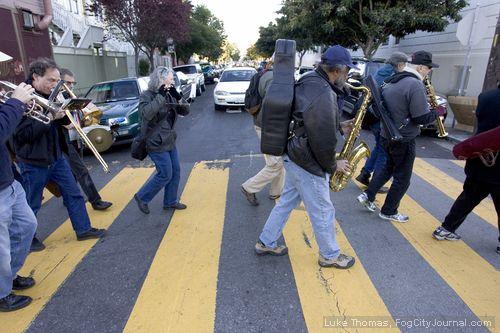
A standing-room-only crowd gathered at United Mission Presbyterian Church on 23rd and Capp Feb. 25th to remember Guardian correspondent and hell-raising investigative poet John Ross. John’s old friends Q.R. Hand, Hermann Bellinghausen, Frank Bardacke, Kevin Quigley and me spoke; his kids, Carla Ross-Allen and Dante Ross, gave moving remeberances. Then we marched through the Mission, led by the Musicians Action Group playing the Internationale. It was a perfect Ross moment: A few of the celebrants put pieces of yellow tape across their chests and stood in the streets halting traffic to the let the procession pass. A couple of confused bicycle cops went by, but took no action, which was good for all involved.


When we reached Cafe LaBoheme, the crowd took over much of 24th Street — but the air of fun and solidarity was so visible and loud that most of the cars simple stopped and waited patiently for room to crawl past. A wild, crazy anarchist funeral mob on the streets of San Francisco; we sent him off right.


PS: The generally nice obituary in the Chronicle described Ross as


“an author, poet, liberal activist and journalist who toiled against perceived injustice from the jungles of Chiapas, Mexico, to the baked streets of Baghdad.”


Which is wrong on two accounts. First of all, there was nothing “perceived” about the injustice Ross saw and wrote about; it was very real. But that’s just a daily paper trying to be objective in a way that turns out to be embarassing. More to the point, as his longtime friend Elizabeth Bell noted, calling Ross a “liberal”  is wildly inaccurate.


Here’s the letter she sent to the Chron:


Although some time has gone by since the Chronicle’s obituary of Bay Area activist and poet John Ross, I must correct a glaring inaccuracy–indeed, slander–that appears in the very first sentence of your otherwise adequate write-up.  John Ross was not at the time of his death, nor had he ever been, a “liberal.”  He was not a liberal-diaper baby, his pioneering refusal to serve in the Vietnam war was not the act of a liberal, nor was placing his body between Palestinian olive farmers and club-wielding Israelis.  His response to a Mexican journalist who asked his profession, “Soy comunista,” does not translate to “I’m a liberal.”  A raucous rebel and man of the people, Ross believed to his dying day that revolution in the United States was necessary and possible. A brief vocabulary lesson, Mr. Coté: Gavin Newsom is a liberal. John Ross was a liberal like a Molotov cocktail is a gin rickey.


Noise Pop Live Review: Dominant Legs and How to Dress Well

4

Synth and bass, rock and roll, some combinations are easily matched, but when you put How to Dress Well on the roster, pairings aren’t as obvious. Dominant Legs‘ mangy pop was an odd precursor to Saturday night’s How to Dress Well performance at Cafe Du Nord, but then again, what flatters eerie falsetto and awkward emotions? 

San Francisco’s Dominant Legs played like summer in a bottle. Happy guitars, lots of cowbell and rad bass made the winter weather outside melt. The only thing missing was sunshine, or lights in general. Half the band was hidden from the crowd due to a lack of lighting– particularly the adorable Hannah Hunt. One disgruntled lady in the audience voiced her disapproval by shouting, “We can’t see the pretty girl in the blue dress,” to which Hunt meekly responded, “It’s green.” Case in point. 

The band of five played three brand new songs, two cute and sleepy and one with tropical breeze, but the hits were any that picked up the pace. The real gem was as suspected– “Young at Love and Life.”

There was a brief interlude by Shlohmo and his way cool collection of old school tracks, including my personal favorite, TLC’s “If I Was Your Girlfriend”– brought me right back to Mr. Burg’s fifth grade class.

Then the stage cleared. A lazy stream of fog seeped from a small machine in the corner as Tom Krell grabbed the mic. Immediately things felt awkwardly intimate as the man behind How to Dress Well told the crowd, “This week things have been kind of tough for me,” said Krell. “But I guess we’ll see how it goes.” And it went in all kinds of ways: uncomfortable, pretty, sexy and repulsive. It was Krell, naked (only figuratively), revealing every last detail of his diary in a high-pitched squeal of sorts, accompanied by super smooth, shattering bass, electronics and R&B stylings. 

At first it seemed like a bad dream. My ears hurt. I thought slitting my wrists sounded like a nice alternative to listening to songs entitled, “Suicide Dream 1” and “Suicide Dream 2.”  I did enjoy the projected visual art and it seemed to pair well with the horror escaping his lips. I couldn’t believe all these people had paid to see this guy. Was this a joke? I turned to the dude next to me (just as his friend offered up some Flamin’ Hot Cheetos) and asked him if he ‘really liked this?” He laughed. “Uh…no comment.” Then he thought about it for a second more. “Well, I don’t hate it.”

And surprisingly by the end of his one-man show I realized I also didn’t ‘hate it’ but couldn’t quite get to the ‘liking’ part either. I grew to respect the dude for what he brought to the table. Krell has balls. Really big balls. Who else would stand up there and tell everyone that this song is about how his life “feels closed,” instead of “feeling open, like when I was young.” It was hipster poetry hour and I needed a cigarette. That’s some depressing shit, man. If only I could’ve understood the actual lyrics. Were those real words?

How to Dress Well is what it is, folks but whether it counts as live music, a band or a quality performance is still up for debate. The transition from amazing recorded material to live act still has some kinks; or maybe that’s the intention and you’re cool and totally hip if you get it. I’ve never been one to understand ‘performance art.’ Instead it seems easier to categorize this fiasco as another talented bedroom musician lured from his comfort zone, into the outdoors and onto stages. We should stop being so pushy.


Appetite: Gin for a winter’s night

1

A favorite experiment: gather a few industry and non-industry friends, taste a specific spirit side-by-side, sample it in the same cocktail recipe, and compare notes. Gin seemed appropriate for a rainy winter’s night.

While gin is fabulous all year ’round, there’s something about its bracing herbal and citrus qualities that evoke winter, particularly in Northern California where crisp air and sunny days mingle to create the mild backdrop that spawns our wealth of citrus at its peak.

Our cocktail of choice was plain and simple: the Martini. Gin and dry vermouth with a little twist of lemon… on the extra dry side to truly taste the properties of the gin.

Out of the 12 gins we sampled, these six stood out for various reasons:

All-around Favorite

DEATH’S DOOR GIN (94 proof – $32) — In our gathering, all loved Death’s Door, and the majority included it as one of their top two or three. It has been a top choice of mine since its release. This Wisconsin gem is made with local ingredients (wheat and organic malted barely) around Washington Island, WI. One of the best gins to come along in recent years, it’s reminiscent of a London dry gin but with its own unique, Midwest character.

Tasting Notes: Juniper berries dominate, coriander and citrus add nuance, while gentle fennel notes surprise.

In a Martini: A bold, flavorful Martini, Death’s Door fennel adds a subtle but seductive absinthe-like tinge to the cocktail.


Rare Edition

BEEFEATER’S WINTER EDITION (80 Proof – $30 and up) — The very limited Beefeater London Dry Winter Edition Gin isn’t going to be available for long, in limited supply, originally launched in New York and San Francisco in December. Legendary master distiller Desmond Payne has taken the signature profile of Beefeater, and as he has done with Beefeater 24 and their Summer gin, added new depth. Here’s hoping for more seasonal, limited editions ahead.

Tasting Notes: With a heavier citrus thrust than the standard Beefeater, I taste Seville orange and peel with a gentle sweetness. Pine and cinnamon add dimension.

In a Martini: It makes a citrusy, bright Martini with nuanced smoothness.


Brand New

NO. 3 GIN (92 Proof – $45) – Created by Berry Brothers & Rudd, London’s oldest wine and spirit merchant, No. 3 Gin is a brand new release named after BBR’s address at 3 St. James St. in London since 1698. Actually distilled in Schiedam, Holland, in copper pot stills, No. 3 is a classic-style, London dry gin.

Tasting Notes: Juniper stands strong here but does not overwhelm. There’s undertones of citrus with the Spanish orange and grapefruit peels used, while Angelica root, coriander and Moroccan cardamom round out this dry gin with a spicy finish.

In a Martini: Makes a classic, smooth Martini, redolent with juniper.


Smooth and Balanced

VOYAGER GIN (84 proof – $35) – Voyager Dry Gin is a harder-to-procure beauty that exemplifies balance and roundness in a juniper-driven gin. Voyager is American (made in Woodinville, WA) in the London dry style, distilled in a copper alembic pot still.

Tasting Notes: Not one element overwhelms: orris root, citrus, angelica, coriander and cassia are all here, but so are licorice and cardamom. They meld with smooth elegance.

In a Martini: Though initially a martini made with Voyager tastes as smooth as the gin alone, when compared side-by-side to other martinis, it somehow got lost. It was quite mellow compared to martinis made with gins like Death’s Door or Junipero.


Local Perfection

JUNIPERO GIN (98.6 proof – $33) – Junipero Gin has long been one of my favorites. Certainly I am proud of its local heritage as an Anchor Distilling product. But it also has one of the bolder, stand-out gin profiles. In the classic London dry style, more than a dozen botanicals and distillation in a copper pot still imbue it with a radiant complexity.

Tasting Notes: Bold and punchy, juniper comes across strong, though the overall effect is still clean and bright. Spice comes through as does citrus, though Anchor Distilling remains secretive about botanicals used.

In a Martini: A bracing yet balanced martini, this makes my top martini alongside Death’s Door.


Classic and Affordable

BROKER’S GIN (80 proof – $20) – Broker’s Gin has only been around since 1998, created by brothers Martin and Andy Dawson, but it plays like a classic London dry gin (actually distilled near Birmingham, England) around for hundreds of years. The best part is the quality vs. price, if you can get past the silly bowler hat cap (although I love the elegant, clean label design with a bowler-hatted gentleman).

Tasting Notes: Delightfully dry, botanicals reign here with herbs from Bulgaria to Macedonia. Orris root and coriander co-mingle with nutmeg, Cassia bark and cinnamon.

In a Martini: Makes a straightforward, classic Martini, but is also balanced, full and spicy.

–Subscribe to Virgina’s twice monthly newsletter, The Perfect Spot

Cultura Madre

0
San Francisco Bay Guardian Presents
CULTURA MADRE
A Fiesta for the Olmec: Colossal Masterworks of Ancient Mexico 

Featuring Live Performances by
All Female Mariachi band:
Mariachi Femenil Orgullo Mexicano 6pm
And Los Cenzontles 7pm

Latin Soundscape by DJ Vanka (StellarTrax)

Taco Truck Industries will be providing live screen printing, BRING YOUR T-SHIRTS and other apparel to be printed on! 6pm- 8:30Pm

Bridge Walkers, an Interactive audio and video installation created San Francisco-based filmmaker and installation artist Catherine Herrera, a Cultural Encounters Commissions artist.

Mission Cultural Center presents a curated video collection from their DF<SF<TJ exhibition featuring:

“La Hora Nacional /The National Hour” (2010) by Carlos Amorales, a color film with sound that is a reflection on the pre-Hispanic collection and proposes a radical rupture from the institutional interpretation of Mexican history.

San Francisco-based video artist Sergio de La Torre will exhibit “New Dragon City” (2008) which features six Cantonese youths. Sergio’s videos address the new reality of the Cantonese community in Tijuana today.

FREE ALL AGES!
Friday, March 11th from 6-9PM @ de Young, 50 Hagiwara Tea Garden Drive

5 Things: February 28, 2011

0

Each day, our editors pick five (or so) things that might interest you

>>OSCAR AND ANN L.A. performance artist-sitcom regular Ann Magnuson is one of our favorite people ever (ask her about crashing in our tent at Burning Man). Sure she’s pretty famous, she ruled ’80s downtown New York, and she is, in fact, the Power of Pussy. But she’s funniest when she’s just straight-up laying down some home truths. Here’s her viral Oscar rant and here’s the film she should have won an Oscar for:

>>BUT STILL, MILA’S DRESS WASN’T ENOUGH TO SOOTHE OUR RANDY NEWMAN-INDUCED RAGE Return to a time when Hollywood rewarded more glamor, less non-threatening paunch — the Balboa Theatre is turning 81 this year, which means it was born the same year as Marilyn Monroe, Hugh Hefner, Harry Dean Stanton, and Cloris Leachman (to name just a few — 1926 was a very good year!) Of course, it was a tragic year too: silent-film hunk Rudolph Valentino died at the age of 31. This year’s Balboa birthday bash (March 6, 7 p.m., $10) pays tribute to the original Italian Stallion with a screening of his 1922 high-seas adventure Moran of the Lady Letty, which was filmed right here in San Francisco and Tiburon. Swoon! Frederick Hodges performs an original score to go with the film, plus there’ll be a magic lantern slides, short films, a live vaudeville show, talks by Valentino experts, and birthday cake for all. www.balboamovies.com.

>>GET YOUR CARNAVAL ON Controversial, yet totally back up-able stance: Carnaval blows most other SF parades outta the grandstand. Sequined spandex, dope Latin beats, and way less corporate involvement than say, the SOUTHWEST AIRLINES Chinese New Year Parade, plus it’s in the Mission – how funky can you really get surrounded by the evil towers of the Financial District? Mission Cultural Center’s putting out the call for dancers in its parade contingent this year, so for anyone who is looking for a little workout, and a whole lot more sabor in their lives, sign up for the bi-week rehearsals to strut the streets as part of the center’s Pre-Colombian-style festivating at the May 29th parade. Email carnaval@missionculturalcenter.org or call (415) 821-1155 to make it happen.

>>IT’S EARLY, BITCH Britney’s coming to the Castro for an a.m. appearance on “Good Morning America” at which throngs of sleep-deprived acolytes will vie to supply her with Hot Cookies and Seconals.

>>THERE’S NO PLACE LIKE SMALL HOME Frigid temps making your flat seem like barren, fossil fuel-sucking tundra? Heard. Would that we all had a small home, whose energy-efficient ways are ever-so-in-right-now – and beyond adorable. Look at them

Contibutors: Cheryl Eddy, Caitlin Donohue, and Marke B.


Local hire victory party a political who’s who

2

The atmosphere at the local hiring victory party that Laborers Local 261 held at its Union Hall this week  was positively elated. Beer, wine and yummy pupusas flowed, commendations were made, and live drumming gave the event a playful edge. And it didn’t hurt that the place was crammed with political candidates, past, present and future, as San Francisco gears up for a a mayor, D.A. and sheriff’s race, this fall.

Sup. David Campos, who hasn’t thrown his hat in the mayor’s race, at least not yet, described the mood as “exciting.” “Who would have thought a year ago that we’d be having this victory,” Campos said, crediting fellow progressive Sup. John Avalos and the community for “great legislative work.”

Sup. John Avalos, who isn’t showing signs of running in the mayor’s race despite his legislative victories, saw implementation and resistant building trades as the biggest hurdles, moving forward. But he felt city departments will lead the way in showing how to implement the new law, when it kicks in March 25. “The San Francisco PUC has shown that local hire can be successful,” he said. “The new PUC building is at 48 percent local hire across all trades.”

Avalos hoped the building trades will come to see local hire in a more positive light. “They need to understand that it’s good for this city, their unions and union membership,” he said.

Avalos noted that he recently met with members of the San Mateo Board of Supervisors to address concerns that SF’s local hire would lead to job losses in San Mateo.Just before Christmas, the San Mateo supes voted unanimously to urge Newsom to veto Avalos’ local hire policy, but it turns out they had been misled around the law’s impacts. ”I met with [County Sups.] Carole Groom and Adrienne Tissier and said, ‘We have a huge misunderstanding,” Avalos said, noting that Jerry Hill’s recent grandstanding against local hire appears to be going nowhere.

Mayor Ed Lee, who insists he’s not planning to run for mayor in November, urged folks to focus on implementation of Avalos’ legislation.
“We are not just here to celebrate a legislative victory but the first jobs we create,” Lee said. “The world does not just turn by signing legislation.”

Board President David Chiu, who dropped by towards the end of the party with Sup. Jane Kim,Board President David Chiu, said he is “still thinking” about running for mayor, and acknowledged that the road to implementing local hire could be challenging. “But during this Great Recession, we have to do everything we can to make sure San Francisco residents get put to work, and local hire is an important part of that.”

Sup. Ross Mirkarimi, who has just announced that he is running for sheriff, linked high recidivism rates in San Francisco to the need to do a better job of hiring local residents. “We have a 70 percent repeat offender rate,” Mirkarimi said. “That’s 3 out of 4 folks.” Noting that there are 1800 parolees in San Francisco daily, Mirkarimi observed that if folks can’t get a job when they come out of the criminal justice system, they are way more likely to re-offend.

Bayview resident Deanna Rice, who got out of a federal penitentiary a year ago, and is still looking for work, said unemployment is another barrier in the way of her trying to regain custody of her kids, who are 9 and 10 years old.

Laborers Local 261 Business Manager Ramon Hernandez acknowledged that more work needs to be done to make local hire a go.
“We will try to do the best we can to get everyone on the same page,” he said

Local 261 Secretary-Treasurer David De La Torre said their membership is struggling and hurting, existing members and residents are not working
“Local hire is not about a sense of entitlement,” he said. “We gotta put people to work and build the local economy. It’s not about race. It’s about community, a disadvantaged community.”

Greg Doxey of the Osiris Coalition pointed to the economic benefits of local hire.
“If you hire local, people are going to shop two, three blocks from home, the economy will get stronger, they’ll be more tax revenue, and folks could even qualify to buy homes

CityBuild’s Guillermo Rodriguez praised the Board, department heads and Mayor Ed Lee “for getting together with labor” to pass Avalos local hire legislation.

But despite the happy vibes at the party, I left wondering if there is going to be adequate investment in workforce development side come budget time, if folks will try to game the system by using the address of locally-based subcontractors to establish local residency, and whether local efforts to sabotage the legislation are going to escalate now that the San Mateo Board no longer seems opposed to the law. But I also left knowing that folks like James Richards, President of Aboriginal Blacks United, have made it clear that if local hire doesn’t get  implemented, they’ll keep protesting until it does. So, stay tuned….


Good Fortunes, Song Dong, and you

0

We’re throwing a party tonight at YBCA (2/25) to celebrate Chinese New Year — and the opening of the amazing Song Dong exhibit (if you’re a fan of “Hoarders” you will not weant to miss this). Jonas Reihardt rocks it, lions dance, sake and other liquor flows, and fortune cookies will fill your pockets. You know how crazy these YBCA parties get. Details after the jump

.The San Francisco Bay Guardian Presents
GOOD FORTUNES

Friday February 25th from 8PM – 11PM

Yerba Buena Center for the Arts
701 Mission at 3rd Street.
www.ybca.org/song-dong

A Chinese New Year Celebration/Opening Night Party
$12 Advance | $15 Door | $10 Tickets for Guardian Readers*
*Use promo code SFBGSD online or bring in a hard copy of the ad running in this week’s paper to the door.

Visit the opening of Dad and Mom, Don’t Worry About Us, We Are All Well
A solo exhibition by Chinese conceptual artist Song Dong, including the much-heralded large-scale installation Waste Not, comprised of over 10,000 items collected by the artist’s mother over the course of more than five decades.

Live Performance by JONAS REINHARDT
Inspired in equal measure by continental European experimental rock, electronic dance music, and the freewheeling aesthetic of punk.’

Lion Dance provided by Leung’s White Crane

San Francisco’s Chinese Cultural Center presents: Daily Lives
An interactive exhibition exploring everyday existence through a variety of sensory experiences. Bring your treasured objects, scraps of material and little mementos to be repurposed as part of the work, “Discarded Repairs.” Explore the powerful sense of smell by collaborating on a scent to be included in the piece, “Close to Home.”


Paul Henderson denies D.A. deal with Willie Brown

6

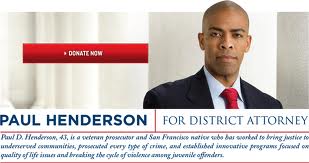
Paul Henderson doesn’t mince words when it comes to debunking the notion that Willie Brown helped him get his new job as Mayor Ed Lee’s public policy czar. Or that his decision to drop out of the D.A.’s race was in exchange for his new job.

“There was no deal with Willie Brown. I called and said, so do I get a check in the mail, a basket of fruit?” Henderson said, recalling his furious reaction to Brown’s claim, made in the Chronicle in January, that Brown and then mayor Gavin Newsom conspired to make sure Henderson was “taken care of,” in the wake of Newsom’s shocking announcement that he had appointed San Francisco Police Chief George Gascón as D.A.

“If there was a set up for me somewhere, I still have not got it. I didn’t get shit,” Henderson, who joined the D.A.’s office in 1995 and was said to be former D.A. Kamala Harris’ preferred pick to fill the D.A. post, after she won the state Attorney General’s race, last fall.

Instead, Henderson, who filed papers to run in the D.A.’s race in November, saw his plans blown out of the water when Newsom, in his last act as mayor, appointed Gascón as Henderson’s new boss. And when Gascón filed papers in the D.A.’s race the very next day, Henderson found himself in the unenviable situation of holding an at-will position in the D.A.’s office, while running against his boss in the 2011 D.A. election.

“ If there was any deal, it was for me not to lose my job,” Henderson added.  “And it’s the best decision for me. I really do care about public service.”

During his 16 years in the D.A.’s office, Henderson established juvenile drug and community justice courts, set up domestic violence and hate crime programs, and focused on rehabilitative, reformative, treatment-oriented alternatives to imprisonment.

He said his decision to join the Mayor’s Office is based on a long relationship with Lee. “I want to have a voice in the criminal justice system, and I’ve known Ed Lee independent of all this political business,” Henderson said, recalling that he worked with Lee to develop language programs in the D.A.’s office, so employees could take lessons and better interact with community members, victims and witnesses in court.

“I’m a third generation San Francisco resident, and the first generation not to grow up in the projects, though we lived opposite them,” Henderson continued, recalling how his mother is a Public Defender, his grandmother was a community advocate, and he went to preschool in Sunnydale. Those experiences gave him a strong sense of being connected to and serving his community from an early age, Henderson said.

And he soon found himself holding the highest position, as a gay and black, in the D.A.’s office in the 1990s.‘I was the first African American the D.A.’s office had hired in five years,” Henderson said, recalling how the department looked in 1995. “And look at it now,” he added, noting that since he took over hiring at the D.A.’s office, more gays, lesbians, Asians, Latinos and other minorities have been employed.

“I’m very aware of who I am and what I represent in this office,” Henderson said. “For me, it’s about creating an open door and having a voice at the table. Ed Lee has asked if I would be the liaison between national, state and local agencies collectively in his office. And this expands my voice and creates opportunities for all in San Francisco in ways that are exciting to me.”

Henderson said his new post will have a very different focus from the role former US Attorney Kevin Ryan played, during his brief tenure in the Mayor’s Office, under Gavin Newsom.“This will be about policy development, advice and implementation, and it will be more reflective of marginalized communities,” Henderson said. “So, I don’t want these communities being misled into thinking, ‘oh, he got a hand out.’ This was not a hook-up. I earned my place here.”

“The truth is that you have access to me because I am in this position,” Henderson continued. “And I hope it’s transformative for the city and the community. Because I did not get shit. There is no Paul Henderson pay-off. I’d be happy to tell you if I’d sold out. But no. I knew Ed independently. He knows my heart, trusts my judgment and reputation. This has nothing to do with Willie, Gavin and Kamala. Unless it did, and they are all tricking me. In which case, they should at least tell me, so I can credit them. But the truth is, I’ve worked so hard, and if I’ve become ‘the Man,’ then I’m at the table for the community. I’m not the person who took a pay out, got a hook up, a cushy deal, so I will go away, to silence my voice.”

Henderson notes that he has not given up his political aspirations, despite all that went down recently. “If it’s not my time right now, I still have political credibility and a profile in the city that isn’t going away “ he said, noting that he raised $65,000 in 28 days, just before Christmas, with no staff, immediately after a statewide election. “That speaks to how much support I have. Obviously I was disappointed that I wasn’t appointed D.A. But I’m not dead, and I’m trying to move in a direction that expands my voice.”

Henderson says his new role won’t change him and he’ll remain accessible to gay, black, Chinese, Samoan, immigrant, low-income, Latino and other marginalized communities.“I have a lens that most city leaders don’t have,” he said, noting that he was homeless and slept in his car when he was going to law school. “Ad now I can affect policy. Many folks feel the criminal justice system happens to you, and over 80 percent of victims are people of color and poor people. But who speaks for and represents them?”

The Performant: Neat stuff

0

TechShop San Francisco gets busy, Writers With Drinks gets drunk

Just when it felt like San Francisco could not possibly Do It Itself more than it already has, Jim Newton’s TechShop moved to town. Now it will be almost impossible not to succumb to the temptation of learning welding, soldering, molding, screen-printing, and quilting — not to mention CAD (computer aided design), CAM (computer aided machining), 3D modeling, laser-cutting and etching, and so much more. Whee!


At Saturday’s grand opening, after a short introductory speech by Mythbuster Adam Savage, a squadron of “dream coaches” gave walking tours of the 3-story, 17,000 square foot premises. Dream coaches are TechShop staffers who person the machinery and help patrons with their on-the-spot needs: answering questions, providing support. As Melquiades Olivares, a recent graduate of the Stanford School of Mechanical Engineering, took us around the giant, state-of-the-art workshop, it became quickly apparent that the scrappy, low-budget definition of DIY does not apply to TechShop. This is not a place where you’re likely to spin your empty toilet paper tubes into golden birdhouses.

But if you’ve been looking for the equipment to build your backyard lunar lander, TechShop’s got you covered. Equipment that made my internal geek organs go pitter-pat included: the Saw Stop, a basic table saw fitted with an electric monitor that can sense almost instantaneously the moment a finger (or carrot, or hot dog) comes in contact with the blade, shutting it down immediately; the Flow Waterjet cutter, capable of slicing through six inches of steel; and a 3D printer busily “printing” a smiling bust in microthin layers of UV-curable acrylic. Memberships, which are $125/month for individuals, are on the pricey side for a cheapskate like me, but certainly cheaper than buying a Waterjet cutter of one’s own.
 
“Tonight we’ll be giving each other Spiritual Wedgies,” promised MC Charlie Jane Anders last Saturday evening, at another monthly installment of San Francisco’s favorite reading series “Writers With Drinks.” A genial mashup of fiction and non, erotica and sci-fi, comedy and drama, WWD has been packing ‘em in for almost 10 years now (April 9 is the anniversary show, mark your calendar).

But it’s more than just the ecstatic crapshoot of the lineup that gets oddience crowding through the door at the Makeout Room. The event’s real secret weapon is Charlie Jane, whose introductory patter is legendary. After discussing our spiritual wedgies, and leading the crowd in a rousing affirmation “I am a sunflower and my underwear is a beautiful bumblebee” — Charlie Jane introduced poet Jason Morris as a man who is most famous “in the giant-cockroach reality,” Comedian Alex Koll as a shoe-fetishist who’d briefly been hired as the replacement Mr. Rogers, erotica author Hanne Blank as “the go-to person for dealing with hive minds that want to be dance instructors.” Event Wrangler isn’t exactly the most glamorous title in show business, but as a person who’s sat through more uninspired introductions that I can bear to recollect, getting to watch a true pro work a room will always keep me coming back for more. And judging from the usual attendance numbers, I’m not the only one.
 
*In the spirit of full disclosure it should be mentioned that the author of this piece read at Writers With Drinks on April 14, 2007.

Back to the streets

2

Coronel knew an old man in Granada who said

(who often said):

“I wish I were a foreigner, so that I

Could go home

— Zero Hour, Ernesto Cardenal

I first came into contact with the work of poet Roberto Vargas a couple of years ago, when I saw his face, projected several stories tall, on a wall just off Valencia Street.

I was riding my bike to the Day of the Dead procession when I came across filmmaker Veronica Majano screening historical footage of the old Mission District on the wall of Dog Eared Books. The footage of Vargas was from a movie called Back to the Streets, and it showed a Latino hippie fest in Precita Park circa-1970. Long-haired Chicanos smoked weed and danced and played bongos on the grass while Vargas read from a stage. On today’s Valencia Street, Vargas was a ghost returned from a long-lost Mission, now standing twenty feet tall on the bookstore’s wall, reading a powerful poem that angrily denounced the SFPD for the mysterious death of a Mission Latino youth in police custody.

The film of Vargas was a beautiful snapshot of Latino youth culture in the neighborhood before gang violence and gentrification, like a Mission High School yearbook scene from an exhilarating era of Latino self-determination. In 1970, the Free Los Siete movement was feeding the community at a free breakfast program out of St. Peter’s Church on Alabama Street and had started free clinics and legal aid programs in the Mission. In the years to follow, the neighborhood would see the founding of the Mission Cultural Center and Galeria de la Raza and the inception of many of the neighborhood’s now world-famous mural projects.

Looking at the groovy scene in the park, it was hard to imagine that just a few short years later, Vargas and other kids from the Mission would be fighting alongside the Sandinistas in the jungles and mountains of Nicaragua. Yet the utopian promise of the era’s poetry, art, and youth culture in many ways culminated in the guerrilla war in which Vargas and other poets from San Francisco would fight and ultimately — in 1979 — help defeat the forces of Nicaraguan dictator Anastasio Somoza.

On Feb. 24, the day of his 70th birthday, Roberto Vargas makes a rare return to San Francisco to perform in a poetry event at the Mission Cultural Center in honor of that Nicaraguan solidarity movement of the 1970s. A video will be shown of footage from that struggle — classic scenes of Vargas and others taking over the Nicaraguan consulate in San Francisco; of the famed nightly candlelight vigils at 24th and Mission BART Plaza in support of the Sandinistas — and Vargas will be reunited on stage to read with old poet friends like Lawrence Ferlinghetti, Diane di Prima, Alejandro Murguía, and Vargas’ old compañero from San Francisco State University’s Third World Liberation Front, actor Danny Glover. The event is not open to the public. Invitations have been given out and the small MCC theater’s 150 seats have already been filled. Yet the event provides an opportunity to publicly honor Roberto Vargas’ contributions to the Mission, and to reflect on the hopes and dreams of Mission past.


POETRY AND REVOLUTIONARY VISION

Poetry was a part of Vargas’ world from the beginning. Vargas was born in Nicaragua, but came to the United States when he was a small child. In his 1980 collection of poems Nicaragua Te Canto Besos, Balas, y Sueños, he writes of “living in an offbeat alley called Natoma Street (where I always imagined a lost Mayan city existed beneath the factories).” By the late 1950s, Vargas may have been the first Mission District Latino Beat poet. “I graduated from Mission High School in 1958 and used to hang out in North Beach, going around to see all the poets,” he says. “I met Allen Ginsberg when I was just a 19-year-old kid running around in North Beach. Diane di Prima, Bob Kaufman, Ted Berrigan — all the major poets knew me when I was in my teens.”

After a stint in the U.S. Marine Corps and an attempt at a boxing career that ended with a detached retina (an injury that also helped him avoid the Vietnam-era draft), Vargas went to SF State, where he was heavily active in the student strike of 1968-69. Students walked out of campus and battled riot police while standing on picket lines for five months to demand an ethnic studies program at the university.

In the spirit of the times, Vargas and other poets — including a young Mission Chicano named Alejandro Murguía — joined the Pocho-Che Collective to publish poetry by local Latino poets. The poets went to cut sugar cane in the Venceremos Brigade in Cuba. They put out small poetry chapbooks in the Mission, full of poems that linked Che Guevara’s call for Third World revolution with the experience of the Chicano barrios of the United States in a new vision tropical. In the era after the SF State strike, the city started funding community arts projects in the ghettos. Like all classic zines, the first copies of Pocho-Che were scammed, in this case late at night at Vargas’ new job in the Mission’s Neighborhood Arts Program. In the years to come, the group would eventually publish hardbound books by Vargas, Nina Serrano, and others.

Today, Murguía is a professor in the ethnic studies program at SF State that the strikers fought to originate. He is the author of the American Book Award-winning short story collection This War Called Love (2002) and the memoir The Medicine of Memory (2002). He remembers, “The poetry scene was incipient, very young, and the readings weren’t always very formal. Sometimes they were at community events or protest rallies. But we had contact with Latin America. We knew people who had been in Chile, like Dr. Fernando Alegría.”

Alegría was a poet who had been the cultural attaché to the U.S. under Allende in Washington. Vargas recalls, “Alegría had myself and some other young poets come to Chile and spend a month or two studying with [Pablo] Neruda. But, of course, our plans were canceled by the coup in Chile.”

Murguia remembers the September 1973 coup in Chile that overthrew the popularly elected Socialist democracy of Salvador Allende caused the young poets to organize rare formal readings at Glide Memorial Church in protest. “We had several big ones there,” he says. “There was a broad range of poets — Michael McClure, Fernando Alegría, Jack Hirschman, Bob Kaufman, Janice Mirikitami all read. There was a line going down the block to get in.”

In addition to their mentor, Alegría, Vargas, and Murguía also knew one of their heroes, the Nicaraguan Marxist poet and priest, Ernesto Cardenal. Cardenal lived under the Somoza dictatorship in a sort-of internal exile in a religious artist commune called Solentiname. Vargas wanted to bring Cardenal to read in the United States, but Somoza would not allow the poet, who was critical of the Nicaraguan dictator, to travel outside the country. Vargas went to his old pal Ginsberg for help.

“Because Allen knew me when I was a kid, he helped me with my organizing for Nicaragua,” says Vargas. “Allen was part of PEN, and in 1973 or ’74 he went to the State Department with other writers to put pressure on [Anastasio] Somoza. Eventually Somoza relented and we brought Cardenal to New York for a reading.”

The poetry of Cardenal was a north star to the young Mission poets. Cardenal’s epic 1957-60 masterwork Zero Hour is perhaps the literary foundation of revolution in Nicaragua. Influenced formally by Ezra Pound, Zero Hour weaves a sprawling history of Somozan oppression and U.S. intervention in Nicaragua together with lyrical imagery of Nicaragua’s natural beauty and wildlife. The poem creates a poignant sense that Nicaraguans, unable to enjoy and own these natural riches, had under Somoza become exiles within their own country.

Of particular interest to the young Mission poets, though, was Cardenal’s Homage to the American Indians (1969), a book-length meditation on the glory of Mayan and North American native civilizations. “For us, the work of Cardenal was very important,” says Murguía. “Homage to the American Indians is a continental vision of Native Americans — everything from the San Blas Indians of Panama to the Indians of Omaha to the Indians of Mexico City and Peru.”

In Homage, Cardenal evokes a lost Indian Utopia “so democratic that archaeologists know nothing about their rulers,” where “their pyramids were built with no forced labor, the peak of their civilization did not lead to an empire, and the word wall does not exist in their language.” He writes:

But how to write anew the hieroglyph,

How to paint the jaguar anew,

How to overthrow the tyrants?

How to build our tropical acropolis anew

Cardenal’s poems of this lost glorious past were to Vargas more pointedly a vision of a Latin American utopia that can also be regained in the future. In Cardenal’s work, says Vargas, “There is a longing for the simplicity of that civilization — the creativity, the innocence, the tribalism. Can we get it back after all the dictatorships, after all that capitalism has done? Cardenal showed us what we were, what we had, what we lost.”

Under Cardenal’s influence, the Mission poets turned seeing lost Mayan cities beneath the city’s factories into a literary movement. By 1975, members of Pocho-Che had started a magazine called El Tin Tan with Murguia as editor and Vargas as contributor. El Tin Tan presented a sweeping utopian vision of a borderless invisible Latino republic united culturally and politically under the sign of the palm tree. The poets situated the capital of this world right here in the Mission District.

“To tropicalize the Mission — to see it as a tropical pueblo — was a political act of defiance and self-determination,” says Murguía. “We were saying that we put this particular neighborhood — our pueblo, in a way — not in a context of North American history but in the context of Latin American history. The history of the eastern U.S. doesn’t affect California until 1848 when the first illegal immigrants came to California — not from the South, but from the East.

El Tin Tan,” Murguía continues, “was probably the first magazine that was intercontinental in scope, a combination of politics and literature and art and different trends from the Mission to Mexico City to Argentina and everywhere in between.” He proudly recalls that it ran the first North American essays on Salvadoran poetry, and translated and printed a short story by Nelson Marra, a writer imprisoned by the Uruguayan dictatorship.

Yet for all its international perspective, El Tin Tan remained firmly rooted in the Mission. Columns by Nuyorican poet Victor Hernández Cruz and news of the assassination of Salvadoran guerrilla poet Roque Dalton ran side by side with the first comics by future Galeria de la Raza founder Rene Yáñez, all folded between wildly colorful cover art by neighborhood favorites like the famed Chicano artist Rupert Garcia and the muralist Mike Rios.

“The magazines were colorful — tropical — on the outside, but very political on the inside,” says Murguía. “That was a metaphor for our own work.”

By this time, Vargas had become an Associate Director at the SF Arts Commission. From within City Hall, he started to pump city arts money into the Mission, helping to fund projects like Mike Rios’ mural of the people holding BART on their backs at 24th and Mission BART Plaza and the Balmy Alley Mural Project — art that can still be seen in public today.

Once, Vargas commissioned a Chuy Campesano mural for the Bank of America building at 22nd and Mission. “I read a poem called “Boa” and had the crowd dancing and chanting, Es la Boa, Es la Boa,” says Vargas. “We were trying to say, ‘You made your millions off our farmers, but now you are on our turf in the Mission here in occupied Mexico. So we’ll put hieroglyphics on the walls of your bank like we used to do!’ Someone from the bank tried to take the mic from me and cops came and escorted us out.”

Vargas’s story of the mural’s dedication ceremony captures the bravado of the era. “It was a beautiful time, all of us young and thinking we were going to change the world. We wanted to change the world through culture.”

The poets organized the community to demand a neighborhood’s arts center, too. In 1977, the dream was realized when the City, with pressure from Vargas from within City Hall in the Arts Commission, purchased an old, five-floor furniture store at 24th and Mission to be made into the Mission Cultural Center. Murguia became the center’s first director.

The Mission utopia was becoming a reality for Vargas. In Nicaragua Te Canto, he wrote:

We used to drive

Our lowered down Plymouths and Chevys

On top of the breast of a mountain to

Make love and drink wine… Never

Knowing what was going to happen after

Mission High School

The Mission is now an expression of real culture, a many-faceted being … both plus and minus with the soul of a human rainbow…My people watching slides of Sandino and Nica history … White children wearing guarachas and afros trippin’ down the streets to party. Young Salvadoran poets discussing the assassination of Roque Dalton … The Mission is now an implosion/explosion of human color, of walls being painted by muralistas. There is a collective feeling of compassion for each other Nicas Blacks Chicanos Chilenos Oppressed Indios. The sense of collective survival, histories full of Somozas, Wounded Knees written on the walls.

In Zero Hour, Cardenal wrote of Nicaragua’s trees and birds and lakes, and their call to revolution, as seen from its mountains:

What’s that light way off there? Is it a star?

Its Sandino’s light shining in the black mountain


Vargas, the excited Mission kid, echoed in his work:


Tonight I am sitting on a mountain called Bernal Hill

Tonight I see the flames of America Latina spreading from here …


STRUGGLE AND VICTORY — AND STRUGGLE

Perhaps inevitably, the Latin American Utopia Vargas and company created in poetry would seem so tantalizingly close to actualization that they would be forced to pick up the gun and fight for its existence.

When the enormous earthquake of 1972 left Nicaragua’s capital, Managua, in ruins, Nicaraguan refugees flocked to SF’s Mission District. Soon, San Francisco was home to more Nicaraguans than any place on Earth outside of Nicaragua. The family of Anastasio Somoza had controlled Nicaragua with brutal repression for generations. Somoza’s embezzling of relief funds for earthquake victims led to increased revolutionary activity against his rule. Taking their name from Augusto Sandino, a Nicaraguan revolutionary who led resistance against U.S. occupation of Nicaragua in the 1930s, La Frente Sandinista de Liberacion Nacional (FSLN) — or the Sandinistas, as they were popularly known — began guerrilla activities in late 1974 by taking government officials and Somoza relatives hostage in a raid on the house of the minister of agriculture. They received a $2 million ransom and had their communiqué printed in the national newspaper. Thus was born the Sandinista revolution.

In the Mission, Vargas, Murguía, and others were in touch with La Frente, and began organizing Sandinista solidarity rallies to coordinate with La Frente’s actions in Nicaragua. Out of offices in the Mission Cultural Center, along with El Tin Tan, the poets published a newspaper called La Gaceta about the situation in Nicaragua. The paper had a circulation of 5000 copies and was available for free all over the district. The sight of pro-Sandinista rallies at 24th and BART Plaza became so common that the plaza was popularly nicknamed Plaza Sandino.

Vargas organized takeovers of the Nicaraguan consulate in San Francisco and traveled the US, speaking about Nicaragua. Yet, soon, this kind of support didn’t seem like enough. In Cardenal’s poetry, victory was inevitable. Cardenal had written that Indian time was circular, that “history became prophecy,” and that therefore the “empire will always fall.” He had also written, “The hero is reborn when he dies. And the green grass is reborn from the ashes.” In poetry, Vargas and Murguia found inspiration to go to war.

In 1976 and 1977, Mission District residents, in solidarity with the FSLN, began quietly leaving San Francisco to join up with La Frente and pick up the gun in the Sandinista Revolution. Among them were Roberto Vargas and Alejandro Murguía.

“It was very romantic,” says Murguía. “If you grew up in the time after Che’s death, when you had Che’s figure calling for “1,2,3, many Vietnams” and a lot of different armed struggles going on all over Latin America, then it would seem logical, I think, if you were kind of young and crazy, that you would want to participate in some of these situations besides just doing solidarity work or organizing rallies. Also, the coup in Chile crushed our generation’s hope for electoral change in Latin America.”

Today, Murguía tries to situate the poets’ embrace of armed struggle within the spirit of those long ago times, but one senses that Vargas would not hesitate to join a guerrilla war tomorrow morning. When I ask him how the young poets made the leap from verse to bullets, he is incredulous at the question.

“We had to fight! There was no other way!” Vargas says. “We had the historical perspective and as a people we were worthless if we let that situation stand. We had our own books out. But are we really revolutionary poets if we just sit back and collect our laurels?”

Murguía compares the Sandinista war with the Spanish Civil War, when there were many international brigades in which writers had been involved. He suggests the poets went to war because they were poets. “If you knew the situation intimately in Nicaragua and you were reading Cardenal’s poems,” he says, “it was easy to see the connection between poets and political necessity.”

Vargas began organizing small, tight-knit cadres for battle in Nicaragua, recruiting his Sandinista guerrillas right off of the streets of the Mission. “I was secretive and I found them one by one,” he explains. “We were very clandestine and very compartmentalized. We never had more than a dozen people in our committee at once.”

Men who were menial laborers in San Francisco would one day be among the most respected heroes of the Nicaraguan Revolution. “When I recruited Chombo [Walter Ferretti], he was a cook at the Hyatt Regency,” says Vargas. “Later, Chombo would become a head of national security in Nicaragua. Another recruit was a former pilot, so I went to talk to him where he pumped gas at 21st and South Van Ness. That was Commandante Raúl Venerio. After the triumph of 1979, he would become the Chief of the Nicaraguan Air Force.”

When in San Francisco, Venerio later served as the editor of La Gaceta. In Nicaragua, the former gas station attendant became a real hero. “They got an airplane and attacked the National Palace,” says Vargas, laughing. “They hit it and split, and got away — real Mission boys!”

Before heading off to join La Frente, Vargas’ recruits would undergo a regimen of training and political education, an informal boot camp largely hidden in plain sight in the Bay Area.

“It was primitive,” remembers Murguía. “We didn’t really have someone with a military background to train us. We got just guns at pawn shops on Mission Street and practiced shooting at the firing range in Sharp Park down in Pacifica. We worked out with a friend who was a black belt in karate.”

Murguía says the most difficult part of training was the daily pre-dawn run of five laps around Bernal Hill. “We would run up the hill counter-clockwise — because that way is more difficult,” he says, “and we would wear these combat boots we bought at Leed’s Shoes on Mission.”

Besides being a part of physical conditioning, the run was a litmus test of the recruits’ commitment. “Doing activity like that is almost impossible if you’re not really psychologically into it,” says Murguía. “Try running five times around Bernal Hill! You start wondering after your third lap, ‘Goddamn! Why am I doing this?‘ Especially when no one is forcing you to do it!”

When I ask if the daily jog of 10 or 12 Latino men in combat boots on the hill at sunrise did not attract any, uh, attention, Murguía shrugs. “There were less people on the hill in those days,” he says. He recalls that the Mission cadres trained in complete anonymity: “We got money to rent planes and we took turns learning to fly the planes around the Bay Area. Nobody suspected anything because nobody knew anything about Nicaragua then.”

When I try to imagine a phalanx of Sandinistas at dawn on today’s Bernal Hill, surrounded by a crowd of early morning dog walkers, I can’t help but laugh. But the cadre’s training was deadly serious, and Murguía says its value was far more than psychological. “What I discovered when I went to the Southern Front was that our San Francisco cadres were some of the most advanced in the war,” he explains. “We understood the political situation and the tactic of insurrection and we had a minimum of physical conditioning. But some of these other cats, man! They literally just walked in off the street!”

For a time, Murguía remained the director of the Mission Cultural Center, while making regular trips to fight in Nicaragua. In 1977, Vargas resigned from the Arts Commission and went to battle for six or seven months. He and Murguía would spend the next couple of years rotating back and forth from the war front in Nicaragua to their solidarity work in the Mission. Murguía describes his entry into Nicaragua, his stay in various guerrilla safe houses in Costa Rica, and his experiences in the war in his 1991 American Book Award-winning fictionalized memoir, Southern Front.

Though Murguía says the actual military war on the ground was largely a stalemate between the Sandinistas and the Somozas’ National Guard, the Sandinistas were at last able to triumph through international pressure, strategic military victories, and a general strike. Somoza fled in July of 1979, and the Sandinistas entered Managua victorious on July 19 of the same year. Cardenal’s poem “Lights” describes the city as seen from a plane that brought the elder poet into a Managua free from the Somoza family’s rule for the first time in 43 years. In Managua, street graffiti declared, El triunfo de la revolución el triunfo de la poesía.

Vargas and Murguía, however, did not enter Managua with the victorious army. The Southern Front did not go to Managua, and Vargas had recently been sent back to the U.S., to coordinate a simultaneous take over of the Nicaraguan consulates in major U.S. cities from coast to coast to coincide with the victory in Managua.

Vargas’ work for Nicaragua did not end with victory. The Mission High kid now found himself serving in the new revolutionary government as cultural attaché to the United States. “I was jailed in the takeover of the DC consulate,” Vargas says, laughing, “but then I came back several months later to serve there!”

The voluble poet grows uncharacteristically silent when I ask him what it felt like to actually win the war.

“To win?,” he asks, pronouncing the word as if he was hearing it for the very first time. “Well … it’s like taking off a huge load, man. Like taking mountains off your back.” He is silent for a bit and then adds, “But what do you win? You win the right to continue the struggle.”

“To win was to reach the objective of getting rid of the Somoza family once and for all,” Vargas says. “But it was not really a win/lose situation.” Indeed, the Sandinistas inherited a country in ruins and in debt, with an estimated 50,000 war dead, and 600,000 homeless. Nicaragua’s left-wing powers would become an obsession for the Reagan Administration, who for the next ten years offered heavy financial assistance and training to the Contras, a coalition of pro-Somoza and anti-Sandinista guerrillas who fought to overthrow the revolutionary government. The U.S. strangled Nicaragua’s economy with a trade embargo like it employed against Cuba. In reality, for the Sandinistas, the war literally never ended.

“Somoza bombed everything in Nicaragua before he left the country. Reagan was spending — what? — $100 million a year annually against us at that time?” says Vargas. “They spent so much for a decade to destroy our little country.”

Nonetheless, poetry remained in the forefront of the Nicaraguan revolution. Cardenal was named Ministry of Culture, and he instituted poetry workshops across Nicaragua as part of a highly successful literacy campaign that raised literacy from just 12 percent to over 50 percent in the first 6 months of the revolutionary government. Soon, poetry was being written and taught in the tiniest villages and in the fields.

“We tried,” Vargas says bluntly. “We were doing very important land reform, incredible stuff for the economy. But it was dangerous to be a good example. We had the potential, but we had to hold off this enormous power [of the U.S.] for decades. Ultimately, we had to step back so they would not destroy Nicaragua.”

In 1990, Nicaraguan voters, weary of war and economic misery, chose to elect FSLN President Daniel Ortega’s U.S.-backed opponent, Violetta Chamorro, in the presidential election. “We lost the elections,” says Vargas. “But we had to allow them to demonstrate that we were not like Cuba or other revolutions. We lost beautiful young men and women to get that liberty.”

I ask Vargas to consider the successes and failures of the Nicaraguan revolution. He pauses and then seemingly changes the subject, excitedly telling me of the time he brought Ginsberg to meet the Sandinista soldiers. “Ginsberg was fascinated by the Sandinistas,” says Vargas. “And he wanted to see what he had been supporting on my behalf all these years. So I took him to the fighting along the Honduras border in 1984, during the Contra war.”

When Ginsberg went to the war zone, he brought not a rifle but a concertina. “I took him to meet these young soldiers in a trench. They see Allen with the concertina and they were like, ‘Who the hell is this guy?’ I told them he was a very famous poet. At once, they all started taking bits of paper out of their pockets that they had written poems on and started reading them to Allen. So there we are, with these soldiers in the trench with their rifles reading poetry, and Allen just wailing away on this concertina!”

I think of the strange road from Cardenal’s vision of lost Mayan cities to Vargas’ dreams of a Bernal Hill utopia to Ginsberg listening to soldiers’ poetry in a Nicaraguan trench, and I see that Vargas has answered my question with his own, the question asked by revolutionary poetry.


LOST CITIES, AND NEW ONES

The lost moment with Ginsberg in the trenches is like a missing chapter out of Roberto Bolaño’s Savage Detectives. Indeed Vargas’ story in many ways embodies that of Bolaño’s exile poet generation, of which he wrote, “They dreamed of a Latin American paradise and died in a Latin American hell.” Except for one crucial difference: Vargas is very much alive and still fighting.

Today, Vargas still puts in a tireless 50-hour work week as a labor organizer for the American Federation of Teachers in San Antonio, TX. During our conversation, he excitedly tells me of an action he is organizing for next month, a march of teachers on the Texas capital to protest budget cuts to education. “I camp out in the teacher’s lounge and talk to them when they are on break,” he says. “I signed up 50 new members last week!”

As he nears 70, the poet shows no signs of slowing down. “I can’t afford to!” he says. “My youngest son is only 17. When I get finished putting him through college, then maybe I can take a break.”

But work seems like more than necessity to Vargas; political struggle is the central theme of his life’s work. “Work, work, work, Erick,” he tells me. “That is what we have to do. I could go back and forth about what went wrong in Nicaragua, but there is more work to do and I have to stay positive. It is all part of the process.”

When Vargas comes back to the Mission Cultural Center this week, he will literally return, full circle, to a building he helped build. “We had no money to hire laborers, so we’d be there with our kids every weekend, building the place,” he remembers.

One of those kids was Vargas’ son, Mission poet Ariel Vargas, who will read in public with his father for the first time this week. “Cardenal baptized him when Ernesto came to bless the new Mission Cultural Center in 1977,” Vargas says. “He had offered to baptize any children who also might be there. In the end, there was a line of families around the block on 24th Street who had brought their children for Ernesto Cardenal to baptize. Ariel had already been there every weekend on his hands and knees sanding those huge gymnasium-like floors with us. The Mission Cultural Center is still there and that is our monument.” As he discusses the Mission, Vargas forgets the problems of the Nicaraguan revolution and begins talking nonstop again at last. He comes back to the stories that started our conversation. “You know, I lived at 110 Mullen on Bernal Hill,” he says, his excitement gathering. “Mike Rios was my neighbor. Rene Yáñez lived on the block. So it was all happening right there! Carlos Santana lived down the block at around 180 Mullen or something. We used to hear him and his band jamming all the time. The Arts Commission had a stage truck and I’d take it out to Precita Park and put the stage down for Carlos to play on.” I think of Cardenal’s vision of the repeating cycle of time, the promise that the empire will always fall and the hero will always be reborn. Much in the Mission has changed. But Vargas, the old poet, still looks out from Bernal Hill today and sees lost cities beneath the surface.




Henderson drops out of D.A’s office and race, SFPD Chief turned D.A. Gascón appoints DeBerry as new chief of staff

4

I wondered what Willie Brown was talking about when he wrote that making sure that D.A. office insider Paul Henderson was “taken care of” was one of only two details to be worked out, following former Mayor Gavin Newsom’s shocking last-minute appointment of former police chief George Gascón as the next District Attorney  And now I think I found out: Henderson, who was former D.A. Kamala Harris’ chief of administration and her preferred pick, announced yesterday that he is dropping out of the D.A.’s race and will serve as Lee’s public safety czar.

Henderson starts his new job March 8, meaning 15 months has passed since former U.S. Attorney Kevin Ryan resigned from the Mayor’s Office of criminal justice—leaving everyone unsure what Henderson’s new post entails, and whether it comes with a staff and/or a budget.

Henderson says his new job includes involvement in the Taser debate, the next police chief selection, and assessing how budget cuts impact public safety. And he certainly didn’t publicly let on that he was anything but delighted about this latest twist in the ever evolving race to be the next elected district attorney.

“I’m excited about helping our Mayor shape this new position and about what we can accomplish under his leadership to enhance public safety in the City,” Henderson, who is  reportedly backing Gascón in the D.A.’s race, told the Guardian.

But Henderson’s move brings us back to the other detail Brown referred to in January, namely, “assessing the odds of Gascón winning the D.A.’s race in November.”

Currently, David Onek, a senior fellow at the UC Berkeley Center for Criminal Justice and served in the Mayor’s Office of Criminal Justice under Newsom and Alameda County Deputy District Attorney Sharmin Bock, are the only remaining contenders. And while little has been heard from Bock since she filed in January, Onek has been doing all he can to stay relevant, including holding house parties, raising money, calling for transparency in the D.A.’s Office around officer-involved shootings, and interviewing criminal justice experts as part of his Criminal Justice conversations podcast project in Berkeley.

Onek’s latest interview is with Michael Romano, co-founder of the Stanford Three Strikes Project, which represents folks serving life sentences under the Three Strikes law for minor, non-violent offenses – such as stealing a pair of socks. “Addressing the flaws in the Three Strikes law will protect Californians while also having a positive impact on our state budget.” Onek observed in a campaign email. “According to the California state auditor, non-violent third strikers will cost our state at least $4.8 billion over the next 25 years – almost $200 million per year.”
 
Onek also noted that the next few months are crucial for his D.A. campaign, “to build strong partnerships between law enforcement and the community.”
And the challenge for anyone who is not part of the Brown- Newsom machine to remain viable in the D.A.’s race were illustrated afresh yesterday when Gascón convened a 30-minute press conference at the Hall of Justice to announce he is reorganizing his staff to focus on cutting the backlog of homicides and other felony cases–and was replacing Henderson with Cristine DeBerry, who was deputy chief of staff under Mayor Gavin Newsom and Mayor Ed Lee.

Gascón said the reshuffle was a product of six weeks talking to prosecutors, court officials, defense lawyers and others in the criminal justice system. And so far it has led to David Pfeiffer being named as heads of special operations, Sharon Woo as head of operations, Eugene Clendinen as chief of administration, Braden Woods as chief of the criminal division, Lenore Anderson as chief of collaborative courts, Maria Bee as chief of victim services, June Cravett as head of the white collar division, Jim Crisolo as chief of investigations and Jerry Coleman as chief of the Brady, appellate and training division.

Gascón said he doesn’t foresee immediate layoffs in the department, which has a $39 million annual budget. But he warned that if he is required to cut his budget by 10 percent, as Mayor Lee has requested of all departments, he’ll have to lay off the equivalent of 18 prosecutors.
“Hopefully, we’ll be spared that,” he said. “As it is, we have so much unattended business.”

Gascón blamed the crushing deficit in the D.A.’s Office on budget constrictions over many years, as he used a Power Point slide show to illustrate how the department had less funding in 2008 than in 1986 (if numbers are adjusted for inflation).
“It’s why we had problems in the past and why we are doing this reorganization,” he said, claiming that a significant lack of training in the department has caused “a poor performance in court,” and that there is only one paralegal for every 9 attorneys, on average.

Gascón said it took 3-4 months to process most felony cases, and up to 3 1/2 years to bring a murder case to trial, under the office’s previous configuration.  “By that time, memories have faded, and people are not showing up,” he said.
(D.A. press spokesperson Seth Steward clarified today that Gascón’s claim that “only one out of every 26 misdemeanor cases” was in fact a misstatement, and that the D.A. is working to provide a more accurate analysis.)

Gascón also announced that he is rolling out a makeshift community court system in the next few months, in which alleged perpetrators, victims and three mediating members of the public would work to find a solution, which could be community service.
‘So you can roll the dice and be prosecuted or go to the community court,” he said. “We believe we can take 20 percent of our work load, which is about 1,000 cases, and run it through this system.”

He also claimed that instead of spending $1,200 to $1,300 in the court system, these cases would only cost $300, and that the Tenderloin Community Justice Center will stay in place, under the reshuffle.
 “My goal as Chief was the make San Francisco the safest and largest city in the United States, and that continues to be the goal,” Gascón concluded.


Taser proposal will move forward

Following a hearing at the San Francisco Police Commission that stretched late into the night, the seven-member panel voted 6 to 1 to authorize the San Francisco Police Department to develop a proposal for implementing Tasers or other less-lethal weapons.

Representatives from immigrant advocacy groups, communities of color, queer and transgender communities, mental-health professional organizations, and civil-rights watchdog groups turned out en masse to voice opposition to the plan. Out of around 50 speakers, just one spoke in favor of adopting Tasers.

As the discussion wore on, commissioners revised the resolution again and again. Interim Police Chief Jeff Godown had initially requested permission to draft a proposal in 30 days; it was extended to 90. Instead of researching the feasibility of Tasers alone, commissioners said the SFPD should look into other less-lethal weapons as possible alternatives. Another amendment prioritized outreach to marginalized communities.

Commissioner Petra DeJesus cast the lone vote of dissent, saying, “No matter how you dress it up, it’s a soft-pitch way to authorize Tasers.” DeJesus voiced concerns about how the departmental budget would be impacted. She also noted, “They’re being used more in the minority community, and that’s the community we’re trying to build trust with.”

Commissioner Angela Chan invited a series of guests to testify about concerns surrounding Tasers. Among them was Attorney John Burris, who has sued police departments over misuse of Tasers; a University of California Berkeley professor who gave a detailed presentation about Tasers and cardiac arrest; and Allen Hopper of the American Civil Liberties Union, who presented a video clip showing outrageous instances of Taser use. At the end of the night, however, Chan was persuaded to go along with the proposal.

Chan later told the Guardian that she supported the resolution because the timeline had been lengthened, which allowed for greater community outreach, and because the discussion had been broadened to include discussion about less-lethal weapons other than Tasers. Also, Chan noted that her suggestion for the force to review their use-of-force tactics as part of moving forward with the program was integrated into the resolution.

Several members of the San Francisco police force told horror stories about situations in which they said they could have used Tasers. A Mission Station officer suffered an attack by a Nortenos gang member in Garfield Park, and feared for his life until backup arrived. A Tenderloin Station officer was thrown into a store window after responding to a call about a trespasser. Just before it happened, “I was reaching for my firearm, and I was going to shoot him,” the officer said.

During the hearing, Chief Godown asked all SFPD officers to stand. He announced, “Everybody that’s in this room are my kids. I’m passionate about making sure they don’t get hurt.” Following a role-playing scenario in which a person waved a knife at an officer, Godown said that without a Taser, “That officer would have had no other option but to shoot that man.”

Equally disturbing, however, were stories about Taser deployments gone wrong. There was the petite African American woman who was at a drugstore buying candy when police attacked and Tasered her because they mistook her for a shoplifter. There was the Virginia couple that was hosting a backyard baptism celebration when police responded to a noise complaint and Tasered them both; the woman was pregnant, and could have suffered a miscarriage due to the electric charge. There was the 17-year-old grocery store clerk who suffered a heart attack and died after police Tasered him — the whole thing started with his employer’s complaint that he was eating a hot pocket he didn’t pay for. Then there was the man who was Tasered during a traffic stop by cops who thought he was drunk. In reality, he was in diabetic shock.

Mayor Ed Lee’s Deputy Chief of Staff, Cristine DeBerry, made an appearance to say Lee was in support of the department’s proposal to move forward with investigating the use of Tasers.

Sheriff Mike Hennessey also offered comments, saying Tasers have been an effective tool in San Francisco jails, yet are rarely used.

Community members, meanwhile, raised a slew of concerns. They highlighted pending budget cuts and asked how these new and expensive instruments could possibly be paid for. They questioned the erosion of trust between police and the public, particularly in communities of color, where Taser use tends to be disproportionately high. Many people, particularly from the mental health community, voiced concerns about accidental deaths due to Taser use.

“I’m a great-grandma with a heart murmur,” said Terrrie Frye, “and I wonder if the police will be able to recognize that when we’re all protesting the budget cuts that will result from these Tasers.”

*This post has been updated from an earlier version.

The truth about pensions

23

David Cay Johnston, the Pulitzer-Prize-winning former New York Times reporter, has a brilliant piece on his blog about public-employee pensions. His basic point: the mainstream media, including his own former paper, have utterly missed the point about how pensions work:


[Wisconsin] Gov. Scott Walker says he wants state workers covered by collective bargaining agreements to “contribute more” to their pension and health insurance plans.

Accepting Gov. Walker’ s assertions as fact, and failing to check, created the impression that somehow the workers are getting something extra, a gift from taxpayers. They are not.

Out of every dollar that funds Wisconsin’ s pension and health insurance plans for state workers, 100 cents comes from the state workers.

How can that be? Because the “contributions” consist of money that employees chose to take as deferred wages – as pensions when they retire – rather than take immediately in cash. The same is true with the health care plan. If this were not so a serious crime would be taking place, the gift of public funds rather than payment for services.


Public employees (like the few employees in the private sector who still get pensions) bargain collectively for compensation packages. Some of that compensation comes in the form of deferred pay, which the employer puts aside into a pension fund. In San Francisco, some city employees several years ago, through negotiations, agreed to forego a pay raise and instead accept more deferred compensation; that is, the money they would have received in wages now goes into their pension fund.


When you say that those employees “contribute nothing” to their pensions, you’re not telling the truth:


The fact is that all of the money going into these plans belongs to the workers because it is part of the compensation of the state workers. The fact is that the state workers negotiate their total compensation, which they then divvy up between cash wages, paid vacations, health insurance and, yes, pensions. Since the Wisconsin government workers collectively bargained for their compensation, all of the compensation they have bargained for is part of their pay and thus only the workers contribute to the pension plan. This is an indisputable fact.  


More:


Thus, state workers are not being asked to simply “contribute more” to Wisconsin’ s retirement system (or as the argument goes, “pay their fair share” of retirement costs as do employees in Wisconsin’ s private sector who still have pensions and health insurance). They are being asked to accept a cut in their salaries so that the state of Wisconsin can use the money to fill the hole left by tax cuts and reduced audits of corporations in Wisconsin.


At the time that San Francisco officials agreed to use deferred compensation as a way to avoid pay raises, it was a politically easy decision: The stock market was booming, and the pension fund was making so much money from its investments that the city could in effect keep that money (the pay raises that would have gone to the employees) and use it to avoid tax increases or cuts somewhere else. Unless they were fools, the city officials who signed off on this deal knew, or should have known, that at some point the stock market would come back to Earth, and the city would have to pay the deferred compensation out of the General Fund.


Now: You can argue that those contracts were overly generous and should be renegotiated. You can argue that the city can’t afford to pay its workers as well as it once did and that they should take further pay cuts (beyond the half-billion or so they’ve already given back). I don’t entirely agree, but at least that’s an honest argument.


But to say that city workers aren’t contributing to their pension fund, or need to contribute more, is dishonest. For the newspapers to report that as fact is bad journalism.


5 Things: February 24, 2011

0

Each day, SFBG staff pick five (or so) things that might interest you

>>1. BEARING JOY A little while ago, a Potrero Hill resident took the concept of neighborhood watch to new (artistic) heights when he came across some brazen red graffiti scrawled across the side of the Cor-o-van building on 17th street near Texas. “I just got sick of looking at it,” the impromptu artist said.

His solution was to paint over the mess, and he admits that he “got a little carried away.” The stretch of corrugated steel now blooms with red flowers, an orange tree, a rabbit in a hole, and a family of posy-sniffing bears. The artist has been adding to his outdoor menagerie on select sunny days for a few weeks now, serenaded by IZ Kamakawiwo’ole’s “Somewhere over the Rainbow.” 

>>2. REFRESHING FACE SALAD A partial list of superfoods: lemon, ginger, tomato, potato. Delicious, all, and now available for your face. Imperial Spa sells facial masks infused with the aforementioned treats – we got tricked out in the tomato the other day during our 90-minute aromatic acupressure treatment and it left us feeling fresher than a chopped salad. If you’re on a budget you can always sport the masks in the spa’s cheap-to-use day facilities. 

>>3. HEBREW-HOP Four-DJ Israeli juggernaut Soulico is rolling into Public Works tonight. (It’s free before 10:30 and only $5 after.) Soulico mostly teams up with quite famous US hip-hop acts like Lyrics Born, Rye Rye, and Ghostface Killah to produce a madly fun, well-produced hybrid of Israeli folk music and good-natured rap. But they also showcase some Israeli rappers that are little-known elsewhere, like Axum, whose hilarious and charmingly low-tech Soulico collab video below for “Pitnum Banu” makes us feel simultaneously hungry and stoned. Or something? Axum probably won’t be on tour with Soulico, but we’re hoping theyll brng their musical mischief (and may some good falafel) our way soon.

>>4. CINEMATIC MAPS If you haven’t read Rebecca Solnit’s amazing Infinite Cities, which reveals and collages hyperreal cartographies onto our Baghdad by the Bay (particular favorites: butter fly habitats vs. queer public spaces, the Third Street Phantom Coast, 2008 murder sites vs. 2009 Monterey Cypress growths) — then you’re in for a real alternative historical treat. Rebecca will be at the Red Vic tonight, helping raise money for another awesome project, Cinematic San Francisco, a “a multi-media event to address the past and future” of San Francisco’s presence in the movies, and its dreamlike, projected presence in the imagination. Are we still a city of fantasies?

>>5. HELL FREEZES OVER So Zeitgeist has re-opened after its remodel, to raspy sighs of relief from every raggedy biker (and wannabe) from here to the Excelsior. The rapacious rumors of outdoor bathrooms have not yet born fruit — though construction activity in the back of the patio against the building suggest that soon you’ll have more options for emptying those pitchers out of your bladder — but there is about 1,000 more beer taps now, in classy aisle formation behind the bar. HOWEVER by far the most exciting upgrade is the veggie burger the Zeit kitchen is now using – those things flirt with being an inch think! That’s a lot of animal-free deliciousness. And hey, weirder things can happen.

Contributors: Emily Appelbaum, Caitlin Donohue, Marke B.

Behind the Twitter tax break deal

36

There’s much political intrigue and anticipation swirling around the Central Market Payroll Tax Exclusion, aka the Twitter Tax Break, which the Board of Supervisors will consider next month. This has all the elements of a great story: backroom deals between political and corporate power brokers, the strange argument that Republican-style tax cuts will cure Mid-Market blight, the fact that Twitter executives have uttered nary a tweet about shaking down SF taxpayers, and the role that a pair of supposedly progressive supervisors have played in brokering the deal.

Following up on my Feb. 10 post about how the deal would help Twitter meet the high asking price of politically connected landlord Alvin Dworman for a new mid-Market headquarters, the Bay Citizen yesterday had a great story showing how Dworman gave then-Mayor Gavin Newsom discounted office space for his lieutenant governor bid just as Newsom proposed the tax break that would benefit Dworman and Twitter. The story also includes a nice tick-tock about how this unseemly deal unfolded.

We at the Guardian are currently awaiting a big package of documents from City Hall that we requested on the deal, and sources tell us they’re likely to include some interesting insights and tidbits. For example, are Twitter and Dworman the main beneficiaries of this legislation or are there other corporations (and the politicians they support) who were pushing this plan? Everyone is also waiting to see how the city’s Office of Economic Analysis rates the proposal, and Economic Ted Egan tells us that report should be out by the end of next week or beginning of the following week.

At this point, we have more questions than answers, but that should start changing by next week. Maybe we’ll gain a better understanding of why Sup. Jane Kim is pushing this deal (much to the consternation of some of her former top supporters) or why Randy Shaw, the taxpayer-subsidized blogger and Tenderloin don, strongly backed Kim’s candidacy and attacked her critics with such perplexing ferocity. Will Willie Brown’s name continue popping up? Perhaps we’ll be able to determine whether the Newsom-Dworman pact actually broke campaign finance laws. And we’ll certainly gain some insights into how the Mayor’s Office of Economic and Workforce Development trades away taxpayer money to successful corporations that wield whines and threats of relocation.

If nothing else, we’ll get a peek into modern crony capitalism, San Francisco-style, dressed up in the guise of “saving” the Tenderloin. So, from a strictly journalistic perspective, this should be fun.

Protest this weekend in support of Libya, Bahrain, Yemen, Morocco uprisings

36

There’s a protest this weekend in San Francisco, in support of folks in Libya, Bahrain, Yemen, Morocco, and other Arab popular movements as they struggle against dictatorships and repressive governments.

Folks are invited to meet Saturday, February 26 at 1 p. m. at the U.N. Plaza at Market and 7th Street in San Francisco for a march that will feature 20 organizations, including Arab Resource and Organizing Center and American Friends Service Committee. [Update: Just got a call from ANSWER Coalition to say they did not approve the inclusion, by protest organizers, of their name as a feature organization at Saturday’s protest, because they do not agree with some of the wording in the protest organizers’ press release.]

“Across Arab nations popular movements for governmental, social, and economic change are arising daily since the start of 2011, with people going to the streets in the thousands and millions,” states a press release from march organizers. “ In many cases, these popular movements are being met by extreme use of force at the hands of governments and dictators whose repression has been supported by foreign assistance from the US.  The most horrific of this repression has been witnessed internationally through social media broadcasting from Libya and Bahrain, where hundreds of innocent protesters have been massacred.”,p.

Organizers note that thousands of Bay Area residents demonstrated solidarity over the last month in support of the Tunisian and Egyptian revolutions, and now they are inviting folks to turn out in solidarity with the people of countries who are mourning those who have lost their lives in this struggle for democratic ideals, and in standing with those who continue to come out into the streets despite brutal repression.

“We are marching in San Francisco to support one another as Libyans, and as Arabs who are all fighting for freedom. We are demanding that governments around the world end their complicity with Gaddafi that has kept him in power for 42 years, and take a firm stance against the brutal repression of our people.” Wafa, a Libyan-American educator and activist, said in a press release.

“For the past week, tens of thousands of Libyans have been marching and demonstrating to put an end to 42 years of dictatorship, poverty, unemployment, and torture at the hands of the ruthless Gadaffi regime,” protest organizers stated. “The people of Libya continue to make history, struggling to defend their country and demand a real end to Gadaffi’s regime, following in the footsteps of their brothers and sisters in Tunisia, Egypt, and in tandem with Bahrain, Yemen, Morocco, Jordan, Syria, Iran, and all nations fighting for freedom.”

Time to start building a cold frame

4

No, I’m not talking about Democrats building shelters against the big chill that the Republicans are trying to bring down on public sector workers, and the impact of that push on folks engaged in pension reform debates in San Francisco. Instead, I’m looking at the possibility that snow could fall at sea level around San Francisco this weekend for the first time in 35 years–and wondering if gardeners need to start worrying about protecting crops and plants that don’t like icy climes.

Hardy winter vegetables and bulbs typically do fine under a warm blanket of snow. But a lot of folks in the Bay Area start growing stuff in January and February that’s not cut out for snow.
 
I’ve read that you can use empty coffee cans, milk jugs with the bottom cut out, or sandwich bags as makeshift plant protection, provided there’s enough space in these containers for your plants to breathe. But just as I was planning to raid the recycle bins, Adam, a fellow gardener and Guardianista, pointed out that such measures won’t withstand high winds, and that if I’m serious about protecting buds and blooms, I should consider building a cold frame

Hmm. Maybe I’ll get around to buying untreated lumber, fastening it with galanized screws, pounding wooden stakes into the ground, and battling sheets of plastic film, all before Saturday’s threat of snowflakes. Or maybe I’ll simpy pop sandwich bags over my plants by torch light Friday night.. Or say a Hail Gaia, and hope that my plants survive regardless, just like they did last week’s hail storms.

And I suspect the snow won’t last too long here, unlike the East Coast, where, as the Farmers Almanac notes, native tribes called the February full moon, which occurred Feb. 17 this year, the Full Snow Moon, since the heaviest snows usually fall in February.  In fact, reading the Farmer’s Alamanac made me recall the 12 years I spent shoveling snow in eastern Canada, and I’m once again reminded just how good we have it here. at least on the weather front.

“Some tribes also referred to it as the Full Hunger Moon or Little Famine Moon, since harsh weather conditions in their areas made hunting very difficult,” the Farmer’s Almanac observes. “Forced to gnaw on bones and sip bone marrow soup for sustenance, the Cherokee named it the Full Bony Moon.”

The Celts called February’s moon the Moon of Ice, the Chinese named it the Budding Moon in anticipation of spring. Here in the Bay Area, maybe we should call our February moon, the Full Hail Moon, since that’s what fell from the skies last week.