San Francisco Chronicle

The shit show’s extended run

0

By Brady Welch

You really can’t make this shit up, people. Since we last reported on the shit show which had gone cross-bay all the way to Alice Waters’ backyard, further accusations have been lobbed, acid press releases have issued forth, and now there’s even a “legal complaint” against, get this, the UK’s Guardian newspaper.

Francesca Vietor, executive director of the Chez Panisse Foundation and vice president at the center of the San Francisco Public Utilities Commission, the agency at the center of this mess, has filed contested a story in the Guardian,” with that paper including the line “This article is the subject of a legal complaint made by Fransesca Vietor” at the top of its article online. What seems to be at issue is a line that states that the SFPUC’s giveaway “was overseen” by Vietor. While that’s exactly the claim that the Organic Consumers Association has made on its website and in press releases, its probably more accurate to say she was a member of the board that oversees the agency that oversees the program.

In an April 1 statement by the Chez Panisse Foundation (issued the day of the OCA’s original but sparsely attended protest), the organization claimed that, “Ms. Vietor has never promoted the SFPUC program. In fact, as soon as [the OCA] brought the program to her attention, Ms. Vietor asked the staff of the SFPUC to do three things,” which the statement lists as putting the program on hold, conducting additional testing, and issuing a public call for alternative solutions. The first has been put into effect (a fact curiously absent from today’s belated San Francisco Chronicle story on the subject), but as far as we can tell, the last two are still waiting to happen.

Nevertheless, while we’re willing to grant Vietor the benefit of the doubt regarding her initial ignorance about the giveaway program (and then successfully suspending it), what’s still troubling is that it was an outside advocacy group that had to bring the program to her attention in the first place. She’s the vice president of the SFPUC after all, and the compost giveaways were a very public campaign.

It’s one thing if Berkshire Hathaway CEO Warren Buffet claims he didn’t know Fruit of the Loom, a Berkshire-owned company, was using, say, endangered albino chimpanzee pelts in its trademark tighty-whities (which we’re not saying, so put down that lawsuit, Warren). But it’s quite another when the VP of the SFPUC board of commissioners (and executive director of the Chez Panisse foundation, as well as former director of the SF Department of the Environment) didn’t know about her agency’s program to greenwash sewage sludge and give it to the city’s gardeners. We’re not saying Vietor lied. We’re just suggesting that maybe she should have read her company emails. Or at least picked up the newspaper.

The Chez Panisse Foundation, for their part, has asked for a public apology for what they take to be the slanderous charges of the Organic Consumers Association. But if we know the OCA, and we’ve talked to them many times on the phone, this is unlikely to happen.

As far as we’re concerned, the most important thing in the matter is that the program be suspended—something which the OCA, the Center for Food Safety, and apparently, Vietor herself, all sought, and succeeded in doing. The second most important thing is putting all the issues and stakeholders out in the open, which if nothing else, our continued reporting of the story has attempted to do. And while this shit is beginning to get a little bit old, and perhaps less odorous, the Guardian will continue to keep you posted.

Revenue for all

2

OPINION Cut, cut, cut, cut, cut: this is the sound of your government — parks, schools, playgrounds, hospitals, clinics, public transportation, programs for youth and seniors, arts, social services, the whole fabric that makes San Francisco what it is — fading away as state and local politicians refuse to raise revenue to revitalize our economy.

Mayor Gavin Newsom and big business groups have promoted a defeatist politics of low expectations, cutting spending, laying off city workers by the thousands, and offering tax breaks to businesses and developers rather than tapping San Francisco’s deep pockets of wealth to generate economic opportunities citywide.

It’s time for a new path: a fiscal politics of optimism, opportunity, and addition rather than subtraction. It’s time for an unapologetic progressive taxation movement for this November’s ballot and beyond, to make the city’s great wealth — individual and corporate, often badly undertaxed — work for all San Franciscans.

As California crumbles, local revenue movements could fuel a statewide campaign of towns, cities, and counties to overturn Proposition 13. San Francisco can take the lead with progressive taxation to create jobs, promote small neighborhood businesses, expand affordable housing and public transit, save public health, and more.

A citywide campaign for progressive taxes is building, including leaders from community-based nonprofits, grassroots organizing and neighborhood groups, labor unions, and some corners of City Hall. There are many promising ideas; with the right political will and organizing, the city could, for instance, tax large-scale real estate and levy profits from large firms. Progressive taxes could, at minimum, bring in close to $100 million and help save critical city services.

To win this campaign, a strong coalition must educate and mobilize the public about the vital importance — and citywide benefit — of raising revenue through targeted taxes on large firms and wealthy individuals. The city’s political leaders will need prodding, pressure, and support to get this done.

Progressive taxation will benefit all of San Francisco, not just some — working-class people of color and immigrants who endure the cuts’ harshest effects, everyone from youths to seniors, and vitally needed city employees like social workers, nurses, librarians, park workers, and firefighters.

The politics of austerity poses false choices between public safety and public health — as if health isn’t a safety issue. San Franciscans of all stripes must reject the pitting of services and "constituencies" against each other, reject the wedge politics that pit labor against nonprofits (both of which work to uplift working-class and poor residents), and unify around progressive revenue.

Nobody likes taxes, least of all the middle class, working class, and poor (the vast majority of us) who shoulder the bulk of the burden. But wealthy individuals and corporations can and must pay their fair share. According to a 2007 World Wealth Report produced by Merrill Lynch, 123,621 households in the Bay Area — many of them in San Francisco — "had $1 million or more in financial assets in 2007, up 10.8 percent from the year before," the San Francisco Chronicle reported.

At a Feb. 14, 2007 Town Hall on Poverty in Bayview-Hunters Point, Newsom asserted, "we haven’t addressed the wealth divide; we haven’t addressed the health divide; we haven’t addressed the economic divide … why in a city like San Francisco has income inequality grown like it has?"

Yet Newsom and others continue to avoid progressive taxation — despite polls suggesting such measures can win. Tell Mayor Newsom, and your district supervisor, to make San Francisco’s wealth work for everyone. Now. *

Christopher Cook, an award-winning journalist and former Bay Guardian city editor, is communications director for the Revenue for All campaign of Budget Justice, a coalition of members from dozens of community organizations, labor unions and their allies working to raise revenue and protect the most vulnerable San Franciscans from budget cuts.

Newsom wants more authority for party-crashing cops

12

At a time of rising concern about police crackdowns on San Francisco nightlife – including the use of unprovoked brutality, selective harassment, and punitive property seizures – it would seem a strange time to call for abolishing the Entertainment Commission and returning its authority to the San Francisco Police Department. But Mayor Gavin Newsom has now called for doing just that.

Newsom last week refused calls to get involved with mediating a nasty dispute between the SFPD and nightlife workers and advocates, who have filed claims and lawsuits against the city alleging improper police behavior, including a racketeering lawsuit and another lawsuit alleging police retribution against promoter Arash Ghanadan for complaining about mistreatment, for which Police Chief George Gascon is scheduled for a video deposition on April 8 (other depositions involving Gascon and the undercover partners Officer Larry Bertrand and ABC agent Michelle Ott will follow in coming weeks).

The police crackdown, the subject of recent cover stories in both the Guardian and the SF Weekly, has been underway for more than a year and nightlife advocates say it is reminiscent of the arbitrary police enforcement against disfavored clubs and parties in the late 1990s that led to the creation of the Entertainment Commission in the first place.

Making Newsom’s new stance even more puzzling, the commission has been responsive to the overhyped criticism of the commission by nightlife critics, some politicians, and the San Francisco Chronicle and Examimer. The commission voted last night to suspend Suede for shooting out front, a decision that Board of Supervisors President David Chiu (whose North Beach constituents have put pressure on him to rein in problem clubs) cast as a litmus test for the commission, and one it apparently passed. In addition, Commissioner Terrance Alan, who had been criticized for his conflicts of interest, last week announced that he will be stepping down from the commission when his term expires in June. 

“Isn’t anyone paying attention? It’s really got me baffled,” Alan said of the continuing calls to kill the commission. “I don’t know what this is about.”

He isn’t the only one. Commissioner Jim Meko, who had been critical of the commission’s industry-heavy makeup and reluctance to take aggressive action against problem clubs, told the Chronicle that turning permitting and enforcement over to the cops would be much worse.

Sen. Mark Leno, who as a supervisor created the commission back in 2002, agrees. He told us that he opposes the change proposed by Newsom.

“I strongly believe the original reasons for the creation of the commission, an inherent conflict in having the same body that enforces licensing to also issue those licenses, remains,” Leno told us.

Leno also noted that it was only in November that the Board of Supervisors voted to give the commission more authority to suspend the licenses of problem clubs, which they used with Suede, delivering the maximum penalty possible: a 30-day suspension.  

“If they just gave them additional authority, let’s give it a little time to work out before we talk about disbanding them,” Leno said. He also noted that it’s strange to see the mayor and supervisors criticizing the industry-heavy makeup of the commission considering that they’re the one who make those appointments: “That’s in the hands of the board and the mayor.”

Neither Chiu nor Newsom have returned our calls seeking comment, but several Guardian sources with long involvement in the conflict between the SFPD and the nightlife community say the cops – particularly hardasses like Commander James Dudley, who has often made comments critical of nightlife and its promoters — have long sought to have more power over nightclub, private parties, and the citizens who attend them.

But until there is a fair airing of and resolution to the trend of overzealous and belligerent enforcement actions by the SFPD, any move to give that agency more authority to kill the fun in San Francisco is likely to be met with heavy opposition.


UPDATE: David Chiu just got back to me, saying Newsom hadn’t consulted him before taking his stand and telling us, “I don’t agree that we need to abolish the commission.”

But as the supervisor from a sometimes-rowdy district that includes a couple of clubs where violence has occurred, Chiu does want to make some changes in how nightlife is governed in San Francisco, seeing a conflict between the Entertainment Commission’s role promoting nightlife and regulating it: “The Entertainment Commission has conflicting missions.”

Chiu said he would like to see nightclub permitting turned over to a body like the Interdepartmental Staff Committee on Traffic and Transportation (ISCOTT), which handles street closure permits and has representatives from several city agencies. It would exist alongside the Entertainment Commission, whose work Chiu said has become “overly politicized” in recent months.

At the same time, Chiu said, “I generally agree with” the Guardian’s coverage of the War of Fun, and said that he’s helped facilitate meetings with SFPD to deal with issues like the inappropriate police seizures of DJ’s laptops: “From my perspective, I want to make sure people’s civil rights aren’t being violated.”

But Chiu said the problem seems to lie more with the California Department of Alcoholic Beverage Control than the SFPD: “It appears the ABC has been inappropriately cracking down on the mainstream venues that are trying to do the right thing.”

Chiu said there isn’t a pressing need to act quickly on the Entertainment Commission issue and said that he would work with Leno on the solution, something Leno confirmed, telling us, “I have had some conversations with David Chiu and I’m going to get more involved.”

Yee’s two-fer: Bashing Palin while promoting sunshine

5

Sen. Leland Yee scored a two-fer yesterday when he blasted a California State University organization for hiding how much it’s playing Sarah Palin for a speaking gig, raising an important sunshine issue and knocking Palin’s populism-for-pay schtick in the process. And at the heart of the issue is how public education institutions increasingly use foundations to avoid accountability.

That issue was recently raised in San Francisco, when City College Foundation sought to keep its financial dealings secret. The Guardian sounded the alarm last month, and City College Trustee John Rizzo, who led the fight for more sunshine, negotiated a more open arrangement that the Board of Trustees unanimously approved last week.

“We got most of what we wanted,” Rizzo told us. “Most of the things are open and they have to give us a quarterly report on donations.”

Yee – who the Society of Professional Journalist-NorCal recently honored with a James Madison Award for his struggles to promote greater government transparency and protections for journalists – has long been fighting for more sunshine in the CSU and UC systems, which is particularly important as they make deep cuts to higher education spending. For example, Yee’s Senate Bill 330 would explicitly require those systems to adhere to the California Public Records Act.    

“These are public institutions that should embrace transparency and accountability,” Yee said yesterday in a press release announcing his request that CSU-Stanislaus’s foundation disclose how much it is paying Palin for a $500 per head speech on June 25. The press release triggered a front-page story in today’s San Francisco Chronicle, with CSU and foundation officials rebuffing Yee’s request.

So now, Yee gets to bash Palin and make an important stand for sunshine, both of which will likely help his nascent campaign to be elected mayor of San Francisco next year.

As Yee wrote in a letter to campus President Hamid Shirvani, who also serves as the chair of the foundation: “The sensational nature of former Governor Palin’s political commentary, coupled with an ongoing book tour, has allowed her to charge top dollar for speaking engagements. As was reported in the media, her speaking appearances typically command $100,000 per event. To that end, I request the foundation to respond to the following issues: 1. Is the former governor being compensated by the CSUS Foundation in any form for her participation in the event on June 25th?  If so, please describe the amount and nature of the compensation being awarded to the former governor.  2. Please disclose any contracts between the former governor and the CSUS Foundation involving the June 25 speaking engagement.”

Later in the press release, he added: “The CSU should immediately disclose how much money is being diverted from students to pay Sarah Palin’s exorbitant speaking fees. At a time when students are struggling to afford an education at CSU, I would hope that spending potentially hundreds of thousands of dollars on a guest speaker for a black-tie gala would be low on the priority list.  Money that is spent on bringing an out-of-touch former politician to campus could be spent on scholarships and other financial assistance during these challenging budget times.”

Win or lose, this is the right fight for Yee, both morally and politically. Go git ‘er!

Editor’s Notes

6

Tredmond@sfbg.com

In 2003, after the United States invaded Iraq, a San Francisco Chronicle technology columnist named Henry Norr got fired for participating in an antiwar demonstration. Marching against the war, the Chron’s managers decided, was a conflict of interest. Although Norr didn’t write about politics, or international affairs, or anything other than computers, he was sent packing.

A year later, Chronicle reporter Rachel Gordon was barred from covering the biggest story in town — Mayor Gavin Newsom’s decision to allow same-sex marriages — because she’d married her same-sex partner. Again the paper’s editors went up on their big high horses and pronounced her conflicted.

So how come it’s fine for columnist and former mayor Willie Brown — who writes about politics all the time — to work as a flak for Pacific Gas and Electric Co.?

Brown was on hand to represent PG&E March 17 at a California Public Utilities Commission hearing on Proposition 16, a statewide ballot measure aimed at blocking public power. He sat with the PG&E executives and said in public that he was there on PG&E’s behalf. PG&E has been a client of his private law firm, and he acknowledged that the company "sought my counsel" over the past few years.

Sounds like a lot more obvious conflict than anything Norr or Gordon did.

But guess what? The Chron has a different standard for celebrity former mayors who carry water for corrupt utilities. When we asked Chronicle editor Ward Bushee about Brown’s obvious conflict, here’s what he said: "Willie Brown writes a popular weekly column for the Chronicle, and readers frequently tell us that they look forward to reading his informed insights and entertaining opinions on issues ranging from politics to movies.

"Our readers like his column to a large degree because he’s the Willie Brown with a long and colorful political history and many connections," he continued. "Willie is not an employee or a member of the Chronicle staff but his columns go through standard editing procedures. He understands conflict of interest as well as anyone. I’m confident that he would not use his column to promote or benefit outside interests or clients. But if you feel differently, why don’t you contact him and ask him these questions directly."

Um, actually, Mr. Bushee, you need a history lesson. Brown was notorious for using his position as speaker of the state Assembly to promote the interests of his private law clients — something that could have gotten him disbarred in 47 states (but not this one). So he has a long history of "promoting … outside interests or clients."

And I did try to contact him. The first time I called, he answered his phone but said he was too busy to talk. I’ve left messages since then, and he hasn’t called back.

For the record, I enjoy Brown’s column too. And for the record, I have no problem with a journalist taking stands on issues. I speak about issues all the time — on panels, on the radio, at community events … anytime anyone’s willing to listen, I’ll tell you what I think. Which is pretty much what you read right here.

But I never get paid for advocating for anyone, certainly not PG&E. And I don’t like double standards.

Frankly, Bushee is wrong here. If Willie Brown can show up as PG&E’s spokesperson at a public hearing on a major political issue and still cover San Francisco and California politics as a columnist (without, by the way, ever disclosing in his column that a major player in the political world is a private client of his), then the Chron should give Henry Norr his job back. And Rachel Gordon should be able to write about the politics of same-sex marriage. Because this looks really, really bad.

Cut administration, not schools

30

I received an interesting opinion piece this week from a group of teachers and parents working on sfbudgetblog.com, which looks at the San Francisco School District budget. They make some valid points:


By T.R. Amsler
Just when you think you’ve reached bottom, California schools find another shovel. Next year, San Francisco school children face even deeper cuts as many lose summer school, face increased class sizes and witness the dismissal of beloved teachers.


In identifying Sacramento as the crux of the problem, San Francisco schools superintendent Carlos Garcia has advocated a lawsuit against the state of California for failing to provide adequate funding to educate all children.
While we wait for a lawsuit that has not been filed, his proposed a 2010-11 budget slashes funding to classrooms while protecting central office jobs.


We wholeheartedly support Garcia’s effort to hold California accountable for the shameful under-funding of our schools. But change at the state level will take time—and in the meantime, we are baffled as to why, on a local level, he is not demonstrating the kind of ethical leadership we know he believes in.


Because of the state cuts, San Francisco must reduce its schools budget by $113 million over the next two years. The superintendent proposes making over 50% of those cuts from schools and classrooms. Over $8 million of the cuts are achieved by increasing K-3 class size—impacting our youngest and most vulnerable children. Over $8 million is slashed from Targeted Instructional Improvement Block Grant funds for the city’s lowest performing schools. Another $4.5 million comes from summer school programs for our struggling high school students. Garcia saves over $3 million by eliminating supplemental counseling funds for high schools supporting college readiness. Another $9 million is saved through furlough days, cutting instructional time for all students when we need to be expanding it.


Some say these draconian cuts are the only option. Some say we cannot find cuts in the central office because it is already lean. Yet the facts suggest otherwise: Compared to four similar-sized school districts (Elk Grove, Santa Ana, San Bernadino, and Capistrano), San Francisco spends significantly more on administration ($462 per student in SF compared to an average of $387) and less on instruction ($4,763 per student in SF compared to an average of $5,685).
Where does San Francisco spend its money instead of schools? This year, the district spent $340 million in centrally-budgeted services, as compared to $257 million in school-based funding. A portion of the central funds flows to schools in the form of centrally-funded staff, but the majority does not. There are many talented people working in the central departments, and many of the central services are helpful. But in a crisis, we must ask: do non-classroom-based expenditures better support student achievement than direct support of classrooms?


If San Francisco were to cut 20% from these central office budgets, we could save $68 million a year and close the budget gap without touching a penny of school-based funding. This would mean radically rethinking how the central office works—but if the alternative is radically slashing our schools, that’s some rethinking we cannot afford to put off.
Garcia’s proposal is to drastically defund school sites, fundamentally changing the experience of students and families. The radical shift however needs to happen not to families, but to the central office.


A group called the Children’s Allocation Team has created an alternative set of central office cuts that demonstrate the real possibility of protecting our schools and classrooms during this budget crisis. We need district staff to engage in this kind of creative thinking too.


In the San Francisco Chronicle on January 27, Superintendent Garcia wrote, “I recognize that we are in the midst of extraordinarily difficult economic times, but to place that burden on our children is morally unethical.” We agree.
Now we need our superintendent to make the morally ethical budget cuts he calls for. It is time to radically re-think the central office, not to fundamentally defund classrooms. We can, and we must, close the budget gap without touching classrooms and students.


T.R. Amsler has been a high school teacher and journalism teacher for ten years. SFbudgetblog.com is a collection of teachers, parents and administrators losing sleep to represent their investigations and analysis of the SFUSD local budget. Read, consider and contribute at www.sfbudgetblog.com


Thawing ICE

0

sarah@sfbg.com

Top San Francisco officials are still refusing to implement legislation approved by the Board of Supervisors that requires due process to play out before immigrant youth accused of felonies are turned over to the federal government, despite recent developments that call into question arguments that have been made against that policy.

Mayor Gavin Newsom, whose veto of the legislation was overridden by the board in November 2009, has been the main obstacle to putting the new policy in place. He has argued that it violates federal law, that the city faces civil liability for harboring undocumented immigrants accused of crimes, and that only serious criminals have been affected by his unilateral 2008 decision to turn minors over to federal authorities before they have been convicted.

But then Muni bus driver Charles Washington’s wife, Tracey Washington, and 13-year-old stepson, undocumented immigrants from Australia, were placed under the control of U.S. Immigration and Customs Enforcement and ordered deported after the boy got into a fight at his middle school.

The case generated sympathetic media coverage because the felony charges and deportation order seemed excessive, so the federal government issued a 60-day reprieve to allow the family to finish applying for green cards and so the boy could have his day in juvenile court.

“All this got triggered by the non-implementation of a law that the board duly enacted last year,” Washington said March 11, a week after getting his reprieve, expressing exasperation with city officials. “The police are overcharging kids and waiting for someone else to whittle the charges down, and the probation officers are referring the kids to ICE, waiting for someone else to deal with the situation.”

Newsom’s policy required the city’s juvenile probation department to refer Washington’s stepson to federal immigration authorities after local police charged the boy with felony robbery, assault, and extortion in a dispute over 46 cents. Authorities then required his mother, rather than his stepfather, to come pick him up and placed an electronic monitoring device on her pending a deportation hearing.

Newsom’s policy has had a big impact in the city’s immigrant communities. Since July 2008 when the mayor ordered changes to Sanctuary City policies that had been in place for two decades, 125 youths have been referred to ICE, according to a March 9 report from the city’s Juvenile Probation Department.

In addition to the Mayor’s Office, the JPD has refused to enforce policies enacted through legislation by Sup. David Campos that are technically supposed to be the new city policy on referring undocumented youth, and the City Attorney’s Office has not required city employees to follow the new law, arguing it can only give advice and not compel departments to take action.

“With the benefit of legal advice provided by the City Attorney’s Office and outside legal counsel, and in light of current restrictions imposed by federal law, particularly the position taken by federal law enforcement authorities, the department has concluded that it cannot modify its policies and practices,” probation chief William Siffermann said at a March 4 hearing of the Board of Supervisors Rules Committee on why his department didn’t implement the legislation.

Grilled by Campos, Siffermann could not identify a federal law that requires city officials to report kids to federal immigration authorities upon arrest. Instead, Sifferman pointed to what many in the criminal justice community see as U.S. Attorney Joseph Russoniello’s overly broad interpretation of federal immigration laws, including his allegation that transporting arrested juveniles to court hearings amounts to “harboring aliens.”

But the Washingtons’ case struck a raw nerve at City Hall, and the Obama administration’s conciliatory response, along with other recent legal developments, indicate that it isn’t the feds that are preventing implementation of Campos’ legislation.

In February, Superior Court Judge Charlotte Woolard ruled in a civil case that the Bologna family — of which three members were murdered in 2008, allegedly by Edwin Ramos, an undocumented immigrant who had been in city custody as a juvenile — can’t hold the city liable for failing to prevent the murders.

That crime had been sensationalized by the San Francisco Chronicle, the San Francisco Examiner, and nativist groups, putting pressure on Newsom to change the Sanctuary City policy. Newsom’s spokespeople repeatedly have referred to it as an example of the civil liability the city faced.

On March 1 (the same day Washington first went public), City Attorney Dennis Herrera replied to allegations that his office has not done enough to implement Campos’ amendment by citing its victory in the Bolognas’ civil case, which sought punitive damages and to invalidate the city’s sanctuary ordinance.

Herrera also asked Gary Grindler, acting deputy attorney general at the U.S. Department of Justice, to direct the U.S. Attorney’s Office in the Northern District of California to “not use its limited resources to criminally prosecute local officials and employees who abide by California and local laws regarding the reporting of undocumented juvenile immigrants to the federal immigration authorities.”

Herrera based his March 12 request on an Oct. 19, 2009 memo that Grindler’s predecessor, David Ogden, issued curtailing federal action against medical marijuana dispensaries, which Herrera argued could serve as the model for clarifying the federal position on the city’s sanctuary law.

“If city officials and employees follow the mandates of state law, including those regarding the confidentiality of records of juvenile detainees, and the requirements of the amendment permitting the reporting to ICE of juveniles only after they have been adjudicated as wards of the court for criminal conduct, then the U.S. Attorney should not make it a priority to use its scarce federal resources to prosecute those city officials on the theory that by not reporting them at an earlier point, the city officials or employees are guilty of harboring,” Herrera wrote.

Campos said he welcomes any effort to get clarification from the feds, but believes such clarification is not necessary — and may not be forthcoming anyway. “So San Francisco should move forward. The law, in my view, allows us to do so, and it’s the right thing to do.”

SOC it to ’em

1

sarah@sfbg.com

On the same evening the Police Commission shot down Chief George Gascón’s plan to arm his officers with Tasers, a Sunshine Ordinance Task Force (SOTF) committee reviewed a proposal to give itself a set of enforcement tools that, if approved, could help nail governmental agencies and officials that violate public information laws.

These proposals include the right to appoint outside counsel to enforce serious, willful violations of the voter-approved Sunshine Ordinance against respondents who fail to comply with SOTF orders, thereby allowing enforcement actions to be brought in civil court.

Despite the potential significance of these amendments to the cause of open government and the history of SOTF findings being blatantly ignored by Mayor Gavin Newsom and other officials who have refused to release public documents, only a small posse of regular sunshine advocates attended the March 4 meeting of SOTF’s Compliance and Amendments Committee.

This lack of public interest underscores how the inability to enforce its findings has undercut its power, and why its members believe the legal equivalent of a stun gun is needed if people are going to start taking the work of this Board of Supervisors appointed body seriously.

Erica Craven-Green, an attorney who has served on SOTF for six years, has seen a number of departments not take the body’s proceedings seriously.

“There are very few penalties for individuals and departments that choose not to comply with the ordinance,” Craven-Green observed. “We’ve had numerous instances where representatives from city departments and the offices of elected officials failed to show up at our hearings and explain how they did or did not comply with the ordinance.”

Angela Chan, staff attorney of the Asian Law Caucus, filed a complaint with SOTF in October 2009 after the Mayor’s Office refused to explain why it gave a confidential City Attorney’s Office memo about sanctuary city reforms to the San Francisco Chronicle but not her organization for two full weeks, despite her requests.

At a December 2009 SOTF hearing, Brian Purchia of the Mayor’s Office of Communications handed SOTF a note that read, “I had to leave to respond to the press,” shortly before Chan’s complaint was heard. As a result, the task force decided to continue the matter to January so someone from the Mayor’s Office could attend. Yet despite repeated requests, no mayoral representatives attended that or subsequent SOTF’s meetings about Chan’s complaint.

“It is deeply disappointing that the Mayor’s Office has not shown any respect for the Sunshine Ordinance Task Force, which works hard to try to improve government transparency and accountability for the residents of San Francisco,” Chan told the Guardian. “The mayor appears to be acting like a monarch rather than a democratically-elected official who is accountable and responsive to the people. Reform is needed to ensure all city officials comply with our Sunshine Ordinance and heed [SOTF’s] orders.”

And it’s not just members of the public who feel their time is being wasted. “I think it is very frustrating and, quite frankly, a waste, not only of the task force’s [time], but of city resources as well, to have a hearing on a matter that the city decides not to reply to and/or show up for,” said Craven-Green, who steps down from SOTF later this year.

SOTF is seeking to address this sense of powerlessness by renaming SOTF the Sunshine Ordinance Commission (SOC), giving it the ability to hire an attorney and propose fines, and requiring that departments post notices of sunshine violations on their Web sites. The amendments also expand the list of public officials required to keep working calendars and clarify access requirements for electronic records and systems.

Craven Green said changing the SOTF’s name is a “nonsubstantive” amendment, but that it “makes it sound more permanent.”

The key difference between SOTF and SOC is that, under the proposed amendments, SOC could, with a two-thirds vote, appoint outside counsel to enforce serious and willful violations of the ordinance by bringing action against them in civil court. Right now, only the Ethics Commission and District Attorney’s Office can enforce SOTF decisions, and neither has been willing to do so.

Retired attorney and sunshine advocate Allen Grossman recently won a $25,000 settlement to cover legal fees in a lawsuit he brought against the Ethics Commission and its executive director John St. Croix to force the city to provide him with previously withheld public records about why Ethics dismissed 14 sunshine cases SOFT had referred to it. The amendment would give SOC that same authority.

“Where we feel there hasn’t been sufficient action by the Ethics Commission or sufficient compliance on issues we think are very important for public access, we could instigate outside counsel to prosecute serious and willful violations,” Craven-Green said.

The amendments also lay out penalties for officials who willfully flout sunshine laws. Government officers and employees found to have committed official misconduct would be required to personally pay $500 to $5,000, while public agency violations would have that amount taken from their budgets.

SOC would recommend the level of these fines, and any fines that Ethics decided to impose would be placed in SOC’s litigation fund. “That should be enough for most departments to comply,” Craven-Green said.

Terry Francke, general counsel of Californians Aware, a Sacramento-based center for public forum rights, has been consulting with SOTF on the changes. He says the Achilles’ heel of the Sunshine Ordinance, which the board enacted in 1993 and voters amended in 1999 through Proposition G, has been what happens to a department or official who refuses to comply with what SOTF thinks is required.

Under the state’s Brown Act open meeting law and the California Public Records Act, correcting the unlawful withholding of public information requires a civil lawsuit. “You go into court, tell them this or that practice violates the Brown Act and ask the court to order a correction,” Francke said. “Or you go to court with a request for public records that you believe are being unlawfully withheld.”

But now SOTF is folding Francke’s recommendations to hire a litigator into the SOC amendment package, along with establishing a $50,000 annual litigation fund. The amendments would require voter approval and the willingness of four members of the Board of Supervisors to place them on the ballot.

Francke acknowledges that this litigation fund could sound odd, “but it’s a kick start that’s needed” to encourage compliance. “It’s not so much a net outflow of funds as a kind of transfer of funds from the operating fund of a particular agency that violated law to the litigation fund of the SO commission.”

Francke says Grossman’s lawsuit is a good example of a successful effort to take the city to court. “But the difference, under the proposed amendments, is that $25,000 payment would go into SOC’s litigation fund,” Francke said. “If the lawsuit by Mr. Grossman had been filed by SOC with its enforcement attorney, that would not have meant a net loss by the city, it would mean a net gain to the commission’s litigation fund.”

The problem now, Francke observes, is that Ethics dismisses most complaints on the grounds that it was not official misconduct or willful failure because employees or officials were acting on City Attorney’s Office advice.

“It’s less important that the occasional willful violation of the Sunshine laws gets punished personally than that the violation gets stopped,” Francke said. “And someone saying, ‘Harry/Judy, what you did there cost $25, 000’ is not a career morale builder.”

Craven-Green agrees that the problem to date has been that departments rely on the advice of the City Attorney’s Office, and SOTF often disagrees with its positions. “One of the reasons we referred these cases to Ethics was so it would take a neutral look,” she explained. “What’s been frustrating is that the Ethics Commission has not done that. It’s simply sided with the City Attorney’s Office.”

Last year, following a joint meeting between the Ethics Commission and SOFT to discuss difficulties those bodies have had with one another, Ethics’ St. Croix introduced changes in how the agency handles SOTF referrals, including defining when he may simply dismiss a referral and allow some documents from its investigations to be made public.

“We are really working to resolve these difficulties,” St. Croix told us. “The core of the conflict has been that when they refer complaints, we investigate. But from their point of view, they’ve done an investigation, and our response should be to assign penalties.”

Grossman is hopeful that SOTF’s proposed amendment package will resolve some problems. As he told us, “It substantially reduces Ethics’ ability to dismiss cases arbitrarily.”

A very different approach to the sit-lie law

1

By Gabriel Haaland


OPINION Last week, Mayor Gavin Newsom introduced legislation that would make it illegal for anyone to sit or lie on the sidewalk in San Francisco’s commercial corridors. The move came after an intense media campaign by the San Francisco Chronicle, which once again created a “crisis” between young street people and other residents of the Haight, much as the paper did with immigrant youth.


The crisis? Youths are sitting on the sidewalk. As a long time resident of the Haight, the dynamics I see are far more complex than that. I understand that my neighbors feel overwhelmed and upset. They want options, want solutions, and, at first blush, it seems some want to get the youths off our streets. However, citing or jailing the kids will not make them go away or improve their relationships with the rest of the community.


The real frustrations my neighbors are voicing are not primarily about whether someone is sitting on the sidewalk, but over genuine concern about violence in our neighborhood. They are looking for safety and respect; however, this legislation does not create conditions for increased safety and respect.


Most experts recognize that the criminal justice system for youths has failed, and putting people in jail for a nonviolent crime doesn’t make a lot of sense. Most of the youths on San Francisco streets come from broken homes from around the country. Some of them, LGBTQ youths in particular, are forced out of their homes and come here because we are still a beacon of hope for those who are marginalized and discriminated against.


If the criminal justice system is failing these young people, how can we address that in a way that creates real, positive change for everyone involved?


I would like to suggest a different path, one that has been wildly successful working with young people. It’s based on restorative justice principles. Restorative justice refers to a growing number of practices around the world that set out to bring together those most affected by a crime or conflict in order to understand and address the harm that has been done. At their best, these practices also support changes in the conditions in which these actions or crimes are taking place, making them less likely to happen in the same way in the future.


One example of this is the Restorative Circle process, which I was introduced to by Dominic Barter, who began developing this process 15 years ago with others in the favelas of Rio de Janeiro, where drug gangs are the main employers and homicide is the most common cause of death for people under 25. The process has been used in pilot programs by the Brazilian Ministry of Justice for the last five years and shown to be very effective. And now Restorative Circle pilot programs are starting in other countries.


Restorative Circles bring together the three parties involved in crimes or other painful acts: those who committed the act, those most directly affected, and the community of those indirectly affected. After each party has a pre-circle meeting with a facilitator, they all come together using a dialogue process intended for each to speak and be heard about the impact the conflict is having on them and about what motivated them to choose the actions they took. With the new understanding established, all are invited to collaborate in devising specific actions, with doable timeframes, involving accessible resources, in an attempt to repair the harm done and restore the sense of dignity, security, and justice of all present, and the wider community.


In Brazil, people across the political spectrum acknowledge the success of Restorative Circles. I would ask people across the political spectrum in San Francisco to join me in creating a new paradigm of public safety in the Haight and across the city based on Restorative Circles, a model that will empower our communities and transform systemic problems into real solutions. *


Gabriel, a.k.a. Robert, Haaland is a 15-year resident of the Haight-Ashbury neighborhood and serves on the board of SF Pride at Work and the Democratic County Central Committee. This proposal was reviewed by Li Morales and by Becky Sutton, community outreach coordinator for Restorative Circles, North America. For more info, go to www.restorativecircles.org.


Obits for sale

0

Dick Meister, former labor editor of the SF Chronicle and KQED-TV Newsroom, has covered labor and politics for a half-century. Contact him through his website, www.dickmeister.com, which includes more than 250 of his recent columns.

Like most daily newspapers these days, the San Francisco Chronicle is hustling to increase declining profit margins.  But let me offer some advice to my former employer: Quit gouging grieving readers as part of your profit chasing. I mean those who pay the Chronicle for running their loved ones’ death notices on the paper’s obituary pages.

Sure, the paper’s not making anywhere near as much as it once did from other classified ads, but don’t try to make up for it by outrageously exploiting the saddened friends and families of the recently deceased.

The basic price for death notices is $16 per printed line per day – $112 per column inch (about seven lines of type).  Those 1×1½ inch photos that sit atop many obits cost about $135 more. If you also want the obit on the Chronicle’s website, that will be another $25, please. And if you want the obit to run for a longer period, for say a week, that can get quite pricey – as much as  $784 per inch.

On a typical day this week, 40 notices ran on the Chronicle’s three pages of paid obits, 21 with photos. They ranged from two to 14 inches each and cost from about $225 to about $1570 to run for that one day. That’s right – $1570, plus the $135 charge for those with photos.

Like all papers, the Chronicle also runs unpaid news obituaries of particularly prominent people that are researched and written by the newspaper’s staffers or by an outside news agency that serves the paper. The paid obits are usually written by members of the deceased’s family or by employees of the mortuary that’s involved.

So, it’s like this: If you’re well known, it probably won’t cost your family or friends a dime to notify the public and remind people of your life story. But if you’re just plain folks, it’ll cost family or friends – and probably cost them dearly.  But at least your story will be told by friendly observers, eager to stress the good over the bad, eager to give you a proper send-off – if they can afford the Chronicle’s price for doing so.

Dick Meister, former labor editor of the SF Chronicle and KQED-TV Newsroom, has covered labor and politics for a half-century. Contact him through his website, www.dickmeister.com, which includes more than 250 of his recent columns.

Jerry Brown and the Rose Bird factor

16

Jerry Brown hadn’t even formally announced that he was running for governor when the San Francisco Chronicle brought up the name of Rose Bird.


It’s fine to talk about where Brown is vulnerable, and there’s no shortage of material. The guy has a long public record; anyone who served two terms as governor in the 1970s and early 1980s, and two terms as mayor of Oakland, and one term as chair of the state Democratic Party, and did a couple of years as a KPFA talk show host, is going to have baggage. He’s also got a wealth of experience.


But the Rose Bird stuff is a cheap shot.


Here’s how the Chron describes it:


Rose Bird: As governor, Brown appointed Bird to be chief justice of the state Supreme Court. After she invalidated the death sentence of every case she reviewed, voters in 1986 made her and two others the first judges unseated from the court. To voters older than 45, Bird’s name is shorthand for “liberal judges.”


Actually, voters ousted her after a savage campaign funded by big business interests who were mad at her pro-labor and pro-free speech rulings. The death penalty was their weapon, and even then it was pretty bogus: The Bird Court consistently upheld the constitutionality of the death penalty.


But in the early 1980s, death-penalty law was unsettled in the United States; the U.S. Supreme Court had in 1977 ruled that executions were legal in America, but set strict standards for states to follow. Most states were struggling to sort out what the ruling meant and to figure out how to comply. By 1986, when Bird was under assault, 38 states had adopted death-penalty laws, but only 13 had actually executed anyone. In conservative states like Arkansas, Kentucky, Mississippi and Tennessee, judges were trying to determine if the laws fit the Supreme Court’s standards — essentially what the Bird Court was doing in California.


And in California, the death-penalty statute had been written by John Briggs, the guy who wanted to keep gay people from teaching in the schools. The Briggs law was, by all accounts, poorly drafted, unclear and convoluted, and applying it under the federal standard was a challenge.


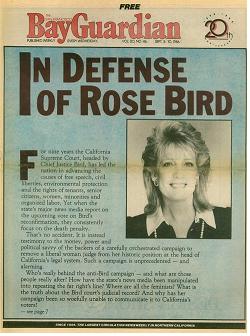
In other words, as we wrote at the time (In Defense of Rose Bird, Sept. 3, 1986):


The charge that the Bird court has refused to enforce the death penalty is simply inaccurate … the California Supreme Court has simply been doing what most state and federal courts have done over the past ten years: carefully scrutinizing death sentences to ensure that they are valid under the federal and state constitutions and complex and ever-changing standards of the U.S. Supreme Court.


The real issue didn’t make the press. Again, from our cover story at the time:


For nine years, the California Supreme Court, headed by Chief Justice Bird, has led the nation in advancing the causes of free speech, civil liberties, environmental protection and the rights of tenants, senior citizens, women, minorities and organized labor.


 Big-business interests organized and funded a massive campaign to get rid of Bird — not because of the death penalty but for purely economic reasons.


The Chronicle got it wrong back then, and is getting it wrong again today.

The attack on the SF left

20

If I were a political consultant hired by the San Francisco Chamber of Commerce and the big developers and the landlords and Mayor Newsom, and my job was to launch an effective attack on the progressive movement in the city and undermine progressive control of the Board of Supervisors, here’s what I’d do:


1. I’d attack district elections. See, every time the downtown folks have tried to run candidates in swing districts under the existing system, they’ve lost. That’s in part because the business types can’t seem to find decent candidates, and part because money doesn’t rule in districts, so progressives who can mobilize at the grassroots level have a better chance.


So when you can’t win the game you try to change the rules. You can’t do it too directly, because the polls show that people like having district supervisors, so I’d come up with a “hybrid” plan — say, seven districts and four at-large supervisors. Since anyone who runs at large in this city needs gobs of campaign cash, that would pretty much guarantee that four board members would be accountable to downtown. Then draw the districts to create two moderate-conservative seats, and the progressives have lost control.


I’d launch this by planting stories in the San Francisco Chronicle about a “growing movement” to change the way the supervisors are elected — even thought there is no real grassroots movement.


But that creates the appearance that’s needed to begin raising money and preparing for a ballot initiative. It’s not hard to get the Chron to bit on something like this; C.W. Nevius, the local columnist who lives in the East Bay suburbs, never liked district elections, so he’ll play along and the Chron’s corporate ownership, which is close to the Chamber folks, never liked the system either. You can expect an editorial from the Chronicle Feb. 28th calling for a partial repeal of district elections.


The argument won’t have anything to do with the fact that the Chron doesn’t like the policies this particular board has passed; it will be all about the need for a “citywide perspective.” Now, that’s just horseshit, since the district boards have done an immense amount of work on citywide issues (like mininum wage and health care) that the at-large boards would never do.


But “citywide perspective” is a term that’s been focus-group tested and sounds good.


2. I’d look for a nice wedge issue for the November elections — something that could be used against progressives in swing districts. When Newsom ran for mayor the first time, he used “care Not Cash” — a well-funded attack on homeless people.


And gee, guess what? There’s another nice anti-homeless measure that’s recently been floating around, and it comes from the media-savvy police chief, George Gascon. It’s called a “sit-lie” law — legislation that would criminize the act of sitting on the sidewalk. It’s got a lot of populist zing to is, particularly since Gascon is talking about the need to clean up Haight Street, where some ill-behaved young people have been bothering the merchants and shoppers.


A November ballot initiative on a sit-lie law would allow downtown to raise a lot of money — and attack people like Rafael Mandelman and Debra Walker, candidates for supervisor in districts where a simplistic attack on the homeless might play. 


3. I’d try to split the city’s labor movement and drive labor away from the progressives. The obvious tactic: Construction jobs. I’d get every construction trade union member to campaign in District 10 for a supervisor who will support Lennar Corp.’s redevelopment project, and I’d attack any supervisor or candidate who supports limits on, say, buildings that shadow the parks and call them anti-jobs.


4. I’d launch a quiet effort to raise a big chunk of money to push pro-downtown candidates for the Democratic County Central Committee. The DCCC used to be something of a political backwater, but under progressive control, it’s become a significant force in local elections. The DCCC controls the local Democratic Party endorsements and money — which can be a big factor in district supervisorial races.


Now: I have no evidence that any individual consultant has created any such plan — but it’s sure an interesting coincidence, isn’t it?


What I see right now is a coordinated, orchestrated attack on the left — and I’m getting a little nervous that our current leadership on the Board of Supervisors isn’t doing enough about it.


Hey Matier & Ross — PG&E is no security blanket

8

Today’s San Francisco Chronicle piece by Phillip Matier and Andrew Ross brought to mind a Pacific Gas & Electric Co.-sponsored Web site that was set up to undermine the city’s fledgling Community Choice Aggregation (CCA) program.

That’s because one of the key points in the story was that San Francisco’s CCA could result in higher customer bills. According to the Chronicle:

“A 2007 city controller’s report concluded that a typical residential utility bill under this type of plan could go up by 24 percent if only half the purchased energy is green. The cost would almost certainly go even higher if the city went totally green, the report said.”

This city controller’s report is referenced on the PG&E-funded Web site, too, and this supposed 24 percent increase was splashed prominently across colorful outsized postcards that the PG&E-sponsored “Common Sense Coalition” sent to businesses and residences throughout the city last December. However, San Francisco’s Local Agency Formation Commission (LAFCo), a city commission responsible for setting CCA in motion, maintains that the claim is misleading.

Why?

The controller’s was drafted in 2007, making it an outdated and unreliable source for an economic-impact projection at this time, according to LAFCo Senior Program Officer Jason Fried.

“PG&E is trying to confuse people now … because they know that in a month or two more, we’ll have a contract” with actual figures to go by, Fried told the Guardian. The city is still in negotiations with Power Choice LLC, the firm selected to handle power purchases, and so it has yet to determine a long-term pricing plan. Fried also pointed out that the 24-percent increase noted in the controller’s report only pertains to electricity generation charges, and not the entire customer bill.

While the report did caution against a potential increase in prices, it also made it clear that the figures were preliminary. Here’s an excerpt:

“San Francisco’s CCA process has not yet advanced to the stage where any definitive economic impact statement can be made. A detailed economic impact assessment will not be possible until the RFP process is complete, a structured long-term rate plan has been submitted, and an opt-out penalty has been set. [NOTE: As of February 2010, the RFP process is complete, but the other two steps haven’t been definitively nailed down yet.]

The proposed implementation of CCA could lead to greater competition in the City’s electricity markets, lower rates for consumers, and a greater reliance on local sources of renewable energy and conservation. Such an outcome would benefit the San Francisco economy and the global environment.”

Since this PG&E-sponsored propaganda campaign got underway, a figure unearthed from this three-year-old report is popping up everywhere, including in the Chronicle.

More importantly, the focus on a potential rate increase under CCA ignores an important question: Is the status quo any better?

Even if CCA did drive up prices, it seems that sticking with PG&E as the region’s sole electricity provider might not be any cheaper in the long run. For example, the following appeared a Feb. 19 article in the Wall Street Journal:

“In December, [PG&E] asked state regulators for permission to raise customer rates 19% or $1 billion in 2011, with additional rate hikes of about $550 million from 2012-13. … The outlook for the increases is unclear, as consumer advocates have vowed to fight them, citing PG&E’s already higher-than-average utility rates, California’s relatively high 12.4% unemployment rate and the state’s ailing economy.”

There are other factors to think about, too, like the dynamic environment we live in and how the cost of a finite energy resource will fluctuate in the long run. The Chronicle piece quotes Severin Borenstein, co-director of the Energy Institute at UC Berkeley’s Haas School of Business, as saying San Francisco’s CCA is “fraught with danger.” This statement seems to ignore what environmentalists have been saying for years, which is that the status quo itself is a treacherous path to go down.

A key difference between San Francisco’s CCA and PG&E’s energy mix is that CCA would rely more heavily on green energy sources, with a goal of offering 51 percent of its energy from renewable resources by 2017 with the plan to transition eventually to 100 percent renewable power. Meanwhile, PG&E is making snail-like progress toward a 33 percent renewable-energy standard by 2020 that is mandated by state law.

In the long run, many experts tell us that energy derived from fossil fuels will be more susceptible to price volatility than wind and solar — especially with added environmental pressures that scientists predict will result from climate change. A future characterized by less rainfall threatens to drive up energy prices, according to the Union of Concerned Scientists, because California gets about 20 percent of its electricity from hydropower, and could be forced to purchase from an outside provider in years of extreme drought. Hotter summers are also expected, which could lead to a higher demand for electricity when everyone is running air conditioners.

Energy analyst Laura Wisland of the California office of the Union of Concerned Scientists put it this way: “We can’t afford not to take advantage of the renewable-energy resources in our own backyard. We will save money, because we will become less dependent on fuels that have more volatile prices.

“We know that we have an exhaustible supply of fossil fuels,” Wisland added. “We know that we have an inexhaustible supply of wind and sun. In the long term, we see renewable energy as investing in … more price certainty and cleaner air — and that can benefit all Californians.”

Notes from the Sierra Club’s gala dinner

0

While I focused on Jerry Brown’s disappointing speech to the Sierra Club San Francisco Bay Chapter’s gala dinner on Wednesday night, there are a few more notable nuggets in my notebook worth posting here, starting with what appears to be the collapse of plans for a California Constitutional Convention.

The Guardian recently reported on the difficulties that the campaign was having, but consultant Clint Reilly told me that the effort is basically over, with fundraising shortfalls being the final nail in the coffin. That’s one more reason why “hope” seems to be in such short supply on the political landscape.

The event was held in the Merchant Exchange, a building owned by Reilly, who helped underwrite the gathering. So it was no surprise that the evening was MCed by his wife, Janet Reilly, who is running a strong campaign to replace Michela Alioto-Pier on the Board of Supervisors.

There were lots of political luminaries at the event (list to follow), but there was one particularly notable attendee and particularly notable absence. Los Angeles City Council member Janice Hahn was one of the few politicos from down south, making the rounds in support of her run for lieutenant governor. But Mayor Gavin Newsom, who is considering challenging her, didn’t show up.

Also a no-show was U.S. Sen. Barbara Boxer, who appeared by video to address the gathering and express appreciation for being the recipient of the Sierra Club’s first Phillip Burton Badge of Courage Award for environmental stewardship. Accepting the award on her behalf was California Democratic Party chair John Burton, who was his usual salty self, taking a dig at the San Francisco Chronicle by referring to someone who wrote “for the Chronicle back when that was a newspaper,” and describing the award’s namesake thusly: “My brother was an outstanding environmentalist who didn’t like the outdoors much.”

He also made this funny, self-effacing crack at the start of his speech: “I think a third of the people in this room would like to see the accelerator stuck on the rug of my Prius.” I was not among that third.

There was a strong turnout of local political leaders, but tellingly, only from the left side of the political spectrum. The members of the Board of Supervisors who turned out were David Chiu, Chris Daly, Ross Mirkarimi, Eric Mar, and John Avalos. Other political luminaries on hand included City Attorney Dennis Herrera, Sen. Leland Yee (Yee and Herrera are each running for mayor) City College trustee John Rizzo (who introduced Brown), Senator-turned-Oakland mayoral candidate Don Perata, District Attorney Kamala Harris, Rep. Jerry McNerney, and Sen. Loni Hancock.

Marijuana really is medicine

5

Just in time for Medical Marijuana Week comes word that the first U.S. clinical trials on marijuana in more than 20 years has found that it is effective in relieving pain and treating multiple sclerosis and other ailments, potentially opening the way for the federal government to revisit its longstanding claim that pot has no medicinal value.

Most significant are findings that even low levels of marijuana offer significant pain relief with minimal health consequences. Unfortunately, the San Francisco Chronicle also reports that the UC San Diego researchers have almost run out of funding before all its planned tests have been completed.

San Francisco has long been a leader in the medical marijuana movement, both with its proactive approach to regulating cannabis clubs, and with the sponsorship of efforts to decriminalize pot by state legislators Tom Ammiano and Mark Leno. Oakland’s pot-cultivation school Oaksterdam University also bankrolled an initiative aimed for the November ballot that would legalize weed for even recreational use.

Appetite: Forecast — a downpour of delicious varietals and gourmet bites

0

It’s been a stunning week of sunny weather… We may get a little rain on Saturday, but no problem if we can spend the afternoon indoors sipping delicious wine, right? On Sat/20, the largest competition of American wines in the world takes place in Fort Mason’s Festival Pavilion.

The San Francisco Chronicle Wine Competition features literally thousands of our country’s best with gourmet bites along the way. Maybe it’s Sonoma Artisan Foie Gras or A Perfect Pear‘s delicious jams. Or you can sample what the CCA students are cooking up.

The event started in 1983 as an annual fundraiser for the Santa Rosa Junior College Wine Studies Program & Culinary Arts Program (now that’s a mouthful), and was then known as the humble Cloverdale Citrus Fair wine competition — eventually growing to the point where it moved to SF. More than 4800 nationwide wines are judged in January by 60 industry judges. The gold medal wines are offered to you — that’s a lot of wine tasting!

You’ll taste wines of many a varietal and within a wide price range, like a Norton from Missouri, Rieslings from both coasts, or a Chambourcin from the Finger Lakes. Fort Mason is yours to roam: sipping, nibbling, taking in views of Golden Gate Bridge. Rainy or not, that sounds like a sweet Saturday.

San Francisco Chronicle Wine Competition
Sat/20; 2-5pm, $60 advance/ $80 at the door
Fort Mason Center Festival Pavillion, 38 Fort Mason 11
www.winejudging.com
twitter.com/sfcwinecomp

Check out Virginia’s culinary itinerary site www.theperfectspotsf.com for more food news and views.

Labor’s love lost

4

Note: This file has been corrected from an earlier version.

rebeccab@sfbg.com

Two recent events could have major implications for Service Employees International Union Local 1021 — San Francisco’s largest public-sector union and an important ally for progressives — for better or for worse. And this union’s fate seems closely tied to that of the progressive movement in San Francisco.

The first event was likened to a “nuclear bomb in the morning paper” by one observer, and might be interpreted as the kickoff to a fierce budget battle. Mayor Gavin Newsom announced that he is considering a plan to help solve next year’s budget deficit by laying off 10,000 full-time city workers and rehiring them at 37.5 hours, which would amount to a sweeping 6.25 percent pay cut for workers and an estimated $50 million in savings for a fiscally impaired city.

Though it was framed by Newsom spokesperson Tony Winnicker as one preliminary cost-saving option among many, the proposal received prominent front-page coverage in the San Francisco Chronicle, even before official discussions were called between the mayor and public sector unions. Since SEIU Local 1021 represents 17,000 members in San Francisco and a majority of the city’s 26,000 total employees, it would likely absorb the greatest impact if such a plan went through.

At the same time the mayor’s startling announcement hit newsstands, SEIU was in the midst of mailing out ballots to its membership for union elections. “I don’t know whether it’s a coincidence, or if the city is taking advantage of the fact that SEIU is absorbed in its elections,” Sin Yee Poon, an SEIU chapter president for Human Services Agency workers, told us while pointing out that the events happened simultaneously.

With three separate slates of candidates vying for control of SEIU Local 1021, grudges between warring internal factions have intensified into bitter sparring matches. The timing is unfortunate — just as SEIU’s internal turmoil is coming to a head, one of its greatest battles is pending over an unprecedented $522 million budget shortfall that looms like a dark cloud over the city. The deficit will surely result in job losses, and the public sector union’s ability to mount resistance even as it wrestles with internal strife is shaping up to be a key question.

This pivotal moment carries wider political implications considering that the progressive organization has in the past helped seal an alliance between San Francisco’s left-leaning leaders and organized labor through the San Francisco Labor Council.

With SEIU besieged by infighting and soon to be hurting from wage slashes and layoffs, more conservative factions of the labor community, such as the San Francisco Firefighters Union and the Building and Construction Trades Council, have recently been butting heads with progressive members of the Board of Supervisors.

At the same time, forces on all sides are beginning to eye the coveted seats up for election in June at the Democratic County Central Committee, a Democratic Party hub that is a cornerstone of local political influence, as well as the seats that will open up on the Board of Supervisors in November. Negotiations between unions and the mayor are ongoing, and mayoral spokesperson Tony Winnicker was quick to note that Newsom is open to options, other than reconfiguring 10,000 city jobs, that organized labor brings to the table. At the same time, the Guardian heard from numerous sources that city workers felt outraged and blindsided by Newsom’s decision to air the plan in the Chronicle instead of bringing stakeholders to the table.

SEIU Local 1021 President Damita Davis-Howard told us she thinks the idea of taking $50 million out of the pockets of working people in a rocky economy is wrong-headed.

“This was devastating,” said Davis-Howard, who is running for a newly created union position called chief elected officer, which is different from the union president, and similar to an executive-director post. “The mayor might as well have raised their taxes, because if you decrease their pay by 6.25 percent, they will still have the same amount of work, they will still have to pay the same mortgage, they will still have to buy the same food, the same PG&E, and they’ll be doing it with a lot less money. If any idea like this were to go through, it would actually remove the very fabric or fiber of San Francisco. It would really cut to the core of the very being of San Francisco. … I don’t see how anybody could believe that we could continue being the city that we love being with this kind of action.”

Winnicker, the mayoral spokesperson, cast it as a plan that could avert hundreds or even thousands of layoffs. “This year the easy decisions are behind us,” he noted in a recent discussion with the Guardian.

Solving last year’s fiscal shortfall was far from easy — budget tussles between frontline city workers and the mayor got ugly, and even then, the city received millions in federal stimulus dollars to cushion the blow. A similar plan of sweeping hourly cuts was floated then too, but it didn’t gain enough traction to move forward.

“The mayor is facing a huge budget deficit, there’s no question about it — but he has not lifted one finger to raise a dime in revenue,” charged SEIU member Ed Kinchley, who works at San Francisco General Hospital. As for how the union might respond if such a proposal went through, he speculated, “I think it’s the kind of thing that could lead to a strike. A big fight.”

While the city charter bars strikes by public employees, Kinchley’s comment indicates the level of frustration among SEIU’s rank-and-file.


The proposal could present a common enemy and a rallying point for a union in disarray. Internal jockeying for elected positions can be fierce in any organization, but for San Francisco’s service-workers union, the rifts are particularly deep.

The elections, which will be decided Feb. 28, mark the first time since a radical restructuring in 2007 that members will collectively decide who should lead. In 2007, the face of SEIU was changed across California when the international president, Andy Stern, began consolidating dozens of far-flung locals into centralized, beefier entities in a bid to maximize political effectiveness (California comprises roughly one-third of the entire union’s membership).

Local 1021 came into existence when 10 locals were conglomerated into one 54,000-member giant — hence the “10-to-one” label — representing health care and frontline service workers from the Bay Area to the Oregon border. 

In San Francisco, where a large segment of its members are based, the shift was interpreted by some as a power grab, and it triggered a period of ongoing strife between those allied with Stern and the international wing on one side, and those dissatisfied with changes they saw as antithetical to the democratic ideals championed by Local 790, its predecessor, on the other.

In the years following the reorganization, Stern began trying to aggregate members by raiding other unions to consolidate power. But campaigns to bring in members from United Healthcare Workers (UHW) and fend off membership losses to the newly created National Union of Healthcare Workers (NUHW) have consumed money and resources that some members told the Guardian would’ve been better spent bolstering national support for health-care reform and the Employee Free Choice Act. According to one source, SEIU spent $10 million on a Fresno battle against NUHW.*

A fight waged between SEIU Local 1021 and UNITE HERE Local 2, a hotel-workers union that was historically allied with Local 1021’s predecessor, left some members especially stung because it marred a longstanding relationship between two groups of frontline workers.

“Andy Stern has concentrated more and more power into the hands of a group of so-called elite members of the union,” Kinchley told the Guardian. Stern’s top-down leadership style and growth-oriented objectives “run pretty harshly against what many of us believe is in the best interest of our workers locally,” he added.

In recent weeks, divisions have deepened further. A staff person who preferred not to be identified for fear of retribution filed charges with the U.S. Department of Labor against a supervisor, who is aligned with the international faction, for alleged harassment and bullying. Another complaint was filed with union leadership alleging that union bylaws were violated when membership money was authorized, but not spent, to conduct a poll without proper approval.*

“There’s a fiscal rogue-ness about it. [Davis-Howard] does whatever she wants, and she spends our dues money without authorization from anybody,” Kinchley charged.

Stern appointed Davis-Howard, and now she is running for election on a slate aligned with the international wing. When the Guardian tried to reach her to discuss union elections, spokesperson Carlos Rivera told us that Davis-Howard found it inappropriate to publicly discuss internal divisions.

Sin Yee Poon is running as her opponent on a reform slate, formed by members disaffected by the international’s modus operandi. “For the whole reform group, we’re disappointed with the general direction of corporate unionism,” Poon told the Guardian. Stressing that she believes grassroots, democratic ideals have eroded since the restructuring, she said members in her camp are agitated when they see resources siphoned into raids on other unions such as UNITE HERE and UHW. “We want it to be member-driven,” she said. “The raiding of other unions is absolutely not OK.”


The internal strife could have a wider ripple effect. SEIU Local 1021 has historically been influential in securing an alliance between the city’s labor community and San Francisco’s progressive leadership. During the last round of elections for San Francisco’s Board of Supervisors, Sups. John Avalos and Eric Mar campaigned and ultimately were elected with strong fundraising support from the labor council.

Yet in recent weeks, several skirmishes pitted certain factions of the labor community against progressive members of the Board of Supervisors. Outrage bubbled up from the firefighters — and ultimately the labor council as a whole — against a charter amendment proposed by Sup. John Avalos that would have extended the minimum number of work hours for firefighters.

Billed as a cost-saving measure, the proposal might have ultimately resulted in fewer firefighter jobs, but it was designed to spread the pain of budget cuts more equitably by grazing public safety departments instead of just inflicting blows on frontline and healthcare workers.

After Labor Council Executive Director Tim Paulson came out strongly against it, Avalos abandoned the idea. A source from within the labor council, who spoke on background only, described it as an opportunity for the labor council to come together and unite on class interests.

The political posturing that came out of that fight shook even Sup. David Campos, who vocally called for equitably sharing the pain during last year’s budget debacle. “This isn’t the way to do it,” Campos said when asked about Avalos’ failed charter amendment. “And I worry about the negative impact on labor and the progressive board. There are larger issues at play here. The entire progressive agenda is at stake. We need to think long-term about the specific issues plus the future of the progressive movement.”

Sup. Sean Elsbernd’s bid to reform the pension system to save money has provoked yet another fight with SEIU Local 1021. Union members argue that if they are asked to contribute to their own retirement funds, which would become mandatory under this proposal, then they should be given the same wage increase that other unions were granted when they agreed to similar terms.

But when Sup. Eric Mar tried to amend Elsbernd’s proposal by inserting language guaranteeing that pay increase, Elsbernd said it would cost the city millions more. If Mar’s amended version goes forward, “you’ll be going to the voters by yourself,” Elsbernd told the progressive-leaning supervisor at a Feb. 9 board meeting.


Another fight has erupted over 555 Washington, a tower proposed to go up beside the TransAmerica Pyramid, which was debated at a joint hearing Feb. 11 between the Planning Commission and the Recreation and Park Commission. For members of the Building & Construction Trades Council, which represents unionized carpenters, plumbers, and other workers in development-related trades, the project represented jobs — the screaming priority in an economy where funding for new construction has trickled to almost nil.

“There is, in general in San Francisco progressive politicians, a knee-jerk reaction to development projects,” Building & Trades Council Secretary Treasurer Michael Theriault told us. As a council representing people whose livelihoods depend on private sector construction, “We have a particular quandary,” he said. “We need politicians who at the same time are friendly to labor and understand that development is an economic tool that can help the city.”

The arm of labor representing Theriault’s council has been slammed with job losses due to the economic downturn, and he’s publicly expressed frustration when projects of this scale are shot down.

“What the mayor did, what Elsbernd did, and what Avalos did are all the same thing: They all staked out a position, put a provocative idea on the table, and forced unions to have a discussion with a gun to their head in a non-constructive way,” Mike Casey, president of UNITE HERE Local 2 and a member of the labor council’s Executive Committee.

A source familiar with the inner workings of the labor council said the tension between building trades and firefighters versus more left-leaning members of the labor community has been in existence for decades, and it isn’t anything new — particularly in the months preceding election season.

Casey challenged the very notion that there is a subculture of the labor council that isn’t progressive, pointing out that labor came together as whole to support Sups. Avalos, Mar, and David Chiu — “and I personally would do it again in a heartbeat,” he added. Internal catfights and struggles for control come with the territory in a democratic, diverse organization, he said. “As a group of working people, I have great regard for the membership [of SEIU Local 1021],” he said. “Occasionally there’s a dustup. In my experience, after the dust settles, more often that not, unions come out stronger for it.”.

*Corrections made to the original file.

Reality bites

0

arts@sfbg.com

THEATER Feb. 5 saw a varied but collectively incensed body of American conservatives unfurl itself all red-white-and-blue in Nashville’s Gaylord Opryland Hotel for the first Tea Party Nation convention. The delegates, dubbed “teabaggers” by media wags and hailing from all parts of the land, responded enthusiastically to a keynote speech bewailing the “Islamification” of a nation overrun by foreigners and subverted from within by the Obama administration, the green movement, and the “cult of multiculturalism.”

Many in the Bay Area might look upon such a grouping, and the groundswell it purports to represent, with a vaguely uneasy sense of amusement, not to say superiority. But the name itself begs the question: are these people really patriots, or just pudheads? Maybe the only thing to do is gas up and head out for some reconnaissance. After all, there’s a legitimate wave of anger across the downsized middle of this otherwise clinically obese country, and it behooves us smug coastal dwellers to know something about it.

Or better idea: let Dan Hoyle go and report back from the stage. Like many a 20-something seeker before him, the restlessly peripatetic San Francisco–based writer-performer set out last year in a custom van to, as he put it in one of his dispatches to the San Francisco Chronicle, “find out what makes America’s heartland tick.” What he discovered during the three-month, 27-state odyssey may not be all that surprising in the end — indeed, the liberal biases Hoyle looks to complicate come back more or less intact — but it makes for a deft, sharply funny, and entirely engaging night of theater.

In the episodes brought to theatrical life here — astutely and meticulously shaped in collaboration with director Charlie Varon (Rabbi Sam) and reminiscent of the humanist satire of Garry Trudeau — Hoyle heads out from his charmingly incongruous but insular circle of friends (and their “liberal bubble”) straight to Texas, where he joins hands in mealtime prayer with a born-again Vietnam vet and his family, including a grandson about to ship off to Iraq with the Marines.

The dinner conversation is largely devoted to a defense of creationist history: “Now,” his kindly host asks with rhetorical relish, “How did Noah fit all those dinosaurs in the ark?” Afterward, Hoyle deflects a postprandial pass from the man’s son, who’s clearly surprised a guy from San Francisco could ever be so straight. Retreating to his van, Dan is not above doing some praying of his own, including hoping for the safety of the young soldier about to do “what I could never do” in Iraq.

Then it’s off to Alabama, Hoyle toggling expertly between, on the one hand, the casual racism of a moonshine-sipping paraplegic ex-trucker and his apologetic wife, and, on the other, an African American casino worker and ex-con (“livin’ the mutherfuckin’ American dream”) who expounds with gritty eloquence upon the impact of Obama on white and black minds.

Reagan Democrats, gun-show vendors, and aging Midwestern hippies-turned-reactionaries, among others, all lie on the road ahead. Hoyle finds much to sympathize with and honor along the way — an all-American cross-cultural encounter related by Ramón, a Dominican from New York whom Hoyle meets in Michigan, is particularly supple and hopeful — but the going is rough. Frequently Hoyle gives vent to his frustration in song, picking up the guitar and letting go a melodic tirade of inspired lyricism. “Americans” is pervaded with a sense of the playwright’s own loneliness, a frustrated desire for connection in the face of a reactionary populism that will not meet an earnest liberal halfway.

Maybe there is no halfway? Or maybe a halfway line requires more rigorous interrogation of the play’s own political assumptions. That might have cast the ideological landscape in a somewhat different light. After all, the widespread conviction that Obama is a “Moozlum” is one thing; a more general distrust of the state and big business as dangerously encroaching powers is another.

THE REAL AMERICANS

Through April 18

Thurs.–Fri., 8 p.m.; Sat., 5 p.m.

Sun/21, Feb 28, and all Sundays starting March 14, 3 p.m.

Marsh

1062 Valencia, SF

(415) 826-5750

www.themarsh.org


The malevolence of Mercury Insurance

9

Yesterday’s San Francisco Chronicle reports on a long history of illegal practices by Mercury Insurance – including discrimination against soldiers, artists, bartenders, and other professions in auto insurance coverage and rates – and the long-overdue political and regulatory attention being paid to the company.

But that’s just the tip of the iceberg. The real story of Mercury’s dealings in California is even more insidious, and it has implications to the health care reform legislation being pushed by President Obama and congressional Democrats, which would require all Americans to buy health insurance, just as all California motorists are required to buy car insurance from Mercury and other companies.  

Documents from the California Department of Insurance (275 pages worth, which we also obtained and which you can download here) detail the Mercury’s deceptive practices, but it was hardly a secret how Mercury operated, brazenly and openly defying standards and regulations that voters created in 1988 by approving Prop. 103.

The author of that measure, respected activist Harvey Rosenfield of Consumer Watchdog, has been sounding the alarm about Prop. 17, a measure that Mercury has placed on the June ballot that would overturn key parts of Prop. 103, allowing insurance companies to jack up premiums for those who haven’t been loyal and continuous insurance customers that paid every bill on time.

Rosenfield recently stopped by the Guardian and offered a fascinating history of insurance regulation in California – and his battles with his number one nemesis, Mercury Insurance.

“Prior to the passage of Prop. 103, which the voters approved in 1988, insurance companies were not regulated in California. They could basically get away with anything and they did. In 1984, the state Legislature mandated that people buy auto insurance and guess what happened? After that, everyone in the marketplace is required to buy insurance and there’s no protection against how much insurance companies could charge you for it or even if they refused to sell it to you because of where you lived or the color of your skin, there were just no protections,” Rosenfield told us.

“One of the most pernicious practices after the Legislature said you have to buy insurance was that when you went to the insurance companies and said, ‘OK, I’m required by law to buy insurance, now sell it to me.’ They’d say, well you didn’t have it before, so we’re not going to sell it to you now. Or, you didn’t have it before so therefore we’re going to surcharge you and double the price of insurance. Talk about a Catch 22.”

So consumer groups sued and Rosenfield started writing Prop. 103. In 1987, the courts said this was a legislative issue, not a judicial one, so the groups turned to the California Legislature.

“Of course, the Legislature was too beholden to the insurance lobbyists to do any of the proposals that we were offering, so we went to the ballot box in 1988. Prop. 103 did many things: it called for a rollback, requires insurance companies to open up their books and justify premiums, it requires auto insurance companies to base your premium on your driving record, the number of miles you drive every year, and your driving experience. No longer would your ZIP code be the dominant determinant for how much you pay. And that battle, just to get that put it in place, we didn’t win that until 20 years after 103 began. We won in basically in 2006, 18 years later, after court challenges and going to the commissioner.”

While Prop. 103 allows the insurance commissioner to set additional reasonable factors in setting insurance premiums, Rosenfield said, “The one rating factor that Proposition 103 prohibits is the one that insurance companies used before. Prop. 103 says you cannot base insurance premiums or refusing to insure somebody on the absence of prior insurance.”

But as the new documents and other court findings showed, Mercury ignored that provision and used it as a factor anyway, setting a surcharge of about 45 percent of the premium price if you hadn’t had insurance before, for which they were again sued.

“Mercury realizes they’re going to lose the civil suit, goes to Sacramento, spreads a fortune in campaign contributions, and lo and behold, gets a bill passed overriding this provision of Prop. 103, legalizing its surcharges. [Gov. Gray] Davis vetoes it in 2002 on the grounds that it violates Prop. 103. Another year goes by, Mercury spreads even more money around, and this time Davis is up in a recall election and needs Mercury’s money. So he takes the money, it’s $100,000 or more, and Davis signs the bill. We have to go to court and challenge the bill as an unconstitutional amendment to Proposition 103, which we finally succeed in doing and it’s upheld by the Court of Appeals in 2005. All that time, Mercury is overcharging people. Ultimately, Mercury is told, the law you sponsored is invalid and you can’t do it anymore, so it stops in 2005 – 10 years of wanton, brazen violation of the law. And that brings us to the Mercury initiative.”

But because these surcharges are so lucrative – in some states, a Consumer Watchdog investigation found, doubling or tripling premiums – Mercury decided to spend millions of dollars to place Prop. 17 on the June ballot, and it will spend millions more to fool consumers into believing that its somehow good for them.  

“The Mercury initiative is even more pernicious than what it was doing before, and here’s why. Under Mercury’s initiative, if you’ve never had prior insurance, you can be surcharged for the first time. It overturns the Prop. 103 provision and legalizes these surcharges. Then they’ve thrown in some other tricks and traps, as you’d expect an insurance company to do on a ballot measure.”

What are those tricks and traps? How have they been able to get away with this for so long? Why did Attorney General Jerry Brown, a candidate for governor, give the measure such a favorable and misleading ballot title and summary? Why has the Democratic Party been so unwilling to challenge them? We’ll have much more on Mercury and its corrupting corporate influence in future issues of the Guardian.

Coby King, Mercury’s vice president and spokesperson, wouldn’t speak directly about the newly revealed documents or the concerns they’re causing among regulators and politicians, sending us the same prepared statement he send to Chronicle, which says consumer groups are trying to “mislead consumers and rehash old allegations.”

Yet I pressed him on why Mercury has for decades shown such contempt for the regulatory framework created by Prop. 103, which the company has now challenged through lawsuits, sponsored legislation, lavish political contributions, the new ballot measure, and even through blatant violations of the law. He tried to refer me to Kathy Fairbanks, who headed the Mercury-backed front group, Californians for Fair Auto Insurance Rates, which is pushing Prop. 17.

But when I noted that the group is supposedly independent of Mercury, and it is the company’s hostility to Prop. 103 that I was asking about, he finally said this: “Prop. 103 is the law of the land, but to the extent there are improvements that can be made that are pro-business and pro-consumer, Mercury has not been shy about acting in the public interest.”

Ah, so it’s the public interest that Mercury has been acting in. Got it.


Public employees feel blindsided by Newsom’s layoff scheme

39

Mayor Gavin Newsom’s proposal to lay off 10,000 city employees and rehire them at lower pay is being met with outrage by some public-sector workers. The plan, crafted as a way of saving money to balance the city budget, would amount to sweeping pay cuts across the board for a significant number of city workers.

Formal discussions about it are in the earliest stages, and Tony Winnicker, the mayor’s press secretary, described it as “just one alternative that we’re investigating.” Nonetheless, some members of Service Employees International Union Local 1021 are furious that the mayor unveiled this plan in the San Francisco Chronicle instead of at a meeting with the city’s labor leaders.

“As far as we can tell, an idea he has ended up on the front page of the Chronicle that’s had a devastating ripple affect among the people who work for the city and county,” SEIU Local 1021 President Damita Davis-Howard told the Guardian. “We feel like we got a sucker-punch. … We really wish he had talked to us before he governed by press conference.”


Davis-Howard said she’s been inundated with phone calls from angry union members who read the article. “This is the same proposal he floated last year,” Davis-Howard said. “Most of our members believed that they gave up their holiday pay in order to avoid this very thing.”

The proposal, which was briefly considered last year but never moved forward, serves to illustrate just how hard financial woes are hitting San Francisco. The city is staring down a $522 million deficit, and Newsom’s proposal would make up for a mere $50 million in savings.

Winnicker declined to comment on Davis-Howard’s concerns about being blindsided by news of the layoff plan, brushing it off by saying the mayor did discuss it with “some folks in labor.” Instead, he suggested that Newsom is getting serious about solving the budget crisis while the Guardian is just focusing on irrelevant gripes.

“It is an unprecedented budget shortfall, and it is real,” Winnicker said, stressing that the gaping budget gap will have to be bridged without the infusion of federal stimulus dollars that cushioned the blow last year. “The easy choices are behind us.” This layoff plan could prevent “hundreds, if not thousands, of layoffs,” but the mayor is open to other ideas that labor brings to the table, he said.

“That logic is just flawed,” Davis-Howard said when asked about the assertion that the plan could prevent layoffs. “That’s not the way you re-stimulate the economy, by taking more dollars out of the economy. We can’t continue to balance the budget on cuts, because pretty soon the actual fiber of the city and county of San Francisco will be reeling because of the number of cuts that we sustained.”

When asked how SEIU Local 1021 would respond, she said, “I do believe we need to be open-minded, imaginative, and creative in coming up with some revenue-generating measures here.”

No doubt the mayor will receive plenty of suggestions as negotiations continue in the coming weeks.

Sunshine and shadows

2

tredmond@sfbg.com

It was, the San Francisco Chronicle proclaimed, the end of the world for development in the city, or at least something close to that. A ballot measure, sponsored by Sup. David Chiu, restricting new buildings from casting shadows on city parks “could imperil major development projects,” a Jan. 28 article by John Cote said. “Everything from a new wing at the San Francisco Museum of Modern Art to the expansion of the Moscone Center and creation of a new downtown core around a rebuilt Transbay Terminal could be affected.”

A lot of that is wildly exaggerated. The Chiu ordinance, which has since been pulled from the ballot pending a city study of the issue, would hardly have halted all development — or even all high-rises — in San Francisco. It wouldn’t have gutted the Transbay Terminal plan (although it might have forced planners to reduce the height of a tower that would soar 400 feet above the tallest building in San Francisco). In fact, the real story is how Chiu has managed — for now — to stop a backroom attempt by developers to undermine a 25-year-old environmental law. We found some fascinating evidence of how Mayor Gavin Newsom has been working with the San Francisco Chamber of Commerce to undermine Chui’s efforts — using broad threats to try to get his way.

Chiu’s legislation sought to clear up a couple of loopholes in a landmark 1984 law, which passed on the ballot as Proposition K. The measure, authored by then-Sup. Bill Maher, essentially barred any new construction that would cast a significant shadow on a city park.

In 1989, the final implementation guidelines were approved, and they’ve stopped literally hundreds of proposed projects from casting dark shadows on public open space.

But in the past year, city planners have been meeting with lawyers for big developers and looking for a way to change the rules. Citing new technology that better measures the curve of the earth and complex algorithms that calculate sunlight, the Planning Department has since proposed revising the Prop. K guidelines — in a way that would allow taller buildings and more shadows without getting the approval of voters or supervisors.

Chiu told us he’s been trying for months to find out exactly what the proposed guidelines would do — how many new buildings, at what heights, would be able to shadow which parks. “I was unable to get any answers,” he said.

The measure he drafted would have barred any new guidelines that allowed more shadows — and would have required the Board of Supervisors to sign off any changes. It would still allow the city to make case-by-case exemptions for projects that cast minor shadows but are otherwise deserving of approval — affordable housing developments, for example.

But downtown went nuts — and Newsom joined the fray.

The crux of the opposition came from the Chamber — and is outlined in an e-mail from Chamber Vice President Rob Black to members of the Chamber board.

“The mayor was very direct and clear about the need to defeat the measure,” the e-mail, which we obtained, states. “The mayor was also very clear that he was in no mood for deal-making on the issue and that he would look very unfavorably on any developer or anyone else who tries to cut a deal with David Chiu on the issue. He literally said, you will be on your own for the next two years if you go there.”

Black confirmed that the e-mail was in fact his — but said the version we’d obtained “has been edited. Some words were changed and other omitted.” He refused to say what the changes were, saying that the e-mail was meant to be a confidential communication to his board. However, he confirmed that the basic message and descriptions of a meeting with Newsom were accurate.

Tony Winnicker, Newsom’s press secretary, confirmed that Newsom had been directly involved in trying to scuttle the ordinance — and didn’t deny the mayor had made those threats.

“The mayor made clear the importance of asking the supervisor to withdraw the measure,” Winnicker wrote in an e-mail to us. “The mayor was clear that backroom deal-making should not be tolerated on the issue.”

Chiu was somewhat aghast at the mayor’s statements. “The context for all this is that the developers and their lawyers were trying to change the rules,” he said.

Aaron Peskin, the former supervisor and longtime North Beach neighborhood activist, told us that the “hysteria around this is factually untrue. This isn’t about stopping development — it’s about making sure development doesn’t have an adverse impact on the city’s common space.”

So now Chiu has agreed to hold off — but only if the key stakeholders (not just developers) have some input into how planning devises new shadow rules. And he’s ready to go back to the ballot in November if the developers try to play games again.

That makes sense, Gabriel Metcalf, executive director of the San Francisco Planning and Urban Research Association, told us. “There should be a heavy burden of proof on the people who want new rules,” he said. “And there should be a heavy burden of proof for anyone who wants a ballot measure.”

In other words, Prop. K — as it is, as it’s stood all these years — is working pretty well. And if the developers hadn’t tried to sneak in some big changes, none of this would have happened in the first place.