Review

“Form +”

0

REVIEW With the evolution of the gallery into a white, blank space, the artwork displayed within its walls has metamorphosed as well. The first-floor exhibit at the Meridian Gallery, "Form +," — curated along with two adjacent shows, "Franck André Jamme: New Exercises" and "Dhyana" by California College of the Arts dean Larry Rinder — call into play both of these factors.

In its very nature, the three-story Victorian that houses Meridian already opposes the clean lines most contemporary art galleries aspire to. Instead, one enters to a bare first floor, ripe with references to its early 20th-century past. A fireplace nook, a step down from the level of the rest of the floor, houses an installation — penned directly on the walls — of tiny paintings in graphite and gouache by Léonie Guyer. Her clean forms are abstract — as are all of the works included in the three shows — and filled with solid colors. Within this busy context, Guyer’s pieces help to establish the crux of "Form +." Guyer’s clean forms are abstract, as is all the work included in these shows; filled with solid colors; and within this rather busy context, help to establish the crux of "Form +." Aiming to address the meditative qualities of form, this exhibition posits formalism as not merely about the materials but a very specific cerebral process. Guyer rejects the necessity for a space devoid of context in favor of a site-specificity that almost obliterates her pieces yet maintains the viewer’s consideration.

"Form +"’s remaining works, exhibited in less quirky settings, are slightly more insular. In spite of the self-referential qualities of the pieces on paper by Todd Bura or Prajakti Jayavant, who both account for every line or crease in their compositions, there is an overarching sense of history: the immediate history of the artist’s hand and that of the artists’ awareness of their place within the broader timeline of art history. As a result, the throwback atmosphere of Meridian’s space both complements and highlights the beautiful subtleties of these works by a somewhat underrepresented contingent of contemporary Bay Area artists.

FORM + Through May 3. Tues.–Sat., 11 a.m.–5 p.m., free. Meridian Gallery, 535 Powell, SF. (415) 398-7229, www.meridiangallery.org

Metal Mania: Just keep Walken

0

› duncan@sfbg.com

How would you feel? Your band has been together since 1999, struggling through lineup changes, two US tours, hundreds of shows, an album and two EPs, without so much as a write-up in the local weekly. Finally, after dropping your most recent CD last year — an untitled, self-released disc of skull-crushing riffs — you get a review in the bible of modern metal, Metal Maniacs, and the photo that runs with it is of another band.

In the case of the San Francisco four-piece Walken, it was a photo of a three-piece party-rock outfit from Sioux City, Iowa, whose MySpace "sounds like" reads: "Rush meets Metallica meets Blink 182 meets Nickelback meets Matchbox 20 meets Live meets Red Hot Chili Peppers." With all due respect to Neil Peart and pre-Load era Metallica — seriously?

"They’re total dicks," Shane Bergman, 25, vocalist and bassist for the Original Walken — otherwise known as Vintage Walken or Walken Classic — says during an interview at the Western Addition Victorian he shares with roommate and guitar player Sean Kohler, 27. It’s the crack of noon and the guys are posted up on the couch, drinking coffee, and eating toast and jam in their finest sweatpants. "I’d written the guy a long time ago," he continues. "’Hey, this isn’t cool. We’ve had this name for seven or eight years. We’ve actually put out stuff and toured the US. It’s not cool.’ And they were like, ‘Oh, it doesn’t really matter — we’re in different states.’ I just let it slide. And then I pick up that" — he points to the magazine — "and I’m, like, ‘Well, now it’s gone too far.’ You look through and see a picture of those tools … "

There have been more Walkens, including a band from Melbourne that played weddings and broke up in 2004. The reason for the popularity, most likely, is Christopher Walken’s 2000 "more cowbell" skit on Saturday Night Live. While this settles the name game with pretenders enamored with the sketch, it raises the question: if not for "more cowbell," then why "Walken"?

Like the actor, dancer, and celebrity beer-can-chicken chef, Walken is hard to pin down. When walking in on Walken’s live set and hearing the crushing, dual-guitar assault "Bitch Wizard," from their untitled, self-released 2007 EP, all pummeling drums and clean backing vocals contrasting with deathly, oven-throat howls, it’s difficult to characterize the group — which includes guitarist Max Doyle, 26, and drummer Zack Farwell, 29 — as anything but metal. Perhaps "fuckin’ metal" might be more apt. But it hasn’t always been so clear-cut. "Our Unstoppable record, it was just a weird record," Kohler says of the self-released 2004 full-length. "We thought we were being all revolutionary having these funny rock songs, with funk songs and blues songs … "

"And math rock," Bergman interjects. Unstoppable was Walken’s version, to steal a phrase from Lou Reed, of ‘growing up in public.’"

"Most people sit in their garage when they’re coming up with their sound, but we were actually out there playing it, trying to figure it out in front of people," Bergman says. The band’s music has coalesced into a pointed metal attack. It couldn’t have happened at a more opportune time. While the bottom has fallen out of the housing market, and spending $3 trillion bucks on blowing up Iraqis has wreaked havoc on the economy, stock in metal is clearly on the rise.

"That’s one thing that’s changed about metal," Kohler says. "All of the sudden it’s getting cool again. You can be big and be in a metal band, with Mastodon and High on Fire and bands like that." I’m sworn to (semi-)secrecy, but there’s something on the horizon for Walken, something that Kohler demanded I euphemistically term a "great opportunity," which will put the days of touring cross-country with Hightower on their own dime, playing a couple dozen shows, and coming home dog-dick broke, behind them.

But are the vanguard of 21st-century metal warriors and their burgeoning audience really anything new? While it’s no doubt refreshing to see metal — true metal, not the Hollywood hair-farmer crap that lined record company coffers in a pre-Nirvana world — crawl out from the underground, it seems that it’s still largely aimed at the dudes in black hoodies. Which leads us to simultaneously discuss two major concerns about the future of heavy music: is anything really new, truly revolutionary, or is it all just a remix of old ideas? And just what will it take to woo a crop of hot new metal women away from the evils of floppy-haired emo boys in so-called chick pants?

Thankfully, Kohler’s got some insight: "Everything that’s new is just a reinvention of something else. The only way that I really believe that there can be a new beginning is after most of the human population is annihilated. And then it starts over, just as creative expression is part of life. It slowly becomes a community thing. It starts organically, that’s the point."

"So basically, you blow up the world, and more chicks will come to metal shows," Bergman quips.

Walken is already well into writing a new full-length, but I’ve got to advise them: scrap those songs and work on the concept album. Imagine this: the year is the year is 3052. Global warming and perpetual war have taken their toll. The ice caps have melted and a tribe of mutant metal warrior women of Amazonian stature have arisen from the rubble, repurposing military technology found in underground bunkers into hybrid instrument-weapons, with which they can both rock out and kill you. They rock you to death. Everything metal is new again.

WALKEN

With Hightower, Three Weeks Clean, and Soulbroker

May 1, 9 p.m., $8

Cafe Du Nord

2170 Market, SF

(415) 861-5016

www.cafedunord.com

Emeric Kalman, 1931-2008

0

Emeric Kalman, a neighborhood activist well known for his decades-long work of bringing important issues concerning the city’s public services and infrastructure to officials at City Hall, died March 22, on his 77th birthday, after battling cancer for several months.

Trained as a mechanical engineer, Kalman fled communist Romania in 1968 with his wife, Valeria, settled in West Portal, and worked at Bechtel from 1970 to the late 1980s. After retiring, he used his considerable expertise and proficiency with highly technical documents to bring to light waste and inefficiency in numerous city departments.

"Emeric contributed his research, his knowledge from his engineering background, his sense of fiscal prudence and accountability, and his demand for transparency and sunshine to making the city a better place for its citizens," said Joan Girardot, head of the Marina Civic Improvement and Property Owners Association and a former president of the Coalition for San Francisco Neighborhoods.

In 1997, Kalman and fellow watchdog Girardot brought an important story to the Guardian — one that was critical to understanding why the San Francisco Public Utilities Commission (PUC) had failed to make regular repairs to the city’s vast water system, which flows from Yosemite to San Francisco. Kalman and Girardot discovered that by using an accounting trick to create an artificial yearly "surplus," the PUC had been transferring millions of dollars annually since 1979 to the city’s general fund — an amount adding up to half a billion dollars. Instead of going toward the care of the system, the money went to sparing officials the political difficulty of having to raise taxes after the 1978 passage of Proposition 13 drastically reduced municipal coffers. (see "The Water Bond-doggle," 8/27/97).

By that time, Kalman had established himself as a trusted source, having discovered numerous problems with the privatization of Presidio National Park and the San Francisco Zoo earlier in the 1990s. In fact, it was Kalman and Girardot who convinced city officials to force the zoo to at least list all of the facility’s assets before they handed it over to the private zoological society.

Tenacious in his activism, Kalman never walked away from an issue. For example, he joined Girardot and other activists in taking the Recreation and Park Department to task in 1997 when it voted to end all public review of how the zoo spent its annual multimillion-dollar grant from the city. (see "The Secret Zoo," 11/26/97). Since the late 1980s, he dedicated himself, along with Girardot, to the ongoing fight against the city’s neglect of regular repairs to the Marina Yacht Harbor and its overly expensive proposal to overhaul the facility, making it more suitable to the owners of high-end yachts and possible privatization and likely destroying the use of an important public open space in the process. (see "Bay Watch," 2/28/01)

On March 17, the Board of Supervisors passed a resolution commending Kalman for his "outstanding contributions to the community." Sponsored by District 7 Supervisor Sean Elsbernd, with whom Kalman had worked most recently in an unsuccessful fight against the PUC’s proposal to raise water rates, the resolution recognized both Kalman’s stubbornness as well as his gracious demeanor (it was not unusual for him to kiss the hands of female city clerks). "Emeric’s old world gentility and grace, combined with new world zeal for justice and fairness in government, made him a force to be reckoned with and a real asset to San Francisco," Elsbernd said. "He was, in a word, undaunted."

Kalman is survived by his son, Ronald; his ex-wife, Valeria; his sister, Judith Ertsey; his nephew, Robert; and his two grandnieces, Elianna and Roxanna — all residents of San Francisco. In lieu of flowers, the family asks that donations be made in Kalman’s name to the National Alliance for Mental Illness. A memorial service will be held April 2, 12:45 p.m., at the Hills of Eternity Cemetery Chapel, 1301 El Camino Real, Colma.

Savannah Blackwell is a former Guardian reporter.

“Protest in Paris 1968: Photographs by Serge Hambourg”

0

REVIEW While most Americans equate 1968 as the ground zero of political tumult in Chicago, New York City, and throughout the South, the revolutions that spread across Europe that year were of equal historical importance. Largely a reaction to the political asphyxiation of post–World War II policy and a much larger rejection of the feudal monarchist, industrial-capitalist, and communist regimes that had subjugated the masses for many years, the continent was suddenly positioned at the precipice of deconstruction. To paraphrase a Nietzsche epigram that appeared in spray paint frequently that year, Europe was discovering "the chaos inside to give birth to a dancing star."

The University of California, Berkeley Art Museum’s "Protest in Paris 1968: Photographs by Serge Hambourg" relives and reveals this spirit through the incredible work of former Le nouvel observateur photographer Serge Hambourg. Capturing the protests that began in the suburbs of Paris in March of that year and quickly spread throughout the country by May, Hambourg’s lens centers on the students, artists, and anarchists who swept up and down the Left Bank.

Some of Hambourg’s photographs capture an air of comedy: one shows the very photogenic Nanterre student leader Daniel Cohn-Bendit shouting down the superannuated Surrealist poet Louis Aragon before a delighted crowd. Other photos — such as the image of a gas grenade shown in close-up before being thrown into a crowd — convey how quickly the protests degenerated into violence. As with the Parisian nouvelle vague auteurs, Hambourg redefines the city’s streetscapes from the singular moments of Eugène Atget or Henri Cartier-Bresson as a kinetic intersection of bodies and machines — everything in the process of becoming. As the protests wound down and the Gaullists regained control, the photos depict a city picked clean of its history — a Pyrrhic victory for the government.

PROTEST IN PARIS 1968: PHOTOGRAPHS BY SERGE HAMBOURG Through June 1. Wed., Fri.–Sun., 11 a.m.–5 p.m.; Thurs., 11 a.m.–7 p.m. UC Berkeley Art Museum, 2626 Bancroft, Berk. $4–$8 (free first Thurs). (510) 642-0808, www.bampfa.berkeley.edu

Shelter

0

REVIEW To a certain extent, almost all surfing flicks carry undercurrents of homoeroticism — but rarely do those vibes take center stage. With Shelter, that’s not the case. Starring Trevor Wright (a TV vet making his big-screen debut) and Brad Rowe (Billy’s Hollywood Screen Kiss), the movie is about two young surfer dudes whose practice of spending endless hours together either half-naked in the water or bonding over neverending six-packs of beer leads to a passionate love affair. So don’t expect to see any radical wave-riding here. Instead, you should count on a sweet and tender rendering of innocent flirtation (and the awkwardness, playfulness, and silliness that come with it), and of the complex deeper emotional phases that a person falling in love goes through. Although Shelter doesn’t avoid being a bit sappy every now and then — and at times the acting feels a bit forced — the truly amazing chemistry between the two protagonists overshadows many of the film’s imperfections. The first movie to be produced under the here! Films Independent Film Initiative (which helps thematically edgy and thus noncommercial projects with all aspects of production), Shelter also marks director Jonah Markowitz’s first attempt at feature filmmaking. If you missed it at Frameline last summer, here’s a chance to make amends.

SHELTER opens Fri/28 in San Francisco.

“Fabric of Cultures: Fashion, Identity, Globalization”

0

REVIEW In an age of inexpensive fashion knockoffs proliferated by stores like H&M and Forever 21, it’s become almost effortless to access catwalk trends. But while it’s a fashionista’s wet dream to possess such designer approximations, one wonders whether we’re forgetting our clothing’s origins, born from the creative genius of haute couture, which in turn found its inspiration in many of the world’s traditional garments. The Museum of Craft and Folk Art’s "Fabric of Cultures: Fashion, Identity, Globalization" assuages some of my qualms by giving viewers not only an education on the development of textiles like block printing and lace or openwork, but also an opportunity to peruse traditional and high-fashion pieces as well as some of the classic ensembles that still inspire designers today. The brilliant gold threading of a deep purple sari from India calls to mind a lamé dress in the Marc by Marc Jacobs spring line, and a Mexican women’s cream-colored coat with broad sleeves, pleated breast, and colorful embroidery reminds me of my slammin’ new outerwear from H&M. The 30-piece exhibition is divided into five themes: weaving, surface design, embellishment, and openwork/pleating, and boasts creations by the likes of Emilio Pucci and Mary McFadden. While "Fabric of Cultures" is not the largest or best-organized show one will encounter, it will help cultivate your knowledge of textiles, and there’s a sweet video presentation on pleating done at a factory in Japan. As viewer who loves clothes but can’t design them, I’d say the exhibit was better than an episode of Project Runway. Sorry, Heidi, et al.

FABRIC OF CULTURES: FASHION, IDENTITY, GLOBALIZATION Through April 27. Tues.–Fri., 11 a.m.–6 p.m.; Sat.–Sun., 11 a.m.–5 p.m. Museum of Craft and Folk Art, 51 Yerba Buena Lane, SF. $5. (415) 227-4888, www.mocfa.org

Karaoke revolution

0

>a&eletters@sfbg.com

REVIEW The radio at my neighborhood Laundromat is a source of pop music melancholy. That a-ha song "Take on Me" gets me misty while folding socks — damn it.

Something similar happened when I first saw British artist Phil Collins’s captivating Smiths karaoke video project, dünya dinlemiyor (Turkish for "the world won’t listen") at the San Francisco Museum of Modern Art in 2006. The piece documents Turkish Smiths fans performing versions of the band’s classics in front of high-keyed landscape photo backdrops — many depicting sites far more tropical than Istanbul. Throughout the run of the exhibition, the cozy projection room was packed with people who stayed far longer than they would for more blatantly arty video pieces. They laughed with empathy — and perhaps to deflect the mix of emotions roused by their own powerful memory triggers.

Dünya dinlemiyor was just one-third of a recently completed trilogy by Collins: to bracket his shoot in Istanbul, he also conducted karaoke sessions at Bogotá, Colombia, and two Indonesian cities. All three were recently united as a triptych at the Dallas Museum of Art. That Texas metropolis — site of the 1992 concert DVD Morrissey: Live in Dallas — is a long way from here. But the monograph produced for the exhibition, Phil Collins: the world won’t listen (Yale University Press, 132 pages, $45), serves as something akin to an edifying concert brochure. This is particularly true of a historical essay (regarding the Smiths oppositional relationship to Thatcherism and corporate label hegemony) by music critic Simon Reynolds.

In addition to Reynolds’s observations, Phil Collins: the world won’t listen includes still photos from videos, related imagery, two other illuminating essays, and a particularly engaging interview with Collins. "Karaoke is a form of joyful treason in which you quite materially supplant your idol," he tells the book’s editor, Dallas Museum curator Suzanne Weaver. Her conversation with the artist illuminates his interest in mediated subjects, and positions his Smiths project as an anti–American Idol. "Every single season [American Idol] is about complete conformity around the idea of the songbook," he observes. Collins’ Smiths project shatters that conformity, presenting an international range of people swayed by the idiosyncratic, outsider, emo aura of, say, "The Boy with the Thorn in His Side."

Critic Bruce Hainley links American Idol to the George W. Bush administration in a manner that — fittingly, considering that the Smiths are a touchstone of Collins’s project — combines longing with astute social observation. "What does it take to be a celebrity (not a star), circa 2007?" he asks, and then provides the American Idol–inspired answer: "Twelve weeks, and consumers voting with more gusto than they have voted in any recent American presidential election." Just as insistently, Hainley points to the crush-generating erotic lure of pop music collateral, citing a shirtless Joe Dallesandro on the cover of the first Smiths album, as well as the camera’s apparent lust for a Smiths fan in a red T-shirt in Collins’s Bogotá-set video. Next, Liz Kotz provides descriptive insight into Collins’s other works, which subvert standard practices of popular media in their depictions of Kosovo refugees, Iraqi citizens, and people emotionally scarred by their appearance on reality TV.

Because musical performance is so central to Collins’s work, it’s a shame that this slip-cased volume doesn’t include a DVD with a few song snippets and examples of the similarities and differences between each national version of the project. But there are compensations: the book does sport images of the Smiths’ set lists, an unauthenticated 1981 handwritten note from Morrissey, and Hainley’s comic acknowledgment of Collins’s pop music namesake: "Why not Genesis karaoke?"

Mmm … bacon lollipops

0

bacon-lolly.jpg

By Justin Juul

You never know what kind of crazy shit your brain’s going to tell you to do when Saturn comes back into the picture and starts demanding attention. Some of us start thinking about babies and tract homes while others spin off in the opposite direction and become workaholics or barflys.

My friend, Jason Lewis of Lollyphile, did something even stranger. On the dawn of his 29th year, he suddenly decided to become a confectioner. He spent hours and days mixing flavors in his basement and self-promoting on the Internet until finally, success! His first run of Absinthe flavored lollipops was met with critical acclaim, eventually reaching full-blown awesomeness when the people over at Penthouse Magazine decided to run a review. A less ambitious man may have stopped there, but my friend is “very special” so he immediately started planning a slow takeover of the gourmet candy industry. He’s gonna be the next Willy Wonka. I can feel it.

I tried to get Lewis on the phone to discuss his outlook on candy, life, and world affairs, but he was too busy boiling lard or something. I did manage to squeeze this little e-interview out of him though. Enjoy.

maplebacon1.jpg

SFBG: What’s your stance on candy from Japan? How can you ever hope to compete with brands like Pocky, Black Black, and Cubyrop?
My bacon lollipops are actually considered to be “sent from god” by a number of people. This wasn’t my fault; a FedEx plane accidentally dropped a few cases on a small Pacific Island, and the natives of that island, upon experiencing their first meat-based sugar-high, started sacrificing various animals (note to PETA: I totally didn’t sanction this) in an attempt to get their gods to ship more lollipops. Sadly, international shipping rates can’t be paid for with any amount of boar’s blood (believe me I’ve tried).

So, while Japan’s candies have awesome names, brand recognition, and the loyalty of several billion people, I’ve got deity cred.

SFBG: What do you do when you’re not turning meat and controlled substances into candy?
Lewis: I reverse the process. Candy into meat and liquor. I transubstantiate stuff all the time.

jasonlewis.jpg
“Bacon lollipops? Why not!”

Lit: Is Cox a dick?

0

By Jason Shamai

In conjunction with my review of his new graphic novel and Repo Man sequel Waldo’s Hawaiian Holiday (Gestalt Publishing, 164 pages, $19.95) in this week’s Guardian, I set down a few questions for writer/director Alex Cox to answer via email.

Clearly he doesn’t find me as clever, or as informed, as I do.

cox.jpg
Alex Cox, not looking surly. Photo by Sam Jones, from www.alexcox.com .

SFBG: What was your initial reaction to Chris Bones’s proposal to turn the screenplay into a graphic novel?
ALEX COX: I thought it was a great idea.

The Duchess Of Langeais

0

REVIEW Acclaimed director Jacques Rivette is still at the top of his game with his latest film, adapted from an Honoré de Balzac novella. The Duchess of Langeais is an opulent period drama that doesn’t feel like one — its story is fresh and alive, and has contemporary resonance. Guillaume Depardieu (Gerard’s son) gives a winning performance as the handsome general Armand de Montriveau. Humiliated when he’s refused by the Duchess (played flawlessly by Jeanne Balibar), it is only when seeking his revenge that he awakens her love. Photographed by William Lubtchansky, Duchess easily has to be one of the most beautiful pictures so far this year. With the richest art direction and wardrobe the genre has to offer, Rivette’s new wave sensibility shines through. Existential wit and love à la de Sade bring to life Paris of the 1820s, a juicy setting riddled with hypocrisy and vanity. Duchess evokes two films from 1975: Françoise Truffaut’s The Story of Adele H and Stanley Kubrick’s Barry Lyndon. Bombarded as we are with blockbuster-style films that are about as personal as a box of cereal, the release of this film is notable. Told almost exclusively in cool blues, Rivette holds up the mirror to our Bonaparte-esque swollen faces, revealing decadence-gone-awry results that wouldn’t be out of place in the 21st century.

THE DUCHESS OF LANGEAIS Opens Fri/21 in Bay Area theaters.

Unchain my art

0

› a&eletters@sfbg.com

REVIEW The United States has the highest incarceration rate of any nation in the world, with more than 1.8 million people currently behind bars. But perhaps more disturbing is the fact that the largest state on the so-called left coast is the most prison-happy: California spends the most money in the nation on corrections while ranking 43rd in funding education.

This according to "Golden Rules: A Guide to the California Prison System," a booklet designed by Kelly Beile and Emily Wright, which presents startling statistics on the industry and economics behind this state’s prison system as part of "The Prison Project," Intersection for the Arts’s continuing multidisciplinary exploration into California’s criminal justice system. The book was produced in conjunction with an exhibition of work by an array of artists directly affected by the correctional facilities in our state.

With so little money being put into education for California’s unoffending citizens, it’s not surprising that next to nothing is spent on rehabilitation programs for prisoners. Thankfully, through private funding and grants, programs such as San Quentin’s Arts in Corrections and the William James Foundation’s Prison Arts Project exist to offer a creative outlet to inmates.

Arts in Corrections student Ronnie Goodman uses acrylic on canvas board to record daily life as a prisoner at San Quentin. In Under the Bullet Holes Shat (2007), Goodman captures the undifferentiated backs of inmates exiting the prison yard as beams of light stream through bullet holes in the tented tarp roof. One figure — perhaps the artist — hangs back from the crowd, a solitary man without a face.

The solitary man is a recurring subject in the show. In the work of Robert Stansbury, who died on San Quentin’s death row in 1991, the male subject appears alone with nature, walking on a beach or cooking his meat over a campfire. Stansbury was entirely self-taught, since programs such as Arts-in-Corrections are only available to "mainline" prisoners, not those on death row.

Another self-taught artist, on San Quentin’s Death Row since 1983, William Noguera recreates images from his dreams and memories in painstaking detail with ink on paper. Photo-realistic renderings of a couple embracing, a billowing curtain, a cross, a shadow, and a cityscape are overlapped and collaged together, creating networks of narratives. Each piece takes Noguera approximately 100 hours to complete, and the artist mixes his own blood into the ink with the belief that he might free a bit of himself from his four-by-10-foot cell with every composition.

Artist Mabel Negrete is not incarcerated, but her brother is, and their collaborative installation You and Me describes the relationship between inmates and their loved ones on the outside. Negrete compares a day in her own life, as she lives in freedom, and a day in the life of her brother, as he lives inside prison walls. On the wall of the gallery, Negrete transcribes a letter from her brother — in distraught hatch marks — and, next to it, her own letter in carefree cursive. On the floor, Negrete renders with masking tape the actual space of her brother’s shared cell, with two beds, a desk, and a toilet/sink, next to the equivalent space of her apartment bathroom.

"The Prison Project" also includes works by at-risk boys and girls through preventive youth education programs such as the Imagine Bus Project and City Studio. Noticeably underrepresented in the exhibition is work by adult women prisoners, especially since "Golden Rules" tell us that the incarceration of women in California has gone up exponentially in the last two decades (mostly for nonviolent offenses) due to mandatory sentencing laws.

Amid the troubling information provided by "Golden Rules" and the haunting art on view, a lighter moment seems necessary — and it arrives in the form of Larry Machado’s motorcycle sculpture Bone Shaker (1981-82). Assembled from the bones of dead rodents found on the prison yard, Bone Shaker is a straightforward, unsentimental symbol of freedom.

THE PRISON PROJECT

Through March 29

Tues., by appt.; Wed.–Sat., noon–5 p.m.

Intersection for the Arts

446 Valencia, SF

(415) 626-2787

Resistance is futile — or is it?

0

It was a time without precedent in American history. The commander-in-chief voiced his intention to take the country to war — a voluntary, preemptive war with no clear catalyst, no faraway invasion or Pearl Harbor or sinking of the Maine and millions of people shouted their opposition. With plenty of time to avert war, the protesters warned the invasion would be a costly disaster.

They were right. And it didn’t matter.

The war in Iraq was a test of our democratic ideals. It was a test that this country failed, a failure that has been felt by the people of the United States, Iraq, and elsewhere for the last five years. For many, the refusal of the US government to heed the demands of its citizens left them disillusioned and disempowered.

But others say it sparked a political change that woke up an apathetic citizenry, pulled the Democratic Party back to the left, and may have averted war with Iran.

It’s certainly arguable that the presidential campaign of Barack Obama owes its energy and success in part to the antiwar movement — and if Obama wins, he will be the first president in a long time who took office thanks to the support of a strong grassroots progressive movement.

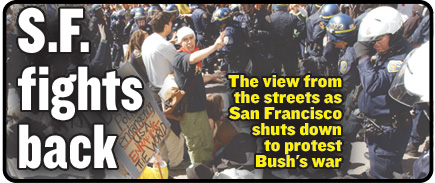
Nowhere was the clash of people power and government will more acute than on the streets of San Francisco, where a series of massive marches, some drawing nearly 100,000 people, filled the streets prior to the invasion of Iraq on March 19, 2003. The onset of war led protesters to effectively shut down the city, resulting in about 2,300 arrests and millions of dollars in costs to the city.

President George W. Bush dismissed the protests, of course, but he wasn’t the only one. Political leaders such as Rep. Nancy Pelosi, then-Mayor Willie Brown and soon-to-be Mayor Gavin Newsom (who didn’t attend any of the marches, unlike progressives on the Board of Supervisors) condemned the peace movement for hurting an innocent city. But with the “battle for San Francisco” making international news, the protesters were more concerned with the global audience.

A month earlier, on the weekend of Feb. 15 and 16, there were coordinated protests against the impending war in about 800 cities around the world, drawing around 10 million people. The peace march in Rome included about 3 million people, earning a listing in the Guinness Book of World Records as the largest anti-war rally in history. People have never made such a loud and clear statement against an incipient war.

Beyond the numbers, the antiwar movement was also right. On every major issue and prediction, the messages from the street proved correct while those from the White House were wrong. The US wasn’t welcomed as liberators. There were no weapons of mass destruction. Iraq after the invasion isn’t a stable democracy or shining beacon to anyone but the new generation of jihadis Bush created.

We can blame a hard-headed president, ineffectual opposition party, failure of the national media, or the national climate of fear following Sept. 11. But rather than refighting that lost battle, now is the time to gain perspective on the events of five years ago and determine what it means for democracy and the post-Bush national agenda.


TO THE STREETS

There were two main umbrella groups organizing protests before the war: Direct Action to Stop the War (DASW) and International ANSWER (Act Now to Stop War and End Racism). ANSWER has remained active and DASW has recently been reconstituted for the fifth anniversary of the war, using direct action in San Francisco as well as other urban centers and outposts like Chevron’s refinery in Richmond, which has reportedly been processing Iraqi oil.

“With the fifth anniversary coming up, we’re going back to direct action on the streets,” said Henry Norr of DASW. “But I don’t have any illusions that it’s going to be like it was five years ago.”

The maddening march to an ill-advised war created a political dynamic in which a broad cross-section of Americans was willing to hit the streets.

“We had a wonderfully diverse group of people, from soccer moms to anarchists,” said Mary Bull, who cofounded DASW, a collective of various affinity groups and concerned individuals formed in October of 2002 as Bush started beating the drums of war.

It was a group fiercely determined to prevent the war — and really believed that was possible. In fact, Bull recalls how she and other members of the group burst out crying at one meeting when a key activist said the war was going to happen.

Richard Becker, who cofounded ANSWER and serves as its West Coast coordinator, said that in the summer of 2002, “we came to the conclusion that [the war] was going to happen.” The group called its first big protest for Sept. 15, 2002, and another one two weeks later. But the movement really exploded on Oct. 26 when almost 100,000 people took to Market Street, much of it a spontaneous popular uprising.

“We were overwhelmed,” Becker said. “We were in a perpetual state of mobilization to keep up with what was going on. But then it didn’t stop the war.”

Did he think they could?

“I think a lot of people thought maybe it was possible to stop it. And we thought maybe it was possible to stop it,” Becker said.

The high point, according to Becker and Norr, was Feb. 17, 2003, when the New York Times ran a front page analysis piece entitled “A new power in the streets” that claimed “the huge anti-war demonstrations around the world this weekend are reminders that there may still be two superpowers on the planet: the United States and world public opinion.” But then Colin Powell went to the United Nations to argue for the invasion, and the Democrats in Congress did nothing, and it became clear war was coming.

Norr stayed out there protesting, being arrested several times and even shot in the leg by Oakland police with a rubber bullet during a protest at the Oakland docks. And he thinks some good came from the experience.

“The lesson for people is the political and economic elites are committed to preserving and extending empire. And they basically say as much in their own writing,” Norr said. “Wars are not anomalies.”

Despite being a frustrating and depressing exercise, most saw benefits to the failed movement. “People got an incredible education about how the system really worked,” Becker said. “Building a movement is mostly about a series of setbacks.”

Medea Benjamin, cofounder of both Global Exchange and CodePink and fixture of the anti-establishment peace movement for years, was upbeat about the protests. “We did our job as citizens. We did what we were supposed to do: organize, get people to take action, get people onto the streets,” she said. “We did everything we could think of.

“What you take from it is we don’t have a very well-developed democracy because the people spoke and the government didn’t listen.”

25war2_Lars1.jpg The ever-evolving “Democracy Wall” on Valencia Street, March 2003, helped stir up debate (Photo by Lars Howlett)


FACING ARREST

The collective action of five years ago starts with a series of personal stories — tens of thousands of them — so let me briefly begin with mine.

My arrival in San Francisco was closely tied to the march to war. I was living in Sacramento and working as the news editor of the Sacramento News & Review when Bush began his saber rattling against Saddam Hussein, but by the end of 2002 I had a falling out with my boss and found myself jobless.

Like most Northern Californians who opposed the war, I came to San Francisco on Jan. 18 to make my voice heard and experienced a bit of serendipity on my way to Justin Herman Plaza: while reading the Guardian on Muni, I saw their advertisement for a city editor, a job that was ideal for me at a paper I’ve always loved. Needless to say, it was a great day, empowering and full of possibilities.

Less than two months later I was on the job, and on the second week of that job I was back on the turbulent streets of San Francisco, part of a Guardian team covering the eruption of this city on the first full day of war. When I stepped off the cable car just after 7 a.m., people were streaming up Market Street and I joined them.

When a large group stopped at the intersection of Market and Beale, I stopped too, taking notes and bearing witness to this historic, exciting event. I had a press pass issued by the California Highway Patrol that allowed me to cross police lines, so when police in riot gear surrounded us and threatened arrest, I held my ground with 100 or so protesters.

After interviewing about a dozen people about why they were there and that they hoped to accomplish (see “On the bus: Journalists, lawyers, four-year-olds — the cops were ready to bust anyone Thursday morning“), I was arrested with the others and taken to a makeshift jail and processing center at Pier 27 (no charges were filed in my case, and charges against all of the 2,300 people arrested here in those first few days of the war were later dropped).

I recently tracked down a few of the people who appeared in my article, including Daphne and Ross Miller, who were at the center of the most interesting drama to play out during our standoff with the police. She’s a family practice physician, he’s an architect, and they live in Diamond Heights with their two children, Emet, who is almost 9, and Arlen, 12, who was away on vacation when the war began.

“We were genuinely shocked that the war started,” Ross told me. “We were at some of the earlier protests and really thought there was no way [Bush] could do it.”

They woke up March 20, 2003, to news that the war had begun and immediately walked to the BART station with Emet and rode to the Embarcadero station, not really planning for the day ahead but just knowing that they had to make themselves heard.

“We were pissed as hell. I don’t think I’ve ever been so angry in my life,” Daphne said.

They quickly came up with a plan. “We basically decided that if anyone was going to be arrested, it was going to be Ross and I’d stay with Emet. But it didn’t end up that way and I ended up in the arrest circle.”

Daphne had their house keys and threw them over the police line to Ross at one point. A photographer in the circle had gotten shots of a man named Roman Fliegel being roughed up by police as they pulled him off his bicycle, which was towing a trailer with a sound system, and decided to throw his backpack with camera gear out as well. When Ross — who had four-year-old Emet on his shoulders — caught it and refused police orders to give it to them, police grabbed Emet and roughly arrested Ross, leaving a gash on his forehead.

“Rage surged through the crowd, and it seemed as if things might get ugly, but the police kept a tight lid on the situation, using their clubs to shove back protesters who had moved forward,” I wrote at the time.

Emet was delivered into the circle with Daphne as the arrests continued, many quite rough. “At that point, as a mom, I had to exercise the most restraint ever,” said Daphne, who was angry about the situation but fearful about what she was exposing her son to. “Please, don’t let any violence happen here,” she pleaded with the crowd. Eventually, commanders on the scene let the mother and child go.

“The officer who let me go said that if he saw me again out there, he would call Child Protective Services on me,” Daphne said. But two days later, still brimming with outrage at her country’s actions, she ditched a downtown medical conference to rejoin the street protests, this time solo.

The couple say they’ve lost friendships over the war and have become more engaged with politics, coming to believe that Bush and the neocons are malevolent figures who knew how badly the war would go and did it anyway to establish a large, permanent military base in Iraq.

“Since that day, we’ve been far more active,” Ross said. “We realized you can’t just trust the system. You have to push.”

But that determination was mixed with feelings of disempowerment and depression. They attended some of the protests that following year, but the couple — like most people — just stopped going at some point because they seemed so futile.

“There was a horrible sense of resignation and a genuine depression that followed,” Ross told me.

The nadir was when Bush was reelected and they considered leaving the country. But then, Ross said, “we decided we’re not just going to run away and we’re not going to accept this.” Looking back, even with the scare over Emet, they express no regrets.

“It was the right thing to do because it was the wrong war to have. I’d do it again and again and again if I had to,” Ross said

They’re guardedly hopeful that Barack Obama could begin to turn things around if he’s elected. “I think the right president can at least start to dismantle this,” Daphne said. “I think thousands of people marching in the streets is something he would listen to.”

25war3_Charles1.jpg A die-in on the streets of San Francisco in March 2007 marked the fourth anniversary of the invasion (Photo by Charles Russo)


WITNESS TO HISTORY

Covering the peace movement in those early days was a heady experience, like reporting on a revolutionary uprising or working in a foreign country where the people are organized and active enough to be able to shut down society and brave enough to risk bodily injury for their beliefs.

I was at the founding meeting of CodePink — which became the most effective group at personally confronting the warmongers and keeping the war in the public eye — one evening at Muddy Waters in the Mission District shortly after the war started.

Looking back, Benjamin rattled off a long list of the alliances the group built — with labor, churches, businesses, and a wide array of social movements — and creative actions intended to build and demonstrate popular support for ending the war.

“We’ve done so many things and what did we get? We got a surge,” she said. “It shows the crisis in our democracy, the crisis of the two-party system, the crisis of a dysfunctional opposition party.”

Yet she said the peace movement has been remarkably successful in convincing the public that the war was a mistake and that it’s time for the troops to come home, even if the Democrats have been slow to respond to that shift.

“The progress we’ve made is turning around public opinion and that’s going to play a big role in the upcoming elections,” she said. For Norr, the role of the news media is a particular sore spot. He was a technology reporter for the San Francisco Chronicle who called in sick on the first full day of war and was arrested on Market Street with his wife and daughter, resulting in suspension by editor Phil Bronstein for his actions.

I wrote several stories on the issue, which culminated in Norr being fired and Bronstein unilaterally banning Chron employees from peace protests. I even borrowed CodePink’s guerilla tactics when Bronstein repeatedly refused to return my calls or address why he had singled out antiwar protesters for uniquely punitive treatment. I confronted him during a speech he gave at the Commonwealth Club (see “Lies and half-truths,” 5/7/03). That was the tenor of the times: we were all tired of being lied to and we decided to push back.

Norr was particularly frustrated with his own paper’s reporting of the war and started sending articles by the foreign press to his paper’s news desk, trying to wake his colleagues up to the pro-war propaganda being passed off as journalism in this country.

He was also disappointed with the country and with the Chronicle — both the management and his fellow reporters, who did little to support him — but the experience caused him to return to his roots as a progressive activist.

“The war and losing the job and everything brought an abrupt end to my consumerist phase and dumped me back into the world of being an activist,” said Norr, who serves on the KPFA 94.1 FM local station board and has made three recent trips to the Palestinian territories while working with the International Solidarity Movement.

Benjamin said Americans shouldn’t expect the next president to end the war — not without lots of pressure from a renewed and vocal peace movement. “This is the time to set the stage for the post-Bush agenda,” Benjamin said. “Don’t put your hopes in Barack Obama in getting us out of Iraq. Put your hopes in the people.”

25war4_Lane1.jpg A rally and nonviolent direct action at the Richmond refinery targeted Chevron on March 15 (Photo by Lane Hartwell)


THE AFTERMATH

The San Francisco Police Department, which spent more than $2 million on overtime costs responding to peace protests between March 15 and April 16, 2003, generally behaved with restraint and professionalism, but there were several exceptions.

The most costly and disturbing incident came when Officer Anthony Nelson began aggressively swinging his long riot baton at protesters, badly shattering the arm of peaceful protester Linda K. Vaccarezza, who suffered a permanent disability in her career as a court reporter.

Nelson’s incident report falsely stated that Vaccarezza had threatened him with a sign attached to a solid pole, but video of the incident later clearly showed there was no pole and that she was retreating when he teed off on her (see “The home front,” 05/19/04).

Vaccarezza received an $835,000 settlement from the city in November of 2004. On Oct. 5, 2005, two and a half years after the incident, SFPD fired Nelson for lying about what happened that day, and the City Attorney’s Office has been successfully fighting Nelson’s appeals in court ever since, putting in more than $100,000 in attorney time and costs into the Nelson and Vaccarezza cases.

The other significant ongoing litigation from the antiwar protests involved Mary Bull, who was arrested during an early protest for pouring fake blood in front of the entrance to Chevron’s San Francisco office before being allegedly strip searched and left naked in her San Francisco Jail cell for 36 hours.

Ironically, Bull was among those who brought a successful class action lawsuit against Sacramento County after she and others protesting a logging plan were strip searched, setting a precedent and led most counties to reform their strip-search policies. She used her share of the $15 million judgment to buy an organic permaculture farm in Sebastopol.

Her San Francisco case, in which Bull won a multimillion-dollar judgment, is still under appeal and now in mediation. Bull said the protests five years ago did make a difference, something she tells those who fret about its apparent failure. “I tell them to look at what issues the candidates are talking about now and I thank them for protesting then.”

“Even though we had millions throughout the world, we were sort of blocked, but now we’re regaining that momentum,” Melodie Barclay, a massage therapist who was also arrested with me on the first day of the war, told me recently. “We can’t judge it by the fact that we didn’t get the momentum we wanted.”

Norr started his antiwar activism working with Students for a Democratic Society in Boston, protesting the Vietnam War, which he said shares many similarities with the current situation, for good or for ill. He said that people tend to forget that while the protests then were huge and helped end the war, the movement did wane after Nixon ended the draft and substituted massive aerial bombardment for boots on the ground.

“The protests dropped off considerably,” he said. “A lot of the things that drove people to take risks in the late ’60s had faded by the early ’70s.”

He thinks the current administration learned a lesson from those days: it’s easier to maintain a war effort if the average citizen isn’t affected.

But there are other factors as well keeping a lid on the antiwar outrage.

“The culture has changed too. Young people are oversaddled with debt. People in schools seem to be docile. The culture as a whole seems to be more individualist and consumerist,” Norr said.

Yet some young people have woken up and many of them are funneling their energies into a peace group that was formed in the summer of 2005: World Can’t Wait, as in: the world can’t wait for the end of Bush’s second term before we change our direction and leadership.

“We don’t just want them gone, we need to repudiate their program,” said Giovanni Jackson, a 26-year-old WCW student organizer. “If we’re going to change anything, we need the youth.”

Jackson was at WCW’s founding convention in New York City, which came just as New Orleans was being flooded and then essentially abandoned by the federal government.

“When [Kerry] lost, people felt demoralized and World Can’t Wait kind of stepped into that situation,” Jackson said. “There was a lot of demoralization in the antiwar movement at that time.”

The group organized protests and student walkouts on Nov. 2, 2005.

“Everyone has their moments of doubt,” he said, “but I’m motivated by the crimes we see everyday.”


THE LESSONS

One of the biggest barriers to galvanizing people and turning the fifth anniversary of the war into something that might make a difference is the presidential election, which is diverting the energy of many potential protesters — and at the same time, offering some hope that a new president may lead to peace.

After all, every single one of the Democratic presidential candidates has promised to withdraw troops from Iraq, with varying timelines and numbers of US personnel left behind. And with enough encouragement, they might be willing to help change the status quo.

Many of the activists who volunteered their time and money to help move the Obama campaign into its front-runner position came out of the antiwar movement, and Obama’s strong stand against the war has been a key factor in his popularity.

Becker and some other activists don’t have much faith that a change in presidents will change the course in Iraq, although he agrees that much of the energy now surrounding Barack Obama derives directly from the antiwar movement.

“There’s been a huge upsurge of hope for Obama and that he might bring about the kind of change we need,” Bull said, adding that she doesn’t share that hope, believing the only path to peace is to pressure Obama and other leaders to commit to more progressive positions.

Norr said, “On one level, people have illusions about the power of peaceful protests. People believe in democracy, as well they should. We feel like the rulers should be paying attention to public opinion.

“It’s a remarkable story how broadly and quickly the American people have turned against the war. Public opinion was certainly ahead of the Democrats.”

And people will only grow more disenchanted with Iraq and its multitude of costs. “The people here are paying for this war, and everyday we have new stories about health clinics being shut down,” Becker said.

Becker was amazed last March as massive demonstrations for immigrant rights seemed to explode out of nowhere. “We think there will be more things like that,” he said.

Because after five years of organizing communities to resist the military-industrial complex’s plans, Becker thinks there’s been some visible progress.

“There isn’t a town or hamlet in the US that doesn’t have activism going on, but you wouldn’t know it from the corporate media,” Becker said. “It’s a mistake for people to feel discouraged.”


Fresh sips

0

› culture@sfbg.com

Spring is positively bursting with wacky holidays. Arbor Day? April Fool’s Day? Patriot’s Day? How the heck are you supposed to celebrate those with a cocktail or two? Figuring out what drink to pair with which spring holiday can become an overwhelming ordeal. Sure, the first few are easy: St. Patrick’s Day and green beer, Passover and four glasses of kosher wine. But what about the others? After a careful and tipsy review, I’ve paired some of my favorite local cocktails with these unusual days of celebration.

Rusty Robot Of all the major Christian holidays, Palm Sunday seems the least alcoholically celebrated, even though feasting is the order of the day. Why not figure in a Rusty Robot from Homestead? A combination of Wild Turkey, Tuaca, lemon, and bitters, it’s perfect for vigorous consumption. The lemon flavor is as wild as the Turkey, but the drink achieves a simplicity missing from most cocktails — the tastes don’t just augment one another; they smack together, almost like two palms. Get it? Homestead, 2301 Folsom, SF; (415) 282-4663.

Green Man Tea Just as we’re getting over our green St. Paddy’s Day hangover, we’re immediately hit with St. Joseph’s Day on March 19 — or more familiarly, the day the swallows return to Mission San Juan Capistrano. Bird lovers across California, rejoice! But with what? I encourage you to stick to something green-related, like Green Man Tea at Nihon Whisky Lounge; your system may not yet be ready for other colors. Made with lime and pineapple juices, green tea liquor, and single malt Scotch, this drink brings together two distinctly different flavors — the Scotch’s smokiness and the other ingredients’ fruity tang — to take delicious flight. Nihon Whisky Lounge, 1779 Folsom, SF; (415) 552-4400, www.nihon-sf.com.

Vieux Carre How do you raise a glass to a good April’s Fools Day prank? Since only rush-hour radio hosts and nine-year-olds actually carry out pranks, you probably don’t. So relax, there’s no need to fuss over this "holiday." Instead, take the time to savor a fine local drink. The Vieux Carre is a version of a classic New Orleans cocktail with its amalgam of rye, cognac, and sweet vermouth. It tastes more like Manhattan in 3-D, however, than it does an Old-Fashioned, Sazerac, or Sidecar — a high-powered, cheek-parching blast. Alembic, 1725 Haight, SF; (415) 666-0822, www.alembicbar.com

Take Your Pick Few outside Massachusetts, Maine, or Wisconsin celebrate Patriot’s Day, which falls on the first Monday in April. But it’s a great excuse to patriotically hoist one. Head to Dimples on Post and order whatever. The mirrored-out decor and neon light overload is so dazzling that your cocktail choice won’t matter — it’ll be like an early Fourth of July, but indoors. Go, USA! Dimples, 1700 Post, SF; (415) 775-6688.

Blue Tokyo Come Earth Day, the Blue Tokyo at Festa Wine and Cocktails should be the perfect drink to remind you that our island cities will soon be submerged, once the sea levels rise high enough. An unfussy mix of vodka, pineapple, and Curaçao amid Festa’s menu of ostentatious pear cosmos and pomegranate martinis, the drink is a useful aid to celebration — it’s almost a frat house cocktail in its simplicity. It wouldn’t jive at most bars, but at this kitschy lounge overlooking Webster — complete with fake skyline behind the karaoke stage — it works perfectly. Festa Wine and Cocktails, 1581 Webster, suite 207, (415) 567-5866.

Bohemian Forget the corporate beer and margarita mix branding that’s attached itself to Cinco de Mayo. Do something different, dammit, and head to Blondie’s Bar and No Grill in the Mission for a Bohemian. Along the same taste lines as, but more full-bodied than, a Cosmo, this well-balanced drink contains a generous dose of 151, so you can feel sunny and in sync with Cinco. Blondie’s Bar and No Grill, 540 Valencia, SF; (415) 864-2419, www.blondiesbar.com.

Sangre Amado Few complicated cocktails are as rooted in earthy flavor as the Sangre Amado, and no place in town makes it better than Catalyst Cocktails. After a fulfilling, tree-hugging Arbor Day, cozy up with this drink made with either vodka or gin, rosehips-hibiscus syrup, grapefruit juice, and fresh strawberries. For all its contents, the concoction is far from overwhelming, and it easily plants the seeds for another round. Catalyst Cocktails, 312 Harriet, SF; (415) 621-1722, www.catalystcocktails.com

Dark and Stormy Despite its name, this semiclassic cocktail — which gets its best treatment at Koko Cocktails — is the perfect way to kick off Memorial Day weekend and ease into the summer season. The taste brings to mind yachting through the Caribbean, which is why I hope the name is ironic. A smooth mix that falls halfway between a mojito and a whiskey ginger, this bevvie consists of ginger beer, lime, and a mild rum that makes it soar. KoKo Cocktails, 1060 Geary, SF; (415) 885-4788

Lagerfeld Confidential

0

REVIEW As far as I know, Karl Lagerfeld is the only fashion designer to have had his likeness made into a collectible figurine. With his instantly identifiable uniform that foppishly mixes old (the white ponytail and high starched collars) and new (his omnipresent sunglasses, a small mine’s worth of silver jewelry, exquisitely cut clothes in every shade of black), he has become as iconic as the Chanel bouclé suits he has designed for the house for 20-plus years. Rodolphe Marconi’s documentary Lagerfeld Confidential performs a nice trick in letting us think we’re getting a candid portrait of the man behind the sunglasses. Depth, though, is a tall order when his subject declares, "I don’t want to be real in other people’s minds; I want to be an apparition." What we do learn across this extended interview, goaded on by Marconi’s softball needling, is that Lagerfeld’s mother was a formative influence (she "exuded frivolity" and "made slaves of everyone") and that he was a sexually precocious youth. But as Wilde and Warhol have shown, the dandy’s mode of address is aphoristic, not confessional. Given the frequency with which he dispenses such obfuscatory pronouncements as "Every friendship needs a sword of Damocles hanging over it" and "Fashion is ephemeral, dangerous, and unfair," perhaps Lagerfeld’s next project should be a little book of quotations à la Chairman Mao. Of course, Lagerfeld’s would be bound in black leather.

LAGERFELD CONFIDENTIAL opens Fri/14 at the Roxie Film Center.

“Friedlander”

0

REVIEW Throughout Lee Friedlander’s 50-year oeuvre, much of which is now on display at San Francisco Museum of Modern Art, the photographer has been lauded for his liveliness, optimism, and mobility. Yet his paean to modern Americana often resembles monochrome memento mori. Taken as a whole, Friedlander’s work has always seemed driven to two poles: the ephemeral and the haunting.

Heavily impressed by the avant-naturalism of European photographers Eugène Atget and Henri Cartier-Bresson, as well as the post–World War II experimentalism of Robert Frank, Friedlander staked his claim at a moment in the 1950s when the photograph transcended the moribund category of journalistic tool and became its own art form. Modeling much of his working method around Cartier-Bresson’s so-called decisive moment, Friedlander’s timeless images still have a striking past tense about them. Now ossified on film, these thousand microcosmic moments, captured throughout the 1960s and ’70s, seem like lively obituaries.

While Friedlander first made a name for himself as a contractor for Atlantic Records — where he shot such musicians as Ornette Coleman — he was never a celebrity photographer. In fact, his most intriguing work resulted from a personal obsession with traveling and shooting the country, crisscrossing between New York and his home state of Washington. And so the images of nocturnal motel rooms, cycloptic TV sets, and storefront tessellations conjure the American dynamism and dread of Vladimir Nabokov or David Lynch. The plethora of windows and mirrors in his street photography admit countless apertures through which to see his subjects. But Friedlander’s playful sense of humor always appears just within the clutches of something inexplicably sinister — like the cartoonish shadows that often hover into his frame. Though his more recent work — in portraiture, nudes, and particularly in nature — may suffer slightly from the inevitable cooling of youth’s ambition, Friedlander’s baroque attention to detail and depth of field are unmatched. This is a definitive exhibition on one of America’s most ingenious, albeit conflicted, photographers. The photographer’s son Erik Friedlander will perform pieces from his album Block Ice and Propane (SkipStone, 2007) on April 24, 8 p.m., $12–$15, at Phyllis Wattis Theater.

"FRIEDLANDER" Through May 18. Mon.–Tues., Fri.–Sun., 11 a.m.–5:45 p.m.; Thurs., 10 a.m.–8:45 p.m.

$7–$12.50, free for members and 12 and under. San Francisco Museum of Modern Art, 151 Third St., SF. (415) 357-4000, www.sfmoma.org

Dress sharp

0

REVIEW Don’t tell anyone, but I have a secret fetish. Nothing turns me on like a new pair of shoes, and few bring me to shoegasm like sexy stilettos. So I put on my favorite pair of Gucci patent-leather tuxedo shoes and headed down to Stiletto, clubutante Parker Day’s arty party at Asia SF, in search of the perfect footwear.

Day named the night after the seductive heels, but it also alludes to the discreetly slim knife — both of which are deadly in the hands of the Pam Anderson B-movie character Barb Wire. "It’s sharp and it’s sexy," Day said. "It gets to the point." But it was The Warriors, a 1979 cult classic about New York City street gangs at war, that set the theme for that night’s party. As footage from the film was projected onto a side wall, the music morphed genres, from hip-hop and hit pop to electronic and indie-rock remixes for an audience as diverse as The Warriors‘s cast — and equally reminiscent of the early-’80s Big Apple. Fab Five Freddy, Blondie, and Madonna occupy the same turf without incident.

The crowd’s footwear was just as varied, but cowboy boots and Converse All-Stars were the most heavily represented in The Warriors–inspired fashion show. Taking cues from the movie, models worked leather vests and gunmetal belts into fierce ensembles, which they paraded down the runway like gangsters. A bit later, audience members were able to participate in a Warriors–themed costume contest. Not to ruffle anyone’s fab feathers, but I think my own shoes were the ultimate winners.

STILETTO

Third Friday of the month, 10 p.m.–3 a.m., $8

Asia SF

201 Ninth St, SF

http://www.myspace.com/stilettosf

Big book, tiny topic

0

› johnny@sfbg.com

REVIEW This week, I’m reviewing a book about toothpicks, a book about citrus, and a book about pigeons. When I first mentioned this plan to a fellow editor, she said it prompted visions of a surrealist game of Clue: the orange stabbed the pigeon in the study with a toothpick.

In truth, my motivation is pragmatic. I want to draw attention to the publishing industry’s love of big books devoted to tiny topics. It seems that one surefire way of selling a nonfiction tome is by focusing on a very specific subject. For evidence, one need only look at recent efforts such as Pierre Laszlo’s Citrus: A History (University of Chicago Press, 252 pages, $25), Henry Petroski’s The Toothpick: Technology and Culture (Knopf, 443 pages, $27.95), and Andrew D. Blechman’s Pigeons: The Fascinating Saga of the World’s Most Revered and Reviled Bird (Grove Press, 239 pages, $24).

Without snappy cover art and a colon followed by a subtitle, these books would be ready for inclusion in the next edition of Russell Ash and Brian Lake’s Bizarre Books: A Compendium of Classic Oddities (Harper Perennial, 224 pages, $14.95), a collection devoted to ridiculous and arcane tomes. Today, the colon (note that Ash and Lake’s book also sports one) is a way for author and publisher to assert an awareness of the potential absurdity that might arise from inscribing a world history on the head of a pin — or the tip of a toothpick.

Which brings us to The Toothpick. It’s the latest endeavor by a writer who specializes in large books on tiny topics. Petroski’s previous lengthy portrait in words was devoted to the toothpick’s cousin of sorts, the pencil. He brings an ease born from familiarity to his latest project. He also brings an anti-Wikipedia agenda, beginning his toothpick odyssey with a collection of false "stuff rustled up from the wild, wild Web." In the United States, the toothpick does have ties to Charles Forster — as claimed by answers.com and other Web sites — but Forster did not "invent" it, as one online source of misinformation states. If you read The Toothpick, you’ll learn about Forster and about Benjamin Sturtevant, a contemporary who has been erased from the toothpick’s United States–origin myth. Neither Forster nor Sturtevant are the most fascinating men ever to have probed their gums.

The point of Petroski’s toothpick testament is sharpest when he uses his small subject to touch upon ideas from different eras and cultures. Thus, before Forster and his Charles Foster Kane–like name (though not, alas, story) take over, The Toothpick cites a long passage from James Joyce’s 1916 A Portrait of the Artist as a Young Man that cries out for a toothpick, provides illustrations of Chinese toothpicks that look like chandeliers, and notes that the Renaissance was "the golden age of toothpicks." Perhaps literally — there are golden toothpicks, as well as ones made from walrus whiskers.

As its title might suggest, Laszlo’s Citrus: A History presents a fruit-centric — though by no means fruitopian — history of the world. Via the erudite Laszlo, the travels of an orange can blossom into a discussion of religious persecution. Laszlo is a retired professor of chemistry, and his prose presents a mix of stuffiness and frolic, whether imagining a correspondence with the first person ever to write a book about citrus (an 11th-century Chinese governor named Han Yen-Chih), randomly leaping from a descriptive passage into a recipe, or redundantly telling the reader that he is about to tell a story. Ultimately, Citrus does have the passion — if not always the juice — of a labor of love, even when its author favors the kind of obvious symbolism found in this sentence.

In comparison, Pigeons author Blechman is a storyteller who has a way with a hilarious turn of phrase. He writes of "backyard geneticists" who create birds "more akin to a Dresden figurine than a child of nature," notes that the pigeon "has been prized as a source of companionship (and protein)," and confesses his fondness for the Frillback, a breed with feathers that look like they "were dipped in Jheri Curl." Over the course of one winter, he meets as many breeds of pigeon obsessives as he does pigeons. The wildest marriage might be between Parlor Rollers and their owners. Parlor Rollers somersault backward up to 600 feet in a single effort, a display that Blechman deems "the avian equivalent of obsessive-compulsive disorder." When Blechman asks one owner why the birds do what they do, the man replies, "Because they’re retarded, that’s why."

Actually, Pigeons makes a strong case for recognizing and respecting the oft-abused pigeon, a case drawn from no less a source than Charles Darwin’s 1859 On the Origin of Species. Blechman’s book contains some disturbing passages (especially a foray into a Pennsylvania town that made bird slaughter into an annual holiday replete with teen boys delivering body slams) and no shortage of funny adventures. By the end, it transformed the way I view pigeons. Though I’m a vampire for blood oranges and I abuse toothpicks like an addict smokes cigarettes, I’m afraid the other two books didn’t have quite the same impact.

Freedom of Information: More sunshine — easily and at no cost

0

› news@sfbg.com

Imagine sitting at home — or in your office, or in your favorite café — and listening in on what are now secret, backroom policy discussions and decisions in the San Francisco mayor’s office. Imagine having access to an immediate transcript of the talks. Imagine being able to read internal e-mail discussions among city staffers about issues that affect you — without ever filing a public records request. In fact, imagine never having to file another written request for public documents; imagine just going to a city Web site, entering a search term, and finding all of the records yourself.

Imagine filing a complaint with a city agency and tracking the issue, minute by minute, as it works its way through the system.

Imagine listening on your cell phone to any policy body as it meets in city hall.

All of this is possible, today. Much of it is not only consistent with but actually required by local law. And it won’t cost the city more than a modest amount of money.

Transparency is a common buzzword during this presidential campaign; the Barack Obama campaign has even issued a white paper describing policy and technological ways to embrace it. He’s talking about live Internet feeds of meetings about significant issues involving executive branch appointees as well as for those of regulatory departments (a program that would go far beyond what you see on C-SPAN).

So there’s no reason San Francisco can’t take the lead in using technology — generally simple, off the shelf, existing technology — to dramatically increase sunshine at City Hall and public participation in local government.

Proposition G, the city’s 1999 sunshine law, mandates that San Francisco use "all technological and economical means to ensure efficient, convenient and low cost access to public information on the Internet." Here are five easy ways to do that:

1. Fully adopt the voyeur concept for city meetings. This is the idea that the public should be able to observe and engage in government decision making — all government decision making.

All policy meetings in City Hall should at the very least be broadcast as audio on the Web and available via phone teleconference. In other words, the meetings should be streamed online, and that stream should be accessible by calling a free conference line. This is already standard practice in the business world and is working well for many investors in public companies that disclose financial information in compliance with Securities and Exchange Commission rules. It can be done for little or no cost with services like blogtalkradio.com, skype.com, freeconferencecalls.com, and webex.com.

Today only a limited number of public meetings are broadcast, mostly because the only outlet is SFG-TV and resources are limited. But audio streaming is a no-brainer — there’s no need for a staffer to control cameras, the microphones are already set up, and these days just about every room has a speakerphone.

Currently, the SFG-TV video coverage isn’t posted on the city’s Web site, sfgov.org, until two or three days after a meeting. That’s too long; the audio should be made immediately available online. And the Internet URL and dial-in options should be listed on the meeting agenda so that news media and citizen bloggers can instantly refer back to the URL with timecodes to point out specifics, and include them in their stories and blog postings.

With streaming, you can follow along in real time when you are stuck at home taking care of a sick relative, or at the office listening with headphones, or you are disabled and can’t cross town to attend in person.

The city already has a great contract for real time captioning — the text you see at the bottom of the screen for video. It’s not 100 percent accurate, but it’s pretty decent. That could be expanded to cover streaming audio, and the text could be computer translated (or translated by bilingual typists) into other common languages. The advantage of media integrated with RTC is that specialized search engines like blikx.com and everyzing.com can be used to find relevant phrases and begin playback directly at that spot. And transcriptions can be posted online in real time (somewhat like live blogging!) so that if you are late for a meeting you can quickly scan what has already transpired, and by the end of the meeting you will effectively have a draft of minutes. That saves a lot of staff time and provides an immeasurably more useful historic record.

Today, video recordings of city meetings can’t be downloaded — the only way to review it or post a clip to YouTube is to order a $10 DVD, which arrives a week after you send a check (and no, they don’t take PayPal). And while many other city meetings make audio recordings, you have to pay $1 for an audio tape and pick it up during business hours or pay more for postage. They all should be available as free podcasts.

The SFG-TV video shows more than just the speakers and officials; there are other angles, and they ought to be available too. It’s important to know who attended the meeting but never said anything, who greeted whom, and even who ignored whom.

2. Let the public do the broadcasting. All City Hall meeting rooms should provide wi-fi (and electrical outlets), and the system ought to have enough speed to allow bloggers or activists to upload high-quality video broadcasts of meetings that SFG-TV can’t afford to cover. It can be done using existing services like Justin.tv, Upstream.tv, and live.yahoo.com. This would also allow live blogging — and let people preparing to testify on an issue have access to the Web to do research on the spot. If the room had a projector and a screen, people who were unable to attend the meeting could still comment, either through video or just by posting text messages that the decision makers could read.

The audio broadcasting of meetings should be expanded to include all meetings between the mayor (or supervisors) and city staff. The law already requires public access to so-called passive meetings — those between the mayor or department heads and outside parties that influence city policy.

3. Make public most city emails and other documents as soon as they are produced.

San Francisco city employees produce thousands of records a day — e-mails, memos, reports, etc. — and the vast majority of them are and should be public record. But many are deleted and others never see the light of day. When a member of the public asks for all the records on a topic, just finding those documents can be a sizable task.

But it’s technologically simply to solve that problem: every time a city employee produces a document, the computer system should automatically send a back-up copy to a public web server. That way nothing would get lost or erased, and anyone looking for public information could simply go to that site and search for it him or herself.

For e-mails sent by city staff, one way might be to CC (carbon copy) an online message board (for example Google or Yahoo groups, which would be available at no cost to the city). Other approaches for instant messages, text messages and voicemails could be adopted as well. The Palo Alto City Council is already doing something like this for a narrow collection of e-mails (although not in real time).

We all know there are some city communications that must remain private or be redacted — for example Attorney Client discussions or human-resource conversations regarding personnel. But there are simply ways to make sure those stay confidential: one approach might simply have the user tick a flag or answer a Yes/No Possible Redaction popup when the message is sent. Certain employees — like the people who handle sensitive employee health records and certain litigators in the city attorney’s office — could have software that defaults to a confidential server.

The added advantage, of course, is that the computers could also make a record of the title and date of every confidential document — and that information could be made public. If a dispute arose over whether the city was improperly withholding records, the public would at least know that certain documents existed.

All city files could be stored on network drives (not on local drives) with one location for default public files that would not allow overwriting or deletions and would be mirrored to a Web server and another drive for the few that may require redaction first.

4. Save all the old records. After a very embarrassing lawsuit that is threatening the Missouri governor’s job, that state in January adopted an email retention system that preserves all email for at least seven years (based on federal requirements for financial records). And e-mail/instant message/text/fax retention systems are standard practice now in the financial industry (Morgan Stanley lost a $1.45 billion judgment because the company failed to preserve e-mail).

In fact, we all know storage continues to get cheaper and smaller — so San Francisco should abolish any retention timeframes for electronic records and keep them all into the foreseeable future. The world-famous Internet Archive is right here in the Presidio: I suspect that group would love to archive all the city information, and keep it online, free and forever.

When paper documents are part of the public record, they should be scanned and converted to text and posted within two days. This would include discussions between staff and individual members of policy bodies and the creation of the draft agenda and supporting materials as they are obtained.

All these methods would significantly reduce the number of public records requests to the city staff and thus save the city money.

5. Make calendars public — and keep communications public. Mayor Gavin Newsom won’t provide detailed daily calendars — even after the fact, when there is no possible security reason for keeping his workday itinerary secret. All top officials should post their calendars on the web so the public can track what they are doing.

The city needs to adopt a global policy that city business should be performed on city devices (computers, email accounts, phones) whenever possible — and when city employees or officials use their own computers or hand-held communications tools, those should be forwarded immediately to the city system and made public.

San Francisco has one of the best local Sunshine laws in the country — and at a time when activists at every level are looking for ways to use technology to expand public access, the city should be in the forefront. All it takes is some political will.

———————————————————-

Here are some more ways that the city could use technology to improve public access:

1. Use a program like govtrack.us to follow legislative changes.

2. Explore ways to bring nonprofits that perform traditional government services under sunshine laws.

3. Significantly improve the city’s Crimestats system (more real-time allow alerts for crimes near you) – google mashup et al. See http://chicago.everyblock.com/crime/

4. Embrace e-rulemaking technology – similar to federal rulemaking use technology to get ideas online and generate more participation for those who can’t show up in a meeting.

5. Require the Police Department to issue press credentials to bloggers.

6. Fund a few open-government lawsuits to expand the boundaries on access to public records (the law provides for attorney’s fees if the suit is successful).

7. Require city agencies to post the method for obtaining public records online. Require posting of all negative determinations on home pages.

8. At budget time, mandate that each agency provide statistics as determined by SOTF on sunshine responsiveness.

9. Require an assessment of sunshine compliance as a mandatory item for all Financial/Management audits.

10. Televise SOTF and Ethics Commission formal hearings.

11. Require active Ethics investigative files to be open.

12. Embrace fully the much-improved but incomplete example of posting online all interactions as part of large contract negotiations – as was partially done with TechConnect.

13. Host accounts payable/receivables online with the scanned images of invoices paid.

———————————————————

>

Freedom of Information: A citizen’s guide to fighting secret government

0

San Francisco has the best local sunshine law in the country — and there are still problems getting access to information. Even though the digital age in which we live affords government agencies with myriad ways to give citizens more access to public documents, there is too often little official will to create transparency. And often, bureaucrats are downright hostile to public scrutiny. But help is out there. This guide to local and national organizations offers a wide range of resources for journalists, citizen activists, and hell-raisers who want to track their tax money and hold their government accountable.

LOCAL ORGANIZATIONS


The California First Amendment Coalition is an independent, nonpartisan, nonprofit organization whose mission is to "promote and defend the people’s right to know" by improving compliance with state and federal access laws. CFAC’s Web site contains an archive of articles dealing with FOI issues, the texts of state FOI laws, and other useful resources. 534 Fourth St., Suite B, San Raphael, CA 94901. (415) 460-5060, cfac@cfac.org, www.cfac.org.

The California Newspaper Publishers Association is the umbrella organization to which most newspapers in the state belong, so it has an acute interest in open government. Its FOI Watch newsletter (also available online) includes a clearinghouse of sunshine news from around the state. 708 Tenth St., Sacramento, CA 95814. (916) 288-6015, tom@cnpa.com (general counsel Thomas Newton), www.cnpa.com.

Californians Aware, run by former CFAC general counsel Terry Francke, helps activists and organizations get access to public meetings and records and offers resources on the Web for citizens, public officials, journalists, and attorneys. 2218 Homewood Way, Carmichael, CA 95608. (916) 487-7000, info@calaware.org, www.calaware.org.

The Center for Investigative Reporting sponsors workshops on investigative techniques for journalists and university students. The center’s Web-based magazine provides FOI information, tips for journalists, and updates on past CIR investigations. 2927 Newbury St., Suite A, Berkeley, CA 94703. (510) 809-3160, center@cironline.org, www.muckraker.org.

The DataCenter provides on-call research, consultation, and referrals to justice organizations regarding FOI issues. It also offers research and action training. Services are free or on a sliding scale, depending on one’s ability to pay. 1904 Franklin St., Suite 900, Oakland, CA 94612. (510) 835-4692, ext. 376, www.datacenter.org.

The Electronic Frontier Foundation, an online First Amendment organization, works to uphold digital free speech, empower the online public, and protect privacy on the Internet. It provides stories and alerts on its Web site, with daily updates. Effector, an e-mail newsletter, is available through the site. 454 Shotwell St., S.F., CA 94110. (415) 436-9333, information@eff.org, www.eff.org.

The First Amendment Project is a public interest law firm that provides legal representation, educational programs, and low-cost or free advice for journalists, public interest organizations, and individual citizens with public records and FOI-related issues. In a joint publication effort with the Society of Professional Journalists, the project offers three free pocket guides, on the Brown Act, California’s Open Meeting Law, and accessing court records. The Web page has information on using the California Public Records Act as well as on getting court records. 1736 Franklin St., 9th floor, Oakland, CA 94612. (510) 208-7744, fap@thefirstamendment.org, www.thefirstamendment.org.

Media Alliance is a nonprofit media center that offers classes on journalism skills, including how to find and use public records. 1904 Franklin St., Suite 500 Oakland, CA 94612. (510) 832-9000, information@media-alliance.org, www.media-alliance.org.

The Society of Professional Journalists, Northern California Chapter, FOI Committee fights for open access to information and educates members of the public on FOI issues. The group provides a subscription e-mail list for journalists and others involved in FOI and First Amendment issues in California as well as putting on the James Madison FOI Awards. 222 Sutter St, 6th Floor, San Francisco, CA 94108 (415) 321-1700, www.spj.org/norcal.

NATIONAL ORGANIZATIONS


The Brechner Center for Freedom of Information conducts research and educates the public in mass-media law and the First Amendment, including public access to government meetings and records and litigation information. University of Florida, College of Journalism and Communications, 3208 Weimer Hall, P.O. Box 118400, Gainesville, FL 32611-8400. (352) 392-2273, www.jou.ufl.edu/brechner.

The Center for National Security Studies works with concerned citizens and groups to expose secret government policies and offers free assistance to those seeking records under the Freedom of Information Act. It also coordinates related litigation. 1120 19th St. NW, 8th floor, Washington, D.C. 20036. (202) 721-5650, cnss@cnss.org, www.cnss.org.

The FOIA Blog, created by an FOIA Washington attorney, has an updated list of documents currently being released by several government agencies infoprivacylaw@yahoo.com, www.thefoiablog.typepad.com.

The Freedom of Information Center of the University of Missouri School of Journalism has a collection of more than one million articles and documents about access to information at the local, state, and federal levels. The center works to ensure compliance with sunshine laws around the country. Its Web site contains links, updates, and tips on FOI inquiries. A free e-mail newsletter provides information on developments in FOI access and issues; you can sign up by contacting umcjourfoi@missouri.edu. University of Missouri, 133 Neff Annex, Columbia, MO 65211. (573) 882-5736, daviscn@missouri.edu, www.missouri.edu/~foiwww.

GovernmentDocs allows people to browse and search thousands of pages acquired through the FOIA and sunshine laws. Registered users can review and comment on documents. www.governmentdocs.org

GovTrack provides information on the U.S. Congress. It compiles information on federal legislation, voting records, and other congressional date and simplifies the language for ordinary citizens. It also indexes all bills, as well as changes to them, in Congress and all roll call votes www.govtrack.us.

Investigative Reporters and Editors provides educational services for investigative reporters and editors. The group’s Web site offers FOI-related resource guides, a database of FOI stories, tips for using the Freedom of Information Act, and a database of previous FOI requests. University of Missouri School of Journalism, 138 Neff Annex, Columbia, MO 65211. (573) 882-2042, www.ire.org

The National Freedom of Information Coalition is composed of First Amendment organizations dealing with FOI issues. It provides resources for the media, government officials, lawyers, and citizens who want access to public information. The coalition also offers seminars and workshops to media professionals, attorneys, academics, students, and the public on FOI issues and helps nurture start-up FOI groups and Internet sites. Its Web site offers links to relevant legislation and organizations state by state, as well as an Internet mailing list, FOI-L. 133 Neff Annex, Columbia, MO 65211. (573) 882-5736, cdavis@nfoic.org, www.nfoic.org.

OMB Watch is a member of the Public Access Working Group, a coalition of organizations promoting greater access to government information. OMB Watch offers an online newsletter, OMB Watcher, available on its Web site or by e-mail, which typically includes articles on FOI issues. To subscribe to the weekly e-mail version, e-mail join-ombwatcher@lyris.ombwatch.org. 1742 Connecticut NW, Washington, D.C. 20009. (202) 234-8494, www.ombwatch.org.

The Project on Government Secrecy is an advocacy and public education project of the Federation of American Scientists. The project has an extensive archive and provides regular news updates through its Web site and e-mail newsletter, Secrecy News. 1725 DeSales Street NW, 6th floor, Washington, D.C. 20036. (202) 454-4691, www.fas.org/sgp/index.htm.

Project Vote Smart provides information on local, state, and national candidates, including voting records, issue positions, campaign contributions, phone numbers, and mailing addresses. The database is accessible by calling the toll-free hotline at 1-888-VOTE-SMART. 1 Common Ground, Phillipsburg, MT 59858. (406) 859-8683 comments@vote-smart.org, www.vote-smart.org.

The Radio-Television News Directors Association is the world’s largest professional organization devoted to electronic journalism. It lobbies for cameras in courtrooms and strong FOI laws and provides coverage of FOI issues on its Web site. 1600 K St. NW, Suite 700, Washington, D.C. 20006. (202) 659-6510, www.rtnda.org.

The Reporters Committee for Freedom of the Press operates the 24-hour FOI Service Center at 1-800-336-4243 to answer emergency questions from journalists and others with open-records problems. 1101 Wilson Blvd., Suite 1101, Arlington, VA 22209. (703) 807-2100, rcfp@rcfp.org, www.rcfp.org.

The Society of Professional Journalists advocates for open access to information and educates members of the public on FOI issues. The society’s Web site has an FOI section with extensive links to resources and information, including a list of FOI advocacy organizations. 3909 N. Meridian St., Indianapolis, IN 46208. (317) 927-8000, questions@spj.org, www.spj.org.

State Sunshine and Open Records shares information, guidance and advice on developments and news about open records at the state and local level. They also have an extensive list of links to other sunshine blogs. www.openrecords.wordpress.com.

The Student Press Law Center works with the Reporters Committee for Freedom of the Press to cover FOI and other First Amendment issues reutf8g to high school and college journalists. It offers free advice, lawyer referrals, and analysis. 1101 Wilson Blvd., Suite 1100, Arlington, VA 22209. (703) 807-1904, admin@splc.org, www.splc.org.

The Sunlight Foundation develops a database to ensure transparency in government and fiscal accountability. They digitize new info and provide access to existing information. 1818 N Street NW, Suite 410, Washington, D.C. 20036, (202) 742-1520. www.sunlightfoundation.com.

WikiFOIA helps people understand the FOI Act on a state and federal level by providing a how-to-guide about open records requests, as well information on how to make that request. www.wikifoia.pbwiki.com.

INTERNATIONAL ORGANIZATIONS AND RESOURCES


The Guardian Web site has extensive information and links concerning international press-freedom issues. For details on journalists under fire, including frontline dispatches and reports from the battle to keep the world safe for journalists, go to www.sfbg.com/journalists/. For updates, dispatches, and links to national and international FOI groups, go to www.sfbg.com/FOI.

The UK FOI Blog provides a glimpse into how FOI issues are dealt with across the pond by listing news and developments on FOI in Great Britain. www.foia.blogspot.com.

Local government resources

The Government Information Center, on the fifth floor of the San Francisco Public Library’s Main Branch, stocks public documents published by the city. These include annual reports for committees and departments, minutes and agendas of official meetings, environmental impact reports, and city audits, ordinances, and resolutions. San Francisco Public Library, 100 Larkin St., S.F., CA 94102. (415) 557-4500, www.sfpl.org.

The Oakland Public Ethics Commission responds to complaints and holds hearings on possible violations of the city’s Sunshine Ordinance. Records, tapes of the commission’s meetings, agendas, and minutes can be picked up at the commission’s office. 1 Frank Ogawa Plaza, 4th floor, Oakland, CA 94612. (510) 238-3593, ethicscommission@oaklandnet.com, www.oaklandnet.com/government/public_ethics/webpage.html.

The Office of Information and Privacy, U.S. Department of Justice, provides online versions of frequently requested records, opinions, policy statements, and guides to the Freedom of Information Act. The guides include detailed instructions for filing FOIA requests, average response times for different governmental offices, and a wealth of other useful information. The text of the FOIA is available on the office’s Web site. 1425 New York Ave., Suite 11050, Washington, D.C. 20530. (202) 514-3642, www.usdoj.gov/oip/oip.html.

Public Access to Court Electronic Records is an online database of court records and decisions. Web access is 8¢ a page, and requires registration through the Web at www.pacer.psc.uscourts.gov. P.O. Box 780549, San Antonio, TX 78278. 1-800-676-6856, pacer@psc.uscourts.gov.

The San Francisco Ethics Commission monitors and enforces the Sunshine Ordinance and the city’s governmental-ethics, campaign-finance, and lobbyist-reporting laws. Individuals can file complaints regarding violations of the Sunshine Ordinance. The commission meets the second Monday of each month at 5:30 p.m. in City Hall, Room 408. 25 Van Ness, Suite 220, S.F., CA 94102. (415) 252-3100, ethics.commission@sfgov.org, www.sfgov.org/site/ethics_index.asp.

The San Francisco Law Library is open to the public, though only government officials, state bar members, and judges can check out items. Main reference library: Mon.-Fri., 8:30 a.m.-5 p.m., Veterans War Memorial Building, 401 Van Ness, Room 400, S.F. (415) 554-6821. Courthouse reference room: Mon.-Fri., 8:30 a.m.-4:30 p.m., 400 McAllister, Room 512, S.F. (415) 551-3647. Financial District branch: Mon.-Thurs., 9 a.m.-9 p.m.; Fri.-Sat., 9 a.m.-5 p.m.; Sun., noon-4 p.m., 685 Market St., Suite 420, S.F. (415) 882-9310, www.ci.sf.ca.us/site/sfll_index.asp.

The Sunshine Ordinance Task Force oversees compliance with San Francisco’s sunshine law by investigating complaints from individuals who believe city officials have withheld records or conducted meetings in violation of the law. The task force meets the fourth Tuesday of each month at 4 p.m. City Hall, 1 Dr. Carlton B. Goodlett Place, Room 244 (meetings held in Room 408), S.F. For complaint forms and other information call (415) 554-7724 or go to http://www.sfgov.org/site/sunshine_index.asp

PUBLICATIONS


The California First Amendment Coalition publishes the California Journalist’s Legal Notebook, a handy guide to the legal issues surrounding telephone interviews, press passes, gags on sources, and other journalism-related topics ($36.25, $30.88 for CFAC members, shipping included). Also by CFAC is The New Brown Act: How the Open Meeting Law Has Been Revised ($12.75, $7.39 for CFAC members, shipping included). (415) 460-5060.

The Oakland Public Ethics Commission publishes a free brochure, How to Notice a Public Meeting under the Oakland Sunshine Ordinance and the Brown Act, useful for making sure a public meeting follows the requirements of the Brown Act. (510) 238-3593, (510) 238-6620, ethicscommission@Oaklandnet.com, www.oaklandnet.com/government/public_ethics/webpage.html.

Access to Courts and Court Records in California, Open Meeting Laws in California, and The California Public Records Act are free, convenient, quick-reference guides published by the Society of Professional Journalists, Northern California Chapter, and the First Amendment Project. (510) 208-7744, www.thefirstamendment.org/freepress.html.

The ACLU Freedom of Information Project publishes Using the Freedom of Information Act: A Step-by-Step Guide (#4002, $3) and Your Right to Government Information (#1190, $5.95), which covers a broader range of topics, including how to get into public meetings. Both publications can be ordered online through the ACLU’s e-store or by phone. ACLU Publications, P.O. Box 4713, Trenton, NJ 08650-4713. 1-800-775-2258, www.aclu.org.

The Government Printing Office publishes The Freedom of Information Act Guide and Privacy Act Overview ($63), a 986-page guide to the FOIA produced by the Justice Department. It can be ordered by phone at 1-866-512-1800 or online at bookstore.gpo.gov. The Citizen’s Guide is available in its entirety online at www.fas.org/sgp/foia/citizen.html.

The Freedom of Information Clearinghouse Guidebook is a free brochure about making FOIA requests and appealing agency decisions. It’s available online through the Freedom of Information Clearinghouse. www.citizen.org/litigation/free_info/index.cfm.

Paper Trails: A Guide to Public Records in California ($12.89), written by Stephen Levine and Barbara Newcombe, is published by the Center for Investigative Reporting and supported by the California Newspaper Publishers Association. It can be ordered from the CIR. An abridged, online version is coming soon. 2927 Newbury St., Suite A, Berkeley,, CA 94703. (510) 809-3160, www.centerforinvestigativereporting.org/

The fourth edition of the Investigative Reporters’ Handbook ($61, $51 for Investigative Reporters and Editors members), by Steve Weinberg, Brant Houston, and Len Bruzzese, is a comprehensive and accessible guide for novice and experienced journalists that shows how to locate and use more than 500 sources of public information. (573) 882-3364, www.ire.org/store/books.

The Reporters Committee for Freedom of the Press supplies a wealth of publications on public access and other First Amendment topics. How to Use the Federal FOI Act ($5) is a handbook on FOI rights, with instructions for appealing if your request is denied, and includes sample letters. The First Amendment Handbook ($7.50) is a journalist’s pocket guide to FOI issues. Two guides — Judicial Records: A Guide to Access ($3) and Access to Electronic Records ($5) — analyze state laws and decisions regarding access to legal records and government electronic data. Tapping Officials’ Secrets is a set of guides to state public records and open-meeting laws ($10 a state). The News Media and the Law is a quarterly magazine that includes updates on legislation pertinent to FOI ($30 a year for four issues). Some of these publications are available in their entirety online; all can be ordered online. 1-800-336-4243, www.rcfp.org.

The second edition of Law of the Student Press ($18) is a vital handbook for student newspapers. It’s extensively annotated but avoids legalese and tries to bring the law to life for students and educators. The Student Press Law Center also publishes Covering Campus Crime, Third Edition ($2) and the Student Press Law Center Report ($15 for three issues a year). (703) 807-1904, www.splc.org.

Citizen Muckraking: How to Investigate and Right Wrongs in Your Community ($9) offers advice on writing press releases, conducting interviews, and using the FOIA. The book, a collaborative effort by the Center for Public Integrity, is available through Common Courage Press. 1-800-497-3207, www.commoncouragepress.com

>

Explosions at Pinhead Gunpowder? More thoughts on the Feb. 10 Gilman show

0

By Alex Felsinger

Punk venue 924 Gilman Street is notorious for two things, both equally insidious in thwarting the average person from attending shows there: a horrible sound system and an overwhelming elitist vibe from the staff. Pinhead Gunpowder, who recently performed at Gilman for the first time in 15 years on Feb. 10 (read the review here), proved that while a new sound system can work wonders, the off-putting vibe of the staff is harder to change.

On the surface, the show was a raging success. Fans flooded in for what was clearly the biggest show for Gilman in years, and from what I saw, almost everyone left with a smile. Every band that performed, not just the headlining super group, put on a fantastic show. But from talking with various people involved in the club, I knew not everyone was tapping their toes.

Weeks before the show, the band – which not only includes Billie Joe Armstrong, but also Green Day’s tour manager, Bill Schneider, and their touring second guitarist, Jason White – offered to donate money to the club. Instead, Gilman told the group that a new sound system would be the best way to help, and it would also make the sound better for their show. The band immediately obliged by installing beautiful new JVC speakers, and later provided a new mixing board as well. According to the club, the band instigated the donation on their own and was not encouraged to make one.

“My Name is Albert Ayler”

0

REVIEW My Name Is Albert Ayler offers a close reading of the titular musician, a saxophone colossus who pushed the emotional limits of free jazz, but it also tells a broader story about the strange currents of American avant-garde music. Interviews with Ayler’s churchgoing Ohio family, New York City compatriots, and Scandinavian admirers trace a particular, though by no means atypical, passage. The tenor saxophonist first achieved renown in Stockholm, Sweden, where he began to experiment with the wailing, explosive runs that would some years later turn even John Coltrane’s head. ‘Trane specifically asked for Ayler to play at his funeral, and the photographs and live sound from the memorial service included in the film are searing enough to make even the staunchest defender of melody reconsider. Rather than employing warts-and-all tactics, first-time Swedish director Kasper Collin keeps a respectful distance from Ayler’s mysteries, nowhere more hauntingly than in a few late sequences regarding the musician’s purported tendency to stare into the sun. There is so much we will never know about Ayler, Collin seems to tell us, but watching former collaborators listen to his music through cracked expressions of pain and amazement is revealing enough.

MY NAME IS ALBERT AYLER runs Sun/9–Tues/11 at the Red Vic Movie House. See Rep Clock for showtimes.

“Drama and Desire: Japanese Painting from the Floating World 1690-1850”

0

REVIEW Drawn almost entirely drawn from the near-mint-condition holdings of Boston’s Museum of Fine Arts, "Drama and Desire: Japanese Painting from the Floating World 1690–1850" is an exhilarating survey of early modern Japan and the sumptuous — and often costly — pleasures that were available to the upper echelon of its newly solidified class system.

One can follow the contextual trail laid down by the show and take in the long view of history inscribed with brush and natural pigments: the relocation of Japan’s capital to Edo (now Tokyo); the establishment of Yoshiwara, the city’s licensed pleasure quarters; the development of Kabuki and sumo; and most important, the rise of an urban, largely male merchant class who kept this floating world afloat. It is a panorama laid out in the pair of large folding screens of Hishikawa Moronobu (1681–84), both studies in hierarchical contrast between the more lowly teahouses and higher-class brothels and their characters: a starring courtesan, enfolded in thickly brocaded kimonos as battle-ready as any armored samurai, surrounded by her retinue of clients, servants, and geisha, and male customers shamefully covering their faces with their fans so they’re not recognized by rivals. The real drama of these ukiyo-e is in their details, such as in the way Katsushika Hokusai dapples the collar of young woman’s inner kimono with mica to evoke a luminescent cherry-blossom pattern in Woman Looking at Herself in a Mirror (1805). Seen from behind, her face framed by a small oval mirror, this gazing beauty is only partially regarding herself. She also seems to be taking stock of the viewer while taking pleasure in being looked at. But surely the pleasure is all ours. (Matt Sussman)

DRAMA AND DESIRE: JAPANESE PAINTINGS FROM THE FLOATING WORLD 1690–1850 Through May 4. Tues.–Sun., 10 a.m.–5 p.m. (Thurs. until 9 p.m.). $10 ($5 Thurs. after 5 p.m.), $7 students, $6 for 12 to 17, free for 11 and under. Asian Art Museum, 200 Larkin, SF. (415) 581-3500

One ear to the ground

0

>a&eletters@sfbg.com

REVIEW Ah, the morality police — you’ve gotta love ’em. At least artists who get free publicity from the overzealous watchdogs should. With freedom of speech still miraculously in decent shape in this country, one might be forgiven for forgetting the unique dilemma of the banned book: once branded immoral, it automatically becomes sought after.

Such is the case with Yousef Al-Mohaimeed’s Wolves of the Crescent Moon (Penguin, 192 pages, $14), which was banned in Saudi Arabia by theocratic thought-cops for casting too many spotlights on societal problems that the authorities insist don’t exist. Upon being labeled dangerous and sinful, the book gained a large audience throughout the Arabic-speaking world. It has since been translated into French, and now, into English by Anthony Calderbank. While hardly as inflammatory as Saudi authorities might lead one to believe, the novel paints a troubling portrait of a traditional society embracing and fighting modernity. Government claims notwithstanding, Saudi Arabia is not free from abuse, prejudice, racism, and religious hypocrisy, and the author minces no words in giving voice to the marginalized, the abandoned, and the otherwise ignored. While the titular animal does figure prominently in the story, the main wolves appear to be of the human variety.

Wolves of the Crescent Moon reveals itself in fevered rushes of storytelling that concern three characters: a one-eared bedouin, a eunuch, and a one-eyed orphan. Turad, the one-eared tribesman who has tolerated an endless run of degrading jobs since leaving the desert for the city, arrives at a Riyadh bus station without a plan. Paralyzed by indecision, he finds himself trapped in nightmarish reminiscence and speculation; thus, we are introduced to Tawfiq, Turad’s elderly eunuch coworker, whose life of misery is retold by the bedouin. While trying to decide which bus ticket to buy, Turad discovers a discarded government file involving an abandoned one-eyed baby; from there, the experimental narrative expands to include anecdotes about the orphan’s distressing childhood, as well as reveries imagined by Turad in an effort to fill in the gaps left by the impersonal official documents. His inability to inject even the briefest respite into the child’s conjectured history speaks volumes. For Turad, life is an endless chain of pain and suffering.

Told over the course of an evening, and engulfed by mental fatigue, Al-Mohaimeed’s novel presents a variant of the existential dread found in works by Jean-Paul Sartre and Albert Camus, albeit with more violence. The spellbinding narrative rarely feels anchored to its chief time and place, but instead hangs suspended within a hellish realm governed by fear, agony, and resentment.

In volleying between carefully recalled memories of his own suffering, detailed anecdotes about Tawfiq’s forced slavery and eventual castration, and embellishments about the abused orphan he never knew, Turad takes the role of a downtrodden Scheherazade. He’s capable of spinning 1,001 tales without the faintest hope of saving a single life. But his creator — at least until he was censored — speaks directly to those huddled in the margins of a secretive society. Wolves of the Crescent Moon might remain banned in Saudi Arabia for the foreseeable future; for now, Al-Mohaimeed will receive his well-deserved audience elsewhere in the world.

“From San Francisco to Silicon Valley”

0

REVIEW The camera loves San Francisco. Weather, light, hills, and landmarks all make it primary fodder for photographers, too many of whom hew to the postcard views. Known for his architectural documentation of the industrial outer rings of Europe’s cities, Italian photographer Gabriele Basilico came to the Bay Area to capture its transitional developments: Silicon Valley and the San Francisco of strange buildings and telephone wires. No Victorians or trolley cars here, which means that many viewers may recognize the city as they know it: construction, do-not-enter road signs, and a distant skyline; sunbathers in Dolores Park rather than the Golden Gate’s majesty; Verizon Wireless billboards; and the 76 gas station globe. A conventional picture of the Marin Headlands drifting in fog is interrupted by the foregrounding of high-rise apartments. A stunning landscape photo taken from Twin Peaks revels in the incongruities of our still-beautiful city, with grassy California hills overlaying the low-slung Sunset and Castro, and Market Street forming a V with a long afternoon shadow.

"From San Francisco to Silicon Valley" also includes a plethora of freeway shots, which makes sense, given the show’s title. Basilico shoots both the silent underpasses and the blurred velocity of downtown-bound cars. As we transition to the valley, the highways provide the visual link. Instead of giving way to a rising crowd of buildings, the roads beget alien corporate campuses and manicured exurbia. Basilico the architect gleefully frames the garish structures and sprawling sameness that define much of the Silicon Valley landscape, though his best portraits include counterpoint evocations of California nature. On the same floor of the museum, in "Picturing Modernity," Carleton E. Watkins’s photograph The Golden Gate from Telegraph Hill (circa 1868) presents San Francisco as a hungry upstart. More than 100 years later, Basilico’s shot of roughshod development in the hills outside San Jose tells a similar story.

FROM SAN FRANCISCO TO SILICON VALLEY Through June 15. Mon.–Tues. and Fri.–Sun., 11 a.m.–5:45 p.m.; Thurs., 10 a.m.–8:45 p.m.; $7–$12.50 (free first Tues.). San Francisco Museum of Modern Art, 151 Third St., SF. (415) 357-4000, www.sfmoma.org