Review

The deal is done

1

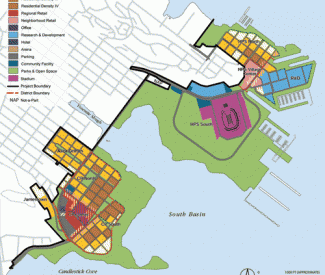
Mayor Gavin Newsom was quick to frame the Board of Supervisors’ 10-1 vote for Lennar Corp.’s massive redevelopment proposal for Candlestick Point-Hunters Point Shipyard on July 27 as a sign that plans to revitalize the Bayview are about to begin.

“Now we can truly begin the work of transforming an environmental blight into a new center of thousands of permanent and construction jobs, green technology investment, affordable housing, and parks for our city,” Newsom claimed in a prepared statement after the board (with Sup. Chris Daly as the lone dissenter) approved Lennar’s 700-acre project.

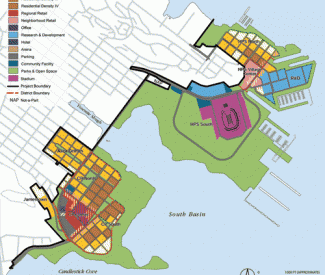
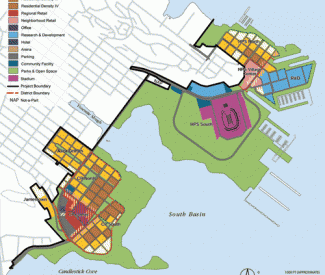
The proposal calls for 10,500 residential units; 320 acres of parks, retail and entertainment facilities, green-tech office space; and a San Francisco 49ers stadium if the team decides not to move to Santa Clara.

But Kofi Bonner, who worked for Mayor Willie Brown before becoming Lennar’s top Bay Area executive in 2006, said the vote means he can start shopping the plan around. “Now we have to find some money to move forward with the project,” Bonner told the San Francisco Chronicle.

Given the stubbornness of the recession, Bonner’s revelation that Lennar has yet to find all the necessary investors means local workers and public housing residents could be waiting a long time for jobs and housing in Bayview. If and when the project finally breaks ground, it will involve building condos in the Bayview’s only major park.

These realities undermine the claims of Lennar, which used the mantra of “jobs, housing, and parks” in 2008 to sell Proposition G but made no mention of a bridge over environmentally sensitive Yosemite Slough or selling state parkland for condos.

Also disturbing, says Sierra Club local representative Arthur Feinstein, is the lack of any economic analysis to support Lennar’s claims that the bridge is needed.

Indeed, the only thing clear to longtime observers of the plan is that the much vaunted jobs won’t happen soon, most of the housing will be unaffordable to current Bayview residents, and Candlestick Point State Recreation Area, the only major open space in the Bayview, will be carved up so Lennar can build luxury condos on waterfront land.

These concerns have led the Sierra Club to threaten a lawsuit over issues on which Board President David Chiu was the swing vote in favor of the Lennar and Redevelopment Agency plan. Yet Chiu told the Guardian that the process got him thinking that it might be time to reform the redevelopment process.

“Now might be a good time to address concerns about the potential for inconsistency between Redevelopment and the city when it comes to land use and planning visions,” Chiu said. “And I have concerns about the tax increment financing process.” Tax increment financing allows the Redevelopment Agency to keep all property tax increases from the project, up to $4 billion, to use in redevelopment projects rather than into city coffers.

Chiu says the amendment he offered July 12, which narrows Lennar’s proposed bridge over Yosemite Slough by half, was based “on the belief that having a connection between jobs and housing is important. And I had understood that it would cost the developer an additional $100 million if the bridge was removed.”

But Feinstein counters that it’s hard to imagine that building a bridge over an environmentally sensitive slough will attract investors that support green technology. He is concerned that the development is expected to attract 24,465 new residents but that the Lennar plan fails to mitigate for transit-related impacts on air quality. “The Bayview already has the highest rates of asthma and cancer in the city,” Feinstein said.

Chiu says the supervisors can introduce separate legislation to address this concern. “It’s my understanding that an air quality analysis could be implemented by the board,” he said.

Although the board’s July 27 vote was a relief for termed-out Sup. Sophie Maxwell, its failure to support the no-bridge alternative, increased affordability standards, and an air quality analysis could result in expensive and time-consuming litigation, Feinstein warns.

And although Sups. Chris Daly, Ross Mirkarimi, David Campos, John Avalos, and Eric Mar supported all three of these amendments, they were ultimately thwarted by a redevelopment law that limits the city’s control of such projects.

During the meeting, Daly acknowledged that it would be impossible for Lennar to meet his 50 percent affordability amendment. But he noted that if the project becomes too expensive “there’s going to be a pretty new neighborhood with lots of white folks living in the Bayview.”

But after Michael Cohen, Newsom’s top economic advisor, said the project would not be financially viable with 50 percent affordability, Sups. Chiu, Maxwell, Bevan Dufty, Michela Alioto-Pier, Carmen Chu, and Sean Elsbernd voted against Daly’s amendment.

These same six supervisors voted against Mirkarimi’s proposal to eliminate plans for a bridge across Yosemite Slough, even though Cohen was unable to point to any economic analysis to support Lennar’s claims that the bridge is necessary.

Arc Ecology owner Saul Bloom, whose nonprofit did studies indicating that an alternative route wrapping around the slough is feasible, says Lennar’s plan illustrates the problem that San Francisco has with development. “Elected officials couldn’t do anything,” he said, except give the nod to a plan he describes as “developed by a mayoral administration and approved by that mayor’s political appointees [on the Redevelopment Agency board],” Bloom said.

“The message that the environmental community takes away from all this is that it doesn’t pay to play well,” Bloom continued. “No matter how much you spend to try and ensure that litigation is not the only way to obtain the desired outcome, ultimately the message that comes back from the city and the developer is ‘sue us!’ That brings out the worst political conduct, not the most appropriate.”

Feinstein wouldn’t confirm that a Sierra Club lawsuit is imminent, but predicted that if the coalition — which includes Golden Gate Audubon, the California Native Plant Society, and SF Tomorrow — goes to court, it’s likely to win. “If we do litigate, we’ll probably do it on a wide range of issues,” Feinstein said. “They approved a fatally flawed document, and they could provide no documented evidence of the need for a bridge — and admitted that publicly.”

Feinstein contends that Lennar’s plan has been a runaway project from the get-go. “The idea was to march it through before the mayor is gone with little regard for process. And despite all the much vaunted public meetings, little in the plan has changed,” he said.

Feinstein added that he was disappointed in Chiu’s stance on the bridge. “There were five supervisors in the Newsom camp, but as board President, Chiu had a responsibility to be more vigilant,” he said. “We told him what’s wrong with the bridge plan, but he didn’t share our view.”

“This is a rare opportunity,” Maxwell said before the board’s final vote. “It focuses public and private investment into an area that has lacked it in the past. It’s unmatched by any development project in San Francisco. This project is large and complicated, no doubt. But let us not be fearful of this project because of its scale, because how else can we transform a neglected landscape?”

But project opponents say everyone should fear a deal that required the board to ask Lennar’s approval to amend a plan that was pitched by the Newsom administration and approved by a bunch of mayoral appointees on the Redevelopment Commission with little chance for elected officials to make changes.

Mirkarimi said the problem with a process in which redevelopment law trumps municipal law is that it creates a shadow government in those few municipalities in California where the Board of Supervisors or City Council is not the same entity as the Redevelopment Commission.

“This is not the first time Redevelopment’s plans have trumped the concerns of local residents,” Mirkarimi said, referring to the agency’s botched handling of the Fillmore District in the 1960s, which led to massive displacement of African and Japanese Americans.

“I’ve been told, ‘Don’t worry, Ross, this is not going to happen, we’re not going to use eminent domain.’ Well, jeez, that’s a consolation, because even when we’ve exercised our legislative influence and given our blessing, [Redevelopment] unilaterally changed the plan after it left the board,” Mirkarimi said, referring to Lennar’s decision to replace rental units with for-sale condos when it first began work on the shipyard in 2006. “That suggests a condescending role in which the developer is able to go to the Redevelopment Commission and make a unilateral change.”

Mirkarimi’s concerns seemed justified after Cohen, Bonner, and Redevelopment Director Fred Blackwell huddled in a corner of City Hall during the board’s July 27 meeting to decide which of the supervisors’ slew of amendments they would accept. When Cohen returned with the amendments organized into three categories (acceptable as written, to be modified, and completely unacceptable), Mirkarimi’s no-bridge amendment had been sorted into the “unacceptable” pile.

“With regard to your insistence on the economic reasons [for the bridge], please point to which document says that,” Mirkarimi said, leafing in vain through the project materials.

Cohen mentioned “a lessening of attractiveness,” “a lower-density product,” and a reduction of revenue available through tax increment financing to pay for the bridge.

“Yes, but I’m still trying to look for the information and all I’m hearing is this pitch,” Mirkarimi said. “The economic study is absent. There are no supporting documents here. This is why I feel it’s justified for us to have a review of this.”

Cohen rambled on about “rigorous public discussion over a number of years” and claimed that a “huge amount of studies had been done.”

“But there is no economic study,” Mirkarimi repeated.

The board then voted 6-5 against Mirkarimi’s amendment after deputy City Attorney Charles Sullivan said that the only way to remove the bridge — since the project’s environmental impact report had rejected that option — would be to reject the entire plan. “I wish we had been able to eliminate the bridge,” Campos told the Guardian after the vote. “Part of the challenge we have is to reexamine how Redevelopment works and explore the potential for taking it over.”

Daly believes the bridge has nothing to do with connecting the neighborhood to the city. “The idea is to allow white people to get the fuck out of the neighborhood,” he said. “And it connects a different class of people to a new job without having to go through a low-income community of color. That’s why the bridge is needed.”

Mirkarimi said he was satisfied that he had dissected the arguments against the no-bridge alternative but fears that institutional memory is lacking on the current board. “A lot of my colleagues have not been involved in the debacle,” he said, referring to decades of problems with redevelopment in San Francisco. But Maxwell was all smiles. “I did my homework a long time ago — that’s why they couldn’t touch the core of the project,” she said. “They just added to and augmented it.”

The yellow wallpaper

0

arts@sfbg.com

HAIRY EYEBALL New York City construction workers at the World Trade Center site recently unearthed an 18th-century ship hull. More interesting is that scientists believe that the structure was part of the massive landfill that extended lower Manhattan further into the Hudson River. You don’t have to read too deep to hit on the symbolism of this story, even if the occurrence at its center isn’t so uncommon in a city as densely developed and old as New York (see the 1991 discovery of a 200-year old African burial ground, also in lower Manhattan). Beneath the site where the Twin Towers fell lies further wreckage, older ruins. Nothing is ever truly gone. What lies buried will eventually surface. The present is always haunted by the past.

The same could be said of the art world, which has recently been holding some flashy curatorial séances of its own. Two exhibits don’t necessarily make a trend, but the Berkeley Art Museum’s current “Hauntology,” recently reviewed in this paper, and the Solomon R. Guggenheim Musuem’s ongoing exhibit “Haunted: Contemporary: Photography/Video/Performance,” both summon the specters of late-1980s academic theory (Derrida in name and word, in the case of BAM’s show) in their selection of works that address the unseen yet felt presences — aesthetic, historical, political — floating amid the present.

You can also add “Now, It’s About What You Can’t See” to the list, although this group show at Triple Base Gallery of paintings, drawings, and installations is not as enthralled by its organizing principle — what is absent may not be forgotten — as the previously mentioned exhibits are to critical theory and now-old debates around appropriation in photography. As Triple Base’s statement declares, though the artists vary by age and medium, their works, “provide faint shadowy traces of moments to imagine what once existed and hint at an ever-evolving history.”

The faintest traces belong to Rachel E. Foster’s wall installation, which is practically invisible from certain angles. Only by moving back and forth in front of the surface does the repeatedly painted word “ghost” emerge from the seemingly contiguous white field of the gallery’s wall. As in her older works involving text, here, Foster cleverly collapses medium and message, using a representational strategy to bring a word’s meaning to life. In this case, the word “ghost” becomes just that.

Unfortunately, it’s hard not to read Foster’s installation as a commentary on the small group of Eleanor Kent’s early oil paintings, which are hung on the same wall. Inspired by her life in Noe Valley in the 1960s when she was still associated with the Bay Area Figurative movement, Kent’s small-scale domestic scenes — her son playing, a couple talking over dinner — aren’t by themselves elegiac. But Foster’s apparitional wallpaper imbues Kent’s facelessness figures and rough outlines with an air of loss that might not be present otherwise.

Wallpaper is put to different use in Mara Baldwin’s How to remember where you put something, the sharpest and most moving articulation of the show’s preoccupation with absence and memory. Baldwin, it appears, has removed and rehung a large section of old wallpaper. The yellowish pattern of red and yellow flowers has faded with age, as revealed by two brighter rectangles near the section’s center that suggest the spaces where perhaps art or photos had once been hung (curiously, no nail holes are visible). But looking closer, you realize that the paper in the less-faded sections is not the same paper at all, but a continuation of the wallpaper’s design in watercolor.

The piece’s two painted sections aren’t simply indexes for what’s gone missing (which may not have even existed in the first place). Executed by Baldwin’s steady, patient hand, the painted sections also draw attention to what they are intended to replicate: the banal, mass-produced wallpaper that surrounds them. By flattening background and subject, Baldwin makes painting the aid to memory of the piece’s title, while also suggesting that “putting on a new coat of paint” always involves some form of erasure. Chechu Alava’s soft-focus portrait of a sylph-like young woman in a slip is more conventionally ghostly, but not nearly as haunting as Foster’s hidden graffiti or Baldwin’s yellow wallpaper.


MORE TOPOGRAPHICS

As I wrote two columns ago in my review of the multi-gallery show “They Knew What They Wanted,” the George Eastman House’s 1975 exhibit “New Topographics” — currently hanging in a reassembled version at SFMOMA — continues to cast its shadow over contemporary art and curatorial practice, particularly where landscape is concerned.

“Land Use,” at Oakland’s Swarm Gallery, could easily be a satellite to both exhibits. Bill Mattick’s color photographs documenting the ecological cost of urban and industrial development in Southern California are the closest relatives to the grim indictments of such “New Topographic” participants as Joe Deal, Robert Adams, and Lewis Baltz. Chris Sicat’s pieces of reclaimed wood “colored in” with soft graphite pencils are less successful as sculptures than as documents of the artist’s attempts to work within natural form of his materials. Sculptor Reenie Charrière takes a similar tack with manmade waste, aggregating the plastic bits that don’t make it to the recycling center into playful, biologic forms.

NOW, IT’S ABOUT WHAT YOU CAN’T SEE

Through Aug. 29

Triple Base

3041 24th St., SF

(415) 643-3943

www.basebasebase.com

LAND USE

Through Sept. 12

Swarm Gallery

560 Second St, Oakl.

(510) 839-2787

www.swarmgallery.com

Filing fees and public financing as clues to 2010 supervisor races

5

For months now–and in a few cases, over a year- a bunch of dedicated residents have been campaigning in the hopes of becoming the next supervisor in districts 2,4,6,8 and 10. But now comes the moment of truth:

Between July 12 and August 6, all these potential candidates must file all necessary paperwork and pay all necessary fees to qualify for the November ballot.

And, provided they get enough signatures, they can submit a petition in which each signature represents 50 cents towards offsetting their $500 candidate-filing fee.

These signatures are called signatures-in-lieu (or SIL) and they provide an interesting data point if you are trying to figure out who has community support and/or money.

A spokesperson for the San Francisco Elections Department recently told me that the point of the signature-in-lieu petition is to allow anyone to get on the ballot, regardless of their financial circumstances—provided they have valid support.

“If they were to collect, let’s say, 1,000 valid signatures, then that totally offsets their candidate filing fee,” the Elections spokesperson said. “But if they go over 1,000 signatures, they don’t get extra money back.”

And, as of July 26, Elections started to look at candidates’ SIL petitions to get an idea of who will owe what come Friday, when the filing fees are due. This is done by figuring out of the signatures are valid or not. To be valid, a signature must come from a person who resides in the geographical area that is covered by the race.

So, D. 2 candidates must gather signatures from D2 residents, and so on.

“Let’s say the candidates didn’t want to do all that, they just file and write a check,” the Elections spokesperson said. “But they must collect at least 20 valid nominating signatures.”

These signatures can be the same as those on the SIL petition, but they must be re-submitted on a nominating petition. And these signatures must come from folks residing in the district covered by each race. So, D 10 nominators must also be D. 10 residents.

“We expect a long line on Friday, which is when we’ll see a lot of people,” the Elections Department representative added. “And we will be working through the weekend to create an ‘unofficial’ official list of candidates by Monday [August 9]. A list we call “unofficial’ because we may need to check out some of the signatures.”

So, what do the candidates’ signature-in-lieu submissions reveal, so far?

Leading the pack in terms of candidates who submitted the least amount of valid signatures-in-lieu is D. 6 supervisor candidate Theresa Sparks.
As of July 27, Sparks had submitted 20 signatures, but only 19 were valid.

Sparks is closely followed, in terms of low SIL numbers, by D.6 candidate Jim Meko: Meko submitted 33 signatures, and only 28 were valid.

Now, this paucity of signatures-in-lieu could suggest that Sparks and Meko do not have massive grassroots support in D. 6. It could also mean that Meko and Sparks are focusing their campaign energies elsewhere. And, to be fair, both could submit more signatures by Friday.

Meko admitted that his campaign did not spend time gathering signatures-in-lieu.

‘We did not devote a whole lot of energy on that,” Meko told me today.”You can only spread yourself so far.”

To date, Sparks’ signatures only count towards $19.50 of her $500 filing fee. This suggests Sparks will pay for the filing fee herself. (Or from the $10,000 public financing that she had qualified for, as of July 14, with a possible increase coming soon, as Elections examines her filings.).

Likewise for Meko: His 28 signatures-in-lieu means $14 off his $500 filing fee. Meko has already qualified for $10,000 in public funds and has an application for another $22,000 in publid funds in the works. This combined with the $7,000 Meko raised in 2009, and the $6,000 he has raised in the first half of 2010, means Meko will have $45,000 in hand to run his campaign.

“That’s no small potatoes to run a campaign in little old District 6,” Meko observed.

Unlike signatures-in-lieu, which must be from within the geographical boundaries of the race, candidates can qualify for public financing based on their ability to raise $5,000 in contributions of less than $100 each, with no requirement that those contributions come from within their electoral district. If the candidates raise $5,000 in this way, the city will double it, meaning that the candidates will receive  $10,000 in public funds. And if candidates raise another $10,000, the city will match those funds by a 1:4 ratio.

But unlike Meko, Sparks still appears to need another valid nominating signature from a D. 6 resident to qualify, since 20 sigs is the nominating minimum. So, someone do her a favor and sign the petition, why don’t you.

Sparks’ and Meko’s numbers stand in stark contrast to D6 candidates Jane Kim and Debra Walker.
Kim has already submitted 1,732 signatures-in-lieu, and 1,281 are valid. This means Kim qualifies to have her filing fee waived and to complete her nominating petition.

The same holds for Walker. She submitted 1,107 signatures, and 1,041 are valid.

Kim also leads the pack with $71,148 in public funds, followed by Walker ($57,344) and Elaine Zamora (S50, 999) with Sparks a distant fourth ($10,00). So, again, it looks like Kim and Walker are running strategic grassroots campaigns, compared to Sparks and Meko. (I left a message with Sparks campaign manager Chris Lee today, and if there are any updates that shed more light on these numbers, I’ll be sure to post them here. Same for Meko.)
Combined, D.6 candidates have seen $199,491 in public funds disbursed.

Over in  D. 4, incumbent Carmen Chu has submitted 401 signatures, and only 282 are valid. But judging from the megabucks that Chu raised from wealthy contributors in 2008, including $11,500 from PG&E, a $500 filing fee is probably the least of her worries.

In D. 8, Rebecca Prozan submitted 1,147 sigs, and 1,056 were valid, so she cleared the waiver and nominating petition requirements, as did Scott Weiner (1,479 sigs submitted, 1,264 valid) and Rafael Mandelman (1,036  sigs submitted, 1,011 are valid.)

In D. 10, none of the candidates has so far succeeded in qualifying for a complete waiver, which is an interesting statistic in a race that remains wide open at this point.
But Steve Moss came close (1097 sigs submitted, 955 are valid). Chris Jackson came fairly close (904 submitted, 802 valid), Marlene Tran got half way (718 submitted, 574 valid) as did Lynette Sweet (509 submitted, 479 valid), and Malia Cohen secured a third of needed sigs to waive the fee (504 submitted, 338 valid).

Fellow D. 10 candidate Tony Kelly told me that he decided not to concentrate his energies on signature-in-lieu gathering, based on on-the-ground intel that Jackson and Moss had already done a thorough job of knocking on doors and asking for folks’ sigs.

Kelly said he’s focusing his efforts on qualifying for increasing levels of public financing. And so far, Kelly is one of eight candidates in D. 10, who have either qualified or are under review for public financing, making D. 10 the top public financing district, citywide, with $233,065 distributed, as of July 30.

Leading the D. 10 public financing pack is Malia Cohen with $53,671 in public funds disbursed. She is followed by Moss ($53,284) and Jackson ($50,220). Kelly is in fourth place ($39,548), Kristine Enea is in fifth ($26,342), DeWitt Lacy is sixth—and Lynette Sweet and Eric Smith’s public funds applications are still under review.

In D. 8, Rafael Mandelman is one of only two candidates to qualify for public financing. Mandelman has received $62,153, placing him ahead of Scott Weiner ($10,000.)

And in D. 2, Kat Anderson has received $40,480, followed by Abraham Simmons ($36,160) but neither made inroads on the signatures-in-lieu front: Anderson submitted 99 and 82 were valid, while Simmons appears not to have submitted any. Of course, everything in D. 2 is up in the air, now that a judge has ruled that incumbent Michela Alioto-Pier can run again this fall, and D. 2 candidate Janet Reilly has not yet decided whether to run. With the latest campaign finance disclosure reports due this week, stay tuned…

Board had to ask for Lennar’s approval…

0

Images by Luke Thomas

The Board of Supervisors found itself in the humiliating position July 27 of having to ask for the approval of Lennar and the city’s Redevelopment Agency before it could amend Lennar’s massive redevelopment plan for Candlestick Point-Hunters Point Shipyard.

If that’s not an argument for reforming how this city approaches redevelopment, I don’t know what is. Especially since the Board’s meeting illustrated only too well how thoroughly Lennar’s local executives, who used to work for the city under Mayor Willie Brown,  understand this game and how to outfoxed any resistance to their ongoing effort to eat San Francisco whole.

“This is a rare opportunity,” Sup. Sophie Maxwell said ahead of the Board’s 10-1 vote (Sup. Chris Daly was the lone dissenting voice) to approve Lennar’s entire plan. “It focuses public and private investment into an area that has lacked it in the past,”continued Maxwell, who represents the district that encompasses the shipyard and Candlestick Point. ” It’s unmatched by any development project in San Francisco. This project is large and complicated, no doubt. But let us not be fearful of this project because of its scale, because how else can we transform a neglected landscape?”

But who wouldn’t be afraid of a deal that found Maxwell, Board President Chiu and Sups. Michela Alioto-Pier, Carmen Chu, Bevan Dufty and Sean Elsbernd joining forces to vote against Sup. Ross Mirkarimi’s proposal that Lennar be required to include a non-bridge alternative?

And who wouldn’t be doubly afraid, given that these six supervisors took that vote after Michael Cohen, Mayor Gavin Newsom’s top economic advisor, was unable to point to a single document to support his claims that Lennar’s $100 million bridge over an environmentally sensitive slough is actually needed?

Talk about scary.

To his credit, Mirkarimi did a good job of illustrating what’s wrong with a process that allows a private developer like Lennar to pitch plans and get mayoral appointees to approve them, but doesn’t allow San Francisco’s elected officials to make any amendments unless the developer and Redevelopment agree.

At the root of this travesty is the fact that redevelopment law trumps municipal law, a power imbalance that creates a shadow government in those few municipalities in California where the city council or board of supervisors is not the same entity as the Redevelopment Commission.

San Francisco is one such municipality, and, as Mirkarimi explained, this is not the first time that Redevelopment’s plans have trumped the concerns of local residents.

“I’m the supervisor for the Fillmore, the first urban renewal laboratory took place in my district, and I vowed to never let it happen again, ”Mirkarimi said, referring to the massive displacement of African Americans and Japanese Americans that took place when Redevelopment decided to makeover the Fillmore in the 1960s.

“I’ve been told, “Don’t worry, Ross, this is not going to happen. We’re not going to use eminent domain,’” Mirkarimi continued. “Well, Jeez, that’s a consolation! Because even when we’ve exercised our legislative influence and given our blessing, [Redevelopment] unilaterally changed the plan after it left the Board. That suggests a condescending role in which the developer is able to go to the Redevelopment Commission and have a unilateral change.”

Mirkarimi was referring to how proposed rental units on Parcel A, the first parcel of shipyard land released for redevelopment, became for-sale condos at Lennar’s request, without the Board having any recourse, even though the area surrounding the redevelopment is ground zero for the city’s last remaining African American community and home to other low-income communities of color.

Deputy City Attorney Charles Sullivan explained that the s supervisors would require the approval of the developer and Redevelopment to amend Lennar’s latest plan, under Redevelopment law. Failing that, their only recourse would be to reject Lennar’s plan in its entirety–a nuclear option that only Daly seemed prepared to carry through.

Sup. David Campos noted that the city’s legal advice had been “somewhat of a moving target.” His comment suggested the Board had  been misled in the critical weeks before this final vote, including ahead of the Board’s July 14 vote to accept certification of the project’s final environmental impact report.

“When a number of us raised questions about the EIR, we were told we couldn’t, but that we would probably be able to make changes to the substantive plan,” Campos recalled. “But now we are getting a more complicated answer.”

Deputy City Attorney Sullivan said the situation was complicated, because some of the proposed amendments “don’t involve a simple stroke of the pen.”

But Campos pointed to the fact that Board President Chiu had introduced an amendment that only allows for a 41 ft. bridge across Yosemite Slough, thereby halving the width of the 82 ft. bridge that Lennar is proposing to build.

That amendment, which Chiu introduced July 12,  leaves the door open for the 82 ft. version of the bridge, if the 49ers indicate interest in a new stadium on Hunters Point Shipyard, a possibility the city claims is still alive, even though Santa Clara voters approved a new stadium for the 49ers this June.

“So, why can you amend the plan to include a scaled-down version of the bridge but not eliminate it altogether?” Campos asked.

“You can make that motion by voting not to approve the project,” Sullivan said.

“So, the change has to point to something already embedded in the project?” Campos asked.

“Or not be a rejection of everything that’s already been brought forward,” Sullivan replied.

After Mirkarimi proposed his no-bridge alternative, along with a slew of other amendments that Daly, Campos, and Sups. Eric Mar and John Avalos had been working on to strengthen the proposed development, Cohen, Mayor Gavin Newsom’s top economic advisor, huddled somewhere in City Hall along with Kofi Bonner,  Lennar’s top local executive and Fred Blackwell, the head of SF’s Redevelopment Agency to decide which of the Board’s amendments they would accept.

Cohen returned with the amendments organized into three categories: acceptable as written, modified, and completely unacceptable.

And predictably enough (to anyone  tracking Lennar’s insistence on a bridge) Mirkarimi’s no-bridge amendment had been tossed into the “unacceptable” pile.

“With regards to your insistence on the economic reasons for the bridge, please point to which document says that,” Mirkarimi said, leafing through the project materials that were piled on his desk.

Cohen mentioned a number of factors, including an alleged “lessening of attractiveness,” “a lower density product” and a reduction of property tax revenue that would be available through tax increment financing to pay for Lennar’s proposed bridge.

“Yes, but I’m still trying to look for the information, and all I’m hearing is this pitch,” Mirkarimi replied. “The economic study is absent. There are no supporting documents here. This is why I feel it’s justified for use to have a review of this.”

Cohen talked some more about “rigorous public discussion over a number of years.”

“But there is no economic study,” Mirkarimi repeated. At which point a deafening silence pervaded the Board’s venerable chambers, much as if the emperor had shown up without his proverbial clothes.

Deputy City Attorney Sullivan broke the silence by indicating that the only way for the Board to move a no-bridge alternative forward would be to stop all project approvals and send the plan back to Redevelopment.

And Mirkarimi reminded the supervisors that at the Board’s July 13 hearing, Cohen had said that there was no conclusive evidence around the need for the bridge.

But then the Board voted 6-5 against Mirkarimi’s proposal, a move insiders said was more about not pissing off Labor, which hopes to create jobs for iron workers, and not pissing off Lennar, whose control runs deep and wide, and less about being convinced of the actual need to build over the last unbridged waterway in the city’s southeast sector.

And a couple of amendments later, the Board gave its blessing and it was all kisses and hugs and applause in the Board Chambers, even though the folks from Dwayne Jones Communities of Opportunities (COO) program, who usually show up to support the plan, strangely weren’t in attendance, rumoredly because their program has been cut off at the knees in the last few weeks, following Jones resignation as COO’s director.

“I wish we had been able to eliminate the bridge,” Campos told me after the Board’s final vote. “I think part of the challenge we have is to reexamine how Redevelopment works and explore the potential for taking it over.”

Mirkarimi was satisfied that he had dissected the arguments against the no-bridge alternative, but feared that institutional memory is lacking on the Board, and that without fundamental Redevelopment reform, the city is in danger of seeing this kind of travesty repeated, over and over.

“A lot of my colleagues have not been involved in the debacle,” Mirkarimo said, referring to how Redevelopment’s infamous role dates back five decades, and how Lennar has been working the local political scene for longer than most of the Board’s current members.

But Maxwell was all smiles.
“I did my homework a long time ago, that’s why they couldn’t touch the core of the project,” she said. “They just added to and augmented it.”

With Maxwell’s days on the Board drawing to a close, I asked what she’s contemplating doing next.

“Sophie is looking into water policies and conservation,” Maxwell said. “Without blue there is no green.

It was about then that Mayor Gavin Newsom released a press statement that blabbed on in vaguely frothing terms about what would happen next.

“Now we can truly begin the work of transforming an environmental blight into a new center of thousands of permanent and construction jobs, green technology investment, affordable housing and parks for our City,” Newsom said

His words came shortly before Bonner said that Lennar would now start looking for investors, and shortly after Cohen admitted that it could be years before anything in Lennar’s plan actually gets built. But none of them mentioned that the Sierra Club and other environmental groups are planning to sue the City over the bridge, an outcome that could have been averted, Sierra Club officials warned, if the No-bridge alternative had been  included in the final redevelopment plan.

Stay tuned….


The bridge isn’t the only problem with Lennar’s plan

0

I’m glad to see the New York Times circle back to the Candlestick-Shipyard development with an article that was a tad more critical than their previous piece.

But while I enjoyed NYT’s joke about how the proposed bridge over the Yosemite Slough “has become a 950-foot-long chicken bone that keeps getting stuck in San Francisco politicians’ throats,”  I’m afraid the Board is in greater danger of choking on the bones of red herrings that they have been fed about this project,  along with last week’s bombshell that the Board won’t be able to amend Lennar’s plan, after all, when it votes July 27 on this massive proposal..

D. 10 candidate Tony Kelly says if that bombshell turns out to be true, it’ll be another example of what he calls, “The bait and switch and switch,” on the deal.

“I’m worried that the Board is getting advice that is less about a case of not being able to vote, and more a case of, if you vote, you could open up the city to liability,” Kelly said.

“Back in 2008, folks were told, just vote for Prop. G because it’s just a concept and we’ll have a robust conversation about the plan itself, but they’ve been running away from that promise ever since,” Kelly explained. “And during the EIR hearings, we were told that folks were simply approving the environmental impact report, not the plan itself.”

Kelly’s critiques of Lennar’s plan and the process by which it has been winning final approvals helped him win former Board President Matt Gonzalez’s endorsement last week in the pivotal race to replace termed-out D. 10 Sup. Sophie Maxwell.

But Kelly worries about the fallout that the next D. 10 supervisor will be left to mop up, if the Board goes ahead and approves Lennar’s plan, as is.
 
“What I’d dread to see happen is that this plan get bullied through on an up and down vote, and then a fifth, or even a tenth of people’s concerns prove to be true, and the next D. 10 supervisor spends the next 4-8 years apologizing to the people of the Bayview, because they won’t be able to do anything else for the area, and this plan keeps lumbering along and doesn’t even work,” Kelly explained.

He says he wants to know who can amend the plan, if it’s not the Board and when.

“ My concern is that after the July 27 vote, the city and Lennar will never have to come before the Board again,” Kelly said, pointing to the uncritical endorsement of the project EIR that the Planning and Redevelopment Commissions, the lead agencies on the plan, made June 3, and who would likely be tasked with any additional studies and findings.

Sup. Ross Mirkarimi confirmed today that the Board has been told that it has limited reach because of Redevelopment law, which supercedes municipal law.”
“But, nonetheless, I’m going to try to make some amendments,” Mirkarimi said.

He noted that the five amendments that Board President David Chiu introduced July 12 during a Land Use Committee hearing were “very benign.”

‘They mostly restated what was already in the project agreement or project EIR,” Mirkarimi said. “So, they don’t amend much, because they are statements of what has already been evaluated or pre-agreed to by Lennar and the city. And they are very benign because they do not require any changes to the plan.”

Mirkarimi observes that the current process by which the city is trying to push this deal through is designed to lock the Board out.

“There are larger questions in play here about our relationship with the Redevelopment Agency and redevelopment law,” Mirkarimi continued. He notes that San Francisco is one of only a few counties in California where the Board is not the same entity as the Redevelopment Agency.

“It’s long overdue that we return to the idea of having the Board have authority over the Redevelopment Agency, it’s been a problem for 40 years,” Mirkarimi said,  referring to Redevelopment’s disastrous handling of the Fillmore, which resulted in the massive and mostly permanent displacement of the Western Addition’s African American community—a negative consequence that many fear will be repeated by the plan for Candlestick-Hunters Point.

“There is a real capitalization on a starving population which is desirous of and at times desperate for positive changes and for jobs and housing, which is understandable,” Mirkarimi continued. “But absent of any alternative, it’s logical that this plan would move forward.”

In an effort to improve the plan, Mirkarimi says he will try to introduce a range of amendments at the Board’s July 27 meeting.

‘These include an attempt to make sure that whatever changes the Board makes are indeed enforceable,” he said. “And I am not satisfied with the discussion on the bridge, and how the gate has been left open on a bridge of any kind.”

Mirkarimi notes that there has been a lot of fanfare surrounding a community benefits agreement that various community-based organizations, labor and the project proponents entered into, in spring 2008.

“But I think they can do better, especially in reaching out to a community that has a high ex-offender population, and connecting to other disadvantaged communities throughout the city,” Mirkarimi said.

He also wants to ensure that if public power is not implemented, or fails, then Community Choice Aggregation program would automaticcally take over.

Mirkarimi is further concerned that there is nothing in the current plan that defines the percentages of housing units offered for rental and for home ownership.

“We are proposing to build 10,500 units but we have no idea what percentage is rental,” he said, noting that he also has concerns about air quality, air monitoring and parcels of land that have not yet been cleaned up to residential standards.

“Parcel E-2 is the most famous, but it’s not the only one,” he said. “The bridge and Parcel  E-2 have become major distractions in that they have sucked the oxygen out of other areas of these gargantuan project.”

So, is it true that elected officials on the Board can’t amend a plan sent to them by the Redevelopment Agency, whose commissioners are all political appointees of the mayor?

“It’s a yes or no vote, if you will,” a deputy City Attorney told the Guardian, on background, noting that the Board could tell Redevelopment that it doesn’t like the plan and wants the Agency to make some changes and bring it some amendments.

“Ultimately, the Board has the final say, but it has to have gone through the Redevelopment process and its PAC (project area committee) and have seen a plan that has been referred to it by the Planning Commission,” the deputy city attorney continued.“So, they could communicate their dissatisfaction and the agency would have to take their view into account. It’s not that the Board has no authority, but it can’t decide unilaterally.”

The City Attorney’s Office also confirmed that under Redevelopment Law, local jurisdictions can decide how to implement redevelopment plans.

“In a number of jurisdictions, the city council has made itself a Redevelopment entity, just as our Board is also the Transportation Authority in San Francisco,” the deputy said.“And if the same body proposes the plan, it probably will be satisfied.”

The City Attorney’s office noted that if agencies that regulate permits to fill the Bay, as is  required to build a bridge over Yosemite Slough, deny the city those permits, then the city would require amendments to its planning documents, but no further environmental impact review would be required, if the bridge was gone.

With the Board’s July 27 vote around the corner, D. 10 candidate Tony Kelly says he has a bunch of concerns that include, but are not limited to the bridge, starting with the projects financing mechanisms.

Kelly points to the fact that city staff recommended and the Board approved July 13 that “significant blight in the project area cannot be eliminated without the increase in the amount of bonded indebtedness from $221 million to $900 million and the increase in the limitation on the number of dollars to be allocated to the Agency from $881 million to $4.2 billion.”
 

Kelly wants the city to explain to the Board how much tax increment financing money will be left for the Bayview, now that the area’s debt ceiling has been tripled.

“Does this mean that all BVHP property tax revenues for the next 30 years will go towards paying down this debt and nothing else?” Kelly asked. “And what will that mean for the rest of BVHP in terms of service and programs it won’t be able to afford?

Kelly would also like to see the Board request an audit of Lennar’s record on Parcel A. As Kelly points out, the Navy conveyed Parcel to the city in 2004, and the city gave Lennar the green light to develop 1,600 mostly luxury condos on that parcel, in 2006.

“But no one has ever done an audit of Parcel A,” Kelly said. “Given the scrutiny that the Board usually brings to five figure numbers, the supervisors should be demanding this information, since we are dealing with a ten-figure number ($4,220,000,000) in future.”

It would be helpful if the City would also brief the Board as to who it believes will be investing in the project,  including the investment companies’ names,  their board of directors, and whether these companies are based in the US. Rumors are swirling that some project proponents have entered into side-deals that involve limited liability companies that are selling Lennar’s proposed condos to folks in China, and that a $1 million investment in a condo could translate into a work permit for the condo owner or occupant.

Kelly worries that the city and Lennar’s joint redevelopment plan is being allowed to squeak past the Board’s financial review simply on the basis of vague estimates.
“They rely once again on promises that won’t show up,” Kelly said, pointing to a recent report that emerged from the Controller’s Office.

Arc Ecology’s Saul Bloom notes that the Controller used averaged figures in that report, an approach that neatly obscures the fact that many of the project’s alleged and benefits– will not be created or felt for years. Bloom for his part is hoping the Board can introduce a maritime uses amendment. This would allow relatively unskilled jobs to be created at the shipyard in short order, compared to vague promises of  building a green tech office park there, some day.

Last week, Mayor Gavin Newsom’s top economic advisor Michael Cohen suggested that plan amendments would delay project construction.

But Cohen was quick to add that, “702 acres of waterfront land in San Francisco is an irreplaceable asset. It’s not a question of if—but when—it gets developed.”

Others are less sure that Cohen’s much promoted vision will ever translate into reality.

So, here’s hoping the Board will grill Cohen and city staff over the financial details, including the internal rate of return (IRR) that Lennar is demanding, and what will happen to promised community benefits, if the IRR doesn’t pencil out. D. 10 candidates DeWitt Lacy, Chris Jackson and Tony Kelly have suggested that some form of liquidated damages  are needed, but if the City believes these are unnecessary, it should explain why.

And then there are questions about the impact on air quality of the traffic related to an additional 24,500 residents and 10,000 workers into the city’s southeast.

Personally, I was fascinated by an April 2010 report from the Redevelopment Agency in which the agency discussed the challenges of driving piles through contaminated soil, which is what could happen if a bridge is built over the Yosemite Slough. In the past, the city made the argument that the NFL and the 49ers were requiring this bridge.

But last week, in the wake of Santa Clara’s vote in favor of a new stadium for the 49ers near Great America, the city began arguing that the bridge would make the project more attractive to financers, because employers want to get their employees quickly in and out.

This was the first time I ever heard city staff make that particular argument and they made it when it’s still not clear who these employers even are.

 So, let’s flesh out the list of potential employers, so the Board can determine if design decisions are being made in the interest of the local community or out-of-state businesses.

And then there’s the fact that it appears that this proposed $100 million bridge would only save commuters a few minutes, while permanently filling the San Francisco Bay.

Today, the Sierra Club, the Golden Gate Audobon Society, the California Native Plant Society and San Francisco Tomorrow released a report that asserts that the Candlestick Point-Hunters Point Shipyard EIR “misrepresents the need for a bridge.”

“A statistical review demonstrates that a route around Yosemite Slough could be as efficient as a bridge route while being better for the environment,” stated a letter that the Sierra Club-led environmental coalition released today. “It’s time for the Board of Supervisors to reject the bridge alternative and insist that the feasible upland route around Yosemite Slough be seriously considered.”

The letter argues that a regression model result found in the Transportation Study Appendix F of the Candlestick Point-Hunters Point Phase 11 EIR provides “no statistically significant evidence to support the claim that a 5 minute increase in transit travel time would lead to a 15 percent decrease in transit ridership, or, indeed, to any decrease in ridership.”

“Therefore, routing the BRT around Yosemite Slough is as consistent with a transit-first redevelopment goal as a bridge alternative, but without the environmental damage wrought by the bridge,” the Sierra Club-led report states in summary. “The results of the regression analysis used in the EIR and relied upon to support the bridge alternative have been misinterpreted in such a way that even if they were statistically significant they are off by a factor of ten: the decrease in transit ridership associated with 5 extra minutes of transit time would be predicted to be approximately 1.5 percent, not 15 percent,” it concludes.

“When the analysis [presented in the Sierra Club’s letter] is combined with previous analyses by LSA Associates (which estimate the increase in travel time would be approximately 2 minutes, rather than the 5 minutes in the final EIR) and other available information, one must reach the conclusion that the FEIR misrepresents the effect on travel time and ridership that would result from a route around Yosemite Slough. Overall, it poses further questions about the need for a bridge over San Francisco’s largest wetland restoration project.”

The Sierra Club-led report lands two weeks after Board President David Chiu introduced his July 12 package of amendments which seeks to narrow the bridge, not eliminate it, and require the Board to hold hearings before the Navy transfers Parcel E-2 to the city.

It’s a good idea for the Board to require hearings before E-2 is transferred to the city. But does this mean the Board will be able to direct the Navy, when it’s time to decide whether to cap or excavate the contamination in that parcel? The answer appears to be no. All the Board can do is to reject the Navy’s proposed solution.

But how would this work? What would happen then? And Parcel E-2 isn’t the only parcel on the shipyard where seriously nasty stuff has been found and is still be cleaned up.

The good news is that at this point, the project still doesn’t belong to the Board.

The bad news is that, as of tomorrow, it could belong to them, if the supervisors opt to approve Lennar’s plan with a simple up-down vote. And given the rush and the political pressure that the process has been subjected to since 2006, it’s almost certain that some scandal will engulf the project, some time in the future. And this Board of Supervisors’ names will be on it. Even if nothing ever gets built at the shipyard.

“How can the city say nothing will be built for years, because we have promised so much, when they say out of the other side of their mouth, that the only way that we can make these promises to the community, is if the community supports the plan?” Kelly asks. “On what planet do we think this makes sense? I think we are moving out of the solar system with every passing week.”

There’s no crime in members of the Board admitting tomorrow that they have not read the entire plan and don’t understand all the details. As the folks in Alameda humbly admitted last week, when they kicked out developer SunCal, it took them years to understand what was being proposed—including the fact that the project might leave their city in the hole, financially.

But it would be a crime for the San Francisco Board of Supervisors to vote yes on this massive proposal without first having done that homework. Yes, I’ve heard supervisors say in the past they are deferring to Sup. Maxwell, since the project lies in her district. But Maxwell is termed out, and the project will impact all of the city, especially in terms of its ethnic and economic diversity, in future. So, as we’ve said, buyer beware!


Wikileaks releases classified Afghan War diaries

1

Wikileaks has released thousands of classified files about the war in Afghanistan. These Afghan war diaries provide a unique insight into what’s happening on the ground. And it ain’t pretty. You can review the reports by looking at various categories, including “severity”, “friendly fire” and “escalation of force”.


Wikileaks is calling the files “the most significant archive about the reality of war to have ever been released during the course of a war.”


The U.K. Guardian calls them, “a devastating portrait of the failing war in Afghanistan.”


Take a look and decide for yourself.


Rumors fly that Board can’t amend Lennar deal, after all

14

For the past month, fireworks and deals have been going on at City Hall as the Board prepares to vote on Lennar’s massive redevelopment plan for Candlestick Point-Hunters Point Shipyard. And recently, the Board vowed to make a slew of amendments to the plan, even as they approved the project’s environmental impact report.

But now it’s beginning to look like the only winners could be the developer—and perhaps those folks at city hall who are staking their political careers on jamming this deal over the finish line, come hell or high water, before the November election comes around and they go into the private sector as real estate developers.

I say this because two weeks ago, the progressives on the Board were saying that they had been told that they couldn’t amend the EIR July 14, but that they could amend the actual redevelopment plan when it comes before them on July 27. It was for this reason, they said, that they decided to vote to accept the EIR in an 8-3 vote, with only Sups. John Avalos, Chris Daly and Eric Mar, voting to reject the project’s key environmental document.

But today, with less than two working days before the Board’s July 27 meeting, I’m hearing rumors that the Board will only be able to take an up and down vote, when they consider Lennar’s actual redevelopment plan.

In other words, the only way the Board would be able to change anything would be to reject the plan in its entirety.But everyone knows that this is a pigs-may-fly scenario, given the massive pressure the Mayor’s Office, labor and Lennar have been exerting on the Board.

So, if these “up-and-down-vote only” rumors turn out to be true, folks who care about environmental and economic justice better start sounding the alarm. Because there is a plethora of unresolved issues that Sups. John Avalos, David Campos, Chris Daly, Eric Mar, and Ross Mirkarimi identified July 13 as needing shoring up, before the actual redevelopment plan would ever pass their sniff test.

These concerns included fears that the project’s financing plan amounts to daylight bank robbery, that the proposed bridge across the Yosemite Slough is unnecessary, and that the amount of projected air pollution related to the development is unacceptable.

And then there’s the fact that the Controller’s “economic benefits” report only used averaged figures, and therefore did not give any details about how many jobs and benefits the project would create in this economically depressed community in the next few years.

And did I mention the part about liquidated damages and watershed concerns? Or the fact that there are no maritime uses in the current plan, even though these uses could translate directly into relatively unskilled jobs, if old ships were broken up at the shipyard.

But despite the hours of discussion on July 13 that the Board sat through last week, I do not recall anyone from the Mayor’s or City Attorney’s Office advising the supervisors that they would not be able to amend the actual plan when it comes before them July 27.

Right now, a lot of confusion is swirling as folks point to the fact that Board President David Chiu introduced five amendments at a July 12 Land Use Committee hearing that eight supervisors subsequently voted to accept. This move led the rest of the Board to believe that they too could make amendments to the final plan.

But a review of Chiu’s amendments and the project’s EIR suggests that these changes are in fact repackaged pieces of the EIR, and that the move misled other supervisors into believing that that they would have a chance to amend the actual redevelopment plan.

So far, no one from the Mayor’s Office has returned my calls seeking clarification on this process. But if it turns out that the only way the Board can have input is to kick the plan to the curb, or ask the Planning Commission to make new findings, then democracy in San Francisco has been replaced with an empty charade.

“The Board can make changes along the line that David made in the Land Use Committee, “ Chiu’s legislative aide Judson True told me today. But he wasn’t clear on the process next week, and suggested that I call Cohen’s office, which I did (only to find myself shunted to Cohen’s voice mail.)

So, what gives? And why would the Board allow an out-of-town developer in partnership with the Mayor’s Office to sidestep its responsibility in this way?

“We were told we could not make amendments to the EIR, but could make amendments to the plan that we will be voting on this Tuesday,” Campos told me today, noting that he and Mirkarimi were prepared to make changes July 13, but were then told they could not do that.

“The biggest fear I have with this project, and any project this size in this economy, is that a lot is promised, but will anything get developed, or will we be stuck holding the bag,” Campos added.

Similar questions led the Alameda city council to kick developer SunCal to the curb last week. Ironically, the move could open the door to a developer like Lennar to try and swoop in and pick up the pieces in the island city across the Bay from San Francisco.

But folks in Alameda are pointing to San Francisco as an example of how difficult it is to nail down developers, noting that Michael Cohen, Mayor Gavin Newsom’s top financial advisor, recently admitted that investment money is scarce, even though the city’s EIR for the project has been approved.

Actually, Cohen went a step further by intimating that all the benefits that the community wants out of the plan would deter investors even more—comments that were perhaps just a precursor to this potential bombshell that the Board won’t actually be able to amend the deal, after all? Stay tuned.

Deal time

1

sarah@sfbg.com

Lennar Corp.’s massive redevelopment plan for Candlestick Point-Hunters Point cleared a critical hurdle July 14 when the Board of Supervisors voted 8-3 to affirm the Planning Commission’s certification of the project’s final environmental impact report, with Sups. John Avalos, Chris Daly, and Eric Mar opposed

Board President David Chiu called the vote "a milestone." Termed-out Sup. Sophie Maxwell, whose District 10 includes Candlestick Point and the former Hunters Point Naval Shipyard, saw the vote as evidence that city leaders support the ambitious plan. Yet many political observers saw the vote as proof that Lennar and its Labor Council allies have succeeded in lobbying supervisors not to support opponents of the project.

"I’m concentrating on pushing this over the finish line," Maxwell said at the hearing in the wake of the vote, which came in the wee hours of July 14 after a 10-hour hearing. Supervisors can still amend Lennar’s development plan during a July 27 hearing and project opponents are hoping for significant changes.

Mar said he wants to focus on guaranteeing that the city has the authority to hold Lennar responsible for its promises. "I want to make sure that we have the strongest enforcement we can," he said.

Lennar’s plan continues to face stiff opposition from the Sierra Club, the Golden Gate Audubon Society, the California Native Plant Society, San Francisco Tomorrow, POWER (People Organized To Win Employment Rights) and CARE (Californians for Renewable Energy).

Representatives for these groups, whose appeals of the EIR certification were denied by the board, say they are now weighing their options. Those include taking legal action within 30 days of the board’s second reading of and final action on the developer’s final redevelopment plan, which will be Aug. 3 at the earliest.

Supervisors are expected to introduce a slew of amendments July 27, when they consider the details of the proposal and its impacts on the economically depressed and environmentally polluted.

Michael Cohen, Mayor Gavin Newsom’s top economic advisor, admitted July 19 that all these various demands will likely delay project construction. "But 702 acres of waterfront land in San Francisco is an irreplaceable asset," Cohen reportedly told the San Francisco Chronicle. "It’s not a question of if — but when — it gets developed."

Chiu already has introduced five amendments to the plan in an effort to alleviate concerns about shipyard toxins, Lennar’s limited financial liability, a proposed bridge over Yosemite Slough, and the possibility that local residents will need more access to healthcare and training if they are to truly benefit from the development plan.

Sup. Ross Mirkarimi told the Guardian that he expects the board will require liquidated damages to ensure the city has some redress if the developer fails to deliver on a historic community benefits agreement that labor groups signed when Lennar was trying to shore up community support for Proposition G, the conceptual project plan voters approved in June 2008.

Mirkarimi said the board would also seek to increase workforce development benefits. "Thirty percent of the target workforce population are ex offenders. So while they might get training, currently they won’t get jobs other than construction," Mirkarimi observed.

He supports the health care access amendment and the public power amendment Chiu introduced July 21, pointing to Mirkarimi’s previous ordinance laying the groundwork for public power in the area. "This ordinance established that where feasible, the City shall be the electricity provider for new City developments, including military bases and development projects," Mirkarimi said. "PG&E was ripped when we pushed that through."

But Sierra Club activist Arthur Feinstein isn’t sure if additional amendments will help, given intense lobbying by city officials and a developer intent on winning project approvals this summer before a new board and mayor are elected this fall.

"Chiu’s amendments gave us what we asked for over Parcel E-2" Feinstein said, referring to a severely contaminated section of the shipyard for which Chiu wants an amendment calling for a board hearing on whether it’s clean enough to be accepted by the city and developed on.

But Feinstein is less than happy with Chiu’s Yosemite Slough amendment, which would limit a proposed bridge over it to a width of 41 feet and only allow bike, pedestrian, and transit use unless the 49ers elect to build a new stadium on the shipyard. In that case, the project would include a wider bridge to accommodate game-day traffic.

"The average lane size is 14 feet, so that’s a three-lane bridge. So it’s still pretty big. And it would end up filling almost an acre of the bay," Feinstein said.

Feinstein thanked Mirkarimi and Campos for asking questions that showed that the argument for the bridge has not been made. "But it’s disappointing that a progressive Board would be willing to fill the Bay for no reason," Feinstein said.

He concurred with the testimony of Louisiana-based environmental scientist Wilma Subra and environmental and human rights activist Monique Harden, who challenged the wisdom of the Navy digging out toxins while the developer installs infrastructure at the same site.

Subra said contamination is often found at Superfund sites after they have been declared clean when contractors to later dig into capped sites and expose workers and the community to contamination. Harden said the plan to begin construction on some shipyard parcels while the Navy removes radiological-contamination from shipyard sewers is "like a person jumping up and down on a bed that another person is trying to make."

But Cohen, who has aggressively pushed the project on Newsom’s behalf, countered that there is no scientific evidence to support such concerns. "It’s a very common situation," Cohen said. "It’s the basis for shipyard artists and the police being on the site for many years … It’s safe based on an extraordinary amount of data."

But Feinstein pointed to his experience working for the Golden Gate Audubon Society at the former Alameda Naval Station. He recalls how a remediation study was completed, but then an oil spill occurred at the site, which had been designated as a wildlife refuge.

"The military didn’t know about everything that happened and was stored on site, and it’s easy to miss a hot spot," he said. "And who’ll be monitoring when all these homes are built with deeds that restrict the renters and owners from digging in their backyards?"

Feinstein said he’s concerned that only Campos seemed to be asking questions and making specific requests for information around the proposed project’s financing

"Lennar is paying city staff and consultants and promising labor huge numbers of jobs. When you are throwing that much money around, it’s hard for people to resist — and the city has been co-opted," Feinstein said. "And how much analysis and resistance can you expect from city commissions when the Mayor’s Office is the driving force behind the project? So we don’t have a stringent review. The weakness of the strategy of ignoring our bridge concerns is that when we sue, we may raise a whole bunch of issues."

Arc Ecology director Saul Bloom says Chiu’s bridge proposal "screwed up the dialogue. We were close to a deal," Bloom claims. "But while that amendment allowed one board member to showboat, it prevented the problem from being solved."

Bloom is concerned that under the financing deal, the project won’t make any money for at least 15 years and will be vulnerable to penalties and bumps in the market — an equation that could lead the developer to build only market rate housing at the site.

"It’s a problematic analysis at best," he said.

"The bigger the development, the more it benefits people who have the capacity to address it — and that’s not the community," Bloom said. "So there’ll be more discussion of the bridge, and that’s where the horse-trading is going to be."

He also said the bridge has now taken on a symbolic value. "The thing about the bridge is that it’s not actually about the bridge any more," Bloom added. "It’s about Lennar telling people, ‘You will support us.’ If they get the bridge, it will give them free rein, an unencumbered capacity to do as they see fit. They are willing to make deals, but they have to have the bridge because it defeats the people who have been the most credible and visible — and then they have no opposition."

Huffing Internet: an indifferent review

0

“Kelly, parents really need to listen up on this one,” says the somewhat stiff-jawed newscaster on News 9 Oklahoma City. Oh good, I hadn’t heard another blatant attempt to scare the bejeesus out of parents in a while. They’re talking about “I doser” videos, videos that cause Mountain Dew swilling adolescent nerds to approximate what they think drunk people do. But wait… free drugs? Can grownups play? Ever attentive to our readers’ needs, I have sifted through the rubble. Conclusions to follow.


Bad: Most of them are. Very bad, indeed. Apparently, the young childs largely equate hallucinogenic trips to Satan, terrible headaches, broken ear drums, and boredom. And strobe. Lots of strobe. I had to stop watching one because I was getting bad Power Ranger flashbacks. Go to hell in particular “Gates of Hades,” one of the most infamous of the free I doses, which felt a lot like tying my head to an amp experiencing persistent feedback problems. 


Good: Not much. But I found the “less I dosey” visual trips to a bit more entertaining, particularly when they involved dancing penguins. Actually, some super swirly clips made my eyes pleasantly wonky for a few seconds after. Giggles and compulsive link forwarding ensued.


Conclusion: Persuasive tools in keeping children away from actual drugs for all eternity. Buy your kid a Magic Eye book. They’ve got higher production values, and will distract them from huffing Internet for at least the length of a “Gossip Girl” episode. Of course, I didn’t shell out the big bucks for George Torrez’s mood-enhancing Binaural Beats. Any patrons out there?


Buyer beware of Candlestick-Shipyard project

0

Board President David Chiu has introduced five amendments to the city’s Candlestick Point-Hunters Point Shipyard redevelopment proposal. All five are a good start, but longtime observers question if they are too little, too late, in the face of intense lobbying by a city and a developer intent on getting project approvals before a new Board and possibly a new mayor occupy City Hall in January 2011.

Chiu’s amendments address key concerns with the city’s proposed redevelopment plan, and they come as the Board prepares for its July 13 hearing into three separate appeals of the project’s final EIR certification, as well as amendments to the Bayview Hunters Point and Shipyard redevelopment plans.

Two of Chiu’s amendments seek to address concerns about the clean-up of radiologically impacted waste at Parcel E-2 on the shipyard, and environmental impacts of a proposed bridge over Yosemite Slough.

Chiu’s other three amendments seek to finance the expansion of the Southeast Health Center, create a workforce development fund and analyze the feasibility of providing public power, including natural gas at the site.

But while all five amendments are welcome, some observers worry they do not fully address concerns about the project’s sustainability, financing and infrastructure.  But before we get to those concerns, let’s review Chiu’s five amendments in greater detail:

1. The Parcel E-2 amendment.
This amendment declares that the Board’s adoption of CEQA findings for the project “shall not in any way imply support of a cap for Parcel E-2.” 

As such, this amendment is a critical step towards insisting that the parcel get completely cleaned up, not just capped, as the Navy is currently proposing. On the other hand, it’s not a watertight demand to excavate and haul away all contamination from this parcel, which is the cleanup alternative that many in the community would prefer..

Instead, Chiu’s Parcel E-2 amendment declares that the U.S. EPA, California EPA and the Navy, “should pursue the highest practicable level of cleanup for Parcel E-2.”
And that the San Francisco Redevelopment Agency “should not accept the property unless and until that cleanup is satisfied.”

It also establishes that the Board shall conduct a hearing regarding final cleanup strategies for Parcel E-2 before a final remedy is selected, urges the U.S. EPA, California EPA and the Navy to participate in such a hearing, and further establishes that the Board shall conduct a separate hearing prior to any transfer of Parcel E-2 to Redevelopment.”

(There was some question as to why the Board was saying “should” in some parts of this amendment, and “shall” in others. The reason I heard was, you can’t force the Navy to do anything, but you can urge them, and you certainly can refuse to accept the property, if it is not cleaned up a city’s requirements.But this needs to be clarified.)

2. The Yosemite Slough Bridge amendment
Chiu notes that the city’s EIR for the project analyzed a non-49ers-stadium alternative that “includes an approximately 41 ft. wide bridge spanning the Yosemite Slough which is limited to bike, pedestrian and transit use.”
“However, in the event the San Francisco 49ers elect to build a new stadium on the shipyard site, the project will include a bridge spanning Yosemite Slough that is wider than 41 ft. across to accommodate game-day traffic,” Chiu’s amendment states.
(So, Chiu’s amendment doesn’t throw the bridge entirely out with the 49ers’ stadium, and that leaves environmental groups uneasy, afraid that the anticipated 25,000 new residents in the proposed development will subsequently push for legislation to allow for a wider, car-accessible bridge.)

3. The Southeast Health Center amendment
Chiu’s Southeast Health Center amendment demands that the developer contribute $250,000 to the Redevelopment Agency for a needs assessment study regarding the need to expand the center and the ongoing health needs of local residents, and, to the extent such expansion is needed, to help pay for predevelopment expenses associated with this expansion.
The capital costs for expanding the center would be funded through a combination of  tax increment dollars, a $2 million Wellness Contribution paid by the developer, and the City’s ability to finance savings that would accrue to the Department of Public Health by moving from leased space into owned space at the expanded center.

4. The Workforce Development Fund amendment
Chiu’s amendment would modify language in the current community benefits agreement to require the developer to contribute $8,925,000 to a workforce development fund to be used for programs “designed to create a gateway to career development, fiirst for residents of District 10 and secondly for “at-risk job applicants.”
(A member of the public suggested that veterans be specified as “at-risk job applicants,” an idea D. 10 Sup. Sophie Maxwell seemed to support during yesterday’s July 12 Land Use Committee hearing, which was where Chiu introduced his five proposed amendments.)

 5. The Public Power amendment 
Chiu’s public power amendment notes that the SFPUC confirmed the feasibility of providing electric service to the shipyard sire, but requires the agency to update this study and include the Candlestick site and include “an analysis of the feasibility of providing natural gas to the project site.”

But will these steps be enough to ensure that the development actually delivers on its promises of thousands of jobs, and hundreds of affordable housing units,? And is a bridge really necessary across Yosemite Slough, if the 49ers go to Santa Clara as planned?

Long-term observers of the project point to the first phase of the project, which began on the shipyard’s Parcel A, as a warning of where things might end up.

“We approved the fast-tracking of Parcel A based on a bevy of assurances and enthusiastic endorsements from the best and brightest this administration has to offer,” said a source who wishes to remain anonymous. “But what has happened since then, and what are we to learn from this experimental test case?”

This source noted that recent maps of the shipyard show that Parcel A, which the Navy conveyed to the city in 2004, has since been carved up into several new pieces.

“How did Parcel A get divided into two areas that don’t even border one another?” my source asked.

The answer appears to be that sections of the shipyard, including Parcel A,  have since been renamed as new and separate parcels, after it was discovered that shipyard sewers on those parcels contained radiologically contaminated material.

One of these sewer lines, as indicated on recent project maps, leads from a site now known as Parcel UC-3, into the Bayview. In other words, it appears to lead off the shipyard site and into the surrounding community. If so, this raises concerns that shipyard contamination is no longer limited to the shipyard in the Bayview, and could be impacting residents and businesses that are not covered by the Navy’s clean-up commitments.

Either way, it seems that the Board could use an update on what happened on Parcel A, since it was conveyed, what’s the deal with UC-3, and other recently renamed parcels, before they consider an early transfer of the rest of the shipyard.

“How can we start Phase 2 of the project, when we haven’t completed Phase 1?” my source asked.

And since the Navy is still tasked with cleaning up the rest of the shipyard parcels, it would be helpful if the Navy updated the Board on what the Navy is proposing in its Records of Decisions for each of these parcels, including UC-3, before the Board votes on Phase 2 of the project.

My source also noted that since the project plans to use 100 percent recycled water at the site, it would be helpful to have an update as to how issues with sewer contamination and groundwater concerns might impact the project’s sustainability plans.

“These issues touch on half of the documents that make up the EIR, but are now obsolete, because of the issue of radioactive contamination on UC-3,” my source claimed.

And then there’s the question of fproject financing and who the developer for the project actually is, these days.

“The city’s exclusive negotiating agreement (ENA) was with Lennar, so who is CP Development and why do we have an ENA with them?” my source asked.”What happened to Lennar? And why would we be obligated to negotiate solely with this CP Development group?”

Now, hopefully the Board has greatly reassuring answers to all these questions, so that the community can rest assured that the supervisors really do understand the ramifications of a project that they are being asked to approve in what appears to be an awful hurry.

Yes, there are plenty of project supporters who keep on urging “no delays.” I understand their concerns. They want jobs, housing, parks and other promised community benefits. And I don’t blame them.

But it’s up to the Board to ensure that it doesn’t get rushed into approving a project that perhaps doesn’t guarantee any or all of these things. So, let’s keep asking questions so the Board of Supervisors doesn’t end up with buyer’s remorse, but instead can truly claim to having secured a deal that really helps all the folks who currently live and work in the city’s southeast sector. Stay tuned.


T


Appetite: Don’t forget to remember — Mission Beach Cafe

0

In the wake of last year’s closings, at the beginning of the year I began reflecting on those neighborhood spots or classic restaurants we often forget are there but don’t want to lose. From time to time, I share reviews of places we’d do well to re-visit… or get to for the first time. They might be receiving a fresh infusion of flavor from recent chef or menu changes, or remain noteworthy, despite floods of new openings and (over)hyped hot spots.

Mission Beach Cafe, aka MBC, a welcoming corner restaurant many go to for brunch or incredible baked goods and Blue Bottle coffee in the morning, has maintained a rare level of quality through a handful of chef changes. I am amazed at how delicious dinners here remain: from chef Thomas Martinez (see my 2009 review at The Perfect Spot) to heartwarming Pot Pie Tuesdays. For about six months, they’ve had a new chef, Trevor Ogden, who most recently worked at Umami, at the now defunct Frisson and with Stephanie Izzard in Chicago. Though young, like former Chef Martinez, there’s inventive maturity in Ogden’s work.

A recent visit yielded literally one pleasurable dish after the other:

– MBC has thankfully kept their killer flatbread of the day ($14) on the menu. Ogden prepared ours with a goat gouda infused with hops (yes, you heard right), layered with crisp corn, caramelized ramps, chicken and two pepper purees (red pepper and padron).

– One of the stand-outs in a stand-out meal, is tea-smoked albacore tuna ($14) topped with quail eggs, caviar, chili creme fraiche and dotted with crispy lemon-saffron risotto. A visual work of art and a lightly seductive pleasure to the palate.

– Mixed baby lettuces ($10) are shaped into bowl cupping mounds of avocado, red spring onions, toybox tomatoes, herbed tofu and walnuts in a creamy cabernet vinaigrette.

Artful smokes and grilled Hodo tofu

– I’m so not a vegetarian, but one of two vegetarian entrees was a favorite of mine: smoked and grilled Hodo tofu ($17) is in good company with zucchini, toybox summer squash, eggplant, grilled corn and forbidden black rice. A little sweet comes in the form of strawberries and strawberry rhubarb glaze.

– Organic pork tenderloin ($23) is comforting with roasted German butterball potatoes, cipollini onions, baby carrots and sugar snap peas. But when it’s cooked in rosemary brown butter and drizzled with white peach pork jus, it’s downright luxurious.

– Pan-seared branzino ($25) arrives stacked over shaved fennel, summer squash and pea tendrils. The fish is delicate but the skin adds crisp and saltiness. Most addictive is the Vidalia onion/Yukon gold soubise and tomato-lemon verbena broth accenting the dish.

– Those truffle fries resting under shaved parmesan ($5) are as fabulous as they ever were.

– Alan Carter holds the crown of pastry chef extraordinaire and his pies ($6.50-7 a slice) are still mama’s home cooking and a long-awaited holiday rolled into one. It’s like coming home to his banana butterscotch cream or chocolate pecan pies, but I was especially entranced with my beloved rhubarb (thank you, summer!) in his strawberry rhubarb pie.

Alan Carter’s magnificent pies

I am happy to (continue) to say, do not forget to return to Mission Beach Cafe.

198 Guerrero Street (at 14th Street)
(415) 861-0198
www.missionbeachcafesf.com

Ungodly deeds

0

news@sfbg.com

The Catholic Church claims to value charity and justice, but recent local conflicts over cutting off child care for low-income families and refusing to pay millions of dollars in taxes to cash-strapped San Francisco city government — as well as the ongoing priest pedophilia cover-up cases — cast doubt over the church’s commitment to those in need.

The San Francisco Catholic Archdiocese has said it will close the Children’s Village Development Center in August, displacing 110 children enrolled in the program and leaving 100 families — a third of them low-income — scrambling for hard-to-find childcare providers.

The Archdiocese also sold other surrounding properties because it could not afford to retrofit its buildings for earthquakes, selling them to developers Chris Harney and Tom Murphy. Both the church and the developers rejected efforts by Children’s Village parents, who formed the nonprofit Supporting Early Experience and Development (SEED), to temporarily lease the building.

Dan Dillon, a representative for Harney and Murphy, told the Guardian that they decided to reject SEED’s leasing offer because they had already made a deal with a tenant who was willing to offer more money. Dillon wouldn’t identify the tenant, but he said the new tenant would use the building without major modifications, which might have triggered a need for city permits and a public hearing.

Catholic Charities CYO, an agency of the Archdiocese that oversees programs such as the Children’s Village program, closed the center because it wasn’t making money. The city gave about $1.5 million in grants and loans to support childcare for poor families at Children’s Village, with most of the money coming from the Low Income Investment Fund.

According to Catholic Charities’ official statement on the dispute, it tried to maintain the program by cutting slots for low income families in an effort to subsidize the program. There was still not enough money to fund the program. Catholic Charities representative Gabrielle Slanina told us that the tough economy and internal budget cuts hurt their ability to continue providing childcare at the site.

“The program hasn’t been financially sustainable over the years,” Slanina told us. “Sustainability just wasn’t turning around. But we tried to keep it going for as long as we could.”

Catholic Charities still plans to later build a new $1 million children development center three blocks away on the corner of 10th and Mission streets. But SEED members are left in the lurch for now, causing them to question the validity of Catholic Charities’ mission to “support, stabilize, and strengthen families.”

Dee Dee Workman, a consultant helping SEED, was disappointed with the Archdiocese’s bottom-line approach to helping local families. “They have not attempted to secure slots with these families,” Workman told us. “They don’t care about these kids. It’s just about the money, and it’s immoral.”

SEED member Sabrina Qutb, who has a three-year-old son enrolled in Children’s Village, said she sees the new center as a waste of money. “I do not believe the city should continue to fund Catholic Charities child care programs,” Qutb told us. “Who’s to say they won’t drop 10th and Mission in a few years and waste even more of the city’s money?”

Many child care programs have waiting lists up to two years in a city where there are more than twice as many children under 13 with working parents as there are licensed child care slots, according to a study prepared for the city by the California Child Care Resources and Referral Network. Child care slots for infants are among the fewest, making up only 6 percent of the 17,894 child care center slots in the city. Preschool children ages two to five years old occupy 63 percent of the child care slots.

SEED member Kathryn Shantz put her two-year-old daughter on a waiting list for another child care facility immediately after the announcement of Children’s Village closure. “I’m 104 on the waiting list for the Yerba Buena Child Development Center,” Shantz said. “I’ve been on the wait-list for a year, and they basically told me that there’s no way I’m getting in.”

Meanwhile, while the city supported the church’s child care program, the church is still stiffing the city on its tax bill. On April 16, the Archdiocese filed a suit in the San Francisco Superior Court against Assessor-Recorder Phil Ting. The suit challenges a Transfer Tax Review Board ruling last November which held that the Archdiocese owed the city $14.4 million after transferring 232 parcels of property among three Archdiocese corporations in 2008 without paying the required transfer taxes attached to those vacant lots, parking lots, apartments, commercial buildings, parishes, and schools. This is the second-largest transfer tax bill in San Francisco history.

Repeated calls to the Archdiocese of San Francisco were not returned. In a press release, the Archdiocese said that it “maintains that to impose transfer taxes, penalties, and interest on a religious organization in connection with an internal restructuring involving no exchange or receipt of money from which to pay any tax is inequitable and threatens to confiscate substantial church assets that are devoted to religious purposes.”

The next court date for this case is scheduled for Sept. 17. This recent lawsuit and the sale of Archdiocese properties come at a time when the church is facing the possibility of paying out big settlements in cases involving sexual abuse by priests.

Survivor Network of Those Abused by Priests (SNAP) Northern California Regional Office representative Joey Piscitelli said that if victims weren’t so afraid to report their abuse, the Archdiocese would owe its victims even more money. “Ninety-eight percent of victims never report the abuse, and the average person reports the abuse 25 years after the incident,” Piscitelli said. “The church brags that the clergy didn’t do it because they were never convicted, yet they’re paying billions of dollars in lawsuits.”

With the Catholic Church now facing scrutiny on so many fronts, it seems that a day of reckoning could be in its future. On June 29, the Supreme Court decided not to hear an appeal by the Vatican for immunity in a highly publicized pedophilia suit, clearing the way for the 2002 lawsuit to advance.

The plaintiff, under the name of John V. Doe, alleged that he was abused in 1965 by Father Andrew Ronan in Portland, Ore. Ronan died in 1992. The Vatican tried to kill the lawsuit by stating that it was protected under the Foreign Sovereign Immunities Act of 1976, a federal law that prevents foreign states from lawsuits.

The appeals court determined that there was an exception to the law, stating that Ronan was an employee of the Vatican and he was working under Oregon law. No one has ever won a lawsuit against the Vatican for sexual abuse allegations made by the clergy. This Supreme Court decision opens the door for future lawsuits against the Holy See.

Environmental groups appeal final EIR on Lennar’s Candlestick/Shipyard plan

0

The Sierra Club, the Golden Gate Audubon Society, the California Native Plant Society’ and San Francisco Tomorrow have filed an appeal with the Board of Supervisor’s and the city’s Planning Department over the Planning Commission’s June 3 certification of the city’s controversial final environment report (FEIR) for Lennar’s Candlestick Point/ Hunters Point Shipyard redevelopment project.

The move means that the FEIR, which otherwise would not have come before the Board for review, now heads to the Board for a hearing within 30 days of the group’s June 21 appeal filing. The move also means that the City, which laid out an aggressive schedule for seeking approvals from a myriad of government agencies and departments, cannot seek further approval actions on the project until the Board holds a hearing, which will likely occur on or before July 20.

The San Francisco Bay chapter of the Sierra Club, the Golden Gate Audubon Society, the California Native Plant Society’s Yerba Buena Chapter and San Francisco Tomorrow cited nine major deficiencies in their appeal , but noted that by removing plans to a) build a bridge over Yosemite Slough, b)erect luxury condos on state parkland and b) compromise clean-up efforts at Parcel E2, which is the most polluted land at the shipyard, resolution of many of these disputed issues could be expedited.

“If the Board of Supervisors acts promptly, revisions to the EIR may be made quickly and result in a minimal delay in the progress of the project,” the appeal warns. “Alternately, resolution of many of these disputed issues may be expedited by a decision to remove from the FEIR and Project Plan the provisions for the bridge over the Yosemite Slough, the transfer of land in Candlestick Point State Recreation Area, and compromised clean-up efforts at Parcel E2.”

In their appeal, the four groups noted that they each group and its members represent “a sizeable constituency that has been actively participating in the development of the EIR” for almost a decade and that has conducted or funded studies to inform the Draft EIR and has filed comments to the DEIR and other planning documents.

“Unfortunately, the data, comments and testimony provided by the Appellants and their members have been dismissed or outright ignored by the Planning Department and the developer in this process, resulting in fatal flaws in the FEIR and necessitating this appeal,” the four groups state.

‘Because many portions of the FEIR are inaccurate and incomplete, the Planning Commission erred in adopting several findings and certifying the FEIR,” the appeal concludes. ‘Therefore, we are appealing the FEIR because:
1.    The FEIR failed to adequately analyze an alternate Bus Rapid Transit (BRT) router around Yosemite Slough;
2.    The FEIR failed to adequately assess impacts resulting form the landfill cap on Parcel E2, which is a lower standard for the clean-up than required by San Francisco voters as expressed in Proposition P;
3.    The FEIR inaccurately and incompletely assessed the impacts from transferring approximately 20 acres of public shoreline land in Candlestick Point State Recreation Area to the developer for construction of high-end housing;
4.    The FEIR failed to analyze those elements of the project’s Sustainability Plan that could have significant environmental impacts, including two proposed heating and cooling plants (which appear to be power plants) to serve at least 10,500 units in the Project and a Project-wide recycling collection system;
5.    The FEIR failed to adequately consider impacts to the bird-nesting island component of the Candlestick Point State Recreation Area’s proposed 34-acre Wetland Restoration Project, which is already permitted and planned for construction this year;
6.    The FEIR failed to adequately address impacts to eight MUNI lines, which would significantly increase transit times, increase delays during peak hours, potentially dissuade ridership, and/or require increased service, busses, or drivers;
7.    The FEIR failed to adequately assess impacts resulting from the construction and maintenance of the Project’s underground utility matrix;
8.    The FEIR failed to adequately address the fact that the Project will result in increases in air pollution that will exceed existing air quality standards—indeed even though the FEIR admits exceedences of air quality levels will occur, those statements are underestimates because the FEIR failed to consider that the development in combination with other development plans will result in significant traffic congestion on Highway 101 and Interstate 280 and fore more traffic onto surface streets; and
9.    The FEIR included conclusions based on false, inaccurate and/or biased statements as “evidence,” including (but not limited to) that one cannot have an ‘undisturbed nature experience” in an urban area as a rationale for dismissing impacts that will inevitably result from construction of the bridge over Yosemite Slough and/or the reduction of public land in the Candlestick Point State Recreation Area.

In their appeal, Mike Lynes, Conservation Director Golden Gate Audubon Society, Linda J.Shaffer, Vice President, California Native Plant Society, Yerba Buena Chapter, Jennifer Clary of San Francisco Tomorrow, and Arthur Feinstein, Sierra Club, San Francisco Bay Chapter, promised that each of the abovementioned deficiencies will be further documented by additional submissions to the record prior to a hearing on this appeal by the Board. So, stay tuned.

Elsbernd blocks state budget resolution

1

The Democratic leadership in the state Assembly has a budget plan that challenges the entire approach Gov. Schwarzenegger is taking on the state budget. It’s not perfect; it relies on borrowing (although it’s borrowing against the revenues from a new oil severance tax). But it will, Speaker John Perez says, save more than 400,000 jobs. And it’s way, way better than what the governor wants to do. “It’s good,” Assembly member Tom Ammiano, who has always been willing to challenge party leadership and take progressive stands. “It’s something we can support.”

Among other things, it would bring San Francisco another $40 million next year as part of a plan to end the raids on city and county treasuries.

So the Dems in the Assembly are trying to get cities, counties and school boards to endorse their plan. Sup. David Chiu did the honors in San Francisco, asking the supes to approve, on consent calendar, a fairly innocuous resolution endorsing the so-called “Jobs Budget.” Nobody objected — except Sup. Sean Elsbernd, who demanded that the measure be sent to committee for further review.

I don’t get that; San Francisco’s support won’t determine the future of this budget, and it’s not a huge deal — but Elsbernd’s a Democrat, he doesn’t like what the governor is doing, and if this could help even a little bit with the forces pushing for an alternative, what’s the big deal?

Well, I talked to Elsbernd about it (one of the things I respect about Elsbernd is that he never ducks questions; unlike some politicians I know, he always returns my calls, always responds, is willing to have an intelligent discussion and doesn’t try to hide). His argument: “I’m not following the details of the state budget yet. I would love to hear a little more about it.” His concern is with the borrowing; “I’m sure,” he said (perhaps a bit sarcastically) “that President Chiu will be able to explain to me why this isn’t just kicking the can down the road.”

He went further: “If the mayor tried to balance the budget by borrowing money with general obligation bonds, you guys would blast him, right?” Well, not necessarily, I told him. Sometimes, governments ought to borrow money, to save and create jobs during an economic downtown. In fact, that’s exactly what President Obama did, borrowing heavily and adding to the already massive federal debt with a stimulus plan that probably prevented the recession from becoming another depression.

I mean, didn’t Sup. Elsbernd support the Obama stimulus package?

“Frankly, Tim,” he said, “I’ve been too busy trying to do my job in San Francisco to be taking a stand on state and federal issues.”

Okay, Sean — it’s a good line. But every elected official in every city in America was paying attention to the Obama economic plans. And SF supervisors have to be paying attention to the state budget. Counties are, in part, the local arms of the state; making sure there’s money to do what the state tells us is part of the job.

SEIU wants a hearing on unseemly Ethics ouster

0

A day before Oliver Luby’s last day at the Ethics Commission, his union has called for a hearing into why his boss removed a special condition from the job that allowed him to be bumped and whether it was retaliation for Luby’s history of blowing the whistle on problems within the troubled agency.

“Special conditions are rare, specific to the position not the incumbent, and are put into place to promote the policy goal that specialists who are qualified serve in positions that require specific talents,” Gabrial Haaland of SEIU Local 1021 wrote to members of the Ethics Commission and Board of Supervisors. “Removing a special condition is more unusual than placing one on in the first place.  It is likely that an inexperienced Fines Officer would not be able to accurately interpret the necessary and complicated web of statute, local code, case law and FPPC opinions.”

Ethics Commission Director John St. Croix has refused to comment of the controversy, citing the confidentiality associated with personnel matters, but Haaland requested the Board of Supervisors Budget and Finance Committee hold a hearing on it as part their review of the commission’s budget. And Haaland told the Guardian that his union generally doesn’t like special conditions to be placed on positions, but he’s concerned about St. Croix’s motives in removing it: “It seems like retaliation based on his past actions.”

Meanwhile, Luby’s last day is Friday (6/11) and he will gather with friends and supporters after work at Temple on Polk Street. Luby told us he appreciates SEIU’s efforts and supports the idea of a hearing into what happened, but he said he has accepted his fate: “I’m still a goner.”

Love, danger, and the enjoyable lightness of Delorean

3

On Subiza, Barcelona’s Delorean best all the other acclaimed bands (Tough Alliance, jj) who’ve resurrected the spirit of Madchester, creating something exhilarating with a poignant undertow. Before last weekend’s French Open final, I posted member Ekhi Lopetegi’s thoughts on Rafael Nadal. Now, on the eve of a Thurs/10 performance at Popscene, it’s time for the rest of the interview with Lopetegi, whose relaxed cadences, cigarette voice and thoughtful answers made for a pleasurable conversation.

SFBG One review of Subiza described it as “luminiscent,” and I thought that word was fitting. Were you trying for that kind of effect within the album’s sound?
Ekhi Lopetegi It was a conscious choice. Not that you sit down to try and make a bright, luminescent sound, but there is a feeling or atmosphere you are looking for, and when the record’s on, you recognize you’ve found it. We wanted to make it bright, but not silly. We wanted the sound of enthusiasm.

SFBG “Grow” is one of my favorite songs on the album. The melody is quite immediate and catchy, but it’s also complicated, and so is the sentiment of the song. Could you tell me more about it?
EL It’s one of my favorites. We built this song out of a sample of a British pop rock band, Prefab Sprout.

SFBG I love Prefab Sprout.
EL It’s a sample from the song “Bonny” (from Steve McQueen, 1985). We started to sing over the sample, and build from there. It’s a completely different song. I like the lyrics and the vocals and how it blows up.
There’s a line taken from Holderlin, “Where danger grows, well that’s what it saves.” It’s about love, and keeping up with it. It’s ambiguous — it can save you and also put you in a situation of total danger.

SFBG Some of my favorite songs on Subiza, like “Grow” and “Real Love,” use a female vocal sample as a hook. Was that a conscious decision when writing and recording?
EL We love female vocal samples. We usually use (samples from music) libraries. We’ll take a line, chop it, reverse it, transpose it, pitch it up, pitch it down. It’s almost like homework. We make our own melody.
In “Real Love,” the melody is made from chopped-up vocal samples. In the end, we have this melody that usually works almost as a theme. A lot of songs are built out of this — a small loop. We keep on working until we’ve made a song.

SFBG It might be cliche to reduce what’s happening in Barcelona to a scene, but I wanted to ask you about music there right now, and about Pablo Díaz-Reixa of El Guincho and Coconot, because I’m also a big fan of his music.
EL We love El Guincho. He’s a great musician. A real one. I honestly admire him. We aren’t close friends, but we know each other.
The scene in Barcelona is very vivid, very heterogeneous and spread out. It’s not totally united, but it’s a community. Extraperlo, who El Guincho produced, are an amazing band. We’re all doing our own thing, we each have our own universe.

SFBG The photo collage of the band on the sleeve of Subiza remind me a bit of a recent movie by Albert Serra. Do you like him, or other contemporary Spanish directors like José Luis Guerin?
EL To be honest I don’t know much about Spanish cinema. Though one director I’d really like to start watching is Victor Erice.

SFBG He’s great.
EL I don’t like Spanish cinema as much as films from other countries. My favorite two directors are John Cassavetes and Werner Herzog. To me, they’re the two most important ones who I’ll always watch.

SFBG I’m ending with a subject that you probably hear about too often, but I’ll try to talk about it in a different way. New Order has been an influence for Delorean, but more than that, I’m struck by how hugely influential New Order is on a lot of music being made today. Last year I thought their influence had crested with bands like Memory Tapes, but here we are in 2010 and I’m hearing their spirit and sound in a lot of good music right now. What do you think of them?
EL New Order is always going to be an influence on us. They definitely were a great influence in the past. We identify with them.
They were the first punk band that literally embraced house music. They started to use electronic stuff, not just keyboards and synths, but (instruments used to make) house music and club music. They’re very down to earth at the same time — they’re not fancy people. Their shows are shitty. They’re a bunch of hooligans trying to make great music. We don’t listen to them as much as we used to, but I feel very close to them in a certain way. Not that I like to do shitty shows, but I embrace their attitude.

SFBG What are you listening to now?
EL I’ve been listening to a lot of Roedelius and Cluster. Last year, a lot of Anna Domino, Cocteau Twins, Durutti Column and UK funky dubstep. And Cubahia — my friends here in the States listen to a lot of it.

DELOREAN
With Teengirl Fantasy
Thurs/10, 9pm, sold out (a limited number of tickets will be available at the door)
330 Ritch, SF
www.myspace.com/delorean

Day after 49ers vote, EPA says shipyard dust monitoring OK

1

The day after the 49ers scored “a touchdown with Santa Clara voters“, the U.S. EPA announced it has finalized a report about asbestos dust control issues at the Hunters Point Shipyard.

Maybe the timing is all just a big coincindence. But the U.S. EPA was hopping mad earlier this year when Lennar claimed that “Obama’s EPA” had declared the shipyard dust conditions safe, after viewing a draft copy of the U.S. EPA report.

So, there’s one worldview that says the U.S. EPA delayed release of its final report, so it wouldn’t get mixed up in the city’s hearings on the final EIR for Lennar’s Candlestick/Shipyard development.

Either way, if the 49ers really do leave, that’s more land for Lennar to build houses on.

There’s also the worldview that says the 49ers used the Santa Clara vote to squeeze a better deal out of San Francisco.(And as Lenny Kravitz likes to sing, it ain’t over ’til it’s over.)

But with city officials admitting  that it doesn’t make financial sense to build a new stadium, it’s easy to arrive at the view  that the city used fears that the 49ers would leave to rush approval of the city’s final EIR for the Lennar project, a vast document that could have used more scrutiny and review time.

Anyways, amid  the competing conspiracy theories, it’s worth taking the time to read the report i its entirity. And if you don’t have the time for all that, here is the full text of the cover letter that the US EPA released today:

“Dear Bayview Hunters Point Community and Stakeholders:

EPA has finalized the report entitled, “U.S. EPA’s Final Review of Dust/Naturally Occurring Asbestos Control Measures and Air Monitoring at the Former Hunters Point Naval Shipyard (June 9, 2010).” 

“About the Report:

EPA conducted a technical review of dust mitigation plans and an independent laboratory analyses of data associated with the City and Air District’s efforts to control naturally-occurring asbestos and dust associated with construction activity on Parcel A at the former Hunters Point Naval Shipyard. EPA also evaluated metals and radiation data for both the Parcel A development work and Navy activities on the Shipyard. “

“EPA made independent technical advisory services available to community members to review the data and EPA’s draft report.  EPA held a public meeting for the community to hear comments from the technical expert.  The comments and EPA’s responses are attached to the final report. “

“Naturally-occurring asbestos in dust at construction sites is a widespread concern in California where serpentine soil is common.  EPA’s report finds that best practices for dust monitoring and mitigation are in place at Parcel A and the Hunters Point Shipyard to protect the community by keeping exposures to asbestos, metals and radiation in dust within
acceptable levels.”

Cutting from the bottom

7

By Alex Emslie

news@sfbg.com

When Mayor Gavin Newsom unveiled his proposed city budget on June 1, he downplayed the severity of cuts to the city’s Department of Public Health, noting that they amounted to less than 2 percent. But if Newsom’s uneven program chopping becomes a reality, critical social services for some of San Francisco’s poorest and most vulnerable residents will be cut by almost one-third.

The DPH was able to shrink its budget by nearly $31 million, according to a budget proposal currently before the Board of Supervisors, in part by slashing community nonprofit clinics providing outpatient mental health services to some of San Francisco’s most difficult to treat mental health cases.

“It’s very possible you could see more people who are homeless, people who are homeless not getting as much care — they’ll be sicker,” said Dr. Eric Woodard, medical director of psychiatric emergency services at San Francisco General Hospital. “And you could reasonably expect more deaths on the street to occur.”

State and federal matching funding to the DPH dwarfs the amount of money the department receives from the city. What isn’t spelled out in Newsom’s budget is that every dollar cut by the city results in more than another dollar lost in federal funding for social services.

The DPH proposed a nearly 9 percent cut to outpatient community-based health services, and an 11 percent cut to residential inpatient services to meet the mayor’s request that all city departments submit a 30 percent budget reduction to his office. Newsom reversed the proposed cuts to residential services but kept the outpatient cuts.

“I believe in the efficacy of residential [treatment],” Newsom said during his budget unveiling. “I believe there are a lot of question marks around outpatient drug treatment.”

But the cuts affect more than just outpatient drug treatment. While many of the clinics that were cut focus on treating mental illnesses, they are funded through the DPH category that includes substance abuse treatment. Newsom’s office declined to answer our inquiries about the reasons for and implications of his cuts, referring us to DPH.

Walden House CEO Vitka Eisen, whose organization serves people suffering from mental illness and substance abuse in inpatient and outpatient clinics, said she was relieved that residential funding was added back. However, she is concerned about the proposed $4.1 million cut spread across several nonprofit outpatient services.

“There’s a very large cut to outpatient services citywide, and that’s obviously problematic because outpatient services are an important part of our system of care in the city,” she told the Guardian. “You can’t really cut one or the other.”

DPH Community Behavioral Health Services Director Dr. Robert Cabaj is hoping the Board of Supervisors will restore some of the cuts to outpatient clinics. “Unfortunately, they [the Mayor’s Office] left these in,” he told the Guardian. “I’m not sure why — I’m not sure what the mayor was thinking at the time.”

Citywide Case Management and Community Focus, an outpatient clinic serving some of San Francisco’s most severely mentally ill, is one of the hardest hit nonprofit clinics in the mayor’s proposed budget. The agency will lose $1.22 in federal funding for every $1 cut from the city, division director Dr. David Fariello said.

That’s how its 15 percent, $1.3 million cut proposed by the DPH and accepted by the mayor, ballooned into a 33 percent, $2.8 million loss for one of the city’s most comprehensive and best-performing community behavioral health services.

Citywide, at 982 Mission St., boasts the facilities, network, and location to serve one of San Francisco’s most vulnerable populations. The typical Citywide client suffers from schizophrenia, bipolar disorder, borderline personality disorder, or severe depression. They are likely homeless, grappling with substance abuse, and many have posttraumatic stress disorder.

Citywide employees, doctors, and administrators, as well as physicians from outside the clinic, speculate that cutting outpatient mental health services in a city with one of the highest per capita populations of mentally ill homeless people will ultimately cost the city more money than it saves now. Use of expensive city services like psychiatric emergency rooms, jails, police, and ambulance could all rise.

“Frankly, a lot of these budget cuts do not seem to be very well thought out in terms of what the real cost is going to be,” Woodard said. “If you look into the not very distant future, you’re going to incur costs that are probably much greater than your savings were initially by making the cuts.”

Cabaj said that past funding cuts haven’t resulted in higher use of psychiatric emergency services because the DPH prioritizes funding for the most severe cases and screens for those who could possibly be moved into cheaper services. Citywide clients are consistently high users of San Francisco General Hospital acute inpatient psychiatric care, at an average cost to the city of $1,200 per patient, per day, if they don’t have insurance or Medical benefits.

Many end up in costly in-patient psychiatric care facilities or are arrested and land in the city’s Behavioral Health Court, which hears cases in which defendants have been diagnosed with a mental illness that is suspected of being a factor in their crime. More than 70 percent of the Behavioral Health Court’s mandated treatment slots are at Citywide.

“We can manage behaviors that get people thrown out of every other clinic in the city,” Fariello said. “Where is that capacity going to be picked up? These are not clients who, if they don’t get treatment, maybe their doctor will give them some medicine and it’ll be OK. These are clients who are going to continue to be high users unless we intervene.”

Citywide figures show a 40 percent decrease in violent reoffenses for clients referred to their clinic from the Behavioral Health Court. Nearly three-quarters who were homeless are able to maintain housing, and more than 25 percent of clients who were frequent users of inpatient psychiatric services have stayed out of the hospital.

“Citywide really is one of the best,” said Woodard, who works with Citywide’s Linkage Team to stabilize patients from SFGH’s psychiatric emergency room. “They provide excellent care for these really fragile, very ill patients. I would say of the community programs, they’re really at the top of the list.”

Fariello estimates having to reduce the 1,035 clients receiving treatment at his clinic by 400 if the cuts are finalized. He may have to scale back some of his clinic’s innovative and successful categories of service — such as employment support and dialectical behavioral therapy, a highly specialized form of therapy with proven success in treating borderline personality disorder. Citywide has the largest DBT team in San Francisco.

Citywide administrators are baffled by DPH’s decision-making process, given that it serves the city’s sickest, poorest, and homeless — characteristics that should have reduced its cuts, according to the department’s priorities outlined in its budget reduction proposal.

Since founding the agency nearly 30 years ago, Fariello has worked with the city to implement innovative techniques in treating San Francisco’s highest users of expensive psychiatric emergency services. And it has been consistently successful. In a review last year of 15 similar programs conducted by the DPH, Citywide received an average 92.1 out of 100, the highest score. It scored a 4.0 out of 4.0 on another recent program review.

Several divisions within Citywide contribute to its inclusive approach to mental health services. Citywide’s forensics program works exclusively with clients involved in the criminal justice system. Community Focus provides culturally sensitive therapy in several languages. The Linkage Team stabilizes emergency psychiatric patients from SFGH.

Employment support for Citywide clients helps them get and retain jobs, emblematic of the entire agency’s goal of treating clients as complete people, not just mental health patients. “What we’ve found out is that people who have an investment in purposeful activity have an investment in getting better,” Fariello said. “A lot of clients have a notion that their career is being a mental health client. What we’re trying to do is change that.”

Citywide supported employment services supervisor Greg Jarasitis told a story of one client who said she liked her job as a bookkeeper because while she was at work she felt like a “normy,” then added: “These are people who have been marginalized for so long.” *

Get involved: The Board of Supervisors holds a public comment hearing on the deep proposed health cuts, as state law requires, June 15 at 3 p.m. in Board Chambers at City Hall. The board’s Budget and Finance Committee departmental hearings for the DPH are scheduled for June 21 and June 28.

Live Review: Holy Ghost!, Fillmore, 6/3/2010

0

By Peter Galvin

While much of the mainstream is still poking fun at the hair bands and taking pot-shots at the easy-listening fluff, the ’80s have snuck back in for a full-on revival. Kids who grew up in the decade of Ninja Turtles and parachute pants surely have the fondest memories, and two of those kids play poker-faced homages to the era as Holy Ghost! Full of flashy synths and smooth vocals, Holy Ghost goes a step beyond the copycat ambiance of Ariel Pink or the sly winking of Francis and the Lights or Chromeo, passing up tongue-in-cheek for reverence.


The band played a flawless five song set in the opening slot for LCD Soundsystem on Thursday night, with the duo of Alex Frankel and Nick Millhiser filling out to six members who played it tight and close to the vest. Drum conversations between Millhiser and Frankel were synched perfectly, their clean sound much better suited to a live setting than headphones. Five songs felt a bit short, but, with just the Static on the Wire EP (DFA) out, it may well have been the extent of the band’s music at this point.

With the draw of the headliner the way James Murphy injects contempo beats onto ’70s art-rock music, Holy Ghost!’s deadpan renditions may have been too much for The Fillmore’s more mainstream concert-goers. Reading the hesitation in the crowd, Millhiser spoke little and thanked the audience “for sitting through our set” before launching into their final song of the night. Inclusion on the DFA roster guarantees any band a ton of reviews and buzz, but I wonder if joining LCD Soundsystem on their US tour will win Holy Ghost! many fans of their own in the long run. I’d certainly love to see them return as headliners.

Should Antonini recuse himself from Lennar vote?

1

As a Newsom appointee, Planning Commissioner Michael Antonini is expected to be a key vote today in favor of Lennar’s massive redevelopment plan at Candlestick Point-Hunters Point Shipyard.

And then there’s the fact that he wrote an op-ed for the San Francisco Business Times in December 18, 2009, suggesting that business, civic, labor and government leaders can keep the 49ers in town by “joining forces to assist in needed repairs and improvements to Candlestick Park and to expedite development of the Candlestick Point Hunters Point Shipyard, a project that features a “state-of-the art,” 69,000-seat football stadium.”
(The full text of Antonini’s op-ed is included at the end of this post to put his words into full context.)

But Antonini’s cheerleading has got some folks questioning his impartiality when it comes to the decisions that members of the Planning and Redevelopment Commissions will make today around certifying the project’s Final Environmental Impact Report (FEIR) and adopting related environmental findings.

In a June 2 letter to Planning Commission president Ron Miguel, Arthur Feinstein of the Sierra Club, Mike Lynes of the Golden Gate Audubon Society, Jennifer Clary of San Francisco Tomorrow and Jaron Browne of POWER (People Organized to Win Employment Rights) claim that “Commissioner Antonini has clearly prejudged the proposed project and become a strong advocate for locating a football stadium for the 49ers at the Hunters Point site as part of this project.”

“He has publicly urged others to support that stadium and cannot impartially review the record before him to determine whether the EIR is adequate, accurate and objective and whether adequate measures are required to protect the environment,” the foursome continue.

 Noting that he could have chosen to sign the December 2009 op-ed as a Member of the Republican County Central Committee, Feinstein, Lynes, Clary and Browne observe that Antonini “ instead identified himself in the capacity where the law requires him to act impartially – as a Planning Commissioner.”

With others arguing that Antonini’s right to express his opinion is protected by the First Amendment, and Antonini planning to read a rebuttal into the record at 1 p.m. today, it sounds like there’ll be plenty of drama at today’s hearing.

Antonini’s Op Ed in San Francisco Business Times

Friday, December 18, 2009
Business leaders can save the Niners
San Francisco Business Times – by Michael J. Antonini

“The 49ers are deeply and historically identified with San Francisco. San Franciscans Vic and Tony Morabito founded the team in 1946, many years before the Giants moved from New York and the Warriors from Philadelphia.

Hence business, civic, labor and government leaders are joining forces to assist in needed repairs and improvements to Candlestick Park and to expedite development of the Candlestick Point Hunters Point Shipyard, a project that features a “state-of-the art,” 69,000-seat football stadium. Leaders from the Committee on Jobs, the San Francisco Chamber of Commerce, Recreation and Park and others are asking businesses and individuals to help with funding of improvements at Candlestick in return for advertising. These improvements could translate into increased revenue for the contributor, the city and the team. Replacement of aging seats and a highly visible new luxury section are two concepts being studied.

Naming rights to Candlestick Park is an attractive opportunity for a company or an entity to gain nationwide exposure and local acclaim — and, perhaps, position itself to be a key contributor when a new stadium is built at Hunters Point. No new stadium can be built anywhere without significant private investment, in addition to $100 million assured from Lennar Corp. as a precondition of development rights and the amount which the 49ers ownership would invest.

On Thursday, Dec. 17, the San Francisco Planning Commission was to hear comment on the Draft Environmental Impact Report for the Candlestick Point Hunters Point Shipyard Plan. Because this plan features many diverse uses, particularly huge amounts of housing, funding is being rapidly obtained for greatly improved transit and traffic access.

San Francisco must avoid the errors of the past, when we failed to build an arena for indoor sporting, major conventions and entertainment events. Such a facility could have brought huge amounts of revenue to San Francisco businesses.

Leaders have twice stepped up to save the San Francisco Giants. One would expect no less from our leaders when dealing with our home grown, five- time Super Bowl champion San Francisco 49ers!

Michael J. Antonini is a planning commissioner for the City and County of San Francisco.”


Political juggernaut

3

sarah@sfbg.com

City officials are scrambling to secure final approvals to allow Lennar Corp. to move forward with its 770-acre Candlestick/Hunters Point Shipyard redevelopment of San Francisco’s impoverished and polluted southeast sector. But the community remains divided on the project, raising concerns that wary residents will end up being steamrolled by this politically powerful juggernaut.

Some groups say the project needs major amendments, but fear it will be rushed to the finish for political reasons. Others say they are hungry to work and desperate to move into better housing units, so they don’t want all the myriad project details to slow that progress. And Mayor Gavin Newsom’s administration is arguing that approving the project’s final environmental impact report by June 3 is crucial if San Francisco wants to keep the San Francisco 49ers in town.

But many observers fear Lennar wants its entitlements now before its project can be subjected to greater scrutiny that could come with the November elections. Newsom, who made Lennar’s project the centerpiece of his housing policy, will be replaced as mayor if he wins the lieutenant governor’s race. And a crowded field of candidates, many of them progressives concerned about the project’s impacts on the poor and the environment, are vying to replace termed-out Sup. Sophie Maxwell, whose district includes Lennar’s massive territory.

“It’s 180 percent about the 49ers,” land use attorney Sue Hestor told the Guardian, referring to the city’s proposed rush job, as evidenced by a rapid entitlement schedule that the Newsom’s administration wants city commissions and the board to follow.

Under that schedule, which Hestor procured from the Mayor’s Office, Planning and Redevelopment commissioners are expected to certify the project’s final 6,000-page EIR, adopt California Environmental Quality Act findings, approve amendments to the project’s original disposition and development agreement, and authorize land trust and open space reconfigurations — all during a June 3 meeting where public comment will likely last for many hours.

Saul Bloom, executive director of Arc Ecology, a community-based nonprofit that tracks the development, says this schedule stretches the credulity that this is a deliberative process. “There’s no way anyone could make a functional reasoned assessment,” Bloom told us. “How do you have any meaningful public conversation under those circumstances?”

Michael Cohen, Newsom’s chief economic advisor, asserted in an April 29 article in The New York Times that Lennar’s plan is a “really, really good project,” echoing the glowing praise he’s heaped on the project since its conception.

“But there’s nothing new in their proposal,” Bloom told us. “That’s because they haven’t been listening to the public’s concerns. [Cohen] says, ‘Haven’t we talked enough? The community’s been waiting all these years!’ But waiting to get what done?”

Lennar’s project — which had early backing from Newsom, U.S. Sen. Dianne Feinstein, and other political power brokers — was sold as creating “jobs, housing, and parks” and “revitalizing the abandoned shipyard” when voters approved the Lennar-financed Proposition G in 2008.

“Proposition G is from the community and for the community,” Lennar’s campaign promised. “You can turn the abandoned Hunters Point Shipyard into a clean, healthy, sustainable, livable neighborhood — a place where people can raise their children.”

The shipyard once employed thousands of workers, including African Americans who were recruited from the South in the 1940s and ’50s. But the district’s economic engine fell into disrepair when the military left in 1974. Today the neighboring Hunters Point and Bayview neighborhoods have the highest unemployment and crime rates and the largest concentration of African American families in the city.

But the city’s final EIR for the project, which the Planning Department released mid-May, shows that 68 percent of the developer’s proposed 10,500 new housing units will be sold at market rates unaffordable to area residents, and that many of these units will be built on state park land at Candlestick Point.

Lennar is also proposing to build a bridge across the environmentally sensitive Yosemite Slough, significantly changing the southeast waterfront. Lennar says it plans to develop the project’s remaining 3,000 units at below market prices, including one-for-one replacement of rundown Alice Griffith public housing units. Its proposal includes a dozen high-rise towers, 2.7 million square feet of commercial space, 1 million square feet of retail space, a performing arts theater, and an artists colony.

Lennar claims its proposal will create 1,500 construction jobs annually during the project’s 20-year build-out, along with 10,000 permanent jobs, thanks to a United Nations Global Compact Sustainability Center and a vaguely defined green technology office park.

The project and its impacts are already an issue in this year’s District 10 supervisor’s race (see “The battle for the forgotten district,” Feb. 23). Candidate Chris Jackson says Lennar’s proposal is weak when it comes to creating well-paying, low-skilled green collar jobs. He supports Arc’s proposal to including green maritime industrial use at the shipyard.

Arc recommends that the city’s final EIR allow recycling and repairing of ships, including the Suisun Bay Ghost fleet — decommissioned U.S. Navy, cruise, and ferry ships — arguing that “ship recycling and repair are resurgent strategic industrial activities yielding employment opportunities for our existing pool of skilled and unskilled workers.”

Jackson, who was elected to the Community College Board in 2008 and recently jumped into the District 10 race, wants the city to assert that the project is not a regional housing plan.

“It’s a local housing plan for local residents,” Jackson asserts. “It’s not here to provide housing for Silicon Valley. It’s for Bayview-Hunters Point and District 10 residents.”

Jackson understands why some local residents want no delays on final EIR approval: “I can never blame folks in Alice Griffith public housing for coming out and saying ‘no delays.’ They really want something real, housing that is not rat and cockroach infested.”

As a policy analyst (a position he’s quitting to focus on the District 10 race) for the San Francisco Labor Council — which gave key backing to the project in the 2008 election — Jackson knows labor is frustrated by all the project meetings. “I try to tell them it’s better to get this project right than rush it through and find out later that it goes against the interests of labor,” Jackson said.

In May 2008, the Labor Council signed a community benefits agreement (CBA) with Lennar. Since then labor leaders have urged no delays on the project’s draft EIR review. But Jackson believes the city must demand that financial consequences, such as liquidated damages, be a project approval condition if the developer reneges on the CBA.

“Right now the only push-back the city has is to threaten to kill the whole project if Lennar doesn’t meet its timeline,” Jackson said. “But people are really invested in this project, and I don’t believe anyone would pull the trigger and end the entire development. We don’t need to throw everything out; we just need to change them.”

Jackson wants to see the inclusion of a special-use district that would create a cooperative land trust to ensure affordability and home ownership opportunities for local residents. “I love open space and sustainability, but I also want affordable housing and real light-industrial opportunities that can employ people living in the district now.”

Special-use districts, Jackson argues, give city commissioners a way to amend this project to make it more acceptable.

Jackson wants to see strong tenant protections for public housing residents. “The vast majority of those residents are African American. At the end of the day, I want to see economic and environmental justice, so we can say we brought the right change to our community.”

Jackson also would like to see a more independent Mayor’s Office. “Don’t you feel like its 2002/2003, and that if you speak out against the project, it’s like you are speaking out against the Iraq war, and all of a sudden you are not patriotic?”

Fellow District 10 candidate Eric Smith concurred. “The powers that be are definitely moving this thing forward,” he said. “And this is a monster train, a juggernaut that is gathering steam. But how it shakes out down the road remains to be seen. My whole mantra is that there needs to be greater transparency down the line. If I become the sheriff, I’ll be shining a light on all this stuff.”

Smith warned that the community needs to work together or it won’t win a better deal. “It’s clear that folks in the city are hoping against all odds that Lennar can pull this stuff off so they can prove all the naysayers wrong and these community benefits can be realized, and that scrutiny of the projects can go on while all this happens,” he said.

But Arthur Feinstein, the Sierra Club’s political chair, worries that the city’s rush job is resulting in seriously flawed documents and decision-making. “It’s difficult for folks to digest 6,000 pages of comments and responses on the draft EIR in the three weeks since planning posted them online,” Feinstein said. “And nothing has changed despite all the comments, which is why it continues to be a nonsense process.”

Feinstein says the Sierra Club’s top concerns are the Parcel E-2 cleanup on the shipyard, a deal to transfer 23 acres at Candlestick Park for development, and the bridge over Yosemite Slough.

“You can cover most of the site,” he said. “But when it comes to Parcel E-2, where the dump burned for six months in 2002, that’s only 20 acres, it could and should be removed. This is the environmental justice issue that has the community up in arms.”

Feinstein worries about the precedent that selling a state park for condos sets. “This is our park, and they are shrinking it.” He is also concerned that the developer wants to bridge Yosemite Slough for cars.

How many of these concerns will be addressed at the June 3 hearing, which is just days before Santa Clara County voters decide whether to try to lure away the 49ers with a new publicly financed stadium? We’ll see.

FCC seeks input on new media ownership rules

0

By Kaitlyn Paris

The Federal Communications Commission filed a Notice of Inquiry on May 25 asking for public input on its changing media ownership rules. Citizens concerned about proposals to expand corporate control of local television, radio, and print should submit their views within 30 days via the FCC website. The list of 107 topics can be found here, along with Commissioner’s statements outlining the intent and scope of the rules and comments.

The request for public opinion is aimed at gaining information on almost every aspect of media for the purpose of shaping laws that encourage competition, localism, and diversity. In the last two reviews, however, the FCC decided to relax ownership rules across media platforms, giving corporations more leeway in acquiring multiple outlets and triggering an overwhelming backlash from the public.

“I have many times expressed my displeasure with the way this review was handled in its previous two incarnations,” wrote Commissioner Michael Copps in his inquiry statement. “Hopefully, the third time is the charm.”

The deregulation initiatives proposed in 2003 and 2007 were blocked by lawsuits, but with this Notice of Inquiry the process has officially begun anew even as the 2007 decisions are contested in court. “We want to finish this proceeding by the end of the year, but from my experience, it is a very hot button political issue,” FCC Media Bureau staffer Krista Witanowski told the Guardian. “It could take a year to two. The goal is to finish it within the year.”

After the time for comments has lapsed, the Commissioners will review them and issue a Notice of Proposed Rulemaking. “We’re trying to get more concrete information,” Witanowski said. “But that doesn’t mean that when this gets going people won’t make a push for all intensive meetings with Commissioners.”

In preparation for its mandatory four year review, the FCC hosted the last of three cross-country “workshops” at Stanford on May 21. Since 1975 the FCC has banned a single entity from owning both television, newspaper, or radio in one local market. The possibility of increased corporate conglomeration of various media outlets brought together concerned citizens and a mix of panelists for discussion and public comment.

The Internet, big business interests argued, provides sufficient alternative news to avoid monopolization of editorial views and broadcasting resources. Ruth Robertson, a member of the Raging Grannies who protested with signs and cookies outside the workshop, is concerned about the digital divide and its effects on already marginalized groups. “It’s easier for someone younger than me to say the Internet is a whole new world,” said Robertson, citing the ease with which her children learned to use computers and the high proportion of seniors who don’t use the web. “Big media tries to make the case that ‘oh well there’s the Internet so there’s this great variety.’ In actuality you can search a certain topic but you’ll see the same quote over and over again.”

Ravi Kapur, panel member and vice president of KAXT-CA Channel One, contends that current news practices ignore the needs and concerns of Bay Area communities. If deregulation occurs, Kapur is worried that smaller frequencies like his will be quieted. “We’ll be wiped out and the corporations will do the same stuff. You’re not going to get Vietnamese newscasts or newscasts in Tagalog and that’s what we’re doing. Other broadcasters could easily do it but they choose not to, that’s why they complain and say they need to streamline their costs. Why don’t they innovate? I don’t want to encourage competition, but they have more resources than us.”

No Commissioners were present at the conference, though it was moderated by staffers from the Media Bureau. Public opinion weighed heavily on the side of upholding regulations. Tracy Rosenberg, a member of Media Alliance (a group involved in the lawsuit blocking the previous FCC decisions) described the concerns she and other attendees voiced: “As members of the public I think mostly their concerns were previous media consolidations. People anecdotally have seen more wire coverage, more repetitive stories, less independent investigative reporting in their neighborhoods.”

If you didn’t hear about the workshop, you’re not alone. Only one network, KGO 7, turned up to cover it. In the weeks leading to the meeting little was done to draw attention and public participation. Tiffiniy Ying Cheng, panelist and co-founder of the Participatory Culture Foundation, thought the FCC could have reached out to the Palo Alto community. “There were very few students and very few people in general, especially for public comments,” she wrote.

With the Notice of Inquiry the public now has a short chance to submit their opinions online without taking the time to attend a workshop. Even without wading through the 35 page inquiry, most Bay Area community members have some input on the current state of local news, issues surrounding consolidation, big media mergers, or net neutrality. Now is the chance to give the FCC a piece of your mind.