Restaurants

Events Listings

0

Events listings are compiled by Paula Connelly. Submit items for the listings at listings@sfbg.com. For further information on how to submit items for the listings, see Picks.

WEDNESDAY 2
Healthy Holiday Drinking Ferry Building, One Ferry Building, SF; (415) 291-3276 x103. 5:30pm, $30. Enjoy a holiday happy hour featuring Jim Beam cocktails made with early winter produce, samples of eight exotic liquor cocktails, and hors d’oeuvres from local restaurants. Vote for your favorite drink and be entered to win farmers market prizes.
The Moment of Psycho BookShop, 80 West Portal, SF; (415) 564-8080. 7pm, free. Hear film critic and historian David Thomson discuss his latest book The Moment of Psycho: How Alfred Hitchcock Taught America to Love Murder about the ways Hitchcock challenged Hollywood and altered our expectations for film.

THURSDAY 3
Handmade Ho Down 1015 Folsom, 1015 Folsom, SF; www.handmadehodown.com. 6pm, free. Bay Area artists selling their handmade goods on Etsy.com team up to present a night of shopping, holiday cocktails, and DJ music. Some proceeds to benefit DrawBridge.
High-Tech and the Written Word Mechanics’ Institute, 57 Post, SF; (415) 393-0100. Bay Area literary, publishing, and tech/media authorities come together to discuss the future of the book and printed word in the world of the internet and merging technologies. Featuring Daniel Handler, Brenda Knight, John McMurtrie, Annalee Newitz, Scott Rosenberg, and Oscar Villalon, moderated by Alan Kaufman.

FRIDAY 4
Green Sight and Sound Mina Dresden Gallery, 312 Valencia, SF; www.me-di-ate.net. 6pm, $35. Enjoy some ecoculture at this event featuring an art exhibition and silent auction of small works by environmental artists, wine, appetizers, and sweets from Bay Area purveyors, and live music performances.
Bay Area
Light Up the Holidays Jack London Square, Broadway at Embarcadero, Oak.; (510) 645-9292 x221. 5:30pm, free. Usher in the holiday season at this community event featuring an interactive palm tree light show, live dance and theater performances, live music, and more.

SATURDAY 5
Artist Bazaar Precita Eyes Mural Arts and Visitors Center, 2981 24th St., SF; (415)-285-2287. 7pm, free. Shop for some affordable original artwork by local artists while enjoying music by DJ Special K, a book signing by Precita Eyes Muralists, and affordable refreshments.
City Dance Cowell Theater, Fort Mason Center, SF; (415) 297-1172. 8pm, $15-23. Check out top-quality Bay Area dance performances with the Zhukov Dance Theater, Soul Sector, Loose Change, Funkanometry SF, and DS Players.
Deco the Halls Concourse Exhibition Center, 635 8th St., SF; (650) 599-DECO. Sat. 10am-6pm, Sun. 11am-5pm; $10. Attend the largest Art Deco and Modernism sale in the country featuring furniture, accessories, pottery, glass, art, books, jewelry, clothing, and more.
SF Camerawork Auction SF Camerawork, 2nd floor, 657 Mission, SF; (415) 512-2020. 1pm, $30. Bid on photographic art that fits a variety of budgets and interests from artists Robert Mapplethorpe, Todd Hido, Catherine Opie, and more. Proceeds help support SF Camerawork’s’ exhibition space, mentoring program for at-risk youth, and journal.
Slow Crab and Oyster Festival Potrero Hill Neighborhood House, 953 De Haro, SF; (415) 957-1313 x2. 6pm, $65. Celebrate the start of Dungeness Crab season at this dinner cooked by student chefs from the California Culinary Academy (CCA) featuring speakers, live blues music, and local beer.
Third Street Warehouse Sale 665 22nd St., SF; (415) 561-9703. 8:30am-4:30pm, free. Dozens of Bay Area designers and manufacturers are offering discounts on samples, overruns, and inventory of all kind of products from home décor and pet, to clothing and jewelry. Down the street at the same time, Rickshaw Bagworks (904 22nd St., SF; (415) 904-8368) is hosting a Flapjack Festival shopping and pancake event.
BAY AREA
Farmers’ Market Fair Civic Center Park, Center at Martin Luther King Jr. Way, Berk.; (510)548-3333. 10am-4pm, free. Shop for local crafts while stocking up on organic produce at this farmers’ market featuring live music throughout the day.
Fungus Fair Lawrence Hall of Science, Centennial Drive, Berk.; (510) 642-5132. Sat-Sun 10am-5pm, $6-12. Get up close to hundreds of wild mushrooms, eat edible mushrooms, learn cultivation techniques, watch culinary demonstrations, and become your own Mycologost (mushroom scientist) at this fair celebrating it’s 40th year.
Project Censored Book Release Odd Fellows Hall, 535 Pacific, Santa Rosa; (707) 874-2695. 6pm, $20. Celebrate the release of the 34th annual Project Censored, a list compiled by students and faculty at Sonoma State University of the most important news stories of the year censored by the mainstream media. To read this year’s stories, visit www.projectcensored.org.

SUNDAY 6
Passive Aggressive Artists Television Access (ATA), 992 Valencia, SF; (415) 863-2141. 5pm, $5-10 sliding scale. Attend SoEx’s 8th annual film and video screening juried by Andrea Grover featuring work from film and video artists Brian Andrews, Marlene Angeja, Miguel Arzabe, Clark Buckner, and more.
Winterfest 2009 SOMArts Gallery, 934 Brannan, SF; (415) 431-BIKE. 6pm; $15 for SFBC members, $40 for general public, includes a one year SF Bike Coalition membership. Enjoy a festive evening with fellow bike enthusiasts featuring New Belgium beer, DJs, food vendors, and deals on bikes, gear, art, and local bike crafts.
MONDAY 7
Double-Consciousness San Francisco Center for Psychoanalysis, 4th floor, 2340 Jackson, SF; (415) 563-5815. 7:30pm, free. Hear E. Victor Wolfenstein, Ph.d., psychoanalyst, author, and professor of political science at UCLA, explore double-consciousness and the subversion of love in Toni Morrison’s Tar Baby.
Save the Ant, Save the World Atlas Café, 3049 20th St., SF; (415) 648-1047. 7pm, free. Find out more about the huge role that ants play in our ecosystem at this talk where Dr. Brian Fisher will describe the unique behaviors and adaptations of these charismatic creatures.

Noodle Theory

0

paulr@sfbg.com

The migratory patterns of restaurants might not be as riveting or significant as those of birds, but they do offer their little quirks and joys. When an Oakland restaurant opens a second front across the bay, in the city — The City, our very own — one sits up and takes notice. I am talking about Noodle Theory, which is the first Oakland, or indeed East Bay, restaurant to hop across our little mare nostrum that I can think of in quite a while, or maybe ever. Since the 1989 earthquake and the realignment of regional dining habits (the city was largely cut off for a month by the Bay Bridge closure), most of the traffic has gone the other way — city restaurants opening in the suburbs, where increasing numbers of diners are. (Also Chronicle subscribers; do we detect a pattern here?) In this sense, Noodle Theory is a kind of reverse commuter.

With a name like Noodle Theory, you would expect … noodles, and lots of them, and Noodle Theory delivers. Executive chef (and owner) Louis Kao’s menu is a brief primer on the noodles of east Asia, including soba, udon, and ramen. (Noodles, as it happens, are an ancient presence in east Asian cuisine, although it’s apparently a myth that Marco Polo introduced them to Italy.) But the food extends beyond noodles, and many of the noodly dishes display a worldly sophistication that transcends memories of those packs of instant ramen so many of us subsisted on as undergraduates.

The look of the restaurant suggests the basic Asian, even Japanese, tendency of things. (The space’s previous occupant was, in a small irony, a Thai restaurant.) The long, deep dining room, which includes the bar, is screened from the street by a pair of slatted rosewood panels that look like upright futon frames. One wall is upholstered in squares of rust-red leather, while the other consists largely of a floated sheet of iridescent green fabric. The basic effect is one of uncluttered sleekness that also manages to be slightly warm. One glance tells you that you’re somewhere in the Marina, and you’d certainly be pardoned for supposing you had ended up in a sushi bar.

The tableware, too, exudes a minimalist high style: oversized plates and bowls of white porcelain, some hemispherical, others rectangular or square. Some of this must be purely for show, but there’s also a functionality angle, since many of the dishes are complex compilations of noodles, broth, and feature ingredients, like the Szechuan-style oxtails ($13), braised in red wine and served in a deep round bowl with ramen and bok choy. I associate Szechuan style with chili heat, but there was none here, just the deep, brown, Burgundian richness of the braising liquid and tender meat on its knuckles of bone. Despite an ostensible Chinese provenance, the dish was like a cross between osso buco, beef Burgundy, and pho. And that was fine.

Less soupy were a set of pan-seared duck-breast flaps ($16) nested in a tangle of chubby wheat noodles. The noodles glistened with a thick coating of the coconut red curry sauce that is a staple in Thai cooking. The most striking quality of the sauce was its heat; despite its shy, orange-pink, nursery-room tint, it packed a real chili charge that left us smacking our lips for relief.

Many of the smaller dishes, even if noodleless, bring their own pleasures. Each table gets a complimentary dish of soy-seasoned edamame to nibble on, and as much as I love bread and butter, there’s much to be said for healthful nibble food that’s also tasty. If the edamame isn’t enough, then perhaps a bowl of dry-sautéed green beans ($6), a wealth of plump torpedoes nicely blistered and generously seasoned with ginger, garlic, and scallions. And the dinner menu offers quite sophisticated starter courses, such as tabs of grilled Hawaiian butterfish ($10), set up like a lean-to over a salad of ramen noodles and wakame (the translucent green threads of seaweed familiar to sushi lovers), with a wading pool of wasabi cream to one side.

All noodles might be starch, but at Noodle Theory, not all starch is noodles. There’s a wonderful soft bun, for instance, that serves as the basis for the chicken katsu sandwich ($10), whose guts consist of a panko-crusted filet and a purplish smear of Asian slaw. The bun was fabulous and the filet juicy-crisp, while the slaw slightly disappointed despite its rich color. But the taro-root chips on the side gave some consolation.

As for sweet starch: how about the doughnut holes ($8), a stack of a half-dozen or so beignet-like disks, dusted with sugar and ready for dipping into either butterscotch or chocolate ganache sauce? In addition to being one of the few items on the menu without a discernible Asian influence, the doughnut holes are sublime and nicely proportioned. They’re just enough for two people to share without feeling that they will soon need CPR or being so bloated that they will have to lie down on a futon to sleep it off.

NOODLE THEORY

Lunch: Mon., Wed.–Fri., 11:30 a.m.–3 p.m.;

Sat.–Sun., 11:30 a.m.–5 p.m.

Dinner: Mon., Wed.-Sat., 5–10 p.m.; Sun., 5–-9 p.m.

3242 Scott, SF

(415) 359-1238

www.noodletheory.com

Beer and wine

AE/MC/V

Noisy

Wheelchair accessible

Pinkie’s and Bento 415: Casual food gets a new twist

0

By Megan Gordon

pinkiesinterior_1109.JPG

I already have my favorite neighborhood spots for coffee and the occasional sandwich. Done. Once I find something good, I rarely stray — kind of like driving routes or apartments. Since I’ve been working in Potrero Hill a few days a week, my spots are Farley’s for a darn strong latte and Hazel’s for great breakfast burritos and huge turkey sandwiches.

But driving in this morning, I spotted something new on the horizon: Pinkie’s Bakery.

Pinkie’s isn’t new to San Francisco. Owner Cheryl Burr’s been baking in her wholesale space for years now, supplying delicious bread to local restaurants, and decadent baked goods to farmer’s markets. But what is new is Pinkie’s as a retail space. Burr opened the doors yesterday, November 19, along with close friend Chris Beerman from Bento 415.

‘Tis the season to be Jewy

0

culture@sfbg.com

December’s not an easy time to be Jewish. Semites are surrounded by cultural references that have nothing to do with them. Gentiles assume that anyone of Jewish heritage cares to celebrate Hanukkah (many don’t) and that it’s as important a holiday to Jews as Christmas is to Christians (it’s not). Half-pint Heebs must watch their peers get heaped with expensive gifts or swept away to elaborate family gatherings during school vacations while they sit at home with eight days worth of chocolate coins and nothing to do. And grown Yids are stuck at least two days a year with few options for leaving the house other than Chinese restaurants (because Buddhists and Taoists don’t celebrate Christmas either) or movie theaters (because this is the day film companies give a gift to themselves).

But there are upsides. Along with Passover, this is the one time of year the rest of the country – and grocery stores’ ethnic foods sections — seems to recognize Jewish culture (however misguided its focus on Hanukkah instead of, say, Rosh Hashanah). While our friends and neighbors get frantic over gifts and gatherings, we can enjoy some mostly mellow time off. And best of all? This is a fantastic city in which to be Jewish, whether you want to celebrate your culture or simply not be forced to celebrate someone else’s.

Judaism: Not just for Hanukkah anymore

Whether or not you care about Hanukah, this is a time of year when many non-practicing Jews are reminded of their Jewishness. If you’d like to get in touch with that side of yourself – outside the sometimes intimidating (or, let’s face it, boring) constructs of Jewish holidays – there are several great ways to do it.

First up? Anything going on at Sha’ar Zahav (290 Dolores, SF. 415-861-6932, ), a welcoming center for lesbian, gay, bisexual, transgender, and hetero Jews – and their friends – that embodies the open-mindedness I love about both Judaism and San Francisco. In particular, I love that the temple hosts an Interfaith Giving of Thanks (Nov. 24, 7 p.m. Donation of nonperishable food items encouraged.), in which the congregation joins with neighborhood faith communities for a service of praise, prayer, and song meant to give thanks for the gifts in our lives. Also hearteningly inclusive? Friday Night Spirit (Dec. 18, and various dates throughout the year. Snacks at 5:45 p.m., service at 6:15 p.m., dinner at 7 p.m. Open to the general public), a monthly event geared towards kids and their families who want to welcome the Sabbath with traditional and new Hebrew and English tunes followed by dinner and a schmooze.

Another awesome opportunity is the Jewish Holiday Cooking (Dec. 6, 12 – 5 p.m. $76. Held at a.Muse Gallery, 614 Alabama, SF. calico-pie.blogspot.com), a class taught by the queer-friendly chefs at Calico Pie. And you don’t have to be a member of the tribe to learn the secrets to perfect latkes, culturing your own crème fraiche, or making applesauce from scratch. Just don’t tell your Bubbe that your goyishe friend cures a better gravlax than she does.

Light ‘em if you’ve got ‘em

So you’ve decided you do want to celebrate Hanukkah? Good for you. There are plenty of ways to do it in the Bay Area, from super reform lighting ceremonies to orthodox services. As for me, I’m most likely to celebrate at A DeLIGHTful Chanukah, the service and celebration that includes not only songs and dancing but live music by the Bay Area klezmer ensemble KugelPlex and (best of all) latkes at this reform temple that “celebrates the diversity of Judaism.” (Dec. 11, service 6 p.m., dinner 7:15 p.m. $10-$18, plus unwrapped toy donation. Congregation Sherith Israel, 2266 California, SF. RSVP at 415-346-1720 x27, www.sherithisrael.org.) Or perhaps I’ll attend an event like Holiday Fun Day (2:00 p.m.-5 p.m., free) or Hanukkah in Argentina (Dec. 16, 6:30 p.m., $40-$45) at the Jewish Community Center of San Francisco (3200 California, SF. 415-292-1200, ).

For a San Francisco twist on the Festival of Lights, you might consider the Festival of Rights, a Super 8 festival featuring eight short films curated by the Jewish Film Festival and featuring beer tasting with Shmaltz Brewing Company (the bi-coastal brewery that makes He’Brew, the Chosen Beer, right here in Cole Valley), live bands, and DJs. (Dec. 12, 7 p.m. $10-$15. Contemporary Jewish Museum, 736 Mission, SF. 415-655-7800, www.thecjm.org).

And if I had kids, there’s no question I’d take them to Kids’ Bagels n’ Blocks at Beth Israel Judea, a congregation known for its progressive, egalitarian Judaism and its member representation in the Pride Parade. For older kids, the Jewish Community Center of San Francisco also hosts a variety of winter camps between Dec. 11 and 18, with focus on swimming, dance and gymnastics, basketball, cooking, or trips to amusement parks.

The most wonderful boring day of the year

What do you do on Christmas Day (a Friday this year) when the stores are all closed, the TV’s only showing Miracle on 34th Street or the Macy’s parade, and all your friends are with their families pretending to like their gifts? Look to Jewish organizations, of course.

The Jewish Community Center of San Francisco will be open (Dec. 25, 1-4 p.m., free.) for swimming, movies, arts and crafts, or even a service project for individuals and families who want something to do other than sit in a dark movie theater. For those who want buddies while they celebrate the traditional Jewish Christmas, join JCCSF’s club for individuals and couples in their 40s, 50s, and 60s also will host Movie and a Meal (RSVP to Shiva Schulz at jazz@jccsf.org late in the week of Dec. 21 for details), a no-host film followed by dinner at a nearby restaurant. Also open on Christmas Day is the Contemporary Jewish Museum (Dec. 25, 11 a.m.-4 p.m., free), featuring free admission to see exhibitions like There’s a Mystery There: Sendak on Sendak (the exhibit about the creator of Where the Wild Things Are).

It’s too bad Heeb Magazine’s Heebonism event isn’t being held in San Francisco this year, but that doesn’t mean you don’t have options for Christmas evening. Of course, there’s always the beloved Kung Pao Kosher Comedy show (Dec. 24-27, 6 and 9:30 p.m. $42-$62. New Asia Restaurant, 772 Pacific, SF. 925-275-9005, www.koshercomedy.com), now in its 17th year and featuring Jonathan Katz (yes, that one), Brian Mallow, and Lisa Geduldig.

But don’t forget that most bars stay open during Christmas, and more and more non-Asian eateries are following suit (check www.opentable.com for a list of restaurants with reservations available). My personal favorite? Jack in the Box (it’s rumored that Jack is Jewish). It might not be high-brow, but there’s a certain entertainment value in pretending your curly fries are payots.

Good work

0

culture@sfbg.com

The phrase "less fortunate" takes on new meaning in times like these, when everyone’s bank accounts and job opportunities seem more bleak than they used to. But according to the clichéd-yet-still-beneficent spirit of almost every holiday story ever told, this is the perfect time of year to contemplate those who truly are less fortunate than we are. (Cupboards full of ramen? Sucks. But having cupboards in which to put ramen? Rocks.) Why not get some perspective by giving your time and energy to those whose straits are even more dire than yours? Check out some of our favorite volunteer opportunities below, or visit www.volunteerinfo.org for an extensive list of Bay Area organizations that need manpower.

CAFÉ GRATITUDE


This Bay Area institution gives patrons yet another way to find personal affirmation with its five-year-old tradition of offering free Thanksgiving meals served by volunteer community members and staff. This year, four locations are participating, each expecting to feed at least 300 people. Want to get involved? No need to RSVP. Just show up at one of the restaurants below with friends and family any time between 11 a.m. and 3 p.m., ready to work — and eat — until the food is gone.

2400 Harrison Street, SF. (415) 830-3014; 1730 Shattuck, Berk. (510) 725-4418; 2200 Fourth St., San Rafael. (415) 578-4928; 206 Healdsburg Ave, Healdsburg. (707) 723-4461; www.cafegratitude.com

GLIDE MEMORIAL UNITED METHODIST


There are plenty of ways to support this noble — and notable — organization year-round, including volunteering at any one of Glide’s daily free meals. (Just visit the Web site and sign up for a breakfast, lunch, or dinner shift. Larger groups also can e-mail lgraybill@glide.org.) If you’d like to get involved in other Glide programs — which need everything from nurses and doctors to clerical assistants and ensemble singers — all you need to do is attend a Volunteer Information Session, held the first Wednesday of select months. But the holidays are an especially important time to support the nonprofit founded by philanthropist Lizzie Glide in 1929 and reborn under the Rev. Cecil Williams during the 1960s. Though all Thanksgiving shifts are filled, Glide still needs volunteers to help with the Toy Sort and Transfer on Dec. 16, 17, 19, and 20; Christmas Eve meal prep; Christmas Day meal service; and especially breakfast and lunch shifts in the days after Christmas, when volunteers are notoriously scarce.

330 Ellis, SF. (415) 674-6000, www.glide.org

FOOD RUNNERS


Founded by Mary Risley of Tante Marie’s Cooking School, this organization’s goal is to help alleviate hunger and waste by delivering excess food from restaurants to local shelters and food programs. The award-winning nonprofit can always use groups and individuals to commit to regular or on-call deliveries — or phone and computer work — year-round, including the holiday season.

2579 Washington, SF. (415) 929-1866, www.foodrunners.org

HANDS ON BAY AREA


Want to help your local community, but not sure where or what you want to do? HandsOn Bay Area specializes in linking potential volunteers with local nonprofits, schools, and parks for high-impact, group-based volunteer projects (though there are plenty of opportunities for individuals too). To get involved, register as a HOBA volunteer at its Web site, complete the online orientation, and then sign up for any open opportunity on the Project Calendar. You can search more than 100 options by project attributes, impact area, or county. Open projects in San Francisco in November and December include working with seniors at Canon Kip Senior Center, sprucing up the Conservatory of Flowers, helping at the Harbor House, and working with families at the Ronald McDonald House.

www.hoba.org

ONE BRICK


Like HandsOn Bay Area, this nonprofit connects volunteers with opportunities. But this Bay Area-based organization (with other branches in New York, Chicago, D.C., Minneapolis, and Seattle) adds a twist: "commitment-free volunteering" and post-event gatherings at restaurants or cafes, all of which appeals particularly to those in their 20s and 30s. Opportunities range anywhere from prepping outreach supplies for the homeless to ushering audience members during a special Berkeley Rep program. Or you can get involved on the ground level. As a 100 percent volunteer-run operation, One Brick can always use help with event management, PR and marketing, development and fundraising, and web design.

237 Kearny, SF. www.onebrick.org

ROCKET DOG RESCUE


This all-volunteer nonprofit’s mission is to save homeless and abandoned animals from euthanasia at overcrowded Bay Area shelters. Even if you can’t help by fostering a dog, you can support the organization by providing animal transportation, getting involved with outreach, helping to host a fundraising happy hour (a recent event featured free makeovers and spa pampering at the Body Shop in the Castro), working at weekend adoption fairs (held the first three Sundays of every month), or signing up for one of the many tasks it takes to keep such an operation running.

(415) 642-4786, www.rocketdogrescue.org

Events Listings

0

Events listings are compiled by Paula Connelly. Submit items for the listings at listings@sfbg.com. For further information on how to submit items for the listings, see Weekly Picks.

WEDNESDAY 18

"Ancient Book of Hip" Space Gallery, 1141 Polk, SF; (415) 377-3325. 7pm, $10 includes book. A release party for D.W. Lichtenberg’s new book of poetry, a case study about girls, sex, cigarettes, thick-framed glasses, and everything that is the world of hip.

Dining by Design Galleria at the San Francisco Design Center, 101 Henry Adams, SF; (415) 597-4650. 6pm, $100. View three-dimensional dining installations and meet the designers at this preview party to Thursday night’s fine dining gala featuring cocktails, wine, and hors d’oeuvres from the city’s top restaurants.

"Meet the Future" California Academy of Sciences, 55 Music Concourse, Golden Gate Park, SF; (415) 379-8000. 7pm, $15. Attend this Scientific American roundtable debate with people working on world-changing ideas to address pressing issues, such as global health, robotics and artificial intelligence, energy, and environment. Moderated by Scientific American magazine editor Michael Moyer.

Mole to Die For Mission Cultural Center for Latino Arts, 2868 Mission, SF; (415) 643-2775. 7pm, $7. Attend this mole tasting and contest where chef’s judge the mole of professional cooks and the people judge homemade moles of from the community. Cash prizes for all winners. Mole for everyone.

THURSDAY 19

Denialism Commonwealth Club, 2nd floor, 595 Market, SF; (415) 597-6705. 5:30pm, $15. Hear staff writer for the New Yorker Michael Specter talk about his new book Denialism, about how irrational thinking hinders scientific progress, harms the planet, and threatens our lives.

InsideStorytime Iran Café Royale, 800 Post, SF; (415) 505-0869. 6:30pm, $3-10 sliding scale. Hear readings from Iranian-American authors Shahrnush Parsipur, Anita Amirrezvani, Mahbod Seraji, Persis Karim, and others with MC Dorinda Vassigh.

Open Source Embroidery Museum of Craft and Folk Art, 51 Yerba Buena, SF; (415) 227-4888. 7pm, free. Michele Pred discusses her mobile phone interactive art piece. Pred’s piece is a part of the Open Source Embroidery exhibition, which presents artworks that use embroidery and code as a tool for participatory production and distribution.

Isabella Rossellini Herbst Theater, 401 Van Ness, SF; (415) 392-4400. 8pm, $20-25. See the legendary actress, model, and director Isabella Rossellini in conversation with Roy Eisenhardt featuring film clips and a reading from her recent book, Green Porno.

SlideSlam Gallery 291, 5th floor, 291 Geary, SF; (415) 291-9001. 7pm, free. Attend this monthly event that provides aspiring and professional photographers the chance present their work to Fotovision members, a professional from a photo agency, and the general public.

BAY AREA

Sustainability Summit and Green Gathering David Brower Center, 2150 Allston Way, Berk; www.ecologycenter.org. 4pm, $35. Start your evening by attending the Sustainability Summit, a series of brief presentations on a range of Berkeley-centric sustainability projects, followed by the Green Gathering dinner and mingling, featuring keynote speaker Robert Reich.

FRIDAY 20

Art in Storefronts Triple Base, 3041 24th St., SF; www.sfartscommission.org/storefronts . 7pm, free. Attend the opening reception for the Mission District addition to the Art in Storefronts program, where local artists create original installations in vacant storefronts throughout the city. Mission installations will appear along 24th St. between Mission and Potrero.

Bead and Design Show Hotel Whitcomb, 1231 Market, SF; (530) 274-1123. Fri. Noon-8pm, Sat. 10am-6pm, Sun. 10am-5pm; $10 for all three days. Join artists, artisans, and merchants who specialize in handmade beads, ethnographic art, artisan supplies, and more at this design show featuring over 40 workshops where you can make your own jewelry.

MESS Oddball Film and Video, 275 Capp, SF; (415) 558-8117 to RSVP. 8:30pm, $10. As a part of the Media Ecology Soul Salon (MESS), where modern thinkers address the metaphysics of their callings and the nitty-gritty of their crafts, Gerry Fialka interviews writer, teacher, and performer Erik Davis.

Up from Underground D-Structure, 520 Haight, SF; (415) 252-8601. 8pm, $5 suggested donation. Attend this fundraiser to support Roots and Branches, a youth-led community-building collective in Oakland featuring performances by Baybe Champ, Bumpitythump, DJ Basta, and more.

SATURDAY 21

5 Treasures The Family, 545 Powell, SF; (415) 565-0545 x16. 6pm cocktail party, 7pm event; $125 cocktail party, $30 event. Celebrate the innovation of five San Franciscans who have contributed to the fields of printing, bookbinding, book design, creative writing, and publishing at this event . Honorees are Bob Aufuldish, Eleanore Edwards Ramsey, Brenda Hillman, Mary Risala Laird, and Dave Eggers.

SF Bike Expo Cow Palace, 2600 Geneva, SF; www.sfbikeexpo.com. 10am, $10. Calling all bike lovers, check out this all-things-bike expo featuring a bike style fashion show, indoor cross race, dirt jump competition, BMX stunt show, swap, and more.

THREAD Festival Pavilion, Fort Mason, SF; threadshow.com. Sat.-Sun. 11am-6pm, $10. Get some holiday shopping done early at this indie fashion, art, and music event featuring cocktails, a clothing swap, clothing donations, eco designers, and more.

TUESDAY 24

Le Chill du Nord Café du Nord, 2174 Market, SF; (415) 861-5016. 7pm, $15. Hang out in the historic Victorian venue at this fundraiser for SF WAR, RAINN, and Free the Slaves featuring downtempo live music performances, art, and fashion.

Seizing space

0

steve@sfbg.com; molly@sfbg.com

San Francisco’s streets and public spaces are undergoing a drastic transformation — and it’s happening subtly, often below the radar of traditional planning processes. Much of it was triggered by the renegade actions of a few outlaw urbanists, designers, and artists.

But increasingly, their tactics and spirit are being adopted inside City Hall, and the result is starting to look like a real urban design revolution — one that harks back to a movement that was interrupted back in the 1970s.

One of the earliest signs of the new approach emerged in 2005 on the first Park(ing) Day, the brainchild of the hip, young founders of the urban design group Rebar. The idea was simple: turn selected street parking spots around San Francisco into little one-day parks. Just plug some coins in the meter to rent the space, then set up chairs or lay down some sod, and kick it.

It was a simple yet powerful statement about how San Franciscans choose to use public space — and the folks at Rebar expected to get in trouble.

“When we did the first Park(ing) Day in 2005, JB [a.k.a. John Bela] and I were just prepared to be arrested and hauled into court,” Rebar’s Matthew Passmore told us at a recent interview in the group’s new Mission District warehouse space. “But nothing like that happened.”

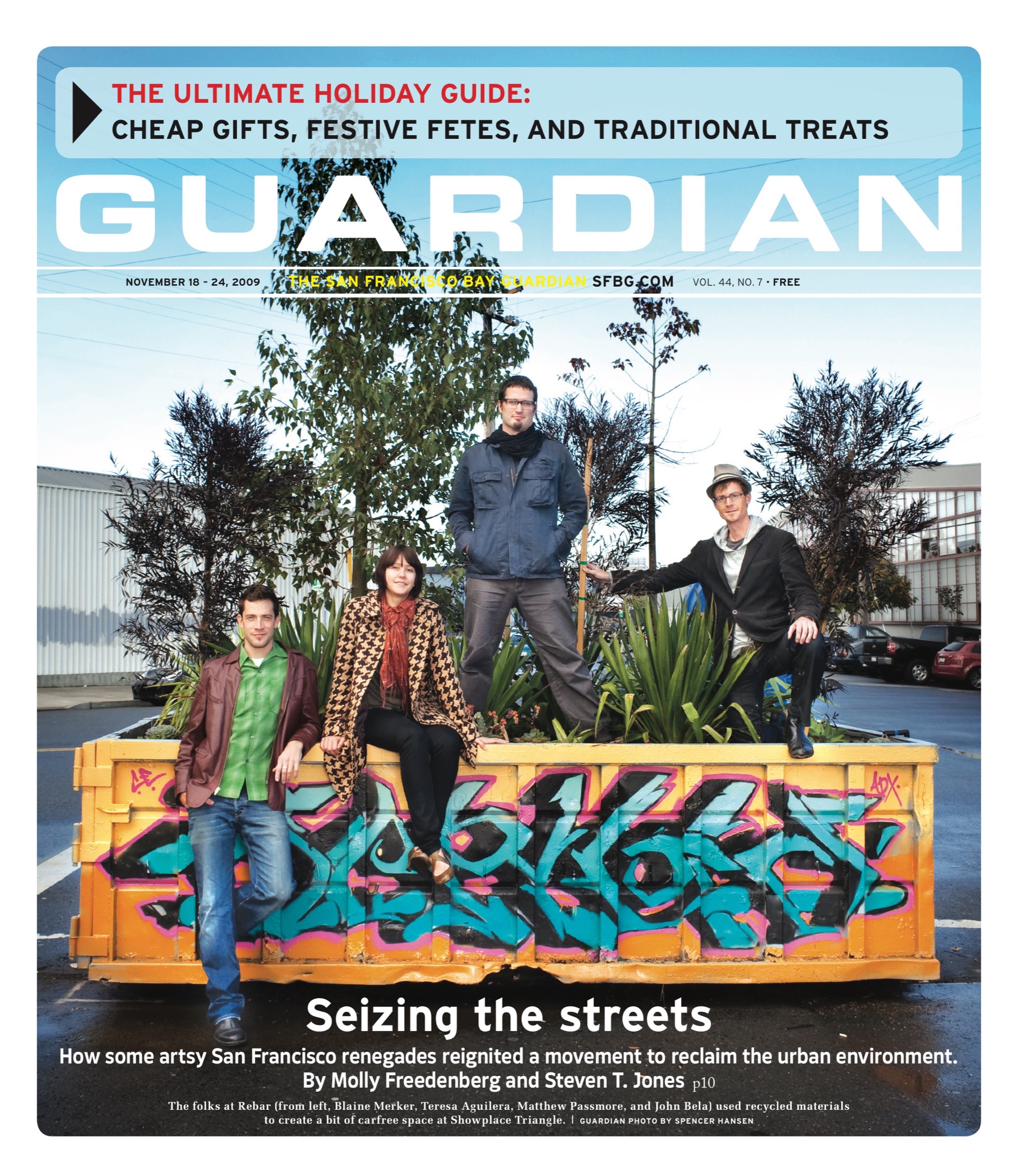
Instead, City Hall called. 079_realcover.jpg Rebar’s Blaine Merker, Teresa Aguilera, Matthew Passmore, and John Bela at their carfreee space at Showplace Triangle

“We got a call from the director of city greening, who said this is great, I want to meet with you guys and talk about how the city can support this kind of activity,” Passmore said. “Much to our surprise, the city was totally responsive as opposed to shutting us down and imprisoning us.”

Bela said the group discovered that Mayor Gavin Newsom’s administration was looking for just the sort of innovative, cool, environmental ideas that were Rebar’s focus. And that connection merged with other people’s efforts — like sidewalk-to-garden conversions being pioneered by Jane Martin, the urban gardening and bicycling movements, and the unique public art that was making its way back from Burning Man. That created a catalyst for a wide array of city initiatives, from the Sunday Streets road closures to temporary art installations that began popping up around the city to the Pavement to Parks program that creates short-term parks in underutilized roadways.

“It was a single interaction five years ago, and now we have things like Sunday Streets,” Bela told us on Sept. 18’s Park(ing) Day, in which various individuals and groups took over more than 50 parking spots around town. “It’s about reclaiming the streets for people.”

Park(ing) Day itself blew up, becoming a worldwide phenomenon that is now in 151 cities on six continents, and one that the Mayor’s Office is planning to turn into a more permanent plan, with the regular conversion of some parking spots on commercial corridors into outdoor seating areas.

“You had a few guys and a girl who had an idea and now it’s an international event,” Mike Farrah, a longtime Newsom lieutenant who now heads the Office of Neighborhood Services and has been the main contact in City Hall for Rebar and similar groups, told the Guardian.

Locally, the success of events like Park(ing) Day have changed San Francisco’s approach to urban spaces, particularly on land left dormant by the economic downturn. Rebar, the permaculture collective Upcycle, and former MyFarm manager Chris Burley plan to turn the old Hayes Valley freeway property near Octavia, between Oak and Fell streets, into a massive community garden and gathering space. Plans are being hatched for temporary uses on Rincon Hill properties approved for residential towers. “Green pod” seating areas are sprouting along Market Street and there are plans to extend the Sunday Streets road closures next year. And, perhaps most amazingly, most projects are being accomplished with very little funding.

How has San Francisco suddenly shifted into high gear when it comes to creating innovative new public spaces? The key is their common denominator: they’re all temporary. As such, they don’t require detailed studies, cumbersome approval processes, or the extensive outreach and input that can dampen the creative spark.

But San Francisco is starting to prove that dozens of short-term fixes can add up to a true transformation of the urban environment and the citizenry’s sense of possibility.


EVOLUTION OF THE PRANK

Rebar began as a group of friends and artists who came together to enter a design contest in 2004. Passmore was a practicing lawyer and Bela was a landscape architecture student at UC Berkeley. They chose the name Rebar for future collaborations, the first of which was Park(ing) Day.

Passmore, who had a background in conceptual art before going to law school, discovered a legal loophole that might allow for anything from a burlesque performance to a temporary swimming pool to be installed in metered parking spaces. Bela recruited Blaine Merker, a fellow landscape architecture student with whom he’d won a design competition, to join the effort.

Park(ing) Day was a hit, getting great press and igniting people’s imaginations. “We realized after we did it, like, oh, people are really getting this,” Merker said. And Rebar was off. In the following years they added a fourth principal, graphic designer Teresa Aguilera, and took on a number of acclaimed projects: planting the Victory Garden in Civic Center Plaza, building the Panhandle Bandshell from old car hoods and other recycled parts, creating COMMONspace events (from “Counterveillance” to the “Nappening”) in privately-owned public spaces, and designing the Bushwaffle (commissioned for the Experimenta-Design biennale in Amsterdam) to help soften paved urban spaces and create a sense of play.

Through it all, the group maintained its prankster spirit. When they were invited to present the Bandshell project at the prestigious Venice Biennale festival, Rebar members showed up costumed as Italian table-tennis players (a joke that mostly baffled other attendees, they said).

They told us every project needed to have a “quotient of ridiculum.” Or as Bela put it, “That’s how we know project has evolved to the right point — when we’re on the floor laughing.”

As Rebar found success, it was still mostly a side project for members who had other full-time jobs. “We were all playing hooky all the time,” said Merker, who, like Bela, joined a landscape architecture firm after he finished school. “It just got worse and worse.”

So now, they’re trying to turn their passion into a profession, recently moving into a cool warehouse office and workspace in the Mission. “We’re shifting our practice a little to have the same sort of spirit but trying to figure out how we can make that an occupation,” Merker said.

It’s also about moving from those short-lived installations to something a little more lasting, even while working within the realm of temporary projects. As Aguilera said, “A lot of the projects we started with were creating moments to maybe think about. But we’re shifting into more permanent ways to interact with the city.”

They may not be sure where they’re headed as an organization, but they have a clear conception of their canvas, as well as the traditions they draw from (including movements like the Situationists and artists such as Gordon Matta-Clark, who worked in urban niche spaces) and the fact that they are part of an emerging international movement to reclaim and redesign urban spaces.

“We’re not the originators of any of this stuff,” Bela said. “It’s like emerging phenomena happening in cities all over the world. We just happened to have plugged into it early on and we continue to push it.”


EXPANDING THE POSSIBLE

Rebar is strongly pushing a reclamation of spaces that have been rather thoughtlessly ceded to the automobile over the last few decades. “Street right-of-way is 25 percent of the city’s land area. A quarter of the city is streets,” Bela said. “And those streets were designed at the time when we wanted to privilege the automobile.

“So basically, there’s all this underutilized roadway,” he continued. “It’s asphalt and it’s pavement, and the city wants to reclaim some of those spaces for people. That’s a thread we’ve been exploring in our work for a long time, and now it’s elevated up to a citywide planning objective.”

The short-term nature of the projects comes in part from political necessity: temporary projects are usually exempt from costly, time-consuming environmental impact reports. Demonstration projects also don’t need the extensive public input that permanent changes do in San Francisco. But there’s more to the philosophy.

“It stands on this proposition that temporary or interim use does actually improve the character of the city,” Passmore said. “People used to think that if something is temporary or ephemeral, what good is it? It’s just here today, gone tomorrow. But I think now people are realizing that the city can be improved like this.”

And it goes even deeper than that. When people see parking spaces turned into parks, vacant lots blossoming with art and conversation nooks, or old freeway ramps turned into community gardens, their sense of what’s possible in San Francisco expands.

“What we’re remodeling is people’s mental hardware. It’s like stretching. You have to bend something a little more than it wants to go, and the next time you do that, it’s that much easier,” Merker said.

“There’s also a psychological aspect to that. When people see a crack in the Matrix open up, if you will, it can open up a whole lot more than just that one moment,” he said.

For those who have been working on urbanism issues in San Francisco for a long time, like Livable City director Tom Radulovich, this new energy and the tactic of conditioning people with temporary projects is a welcome development. “There is a huge resistance to change in San Francisco, no matter what the change is, and a lot of that stems from fear,” Radulovich said. But with temporary projects, he said, “you can establish what success looks like from the outset.”


BUILDING ALLIANCES

The Rebar folks have been fairly savvy in their approach, making key friends inside City Hall, people who have helped them bridge the gap between their idealism and what’s possible in San Francisco.

“We are a process-driven city, and temporary allows you to create change without fear,” Farrah told us. He said the partnership between the Mayor’s Office and community groups that want to do cool, temporary public art really began in the summer of 2005 with the Temple at Hayes Green by longtime Burning Man temple builder, David Best.

Farrah had connections to the Burning Man community, so he facilitated the placement of the temple along Octavia Boulevard, then one of the city’s newest and least developed public spaces. Next came the placement of another Burning Man sculpture, Flock by Michael Christian, in Civic Center Plaza that fall. Both projects got funding and support from the Black Rock Arts Foundation, a public art outgrowth of Burning Man.

“I saw, after some of the temporary art and special events, how it’s changed people’s ideas about what’s possible,” Farrah said. “There has been a change in the way people view the streets.”

That got Farrah thinking about what else could be done, so he approached BRAF’s then-director Leslie Pritchett and Rebar’s Bela, telling them, “I need you to look at San Francisco like a canvas. Tell me the things you want to do, and I’ll tell you if it’s possible or not. And that’s led to a lot of cool stuff.”

Livable city advocates like Radulovich — progressives who are generally not allied with Newsom and who have battled with him on issues from limiting parking to the Healthy Saturdays effort to create more carfree space in Golden Gate Park — give the Mayor’s Office credit for its greening initiatives.

He credits Greening Director Astrid Haryati and DPW chief Ed Reiskin with facilitating this return to urbanism. “He’s really responsive and he gets it,” Radulovich said of Reiskin. “This is really where a lot of energy is going in the mayor’s office. It seems to have captured their imaginations.”

Another catalyst was last year’s visit by New York City transportation commissioner and public space visionary Janette Sadik-Khan, who met with Reiskin and Newsom on a trip sponsored by Livable City and the San Francisco Bicycle Coalition. Radulovich said her message, which SF has embraced, is that, “There are low-cost, reversible ways you can reclaim urban space in the near term.”

The Mayor’s Office, SFBC, and Livable City partnered last year to create Sunday Streets, which involved closing streets to cars for part of the day. The events have proven hugely successful after overcoming initial opposition from merchants who now embrace it.

Then there’s the Pavement to Parks program — which involves converting streets into temporary parks for weeks or months at a time — that grew directly from the Sadik-Khan visit. Andres Power, who directs the program for the Planning Department, told us the visit was a catalyst for Pavement to Parks: “She came to the city a year ago and inspired my director, Ed Reiskin.”

“We’re rethinking what the streets are and what they can be,” Power said. “It’s rewarding to see this stuff happen and to be at the forefront of a national effort to imagine what our streets could be.”


DE-PAVE THE CONCRETE

Pavement to Parks launched last year, a multiagency effort with virtually no budget, but the mandate to use existing materials the city has on hand to turn underutilized streets into active parks. “It looks at areas where we can reclaim space that’s been given over to cars over the decades,” Power told the Guardian.

At the first site, where 17th Street meets Market and Castro, the city and volunteer groups used planters and chairs to convert a one-block stretch of street that was little-used by cars because of the Muni line at the site.

“We bent over backward to make the space look temporary,” Power said, noting the concern over community backlash that never really materialized, leading to two time extensions for the project. “But we’re now ready to revamp that whole space.”

Another Pavement to Parks site at Guerrero and San Jose streets was created by Jane Martin, whom Newsom appointed to the city’s Commission on the Environment in part because of the innovative work she has done in creating and facilitating sidewalk gardens since 2003.

As a professional architect, Martin was used to dealing with city permits. But her experience in obtaining a “minor sidewalk encroachment permit” to convert part of the wide sidewalk near a building she owned on Shotwell Street into a garden convinced her there was room for improvement.

“At that point, I was really jazzed with the result and response [to her garden] and I wanted to make it so we could see more of it,” she said. So she started a nonprofit group called PlantSF, which stands for Permeable Lands As Neighborhood Treasure. Martin worked with city agencies to create a simpler and cheaper process for citizens to obtain permits and help ripping up sidewalks and planting gardens.

“We want to de-pave as much excess concrete as possible and do it to maximize the capture of rainwater,” she said.

Martin said the models she’s creating allow people to do the projects themselves or in small groups, encouraging the city’s DIY tradition and empowering people to make their neighborhoods more livable. More than 500 people have responded, creating gardens on former sidewalks around the city.

“We’ll get farther faster with that model,” she said. “It’s really about engaging people in their neighborhoods and helping them personalize public spaces.”

San Francisco has always been a process-driven city. “We in San Francisco tend to plan and design things to death, so as a result, everything takes a very long time,” Power said.

But with temporary projects under Pavement to Parks, the city can finally be more nimble and flexible. Three projects have been completed so far, and the goal is to have up to a dozen done by summer.

“We’re working feverishly to get the rest of the projects going,” Power said.

One of those projects involves an impending announcement of what Power called “flexible use of the parking lane” in commercial corridors like Columbus Avenue in North Beach. “We’re taking Park(ing) Day to the next level.”

The idea is to place platforms over one or two parking spots for restaurants to use as curbside seating, miniparks, or bicycle parking. “The Mayor’s Office will be announcing in the next few weeks a list of locations,” Power said. “There have been locations that have come to us asking for this.”

“The idea is to do a few of these as a pilot to determine what works and what doesn’t. The goal is to use their trial implementation to develop a permanent process,” Power said. “We want to think of our street space as more than a place for cars to drive through or park.”

Rebar was responsible for the last of the completed Pavement to Parks projects. Known as Showplace Triangle, it’s located at the corner of 16th and Eighth streets in the Showplace Square neighborhood near Potrero Hill. For Rebar, it was like coming full circle.

“We started doing this stuff about five years ago, finding these niches and loopholes and exploring interim use as a strategy for activating urban space,” Bela said. “And to our surprise, what we perceived as a tactical action is now being embodied by strategic players like the Planning Department.”


REUSE, RECYCLE, REINVENT

The Rebar crew was like kids in a candy store picking through the DPW yard.

“These projects are all built with material the city owns already, so we had the opportunity to go down to the DPW yard and inventory all of these materials they had, and figure out ways to configure them to make a successful street plaza,” Bela said.

So they turned old ceramic sewer pipes into tall street barriers topped by planter boxes, and built lower gardens bordered by old granite curbs.

“We are trying to be as creative as possible with the use of materials the city already has on hand,” Power said. In addition to the DPW yard that Rebar tapped for Showplace Triangle, Power said the Public Utilities Commission, Port of SF, and the Recreation and Parks Department all have yards around the city that are filled with materials.

“They each have stockpiles of unused stuff that has accumulated over the years,” he said.

For her Pavement to Parks project on Guerrero, Martin used fallen trees that originally had been planted in Golden Gate Park — pines, cypress, eucalyptus — but were headed for the mulcher. Not only were they great for creating a sense of place, they offered a nod to the city’s natural history.

But perhaps the coolest material that had been sitting around for decades was the massive black granite blocks that Rebar incorporated into Showplace Triangle. “One of the most interesting materials that we used in Showplace Triangle was the big granite blocks from Market Street that were taken off because merchants didn’t like people encamping there. They were too successful as spaces, so they got torn out,” Merker said.

Bela said they couldn’t believe their eyes: “We saw these stacks of five-by-five by one-foot deep black granite. Just extraordinary. If we were to do a public project today, we could never afford that stuff. There’s no way. But the taxpayers bought that stuff back in the ’70s and now it’s just sitting there in the DPW yard. It’s a crime that it’s not being used, so it was great to get it back out on the street.”

Radulovich said the return of the black granite boxes to the streets represents the city coming full circle. He remembers talking to DPW manager Mohammad Nuru as he was removing the last of them from Market Street in the 1970s, citing concerns about people loitering on them.

“To see them put up again in JB’s project was symbolic of where the city went and where it’s coming back from,” Radulovich said. “It’s almost like the livability revolution got interrupted and we lost two decades and now it’s picking up again.”

Back in the 1970s, Radulovich said the city was actively creating new public spaces such as Duboce Triangle. It was also creating seating along Market Street and generally valuing the creation of gathering places. But in the antitax era that followed, public sector maintenance of the spaces lagged and they were discovered by the ever-growing ranks of the homeless that were turned loose from institutions.

“The fear factor took over,” Radulovich said. “We did a lot to destroy public spaces in the ’80s and ’90s.”

But by creating temporary public spaces, people are starting to realize what’s been lost and to value it again. “These baby steps are helping us relearn what makes a good public space,” Radulovich said.

For much of the younger generation, building public squares is a new thing. As Aguilera noted, “We don’t have a lot of public plazas anymore or places for people to gather. When Obama was elected, where did everyone go in the city? Into the streets. So we’re trying to give that back to the city.”


CARS TO GARDENS

Perhaps the most high-profile laboratory for these ideas is the Hayes Valley Farm, a temporary project planned for the 2.5 acres of freeway left behind after the Loma Prieta earthquake. The publicly-owned land between Oak and Fell streets is slated for housing projects that have been stalled by the slow economy.

“The site’s been vacant for 10 years. They came up with a beautiful master plan. And the moment they’re ready to move on the master plan, there’s an economic collapse, so nothing is happening,” Bela said.

In the meantime, the Mayor’s Office and Hayes Valley Neighborhood Association pushed for temporary use of the neglected site. They approached the urban farming collectives MyFarm and Upcycle. Later, Rebar was brought in to design and coordinate the project.

Now the group known as the Hayes Valley Farm Team has an ambitious plan for the area: part urban garden, part social gathering spot, and part educational space. There will be an orchard of fruit trees, a portable greenhouse, demonstrations on urban farming, and a regular farmers market.

“The different topography of ramps allows for different growing conditions. These ramps are prime exposure to the south,” Merker said. “They create these areas that can produce some really great growing conditions, so it’s kind of funny that this freeway is responsible for that. The ramps actually create different microclimates.”

Most remarkably, the whole project is temporary, designed to be moved in three years. “We’re interested in developing infrastructure and tools and machinery and implements that are sort of coded for the scale of the city: a lot of pedal-powered things, a lot of mobile infrastructure, and smaller things that are designed to be useful in a plot that is only 2.5 acres,” Bela said. “Then when we need to move on, we’ll be able to do that. It’s about being strategic with some of the investments so we can take some of the tools we develop here and move it to the next vacant lot down the street.”

The project has lofty goals, ranging from creating a social plaza in Hayes Valley to educating the public about productive landscaping. “We’re getting away from ideas of turning parks into food production — it can be both,” said David Cody of Upcycle. “We want to just crack the awareness that cities can be multi-use and agriculture doesn’t mean farm.”

This is perhaps the most ambitious temporary project the Mayor’s Office has taken on. “Rebar pushed the envelope on what is possible. I told them it would be a tough one,” Farrah said of the project. But he loves the concept: “You can argue that putting gardens in temporary spaces changes attitudes.”

Symbolically, this land seems the perfect place for such an experiment. “This really is a special spot. If you look at a map of the city, Hayes Valley is in the very center, and this is right in the heart of Hayes Valley,” Aguilera said. “And right now, in the heart of a neighborhood in the heart of the city, there’s this vacant, fallow reminder of what used to be there. We’re looking to turn it into a new beating heart that brings together lots of different parts of the community.”


ACTIVATING DORMANT SPACES

Activating dormant spaces in the city isn’t easy, particularly for properties with pending projects. In Hayes Valley, for example, the Rebar crew was required to develop a detailed takedown plan.

“A lot of development is hesitant to get involved with these interim uses because at the end, they’re worried that it’s going to be framed as the evil, money-hungry developer coming in to kick out artists or farmers,” Passmore said. “But the reality is, they are very generously opening up their space is the first place.”

With last year’s crash of the rental estate and credit markets, development in San Francisco stalled, leaving potentially productive land all over the city. “As the city has gone through an economic downturn, like now, the city has a lot of vacant lots with developer entitlements on them, but nothing is being built right now. Those are spaces the public has an interest in,” Merker said, citing Rincon Hill as a key example.

Michael Yarne, who facilitates development projects for the Mayor’s Office of Economic Development, has been working on how developers might be encouraged to adopt temporary uses of their vacant lots.

“How can we credit them to do a greening project on a vacant lot?” Yarne asks, a problem that is exacerbated by the complication that neither the developers nor local government have money to fund the interim improvements.

He looked at the possibility of using developer impact fees on short-term projects, but there are legal problems with that approach. The courts have placed strict limits on how impact fees are charged and used, requiring detailed studies proving that the fees offset a project’s real cost and damage.

“But there is other value we can give as a city without spending a dollar — and that is certainty,” said Yarne, a former developer. He said developers value certainty more than anything else.

Right now, developers have to return to the Planning Commission every year or so to renew project entitlements, something that costs time and money and potentially places the project at risk. But he said the city might be able to enter into developer agreements with a project proponent, waiving the renewal requirement for a certain number of years in exchange for facilitating short-term projects.

“Everyone wins. We get a short-term use, and the developer gets certainty that they won’t lose their rights,” Yarne said, noting that he’s now developing a pilot project on Rincon Hill. “If that works, that could be a template we could use over and over.”

Radulovich is happy to see the new energy Rebar and other groups are infusing into a quest to remake city streets and lots, and with the use of temporary projects to expand the realm of the possible in people’s minds: “Let’s get people reimagining what the streets could be.”

www.rebargroup.org

Appetite: Food for Thought helps Mission grads, Frescobaldi gets Luce

0

Every week, Virginia Miller of personalized itinerary service and monthly food, drink, and travel newsletter, www.theperfectspotsf.com, shares foodie news, events, and deals. View the last installment here.

foodforthought1109.jpg
Digging into some Food for Thought

11/11-11/23 of the Mission’s best restaurants participate in "Food for Thought" to help Mission grads get to college
Do nothing but eat out at one of your favorite Mission restaurants this Wednesday night and you’ll be helping some of the neediest Mission high school grads get to college. With 23 of the ‘hood’s best restaurants participating, a portion of all dinner sales (restaurants have committed anywhere from 25-100% of that night’s sales) go to Food for Thought. In it for the long haul, Food for Thought offers, among other things, tutoring centers for elementary school kids, academic support groups in junior high, and college prep programs for high school students, working with them through each phase of schooling. There’s even raffle prizes at each restaurant, like a trip for two to Mexico. You don’t have to be told twice to eat out at Range, Mission Beach Cafe, Little Star Pizza, or Bar Bambino, do you?
11/11 regular hours at 23 Mission restaurants
List of participating restaurants: www.missiongraduates.org/foodforthought

————-

rest1109.jpg
A Luce interior

11/11 – Luce celebrates its Michelin Star with the Frescobaldi family
It’s an honor for a chef to receive a Michelin star, especially a French chef like our own Dominique Crenn at Luce in the Intercontinental Hotel (she’s also on this season of The Next Iron Chef). Luce celebrates in a big way by cooking a 6-course Tuscan feast, Inspirations of Tuscany, with Marchesi de’ Frescobaldi’s wine estates’ executive chef, Donatella Zampoli. Frescobaldi, the legendary Italian family who even traded their wines with Michelangelo back in the day, will, naturally, be pairing their wines with dinner. Not only is this a rare, special night, but $10 of every 6-course dinner benefits CUESA, so the focus remains local as it is international. Courses include Thomas Family Farms potato gnocchi with bone marrow and lobster paired with a glass of 2006 Attems Cicinis, or sweetbread and beef tongue with potato espuma (foam to you), slow cooked egg and pancetta jus partnered with a 2005 Nipozzano Riserva Chianti Classico. Can’t make it out Wednesday? The party rolls on all month until November 21, with a 4-course Michelin Star prix-fixe menu available any night for $60 per person.
$75; $30 for wine pairings
11/11 – make a reservation during regular hours, 5-11pm
888 Howard Street
415-616-6566

www.lucewinerestaurant.com

Events listings

0

Events listings are compiled by Paula Connelly. Submit items for the listings at listings@sfbg.com. For further information on how to submit items for the listings, see Picks.

WEDNESDAY 11

Food for Thought Participating restaurants in the Mission District, SF; www.missiongraduates.org/foodforthought. All day, free. Enjoy some of what the Mission has to offer while helping to invest in it’s future at this annual dine-out fundraiser for Mission Graduates, a nonprofit that prepares Mission youth for college careers. Participating restaurants will donate 25-100% of your total bill.

THURSDAY 12

From the Hood to the House San Francisco War Memorial Opera House, 301 Van Ness, SF; (415) 674-6117. 7pm, $75-500. A benefit to honor Reverend Cecil Williams’ 45th anniversary at Glide featuring Maya Angelou, Rita Moreno, Alonzo King LINES Ballet, San Francisco Opera Adler Fellows, San Francisco Opera Orchestra, and more.

Sugar Rush 111 Minna, 111 Minna, SF; (415) 626-5470. 7pm, $60. Attend a sweet fundraiser benefiting Spark, a local youth empowerment organization that organizes one-on-one apprenticeships, featuring unlimited dessert-tastings from high end restaurants like Boulevard, Chez Panisse, Range, Humphry Slocombe, and more.

FRIDAY 13

A Country Called Amreeka Arab Cultural and Community Center, 2 Plaza, SF; (415) 664-2200. 7pm, $5-10 suggested donation. Hear Syrian- American civil rights lawyer and author Alia Malek discuss her new book A Country Called Amreeka: Arab Roots, American Stories.

Drinking and Dancing The Lab, 2948 16th St., SF; (415) 407-0225. 8pm, free. A sport under recognized, dancing with a drink-in-hand requires coordination with your beverage, your partner, the music, and your liver. Join in the open floor competition followed by a knockout tournament. Stronger drinks awarded more points.

Farming and Food Golden Gate University School of Law, 536 Mission, SF; (415) 442-6636. 9am, $30. Attend this Environmental Law and Policy Conference that takes a look at the role law and policy plays in shaping aspects of food.

Green Festival Concourse Exhibition Center, 635 8th St., SF; 1-800-58-GREEN. Fri. Noon-7pm, Sat. 10am-7pm, Sun. 11am-6pm; $15. Discover the latest in renewable energy and green technology, savor Fair Trade, organic, and natural foods and beverages, and learn how to incorporate sustainability at home at this annual festival that integrates all aspects of environmentalism into one fun and educational event.

Masked Soirée DNA Lounge, 375 11th St., SF; (415) 626-1409. 9pm, $18. Enjoy a sexy soirée with live music, performances by Burlesque Deviant Nation models, suspension acts, an art auction, and a costume contest with free subscriptions to Deviant Nation magazine.

Young Workers United Station 40, 3030B 16th St., SF; (415) 621-4155. 7pm, free. Buy art, dance, and donate money to benefit Young Workers United, a nonprofit dedicated to improving working conditions of young people and immigrants in low wage, service sector jobs.

SATURDAY 14

Coats for Cubs Buffalo Exchange, 1210 Valencia, SF; 1555 Haight Street, SF; 1-866-235-8255. Starting Nov. 14 through Earth Day on April 22, 2010. Bring your real fur apparel, including trims and accessories, to any Buffalo Exchange store and help provide bedding and comfort to orphans and injured wildlife. Condition of fur is unimportant.

Golden Gala Castro Theater, 429 Castro, SF; (415) 863-0611. 8:15pm, $35. Attend this tribute to Golden Girl Rue McClanahan, appearing live in-person, featuring performances by SF Golden Girls and a "Golden Girls Gone Wild" contest with cash prizes.

Mural Walks Café Venice, 3325 24th St., SF; (415) 285-2287. 11am, $12. Tour over 60 murals in this 10-block walk organized by Precita Eyes Mural Arts and Visitors Center. Other walking tours available, go to www.precitaeyes.org for details.

BAY AREA

A Day at Pixar Pixar Animation Studios, 1200 Park Ave., Emeryville; (415) 227-8666. 11am for VIP and 1pm for Family ; $35-149, advanced tickets required. Experience the world of Pixar films behind the scenes at this fundraiser for San Francisco’s Cartoon Art Museum. See art, sculptures, and other items from the Pixar archives, get a crash course on how to draw Pixar characters, and watch a selection of Pixar short films. VIP ticket holders can also enjoy special full length movie screenings, discussions with crew and staff, and discounts at the Pixar store.

SUNDAY 15

Outdoor Bootcamp Kezar Stadium Track, Frederick at Stanyan, SF; www.02athletics.com. 7am, free. Get motivated and start moving your ass at this free weekly workout session.

BAY AREA

Fur Ball Fundraiser Hopalong Animal Rescue, 5749 Doyle, Emeryville; (510) 267-1915×103. 1pm, $40. Help support Hopalong Animal Rescue at this fundraiser featuring live music, hors d’oeuvres, wine tasting, a silent auction, and special guest KTVU anchorman Frank Somerville. Hopalong offers rescue, placement, prevention and outreach programs to the community and strives to eliminate the euthanasia of adoptable animals.

MONDAY 16

Amy Goodman First Congregational Church of Berkeley, 2345 Channing, Berk.; 1-800-838-3006. 7pm, $15. Hear investigative journalist, Democracy Now! host, and New York Times best-selling author Amy Goodman discuss her new book, Breaking the Sound Barrier. Event to benefit KPFA radio.

TUESDAY 17

Gardening in Small, Urban Spaces San Francisco Public Library, 100 Larkin, SF; (415) 557-4500. 6pm, free. Permaculturist Fred Bove takes us beyond the herb garden with a discussion about the possibilities, and produce, that can be coaxed out of tiny spaces for little effort or money.


Appetite: Food for Thought helps Mission grads, Frescobaldi gets Luce

0

Every week, Virginia Miller of personalized itinerary service and monthly food, drink, and travel newsletter, www.theperfectspotsf.com, shares foodie news, events, and deals. View the last installment here.

foodforthought1109.jpg
Digging into some Food for Thought

11/11-11/23 of the Mission’s best restaurants participate in "Food for Thought" to help Mission grads get to college
Do nothing but eat out at one of your favorite Mission restaurants this Wednesday night and you’ll be helping some of the neediest Mission high school grads get to college. With 23 of the ‘hood’s best restaurants participating, a portion of all dinner sales (restaurants have committed anywhere from 25-100% of that night’s sales) go to Food for Thought. In it for the long haul, Food for Thought offers, among other things, tutoring centers for elementary school kids, academic support groups in junior high, and college prep programs for high school students, working with them through each phase of schooling. There’s even raffle prizes at each restaurant, like a trip for two to Mexico. You don’t have to be told twice to eat out at Range, Mission Beach Cafe, Little Star Pizza, or Bar Bambino, do you?
11/11 regular hours at 23 Mission restaurants
List of participating restaurants: www.missiongraduates.org/foodforthought

————-

rest1109.jpg
A Luce interior

11/11 – Luce celebrates its Michelin Star with the Frescobaldi family
It’s an honor for a chef to receive a Michelin star, especially a French chef like our own Dominique Crenn at Luce in the Intercontinental Hotel (she’s also on this season of The Next Iron Chef). Luce celebrates in a big way by cooking a 6-course Tuscan feast, Inspirations of Tuscany, with Marchesi de’ Frescobaldi’s wine estates’ executive chef, Donatella Zampoli. Frescobaldi, the legendary Italian family who even traded their wines with Michelangelo back in the day, will, naturally, be pairing their wines with dinner. Not only is this a rare, special night, but $10 of every 6-course dinner benefits CUESA, so the focus remains local as it is international. Courses include Thomas Family Farms potato gnocchi with bone marrow and lobster paired with a glass of 2006 Attems Cicinis, or sweetbread and beef tongue with potato espuma (foam to you), slow cooked egg and pancetta jus partnered with a 2005 Nipozzano Riserva Chianti Classico. Can’t make it out Wednesday? The party rolls on all month until November 21, with a 4-course Michelin Star prix-fixe menu available any night for $60 per person.
$75; $30 for wine pairings
11/11 – make a reservation during regular hours, 5-11pm
888 Howard Street
415-616-6566

www.lucewinerestaurant.com

Greens

0

paulr@sfbg.com

If there is a better-known vegetarian restaurant in the world than Greens, I’ve never heard of it. But — that sounds a little like hype, and hype is on cozy terms with falsehood. Greens is also 30 years old this year, and since restaurants often age in dog years, or worse, we are talking about a place that can’t ignore the many risks of geriatric life, among them fatigue, complacency, boredom, and a descent into tourist-trappiness. No doubt there are others.

Apart from the fusty, undersized sign above the door, Greens still looks sensational. It helps, surely, that the restaurant was designed around a giant wall of multi-light windows that look directly west, across the Marina to the Golden Gate Bridge. Stepping into the restaurant (from the Fort Mason parking lot, prosaic even by parking-lot standards) is like stepping into a postcard; even the tables away from the windows have an expansive view of sea and sky. (And even the table for four in the small, semi-private room at the south end of the main dining room has a commanding view of the bridge.)

A view can be a mixed blessing. View restaurants are often bad, while vegetarian restaurants can be pointedly austere. Greens incorporates its singular view into a theme of subdued, white-linen elegance that gives no clue to the meatless nature of the food. It is one of those rare places that combines high style and a pedigreed menu with something for everyone, even doubtful omnivores.

Greens’ cuisine, in fact, has long seemed to me to have more in common with that of Zuni Café, its exact contemporary, than with the city’s other tony vegetarian temples. The grill is skillfully deployed for smokiness, and the rustic cooking of Italy is well-represented on the menu, since so much of Italian cuisine is naturally meatless and produce-driven. But the kitchen takes inspiration and influences from around the world, including Southeast Asia and the American Southwest.

For a quarter-century, my foundational text for vegetarian cooking has been The Greens Cookbook by Deborah Madison. Madison was Greens’ opening chef, but she left in the early 1980s and was replaced by Annie Somerville, who still runs the show while having published several Greens-related cookbooks of her own, which I also regularly consult. Given the stability in the kitchen, it’s not surprising that the restaurant’s cooking style hasn’t changed much over the years. In fact, you can still get the fabled black-bean chili, a dish about as old as the place itself and muscley enough to sate most meat-eaters.

But … how about a pizza to start? In the early 1990s, on my first visit to Greens, I noticed that the menu offered the same Mexican pizza I’d been making from the cookbook. I was prepared to be shamed, but the restaurant’s pie turned out to be a disappointment, mainly because of a stinginess (it seemed to me) with the toppings. As a home cook, I applied toppings with abandon, but home cooks don’t have to make a profit.

Nonetheless, the gods must somehow have divined my dismay, because a recent corn and grilled onion pizza ($16) was a veritable cornucopia of late-summer bounty: corn kernels, yellow cherry tomatoes as sweet-tart as fruit, plenty of cheese (fontina and grana padano), and blobs of garlicky pesto, all on a nicely blistered crust. It was like waking up on Christmas morning and finding even more presents under the tree than you had tentatively counted the night before. But I am mixing my seasonal imagery. The interval from Labor Day to Thanksgiving could well be the best time to visit Greens, since the kitchen still has access to summer produce even as the delights of autumn (among them peppers and squash) start to trickle in.

Squash — sunburst and butternut — figured in the fabulous Zuni stew ($14.50), "Zuni" here being a reference to the Indian tribe, not the restaurant. The stew (arranged around a set of grilled polenta triangles) was a mélange of (besides the cubed squash) corn kernels, Rancho Gordo beans, diced red bell peppers, carrots, broccoli, and roasted Early Girl tomatoes and flavored with onions, ancho chilis, majoram, sage, and chipotle lime butter. It was tasty, colorful, noticeably spicy, and managed to honor a pair of seasons as well as the ancient Indian trifecta of corn, beans, and squash.

Back to the Mediterranean for the farro sampler ($16.75), a potpourri of farro salad scented with lemon and mint, cucumber coins, cherry tomatoes, summer and shelling beans with tarragon, baby beets on a mache nest, hummus (garlicky!), black and green olives, triangles of grilled pita, and a rather thrilling, earthy-sweet tomato jam that went nicely with the pita and hummus but could as easily been spooned over vanilla ice cream.

Some ice creams — huckleberry, say — don’t need and probably wouldn’t accept such help. Huckleberry ice cream (the color of grape chewing gum) turned up in the company of a wonderful apple-huckleberry galette ($8.75) whose pecan streusel could have stood on its own, or perhaps with the cardamom cream mille-feuille laid atop slices of roasted pear ($8.50). I have never entirely accepted the stewed or poached pear, but roasting helps retain firmness — an important consideration with pears, whether red, green, or some other color.

GREENS

Dinner: Nightly, 5:30–9 p.m.; Lunch: Tues.–Sat., 11:45 a.m.–-2:30 p.m.;

Brunch: Sun., 10:30 a.m.–2 p.m.

Bldg. A, Fort Mason Center

(415) 771-6222

www.greensrestaurant.com

Beer and wine

AE/DS/MC/V

Not noisy

Wheelchair accessible

Fall Feast 2009

0

Man (and woman) cannot live on PBR and pasta alone. I should know. I spent the whole summer trying. But now that my leftover Burning Man groceries are gone and the weather’s getting colder, I can’t help but crave real food again. And what better time and place is there to be really, really hungry for a substantial meal made with fresh ingredients than right now in San Francisco? Despite the struggling economy, innovative restaurants keep popping up — and the old classics are offering better deals. Plus, the changing culinary landscape has led to all kinds of fun, cheap, gourmet alternatives like pop-ups, lunch carts, and temporary restaurants-within-a-restaurant. This edition of FEAST, our drinking and dining magazine, focuses on what we love about the Bay Area’s food scene, from innovative locales to cross-cultural alternatives, from wintery suppers to summery desserts (after all, how cold does it ever really get here?), and from new restaurants to a niche bookstore that only a foodie-city like San Francisco could support. Whether you’re ready to start your Thanksgiving feasting early or are simply transitioning out of your warm-weather diet (or budget), we’re sure you’ll find something in the coming pages to satisfy your cravings. Unless, that is, you’re looking for PBR and pasta. You’ll have to take care of that one on your own — or wait ’til next summer. (Molly Freedenberg)


>>10 latest, greatest openings


>>6 supper-worthy soups


>>4 fine wine bars


>>6 innovative ice creams


>>4 phenomenal falafels


>>A readable feast: Q&A with Omnivore’s Celia Sacks

Appetite: Cliff House hits 100, juicy “Appetite City”

0

Every week, Virginia Miller of personalized itinerary service and monthly food, drink, and travel newsletter, www.theperfectspotsf.com, shares foodie news, events, and deals. View the last installment here.

cliffhouse1009.jpg

11/4 Cliff House Centennial Celebration
Cliff House is one of our San Francisco classics, surviving fires and decades with seaside dining over crashing waves and sunset vistas. In 1909, the third “fire-proof” incarnation was built by Adolph Sutro’s daughter, Dr. Emma Merritt, after the original two locations burnt to the ground. There have been numerous renovations, the last in 2004, two restaurants, the Bistro and more upscale Sutro’s, and George Morrone came on as chef for a time, raising menu offerings commensurate with the views.

CliffHouseGown1009.jpg

Cliff House’s centennial celebration is coming up on November 4. Though it does cost a lofty $175, there’s no other party quite like it. Benefiting Golden Gate National Parks Conservancy, there will be an intriguing auction of period ball gowns made from recycled Cliff House menus, memorabilia and photographs, by 3D designer, Mari O’Connor. Fashion buffs, check out sketches of the gowns representing various eras throughout the century – sure to be a highlight of the night.

While savoring hors d’oeuvres and cocktails, there’s a Beach Blanket Babylon performance, dancing to the Reinhardt Swing Band or a DJ in the Terrace Room, historical exhibits, with hosts, Gene Burns and John Rothmann, of KGO radio, and comedian, Bob Sarlatte.

If that’s too much money to swing, commemorate 100 years in the Bistro on Wednesday nights with a $19.09 three-course prix fixe, or Sutro’s $20.09 three-course lunch every Tuesday, through the end of 2009.
Wednesday, November 4
6:30pm
$175
1090 Point Lobos
415-386-3330
Vintage attire or black tie eveningwear

www.cliffhouse.com

AppetiteCity1009a.jpg

Oct. 28 — William Grimes talks about his latest book, “Appetite City”, at Omnivore Books
William Grimes is a former restaurant reviewer for the New York Times whose book, Straight Up or on the Rocks: The Story of the American Cocktail, ignited my passion for the history of the cocktail, leading to excessive reading on the subject afterwards. His knowledge of drink and food is both broad and deep. I’m eager to hear him talk about his latest, Appetite City: A Culinary History of New York, at Omnivore Books in Noe next Wednesday. The book covers the daring, multicultural past of New York’s food scene with Grimes’ impeccable historical writing and attention to detail, plus more than 100 photographs and rare menus. Food and restaurant lovers will find something of interest here – but arrive early enough to squeeze into Omnivore’s small space.
Wed/28, 6-7pm, free
3885A Cesar Chavez
415-282-4712

Omnivore Books

Appetite: Cliff House hits 100, juicy “Appetite City”

0

Every week, Virginia Miller of personalized itinerary service and monthly food, drink, and travel newsletter, www.theperfectspotsf.com, shares foodie news, events, and deals. View the last installment here.

cliffhouse1009.jpg

11/4 Cliff House Centennial Celebration
Cliff House is one of our San Francisco classics, surviving fires and decades with seaside dining over crashing waves and sunset vistas. In 1909, the third “fire-proof” incarnation was built by Adolph Sutro’s daughter, Dr. Emma Merritt, after the original two locations burnt to the ground. There have been numerous renovations, the last in 2004, two restaurants, the Bistro and more upscale Sutro’s, and George Morrone came on as chef for a time, raising menu offerings commensurate with the views.

CliffHouseGown1009.jpg

Cliff House’s centennial celebration is coming up on November 4. Though it does cost a lofty $175, there’s no other party quite like it. Benefiting Golden Gate National Parks Conservancy, there will be an intriguing auction of period ball gowns made from recycled Cliff House menus, memorabilia and photographs, by 3D designer, Mari O’Connor. Fashion buffs, check out sketches of the gowns representing various eras throughout the century – sure to be a highlight of the night.

Events listings

0

Events listings are compiled by Paula Connelly. Submit items for the listings at listings@sfbg.com.

WEDNESDAY 21

Distribution Workshop Artists’ Television Access, 992 Valencia, SF; festival@atasite.org. 7:30pm, free. Gain insight into the world of experimental film exhibition and distribution at this workshop and panel discussion featuring Joel Bachar from Microcinema International, filmmaker Jonathan Marlow from SFcinemateque, filmmaker Maia Carpenter from Canyon Cinema, filmmaker Craig Baldwin from Other Cinema, and associate editor and producer of Wholphin, Emily Doe.

Root Division Auction Root Division, 3175 17th St., SF; (415) 863-7668. 7:30pm, $35. Support artists and arts education at this community auction and benefit for local emerging artists and Root Division’s after school art program for Bay Area youth.

FRIDAY 23

Art in Storefronts 989 Market, SF; www.sfartscommission.org/storefronts. 5pm, free. Enjoy live music and pick up a map at the opening party for the Art in Storefronts program, where participating storefronts along central Market and Taylor streets will display original window installations done by San Francisco artists.

Crush It! The Booksmith, 1644 Haight, SF; (415) 863-8688. 6pm; $22, includes book. Meet Gary Vaynerchuk, host of the popular daily webcast The Thunder Show on tv.winelibrary.com, and get a copy of his new book Crush It! Why now is the time to cash in on your passion, a guide on how to turn your interests into businesses.

Haunted Haight Walking Tour Starts in front of Coffee to the People, 1206 Masonic, SF; (415) 863-1416. Fri., Sat., and Sun throughout October, 7pm; $20 advanced tickets required. Discover neighborhood spirits and hunt ghosts with a real paranormal researcher on this haunted tour which includes chances to win spooky prizes and a guidebook.

Leon Panetta Intercontinental Mark Hopkins, 999 California, SF; (415) 869-5930. 11am, $30. Hear CIA director and California native Leon Panetta discuss the current challenges facing national security. Attendees may be subject to search.

SATURDAY 24

BYOQ Music Concourse, Golden Gate Park, 55 Hagiwara Tea Garden Drive, SF; www.byoq.org. Noon, free. Come dance and play at the Bring Your Own Queer music and arts festival featuring bands, DJs, performances, art, fashion, and more.

Passport 2009 Mission Playground, Valencia between 19th and 20th St., SF; (415) 554-6080. Noon, $25 for booklet. Pick up a map and purchase a "passport" at Mission Playground and begin your adventure to various locations around the Mission to collect artist-made stamps that will personalize your Passport 2009 journey.

Save City College Sale Parking area of the Balboa Reservoir across from the San Francisco City College Ocean Campus Science Hall, 50 Phelan, SF; www.ccsf.edu/saveccsf. 9am-2pm, free. Help restore canceled classes at the City College of San Francisco for the Spring 2010 semester at this Save City College garage sale and flea market.

Opera Costume Sale San Francisco Opera Scene Shop, 800 Indiana, SF; sfopera.com. Sat. 11am-5pm, Sun. 11am-4pm; free. Get a last minute Halloween costume at the San Francisco Opera’s warehouse sale featuring hats, masks, fabrics, shoes, and handmade costumes for women, men, and children.

Potrero Hill History Night International Studies Academy, 655 De Haro, SF; (415) 863-0784. 5:30pm; free program, $6 for BBQ. Enjoy BBQ from Potrero Hill restaurants and music by the Apollo Jazz Group, followed by a performance by the I.S.A. Community Choir, and ending with interviews of unique long-time residents.

Walk for Farm Animals Ferry Market Plaza, meet behind the Vallicourt Fountain in Justin Herman Plaza, SF; 607-583-2225. Noon, $20. Help expand awareness of the unnecessary suffering that farm animals endure and help raise funds for Farm Sanctuary, a farm animal rescue, education, and advocacy organization.

BAY AREA

Exotic Erotic Ball Cow Palace 2600 Geneva, Daly City; (415) 567-BALL. 8pm, $79. Attend the 30th anniversary of the Exotic Erotic Ball, a lingerie, fetish, and masquerade celebration of human sexuality and freedom of expression featuring live music, DJs, and costume contests.

SUNDAY 25

BAY AREA

Sister of Fire Awards Oakland Asian Cultural Center, 388 9th St., Oak; (510) 444-2700. 11am, $50-5,000. Help honor four remarkable women: Civil rights and immigration advocate Banafsheh Akhlaghi, Colombian indigenous rights advocate Ana Maria Murillo of Mujer U’wa, employment and labor rights advocate and author Lora Jo Foo and Tirien Steinbach of the East Bay Community Law Center. Featuring brunch and live music.

MONDAY 26

Ghosts of City Hall SF City Hall, meet at South Light Court, through Polk street entrance, 1 Dr. Carlton B. Goodlett Place, SF; (415) 557-4266. 6:30pm, free. Hear stories of disinterred remains, assassinations, and other ghostly lore, like the little-known fact that a cemetery once covered Civic Center. Allow time for security check.

Meister: Shake now, buy later

0

By Dick Meister

Attention fans of free enterprise: After the earthquake on Oct. l7, 1989, almost everyone with something to sell quickly began peddling earthquake specials

(Dick Meister is a longtime San Francisco journalist.)

Fans of free enterprise undoubtedly were pleased that the earthquake which caused such great damage in the Bay Area on Oct. 17, 1989, didn’t so much as dent the spirit of local entrepreneurs. They lost none of their eagerness to exploit any and all situations to their advantage – natural disasters unquestionably included.

Bankers and lawyers and utility companies, insurers, furniture and appliance stores, contractors and condo salesmen, jewelers and art dealers, office supply firms, clothiers, supermarkets, fast food outlets, hotels and restaurants, T-shirt vendors …

Brütal odyssey

0

>>Read Ben Richardson’s full interview with Tim Schafer here

arts@sfbg.com

GAMER "The first time we pitched it, they wanted us to change the genre, to make it about country or hip-hop or something."

Game designer Tim Schafer is sitting in his SoMa office, in his favorite chair — appropriately, a rocking chair — and talking about his masterpiece. "They were saying, ‘Why don’t you open it to all music?’ We said, ‘Look — this is a game about epic battles, good vs. evil, Braveheart-type moments. And heavy metal is the musical genre that focuses heavily on folklore. It sings about medieval combat. It’s really the only genre that makes sense for it.’"

The game is Brütal Legend (Double Fine/EA), and in the end, Schafer got his way. Taking control of Eddie Riggs, a grizzled roadie voiced by Jack Black, the player journeys through a metal landscape inspired by the album covers the designer studied in his youth. Wielding a massive battle-ax and a magical guitar, Riggs encounters righteous friends and fiendish foes, including characters voiced by luminaries like Lemmy Kilmister, Ozzy Osbourne, Rob Halford, and Lita Ford. The soundtrack is a carefully compiled list of headbang-inducing classics.

Schafer agrees that the game is his most personal creation to date. "All games are wish fulfillments. All games are about fantasy. This is a game where I’ve been able to make my own wish fulfillment. I would like to go back in time with a cool car and a battle-axe while listening to heavy metal."

THE TROOPER

Growing up in Sonoma, the designer escaped his suburban life by rocking out to Ozzy Osbourne, Black Sabbath, Judas Priest, and Iron Maiden. He would drive down to San Francisco for shows, catching sets at Mabuhay Gardens or the Stone. The music introduced him to a mythic world of horned hell-monsters, glistening chrome, and mortal combat, a world he never quite left behind.

He attended both UC Santa Cruz and UC Berkeley, dividing his attention between computer programming and creative writing, two talents he would later fuse. At Berkeley, he took a class on folklore from Alan Dundes, a provocative professor whose belief in the power of folklore influenced Schafer’s work tremendously. In 1989, he got a job in San Rafael at Lucasfilm Games, now LucasArts. He was assigned to The Secret of Monkey Island, a comedic adventure game by designer Ron Gilbert. Monkey Island was the perfect vehicle for Schafer’s talents, taking full advantage of his boundless imagination, storytelling sense, and biting wit. It is best remembered for its "insult sword fighting" section, in which dueling buccaneers trade verbal jabs in lieu of physical ones.

Mitch Krpata, game critic for the Boston Phoenix and author of the blog Insult Swordfighting, identified the defining quality of Schafer’s LucasArts output via e-mail: "Character. There are a few archetypes that most games go to again and again: silent man of action, easygoing everyman, tormented soul out for revenge. Schafer’s protagonists aren’t like that. They’re individuals. They’re good guys, but they have flaws, and their flaws aren’t things like they just care too much, dammit."

BE QUICK OR BE DEAD

After finishing the biker-themed Full Throttle in 1995, Schafer hunted inspiration. It came to him as an unlikely combination of themes, both closely tied to his San Francisco home. Initially, he was devouring classic noir films at the Lark and Castro theatres. A trip to the Day of the Dead parade in the city’s Mission District delivered the epiphany. The higher-ups at LucasArts had been agitating for a game with 3-D graphics, a prospect he did not relish. "I really hated the look of 3-D art back then, because it looked like a nylon stretched over a cardboard box," he remembers.

Picking through a table of Day of the Dead ephemera, the idea came: "I saw those calavera statues. Instead of modeling all of the bones in papier-mâché, they’ll just make a tube and paint the bones on the outside. I was like, ‘This is just like bad 3-D art. This is great!’"

Additional fodder was provided by doctor visits to 450 Sutter — a building that combines Art Deco architecture with Mayan motifs — and Schafer began work on his most ambitious project to date. Drawing on his collegiate folklore training, he and his team wove together elements of Day of the Dead tradition, Aztec folk tales, and noir cinema to create 1998’s Grim Fandango (LucasArts), a sprawling epic of crime and love in which all the characters were stylized, calavera-style skeletons "living" in the Land of the Dead. Featuring a labyrinthine, affecting story, delectable hard-boiled dialogue, and stunning art direction, it is still ranked among the best games of all time.

RUNNING FREE

Schafer left LucasArts in 1999, concerned that the company would exercise its ownership of his beloved characters without his participation. He wanted to found his own studio in San Francisco. As he told me over the phone, "Working at a company where you can look out the window and see the city outside is just so inspiring. It’s not just about having great restaurants at lunch, though that’s part of it." Starting in his living room "in a bathrobe and flip-flops," the nascent Double Fine Productions — named after a "double fine zone" sign on the Golden Gate bridge — jumped from location to location, including an unheated warehouse with a rodent problem and a toilet that often unleashed an "ocean of human waste" into the office.

The first Double Fine game was 2005’s Psychonauts, an ambitious project about a summer camp for psychic kids that failed to reach the wide audience it deserved. Even in this rarefied setting, Schafer included bits of the city’s lore. A character named Boyd was based on a homeless man who hung out near the team’s offices, doing odd jobs and enlightening the Double Fine crew with his extensive conspiracy theories.

"Sometimes he would just be on a rant about [how] the government would be trying to read his mind using satellites, or using the broken glass in the streets to bend their optics around," Schafer recalls. "He just produced great quotes: ‘I don’t want to be liquid, I want to be a turtle with rockets strapped to my back!’" Deciding to include him in the game, the designer painstakingly created a flow-chart that would procedurally generate conspiracy theories for Boyd to spout onscreen. "He constructs it by coming up with a conspirator, what their plan is, what the victim of it is, and strings it all together with a bunch of coughing and stuff."

FROM HERE TO ETERNITY

Brütal Legend, Double Fine’s latest game, was released Oct. 13, and gamers across the country will have the opportunity to play through the piece of San Francisco folklore most familiar to Schafer: the one based on himself. By making a game about a character transported from our familiar world into an ax-happy metal battleground, the designer has turned his story, the story of a misfit headbanger from a city steeped in metal history, into a new kind of 21st century myth.

Twenty galleries in two hours

0

By Spencer Young

“First Thursday” is, you guessed it, the first Thursday of every month, but it’s also an open house art event where 30-plus galleries, mostly concentrated in downtown SF, invite you to look and hopefully buy their art things from around 5:30 to 7:30 p.m.

But, what if — like me — you struggle making decisions that involve seemingly endless options and finite resources (time, money, stomach space)? If at restaurants you get overwhelmed by the menu’s dimensions, eventually narrow it down to the french toast and panini, but linger between the combinations tirelessly? You can choose at random, allowing chance to dictate your indecisiveness, or, you give in, exercising volition. Neither option, however, will erase the pangs of what was left out — what if the wild arugula salad would have been the one?

Oh the anguish of living in a liberal democracy! How does one make a decision and avoid the anxiety of absence? The answer: suicide. Not the act, but the drink. Filling a 64 ounce mug from every soda pop spout from Hawaiian Punch to Mountain Dew reconciles the dilemma at hand, because everything is chosen and nothing left out. Sure, the result tastes like shit, but at least you’ve experienced all there was to experience, albeit all at once.

This was my logic for “First Thursday.” There was just one problem: given that there’s over 30 participating galleries and only a two-hour window, that leaves less than four minutes per gallery, excluding commute time. Impossible.

The next best alternative? Hit the most concentrated area: 49 Geary St. With five floors and 20 galleries, two hours allow five minutes per gallery and 20 minutes in the hallways and stairs. Most galleries get boring after mere seconds anyways, so five minutes is plenty of time to drink a glass of wine, do a quick perusal, snap some photos, and jot down some impressions. In order to avoid another decision, these shotgun summaries are limited to 49 words each, constrained, like each gallery’s space, by the building. In order of viewing, here are 20 extremely hasty reviews of the 49 Geary St. galleries:

1. Bekris Gallery: “Common Ground” (continues through Nov. 21) www.bekrisgallery.com

Importantly dressed buyer-types regaling each other of trips to Africa and chanting, “Oh, how do you do?” “How do you do.” Broom-like statues of African subjects, and lively colored paintings with tricky ciphers fill the room. General, by William Kentridge, is the most attractive piece in the place.

bekris.jpg
General by William Kentridge. All photos by Spencer Young.

2. George Lawson Gallery: Clem Crosby, Tad Wiley, Transfocus (continues through Oct. 3) www.rfprfp.com

Eerily empty compared to Bekris Gallery. Clem Crosby: crude, ugly, drippy oil paintings seemingly painted with fingers, fists, and libidinal angst. Tad Wiley: solemn, yet inviting graphic arts balanced-shape paintings on paper. Transfocus: haunting photos of the abstract, awash in yummy colors. Uhh… where is the wine?

lawson.jpg
Art by Tad Wiley

Appetite: Whiskey wonderland and a Cool Black Ball

0

Every week, Virginia Miller of personalized itinerary service and monthly food, drink, and travel newsletter, www.theperfectspotsf.com, shares foodie news, events, and deals. View the last installment here.

whiskiesworld1009.jpg
Whiskeyfest events and tastings all week long. Sazerac cocktail photo by Daniel Stumpf

Through 10/17 – Whiskeyfest happenings all week long
I told you about Whiskeyfest happening this Friday in last week’s Appetite, but for those who either can’t afford the big blowout at the Marriott on Friday, or who want to keep the celebration (and tasting) going all week, pick from a stellar line-up and range of events happening through Saturday. Whiskeyfest’s Web site has a comprehensive listing, as does one of my favorite spirits’ blogs, Camper English’s Alcademics. There are tasting sessions from distillers and whiskey experts at restaurants and bars around town, like Elixir and 15 Romolo, roundtable tastings and a Glenfiddich & Cigars night at whiskey dive bar haven, Broken Record, Fifth Floor’s always classy Whiskey Wednesdays and other special happy hours, and even a whiskey dinner at the Alembic put on by K&L Wine Merchants. So many choices, (thankfully) all of them involving whiskey.
www.maltadvocate.com

coolblack1009.jpg

10/17 – Lower Fillmore’s Cool Black Ball
Here’s sexy way to drink and dine… in a night that evokes the jazz glory days of Lower Fillmore, come out in your 1920’s-50’s dress for Cool Black Ball, darting in and out of Fillmore’s jazz clubs and restaurants, like 1300 on Fillmore, Yoshi’s, Rasselas, Sheba Piano Lounge. Each will feature special menu items, jazz bands and dancing till 2am, concerts included with the price of a ticket (or a free show at Bruno’s on Fillmore; note details on the website for getting half off your ticket if you dine at Yoshi’s or Rasselas). In the Fillmore Center Plaza from 7:30-8:30pm, there’s free swing lessons and open dancing in the plaza from 8:30-10pm. Think vintage clothing from any of those four decades, with emphasis on “cool, classy, sexy, hip and all black”. Certainly non-vintage black is welcome, and watching Fillmore come alive with finely dressed partiers should be a surreal experience. Come out for a little night music… and some food.
10/17, 7pm-2am
$30 Advance; $40 at door (Fillmore Center Plaza)
Lower Fillmore Street (between Post and Eddy)
www.coolblackball.com

Half and half

0

le.chicken.farmer@gmail.com

CHEAP EATS At a pretty good restaurant in a small town, other side of the mountains, we were greeted and seated by a small boy, age 9, 10, 11 tops. We looked at each other, looked at the kid, looked at each other, shrugged, and followed him to our table.

"Can I get you anything to drink?" he said.

We had just emerged from Death Valley, where the heat was intense and the scenery surreal, and milk was the last thing on our minds.

"Um, what kind of lemonades do you have?" I said, scanning the menu very quickly. It was an inside joke between me and me — one of my specialties.

Romeo ordered a beer. He lives in Germany, and his favorite brew is Sierra Nevada Pale Ale.

Well, we were doing it. Setting up camp together, if not house. After a few days of cooking on fires, sleeping in tents, squatting in the bushes, and not washing at all, Romeo said he felt like he had got to meet Dan Leone. He said he liked him OK, but maybe we should get a motel room for one night.

I agreed. It was weird to be cut in half like that and, though I have never been one to run from weirdness, I do prefer speaking of myself in the first person. A bath seemed like a very good idea.

A bath, a pluck, a night of mattressousness, change of clothes in the morning, and I would be myself again. But first, while I was still Dan Leone, I had to order a buffalo burger with bacon, cheese, barbecue sauce, and chili on it, because … I mean, come on, were we or were we not a couple of smelly cowboygirls just in from a roundup?

Of course we were. The more interesting question is what was the fuck re: the fourth- or fifth-grade waitchild. Sixth-grade tops. Do we have child labor laws here? My German wanted to know. I think so, I thought, but maybe they don’t apply to family-run restaurants in tiny middle-of-nowhere towns. Clearly that was what this was, a family. There was a strong resemblance between the kid, a slightly older kid also waiting tables, a slightly-older-than-that kid, and the cat in charge, their father, who seemed too young to have three kids, including at least one teenager, so maybe he was the oldest brother, I don’t know.

Anyway, it was a school night.

And I still can’t decide if the whole thing was cute or creepy, so I’ll just tell you that the burger was great. Even though it may well be mean, unfair, and irresponsible of me to tell you so, according to a whole pile of e-style mail waiting for me upon my return to civilization.

Apparently a popular restaurant that I slagged a couple weeks ago is run by a positive force in the community, and so therefore I shouldn’t say anything bad about their carne asada. Which sucked. But most of the people who called for my resignation, apologies, do-overs, and so forth, admitted that they were vegetarians, and so presumably have never had the carne asada (which sucks) at their favorite restaurant.

Really, I doubt I’ll like the vegetarian food there either, because the rice and beans didn’t impress me and the salsa was even worse than the meat, but I am nothing if not a good sport. I will re-review the Sunrise, and I will order something vegetarian this time, provided one of the vegetarians calling for my head/job/apology agrees to a) pay for it, and b) sit across from me and eat carne asada.

You’ll get your do-over, and I’ll get to watch a vegetarian eat meat. Which is one of my favorite pastimes.

Just so you know though: I’ll say exactly what I think about anything I eat, I don’t care if Jesus Hisself runs the joint. I calls ’em like I tastes ’em, and if I don’t like His bread and wine, or carne asada …

Oh, but I did like that buffalo burger, very much. What a shame, that a child labor law scofflaw and/or mean dad can be a better cook than a sweetie-pie.

Cruel world!

MOUNT WHITNEY RESTAURANT

Daily: 6 a.m.–9 p.m.

227 S. Main, Lone Pine

(760) 876-5751

Beer & wine

MC/V

L.E. Leone’s new book is Big Bend (Sparkle Street Books), a collection of short fiction.

Flourescence

0

le.chicken.farmer@gmail.com

CHEAP EATS It looked like a good place to sit and so we sat there, basking in the relative fluorescentlessness. Compared to Joshua Tree National Park, there are a lot of restaurants to choose from on San Bruno Avenue in San Francisco. Dive after dive after dive, it’s a Cheap Eats mecca. Whereas Joshua Tree has lizards. Stones. A bee that won’t leave me alone.

My sweetie and me are under a rock, or rather, under a complex formation of rocks, sharing an apple and writing on our laptops. We are sitting side by side on a blanket, leaning against one wall of our cave. I just had me my favorite siesta ever. Hold on a second … Her too. You wouldn’t believe how in love I am. Hold on a second … Her too.

You wouldn’t believe how hot it is just a few feet away from us, and how pleasant the weather is in our cave. Tomorrow with the air conditioning on we will drive through Mojave to Death Valley Junction, home of the Amargosa Opera House.

A woman named Marta rented then bought it 40-some years ago, but no one would come, so she painted an audience on the walls of the place, and now she’s 90 and still performs there even though sometimes she has to sing sitting down.

Anyway, it seems like a monument to what I love about life: kooky people making limeade out of lemons. That’s one thing. So we’re going to go see it, maybe catch a show, if we’re lucky. If we’re really lucky, a standing-up one. And if not, we’ll drive on. There are hot springs that side of the mountains.

I haven’t camped in Joshua Tree for a few years. Ever since I first moved to my witchy shack in the woods, I have not felt the need to camp, go figure. But the desert is something else. And this one is my favorite place on the planet. The surreal rock formations, the moony landscape, the irrepressible joy of headlight-lit ocotillos, and the cartoonishly contortionistic joshua trees reaching every which way at once.

What we don’t have here is beef with tender greens, or pork and preserved cabbage noodle soup, or chicken with bitter melon. In fact, there are many ways in which Joshua Tree National Park is not a Chinese restaurant.

It’s so quiet you can hear the air, sometimes.

At night there are a lot of airplanes. Blinking beelines to Palm Springs, or Los Angeles, or back, their silent exclamations are almost welcome in a sky dotted with periods and comets.

I don’t think I ever brought a laptop before to Joshua Tree. But I’m with a writer now, and she’s got a reading tour on the East Coast next month, a slow-going story to finish, and a new one to start. Whereas I have a restaurant to tell you about.

It’s a little less fluorescent than most San Bruno Avenue joints, yes, but it’s still cheap. San Bruno Café. Or 2546 Café. Or 2546 San Bruno Café. They have $5.25 rice plates from 11 a.m. to 5 p.m., even on weekends. Gotta like that.

What you don’t gotta like (and won’t) is that every meal starts — no matter what you order — with a bowl of bean water soup. That was our name for it. I mean, you can’t argue with free, but … come on! A bowl of murky brown water with nothing in it? Maybe a half of a bean, or two, lurking somewhere beneath the cloudy, greaseless surface.

If you look around the restaurant, you’ll notice that people are leaving unfinished bowls of bean water all over — on ledges, on chairs, on other people’s dirty tables, on clean ones … Eventually the management will notice too.

Bean water aside (very very literally), nothing else was especially great either. Although: everything was good and cheap. You’d be hard-pressed to find any 10s on San Bruno’s menu. There are even some things under five, like instant noodles and porridges.

But it’s so weird to be writing about Chinese food in Joshua Tree. I’m going to stop doing so, abruptly, kiss my hard-working sweetie, and walk until I find an Internet café.

2546 SAN BRUNO CAFE

Daily: 7:30 a.m.–9 p.m.

2546 San Bruno, SF

(415) 468-8008

No alcohol

MC/V

L.E. Leone’s new book is Big Bend (Sparkle Street Books), a collection of short fiction.

Censored!

0

news@sfbg.com

Peter Phillips, director of Project Censored for 13 years, says he’s finished with reform. It’s impossible, he said in a recent interview, to try to get major news media outlets to deliver relevant news stories that serve to strengthen democracy.

"I really think we’re beyond reforming corporate media," said Phillips, a professor of sociology at Sonoma State University and director of Project Censored. "We’re not going to break up these huge conglomerates. We’re just going to make them irrelevant."

Every year since 1976, Project Censored has spotlighted the 25 most significant news stories that were largely ignored or misrepresented by the mainstream press. Now the group is expanding its mission — to promote alternative news sources. But it continues to report the biggest national and international stories that the major media ignored.

The term "censored" doesn’t mean some government agent stood over newsrooms with a rubber stamp and forbid the publication of the news, or even that the information was completely out of the public eye. The stories Project Censored highlights may have run in one or two news outlets, but didn’t get the type of attention they deserved.

The project staff begins by sifting through hundreds of stories nominated by individuals at Sonoma State, where the project is based, as well as 30 affiliated universities all over the country.

Articles are verified, fact-checked, and selected by a team of students, faculty, and evaluators from the wider community, then sent to a panel of national judges to be ranked. The end product is a book, co-edited this year by Phillips and associate director Mickey Huff, that summarizes the top stories, provides in-depth media analysis, and includes resources for readers who are hungry for more substantive reporting.

Project Censored doesn’t just expose gaping holes in the news brought to you by the likes of Fox, CNN, or USA Today — it also shines a light on less prominent but more incisive alternative-media sources serving up in-depth investigations and watchdog reports.

Phillips is stepping down this year as director of Project Censored and turning his attention to a new endeavor called Media Freedom International. The organization will tap academic affiliates from around the world to verify the content put out by independent news outlets as a way to facilitate trust in these lesser-known sources. "The biggest question I got asked for 13 years was, who do you trust?" he explained. "So we’ve really made an effort in the last three years to try to address that question, in a very open way, in a very honest way, and say, these are [the sources] who we can trust."

Benjamin Frymer, a sociology professor at Sonoma State who is stepping into the role of Project Censored director, says he believes the time is ripe for this kind of push. "The actual amount of time people spend reading online is increasing," Frymer pointed out. "It’s not as if people are just cynically rejecting media — they’re reaching out for alternative sources. Project Censored wants to get involved in making those sources visible."

The Project Censored book this year uses the term "truth emergency."

"We call it an emergency because it’s a democratic emergency," Huff asserted. In this media climate, "we’re awash in a sea of information," he said. "But we have a paucity of understanding about what the truth is."

The top 25 Project Censored stories of 2008-09 highlight the same theme that Phillips and Huff say has triggered the downslide of mainstream media: the overwhelming influence of powerful, profit-driven interests. The No. 1 story details the financial sector’s hefty campaign contributions to key members of Congress leading up to the financial crisis, which coincided with a weakening of federal banking regulations. Another story points out that in even in the financial tumult following the economic downturn, special interests spent more money on Washington lobbyists than ever before.

Here’s this year’s list.

1. CONGRESS SELLS OUT TO WALL STREET


The total tab for the Wall Street bailout, including money spent and promised by the U.S. government, works out to an estimated $42,000 for every man, woman, and child, according to American Casino, a documentary about sub prime lending and the financial meltdown. The predatory lending free-for-all, the emergency pumping of taxpayer dollars to prop up mega banks, and the lavish bonuses handed out to Wall Street executives in the aftermath are all issues that have dominated news headlines.

But another twist in the story received scant attention from the mainstream news media: the unsettling combination of lax oversight from national politicians with high-dollar campaign contributions from financial players.

"The worldwide economic meltdown and the bailout that followed were together a kind of revolution, a coup d’état," Matt Taibbi wrote in "The Big Takeover," a March 2009 Rolling Stone article. "They cemented and formalized a political trend that has been snowballing for decades: the gradual takeover of the government by a small class of connected insiders who used money to control elections, buy influence, and systematically weaken financial regulations."

In the 10-year period beginning in 1998, the financial sector spent $1.7 billion on federal campaign contributions, and another $3.4 billion on lobbyists. Since 2001, eight of the most troubled firms have donated $64.2 million to congressional candidates, presidential candidates, and the Republican and Democratic parties.

Wall Street’s spending spree on political contributions coincided with a weakening of federal banking regulations, which in turn created a recipe for the astronomical financial disaster that sent the global economy reeling.

Sources: "Lax Oversight? Maybe $64 Million to DC Pols Explains It," Greg Gordon, Truthout.org and McClatchey Newspapers, October 2, 2008; "Congressmen Hear from TARP Recipients Who Funded Their Campaigns," Lindsay Renick Mayer, Capitol Eye, February 10, 2009; "The Big Takeover," Matt Taibbi, Rolling Stone, March 2009.

2. DE FACTO SEGREGATION DEEPENING IN PUBLIC EDUCATION


Latinos and African Americans attend more segregated public schools today than they have for four decades, Professor Gary Orfield notes in "Reviving the Goal of an Integrated Society: A 21st Century Challenge," a study conducted by UCLA’s Civil Rights Project. Orfield’s report used federal data to highlight deepening segregation in public education by race and poverty.

About 44 percent of students in the nation’s public school system are people of color, and this group will soon make up the majority of the population in the U.S. Yet this racial diversity often isn’t reflected from school to school. Instead, two out of every five African American and Latino youths attend schools Orfield characterizes as "intensely segregated," composed of 90 percent to 100 percent people of color.

For Latinos, the trend reflects growing residential segregation. For African Americans, the study attributes a significant part of the reversal to ending desegregation plans in public schools nationwide. Schools segregated by race and poverty tend to have much higher dropout rates, more teacher turnover, and greater exposure to crime and gangs, placing students at a major disadvantage in society. The most severe segregation is in Western states, including California.

Fifty-five years after the Supreme Court’s Brown vs. Board of Education ruling, Orfield wrote, "Segregation is fast spreading into large sectors of suburbia, and there is little or no assistance for communities wishing to resist the pressures of resegregation and ghetto creation in order to build successfully integrated schools and neighborhoods."

Source: "Reviving the Goal of an Integrated Society: A 21st Century Challenge," Gary Orfield, The Civil Rights Project, UCLA, January 2009

3. SOMALI PIRATES: THE UNTOLD STORY


Somali pirates off the Horn of Africa were like gold for mainstream news outlets this past year. Stories describing surprise attacks on shipping vessels, daring rescues, and cadres of ragtag bandits extracting multimillion dollar ransoms were all over the airwaves and front pages.

But even as the pirates’ exploits around the Gulf of Aden captured the world’s attention, little ink was devoted to factors that made the Somalis desperate enough to resort to piracy in the first place: the dumping of nuclear waste and rampant over-fishing their coastal waters.

In the early 1990s, when Somalia’s government collapsed, foreign interests began swooping into unguarded coastal waters to trawl for food — and venturing into unprotected Somali territories to cheaply dispose of nuclear waste. Those activities continued with impunity for years. The ramifications of toxic dumping hit full force with the 2005 tsunami, when leaking barrels were washed ashore, sickening hundreds and causing birth defects in newborn infants. Meanwhile, the uncontrolled fishing harvests damaged the economic livelihoods of Somali fishermen and eroded the country’s supply of a primary food source. That’s when the piracy began.

"Did we expect starving Somalians to stand passively on their beaches, paddling in our nuclear waste, and watch us snatch their fish to eat in restaurants in London and Paris and Rome?" asked journalist Johann Hari in a Huffington Post article. "We didn’t act on those crimes — but when some of the fishermen responded by disrupting the transit-corridor for 20 percent of the world’s oil supply, we begin to shriek about ‘evil.’"

Sources: "Toxic waste behind Somali piracy," Najad Abdullahi, Al Jazeera English, Oct. 11, 2008; "You are being lied to about pirates," Johann Hari, The Huffington Post, Jan. 4, 2009; "The Two Piracies in Somalia: Why the World Ignores the Other," Mohamed Abshir Waldo, WardheerNews, Jan. 8, 2009

4. NORTH CAROLINA’S NUCLEAR NIGHTMARE


The Shearon Harris nuclear plant in North Carolina’s Wake County isn’t just a power-generating station. The Progress Energy plant, located in a backwoods area, bears the distinction of housing the largest radioactive-waste storage pools in the country. Spent fuel rods from two other nuclear plants are transported there by rail, then stored beneath circuutf8g cold water to prevent the radioactive waste from heating.

The hidden danger, according to investigative reporter Jeffery St. Clair, is the looming threat of a pool fire. Citing a study by Brookhaven National Laboratory, St. Clair highlighted in Counterpunch the catastrophe that could ensue if a pool were to ignite. A possible 140,000 people could wind up with cancer. Contamination could stretch for thousands of square miles. And damages could reach an estimated $500 billion.

"Spent fuel recently discharged from a reactor could heat up relatively rapidly and catch fire," Robert Alvarez, a former Department of Energy advisor and Senior Scholar at the Institute for Policy Studies noted in a study about safety issues surrounding nuclear waste pools. "The fire could well spread to older fuel. The long-term contamination consequences of such an event could be significantly worse than Chernobyl."

Shearon Harris’ track record is pocked with problems requiring temporary shutdowns of the plant and malfunctions of the facility’s emergency-warning system.

When a study was sent to the Nuclear Regulatory Commission highlighting the safety risks and recommending technological fixes to address the problem, St. Clair noted, a pro-nuclear commissioner successfully persuaded the agency to dismiss the concerns.

Source: "Pools of Fire," Jeffrey St. Clair, CounterPunch, Aug. 9, 2008

5. U.S. FAILS TO PROTECT CONSUMERS AGAINST TOXICS


Two years ago, the European Union enacted a bold new environmental policy requiring close scrutiny and restriction of toxic chemicals used in everyday products. Invisible perils such as lead in lipstick, endocrine disruptors in baby toys, and mercury in electronics can threaten human health. The European legislation aimed to gradually phase out these toxic materials and replace them with safer alternatives.

The story that has gone unreported by mainstream American news media is how this game-changing legislation might affect the U.S., where chemical corporations use lobbying muscle to ensure comparatively lax oversight of toxic substances. As global markets shift to favor safer consumer products, the U.S. Environmental Protection Agency is lagging in its own scrutiny of insidious chemicals.

As investigative journalist Mark Schapiro pointed out in Exposed: The Toxic Chemistry of Everyday Products and What’s at Stake for American Power, the EPA’s tendency to behave as if it were beholden to big business could backfire in this case, placing U.S. companies at a competitive disadvantage because products manufactured here will be regarded with increasing distrust.

Economics aside, the implications of loose restrictions on toxic products are chilling: just one-third of the 267 chemicals on the EU’s watch list have ever been tested by the EPA, and only two are regulated under federal law. Meanwhile, researchers at UC Berkeley estimate that 42 billion pounds of chemicals enter American commerce daily, and only a fraction have undergone risk assessments. When it comes to meeting the safer, more stringent EU standard, the stakes are high — with consequences including economic impacts as well as public health.

Sources: "European Chemical Clampdown Reaches Across Atlantic," David Biello, Scientific American, Sept. 30, 2008; "How Europe’s New Chemical Rules Affect U.S.," Environmental Defense Fund, Sept. 30, 2008; "U.S. Lags Behind Europe in Reguutf8g Toxicity of Everyday Products," Mark Schapiro, Democracy Now! Feb. 24, 2009

6. AS ECONOMY SHRINKS, D.C. LOBBYING GROWS


In 2008, as the economy tumbled and unemployment soared, Washington lobbyists working for special interests were paid $3.2 billion — more than any other year on record. According to the Center for Responsive Politics, special interests spent a collective $32,523 per legislator, per day, for every day Congress was in session.

One event that triggered the lobbying boom, according to CRP director Sheila Krumholz, was the federal bailout — with the federal government ensuring that the lobbyists got a piece of the pie. Ironically, some of the first in line were the same players who helped precipitate the nation’s sharp economic downturn by engaging in high-risk, speculative lending practices.

"Even though some financial, insurance and real estate interests pulled back last year, they still managed to spend more than $450 million as a sector to lobby policymakers," Krumholz noted. "That can buy a lot of influence, and it’s a fraction of what the financial sector is reaping in return through the government’s bailout program."

The list of highest-ranking spenders on Washington lobbying reads like a roster of some of the most powerful interests nationwide. Topping the list was the health sector, which spent $478.5 million lobbying Congress last year. A close runner-up was the finance, insurance, and real-estate sector, spending $453.5 million. Pharmaceutical companies plunked down $230 million; electric utilities spent $156.7 million; and oil and gas companies paid lobbyists $133.2 million.

Source: "Washington Lobbying Grew to $3.2 Billion Last Year, Despite Economy," Center for Responsive Politics, Open Secrets.org

7. OBAMA’S CONTROVERSIAL DEFENSE APPOINTEES


President Barack Obama’s appointments to the Department of Defense have raised serious questions among critics who’ve studied their track records. Although the news media haven’t paid much attention, the defense appointees bring to the administration controversial histories and conflicts of interest due to close ties to defense contractors.

Obama’s decision to retain Robert Gates, Secretary of Defense under President George W. Bush, marks the first time in history that a president has opted to keep a defense secretary of an outgoing opposing party in power.

Gates, a former CIA director, has faced criticism for allegedly spinning intelligence reports for political means. In Failure of Intelligence: The Decline and Fall of the CIA, author and former CIA analyst Melvin Goodman described him as "the chief action officer for the Reagan administration’s drive to tailor intelligence reporting to White House political desires." Gates also came under scrutiny for questions surrounding whether he misled Congress during the Iran-contra scandal in the mid-1980s, and was accused of withholding information from intelligence committees when the U.S. provided military aid to Saddam Hussein during the Iran-Iraq war.

Critics are also uneasy about the appointment of Deputy Defense Secretary William Lynn, who formerly served as a senior vice president at defense giant Raytheon Company and was a registered lobbyist for Raytheon until July 2008. Lynn, who previously served as Pentagon comptroller under the Clinton administration, came under fire during his confirmation hearing for "questionable accounting practices." The Defense Department failed multiple audits under Lynn’s leadership because it was unable to properly account for $3.4 trillion in financial transactions made over the course of several years.

Sources: "The Danger of Keeping Robert Gates," Robert Parry, ConsortiumNews.com, Nov. 13, 2008; "Obama’s Defense Department Appointees- The $3.4 Trillion Question," Andrew Hughes, Global Research, Feb. 13, 2009; "Obama Nominee Admiral Dennis Blair Aided perpetrators of 1999 church Killings in East Timor," Allan Nairn, Democracy Now! Jan. 7, 2009; "Ties to Chevron, Boeing Raise Concern on Possible NSA Pick," Roxana Tiron, The Hill, Nov. 24, 2008


8. BIG BUSINESS CHEATS THE IRS


The Cayman Islands and Bermuda are magnets for Bank of America, Citigroup, American International Group, and 11 other financial giants that were the beneficiaries of the federal government’s 2008 Wall Street bailout. It’s not the balmy weather that inspires some of America’s wealthiest companies to open operations in the Caribbean archipelago: the offshore oases provide safe harbors to stash cash out of the reach of Uncle Sam.

According to a 2008 report by the Government Accountability Office, which was largely ignored by the news media, 83 of the top publicly-held U.S. companies, including some receiving substantial portions of federal bailout dollars, have operations in tax havens that allow them to avoid paying their fair share to the Internal Revenue Service. The report also spotlighted the activities of Union Bank of Switzerland (UBS), which has helped wealthy Americans to use tax schemes to cheat the IRS out of billions.

In December 2008, banking giant Goldman Sachs reported its first quarterly loss, and promptly followed up with a statement that its tax rate would drop from 34.1 percent to 1 percent, citing "changes in geographic earnings mix" as the reason. The difference: instead of paying $6 billion in total worldwide taxes as it did in 2007, Goldman Sachs would pay a total of $14 million in 2008. In the same year, it received $10 billion and debt guarantees from the U.S. government.

"The problem is larger than Goldman Sachs," U.S. Representative Lloyd Doggett, a Texas Democrat who serves on the tax-writing House Ways and Means Committee, told Bloomberg News. "With the right hand out begging for bailout money, the left is hiding it offshore."

Sources: "Goldman Sachs’s Tax Rate Drops to 1 percent or $14 Million," Christine Harper, Bloomberg News, Dec. 16, 2008; "Gimme Shelter: Tax Evasion and the Obama Administration," Thomas B. Edsall, The Huffington Post, Feb. 23, 2009

9. U.S. CONNECTED TO WHITE PHOSPHOROUS STRIKES IN GAZA


In mid-January, as part of a military campaign, the Israeli Defense Forces fired several shells that hit the headquarters of a United Nations relief agency in Gaza City, destroying provisions for basic aid like food and medicine.

The shells contained white phosphorous (referred to as "Willy Pete" in military slang), a smoke-producing, spontaneously flammable agent designed to obscure battle territory that also can ignite buildings or cause grotesque burns if it touches the skin.

The attack on the relief-agency headquarters is just one example of a civilian structure that researchers discovered had been hit during the January air strikes. In the aftermath of the attacks, Human Rights Watch volunteers found spent white phosphorous shells on city streets, apartment roofs, residential courtyards, and at a U.N. school in Gaza.

Human Rights Watch says the IDF’s use of white phosphorous violated international law, which prohibits deliberate, indiscriminate, or disproportionate attacks that result in civilian casualties. After gathering evidence such as spent shells, the organization issued a report condemning the repeated firing of white phosphorus shells over densely populated areas of Gaza as a war crime. Amnesty International, another human rights organization, followed suit by calling upon the United States to suspend military aid to Israel — but to no avail.

The U.S. was a primary source of funding and weaponry for Israel’s military campaign. Washington provided F-16 fighter planes, Apache helicopters, tactical missiles, and a wide array of munitions, including white phosphorus.

Sources: "White Phosphorus Use Evidence of War Crimes Report: Rain of Fire: Israel’s Unlawful Use of White Phosphorus in Gaza," Fred Abrahams, Human Rights Watch, March 25, 2009; "Suspend Military Aid to Israel, Amnesty Urges Obama after Detailing U.S. Weapons Used in Gaza," Rory McCarthy, Guardian/U.K., Feb. 23, 2009; "U.S. Weaponry Facilitates Killings in Gaza," Thalif Deen, Inter Press Service, Jan. 8, 2009; "U.S. military resupplying Israel with ammunition through Greece," Saed Bannoura, International Middle East Media Center News, Jan. 8, 2009.

10. ECUADOR SAYS IT WON’T PAY ILLEGITIMATE DEBT


When President Rafael Correa announced that Ecuador would default on its foreign debt last December, he didn’t say it was because the Latin American country was unable to pay. Rather, he framed it as a moral stand: "As president, I couldn’t allow us to keep paying a debt that was obviously immoral and illegitimate," Correa told an international news agency. The news was mainly reported in financial publications, and the stories tended to quote harsh critics who characterized Correa as an extreme leftist with ties to Venezuelan President Hugo Chavez.

But there’s much more to the story. The announcement came in the wake of an exhaustive audit of Ecuador’s debt, conducted under Correa’s direction by a newly created debt audit commission. The unprecedented audit documented hundreds of allegations of irregularity and illegality in the decades of debt collection from international lenders. Although Ecuador had made payments exceeding the value of the principal since the time it initially took out loans in the 1970s, its foreign debt had nonetheless swelled to levels three times as high due to extraordinarily high interest rates. With a huge percentage of the country’s financial resources devoted to paying the debt, little was left over to combat poverty in Ecuador.

Correa’s move to stand up against foreign lenders did not go unnoticed by other impoverished, debt-ridden nations, and the decision could set a precedent for developing countries struggling to get out from under massive debt obligation to first-world lenders.

Ecuador eventually agreed to a restructuring of its debt at about 35 cents on the dollar. Nonetheless, the move served to expose deficiencies in the World Bank system, which provides little recourse for countries to resolve disputes over potentially illegitimate debt.

Sources: "As Crisis Mounts, Ecuador Declares Foreign Debt Illegitimate and Illegal," Daniel Denvir, Alternet, November 26, 2008; "Invalid Loans to Ecuador: Who Owes Who," Committee for the Integral Audit of Public Credit, Utube, Fall 2008; "Ecuador’s Debt Default," Neil Watkins and Sarah Anders, Foreign Policy in Focus, Dec. 15, 2008

——–

OTHER STORIES IN THE TOP 25

11. Private Corporations Profit from the Occupation of Palestine

12. Mysterious Death of Mike Connell—Karl Rove’s Election Thief

13. Katrina’s Hidden Race War

14. Congress Invested in Defense Contracts

15. World Bank’s Carbon Trade Fiasco

16. US Repression of Haiti Continues

17. The ICC Facilitates US Covert War in Sudan

18. Ecuador’s Constitutional Rights of Nature

19. Bank Bailout Recipients Spent to Defeat Labor

20. Secret Control of the Presidential Debates

21. Recession Causes States to Cut Welfare

22. Obama’s Trilateral Commission Team

23. Activists Slam World Water Forum as a Corporate-Driven Fraud

24. Dollar Glut Finances US Military Expansion

25. Fast Track Oil Exploitation in Western Amazon

Read them all at www.projectcensored.org