redevelopment

Goodbye, 49ers — and do we really care?

4

Tony Winnicker, the mayor’s press secretary, was chatting with a group of folks at the Newsom victory party on election night, and Steven T. Jones, the Guardian city editor, asked how the stadium vote was going down in Santa Clara. “Oh, it’s winning, but it’s never going to get built,” Winnicker said. “Cities building stadiums is an economic loser.”


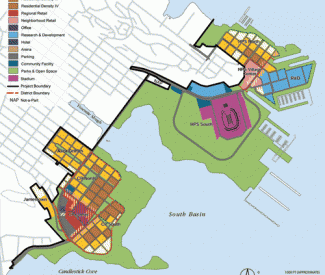
He’s right, of course — although it’s an odd comment coming from a press staffer for a mayor who is still dead set on building a stadium for the 49ers at Candlestick Point. I agree with Randy Shaw: The loss of the 49ers would be a good thing for San Francisco — particularly if the alternative is to pour public money into another expensive boondoggle like Candlestick Park.


Here’s the thing: You can argue that urban baseball stadiums bring economic benefits to the community. You can argue that the (mostly) privately financed Giants stadium has spruced up that neighborhood, spurred the creation of new bars and restaurants, brought in new tax dollars and created jobs. (It also displaced some blue-collar jobs and some poor people, but that’s a different argument.)


In fact, with limited parking and good transit access, the Giants ballpark encourages foot traffic, which encourages people to patronize local businesses before and after the game.


Football stadiums are traditionally very different. Football fans are tailgaters — they drive cars, bring their food and drinks to the parking lot, set up grills and picnic tables, go to the game — and then go right home. Almost nobody who attends a 49ers game at Candlestick stays around in the neighborhood afterward; the people who live nearby get virtually zero economic benefits.


Even as part of a shiny new development package, that won’t change much. The plans for a 49ers stadium in the new redevelopment area include a new roadway and bridge to make it easier to drive in and out, and a parking garage with room for tailgating; the fan base is largely from the Peninsula anyway. And in nearly every city that’s put up public money for a football stadium, the taxpayers have gotten screwed.


I love football, I love the 49ers, but I never go to the games, anyway — way too expensive. The TV feed from Santa Clara will be just fine.


Newsom and his commissioners just love Candlestick/Shipyard report

4

 Text by Sarah Phelan, photos by Luke Thomas

Today, I’m dedicating Michael Franti’s  “Say hey, (I love you)” to the entire Redevelopment Commission and the four Planning Commissioners who approved the City’s final Environmental Impact Report plan for Lennar’s Candlestick/ shipyard development. I’m doing so, not because I love these commissioners, who are  all mayoral appointees, but because they all seem to love everything about the final report, despite ongoing concerns about building a bridge over an environmentally sensitive slough, taking park land for luxury condos and unresolved questions about the Navy’s cleanup of the shipyard.(Yes, the EIR doesn’t address the toxic cleanup, but does it make sense to approve it before the Navy has completed its cleanup assessment plan?)

I’m also dedicating Franti’s bubbly soul-lifting song to Planning Commissioners Christina Olague. Kathrin Moore and Hisashi Sugaya for refusing to rubberstamp the final EIR or the related CEQA findings. Thanks guys for having some moral backbone!

Mayor Gavin Newsom, presumably tweeting while leaving town again on the Lt. Governor campaign trail, hailed yesterday’s rubberstamping process as a critical milestone.
“This is a major milestone for our efforts to transform the shipyard from an environmental blight to a showcase of jobs, affordable housing, parks and green-technology investment for the Bayview and our entire City,” Newsom said in a press release. “The approvals of the EIR and Redevelopment Plan reflect the years of hard work, rigorous study and extensive community involvement invested in revitalizing our City’s Southeastern Waterfront…our progress today is a testament to their leadership and commitment to thoroughly cleaning up the Shipyard so we can forge ahead towards a new vision for Hunters Point.”

One of the key points to emerge from last night’s hearing is the bifurcated nature of the process, which yesterday let the city push the EIR certification through, before the Navy completes a related EIS (environmental impact statement) about the cleanup on the shipyard—including areas of land where Lennar hopes to develop homes if the 49ers leave.

Fog City Journal’s Luke Thomas told me today that during public comment, the Nation of Islam’s Minister Christopher Muhammad called the commissioners “paid prostitutes” and “political whores” and said there would be a “political earthquake” if the commissioners go forward with EIR. 

“However, I don’t think he understood that the EIR and the EIS (which deals with the toxic cleanup) are two separate documents,” Thomas said, accurately noting that the joint commission was only voting on the EIR yesterday.

(According to Thomas, the Minister also promised that coalition of activists that would dog Newsom up and down the State during his campaign for Lt. Governor to expose Newsom’s record, so expect more fireworks along the campaign trial this summer.)

Another key fact to emerge from yesterday’s hearing was the lack of public comment on the part of almost all the candidates running to replace D. 10 Sup. Sophie Maxwell, whose district includes this massive development. Only Kristine Enea, Tony Kelly and Espanola Jackson spoke on the record—with Enea in favor of the plan with amendments, and Kelly and Jackson opposed as things currently stand.

Now, you’d think that everyone running in this race would be eager to show D. 10 constituents (and beyond) that they were at the meeting, not only silently tracking, but also publicly expressing their opinions. And while it’s true that Marlene Tran and DeWitt Lacy filled in speaker cards, Chris Jackson showed up during the proceedings, and Lynette Sweet got ushered into the press box by Sup. Bevan Dufty, none of these D. 10 candidates got their thoughts in the public record. Now, no doubt Cedric Akbar, Bill Barnes, Isaac Bowers, James Calloway, Malia Cohen, Ed Donaldson, Marie Franklin, Rodney Hampton Jr., La Vaughan Moore, Geoffrea Morris, Steve Moss, Jacqueline Norman, Nina Pickerrell, Dwayne Robinson, Diane Wesley Smith, Eric Smith, (and the many others rumored to be running) had their reasons for not being there, and I’d be happy to hear all about it from all of them between now and the November election.

But it doesn’t instill confidence in candidates when they won’t say in public what they are only too willing to say off the record. So, kudos to Enea, Kelly and Jackson for taking that leap and refusing to act like politicians before they have even been elected.

“So much of it was shocking but not surprising,” Tony Kelly told me today, after he recovered from last night’s meeting which lasted until 2 a.m. ‘Everyone knew there would be a snappy 4-3 decision by the Planning Commission on the stuff that mattered. And in a way, I can see why the mayoral appointees on the Commission would decide that they would leave it to the elected officials on the Board to stop this plan. But there was zero excuse for the lameness of the Redevelopment Commission [who are all mayoral appointees]. Still, it showed what the Planning Commission [which today consists of four mayoral appointees, and three Board appointees] must have been like  before it was reformed [and still consisted solely of mayoral appointees].”

“It was heartbreaking to see the endless parade of Bayview Hunters Point residents saying, ‘I need a job,’ or ‘ I need to live in a new house,’ as they argued in favor of certifying the project’s final EIR, despite all the flaws,” Kelly acknowledged.

Still, as Kelly points out, the city could have pushed to acquire foreclosed housing in D. 10 so residents in substandard public housing could be relocated into decent units now, instead of having to stay at least another five years, or longer, in rat, cockroach and sewage inundated units, under Lennar’s plan.

Kelly also notes that the city could have used the Redevelopment Agency’s “massive power” to do stuff up and down Third St, where unemployment is especially visible.

“Having done planning elsewhere, this plan [for Candlestick and the shipyard] is like planning on Mars,” Kelly said. ‘This is a bigger badder version of 555 Washington.”

Last but not least, Kelly voiced concern that a couple of peaker plants will be built within Lennar’s project area.
.“There are going to be two combustion turbines generating steam heat, but not electricity within the project boundaries,” Kelly clarified. “That means they don’t have to register as a power plant, but they will be generating greenhouse gases. The only difference is they won’t be generating electricity.”

So, now the charade of approvals heads to the Port Commission, which has got some folks asking whether Port Commissioner Stephanie Shakofsky, another Newsom appointee should recuse herself , given that her non-profit is clearly such a fan of the project.


Should Antonini recuse himself from Lennar vote?

1

As a Newsom appointee, Planning Commissioner Michael Antonini is expected to be a key vote today in favor of Lennar’s massive redevelopment plan at Candlestick Point-Hunters Point Shipyard.

And then there’s the fact that he wrote an op-ed for the San Francisco Business Times in December 18, 2009, suggesting that business, civic, labor and government leaders can keep the 49ers in town by “joining forces to assist in needed repairs and improvements to Candlestick Park and to expedite development of the Candlestick Point Hunters Point Shipyard, a project that features a “state-of-the art,” 69,000-seat football stadium.”
(The full text of Antonini’s op-ed is included at the end of this post to put his words into full context.)

But Antonini’s cheerleading has got some folks questioning his impartiality when it comes to the decisions that members of the Planning and Redevelopment Commissions will make today around certifying the project’s Final Environmental Impact Report (FEIR) and adopting related environmental findings.

In a June 2 letter to Planning Commission president Ron Miguel, Arthur Feinstein of the Sierra Club, Mike Lynes of the Golden Gate Audubon Society, Jennifer Clary of San Francisco Tomorrow and Jaron Browne of POWER (People Organized to Win Employment Rights) claim that “Commissioner Antonini has clearly prejudged the proposed project and become a strong advocate for locating a football stadium for the 49ers at the Hunters Point site as part of this project.”

“He has publicly urged others to support that stadium and cannot impartially review the record before him to determine whether the EIR is adequate, accurate and objective and whether adequate measures are required to protect the environment,” the foursome continue.

 Noting that he could have chosen to sign the December 2009 op-ed as a Member of the Republican County Central Committee, Feinstein, Lynes, Clary and Browne observe that Antonini “ instead identified himself in the capacity where the law requires him to act impartially – as a Planning Commissioner.”

With others arguing that Antonini’s right to express his opinion is protected by the First Amendment, and Antonini planning to read a rebuttal into the record at 1 p.m. today, it sounds like there’ll be plenty of drama at today’s hearing.

Antonini’s Op Ed in San Francisco Business Times

Friday, December 18, 2009
Business leaders can save the Niners
San Francisco Business Times – by Michael J. Antonini

“The 49ers are deeply and historically identified with San Francisco. San Franciscans Vic and Tony Morabito founded the team in 1946, many years before the Giants moved from New York and the Warriors from Philadelphia.

Hence business, civic, labor and government leaders are joining forces to assist in needed repairs and improvements to Candlestick Park and to expedite development of the Candlestick Point Hunters Point Shipyard, a project that features a “state-of-the art,” 69,000-seat football stadium. Leaders from the Committee on Jobs, the San Francisco Chamber of Commerce, Recreation and Park and others are asking businesses and individuals to help with funding of improvements at Candlestick in return for advertising. These improvements could translate into increased revenue for the contributor, the city and the team. Replacement of aging seats and a highly visible new luxury section are two concepts being studied.

Naming rights to Candlestick Park is an attractive opportunity for a company or an entity to gain nationwide exposure and local acclaim — and, perhaps, position itself to be a key contributor when a new stadium is built at Hunters Point. No new stadium can be built anywhere without significant private investment, in addition to $100 million assured from Lennar Corp. as a precondition of development rights and the amount which the 49ers ownership would invest.

On Thursday, Dec. 17, the San Francisco Planning Commission was to hear comment on the Draft Environmental Impact Report for the Candlestick Point Hunters Point Shipyard Plan. Because this plan features many diverse uses, particularly huge amounts of housing, funding is being rapidly obtained for greatly improved transit and traffic access.

San Francisco must avoid the errors of the past, when we failed to build an arena for indoor sporting, major conventions and entertainment events. Such a facility could have brought huge amounts of revenue to San Francisco businesses.

Leaders have twice stepped up to save the San Francisco Giants. One would expect no less from our leaders when dealing with our home grown, five- time Super Bowl champion San Francisco 49ers!

Michael J. Antonini is a planning commissioner for the City and County of San Francisco.”


Political juggernaut

3

sarah@sfbg.com

City officials are scrambling to secure final approvals to allow Lennar Corp. to move forward with its 770-acre Candlestick/Hunters Point Shipyard redevelopment of San Francisco’s impoverished and polluted southeast sector. But the community remains divided on the project, raising concerns that wary residents will end up being steamrolled by this politically powerful juggernaut.

Some groups say the project needs major amendments, but fear it will be rushed to the finish for political reasons. Others say they are hungry to work and desperate to move into better housing units, so they don’t want all the myriad project details to slow that progress. And Mayor Gavin Newsom’s administration is arguing that approving the project’s final environmental impact report by June 3 is crucial if San Francisco wants to keep the San Francisco 49ers in town.

But many observers fear Lennar wants its entitlements now before its project can be subjected to greater scrutiny that could come with the November elections. Newsom, who made Lennar’s project the centerpiece of his housing policy, will be replaced as mayor if he wins the lieutenant governor’s race. And a crowded field of candidates, many of them progressives concerned about the project’s impacts on the poor and the environment, are vying to replace termed-out Sup. Sophie Maxwell, whose district includes Lennar’s massive territory.

“It’s 180 percent about the 49ers,” land use attorney Sue Hestor told the Guardian, referring to the city’s proposed rush job, as evidenced by a rapid entitlement schedule that the Newsom’s administration wants city commissions and the board to follow.

Under that schedule, which Hestor procured from the Mayor’s Office, Planning and Redevelopment commissioners are expected to certify the project’s final 6,000-page EIR, adopt California Environmental Quality Act findings, approve amendments to the project’s original disposition and development agreement, and authorize land trust and open space reconfigurations — all during a June 3 meeting where public comment will likely last for many hours.

Saul Bloom, executive director of Arc Ecology, a community-based nonprofit that tracks the development, says this schedule stretches the credulity that this is a deliberative process. “There’s no way anyone could make a functional reasoned assessment,” Bloom told us. “How do you have any meaningful public conversation under those circumstances?”

Michael Cohen, Newsom’s chief economic advisor, asserted in an April 29 article in The New York Times that Lennar’s plan is a “really, really good project,” echoing the glowing praise he’s heaped on the project since its conception.

“But there’s nothing new in their proposal,” Bloom told us. “That’s because they haven’t been listening to the public’s concerns. [Cohen] says, ‘Haven’t we talked enough? The community’s been waiting all these years!’ But waiting to get what done?”

Lennar’s project — which had early backing from Newsom, U.S. Sen. Dianne Feinstein, and other political power brokers — was sold as creating “jobs, housing, and parks” and “revitalizing the abandoned shipyard” when voters approved the Lennar-financed Proposition G in 2008.

“Proposition G is from the community and for the community,” Lennar’s campaign promised. “You can turn the abandoned Hunters Point Shipyard into a clean, healthy, sustainable, livable neighborhood — a place where people can raise their children.”

The shipyard once employed thousands of workers, including African Americans who were recruited from the South in the 1940s and ’50s. But the district’s economic engine fell into disrepair when the military left in 1974. Today the neighboring Hunters Point and Bayview neighborhoods have the highest unemployment and crime rates and the largest concentration of African American families in the city.

But the city’s final EIR for the project, which the Planning Department released mid-May, shows that 68 percent of the developer’s proposed 10,500 new housing units will be sold at market rates unaffordable to area residents, and that many of these units will be built on state park land at Candlestick Point.

Lennar is also proposing to build a bridge across the environmentally sensitive Yosemite Slough, significantly changing the southeast waterfront. Lennar says it plans to develop the project’s remaining 3,000 units at below market prices, including one-for-one replacement of rundown Alice Griffith public housing units. Its proposal includes a dozen high-rise towers, 2.7 million square feet of commercial space, 1 million square feet of retail space, a performing arts theater, and an artists colony.

Lennar claims its proposal will create 1,500 construction jobs annually during the project’s 20-year build-out, along with 10,000 permanent jobs, thanks to a United Nations Global Compact Sustainability Center and a vaguely defined green technology office park.

The project and its impacts are already an issue in this year’s District 10 supervisor’s race (see “The battle for the forgotten district,” Feb. 23). Candidate Chris Jackson says Lennar’s proposal is weak when it comes to creating well-paying, low-skilled green collar jobs. He supports Arc’s proposal to including green maritime industrial use at the shipyard.

Arc recommends that the city’s final EIR allow recycling and repairing of ships, including the Suisun Bay Ghost fleet — decommissioned U.S. Navy, cruise, and ferry ships — arguing that “ship recycling and repair are resurgent strategic industrial activities yielding employment opportunities for our existing pool of skilled and unskilled workers.”

Jackson, who was elected to the Community College Board in 2008 and recently jumped into the District 10 race, wants the city to assert that the project is not a regional housing plan.

“It’s a local housing plan for local residents,” Jackson asserts. “It’s not here to provide housing for Silicon Valley. It’s for Bayview-Hunters Point and District 10 residents.”

Jackson understands why some local residents want no delays on final EIR approval: “I can never blame folks in Alice Griffith public housing for coming out and saying ‘no delays.’ They really want something real, housing that is not rat and cockroach infested.”

As a policy analyst (a position he’s quitting to focus on the District 10 race) for the San Francisco Labor Council — which gave key backing to the project in the 2008 election — Jackson knows labor is frustrated by all the project meetings. “I try to tell them it’s better to get this project right than rush it through and find out later that it goes against the interests of labor,” Jackson said.

In May 2008, the Labor Council signed a community benefits agreement (CBA) with Lennar. Since then labor leaders have urged no delays on the project’s draft EIR review. But Jackson believes the city must demand that financial consequences, such as liquidated damages, be a project approval condition if the developer reneges on the CBA.

“Right now the only push-back the city has is to threaten to kill the whole project if Lennar doesn’t meet its timeline,” Jackson said. “But people are really invested in this project, and I don’t believe anyone would pull the trigger and end the entire development. We don’t need to throw everything out; we just need to change them.”

Jackson wants to see the inclusion of a special-use district that would create a cooperative land trust to ensure affordability and home ownership opportunities for local residents. “I love open space and sustainability, but I also want affordable housing and real light-industrial opportunities that can employ people living in the district now.”

Special-use districts, Jackson argues, give city commissioners a way to amend this project to make it more acceptable.

Jackson wants to see strong tenant protections for public housing residents. “The vast majority of those residents are African American. At the end of the day, I want to see economic and environmental justice, so we can say we brought the right change to our community.”

Jackson also would like to see a more independent Mayor’s Office. “Don’t you feel like its 2002/2003, and that if you speak out against the project, it’s like you are speaking out against the Iraq war, and all of a sudden you are not patriotic?”

Fellow District 10 candidate Eric Smith concurred. “The powers that be are definitely moving this thing forward,” he said. “And this is a monster train, a juggernaut that is gathering steam. But how it shakes out down the road remains to be seen. My whole mantra is that there needs to be greater transparency down the line. If I become the sheriff, I’ll be shining a light on all this stuff.”

Smith warned that the community needs to work together or it won’t win a better deal. “It’s clear that folks in the city are hoping against all odds that Lennar can pull this stuff off so they can prove all the naysayers wrong and these community benefits can be realized, and that scrutiny of the projects can go on while all this happens,” he said.

But Arthur Feinstein, the Sierra Club’s political chair, worries that the city’s rush job is resulting in seriously flawed documents and decision-making. “It’s difficult for folks to digest 6,000 pages of comments and responses on the draft EIR in the three weeks since planning posted them online,” Feinstein said. “And nothing has changed despite all the comments, which is why it continues to be a nonsense process.”

Feinstein says the Sierra Club’s top concerns are the Parcel E-2 cleanup on the shipyard, a deal to transfer 23 acres at Candlestick Park for development, and the bridge over Yosemite Slough.

“You can cover most of the site,” he said. “But when it comes to Parcel E-2, where the dump burned for six months in 2002, that’s only 20 acres, it could and should be removed. This is the environmental justice issue that has the community up in arms.”

Feinstein worries about the precedent that selling a state park for condos sets. “This is our park, and they are shrinking it.” He is also concerned that the developer wants to bridge Yosemite Slough for cars.

How many of these concerns will be addressed at the June 3 hearing, which is just days before Santa Clara County voters decide whether to try to lure away the 49ers with a new publicly financed stadium? We’ll see.

What happens when Lennar doesn’t have a say

1

Today the Planning Commission holds a hearing about Lennar’s massive development plan for Candlestick and Hunters Point Shipyard, a plan the Guardian has been critically tracking for years, but the Mayor’s Office and a non-profit called the Center for Creative Land Recycling have been busily promoting (check out the above video clip). But one thing they won’t be talking about is the Alternatives For Study that Arc Ecology proposed, Bionic developed and Urban Strategies reviewed two years ago, in an effort to improve the developer’s otherwise Foster City-like vision for the heart of District 10 in the city’s southeast sector.

And that’s ironic, because the AFS proposal just received an honor award.(Scroll to bottom of AFS proposal link to see award.)

Saul Bloom, Arc Ecology’s excutive director, explains why Bionic got the award, and who was involved in the AFS proposal.
“Bionic is our landscape architectural and planning consultant,” Bloom said. “We do the conceptual planning and they do the detail, design and associated planning work. So in AFS, I worked with Bionic to develop the land use plans and analysis. I conceptualized where they would put various features of the plan, they either agreed, offered alternatives, or argued why I didn’t know what I was talking about. It was then my decision as to what went forward to the draft document.Once the draft document was produced Eve Bach [recently deceased], Ruth Gravanis, Arthur Feinstein, Junious and Anne from Urban Strategies and a number of other folks reviewed the materials and edited text. Bionic then finalized the design, I gave final approval and the document was published.  As such it really was a team planning effort.However because Bionic is the landscape architecture firm – they get the fame.  Because of Arc’s karma we get the infamy.”

So, is it fair to say that none of the AFS proposal are in the plan that will be the subject of today’s hearing, which promises to focus on the below-market rate housing plan, the community benefits plan, workforce development and local hiring policies?

 “Not entirely,” Bloom quipped. “They have been integrated into the study in order to reject them.”

Chris Jackson leaps into the District 10 race

9

Community College Board Trustee Chris Jackson has thrown his hat into the District 10 Supervisor race. The move is guaranteed to upset the already crowded field of candidates in the district. District 10 lies in the city’s southeast sector and is home to San Francisco’s largest remaining African American community, and some of its most economically disadvanted communities and environmentally polluted lands.

Jackson was elected to the Community College Board in 2008, winning more than 8,000 votes in District 10, as part of that citywide election. And he has done a good job on the Board ever since.

The only African-American male currently holding elected  public office in San Francisco, Jackson works as a policy analyst for the San Francisco Labor Council. That position is sure to raise questions about Jackson’s ties to Lennar’s redevelopment proposal at Candlestick Point and the former Hunters Point Naval Shipyard. The Labor Council entered a community benefits agreement with the developer shortly before the June 2008 election on Prop. G. and Labor Council representatives appear to be proponents of Lennar’s draft environmental impact report (DEIR). A final version of that report is expected to come before  the Board of Supervisors for approval in June.

But Jackson told us that he will fight to keep District 10 a middle-class district and not a neighborhood dominated by millionaire’s condos.


Waste of paper

0

rebeccab@sfbg.com

Several weeks ago, Sup. Chris Daly e-mailed the San Francisco Ethics Commission to ask what seemed like a simple question. Daly is spearheading a June citywide ballot measure to ask voters to support the designation of the new Transbay Transit Center as the end point for the planned California High Speed Rail project, a response to the California High Speed Rail Authority’s move to explore alternative locations.

As an elected official, Daly knew there were certain individuals he might be barred from accepting money from for this effort. A San Francisco campaign finance law prohibits entities holding city contracts worth $50,000 or more from donating to political campaigns run by the elected officials who approve those contracts, a rule crafted to eliminate quid pro quo dealings that can corrupt the political process.

But when Daly tried to find out whose checks he shouldn’t be accepting, he didn’t receive a simple list of names in response. Instead he got a dense e-mail highlighting the complexity of this area of campaign finance law, offering no easy answers. For one, it wasn’t clear whether the law applied to his committee. Assuming it did, however, there was another hurdle.

“Determining which contributors are prohibited from contributing to your committee is a bit complex at the moment,” Oliver Luby, an Ethics Commission staffer, wrote in the e-mail, “because the contractor disclosures filed … are only in hard copy format.”

This vexing detail meant that obtaining a searchable list of banned contributors would require scanning hundreds of Ethics Commission forms filed on behalf of the Board of Supervisors, then manually entering potentially thousands of data rows into a spreadsheet, a project that could suck up significant time and resources.

The campaign contribution ban applies not only to major contractors, but the executive officers, subcontractors, and major shareholders of those contracting firms, so there could be a long list of individuals prohibited from making a political donation once a single contract is approved.

These restrictions theoretically create an excellent safeguard against corruption — but since it’s not recorded in electronic format, the filings amount to an almost useless sea of data. In fact, even the Ethics Commission, which is supposed to regulate violations of this ban and issue fines, isn’t able to routinely do so.

Luby pointed out the shortcoming of the system and an easy solution to Executive Director John St. Croix and Deputy Director Mabel Ng in an internal e-mail last December. “Private interests that can afford to manually create databases using the data … will have an advantage over other interests (perhaps even our own office) where the resources are not available to manually create such databases,” he wrote. “The obvious solution to this problem is e-filing.”

For example, if city agencies and political campaigns were required to submit their data in Excel spreadsheets or through an online system that automatically created spreadsheets, it would be easy to compare them to see who is violating the law.

When asked about this, St. Croix said the resources just don’t exist to upgrade the commission’s online capabilities. “We don’t have the resources to develop the software right now,” he told us. “So someday, yes. After we go through the next election season, and people see that they have a lot of difficulties in complying with this, then we may be able to build some support to make these changes.”

The e-mails were among hundreds of documents included in response to a Sunshine Ordinance public information request the Guardian submitted to the Ethics Commission in February. The assortment of documents relating to the contractor contribution ban revealed just how difficult it is for the average person to discern whether any entities striking deals with the city are at the same time trying to curry favor with the politicians who approve their contracts.

In 2006, a batch of reforms were approved to tighten restrictions on campaign contributions from major city contractors and require filing disclosure forms. Intended to point a floodlight on pay-to-play practices, the rules were championed by former Ethics Commissioner Joe Lynn, who died late last year.

Since it was established in 2006, however, the law has seen neither steady enforcement nor routine compliance from elected officials, documents show. The Mayor’s Office, for example, did not start filing the forms until April 2009, a month after critical media reports pointed out that few city departments were in compliance. While many more have started filing regularly, it appears that certain state agencies covered by the law — including the Treasure Island Development Authority (TIDA) — have not.

Nor does the Ethics Commission itself seem focused on ferreting out potential violators. “I am reluctant to ask my auditors or enforcement staff to review [contract disclosure] filings and compare them against campaign filings because the sheer amount of data will make the search wasteful and likely fruitless,” St. Croix wrote in a memo to his staff last October.

At the same time, attempts have been made to scale back the scope of the law, based on the argument that it is difficult to enforce. St. Croix’s memo recommended that the contribution ban not apply to contractors who deal with state agencies such as TIDA or the Redevelopment Agency, which are controlled by mayoral appointees and oversee development contracts worth millions of dollars. “Although city elective officers appoint some members of those bodies, city officials rarely have any involvement with those agencies’ contracts,” he argued.

Asked if these suggestions will be discussed formally anytime soon, St. Croix was doubtful. “Unfortunately, even though we think they’re necessary, it’s going to be a very difficult sell at the Board [of Supervisors],” he said. “Even though we think we’re fixing a problem, it looks like you’re rolling back reform, and that’s not popular.”

On the eve of an election season featuring hotly contested seats on the Board of Supervisors, the Democratic County Central Committee, and other high-profile local and statewide offices, the relatively arcane archive of the contractor disclosure forms stored away at the Ethics Commission might get more attention. Are major corporations that do business with the city scratching the backs of politicians who want to advance their political careers to keep the wheels greased for their own business ambitions?

Without a user-friendly, functional system for tracking contracts and comparing them against campaign contributions, it’s tough to say.

Still defying gravity

0


By Brady Welch

news@sfbg.com

For more than a decade, a curious scene has greeted viewers looking upon the old Hugo Hotel at Sixth and Howard streets. A bright green couch lurches precipitously from the building’s corner window. Packs of reading lamps are scaling the building’s outer walls. A floor or two up, another couch, some coffee tables, and one of those old and impossibly heavy television cabinets appear to contemplate jumping from the fourth-story rooftop. No prank of the homeless, this precarious assemblage — wow, that’s a dangling claw-foot bathtub three stories up — is the Defenestration Project, the work of Bay-Area artist Brian Goggin.

“I never thought it would last,” Goggin recently admitted to us. In fact, the project wasn’t supposed to last for more than six months. “The clock and armoire were built for the project. But the bathtub is an original from the Hugo, and all the others were salvaged from the street or found in thrift stores.” It is a testament to the project’s sheer fortitude against the elements — and its quirky appeal — that Defenestration will celebrate its 13th anniversary March 5 at 1:AM Gallery, located directly across the street from the installation.

The event will be a retrospective-cum-fundraiser for a proposed $75,000 restoration Goggin has titled “Project Restore Defenestration” that includes illuminating the lamps and installing an LED strobe in the hulking television set. “We’re making sure that all the pieces are looking good and in some cases even better than they originally looked,” he said.

A few pieces of furniture already have been removed, many needing to be entirely rebuilt. Others will be restored while remaining affixed to the building, requiring boom lifts and scaffolding. Overall, these will require resealing, repainting, fiberglassing in some instances, and in the case of the couch, getting covered in a new gloss of latex (as a preservative). Goggin estimates the restoration will take from one to three months, and he may even add some entirely new pieces to the installation.

“We want to see it vibrant again,” he said. For the gallery show, he plans to have individual pieces of furniture on view with the intent that patrons will sponsor them. “We’re hoping to get the funding and support, so by the time the rain stops, we’re funded and ready to go. If we don’t, maybe it’s time for it to come down.”

And come down it eventually will, though not for lack of funding and support. In October 2009, a court ruled that the San Francisco Redevelopment Agency could condemn and acquire the building under eminent domain for $4.6 million. Though the agency’s plan is to build much-needed affordable housing in the area, the sale represented the retreat of any protective cover the building’s original owners, the I.M. and S.I. Patel Living Trust, inadvertently provided for the artwork.

The Guardian spoke to Jeremy Sugerman, Goggin’s legal adviser, who was able to confirm that the artist always had a loose agreement with the Patels whereby they reserved the right to notify the artist to take down the work for any reason or lose title to it. So when the Redevelopment Agency purchased the building, the notice from the Patels came due.

Sugerman and Goggin then went directly to the Redevelopment Agency and pleaded with them to let the building and art stay until a new development was solidly in the works. A raggedy Hugo Hotel with couches and reading lamps welded to its side, they argued, is easier on the eye than an empty hole in the ground. Sugerman told us that the agency was immediately receptive. A month after the purchase, SFRA commissioners approved a permit stipulating that the work could stay hanging for a minimum of 18 months.

Then again, any demolition of the building will require a litany of proposal reviews, permits, and budgeting that could take longer than the 18-month lifeline. In other words, Defenestration will continue to occupy the same conspicuously abandoned and, depending on whom you ask, dilapidated building at the corner of Sixth and Howard.

Originally funded by a combination of maxed-out credit cards, a $3,500 grant from the National Endowment for the Arts, “sweat equity” from more than 100 volunteers, and a staggering $14,000 raised on the project’s opening night, Goggin — understandably — doesn’t envision the same type of institutional support existing in today’s economy for his present renovation. Still, he’s positive. “I feel like this can be done,” he said, adding that $75,000 “is not an outrageous amount to be raised. It’s much less than Burning Man projects that only stay up for a few days.”

Which got us to wondering how in the heck Goggin came up with the idea of Defenestration — a word that means throwing someone or something out a window — in the first place. “I was an apprentice to a sculptor in Europe for a number of years, helping him set up shows, and he invited me to go create an installation in Paris,” Goggin told us. “There was this one area where they were demolishing 18th-century buildings, and I could see remnants of the walls and portions of the staircases and tiled elements of the bathrooms and old shelving. Through the course of imagining what could fill that vacant space that so many had lived in, life and form created a drama.”

For years, it was a drama that played out solely within the artist’s head. But Goggin eventually received the NEA grant, and like a kid who just received his allowance, went shopping around. “I just started knocking on doors, asking people who had buildings if they’d be interested as a base for this installation,” he told us. “Most owners were interested in the idea but then, when they found out what would be involved in installing the piece, became less interested. After I was told off a 16th time, I was riding my bicycle by the Hugo Hotel and I noted the sign.” The sign Goggin is referring to is still there. Posted for potential buyers of the building, it reads: “LOT & BUILDING for SALE. Limit ‘130’ ZONED: RC. 3 HEIGHT,” and lists a fax number.

“It looked vacant, so it seemed like a good option,” he said. “I sent them a proposal.”

Sumati Patel, the daughter of the buildings owner, loved the idea, and over the course of a few weeks, convinced her father that having Goggin work on the building would ultimately be advantageous to the real estate. Squatters had become a problem since renovations on the building had stalled in the 1990s. “Lots of squatters,” Patel told us. “Tons. They’re pooping and peeing. They would have rallies. It gets tiring. It gets expensive.” Under the artist’s agreement with the owners, Goggin sort of took responsibility for the building. “If a squatter got it in, Brian would go over there and take care of it,” Patel said. And how does she feel the project turned out? “I remember once picking up my AAA magazine and seeing an article about Defenestration and showing my dad, like, ‘See?'”

The agreement between Goggin and SFRA to keep the work hanging certainly testifies to the success of the project. It has become part of the neighborhood, and although its days are numbered, perhaps they will be brighter than ever before.

“The State of Black SF”

2

By Adrian Castañeda

To support those living in public housing, the Osiris Coalition is hosting an event called The State of Black SF this Sunday (Feb. 28) at the Main Library’s Koret Auditorium from 2-4:30 pm. It will feature a short film and a panel discussion on the plight of the city’s African American population, a topic discussed in this week’s Guardian cover story.

One of the items the panel is sure to discuss is the mayor’s Hope SF initiative to renovate eight public housing projects around the city. City officials, residents, and developers agree that housing projects like Hunter’s View and Alice Griffith are dilapidated. But while plans have been made for revitalization and rebuilding, some community groups are worried that current residents, an already marginalized population, will be overlooked.

With this in mind, the Housing Rights Committee of San Francisco is drafting The Right to Remain Act that aims to assign accountability and protect current tenants during the construction process.

If passed by the Board of Supervisors, the ordinance would provide for the establishment of a monitoring committee comprised of residents and community leaders to approve plans and keep the public informed.  The aim, says Julian Davis of the San Francisco Housing Development Corporation, is to guarantee that current residents benefit from revitalization and will be allowed to remain in their neighborhoods. “They’re all just stated policy goals at this point,” he said of the effort to provide stronger guarantees.

Under the ordinance, existing provisions in the Hope SF plan would be enforced by limiting city funding for future projects until appropriate conditions for relocation and construction are met. The current Hope SF plan includes specific one-to-one placement and phased development provisions, where residents will be moved to on-site housing if possible.

However, there is no guarantee the developers will abide by these plans, so the Right to Remain Act will fill in gaps in federal and state housing laws and hold the Hope SF plan to its goals by ensuring every resident will receive a contract for their home and can sue if their rights are not upheld. Sara Shortt of the HRCSF told us, “No matter what kind of rhetoric is thrown around by officials during all of this, there’s something real on paper that can be enforced.” Shortt, who served on the mayor’s Hope SF task force, says there is a long history of broken promises in communities like Hunter’s View and tenant’s fear being pushed out of their homes.

Many city officials, including District 10 supervisor Sophie Maxwell and those in the Mayor’s Office of Housing, are receptive to the general idea behind the act but few have assured their support. “I don’t think the mayor’s office is particularly keen on it,” Davis said of the proposed residential committee. Shortt said, “It’s not just about logistical issues. We believe you can’t guarantee that without having accountability and oversight.” She adds that the act should be “in the spotlight,” for the November District 10 elections, “so all the candidates are aware this is something that they’re going to have to take a position on.”

The act is still being drafted, but the relocation of residents at the Hunter’s View projects has already begun. The pre-existing surplus of hundreds of empty units has made the on-site relocation simple, and Jack Gardner of the John Stewart Company says demolition will begin in March. While the Right to Remain Act would not retroactively cover current projects, it will protect residents in future redevelopment plans.

“Wouldn’t it be great to have it happen like Hunter’s View at the other sites?” says Davis.

The battle for the forgotten district

24

sarah@sfbg.com

This November, when voters in District 10 — the largest, sunniest, and most diverse of the city’s 11 supervisorial districts — replace termed out Sup. Sophie Maxwell, they’ll be making a selection that could have pivotal implications for the entire city.

That’s because the next supervisor from southeast San Francisco inherits a district that is home to some of the city’s biggest environmental and public health challenges, as well as the most potential for development that will determine what kind of city San Francisco becomes.

District 10 is where you’ll find the most polluted and most underdeveloped lands in San Francisco, areas that could either be transformed into models of a sustainability or, in the words of Tony Kelly, the president of Potrero Boosters Neighborhood Association, “be turned into a toxic Foster City.”

District 10 is where the slaughterhouses, tanneries, and glue factories set up shop and used the bay as a dumping ground. It’s where the smokestacks of coal and oil fired power plants polluted the air. It’s where the Navy filled the Bay, built a shipyard at Hunters Point and loaded parts of the first atomic bomb onto the USS Indianapolis in 1945.

District 10 is where the bottom fell out of this industrial economy in 1974, when the Navy left, taking with it people’s jobs, pay, and hopes for a home of their own and a better future, particularly for what was then a predominantly African American population.

And District 10 is ground zero for plans that will triple the population and double the number of homes — homes that likely will only be “affordable” to Google executives and retirees from Marin, forever changing the face of San Francisco’s southeast sector. Critics fear that will accelerate what has been a steady exodus of black residents, replaced by megadeveloper Lennar’s vision for a new D10.

It’s against this dark history and difficult present that a wide open field of more than a dozen candidates are vying to replace Maxwell, who came to power in 2000 and has had a mixed voting record in her decade on the board. Sometimes, Maxwell was the eighth vote that let the progressive majority on the Board override Mayor Gavin Newsom’s veto and pass trailblazing legislation. Other times, she was the swing vote that allowed the moderate minority to carry Newsom’s water.

So, in addition to D10’s many internal challenges, this seat could determine the political balance of power on the Board of Supervisors, placing all the more importance on voters in this long-marginalized part of town.


DISTRICT OF DISCONTENT

Eric Smith, a biodiesel activist who has thrown his hat in the D10 ring, says that there is a lot of frustration in the air, and looking at the problems the district is facing, it’s hardly surprising that it has what nearly every candidate agrees is a fractured political culture.

“The Bayview, the Hunters Point Shipyard’s toxic Superfund site, the homicide rate, unemployment, poor public transportation, dwindling services and community resources have made D10 one of the city’s largest melting pots of discontent,” Smith said.

Smith’s words were spoken while the Elections Department was verifying signatures earlier this month on a second failed effort to qualify a petition to recall Maxwell.

Bayview resident and D10 candidate Marie Franklin didn’t support the attempt to recall Maxwell, but she understood it as “a frustration movement.”

“People are sinking in the sand, we’ve already lost so many of them, and they felt Sophie wasn’t doing anything for them,” said Franklin, who praised Maxwell for helping get Franklin’s apartment building complex renovated — a job that was completed 18 months ago, at a cost of $65 million, creating 500 local jobs.

“There are 654 units here, and they were uninhabitable,” Franklin said. “There was black mold, rain falling inside. We had people living worse than Haiti.”

Franklin, who said she is running because she “knows the history,” came here in 1978, when she and her son were living in a car after a fire left them homeless. She said the Bayview was a totally isolated area, barely part of mainstream San Francisco.

“There were no taxis, no services,” she recalled. “Nobody would come here, it was the stigmatized area where no one was accountable to provide services.”

The Bayview — which in some ways is the heart of D-!0 — wasn’t always a black community. But African Americans have been living here for 70 years, dealing with all the racism, denial of services, poverty, and pollution. And it bothers Franklin that 85 percent of the 10,500 homes that Lennar plans to develop won’t be affordable to the elderly, disabled, unemployed and low-income people who currently live in the Bayview.

“We need to preserve the diversity of the community and make sure their issues and information will flow to City Hall,” she said. “You must give the people a handle. If you don’t reach out, they’ll slip. That’s why folks out migrated.

Whoever succeeds Maxwell will be a central player in addressing some very big and dirty issues: the future of the Navy’s radiologically impacted shipyard at Hunters Point, Lennar’s massive redevelopment plan for the Shipyard and Candlestick Point, the polluting power plants, replacement of stinky digesters at the sewage plant, and the SF Hope public lousing rebuild.

There’s also the chance to address violence and crime. James Calloway, a candidate who has long worked in Bay Area schools, told us he believes that education and jobs are part of the keys to rejuvenating the district.

“Job opportunities are not as plentiful in the district,” Calloway said. “When I was a kid, you could walk down Third Street at 2 a.m. Now I wouldn’t walk down it at 9 p.m., and I know the area.”

Calloway is hopeful that the massive redevelopment plan, if done correctly, could start the district’s comeback. “Not a lot of black folks stay here when they have extensive education,” he said. “But it’s not only them. Many were displaced by redevelopment and had no way to go back.”


ELECTION UP FOR GRABS

The largest of the city’s 11 electoral districts, D10 is a huge triangular piece of land in the city’s southeast sector that was used as an industrial dumping zone for decades. Today, the district runs from the Giants stadium at AT&T Park to the 49ers stadium at Candlestick Point and encompasses Mission Bay, Potrero Hill, Dogpatch, India Basin, Portola, Little Hollywood, and Visitacion Valley. It’s also crossed by two freeways that isolate it from the rest of the city, and is home to a large number of crumbling housing projects that are in the process of being rebuilt.

Candidate Ed Donaldson grew up in the projects until he was 10 years old, when the Redevelopment Agency kicked his family out in the 1970s. “We landed on our feet, but others weren’t so lucky,” said Donaldson, who works as a housing counseling director at the San Francisco Housing Development Corporation.

“There is a sense that the Bayview and Visitacion Valley have not been included within the San Francisco family,” Donaldson said. “There is a sense of being forgotten.”

In 2007, Donaldson co-founded the Osiris Coalition to tackle the city’s dormant Certificate of Preference program, in which the Redevelopment Agency issued a document to displaced residents and businesses in the 1960s promising that they could return.

He also tried to rescue some 700 foreclosed properties and recycle them as affordable housing stock. And now he is trying to prevent the city from bulldozing seven SF Hope projects without guaranteeing residents that they have right to remain.

In 2007, Mayor Gavin Newsom and Maxwell convened an African American Outmigration Task Force that didn’t get a public hearing about its findings until August 2008. The timing angered some, who questioned why the report’s findings and implications for urban planning weren’t released before June 2008, when the residents of San Francisco voted for the Lennar-led Proposition G, a proposal to build 10,000 market rate homes at one of San Francisco’s last remaining black communities, which Newsom and Maxwell endorsed.

The taskforce didn’t publish its recommendations until the end of 2009, allegedly because of insider squabbling. Meanwhile, gentrification was going on actively, and many blamed Newsom, and by extension Maxwell, for failing to do anything with the group’s findings as D10 residents continued to suffer from high rates of asthma, cancer, unemployment and an ongoing black exodus.

It wasn’t always this way. In the 1940s, the district’s black population exploded when migrants from the south and World War II veterans came to work at the Hunters Point Naval Shipyard. Some moved to Alice Griffith Public Housing complex, or Double Rock, which was built as military housing in 1962. Others relocated to the Bayview when the Redevelopment Agency took over the Fillmore/Western Addition in the ’60s and ’70s as part of a controversial urban renewal effort.

But when the Navy abandoned the shipyard in 1974, unemployment hit the black community hard. Today, hundreds of the city’s lowest income residents live in Alice Griffith’s crumbling units and endure sewage backups, no heat, cloudy drinking water and leaking ceilings, as they wait for the projects to be rebuilt.

“Generations have been trapped in the silo of public housing and cannot get out, because of lack of opportunity and education, so when we legislate, we need to take that into consideration,” said candidate Malia Cohen, whose grandfather came from Texas to work at the shipyard where he met her grandmother, whose family came from New Orleans.

“My grandfather’s father was a longshoreman. He worked with the infamous Leroy King [a commissioner at the city’s Redevelopment Agency] and he has fantastically vivid stories of racism,” said Cohen, who works for the Federal Reserve Bank of San Francisco, previously served on the executive staff of Mayor Gavin Newsom, and has already raised over $18,000 in the D10 race and qualified for public matching funds.

“My family came here to work hard, they lived on Navy road in the projects, and then they bought a house here. My parents were born here, and we were all public schooled,” Cohen recalled as she took me on a tour of D10 that ended up in Visitacion Valley, an increasingly Chinese-American neighborhood that reflects a district-wide trend.

Census data show that by 2000, Asians were the largest racial group in the district (30 percent), followed by blacks (29 percent), whites (26 percent), and Latinos (19 percent). By 2003, according to the California Urban Issues project, the trend continued. Asians were the largest racial group (32 percent), followed by blacks (27 percent), whites (21 percent) and Latinos (17 percent) of the population.

This means that D10 candidates will have to garner support from more than one ethnic group to win. Over a dozen candidates have already filed papers in the race, but so far there is no clear front-runner.

Also frustrating the prognosticators is that fact that D10 has had the lowest voter turnout in the city, so the winner will also depend on who goes to the polls.

D10 candidate Geoffrea Morris, who is the grand daughter of longtime Bayview activist Charlie Walker, has been knocking on doors and participating in voter registration drives.

“We need new blood,” Morris said

Getting elected will be a complicated equation. Although Bayview’s population was 50 percent African American at the time of the 2000 census, it didn’t turn out the vote. In the 2006 election, only 14,000 of the district’s 37,000 registered voters went to the ballot, and 50 percent were from whiter, richer, and more Asian neighborhoods.

“It’s very important to the future of the city that the ethnicity diversity of the board be maintained and that the African American community have representation,” former Board President and current Democratic Party chair Aaron Peskin told the Guardian.

Maxwell recently told the Guardian that she’s not ready to endorse any D10 candidates yet. “I’m waiting for people to have a better understanding of what this community is, what the common thread running through it is, and how to use rank choice voting,” she told us.

The only candidate who currently holds elected office is BART director Lynette Sweet, who had her answers down pat when we reached her by phone, and even used wording that was eerily similar to Maxwell’s words.

“D10 is a pretty diverse district, but there is only one common thread: the need for economic development,” Sweet told me. “That’s true in Potrero Hill, Portola, Dog Patch and the Bayview. It’s the same mantra: a lot of small businesses need help, and the only way to help them is through economic development. In Potrero Hill it’s about land use. In the Bayview, it’s about the shipyard and better transportation and truancies.”


THE COMMON THREAD

District 10 is ground zero for the Lennar’s $2.2 billion plan to develop 10,500 market rate condos at the Shipyard and Candlestick Point. The plan will allegedly create thousands of jobs and new parks, deliver on an historic community benefits agreement that labor groups claim is so “lawyered up” that the developer can’t renege on its promises.

The package is framed as the one and only way to revitalize the southeast’s formerly vibrant economic engine. Indeed, any time anyone tries to slow down the process—to take time to thoroughly read the draft EIR and see if it adequately addresses the impacts of this massive urban reengineering project — a chorus of “no delays” starts up, either from residents of the housing projects desperate to see their homes rebuilt, or the labor contractors who hope to get jobs.

“It’s as if the city is playing checkers, while Lennar is playing three-dimensional chess,” Eric Smith observed.

Lennar has stated that it will contribute $711 million to finance this massive project. The remainder will be leveraged by Mello-Roos bonds, state taxes based on the use and size of a property and intended to raise money for needed services, and tax increment financing, which creates funding for projects by borrowing against future property tax revenues.

The conceptual plan won Maxwell’s backing but environmental groups are critical of the draft EIR.

During DEIR hearing, environmentalists questioned the wisdom and the cost of filling the Bay to build a bridge over Yosemite Slough, and building condos on Candlestick Point state recreation area, the only open major open space in the district.

But the city’s Planning Department also has 20,000-30,000 units of housing in its pipeline. This means that if all these plans get approved in the next decade, they’d account for 80 percent of residential development citywide. And D10’s population could triple, further skewing the district’s already shifting demographics.

In other words, D10 as we know it could become nothing more than a historic relic in a few years, and the next supervisor will play a key role in deciding whether that happens. SFHDC’s Ed Donaldson warns that any supervisor who does not understand the complexity of the city’s largest district can expect a similar recall backlash in future.

“There is no one homogenous voice in the community,” Donaldson said. “The grass-roots organizing that brought about the recall effort was a result of a changing political structure in the area, but is not yet on par with other districts in town. We still allow our politics to be controlled from downtown.”

Fellow candidate Eric Smith warns that the issues—and politics—are complex.

“People were emotional, angry, and desperate because they feel no one listens to them,” Smith said. “That’s part of the problem here; they would rather have a supervisor go down swinging for them, rather than watch one seemingly side with Lennar, PG&E and the mayor on issues contrary to their interests. That’s the terrible irony and one of the biggest problems in District 10. Folks are so mad, they’re willing to do whatever it takes to make them feel they have a voice in the outcome, even if it’s potentially worse.”

Smith cited the sequence of events that culminated last year in the Navy dissolving the community-based shipyard Restoration Advisory Board (RAB), which for years has reviewed technical documents and commented on the Navy’s clean-up proposals. But in December, the Navy made its official decision to disband the RAB, citing dysfunctional behavior and off-topic discussions that got in the way.

“Some of the same folks who were frustrated by the process, tried to send a signal to the Navy that they weren’t being heard and for all their well-intentioned efforts got the RAB dissolved,” Smith said. “I truly feel for them, it’s absolutely heartbreaking, but at times, they can be their own worst enemy.”

One of the looming issues about the shipyard is that the land has been polluted and needs to be cleaned. The shipyard contains radioactive debris from ships towed to the shipyard, after a 90-foot wave washed over them during an atomic test gone awry. The Navy burned 610,000 gallons of radioactively contaminated ship fuel at the shipyard, and workers showered on the shipyard, raising concerns that radioactive materials got into the drains and sewers. And questions have been raised about radiological tests on animals at the yard.


LEAKS AND FLOODS

It’s not just the shipyard that’s toxic. Even the buildings that were constructed to house workers 50 years ago are a serious mess.

Realtor Diane Wesley Smith, who grew up in public housing projects, took me on a walking tour of Alice Griffith last week to see conditions that tenants will likely have to endure until at least 2014, if the city sticks to its plan to relocate people into a new replacement unit in the same geographical area, if not the exact same site.

What we found was pretty messed up.

“The water sometimes comes out brown and feels like sand. It’s been like that for a year,” one resident said.

“The water is cloudy, the bath tub isn’t working and the sink keeps stopping up,” said another.

A woman named Silvia showed us how the water from the tap in her elderly mother’s kitchen flows out cloudy and then doesn’t settle properly, like foamy beer.

“The roof’s been leaking for years, the sewage backs up, but they just fixed the lights,” Silvia said. A neighbor named Linda was using her oven as a heater.

“The toilet backs up a lot, and my grandson’s been coughing a lot from asthma,” Linda said.

“Roaches is always a problem,” said a woman named Stormi, dressed in black sweats and a black T-shirt that read, “Can’t knock the hustle.”

“They’re trying,” said Stormi, a member of the Alice Griffith Residents Association, as a couple of Housing Authority trucks pulled up to do repairs.

“They promise that you will not have to leave your unit, but if they try to move us down to the waterfront, well, there’s a reason there’s no housing there, and it’s because the land will flood,” Stormi said.

“If we don’t end up at the table, we’ll end up on the menu,” Wesley Smith warned, as she stopped to chat with a group of young men, who were worried they would pushed out of the Alice Griffith rebuild through the criteria being established.

“Fred Blackwell, the executive director of the Redevelopment Agency, assures me that’s not the case, but Alice Griffith is a Housing Authority property, and empty promises have the potential to be great promises provided they are made in writing,” Wesley Smith said as we walked out of the projects and onto the road where a yellow and black sign announced “flooded” next to Candlestick Point park, where Lennar wants to build.

Malia Cohen expressed concern about Hope SF residents, as we drove through the Sunnydale housing project.

“We have to be diligent and mindful that people are not pushed out,” Cohen said, noting the sweeping views at Gleneagles golf course above Sunnydale, and the value of housing for a golf course community. “When public housing gets taken offline, we must work with Redevelopment and the Housing Authority to make sure no one is changing the rules halfway. We have to make sure the talks and walks line up. We need to be equal partners. We cannot be bulldozed by City Hall.”

Geoffrea Morris is a Calworks employee, at the Southeast Community College facility on Oakdale, which was built to mitigate the city’s expansion of the sewage plant in 1987. She cited concerns about the literacy levels of people who live in the 2200 public housing units that cluster D10. “A lot of people in Alice Griffith don’t even know the dates or when it’s going to be reconstructed,” Morris said. “Folks like to be told stuff like that, but the city gives you a stack of papers. Some will read them, but others rely on folks they think are trustworthy. They need stuff in layman’s terms written on one sheet of paper.”

Morris is a fan of the Internet who posted a community survey online, and made sure every housing project got some literature telling people to get informed. She worries about the digital divide in D10:

“A lot of folks don’t have computers and access to important information,” Morris said. “And let’s talk about the way ‘affordable’ is used to trick people.”

Michael Cohen, Newsom’s top economic adviser, recently stated in a memo that over the expected 15-20 year phased build out, Lennar’s Candlestick-Shipyard development would include, “up to 10,500 residential units, about 32 percent of which (3,345) will be offered at below market rates.”

“But 892 units of this ‘affordable category’ will be sold to folks earning $100,000,” Morris said. “So if you subtract 892 units from affordable unit category, you’re back to 25 percent affordable.”

Candidate Kristine Enea, an attorney and a former RAB member, chairs the India Basin Neighborhood Association, which administers a US EPA grant to hire experts to translate the Navy’s cleanup documents into plain English and comment on them She was frustrated by the Navy’s decision to dissolve the RAB.

“The lack of a forum does nothing to bolster the community’s trust in the cleanup or the redevelopment process,” Enea said.

Enea generally supports the Lennar project, but has concerns about whether it will adequately mitigate increased car traffic, or result in commercial development that benefits her neighborhood.

“India basin is a pocket of Hunters Point right along the shoreline,” Enea said. “Right now, we have no shops or restaurants, no ATM, no groceries, nothing beyond one liquor store and a few industrial businesses.

Potrero Boosters president Tony Kelly told us that District 10 residents can think for themselves. “D10 residents don’t need to rely on corporations to solve their problems,” he said.

“Folks in the eastern neighborhoods came up with a better revitalization plan than what the city proposed and community activists managed to close the power plant, after the city said it was impossible,” Kelly recalled.

And there’s no shortage of good ideas.

Kelly suggested that an urban agriculture center could immediately put low-skilled folks to work by erecting greenhouses on unused land. Smith said the industrial zone could be “incredible eco-park made from sustainable sources.

‘D 10 is the dumping ground for everything, including all the city’s waste,” he said. “We could be a shining example, not just for D 10, but the rest of the state.”

The D 10 candidate line up includes Calloway, Cohen, Donaldson, Smith, Enea: civil rights attorney Dewitt Lacy, Morris, Potrero View publisher Steve Moss; District 7 BART director Lynette Sweet, Wesley-Smith. Bill Barnes, who works for Sup. Michela Alioto-Pier, and Linda Richardson, who was appointed to the Human Rights Commission in 2007 by Mayor Newsom, have also expressed interest in the race.

In such a huge field, name identification will play a major role. Sweet is in office, but BART Board is not a high-profile job and won’t give her a huge advantage.

Cohen has a slight edge right now in that she’s raised $18,505, including $500 from former Newsom flak Peter Ragone, making her the first D. 10 candidate to qualify for campaign financing. The oldest of five girls, Cohen recalls how her mother got laid off from her city job as a school-based mental health worker and then rehired, as part of the city’s budget cuts.

“We felt that pinch and the frustrating games that are played out between the leadership and the rank and file,” she said.

Cohen who worked for Newsom in his first term as mayor, but has since left his administration , said she is uncomfortable at being framed as Newsom’s candidate.

“Because I’m not, but I am one of the few candidates who has seen how the mayor and the Board work—and don’t work—together,” she said.

Moss sees the city’s southeast as a “district in transition.” Over coffee at Farley’s in Potrero Hill, he told me that the southeastern neighborhoods could be “launching pads for environmentally sustainable growth.”

“The district’s been in a frozen period for 30 years, But despite the problems, people are deeply committed to and in love with their community.

“This district is the future of San Francisco and its social fabric—the diversity, income –and its problems are leftovers from the city’s industrial age.”


DISTRICT 10, BY THE NUMBERS

Total Acres: 5,650

Average household income: $85,000

Population: 73,000

Registered voters: 37,700

Average housing price: $335,000

Ethnicity (2003 figures): Asian 32%, African American, 27%, white 21%, Hispanic 17%

Development status of land: 18% residential, 38% is commercial, 38% undevelopable

All figures the latest available. Sources: SFGIS, Association of Bay Area Governments, U.S. Census, California Urban Issues Project. Ethnicity and income data is from 2003 and almost certainly has changed.


The attack on the SF left

20

If I were a political consultant hired by the San Francisco Chamber of Commerce and the big developers and the landlords and Mayor Newsom, and my job was to launch an effective attack on the progressive movement in the city and undermine progressive control of the Board of Supervisors, here’s what I’d do:


1. I’d attack district elections. See, every time the downtown folks have tried to run candidates in swing districts under the existing system, they’ve lost. That’s in part because the business types can’t seem to find decent candidates, and part because money doesn’t rule in districts, so progressives who can mobilize at the grassroots level have a better chance.


So when you can’t win the game you try to change the rules. You can’t do it too directly, because the polls show that people like having district supervisors, so I’d come up with a “hybrid” plan — say, seven districts and four at-large supervisors. Since anyone who runs at large in this city needs gobs of campaign cash, that would pretty much guarantee that four board members would be accountable to downtown. Then draw the districts to create two moderate-conservative seats, and the progressives have lost control.


I’d launch this by planting stories in the San Francisco Chronicle about a “growing movement” to change the way the supervisors are elected — even thought there is no real grassroots movement.


But that creates the appearance that’s needed to begin raising money and preparing for a ballot initiative. It’s not hard to get the Chron to bit on something like this; C.W. Nevius, the local columnist who lives in the East Bay suburbs, never liked district elections, so he’ll play along and the Chron’s corporate ownership, which is close to the Chamber folks, never liked the system either. You can expect an editorial from the Chronicle Feb. 28th calling for a partial repeal of district elections.


The argument won’t have anything to do with the fact that the Chron doesn’t like the policies this particular board has passed; it will be all about the need for a “citywide perspective.” Now, that’s just horseshit, since the district boards have done an immense amount of work on citywide issues (like mininum wage and health care) that the at-large boards would never do.


But “citywide perspective” is a term that’s been focus-group tested and sounds good.


2. I’d look for a nice wedge issue for the November elections — something that could be used against progressives in swing districts. When Newsom ran for mayor the first time, he used “care Not Cash” — a well-funded attack on homeless people.


And gee, guess what? There’s another nice anti-homeless measure that’s recently been floating around, and it comes from the media-savvy police chief, George Gascon. It’s called a “sit-lie” law — legislation that would criminize the act of sitting on the sidewalk. It’s got a lot of populist zing to is, particularly since Gascon is talking about the need to clean up Haight Street, where some ill-behaved young people have been bothering the merchants and shoppers.


A November ballot initiative on a sit-lie law would allow downtown to raise a lot of money — and attack people like Rafael Mandelman and Debra Walker, candidates for supervisor in districts where a simplistic attack on the homeless might play. 


3. I’d try to split the city’s labor movement and drive labor away from the progressives. The obvious tactic: Construction jobs. I’d get every construction trade union member to campaign in District 10 for a supervisor who will support Lennar Corp.’s redevelopment project, and I’d attack any supervisor or candidate who supports limits on, say, buildings that shadow the parks and call them anti-jobs.


4. I’d launch a quiet effort to raise a big chunk of money to push pro-downtown candidates for the Democratic County Central Committee. The DCCC used to be something of a political backwater, but under progressive control, it’s become a significant force in local elections. The DCCC controls the local Democratic Party endorsements and money — which can be a big factor in district supervisorial races.


Now: I have no evidence that any individual consultant has created any such plan — but it’s sure an interesting coincidence, isn’t it?


What I see right now is a coordinated, orchestrated attack on the left — and I’m getting a little nervous that our current leadership on the Board of Supervisors isn’t doing enough about it.


DEIR in the headlights

0

GREEN CITY Public comments on the city’s draft environmental impact report (DEIR) for Lennar Corp.’s massive redevelopment proposal on Candlestick Point and the Hunters Points Shipyard includes complaints that the comment period was too short (see “The Candlestick Farce,” 12/23/09), concerns that the city violated state requirements to notify the Ohlone Tribe, and frustration that the city’s preferred plan represents the most significant and substantial impacts of any of the five scenarios analyzed in the DEIR.

These and many other concerns about the impacts of the 10,500-home project will need to be addressed in the final EIR, which Mayor Gavin Newsom and other project proponents expect to be completed by June.

Some object that the city is considering an early transfer of the shipyard and would undertake activities that are currently the Navy’s responsibility (see “Eliminating Dissent,” 06/17/09), saying the final EIR should prominently reference Proposition P, which voters approved in 2000, establishing community acceptance criteria for the cleanup.

Saul Bloom, executive director of Arc Ecology, submitted his organization’s comments “under protest for the inadequate extension of the public comment period, which we believe unfairly penalizes the public review of the draft EIR.”

Land use attorney Sue Hestor called the public comment submission schedule “abusive” in comments submitted for POWER (People Organized to Win Employment Rights). “The schedule is being driven by an insane desire to have the final EIR certified and all local approvals done by June,” Hestor said.

Ohlone chairperson Ann Marie Sayers and Neil MacClean of the Ohlone Profiles Project wondered why the Planning Department did not contact anyone on the city’s list of official Ohlone representatives. “We want the SF Planning Department to follow Senate Bill 18, which requires them to include Ohlone people in the planning process,” MacClean said, noting that there are at least four Ohlone villages within the proposed development area.

Jaime Michaels, coastal program analyst for the San Francisco Bay Conservation and Development Commission, expressed concerns about the DEIR’s proposal to make a 23.5 acre reduction in existing state park boundaries (see “Can I buy your park?” 08/12/09).

Project proponents, Michaels said, “would need to demonstrate that the decreased area would not compromise or reduce its value as a park/beach facility.” Michaels also worries about the impact of adding a minimum of 1.7 acres of fill in the bay to accommodate a bridge at Yosemite Slough, a plan she described as “a significant amount of coverage, particularly for a facility where the large majority of its coverage is needed to serve vehicles accessing the new stadium only 12 days a year.”

Michaels expressed concerns that the project’s plans to address sea level rise would negatively affect bay views and public access to the shoreline.

The project includes a 9.6-mile trail and a variety of other public amenities directly adjacent to the shoreline. Proposed building structures located away from the immediate shoreline would accommodate a 36-inch sea level rise by 2075, and the DEIR promises to employ adaptive management strategies along the perimeter beyond 2050.

“Unfortunately, partly due to illegibility and the scale of the drawings, it is difficult to assess precisely how these adaptations would appear,” Michaels observed. “However, it can be assumed that over time levees would need to be raised and likely widened at the base, thereby partly or entirely obstructing the public’s view of the bay from inland areas, encroaching on and reducing the area devoted for public use and impacting the overall public access experience.”

Arc Ecology discussed the DEIR’s failure to provide a comprehensive sustainability plan, address adjacent development projects, justify a 49ers stadium on the shipyard, or evaluate the potential for the development of port-related heavy industrial activities.

“The city is determined to get this project passed right now, and the developer is afraid that if someone else comes along as mayor and District 10 supervisor, they may not be as sympathetic,” Bloom said. “But the project — as outlined in the DEIR and the city’s way of approaching the deal — is against the interests of San Francisco.”

The DEIR that ate Christmas!

0

Text by Sarah Phelan. Photo by Ben Hopfer.

Grinch.jpg

I don’t know if Mayor Newsom took a copy of the city’s 4,400 page draft environmental impact report (DEIR) for Lennar’s proposed massive Candlestick/Hunters Point Shipyard redevelopment on vacation at the swanky Mauna Kea Beach Hotel in Hawaii.

New-Room.jpg
This is what a room at the Newsoms’ get away (from the folks wanting more time to read the DEIR) hotel in Hawaii looks like.

But if he did, he’d need an extra suitcase just to carry the darn thing, not to mention an ante chamber to store it, when he goes swimming, or whatever, in between readings.

EIR_report.jpg
As our illustration shows, a volume of this massive six-volume report is the size of a phone book. And way denser.
That’s because it’s packed with all kinds of interesting information. Which is why folks have been asking Newsom to extend the public comment period on this document, which was released in mid-November, to mid-February.

This requested extension would give folks three months to read, digest and comment on one of the most important and legally binding documents to land on Newsom’s desk since he became mayor. And the last month of this requested extension wouldn’t be unencumbered by Thanksgiving, Christmas and New Years.

But to hear Newsom’s appointees on the Redevelopment and Planning Commissions, those folks asking for a mid-February extension are just whining, or don’t plan on reading the documents at all. And anyways, who cares if the public doesn’t get their comments in time. Because there’ll be plenty of opportunity to comment later on, right?

Wrong. The DEIR public comment period represents one of the few moments when comments have to be put into the public record—and replied to. That was not the case during all those hundreds of meetings that city staff and project boosters like to quote as alleged evidence that there has been plenty of public input into this process.

In fact, when folks were worried about the prospect of selling off a slice of Candlestick Park so that Lennar could build luxury condos on prime waterfront land, they were told, don’t worry, they’ll be plenty of opportunity to review this plan when the environmental impact report comes out. But now it’s all, hurry up and finish, already.

But now that a draft version has been released, and is available online—or in the offices of the Redevelopment Agency and the Planning Department, it’s critical that folks read all of it, and not just the executive summary. It’s also important that folks not versed in “DEIR speak” find professionals that are to give them independent feedback, and that they then submit written comments to Redevelopment and Planning, the city’s two lead agencies on this project, by the deadline that the city has set.

The city’s original deadline was Dec. 28–the minimum 45-day public review period that’s required under the California Environmental Quality Act (CEQA), when a project has to be reviewed by state agencies. That’s why a lot of folks showed up at the city’s two DEIR hearings on Dec. 15 and Dec. 17 to voice their concerns. And while I sympathize with the plight of Alice Griffith residents, who continue to live with cockroaches and backed-up sewers and leaking roofs and broken windows, and unemployed workers in this town, rushing DEIR review won’t get housing built or jobs created any sooner. What it will do is increase the chances that the city will get sued.

Which is why folks who seriously want to read and comment on the DEIR asked the city for the Feb. 12 extension. Instead, they got a patronizing rebuff from Newsom’s commissioners, who gave them a 15-day extension, which ends Jan. 12. Along with the opportunity to voice their concerns one more time before Redevelopment on Jan. 5.

That’s why some folks are planning to ask Newsom not to be a Grinch, by faxing copies of a poster that features a cool looking Grinch to City Hall. So, while it won’t be snowing in Hawaii, it could be snowing faxes in the Mayor’s Office. As the poster notes,

“Don’t be a Grinch! Mister Mayor. Don’t steal Christmas and New Years. Your staff released the draft environmental impact report a week and a half before Thanksgiving.”

“Your staff had two years to work on it, but your commissioners just gave the public two months to read 4,400 pages. It’s unfair to steal the public’s Christmas and New Years’ to meet an arbitrary deadline.”

“Extend public comment on the Candlestick Point Hunters Point Shipyard draft environmental impact report (DEIR) to Feb. 12, 2010.”

This follows on the heels of a letter that a broad coalition of environmental and community groups, along with concerned Bayview Hunters Point residents, sent to Newsom before the Dec. 15 and 17 hearings, asking for the Feb. 12 extension, a copy of which follows:

The Candlestick farce

0

No one was really surprised when commissioners for the Redevelopment Agency and Planning Department voted last week to only give the public a Scrooge-like 15 days to review a six-volume, 4,400-page draft environmental impact report for Lennar Corp.’s massive 700-acre Candlestick Point redevelopment project.

Everybody knew that Michael Cohen, Mayor Gavin Newsom’s top economic advisor, wanted to jam this proposal through the certification process by early June in a last-ditch effort to win back the 49ers, even though the team has said it wants to go to Oakland if the City of Santa Clara doesn’t vote to build a new stadium.

The decision gives the public until Jan. 12th to submit written comments on the DEIR. A broad coalition of community and environmental justice groups asked for a 45-day extension.

And the entire process — including condescending remarks by commissioners, a fight, the forcible removal of several members of the audience, and statements from developer allies that were, at best, highly misleading — can only be described as a farce.

The rush to approve the document is entirely political. Santa Clara voters go to the ballot June 8 to decide if they want to build the 49ers a fancy facility near Great America. But June 8 is the same day, according to a spreadsheet maintained by city Shipyard/Candlestick planners, that the San Francisco Board of Supervisors is scheduled to approve the EIR for Lennar’s proposal.

The city’s DEIR envisions building a new 49ers stadium on the shipyard — a position that would allow thousands of luxury condos to be built on the site where the team currently plays, including a significant slice of Candlestick Point State Recreation Area.

To meet the increasingly artificial-looking June 8 EIR deadline, Cohen signaled he’d only be able to squeeze out 15 extra days for draft EIR review.

LENNAR’S PAID SUPPORTERS

With Cohen nowhere in sight at the DEIR hearings last week, his deputy, Tiffany Bohee, was left to kick off Redevelopment’s Dec. 15 and Planning’s Dec. 17 DEIR hearings.

“Time does matter for this project,” Bohee told commissioners, claiming that the project has been vetted exhaustively, including at least 177 public meetings — when the truth was that the public had never had an opportunity to review the complete draft EIR, a binding legal document, before its recent release.

“The consequence of delays is that it precludes the city’s ability to get ahead of the Santa Clara election in June,” Bohee said.

Bohee’s introduction was followed by a string of “no delay” and other off-point comments from representatives of the San Francisco Labor Council, the San Francisco Organizing Project, SF ACORN, and other groups that signed a community benefits agreement with Lennar in May 2008 that promised them millions of dollars in work and housing benefits — provided they show up at public meetings and support the development.

SF Labor Council vice president Connie Ford told commissioners that her organization “looks forward to the day when much-needed resources and support comes our way.”

A dozen residents of the Alice Griffith public housing project talked about their deplorable living conditions.

Asked by Redevelopment commissioner London Breed what the impact of a DEIR review extension would have on the planned rebuild of the Alice Griffith project, Bohee said, “It will jeopardize our ability to get any city decision on the project by June. As a result, delays to Alice Griffith could be indefinite.”

But that’s a stretch — at best. According to Lennar and the city’s own schedule, new Alice Griffith replacement units won’t be available before 2015 at the earliest. An additional 30 days of environmental review at this point will make no difference.

THE BOZO COMMISSIONERS

Compounding the city’s half-truths was the patronizing attitude of those commissioners who thought that their opinion of the DEIR should satisfy members of the public who hadn’t had enough time to review it.

“I think it’s an extremely well done document,” Planning commissioner Michael Antonini told a crowd that had sat through five hours of testimony and been warned by Planning Commission chair Ron Miguel that they’d been thrown out if they spoke during others’ testimony.

Bizarrely, planning commissioner Bill Lee tried to use the fact that the public wasn’t making many substantive comments on the DEIR as an argument against giving anyone more time to read it. Commissioner Gwyneth Borden made the equally odd argument that since people are almost certain to sue the city over the DEIR, there’s no reason to give an extension now.

And Miguel asked the public to put their faith in some vague meeting in the future rather than agreeing to what were asking for at the meeting. “I do believe that when all the comments are considered and answered and the final EIR comes before us and the Redevelopment Agency, that everything will come together,” Miguel said.

By that time, Arc Ecology’s director Saul Bloom, Jaron Browne of People Organized to Win Employment Rights, and POWER’s attorney Sue Hestor told the commissioners that they believe the project’s impacts on transportation, state park habitat, and the foraging requirements of the peregrine falcon had not been adequately analyzed. Eric Brooks of the Green Party expressed concern that sea level rise will be more pronounced than the DEIR projections.

Bloom also explained that a lack of adequate review time hindered his staff’s ability to prepare comments in time for a hearing that came only a month after the DEIR’s release.

Planning Commission vice president Christina Olague and commissioners Kathrin Moore and Hisashi Sugaya tried to extend the review period to February. As Olague pointed out, the commission recently granted a public DEIR review extension to a 15,959-square-foot parcel in Russian Hill, which is tiny compared to Lennar’s 708-acre proposal in the Bayview, where residents have the city’s lowest educational levels

But the Planning Commission’s 4-3 vote against a February extension revealed how mayoral appointees ignore common sense once they have their political marching orders.

COHEN’S FANTASY

“This appears to be all about Cohen’s fantasy of out-maneuvering Santa Clara to get the 49ers to move into a new Hunters Point stadium,” Hestor told the Guardian.

Hestor also pointed to a Dec. 18 San Francisco Business Times guest editorial titled “Business Leaders Can Save the Niners” that Planning Commissioner Michael Antonini had clearly written before Planning’s marathon Dec. 17 hearing.

“The editorial illuminates why, at the Planning Commission on Dec. 17, Antonini argued against any extension for public comment on the DEIR beyond Dec. 28,” Hestor said, noting that Dec. 28 was the absolute minimum DEIR review period required under the California Environmental Quality Act — a review period that straddled Thanksgiving, Hanukkah, Kwanza and Christmas (see Holiday Snowjob, 12/09/09).

Earlier this month, a coalition of environmental and community development groups, including Arc Ecology, the Sierra Club, the Potrero Hill Democratic Club, San Francisco Tomorrow, Literacy for Environmental Justice, Young Community Developers, the Neighborhood Parks Council, the South East Jobs Coalition, Walden House, Urban Strategies Council, India Basin Neighborhood Association, California Native Plants Society, Golden Gate Audubon Society, and the Bayview Resource Center, wrote to Mayor Gavin Newsom, requesting a 45-day DEIR review extension.

The request seemed further vindicated when it became apparent that most of the people who showed up at the DEIR hearings, including those opposed to extending the review period, admitted that they had not actually read the documents in question. And the commissioners’ failure to honor the extension request represents a new low in a process that threatens to become a classic lesson in the dangers of public-private partnerships.

Opponents of giving the public a decent chance to read the DEIR argue that there have already been hundreds of meetings on the proposed project. But as Bloom pointed out, the character and focus of EIR is different from any other document that has been produced for discussion. “If an issue is not raised during the EIR process, it cannot be raised subsequently,” Bloom said. “Releasing an EIR during the holiday season and providing the minimum amount of time allowable under the law for public review undermines the public’s ability to evaluate an EIR and disenfranchises people at one of the most critical points of the project approval process.”

Bloom also noted that a standard strategy for drastically limiting public input while appearing to be transparent is to spend time evaluating nonbinding documents while providing the minimum time required to evaluate the legally binding stuff.

“The Phase 2 Urban Design Plan released in October 2008 was in public discussion until it was approved in February 2009 — five months,” Bloom observed, noting that nothing in that document was legally binding. Neither was Lennar required to disclose negative effects of its plan. But an EIR is a legally binding document. “It’s a fiction that a 45-day DEIR public review extension would have cause a domino effect of indefinitely delaying the approval of the project,” Bloom added.

Holiday snowjob

0

sarah@sfbg.com

Shortly before Thanksgiving, San Francisco city officials announced that the draft environmental impact report for Lennar Corp.’s massive Hunters Point Shipyard-Candlestick Point redevelopment proposal was finally available, and that the public has 45 days — until Dec. 28 — to read and comment on the 4,400-page document.

Envisioned to include more than 10,000 homes (most of them market-rate condos) spread over 708 acres in southeast San Francisco, the project — whose vague outlines city voters affirmed by approving Prop. G in June 2008 — is the centerpiece of the city’s housing strategy for the next 25 years.

At a Nov. 5 presentation, Michael Cohen, Mayor Gavin Newsom’s top economic advisor, told the city’s Planning Commission that the DEIR was a "milestone." But critics warn that this milestone could become a millstone around the city’s neck if it fails to extend the DEIR review period, as a coalition of environmental groups and a state agency are requesting. Cohen did not return repeated calls for this story.

These groups are concerned that the city of San Francisco, Lennar’s partner in this billion-dollar deal, is trying to rush through a controversial project before anyone can review its details. Forty-five days is the minimum required under California Environmental Quality Act guidelines for a project that also needs to be reviewed by state agencies and the groups want the deadline extended to mid-February.

The southeast sector has historically been home to low-income communities of color, and fears are running high that this project will continue the destructive, gentrifying legacy of the San Francisco Redevelopment Agency, which shares lead agency responsibilities for this project with the Planning Department.

After Redevelopment Agency projects in Western Addition and Yerba Buena displaced much of San Francisco’s African American population, there is concern that if this project isn’t carefully considered, it could finish the job in the remaining parts of town with significant black populations: Bayview and Hunters Point, which are both in the plan area.

"People would have to read 130-plus pages per day since the DEIR’s release to complete it by the first public hearing," said Kristine Enea, who sits on the board of the India Basin Neighborhood Association and is a candidate in the 2010 race to replace termed-out District 10 Sup. Sophie Maxwell.

Downloadable at the Planning Department’s Web site, the Shipyard-Candlestick DEIR envisions an influx of 24,465 new residents and the possible building of a new 49ers stadium on a site that is radiologically contaminated, seismically vulnerable, and will undoubtedly be adversely affected by climate change-induced sea level rise.

As such, it requires significant chunks of time to digest and comment on — something folks are urged to do at two public hearings in mid-December or in writing by Dec. 28.

"The timeline is incredibly short," Arc Ecology’s executive director Saul Bloom told us. So a coalition that includes Bloom, Enea, Arc Ecology, the Urban Strategies Council, the Sierra Club, the California Native Plant Society, and the Potrero Hill Democratic Club is urging Mayor Gavin Newsom to extend the DEIR public review period to 90 days.

"We believe that a public review period totaling 90 days ending on Feb. 12, 2010 is necessary and of appropriate length for the public and our organizations to review, discuss, and comment on this complicated tome," the coalition wrote in a Dec. 7 letter.

Also seeking a time extension is the San Francisco Bay Conservation and Development Commission (BCDC), a state agency charged with reviewing large projects that may impact the bay, although the agency did sign onto the coalition’s letter. BCDC studies project that much of the project area could be inundated with rising water levels caused by global warming.

Technically, the lead agencies have the authority to extend EIR comment periods, but because they are controlled by mayoral appointees, the coalition is appealing to Newsom. The coalition letter notes that the project will nearly double the population of Bayview-Hunters Point, and that the newly released DEIR was nearly two years in the making.

"The city’s project staff reasonably took the time to provide what in their opinion is an adequate review of the project," the coalition wrote. "The public similarly deserves 12 weeks to examine and comment on your work."

City officials have been patient with Lennar, recently granting the company a six-month delay in construction of housing at Phase 1 of the development, which sits at Parcel A of the shipyard. As a result, construction for Phase 2 is not expected to start until 2015 and continue until about 2035.

So coalition members say at 45-day delay isn’t asking much. The letter makes clear that the coalition isn’t opposed to the project or Newsom’s administration, but that its members expect "public engagement and transparency in government."

"It is our view that a 45-day public review period for a document as complex and lengthy as the DEIR is simply inadequate under any circumstances," the coalition wrote, adding that the document’s release over the Thanksgiving, Christmas, Kwanza, and Hanukkah holidays is "particularly troubling." By contrast, Santa Clara Countyoffered an extended comment period for its DEIR on its proposed new 49ers stadium.

"By releasing a six volume, 4,400 page document a week and a half before Thanksgiving, you have demanded that the public and community based organizations choose between civic duty, prearranged vacation time, and obligations to family and faith," the coalition wrote, noting that the city effectively shortened even this prep time to 25 days by holding public hearings one month after the DEIR’s release.

Unlike Prop. G or previous discussion about Phase 1 of the project, the coalition reminded Newsom that an EIR is an administrative decision document, and the DEIR is the part of the approval process where ideas become concrete plans to be approved in a lawful process. "Transparency in government is not just a matter of letting the public see information," the coalition observe in the letter. "The capacity to act on what one sees is critical to transparency and the length of the look has a direct effect on the quality of observation."

Or as Bloom warned the Guardian, the current 45-day review period will likely result in a polarized dialogue. "It will lead to the squeezing out of any of the middle-of-the road perspective from folks who are not opposed to development but think the proposed project could be better," Bloom warned. "And if that happens, no modifications will be possible."

The DEIR will be the subject of two public hearings: Dec. 15 at 4 p.m. in City Hall Room 416 by the Redevelopment Agency and Dec. 17 at 1:30 p.m. in City Hall Room 400 by the Planning Commission.

Don’t rush the Candlestick EIR

0

EDITORIAL The Candlestick Point redevelopment project is by far the biggest land-use decision facing San Francisco today, and one of the most significant in the city’s modern history. The project, sponsored by Lennar Corp., would bring 10,500 housing units and 24,000 additional residents to the area. Those residents would need new schools, playgrounds, open space, and transportation systems. Industrial and commercial development would create some 3,500 permanent jobs, and those people would need ways to get to work. Plans calls for new roadways, including a bridge over the fragile Yosemite Slough. The 708-acre site includes areas with significant toxic waste issues.

It’s no surprise that the draft environmental impact report on the project weighs in at 4,400 pages. It took two years to review the land use, transportation, air quality, water quality, population, employment, noise, hazardous materials, and other potential issues.

And now the Planning Department and Redevelopment Agency wants all public comment to be completed in a 45-day period that includes the winter holidays. That’s crazy – and it’s a sign that the city just wants to rush this project through without adequate oversight, review, or discussion.

The EIR in a project this size is a major political battleground. It’s one of the few times that the Planning Commission and Board of Supervisors will get to weigh in on the entire project and look at its local and citywide impacts. It’s quite possibly the only time prior to construction when the economic, social, and environmental issues around the project will get widespread public discussion.

And anyone who reads these reports on a regular basis can tell you that they’re thick, dense, tough to follow, and filled with minute details and arcana that add up to very big policy decisions. Among the most pressing issues:

• The housing mix. The city’s own General Plan notes that almost two-thirds of all new housing built in San Francisco needs to be available at below-market rates. Lennar won’t even meet half that target. So the project would create an even greater unmet demand for affordable housing — something the EIR, at least on first read, glosses over. The report refers to “a broad range of housing options of varying sizes, types, and levels of affordability [that would] be developed at Candlestick Point” and states that “such housing would be in close proximity to the jobs provided by the project, [so] it is likely that future employees at Candlestick Point would seek housing at the project site prior to searching for housing in the surrounding Bayview-Hunters Point neighborhood. However, if future employees did seek housing elsewhere in the neighborhood, the effects would not be adverse.”

Actually, if comparatively well-paid employees at the project’s research and development facilities decided to move into the existing Hunters Point/Bayview neighborhood, it would almost certainly drive up housing prices, displacing existing residents.

• Transportation options. The project projects significant improvements in Muni service — but doesn’t say how the city will pay for them. There’s a sizable focus on cars — the EIR estimates the project will need more than 21,000 parking spaces. That’s a lot more cars on the streets of the city, a lot more traffic in the southeast — and a direct clash with the city’s transit-first policies.

• What jobs, and for whom? The 3,500 permanent jobs that would be created are badly needed in that neighborhood, which has the highest unemployment rate in the city. But a comprehensive labor pool study, and a discussion of how existing residents will be trained for projected jobs, appears to be missing from the EIR.

• Hazardous materials. The EIR broadly proclaims that “construction activities associated with the project would not result in a human health risk involving the disturbance of naturally occurring asbestos, demolition of buildings that could contain hazardous substances in building materials, or possible disturbance of contaminated soils or groundwater within one-quarter mile of an existing school.” That is — at the very least — a matter of some dispute.

There’s lots more – 4,400 pages more – and if the approval process is going to be anything other than an utter farce, the Planning and Redevelopment directors need to extend the public comment period for at least another 45 days. *

Editorial: Don’t rush the Candlestick EIR

1

The city wants to rush the massive Candlestick Point Redevelopment Project through during the holiday season without adequate oversight, review, or discussion. It needs to extend the public comment period for at least another 45 days.

The Candlestick Point redevelopment project is by far the biggest land-use decision facing San Francisco today, and one of the most significant in the city’s modern history. The project, sponsored by Lennar Corp., would bring 10,500 housing units and 24,000 additional residents to the area. Those residents would need new schools, playgrounds, open space, and transportation systems. Industrial and commercial development would create some 3,500 permanent jobs, and those people would need ways to get to work. Plans calls for new roadways, including a bridge over the fragile Yosemite Slough. The 708-acre site includes areas with significant toxic waste issues.

It’s no surprise that the draft environmental impact report on the project weighs in at 4,400 pages. It took two years to review the land use, transportation, air quality, water quality, population, employment, noise, hazardous materials, and other potential issues.

Sophie Maxwell’s big test

19

By Tim Redmond

Shortly after the new supervisors were elected last fall, Sup. Sophie Maxwell came by the Bay Guardian to talk about the board presidency. She was a candidate, and she knew she needed progressive support to get the job. So she told us about her political views and accomplishments and asked why we didn’t consider her a “progressive.”

Well, we’ve had some (respectful) disagreements with Sup. Maxwell over redevelopment and Home Depot. But what really concerned us, then and now, was whether Maxwell was willing to defy the mayor and take a hard line on city budget issues.

And now comes a major test.

The progressives on the board — along with Sup. Bevan Dufty, who is often a more moderate vote — are pushing to force the mayor to rescind the layoffs of 500 front-line health-care workers.

The nurses aides and clerical workers are almost all people of color, mostly women, and mostly making less than $50,000 a year. Sup. John Avalos has proposed that the city take $7 million out of reserves to save their jobs. That’s a temporary fix — in the long run, San Francisco needs to raise taxes to get some more revenue in, or at least do layoffs more equitably.

The Avalos legislation requires eight votes. Union activists say Maxwell appeared to be on their side last week, but after meeting with the mayor’s chief of staff, Steve Kawa, she voted against the measure Nov. 10th. That left it one vote short of passage.

It also sparked a fight between Maxwell and Sup. Chris Daly, which isn’t doing anyone any good.

But it’s not over. The Avalos bill is back in committee, and will come before the board again in the next two weeks. And Maxwell has to face a tough decision.

The argument that there’s no money available to save these jobs doesn’t make sense to me. The city’s likely to receive $33 million in extra public health money next year through a state bill known as AB 1383.

Besides, the entire city budget is out of whack already; revenue isn’t up to expectations and the deficit is growing for next year, so the mayor could (and should) make some mid-year changes — like layoffs at the top.

I haven’t been able to reach Maxwell by phone. But this one’s going to go down as a litmus test: When it comes to saving the jobs of working-class people of color, or siding with the mayor, where will she come down?

It’s clear where all the progressives on the board are. And that’s where Maxwell should be.

Wanna side of Candlestick EIR with turkey dinner?

5

Text by Sarah Phelan
For those brave folks who plan to read the newly released six-volume EIR for Lennar’s proposed redevelopment of the 770-acre Hunters Point Shipyard/Candlestick Point site, the holiday season promises to be a busy time.

First, you need to actually find the report, which is buried over at the San Francisco Planning Commission’s site. To help you find your way there, click here.

Nex, you need to figure out when you’ll have time to read it before two public hearing which are scheduled for Dec. 15 & 17—just ten and eight shopping days before Christmas.

And then, if you plan to make a difference, you’ll also need to figure out when you’ll have time to write and submit public comments, which will be accepted until Dec. 28 (three days after Christmas, three days before New Year)

Now, maybe this timing will work marvelously, what with the economy in the shitter, and no one having money to spend on the holidays, and more and more people unemployed and therefore in possession of the time needed to read, digest and comment on all six of these crucial tomes.

Or could it be that most people won’t be doing any of this, and especially not during and in between the biggest celebrations –in terms of family gatherings and feasts?

To motivate y’all to sit up and start tracking this plan, which promises to majorly impact the city’s southeast, may I point you to a Nov. 5 presentation on the proposed plan that was made before the San Francisco Planning Commission last week, in anticipation of the EIR’s release.
(You can watch it or read the captions, depending on your mood). in anticipation of the EIR’s release, by clicking on the Nov. 5 links listed at the Planning Commission’s site.)

What struck me when I watched it was the overall vagueness, on the part of city officials, when it came to explaining the plans, and the desperation of community members, on the one hand, to get jobs, and, on the other, to get the shipyard thoroughly cleaned up (and not just cleaned up to Lennar’s “intended use”) and to get Lennar to keep its promises, be they to monitor the dust, or build 32 percent affordable housing, or create thousands of permanent jobs. Enjoy.

Living with water

0

rebeccab@sfbg.com

GREEN CITY Here’s a sobering thought: By the middle of the century, the waters of the San Francisco Bay could rise up to 16 inches. By 2100, in a worst-case scenario, the water level could creep up 55 inches higher, affecting some 270,000 people and placing economic resources worth $62 billion at risk.

These projections, which are potential consequences of climate change, are outlined in San Francisco Bay: Preparing for the Next Level, a joint report issued by the San Francisco Bay Conservation and Development Commission (BCDC) and a team of Dutch research and engineering firms.

The Dutch have centuries of experience with flood mitigation. The low-lying, flood-prone territory of the Netherlands, adjacent to the North Sea, has forced Dutch engineers to become well versed in utilizing dikes, levees, and other adaptive techniques to contend with sea-level rise.

Drawing on that expertise, the San Francisco Bay study serves as a wake-up call and the beginnings of a roadmap for the Bay Area, listing 60 possible measures for addressing what appears to be an inevitable rise in sea level. Ideas range from sturdy levees, to mechanical floodwalls, to innovations such as floating houses.

"Adaptation is essential because it’s really too late to stop climate change and sea-level rise," Will Travis, executive director of BCDC, noted at a Sept. 21 symposium held to discuss the study. "If we shut down all the power plants, turn off all the lights, and park all the cars today, it’ll still continue to get warmer for at least a half a century or more."

Even with the world’s flood-mitigation experts on the case, the scenarios are daunting — and the implications are only beginning to come into focus for policymakers, planners, and the urban populations who inhabit coastal territories.

Waves in the bay could swell to about 25 percent higher on average. Intense storms are also expected to happen more often. If the sea level rose one foot, for instance, a storm-surge induced flood that used to occur roughly once a century would instead happen once a decade. The changes would be accompanied by an air-temperature increase of more than 10 degrees by 2100 — the difference between a typical summer day and a typical winter day in San Francisco.

"The reality of sea-level rise needs to be taken seriously," San Francisco Board of Supervisors President David Chiu, who delivered remarks at the symposium, told the Guardian. Chiu represents San Francisco on BCDC, one of the few bodies that can bring multiple stakeholders from throughout the region under one tent to plan for sea-level rise.

If the sea level in the San Francisco Bay rose three feet, some critical landmarks — Treasure Island, AT&T Park, and San Francisco International Airport — would end up underwater unless mitigation measures were in place.

Treasure Island, the site of one of the largest redevelopment projects currently moving forward in San Francisco, was cited in the report as a case study "for how large-scale development projects can deal with rising sea levels." Project developers are looking at artificially increasing island elevation to accommodate a three-foot rise in water level, according to Jack Sylvan, director of joint development for the city’s Office of Economic and Workforce Development.

Plans also include creating a buffer between new construction and the high-water line, and leaving open the possibility of shoring up the perimeter if it’s necessary to prevent flooding in the future, he said. "The fact that it’s an island forces us to address the issue," Sylvan told the Guardian.

In the report, proposed strategies for coping with climate change were presented along a continuum. One end emphasized fortress-like solutions that would support economic growth alone, while the opposite end featured more ecologically-oriented ideas like retreating from the waterfront and allowing nature to take its course.

The guiding philosophy from the Dutch was that the best approach would be to find a middle ground between these two extremes, and tailor solutions to each individual coastal area. "You should not only fight water," advised Bart Van Bolhuis, of the Consulate General of the Netherlands. "We want to share with you how we’ve mastered living with water."

Will Arnie’s ‘park closure solution’ save Candlestick Point?

3

Text and photo by Sarah Phelan

Monsterskies0925.JPG
Does San Francisco really need to sell Candlestick Point park for Lennar condos?

Governor Arnold Schwarzenegger has unveiled a plan to allow for all state parks to remain open without increasing Parks and Recreation budget appropriation. Does this mean the Bayview’s only major park can be saved? Developers are arguing that if the state sells a chunk of the waterfront property for $50 million, the rest of the park can be saved. But environmentalists disagree, noting that Lennar simply wants the land for luxury condos.

“Working closely with my Departments of Finance and Parks and Recreation, we have successfully found a way to avoid closing parks this year,” Schwarzenegger said in a press release today. “This is fantastic news for all Californians.”

But does this mean that Sen. Mark Leno’s SB 792 is no longer necessary?

Leno’s bill would allow the state to sell a chunk of Candlestick Point State Recreation Area for $50 million, so that developer Lennar, which has entered into a nebulous public-private partnership with the city of San Francisco, can build luxury condos on this waterfront parkland.

Leno’s bill, which the Assembly and the Senate have approved, is sitting on Arnie’s desk awaiting the governor’s signature. But it has faced stiff opposition from environmental groups in recent months.

And their neutrality was only recently secured, based on the spurious argument that, without the bill’s approval, Candlestick Point SRA would have to closed in its entirerity.

But now the Governor is proposing to reduce ongoing maintenance for the remainder of 2009-10, eliminate all major equipment purchases, and reduce hours and/or days of operation at most State Park units, expenditures on seasonal staff, and staffing and operations at State Parks headquarters.

According to Arnie’s proposal, some facilities could close weekdays and be open on weekends and holidays, or portions of a unit could be closed, such as the back loop of a campground. For a park with multiple campgrounds, one whole campground or day use facility could be closed while the rest of the park remains open, while parks that already close due to seasonal conditions could see longer closures.

“Service reductions will be planned to minimize disruptions to visitors, achieve cost savings and maintain park fee revenues,” the memo says.

Hmm. Seems like Arnie’s memo just gave Candlestick Point park supporters more ammo in their ongoing quest to challenge Lennar’s plan to take 23 acres of Candlestick Point SRA.

Lennar never spelled out this plan to take a chunk of the Bayview’s only major park, when they asked voters to approve Prop. G in 2008.

Instead, Prop. G was billed as a way to clean-up the abandoned Hunters Point shipyard and “create” hundreds of new acres of parkland.

It wasn’t until after Prop. G passed, that Lennar began publicly arguing that they would need 42 acres of the existing parkland, if the rest of their plan, which involves building 10,500 housing units on 770 acres of former industrial/ military land, is to pencil out. As for the new acres of parkland, that turned out to be acres of polluted shipyard that Lennar was proposing to cap with a cement cover and convert into a park.

Understandably angered, park advocates beat Lennar down to 23 acres, this fall, during the most recent round of the “parks for condos” battle.

Now, in light of Arnie’s plan and the soon-to-be released environmental impact report for Lennar’s massive redevelopment plan, those battlelines are perhaps, once again about to be redrawn. Only this time in favor of the park.

Stay tuned.

Crunch time

0

sarah@sfbg.com

The proposal by city officials and Lennar Corp. to build more than 10,000 new housing units at Hunters Point Shipyard/Candlestick Point is entering a critical phase, particularly for Bayview-Hunters Point residents who want greater oversight and scrutiny of the project.

Candidates are lining up to replace termed-out District 10 Sup. Sophie Maxwell next year; the project’s draft environmental impact report will be released, considered for approval and potentially challenged; and Lennar officials will seek to get the final development agreement with the city signed before Mayor Gavin Newsom leaves office in 2011, or earlier.

The 770-acre redevelopment plan, which the Mayor’s Office is touting as a shining example of a public-private partnership, has come under repeated attack from community advocates after Lennar’s failures to monitor and control toxic asbestos dust at the shipyard. The crash of the housing market and plunge in the company’s stock price also triggered concerns about the project.

And in light of the U.S. Navy’s recent decision to dissolve the Hunters Point Shipyard Restoration Advisory Board (RAB), the community is concerned that decisions about radiologically-affected dumps and the shipyard’s early transfer from the Navy to the city could occur without important public oversight.

Another aspect of the project — a proposal to build condos on 42 acres of Candlestick Point State Recreation Area — was criticized by the Sierra Club, Arc Ecology, and Friends of Candlestick Park. Lennar argued it was necessary for the project to pencil out and this sale of state land was to be authorized by Senate Bill 792, sponsored by Sen. Mark Leno.

In August, Leno secured the neutrality of the environmental groups and the support of the California Assembly (but not Assembly Member Tom Ammiano, the lone dissenting vote) for an amended version of his bill, arguing that selling 23 acres for $50 million would spare the rest of Candlestick Point SRA from being closed by budget cuts. The legislation now awaits Gov. Arnold Schwarzenegger’s signature.

Now, with the project’s EIR due to be released Sept. 28, people have the chance to register concerns about plans for such a massive development project, which includes condos on the Bayview’s only major park and a controversial bridge over Yosemite Slough.

On Sept. 15, community members packed the Board of Supervisors’ meeting to demand an investigation into their concerns, which also include the apparent inability of Newsom’s African American Out Migration task force to issue its overdue final report about the ongoing exodus of the city’s black population, which this project could exacerbate.

Sup. John Avalos told us he is now gathering information on the issue and hopes to schedule Land Use Committee hearings on the shipyard cleanup and Lennar’s economic health. "The documentation gives real strength and power to the community’s contentions," Avalos said.

He also noted that Maxwell is scheduling a hearing into the dissolution of the RAB, while Sup. Ross Mirkarimi is resurrecting legislation that seeks to put the San Francisco Redevelopment Authority under the control of the Board of Supervisors.

Arc Ecology director Saul Bloom said his group will study the project’s EIR to see if it accurately assesses the effects of Lennar’s development.

"We are concerned about the impact of truck traffic, the bridge over Yosemite Slough, and whether the transportation plan is going to effectively put the Bayview between three freeways," Bloom said. "But we’re going to be even-handed. If the EIR does a good job, we plan to say so."

Jaron Browne of the Bayview advocacy group POWER (People Organized to Win Employment Rights) told the Guardian that her group wants the shipyard cleaned up and the community respected.

"This is not just a Bayview issue," Browne said. "The whole city will be affected by the decisions that take place in terms of the future of affordable housing and environmental protection."

I’ll miss the defenestration building

9

By Tim Redmond

914defen.jpg

I’m not about to start a campaign here; I know the place is falling apart and a hazard to everyone and ought to be turned into affordable housing, so there’s no rational reason to protest the Redevelopment Agency’s plan to bulldoze the old Hugo Hotel.

But I have to say: I’m going to miss the place.

It just sat there for so long, a weird piece of street art, an abandoned building with furniture flowing out of the windows and hanging on the walls defying gravity and progress. Every time I’d pass by, I’d say: God, I love this fucking city.

It was just art for art’s sake, no money in it, no sign describing the vision of the artist, no discussion of what it means or meant … just old stuff miraculously bolted to the old crumbling walls of an an old crumbling building. I always wondered what would fall down first and what the green couch would look like after it hit the sidewalk.

It was never meant to be permanent. And now it will be gone. That’s appropriate, in a sad kind of way.

But every time something truly strange goes away, San Francisco loses a bit of itself. I hope we don’t forget this one; maybe Redevelopment can find the cash to hire a photographer to document the place, and put great big color pictures of it up in the lobby of the new, clean, sterile project that takes its place, just to remind us that things were different here, once.