Real Estate

Live Shots: Real Estate and Big Troubles at Slim’s

0

The sunny, indie rock jams of Ridgewood, NJ’s Real Estate cured my rainy day blues on Friday night at Slim’s. San Francisco’s unshaven, flannel-clad urban lumberjacks showed up en masse to seek shelter from the rain and soak up some seriously good vibes. The five-piece kicked off with “Suburban Beverage” from its 2009 self-titled debut. Inviting us to mellow out, leader Martin Courtney repeated the song’s only words, “Budweiser, Sprite, do you feel alright?” Fans responded with blissful head-nodding.

Courtney looked effortlessly hip in his thrift store button-up and thick-rimmed glasses. With his ball cap, t-shirt, and scruffy beard, bassist Alex Bleeker resembled someone’s dad jamming out on a Saturday afternoon. Bleeker praised San Francisco as his favorite city before the band jumped into “Easy,” the opening track from its sophomore effort, Days (Domino). As Courtney recited lyrics involving dreams, running through fields, and free love, guitarist Matt Mondanile warmed the venue with his clean guitar riffs.

The band’s lengthy set consisted of new songs from Days interspersed with selections from its debut. Considering the consistent sound of Real Estate’s albums, I was surprised to see Courtney and Bleeker trading lead vocal duties. A highlight of the evening was “It’s Real,” which had fans singing along to its catchy chorus of Ohs. Another success was the laid back, exceptionally chill “Out Of Tune.”

Real Estate also covered a couple songs by fellow New Jersey bands, the first of which was Felt’s “Sunlight Bathed The Golden Glow.” The jangly pop track was perfectly suited to the group’s summery backyard sound. After closing with “All the Same,” the band returned to the stage to cover the Feelies’ “Higher Ground.” Though I suspect few of them were familiar with the original, the audience totally loved it.

Real Estate finished out its encore with some favorites and left with the promise to meet fans at the Attic for a drink. Cloaked in the warmth of Real Estate’s positive vibes, I ventured back into the dark and blustery San Francisco night.

Opener: I had high hopes for another act from Ridgewood, Big Troubles. Though the band looked cute enough to take to the prom, its opening set fell a little flat. After getting hooked on its recent album Romantic Comedy (Slumberland), I was looking for a more intense, dynamic version of the songs I’d come to love. What I got was the equivalent of listening to the CD in my bedroom. With such a clear shoe-gaze influence, however, I suppose a highly animated performance would be a betrayal of the band’s roots.


All photos by Wolfgangg Photography.

Stage Listings

0

Stage listings are compiled by Guardian staff. Performance times may change; call venues to confirm. Reviewers are Robert Avila, Rita Felciano, and Nicole Gluckstern. Submit items for the listings at listings@sfbg.com. For further information on how to submit items for the listings, see Picks.

THEATER

OPENING

Fela! Curran Theatre, 445 Geary, SF; www.shnsf.com. $31-200. Opens Tues/15, 8pm. Runs Wed-Sat, 8pm (also Wed and Sat, 2pm; no show Nov 24); Sun, 2pm (also Nov 27, 7:30pm). Through Dec 11. The life and music of Nigerian superstar Fela Kuti is captured in this show with choreography by Bill T. Jones.

Forgetting the Details Bindlestiff Studio, 185 Sixth St, SF; www.nicolemaxali.com. $20. Opens Thurs/10, 8pm. Runs Thurs-Sat, 8pm; Sun/13, 3pm. Through Nov 19. Nicole Maxali performs her solo work about the effects of Alzheimer’s.

The Importance of Being Earnest Notre Dame Senior Plaza, Community Room, 347 Dolores, SF; (650) 952-3021. Free. Opens Fri/11, 7:30pm. Runs Fri, 7:30pm; Sat-Sun, 3pm. Through Nov 20. 16th Street Players perform the Oscar Wilde classic.

Language Rooms Thick House, 1695 18th St, SF; www.brownpapertickets.com. $20-28. Previews Thurs/10-Fri/11, 8pm. Opens Sat/12, 8pm. Runs Thurs-Sat, 8pm (no show Nov 24); Sun, 7pm (no show Sun/13). Through Dec 4. Golden Thread Productions and Asian American Theater Company present the West Coast premiere of Yussef El Guindi’s dark comedy.

SexRev: The José Sarria Experience CounterPULSE, 1310 Mission, SF; (415) 552-4100, www.therhino.org. $10-25. Previews Thurs/10-Sat/12 and Nov 17-18, 8pm (also Sat/12, 10:30pm); Sun/13, 3pm. Opens Nov 19, 8pm. Runs Thurs-Sat, 8pm (also Sat, 10:30pm; no show Nov 24); Sun, 3pm. Through Nov 27. Theatre Rhinoceros performs John Fisher’s musical celebration of America’s first queer activist — a hit for the company in 2010.

BAY AREA

The Soldier’s Tale Aurora Theatre, 2081 Addison, Berk; (510) 843-4822, www.auroratheatre.org. $10-55. Previews Fri/11-Sat/12 and Nov 16, 8pm; Sun/12, 2pm; Tues/15, 7pm. Opens Nov 17, 8pm. Runs Tues, 7pm; Wed-Sat, 8pm; Sun, 2 and 7pm. Through Dec 18. Aurora Theatre presents a re-imagined version of Igor Stravinsky’s 1918 musical by Tom Ross and Muriel Maffre.

ONGOING

Absolutely San Francisco Alcove Theater, 414 Mason, Ste 502, SF; (415) 992-8168, www.thealcovetheater.com. $32-50. Sun, 6pm; starting Nov 19, Thurs and Sat, 8pm. Through Dec 29. Not Quite Opera Productions presents Anne Nygren Doherty’s musical about San Francisco, with five characters all portrayed by Mary Gibboney.

Almost Nothing, Day of Absence Lorraine Hansberry Theatre, 450 Post, SF; (415) 474-8800, www.lhtsf.org. $43-53. Wed-Sat, 8pm (also Sat, 2pm); Sun, 2pm. Through Nov 20. The Lorraine Hansberry Theatre christens its grand new home near Union Square with two well-acted one-act plays under sharp direction by artistic director Steven Anthony Jones. Almost Nothing by Brazilian playwright Marcos Barbosa marks the North American premiere of an intriguing and shrewdly crafted Pinteresque drama, wherein a middle-class couple (Rhonnie Washington and Kathryn Tkel) returns home from an unexpected encounter at a stop light that leaves them jittery and distracted. As an eerie wind blows outside (in David Molina’s atmospheric sound design), their conversation circles around the event as if fearing to name it outright. When a poor woman (Wilma Bonet) arrives claiming to have seen everything, the couple abandons rationalization for a practical emergency and a moral morass dictated by poverty and class advantage — negotiated on their behalf by a black market professional (Rudy Guerrero). Next comes a spirited revival of Douglas Turner Ward’s Civil Rights–era Day of Absence (1965), a broad satire of Southern race relations that posits a day when all the “Neegras” mysteriously disappear, leaving white society helpless and desperate. The cast (in white face) excel at the high-energy comedy, and in staging the text director Jones makes a convincing parallel with today’s anti-immigrant laws and rhetoric. But if the play remains topical in one way, its too-blunt agitprop mode makes the message plain immediately and interest accordingly pales rapidly. (Avila)

Annapurna Magic Theatre, Bldg D, Fort Mason Center, Marina at Laguna, SF; (415) 441-8822, www.magictheatre.org. $20-60. Opens Wed/9, 8pm. Showtimes vary, through Dec 4. Magic Theatre performs Sharr White’s world premiere drama about love’s longevity.

How to Love Garage, 975 Howard, SF; www.pustheatre.com. $15. Fri-Sat, 8pm; Sun, 2pm. Through Nov 20. Three demigod-like personalities at the center of the earth are charged with answering life’s mysteries, big and small, but find themselves stymied by their latest task, namely, explaining “how to love.” They have only a week to do it, for some reason, or humanity will be consigned to everlasting consternation, or something like that — coherence is not a priority here — anyway: stakes are high. Their boss, the Magistrate (Geo Epsilanty), has them present their findings each day, but each of them — the Very Sexy One (Jessica Schroeder in sassy lingerie), the Stern One (Gloria MacDonald in girl-school uniform), and the Young One (Brian Martin in caped crusader outfit) — comes up with bupkus. Finally, the Young One gets the inspiration to kidnap a surface-dwelling earthling (Valerie Fachman) to help them figure it all out. Local playwright Megan Cohen’s mumbling comedy, directed with robust attention to blocking and movement by Scott Baker for Performers Under Stress, is far too skit-like a conceit to merit its two plodding acts. More to the point, its humor is very silly but generally dim. Despite being set at the center of the earth, this is too shallow and glancing an investigation of love to intrigue or tickle the genuinely curious. (Avila)

*The Kipling Hotel: True Misadventures of the Electric Pink ’80s Marsh San Francisco, 1062 Valencia, SF; (415) 282-3055, www.themarsh.org. $15-50. Sat/12, 8:30pm; Sun/13, 7pm. This new autobiographical solo show by Don Reed, writer-performer of the fine and long-running East 14th, is another slice of the artist’s journey from 1970s Oakland ghetto to comedy-circuit respectability — here via a partial debate-scholarship to UCLA. The titular Los Angeles residency hotel was where Reed lived and worked for a time in the 1980s while attending university. It’s also a rich mine of memory and material for this physically protean and charismatic comic actor, who sails through two acts of often hilarious, sometimes touching vignettes loosely structured around his time on the hotel’s young wait staff, which catered to the needs of elderly patrons who might need conversation as much as breakfast. On opening night, the episodic narrative seemed to pass through several endings before settling on one whose tidy moral was delivered with too heavy a hand, but if the piece runs a little long, it’s only the last 20 minutes that noticeably meanders. And even with some awkward bumps along the way, it’s never a dull thing watching Reed work. (Avila)

Making Porn Box Car Theatre Studios, 125A Hyde, SF; www.brownpapertickets.com. $25-50. Thurs, 8pm; Thurs, 8pm; Fri-Sat, 9pm; Sun, 7pm. Extended through Nov 27. Ronnie Larsen brings back his crowd-pleasing comedy about the gay porn industry.

*”Master Harold” … and the Boys Phoenix Theater, 414 Mason, Ste 601, SF; 1-800-838-3006, www.offbroadwaywest.org. $18-40. Thurs-Sat, 8pm. Through Nov 19. Based loosely on personal history, Athol Fugard’s drama explores institutionalized racism in South Africa’s apartheid era ensconced in the seemingly innocuous world of a Port Elizabeth tea room. The play opens during a rainy afternoon with no customers, leaving the Black African help, Willie (Anthony Rollins-Mullens) and Sam (LaMont Ridgell), with little to do but rehearse ballroom dance steps for a big competition coming up in a couple of weeks. When Hally (Adam Simpson), the owner’s son, arrives from school, the atmosphere remains convivial at first then increasingly strained, as events happening outside the tea room conspire to tear apart their fragile camaraderie. The greatest burdens of the play are carried by Sam, who fills a range of roles for the increasingly pessimistic and emotionally-stunted Hally — teacher, student, surrogate father, confidante, and servant — all the while completely aware that their mutual love is almost certainly doomed to not survive past Hally’s adolescence, and possibly not past the afternoon. Ridgell rises greatly to the challenges of his character, ably flanked by Rollins-Mullens, and Simpson; he embodies the depth of Sam’s humanity, from his wisdom of experience, to his admiration for beauty, to his capacity to bear and finally to forgive Hally’s need to lash out at him. It is a moving and memorable rendering. (Gluckstern)

More Human Than Human Dark Room Theater, 2263 Mission, SF; (415) 401-7987, www.brownpapertickets.com. $25. Thurs-Sat, 8pm. Through Nov 19. B. Duke’s dystopian drama is inspired by Philip K. Dick.

Not Getting Any Younger Marsh San Francisco, Studio Theater, 1062 Valencia, SF; (415) 826-5750, www.themarsh.org. $15-50. Thurs-Fri, 8pm; Sat, 8:30pm; Sun, 3pm. Extended through Dec 17. Marga Gomez is back at the Marsh, a couple of too-brief decades after inaugurating the theater’s new stage with her first solo show — an apt setting, in other words, for the writer-performer’s latest monologue, a reflection on the inevitable process of aging for a Latina lesbian comedian and artist who still hangs at Starbucks and can’t be trusted with the details of her own Wikipedia entry. If the thought of someone as perennially irreverent, insouciant, and appealingly immature as Gomez makes you depressed, the show is, strangely enough, the best antidote. (Avila)

*The Odyssey Aboard Alma, Hyde Street Pier, San Francisco Maritime National Historic Park, SF; www.weplayers.org. $160. Fri/11-Sat/12 and Nov 18, 12:30pm. Heralding their hugely ambitious Spring 2012 production of The Odyssey, which will take place all over Angel Island, the WE Players are tackling the work on a slightly smaller scale by staging it on the historic scow schooner Alma, which is part of the Maritime National Historical Park fleet docked at the end of Hyde Street Pier. Using both boat and Bay as setting, the essential chapters of the ten-year voyage — encounters with the Cyclops, Circe, the Underworld, the Sirens, Aeolus, the Laestrygonians, and Calypso — are enacted through an intriguing mash-up of narration, choreography, sea chanteys, salty dog stories (like shaggy dog stories, but more water-logged), breathtaking views, and a few death-defying stunts the likes of which you won’t see on many conventional stages. High points include the casual swapping of roles (every actor gets to play Odysseus, however briefly), Ross Travis’ masked and flatulent Prometheus and sure-footed Hermes, Ava Roy’s hot pants-clad Circe, Charlie Gurke’s steady musical direction and multi-instrumental abilities, and the sail itself, an experiential bonus. Landlubbers beware, so much time facing the back of the boat where much of the action takes place can result in mild quease, even on a calm day. Take advantage of the downtime between scenes to walk around and face forward now and again. You’ll want to anyway. (Gluckstern)

Oh, Kay! Eureka Theatre, 215 Jackson, SF; (415) 255-8207, www.42ndstmoon.org. $20-50. Wed, 7pm; Thurs-Fri, 8pm; Sat, 6pm; Sun, 3pm. Through Nov 20. 42nd Street Moon performs George and Ira Gershwin’s Prohibition-set comedy.

*On the Air Pier 29 on the Embarcadero (at Battery), SF; (415) 438-2668, love.zinzanni.org. $117 and up (includes dinner). Wed-Sat, 6pm; Sun, 5pm. Through Dec 31. Teatro ZinZanni’s final production at its longtime nest on Pier 29 is a nostalgia-infused banquet of bits structured around an old-time radio variety show, featuring headliners Geoff Hoyle (Geezer) and blues singer Duffy Bishop. If you haven’t seen juggling on the radio, for instance, it’s pretty awesome, especially with a performer like Bernard Hazens, whose footing atop a precarious tower of tubes and cubes is already cringingly extraordinary. But all the performers are dependably first-rate, including Andrea Conway’s comic chandelier lunacy, aerialist and enchanting space alien Elena Gatilova’s gorgeous “circeaux” act, graceful hand-balancer Christopher Phi, class-act tapper Wayne Doba, and radio MC Mat Plendl’s raucously tweeny hula-hooping. Add some sultry blues numbers by raunchy belter Bishop, Hoyle’s masterful characterizations (including some wonderful shtick-within-a-shtick as one-liner maestro “Red Bottoms”), a few classic commercials, and a healthy dose of audience participation and you start to feel nicely satiated and ready for a good cigar. Smoothly helmed by ZinZanni creative director Norm Langill, On the Air signals off-the-air for the popular dinner circus — until it can secure a new patch of local real estate for its antique spiegeltent — so tune in while you may. (Avila)

*Pellas and Melisande Cutting Ball Theater, Exit on Taylor, 277 Taylor, SF; 1-800-838-3006, www.cuttingball.com. $10-50. Thurs, 7:30; Fri-Sat, 8pm (also Sat, 2pm); Sun, 5pm. Through Nov 27. The Frog Prince, Rapunzel, the Swan Maiden: shimmering strands of each timeless tale twist through the melancholy tapestry of the Maurice Maeterlinck play Pelleas and Melisande, which opens Cutting Ball Theater’s 12th season. Receiving a lushly atmospheric treatment by director and translator Rob Melrose, this ill-fated Symbolist drama stars Joshua Schell and Caitlyn Louchard as the doomed lovers. Trapped in the claustrophobic environs of an isolated castle at the edge of a forbidding forest and equally trapped in an inadvertent love triangle with the hale and hearty elder prince Golaud (Derek Fischer), Pelleas’ brother and Melisande’s husband, the desperate, unconsummated passion that builds between the two youngsters rivals that of Romeo and Juliet’s, and leads to an ending even more tragic — lacking the bittersweet reconciliation of rival families that subverts the pure melodrama of the Shakespearean classic. Presented on a spare, wooden traverse stage (designed by Michael Locher), and accompanied by a smoothly-flowing score by Cliff Caruthers, the action is enhanced by Laura Arrington’s haunting choreography, a silent contortionism which grips each character as they try desperately to convey the conflicting emotions which grip them without benefit of dialogue. Though described by Melrose as a “fairy tale world for adults,” the dreamy gauze of Pelleas and Melisande peels away quickly enough to reveal a flinty and unsentimental heart. (Gluckstern)

*Race American Conservatory Theater, 415 Geary, SF; (415) 749-2228, www.act-sf.org. $10-85. Opens Wed/26, 8pm. Wed/9-Sat/12, 8pm (also Wed/9 and Sat/12, 2pm); Sun/13, 2pm. A very rich older white guy (Kevin O’Rourke) accused of sexually assaulting a poor woman of color looks for representation from the racially diverse firm headed by Jack (Anthony Fusco) and Henry (Chris Butler) with assistance from Jack’s African American protégé, Susan (Susan Heyward). With shades of Oleanna and Speed the Plow, David Mamet’s fleet new play mixes race and gender in the so-called justice system (in fact solely adversarial in the playwright’s unsurprising view, with winning being the only point). The result is an ultimately vindictive struggle both volatile and familiar. Some of that familiarity naturally stems from the world beyond the playwright’s immediate control — especially with the odor of the Dominique Strauss-Kahn affair still in the air — but the play’s action feels managed throughout by a political worldview too, um, black-and-white to register as up-to-the-moment. That said, muscular writing and the strong and appealing cast under intelligent direction by Irene Lewis guarantee an enjoyable, crackerjack production from American Conservatory Theater. (Avila)

Savage in Limbo Actors Theatre of San Francisco, 855 Bush, SF; (415) 345-1287, www.actorstheatresf.org. $26-38. Wed-Sat, 8pm. Through Dec 3. Actors Theatre of San Francisco performs John Patrick Shanley’s edgy comedy.

“Shocktoberfest 12: Fear Over Frisco” Hypnodrome Theatre, 575 10th St, SF; (415) 377-4202, www.thrillpeddlers.com. $25-35. Thurs-Sat, 8pm. Through Nov 19. In its annual season-scented horror bid, Thrillpeddlers joins forces with SF’s Czar of Noir, writer-director Eddie Muller, for a sharply penned triplet of plays that resurrect lurid San Francisco lore as flesh-and-blood action. In the slightly sluggish but intriguing Grand Inquisitor, a solitary young woman modeling herself on Louise Brooks in Lulu (an alluringly Lulu-like Bonni Suval) believes she has located the Zodiac killer’s widow (a sweet but cagey Mary Gibboney) — a scenario that just can’t end well for somebody, yet manages to defy expectations. An Obvious Explanation turns on an amnesiac (Daniel Bakken) whose brother (Flynn de Marco) explains the female corpse in the rollaway (Zelda Koznofski) before asking bro where he hid a certain pile of money. Enter a brash doctor (Suval) with a new drug and ambitions of her own vis-à-vis the hapless head case. Russell Blackwood directs The Drug, which adapts a Grand Guignol classic to the hoity-toity milieu of the Van Nesses and seedy Chinatown opium dens, where a rough-playing attorney (an ever persuasive Eric Tyson Wertz) determines to turn a gruesome case involving the duplicitous Mrs. Van Ness (an equally sure, sultry Kära Emry) to his own advantage. The evening also offers a blackout spook show and some smoothly atmospheric musical numbers, including Muller’s rousing “Fear Over Frisco” (music composed by Scrumbly Koldewyn; accompaniment by Steve Bolinger and Birdie-Bob Watt) and an aptly low-down Irving Berlin number — both winningly performed by the entire company. (Avila)

Shoot O’Malley Twice StageWerx, 446 Valencia, SF; www.viragotheatre.org. Thurs-Sat, 8pm (no show Nov 24). Through Nov 26. Virago Theater Company performs Jon Brooks’ world-premiere existential comedy.

Sitting in a Circle Intersection for the Arts, 925 Mission, Ste 109, SF; www.brownpapertickets.com. $15-25. Fri/11-Sat/12, 8pm. We are here to question the ways we present ourselves, communicate, and commune, but the masks never really come off and — unlike, say, a general assembly meeting down at Occupy SF — a circle of equals never really forms in this new work by the Erika Chong Shuch Performance Project, debuting at Intersection for the Arts’ new downtown space. The audience sits in or around a large circle of chairs, initially bathed in the harsh glow of office-space fluorescence. This much is as expected. But as the room transforms (amid production designer Allen Willner’s protean, mood-shifting lighting scheme) into some in-between world of personal-transformation workshop, talk show confessional, art therapy session, and psychic retreat, the accompanying conceit of spontaneous open-ended “coming together” gives way to a highly choreographed, largely jocular entertainment managed by a group of seven performers planted among the assembled. The results are varied, sometimes amusing, sometimes pushy, and usually too stylized or arch to be very moving or discerning. But a dance solo by adroit 13-year-old Rio Mezey Anderson comes as an unexpected, mesmerizing moment that — in its channeling of pure, unguarded expression — is also the evening’s most authentic. (Avila)

Sticky Time Brava Theater, 2781 24th St, SF; www.vanguardianproductions.com. $15-40. Wed-Sat and Mon/14, 8pm. Through Nov 18. Crowded Fire and Vanguardian Productions present playwright-director Marilee Talkington’s multimedia science fiction about a woman running out of time in the worst way. The prolix and histrionic story is the real sticking point, however, in this otherwise imaginatively staged piece, which places its audience on swivel chairs in the center of Brava’s upstairs studio theater, transformed by designer Andrew Lu’s raised stage and white video screens running the length of the walls into an enveloping aural (moody minimalistic score by Chao-Jan Chang) and visual landscape. Thea (Rami Margron) heads a three-person crew of celestial plumbers managing a sea of time “threads,” an undulating web of crisscrossing lines (in the impressive video animation by Rebecca Longworth). The structure is plagued by a mysterious wave of “time quakes” that Tim (Lawrence Radecker) thinks he may have figured out. Coworker Emit (Michele Leavy), meanwhile, goofing around like a hyperactive child, spots some sort of beast at work in the ether. When Thea gets stuck by a loose thread, she becomes something of a time junky, desperate to relive the color-suffused world of love and family lost somewhere in space-time as reality starts to unravel (with a dramatic assist from cinematographer Lloyd Vance) and the crew seeks help from a wise figure in a tattered gown (Mollena Williams). A little like a frenetic, stagy version of Andrey Tarkovsky’s Solaris (1972), the story gets credit for dramatizing some confounding facts about time and space at the particle level but might have benefited from less dialogue and more mystery — just as the audio-visual experience works best when the house lights are low. (Avila)

The Temperamentals New Conservatory Theatre Center, 25 Van Ness, SF; (415) 861-8972, www.nctcsf.org. $25-45. Previews Wed/9-Fri/11, 8pm. Opens Sat/12, 8pm. Runs Wed-Sat, 8pm; Sun, 2pm. Through Dec 18. New Conservatory Theatre Center performs Jon Marans’ drama about gay rights during the McCarthy era.

Totem Grand Chapiteau, AT&T Park, Parking Lot A, 74 Mission Rock, SF; cirquedusoleil.com/totem. $58-248.50. Tues-Sun, schedule varies. Extended through Dec 18. Cirque Du Soleil returns with its latest big-top production.

Two Dead Clowns Box Car Theatre Studios, 125A Hyde, SF; www.brownpapertickets.com. $20. Fri-Sat, 7pm. Through Nov 26. Ronnie Larsen’s new play explores the lives of Divine and John Wayne Gacy.

The Waiting Period MainStage, Marsh San Francisco, 1062 Valencia, SF; (415) 282-3055, www.themarsh.org. $15-35. Fri, 8pm; Sat, 5pm. Through Nov 26. Brian Copeland (Not a Genuine Black Man) presents a workshop production of his new solo show.

*Working for the Mouse Exit Theatre, 156 Eddy, SF; www.brownpapertickets.com. $22. Thurs-Sat, 8pm (no performances Nov 24-26). Through Dec 17. It might not come as a surprise to hear that even “the happiest place on earth” has a dark side, but hearing Trevor Allen describe it during this reprise of 2002’s Working for the Mouse will put a smile on your face as big as Mickey’s. With a burst of youthful energy, Allen bounds onto the tiny stage of Impact Theatre to confess his one-time aspiration to never grow up — a desire which made auditioning for the role of Peter Pan at Disneyland a sensible career move. But in order to break into the big time of “charactering,” one must pay some heavy, plush-covered dues. As Allen creeps up the costumed hierarchy one iconic cartoon figure at a time, he finds himself unwittingly enmeshed in a world full of backroom politics, union-busting, drug addled surfer dudes with peaches-and-cream complexions, sexual tension, showboating, job suspension, Make-A-Wish Foundation heartbreak, hash brownies, rabbit vomit, and accidental decapitation. Smoothly paced and astutely crafted, Mouse will either shatter your blissful ignorance or confirm your worst suspicions about the corporate Disney machine, but either way, it will probably make you treat any “Casual Seasonal Pageant Helpers” you see running around in their sweaty character suits with a whole lot more empathy. (Note: review from the show’s recent run at La Val’s Subterranean in Berkeley.) (Gluckstern)

BAY AREA

Annie Berkeley Playhouse, Julia Morgan Center for the Arts, 2640 College, Berk; (510) 845-8542, www.berkeleyplayhouse.org. $17-35. Thurs-Sat, 7pm; Sun, noon and 5pm. Through Dec 4. Berkeley Playhouse performs the classic musical.

Doubt: A Parable Live Oak Theatre, 1301 Shattuck, Berk; www.aeofberkeley.org. $12-15. Fri-Sat, 8pm; Sun/13, 2pm. Through Nov 19. Actors Ensemble of Berkeley performs John Patrick Shanley’s Pulitzer-winning drama.

How to Write a New Book for the Bible Thrust Stage, 2025 Addison, Berk; (510) 647-2949, www.berkeleyrep.org. $14.50-73. Tues, Thurs-Sat, 8pm (also Sat, 2pm; no show Nov 18); Wed and Sun, 7pm (also Sun, 7pm). Through Nov 20. An aspiring writer who later becomes a priest, Bill (Tyler Pierce) is the caregiver for his aging mother (Linda Gehringer) during her long bout with cancer. His father (Leo Marks), though already dead, still inhabits his mother’s flickering concept of reality, made all the more dreamlike by her necessary dependence on pain medication. His brother (Aaron Blakely), meanwhile, has returned from Vietnam with survivor guilt but lands a meaningful career as a schoolteacher in the South. The latest from playwright Bill Cain (Equivocation, 9 Circles) is a humor-filled but sentimental and long-winded autobiographical reflection on family from the vantage of his mother’s long illness. It gets a strong production from Berkeley Rep, with a slick cast under agile direction by Kent Nicholson, but it plays as if narrator Bill mistakenly believes he’s stepped out of an Arthur Miller play, when in fact there’s little here of dramatic interest and far too much jerking of tears. (Avila)

Rambo: The Missing Years Cabaret at Marsh Berkeley, 2120 Allston, Berk; (415) 282-3055, www.themarsh.org. $15-50. Thurs-Fri, 7pm; Sat, 8:30pm. Through Dec 10. Howard “Hanoi Howie” Petrick presents his solo show about being an anti-war demonstrator — while also serving in the Army.

*Rita Moreno: Life Without Makeup Berkeley Repertory Theatre, Roda Theatre, 2015 Addison, Berk; (510) 647-2949, www.berkeleyrep.org. $14.50-73. Wed/9, 7pm; Thurs/10 and Sat/12-Sun/13, 2pm; Fri/11, 8pm. The life of stage and screen legend Rita Moreno is a subject that has no trouble filling two swift and varied acts, especially as related in anecdote, song, comedy, and dance by the serene multiple–award-winning performer and Berkeley resident herself. Indeed, that so much material gets covered so succinctly but rarely abruptly is a real achievement of this attractively adorned autobiographical solo show crafted with playwright and Berkeley Rep artistic director Tony Taccone. (Avila)

Sam’s Enchanted Evening TheaterStage at Marsh Berkeley, 2120 Allston, Berk; (415) 282-3055, www.themarsh.org. $15-50. Thurs-Fri, 8pm; Sat, 8:30pm. Through Nov 26. The Residents wrote the script and did the musical arrangements for this musical, featuring singer Randy Rose and pianist Joshua Raoul Brody.

The World’s Funniest Bubble Show Marsh Berkeley, TheaterStage, 2120 Allston, Berk; (415) 826-5750, www.themarsh.org. $8-50. Sun, 11am. Through Nov 20. Louis “The Amazing Bubble Man” Pearl returns with this kid-friendly, bubble-tastic comedy.

On Guard!

4

news@sfbg.com


VICTORY’S MUDSLINGING

Hit pieces are common in San Francisco politics. So, sadly, are negative mailers funded by outside independent expenditure committees that can raise unlimited money.

But it’s highly unusual for an organization devoted to electing queer candidates to fund an attack on a candidate who is endorsed by both leading LGBT organizations and is, by all accounts, an ally of the community.

That’s what happened last week when the Washington-based Victory Fund — the leading national organization for LGBT political candidates — sent out a bizarre mailer blasting City Attorney Dennis Herrera for taking money from law firms that do business with the city.

The Victory Fund has endorsed former Sup. Bevan Dufty, who is the most prominent LGBT candidate in the mayor’s race. That’s to be expected; it’s what the Victory Fund does.

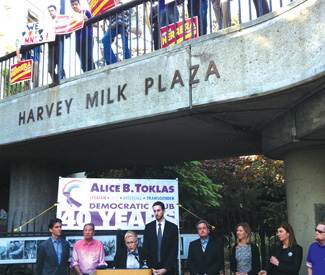
But why, in a race with 16 candidates, would the fund go after Herrera, who has spent much of the past seven years fighting in court for marriage equality? Why try to knock down a candidate who has the support of both the Harvey Milk Club and the Alice B. Toklas Club?

It’s baffled — and infuriated — longtime queer activist Cleve Jones, who is a Herrera supporter. “I have long respected the Victory Fund,” Jones told us. “But I’ve never seen them do what they did here. And it’s going to undermine the fund’s credibility.”

Jones dashed off an angry letter to the fund’s president, Chuck Wolfe, saying he was “appalled that this scurrilous attack, in the waning days of a mayoral campaign, would go out to the San Francisco electorate under the name of the Victory Fund.

“You really screwed up, Chuck, and I am not alone in my anger.”

We couldn’t get Wolfe on the phone, but the fund’s vice president for communications, Denis Dison, told us that the mailer “is all about fighting for our endorsed candidates.”

So how does it help Dufty, in a ranked-choice election, to attack Herrera? (In fact, given the dynamics of this election, the person it helps most is probably Mayor Ed Lee). Dison couldn’t explain. Nor would he say who at the fund decided to do the attack mailer.

But there are a couple of interesting connections that might help explain what’s going on. For starters, Joyce Newstat, a political consultant who is working for the Dufty campaign, is active in the Victory Fund, sits on the board of the fund’s Leadership Institute, and, according to a March 24 article in the Bay Area Reporter, was among those active in helping Dufty win the Victory Fund endorsement.

But again: Supporting Dufty is one thing. Attacking Herrera is another. Who would want to do that?

Well, if there’s one single constituency in the city that would like to sink Herrera, it’s Pacific Gas and Electric Co. And guess what? PG&E Governmental Affairs Manager Brandon Hernandez chairs the Victory Fund’s Leadership Institute. PG&E’s corporate logo appears on the front page of the fund’s website, and the company gave the Victory Fund more than $50,000 in 2010, according to the fund’s annual report.

Dison insisted that neither Hernadez nor anyone else from PG&E was involved in making the decision to hit Herrera and said the money went to the Leadership Institute, which trains LGBT candidates, not directly to the campaign fund.

Maybe so –- but the folks at the private utility, who are among the top three corporate donors to the Victory Fund, have to be happy. (Tim Redmond)


HERRERA HIT BACKFIRES

Herrera was also the target of another attack on his LGBT credentials last week, this one by the San Francisco Chronicle, which ran a front page story on Oct. 26 in which anonymous sources said he raised doubts in private City Hall meetings about San Francisco’s decision to issue same-sex marriage licenses in 2004. It was entitled, “Fight turns ugly to win gay votes in mayor’s race.”

Despite trying to couch the hit in passive language, writing that ” a surprise issue has emerged” based on accusations “leveled by several members of former Mayor Gavin Newsom’s administration,” it was clear that it was the Chron that made it an issue, for which the newspaper was denounced by leaders of the LGBT community from across the political spectrum at a rally the next day.

“Those who are saying this now anonymously are as cowardly as Dennis and Gavin were courageous back then,” said Deputy City Attorney Theresa Stewart, the lead attorney who defended San Francisco’s decision in 2004 to unilaterally issue marriage licenses to same-sax couples, in defiance of state and federal law, which eventually led to the legalizing of such unions. “We can’t have our community turn on us for petty political gain.”

“WTF, Chronicle?” was how Assemblymember Tom Ammiano began his speech, going on to lay blame for the attack on surrogates for Mayor Ed Lee. Ammiano also called out the mayor for campaign finance violations by his supporters, for undermining the Healthy San Francisco program that was created by Ammiano’s legislation, and for repeatedly ordering police raids on the OccupySF encampment.

“How about some fucking leadership?!” Ammiano said.

Cleve Jones, an early gay rights leader who marched with Harvey Milk, also denounced Lee and his supporters for cronyism, vote tampering, money laundering, and the “fake grassroots” efforts of the various well-funded independent expenditure campaigns, which he said have fooled the Chronicle.

“To the Chronicle and that reporter — really? — this is what you do two weeks before the election? You should be ashamed of yourself,” Jones said. “How stupid do you think we are?”

Yet Chronicle City Editor Audrey Cooper defended the article. “Clearly, I disagree [with the criticisms],” she told the Guardian. “I personally vetted every one of the sources and I’m confident everything we printed is true.” She also tried to cast the article as something other than a political attack, saying it was about an issue of interest to the LGBT community, but no LGBT leaders have stepped up to defend the paper.

Beyond criticizing the obvious political motivations behind the attack, speakers at the rally called the article bad journalism and said it was simply untrue to suggest that Herrera didn’t strongly support the effort to legalize same-sex marriage from the beginning.

“I can tell you that Dennis never once shrank from this fight. I was there, I know,” Stewart said, calling Herrera “a straight ally who’s devoted his heart and soul to this community.”

Sen. Mark Leno, who introduced the first bill legalizing same-sex marriage to clear the Legislature, emphasized that he isn’t endorsing any candidates for mayor and that he didn’t want to comment on the details of the article’s allegations. But he noted that even within the LGBT community, there were differences of opinion over the right timing and tactics for pushing the issue, and that Herrera has been a leader of the fight for marriage equality since the beginning.

“I am here to speak in defense of the character and integrity of our city attorney, Dennis Herrera,” Leno said, later adding, “I do not appreciate when the battle for our civil rights is used as a political football in the waning days of an election.”

Molly McKay, one of the original plaintiffs in the civil lawsuit that followed San Francisco’s actions, teared up as she described the ups and downs that the case took, working closely with Herrera throughout. “But this is one of the strangest twists I can imagine,” she said of the attack by the Chronicle and its anonymous sources. “It’s ridiculous and despicable.”

Representatives for both the progressive Harvey Milk LGBT Democratic Club and fiscally conservative Alice B. Toklas LGBT Democratic Club also took to the microphone together, both saying they often disagree on issues, but they were each denouncing the attack and have both endorsed Herrera, largely because of his strong advocacy for the LGBT community.

Sup. Scott Wiener called Herrera, “One of the greatest straight allies we’ve every had as a community.”

When Herrera finally took the microphone, he thanked mayoral opponents Joanne Rees and Jeff Adachi for showing up at the event to help denounce the attack and said, “This is bigger than the mayor’s race. It’s bigger than me.”

He criticized those who would trivialize this issue for petty political gain and said, “It was my pleasure and honor to have been a part of this battle from the beginning — from the beginning — and I’ll be there in the end.” (Steven T. Jones)


BUYING REFORM

UPDATE: THIS ITEM HAS BEEN CHANGED FROM THE PRINT VERSION TO CORRECT INACCURATE INFORMATION DEALING WITH WHETHER PAST INIATIVES CAN BE CHANGED

October yielded tremendous financial contributions from real estate investors and interest groups for Yes on E, feeding fears that the measure will be used to target rent control and development standards in San Francisco.

Sup. Scott Wiener has been the biggest proponent for Prop E since May 2011. He argues that the Board of Supervisors should be able to change or repeal voter-approved ballot measures years after they become law, saying that voters are hampered with too many issues on the ballot. Leaving the complex issues to city officials rather than the voters, makes the most sense of this “common sense measure”, Wiener calls it.

But how democratic is a board that can change laws approved by voters? Calvin Welch, a longtime progressive and housing activist, has his own theory: Wiener is targeting certain landlord and tenant issues that build on the body of laws that began in 1978, when San Francisco voters first started adopting rent control and tenants protection measures. Yet the measure will only allow the board to change initiatives approved after January 2012.

“That is what the agenda is all about — roughly 30 measures that deal with rent control and growth control,” he said. Critics say  the measure will leave progressive reforms vulnerable to a board heavily influence by big-money interests. Although Wiener denies Prop E is an attack on tenants, who make up about two-thirds of San Franciscans, the late financial support for the measure is coming from the same downtown villains that tenant and progressive groups fight just about every election cycle. High-roller donations are coming straight from the housing sector, which would love a second chance after losing at the ballot box.

Contributions to Yes on E include $15,000 from Committee on Jobs Government Reform Fund, $10,000 from Building Owners and Managers Association of SF PAC, another $10,000 from high-tech billionaire Ron Conway, and $2,500 from Shorenstein Realty Services LP. Then — on Oct. 28, after the deadline for final pre-election campaign reporting — the San Francisco Association of Realtors made a late contribution of another $18,772, given through the front group Coalition for Sensible Government.

Prop. E is organized so that the first three years, an initiative cannot be subject to review. However after four years, a two-thirds majority vote by the board could make changes, and after sevens years, a simple majority could do so.

 (Christine Deakers)

Stage Listings

0

Stage listings are compiled by Guardian staff. Performance times may change; call venues to confirm. Reviewers are Robert Avila, Rita Felciano, and Nicole Gluckstern. Submit items for the listings at listings@sfbg.com. For further information on how to submit items for the listings, see Picks.

THEATER

OPENING

Annapurna Magic Theatre, Bldg D, Fort Mason Center, Marina at Laguna, SF; (415) 441-8822, www.magictheatre.org. $20-60. Previews Wed/2-Sat/5, 8pm; Sun/6, 2:30pm; Tues/8, 7pm. Opens Nov 9, 8pm. Through Dec 4, showtimes vary. Magic Theatre performs Sharr White’s world premiere drama about love’s longevity.

More Human Than Human Dark Room Theater, 2263 Mission, SF; (415) 401-7987, www.brownpapertickets.com. $25. Opens Fri/4, 8pm. Runs Thurs-Sat, 8pm. Through Nov 19. B. Duke’s dystopian drama is inspired by Philip K. Dick.

Oh, Kay! Eureka Theatre, 215 Jackson, SF; (415) 255-8207, www.42ndstmoon.org. $20-50. Previews Wed/2, 7pm; Thurs/3-Fri/4, 8pm. Opens Sat/5, 6pm. Runs Wed, 7pm; Thurs-Fri, 8pm; Sat, 6pm; Sun, 3pm. Through Nov 20. 42nd Street Moon performs George and Ira Gershwin’s Prohibition-set comedy.

The Temperamentals New Conservatory Theatre Center, 25 Van Ness, SF; (415) 861-8972, www.nctcsf.org. $25-45. Previews Fri/4-Sat/5 and Nov 9-11, 8pm; Sun/6, 2pm. Opens Nov 12, 8pm. Runs Wed-Sat, 8pm; Sun, 2pm. Through Dec 18. New Conservatory Theatre Center performs Jon Marans’ drama about gay rights during the McCarthy era.

Two Dead Clowns Box Car Theatre Studios, 125A Hyde, SF; www.brownpapertickets.com. $20. Previews Thurs/3, 8pm (free preview). Opens Fri/4, 7pm. Runs Fri-Sat, 7pm. Through Nov 26. Ronnie Larsen’s new play explores the lives of Divine and John Wayne Gacy.

The Waiting Period MainStage, Marsh San Francisco, 1062 Valencia, SF; (415) 282-3055, www.themarsh.org. $15-35. Opens Fri/4, 8pm. Runs Fri, 8pm; Sat, 5pm. Through Nov 26. Brian Copeland (Not a Genuine Black Man) presents a workshop production of his new solo show.

*Working for the Mouse Exit Theatre, 156 Eddy, SF; www.brownpapertickets.com. $22. Opens Thurs/3, 8pm. Runs Thurs-Sat, 8pm (no performances Nov 24-26). Through Dec 17. It might not come as a surprise to hear that even “the happiest place on earth” has a dark side, but hearing Trevor Allen describe it during this reprise of 2002’s Working for the Mouse will put a smile on your face as big as Mickey’s. With a burst of youthful energy, Allen bounds onto the tiny stage of Impact Theatre to confess his one-time aspiration to never grow up — a desire which made auditioning for the role of Peter Pan at Disneyland a sensible career move. But in order to break into the big time of “charactering,” one must pay some heavy, plush-covered dues. As Allen creeps up the costumed hierarchy one iconic cartoon figure at a time, he finds himself unwittingly enmeshed in a world full of backroom politics, union-busting, drug addled surfer dudes with peaches-and-cream complexions, sexual tension, showboating, job suspension, Make-A-Wish Foundation heartbreak, hash brownies, rabbit vomit, and accidental decapitation. Smoothly paced and astutely crafted, Mouse will either shatter your blissful ignorance or confirm your worst suspicions about the corporate Disney machine, but either way, it will probably make you treat any “Casual Seasonal Pageant Helpers” you see running around in their sweaty character suits with a whole lot more empathy. (Note: review from the show’s recent run at La Val’s Subterranean in Berkeley.) (Gluckstern)

ONGOING

Almost Nothing, Day of Absence Lorraine Hansberry Theatre, 450 Post, SF; (415) 474-8800, www.lhtsf.org. $43-53. Wed-Sat, 8pm (also Sat, 2pm); Sun, 2pm. Through Nov 20. The Lorraine Hansberry Theatre christens its grand new home near Union Square with two well-acted one-act plays under sharp direction by artistic director Steven Anthony Jones. Almost Nothing by Brazilian playwright Marcos Barbosa marks the North American premiere of an intriguing and shrewdly crafted Pinteresque drama, wherein a middle-class couple (Rhonnie Washington and Kathryn Tkel) returns home from an unexpected encounter at a stop light that leaves them jittery and distracted. As an eerie wind blows outside (in David Molina’s atmospheric sound design), their conversation circles around the event as if fearing to name it outright. When a poor woman (Wilma Bonet) arrives claiming to have seen everything, the couple abandons rationalization for a practical emergency and a moral morass dictated by poverty and class advantage — negotiated on their behalf by a black market professional (Rudy Guerrero). Next comes a spirited revival of Douglas Turner Ward’s Civil Rights–era Day of Absence (1965), a broad satire of Southern race relations that posits a day when all the “Neegras” mysteriously disappear, leaving white society helpless and desperate. The cast (in white face) excel at the high-energy comedy, and in staging the text director Jones makes a convincing parallel with today’s anti-immigrant laws and rhetoric. But if the play remains topical in one way, its too-blunt agitprop mode makes the message plain immediately and interest accordingly pales rapidly. (Avila)

Desdemona: A Play About a Handkerchief Boxcar Theatre Playhouse, 505 Natoma, SF; www.boxcartheatre.org. $15-35. Wed/2-Sat/5, 8pm. Written in 1979 by a 28-year-old Paula Vogel, Desdemona retells a familiar Shakespearean tragedy, Othello, through the eyes of its more marginalized characters, much as Tom Stoppard’s Rosencrantz and Guildenstern are Dead did with Hamlet in 1966. In Vogel’s play, it is the women of Othello — Desdemona the wife, Emilia her attendant (demoted down to washer-woman in Vogel’s piece), and Bianca, Cassio’s lover, and the bawdy town pump — who are the focus, and are the play’s only onstage characters. Whiling away an endless afternoon cooped up in the back room of the governor’s mansion, the flighty, spoiled, and frankly promiscuous Desdemona (Karina Wolfe) frets over the loss of her “crappy little snot-rag,” while her subservient, pious, but quietly calculating washer-woman Emilia (Adrienne Krug) scrubs the sheets and mends the gubernatorial underpants with an attitude perfectly balanced between aggrieved, disapproving, and cautiously optimistic. Though the relationship between the two women often veers into uncomfortable condescension from both sides, their repartee generally feels natural and uncontrived. Less successfully portrayed is Theresa Miller’s Bianca, whose Cockney accent is wont to slip, and whose character’s boisterous nature feels all too frequently subdued. Jenn Scheller’s billowing, laundry-line set softens the harsh edges of the stage, just as Emilia’s final act of service for her doomed mistress softens, though not mitigates, her unwitting role in their mutual downfall. (Gluckstern)

Honey Brown Eyes SF Playhouse, 533 Sutter, SF; (415) 677-9596, www.sfplayhouse.org. $20-50. Wed/2-Thurs/3, 7pm; Fri/4-Sat/5, 8pm (also Sat/5, 3pm). Bosnia in 1992 is divided in a horrifying civil war, some characteristics of which play out in parallel circumstances for two members of a single rock band in SF Playhouse’s west coast premiere of Stefanie Zadravec’s new play. In the first act, set in Visegrad, a young Bosnian Muslim woman (Jennifer Stuckert) is held at gunpoint in her kitchen by a jumpy soldier (Nic Grelli) engaged in a mission of murder and dispossession known as ethnic cleansing. The second act moves to Sarajevo and the apartment of an elderly woman (Wanda McCaddon) who gives shelter and a rare meal to an army fugitive (Chad Deverman). He in turn keeps the bereaved if indomitable woman company. Director Susi Damilano and cast are clearly committed to Zadravec’s ambitious if hobbled play, but the action can be too contrived and unrealistic (especially in act one) to be credible while the tone — zigzagging between the horror of atrocity and the offbeat gestures of romantic comedy — comes over as confused indecision rather than a deliberate concoction. (Avila)

How to Love Garage, 975 Howard, SF; www.pustheatre.com. $15. Fri-Sat, 8pm; Sun, 2pm. Through Nov 20. Performers Under Stress Theatre presents Megan Cohen’s Plato-inspired world premiere.

*The Kipling Hotel: True Misadventures of the Electric Pink ’80s Marsh San Francisco, 1062 Valencia, SF; (415) 282-3055, www.themarsh.org. $15-50. Sat, 8:30pm; Sun, 7pm. Through Nov 13. This new autobiographical solo show by Don Reed, writer-performer of the fine and long-running East 14th, is another slice of the artist’s journey from 1970s Oakland ghetto to comedy-circuit respectability — here via a partial debate-scholarship to UCLA. The titular Los Angeles residency hotel was where Reed lived and worked for a time in the 1980s while attending university. It’s also a rich mine of memory and material for this physically protean and charismatic comic actor, who sails through two acts of often hilarious, sometimes touching vignettes loosely structured around his time on the hotel’s young wait staff, which catered to the needs of elderly patrons who might need conversation as much as breakfast. On opening night, the episodic narrative seemed to pass through several endings before settling on one whose tidy moral was delivered with too heavy a hand, but if the piece runs a little long, it’s only the last 20 minutes that noticeably meanders. And even with some awkward bumps along the way, it’s never a dull thing watching Reed work. (Avila)

Making Porn Box Car Theatre Studios, 125A Hyde, SF; www.brownpapertickets.com. $25-50. Thurs, 8pm; Thurs, 8pm; Fri-Sat, 9pm; Sun, 7pm. Extended through Nov 27. Ronnie Larsen brings back his crowd-pleasing comedy about the gay porn industry.

*”Master Harold” … and the Boys Phoenix Theater, 414 Mason, Ste 601, SF; 1-800-838-3006, www.offbroadwaywest.org. $18-40. Thurs-Sat, 8pm. Through Nov 19. Based loosely on personal history, Athol Fugard’s drama explores institutionalized racism in South Africa’s apartheid era ensconced in the seemingly innocuous world of a Port Elizabeth tea room. The play opens during a rainy afternoon with no customers, leaving the Black African help, Willie (Anthony Rollins-Mullens) and Sam (LaMont Ridgell), with little to do but rehearse ballroom dance steps for a big competition coming up in a couple of weeks. When Hally (Adam Simpson), the owner’s son, arrives from school, the atmosphere remains convivial at first then increasingly strained, as events happening outside the tea room conspire to tear apart their fragile camaraderie. The greatest burdens of the play are carried by Sam, who fills a range of roles for the increasingly pessimistic and emotionally-stunted Hally — teacher, student, surrogate father, confidante, and servant — all the while completely aware that their mutual love is almost certainly doomed to not survive past Hally’s adolescence, and possibly not past the afternoon. Ridgell rises greatly to the challenges of his character, ably flanked by Rollins-Mullens, and Simpson; he embodies the depth of Sam’s humanity, from his wisdom of experience, to his admiration for beauty, to his capacity to bear and finally to forgive Hally’s need to lash out at him. It is a moving and memorable rendering. (Gluckstern)

Not Getting Any Younger Marsh San Francisco, Studio Theater, 1062 Valencia, SF; (415) 826-5750, www.themarsh.org. $15-50. Thurs-Fri, 8pm; Sat, 8:30pm; Sun, 3pm. Extended through Dec 17. Marga Gomez is back at the Marsh, a couple of too-brief decades after inaugurating the theater’s new stage with her first solo show — an apt setting, in other words, for the writer-performer’s latest monologue, a reflection on the inevitable process of aging for a Latina lesbian comedian and artist who still hangs at Starbucks and can’t be trusted with the details of her own Wikipedia entry. If the thought of someone as perennially irreverent, insouciant, and appealingly immature as Gomez makes you depressed, the show is, strangely enough, the best antidote. (Avila)

*The Odyssey Aboard Alma, Hyde Street Pier, San Francisco Maritime National Historic Park, SF; www.weplayers.org. $160. Fri/4-Sun/6, Nov 11-12, and 18, 12:30pm. Heralding their hugely ambitious Spring 2012 production of The Odyssey, which will take place all over Angel Island, the WE Players are tackling the work on a slightly smaller scale by staging it on the historic scow schooner Alma, which is part of the Maritime National Historical Park fleet docked at the end of Hyde Street Pier. Using both boat and Bay as setting, the essential chapters of the ten-year voyage — encounters with the Cyclops, Circe, the Underworld, the Sirens, Aeolus, the Laestrygonians, and Calypso — are enacted through an intriguing mash-up of narration, choreography, sea chanteys, salty dog stories (like shaggy dog stories, but more water-logged), breathtaking views, and a few death-defying stunts the likes of which you won’t see on many conventional stages. High points include the casual swapping of roles (every actor gets to play Odysseus, however briefly), Ross Travis’ masked and flatulent Prometheus and sure-footed Hermes, Ava Roy’s hot pants-clad Circe, Charlie Gurke’s steady musical direction and multi-instrumental abilities, and the sail itself, an experiential bonus. Landlubbers beware, so much time facing the back of the boat where much of the action takes place can result in mild quease, even on a calm day. Take advantage of the downtime between scenes to walk around and face forward now and again. You’ll want to anyway. (Gluckstern)

*On the Air Pier 29 on the Embarcadero (at Battery), SF; (415) 438-2668, love.zinzanni.org. $117 and up (includes dinner). Wed-Sat, 6pm; Sun, 5pm. Through Dec 31. Teatro ZinZanni’s final production at its longtime nest on Pier 29 is a nostalgia-infused banquet of bits structured around an old-time radio variety show, featuring headliners Geoff Hoyle (Geezer) and blues singer Duffy Bishop. If you haven’t seen juggling on the radio, for instance, it’s pretty awesome, especially with a performer like Bernard Hazens, whose footing atop a precarious tower of tubes and cubes is already cringingly extraordinary. But all the performers are dependably first-rate, including Andrea Conway’s comic chandelier lunacy, aerialist and enchanting space alien Elena Gatilova’s gorgeous “circeaux” act, graceful hand-balancer Christopher Phi, class-act tapper Wayne Doba, and radio MC Mat Plendl’s raucously tweeny hula-hooping. Add some sultry blues numbers by raunchy belter Bishop, Hoyle’s masterful characterizations (including some wonderful shtick-within-a-shtick as one-liner maestro “Red Bottoms”), a few classic commercials, and a healthy dose of audience participation and you start to feel nicely satiated and ready for a good cigar. Smoothly helmed by ZinZanni creative director Norm Langill, On the Air signals off-the-air for the popular dinner circus — until it can secure a new patch of local real estate for its antique spiegeltent — so tune in while you may. (Avila)

*Pellas and Melisande Cutting Ball Theater, Exit on Taylor, 277 Taylor, SF; 1-800-838-3006, www.cuttingball.com. $10-50. Thurs, 7:30; Fri-Sat, 8pm (also Sat, 2pm); Sun, 5pm. Through Nov 27. The Frog Prince, Rapunzel, the Swan Maiden: shimmering strands of each timeless tale twist through the melancholy tapestry of the Maurice Maeterlinck play Pelleas and Melisande, which opens Cutting Ball Theater’s 12th season. Receiving a lushly atmospheric treatment by director and translator Rob Melrose, this ill-fated Symbolist drama stars Joshua Schell and Caitlyn Louchard as the doomed lovers. Trapped in the claustrophobic environs of an isolated castle at the edge of a forbidding forest and equally trapped in an inadvertent love triangle with the hale and hearty elder prince Golaud (Derek Fischer), Pelleas’ brother and Melisande’s husband, the desperate, unconsummated passion that builds between the two youngsters rivals that of Romeo and Juliet’s, and leads to an ending even more tragic — lacking the bittersweet reconciliation of rival families that subverts the pure melodrama of the Shakespearean classic. Presented on a spare, wooden traverse stage (designed by Michael Locher), and accompanied by a smoothly-flowing score by Cliff Caruthers, the action is enhanced by Laura Arrington’s haunting choreography, a silent contortionism which grips each character as they try desperately to convey the conflicting emotions which grip them without benefit of dialogue. Though described by Melrose as a “fairy tale world for adults,” the dreamy gauze of Pelleas and Melisande peels away quickly enough to reveal a flinty and unsentimental heart. (Gluckstern)

Race American Conservatory Theater, 415 Geary, SF; (415) 749-2228, www.act-sf.org. $10-85. Opens Wed/26, 8pm. Tues-Sat, 8pm (also Wed and Sat, 2pm); Sun, 2pm (also Sun/6, 7pm). Through Nov 13. ACT performs David Mamet’s wicked courtroom comedy.

The Rover, or the Banish’d Cavaliers, The American Clock Hastings Studio Theater, 77 Geary, SF; (415) 749-2228, www.act-sf.org. $10 ($15 for both productions). Through Sat/5, performance times vary. American Conservatory Theater’s Masters of Fine Arts program presents plays in repertory by Aphra Behn and Arthur Miller.

Savage in Limbo Actors Theatre of San Francisco, 855 Bush, SF; (415) 345-1287, www.actorstheatresf.org. $26-38. Wed-Sat, 8pm. Through Dec 3. Actors Theatre of San Francisco performs John Patrick Shanley’s edgy comedy.

“Shocktoberfest 12: Fear Over Frisco” Hypnodrome Theatre, 575 10th St, SF; (415) 377-4202, www.thrillpeddlers.com. $25-35. Thurs-Sat, 8pm. Through Nov 19. In its annual season-scented horror bid, Thrillpeddlers joins forces with SF’s Czar of Noir, writer-director Eddie Muller, for a sharply penned triplet of plays that resurrect lurid San Francisco lore as flesh-and-blood action. In the slightly sluggish but intriguing Grand Inquisitor, a solitary young woman modeling herself on Louise Brooks in Lulu (an alluringly Lulu-like Bonni Suval) believes she has located the Zodiac killer’s widow (a sweet but cagey Mary Gibboney) — a scenario that just can’t end well for somebody, yet manages to defy expectations. An Obvious Explanation turns on an amnesiac (Daniel Bakken) whose brother (Flynn de Marco) explains the female corpse in the rollaway (Zelda Koznofski) before asking bro where he hid a certain pile of money. Enter a brash doctor (Suval) with a new drug and ambitions of her own vis-à-vis the hapless head case. Russell Blackwood directs The Drug, which adapts a Grand Guignol classic to the hoity-toity milieu of the Van Nesses and seedy Chinatown opium dens, where a rough-playing attorney (an ever persuasive Eric Tyson Wertz) determines to turn a gruesome case involving the duplicitous Mrs. Van Ness (an equally sure, sultry Kära Emry) to his own advantage. The evening also offers a blackout spook show and some smoothly atmospheric musical numbers, including Muller’s rousing “Fear Over Frisco” (music composed by Scrumbly Koldewyn; accompaniment by Steve Bolinger and Birdie-Bob Watt) and an aptly low-down Irving Berlin number — both winningly performed by the entire company. (Avila)

Sticky Time Brava Theater, 2781 24th St, SF; www.vanguardianproductions.com. $15-40. Wed-Sat and Nov 14, 8pm. Through Nov 18. Crowded Fire and Vanguardian Productions present playwright-director Marilee Talkington’s multimedia science fiction about a woman running out of time in the worst way. The prolix and histrionic story is the real sticking point, however, in this otherwise imaginatively staged piece, which places its audience on swivel chairs in the center of Brava’s upstairs studio theater, transformed by designer Andrew Lu’s raised stage and white video screens running the length of the walls into an enveloping aural (moody minimalistic score by Chao-Jan Chang) and visual landscape. Thea (Rami Margron) heads a three-person crew of celestial plumbers managing a sea of time “threads,” an undulating web of crisscrossing lines (in the impressive video animation by Rebecca Longworth). The structure is plagued by a mysterious wave of “time quakes” that Tim (Lawrence Radecker) thinks he may have figured out. Coworker Emit (Michele Leavy), meanwhile, goofing around like a hyperactive child, spots some sort of beast at work in the ether. When Thea gets stuck by a loose thread, she becomes something of a time junky, desperate to relive the color-suffused world of love and family lost somewhere in space-time as reality starts to unravel (with a dramatic assist from cinematographer Lloyd Vance) and the crew seeks help from a wise figure in a tattered gown (Mollena Williams). A little like a frenetic, stagy version of Andrey Tarkovsky’s Solaris (1972), the story gets credit for dramatizing some confounding facts about time and space at the particle level but might have benefited from less dialogue and more mystery —just as the audio-visual experience works best when the house lights are low. (Avila)

Totem Grand Chapiteau, AT&T Park, Parking Lot A, 74 Mission Rock, SF; cirquedusoleil.com/totem. $58-248.50. Tues-Sun, schedule varies. Extended through Dec 18. Cirque Du Soleil returns with its latest big-top production.

BAY AREA

Annie Berkeley Playhouse, Julia Morgan Center for the Arts, 2640 College, Berk; (510) 845-8542, www.berkeleyplayhouse.org. $17-35. Thurs-Sat, 7pm; Sun, noon and 5pm. Through Dec 4. Berkeley Playhouse performs the classic musical.

Doubt: A Parable Live Oak Theatre, 1301 Shattuck, Berk; www.aeofberkeley.org. $12-15. Fri-Sat, 8pm; Nov 13, 2pm. Through Nov 19. Actors Ensemble of Berkeley performs John Patrick Shanley’s Pulitzer-winning drama.

How to Write a New Book for the Bible Thrust Stage, 2025 Addison, Berk; (510) 647-2949, www.berkeleyrep.org. $14.50-73. Tues, Thurs-Sat, 8pm (also Sat, 2pm; no show Nov 18); Wed and Sun, 7pm (also Sun, 7pm). Through Nov 20. An aspiring writer who later becomes a priest, Bill (Tyler Pierce) is the caregiver for his aging mother (Linda Gehringer) during her long bout with cancer. His father (Leo Marks), though already dead, still inhabits his mother’s flickering concept of reality, made all the more dreamlike by her necessary dependence on pain medication. His brother (Aaron Blakely), meanwhile, has returned from Vietnam with survivor guilt but lands a meaningful career as a schoolteacher in the South. The latest from playwright Bill Cain (Equivocation, 9 Circles) is a humor-filled but sentimental and long-winded autobiographical reflection on family from the vantage of his mother’s long illness. It gets a strong production from Berkeley Rep, with a slick cast under agile direction by Kent Nicholson, but it plays as if narrator Bill mistakenly believes he’s stepped out of an Arthur Miller play, when in fact there’s little here of dramatic interest and far too much jerking of tears. (Avila)

Rambo: The Missing Years Cabaret at Marsh Berkeley, 2120 Allston, Berk; (415) 282-3055, www.themarsh.org. $15-50. Thurs-Fri, 7pm; Sat, 8:30pm. Through Dec 10. Howard “Hanoi Howie” Petrick presents his solo show about being an anti-war demonstrator — while also serving in the Army.

*Rita Moreno: Life Without Makeup Berkeley Repertory Theatre, Roda Theatre, 2015 Addison, Berk; (510) 647-2949, www.berkeleyrep.org. $14.50-73. Wed-Sun, showtimes vary. Extended through Nov 12. The life of stage and screen legend Rita Moreno is a subject that has no trouble filling two swift and varied acts, especially as related in anecdote, song, comedy, and dance by the serene multiple–award-winning performer and Berkeley resident herself. Indeed, that so much material gets covered so succinctly but rarely abruptly is a real achievement of this attractively adorned autobiographical solo show crafted with playwright and Berkeley Rep artistic director Tony Taccone. (Avila)

Sam’s Enchanted Evening TheaterStage at Marsh Berkeley, 2120 Allston, Berk; (415) 282-3055, www.themarsh.org. $15-50. Thurs-Fri, 8pm; Sat, 8:30pm. Through Nov 26. The Residents wrote the script and did the musical arrangements for this musical, featuring singer Randy Rose and pianist Joshua Raoul Brody.

The World’s Funniest Bubble Show Marsh Berkeley, TheaterStage, 2120 Allston, Berk; (415) 826-5750, www.themarsh.org. $8-50. Sun, 11am. Through Nov 20. Louis “The Amazing Bubble Man” Pearl returns with this kid-friendly, bubble-tastic comedy.

Lesson plan

0

arts@sfbg.com

THEATER An elegant young woman in white gloves with a soothing voice (Meg Hurtado) breathes into a microphone some pre-flight instructions before beginning a narration of a journey “you” are taking. It’s accompanied by video footage (by Derek Phillips) of some European-looking city: a train station, a big electric clock, a rushing locomotive, the flow of strangers in a not-too-foreign land. No one cares you’re there, but you’re still uncomfortable, trying to stay calm and fit in. As she speaks, the small studio stage at the Exit Theatre flickers with a rush of bodies moving in near darkness.

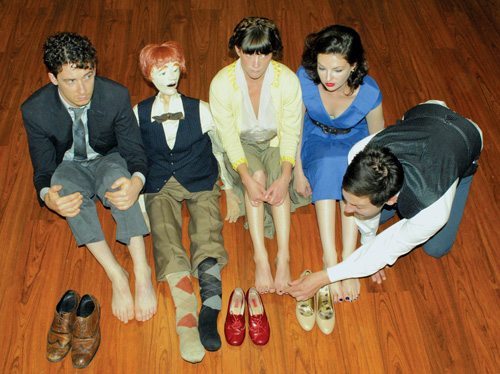
Finally, from this mysterious disorientation, emerges a family of four: egomaniacal Major von Berg (a nicely volcanic Ryan Hayes), sly Mrs. Von Berg (a serenely confident Hurtado), morose teenage daughter Gussie (a withering but vulnerable Margery Fairchild in severe pigtails), and half-feral little Lippel (a wan puppet). They have a decidedly European mien about them, but from where or what century they hail exactly is hard to say. What is certain: you have arrived at your destination.

Dark Porch Theatre co–artistic director Martin Schwartz pens and directs this curious, half-elevated yet earthy, gently absurdist foray into the woods of East Prussia, a Twilight Zone of indeterminate time and place where a nervously deferential young man named Läuffer (Brandon Wiley) gains employment as a tutor for a deeply divided family headed by a hot-under-the-military-collar patriarch. Divided into a dozen discrete episodes over 90-minutes, Tutor: Enter the Exclave is fitfully inspired but at its best offers some excellent opportunities for the eight-year-old experimental theater company, now in residence at the Exit, which specializes in evoking the unsettling dream with humor, unusual staging, and a taste for the macabre.

Läuffer finds his two charges unimpressed and abusive. The puppet is particularly surly, slapping his tutor for fun and never saying anything more than “doo, doo, doo,” which has something fecal about it to be sure, but also harkens back to the German formal form of “you” (with maybe a little echo there of Sylvia Plath’s “Ach, du” in her papa-as-fascist poem, Daddy). Moreover, given the competing demands and threats thrust his way by the warring parents, his position in the household is hardly tenable. Still, he clings on for lack of anywhere else to go, until an unhealthy interest in 15-year-old Gussie culminates in general ruin and some grisly particulars.

Schwartz latches onto an intriguing aspect of this grim goodtime story — which he adapts from his own translation of Sturm und Drang–school writer J.M.R. Lenz’s 1774 play, Der Hofmeister — namely the theme flagged by the “exclave” in the title, which refers to an isolated region detached from the mainland but nevertheless a part of the same country. Attached yet apart proves an apt description of each character’s condition as well as of the family unit itself, which is seemingly lost in time. (The video mash-ups include modern-day footage of the Russian exclave of Kaliningrad, formerly East Prussia, the setting for the Lenz play.) Even the narrative is kept at arm’s length: Gussie, for instance, has a penchant for narrating out loud everything happening inside her head and around her as if it were a story. Moreover, at random intervals a light shift signals a break in the action, wherein the actors drop character and execute a short improvisational exercise. The quiet harmony on display in such Brechtian moments acts as a counterpoint to the hierarchical but inherently fractured world of the story.

The generational and authoritarian tension between the parents and the children, and the forbidden love it both produces and dooms, is a classic theme recalling Lenz’s contemporary Schiller’s Intrigue and Love or, a century later, Wedekind’s Spring Awakening. Gussie highlights it at the outset when she announces petulantly, “In all of our stories, discipline is the hero. In all of our stories discipline is broken and has its revenge.”

Damn if she isn’t right, too. Tutor‘s exploration of the exclave limns a mental landscape as much as anything else: an alienated chunk of real estate ruled by an authoritarian regime known variously as the Superego, or Daddy, or “doo.”


Tutor: Enter the Enclave

Through Oct. 22, $15-$25

Thurs.-Sat., 8 p.m.

Exit Studio

156 Eddy, SF

(415) 673-3847

www.darkporchtheatre.com

Strive to fail

0

steve@sfbg.com

LIT As I watched Occupy Wall Street grow and spread to other cities in recent weeks, I’ve been alternating between reading two books by familiar figures — a pair of fearless entities that have helped pry open public spaces using the simple weapon of creative expression — and I’m struck by the lessons they offer at this strangely hopeful moment in our history.

Together, they’re like a one-two punch to the status quo and to the notion that we’re all essentially prisoners of the existing political and economic systems. They encourage their readers to strive for impossible goals, to be guided by something bigger than our tiny selves, and to embrace failure rather than fearing it. These are the same ideas embodied by protesters occupying the streets of San Francisco and other major U.S. cities, this sense that they have nothing to lose by making a stand now but everything to lose by continuing to be obedient to the powerful forces that seek to dampen their spirits and rob them of their futures.

The Reverend Billy Project: From Rehearsal Hall to Super Mall with the Church of Life After Shopping is by Savitri D and Billy Talen, the couple behind the performance art church that critiques hyper-capitalism by doing exorcisms and other telling rituals in banks, chain stores, and other examples of what they call the “devil monoculture.”

So the Occupy Wall Street movement that began Sept. 17 in their adopted hometown of New York City is right in their sweet spot. They’ve been down there almost every day delivering sermons, songs, and support — Savitri D as the group’s stage manager and creative director and Talen as his alter ego, Rev. Billy, the evangelical pastor of a large flock of creative activists they’re organized into a choir.

“It feels like the culture is breaking open,” Talen told me by phone as he surveyed the scene at Occupy Wall Street. “These kids are really going for it.”

I’ve long been an admirer of their work and I included Billy as a character in my own book, The Tribes of Burning Man: How an Experimental City in the Desert is Shaping the New American Counterculture, along with longtime burner and San Francisco-based showman Chicken John Rinaldi, the author of the other book I’m discussing.

The Book of the IS: Fail…TO WIN! Essays in engineered disperfection was launched by Chicken and the eclectic group of culture-shakers in his orbit during a spectacular free party on Sept. 30. The 111 Minna Gallery contained 50 unique, custom-designed covers to his already well-designed book, selling for a whopping $250 each — and they sold out! Outside, the closed-off alley was filled with variety acts, strange artsy spaces to explore, a buzzing Tesla-coil tree, and hundreds of people.

Both Chicken and Billy have run for mayor in their respective cities, Chicken in 2007 and Billy in 2009, both injecting art and unconventional creativity into their campaigns. Ironically, it is Chicken who discusses his campaign at some length in his book, despite his basic disdain for politics, while Billy and Savitri — whose art is performed in service of political principles they hold dear — don’t include the campaign in their book.

“We believe that the five freedoms of the First Amendment — religion, speech, press, assembly, and petition — that you need to have these freedoms flourish in public spaces, and that has been shut down in New York City since 9/11,” Billy told me from Occupy Wall Street. “We’ve suffered a loss of our public spaces in New York, and to have all these young people open that back up is very exciting.”

But it wasn’t the politics of their books that struck me as much as their sense of possibility and the way they agitate for a new kind of world. Chicken didn’t run for mayor to win or even to make a political statement. He ran because he sees San Francisco as a “city of art and innovation,” and because then-Mayor Gavin Newsom was more focused on keeping the real estate market booming than keeping the city a fun and interesting place.

“No one was stepping up to challenge him, because no one could beat him. It was in the bag. But Gavin didn’t represent San Francisco very well in a few key departments, and I wished that someone would provide a referendum on the values of the city. Or something. Whatever else it was, running for Mayor was an opportunity to bring my shtick to a bigger stage,” Chicken wrote.

And Chicken’s shtick was the show, his raison d’etre, the need to create culture that drove the various pursuits that he chronicles in his book, from his adventures with the Cacophony Society to his touring with Circus Redickuless and the hardcore punk Murder Junkies to piloting a fleet of boats built from garbage to hosting strange spectacles at his Odeon Bar.

“I mean it’s all a show, of course. And all shows are just stories. And in the end, it’s all the same story,” Chicken wrote. And that story is about what it means to be human, to strive for something authentic and important in this mediocre, manufactured culture that corporations create for us, to reach so far for that truth that we fail — in the process touching the divine, or achieving what Chicken calls Severe Comedy — and then to start that process all over again.

“You can never really say you gave your all unless you fail,” Chicken tells me, recognizing that same spirit in the Occupy Wall Street movement. “I think we’re literally witnessing history in the making. This is the dawn of new ideas.”

That same spirit has animated the work of Billy and Savitri, and their book tells stories from their many demonstrations and events from around the world, ping-ponging between their two perspectives on what happened. Some actions are well-planned and meticulously rehearsed, other more impromptu, like leading a group from a talk they gave in Barcelona to a nearby Starbucks to lick all the surfaces and take it into their bodies.

“Now! Now! Let your body tell you. Do you accept or reject this devil chain store? Will you allow the alien corporation Starbucks to come into your body, into your neighborhood, into your town? Do you accept the devil chain store?” Billy preached.

In reading their books, I got the sense that they didn’t always know what they were doing, that they were just acting, trying to stay in motion, to just do something and figure out what it really means later. Chicken even confirmed the observation when we spoke: “I never have any clue what the fuck I’m doing.”

But that’s okay. Maybe a lot the kids on Wall Street and in front of Federal Reserve building in San Francisco don’t know what the fuck they’re doing either. But, in the face of the greed and corruption that plague our economic and political systems, at least they’re doing something. And even if they fail — maybe especially if they fail big — we’re a better and more interesting country because of their efforts.

SF’s foreclosure crisis

0

OPINION Foreclosures are still ravaging San Francisco neighborhoods.

As steward of the city’s property roll and head of the department that appraises every home in San Francisco, I see every day the toll the mortgage crisis is having on real estate values and the city budget.

Thousands of Notices of Default have been filed with my office in the last few years, and every Monday there’s a vivid reminder San Francisco is far from out of the woods on foreclosures as homes are auctioned off on the steps of City Hall.

Two Mondays ago, lifelong Bayview-Hunter’s Point resident Curtis Warren’s home — which my office assessed to be worth $165,000 — was scheduled to be auctioned because he had fallen behind on a $15,000 debt.

Imagine having your home foreclosed upon over a loan less than 10 percent of the value of the property. Imagine a family in your neighborhood being put on the street and a home in your community sitting vacant under such circumstances.

Fortunately, the foreclosure sale of Curtis’s home was canceled. Curtis is a member of the Alliance of Californians for Community Empowerment (ACCE) — a grassroots organization working to help victims of the mortgage meltdown.

Unfortunately, cases like Curtis’s are all too common. That is why I am fighting foreclosure as your Assessor-Recorder and working to get Sacramento to act, too.

ACCE recently published startling findings in their “The Wall Street Wrecking Ball” report.

San Francisco homeowners are estimated to lose $6.9 billion in property values as a result of foreclosures.

Foreclosure costs San Francisco government an estimated $42 million in lost revenue.

Local government spends an additional $19,229 on increased safety inspections, police and fire calls, and trash removal and maintenance for every foreclosure. This costs San Francisco $73 million.

San Francisco LITERALLY cannot afford this foreclosure crisis, which is why I have joined with Supervisors John Avalos, Malia Cohen and Ross Mirkarimi in support of the following plan of action:

A foreclosure fee to ensure banks pay their fair share: The city should charge a $10,000 to $20,000 fee per foreclosure to defray loss of home values and costs to taxpayers. This fee would raise roughly $2 billion to $4 billion over the next year to partially reimburse local governments.

A strong AG settlement. Any agreement between banks and the 50 attorneys general must include 1) a monetary settlement commensurate with the harm caused by banks; 2) limited release of bank liability; 3) principal reductions fairly distributed to communities hardest hit by predatory lending and foreclosure; and 4) homeowner restitution for irresponsible and illegal foreclosure practices.

Stop preventable foreclosures: The city should require court-based mediation programs to help homeowners modify loans and end the “dual track” process, whereby banks continue foreclosure proceedings while simultaneously negotiating loan modifications.

Wall Street must pay for foreclosure-related blight: Banks must maintain and pay for the cleanup of blighted, vacant homes in neighborhoods.

As long as our economy and housing market is being hampered by foreclosures caused by banks and Wall Street, we must continue to fight for common-sense solutions that protect our neighborhoods and the city.

Phil Ting is assessor-recorder of San Francisco.

Guardian editorial: The attack on public finance

15


ATTACKING PUBLIC FINANCE, COURTESY OF SUPERVISORS SEAN ELSBERND AND MARK FARRELL WHO ARE  CARRYING THE WATER FOR THE DOWNTOWN GANG AND ITS WELL-FUNDED CANDIDATE MAYOR ED LEE

Impertinent questions for the supervisors:
Why are you discussing amending/gutting a damn good thing (the public finance system)  for reasons of “liability” when nobody has sued the city?
Why not tell Mayor Ed Lee to start showing up at debates and forums instead of hiding behind the gushers of PG&E/Chamber/downtown/real estate money flowing  into his campaign?  B3


EDITORIAL: The two most important political reforms in modern San Francisco history were the restoration of district elections and the creation of a public-finance system for mayoral and supervisorial elections. Both give candidates who lack big-business support a chance to win elective office. Both give independents a chance to compete against the downtown interests. Both have improved local government considerably in the past decade. And now public financing is directly under attack.

The Board of Supervisors was slated to meet in closed session Sept. 27 to discuss amendments to the public disclosure law — allegedly, according to Supervisors Mark Farrell and Sean Elsbernd, to avoid legal liability. The U.S. Supreme Court struck down in July that an Arizona law giving increased public money to candidates who were being badly outspent by well-financed opponents. One aspect of the city’s law, which allows extra public money for candidates once their opponents break the spending cap, might fall under the high court’s ruling.

But the city’s right in the middle of a heated mayoral election, and all of the candidates entered knowing the current rules — and more important, nobody has come forward to sue, or even threaten to sue, over the city’s law. So there’s no urgent reason to rewrite the ordinance.

The very fact that so many qualified candidates are in the race is an argument for public financing. Many of the current candidates would be unable to raise the vast sums required for a serious campaign without the help of public finance — and that opens up the field to more ideas, more debate, more policy discussions. It also gives the voters more of a choice — which, is, after all, what democracy is about.

Besides, as activist Larry Bush pointed out to us, “you have two choices with money in elections — you can pay up from with public funding or you can pay afterward with sweetheart contracts. And we all know which one is cheaper.”

Mayor Ed Lee, who has refused to take public money (because he doesn’t have to — he’s got plenty of rich and powerful backers) is attacking the campaign law, complaining in a TV ad that his opponents are “using taxpayer money” for “attack ads” — and that’s spurring discussion about whether there ought to be limits on how public money can be used. Any move in that direction would undermine the whole point of the law — if candidates can’t do negative ads (which, like it or not, are part of the modern campaign world) with public funds, they’ll raise outside money instead.

There are plenty of ways to improve the city’s public finance law (increasing disclosure requirements for late money and expanding the restrictions on donation by city contractors would be a good start). But amending the law in the middle of a campaign when there are no existing legal threats is a bad idea, and the supervisors should scrap it.

PS: If Lee wants to be mayor, he needs to start showing up — at debates and forums. That’s part of the job.
 

The America’s cup confusion

19

If the sponsors (and city officials) are right, the America’s Cup is going to be a huge event, attracting hundreds of thousands of spectators, many of whom will want to be on the San Francisco waterfront to watch. But it’s never been clear to me exactly how that’s going to work — how are all those (rich) people who are used to getting around in limos going to travel from their downtown hotels to the viewing areas? If the city wanted to do this right, we should close down the Embarcadero and some of the feeder streets to all vehicles (except ambulances — always needed when rich old people get excited) and force everyone to travel by pedicab. Buy up a fleet of several hundred of the human-powered vehicles and let all the unemployed teenagers get a shot at driving them. Job creation for youth; environmentally sound transportation; potentially fun bumper-car action with well-heeled patrons screaming in fear.


Remember: The f-line, even with improvements, can’t possibly handle the necessary traffic. And the AC types aren’t going to ride the train anyway. No way private cars can all fit without massive gridlock.


So: Pedicabs. My suggestion.


In the meantime, there’s this little problem of 8 Washington.


See, the developer of what would be the city’s most expensive condos ever is planning on excavating 110,000 cubic yards of soil for a massive underground parking garage — right along the Embarcadero, and right during the America’s Cup events. The Draft Environmental Impact Report for 8 Washington indicates that the dump trucks (about 20 big trucks per day, and possibly a lot more) would be using that roadway to get to 101 or 280.


Actually, if activist Brad Paul is correct, there’s no way the developer can excavate that much dirt in the time frame that it’s supposed to happen unless the number of trucks is closer to 300 a day. Imagine all of that happening while 100,000 people are trying to get to the waterfront to watch the show. Oh, and according to the DEIR for the America’s Cup, the Embarcadero will be CLOSED during that period.


The fact is, the 8 Washington project is not only a terrible idea (just what the city needs — more condos for mega-millionaires) but would directly screw up the whole America’s Cup effort. And the amazing thing is that the AC people and the Mayor’s Office don’t seem to be paying attention.


Paul has put together a lengthy critique of the whole mess that makes great reading if you’re into this sort of thing. So I thought I’d just post it all here. Warning: It’s long. Enjoy.


August 15, 2011                                                                                                         


Bill Wycko
Environmental Review Officer
San Francisco Planning Department
1650 Mission Street, Suite 400
San Francisco, CA  94103


Re: COMMENTS ON DRAFT EIR FOR 8 WASHINGTON STREET/
SEAWALL LOT 351 PROJECT    
Case No. 2007.0030E


Dear Mr. Wycko:


I am writing to my provide my comments on the Draft Environmental Impact Report (“DEIR”) for this project, a document that is incomplete, inadequate and in places quite misleading. I’ve organized my comments in sections beginning with a detailed discussion of how the project’s construction schedule has been greatly underestimated. This is followed by discussions of the DEIR’s failure to address key Housing and Population issues, misstatements regarding historic obligations related to Golden Gateway, comments on recreation issues, and more.  In general, I believe the DEIR fails to present objective information and analysis, it omits a number of relevant issues that are critical to the ability of public officials to make objective and informed decisions about the project and it is filled with judgments and assertions that are not supported by facts.


The DEIR is incomplete and inadequate in the following areas:


I. THE DEIR CONSTRUCTION SCHEDULE FOR 8 WASHINGTON IS BOTH INACCURATE AND MISLEADING.


The DEIR construction schedule is based on overly optimistic assumptions that are totally unrealistic; the ramifications of these erroneous assumptions need to be carefully considered as they will cascade throughout the project requiring major revisions to the DEIR before it can be considered accurate and complete.


At the bottom of page II.19 it states:
 
      Project construction, including demolitions, site and foundation work,
      construction of the parking garage, and construction of the buildings,
      would take 27-29 months. Assuming that construction would begin in 2012,   
      the buildings would be ready for occupancy in 2014. The first phase of the
      construction would take about 16 months and would include demolition       
     (2 months), excavation and shoring (7 months), and foundation and below
      grade construction work (7 months).


While the DEIR unequivocally states the project will take 27-29 months to construct, from 2012 to 2014, facts provided elsewhere in the DEIR together with current city policies,  the City’s America’s Cup Host and Venue Agreement and basic math indicate that this schedule is not tenable. The remainder of this section provides the data and analysis that lead to the conclusion that construction of 8 Washington will take much longer than 27-29 months, almost TWICE AS LONG, with excavation taking 2.5 to 3 TIMES longer.  


Table 1: Requested Changes to the overall DEIR construction schedule


          ACTIVITY             MINIMUM           MAXIMUM


    DEIR’s construction schedule: 27 months    to    29 months  


    Actual excavation schedule:  18 months           22 months
    — DEIR estimate for excavation – 7 months            – 7 months
    + Increased excavation time  11 months      to       15 months 
    + Archeology delays                .5 months      to         2 months
    +  America’s Cup delays                  2.5 months       to         5 months
    +  Weather delays                        .25 months      to         1 months


   ACTUAL CONSTRUCTION TIME 41 months       to      52 months


To refute the numbers in Table 1, project sponsors must present additional, verifiable data supporting their unrealistic assumptions, beginning with the claim that the first phase of construction takes 16 months with a mere seven months allocated for excavation/shoring.


A. The DEIR fails to accurately ascertain and analyze the excavation/shoring schedule.


The DEIR states on page II.20 that “approximately 110,000 cubic yards of soil” will be excavated from the site for an underground garage (approximately 90,000 cubic yards) and other foundation work during the seven (7) month “excavation” portion of the projected timeline. It later states excavation will take place 6.5 hours per day with an average of 20 truck trips per day (pg.IV.D.31). Assuming the average dump truck holds 12 cubic yards of dirt (typical payload for a dump truck), that would mean:


      · 110,000 cu. yards/12 cubic yards per truck = 9,166 truck trips


      · 20 trucks/day X 12 cubic yards/trip = an average of 240 cu. yards/day


      · 110,000 cu. yards/240 cu. yards per day = 458 working days for this task


Could this task be completed in seven (7) months as claimed in the DEIR?  NO.


     ·5 working days per week X 52 weeks = 260 working days per year
             – 11 holidays per year
                   249  total working days/year


     ·458 days to finish task/249 working days per year = 22 months  (not 7)
     
For this to take 7 months as the DEIR asserts, the following would have to be true:


   · 20 trucks/day X 7 months (145 working days ) = 2,900 total truck trips


   · 110,000 cu. yards/2,900 trucks = each truck must average 38 cubic yards/trip
Empirical evidence exists, however, proving the DEIR’s claim that the excavation portion of the schedule will take seven months is inaccurate and misleading:


        CASE STUDY #1: San Francisco General Hospital Rebuild Project


A recent SF General Hospital (SFGH) Newsletter reports the hospital’s contractor just finished hauling 120,000 cu. yards of dirt from the 45’ deep hole that was dug to build two basement levels and the foundation for a new hospital building. This is as close as anyone is likely to get to replicating what 8 Washington proposes, a three level 40’ deep underground garage accounting for most of the 110,000 cubic yards of dirt that must be removed from the site. 


A call to the SFGH Rebuild office revealed their excavation process took seven (7) months with an average truck load of 13 cu. yards per trip. How was that possible?


“The average truck load was 13 cubic yards. Some days we had
over 300 truck loads hauled in one day. This volume was possible
through use of a paved drive that allowed trucks to enter the side, be
loaded up then tires washed to prevent dirt on road causing storm-            
water pollution and dust.”


The SF General site is just a few blocks from U.S. 101 with direct access via Potrero Ave., thus minimizing potential traffic conflicts. The 8 Washington site will require driving long distances on city streets including “The Embarcadero, Harrison Street, and King Street… likely the primary haul and access routes to and from I-80, U.S. 101, and I-280 (pg. IV.D.31).” Imagine 300 trips a day on one of these streets.


               CASE STUDY #2: SF PUC’s New Hetch Hetchy Reservoir Tunnel


A recent Oakland Tribune story (4/8/11) describes construction of a new 3.5-mile tunnel designed to protect the water supply from SF’s Hetch Hetchy reservoir from major earthquakes by boring a 2nd, state-of-the-art tunnel from Sunol to Fremont alongside the existing 81-year-old Irvington Tunnel. The article states:


      “By the time the New Irvington Tunnel is completed in 2014, crews will have
        excavated about 734,000 cubic yards of material—the equivalent of 61,000
        dump-truck trips, said officials with the SF Public Utilities Commission.”


Dividing 734,000 cubic yards of soil by the 61,000 dump truck trips that the PUC says are necessary equals 12 cubic yards per truck trip. Given this job’s overall size and $227 million budget, it would seem to confirm the fact that the most efficient excavation equipment for the 8 Washington site will be 12 cubic yard dump trucks.


In light of these facts and the analysis provided above, the only way 8 Washington could meet its proposed seven (7) month excavation schedule would be to:


a) schedule up to 300 TRUCK TRIPS A DAY, over 10 TIMES the average number of trips per day (20) stated in the DEIR and 3 TIMES the absolute maximum of 100 truck trips per day (pg. IV.D.31)  along the Northeast Embarcadero during a period of time that directly overlaps with the major America’s Cup events and activities, something specifically prohibited by the City’s America’s Cup Host and Venue Agreement ,        


         OR


b) average 38 cubic yards of dirt per truck trip, 3 TIMES the average truck payload of both the PUC’s Irvington Tunnel project and SF General Hospital’s 120,000 cubic yard excavation project—assuming that 38 cubic yard trucks:  a) exist in sufficient quantity in   the Bay Area, b) would be available during that period of time described and c) would be allowed on The Embarcadero, Harrison St., King St., Washington St. and Drumm St. by     the City. [see photo comparison of 12 cubic yard vs. 30 cubic yard trucks below]


Unless the project sponsor can demonstrate that one of these two highly unlikely scenarios is possible, then the EIR must reanalyze a number of impacts (e.g. Land Use, Air Quality, Greenhouse Gases) based on a revised excavation schedule, one that takes 2.5 to 3 TIMES as long as the one described in DEIR to complete excavation work, and this 22 month timeline assumes NO archeological remains are found on site and the City imposes NO stop work orders related to America’s Cup (see below).


This 15-month difference between the excavation period analyzed in the DEIR and the ACTUAL time it will take to complete the excavation (22 months vs. 7 months) is a major deficiency in the DEIR with profound impacts.  For instance, some of the most significant unavoidable negative impacts described in the DEIR involve degraded air quality both during and after construction. Adjusting the environmental analysis to reflect how long excavation will actually take means significant air quality impacts related to excavation (with the greatest detrimental effect on seniors, children and people exercising) will persist for 2.5 to 3 TIMES LONGER than described in the DEIR.  This flaw also requires significant revisions to other sections of the DEIR.


In light of this new information, the next draft of the EIR must contain an analysis of    this longer overall construction period—two months for demolition; a range of 18 to 22 months for excavation (not seven months); a built-in range of time for the shutting down of the site when archeological artifacts are uncovered, documented and extracted (something the DEIR’s archeology consultant states is “likely” ); and the building construction period. Finally, given these overly aggressive excavation schedule estimates, all other estimates for later construction phases must now to be cross checked for accuracy by independent contractors (e.g. not working for 8 Washington developer    or the source of the prior DEIR excavation estimate).


B. The actual construction timeline for 8 Washington will be 41-52 MONTHS. 
If the project sponsors disagree with this assessment, they must provide the Planning Department with much more detailed information on how they expect to achieve a shorter construction period given the restrictions described in the DEIR itself as well as mathematical analysis described above. For instance,


– Did the developers err when they reported that the average number of truck
   trips per day would be 20 as analyzed in the DEIR?  If so, what number do they 
   choose to use now and how does that impact various aspects of the DEIR analysis
   such as air quality, conflicts with pedestrians, MUNI and America’s Cup, etc.. 


– Does the developer plan to raise the limit of truck trips per day from 100 (as
   per the DEIR) to 300 truck trips per day? If so, how often will this happen and 
   how will these changes impact various aspects of the previous EIR analysis (e.g. air
   quality, traffic/transit/pedestrian conflicts, America’s Cup)?


– Does the developer plan to lengthen the average workday or work six days a
   week? If so, how often and how would this impact the previous DEIR analysis?
   NOTE: The DEIR construction schedule (27-29 months) was not predicated on the
   trucks operating 6 days a week EVERY WEEK. But even if the developer ran dump  
   trucks 6 days a week for the ENTIRE excavation period it would still take TWICE AS
   LONG as the DEIR states to remove 110,000 cubic yards of dirt .


– Where is the project sponsor planning to route 100 to 300 trucks a day as they
   leave the site, particularly during the various America’s Cup trials (2012) and
   finals (2013) when vehicular traffic will be severely limited or prohibited?
   Washington Street? The Embarcadero? Drumm Street? Clay Street?, where exactly?


– Have the developers located a source of 30+ cubic yard trucks and secured
   city permission to use them on the specific streets described in the DEIR?
   It seems fair to assume the SF General Hospital’s excavation contractor would have
   done this if it were possible (and the SF PUC’s Irvington Tunnel contractor). See the  
   three photos below to get a sense of the size difference between a typical 12 cubic yard
   dump truck and the type of tractor-trailer rig required to carry 30 cubic yards or more.


As the questions and examples (SF General Hospital) above demonstrate, the DEIR’s claim that 110,000 cubic yards can be excavated in seven months defies the laws of physics and math, not to mention the America’s Cup Host & Venue Agreement between the City and Larry Ellison’s Oracle BMW Racing Team 


 A thorough reading of the DEIR’s Archeology section and the America’s Cup Host and Venue Agreement indicate that additional time must be built into the construction schedule for predictable work stoppages related to both issues.


KNOWN ARCHEOLOGICAL RESOURCES IDENTIFIED ON THIS SITE IN THE DEIR


On page IV.C.12, the DEIR’s archeology consultant, Archeo-Tec, identifies the Gold Rush ship Bethel as located under a portion of the site and states that “If discovered, the Bethel would be the oldest known (and perhaps most intact) archeological example of an early Canadian built ship (Pg. IV.C.3)”. On page IV.C.11, the archeology consultant states “Significant archeological resources are likely to exist at this site”.  The DEIR, goes on to state the proposed project will destroy a portion of city’s original Seawall causing “the largest disturbance of the Old Seawall to date”.


As a result of these DEIR findings, the archeology consultant should now be asked for an estimate of the time required to mitigate the discovery of the Bethel and other likely finds (e.g. original Seawall, other Gold Rush ships, original Chinatown). This “likely” work delay should be built into the construction schedule and stated as a range. For purposes of the matrix below (Table 1) we chose a time of two weeks to two months based on anecdotal information from other similar sites. Archeo-Tec, the archeology consultant, should be able to come up with a more precise estimate.


KNOWN AMERICA’S CUP SCHEDULING CONFLICTS


Based on recent MTA staff presentations on protocols for the America’s Cup, it seems clear that traffic, particularly construction dump trucks, will be banned from Washington Street, Drumm Street and The Embarcadero during major America’s Cup events that include, at a minimum, the America’s Cup World Series warm-up races (July/Sept. 2012), the penultimate Louis Vuitton Cup Series (July/August 2013) and the America’s Cup finals (Sept. 2013).  


This represents a minimum of 2.5 months that must be added to the construction schedule, something the DEIR authors should have included if they had read the America’s Cup DEIR which states there are 9+ weeks of races associated with this event in 2012/2013. The extra few weeks added to the low end range in Table 1 (below) are there to accommodate last minute weather delays and various large non-racing events held along the waterfront that will require closure of The Embarcadero, Washington Street, Drumm Street, etc.


Table 1 below lays out a more credible and realistic construction schedule based on the factors described at length above, taken directly from the DEIR or readily available from the city (e.g. America’s Cup DEIR) and the America’s Cup Host and Venue Agreement.


Table 1: Requested Changes to the overall DEIR construction schedule


          ACTIVITY             MINIMUM           MAXIMUM 


    DEIR’s construction schedule: 27 months    to    29 months  


    Actual excavation schedule:  18 months           22 months
    — DEIR estimate for excavation – 7 months            – 7 months
    + Increased excavation time  11 months      to       15 months 
    + Archeology delays                .5 months      to         2 months
    + America’s Cup delays                   2.5 months        to         5 months
    + Weather delays                        .25 months      to         1 months


   ACTUAL CONSTRUCTION TIME 41 months       to      52 months


To refute these numbers, the project sponsors must not only present a verifiable and detailed plan to remove 110,000 cubic yards (9,167 truck trips) in seven months that the City has signed off on but also produce a letter from the City and Oracle BMW Racing granting a waiver from Section 10.4 of the America’s Cup Host and Venue Agreement that would allow 20 to 300 trucks a day to drive along The Embarcadero, Washington Street   or Drumm Street during major America’s Cup events in 2012 and 2013.


D. Significant Transportation and Energy issues that were not addressed in DEIR.


More specific information related to the construction process needs to be provided and analyzed in the EIR, particularly regarding the far reaching impacts of those 9,166 dump truck trips, impacts that go beyond the immediate Northeast Waterfront.


The DEIR states “While the exact routes that construction trucks would use would depend on the location of the available disposal sites, The Embarcadero, Harrison Street, and King Street would likely be the primary haul and access routes to and from I-80, U.S. 101, and I-280”. At a minimum, The EIR needs to include information on where the two or three most likely disposal sites are located, based on recent experience (SF General Hospital excavation) so that one can analyze the extent of potential conflicts on the Bay Bridge or 101 South where other trucks will be transporting dirt to and/or from the Transbay Terminal project, Hunters Point Shipyard, Mission Bay, Treasure Island, etc. Without this information, the City could find itself creating significant traffic conflicts on the Bay Bridge or highway 101 that greatly increase air quality, traffic and transit problems without having analyzed these potential impacts in a flawed EIR.


Simply saying “While the exact routes that construction trucks would use would depend on the location of the available disposal sites” isn’t adequate or acceptable. Assumptions must be made regarding most likely disposal sites and routes to those sites and what additional cumulative impacts these routes (and 9,166 trucks) will create. The EIR must provide a MAP of the route to be used for hauling soil, all the way from the departure point at 8 Washington to the final destination(s) with an explanation of where trucks will drive and what restrictions there are on hours, size of payload, safety, etc. for the various streets, highways and bridges they will travel on. If the options include trucking the soil to San Francisco’s southern waterfront to transfer it to barges, then this needs to be disclosed and analyzed, including the potential routes and destinations of those barges.
In addition, to accurately compare the environmental impacts of the project sponsor’s ‘Preferred Project’ to the “No Project” alternative (energy consumption, traffic impacts, air quality degradation, etc.), one needs to know not only the destination of the approximately 9,166 dump truck trips but also the average miles per gallon of a typical dump truck. For instance, if the final destination for the soil was 100 miles away and a typical dump truck averages 8 miles per gallon of diesel fuel, then:


      9,166 truck trips X 200 miles per round trip = 1,833,200 miles for all dump trucks;


      1,833,200 gallons/8 MPG = 229,150 gallons of diesel fuel that would be burned. 


In other words, the city’s choices would be:


     229,150 gallons of diesel fuel used to transfer 110,000 cubic yards 1,833,200 miles


VS.


    ZERO (O) gallons of diesel fuel used if the NO PROJECT alternative were approved.


E. Importance of accurate, detailed information re: the construction process.


Given the above discussion, it is clear that the construction schedule set forth in the DEIR is inaccurate at best and has led, in many cases, to the significant understating of major negative impacts associated with this project. The lack of a detailed discussion of some of the key aspects of the construction process, e.g. the route and destination of 9,166 dump trucks, is also highly problematic.


Without a complete and thorough analysis of the impacts of a of an overall construction schedule that is TWICE AS LONG as the one analyzed in this DEIR, city officials will be missing much of the critical information they need to determine whether or not the developer’s ‘Preferred Project’ is necessary, desirable or feasible. A complete and factual analysis of this issue must be included in the next draft of the EIR which, given this and  other major inaccuracies and omissions (see below), should be recirculated in draft form.


II. THE DEIR FAILS TO DISCUSS OR ANALYZE ANY CRITICAL HOUSING ISSUES RELEVANT TO 8 WASHINGTON OR UNIQUE ENVIRONMENTAL AND ENERGY IMPACTS THOSE HOUSING ISSUES CREATE. 


A. Impacts of the project on the City’s Housing Needs were Not Analyzed in DEIR.  The DEIR states that potentially significant impacts to Population and Housing will not be discussed because the 2007 NOP/Initial Study found that the proposed project would not adversely affect them. Unfortunately the DEIR lacks the basic information needed to reach such a conclusion and, as we will demonstrate, an objective review of relevant 2008-2011 housing data contradicts this conclusion.


The world, particularly regarding housing, has changed radically since 2007. Relying   on housing and population information from 2007 ignores the financial and housing meltdown of 2008 and is simply indefensible. In addition, back in 2007, the EIR consultants were relying on stale, seven-year-old census data while today they have access to a multitude of fresh 2010 census data. No one can dispute that the housing environment today could not be more unlike the housing environment in 2007.
By relying solely on pre-2008 housing data from the 2007 NOP/Initial Study, this DEIR    lacks any of the basic information needed to conclude that this project would not have adverse effects on Population and Housing and must now revisit and thoroughly analyze these issues.


B. The DEIR fails to analyze how the type and price of housing proposed for
8 Washington determines whether or not it meets the city’s housing needs.


One of the project objectives (Pg II.14) is to “help meet projected City housing
needs.” How is that possible, given the fact that the developer has publicly stated
that these will be “the most expensive condominiums in the history of SF” ? With a
$345,000,000 project cost , 8 Washington’s 165 units will cost $2.0 million a unit
just to build . To secure financing and a ‘reasonable’ profit, each unit will have to
sell for $2.5-$5 million with penthouses selling for $8-$10 million.


Nowhere in the DEIR is ANY of this discussed. There is no analysis of how these
very high sales prices will determine who lives at 8 Washington (e.g. how many San
Francisco families could afford these prices?) and how the incomes of these new
residents ($250,000 to over $1 million/year) will dramatically change a number of
the environmental impacts of the project, with major implications for sustainability
and energy use, among other things.


The final EIR must state the average cost to build each unit and the range of
sales prices expected so that public officials can assess for themselves whether
the proposed condos will or will not  “help meet projected City housing needs.” 


The 2009 Housing Element, signed into law by Mayor Ed Lee on June 29, 2011, states that 61% of the housing need in San Francisco is for below-market-rate housing—serving families making 30-120% of Area Median Income (AMI), and only 39% of the city’s housing need is for market rate housing (120% to 500+% AMI).


As Planning staff and Commissioners know from their Housing Element discussions, the luxury condos proposed for this project are so expensive they will not help the city meet its current unmet housing needs. If this project objective (Pg II.14) is left in the final EIR, it should include a note explaining that the project, as proposed, is unlikely to meet this objective for the following reasons:


Condominiums selling for $2.5 million and more fall into the one segment of the city’s housing market that is currently overbuilt and has historically been over represented in relation to the state’s Regional Housing Needs Allocation (RHNA) goals that underpin the updated 2009 Housing Element of the city’s General Plan. An ABAG report on housing needs vs. housing production in SF (1999-2006) that came out in 2007—a report that should have informed the 2007 NOP/Initial Study for 8 Washington—states RHNA Allocations (Goal), Permits Issued (Permitted) and % of Allocation Permitted (% of RHNA Goal) by income category as follows:


Table 2: SF Housing Production (1999-2006)*


Housing Type  Very Low    Low              Moderate       Market Rate 
by Income    Income Income  Income           Housing
____________________________________________________________________________________________________________
  % of AMI:    21-50%  51-80%  81-120%         120-500+%
  Annual income: [21-50K] [57-81K] [85-123K]   [123K-$1million+]
———————————————————————————————————-
·RHNA Goal (units)   5,244       2,126   5,639                7,363


·Permitted    4,203       1,101      661                        11,474


·% of RHNA Goal     80%      52%       12%             156%


        * from a 2007 ABAG report entitled: A Place to Call Home


A chart like this, showing housing goals by income group (based on RHNA numbers from the State Office of Housing and Community Development), must be included in the DEIR so public officials can analyze what portion of the city’s unmet affordable and middle income housing needs, if any, the proposed project would meet. It illustrates something local housing experts have long known, that the city consistently comes in well above its RHNA goals for market rate condos, and has historically fallen short of its goals in all other categories for affordable housing, the housing that serves the 61% of San Franciscans that cannot afford ‘market rate’ housing.
C. Dramatic changes to the San Francisco housing market since the 2007 NOP/ Initial Study were not acknowledged and analyzed in the DEIR. All the traditional (pre-2007) sources of funding for the city’s affordable housing programs have dried up since the 2008 housing crash. Redevelopment tax increment funds will either be significantly reduced to pay the state to avoid closure of the SF Redevelopment Agency, or they will be eliminated altogether. Proceeds from the state’s $2.8 billion Affordable Housing Bond (Prop. 1C) are all spent. The federal Low Income Housing Tax Credit, a major source of funding for affordable housing, is under attack by House and Senate Republicans and may not survive.


This indicates that San Francisco won’t come close to meeting its pre-2007 affordable housing production levels  until we find a new permanent local source of funding for affordable housing. How long will that take? The DEIR must address this issue.


Another chart that must be included in the DEIR shows the city’s RHNA goals by income category combined with a summary of a recent SF Business Times (6/24/2011) chart showing all San Francisco residential projects under construction, permitted or  in the planning pipeline . Such a chart would look something like Table 3 below:


Table 3: Where does the city need help in meeting its RHNA goals?


          Extremely Low       Very Low            Low             Moderate          Market Rate   
                 Income          Income           Income            Income               Housing
         Below 30% AMI          31-50%            51-80%           81-120%              120-500+% 
      [21K-30K]         [35K-50]        [57K-81K]      [85K-120K]        [120K-$1M+]
____________________________________________________________________________________________________________


RHNA      439/yr.                   439/yr.           738/yr.            901/yr.                    1,632/yr.
Goals:      10.5%        +          10.5%      +      18%        +     22%  =  61%           39%
# of units                    of total        of total
% of goal
                             All Affordable Categories Combined            Market Rate_


Underway:          470 units                 1,557 units


Approved:                  8,751 units             30,878 units


In Pipeline:                   780 units                     4,184 units 
________________________________________________________________________
                          10,000 units             36,619 units 
            or                     or
          21.5% of all units                 78.5% of all units


                        56% of RHNA goals                                300% of RHNA goal
                in all affordable categories                        in market rate category
Some version of Table 3 must be included in the revised DEIR to help public officials determine whether the significant negative environmental impacts this project creates are outweighed by the ‘need’ for the type of housing that 8 Washington provides given the priorities set forth in the Housing Element of the General Plan and what the above-mentioned SF Business Times chart tells us about likely housing production for each segment of the city’s housing needs (from 2011-2014). 


Table 3 demonstrates that in a few years, if nothing changes, the city will have approved and built out 300% of its RHNA goal for Market Rate projects (such as 8 Washington) but only 56% of its RHNA goals for all other housing that serves San Franciscans making 30% AMI to 120% AMI. But given what we now know about the current lack of funding for affordable housing, the exact opposite of what was true in 2007 (when the city had significant amounts of Redevelopment tax increment and other affordable housing funds), many of the affordable housing projects listed by the Business Times are now on hold and unlikely to come on line by 2014. This means the mismatch between market rate (39% of need but 300% of production) and all categories of affordable will be even greater than Table 3 indicates.


To be fair, one could argue that some of the market rate housing on the Business Times chart may not be built soon either given that banks have been reluctant to lend money lately. However, a recent article in the SF Chronicle (8/11/11) entitled “Rents Go Through Roof” indicates that the city’s housing market is roaring back; Dennis Robal, property manager with Chandler Properties, reports “Noe Valley apartments that were $2,000 a month a year ago are now going for $2,400”. These kinds of increases, driven by new renters from the tech sector, are prompting major increases in investments by financial institutions in new rental housing.


Regarding the condo market, the one group of potential condominium buyers that
have not suffered financially from the economic meltdown are the very people who
caused it, the Wall Street investors, derivatives specialists, hedge fund managers,
etc. who are now making record salaries and bonuses. These are some of the people
8 Washington will be marketing to because they have the cash to spend $2.5-$10
million on a second, third or fourth home in San Francisco.


NONE of this housing analysis appears in the DEIR yet including it in the DEIR is
critical to the ability of public officials to make informed, rational decisions on this
project, particularly claims by the developer that this project will “help meet
projected City housing needs”. The information and analysis described above is
necessary to allow city officials and all readers to determine accurately and
objectively what portion of San Francisco’s unmet affordable and middle income
housing needs, if any, 8 Washington would meet.


Each year, as the City assesses how well it is meeting its RHNA (state) housing goals, the one area that has consistently over produced is high-end market rate housing affordable to people making $250,000 to $1 million+ a year.
How does building second, third and fourth homes for this demographic “help the city meet its housing needs?”


The unmet housing needs in San Francisco are for people making from 30%-50% of median income all the way up to 100-120%, not people making $250,000 to $1,000,000+ a year (200-500% or more of area median income). The DEIR needs to discuss the following questions to be considered complete, adequate and accurate, questions such as:


How does this project relate to the objectives, policies and goals of San Francisco’s recently enacted 2009 Housing Element of the General Plan?


What portion of San Francisco’s affordable and middle-income housing needs will this proposed project actually meet?


How many other projects under construction, approved or in the pipeline (see June 24,
2011 SF Business Times chart) will meet the needs of San Franciscans who can afford market rate housing vs. those that meet the needs of  the 61% of SF residents needing below market housing?


What percentage of “residents” of these condos will be using this housing as their primary residence vs. as second, third and fourth vacation homes?


Given that numerous studies show transit use goes down as income goes up,
how likely is it that these new owners will use public transit?


Again, the answer to each of these questions provides critical information that public
officials need to assess for themselves whether the proposed condos will or will
not “help meet the projected City housing needs.” 


Everything that’s happened since the 2008 economic/housing meltdown has made our housing problems worse, something the DEIR doesn’t attempt to analyze, arguing instead that a 2007 NOP/Initial Study—competed a year before the housing bubble burst—absolves it of all such responsibility, an argument that is factually absurd.


D. The DEIR fails to acknowledge, measure or analyze the unique environmental impacts generated by owners who can pay $2.5 to $10 million for luxury condos.


Building housing for this demographic has measurable impacts on transit and energy use that were not included in the DEIR. We know from national studies that low-and middle- income residents are far greater consumers of public transit than people with higher incomes. Imagine how much different public transit use will be when this inverse relationship includes people who can afford $2.5-10 million condos that come with             1-for-1 parking (costing almost $100,000 a space to build).


But a far greater environmental impact than driving private cars was not addressed in this DEIR, an impact resulting from lifestyle differences one can anticipate with some members of this highest of high-end demographics: owning and/or using private jets.


It’s reasonable to assume that five of the 165 condo buyers at 8 Washington (just 3% of   all buyers) are Wall Street hedge fund managers, derivatives traders or venture capitalists using these condos as second, third or fourth homes. It’s also reasonable to assume that these five buyers will use their condos 1.5 times a month on average and commute to and from SF aboard private business jets, a perfectly rational assumption for Wall Street executives making tens of millions in salary and bonuses each year. Why would they fly private jets rather than take Southwest…because they can. The fact that a handful of  people that are this wealthy will buy units at 8 Washington must be factored into any environmental analysis of a project that will explicitly market to this high-end demographic. That analysis must include, among others, the following:


                           Table 4: The Jet Fuel Burn Rate for Luxury Condominiums
___________________________________________________________________________
Mid to large size business jets used to fly cross country (e.g. Hawker 800XP, Gulfstream G2/G3, Bombardier Global Express) average 400 gallons of jet fuel per hour and take six hours to fly New York to SF and five hours to fly back for an 11 hour round trip  :


     · 11 hours X 400 gallons per hour = 4,400 gallons of jet fuel per trip
          a typical family car burns 1,200 gallons of gas per year so one flight from
          NYC to SF equals almost four years of driving a typical family car.
               ————————————————————————————————————————————————————————————————————-
       
        ·  1.5 trips/mo. = 6,600 gallons/mo. X 12 mo. = 79,200 gallons of jet fuel/year


        ————————————————————————————————————————————————————————————————————-
Using our example of 5 residents, the numbers over one year and 20 years are:


        ·  5 X 79,200 gallons/per year = 396,000 GALLONS OF JET FUEL A YEAR or
         equivalent to driving a family car 330 years, A THIRD OF A MILENNIUM, per year.


        ·  396,000 gallons/year X 20 years = 7,920,000 GALLONS of jet fuel in 20 years
         equivalent to driving family car 6,600 years, OVER 6 MILLENIUM, in 20 years.


Given these condos cost $2+ million to build and will sell for $2.5 to $8 million or more,    it seems quite reasonable to assume a mere 3% of these buyers—just five (5) buyers out of 165 —will be part-time residents wealthy enough to commute to San Francisco by business jet. If this is a reasonable assumption , then the DEIR must include the mathematical calculations above to show the true energy costs of this project. In fact, it would also be reasonable to assume a few other buyers will use private business jets to commute from LA, San Diego, Denver, etc. The only way to prevent this, forbidding buyers to own or use corporate jets, is of course impossible.
This is just one example of how housing prices—and who lives in that housing—greatly changes environmental impacts and why this analysis must be included in the DEIR for    8 Washington. As condo prices reach $2.5-10 million, it’s reasonable to assume a number of buyers will use them as a second, third or fourth homes and that some of those buyers will travel here by jet, not car or public transit. On the other hand, if units at 8 Washington were affordable or market rate rental or affordable-by-design condos (80%-150% AMI), it’s very unlikely any of its residents would own or use business jets. Price does matter with regard to energy consumption and transit use.


Given these facts, the 8 Washington DEIR must analyze such questions as:


How many solar panels do you need to make up for 396,000 gallons of jet fuel per year?


How many low flow toilets make up for 396,000 gallons of jet fuel per year?


How many double pane windows make up for 396,000 gallons of jet fuel per year?


How many on-demand hot water heaters make up for 396,000 gallons of jet fuel per year?


Looking at the longer term impacts of this excessive consumption of energy resources:


How many solar panels compensate for 7,920,000  gallons of jet fuel over 20 years?


How many low flow toilets make up for 7,920,000 gallons of jet fuel over 20 years?


How many double pane windows make up for 7,920,000 gallons of jet fuel over 20 years?


How many on demand water heaters make up for 7,920,000 gallons of jet fuel over 20 years?


Having this information in the DEIR is necessary for the Planning Commissioners or Board of Supervisors to make informed decisions about 8 Washington, especially when the project sponsor keeps touting it as state-of-the-art, sustainable, LEED certified (at Gold or Platinum level), etc. When added to the project sponsor’s insistence on building a 420-car underground (below sea level) garage, one has to question how one can call this a model of sustainable development or let the DEIR include sustainability as a project objective.


Unless the DEIR seriously and objectively addresses questions of how the price of housing and who lives in that housing impacts environmental sustainability, we risk creating a backlash against things like LEED certification and terms like “sustainability”. They could easily become just another example of slick marketing and “greenwashing”. Everyone agrees that building 10,000 s.f. McMansions in the Sierra Foothills on 2-acre lots—even if they’re LEED certified at the highest level—is NOT sustainable development. Why is it any less absurd to use “green” and “sustainable” to describe $2.5-$10 million condos built as second and third homes for extremely wealthy part-time residents, some of whom commute from their primary residence by private jet?


The DEIR must provide public officials with the data and information they need to analyze all the significant impacts that units this expensive have on the environment. With this information, decision makers might choose to require a much smaller garage or no garage at all (insisting on more efficient use of nearby existing garages). They might also choose to support a much smaller project or no project at all, based on the lack of demonstrable need for this housing type and all the other negative impacts described above. But they cannot make any of these decisions in a rational and objective manner without all the facts, many of which are missing from this DEIR.


E. The DEIR confuses project “objectives” with city mandated requirements with regard to Inclusionary Housing, then fails to discuss any of the relevant issues around this city policy.


The project objective (Pg II.14) that talks about the project’s ability “to help meet
projected City housing needs” reads in full:


 “To develop a high-quality, sustainable and economically feasible
   high-density, primarily residential, project within the existing
   density designation for the site, in order to help meet projected
   City housing needs and satisfy the City’s inclusionary affordable
         housing requirement;” 


Satisfying the city’s inclusionary affordable housing requirement, for this or any market  rate housing development, IS NOT an Objective, and stating it as such is misleading. It is,  in fact, legally mandated by city ordinance. The developer doesn’t have a choice in the matter and it should be stricken from this Objective. However, this reference to inclusionary housing leads one to ask several questions that are never addressed in the DEIR but should be. An Inclusionary Housing section must be added that answers questions such as:


What are the specific requirements for including permanent below market rate (BMR) units in all market rate projects and how many would be required on-site for this one?


Did the developer ever consider building on-site BMR units and if not, why not?


If the developer did consider and reject on-site BMR units, why?


If the developer has decided to pay the in-lieu affordable housing fee, what would it be and how and where (e.g. within a 1-mile radius of the project) would it be spent?


Given that the in-lieu fee charged developers to buy out of providing BMR units on-site is based on construction costs and sales prices for “average” condos, how will the extraordinarily high construction costs and sales prices for these condos impact the in-lieu fee? If it doesn’t impact the fee, would an appropriate mitigation measure be amending the Inclusionary Housing policy so that it does?


Mentioning the inclusionary requirement as part of an objective stating that the project seeks to “help meet projected City housing needs” is misleading and inaccurate. It tries to infer that the funding for 30 affordable units provided by the developer’s inclusionary requirement is helping to meet this objective when, in fact, relying on inclusionary payments to advance the city’s affordable housing goals will only drive the city further   out of compliance with its state mandated RHNA goals. The following example clearly demonstrates the validity of this claim:


TNDC’s proposed affordable family apartment project at Eddy and Taylor Streets is typical of the projects now stalled in the city’s affordable housing pipeline due to the lack of affordable housing funding from traditional sources. But the Eddy and Taylor project is a 150 unit development, not 30 units. For it to go forward, you would need the inclusionary housing funds from FIVE market rate projects like 8 Washington. What would that do to San Francisco’s RHNA goals:


         If:  165 market rate units are needed to fund 30 affordable units,
  Then:   825 market units (5X) are needed to fund 150 affordable units (975 total units).
      
         If:  out of a every 975 new housing units, 825 are market rate & 150 are affordable,
   Then:  for each new 975 units built in SF: 85% are market rate, 15% affordable.


But the 2009 Housing Element of San Francisco’s General Plan (based on the state RHNA goals) calls for 39% OF NEW HOUSING TO BE MARKET RATE (NOT 85%). Relying on Inclusionary Housing off-site payments to fund affordable housing clearly runs counter to the housing production goals set forth in the 2009 Housing Element in the General Plan as well as the RHNA goals for San Francisco established by the state of California. Furthermore, as SB375 Sustainable Development funding criteria begins influencing state funding decisions, by driving our RHNA numbers toward 85% market rate, projects like 8 Washington could jeopardize San Francisco’s ability to apply for and receive state and federal infrastructure and transit funding.


The only way to bring San Francisco’s housing production numbers back into line with the goals in the Housing Element (and RHNA numbers) is to create a new local permanent and dedicated source of funding for affordable housing. These relevant facts regarding the impacts of inclusionary housing must be included in the DEIR.


III. THE DEIR IGNORES THE GENTRIFICATION/DISPLACEMENT IMPACTS OF THIS PROJECT THAT WILL RESULT IN THE LOSS OF HUNDREDS OF RENT CONTROLLED UNITS IN THE GOLDEN GATEWAY BY ENCOURAGING THE FURTHER HOTELIZATION OF ITS 1,200 RENTAL APARTMENTS


The other ‘partner’ in this project is Timothy Foo, who bought Golden Gateway from Perini Corp. about 20 years ago. Only 20% of the 8 Washington site is on Port land, while 80% of the site is on land owned by Mr. Foo and currently occupied by Golden Gateway’s community recreation center. However, Mr. Foo’s only mention in the DEIR is in a footnote to the first sentence of the Introduction which states: “On January 3, 2007, an environmental evaluation application (EE application) was filed by San Francisco Waterfront Partners II (the “project sponsor”) on behalf of the Golden Gateway Center*”. That footnote says “*Golden Gateway Center, Authorization Letter from Timothy Foo, December 27, 2006”).


In addition to violating the original Golden Gateway development agreement that required Perini (and future owners) to preserve the recreation center in exchange for deep discounts in land prices charged by Redevelopment, for some time now Mr. Foo has also been converting rent controlled apartments in the Golden Gateway to short term rental use (e.g. on one floor of a high-rise tower, a third of the units are rented this way). These conversions have been documented by the Golden Gateway Tenants Association, the Affordable Housing Alliance and the San Francisco Tenants Union. While such conversions are not unique to the Golden Gateway Center (see attached Bay Citizen article), they are illegal and violate city zoning, rent control and apartment conversion ordinances.


The DEIR must address this issue by posing the following questions to Mr. Foo and incorporating his answers into the DEIR. He must provide this information because as the owner of 80% of the underlying land that comprises the 8 Washington site, he has had and continues to have a direct financial stake in this project. He must be asked the following questions:


How many of Golden Gateway’s 1,200 rental apartments are currently being used as hotel rooms and/or short-term rentals and/or rented to persons other than those using them as primary residences or directly related to the person residing there (e.g. corporations, business organizations, apartment brokers).


Has Mr. Foo consulted with either the Rent Board or the Planning Department as to the legality of his use of apartments in Golden Gateway as hotel rooms or short-term rentals under applicable city zoning codes, the San Francisco Rent Control ordinance or the city’s Apartment Conversion Ordinance?


Upon receiving and analyzing this information from Mr. Foo, the DEIR must then answer the following questions:


Is the ‘hotelization’ of Golden Gateway and other large apartment complexes likely to increase with the approval of 8 Washington, a development that:


a) builds 165 high-end luxury condos ($2.5 – $10 million each)
 on Mr. Foo’s property—creating a much more upscale
environment adjacent to his Golden Gateway apartments;


b) provides Mr. Foo with $10-15 million (what he’s likely to
be paid for his 80% of the site) that can be used to upgrade
his rent controlled apartments at Golden Gateway in order                             to attract even more higher paying hotel users; and


c) if no mention of these conversions is made in the DEIR, after                     these written comments have been submitted, will send a clear
message to Mr. Foo and others that the City has no intention of
enforcing its own zoning, rent control and apartment conversion
ordinances, thereby encouraging even more conversions.


If conversions like those at Golden Gateway are not stopped soon, the city is at risk of losing thousands of residential apartments in its downtown neighborhoods.


What kind of mitigations would prevent the further hotelization of the Golden Gateway’s 1,200 rent controlled apartments?


With larger apartment complexes such as Golden Gateway, Parkmerced and Fox Plaza, owners get around the current prohibition on renting residential apartments for less than 30 days as hotel rooms (an action that is legally prohibited by the San Francisco Apartment Conversion Ordinance) by leasing them for more than 30 days to third parties (e.g. corporations, apartment brokers). These intermediaries then rent the apartments for anywhere from a day or two to a few weeks to a month or two.


A simple amendment to the Apartment Conversion Ordinance that changes “you cannot rent an apartment for less than 30 days” to “you cannot rent or occupy an apartment for less than 30 days” would prevent Golden Gateway and others from renting apartments for anywhere from a few days to up to four weeks. Preventing 30-60 day rentals would be a more complicated matter.


The DEIR must address how constructing 8 Washington could encourage, help fund and accelerate Mr. Foo’s conversion of the 1,200 units at Golden Gateway from rent controlled apartments to hotel use as well as the impacts this would have on the city’s housing goals as set forth in the San Francisco’s 2009 Housing Element and its RHNA goals. For instance, if we’re converting housing to non-housing (hotel) uses as fast or faster than we are creating new housing units, we will never dig ourselves out of our current housing crisis and that outcome would have catastrophic impacts on the environmental and economic sustainability of San Francisco as a city.


The DEIR must also describe, in detail, the kind of mitigations (see above) that, if enacted, could mitigate the potential impact of losing more that 165 rent controlled apartments at the Golden Gateway, erasing the gain, on paper, of 165 luxury condos.


IV. FREQUENT USE OF THE WORD “PRIVATE” AS A MODIFIER OF THE GOLDEN GATEWAY RECREATION FACILITIES THROUGHOUT THE DEIR  IS BOTH MISLEADING AND INNACCURATE IN LIGHT OF THE RECENT PRIVITIZATION AND FEE STRUCTURES IMPOSED ON THE CITY’S “PUBLIC’ RECREATION FACILITIES AND SWIMMING POOLS.


The current fee structure for public recreation facilities in San Francisco results in situations where the cost of attending ‘public’ pools can often exceed fees charged by    the “private” Golden Gate Tennis & Swim Center (GGTSC).


The use of the term “private” in this context throughout the DEIR appears to be an attempt to justify the loss of GGTSC facilities for the 3-4 years that it would be shut down if the “preferred project” were approved (see section I.A for actual construction schedule) as well as the permanent loss of five of nine tennis courts, the basketball court and the current, family-friendly ground level swimming pools, Jacuzzi and open space.


In the past, the city’s public recreation facilities, including its swimming pools, were  “public” in every sense of the word—open long-hours, open 6-7 days a week and “free” to residents. In recent years, however, the San Francisco Recreation & Parks Department has increased resident user fees, reduced hours and increased the privatization of its facilities in response to ongoing budget deficits. Today, both the ‘private’ Golden Gateway facility and ‘public’ pools are open to anyone, anyone who is willing to pay   the fees that they charge. Neither is free.


A. The DEIR fails to discuss the privatization of the City’s  recreation centers: According to a 7/9/11 SF Chronicle article, the city is now leasing 23 of its 47 recreation centers to outside interests (e.g. nursery schools, private classes) with the city staffing only a dozen (12) of the 47 former “public” recreation centers. Seven (7) of the remaining recreation centers are under renovation and five (5) are vacant, unavailable for any kind of use “because no one has leased them and there is no money for city workers to run them”. Out of a total of 47 city recreation centers, only 12 are staffed by city workers who run programs for residents, many of them for a fee, during reduced days and hours.


The City also runs nine “public” swimming pools in neighborhoods such as North Beach, the Mission, Bayview, Visitacion Valley, etc. These pools used to be open five or six days a week and were free for residents. Today, residents pay $5 for each swim and $7 for adult swim lessons/water exercise. Children under 17 pay $1 per swim and $2 for swim lessons/water exercise ($3 for a swim & a class together).


Active Recreation Facilities: Public vs. Private… is there a difference anymore?


Each time a family of two adults goes to a city pool it costs $10 per visit to swim and up to $14 per visit if they participate in swim lessons or water exercise. If that family went three times a week, it would cost them $120-$168 per month depending upon how many times they took a swim vs. participated in swim lessons/water exercise. That comes to at least $1,440 dollars per year. Additional swim lessons/water exercise classes drive costs of using a “public” pool even higher.


Now imagine a family of two adults living at the Golden Gateway who currently       swim every day at the Golden Gate Tennis and Swim Center. At the city’s North Beach (public) pool, it would cost them $200 a month ($10/swim X 20 days) to swim Tuesday through Saturday (the pool is closed Sunday/Monday) and their schedules would have to match specific windows each day when the pool is available for adult lap swimming. Compare that to the two pools at the Golden Gateway Tennis and Swim Center—one just for swimming laps; one for kids, families and seniors that are open seven days a week for longer hours.


B. Comparative Costs. Because our hypothetical couple live at the Golden Gateway Apartments they automatically receive a discounted membership of about $170  per month ($85 each) to use the two pools, full gym across the street and have the ability to reserve tennis courts at $20 per use. Since the Golden Gateway was built (1960’s), residents have always received discounted membership at this facility, one of two community benefits Redevelopment required, along with Sidney Walton Square, in exchange for entitlements to build both the Golden Gateway (1,150 rental units) and the adjacent Gateway Commons (condominiums). Redevelopment felt both amenities were needed to meet the open space and active recreation needs of what was to become one of the densest residential communities in San Francisco and discounted the land for the GGTSC and Gateway Commons in exchange for the owner maintaining an active recreation facility at the GGTSC in perpetuity.


Even for those who don’t get the Golden Gateway resident discount, memberships to the Tennis and Swim Center that don’t include automatic access to the tennis courts cost about $220 a month to swim 30 days a month, the same price two adults would pay to swim only 20 days a month at the North Beach pool, a facility with no gym and only   one pool and therefore greater restrictions on when they could swim laps. It should also be noted that over 300 “guests” are admitted free to the Golden Gateway recreation facility each month, a total of 3,000 to 4,000 guests each year. We are not familiar with   a similar policy for free guests at the North Beach pool (or any other city pools).


Clearly, the recent privatization and escalating fee structures at the city’s “public” recreation centers/swimming pools have erased any real distinctions between public facilities and private facilities as viewed by local families and residents. But one of          8 Washington’s main justifications for closing the Golden Gateway Tennis and Swim Center for 3-4 years during construction—and downsizing the replacement facility—
is that it is a “private” club maintained for the selfish interests of the few.


Putting aside the fact that 8 Washington’s condos will cost $2 million each to build  and will sell for $2.5 to $5 million each and up (for upper floors), making them unaffordable to 97% of all San Franciscans (talk about catering to “the few”), the issue of who uses the current recreation facilities on this site is an important one that the DEIR must address. The similarities outlined above between today’s Golden Gateway recreation facilities and the City’s current “public” recreation centers/swimming pools contradicts the impression created by the DEIR in its current form with so many derogatory references to GGTSC as a ‘private’ club.


It is imperative that public officials have the information outlined above regarding the current costs of “public” recreation in front of them so they can decide for themselves what distinctions, if any, exist in today’s world between this ‘private’ club and so called “public” alternatives. This information is precisely what an EIR is suppose to provide to officials charged with making these kinds of decisions.


For these reasons, we must insist that you provide—in the Comments and Responses document—a clear, complete explanation of this issue, with a chart (see attached for potential template) that compares the facilities, hours, programs and costs to San Francisco residents of the city’s nine (9) “public” swimming pools with the current Golden Gateway recreation facility fee structure. Without such an analysis critical information will be lacking, information that Planning Commissioners, Park and Recreation Commissioners, Port Commissioners and the Board of Supervisors will clearly need as they assess the validity of the developer’s claims about who is served by the current facilities (and what environmental impacts they have) versus those who’ll be served by the proposed project (and its environmental impacts).


Without this information, it will be difficult for these public bodies to make informed decisions as to whether to grant or not grant the conditional use authorizations, upzonings and dozens of separate approvals and permits needed for this complicated and controversial project to proceed.


V. THE DEIR FAILS TO ADDRESS OR ANALYZE ANY OF THE MAJOR ECONOMIC ISSUES RELATED TO THIS PROJECT, ISSUES THAT HAVE SIGNIFICANT ENVIRONMENTAL AND FINANCIAL IMPACTS ON THE NEIGHBORHOOD AND THE CITY.


Several of the project sponsor’s and the Port’s objectives for this project speak to the “economic” benefits of the project for the developers, the Port and the City. The DEIR and other Port documents talk about the need to develop SWL 351 in order to generate revenue for badly needed Port infrastructure work. But the Port’s financial term sheet for this project is unrealistic, misleading and relies on depriving the city of $32 million in general fund dollars as part of a proposed Infrastructure Financing District.


This section addresses the DEIR’s lack of analysis or scrutiny regarding the ‘alleged’ financial benefits of the project as described in the Port’s Term Sheet for Seawall Lot 351 with San Francisco Waterfront Partners (“Term Sheet”) and how that Term Sheet, if executed, would have very real environmental impacts with regard to transit, open space, recreation, housing and population.  An examination of the Term Sheet demonstrates that the stream of income on which the term sheet’s finances rely cannot be achieved.  An objective analysis of “payments” described in this Term Sheet leads one to a much more pessimistic set of income projections than those presented in the September 23, 2010 Director’s Recommendation to the Port Commission. That report describes three payment sources as follows:


(1)  a land lease with annual payments of $120,000 per year;
(2)  future payments triggered by resale of condos created by the Project;
(3)  a to-be-established Infrastructure Financing District (IFD) that allows
              a portion of growth in property taxes to be reinvested in public facilities;  
 
That third source of funding is particularly troubling since it requires a sizeable appropriation of City General Fund revenues ($32 million) by the Port for its own purposes. We will now examine each of these proposed “payment” schemes to determine how realistic they are as well as the potential environmental and economic consequences they create for San Francisco’s residents and taxpayers:
1.  Lease Payments. It is easy to refute the likelihood of the $120,000/year lease payment for parcels to be used as open space with related facilities.  The second paragraph of Director’s Recommendation (page 5) states: “If engineering and cost analyses deem additional funding is needed to finance agreed upon public improve- ments, the Port agrees to designate some or all of the $120,000 per year park rent to augment financing of these public improvements.”  If the developer produces “engineering and cost analyses” showing “additional funding is needed to finance agreed upon public improvements,” the Port will “designate some or all of the $120,000/year in park rent to finance public improvements,” improvements that the developer is responsible for.  Suddenly this $120,000 of alleged “rent” could become no rent. Is that likely to happen? You be the judge:


A Little Recent History


The developer of 8 Washington is San Francisco Waterfront Partners, a partnership between Pacific Waterfront Partners and CALSTRS, the same partnership that  developed Piers 1½, 3 and 5 across the street. According to the Port’s rent rolls, San Francisco Waterfront Partners makes rent payments for Piers 1½, 3  and 5 of  $41,666.67 per month or $500,000 annually. But 90% of this is wiped out by a rent credit of a $450,000 annual rent credit ($37,500.00 per month). This means that the actual rent for Piers 1½, 3 and 5 paid by San Francisco Waterfront Partners isn’t $500,000/year, but $50,000/year or 1/10 of the original rent. Knowing this, it seems highly likely that the Port will grant a similar rent credit to 8 Washington, a credit that it has already offered in the Term Sheet approved last year.


The DEIR needs to discuss this and ask the following questions to help establish for public officials whether or not 8 Washington has the possibility of generating resources to fix up the Port’s historic infrastructure.


Was the $450,000 rent rebate given Piers 1½, 3 and 5 given for “public improvements” in the same way the 8 Washington Term Sheet proposes to give      8 Washington an up-to-$120,000/year (100%) rebate for “public improvements?


How much of this $120,000/year lease payment to the Port is guaranteed?


Based on recent history with this developer (see above box), it would appear that claiming a $120,000 per year lease payment is, at best, a gross overestimate.


2.  Future payments triggered by resale of condos (aka increased transfer tax). The second source of payments (around $25 MILLION over life of the lease) involves the developer recording covenants “committing all owners to transfer payments to the Port of ½ percent of sale value for all sales of the residential condominiums and all re-sales of commercial condominiums” (from Director’s Report, Page 4), in other words, a ‘voluntary’ increase in the transfer tax.  


This idea of obligating future owners to a special transfer “fee” was already tried, unsuccessfully, several years ago by then Mayor Gavin Newsom’s office as a way to provide ‘stimulus’ for large condo developers with approved projects who were trying to get financing. In exchange for agreeing to binding future condo owners to ‘voluntarily’ pay a 1% increase in the real estate transfer tax (but not calling it a “tax”), the Mayor’s Office proposed relieving the developers of 1/3 of their affordable housing requirement. That idea failed to get off the ground for both legal and political reasons. Regarding this proposal:


How does the Port plan to argue this increase in the real estate transfer TAX is not really a tax and do so in a way that convinces the Pacific Legal Foundation, Howard Jarvis Taxpayers Association and SF Board of Realtors not to sue?
Mayor Newsom’s failed proposal did trigger an multi-stakeholder discussion of a broader, legally defensible strategy, going to the voters for a permanent, across the board increase in the transfer tax on ALL real estate transactions (above the median home price) generating tens of millions of dollars a year for affordable housing. A portion of this new money would fund traditional affordable housing built by non- profit housing development corporations, but a portion would also be available to for-profit housing developers to buy down their affordable housing obligations. All sides agreed to this compromise and to place it on the November 2010 ballot, because it HAD to go to the voters, just as the ½% transfer tax increase proposed     in this Term Sheet would need voter approval.


NOTE: The reason that this proposal was not on the ballot that November, as reported in the New York Times, was because Mayor Newsom refused to support it or ANY tax increase, no matter how much support it had, for fear of giving his Republican opponent in the Lt. Governor’s race an issue to use against him in the 2010 election.


If the best legal and political minds in the city couldn’t figure out a way to “voluntarily” increase the real estate transfer tax without going to the voters then, how does the Port propose to do the same thing for 8 Washington now?


3.  New IFD Funding Mechanism. The third weak link in this financing plan is the as yet “to-be-established Infrastructure Financing District (IFD) that will allow a portion of growth in property taxes to be reinvested in public facilities.”  Port Director’s Recommendation, page 2.   While the concept is an interesting one, it is in its infancy in San Francisco. The Board of Supervisors is in the process of setting up a pilot IFD with seven or eight property owners on Rincon Hill to test this model.


To date, citywide discussions about the use of tax increment financing tools, such as the IFD, have linked their use to funding a larger set of neighborhood infrastructure needs and public benefits previously identified through adopted Area Plans such as Eastern Neighborhoods, Market Octavia and Rincon Hill and not for the specific needs of individual projects or developers (e.g. 8 Washington).


Looking ahead, it isn’t hard to imagine the kind of criteria the Board of Supervisors might adopt to determine what developments could avail themselves of IFDs. Those with significant legal, political and financial challenges, such as 8 Washington, would not score well.  Nor would projects that dramatically reduce and eliminate active recreation facilities serving middle-income families and seniors for over 45 years.  Finally, projects that undo decades old community benefits agreements, provided as part of a Redevelopment plan (e.g. Golden Gateway’s permanent active recreation center), probably wouldn’t pass muster .


Assuming the city eventually creates IFDs in certain circumstances, how does the Port make the case for THIS project, given the growing political and legal opposition to it, the long standing community resource that it destroys and the fact that the Board of Supervisors won’t give up $32 million for it (see below).


 4. Diversion of property taxes from the General Fund to the Port. The majority of the 8 Washington/SWL 351 site is NOT Port property, but under the jurisdiction of the City and County of San Francisco. Exhibit A of the Term Sheet shows the boundary of the 0.64 acre under Port control (SWL 351) and the 2.51 acres portion currently privately owned by Golden Gateway on AB168, 171, 291 (80% of the site). SWL 351 (the Port land) is only 20% of the total development site.


While these blocks were under the jurisdiction of the Redevelopment Agency, the property tax increment was diverted from the City’s General Fund to that Agency.  Following termination of the Redevelopment project area several years ago, however, ALL property tax revenue from this land flows to the General Fund.  The Port now proposes to divert the property tax increment from the portion of this site NOT UNDER PORT JURISDICTION away from the General Fund and to the Port.


The Port Director’s Term Sheet Recommendation on page 6 proposes “a new Port IFD” covering both SWL 351 and the Golden Gate Tennis and Swim Club (WHICH IS NOW ENTIRELY UNDER THE CITY’S JURISDICTION AND TAXING AUTHORITY).  Under the “new Port IFD” all the property tax increment from development on non-Port property would be diverted FROM the General Fund TO the Port.  Toward the end of the Term Sheet recommendation the Port Director does state that the Board of Supervisors would have to agree to this arrangement, which prompts several questions that should have been asked and answered in the DEIR:


Who from the city, not the Port, agreed to including these IFD financial terms in the Term Sheet?


Which members of the Board of Supervisors were consulted regarding this planned appropriation of property tax revenue from the city’s general fund?


What would lead the Port to think ANY current or future Board of Supervisors would  ‘voluntarily’ turn over $32 million in General Fund dollars to the Port, providing a $32 MILLION CITY SUBSIDY FOR LUXURY CONDOS when the Board is struggling with massive budget deficits, layoffs and cuts to vital city programs?


The DEIR must address whether or not this project is financially viable because if it is not, then the public facilities and infrastructure the project has promised to provide cannot be built. The DEIR must also assess the likelihood of the Board of Supervisors turning over $32 million in General Fund monies as a subsidy to the Port for this and other Port projects and analyze what environmental impacts this loss of $32 million to the city would create over time: what parks wouldn’t be maintained, which parks and recreation centers closed, what transit lines discontinued or run less frequently, etc.; actions that would not have been necessary had the city kept that $32 million. Specifically, the DEIR must answer the following questions:


Can 8 Washington’s public facilities (e. g. Jackson Commons, other open space) ever  be built with IFD funding, given that:


a) the IFD is predicated on the Port capturing 100% of the tax increment generated by 8 Washington even though the Port only owns 20% of the site, and


b) according to recent testimony before the Planning Commission by Michael Yarne (OEWD), under state law IFD’s are prohibited on land that “is currently,  or was previously part of a redevelopment area”?
 
Under what circumstances does the Port anticipate that the current (or a future) 
Board of Supervisors would voluntarily give up its 80% of this tax increment
($32 million out of $40 projected by the Port) to fund public improvements for   
LUXURY CONDOS at 8 Washington or other Port projects?


Has the Port had any discussions with the Board of Supervisors regarding this?


If so, what was the Board’s reaction?
    
Has the Port or project sponsor had state legislation passed (or introduced) that
provides the necessary waivers from the current state prohibition against
setting up IFD’s in former redevelopment areas?


Again, this is information that public officials must have to make informed, objective
decisions about the impacts of this project.


VI. THE DEIR FAILS TO DISCLOSE THAT 8 WASHINGTON IS THE FOURTH ATTEMPT TO CONVERT THE GOLDEN GATEWAY TENNIS & SWIM CLUB FROM CITY MANDATED ACTIVE RECREATION USE TO CONDOMINIUMS. IT PRESENTS VERY BRIEF AND MISLEADING INFORMATION REGARDING THE HISTORIC RECORD SUPPORTING THE REQUIREMENT TO PRESERVE THE CURRENT ACTIVE RECREATION FACILITIES ON SITE IN PERPETUITY.


The DEIR addresses this issue very briefly in a footnote on page II.3 that states:


2 The original development agreement governing the Golden Gateway Center Lots required the developer to provide non-profit community facilities as part of the overall development with the Golden Gateway Center. In Section 4 (a) of the Agreement for Disposition of Land for Private Development (“Agreement”) between Perini-San Francisco Associates (the “Developer’) and the Redevelopment Agency, dated August 27, 1962, the Developer agreed to maintain “community facilities of  a permanent nature… designed primarily for use on a nonprofit basis” (page 25 of the Agreement). Subsequent to the Agreement, the Agency and Golden Gateway Center (the successor to the Developer) entered into a Second Supplement and Amendment to the Agreement (“Second Supplement”) on March 14, 1976. Section 1(d) of the Second Supplement deleted Section 4(a) of the agreement (page 12 of Second Supplement) and thereby removed the requirement to maintain community facilities on the property in exchange for the dedication of Sydney Walton Park for perpetual use as a public park.


This interpretation of those documents contradicts evidence previously by individuals with intimate, first hand knowledge of those Golden Gateway redevelopment agreements. Those comments are attached as:


Exhibit A: A May 9, 1984 letter from then Mayor Dianne Feinstein that begins:“As a supervisor and as mayor, I have a long history with the redevelopment plan and agree with those who maintain that this site has always been considered set aside for recreation and open space.”


Exhibit B: An August 8, 1990 letter from Robert Rumsey to then redevelopment director Ed Helfeld that states:


  “I happened to be Deputy Director of Redevelopment in the late 1950’s and early  
    1960’s when the Golden Gateway redevelopment plan was adopted by the city and
    when Perini Corp. was subsequently selected as the developer of the Golden Gateway
    over eight other competitors… I feel it is important to place on the record the view of  
    the staff and commissioners of the agency at the time of selection: The provision of that
    open space and recreational space was a significant factor in the selection of the
    Perini proposal. And clearly, the space was presumed to be kept that way in
    perpetuity” (underlining Mr. Rumsey’s).


Exhibit C: A January 24, 2003 letter from Senator Dianne Feinstein reiterating that: 
  
   “I have a long history with the redevelopment area at Washington and Drumm Streets     
    and concur with those who believe this space was intended for recreation and open
    space. Please oppose further development of the Golden Gateway Tennis & Swim Club.”


These letters came in reaction to THREE previous unsuccessful attempts to develop the Golden Gateway Recreation Center as condominiums. Those attempts included:


1. Perini Corp. (early 80’s). The original developer of the Golden Gateway project proposed replacing the Golden Gate Tennis & Swim Club (GGT&SC) with a 9-story condominium project, in violation of its original approvals for the larger project that called for the GGTSC to serve as one of two major community benefits (along with Sidney Walton Sq.) in perpetuity. NOTE: This took place after the Second Supplement and Amendment to the Agreement referenced in Footnote 2 (above) was executed. Clearly, then Mayor Feinstein, had a very different interpretation of the Second Supplement than that of the author of Footnote 2 when she says in her letter that  “I agree with those who maintain that this site has always been considered set aside for recreation and open space.”


2. Perini Corp. (early 90’s). Again the owners of the Golden Gateway proposed replacing the project’s active recreation center with a condo project. This time, a letter from former Redevelopment Director Robert Rumsey date 8/8/90 provides extensive evidence that the interpretation of events contained in Footnote 2 is neither complete nor accurate. His detailed first hand description of that transaction which took place in the 1970’s is quite instructive. In addition to his comment that:


     “I feel it is important to place on the record the view of the staff and commissioners  
      of the agency at the time of selection: The provision of that open space and
      recreational space was a significant factor in the selection of the Perini proposal.
      And clearly, the space was presumed to be kept that way in perpetuity”


his letter states that “if it is now proposed that there is a loophole permitting that space to be invaded by condominiums, I would consider that to be most unfortunate for the city” and describes the land use negotiations that allowed Perini to substitute 155 low-rise condos for the four remaining high-rise rental towers that were suppose to be built as Phase III of the redevelopment plan. According to Rumsey, the agency finally, “albeit reluctantly” agreed to let Perini make this change “because some seven years had elapsed since completion of Phase II and there was otherwise no prospect for building on those long-barren blocks”.


Rumsey then states that the Agency’s October 28, 1975 minutes show the debate over what the Agency should charge Perini for the land that made up Phase III (now Gateway Commons condominiums) focused on “whether it should be $8.45 a square foot, the price established 15 years earlier, or a more realistic 1975 price of $15-$20 a square foot”. He then states:


      “My new successor, Arthur F. Evans, said he might agree with the higher number if
      the land was offered without restrictions, such as requirements of open space. And
      he added: Amenities such as Sidney Walton Square and the Golden Gateway tennis
      courts were on land that was not income producing, and since no one could build
      highrise buildings on this area, its value could be considered zero.”


As a result of this discussion, according to Rumsey, “Evans and the commission agreed to hold the land sales price to the original $8.45 a square foot, as the agency continued to view the open and recreation space to be in perpetuity.”


Based on Rumsey’s letter and substantial community opposition, this second attempt to replace the GGT&SC was defeated.


3. John Hamilton, developer (2003-04). In the mid-90’s Perini sold Golden Gateway to Timothy Foo and a group of investors. In 2003, developer John Hamilton proposed another condo tower on the site. Senator Feinstein’s January 24, 2003 letter was responding to that proposal. After reiterating her conclusion that “this space was intended for recreation and open space”,  she goes on to say, “increasing the height of the Club would drastically change the picturesque panorama of the Bay and would create shadow effects on the newly constructed Embarcadero. Further, development of more residential units would increase traffic noise and pollution, and disregard the original understanding between City officials and area residents that open space and recreational amenities should be preserved.”


4. Current 8 Washington Street/SWL 351 proposal is the 4th Attempt (2006-present) to develop condos on this site and demolish the Golden Gateway’s active recreation center, a facility that’s successfully fulfilled its intended purpose for almost 50 years.


In his written comments on 8 Washington’s DEIR dated August 11, 2010, Mr. Edward Helfeld, Director of the Redevelopment during the second attempt to demolish the Golden Gateway Tennis and Swim Club speaks to the original purpose of the facility, how it has successfully served San Francisco’s recreation needs for over four decades and how relatively inexpensive it is compared to other tennis facilities in the city. He also writes that “As Executive Director (1987-1994) I was in total support of retaining Golden Gateway Tennis and Swim Club”.


Any public official or member of the general public reading the current DEIR would have no knowledge of these three previous attempts to build on this site, their outcome and the role former city officials have played in confirming that the Golden Gateway active recreation center was meant to be preserved as an active recreation center in perpetuity. The Comments and Responses to the 8 Washington Street/SWL 351 DEIR must include this historic information in order to be considered accurate, complete and objective.


VII. ADDITIONAL COMMENTS ON THE 8 WASHINGTON DEIR


A.  The DEIR’s Introduction presents confusing and conflicting information regarding how, when and by whom environmental review for this project was initiated. The first two paragraphs of the DEIR’s Introduction (pg. Intro.1) raise some troubling questions about how environmental review for 8 Washington was carried out that need to be addressed more completely and forthrightly. The timeline for environmental review is described as follows (quoting from the DEIR):


1. “On January 3, 2007, an environmental evaluation application (EE application) was filed by San Francisco Waterfront Partners II (the “project sponsor”) on behalf of the Golden Gateway Center for a project at 8 Washington Street and the adjacent Seawall Lot 351, which is owned by the Port….(the Port is not a co-sponsor of the proposed project, but has authorized San Francisco Waterfront Partners II to submit an EE application that includes Seawall Lot 351).”


2. “On August 15, 2008, the Port issued a Request for Proposals (RFP) for the development of Seawall Lot 351. Two parties submitted timely proposals: SF Waterfront Partners II and a development group led by Dhaval Panchal (which later withdrew its proposal).”


3. “On November 10, 2008, the Port reissued the RFP for this project.”


4. “On February 24, 2009, the Port Commission authorized Port staff to enter into an exclusive negotiating agreement with SF Waterfront Partners II, finding that the proposal submitted by SF Waterfront Partners II meets the requirements of the RFP and meets the Port’s objectives for Seawall Lot 351.”


It appears from this timeline that the ‘project sponsor’, SF Waterfront Partners, was selected to carry out the 8 Washington project on January 3, 2007 when they were “authorized” (by the Port) to submit an Environmental Evaluation (EE) application officially beginning environmental review. However, there’s no explanation in the DEIR as to why, 18 months later (August 2008), the Port decided to issue an official RFP to select a developer for Seawall Lot 351.


This makes no sense given that Seawall Lot 351 was included in the January 3rd EE application submitted by SF Waterfront Partners (if not as designated developer, then in what capacity?). Then three months later (November 2008), we’re told the Port reissued the RFP with no explanation as to why. Finally, on Feb. 24, 2009, twenty five months after SF Waterfront Partners filed the EE application and began the environmental review process, the Port Commission authorizes staff to enter into an exclusive negotiating agreement with SF Waterfront Partners (SFWP) to develop  SWL 351. This raises troubling questions that need to be addressed in the DEIR to give public officials (and the general public) a clearer sense of the appropriateness, completeness and legality of the current environmental review process.


The DEIR must explain:


1. Is this how environmental review is normally sequenced? Is it routine for a developer that has not yet been selected by the Port to undertake a specific project, let alone negotiated an Exclusive Negotiating Agreement (ENA) with the Port for said project, to submit an EE application to Planning for this project that they haven’t yet been selected to develop and then for the Port, eighteen months later, to issue the first RFP to select a developer for the project and have a developer other than the one who submitted the EE respond to the RFP—then drop out (with     no explanation why in the DEIR), then have the RFP reissued six months later and then finally,
25 months after the current developer of 8 Washington submitted the EE, the Port finally selects said developer (SFWP) as the official developer of 8 Washington and begins negotiating an ENA? Is this NORMAL procedure?


2. How could the Port authorize SFWP’s EE application without a written agreement designating SFWP as the approved developer of SWL351? Is this standard procedure in these matters?


3. If this EE process was, in fact, legal prior to August 2008, why did the Port reverse course on August 15, 2008 and issue an RFP for SWL 351 (a site already included in the EE application filed 18 months earlier)? Doesn’t the initial applicant in the EE process have to be either the property owner or his designated developer and be able to demonstrate site control? How would that have been possible back in January 3, 2007 for SWL 351?


4. What role did SFWP play in drafting the RFP (and Port’s objectives for SWL351)?


5. What reasons did the second respondent to RFP give for “withdrawing his proposal?”


6. Why was the RFP reissued on November 10, 2008?


7. When on January 3, 2007, the Planning Department accepted an environmental evaluation application (EE) “filed by San Francisco Waterfront Partners II (the “project sponsor”) on behalf of Golden Gateway Center for a project at 8 Washington Street and the adjacent Seawall Lot 351”, was Planning aware that San Francisco Waterfront Partners had not been and could not be legally designated as “project sponsor” for SWL 351 at that time?


8. Why didn’t the fact that SFWP had no legal basis to claim that it was the “project sponsor” for SWL 351 invalidate the EE application? The DEIR states that the Port “authorized San Francisco Waterfront Partners II to submit an EE application that includes Seawall Lot 351” but wouldn’t that imply SFWP would eventually be selected as the developer and discourage other developers from submitting responses to the Port’s August 15, 2008 RFP given that SFWP had been working with Planning staff on the environmental evaluation for 18 months already?


9. Is what happened in January 2007 legal? If not, when did the Planning Department become aware of this problem and what did it do about it?


10. Having now publicly described this chronology in the DEIR, what legal impact does this have today on the environmental and project review process?


11. Would any other developer be allowed to begin the environmental review process on a project for which they had neither been designated developer nor had site control?


These questions MUST be answered in the DEIR given the bizarre and confusing chronology that now appears in it regarding how environmental review was initiated for this project.


B. In other Port documents related to 8 Washington, San Francisco Waterfront Partners II is described as a partnership between Pacific Waterfront Partners (PWP) and California State Teachers Retirement System (CalSTRS). However, the involvement of CalSTRS in this project appears nowhere in the DEIR. Given that CalSTRS has already spent over $23 million dollars in predevelopment funds for 8 Washington, the DEIR must contain some mention of CalSTRS as a member of this partnership and the fact that the same partnership (PWP and CalSTRS) developed Piers 1½, 3 and 5 across The Embarcadero from this site.


Finally, the first sentence of the Introduction to the DEIR refers to the fact that “on January 3, 2007 an environmental evaluation application (EE) was filed by SF Waterfront Partners on behalf of the Golden Gateway Center   for a project at 8 Washington”. That footnote references “Golden Gateway Center, Authorization Letter from Timothy Foo dated Dec. 27, 2006.”


For this DEIR to be complete and accurate it must address several key questions including:


1. Who is developing this project? Pacific Waterfront Partners?  CalSTRS? Golden Gateway Center (Timothy Foo)? What are their relationships to each other and the proposed project?


2. What precisely is the relationship between these three entities and the Port?


3. What was the understanding between SFWP, Timothy Foo and the Port when SFWP submitted its EE application on behalf of Golden Gateway Center? All three are mentioned in the relevant discussion in the DEIR.


C. The DEIR is inadequate and incomplete due to its failure to include A Community Vision for San Francisco’s Northeast Waterfront. The DEIR is inadequate and biased in discussing the Planning Department’s Northeast Embarcadero Study (NES), while failing to include an equally detailed discussion of the background and recommendations of the study prepared by Asian Neighborhood Design entitled A Community Vision for San Francisco’s Northeast Waterfront, dated February 2011, which was presented to the Planning Commission on July 7, 2011. 


The second sentence in the third paragraph of the Introduction states that the purpose of the Northeast Embarcadero Study (NES) was “to foster consensus on the future of Seawall Lot 351 and at other seawall lot properties on the northern waterfront” and leaves the reader with the impression that it succeeded in this goal by stating how many public workshops were held (five) and “on July 8, 2010, the San Francisco Planning Commission adopted a resolution that it ‘recognizes the design principles and recommendations of the Study’ and urges the Port of San Francisco to consider the recommendations of the NES when considering proposals for new development in this area”.


To be accurate and truthful, the DEIR should mention the level of anger and frustration expressed by the majority of the public that attended these five workshops who felt the Port, who was paying for the NES, was dictating its conclusions in order to facilitate the approval of the
8 Washington. For example, when 30-40 people at a workshop opposed the notion advanced by Planning staff that The Embarcadero needed a “hard edge” and that “higher heights” were appropriate for the 8 Washington site and only 6-8 people expressed support for these ideas, the notes from that meeting would later say that opinion was divided on these matters. To its credit, the Planning Department states clearly in the final draft of the NES that they failed in their goal   of achieving consensus on the future of SWL 351.


The DEIR needs to include this information to provide a more accurate representation of the outcome of the NES process.


People were so upset by what they perceived as a transparent attempt to ‘justify’ 8 Washington, that they began their own community-based planning process to address the larger issues of reconnecting Chinatown, North Beach, Russian Hill and Telegraph Hill to the Waterfront; healing the wounds left by the ramps to the Embarcadero Freeway by making Broadway, Washington and Clay Streets more pedestrian, bicycle and transit friendly; and fostering consensus on the future of Seawall Lot 351 and at other seawall lot properties on the northern waterfront.


Four major community organizations representing thousands of local residents, small businesses        and property owners became the primary sponsors/organizers of this “Community Vision for the Northeast Waterfront” and hired Asian Neighborhood Design to assist them in developing it.    These organizations included: Friends of Golden Gateway; Golden Gateway Tenants Association; Telegraph Hill Dwellers and Barbary Coast Neighborhood Association. Stakeholders from Chinatown, Russian Hill, Nob Hill, Fisherman’s Wharf and other neighborhoods also participated.


On July 7, 2010, when the Planning Department staff presented the NES to the Planning Commission, AND and the four sponsors of the “Community Vision for the Northeast Waterfront” were invited to present a summary of their planning work to date.


The DEIR fails to make any mention of the alternative plan created by these four community groups with AND’s help. It needs to describe this study, how it differs from Planning’s NES and include it in the final EIR so public officials can evaluate the merits of both studies for themselves.
 
The DEIR must describe the reasons why this alternative community planning process was undertaken and include a detailed discussion how the proposed project would or would not conform to each of the recommendations contained in A Community Vision for San Francisco’s Northeast Waterfront?


I am attaching a copy of the AND Study: A Community Vision for San Francisco’s Northeast Waterfront to these comments and ask that it be included in the EIR so that readers and public officials can gauge for themselves if it was more successful in “fostering consensus on the future of Seawall Lot 351 and at other seawall lot properties on the northern waterfront” than the Planning Department’s Northeast Embarcadero Study (NES).


D. The DEIR tries, unsuccessfully, to minimize the loss of iconic views of Coit Tower and Telegraph Hill from in front of the Ferry Building with its argument about ‘episodic’ views and a new claim that “trees” already obscure the views of Coit Tower from in front of the Ferry Building, views enjoyed by millions of tourists, residents and office workers each year.  As demonstrated in Figure IV.B-3: View B (page IV.B.7), the height and mass of the proposed project would completely obstruct views of Coit Tower and Telegraph Hill currently seen from the Embarcadero Promenade at the northern end of the Ferry Building. This significant adverse effect on the visual quality and scenic vistas enjoyed by the public puts the project in direct conflict with a number of city and Port planning policies. The DEIR’s conclusion that this would not create a substantial adverse effect on a scenic vista because “Coit Tower and Telegraph Hill would continue to be visible from numerous vantage pointes in the vicinity of the Project site and the City” is a biased and subjective judgment that is not based on fact. This ‘episodic’ argument could be used to claim that NO building ever blocks an important view because if you walk far enough past the offending structure, you might get the view back.
The comment about trees blocking the view of Coit Tower from in front of the Ferry Building must be stricken from the document. I just came from standing at the main entrance of the Ferry Building and I could clearly see Coit Tower and most of Telegraph Hill. While several trees in front of the F-line stop across the street did impede the view around the edges, these trees could easily be pruned to eliminate the problem.


E. The DEIR’s Traffic and Transit Data is Seriously Out of Date.


The traffic data relied upon by the DEIR in reaching its conclusions is incredibly stale, having been based on surveys done in 2006-2007 and with 2000 census data (page IV.D.5 of the DEIR).  These studies must be updated.  For example, the assumptions made in the DEIR that the existing conditions at the Embarcadero/Broadway and Embarcadero/Washington intersections are “satisfactory” (at LOS D) defy logic.  Anyone familiar with the real time conditions at these intersections knows that this assessment could not be based on a factual analysis of current conditions at peak periods which, by the way, often occur on weekends (not studied in DEIR).


Also out of date is the transit information relied upon by the DEIR in reaching its conclusion that the project would not result in significant transportation impacts to transit systems (Impact TR-2), having been based upon data on capacity and utilization of individual MUNI lines from 2007 (page IV.D.9 of the DEIR).  This data should also be updated. For example, whoever was responsible for the assumption in the DEIR that the F-Line is not at capacity during peak periods has never ridden the F-line at peak periods. The America’s Cup will only make this worse.


F. The DIER belittles Pedestrian Safety Issues. The DEIR states that: “Conflicts between pedestrians and vehicles could occur at the project garage driveway, which could cause the potential inbound vehicles to queue onto Washington Street. Outbound vehicles would queue inside the garage and would not affect street traffic. Conflicts between outbound vehicles and pedestrians could still occur, but their effect on pedestrians would be reduced because pedestrians on the sidewalk have the right-of-way.” (page IV.D.25). I’m sure the fact that pedestrians have the right-of-way is of great comfort to families of children and seniors who’ve been struck and killed by cars. This statement is insulting and MUST be stricken from the DEIR. It’s also not true.


In the very next paragraph the DEIR makes the following statement about these potential vehicular and pedestrian conflicts at the garage driveway:


“The number of vehicles and pedestrians per minute are relatively small (about one vehicle and three pedestrians every 30 seconds on average) and it is therefore not anticipated that the proposed project would cause any major conflict or interfere with pedestrian movements in the area.” (page IV.D.25)


These numbers translate to 2 cars and 6 pedestrians every minute or 120 cars and 360 pedestrians an hour (or approximately 1,440 cars and 4,320 pedestrians coming into potential conflict in any given 7 am to 7 pm period).  The DEIR’s conclusion that such conflict between vehicles and pedestrian movement would be “less than significant” makes no logical sense and is simply not supported by the facts presented in the DEIR. 


G. The DEIR must include a new fence around the Golden Gateway Tennis and Swim Club in its NO PROJECT Alternative. Finally, the comments often heard about the “ugly green fence” around the GGTSC reminds us that the DEIR must let the reader know that it is the owner of the property, Mr. Timothy Foo, who is responsible for the ugly “green fence”. First, he has put the GGTSC operator on a month-to-month lease making it difficult for them to make a substantial investment in a nicer fence. Second, Mr. Foo himself stands to gain financially if 8 Washington is approved, so he has no incentive to fix the fence since its unsightliness is being used as an argument for demolishing the current facility. This simplest way to correct this bias would be to:


Include a rendering of the site with a new, attractive fence in the NO PROJECT alternative .


For the reasons stated in this letter, I believe this DEIR is seriously incomplete and inadequate to address the potentially significant impacts of this project.  I urge you to revise the document and re-circulate it in draft form.


Sincerely,


Brad Paul



Music Listings

0

Music listings are compiled by Guardian staff. Since club life is unpredictable, it’s a good idea to call ahead or check the venue’s website to confirm bookings and hours. Prices are listed when provided to us. Submit items for the listings at listings@sfbg.com. For further information on how to submit items for the listings, see Picks.

WEDNESDAY 27

ROCK/BLUES/HIP-HOP

Audacity, Pterodacdudes, Hysterians Knockout. 9pm, $5. Part of Total Trash Fest 3.

Bear Hands, Birdhand, Thelittlestillnotbigenough Hotel Utah. 8pm, $8.

Buttercream Gang, Horde and the Harem, Brownshoe Café Du Nord. 8pm, $10.

Guy Davis Biscuits and Blues. 8 and 10pm, $20.

Definite Articles, Dirty Mittens, Il Gato Rickshaw Stop. 8pm, $10.

Grass Widow, Cold Showers, Dunes, Petals Thee Parkside. 8pm, $8.

Memorials, Rough Waters, Straight Ups Bottom of the Hill. 9pm, $8.

My Parade, Get Dead, Axewound Red Devil Lounge. 9pm, $6.

Sabertooth Zombie, Humilitate, Street Justice Hemlock Tavern. 9pm, $7.

Yuck Independent. 8pm, $15.

JAZZ/NEW MUSIC

Cat’s Corner with Nathan Dias Savanna Jazz. 9pm, $10.

Cosmo Alleycats Le Colonial, 20 Cosmo, SF; www.lecolonialsf.com. 7pm.

Dink Dink Dink, Gaucho, Michael Abraham Amnesia. 7pm, free.

Jazz organ party with Graham Connah Royal Cuckoo, 3202 Mission, SF; www.royalcuckoo.com. 7:30pm, free.

Ben Marcato and the Mondo Combo Top of the Mark. 7:30pm, $10.

Realistic Orchestra Yoshi’s San Francisco.8pm, $15.

Rob Figliuzzi Trio 50 Mason Social House, 50 Mason, SF; www.50masonsocialhouse.com. 9pm, free.

DANCE CLUBS

Club Shutter Elbo Room. 10pm, $5. Goth with DJs Nako, Omar, and Justin.

Booty Call Q-Bar, 456 Castro, SF; www.bootycallwednesdays.com. 9pm. Juanita Moore hosts this dance party, featuring DJ Robot Hustle.

Buena Onda Little Baobab, 3388 19th St, SF; (415) 643-3558. 10pm, free. Funk, swing, rare grooves, and more with Dr. Musco and guests.

Full-Step! Tunnel Top. 10pm, free. Hip-hop, reggae, soul, and funk with DJs Kung Fu Chris and Bizzi Wonda.

Mary Go Round, the New Generation Lookout, 3600 16th St, SF; www.lookoutsf.com. 10pm, $5. Drag with Suppositori Spelling, Mercedez Munro, and Ginger Snap.

No Room For Squares Som., 2925 16th St, SF; (415) 558-8521. 6-10pm, free. DJ Afrodite Shake spins jazz for happy hour.

THURSDAY 28

ROCK/BLUES/HIP-HOP

Billy and Dolly, Karina Denike, Carletta Sue Kay Bottom of the Hill. 9pm, $10.

Guy Davis Biscuits and Blues. 8 and 10pm, $20.

Eat Skull, Unnatural Helpers, Uzi Rash, Street Eaters Hemlock Tavern. 9pm, $7.

Flakes, Swiss Family Skiers, Poontang Wranglers Knockout. 9:30pm, $5. Part of Total Trash Fest 3.

Frail, Survival Guide, Tigercat Thee Parkside. 9pm, $8.

Skylar Grey Rickshaw Stop. 9pm, $12. With Popscene DJs.

Zach Rogue: Release the Sunbird Café Du Nord. 8pm, $14.

JAZZ/NEW MUSIC

Gerald Albright Yoshi’s San Francisco. 8pm, $28.

Cosmo Alleycats Blondie’s, 540 Valencia, SF; (415) 864-2419. 9pm, free.

Dave Parker Quartet Purple Onion, 140 Columbus, SF; (415) 956-1653. 7:30-10:30pm, free.

Josh Smith Trio Rose Pistola, 532 Columbus, SF; www.rosepistola.com. 8pm, free.

Tom Lander and friends Medjool, 2522 Mission, SF; www.medjoolsf.com. 6-9pm, free.

Tom Lattanand, Jon Raskin Quartet El Valenciano, 1153 Valencia, SF; (415) 826-9561. 9pm, $5.

Organsm featuring Jim Gunderson and “Tender” Tim Shea Bollyhood Café. 6:30-9pm, free.

Paul Press Band featuring Kai Eckardt and Peter Horvath Savanna Jazz. 7pm, $10.

Soul jazz party with Chris Siebert Royal Cuckoo, 3202 Mission, SF; www.royalcuckoo.com. 7:30pm, free.

Stompy Jones Top of the Mark. 7:30pm, $10.

Swing with Stan Rite Spot, 2099 Folsom, SF; www.ritespotcafe.net. 9pm.

FOLK/WORLD/COUNTRY

Greensky Bluegrass Slim’s. 9pm, $16.

J.L. Stiles Café Royale, 800 Post, SF; (415) 641-6033. 8pm, free.

YeYe Suarez Red Poppy Art House. 8pm, $12-20.

DANCE CLUBS

Afrolicious Elbo Room. 9:30pm, $5. Afrobeat, Tropicália, electro, samba, and funk with DJs Pleasuremaker and Señor Oz, plus guest Vibrometers.

Culture Corner Koko Cocktails, 1060 Geary, SF; www.kokococktails.com. 10pm, free. Roots reggae, dub, rocksteady, and classic dancehall with DJ Tomas, Yusuke, Vinnie Esparza, and Basshaka and ILWF.

Guilty Pleasures Gestalt, 3159 16th St, SF; (415) 560-0137. 9:30pm, free. DJ TophZilla, Rob Metal, DJ Stef, and Disco-D spin punk, metal, electro-funk, and 80s.

1984 Mighty. 9pm, $2. The long-running New Wave and 80s party features video DJs Mark Andrus, Don Lynch, and celebrity guests.

Supersonic Bollyhood Café. 10pm, $5. Fly the friendly skies with SF’s Tasty Crew, spinning wold beats from the Balkans, Brazil, Colombia, and more.

Thursday Special Tralala Revolution Café, 3248 22nd St, SF; (415) 642-0474. 5pm, free. Downtempo, hip-hop, and freestyle beats by Dr. Musco and Unbroken Circle MCs.

Thursdays at the Cat Club Cat Club. 9pm, $6 (free before 9:30pm). Two dance floors bumpin’ with the best of 80s mainstream and underground with Dangerous Dan, Skip, Low Life, and guests. This week, Romeo Void’s Debora Iyall spins a special DJ set.

Tropicana Madrone Art Bar. 9pm, free. Salsa, cumbia, reggaeton, and more with DJs Don Bustamante, Apocolypto, Sr. Saen, Santero, and Mr. E.

FRIDAY 29

ROCK/BLUES/HIP-HOP

American Steel, Angry Amputees, Shotdown Bottom of the Hill. 10pm, $12.

Bells, Steve Taylor, Alameda, We are the Willows Amnesia. 9pm, $7.

Black Dahlia Murder, Whitechapel, Darkest Hour, Six Feet Under, Dying Fetus, Powerglove, As Blood Runs Black, Oceano, Hourcast, Fleshgod Apocalypse Fillmore. 3:30pm, $27.

Lance Canales and the Flood Union Room at Biscuits and Blues. 8:30pm, $10.

Das Racist, Black Mahal, Ren the Vinyl Archaeologist Mezzanine. 9pm, $18.

Thomas Dybdahl Brick and Mortar Music Hall. 9pm, $13.

“A Good Idea Fundraiser” Rickshaw Stop. 8pm, $30. With California Honeydrops, Con Brio, Neurovoltaic Orchestra, and more.

Heather Combs Band, Ponies, Alden Café Du Nord. 9pm, $12.

John Lee Hooker Jr. Biscuits and Blues. 8 and 10pm, $22.

David J, Emily Jane White, Chelsea Set Red Devil Lounge. 9pm, $12.

Chick Jagger and the Sticky Fingers, Liquid Sky, Jean Genies Rockit Room. 8pm, $5.

Katdelic with Brian Jordan Boom Boom Room. 9:30pm, $12.

Maps and Atlases, Princeton, Sister Crayon Slim’s. 9pm, $15.

Mazer Laser Lightshow 50 Mason Social House, 50 Mason, SF; www.50masonsocialhouse.com. 9pm, free.

Mean Jeans, Black Jaspers, Guantanamo Baywatch, Teutonics Thee Parkside. 9pm, $10-30. Part of Total Trash Fest 3.

Prizehog, Nero Order, Ghetto Blaster Hemlock Tavern. 9:30pm, $7.

Ben Sollee, Thousands Swedish American Hall (upstairs from Café Du Nord). 8pm, $15.

Woods, Fresh and Onlys, Mantles, DJ Britt Govea Independent. 9pm, $15.

JAZZ/NEW MUSIC

Gerald Albright Yoshi’s San Francisco. 8 and 10pm, $35.

Black Market Jazz Orchestra Top of the Mark. 9pm, $10.

Jazz Organ Party with Graham Connah Royal Cuckoo, 3202 Mission, SF; www.royalcuckoo.com. 7:30pm, free.

Linda Kosut Savanna Jazz. 7pm, $10.

North Beach All Stars Rose Pistola, 532 Columbus, SF; www.rosepistola.com. 8pm, free.

“Playback > Audiobus: The Genie” Million Fishes, 2501 Bryant, SF; www.me-di-ate.net. 8 and 9pm, $20-200. Live concert on a double-decker bus.

Vaughan Johnson Jazz Combo Jack’s Club, 2545 24th St., SF; (415) 641-1880. 7pm, free.

FOLK/WORLD/COUNTRY

Family Vibes featuring Sila and Nonstop Bhangra Elbo Room. 10pm, $10.

Tango No. 9 Red Poppy Art House. 8pm, $12-20.

DANCE CLUBS

Afro Bao Little Baobab, 3388 19th St, SF; (415) 643-3558. 10pm, $5. Afro and world music with rotating DJs including Stepwise, Steve, Claude, Santero, and Elembe.

Blow Up DNA Lounge. 10pm-2am, $20. Electro with Jeffrey Paradise and guests.

DJ Dirty Dreams Medjool, 2522 Mission, SF; www.medjoolsf.com. 10:30pm, $10.

Mission United Public Works. 9pm. Celebrate the Mission with Afrolicious, Hard French Crew, a fashion show, and more.

Sweater Funk’s Three Year Anniversary with Steve Arrington Som. 9pm, $15. Funk.

Teenage Dance Craze: The Number One Twisting Party in the Universe Knockout. 10pm, $4. With DJs Russell Quan, dX the Funky Granpaw, and Okieoran Scott.

Vintage Orson, 508 Fourth St, SF; (415) 777-1508. 5:30-11pm, free. DJ TophOne and guest spin jazzy beats for cocktalians.

SATURDAY 30

ROCK/BLUES/HIP-HOP

Bam Bam, Silent Pictures, Schande Hemlock Tavern. 9:30pm, $7.

Cornmeal, TV Mike and the Scarecrows Café Du Nord. 9:30pm, $15.

Delta Bombers Knockout. 9pm, $7. With DJs Badass Daniel Bermudez and dX the Funky Granpaw.

Fab Four Yoshi’s San Francisco. 8pm, $35.

Fiver Brown and the Good Sinners 50 Mason Social House, 50 Mason, SF; www.50masonsocialhouse.com. 9pm, free.

Julia Fordham and Paul Reiser Bimbo’s 365 Club. 9pm, $28.

Hank IV, John Wesley Coleman, Rayon Beach El Rio. 9pm, $7.

South Bay Surfers, Okmoniks, Shruggs, Night Howls, S’Lobsters Thee Parkside. 2pm, $8. Part of Total Trash Fest 3.

Spits, Black Jaspers, Personal and the Pizzas, Therapists, Apache Thee Parkside. 9pm, $15. Part of Total Trash Fest 3.

Earl Thomas and the Blues Ambassadors Biscuits and Blues. 8 and 10pm, $22.

Those Darlins, White Arrows, Motopony Bottom of the Hill. 10pm, $12.

JAZZ/NEW MUSIC

Daniel Casares Trio Rose Pistola, 532 Columbus, SF; www.rosepistola.com. 8pm, free.

Erik Deutsch, Scott Amendola, John Schifflett Red Poppy Art House. 9pm, $12-20.

Jazz Organ Party with Graham Connah Royal Cuckoo, 3202 Mission, SF; www.royalcuckoo.com. 7:30pm, free.

“Playback > Audiobus: Christopher Willits” Everybody Bikes, 1288 15th Ave, SF; www.me-di-ate.net. 8 and 9pm, $20-200. Live concert on a double-decker bus.

Savanna Jazz Trio Savanna Jazz. 7pm, $5.

Lavay Smith and Her Red Hot Skillet Lickers Club Deluxe, 1511 Haight, SF; www.sfclubdeluxe.com. 10pm, $10.

FOLK/WORLD/COUNTRY

Toshio Hirano Rite Spot, 2099 Folsom, SF; www.ritespotcafe.net. 9pm.

Tango No. 9 St. Cyprian’s Church, 2097 Turk, SF; www.noevalleymusicseries.com. 8pm, $15.

DANCE CLUBS

Afro Bao Little Baobab, 3388 19th St, SF; (415) 643-3558. 10pm, $5. Afro and world music with rotating DJs including Stepwise, Steve, Claude, Santero, and Elembe.

Blowoff Slim’s. 10pm, $15. With DJs Bob Moul and Rich Morel.

Bootie’s Best Dance Crew Mezzanine. 9pm, $8-15. Dance crews perform live, plus DJ sets by Adrian and Mysterious D.

DeeCee’s Soulshakedown Eighth Anniversary Bash Club Six. 9pm, $10-15. Reggae, dancehall, and hip-hop with Jan Warrior Shelter Hi-Fi, SAKE 1, ACTIV808, and more.

DJ Johnny 5 Medjool, 2522 Mission, SF; www.medjoolsf.com. 10:30pm, $10.

Icee Hot with MK, Scottie Deep, and Todd Edwards Public Works. 10pm, $10. House-garage.

Jock Jams Elbo Room. 10pm, $5. Hip-hop with the Arabian Prince and DJ Thrifty Lips, plus residents Nu-Jack and X2SIH.

Kafana Balkan Rickshaw Stop. 9pm, $10. With Brass Menazeri and DJ Zeljko.

New Wave City: 19th Anniversary DNA Lounge. 9pm, $7-12. Eighties dance party with DJs Skip and Shindog, Lowlife, and guests.

Roots and Rhythm Amoeba, 1855 Haight, SF; (415) 831-1200. 2pm, free. With DJ Harry Duncan.

SUNDAY 31

ROCK/BLUES/HIP-HOP

Matt Adams, Ayla Nereo, Trails, Katie Clover Hemlock Tavern. 9pm, $5.

Bone Cootes and friends Rite Spot, 2099 Folsom, SF; www.ritespotcafe.net. 9pm.

Fab Four Yoshi’s San Francisco. 7pm, $35.

Debora Iyall, True Margrit, Kate Kilbane and the Cellar Doors Bottom of the Hill. 6pm, $8.

Olin and the Moon Café Du Nord. 8pm, $10.

Rasputina, Smoke Fairies Great American Music Hall. 8pm, $16.

Zoé Regency Ballroom. 8pm, $38.

JAZZ/NEW MUSIC

Jennifer Bryce, Josh Workman Bliss Bar, 4026 24th St, SF; www.blissbarsf.com. 4:30pm, $10.

Jazz organ party with Lavay Smith and Chris Siebert Royal Cuckoo, 3202 Mission, SF; www.royalcuckoo.com. 7:30pm, free.

Tom Lander and friends Medjool, 2522 Mission, SF; www.medjoolsf.com. 6-9pm, free.

Savanna Jazz Jam Savanna Jazz. 7pm, $5.

Sunday jazz jam 50 Mason Social House, 50 Mason, SF; www.50masonsocialhouse.com. 9pm, free.

FOLK/WORLD/COUNTRY

Mandatory Merle Thee Parkside. 4pm, free.

DANCE CLUBS

Batcave Cat Club. 10pm, $5. Death rock, goth, and post-punk with Steeplerot Necromos and c_death.

Dub Mission Elbo Room. 9pm, $6. Dub, roots, and classic dancehall with DJ Sep, Ludichris, and guest Roommate.

45 Club Knockout. 10pm, free. Funky soul with DJs Dirty Dishes, English Steve, and dX the Funky Granpaw.

Jock Lookout, 3600 16th St, SF; www.lookoutsf.com. 3pm, $2. Raise money for LGBT sports teams while enjoying DJs and drink specials.

La Pachanga Blue Macaw, 2565 Mission, SF; www.thebluemacawsf.com. 6pm, $10. Salsa dance party with live Afro-Cuban salsa bands.

MONDAY 1

ROCK/BLUES/HIP-HOP

Blues Traveler Yoshi’s San Francisco. 8pm, $45.

Buffalo Killers, Greg Ashley Band, Strangers Family Band Hemlock Tavern. 6pm, $6.

Screamin’ Cyn Cyn and the Pons, Hepa/Titus, Deep Teens, WWE, Shane Shane, Shlitz Claiborne Stud. 9pm, $5.

Tally Hall, Speak, Casey Shea Bottom of the Hill. 9pm, $12.

Yemen Blues Independent. 8pm, $20.

DANCE CLUBS

Death Guild DNA Lounge. 9:30pm, $3-5. Gothic, industrial, and synthpop with Joe Radio, Decay, and Melting Girl.

M.O.M. Madrone Art Bar. 6pm, free. DJs Timoteo Gigante, Gordo Cabeza, and Chris Phlek playing all Motown every Monday.

Sausage Party Rosamunde Sausage Grill, 2832 Mission, SF; (415) 970-9015. 6:30-9:30pm, free. DJ Dandy Dixon spins vintage rock, R&B, global beats, funk, and disco at this happy hour sausage-shack gig.

TUESDAY 2

ROCK/BLUES/HIP-HOP

Audacity, Fuzz Hemlock Tavern. 9pm, $7.

Blues Traveler Yoshi’s San Francisco. 8pm, $45.

Dismantled, Everyting Goes Cold, Limnus DNA Lounge. 8pm, $13.

Matisyahu, Trevor Hall, John West Regency Ballroom. 8pm, $32.

Nerv, Lean, Radio Revolt, DJ Taypoleon Knockout. 9:30pm, $5.

One A-Chord, Bobby Tenna Elbo Room. 9pm, $8.

Real Estate, Dominant Legs, Melted Toys Independent. 8pm, $15.

Scattered Treets, Alternative Routes, Halsted Rickshaw Stop. 8pm, $10.

Our Weekly Picks: July 27-August 2, 2011

0

THURSDAY 28

FILM

“Marker XC: Three Times Thirty”

Chris Marker is a little older than his nouvelle vague contemporaries, though you wouldn’t know it from his fugitive art. His work is not a career but a universe, one that continues to expand like our own cosmos; at 90, the cat is still grinning. A few minutes of homework on the Internet turns up some of his latest illuminations, but this special birthday tribute focuses on three short films made in years sandwiching 1968, a revolutionary epoch Marker has spent a lifetime observing in quicksilver pasts and futures. Following Marker’s lead, the screening is free. (Max Goldberg)

7:30 p.m., free

McBean Theatre

Exploratorium

3601 Lyon, SF

415-561-0360

www.exploratorium.edu


MUSIC

Fresh Greens

They don’t play Equipto and Mike Marshall’s new booze banger “I Drink Fernet” in SF bars enough. C’mon city — the hook’s stuck in our gray matter all day and when we’re ready to order a beer and a shot of the herbal stuff, we wanna hear our jam. This is not going to be a problem at this week’s installation of Fresh Greens, Showdown’s hip-hop and bass night with DJs Mr. Lucky and Doc Fu. The duo has invited DJ Pause, progenitor of said Fernet anthem, to spin that night — and they’ve coordinated with Fernet Branca to the end that there will be drink giveaways galore. (Caitlin Donohue)

10 p.m.–2 a.m., free

Showdown

10 Sixth St., SF

(415) 503-0684

www.showdownsf.com


FRIDAY 29

MUSIC

Steve Arrington

In one of those head-scratching retro confluences that have been popping up on dance floors lately, two quite different soul-stomping records featuring Steve Arrington — his Wonder-full 1985 “Dancing in the Key of Life” solo release and the 1979 “Just a Touch of Love,” recorded with his classic disco-funk outfit Slave — have become local club hits again. Arrington’s in the air: the smooth-voiced Ohioan is working on a new album with steamy L.A. squelch-funk revivalist Dâm-Funk. And now here he comes live, helping to celebrate the third anniversary of retro-fun and “contemporary boogie” party Sweaterfunk. Sweat or funk? You’ll do both. (Marke B.)

9 p.m.–3 a.m., $15

Som.

2925 16th St., SF

www.stevearringtonsf.eventbrite.com


MUSIC

“Playback: AudioBus”

Every few years, the Soundwave festival inundates the Bay Area with adventurous sonic experiences, like watching tiny solar-powered speakers bloom like flowers on Civic Center trees, or hearing a concrete bunker in Marin reverberate with waves of bass. Missed last year’s Soundwave? The Playback series is giving your experiment-hungry ears another chance. This week, hop aboard the double-decker AudioBus (equipped with state-of-the-art Sennheiser headphones) and explore live music scores “routed to the scenery around you.” Music plus motion equals magic. Bay Area scratch guitarist the Genie guides you audibly through the Mission on Friday; Christopher Willets, who creates “patterns of vibrations with sound and light” takes over Saturday with a trip through Golden Gate Park. (Marke B.)

Fri/29–Sat/30, 7 p.m., $20–$200

Various locations, SF

www.me-di-ate.net


MUSIC

Mean Jeans

“This song is about the economy. It’s called: what the fuck is a 401(k)?!?!” The members of Mean Jeans wax philosophical about lots of things, but mostly they stick to partying and its many and varied intricacies. If you think punk has gotten too cerebral over the years and/or are able to argue with authority and aplomb the ups and downs of the different beers you can buy with pocket change, then Mean Jeans is the band for you. They’re the Ramones on speed, a raging house party manifest as a three piece from Portland, Ore. Pogo to your hearts content, just don’t tell them or the crowd to chill out and take it easy. It’s a punk show, you wimp — have some fun. (Cooper Berkmoyer)

With Black Jaspers, Guantanamo Baywatch, and Teutonics

9 p.m., $10

Thee Parkside

1600 17th St., SF

(415) 252-1330

www.theeparkside.com


PERFORMANCE

“Work MORE!”

Eleven drag queens, 165 costume changes, 60 minutes: put it all together and what do you get? One hell of a rendition of “Bohemian Rhapsody.” Kidding! (Kinda.) You get one of the most ambitious hours of deconstructed gender illusionism you’re likely to see in a while. “Work MORE!,” the brainchild of local firebrand VivvyAnne ForeverMORE!, has been a thrilling series of performances that dramatizes the art of drag by blending performance, storytelling, set design, music, and various challenges reminiscent of It’s a Mad, Mad, Mad, Drag World. This installment, running for two nights, calls on 11 performers to direct each other in interchangeable performance numbers — a kaleidoscope of queens engendering an evening-long mosaic of mimicry. And it might go on tour! (Marke B.)

Fri/29–Sat/30, 8 p.m., $20

CounterPULSE

1319 Mission, SF

(415) 626-2060

www.counterpulse.org


SATURDAY 30

MUSIC

MK at Icee Hot

One of the most astonishing production runs in dance music — or any music, really — occurred when young Detroit producer Marc Kinchen discovered he had a flair for combining cyber-melancholic Detroit techno beats with a soulful New York City garage house vibe. On the strength of his early, driving records, MK soon became one of techno’s first big-time remixers: his genius for chopping up a song’s vocals into completely different, in most cases more appealing, melodies filled floors from 1991-95. Since then, he’s moved on to producing Pitbull and Willow Smith, but he’s back to reap underground propers in the retro-1990’s house craze, DJing with equally famous brother Scott and fellow virtuoso vocal-hacker Todd Edwards at the monthly Icee Hot party. (Marke B.)

With Scottie Deep and Todd Edwards

10 p.m., $10

Public Works

161 Erie, SF

www.publicsf.com


EVENT

“Livin’ La Vida Lambada”

When I first started writing about Burning Man for the Guardian in 2004 — a process that this year culminated in the release of my book The Tribes of Burning Man — the two crews that I most deeply embedded myself with were Opulent Temple and the Flaming Lotus Girls. They each work out of the Box Shop on Hunters Point and were just beginning their meteoric rises to become the event’s premier fire arts collective (FLG) and more enduring large sound camp (OT). Now, as the FLGs work toward completion of its latest ridiculously ambitious project — Tympani Lambada, a representation of the inner ear translated into a massive sculpture of sound, fire, and light — the OT DJs, the burner artists of NIMBY, and others are pitching in to help their hermanas del fuego reach their goal. So come shake your asses and help bring an amazing artwork to life on the playa next month. (Steven T. Jones)

8 p.m.–2 a.m., $20

NIMBY Warehouse

8410 Amelia, Oakl.

www.flaminglotus.com/brownpapertickets


EVENT

Treasure Island Flea Market

Hey, you in the horn-rimmed glasses. You can’t really consider yourself a Bay Area vintage freak without making pilgrimages to all the area’s flea markets — Candlestick, Alameda, Alemany all rev up our barter skills — and as of Memorial Day this year there’s a new kid on the clothing rack-covered asphalt block: the Treasure Island Flea Market, where somewhere among the grassy aisle and hundreds of vendor booths, you are virtually assured of finding something with history and pizzazz. Gadabout spectator shoes, barely-used vintage road bicycles, rusty old bird cages for making garden lanterns — just make sure you can schlep it on the 108 Treasure Island Muni going home. (Donohue)

Through Sun/31

9 a.m.–4 p.m., free

(415) 898-0245

www.treasureislandflea.com


SUNDAY 30

MUSIC

Mattachine Dance Party

Around 2004, when celebrating gay history became all the rage in dance clubs, DJs naturally turned to previously buried disco sounds to accompany the onrush of post-AIDS-era curiosity. But of course gays existed before the 1970s — as recently discovered fossilized size-14 stripper heels and catty hieroglyphics about Top Chef judge selection have proved. Young, queer parties have noticed: our own Hard French reaches back to the 1950s for soul inspiration, while New York City’s Mattachine Dance Party adds 1960s rock and other queer-eared genres to the mix. Now filmmaker and sexual provocateur John Cameron Mitchell is bringing his buoyant Mattachine affair, named for the U.S.’s first gay rights organization, to El Rio for a special daytime installment that will resurrect the hot-pink spirits of yesteryear. (Marke B.)

3–8 p.m., $5

El Rio

3158 Mission, SF

(415) 282-3325

www.elriosf.com


MONDAY 1

COMEDY

Maria Bamford

One-quarter of the dream team Comedians of Comedy tour in 2004 (alongside Patton Oswalt, Zach Galifianakis, and Brian Posehn), Maria Bamford is about as unique a comedic personality as they come. She subscribes to the darker, more surrealist side of stand-up, forgoing traditional punch lines to put all her anxieties and neuroses on full-display through self-deprecation, twisted inner monologues, and a ton of barbed vocal impressions that send up her Minnesota-based family and friends. Yet for all her eccentricities, Bamford never delves into novelty or shtick. Her material is always smart, perfectly nuanced, and balanced with enough of her natural Midwest charm to make even the strangest moments relatable. (Landon Moblad)

With Robert Mac and Nato Green

Through Aug. 3

8 p.m., $22.50

Punch Line Comedy Club

444 Battery, SF

(415) 397-7573

www.punchlinecomedyclub.com


TUESDAY 2

MUSIC

Real Estate

The un-Google-able band name. Is it creative combativeness or audacity in the face of technology’s encroaching hand that led four like-minded musicians from New Jersey to name themselves Real Estate? Search engines aside, Real Estate isn’t an easy band to pin down. Reverb-heavy surf guitar with some folk mixed in begin to paint the picture, but it isn’t simply the sum of its parts. It sounds the way a drive to the beach looks: the stucco strip malls race past in a beige blur and soon recede as the scenery grows increasingly lush. Everyone else in the car is talking, but you’re too busy staring out the open window to notice. Real Estate is surf rock for city folks. (Berkmoyer)

With Dominant Legs and Melted Toys

8 p.m., $15

Independent

628 Divisadero, SF (415) 771-1421 www.theindependentsf.com 


The Guardian listings deadline is two weeks prior to our Wednesday publication date. To submit an item for consideration, please include the title of the event, a brief description of the event, date and time, venue name, street address (listing cross streets only isn’t sufficient), city, telephone number readers can call for more information, telephone number for media, and admission costs. Send information to Listings, the Guardian Building, 135 Mississippi St., SF, CA 94107; fax to (415) 487-2506; or e-mail (paste press release into e-mail body — no text attachments, please) to listings@sfbg.com. Digital photos may be submitted in jpeg format; the image must be at least 240 dpi and four inches by six inches in size. We regret we cannot accept listings over the phone.

Best of the Bay 2011: BEST ANTI-GOLIATH GAME FACE

0

After a five-year effort by chain-wary neighborhood activists to keep it off the grand hippie boulevard, megachain Whole Foods opened at Haight and Stanyan streets early this year. It furthered the neighborhood’s fitful transmogrification into Fancy Town (or Ashbury Valley, the ‘hood’s new NoPa-like real estate agency-created moniker), but Haight Street Market is rising to this market-share challenge. With shifts starting before the crack of dawn, the 30-year-old family-owned shop has stepped it up, adding a high-quality butcher counter, a deli, the least pricey and most diverse beer selection in the Upper Haight, and a buffed-up coffee selection. If only all small businesses could up their game in the face of corporate claims.

1530 Haight, SF. (415) 255-0644, www.haightstreetmarket.com

Best of the Bay 2011 Editors Picks: Shopping

0

Best of the Bay 2011 Editors Picks

Shopping


BEST VINYL FLIPPERS

Tweekin Records in the Lower Haight was one of the centers of Bay Area dance music culture for the better part of two decades. But besides the basic insanity of operating a specialty record store in these e-times, the Tweekin brand had gotten a bit ragged over the years. So it was a charge for vinyl lovers when Manny Alferez and crew stepped up for a reinvigoration, unveiling Black Pancake Records. Pretty much the same concept reigns: great funk, soul, house, techno, jazz, and even (gasp!) rock records, plus a friendly staff with some primo recommendations. Perhaps best of all, there are a couple of those rarest of beasts — listening stations. Yep, you can put the actual circular whatsit on the doohickey that spins around and hear it make the music, little Johnny. All without clickety-clicking on the wee mouse-thingy.

593 Haight, SF. (415) 626-6995, www.blackpancakerecords.com


BEST EVERYDAY KAN DO

Peruse the labels of say, a kitty-shaped exfoliating washcloth or exquisitely lacquered bento box at Ichiban Kan, and you’re likely to see a Good Housekeeping seal of approval-style label trumpeting that the item won a design award in Japan. At times it seems like everything wins a design award in Japan, then the realization sets in that no other country seems to have dedicated itself so fervently to assuring that the everyday things of life — from paper clips to cooking utensils — be attractive, eminently functional, durable, and well-designed. When we want to load up on the best of the quotidian (we’re particular fans of the rolls of plastic wrap for $1), we come here.

Various locations, www.ichibankanusa.com


BEST GEEKDOM: THE GATHERING

It’s a constant nerd alert — not that that’s a bad thing — at Cards and Comics Central, a Richmond District shop where employees know the difference between vine whips and seed bombs and can explain why destroy effects don’t harm a cattank. Kids into Yu-Gi-Oh, Pokémon, or Magic will be overwhelmed by the shop’s vast selection. Parents will be overwhelmed at the price tag — you can spend more than $100 on a single card, though assorted decks (available for under $10) might keep the average young collector sated. Check out the back room for the real action — pale adults playing Magic with an intensity you won’t find at most Vegas poker tables.

5424 Geary, SF. (415) 668-3544, www.candccentral.com


BEST REFILL, NOT LANDFILL

What does it take to win a gazillion green business awards? It certainly starts with a great concept, a seriously vetted supply chain, and a commitment to spreading the eco-word. It also helps to have a pleasing storefront in Noe Valley, cute and eager staff, luscious products, and bulk-store prices without the forklifts and doublewide shopping carts. Green 11, launched by married couple Marco Pietschmann and Bettina Limaco and inspired by a Rachel Carson observation (“For the first time in history, every human being is being subjected to contact with dangerous chemicals, from the moment of conception to death.”), offers soaps, cleaning supplies, pet food, shampoo, conditioners, and lotions, all ready for your refillable, affordable use. Bring your own containers or put for up a starter container at the store.

3980 24th St., SF. (415) 425-5195. www.shopgreen11.com


BEST FAIR FEATHERS

You think your head hurts from the plumage parade that alit on Dolo Park this year? Think of the feather-farm roosters and other avian amigos that have lost their lives to appease the current mania for quill jewelry and hair extensions. Happily, two gentle crafters have taken the torture out of the trend: Erykah Prentice and Martha Hudson started their accessories label Divine Dandelions for peace, not plucking. The two create their cascading earrings and fanciful headdresses from foraged feathers, selling them from a sweet little gazebo at festivals up and down the West Coast. If you find yourself Bay-bound during next month’s Gaia Festival (up in the hills of Laytonville), you can always check out their Kahlil Gibran-quoting website for custom-made creations.

www.divinedandelions.com


BEST MEMORY TRANSFERENCE

Are your childhood camcorder memories gathering worrisome mildew by the minute? Entrust your VHS-ed precious moments to the Mission’s Video Transfer Center run by Jennifer Miko, a 2008 graduate of the L. Jeffrey Selznick School of Film Preservation and a collaborator with the Image Permanence Institute. Miko, along with husband Buck Bito, boasts some of the best equipment in the biz — including a fancy-pants transfer system for 8mm and Super-8 that the center says is California’s first and only. For a small fee, the team will inspect, repair, and transfer your film memories to a digital format that will last forever … or at least until we figure out brain-to-brain info-beaming.

395 South Van Ness, SF. (415) 558-8815, www.videotransfercenter.com


BEST BUGS BUNNY B-BOY FLASHBACKS

Mission vintage stores tend to cater to your typical high-waisted jean-clad, chain-smoking-in-front-of-Four-Barrel kind of girl. (We love her!) But New Jack City is a breath of fresh hype air. This “throwback goods” outpost at 15th and Guerrero streets specializes in sports gear and B-boy stylings straight from your favorite scene in Houseparty 2. Vintage Giants jackets, old school stripes, Bugs Bunny tees of various ages, priceless Afro-centric relics, and breezy caps repping teams or just plain reppin’ … . Actual 1980s and ’90s B-boys (and newer admirers) will feel they never left their Cold Crush Brothers and KRS-One cassettes in their cousin’s janky hoopty’s deck once they step inside.

299 Guerrero, SF. (415) 624-3751, newjackcitysf.blogspot.com


BEST REASON TO NOT GET OUT OF BED

You know those girls who flounce down 24th Street, vintage pastel print sundresses fluttering over their kicky cork wedge sandals, carrying a perfect sexy grandma purse? We know their style secret. Oakland’s Field Day Wearables’ bedding dresses are handmade by a crunchy-awesome label that wants to take the disposable out of fashion. They’ve got pockets and detachable straps that double as a matchy-match headband, and you can find them in patterns from striped to pansied to Batman (yes, they’re made from actual sheets). Score ’em at myriad brick-and-mortar distributing boutiques — or even better, by trying them on over your jeans at one of the craft fairs and street walks where FDW sets up a pretty post.

Available at various Bay Area locations. www.fielddaywearables.com


BEST SMALL WORLDS AFTER ALL

Apparently all the people who came of age in the late 1960s and early ’70s are either dead or too busy filling out Social Security forms to notice that at least one of their cherished craft projects is making a comeback. (No, not candle-splattered Mateus wine bottles or macramé hanging plant slings.) We’re talking about terrariums, the terrestrial equivalent of a ship in a bottle. So what if many G4-era terrarium enthusiasts call them “terraniums”? Their variation on vivarium nomenclature does nothing to diminish the charm of these glassed-in mini-worlds. And particularly high on the charm assessment scale are the creations of the good women of Studio Choo, part of Prairie Collective, whose arrangements of tiny ferns, succulents, and other floral inspire full minutes of unbroken, smart phone-free contemplation.

Available at Prairie Collective 262 Divisadero. (415) 701-8701, www.studiochoo.com, www.prairiecollective.com


BEST BET FOR BAROQUE BEAUTY

You’ve redecorated your living room, but still something is missing. Could it be? Yes it is — a fuchsia-toned chaise lounge. Do not despair, for we have your marching orders: SF Antiques and Design Mall. The 13-year-old Bayview behemoth is something akin to an indoor flea market, and is home to 200 experts in the art of antique, all of whom have booths filled to the brim with fanciful paperweights, glittering heaps of costume jewelry, and ever-so-whimsical seating options. Seriously, if your interior design is hankering for a touch of the over-embellished, a whiff of kitsch, or perhaps a splash of hanging basket chair, you will find it here.

701 Bayshore, SF. (415) 656-3530, www.sfantique.com


BEST FASHION SHRINE

Natural wooden tables, colorful blankets spread here and there, a goat’s head staring placidly down on wonder-covered shelves — Hayes Valley’s Reliquary could be a gaucho explorer’s treasure room. And — minus the gaucho part — that’s pretty much what boutique owner Leah Bershad has created it to be. Bershad stocks the year-old space with crafts and vintage finds from all around the country, plus Europe and — in the case of some elaborate bead-and-quilt satchels stacked near the counter — Afghanistan. The store’s racks of secondhand embroidered dresses and its smattering of designer wear like high-waisted Court denim mean that, as far as fashion church goes, Reliquary lives up to its name: a container for sacred relics.

537 Octavia, SF. (415) 431-4000, reliquarysf.tumblr.com


BEST PLACE TO BUY 300 PAIRS OF PANTS, 250 TELEPHONES, OR 7,651 RUBBER GASKETS

If you’ve ever spent an afternoon wistfully clicking your way through the Craigslist “free” section — pondering all you could do with an extra this or that — you’ve sampled a certain seductive sweet taste. Beware: the California Materials Exchange is crack to Craigslist’s cocaine. It’s eBay on steroids, Urban Ore for colossi. A state-sponsored recycling program, CalMAX facilitates the transfer of bulk, odd, and industrially useful products for wholesale and discount rates, and sometimes for free. So, looking for extra cubicles? How ’bout a free 1000-gallon asphalt-emulsion tank? Or 7,500 pounds of apparel, including 300 women’s black twill pants missing only the waist button? That’ll cost you a paltry 10 grand, but for someone with a plan — and a lot of storage — it could be just the thing.

www.calrecycle.ca.gov/CalMAX


BEST SHOP FOR THE SOCIALLY CONSCIOUS STITCH

A sobering fact: your clothes were probably made in a sweatshop (sorry). Most of our industrially produced togs — you are probably aware — are made by people making far from decent wages, working with toxic, health-shattering dyes. Small wonder then that local fiber movements are beginning to stitch. Visit Oakland yarn shop A Verb For Keeping Warm to be indoctrinated. Owner Kristine Vejar sells an in-house line of local fibers and natural dyes, and stocks other brands as well. Plus she gives classes on the skills you need to clothe yourself sustainably and hosts free sewing nights to develop community among people who purl — responsibly.

6328 San Pablo, Oakl. (510) 595-8372, www.averbforkeepingwarm.com


BEST WAY TO SIGN UP

Beautify the street and bolster your curb appeal in classic style with some legit hand-lettering from New Bohemia Signs. Using traditional enamels and gold leaf, New Bohemia practices its old-school art with pride — snazzing up placards with over-the-top fonts, providing elegant window signage for boutiques and restaurants, crafting appetizing menu boards, even revamping your Victorian with a gilded transom. Founder Damon Styer and crew have also branched out into the gallery scene: a recent art show at Guerrero Gallery featured work by present and past New Bohemia staff. The vintage feel, handmade aesthetic, and design-addict cache — New Bohemia’s products have even been salivated over in The New York Times — seem a perfect sign of our local, small-batch, skill-appreciative times.

281 Ninth St., SF. (415) 864-7057, www.newbohemiasigns.com


BEST PROTOTYPES (PRIMATE OR OTHERWISE)

The website of the Foam Monkeys concept modeling studio has an “awards” section that admits, “While we can’t honestly recall Foam Monkeys ever actually being mentioned for an award, the company has certainly been a part of many award-winning product development teams.” But we’re giving the company itself a real, bona fide Best of the Bay to boast about. Why? Because! Here you can not only construct a polyurethane primate, but also all sorts of useful stuff — like prototypes for everything from MacBooks to microchips. Sure, the company is geared toward creating serious conceptual models for industrial design and product development, but that doesn’t make the idea of an accessible foam-based 3-D modeling studio any less awesome.

32 Shotwell, SF. (415) 552-5577, www.foammonkeys.com


BEST SONIC SAFARI

Deep in the thick of the taquerias, bodegas, butcher shops , and joyerias of 24th Street dwells this exotic little shopping outpost for fearless cultural adventurers. Explorist International captain Chris Dixon (known on assorted music bills as Phengren Oswald) lets his collector come out to play here, sharing new and used recordings of global party riddims, heady jazz, weird old folk and country blues, and various unclassifiables — as well as art books, micro-run zines, and McSweeney’s volumes. The record bins are where the real action is, though: Moondog vinyl canoodles with Sperm Walls rarities, and Charlie Nothing crashes with the Indonesian prog and funk of Those Shocking, Shaking Days. Would we like to snag that vinyl copy of Luk Thung: Classic and Obscure 78s from the Thai Countryside? Yes, Dr. Livingstone, we would indeed.

3174 24th St., SF. (415) 400-5850, www.exploristinternational.com


BEST CHEAP PLACE TO SCORE A CUP AND A CONRAD

Literature and coffee: such sweet, sweet dependencies. Enable both on the cheap at Reader’s Café . Inconspicuous to those on a casual Fort Mason stroll, this used book treasure trove on the bay is infinite and grand once found. With $20, it’s possible to take home a few written works (some only $1!) and still have change for indulging in a custom-brewed cup of Blue Bottle. Reader’s is a production of the San Francisco Friends of the Library, so not only does each purchase soothe the DTs, it’s for a good cause.

Building C, Room 165, Fort Mason Center, SF. (415) 771-1076, www.readerscafe.org


BEST PARTNER IN PREUSED PURCHASE

In a perfect world, each visit to the Apartment would be a leisurely half-day treasure hunt. The Mission District store is packed with vintage furnishings, boxes of old family photos and 1960s magazines, even a $1 tray for affordable finds. No plywood or cheap IKEA stuff here — everything on offer is well maintained and crafted. Of course, that quality comes with some heft, but if you’ve fallen in love with a cedar armoire when you were supposed to be on the hunt for a throw rug, the Apartment will pay for its delivery: $65 plus $10 for every flight of stairs it must ascend to your door. So accommodating!

3469 18th St., SF. (415) 255-1100


BEST ANTI-GOLIATH GAME FACE

After a five-year effort by chain-wary neighborhood activists to keep it off the grand hippie boulevard, megachain Whole Foods opened at Haight and Stanyan streets early this year. It furthered the neighborhood’s fitful transmogrification into Fancy Town (or Ashbury Valley, the ‘hood’s new NoPa-like real estate agency-created moniker), but Haight Street Market is rising to this market-share challenge. With shifts starting before the crack of dawn, the 30-year-old family-owned shop has stepped it up, adding a high-quality butcher counter, a deli, the least pricey and most diverse beer selection in the Upper Haight, and a buffed-up coffee selection. If only all small businesses could up their game in the face of corporate claims.

1530 Haight, SF. (415) 255-0644, www.haightstreetmarket.com


BEST LEATHER-SCENTED TIME WARP

Stepping into cobbler Suzanne George’s shop is like entering a hide-covered time warp. George crafts her clodhoppers in much the same way that shoes were made several hundred years ago. She works the leather by hand, stitching the pieces with thread and hammering it all together with actual nails. Not only are the shoes custom-made to fit every tootsie they encase, they are also unique pieces of art, nearly too lovely to take tramping on the dirty pavement. George shares her high-quality, low-technology workshop with Peter, a shoemaker originally from Italy who used to make sandals for Mother Teresa. Together they make some damn fine throwback sling-backs.

1787 Church, SF. (415) 775-1775, www.suzannegeorgeshoes.com


BEST COUCH-BOUND — BUT COMMUNITY-MINDED — STONER’S DREAM COME TRUE

While a marijuana home delivery business may sound like nothing more than a couch-bound stoner’s dream come true, the Green Cross actually offers a valuable service to many of the city’s neediest residents who are less mobile as a result of illness, disability, or age. And this is no slapdash selection, either. Brick-and-mortar dispensaries can’t beat its impressive array of hard-to-find THC-infused specialty items like olive oil and agave nectar. Plus it boasts vegan, gluten-free, and nut-free goodies, all made in-house. So toke it all in — a portion of the proceeds are reinvested in the community, supporting social service agencies like the SF AIDS Foundation and the YMCA.

(415) 648-4420, www.thegreencross.org


BEST GOAL-GETTERS

Toby and Libby Rappolt hardly leave the balls behind when they exit their 20-year business, Sunset Soccer Supply, for the day. The Rappolts are players, coaches, and fans too. If they’re not holding up the counter at their shop, chatting with regulars about the most recent match or the best way to teach a kid to dribble or selling a team-sized box of scrimmage vests, there’s a good chance they’re out supporting the SF soccer community. The business is especially into rooting for women’s teams: it was present at the Civic Center showing of the World Cup final, it sponsors tournaments, and it has even invited players to in-store signings.

3401 Irving, SF. (415) 753-2666, www.sunsetsoccer.com


BEST PLACE TO PUT A CORD ON IT

Where to trundle if you want to wear that pretty pierced stone you found on your first anniversary hike up Mount Diablo? The Bead Store has a vast assortment of necklace-ready cords, and the Castro shop’s friendly staff can point you toward a nice clasp, or even tie a slip-knot for you if you’re not fancy. It’s the city’s smallest and oldest bead store — it has been in the same spot since 1964 — and stocks centuries-old beads and rare stones you won’t find anywhere else, as well as the standard tools you need to take your diamonds from the rough.

417 Castro, SF. (415) 861-7332, www.thebeadstoresf.com


BEST RING OF SUCCESS

Jewelry — it can be scary! We don’t mean the fun ornamental kind of jewelry, like Celtic nipple rings or jade idol earrings or purple pentagram pendants (although those can be scary too). No, we’re referring to real jewelry — like the fancy traditional kind you’d better get right or Bridezilla/o is gonna ‘splode and slap you silly with a rolled-up copy of Country Weddings magazine. How will you know how to score the perfect engagement ring, or wedding band, or anniversary bracelet, or birthday watch? Don’t fret. The enormously helpful and nice folks of Just Bands will help you with everything, from sizing and color to design and polish. Their showroom in the labyrinthine San Francisco Gift Center sparkles not just with diamonds and silver, but with the smiles of satisfied lovers whose romance wasn’t tarnished by stressful transactions.

888 Brannan, Suite 151, SF. (415) 626-2318


BEST THROUGH THE RABBIT HOLE

The N-Judah thunders by it dozens of times a day, but because it’s tucked well back in a garden courtyard, you’d never know this spirited, magickal little “multitraditional world mysticism” shop existed. Unless you capital-K Know. Look into your third eye: do you Know? Randy, the genial owner of the Sword and the Rose — a man who is part Keith Richards, part Baba Yaga — definitely Knows. And he’ll graciously tell you, spinning tales of about gods and goddesses from esoteric cultures past and present, or reading your tarot cards in a cozy nook warmed by an amber fire, or selling you his house-produced incense, or offering lessons in spellcraft, all while bestowing friendly (if a bit confusing to the uninitiated) guidance to more transcendent realms. First stop: Cole and Carl streets. Next stop: the Divine.

85 Carl, SF. (415) 681-5434


BEST BARREL FULL OF MONKEY SUITS

Let’s face it, if you’re a happenin’ gentleman or a trouser-trusting lady in this fancy-pants city, you’re going to need to bust out the occasional tuxedo. But who wants to spend a few hundred bucks on a new tux? Screw that noise, get over to Held Over, and check out the selection of $20 used tux shirts and wide variety of full monkey suits — from the 1970s-style mariachi look to something a bit more classic. Hell, why don’t you mix-and-match it up? They’ve already got you in a suit, so you might as well have some fun with it.

1542 Haight, SF. (415) 864-0818


BEST GRAND POOBAH OF THE PAST

A visit to the cavernous Potrero Hill digs of Big Daddy’s Antiques ushers you into a wondrous, uncannily postmodern version of the past. There’s definitely a little vintage-meets-steampunk aesthetic going on — Big Daddy grand poobah Shane Brown and his magic elves have collected enough old-school film lights, globes, wooden angel wings, horse-drawn buggies, large animal heads, giant pillars, and studio cameras with bellows to kit out the dreams of antique queens and cyber-fanboys alike. (Tech guys, please get your decor here.) And the large collection of Depression-era Americana like shoe shop signs and flag bunting adds to the pleasantly discombobulating Twilight Zone feel. Don’t worry though; the amiable Big Daddy’s staff will guide you though it all.

1550 17th St., SF. (415) 621-6800, www.bdantiques.com


BEST SHOT OF PANACHE

We just have one question for you, Revolver: can we move in? We would fit so well in your charming, roomy, homey, comfy store-and-gallery. On warm summer days, we could don one of your light summer frocks and Illesteva sunglasses, like contemporary post-ironic preppies but not that heavy; seal in our dewy look with one of your delicious moisturizers; and have coffee while pondering the art on display in your back room. Evenings, we could venture out in a pair of Tretorn rubber boots or suede Volta high tops and Creep khaki chinos, then settle in for the night on one of your durable cotton Japanese Workers pillow covers. In short, Revolver, we like everything about your small, beautifully curated store. Just one more thing: Is that a pistol in your pocket, or are you glad to see us?

136 Fillmore, SF. (415) 578-3363, www.revolversf.com


BEST HOLGA ROLLS

You know what’s tired? Using your iPhone to take a picture of yourself in the mirror for your Google+ profile. You know what’s not tired? Using a low-fi medium format 120 film Chinese toy camera from the 1980s to snap that same pic. Sure, you could just download Hipstamatic, but the hardcore among us prefer to use the delightful original mechanism — an actual Holga camera — which, thanks to a mini-craze in the past few years, has become readily available in the U.S. But you’ll need the right roll of film, and the awesome Photoworks is here to provide. Photoworks stocks hard-to-find film from all over the world, offers excellent print production services, and will even stretch your Holga hotness on a canvas to hang in your hallway.

2077-A Market, SF. (415) 626-6800, www.photoworkssf.com


BEST NATURE NOOKIE NAPSACKS

Backpacks, tents, and BPA-free utensils designed with an eye for classic retro outdoors-y accouterments (think 1980s L.L. Bean and 1970s RV campers), Mission District-based camping company Alite Designs‘ gear is innovative, body conscious, and oh-so-considerate of our decadent ways. Take for example its Sexy Hotness sleeping bag — at first glance, just a pretty sack for camp-crashing, but unzip the center fastener and it becomes a thermo-Snuggie with built-in feet, its center zipper freeing your nether regions for trips to the john or even a little nature nookie. Plus, the bags connect endlessly, so if you roll deep ‘n’ dirty, your camp orgies will be well served.

2505 Mariposa, SF. (415) 626-1526, www.alitedesigns.com

Shuttle wars at SFO

1

news@sfbg.com

It’s a misty morning at San Francisco International Airport, with the fog breaking into a slight drizzle. At the ground transportation area, travelers were repeatedly running in to each other in their head-down dash across packed taxi lanes.

The biggest bottleneck wasn’t the cars, though; it was the confused populace staring up at multicolored, multiarrowed transportation-related signs. Taxi? No. Shuttle? Yes, but which shuttle — reserved, hotel, or shared-ride?

I watch the collective confusion from the shared-ride zone, itself a tricolor ménage. A small sign shows that the red, yellow, and blue zones each correspond to a set of shuttle companies, but it takes some time to figure out which is which. Someone (official or not, I can’t tell) has crossed out and reassigned companies with a permanent marker. Good thing I don’t actually need a ride.

I ask a curb coordinator on duty, Carlos Marenco, about the colored zones. He explains that there are eight small shuttle companies that share the yellow zone — they rotate every five minutes. Two companies use the red zone and rotate every seven minutes. And one company, SuperShuttle, has its own blue zone. Why are the zones distributed like this, I ask?

“SuperShuttle and Lorrie’s (a red zone company) are bigger. More people know them, so they need more space,” Marenco said.

Just then a bewildered couple approached the shared-ride zone. They began talking to the driver of a small yellow zone company who is about to finish his allotted five minutes.

“No,” a coordinator shouts as he comes bustling toward passengers. “You need to go down to the blue zone.”

“Why?” the man asks.

“It is not this driver’s turn. You need to go to the blue zone,”

The coordinator takes their bags from the driver and begins wheeling them to the blue zone.

“They want to ride with me!” he shouts.

The couple is already down the sidewalk though, guiltily following their bags to a waiting SuperShuttle — and the next yellow zone driver idles nearby waiting for their spot at the curb. The driver curses, slams his door, and drives off empty.


AT THE CURB

Curb space at SFO is prime real estate, and a battle is underway between the giant SuperShuttle — owned by a French conglomerate — and a group of small, locally owned airport shuttle companies that say that they’re being pushed aside.

It gets heated out at the curb — when I talked to him after the unlucky driver left without his potential passengers, Marenco explained that the coordinators are often yelled at by enraged drivers.

“They think we cheat them, but we do not,” Marenco said. He says his job is to make sure drivers do not solicit passengers and that each zone gets an equal number of walk-up customers. He has come up with his own system — three large rectangular red, yellow, and blue magnets he puts on a pole at the front of the line to show drivers who gets the next passenger.

But Aaron Chan, owner of Advance Airporter, a small company stuck in the yellow zone, said that “the drivers are always telling me that the curb coordinators give many more passengers to SuperShuttle, even when it is not their turn.” And some small companies say that the big outfit pays the coordinators for more favorable treatment.

Marenco insists he never took money (which you can call tips or bribes, depending on your attitude). But Matt Curwood, San Francisco SuperShuttle general manager, acknowledged that “there have been a number of situations where our drivers are forced into circumstances where coordinators will only escort passengers to their shuttle if they are provided with payment of some form.”

There are no shining angels here. Both parties blame the other side; both deny bribery themselves (but claim the others do it), and the coordinators deny it happens at all.

And the whole mess is getting dropped in the lap of the Airport Commission, which in the past has been very friendly to SuperShuttle.


GET RID OF THE LITTLE GUYS

When the new Terminal 2 opened in April, airport staff asked each shuttle company to submit a letter discussing how zoning should be organized at the new curb. SuperShuttle responded — and took the opportunity to push a topic it has been trying to get SFO officials to adopt since the early 1990s: limiting the number of shuttle companies allowed to serve SFO to no more than two or three.

Curwood says that of the airports SuperShuttle operates in, SFO is the most difficult for customers to navigate. In the letter, he proposed the solution of “a competitive RFP process [that] enables competition and improves the quality of service the customer currently experiences. The essence of the problem SFO faces is that it is trying to accommodate too many substandard operators at the jeopardy of the public’s experience and safety.”

Gil Sharabi, general manager of Airport Express, a yellow zone company his father started in 1979, told me that his company has a perfect safety record and is just as qualified to serve the public as SuperShuttle. Sharabi says that SuperShuttle is really aiming to eliminate local business competition.

SuperShuttle’s corporate offices are in Illinois, and it serves 36 airports in the United States.

Curwood says it’s unfair to make this about the big company versus the little guy. “When you see one of those SuperShuttles on the road, that’s its own business. That’s its own franchise. I want that to be clear because we talk about small companies, and in fact what we are is a franchise for over 100 small companies.”

SuperShuttle may be made up of franchises, but the company itself is owned by Veolia Transportation, part of French multinational company Veolia Environment. Veolia is a Fortune 200 company with four divisions — water, energy, environmental services, and transport — and is the 34th-largest employer in the world. Its website boasts that it is the leading private water service provider in the world and the “No. 1 private transportation operator in Europe and North America.” So much for the little guy.

Sharabi says that aside from monopolization threats, the real problem is the special treatment SuperShuttle is given by airport staff.

The current tricolor system began in 1993 when the airport tried to terminate space in the yellow zone. The issue went to the Board of Supervisors, which directed the airport to give yellow zone companies their space back.

Since then, the companies in the yellow zone have been forced to share their space eight ways, which means fewer customers for them. If each colored zone gets one-third of walk-up customers, a company in the yellow zone — if it’s lucky — one out of every 24. SuperShuttle, on the other hand, gets all blue zone customers and can wait to pile in passengers, saving on gas and time. Furthermore, the eight yellow zone companies pay more of the third-party curb coordinator’s salaries than SuperShuttle.


A FREE BILLBOARD

Ray Sloan-Zayotti of the local lobbying firm Public Policy Advocates, which has represented the eight yellow zone companies since 1993, said that by not making SuperShuttle rotate, “they essentially have a free billboard right outside the terminal — and they don’t have to pay the fees the others pay to loop through the airport.”

Sharabi said the situation at SFO is unusual. “There are even more shuttles at Oakland Airport, but no one complains there,” Sharabi said. “It’s because everyone over there is treated fairly — and that’s all we’re asking for.”

Indeed, Sharabi said, one of the most aggravating parts of this debate is that the day after airport staff received SuperShuttle’s letter, it led to a long discussion at the Airport Commission. He said his and other yellow zone companies have been trying for years to get the commission and staff to listen to their complaints of unequal treatment.

“They don’t want to listen to us,” Sharabi said. “They have decided that they want SuperShuttle here, and not us. And they haven’t given us a reason why.

“We’ve been sending letters and doing proposals and lots of work for years,” he added. “And they have not only never cared for us, they have never forwarded anything to the commission,” Sharabi said.

In exasperation, the eight yellow zone companies sent a response letter directly to the Airport Commission outlining their position. “For nearly two decades a majority of companies — many that have been around much longer than SuperShuttle — have sent letters to SFO and the commission that have been received with little or no interest,” it stated. The letter went on to ask the commission to consider giving all 11 companies equal time at the curb.


A MATTER OF SURVIVAL

Sharabi and Sloan-Zayotti both point out that SuperShuttle hired Platinum Advisors, a well-known local lobbying firm. Curwood confirmed that SuperShuttle has hired the company, adding that it’s common for businesses dealing with the city to hire lobbyists. (Indeed, yellow zone companies have a lobbyist of their own.) He said SuperShuttle’s proposal will benefit passengers, but that it is ultimately up to the commissioners and airport staff.

“The system is right now catering to the small companies to ensure their survival rather than catering to the public,” Curwood said. “[The letter is] not saying ‘I want to kick everyone out of business,’ it’s saying that these are serious issues our customers say they face and proposing a way to put standards in place that will change it.”

“In all honesty, we understand what SuperShuttle is doing — and that’s reducing the competition for them,” Sharabi said. “It’s business, right? But what’s not right is that unelected officials get to make decisions that affect small business owners like us without having to answer to the public. That right there is the problem.”

“I do not know where that’s coming from,” said Michael McCarron, director of the SFO Bureau of Community Affairs. “We listen to everyone. We can’t make everyone happy, but we try to listen to everyone and work out the best possible arrangements for all the operators.”

Sharabi disagreed. “Everybody drops the line ‘You know we support the local people.’ But it couldn’t be further from the truth.”


One Hundred Days of Spring: As Mid-Market talks, two organizers do

1

All photos by Stephen Heraldo

Just beyond the scope of the perpetual debate of revitalizing Mid-Market — defined as the stretch from Fifth Street to Van Ness Avenue — an extraordinary project is quietly closing its doors on an oblique, no-man’s-land corner of Market near Franklin. There, for one hundred days and nights, an empty glass storefront opened up to spill a swath of light and music onto the cigarette-studded sidewalk — without funding, a business model, or (as founders Will Greene and Sam Haynor are the first to say) much of anything else.

“Ask us our mission statement,” One Hundred Days of Spring organizer Haynor challenges.

“We don’t have one,” Greene, his creative partner, cuts in.

“Well, yes we do,” says Haynor.

“Yeah, that not doing it seemed like a cop-out,” the pair concludes.

“It” was creating more than three months of free and donation-based events, classes, and recorded stories representing a variegated slice of the local population: hipster kids in art collectives, professionals on their Market Street commutes, and low income neighborhood residents, including many who bed down each night on the block.

As part of Central Market Partnership’s ongoing efforts to inject arts and culture into revitalization plans for mid-Market, the San Francisco Office of Economic and Workforce Development is joining with the Arts Commission to hold a series of focus groups exploring ways to engage artists, small businesses and cultural organizations in the making of a thriving creative district.

Five focus groups have already met, according to OEWD’s Jordan Klein, and over the coming weeks, more gatherings — of community residents, transportation advocates, historical preservation advocates, and nonprofit leaders — will provide insight for the Central Market Economic Strategy, to be released in the late summer or early fall.

One Hundred Days of Spring wasn’t on the agenda of any of these meetings. A former boutique clothing store sandwiched between SROs and auto body shops on a strip shadowed by the sheer, block-long face of a Honda dealership, the space’s previous tenants didn’t last long. But transformed into a gypsy-tent-circus-wagon-theater-gallery-cum-classroom, the storefront, reborn as the Schoolhouse, rooted itself in the neighborhood in just a few months.

The hundred days are now over. But if the packed closing ceremony was any indication, Haynor and Greene’s model is one that the community is keen to reproduce. Mark Singer, a research librarian and freelance writer who found the project in what the two founders call the “analog way” — by stumbling across the threshold — told supporters, “I challenge everyone in this room to replicate what we’ve seen here, seen in the last hundred days.”

“The ultimate goal,” Haynor said, “is not only to share and to educate, but at the end of one hundred days, to have created one hundred new ideas for people to carry out into the world.”


Nothing to it

One Hundred Days of Spring was an experiment in community-supported programming. Rather than relying on or waiting for grant money, Haynor and Greene hoped to show that a community space can be self-sustaining — for the benefit of those who can contribute more and those who must contribute less.

“San Francisco is grant rich,” Haynor explains, “but it’s also full of people waiting for grants. They have a bunch of awesome ideas, but by the time the grant cycle comes around, the initial spark is gone. For us, going after a grant would just eat up time, and we wouldn’t end up doing what we wanted.”

Instead, the two 25-year-olds pooled their savings and paid $2,000 a month for rent from March to June, $200 for utilities, plus a few hundred extra for renovations and insurance. Within three weeks of the initial idea, they had moved into the space and populated a calendar of events through friends, friends of friends, and tools like SF Chalkboard. They were running full tilt by day six. 

In just over three months, the team offered more than 250 classes, shows, and tutorials — sometimes five in a day — covering everything from truffle-making and fermentation to bike repairs, aerial silks, and open mics. By collecting donations on a pay-what-you-can basis, Haynor and Greene were able to recover a large portion of their initial output, and also garner an extra $4,000 to reinvest into the project.

Greene on the value of 100 days of events: “If you try to put a value on what we have now, that we didn’t have then, you couldn’t buy it for $4,000.”

Though the Schoolhouse founders ended up $4,000 short, Greene says they “could have broken even” if they had focused more on the project’s revenue-generating components, like filming videos for musicians who performed in the space.

Even so, for Greene the worth of One Hundred Days of Spring was indisputable. “If you try to put a value on what we have now, that we didn’t have then, you couldn’t buy it for $4,000,” he says.

When Judy Nemzoff, community arts and education program director for the Arts Commission, stopped by the Schoolhouse and asked how Haynor and Greene did what they did, the two replied, “Well, we just signed a lease.”


It takes two

Inside the Schoolhouse, the laid-back attitude seemed to likewise shrug “nothing to it but to do it.” But the warm, easy atmosphere belied the late nights and hard work it took to get ‘er done.

Understanding how One Hundred Days of Spring came to be — and why it worked so well — means understanding a bit about its creators

Greene and Haynor, hanging at the Schoolhouse

Haynor and Greene have the kind of friendship people make movies about. Besides the sort-of charming things like finishing each other’s sentences and bragging about accomplishments each knows the other would never mention for himself, there’s the sense that somehow, these two unassuming fellows are going to change the world.

“We’re a good balance,” Greene says. With the air of someone showing how two-plus-two equals four, he explains, “Sam’s a bit spastic, and I can plunge a toilet.”

“We have different skill sets, but we share goals,” he continues. “We keep each other in check. We’re both very often wrong, but we’re rarely both wrong at the same time.”

Coco Spencer, who joined One Hundred Days of Spring as an intern partway through and become an indispensible team member, says she was willing to dedicate so many hours to the Schoolhouse because, “Basically, Sam and Will are the most inspiring people I’ve ever met.”

Haynor and Greene were campers and later counselors together at the Bar 717 Ranch in Trinity County. There, they found each other, and also a passion for teaching — or, as they put it, “helping people to be good versions of themselves.”

Though each has traveled and embarked on sundry individual projects — Greene as a musician and videographer, Haynor as a chess champion and conflict-area journalist — they continue to connect over their drive to educate in unique new ways.


Bathroom, beats, and big ideas

At the Schoolhouse, that meant engaging community members through a service-based approach. “Our main goal is to provide resources to people who need resources,” Greene says. “We’re not interested in providing resources to people who have resources.”

Given the diversity of The Schoolhouse’s participants, “resources” could mean different things.

Haynor explains, “For some people, we’re a bathroom. For some we’re a place to stop in and say ‘hi.’ For some, we’re a place to do events.”

“We’re successful because we’re always doing something fun, and everyone feels invited,” Greene says. “It’s the loose nature of our project. There’s no doorman, no guy with a cash box.”

There were challenges (“Sam’s been trying to put together homeless poetry readings, but he’s scheduled them for the first of the month. That’s when everyone gets their checks, so everyone gets drunk,” Greene says at one point), but there were also many moments — like when a woman from the block walked up and started giving Haynor a massage, or when Greene calmly negotiated with a rowdy, intoxicated visitor, encouraging her to pipe down and eventually leave — that pointed to a deft interface with the surrounding community.

“They respect our storefront more than they do the others,” Greene says. Some locals worked shifts at the Schoolhouse in return for resources. Others stopped in for music, for food and nutrition classes, or to look at the art. Some simply came by to talk about living in the area.

During an “Un-Talent Show”, a performer named SofT humorously described a street-dweller’s perpetual problem: carrying belongings. He showed an in-stitches audience how to bundle objects in an old sweater — a wholly relatable rap on wrapping. Another visit came from Benny, one of SF’s famous itinerant tamale sellers, who lives in an SRO across the street and makes what partakers described as “possibly the world’s best tamales” across town in his girlfriend’s kitchen.

Haynor describes a woman who walked into a sewing workshop — run by SF Social Fabric, a volunteer-staffed bike maintenance and sewing skills collective — with “some trepidation.”

“She was in a room with a bunch of people who were nothing like her,” he says, “but we got to know each other over the fact that we all wear clothes. And they all fall apart.”

Neighborhood connections at the Schoolhouse

“There’s a duality to this corner,” Haynor says. “From doctors to the people who live on the block to all the people in the middle who travel Market Street. Before us, some wouldn’t even cross the street.”

“At our best,” he continues, “we’re a place people from another demographic can discover the old-fashioned way — with their eyes and their feet. They cross the threshold, ask what we’re doing, decide to stay, and learn something. Now, I can’t go five minutes without seeing someone I know, or someone who I recognize, or someone who just popped in.”

Singer, a perfect example of the phenomenon, started stopping by between two and five times a week after his initial discovery. He framed the project’s importance in simpler terms: “This is where we need these things to happen. Where it smells like urine on a hot day.”


Let’s put on a show!

Singer believes that projects like the Schoolhouse can “transform parts of San Francisco” by providing services that are more than “just artists and gallery-talk.” The Schoolhouse, he says, “was something visceral.”

“One Hundred Days of Spring created an infinite possibility for community that can’t be replicated on a screen or keyboard. We’re not talking Internet cafés with white earbuds, but humans breathing in the same space — collaborating, communicating in one room, and that room changing every darn day.”

Indeed, the walls of the Schoolhouse were repainted so many times over the course of the hundred days — with layers of murals, street art, installations, white space for projecting films — that Spencer, who took charge of many of the events’ logistics, joked she was hoping to reduce the interior square footage, and thus, the rent.

The zealous energy required to transform the space again and again was reminiscent — Singer pointed out — of Babes-in-Arms-era Mickey Rooney and Judy Garland exclaiming Hey, kids! Let’s put on a show in this old barn! That down-home, DIY energy may be just what efforts like the Mid-Market revitalization require.

Greene, who attended one of the Central Market Partnership’s focus groups, says the consensus was that knowledge about and access to space were the biggest obstacles to creating and executing programs of any kind.

“People are looking for answers,” he says, “looking for some larger entity to hand them space, or looking tax breaks. There’s the feeling that you can’t just do what you want to do.”

“Rather than saying ‘if you give us space, we’ll fill it with beautiful things,’ you can say ‘I’m just going to do it.’ If you’re willing to make it happen, if you work really hard, if you work with the people you’re trying to reach, then you don’t have to worry about anything else.”

Despite the waiting, wanting, hoping attitudes Greene says he encountered, he points out that plenty of others are “just doing it.” The Schoolhouse helped along a few such visionaries by sponsoring two “Grant Prix Dinners.” During the informal roundtables, entrepreneurs presented project ideas between courses. Participants paid a fee for dinner and a ballot on which to elect their favorite projects – to whom the entry frees were turned over as seed money at the end of the night. 


Bringing together the neighborhood

At times, especially in San Francisco and other urban areas where real estate is costly, amping up a neighborhood’s arts and cultural amenities has acted as a roundabout measure to invite the type of gentrification that sweeps streets clean. That kind of programming is not intended to serve current residents so much as to usher in new ones. 

By contrast, the Schoolhouse made a conscious decision to serve the neighborhood’s existing population — with safer-feeling streets resulting, and much more quickly, at that. 

One Hundred Days of Spring was a bold, direct move to engage the local community. As such, it was highly effective not only at providing needed resources, but at tempering the less-desirable qualities of the neighborhood by creating a sense of community and responsibility among residents and passers-through.

“Coming out of Muni, walking home on Market Street,” Singer had said, “can frankly be pretty scary. There’s substance abuse, drug deals, and people who may or may not be harmless.” The Schoolhouse, he said, helped diffuse that lack of ownership and feeling of “anything goes.” For Singer – and Schoolhouse denizens of all backgrounds — the space managed to help tie a few new knots. 

“The Schoolhouse brought me closer to a world that’s very marginal,” Singer said. “the homeless world.”

Whether or not Mid-Market planners will look to the Schoolhouse for a lesson in effective community building, the project’s two masterminds have undoubtedly developed a model they can draw on in the future.

Haynor and Greene plan to continue working together on community education projects. With One Hundred Days of Spring under their belts, they will be able to approach supporters “not just with an idea, but with a proven concept.”

“We are both in this together to see what we’re both capable of,” Haynor said. “To see if we’re any good at this thing.”

In the style of banter so typical of the pair, Greene added, “So we can figure out the rest of what we’re going to do with our whole darn lives.”


Smooth sailing for developers

3

rebeccab@sfbg.com

It’s a mad dash at San Francisco City Hall to put all the pieces together in preparation for the America’s Cup, the prestigious regatta that will culminate in the summer of 2013 along the city’s northern waterfront. But once that spectacle is over, the biggest impact of the event will be a massive, lasting, and quite lucrative transformation of the city’s waterfront by a few powerful players, a deal that has been modified significantly since it was approved by the Board of Supervisors.

As negotiations on the fine terms of the development agreements continue to unfold, the future landscape of a huge section of the San Francisco waterfront is in play. If the America’s Cup Event Authority (ACEA) — the race management team controlled by billionaire Oracle CEO Larry Ellison — aims high in its investments into port-owned infrastructure, it has the potential to lock-in leases and long-term development rights for up to nine piers for 66 years, with properties ranging from as far south as Pier 80 at Islais Creek to as far north as Pier 29, home of the popular dinner theater Teatro ZinZanni.

The possibility of securing long-term leases and development rights to Piers 19, 23, and 29 — provided race organizers sink more money into infrastructure improvements — was added to the deal in the last two weeks of 2010, just before San Francisco won its bid to host the world-famous sailing match. The possibility of obtaining rights to portions of two additional piers, 27 and 80, were also added at the last minute. Race organizers and city officials negotiated the final modifications after the Board of Supervisors signed off on the Host City Agreement on Dec. 14, 2010.

Not all board members knew that three additional city-owned piers were being added as possible extensions of the land deal, and those properties weren’t mentioned in any of the earlier documents that went through a public review process in the months leading up to the approval of the agreement. Yet Board President David Chiu was evidently appraised of how the last-minute negotiations were unfolding and he quietly offered his support.

On Dec. 22, 2010, Chiu sent a letter to Russell Coutts, CEO of Oracle Racing, the team that won the 33rd America’s Cup and is an integral player in laying plans for the 34th. “I understand that Mayor Newsom and the city’s team have been working directly with you since the board’s approval of the Host City Agreement to make the necessary adjustments and clarifications to the agreement to ensure it meets your needs. I am aware of these changes and support them,” Chiu wrote in a letter that was not shared with his fellow supervisors.

Quoting from a section of the agreement that explains that ACEA is ensured long-term development opportunities in exchange for funding improvements and upgrades, Chiu’s letter went on, “This section specifically applies to … Piers 30-32 and Seawall Lot 330, as well as Piers 26 and 28, and if mutually agreeable could apply to Piers 19, 23, and 29. To obtain the community’s support and agreement for future development rights to piers on the northern waterfront, you will need to invest in a strong partnership with the community … I am prepared to help facilitate that relationship.”

Former Board President and Democratic County Central Committee Chair Aaron Peskin, who has closely followed the America’s Cup land deal and has for decades been actively involved in land-use issues along the northern waterfront, interpreted Chiu’s letter to Coutts as a backroom deal.

“There is no question that the president of the board, without the authorization of the majority of the Board of Supervisors, went behind closed doors, out of view of the public, and committed to [long-term development] for three piers,” Peskin said, highlighting the fact that no other supervisors were copied on Chiu’s letter. “That he has done this unilaterally, without the consent of a board’s vote at a board meeting, is not good governance. If there’s one body that’s supposed to do all of its work for the public, it’s the Board of Supervisors.”

Chiu defended the letter by emphasizing the part that asked for a partnership with the community. “This was all within the broader framework of the Host City Agreement that we signed in the middle of December,” he told the Guardian when presented with the letter during an interview and asked to comment. “They had questions about, well, can we develop on these other piers? And what I said was, ‘Well, as I think the language here specifically says if mutually agreed upon … you could possibly do this.’ And we specifically said you’ll need to invest in a strong partnership with the community.”

He added that specific development plans would still have to be approved by the Board of Supervisors. Proposals for each parcel will be made in separate Disposition and Development Agreements, subject to board approval.

On hearing Chiu’s response, Peskin was still critical of the lack of transparency in this deal: “My position is, if it walks like a duck and quacks like a duck, it’s a duck.”

Meanwhile, an analysis prepared by Budget Analyst Harvey Rose in mid-March suggests that the final amendments did reflect new commitments for the city that go well beyond what was discussed publicly. “No city approval of the Event Authority’s selection of Pier 29 for a long-term lease is required in the agreement, as modified by the Mayor’s Office and other city officials,” the Budget Analyst’s report notes. “This entire provision … was not included in the agreement of Dec. 14, 2010 as previously approved by the Board of Supervisors.”

Brad Benson, special projects manager at the Port of San Francisco, explained the Pier 29 provision slightly differently. “The city would have to be acting in its reasonable discretion to say no,” he said, emphasizing that ACEA would have to invest well above the $55 million threshold to obtain rights to Pier 29.

At a time when a new era of civility is being hailed at City Hall, two elements of the city family are essentially agreeing to disagree on the broader question of whether the 11th-hour modifications to the deal resulted in a greater hit to city coffers than supervisors approved. While Rose stated in public hearings that the modifications would deal a greater blow to city revenues, City Attorney Dennis Herrera, a mayoral candidate, has stood with the Office of Economic and Workforce Development in his assessment that the changes did not significantly exceed the scope of what was approved by the board. Fred Brousseau of the Budget & Legislative Analyst chalked it up to “a difference in opinion,” reflecting “the auditor’s standard for materiality versus the city attorney’s.”

Legalese aside, it’s clear that the race organizers stand to gain some highly desirable waterfront property in exchange for investing in the piers and bringing an event to the city that is expected to generate substantial economic activity. If ACEA invests a minimum threshold of $55 million for infrastructure improvements, it can likely secure long-term development rights for Piers 30-32, a 13-acre waterfront parking lot where Red’s Java House is located, plus win the title to Seawall Lot 330, a two-acre triangular parcel along the Embarcadero that has been discussed as the site of a future luxury condo tower that has already cleared city approval for that use.

A high-rise next door to Seawall Lot 330, called the Watermark, currently has condos going for $1.2 million apiece on average, according to a calculation of online listings. Under the America’s Cup deal approved by the board, the port would have received 1 percent of each condo sale plus 15 percent of transfers or subleases made by ACEA. “Such required payments … have been entirely removed from the agreement as modified by the Mayor’s Office and other city officials,” the budget analyst’s report points out.

Waterfront real estate in San Francisco, always expensive, has recently soared to even higher values. According to a June 22 article in the San Francisco Business Times, Farallon Capital Management recently put up for sale a 3.36-acre parcel in Mission Bay zoned for life science and tech office space — and it’s expected to fetch around $90 million. This past April, BRE Properties shelled out $41.4 million for two Mission Bay residential development sites entitled for 360 residential units, and last year, Salesforce.com acquired a 14-acre Mission Bay property for $278 million, or $140 per buildable square foot.

By comparison, the $55 million that ACEA must invest to be granted a two-acre waterfront parcel on the Embarcadero, plus long-term rights to lease and develop an additional 13 acres across the street, sounds like a good deal. “We’re using an appraisal approach. It’s not going to ridiculously undervalue the property,” Benson said. Under changes made to the deal after the board signed off, base rent for Piers 30-32 will be $4 per square foot of building area. Rent for all other possible piers will be $6 per square foot of building area.

The ability to transfer city-owned Seawall Lot 330 outright to the ACEA is predicated on the approval by the State Lands Commission to strip that property of constraints placing it, like all coastal properties, in the public trust. Lt. Gov. Gavin Newsom, who pushed the deal as mayor, is one of the three members of that commission.

Under a provision in the agreement, the ACEA’s $55 million investment will be applied toward rent credits on city-owned parcels — and depending on how much the company puts in, that credit balance can increase by 11 percent every year. Benson described this as a typical arrangement, saying, “It’s not out of the line with other rent-credit deals the port has done.”

Two former mayoral advisors from OEWD, Kyri McClellan and Alexandra Lonne, have since gone to work for the America’s Cup Organizing Committee (ACOC), a nonprofit entity working in tandem with the city and the ACEA to secure financial commitments for hosting the race. Newsom has also been named ambassador at large for the America’s Cup effort.

Meanwhile, an OEWD budget proposal includes $819,000 in staffing costs for four management-level positions relating to America’s Cup planning. A refund is expected in the form of $12 million that the ACOC has committed to fundraise by the end of 2011, with an ultimate target of $32 million by 2013. So far, ACOC has only raised $2 million, but plans to seek higher donations once it gains tax-exempt status. “I think the $2 million is a really good start,” said Mike Martin, who transferred in February from the San Francisco Public Utilities Commission to OEWD to direct the America’s Cup effort. “They’re building a foundation for an effective pitch.”

For now, city departments are scrambling toward completing the environmental review process for the infrastructure improvements, expected to be complete sometime in November. “It’s incredibly compressed,” Martin said. “There’s a lot to be done in a very short time.”

Peskin, for his part, seemed be keeping a watchful eye on the unfolding America’s Cup plans. “What we, the citizens of San Francisco, have to watch out for is that we’re not being taken advantage of,” he said. “We’ve got to be vigilant that we don’t get taken to the cleaners.”

Tipping point

3

sarah@sfbg.com

On June 14, members of the Board of Supervisors will vote to appoint a new member of the Police Commission — in the wake of a messy string of alleged police misconduct scandals that, progressives argue, underscore why having strong civilian oversight is critical to ensuring a transparent, accountable police department the public can trust.

The appointment comes less than two months after San Francisco native Greg Suhr was sworn in as chief in the wake of Mayor Gavin Newsom’s decision to appoint former Chief George Gascón as the next district attorney — a move that has served to muddy the D.A. Office’s efforts to investigate the alleged police misconduct.

Further complicating the board’s choice is the heated battle that erupted over the appointment, led in part by members of two Democratic clubs that represent lesbian, gay, bisexual, and transgender communities.

The Alice B. Toklas LGBT Democratic Club has officially endorsed Julius Turman, a gay attorney and community activist who was a former assistant U.S. attorney and the first African American president of the Alice club. Turman currently works for Morgan, Lewis & Bockius, where he represents companies in actions for wrongful termination, employment discrimination, and unfair competition. He is also state Sen. Mark Leno’s (D-SF) proxy to the San Francisco Democratic County Central Committee and serves on the Human Rights Commission.

On the other side, members of the Harvey Milk LGBT Democratic Club, the voice of the city’s queer left, are supporting David Waggoner, an attorney and community activist who is a former Milk Club president. Waggoner has worked on police use-of-force policy and as a pro bono attorney for the National Lawyers Guild at the Oakland Citizen’s Police Review Board, and been a passionate advocate for the LGBT community, immigrants’ rights, people with disabilities, and the homeless.

The other two applicants for the post are Vanessa Jackson, a staffer at a women’s shelter with experience in counseling ex-offenders; and Phillip Hogan, a former police officer who serves on the board of the Nob Hill Association and has been trying to get on a commission for years.

Although both Jackson and Hogan have diverse experience with law enforcement — Jackson as an African American woman who claims the police have “no respect for people of color” and Hogan as a former police officer of Lebanese-Irish descent who manages real estate — neither has the support of the LGBT community. The position occupied by Deputy District Attorney James Hammer for the last two years, and Human Rights Commission director Theresa Sparks occupied before that, is widely considered to be an LGBT seat.


WHO’S THE REFORMER?

So now the fight is about whether Turman or Waggoner would be the strongest reformer.

In a recent open letter, former Board Presidents Harry Britt, Aaron Peskin. and Matt Gonzalez expressed support for Waggoner. “While most hardworking police officers perform their jobs admirably, insufficient oversight and poor management systems have led to significant problems,” their letter stated. “Despite these widely reported problems, the Police Commission has failed to adequately address these issues. San Francisco needs real reform, not more of the same. We believe David Waggoner will be that voice at this critical time.”

At the June 2 Rules Committee hearing, Waggoner proposed taking away master keys to single-resident occupancy (SRO) hotels from the police. “Significant abuse of that resulted in seriously tarnishing the department,” he said.

Turman made an equally impassioned — if less stridently reformist-sounding — speech. “Why would we allow an officer to enter a home, regardless of the master key rule, which I’m not a fan of?” Turman asked. He also said Tasers are dangerous weapons with unintended consequences. “I fear communities of color will suffer more from Taser use.”

Waggoner’s supporters noted that their candidate has more than 15 years of police accountability experience. Turman’s supporters vouched for his integrity, maturity, ability to build consensus, and “belief in strategically serving his community.”

In the end, Sups. Sean Elsbernd and Mark Farrell voted for Turman, while Rules Committee Chair Sup. Jane Kim voted for Waggoner.

That means Turman’s name has been forwarded to the full board with a recommendation. But because the Rules Committee interviewed all the candidates, the board can still appoint any of them.

At the Rules Committee, Sup. Scott Wiener voiced support for Turman. And Board President David Chiu recently told the Guardian that he has known Turman for years, has worked with him professionally, and will vote for him. “I found him to be fair, thoughtful, and compassionate,” Chiu said, noting that he believes the role of the commission is “to provide oversight and set policy.”

Sup. David Campos, one of the solid progressive votes on the board and a longtime Milk Club member, believes Waggoner would make an excellent commissioner but is a friend of Turman, and believes he’ll be a strong voice for reform. “Sean [Elsbernd] and Mark [Farrell] could be in for a big surprise if Julius gets appointed,” Campos mused shortly after Elsbernd and Farrell voted for Turman.

Campos recalled how he and Turman started working at the same firm years ago. “So I got to know him well,” he said, adding he is “like a family member.

“By virtue of his involvement with Alice, some folks think Julius will be a certain way,” Campos added. “But I believe he’ll take a progressive point of view on the issues. He has both the knowledge and the experience with the police, he understand the important role that police oversight and the Police Commission play in making the SFPD accountable.”

Kim told us that she primarily voted for Waggoner because she knows him the best, and not out of concern that Turman wouldn’t do a good job. “I’m more familiar with David and that’s what tipped the scale,” Kim said. “It’s great to have two strong LGBT attorneys who have a clear understanding of public safety issues, the law, and are advocates for the community.”

But Debra Walker, who ran against Kim last November, steadfastly supports Waggoner. “Julius has been active in the Alice B. Toklas club for a while, he’s a prosecutor, while David is more of a citizen’s defense attorney,” she said.

Turman continues to be dogged by reports of domestic violence, thanks to a lawsuit that Turman’s former domestic partner Philip Horne filed in March 2006 alleging that Turman came into his house when he was sleeping on New Year’s Day 2006 and tried to strangle him.

Horne claimed he “was terrified that the lack of air supply would cause him to pass out and potentially die at the hands of such a jealous and unmerciful former lover.” He alleged he was able to calm Turman down only to see him get enraged again and punch Horne in the face seven to 10 times. When Horne decided he needed to go to the emergency room, the complaint states, Turman grabbed his phone and keys saying, “If you leave, you’ll never see the cats (alive) again,” and “I will report you to the state bar.”

Horne claimed he ran outside screaming for help and that when SFPD arrived, they arrested Turman for domestic violence and called an ambulance for Horne.

Turman responded in July 2006 to what he described as Horne’s “unverified complaint,” arguing he acted in “self-defense” and that the conduct Horne complained of “constituted mutual combat.” He added that “damages, if any, suffered by Horne were caused in whole or in part by entities or persons other than Turman.”

In the end, no criminal charges were ever filed against Turman and the case was settled out of court. Turman now says “I’ve done nothing wrong and these allegations are false.”

Campos warns people not to jump to conclusions. “We need to remember that there is a presumption of innocence,” Campos said. “Yes, there was a court case, but there was never a conviction. Yes, there was a settlement, but people do that for a lot of reasons.”

Turman told the Rules Committee that the incident was from “an extremely difficult time that is now being used against me as a political sideshow.”

Meanwhile, Campos notes that without a reform-minded mayor, there will be only so much any board-appointed police commissioners can do. “What we really need to implement police reform is a mayor who is willing to do that,” he said. “Otherwise it’s going to be very difficult because the mayor still gets to appoint four commissioners and mayor still gets to control who is in charge of the police department.”


WHAT DIRECTION?

Civil liberties advocates praised as a “first step in the right direction” Suhr’s May 18 decision to issue an order clarifying that SFPD officers assigned to the FBI’s joint terrorism taskforce should adhere to SFPD policies and procedures set by the Police Commission, not FBI guidelines.

But in the coming months, the commission will have to decide whether to push a Portland-style resolution around SFPD involvement with the FBI. The commission also will be dealing with fallout from the other scandals, including the crime lab, the use of force against mentally ill suspects, and videos that allegedly show police conducting warrantless search and seizure raids in single residential occupancy hotels.

These scandals have progressives arguing that it’s critical that the board’s three seats on the commission are occupied by applicants with proven track records of reform.

Waggoner notes that in 2003, voters approved Prop. H., which changed the composition of the commission from five to seven members. Four are appointed by the mayor; three by the board.

Last year, he said, the commission made significant progress in the right direction when it adopted new rules after the Jan. 2 shooting of a man in a wheelchair in SoMa. “That was not the first time an unarmed person with a disability was killed,” he said. “After Prop. H and a crisis, the commission finally took steps. It remains to be seen if Chief Suhr will implement that.”

Waggonner said the current arrangement “creates tension between people who are more willing to defer to the chief on policy issues and being in an advisory capacity, as opposed to people who want to be in the forefront of setting policy.”

That tension played out when Commissioners James Hammer, Angela Chan, and Petra DeJesus tried to find consensus on the Taser controversy last year. “Overall they worked well together. But there’s been no progress yet on Tasers,” he said, noting that the commission eventually decided on a pilot project.

Waggoner said he would be in favor of the commission having a more active role and exerting its authority under the city charter to set policy, but in collaboration with the chief.

The Police Commission’s May 18 joint hearing with the Human Rights Commission about FBI spying concerns was a symbol of the broader issue at the Police Commission. The majority of the commission didn’t see any major problems — but the progressives were highly critical. “Is the commission there to set policy and take leadership, or is it there in an advisory capacity?” Waggoner asked.

With Hammer’s departure, Chan and DeJesus, both board-appointed women of color, are the most progressive members of the commission. Chan hopes Hammer’s replacement believes in strong civilian oversight. “We should never be a rubber stamp for the police department,” he said. “We need to take community concerns very seriously. When the police department is doing great things, we should support them — but if we see something wrong, we should not be afraid to speak out.”

Turman told the Guardian that “being the voice for reform and advising are not mutually exclusive roles — and an effective police commissioner needs to be both.

“I would advocate for series of meetings with representatives from the Arab community, the SFPD, and the FBI to increase communication and understanding of each side’s perspective on exactly what we need to implement in San Francisco,” Turman said.

Asked more about Tasers, Turman said that “one of the things I would be interested in pursuing is a recognition by some that female officers are less likely to incapacitate during an arrest, which could lead to learning for the larger police force.”

But does this means Turman will turn out to be a swing vote for Tasers? Only time — and the board’s June 14 vote — will tell.

Mayor Lee’s dismal budget challenge

4

The “create your own budget” app is nothing new; we’ve seen it at the state level for a couple of years. But it’s new to San Francisco, and Ed Lee’s promoting it. So you can go here and see if you can solve SF’s budget problems.


I did the whole thing, gave the best answers I could — and wound up with the city still deep in the red. That’s because the choices on the app are pretty limited. Only a few modest tax increases are available, along with a lot of cuts. There is, for example, no option for a commercial real estate tax, no option for a tax on vacant housing, no option for a prgoressive gross receipts tax, no option for a city income tax … just a higher sales tax, a utility user tax, and an increase in the (flat) payroll tax. Those are all somewhat regressive options (although the utility user tax isn’t that bad, but it offers a maximum of $4.6 million). All told, the taxes offered together make up about $60 million, or about 20 percent of the deficit.


So why the limited choices? According to the program, these options are “actual policy decisions the mayor and the board of supervisors must make in developing a balanced budget for the next fiscal year.”


Yes, but raising more revenue is also an “actual policy decision.” And while these budget simulators are just gimmicks, this one gives some indication of what Lee’s office things may be in the offing. And if these are the only options the mayor considers on the table, it’s not going to be a pleasant year for health, human services, parks, police, fire or anyone else.