Protest

Editor’s Notes

0

Tredmond@sfbg.com

The crowd protesting at San Francisco’s Civic Center March 4 had a different demographic than we’re used to. There were families, moms and dads with their kids. A lot of the people there don’t demonstrate and protest on a regular basis; they have jobs and families and can barely keep up with their day-to-day responsibilities. I know the drill.

But they were out in the streets because they’re furious at what’s happening to public education in California — and they should be. It’s criminal. The state is headed for the very bottom, and at this rate we’ll soon have the worst-funded public schools in America. And a gem of a state higher education system is on its way to becoming a set of overpriced, second-rate institutions.

And now everyone who stood up to be counted last week needs to take the next step and support the only solution that will actually work. It’s called raising taxes.

California’s more than $20 billion in the hole. There’s money going to waste, plenty of it. We could release every prisoner doing time on drug charges and save a few billion. But even that wouldn’t be enough to save the education system.

We all knew, or should have known, back in 1978, when Proposition 13 passed, that this day was coming. When you cut off the main source of revenue for schools — local property taxes — and rely on state funding, and the state Legislature can’t raise new revenue without a two-thirds vote, which means a handful of troglodyte Republicans can prevent it, this kind of crisis is inevitable.

So some intense, ongoing political action has to come out of the exciting and wonderful Day of Action. And if it’s going to make a difference, the action has to take place on three fronts.

1. We’ve got to get rid of the two-thirds majority requirement. There’s a ballot initiative circulating now that would do that.

2. We’ve got to amend Prop. 13. Assembly Member Tom Ammiano is pushing for a split-roll, to tax commercial property at a higher rate. That’s an excellent start.

3. We’ve got to push local government to raise taxes — right here at home — to help fund schools and public services. That means pushing Mayor Gavin Newsom, who loves to crow about education, to work with the supervisors on some major new revenue measures.

Either that or we let the politicians point fingers and blame each other. And the schools fall apart.

Guardian reporter’s inside story on arrested protesters

17

Story and photos by Jobert Poblete

I thought I was keeping a safe distance, observing Day of Action protesters as they went onto Interstate 880 to block traffic rather than participating, until a line of riot cops came barreling towards where I stood by the side of a freeway offramp. But my flight instinct took over, and I found myself running along northbound 880 with my notebook and pen still in my hands. What had been an impressive but otherwise peaceful protest was taking a surreal turn. But maybe I should start from the beginning.

As a recent UC Berkeley grad, I had been on campus many times in the last few months, invited by friends to support the occupations and protests that were fueling an extraordinary movement to defend public education. So I was excited to go out on March 4th to cover the Day of Action in the East Bay. This was a new experience for me. Like any good Berkeley grad, I’ve participated in my share of protests, but now I was a Bay Guardian news intern and this was the first time I was going out as a reporter.

There was a lot to be impressed with that day. In Berkeley, activists had succeeded in creating a broad coalition made up of graduate and undergraduate students, faculty, union members, lecturers, and campus workers and staff. These constituencies were well-represented Thursday morning.

Berkeley organizers were also working to expand their movement beyond the university. Callie Maidhof, a graduate student in anthropology, told me that March 4th is the “first attempt to organize beyond a single system, to organize across California, across the public education systems, and across the nation.”

On the four and a half mile march from Berkeley to downtown Oakland, there was plenty of evidence that they were succeeding. As the Berkeley contingent marched down Telegraph Ave., it was joined by middle school and high school students who brought their own concerns about teacher layoffs and program cuts.

At the rally in Oakland, I spoke to high school students who had walked out of their schools to participate. Sophomore Sienee Dakina from Oakland’s Envision Academy told me that her school lost three teachers because of budget cuts. “We feel like it’s not right,” Dakina said. “We’re losing our teachers.” Ninth graders Victoria Romero and Andrea Barba from Life Academy told me that they were protesting so that the school district would “not take our dreams away.”

When the rally ended, some people were headed to San Francisco to take part in the big rally at Civic Center. I knew that there would already be Guardian reporters there, so I decided to stay in Oakland for what was being billed as an after-protest dance party and “snake march.”

The dance party started around 4:30 with a couple hundred people taking Broadway accompanied by a mobile sound system, black flags, and large banners that declared “We Have Decided Not to Die” and “Occupy Everything.” For the first time that day, I saw riot cops in full force. I read these as signs that something dramatic was probably in store. The dance party wound its way through downtown Oakland, stopping in front of the UC Office of the President before heading towards West Oakland.

I was at the back of the march, talking to an Oakland teacher who was telling me about layoffs at his school, when the police started warning the crowd that they could face arrest. I fell behind and was playing catch-up as a group of around 150 people took to the freeway. I decided to stick by the offramp and watched as a bicyclist, who appeared to be riding on the freeway away from the march, got violently tackled by a fast-moving line of cops.

It was at this point that another line of cops started up the offramp and I fled up the freeway. An officer on a motorcycle yelled at me to continue and join the protesters or face arrest. I ran to catch up with the crowd, which was in chaos as the police approached. (I later learned that, in the chaos, a local high school student fell off the elevated highway and was taken to Highland Hospital with serious injuries.) I saw two kids – perhaps as young as 12 or 13 – trying to get away on skateboards. I was with a cluster of journalists as a line of cops and a blur of batons fell upon a group on the far side of the southbound lanes. We retreated to the dividing wall, me still clutching my pen and notebook, holding my hands in the air.

We were ordered to lay on the ground. My pen was still out so I continued taking notes. An officer noticed me and ordered me up. I explained that I was a reporter and offered to show him proof of my affiliation with the Guardian. “But you’re on a freeway,” he said. “You’re under arrest.” He did help me secure my notes and camera.

I was handcuffed and ordered to kneel on the side of the highway with the protesters, next to a friend from Berkeley, a graduate student at the journalism school. We knelt for hours waiting for the buses that would take us to Glenn Dyer jail in Oakland and Santa Rita jail in Dublin. A handful of stranded motorists cheered, presumably for the protesters, and in one of the lofts next to the freeway, a resident had posted a sign that said “FUCK U Protesters.”

I was sent to Santa Rita with around 100 of those arrested on the freeway. We were informed that we would be charged with misdemeanors and released, but it was clear that our numbers had overwhelmed the jail’s systems. Deputies told us that we would be in there for 10 hours. Ten hours turned into 20, most of that time spent in a cold concrete cell, seven feet long and seven feet wide, with 14 other inmates. There wasn’t room for all of us to lie down at the same time. The fluorescent lights were kept on all night, and I was disoriented, groggy.

The sheriff’s deputies joked about IEDs and half-heartedly threatened us with prison clichés. An agent with U.S. Immigration and Customs Enforcement visited my cell and questioned me and another person of color, asking us for our names and where we were born. My cell mates, worried about the possibility that an undocumented student had been arrested, discussed whether we should refuse to answer their questions. An inmate in a nearby cell hurled obscenities at the “protesters.” But most of the other inmates were merely curious. A few held up their fists in solidarity as they were led past our cell.

I shared cells with a diverse group of people, some I had known for years: a teacher’s aid, a Berkeley freshman computer science major, a veteran, an older man who called himself a communist, and a handful of community college students from Modesto. There were a number of other journalists: two stringers working for Democracy Now!, a reporter from the Daily Californian, and a friend who was covering the protest for Indybay.org. I had seen other journalists with big video rigs on the freeway, but one of the other arrestees told me that they had been allowed to leave.

We passed the time as best we could. The Berkeley computer science major taught us how to fold origami cranes. One of the other reporters gave an impromptu teach-in about some Bay Area residents imprisoned in Iran. We took advantage of the concrete cell’s unique acoustic properties by humming harmonies. A few cells over, the women agitated for food and we got bologna sandwiches and a strange powdered juice that tasted like the color yellow. Mostly, we tried to sleep, in fetal positions, sitting up, or curled around the toilet using our arms, shoes, and rolls of TP for pillows.

There were also discussions about the movement: how to make it broader, how best to organize and make decisions, and what should come next. It was clear to me that many of the people I was with did not know that they would end up on a freeway, but if there were any regrets, no one in my cell let that on. One man commented that the movement was getting bigger – earlier protests had resulted in dozens of arrests, but this one had 150 people taking a freeway. Another said that only the movement “intellectuals” were taking militant action. A community college student objected to that point. Earlier, he had joked about the $6 increase in his fees, but now he spoke bitterly and passionately about how he considered himself working class and not an intellectual. The budget cuts had made him feel that a quality education at a UC was getting further from his grasp.

I was not released until around 4 p.m. on Friday, charged with two misdemeanors – unlawful assembly and obstructing a public place – and ordered to appear in court April 5. Outside the jail, a small crowd of supporters had been gathered all day and it did not take long to find a familiar face and a ride back home.

A friend who had worked through the night to rally support and secure attorneys told me that a lot of students were upset about what had happened. They were critical about what they called a lack of planning and angry that protesters had been led into an action they did not fully understand and did not fully prepare for.

But the freeway action also showed how far the movement has come. Resistance to the budget cuts has spilled out of the universities and gotten bigger, broader, and, yes, perhaps more foolhardy. From my vantage point on that elevated highway, the movement has definitely upped the ante and more and more people are calling the bet.

Making the protests count

37

It was wonderful to see so many people all over the state taking to the streets to protest cuts in education and public services. The rally at San Francisco’s Civic Center wasn’t just young radical agitators, either — most of the people there were parents with kids, families, people who are just fed up with the threats to the future of this state and don’t want to take it any more.


And now that the press and public and maybe even the elected officials are focused on the issue, it’s time to move to the next step. Politicians can talk all they want about “standing with the families” and supporting education, but in the end, there’s only one way to adequately fund K-12 and higher education in California. And that’s to raise taxes.


You can talk about waste all you want, and there’s certainly waste at the University of California. But we’re looking at a need that runs into the billions, multiple billions, tens of billions — and eliminating a few million bucks of waste here and there isn’t going to solve the problem.


You’re not going to solve it by reallocating the state’s budget money, either, since there’s no single large pot of cash that can be taken and given to the schools without devastating another necessary public service. The only real possibility is the prison system, a financial sink hole if ever there were one — but again: You can’t just cut prison spending by eliminating services to prisoners. They get so little as it is — and the federal courts won’t allow any reductions in health care and the state’s already under court order to reduce overcrowding.


You could probably solve half of the schools’ fiscal problems by releasing from prison every single inmate serving time for a drug offense; that’s the kind of dramatic steps we’re talking about. And if anyone wants to launch a political campaign to let 30,000 prisoners free tomorrow, I’m with you.


But it’s not going to happen, not in this climate. So the only real option is to get more revenue. That means raising taxes at the state level, repealing Prop. 13 to allow local property tax hikes, or raising taxes at the city level.


And here’s who the protesters need to be targeting:


1. The governor. Arnold Schwarzenegger not only refuses to allow new taxes as part of the budget, he vetoed Sen. Mark Leno’s bill that would have allowed local government to raise its own car taxes. He’s at (916)-445-2841.


2. The Republican leadership of the state Legislature. These folks go into the budget talks with the power of a minority that can block the two-thirds vote required for tax hikes, and they’ve both signed “no new taxes” pledges. These two people are among the single largest reason that the California school are facing such huge cuts. Assemblymember Martin Garrick,  916-319-2074. Senator Dennis Hollingsworth, (916) 651-4036.


3. Attorney General Jerry Brown. He’s running for governor as the Democratic candidate, and he has already announced that he won’t raise taxes and that Prop. 13 is untouchable. He won’t even support Assemblymember Tom Ammiano’s bill to legalize and tax marijuana. He needs to hear from his constituents that those positions won’t fly. (916) 322-3360


4. The mayor of San Francisco. Gavin Newsom is happy to announce that he supports education funding, but he’s never come forward with a single significant new tax increase for the city. Local taxes could be split between the general fund and the schools, and the progressives on the Board of Supervisors are looking for revenue options. Call the mayor and tell him: If Sacramento won’t raise taxes to educate our kids, we’d like to do it at home, in San Francisco. 415-554-6141.


5. Any state or local official who claims to support the schools but won’t publicly endorse and work for higher taxes. Folks, there’s no other way out of this.


And at the next rally, let’s chant: Repeal Prop. 13, Now! Tax the rich in San Francisco — Now!

Young people protest school cuts

0

By Brady Welch

The scene was relatively quiet around 1:45 p.m. on March 4—just another sunny afternoon in the Mission District. Fifteen minutes later, things got much louder. Hundreds of Mission High students, accompanied by faculty and staff, poured out upon Dolores Street near the intersection of 18th, banging drums, blowing whistles, chanting, and holding handmade signs reading “Stop Crippling Public Education,” and “DREAM: Act Now.” Cars halted at the intersection honked in support, and the marching students, invariably stoked to have left school almost an hour early, grew louder in response.

It was one of the first actions in the Mission in conjunction with dozens of others across the state in protest against massive budget cuts in public education. The Mission High marchers continued their march south along Valencia Street, eventually converging with numerous other school and civic groups at the 24th and Mission BART station. In preview of the boisterousness that was to follow, a group of students from Cupertino was chanting, “You say cut backs, we say fuck that!”

One of them, Lucas Ho, told me that with the massive budget cuts, “The chances for student success are being limited,” citing rollbacks in honor programs and not hiring tutors. Another student who only gave her name as Stacey, came with about 30 other students from Balboa High School. “Our education is important,” she said emphatically, before our conversation was cut short by more chanting and drumming.

Particularly heartening were the large number of enthusiastic elementary school students, who at many points during the day’s rallies, seemed to be leading the charge. The San Francisco Community School, in particular, seemed to come armed with a number of assertive youngsters, one of whom on the verge of yelling themselves hoarse with crowd-hyping chants over a megaphone.

Fifth-grader Deontay Harper stood by holding a large banner. “We’re protesting for justice and to save our teachers,” he told me with surprising erudition. Without proper funding, “it’s gonna be harder for us to learn.” SF Community School 4th and 5th grade teacher Robin Yorkey concurred. The budget cuts “are going to ruin us,” she told me over the din. “They’re going to make class size huge, and we’re incredibly concerned.” In the background, the aforementioned pint-sized Eugene Debs on the megaphone engaged in the classic call-and-response, “What do we want? Justice! When do we want it? Now!”

Across the street, 11th grader Moneace Smith came with fellow students and teachers from June Jordan School for Equity. “It is our future money—we need that,” she told me, showing a level of recognition of the cuts’ long-term impact. “We want our education. We want to go to college.”

SF State students march

0

Story and photos by Nima Maghame

San Francisco State University added pageantry to the Day of Action protest, one of the many schools from around the Bay Area from Kindergarten to Ph.D that united on the steps of San Francisco City Hall yesterday.

Students, faculty and staff painted their faces, wore colorful t-shirts and paraded 10-feet high puppets depicting a skull-faced grad, a crying queen and a fossilized dinosaur; each representing greedy politics and the killing of education.

SF State students started the day with blocking traffic on Holloway and 19th streets, an echo of the 1968 student strike when SF State students did the same thing to protest civil rights. Police were ordered to clear the protesters out of the streets, but students continued on the sidewalk before merging with several other organized demonstrations in Malcolm X plaza.

Hundreds of students filled the open-air plaza to dance to music, hear spoken word poetry and chant. By 3:30 p.m. the festivities moved to City Hall where university students marched along side elementary, middle and high school students. “We’re in solidarity with everyone in this protest. Not centralized but many coming together to send one message. We have elementary students protesting, for the first time ever all facets of education are joining up. It’s beautiful and it’s healthy,” Phil Lassky, an Ethnic Studies teacher.

Empowerment was the feeling in the air. Many who participated had stories about how budget cuts have kept them from graduating, sitting on the floor in classrooms and not receiving their financial aid checks. “They have forgotten about us. Here we are paying for the bank’s debt and we get our budgets cut? Time for this to stop,” said Andrea Thomas a senior at SF State. Some teachers were uncertain if they’ll have work in the fall, and some were certain they would have no classes to teach.

Not all on the Gator campus were eager to spray paint a sign. Some students said they thought the Day of Action was futile and contradictory. “Ditching class is a hypocritical message that goes against what we are all trying to do,” said Travis Northup, SF State sophomore. “Instead of posters with vague statements we should be trying to find solutions that are reasonable.”

But most of the campus community seemed down with the cause. Ramon Castellblanch, health professor and California Faculty Association president for the university, was one of the leading protest organizers for SF State. Planning had begun back in January and he was astounded by the number of students willing to volunteer. Speaking on those who have chosen not to join in, Castellblanch remarked, “They need to decide the best way to spend their time, usually it’s being in the classroom, other times it’s not. If something doesn’t happen, there may not be any classes left to be in.”

Protests demand more money for education

17

Images from yesterday’s protests by Charles Russo

Yesterday’s Day of Action to protest deep cuts in public education and other vital services was far larger – and occasionally more militant – than many had expected, sending a strong message to Sacramento that it’s time to pursue new revenue options instead of simply cutting the public sector to the bone.

More than 150 people were arrested (including Guardian intern Jobert Poblete, who is still among at least 80 awaiting booking this morning at the overwhelmed Santa Rita Jail in Dublin) for allegedly climbing onto the freeway at Interstate 880 in Oakland and blocking traffic around 5 p.m., the most confrontational event in an otherwise peaceful yet forceful day of protest.

The biggest Bay Area event was outside San Francisco City Hall, were more than a dozen smaller events and marches converged at 5 p.m. Civic Center Plaza was filled with thousands of people of all ages, backgrounds, and ethnicities, from sign-wielding kindergarteners to United Educators of San Francisco President Dennis Kelly, who served as MC of a program that explicitly excluded elected officials.

“We’re here today because never again should any of us feel helpless,” Kelly boomed, declaring, “The budgets of California will not be built on the backs of our future.”

It was indeed an inspiring, passionate presentation to the largest crowd that has filled the plaza since the start of the Iraq War in 2003. Some speakers even drew on that connection in scoffing at statements by elected officials that the budget cuts – which have results in hundreds of teacher layoffs and steep tuition hikes — are unavoidable.

“When the government wants to wage war, the money is there. When the government wants trillions of dollars to bail out the banks, the money is there,” Chabot College teacher Kip Waldo said.

Susan Solomon, a San Francisco kindergarten teacher, said the budget decisions being made today are incredibly myopic and unjust. “We are here today to address a crime, the crime of stealing education from our kids,” she said, going on to attack the belittling mantra that educators need to simply live within the budgets they’re given. “We are sick and tired of doing more with less. Let’s try something new. Let’s try doing more with more.”

Then she spelled out what she – and the majority of people who were out there, people who don’t usually take to the streets in protest – are advocating: “We want progressive taxation. The people and the corporation who have all the money should pay their fair share.”

Whether this nascent movement can help bring that about is yet to be determined, but its leaders sounded confident yesterday. As California Faculty Association President Lil Taiz said, “We have here the seeds of a movement that can lead this state to the kind of future we believe in.”

Day of Action field reports

3

We’re starting to get some field reports from today’s big Strike and Day of Action — which culminates in a 5 p.m. rally in Civic Center Plaza — from some Guardianistas who we have covering various marches. And it sounds like the turnout is big and lively.

Over at SF State, hundreds of protesting students blocked 19th Avenue before being cleared by police. Then, for those students who hadn’t walked out in protest of rising fees and declining class offerings, someone pulled a fire alarm and shut down classes that way.

Meanwhile, in the East Bay, intern Jobert Poblete is with a march that he estimates to be a couple thousand people that has taken Telegraph Avenue and is trying to go all the way from the UC Berkeley campus to downtown Oakland, where they’ll rally in the Frank Ogawa Plaza outside Oakland City Hall this afternoon. So far, they’ve met with little resistance or police activity.

Currently, there are already hundreds of protesters outside Oakland City Hall, which has been locked down, and the crowd is expected to swell to several thousand once the Telegraph protest and other East Bay events converge there. It’s the same story outside San Francisco City Hall, where a rally is now underway with several satellite protests making their way there now.

See Alerts for more on the various marches and check back to this post later for updates and photos.  

2:15 update: Brady Welch reports that around 100 Mission High students have walked off campus together and are now marching up Valencia Streets, banging drums and chanting slogans, with some SFPD squad cars providing an escort. We’ve also heard from various sources through SF and the East Bay that there’s been more than a dozen smaller protests, many of them involving grade school children carrying protest signs. SF Public Press has an interesting report by a former Guardian intern on that phenomenon.

Shot of crowd at East Bay march.

And a couple photos from Brady Welch:


This photo (taken from inside Oakland City Hall by my friend, Deputy City Attorney Alix Rosenthal, less than an hour ago) shows a smaller than expected turnout:

Meanwhile, San Francisco Mayor Gavin Newsom has issued a statement of support for the Day of Action that begins, ““I join the thousands of students, parents and teachers across California and here in San Francisco today calling for adequate, equitable education funding for our public schools and universities.”

Newsom also opposed the Iraq War but never took part in any of the peace marches (unlike progressive members of the Board of Supervisors, who marched and gave speeches at the events), but I’m headed to the Civic Center rally soon, so I’ll let you know if he makes an appearance. We’ll have more extensive coverage of today’s events and what they mean tomorrow.

UPDATE: Guardian intern Jobert Poblete was among 150-200 people arrested in the East Bay during the Day of Action protests this evening, a group that he says including several journalists. Details are sketchy in the brief messages that we’ve had from him, but most of the arrests reportedly occurred when the protesters briefly blocked Interstate 880. They’ve been taken to Alameda County Jail in Dublin where jail personnel tell us most of those arrested are likely to be cited and released sometime tonight. Meanwhile, a 5 p.m. rally at Civic Center Plaza in San Francisco was packed with an exhuberant crowd of several thousand, the largest demonstration there in years. We’ll have a full report of the day’s events tomorrow.

Homeowners for Prop. 13 reform

32

The Chron’s headline says “most want cuts, not taxes, to fix state budget.” The story cites a new Field poll, and the Chron’s not the only paper to spin it that way. The Sacramento Bee also claims that the poll shows widespread support for cuts instead of taxes.


But the folks at Calitics drew a different, more encouraging conclusion:


The responses, of statewide registered voters:
Cuts only: 31%
Mostly cuts: 19%
Equal mix of cuts and taxes: 29%
Mostly taxes: 9%
Taxes only: 4%
No opinion: 8%
So the way this is being reported in the media strikes me as being pretty flawed. The way I read this says 61% of voters want taxes to be some element of the solution to the budget mess, and only 31% want cuts-only.


And as people take to the streets March 4th to protest cuts to education and public services, I think that message will get reinforced. I certainly hope so — and I hope when protesters are interviewed, they don’t make the mistake of saying that “there’s plenty of waste in the budget” or that resources need to be better deployed.


The truth is that we need to raise taxes, particularly on the wealthy, to close this budget gap without destroying the state. I’m a homeowner who wants higher property taxes and better schools; anyone want to join me in Homeowners For Prop. 13 Reform?

Alerts

0

alerts@sfbg.com

THURSDAY, MARCH 4


Day of Action

Join thousands of teachers, parents, students, public sector workers, union members, and social justice activists to protest two years of devastating budget cuts to California’s public education system and other vital public services and to demand the creation of revenue measures to help solve the budget crisis.

Main rally

5 p.m., free

San Francisco Civic Center

Polk at Larkin


CCSF Rally

10 a.m. Rally featuring speak outs, teach-ins, and direct action. Corner of Ocean and Phelan, SF

Rally attendees will later join the 5 p.m. rally at Civic Center.

SFSU

12:15 p.m. Picket line march to Malcolm X Plaza, SFSU campus

12:30 p.m. Theater, spoken word, stenciling, and teach-In at Malcolm X Plaza, SFSU campus

3:30 p.m. Board Muni or shuttle to BART. Those at 19th St. Muni with a march T-shirt get a free pass

4:00 p.m. Gather at the steps of the Asian Art Museum, 200 Larkin, SF

5 p.m. Join the San Francisco Civic Center rally


Save Our Schools

March with parents, educators, and students from southeast area San Francisco public K-12 schools.

3 p.m. meet at 24th St. and Mission, SF

3:15 p.m. March to 16th St. and Mission to State Building at Van Ness and McAllister 4:30 p.m. Rally with United Educators of San Francisco (UESF) at the State Building, 455 Golden Gate 5 p.m. March to San Francisco Civic Center


Defend Public Services

Public transit supporters join educators to protest service cuts, with open mike and street theater.

1:30 p.m. Civic Center Plaza


March to Oakland

Join the picket lines with participants from UC Berkeley, Oakland Tech, Skyline High, Oakland Education Association, University Professional and Technical Employees, Coalition of University Employees, and the American Federation of Teachers and march to Oakland’s Frank Ogawa Plaza. Attendees join the 5 p.m. rally at Civic Center.

Frank Ogawa Plaza

Broadway at 14th St., Oakl.

Berkeley Public K-12 Schools

4 p.m. Join the community to line Martin Luther King Way from University to Dwight, Berk.


CSU East Bay Walkout

Noon Campus walkout and open mic speak out to defend public funding for public education featuring a delivery of demands to California State University East Bay President Mohammad H. Qayoumi. California State University East Bay, Agora Stage, Off Harder Road, Hayward

Chabot College

Noon Walkout and rally, 25555 Hesperian, Hayward

3:30 p.m. Leave for Civic Center rally


Laney College

11 a.m. walkout and rally

1 p.m.– 4 p.m. march to Frank Ogawa Plaza

Fruitvale BART

Meet at 11 a.m.

11:30 a.m.– 4 p.m. march to Frank Ogawa Plaza Oakland Public Schools

9:15 a.m. district wide “California’s Budget is a Disaster!” drill

11:30 a.m.–4 p.m. march to Frank Ogawa Plaza

UC Berkeley

7 a.m. Campus picketing

Noon Rally and action at entrance to Sproul Plaza, Telegraph at Bancroft

1 p.m. March to Oakland’s Frank Ogawa Plaza

Mail items for Alerts to the Guardian Building, 135 Mississippi St., SF, CA 94107; fax to (415) 255-8762; or e-mail alert@sfbg.com. Please include a contact telephone number. Items must be received at least one week prior to the publication date.


Taxi turbulence

13

By Skyler Swezy

news@sfbg.com

It’s 10:20 p.m. on a recent Saturday night. Cab driver Dorian Lavender picks up a middle-aged couple outside the Gold Club, a strip joint in SoMa.

The couple is sharply dressed for a night out. After requesting the Mitchell Brothers’ O’Farrell Theatre as their destination, the man brags to Lavender about having had sex with a stripper in one of the club’s private rooms. His female companion smiles and says nothing.

“This is before I met her,” the man explains. “We’re swingers.”

Minutes later, beneath the theater’s flashing marquee, the man hands the driver a $20 bill for the $10 fare. “Keep the change,” he says.

A few blocks away, a young couple flags the cab from the corner of Bush and Polk streets. They are talkative and entertained as Lavender tells them about the swingers. Ten minutes later, the meter reads $9.86. Apologizing, the young man hands him $11.

Lavender folds the bills into the cash-wad kept in his pocket.

“That’s how it goes with cab driving,” he says. “The nice couple tips 10 percent, the weird swingers tip 100 percent — and they were more interesting to talk to.”

At 25, Lavender considers cab driving a great gig and survives working only three shifts a week. He enjoys the cash, freedom, and unpredictable encounters. He’s even landed a few dates. A lot of career cabbies start driving for the same reasons. But after the excitement wears off, it turns out to be a tough job.

A typical cab driver in San Francisco makes less than $30,000 a year. Before drivers even start a shift, gate fees (covering the rental on the cab and the use of its permit, known here as a medallion), gas, and graft have already set them back close to $100. Bribes are commonplace in the industry, used to ensure weekend shifts, airport fares, and newer cars.

The industry offers no retirement plan or health coverage. In fact, the primary reason some people stay behind the wheel long after the thrill is gone is the promise that at some point, after maybe 15 years, an active driver becomes eligible for his or her own medallion. It costs almost nothing, and offers a tremendous benefit: drivers with medallions no longer pay high gate fees, get better shifts — and can lease out the permit when they’re not working. The lease revenue alone can nearly double a driver’s income.

Since 1978, medallions have been issued only to working drivers, and entirely on the basis of a waiting list that now numbers 3,200 names. New medallions become available when permit-holders retire, die, or are forced by disability to stop driving.

That system — and the entire cab industry — is about to change, profoundly. On Feb. 26, the San Francisco Municipal Transportation Agency agreed to allow some permits to be sold on the open market to help close its huge budget deficit. When the dust settles and the implications of that decision become clear, life for cab drivers and passengers will be very different.

Some say the industry will be better; some say it will be much worse — but the truth is, nobody really knows.


PRIVATIZING PERMITS

Mayor Gavin Newsom’s adminstration has talked about allowing the sale of permits for several years, but only in the past few months has Christine Hayashi, SFMTA’s deputy director of taxi services, come up with a detailed plan.

It’s aimed at addressing what some drivers call an unfair and flawed system. Permit-holders by law must drive a minimum number of shifts, and it they get hurt or just get too old to drive, they have to surrender their medallions, leaving them with no source of income.

It will also help SFMTA’s budget — the city could sell unclaimed permits for big money and would get a cut of every other sale.

But critics, including Judge Quentin Kopp, the former San Francisco supervisor who wrote the 1978 law that created the old system, say the medallion holders just want to cash in on something that has always been city property.

The pilot project approved by the SFMTA board allows the city to sell up to 60 medallions directly to drivers and allow about 300 drivers over the age of 70 to sell their medallions to any qualified driver who can come up with the cash. The program aims to set a fixed selling price, but has yet to do so, instead setting a $400,000 limit. It is estimated that medallions will sell for no less than $200,000.

That, of course, will be a huge windfall to the sellers, who paid nothing for their permits.

The pilot program was essentially a done deal even before the Feb. 26 vote. In an e-mail to the Guardian, agency spokesperson Judson True confirmed that $11 million in taxi revenue had been added into the MTA budget before the vote took place.


THE GREED FACTOR

Kopp sat behind the desk in his West Portal neighborhood office a week before the MTA vote, bitterly condemning the medallion sales program. “It’s based on greed. It’s based on City Hall greed,” he said. The stentorian 82-year-old occasionally thumped the desk with his fist for emphasis as he launched into the history of Proposition K. Then-Sup. Kopp authored that landmark legislation prohibiting private companies from owning driving permits, instead granting control to drivers.

“This will reverse a system that gave a genuine cab driver the opportunity to obtain a permit and replace it with a system that restores the ability of people with lots of money to buy a permit,” he said.

But Kopp’s bill had some unforeseen consequences. The list has become so long that medallions are being issued to people in their 60s and 70s — and some of those people are driving passengers around town despite failing reflexes, eyesight, and motor skills.

Carl Macmurdo, president of the Medallion Holders Association (MHA), believes that selling medallions will provide an exit plan for geriatric drivers while giving younger cabbies an entry opportunity. At 59, Macmurdo is still a full-time driver and has been in the industry 27 years.

It makes sense that MHA members are generally in favor of the pilot program — they could potentially make a mountain of money. Although only those over the age of 70 are now eligible to sell them, the age limit could be lowered in the future.


INDENTURED SERVANTS

The United Taxi Workers (UTW) headquarters consists of a few cramped offices on the fourth floor of an old office building in the Mission District. All the interior trim is painted taxi-yellow. In late January, UTW spokespersons Mark Gruberg and Rua Graffis sat at a large table, fearing the worst.

They predict the sale of medallions will provide large cab companies with the equivalent of indentured servants. They say drivers will need upwards of a $200,000 loan to purchase a medallion, requiring a hefty downpayment.

Few drivers will be able to pay for a permit with savings, so the system will only work if someone is willing to finance those purchases. And drivers who are recent immigrants or have bad credit may not be able to get traditional loans. So they could wind up borrowing from their employers, the cab companies, UTW activists say — and by owning the debt the companies will essentially own the medallion.

“Supposedly there’s going to be a provision that says a cab company can’t lend money to a driver toward purchasing a medallion. But it would be so easy to get around that by hooking up with an outside lender,” Gruberg said.

Another fear is that the pilot program will favor young drivers and punish veterans. “Suppose a 27 year-old is on the list and I’m 63. Which one of us is the bank more likely to lend money to?” Graffis asked.

Under the pilot program, drivers will have the option to purchase according to seniority on the list. But without a lender, that’s little help.


WHO’S GETTING SCREWED

At 1 p.m. the day of the SFMTA vote, Bill Mounsey and David Barlow were sitting on a bench outside the hearing room. Both are members of UTW and planned to speak in protest of the pilot program.

Mounsey is 63. He’s been on the list for 13 years and is No. 200. He is part of the group most vulnerable in the medallion reform process — drivers who have already waited more than a decade but still have years to go.

If at any point the board decides to eradicate the list before he receives a medallion, Mounsey’s years of waiting will be wasted. “I would never buy one. I’m 63 years-old, no one would ever give me a loan,” he said.

For now, the wait list survives. Under the pilot program, one medallion will be given away for every one sold until the list is exhausted. However, with only half as many medallions being given out, Mounsey fears the list will move half as fast.

Around 50 people attended the meeting, a small fraction of the city’s cab drivers. At 3:56 p.m. the board passed the pilot program and Prop. K moved a little closer toward death.

Hayashi spent more than 175 hours trying to create a pilot program that provides the city with revenue and benefits the taxi drivers. She has made an effort to engage the taxi community and worked with a group of drivers to draft the proposal. She even plans on getting a taxi license.

After the City Hall meeting, Hayashi explained the challenges facing the pilot program over coffee in a downtown cafe. Before March 30, when the proposal is set for a final SFMTA vote, Hayashi must lock down lenders, create lending programs feasible for drivers, and set a fixed selling price for the medallions.

The blaring problem with the pilot program is a lack of committed lenders ready to finance cab drivers’ loans. Bank of the West has expressed interest, as well as two New York credit unions experienced in medallion loans and two San Francisco credit unions.

But how will those loans be structured? Who will qualify? How much of a downpayment will drivers need? And how, in the end, will this change the experience and qualifications of the drivers — and the quality of cab service in the city?

Hayashi sounds confident. “Good service depends on happy drivers. Our goal is to restore professional pride for the drivers, allow them to feel that taxi driving is a career and a respected profession,” she said.

But a lot — a whole lot — can go wrong with this major change in a complex industry that provides essential service to residents and tourists alike. And once the city moves down the path to private medallions, it’s going to be hard to go back.


Expanding movement

1

rebeccab@sfbg.com

When University of California Berkeley students staged building occupations last fall, their furious, brazen response to startling tuition hikes and staff cutbacks captured the attention of the world, recalling the radical actions of earlier generations.

Yet the thrust behind the March 4 Strike and Day of Action, a mass mobilization for public education and services that is reaching into all corners of the state and spreading nationwide, appears to stem from widespread agitation that extends well beyond the flare-ups on college campuses.

"What’s historic about this is that pre-K through PhD has never walked together," said Lillian Taiz, president of the California Faculty Association, which represents faculty in the California State University system. "We have often been pitted against one another, and I think everyone feels finally, in the end, there is no difference in importance between pre-K and PhD. We need it all."

The historic new alliance faces an uphill climb in an environment characterized by a devastating budget crisis at the state level. California — the world’s eighth-largest economy — hovers around 47th in the nation in terms of per-pupil spending, and the most recent wave of budget rollbacks has cut to the bone.

Students and teachers across the Bay Area argue that with dramatic slashes in funding, the educational system is failing youth. Class sizes are ballooning to claustrophobic levels, students are unable to take their desired courses, fees are going up, bathrooms are getting cleaned less frequently, and staffers are getting stressed by overwhelming workloads. "Classes are jam-packed," Taiz says. "You have kids sitting on the floor. You have students just begging to be allowed in a class."

As University of California students decry a 32 percent hike in fees, the California State University system is suffering from damage inflicted by 2,000 faculty layoffs over the past year. The San Francisco Unified School District, meanwhile, is staring down an estimated $113 million budget deficit over the next two years, and 900 layoff notices recently were issued to teachers, librarians, secretaries, and other school employees to warn them that their jobs could be slashed by the end of the school year.

When San Francisco’s school district faced a gaping budget shortfall during the last budget cycle, it was propped up by a combination of Rainy Day Fund reserve dollars and stimulus funding from the American Recovery and Reinvestment Act. With no such safety nets in place this time around, anxiety levels are higher and the outlook is uncertain.

March 4 is shaping up to be more than an opportunity to vent frustrations to elected leaders. Instead, organizers describe it as a rallying point for a movement to defend public education that has caught on like wildfire, uniting people from different worlds. Pickets and rallies will be staged throughout the region. Thousands are expected to swarm Civic Center Plaza in San Francisco. Students from a handful of East Bay campuses are organizing marches to Frank Ogawa Plaza in downtown Oakland. Students and faculty from Berkeley will be boarding buses to take the message to Sacramento. The Oakland Unified School district will host a districtwide mock "disaster drill" to call attention to the disastrous budget. Even public transit activists opposed to the latest round of Muni service cuts and fare hikes are joining the protests, hoping to expand the discussion to support vital public services (for details on these and other events, see "Alerts" opposite this page).

"We’ve never gotten this level of activism over anything in SF since I’ve been here," says Matthew Hardy, communications director for United Educators of San Francisco. "There’s a growing movement for progressive taxation and budget reform instead of draconian cuts."

Taiz, who teaches history at Cal State Los Angeles, described March 4 as an opportunity to fill a void in leadership. "Historically, in these moments where ordinary people step up to the plate, you end up leading the leaders," she said. "We are kind of shocked, but in truth, we do know what has to be done." Quality education isn’t just important for young people, but for society as a whole, she argued. "I am a baby boomer, and if the folks coming up behind me don’t have really, really good jobs, I’m going to be eating dog food. Because those are the people who pay Social Security and pay the taxes."

In the week preceding March 4, teachers and students throughout the Bay Area were in a frenzy of preparation.

Carlos Baron, a theater professor at SF State, was wondering whether the grand procession of papier-mâché puppets his theater students will unveil on the March 4 Day of Action should take a V-shape or some other form. "The main puppet is the Draculator," explained Baron, a Chilean who directed plays in the Salvador Allende era before he began teaching at SF State in 1978. "It’s a cross between the Terminator-Governor and Dracula. But also it doubles as a banker and a general."

When asked how funding cutbacks affect students, Baron didn’t hesitate. "It impedes the creation of a positive vision for themselves and this society," he said. It stunts "the development of the imagination," he added. "We are trained as individuals to accept our failure and our smallness because we’re familiar with it. They don’t want an educated population, a sensitive population, a dreaming population. Would we select Schwarzenegger?"

Nicole Abreu Shepard, a first-grade teacher at Buena Vista Elementary in San Francisco’s Mission District, was collecting permission slips from parents to take her students to a rally and march down 24th Street. "The entire school is walking out," Abreu Shepherd said. Buena Vista’s art program exists solely because parents volunteer their time, she explained. More than half the students qualify for free or reduced lunch, and many incoming kindergarteners or preschoolers are new to the English language. Now there are proposals on the table to increase kindergarten class sizes to 25 or possibly even 30 students. "It’s sort of tying their hands behind their back and asking them to teach on one foot," she noted, and worried about the eventual result. "It’s going to be harder and harder to keep parents who could afford private school in a public school system."

Meanwhile, at the UC Berkeley campus, Krystof Cantor was sitting behind a table heaped with piles of radical literature bearing titles such as "After the Fall: Communiques from an Occupied California." Cantor, who earned his PhD in vision science in 2005, was joining student organizers in making one last push to drum up student interest in March 4 events at a multi-faceted event called "Rolling University." Late on the evening of Feb. 26, a dance party on the Berkeley campus morphed into a street riot — replete with ignited Dumpsters — in downtown Berkeley. The incident attracted media attention and drew public criticism from administrative officials.

The radicalized student movement that has erupted on the UC Berkeley campus is "very much about seizing power," Cantor told the Guardian several days before. "It’s been disruptive, it’s been militant, and it’s been creative. That’s very scary," to the administrators the movement is targeting, he added.

That focused pressure on UC administrators sets these students apart from the coalition of UC Berkeley faculty members and student government members and allies who are coordinating bus trips to protest in Sacramento March 4, he explained. "Sacramento’s not innocent, but it’s not like the administrators are just doing what they have to do," he charged, pointing to new construction projects on campus even as workers are hit with layoffs and furloughs, plus an increasing trend of privatizing on-campus jobs and services. "You can save the public sector by pouring money into it. But it won’t work if the people in charge … want to privatize everything."

Jasper Bernes, a graduate student in English who was seated next to Cantor, noted that the occupation tactic is catching on at other campuses. "I have no doubt that March 4 will greet us with news of many occupations," he said.

Baron, the Chilean theater professor, noted that some SF State students had occupied a business school building in protest of budget cuts. "They were pissed," he said. "They wanted to do something radical. They really inconvenienced a lot of people — but they took chances nonetheless. I went there, and I locked arms with them for awhile." At the same time, he wondered about how effective it was, he said.

And for all the months of preparation and visioning, Baron said he also wonders what will ultimately be borne out of the marches, rallies, pickets, and procession of lovingly crafted street puppets he helped breathe life into. For all the hard work and planning, he says, "My problem is not so much March 4. It’s March 5."

Brick by brick

0

TOY-NAMATION Denmark has given us so much. In the past few decades alone it has gifted the world with live-sex club acts, Brigitte Nielsen, breakfast pastries, and Lars “Antichrist” von Trier. In 1969 it became the first country to legalize pornography, and two decades later did likewise for same-sex marriage. It is also currently designated the least corrupt nation on earth, with the greatest income equality.

But predating all these wonders was that cultural juggernaut we call Lego. Toymaker Ole Kirk Christiansen named his company that in 1934; 15 years later, he began producing interlocking plastic bricks, though it was not until 1958 that the perfected current design debuted. (Thus, 52-year-old blocks remain compatible with ones you could buy today.) In 1988, Lego Group’s last patent on its fortune’s literal building block expired, resulting in a rash of cheap imitations, most manufactured in (surprise) China. But a Lego is a Lego is a Lego. Like Kleenex, it is a brand name more familiar than the object’s literal description. What five-year-old wants his “interlocking plastic brick”?

This week sees the (direct-to-DVD) release of the first feature-length Lego movie. The first thing you notice about Lego: The Adventures of Clutch Powers is that there’s been some heinous error: how can this not be stop-motion animation, but CGI?! What’s the point if we’re not seeing actual crazy Legos-constructed figures moving around an all Lego-landscape?

That said, it does sport a certain blocky design theme, and the early-1980s Cars-type songs with handclaps and synths seem just right. Clutch is an all-American, thrill-seeking, planet-saving blowhard who learns the value of teamwork by being forced to cooperate with a girl (plucky!), musclehead (jerky!), and egghead (German!) on an intergalactic voyage to defeat an evil wizard and his army of skeleton warriors. There’s a little Indiana Jones here, a little Shrek there, a lotta Lord of the Rings hither and yon.

But these 82 innocuous minutes are just a blip in the ever-widening Lego cosmos, which includes umpteen subsidiary toy franchises, clothes, video games, books, theme parks, “Lego Serious Play” (for business consensus-building!), and independent uses that run from elaborate Lego reconstructions of live action movies to epic online biblical illustration The Brick Testament.

Legos are timeless and cool. The company is laudable, not just for inviting action and imagination from kids, but for being a good global citizen. Lego’s corporate responsibility bylaws regarding environmental impact, charitable contributions, and treatment of workers are the sort of “socialist” stuff that would be lobbied out of existence here in five seconds. Oh, those Scandinavians — when will they realize all their prosperity, public benefits, and high overall happiness index is really a living hell in sheep’s clothing? Surely they need an angry Tea Party movement to protest a society that actually takes care of its own. 

www.legoclutchpowers.com

SF Weekly mangles Mexican politics

1

The SF Weekly, in its continuing effort to make everything the progressives in San Francisco do look stupid, just stepped in a major turd. A piece by Matt Smith seeks to trash the supes for passing a resolution supporting Mexican electricity workers against an effort by the Mexican government to privatize the nation’s electricity system.

He notes:

However, the government of Mexico felt this one to be so egregious as to warrant fact-checking. As it happens there was no privatization. The government transferred Luz y Fuerza del Centro to a much larger power utility called the Comision Federal de Electricidad — which is, you guessed it, also government-run.

 His single source for that information? The (utterly unbiased, of course) Mexican consulate.

Well, John Ross, our Mexico City correspondent, who has lived there more more than 25 years, has written several books on Mexican politics and is nationally known an expert in the area, has written about this issue extensively. I just sent him Smith’s blog post, and here’s how he responded:

Consul general Carlos Felix Corona’s response to the Board of Supervisors resolution re Felipe Calderon’s efforts to break the mexican electricity workers union (SME) is disingenuous. The Luz y Fuerza Company was forced to buy electricity from the federal electicity commission (CFE) at an exorbitant price, with the costs then passed along to the consumer by presidential fiat. The CFE itself now buys a third of the electricity it generates from private corporations — in violation of the Mexican Constitutionl, which ascribes electricity generation as a state function, thus privatizing electricity generation in Mexico City and five other states in the center of the country. According to the SME, whose workers were forced out of the generating plants and which the Mexican Labor Commission has now stripped of its authority to represent the workers, Luz y Fuerza lines will now be sold off to W Communications, a Madrid-based transnational represented in Mexico by two ex-energy secretaries (Calderon himself is an ex energy secretary). W Communications is expected to install fiber optic cables on the old Luz y Fuerza lines. The Calderon administration will no doubt wait several months to seal this deal until the clamor about priviatization recedes. But the contracts have been signed, so don’t be fooled by the consul’s disingenuous response that Luz y Fuerza has not yet been privatized. Now that US unions and the SF Board of Supes have expressed their solidarity with the electricity workers, Felix Corona, a shill for calderon, seeks to bamboozle San Franciscans that all is honky dory South of the border and that protest marches that regularly turn out a quarter of a million Mexicans are just the work of a few malcontents  

So there’s another side to this story, Matt, and the consulate is hardly a trustworthy source.


State by state, unions matter

0

Dick Meister, former labor editor of the SF Chronicle and KQED-TV Newsroom, has covered labor and politics for a half-century. Contact him through his website, www.dickmeister.com, which includes more than 250 of his recent columns.

Union members invariably have better pay and benefits than non-union workers. But, as a new study shows, the number of workers who’ve joined unions varies widely from state to state.

Even in some states with a relatively high number of union members, the number is only a small percentage of the state’s overall workforce, according to the study by the Center for Economic and Policy Research.

For example: Texas , the country’s second largest state, has the eighth highest number of union members — 615,000. But that’s only 6 percent of the Texas workforce. It is, in fact, the country’s fourth lowest rate of unionization and less than half the national average of 13.6 percent.

It’s no coincidence that Texas is a so-called right-to-work state that prohibits unions from negotiating contracts that include union shop provisions which require workers to join the union that represents them in dealing with employers. So why should workers in those states join the union when they can get the union’s services and the pay and benefits it negotiates without even paying dues?

Twenty-one other states have right-to-work laws, most in the South, Southwest and Midwest. They include North and South Carolina, where the percentage of workers in unions is at a national low of less than five percent.  It’s at a national high of more than 25 percent in New York and Hawaii.

California, the nation’s largest state, has the most union members — 2.6 million or 18 percent of its workers.  At the other end of the national scale, the numbers drop way down to Wyoming’s total of less than 20,000 unionized workers, only 9 percent of that right-to-work state’s workforce.

Public employees, who make up 10 to 20 percent of the states’ workforces, have unionization rates ranging from below 30 percent to more than 60 percent.
But what, specifically, do they and the 17 million other U.S. workers who’ve unionized get that other workers don’t get?

 The Center’s study found that union members’ pay is generally about 15 percent higher than that of non-union workers — roughly $2.50 or 15 percent more an hour for an average hourly rate of $6.25.  Union members also typically get benefits that many, if not most, non-union workers lack, such as employer-financed health insurance and pensions.

The conclusion should be obvious. The study’ s author, John Schmitt, noted that the findings show clearly that “unions substantially improved the pay and benefits of workers in every state.”

Beyond that, unionized workers have a greater say, not only about their working conditions, but also in political affairs and community activities, given organized labor’s prominence in such matters.

A large part of the reason many workers nevertheless remain outside of unions is the notoriously lax enforcement of the laws that were designed to guarantee working Americans the unfettered right to unionization. 

His findings, said Schmitt, “strongly suggest that better protection of workers right to unionize would have a substantial positive impact on the pay and benefits of workers in every state.”

The Employee Free Choice Act that’s long been stalled in Congress would provide the needed protection by cracking down on the widespread violation of labor laws. Many employers illegally interfere in unionization drives by disciplining, firing or otherwise intimidating union organizers and supporters.  Even those employers who recognize a union as their employees’ representative often refuse to bargain with the union and discipline employees who protest.

Until the Free Choice Act or something much like it is enacted, the growth of unions in California and every other state will be stunted.
                                         
Dick Meister, former labor editor of the SF Chronicle and KQED-TV Newsroom, has covered labor and politics for a half-century. Contact him through his website, www.dickmeister.com, which includes more than 250 of his recent columns.

California healthcare workers spar over medical facility rallies

4

By Rebecca Bowe

Service Employees International Union-United Healthcare Workers West (SEIU-UHW) is holding a series of rallies today at eight different Bay Area medical facilities to “mark the approval of their new contract and organize to enforce it; and throw out an outside organization that is trying to undermine their progress,” according to a press release.

The “outside organization” refers to the National Union of Healthcare Workers (NUHW), a young union formed early last year in the wake of a deep rift created when SEIU brought UHW workers under its representation through a trusteeship. NUHW later decried the move as a “hostile takeover.”

Workers at the hospitals, which include five medical centers in the Daughters of Charity Health System, are expected to vote soon on whether they would rather remain under the SEIU-UHW umbrella or break away to join NUHW. The eight medical centers employ roughly 3,500 SEIU-UHW members. SEIU-UHW also plans to deliver an open letter to NUHW tomorrow, Feb. 19, at NUHW’s offices in Emeryville.

In conversations with the Guardian about the events, representatives from SEIU-UHW and NUHW each charged that the other side was engaged in spreading lies.

Richard Gutierrez, a member of SEIU-UHW who has been working as a physical therapy aid at the Seton Coastside facility in Moss Beach for a little more than two years, said the rallies were meant to signal to management and NUHW “that we are a united front … united to work against management.”

Gutierrez said he’d been involved in contract negotiations for 18 months, but worried that the newly secured contract would be undermined by pending votes on union representation. “It’s not as strong, because management can drag their tail, and say that right now we’re not going to deal with it,” he said.

Kathleen Blocher, a union member who has worked in the radiology division at Seton Medical Facility in Daly City for more than 30 years, said she didn’t think much of SEIU-UHW’s rallies. “I don’t understand why we’re spending money on a picket when we already have a contract,” she said. “They’re picketing against NUHW, which is not the union of record — yet.” Blocher believes there is strong support for NUHW, in part because she said it is more member-driven than SEIU.

Blocher also took a dim view of the contract secured by SEIU-UHW, because she said certain provisions that were previously in place had been given up.

“To hear that is a slap in the face,” Gutierrez said when we shared this viewpoint. “97 percent of our membership voted to ratify the contract.” He said he believed the contract was strong, pointing to a provision that grants part-time workers eligibility for healthcare benefits, a rare perk in this economy and job market.

According to Gutierrez and Adriana Surfas, who handles communications for SEIU-UHW, NUHW has been trying to delay the vote on union representation because they fear a lack of support for transitioning to NUHW. “I hope it’s done soon,” Gutierrez said. “The sooner it is, the sooner it shows that we are actually SEIU-UHW.”

Blocher dismissed this charge as completely false. “That makes absolutely no freaking sense to me,” she said. “We should’ve had our vote more than a year ago. And SEIU has put up roadblocks the whole way.”

For more on local labor shakeups, read this week’s report.

Come to life

0

arts@sfbg.com

In the 1970s and early ’80s, Gil Scott-Heron sang, spoke, and wrote viscerally of social and spiritual unrest. Few artists could voice acute awareness of the struggles of their time and still touch on glimmers of redemption with such aplomb. Even at his biting bleakest, Scott-Heron always preferred the profundity of hope to cynical withdrawal.

Born in Chicago and raised in Jackson, Tenn., a teenage Scott-Heron absorbed the successes and failures of the civil rights movement in the hustle of the Bronx. In the wake of Martin Luther King Jr.’s death, he moved to Manhattan, where he channeled the Harlem Renaissance and followed in the footsteps of Langston Hughes. Nearly a decade before the first hip-hop record was pressed on wax, Scott-Heron deftly rapped spoken word poetry over jazz-funk backbeats. His songs and street-talk illustrated the joys and sufferings of life — black self-determination and the plight of the inner city (“Home is Where The Hatred Is”), apartheid (“Johannesburg”), political protest (“B Movie”), the poisonous drug epidemic (“Bottle”), and an urgent call for uprising (“The Revolution Will Not Be Televised”). He cloaked poignant criticisms of the American dream with a tough wit sweetened by his rich, impassioned baritone. Today Gil Scott-Heron is the stuff of legend.

Despite the unwavering relevance of his music, Scott-Heron released his last album, Spirits (TVT), 16 years ago, his only recording since 1982. He spent much of the last decade in and out of prison and rehabilitation centers on cocaine possession and parole transgression charges. Upon release from Rikers Island in 2007, Scott-Heron started touring again with his band the Amnesia Express. Last fall, I managed to catch his inspiring live performance in San Francisco at the Regency Ballroom. Addressing rumors about his alleged drug abuses and weakened state of health, a jaunty Scott-Heron warned the audience not to trust the gossip circulating on the Internet. The plea seemed more like a strategy for protecting himself, perhaps stirred by the artist’s haunting realization that he couldn’t help falling victim to his own cautionary tales. Yet Scott-Heron prophesied it all 35 years prior. He told stories from life experience and out of necessity rather than through the idealistic eyes of a watchdog. “If you ever come looking for me/ You know where I’m bound to be — in a bottle,” he sang. “If you see some brother looking like a goner/ It’s gonna be me.”

On the brilliant new I’m New Here (XL), a 60-year-old Scott-Heron eschews outright protest to turn his sights inward. The concise effort, clocking in at just under 30 minutes, visits fragments of Scott-Heron’s life through an unusual, electronic-laced patchwork of introspective meditations, poetry snipped from earlier works, cover songs, and off-the-cuff interludes from recorded studio conversation. The two-part “On Coming From a Broken Home” bookends I’m New Here. The first part — a heartfelt tribute to his grandmother Lily Scott who raised him in Jackson — sets a confessional tone, one about searching for home. In the closer, a weathered and raspy-voiced Scott-Heron speaks in praise of the courageous women-folk who made him the man he is today. The introspective and momentous sound of “Broken Home” also sets up the multi-referential aesthetic of the record. Its production extends the intro loop of Kanye West’s “Flashing Lights” (continuing a dialogue — West sampled Scott-Heron in “No Way Home”), which itself took inspiration from the fluttering string arrangements in Curtis Mayfield’s Superfly theme, “Little Child Running Wild.”

I’m New Here then embarks on a starkly orchestrated narrative, largely the vision of Richard Russell, label head and main producer of XL Recordings, the home of Tom Yorke and Vampire Weekend. (Russell signed Scott-Heron four years ago, while he was still in Rikers.) Scott-Heron’s guttural blues pulls tremendous vigor from Russell’s bleak electronic beats and sparse folk arrangements. The shuffling rhythm and ghostly atmospherics of “Your Soul and Mine” recall the dreary wastelands and enchanted junkyards depicted by dub-step progenitor Burial. In “Running” and “The Crutch,” off-kilter industrial pounding weaves foreboding spirits into Scott-Heron’s words, which circle the question of absolute loneliness and salvation like a feverish pack of vultures. “Because I always feel like running,” Scott-Heron intones, “Not away, because there is no such place/ Because if there was, I would have found it by now.” He takes the outsider’s perspective on the isolating effect of pain in “The Crutch”: “From dawn to dawn his body houses hurt/ And none of us can truly aid his search.” The handclap driven gospel blues of “New York is Killing Me” sees Scott-Heron longing for his Jackson home over the alienating grind of city living; “Eight million people, and I didn’t have a single friend,” he levels.

On the three cover version here, Scott-Heron reimagines 20th century songs that play on the possibility that renewal might emerge from the final throes of desperation. He flips Robert Johnson’s shadowy dance with evil in the lead single “Me and the Devil” over a ravaging beat that intensifies the weight of solitude. The song transitions abruptly into the guitar strummed title track “I’m New Here,” wherein Scott-Heron invigorates alt-rocker Smog’s original lyrics with a contradictory pairing of confidence and stripped-down anxiety. “I did not become someone different/ That I did not want to be,” he proclaims, but then admits, as if pushing himself forward in a repeating line, “No matter how far wrong you’ve gone/ You can always — turn around.”

It’s easy to hear I’m New Here as autobiographical, but I can’t help but wonder how to piece together an accurate view of the man behind the music, beneath the icon. Sincere-sounding emotions — suffering, and hope for some sort of earthly redemption — emerge. But they come from an artist and occasional satirist who reminded us to always question the media spectacle, the beguiling and toxic messages foisted on us, the business of buying, selling, and experiencing art.

In a recent interview on BBC Radio 4, host Mark Coles attempted to address the subject of Scott-Heron’s personal trials. Scott-Heron interrupted, “Very few things have been autobiographical that have been included in my work … If you do a good job on a song and convince people of it, they’ll attach it to your biography as though it’s actually something that’s part of your life instead of a good acting job.”

Is Scott-Heron trying to protect himself once again from the public’s judgment? It’s a strategy that I’m New Here captures well. The lifelong fabulist can make the unhinged pathos underlying a cover song his own. He can conjure up moments of raw expression; he can recite reflective poems from distant nights. But Scott-Heron’s storytelling talent itself is what sinks into your gut. It’s the self-renewing life of the words and sounds that linger in your flesh. “And so we’ve made a lot of characters come to life for people,” he said, “because they needed them to come to life.” *

GIL SCOTT-HERON

March 16, 17

8pm, 10pm, $26

Yoshi’s San Francisco

1330 Fillmore, SF

(415) 655-5600

www.yoshis.com

Day laborers protest U-haul and police crackdown

6

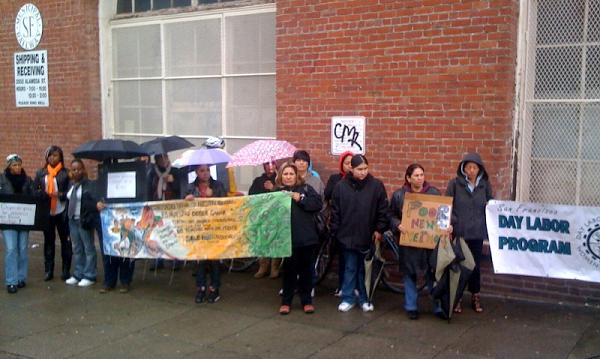
Every day, on my bike ride to work, I see the day laborers lined up along Alameda Street across from the U-haul office, hoping to get work. It’s a great little community, full of friendly people (mostly Latino men, but sometimes a couple young African-Americans as well), and they wave, smile, and try to get me to jingle my bell or honk my horn at them as I pass, which I always oblige.

But a couple months ago, the scene changed. Police officers now show up more often to hassle the day laborers, often demanding they clear the street. So they linger on adjacent streets, still trying to make themselves available for work, but clearly intimidated and wary of getting busted.

Well today, the workers pushed back, with the help of La Raza Centro Legal’s Day Laborer Program and nearly 100 supporters, who came to chant and protest a new U-Haul manager who they say constantly harasses them and calls the police three times a day. That manager, who was chatting with two cops at the scene, refused to identify himself or speak with me, referring me to their corporate flak (who hasn’t returned my call).

Anecdotally, we’ve heard that day laborers around the city have been rousted by police far more often in recent months, just one more of the SFPD crackdowns under new Police Chief George Gascon, which include raids on pot growers in the Sunset, mass arrests in the Tenderloin, regular raids of underground parties in SoMa, and lots more citations for drinking in Dolores Park and other parks.

The heart of art

0

arts@sfbg.com

DANCE In 1960, San Francisco City Hall’s glorious staircase became infamous when police turned fire hoses on protesters at a hearing of the House Un-American Activities Committee. Fifty years later, these same stairs will become the stage for a very different event: Erika Chong Shuch Performance Project’s Love Everywhere, a celebration of love and marriage equality.

Chong Shuch had never heard of the protest incident when Dancers’ Group commissioned her as part of its ONSITE initiative — free performances in public spaces that offer artists the opportunity to create something otherwise not possible (Joanna Haigood, Patrick Makuakane, and Anna Halprin are previous participants; Benjamin Levy is next). When Chong Shuch received the grant, she was asked to consider the Civic Center area as a possible site.

She first looked at the San Francisco Public Library, but upon walking into City Hall she was struck “by the beauty of the architecture of this public space that belongs to everybody living here.” She knew she wanted to make a work about “love and joy and the big things in my life as opposed to the difficulties.” Deciding on a Valentine’s Day piece, she was reminded that Feb. 12 is the sixth anniversary of when the city started issuing marriage licenses to same-sex couples. That sealed the deal.

“I remembered how incredibly joyous it was to be in that City Hall space at the time, and I was inspired to try to generate that kind of joy,” she recalls.

You certainly couldn’t miss the love and joy in the couple dances, spiraling chains, and whirling circles practiced at a recent rehearsal in the Margaret Jenkins Performance Lab. Fifty or so performers (“At this point, I am not sure myself of how many,” she says) answered Chong Shuch’s call for volunteers to join her octet of professional dancers. These folks — primarily young, but with a gray head or two — were having the time of their lives.

Two also had a surprise awaiting them. In addition to calling for volunteers, Chong Shuch sent out a request for marriage vows that people had written for each other. She received around 30, ranging from “African ceremonial” to “quirky and artsy” and “formal, God-ly.” These vows form the texts for Love. One became the basis for a call-and-response: “I promise to pay close attention; I promise to listen.” But one couple recognized lyrics from a Daveen DiGiacomo song composed for the piece — because they had selected them for their wedding. “It’s a lovely way for this couple to have their own vows reflected back to them,” Chong Shuch says.

Using amateur performers — “I don’t like to call them that, I prefer to simply call them people” Chong Shuch says — seems to be something of a trend among Bay Area choreographers. Joe Goode, Janice Garrett and Charles Moulton, and Chong Shuch in her 2008 After All have done it successfully. It’s a way to fill large spaces where the added numbers often serve as choruses, but it’s also a sign of what might be called an attempt to “democratize” dance.

For Chong Shuch, this means thinking differently about her own role as choreographer. Just as she increasingly seeks her professional dancers’ input, she also thinks that “regardless of their training or lack thereof, individual expressions are still of value and of worth” — and, therefore, have a place on stage.

LOVE EVERYWHERE

Fri/12, noon–1 p.m., free

San Francisco City Hall Rotunda

One Dr. Carlton B. Goodlett Place, SF

Sat/13, performances TBA (check Web site for updates)

Sun/14, 9 a.m. and 11 a.m., free

Glide Memorial Church

330 Ellis, SF

www.dancersgroup.com, www.erikachongshuch.org

Alerts

0

alerts@sfbg.com

THURSDAY, FEB. 11

Let BART know


Protest the upcoming BART Board meeting, which follows BART attorney Dale Allen’s announcement that BART intends to "vigorously fight [a lawsuit brought by friends of Oscar Grant] based on their contributing actions to the tragic accident." Ex-BART police officer Johannes Mehserle is being tried for murder in the case.

9 a.m., free

Kaiser Center

20th St. Mall, third floor

344 20th St., Oakl.

indybay.org/oscargrant

Responding to Mein Kampf


Attend this exhibit by French artist Linda Ellia, where pages of Hitler’s book Mein Kampf (My Struggle) have been transformed by artists, youths, and citizens into transformative artistic responses to the text creating a new book, Notre Combat (Our Struggle).

11 a.m., $10

Contemporary Jewish Museum

736 Mission, SF

(415) 655-7800

She wrote it


Attend the first lecture in the Radical Women’s 2010 Feminist Theory Series for a discussion with author and socialist feminism pioneer Clara Fraser on her book Revolution, She Wrote.

7 p.m., free

Radical Women

625 Larkin, Suite 202, SF

(415) 864-1278

V-Day East Bay


Celebrate the diversity and strength of local women at this performance of Eve Ensler’s play The Vagina Monologues starring local women. Proceeds benefit global women’s organizations.

8 p.m., $10

La Peña Cultural Center

3105 Shattuck, Berk.

(510) 849-2568?

Eat right


Dine and do good. Pick up a copy of Young Workers United 2010 Restaurant Guide to Guilt-Free Eating, which recognizes restaurants in San Francisco that provide good working environments and delicious food.

6:30 p.m., $5–$10 suggested donation

Women’s Building

Audre Lorde Room

3543 18th St., SF

(415) 621-4155

FRIDAY, FEB. 12

Black Rock


Attend this screening of the Kevin Epps film, The Black Rock: The Untold Story of the Black Experience on Alcatraz, which chronicles the role of African Americans in the history of Alcatraz.

8 p.m., $6

Artists’ Television Access

992 Valencia, SF

www.blackalcatraz.com

SATURDAY, FEB. 13

Save Stowe Lake Boathouse


Enjoy free festivities and snacks for the whole family at this historic boathouse building and help send a message to the SF Recreation and Park Department that you oppose the take-over of the top floor of the boathouse for an indoor, privately-owned restaurant. Rain cancels.

11 a.m., free

Stowe Lake Boathouse

Golden Gate Park

50 Stow Lake Drive, SF

www.savestowlake.org

TUESDAY, FEB. 16

MTA Not ATM


Protest Muni’s service cutbacks and fee hikes at this rally and press conference preceding a 2 p.m. MTA board meeting. Demand that the city implement progressive taxes instead of "taxing" the people who rely on Muni to get to work.

1 p.m., free

Steps of City Hall

1 Dr. Carlton B. Goodlett Place, SF

(415) 821-6545

Mail items for Alerts to the Guardian Building, 135 Mississippi St., SF, CA 94107; fax to (415) 255-8762; or e-mail alert@sfbg.com. Please include a contact telephone number. Items must be received at least one week prior to the publication date.

Alerts

0

WEDNESDAY, FEB. 3

No time to let up

Help raise money for the earthquake victims in Haiti at this fundraiser lunch and dinner where 100 percent of the proceeds go to the 3 million people in need of aid. Sen. Leland Yee (D-SF, San Mateo), SF Assemblywoman Fiona Ma, and Betty Yee, chair of the state Board of Equalization will be on hand.

Lunch 11 a.m.–3 p.m.;

dinner 5 p.m.–9 p.m.; $20 minimum

Moonstar Buffet Restaurant

383 Gellert, Daly City

(650) 992-2888

THURSDAY, FEB. 4

La Pelanga por Haiti

Help raise money for Partners in Health, an aid agency with more than 20 years’ experience in Haiti and more than 4, 000 Haitian employees, at this community street party featuring DJs Posoule, Papicultor, China tu Madre, and Juancho 3000 spinning cumbia, salsa dura, dancehall, hip-hop, Haitian kompa, and more. East Oakland artist Favianna Rodriguez will be selling prints; 100 percent of proceeds will be donated.

9 p.m., $5–$20 donation

Sub-Mission Arts

2183 Mission, SF

lapelanga.com

BayNVC workshop

Learn how to be a resource for your community at this workshop with Miki Kashtan from the Bay Area Nonviolent Communication and North American Leadership programs. Brush up on skills like how to stay present in a challenging situation and how to reflect understanding during conflict.

4:30 p.m., free

First Congregational Church of Oakland

2501 Harrison, Oakl.

(510) 433-0700 to register

Stand with Haiti

Attend “Stand with the People of Haiti: What the U.S. Government Isn’t Telling You,” a benefit dinner for Haiti. Pierre Labossiere of the Haitian Action Committee will discuss how U.S. policies contribute to chronic malnutrition and poverty in Haiti. The event is a Black History Month forum sponsored by the ANSWER Coalition.

7 p.m., $10–$20 donation

Centro del Pueblo

474 Valencia, SF

(415) 821-6545

SATURDAY, FEB. 6

Get on the march

Attend this organizing meeting for the March 20 antiwar protest in San Francisco. The meeting is open to all antiwar organizations and individuals and will be followed by mass outreach. A Jan. 9 meeting approved a plan for the protest to begin at Civic Center and march to downtown hotels in solidarity with the Local 2 hotel workers.

2 p.m., free

Centro del Pueblo, 2nd floor auditorium

474 Valencia, SF

(415) 821-6545

TUESDAY, FEB. 9

500 Years Later

Watch this award winning documentary directed by Owen ‘Alik Shahadah chronicling the struggle of people of African descent from enslavement through the continued fight for human rights, filmed in more than 20 countries.

7:30 p.m., $6 donation

Artists Television Access

992 Valencia, SF

(415) 821-6545

Mail items for Alerts to the Guardian Building, 135 Mississippi St., SF, CA 94107; fax to (415) 255-8762; or e-mail alert@sfbg.com. Please include a contact telephone number. Items must be received at least one week prior to the publication date.

Building the movement

2

Frustrated by deep cuts to education spending and quality, momentum is building across California in support of the “Strike and Day of Action to Defend Public Education” on March 4.

Students, laborers, and faculty throughout the University of California system are trying to expand on last semester’s organizing efforts by strengthening ties to groups from all tiers of the public education system. But questions linger about the best way to proceed and what exactly the event should look like.

“I think that the regents and [UC President Mark] Yudof are very fearful of what would happen if the students and workers united. They could be unstoppable,” said Bob Samuels, president of the University Council-American Federation of Teachers (UC-AFT).

That collaboration is exactly what many grassroots organizers are hoping to achieve, although their central message is not limited to participants in the UC system alone. They argue that fee increases and cutbacks at the universities are symptomatic of a greater problem, namely the denigration of free and low-cost public education.

“This emerged as a movement of students and workers at the university level. What we’re doing now is going beyond the UCs,” said Blanca Misse, a graduate student and member of the Student Worker Action Team (SWAT).

By reaching out to members of preschool, K-12 public school, community college, and California State University communities, organizers hope to turn March 4 into a rallying moment for the entire public education system in the state. Organizers also want to ensure that the UC system isn’t funded at the expense of other institutions of public learning.

“We need to be fighting for money and political power,” Misse added. “The committees need to mobilize all of the fighting sectors and show them our strength.”

At the Jan. 17 meeting of the Berkeley March 4 organizing committee, one of many ad hoc groups set up across the state, a gathering of about 35 union members, graduate students, community activists, and undergraduates discussed what the day should look like locally. They also reported back on their attempts at organizing the local community, including garnering union support and reaching out to high school students.

Javier Garay noted that at a meeting of the Oakland Education Association, a union of public school workers, “89 percent of the nearly 800 attendees voted in solidarity with the March 4 Day of Action, possibly including a strike.”

Yet the most heated discussions centered on how to unite the interests and power of the university population behind the broader fight for public education funding.

During the meeting, Tanya Smith, president of the local chapter of the University Professional and Technical Employees union (UPTE), stressed the importance of “not being an ivory tower” by extending activism “beyond Berkeley’s campus and reaching out to the political center in Oakland.”

Student activist Nick Palmquist, a fourth-year development studies student at UC Berkeley, admitted that the “tuition issue” is a big motivating factor for college students. At the same time, he noted, “Students have a lot of potential to see the bigger picture. We’re trying to expand the consciousness of the movement.”

That movement stretches back to the beginning of the school year, when students realized that Yudof and the Board of Regents were planning on making up for the $814 million budget cut from 2008-09 and the additional $637 million cut in 2009-10 with layoffs, furloughs, and a possible fee hike.

On Sept. 24, 2009, groups organized strikes and walkouts across the University of California system, including an estimated 5,000-person protest in the legendary Sproul Plaza at UC Berkeley.

Exactly one month later, several hundred people gathered on the Berkeley campus for the Mobilizing Conference to Save Public Education. According to the invitation, the purpose of the conference was “to democratically decide on a statewide action plan capable of winning this struggle, which will define the future of public education in this state, particularly for the working-class and communities of color.”

After an intense day of discussion, the body voted to establish March 4 as a “statewide strike and day of action.” Though it remains unclear how the different interests would come together (the call left demands and tactics open for debate), the message was clear: to save public education, diverse groups need to stand together cohesively.

Tensions escalated dramatically in November when the regents approved a 32 percent fee increase. At UCLA, where the regents held the meeting, an estimated 2,000 students gathered in demonstration and protest.

UC Berkeley student Isaac Miller told the Guardian, “I think we left there feeling like even though the fee increase went through, this is a long-term fight. It was really empowering to connect to students from all over the UC community.”

Meanwhile, a three-day protest at UC Berkeley culminated in a day-long occupation of Wheeler Hall on Nov. 20. As the protesters outside multiplied in support of the occupiers, they expressed solidarity with their causes as well as anger at the fee hike.

Callie Maidhof, a graduate student and spokesperson for the occupiers, said at the time, “One of the reasons behind this particular action is that students realized that not only is the state an unreliable partner, so is the administration. The only thing students can do at this point is reach out to each other.”

Maidhof was referring to a frequently repeated refrain from the regents and Yudof: “The state is an unreliable partner.” They argue that their hands are tied by the budget shortfall and the UC system has to figure out ways to sustain itself apart from increasingly erratic state funding. “The message is if the state fixes the budget, all our problems will be over,” said Mike Rotkin, mayor of Santa Cruz and a former lecturer at UC Santa Cruz.

So when a Jan. 21 San Francisco Chronicle article (“Regents to Back UC Students’ Protest at Capitol”) reported that the regents and Yudof agreed to stand alongside the students in Sacramento on the March 4 Day of Action, many were shocked and angered. “This is a complete turn-around for them,” Palmquist said. “They were never in support of our efforts. But now they feel threatened and they also feel like they can capitalize on them.”

In an open-letter response, several unions wrote back: “This is a cynical publicity stunt, and we do not buy it.”

Victor Sanchez, president of the UC Students Association (UCSA), said the article misrepresented what Yudof and the Regents said. “The regents and Yudof agreed to participate with students on a separate March 1 day of activism, not March 4,” he said. Calls and e-mail to Yudof’s office to confirm were unreturned at press time.

Sanchez explained that the March 1 activities are the culmination of UCSA’s annual Student Lobbying Conference, which takes place in Sacramento from Feb. 28–March 1. Its actions focus primarily on lobbying the Legislature. That approach is more in tune with the administration’s message that the problem lies in Sacramento.

UCSA’s demands include increasing funding for higher education by $1 billion, creating alternative sources of revenue through comprehensive prison reform, preserving the California grant program, and passing Assembly Bill 656.

Sponsored by Assembly Majority Leader Alberto Torrico (D-Fremont), AB 656 would place a severance tax on oil companies and divert revenues toward higher education. “It is strategic for us to focus resources in Sacramento, because that’s where the negotiations are happening,” Sanchez said. “But we also understand that we’re fighting a two-front war and need to hold both the Legislature and the administration responsible.

“At the end of the day, it is our event and our day of action,” he continued. “We made it clear we aren’t going to change our demands. We stand in solidarity with the March 4 organizers. We’re all advocating a common goal, and folks are going to apply complementary pressure. Our end goal is prioritizing education, and we need to move forward with that collective mentality.”

If all this seems confusing, that’s because it is. The groups that have formed in reaction to cuts to public education are numerous, amorphous, and have slightly different agendas. Some subscribe to the position that the fault and solution primarily rests in Sacramento, while others argue that the administration and appointed, rather than elected, regents are to blame. Most agree with Sanchez that both are part of the problem.

As community organizers build toward March 4, it is clear that the day will be significant. The real question is, if students can maintain their momentum and their newfound network with other sectors of public education, what will happen on March 5 and beyond?

Big Brother Obama

0

The Federal Bureau of Investigation illegally collected thousands of telephone records between 2002 and 2006, a Jan. 20 Justice Department report revealed. Senate Judiciary Committee Chairman Patrick Leahy (D-Vt.) publicly scolded FBI Director Robert Mueller for the transgression, but the practice of secretly spying on Americans’ international communications has become standard practice, even under the new presidential administration.

In late 2005, The New York Times exposed how the George W. Bush administration authorized the National Security Agency (NSA) to spy on Americans’ e-mails and phone calls without then-required court orders. The scoop prompted retired AT&T technician Mark Klein to reveal the existence of a NSA-controlled secret room at a San Francisco AT&T facility, providing undisputed proof of this public-private spy operation and the extensive amount of personal data that is collected.

Not only was no one held accountable, but the Democrat-controlled Congress legalized the operation after the fact by passing the Foreign Intelligence Surveillance Amendments Act (FISA Amendments Act) in 2008. Klein responded last year with the self-published book Wiring Up the Big Brother Machine … And Fighting It to narrate his version of the civil liberties and privacy battle.

The creeping intrusion on Americans’ privacy continues unabated under the Obama administration, according to government watchdog groups and media pundits. “Things have changed slightly — for the worse,” said Rebecca Jeschke from the Electronic Frontier Foundation (EFF).

Barack Obama, while still a Senator, hinted what his later inclination might be when he voted for the FISA Amendments Act, arguing that it was needed to foil terrorist plots (after having previously stated his intention to oppose the bill). Now that the legislation is law, his administration is using the same rationale as its predecessor to fend off attempts to repeal it, namely that it is crucial to national security.

Yet the EFF and the American Civil Liberties Union (ACLU) deem the practice and the legislation that authorized it to be unconstitutional. They’re challenging it in courts but having a difficult time in light of executive branch opposition and national security claims.

The 1978 Foreign Intelligence Surveillance Act (FISA) was originally crafted to constrain and oversee the government’s spying activities on Americans after the Nixon administration abused its power to eavesdrop on Vietnam War protesters and political adversaries.

FISA required officials to obtain from a judge individual warrants with specific named individuals or specific phone numbers before it wiretapped phone calls or read e-mails in the U.S. Outside the borders, spying remained unrestricted. The FISA Amendments Act subtly blurs those lines and leaves loopholes whereby the government can intercept U.S. residents’ communications without having to notify the FISA court.

Under the new protocols, the FISA court can authorize NSA to conduct surveillance on U.S. soil as long as the target isn’t American and is “reasonably believed” to be located abroad, no matter who the interlocutor may be, foreigner or American. When information is incidentally collected on American citizens, “minimization procedures” are designed to prevent the unnecessary retention or dissemination of such information.

“Now under the new law, the FISA court is looking at bulk surveillance under which the government doesn’t specify who it’s going to wiretap, which phone numbers it’s going to monitor, or which e-mail addresses it’s going to surveil. All the government has to say to the court is that the targets of its surveillance are overseas. Once the government has said that, the court just checks a box and grants permission. So insofar as Americans engage in international communications, this is a law that gives the government carte blanche to monitor those communications,” explained ACLU National Security Project Director Jameel Jaffer.

Civil liberties advocates say this unchecked eavesdropping power violates the Fourth Amendment, which protects against unreasonable searches and seizures. Yet the Obama administration is “aggressively defending the FISA Amendments Act,” Jaffer said. It is arguing that the courts don’t even have a role in evaluating the constitutionality of the government’s surveillance activities.

A brief filed by the Justice Department in January 2009 maintains that the FAA “strikes a reasonable balance between the critical intelligence it serves and the privacy interests of Americans it indirectly affects,” and that “plaintiffs’ arguments from the start have rested on speculation and surmise.” In short: trust in the government’s good faith for not abusing its power.

Another worrisome aspect of the FISA Amendments Act is the immunity from liability it retroactively granted to telecommunications carriers that assisted the government in carrying out its warrantless wiretapping program before Congress consented to it.

In January 2006, Klein gave EFF critical engineering documents proving that AT&T, his former employer, let NSA access its 611 Folsom St. office building to tap into its Internet data flow to duplicate it and send it to a secret room the agency controlled. That included e-mails, Web browsing, voice-over Internet Protocol (VoIP) phone calls, pictures, and streaming video, be they international or domestic.

Thanks to this installation, anything transmitted on the AT&T network was swept by the NSA. And there were clues that the San Francisco secret room was just one in a series set up all over the country. In his book, available on Amazon, Klein gives an account of his personal protest and involvement in the case spearheaded by EFF against AT&T.

Klein tells how he figured out what the San Francisco room was about, how he struggled to get the story out, and how he tried in vain to inform Congress. But following approval of the FISA Amendments Act, the lawsuit was dismissed in June 2009, along with 32 other similar cases brought by customers against their telecommunications service providers.

“The surveillance system now approved by Congress provides the physical apparatus for the government to collect and store a huge database on virtually the entire population, available for data mining whenever the government wants to target its political opponents at any given moment — all in the hands of an unrestrained executive power. It is the infrastructure for a police state,” he wrote. According to his sources, the equipment is still in place. Security even has been beefed up at the Folsom Street building where he used to work: the entrance to the entire floor where the diversion device is inserted is now restricted.

EFF is appealing the dismissal of the AT&T lawsuit, arguing that the communications companies’ amnesty is unconstitutional in that it grants to the president broad discretion to block the courts from considering the core constitutional privacy claims of millions of Americans. Officials with the Justice Department told us they wouldn’t comment because of the ongoing litigation.

In the meantime, the current judicial and legal gridlock is barring the public from reviewing what took place under the Bush administration and what is going on right now. Can our communications channels be trusted? Klein says he won’t be appeased unless the equipment is torn out.

DEIR in the headlights

0

GREEN CITY Public comments on the city’s draft environmental impact report (DEIR) for Lennar Corp.’s massive redevelopment proposal on Candlestick Point and the Hunters Points Shipyard includes complaints that the comment period was too short (see “The Candlestick Farce,” 12/23/09), concerns that the city violated state requirements to notify the Ohlone Tribe, and frustration that the city’s preferred plan represents the most significant and substantial impacts of any of the five scenarios analyzed in the DEIR.

These and many other concerns about the impacts of the 10,500-home project will need to be addressed in the final EIR, which Mayor Gavin Newsom and other project proponents expect to be completed by June.

Some object that the city is considering an early transfer of the shipyard and would undertake activities that are currently the Navy’s responsibility (see “Eliminating Dissent,” 06/17/09), saying the final EIR should prominently reference Proposition P, which voters approved in 2000, establishing community acceptance criteria for the cleanup.

Saul Bloom, executive director of Arc Ecology, submitted his organization’s comments “under protest for the inadequate extension of the public comment period, which we believe unfairly penalizes the public review of the draft EIR.”

Land use attorney Sue Hestor called the public comment submission schedule “abusive” in comments submitted for POWER (People Organized to Win Employment Rights). “The schedule is being driven by an insane desire to have the final EIR certified and all local approvals done by June,” Hestor said.

Ohlone chairperson Ann Marie Sayers and Neil MacClean of the Ohlone Profiles Project wondered why the Planning Department did not contact anyone on the city’s list of official Ohlone representatives. “We want the SF Planning Department to follow Senate Bill 18, which requires them to include Ohlone people in the planning process,” MacClean said, noting that there are at least four Ohlone villages within the proposed development area.

Jaime Michaels, coastal program analyst for the San Francisco Bay Conservation and Development Commission, expressed concerns about the DEIR’s proposal to make a 23.5 acre reduction in existing state park boundaries (see “Can I buy your park?” 08/12/09).

Project proponents, Michaels said, “would need to demonstrate that the decreased area would not compromise or reduce its value as a park/beach facility.” Michaels also worries about the impact of adding a minimum of 1.7 acres of fill in the bay to accommodate a bridge at Yosemite Slough, a plan she described as “a significant amount of coverage, particularly for a facility where the large majority of its coverage is needed to serve vehicles accessing the new stadium only 12 days a year.”

Michaels expressed concerns that the project’s plans to address sea level rise would negatively affect bay views and public access to the shoreline.

The project includes a 9.6-mile trail and a variety of other public amenities directly adjacent to the shoreline. Proposed building structures located away from the immediate shoreline would accommodate a 36-inch sea level rise by 2075, and the DEIR promises to employ adaptive management strategies along the perimeter beyond 2050.

“Unfortunately, partly due to illegibility and the scale of the drawings, it is difficult to assess precisely how these adaptations would appear,” Michaels observed. “However, it can be assumed that over time levees would need to be raised and likely widened at the base, thereby partly or entirely obstructing the public’s view of the bay from inland areas, encroaching on and reducing the area devoted for public use and impacting the overall public access experience.”

Arc Ecology discussed the DEIR’s failure to provide a comprehensive sustainability plan, address adjacent development projects, justify a 49ers stadium on the shipyard, or evaluate the potential for the development of port-related heavy industrial activities.

“The city is determined to get this project passed right now, and the developer is afraid that if someone else comes along as mayor and District 10 supervisor, they may not be as sympathetic,” Bloom said. “But the project — as outlined in the DEIR and the city’s way of approaching the deal — is against the interests of San Francisco.”